
CHAPTER XIV
C. XIII. § 83-C. XIV. § 84] MISCELLANIES, BOOK VII.
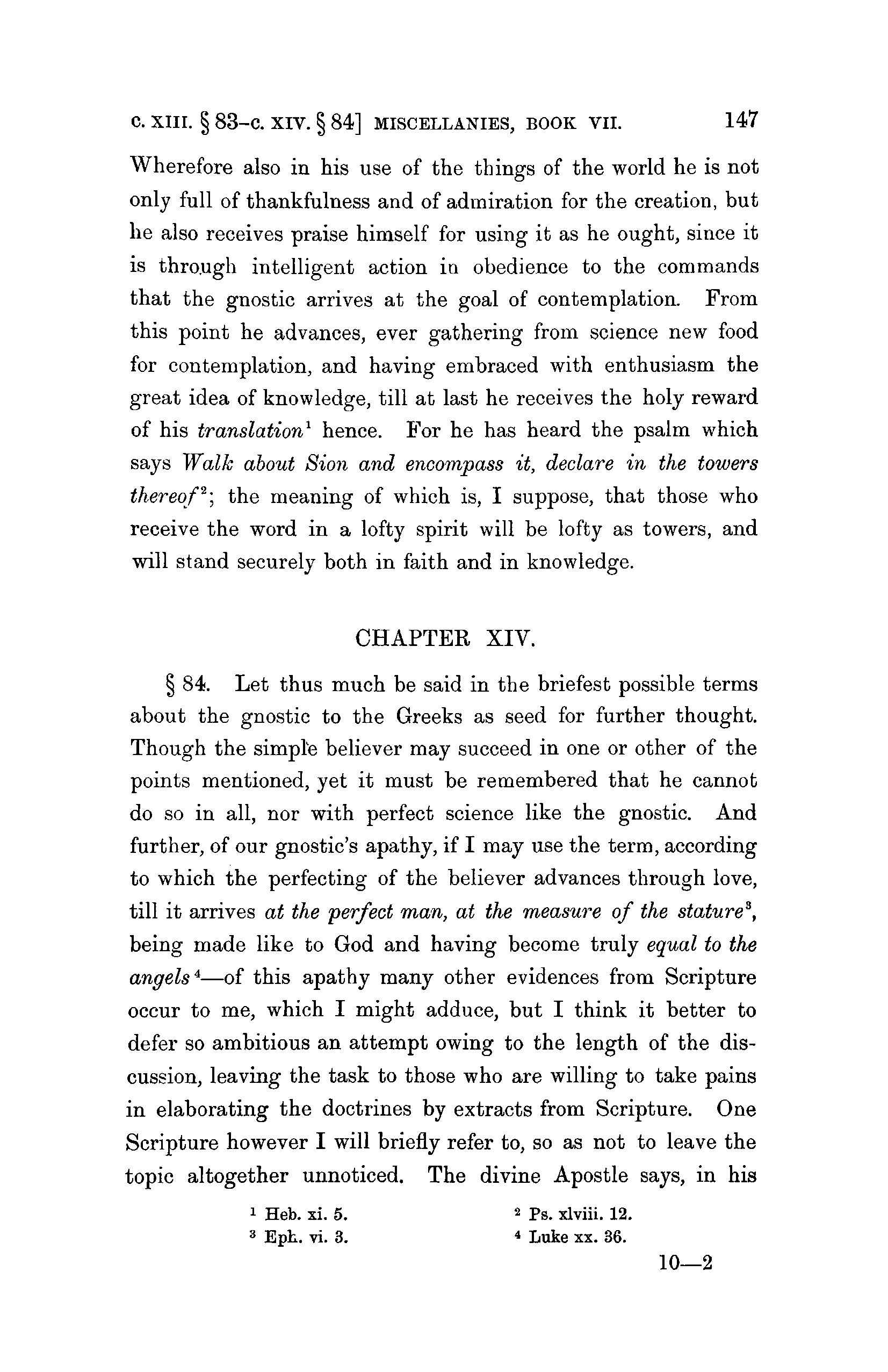
Wherefore also in his use of the things of the world he is not only full of thankfulness and of admiration for the creation, but he also receives praise himself for using it as he ought, since it is through intelligent action in obedience to the commands that the gnostic arrives at the goal of contemplation. From this point he advances, ever gathering from science new food for contemplation, and having embraced with enthusiasm the great idea of knowledge, till at last he receives the holy reward of his translation1 hence. For he has heard the psalm which says Walk about Sion and encompass it, declare in the towers thereof2; the meaning of which is, I suppose, that those who receive the word in a lofty spirit will be lofty as towers, and will stand securely both in faith and in knowledge.
CHAPTER XIV.
§ 84. Let thus much be said in the briefest possible terms about the gnostic to the Greeks as seed for further thought.
Though the simple believer may succeed in one or other of the points mentioned, yet it must be remembered that he cannot do so in all, nor with perfect science like the gnostic. And further, of our gnostic's apathy, if I may use the term, according to which the perfecting of the believer advances through love, till it arrives at the perfect man, at the measure of the stature3, being made like to God and having become truly equal to the angels4—of this apathy many other evidences from Scripture occur to me, which I might adduce, but I think it better to defer so ambitious an attempt owing to the length of the discussion, leaving the task to those who are willing to take pains in elaborating the doctrines by extracts from Scripture. One
Scripture however I will briefly refer to, so as not to leave the topic altogether unnoticed. The divine Apostle says, in his
1 Heb. xi. 5.
2 Ps. xlviii. 12.
3 Eph. vi. 3.
* Luke xx. 36.
10—2 https://doi.org/10.1017/CBO9780511695513.010 Published online by Cambridge University Press
ITPQMATEftN Z'
[p. 883, s. 318
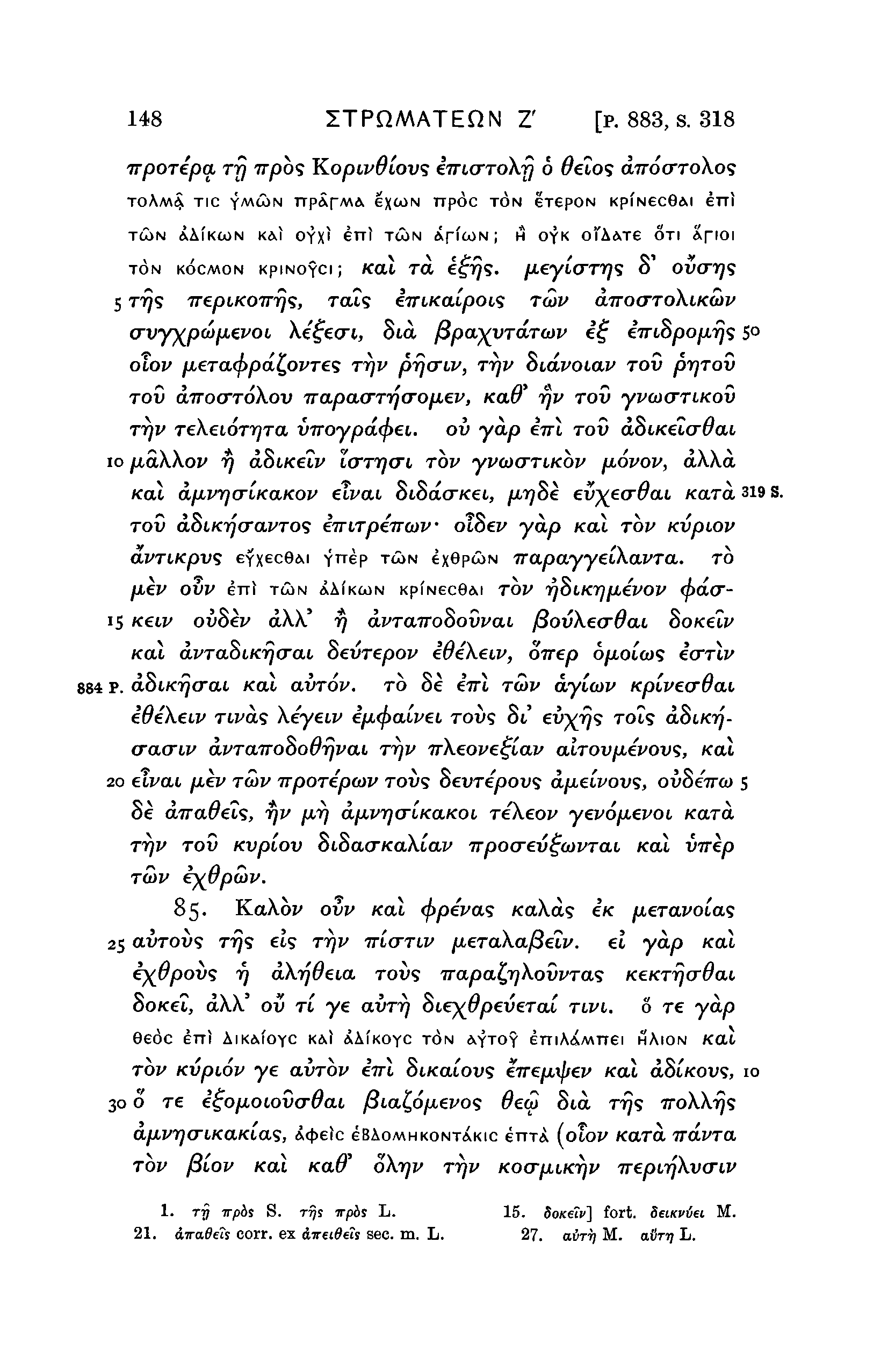
TrpoTepa Trj npbs KopwOiovs enio-ToXr) 6 Oeios aTrocrroXo?
TOAM§ TIC YM^>N npArMA e\u>N npoc TON eTepoN KpfNec6&i eni
TCON AAIKOON KAI OYX' en! TCON & P « N ;
H OYK ofA&Te OTI Afioi TON KOCMON KpiNoyci; /cat r d e^Tjs.
/Aeytcrr^s S' oucnjs 5 T17S TrepiKOTTTJs, rats imKaLpois TWV airoaToXiKaiv (rvy)(j}(i>[J<evoi, Xe^ecrt, Stct ^pa^yTdrcov i£ iirthpo^s 5° otoi/ ix.eTa<f>pd£tovT£'S TTJV pfjcriv, TTJV hiavotav
TOV prjTov TOV CLTTOO-TokoV TTapa<TT7]O-OfieV, KCtff 7)V TOV yVOiCTTLKOV Tr)v reXeior^Ta v-rroypa<f>ei. ov yap inl TOV dSt/ceto-#ai
10 fiSXXov rj aSiKelv XarTiqo-i TOV yvoyaTiKov [JLOVOV, aXXa.
/cat a.fivrjO'iKaKov elvai StSacr/cet, /Mr/Se eu^ecr^at /caret 319 s.
TOV a&LK7Jo~avTO<s eiriTpeTTCov olSev yap /cat TOV Kvpiov fxecOM yTTep TCON exOpcoN TrapayyetkavTa.
TO ovv en] TLJN AA(KWN KpfNece^i TOV rjSucrjfievov <f>do~- 15 Keiv oiSev aXk' fj avTavoSovvai /3ov\eo~6aL hoKelv /cat dvraSi/ajcrat SeuTepov edekew, oirep ofioiwi £O~T\V 884 p. dSi/crjcrai /cat avrov.
TO 8e eVt Ttav ayioyv Kplvecrdai eOekeiv Tivas Xeyeiv ifjicfaaCvet, rous St' e u ^ ? Tot? dSt/07craariv avTaTrohodrjvai TTJV TrXeove^lav atrovjiieVovs, Kat
20 eivai fxev TCOV irpoTepwv rovs Seurepov? d/ietvovs, ovSeirco 5 Be a/iradels, rjv /xr) ajxv"qo~iKaKoi TeXeov yevofievoi, /caret
T'^i' roC Kvpiov StSacr/caXtav irpoaev^covTai /cat UTrep rwi/ e)(6pa>v.
85.
KaXw o w /cat <f>peva<; /caXd? e'/c jneravotas 25 avrous r^5 ets TTJI' TTIO~TLV jiteraXa/Seti/. et yct/3 /cat e\6pov<; r) aXi]dei,a TOV<S irapa^r}XovvTa<s KeKTrjadav So/cet, dXX' oil rt ye avr?) Sie^dpeveTaC
TIVL.
O re yap Geoc ETTI AiK^foyc K&i <iAiKOYC T6N &YT°Y ETriA&Mnei HAION Kat TOV Kvpiov ye avTOv eiri St/catous eirejAxfiev /cat dSt/cou?, 10
30 o re i^ofioiovo-daL ^ta{o/ievo§ ^ew Stct r-ij? TTOXX^S a/AV7^o"t/ca/ctas, A<})efc eBAoMHKONTAKic enT& (o?oz/ /caret TrdWa
TOJ' /Stov /cat Kad" oXrjv TT/V Koo-p.iKr)p TrepLrjXvo-i.v 1. r% irpbs S. T?}! Tpbs L.
15. 5o<ce?i'] fort. Scixviei M.
21. d7raSe?s corr. ex &Tei0eh sec. m. L.
27. atfrr; M.
OCTT; L. https://doi.org/10.1017/CBO9780511695513.010 Published online by Cambridge University Press
C. XIV. §§ 84, 85]
MISCELLANIES, BOOK VII.
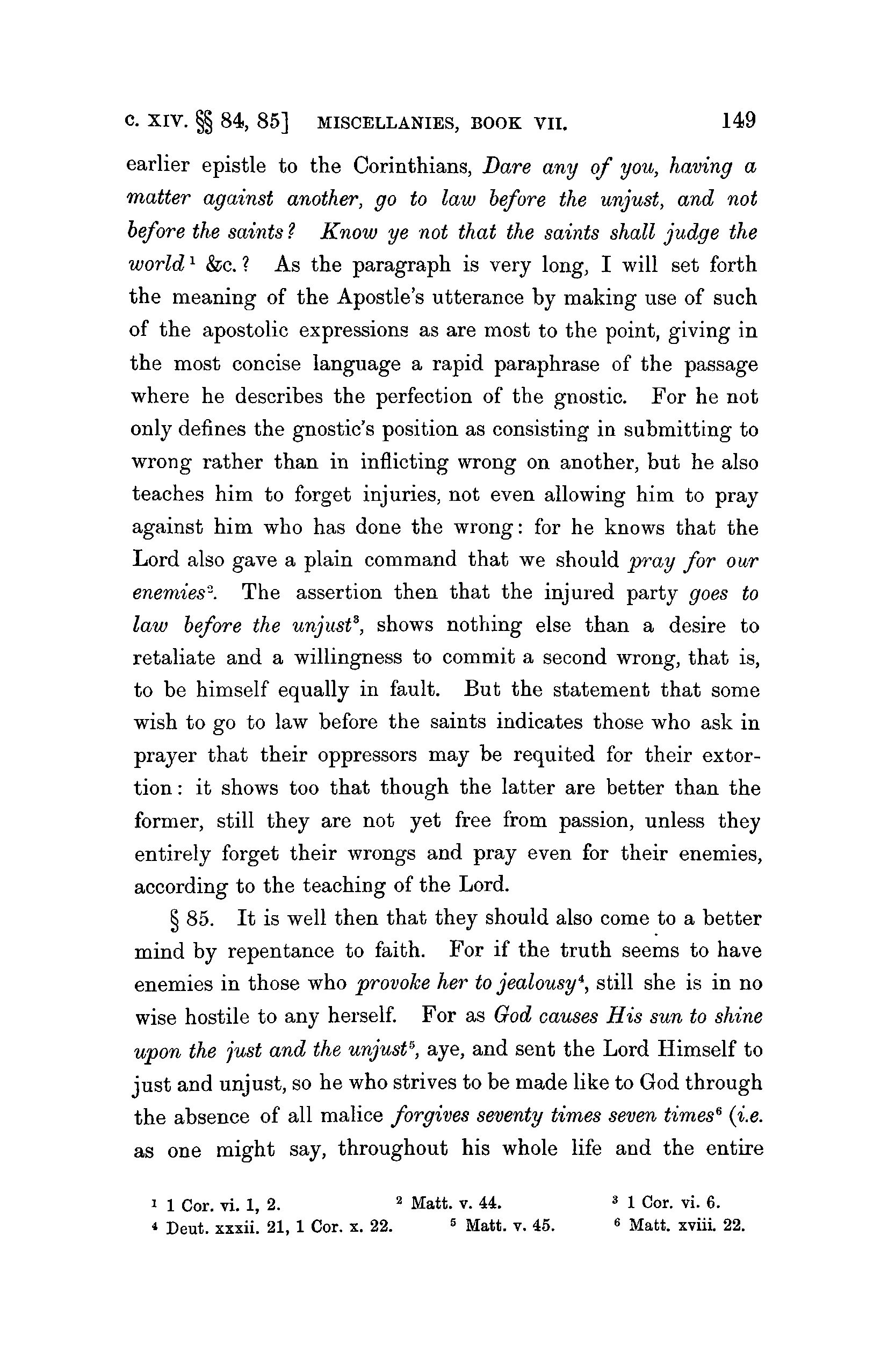
earlier epistle to the Corinthians, Dare any of you, having a matter against another, go to law before the unjust, and not before the saints ? Know ye not that the saints shall judge the world1 &c. ? As the paragraph is very long, I will set forth the meaning of the Apostle's utterance by making use of such of the apostolic expressions as are most to the point, giving in the most concise language a rapid paraphrase of the passage where he describes the perfection of the gnostic. For he not only defines the gnostic's position as consisting in submitting to wrong rather than in inflicting wrong on another, but he also teaches him to forget injuries, not even allowing him to pray against him who has done the wrong: for he knows that the Lord also gave a plain command that we should pray for our enemies". The assertion then that the injured party goes to law before the unjusts, shows nothing else than a desire to retaliate and a willingness to commit a second wrong, that is, to be himself equally in fault. But the statement that some wish to go to law before the saints indicates those who ask in prayer that their oppressors may be requited for their extortion : it shows too that though the latter are better than the former, still they are not yet free from passion, unless they entirely forget their wrongs and pray even for their enemies, according to the teaching of the Lord.
§ 85. It is well then that they should also come to a better mind by repentance to faith. For if the truth seems to have enemies in those who provoke her to jealousy*, still she is in no wise hostile to any herself. For as God causes His sun to shine upon the just and the unjust5, aye, and sent the Lord Himself to just and unjust, so he who strives to be made like to God through the absence of all malice forgives seventy times seven times" (i.e. as one might say, throughout his whole life and the entire
1 1 Cor. vi. 1, 2.
2 Matt. v. 44.
3 1 Cor. vi. 6.
4 Deut. xxxii. 21, 1 Cor. x. 22.
5 Matt. v. 45.
6 Matt, xviii. 22. https://doi.org/10.1017/CBO9780511695513.010 Published online by Cambridge University Press
ZTPQMATEQN Z
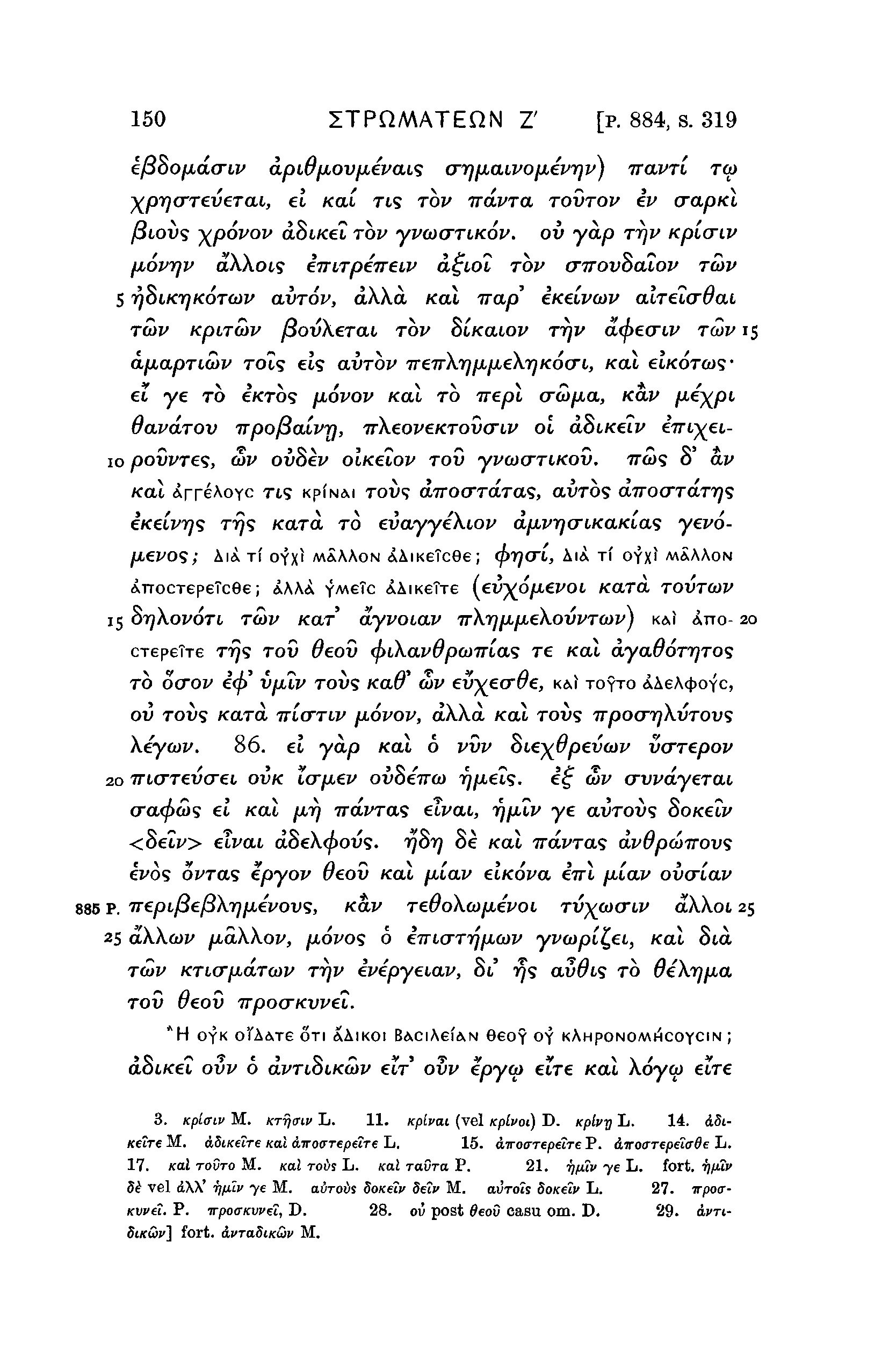
[P. 884, s. 319 efihofxao~iv apiOfiovfievai^ o"r\[xlaivo\iivr\v) iravrl ra Xprjo~TeveT<u, el Kal TIS TOV TTOVTO. TOVTOV iv crap/cl /Sious y^povov dSi/cel TOV yvao'TiKov. ov yap TTJV Kpiaiv fiovrjv dXXois eTTLTpeireLV a£io2 TOV cirovScuov
T£>V S r)8iKr)KOTG)v avTov, aXXa, Kal irap" eKeivcuv aiTe«r#at TWV KpiTOiV /3ovK.€T(U TOV SiKCUOV TTjV a(j>€O~LV TWV a^iapTiuiv TOIS ei5 CLVTOV TrenXrjfx.fjieXriKoo'L, /cat eiKo el ye TO eKTos (JLOVOV Kal TO irepl oS)fJLa, KCLV dava-TOv vpo/3atvrj, irkeoveKTovo~iv ol dSt/ceiV eV io povvTes, chv ovSev ot/ceiov TOV yvoiCTiKov.
77&>s S' av Kal Arre^oyc TIS KP(N<M TOVS dTrocrraras, avros aVocrrdT^s TTJS Kard TO euayyeXiot1 d/Avi^crc/ca/cias yei'd- ; AIA TI o-fxi MAAAON AiiKeTcGe; (f>7]O~i, Ai& Tf oyx'
; &AA«i YMeTc ^AiKeTTe (eu^o/ievoi /caTa 15 SijXoi'dTi T&ii/ Kar' ayvotav irXTj/jifjiekovvTcov) K»,i <ino20 CTeperre T^S TOU ^eou <f)L\.avdpa)TTLas Te Kal ayadoTrjTOS
TO oo~ov e<f>' vfiiv TOVS Kad" 3>v ev^efrde,
K«,( TOYTO AA6A<()OYC,
ou TOUS KaTa TT'IO-TLV \LOVOV, aXkd Kal TOVS irpoo-7]\vTOvs Xeyojv.
86. el yap Kal 6 vvv 8ieyQpevtav vo~Tepov 20 TricrTevcrei OI5K uo-fiev ovSeVa) 1^^615. e^ cwt' crwdyerai o"a<^>ois ei /cat ^17 Trd^Tas etvat, T^JU.II' ye avTovs So/ceti'
<8et^> etvai dSeX<^ous.
17817 Se Kal TrdvTa? avdpanrovi evos (Was epyov deov Kal \iiav eiKova eVl /Aiav ovo-'iav
885 P. TrepiySe^X^jueVous, Kav Te9o\b)jjievoi Tv-^oycnv dXXot 25 25 dXXwi' fjicLWov, /xdvos 6 eTno~T7J[jLCi)v yvcopC^et, Kal Sid
T(ov KTio-jxaTcov Trjv evipyeiav, Si' 17s au^i? TO BeX TOV deov Trpoo-Kvvei.
*H OYK ofA&Te on AAIKOI BACiAefAN 6eoY OY ouv 6 O-VTUSLKCOV CLT' OVV epyw eire Kal Xdyw
Kplaiv M. KTTJaw L.
11. tcplvtu (vel tcpivoi) D. Kp/pg L.
14. 45iKeire M. dSi/ceire xai dTroerTcpeire L.
15. awKMrTepeTre P . bvotrTtpeiaBe L.
17.
KOI TOCTO M.
(cai roi>s L.
/cal ToOra P.
21. ijfuv -ye L. fort. ^/u>> 8£ vel dXX' ^/aij' 7e M. avrois SoKeiv deiv M. avTols Soxelv L.
27. jrpocrKitvei. P. irpo&Kvvu, D.
28. ov post SeoO casu om. D.
29. avnSucwv] fort. 6,vTadtKQv M. https://doi.org/10.1017/CBO9780511695513.010 Published online by Cambridge University Press
C. XIV. §§ 85, 86]
MISCELLANIES, BOOK VII.
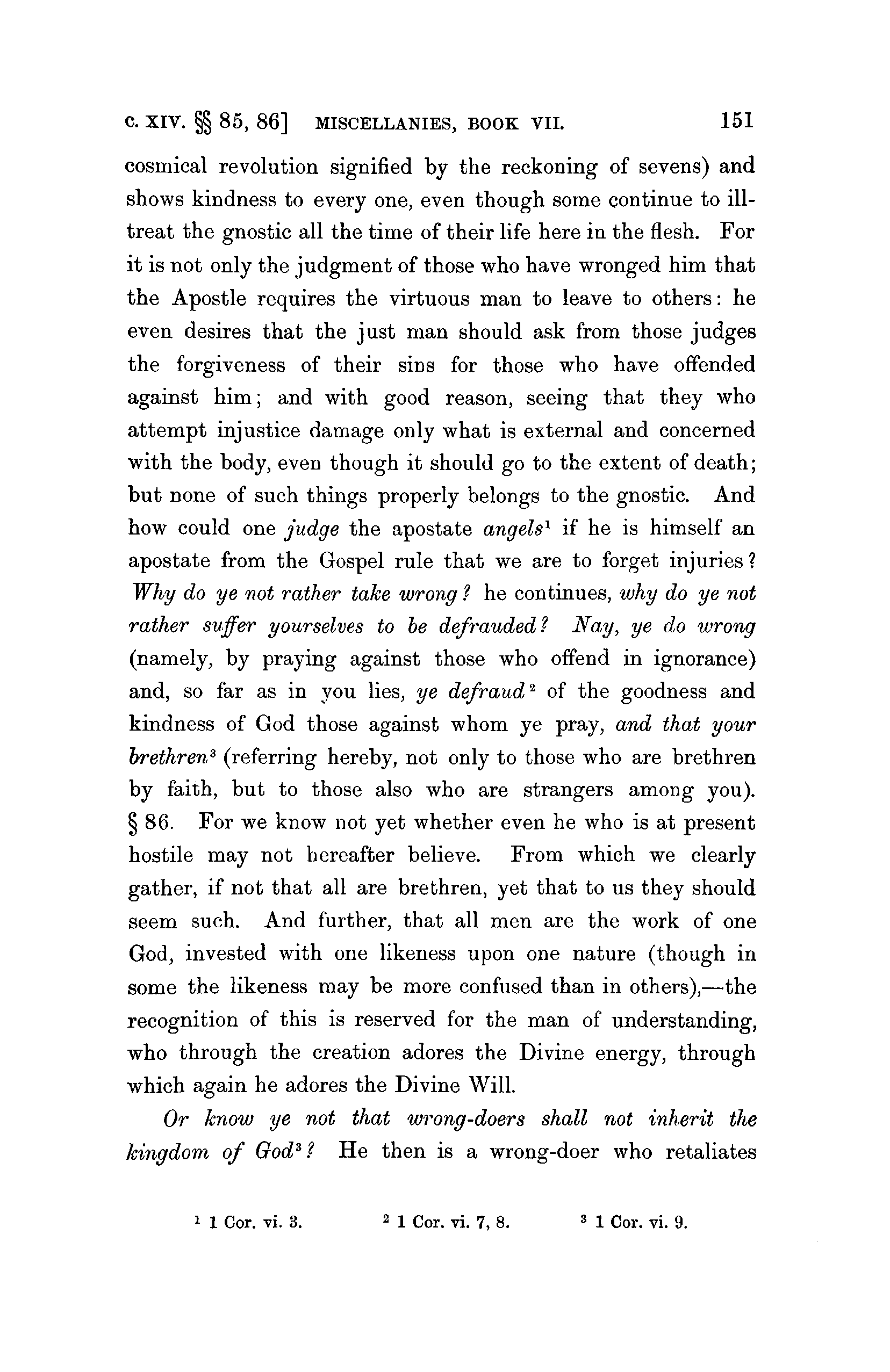
cosrnical revolution signified by the reckoning of sevens) and shows kindness to every one, even though some continue to illtreat the gnostic all the time of their life here in the flesh. For it is not only the judgment of those who have wronged him that the Apostle requires the virtuous man to leave to others: he even desires that the just man should ask from those judges the forgiveness of their sins for those who have offended against him; and with good reason, seeing that they who attempt injustice damage only what is external and concerned with the body, even though it should go to the extent of death; but none of such things properly belongs to the gnostic. And how could one judge the apostate angels1 if he is himself an apostate from the Gospel rule that we are to forget injuries ?
Why do ye not rather take wrong ? he continues, why do ye not rather suffer yourselves to he defrauded? Nay, ye do wrong
(namely, by praying against those who offend in ignorance) and, so far as in you lies, ye defraud'1 of the goodness and kindness of God those against whom ye pray, and that your brethren3 (referring hereby, not only to those who are brethren by faith, but to those also who are strangers among you).
§ 86. For we know not yet whether even he who is at present hostile may not hereafter believe.
From which we clearly gather, if not that all are brethren, yet that to us they should seem such. And further, that all men are the work of one
God, invested with one likeness upon one nature (though in some the likeness may be more confused than in others),—the recognition of this is reserved for the man of understanding, who through the creation adores the Divine energy, through which again he adores the Divine Will.
Or know ye not that wrong-doers shall not inherit the kingdom of God3? He then is a wrong-doer who retaliates
1 1 Cor. vi. 3.
2 1 Cor. vi. 7, 8.
3 1 Cor. vi. 9. https://doi.org/10.1017/CBO9780511695513.010 Published online by Cambridge University Press
ITPQMATEQN Z'
[p. 885, s. 319
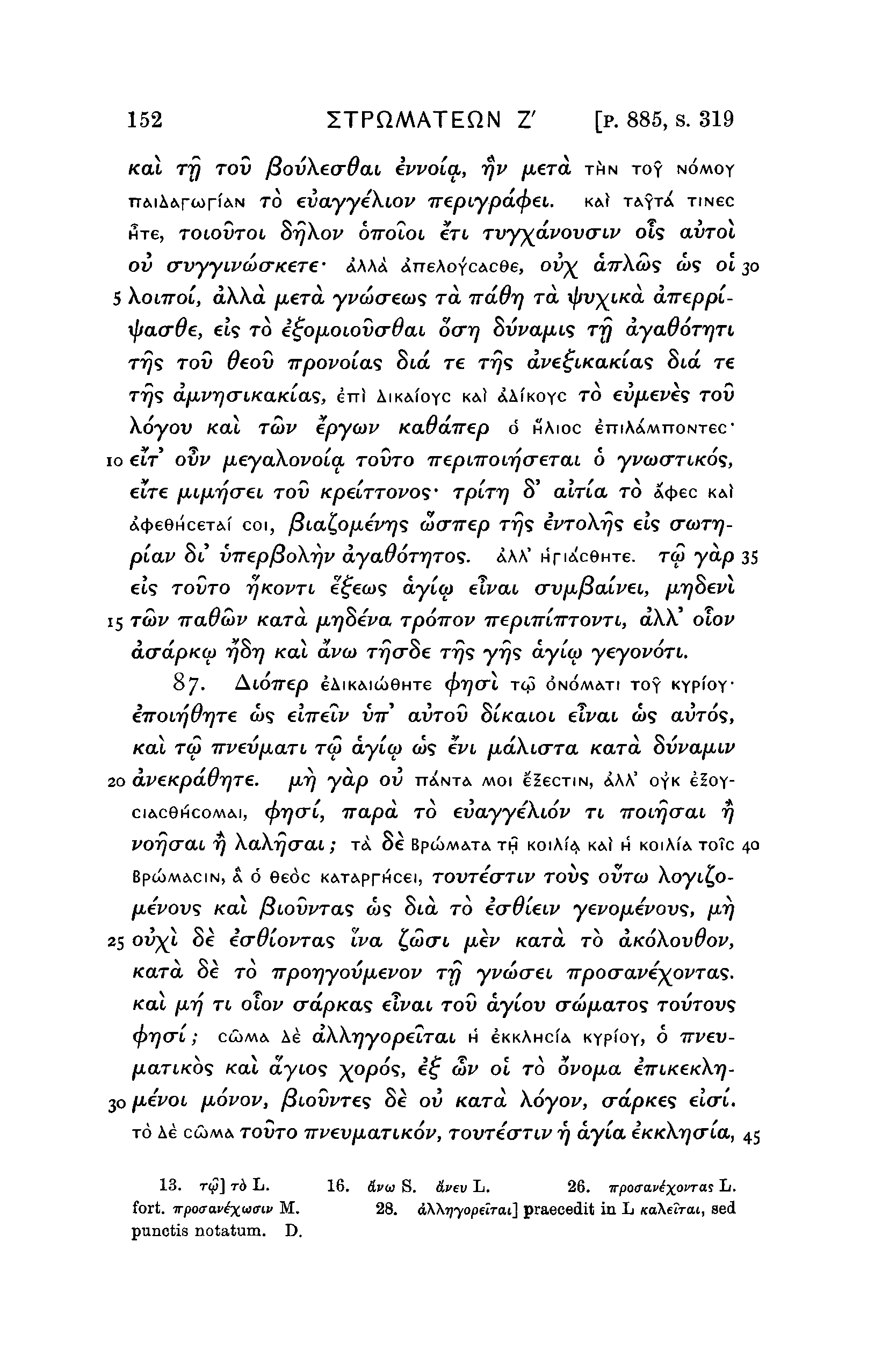
KOLL rfj TOV fiovXeo-6 ai eWota, TJV /xera T&N TOY NOMOY rriMA&r«P*>N TO evayyeKiov Trepiypd<f>eL.
KA? T&YTA TINEC
HT6, TOIOVTOI SrjXoV OTTOLOL CTL TVy)(dvOVO~lV OlS OLVTol ov crvyyivcoo-Kere- &\I\A (ineAoYc&cee, ov^ dirXo>s c!>s ol 30
5 XOLTTOL, ctWa JJ,€TOL yva>o-ea>s ra Trddrj ra \pv)^iKa aT \jjao~6e, ei? TO i^op.OLOVo~6aL ocriy hvvajxis Trj
TOV deov npovoCa<; Sia re T^S aveft/ca«:ia5 Sia TC dfivr/o-iKaKLOL1;, enl AIKA(OYC KA) AA(KOYC TO evfieves TOV
\6yov KCU TWV epycov KaOdirep 6 HAIOC emAAMrroNTec'
10 eir' ovv fieyaXovoia TOVTO TrepiTTOLrjo-eTai 6 yv<oo~TLK6<s, eire [UfArjcreL TOV KpeuTTOvos' TptTt] S' a m a TO A4>ec KA(
A<J>eeHC6T^i coi, /Sta^o/xe'i'^s ajo-irep Trjs ivTo\r)<; ets o~(OTrjpiav Si' vTrepfioXrjv dyadoTt]TO<;. AAA' Hfi^cOHTe.
T<W yap 35 ets TOVTO TJKOVTI Ifews ayiw etvat o-vfjifiaivet,, fJbrjSevl 15 TW^ iraOlav Kara fJbrjBeva Tpoirov irepimTTTOVTi, dXX' oiov ao~dpKa> 17S17 /cai avw TijcSe TTJS y>js aytw yeyoi'OTt.
87.
Aiorrep eAiKMcoBHTe (f>7)O-l T<^5 ONOM^TI TOY KYP?OY' iTTOLfjdrjTe w§ elireiv vif OVTOV Si/catoi elvat <us aurds, /cat TW TTvevfxaTL T(O dyico a5s eVt jLtaXtcrra /caTa
SvvafiLV 20 dveKpddrjTe. fjirj yap ov TTANTA MOI elecTiN, AAA' OYK GIOYCIAC6IHCOM(M, (f>rjo'L, irapd
TO evayyiXiov TL Troirjaai rj V07]o~a.L f\ XaXr]o~cu; T& oe BPCOMATA TH KOIAI^ KA( H KoiAf.\ TOTC 40
N, <\ 6 eeoc KAT^prHcei, TOVT£O~TLV TOUS OUTOJ Xoyt^oKCU /3LOVVTOLS ais Sta TO io~6le.iv yevofievovs, firj 2ov^l Se icrOlovTas Iva tjao~i fx,kv Kara, TO aKoX a Se TO 77porp/ovp.evov TTJ yvcoaei, Trpoo-ave)(ovTa<s.
/cat JU,77 ri 0101/ crap/cas eTvat TOU dytou o-cojxaTo<; TOUTOUS (f>r)o-i; ctoM*. Ae dXXrjyopelTcu H eKKAHcfA KYP?OY, 6 irvevjuariKOS «:at a y i o s x°P°<;> ^
<*>v ol TO ovofjua e7TtKe/cX7j30 /AeVoi fJiovov, ySiowTes Se ov KaTa Xdyoi', o-dpKes etcrt.
TO Ae ctoM& TOOTO irvev/xaTLKov, TovTeo-Tcv r) dyia iKKXrjo~ia., 45 13.
TijJ] T4 L.
16. &va> S. fiyeu L.
26. irpoira.vixOVTai ^-1fort. Trpoo-ai'^wiric M.
28. dWrjyopelTai] praecedit iu L KaXeirai, sed punotis notatum. D. https://doi.org/10.1017/CBO9780511695513.010 Published online by Cambridge University Press
C. XIV. §§ 86, 87]
MISCELLANIES, BOOK VII.
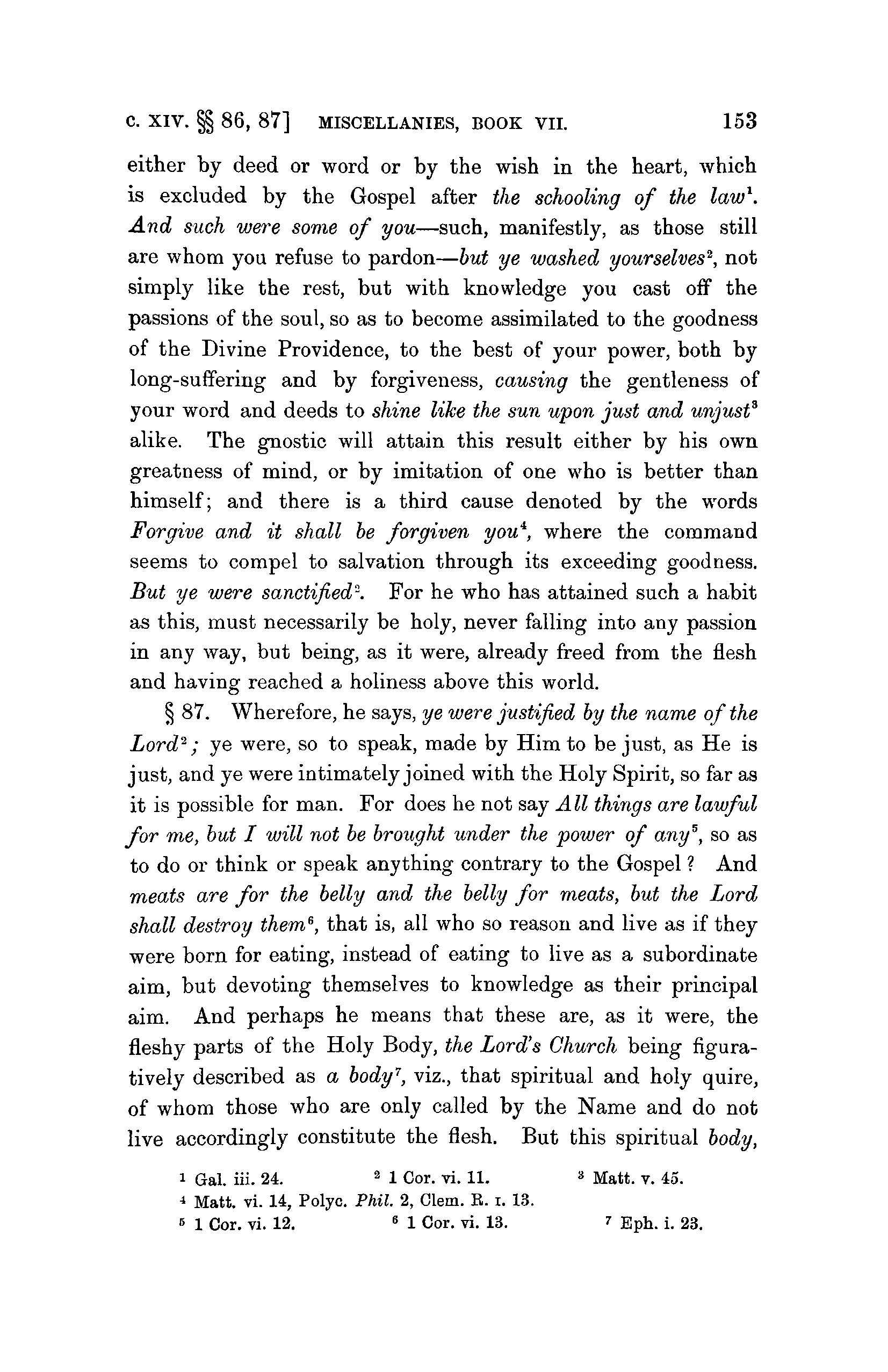
either by deed or word or by the wish in the heart, which is excluded by the Gospel after the schooling of the law1.
And such were some of you—such, manifestly, as those still are whom you refuse to pardon—but ye washed yourselves2, not simply like the rest, but with knowledge you cast off the passions of the soul, so as to become assimilated to the goodness of the Divine Providence, to the best of your power, both by long-suffering and by forgiveness, causing the gentleness of your word and deeds to shine like the sun upon just and unjust3 alike. The gnostic will attain this result either by his own greatness of mind, or by imitation of one who is better than himself; and there is a third cause denoted by the words
Forgive and it shall be forgiven you*, where the command seems to compel to salvation through its exceeding goodness.
But ye were sanctified". For he who has attained such a habit as this, must necessarily be holy, never falling into any passion in any way, but being, as it were, already freed from the flesh and having reached a holiness above this world.
§ 87. Wherefore, he says, ye were justified by the name of the Lord2; ye were, so to speak, made by Him to be just, as He is just, and ye were intimately joined with the Holy Spirit, so far as it is possible for man. For does he not say All things are lawful for me, but I will not be brought under the power of any", so as to do or think or speak anything contrary to the Gospel ? And meats are for the belly and the belly for meats, but the Lord shall destroy them6, that is, all who so reason and live as if they were born for eating, instead of eating to live as a subordinate aim, but devoting themselves to knowledge as their principal aim. And perhaps he means that these are, as it were, the fleshy parts of the Holy Body, the Lord's Church being figuratively described as a body7, viz., that spiritual and holy quire, of whom those who are only called by the Name and do not live accordingly constitute the flesh. But this spiritual body, i Gal. iii. 24.
2 1 Cor. vi. 11.
3 Matt. v. 45.
4 Matt. vi. 14, Polyo. Phil. 2, Clem. B. i. 13.
5 1 Cor. vi. 12.
6 1 Cor. vi. 13.
? Eph. i. 23. https://doi.org/10.1017/CBO9780511695513.010 Published online by Cambridge University Press
ITPQMATEfiN Z'
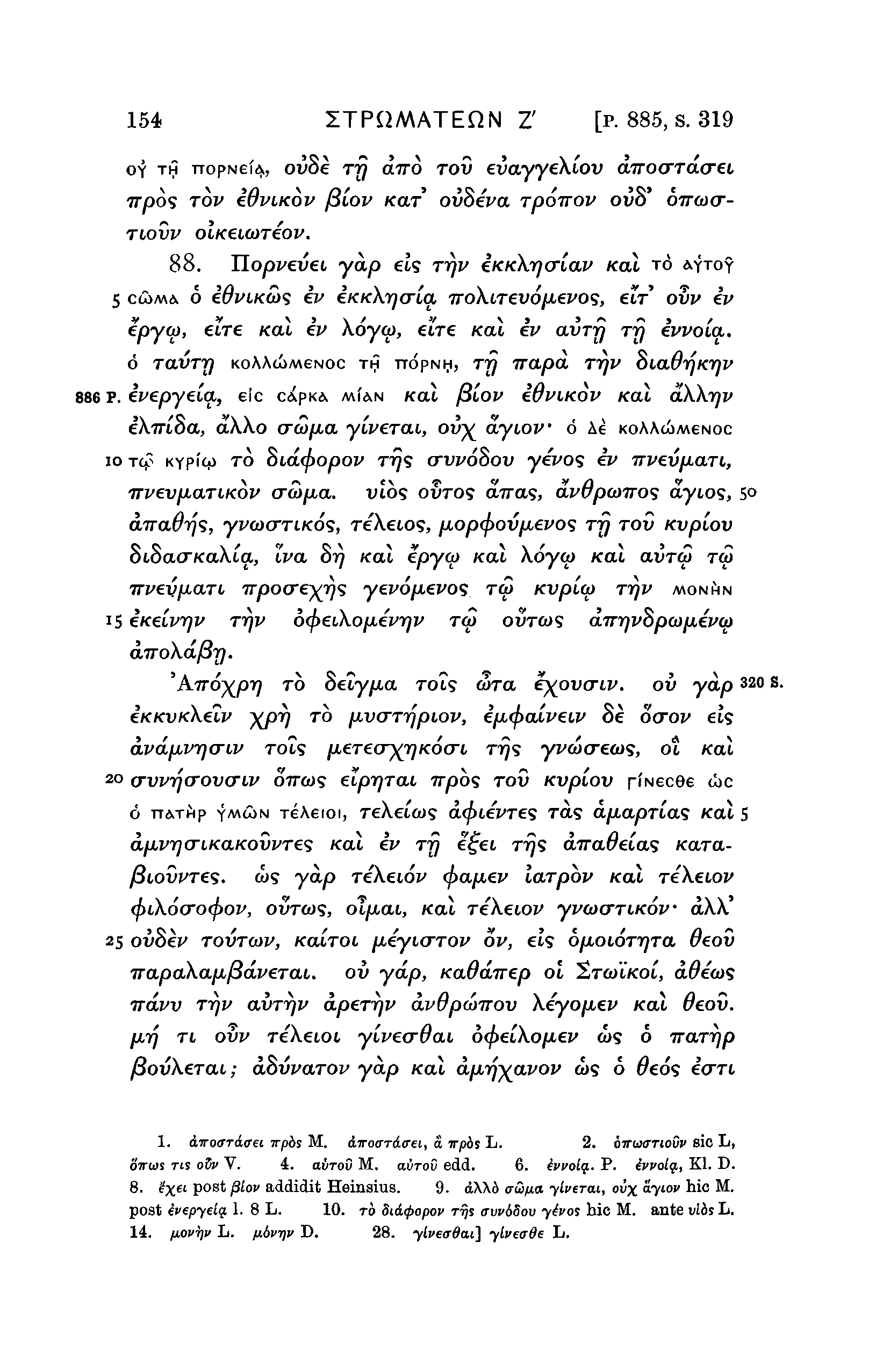
[P. 885, s. 319 o-f TH TTopNef^, ovSe rfj OLTTO TOV evayyekCov dVocrTacrei 7T/3OS TOV idvLKOV fi'lOV KaT OvSeva
TpOTTOV OVO* OTT&JCT-
TIOVV OiK€l(iiT4ov'.
88.
HopvtveL yap eis TTJV iKKXr)o~Cav /cat TO AYTOY 5 ctbMA. 6 i0vi,K(t><; iv e/c/cX^cria iroXiTevofievos, etr' ovv iv epyw, eiTe /cai iv Xdya), elVe /cat iv avTrj Trj ivvoia.
6 TaVTYj K0AA(I)M6N0C TH HOpNH, TTj TTapO, TTjV SiaOtJKrjV 886 P. ivepyeCa., eic cipK*. M(AN Kal /3Cov iOviKov Kal OXXTJV eXmSa, aXXo aw/jba yivcrai, ovy^ ayiov
6 Ae KOAAJ)M6NOC
IO TCJ? KYpi<+> TO hid<fiopov T^9 cui'dSov yivos iv TTvevjMaTL, TrvevfiaTiKov caljaa. ui6s ouro? airas, dvBpcoiros aytos, 50 a.7ra07js, yi'wa'TiKds, TeXetos, fiop(f>ovfi,€vois TTJ TOV Kvpiov
8iSao"/caXta, iVa 817 /cai cpyw /cal Xdya> /cat awra ra 7rvev/j.aTi Trpoo~e^r)<; yev6[x.evo<s T(p Kvpico TT\V MON^IN 15 iKeivrjv Tr/v ofaiXoyLtvqv TW OUTWS dirr)v8pa)[j.ev(0 dTTo\d/3rj.
'A TO Seiy/Jba rols wra
£)(OVO~LV.
OV ydp 320! y3^ TO fivo~Ty]piov, ifju(f>aiv€LV Se ocrov eis TOIS ixeTeo-^r/Koo-i Trj<i yva>o-ea)s, 0$ /cat
20 o~vvr\o~ovo~iv onus eiprjTat. npbs TOV Kvpiov r'Necee obc 6 n*.THp Y^CON -reAeioi, TeXeta)? d<f>tevTes Tcts a/iayartas /cat 5 dfivrjo-LKaKovvTes /cat ei> TTJ e^ei TTJS aTra^etas /caTa- )8tovvTes. ft>5 ya/3 TeXetdi' (pa/xev iarpov
Kal TeXetov <f)t\6o~o<f>ov, OUTWS, olfjbai, Kal TeXeiov yvoj&TLKov aXX 25 ovSev TOVTotv, /catTot [x-eyiaTov ov, el<s 6/AoioTijTa #eot) irapaXafjifidverai. ov ydp, Kaddnep oi STWI/COI, d^ews vdvv TTJV avTrjv dpeTrjv avdpuyirov Xeyofiev Kal deov. fjurj TL ovv TeXetot yiveo~6ai o^eiXo^ev a>s 6 Trarrjp /SouXeTat; dSu^aTOv yap /cat d/xij-^avov a>s 6 #eds eo
1. diro<rrd(rei 7rpds M.
&ToaTi.<rei, a irpbs L.
OTTUCTTICIO)' sic L, oVats TLS otv V.
4. airoO M. avrov edd.
6. ivvolq.. P. ivvolq,, Kl. D.
?xCI post /Sioi' addidit Heinsius.
9. dAXd cwwo yiveTai, oi% ayiov hio M. post ivepyelq. 1. 8 L.
10.
TO Si&tpopov rijs <rvv6Sov yivos hie M. ante vlbt L.
14. luovty L. nbvqv D.
28.
7(xe<r0cu] ylveaOe L. https://doi.org/10.1017/CBO9780511695513.010 Published online by Cambridge University Press
C. XIV. §§ 87, 88]
MISCELLANIES, BOOK VII.
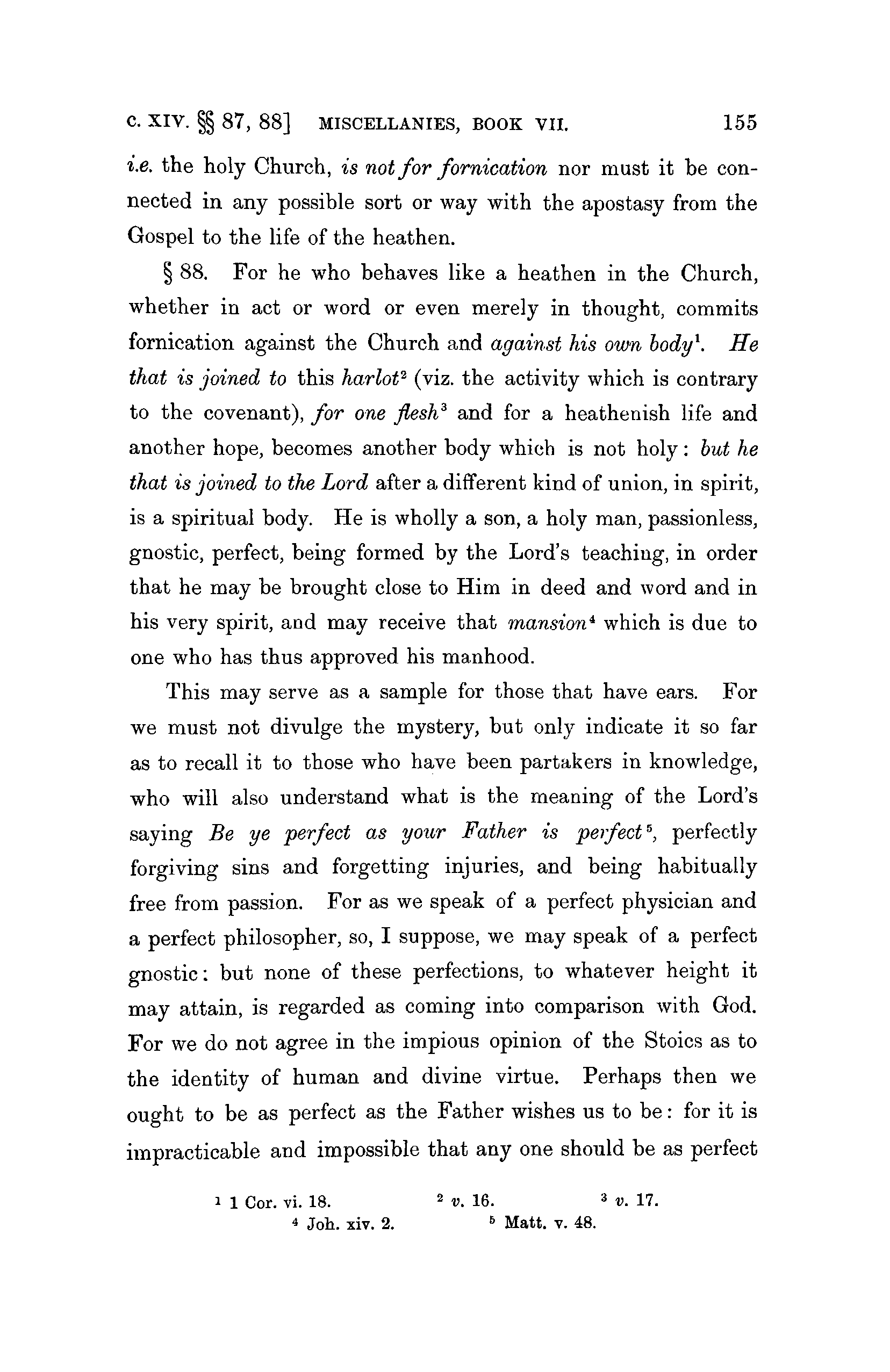
i.e. the holy Church, is not for fornication nor must it be connected in any possible sort or way with the apostasy from the Gospel to the life of the heathen.
§ 88. For he who behaves like a heathen in the Church, whether in act or word or even merely in thought, commits fornication against the Church and against his own body1. He that is joined to this harlot2 (viz. the activity which is contrary to the covenant), for one flesh3 and for a heathenish life and another hope, becomes another body which is not holy: but he that is joined to the Lord after a different kind of union, in spirit, is a spiritual body. He is wholly a son, a holy man, passionless, gnostic, perfect, being formed by the Lord's teaching, in order that he may be brought close to Him in deed and word and in his very spirit, and may receive that mansion* which is due to one who has thus approved his manhood.
This may serve as a sample for those that have ears. For we must not divulge the mystery, but only indicate it so far as to recall it to those who have been partakers in knowledge, who will also understand what is the meaning of the Lord's saying Be ye perfect as your Father is perfect5, perfectly forgiving sins and forgetting injuries, and being habitually free from passion. For as we speak of a perfect physician and a perfect philosopher, so, I suppose, we may speak of a perfect gnostic: but none of these perfections, to whatever height it may attain, is regarded as coming into comparison with God.
For we do not agree in the impious opinion of the Stoics as to the identity of human and divine virtue. Perhaps then we ought to be as perfect as the Father wishes us to be: for it is impracticable and impossible that any one should be as perfect i 1 Cor. vi. 18.
2 v. 16.
3 v. 17.
* Job. xiv. 2.
6 Matt. v. 48. https://doi.org/10.1017/CBO9780511695513.010 Published online by Cambridge University Press
ITPQMATEQN Z'
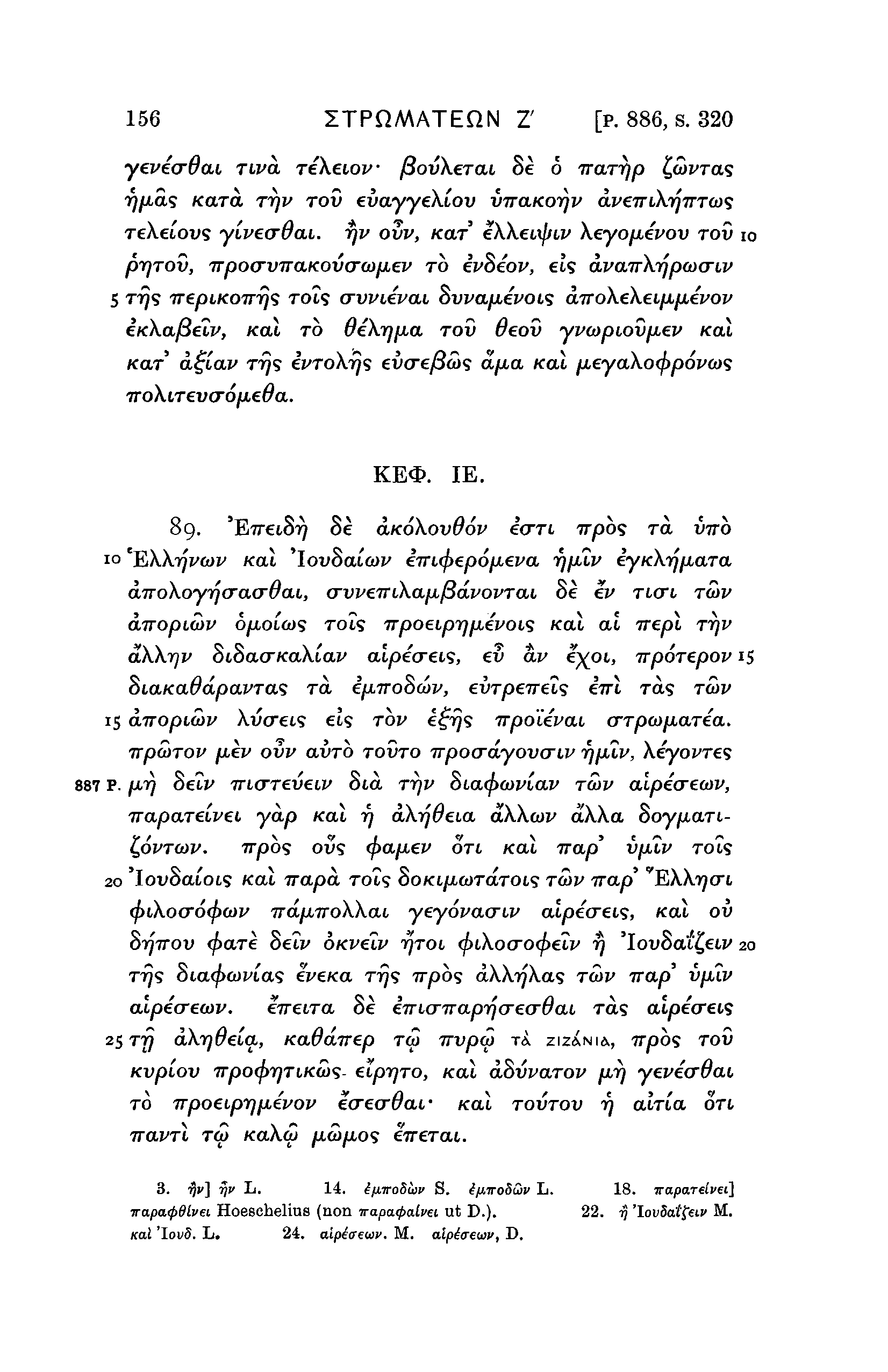
[p. 886, s. 320 yevecrdau TLVCL re'Xetov fiovkerai Se 6 iraTijp £a)yras TJ/ASS Kara rr\v TOV evayyeXtov viraKorjv dyeTrtXTjTrras reXetous yiveadai.
T}V OVV, KOT iXXenfjuv Xeyofievov TOV IO P'TQTOV, TTpocrvTraKovcrwfjLev TO ivSeov, ei<s avairXrjpa>o~LV
5 r>}9 TTepLKOirr)<s rois o~vviivai Swafj-evoa a7ro\eXei/A/ieVoi' ii<Xa(3elv, Kal TO OiXiqjxa TOV deov yvcopiov^ev
KOX KOLT a^iav TTJS et'ToX'^s eucreySw? ayu.a KOX fjLeyaXo<j)p6v(i)<;
KE0>. IE.
89.
'ETTCIS^ Se aKoXovdov ecrri irpbs r a viro 10 'EXXT^VWV Kal 'lovSatcov iirL<f>ep6[JLeva r\\ixv ey/cX^/Aara a.TroXoyr)crao~dai, o~vv€TnXa[ji/3dvovTai 8e ev Ttcrt TU>V airopiaiv 6/xoiws TOIS Trpoei^o^/AeVois fax at 7re/)l T ^ dXXrjv SiSaaKaXCav aipecrei?, ev ay e^oi, irpoTepov hiaKaddpavTWi TO. ifiTroScov, euT/oeTrets iirl Tcts 15 OLTTOpLtov Xvcrets eis TOV ef^s irpo'iivai irpSiTOV fiev ovv avrb TOVTO Trpoo-<Lyovo-iv rffjlv, XeyovTes
887 P. JU.T) Sety iricrreueti' Sta, Tr)!' SiaffxovCav T5)V alpeaecov, vapaTelvet, yap /cat 17 dXr^^eta aXXwr aXXa Soy/xart- ^dvrwy.
Trpos ous (f>a.jJL€v OTL /cat Tra/a' Uju,tv rois 20 'IovSatots /cat irapa rots So/ct/Awrarots TWV Traya' 'EXXijcrt
(f>iXoo~6<f)G)i> TrajXTToXXaL yeyovao-tv atpecret?, /cat ou ^>are Sety oKveiv TJTOI (faXoo-offrelv ^ 'IouSat^etv 20 vtas eVe/ca r^5 irpos aXXijXas ray 7ra/a' wyxiy alpeaecov. eveiTa Se iino-TrapTJo-eo-dcu ras atpecrets 25 T>7 aXr)Beia, Kadairep ra irvpw ri
ZIZANIA, TTJOOS TOU
Kvpiov Trpo(j>r)TiKu><;- etpr/To, /cat dSvyaroy JU/») yeyecr^at TO Trpoeipf]^ivov icrecrOaf /cat TOVTOV TJ atria ort TL ra /caXw JU,&)/AOS 3. ^v] 17^ L.
14. iixiroSwv S. i/iwoSQv L.
18.
Trapa(p6lvei Hoesehelius (non •n-apa^a.lva ut D.).
22. -q 'IoD5aff«"'
Kal 'Ioi;5. L.
24. aipiaewv. M. aipivewv, D. https://doi.org/10.1017/CBO9780511695513.010 Published online by Cambridge University Press