
CHAPTER VIII
C. VIII. §§ 50, 51]
MISCELLANIES, BOOK VII.
CHAPTER VIII.
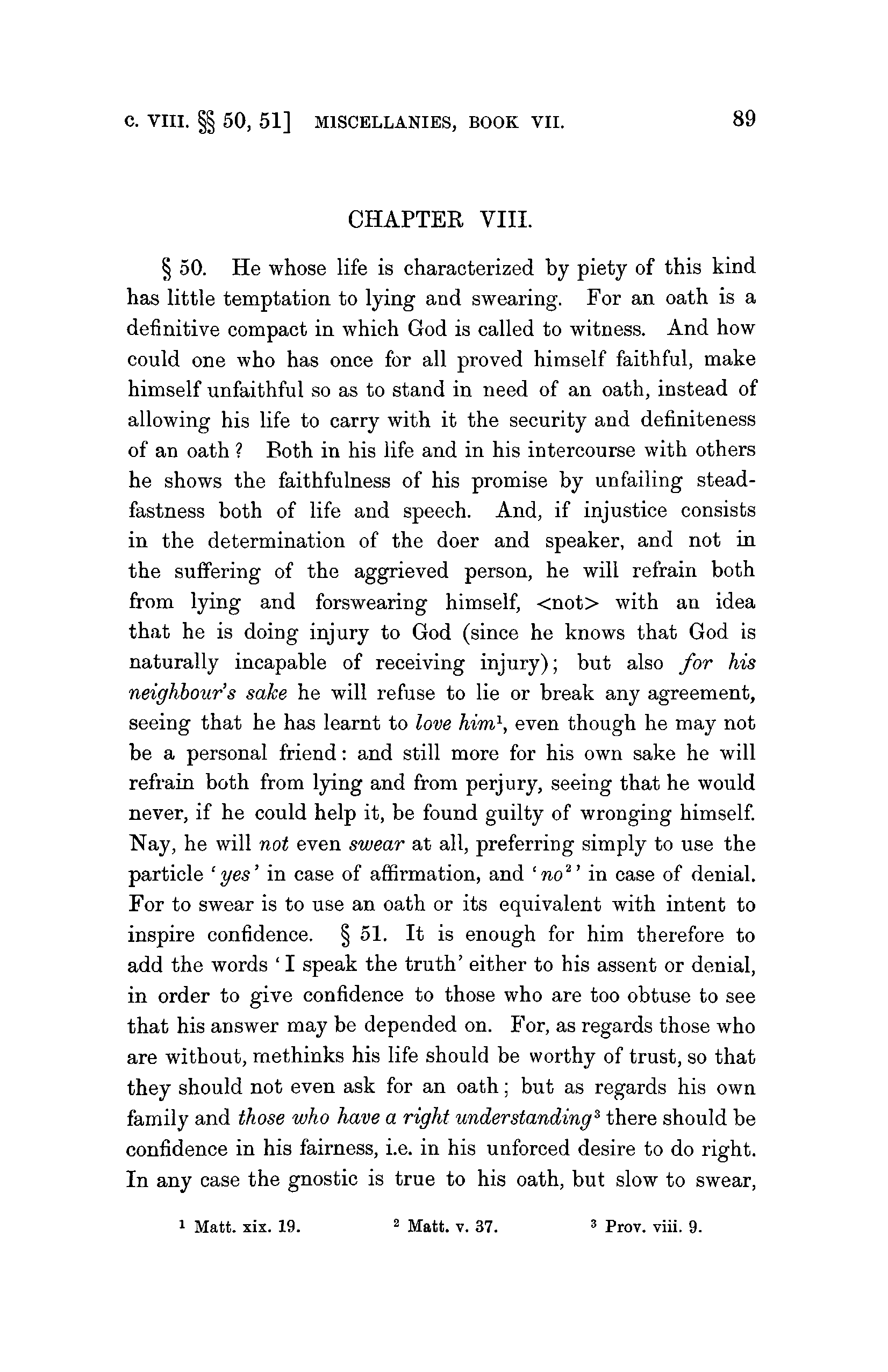
§ 50. He whose life is characterized by piety of this kind has little temptation to lying and swearing. For an oath is a definitive compact in which God is called to witness. And how could one who has once for all proved himself faithful, make himself unfaithful so as to stand in need of an oath, instead of allowing his life to carry with it the security and definiteness of an oath ? Both in his life and in his intercourse with others he shows the faithfulness of his promise by unfailing steadfastness both of life and speech. And, if injustice consists in the determination of the doer and speaker, and not in the suffering of the aggrieved person, he will refrain both from lying and forswearing himself, <not> with an idea that he is doing injury to God (since he knows that God is naturally incapable of receiving injury); but also for his neighbours sake he will refuse to lie or break any agreement, seeing that he has learnt to love him1, even though he may not be a personal friend: and still more for his own sake he will refrain both from lying and from perjury, seeing that he would never, if he could help it, be found guilty of wronging himself.
Nay, he will not even swear at all, preferring simply to use the particle 'yes' in case of affirmation, and 'no2' in case of denial.
For to swear is to use an oath or its equivalent with intent to inspire confidence.
§ 51. It is enough for him therefore to add the words ' I speak the truth' either to his assent or denial, in order to give confidence to those who are too obtuse to see that his answer may be depended on. For, as regards those who are without, rnethinks his life should be worthy of trust, so that they should not even ask for an oath; but as regards his own family and those who have a right understanding3 there should be confidence in his fairness, i.e. in his unforced desire to do right.
In any case the gnostic is true to his oath, but slow to swear, 1 Matt. xix. 19.
2 Matt. v. 37.
3 Prov. viii. 9. https://doi.org/10.1017/CBO9780511695513.010 Published online by Cambridge University Press
ITPQMATEQN Z'
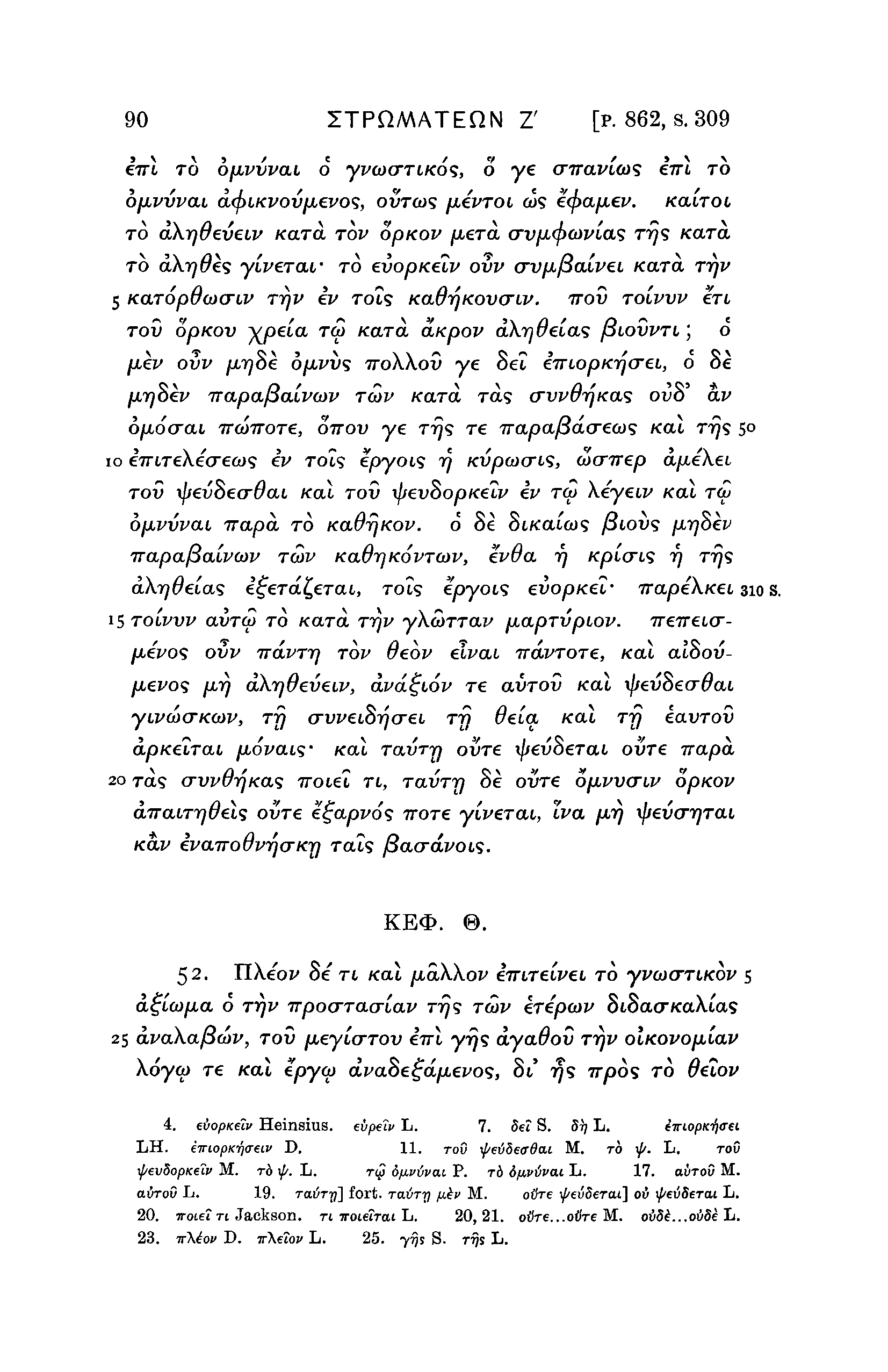
[P. 862, s. 309 iirl TO o/jivvvai 6 yvcoo-TiKoq, 6 ye cnravtoDS eirl TO bjuvvvai d<f)iKvov[ji,evos, ourws fievToi COS e(j>a/jiev.
KOLLTOL TO dXrjdevecv Kara TOV opKov jLtera av[JL<f>a)v£a<s Trj<s /cara TO dXrjOes yiverai'
TO evoptcelv ovv <TVfA/3aiveL Kara Trjv 5 KOLTOpdosHTLV TTjV iv TOIS Ka07jKOV<TlV.
TTOV TObVVV 6TI
TOV opKov X/° e t a T(? KOLTOL aKpov akrjdeCas /3LOVVTL ; d jiiev ovv jJir/Se 6[JLVV<; woWov ye Sei einopKrjcrei, 6 Be /xr/hev TTapaftaCvcov TCOV KCLTO, T<XS cvvdrJKas ovS' av o/xocrai TrcoTTOTe, OTTOV ye T^S TC 7rapa/Sao"ecos Kai T^S 5° io eTTtTeXeVews ev TO!? epyots "*y /cupwo'ts, atcrirep d/xeXei
TOV \\sevhecrdaL KCU TOV \jfevSopKeLv iv TCU Xeyeuv Kai TU> djjivvvou TTapa TO KadrJKov.
6 Se SIKOXCUS yStous l^rfiev TTapa/3aCv(ov TCOV KadrjKovTcov, ev&a r) Kpicra 17 TTJS a\r)deia<z l^eTO-tjerai, TOIS epyois evopxelTrapekxeL 310 s.
15 TOivvv avTw TO Kara TT\V yXcoTTav jxapTvptov.
Tretteio'- [K,evo% ovv TTOLVTr) TOV deov eivai iravTOTe, KOX alSovfievos jL-q dXrjdevei.v, dvd^iov
Te aVTOv KOX \jiev8eo-0aL yiva>o-KO)v, TYJ cruj'etS^cret TTJ Oeia KOI TTJ eavTov apKeiTai fiovai?KOL TavTTj ovTe i//eu8erat ovre rrapa
20 Tas crvvdy]Ka<; noiel TL, TavTr/ Se OVTC ofivvcrw opKov aTraLT7)6el<; ovTe e^apvo? TtOTe yiveTai, Iva /u,i) \jjevcrrjTai
KCLV evairoQvr\o-Kri Tats /?a<xavois.
52.
IlXeov Se Tt /cat /x.aXX.ov hrneivei TO yvatcrTiKov 5 d^Lcofjia 6 Trjv vpocrTao-tav Trjs TCOV erepcov StSacrKaXias
25 dvaXafiav, TOV [jueyCo-TOV iirl yrj<; dyadov Trjv olKOVO^iav X6ya> Te Kai epya> dvaSe^dyuevos, Si' 17s TT/OOS TO delov i. dopKeiv Heiusius. eupeic L.
SeT S.
Sr; L. p) LH. eTnopic/jaeiv D.
11. TOV fev5e<rdai M.
TO if/. L.
TOU \pev8opKe'iii M.
T6 ^. L. ry ifivivai P.
T6 6/ivivai L.
17. auToO M. aurou JJ.
19.
TaijTjii fort. Tatfr?j ^ ^ M. otire ^ei55erai] ov ^eiiSerat L.
20.
TTOIEI TI Jackson, TI TroieiTat L.
20,21. o$Te...o#Te M. o^...oi)Se L.
23. ir\4oi> D. 7rXe?oy L.
25. Y^S S. r^s L. https://doi.org/10.1017/CBO9780511695513.010 Published online by Cambridge University Press