
CHAPTER VI
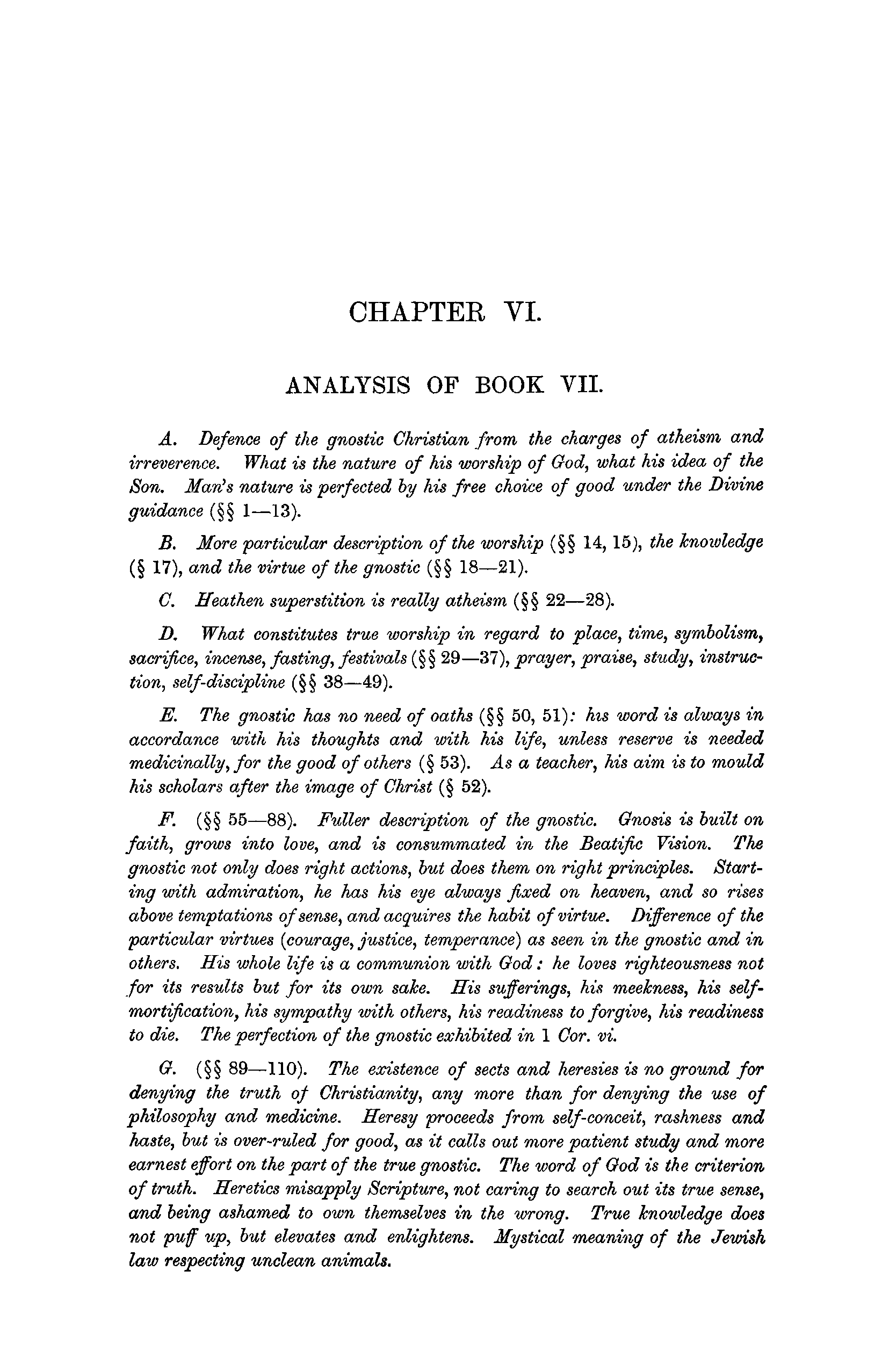
CHAPTER VI.
ANALYSIS OF BOOK VII.
Defence of the gnostic Christian from the charges of atheism and irreverence. What is the nature of his worship of God, what his idea of the Son. Man's nature is perfected by his free choice of good under the Divine guidance (§§ 1—13).
More particular description of the worship (§§ 14, 15), the hnoivledge (§ 17), and the virtue of the gnostic (§§ 18—21).
C. Heathen superstition is really atheism (§§ 22—28).
What constitutes true worship in regard to place, time, symbolism, sacrifice, incense, fasting, festivals (§§ 29—37), prayer, praise, study, instruction, self-discipline (§§ 38—49).
The gnostic has no need of oaths (§§ 50, 51): his word is always in accordance with his thoughts and with his life, unless reserve is needed medicinally, for the good of others (§ 53). As a teacher, his aim is to mould his scholars after the image of Christ (§ 52).
(§§ 55—88). Fuller description of the gnostic. Onosis is built on faith, grows into love, and is consummated in the Beatific Vision. The gnostic not only does right actions, but does them, on right principles.
Starting with admiration, he has his eye always fixed on heaven, and so rises above temptations of sense, and acquires the habit of virtue.
Difference of the particular virtues [courage, justice, temperance) as seen in the gnostic and in others. His whole life is a communion with God: he loves righteousness not for its results but for its own sake. His sufferings, his meekness, his selfmortification, his sympathy with others, his readiness to forgive, his readiness to die.
The perfection of the gnostic exhibited in 1 Cor. vi.
G. (§§ 89—110). The existence of sects and heresies is no ground for denying the truth of Christianity, any more than for denying the use of philosophy and medicine. Heresy proceeds from self-conceit, rashness and haste, but is over-ruled for good, as it calls out more patient study and more earnest effort on the part of the true gnostic. The word of God is the criterion of truth. Heretics misapply Scripture, not caring to search out its true sense, and being ashamed to own themselves in the wrong. True knowledge does not puff up, but elevates and enlightens. Mystical meaning of the Jewish law respecting unclean animals. https://doi.org/10.1017/CBO9780511695513.007 Published online by Cambridge University Press
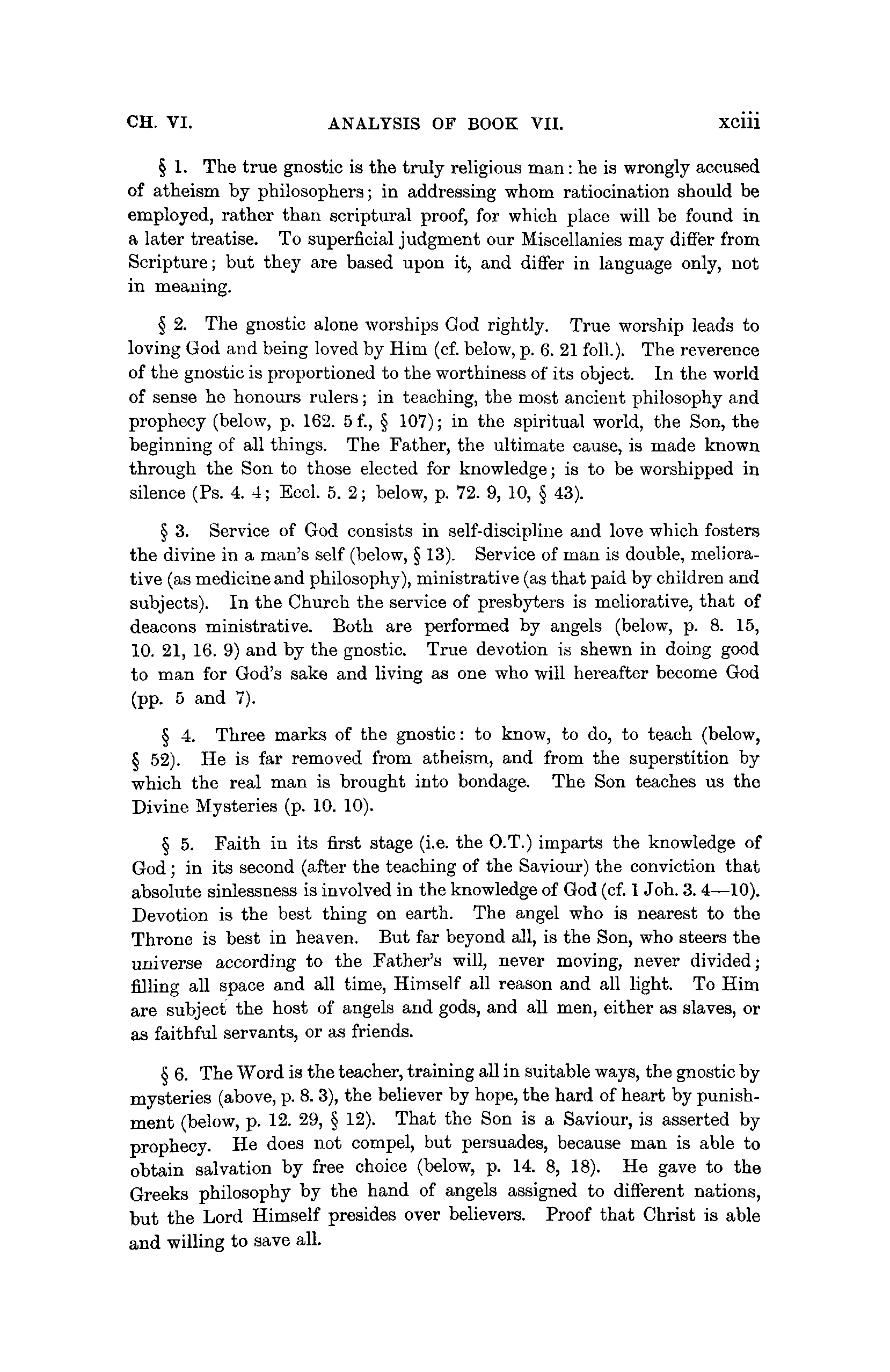
CH. VI.
ANALYSIS OF BOOK VII.
XC111 § 1. The true gnostic is the truly religious man: he is wrongly accused of atheism by philosophers; in addressing whom ratiocination should be employed, rather than scriptural proof, for which place will be found in a later treatise. To superficial judgment our Miscellanies may differ from Scripture; but they are based upon it, and differ in language only, not in meaning.
§ 2. The gnostic alone worships God rightly.
True worship leads to loving God and being loved by Him (cf. below, p. 6. 21 foil.). The reverence of the gnostic is proportioned to the worthiness of its object.
In the world of sense he honours rulers; in teaching, the most ancient philosophy and prophecy (below, p. 162. 5f., § 107); in the spiritual world, the Son, the beginning of all things. The Father, the ultimate cause, is made known through the Son to those elected for knowledge; is to be worshipped in silence (Ps. 4. 4; Eccl. 5. 2; below, p. 72. 9, 10, § 43).
§ 3. Service of God consists in self-discipline and love which fosters the divine in a man's self (below, § 13). Service of man is double, meliorative (as medicine and philosophy), ministrative (as that paid by children and subjects).
In the Church the service of presbyters is meliorative, that of deacons ministrative. Both are performed by angels (below, p. 8. 15,
10. 21, 16. 9) and by the gnostic. True devotion is shewn in doing good to man for God's sake and living as one who will hereafter become God
(pp. 5 and 7).
§ 4. Three marks of the gnostic: to know, to do, to teach (below, § 52). He is far removed from atheism, and from the superstition by which the real man is brought into bondage.
The Son teaches us the Divine Mysteries (p. 10. 10).
§ 5. Faith in its first stage (i.e. the O.T.) imparts the knowledge of God; in its second (after the teaching of the Saviour) the conviction that absolute sinlessness is involved in the knowledge of God (cf. 1 Joh. 3. 4—10).
Devotion is the best thing on earth. The angel who is nearest to the Throne is best in heaven. But far beyond all, is the Son, who steers the universe according to the Father's will, never moving, never divided; filling all space and all time, Himself all reason and all light. To Him are subject the host of angels and gods, and all men, either as slaves, or as faithful servants, or as friends.
§ 6. The Word is the teacher, training all in suitable ways, the gnostic by mysteries (above, p. 8. 3), the believer by hope, the hard of heart by punishment (below, p. 12. 29, § 12). That the Son is a Saviour, is asserted by prophecy.
He does not compel, but persuades, because man is able to obtain salvation by free choice (below, p. 14. 8, 18). He gave to the Greeks philosophy by the hand of angels assigned to different nations, but the Lord Himself presides over believers. Proof that Christ is able and willing to save all. https://doi.org/10.1017/CBO9780511695513.007 Published online by Cambridge University Press
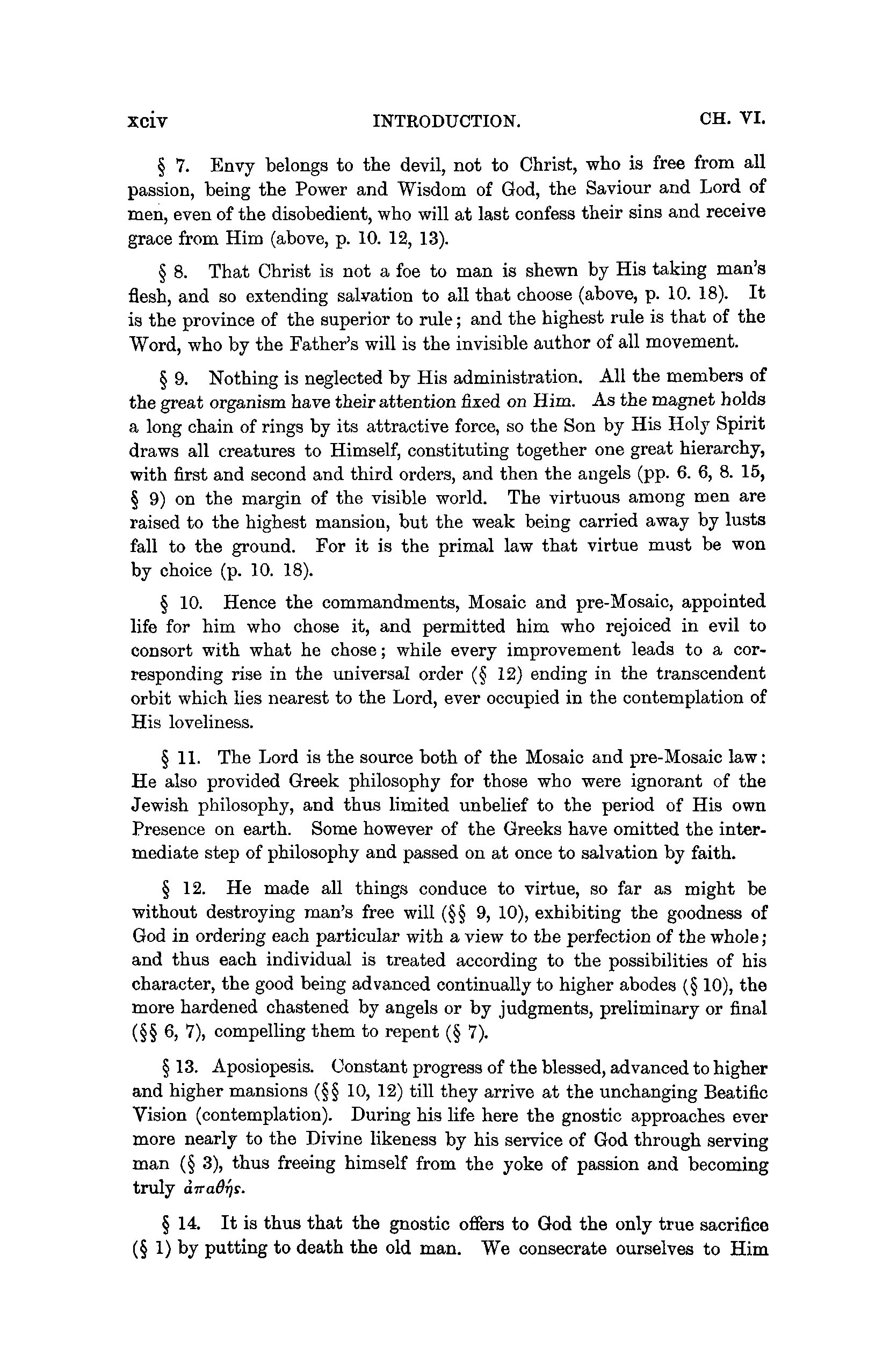
Xciv
INTRODUCTION.
CH. VI.
§ 7. Envy belongs to the devil, not to Christ, who is free from all passion, being the Power and Wisdom of God, the Saviour and Lord of men, even of the disobedient, who will at last confess their sins and receive grace from Him (above, p. 10. 12, 13).
§ 8. That Christ is not a foe to man is shewn by His taking man's flesh, and so extending salvation to all that choose (above, p. 10. 18).
It is the province of the superior to rule; and the highest rule is that of the Word, who by the Father's will is the invisible author of all movement.
§ 9. Nothing is neglected by His administration. All the members of the great organism have their attention fixed on Him. As the magnet holds a long chain of rings by its attractive force, so the Son by His Holy Spirit draws all creatures to Himself, constituting together one great hierarchy, with first and second and third orders, and then the angels (pp. 6. 6, 8. 15,
§ 9) on the margin of the visible world. The virtuous among men are raised to the highest mansion, but the weak being carried away by lusts fall to the ground. For it is the primal law that virtue must be won by choice (p. 10. 18).
§ 10. Hence the commandments, Mosaic and pre-Mosaic, appointed life for him who chose it, and permitted him who rejoiced in evil to consort with what he chose; while every improvement leads to a corresponding rise in the universal order (§ 12) ending in the transcendent orbit which lies nearest to the Lord, ever occupied in the contemplation of His loveliness.
§ 11. The Lord is the source both of the Mosaic and pre-Mosaic law:
He also provided Greek philosophy for those who were ignorant of the Jewish philosophy, and thus limited unbelief to the period of His own
Presence on earth. Some however of the Greeks have omitted the intermediate step of philosophy and passed on at once to salvation by faith.
§ 12. He made all things conduce to virtue, so far as might be without destroying man's free will (§§ 9, 10), exhibiting the goodness of God in ordering each particular with a view to the perfection of the whole; and thus each individual is treated according to the possibilities of his character, the good being advanced continually to higher abodes (§ 10), the more hardened chastened by angels or by judgments, preliminary or final
(§§ 6, 7), compelling them to repent (§ 7).
§ 13. Aposiopesis. Constant progress of the blessed, advanced to higher and higher mansions (§§ 10, 12) till they arrive at the unchanging Beatific
Vision (contemplation). During his life here the gnostic approaches ever more nearly to the Divine likeness by his service of God through serving man (§ 3), thus freeing himself from the yoke of passion and becoming truly diradrjs.
§ 14. It is thus that the gnostic offers to God the only true sacrifice (§ 1) by putting to death the old man. We consecrate ourselves to Him https://doi.org/10.1017/CBO9780511695513.007 Published online by Cambridge University Press
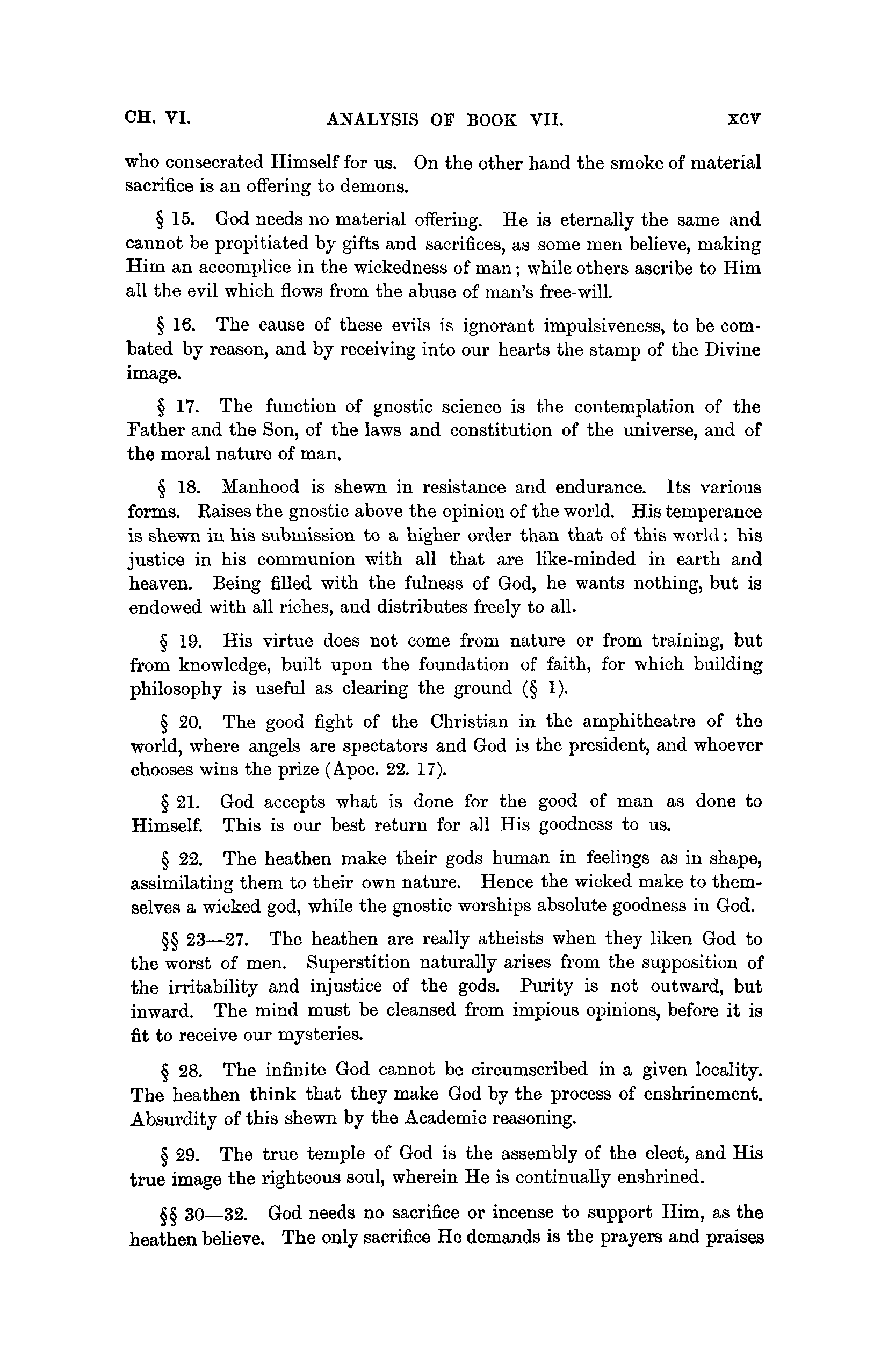
CH. VI.
ANALYSIS OF BOOK VII.
XCV who consecrated Himself for us. On the other hand the smoke of material sacrifice is an offering to demons.
§ 15. God needs no material offering.
He is eternally the same and cannot be propitiated by gifts and sacrifices, as some men believe, making
Him an accomplice in the wickedness of man; while others ascribe to Him all the evil which flows from the abuse of man's free-will.
§ 16. The cause of these evils is ignorant impulsiveness, to be combated by reason, and by receiving into our hearts the stamp of the Divine image.
§ 17. The function of gnostic science is the contemplation of the Father and the Son, of the laws and constitution of the universe, and of the moral nature of man.
§ 18. Manhood is shewn in resistance and endurance.
Its various forms. Raises the gnostic above the opinion of the world. His temperance is shewn in his submission to a higher order than that of this world: his justice in his communion with all that are like-minded in earth and heaven.
Being filled with the fulness of God, he wants nothing, but is endowed with all riches, and distributes freely to all.
§ 19. His virtue does not come from nature or from training, but from knowledge, built upon the foundation of faith, for which building philosophy is useful as clearing the ground (§ 1).
§ 20. The good fight of the Christian in the amphitheatre of the world, where angels are spectators and God is the president, and whoever chooses wins the prize (Apoc. 22. 17).
§ 21. God accepts what is done for the good of man as done to Himself.
This is our best return for all His goodness to us.
§ 22. The heathen make their gods human in feelings as in shape, assimilating them to their own nature.
Hence the wicked make to themselves a wicked god, while the gnostic worships absolute goodness in God.
§§ 23—27. The heathen are really atheists when they liken God to the worst of men.
Superstition naturally arises from the supposition of the irritability and injustice of the gods. Purity is not outward, but inward.
The mind must be cleansed from impious opinions, before it is fit to receive our mysteries.
§ 28. The infinite God cannot be circumscribed in a given locality.
The heathen think that they make God by the process of enshrinement.
Absurdity of this shewn by the Academic reasoning.
§ 29. The true temple of God is the assembly of the elect, and His true image the righteous soul, wherein He is continually enshrined.
§§ 30—32. God needs no sacrifice or incense to support Him, as the heathen believe. The only sacrifice He demands is the prayers and praises https://doi.org/10.1017/CBO9780511695513.007 Published online by Cambridge University Press
XCV1
INTRODUCTION.
CH. VI. of His people, the only altar the righteous soul, the only incense the prayer of holiness.
§ 33. On abstinence from certain kinds of food.
§ 34. The composite incense demanded by the Law is the joint worship of many hearts and many nations. The sacrificial fire sanctifies, not flesh, but sinful souls.
§ 35. The gnostic honours the Father and the Son, not in a special place or at a special time or by special rites, but everywhere, in every way and at all times, rising above himself into the actual presence of God.
§ 36. He takes no part in public spectacles (§ 74), or in festivals; but enjoys all things soberly, thanking God for all that he receives, and assured that God's eye is ever upon him, and that God's ear is open to every thought of his heart.
§ 37. Hence there is no need for anthropomorphism (§ 22). [Confused and inconclusive argument, probably Academic]
§ 38. In the gnostic, desire takes the form of prayer; and his desire is only for real good, i.e. for goodness.
§ 39. To pray rightly requires knowledge of what good is, and what God is. It is the extreme of folly to pray for what is inexpedient, or to pray to any but God. True prayer, spoken or unspoken, is communion with God. The declaration of God's threats to the wicked is a form of prayer; but this must always be with the view of recalling them to righteousness. [For an instance see below, § 102.]
§ 40. In prayer the soul rises upwards scorning the impediments of the body. The gnostic does not confine himself to the three fixed hours of prayer (§ 35), though these are associated in his mind with the triad of the celestial mansions.
§ 41. The pseudo-gnostics deny the use of prayer.
My answer to them is reserved for another place. Here I am only concerned to prove that the true gnostic knows how to pray, and that he always obtains his petitions (§ 73), aye, and even receives good without petition made. Besides petitions for himself, his communion with God includes thanksgiving and prayer for others. Faith too is a kind of silent prayer (p. 4. 21).
§ 42. The holiness of the gnostic is the result of free choice on the side both of God and of man.
§ 43. Wherever there is readiness, there God is worshipped, independently of place and time. If we turn to the East in prayer, it is only because the light comes from thence.
§ 44. To the bad man prayer is hurtful, as he knows not what is true good: to the good it gives command over his passions, and union with the Divine nature through contemplation. https://doi.org/10.1017/CBO9780511695513.007 Published online by Cambridge University Press
CH. VI.
ANALYSIS OF BOOK VII.
XCvii § 45. Such a man becomes impervious to temptation and perfectly resigned to God's will.
§ 46. Beginning with faith he goes on to knowledge and love and contemplation, and thus virtue becomes his second nature.
§ 47. While rejoicing in present good, he already possesses in thought the higher promised good (p. 130. 15), which will be gradually realized in accordance with the Divine decree.
§ 48. He who cooperates with the Divine working finds the whole world contributing to his perfection.
Cf. § 12.
§ 49. Gnostic worship. His sacrifices are prayers and praises and study of the Scriptures, and the free imparting of instruction and money to others. This worship is continuous. His prayer goes up to heaven whatever he does. In all his acts he aims at the honourable and the expedient as distinguished from what is pleasant.
§§ 50, 51. On perjury and falsehood.
A good man's life should be sufficient security without an oath. He is bound to truth by his duty to God, to his neighbour and to himself.
§ 52. The highest office of the gnostic is the teaching of the Word (§ 4), while he forms his scholars after the image of Christ.
§ 53. His word always corresponds with his thought and with his life, unless reserve is required medicinally for the good of the weak brother.
§ 54. Conclusion. The gnostic is the very opposite of atheist or impious.
§ 55. Gnosis is the perfecting of man's nature (§ 46), built on the foundation of faith, and itself naturally grows into love. Distinction between yvaxris and cro<fiia.
§§ 56, 57. We are thus enabled to look forward to that supreme abode of rest where the soul ever enjoys the Beatific Vision. Faith believes it, gnosis has a fixed conviction of it. Distinction between the Sabbath and the Ogdoad.
§ 58. Description of the gnostic in the 24th Psalm.
§ 59. The actions of the gnostic are not merely good in themselves: they alone are done on right principles and in the right way.
§ 60. The gnostic starts with admiration for the Creation, and is thus prepared to accept the truth with regard to God and His Providence, and to understand the commandments in their higher spiritual sense.
§§ 61, 62. Having his eye always fixed upon the Lord, and feeling that every thought is open to Him, he is enabled to resist the temptations of sense, and to accept sorrow and pain as a healing medicine for the diseases of the soul.
M. c. a https://doi.org/10.1017/CBO9780511695513.007 Published online by Cambridge University Press
XCVlii
INTRODUCTION.
CH. VI.
§ 63. Having thus trained himself to a habit of virtue (§ 46), he despises both the persecutions and the flatteries of the world.
§ 64. Difficulty only serves to bring out his hidden strength, while his soul is built up into a Temple of the Holy Spirit by the combined action of nature, discipline, and reason.
§§ 65—68. The gnostic's courage and temperance distinguished from the qualities commonly so called. They have their root in the love of God (cf. § 73).
§ 69. Justice and liberality of the gnostic.
§ 70. Continence of the gnostic, shewn in marriage rather than in a celibate life.
§§ 71, 72. It is impossible for him whose aim is to please God, to be a slave to pleasure. God alone is originally free from desire. It is the gnostic's aim to eradicate his passions by discipline. He is like the wise virgins who waited for their Lord.
§ 73. The whole life of the gnostic is prayer and communion with God, and he receives whatever he asks for (§ 41). He loves righteousness for itself, not for its results. Herein he differs from the philosophers whose virtue flows from fear or from desire of applause (§ 67).
§§ 74—76. The gnostic is a labourer in the Lord's vineyard, and as such receives a double reward, though he may be tried, like the Apostles, for the instruction and encouragement of the brethren.
He does not call down vengeance on his persecutors, but prays for their conversion. The spectacles, in which the punishment of criminals is turned into a public entertainment, have no warning and no attraction for him (§ 36). His life is no mere outward worship of prayer and fast, but a constant struggle against worldly desires, and mortification of the love of money and of pleasure. He fulfils the O.T. by fasting from wrong acts, the N.T. by fasting from wrong thoughts.
He holds that to be a Lord's day on which he experiences the power of the Resurrection in himself. When his eyes are opened to a new truth he believes that it is a manifestation of the Lord.
§§ 77, 78. The gnostic is ashamed if he finds himself taking pleasure in anything which is attractive to the flesh. He is united with his brethren in a fellowship of holy and beautiful thoughts.
Though in the world, he is unaffected by its spirit, passing through it as a stranger and pilgrim. He is a true successor of the Apostles, resembling them in knowledge and in charity : he looks for praise from God only: feels the sorrows of others as if they were his own, and pities those whose repentance only begins under stress of punishment after death : is ever listening for the call of God, having no will but God's will, and being always ready to be united with saints and angels in prayer.
§ 79. Righteousness proceeds both from fear and from love, the one. prompting to abstain from evil, the other to do good. The latter is the https://doi.org/10.1017/CBO9780511695513.007 Published online by Cambridge University Press
CH. VI.
ANALYSIS OF BOOK VII.
XC1X case of the gnostic, whose prayer consists in thanksgiving for mercies, past, present, and future, in petitions for his own continuance in well-doing, and for the conversion of others. Being joined to Christ in his thanksgiving he receives the power of God by inward union, hating the lusts of the flesh and bringing into control the lower nature.
§ 80. He is eager to impart all goods to his brethren and even to take on himself the burden of their sins; though he is ever on his guard lest, in accommodating himself to their weakness, he should imbibe anything of their spirit.
Like Job, he is patient under all affliction; nay, his life is filled with joy, being occupied with prayers and praises and good words and works.
§ 81. He bears a grudge against none, knowing that all are God's handiwork. Thus he is entitled to use the petition 'Forgive, as we forgive.'
His help to others, even in his prayers, is in the most unostentatious form.
§ 82. In the Traditions of Matthias, it is written that' if the neighbour of an elect person sins, it is the fault of the elect.' The gnostic is the living temple of God, carrying God within him and being carried by God; thus he is transported beyond the bounds of sense into the highest heaven.
§ 83. Having a good conscience, he does not shrink from appearing before the unseen Powers after death. In his use of the things of this lower world, he has trained himself in the habit of thankfulness and admiration, ever gathering new material for pious contemplation from every new advance in knowledge.
§§ 84—88. The teaching of Scripture as to the perfection of the gnostic shown in an examination of 1 Cor. vi.
§§ 89, 90. Answer to the attack made against Christianity on the ground of the variety of sects and heresies.
(1) ad horn. The same charge may be alleged against the Jews and the philosophers. (2) The existence of such heresies was prophesied by Christ, and is in accordance with the law that the beautiful is always shadowed by its caricature.
(3) In other cases we do not allow the existence of diversity to prevent us from coming to a decision. There are different schools of medicine, but this does not prevent us from calling in a physician. So neither should one who is diseased in soul refuse to be converted to God because of the diversity of preachers. This diversity was intended to be the means of training 'skilled money-changers.'
§ 91. Heresies spring from the vanity of teachers, who are too impatient to give the profound study needed for the discovery of the truth.
Their effect should be to stimulate inquiry, not to stop it; just as the ready growth of weeds should increase the care and industry of the gardener.
There are sure marks by which we may distinguish the true from the false. https://doi.org/10.1017/CBO9780511695513.007 Published online by Cambridge University Press
INTRODUCTION.
CH. VI.
§§ 92—94. If it is admitted that there is such a thing as demonstration, it is the duty of those who are capable of thought and have learnt to distinguish between true and false reasoning to try the doctrines of the various sects by the words of Scripture: and the indispensable preliminary is to get rid of self-conceit and keep an open mind. The Scriptures are pregnant to the gnostic, but barren to the heretic, who wrests them from their true meaning to suit his own desires. He who is indeed a lover of truth needs energy of soul.
§ 95. The Lord is the great teacher, communicating the truth in divers ways and divers portions, through the Prophets and the Gospel and the Apostles. His word is our criterion and needs no other proof. This is our first principle, which we apprehend by faith; and from it we obtain our proofs, being thus trained for the knowledge of the truth. Mere assertion is valueless. As compared with ordinary believers, the gnostic is like the expert in his judgment of truth.
§§ 96—100. The heretics misuse Scripture by picking out isolated expressions, not interpreting them according to the context or in accordance with the general teaching of the Bible, or even with the natural force of the words: whereas the true interpretation is that which is confirmed by parallel passages and by our knowledge of what befits the Divine nature.
They are ashamed to confess themselves in the wrong, and unwilling to give up their lucrative positions and the presidency in their love-feasts.
When confuted by us they deny the authority of our sacred books, or say that contradictory statements are both true, and that their mysteries are beyond our comprehension. Their self-conceit leads to constant quarrelling. They live at hap-hazard without any regular guidance, at one time carried away by a sudden impression (which ought to be resisted by reasonable impressions stored up in advance), at another time mastered by the tyranny of habit.
§§ 101,102. Ignorance and voluptuousness are the mark of the heathen, knowledge and joy of the Church, opinion and strife of the heretic. The Lord trains His disciples to be partakers of the Divine nature, just as other teachers train their disciples to imitate them. Ignorance and weakness are the causes of heresy, as of every error. These causes are to be neutralized by instruction and discipline. If any fail to make use of these, our prayer should be that they may undergo the Divine chastisement which is sent not for vengeance, but for our good, and so be led to turn from their evil ways.
§ 103. Let those who are still curable be wise in time and submit themselves to the knife and cautery of the truth.
Let them cease from the slothfulness and the delight in novelty, which now deter them from the patient study of the Word: and let them measure the value of a Marcion or a Prodicus by the standard of the Apostles.
§§ 104,105. A further setting forth of the excellence of knowledge. We may be told however that 'knowledge puffs up.1 But this does not apply https://doi.org/10.1017/CBO9780511695513.007 Published online by Cambridge University Press
CH. VI.
ANALYSIS OF BOOK VII.
Cl to true, but only to seeming knowledge. Indeed, it is probable that the word is wrongly translated 'puffs up': it means rather 'elevates,' implying that knowledge makes a man disdain solicitations to evil. Such a man will cling to the truth himself, and declare the truth fearlessly and honestly to others.
§ § 106—108. On the other hand the heretics misinterpret the Scriptures, neither entering into the kingdom of God themselves, nor permitting others to enter. The founders of their sects did not arise till the time of Hadrian, long after the preaching of our Lord and His apostles (cf. § 2). The Unity of the Apostolic Church is broken up into fragments by their innovations and divisions. The heresies are named, some from their founder, some from their place or nation, and others from other causes.
§§ 109, 110. The Jewish law about clean and unclean animals is typical of the division between Jews and heretics and the true Church.
The division of the hoof denotes the faith in the Father and the Son: the chewing of the cud denotes the careful study of the Word. Those who fail in either are deficient; those who fail in both are like the chaff scattered by the wind.
§ 111. The nature and use of the writings known as 2Tpa>fiare"Ls. https://doi.org/10.1017/CBO9780511695513.007 Published online by Cambridge University Press
BIBLIOGRAPHICAL NOTE.
The following publications may be added to the list given in Westcott's article on Clement:
Von Arnim, De Octavo Stromateorum libro, 1894.
Barnard, Quis Dives Salvetur, Gr. Text, with Introduction, Notes and Indices (greatly improved text), 1897.
Barnard, Quis Dives Salvetur, English Translation, S.P.C.K., 1901.
Barnard, Clement's Biblical Text (Gospels and Acts), 1899.
Bigg, Christian Platonists of Alexandria, 1886.
Bywater (Emendations), Journal of Philology, vol. iv. pp.
204 foil.
Chase, Clement (in Lectures on Ecclesiastical History), 1896.
Clement, Eng. tr. (in Ante-Nicene Lib.), 1867.
Diels, Doxographi Graeci, 1879 (points out, pp. 129 foil., resemblance between the list of philosophers given in Cic. N. D. I. and that in Protr. §§ 64 foil.).
Faye, E. de, Clement d'Alexandrie, 1898.
Harnack, Hist, of Dogma, vol. n. pp. 319—380.* Hatch, Influence of Greek Ideas and Usages upon the Christian
Church, 1890.
Hiller, Zur Quellenkritik des Clem. Al. in Hermes, vol. xxi. pp. 126—133.
Hitchcock, Clement, in the S.P.C.K. series of Fathers for English Readers, 1899.
Hort, Six Lectures on the Ante-Nicene Fathers, 1895.
Inge, Christian Mysticism, 1899.
Jackson, H. (Emendations), J. of Phil., vol. xxiv. 263—271, voL xxvn. 136—144, vol. xxvm. 131—135.
* My references are sometimes to the 3rd German edition {Dogmengeschichte). https://doi.org/10.1017/CBO9780511695513.008 Published online by Cambridge University Press
BIBLIOGRAPHICAL NOTE.
Clll Koster, Quis Dives Salvetur, 1893.
Kutter, Cl. Alex, und das Neue Testament, 1897.
Maass, De Biographis Graecis quaestiones selectae, in Philol.
Unters., Berl., 1880 (on Clement's indebtedness to Favorinus).
Mayor, J. B. (Emendations on Strom, i.—vn.), Class. Rev. vol. vni. pp. 233—238, 281—288, 385—391, vol. ix. pp. 97—105,
202—206, 297—302, 337—342. (On Protr.) Philologus, 1898.
Merk, Clem. Al. in seiner Abhangigheit von d. gr. Philosophie, 1879.
Nicklin, Alexandrian Evidence for Chronology of Gospels, J. of Phil., vol. XXVII. 232—252.
Overbeck, Ueber die Anfdnge des Patristischen Literatur (Hist.
Zeitschrift, vol. XLVIII. p. 417 foil, 1882).
Pascal, La Foi et la Raison dans Cl. Alex., 1901.
Ruben, Clementis Alexandri Excerpta ex Theodoto, 1892.
Stahlin, Observationes Criticae, Erlangen, 1890; Beitrdge z.
Kenntniss der Handschriften des Clem. AL, Niirnberg, 1895; Untersuchungen u'ber die Scholien zu Clem. AL, Nurnberg, 1897 ; Clem.
Al. und die Septuaginta, Niirnberg, 1901 ; Zur handschriftlichen Ueberlieferung des Clem. AL, Leipzig, 1900.
W^endland, Quaestiones Musonianeae, 1886.
Winter, F. J., Die Elhik des Clem, von Alex., Leipzig, 1882.
Zahn, Forschungen, vol. in. (Supplemeutum Clementinum), 1884.
Ziegert, Zwei Abhandlungen u'ber Clem. AL, Heidelberg, 1894. https://doi.org/10.1017/CBO9780511695513.008 Published online by Cambridge University Press
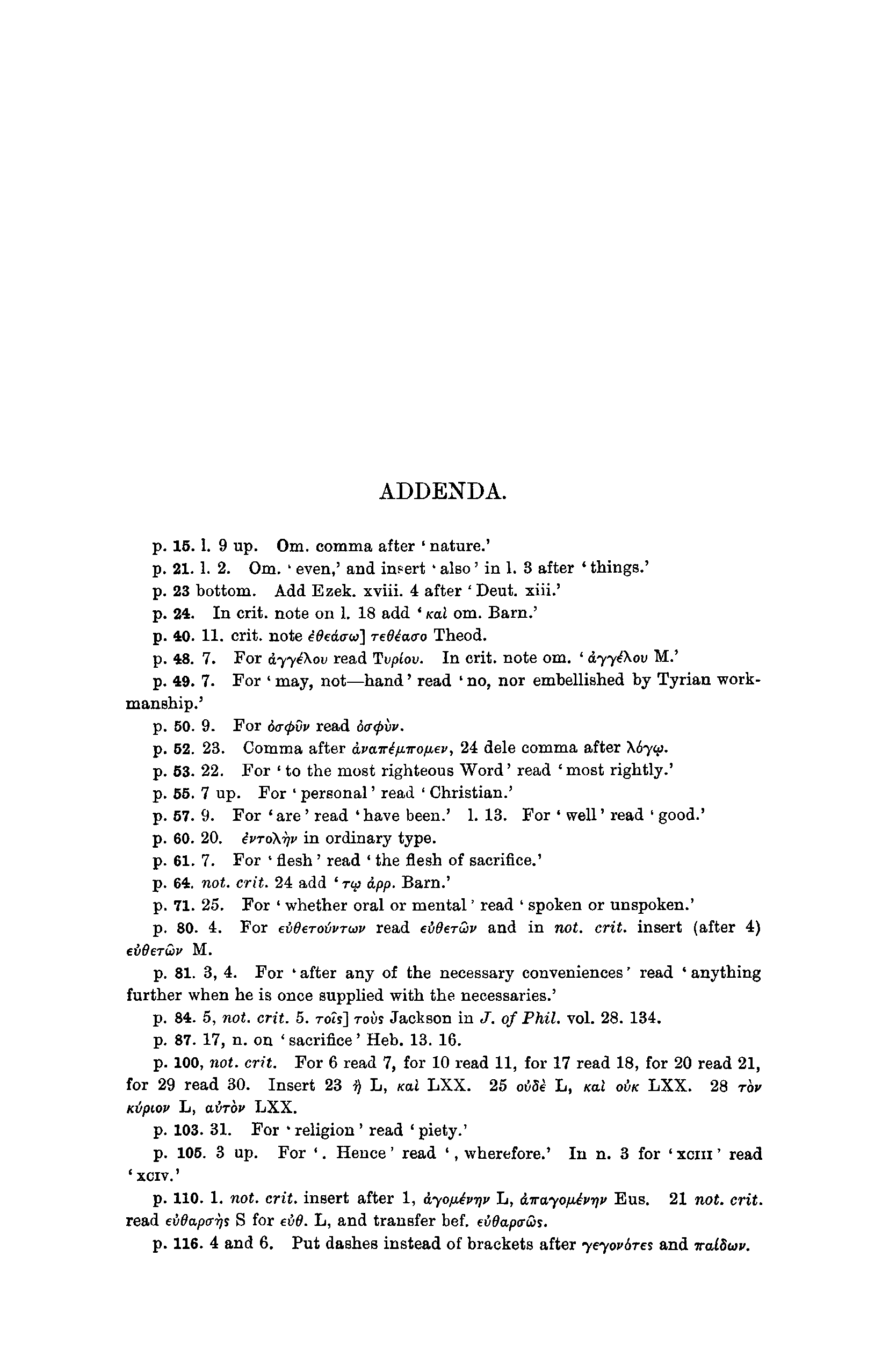
ADDENDA. p. 15. 1. 9 up.
Om. comma after 'nature.' p. 21. 1. 2. Om. ' even,' and insert ' also' in 1. 3 after ' things.' p. 23 bottom.
Add Ezek. xviii. 4 after ' Deut. xiii.' p. 24. In crit. note on 1. 18 add ' iced om. Barn.' p. 40. 11. crit. note ide&trw] TCWCKTO Theod. p. 48. 7. For 077^X01; read Tvplov. In crit. note om. ' dyytXov M.' p. 49. 7. For ' may, not—hand' read ' no, nor embellished by Tyrian workmanship.' p. 50. 9.
For 6tr<pvv read 6<r<pvv. p. 52. 23. Comma after avair£fLirop,ei>, 24 dele comma after \6yij>. p. 53. 22. For ' to the most righteous Word' read 'most rightly.' p. 55. 7 up. For ' personal' read ' Christian.' p. 57. 9. For 'are ' read 'have been.'
1. 13. For ' well' read ' good.' p. 60. 20. ivrohrpi in ordinary type. p. 61. 7. For ' flesh ' read ' the flesh of sacrifice.' p. 64. not. crit. 24 add ' TI$ dpp. Barn.' p. 71. 25. For ' whether oral or mental' read ' spoken or unspoken.' p. 80. 4. For ei8eToii>Tui> read eiBerSiv and in not. crit. insert (after 4) eiOeruv M. p. 81. 3, 4. For ' after any of the necessary conveniences' read ' anything further when he is once supplied with the necessaries.' p. 84. 5, not. crit. 5. rois] TOVS Jackson in J. of Phil. vol. 28. 134. p. 87. 17, n. on ' sacrifice' Heb. 13. 16. p. 100, not. crit.
For 6 read 7, for 10 read 11, for 17 read 18, for 20 read 21, for 29 read 30. Insert 23 ij L, KO.1 LXX.
25 oiSe L, ml OVK LXX.
28 rar Kiipiov L, airbv LXX. p. 103. 31. For ' religion ' read ' piety.' p. 105. 3 up.
For '. Hence' read ', wherefore.'
In n. 3 for ' xcm' read 'xciv.' p. 110. 1. not. crit. insert after 1, &yoixir<\v L, i.irayojxivr\v Eus.
21 not. crit. read eiBapirijs S for e60. L, and transfer bef. eudapews. p. 116. 4 and 6. Put dashes instead of brackets after yeyov6rcs and tralSajv. https://doi.org/10.1017/CBO9780511695513.009 Published online by Cambridge University Press
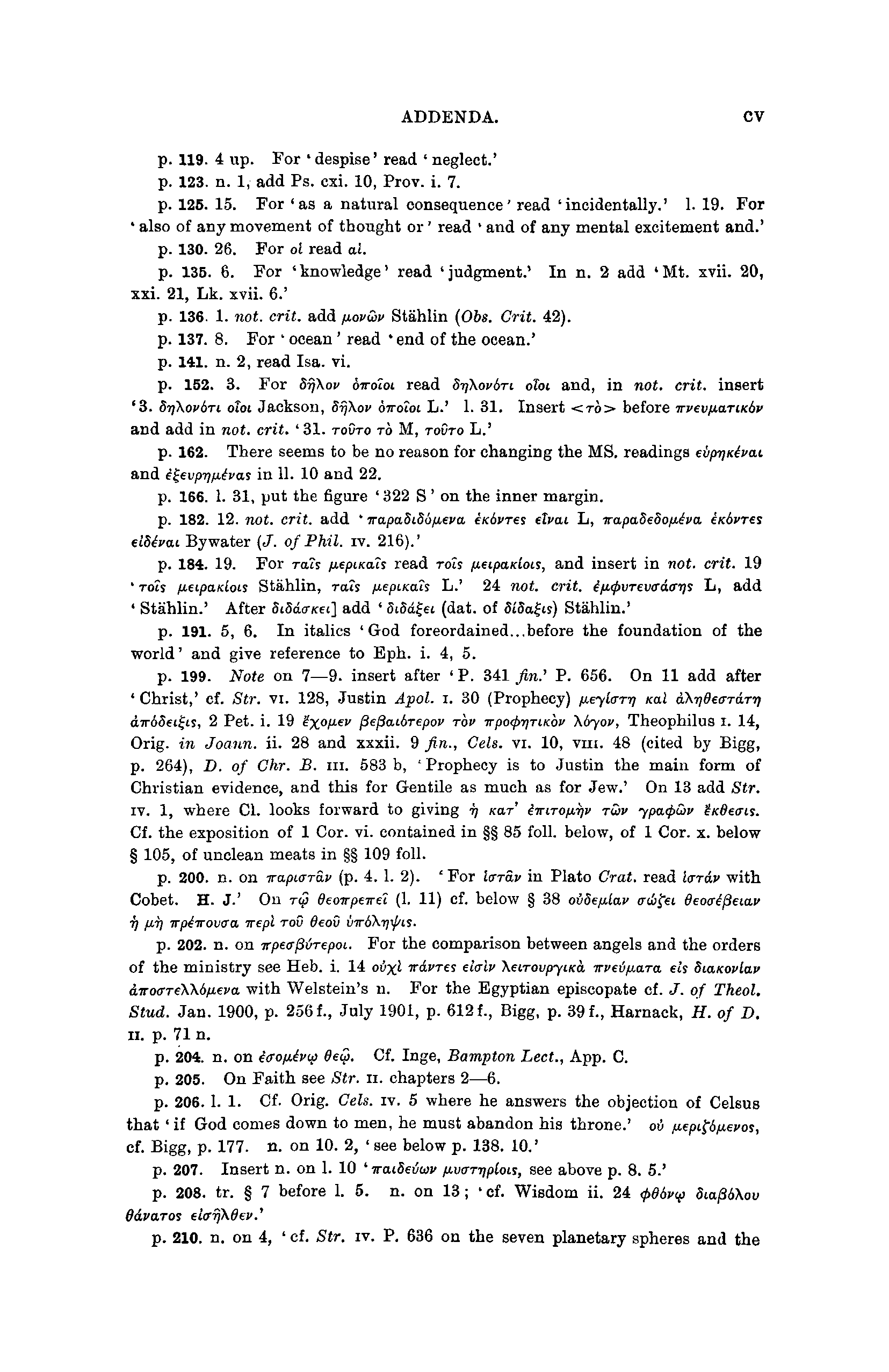
ADDENDA.
CV p. 119. 4 up.
For ' despise' read ' neglect.' p. 123. n. 1, add Ps. cxi. 10, Prov. i. 7. p. 125. 15.
For ' a s a natural consequence' read 'incidentally.'
1. 19. For ' also of any movement of thought or' read ' and of any mental excitement and.' p. 130. 26.
For ol read ai. p. 135. 6. For ' knowledge ' read ' judgment.' In n. 2 add ' Mt. xvii. 20, xxi. 21, Lk. xvii. 6.' p. 136. 1. not. crit. add fiovuiv Stahlin (O6s. Crit. 42). p. 137. 8. For ' ocean' read • end of the ocean.' p. 141. n. 2, read Isa. vi. p. 152. 3. For SrjXov oiroloi. read S-qXovtyri oToi and, in not. crit. insert ' 3 . 5TJ\OV6TI OTOI Jackson, STJXOV OTTOLOI L.1 1. 31. Insert < T O > before irvevfiariKdv and add in not. crit. ' 31. TOOTO TO M, TOCTO L.' p. 162.
There seems to be no reason for changing the MS. readings eiprjK^ai. and ££evf>T)/j.£vas in 11. 10 and 22. p. 166. 1. 31, put the figure ' 322 S ' on the inner margin. p. 182. 12. not. crit. add * Tapadidofieva €K6VT€S etvai L, irapadedofx^va €K6VT€S eiSivtu By water (J. of Phil. iv. 216).' p. 184. 19. For rats ij.epiKa.Xs read rols /j.eipaidois, and insert in not. crit. 19
' rots /j.eipaalois Stahlin, rats fiepi.Ka.ft L.' 24 not. crit. ifupvTevffdffrjs L, add
1 Stahlin.'
After 5I5&<TKEI] add ' SiSdifei (dat. of SiSa^is) Stahlin.' p. 191. 5, 6. In italics 'God foreordained...before the foundation of the world' and give reference to Eph. i. 4, 5. p. 199.
Note on 7—9. insert after ' P. 341 fin.' P. 656. On 11 add after ' Christ,' cf. Str. vi. 128, Justin Apol. I. 30 (Prophecy) neyirrri KO.1 ahridecTaTri
O7r65ei{is, 2 Pet. i. 19 £%op.ev fiefjai-bTepov TOP irpocp-qTiKov \6yov, Theophilus I. 14,
Orig. in Joaun. ii. 28 and xxxii. 9 fin., Cels. vi. 10, vm. 48 (cited by Bigg, p. 264), D. of Chr. B. in. 583 b, 'Prophecy is to Justin the main form of Christian evidence, and this for Gentile as much as for Jew.'
On 13 add Str. iv. 1, where Cl. looks forward to giving T) KO.T' iTm/iyr ruv ypa^Qv l/c#e<7«.
Cf. the exposition of 1 Cor. vi. contained in §§ 85 foil, below, of 1 Cor. x. below
§ 105, of unclean meats in §§ 109 foil. p. 200. n. on irapurTav (p. 4. 1. 2). ' F o r icrrav in Plato Crat. read lirrav with Cobet. H. J.' On TQ Beoirpeiva. (1. 11) cf. below § 38 oideplav o-cifci $eocr{peuu>
T) fii] irp4irov(xa irepl rod 0eov virdXtj^iS. p. 202. n. on Trpetrfitirepot.. For the comparison between angels and the orders of the ministry see Heb. i. 14 ov%l irdvres dalv XeirovpyiKa Tpei/xara eh Siaxovlav
AiroTTeXXdneva with Welstein's n. For the Egyptian episcopate cf. J. of Theol.
Stud. Jan. 1900, p. 256 f., July 1901, p. 612 f., Bigg, p. 39 f., Harnack, H. of D. n. p. 71 n. p. 204. n. on 4<ro/i^vii) Bey.
Cf. Inge, Bampton Led., App. C. p. 205.
On Faith see Str. n. chapters 2—6. p. 206. 1. 1. Cf. Orig. Gels. iv. 5 where he answers the objection of Celsus that ' if God comes down to men, he must abandon his throne.'
06 iiepitfuevos, cf. Bigg, p. 177. n. on 10. 2, ' see below p. 138. 10.' p. 207.
Insert n. on 1. 10 ' iraiSeiuv /ivarriploLs, see above p. 8. 5.' p. 208. tr. § 7 before 1. 5. n. on 13 ; ' cf. Wisdom ii. 24 <pd6vij> 8i.ap6Xov
66.va.ros eiffT]Xdev.' p. 210. n. on 4, ' cf. Str. iv. P. 636 on the seven planetary spheres and the https://doi.org/10.1017/CBO9780511695513.009 Published online by Cambridge University Press
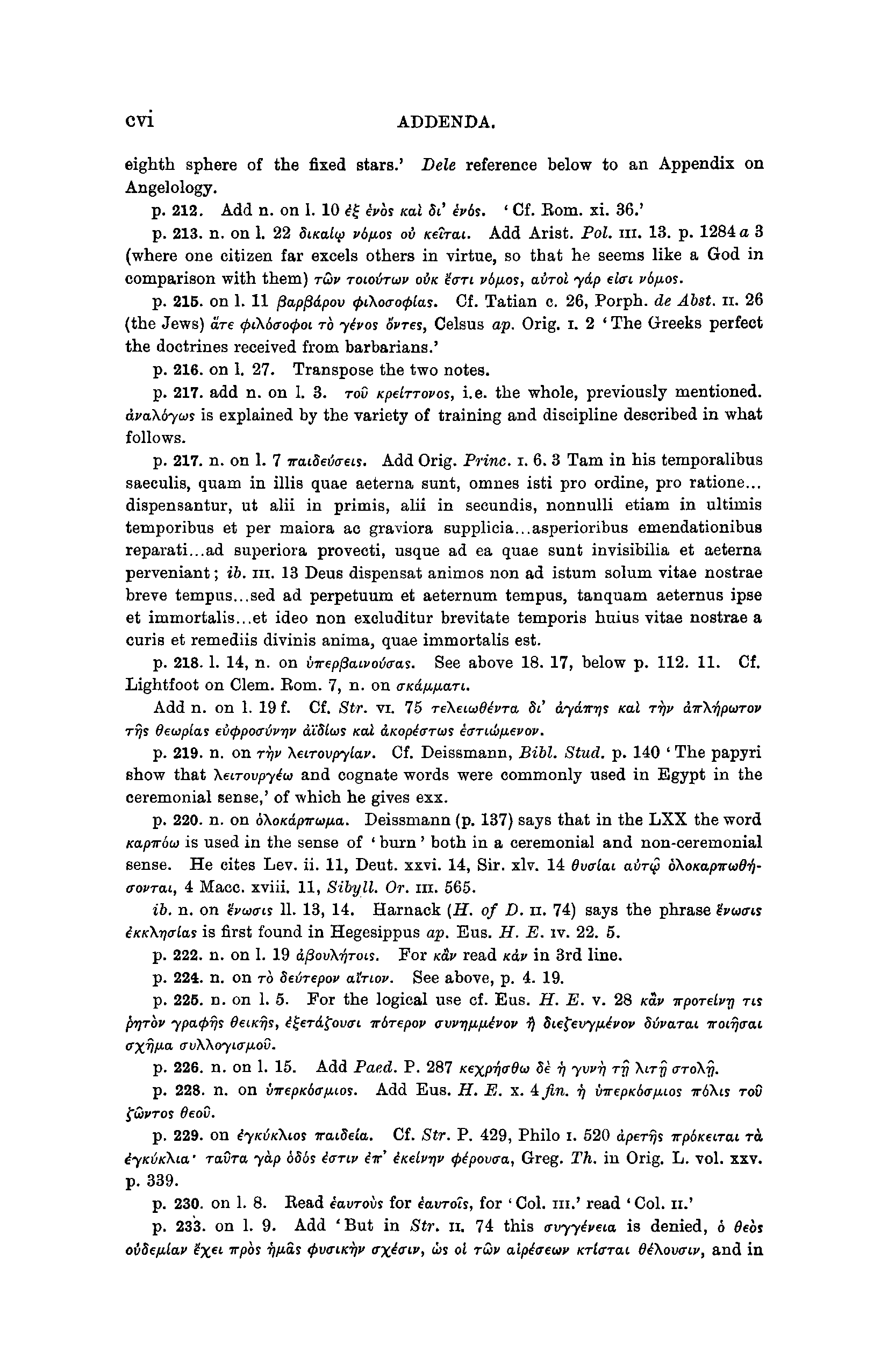
CV1 ADDENDA. eighth sphere of the fixed stars.'
Dele reference below to an Appendix on Angelology. p. 212.
Add n. on 1. 10 <?f ivbs KOX SC ev6s.
' Cf. Eom. xi. 36.' p. 213. n. on 1. 22 Sinaly vS/ios oi Kcihtu. Add Arist. Pol. in. 13. p. 1284 a 3
(where one citizen far excels others in virtue, so that he seems like a God in comparison with them) TQV Towfrruv O&K '{<JTI v6fios, avroi ydp eUn vdfios. p. 215. on 1. 11 fiapfidpov tpiXo<ro<pLas. Cf. Tatian c. 26, Porph. de Abst. n. 26
(the Jews) are <pi\6cro(pot TO ytvos b'vres, Celsus ap. Orig. I. 2 ' The Greeks perfect the doctrines received from barbarians.' p. 216. on 1. 27. Transpose the two notes. p. 217. add n. on 1. 3. rod Kpefrrovos, i.e. the whole, previously mentioned. avaXoyus is explained by the variety of training and discipline described in what follows. p. 217. n. on 1. 7 ircu8efoei.s. Add Orig. Trine, i. 6. 3 Tarn in his temporalibus saeculis, quam in illis quae aeterna sunt, omnes isti pro ordine, pro ratione... dispensantur, ut alii in primis, alii in secundis, nonnulli etiam in ultimis temporibus et per maiora ac graviora supplicia...asperioribus emendationibus reparati...ad Buperiora provecti, usque ad ea quae sunt invisibilia et aeterna perveniant; ib. in. 13 Deus dispensat animos non ad istum solum vitae nostrae breve tempus...sed ad perpetuum et aeternum tempus, tanquam aeternus ipse et immortalis...et ideo non excluditur brevitate temporis huius vitae nostrae a curis et remediis divinis anima, quae immortalis est. p. 218. 1. 14, n. on vTrep/3cuvo6iras.
See above 18. 17, below p. 112. 11. Cf.
Lightfoot on Clem. Eom. 7, n. on (ncd/i/Mri.
Add n. on 1. 19 f.
Cf. Str. vi. 75 TeXeuad&Ta Si dydirqs ical TTJV AwX^purov Trjs Beupias ev<ppoaivqv d'CStois Kcd dKopiiXTUis icrniifaevov. p. 219. n. on ryv Xeirovpylav. Cf. Deissmann, Bibl. Stud. p. 140 ' The papyri show that \eiTovpy£u> and cognate words were commonly used in Egypt in the ceremonial sense,' of which he gives exx. p. 220. n. on oXoKdpTrw/ia. Deissmann (p. 137) says that in the LXX the word
Kapirdu is used in the sense of ' burn ' both in a ceremonial and non-ceremonial sense. He cites Lev. ii. 11, Deut. xxvi. 14, Sir. xlv. 14 Bvalai airy dXora/>7rw0i)oovrtu, 4 Mace, xviii. 11, Sibyll. Or. in. 565. ib. n. on havis 11. 13, 14. Harnack (if. of D. n. 74) says the phrase ft-wo-ts iKKKqixlas is first found in Hegesippus ap. Eus. H. E. iv. 22. 5. p. 222. n. on 1. 19 d^ouXijrois.
For K&V read K&V in 3rd line. p. 224. n. on TO Seirepov OXTIOV. See above, p. 4. 19. p. 225. n. on 1. 5. For the logical use cf. Eus. H. E. v. 28 KOD irpOTetvy TIS pryrbv ypafiijs Oeucijs, 4£eT&£ov<ri irbTepov avvi]iJ.ixivov •)) Sie^evy/iivor dijraTcu p. 226. n. on 1. 15.
Add Pae.d. P. 287 Kexp-ijaBa 5e i) yvvy] rrj \irfj CTTOXTJ. p. 228. n. on vTrepK6a/Mos. Add Eus. H. E. x. 4 fin. ij iirepK6<r/uos ir<5Xis TOV
VTO$ deov. p. 229. on (ty/cfeXios ircudeia.
Cf. Str. P. 429, Philo I. 520 dperij! irpUea-ai. T& a' Tavra yap 656s (<TTIV iv' iKelvrjv tptpov<ra, Greg. Th. in Orig. L. vol. xxv. p. 339. p. 230. on 1. 8. Bead eourous for iavrois, for ' Col. in.' read ' Col. n.' p. 233. on 1. 9. Add 'But in Str. II. 74 this avyyiveia is denied, 6 0ebs oiSefiiay lxel ""P^s ^/"2s (pvaiKyv <rxi<riv, us oi TWV aipiaetiiy arterou S^Xovaiv, and in https://doi.org/10.1017/CBO9780511695513.009 Published online by Cambridge University Press
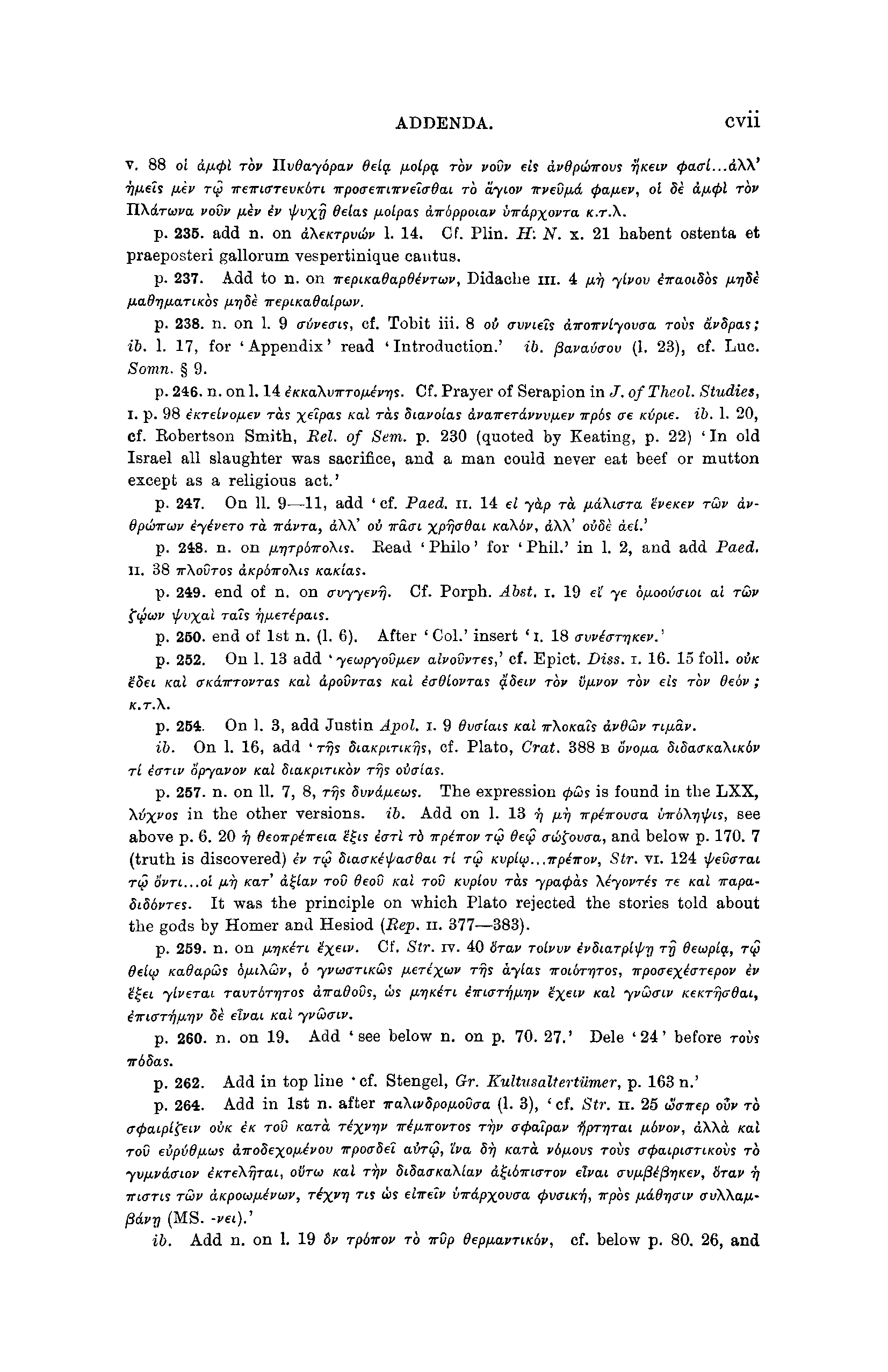
ADDENDA.
CV11 V, 88 ol dfx<pl TOV HvBayopav Beta p.otpa TOV vovv ets dvBpJnrovs yKeiv <pad...a\\' ijfieU ixkv TI} Tre-no-TevKon Trpoo-eTrnrvelaBai TO ayiov irvevpA ipafiev, ol Be a/xipl TOP
HXaTtava vovv fiiv iv ^pvxg Betas p.oLpas dwbppoi.av iiirapxovTa K.T.\. p. 235. add n. on aXeKTpviSiv 1. 14. Cf. Plin. H: N. x. 21 habent ostenta et praeposteri gallorum vespertinique oantus. p. 237.
Add to n. on irepiKaBapBivrwv, Didache in. 4 /j.ij ylvov i-traoiSbs firjSe jj.aB7]fj.aTiKos fiTjdi irepLKaBalpoiv. p. 238. n. on 1. 9 trivecris, of. Tobit iii. 8 oi avvius dirowlyovaa
TOVS avSpas; ib. 1. 17, for 'Appendix' read 'Introduction.' ib. fiavavaov (1. 23), cf. Luc.
Sovm. § 9. p. 246. n. on 1.14 iKKa\vTrTO/j.ivqs. Cf. Prayer of Serapion in J. of Theol.
Studies, I. p. 98 eKTelvofiev ras x e'P a' Ka^ ™! Siavolas dvaTreTdvvv/iev irpbs ere Kipie. ib. 1. 20, cf. Robertson Smith, Bel. of Sevi. p. 230 (quoted by Keating, p. 22) ' I n old
Israel all slaughter was sacrifice, and a man could never eat beef or mutton except as a religious act.' p. 247. On 11. 9—11, add ' cf. Paed. n. 14 el yip TO, ficAurra ZveKev TGIV dvdpwiroij/ tytveTO TO. TrdvTa, dAV ov iratrc xp?7<70cu /caXip, d\\' ovde del.' p. 248. n. on /i^rpiTroAis.
Bead ' Philo' for 'Phil.' in 1. 2, and add Paed.
II. 38 TTAOUTOS dKpbiro\is Katcias. p. 249. end of n. on crvyyevTJ. Cf. Porph. Abst, i. 19 el ye 6/J.OOIJO-LOI ai w fyoiv i/'uxai TOIS i]/J.eT<;pais. p. 250. end of 1st n. (1. 6).
After 'Col.' insert ' i . 18 avvio-T-qicev.' p. 252.
On 1. 13 add ' yeapyodfiev alvovvTes' cf. Epict. Diss. i. 16. 15 foil. OI)K k'b'ei Kai CKairTovTas Kal dpovvTas KaX iadlovTas ^'Setf TOV vpvov TOV els TOP debv ;
K.T.X. p. 254. On 1. 3, add Justin Apol. i. 9 Bvaiais Kal irXoKais dvBCiv n/iSc. ib.
On 1. 16, add ' TTJS 5taKpiriK?)s, cf. Plato, Crat. 388 B ovofj.a dida<nca\uc6v TI taTLv b'pyavov Kal btaKptTLKOv TTJS oiaias. p. 257. n. on 11. 7, 8, rfjs Svvd/ieus.
The expression 0£s is found in the LXX, Xi5x"°s i n the other versions, ib. Add on 1. 13 ^ fj.i] irpiirovcra vvb\-q\j/i.s, see above p. 6. 20 -rj Beoirptireia Z^ts IGTI T6 irpe'irov T<£ 6e£ <rib£oucra, and below p. 170. 7
(truth is discovered) iv TU tiadKi^aaSai rl TI£ Kvpltf...Ttpiirov, Str. vi. 124 -j/eviTTat. r y 6VTI....OI /J.rj /car' d%lav TOV Beov Kal TOV Kvplov Tas ypaQas XtyovTte T« Kai irapaSiddvTes. It was the principle on which Plato rejected the stories told about the gods by Homer and Hesiod {Rep. 11. 377—383). p. 259. n. on y.tjKe'n ixeLV'
Cf. Str. rv. 40 Srav Tolvvv ivdiarplfi] TJ Beupiq, rf BeitfS KaBapCis b)j.iKC>v, 6 yvwo-TiKws fieTexav TT/S dylas TTCKOTTJTOS, -rrpoaexicTepov iv Si elvai Kal yvCxriv. p. 260. n. on 19.
Add 'see below n. on p. 70. 27.'
Dele ' 2 4 ' before TOUS irbbas. p. 262.
Add in top line "of. Stengel, Gr. Kultusaltertiimer, p. 163 n.' p. 264. Add in 1st n. after vaXivSpojiovo-a (1. 3), ' cf. Str. n. 25 wo-irep ovv TO o-ipai-plfeLV OVK £K TOV /card Tix"V TriinrovTos TTJV a<j>alpav •fjpn)Tai /xbvov, dXXd Kal
TOV evpiBfiais diroSexohi-ivov trpoadei airr<fi, Iva di] Kara vSfiovs TOVS o-tpaipiaTiKovs TO yvfivdmov e*KTe\7JTaii OOTOJ Kal TTJV dtdao~Ka\Lav d^ibizujTOv elvat av^i^rjKev, tirav ij
TQV aKpoa/xivuiv, Ttxvy TIS us elireiv xnrdpxovo-a <pvaiKi), 7rpbs ix6.Bi\aiv avWa/i- (MS. -vei).' ib.
Add n. on 1. 19 6v TpSirov TO irvp 8epp.avTi.Kbv, cf. below p. 80. 26, and https://doi.org/10.1017/CBO9780511695513.009 Published online by Cambridge University Press
CVU1 ADDENDA.
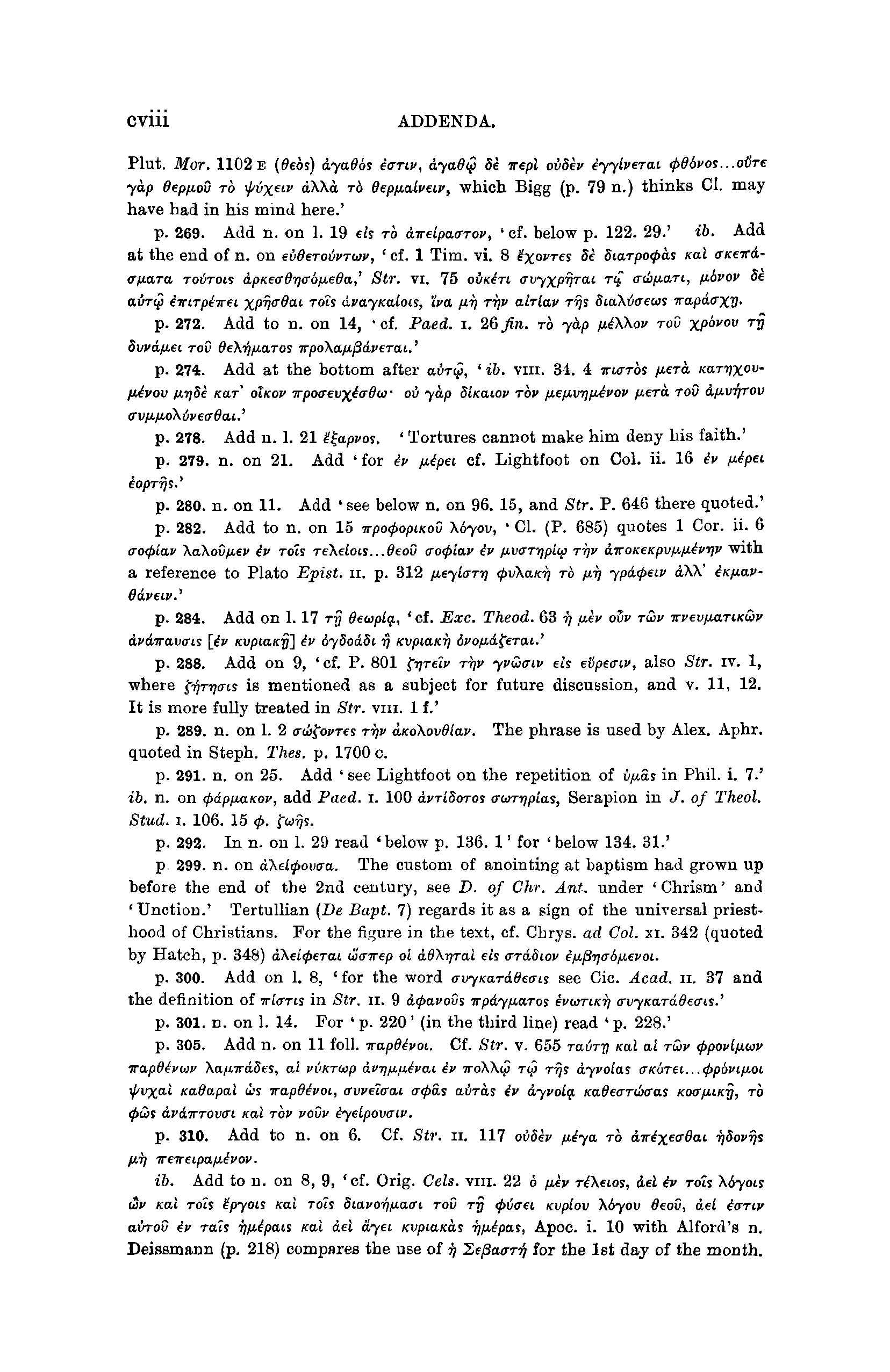
Plut. Mor. 1102E (0ebs) dyaffbs ianv, dyadif de ircpl oidev iyylverai. <j>8bvos...oihe yap Bep^ov TO ftix™" aXKa rb Bep/jialveiv, which Bigg (p. 79 n.) thinks Cl. may have had in his mind here.' p. 269. Add n. on 1. 19 els TO direlpaffrov, ' cf. below p. 122. 29.' ib. Add at the end of n. on eideroivTwv, 'cf. 1 Tim. vi. 8 IXOVTCS 5e diarpotpas KOX aKeicdffiiara
Toirois dpKeff07tab)ie6a' Str. VI. 75 oinin avyxpfJTai T<J o-difian, fibvov Se airy iiriTpiirei xpVffdat. rots dvayKalois, iva /lij TTJV alriav TTJS SiaXio-eas irapdffXVp. 272. Add to n. on 14, • cf. Paed. I. 26 Jin. TO yap fiiXXov TOV xp°v°u
TV Swdfiet TOV 8e\r]jj.aTos TrpoXafi^dveTat.3 p. 274. Add at the bottom after a&rtf, ' ib. v m . 34. 4 TTKTTOS fierd
KarrixovfUvov firjde KO.T OTKOV TrpOffevx^Bw • ov yap diicaiop TOV /ie^uij^coc fieTa TOO d^vifov o~v/ifi6\ijve<r6ai.' p. 278. Add n. 1. 21 i^apvos. ' Tortures cannot make him deny his faith.' p. 279. n. on 21. Add 'for iv ixipei cf. Lightfoot on Col. ii. 16 iv ixipei. iopryjs.' p. 280. n. on 11. Add 'see below n. on 96. 15, and Str. P. 646 there quoted.' p. 282. Add to n. on 15 irpo<j>opiKov \byov, • Cl. (P. 685) quotes 1 Cor. ii. 6 aorf>iav \a\ovfiev iv Tots Te\€iois...$eov ao(f>Lav iv fivffTyjpl^j TTJV airoK£Kpv/j.fJ.£v7}V with a reference to Plato Epist. n. p. 312 /xeylaTi] <pv\aKi) rb pi} ypatpeiv dXX' p. 284. Add on 1. 17 TT; Oeupla, ' cf. Exc. Theod. 63 TJ juee ovv TC>V irvev/j.aTiKwv avdiravtns \£v tcvpiaKr}~\ iv bydoddi rj tcvpiaicii bvofJ.dfr€Tai..' p. 288. Add on 9, 'cf. P. 801 STJTUV TTIV yvdaiv els eipecriv, also Str. iv. 1, where jftnitns is mentioned as a subject for future discussion, and v. 11, 12.
It is more fully treated in Str. vm. 1 f.' p. 289. n. on 1. 2 o-tiifovres TTJV a.Ko\ovBlav. The phrase is used by Alex. Aphr. quoted in Steph. Thes. p. 1700 c. p. 291. n. on 25. Add ' see Lightfoot on the repetition of v/n-as in Phil. i. 7.' ib. n. on <pdpfiaicov, add Paed. I. 100 avriSoros auirrjplas, Serapion in J. of Theol.
Stud. l. 106. 15 (p. fw^s. p. 292. In n. on 1. 29 read 'below p. 136. 1' for 'below 134. 31.' p 299. n. on d\d<povaa. The custom of anointing at baptism had grown up before the end of the 2nd century, see D. of Chr. Ant. under ' Chrism' and 'Unction.'
Tertullian (De Bapt. 7) regards it as a sign of the universal priesthood of Christians. For the figure in the text, cf. Chrys. ad Col. xi. 342 (quoted by Hatch, p . 348) dXeitperai. oiawep ol dSXrjTal els GTdbiov ififiTjabfievot.. p. 300. Add on 1. 8, ' for the word atryKaTddeais see Cic. Acad. n. 37 and the definition of iriffTis in Str. II. 9 drpavovs irpdypaTos evarriKT] ffvynaTddeffts.' p. 301. n. on 1. 14. For ' p. 220' (in the third line) read ' p. 228.' p. 305. Add n. on 11 foil, irapdivoi. Cf. Str. v. 655 TCH^TI; Kal ai TSIV <ppovlfiav irapdivwv Xa/A7ra5es, ai vvKTwp dvTj/j.fj.e'vai iv TTOXXJ^ Ty TTJS dyvolas <TK0Tei...tppdvipoi ij/vxal Kaffapai ws wapffivoi, avvelaai <r<pd.s avrds iv dyvola KaffecmlxTas KOIT/U/CT}, TO <j>C>s dvdiTTOvai Kal TOV VOOV iyelpovaiv. p. 310. Add to n. on 6.
Cf. Str. n . 117 oi>8ev fUya TO dwix^Sai riSovijs pil ireireipafie'vov. ib.
Add to n. on 8, 9, 'cf. Orig. Cels. v m . 22 6 /icy riXeios, del iv rois Xbyois uv Kal TOU gpyots Kal TOU Si.av07ifi.affi TOV TTJ tf>tiffei Kvplov Xbyov Beov, del i<mv airrov iv Tais ijfiipais Kal del ayei. KvpiaKas rifi.e'pas, Apoc. i. 10 with Alford's n.
Deissmann (p. 218) compares the use of i] 2e/3acrTiJ for the 1st day of the month. https://doi.org/10.1017/CBO9780511695513.009 Published online by Cambridge University Press
ADDENDA.
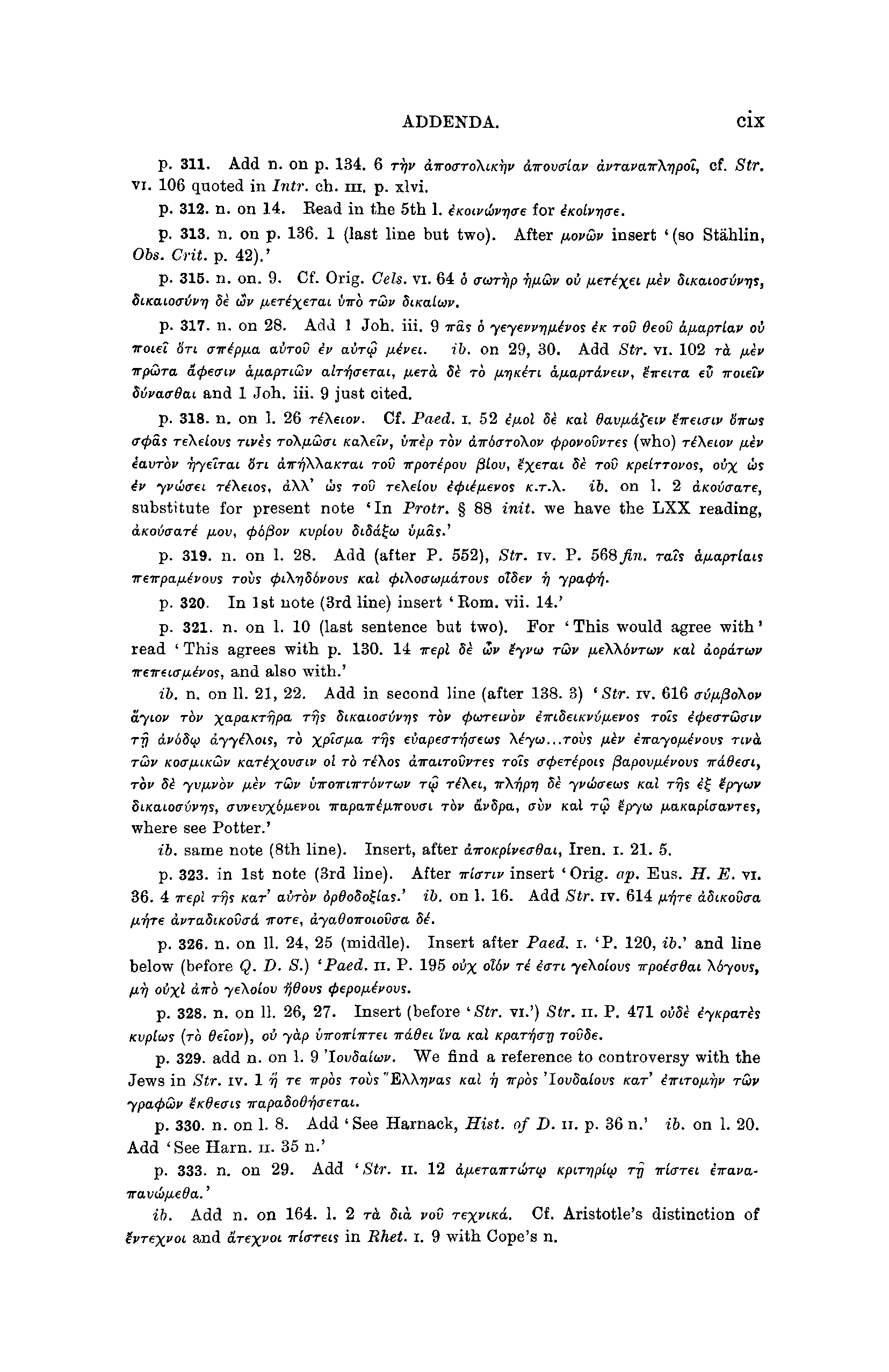
C1X p. 311. Add n. on p. 134. 6 Trjv dwoo-roXiKriv dirowiav avravairXripo'i, cf. Str. vi. 106 quoted in Intr. ch. in. p. xlvi. p. 312. n. on 14. Bead in the 5th 1. iKoivthvqixe for iKolvqae. p. 313. n. on p. 136. 1 (last line but two). After /tovdv insert '(so Stahlin,
Obs. Grit. p. 42).' p. 315. n. on. 9. Cf. Orig. Cels. vi. 64 6 croT^p ij/iSrv ov /lere'xei M^r SiKaiouiivtis,
SiKaiovtivq 5e iiSv fier^x^Tai biro TWV diKaluiv. p. 317. n. on 28. Add 1 Joh. iii. 9 TTCLS 6 yeyevvTjfj.e'vos 4K TOV 6eov dfiapriav ov void STL uiripixa avTov iv ai/njj fie'vei. ib. on 29, 30. Add Str. VI. 102 rh fiev irpSira afecnv dixapriwv alT^aeTai, pera Si TO /WJK^TI d^aprdveiv, tirura €v iroieiv SvvaoSai and 1 Joh. iii. 9 just cited. p. 318. n. on 1. 26 riXewv.
Cf. Paed. I. 52 ifiol 5e Kal Bav/j-afciv tireto-iv b'lras o~<f>a$ re\eiovs rives roXfiCJo'i KaXeiv, virep rov dirdaroXov fppovovvres (who) TfKeiov fiev iavrbv Tiyeirai b'ri d7r^\Xa/CTcu rod irportpov fiiov, ^x€TaL
^ To^ Kpcirrovos, ovx ws 4v yvwtrei TACIOS, dXX' cis TOU reXetov e'rp'ie'fi.evos K.T.X. ib. on 1. 2 d/covo-are, substitute for present note 'In Protr. § 88 init. we have the LXX reading, d/cot/trar^ yttou, <pb{5ov Kvpiov 5idd£u) vf/.ds.' p. 319. n. on 1. 28. Add (after P. 552), Str. iv. P. 568fin. rois a/j-aprlais
Treirpa^vovs TOVS <piXt}bbvovs Kal (piXotrw/j-dTovs oTdev rj ypatptf. p. 320.
In 1st note (3rd line) insert 'Rom. vii. 14.' p. 321. n. on 1. 10 (last sentence but two).
For ' This would agree with' read ' This agrees with p. 130. 14 irepl Se iv lyva) TUV /x.eXXbvTuy Kal dopdruv
TrtireuriJ.e'vos, and also with.' ib. n. on 11. 21, 22. Add in second line (after 138. 3) 'Str. iv. 616 avupoXov ayiov TOV xaPaKTVPa TV* SircaLOffijv'ijs rbv <parreivbv iiridetKv^/xevos rots ^tpeo'rQo'iv rrj dvbd(f> dyy^Xois, TO xptoyta rijs evapetTr'qo'CLas X£yo)...TOvs fxkv e'wayofj.tvovs rcva rwv KO&fiiKQv Kar^xovair ol TO TCXOS dirairoCyres rols <r<peTipois (Sapovfit'vovs TrdOeoi,
TOV Se yvfxvbv ixev T&V inroirnrrovriov TQ r^Xet., irXTjpt) 8e yvdxreojs Kal TT}% 4% e"pywv diKaioo'OvTjs, o~vvevxbfj.evoi irapair^ixirovo'i T6V avfipa, avv Kal r y gpyoi fj.aKapLo~avTes, where see Potter.' ib. same note (8th line).
Insert, after diroKplveaQai, Iren. i. 21. 5. p. 323. in 1st note (3rd line).
After wio-riv insert 'Orig. ap. Eus. H. E. vi.
36. 4 Trepi T7)s Kar airov dp6o8o£tas.' ib. on 1. 16. Add Str. IV. 614 ^ r e dSiKovtra
/Ar/re dvTadtKovtrd troTe, dyaOoiroiovffa Si1. p. 326. n. on 11. 24, 25 (middle).
Insert after Paed. i. 'P. 120, ib.' and line below (bpfore Q. D. S.) 'Paed. n . P. 195 ovx 0^°" T^ ^t7Tt y^Xoiovt irpoicdai
Xbyovs, fir] ovxl dtrb yeXoiov ijdovs tpepofj.e't'ovs. p. 328. n. on 11. 26, 27. Insert (before ' Str. vi.') Str. n. P. 471 ovSe iyKparte
Kvplws (TO 6e7oii), ov ydp viroiriTTTei irddei 'iva Kal KpaT"tj(rr) rovde. p. 329. add n. on 1. 9 'lovSaiwv. We find a reference to controversy with the Jews in Str. IV. 1 r\ re irpbs rohs "EiXXtjvas Kal T\ Trpos 'lovdalovs KaTf 4Trtro/j.i]V TQIV ypa<f>Qv (Kffeais irapaSoB^aerai. p. 330. n. on 1. 8.
Add 'See Harnack, Hist, of D. n. p. 36 n.' ib. on 1. 20.
Add 'SeeHarn. H. 35 n.' p. 333. n. on 29. Add ' Str. II. 12 dfieTa7TTiiriji KpiTrjpiip Trj irlo-rei. exavaTrav<i>/j.e8a.' ib.
Add n. on 164. 1. 2 rh did vov TexviKa. Cf. Aristotle's distinction of ivTexvoc and aTex"oi Trlo-reis in Rhet. I. 9 with Cope's n. https://doi.org/10.1017/CBO9780511695513.009 Published online by Cambridge University Press
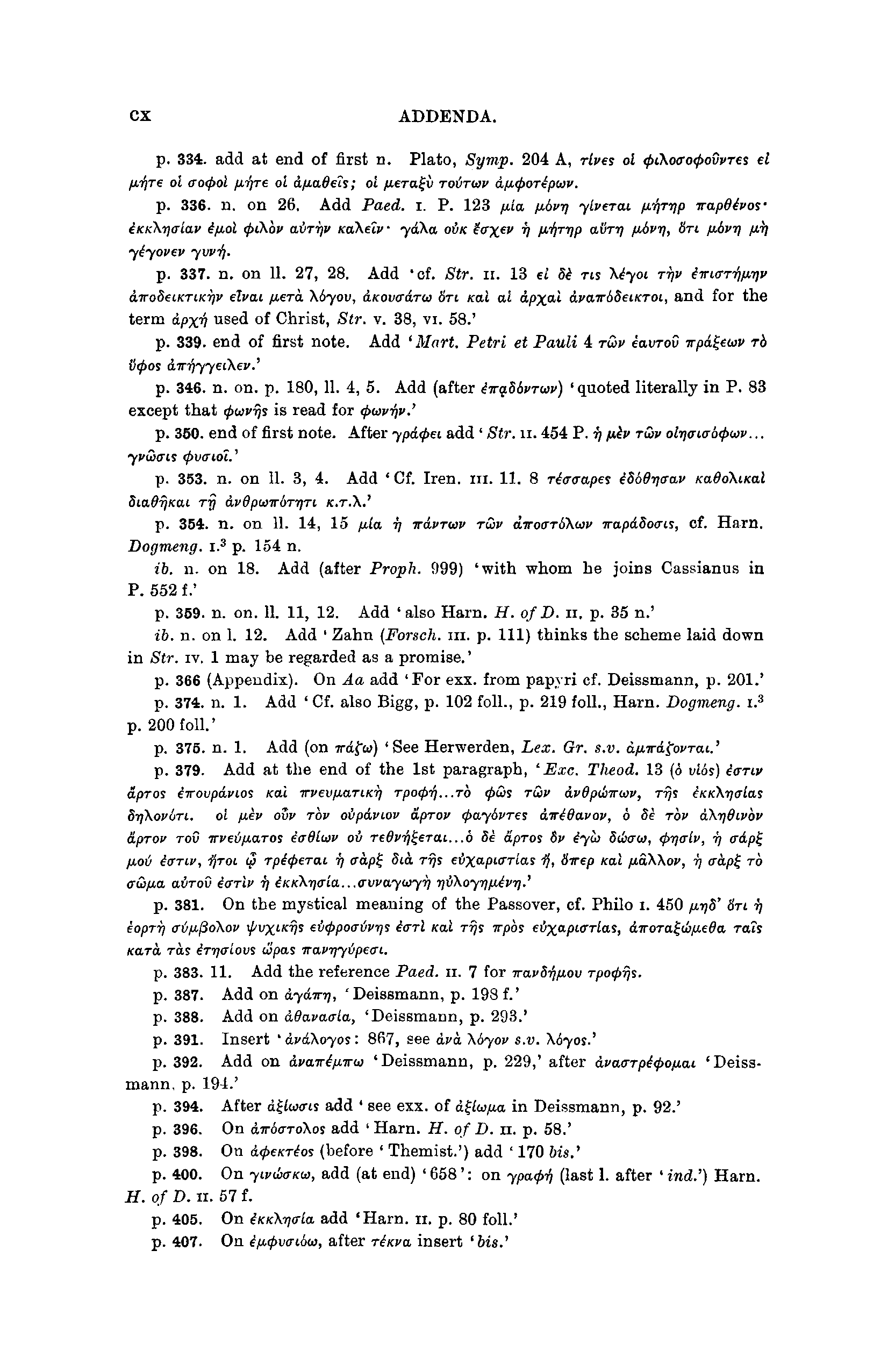
ex ADDENDA. p. 334. add at end of first n. Plato, Symp. 204 A, rlyts ol <pi\o<ro<j>ovvTes el
/i-iJTe ol <ro<pol firp-e ol afiaBeh; ol fieral-v rotirwv d/j.<poT4puv. p. 336. n. on 26.
Add Paed.
I. P. 123 /j.ia IJMV-Q ylverai /n^rrip irap64vo%iKK\i)alav t/iol <pikbv airijv Ka\etv • yd\a oin l<rxf V M'^I7"'IP aiirri fibvri, Sri jubvr\ /*•)) yiyovev yw^. p. 337. n. on 11. 27, 28. Add 'of. Str. n. 13 el 5t TIS \4yoi TT)V ivurHnaiv airodeiKTiKTiv elvcu /terd X670U, d/cowrdra STI rat al dpxal dvairbSeiKroi, and for the term apxh u sed of Christ, Str. v. 38, vi. 58.' p. 339. end of first note.
Add 'Mart. Petri et Pauli 4 T&V eavrov irpd^uv TO p. 346. n. on. p. 180, 11. 4, 5. Add (after {irq.b'bvTwv) 'quoted literally in P. 83 except that cpwvTJs is read for <j>avi]v.' p. 350. end of first note. After ypdfei. add ' Str. 11.454 P. r) fttv TWV yvuio~LS <f>vo~iol.' p. 353. n. on 11. 3, 4. Add 'Cf. Iren. m. 11. 8 r^crapes idbeyo-av
8ia$iJKai rrj avdpuirbrriTi K.T.X.' p. 354. n. on 11. 14, 15 /xla r/ TT&VTWV TSIV atroarbXav
Trap&Soais, of. Harn.
Dogmeng. I.3 p. 154 n. ib. n. on 18. Add (after Proph. 999) 'with whom he joins Cassianus in P. 552 f.' p. 359. n. on. 11. 11, 12. Add ' also Harn. H. ofD. 11, p. 35 n.' ib. n. on 1. 12. Add ' Zahn (Forsch. in. p. Ill) thinks the scheme laid down in Str. iv. 1 may be regarded as a promise.' p. 366 (Appendix). On Aa add 'For exx. from papyri cf. Deissmann, p. 201.' p. 374. n. 1. Add ' Cf. also Bigg, p. 102 foil., p. 219 foil., Harn. Dogmeng. I.3 p. 200 foil.' p. 375. n. 1.
Add (on 7rdfw) 'See Herwerden, Lex. Gr. s.v. d/i7rdfovrai.' p. 379. Add at the end of the 1st paragraph, 'Exc. Theod. 13 (6 vlbs) i<mv apros iiroupavios Kai irvevfiariKT} Tpotp^i...TO 0ws r&v dvdp&irwv, r-^s £KK\7IO~ICLS SrfKovliTi.. ol /J.ev ovv rbv oip&viov aprov (fiaybyres dir^ai'ov, 6 5e rbv a\7]6iv6r aprov TOV irveifiaros iadluv ov Te6vfi£eTai...b Be dpros bv iyic dibvta, cj>r)<riv, i) trdplfioi ianv, ijroi if Tpi<perai i) aapl; did rrjs eixapicrTias if, Sirep Kal fiaWov,
TI crkp^ TO aQifia airov 4arlv i] iKKkqaia...vvvayayr) yiiKoyrniivq.' p. 381. On the mystical meaning of the Passover, cf. Philo 1. 450 fiyS' STL T) eoprij trtiixficikov \pvx<-KV* d^poirivrjs iarl Kal rrjs Trpbs eixaPLtyT^a^ diroTa£(l)/j.eda rats Kara Tas £TT]<TIOVS wpas Travtrytipecn. p. 383. 11. Add the reference Paed. 11. 7 for wavSijiiov rpotpris. p. 387. Add on dydirri, 'Deissmann, p. 198 f.' p. 388. Add on ddavaula, 'Deissmann, p. 293.' p. 391. Insert 'dv£Koyos: 867, see dca \byov s.v. \670s.' p. 392. Add on dvairifiirw 'Deissmann, p. 229,' after dvaarp4<poii.ai 'Deisamann, p. 194.' p. 394. After d£(w<m add ' see exx. of d^ioi/xa in Deissmann, p. 92.' p. 396. On d7r6o-To\os add ' Harn. H. of D. 11. p. 58.' p. 398. On acpeKTios (before ' Themist.') add ' 170 bis.' p. 400. On ywdxTKa, add (at end) ' 658': on ypa<j>Ji (last 1. after ' ind.') Harn.
H. of D. 11. 57 f. p. 405. On {KKKritrla add 'Harn. 11. p. 80 foil.' p. 407.
On iiMpwibui, after T^KVO. insert 'bis.' https://doi.org/10.1017/CBO9780511695513.009 Published online by Cambridge University Press
ADDENDA.
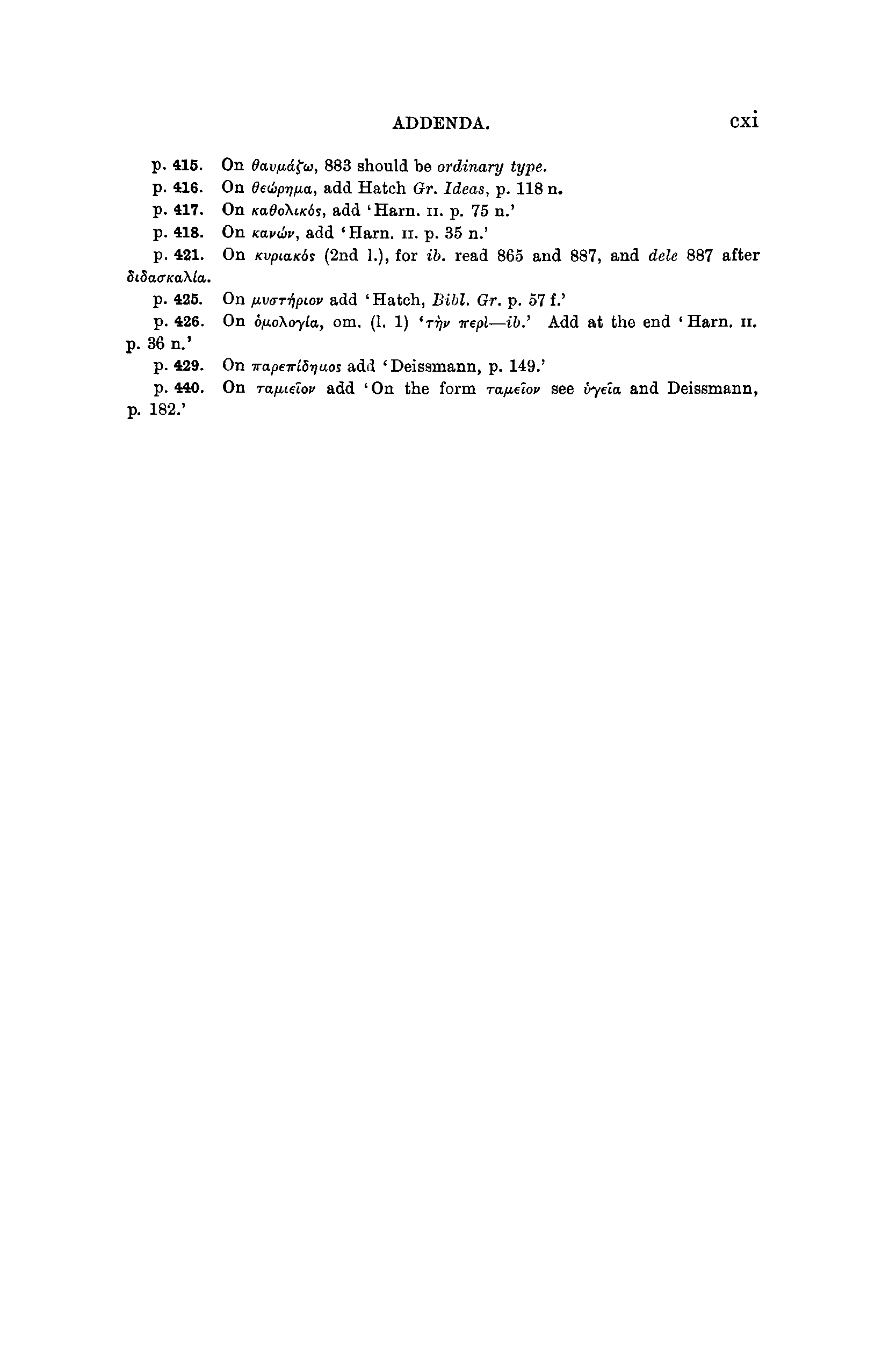
CXI p. 415. On davfid^a, 883 should be ordinary type. p. 416. On eeiipTj/xa, add Hatch Gr. Ideas, p. 118 n. p. 417. On Ka6o\iK6s, add 'Ham. u. p. 75 n.' p. 418. On Kavibv, add 'Ham. n. p. 35 n.' p. 421. On /cupia/cis (2nd 1.), for ib. read 865 and 887, and dele 887 after SidaiTKaXLa. p. 425.
On /Av<TT-fipiov add 'Hatch, Bibl. Gr. p. 57 f.' p. 426. On ifwXoyla, om. (1. 1) 'ri]v irepl—ib.' Add at the end ' Harn. H. p. 36 n.' p. 429. On irapeirldriuos add ' Deissmann, p. 149.' p. 440. On Ta/ueloi> add ' On the form ra/ielov see vytia and Deissmann, p. 182.' https://doi.org/10.1017/CBO9780511695513.009 Published online by Cambridge University Press

https://doi.org/10.1017/CBO9780511695513.009 Published online by Cambridge University Press
K A H M E N T 0 5
2 T P Q M A T E Q N
Z M. C. https://doi.org/10.1017/CBO9780511695513.010 Published online by Cambridge University Press
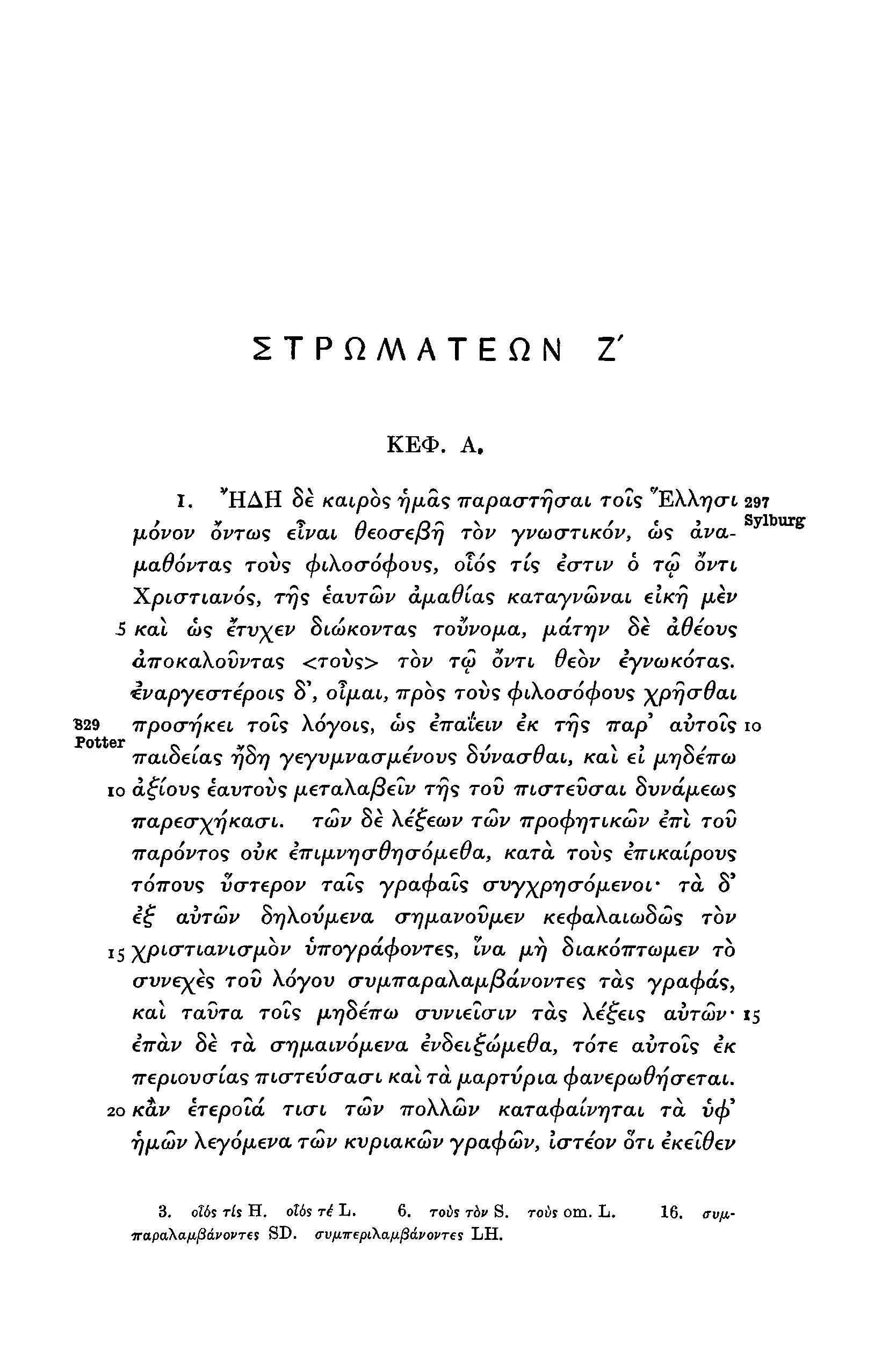
2 T P Q M A T E Q N
KE<£. A.
"HAH Be fcaipos 17//.a? irapacrTrjcrai TOIS ''EWrjcru 297 fjiovov OVTO)<; etvai ueocrepr) TOV yvu>o~TiKov, at? avaToils (f>ikoo-6<f>ov<;, otos TIS io~Tiv 6 ra oi'Ti
T^S kavTOiv d/xa^tas KCLTayvcovai e'lKr} fikv -5 /cat &)§ krv)(€V Stw/covras Tovvo/xa, fxaTrjv Se aOeow;
<TOUS>
TOV TW OVTI
4vapyeo-Tepoi<s S\ olfiai, TT/JOS TOUS •829 Trpoo~rjK€i TOIS Xdyois, ws ina'Cew IK TIJS Trap' avrois 10
TratSetas 178^ ytyv/JLvao-fJievovs 8vvao~6cu, /cat et 10 d^tous eauTous fieTaXafielv Trjs TOV mcrreucrai irapeo-)(r)Kao-i.
TU>V Se Xefewv TWI/ Trpo§y\TiKa>v iiri TOV TrapovTos OVK iTnfxvrjcrdrjaoiJieOa, /card row? iniKaipovs TO7rous varepov rats ypcujxtls crvy^prjO'oiJ.evoLTO. §' ef auTftSv Sr/Xovfjieva, o"f\\x.avovp.ev /ce<^aXata)Sa3s TOV iiri 15 -yj>io~Tia.vio-px>v v7roypd<f>ovT€<5, Cva. fxr) Sta/coTTT&j^iev TO awe^es TOV Xdyou a-vjxiTapaKa^pdvovTes Tas ypacjids, /cat, TauTa TOI? /x^SeVw o-vvieZaiv Tas Xe^ets a i r a c 15
C7rdv Se Ta a">j/Aatvdju,eva evSei^wjiie^a, TOTC avT0i9 e/c TrepLOvo-ias Tno~Tevo~ao-L KCU TO. jxapTVpia.
(jxxvepadyjo-eTau.
20 /cav eTepoZd TIO~I
TWV TTOXXW
KaTa(j)aCvr)TaL TO. vcj) r)fj.(ov Xeydjueva TCSV Kvpia/caJv ypa<]>a>v, icniov OTL eK 3. o?6s Ws H. oWs T^ L.
TOI5S T6V S. roiis om. L.
16. irapaXa/jifJ&vovTCS SD. (TVfnrepAa/j.^di'ovTes L H . https://doi.org/10.1017/CBO9780511695513.010 Published online by Cambridge University Press