
CHAPTER V
CIV. §27—C. V.§28] MISCELLANIES, BOOK VII.
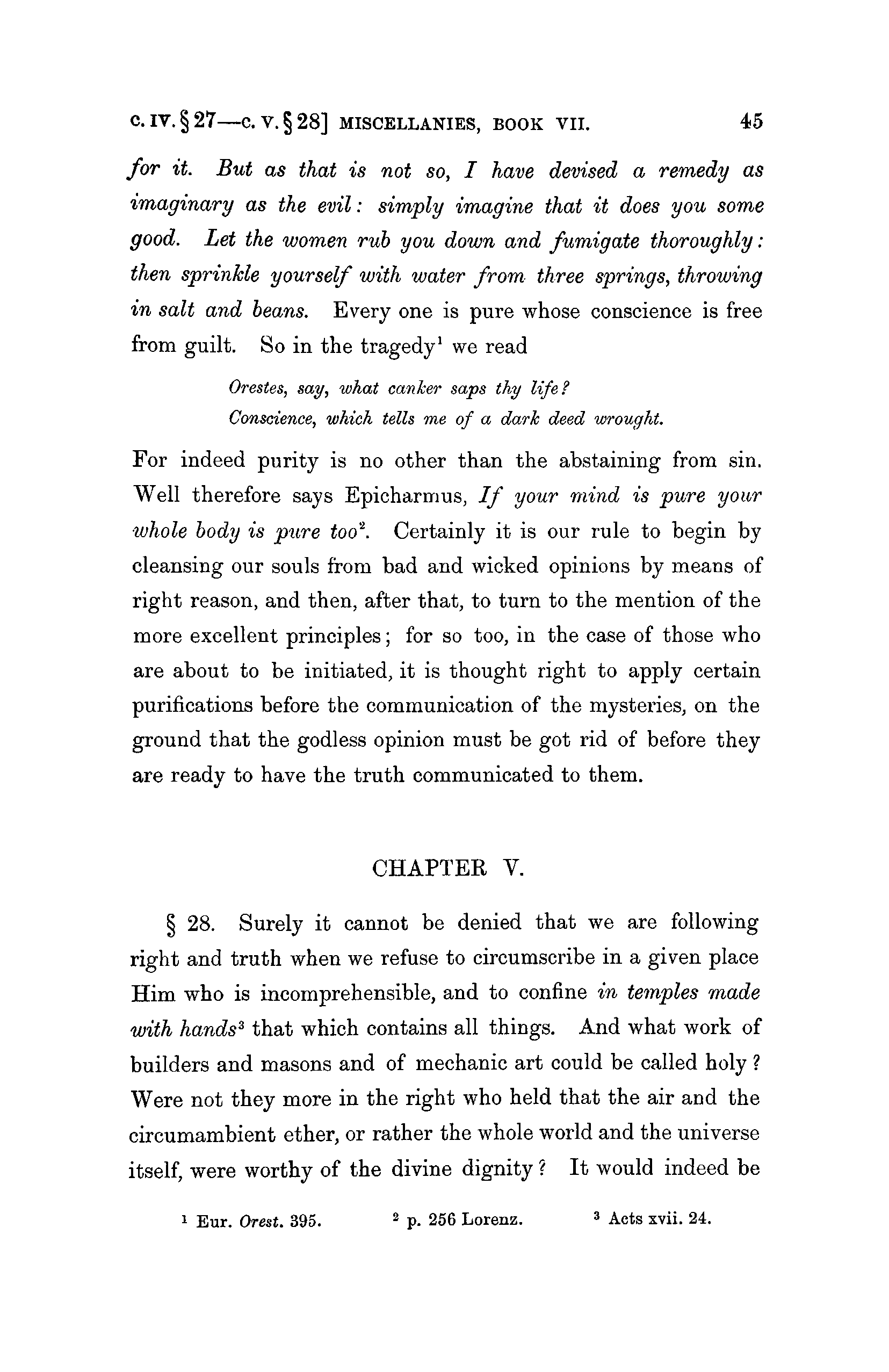
for it. But as that is not so, I have devised a remedy as imaginary as the evil: simply imagine that it does you some good. Let the women rub you down and fumigate thoroughly: then sprinkle yourself with water from three springs, throwing in salt and beans. Every one is pure whose conscience is free from guilt. So in the tragedy1 we read Orestes, say, what canker saps thy life?
Conscience, which tells me of a dark deed wrought.
For indeed purity is no other than the abstaining from sin.
Well therefore says Epicharmus, If your mind is pure your whole body is pure too'2. Certainly it is our rule to begin by cleansing our souls from bad and wicked opinions by means of right reason, and then, after that, to turn to the mention of the more excellent principles; for so too, in the case of those who are about to be initiated, it is thought right to apply certain purifications before the communication of the mysteries, on the ground that the godless opinion must be got rid of before they are ready to have the truth communicated to them.
CHAPTER V.
§ 28. Surely it cannot be denied that we are following right and truth when we refuse to circumscribe in a given place
Him who is incomprehensible, and to confine in temples made with hands3 that which contains all things. And what work of builders and masons and of mechanic art could be called holy ?
Were not they more in the right who held that the air and the circumambient ether, or rather the whole world and the universe itself, were worthy of the divine dignity ? It would indeed be
1 Eur. Orest. 395.
2 p. 256 Lorenz.
3 Acts xvii. 24. https://doi.org/10.1017/CBO9780511695513.010 Published online by Cambridge University Press
ZTPQMATEQN Z'
[p. 845, s. 303
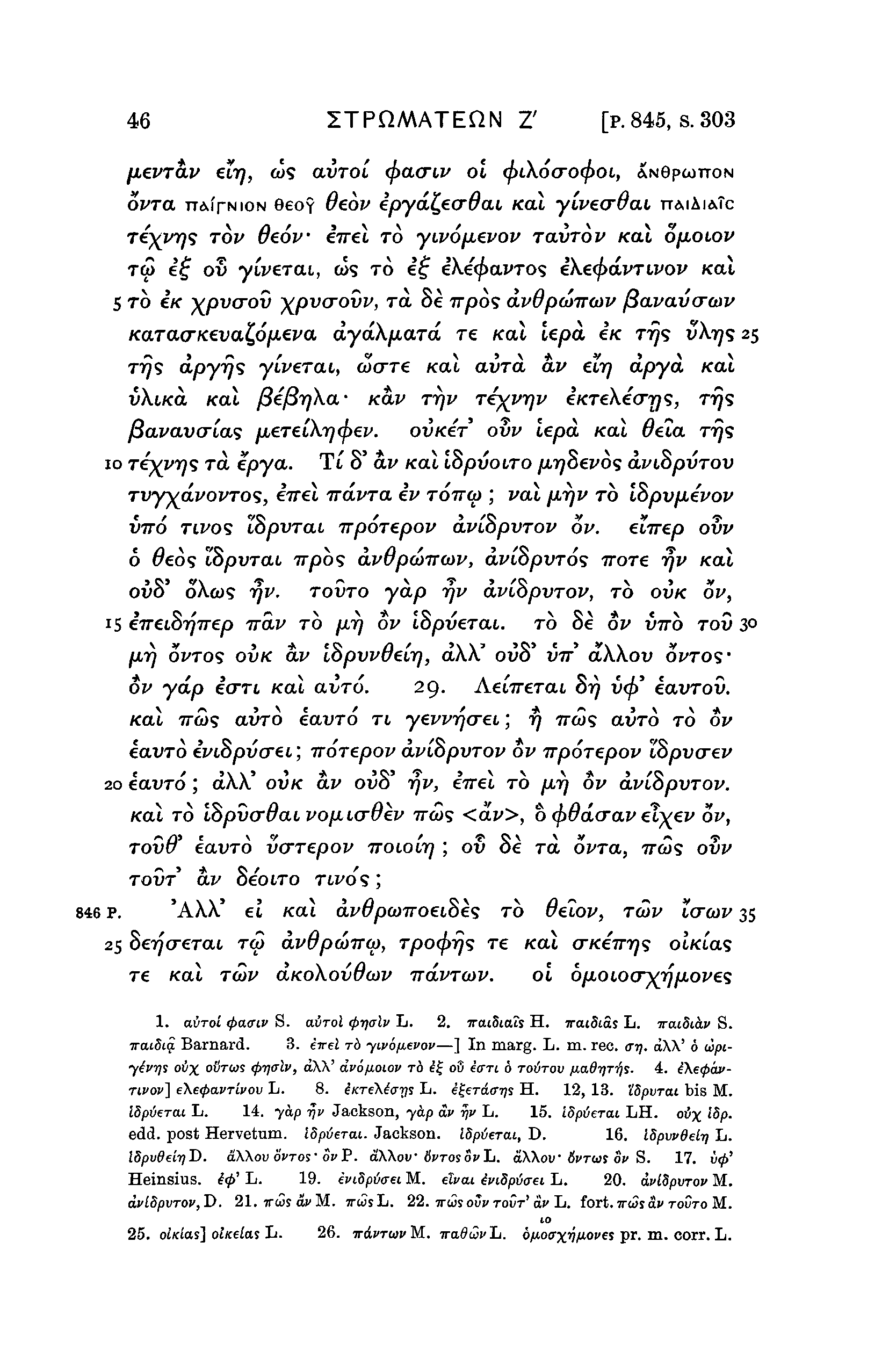
GLT), w? avToi <f>ao~iv ol <J>L\6O-O<J>OL, A OVTOL n^ffNioN Seoy 0e6v kpydt/tcrdai Kal yivecrdai TTAIAI&TC
T€)(yr)S TOV 0€OV eVct TO ytVO/XCVOV TOLVTOV Kal 0/U.OtOV TS i£ ov yiveraa, o5s TO ef eXe'(£avTos eXe<£dvTtvov /cat
S TO e/c xpvaov xpvo-ovv, rd Se wpos dvdpcoirav j3avavcr<t)v KaTao~K€va£,6[JL€i'a dydX[x.aTd Te /cat Upd e/c TT}S V\.T)<S 25 rrjs dpyrjs yiverai, ware /cat avTa av elr/ dpyd /cat uXt/ca /cat 0ij3r)\aKOLV TTJV Texyiqv e/CTe\ecr7ys, TTJS y8avauo~tas fJb€TeC\r)(f>ei'.
OVK£T OVV lepd /cat #eta TTJS 10 Te^yrfi rd epya.
Tt 8' av /cat tSpuotTO /AT^SCVOS avtSyauTou Tuy^avoi'Tos, eTret TrdvTa iv TOTTW ; vat /A^V TO ISpv/JLevov
VTTO Ttvos ISpvraL wpoTepov dviSpvrov ov. etvep ovv 6 deos ihpvTai TT/DOS dvOpcoircov, dviS/DUTos TTOTC TJIC /cat ouS' oX<u9 17V.
TOUTO ydp r/v dvCSpvrov, TO OVK OV, 15 iireiStiTrep irdv TO fir) ov tS/jveTat.
TO Se ov virb TOV 3° joti) 6Vros OVK av ISpwdeCrj, dXX' ovS' VTT aXXov OVTOS* ov ydp eo"Tt /cat avTO.
29.
AeiTreTat Srj ixfi iavrov.
Kal TTWS a w o eauTo TI yevf-^o-et; r/ TTWS avTo TO OV eavTo eVtSpucret; rrorepov dvCSpvTov ov irpoTepov lhpvo-ev
20 eauro; aAA OVK av ovo r/v, evret TO /AT) OV aviopvTov.
/cat TO ISpvo-daL vo[j.Lo-dev TTWS <dv>, o (fiddcrav et^ev ov, Tovff eavTo vo~Tepov TTOLOLT) ; ov Se Tot ovTa, TTCUS OVV
TOVT' av Se'otTo Ttvo's; 846 p.
'AXX' et /cat dv6po)Troei,Se.<s TO deiov, TCOV lo~u>v 35 25 Se^ceTat TW dvdpanrcp, Tpo<f>rjs TC /cat o"/ce7r^s ot/ctas
TC /cat TWV aKoXovdwv TrdvTcov. ol 6fiOLOo~)(7]fLoveis 1. (II5TOI t(>a<nv S. ai3rol cj>r)alv L.
2. TraiSiais H. jraiSias L. vai.Si.la> S. iraiSiq. Barnard.
3. eirel T6 yivoixevov—] In marg. L. m. rec. <rij. i W 6 o)p(- •ytvqs oi>X OHITOH (pTjulv, dJiV dvo/xoiov T6 i£ od icTTi 6 TO(5TOU fmd7)Ttfs.
4. i\e<pavTU>OV\ e\e(pavrivov L.
8. ^KreX^crijs L. i&T&ays H.
12, 13. HSpurai bis M.
ISpierai. L.
14. Y&/) •ijj' Jackson, 7dp (JK ^y L.
15. ISpierai LH. oi5x '5pedd. post Hervetum. ISpierai.. Jackson. ISpiercu, D.
16. ISpvvBehf L. idpvffeiriD. aXKov OI/TOS'ovP. aXKov SerosoeL. aXXou" iSxTut ov S.
17. u0'
Heinsius. ^0' L.
19. iviSpiaei M. efrai iviSptiaei L.
20. avldpvrov M. dvl8pvT0v,T>. 21. IT us an M. TTWSL. 22. TTUSOWTOUT'OC L. fort. 7ra>s a» TOUTO M. to 25. o^/cfas] oiicelas L.
26. TrdprwyM. Tra^wi'L. o/j.offxy/J'Oves pr. m. corr. L. https://doi.org/10.1017/CBO9780511695513.010 Published online by Cambridge University Press
C. V. §§ 28, 29]
MISCELLANIES, BOOK VII.
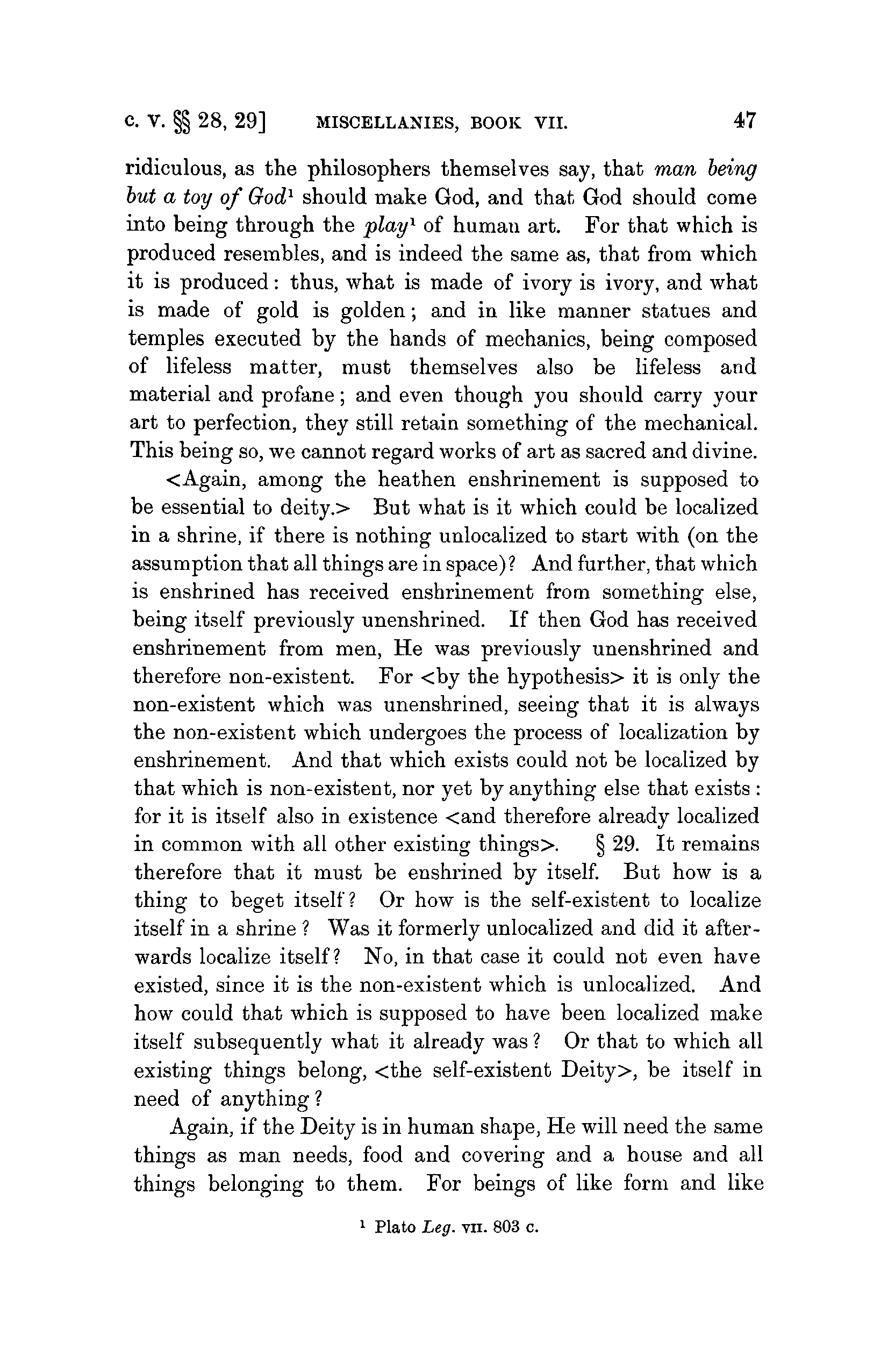
ridiculous, as the philosophers themselves say, that man being but a toy of God1 should make God, and that God should come into being through the play1 of human art. For that which is produced resembles, and is indeed the same as, that from which it is produced: thus, what is made of ivory is ivory, and what is made of gold is golden; and in like manner statues and temples executed by the hands of mechanics, being composed of lifeless matter, must themselves also be lifeless and material and profane; and even though you should carry your art to perfection, they still retain something of the mechanical.
This being so, we cannot regard works of art as sacred and divine.
<Again, among the heathen enshrinement is supposed to be essential to deity.> But what is it which could be localized in a shrine, if there is nothing unlocalized to start with (on the assumption that all things are in space) ? And further, that which is enshrined has received enshrinement from something else, being itself previously unenshrined. If then God has received enshrinement from men, He was previously unenshrined and therefore non-existent. For <by the hypothesis> it is only the non-existent which was unenshrined, seeing that it is always the non-existent which undergoes the process of localization by enshrinement. And that which exists could not be localized by that which is non-existent, nor yet by anything else that exists : for it is itself also in existence <and therefore already localized in common with all other existing things>.
§ 29. It remains therefore that it must be enshrined by itself. But how is a thing to beget itself?
Or how is the self-existent to localize itself in a shrine ? Was it formerly unlocalized and did it afterwards localize itself? No, in that case it could not even have existed, since it is the non-existent which is unlocalized. And how could that which is supposed to have been localized make itself subsequently what it already was ? Or that to which all existing things belong, <the self-existent Deity>, be itself in need of anything ?
Again, if the Deity is in human shape, He will need the same things as man needs, food and covering and a house and all things belonging to them. For beings of like form and like
1 Plato Leg. vn. 803 c. https://doi.org/10.1017/CBO9780511695513.010 Published online by Cambridge University Press
ITPQMATEQN Z
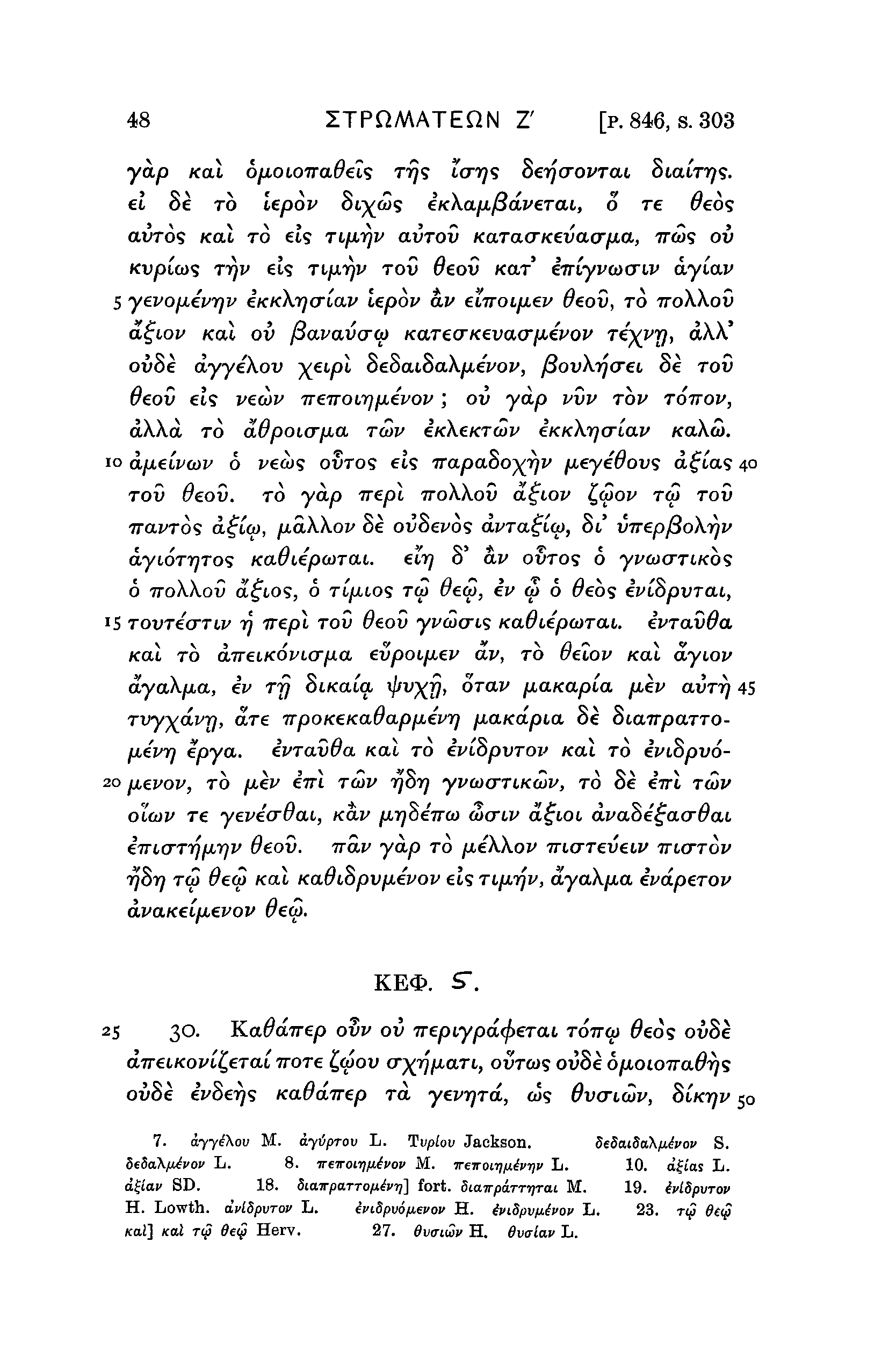
[P. 846, s. 303 yap KaX byuoioiradels TTJS UX^S SeTjcrovTai Sicur>?s. el Se TO lepov Si^ws efcXajii/SaVeTcu, o re #eos avTos /cat TO ets Tifirjv avTOv KaTacrKevacrfJia, TTOS ov
KvpC<x><; TTJV eis Tt/x-qv TOV deov xar' iiriyvoicriv dylav 5 yevofievr/v eKKXrjo~iav lepov av €.tiroi[j.ev deov, TO TTOXXOC atjuov Kal ov j3avavo-a> KaTecrKevacrjx,evov
T£XVV> * ^ '
ovSe ayyekov \etpl BeSaiSaX[xe'vov, fiovXtfcrei, 8e TOV deov ei? vewv TreiTOLrjfievov; ov yap vvv TOV TOTTOV, dXXa TO d0poio'[xa TQ>V eKXeKTwv eKKkrjo~iav KaXw. io a\x.ewa>v 6 vews ouros ets TTapaZo^r^v ^eyi8ov<s dfias 40
TOV deov.
TO yap Trepl TTOXXOU aqiov £,<£ov rw TOV os a£Ca), [j.aXXov he ovSevos dvTa£i(t>, 8L vnepfioXr/v KaOiepunai. eh) 8' av OVTOS 6 yva)o-TiKo<i 6 TTOXXOV a^ios, o TijUtos TW ^ew, iv (o 6 debs evihpvTai, 15 TovTecrTiv Tj Ttepl TOV deov yvao-is KadiepatTai,. evTavda Kal TO aTreLKOVLcrfia evpoLjjiev av, TO delov Kal dyiov dyaXfjia, ev Trj SiKaia '/'^X??' °Tav I^o-Kapia fiev avTT) 45
TvyyavQ, are TrpoKeKadapfJuevr) /xaKapia Se hiairpaTTO- [K,evy] epya. ivTavda Kal TO iviSpvTov Kal TO evi.o*pv620 jjievov, TO p.ev ewl TCOV yjSrj yvacrTiKwv,
TO Be eirl TCOV OLCJV Te yeveo-dat, KCLV jM^SeVa) O>O~LV d£iot dvaBetjacrdai.
€TTi.o-Ti}iJir)v deov.
Trav yap TO jxeXXov irio-Teveiv TTICTTOV rjSrj TU dea> Kal KadcSpvfievov ets TL/JLTJV, dyaX/xa evdpeTOv dvaKeifxevov dew.
30.
Kaddirep ovv ov TrepuypatyeTai TOTTOI deos ovSe direiKovi^eTai TroTe t,a>ov cr^'jMari, ourws ovSe 6jU,oiO7ra^s ovSe evSerjs Kaddirep rd yevrjToi,
OJS OVCTLWV, SCKTJV 50
077^X01; M. aytiprov L. tvplov Jackson.
SeSaiSaX/ifrox S. dcSaK/j^vov L.
8. ireiroiyifiivov M. ir€TroL7]/j.4v7jv L.
10. aifi'as 3J. a^iai' SD.
18. diaTrparTo/ihri] fort. dunrpaTTrjrai M.
19.
MSpvrov H. Lowth. dvldpvTov L. iviipvofiwov H. ivi.SpviJ.hov L.
23. T(£ S«I^
Kai] /cai T<j) 0e<£ Herv.
27. 0v<nuiv H.
6vtrlav L. https://doi.org/10.1017/CBO9780511695513.010 Published online by Cambridge University Press