
CHAPTER VI
C. V. § 29—C. VI. § 80] MISCELLANIES, BOOK VII.
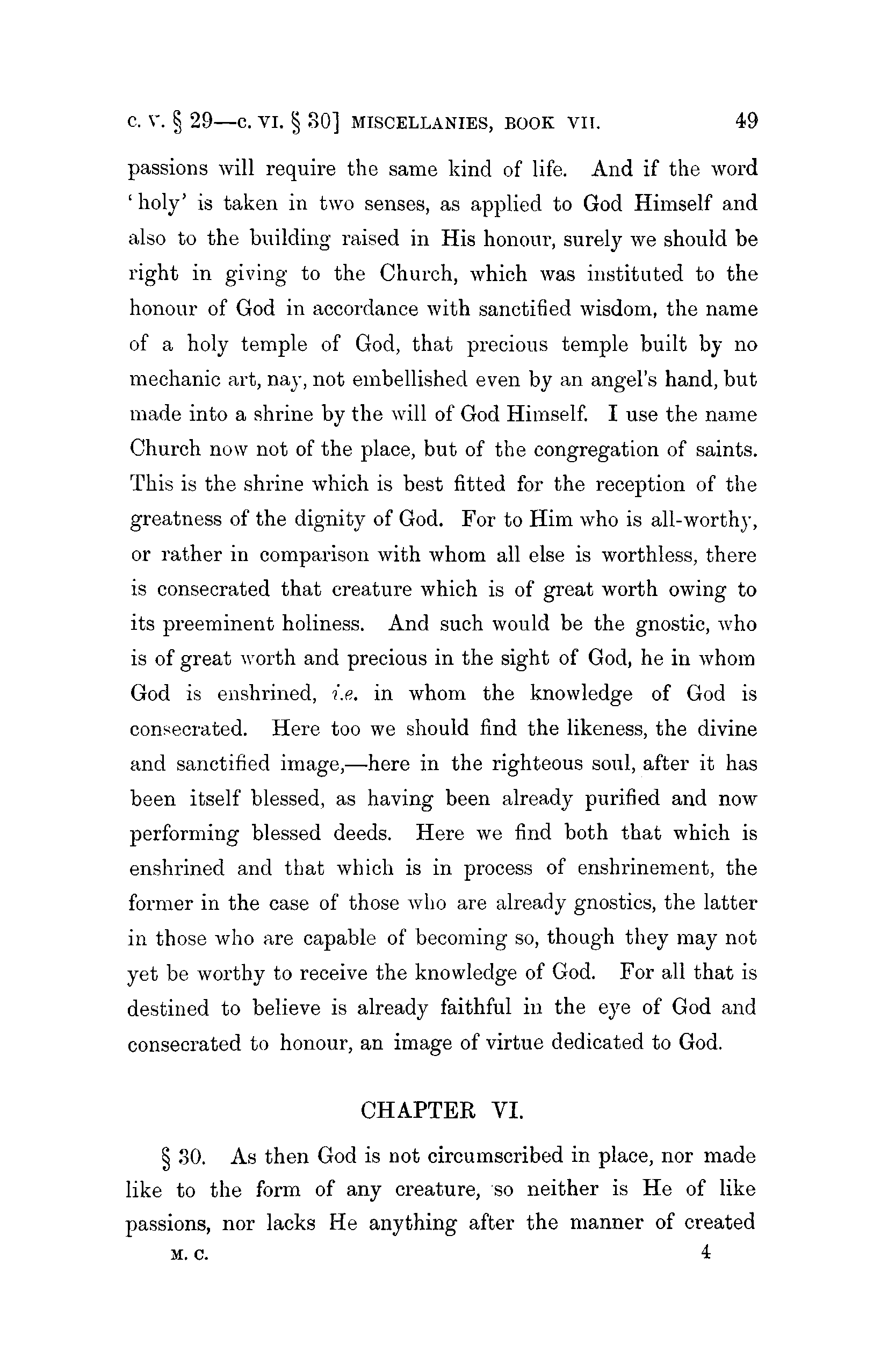
passions will require the same kind of life. And if the word ' holy' is taken in two senses, as applied to God Himself and also to the building raised in His honour, surely we should be right in giving to the Church, which was instituted to the honour of God in accordance with sanctified wisdom, the name of a holy temple of God, that precious temple built by no mechanic art, nay, not embellished even by an angel's hand, but made into a shrine by the will of God Himself. I use the name
Church now not of the place, but of the congregation of saints.
This is the shrine which is best fitted for the reception of the greatness of the dignity of God. For to Him who is all-worth)-, or rather in comparison with whom all else is worthless, there is consecrated that creature which is of great worth owing to its preeminent holiness. And such would be the gnostic, who is of great worth and precious in the sight of God, he in whom
God is enshrined, i.e. in whom the knowledge of God is consecrated. Here too we should find the likeness, the divine and sanctified image,—here in the righteous soul, after it has been itself blessed, as having been already purified and now performing blessed deeds. Here we find both that which is enshrined and that which is in process of enshrinement, the former in the case of those who are already gnostics, the latter in those who are capable of becoming so, though they may not yet be worthy to receive the knowledge of God. For all that is destined to believe is already faithful in the eye of God and consecrated to honour, an image of virtue dedicated to God.
CHAPTER VI.
§ SO. As then God is not circumscribed in place, nor made like to the form of any creature, so neither is He of like passions, nor lacks He anything after the manner of created
M. c. i https://doi.org/10.1017/CBO9780511695513.010 Published online by Cambridge University Press
ITPQMATEQN Z'
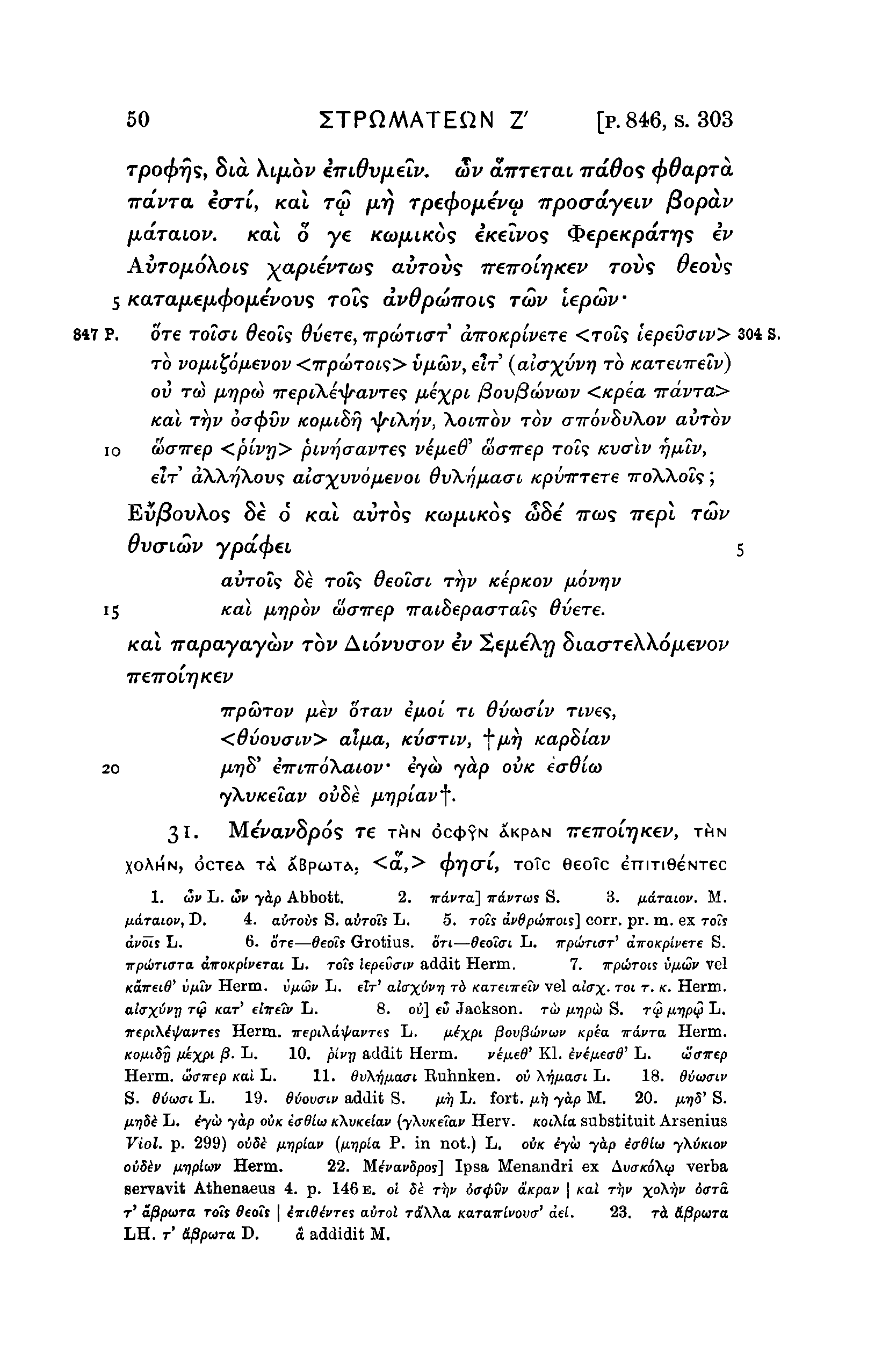
[p. 846, s. 303 rpo(f>fj<s, Sta XL/MOV iiriOvfieLv.
<£v aVreTat Trd Ttdvra. ecrrt, KOLL TG> /AT} rpei^o/ieW irpocrdyeiv fiopav lidraiov.
/cat O ye KO){XIKOS iicelvos <&epeKpdTr)<; iv Avroju.dX.ots -yapiivTOiS avrovs TreTroCrjKev TOVS 0eou?
5 Kara[jLefL(f)on,€i>ov<; rots dvdpdjirois TWV lepcov 847 P. ore Tolai, deals Overe, irpd>Tt,<TT airoKplvere KTolf lepev<nv> 304
TO vofu£6/jLevov <7r/3coTot?> V/JL&V, 6JT' (aicr)(vvT) TO KaTeiveiv) ov T<0 firjpm TT€ptXiyjravTe<; /^e^pt ftovftcovav </cpea travTa>
Kal TT)V 6(T(j>VV KO/juBfj •^rlX.TJV, \OITTOV TOV CTTTOvSuXoP CIVTOV io wairep <plvrj> pivtfcravTes vefie6' wa-rrep Tot? /cvcrlv T//J,2V,
SIT aXKip^ov; altrxyvo/ievot OvkqfJbacri icpvineTe TroXXot?; Eu/8ovA.os Se 6 /cat auro? /cw/xt/cos <58e TTW? Trept T(ov
Qvcjiutv ypdcfaet
auTOis Be Tot? Oeolcri TTJV Kepicov fiovrjv IS KOI firjpov axTTrep iraihepa(TTal<i dveTe.
/cat napayayaiu TOV ALOVVCTOV iv Xefidkr) SiacrTeWofievov irpwrov fiep b'-rav ifioi, TI Ovoocrlv <8vovcriv> alfia, KXXTTIV, f/MT) icapSlav
fJ-V^ iirnroXaiov i<ya) yap OVK eaOiw yXviceiav ovSe firjpiav'f.
3 1 .
MeVavSpds TC T^IN 6C4>YN AKP&N TreiroLTjKev XOAHN, OCT6A T(i ABptOTA, < a , > ^HTjCTl, TOTc 66oTc 6TTITl6eNTeC
1. wv L. wv 7^p Abbott.
2. iravra] T&VTOJS S.
3. judraioy. M. fidraiou, D.
4. a^Tois S. airois L.
5. TO« avSpdiirois] corr. pr. m. ex TOIS apots L.
6. ore—dedts Grotius. on—$eoicri L. irjOciTttrr' diroKplveTe S. awoKplvcrai L. Tots Uptvviv addit Herm.
7. Trpthrois i/xuv vel ' u^j' Herm. i)/xu5v L. etT* alffx^vy Tb KaTenreiv vel altrxTOL T. K. Herm. y TV KaT' cfaeu' L.
8. oi)] eu Jackson, TO; fJ.fjpoj S.
T^J y>Tiptp L.
Herm. TreptXd^acTes L.
^XPL ftovfi&vw Kpea "WOVTV. Herm.
Ko/uSrj /jixp1 P- !"• 10. pivji addit Herm. ve^eB' Kl. he^eed' L. wffirep Herm. uairep Kai L.
11. 9i)\i;/tai7t Euhnken. oO X^/iairi L.
18. 8i<a<nv S. Mum L.
19. SiJoucrij' addit S. pA) L. fort. fi.T] yap M.
20. yu.ij5' S.
/njSi L. ^yib 7ap O6K iaBlw aXvicelav (y\vKeiai> Herv.
KoMa substituit Arsenius Viol. p. 299) obSt /i-qplav (li-qpia. P. in not.) L. oik ^7« yap 4<r8tu yKiiaov oibtv /iijpluv Herm.
22. MivavSpos] Ipsa Menandri ex Aua-mXy verba servavit Athenaeua 4. p. 146 E. OI 5^ TTJP 6a<pvv aicpav | xai rrjx x 0 ^ " *<"•»
T' aPpwra TOU BeoU | ivcBivres airol TaXXa KaTa7rfrouo-' ae(.
23. ret 4/3pwra LH. T' 4^flUTa D. a addidit M. https://doi.org/10.1017/CBO9780511695513.010 Published online by Cambridge University Press
C. VI. §§ 30, 31]
MISCELLANIES, BOOK VII.
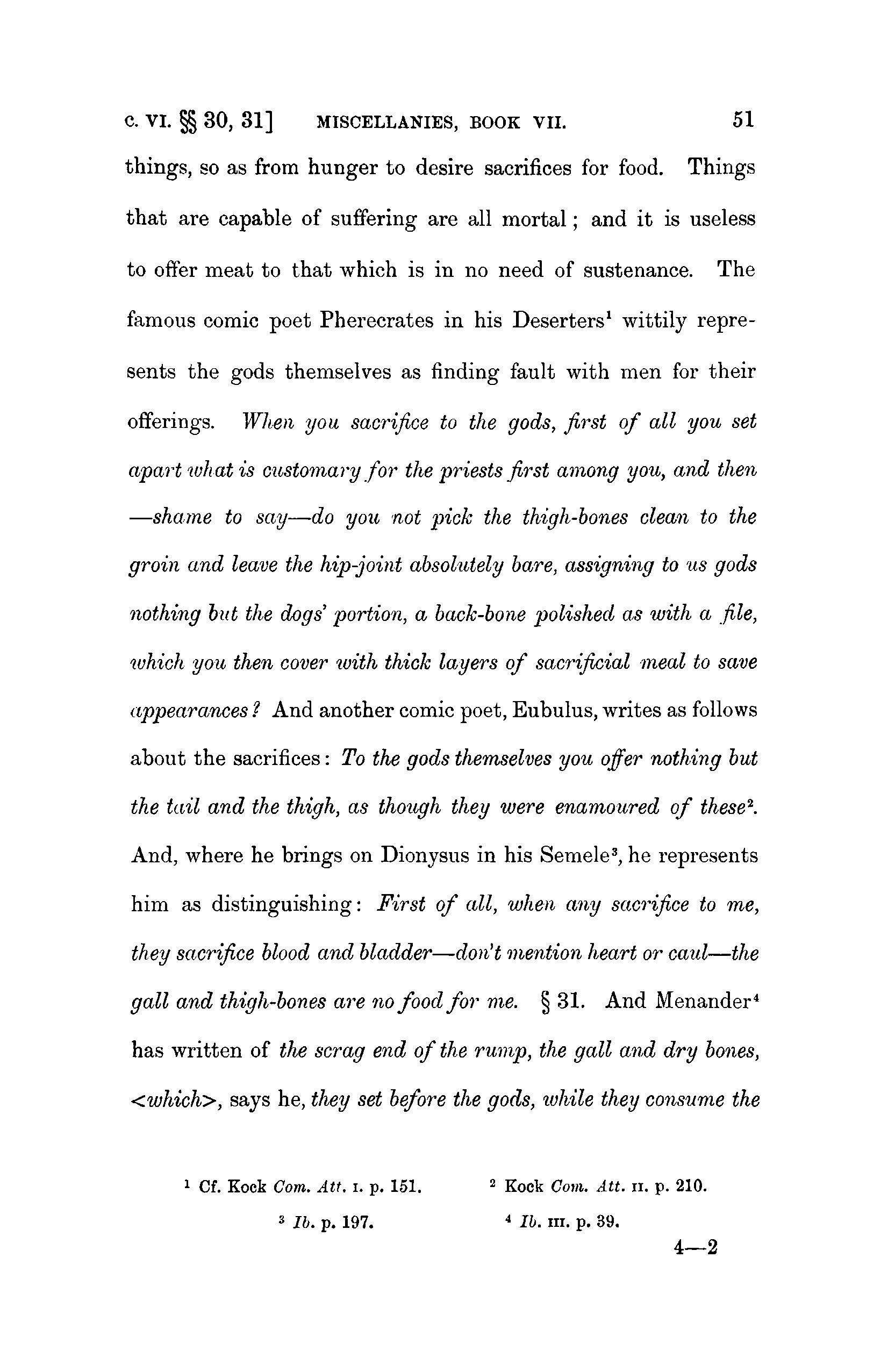
things, so as from hunger to desire sacrifices for food. Things that are capable of suffering are all mortal; and it is useless to offer meat to that which is in no need of sustenance. The famous comic poet Pherecrates in his Deserters1 wittily represents the gods themselves as finding fault with men for their offerings.
When you sacrifice to the gods, first of all you set apart what is customary for the priests first among you, and then
—shame to say—do you not pick the thigh-bones clean to the groin and leave the hip-joint absolutely bare, assigning to us gods nothing but the dogs' portion, a back-bone polished as with a file, which you then cover with thick layers of sacrificial meal to save appearances ? And another comic poet, Eubulus, writes as follows about the sacrifices: To the gods themselves you offer nothing but the tail and the thigh, as though they were enamoured of these*.
And, where he brings on Dionysus in his Semele3, he represents him as distinguishing: First of all, when any sacrifice to me, they sacrifice blood and bladder—don't mention heart or caul—the gall and thigh-bones are no food for me. § 31. And Menander4 has written of the scrag end of the rump, the gall and dry bones,
<which>, says he, they set before the gods, while they consume the 1 Cf. Kock Com. Att. i. p. 151.
2 Kock Com. Att. n. p. 210.
3 Ih. p. 197.
4 Ib. in. p. 39.
4—2 https://doi.org/10.1017/CBO9780511695513.010 Published online by Cambridge University Press
ITPQMATEQN Z'
[p. 847, s. 304
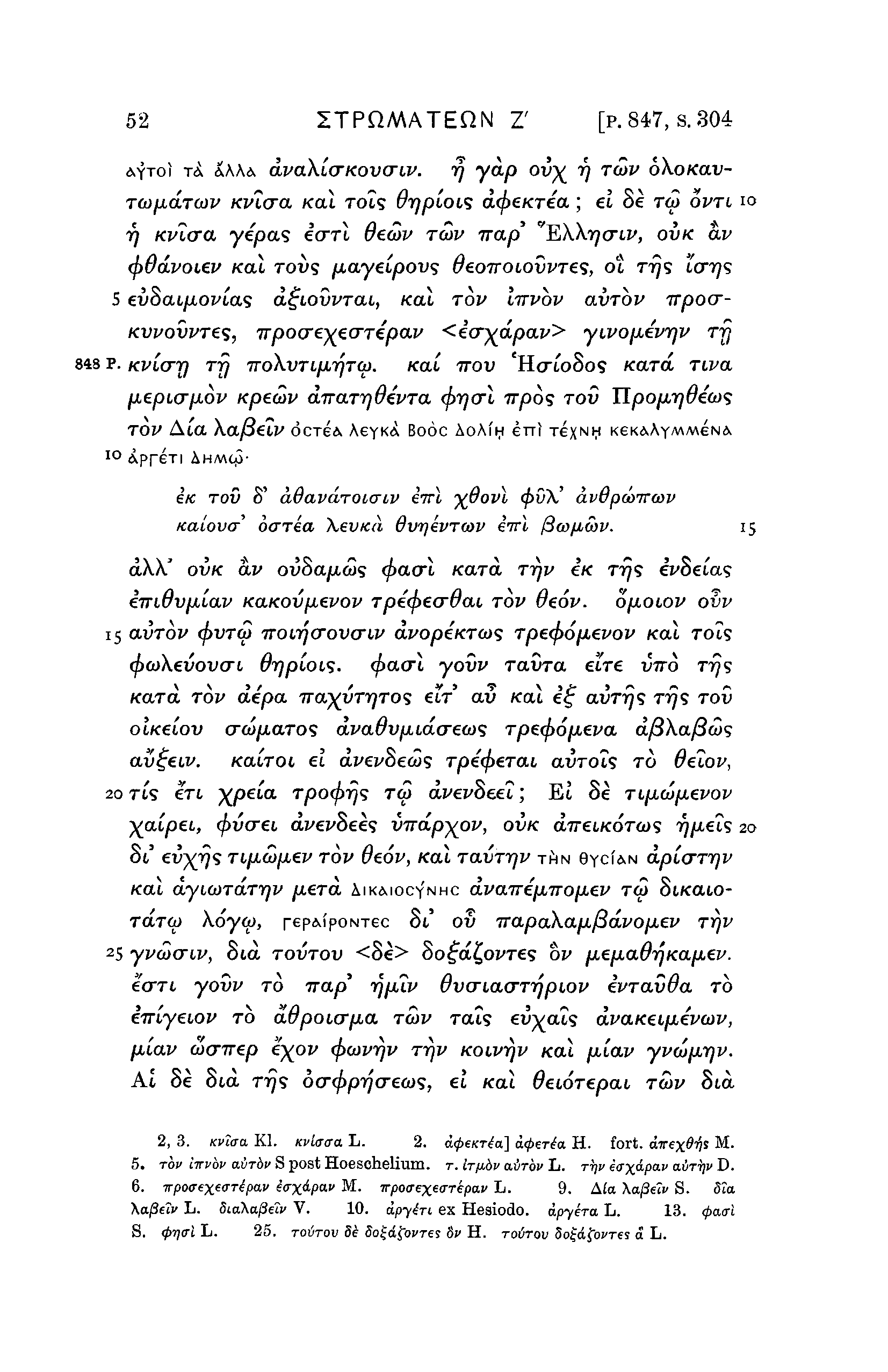
AYTOI ri &AAa, dva\io~Kovo~iv. rj yap ov^ rj TCOV oXo/cauT(ofjLd.TCi)v KVLira /cat rots 9rjpLoi<; d<f>eKTea; ei Se rw OVTI io rj Kvlcra yejoas ecrrl deeHv TCOV Trap' "EXXtjo'tv, OVK av
(f>6dvoL€v KO1 rovs ixayeCpovs OeoTrouovvTes, ot TTJS tcr^s S evSatyLtovias d^tovvTai, KOL TOV ITTVOV avrov TrpocrKvvovvTes, Tvpo(X€^<JT4pa.v <ia~^dpav> yivofxeirqv rfj 848 P. KVlCrrj TYj TTo\vTLfJLr)TCi).
KOX TTOV ' H c r t o S o ?
KCLTa TLVO,
[jiepLcr[Ji6v Kpecov dvaTrjdivTa <f>r)crl TT/DOS TOV TOV Ata Xapetv OCTEA AeyKA BOOC AoAitf eni e'/c rot) S' adavdrooaiv eVt xdovl cf>0\' dv6pa>-7ra>v Kaiova' oaTea XevKti dinjevrcov em ffcoficov.
dXk' OVK av ouSa.ju,<Ss <f>ao~l /card ri)^ e/c eTndvfjLLav KaKOVfizvov Tp€(f>eo~0ai, TOV ^eov. ofj.otov ovv
15 avTov (f>VTco Troi/ijo'ovcnv dvop€KT(t)<; Tpecfro/JLtvov Kal Tots drjpioLS- <j)<xo~l yovv Tavra etre
VTTO TTIJ?
TOV ae'pa Tra^wr^Tos CIT' av /cat e^ aur^s T^S TOV olxeiov crcJjLtaTos ava^U/Litacrews Tpe<f>6/JLeva a/3Xa/3w9 av^eiv.
/catTOt et dvevSe&Js Tpd(f>erai avrots TO delov, 20 Tts eri XPe^a TPo<f'V'; T<? dvevSeeu; Et Se TL/jLco/xevov t/set, <j>vo~ei, dvevSee? vndpyov, OVK aVet/coTtos i7//.€t9 20 s TifiaJfjuev TOV QZOV, Kal TavTTjv TAIN eyciAN dpto-Tiqv l dyiOTaTrjv fieTa AIKAIOCY'NHC dvaTrifjiiro^ev T<5 St/catoTctTW \oyai, r6P^ipoNTec St' ov Trapa\afj./3dvofJiev TY)V 25 yvwcrtv, 8tct TOVTOW <Se> So^d^ovTes ov fxeyiadrjKayu€v.
€CTTL yovv TO 7ra/>' TJ/AIV Ovcriao-T'qpiov ivTavda TO i-iriyeiov TO ddpoio-^a TWV Tats ev^ats dvaKei/xivav, jjbiav aanrep dyov (fxovrjv TYJV KOLVYJV Kal yu.tav yvcufnqv.
At Se 8td TTJS 6cr(j)pt]o-e(os, et /cat #et6Vepat TWV Std 2, 3. /ci-io-a Kl. /c^/crira L.
2. a0e/cT<?a] d0er^a H. fort. atrexHs M.
TO^ ITTVOV avrdv S post Hoeschelium. r. trfibv atirbv L. r^f e<T%dpa.v aurty D.
Trpoffexecrrtpav iax^pav M. Trpoa^x^ripav L.
9. A£o Xa/3erf S. 5ia Xafieiv L. Si.a\a§v:v V.
10. ap7^n ex Hesiodo. apyfra L.
13. 0airi S. <£?;er£ L.
25. roiirou 5£ So^dfoi'Tes §!< H. TOI5TOK 5o£eifoi'Tes a L. https://doi.org/10.1017/CBO9780511695513.010 Published online by Cambridge University Press
C. VI. § 31]
MISCELLANIES, BOOK VII.
rest themselves. Why, the smoke of burnt sacrifices is intolerable even to the beasts. If however this smoke is really the meed of the gods of Greece, no time should be lost in deifying the cooks also (since they are deemed worthy of the same happiness) and in worshipping the stove itself, when it becomes an altar closely connected with the precious smoke. Hesiod1 somewhere says that Zeus, being outwitted in some division of the flesh of the sacrifice by Prometheus, chose the white bones of the ox craftily concealed in the glistening lard: and from that time the tribes of men on earth burn to the immortals white bones on fragrant altars. Still they altogether deny that God's partaking of nourishment could be explained by the craving which grows out of want. Accordingly they must suppose Him nourished without appetite like plants or hibernating bears.
At all events they say that these are not impeded in their growth, whether it be that they are nourished from the density of the air, or even from the exhalation arising from their own body.
And yet, if they hold that the Deity is nourished without needing it, what is the use of nourishment to one who needs it not ?
But if the Deity, being by nature exempt from all need, rejoices to be honoured, we have good reason for honouring God by prayer, and for sending up to the most righteous Word this sacrifice, the best and holiest of sacrifices when joined with righteousness2, venerating3 Him through whom we receive our knowledge, <and> through Him glorifying Him (i.e. the Father) whom we have learnt to know. At any rate our altar here on earth is the congregation of those who are devoted to the prayers, having, as it were, one common voice and one mind.
As to the kinds of nutrition received through the sense of smell, though they may be less unworthy of the deity than
1 Theog. 556.
- Ps. iv. 5.
'•' Plat. Leg. 799 A. https://doi.org/10.1017/CBO9780511695513.010 Published online by Cambridge University Press
ITPQMATEQN Z
[P. 848, s. 304 crTOju,aros Tpo<f>a£, dXXd dvairvorjs eicrt 2,2.
To ovv (jyacrL irepl TOV deov; TtoTtpov StaTT^eiTat 25 ais TO TCOV ScufjLovwv yivos ', 17 e/A7n>eiTai /JLOVOV <WS r a evvSpa /caret r i p rwy fipayylcov SiacrToXiQv; 17 Trepi5 Tn'etrat Kaddrrep TO. evTOfi-a Kara T^V Sid r<5v TTTepvycav
Trjs ivTo/xrjs; dXX' OVK dv TLVU TOVTCOP drrei,v, el ye ev tf>povolev, TOV deov. ocra Se dvairvei Kara TTJV TOV irvevfiovos Trpos TOI* dcopaKa dvT<&iao~ToXy)v p'vdnai eXfceu TOV depa. elra el o~TrXdy^ya 8olev /cat 10 dpr^pias Kal ^>Xey8as KGU vevpa Kal fjiopia TW dew, 3° ovhev <dvdpanrov> Sia(f>epovTa e\a~r\yr\o~ovTa.i TOVTOV.
'H av/XTTvoLa 8e C7ri Trjs CK/cXr^crias Xeyexai, KvpitoS. Kal yap ecrnv 7J OvaCa T^S e/c/cXijcrias Xoyos <X7ro TtSt" dyiav
\jjv)(aiv dvaOvfiLaJfievos, e/c/caXuTrrojLie^s a/xa T77 dvaia 15 zeal T17S Siavotas aTrdcr^s TOJ ^ew.
'AXXd TOV jui^ dp-^aLOTaTov fica/Aov ev ATJXCO dyvov etvai TeOpvXrJKacn, wpos ov S17 JJLOVOV Kal TLvdayopav irpoo~eX9e1v (j)ao~u <f)6vct> Kal davaTco fj,r/ /juavdevTa' fico/JLOv Se d
849 p. dyioz> TTJV hiKaiav ^nr^rjv, Kal TO dir avTrjs 20 TT)V bcrlav evyrfv Xeyovatv rjfxiv dincrTrjO'ovo'iv ; aapKo35
<f)ayua)v 8', oifj-ai, Trpo(f>daei at dvaiat TOIS dvdpoii eTTivevo-qvTai. etjrjv 8e zeal dXXws dveu T17S eiSwXoXar/otas fi.eTaXap.^dveLv Kpecuv TOV aX jxev ydp /card TOZ> VO/JLOV dvcriai TTJV irepl ^j 25 evo-e($eiav dXXrjyopovaL, Kaddirep ri Tpvycov Kal rj irepio'Tepa virep d/xapTLoHv Trpocr(j>ep6[JievaL TYJV diroKadapo~Lv TOV dXoyov
(xepov; T^§ ^ X ^ 5 irpocrheKTrjv IA7)VVOVO~L rw 0e<o. el Se Tts TCOV SiKaCtov OVK hn- (jtopTL^et Tjj TU>V Kpewv f3pa>o~ei, TTJV ^fv^rjv,
Xoyw TLVI 4° 30 evXoyco xpfJTau, ov^ a> TLvdayopas Kal ol dir auToi) TTJV fj.eTev8ecnv oveipoiroXovvTes
TTJ<; \JJV^<;.
SOKCI Se 9. pvfffup ?A*a M. pUjUouX/cci L.
11. ovdtv dvdptjmov (i.e. avoH) M. otiSh avBpwiruv vel i]/j.(oi> P. oidtv L.
14. rrj dvaiq. H.
T^S Swrias L.
17.
Sv S.
Toy L.
23. eiSuXoXarpias] Sic L, non ei5ai\o\aTpeia.s. https://doi.org/10.1017/CBO9780511695513.010 Published online by Cambridge University Press
C. VI. §§ 31, 32]
MISCELLANIES, BOOK VII.
those received through the mouth, still they witness to respiration. § 32. What then is <the worshippers'> idea as to the breathing of God ? Is it by means of transpiration as in the demons? or by inspiration only, as in fishes through the dilatation of their gills ? or by circumspiration, as in insects through the pressure of the membranes on the waist ? No, they would not liken God to any of these, if they were in their senses. But as for creatures that live by respiration, they draw in the air by rhythmic beats corresponding to the counter-dilatation of the lungs against the chest. Then if they assign viscera and arteries and veins and sinews and members to God, they will exhibit Him as in no respect differing from man. The word
' conspiration' is that which is properly used of the Church.
For the Church's sacrifice is indeed speech rising, like incense, from holy souls, while every thought of the heart is laid open to God along with the sacrifice. They are fond of talking about the purity of the most ancient altar at Delos, that altar which, we are told, was the only one approached by Pythagoras, because it was unpolluted by slaughter and death: will they then refuse credence to us when we say that the truly hallowed altar is the righteous soul, and the incense which ascends from it, the prayer of holiness ? Sacrifices, I believe, are an invention of mankind to excuse the eating of flesh, though, even apart from such idolatry, it was always possible for one who wished it to partake of flesh. The Mosaic sacrifices symbolize personal piety: for instance the dove and the pigeon offered for sins show that the purging away of the irrational part of the soul is acceptable to God. But if any of the righteous refuses to weigh down his soul by the eating of flesh, he does this on some reasonable ground, not as Pythagoras and his school from some dream as to the transmigration of souls. Xenocrates in a special treatise https://doi.org/10.1017/CBO9780511695513.010 Published online by Cambridge University Press
ZTPflMATEflN Z [P. 849, s. 304 aevoKpaTiqs tStct trpayixaTev6fi.evo<; irepl TTJS aVo TWV
£,(oa>v rpocjyfjs KOX ILoXeiAcov iv rots irepl TOV /cara <j>vcriv /3LOV crvvTa.yfi.ao'i o~a<£a>s Xeyeii' &>s do~v/JL<f)op6v io~Tiv r] Sta TWV crapKcov Tpo<f)rj eipyatrfievrj
17017 /cat igo5 i^OLOVfLevrj rats TCOV dXoycov i//u^ats.
33.
TauTTj /cat [idXiCTTa 'lovSauou ^oipdov d-ni- ^ovTai, ws dv TOV drjpiov TOVTOV yuapov 6VTO<S, inel 45 jaaXtcrra TMV dXXxov TOV?
KapTrovs avopvacrei.
/cat <j>deipeL. idv Se Xeycoai rots dv9pa>-iroi<; SeSocr^at r a 10 £&ia, Kal 17/0,615 o~vvo^ioXoyovyiev, irXrjv ov trdvTco^ ets fipaicrLV, ovSe /xrjv irdvTa, a\X' ocra depyd.
SioTrep ov KaKw<; 6 MO/JUKOS HXaTO)v iv Tats 'Eoprars T&» Spd/xaTi T<£v <ydp TerpaTToBcov ovBev diroKreLvetv e'Set
f/fias TO \onrov, TTXTJV V(SV TO, yap Kpea rjBbGT expvcri, KovBev d<$> vo<; yiyvercu Trkrjv ucrrpi%65 ical TTT^XO? TJ/JLIV KOI $or\. oOev Kal 6 Atcr&JTTOS ov /ca/cws £^17 rous vs KCKpaydvai, 50
/xeyicrrov, orav ekKOiVTaiavveiBevai ycip aurots ets 20 ot'Sei' aXXo ^p^crijaots TTXIJJ/ et5 TIJV dvcriav.
8io «:ai KXeav^ijs (f)7]o~lv dvd' dXcov aurovs e^eiv ri}^ \pv)(rjv, 850 P. tva /u.17 o~a.Trr} r a Kpea. ol fiev ovv OJ? ajyjrqo-Tov io~0Covo~LV, ol 8' eJs XvfiavTiKov T<OV Kapncov, Kal dXXoc, 305 s.
Sia TO KaTaxfrepks eis o~vvovo~iav eivac TO t,(oov, OVK 25 iadiovo-w.
TavTy ovSe TOV Tpdyov 6 w/xos #ve V l TJ BiOTTOfJunjcrei TCOV KaKcov, eVel rjBovyj. auri/ca /cat o"Vju./SaXXeo"^at riyv 4, 5. efoyaoioKja^ci;] fort, ^afioiufihi]
14, 15. e5ei ^ a s S. ra v/xas Kock. ^/ias ^Sei L. rj/j.ds om. MS. Ottob.
15. i^as] u^as Cobet. dwc corr. ex u£<2>' L.
16. TJSKTT'—KOI)5£P S. ijduTTa—xai oidtv L.
17. vtrrpixes LH. i/ffTpixk D.
^JIUK hoc loco Heinsiue (^/iiv Cobet.), post iiarptxes L.
18.
KCIKUS] xnXws L.
19. orav IXKWVTCU post xP'tvLw* I".
Transposuit Eittershus. airrois] airois L.
20. 7TXT;I' aut TTXTJIT; Eittersh.
-i) TTXTJI/
(•^ pr. ra. supra lineam) L.
23. \vixavriKbv S. \oifiavTiitbv L.
20. 5ioL H .
O.TrofooTTOIXTT'tlGU D . https://doi.org/10.1017/CBO9780511695513.010 Published online by Cambridge University Press
C. VI. §§ 32, 33]
MISCELLANIES, BOOK VII.
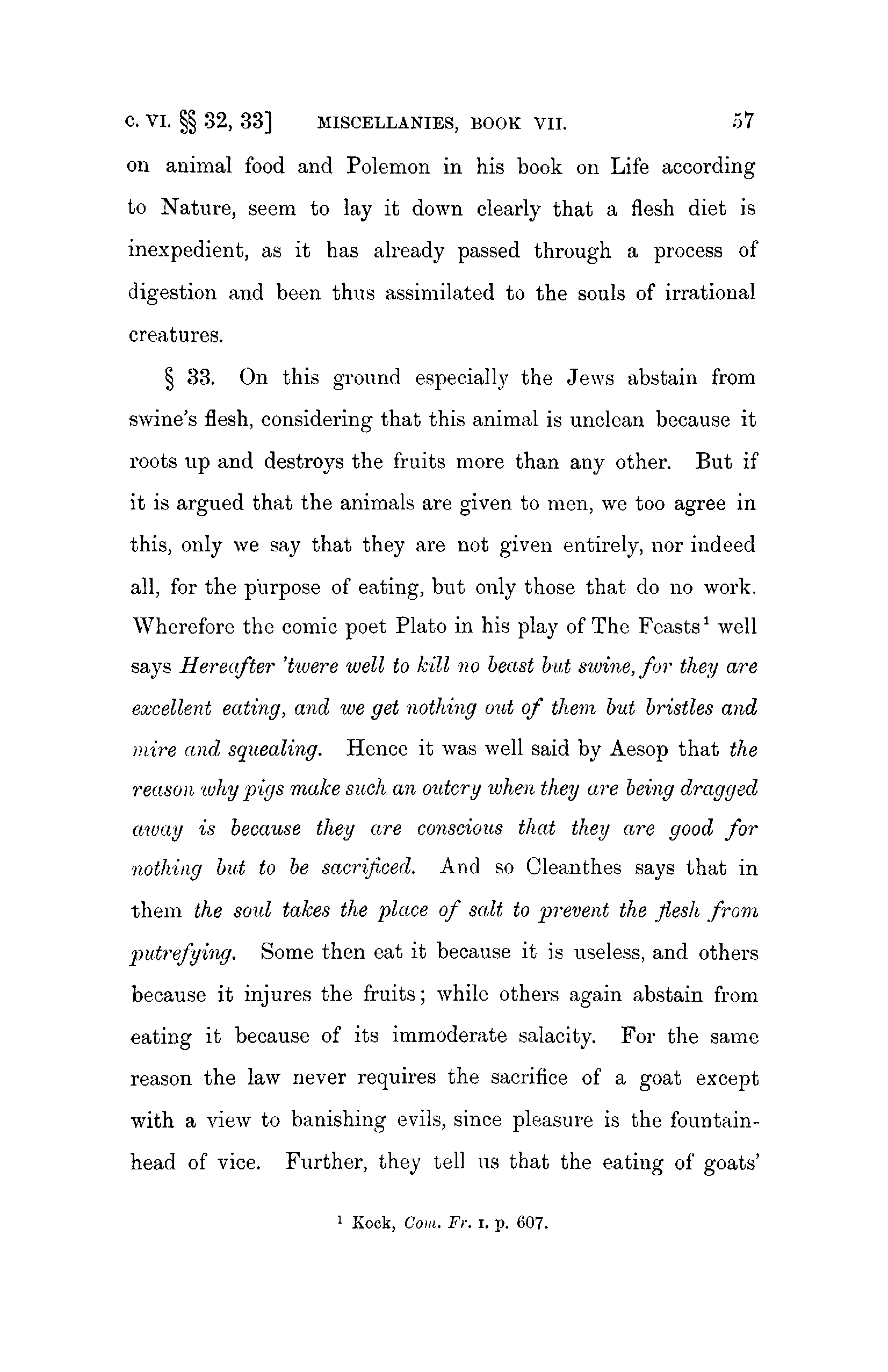
on animal food and Polemon in his book on Life according to Nature, seem to lay it down clearly that a flesh diet is inexpedient, as it has already passed through a process of digestion and been thus assimilated to the souls of irrational creatures.
§ 33. On this ground especially the Jews abstain from swine's flesh, considering that this animal is unclean because it roots up and destroys the fruits more than any other. But if it is argued that the animals are given to men, we too agree in this, only we say that they are not given entirely, nor indeed all, for the purpose of eating, but only those that do no work.
Wherefore the comic poet Plato in his play of The Feasts1 well says Hereafter 'tivere well to kill no beast but swine, for they are excellent eating, and we get nothing out of them but bristles and mire and squealing.
Hence it was well said by Aesop that the reason ivhy pigs make such an outcry when they are being dragged away is because they are conscious that they are good for nothing but to be sacrificed.
And so Cleanthes says that in them the soul takes the place of salt to prevent the flesh from putrefying.
Some then eat it because it is useless, and others because it injures the fruits; while others again abstain from eating it because of its immoderate salacity. For the same reason the law never requires the sacrifice of a goat except with a view to banishing evils, since pleasure is the fountainhead of vice. Further, they tell us that the eating of goats'
1 Kock, Com. Ft: I. p. 607. https://doi.org/10.1017/CBO9780511695513.010 Published online by Cambridge University Press
ITPQMATEQN Z
[p. 850, s. 305
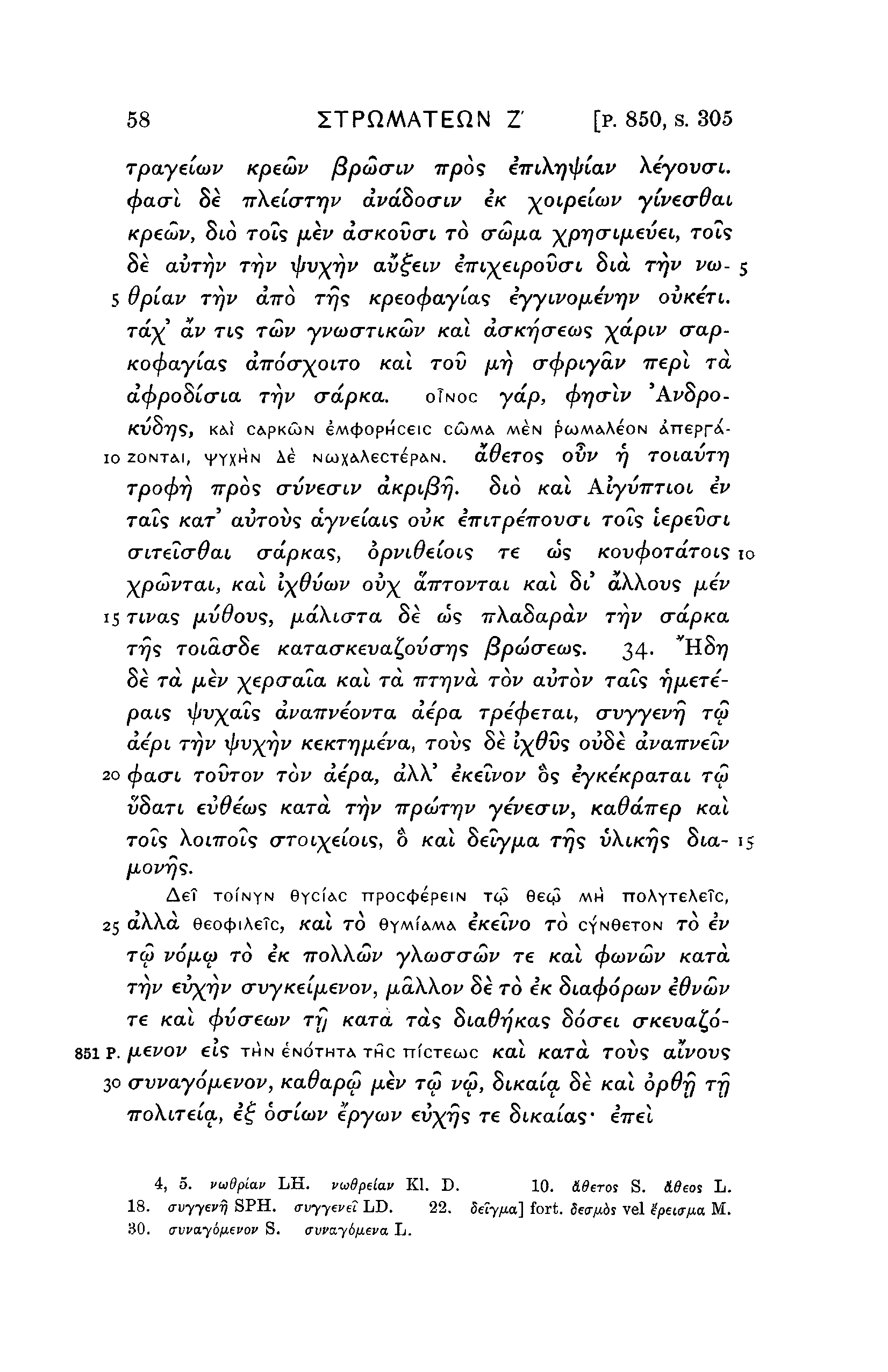
Tpaytiwv Kpecov fipa><Tiv irpos £irCkq\\iiav Xeyoucri.
(fxurl Se TrXeicrTrjv dvdhocnv e'/c yoLpeiuv yCvecrOai Kpecuv, Sto TOIS ju.e> dcrKovcri TO o-ftjjua ^py]crifievei, rots Se avTrjv Trjv xjjv^crjv av£ew hn^Lpovcn Sta TI}V yw5 5 9plav Trjv diro rrj<; /cpeo^ayia? iyyuvo^evrju
OVK4TL. ra^' ai> Tt9 ratv yvcjcrTLKcov Kal acr/c^crews ^apt,v crap- /co^aytas ctTrdcr^oiTO /cat rou /X.T) crfypi/yav Trepl ra d(f)po8io-La rr/v crapKa.
OTNOC yap, (f>r}crlv 'AvSpoKV07)<s, K&i c«.pKcoN eMtfiopHceic
COJM*. M6N
10 20NT&1, fYXHN
^ 6 Ncox&AecTep&N. a f e r o s Tpo(f>r) 7T|0os crvvecrLV dxpifirj.
S16 /cal ' avrous ayi'etats ou/c iiriTpeTTOVcn rots lepevai adpKas, opvidttoLS re a>s Kov<j>OTaToi<; 10 , Kal i^dvcov oiy^ dtnovrai KOX SI' aXXovs /Ltev 15 rtvas /JLVOOVS, jLiaXta-ra 8e GJ? TrXaSapdv
TYJV crap/ca T^S TOtacrSe /caTacrKeva^oucr>js ^pwcrews.
34.
8e ra. yw.ej' ^epcrata /cal r a TTT^VO. TOV avrov rats pais \pv)(ais dvairveovTa dipa rpe^erat, crvyyevrj rw aept ri}v xjtvy^v KeKTrjfjieva, rovs Se t^^us ouSe dvaiTveuv
20 <£acri rourov rav aepa, aX\' iKeivou os eyKe'/cparat TW ev#e'a)S /caret TT}V TrpcuTrjv yivecnv, KaOdnep Kal Xoi7rot9 o-rot^eiots, o Kat Seiy/Aa r^s UXIKTJS Sia15
AeT TOINYN ByciAC npoc<{)epeiN T(<3 Sec^ MH 25 aXXd 6eoc()iAeTc, «ai TO 6YM(AMA e/cetvo TO cyNeeTON TO et1
TO! VO/JLCO TO e/c TroXXdJt1 yXft)O"O"&5v TC /cal (fxnvojv /cara, riji' evjc^i1 crvyKi.Lfx.evov, p.aXXov Se TO e/c Sta^>dpwv iduatv re /cat <£vo~e&>v rr^ /cara rct§ Sta^/cas 8do"et cr/ceua^d851 P. ixevov et? THN ENOTHTA THC nfcTewc /cal /caTa rous ati/ous
30 crvvayofjuevov, Ka6apa> /xev rw cw, St/cata 8e /cat d TroXtreta, ef buioiv epycov e u ^ s TC St/catas" eVet i, 5. vuBpiav LH. vwBpdav Kl. D.
10. Uderos S.
40eos L.
18.
(7U77ej'9) S P H . a-i/ryei-ei LD.
22.
Seiy/xa] fort. Setr/ibs vel gpeuT/xa M.
30. crvva-yofAtvov S.
(Tvvzydtieva L. https://doi.org/10.1017/CBO9780511695513.010 Published online by Cambridge University Press
C. VI. §§ 33, 34]
MISCELLANIES, BOOK VII.
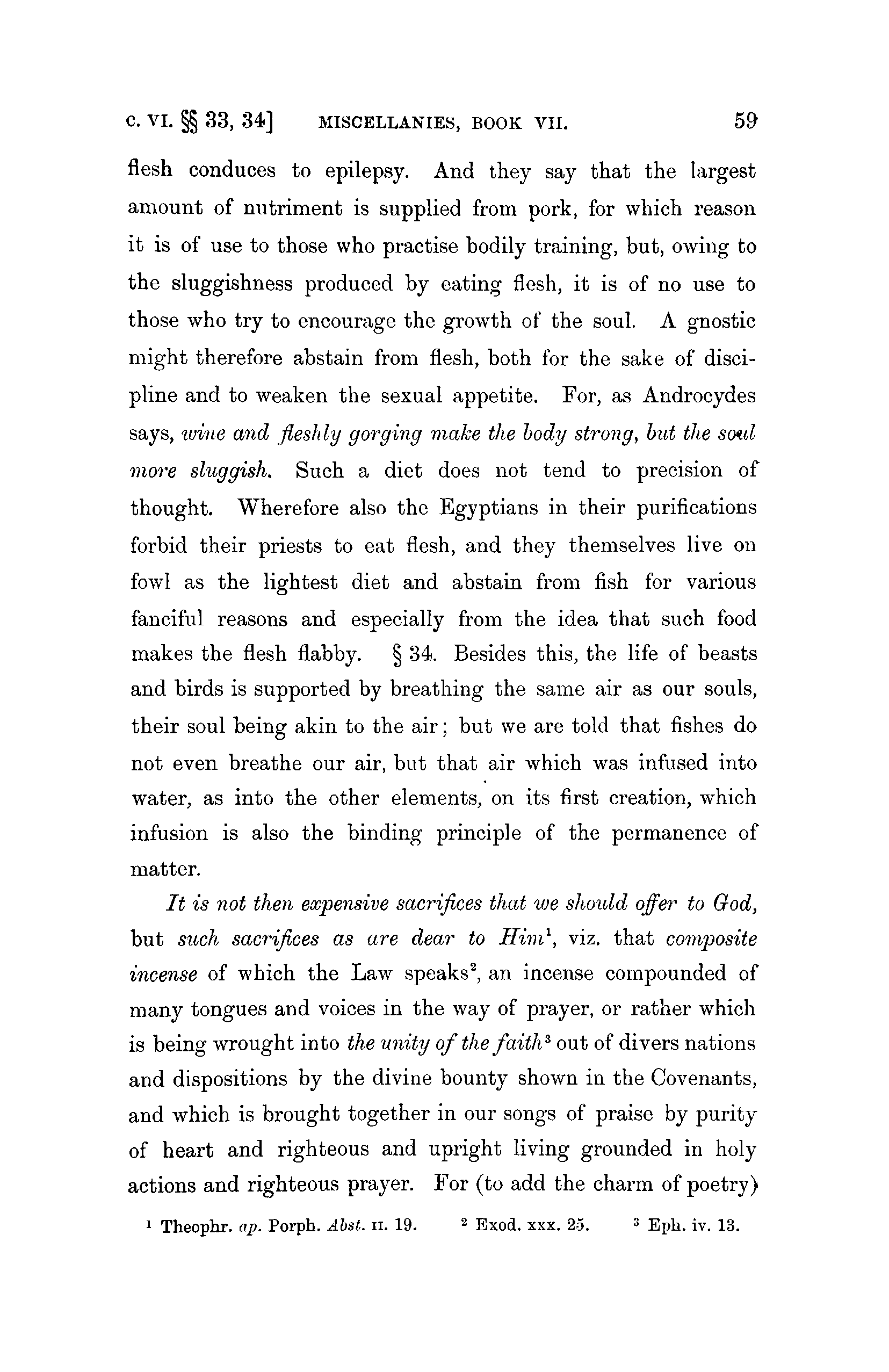
5& flesh conduces to epilepsy. And they say that the largest amount of nutriment is supplied from pork, for which reason it is of use to those who practise bodily training, but, owing to the sluggishness produced by eating flesh, it is of no use to those who try to encourage the growth of the soul. A gnostic might therefore abstain from flesh, both for the sake of discipline and to weaken the sexual appetite. For, as Androcydes says, wine and fleshly gorging make the body strong, but the soul more sluggish. Such a diet does not tend to precision of thought. Wherefore also the Egyptians in their purifications forbid their priests to eat flesh, and they themselves live on fowl as the lightest diet and abstain from fish for various fanciful reasons and especially from the idea that such food makes the flesh flabby. § 34. Besides this, the life of beasts and birds is supported by breathing the same air as our souls, their soul being akin to the air; but we are told that fishes do not even breathe our air, but that air which was infused into water, as into the other elements, on its first creation, which infusion is also the binding principle of the permanence of matter.
It is not then expensive sacrifices that we should offer to God, but such sacrifices as are dear to Him1, viz. that composite incense of which the Law speaks2, an incense compounded of many tongues and voices in the way of prayer, or rather which is being wrought into the unity of the faith3 out of divers nations and dispositions by the divine bounty shown in the Covenants, and which is brought together in our songs of praise by purity of heart and righteous and upright living grounded in holy actions and righteous prayer. For (to add the charm of poetry)
1 Theophr. ap. Porph. Abst. n. 19.
2 Exod. xxx. 25.
3 Eph. iv. 13. https://doi.org/10.1017/CBO9780511695513.010 Published online by Cambridge University Press
ITPQMATEQN Z'
[P. 851, s. 305
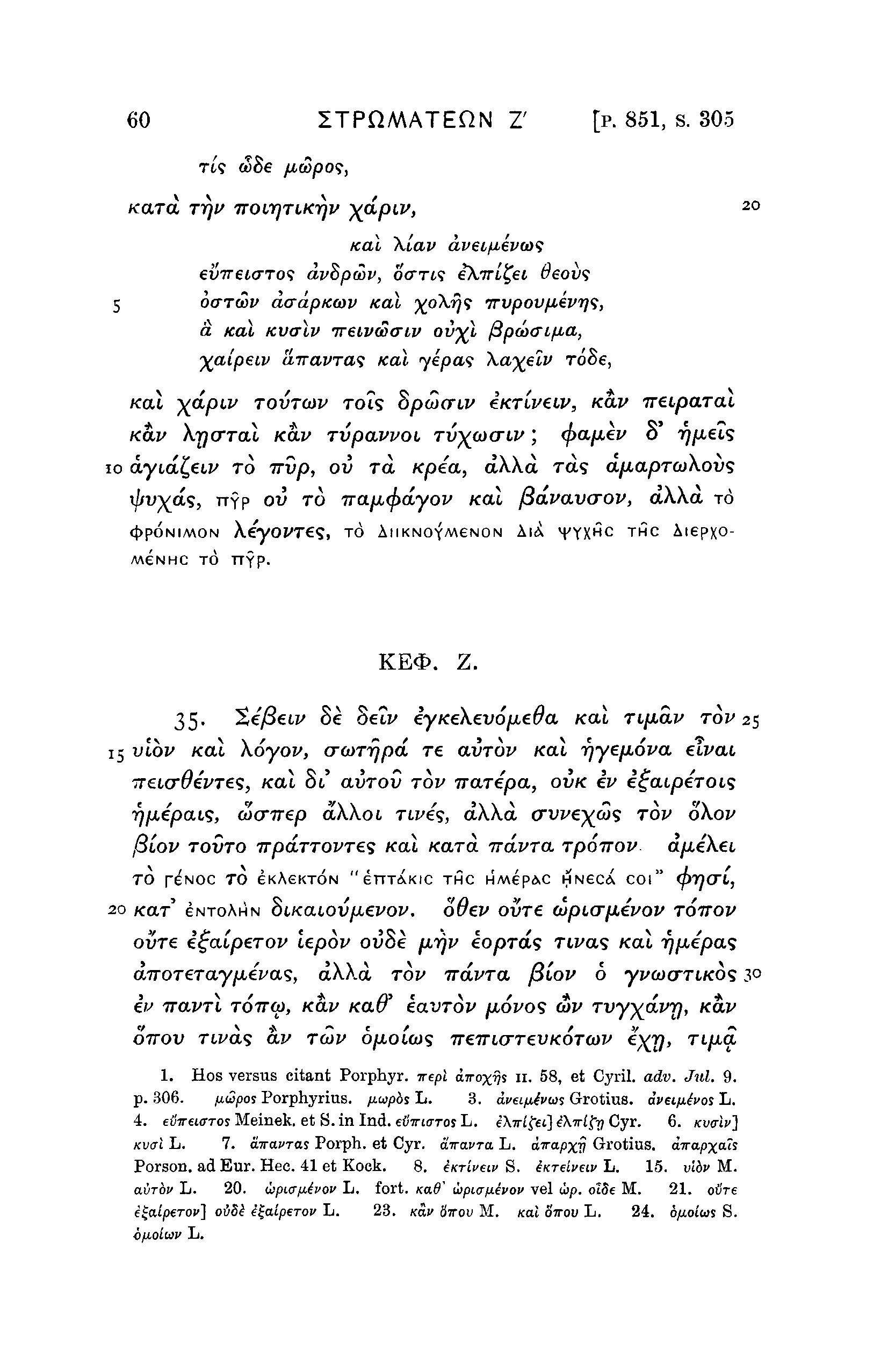
TYJV Ttovr)TiKr)v ydpiv, 2 0 ical \iav einreio-Tos dvBpwv, Saris OCTTWV aaapiccov Kal %o\r)<; irvpovfievrjs, a Kal icvcrlv -jreivoocriv ovj(l ft paten pa, a-rravTas Kal yipa? Xa^elv roBe, TOVTOIV TOIS Spwcnv eKrivf.iv, Kav KOV XrjcrTal KOLV rvpavvoi TV^OHTLV ; Kpa/xev o' io ayiaQe.iv TO irvp, ov TO. Kpea, aWa Tas xjjv^(ds, rryp ov TO TTajx(poiyov Kal flavavcrov, aXXa TO <}>P6NIMON XeyoVTCS, TO AIIKNOYM6NON Alii YYXHC THC AiepxoM6NHC TO . Z.
35.
Se73eii> Se Setv ey/ceXevo//,e^a /cat TijUav Tot125 15 utov zeal Xoyov, cr(OTrjpd re axnov Kal rjye/xova elvai. s, /cal Si' aurou TOV narepa, OVK iv i£atpeToi<; axnrep aXkoi Ttve<s, aXXa crvve^ws TOV 6'XOV
/3LOV TOVTO TrpctTTOfTes Kat Kara Trdvra Tpoirov afxiXei TO reNOC TO SKASKTON "enTAKic THC HMEPAC HN6CA COI" <pT)o~i,
20 Kar" 6NTOAHN SiKaiovfievov.
6'dev ovre (uptafxivov TOTTOV ovre i^aiperov lepov ovSe yirjv copras Tivas Kal fj/JLepas aXXa, TOV ndvra /3Cov 6 yi/wcrTi/cos 3° iv Travrl TOTTO), KOLV Kaff kavrov (JLOVOS av rvyydvr), Kav
OTTOV Tivas av TOJV 6ju,otws 1. Hos versus citant Porphyr. irepl a7rox^s n. 58, et Cyril, adv. Jill. 9. p. 306.
/xwpos Porphyrius.
/iw/)6s L.
3. dvei/iivios Grotius. dveifihos L.
4. evireiOTos Meinek. et S. in Ind. (STTMTTOS L. e\wtfri] Airifi; Cyr.
6. Kv<rb] Kval L.
7. awavras Porph. et Cyr. airavTa L. dirapxy Grotius. awapxous Porson. ad Eur. Hec. 41 et Kock.
8. iicrivetv 8. iKTelveiv L.
15. vlbv M. avrbv L.
20. CipnT^vov L. fort, KO.6' wpKTfi^vov vel top. ot5e M.
21. o^'re e|a//3eroi'] oiSi i^alperov L.
23. rav UTTOV M. Kai OTTOU L.
24. 6/Wws S. https://doi.org/10.1017/CBO9780511695513.010 Published online by Cambridge University Press