
CHAPTER II
C. I. § 4—C. II. § 5] MISCELLANIES, BOOK VII.
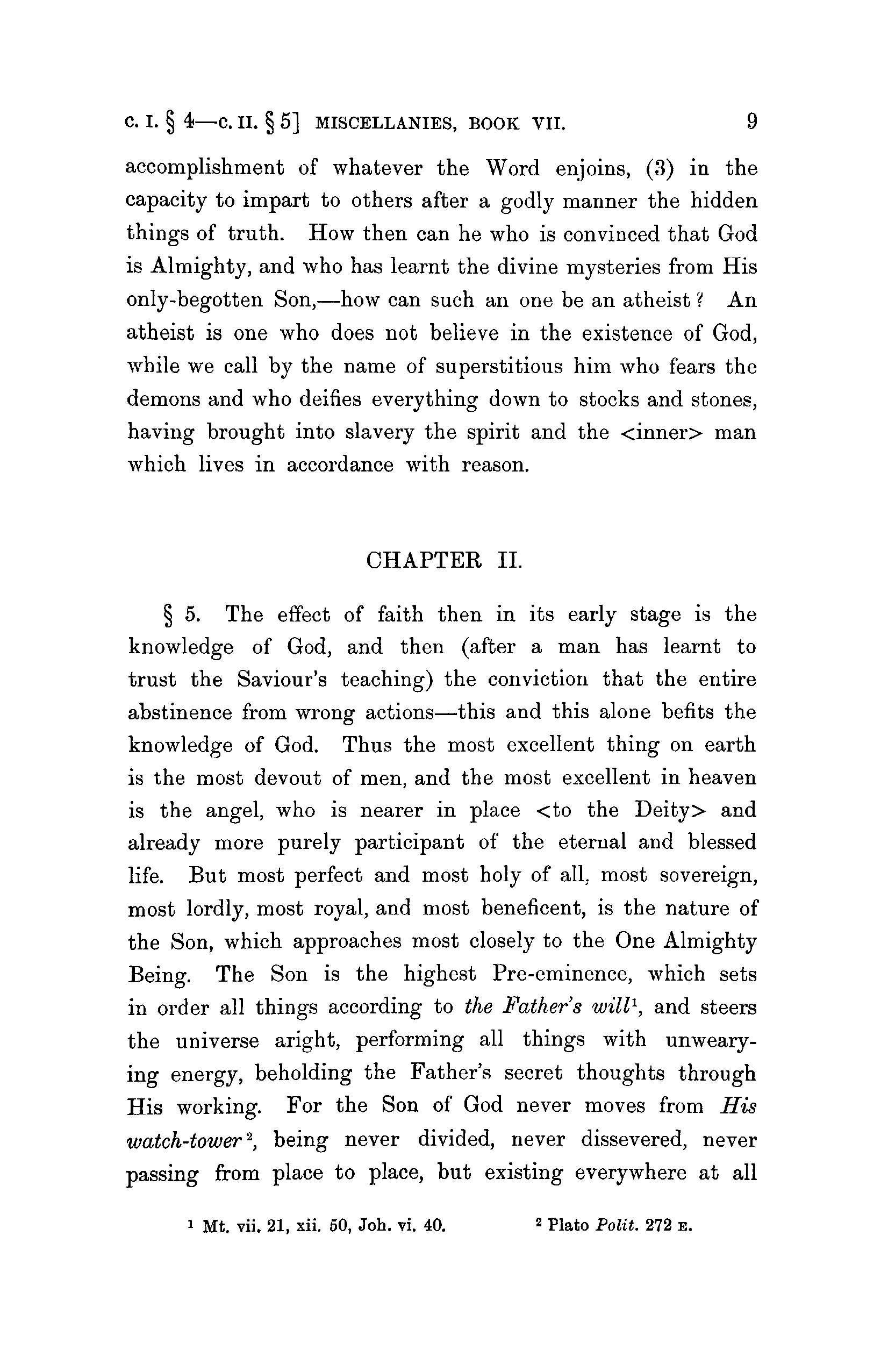
accomplishment of whatever the Word enjoins, (3) in the capacity to impart to others after a godly manner the hidden things of truth. How then can he who is convinced that God is Almighty, and who has learnt the divine mysteries from His only-begotten Son,—how can such an one be an atheist ? An atheist is one who does not believe in the existence of God, while we call by the name of superstitious him who fears the demons and who deifies everything down to stocks and stones, having brought into slavery the spirit and the <inner> man which lives in accordance with reason.
CHAPTER II.
§ 5. The effect of faith then in its early stage is the knowledge of God, and then (after a man has learnt to trust the Saviour's teaching) the conviction that the entire abstinence from wrong actions—this and this alone befits the knowledge of God. Thus the most excellent thing on earth is the most devout of men, and the most excellent in heaven is the angel, who is nearer in place <to the Deity> and already more purely participant of the eternal and blessed life. But most perfect and most holy of all, most sovereign, most lordly, most royal, and most beneficent, is the nature of the Son, which approaches most closely to the One Almighty
Being. The Son is the highest Pre-eminence, which sets in order all things according to the Father's will1, and steers the universe aright, performing all things with unwearying energy, beholding the Father's secret thoughts through His working. For the Son of God never moves from His watch-tower2, being never divided, never dissevered, never passing from place to place, but existing everywhere at all
1 Mt. vii. 21, xii. 50, Joh. vi. 40.
2 Plato Polit. 272 E. https://doi.org/10.1017/CBO9780511695513.010 Published online by Cambridge University Press
ZTPQMATEQN Z'
[p.831, s.298
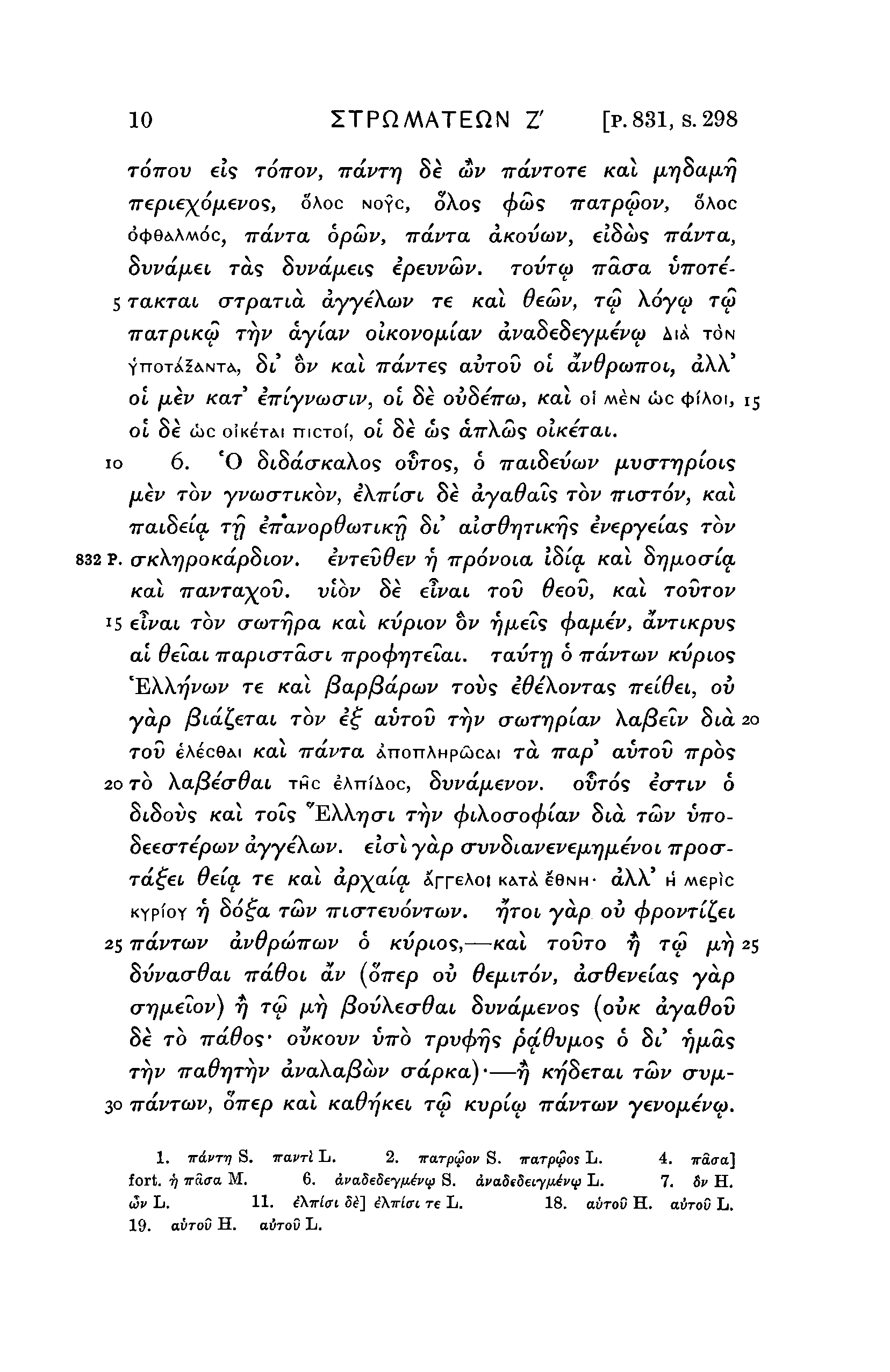
TOTTOV €15 TOTTOV, TtaVTr) Se Sv ffdvTOTe Kal Trepie^o/jievo?, oAoc NOYC, OXOS <£WS narpwov, oAoc o^e&A/woc, irdvTa opaiv, TrdvTa aKovcuv, eiSa>5 ndvTa, hvvafxei ras Swa/ACis ipevvS>v.
TOVTO) Tracra VTTOT£S TaKTat (TTpaTta dyyeXoiv re Kal decov, TW Xdyw TOJ rr/v ayiav olKovofxiav dvaSeSey/ttevw Ai<si T6N A, SI' OV /cal ndvTes avrov ol avOpoiiroi, dW ol fjikv Kar iirLyvaxTLV, ol Se ovSeirca, Kal oi MEN cbc <t>iAoi, 15 ol oe ^c oiKeTiM nicTof, oi oe ais O.TTX.W'S OLKerai.
'O SiSacr/caAos ouros, 6 TratSevaif fivo~Tr)pCoLS fjikv TOV yvuio-TiKOv, eWicri, Se dya^ais T6V TrtcrToi', feat
TratSeta rfj iTravopOoiTLK-Q hC alo~dr)Tt.Kr}<; ivepyeias TOV 832 p. o~K\r)poKdpSi,ov.
£VT€.V9O> rj irpovota iSta Kal Sr^/xocrta Kal navTO)(ov. vlbv Se ea'ai TOV deov, Kal TOVTOV 15 elvai rov o~(OTrjpa Kal Kvpiov bv rjju,eis cftafiev, avriKpvs al delau itapio'Tao'i. 7rpo<f>r)TeZai.
TavTTj 6 TrdvTcov Kvptos 'FiXkrjvaiv Te Kal fiapfidpwv TOUS ide\ovTa<s Treidet, ov ydp fiidtfiTai TOV ef avTOV TrjV acoTr/puav Xafielv Sia 20
TO5 eAecew /<ai irdvTa ATTOTTAHPCOCAI TO, 7rap' auToi) 77/305 20 TO XaySec^ai THC eAnfioc, owdfievov.
OVTOS ia~Tiv 6 S1S0V5 Kai TOIS "EXX-^O"! TTJI' cf)Lkoo~o<f>iav Sta TWV UTTO8e€o~Tepcov dyyikutv. eio~l yap crvvSiaveveiArjfjLevoi, irpoaTatjeL deia. Te /cai dpyaia.
Arre^oi KATA 69NHdXX' H Mepic KypioY 17 So^a rwy 7no"Teuoi'T&)v.
T^TOI yap ov <f)povTC!Z,ei.
25 irdvTCOv dvOpanrcav 6 Kvpi.o<;,—Kal TOVTO rj T&J fx.r) 25 Svvao-0aL TrdOoi dv (o-rrep ov defiiTov, d&deveCas yap o~rj/j.€iov) r) TCO pr) f$ov\eo-dai Swdfjievos (ov/c dyadov Se TO ird6o<;' OVKOVV v-rro Tpv(f>rjs paOvfios
6 St' Tjj Trjv TradrjTTjv dvaXaficov crdpKa)-—rj KrjSeTai T&V 30 irdvTdiv, oTrep Kal KadrjKei T&5 Kvpico irdvTow yevo/xeva.
T&vrq S.
TTCLVTI L.
Trarpfov S. warpifios L.
Traira] fort. ^ 7r5(ro M.
6. avadedeyidvip S. d.va$f5eiyiiAvi# L.
7. 6c H.
«v L.
11. iXirlcn 5£~\ tXirlffi. re L.
18. auroO H. oiroO L.
19. aiiTov H. ai5roO L. https://doi.org/10.1017/CBO9780511695513.010 Published online by Cambridge University Press
C. II. §§ 5, 6]
MISCELLANIES, BOOK VII.
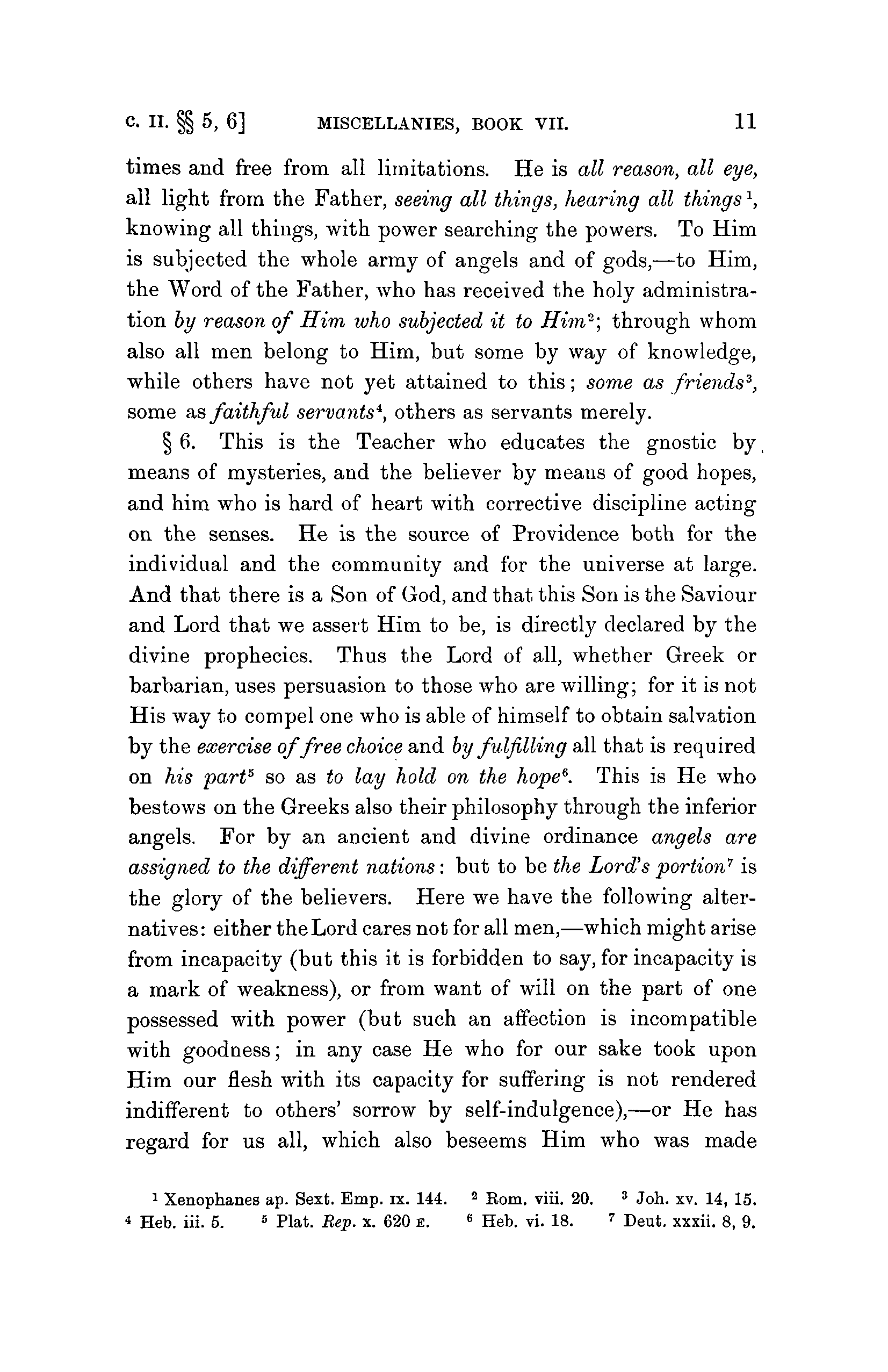
times and free from all limitations. He is all reason, all eye, all light from the Father, seeing all things, hearing all things1, knowing all things, with power searching the powers. To Him is subjected the whole army of angels and of gods,—to Him, the Word of the Father, who has received the holy administration by reason of Him who subjected it to Him2; through whom also all men belong to Him, but some by way of knowledge, while others have not yet attained to this; some as friends*, some as faithful servants'1, others as servants merely.
§ 6. This is the Teacher who educates the gnostic by, means of mysteries, and the believer by means of good hopes, and him who is hard of heart with corrective discipline acting on the senses. He is the source of Providence both for the individual and the community and for the universe at large.
And that there is a Son of God, and that this Son is the Saviour and Lord that we assert Him to be, is directly declared by the divine prophecies. Thus the Lord of all, whether Greek or barbarian, uses persuasion to those who are willing; for it is not His way to compel one who is able of himself to obtain salvation by the exercise of free choice and by fulfilling all that is required on his part5 so as to lay hold on the hope6. This is He who bestows on the Greeks also their philosophy through the inferior angels. For by an ancient and divine ordinance angels are assigned to the different nations: but to be the Lord's portion7 is the glory of the believers. Here we have the following alternatives: either the Lord cares not for all men,—which might arise from incapacity (but this it is forbidden to say, for incapacity is a mark of weakness), or from want of will on the part of one possessed with power (but such an affection is incompatible with goodness; in any case He who for our sake took upon Him our flesh with its capacity for suffering is not rendered indifferent to others' sorrow by self-indulgence),—or He has regard for us all, which also beseems Him who was made
1 Xenophanes ap. Sext. Emp. ix. 144.
2 Rom. viii. 20.
3 Joh. xv. 14, 15.
4 Heb. iii. 5.
5 Plat. Rep. x. 620 E.
6 Heb. vi. 18.
7 Deut. xxxii. 8, 9. https://doi.org/10.1017/CBO9780511695513.010 Published online by Cambridge University Press
ITPQMATEQN Z'
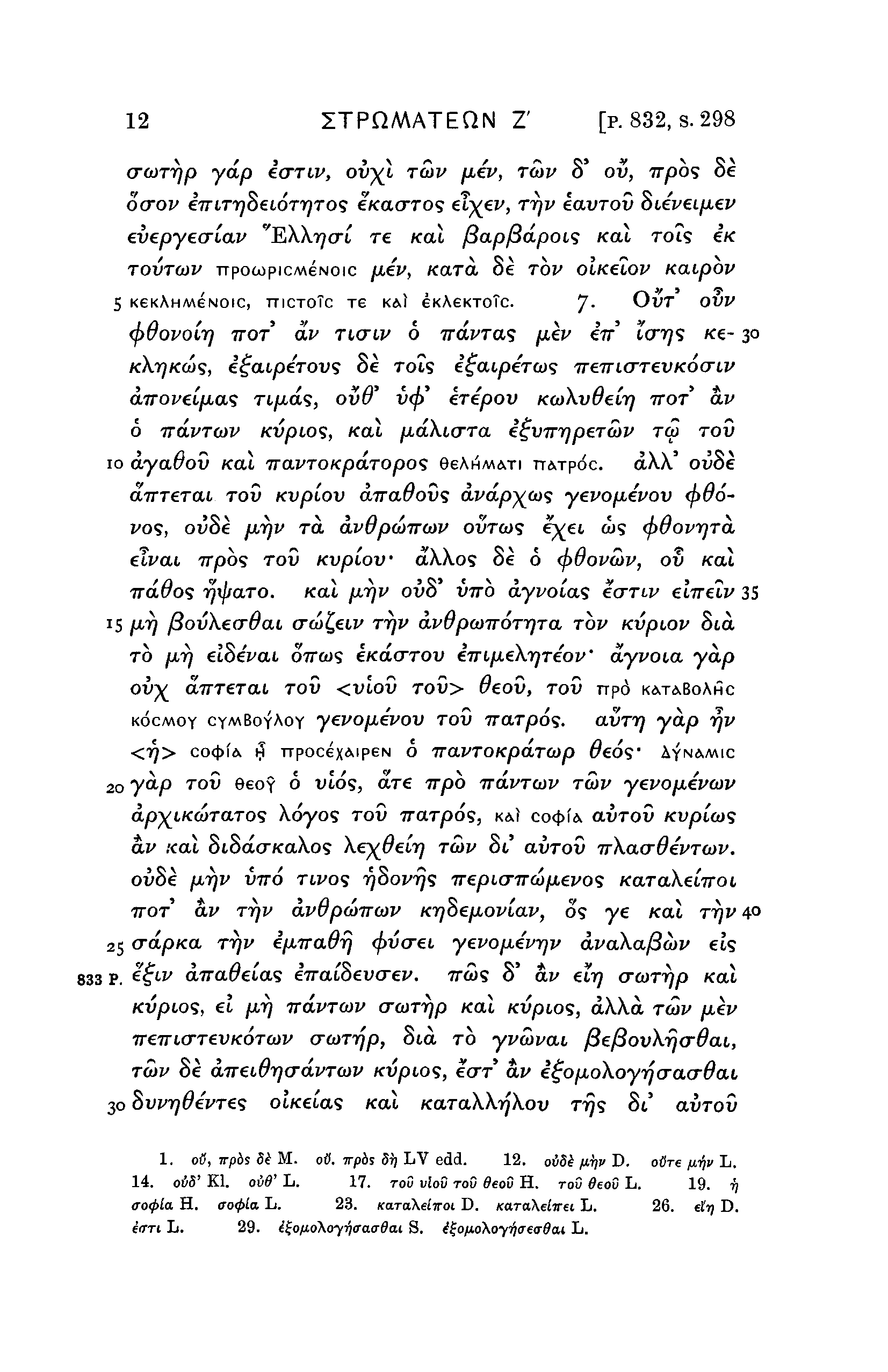
[p. 832, s. 298 croJTrjp ydp io~Tiv, ov^l T£>V fiev, TCOV 8' ov, irpbs Se oarov iTriTrjSeioTrjTOS evcaoros etyev, rr/v iavTov BieveLfxev evepyecriav "EXXrjcrC re Kal (Bapfidpois Kal rois IK TOVTGDV TrpocopicMeNoic fidv, Kara Se TOV OIKZLOV Kaipbv
5 K6KAHMGNOIC,
TTICTOTc T6 Kdkl CKAeKTOTC.
OvT OVV <J>0OVOCT) TTOT av TIO~LV 6 irdvras i^ev eV ur^s Kt30 os, efaiperous Se TOIS e Ti/ms, ou^' v^)' erepov KoiXvOeCr) TTOT' av 6 TrdvTtav Kvpios, KO\ jLtaXtcrTa i^VTrrjpeTSyv r&3 TOU dya^ov Kal Travro/cpaTO/DOS eeAHM&Ti rr&Tpoc. d\X' owSe aiTTerai rou Kvpiov airadovs dvdp^cos yevofjuevov (f>66-
vos, ovhe fx,7)v TO. dvdpwTTcav ovTWi e^ei ws <f)0ovr]Ta elvcu TT/OOS TOU Kvpiov aXXos Se 6 cjidovwv, ov Kal •nddos rjxj/aTO. Kal fjLrjv ouS' UTTO dyvoias ecrrtv etTreit' 35
15 jit?) {Sovkeo-dai o~<ii£,eiv TTJV dvOpcoTTOTTjTa TOV Kvpiov Sta.
TO JU,T) etSeVai OTTWS eKacrrou iTnfJie\rjTeov' aryvoia ydp ou^ aTTTerat TOU <vtov TOU> ^eov, TOU npd KATABOAHC
KOCMOY CYMBOYAOY yevo/juivov TOV irarpo^. avTt) ydp rjv <r)> CO4>IA $ TTpocexAipeN 6 TTavTOKpaTcop
2O yap TOU eeoY o utds, <XT€ TT/JO iravTcov TS)V Xdyos TOV TraT/ads, KA) co<j>f«> auToG av xal SiSdcr/caXos Xe^deir) TS)V SI' auTou ouSe /U.-39V U7rd TIVOS 1780^5 TTepio-Trdifxevo<s
TTOT av TTJV dvdpdaircov KTjhefj.oviav, os ye /cat TTJV 4° 25 crdp/ca TIJZ> ifXTradr) <f>vcreL yevofJLevrjv dvaXafia>v ets
833 P. ^TtI/ dira^etas iTraCSevaev.
TT&)S S' av etij o-OTrjp Kal s, et JUT) TrdvTOiv crcDTr/p Kal /cuptos, dXXa T<2V yu.ei' aa)T7]p, Sia TO yvoivai /3efiovXfjcr0at,, TO>V Se dneudrjo-avTOiv Kvpto<s, CCTT' ai
30 SwrjdevTes otKeta? Kal /caTa\\7jX.ov T^S St'
1. otf, 7rp6s 6^ M. ofl. 71736s 5i) LV edd.
12. otfd^ /i7;^ D. oi?Te ji-fyi L.
14. o(S' Kl. oiff L.
17.
TOU uioD TOO SCOU H.
TOO ^eoD L.
19. i, crcxpia H. oo<pla L.
23. raTaXeijroi D.
KaraXdirei L.
26. cti; D. eflri L.
29.
^o/ioAo77}ffao-flai S.
H-onoXoytfaeaBai L. https://doi.org/10.1017/CBO9780511695513.010 Published online by Cambridge University Press
C. II. §§ 6, 7j
MISCELLANIES, BOOK VII.
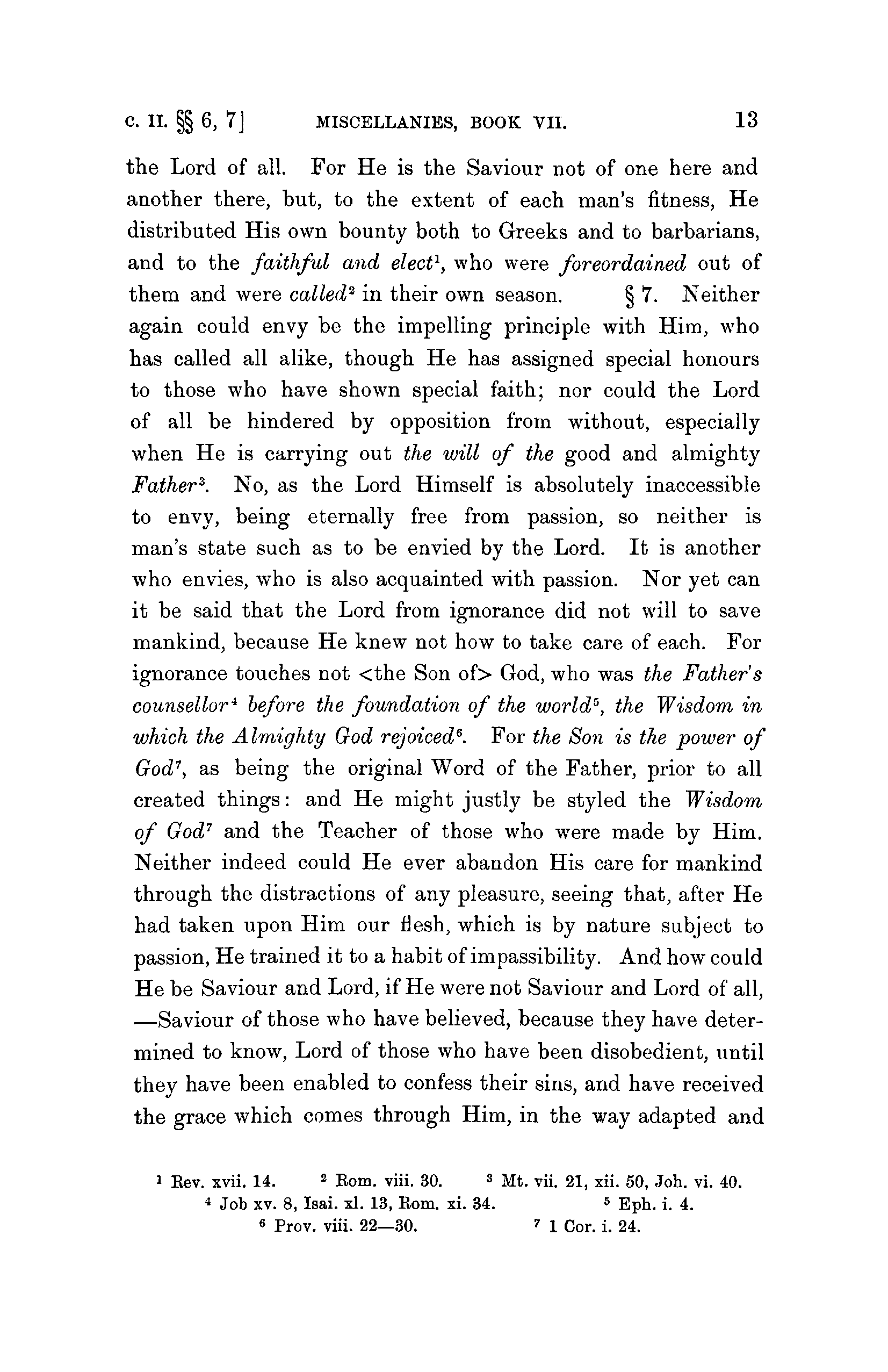
the Lord of all. For He is the Saviour not of one here and another there, but, to the extent of each man's fitness, He distributed His own bounty both to Greeks and to barbarians, and to the faithful and elect1, who were foreordained out of them and were called3 in their own season.
§ 7. Neither again could envy be the impelling principle with Him, who has called all alike, though He has assigned special honours to those who have shown special faith; nor could the Lord of all be hindered by opposition from without, especially when He is carrying out the will of the good and almighty
Father1. No, as the Lord Himself is absolutely inaccessible to envy, being eternally free from passion, so neither is man's state such as to be envied by the Lord. It is another who envies, who is also acquainted with passion. Nor yet can it be said that the Lord from ignorance did not will to save mankind, because He knew not how to take care of each. For ignorance touches not <the Son of> God, who was the Father's counsellor* before the foundation of the world5, the Wisdom in which the Almighty God rejoiced*. For the Son is the power of God7, as being the original Word of the Father, prior to all created things: and He might justly be styled the Wisdom of God7 and the Teacher of those who were made by Him.
Neither indeed could He ever abandon His care for mankind through the distractions of any pleasure, seeing that, after He had taken upon Him our flesh, which is by nature subject to passion, He trained it to a habit of impassibility. And how could
He be Saviour and Lord, if He were not Saviour and Lord of all, —Saviour of those who have believed, because they have determined to know, Lord of those who have been disobedient, until they have been enabled to confess their sins, and have received the grace which comes through Him, in the way adapted and 1 Rev. xvii. 14.
2 Rom. viii. 30.
3 Mt. vii. 21, xii. 50, Joh. vi. 40.
4 Job xv. 8, Isai. xl. 13, Rom. xi. 34.
5 Eph. i. 4.
6 Prov. viii. 22—30.
7 1 Cor. i. 24. https://doi.org/10.1017/CBO9780511695513.010 Published online by Cambridge University Press
ZTPQMATEQN Z'
[p.833,s.298
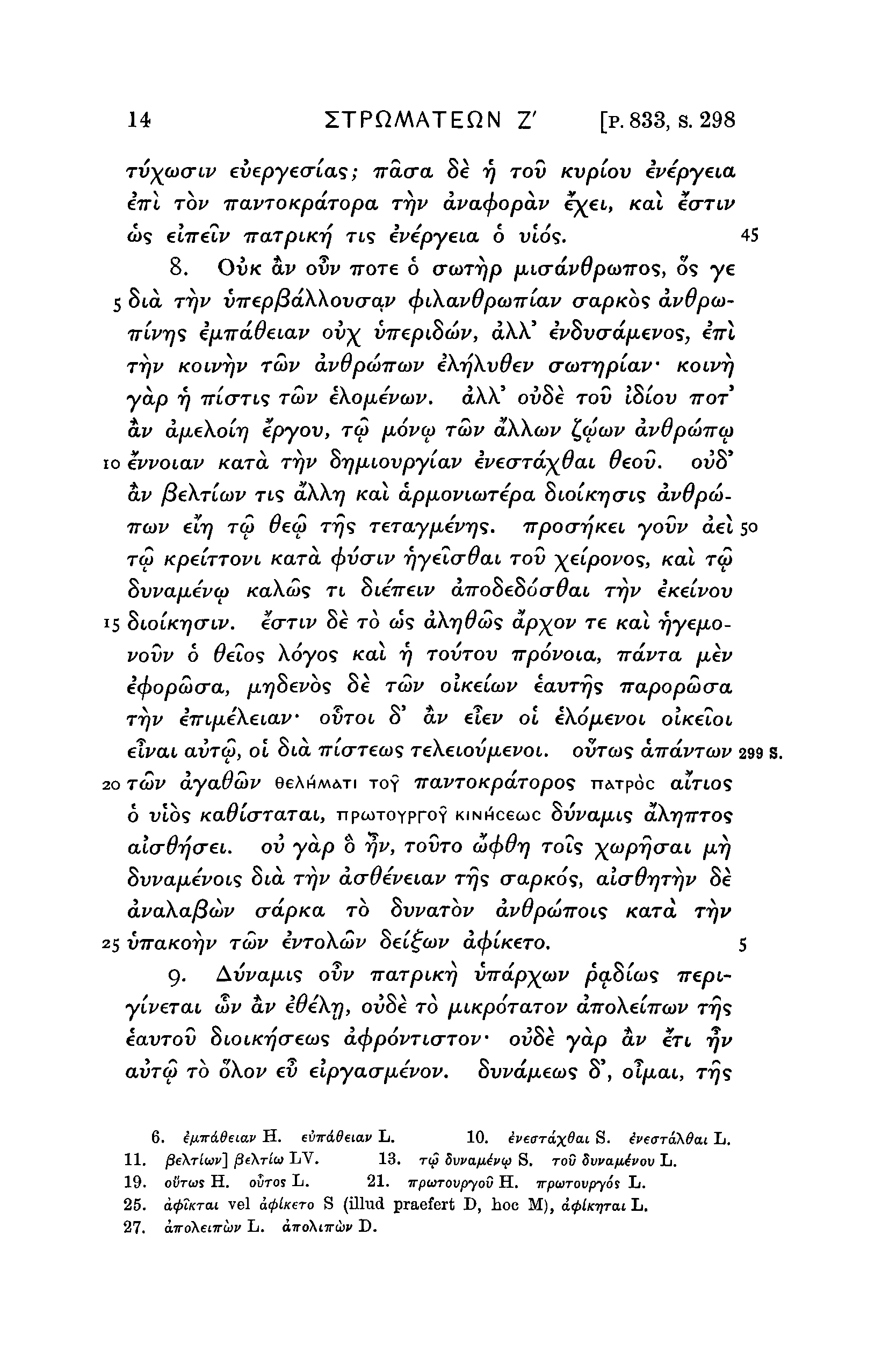
TV^WCTLV evepyeo-ias; irda-a Se rj TOV Kvpiov ivipyeia iiri TOV 7ra.v7OKpa.ropa rr/v dvafopdv e)(€i,
KOX CO-TLV
&>s tiireiv 7ra7ptKrj TIS ivepyeia 6 vios.
OVK av ovv TTOTC 6 acorr/p \xio~dvQp(siiro%, os ye 5 Std TTJV virep[$dXXovo-av <f>ikav8ponriav o~apKO% avdpcoTTCVTJS ijj.ird6eiav ov^ VTrzpihoiv, dXX' eVSvo"a/iej'os, inl rr/v KOLvrjv T5>V dv9po)7T(j>v iXijXvdev a-corr/pCav KOLVTJ yap f) mcrrts TGJV eXo^evcov. dXX' ovSe TOV ISLOV TTOT av dfJieXoCrj epyov, TO! fiovw TO>V dXXcov £,<oa>v dvdpanra)
IO evvoiav Kara, rrfv SrjfiLovpyiav evecrrd^dai deov. ovS' av fieXriwv TIS dXXr) /cai apfiovicorepa Stoi/c^cris dvdpa>troiv elrj ra 6eq> T17S reray/AeV^s.
Trpoo~rJK.ei yovv del 50 T(p KpetTTOvi Kara. <$>VO-LV rjyeio-Oai TOV ^eipovo<;, KOL TW
Swa/Jbevq) /caXws rt SieVeiv d7roSeSocr^ai TT}V iicetvov 15 ScoiKYjo-LV. ecrriv Se TO OJS dX^^ws apyov Te KCU i^ye/xoi^ovv 6 ^eios Xdyo? /cai 17 TOVTOU npovoia, ndvra /xev i(f)optoo~a, jLtTjSevos Se TCOV OLKCCCOV iavTrjs irapopaaa TTJV hnfJiiXeiav OVTOL 8' av eiev ol iXofievot 01/ceiot elvat, avrw, ol Sid irio"Tea)s TeXeiov/iei'ot. ovrcos diravrcov 299 s.
20 TCOV dyadStv eeA^MATi TOY iravroKparopos n*.Tp6c a m o s 6 vlbs KadiaraTai, nptoTOYpro? KIN^CSWC Swayais aX^TTTO? ov ydp o rjv, TOVTO otfydi) Tots -yoipr\o-ai ^T)
S Std TTJV dadiveiav T-^S o-api<6<;, aiaBrjTrjv Se dvaXa/3a>v crdpKa TO Sut'aToi/ dvdpanroLS Kara TTJV 25 viraKorjv TCOV ivroXcjv Se.C£a>v d(^)i/ceTO.
S 9.
Awajais ovi' TrarpiKri virdp^cov /aaStcos yiverai wv av eOiXrj, ovSe TO [iiKpoTarov aTroXeiTrav eavTou Stot/ojcrews d<f)p6vTio~Tov ovSe ydp av in rjv avTCo TO oXov ev elpyao-jievov.
Swd/xeais S', otju,at, 6. i/xwddciav H. ei57riiSeiav L.
10. ivcuTaxSai S.
^petrTaXflat L.
11.
^cXTiwc] fjeXriw LV.
13.
T^J dwa^vu) S.
TOO SWO-IUVOV L.
19.
OOTWS H.
OUTOS L.
21. TrpuTovpyov H. irptnTovpyos L.
25. d0«Tai vel acpUeTo S (illud praefert D, hoc M), a^ln-iyrai L.
27. d7roXei7iw L. dTroXuriii' D. https://doi.org/10.1017/CBO9780511695513.010 Published online by Cambridge University Press
C. II. §§ 7—9]
MISCELLANIES, BOOK VII.
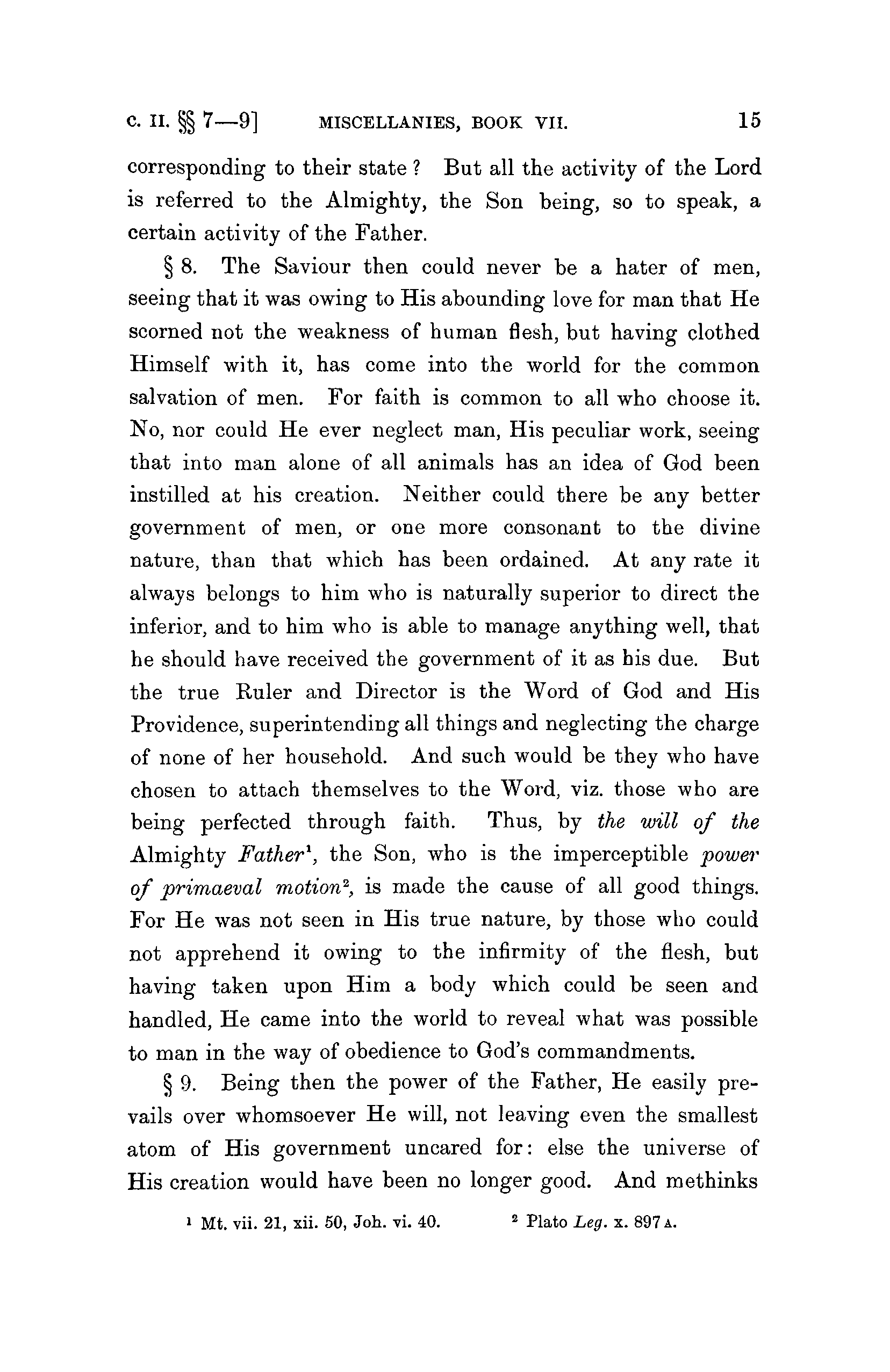
corresponding to their state ? But all the activity of the Lord is referred to the Almighty, the Son being, so to speak, a certain activity of the Father.
§ 8. The Saviour then could never be a hater of men, seeing that it was owing to His abounding love for man that He scorned not the weakness of human flesh, but having clothed
Himself with it, has come into the world for the common salvation of men. For faith is common to all who choose it.
No, nor could He ever neglect man, His peculiar work, seeing that into man alone of all animals has an idea of God been instilled at his creation. Neither could there be any better government of men, or one more consonant to the divine nature, than that which has been ordained. At any rate it always belongs to him who is naturally superior to direct the inferior, and to him who is able to manage anything well, that he should have received the government of it as his due. But the true Ruler and Director is the Word of God and His
Providence, superintending all things and neglecting the charge of none of her household. And such would be they who have chosen to attach themselves to the Word, viz. those who are being perfected through faith.
Thus, by the will of the Almighty Father1, the Son, who is the imperceptible power of primaeval motion2, is made the cause of all good things.
For He was not seen in His true nature, by those who could not apprehend it owing to the infirmity of the flesh, but having taken upon Him a body which could be seen and handled, He came into the world to reveal what was possible to man in the way of obedience to God's commandments.
§ 9. Being then the power of the Father, He easily prevails over whomsoever He will, not leaving even the smallest atom of His government uncared for: else the universe of His creation would have been no longer good. And methinks
1 Mt. vii. 21, xii. 50, Joh. vi. 40.
2 Plato Leg. x. 897 A. https://doi.org/10.1017/CBO9780511695513.010 Published online by Cambridge University Press
ITPQMATEQN Z'
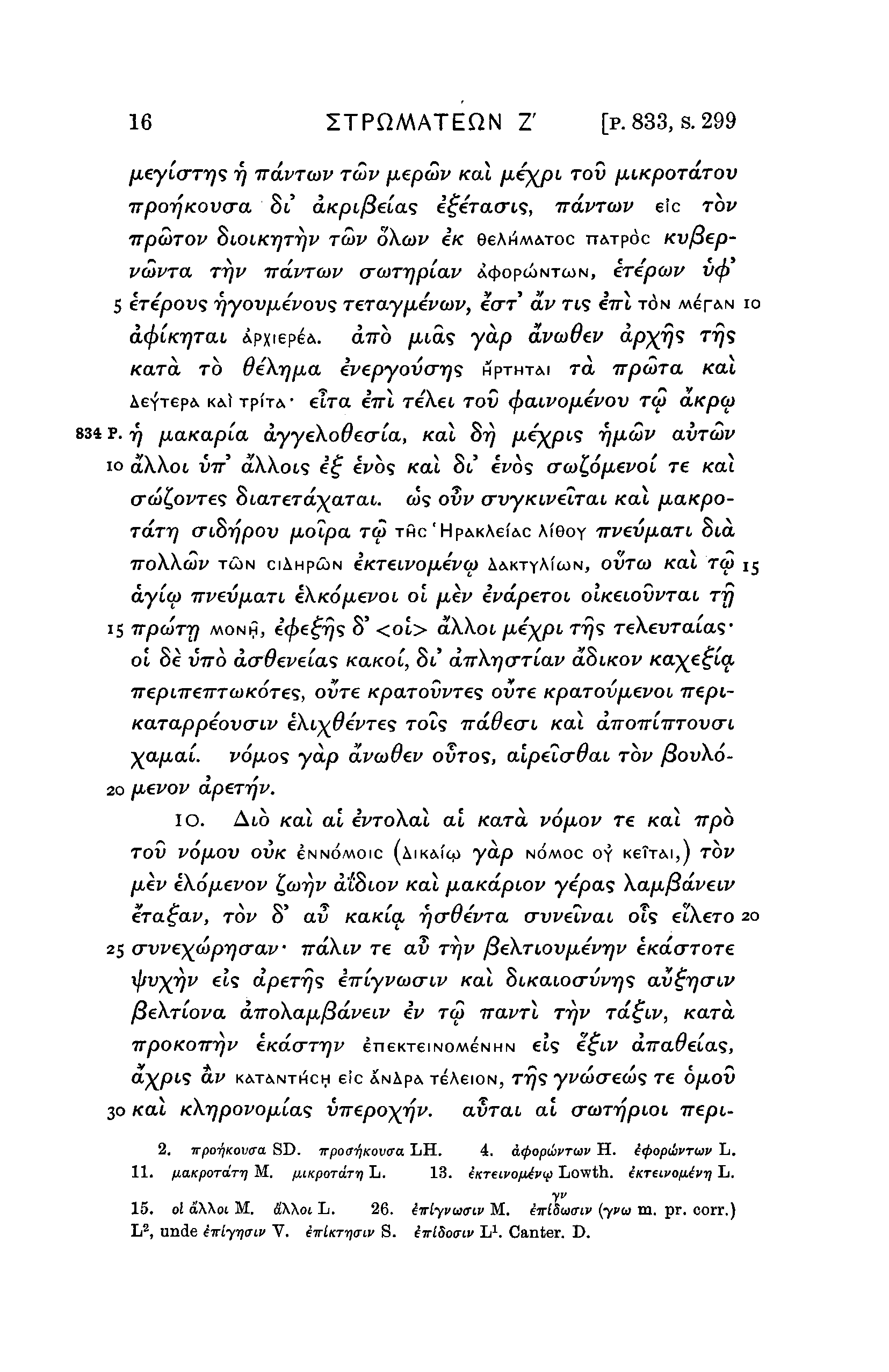
[p. 833, s. 299 rj TrdvTcov TCOV pepcov Kal jue^pi TOV yuKpora/rov TTpoiJKOVo~a Si' d/cpt/Jeias eferacris, ndvrwv elc TOI/ irpcoTov BioiKrjTrjv TCJV oXcav e/c eeA^M&Toc TTATPOC KvpepvStvTO. 7r\v TrdvTOiv o-oiTTjpiav (\4>optoNT60N, kripwv i)(f>
5 eVepous rjyov/jLevovs TCTay/jLevatv, ear' dv ris e7ri T6N MBPAN IO d(f)iKrjTaL Apxiepe&. a7ro /Aia5 yap dvwdtv a p ^ s T^s Kara TO ddXyj/jLa h>epyovcrr)<; HPTHTAI ra, Trpcora KCU
AeyTep*. K^} TPITAeTra CTTI Te'Xet TOV <^aivo//.eVou T<w aKpco 834 P. ^ fjLCLKapia dyyeXodecria, Kal Si) [le^pus rj/xcov io aXXoi VTT' aXXois ef evos «at St' eVos o-o)L,6p.evo'i re
O~O>1,OVT€<; StaTCTa^aTai.
W9 ouv o-vyKiveiTai Kal crtS^pov fiolpa TW THc'HpA.KAefa.c Afeoy Trvevfjuart hid
TCON ClAHpCON €KT€LVO[Jievq) Ad.KTyAlWN, OVTW Kttl TO) 15 vevjuaTt eX/cojU.et'oi ot yu.ei' kvdperoi oiKeiovvTai TJJ
15 irpcorrj MONH, e^e^Tjs S' <ot> aXXoi ^XPl oi 8e VT70 dcrOeveCa1; KaKoi, Si' dir\r)o~TCav dS
•77epi7re7JTCt)KOTes, ovTe KpaTovvrc; ovre KpaTOvp,a>oi irepiKaTappeovo-iv eXi^devTes TOIS Tra^ecri Kai dTrotrluTOvo'i ^a/u,ai.
I'dyxos yap dvo)0€v OVTOS, aip€io~6ai TOV fiovXo20 fievov dperrjv.
10.
Aio zeal ai eVToXal ai KaTa vo/xov Te Kai Trpo TOU VO/XOU OU/C 6NN0M0IC (AlK^fcp y a p NOMOC of KeTTM,) TOJ'
/ACV iX6p.evov ^corjv dtSiov Kal [laKapiov yepas Xa/xfidveLV era^av, TOV S' au KaKia r\o~0ivTa crvveZvac ols CIXCTO 20
25 o~vve)(a>pyjorav • irdXuv Te a i T^V ficXTLOVfjLevrjv eKao"TOTe ^ivxyjv ets dperrj? kir'iyviao-iv Kal hiKaioo-vviqs av^atv fieXriova d7roXa/A/3aveii/ ev ra TravTi TTJV Ta^iv, /caTa irpoKOTTrjv ihcdo-Trjv IneKTeiNOMeNHN eis a X / ° t ? a l > K*.Td>NT^cH eic ANipd. TGASION, TTJ? yj'wa'e&JS Te
30 Kai KXrjpovop,ia<; VTrepo)(ijv. auTai ai arcoTrjpuoi irepi2. irporfKovffa SD. irpoai]Kovaa L H .
4. a<poptbt>Tuiv H.
£<popthvTwv L.
11. iia.KpoTa.T7j M. in.Kpord.Ti) L.
13. iKreivo/Uvif Lowth. iKTei.vofi.ivri L. y 15. oi aXXoi M. diXXoi. L.
26. iirlyvwaw M. ivl&uaiv {yvw m. pr. oorr.) L2, unde iirlyriaiv V. eirUTijinv S. iwlSo<nv L1. Canter. D. https://doi.org/10.1017/CBO9780511695513.010 Published online by Cambridge University Press
C. II. §§ 9, 10] .
MISCELLANIES, BOOK VII.
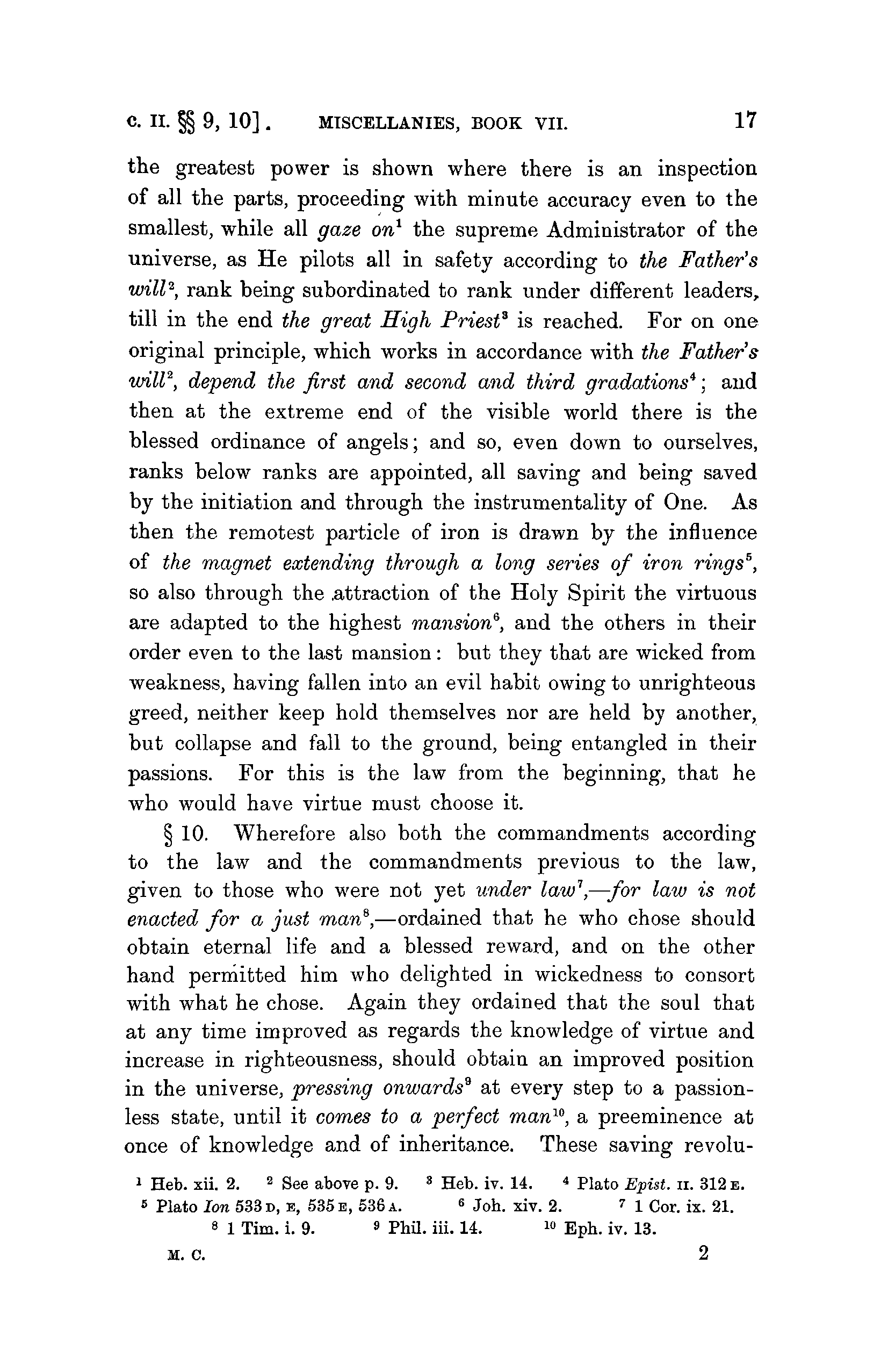
the greatest power is shown where there is an inspection of all the parts, proceeding with minute accuracy even to the smallest, while all gaze on1 the supreme Administrator of the universe, as He pilots all in safety according to the Father's will2, rank being subordinated to rank under different leaders, till in the end the great High Priest3 is reached. For on one original principle, which works in accordance with the Father's will2, depend the first and second and third gradations*; and then at the extreme end of the visible world there is the blessed ordinance of angels; and so, even down to ourselves, ranks below ranks are appointed, all saving and being saved by the initiation and through the instrumentality of One. As then the remotest particle of iron is drawn by the influence of the magnet extending through a long series of iron rings5, so also through the .attraction of the Holy Spirit the virtuous are adapted to the highest mansion*, and the others in their order even to the last mansion: but they that are wicked from weakness, having fallen into an evil habit owing to unrighteous greed, neither keep hold themselves nor are held by another, but collapse and fall to the ground, being entangled in their passions. For this is the law from the beginning, that he who would have virtue must choose it.
§ 10. Wherefore also both the commandments according to the law and the commandments previous to the law, given to those who were not yet under law1,—for law is not enacted for a just man*,—ordained that he who chose should obtain eternal life and a blessed reward, and on the other hand permitted him who delighted in wickedness to consort with what he chose. Again they ordained that the soul that at any time improved as regards the knowledge of virtue and increase in righteousness, should obtain an improved position in the universe, pressing onwards9 at every step to a passionless state, until it comes to a perfect man1", a preeminence at once of knowledge and of inheritance.
These saving revolu1 Heb. xii. 2.
2 See above p. 9.
3 Heb. iv. 14.
4 Plato Epist. II. 312 E.
5 Plato Ion 533 D, E, 535 E, 536 A.
6 Joh. xiv. 2.
7 1 Cor. ix. 21.
8 1 Tim. i. 9.
9 Phil. iii. 14.
10 Eph. iv. 13.
M. C.
https://doi.org/10.1017/CBO9780511695513.010 Published online by Cambridge University Press
ITPQMATEQN Z'
[P. 834, s. 299
TpoTraX Kara rrjv Trjs iJ,€Ta/3oXr)<s rd^tv dirofiepitftVTan.
KCU XpOVOLS
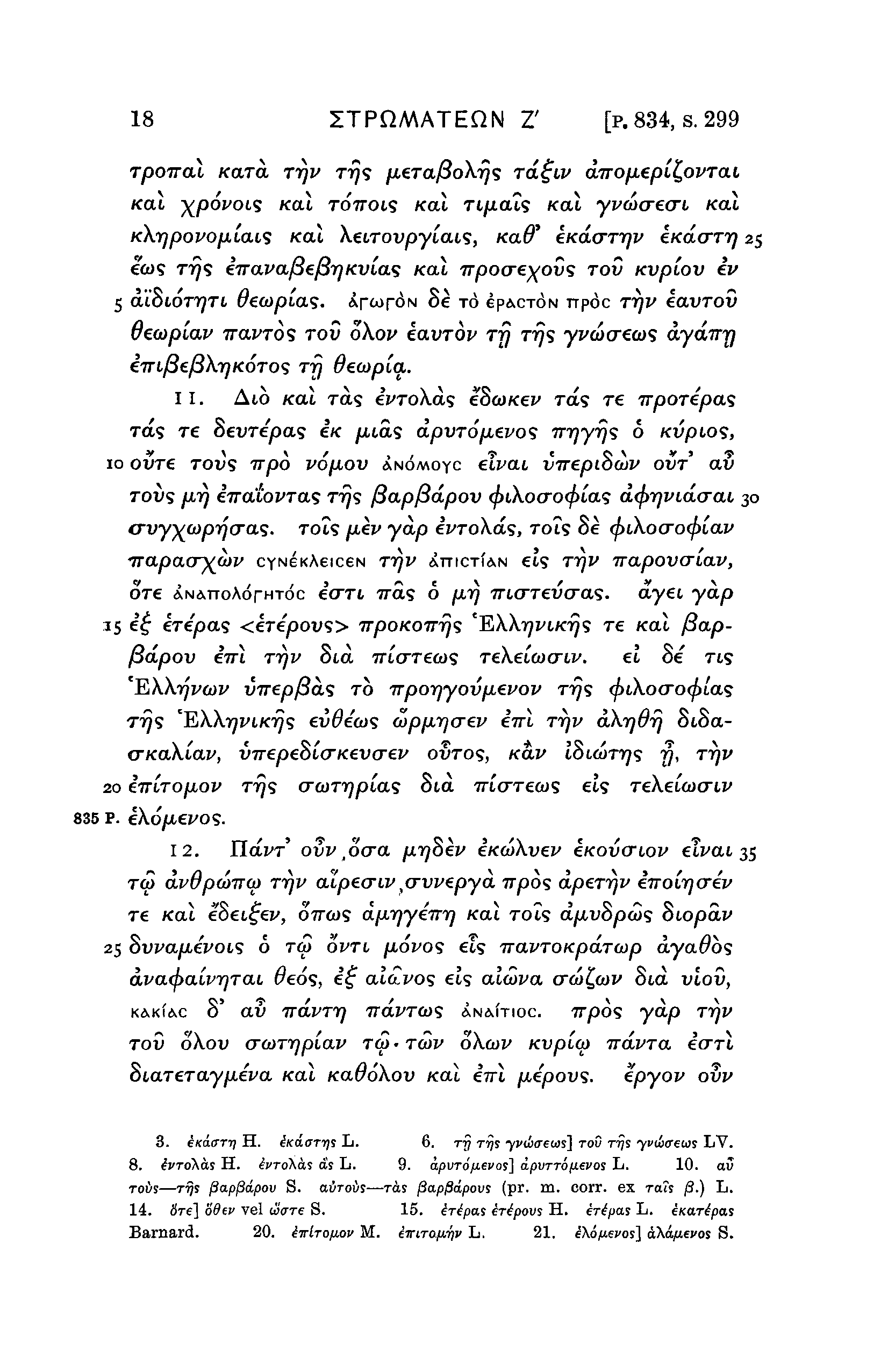
KCll TO7TOIS KOI TljUCUS KCU yv(OO~€O~t. KOL Kkrjpovop.laL's KOX XeiToupyuus, Kaff ei<do~Tr)v eKacrTTj 25 eo)S Trjs iTra.va/3€J3r)Kvia<; KOL Trpocre)(ov<; TOV KvpCov iv 5 di'SioV^n deoypias. ircor^N Se TO IPACTON rrpoc TTJV iavTov 6t<opiav TravTOS TOV O\OV CCLVTOV Trj 717s yva>o-€(os aydirrj
11.
Aio /cat ras eVroXds eSwKev ras re Trporepas T«£S re SevTepa? ix jaia; apuTo^ievos rnqyTj^ 6
Kvpios, 10 ovre TOVS TT/00 vo/xov &N6MOYC elt'at virepiZtov OVT av TOVS fir) iiratovTas TTJS jSapfidpov (j>L\oaro<f>La<; d^r/vidaai
<rvy)((t)prjcra<;. rots fiev ydp ivToXds, rots Se (j>i\ocro(f)iav •7Tapao~)(cov cyNGKAeiceN Ti}i' AniCTf^N eis TTJI' irapovo-tav, ore <\N&TTOA6|-HT6C eo"Tt iras 6 JLO) TrtcrTeucras. ayet 35 e£ eTepa<s <ere/30V5> TrpoKovrjs 'EXXijvt/c^s TC *ca
/Sdpov em. TTJV SLOL Trtcrrews reXetwcriv. et Se rts virepfias TO Trporjyovynvov T17S <^>tXocro^>ta? v8ecj<s ajpfirjaev inl Tr)v d\r)6rj SiSaVTrepe8£cn<evo~ev OVTO<;, KCLV iStwTiy? y, Tr)v 20 iiTLTOfjiov Trj? o~oiTrjpia<s Sid Tricrrews et? reXeuucriv
835 P. eXo/xei'os.
12.
YlavT* ovv ,ocra fxr/Sev iKcoXvev €KOVO~LOV elvai 35 TO) dvdpd>TT(0 Tr)v aupea-Lv^crvvepyd 77/305 dpeTrjv inoCrjcrev re /cat e8ei£ev, OTTCJS dixr/yenr) KOLI TOIS djAvSpcos Siopav
25 Suva/AeVots 6 TW ovrt [lovo? eis TravTOKparcup dyadbs dva(j)aivrjTaL 6e6s, e£ alavos eis alaiva auttfav Sid uiou,
KAKIAC S' av TrdvTrj irdvTOi<5 kt<t>.h\oc. Trpos ydp TI}V TOV oXou aoiTrjpiav T(O-TCOV OXGJV Kvpico irdvTa eo-ri /cai Ka^oXou Kai e7Ti iiipovs. epyov ovv 3. eKaffri] H. ^/cairrT;? L.
T^ T?)S "yi'tiffews] roG rijs ^vtitrecos LV.
^yroXas H. ^roXcts as L.
9. apuro'/xei'os] dpvrTOfievos L.
10. au TOI>S—rrfi papfidpov S. auroiis—TAS /3apf3dpovs (pr. m. oorr. ex Tais ^.) L.
14.
6re\ offer vel w r e S.
15. iripas ertpovs H. eripas L. iKartpas Barnard.
20. Mro/iov M. iiri.TO.nriv L.
21. eXo^eras] dXa^evos S. https://doi.org/10.1017/CBO9780511695513.010 Published online by Cambridge University Press
C. II. §§ 10—12]
MISCELLANIES, BOOK VII.
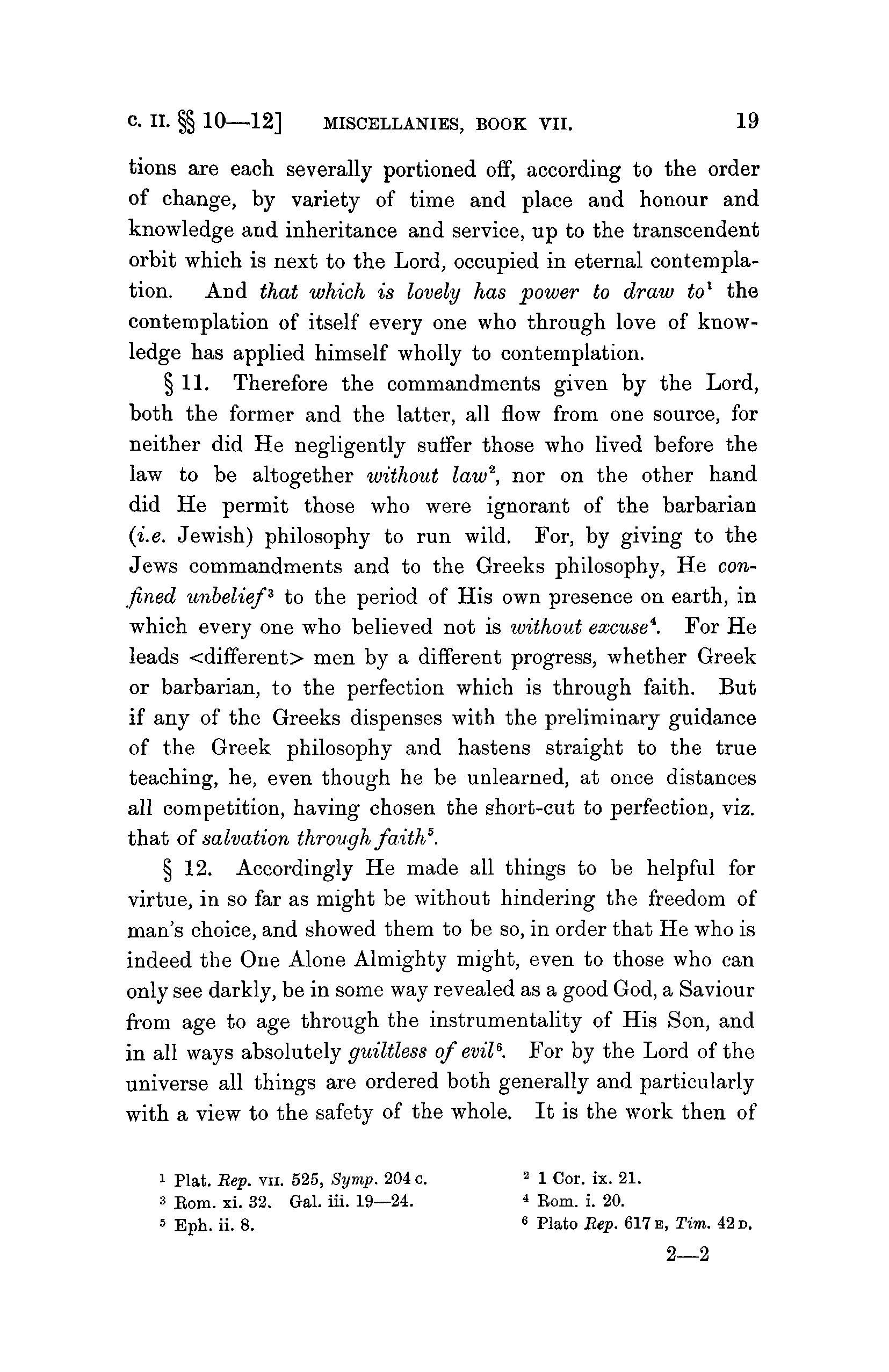
tions are each severally portioned off, according to the order of change, by variety of time and place and honour and knowledge and inheritance and service, up to the transcendent orbit which is next to the Lord, occupied in eternal contemplation.
And that which is lovely has power to draw to1 the contemplation of itself every one who through love of knowledge has applied himself wholly to contemplation.
§ 11. Therefore the commandments given by the Lord, both the former and the latter, all flow from one source, for neither did He negligently suifer those who lived before the law to be altogether without law*, nor on the other hand did He permit those who were ignorant of the barbarian
(i.e. Jewish) philosophy to run wild. For, by giving to the Jews commandments and to the Greeks philosophy, He confined unbelief* to the period of His own presence on earth, in which every one who believed not is without excuse*. For He leads <different> men by a different progress, whether Greek or barbarian, to the perfection which is through faith.
But if any of the Greeks dispenses with the preliminary guidance of the Greek philosophy and hastens straight to the true teaching, he, even though he be unlearned, at once distances all competition, having chosen the short-cut to perfection, viz. that of salvation through faith5.
§ 12. Accordingly He made all things to be helpful for virtue, in so far as might be without hindering the freedom of man's choice, and showed them to be so, in order that He who is indeed the One Alone Almighty might, even to those who can only see darkly, be in some way revealed as a good God, a Saviour from age to age through the instrumentality of His Son, and in all ways absolutely guiltless of evil6. For by the Lord of the universe all things are ordered both generally and particularly with a view to the safety of the whole. It is the work then of 1 Plat. Rep. VII. 525, Symp. 204 o.
2 1 Cor. ix. 21.
3 Eom. xi. 32. Gal. iii. 19—24.
4 Rom. i. 20.
5 Eph. ii. 8.
6 Plato Rep. 617 E, Tim. 42 D.
2—2 https://doi.org/10.1017/CBO9780511695513.010 Published online by Cambridge University Press
STPQMATEQN Z'
[p. 835, s. 299
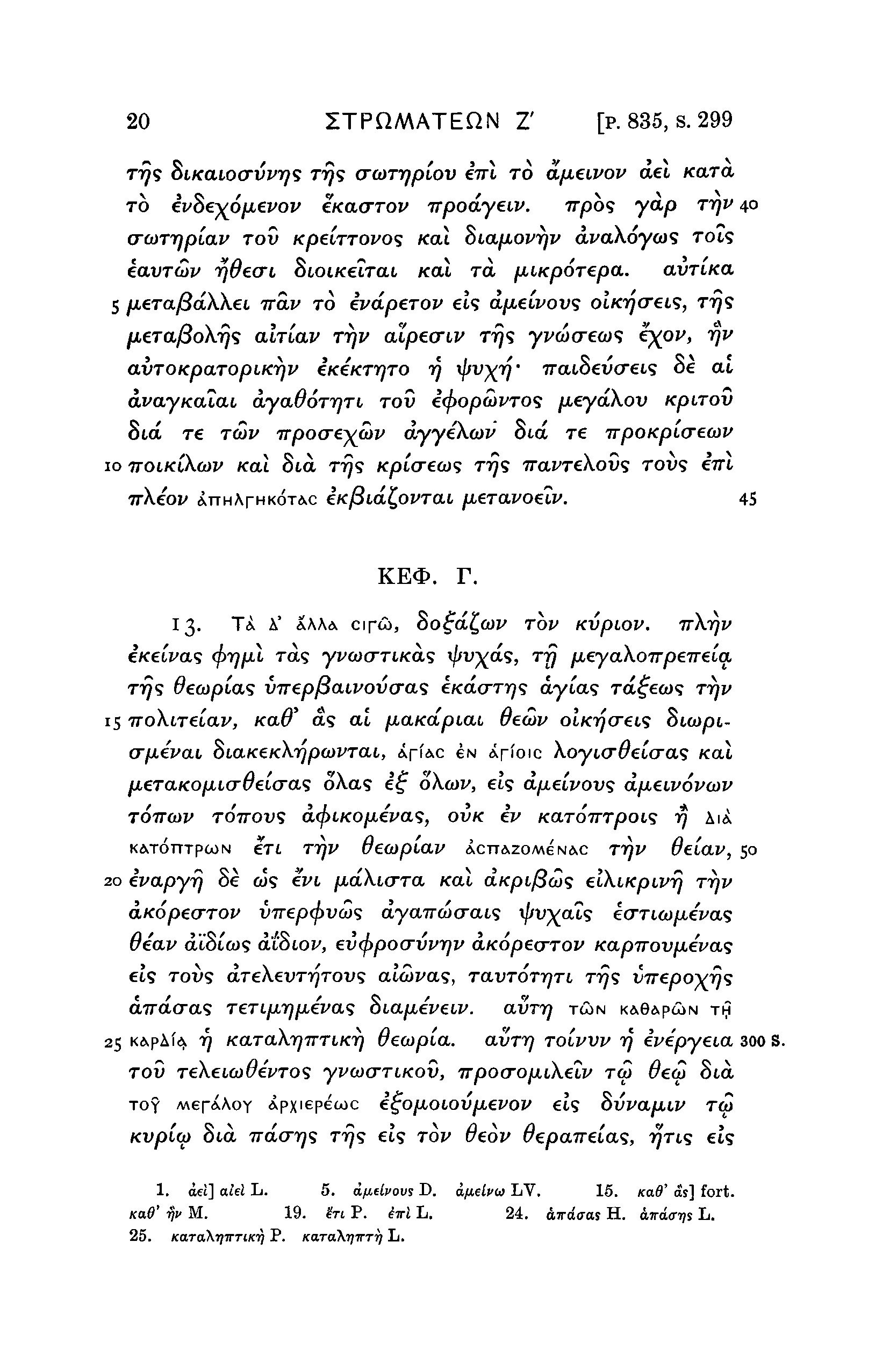
Trjs hiKaiocrvviqs Tr)s acDT-qpiov eVi TO d/xeivov del Kara TO evhe^o^evov eKacrrov irpodyeiv. irpbs yap Tr/v 4° cro)T7jpi,av TOV KpeiTTOvos Kal Siafiovrjv dvakoyws Tots iavroiv rjdecri Sioi/ceirai Kal rd fjUKporepa. avriica S fjLerafidWei trdv TO evdpeTOV els dfjueivovs o'ncjtret^,
TTJ5 ju,£Ta/3oX^? aiTiav TTJV alpecrw Trjs yva>aeo)<; ^X.ov, r\v avTOKpaTopiicrjv itceKTrfTO TJ xpv^rj' i7aiSevo"eis oe a t dvayKalac dyaOoTTjTi TOV i(f>opS)VTO<s /xeyakov Sid T€ TOJV trpoaeySiv dyyeXov Bid TC io TTOLKCXCOV Kal 8id TT)<; Kpio~ea><; Trj<s TravTe\ov<; TOVS em nXeov dlTTH\rHKOT,\c eKfiid^ovTai peTavoelv.
13.
TA i' AAAA cifco, 8o£d£,<ov TOV Kvpiov. irXijv e/cetvas j>f)fjl TOLS yvwcrTi/cas t//u^as, TTJ
T17S decopCas virepfiaLvovo-as eKacrTr)<; dyCas Ta 15 TroXtTetai', /ca#' a5 at fiaKapiai deaJv ot/c^o"ei o"/u.eVat htaKeKXrjpoiVTai, Lr'\t>.c eN irloic Xoyio"^eto"as /cal ju.eTaKOjU.io-^eio"as oXas e^ oXcov, ets ajxeivovs d^eivoviav e/cetv TOTTOiV
T 0 V 0 V S
d(f)LKOfJ.evaS) OVK iv KaTOTTTpoiS Y) AlA
K&TOTTTpCON
6TI TT^l1 8e(t)piaV
(\CTTAZOM6 NAC
T'^I' deLaV, SO 20 evapyrj 8e w? evi fjidXtcrTa Kal aKpiftcos elXiKpivrj TT/V aKopeo~TOV VTrep<ftva><; ayaTrw deav diSiw§ dtStov, ev<f>poo~vvr}v els TOVS aTeXevTrjTovs alSivas, TavTorrjTi TT}S dirdo-as TeTLfj-rj/jLevas Biafjceveuv. avTTj TUN K&e&pcoN TI?
25 K^pAfdi, 17 KaTaXrjTTTLKT) decopia. avTfj TOIVVV rj evepyeia 300 S.
TOU TeXeiaOevTos yvcoo-TLKov, TrpocoyLiXelv TW ^e&I Sia.
TOY Mer^Aoy Apxiepewc i^ofJiOiov/jievov els SvvafiLV ra ia) 8td irdar/s Trjs els TOV deov depaneias, r)Tis els 1. a«] oi'ei L.
5. andvovs D. a/ielnu LV.
15. Ka0' as] fort.
Ka0' 171M.
19. fri P.
<?7r! L.
24. d7ro<7as H. todays L.
25.
KaTaX?;7rTiKi7 P. https://doi.org/10.1017/CBO9780511695513.010 Published online by Cambridge University Press