
CHAPTER XII
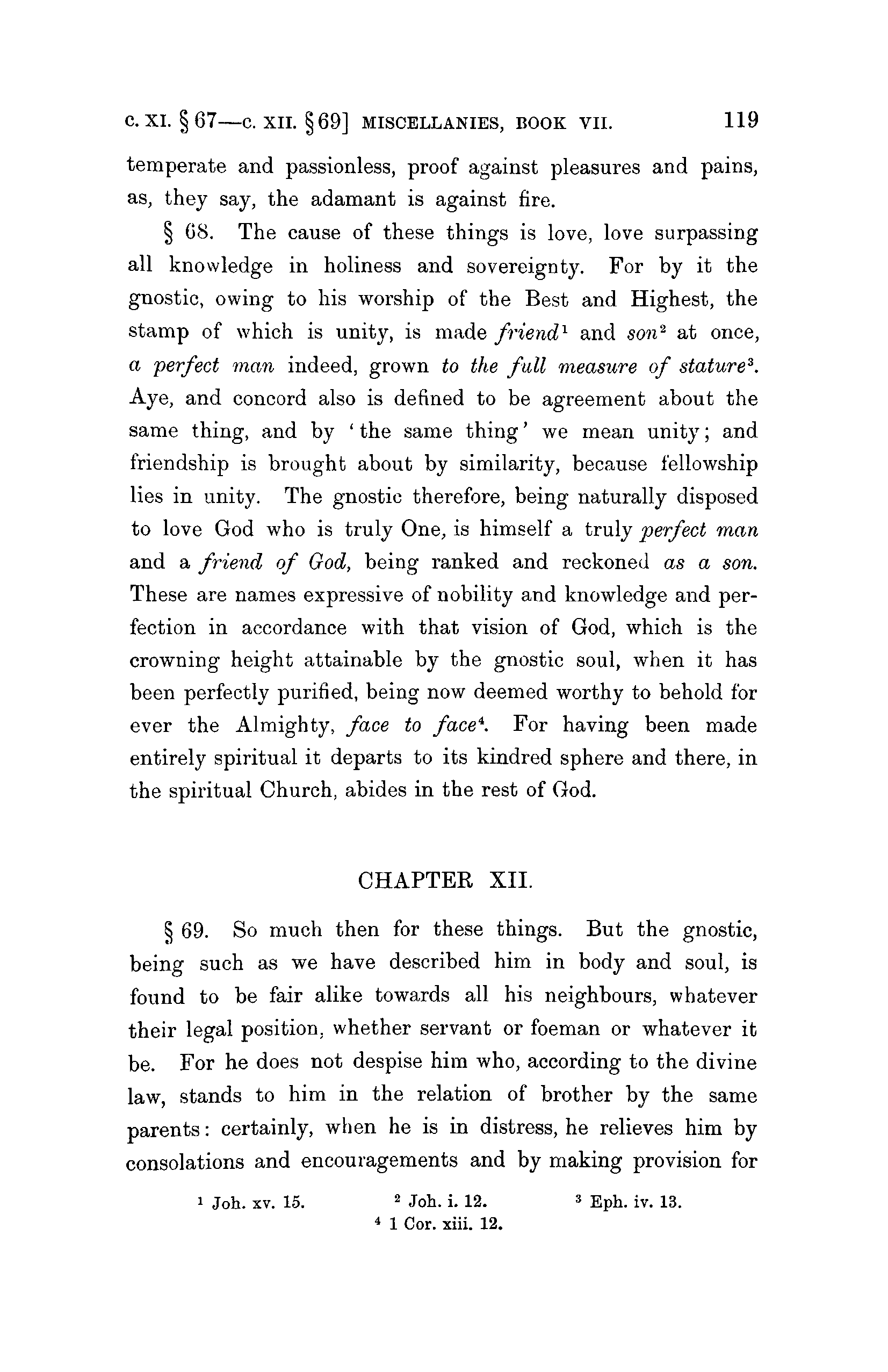
CXI. §67—C. XII. §69] MISCELLANIES, BOOK VII.
temperate and passionless, proof against pleasures and pains, as, they say, the adamant is against fire.
§ 08. The cause of these things is love, love surpassing all knowledge in holiness and sovereignty. For by it the gnostic, owing to his worship of the Best and Highest, the stamp of which is unity, is made friend1 and son2 at once, a perfect man indeed, grown to the full measure of stature3.
Aye, and concord also is defined to be agreement about the same thing, and by ' the same thing' we mean unity; and friendship is brought about by similarity, because fellowship lies in unity. The gnostic therefore, being naturally disposed to love God who is truly One, is himself a truly perfect man and a friend of God, being ranked and reckoned as a son.
These are names expressive of nobility and knowledge and perfection in accordance with that vision of God, which is the crowning height attainable by the gnostic soul, when it has been perfectly purified, being now deemed worthy to behold for ever the Almighty, face to face\ For having been made entirely spiritual it departs to its kindred sphere and there, in the spiritual Church, abides in the rest of God.
CHAPTER XII.
§ 69. So much then for these things. But the gnostic, being such as we have described him in body and soul, is found to be fair alike towards all his neighbours, whatever their legal position, whether servant or foeman or whatever it be. For he does not despise him who, according to the divine law, stands to him in the relation of brother by the same parents: certainly, when he is in distress, he relieves him by consolations and encouragements and by making provision for i Joh. xv. 15.
2 Job. i. 12.
3 Eph. iv. 13.
4 1 Cor. xiii. 12. https://doi.org/10.1017/CBO9780511695513.010 Published online by Cambridge University Press
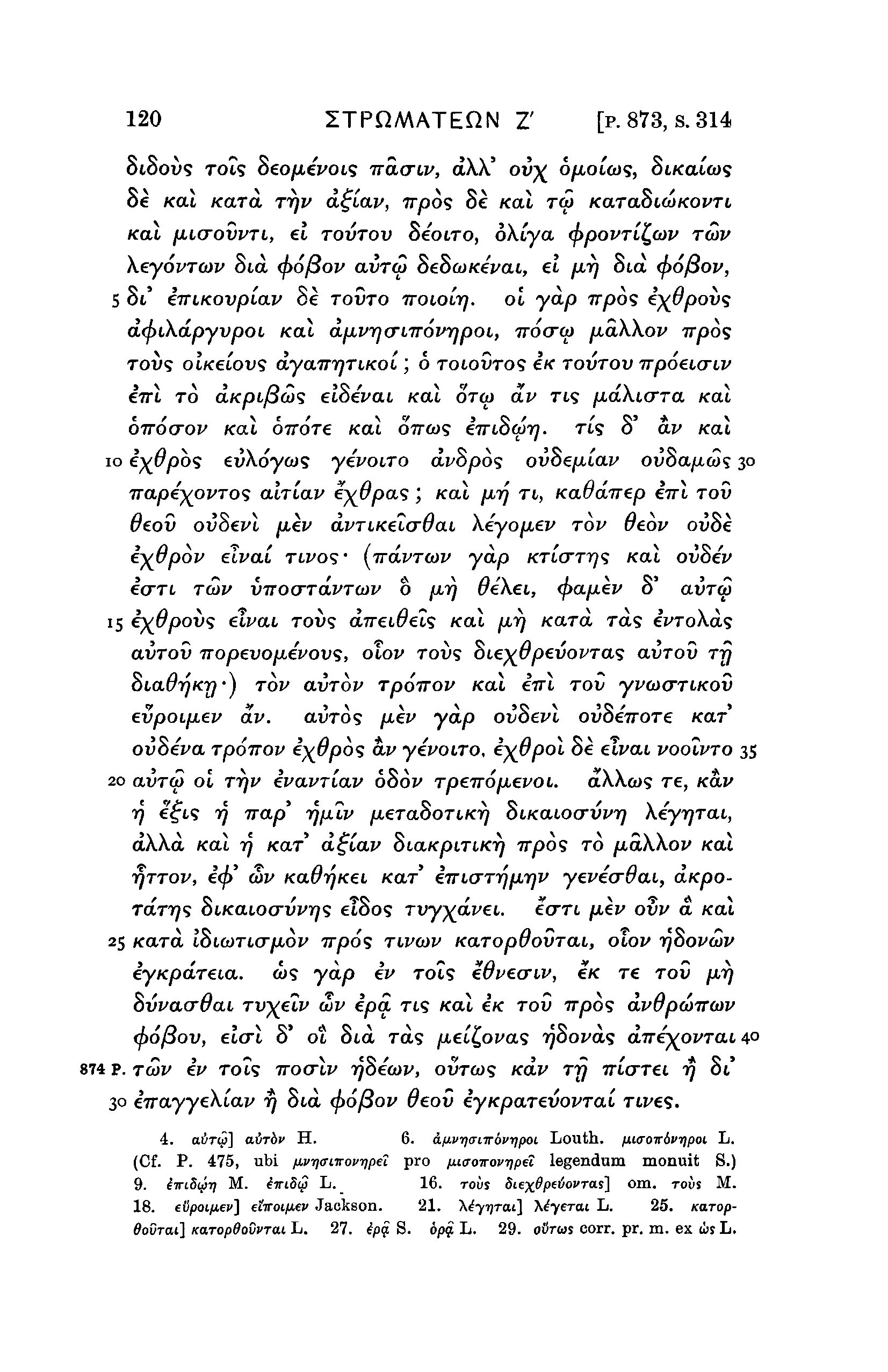
ITPQMATEQN Z'
[P. 873, s. 314
SiSou9 rots SeojueVois iracriv, dXX' ov^ 6fiota)<;, Si/catws Se /cat Kara, TTJV d£Cav, TT/DOS Se /cat TW /caTaSici/copTi
/cat [iicrovvri, ei TOUTOU SC'OITO, oXtya <f>povTi£cov TCJV Xey6vT0)v Sid <f>6/3ov avrq> SeS&i/ceVat, et yu,^ Sid <f)6/3ov,
5 Si' hriKovplav Se TOCTO TTOLOCT). ol yap npos i^ d^ikdpyvpot /cat djxviqcriTrovrjpoL, vrocrw |u.aXXov
Toir? ot/cetovs dyaTrr/TLKoC; 6 TOIOWTO? e/c rourov irp6ei,aiv ITTX TO a/cyatyScGs etSeVat /cat OTW aV rt§ /xaXtcrra /cat
6TTOO"OV /cat 07T0Te /cat oirws eTrtSw^. rts S' av /cat euXoyws yivono dvSpos ovSe^atav ovSa/xw; 30 alriav eydpas; /cat /AT^ rt, Kaffdirep eVt TOU ouSevl jttei' di'Tt/cetcr^at Xeyofjuev TOI' ^£OC ovSe eydpov elvaC Tti'o?* (irdvTcav yap KTi(TTr)<; /cat ovSeV ecrrt rail/ uirocrraWaw o /x,^ dekei, <f>a/Ji.ev S' avrw 15 e^Opovs eivai TOVS d7rei#ets /cat ^17 Kara rets eVroXds
O TTopevofJievovs, olov TOVS Ste^^pevo^ras awTou ry TOV avTov rpoirov /cat CTTI TOV dv. auTos jix.ei' yd/3 o^Sevt ouSeVoTe /ca/ ouoei'a rpoTTOv tyvpo% av ytvovro, e^upoi oe etvat VOOIVTO 35
20 avTW ot T ^ ivavTiav 6S6v Tpenofievoi. dXXws TC, /cav 17 e^t? ij Trap' ij^tv fx€TaSoTi,Krj hiKaioo~vv7j
\4yqTai, dXXct /cat 7j KaT* d^iav SiaKptTLKrj TTyDOS TO /LtaXXov /cat V, i<f>' 3>v Ka9r)K€L Kar' iTnaTififinqv yevecrBai, dtcpoSt/catocrw^s eTSos Tuy^dvet. ecrTt /jtev oui/ a /cai 25 /caTa tStwTtcrjLioi' irpos Tivoiv KaTopdovrai, olov rjhovuiv iyKpdreta. a>? yap iv Tots edueaiv, e/c TC TOV ^ Svvao~dai TV)(elv d>v ipa Tt§ /cat e'/c TOU TT/DOS dvOpcjircov
<f>6/3ov, etcrt S' ot Sid Ta? jxei^ovas TjSoi'ds dveyovTai 4° 874 P. TWV Cf TOtS 7TOCTIV 7JSe'&)V, OUTW§ /Cat' T1^ 7TlO"Tet 17 S i '
30 iirayyekiav r/ Sid (jiofiov deov iyKparevovTai Ttves.
4. aivTcjj] ai5T6>> H .
6. d.ii.rqaurbvripoi. Louth. nurovbvripoi. L.
(Cf. P. 475, ubi nvriffiTovrjpel pro luaowov-qpti legendum monuit S.) 9. iiriSifij M.
£iri8$ L.
16.
TOUJ Siex^pd'oxTas] om.
TOUS M.
18. eSpoiiiev] eiiroi/nev Jackson.
21. \4yr)Tai] WyeToi L.
25. KaropOovTat] KaropOovvTcu L.
27. ^pjt S. bpq. L.
29. oSrus corr. pr. m. ex us L. https://doi.org/10.1017/CBO9780511695513.010 Published online by Cambridge University Press
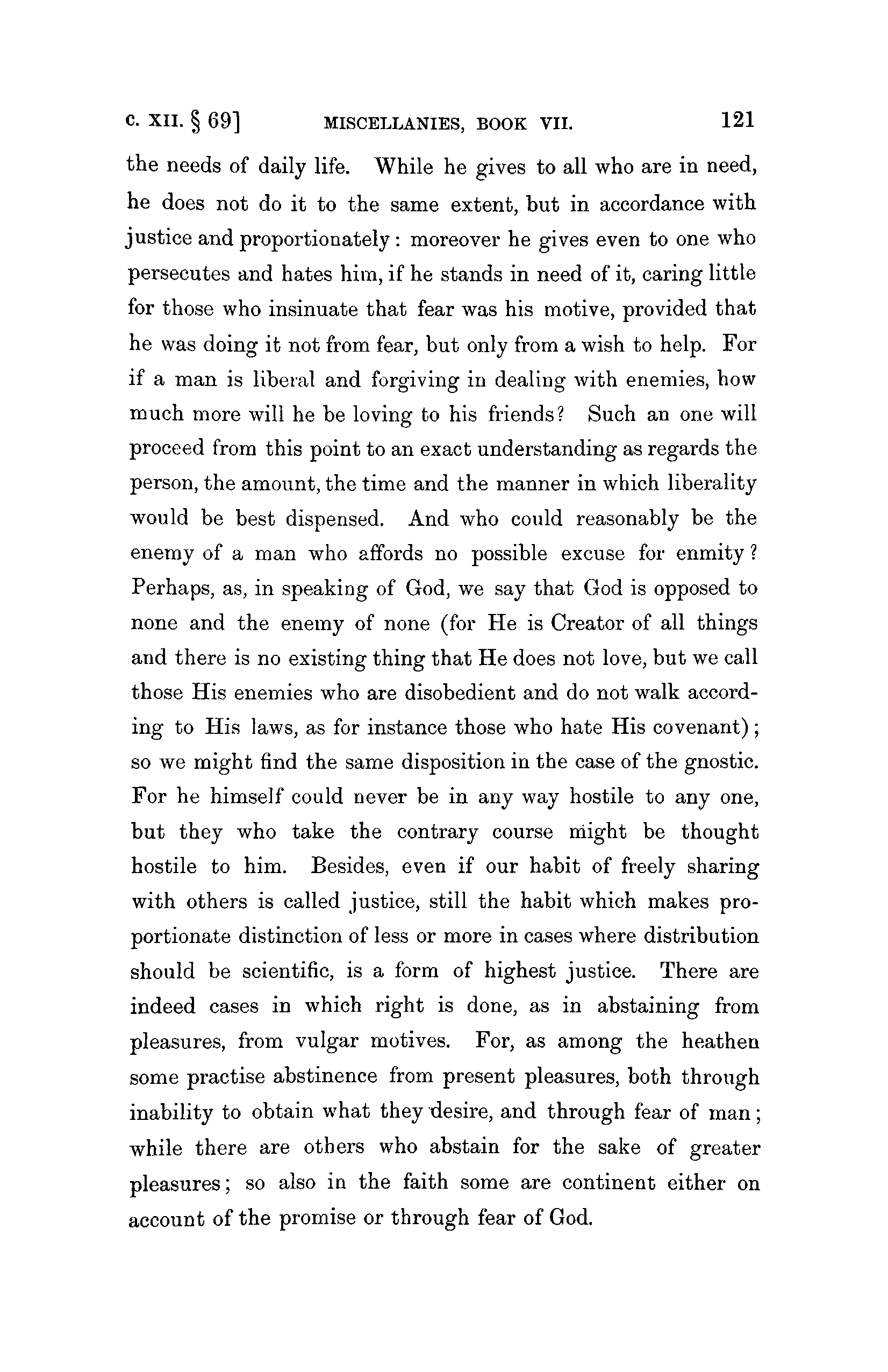
C. XII. § 69]
MISCELLANIES, BOOK VII.
the needs of daily life. While he gives to all who are in need, he does not do it to the same extent, but in accordance with justice and proportionately : moreover he gives even to one who persecutes and hates him, if he stands in need of it, caring little for those who insinuate that fear was his motive, provided that he was doing it not from fear, but only from a wish to help. For if a man is liberal and forgiving in dealing with enemies, how much more will he be loving to his friends?
Such an one will proceed from this point to an exact understanding as regards the person, the amount, the time and the manner in which liberality would be best dispensed. And who could reasonably be the enemy of a man who affords no possible excuse for enmity ?
Perhaps, as, in speaking of God, we say that God is opposed to none and the enemy of none (for He is Creator of all things and there is no existing thing that He does not love, but we call those His enemies who are disobedient and do not walk according to His laws, as for instance those who hate His covenant); so we might find the same disposition in the case of the gnostic.
For he himself could never be in any way hostile to any one, but they who take the contrary course might be thought hostile to him. Besides, even if our habit of freely sharing with others is called justice, still the habit which makes proportionate distinction of less or more in cases where distribution should be scientific, is a form of highest justice. There are indeed cases in which right is done, as in abstaining from pleasures, from vulgar motives. For, as among the heathen some practise abstinence from present pleasures, both through inability to obtain what they desire, and through fear of man; while there are others who abstain for the sake of greater pleasures; so also in the faith some are continent either on account of the promise or through fear of God. https://doi.org/10.1017/CBO9780511695513.010 Published online by Cambridge University Press
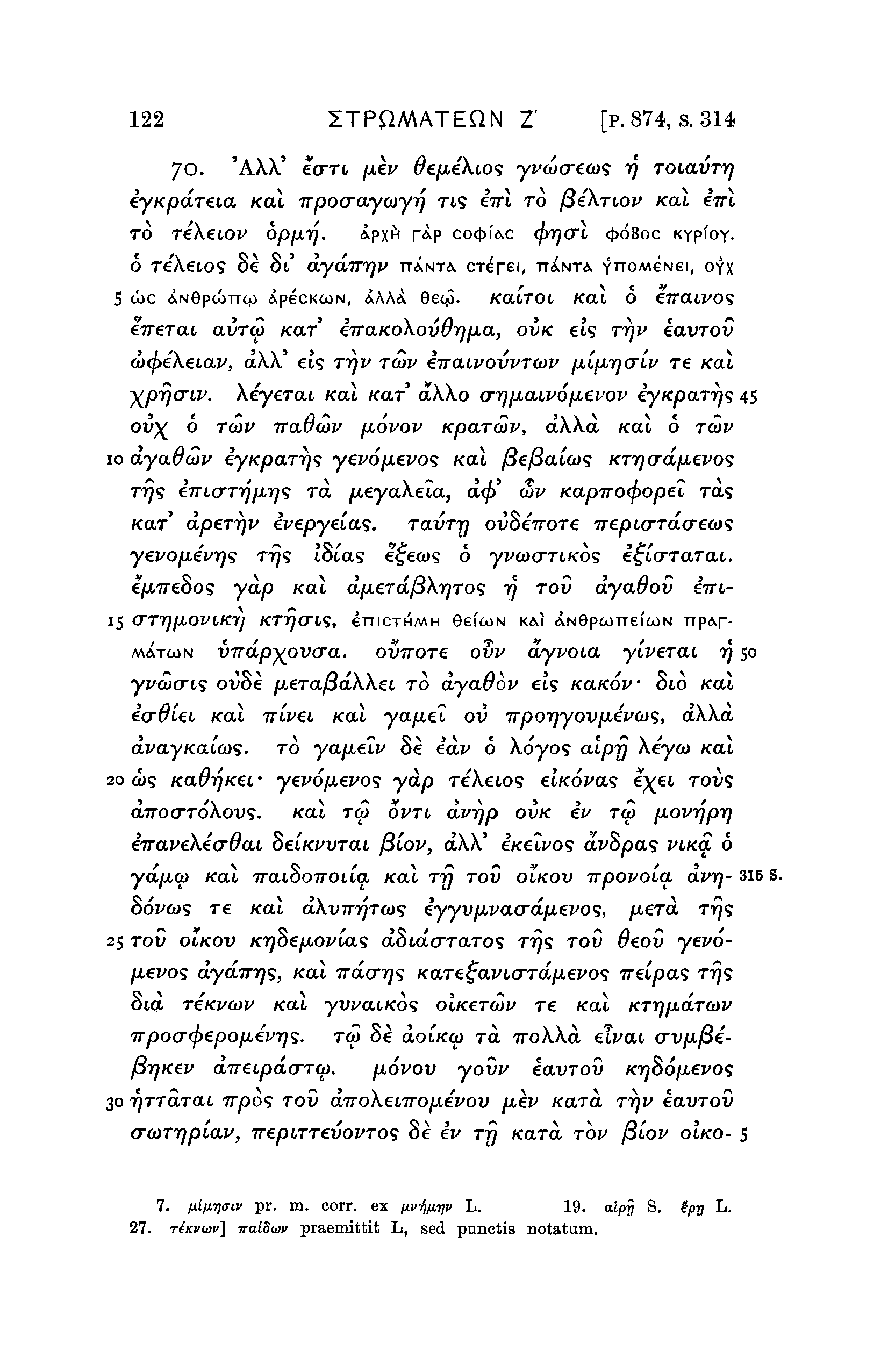
I T P ^ M A T E Q N Z'
[p. 874, s. 314
70.
'AXX' ecrri /xev 0ejue'Xios yi'wcrews 77 Toiavrr) kyK.pa.Tf.ia. KOX irpocraycayt] ris «ri TO /SEXTIOV /cai eVi
TO TeXeiov 6p[j.rj.
&pxh r^P co(J>i&c <j>7]crl 4>6Boc Kypioy.
6 TeXeios oe 01 a.ya,TTt]v TT&NT& crepei/ TT&NTA YTTOMCNGI, oyx S <i)C ANGpCOTK+l AP6CK60N, <N.AAdL 9e<£.
K0A.T01 KaX
eTTCLLVOS
€TT€TOLL ax/Tea KO.T' iTraKoXovdrjfjia, OVK eis TTJV eavTov wcj>e\eLav, dKX' eis TTJV TCOI> iiraivovvToyv fMiixyjcrCv T€ /cat
XeyeTai /cai KOTT aXko <jr\p.a.iv6ix.z.vov iyK.pa.Tr\<i 45 ° TWI/ Tto.du>v fiovov KpaTOiv, aXXa. /cai 6 T&iv 10 dyadtov iyKpaTr/s yev6[j.evo<; /cai /Je/3aia>s KTTjcrdfJLevos
Tr}<; eVicTTij/Ar/s TO. /xeyaXeia, d^>' wt1 KapTro<j>opel Tas /car' dpeTrjv ivepyeCas.
TOLVTIQ ovSeVoTe yevojueV^s TTJS iSias e^ew? 6 yvwcrn/cos e)u,7re8o? ydp /cai d/xeTa^XijTos 77 TOU dyaOov eVi15 <TT7]ixoviK7j KTTJCTLS, emCTHMH 6efa>N K&t ANSpconefcoN npArMATCON vndp-^ovcra.
OUTTOTC oSi' dy^oia ylverai 7) 50 yva!cri9 ovSe /AeTa^SdXXei TO dyadov eis /ca/cov Sio /cai ia6Ui teal Trivet /cai ya.fi.el ov 7rpor)yov(j.eva)<;, ctXXd dvay/caiws.
TO ya/Aeiv Se edv 6 Xoyo? ai/37j Xeyai /cai 20 &)s KadijKet. • yevofjbevos ya.p TeXeios ei/cova9 e^ei TOWS
/cai TW oi'Ti dviy/D ov/c ev TW [i.ovr\py\ hraveKecrdat heiKvvTai (3£ov, dXX' eKewos dvSpas
VLKO, 6 ydfjLO) /cat 7raiSo7roiia /cat TTJ TOU OLKOV irpovolq. dvr]- 315 S.
Sovws TC /cai dXv7T7;Tft)s iyyvfi,va(Tdyievo% fieTa. TTJS 25 TOI) OLKOV Kffhefj.ovia'i d8ido"TaTos TTJS TOU #eou yevofj.evo? dyd7T7is, /cai 7rdo"7i? KaTe^avicrTdfievo^ Trei/Das TTJS
Sid TeKvoiv /cai yuvai/cos OIKETCGV TC /cai KT^fxaTOiv irpoo~(f>epofji,evr)<s.
TW Se doi/cw TO, TTOXXO. etvai cruju,/8ef3r)Kev djreipd(TTU). fxovov yovv eavTov K7]S6[j.evos 30 rjTTaTai Trpos TOV aTroXeiTro/xeVou /ACV /caTa TTJV eauTou aa)T7)piav, vepuTTevovTOS 8e eV TT? /caTa, TOI^ ^10^ 01/co5
7. fd/ii)nv Prm - corr. ex iivqij.-qv L.
19. aipj S. Ipj; L.
27.
T^CPGJ!'] iralbwv praemittit L, sed punctis notatum. https://doi.org/10.1017/CBO9780511695513.010 Published online by Cambridge University Press
C. XII. § 70]
MISCELLANIES, BOOK VII.
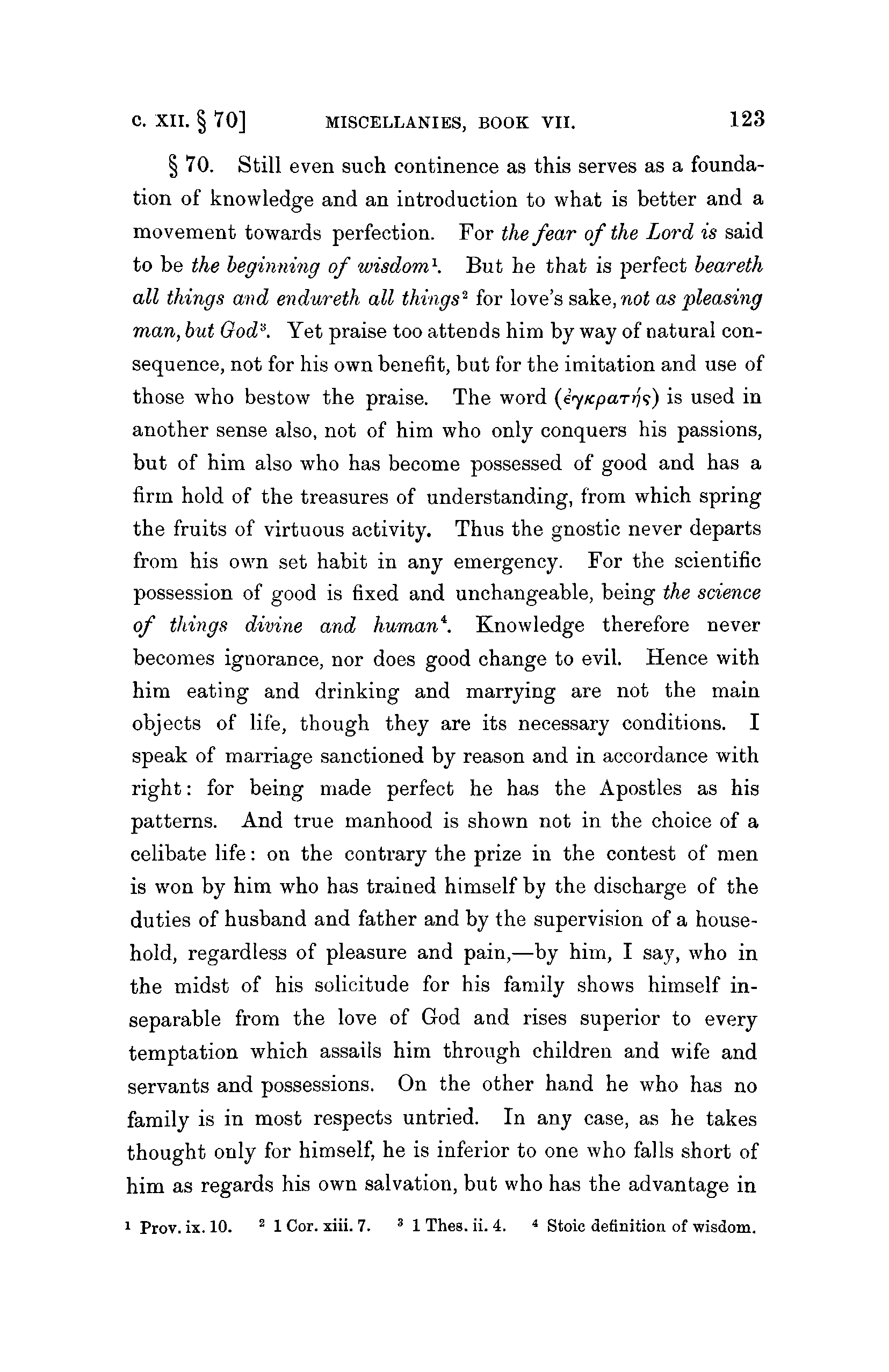
§ 70. Still even such continence as this serves as a foundation of knowledge and an introduction to what is better and a movement towards perfection. For the fear of the Lord is said to be the beginning of wisdom1. But he that is perfect beareth all things and endureth all things* for love's sake, not as pleasing man, but Gods. Yet praise too attends him by way of natural consequence, not for his own benefit, but for the imitation and use of those who bestow the praise. The word (eryKpary]<;) is used in another sense also, not of him who only conquers his passions, but of him also who has become possessed of good and has a firm hold of the treasures of understanding, from which spring the fruits of virtuous activity. Thus the gnostic never departs from his own set habit in any emergency. For the scientific possession of good is fixed and unchangeable, being the science of things divine and human4'. Knowledge therefore never becomes ignorance, nor does good change to evil. Hence with him eating and drinking and marrying are not the main objects of life, though they are its necessary conditions. I speak of marriage sanctioned by reason and in accordance with right: for being made perfect he has the Apostles as his patterns. And true manhood is shown not in the choice of a celibate life: on the contrary the prize in the contest of men is won by him who has trained himself by the discharge of the duties of husband and father and by the supervision of a household, regardless of pleasure and pain,—by him, I say, who in the midst of his solicitude for his family shows himself inseparable from the love of God and rises superior to every temptation which assails him through children and wife and servants and possessions. On the other hand he who has no family is in most respects untried. In any case, as he takes thought only for himself, he is inferior to one who falls short of him as regards his own salvation, but who has the advantage in 1 Prov. ix. 10.
2 1 Cor. xiii. 7.
3 1 Thes. ii. 4.
4 Stoic definition of wisdom. https://doi.org/10.1017/CBO9780511695513.010 Published online by Cambridge University Press
ITPQMATEQN Z'
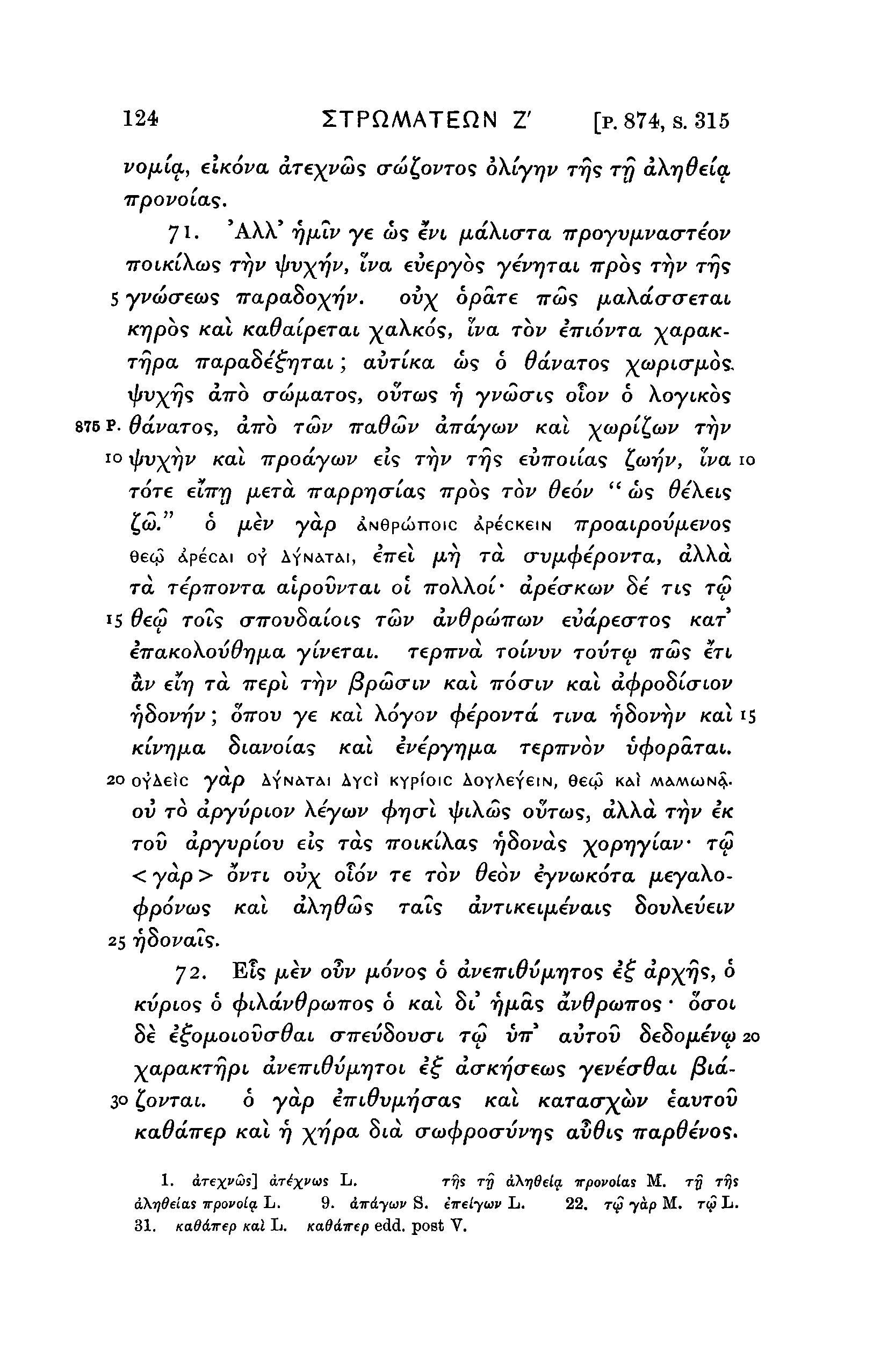
[p. 874, s. 315 vofiLa, eiKova. arenas CTCO^OVTOS okiyiqv Trj<s rfj ahrqOeia irpovoia*;.
"Jl.
AXX rj/juv ye &>s eVi /xdXicrTa Ttpoyv\Lva.cneov TTOLKikbis rrjv \pv)(i]i>, Iva evepybs yevrjTai irpbs TTJV TTJ?
S yva>cre<0<; irapaSox^v. ov^ opdre 7rols //.aXoVcreTai Kr/pbs Kal KaOatperai ^CIXKOS, tvot TOP eirtovTa rrjpa Trapahi^iqTai; auri/ca &>5 6 ddvaros \ffV)(fj<; a.7TO crco/xaTO?, OVTCJS rj yvcocri<; otov 6 Xoyi/cos
875 P. ddvaro1?, dvb TMV TraOwv dirdycov Kal •yjapiQiav TTJV io \lrv)(r)v Kal irpodyoiv eh TTJV rijs evirouas £<07]V, Iva io Tore elirrj /xera TTappy]<ria<; irpbs TOV Qeov " a)s ^e'Xeis
£,(0. '
6 fxev ydp &N6pcoTTOic ApecKeiN TTpoaipovfxevo'i eecp Apec&i oy AYNAT&I, eirei fxrj ra orvfA^epovTa, dXXa TO. TepirovTa alpovvrai ol TTOXXOI* dpecrKCJV Se TIS TW IS deaj TOLS CTTrouSaiot? rail' dvdpdiirtov evdpeo-Tos /car' eTraKokovdr}ix,a yiverai. repnva Toivvv TOVTM TTOJS en av etrj rd irepl r-qv fipoicriv /cat TTOCTIJ/ Kal d^pohicrtov
TJSOVTJV ; OTTOV ye Kal \6yov (ftepovrd iiva r^ovr\v Kal is Kivrjixa Siai'otas Kal evepyq^a repTrvov u^oparai.
20 oyAeic yap AYN^TAI Aye! Kypfoic AovAeyeiN, Gecp K&1 MA.MOON£. oO TO dpyvpiov keyejv <f>rjcrl i/^Xws OWTCUS, aXXa TTJV e/c
TOC dpyvpiov ei? T<XS Troi/aXas i^Soi/as ^oprjyiav TftI < yap > cwri ou^ olov re TOV ^eov iyvcoKora /xeyaXo- <f>p6va)<s Kal d\r]Oco<; Tats at'Tt/cetjueVais SouXeueiv 25 ^8ovar9.
72.
Ets jnev ouv fiovos 6 dveTTLdvfjbrjTO1; i£ a p ^ s , 6 KvpLOS 6 (f)l\dv$p(i)TTOS 6 Kal Si' 17/AaS dvdpO)TTO<i ' OCTOL
Se i^ofJbOLOVcrdai cnrevSovcri, ra VTT' aurov SeSofievco 20 XapaKTTJpi dveinOv^rjToi i£ ao-K7jo"ews yevecrdai )8ia30 tpvrai.
6 ydp eTTidvfj.rjcra<i Kal Karacr)(cl)v eavrov Kaddirep Kal rj XVPa ^ l * crai^poa-vvqs av6i<; trapdevos.
1. aTex"ws] eWx'"<>s L.
T^S TJ dXTjSeij irpovoias M. TJ T^S a\r)0eias irpovolq. L.
9. dird7U>'S. iirelyuv L.
22. T£ 7op M. 7-<jJ L.
31.
Kaff&wep Kal L.
KaO&rrep edd. post V. https://doi.org/10.1017/CBO9780511695513.010 Published online by Cambridge University Press
C. XII. §§ 70—72]
MISCELLANIES, BOOK VII.
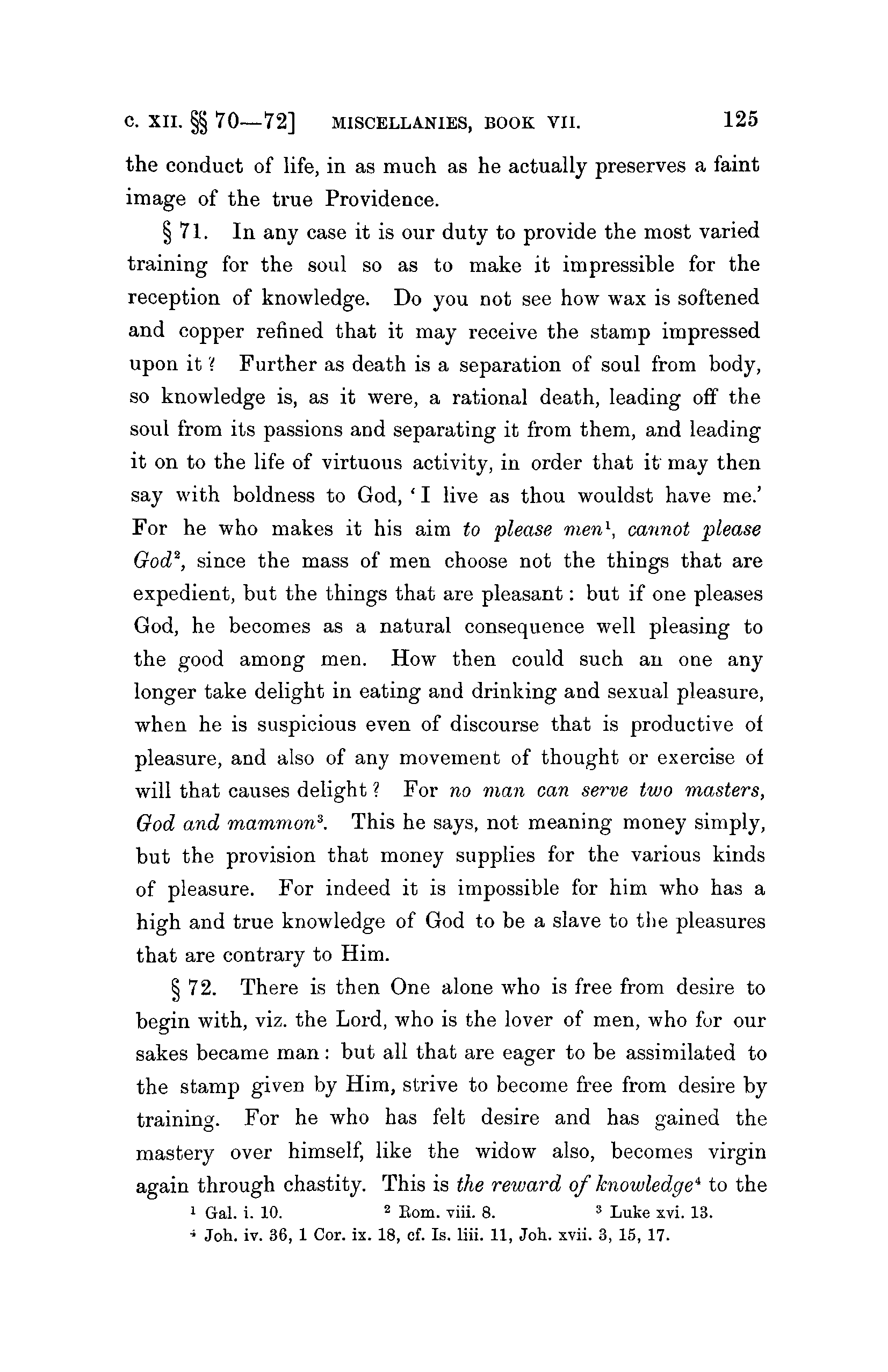
the conduct of life, in as much as he actually preserves a faint image of the true Providence.
§ 71. In any case it is our duty to provide the most varied training for the soul so as to make it impressible for the reception of knowledge. Do you not see how wax is softened and copper refined that it may receive the stamp impressed upon it'( Further as death is a separation of soul from body, so knowledge is, as it were, a rational death, leading off the soul from its passions and separating it from them, and leading it on to the life of virtuous activity, in order that it may then say with boldness to God, ' I live as thou wouldst have me.'
For he who makes it his aim to please men1, cannot please God%, since the mass of men choose not the things that are expedient, but the things that are pleasant: but if one pleases
God, he becomes as a natural consequence well pleasing to the good among men. How then could such an one any longer take delight in eating and drinking and sexual pleasure, when he is suspicious even of discourse that is productive of pleasure, and also of any movement of thought or exercise of will that causes delight ? For no man can serve two masters,
God and mammon3. This he says, not meaning money simply, but the provision that money supplies for the various kinds of pleasure. For indeed it is impossible for him who has a high and true knowledge of God to be a slave to the pleasures that are contrary to Him.
§ 72. There is then One alone who is free from desire to begin with, viz. the Lord, who is the lover of men, who for our sakes became man: but all that are eager to be assimilated to the stamp given by Him, strive to become free from desire by training.
For he who has felt desire and has gained the mastery over himself, like the widow also, becomes virgin again through chastity. This is the reward of knowledge1" to the 1 Gal. i. 10.
2 Bom. viii. 8.
3 Luke xvi. 13.
4 Joh. iv. 36, 1 Cor. ix. 18, of. Is. liii. 11, Joh. xvii. 3, 15, 17. https://doi.org/10.1017/CBO9780511695513.010 Published online by Cambridge University Press
STPQMATEQN Z'
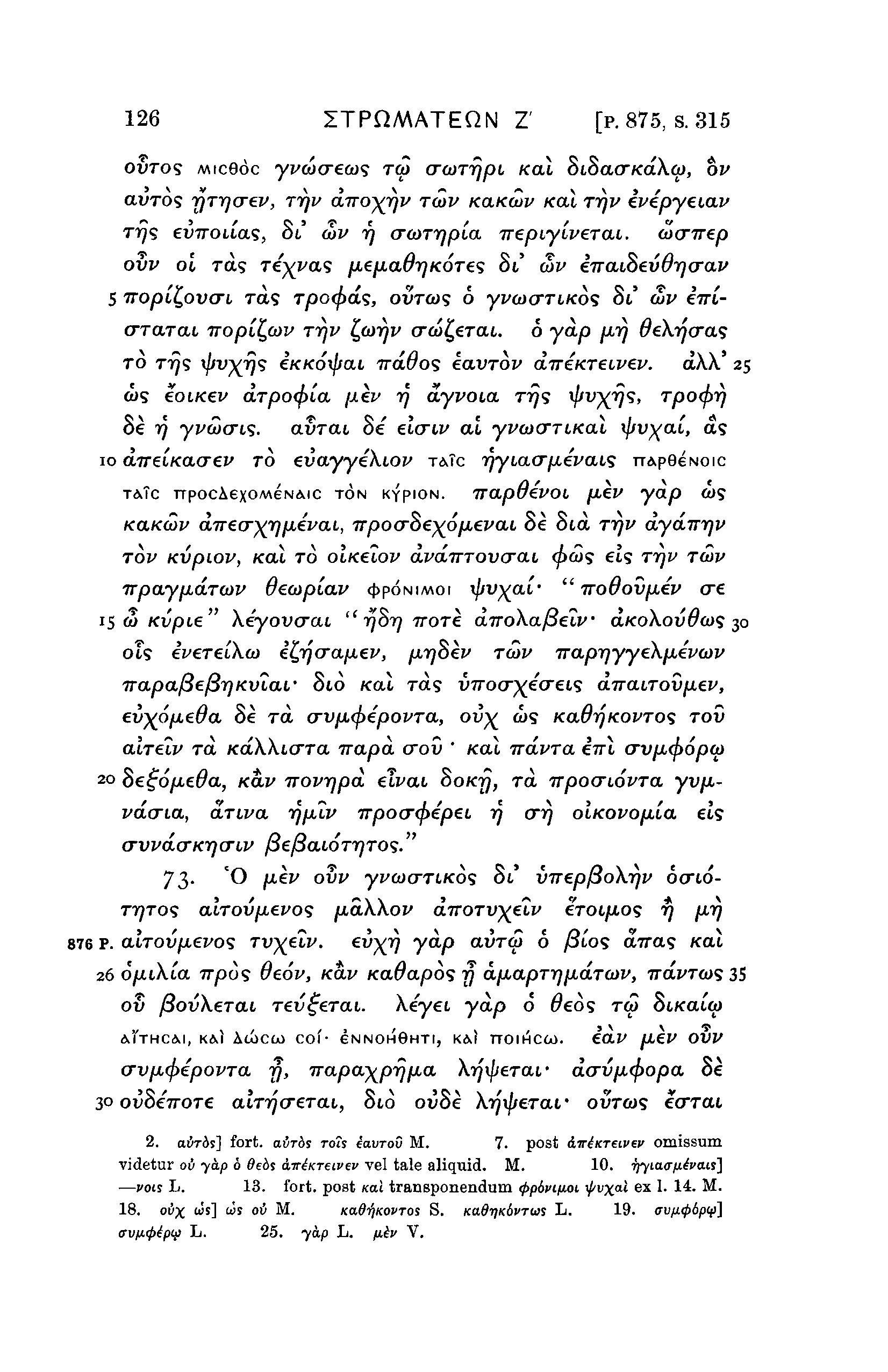
[p. 875, s. 315 ouros Micedc yv<ocrea><; T<W crcjTrjpi Kal SiSacr/caXoi, ov avros TjTVjcrev, Tf\v airo)(r)v TCOV KaKwv Kal TTJV ivepytiav rrjs evTTOuas, Si d>v rj crcoTfjpia irtpvyiverai. aianrep ovv oi rd? Te^vas fie/ia^/cores Si Sv iiraiSevdrjcrav 5 TTopi^ovcri rds ryoo^ias, ovrws o yvwcrri/cos St' cSr iiri- (TTaTai vopi^cov Trjv tflirjv crw^erat.
6 ydp fir} deXtjcras TO TT}<; t|>u^9 €KK6\JJIXI TrdOos eavTov dviKTeivev. aXX' 25 a)s eoiKev arpo^ia /xei' 17 ayvota
T»?S ^XV^'
TP°4'V Se TJ yvwcris. aurai 8e eicriv at yvwcTTiKai xpv^ai, as 10 dueiKacrev TO evcuyyikiov TATC T^ytacrfievais nApeeNoic TATC rrpocAexoMeNiMC TON KYPION. irapudvot fjb€V yap <u?
KaK<av direo')('r)fji€vai, TrpocrSe^o^evat Se Std riyv dydnrjv TOV Kvpiov, Kal TO OIKCIOV avdnTovcrai <^>a!? eis TTJV Tutv npay/idTaiv Qeoipiav <J>PONIMOI i/zu^ai1 " Trodov/xev ere
15 a> Kvpie" Xeyovcrai " yjSrj TTOTC aVoXa/Sea'• aKoXovdcos 30 cu? iv€T€.i\(i) e^Tjcra/xet', ixajSev T(ov Tr wapa{3e/3r)Kviai'
816 Kal TOS uvrocr^ecreis aT evxpfieda Se Ta crv^ipovTa, ov)^ ws KaOrjKovTos TOV aWetv Ta /caXXicrra vapd crov ' zeal irdvTa in\ <rvfi<j>6pa)
20 8e£6fjieda, Kav irovqpd elvai SOKT}, TO. wpocriovTa yuftvdo~ia, a/riva rffjuv Trpo<T<j>epei r) err} olKovofiia ets 73.
'O /ixei' 0S1/ yfwcTTt/cos St' VTrepftoXrjv ocrioTT)TO<; aiToUjiiei'os JJ.SW.OV aTroTv^iiv erot/Aos ^ jai^ 876 P. atTov/Ltevos Tu^eti'. e^X7) T*/3 awT<£ 6 y8tos avras Kai 26 ofiik'ia npo'S deov, Kav Kadapos 17 d^apT^yidTOiv, TrdvTcos 35 ou ySovXerai rev^erai.
Xeyet ydp o ^eos TW 4.1'THCM, K&l Atict*) CO?" 6NNOH6HTI, K&! TTOI^CCO. o~v\i<<\>£povTa rj, Trapar^prjfj.a \-q\\ieTai'
30 ovSeVoTe aiT^crerai, Sio ovSe X^i^erai • OUTWS ecrrat 2. atfrds] fort. O^T6S TOIS raurou M.
7. post iiriKreivtv omissum videtur ou 7A/) 6 0e6s iir^KTeivev vel tale aliquid.
10. ^7100-^^015] —vots L.
13. fort, post Kal transponendum <ppbvifwi xj/vxai ex I. 14. M.
18. oi% us] ws ai M.
Kad^Kovros S.
KO.6TIK6I>TUS L .
19.
(T\>i/.<j>ipif L .
25. 70/3 L.
/iii> V. https://doi.org/10.1017/CBO9780511695513.010 Published online by Cambridge University Press
C. XII. §§ 72, 73]
MISCELLANIES, BOOK VII.
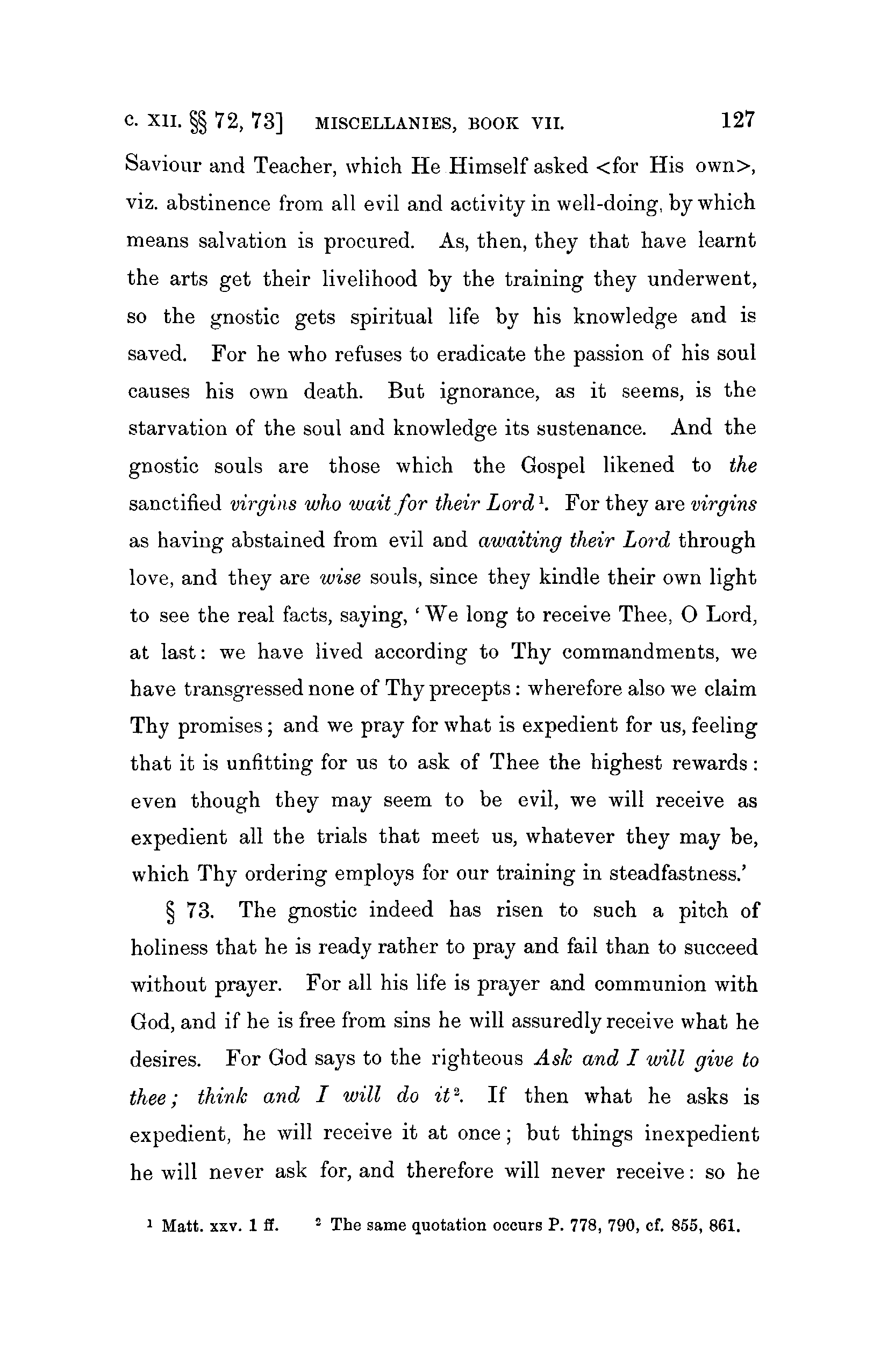
Saviour and Teacher, which He Himself asked <for His own>, viz. abstinence from all evil and activity in well-doing, by which means salvation is procured. As, then, they that have learnt the arts get their livelihood by the training they underwent, so the gnostic gets spiritual life by his knowledge and is saved. For he who refuses to eradicate the passion of his soul causes his own death. But ignorance, as it seems, is the starvation of the soul and knowledge its sustenance. And the gnostic souls are those which the Gospel likened to the sanctified virgins who wait for their Lord1. For they are virgins as having abstained from evil and awaiting their Lord through love, and they are wise souls, since they kindle their own light to see the real facts, saying, ' We long to receive Thee, O Lord, at last: we have lived according to Thy commandments, we have transgressed none of Thy precepts: wherefore also we claim
Thy promises; and we pray for what is expedient for us, feeling that it is unfitting for us to ask of Thee the highest rewards : even though they may seem to be evil, we will receive as expedient all the trials that meet us, whatever they may be, which Thy ordering employs for our training in steadfastness.'
§ 73. The gnostic indeed has risen to such a pitch of holiness that he is ready rather to pray and fail than to succeed without prayer. For all his life is prayer and communion with God, and if he is free from sins he will assuredly receive what he desires. For God says to the righteous Ask and I will give to thee; think and I will do it2. If then what he asks is expedient, he will receive it at once; but things inexpedient he will never ask for, and therefore will never receive: so he
1 Matt. xxv. 1 ff.
2 The same quotation occurs P. 778, 790, cf. 855, 861. https://doi.org/10.1017/CBO9780511695513.010 Published online by Cambridge University Press
ITPQMATEQN Z'
[P. 876, s. 315 o /SovXeTat.
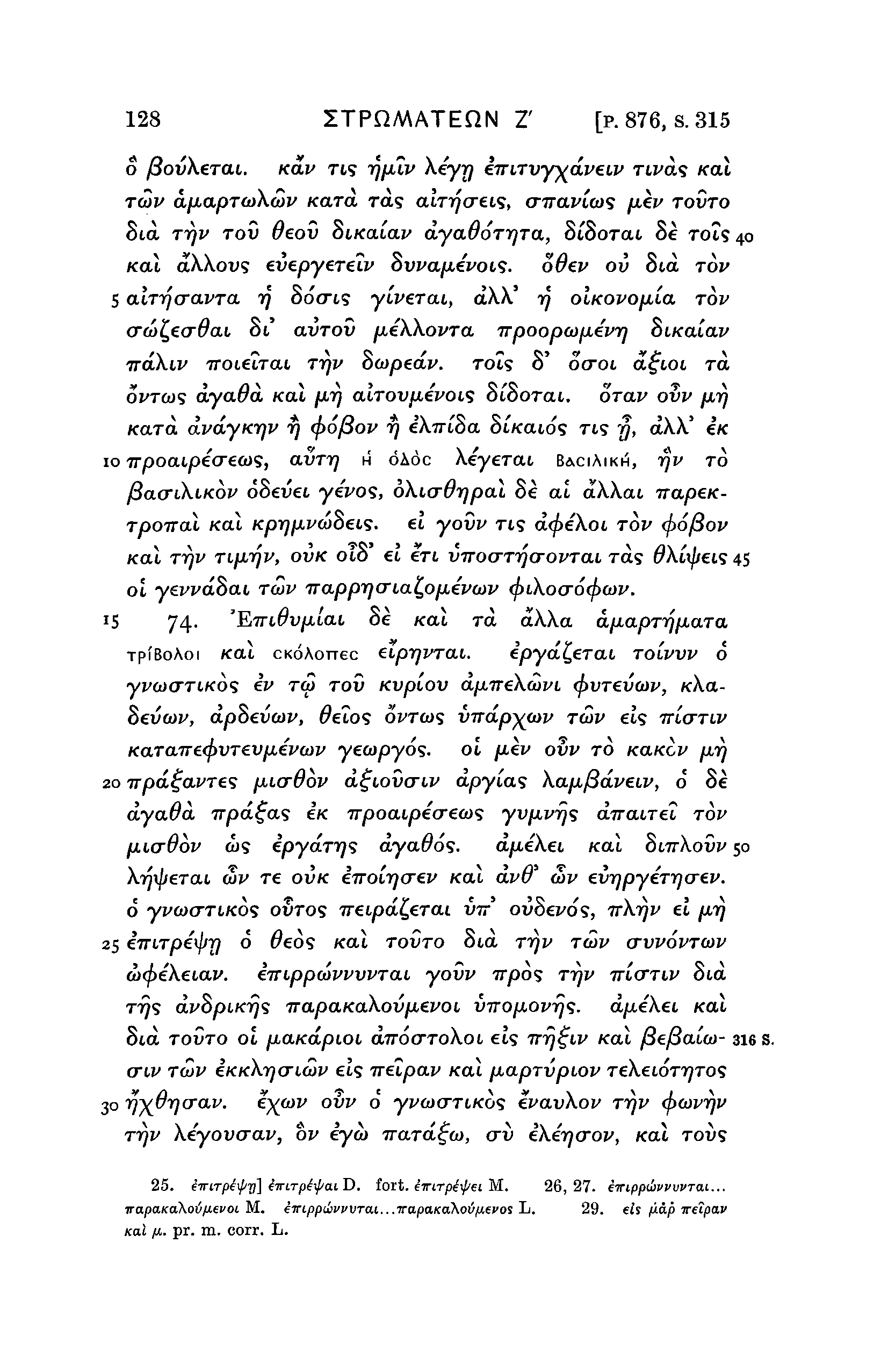
KCLI> TIS TJ/JUV Xeyy hriTvyydveiv Tivds /cat T«I> a[JbapTO)\(ov Kara ras air^creis, o-naviwi fxev TOVTO Bid TY)V TOV Oeov BiKaiav dyaOoTrjTa, BiBoTai Be rots 40 /cat aXXous evepyeTelv Bwajjuevois. odev ov Sta roi'
5 oXrr\cra.vTa. r\ Socrts ytVerat, aXX' 7; otKOvo^La TOV croy^adai St' avrov fiiWovra Trpoopa/jievT) hiKaiav TTOLXLV TTOtetrat Trjv 8a>pedv. rots S' ocrot a^tot r a OI'TCOS dyadd Kal (JLTJ alrovjxivoi^ StSorat. orat' ovv fj/rj Kara dvdyKTjv r) (fcofiov r/ iXnCSa St/catos Tt? 77, aXX' e«
10 Trpoatpecrews, aur^ H dAoc Xeyerat
BACIAIKI^, 17V TO
ySacrtXt/cot' oSeuet yeVos, dXicrdrjpal Be at aXXat napeKrpoiral KOX KprjixvcoSeLs. et youv rts a<£e'Xoi TO^ <j>6fiov
Kai rr/v n\ur)V, OVK oio ei ert VTrocmjcrovTai ras dXirpeis 45 ot yewaSat T&II' TrappTjcrca^ofLevcov (f)i\o(r6cf>(oi>. iS 74.
'ETriOvjALai Se /cat ret aXXa afia.pTrjfia.Ta TpfBoAoi /cat cKoAorrec eipTjvrai. ipydtprai Toivvv o yvwerrt/cos Iv T(p TOV Kvpiov a/ATTeXftii't <f)VTev(ov, /cXav, apSevwv, ^eto? OVTCOS vndp^cov
TWV et? TTLO-TLV Tevfjievcov yecapyos. ol ftev 03^ TO KaKcv pr) 20 77pdtjavTes /xtadov ctftovcrtv dpyias Xa/xfSdveLv, 6 Be dyadd irpd^as IK trpoaipecreoi^ yvfivfjs aTratret TOV a>s ipyaTTjs dyados. ajaeXet Kat Bcnkovv 50 cSv Te OVK iiroLr/aev Kal dv0' 3>v eirjpyeTrjcrev.
6 yvcocrrtKos ouros Treipdl,eTai VTT ovBevos, TTXTJV el fArj 25 e7TLTpeyjjrj 6 deos Kal TOVTO Sta TI}V TC5V crwoi'Tajj' d}(j)eXet.av. eitipptavvvvTai yovv irpo% TT)V irio~Tiv Bid TT^S dvBpiKrj<z TTapaKaXov/xevoL v-rroixovr]<;. dfxeXei /cat
Bid TOVTO ot jLta/captot aTrdcrToXot ets TTYJ^IV /cat /8e^8atw316 s. crtv Tail' eKKXr)o~ia)v ets irelpav Kal fiapTvpiov reXetoT^ros 30 yj^d-qaav. ey(O)v ovv 6 yv(ao~TiKo<i evavXov rqv <f><t)vr)v Trjv Xeyovaav, ov iyci) Trarafw, crv eXerjarov, Kal TOUS
25. iTn.rpi\pri] briTplij/ai. D. fort. eTTiTptyei M.
26,27. iirippiiivvvvTai...
TrapaKakotifievoL M. tTrLpp&vvvTa.i...irapa.Kahotiii.evQS L.
29. eis fi-dp ireipav Kal fi. pr. m. corr. L. https://doi.org/10.1017/CBO9780511695513.010 Published online by Cambridge University Press
C. XII. §§ 73, 74]
MISCELLANIES, BOOK VII.
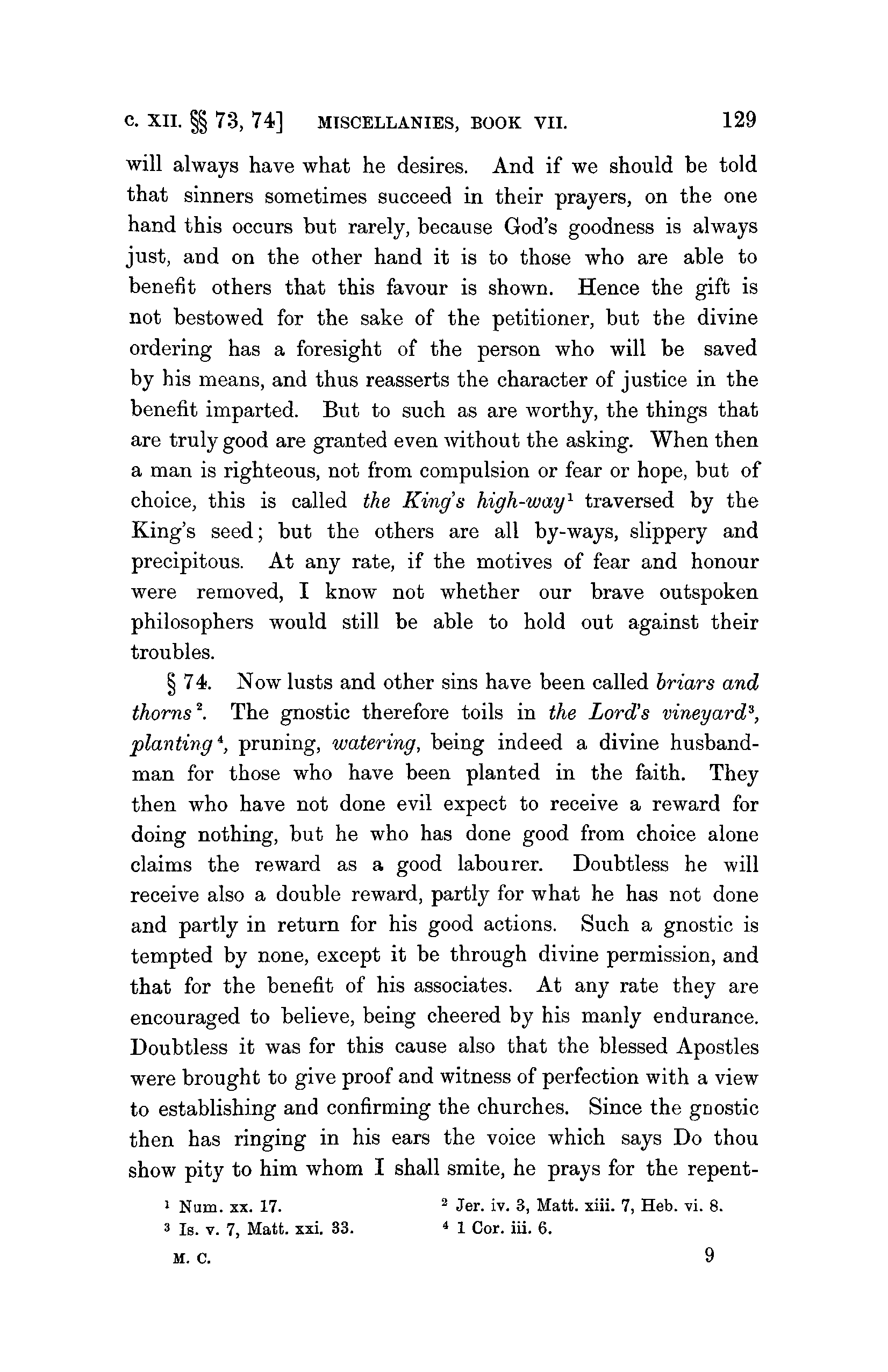
will always have what he desires. And if we should be told that sinners sometimes succeed in their prayers, on the one hand this occurs but rarely, because God's goodness is always just, and on the other hand it is to those who are able to benefit others that this favour is shown. Hence the gift is not bestowed for the sake of the petitioner, but the divine ordering has a foresight of the person who will be saved by his means, and thus reasserts the character of justice in the benefit imparted. But to such as are worthy, the things that are truly good are granted even without the asking. When then a man is righteous, not from compulsion or fear or hope, but of choice, this is called the King's high-way1 traversed by the King's seed; but the others are all by-ways, slippery and precipitous. At any rate, if the motives of fear and honour were removed, I know not whether our brave outspoken philosophers would still be able to hold out against their troubles.
§ 74. Now lusts and other sins have been called briars and thorns*. The gnostic therefore toils in the Lord's vineyard3, planting4, pruning, watering, being indeed a divine husbandman for those who have been planted in the faith. They then who have not done evil expect to receive a reward for doing nothing, but he who has done good from choice alone claims the reward as a good labourer.
Doubtless he will receive also a double reward, partly for what he has not done and partly in return for his good actions. Such a gnostic is tempted by none, except it be through divine permission, and that for the benefit of his associates. At any rate they are encouraged to believe, being cheered by his manly endurance.
Doubtless it was for this cause also that the blessed Apostles were brought to give proof and witness of perfection with a view to establishing and confirming the churches. Since the gnostic then has ringing in his ears the voice which says Do thou show pity to him whom I shall smite, he prays for the repent1 Num. xx. 17.
2 Jer. iv. 3, Matt. xiii. 7, Heb. vi. 8.
3 Is. v. 7, Matt. xxi. 33.
4 1 Cor. iii. 6.
M. C.
https://doi.org/10.1017/CBO9780511695513.010 Published online by Cambridge University Press
1TPQMATEQN Z
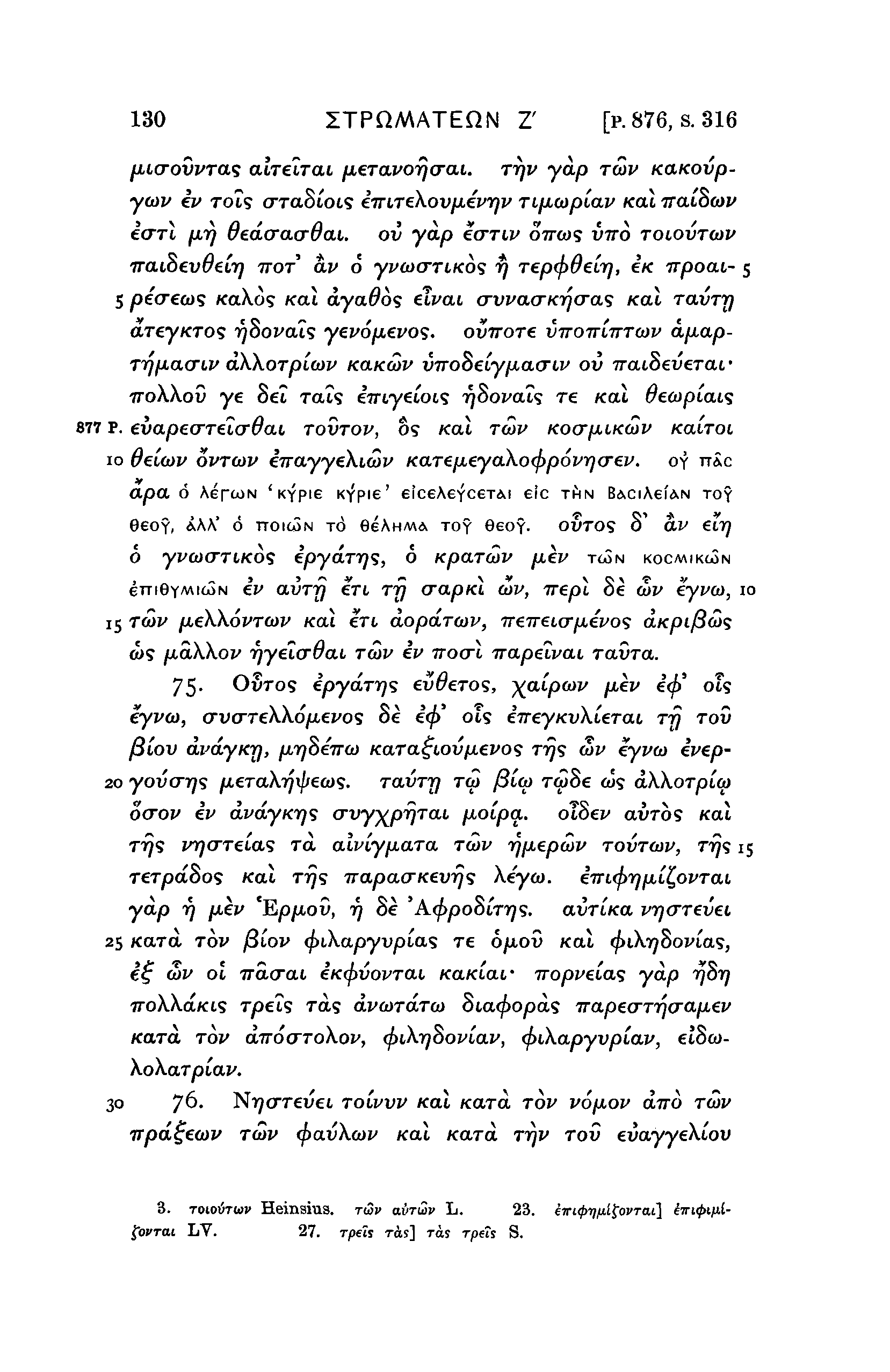
[P. 876, a 316 alrelrai. /xeTavorjcrat. rr)v yap TWV KaKovpywv iv TOIS crraStots iinTeXovfxevrjv TLfxcapiav /cat vaidcov icrrl fxrj 9edo~ao~6ai. ov ydp eo~riv OTTCOS viro TOLOVTCOV •jrai.he.v6e.iy) TTOT' av 6 yyaxTTtKos ^ Tep^deirf, e/c -rrpoai5
5 pecrews /ca\os /cai dya^os elvai crvvacncrjcra1; /cat ravTT) arey/cros ^Somis yevopevos. ovnore vwoniirTcov a^aprrffiacrLV aWoTpicav
KO.KU>V vnoSeCy/*acriv ov TratSewerat • TTOXKOV ye Set rats errtyetots rjSovais re /cal 6eoipiai<s
877 p. evapeo-Telo~0at TOVTOV, bs /cat rwi' Koar/XLKCJV /catrot 10 0eC(ov ovroiv inayyeXicov KaTefxeyaXo^povqcrev. oy TTAC 6 AertoN 'KYPIE Kypie' eiceAeyceT*,! eic TIHN Ba,ciAefAN TOY y, AAA' 6 TTOICON TO GEAHMA TOY eeoyOUTOS §' av elr\
yvojcrriKOS ipya.Tr)<;, 6 Kparwv [xev TUN KOCMIKCON eniGYMicoN iv aiiTrj ert T ^ o-apKL utv, irepl Se a>v eyvco, 10
15 TCOV fjueWovTOiv /cai ert dopdrcov, TreTrei(Tp,evo<; a/cpt/8<3s a>? fxaXkov r)yelo~6ai TWV iv TTOO~\ irapelvai raura.
75OVTOS ipydrrj<i evdeTos, ^aCpcov fxev i<f> ol? eyvco, crvo-TeXkofievos Be i(f>' ots eVey/cvXterai TT} TOV fiiov dvdyKrj, ///^SeVw KaTa&ovfievos rrjs aZv eyv(o ivep20 yovo-qs fieTa\r]\lieci)<;. ravry T& y8tw TwSe cos ocrov iv dvdyKvjs o-vyxprJTab po'ipa. oTSev avros T^S vrjo-Teias r a atviy/Aara TWI/ rjjxephiv TOVTOJV, TTJS 15
TerpaSos /cat TIJS irapao~Kevr}<; Xeyo). iTnt^rj^itfiVTai ydp r) jxev 'Epfjiov, r) Se 'A^yaoSiT^s. avrt/ca vrjarevei 25 Kara TOP /Stoi' (fuXapyvptas re 6/toi) /cat cj>i.Xrj8ovLa<;, i£ wv 01 Tracrat e/c^uovTat /ca/ctat* vopveias ydp 17S77 7roXX.a/cts r/aeis ras avcoraroj Siae^opcts Trapeo-nqo-a/jLev
/card rof a7rocr7oXoi', (f)iXr)SovCav, (fyiXapyvpCav, elScoXoXar piav.
76. N^crTeuei ro'ivvv /cat KaTa, T W vofxov d-rrb TCJV trpd^eav TCOV (fxxvXcov /cai /caret Tijt1 TOV euayyeXtou
TOIOIJTWI' Heinsius.
TWC ai/ruv L.
23. evuprnj.l^ovTai] iirupi/i.1-
£OVT(U LV.
27. T/)ets ras] Tas rpeis S. https://doi.org/10.1017/CBO9780511695513.010 Published online by Cambridge University Press
C. XII. §§ 74-76]
MISCELLANIES, BOOK VII.
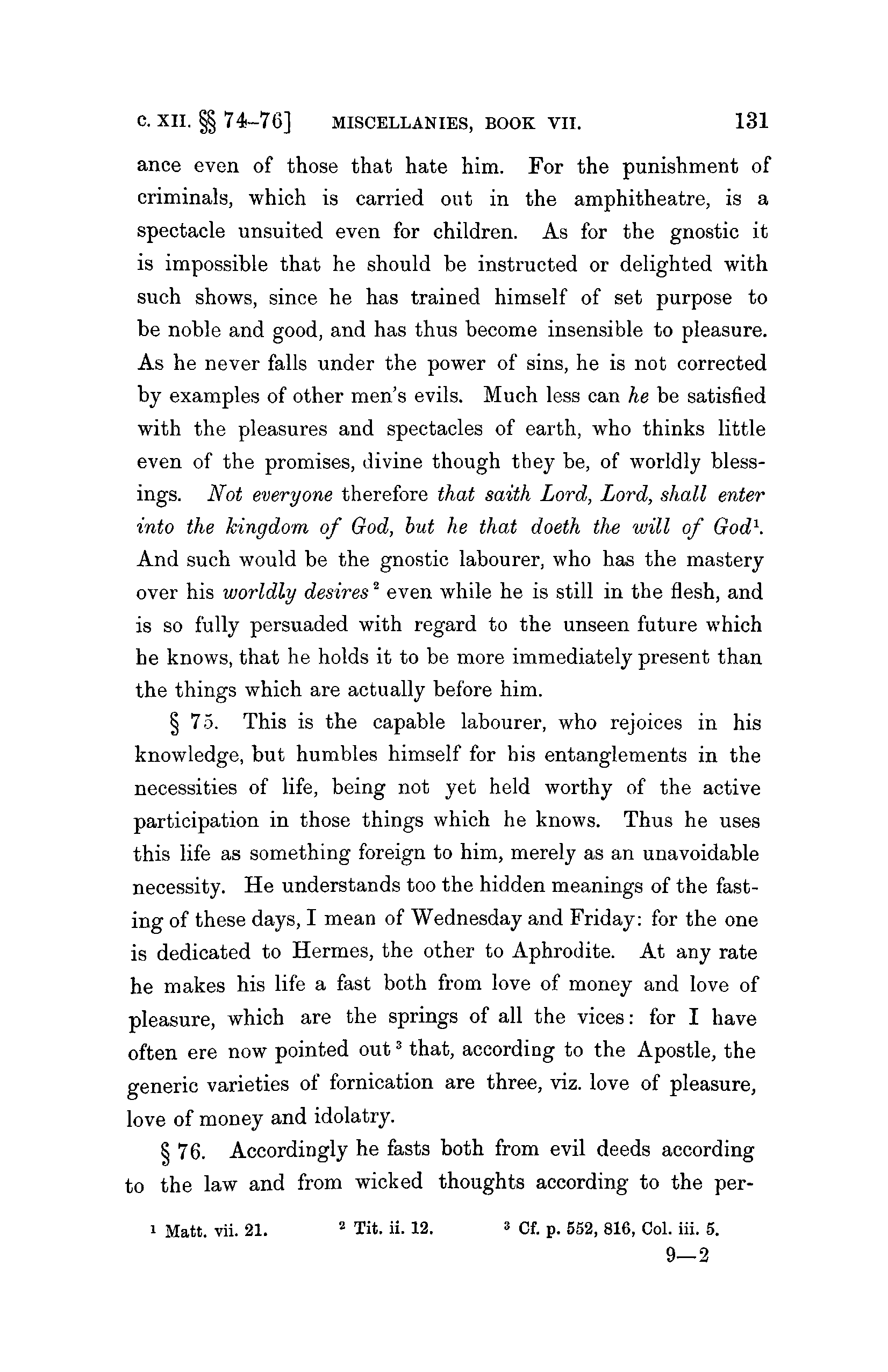
ance even of those that hate him. For the punishment of criminals, which is carried out in the amphitheatre, is a spectacle unsuited even for children. As for the gnostic it is impossible that he should be instructed or delighted with such shows, since he has trained himself of set purpose to be noble and good, and has thus become insensible to pleasure.
As he never falls under the power of sins, he is not corrected by examples of other men's evils. Much less can he be satisfied with the pleasures and spectacles of earth, who thinks little even of the promises, divine though they be, of worldly blessings.
Not everyone therefore that saith Lord, Lord, shall enter into the kingdom of God, but he that doeth the will of God1.
And such would be the gnostic labourer, who has the mastery over his worldly desires2 even while he is still in the flesh, and is so fully persuaded with regard to the unseen future which he knows, that he holds it to be more immediately present than the things which are actually before him.
§ 75. This is the capable labourer, who rejoices in his knowledge, but humbles himself for his entanglements in the necessities of life, being not yet held worthy of the active participation in those things which he knows. Thus he uses this life as something foreign to him, merely as an unavoidable necessity. He understands too the hidden meanings of the fasting of these days, I mean of Wednesday and Friday: for the one is dedicated to Hermes, the other to Aphrodite. At any rate he makes his life a fast both from love of money and love of pleasure, which are the springs of all the vices: for I have often ere now pointed outs that, according to the Apostle, the generic varieties of fornication are three, viz. love of pleasure, love of money and idolatry.
| 76. Accordingly he fasts both from evil deeds according to the law and from wicked thoughts according to the per1 Matt. vii. 21.
2 Tit. ii. 12.
3 Cf. p. 552, 816, Col. iii. 5.
9—2 https://doi.org/10.1017/CBO9780511695513.010 Published online by Cambridge University Press
ITPQMATEQN Z'
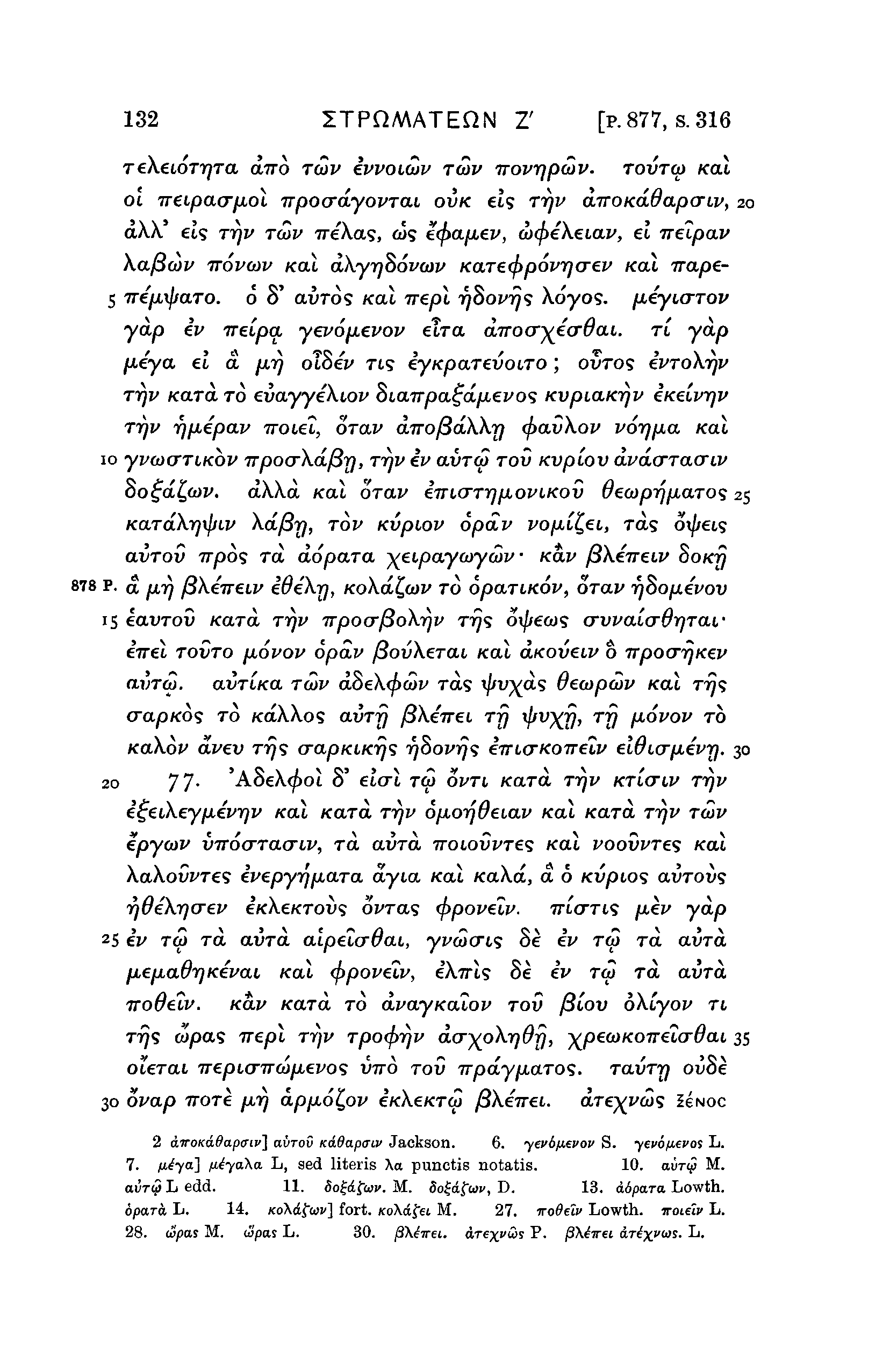
[p.877,s.316 dno TU>V ivvotu»v TUV vovrjpdov.
TOVTW /cat OL Treipao~[Lo\ irpocrdyovTai OVK ei; TTJV aTroKadapcnv, 20 aXX ets TTJV TCOV Tre'Xas, cos €<f>afiev, d)<f>£\eiav, el vetpav \a/3a>v TTOVOIV /cat dky7)86vwv KaTecfrpovr/crev /cat irape5 irep/raTo. o S' auros /cal Trepl rjSovrjs \oyos. piyujTov yap Iv TreCpa. yeuoyuevov etra djnoayiadai.
TL yap fxeya et a ju.^ oTSev rt? ey/cparevotTO; ouros ivTo\rji> rrjv Kara, TO evayyekiov SiaTTyDafaju.ei'os Kvpiaxrjv iKeivqv rrjv rj/jbepav Trotei, orav diro^dWr} <j>av\ov v6"qp.a KOI 10 yvoiO'TLKOV Trpoo-\d/3r), TTJV iv OVTW TOV KVpiov dvdcTTacriv ho^dtfitv. ak\d /cat OTav eTno-TrjfAOVLKov decoprj/jLaTOS 25
\df3r), TOV Kvpiov opdv vo^it,ei, rets ot|;ets Trp6% ret dopara ^eipaycoycov KCLV fi\4ireiv BOKTJ 878 p. a /XT) /SX.eVeti' iOikrj, KoXd^cov TO opaTLKOv, OTav r)8o[/.evov
15 eaurou /cara T ^ Trpo<r^o\rjv T17S oi|;eajs o~vvaio-dr)Tav eVet TOVTO JAOVOV opdv /SouXerat /cat aKoveti' o 7rpoo-rJKev avTb}. avTLKa TWV d8e\<f>aiv ras i/n^as dewpajv /cat r^? o~apKo<; TO /caXXos auri^ ySXeVet TIJ ^fVXQ> TV ^ v o v T0 KaXov dvev Trjs crap/ct/c^s •^Soi'ijs eTno-KOTreiv eldio-fxivrj. 30
77Ad€A.<poi o etcrt TW oi/rt Kara Trp KTLO-LV TTJV i^GiXey/xevrjv /cat /cara. TT)^ ofio-qdeuav /cat /caret riji' rail' ipycov viroo-Taaiv, ret aura, 7roiouvres »cat I'ooui'res /cat
XaXovi'Tes ivepyrjfjLora ayta /cat /caXa, a 6 Kvpios r/OeXrjo-ev e/cXe/crous <Was <f>poveiv. 7rtorrts /A 25 ei/ TO) ra. aura, alpeladai, yvcHai1; Se «/ rai Ta avra. fie/xadr^Kevai, /cat <f>poveLv, e'X7rts Se ev rw Ta aura,
TTodeiv.
KOLV /caret TO dvayKalov TOV /3LOV b\iyov TL Trj<s w/oas Trept TT/V Tpo<f>r)v do~)(o\r}drj,
^/Dew/coiretcr^at 35 oterai 7reptcn7Cj/Aevos V7ro TOU TrpdyfjiaTO<;.
TavTy ov8£ 30 ova/3 Trore /AI) dpfjuol^ov e/cXe/cTw /3XeVei. are^^ws IENOC 2 dTroKa^apcri^] auroC teddapcrw Jackson.
6. yevd/xevof S. yevofievos L.
^ y a ] iiiyaKa L, sed literis Xct punctis notatis.
10. ourp M.
OI5T^ L edd.
11.
Sofdfoiy. M. So^cifaii', D.
13. abpara Lowth. opara L.
14.
KoXdfwi'] fort. KoXdfet M.
27. iroBelv Lowth. iroie?^ L.
28. upas M. wpas L.
30. p\4irei. drex^ws P.
J3\tirei i.Tixv<asL. https://doi.org/10.1017/CBO9780511695513.010 Published online by Cambridge University Press
C. XII. §§ 76, 77]
MISCELLANIES, BOOK VII.
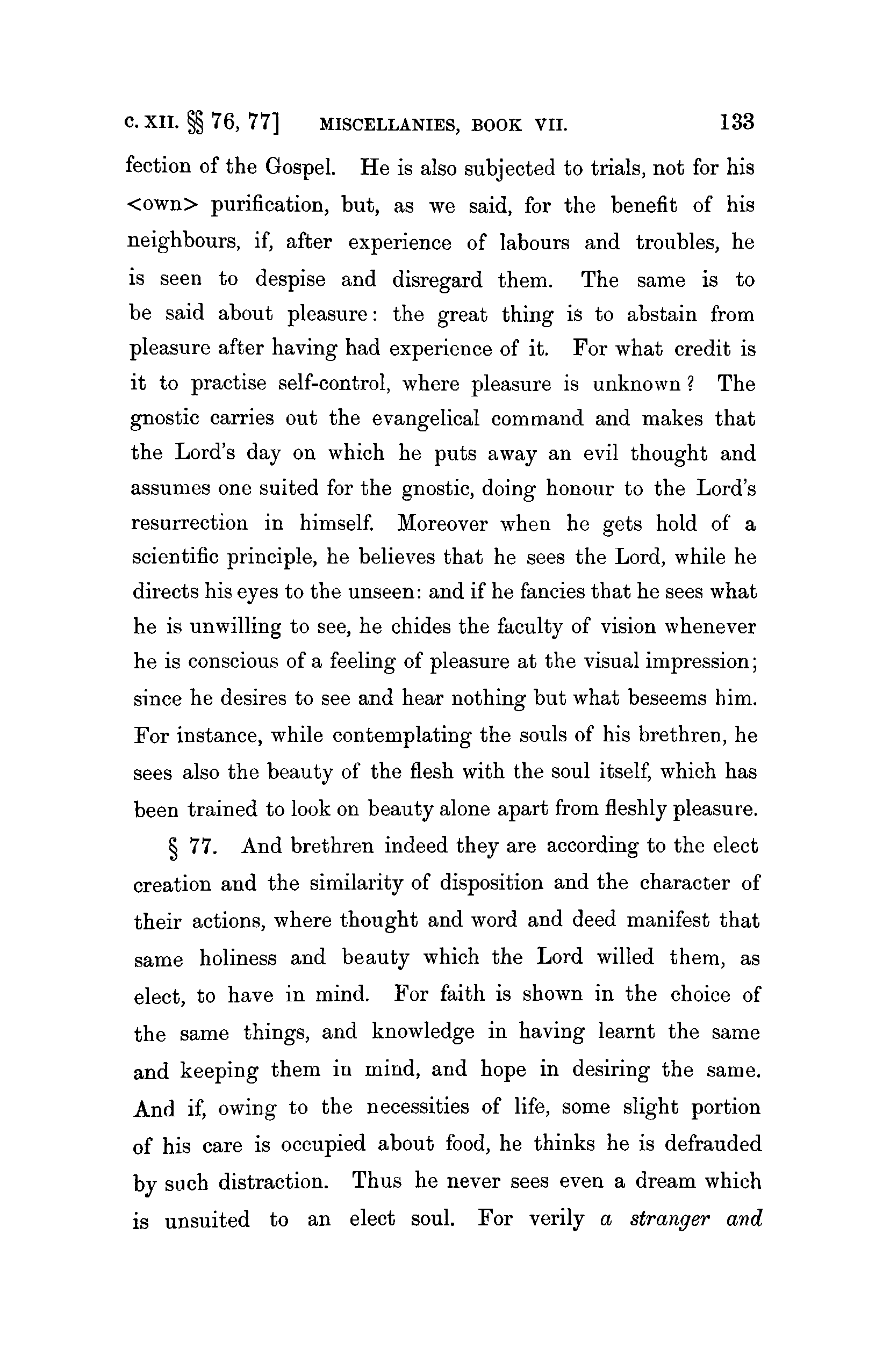
fection of the Gospel. He is also subjected to trials, not for his <own> purification, but, as we said, for the benefit of his neighbours, if, after experience of labours and troubles, he is seen to despise and disregard them.
The same is to be said about pleasure: the great thing is to abstain from pleasure after having had experience of it. For what credit is it to practise self-control, where pleasure is unknown ? The gnostic carries out the evangelical command and makes that the Lord's day on which he puts away an evil thought and assumes one suited for the gnostic, doing honour to the Lord's resurrection in himself. Moreover when he gets hold of a scientific principle, he believes that he sees the Lord, while he directs his eyes to the unseen: and if he fancies that he sees what he is unwilling to see, he chides the faculty of vision whenever he is conscious of a feeling of pleasure at the visual impression; since he desires to see and hear nothing but what beseems him.
For instance, while contemplating the souls of his brethren, he sees also the beauty of the flesh with the soul itself, which has been trained to look on beauty alone apart from fleshly pleasure.
| 77. And brethren indeed they are according to the elect creation and the similarity of disposition and the character of their actions, where thought and word and deed manifest that same holiness and beauty which the Lord willed them, as elect, to have in mind. For faith is shown in the choice of the same things, and knowledge in having learnt the same and keeping them in mind, and hope in desiring the same.
And if, owing to the necessities of life, some slight portion of his care is occupied about food, he thinks he is defrauded by such distraction. Thus he never sees even a dream which is unsuited to an elect soul. For verily a stranger and https://doi.org/10.1017/CBO9780511695513.010 Published online by Cambridge University Press
ZTPQMATEQN Z'
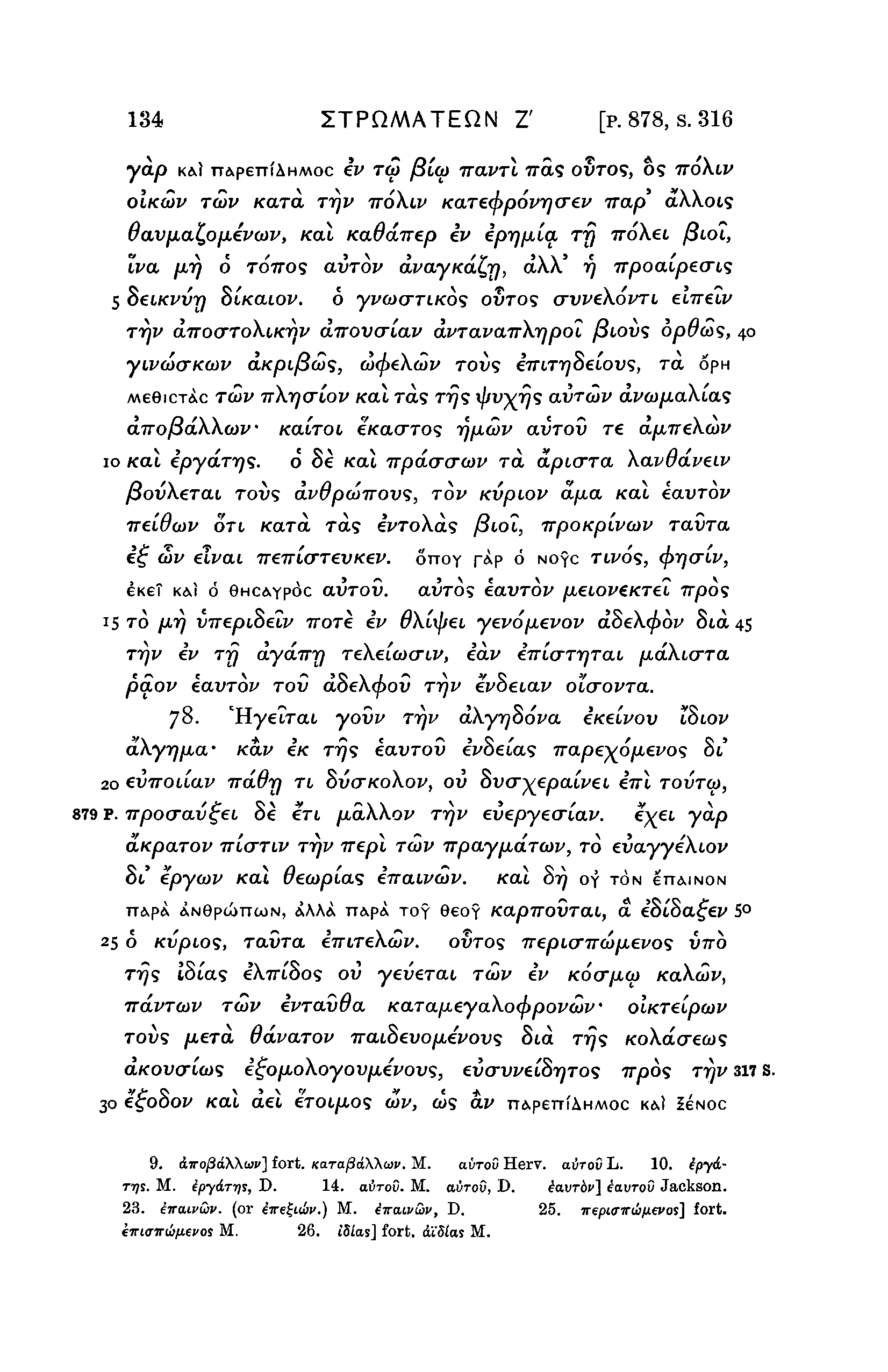
[p. 878, s. 316 yap KA.! TT&P6TT(AHMOC iv T(a fiico iravrl rras 0UT09, os TTOKLV
OLKWV rcov Kara TTJV TTOXLV Kare<f>p6vr]O~ev nap aXXots Oav^a^ofxevoiv, Kal Kaddirep iv ipr)/xia rrj TroXei p\oi,
Iva fiT) 6 TOTTOS avrov dvayKa^rj, dXX' r) Trpoaipe<TL<; 5 SeLKvvrj Sucaiov.
6 yvaxrTiKos ouros crvveXovri elnelv dirocrToXiKriv dirovalav dvTavaTrXrjpoi fiiovs opdais, 40 aKpi/3w^, (xx^tXaiv TOV<; eTTtr^Setous, rd 6pH
&c Tciiv irXrjcriov Kal ras Trjs ipv^rji; avTuv dvo}p.aXlas KaiToi e/cacrros r)n.h>v avrov re a/^neXcov
10 Kal epyctTTjs. d Be Kal irpdcrcroyv rd dpicna Xavddveiv fiovXerai TOVS dv6pa)Trov<;, TOP Kvpiov d/xa Kal eavrov on Kara r a s ivroXds ySiot, trpoKplvoiv raura d)v eivai veiricrTevKev. orroy r«>P 0 N0?c Ttvds, (j)T)aCv, 6 SHCAYPOC avTov. avro; eavTov fieioveKTei npos 15 TO yirj virepiheiv TTOTC iv dXCxftei yevojjievov d8eX<f>6v Sia 45 rrjv iv rrj dydirr) TeXeiottriv, idv eVicrr^rai juaXiaTa pdov eavTov rov d8eX<f>ov TYJV ev&euav oucrovTa.
78.
'HyelTai, yovv Tr)v dXyiqSova iKeivov Ihtov dXyrjjxa'
KOLV e/c Trjs eavrov ivSeCas irape^ofievo^ Si'
20 evwodav irdOrj n SVCTKOXOV, OV Svo-^epaCvei. inl TOVTO), 879 p. TTpoo~av^ei Se e n fjidXXov TTJV evepyeo~iav. e^ei ydp aKparov niaTiv TYJV irepl TCOV irpay/jLdTCJv, TO eva.yyeXi.ov
St' epyoiv Kal OeoipLas i-rraivaiv.
/cat S17 oy TON ITTAINON TT&P& ANSptincoN, <NAA(>> n^pA TOY 0ec>Y Kapirovrai, a iSiSa^ev 5° 25 6 Kvpcos, Taura eTTLTeXwv. OUTOS nepio'vcoixevos VTTO iSias eX.7TiSo§ ou yeverai. T&JI' eV
K6O~JJ.O)
KaXwv, TCOV ivravda KarafxeyaXo<f)povcZv' oiKTeipcav TOVS fierd ddvarov iraLSevo/xevov; Sid rrj's KoXacrews aKovcrio}<i i^o^oXoyovfievovs, evarvveiBrjro^ TT^OOS Tiyi' 317 S.
30 e£o8ov Kal del eroijuos wt«, ws ai* n^penfAH/woc K&) SENOC 9. dTrojSdWwc] fort. KaTa/3a\Xa»'. M. auTou Herv. aurou L.
10. ipydTT/S. M. ipydrris, D.
14. oiroO. M. aiirov, D. iavToi/] eavTov Jackson.
23.
^7rau<uJ>'. (or iirel-ubv.) M. iirawSiv, D.
25. irepio-mi/iei'os] fort.
.ei'OS M.
26. i'8ias] fort. cu<5/as M. https://doi.org/10.1017/CBO9780511695513.010 Published online by Cambridge University Press
C. XII. §§ 77, 78]
MISCELLANIES, BOOK VII.
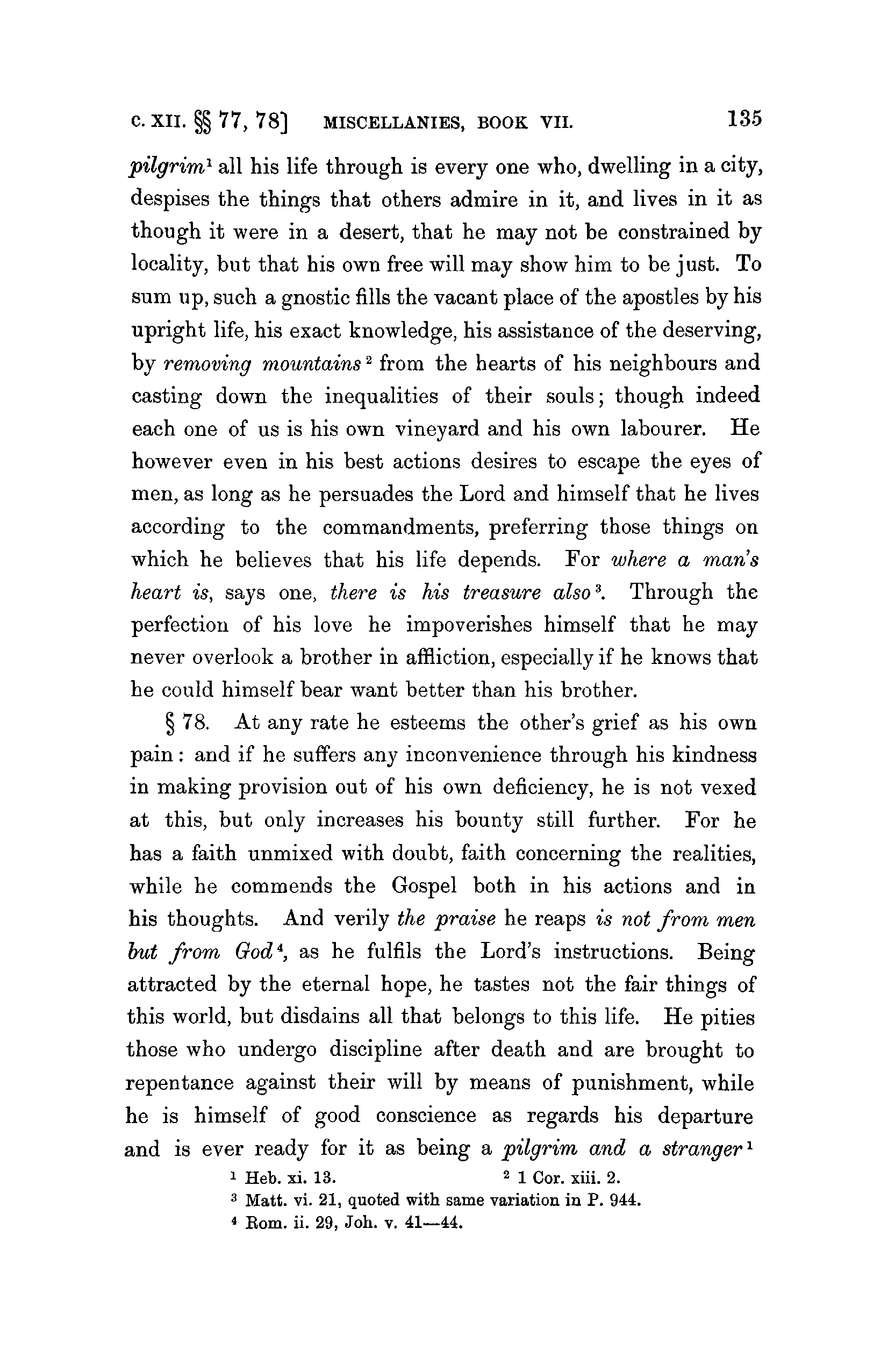
pilgrim1 all his life through is every one who, dwelling in a city, despises the things that others admire in it, and lives in it as though it were in a desert, that he may not be constrained by locality, but that his own free will may show him to be j ust. To sum up, such a gnostic fills the vacant place of the apostles by his upright life, his exact knowledge, his assistance of the deserving, by removing mountains2 from the hearts of his neighbours and casting down the inequalities of their souls; though indeed each one of us is his own vineyard and his own labourer. He however even in his best actions desires to escape the eyes of men, as long as he persuades the Lord and himself that he lives according to the commandments, preferring those things on which he believes that his life depends. For where a man's heart is, says one, there is his treasure also3. Through the perfection of his love he impoverishes himself that he may never overlook a brother in affliction, especially if he knows that he could himself bear want better than his brother.
§ 78. At any rate he esteems the other's grief as his own pain: and if he suffers any inconvenience through his kindness in making provision out of his own deficiency, he is not vexed at this, but only increases his bounty still further. For he has a faith unmixed with doubt, faith concerning the realities, while he commends the Gospel both in his actions and in his thoughts. And verily the praise he reaps is not from, men but from God4, as he fulfils the Lord's instructions. Being attracted by the eternal hope, he tastes not the fair things of this world, but disdains all that belongs to this life. He pities those who undergo discipline after death and are brought to repentance against their will by means of punishment, while he is himself of good conscience as regards his departure and is ever ready for it as being a pilgrim and a stranger1
1 Heb. xi. 13.
2 1 Cor. xiii. 2.
3 Matt. vi. 21, quoted with same variation in P. 944.
4 Eom. ii. 29, Joh. v. 41—44. https://doi.org/10.1017/CBO9780511695513.010 Published online by Cambridge University Press
ZTPQMATEQN Z'
[P.879,8. 317
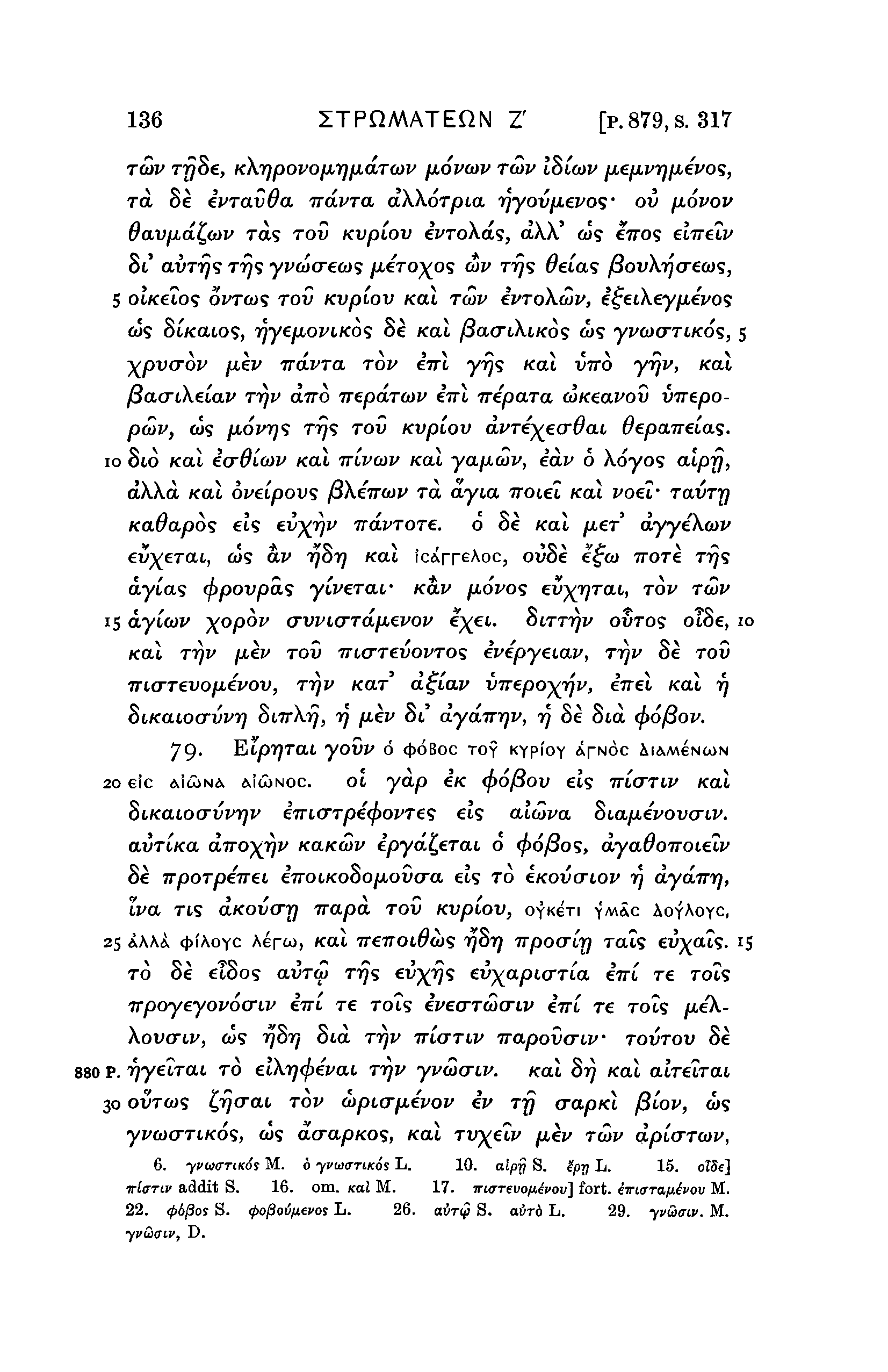
TWV TrjSe, Kkrjpovofj/qfx.a.Tiov fj,6v(ov ray ISicov [xef^vr/fievoi;, TO. Se ivTavda irdvTa dXXoTpia rjyovp.evo<s • ov {JLOVOV
Oav/xd^wv ras TOV xvpiov ivToXds, dXX' &5§ tiros elirelv Si' avTrjs T^S yvdjcrews /Aero^os &w TTJS #eias /S
5 oi/ceio? 6VT<W5 TOV Kvpiov Kal TWV iuroXcov, e^ tus Si/caios, T^yejjiovLKOs Se Kai ^acriXtKos &»s yvwcrTt/fos, 5
•)^pvo~6v jxev TravTa TOV inl yrjs Kal vno yrjv, Kal {3ao-ike(.ai> TTJU O.TTO Trepdrcov inl Trepara aiKeavov vnepopwv, ws ii.6vr)<i Trjs TOV Kvpiov dvTe^eaOai
OepaiTeias.
10 8to Kal io~6Co}i> Kal Trivatv Kal ya/^aiv, idv 6 Xoyos alprj, aXXa Kal oveipovs ^Xewojv Ta ayia iroiel Kal voelTavry ets ev^rjv TrdvroTe.
6 Se Kal /ACT' dyyiXoiv i, ws av rjSr] Kal ic&rre^oc, ouSe efw TTOTE TIJS ayias <f>povpas yiverai'
KOLV fx.6vo<; ev^TjTai, TOV TCOV 15 dyCcov x°Pov a-vvLa-Tafitvov e^et.
SLTTTJV OVTOS oTSe, 10
Kal Trjv pep TOV TTLO~T€VOVTO<; ivipyeiav,
TYJV Se TOV
TTicrrevojLteVov, rfjv Krar' d^iav inrepo^qv, iirel /cat ij St«:ato<TVi''>j SLTTXT], rj fx.kv St' dyaTTrjv, rj Se Std <f>6/3ov.
79.
FitprjTaL yovv 6 <))6BOC TOY Kypioy ATNOC ii^MeNtoN 20 eic AitoN^ AICONOC.
y a p e/c <f>6/3ov eis
TTLO~TIV KOX
SiKaLocrvvrjv iTno~Tpd<f>ovT€<; ets euwva Sia/teVoucrtv. avTLKa diroxqv KaKwv e/sya^erai d ^)d/Sos, dyaOovoitlv Se 7TpoTp€TT€i eTTOLKohofjiova'a eis TO €KOVO~LOV rj dydirr),
Iva Tts aKovcrr) irapd TOV KvpCov, OYKCTI YM&C AOYAOYC, 25 &A\«> <))IAOYC Aerco, /cai TT€TTOi0ci)S T]8r] npocrCr) rais eu^ats. 15
TO Se elSos ai5rw TIJS e v ^ s ev^a/atcrTta eVt TC TOIS Trpoyeyovocriv kiri TE Tots ivecrTciicrtv eVi TC TOIS ju.e'XXoucriv, ws 17817 Sid T17V irioTiv irapovo-cv
TOVTOV Se
880 P. rjyelTat. TO eiXr)<j}dvai T17V yvao-iv.
Kal 8r) Kal aiTeiTai 30 OVTWS ^ o - a i TOV oypto-fjiivov iv rfj crapKl filov, a»s yvwo-Ti/cds, ws dcrapKos, Kal TV^(€LV JJ,€V TCOV dpicrTGJV,
6. yvotiTTiKos M. 6 TJXIIOTUCO! L.
10. oipj; S.
Ipj; L.
15. o?5e] irlffTLv addlt S.
16. om. Kal M.
17. 7ria'Teuo/A^oi;] fort. £iri<rTa/x£vov M.
22.
<pbfios S.
0o/3oi)|«ecos L.
26. oOrij; S. ai^Td L.
29. yvaaai. M. yv&Giv, D. https://doi.org/10.1017/CBO9780511695513.010 Published online by Cambridge University Press
C. XII. §§ 78, 79]
MISCELLANIES, BOOK VII.
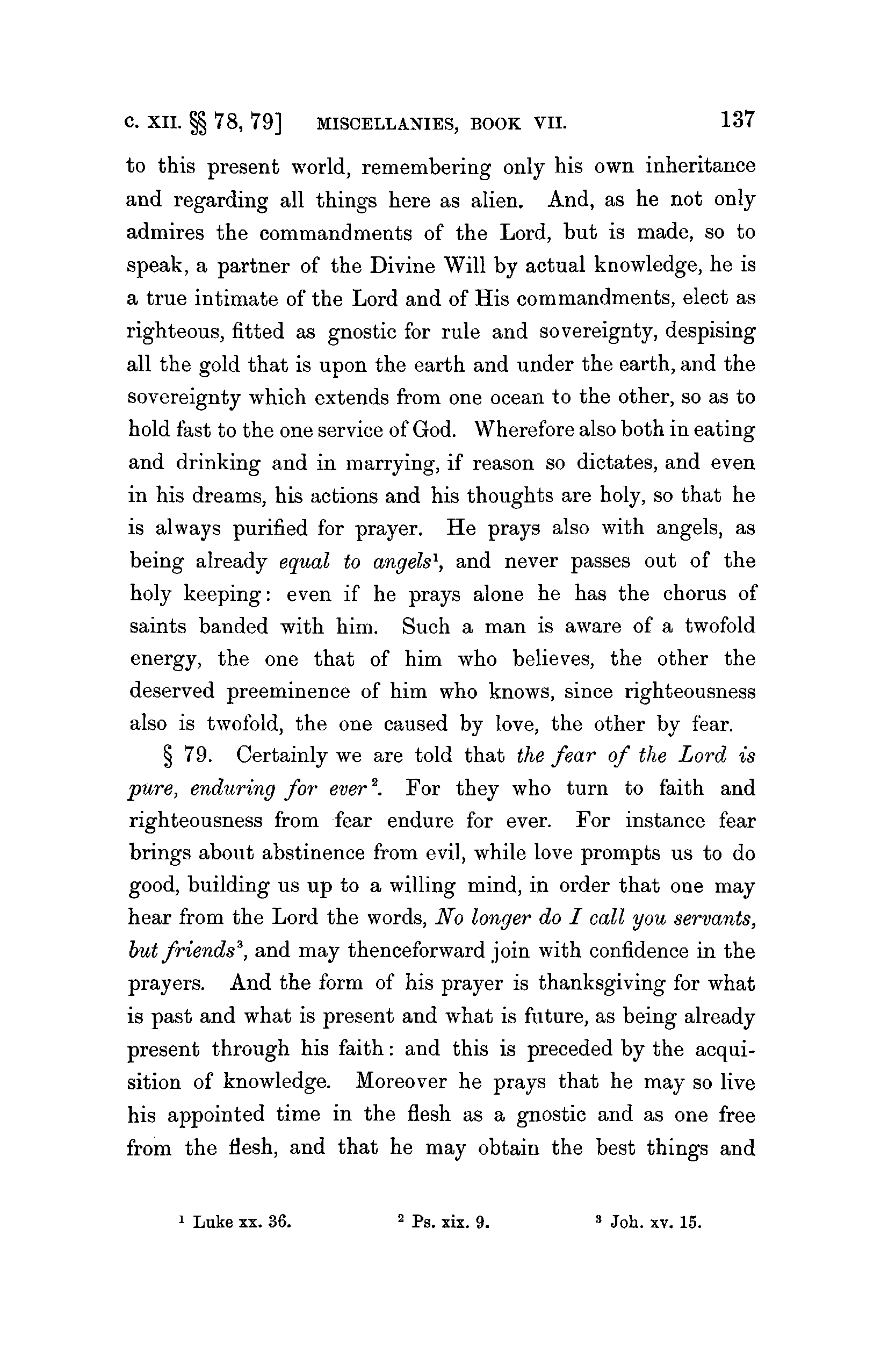
to this present world, remembering only his own inheritance and regarding all things here as alien. And, as he not only admires the commandments of the Lord, but is made, so to speak, a partner of the Divine Will by actual knowledge, he is a true intimate of the Lord and of His commandments, elect as righteous, fitted as gnostic for rule and sovereignty, despising all the gold that is upon the earth and under the earth, and the sovereignty which extends from one ocean to the other, so as to hold fast to the one service of God. Wherefore also both in eating and drinking and in marrying, if reason so dictates, and even in his dreams, his actions and his thoughts are holy, so that he is always purified for prayer. He prays also with angels, as being already equal to angels1, and never passes out of the holy keeping: even if he prays alone he has the chorus of saints banded with him. Such a man is aware of a twofold energy, the one that of him who believes, the other the deserved preeminence of him who knows, since righteousness also is twofold, the one caused by love, the other by fear.
§ 79. Certainly we are told that the fear of the Lord is pure, enduring for ever2. For they who turn to faith and righteousness from fear endure for ever. For instance fear brings about abstinence from evil, while love prompts us to do good, building us up to a willing mind, in order that one may hear from the Lord the words, No longer do I call you servants, but friends3, and may thenceforward join with confidence in the prayers. And the form of his prayer is thanksgiving for what is past and what is present and what is future, as being already present through his faith: and this is preceded by the acquisition of knowledge. Moreover he prays that he may so live his appointed time in the flesh as a gnostic and as one free from the flesh, and that he may obtain the best things and 1 Luke xx. 36.
2 Ps. xix. 9.
3 Joh. xv. 15. https://doi.org/10.1017/CBO9780511695513.010 Published online by Cambridge University Press
STPQMATEQN Z'
[p. 880, s. 317
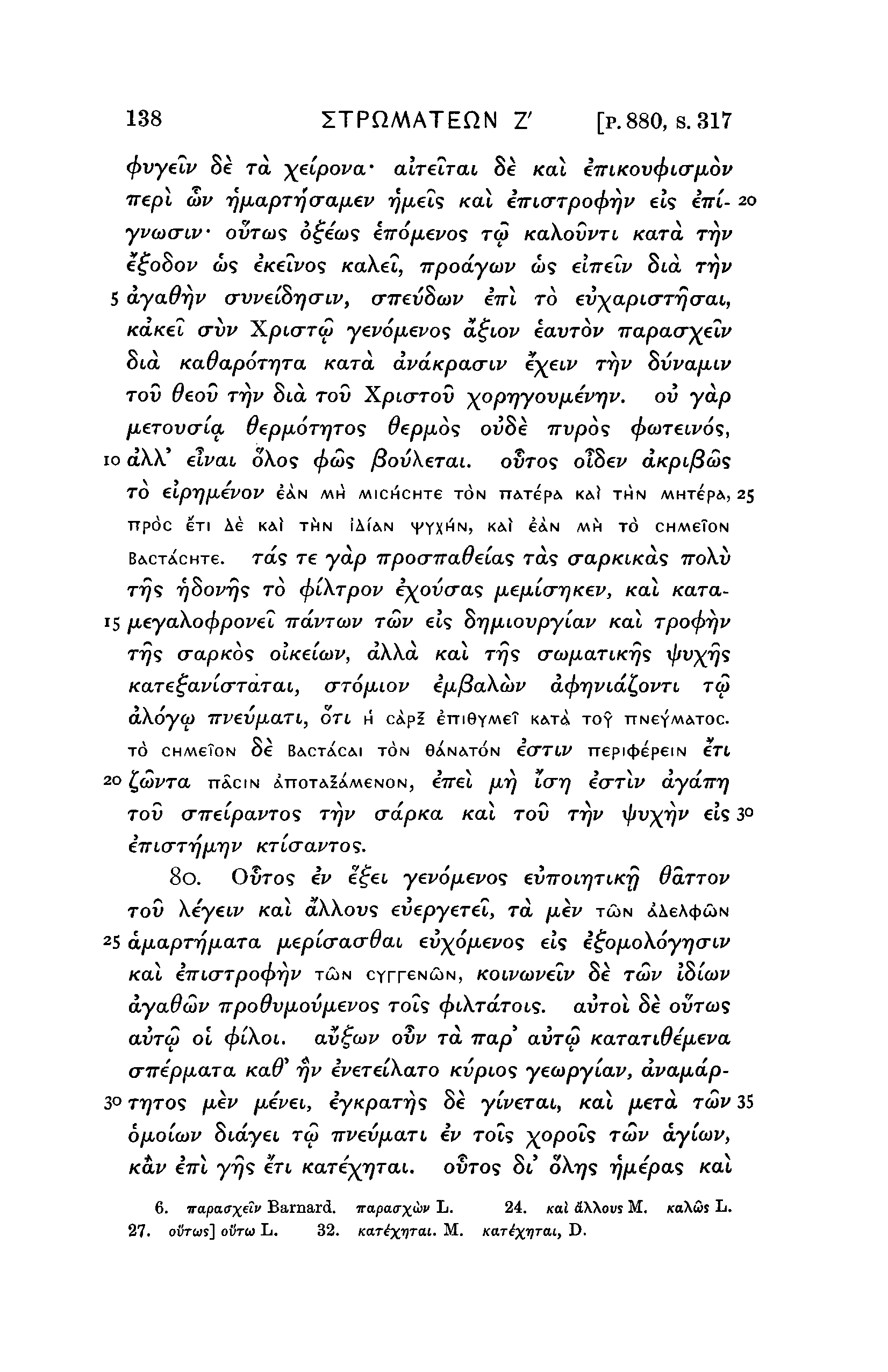
<f>vyelv Se TO, -^eCpovaatTetrat Se /cat e7rt/coi;<£io-/jto> vepi wv rffjiapTyjarafjiev i^eis /cat itri<TTpo$r\v eis eVt20 yvoio-LV ourws o^e'cos evofxevo'S TO /caXouVTt Kara r^v ££oSov a>s e'/cetvos /caXet, irpodyatv a>s eiirelv Sid r>)i> 5 dyadfjv (rweChrjaiv, crirevScov iirl TO eu^a/atcrTTjcrai, /ca/cet crui' XjOtcrrw yevSfievos d^iov kavTOv vapaa)(elv Sud KaOapoTrjTa /cara, dvaKpaaiv
£X£LV TVV
$vvafi,iv TOV deov TTJV 8tct rov Xpta-rou ^o^Tyyou/iev^z/. ou yct/j jLteroucria 0epfj.6Tr)TO<s depixos ovSe TTU/JOS 10 aXX' etr'at 0X05 ^>w? ^ouXerat.
OUTOS oTSev a/ TO i.ipt]llivOV 6(\N MH MICHCHTC TON nAT6p& K&t THN MHTepA, 25 ETI A6 KAt T^IN iAf&N fYX^N;
KAf €* N ^H TO CHMeTON
e. r a s re yap Trpoo~Tradeta<; Tas crayo/ct/ca§ TTOXU 1780^77$ ro <f>CS.Tpov e^ovcra? p.e\x.lo"r)Ke.v, /cat /cara15 ix€ya\o(f)pov€L irdvTOiv TU>V ets ByjfiLovpytav /cat Tpo<jyr/v TT}<; crap/cos ot/cetwv, dXXd /cat TTJS crw/xart/c^s
/carefavtirraTat, O-TOJJUOV ifjif3a\(ov d(j>r)vi aAoyw TrveujxaTi, OTL H CAP? eniSyMei KATA TOY TO CHMGTON oe BACTACAI TON GANATON €O~TLV Trepi(t)epeiN ert
20 £<itWTa TTACIN ATTOTAIAM6NON,
CTTCI /AI) tcrr^ io~Ttv dydnr) TOV CTTret/aavTos Ti)y crdp/ca /cat TOV T17V xfivx'QV e^s 3°
80.
OVTOS ev efei yevofJLevos eviroLrjTLKrj OOLTTOV TOV Xeyew /cat dXXous eweyDyeTet, TO, ju,e
25 dfJiapr-q/JLaTa fxepCa-aardaL ei5^o/A«/os ets e /cat iTTLO-Tpo<f>r)v TCON cyrreNcoN, Koivu>veiv Se dyaOaJv irpodvyLOVji.ei>o<; TOIS (^iXTaYots. aurot Se avrw ot cftCXoi. av^oiv ovv TO. 7ra^>' awT cnripfJ-OLTa Ka.9* rjv eVeTetXaro Kvpios yeapyiav, dvafxdp3° T^TOS /u.ei' fi£vei, iyKpaTrjs Se ylveran., /cat /neTa. rail' 35
6fxoLO)v Stdyet r&5 nvevfjiaTi iv TOIS ^opots w dyicov, eVt y^? en KaTexV70-1OVTO<; SI' 0X175 i)jLie/oas /cat
6. irapaax&v Barnard.
7rapa(r^u)v L.
24. /cai (iXXoi/s M, 27.
OVTWS] OBTU L.
32. Kar^xijrat. M. KarixV™} D. https://doi.org/10.1017/CBO9780511695513.010 Published online by Cambridge University Press
C. XII. §§ 79, 80]
MISCELLANIES, BOOK VII.
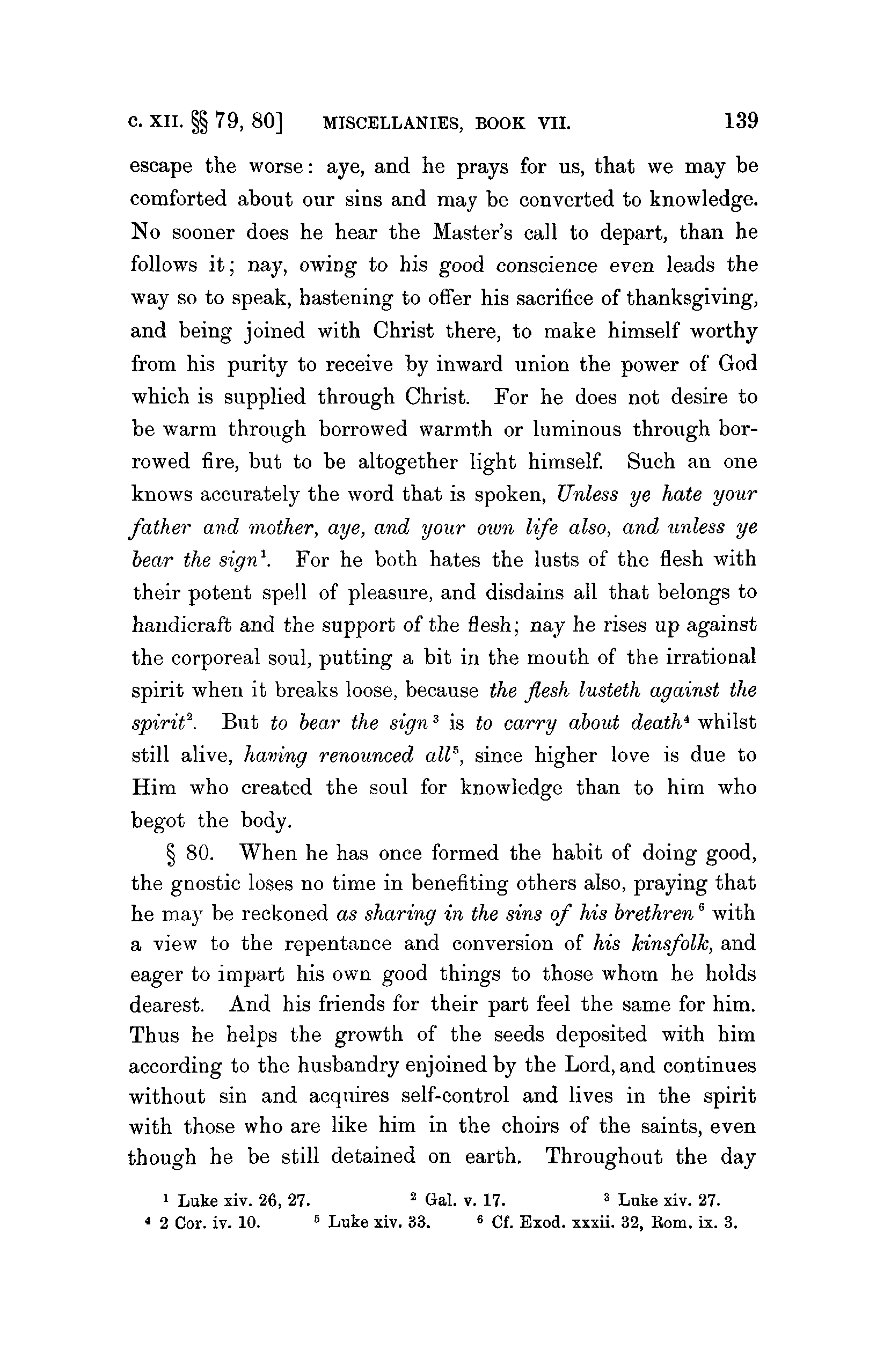
escape the worse: aye, and he prays for us, that we may be comforted about our sins and may be converted to knowledge.
No sooner does he hear the Master's call to depart, than he follows it; nay, owing to his good conscience even leads the way so to speak, hastening to offer his sacrifice of thanksgiving, and being joined with Christ there, to make himself worthy from his purity to receive by inward union the power of God which is supplied through Christ. For he does not desire to be warm through borrowed warmth or luminous through borrowed fire, but to be altogether light himself. Such an one knows accurately the word that is spoken, Unless ye hate your father and mother, aye, and your own life also, and unless ye hear the sign1. For he both hates the lusts of the flesh with their potent spell of pleasure, and disdains all that belongs to handicraft and the support of the flesh; nay he rises up against the corporeal soul, putting a bit in the mouth of the irrational spirit when it breaks loose, because the flesh lusteth against the spirit2. But to bear the sign3 is to carry about death4 whilst still alive, having renounced all5, since higher love is due to Him who created the soul for knowledge than to him who begot the body.
§ 80. When he has once formed the habit of doing good, the gnostic loses no time in benefiting others also, praying that he may be reckoned as sharing in the sins of his brethren6 with a view to the repentance and conversion of his kinsfolk, and eager to impart his own good things to those whom he holds dearest. And his friends for their part feel the same for him.
Thus he helps the growth of the seeds deposited with him according to the husbandry enjoined by the Lord, and continues without sin and acquires self-control and lives in the spirit with those who are like him in the choirs of the saints, even though he be still detained on earth. Throughout the day
1 Luke xiv. 26, 27.
2 Gal. v. 17.
3 Luke xiv. 27.
4 2 Cor. iv. 10.
6 Luke xiv. 33.
6 Cf. Exod. xxxii. 32, Bom. ix. 3. https://doi.org/10.1017/CBO9780511695513.010 Published online by Cambridge University Press
ITPQMATEQN Z'
[p. 880, s.317
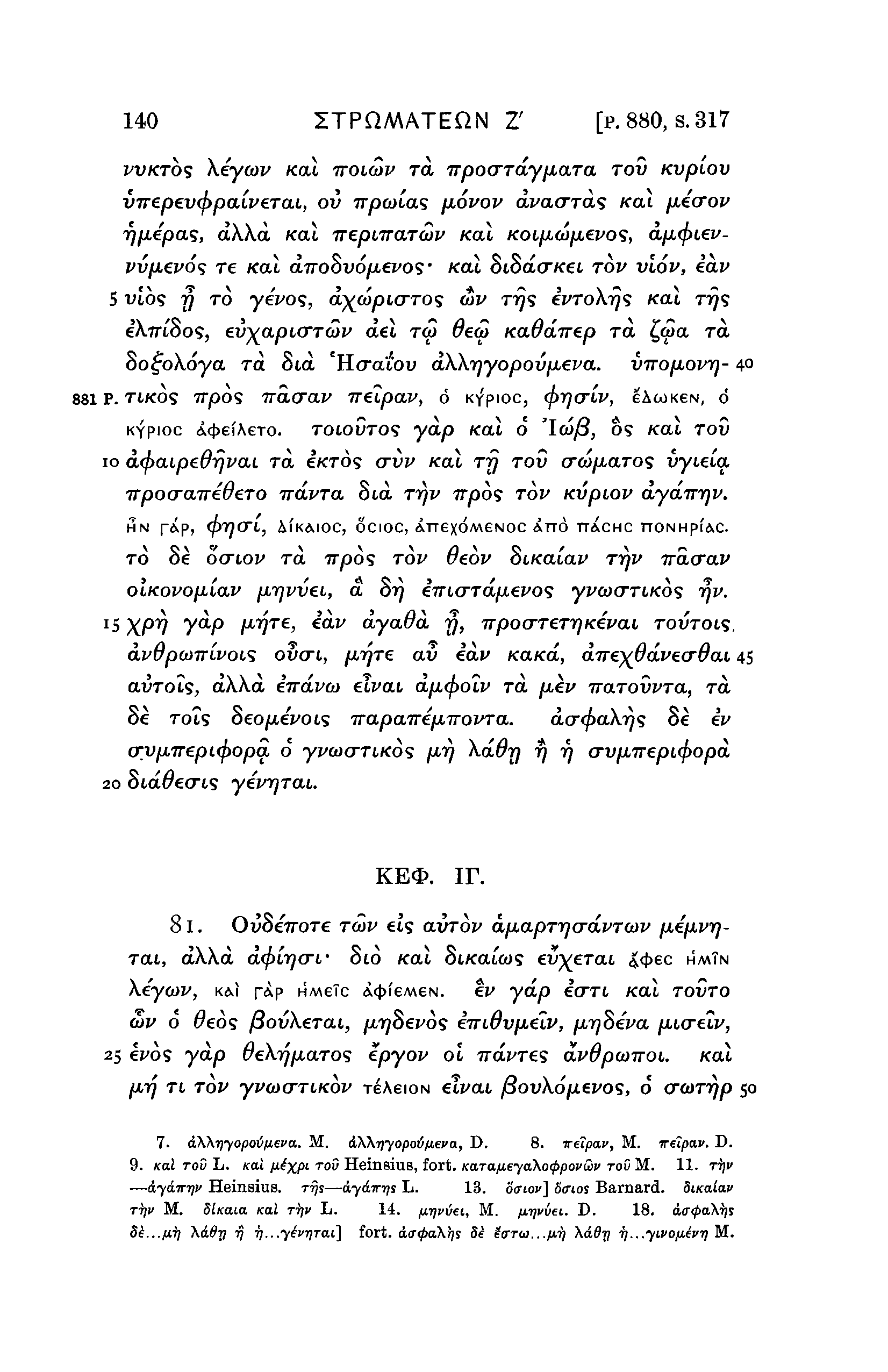
VVKTOS Xeycov KOX ITOL<OI> TO. Trpoo-TdyyiaTa TOV KvpCov i)7repev(f>paLveTa.L, ov Trpatias \iovov aVacrj-ds /cat fjidcov rjfjiepa^, dXKd Kal irepnraTtov /cat /cot/AWjuevos, djA(f>ievvvfj,€vo<; Te Kal diro<iv6jj.evo<S' Kal 8tSdcr/cei TOV vlov, iav
5 vt6s rj TO yeVos, d^copLO'TOs OJV Trj<i evroXi^S Kal rijs eX.7Ti8os, ev^apiCTTSv del TO dew Kaddirep r a ^a!a TO,
SofoXoya TO. Sid 'Hcraiou dWrjyopovfieva. inro/xovrj40 881 P. TIKOS 7rpos 77acrai' nelpav, 6 Kypioc, <J>7]O~'LV, eAwKeN, d Kypioc <i<|>efAeTo.
TOIOCTO? y a p Kai d 'Iw/3, 6s /cai TOU 10 dfyaipedrjvai ra, CKTOS crui' /cat r^ TOU ccofiaTos vyieia TrpoaaireOeTO ndvTa Sia. TI}^ 7rpo? TOI' Kvpiov
HN r*>Pj <^ 1? O r ij AfK&IOC, OCIOC, ATTGXOMeNOC A n d TTACHC TO 8e oaiov ra irpos roi' ftw SiKaiav Trjv -ndarav o\Kovo[iiav fjL7]vvei, a §•>} eTrtcrTa/xevos yvwcrrtKos ^v.
15 x/017 yap /^T£, eav dyadd rj, Trpoo-TeTrjKevai TOVTOIS, dvdpoiTTtvoLs overt, ju,7^re au eac /ca/ca, dire^ddveadai
aurots, aXXct eirdvia etvai dfji(f>oZv ra /i^ei' iraTOVVTa, TO, Se rots Seo/xevoLs irapaTrefAirovra. acr^aXiys Se eV o-Vfj.Trepi(f)opa 6 yvctiCTTiKos /AI) Xa^rj ^ 17
KE*. ir.
81.
OuSeVore TOJV ets auroj/ d^apTiqo-dvTOiv Tat, d\Xa d<f>Lrjo~L' 8to feat St/catws ev^erat A<J>ec HMTN
\eya>v, KAI r^P HMGTC A<t>feM6N. ev ydp ecrrt /cat roirro (5^ d ^e6s /SouXerat, jArjSevos hriBvpew, fjLTjSeva fi.io~eLv, 25 OTS yd/o 6e\rjjxaTo<; epyov ot Trd^res dvdpeovoi.
Kal fxrj TI TOV yva)0~TLK6v TeAeioN etvat ySouXojuei'os, d o~coTr)p 50 7. d\\7;7O/)oi5^eva. M. dXXr;7opoi5^eyo, D.
Teipav, M. ireipav. D.
9. Kai roS L. Kai M^x/" T°v Heinsius, fort. Kara/ji.eya\o(ppov£>p TOV M.
11. rty —&.y6.irrit> Heinsius.
T?)S—ay6.irr}s L.
13. offiov] So-ios Barnard.
SiKaia^ TT;V M.
Si/coia /cai T7JK L.
14. nijviei, M.
/iijvvei. D.
18. d<r0aXi)s 3£...fiTi X&ffy 7? ^...v^KijTai] fort. dtr0aXi;s Se lo'Tai...fi7i Xady ^...yivoixivr} M. https://doi.org/10.1017/CBO9780511695513.010 Published online by Cambridge University Press