
CHAPTER I
INTRODUCTION.
CHAPTER I.
ON THE TITLE
STEOMATEIS.
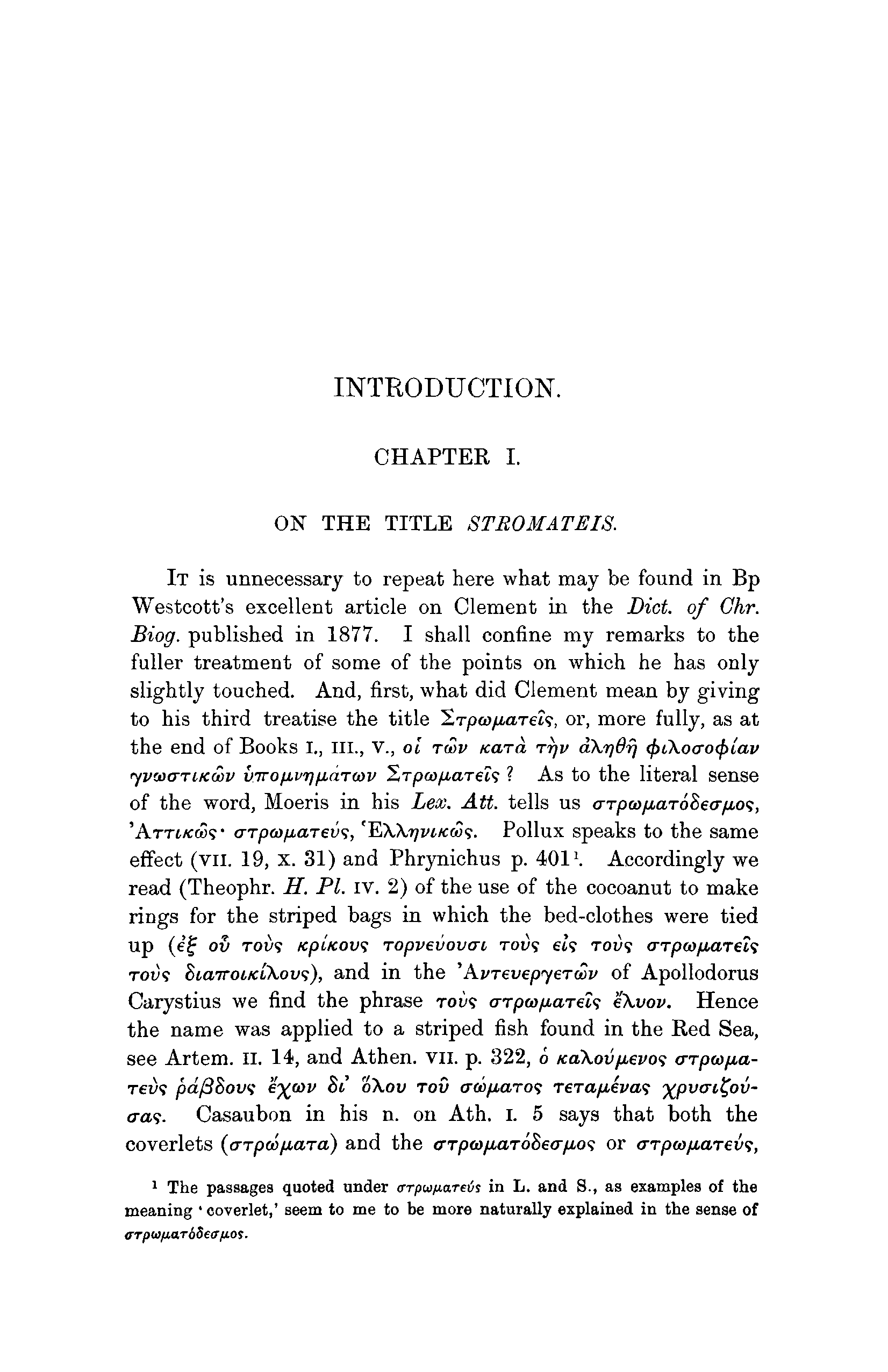
IT is unnecessary to repeat here what may be found in Bp Westcott's excellent article on Clement in the Diet, of Ghr.
Biog. published in 1877. I shall confine my remarks to the fuller treatment of some of the points on which he has only slightly touched. And, first, what did Clement mean by giving to his third treatise the title 1.rpa>fiaTei<!, or, more fully, as at the end of Books I., in., V., ol TWV Kara rr)v dXijOrj <f>t,\o<ro(f)lav
<yvj><TTiica)v vTTOfj.wr]fj.aTa>v XTpcofiareis ? As to the literal sense of the word, Moeris in his Lex. Att. tells us o-Tpto/iaToSecr/io?,
'ATTI/CW?1 crTpafiaTev1;, 'EWi/w/c&J?.
Pollux speaks to the same effect (vn. 19, x. 31) and Phrynichus p. 401 \ Accordingly we read (Theophr. H. PL iv. 2) of the use of the cocoanut to make rings for the striped bags in which the bed-clothes were tied up (ef ov roii<i KpUovi Topvevovau TOVS eh TOI)? arpcofiaTels
Tot)? BiaTToi/clXovs), and in the 'Avrevepyerdov of Apollodorus Carystius we find the phrase TOI)? aTpa/tarei*; eXvov.
Hence the name was applied to a striped fish found in the Red Sea, see Artem. n. 14, and Athen. vn. p. 322, 6 KaXovfievos <rTpco//,aT£i)? pdfiBow; exav
&' o\ov TOV croi/xaTo? reTa/ieva? yjpvai^ovcra?.
Casaubon in his n. on Ath. i. 5 says that both the coverlets (crrpco/iaTa) and the o-Tpco/jLaroSecrfios or <Trpa>fiaTev<{,
1 The passages quoted under (rrpu/Mreis in L. and S., as examples of the meaning ' coverlet,' seem to me to be more naturally explained in the sense of dSeffOS Published online by Cambridge University Press
Xli
INTRODUCTION.
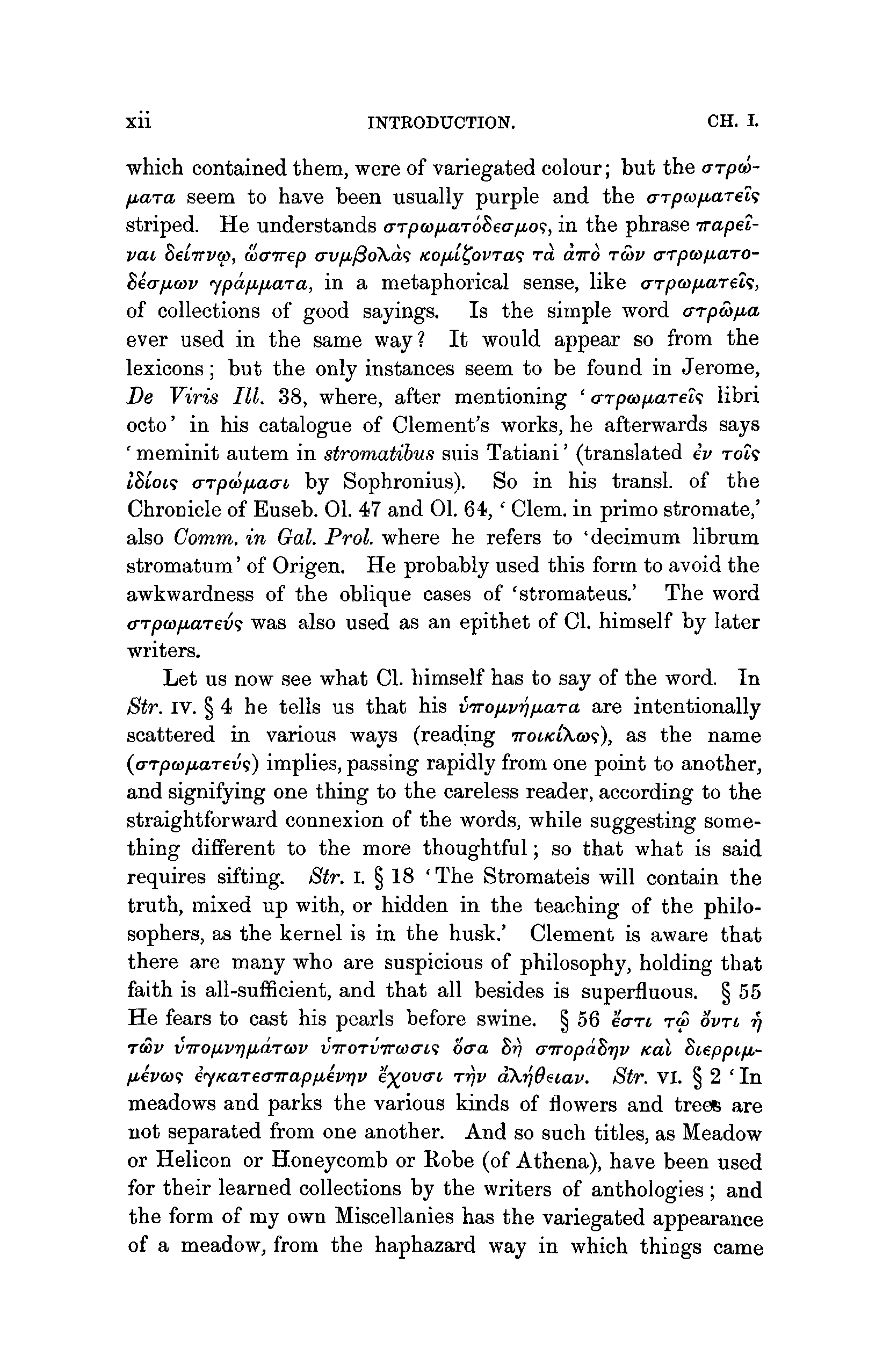
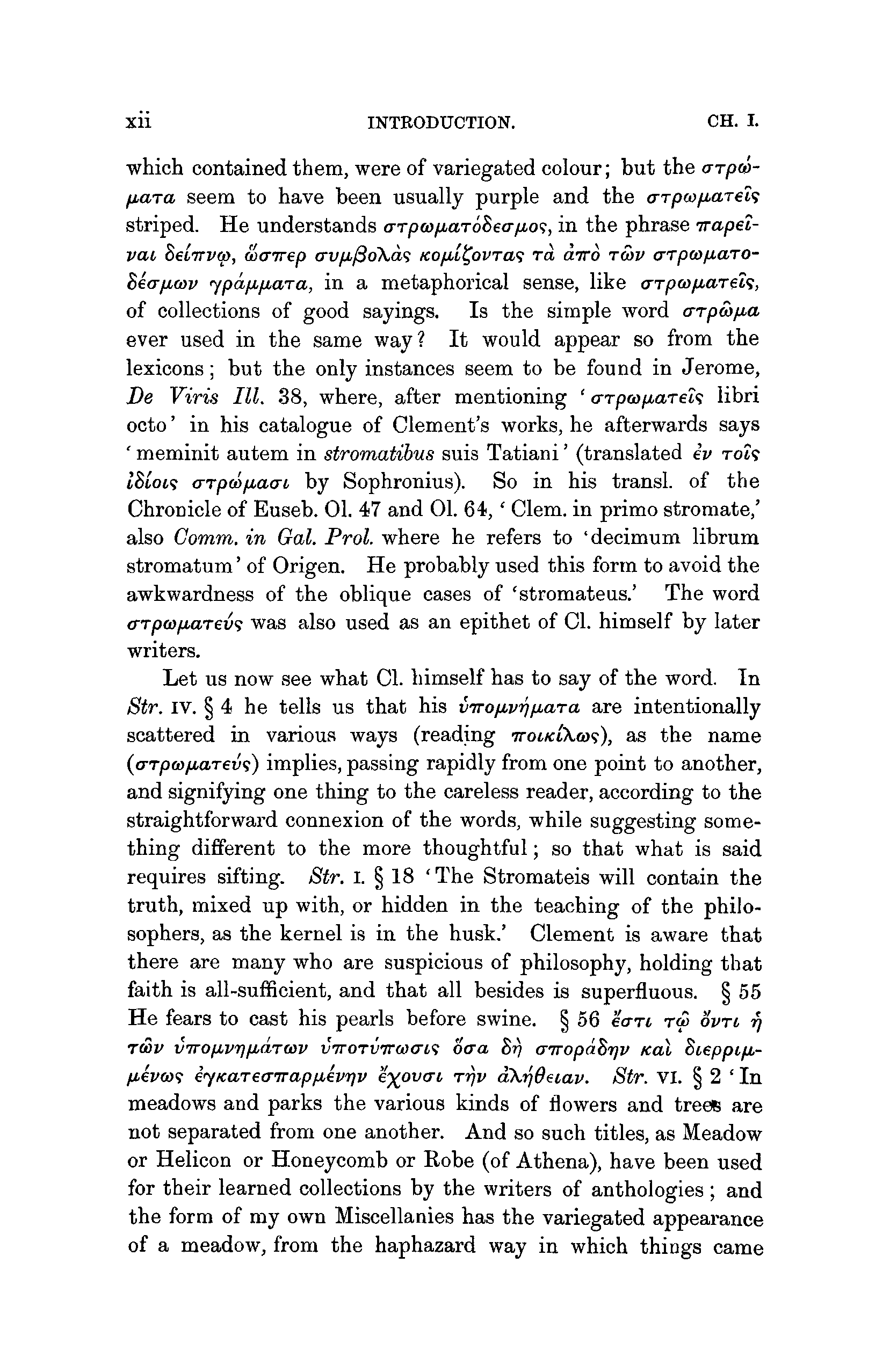
CH. I. which contained them, were of variegated colour; but the arpwfiaTa seem to have been usually purple and the crrpcofiaTeis striped. He understands aTpco/jLaToSeo-fios, in the phrase trapelvai Beiirvq), wcnrep av/j,/3o\a<> KOfii^ovTas ra airb TUV crrpcofiaTOBea-ficov ypa/jifiara, in a metaphorical sense, like <np(ofxar&l%, of collections of good sayings.
Is the simple word arpSifxa ever used in the same way? It would appear so from the lexicons; but the only instances seem to be found in Jerome,
Be Viris III. 38, where, after mentioning ' o-rpcofiaTei? libri octo' in his catalogue of Clement's works, he afterwards says
' meminit autem in stromatibus suis Tatiani' (translated iv rot? t'Siot? arpcofiaai by Sophronius).
So in his transl. of the Chronicle of Euseb. 01. 47 and 01. 64,' Clem, in primo stromate,' also Comm. in Gal. Prol. where he refers to 'decimum librum stromatum' of Origen. He probably used this form to avoid the awkwardness of the oblique cases of 'stromateus.'
The word (rrp(onarev<; was also used as an epithet of Cl. himself by later writers.
Let us now see what Cl. himself has to say of the word. In Str. IV. § 4 he tells us that his inro/j,v^/j.aTa are intentionally scattered in various ways (reading TrouciXms;), as the name
(<rTpa> pareix;) implies, passing rapidly from one point to another, and signifying one thing to the careless reader, according to the straightforward connexion of the words, while suggesting something different to the more thoughtful; so that what is said requires sifting. Str. I. § 18 'The Stromateis will contain the truth, mixed up with, or hidden in the teaching of the philosophers, as the kernel is in the husk.' Clement is aware that there are many who are suspicious of philosophy, holding that faith is all-sufficient, and that all besides is superfluous. § 55
He fears to cast his pearls before swine. § 56 eari TC3 OVTL r) r&v vTrofj,v7]/j,dra)v uVoTUTrwcrt? ova &r) airopahrjv Kal
Bieppifi- /zei/w? e^KaTecnrapfievriv e~)(pv<Ti rrjv aXrjdeiav.
Str. VI. § 2 ' In meadows and parks the various kinds of flowers and trees are not separated from one another. And so such titles, as Meadow or Helicon or Honeycomb or Robe (of Athena), have been used for their learned collections by the writers of anthologies ; and the form of my own Miscellanies has the variegated appearance of a meadow, from the haphazard way in which thiugs came
Published online by Cambridge University Press
CH. I.
THE TITLE STROMATEIS.
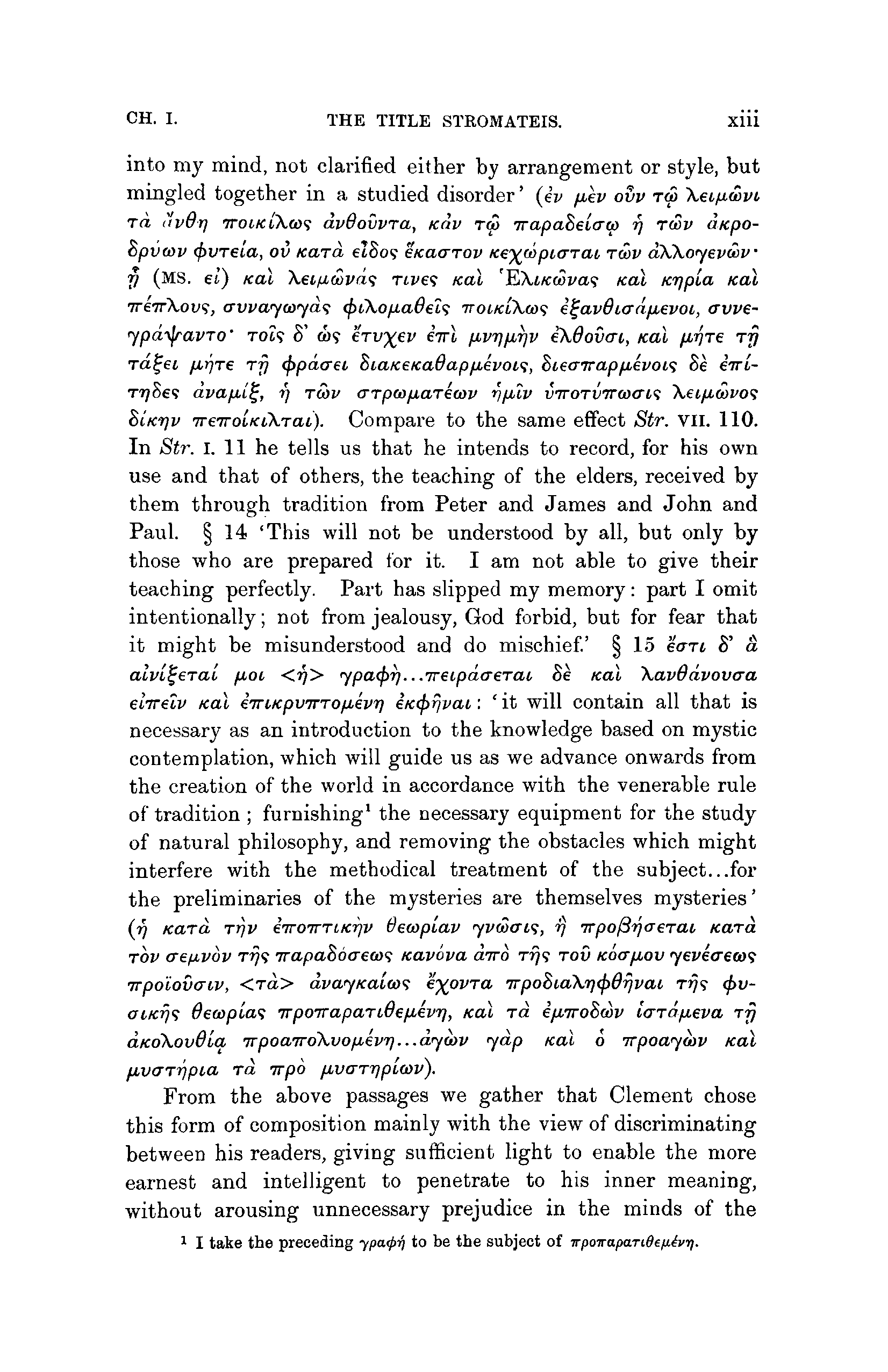
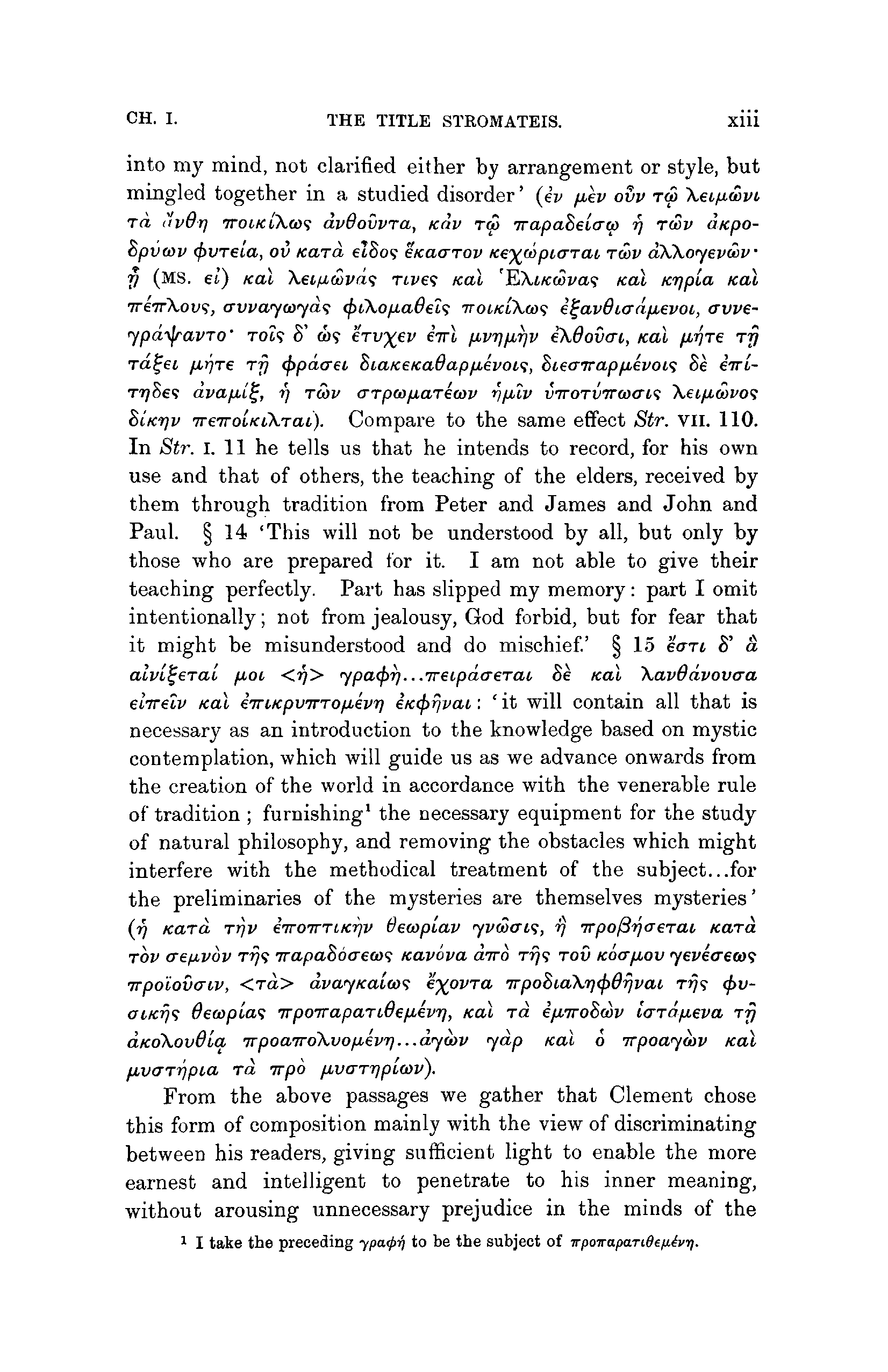
Xlii into my mind, not clarified either by arrangement or style, but mingled together in a studied disorder' (ez; fiev ovv TS Xei/J.a>pi rd av6r) Troutt'Xw? dvOovvra, tcav TC3 irapaBelcrcj) r) rwv d/cpoBpvwv <f>VTela, ov Kara elBos e/cacrTov Ke)^a>pi(rTai TWV dXXoyevcov
17 (MS. el) /cal Xeifj.dovd'i rcves ical 'EXi/cwvas ical icrjpia ical vvaywyat; <fit,Xo/j.a6el<> TTOIKLXW; i^avSiad/j,evoo, avverot? 8' w? €TV)(ev eVl fivrjfirjv iXdovcrc, ical fiijTe T§ rfi typdaet Bia,KeicaOapf/.evoi<;, ^lecrirapfiivoi1; Be eVtTT;86? dvafii^, rj TWV crrpa^aTewv vf^iv vTroTinraxris Xeifioovos BiKrjv TreTro'iKLk-rai).
Compare to the same effect Str. VII. 110.
In Str. I. 11 he tells us that he intends to record, for his own use and that of others, the teaching of the elders, received by them through tradition from Peter and James and John and Paul. § 14 'This will not be understood by all, but only by those who are prepared for it. I am not able to give their teaching perfectly.
Part has slipped my memory: part I omit intentionally; not from jealousy, God forbid, but for fear that it might be misunderstood and do mischief.' § 15 eari 8' a alvL^eral fxoi <r)> <ypacf)r)...r7retpdcreTcn, Be ical
Xavffdvovcra ei-rrelv ical iirucpvTrTOfievri eK(f>rjvai: ' it will contain all that is necessary as an introduction to the knowledge based on mystic contemplation, which will guide us as we advance onwards from the creation of the world in accordance with the venerable rule of tradition ; furnishing1 the necessary equipment for the study of natural philosophy, and removing the obstacles which might interfere with the methodical treatment of the subject...for the preliminaries of the mysteries are themselves mysteries'
(r) icard rrjv eiroTTTiKrjv 6eu>piav ryvdoai<;, rj Trpo/Srfo-eTai Kara rov crefxvov TJ79 TrapaBdaew; icavova awo rfj<; TOV tco&fiov yeveaecos
TTpoioiHTiv, < T H > dvay/caicos e%ovra TrpoBiaXrjtpOrjvai. TJ;? <f>vot/cfjs deatpLas 7rpoirapaTi,de/J.ev7j, ical rd e/j/iroBaiv i<TTap.eva rrj aKoXovOia r7rpoa7roXvofiev7)...dya>v yap teal 6 irpoayaiv ical fivaTrjpca rd irpo fivcrrJipicov).
From the above passages we gather that Clement chose this form of composition mainly with the view of discriminating between his readers, giving sufficient light to enable the more earnest and intelligent to penetrate to his inner meaning, without arousing unnecessary prejudice in the minds of the 1 I take the preceding ypa.<t>T] to be the subject of Trpoirapa.Ti$e/j.&T).
Published online by Cambridge University Press
XIV
INTRODUCTION.
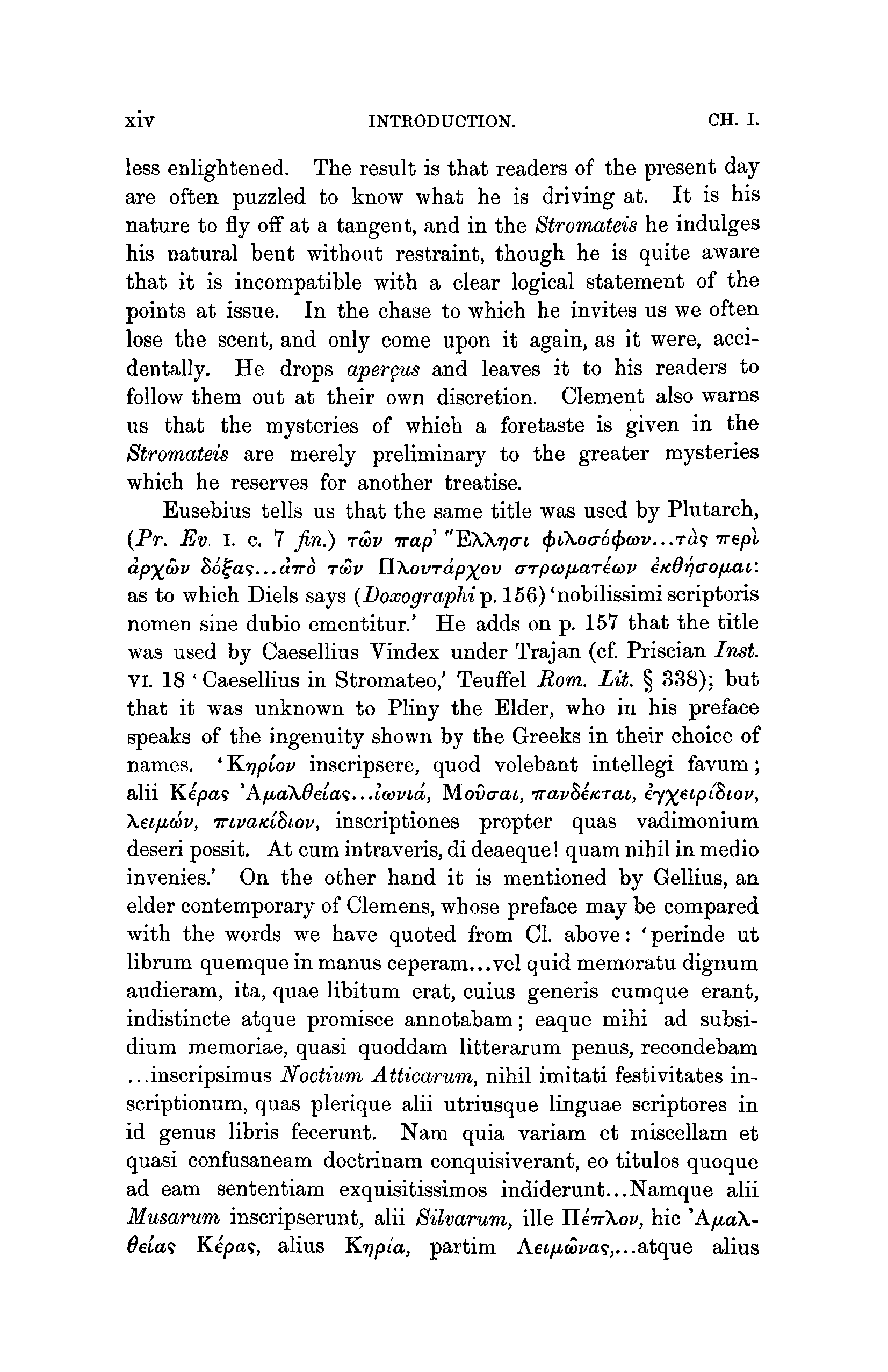
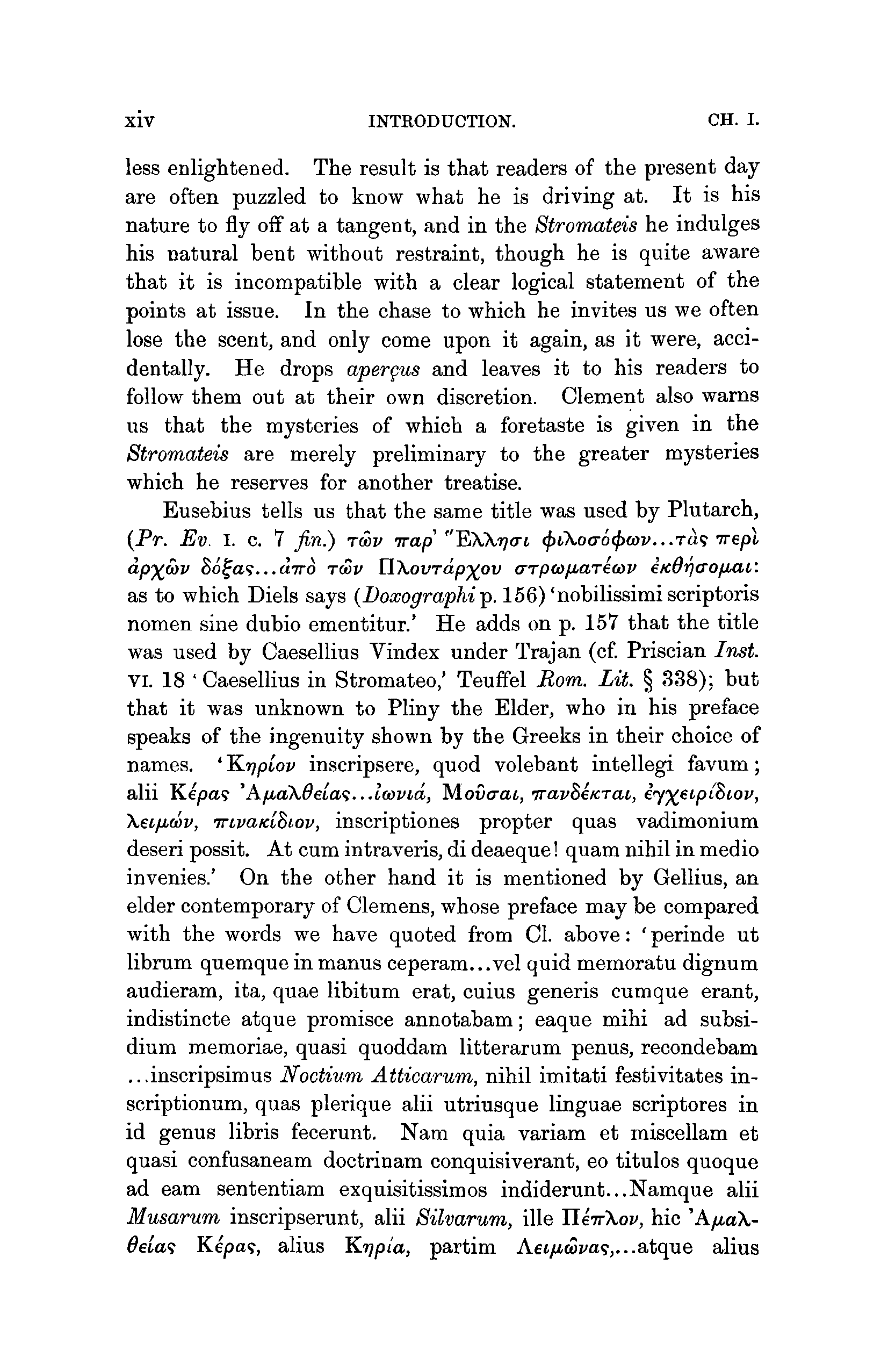
CH. I. less enlightened. The result is that readers of the present day are often puzzled to know what he is driving at. It is his nature to fly off at a tangent, and in the Stromateis he indulges his natural bent without restraint, though he is quite aware that it is incompatible with a clear logical statement of the points at issue. In the chase to which he invites us we often lose the scent, and only come upon it again, as it were, accidentally. He drops apergus and leaves it to his readers to follow them out at their own discretion. Clement also warns us that the mysteries of which a foretaste is given in the Stromateis are merely preliminary to the greater mysteries which he reserves for another treatise.
Eusebius tells us that the same title was used by Plutarch, (Pr. Ev. I. c. 7 fin.) TUIV irap "EXX^o-t j>i\oa-6(f>(ov...ra<s irepl dp^wv B6^w;...el7r6 roov YlXovrdp^ov a-rpco/MaTecov €Kdr)<rofiai: as to which Diels says (DoocographiTp. 156)'nobilissimiscriptoris nomen sine dubio ementitur.' He adds on p. 157 that the title was used by Caesellius Vindex under Trajan (cf. Priscian Inst. vi. 18 ' Caesellius in Stromateo/ Teuffel Bom. Lit. § 338); but that it was unknown to Pliny the Elder, who in his preface speaks of the ingenuity shown by the Greeks in their choice of names. ' ^.rjptov inscripsere, quod volebant intellegi favum; alii Kepa? 'Af/1a\de(,a$...la>vid, Moucrat, iravZ&icTat,, i'yjfeiplhiov,
Xeificov, Tnvaiclhiov, inscriptiones propter quas vadimonium deseri possit. At cum intraveris, di deaeque! quam nihil in medio invenies.' On the other hand it is mentioned by Gellius, an elder contemporary of Clemens, whose preface may be compared with the words we have quoted from Cl. above: ' perinde ut librum quemqueinmanus ceperam...vel quid memoratu dignum audieram, ita, quae libitum erat, cuius generis cumque erant, indistincte atque promisee annotabam; eaque mihi ad subsidium memoriae, quasi quoddam litterarum penus, recondebam
...inscripsimus Noctium Atticarum, nihil imitati festivitates inscriptionum, quas plerique alii utriusque linguae scriptores in id genus libris fecerunt. Nam quia variam et miscellam et quasi confusaneam doctrinam conquisiverant, eo titulos quoque ad earn sententiam exquisitissimos indiderunt...Namque alii
Musarum inscripserunt, alii Silvarum, ille UeirXov, hie 'AfiaX6ela<i Ke/so?, alius Krjpla, partim AetyuoW?,...atque alius
Published online by Cambridge University Press
CH. I.
THE TITLE STROMATEIS.
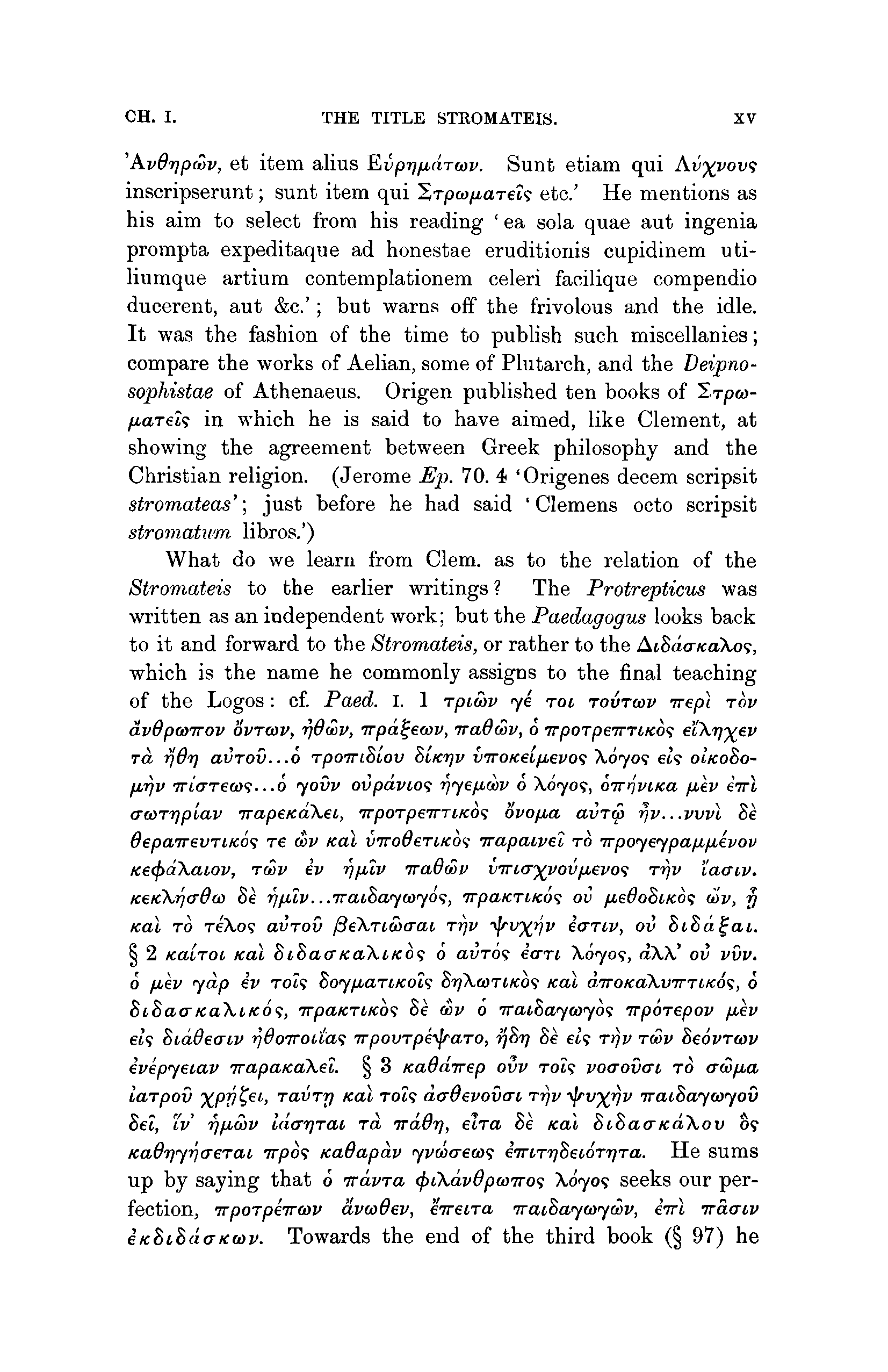
XV 'Avdrjpoov, et item alius Evpr]/MaTiov. Sunt etiam qui Av%vov<; inscripserunt; sunt item qui SxjOco/iaTet? etc' He mentions as his aim to select from his reading ' ea sola quae aut ingenia prompta expeditaque ad honestae eruditionis cupidinem utiliumque artium contemplationem celeri faoilique compendio ducerent, aut &c.' ; but warns off the frivolous and the idle.
It was the fashion of the time to publish such miscellanies; compare the works of Aelian, some of Plutarch, and the Deipnosophistae of Athenaeus. Origen published ten books of ST/3WpaTels in which he is said to have aimed, like Clement, at showing the agreement between Greek philosophy and the Christian religion. (Jerome Ep. 70. 4 'Origenes decem scripsit stromateas'; just before he had said 'Clemens octo scripsit stromatwm libros.') What do we learn from Clem, as to the relation of the Stromateis to the earlier writings ? The Protrepticus was written as an independent work; but the Paedagogus looks back to it and forward to the Stromateis, or rather to the Ai$dcnca\o<;, which is the name he commonly assigns to the final teaching of the Logos: cf. Paed. I. 1 rpi&v ye TOL TOVTWV -Kepi TO avOptoirov ovrcov, rjda>v, Trpd^ecov, traQwv, 6 TrpoTpeTTTiKO^ etS/qyev
TO. r\Qt] avT0V...6
TpoirtSiov BIKTJV inroKei^evo'; Xoyos et? OIKOBOfirjv 7rt'(7Tett>5...o yovv ovpavios r)yefiwv 6 \d<yo?, OTrrjviica jxev eirl crcoTtjplav Trape/cdXei, irporpeiTTiKO^ ovofia avra rjv...vvvl Be depairevTLKO'i re wv Kal inroOeTO/cos trapaivel
TO irpoyeypafi^ievov Ke<f>d\aiov, TWV ev r\fjlv iradwv vTriayvovfievo1; rrjv tacnv.
KeKX^crdco Be rjfuv.. .iraiBaycoyos, irpaicTiic6<i ov fiedoBt,Ko<; cov, y Kal TO TeXo? avTOv fteXTiSiaai Tr\v ^rvytjv io~Tiv, ov BiBd^ai.
§ 2 KaiToi Kal BiBacrKaXiKOs 6 CIVTOS ecrn Xoyos, dXX' ov vvv.
6 fiev yap iv Tot? BoyfiaTiKols ByXcoTiKO1} Kal dTTOKaXvirTiKos, 6 BiBaaKaXiKos, TrpaKTiKos Be wv 6 -iraiBaywyos irpoTepov fiev et? Biddeatv rj8oTTOita<; TrpovTpeyjraTO, r)Brj Be «'? Trjv TWV BeovTtov evepyeiav irapaicaXel.
§ 3 KaOd-trep ovv Tot? vocrovcn TO aw/na laTpov XPV^€L> TavTj) Kal Tot? dcrdevovo-i Trjv yfrvy^rjv TraiBayayov
Bel, iv rjfiwv idarjTai TCL nrdOr], eiTa Be Kal BiBaaicdXov 0?
Kadriyr]o~eTaL 7r/oo? Kadapdv yvuiaew; iiriTrjBeioTTjTa.
He sums up by saying that 6 irdvTa <pi\dv0pa>7ro<; X070? seeks our perfection, 7rpoTpeir(ov dvcodev, eireiTa iraiBaywya>v, iirl irdcriv
Towards the end of the third book (§ 97) he Published online by Cambridge University Press
xvi
INTRODUCTION.
CH. I. distinguishes between the teaching of the Paedagogus and that of the Teacher ' whose aid we need eh rrjv e^nyncriV T(*'v dylcov
\6<ycov...Kal Brj &pa ye ifiol fiev ireiravcrOai T17? iraiBaywyuas, ifid<; Be CLKpodaOat BtBao-KaXov. irapaXafiwp Be ovros vfid'i, viro KaXrj reOpa/M/j,evov<; dycoyr), iKBiBd^erai ra Xoyta.
The same distinction is found in § 87 oaa fiev OIKOI irapa<f>vXaKTeop, KCU «J? TOP fiiov iiravop0ci)Teov 6 TraiBayayds r]fuv dBrjv OietXeKTai,
. ..a^pt? dp drydyr) 7r/>o? TOP St&da/caXov, and in Paed. II. 76, where after giving a mystical interpretation of the appearance in the Burning Bush, he breaks off dXX' e^e^T/p yap rod ircuSaymyiKOV TOTTOV TO BiBcMTicaXiKOP el&os vrapeicrdytop.
Again towards the end of the Paedagogus (ill. 97) aX\' OVK e/j,6p, <f)r)crlp 6 Trcuhaywyo';, hthdo-iceip en ravra (the instructions to be found in the Bible for bishops, priests and deacons &c), BiBacrKaXov
Be elf rrjp i^riyrjo-iv TMP dyicov e/ceipuip Xoywp
XPV?0/JI€V>
7TjOO? OP TjfJLlP /3dBlO~TeOP.
De Faye argues with force, as it seems to me, that when Cl. wrote these words, he intended to give the name AtSatr/caXo? to the third part of his great work, which was to treat of the Christian mysteries. Other writers on Clement have assumed that the Srpw/jaTet? are merely the A.iBd<r>caXo<; under a different name. But is this so ? De Faye calls attention to the fact that there is no appearance of finality in the Miscellanies.
They, like the Paedagogus, are paving the way for a more advanced treatise. Thus in Str. iv. § 1, after laying out the subjects which remain to be discussed in the later books, he continues § 2 eVi TOVTOC; vcrrepov, 7rXripa)deiar)<; 0)9 k'vi T?5? Kara rd irpoKel.fj.epa tf/jitv vTrorvTraxrem^, rd Trepl
<$>va~ioXoyr}9evTa rols re "EXXTJCTI, rois re dXXois /3apj3dpoK, oawv (MS. ocrop) T]KOP els rj/J,d<; ai Botjai, i^t,o-Topr)reov, Kal TT/OO? rd Kvpioorara r<Sv TOK <J)I,XO<T6<}>OLS itrtvevor)fievtov iyyeip'rjreop1, oh eTTO/xevov av eltj fierd rfjv eiri.BpoiJ.ijp T?7? 0eoXoy(,a<; rd irepl TJ79 7T/9o0i?T6ta? irapaBeBo/j,iva BiaXaffelv, and to confute the heresies from the Scripture.
§ 3 TeXetw^eto-^? roivvp rrj<; irpoOeaewi rjfjilv divaa^...rare Brj rrjv ra> b'pri ypcoo-riKrjp <pv<rioXoyiav fierifiep, rd fiiicpd irpo rSp fieydXcov fj.vri6ivre<i fj.vo-T7}piwp
...dXXd yap ro /j,ev yeypdtyerai, rjp #eo? ye ideXrj Kal 07T(u? dp e/iirpey, vvpl Be eiri TO irpoKeifievop (jLenreop KOI TOP tfdi/cop diro1 Cf. Str. 11. 134, where the discussion of theories of happiness is deferred.
Published online by Cambridge University Press
CH. I.
THE TITLE STROMATEIS.
xvii •7r\T)pa>Teov Xoyov.
References to this more advanced treatise are also to be found in Str. vir., where he promises to give a view of gnostic teaching {rrjv TWV Boyfj-drtov Oewpiav) on some future occasion (§ 59); Str. v. 68 'the allegorical meaning of the anthropomorphic descriptions of God will be explained further on.' In IV. 162 having strayed into the region of the higher philosophy he recalls himself to his proper province (fieroriov
Be dtro rwv fyvcnicciOTepav irrl ra 7rpo(f>avecrTepa r)6uca), cf. VI. 4> ' I postpone the elucidation of the Greek mysteries, until we have examined their philosophy of first principles, on which it will be shown that their mysteries depend.'
Similarly in Str.
II. 37 the treatment of the First Cause is postponed.
Str. vi.
168fin. ' I have shown the character of the gnostic; what he is Kara rfjv decopiav will be shown hereafter iv TOI<; <f>vcriicois, eirav -rrepl yeveaeoos Koa/xov BiaXafi^dvetv dp^cofieda.' The same is said with regard to the interpretation of prophecy in VII. 1; and the refutation of the heretical depreciation of prayer in VII.
41.
The questions of metempsychosis and of the nature of the devil are reserved for a future occasion in iv. 85; so for providential discipline in iv. 89 init.; for the Basilidean view of the creation in iv. 91 init.; for the Divine attributes in Str. v. 71
Kara rov oliceiov iTTiBei^OijcreTai TOTTOV, and for the Monad in reference to the Church VII. 108 init.
Besides these somewhat vague references to the future developments of his work, Cl. names particular topics, on which he means to write—what most interpreters have understood to be—distinct treatises. Such are (1) the irepl irpo<fyr)Teia<; referred to in Str. I. 158 UTTCC; /j,ev ovv 6 NLcovafjs yv Trpo<l>r)Tiicd<; fierd ravra Xexdijcrercu, o-wr]viKa av irepl Trpo<^r)Tela<; BiaXa/u.^dvcopev: cf. Str. IV. 2 already cited, and § 93 irpo<; oO? (TOII? Qpvya*;) iv TOIS irepl TrpotfyrjTeias Bta\e^6/xe0a, Str. V. 88 OTTCO? Be rj
Biavofirj aiiTi-j (roil TrvevpaToc;) /cat o rl iroTe iart TO ayiov 7rvevfJ.a iv rot? irepl TrpofyrjTelas icav TOK irepl •^rw^i]<; iiriBeiydrjaerai, rj/uv. (2) The irepl - ^ i ^ s mentioned here is also referred to in Str. in. 13, where the question of metempsychosis
(see iv. 85 referred to above) is reserved for another opportunity, 6-rnjviKa av irepl ^vxv^ Bt,a\a/j./3dva>/Aev. Also Str. II. 113
TTJOO? TO Boyfia TOVTO (the Basilidean doctrine of the passions) BtaXetjofieOa vcrrepov, OTrtfviica irepl A|TU^? BiaXa/i^dvofjiev.
M. c. b Published online by Cambridge University Press
xviii
INTRODUCTION.
CH. I.
(3) A irepl yeveaeox; is promised in Str. in. 95, where he says that Cassianus' interpretation of the ' coats of skin' (Gen. iii.
21) will be considered vcrepov...'6rav rrepl rrjs dvOpwirov yeveeretO9 rrjv i%r)yr)cnv.. .fiera^eipi^d/j,e6a, cf. Str. VI. 168 quoted above.
(4) 7r€pl dyyeXcov in Str. VI. 32, where, speaking of the supposed action of demons, he says irepi fiev rovrcov iv x«5 irepl dyyeXiov Xoya> 7rpo'iovar]^ rrjs ypa^t
Kara /caipov BiaXe- %6/Aeda, which seems to imply that the discussion would form a part of the work on which he was already engaged.
(5) frepl ev'xfi<i! Strom. IV. 171 tjfieK Be irepl TJ79 ev^i}? Kara icaipbv irpotOVTOS rov Xoyov BiaXTjilro/xeOa, on which the same remark may be made.
(6) A discussion Trepl dp%a>vl is promised in Str. V.
140, where it is said that Greek philosophy will necessarily come up for examination oirr/viKa av Ta? vrepl dpxaiv B6!;as rd<; trap "EXXrjai 4>epo/j,eva<; dvaXeywfieda, cf. Str. IV. 2 and VI. 4 already quoted on pp. xvi, xvii. (7) A discussion irepl dvaardcre(o<; is mentioned in Paed. I. 47, and II. 104.
De Faye thinks that the Stromateis was never completed, and that some of the subjects named were intended to have been included in it.
Others he assigns to the final treatise ; of which he considers that the so-called eighth book of the Stromateis, the Excerpta
Theodoti and the Eclogae Propheticae, were intended to form a part.
The termination of the seventh Book certainly implies a distinct break from what is to follow
{rdiv 6^77? air' aXXrjs dp%r}<; TroirjaofieOa rov Xoyov); and Photius tells us that the eighth book was different in different copies, being sometimes the treatise entitled Quis Dives Salvetur, sometimes the logical treatise which stands in that place in our editions. I cannot agree with De Faye in supposing that 1 In the Q.D.S. § 26 Clement speaks of the camel passing through the needle's eye, as a pvaT-ripiov TOV o-wrijpos, the meaning of which may be learnt
^c TIJ Trepl apxuv Kal 6eo\oyLas i^yqaei.
This has been generally understood to prove that the treatise irepl apx&v, promised in the Stromateis, had been published before the appearance of the Q.D.S. De Faye, holding that the former was the last of all the works of Clement, argues that the phrase ri vepl apx&v i^-fiyqins may be explained more generally, 'appartient au domaine des principes.' The word ^^7171x15 does not seem to me to lend itself to such an explanation. If we regard the Q.D.S. as a mere sermon, it might surprise one to find in it a reference to a formal treatise of the preacher; but the former is really a treatise, just as much, say, as Hare's Mission of the Comforter, only that, in modern writings, text and noteB are divided.
Published online by Cambridge University Press
CH. 1.
THE TITLE STROMATEIS.
XIX the Hypotyposes and the Q. D. S. preceded the Miscellanies.
The former, and possibly the latter, may be referred to in the promised discussion irepl irpo$T]Teias. Granting that it was at one time Clement's intention to bring out a complete treatise on Christian Gnosis under the name AiSao-«a\o?, I do not see why the same reasons which led him to prepare the way for this by the Stromateis should not also have suggested to him to bring out his great work in portions.
We have still to answer the question, what were the reasons which induced Clement to follow up the Paedngogus by a work, of which the real character was disguised by its apparent disorder? Perhaps the following quotation from De Faye's preface may help to clear the ground.
'Ce qui rend le sieclede Clement d'Alexandrie si interessant, c'est qu'il est, comme le n6tre, une epoque de transition oil fermentent les germes fdconds de l'avenir. C'est une heure inde"cise et trouble, ou se preparent les croyances et les institutions des siecles suivants. Cle'ment lui-meme et son osuvre ne sauraient nous laisser indiffe'rents.
II a ete essentiellement un homme de transition. Avant lui, le Christianisme a encore quelque chose de primitif; a bien des e"gards la foi nouvelle n'avait pas depasse l'e'tat embryonnaire. Apres lui, c'est une religion constitute. II se fait, vers la fin du Ile siecle, une prodigieuse transformation au sein de l'Eglise. Clement en fut l'un des plus puissants ouvriers. II est le veritable createur de la theologie eccle'siastique. Quel chemin parcouru par la pensde chrdtienne depuis les Peres apostoliques jusqu'a Origene ! C'est
Clement qui est l'auteur responsable de cette etonnante Evolution. C'est pour cela qu'il occupe dans l'histoire des idees chretiennes une place de premier ordre.'
The early Christians for the most part looked upon the Greco-Roman literature as a part of the hostile world against which they were warned. It was necessity which compelled the Apologists, such as Quadratus and Aristides, to enter this new domain in the reign of Hadrian. Though they professed a distaste for the rules of composition and rhetoric, which were current in the world, they were forced to adopt them to a certain extent in order to gain a hearing, and thus
Published online by Cambridge University Press
INTRODUCTION.
CH. I. prepared the way for a Christian literature. The conflict with heresy carried further the process begun by the conflict with the heathen and the Jew. But while it widened the range of thought and developed the reasoning powers of the few, it had a tendency to drive back the mass of Christians upon an unreasoning dependence on tradition and authority. And this tendency found a voice in Tertullian's vehement denunciation of philosophy as the source of all heresy, and in his fierce denial of the right of inquiry and private judgment1.
In contrast to the Roman lawyer we have the Greek professor. In the catechetical school of Alexandria Clement was accustomed to lecture both to believers and to unbelievers, opening the eyes of both alike to the divine revelation around and within them, a revelation to be found in its purest form in the Christian Scriptures, but which was also reflected in Greek poetry and philosophy, especially in ' the inspired writings of Plato.' Philosophy was for the Greeks what the law was for the Jews. Nor had its use ceased even for Christians. It is the appointed means of education: it serves to protect the believer from the sophistries of a pseudo-gnosticism: it throws light on the meaning of Scripture : it helps to the attainment of divine truth. Hence Clement begins his Stromateis with the defence of philosophy. He is aware that the general opinion is opposed to him, a>9 eoiicev, ol TfkelaTOt, raw TO ovofia iirvypatyofxevaiv,
KaQdirep ol TOV 'OSvcr&eas eralpoi, dypo[,K(O<; fj,erLa<TL TOV XOJOV, ...ajxaQLa /3v<rai>Te<> ra ami, iireiirep taacnv ov Bvvrjcrofievoi, aira^ v7roa^wTe? TCLI aicoas 'J^WTJVIKOIS fiadrjfiacn, fiera ravra TOV VOO-TOV Tv%elv. 'He who remembers that the earth is the Lord's and the fulness thereof, will not shun philosophy.' Similarly in VII. 1 Clement assumes that his language will be suspected by many as unfamiliar, though it is really founded on Scripture and breathes the spirit of the Gospel. These ' Orthodoxastae,' as he calls them in Str. i. 45, even go so far as to condemn writing altogether. Clement has seriously to argue that, if it
1 He even forbids discussion on the meaning of Scripture as dangerous or superfluous for the orthodox, {Praescr. 19) 'Ergo non ad Scripturas provocandum est: nee in his eonstituendum certamen, in quibus aut nulla aut incerta victoria est, aut par incertae...Ubi enim apparuerit esse veritatem et disciplinae et fidei Christianae, illic erit veritas Scripturarum et expositionum et omnium traditionum christianarum'; on which Famelius naturally observes
'Locus insignis pro Catholicis.'
Published online by Cambridge University Press
CH. I.
THE TITLE STROMATEIS.
XXI be right to teach by hearing, it cannot be wrong to teach by sight (Str. I. 1 foil.). Hence it was impossible, as De Faye says (p. 133), for Clement to lay before the public 'sans explication et sans pre'ambule la partie de son grand ouvrage qui, dans sa pensee, devait exposer tout un systeme de dogmes concus et formules selon les me'thodes de la philosophie. II aurait souleve une reprobation ge'nerale; il aurait perdu toute autorite" sur ses coreligionnaires; il aurait e'te' traits de gnostique, tout en combattant le gnosticisme. Voila pourquoi il lui fallait ecrire un traite qui prdparerait l'ouvrage doctrinal et lui aplanirait les voies. II y a plus...Clement a eu l'heureuse idee de choisir pour son livre un genre litteraire qui lui laissait une liberty particulierement favorable a son dessein. Dans ses
Stromates, il lui e"tait parfaitement loisible de presenter ses vues au moment et de la maniere qui lui convenaient.'
We may find examples of the vari-coloured texture of the Stromateis in the admixture of topics which would be more agreeable to the ordinary taste than the systematic exposition of his views on theology. The praise of philosophy is mixed with polemic against the heretics and with the attempt to prove that all that is best in philosophy is ultimately derived from Scripture. Faith is the subject of high panegyric, and the use of the motive of fear is urged against the gnostic teachers. The third book has a long dissertation on marriage, which scarcely belongs to the context. Then we have interesting discussions on martyrdom and on symbolism; the absurdity of pagan superstition is shown in a number of amusing examples; in fine the whole work teems with quotations and anecdotes; and it is partly under cover of these things that Clement suggests the doctrines on which he lays the greatest stress.
Another art which Clement employs to avoid giving offence is his profession to be merely a reporter of the sayings of the elders, and of a secret tradition handed down from the Apostles.
It is quite possible that he is indebted to Pantaenus for the germ of some of his opinions, and his allegorical interpretations of Scripture often agree with what we find in Philo or Barnabas or Irenaeus, cf. vil. 109 foil.; but it can hardly be doubted that many of his ideas are original or, in any case, largely developed by himself.
Published online by Cambridge University Press
INTRODUCTION.
CHAPTER I.
ON THE TITLE
STEOMATEIS.
IT is unnecessary to repeat here what may be found in Bp Westcott's excellent article on Clement in the Diet, of Ghr.
Biog. published in 1877. I shall confine my remarks to the fuller treatment of some of the points on which he has only slightly touched. And, first, what did Clement mean by giving to his third treatise the title 1.rpa>fiaTei<!, or, more fully, as at the end of Books I., in., V., ol TWV Kara rr)v dXijOrj <f>t,\o<ro(f)lav
<yvj><TTiica)v vTTOfj.wr]fj.aTa>v XTpcofiareis ? As to the literal sense of the word, Moeris in his Lex. Att. tells us o-Tpto/iaToSecr/io?,
'ATTI/CW?1 crTpafiaTev1;, 'EWi/w/c&J?.
Pollux speaks to the same effect (vn. 19, x. 31) and Phrynichus p. 401 \ Accordingly we read (Theophr. H. PL iv. 2) of the use of the cocoanut to make rings for the striped bags in which the bed-clothes were tied up (ef ov roii<i KpUovi Topvevovau TOVS eh TOI)? arpcofiaTels
Tot)? BiaTToi/clXovs), and in the 'Avrevepyerdov of Apollodorus Carystius we find the phrase TOI)? aTpa/tarei*; eXvov.
Hence the name was applied to a striped fish found in the Red Sea, see Artem. n. 14, and Athen. vn. p. 322, 6 KaXovfievos <rTpco//,aT£i)? pdfiBow; exav
&' o\ov TOV croi/xaTo? reTa/ieva? yjpvai^ovcra?.
Casaubon in his n. on Ath. i. 5 says that both the coverlets (crrpco/iaTa) and the o-Tpco/jLaroSecrfios or <Trpa>fiaTev<{,
1 The passages quoted under (rrpu/Mreis in L. and S., as examples of the meaning ' coverlet,' seem to me to be more naturally explained in the sense of dSeffOS https://doi.org/10.1017/CBO9780511695513.002 Published online by Cambridge University Press
Xli
INTRODUCTION.
CH. I. which contained them, were of variegated colour; but the arpwfiaTa seem to have been usually purple and the crrpcofiaTeis striped. He understands aTpco/jLaToSeo-fios, in the phrase trapelvai Beiirvq), wcnrep av/j,/3o\a<> KOfii^ovTas ra airb TUV crrpcofiaTOBea-ficov ypa/jifiara, in a metaphorical sense, like <np(ofxar&l%, of collections of good sayings.
Is the simple word arpSifxa ever used in the same way? It would appear so from the lexicons; but the only instances seem to be found in Jerome,
Be Viris III. 38, where, after mentioning ' o-rpcofiaTei? libri octo' in his catalogue of Clement's works, he afterwards says
' meminit autem in stromatibus suis Tatiani' (translated iv rot? t'Siot? arpcofiaai by Sophronius).
So in his transl. of the Chronicle of Euseb. 01. 47 and 01. 64,' Clem, in primo stromate,' also Comm. in Gal. Prol. where he refers to 'decimum librum stromatum' of Origen. He probably used this form to avoid the awkwardness of the oblique cases of 'stromateus.'
The word (rrp(onarev<; was also used as an epithet of Cl. himself by later writers.
Let us now see what Cl. himself has to say of the word. In Str. IV. § 4 he tells us that his inro/j,v^/j.aTa are intentionally scattered in various ways (reading TrouciXms;), as the name
(<rTpa> pareix;) implies, passing rapidly from one point to another, and signifying one thing to the careless reader, according to the straightforward connexion of the words, while suggesting something different to the more thoughtful; so that what is said requires sifting. Str. I. § 18 'The Stromateis will contain the truth, mixed up with, or hidden in the teaching of the philosophers, as the kernel is in the husk.' Clement is aware that there are many who are suspicious of philosophy, holding that faith is all-sufficient, and that all besides is superfluous. § 55
He fears to cast his pearls before swine. § 56 eari TC3 OVTL r) r&v vTrofj,v7]/j,dra)v uVoTUTrwcrt? ova &r) airopahrjv Kal
Bieppifi- /zei/w? e^KaTecnrapfievriv e~)(pv<Ti rrjv aXrjdeiav.
Str. VI. § 2 ' In meadows and parks the various kinds of flowers and trees are not separated from one another. And so such titles, as Meadow or Helicon or Honeycomb or Robe (of Athena), have been used for their learned collections by the writers of anthologies ; and the form of my own Miscellanies has the variegated appearance of a meadow, from the haphazard way in which thiugs came https://doi.org/10.1017/CBO9780511695513.002 Published online by Cambridge University Press
CH. I.
THE TITLE STROMATEIS.
Xlii into my mind, not clarified either by arrangement or style, but mingled together in a studied disorder' (ez; fiev ovv TS Xei/J.a>pi rd av6r) Troutt'Xw? dvOovvra, tcav TC3 irapaBelcrcj) r) rwv d/cpoBpvwv <f>VTela, ov Kara elBos e/cacrTov Ke)^a>pi(rTai TWV dXXoyevcov
17 (MS. el) /cal Xeifj.dovd'i rcves ical 'EXi/cwvas ical icrjpia ical vvaywyat; <fit,Xo/j.a6el<> TTOIKLXW; i^avSiad/j,evoo, avverot? 8' w? €TV)(ev eVl fivrjfirjv iXdovcrc, ical fiijTe T§ rfi typdaet Bia,KeicaOapf/.evoi<;, ^lecrirapfiivoi1; Be eVtTT;86? dvafii^, rj TWV crrpa^aTewv vf^iv vTroTinraxris Xeifioovos BiKrjv TreTro'iKLk-rai).
Compare to the same effect Str. VII. 110.
In Str. I. 11 he tells us that he intends to record, for his own use and that of others, the teaching of the elders, received by them through tradition from Peter and James and John and Paul. § 14 'This will not be understood by all, but only by those who are prepared for it. I am not able to give their teaching perfectly.
Part has slipped my memory: part I omit intentionally; not from jealousy, God forbid, but for fear that it might be misunderstood and do mischief.' § 15 eari 8' a alvL^eral fxoi <r)> <ypacf)r)...r7retpdcreTcn, Be ical
Xavffdvovcra ei-rrelv ical iirucpvTrTOfievri eK(f>rjvai: ' it will contain all that is necessary as an introduction to the knowledge based on mystic contemplation, which will guide us as we advance onwards from the creation of the world in accordance with the venerable rule of tradition ; furnishing1 the necessary equipment for the study of natural philosophy, and removing the obstacles which might interfere with the methodical treatment of the subject...for the preliminaries of the mysteries are themselves mysteries'
(r) icard rrjv eiroTTTiKrjv 6eu>piav ryvdoai<;, rj Trpo/Srfo-eTai Kara rov crefxvov TJ79 TrapaBdaew; icavova awo rfj<; TOV tco&fiov yeveaecos
TTpoioiHTiv, < T H > dvay/caicos e%ovra TrpoBiaXrjtpOrjvai. TJ;? <f>vot/cfjs deatpLas 7rpoirapaTi,de/J.ev7j, ical rd e/j/iroBaiv i<TTap.eva rrj aKoXovOia r7rpoa7roXvofiev7)...dya>v yap teal 6 irpoayaiv ical fivaTrjpca rd irpo fivcrrJipicov).
From the above passages we gather that Clement chose this form of composition mainly with the view of discriminating between his readers, giving sufficient light to enable the more earnest and intelligent to penetrate to his inner meaning, without arousing unnecessary prejudice in the minds of the 1 I take the preceding ypa.<t>T] to be the subject of Trpoirapa.Ti$e/j.&T). https://doi.org/10.1017/CBO9780511695513.002 Published online by Cambridge University Press
XIV
INTRODUCTION.
CH. I. less enlightened. The result is that readers of the present day are often puzzled to know what he is driving at. It is his nature to fly off at a tangent, and in the Stromateis he indulges his natural bent without restraint, though he is quite aware that it is incompatible with a clear logical statement of the points at issue. In the chase to which he invites us we often lose the scent, and only come upon it again, as it were, accidentally. He drops apergus and leaves it to his readers to follow them out at their own discretion. Clement also warns us that the mysteries of which a foretaste is given in the Stromateis are merely preliminary to the greater mysteries which he reserves for another treatise.
Eusebius tells us that the same title was used by Plutarch, (Pr. Ev. I. c. 7 fin.) TUIV irap "EXX^o-t j>i\oa-6(f>(ov...ra<s irepl dp^wv B6^w;...el7r6 roov YlXovrdp^ov a-rpco/MaTecov €Kdr)<rofiai: as to which Diels says (DoocographiTp. 156)'nobilissimiscriptoris nomen sine dubio ementitur.' He adds on p. 157 that the title was used by Caesellius Vindex under Trajan (cf. Priscian Inst. vi. 18 ' Caesellius in Stromateo/ Teuffel Bom. Lit. § 338); but that it was unknown to Pliny the Elder, who in his preface speaks of the ingenuity shown by the Greeks in their choice of names. ' ^.rjptov inscripsere, quod volebant intellegi favum; alii Kepa? 'Af/1a\de(,a$...la>vid, Moucrat, iravZ&icTat,, i'yjfeiplhiov,
Xeificov, Tnvaiclhiov, inscriptiones propter quas vadimonium deseri possit. At cum intraveris, di deaeque! quam nihil in medio invenies.' On the other hand it is mentioned by Gellius, an elder contemporary of Clemens, whose preface may be compared with the words we have quoted from Cl. above: ' perinde ut librum quemqueinmanus ceperam...vel quid memoratu dignum audieram, ita, quae libitum erat, cuius generis cumque erant, indistincte atque promisee annotabam; eaque mihi ad subsidium memoriae, quasi quoddam litterarum penus, recondebam
...inscripsimus Noctium Atticarum, nihil imitati festivitates inscriptionum, quas plerique alii utriusque linguae scriptores in id genus libris fecerunt. Nam quia variam et miscellam et quasi confusaneam doctrinam conquisiverant, eo titulos quoque ad earn sententiam exquisitissimos indiderunt...Namque alii
Musarum inscripserunt, alii Silvarum, ille UeirXov, hie 'AfiaX6ela<i Ke/so?, alius Krjpla, partim AetyuoW?,...atque alius https://doi.org/10.1017/CBO9780511695513.002 Published online by Cambridge University Press
CH. I.
THE TITLE STROMATEIS.
XV 'Avdrjpoov, et item alius Evpr]/MaTiov. Sunt etiam qui Av%vov<; inscripserunt; sunt item qui SxjOco/iaTet? etc' He mentions as his aim to select from his reading ' ea sola quae aut ingenia prompta expeditaque ad honestae eruditionis cupidinem utiliumque artium contemplationem celeri faoilique compendio ducerent, aut &c.' ; but warns off the frivolous and the idle.
It was the fashion of the time to publish such miscellanies; compare the works of Aelian, some of Plutarch, and the Deipnosophistae of Athenaeus. Origen published ten books of ST/3WpaTels in which he is said to have aimed, like Clement, at showing the agreement between Greek philosophy and the Christian religion. (Jerome Ep. 70. 4 'Origenes decem scripsit stromateas'; just before he had said 'Clemens octo scripsit stromatwm libros.') What do we learn from Clem, as to the relation of the Stromateis to the earlier writings ? The Protrepticus was written as an independent work; but the Paedagogus looks back to it and forward to the Stromateis, or rather to the Ai$dcnca\o<;, which is the name he commonly assigns to the final teaching of the Logos: cf. Paed. I. 1 rpi&v ye TOL TOVTWV -Kepi TO avOptoirov ovrcov, rjda>v, Trpd^ecov, traQwv, 6 TrpoTpeTTTiKO^ etS/qyev
TO. r\Qt] avT0V...6
TpoirtSiov BIKTJV inroKei^evo'; Xoyos et? OIKOBOfirjv 7rt'(7Tett>5...o yovv ovpavios r)yefiwv 6 \d<yo?, OTrrjviica jxev eirl crcoTtjplav Trape/cdXei, irporpeiTTiKO^ ovofia avra rjv...vvvl Be depairevTLKO'i re wv Kal inroOeTO/cos trapaivel
TO irpoyeypafi^ievov Ke<f>d\aiov, TWV ev r\fjlv iradwv vTriayvovfievo1; rrjv tacnv.
KeKX^crdco Be rjfuv.. .iraiBaycoyos, irpaicTiic6<i ov fiedoBt,Ko<; cov, y Kal TO TeXo? avTOv fteXTiSiaai Tr\v ^rvytjv io~Tiv, ov BiBd^ai.
§ 2 KaiToi Kal BiBacrKaXiKOs 6 CIVTOS ecrn Xoyos, dXX' ov vvv.
6 fiev yap iv Tot? BoyfiaTiKols ByXcoTiKO1} Kal dTTOKaXvirTiKos, 6 BiBaaKaXiKos, TrpaKTiKos Be wv 6 -iraiBaywyos irpoTepov fiev et? Biddeatv rj8oTTOita<; TrpovTpeyjraTO, r)Brj Be «'? Trjv TWV BeovTtov evepyeiav irapaicaXel.
§ 3 KaOd-trep ovv Tot? vocrovcn TO aw/na laTpov XPV^€L> TavTj) Kal Tot? dcrdevovo-i Trjv yfrvy^rjv TraiBayayov
Bel, iv rjfiwv idarjTai TCL nrdOr], eiTa Be Kal BiBaaicdXov 0?
Kadriyr]o~eTaL 7r/oo? Kadapdv yvuiaew; iiriTrjBeioTTjTa.
He sums up by saying that 6 irdvTa <pi\dv0pa>7ro<; X070? seeks our perfection, 7rpoTpeir(ov dvcodev, eireiTa iraiBaywya>v, iirl irdcriv
Towards the end of the third book (§ 97) he https://doi.org/10.1017/CBO9780511695513.002 Published online by Cambridge University Press
xvi
INTRODUCTION.
CH. I. distinguishes between the teaching of the Paedagogus and that of the Teacher ' whose aid we need eh rrjv e^nyncriV T(*'v dylcov
\6<ycov...Kal Brj &pa ye ifiol fiev ireiravcrOai T17? iraiBaywyuas, ifid<; Be CLKpodaOat BtBao-KaXov. irapaXafiwp Be ovros vfid'i, viro KaXrj reOpa/M/j,evov<; dycoyr), iKBiBd^erai ra Xoyta.
The same distinction is found in § 87 oaa fiev OIKOI irapa<f>vXaKTeop, KCU «J? TOP fiiov iiravop0ci)Teov 6 TraiBayayds r]fuv dBrjv OietXeKTai,
. ..a^pt? dp drydyr) 7r/>o? TOP St&da/caXov, and in Paed. II. 76, where after giving a mystical interpretation of the appearance in the Burning Bush, he breaks off dXX' e^e^T/p yap rod ircuSaymyiKOV TOTTOV TO BiBcMTicaXiKOP el&os vrapeicrdytop.
Again towards the end of the Paedagogus (ill. 97) aX\' OVK e/j,6p, <f)r)crlp 6 Trcuhaywyo';, hthdo-iceip en ravra (the instructions to be found in the Bible for bishops, priests and deacons &c), BiBacrKaXov
Be elf rrjp i^riyrjo-iv TMP dyicov e/ceipuip Xoywp
XPV?0/JI€V>
7TjOO? OP TjfJLlP /3dBlO~TeOP.
De Faye argues with force, as it seems to me, that when Cl. wrote these words, he intended to give the name AtSatr/caXo? to the third part of his great work, which was to treat of the Christian mysteries. Other writers on Clement have assumed that the Srpw/jaTet? are merely the A.iBd<r>caXo<; under a different name. But is this so ? De Faye calls attention to the fact that there is no appearance of finality in the Miscellanies.
They, like the Paedagogus, are paving the way for a more advanced treatise. Thus in Str. iv. § 1, after laying out the subjects which remain to be discussed in the later books, he continues § 2 eVi TOVTOC; vcrrepov, 7rXripa)deiar)<; 0)9 k'vi T?5? Kara rd irpoKel.fj.epa tf/jitv vTrorvTraxrem^, rd Trepl
<$>va~ioXoyr}9evTa rols re "EXXTJCTI, rois re dXXois /3apj3dpoK, oawv (MS. ocrop) T]KOP els rj/J,d<; ai Botjai, i^t,o-Topr)reov, Kal TT/OO? rd Kvpioorara r<Sv TOK <J)I,XO<T6<}>OLS itrtvevor)fievtov iyyeip'rjreop1, oh eTTO/xevov av eltj fierd rfjv eiri.BpoiJ.ijp T?7? 0eoXoy(,a<; rd irepl TJ79 7T/9o0i?T6ta? irapaBeBo/j,iva BiaXaffelv, and to confute the heresies from the Scripture.
§ 3 TeXetw^eto-^? roivvp rrj<; irpoOeaewi rjfjilv divaa^...rare Brj rrjv ra> b'pri ypcoo-riKrjp <pv<rioXoyiav fierifiep, rd fiiicpd irpo rSp fieydXcov fj.vri6ivre<i fj.vo-T7}piwp
...dXXd yap ro /j,ev yeypdtyerai, rjp #eo? ye ideXrj Kal 07T(u? dp e/iirpey, vvpl Be eiri TO irpoKeifievop (jLenreop KOI TOP tfdi/cop diro1 Cf. Str. 11. 134, where the discussion of theories of happiness is deferred. https://doi.org/10.1017/CBO9780511695513.002 Published online by Cambridge University Press
CH. I.
THE TITLE STROMATEIS.
xvii •7r\T)pa>Teov Xoyov.
References to this more advanced treatise are also to be found in Str. vir., where he promises to give a view of gnostic teaching {rrjv TWV Boyfj-drtov Oewpiav) on some future occasion (§ 59); Str. v. 68 'the allegorical meaning of the anthropomorphic descriptions of God will be explained further on.' In IV. 162 having strayed into the region of the higher philosophy he recalls himself to his proper province (fieroriov
Be dtro rwv fyvcnicciOTepav irrl ra 7rpo(f>avecrTepa r)6uca), cf. VI. 4> ' I postpone the elucidation of the Greek mysteries, until we have examined their philosophy of first principles, on which it will be shown that their mysteries depend.'
Similarly in Str.
II. 37 the treatment of the First Cause is postponed.
Str. vi.
168fin. ' I have shown the character of the gnostic; what he is Kara rfjv decopiav will be shown hereafter iv TOI<; <f>vcriicois, eirav -rrepl yeveaeoos Koa/xov BiaXafi^dvetv dp^cofieda.' The same is said with regard to the interpretation of prophecy in VII. 1; and the refutation of the heretical depreciation of prayer in VII.
41.
The questions of metempsychosis and of the nature of the devil are reserved for a future occasion in iv. 85; so for providential discipline in iv. 89 init.; for the Basilidean view of the creation in iv. 91 init.; for the Divine attributes in Str. v. 71
Kara rov oliceiov iTTiBei^OijcreTai TOTTOV, and for the Monad in reference to the Church VII. 108 init.
Besides these somewhat vague references to the future developments of his work, Cl. names particular topics, on which he means to write—what most interpreters have understood to be—distinct treatises. Such are (1) the irepl irpo<fyr)Teia<; referred to in Str. I. 158 UTTCC; /j,ev ovv 6 NLcovafjs yv Trpo<l>r)Tiicd<; fierd ravra Xexdijcrercu, o-wr]viKa av irepl Trpo<^r)Tela<; BiaXa/u.^dvcopev: cf. Str. IV. 2 already cited, and § 93 irpo<; oO? (TOII? Qpvya*;) iv TOIS irepl TrpotfyrjTeias Bta\e^6/xe0a, Str. V. 88 OTTCO? Be rj
Biavofirj aiiTi-j (roil TrvevpaToc;) /cat o rl iroTe iart TO ayiov 7rvevfJ.a iv rot? irepl TrpofyrjTelas icav TOK irepl •^rw^i]<; iiriBeiydrjaerai, rj/uv. (2) The irepl - ^ i ^ s mentioned here is also referred to in Str. in. 13, where the question of metempsychosis
(see iv. 85 referred to above) is reserved for another opportunity, 6-rnjviKa av irepl ^vxv^ Bt,a\a/j./3dva>/Aev. Also Str. II. 113
TTJOO? TO Boyfia TOVTO (the Basilidean doctrine of the passions) BtaXetjofieOa vcrrepov, OTrtfviica irepl A|TU^? BiaXa/i^dvofjiev.
M. c. b https://doi.org/10.1017/CBO9780511695513.002 Published online by Cambridge University Press
xviii
INTRODUCTION.
CH. I.
(3) A irepl yeveaeox; is promised in Str. in. 95, where he says that Cassianus' interpretation of the ' coats of skin' (Gen. iii.
21) will be considered vcrepov...'6rav rrepl rrjs dvOpwirov yeveeretO9 rrjv i%r)yr)cnv.. .fiera^eipi^d/j,e6a, cf. Str. VI. 168 quoted above.
(4) 7r€pl dyyeXcov in Str. VI. 32, where, speaking of the supposed action of demons, he says irepi fiev rovrcov iv x«5 irepl dyyeXiov Xoya> 7rpo'iovar]^ rrjs ypa^t
Kara /caipov BiaXe- %6/Aeda, which seems to imply that the discussion would form a part of the work on which he was already engaged.
(5) frepl ev'xfi<i! Strom. IV. 171 tjfieK Be irepl TJ79 ev^i}? Kara icaipbv irpotOVTOS rov Xoyov BiaXTjilro/xeOa, on which the same remark may be made.
(6) A discussion Trepl dp%a>vl is promised in Str. V.
140, where it is said that Greek philosophy will necessarily come up for examination oirr/viKa av Ta? vrepl dpxaiv B6!;as rd<; trap "EXXrjai 4>epo/j,eva<; dvaXeywfieda, cf. Str. IV. 2 and VI. 4 already quoted on pp. xvi, xvii. (7) A discussion irepl dvaardcre(o<; is mentioned in Paed. I. 47, and II. 104.
De Faye thinks that the Stromateis was never completed, and that some of the subjects named were intended to have been included in it.
Others he assigns to the final treatise ; of which he considers that the so-called eighth book of the Stromateis, the Excerpta
Theodoti and the Eclogae Propheticae, were intended to form a part.
The termination of the seventh Book certainly implies a distinct break from what is to follow
{rdiv 6^77? air' aXXrjs dp%r}<; TroirjaofieOa rov Xoyov); and Photius tells us that the eighth book was different in different copies, being sometimes the treatise entitled Quis Dives Salvetur, sometimes the logical treatise which stands in that place in our editions. I cannot agree with De Faye in supposing that 1 In the Q.D.S. § 26 Clement speaks of the camel passing through the needle's eye, as a pvaT-ripiov TOV o-wrijpos, the meaning of which may be learnt
^c TIJ Trepl apxuv Kal 6eo\oyLas i^yqaei.
This has been generally understood to prove that the treatise irepl apx&v, promised in the Stromateis, had been published before the appearance of the Q.D.S. De Faye, holding that the former was the last of all the works of Clement, argues that the phrase ri vepl apx&v i^-fiyqins may be explained more generally, 'appartient au domaine des principes.' The word ^^7171x15 does not seem to me to lend itself to such an explanation. If we regard the Q.D.S. as a mere sermon, it might surprise one to find in it a reference to a formal treatise of the preacher; but the former is really a treatise, just as much, say, as Hare's Mission of the Comforter, only that, in modern writings, text and noteB are divided. https://doi.org/10.1017/CBO9780511695513.002 Published online by Cambridge University Press
CH. 1.
THE TITLE STROMATEIS.
XIX the Hypotyposes and the Q. D. S. preceded the Miscellanies.
The former, and possibly the latter, may be referred to in the promised discussion irepl irpo$T]Teias. Granting that it was at one time Clement's intention to bring out a complete treatise on Christian Gnosis under the name AiSao-«a\o?, I do not see why the same reasons which led him to prepare the way for this by the Stromateis should not also have suggested to him to bring out his great work in portions.
We have still to answer the question, what were the reasons which induced Clement to follow up the Paedngogus by a work, of which the real character was disguised by its apparent disorder? Perhaps the following quotation from De Faye's preface may help to clear the ground.
'Ce qui rend le sieclede Clement d'Alexandrie si interessant, c'est qu'il est, comme le n6tre, une epoque de transition oil fermentent les germes fdconds de l'avenir. C'est une heure inde"cise et trouble, ou se preparent les croyances et les institutions des siecles suivants. Cle'ment lui-meme et son osuvre ne sauraient nous laisser indiffe'rents.
II a ete essentiellement un homme de transition. Avant lui, le Christianisme a encore quelque chose de primitif; a bien des e"gards la foi nouvelle n'avait pas depasse l'e'tat embryonnaire. Apres lui, c'est une religion constitute. II se fait, vers la fin du Ile siecle, une prodigieuse transformation au sein de l'Eglise. Clement en fut l'un des plus puissants ouvriers. II est le veritable createur de la theologie eccle'siastique. Quel chemin parcouru par la pensde chrdtienne depuis les Peres apostoliques jusqu'a Origene ! C'est
Clement qui est l'auteur responsable de cette etonnante Evolution. C'est pour cela qu'il occupe dans l'histoire des idees chretiennes une place de premier ordre.'
The early Christians for the most part looked upon the Greco-Roman literature as a part of the hostile world against which they were warned. It was necessity which compelled the Apologists, such as Quadratus and Aristides, to enter this new domain in the reign of Hadrian. Though they professed a distaste for the rules of composition and rhetoric, which were current in the world, they were forced to adopt them to a certain extent in order to gain a hearing, and thus
https://doi.org/10.1017/CBO9780511695513.002 Published online by Cambridge University Press
INTRODUCTION.
CH. I. prepared the way for a Christian literature. The conflict with heresy carried further the process begun by the conflict with the heathen and the Jew. But while it widened the range of thought and developed the reasoning powers of the few, it had a tendency to drive back the mass of Christians upon an unreasoning dependence on tradition and authority. And this tendency found a voice in Tertullian's vehement denunciation of philosophy as the source of all heresy, and in his fierce denial of the right of inquiry and private judgment1.
In contrast to the Roman lawyer we have the Greek professor. In the catechetical school of Alexandria Clement was accustomed to lecture both to believers and to unbelievers, opening the eyes of both alike to the divine revelation around and within them, a revelation to be found in its purest form in the Christian Scriptures, but which was also reflected in Greek poetry and philosophy, especially in ' the inspired writings of Plato.' Philosophy was for the Greeks what the law was for the Jews. Nor had its use ceased even for Christians. It is the appointed means of education: it serves to protect the believer from the sophistries of a pseudo-gnosticism: it throws light on the meaning of Scripture : it helps to the attainment of divine truth. Hence Clement begins his Stromateis with the defence of philosophy. He is aware that the general opinion is opposed to him, a>9 eoiicev, ol TfkelaTOt, raw TO ovofia iirvypatyofxevaiv,
KaQdirep ol TOV 'OSvcr&eas eralpoi, dypo[,K(O<; fj,erLa<TL TOV XOJOV, ...ajxaQLa /3v<rai>Te<> ra ami, iireiirep taacnv ov Bvvrjcrofievoi, aira^ v7roa^wTe? TCLI aicoas 'J^WTJVIKOIS fiadrjfiacn, fiera ravra TOV VOO-TOV Tv%elv. 'He who remembers that the earth is the Lord's and the fulness thereof, will not shun philosophy.' Similarly in VII. 1 Clement assumes that his language will be suspected by many as unfamiliar, though it is really founded on Scripture and breathes the spirit of the Gospel. These ' Orthodoxastae,' as he calls them in Str. i. 45, even go so far as to condemn writing altogether. Clement has seriously to argue that, if it
1 He even forbids discussion on the meaning of Scripture as dangerous or superfluous for the orthodox, {Praescr. 19) 'Ergo non ad Scripturas provocandum est: nee in his eonstituendum certamen, in quibus aut nulla aut incerta victoria est, aut par incertae...Ubi enim apparuerit esse veritatem et disciplinae et fidei Christianae, illic erit veritas Scripturarum et expositionum et omnium traditionum christianarum'; on which Famelius naturally observes
'Locus insignis pro Catholicis.' https://doi.org/10.1017/CBO9780511695513.002 Published online by Cambridge University Press
CH. I.
THE TITLE STROMATEIS.
XXI be right to teach by hearing, it cannot be wrong to teach by sight (Str. I. 1 foil.). Hence it was impossible, as De Faye says (p. 133), for Clement to lay before the public 'sans explication et sans pre'ambule la partie de son grand ouvrage qui, dans sa pensee, devait exposer tout un systeme de dogmes concus et formules selon les me'thodes de la philosophie. II aurait souleve une reprobation ge'nerale; il aurait perdu toute autorite" sur ses coreligionnaires; il aurait e'te' traits de gnostique, tout en combattant le gnosticisme. Voila pourquoi il lui fallait ecrire un traite qui prdparerait l'ouvrage doctrinal et lui aplanirait les voies. II y a plus...Clement a eu l'heureuse idee de choisir pour son livre un genre litteraire qui lui laissait une liberty particulierement favorable a son dessein. Dans ses
Stromates, il lui e"tait parfaitement loisible de presenter ses vues au moment et de la maniere qui lui convenaient.'
We may find examples of the vari-coloured texture of the Stromateis in the admixture of topics which would be more agreeable to the ordinary taste than the systematic exposition of his views on theology. The praise of philosophy is mixed with polemic against the heretics and with the attempt to prove that all that is best in philosophy is ultimately derived from Scripture. Faith is the subject of high panegyric, and the use of the motive of fear is urged against the gnostic teachers. The third book has a long dissertation on marriage, which scarcely belongs to the context. Then we have interesting discussions on martyrdom and on symbolism; the absurdity of pagan superstition is shown in a number of amusing examples; in fine the whole work teems with quotations and anecdotes; and it is partly under cover of these things that Clement suggests the doctrines on which he lays the greatest stress.
Another art which Clement employs to avoid giving offence is his profession to be merely a reporter of the sayings of the elders, and of a secret tradition handed down from the Apostles.
It is quite possible that he is indebted to Pantaenus for the germ of some of his opinions, and his allegorical interpretations of Scripture often agree with what we find in Philo or Barnabas or Irenaeus, cf. vil. 109 foil.; but it can hardly be doubted that many of his ideas are original or, in any case, largely developed by himself. https://doi.org/10.1017/CBO9780511695513.002 Published online by Cambridge University Press