
CHAPTER III
C. II. § 12—C. III. § 13] MISCELLANIES, BOOK VII.
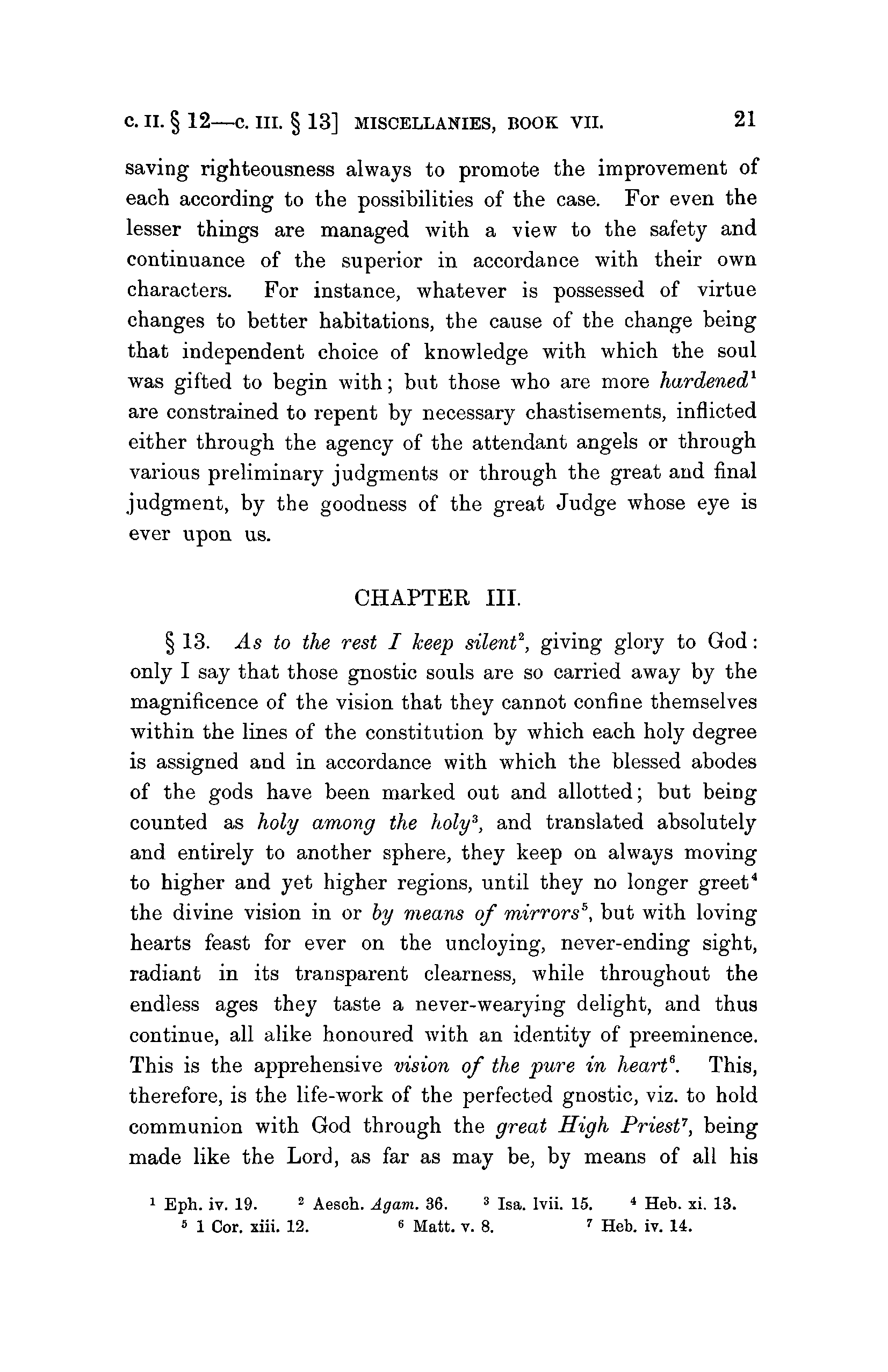
saving righteousness always to promote the improvement of each according to the possibilities of the case. For even the lesser things are managed with a view to the safety and continuance of the superior in accordance with their own characters.
For instance, whatever is possessed of virtue changes to better habitations, the cause of the change being that independent choice of knowledge with which the soul was gifted to begin with; but those who are more hardened1 are constrained to repent by necessary chastisements, inflicted either through the agency of the attendant angels or through various preliminary judgments or through the great and final judgment, by the goodness of the great Judge whose eye is ever upon us.
CHAPTER III.
§ 13. As to the rest I keep silent2, giving glory to God: only I say that those gnostic souls are so carried away by the magnificence of the vision that they cannot confine themselves within the lines of the constitution by which each holy degree is assigned and in accordance with which the blessed abodes of the gods have been marked out and allotted; but being counted as holy among the holy3, and translated absolutely and entirely to another sphere, they keep on always moving to higher and yet higher regions, until they no longer greet4 the divine vision in or by means of mirrors5, but with loving hearts feast for ever on the uncloying, never-ending sight, radiant in its transparent clearness, while throughout the endless ages they taste a never-wearying delight, and thus continue, all alike honoured with an identity of preeminence.
This is the apprehensive vision of the pure in heart6. This, therefore, is the life-work of the perfected gnostic, viz. to hold communion with God through the great High Priest7, being made like the Lord, as far as may be, by means of all his
1 Eph. iv. 19.
2 Aesoh. Agam. 36.
3 Isa. Ivii. 15.
* Heb. xi. 13.
8 1 Cor. xiii. 12.
« Matt. v. 8.
7 Heb. iv. 14. https://doi.org/10.1017/CBO9780511695513.010 Published online by Cambridge University Press
STPQMATEQN Z'
[p. 835, s. 300
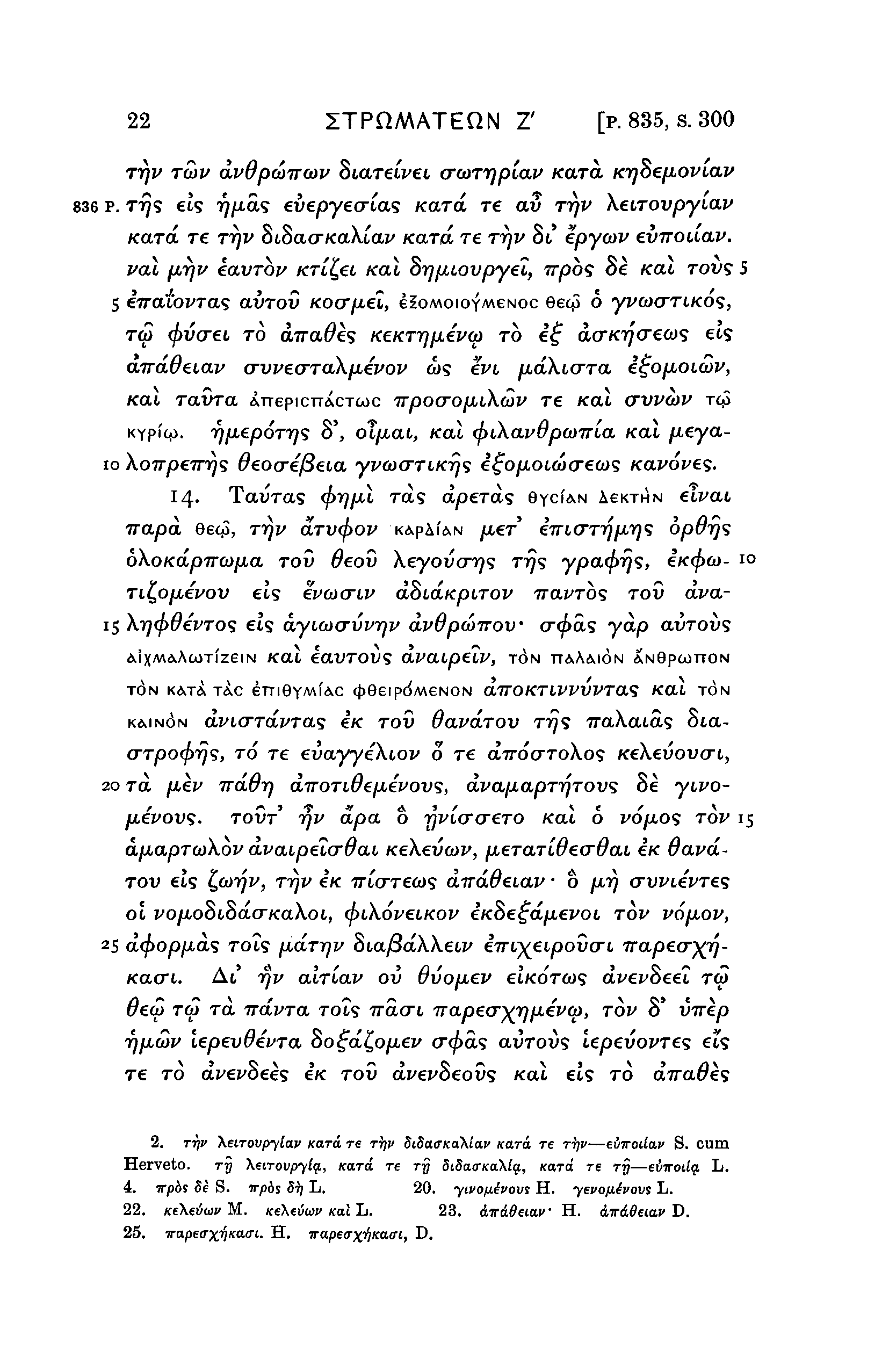
TT/V rap dvdpcaiTOiv Stareivei o-car'qpiav Kara 836 P. TTJS ets r]f^d<; evepyeo-'ias Kara, re av TX]V Xeirovpyiav Kara, re rrjv StSacr/caXiav Kara re rrjv Si' epycov eviroiiav. pal firjv eavrbv KTI£CI Kal Zrjjjuovpyel, irpo<; he Kal TOUS 5
S eTra'iovras avrov Kocr^ei, eSoMoioyMeNoc ee^p 6 yv(acrriK.6<;, r<£ (f}vaeu TO airades KeKrrjfjievco TO e£ avaOeiav a-vveaTaXfievov &»s evt paXicrra if Kal ravra ^nepicnalcTcoc irpocroiLikaiv re Kal crvvcov
Kypfcp.
T^jaepoT^s S\ ol/JLai, Kal <f>i\av9p(x)7rCa Kal io \ovpeTrrjs 6eo(re[$eLa yvcoaTiKrjs e^OjUOK
14.
Tauras (^yai Tas dperds OYCIAN AEKTHN etvat Tra/Da eecp, TIJV drv(f>ov K&P&I&N per eViCTT^jaij? 6pdT)<; 6XoKapTro)fia rov deov \eyovcrrjs TTJS ypa^yj1;, iK<fxo10 ri^ofjuevov el<s 'ivaxriv dSuaKpLTov Trai/ros TOV dva15 Xif](f)devro<; ei<s a.yi<xt<jvvr\v dvOpconov cr(j>as yap avrous AixMAAtoTfzeiN <cai eavrous dvat,pe7u, TON HAAAION AN9pconoiM T6N KAT4, T^C emeyMiAc <J>6eipdMeN0N aTTOKTivvvvras
Kai TON KAINON dvuTTavras 4K TOV davdrov rrj<; 77aXatas Sta- <rrpo<f>r}<;, TO re evayyikiov o re 017700-70X05 KeXeuoucri, 20 TO. fj,ev Trddr) diroridefjuevov;, dvanapTtJTovs he yivofjLevoviTOVT" iqv dpa o rjvio~o-eTO /cat 6 v6[xo<5 TOV 15 dfiaprcoXov dvaipelo~6ai KeXevaiv, [LeTariQecrQai IK davdrov ets t^W'
TW e'K •"'to-Tews dnddeiav • o fj-rj o-wteWes ot vofioSiSdo-KaXoL, <f>iX6veLKov €KSe^dfj.evoi rbv vofiov,
25 d(^op/xa.s Tots fidrrfv SiafiaXXeuv eTri^eipovo-L irapeo~)^qKao"i.
Ai' i}V alrCav ov Ovofiev etKoVais dve^Seer TW ^ea> T&) TO. irdvra TO?S irao~i •7rapeo~)(r)fiev(p, TOV 8' v-rrep rjficov lepevdivTa So^d^ofiev o~<f>a<; avTous lepevovre^ els re TO dvevSees IK TOV dvevSeovs Kal eis TO dirade<; 2.
Tr/v \enovpyiar Kara re rty SiSajxaXLav Kara re TT)V-—evwodav S. cum Herveto.
TT) \urovpylq., Kara re rjj SidaffKoKly, Kara re r%—einodq. L.
4. irpbs Se S.
Trpds 5^ L.
20. yivo^vovi H. yevofxtvovs L.
22.
Ke\e6iM M.
Kektiuv Kal L.
23. <brd0«a>'- H. djrdBciav D.
25.
Trapetrx^Kac'. H .
Trapea-x^licaai, D. https://doi.org/10.1017/CBO9780511695513.010 Published online by Cambridge University Press
C. III. §§ 13, 14]
MISCELLANIES, BOOK VII.
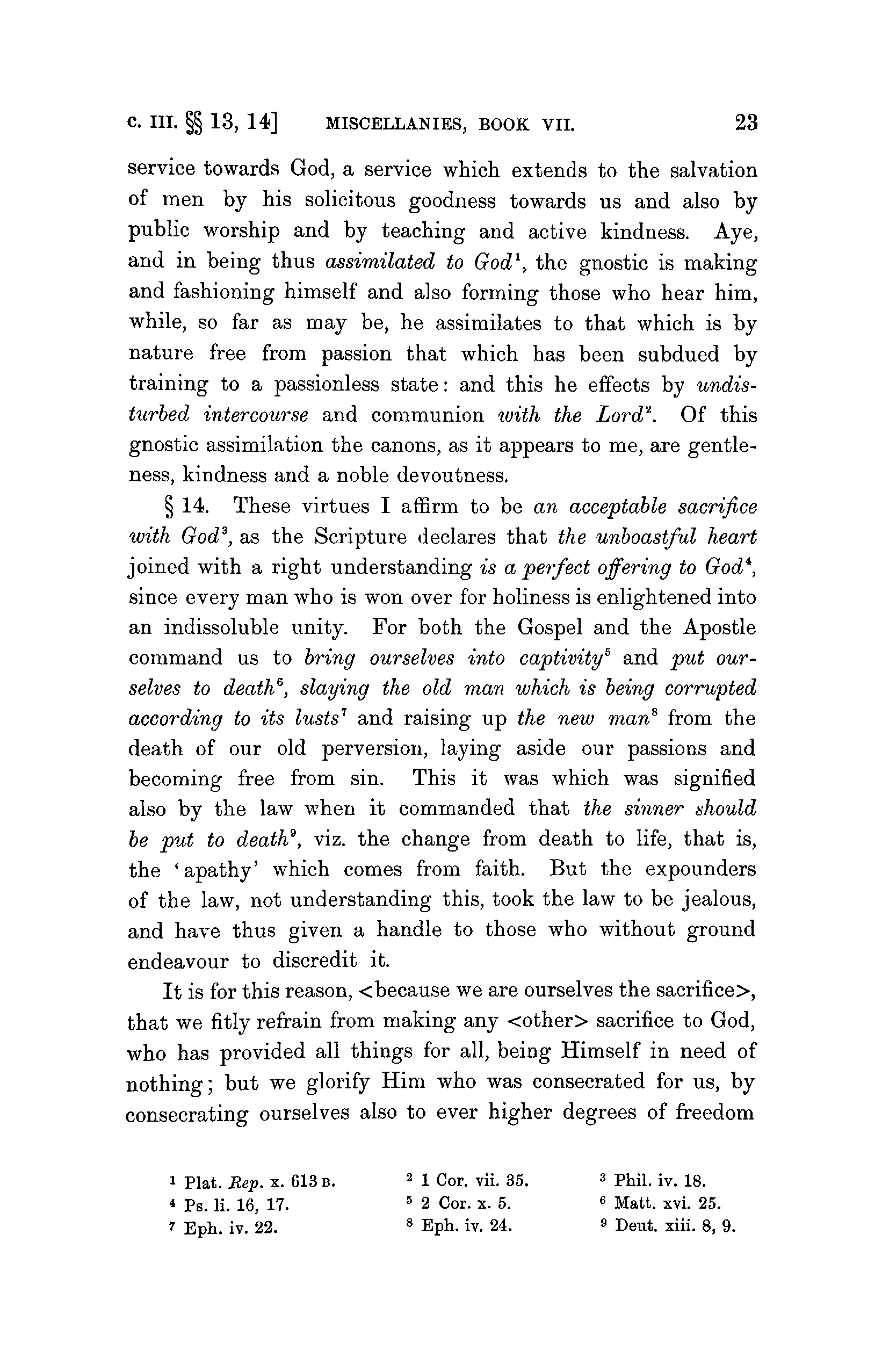
service towards God, a service which extends to the salvation of men by his solicitous goodness towards us and also by public worship and by teaching and active kindness. Aye, and in being thus assimilated to God1, the gnostic is making and fashioning himself and also forming those who hear him, while, so far as may be, he assimilates to that which is by nature free from passion that which has been subdued by training to a passionless state: and this he effects by undisturbed intercourse and communion with the Lord''. Of this gnostic assimilation the canons, as it appears to me, are gentleness, kindness and a noble devoutness.
§ 14. These virtues I affirm to be an acceptable sacrifice with God3, as the Scripture declares that the unboastful heart joined with a right understanding is a perfect offering to God*, since every man who is won over for holiness is enlightened into an indissoluble unity. For both the Gospel and the Apostle command us to bring ourselves into captivity6 and put ourselves to death5, slaying the old man which is being corrupted according to its lusts1 and raising up the new man8 from the death of our old perversion, laying aside our passions and becoming free from sin. This it was which was signified also by the law when it commanded that the sinner should be put to death9, viz. the change from death to life, that is, the 'apathy' which comes from faith. But the expounders of the law, not understanding this, took the law to be jealous, and have thus given a handle to those who without ground endeavour to discredit it.
It is for this reason, <because we are ourselves the sacrifice>, that we fitly refrain from making any <other> sacrifice to God, who has provided all things for all, being Himself in need of nothing; but we glorify Him who was consecrated for us, by consecrating ourselves also to ever higher degrees of freedom
1 Plat. Rep. x. 613 B.
2 1 Cor. vii. 35.
3 Phil. iv. 18.
4 p s . H. 16, 17.
5 2 Cor. x. 5.
6 Matt. xvi. 25.
7 Eph. iv. 22.
8 Eph. iv. 24.
9 Dent. xiii. 8, 9. https://doi.org/10.1017/CBO9780511695513.010 Published online by Cambridge University Press
ITPQMATEQN Z'
[p. 836, s. 300
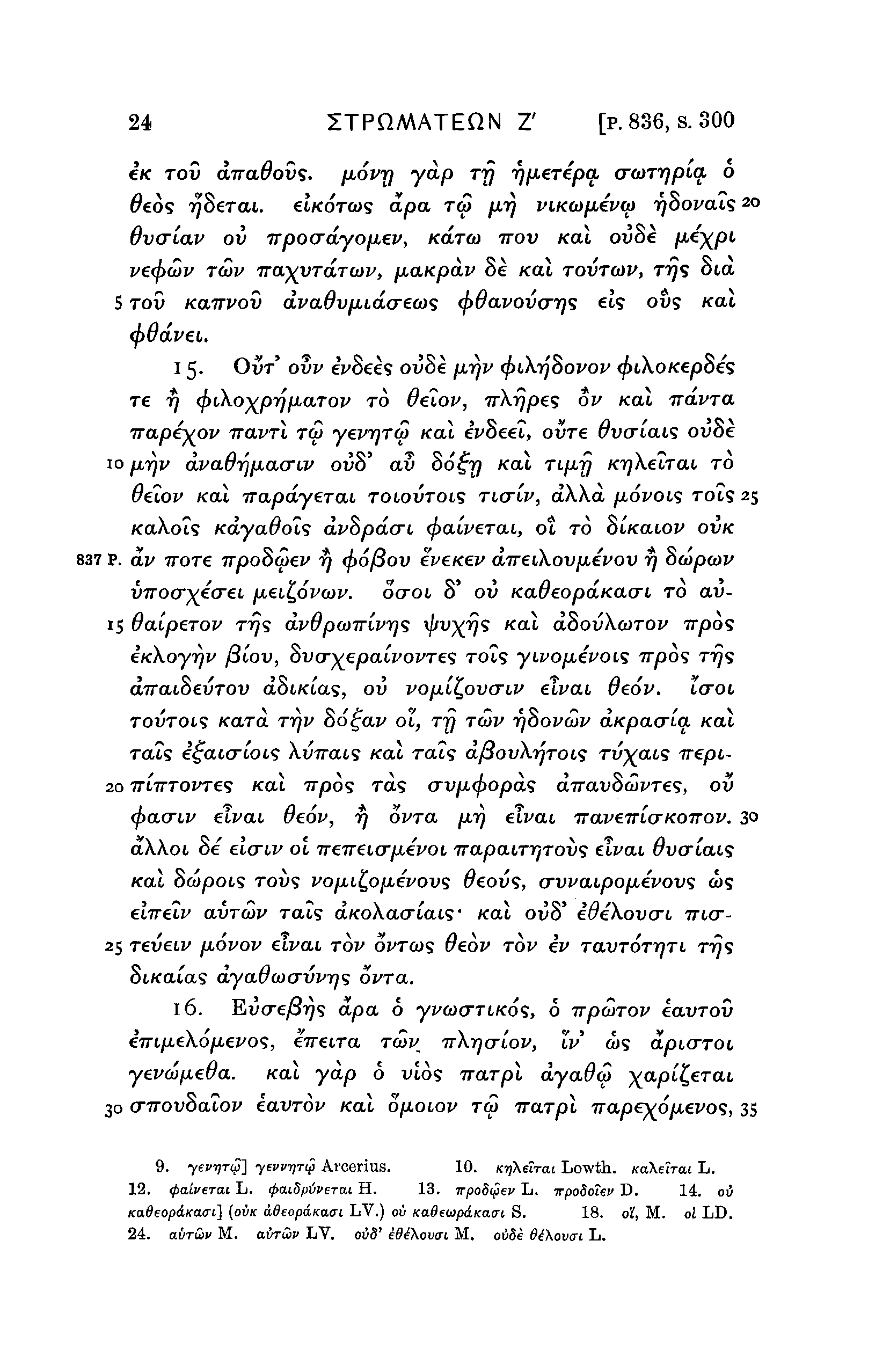
€K TOV diraOovs. povrj yap rrj rjfJLeTepa crwTqpia
0eos rjBeTai.
CIKOTWS apa TS /AT) vt/cwyxevoj r)8ovcu<; 20 dvcriav ov irpoadyofiev, KaYtu irov KaX ovSe /-te^pi vetjxiov T&v TraxyTaTwv, paKpav Se /cai TOVTCJV, TTJS oia
S TOV KaTTVOv dvadv/jiidcreco's (f>6a.vovcr7)<; ei? ovs <})6dvei,.
15.
OUT' OVV evSees owSe jLtiyf (ftuXijBovov re rj (j>Lko^pyjfJLaTov TO deiov, irXfjpes ov Kai irape^ov TTOLVTI TW yevrjTM Kai ivheei, ovre dvaiavi ovoe 10 fir)v dvadr]yiao-iv ovh" av 80^77 Kai TL/JLTJ Kr/Xetrai. TO BzLov KaX TTapdyeTai TOIOVTOLS TIO-'IV, dWd fj.6vois TOIS 25
KaXoIs Kayadols dvSpdo~L <$>aive.Tai, 0% TO hiKaiov OVK 837 p. ai/ 7TOT€ upoScoev rj <f)6fiov eveKev direi\ov[j.evov r) Stopov vTrocry(icr€i jjieitpvwv.
6V01 S' oi; KaOeopaKaav TO av15 Oaiperov T179 dvOpcoTrivr/s \jjv~xfj<; Kai dSovXcoTOv irpos iKkoyr)v /3iov, Zvo-yepaivovTe<s TOIS yivofjuevois irpos Trjs diraiSevTov dStKtas, ov vopitpvariv elvat deov. tcroi TOVTOIS KaTa. Trjv So'faz/ ol, Trj TWV rjSovwv aKpao-'ia.
Tats e^xticrtois XuVais Kai Tats a/3ouX.7jTot5 Tu 20 7Tl7TTOVTe? Kai TTpoS TCt§ O"V/A(^OpaS aTTauS&Jl'TeS, OU <f>ao~Lv elvai, deov, r/ ovTa /jcrj elmi TraveirLo-KOTTOV. 30 aXXoi Se elo~iv oi TreTreicryu.eVot TrapatTT/rov? elvai 6vcriats
Kai Swpois TOUS vofxitpyLivovi 9eov<;, crwatpojaeVovs ws elnelv avrcov Tats aKoXaaiais* Kai ov8' ideXovcn
TTICT25 Teuetv fiovov eivau TOV OVTCOS deov TOV iv TavTOTrjTi Trjs StKaias dya6<t)0~vvrj<; ovTa.
16.
Eucre/3i)s apa 6 yvwcrTtKos, 6 wpaJTov eavTov C77i//,eXoju,ei'os, eireiTa TCOJ/
TTXYJO-LOV, IV
&»S apio-Toi yevd>(jL€0a. Kai yap 6 vios naTpl dyada} ^apt^eTai 30 crvrovSaiov eaUTOv Kai o/xoiov TW iraTpl Trape^o/Aevos, 35
9. yevriTip] yevvriTip Arcerius.
10.
KijKurai. Lowth. KaXeirai L.
12.
(paliterai L. tfiatSpiverai. H.
13. irpoSifev L. irpodoiev D.
14. oi> /caSeopdKacri] (oy/c adeopaKaai LV.) ou Ka0eap6.Ka<n S.
18. oZ, M. oi L D .
24. aiiTui/ M. aiirw LV. oi)8' idiXawi. M. oi)Se 6£\ov<n L. https://doi.org/10.1017/CBO9780511695513.010 Published online by Cambridge University Press
C. III. §§ 14—16]
MISCELLANIES, BOOK VII.
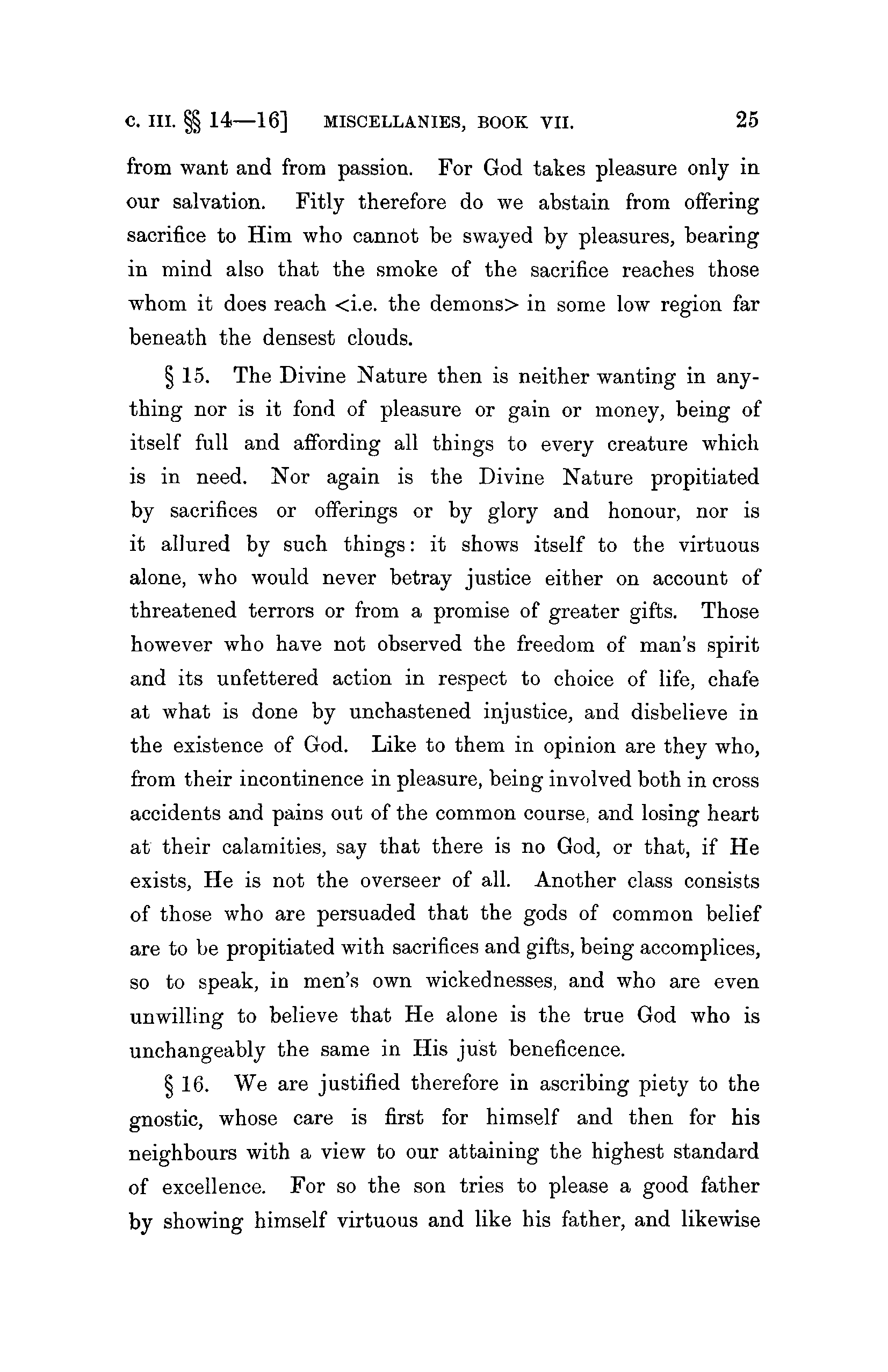
from want and from passion. For God takes pleasure only in our salvation.
Fitly therefore do we abstain from offering sacrifice to Him who cannot be swayed by pleasures, bearing in mind also that the smoke of the sacrifice reaches those whom it does reach <i.e. the demons> in some low region far beneath the densest clouds.
§ 15. The Divine Nature then is neither wanting in anything nor is it fond of pleasure or gain or money, being of itself full and affording all things to every creature which is in need. Nor again is the Divine Nature propitiated by sacrifices or offerings or by glory and honour, nor is it allured by such things: it shows itself to the virtuous alone, who would never betray justice either on account of threatened terrors or from a promise of greater gifts. Those however who have not observed the freedom of man's spirit and its unfettered action in respect to choice of life, chafe at what is done by unchastened injustice, and disbelieve in the existence of God. Like to them in opinion are they who, from their incontinence in pleasure, being involved both in cross accidents and pains out of the common course, and losing heart at their calamities, say that there is no God, or that, if He exists, He is not the overseer of all. Another class consists of those who are persuaded that the gods of common belief are to be propitiated with sacrifices and gifts, being accomplices, so to speak, in men's own wickednesses, and who are even unwilling to believe that He alone is the true God who is unchangeably the same in His just beneficence.
§ 16. We are justified therefore in ascribing piety to the gnostic, whose care is first for himself and then for his neighbours with a view to our attaining the highest standard of excellence. For so the son tries to please a good father by showing himself virtuous and like his father, and likewise https://doi.org/10.1017/CBO9780511695513.010 Published online by Cambridge University Press
ZTPQMATEQN Z'
[p. 837, s. 300
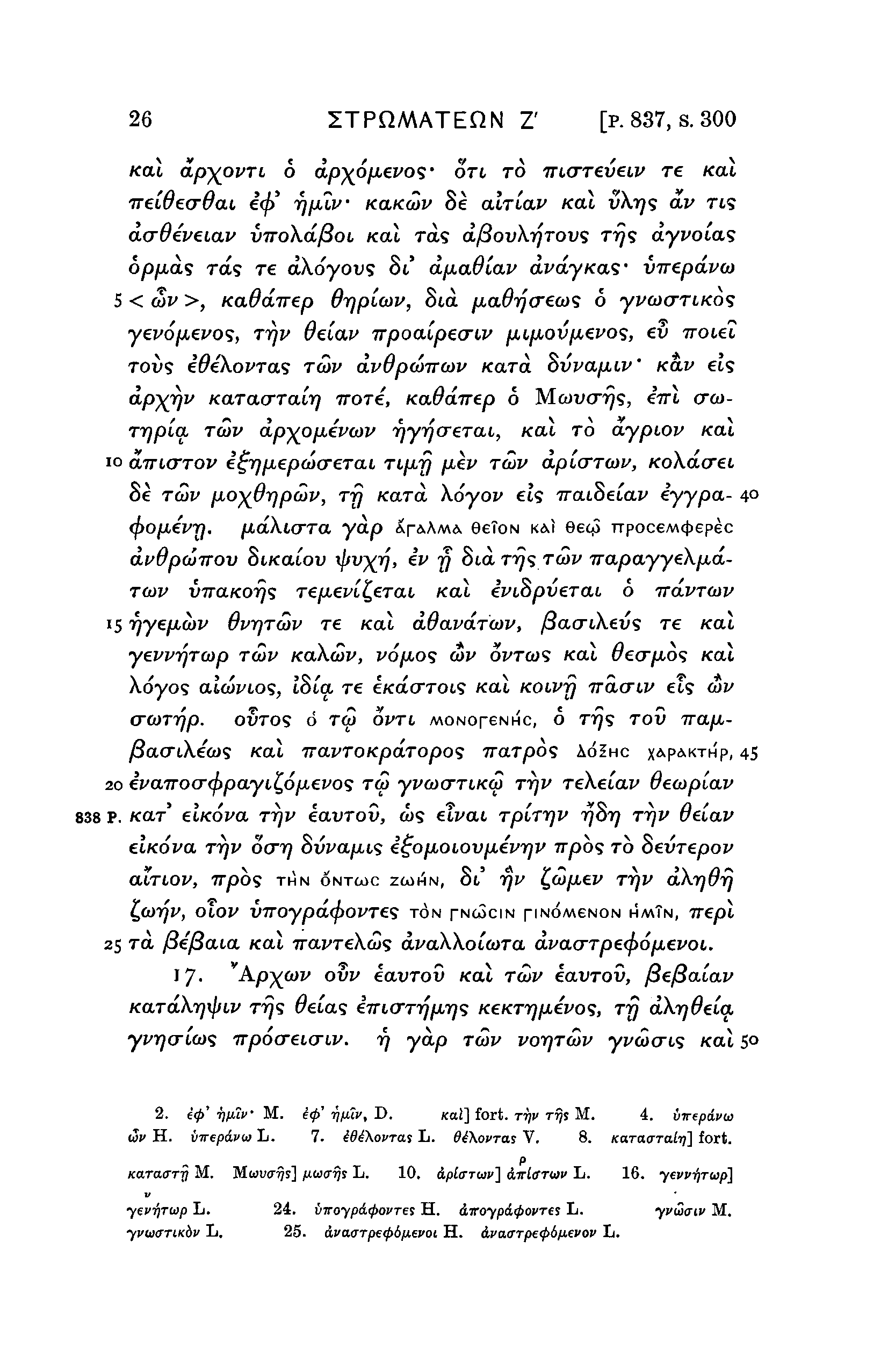
Kal ap-^ovTL 6 dpxojAevos' on TO mcrTeveLV re Kal TreudecrdaL i<j> rjfj.lv KCLKCOV Se OXT'KXV Kal UXTJS dv n ? dcrOeveLav virokafioi nal ras dfiovXrJTOws Tr)<; dyvoias op/xas ras re dXoyous Si' dfxadiav aVdy/cas1 virepdvco
5 < wv >, Kaddirep dr\p'iwv, Sta fj.a.0T}o-ecos 6 yvo)o-TiKo<; yevo^evos, Trjv Oeiav irpoaupeo'i.v IXLIJ.OV[XGVOS, ev -rroiel
TOUS idikovTa's TW> dvOpamwv Kara Zvvafj.iv'
KOLV ets dp^rjv KaTao~Taiq TTOT4, Kaddnep 6 M-Ovcryj?, eVt crwTrjpia TWV dpypjhivoiv rjyrjO-eTai, nai TO aypiov /cai 10 aVicrTOV i^rj/jLepojcreTai, Tifiy fxev TOW dpio~T<i)v, Kokdaei
Se T&SV [xo^OrjpaJv, Trj Kara Xoyov eis TraiSeCav iyypa4° (ftofxevrj.
//.aXicrra ya^o &r<^Ma. eeToN KAI ee({3 rrpoceMcjjepec dvdpGjirov SIKCUOU i/zux7?' e^ 1? Sia T^s.TaJj/ TrapayyekfxdTd)v vTTaKorjs Tejj.evi^eTai, Kal iviSpveTau
vavroiv 15 rjyefiwv dvqTcov re /cal ddavaTcov, /SacriXevs TC /cat yevvr)Ta>p TSV KaXSv, VOJJ.OS cov ovrws /cai 6eo~fJ,6<; Kal Xoyos atwios, tSta, TC e/cacrroi? Kai KOivrj naauv el? c3v
OVTOS 6 T&5 OITI MONoreNHC, 6 rrjs TOT) t iravTOKpaTopo?
TraTpos
AOIHC X^PAKTH'P, 45
20 ivaTroo-<f)payi^6fJb€vo? TCO yvcocrriKW TTJV Tekeuav Oecjpiav 838 P. Kar' et^ova TTJV iavrov, ws etvat TpCrr/v 17877 TT)I' deiav eiKova TT/V oo"Y] Swa/Ais i^ofj,oiovjj.dv7]V npb<; TO SevTepov aLTLOV, Trpb<s THN ONTCOC ZOIHN, Si' T7V ^cofiev
TTJV dXrjOrj C,6)7]v, oiov viroypa<f)OVT£<i TON PNWCIN piNOMeNON HMTN, irepl 25 TO. /8e/8aia /cat Trai'TeXcos dvaXXotwra dvacrrpe(f>6fj,evoi..
17.
"Ap^cov ovv iavTov Kal TCOV iavTov, fieftauav KaTaXrjxjjLv rrjs Betas eTriOTty/u/j/s KeKT7)fj,evo<s, Trj dXrjdeia. yvrjcrCax; Trpocreio-iv. r) yap TCOV VOTJTSV yi/cScrts Kai 50 2. i<p' r)iuv M.
^0' •qixiv, D.
Kal] fort. 7TJK T?)S M.
4. inrepdva we H. vwep&via L.
7. iBiKovras L.
WXoiras V.
Karaarati;] fort. p M.
Muuo-^s] nw<rrjs L.
10. &.pl<nwv~\ &irlffr<ov L.
16. YewijTa)/)] L.
24. iTroypd<povT£S H .
&rroyp&<j>oi>Tes L. yvQaiv M. bv L.
2 5 . &vaarpe<j>6p.evoi H . d.vaaTpe<j>biJ.evov L . https://doi.org/10.1017/CBO9780511695513.010 Published online by Cambridge University Press
C. III. §§ 16, 17]
MISCELLANIES, BOOK VII.
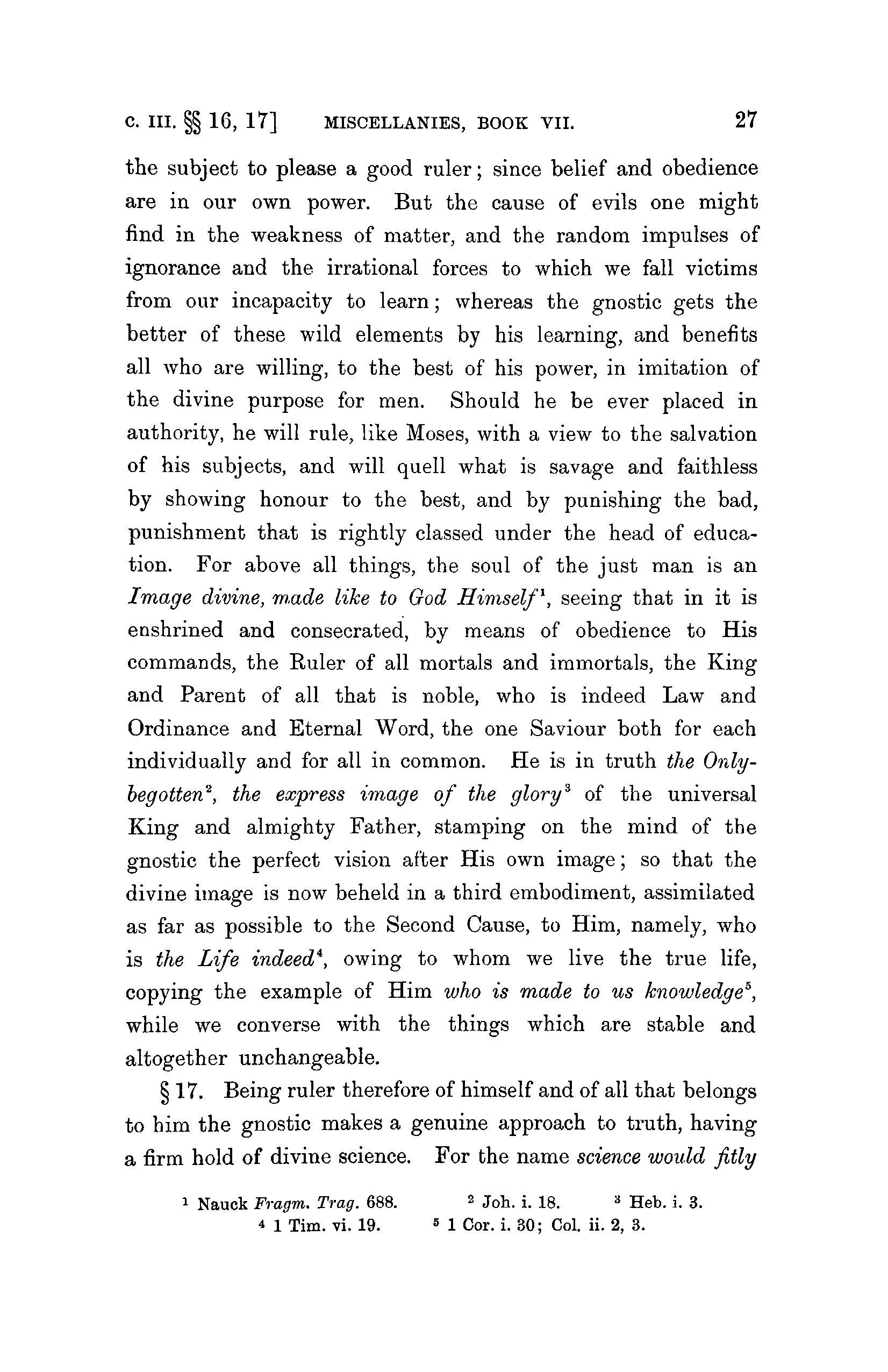
the subject to please a good ruler; since belief and obedience are in our own power. But the cause of evils one might find in the weakness of matter, and the random impulses of ignorance and the irrational forces to which we fall victims from our incapacity to learn; whereas the gnostic gets the better of these wild elements by his learning, and benefits all who are willing, to the best of his power, in imitation of the divine purpose for men. Should he be ever placed in authority, he will rule, like Moses, with a view to the salvation of his subjects, and will quell what is savage and faithless by showing honour to the best, and by punishing the bad, punishment that is rightly classed under the head of education. For above all things, the soul of the just man is an Image divine, made like to God Himself1, seeing that in it is enshrined and consecrated, by means of obedience to His commands, the Ruler of all mortals and immortals, the King and Parent of all that is noble, who is indeed Law and Ordinance and Eternal Word, the one Saviour both for each individually and for all in common. He is in truth the Onlybegotten2, the express image of the glory3 of the universal
King and almighty Father, stamping on the mind of the gnostic the perfect vision after His own image; so that the divine image is now beheld in a third embodiment, assimilated as far as possible to the Second Cause, to Him, namely, who is the Life indeed*, owing to whom we live the true life, copying the example of Him who is made to us knowledge6', while we converse with the things which are stable and altogether unchangeable.
§ 17. Being ruler therefore of himself and of all that belongs to him the gnostic makes a genuine approach to truth, having a firm hold of divine science. For the name science would fitly
1 Nauck Fragm. Trag. 688.
2 Joh. i. 18.
3 Heb. i. 3.
* 1 Tim. vi. 19.
5 1 Cor. i. 30; Col. ii. 2, 3. https://doi.org/10.1017/CBO9780511695513.010 Published online by Cambridge University Press
ITPQMATEQN Z'
[p. 838, s. 300
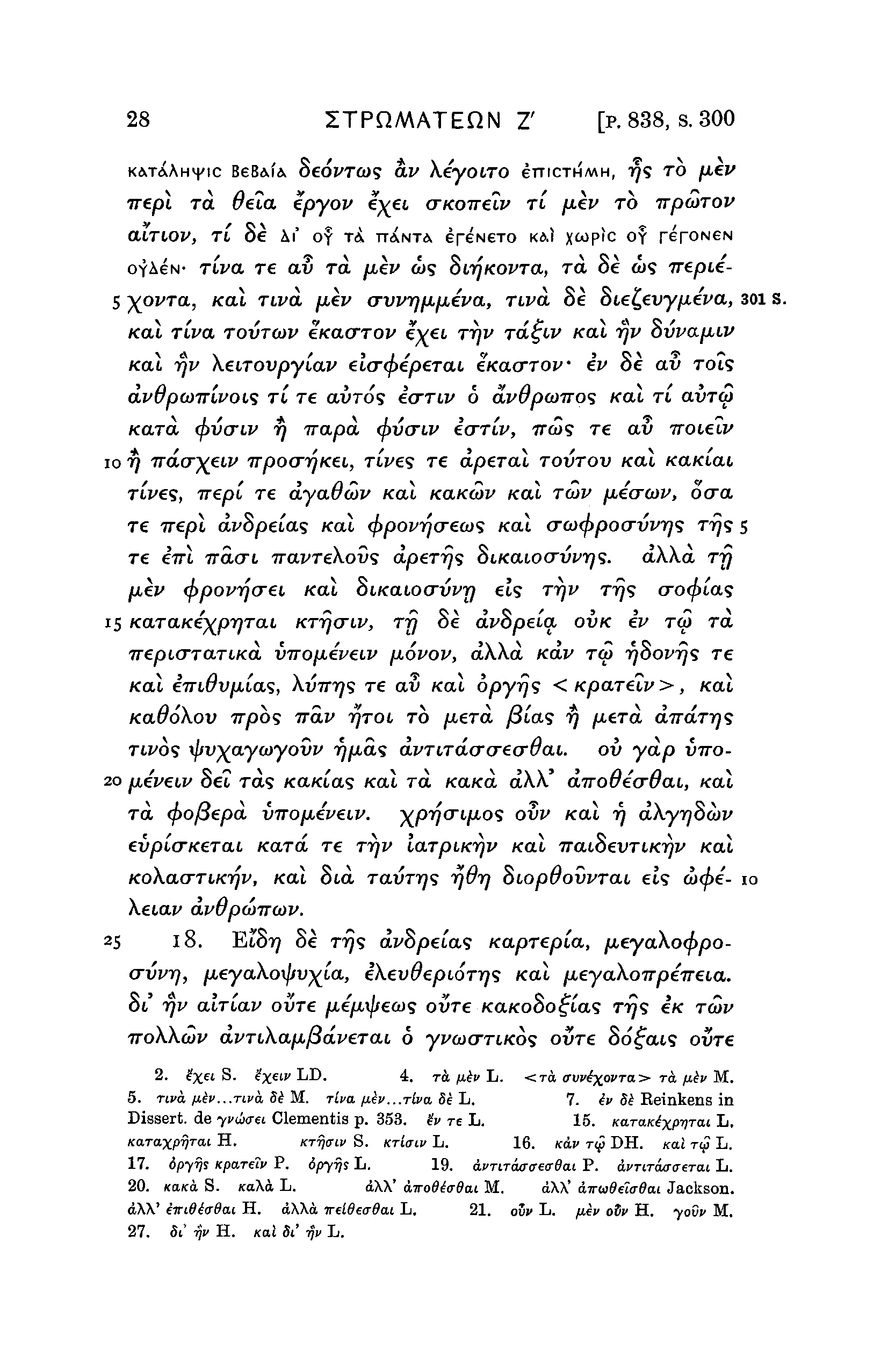
KATAAH^IC BeBaJa* SeoVrcos av \4yoiTO emcTHMH, 17s TO /Ji€V nepl TO. 0eZa epyov e^ei aKo-rreiv TL /iev TO vpcoTov ainov, TL Se h\ oy T& TT&NT*. ereNCTo K*.! X"P'C °Y oy^eNTLva Te av TO. fikv a>s Si/^KOvra, TCL Se <us
5 yovTa, Kal TLVOL /xev crvvrjfjifjieva, TLVOL Be Ste^euy/x.eVa, 301 s.
Kal TLva TOVTCOV (LKacrTov ex € t TVV TQ-^w Ka^ Vv BvvafiLV Kal rjv XeLTOvpyiav eto-^e/jerat eKaaTov kv Se av rois dvdpcoirLVOLS TL re avros ICTTLV b avOpcoiros Kal TL avTW
Kara (f>v<TLV rj Trapa (JJVCTLV ICTT'LV, TTWS xe av TTOLCLV IO ^ vracr^etv TrpocnJKeL, rives re aperal TOVTOV fcai /ca/aai
TLve<5, nepC Te dya6(ov Kal KaKcHv Kal TU>V p,£cr<tiv, ocra re Trepl avSpetas Kal (ftpovtfcreojs Kal (Taxjjpoavvrj'i TTJS 5 re eVt Tracrt TravreXovs aper^s SiKatocrw^s. a \ \ a r^ jaei' (jipovrfcreL Kal SiKatocrv^ eis r^v TTJS cro(j)La<; 15 KaTaKC)(pr)TaL KTTJCTLV, Trj Se avSpeia,
OVK kv rw TO.
Treptcrran/ca vwofJieveLv /xovov, aXXa KaV raj T^SOI'TJS re Kal inLdvfjLLas, XVTTT^S re av Kal bpyrj<; < KpaTtiv > , Kal
KaOokov 7T/3OS irav T^TOI TO yuerd j8tas ^ /aeTa aTrar^?
TWOS ^vxaywyovv i^as dvTLTaa-crecrdaL. ov yap VTTO20 fieveiv Sei rds KaKtas Kal rd Ka/cd dXX' dirodicrdaL, Kal r d <f>o/3epd viro^iveLV. y^prjCTLyLO'S ovv Kal r/ d\yr)8a>v Kara re r^v laTpLKrjv Kal TraiSevrtKi}^ Kal
Kal Std ravrr^s 17^ Siop^ov^rat eis ai^>e'- 10
18.
EISTJ Se rijs dvSpetas KapTepCa, fj,eya\o<j>pocrvvr], fjueyakoipv^Ca, eXev^e/)torr;s Kal juey
St' 17V aWCav ovTe ju,e)u,»/»eajs ovre KaKoSofias r^s CK V dvTL\aiAJ3dveTaL 6 yvojcrTLKos ovTe So^ais ovre
?x« S.
^ ' ^ LD.
4. ra ^ n L.
<ra <rvv4xovra> TO. ph M.
5. rira p.iv.. .Tiva hi M.
T£MI /j.h.. .riva Se L.
7. ev 8e Eeinkens in Dissert, de yvwaa Clementis p. 353. ft/ TE L.
15. Ka.TaKixf>i)Ta.i L, KaraxpiJTai. H .
KT^ITI>' S. KTiffti/ L.
16.
Kaj/ Ty DH. jcai T ^ L.
17.
6pyT)s Kpareiv P.
6/>7^s L.
19. di/TiT<Wecr0ai P. dcrtTotrireTai L.
20.
Kaxa S.
/caXa L. aXK' airodtadai M. dXX' airudeiaBai Jackson. dXX' iiuSitrSai H. dXXd TeideaSat L.
21. ow L.
/u,ev otv H.
70O1' M.
27.
Si rjv H.
/cai Si rjv L. https://doi.org/10.1017/CBO9780511695513.010 Published online by Cambridge University Press
C. III. §§ 17, 18]
MISCELLANIES, BOOK VII.
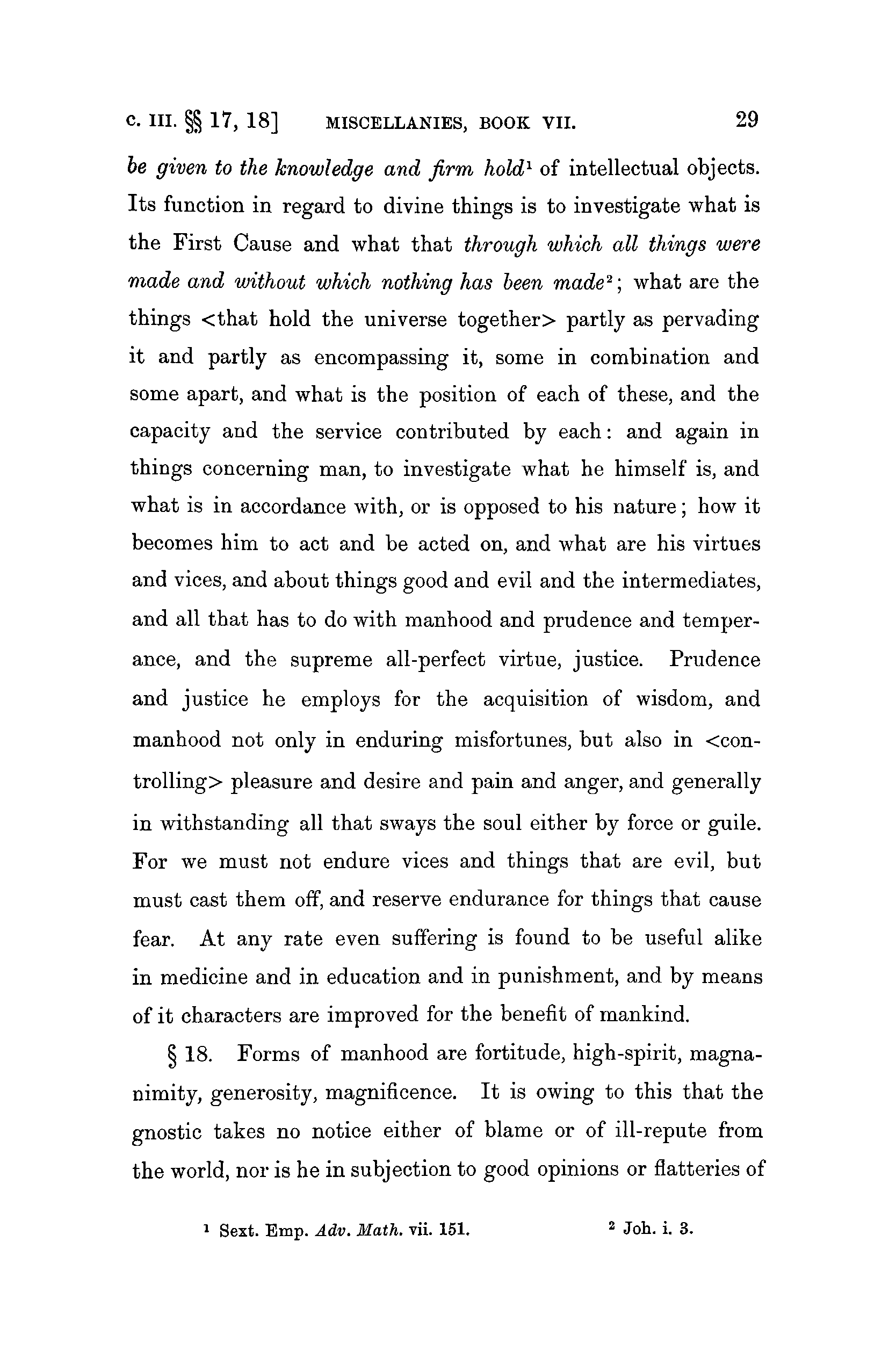
be given to the knowledge and firm hold1 of intellectual objects.
Its function in regard to divine things is to investigate what is the First Cause and what that through which all things were made and without which nothing has been made2; what are the things <that hold the universe together> partly as pervading it and partly as encompassing it, some in combination and some apart, and what is the position of each of these, and the capacity and the service contributed by each: and again in things concerning man, to investigate what he himself is, and what is in accordance with, or is opposed to his nature; how it becomes him to act and be acted on, and what are his virtues and vices, and about things good and evil and the intermediates, and all that has to do with manhood and prudence and temperance, and the supreme all-perfect virtue, justice.
Prudence and justice he employs for the acquisition of wisdom, and manhood not only in enduring misfortunes, but also in <controlling> pleasure and desire and pain and anger, and generally in withstanding all that sways the soul either by force or guile.
For we must not endure vices and things that are evil, but must cast them off, and reserve endurance for things that cause fear. At any rate even suffering is found to be useful alike in medicine and in education and in punishment, and by means of it characters are improved for the benefit of mankind.
§ 18. Forms of manhood are fortitude, high-spirit, magnanimity, generosity, magnificence. It is owing to this that the gnostic takes no notice either of blame or of ill-repute from the world, nor is he in subjection to good opinions or flatteries of 1 Sext. Emp. Adv. Math. vii. 151.
2 Joh. i. 3. https://doi.org/10.1017/CBO9780511695513.010 Published online by Cambridge University Press
ITPQMATEQN Z'
[p. 838, s. 301
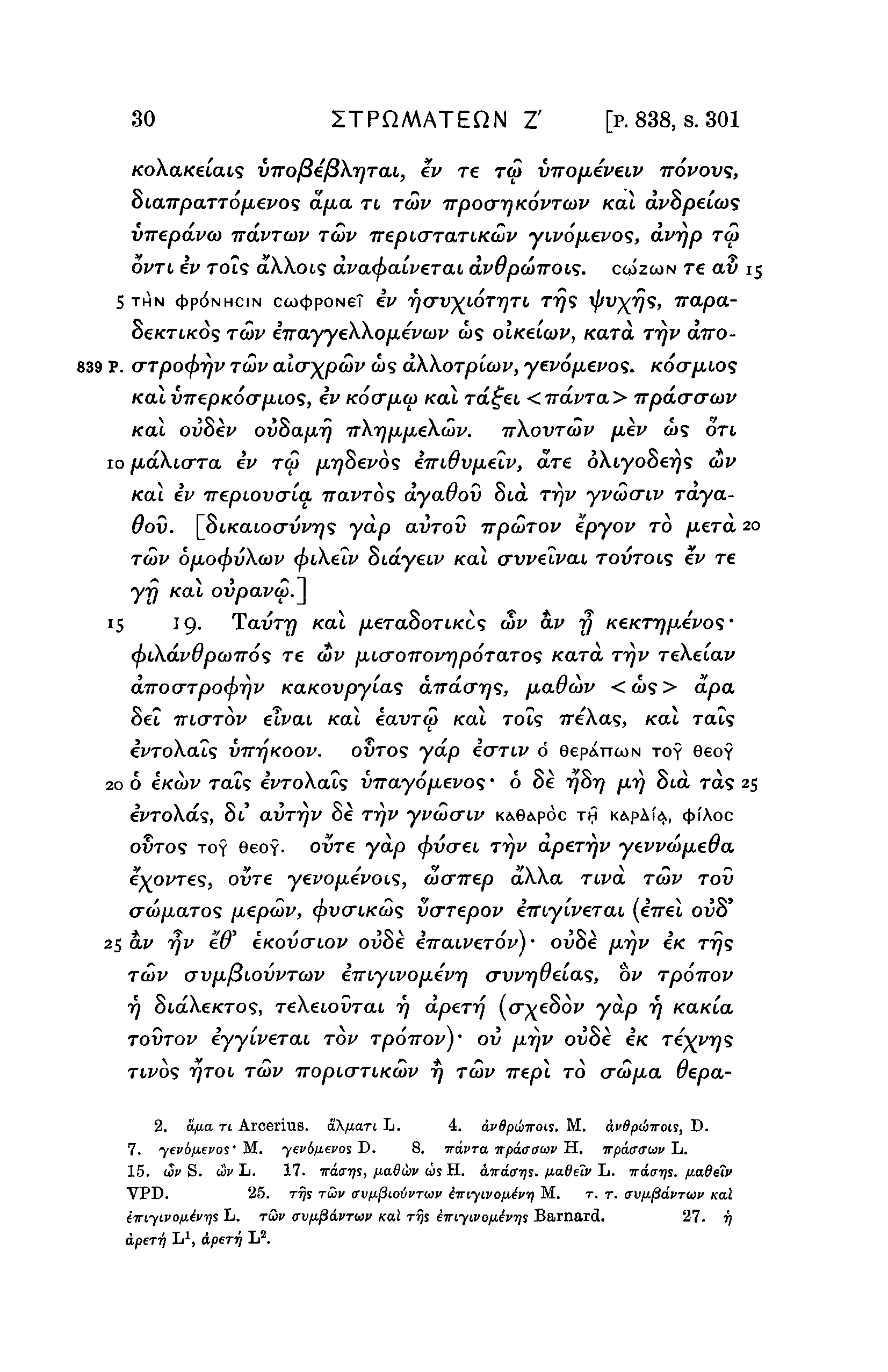
/coXa/ceiais VTrofSefihqTai, ev re rw vwofiiveiv TTOVOVS, SLairpaTTOfjievos dfia TI TCOV TrpocrrjKovTcov /cai dVS/aeioi? vnepdvco irdvrcov TCOV 7repLO~TaTiKcov yivojAtvos, dvrjp TCO OVTL iv TOIS dXXois dva(j>aCveTai dv0pcoiTOL<;. CWZCON re aw 15
5 THN 4>P6NHCIN cwct)poN6T iv rfcrv^toTrjTi rrjs \pv)(7)<;, TrapaSeKTi/fds Th>v eTrayyeXXojaeVwv ws oiKeCwv, /caret r^v aTro839 P. <TTpo<fyr)v TCOV alcy^pcov cos dWoTpCcov, yevofievo1;.
KOCT/UOS Kai v7re/3/cocr/Atos, ei' KOOT/XCO Kal ra^et <ndvTa> Trpdcrcrcov KCU ovSev 0uSa.jU.77 irXrjiJLpeXcov. ITXOVTCOV fx.lv a>s o n
10 fxdXicTTa iv TCO fjurjSevos iTridv^iiv, are oXtyoSerjs cSi'
/cat eV •nepiovcria TTOLVT6<; dyadov Sid TT)V yvwcriv rctya- . [Si/caioo-WT^s yap aurou TrpcoTOV epyov
TO (JL^TO, 20
6/MO(f>vXcov <f>iXeLV Sidyeiv KO.1 crvvelvai rourot? ev re yjj /cal oupavco.]
19.
Tav-n; /cai ^leTaSon/ccs cui' a.^ T| Ke/cTij/ieVos • cf>CkdvdpcoTros re ouv iJLLcroTTovrjpoTaTos /cara TTJI' reXeiav aTTOCTTpocjjrjV Ka/covyayia? d7rao"7j5, jxadcov <co<s> dpa
Sei TTICTTOV elvai /cai eaurw Kal TOI§ 7reXas, /cai e^roXats vTrrjKoov.
OUTOS ydp icTTiv 6 eep^ntoN TOY 20 6 e/ccov rals e^roXats vTra/y6fiEvos • 6 Se 7787/ JU,T) Sid Tas 25 evroXas, Si' auTr}t> Se TT)V yfwcrij' KAOAPOC T£ K&pAf<>, t(>i'Aoc
OUTOS TOY 6eoYOVTZ yap <f>vcreL Trjv dperrjv ytvvcopeOa s, ovre yevo[xei>OL<s, coatrep dXXa Tuva
TCOV TOV [xepcov, cf)vcru<co<; vcrTepov imyCveTau (ivel oi;S'
25 av rjv e0' k.Kovaiov ovSe iTTa.ivz.TOv) • ouSe p/r\v e/c TTJ?
TttJv o~vfjif3iovvTcov iTnyivojj.ev7] crvvrjOeicvs, ov Tpoirov 7) SidXe/cros, reXeiovTai 77 apery (^cr^eSov yap 77 /ca/cia TOVTOV iyyiverai TOI' Tpoirov)' ov /ji.rjv ovSe e/c TIVOS 77701 T(5l> TTOpLCTTlKCOV rj TCOV 776/31 TO CTCOfia
2. afxa TI Arcerius. aX/tari L.
4. ivSptiwois. M. avBpdnrois, D.
7fj'6/iei'osM. yev6fievos D.
8. iravTa Trpaaaav H. irpacauv L.
15. we S. wv L.
17. iraty-qi, fiadwv as H. a:rd<n;s. ixaBeiv L. irdarjs. /laB VPD.
25.
T?5S TWI/ ffvin§mivTO>v iiriyivo/xivi) M.
T. T. ffVfi^dvTWv eTriyivofi.4vris L.
TUC <rv/j.[lAvTwv Kal TTJS eiriyivofiivTis Barnard.
27.
L1, dperi? L 2. https://doi.org/10.1017/CBO9780511695513.010 Published online by Cambridge University Press
C. III. §§ 18, 19]
MISCELLANIES, BOOK VII.
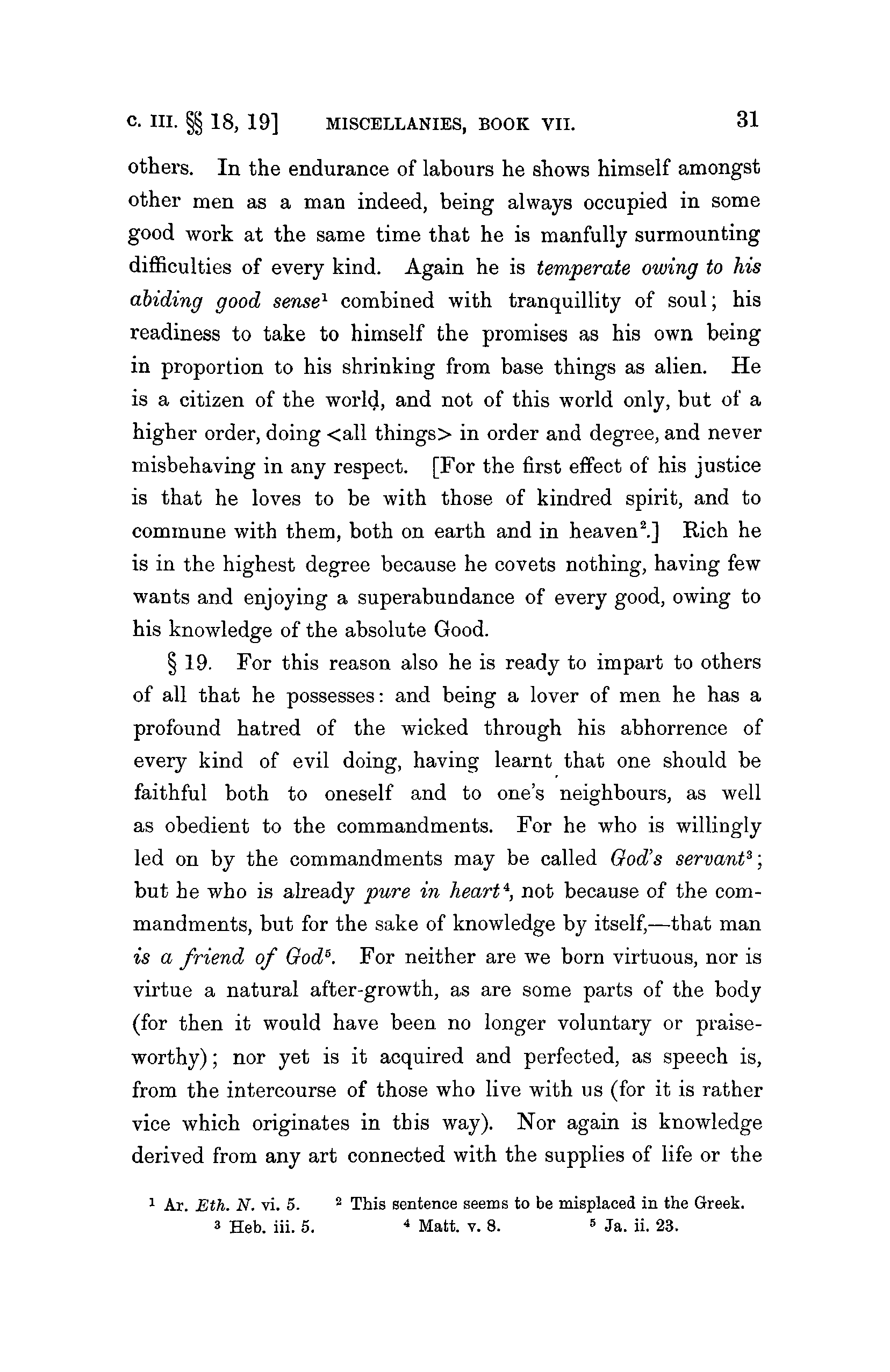
others. In the endurance of labours he shows himself amongst other men as a man indeed, being always occupied in some good work at the same time that he is manfully surmounting difficulties of every kind. Again he is temperate owing to his abiding good sense1 combined with tranquillity of soul; his readiness to take to himself the promises as his own being in proportion to his shrinking from base things as alien. He is a citizen of the world, and not of this world only, but of a higher order, doing <all things> in order and degree, and never misbehaving in any respect. [For the first effect of his justice is that he loves to be with those of kindred spirit, and to commune with them, both on earth and in heaven2.] Rich he is in the highest degree because he covets nothing, having few wants and enjoying a superabundance of every good, owing to his knowledge of the absolute Good.
§ 19. For this reason also he is ready to impart to others of all that he possesses: and being a lover of men he has a profound hatred of the wicked through his abhorrence of every kind of evil doing, having learnt that one should be faithful both to oneself and to one's neighbours, as well as obedient to the commandments. For he who is willingly led on by the commandments may be called God's servant3; but he who is already pure in heart4, not because of the commandments, but for the sake of knowledge by itself,—that man is a friend of God6. For neither are we born virtuous, nor is virtue a natural after-growth, as are some parts of the body
(for then it would have been no longer voluntary or praiseworthy) ; nor yet is it acquired and perfected, as speech is, from the intercourse of those who live with us (for it is rather vice which originates in this way). Nor again is knowledge derived from any art connected with the supplies of life or the 1 Ar. Eth. N. vi. 5.
2 This sentence seems to be misplaced in the Greek.
3 Heb. iii. 5.
4 Matt. v. 8.
6 Ja. ii. 23. https://doi.org/10.1017/CBO9780511695513.010 Published online by Cambridge University Press
ITPQMATEQN Z'
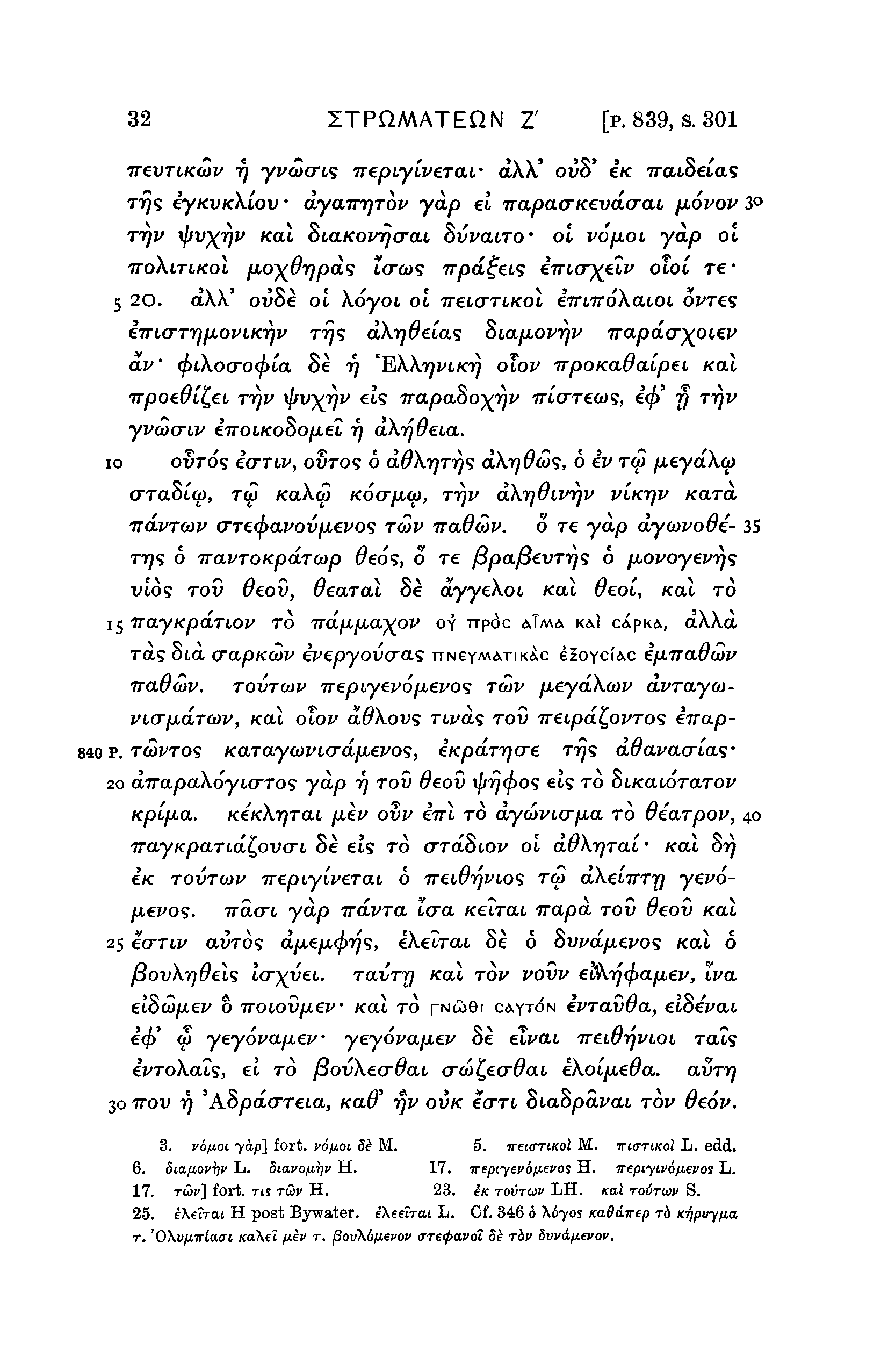
[p. 839, s. 301 rj yvcoo'ts TtepiyiveTai' dXX' ovS' e/c Trjs iyKVKkiov • dyaTrrjTov yap el vapourKevdo-au
JJLOVOV 3°
TTJV \J/v)(r}v Kal hiaKovrjcrai S I W I T O * ol vofMOL ydp ol TTOXLTLKOL fio^8r)pd<s ura)s Trpa^et? eirio-xeiv oloC re* 5 2O. aXX' ouSe ot Xoyot oi TretcrriKot erruTroXaioi ovres i ^ dd S d dv <f>ikoo~o(f)ta Se 17 'EXX.TjvtK:^ 0^1^ irpoKaQaipzi
/cat i Trjv x}iv~xrjv ets TrapaSo^rjv •77"to"Tea>s, e^>' io~Tiv, ovros 6 d6XrjTrj<s aXr/dcos, 6 iv TO» fj-eyaXco tft), ra /caX&I KOCT/AO), TI)I' dXrjdivrjv
VLKT/V /cara, irdvTcov crTe^avovju-ei'os T<UI> iraBdv. o re yap dycovode35 7775 6 TravTOKpdrotp deos, 6 re fipafievTr/s 6 yLOvoyevrfs vios TOU 6eov, deaTal Se ayyeXot Kal ^eoi, /cal TO 15 nayKpaTiov TO irdfiyua^ov oy rrp6c ATM*. KA! C&PKA, aXXd ras 8ta o~apKa>v ivepyovaa<; TTNeyMATiK^c eloycf^c ifJiTTaOaiv naOaiv.
TOVTUIV Trepiyev6fievo<; Tatv jxeydXo)v dvrayoivio-paTtov, Kal olov d$Xov<s TUXXS TOC Treipa^ovros iirap840 P. TWI^TOS KaTaycovLcrdfxevo?, iKpaTrjae
TTJS ddavaaCas'
20 aTrapaXoyio-Tos ydp r\ TOV deov \prj(f>o<s eis TO St/catoraTOV KpC/xa. KeKXrjTai, fxev ovv inl TO dyoivio-p.a TO BeaTpov, 40
TrayK.paTidtpvo-1 8e eis TO crraSiov ol ddXrjTat'
Kal S77 e«: TOUTWV irepiryiveTai b Trei6rjvio<; rw dXeiiTTrj yevo- [Kevo%. Tracri yap irdvTa laa /cetrai irapd TOV deov /cat
25 eo~TLv avT0<; dfjL€[jL<f)rj<;, eXetrat 8e 6 Swayaevos Kal 6 fiovXr/Bels io"^uet.
TavTTj Kal TOV VOVV e^Xrj^afjuev, Iva elScofiev o TTOiovfxev Kal TO fNCidi CAYTON ivTavOa, eiSevai i<{> a) yeyovafjcev yeyova^ev Se eti'at Trei6r\vioi rais eVroXats, et TO fSovXecrdai, o-co^eaBac ekoi^eBa. ami) 30 TTOV 17 'ASpao-reta, «a^' 17^ OVK eo-Tt StaSpavat TOV 0eoV.
3. i<6|Uoi 7a/)] fort, v6fj.cn. Si M.
5. ireurnKol M.
TTKSTIKOI L. edd.
SiajUOFTjc L. diavofj,ijv H .
17. ireptyevi/Aevos H.
Treptyiv6/J.evos L.
17. w ) fort, TIS TSK H.
23.
^/c TOiirui' LH. icai TOJJTWV S.
25. eXei-rai H post Bywater. Aeeirai L. Cf. 346 6 \670s icaBdirep rb T. '0\up.wla(n Ka\e~i /J.CV T. [SovK&ixevov areipavdi 5£ rbv dwi/ievov. https://doi.org/10.1017/CBO9780511695513.010 Published online by Cambridge University Press
C. III. §§ 19, 20]
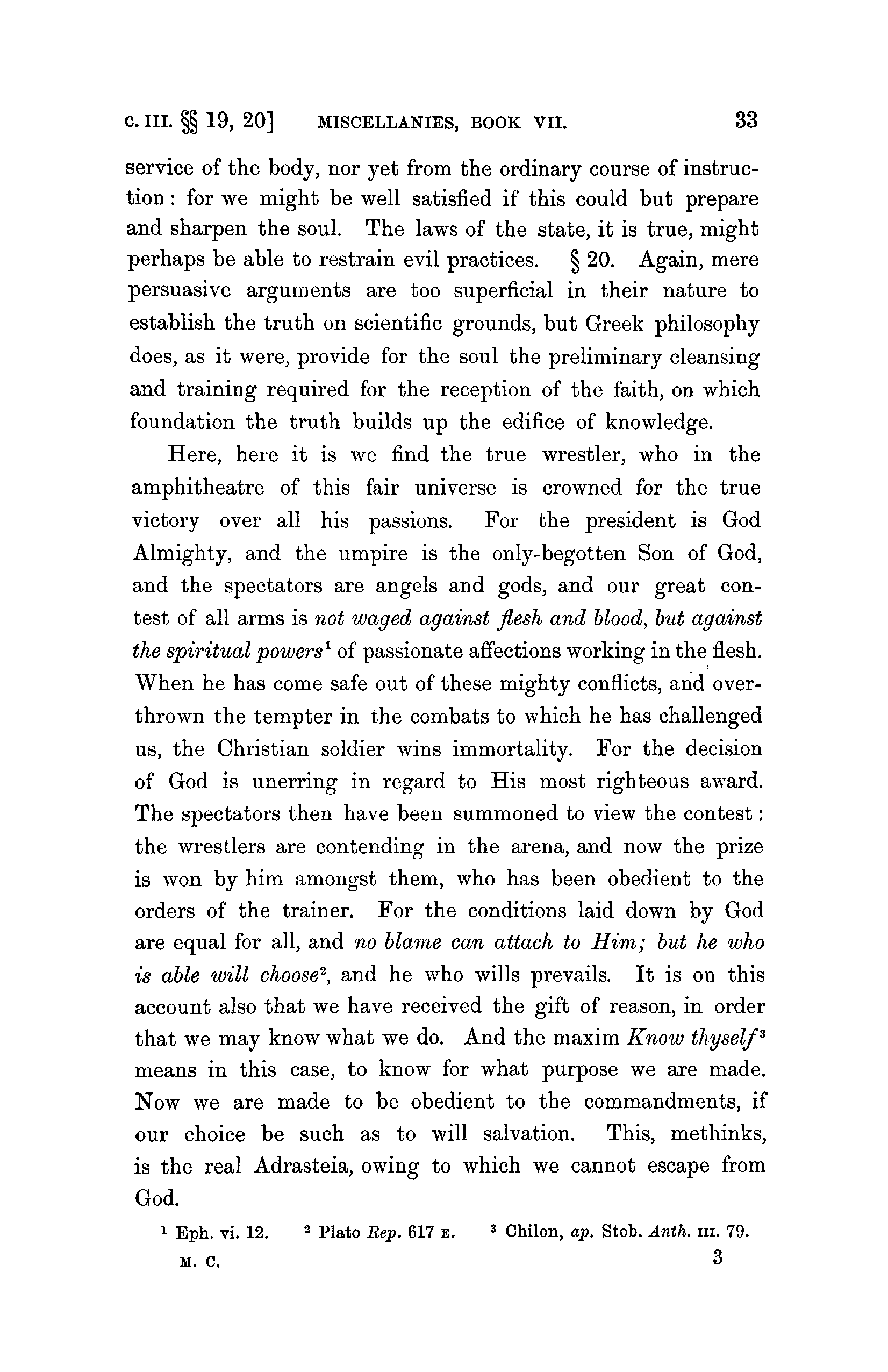
MISCELLANIES, BOOK VII.
service of the body, nor yet from the ordinary course of instruction : for we might be well satisfied if this could but prepare and sharpen the soul. The laws of the state, it is true, might perhaps be able to restrain evil practices.
§ 20. Again, mere persuasive arguments are too superficial in their nature to establish the truth on scientific grounds, but Greek philosophy does, as it were, provide for the soul the preliminary cleansing and training required for the reception of the faith, on which foundation the truth builds up the edifice of knowledge.
Here, here it is we find the true wrestler, who in the amphitheatre of this fair universe is crowned for the true victory over all his passions.
For the president is God Almighty, and the umpire is the only-begotten Son of God, and the spectators are angels and gods, and our great contest of all arms is not waged against flesh and blood, but against the spiritual powers1 of passionate affections working in the flesh.
When he has come safe out of these mighty conflicts, and overthrown the tempter in the combats to which he has challenged us, the Christian soldier wins immortality. For the decision of God is unerring in regard to His most righteous award.
The spectators then have been summoned to view the contest: the wrestlers are contending in the arena, and now the prize is won by him amongst them, who has been obedient to the orders of the trainer. For the conditions laid down by God are equal for all, and no blame can attach to Him; but he who is able will choose2, and he who wills prevails. It is on this account also that we have received the gift of reason, in order that we may know what we do. And the maxim Know thyself3 means in this case, to know for what purpose we are made.
Now we are made to be obedient to the commandments, if our choice be such as to will salvation.
This, methinks, is the real Adrasteia, owing to which we cannot escape from God.
1 Eph. vi. 12.
2 Plato Rep. 617 E.
3 Chilon, ap. Stob. Anth. in. 79.
M. C.
https://doi.org/10.1017/CBO9780511695513.010 Published online by Cambridge University Press
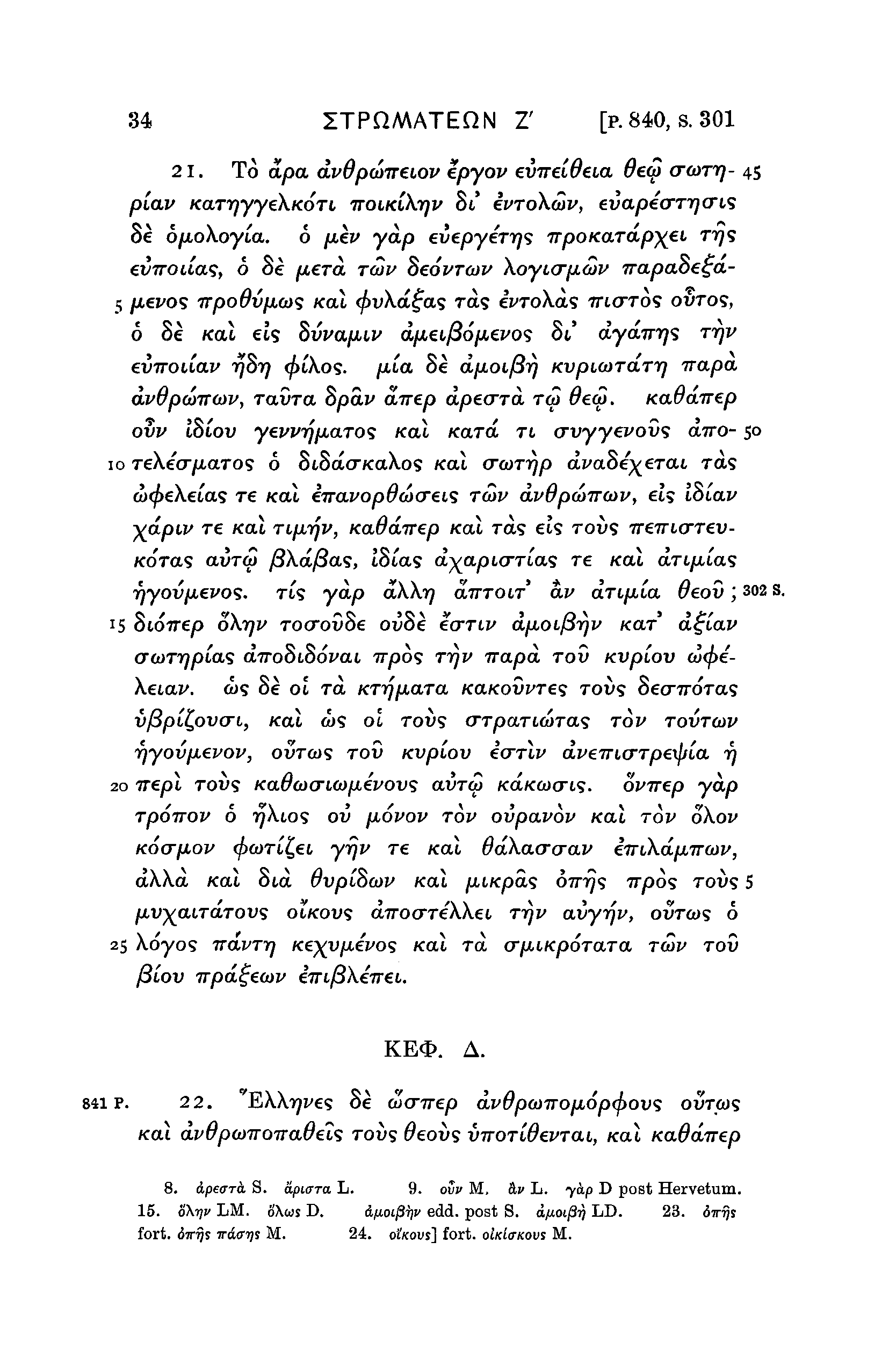
ITPQMATEQN T
[P. 840, s. 301
21.
To apa dvOpconeLov epyov evireideia 0ew croyrr]- 45 plav /car^yyeX/coVi iroudkyv Si' ivToXeHv, euape'cmjcris Se ofioXoyia.
6 fLev yap evepyeTrjs TrpoKardpx^ TV? evirouas, 6 Se /nera TWU Seovrcov Xoyio-juaiv Trapa8e£d5 fievo1; rrpodviLtas /cat <f>vkd^as ras ei'ToXas TTICTTO? OVTO?,
6 Se /cat ets Svvafiiv a/iet^o/*ei'O9 Si' dydirr)?
TTJV evnoUav rjBr) <£tXos.
/Ata Se dyu,oty8i) KvpioiTaTf] irapa dvBpomoxv, TavTa Spav dwep dpecrTcL TW ^ea».
KaOdirep ovv tStou yevvrjixcLTOS /cat /canx Tt cruyyevovs a7ro50 10 TeXe'cr/Aaros 6 SiSa<xzcaXos /cat (TWT-qp avaSe^eTat
Te Kat iiravopdaxret.s TGJV dvdpconcov, et? tSta T e K a ' TLfxrjv, Kaddnep Kat Ta? ets TOV? 7re7rtcrTeu- /coras aural y8Xa/8as, tStas a^apt(TTtas re /cat aYi/nas
^yov/Aei'OS.
Tts ya/3 aXXrj CLTTTOLT' av art)itta ^eou; 302 s.
15 StoTrep 0X77V TocrouSe ouSe ecmv djAOLf3r)v KCUT d^iav au>Tr)pia<; ctTroStSovat TT/DOS TTJI' irapd
TOV KVpCov w<f>eXeiai>. a)? Se ot Ta KT^jaara /ca/cou^res TOU? SecrTroras v^pitpvcri, /cat ws ot rows O"rpart<yra9 roV TOVTOIV r/yov/JLevov, OVTO><; rov Kvpiov icrrlv dveTncrTperpCa rj 20 Trepl rous Ka.6co<Tio)fJL€vov<; avrcp /ca/cwo"ts. ovirep yap TpoiTOV b T^Xtos ov fxovov TOV ovpavov /cat TOV oXov Kocrfiov <f>a)TiL,ei yfjv re /cat ddXacrcrav erri\dp.Troiv, aXXa /cat Sta dvpiScov /cat /xt/c/jas 6771^9 Trpos TOVS 5 Ixv^aiTaTovs ot/cous aVoo-re'XXet TT^I' avyifi', ovrws 6
25 Xoyos TravTY] Ke^u/x.ei'os /cat r a o"ju.t/c/>orara rwi^ TOU eVt/SXevret.
841 P.
22.
"EXX^ves Se axr-rrep dv0po)TTOix6p(j>ov^ OUTCDS /cat dvOpcoTroTTadeZs TOV? deovs viroTiQevTai, /cat Kaddirep
8. dpeffrd S. iLpuTTa. L.
9. offy M, ftx L.
7&p D post Hervetum.
15. oXi/e LM. o\«s D. dftoi^rjj' edd. post S. a/ioi/3i} L D .
23. dx^s fort. dTT^y 7rd<n;s M.
24. oiVcous] fort. OIKIVKOVS M. https://doi.org/10.1017/CBO9780511695513.010 Published online by Cambridge University Press