
CHAPTER XIII
C. XII. § 80-C. XIII. § 81] MISCELLANIES, BOOK VII.
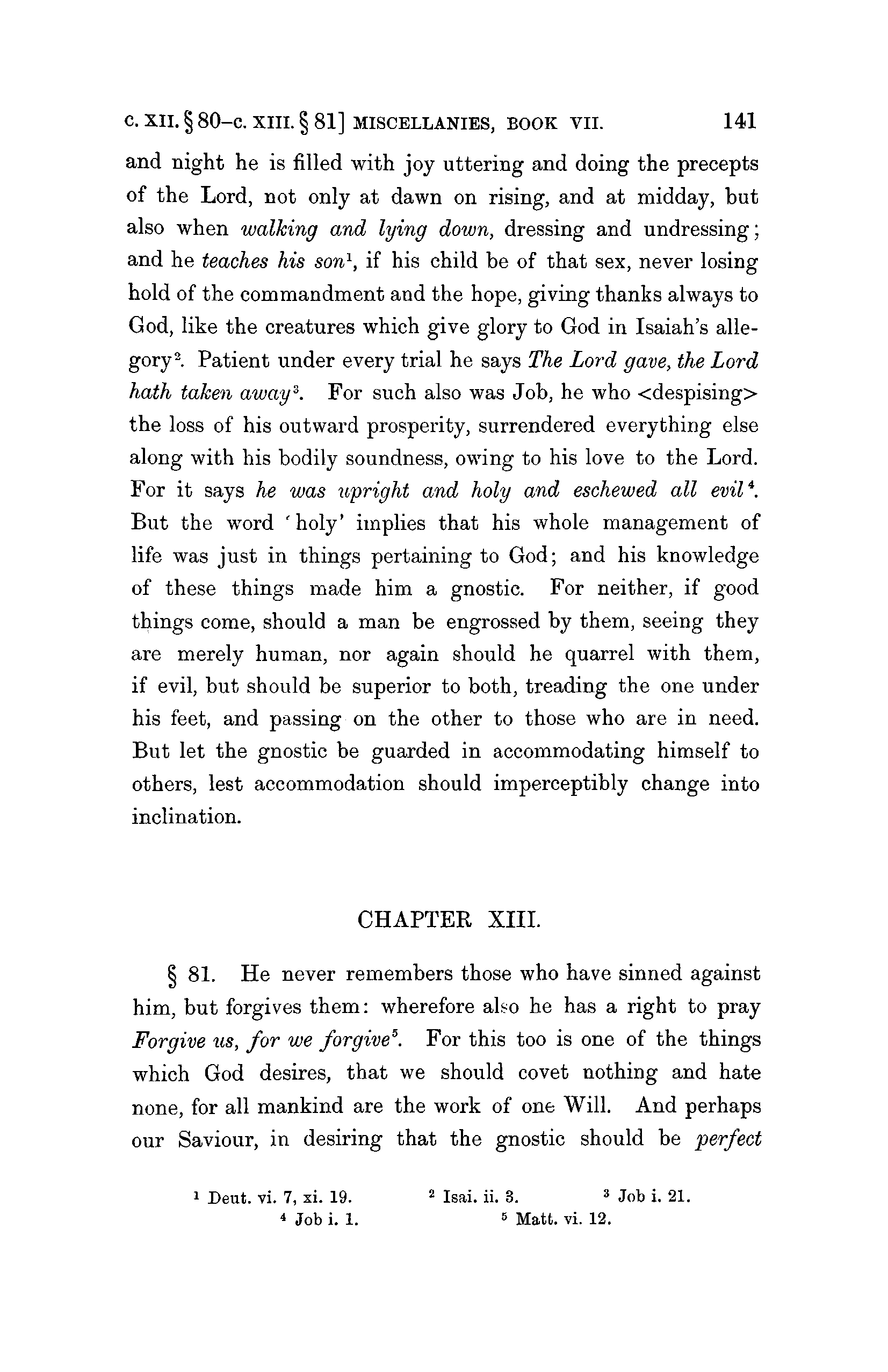
and night he is filled with joy uttering and doing the precepts of the Lord, not only at dawn on rising, and at midday, but also when walking and lying down, dressing and undressing; and he teaches his son1, if his child be of that sex, never losing hold of the commandment and the hope, giving thanks always to God, like the creatures which give glory to God in Isaiah's allegory2. Patient under every trial he says The Lord gave, the Lord hath taken away". For such also was Job, he who <despising> the loss of his outward prosperity, surrendered everything else along with his bodily soundness, owing to his love to the Lord.
For it says he was upright and holy and eschewed all evil*.
But the word 'holy' implies that his whole management of life was just in things pertaining to God; and his knowledge of these things made him a gnostic. For neither, if good things come, should a man be engrossed by them, seeing they are merely human, nor again should he quarrel with them, if evil, but should be superior to both, treading the one under his feet, and passing on the other to those who are in need.
But let the gnostic be guarded in accommodating himself to others, lest accommodation should imperceptibly change into inclination.
CHAPTER XIII.
§ 81. He never remembers those who have sinned against him, but forgives them: wherefore also he has a right to pray
Forgive us, for we forgive5. For this too is one of the things which God desires, that we should covet nothing and hate none, for all mankind are the work of one Will. And perhaps our Saviour, in desiring that the gnostic should be perfect
1 Deut. vi. 7, xi. 19.
2 Isai. ii. 3.
3 Job i. 21.
* Job i. 1.
6 Matt. vi. 12. https://doi.org/10.1017/CBO9780511695513.010 Published online by Cambridge University Press
ZTPQMATEQN Z'
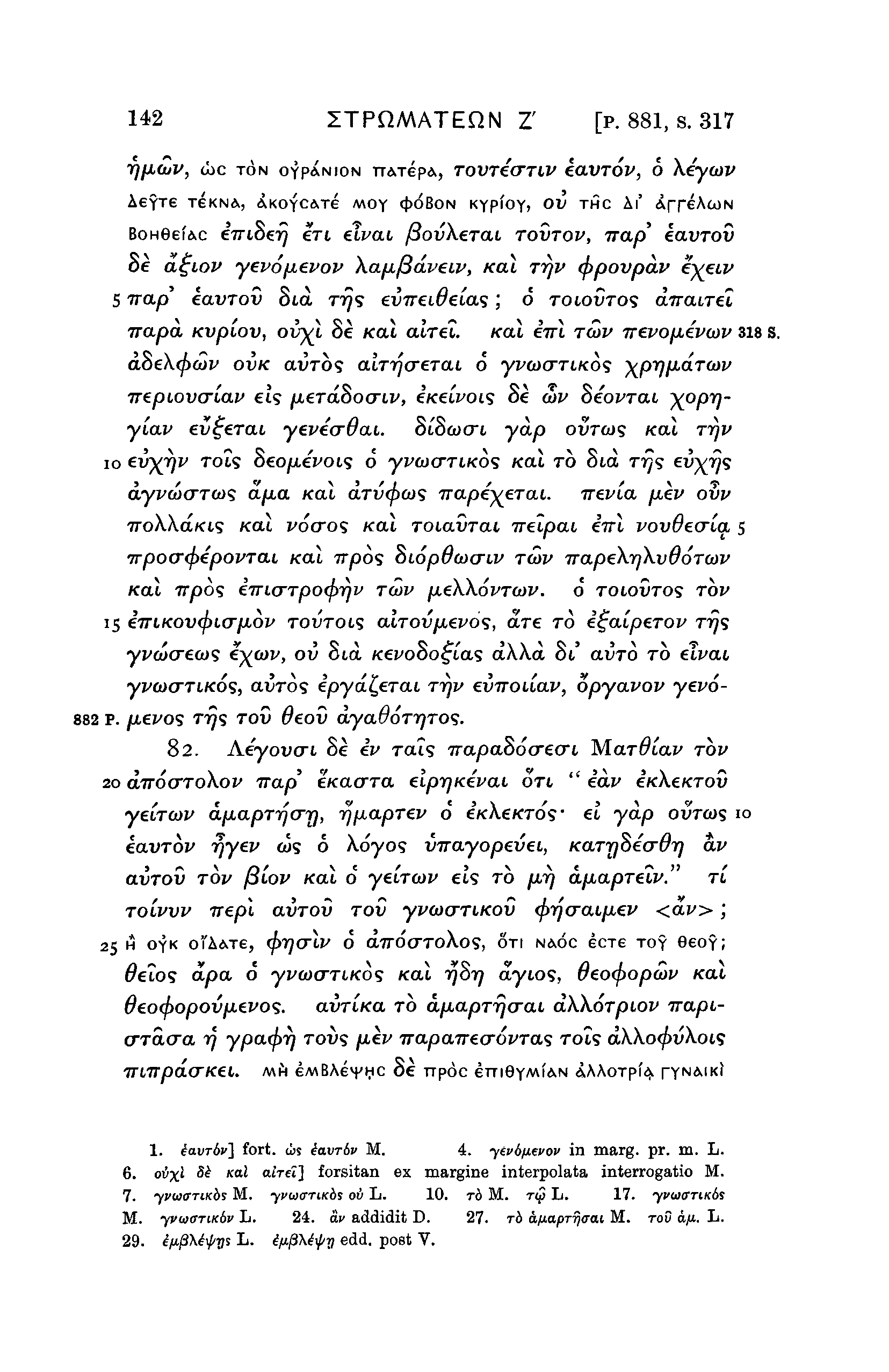
[P. 881, s. 317 v, die TON OYPANION n^TepA, TOVT4<TTIV iavTov, 6 Xeycov TCKNA, AKoycATe MOY 4>OBON Kypfoy, ov THC AI' iffe\(x>N en elmi /SouXerai roi'Tot', Trap' eaurou
Se d^Lov yevojxevov Xa/xfidveiv, Kal TYJV <f>povpdv S Trap' eavvov Sia TT^? ev7ret^eias; d TOIOVTOS
Trapd Kvptov, ou^l Se /cai atrei.
KCU CTTI TCOV vevofJLtvojv 318 s. d8e\<£a>i> ov/c avro5 atr^crerat d yvaxm/cds ^prjfxaTOiv irepuovo-Cai> el? /xeraSocrtv, oceiVus Se wi' Se'o^Tat X°PV~ yiav ev£ercu yeveaOcu.
SLSOXTL yap ourws /cat io evxyv TOIS SeojuteVois d yvcucrriKos Kat ro Sia a/u,a Kal aTv<f)Q)<; Trape^eTat. vevLa fjikv ovv Kat fdcros Kal roiavrat Trelpai CTTI vovdecria 5
•7rpoo~<f>epovTa,L K<XL irpO'S 8i6p6a>o~iv TU>V irapeXrfXvdoTcov Kal TTpO? iTTL(TTpO(j)T]V TWV fXiXXoVTOiV.
6 TOLOVTOS TOV
15 eT7LKov<f)LO'ix6v TouTots aiToi5)aevo5, are ro ifjalpcrov r^s •yv<wo"ea)S e^wv, ou Sia. Kei'oSo^ias aXXd Si' avrd TO etvat yi'wcrTt/cds, avro? £pyat,erai rrjv evvouav, opyavov yevo882 p. fievos Trj<i TOV deov dyadoT7)TO<;.
82.
Aeyouo~i Se iv rats TrapaSdcreci Mar^tav TOV 20 aVdcrToXov Trap' e/cacrra eipTjfceVai ort " edv CKXCKTOU j, r^iapTev 6 eVXewrro'?- et yap ourcos io
<ws 6 Xdyo? VTrayopevet, KaTrjSeo~0T] av avTov TOV fiiov Kal 6 yeiTwv ets TO /A^ afjiapreiv.'
TL To'ivvv vepl avTov TOV yv(t)o~TiKov (f^yjo-aL/xev <av>; 25 H OYK o"A*.Te, (j)7]o-lv 6 dnoaToXos,
OTI NAOC GCTE TOY eeoy; Oeios dpa d yi/wcrTi/cos /cat ^ S ^ ayio?, 0eo(j)op(op /cat avTLKa TO dixapTrjaat aXXorpiov Trapirf ypa<f>r) TOV? fj.ev TrapaTrecrovra? roi? d
WLTrpdcncei,. M& eMBAeyi^c Se npdc e 1. ^ourAi'] fort, us iavrSv M.
4. yevb^vov in marg. pr. m. L.
6. oi)x' 5^ /cai ahcil forsitan ex margine interpolata interrogatio M.
7. yvwaruclis M. yvoxTTiubs oi L.
10. T6 M. Tip L.
17. yvo>(TTtK6s M. yviaffTiitbv L.
24. a^ addidit D.
27. T6 afjLaprijffat, M. rou d/x. L.
29. <?/i/3X(ty7js L. ifi.p\tyri edd. post V. https://doi.org/10.1017/CBO9780511695513.010 Published online by Cambridge University Press
C. XIII. | | 81, 82]
MISCELLANIES, BOOK VII.
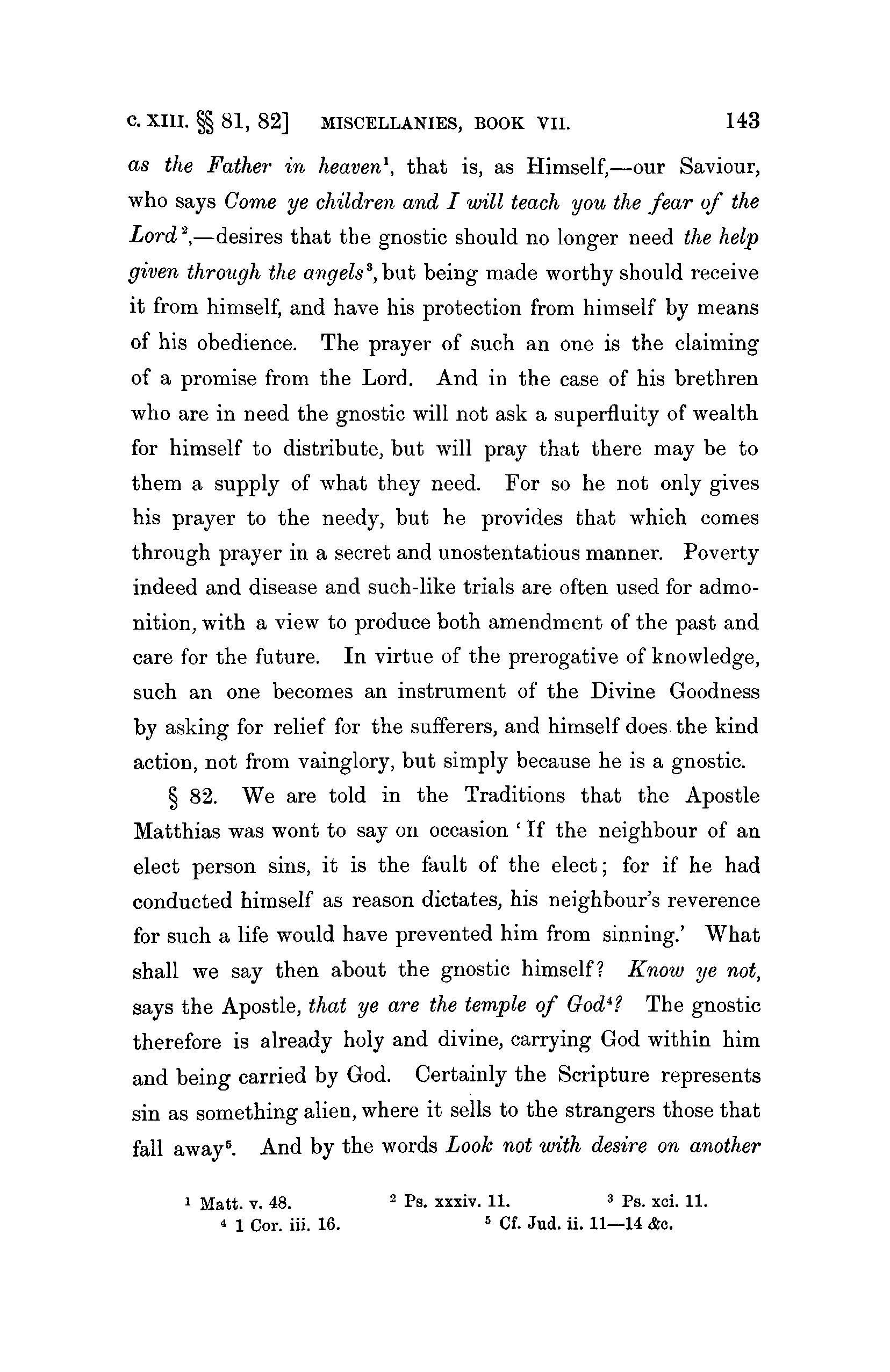
as the Father in heaven1, that is, as Himself,—our Saviour, who says Come ye children and I will teach you the fear of the Lord'2,—desires that the gnostic should no longer need the help given through the angels3,hut being made worthy should receive it from himself, and have his protection from himself by means of his obedience. The prayer of such an one is the claiming of a promise from the Lord. And in the case of his brethren who are in need the gnostic will not ask a superfluity of wealth for himself to distribute, but will pray that there may be to them a supply of what they need. For so he not only gives his prayer to the needy, but he provides that which comes through prayer in a secret and unostentatious manner. Poverty indeed and disease and such-like trials are often used for admonition, with a view to produce both amendment of the past and care for the future. In virtue of the prerogative of knowledge, such an one becomes an instrument of the Divine Goodness by asking for relief for the sufferers, and himself does the kind action, not from vainglory, but simply because he is a gnostic.
§ 82. We are told in the Traditions that the Apostle Matthias was wont to say on occasion ' If the neighbour of an elect person sins, it is the fault of the elect; for if he had conducted himself as reason dictates, his neighbour's reverence for such a life would have prevented him from sinning.' What shall we say then about the gnostic himself? Know ye not, says the Apostle, that ye are the temple of God*? The gnostic therefore is already holy and divine, carrying God within him and being carried by God. Certainly the Scripture represents sin as something alien, where it sells to the strangers those that fall away5. And by the words Look not with desire on another
1 Matt. v. 48.
2 Ps. xxxiv. 11.
3 Ps. xci. 11.
4 1 Cor. iii. 16.
6 Cf. Jud. ii. 11—14 &o. https://doi.org/10.1017/CBO9780511695513.010 Published online by Cambridge University Press
ITPQMATEftN Z [p. 882, s. 318
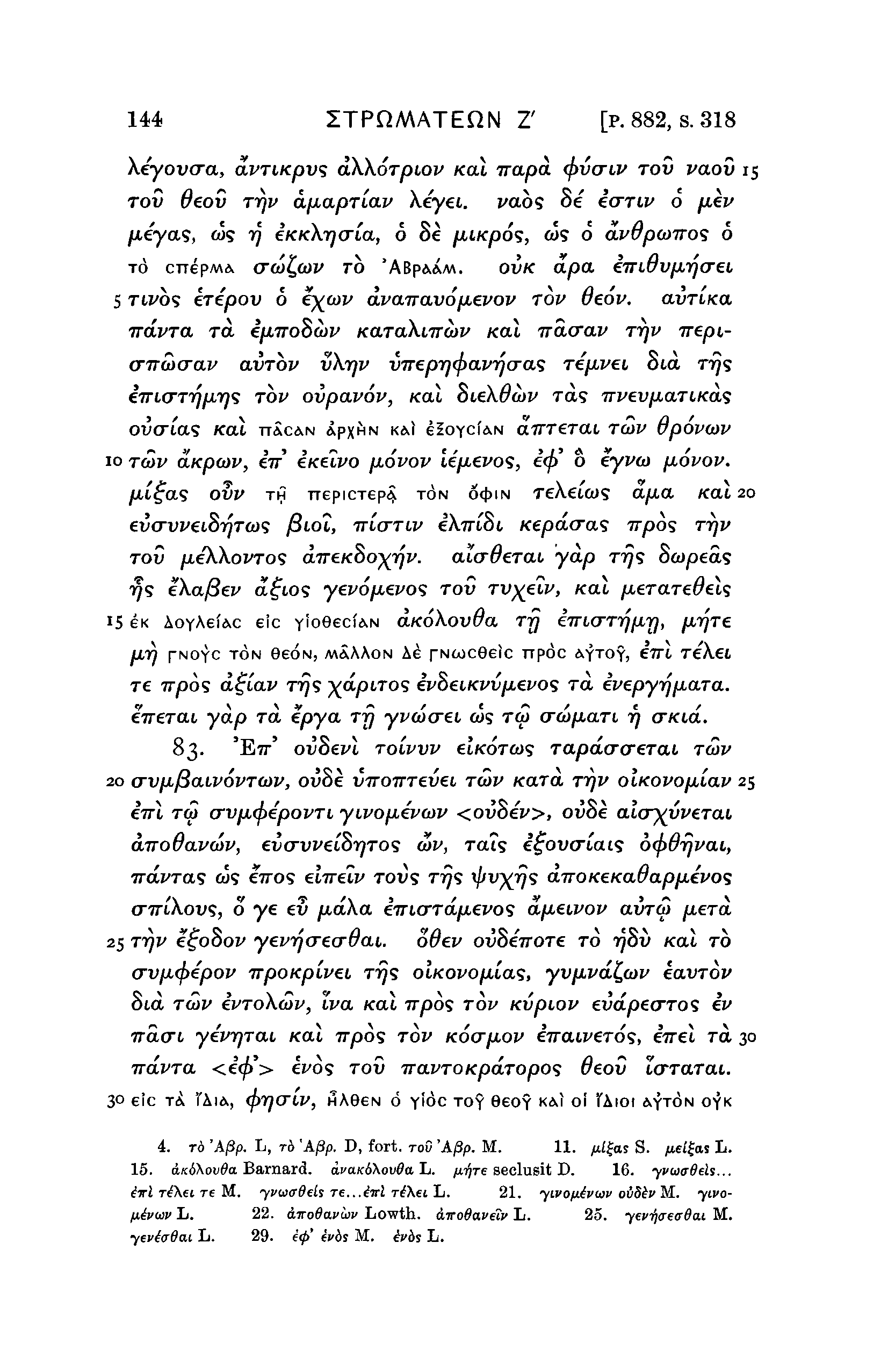
Xeyovaa, avTiKpvs dWorpLov /cat napa (f>vaiv TOV vaou 15 TOV deov TT)V a/JLapTiav Xeyet. z/aos Se icmv 6 fiev /ieyas, w? rj e/c/cX^crta, 6 Se [JUKpos, ws o avdpconos 6
TO cnep/v\& crditfav
TO "ABRAAM.
OV/C a/3a hridv\Ly\o-ei 5 TW'OS eTepov 6 e^wv dvairavonevov TOV deov. avriKa ndvTa TO. ifnroSwv KaTaXiircbv KOU irao'av TTJV iri.picrTrwcrav avroi/ uX^v vTreprj(f>av7]o-a'; refivei
Bid TTJS iTTLO~TT][JLr}<s TOV ovpavov, KOX SieX^wv Ta? TTvev/xaTLKas ovcrtas /cat TT&C&N ^PXHN K*.! eloycfAN aTrrerai, raw dpovcav
10 TWV aKpav, eV e/ceivo fiovov le/JL€vo<s, i(j)' b eyva) /xovov.
TIH nepicTep^ TON OCJJIN reXetws ayu,a /cat 20 jStot, TTLO-TLV eXmSi Kepdcras vpos TT/V TOV fieWovTos aTreKho^rfv. alaOerai yap TTJ<; 77s eXa/3ei' afios yev6fj,€vo<; TOV TV^elv, /cat
15 eK AoyAei&c eic yioeect^N aKoXou^a TYJ jj/rj fMoyc TON 6eoN, MAAAON Ae rNwceeic npoc &YTOY; re irpos d^iav Trjs ^aptTOS ivSeiKvufLevos Ta iv CTrerat ya/> r a epya Trj yv<6o~ei ais TW crw/u.art 17 cr/cta.
83.
'ETT' ovSet't Toivvv etfcdrws Ta/jacrcrerat 20 o~vfij3aLv6vTb)v, ovSk vTro-mzvzi TWV /cara TIJI' oiKovofxiav 25 eTTt TW o~vfL(j)epovTi yuvofiivh)v <ovhiv>, ovhk atcr^werat a>v, Ta?s e^oucrtats o<f>drjvai, CTTTIXOVS, o ye ev /xdKa emcrra/tepos afj-etvov aurw
25 TTJV egooov yevr)o~eo-uat,. oaev OVO€TTOT€ TO TJOV /cat TO o~vfi(j)epov irpoKpivei Tr\<i ot/coi>o/u,tas, yvfivd^wv iavTov Std T&JI' ei'ToXcoj', tva /cat TT/DOS roz/ Kvpiov evdpeo~TO<s iv TTacn yevrjTai /cat 77/305 TOV K6O~{JLOV eTrat^ero?, eTret ra. 30
•ndvTa. <i(f)'> evos TOV ira.vTOKpaTopo<s deov tcrrarat.
30 eic ri TAIA, (fyrjO'LV, HAOBN 6 y'oc TOY 8EOY K*.I oi TAIOI A.YTON °YK 4. rb 'A/Sp. L, r6 'A/3p. D, fort. TOO 'A/Sp. M.
11. ^as S. /ieifas L.
15.
<M(5\cw0a Barnard. doatciXovda L.
^ v e seclusit D.
16. yi>w<r$els... iirl T A « TE M. yvwadds re...ivl ri\ti L.
21. ywo/jivoiv oiSiv M. 71x0fiivuiv L.
22. biroBaviiv Lowth. &vo9aveiv L.
25. yevfiaetrBai M.
29. e0' fi/As M.
A»4s L. https://doi.org/10.1017/CBO9780511695513.010 Published online by Cambridge University Press
C. XIII. §§ 82, 83]
MISCELLANIES, BOOK VII.
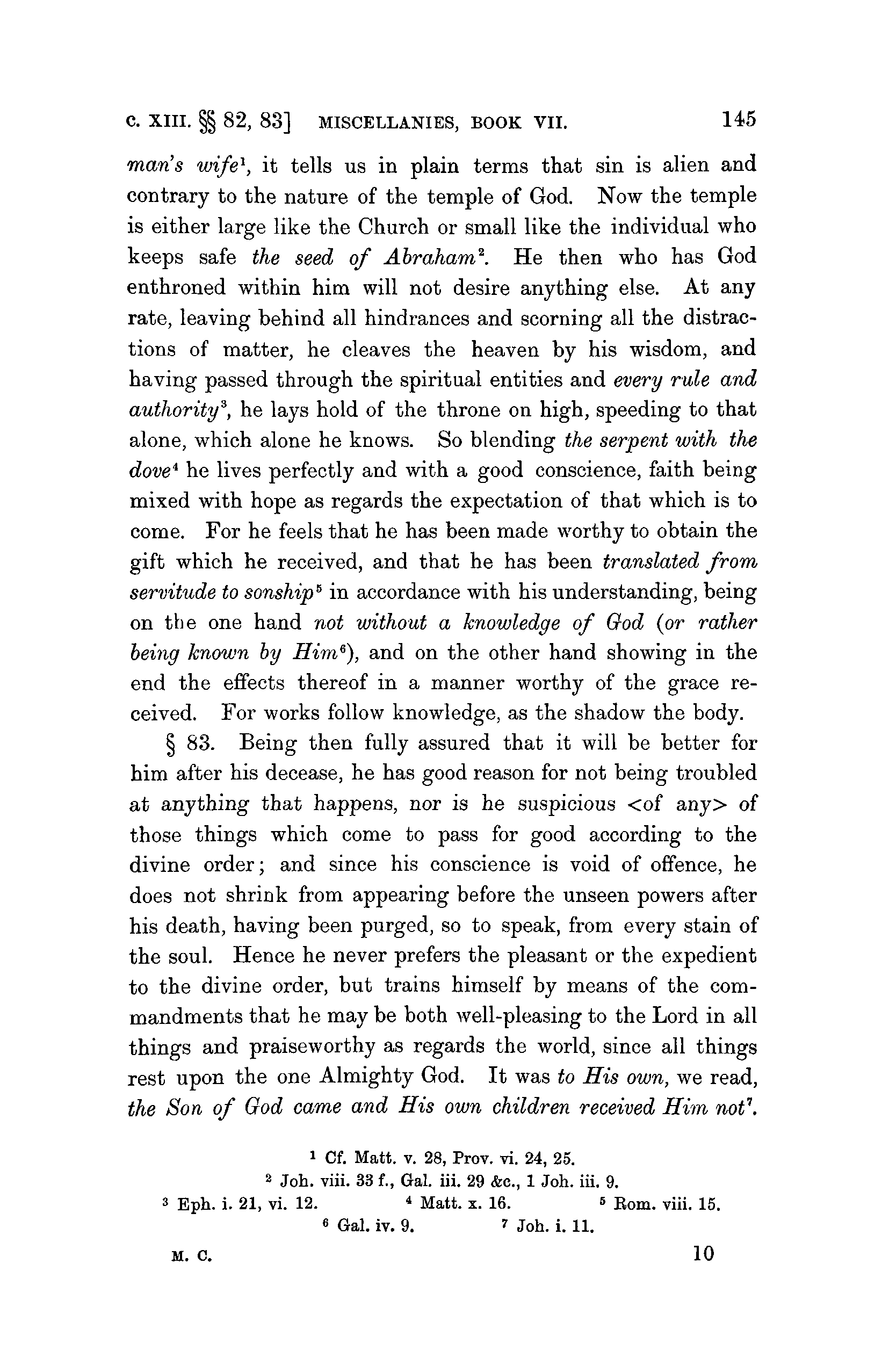
mans wife1, it tells us in plain terms that sin is alien and contrary to the nature of the temple of God. Now the temple is either large like the Church or small like the individual who keeps safe the seed of Abraham*. He then who has God enthroned within him will not desire anything else. At any rate, leaving behind all hindrances and scorning all the distractions of matter, he cleaves the heaven by his wisdom, and having passed through the spiritual entities and every rule and authority3, he lays hold of the throne on high, speeding to that alone, which alone he knows. So blending the serpent with the dove1 he lives perfectly and with a good conscience, faith being mixed with hope as regards the expectation of that which is to come. For he feels that he has been made worthy to obtain the gift which he received, and that he has been translated from servitude to sonship6 in accordance with his understanding, being on the one hand not without a knowledge of God {or rather being known by Him6), and on the other hand showing in the end the effects thereof in a manner worthy of the grace received. For works follow knowledge, as the shadow the body.
§ 83. Being then fully assured that it will be better for him after his decease, he has good reason for not being troubled at anything that happens, nor is he suspicious <of any> of those things which come to pass for good according to the divine order; and since his conscience is void of offence, he does not shrink from appearing before the unseen powers after his death, having been purged, so to speak, from every stain of the soul. Hence he never prefers the pleasant or the expedient to the divine order, but trains himself by means of the commandments that he may be both well-pleasing to the Lord in all things and praiseworthy as regards the world, since all things rest upon the one Almighty God. It was to His own, we read, the Son of God came and His own children received Him not1.
1 Cf. Matt. v. 28, Prov. vi. 24, 25.
2 Joh. viii. 33 f., Gal. iii. 29 &c, 1 Joh. iii. 9.
3 Eph. i. 21, vi. 12.
4 Matt. x. 16.
6 Eom. viii. 15.
6 Gal. iv. 9. i Joh. i. 11.
M. C.
https://doi.org/10.1017/CBO9780511695513.010 Published online by Cambridge University Press
STPQMATEQN Z'
[p. 882, s. 318
883 P. eAel&NTo.
Sio K<XI Kara TYJV TOJV KOO-fjLiKQ>v xpfjaLV oil fj-ovov ev^aptcTTel /ecu Oav/xd^eu TTJV KTLCTLV, dXXd /cat
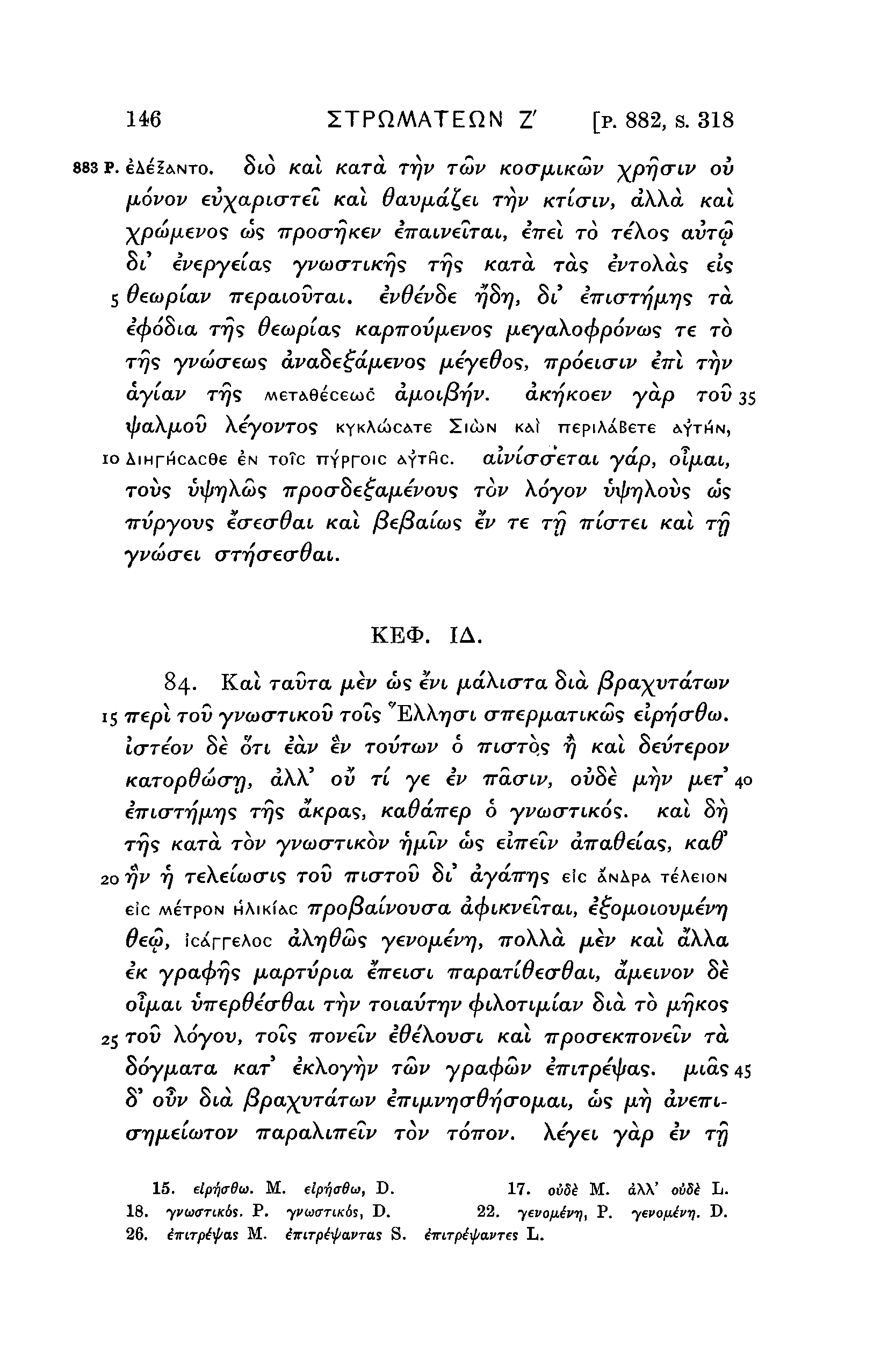
^pcofxevo? ws TrpocrrJKev eTraiveirai, eVei TO re'Xos avT(a Si' eVepyeias yvwcrTi/oJs TTJS /card ras eVroXa? ets 5 OecopCav TrepcuoCrcu. ivdevSe rjSrj, SL eVio-T^/A^? TO, i(f>6Sia Trj<i Oecopias KapTrovfjLevos fJL€ya\o<f)p6voi)<; TC TO T^S yv<uo"ea)s ava8e£d(i,evo<5 /xeyeOo's, Trpoeuriv CTTI T^V ayiav TIJS MGT&eecewc dfLoifiijv. aKrjxoev yo.p TOV 35 xjjakfxov XeyovTO?
K^KKdicdae 2I<1>N KA( rrepiAABeTe AYT^NJ 10 Amr^c&cee IN TOTC nyproic AYTHCaivicrcreTai ydp, OTJJLOLL,
TOUS vxjjrjkw'; TTpoahe^a[Jievov<s TOV koyov vxpyXovs cus TTvpyovs ecrecrdau /cat /Se^aiws et' TC T17 7TIO"TCI crTujcrecrdai.
KE*. IA.
84.
Kai Taura /xev ws eVi fjidXiaTa Sia 15 Trepi TOU yvoxTTiKov TOIS wEXX.7^o"t cnrepfxaTLKW1; fiprjardw.
8e OTI eav ei* TOUTWV 6 TrtCTOs "^ K<xl SevTepov /, dXX' ori TI ye ef 7rao"ti', ouSe /XTJV per 40
TT]<S a/cpas, tcaOdirep 6 yvcocrTLKos. /cai Si) TOV yvaxTTLKOv rj/juv o)§ eiTretv diradeias, naff 2017V 17 Te\eia)O"is TOU 7TIO"TOU SI' dyaTTijs eic &Nip«> TGA eic MeTpoN HAIK(*>C TrpofiaCvovcra. d^tiKveiTai, dew, icAire^oc akr)6(o<; yevofievrj, TTOWCL fiev /cat aXXa ii< ypa<$>rj<i papTvpia, eTreicri iraparidicrdai, d/xtuvov Se oifjiai VTrepdccrdai TTJV TOiavriqv <j>L\oTi[j,Cav Sia. TO firJKOS
25 TOV Xoyou, TOIS 'n-oveiv i9e\ovcri K<U Vpocreiarovelv Ta Sdy/mTa KaT5 eKXoyrjv TU>V ypatf>cov imTpex)ja<s. /Atas 45
S' ovv Sid fipaxyTaTCiiv hTi\Kvr\cr6y\<J0\xa.i, ws o~r]fieLCx)Tov irapaXiTreZv TOV TOTTOV.
Xeyei ydp iv 15. dpfaBw. M. eipiaBa, D.
17. oi)« M. dU' oi)«^ L.
18. yvuxfTiKbs. P.
7CWITTIK6S, D.
22. ycpofitvr), P. yevofi^vri, D.
26. iirirptyas M. ^jrir/o^acros S. iTnTptxpavres L. https://doi.org/10.1017/CBO9780511695513.010 Published online by Cambridge University Press