
CHAPTER VII
C. VI. § 34-C. VII. § 35] MISCELLANIES, BOOK VII.
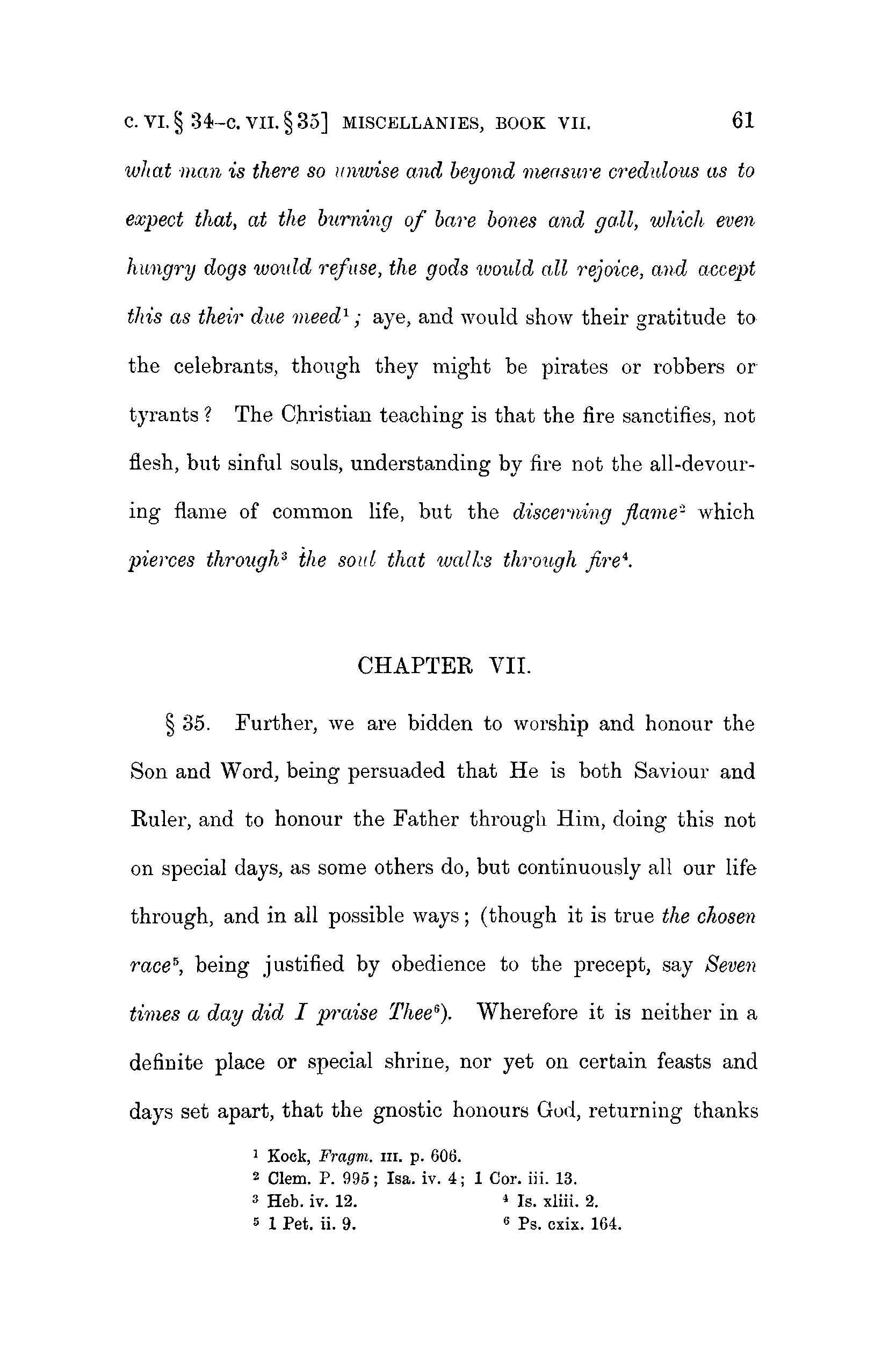
what man is there so unwise and beyond measure credulous as to expect that, at the burning of bare bones and gall, which even hungry dogs would refuse, the gods would all rejoice, and accept this as their due meed1; aye, and would show their gratitude to the celebrants, though they might be pirates or robbers or tyrants ? The Christian teaching is that the fire sanctifies, not flesh, but sinful souls, understanding by fire not the all-devouring flame of common life, but the discerning flamewhich pierces through3 the soul that walks through fire*.
CHAPTER VII.
§ 35. Further, we are bidden to worship and honour the Son and Word, being persuaded that He is both Saviour and Ruler, and to honour the Father through Him, doing this not on special days, as some others do, but continuously all our life through, and in all possible ways; (though it is true the chosen race5, being justified by obedience to the precept, say Seven times a day did I praise Theee). Wherefore it is neither in a definite place or special shrine, nor yet on certain feasts and days set apart, that the gnostic honours God, returning thanks
1 Kock, Fragm. in. p. 606.
2 Clem. P. 995; Isa. iv. 4; 1 Cor. iii. 13.
3 Heb. iv. 12.
* Is. xliii. 2.
5 1 Pet. ii. 9.
6 Ps. oxix. 164. https://doi.org/10.1017/CBO9780511695513.010 Published online by Cambridge University Press
ZTPQMATEQN Z
[P. 851, s. 305
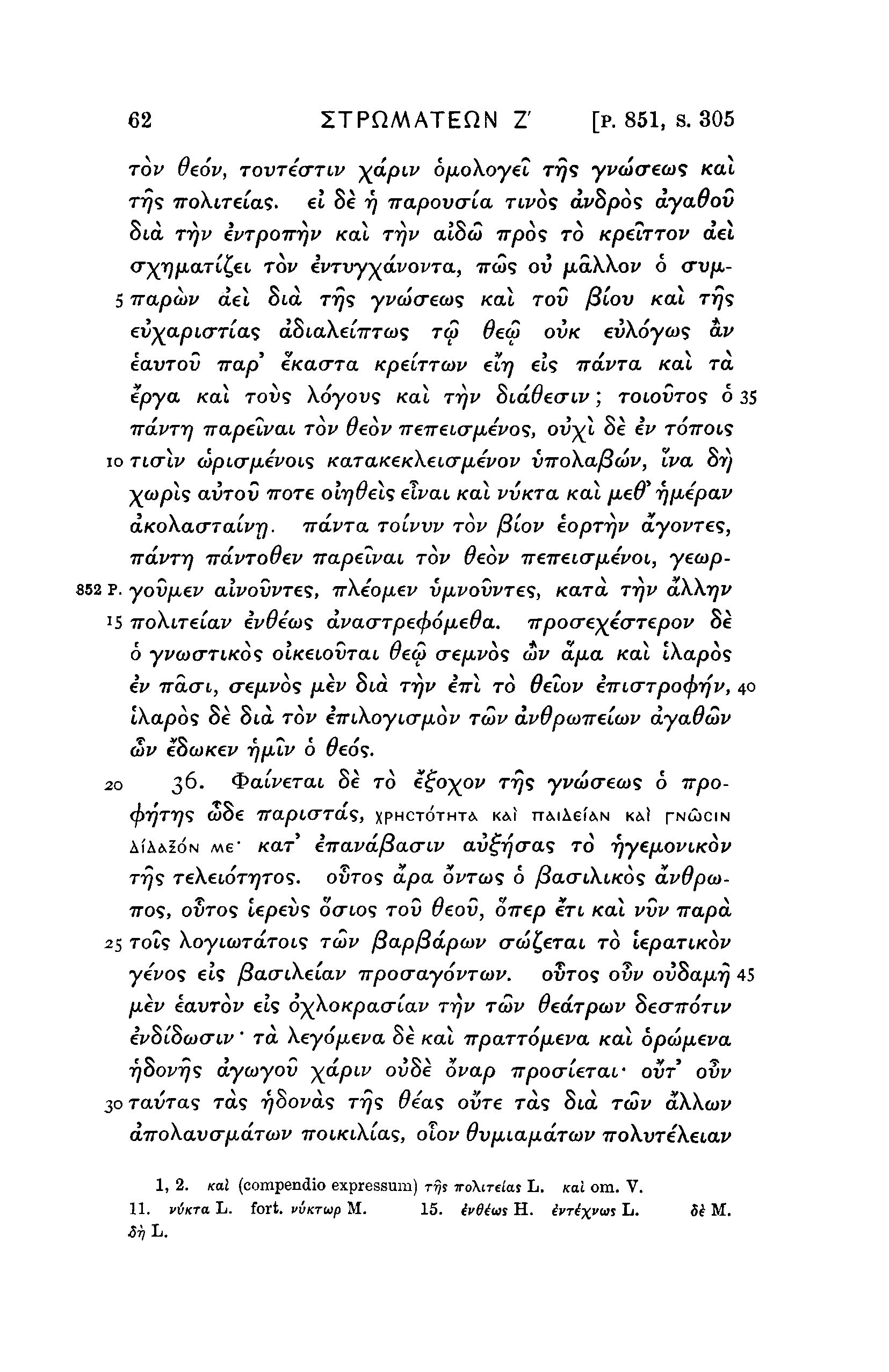
TOV Qeov, TovTtcrTiv ^dpiv o/zoXoyet TT)<S yvcocrews /cat TTJS 7roXtTeias. ei Se r) -napovcria TWOS aVSpos dyadov Std TT)V ivTpoirrjv Kal TTJV alSai Trpos TO KpeiTTov del
Cr^jXaTltfiL TOV ivTVy^dvOVTOL, TTtoS OU /AaXXoP 6 O"U/A5 Trapatv del Std T17S yvcJcrews /cat TOI; /Stou Kal Trjs aStaXetVTws T&J 6ea> OVK ewXoyw? av Trap e/caora KpeiTTatv eurj ets TrdWa /cat Ta e)oya /cat TOV? Xoyovs /cat T^V hiddeaiv;
TOLOVTOS 6 35
TtdvTt} vapelvai.
TOV deov Treneto-fJievos, ov^t Se iv TOTTOIS 10 Tto"tv <w/Dto")u.evois KaTaKeKXeuo-fievov viro\aj3(6v,
Iva 8r) X&)^ts avTOv TroTe ot^^ets elvat /cat vv/cTa /cat fied' rjfxepav dKo\ao~Taivrj.
TTOVTO. TOLVVV TOI^ /Stoi' eopTrjv ayovTes, •ndvTf] irdvTodev irapelvai TOV deov ireneia-fievoi, yeap852 p. yovfxev cdvovvTes, wXeofJiev v/jLvovvTes, /caTa Tr\v dWyjv
'5 iTokiTeiav evdeus dvao-Tpe^>6fie6a.
Trpocre)(€O-Tepov Se 6 y^wo"Tt/cos ot/cetovrai 0e<o o~efJLv6<; cov dfia Kal IXapos iv Tract, crefivos /xe> Sta TTJV eirl TO delov eirio-Tpo<f>yjv, 40 tXa/3os Se Sta TOI' eTrtXoytorynoi' TWV dvdpwTreCtov dyadcav cui/ eow/cei' ijjati' o Ceo?.
36.
<3>aiveTai Se TO e^o^ov T^S yvcoo~ea)s 6 Ttpo- <f)T]T'r)<; cooe Trapto'Ta?, XPHCTOTHTA KAI rrMAefAN K&I ON ME1 /caT* i-7ravd/3ao-iv avgrjcras TO ri
TeXeioTrjTos.
OSTOS apa OVTOJS 6 ySao"tXt/cos dvdpcoTTOS, OSTOS iepevs oVtos TOU deov, oirep en /cat vui' vapd
25 Tot9 XoytwTaTot? T&Ji' /3ap/3dpa>v crw£eTai TO iepariKov yevo<; ets ySao"tXetav Trpoo~ayovTO)v.
OUTOS out" ovSa/irj 45 jaev eavrov ets 6y\oKpao~iav TT}V TCOV OeaTpav Seo-iroTiv €vhihd)O~iv' TO. Xeyofxeva Se /cat npaTTOfieva Kal 6pa>{j.eva
•fjSovfjs dycoyov ^dpiv ouSe oi^aya -npoo-ieTaiOVT OVV 30 TavTas TCIS ^Sovas TTJS ^e'as OUTC Tcts Sta TWV dWwv aTwi' 7rot/ctXtas, olov Ovfiia/xaTcov 1, 2. Kal (compendio expressum) T^S iroXirdas L.
/cai om. V.
11. vinra L. fort. vinTwp M.
15. iv$4ws H.
£VT4XV<»S L.
5£ M. https://doi.org/10.1017/CBO9780511695513.010 Published online by Cambridge University Press
C. VII. §§ 35, 36]
MISCELLANIES, BOOK VII.
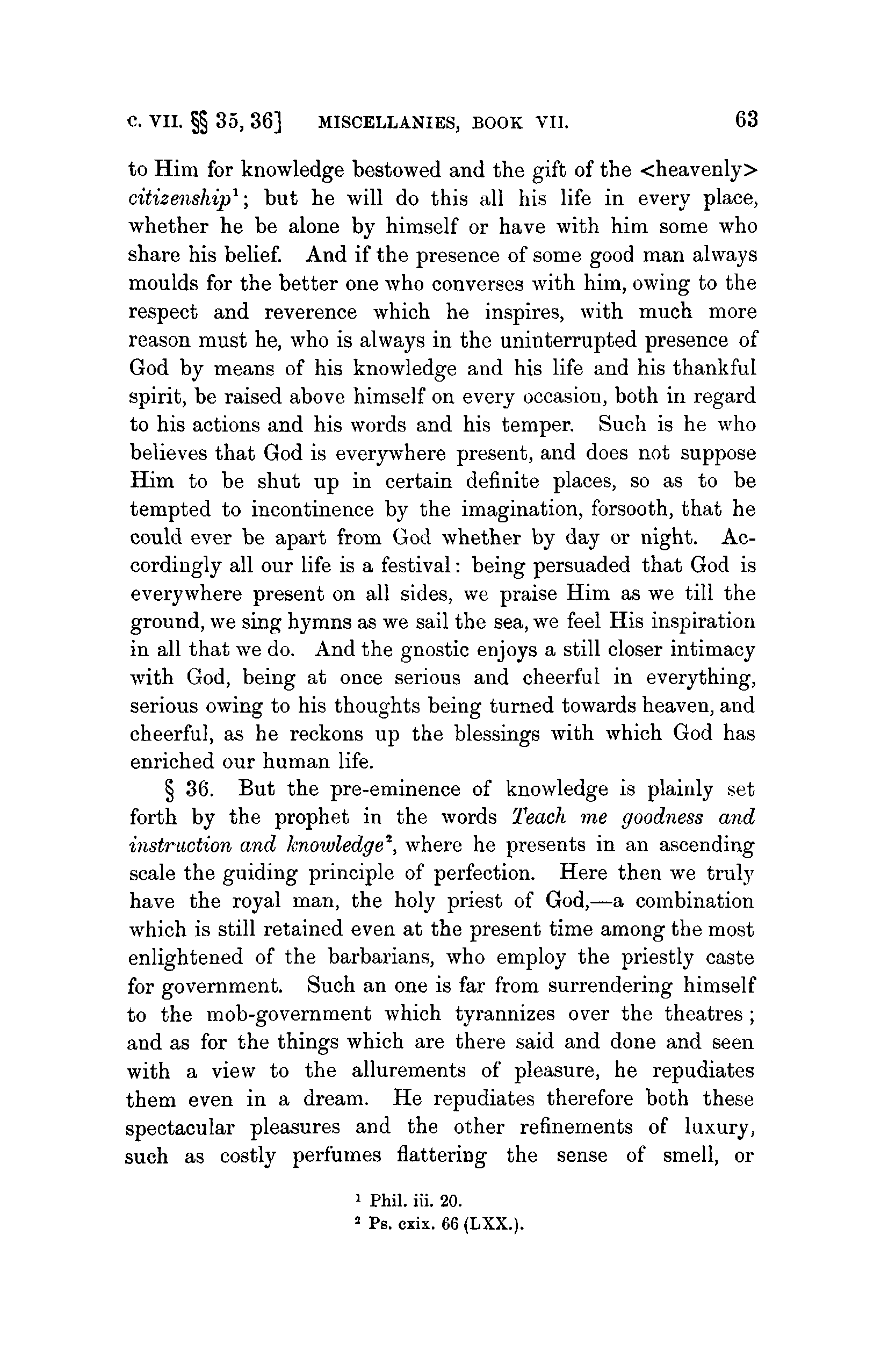
to Him for knowledge bestowed and the gift of the <heavenly> citizenship1; but he will do this all his life in every place, whether he be alone by himself or have with him some who share his belief. And if the presence of some good man always moulds for the better one who converses with him, owing to the respect and reverence which he inspires, with much more reason must he, who is always in the uninterrupted presence of God by means of his knowledge and his life and his thankful spirit, be raised above himself on every occasion, both in regard to his actions and his words and his temper. Such is he who believes that God is everywhere present, and does not suppose
Him to be shut up in certain definite places, so as to be tempted to incontinence by the imagination, forsooth, that he could ever be apart from God whether by day or night. Accordingly all our life is a festival: being persuaded that God is everywhere present on all sides, we praise Him as we till the ground, we sing hymns as we sail the sea, we feel His inspiration in all that we do. And the gnostic enjoys a still closer intimacy with God, being at once serious and cheerful in everything, serious owing to his thoughts being turned towards heaven, and cheerful, as he reckons up the blessings with which God has enriched our human life.
§ 36. But the pre-eminence of knowledge is plainly set forth by the prophet in the words Teach me goodness and instruction and knowledge', where he presents in an ascending scale the guiding principle of perfection. Here then we truly have the royal man, the holy priest of God,—a combination which is still retained even at the present time among the most enlightened of the barbarians, who employ the priestly caste for government. Such an one is far from surrendering himself to the mob-government which tyrannizes over the theatres ; and as for the things which are there said and done and seen with a view to the allurements of pleasure, he repudiates them even in a dream. He repudiates therefore both these spectacular pleasures and the other refinements of luxury, such as costly perfumes flattering the sense of smell, or 1 Phil. iii. 20.
2 Ps. cxix. 66 (LXX.). https://doi.org/10.1017/CBO9780511695513.010 Published online by Cambridge University Press
ITPQMATEQN Z
[p. 852, s. 305
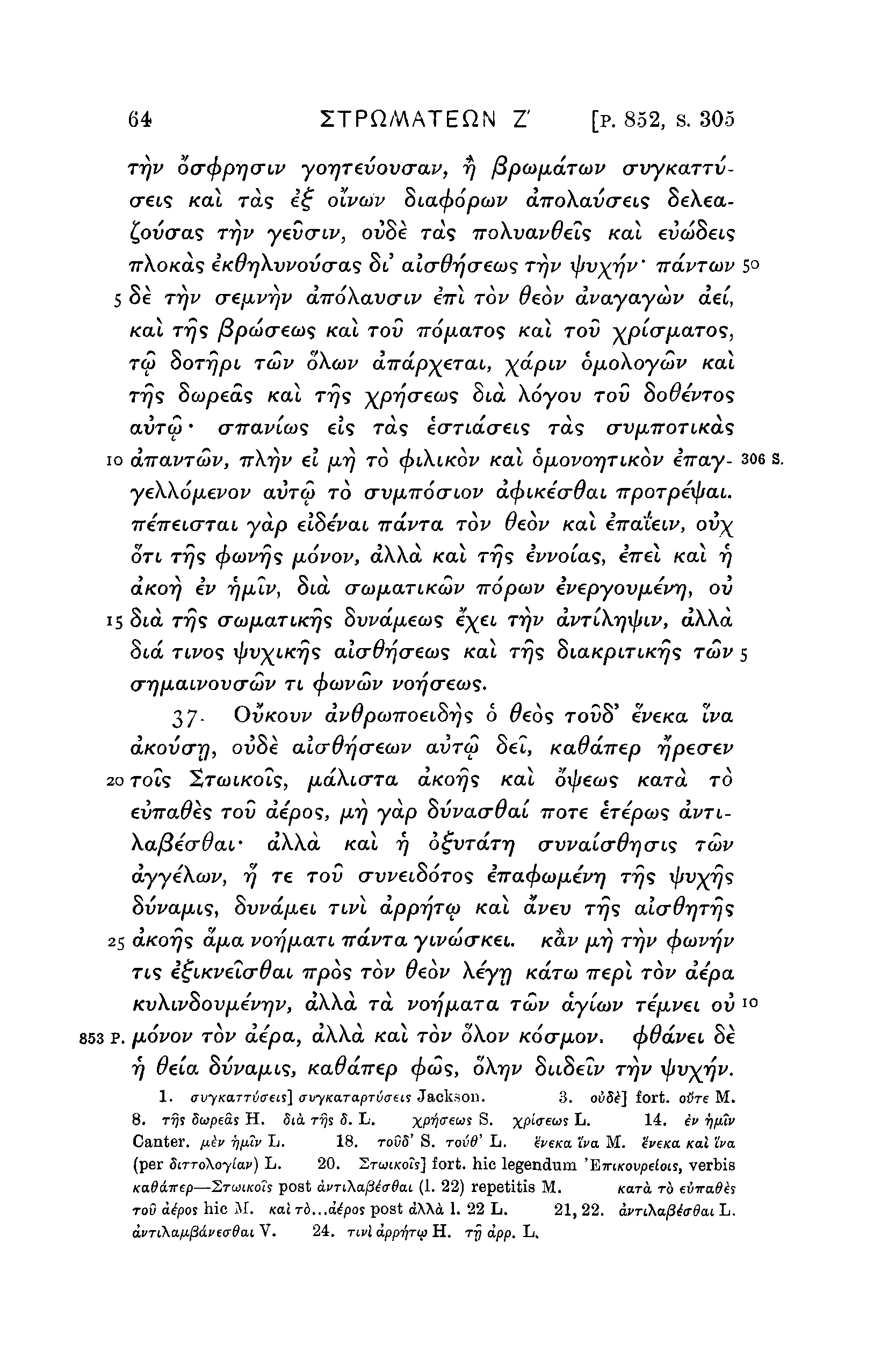
Trjv 6a-(j)py]O'LV yorjTevovcrav, rj fipco/xaTcov crvyKaTTVcrets /cat Tas e'^ oivoiv Stac^opwv dVoXavcrew SeXea- £ovo~as TTJV yevo~tv, ovSe rds 7roXuav#et9 /cat evwSeis
TrXoKas iK0r)Xwovo'at5 St' aio~d~qo-ea>s TTJV ^tvy^v' irdvT(ov 5° 5 Se Trjv aejMvrjv ctTroXavcrtv eVt TOV #eov dvayaycov aet,
/cat T179 f3pc!>o~€(i)$ Kal TOV vofxaTOS Kal TOV ^pto"ju,aTos, TW SoTTjpt T6JV oXo)v dndp^eTaL, ^apiv 6/j.oXoywv Kal Scoped? Kal Trjs ^prjcreo)? Std Xoyov rov w • cnravCco? ets Tas eo"Ttao"ets rets 10 dnavTcov, TTXTJV et JUT) TO <J>IXLK6V /cat ojiovo-qTiKov eTray306 s. yeXXofxevov avTto TO O~V\KTT6O-IOV a^)t/ce'o"^at TrpoTpexfjai.
7re77eto"rat yap etSe'vat irdvTa TOV deov /cat eVatetv, ov>( ort T77S <J>COVT}<; jjbovov, aXXa /cat TTJS e'vvotas, eVei /cat 77 a'/coi} e'v i7ju-tv, Std o-aj/xart/caiv Tropwv ivepyovfievrj, ov 15 Std T77S o"a)jMari/c77S Svvct/xews e^et TT}Z/ dvTCXrjijjLV, dXXd
Std Ttvos i|/v^t/C77S ato"^rjo"e&)s /cat TTJS Sta/cptTt/ci^? TWV 5 crrjixaLvovcrSv rt <f>wvwv vorjo-ea><;.
37.
Ov/covv dvdpaiTToeiSrj? 6 #eos TOVS' eve/ca tva aKovcrrj, ovSe alo~0rjo~€a>v avT&i Sei, Kaddnep tfpeo~ev 20 rots Srajt/cor?, fxaXio'Ta a/co^s /cat oi/zew? /card TO evTra^es TOV depos, /XT) yap Svvacrdai TTOTC eTepco? dvrtXa/3ecr#af dXXd /cat 77 o^vTaTT) o~vvaio~6r]ai? TCOV dyyeXwv, rj re TOV o"uvetooTos e7ra^>ci)jLtei SuvajLtt9, Swdfxei TLVI dpprjTio Kal dvev Trjs 25 dKorj? d/xa vorj/xaTL Trdvra ytveucr/cet.
/cav /AT} T77V T19 i^iKve'icrdai irpo9 TOV ^eov Xeyij /cctTw Trept rov depa KvXwSovjxivrjV, dXXd Ta votjfxaTa TCZV dylwv re)u,vet ov I0 853 P. /xovov rov aepa, dXXd Kal TOV 6XOV /cocrjaov. cf>8dvei Se 7) ^eta Svva/At?, Kaddirep <£a!s, 0X77V SttSetv TT)V \fjv)(yjv.
1. o-iry/caTT^crets] crvyKaTapTvueis Jackson.
3. oi}5£] fort, ofire M.
T?JS dapeas H . Sid rijs S. L. xpy<?€<>>s 8.
X/Jicreus L.
14. ^v r/iuff Canter, ^ i / r)|Uiy L.
18.
TOOS' S. TOI50' L.
fj'ejca foo M. ?vexa «a£ IVa (per diTToXoytav) L.
20. STutKois] fort, hie legendum 'ETri/covpeiois, verbis Kaffdrrep—STOJIKOIJ post avTi\afS£tT$ai (1. 22) repetitis M.
/card TO et/iraS^s TOO d^pos hie M. /coiT6...o^pos post dXXd 1. 22 L.
21,22. avTi.\a§4(rda,i. L. dpTtXa^dpecrtfcu V.
24. TiW apprfptp H. TT; app. L. https://doi.org/10.1017/CBO9780511695513.010 Published online by Cambridge University Press
C. VII. §| 36, 37]
MISCELLANIES, BOOK VII.
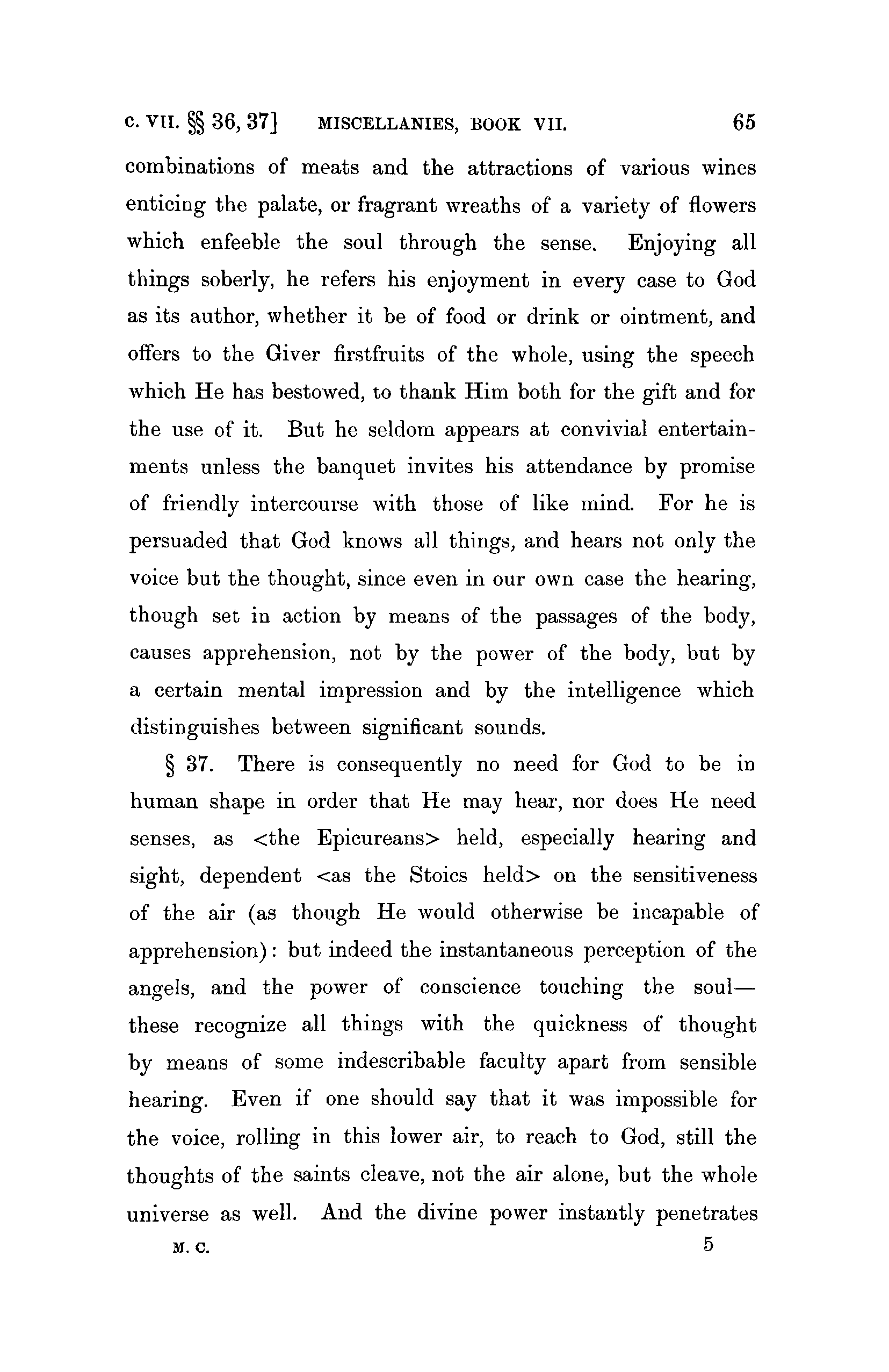
combinations of meats and the attractions of various wines enticing the palate, or fragrant wreaths of a variety of flowers which enfeeble the soul through the sense.
Enjoying all things soberly, he refers his enjoyment in every case to God as its author, whether it be of food or drink or ointment, and offers to the Giver firstfruits of the whole, using the speech which He has bestowed, to thank Him both for the gift and for the use of it. But he seldom appears at convivial entertainments unless the banquet invites his attendance by promise of friendly intercourse with those of like mind. For he is persuaded that God knows all things, and hears not only the voice but the thought, since even in our own case the hearing, though set in action by means of the passages of the body, causes apprehension, not by the power of the body, but by a certain mental impression and by the intelligence which distinguishes between significant sounds.
§ 37. There is consequently no need for God to be in human shape in order that He may hear, nor does He need senses, as <the Epicureans> held, especially hearing and sight, dependent <as the Stoics held> on the sensitiveness of the air (as though He would otherwise be incapable of apprehension) : but indeed the instantaneous perception of the angels, and the power of conscience touching the soul— these recognize all things with the quickness of thought by means of some indescribable faculty apart from sensible hearing. Even if one should say that it was impossible for the voice, rolling in this lower air, to reach to God, still the thoughts of the saints cleave, not the air alone, but the whole universe as well. And the divine power instantly penetrates
M. c.
https://doi.org/10.1017/CBO9780511695513.010 Published online by Cambridge University Press
STPQMATEQN T
[p. 853, s. 306
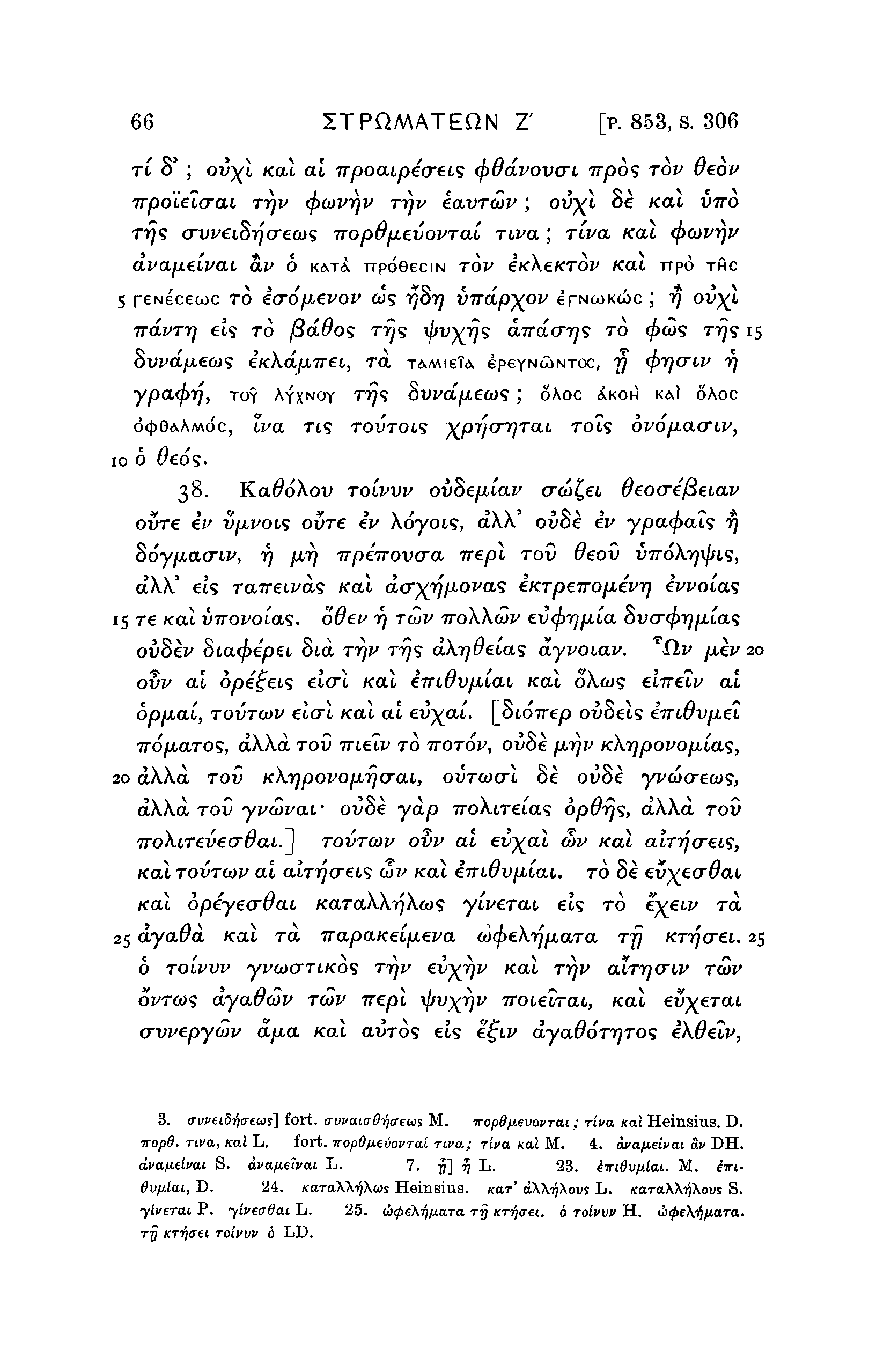
Tt S' ; ovyi /cat at TT poaipecreis <$>6dvovcri irpos TOU veov npoielcraL rr)v cfrcovr/v rr)v eavrcov ; ov^t Se /cat VTTO
T7)<z o-uvetS^'crecos Tropd^evovTai TWO. ; rCva /cat <j>covr)v dvapeivai av 6 K&T^ npoeeciN TOV ixXeKTOV Kal npo THC
S peNececoc TO icrofjuevov cos r]8r) virdp^ov efNcoKcbc ; rj ov)(L et? TO f3ddos rrj<s xfjv^rj? dTracr^? TO <f>co<; Trj<; IS ws e/cX.a|U77-et, TO. TAMIETA epeyNtbNTOC, rj <f>n]<TLV 7} ypa<f>rj, TOY ^YXNOY T175 $vvd[x,ecos; oAoc AKOH K<\! OAOC 64>e*.AMoc, iVa T15 TOVTOts ^pyjcrrjTai TOIS bvop-acnv, 10 6 #eos.
38.
Ka^dXov ro'ivvv ovSe/xtav crat[,eL ^eocre/3eiav OUTC e^ v/xvois OVTE eV Xdyois, aXX' ouSe ev ypa^ais ^
V, rj fir) irpeTrovcra Trepl rod deov inroX ets Taireii'as /cal dcr^if/AO^a 15 TC /cat vTrovoias. o^ev 17 TCUV TTOXXOJI' ovSev 8ia(f>epeL Bed Trjv rrjs dkrj6e(,as dyvoiav.
'ilv jxkv 20 ovv at operas eicrl /cat l-niOv\hia.i KOX OXW? eiTreiv at opfiai, TOVTWV eicrl KCU at eu^at. [StoTrep ouSets h
7rd//,aTOS, dXXd TOU vrtetv TO TTOTOV, ovSe fxr)v 20 dXXd TOV KXr/povofirjcrcu, ovrcocrl Se o«;Se dXXd TOU yj'&jz/af ouSe yap TroXiTCias 6p0rj<;, dXXd TOV
7roXiT€uecr#ai.] TOUTWV 05^ at eu^at chv KCU airrjc Kal TOVTCOV ai atT^o~eis cov KCU ividv/JLLai.
TO Se /cat opeyecrdaL KaTaXXrjXcos yivtrcu, ets TO ^X€LV T<^ 25 dya#d /cat TO. Trapa.KeiiJ.eva coc^eX-qfiaTa rfj
KTrjcrei. 25
6 Toivvv yva)O"TtKos TTJI' evyr\v KOX TTJV atrrfcnv rcov OVTCOS dyadcov TCZV Trepl \pv)^rjv 7rotetTat, Kat eu^eTat crvvepycov ajua /cat a^T09 ets e^tv dya^oTijTOs eXOeiv,
3. crweiS^ereus] fort. avvaiaB-qamis M. iropSfievovrai; riva Kal Heinsius. D.
7rop9. Tica, /col L. fort. TropO/i.eioi>Ta.l riva; rlva. Kal M.
4. avap.ei.vai. av D H . dvafidvcu S. ava/ustvai L.
J] J7 L.
23.
4iri.8vfji.laL. M. ^TTISvfilai, D.
24.
KaTaXXiJXws Heinsius.
/tar' dXXijXovs L.
KaraXX^Xous S. ylverat P. "ylveadai L.
25. th<pe\T)fj.aTa ry Kr'rjirei. 6 Toivvv H. a>0 r^ KTr/ijet roivvv 6 LD. https://doi.org/10.1017/CBO9780511695513.010 Published online by Cambridge University Press
C. VII. §§ 37, 38]
MISCELLANIES, BOOK VII.
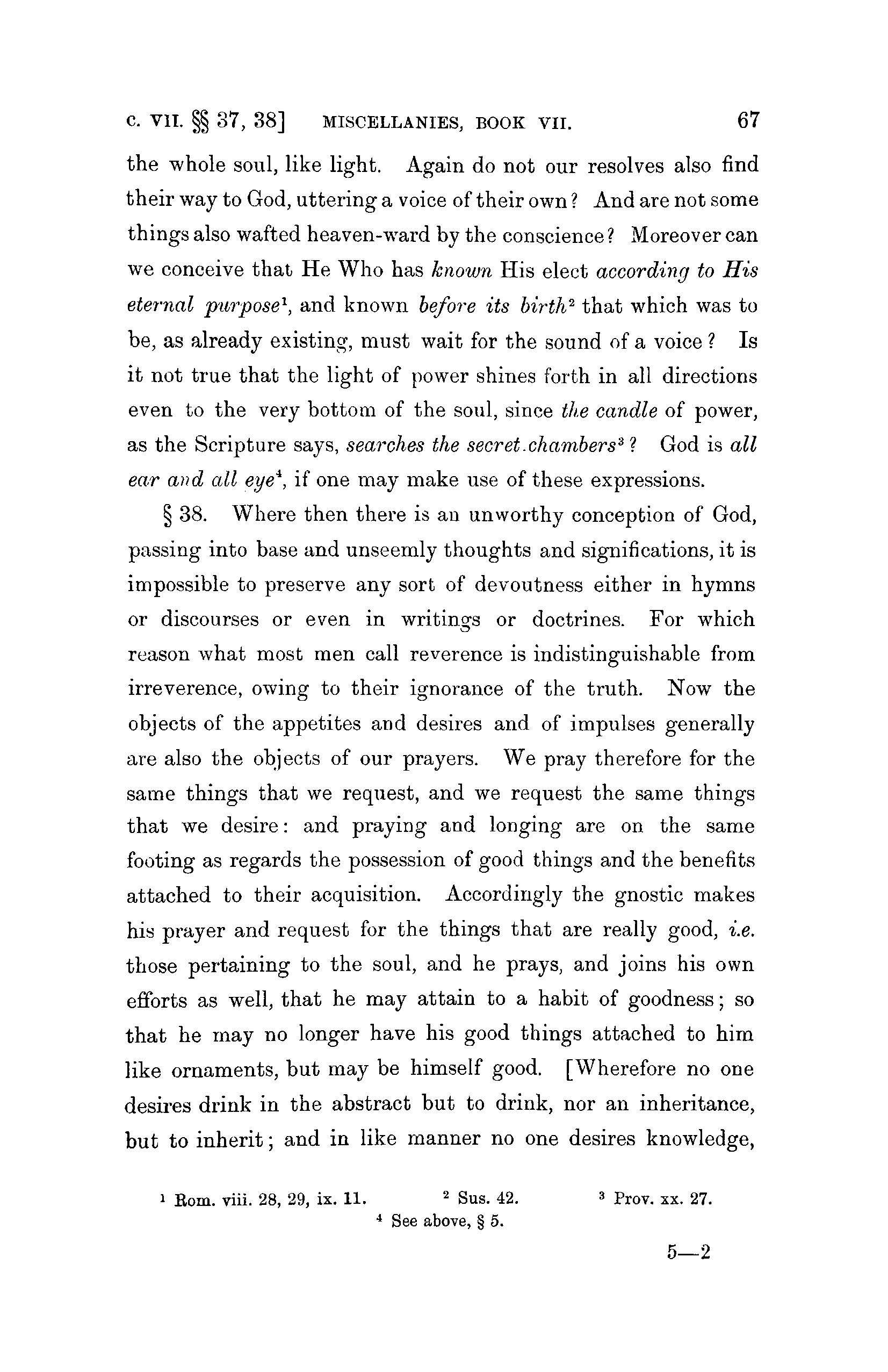
the whole soul, like light. Again do not our resolves also find their way to God, uttering a voice of their own ? And are not some things also wafted heaven-ward by the conscience ? Moreover can we conceive that He Who has known His elect according to His eternal purpose1, and known before its birth2 that which was to be, as already existing, must wait for the sound of a voice ? Is it not true that the light of power shines forth in all directions even to the very bottom of the soul, since the candle of power, as the Scripture says, searches the secret .chambers3 ? God is all ear and all eye*, if one may make use of these expressions.
§ 38. Where then there is au unworthy conception of God, passing into base and unseemly thoughts and significations, it is impossible to preserve any sort of devoutness either in hymns or discourses or even in writings or doctrines. For which reason what most men call reverence is indistinguishable from irreverence, owing to their ignorance of the truth. Now the objects of the appetites and desires and of impulses generally are also the objects of our prayers. We pray therefore for the same things that we request, and we request the same things that we desire: and praying and longing are on the same footing as regards the possession of good things and the benefits attached to their acquisition. Accordingly the gnostic makes his prayer and request for the things that are really good, i.e. those pertaining to the soul, and he prays, and joins his own efforts as well, that he may attain to a habit of goodness; so that he may no longer have his good things attached to him like ornaments, but may be himself good. [Wherefore no one desires drink in the abstract but to drink, nor an inheritance, but to inherit; and in like manner no one desires knowledge,
1 Bom. viii. 28, 29, ix. 11.
2 Sus. 42.
3 Prov. xx. 27.
4 See above, § 5.
5—2 https://doi.org/10.1017/CBO9780511695513.010 Published online by Cambridge University Press
ITPQMATEQN Z'
[p. 853, s. 306
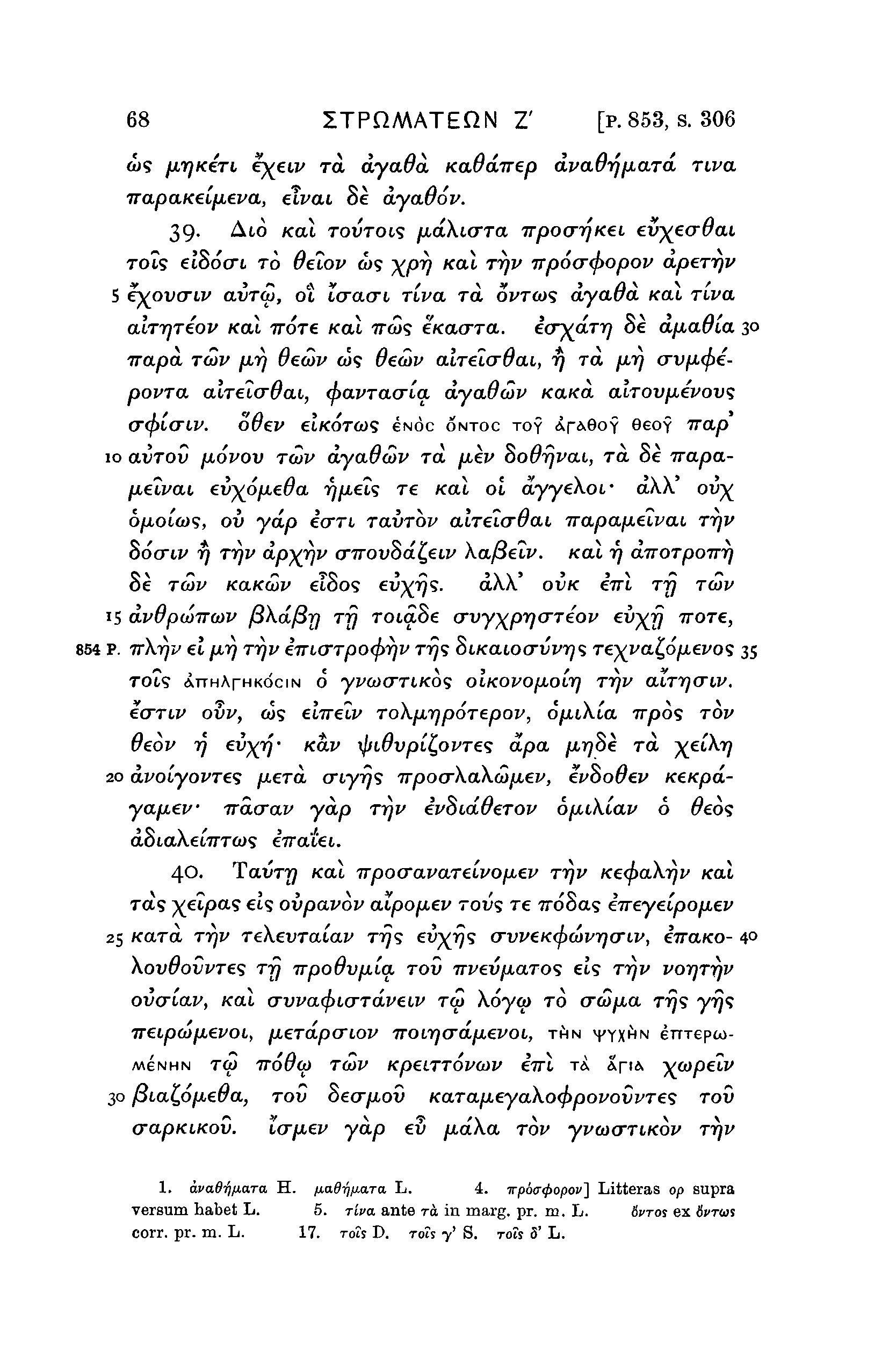
(us iMr)K€TL e^eiv ra dyadd KaBdirep dvadrj/xaTd TIVO. napaKeCfjieva, elvai Se dyaOov.
39.
Ato Kal TOVTOLS /u-aXiora irpocnqKei ev^eaOai TOIS eiSoVi TO detov ws ^ 7 7 /cat r»)i> TTp6o~<f>opoi> dpeTrjv
5 eyovo~iv axiT(u, 0% lo~ao~i Tiva rd OVTCOS dyadd Kal rCva alr7]T€ov Kal TroVe Kal TTWS eKacrTa. ecr^aTrj Se d^adia
irapa TGJV fir) Qe£>v o5? ^etSi' aVreladaL, rj r a ja^ o~vfJi<f)epovTa aiTetcr^at, tyavTacria dyaQwv KaKa <r<j)Co-ii'. oOev eiKOTWS 6NOC ONTOC TOY <\r^6 fj-ovov TWV dyadcov r a /ACV SoOrjvat, TO. Se irapaev^ofieda
77^61? TC /cai ot ayyeXoi* aXX ou^ 6fjbOLO)<;, ov yap ecrn TavTov aLTeiaOai irapafxeivaL TT)V 8oo"iv 17 Tr)v dp)(Tjv (nrovhdtfiiv Xafielv.
Kal 77 diroTpoTry) Se Tb)v KaKcov etSos CU^TJS. dXX' ov/c inl Trj TGJV 15 dvOpwTrwv fiXdfirj Trj roiaSe crvy^prjaTeov ev^rj iroTe, 854 p. irXrjv el fxr) Trjv eTno~Tpo<f>rjv TTJS Si/catoo"i;r7is Te^va^o/xei'os 35
Tols ATTHATHKOCIN d yvoiO~TLKO<; olKOVOfJiotrj Trjv aiTr)o~iv. io~Tvv ovv, ws elireiv ToXjxrjpoTepov, d/xt\ia
TT/JOS TOV
^eoi'
77 e w ^ 1 KCLV ipidvpi£,ovTe<; dpa jmjSe TO.
20 dvo'iyovTe<i /xeTa criyrj<s irpoamXaXS[jLev, evSo$ev ya/xev •ndo'av yap Trjv ivhiddeTov 6yu.iA.iaz/ 6 iirateu.
40.
Ta^T77 Kal TTpocravaTeLVOfx,ev Trjv Ke<f>aXr)v Kal Tas ~x.elpas ets ovpavov atpofiev TOVS Te TrdSa? ineyeCpofjiev 25 /caTa T77V TeXeuTataz/ T77S eu^T^s o~vveK<$>u)vrio~iv, eiraKo4°
Xou^oi'i'Tes T77 TrpoOvfxia TOV irvevfJLaTos ets TTJV vor)Tr)v ovcrCav, Kal cvva^io-Taveiv T<W X6yq> TO cr&J)aa T77S yTjs Treipcj^evoi, fieTapo-Lov Troirjo~djj.evoi, TI^N VYX^N errTepcoMGNHN TW TToOcO TU>V KpeLTTOVOiV CTTt TA &r'^ ~)(O)pelv
30 fiSiatpiAeOa, TOV Seo-fjuov KaTafj.eyaXo(j)povovvTes TOV crapKiKov.
Ivpev yap ev fidXa TOV yvcuo-TLKov Tr)v 1. cwafl^uara H. fiaBri/mTa L.
4. irp6o-<j>opov~\ Litteras op supra versum habet L.
5. riva ante TO. in marg. pr. m. L.
S^ros corr. pr. m. L.
17.
TOIS D.
TOIS 7' S.
TOIS 5' L.
https://doi.org/10.1017/CBO9780511695513.010 Published online by Cambridge University Press
C. VII. §§ 38—40]
MISCELLANIES, BOOK VII.
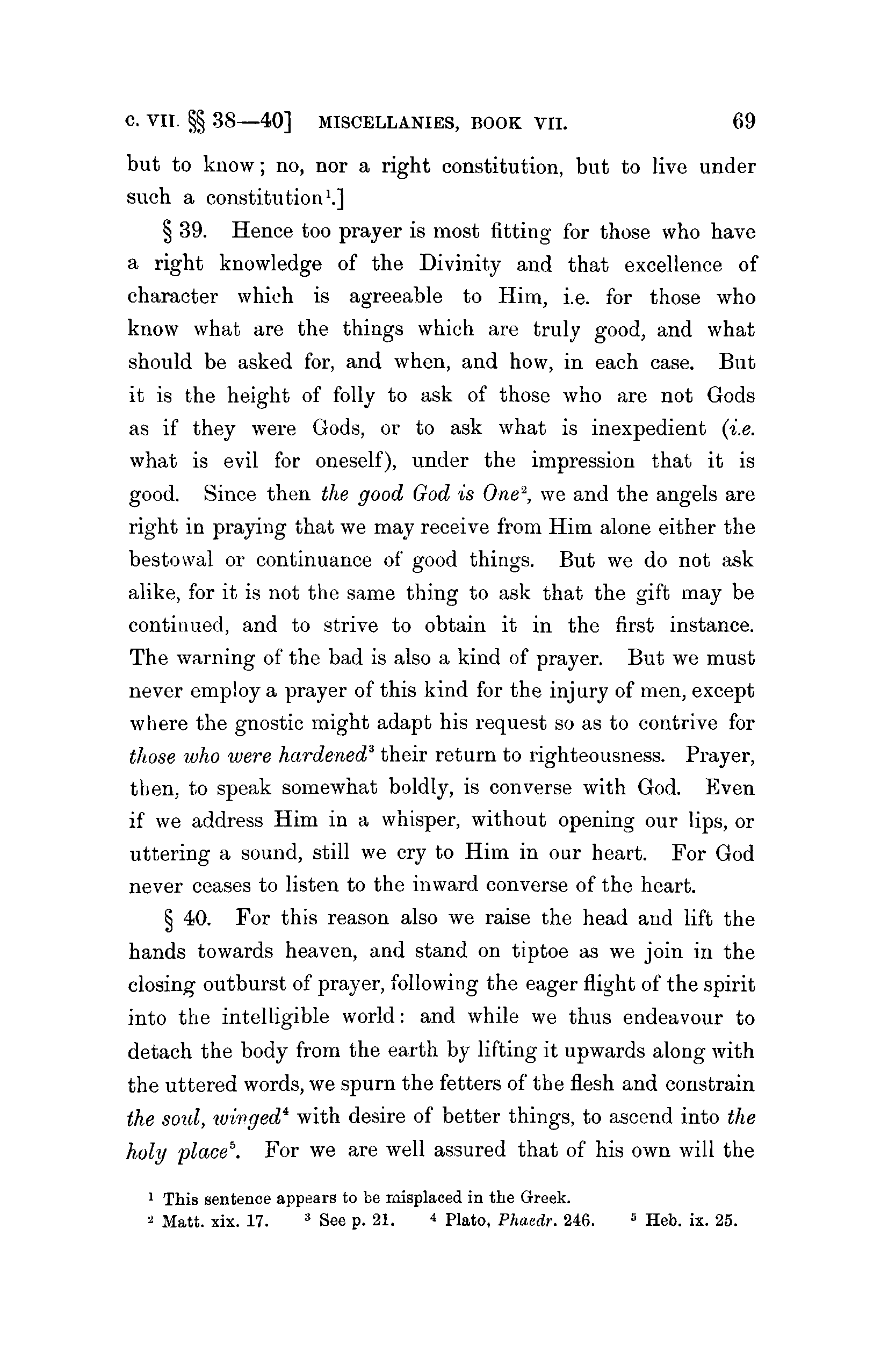
but to know; no, nor a right constitution, but to live under such a constitution1.] § 39. Hence too prayer is most fitting for those who have a right knowledge of the Divinity and that excellence of character which is agreeable to Him, i.e. for those who know what are the things which are truly good, and what should be asked for, and when, and how, in each case. But it is the height of folly to ask of those who are not Gods as if they were Gods, or to ask what is inexpedient (i.e. what is evil for oneself), under the impression that it is good. Since then the good God is One2, we and the angels are right in praying that we may receive from Him alone either the bestowal or continuance of good things. But we do not ask alike, for it is not the same thing to ask that the gift may be continued, and to strive to obtain it in the first instance.
The warning of the bad is also a kind of prayer. But we must never employ a prayer of this kind for the injury of men, except where the gnostic might adapt his request so as to contrive for those who were hardened3 their return to righteousness. Prayer, then, to speak somewhat boldly, is converse with God. Even if we address Him in a whisper, without opening our lips, or uttering a sound, still we cry to Him in our heart. For God never ceases to listen to the inward converse of the heart.
§ 40. For this reason also we raise the head and lift the hands towards heaven, and stand on tiptoe as we join in the closing outburst of prayer, following the eager flight of the spirit into the intelligible world: and while we thus endeavour to detach the body from the earth by lifting it upwards along with the uttered words, we spurn the fetters of the flesh and constrain the soid, winged* with desire of better things, to ascend into the holy place5. For we are well assured that of his own will the 1 This sentence appears to be misplaced in the Greek.
2 Matt. xix. 17.
3 See p. 21.
* Plato, Phaedr. 246.
5 Heb. ix. 25. https://doi.org/10.1017/CBO9780511695513.010 Published online by Cambridge University Press
ITPQMATEQN Z
[p. 854, s. 306
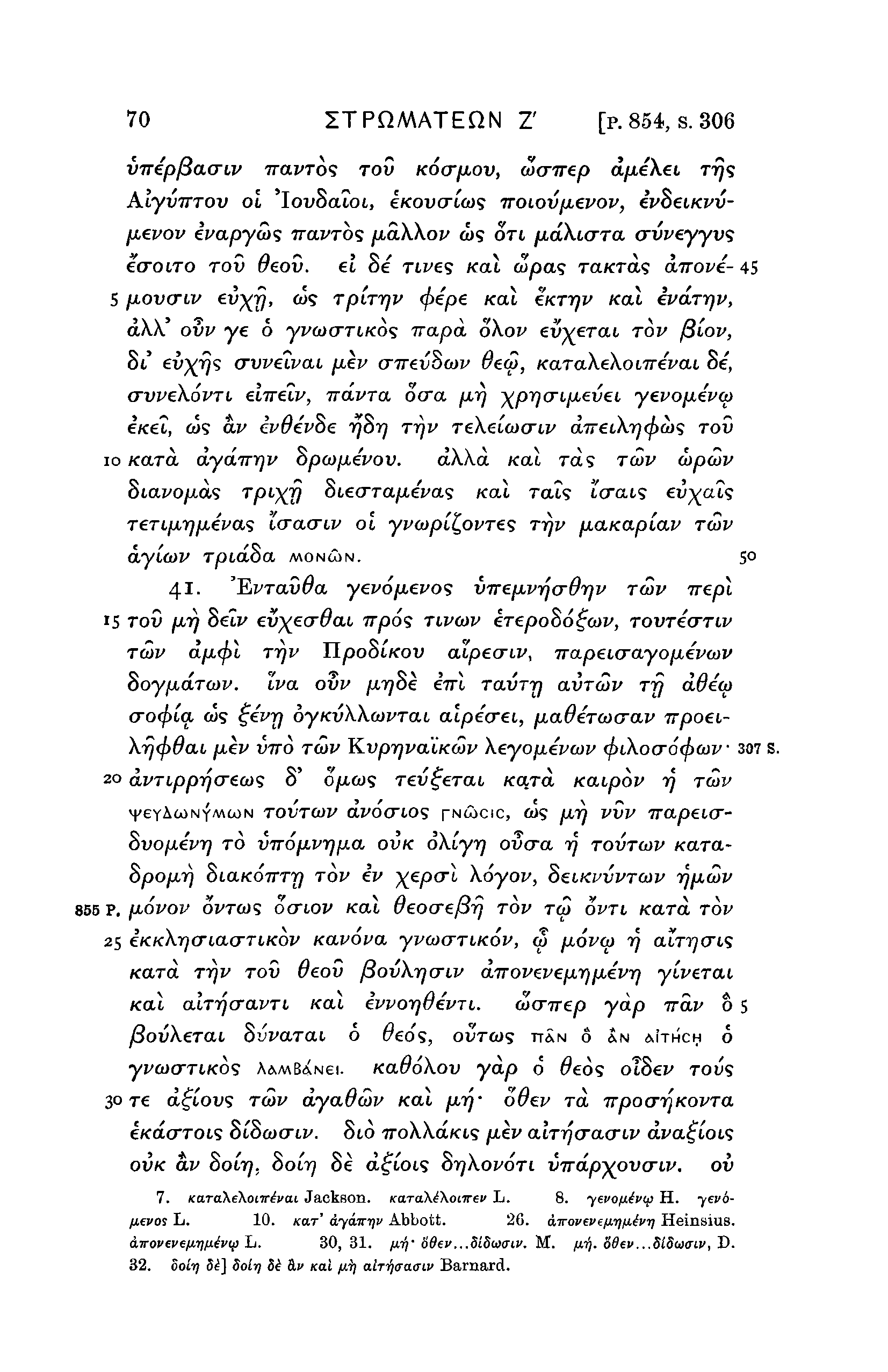
VTripfiacriv iravTos TOV KOVJUOV, wanep d/xe'Xei TTJS AlyvTTTOv ol 'iouSaioi, e/coucritu? Troiovfjuevov, ivSeLKvvfievov ivapyws navTO<z (JLOLXXOV C!>S OTL fidXtara crvveyyvs ecroiTO TOV deov. ei Se Tiz^es Kai upas Ta/cras dirove45 5 /JLOVCTLV €-V)(fj, CO? TplTTjV <f>€p€ KOI €KT7}V KCU €Va.Tr)V, aAA.' o3^ ye 6 yvojo-TLKOs irapa okov eu^erai roi' fiiov,
Si' eu^Tjs crvi'ervai /AEJ' crTre^S&w ^ « , KaraXeXotTreVai Se, (TV^eXovrt eiTreii', irdvTa o c a /Ary ^prjcrt/xevei yevo/xeva) €K€L, (us av iv0dv8e yjSr) TTJV Te\eC(i)o~iv dTreiXr)<f>o)<; TOV
IO /caret dyaTTr/v <>po)[xevov. dWa Kai r a s raSi' u>pa>v Siavo/^as TplXQ S(,eo"ra/,ieVas Kai rat? io"ai? exeats io~ao~iv ol yv<i)pit,ovTe<; TTJV /xaKapiav TWV rpiaSa MONUN.
SO 41.
'Ej'TaS^a yevo/jLtvos VTrep.vrjo~9rjv TU>V nepl 15 rov /U-T) Sell' eu^ecr^ai TT/JO? TIVWV ereyaoSd^cov, TOVTIO-TIV dfL<f>l Trjv UpoBiKov alpeo-LV, Trapeicayo/xeVwv aTOiv.
Iva ovv /xrjSe iirl TOVTITJ avTaiv Trj ddio) ao(f)Ca 0J9 tjevr) oyKvXXajvTai aipe'crei, fiadeTOicrav irpoei- \rj<j>dau jxev VTTO TO)V KvprjvaLKaiv Xeyojxevwv (f)iXoo~6^)0)v 307 s.
20 dvTipprjO~€.ut<; S' O/AWS Tev^erai Kara Katpov rj TCOV YeyAcoNYMcoN TOVTCOV dvoo~ios fNihc\c, 6J9 /jbr) vvv
Svofxevrj TO wo/AV^jLia OVK okiyrj ovo~a rj TOVTU>V Bpofirj ZiaKOTTTf) TOV iv )(€po~l Xoyov, SeLKvvvTOJv rjp
855 P. \LOVOV OVTOJS OO~IOV KOX deocrefirj TOV T&» OVTI Kara TOV 25 iKKkr)O-iao-TiK0v Kavova yvoicrTiKov, <£ JXOVCO rj aiT7]cn<;
/cara Trjv TOV deov fiovXyjcrLv aTrov^veixruxivrj yiVerai /cai aWrjo-avTi /<ai ivvor/OevTL. u>o~TT€.p yap vdv o 5
#eo's,
OVTWS n&N 6 JN AITHCH
KaffoXov yap 6 deos olSev TOVS 30 T€ allows TWV dyaOwv /cai jai^- o^ei' Ta TrpocnqKovTa eVcacTTOis SISWO'IJ'.
SIO TroWa/cis jLiev axTr)o~ao~iv dva£Coi<; OVK av BOLT), BOLT] Se dfiois S^XO^OTI vndp^(ovo~iv. oi 7.
KaraXeXoi7r^at Jackson.
K"GtTa\^Aoi7rei> L .
8. yevonivtg H . •y«'6- /ie^os L.
10. xar' ayairriv Abbott.
26. airova>eixT)iLivTi Heinsius. aTrovevenrffiivip L.
3 0 , 3 1 .
^ij-SSe>»...5t8(<>(rii'. M. /i^. o6e 32.
6o£ij 5^] 5o()) U hv xal ^ alrij<ja.aw Barnard. https://doi.org/10.1017/CBO9780511695513.010 Published online by Cambridge University Press
C. VII. §| 40, 41]
MISCELLANIES, BOOK VII.
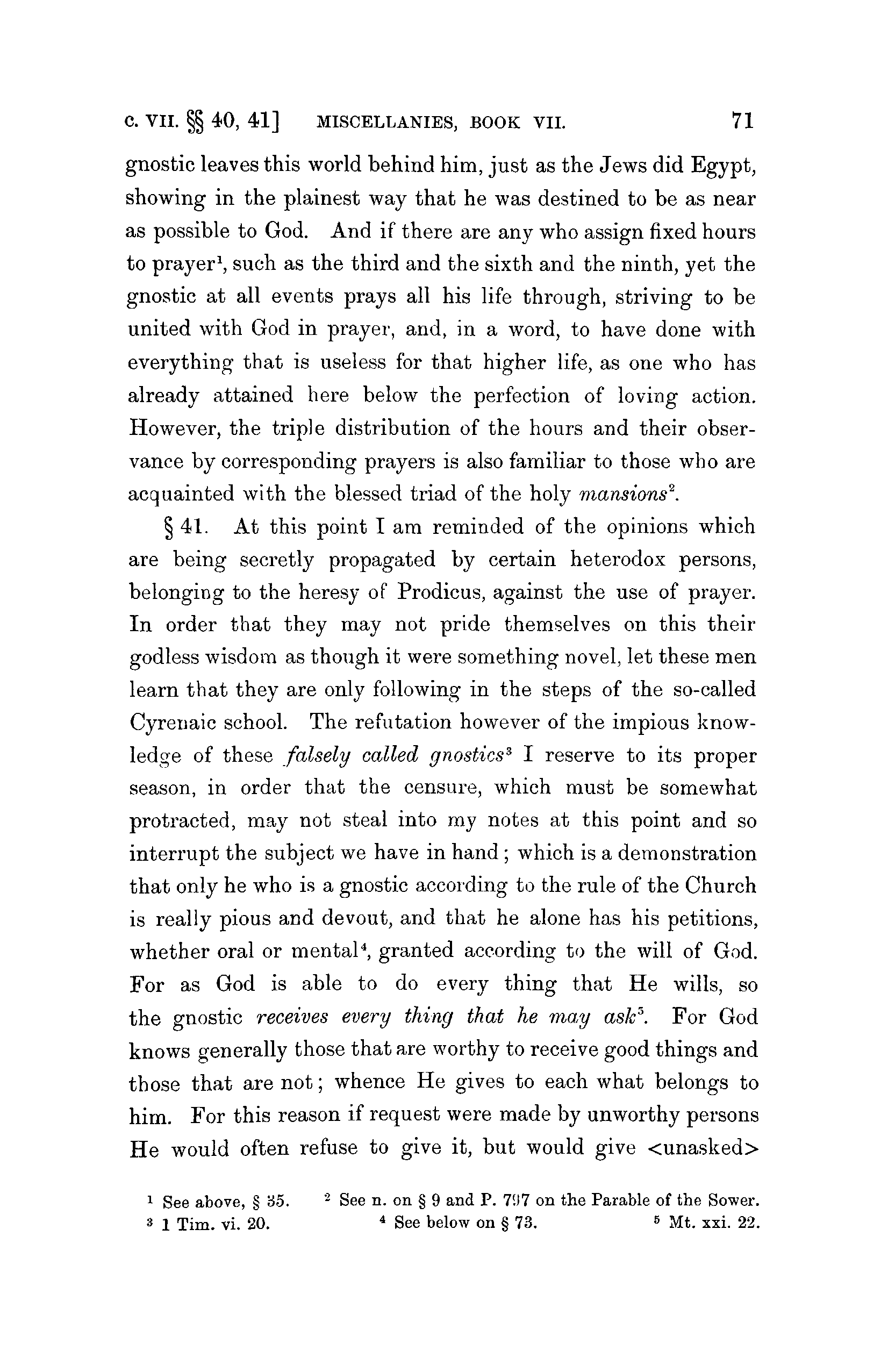
gnostic leaves this world behind him, just as the Jews did Egypt, showing in the plainest way that he was destined to be as near as possible to God. And if there are any who assign fixed hours to prayer1, such as the third and the sixth and the ninth, yet the gnostic at all events prays all his life through, striving to be united with God in prayer, and, in a word, to have done with everything that is useless for that higher life, as one who has already attained here below the perfection of loving action.
However, the triple distribution of the hours and their observance by corresponding prayers is also familiar to those who are acquainted with the blessed triad of the holy mansions*.
§ 41. At this point I am reminded of the opinions which are being secretly propagated by certain heterodox persons, belonging to the heresy of Prodicus, against the use of prayer.
In order that they may not pride themselves on this their godless wisdom as though it were something novel, let these men learn that they are only following in the steps of the so-called
Cyreuaic school. The refutation however of the impious knowledge of these falsely called gnostics* I reserve to its proper season, in order that the censure, which must be somewhat protracted, may not steal into my notes at this point and so interrupt the subject we have in hand ; which is a demonstration that only he who is a gnostic according to the rule of the Church is really pious and devout, and that he alone has his petitions, whether oral or mental4, granted according to the will of God.
For as God is able to do every thing that He wills, so the gnostic receives every thing that he may ask3. For God knows generally those that are worthy to receive good things and those that are not; whence He gives to each what belongs to him. For this reason if request were made by unworthy persons
He would often refuse to give it, but would give <unasked> 1 See above, § B5.
2 See n. on § 9 and P. 797 on the Parable of the Sower.
3 1 Tim. vi. 20.
4 See below on § 73.
6 Mt. xxi. 22. https://doi.org/10.1017/CBO9780511695513.010 Published online by Cambridge University Press
ZTPQMATEfiN Z'
[p. 855, s. 307
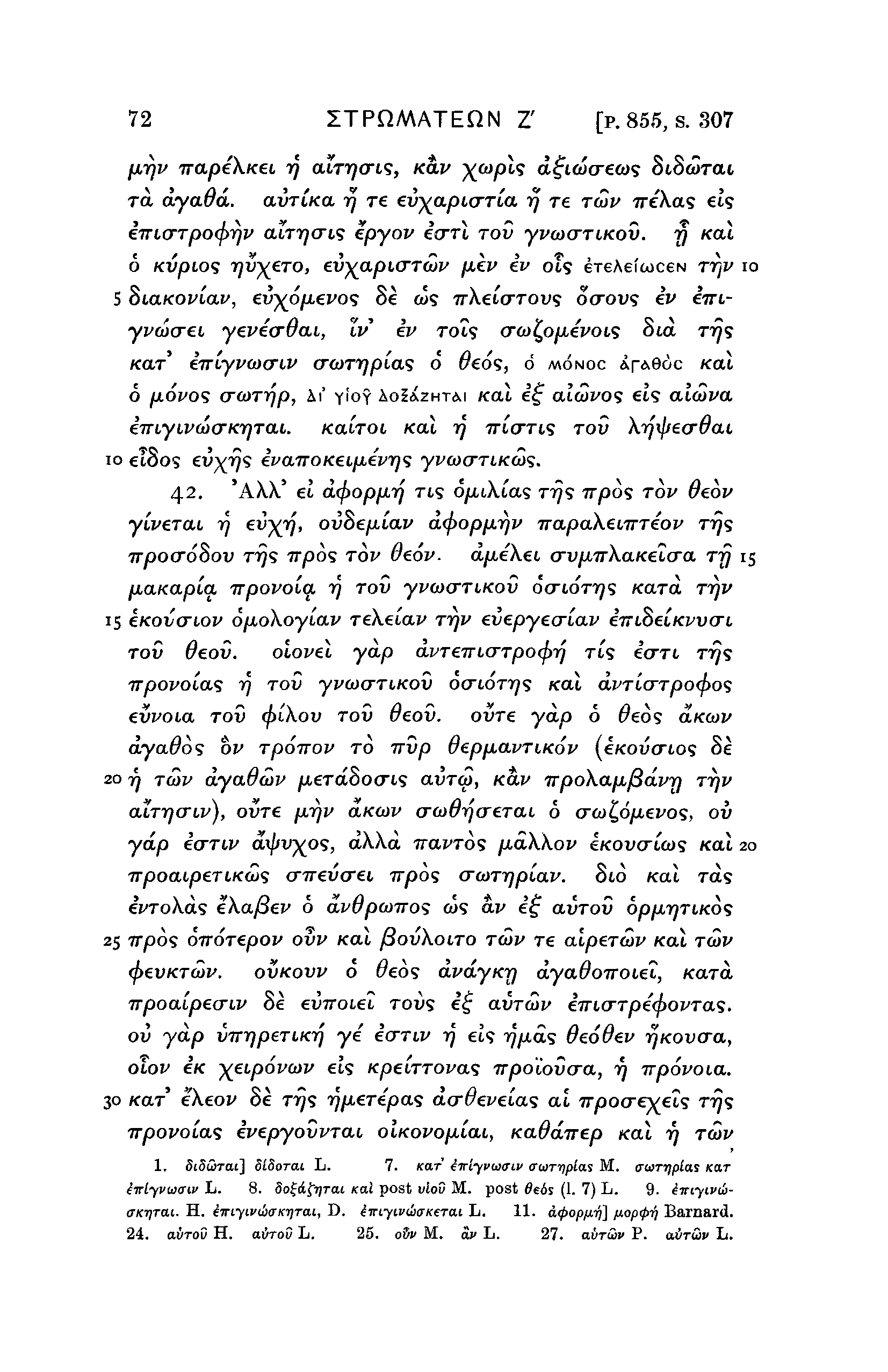
H^v irapekKet r] airrjcris, KOLV xcopls dficucrecos SISCOTCU r a dyada. auTt/ca yj re eu^aptcrrta rj re TU>V Tre'Xas eis ini.crTpocj>7ji> airports epyov icrrl TOV yvcacrriKov. rj /cat 6 Kvpios rjvyero, ev^apio~Tb>v fikv iv 61s eTeAefwceN 5 SiaKOViav, eu^o/Ltevo? Se cos TrAeioTovs ocrou? eV yi'ftjo-et yevicrOai, Iv kv roi?
(rco^OjueVots Sta «ar' i-niyvtecriv <ro)Trjpia<; 6 #eos, d MONOC Ar^eoc /ecu 6 ixovos croiTrjp, K\ yioy AO?AZHT*.I /cat ef aiaJvos eis alcova iTnyLV(ocrKrjTat.
KOLCTOL /cat r^ Trtcrrts TOU Xijxjje(r0at. io etSos e u ^ s e^aTro/cetjaevijs yi'aicrTi/c&JS.
42.
'AA.A.' Ct d(f)OpfJLlj TtS O/AlXtaS 7175 7T/3OS TO!/ yiverai -q ev^rj, ovSe/JLtav d<f>opjjLr)v irapaXeLirTeov wpocroSov T7)<z Trpos TOV Oeov. d/xeXeL cru/AirXa/cetcra TT^ 15 jua/capta, irpovoia rj TOV yvaxxTLKov ocrtor^s /cara r^v 15 e/covcrtov ofJioXoyiav rekeCav TT)V evepyecriav e7rtSet/cvwcrt
TOV 0eov. olove.1 yap avT€Trio~Tpo(f)r) rts io~Ti T17S TT/sovota? 7) TOV yvaxTTLKOv oo~tOT7/s /cat dvTio-Tpo<fio<; evvoba TOV <f>iXov TOV deov.
OVTS yap 6 Oeos a/caiv dyaOos ov Tpoirov TO nvp dep/xavTiKov (e/coucrtos 8e 20 ^ rav dyadatv )u,eTaSoo-is avTco, /cctv irpoXafji/Sdvy TTJV aiTrjo-Lv), OVT€ JJLT)V aKcov o~o)0rjcr€TaL 6 o"a)^6/a,ei'os, ov yap io-TW CH/ZU^OS, aXXa TravTos p-aXXov e/couo"tct>s /cat 20 o~7reuo~et 7r/3os o-ct)TT)pCav. Sto /cat Tas v 6 dv0punro<; cos civ e'£ ai5To{5 6pjxrjTiKo<;
25 Trpos oiroTepov ovv Kal (ZOVXOLTO TMV TG alperav /cat TC3V <j)evKT(ov. OVKOVV 6 0e6s dvdyKTj dya0OTTOLet, /caT<i Trpoaipeo~iv he einroiel TOWS e^ avTcoi' eTno~Tpe(j>ovTa?. ov ydp v-trrjpeTLKrj ye eo-Tiv r] ets i^/xas 0e60ei> rjKovaa, olov e/c ^eipovcov ets /cpetTTovas Trpoiovaa, r) irpovoia.
30 /caT* eXeov 8e TTJS rjfjLeTdpas do~0eveia<s at Trpocrexets TTJS 7r/Dovotas ivepyovvTac ot/covo/x.tat, Ka0direp /cat 17 TCOV 1.
8I5(3T<U] SiSorai L.
7. (far tiriyvw<ru> atorriplas M. (TwrT/pias K«T Myvuaiv L.
8. SofdfTjrai /cai post i/ioD M. post 0e6s (1. 7) L. i. H. ^i7»'ii(T/fi)Tai, D. imyivdivKeTcu h.
11. d^op/xi;] /iop0^ Barnard.
24. ayroC H. ai/Tov L.
25. oSv M. ay L.
27. avrwv P. auT<3» L. https://doi.org/10.1017/CBO9780511695513.010 Published online by Cambridge University Press
C VII. §§ 41, 42]
MISCELLANIES, BOOK VII.
provided they were worthy. Yet the petition is not superfluous, even though good things be granted without petition made. For instance, both thanksgiving and prayer for the conversion of his neighbours are the duty of the gnostic. Thus the Lord also prayed, returning thanks for the accomplishment of his ministry1 and praying that as many as possible might share in knowledge*, in order that God, who alone is good, alone is
Saviour, may be glorified through His Sons, in those who are being saved through the salvation which is according to knowledge4, and that the knowledge of Him may grow from age to age. Howbeit the mere faith that one will receive is itself also a kind of prayer stored up in a gnostic spirit.
§ 42. But if prayer is thus an occasion for converse with God5, no occasion for our approach to God must be neglected.
Certainly the holiness of the gnostic, being bound up with the Divine Providence through a voluntary acknowledgment on his part, shows the beneficence of God in perfection. For the holiness of the gnostic is, as it were, a return back on itself of Providence and a responsive feeling of loyalty on the part of the friend of God. For neither is the goodness of God involuntary like the warmth of fire (but His imparting of good things is voluntary, even though He should wait to be asked); nor on the other hand will the man who is being saved be saved without his will, for he is no lifeless machine, but will most assuredly hasten to salvation with eager alacrity.
It is on this account that the commandments were given to man as to a being who would be spontaneously impelled to whichever he might choose, whether of things eligible or ineligible.
God therefore does not do good of necessity, but of His own free will He befriends those who turn to Him of their own accord. For the providence that comes to us from God is not ministrative6, as though it proceeded from inferiors to superiors; but it is from pity of our weakness that the nearer dispensations
1 Joh. xvii. 4.
- Joh. xvii. 20, 23.
3 Matt. xix. 17, Joh. xvii. 1.
* Job. xvii. 3.
6 See above, § 39.
6 See above, § 3. https://doi.org/10.1017/CBO9780511695513.010 Published online by Cambridge University Press
STPQMATEQN Z'
[P. 855, s. 307 iroifji.4voiv eis r a 77po/3ara /cat r) TOV /8acriXe&>? irpo<; 856 P. TOWS dp)(Ofievov<s, /cat IJ/XWJ' avT<3v TreiOrfvio)^ vpos
TOUS 25 rjyovfxevov^ i\6vT(ov, TOUS TeTaypevais SteVovTas «:a#'
17V eveyeip'10-QrjO-av T<X£LV e'/c #eou.
Oepdnovres apa Kal 5 OepairevTal TOV OeCov ol iXevdepiKajTaTr/v Kal /3ao"tXt/cwdepairelav
Trpoo~dyovTe<;, T-qv 8ta r^s 8eocre/3ov<s Te Kal yvcoarew?.
43. lias o w /cat TOTTOS te/jos T&I OVTI ev OJ TIJV eirivoiav TOV deov Xa/jL^dvofiev Kal ^povo<;OTOV Se
10 6 evirpoaipeTOS bfxov /cat eu^aptcrTos §t' e v ^ s alTrJTai, afirfyewrj avvepyei TL TT/DOS T^V Xrjxbiv, acr/xeV&is Si' aw 30 ev^erat TO TTOOOV/JLCVOV Xa/jLJ3dva>v. iTrav yap TO Trap rjjjicov eveTTL(f)opov 6 Twv dyadcov Xdfirj Sorrjp, dOpoa irdvTa Trj o-vXXrjxjjet, avTjj ZTrerai TO. dyadd. a/^eXet 15 e^eTa^erat Sta TTJS ev^ijs o TyDovros TTWS e^et Trpos TO TrpoarTjKov. el Se rj (fxovrj Kal rj Xe^ts T17S I'OTjcrews
•)(dpiv SeSoTat rjjjuv, TT&JS 0 ^ 1 avTrjs Trjs yjjv^rjs Kal TOV vov eTra/covet o ^eos, OTTOV ye 1781^ ^X 7? l/'l'X^s K a ^ v o ^ s voos eVa'tei; o^ev Tas TTOXV^WVOVS yXcucrcras ou/c ava35 20 /j,eVet 6 ^eos KaOdnep ol irapd dvOpcincov epfjLrjvels, aXX' a.7rafan"Xa5s diravTotv yvcopi^eL Tas voiycreis, /cat oVe/3
T7ju.1i' 17 (pwvr) crrj/jLaivei,, TOVTO TW ^ew 77 evvoia r]/x(ov XaXet, 77V /cat Trpo Tiijs Srj[XLOvpyi,a<; ets vorjcriv r]^ovo~av rjTTio~TaTO. e£e<XTLV ovv fjL7)8e <f>o)vrj TTJV ev)(r)v Ttapa25 TrifjuTTetv, arvvTeivovTa fxovov ev8o9ev TO •nav ets (fxo^rjv TTJV vorjTr)v /cam TTJV aT irpbs TOV deov eViarpo<f>r)v.
'E7re( Se yeveOXtov rjfxepa<i eiKWv rj dvaToXrj, Ka TO <)>toc av^eTai ex. CKOTOYC AAM^AN TO npaJTOv, dXXd Kal 40
30 TOTC GN dyvolq. /caXivSoi>jueVois AN6Tei\eN y^wcrews d 3.
TeTay/nivws P. rerayfiivovs L.
10. ahrJTat D. o/retTat L.
13.
Xd/3i; L.
>d^oi V.
14. ai>ri? M. aijrijs L.
17. x^/"",Prm. corr. ex 5ia x^P"1 L.
S^SoTai pr. m. corr. ex &5orcu L.
24, 25. irapaTr^/ixeic, avvTeivovTa fj.t>vov h8o$ev Heinsius. irapaireinrav avvrdvovTO. fi6vov d' hdoBef L.
30. ivtreiXev L. dWretXe VD. https://doi.org/10.1017/CBO9780511695513.010 Published online by Cambridge University Press
C. VII. §§ 42, 43]
MISCELLANIES, BOOK VII.
of Providence are set in motion, like the care of shepherds for their sheep and that of a king towards his subjects; while we ourselves also are submissive to our superiors, who govern us in an orderly manner according to the commission with which they were entrusted by God. They therefore are ministers and worshippers of the Divinity who offer the freest and most royal worship, viz. that which is rendered by devoutness both of purpose and of knowledge.
| 43. Every place then and every time at which we entertain the thought of God is truly hallowed ; but when he who is at once right-minded and thankful makes his request in prayer, he in a way contributes to the granting of his petition, receiving with joy the desired object through the instrumentality of his prayers. For when the Giver of all good meets with readiness on our part, all good things follow at once on the mere conception in the mind. Certainly prayer is a test of the attitude of the character towards what is fitting. And if voice and speech are given to us with a view to understanding, how can God help hearing the soul and the mind by itself, seeing that soul already apprehends soul, and mind apprehends mind ? Wherefore God has no need to learn various tongues, as human interpreters have, but understands at once the minds of all men; and what the voice signifies to us, that our thought utters to God, since even before the Creation He knew that it would come into our mind. It is permitted to man therefore to speed his prayer even without a voice, if he only concentrates all his spiritual energy upon the inner voice of the mind by his undistracted turning to God.
And since the east symbolizes the day of birth, and it is from thence that the light spreads, after it has first shone forth out of darkness*, aye, and from thence that the day of the knowledge of the truth dawned like the sun upon those who were lying in 1 2 Cor. iv. 6. https://doi.org/10.1017/CBO9780511695513.010 Published online by Cambridge University Press
ITPQMATEQN Z
[P. 856, s. 307 rj/xepa Kara \6yov TOV rjXCov, 7T/DOS TYJV ko)divy)v dvaToXrjv 857 P. a i e u ^ a i . odtv /cat r a TraXairara TCJV lepcov TT/JOS Suo"u> £/3XeTTev, Iva ol diravTLirpocrcoTroi T<av dyaXfiaTwv iCTTa/Aevoi Trpos dvaroXr/v Tp4ir€o~dai SiSaovcawrai.
5 6YN6HTW H npoceyxH MOY cbc 9 Y M ^ M & eNtbnioN COY, TUN xeiP^N MOY OYcf& ecnepiNH, ot ipaX[x.ol Xeyovcrtv.
44Tois fxo^(6rjpot<i Toivvv TSV dvdpcoirov rj ov /xovov eis TOI;? aXXous, aXXa /cat eis o~<f>d<; aurous 45
/SXaySepwrar^. et youj' «al a <pao~i.v evTV^/xara io alrrjo-dfievoL Xdfioiev, fiXdirret. Xa/3ovra9 avrovs, dveino~Ti]fx.ovas T^S X/07?°"ews aural^ UTrap^o^ra?. oi /xei' ya/3 a ov/c e^ovtrw ev^ovraL Krr\o~a,o'Qa.i, KOX TO. SOKOVVTOL dyadd, ov rd wro, atrovvrat.
6 y^wcm/cos §e «5»'
KeKTrjTai Trapafiovrjv, iirLTrjSeLorrjTa Se eis a 15 d-7To/3aiveLv, /cat ai'SiorijTa &w ov Xiji//erai airijcrerai' r a Se OVTCOS dyadd r a Trept xjjv^rjv eu^erat etz^at re a^rw Kai Trapafxeivat.
TOAITQ ouSe opiyerai
TLVOS TCOV
dnovToyv dpKovfxevos rot? TTapovatv. ov yap
C'XXITT^S 50
rwv olictuiiv dyadatv, t/cavo§ wv 17S77 eaurw e/c T^S delas o<s re /cat yi'aicrews' aXXa auYap/ojs /i.ei' yev6fj.evo<; tfs TC TWV aXX&)i^, TO iravTOKpaTopiKov Se /3ouX>>?ju.a /cat, ej^wi' a/i,a /cat eu^Ojuei'os, Trpocre^s r^
Travo-devel Swa/uei yev6[j.evo<;, 7rveuju.art/cos etvat CTTTOU308 s.
Sacras Sia TTJ? dopicrTov dyaTnjs ^vwrai raJ TrvevfxaTL.
25 OUTOS 6 jjLeyaX6<f)p(!i>v, 6 TO iravroiv TLjJLtc&TaTov, 6 TO dya6h)TaTov Kara Trjv iirio-TrJixrjv K€KTr)[xevos, ev Kara TTJV irpoo-fioXrjv TTJS #e&>pias, ej
Se TT)V raJv OecopiqTtov hvvafx.iv iv rfj *pv)(r} Tovricrri rrjv SiopaTiKrjv Trjs eVicmfju/^s 858 P. ravTiqv Se a>s ei't juaXicrra /Sia^erat KTTjo-ao~6ai TT)V S
3. ti7rai'Tt3r/>6<rw7rot H . affai» TI vpbauirov L. avTiTrpdaairoi T> post S in Ind. diroi'T«rp6(rw7roi' S. a7r' avmrpoaiiirov
Jackson.
9. 70OV pr. m. oorr. ex oSv L.
15. airopatvetv Heinsius. farepfjaiveiv LH. dt&irqra] fort. aditupopdrriTa. M. dvtSidnyra Abbott. ur oi) \ij<f/erai LH. tSc Xij^eTai D post Heinsium.
18. {XKiTrijt S. ^\\ei7r^sL.
21. r e H .
S£L.
25. OVTOS Barnard. OCTOSL. https://doi.org/10.1017/CBO9780511695513.010 Published online by Cambridge University Press
C. VII. §§ 43, 44]
MISCELLANIES, BOOK VII.
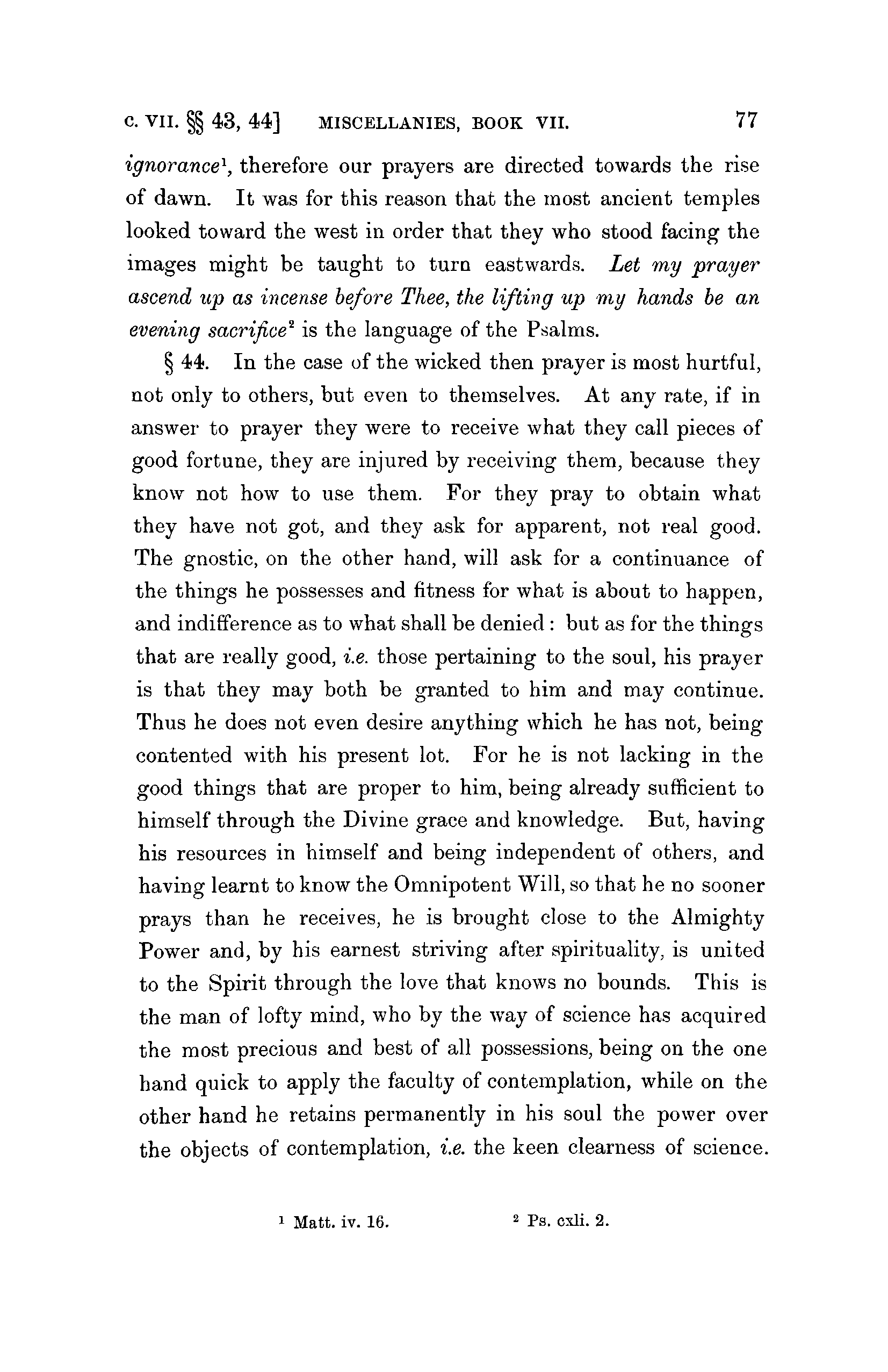
ignorance1, therefore our prayers are directed towards the rise of dawn. It was for this reason that the most ancient temples looked toward the west in order that they who stood facing the images might be taught to turn eastwards. Let my prayer ascend up as incense before Thee, the lifting up my hands be an evening sacrifice* is the language of the Psalms.
§ 44. In the case of the wicked then prayer is most hurtful, not only to others, but even to themselves. At any rate, if in answer to prayer they were to receive what they call pieces of good fortune, they are injured by receiving them, because they know not how to use them. For they pray to obtain what they have not got, and they ask for apparent, not real good.
The gnostic, on the other hand, will ask for a continuance of the things he possesses and fitness for what is about to happen, and indifference as to what shall be denied : but as for the things that are really good, i.e. those pertaining to the soul, his prayer is that they may both be granted to him and may continue.
Thus he does not even desire anything which he has not, being contented with his present lot. For he is not lacking in the good things that are proper to him, being already sufficient to himself through the Divine grace and knowledge. But, having his resources in himself and being independent of others, and having learnt to know the Omnipotent Will, so that he no sooner prays than he receives, he is brought close to the Almighty
Power and, by his earnest striving after spirituality, is united to the Spirit through the love that knows no bounds. This is the man of lofty mind, who by the way of science has acquired the most precious and best of all possessions, being on the one hand quick to apply the faculty of contemplation, while on the other hand he retains permanently in his soul the power over the objects of contemplation, i.e. the keen clearness of science.
1 Matt. iv. 16.
2 Ps. oxli. 2. https://doi.org/10.1017/CBO9780511695513.010 Published online by Cambridge University Press
ITPQMATEQN Z'
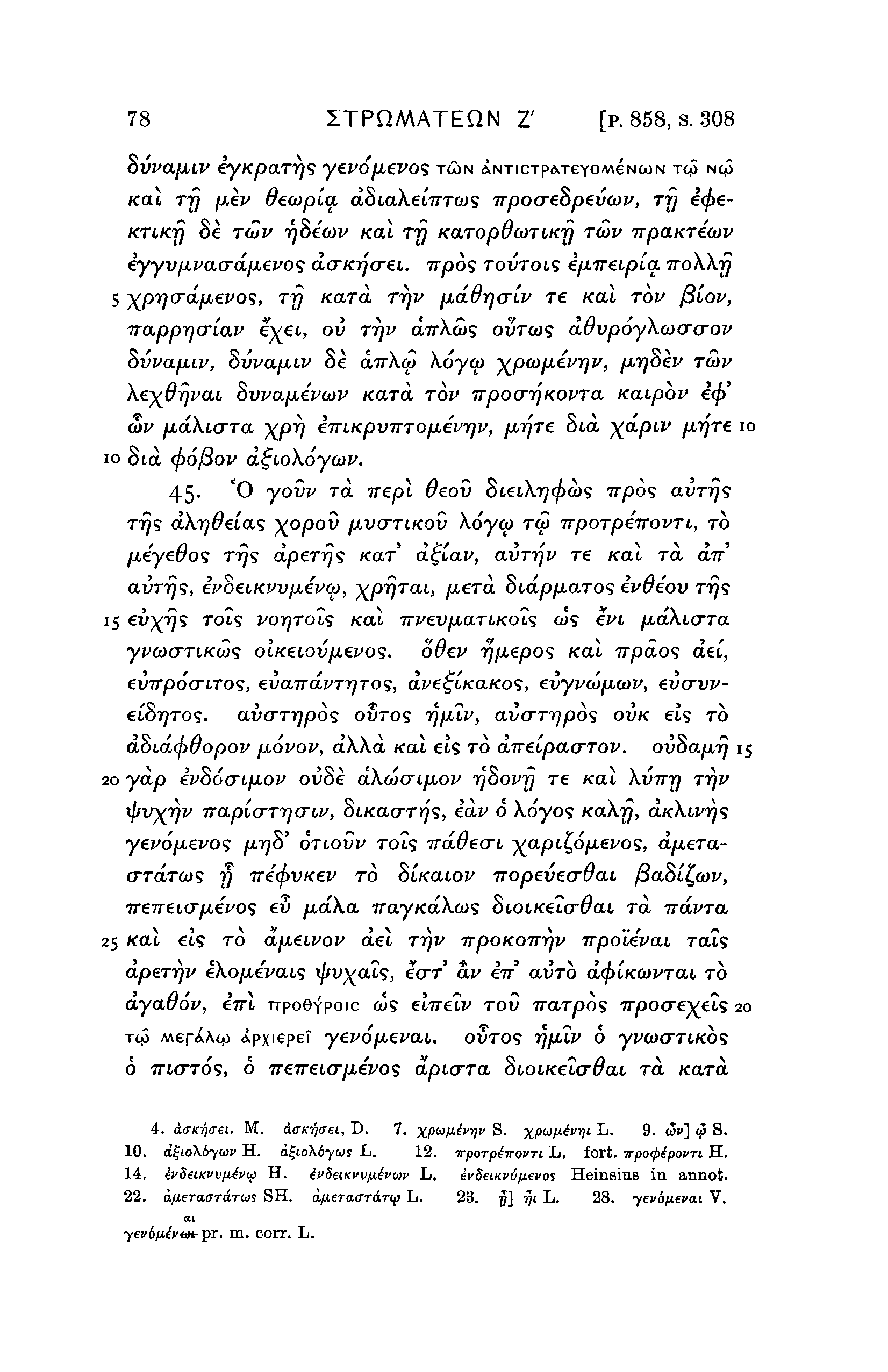
[p. 858, s. 308 iyicpaTr)1; yevo/xevos TU>N (j,ev decopia dSiaXeiTmos Trpocr€&peva)v, TTJ i<f>ee TOJV TjSeOV
Kal TTj KaTOpOwTLKJ)
Th)V TTpOLKTCCOV
iyyvfivacrdfievos dcrKrjcreL. Trpos TOVTOUS ifxireLpia TTOXXT} 5 ^prjo~dfxevo^, TTJ Kara TTJV fj,d6r)o~iv re Kal TOP (HIOV,
Trapprjoriav e.\^, ov TTJV airX.ws OVTCDS ddvpoykaxxcrov SvvafXLV 8e aTrXai \6yq> ^poijxivrjv, fJLr)8ev T£>V Swafxevcov Kara TOV irpocrrJKOVTa Katpov £<f>'
PV iTn-KpvTTTo/xepyjv, [nJTe Sta X'^PI'V At7?re I0 io Sid <f>6/3ov di;io\6yci)v.
45.
'O yovv ret 7rept deov SieiX^cbs TIJS dXrjOeias x°P°v (JLVO'TLKOV X6ya> T(O TrpoTperrovTt,, TO TTJS dpeTrjs /car' d^iav, avTijv re Kal ra. aV' s, ivoeiKW[A€V(i), ^p^rat, ^u,era hidpfxaTOs ivdeov
15 CV^TJS rots ^or^rot? /cal Trvev/jLOLTLKols cJs yvcocTTiKws OLKeLovfj.tvos. odev i^ftepo? /cat Trpdos det, einrp6<TLTo<;, evandvTrjTOS, di'eft/ca/cos, evyvcoficov, evcrvveCSrjTos. aucrTTjpos OSTOS ^fjuv, avcTTYjpds OVK ets TO dSid<j)6opoi> JXOVOV, dXXd Kal ets TO ciTreipacrTOV. ovSafxyj 15 20 yap evSoaijxov ovSe dXoio-Lfxov rjhovfj T€ Kal Xvirrj Tqv
\\iv)(rjv TrapicrTrjCTLv, 8iKao"T>js, ea.^ o Xdyos KaXfj, aKXivr)*; y€v6jjievo<; jxr/S' OTIOVV TOIS Trddecn ^api^o/Mez/os, d/xeTa- ^ Tre<f>vKev TO St/caio^ Tropeveo~0ai fiaSi^cov, ev fxdXa Tray/caXws 8iotKero"^at TOirdvTa,
25 /cat ets TO afxeivov del TT)V TrpoKOTrr/v Trpo'iivai Tais dpeTrjv iXo[X€vaL<; t/iv^ais, ICTT' av eTr' avTO d(j)LK(0VTai TO dyaOov, inl npoOypoic ws e'nreiv TOV iraTpos Trpocre^eis 20
Ttp Mer^Atp <\pxiepeT yevofxevai.
OVTOS Tjfxlv 6 yv<tio~TLK.o<i 6 TTtcrTOS, o TreTTetcr/ieVos apicrTa StoiKetcr^ai TO.
4. d(7K?)<7ei. M. i.aK-quei, D.
7. XP^^V
S. XP^M^1"?' L.
9. tSy] <j5 S.
10.
O£COX67WP H.
dlioXiyuJS L.
12. vporpiirovTi L. fort, irpotpipovn H .
14. ivdeiKi/vi^vifi H. ivSanvviiivuv L. iv8eiKvi/i.evos Heinsius in annot.
22. a/j.ETa.<TT&TO)s SH. a^erao-Tdvi;) L.
23. 37] ^1 L.
28. yev6/j.evai V. ai yevbiUv-ut-'pi. m. corr. L. https://doi.org/10.1017/CBO9780511695513.010 Published online by Cambridge University Press
C. VII. §| 44, 45]
MISCELLANIES, BOOK VII.
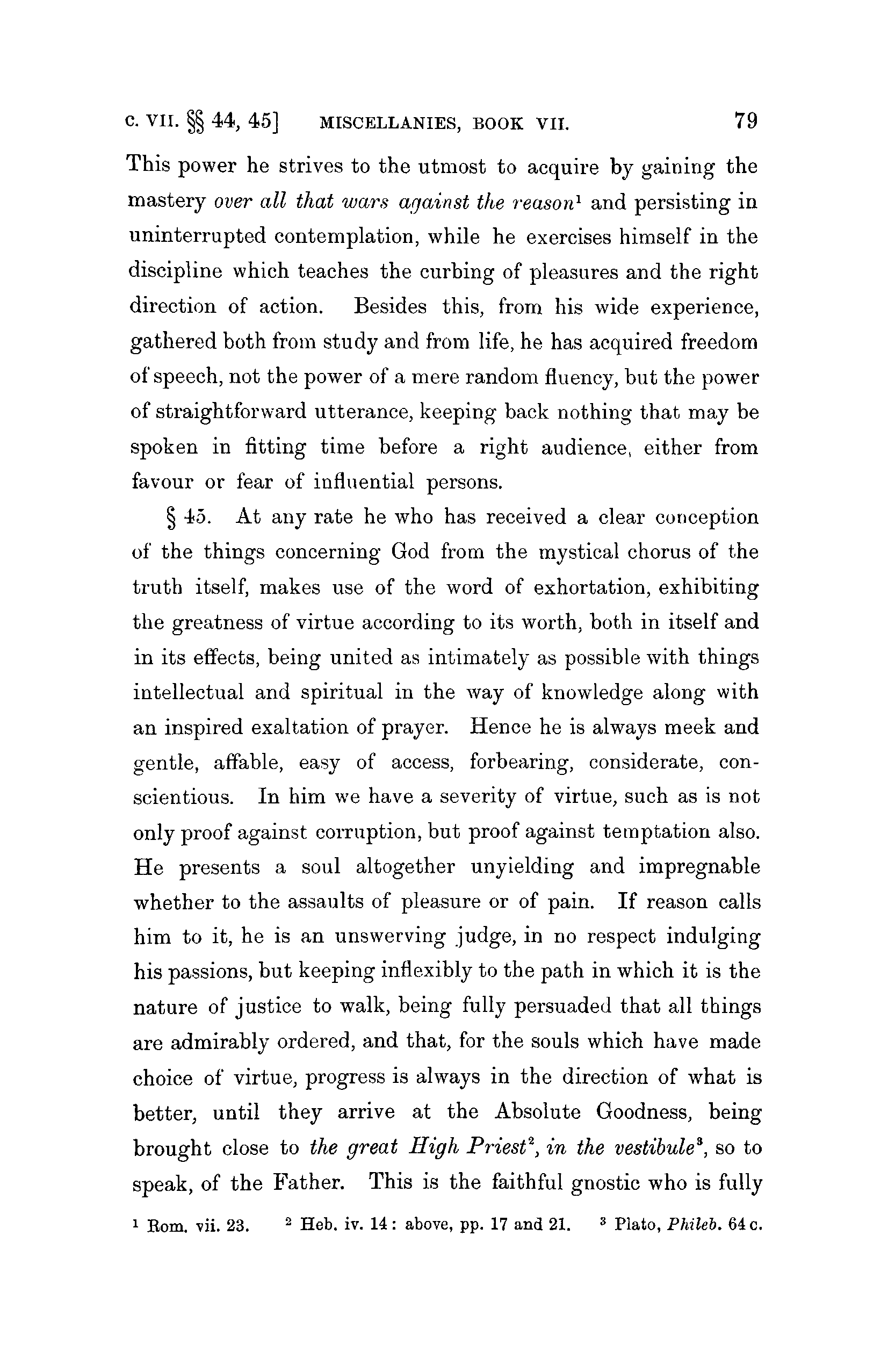
This power he strives to the utmost to acquire by gaining the mastery over all that wars against the reason1 and persisting in uninterrupted contemplation, while he exercises himself in the discipline which teaches the curbing of pleasures and the right direction of action.
Besides this, from his wide experience, gathered both from study and from life, he has acquired freedom of speech, not the power of a mere random fluency, but the power of straightforward utterance, keeping back nothing that may be spoken in fitting time before a right audience, either from favour or fear of influential persons.
§ -io. At any rate he who has received a clear conception of the things concerning God from the mystical chorus of the truth itself, makes use of the word of exhortation, exhibiting the greatness of virtue according to its worth, both in itself and in its effects, being united as intimately as possible with things intellectual and spiritual in the way of knowledge along with an inspired exaltation of prayer. Hence he is always meek and gentle, affable, easy of access, forbearing, considerate, conscientious. In him we have a severity of virtue, such as is not only proof against corruption, but proof against temptation also.
He presents a soul altogether unyielding and impregnable whether to the assaults of pleasure or of pain. If reason calls him to it, he is an unswerving judge, in no respect indulging his passions, but keeping inflexibly to the path in which it is the nature of justice to walk, being fully persuaded that all things are admirably ordered, and that, for the souls which have made choice of virtue, progress is always in the direction of what is better, until they arrive at the Absolute Goodness, being brought close to the great High Priest2, in the vestibule3, so to speak, of the Father. This is the faithful gnostic who is fully
1 Bom. vii. 23.
2 Heb. iv. 14 : above, pp. 17 and 21.
3 Plato, Phileb. 64 c. https://doi.org/10.1017/CBO9780511695513.010 Published online by Cambridge University Press
ITPftMATEQN Z'
[p. 858, s. 308
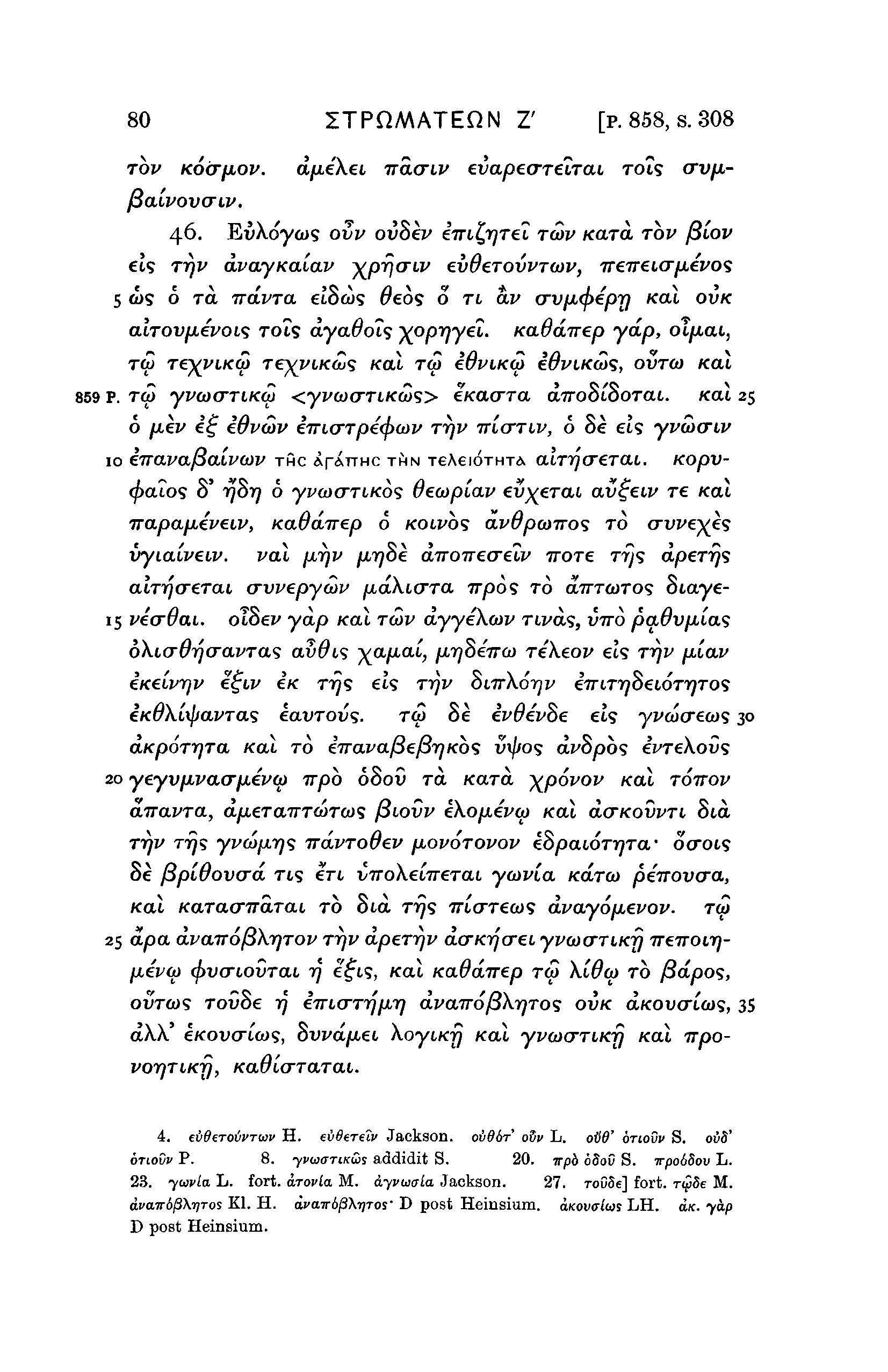
TOV KO&JAOV. d/xeXei iracriv evapecrTeZraL TOIS fiaLvovcriv.
46.
EuXoyws ovv ovhev ivi^Tel rS>v Kara TOV filov ets TT)V dvouyKatav -^prjcnv evderovvTOiv, TreireiayxeVos
5 d>s o r a navra etScis 0eo? o TI av o~v/JL<j>epr) Kal OVK aiTovfjievois TOIS ayaOois ^opyyyei.
KaOdnep yap, otjaat, TW Tf)(yiKca Te^viKOjs Kal ra idvuKai idviKcos, OVTW Kal 859 P. Tft) yvcocTTLKai <yi'wo"Ti/fa)s> e/ca.o~Ta. awoStSoTat.
Kat 25 6 ju,ez> e£ IBvwv hricnpe<f>a)i> rr)v TTICTTLV, 6 he eis yvuxriv 10 iiravafiaivcDv THC APATTHC THN TeAeioTHTA aiTyjaerai.
Kopv- (f>aio<s 8' 17877 6 yi><oo-T(,/<:o5 decopiav eu^eTcu av^eiv TC /cai irapafJLevew, KaOdirep 6 fcotvo? avdpcoTros TO cruve^es vyiaiveiv. val /JLTJV f^rjSe aTTOTrccreiv nore TTJS dperrjs airrjcrerai crvvepyoiv fj.d\i(TTa 7rpos TO aTrrcoTO? Siaye15 vicrdat. oTSev yap Kal TU>V dyyeXcov TLvds, VTTO p'advfiCas
6\uT0rjcravTa<; avdcs \afiai, /ATySeVaj rekeov ets Tr)v ylav £ i£ CK T17S eis Tr)v hnrkoiqv eTnTTjSetoTi^Tos eavTovq.
TW Se ivdevBe els yvwaecos 30 Kal TO eVava^eyS^/cos u»/»os dvhpbs ivrekov1; 20 yeyvfjivacrfj^evo) irpb 68ov TO. Kara, ^povov
Kal rotrov , ct/xeTaTTTtuTois ftiovv e\ofj.eva> Kal d&KovvTi Sta yi>(6jjLr)<; irdvTodev /XOVOTOVOV iSpawTrjra' oo"ois Se fiptdovcrd TLS ere vTroXeLTTerai yu>via Karco peirovcra,
Kal KaTacrirdrai, TO Sta rrj<; iri<TTea><; dvayof^evov.
™ 25 a^ia dvaTTofiXr/Tov TTJV dperrfv d(jKr\crei yvwcrTiKr} Treiroir)fj.ev(p (ftvertovrai TJ efis, Kal KaOdirep TS \Wa> TO fidpos,
OVT(D<; TovSe 17 eVto-T^'/A^ dvaw6f3\.7]Tos OVK aKoucruus, 35 dXk' eKovo~La><;, hvvdfxei \oyiKrj Kal yvo)o~TiKrj Kal irpo-
VOTJTIKT),
4. eu8eTo6vTwv H. evdereTy Jackson.
OV$6T' odv L. oiid' OTIOVV S. OI)5'
OTIOOC P.
8. yvwtjTiKus addidit S.
20. irpb idou S. irpo6Sov L.
23.
-yavia L. fort, arovla M. d7i>uffia Jackson.
27. roOSe] fort. TipSe M. di'a7r6(3\7;Tos Kl. H. avairbfi\i)Tos' D post Heinsium.
UKOIKTIOIS LH.
d/c. ^ctp D post Heinsium. https://doi.org/10.1017/CBO9780511695513.010 Published online by Cambridge University Press
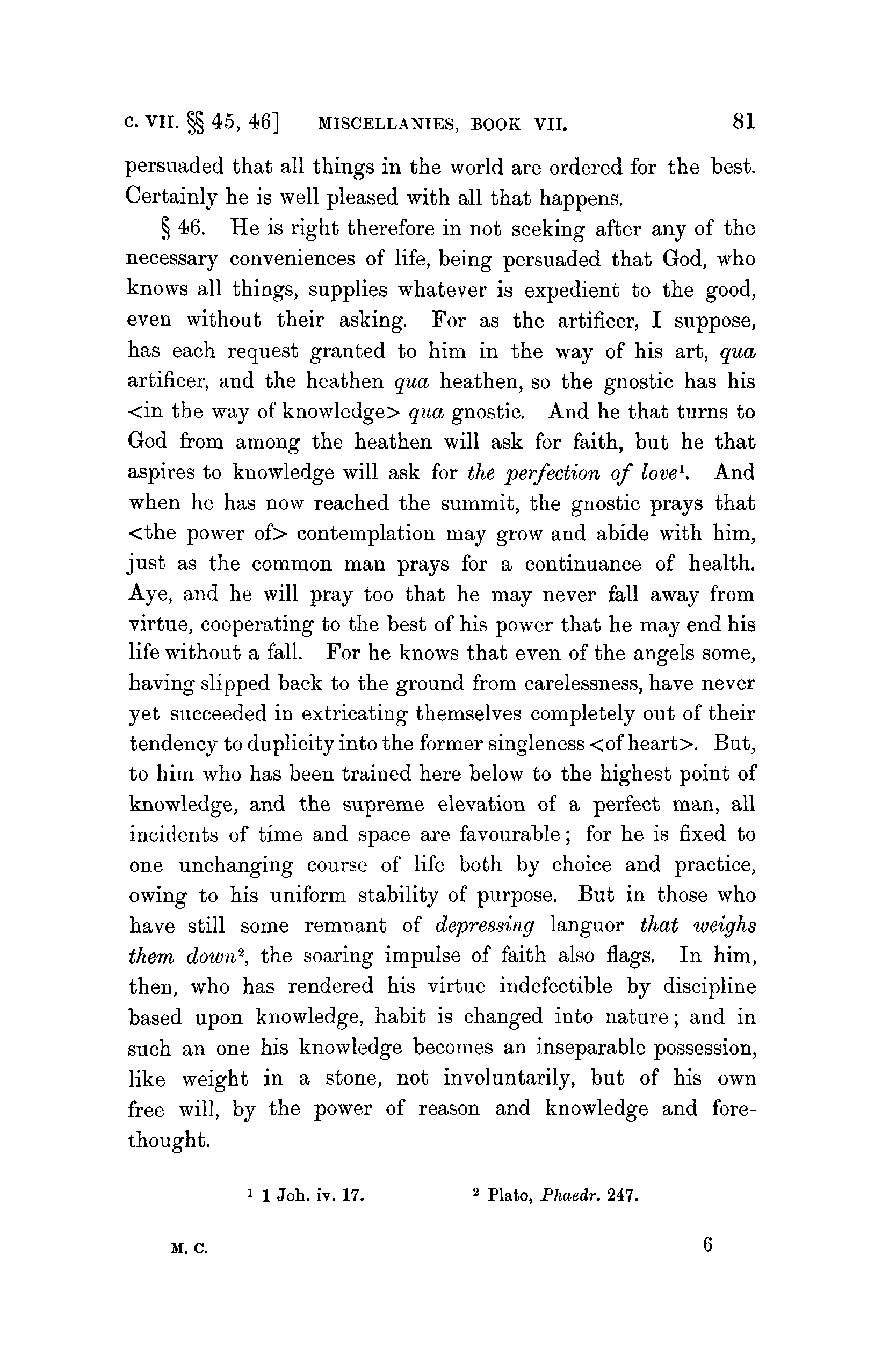
C. VII. §§ 45, 46]
MISCELLANIES, BOOK VII.
persuaded that all things in the world are ordered for the best.
Certainly he is well pleased with all that happens.
§ 46. He is right therefore in not seeking after any of the necessary conveniences of life, being persuaded that God, who knows all things, supplies whatever is expedient to the good, even without their asking. For as the artificer, I suppose, has each request granted to him in the way of his art, qua artificer, and the heathen qua heathen, so the gnostic has his
<in the way of knowledge> qua gnostic. And he that turns to God from among the heathen will ask for faith, but he that aspires to knowledge will ask for the perfection of love1. And when he has now reached the summit, the gnostic prays that <the power of> contemplation may grow and abide with him, just as the common man prays for a continuance of health.
Aye, and he will pray too that he may never fall away from virtue, cooperating to the best of his power that he may end his life without a fall. For he knows that even of the angels some, having slipped back to the ground from carelessness, have never yet succeeded in extricating themselves completely out of their tendency to duplicity into the former singleness <of heart>. But, to him who has been trained here below to the highest point of knowledge, and the supreme elevation of a perfect man, all incidents of time and space are favourable; for he is fixed to one unchanging course of life both by choice and practice, owing to his uniform stability of purpose. But in those who have still some remnant of depressing languor that weighs them down2, the soaring impulse of faith also flags. In him, then, who has rendered his virtue indefectible by discipline based upon knowledge, habit is changed into nature; and in such an one his knowledge becomes an inseparable possession, like weight in a stone, not involuntarily, but of his own free will, by the power of reason and knowledge and forethought. i 1 Joh. iv. 17.
2 Plato, Phaedr. 247.
M. C.
https://doi.org/10.1017/CBO9780511695513.010 Published online by Cambridge University Press
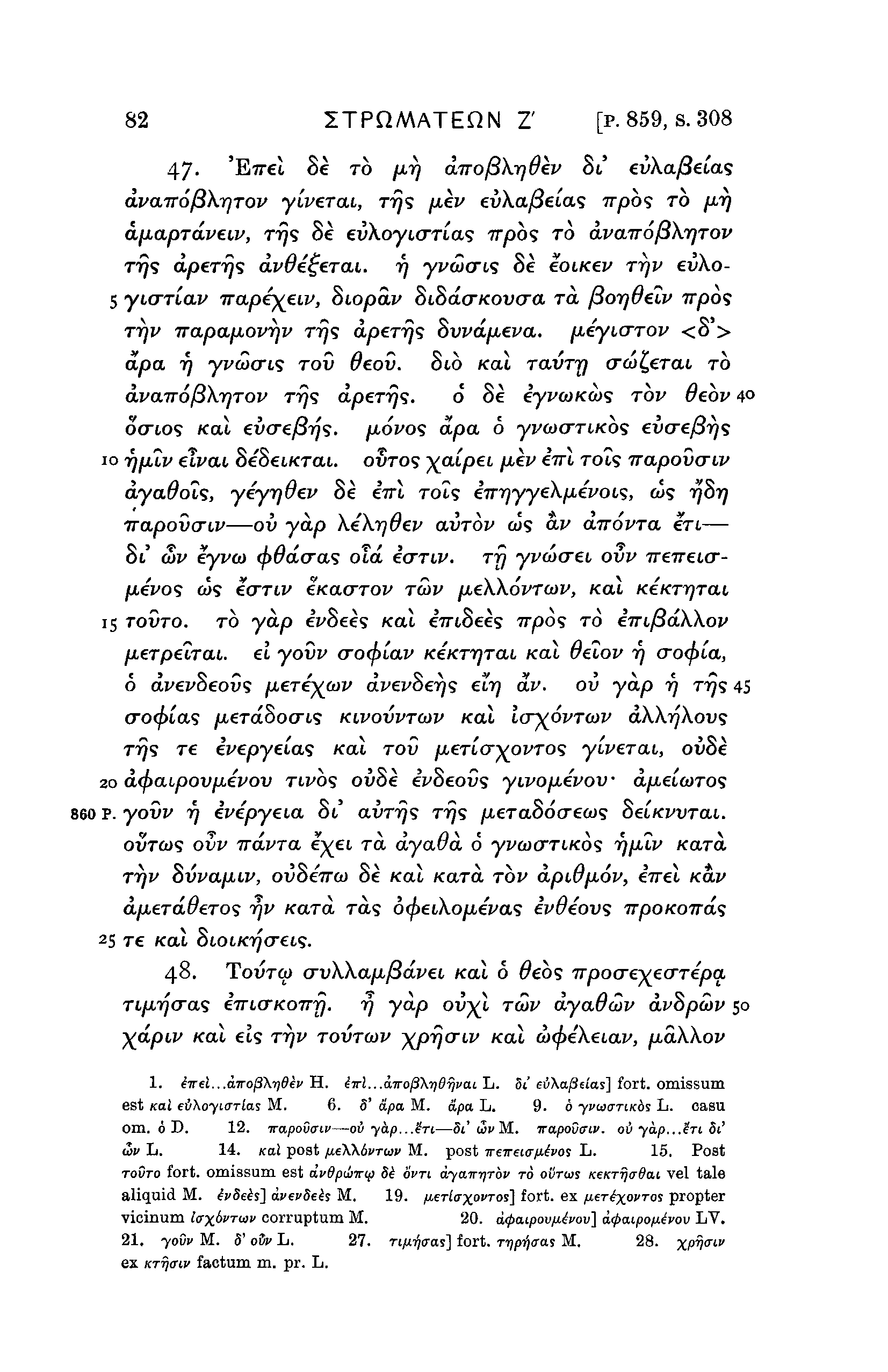
ITPQMATEQN Z'
[P. 859, s. 308
47.
'E7rel Be TO /ATJ a.Trof3\r)0ev Si' evkafieCas dvairofiXrjTOV ylverai, TTJS /JL£V evkafielas
TT/JO? TO /XIJ
aiJ.apTa.veiv, TTJS Se euXoyicrrias TT/>OS TO dvaw6/3\7)Tov T7J<s dpeT-rjs dvde^eTai. rj yvucris Se eoiKev TT)V evXo5 yicrTiav irapeyeiv, Siopav SiSdcncouca TO. fioiqdeZv npos Trjv irapa^ovy\v Trjs apeTrjs Swd/xeva.
^eyicrTOv <S'> dpa r\ yvwcrLS TOV deov.
Sio Kal TavTr/ crw^eTat TO dvaTr6j3\r)TOV Trjs dpeTrjs.
6 Se iyvwxcbs TOV debv 4° oo-to? Kal eucreySrys.
/J.OVO'S dpa 6 yvo}<rTU<6<; evcrefiris 10 rjfjuv elvai, SeSetKTai.
OUTOS ^aipet fx,kv iirl T61<S irapovaiv dyadols, yeyrjdev Se iirl TOLS e7njyyeX/u,eVots, cos TJ&r) •uapovaiv—ov yap XeXr/dev avTov cJs av drrovTa eri— 8t' Sv eyvai <f>6do~as old ko~Tiv. Trj yva>o~€L ovv Treiretcrji/,eVo5 cos €O~TLV €Kao~Tov TCOV fxeXXovrcov, Kal Ke/mjTeu
15 TOVTO.
TO yap evSees Kal eirtSees irpos TO inifidWov /LieTpeiTcu. el yovv o~o(f>iav KeKTryvai Kal deiov rj o-o<f>Ca,
6 avevSeous fxeTe^atv dvtvSerjS etrj av. ov yap 17 Trjs 45 o~o<f>ias )U,eTaSoo"is KLVOVVTCOV Kal LO~^(OVTO)V dAA^Aous
Trjs Te ivepyeias Kal TOV yu.6Tio"^ovTos ycveTat, ovSe 20 dtyaipovfjuivov TWOS ovSe ivSeovs yLvo/xevov • 860 p. yovv rj ivipyeia SL avrrjs TTJS /ACTaSdcrews OVTCOS ovv irdvTa e^ei TO. dyaOd 6 yvaicrTLKos rj^iv TTJV SvvafJLiv, ovSeVw Se Kal KOTO, TOV dpid^iov, iwel KOLV afjueTadeTos rjv KOTO, TOLS 6(£etA.oju.eVa,5 ivOeovs
25 T€ Kal St0t/C7^O"€tS.
48.
TOUTW o-vWafJifidveL Kal 6 debs TLfirjo~as eTTLO-KOTrrj. rj ydp OV^L TCOV dyadcov dvSpcov 50 Kal els TT)V TOVTCOV ^prjcrLV Kal co<f>e\eiav, /JLOXXOV
1. iird...airo§\T)Bev H. iirl...a,Tvo§\r)BfivaL L. Si eiXafldas] fort, omissum est Kal eiXoyiffTLas M.
6. 5' apa M. apa L.
9. 6 yKuo-riKis L. oasu om. o D.
12. Trapowiv—ov yhp..Jri—Bi' wv M. irapouai.ii. oi yap...in iC wv L.
14. Kal post jCicMiWctH' M. post Trewe«r/J.£vos L.
15. Post roOro fort, omissum est dvdpwinp Si 6Wi ayair-qTov TO OVTOIS KeKrijirdai vel tale aliquid M. ^ySe^s] avevdeh M.
19. /lerltrxovTos] fort, ex tiertxovTos propter vicinum l<rxoVTU3v corruptum M.
20. a/paipovjjifrov] dtpaipo^vov LV.
21. 70C1' M. S' otw L.
27. TtjU-^iras] fort. rt)pi\aa% M.
28. ex Krficnv faotum m. pr. L. https://doi.org/10.1017/CBO9780511695513.010 Published online by Cambridge University Press
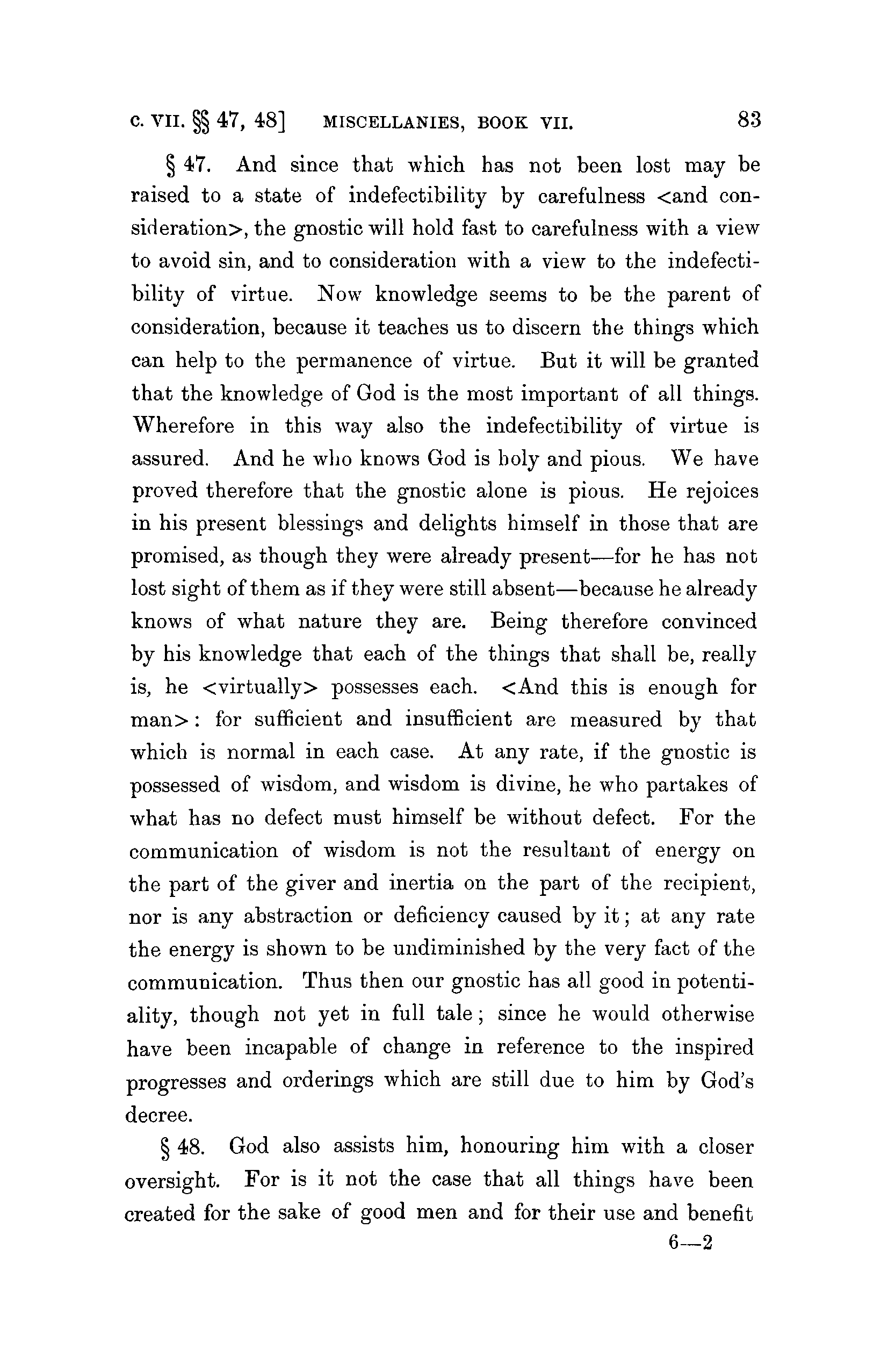
C. VII. §| 47, 48]
MISCELLANIES, BOOK VII.
§ 47. And since that which has not been lost may be raised to a state of indefectibility by carefulness <and consideration;^ the gnostic will hold fast to carefulness with a view to avoid sin, and to consideration with a view to the indefectibility of virtue. Now knowledge seems to be the parent of consideration, because it teaches us to discern the things which can help to the permanence of virtue. But it will be granted that the knowledge of God is the most important of all things.
Wherefore in this way also the indefectibility of virtue is assured. And he who knows God is holy and pious. We have proved therefore that the gnostic alone is pious. He rejoices in his present blessings and delights himself in those that are promised, as though they were already present—for he has not lost sight of them as if they were still absent—because he already knows of what nature they are. Being therefore convinced by his knowledge that each of the things that shall be, really is, he <virtually> possesses each. <And this is enough for man>: for sufficient and insufficient are measured by that which is normal in each case. At any rate, if the gnostic is possessed of wisdom, and wisdom is divine, he who partakes of what has no defect must himself be without defect. For the communication of wisdom is not the resultant of energy on the part of the giver and inertia on the part of the recipient, nor is any abstraction or deficiency caused by it; at any rate the energy is shown to be undiminished by the very fact of the communication. Thus then our gnostic has all good in potentiality, though not yet in full tale; since he would otherwise have been incapable of change in reference to the inspired progresses and orderings which are still due to him by God's decree.
§ 48. God also assists him, honouring him with a closer oversight. For is it not the case that all things have been created for the sake of good men and for their use and benefit
6—2 https://doi.org/10.1017/CBO9780511695513.010 Published online by Cambridge University Press
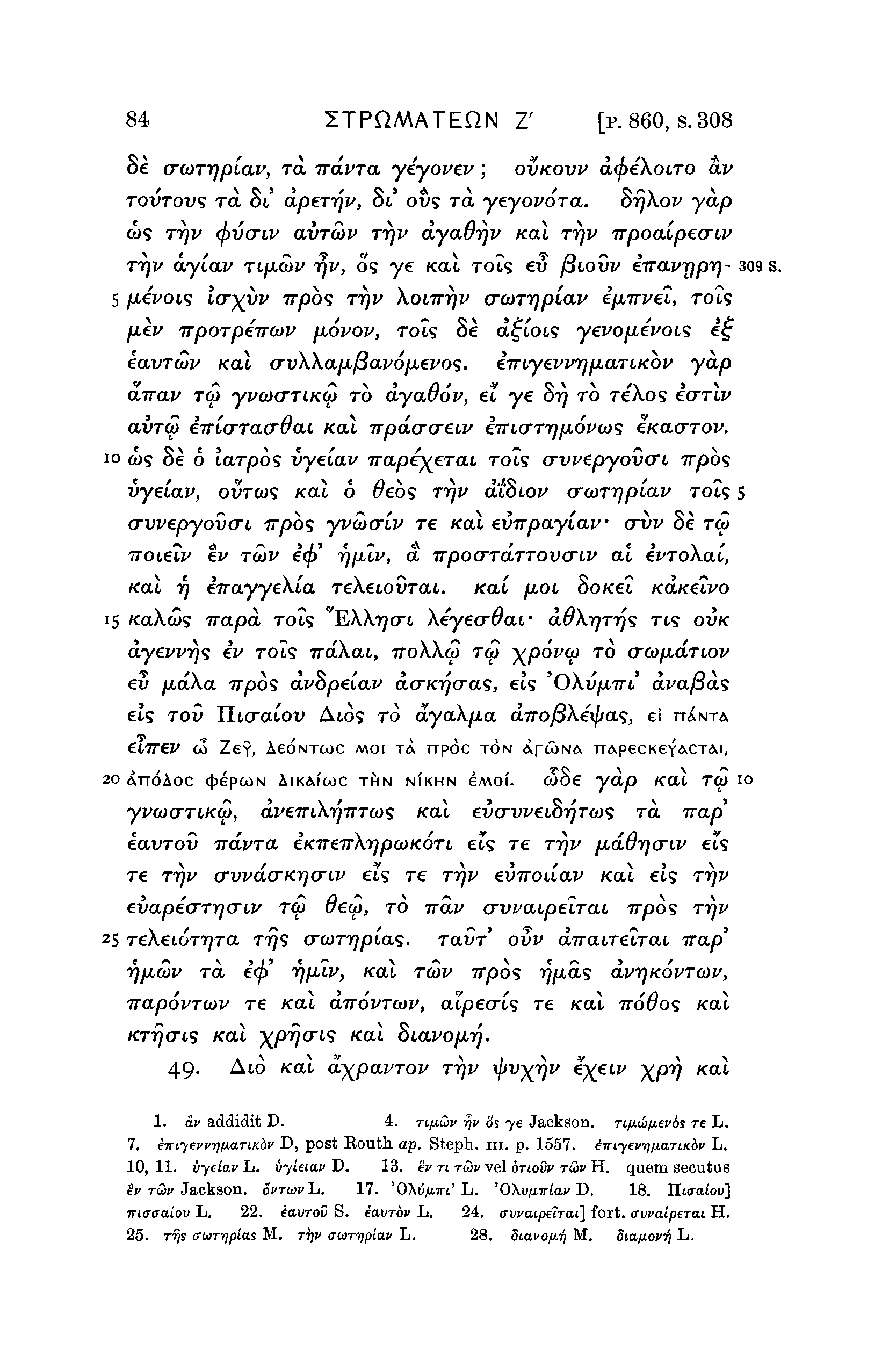
ITPQMATEQN Z'
[p.860, s.308
Se croiTrjpiav, ra TrdvTa yeyovev; OVKOVV dc^e'XotTO av TOVTOVS TO, Si' aperrjv, Si' OUS TO, yeyovo'ra.
SrjXov yap w? TTJV <f)vo-LV avTUiv TTJV dyadrjv Kal TTJV npoaCpecriv TTJV dylav TL/XCOV rjv, 6's ye /cat rots eu fiiovv iiravrjpr)- 309 s.
5 /AeVois tcr^vv irpos T ^ \ot.7rr)i> cratT'qpia.v i/jurvel, rot9 /Aev npoTpiircov /xovov, rot? Se aftot? yevOjueVois e^ iavTcHv Kail crv\kajj./3av6ix€vo<;kniye.vvrni.a.TiKov yap a/rrav TW yvaxTTiKCp TO dyadov, et ye ST) TO Te\os ecrrtv
£irio~Tao~9ai /cat 10 a>s Se 6 tarpos vyeiav Trape^erai TOIS crvvepyovcn, vyeiav, OVTOJS /cal 6 ^eos TI}^ atStoi' o-coTrjpCav rots S crvvepyovcn, irpbs yvotcriv re /cai einrpayiav o~vv Se TO! iroteit' ev TWI1 e^>' i]\)lv, a 'npoo'Ta.TTovo'iv aX ivToXaC,
Kal r] hrayyeXia TeXeioCrat.
/cat /*ot SOKCI /cd/cetvo 15 /caXws Trapa Tots 'EXXTJCTI Xeyecr#af adXrjTrfs Tts ov/c dyei'v^s eV rots 7rdXat, 7roXXw TO> -^povco TO crut^Ldrriov ev fjidXa Trpos dvBpeiav dcr/c-^cras, ets 'OXV/ATTI' dva/3ds ets TOU ITtcratov Atos TO dyaXjxa d7ro/3Xe\jja<;, ei HANTA
€LTT£V to Zey, AeoNTtoc MOI TA rrpoc TON APWNA nApecKeyACTAi,
20 ATTOAOC <J>epwN AIK&IWC T^IN NIKHN 6MOI.
d)u€ yap /cat TO) io oi, dv€TTiXrjTTT(i}<i Kal evo~weiS^7<ws r d Tra^o'
TrdvTO. e/c7re7rX^aj/cdrt ets re TT^I' p.dQr\<jiv ets re n}!' crvvdo~Krjo~Lv ets re TT)V euTroitav «:at ets TT\V €vapeo~Tr)O~LV T(o 9eco, TO irav crvvaipelTai Trpos TTJV 25 TeXetoTryra TTJS o-coTrjpLas. rawr' ovv aTraiTetTai Trap'
TO. i(j) fjl^v, Kal TG)V TT/JOS ij d Te Kal dirovTcov, atpecrts re /cat irodos Kal •^prjo'L? Kal Ziavoynrj.
49.
Ato /cat a^pavTov TTJV xjiv^yjv 1.
<XJ/ addidit D.
4. rt/tuv rji> os ye Jackson. n/Mb)iev6s re L.
7. ewryevvr))MTi.Kbv D, post Routh ap. Steph. in. p. 1557. iwiyevrnxaTLKbv L.
10, 11. vyeiav L. i^eiae D.
13. Iv n T&V vel OTWVV TQV H. quern secutus iv TGSP Jackson, ovruvlt.
17. 'OXiijUiri' L. 'OXv/nrlav D.
18. IIi<ra(ou] wiaaalov L.
22. eaurou S. ecu/roe L.
24. cru^oipetTai] fort, awalperai H.
25. Tijs ffurijpias M. Ti;y awqplav L.
28. Siavofi.ii M. faaiiovfi L. https://doi.org/10.1017/CBO9780511695513.010 Published online by Cambridge University Press
C. VII. §§ 48, 49]
MISCELLANIES, BOOK VII.
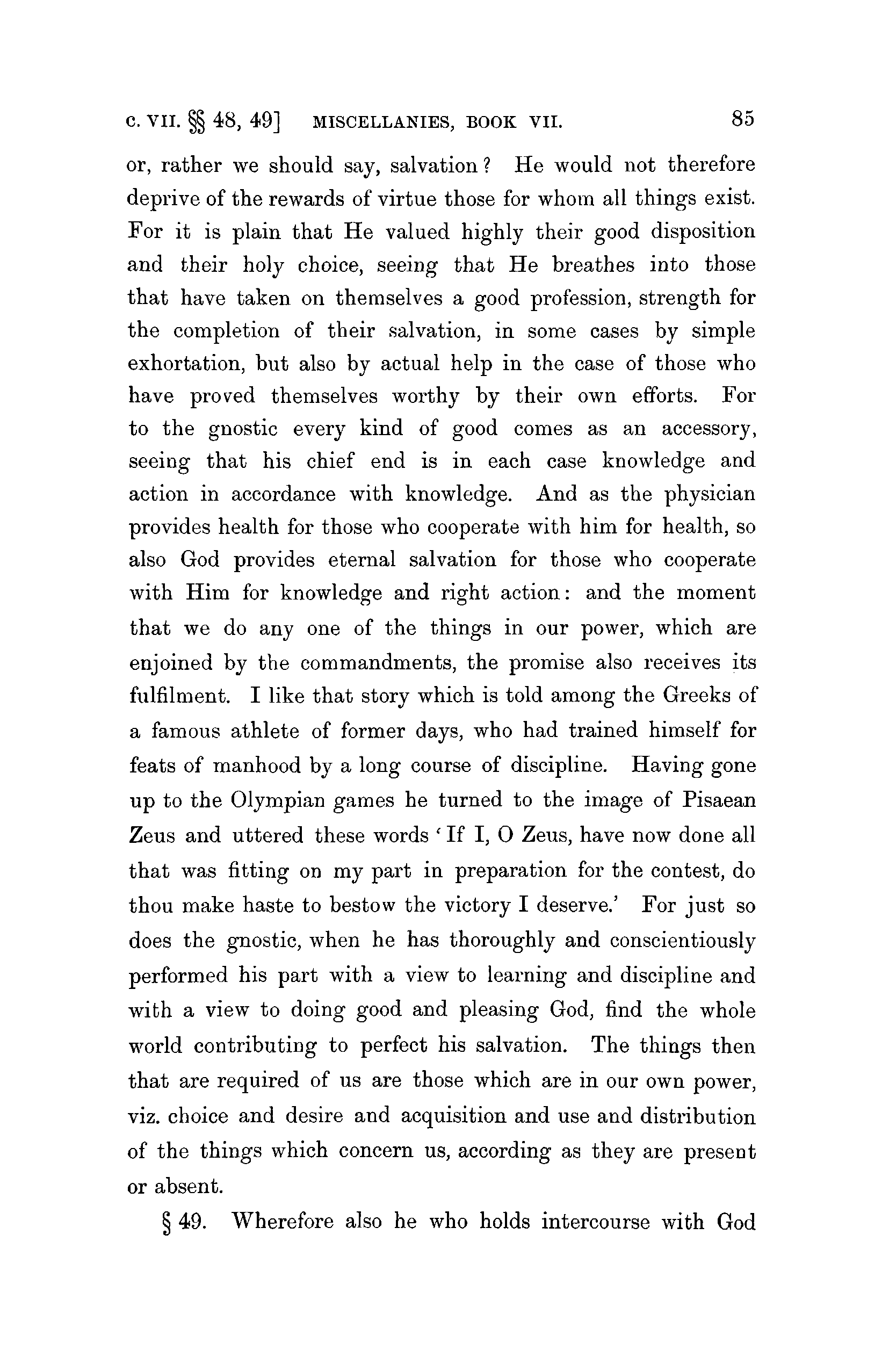
or, rather we should say, salvation ? He would not therefore deprive of the rewards of virtue those for whom all things exist.
For it is plain that He valued highly their good disposition and their holy choice, seeing that He breathes into those that have taken on themselves a good profession, strength for the completion of their salvation, in some cases by simple exhortation, but also by actual help in the case of those who have proved themselves worthy by their own efforts.
For to the gnostic every kind of good comes as an accessory, seeing that his chief end is in each case knowledge and action in accordance with knowledge. And as the physician provides health for those who cooperate with him for health, so also God provides eternal salvation for those who cooperate with Him for knowledge and right action: and the moment that we do any one of the things in our power, which are enjoined by the commandments, the promise also receives its fulfilment. I like that story which is told among the Greeks of a famous athlete of former days, who had trained himself for feats of manhood by a long course of discipline. Having gone up to the Olympian games he turned to the image of Pisaean
Zeus and uttered these words ' If I, 0 Zeus, have now done all that was fitting on my part in preparation for the contest, do thou make haste to bestow the victory I deserve.' For just so does the gnostic, when he has thoroughly and conscientiously performed his part with a view to learning and discipline and with a view to doing good and pleasing God, find the whole world contributing to perfect his salvation. The things then that are required of us are those which are in our own power, viz. choice and desire and acquisition and use and distribution of the things which concern us, according as they are present or absent.
§ 49. Wherefore also he who holds intercourse with God https://doi.org/10.1017/CBO9780511695513.010 Published online by Cambridge University Press
ITPQMATEQN Z'
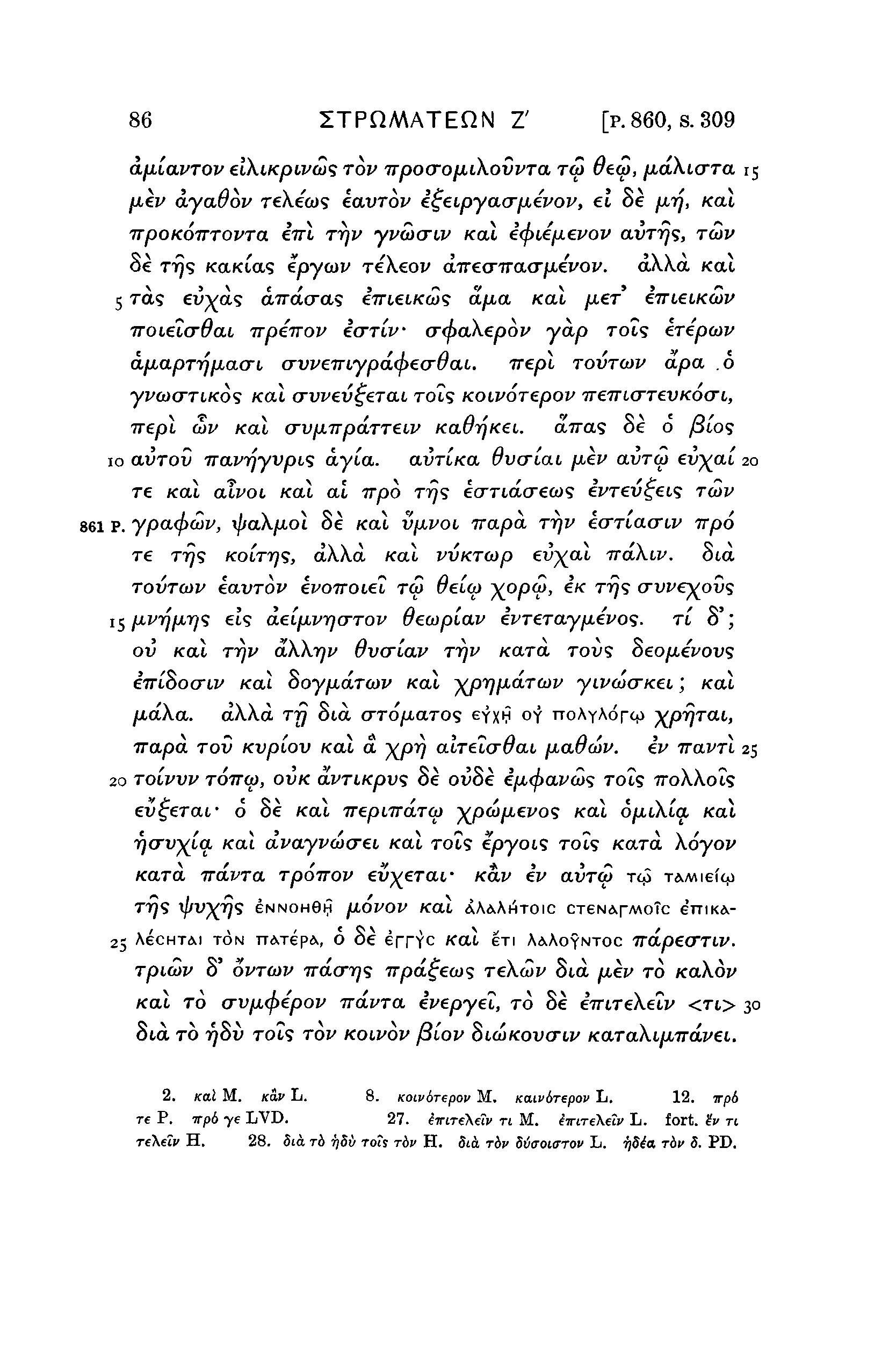
[p. 860, s. 309 dfiCavTOv etXi/cpivtos TOV npoaroiJuXovvTa ra 0eaJ, /mA terra 15 ev dyaOov TeXe'ws eavrov e^eipyaafxevov, el Se JUTJ, /cat npOKOTTTOVTOL itTL TTjV yVOiCTW /Cat e^te/ACVOV a.VTrj'i, TO)V Se rrjs /ca/aas epycav TeXeov dVecrTracr/AeVov. dXXd /cat 5 TOLS eu^a? aTracras eTTietfcal? a/^a /cat fxer eVict/caw Trpiirov icrrCv crfyaXepov yap TOIS trepans avveTnypd^eaOai.
Trepl TOVTWV apa 6 os /cat crvvevi^eKu, rols Koivorepov neiricrTevKocrL, nepl utv /cat <Tvp.-rtpa.TTeiv KaOrjKet. airas Se d ^tos
10 avrou Travrjyvpi'i dyta. avrt/ca dvalai [ikv avroj ev^aC 20 re /cat atfot /cat at irpo TTJS ecrriao"ews et'revfet? TWV
861 P. ypa<f>coi>, xpaXfJLol Se /cat V\LVOI wapa TTJV ecrTiaatv Ttpo re TTJS KOLTTJS, dXXd Kal vvKTop eu^at TTOXIV. Std rovTutv eavrov evoTroiel TW ^etw -^op<o, e/c T^9 CV^CYOUS
15 ixvrjixrjs ets deLfjLvrjo-rov dewplav ivreTayfjievosTL S'; ou /cat r ^ dXXrjv Overlay TV\V /caret rovs
Seofievovs iTTiSocnv Kal Soy/Jbdrcov Kal -^p7][xdT0)v yivaxrKei; Kal /i-aXa. aXXd Trj Std crro/xaros eyxu oy -noKyho^o^ -^pyjrat,, irapd TOV Kvpiov /cat d ^pr) alreio'dai fxaOoiv. ev iravrl 25 20 TOIVVV TOTTW, OVK dvTLKpvs Se ovSe e/jL<f>avaJs rots iroXXots d Se /cat TTepLTrdroj ^pwyu,evo? /cat djatXta /cat ia /cai dvayvaxrei Kal rots epyois TOZS Kara Xoyov
Kara irdvra rpoirov ev^erat- /cdv ev avr&> TCP TAMieftp TTJS T//U^TJS eNNOHGi^ fiovov Kal <\A&AIHTOIC CTeNAfMoTc eniKA25 AecHT&i TON TTATepA, 6 Se eri~Yc /cat en AAAOYNTOC ndpecTTLV.
Tpicov h" ovTOiv irdcrr]<; irpd^ewi reXwv Std /xeu TO KOXOU Kal TO crv^epov irdvra evepyel, TO Se eTTtTeXetv <rt> 30 Std TO r]Sv rot? TOV KOIVOV /3lov Stcu/covcrtv
Kal M. xav L.
8. noivdrepov M. Kaip6repov L.
12. 7rpA P.
Trp6 ye LVD.
27. i-nreKeii/ n M. iinTt\uv L. fort. &/ TI Xeu/ H.
28. 5ia TA r;5i> Tors T6J> H. Siii rbv Siaourrov L. ^S^o TAr< 5. PD. https://doi.org/10.1017/CBO9780511695513.010 Published online by Cambridge University Press
C VII. § 49]
MISCELLANIES, BOOK VII.
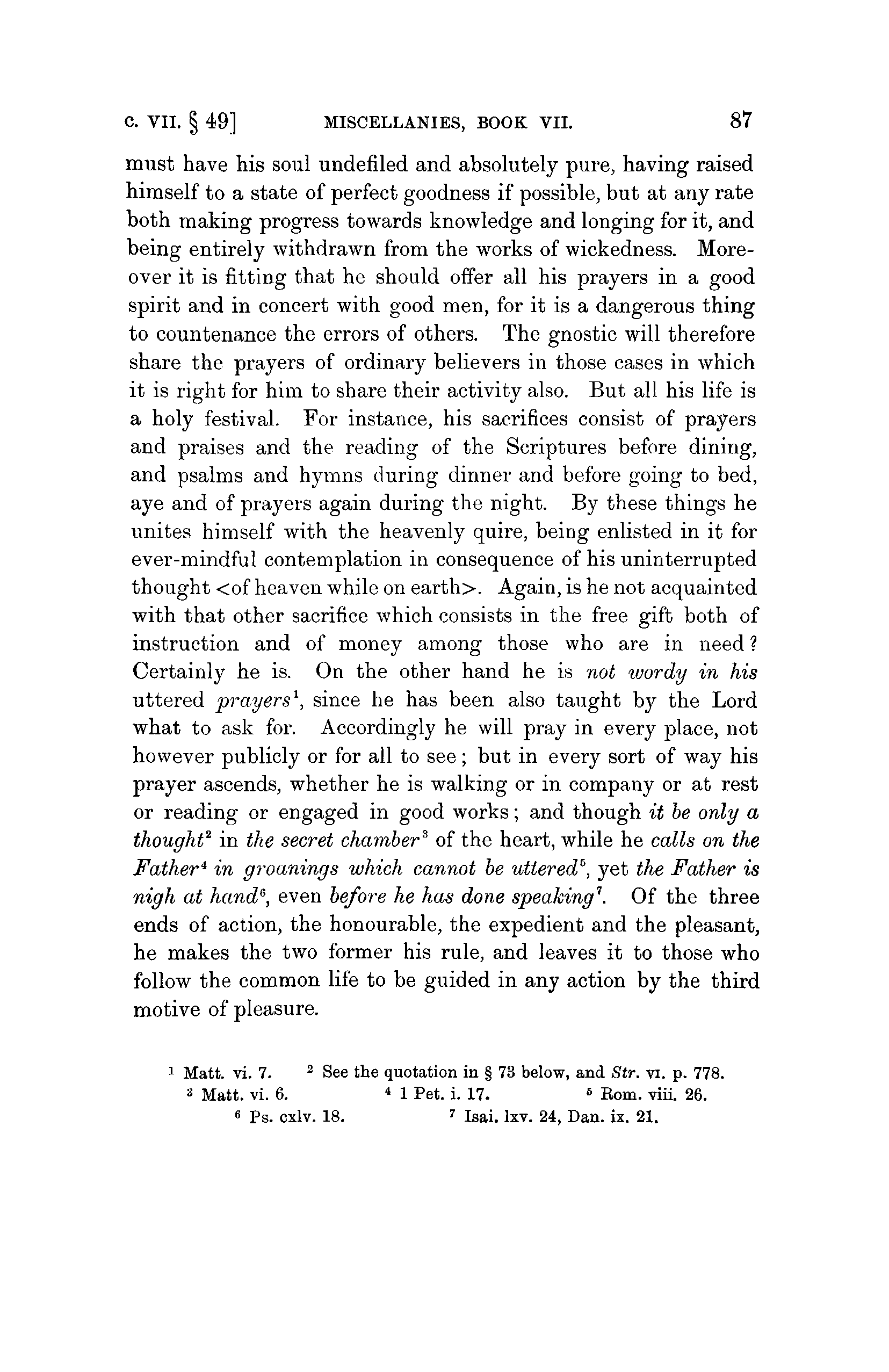
must have his soul undefiled and absolutely pure, having raised himself to a state of perfect goodness if possible, but at any rate both making progress towards knowledge and longing for it, and being entirely withdrawn from the works of wickedness. Moreover it is fitting that he should offer all his prayers in a good spirit and in concert with good men, for it is a dangerous thing to countenance the errors of others. The gnostic will therefore share the prayers of ordinary believers in those cases in which it is right for him to share their activity also. But all his life is a holy festival. For instance, his sacrifices consist of prayers and praises and the reading of the Scriptures before dining, and psalms and hymns during dinner and before going to bed, aye and of prayers again during the night. By these things he unites himself with the heavenly quire, being enlisted in it for ever-mindful contemplation in consequence of his uninterrupted thought <of heaven while on earth>. Again, is he not acquainted with that other sacrifice which consists in the free gift both of instruction and of money among those who are in need ?
Certainly he is. On the other hand he is not wordy in his uttered prayers1, since he has been also taught by the Lord what to ask for. Accordingly he will pray in every place, not however publicly or for all to see; but in every sort of way his prayer ascends, whether he is walking or in company or at rest or reading or engaged in good works; and though it be only a thought2 in the secret chamber3 of the heart, while he calls on the Father* in groanings which cannot be uttered5, yet the Father is nigh at hands, even before he has done speaking7.
Of the three ends of action, the honourable, the expedient and the pleasant, he makes the two former his rule, and leaves it to those who follow the common life to be guided in any action by the third motive of pleasure.
1 Matt. vi. 7.
2 See the quotation in § 73 below, and Str. vi. p. 778.
3 Matt. vi. 6. i 1 Pet. i. 17.
6 Rom. viii. 26.
« Ps. cxlv. 18.
7 Isai. lxv. 24, Dan. ix. 21. https://doi.org/10.1017/CBO9780511695513.010 Published online by Cambridge University Press
ITPQMATEfiN X [p.861, s. 309
KE<D. H.
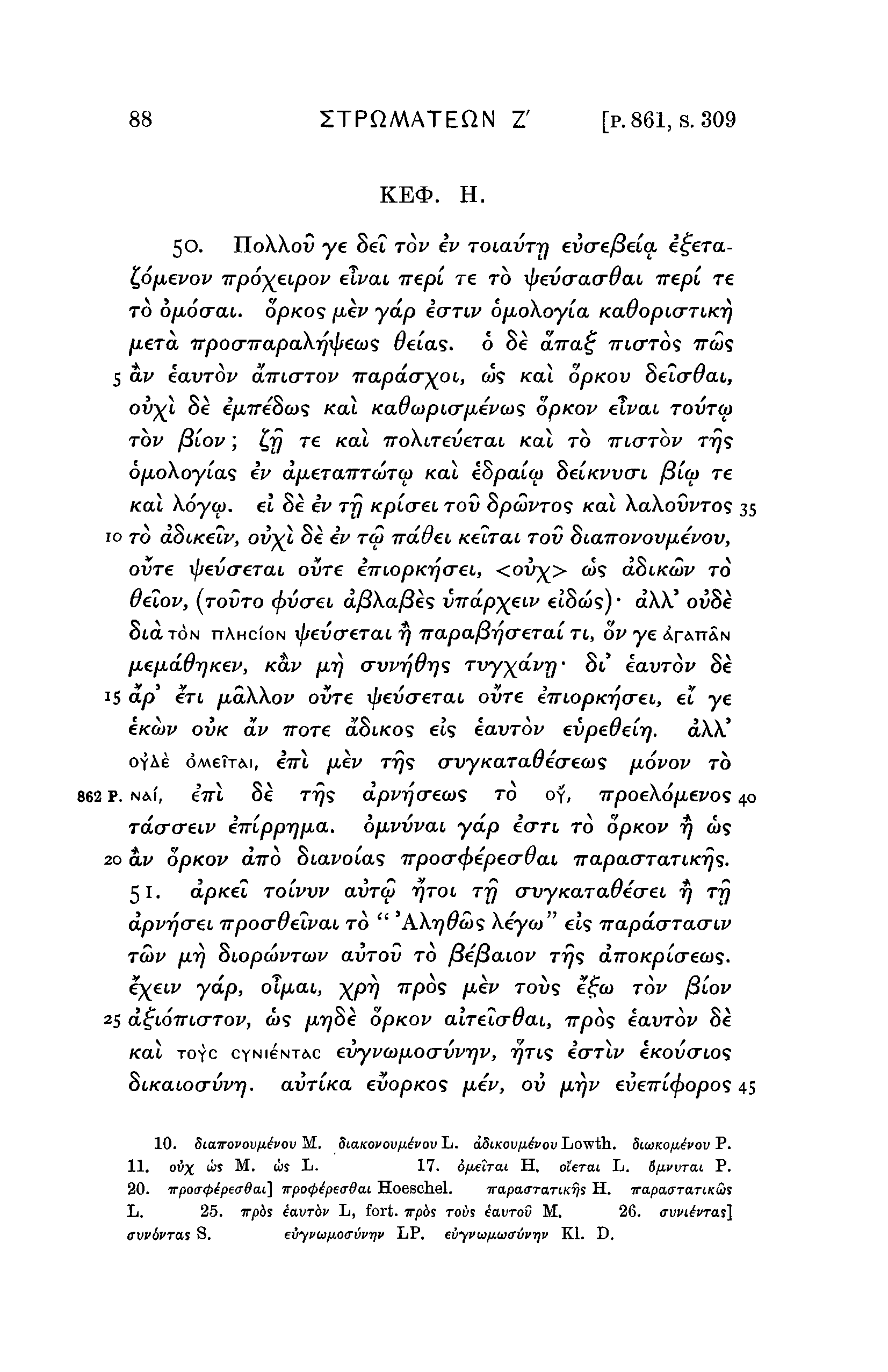
50.
IIoXXov ye Sei TOV iv Toiaimj evo~e/3e£a i£era- ^6{ji€vop irpo^eLpov elvaL irepi re TO \jjevo-acr0ai trepC TC
TO ofjioo-ai. op/co? fi€v yap ecrTiv opoXoyCa KaOopio-TLKrj fiera tTpoo"irapak'q\(j€ci}<; #eias.
6 Be aVa£ Trtaros TT&SS 5 av kavrov O.TTI.O'TOV vapdo~)(OL, ws Kai opKOv Seicrdac, ov)(L Se ifjLTreScos Kal KadcopLO'i^evco's opKov elvaL TOVTO> rbv f3£ov; ty re Kal TroXireuerai Kai TO TTKTTOV TTJ?
OjaoXoytas ev d[x,€TaTTTcuT(o Kal iSpaCco SEIKWCTL ySiw TC Kai Xoyw. ei Se iv TTJ KpCo~€L TOV SpuvTOS Kal Xakovvro? 35
10 ro dSiKtiv, ov)(l Se iv TW Trddti Ketrat TOU hiairovovfjuivov, OVTC i/fevcrerai ovre e7rto/3Kijcrei, <ov^> cu? aSiKftJi' TO deiov, (TOVTO (^ucei a/3\a/8es virdp)(€Lv eiSws) • a\X' ouSe
Sia Tdw TTAHCION ijjevo-tTaL rf irapa(3rio~eTai TL, OV ye <\r<5>n£N fJLefuddrjKev, KCLV fj-rj o-vvtfdrjs TvyyavQSL iavTOV Se
15 ap €TL fiaXXov OVT€ \jj€vo~€TaL ovTe i7TLopKrjo~€L, el ye CKQJV OVK dv TTOTC aSiKos eis eairroV evpeOeCr). d\\' oyAe OMSTTM, eVi p.ev Trjs o~vyKaTa6ecreoyz [xovov
TO 862 p. NAI, iirl Se TTJS dpvy]creo}<; TO of, 7rpoe\6^evo<; 40 Tao-creLV iirCpprjiJLa. 6/xvvvaL ydp ICTTL TO opKov f/ a»s 20 av opKov diro Stavoias wpoo-fyepeo-dai Trapao~TaTLKyjs51. dpKei TOLVVV avToi TJTOL TTJ crvyKaTadecreL rj Trj dpvrjo-eL trpocrdeZvaL TO " 'AXiy^ais Xeyco" ets vapdo-Tao-LV
TCOV p.rj SLopaivTcov avTov TO ySeySaiov T77S diroKpLo-eu><s. e^eiv ydp, oifiaL, \PV irpos /xev TOUS efw TOV /8IOV
25 d^LOTTLo-Tov, o»s firjSe opKov aLTeXo'Oai, irpos eavTov Se t Toyc cyNieNT&c evyv(a^oa"uvqv, rjTL<s io-TLV eKovcto? avTLKa evopKO'i fiev, ov fxrjv eveTTL<f)opo<s 45
10.
StaTovovfi&ov M. 5iaKOvov[jAvov L. adt-KOv/x^vov Lowtb.
8LOJKO^VOV P.
11.
01/x ^s ^ * ws L.
17. <5;ae?rat H. oterat L.
6[J.VVT<XI P.
20.
Tpoiwptpeo'dai] irpoipipefrdai Hoeschel.
7rapatrraTtKi?s H .
TrapaaraTLKws L.
25. TTjoJs ^aur6>' L, fort, irpds TOI>S ^OUTOC M.
26.
(ruci^fros] S. evyvwixoGvvqv LP, evyvw^uaivqv Kl. D. https://doi.org/10.1017/CBO9780511695513.010 Published online by Cambridge University Press