
CHAPTER II
CHAPTER II.
INFLUENCE OF GREEK PHILOSOPHY ON THE
THEOLOGY AND ETHICS OF CLEMENT.
IF I am not mistaken, there has been of late years a tendency to exaggerate the difference between the teaching of the Bible and that of Clement in regard both to ethics and theology. A reader of Harnack and of Hatch would, I think, gather that genuine apostolic Christianity was an unreasoning, enthusiastic revivalism, fed on visions and miracles, and looking forward to the immediate coming of the Lord and the reign of the Saints for a thousand years on earth ; that the second and third centuries witnessed an illegitimate development of the teaching of Christ and His Apostles in the hellenizing and secularizing of Christian doctrine, by which the new wine of the Day of Pentecost, the ardours of the first faith and love, were changed into correctness of creed and of conduct1; and that in this transformation Clement was the leading agent.
1 Perhaps the most startling assertion made on this subject is that which traces the commencement of secularism to the existence of the N. T. Thus
Deissmann (Bible Studies p. 59) says ' The beginnings of Christian literature are really the beginnings of the secularization of Christianity: the Church becomes a book-religion.' ' The Church required literature, and hence it made literature, and made books out of letters: hence also, at length, the N. T. came into existence.' If the existence of sacred books naturally leads to the secularization of religion, then all who held that the Law and Prophets of the O.T. were inspired, whether under the old or the new dispensation, including the Apostles themselves, must have been subject to this baneful influence. To much the same effect Hatch says (Influence of Greek Ideas on the Christian Church pp. 106, 107) 'prophesying died when the Catholic Church was formed,' 'the prophet preached because he could not help it, because there was a divine breath breathing within him, which must needs find utterance,' ' they did not practise beforehand how or what they should say, for the "Holy Ghost taught them in that very hour what they should say".' [This quotation is wrongly applied; it is a promise to Christians generally, to keep them from over-anxiety if they should be called before magistrates to answer for their religion: it gives no https://doi.org/10.1017/CBO9780511695513.003 Published online by Cambridge University Press
CH. II.
INFLUENCE OF GREEK PHILOSOPHY.
xxiii If by 'hellenism' and 'secularism' it is simply meant that encouragement to preaching without preparation.]
As evidence how far the Church had fallen away from this ideal by the end of the 2nd century, Dr Hatch states (p. 109) that Origen's addresses, ' like those of the best professors, were carefully prepared: he was sixty years of age, we are told, before he preached an extempore sermon.' It may be well to put side by side of this depreciation of the work of reason and reflexion, as contrasted with the outpourings of emotion, the judgment of contemporaries who were familiar with prophets and prophesyings. The Epistles to the Romans and to the Hebrews are the outcome of long-continued thought, and make the utmost demand on the thoughtful intelligence of the reader. St Paul in one place seems to speak of prophecy as especially useful for the unbeliever or unlearned, probably because it rouses the sluggish or indifferent by the impressive utterance of simple truths : but he has to find fault with the prophets for their disorderly behaviour ; even in his day diaKplffeis wvevfmTav were needed, and he speaks ironically of some who think themselves prophets. While he places the gift of prophecy above that of tongues, he does not seem to make any broad distinction between the work of the prophet, and that of the evangelist, the pastor and the teacher. The word of wisdom and the word of knowledge are gifts of the Spirit, just as much as prophecy.
Again, St John speaks of many false prophets, and his warning is repeated in the Didache xi. 8 f. where the marks of a false prophet are given. It is really astonishing to find the superstitious belief of the vulgar in the virtue of extemporaneousness entertained by learned writers.
Doubtless it would have been interesting to have acted as St Paul's amanuensis and watched his kindling eye, as he poured forth his inspired hymn on Christian charity, but the sacred flame has been caught from the glowing page by hundreds of thousands in later times, who never heard his voice or saw his face.
Harnack, while avoiding the extravagances of Deissmann and of Hatch, still specifies as the main factors in the development of Christianity in the 2nd and 3rd centuries, (1) 'the Fixing and gradual Secularizing (Verweltlichung) of Christianity as a Church, (2) ' the Fixing and gradual Hellenizing (Hellenisirung) of Christianity as a system of doctrine' (Hist, of Dogma vol. II. pp. 18—168,
169—230); and states that it was ' between the years 190 and 220 (just the period of Clement and Origen) that the secularization of the Church made the greatest strides ' (ib. p. 100). What he means by this secularization is explained in p. 125: ' What made the Christian a Christian, was no longer the possession of charisms, but obedience to ecclesiastical authority, share in the gifts of the Church, and the performance of penance and good works
The dispensations of grace, that is, Absolution and the Lord's Supper, abolished the charismatic gifts. The Holy Scriptures, the apostolic episcopate, the priests, the sacraments, average morality...were mutually conditioned....And yet, alongside of a code of morals, to which anyone in case of need could adapt himself, the Church began to legitimize a morality of self-chosen, refined sanctity, which really required no Eedeemer.' I must say I entertain the gravest doubts as to the correctness of this diagnosis of the Church of Clement and of Origen. If St Paul's eye had travelled over the whole course of subsequent Christianity
I believe it would have rested upon none with more sympathy and complacency than on these two. See further my note on p. xxxiii below. https://doi.org/10.1017/CBO9780511695513.003 Published online by Cambridge University Press
xxiv
INTRODUCTION.
CH. II. when the Church overstept the limits of the Hebrew race and language, and became more fully conscious of its mission to preach the Gospel to every creature, it became also to the Greeks as Greek, to the Komans as Roman, and claimed as its own those seeds or fragments of divine teaching which it found embodied in the thoughts or institutions of other races;—if so, then, though one might object to the use of the ambiguous term ' secularism,' I think none who had paid attention to the subject, would question the truth of the assertion.
But such secularization as this is no illegitimate development of Christianity: it is only carrying out the principle which pervades the whole history of revelation, and which is taught and exemplified by the Apostles and Evangelists themselves in such words as rjv TO </>W? TO d\r]0iv6v, b (fxori^ec irdvTa avOpwrrov ep^o/jLevov et? TOV KOO~/JLOV, and TO yvwarbv
TOV deov <f>avepov iariv iv avTOt?, 6 yap debs avrol<; e<f)avep(0o~e, and OVK dfidprvpov eavrov drf>rjicev, and iv axirw yap £co/J,ev /cal Kivovfieda Kal iafiev' a>? KaL roves ratv icaO' vfjia1; TTOITJTWV eiptf/cacrc Tov yap Kal yevos icrfiev, above all perhaps TO irveiifia
OTTOV 6e\ei Trvel, and eVt iroWa e%a> Xeyetv vfitv, dXA,' oi) BvvaaOe fiao-rdfeiv dpn and (a text often quoted by Clement) TOV yap
Kvplov 7) yr\ Kal TO -rrXypco/xa avrrj^.
From the beginning of the Bible to the end of it, we have evidence of the working of the Divine Spirit, even in the form of direct inspiration, outside of the race or the class which may have been chosen as its appointed organ. Modern research has shown that the story of the Creation and the Fall is older than Moses; Abraham is blessed by one, and rebuked by another, who did not belong to the chosen seed:
Moses, we are told, was learned in all the wisdom of the Egyptians: the words which God spoke through Balaam, enemy and seducer of Israel as he was, are quoted by the prophet Micah as showing ' the righteousness of the Lord.'
The priests and the judges vainly resist the calling of the prophets and kings. Amos, the herdsman, is bidden to prophesy, though he was no prophet nor prophet's son.
Dramas, stories, love-poems, and prudential maxims are admitted into the 'Divine Library.' Heathen kings and heathen nations come under the discipline, and receive the forgiveness https://doi.org/10.1017/CBO9780511695513.003 Published online by Cambridge University Press
CH. II.
INFLUENCE OF GREEK PHILOSOPHY.
XXV and blessing of God. Even the beliefs of the chosen people are modified by what they were taught in Babylon and Persia: and the apocryphal writings, especially the book of Wisdom and the Fourth book of Maccabees, exhibit the influence of Greek philosophy, which is also perceptible throughout the Septuagint translation. The New Testament is addressed to Greek readers: many of the terms employed bear the stamp of the Academy or the Porch. St John's use of the word Logos, while it reminds us of the phrase used by the prophets ' the Word of the Lord came to me,' yet betrays a consciousness of the later philosophic application of the term; and St Paul's language continually bears witness to his studies in the university of Tarsus. See Lightfoot's notes on TroXirevfia
Phil. iii. 20, airapicr)? Phil. iv. 11, aireyw Phil. iv. 18, fiop^-q ib. p. 127, on crvvicrTTjKev Col. i. 17, fivcrr^piov ib. i. 26, and the essay on St Paul and Seneca in Gal. pp. 270—328, esp.
307, see also Harnack, Dogmeng. I.3 pp. 41, 56, 208. In my introduction to the Epistle of St James, I have endeavoured to show that there is evidence of a similar acquaintance with Greek philosophy in what I hold to be the earliest of the N.T. documents. One of St Paul's most trusted followers, who is described as an dvrjp Xojco^ of Alexandria, has been supposed by some to be the author of the Epistle to the Hebrews, which certainly shows an acquaintance with the teaching of Philo. The reference in St John's Gospel to the Greeks who desired to see Jesus, and the remark which their request elicited from Him, eav /XT) 6 KOKKOS TOV GLTOV irecroiv et?
TT]V <yr)v aTTodavr], avro? fiovos fievef eav Be airodavri, TTO\VV Kapirbv cj>epet,, suggest that the Lord Himself looked to Greece as the soil in which the seed of the Gospel was to take root and flourish.
There is then something of Hellenism in primitive Christianity, as there is a great deal of it in the contemporary Judaism of the Diaspora.
On the other side there is a remarkable approach to Christianity in Greek philosophy from the time of the Christian era. If it can be said with any truth that there was a secularization of Christianity going on in the 2nd century, it is at least as true to say, there was a de-secularization of philosophy. I need not go into detail on this point, for it is https://doi.org/10.1017/CBO9780511695513.003 Published online by Cambridge University Press
XXVI
INTRODUCTION.
CH. II. admitted by all.
It may suffice to repeat words in which I have elsewhere summed up the work of Greek Philosophy as preparing the way for Christianity. ' Just as deeper thoughts about the nature of knowledge forced on men the conviction of their own ignorance, so deeper thoughts about virtue made men conscious of their own deficiency in virtue, and produced in them the new conviction of sin. The one conviction taught them their need of a revelation, the other conviction taught them their need of a purifying and sanctifying power1.' Even in that school, which is usually regarded as the very embodiment of' proud philosophy,' we find examples of the enthusiasm and unction, which Dr Hatch seems to regard as the exclusive possession of the Christian prophets. Never has the human spirit uttered its longings and its aspirations with a more pathetic earnestness than in the Lectures of Epictetus and the Diary of M. Aurelius.
If a Christian preacher of the 2nd century might be tempted (as Hatch suggests, pp. 105 foil.) to adorn his sermon with the rhetorical charms of a Dio
Chrysostom, he might be shamed out of it by the stern simplicity of these typical Stoics.
To consider first the ethical side of the question. Is it true that Hellenism is responsible for degrading the aspiration after holiness, the fruits of the Spirit, aud the self-sacrifice of love, into a dull morality, changing the ethics of the Sermon on the Mount into the ethics of Roman Law ? So Dr Hatch seems to think (pp. 164—170); but, if I am not mistaken, there is the same exaggeration here as in the rest of his book, interesting and valuable as it is. Perhaps exaggeration is unavoidable in pioneer work, such as he claims his to be (p. 353), but at any rate it is the duty of those who come after him to be on their guard against over-statements on one side or the other.
No one can complain that Dr Hatch is unfair in his description of the ethical teaching of Epictetus. ' Moral conduct,' he says, is made by him a 'sublime religion.' The difficulty is to understand the steps by which he passes from this appreciation to his conclusion, that the morality of Christians was lowered owing to the influence of Hellenism.
He begins by taking the Didache as exhibiting the primitive form of Christian 1 See also Harnaok, Dogmeng. i.» 111—123. https://doi.org/10.1017/CBO9780511695513.003 Published online by Cambridge University Press
CH. II.
INFLUENCE OF GREEK PHILOSOPHY.
XXV11 morality, and notes that in it ' the moral law is regarded as a positive enactment of God' (p. 159), while in Stoicism morality appears as a ' law revealed in the nature of the universe and of man.' He points out that, in the Way of Life embodied in the Didache, doctrine has no place (p. 160). I quite agree: but if this is a true account of the Didache, is it possible to conceive a more entire departure from the teaching of St Paul, when, in the Romans, he speaks of the Gentiles showing ' the work of the law written in their hearts,' and when he reminds the Galatians that ' by the works of the law shall no flesh be justified,' but that 'God sent forth his Son to redeem them that were under the law, that we might receive the adoption of sons'?
What we have in the Didache is the very moralism decried by Harnack in the words, 'Die Kraftigkeit und Unmittelbarkeit des religib'sen Geflihls stumpfte sich zu einem Moralismus ab.'
We find in it, says Dr Bigg (p. 84) ' a law which differs from the Mosaic mainly in being more searching and elaborate'; and that too combined with a pettiness and a superstition, which testify alike to the simplicity and the defective intelligence of those for whom it was intended. Thus we read ' If you are able to bear the whole yoke of the Lord, you will be perfect: if you are not able, do what you can. As to meat, bear what you are able, and abstain altogether from what is offered to idols. Before baptism let both minister and catechumen fast.
Do not fast like the hypocrites on the 2nd and 5th day, but on the 4th and 6th.
If a prophet remains in one place more than two days, it shows he is a false prophet,' and so on.
And it is for a community of this kind that Dr Hatch deprecates the admission of the free air of Greece.
The next point noted is Church discipline. ' To be a member of the community was to be in reality a child of God and heir of everlasting salvation : to be excluded from the community was to pass again into the outer darkness.' A close community of this sort has undoubtedly both its good and its bad sides.
Our Lord in His parables of the Tares and the Fishes pronounces His judgment against it. I do not see that Hellenism was necessarily opposed to it, any more than to the withdrawal from the world into schools of philosophy, or to the initiation into the mysteries. Dr Hatch thinks that the change from https://doi.org/10.1017/CBO9780511695513.003 Published online by Cambridge University Press
xxviii
INTRODUCTION.
CH. II. the ideal Church to the corpus permixtum was due to the fact that ' the attention of the majority of Christians was turned to the intellectual as distinguished from the moral element in Christian life' (p. 164). This however belongs to Greek speculation, not to Greek ethics. He then draws attention to the secession of the Puritan party, and the doubling of the Christian ideal, which divided off the clergy and the ascetics from the general body of the Church, to the great detriment of the latter. Here, at last, we come to a vera causa, which does really touch both Clement and the philosophers.
I shall return to it shortly.
But that which constitutes ' the victory of Greek ethics' (p. 169) is that Cicero's De Officiis should have been selected by Ambrose as the basis of his text-book of morality, and should have remained the chief authority during the Middle Ages. ' The Pauline ethics vanished from the Christian world.'
' Instead of the code of morals, which was " briefly comprehended in this saying, namely, Thou shalt love thy neighbour as thyself," there was the old enumeration of duties.'
But so it was, we have seen, in that compendium of duty for which Dr Hatch has such a paradoxical admiration. If we are asked which discipline was better adapted for the training of the rude nations of the north, that robust and manly teaching which was handed down from Plato and Aristotle and Zeno and Panaetius and Cicero, or the fanatical asceticism which prevailed among the Montanists and other early Puritans, surely there can be no doubt as to our answer.
Aristotle is not even yet superseded as an ethical teacher. He has his defects no doubt, but to him and to the other ancient moralists we are indebted for an indispensable supplement to the Bible, in so far as they make explicit what in it is still implicit.
I proceed now to consider in what way the development of Christian doctrine was affected by Greek logic and rhetoric.
Dr Hatch says (pp. 116—137) that the logical habit of mind was injurious to theology in two ways.
(1) Clearness of thought and logical consistency were regarded as guaranteeing the objective truth of the conclusions arrived at in reference to ethics and metaphysics, as much as in regard to geometrical abstractions. (2) The theological conclusions thus arrived at were held to be as necessary to salvation as trust in God and https://doi.org/10.1017/CBO9780511695513.003 Published online by Cambridge University Press
CH. II.
INFLUENCE OF GREEK PHILOSOPHY.
XXIX the effort to lead a holy life. This is illustrated by an instructive anecdote, quoted with approval by Eusebius (H. E. v. 13), of a controversy which took place in the latter part of the second century between the orthodox Rhodon and Apelles, who was in some respects in sympathy with Marcion. "Apelles was often refuted for his errors, which indeed made him say that we ought not to inquire too closely into doctrine; but that, as every one had believed, so he should remain. For he declared that those who set their hopes on the Crucified One would be saved, if only they were found in good works....He held no doubt that there is One Principle, just as we hold too; but when I said to him ' Tell me how do you demonstrate that, or on what grounds are you able to assert that there is One
Principle '...he said that he did not know, but that this was his conviction.
When I thereupon adjured him to tell me the truth, he swore that...he did not know how there is one unbegotten God, but that nevertheless so he believed. Then
I laughed at him and denounced him for that, giving himself out as a teacher, he did not know how to prove what he taught" (Hatch p. 135 f). So far, I think, we shall agree.
There is a danger of confounding the subjective and the objective: there is a danger of denying the legitimacy of conviction, which is not capable of being expressed in logical forms. But was this danger confined to Greek philosophy and the habits of thought engendered by it ? What of the Palestinian philosophy which ' reflected, as in a mirror, the difficulties, the contradictions, the unsolved enigmas of the world of fact'' ? Yet here too the rabbis ' taught for doctrines the commandments of men,' and ' made the word of God of none effect by their tradition.' There are many errors which arise from haziness of mind, from mistaking resemblance for identity, from being unable to see the subject as a whole: there are the idola fori and idola specus. From such errors and from the sophistical use of logical processes, the methods of Plato and Aristotle are a preservative: and, as a consequence, they were able to throw a flood of light on what was dark before in regard to the nature of man and of God. It would greatly have increased the value of Clement's writings
1 Hatch p. 125. https://doi.org/10.1017/CBO9780511695513.003 Published online by Cambridge University Press
XXX
INTRODUCTION.
CH. II. if he had been more penetrated by the logical spirit; if he had thought more clearly and more consecutively. To what extent he used logical methods and how far he was misled by them will be discussed further on.
If he has sometimes been tempted to make assumptions in matters which transcend man's understanding, he has never, so far as I remember, fallen into the second error specified by Dr Hatch, and demanded assent to his conclusions on pain of anathema.
Dr Hatch is no less severe on Greek rhetoric. It 'killed philosophy' he says, and ' has arrested the progress of Christianity, because many of its preachers live in an unreal world' and 'cultivate style for the style's sake' (pp. 113, 114). Here too we must allow that there is a real danger1. And yet there is a place for rhetoric, as for logic, in the right training of the Christian philosopher. As logic is needed to teach clear thought and consecutive reasoning, so rhetoric is needed for clear and appropriate expression; and as in the one case, so in the other, the remedy for possible abuses is to be sought from the science itself.
The charges against rhetoric have been answered once for all by Aristotle. If it is abused, as all powers may be, the fault lies in the motive {Trpoaipeai,<;) of the speaker, not in the command of the resources of speech supplied by the art. It is unfair to expose unarmed justice to the attack of injustice armed with rhetoric (Rhet. i. 2). As to mere rhetorical ornaments, nothing can be more contemptuous than the language in which they are spoken of by Clement in Strom, i. 22.
But what, after all, is the good of all these protests against Hellenism?
Granting that it had its weak side, like all things human, can we really suppose that it would have been better for the Church and for the World, if thought and learning had been permanently excluded from the Christian community;
1 Cf. Gardner (Expl. Ev. p. 356), ' Ehetoric, which one may fairly call the evil genius of Greece, had a constant tendency to drag doctrine away from the base of experience, and to make it depend rather on words than on facts.' If we are speaking of Christian rhetoric, I should be inclined to say it is more conspicuous in Latin than in Greek writers, in Minucius, in Tertullian, in Arnobius, rather than in Justin, or Clement; the latter of whom would indeed be very much more intelligible if he had had a better rhetorical training, say, under such a teacher as Quintilian or Longinus. https://doi.org/10.1017/CBO9780511695513.003 Published online by Cambridge University Press
CH. II.
INFLUENCE OF GREEK PHILOSOPHY.
XXXI if there had been no Paul, no Clement, no Origen, no Tertullian, no Augustine; if our theological and religious formularies had been framed by men of the calibre of Hernias and the compilers of the Didache, nay, even by martyrs and saints such as Ignatius or Polycarp, or Perpetua herself, that fairest flower in the garden of post-Apostolic Christendom ? Yet the language of Deissmann and of Hatch, if literally interpreted, would seem to go even further than this, and imply that formularies altogether are a mistake; that nothing should be done to check the spontaneous overflow of religious emotions; that the exercise of Church authority was always mischievous; that each generation should act as if it stood alone in the world, regardless alike of the experience of the past, and of its responsibility for the future.
Of course an absolute absurdity and impossibility: and yet, I think, the necessary consequence of their premisses1.
To return, Hellenism, as we have seen, is not contrary to the Christianity of the N.T.: it is involved in the teaching of Christ and His Apostles, and is its pre-ordained, its natural
1 A far truer account of the transition from the creative to the regulative stage in the development of religious thought is to be found in Gardner's
Exploratio Evangelica pp. 322—324.
' The development of a scheme of doctrine is seldom the work of one of those great religious leaders who make epochs in human history. But after such leaders have broken the way and prepared the ground, doctrines arise among their successors
There are periods of enthusiasm; but enthusiasm cannot last for ever in any community. While the enthusiasm lasts, men despise all worldly considerations and act only for the glory of God. And at the same time they are ready to make light of the needs of the intellect, to make religious zeal all in all, and to despise mere knowledge. But these powerful movements sooner or later lose their first energy Then comes the necessity of clear definitions, of exact statements, of a scheme of the universe framed from the new point of view, and capable of being defended against the philosophic assaults of those who maintain the old order of things. It may be that the new movement had not sufficient intellectual force and rational basis to develop a new system of thought. In that case it is doomed at once to pass away If however the new movement has enough vital force to frame a satisfactory scheme of the world, it may grow and flourish. It was thus with Christianity But, unless Christianity had presented to the thinking part of mankind a system of the world and of human life which they felt to be higher and truer than others, it must have failed to make its way. For if the emotions are the sails of life, the intellect is the rudder Religion is more closely connected with emotion and action than with thought, yet if we love religion we must think about it. And if we think about it at all, it is of the utmost consequence to think about it rightly.' https://doi.org/10.1017/CBO9780511695513.003 Published online by Cambridge University Press
XXxii
INTRODUCTION.
CH. II. and necessary development.
The emotional and physical accompaniments of the first reception of the Gospel were mere passing phenomena, perhaps unavoidable, like the excitement attending the preaching of Wesley or Whitfield; anyhow not to be encouraged.
Indeed we have frequent warnings against them, as in St Paul's depreciation of the charismata as compared with charity; in his insistence on order and self-control, on worship with the understanding as well as with the spirit (1 Cor. xiv.); in his exhortation to the Thessalonians (2 ep. iii. 6—13) to go on quietly with their own business, undisturbed by the thought of the Day of the Lord at hand.
We may say then that Clement is entirely justified in his assumption that the working of the Divine Spirit was to be traced in the history of Greece and Rome as well as in that of Judaea ; that philosophy had been to the Greeks what the law was to Jews, a covenant with God1, a TraiSaycoyos to bring them to Christ; that a Socrates or Plato, a Pythagoras or Cleanthes, who acted up to the light which he had received from heaven, was as truly a sharer of the heavenly citizenship as any devout Jew under the Old Dispensation2. More generally we may say that it is only a partial aspect of God which is revealed to any individual, to any race, or to any age, and that the Jewish conception of God and of man needed to be supplemented by the Greek conception, just as in later ages the ecclesiastical conception of God is continually widened and modified by the scientific conception. The Church which is not always learning, which is merely traditional, is doomed to sterility, if it is not already dead. It does not of course follow that the Greek conception was on the whole as adequate as the Jewish conception.
Clement allows that it is altogether defective as compared with the teaching of Christ3; yet still it is of use as a handmaid for the highest wisdom, just as the ordinary course of instruction is for philosophy"; it prepares the soul to receive the faith6, though even in a Greek it is not absolutely indispensable6. Clement would no doubt have maintained that 1 Str. vi. 42, 67.
2 Protr. § 68 foil., Str. I. 28, vi. 156.
8 Str. i. 28, 98, vi. 68.
* Str. I. 30.
5 Str. vn. 70.
6 Str. vn. 11. https://doi.org/10.1017/CBO9780511695513.003 Published online by Cambridge University Press
CH. II.
INFLUENCE OF GREEK PHILOSOPHY.
XXX1U all the books in the world taken together cannot compare with the value of the revelation contained in the Scriptures: are we to censure him if he finds more of divine truth in the writings of Plato than in the books, say, of Chronicles and Esther, in other words, if he holds that the portion of the AiaO-ijKT) which is contained in the latter is of less importance than that which is contained in the former ?
I am far from asserting that Clement was never mistaken in accepting the Greek ideas. Whether he was or was not mistaken, is a matter for investigation; but we need not embarrass ourselves beforehand by the use of questionbegging terms, and condemn his proceeding off-hand as a ' depotentiation' and ' secularization' of the Christian religion1.
1 These terms occur in Harnack's Hist, of Dogma. See vol. IT. p. 4, ' Catholicism preserved Christianity from being hellenized to the most extreme extent; but, as time went on, it was forced to admit into this religion an ever greater measure of secularisation.' ' It permitted the genesis of a Church which was no longer a communion of faith, hope and discipline, but a political commonwealth, in which the Gospel merely had a place beside other things': ib. p. 6 ' The depotentiation (depotenzirung) to which Christianity was here (in its ecclesiastical organisation) subjected, appears most plainly in the fact that the secularising of the Christian life was tolerated or even legitimised' : p. 11
'In the case of the Alexandrines, heathen syncretism in the entire breadth of its development was united with the doctrine of the Church': p. 14 ' The union of the Christian religion with a definite historical phase of human knowledge and culture may be lamented in the interest of the Christian religion, which was thereby secularised, and in the interest of the development of culture, which was thereby retarded': in p. 22 he praises the wisdom with which ' the bishops carried out the great revolution which so depotentiated the Church as to make her capable of becoming a prop of civil society and of the state, without forcing any great changes upon them' t p. 105 ' The ultimate motive (of the Montanists) was the effort to stop the continuous secularising of the Christian life': the same thing is said of the Eneratites and Marcionites in p. 123, and of Novatian in p. 118 : the followers of the last ' neither transformed the gifts of salvation into means of education, nor confused the reality with the possibility of Eedemption; and they did not completely lower the requirement for a holy life' (p. 120): ' In this conception (that the Church alone saves from damnation, which is otherwise certain) the nature of the Church is depotentiated, but her powers are widened' (p. 113): ' To them (Clement and Origen) the ethical and religious ideal is the state without sorrow, the state of insensibility to all evils, of order and peace—but peace in God. Reconciled to the course of the world, trusting in the divine Logos, rich in disinterested love to God and the brethren, reproducing the divine thoughts, looking up with longing to heaven its native city, the created spirit attains its likeness to God and eternal bliss' (p. 337): it is apparently of this that we read just before 'No M. C.
C https://doi.org/10.1017/CBO9780511695513.003 Published online by Cambridge University Press
INTRODUCTION.
CH. II.
What then is the extent of Clement's borrowing from philosophy ? How far does he discriminate between one school and another ? He tells us that tares have been sown in Greek as in Hebrew philosophy (Str. VI. P. 774) and compares the teaching of Epicurus to the heresies which vex the Church.
In Str. i. P. 338 he defines more exactly what is the philosophy which he follows: <$>L\oGo$>lav ov TTJV "ZTcoi/cr/v Xeyeo ovSe rrjv
TlXaToyviKTjv rj rrjv 'H"7riicovpei6v Te ical 'ApMTTOTeki/crjv, aXX ocra e'iprjrai Trap' eicdcrrr) rav alpecrecov TOVTCOV «a\w?, one can deny that this sort of flight from the world and possession of God involves a specific secularisation of Christianity': p. 141 ' Systematic theology always starts, aa Clement and Origen also did, with the conscious or unconscious thought of emancipating itself from the outward revelation and community of worship, which are the outward marks of positive religion. The place of these is taken by the results of speculative cosmogony.'
I have stated before (note on p. xxiii) that this diagnosis of the Church of Clement and of Origen appears to me mistaken. It would be more applicable two hundred yeara later to the Church as we know it from the writings of Jerome and Chrysostom, though even then the cancer of worldliness was, I think, due less to intellectual, than to social and political causes. I will not however dwell further on this, but proceed to quote from Harnack what seems to me a perfectly accurate appreciation of Clement's great work (vol. II. p. 324): this, which ' has been rightly called the boldest literary undertaking in the history of the Church, is the first attempt to use Holy Scripture and the Church tradition, together with the assumption that Christ, as the Beason of the world, is the source of all truth, as the basis of a presentation of Christianity, which at once addresses itself to the cultured by satisfying the scientific demand for a philosophical ethic and theory of the world, and at the same time reveals to the believer the rich content of hie faith. Here then is found, in form and content, the scientific Christian doctrine of religion which, while not contradicting the faith, does not merely support or explain it in a few places, but raises it to another and higher intellectual sphere, namely, out of the province of authority and obedience into that of clear knowledge and inward intellectual assent emanating from love to God.' And again, 'Through Clement theology became the crowning stage of piety; the highest philosophy of the Greeks was placed under the protection and guarantee of the Church, and the whole Hellenic civilisation was at the same time legitimised within Christianity. The Logos is Christ, but the Logos ia at the same time the moral and rational in all stages of development.
The Logos ia the teacher, not only in cases where an intelligent self-restraint, as understood by the ancients, bridles the passions and instincts, and wards off excesses of all sorts; but also, and here of course the revelation is of a higher kind, wherever love to God determines the whole life and exalts man above everything sensuous and finite. What Gnostic moralists merely regarded as contrasts, Clement, the Christian and Greek, was able to view as stages.... He was thus led to include the history of pre-Christian humanity in the system he regarded as a unity, and to form a theory of univeral history https://doi.org/10.1017/CBO9780511695513.003 Published online by Cambridge University Press
CH. II.
INFLUENCE OF GREEK PHILOSOPHY.
XXXV crvvTjv fiera ewe/Bods eVtcrT^/ii;? eic$i$dcncovTa, TOVTO crv/nrav TO e/cXe/CTL/cov <fii\oao<f)lav Xeyco. ocra Se dvdpanrlvwv Xoywv a-TTOTefj,ofjbevoi 7rape^dpa^av, ravra OVK av Trore 6ela eiiroift? av. That is, he accepts as Divine teaching whatever sayings of philosophers seem to him to promote religion and virtue. As regards religion and the theory of the universe he finds this teaching chiefly in Plato, .as regards ethics in the Stoics, but satisfactory to his mind. If we compare this theory with the rudimentary ideas of a similar kind in Irenaeus, we see clearly the meagreness and want of freedom, the uncertainty and narrowness in the case of the latter.'...'Clement was the first to grasp the task of future theology' (p. 328 f.). Yet just below we read • But does the Christianity of Clement correspond to the Gospel ? We can only give a qualified affirmation to this question.
For the danger of secularisation is evident, since apostasy from the Gospel would be completely accomplished as soon as the ideal of the self-sufficient Greek sage came to supplant the feeling that man lives by the grace of God. But the danger of secularisation lies in the cramped conception of Irenaeus, who sets up authorities which have nothing to do with the Gospel, and creates facts of salvation
(Heilsthatsachen aufrichtet) which have a no less deadening effect, though in a different way.' 'What would be left of Christianity, if the practical aim given by Clement to this religious philosophy were lost? A depotentiated system which could absolutely no longer be called Christian.
On the other hand there were many valuable features in the ecclesiastical regula literally interpreted : and the attempts of Irenaeus to extract an authoritative religious meaning from the literal sense of Church tradition and of New Testament passages, must be regarded as conservative efforts of the highest kind' (p. 331).
I yield to no one in my admiration of the qualities shown in the Dogmengeschichte.
It is a stupendous monument of learning, combined with great power of generalization, transparent honesty, and many-sided sympathy. And the result is perhaps the most interesting and stimulating book that has ever been written on what would commonly be regarded as a dry subject. I wish it could be made a text-book in all our schools of theology.
What appear to me the defects of the book spring partly from its excellences.
The perpetual activity of thought leads to over-hasty generalization; and hence the original generalization has continually to be modified by others, given sometimes in a note or in the next sentence, which are quite at variance with it, so that it is very hard to get a total impression. At least that is my experience. I do not know that there is anything in my text for which Harnack's authority might not be cited, but then it may equally be cited for quite the opposite view.
It reminds me of the wavering of the needle, after the compass has been shaken, before it finds its way back to the north.
Perhaps, however, nothing could be better than this for rousing independent thought on the part of the reader.
Only it behoves the latter to be constantly on his guard against the assumptions which he will meet with in every page; and to keep in mind that a student is guilty of treason to the cause of truth if, either from too great regard for authority or from delight in novel and brilliant combinations, he neglects to prove all things to the very best of his power. c2 https://doi.org/10.1017/CBO9780511695513.003 Published online by Cambridge University Press
XXXvi
INTRODUCTION.
CH. II. for both he leans much on the authority of Philo, the great leader in the work of reconciling Hebraic and Hellenic thought.
My space does not allow me to give a full account of Clement's obligations to philosophy thus understood; I will therefore confine my attention mainly to the book which is the subject of this volume, the Seventh Miscellany.
The first and most general modification in the form of religious teaching introduced by Clement is the adoption of the philosophic method. This is alluded to in Str. VII. 1 ivapyecrTepoii
S', ol/Mat, 717309 TOU9 <j>i\ocr6(f>ov<; yj>r\(rQai -irpoarjKei rot? \6<yob<s, &)? STrateiv etc rrj<; Trap (LVTOZS 7rat8eta? 7]ST) yeyv/nvacrfAevovs hvvaadat,, and shortly below it is stated that the modification is in form only, not in the substance of the teaching. This method is fully explained in Strom. VIII. It is the dialectic of Plato, commencing with the thirst for knowledge which is caused by the consciousness of ignorance, and proceeding by way of question and answer to define the subject treated of, and so to advance step by step from what is admitted to what is still matter of dispute.
The first principle in reasoning is necessarily indemonstrable ; eVt TTJV dvairohencrov apa -KICTTIV fj iraaa dirohei^is dvdyerai (§ 7). Reference is made to this in Str. VII. 95 Trttrret irepiXafiovTes dvairoheLKTov rrjv dp-^rjv,
§ 98 77 TricrTK ovala a7ro8eife<o?, § 95 TTJ TOV Kvpiov cpcovfj irKTTovfj.eda TO £r)Tov{ievov, r) iraacav dirohei^ewv e^eyyvarepa, H&XXov Be fj fiovrj diroSeo^K ofiaa Tvy^dvei.
See Index s.v. dp^rj and nVdSei^t?. Definition and division are treated of in vill.
9—21. We have examples of both in Bk vn. 3 where depaTreia is defined and divided into species ; deoirpeireia is defined in the same §, and aOeos and SeicriBal,/j,(ov in § 4. Specimens of Disjunctive Syllogism are found in § 6 : ' either God cares not for man, which might arise from want of will, or want of power, or want of knowledge (but all these are shown to be impossible) ; or He cares for all, oirep icaOijicet, ra> Kvp'ta Trdvrcov yevofxevcp.' In § 17 we have the Stoic definition of eTria-Ttj/xr), in § 18 the philosophic division of dvhpeia. In § 20 rhetorical arguments are said to be too superficial to establish the truth.
In §§ 28 foil, we have a sceptical argument probably taken from some Academic source, to show that the supposed necessity of material enshrinement proves the non-existence https://doi.org/10.1017/CBO9780511695513.003 Published online by Cambridge University Press
CH. II.
INFLUENCE OF GREEK PHILOSOPHY.
XXXVU of the enshrined God.
Again in § 37 we have a most unnecessary aud unsatisfactory argument to prove that God can hear and see without having a human body. In § 55 we have definitions, very unsatisfactory ones, I allow, of <yv£>ai<; and (ro(pla. and again of iyvu>ai<; and 7rto"Tt? in § 57, of <ro(f>ia in § 70, of <yva>(ji<; in § 71. It is a fault in Clement, perhaps from an amiable syncretism, or a wish to see his subject from all sides, that he often tries to combine various definitions instead of adhering to one. In § 68 we have a definition of 6fj.6voca, in § 80 the Stoic definition of OCTIOTTJS.
In § 93, speaking of the criteria of truth, he distinguishes between thu senses, which are common to all, and the logical criteria, in the use of which we have to be trained.
No attention is to be paid to arbitrary assertion: we must submit to the dictates of reason: inconsistency is a sign of error (§§ 94, 95, 97, 100, 103). The heretics refuse to listen to argument, though they do not formally deny the possibility of proof.
They refuse to meet us because they are afraid of being confuted, and meanwhile they impose on their fellows by sophisms (§ 91). The heretics profess to find their doctrines in Scripture, but they reject some of the sacred writings, and they lay stress on isolated passages, without regard to the context or the natural sense of words ; whereas the true way to get at the meaning of Scripture, and so to learn what is the teaching of the Holy Spirit, is to compare one part with another, the Prophets with the Gospel and Epistles; and to consider that no interpretation can be true, which is inconsistent with the character of God, and with the tradition handed down in the Church from the Apostles (§§ 38, 96, 97,
99, 104).
Dr Bigg says (p. 51) that ' the great Platonic maxim' of the Alexandrines, 'that nothing is to be believed which is unworthy of God,'' makes reason a judge of revelation.' It is balanced, as we have seen, by another maxim, viz. the respect due to Church or Apostolic tradition.
But it is of great importance in reference to the employment of the system of allegorical interpretation. Marcion and others had laid stress on the fact of the difference between the idea of God in the O.T. and in the N.T., and explained this by the supposition of an inferior and https://doi.org/10.1017/CBO9780511695513.003 Published online by Cambridge University Press
XXXviii
INTRODUCTION.
CH. II. superior Deity.
Clement, following the example of Philo, adopted the Stoic method of explaining away the immoralities of the Greek mythology by the method of allegory; not that this method was peculiar to the Stoics,—it was known to the Greeks in the time of Plato1 and to the Jews long before Philo2—but it was brought to perfection by the Stoics.
Clement again was not the first Christian to apply this method to the O.T.: it had been used by St Paul, by the writer of the Epistle of Barnabas and by Irenaeus. It was thus a recognized principle of interpretation, and Clement makes use of it partly as a cover under which to introduce ideas which might be otherwise suspected. Examples from the Seventh Book of the Miscellanies will be found s.v. 'Allegory' in the English Index, one of them taken from the New Testament.
We will now consider some typical examples of cases in which Clement seems to me (1) to have been right in borrowing from philosophy, (2) to have been wrong in borrowing,
(3) to have been wrong in refusing to borrow, (4) to have been both right and wrong in the use he has made of philosophy.
I leave it to my readers to apply these categories for themselves in the instances which follow. Take first the conception of God. The Stoics believed in the immanence of a material
Deity: the Platonists in the transcendence of the Idea of Good. Philo carried the Platonic view to a higher abstraction.
The mind of the universe is Kpeirrcov rj dperrj /cal Kpeirrojv rj iirifrTij/LiTi teal tcpetrTov r) avTO TO d<yadov teal avro TO icaXov3.
Clement even goes further.
By the method of elimination {dvd\v(7i<;) he strips from concrete existence all physical attributes, and then, by removing the three dimensions of space, arrives at the conception of a point having position.
Remove position and you have the pure Monad4. But even this is not enough: in Paed. I. P. 140 we read ev Se 6 8eb<;
Kal iireiceLva rod evo<; KOX inrep avrrjv jiovdSa.
Similarly in Str. V. 81 7TW5 <yap av etrj prjrbv b firjre <yevo<; earl fAi^Te Siacpopa
1 Phaedr. 229.
2 See Punk's Jewish Encyclopaedia under ' Allegory.'
3 De Opif. 2 M, quoted by De Faye, p. 218.
4 Cf. Str. v. 71 quoted by De Faye and Bigg, p. 63. https://doi.org/10.1017/CBO9780511695513.003 Published online by Cambridge University Press
CH. II.
INFLUENCE OF GREEK PHILOSOPHY.
XXXIX e'So? /j,r)re arofiov firjTe apcd/AO?, aXXa firjre <TVfi/3e/3r)ic6<; n fAijre a> crufi/3eft7)Kev TI...KO.V 6vo/j,d£a>/j.ev avro irore ov icvpLa><s,
KaXovvre<; r/Toi ev i] rdyadov rj vovv vj avrb rb ov rj -jrarepa r/ debv rj Srjfiiovpybv r) Kvpiov, ov% &>? ovofia avrov irpo^epofievoi,
Xeyofj.ev, V7TO Se aTTopias ovofiacn KOKOK Trpoaxpcofieda.
Is there any real distinction between this deification of zero, and a speculative atheism ? In point of fact, however, it is with Clement only an exaggerated way of saying that man can know nothing of God except through God's revelation of Himself in the Word, as he himself confesses (Str. V. 82) Xelirerac St) Oeia yapiTi Kab fiova> T » Trap avTov \oya> TO ayvaxnov voelv.
Nor does it appear that this abstract speculation had any influence on Clement's positive view of the Divine Nature, except in one respect which I shall presently notice. God is the First Cause (Str. vii. 2), Omnipotent (ib. §§ 5, 12), Omniscient
(§ 36), Omnipresent (§§ 35, 51), Creator and Governor of the world (§§ 69, 20), the Lover of all that He has made (§ 69), the Cause of eternal Salvation (§ 48), the Guardian of our faith and love (§ 56), the Benefactor of all, not of necessity, but of His own free-will (§ 42), His goodness is shown in His justice
(| 73, Paed. I. 88 ayadbs ixev 6 6eb<i Si eavrov, 8t,/caio<; Se i]Sr) St fifias, /cal TOVTO on ayaOos:). The one point in which Clement was led astray by his theological abstractions, is his condemnation of the Stoic doctrine of the identity of divine and human virtue (§ 88), following, in this, Aristotle and the later
Academy. It would seem that such a negation must have led straight to the denial of the Incarnation; but here too his theory is not allowed to influence his practical belief. ' Man may be assimilated to God by knowing God, by the indwelling of the Word, by knowledge, by piety, by justice, by purity, by placability, by exemption from passion1.' Compare also Protr.
I. 8 6 Xoyos TOV 6eov avdpwrros yevo/jbevos, "va &r) teal av trapa av6pu>Trov fidOr)? Trrj Trore dpa avQpwKO^ yevrjTat. Oeo^.
My next example shall be the nature and use of punishment. Here Clement's view is mainly based on Plato. The object of punishment (/coXaais) is the reformation of the offender; pain inflicted with a different object is vengeance
(rc/KopCa).
God /coXd^ei, for rj /coXacns is eV aya8a> KOX eir 1 See references in Kaye, p. 136. https://doi.org/10.1017/CBO9780511695513.003 Published online by Cambridge University Press
INTRODUCTION.
CH. II. eia rod KoXa^ofievov: but he does not take vengeance, for Tifieopia is avT<nr6Bocn<; Kaicov iirl TO Ti/iapovvro'i <rvfi(f>epov avcnrefnropevr} (Paed. I. 140, cf. Str. VII. 102). It is a means of education employed in the case of those who will not yield to gentler influences (Str. vn. 6, 7). It is not confined to this life, see § 12, ' Those who are more hardened are constrained to repent by necessary chastisements, inflicted through various preliminary judgments or through the final judgment by the goodness of the great Judge'; § 78 ' The gnostic pities those who undergo discipline after death and are brought to repentance against their will by means of punishment'; Str. iv. 37 fin.
' There are two forms of repentance, the more common the fear which follows wrong-doing, the rarer the inward shame arising from conscience, whether it be in this world or another, since no region is without God's goodness.' In one passage
Clement, like Plato, speaks of the dviaroi, Str. I. 171 fin. orav Be riva OVTOK; e%ovTa /cariBr) &>? aviarov Boicelv, et? eayarov dBucias ekavvovra, rore rjBr) rav aXXtov K7]B6fievo<; ...axrirep fiipos TI rod Travrbs adofjuaro^ diroTe^wv, ovrco irov rov TOIOVTOV vyiearara cnroKTivvvai, and again in § 173 TeXecoraTov cvyaObv oiav TWO, IK. TOV KaKoy; Trpdrreiv et? dperr/v..
BvvTjrai Tt?, oirep 6 vopos ipyd^erai. aiare ical orav nvl tcaica> Trepnrecrrj TK, V7ro re aSt/cm? ical ii\.eove^ia<; Kara- \rj<f)9ei<i, evepjerolT av 6 dwoKTivvvfievo^1 evepyerT)? yap 6 VO/LLO<;
Tou? fjuev Bucalov; e£ dSixcov iroveiv Bvvd/J,evo<;, rjv JXOVOV iirateuv edeXrfcrcocnv avrov, TOV<; Be nTraWdrTcov TOiv irapovTwv icaicoiv.
Here annihilation seems to be regarded as the destiny of the aviaroi, but in Eel. Pruph. § 26 he interprets the words -7rvp rfKdov fiaXeiv eTrl TTJV yrjv as implying Bvva/MV TSJV fiev dyicov
KaQapriKTjv, rcov Be VXIKCOV, a>? fj,ev itcelvoL (fiacriv, d^avtariKrjv, o>9 Se r)/j,ei<; av (palrj/xev, TraiBevTi/ajv, see my note on Str. VII.
§ 34 fin. TO voepov Trip.
I do not remember that Clement ever attempts to deal with the passages of Scripture which seem to imply endless punishment. And the only ones of an opposite tendency which he quotes seem to be 1 Pet. iii. 19 'the spirits in prison' (Str. VI. 44),
Job xxviii. 22 (ib.), Isa. iv. 4 'when the Lord shall have purged the blood of Jerusalem by the spirit of judgment and the spirit of burning' (Paed. in. 48), 1 Cor. iii. 10 (Str. v. 26), https://doi.org/10.1017/CBO9780511695513.003 Published online by Cambridge University Press
CH. II.
INFLUENCE OF GREEK PHILOSOPHY.
xli Ezek. xvi. 53 (on the restoration of Sodom), apparently alluded to in Adumbr. P. 1008. He twice refers to a remarkable passage in Hernias (Sim. 9. 16) founded on 1 Pet. iii. 19 f.
See Str. n. 43 f. ' The Shepherd, speaking plainly of those who had fallen asleep...says that the Apostles and teachers, who had preached the name of the Son of God and fallen asleep, preached to those who had fallen asleep before them, and bestowed upon them the seal of their preaching. Accordingly they descended with them into the water and again ascended. They descended alive and ascended alive. But the others descended dead, but ascended alive': also Str. VI. 44 Jin.
' Wherefore the Lord preached the Gospel to those in Hades, according to what is written " Hades says to Destruction, we have heard his voice"...The Lord preached the Gospel to those who perished in the Flood, or rather to those who were fettered and kept in watch and ward...we have also read that the Apostles did the same: e^prjv yap, 61/j.ai, Sairep xdvravOa,
OVTCOS Be icdiceicre TOV<; apLarovs TOW fj.a07]T(bv fj,ifj,7jTa<; yive- <rdcu TOV SiSaaicaXov, in order that they might call to repentance those who had lived in the righteousness of the law and of philosophy, but had ended their life ov Te\el.a><; dX>C dfiapTTjTt/eeu?... If then the Lord descended to Hades for no other end but to preach the Gospel, it was either to preach the Gospel to all, or to the Hebrews only. If to all, then all who believe shall be saved, on making their confession even in that other world, e7ret aa>Trjpiou KaX irauhevriKal ai /coXacret? TOV 6eov els eiTiorpo(f>r)v ayovaai
/cai rr/v jjueravoiav TOV dfiapTcoXov fj,dXXov rj TOV ddvaTOV alpov/jievat,...Thus is shown the goodness of God and the power of the Lord to save with equal justice all that turn to Him, whether here or elsewhere. For the active1 power of God is not confined to this world, but is at work everywhere and at all times.' In the same strain he continues to the end of § 52.
What is Dr Hatch's attitude in regard to such teaching as this ? He professes to object to the hellenizing of Christianity and to speculation about matters of faith; and there can be no doubt that Clement's view of punishment is distinctly hellenistic, and involves much free speculation on a matter which the 1 Perhaps we should read here eiepyeriK-fi for https://doi.org/10.1017/CBO9780511695513.003 Published online by Cambridge University Press
xlii
INTRODUCTION.
CH. II. majority of contemporary Christians would have regarded as beyond the region of debate. And yet when I read such words as the following ' The Spirit of God has not ceased to speak to men: it is important for us to know not only what
He told the men of other days, but also what He tells us now' (p. 84), I am at a loss to understand why free thought on religion should be right for us now, and wrong for Clement in the 2nd century.
Still more when I read in p. 237 the eloquent panegyric on ' Origen's sublime conception of an infinite stairway of worlds with its perpetual ascent and descent of souls, ending at last in the union of all souls with God'
—a conception which differs from Clement's only in one point, viz. that there is no 'descent of souls,' no falling away from God and from blessedness in another world,—I begin to doubt whether Dr Hatch has really made clear to his own mind what it is he dislikes; whether it is not rather the setting the stamp of Church authority on speculation, than the freedom of speculation in itself. I cannot but think that, if the question had been fairly put to him, he would have acknowledged that the great need of our time, as of every age of the Church, is the multiplication of men like Clement, equally gifted on the side of religious thought and on the side of religious emotion, utterly fearless in the pursuit of truth of every kind, because they have an absolute faith in the God of truth and know Him to be the God of love.
I proceed now to the broad distinction made between the ' gnostic' and the ordinary believer, a distinction which Clement held to be founded on St Paul's distinction between the grown men, who have put away childish things and passed out of the rudimentary discipline of ordinances, and the children, who must still be fed with milk (see Lightfoot's n. on Phil. iii. 15).
To this we have an allusion in Str. VII. 67 7raiSe? ev iritnei., ov8e7ra> av$pe<; ev dydirrj, icaddirep 6 <yva>tTTiie6s. The distinction was also to be found in philosophy, as in Plato's ideal
State, where the Guardians do right on principle and insight, as opposed to the Auxiliaries who do right from habit and training; and, more broadly and offensively, in the Wise Man and the Fool of the Stoics; and the •7rvevfiariKo<i and yfrvof the pseudo-Gnostics. Clement's interest in the subhttps://doi.org/10.1017/CBO9780511695513.003 Published online by Cambridge University Press
CH. II.
INFLUENCE OF GREEK PHILOSOPHY.
xliii ject is partly controversial: he is altogether opposed to the Gnostic view that there is a difference of nature and of kind between these two classes. In his view the difference is one of degree; all are alike saved by faith, and by the God-given power of free choice, working through the ability which divine grace supplies. There are different stages in the heaven-ward progress, faith, knowledge, love, all culminating in the Kk-rjpovofiia (§ 55). The difference between the lower and the higher stages is shown in various ways: he who is merely TTICTTO^ is actuated by fear, or hope of reward ; the gnostic by the motive of love (§ 67); the perfection of the former consists in abstaining from evil, that of the latter in doing good (§ 79); the former prays at a fixed time and place for seeming good, the latter everywhere and at all times for that which is really good (§§ 35,
38, 40, 43); in the latter virtue has become a second nature (§ 46), in the former it is a struggle against inveterate habit; the latter has trained himself to apathy, the former is still labouring to acquire self-control (§§ 13, 67, 74, 84); the latter is sinless (§§ 14, 80), equal to the angels (§§ 57, 78), is already holy and divine, bearing God within him and being borne of God (§ 82), iv <raptcl irepbTToXSiv #eo? (§ 101).
There is certainly much room for criticism in this view of the two stages of Christianity. Clement has evidently been too much attracted by the Stoic ideal. We should all agree that he is wrong in regarding apathy as a part of Christian perfection, and speaking of Him who wept over Jerusalem and over the grave of Lazarus as d-rraOrj'i dvdp%a><; yevo/nevo'i1.
It is extraordinary that he was not struck with the contradiction between such a view and the exalted place he has himself assigned to love,—between love which is life, sensitiveness carried to its highest point, and apathy which is death. The 1 See § 7, and Str. vi. 71 where it is even denied that Christ suffered hunger or thirst, or was accessible to any movement whether of pleasure or pain. So the Apostles after the Resurrection were not liable to emotion of any sort, not even to zeal or joy or desire [and yet Clement had read the 2nd epistle to the Corinthians]. Shortly afterwards he endeavours to show that love is not a ir&dos
(§ 73): 7TWS diraBTjS /xtvet, (pytrlv, b TWV KO\CJV 6pey6iJ.evos; dXX' ourc t<ra<ru', us £oucev, otfrot rb Qeiov TT)S dydTrtjs' ov yap itjriv £rt ope^ts TOU dyairwvros ij dydiri), ffTepKTLKT) 5e olKetoxrcs e/s TT]V kvbTtyro. TTJS irlarews &T0Ka6e<TTT]Kvia rbv yvoxTTiKbv,
Xpbfov KOX TOTOV p.r} Trpoadebfievov. https://doi.org/10.1017/CBO9780511695513.003 Published online by Cambridge University Press
INTRODUCTION.
CH. II. hyperbolical language used to express man's participation in the divine nature (2 Pet. i. 4) is supported by quotations from Scripture, Ps. lxxxii. 6, Joh. x. 35 (Paed. I. 26, Str. II. 125), and from Greek philosophers (see the note below on § 3 io-ofievw
6eS): it was also facilitated by the very free use of the word 060? at that time1; but, joined with other terms employed to express the superiority of the gnostic, it certainly leaves an impression very unlike that which we should gather from the Gospel. Compare our Lord's words in Luke xvii. 10 ' we are unprofitable servants' with the language of the Olympian victor which Clement holds up for the imitation of the gnostic, a7roSo? <f>epcov Si/caicos TTJV vi/crjv ifioi {Str. VII. 48); and the words put in the mouth of the 'gnostic souls' in § 72, aicoXov6a}<; ot? ivereiXco iffiaa/jLev /u-r]Sev T(bv TraprjyjeXfieiKov Trapa/3ef3i]KVLar Bio not TO? viroo'xscrei'; d-iranov/JLev; or compare
§ 6 ' it is not the way of the Lord to compel TOV e£ avrov rrjv aa>T7]plav Xaftelv Soa TOV eXeaOai, Kal irdvTCt, diTOTrXripmaab ret, irap aiiTov irpbs TO XaftecrOcu TT?9 <=A,7rt8o9 Svvdfj.evou, also §§ 48 and 81, with Joh. xv. on the Vine and the branches. I think also that on coming to this book of the Stromateis from, say, the Epistle to the Romans, we are struck with the comparatively small part assigned by Clement to the sense of sin, the need of Grace and the virtue of humility. We must not indeed forget what is the object of this particular book.
It is not a missionary address, or a book of confessions, or a penitential hymn. And again it is not the writing of a Paul or an Augustine, whose consciences could never forget the contrast between their past and their present. Its object is to present the gnostic Christian in the most favourable aspect to Greek philosophers.
Nor again is the other side entirely neglected by Clement.
In Paed. I. 4, in. 93, Str. IV. 130 we read that Christ alone of men is without sin, in Str. vil. 88 that no human perfection is for a moment to be compared to the perfection of God: in Str. II. 74 Clement protests against the heretical notion that man is a portion of God, ' I know not how one who knows God can bear to hear this, when he looks to our life, and sees in what evils we are involved.' ' No, God in consequence of His
1 On this see Harn. Hist, of D. i. p. 119, Inge App. C on . https://doi.org/10.1017/CBO9780511695513.003 Published online by Cambridge University Press
CH. II.
INFLUENCE OF GREEK PHILOSOPHY.
xlv own goodness cares for us, who are by nature wholly estranged.'
In Str. VII. 87 we read ' Ye were justified by the name of the Lord, ye were made by Him to be just as He is just, and ye were joined in closest union with the Holy Spirit': in § 76 he speaks of the Resurrection power of the Lord exhibited in the gnostic; in § 9, of the blessed hierarchy linked together by the magnetic attraction of the Spirit, in which all the members are saved by and through the One great High Priest; in § 35
' the gnostic, being always in the uninterrupted presence of God, is raised above himself in action, word and temper'; § 12 ' God made all things to be helpful for virtue, in so far as might be without interfering with the freedom of man's choice, in order that He who is indeed the One alone Almighty might, even to those who can only see darkly, be revealed as a good God, a Saviour from age to age (ef alwvo<; et? alaiva) through the instrumentality of His Son.' On humility we may compare what is said of the gnostic in § 75 avareWofievo'; e$ oh eireyTrj TOV /3toii dvdy/crj, fir/SeTrco ica,Tal;iov/Lievos Tr)<; o5i> ivepyovcrr)<; iJ,€Ta\rj-^rea><i.
Dr Hatch has much to say on the introduction of the double standard into the Christian Church (p. 162 foil).
After dwelling on the ideal purity of the earlier Christian communities, he speaks of the ' enormous change ' which passed over them in the latter half of the second and the earlier half of the third century mainly owing to theory superseding practice, doctrine being exalted above morality. The lowering of the general tone led to an outward and an inward secession. The Puritans, i.e. the Montanists, ' endeavoured to live on a higher plane than their fellows,' and followed ' such counsels of perfection as abstinence from marriage and from animal food.' This was known by the name of aa/ajais. After the banishing of the Montanists, the same tendency showed itself in the Monks within the Church. The consequence was that less and less strictness was expected of the ordinary layman.
I will not stop to inquire how far this description is in accordance with facts. My object is to consider how far it can be truly alleged that Clement's teaching tended to produce such a result. It certainly cannot be said that he lowers the standard https://doi.org/10.1017/CBO9780511695513.003 Published online by Cambridge University Press
xlvi
INTRODUCTION.
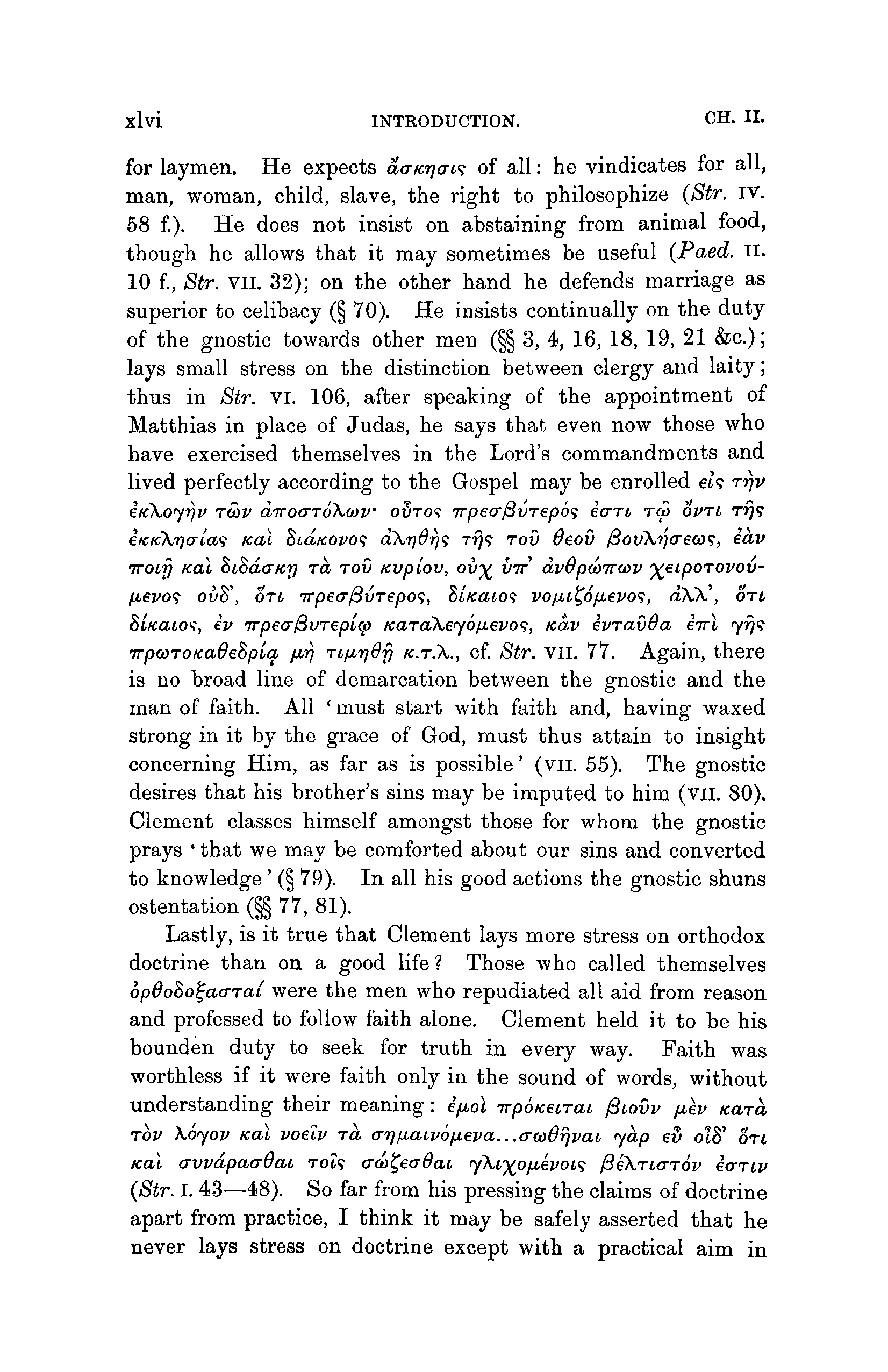
OH. II. for laymen. He expects aa/crjo-is of all: he vindicates for all, man, woman, child, slave, the right to philosophize (Str. IV.
58 f.). He does not insist on abstaining from animal food, though he allows that it may sometimes be useful (Paed. II.
10 f., Str. vil. 32); on the other hand he defends marriage as superior to celibacy (§ 70). He insists continually on the duty of the gnostic towards other men (§§ 3, 4, 16, 18, 19, 21 &c); lays small stress on the distinction between clergy and laity; thus in Str. vi. 106, after speaking of the appointment of Matthias in place of Judas, he says that even now those who have exercised themselves in the Lord's commandments and lived perfectly according to the Gospel may be enrolled eh TT}V ifcXoyrjv TCOV drroaToXwv OVTOS 7rpecr/3vTep6s ecnu TU> OVTI TJ}?
£icic\r)<TLa<s teal Sid/covos dXrjOrjs TT}? TOV Oeov ftoiihrjcrecos, eav KCU BiSdcTKJj TO TOV KVpioV, OU^ VTT dvdpWTTWV yZLpOTOVOVoi>B\ oru TrpecrftvTepcx;, Sl/caios vofxi^ofxevos, dXX', OTV ev irpecrBvTepiq) tcaraXeyo/jLevo^, xdv ivravda eVl 717?
Bpia fir] ri/jt-rjOf} K.T.X., cf. Str. VII. 77. Again, there is no broad line of demarcation between the gnostic and the man of faith. All ' must start with faith and, having waxed strong in it by the grace of God, must thus attain to insight concerning Him, as far as is possible' (vil. 55). The gnostic desires that his brother's sins may be imputed to him (vil. 80).
Clement classes himself amongst those for whom the gnostic prays 'that we may be comforted about our sins and converted to knowledge' (§ 79). In all his good actions the gnostic shuns ostentation (§§ 77, 81).
Lastly, is it true that Clement lays more stress on orthodox doctrine than on a good life ? Those who called themselves opOoSo^acrrai were the men who repudiated all aid from reason and professed to follow faith alone. Clement held it to be his bounden duty to seek for truth in every way. Faith was worthless if it were faith only in the sound of words, without understanding their meaning: i/j,ol Trpo/ceiTcu [Siovv fiev
Kara TOV Xoyov KaX voelv TO o-7)fAcuv6[Aeva...<T(o6r]vai. yap ev olS' OTL Kal avvdpaaOat TOC<; <r<i>%e<i6ab yXi%o[j,evoi<; {3eXTt,<7Tov ecxriv
(Str. I. 43—48). So far from his pressing the claims of doctrine apart from practice, I think it may be safely asserted that he never lays stress on doctrine except with a practical aim in https://doi.org/10.1017/CBO9780511695513.003 Published online by Cambridge University Press
CH. II.
INFLUENCE OF GREEK PHILOSOPHY.
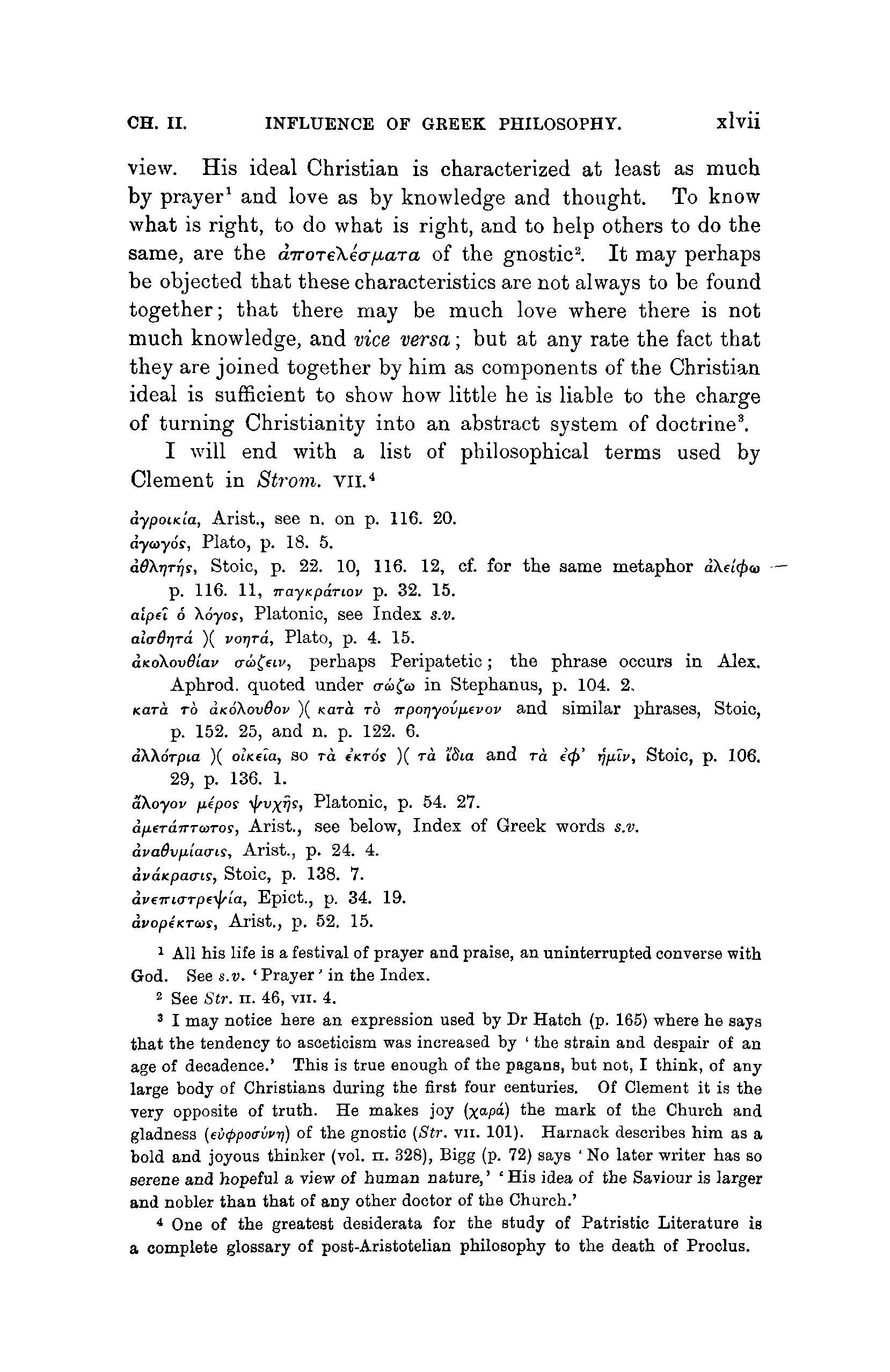
xlvii view. His ideal Christian is characterized at least as much by prayer1 and love as by knowledge and thought.
To know what is right, to do what is right, and to help others to do the same, are the d-rroTe\ecrfjiaTa of the gnostic2. It may perhaps be objected that these characteristics are not always to be found together; that there may be much love where there is not much knowledge, and vice versa; but at any rate the fact that they are joined together by him as components of the Christian ideal is sufficient to show how little he is liable to the charge of turning Christianity into an abstract system of doctrine3.
I will end with a list of philosophical terms used by Clement in Strom. VII.4 dypoiKia, Arist., see n. on p. 116. 20. dya>yos, Plato, p. 18. 5. ddhrjTrjs, Stoic, p. 22. 10, 116. 12, cf. for the same metaphor dXet'0<u p. 116. 11, nayK.pa.riov p. 32. 15. cupel 6 Xoyos, Platonic, see Index s.v. ala-drjTa )( vorjrd, Plato, p. 4. 15. aKoKovdiav crafeiv, perhaps Peripatetic; the phrase occurs in Alex.
Aphrod. quoted under o-cofco in Stephanus, p. 104. 2, Kara TO CLKO\OV6OV )( Kara TO vporjyovfievov and similar phrases, Stoic, p. 152. 25, and n. p. 122. 6. dXkoTpia )( oixeia, SO ra e'/crds )( ra iSia and Ta i(j>' tffiiv, Stoic, p. 106.
29, p. 136. 1. aXoyov [xtpos tyv^s, Platonic, p. 54. 27. dp.€TdjrTaiTos, Arist., see below, Index of Greek words s.v. dvadvplaons, Arist., p. 24. 4. dvaKpacris, Stoic, p. 138. 7. dvcirio-Tpe^La, Epict., p. 34. 19. dvopeKTas, Arist., p. 52. 15.
1 All his life is a festival of prayer and praise, an uninterrupted converse with God. See s.v. ' Prayer' in the Index.
2 See Str. n. 46, vn. 4.
3 I may notice here an expression used by Dr Hatch (p. 165) where he saya that the tendency to asceticism was increased by ' the strain and despair of an age of decadence.' This is true enough of the pagans, but not, I think, of any large body of Christians during the first four centuries. Of Clement it is the very opposite of truth. He makes joy (x^pa) the mark of the Church and gladness (eutppoavvri) of the gnostic (Str. vn. 101). Harnack describes him as a bold and joyous thinker (vol. n. 328), Bigg (p. 72) says ' No later writer has so serene and hopeful a view of human nature,' ' His idea of the Saviour is larger and nobler than that of any other doctor of the Church.'
4 One of the greatest desiderata for the study of Patristic Literature is a complete glossary of post-Aristotelian philosophy to the death of Proclus. https://doi.org/10.1017/CBO9780511695513.003 Published online by Cambridge University Press
xlviii
INTRODUCTION.
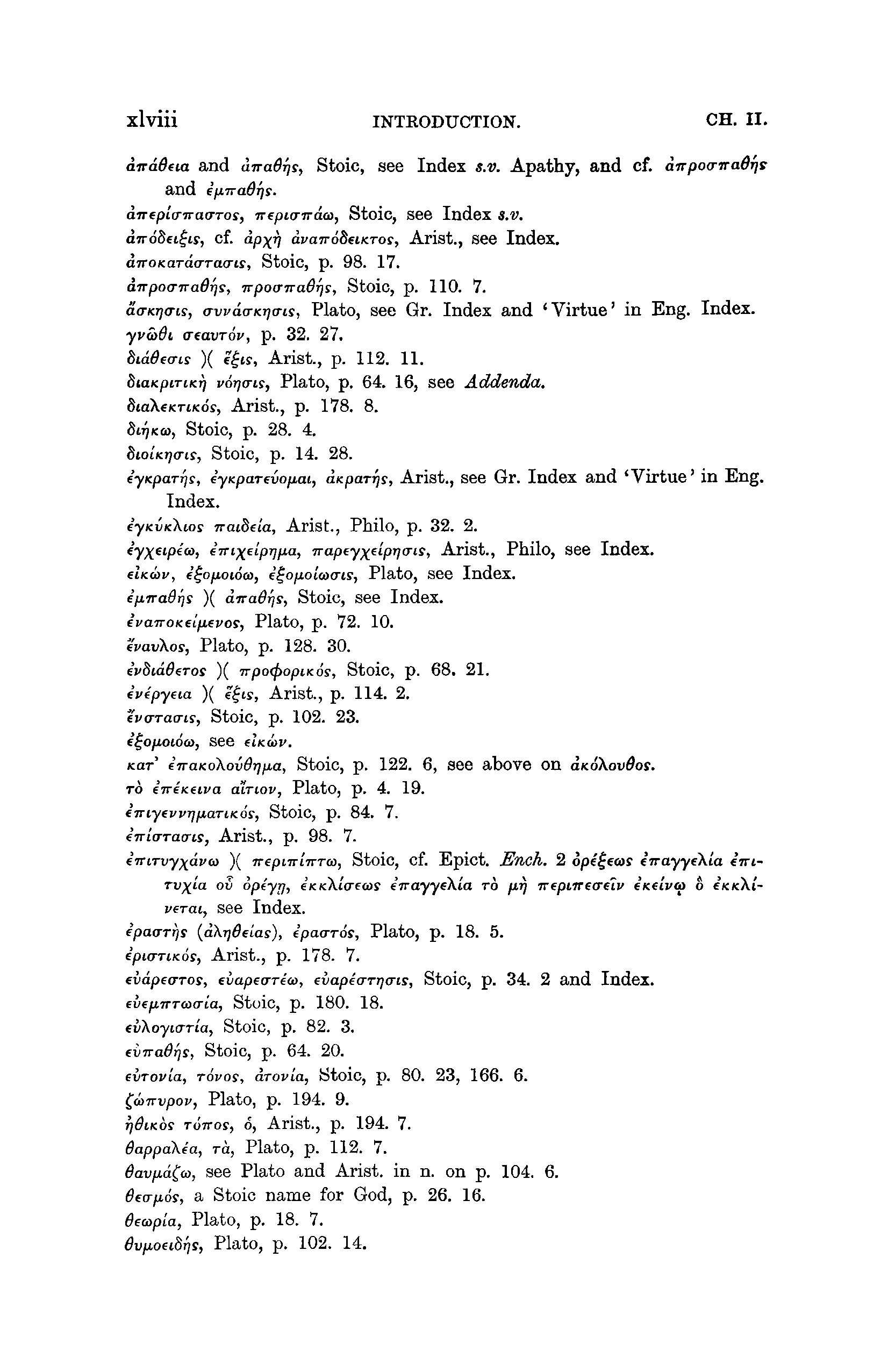
CH. II. airaBeia and airaBijS, Stoic, see Index S.V. Apathy, and cf. dirpoo-ira6i]S and ijiTvaBi)!. airfplcrna(TTOs, irepi(Tirda>, Stoic, see Index S.V. dirofSfi^is, cf. ap-)(Tj dvajroSfiKTos, Arist., see Index. airoKaTcuTTwris, Stoic, p. 98. 17. anpo(T7ra8r)s, irpoarnadr}!, Stoic, p. 110. 7. ao-Krjais, <TvvdtrKr)(ns, Plato, see Gr. Index and 'Virtue' in Eng. Index. yva>6i aeavrov, p. 32. 27.
)( f£u, Arist., p. 112. 11.
T) V6T)(TK, Plato, p. 64. 16, see Addenda. dia\(KTiKos, Arist., p. 178. 8.
8IT)KO>, Stoic, p. 28. 4.
SwUt]<ns, Stoic, p. 14. 28. iyK.pa.Trjs, iyKparfvojiai, aKpaTrjs, Arist., see Gr. Index and 'Virtue' in Eng.
Index. eyKvK\u>s Trmdeia, Arist., Philo, p. 32. 2.
€7TixciprjfjLa, Tra/jey^eipt/iris', Arist., Philo, see Index. o^iotdo), e^ojLtotaxrty, Plato, see Index. ris )( d.Tra6r]s, Stoic, see Index. eva-n-OKeipfvos, Plato, p. 72. 10. i'vavXos, Plato, p. 128. 30. ivbiaBcros )( irpotpopiicos, Stoic, p. 68. 21. ivipyeia )( e^ts, Arist., p. 114. 2. eva-raa-is, Stoic, p. 102. 23. i^ojioioa, See (IKU>V.
KUT' inaKoXovdrjfia, Stoic, p. 122. 6, see above on duokovdos.
TO (TreKciva airiov, Plato, p. 4. 19. iviyevvT)ii.a.TLK.is, Stoic, p. 84. 7. s, Arist., p. 98. 7.
)( TrcpiTriVrco, Stoic, cf. Epict. Ench. 2 6pe£ca>s eVayyeAi'a eViTv)(ia ov opcyrj, €KK\l(reo>s iirayyehia
TO p.rj Trepcrreo'e'iv inc'iva 6 £KK\1vcTai, see Index.
(d\r)6eias), ipao-Tos, Plato, p. 18. 5. os, Arist., p. 178. 7. cvdpe(TTOS, fiapeore'a), dapeo-Trjais, Stoic, p. 34. 2 and Index. evep.7TT<oo'La, Stoic, p. 180. 18.
(vkoyio-Tia, Stoic, p. 82. 3. evna6l)S, Stoic, p. 64. 20. evrovia, TOVOS, arovia, Stoic, p. 80. 23, 166. 6.
£ainvpov, Plato, p. 194. 9.
^#tKor TOTTOS, 6, Arist., p. 194. 7. dappakea, TO, Plato, p. 112. 7. davfidfa, see Plato and Arist. in n. on p. 104. 6.
Betrpos, a Stoic name for God, p. 26. 16.
Becopia, Plato, p. 18. 7.
8vpoei8r)s, Plato, p. 102. 14. https://doi.org/10.1017/CBO9780511695513.003 Published online by Cambridge University Press
CH. II.
INFLUENCE OF GREEK PHILOSOPHY.
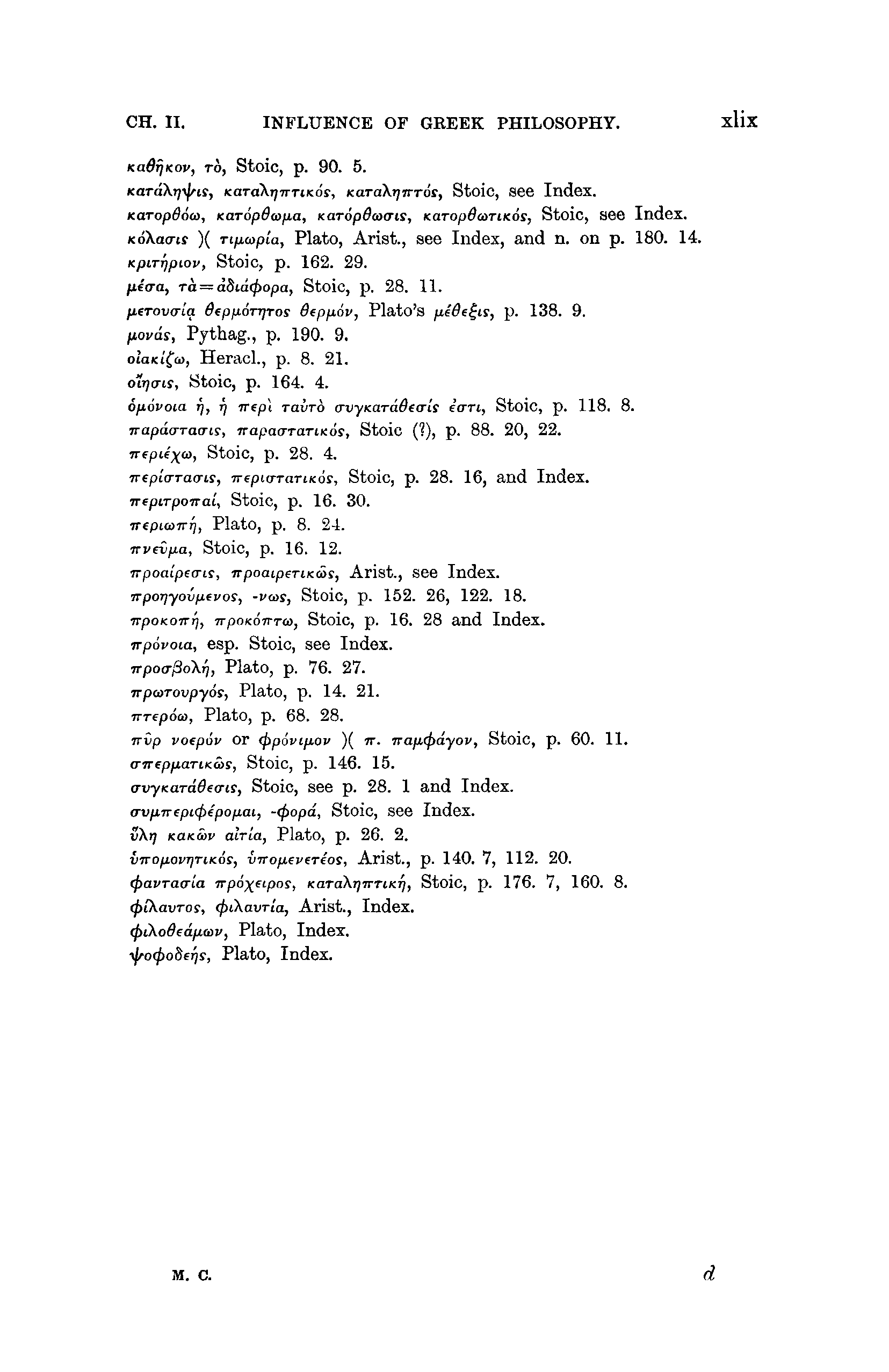
xlix KadiJKOv, TO, Stoic, p. 90. 5.
KaTakr)\jns, KaraKynTiKos, KaraX^n-rdr, Stoic, see Index.
Karopdoca, KaTop&wfia, KaTopOocris, KaropSaiTiKos, Stoic, see Index.
KoKams )( rifiiopla, Plato, Arist., see Index, and n. on p. 180. 14.
Kpirrjpiov, Stoic, p. 162. 29. fiitra, Ta = aSui(popa, Stoic, p. 28. 11. fierowia dtpfiorrp-os 8epp.6v, Plato's fiide£is, p. 138. 9. pov&s, Pythag., p. 190. 9. olaKifa, Heracl., p. 8. 21. oirjcns, Stoic, p. 164. 4.
6/iovoia fj, TJ irtpt ravTO tTvyKaTd9((Tis iari, Stoic, p. 118. 8. napaa-raa-is, irapaaraTLKos, Stoic (?), p. 88. 20, 22.
TTfpte'^o), Stoic, p. 28. 4. nepla-Tacns, TrepicrTariicos, Stoic, p. 28. 16, and Index. nepLTpoirai) Stoic, p. 16. 30. irepuoirii, Plato, p. 8. 24. irvevfia, Stoic, p. 16. 12. irpoaipeais, npoaiperiKais, Arist., see Index.
7TpO7]yovfievos, -vats, Stoic, p. 152. 26, 122. 18. irpoKonrj, npoKonray, Stoic, p. 16. 28 and Index. npovoia, esp. Stoic, see Index.
Trpoo-^oXij, Plato, p. 76. 27. nparovpyos, Plato, p. 14. 21.
•n-Tep6a>, Plato, p. 68. 28. nvp vofpov or <ppovip.ov )( n. Tra/Kpayov, Stoic, p. 60. 11.
(rirepfiariKas, Stoic, p. 146. 15.
(rvynardOecns, Stoic, see p. 28. 1 and Index.
(rvfnrepKpipofiaL, -<popd, Stoic, see Index. v\rj KCticaiv atria, Plato, p. 26. 2.
VTVOfiovijTiKos, virofievereos, Arist., p. 140. 7, 112. 20.
(pavTa<ria Trpd^fipof, KaTakrjTTTtKri, Stoic, p. 176. 7, 160. 8.
(ptKavros, (f>t\avTia, Arist., Index. v, Plato, Index. irjs, Plato, Index.
M. C. https://doi.org/10.1017/CBO9780511695513.003 Published online by Cambridge University Press
CHAPTEE III.
CLEMENT AND THE MYSTERIES1.
NEXT to philosophy the most powerful spiritual influence in the Hellenic world of the second century was that exercised by the Mysteries; the former appealing to the reason and judgment, the latter to feeling and imagination. As long ago as the time of Pindar, the Eleusinian Mysteries were famed as ennobling men's ideas of life and of death2.
In the great revival of religious feeling which took place about the time of the Christian era, partly owing to the loss of national independence, and the consequent decay of higher secular interests; partly to the recognition that philosophy, while it awoke the sense of individual responsibility, had yet failed to explain the deeper riddles of life; men turned more and more
1 On the Bubjeot of this chapter see Purser's articles on ' Eleusinia,'
'Mysteria,' 'Orphica' in the new edition of Smith's D. of Ant; Eamsay on ' Mysteries' in Enc. Brit.; Lenormant in Cont. Rev. for May, July, Sept. 1880;
DBllinger Gentile and Jew, vol. I. Book m.; Hatch Influence of Greek Ideas, 1890, pp. 283—309 ; Gardner Exploratio Evangelica, 1899, pp. 325—345, 456 f.;
Inge Christian Mysticism, App. B, 1899; Anrich Das antike Mysterienwesen in seinem Einfluss auf das Christenthum, 1894; Wobbermin Beeinflussung des
Urchristenthums durch das antike Mysterienwesen, 1896.
2 Clement (Str. in. 518) quotes Pindar speaking of these mysteries ofySios 8ffn$ ISwv Ktiv' e?<r' virb %Siiv' • oTSe ixiv §lov reXevrav oTSev Se 5i6<r5oTor apxav; cf. the Homeric Hymn to Demeter 476—482, and Cicero (Legg. n. 36). Plato gives an uncertain sound: on the one hand, in the Phaedo, p. 69 c, we read xtvSvveiovcTLv ol ras reXeras i][uv KaTatTTfoavTes ov <pa.v\ol nves elvat, dXXcfc rtp OVTL TrdXat alvirTCfrdai 8TC 6S tip &fJ.tir]Tos KOX dr^Xetrros els'Atdou dtpiKTjTat iv jSop/36p^j Keiaerai, 6
Se K€Ka6apfjL^fos re KaX rereXeafi^vos fKeTve d<jiLKbfi.evos /ierct 6eu>v oi/crjaci : on the other hand he speaks {Rep. u. 364/re. and 366) of the evil effect of the Orphic teaching in persuading men that the wrath of heaven against sin may be averted by Ka.6apiJ.ol and reXerai of the XiVioi 0eol. https://doi.org/10.1017/CBO9780511695513.004 Published online by Cambridge University Press
CH. III.
CLEMENT AND THE MYSTERIES.
li to those mystic rites which professed to provide healing and rest for the sick and weary soul, to enable it to enter into communion with God and look forward with hope to a blissful immortality1. The influence of the Mysteries is reflected in Christian writers from opposite points of view. In the first place there is an attempt to lessen the prestige of the Pagan mysteries by calling attention to the frivolities and obscenities connected with them (Clement Protr. 12—24). In the next place there is an attempt to show that the Christians also have their own far worthier mysteries, secret rites and secret doctrines, which were imparted only to the initiated.
I shall presently point out the allusions to the latter effect which may be found in Clement: but before doing so it may be well to give a very brief account of the nature and character of the Eleusinian Mysteries so far as may serve to explain the allusions which follow, and then to illustrate from earlier writers, Pagan as well as Jewish and Christian, the use of figurative language borrowed from the Mysteries.
The disappearance and seeming death of the seed in the ground and its springing up into the living plant, with its suggestion of man's resurrection from the dead, are symbolized in the story of Demeter and Persephone, who were honoured in Attica by the Lesser Mysteries held in spring
1 Ramsay in the Encycl. Brit, speaks of the Mysteries as ' an attempt of the Hellenic genius to take into its service the spirit of Oriental religion.'
Wobbermin distinguishes the following elements in the influence of the Mysteries (1) the soteriological motive ('moment'), which he finds in the epithet varr/p frequently appended to Chthonian deities, compare Clem. Protr.
II. 26 rov yap evepyerovvra /J.7} avvuvres Bcbv avtirXaaav TLPCLS ccoTTJpas AwaKoijpovs Kal...'AaK\rjinoy iarpbv, Plut. MOT. 1119 E ras nvve^evyixtvas rois Seois TrpoffT/yopias dirotnrQvTes, trvvavaLpetre ffvaias, /ivffrypia,
7ro/A7rds, eoprds. rivt yap...(rwr-fjpia.
0{i<rofiev.../j.7} awo\ur6vTes (Turf/pas; (2) the henotheistic motive, or religious syncretism, by which separate deities were confounded together as being different names for the same Being; (3) the dualistic motive, combining terror and love in such names as Erinyes—Eumenides, "AiSys—W>(3ov\e\5s; (4) the ethical motive, shown in the demand for purity of heart and life, in purification and asceticism ; (5) the eschatological motive shown in the constant reference to the rewards and punishments of another life. Inge gives a more useful analysis in p. 354, where he specifies as the main features of the Mysteries which passed into Catholicism ' the notions of secresy, of symbolism, of mystical brotherhood, of sacramental grace, and, above all, of the three stages in the spiritual life, ascetic purification, illumination, and iTroirrela as the crown.' https://doi.org/10.1017/CBO9780511695513.004 Published online by Cambridge University Press
lii
INTRODUCTION.
CH. III. on the banks of the Ilissus, and by the Greater Mysteries held in autumn at Eleusis. The former were a necessary preliminary to the latter1. Two years at least were as a rule required before the nva-r^ of the former could become an eiroTrTr}*; of the latter, thus completing his initiation into the Greater Mysteries. The first step to be taken by a candidate for admission to the latter was to apply to one who was already e7ro7TT?7?, and satisfy him that he was dyvbs airo 7ravro<; fivaov<;, and then to receive instruction from him as to the necessary purifications. If the instructor (/u,varay(oy6<;) was in doubt on any point, he might appeal to the e^TjyrjTijv, who was a special adviser on questions of casuistry. The candidate had then to abstain from certain viands, especially fish, for nine days, during which occurred the immersion in the sea, following the proclamation aXa&e fiva-rai, and the great torch-bearing procession in which the image of Iacchus was carried along the Sacred Way from Athens to Eleusis2. At Eleusis there followed two iravvvx'i^es in which the initiated represented
Demeter seeking for her daughter. After this they partook of the KVKewv, the Eleusinian sacrament of mint, meal and water, and were finally admitted by the SaSovxo? from the outer darkness into the brilliantly lighted temple, where the holy drama was enacted before their eyes, and the sacred relics were exhibited by the lepo^avT^.
Death was the punishment for divulging the mysteries3.
1 Plato Gorg. 497 c, evSai/uov el, <3 KaXX/xXeis, &n TO /ieyaKa jie/tiJijcrai irplr TO o-fUKpd' iyu> 5' obn y/iT/y fle/tirox elvai.
2 The worship of Iacchua is said to have been joined to that of the goddesses by Epimenides at the end of the seventh century B.C.
* The quotations which follow will illustrate some of the above statements:
Hor. C. in. 2. 26 vetabo qui Cereris sacrum volgarit arcanae sub isdem sit trabibus, Strabo x. 717 rj Kptiif/is T) I^VUTIKT) TWV UpQv ire)ivoiroiei TO Oelov, /Aifiovfitvri
TT)P (pi'iaiv avroO iKtpeiyovaav Trp> ataffriinv, Synesius Dion 47Jin.'kpioTorfKr)? dfiot TOIIS TuXovphovs oi ixad<uv n delv, dXXa TraBeiv Kal SiaTeBijvai, yivo/jAvovs
SifKovbn ^irtTTjdetovs, Arist. Ranae 143 foil, juera TOUT' o<pei.s Kal drjpl' O^JCL jLtup£a...eTra fibpfiopov iro\iv...iv Se Toir(f /cei/i^vous, el' TTOU ^COP rts 4)6lici)<re irdwore...ivrevdev ai\Qv rls <re irepleiaiv irvoi], o\pu re tpds KaXhujTov...Kai
Oi&vovs eiBalfiovas...Ourot Si Si; rivet elcrlv; Oi fie^vrj/iivoi, ib. 326 "lanx,
<£ "IaKXe &0t rovS' dva Xsi/uSca Xopeiaav otxiovs is 9mcniTas...ayi'ar balois fiera ixforaun x°P^av-..tyeipe <p\oyias XaftirdSas iv X€Pa'^ Tivd<rffav, ib. 354 €A<fnuMu> XPV KA^lffraaOaL rots i]fi.eTt'poi<n
Xopolcrtv, Sims dwecpos roidvSe \6ywv $) y&ny /i^i) Kadapeiei, ib. 454 juArots -yap i]/uy
TJXios Kal tpiyyos IKapbv iarai, fitrot fiefiwJiiJ.(6' tvoeftfj re Srfyo/iev rpoirov, Clem. Str. https://doi.org/10.1017/CBO9780511695513.004 Published online by Cambridge University Press
CH. III.
CLEMENT AND THE MYSTERIES.
Hil The Mysteries of Eleusis were the most famous, but they did not stand alone. The Phrygian Cybele and Sabazius, the Persian Mithras, the Egyptian Isis and Osiris and Serapis, the Syrian Adonis, the Samothracian Cabeiri, the Cretan Zagreus, all had their mystic thiasus, and their secret rites, which by their common meal and other ceremonials were supposed to establish an intimate communion between the deity and the worshipper. In all the common object was the attainment of awrrjpla in this life and the next.
I proceed now to give examples of the use of figurative language borrowed from the Mysteries.
One of the most striking is found in Plato's allegory of pre-natal existence (Phaedras 250): ' Beauty not only shone brightly on our view at the time when in the heavenly choir we followed in the band of Zeus...and were initiated in that which I fear not to pronounce the most blessed of all mysteries, evSaifiova (pda-paTa fivov/xevoi T€ Kal iiroTrrevovTe^ iv avyfj icadapa Kadapol 6We?.'
Philo I. p. 146 fin. (introducing an allegorical interpretation) avaSibda/cofiev #ei<Z9 TOI>? reXerayv d^iov; TWV lepaTdrav ...eKeiioit; Se ou-% lepocfravTijaofiev Karea^7jf^evoi<; dvtdra KaKG>...TavTa, co jxv<TTai Ke/caOapfievoi ra ccra, to? lepa ovrcc; fx,v<jTr]pia tyvyaZ*; Tat? eavroiv 7rapa&e%ec0€ Kal p,r]Bevl T&V d/j,vijTcov eKkaXijaare, II. p. 447 wairep iv rah TeXerat? iepo- (f>avT7]6evTe^, orav opylcov ye/jLi,a8a><Tiv, TroWd TTJ? irpoadev o\iry(op[a<; eavrov?
Kafci^ovcriv ft)?.../3toi> rp[-^ravTe<i dftlwrov iv a> cf>povi]<Tea)<; i)(ijpevcrav.
Elsewhere Philo strongly condemns the mysteries as betokening a jealous and exclusive spirit (il. 260). Epictetus III. 21. 13 foil, contrasts the teaching of a glib reporter of philosophical phrases with that of a true philosopher in the following terms: TL d\Xo
[ivar-qpia i^op^rj Kal \eyei,<; ' oiKTj^d iari Kal iv iBov Kal iv8dSe.
€Kel lepo(j)di>Tr]<f Kal eyoi Trocrjaco lepo(j)dvTT]v.
V. 689 init.
OVK aireiKdrws Kal T&V ^xKTrrjplwv TUIV Trap' "EWTJITLV <xpxet ^ v T^ Kad&fxria, Kaddirep Kal tv rots /3a/>/3(£/>ots TO \ovrpbv • //.era raOra be iarl ra fUKpa ixvar-qpia 5i8acrKa\las virbBeaiv ^x0VTa
Ka^ TrpoirapacrKevTJs TWV ixeWbvTUiv • TO 5e fj.eyd\a wepl TWV avfiiravTuii' ov fiavdaveiv Irt iiiroXdireTai, iiro-jrTeieiv Se Kal irepivoeiv TTJV TC (piaiv Kal ra Trpdy/j-ara, Protr. 12 Ar/w nal K6py dpa/Mt, £yevia8T)v (XVGTIKOV, Kal TJJV 7c\dv7jV Kal Tr\v apiray^v Kal TO W^V&OS aiiTaiv "EXeutrts dadovx*?,
Str.
VII. 27 Trpb T7js Tuyv [ivo'T^pla)? Trapabbaews Kadapfxovs Tivas Tpoffdyeiv TOLS
[JL4XKOV<TU> a£iov(rLV, ib. 88 OVK ^KKVKXETV 5et Tb ^vfTT^ipiov. https://doi.org/10.1017/CBO9780511695513.004 Published online by Cambridge University Press
liv
INTRODUCTION.
CH. III. e/cet Krjpv^'
Kayo) KrjpvKa KaraaTrjcrai. ixel BaSov^o<i' icayw hahovyov. eKei 8a8e<f ical ivOdSe'...aXXov rpoirov Sel eVt ravra iXOelv' fieya earl TO irpayf^a, /J,V<TTIK6V eartv, ov% a>? krv^ev, ovSe ™ TV^OVTC BeSofievov.
We find references to the Mysteries in the LXX, e.g. Dan. ii. 29 o aTTOKak.v'irTwv /4vo~Trjpia iyvcopiae aoi a Bel yevecrOai, Wisdom xiv. 23 rj yap re/cvo(f)6vov<; TeXera? T) icpv<f)ia ixvaTrjpia
...ayovTes, ovre [How; ovre ydfiovs icaOapovs eVt (fivXaaaovaiv, ib. xii. 5 €K fxeaov /J,v<TTa<; didaov, ib. viii. 4 (aofyia)
/J.VO~TL<; icrn TJ79 TOV Oeov e7n<TTr/fir]^, and N.T. e.g. Matt. xiii. 11 vjuv SeSorat yvdvai ra fivarTjpia TOV Oeov.
The word is frequently used by St Paul in reference to the Gospel revealed in Christ: see Col. i. 26, where Lightfoot says ' this is not the only term borrowed from the ancient mysteries, which St Paul employs to describe the teaching of the Gospel. The word reXeto? just below (ver. 28) seems to be an extension of the same metaphor. In Phil. iv.
12 we have the word /d.e/j,vrj/j.ai,, and in Eph. i. 14 o-<f>pay££ecr8ai is perhaps an image derived from the same source. So the Ephesians are addressed as TlavKov avjx^va-rai, in Ign. Eph. 12.
The Christian teacher is thus regarded as a lepo(f)dvTr]<i (see Epict. in. 21. 13) who initiates his disciples into the rites.
There is this difference however; that, whereas the heathen mysteries were strictly confined to a narrow circle, the Christian mysteries are freely communicated to all. There is therefore an intentional paradox in the use of the image by St Paul.' Cf. also
Rom. xvi. 25, 26, Eph. v. 32 (of the mystical meaning of the marriage union), and Eph. iii. 3—5 cited by Clement Str. V.
P. 682. Besides the direct reference to the Mysteries, we find the word eVo^r?;? used in 2 Pet. i. 16 eVoVTat yevrjdevTes TYJS eiceivov fj,eya\eLOTr)To<;, and there are two technical terms connected with the Mysteries, which are employed by writers of the N.T. when speaking of Baptism: these are ^COTL^CO and <T(f)payi£a>. For the former compare Heb. vi. 4 dhvvaTov roiis aval; 4>a)Ti.o-6evTa<;...Kal /X6TO%OU? yei>7)6evTa<; irvev[UZTOS ayiov ...Kal TrapaireaovTa^ iraKiv dvaKaivl^eiv eh fierdvoiav, ib. x. 32 dvafiLfwqcnceo-de Tct,<i Trporepov rjfiepas, if at?
<$>(OTio~devTe<; iroXXrjv ad\7]Gtv virefielvaTs 7ra6rj/j,dTwv; for the latter, Rev. vii. 3 fir) dBiKijffTjTe TTJV yrfv-.-ayjH, cnfipaylaco/Aev TOW? SOVXOV; TOV Oeov r/ficov eVt TG>V irpoardnrav CIVTCOV, Eph. i. 13 iv a> https://doi.org/10.1017/CBO9780511695513.004 Published online by Cambridge University Press
CH. III.
CLEMENT AND THE MYSTERIES.
lv arcovo-avTes T W Xoyov TJ79 dXr)6eLas, TO evayyeXiov TJ?? v/iwv. ..Trunev<TavTe<i io-fypayiarOrjTS TO. irvevfiaTi TT}<> iirayyeXias ™ dylw, ib. iv. 30, 2 Cor. i. 22 *.
I turn now to Clement's use of mystical terms, and will deal first with his references to rites, and then with the references to doctrine.
Paed. I. 26 ftaTTTi£6[ievoL cp<im|i5|j.evoi vioiroiovfieda, vloTroiovfievoi TeXciov|iE8a, airo8avaTiJo|ji€fla /caXeiTai o"e 7ro\\a/^a>9 TO epyov TOVTO
Kai 4>"JTio-(j.a Kai, XoiiTpov. ..c|>wTi<r(j.a oV oil TO a-yaov EKEIVO 4><3S TO o-wTijpiov eiroirTeveTai, TOVTetjTiv hi ov TO ueiov o^vwirovfiev, § 27 o fiovov avay€WT)86ls...<|>wTi.o-8«ls aTrrfWaKTai
[lev Trapd^prjixa
TOV <T«OTOU?,
avTodev TO <£a><?, § 28 ot /3cnrTi£6fievoi T<Z? k-KMJicoTO ^et&) TrvevfiaTi.
..d7TOTpiyjrdfievoi,...(j}Ci)Teivdv TOV irvevfiaTO*; lo-yo^ev, a> Sr) /j,6vq> TO 8elov liroirTeiJO(i€v, § 30 fiia %fzpt? avTt] TOV <j>a>TCa-|i.aTos TO fir) TOV avTov eivat, T<£ irplv rj Xoiio-ao-8tti. TOV Tpoirov:
Protr.
§ 120 w TOJV dyi<ov <O9 (ZXTJUGOS p.vo~TT]pCwv, Cu ijicoTos aKT]paTOu.
Sa8ou^ov|xat TOf9 ovpavov<ii Kai TOV O€0V eiroTrreuo-as a-ytos yuVOfiat |j.uou|ievos, L£po<|>avTEi 06 O KVpiOS Kai TOV |J,I!O-TT)V o-^pa'yCjeTai (JxaTaYwycov : Q. D. S. 42 o Se Trpe<r/3vT6po? dvaXaffoov oltcahe TOV irapaSodevra veaviaKov..
.ICJXOTKTS /cat yaera TOVTO vcj)r)>ce T;?? 7r\etoz/O9 eTri/j,e\ela<;...&>?
TC'XCOV CLVTM
ifivXaKTi^piov eVtcrT^cra?
T^y 0-<|>pa7i8a TOI) Kvpiov.
Clement's language about the Eucharist, as is natural from the less prominent position assigned to it by him, is less tinged with reminiscences of the Mysteries; still we meet with such phrases as the following: Paed. 11. 29 (IVO-TIKOV OTJUPOXOV3 V alfiaTOS dylov olvov avo/iatrev, ib. I. 43 w TOV
|Mjo-ri]pCov • dirohvaaadai rjfilv Tt]v irdXaiav iy/ceXeverai (fiOopdv .../caivfjs Se dXXrj'; T ^ ? Xpto"Tou SmiT?79
[ieTaXafi/3dvovTas...T6v o-wTtipa 4vo-Tepv£o-a<r8ai, ib. II. 20 r)s (evxapio-Tias)
ol KCLTO, ITIO-TIV
IA€TaXafi(3dvovTe<; dyid^ovTai ical o-w/ia Kai \jrv)£i]v, TO Oelov 1 The evidence for the use of these terms in the Mysteries is given by Wobbermin in his book On the Influence of the Mysteries upon Early Christianity, pp. 144—172.
2 The technical terms are distinguished by thick type.
3 For the mystical use of this word compare Wobbermin pp. 174—183, where he refers to Protr. 15 TO, ainjioXa TTJS fivrfcreios ratr-ris, ib. 16 Sa^a^iav liViTTriplwi' <rtifi[lo\ov, ib. 22 TT)? 0^/tiSos TO. airopp^ra atififioha, ib. 18, Orig. c. Cels. in. 51 where the catechumens are described as ol ovdtirw TO o~tiixfio\ov rov diroKeKa.66.pdai. &y https://doi.org/10.1017/CBO9780511695513.004 Published online by Cambridge University Press
lvi
INTRODUCTION.
CH. III.
Kpafia, TOV avdpwrrov, TOV TrarpiKov fiovktjfiaTOS Trvevfiari /ecu \6ya> crvyKpivavTO<; pucrriKus.
It is chiefly however in reference to doctrine that Clement employs these figures, as in Str. I. 13 fieraSiBovai
Tcbv Oeitov [LV(m\plnv Kol roi (jiwros «Ke£vov TOV d-yCou TOi?
^copeiv Buvafievoa <rvyfce')(a)p7]Ke,..Ta d-n-6ppr\Ta. \oyq> TrKTreverai ov ypdfj,fj,aTi, ib. ra (ivcrnjpia. |XVO-TIKUS irapaBiBoTai, § 14 eickeyav 6 8 e S ( . t t > 9 ^...irai^l fid-%aipav...6peyovTe<; evpeib. V. 66 yaXa rj K,aTrj')(rjat,^...^poiixa Be rj BtupCa, ib. II. 47 BwpCa fieyiarr) 11 liroirriKij, ib. IV. 3
T?}? -rrpoOeaewi •qfitv...roT€ Brj TTJV TW OVTI yvcoariKTjv <f>uaioXoyiav /J,eTifiev, TCI |iiKpd irpA TWV (ic-ydXwv |iur)0e'vT£s (Av<TTi]p£o)V <a?
(irjSev ifj,TroBa>v ry 6ela 6W&)9 Upo+avrCa ylveaOai, IV. 162 o acoTTjp f.vtTTaf<oy(i, V. 56 «£I]YIITOG TII/O? KOX Ka8t]7iiToi %pei,av
^/ia.? jSovXovrai, § 57 ov yap OefiK opeyeiv TOIS amavT&cn, ra fierd roaovTcov dycovwv iropiaQevra, ovSe /J,rjv p^Xois TO TOV \6you (luo-Tiipia BiriyelcrOai, § 63 ov yap (pdov&v iraprjyyeiXev o /cvpio1; ev TIVI evayyeklw ' (woTijpiov e/u,bv ifioi icai rot? viols TOV o'itcov ftov,' § 7 9 TO appTfrov TOU deov.. .virep ovpavov TOV Tp'nov apteral \a\ela6ab to? defies TOI<; i/cel •v|ri'^a?1, VII. 4 Ta dela (»,ii<rTi|pitt irapd TOV eicfiaOcav, ib. 6 o TraoBevcov (ivo-riiptois TOV yvwcrTiicov, ib. 45 x°P°s n1KrrtKols TVS d\t]deia<i, ib. 97 the heretics firj fia66vTe<; TO, T^9 yvd>aeo)<i TT}<; iKKXrjo-iaaTucrj'i [ivo-rTpia, ib. 106
(jLvo-TaYw/ol T^9 TCOV dcrejSwv tyv)(f)s Kadio'TavTat3.
For the reasons and the subjects of this reticence, I may give in condensed form portions of the article on ' Disciplina
Arcani' in the D. of Ghr. Ant.
It arose 'out of the principles (1) of imparting knowledge by degrees in methods suited to the capacity of the recipients, and (2) of cutting off occasions of profaneness by not proclaiming the mysteries of the faith indiscriminately to unbelievers.' These principles find support in the distinction between ' milk' and ' strong meat,' and in the warning against ' casting what is holy to dogs.' Thus arose a distinction between the degrees of knowledge permissible to 1 Cf. 2 Cor. xii. 2 foil.
2 On the use of this word in the Mysteries see Wobbermin pp. 113 foil, and the Orphic quotation in Clem. Str. v. 124.
3 See also Protr. 12, Str. v. 689, vn. 27, 88 quoted above. https://doi.org/10.1017/CBO9780511695513.004 Published online by Cambridge University Press
CH. III.
CLEMENT AND THE MYSTERIES.
lvii catechumens and to believers, and a spirit of reticence on the more mysterious doctrines of the faith, whether in speech or writing, when it might be accessible to the heathen. Again, in Alexandria especially, doctrines and facts of Scripture were expounded esoterically to the initiated (yvacrTiKol), while their deeper meaning was disguised from others by an 'ceconomy.'
Origen (c. Cels. I. 7), enumerating the doctrines which were not hidden, mentions the birth, crucifixion and resurrection of the Lord, the resurrection of the dead, and the last judgment, but omits the doctrine of the Holy Trinity and of the Atonement.
So far I have confined my attention to the Eleusinian Mysteries, but ' it is not easy to draw a definite line between these and the forms of worship which went on side by side with them. Not only are they sometimes spoken of in common as mysteries, but there is a remarkable syncretist painting in a non-Christian catacomb at Rome, in which the elements of the Greek mysteries of Demeter are blended with those of Sabazius and Mithras in a way which shows that the worship was blended also1.'
Clement joins the Sabazian with the Eleusinian Mysteries, but does not, I think, mention Mithras, though the similarity of his rites to the Christian sacraments is admitted both by Pagan and Christian writers, each side retorting the charge of plagiarism on the other, just as was done in regard to the resemblances between Greek philosophy and the Scriptures2. In both cases we may allow that there was a 1 Hatch p. 290 f.
2 Cf. Justin Apol. i. 66 (the institution of bread and wine was imitated in the Mithraic Mysteries by the demons) STI yap apros Kal iroriipiov TIBCTOU. iv TCUS rod /J.VOV/J.£VOV reXercus per' (inXoyav
TLVZIV i-wlaraade, Tert. Praescr.
(diabolus) ipsas quoque res sacramentorum divinorum idolorum mysteriis aemulatur. Tingit et ipse quosdam utique eredentes et fideles suos; expositionem delictorum de lavacro repromittit...Mithra signat illio in frontibus milites suos; celebrat et panis oblationem et imaginem resurreetionis inducit, Orig. c. Cels. vi. 22, cited by Hatch I.e. For the Mysteries of Isis compare the account given by Apuleius of his own initiation {Met. xi. 21 foil.). The priest is speaking,
' inferum claustra et salutis tutelam in deae manu posita, ipsamque traditionem ad instar voluntariae mortis et precariae salutis celebrari; quippe cum transactis vitae temporibus iam in ipso finitae lucis limine eonstitutos, quibus tamen tuto possint magna religionis committi silentia, numen deae soleat elicere et sua providentia quodam modo renatos ad novae reponere rursus salutis curricula.' https://doi.org/10.1017/CBO9780511695513.004 Published online by Cambridge University Press
lviii
INTRODUCTION.
CH. III. reciprocal influence. The Christian Fathers were of course mistaken in regarding all that was good in philosophy as a theft from Christianity; but it is a mistake on the other hand to suppose that the Jewish Dispersion, which had such an extraordinary influence on Greek thought in Alexandria, could have been entirely without influence elsewhere, especially when we remember how many of the Stoics were of Eastern origin1.
And so with the Mysteries. There can be no more doubt that these were modified in their later stages, to compete with the rival forces of Christianity, than that the romance of Apollonius and the reforms of Julian were suggested by the story of the Gospels and the ascetic training and philanthropic activity of the Church. On the other hand, there were original elements in these Mysteries (as we have seen in regard to the Eleusinia), which were akin to Christianity and helped to prepare the way for it; and there were other elements which, whether for good or evil, could easily be absorbed in it. How far was this actually the case ? Dr Hatch traces the influence of the Mysteries down to the Middle Ages, and thinks that it was wide spreading and on the whole injurious. Mysteries take the place of the simple rites and open teaching of the early
Church. Baptism no longer follows immediately on conversion, but is sometimes deferred to the end of life, and is always preceded by a long course of instruction. It is administered, as a rule, only once a year with ceremonies closel}7 resembling those of Eleusis.
A more recent writer carries back this influence to the New Testament itself. ' The great difference between the teaching of the Synoptic Jesus on the one hand, and the teaching of Paul, of the Fourth Evangelist, and of the author of the Hebrews on the other, is just that the latter is permeated, as the former is not, by the ideas of spiritual communion, of salvation, of justification and mediation : ideas which had found an utterance, however imperfect, in the teaching of the thiasi...Christians are, like the Pagan Mystae, called upon to be ocnoi and ayioi. And in the second Corinthian Epistle
Paul speaks of the Eucharist in a manner which shows that already, in the churches which he had founded, it had taken
1 See Lightfoot, Phil. p. 273 foil. https://doi.org/10.1017/CBO9780511695513.004 Published online by Cambridge University Press
CH. III.
CLEMENT AND THE MYSTERIES.
Hx the mystic and sacramental position which it has never since lost. It would be misleading to speak of this change...as due to the direct influence of the Pagan thiasi. My contention is quite different.
I maintain that the language of the Pauline and Johannine writings shows the translation of Christianity on to a new level by the reception and the baptism into Christ of a set of ideas which at the time, coming from a divine source, were making their way into the various religions of the human race. These ideas...passing into ordinary Christianity... more fully adapted it for human reception.' Dr Percy Gardner, from whom I have taken this quotation, expresses a regret that ' the nobler doctrines of cults like those of Apollo and Athena' had less influence than the mysteries on the development of early Christianity. ' The divine nobleness of moderation and order, the charm of the mens sana in corpore sano, the beauty of a perfectly proportioned character, of manliness and a noble ambition, perfect freedom in thought and aspiration, in fact the whole range of higher Hellenic religious ideas were omitted in the web of Christianity1.' This complaint is much the same as that made by J. S. Mill, where he deplores that the feminine virtues of Christianity were not combined with the manly virtues of Stoicism *; and no doubt there has been much to justify such complaint at particular times and in particular portions of the Church; but if we look to the Ideal held before us in the New Testament itself, I do not think we can better the saying of the old dramatist, that in it we have depicted before our eyes ' The first true gentleman that ever breathed.'
If there is less talk about avSpeia and fieyaXo^v^ia and iirietKeta and TO icaKov than in Plato or Aristotle, there is more of the substance of these in St Peter's words ' whether it be right in the sight of God to hearken unto you more than unto God, judge ye' (that worthy pendant to the magnificent ' But if not' of Daniel); and again in St Paul's description of a^anrt] and of the ' armour of God,' and his list
1 Expl. Evang. pp. 340 foil.
2 Liberty, pp. 89 f., 112. https://doi.org/10.1017/CBO9780511695513.004 Published online by Cambridge University Press
INTRODUCTION.
CH. III. of the things which should occupy a Christian's thoughts (Phil, iv. 8), and in St James' description of the wisdom from above.
My chief reason however for touching on the subject here is to point the contrast between Dr Hatch and Dr Gardner on the introduction of Hellenic ethics into Christianity.
The latter deplores that Christian morality was not hellenized: the former, as we saw in the last chapter, considers that it was hellenized by Ambrose's adaptation of Cicero's Offices, and regards this as a mark of the degeneration of Christianity. https://doi.org/10.1017/CBO9780511695513.004 Published online by Cambridge University Press