
CHAPTER XI
C. X. § 59—C. XI. § 61] MISCELLANIES, BOOK VII.
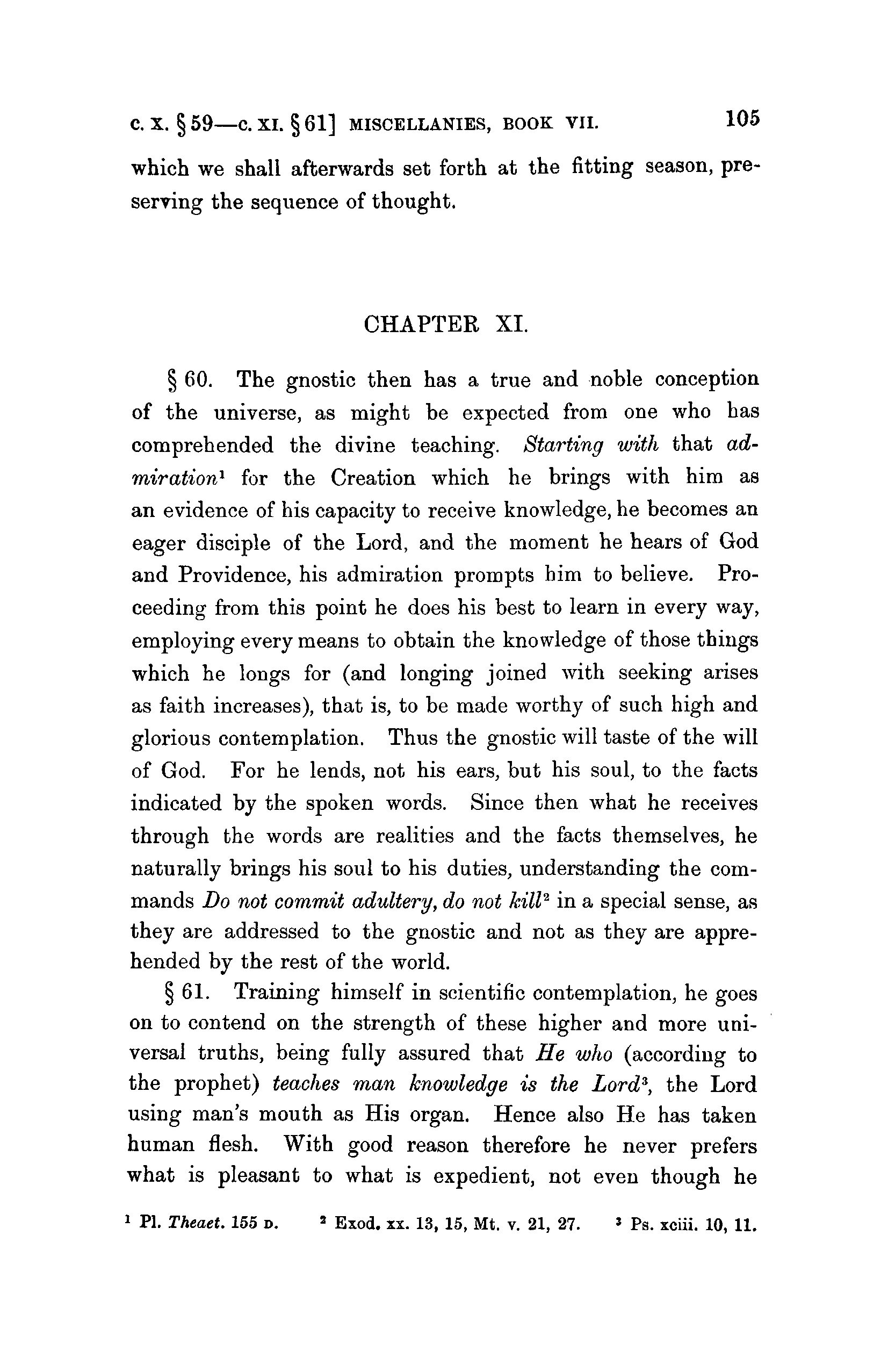
which we shall afterwards set forth at the fitting season, preserving the sequence of thought.
CHAPTER XI.
§ 60. The gnostic then has a true and noble conception of the universe, as might be expected from one who has comprehended the divine teaching. Starting with that admiration1 for the Creation which he brings with him as an evidence of his capacity to receive knowledge, he becomes an eager disciple of the Lord, and the moment he hears of God and Providence, his admiration prompts him to believe. Proceeding from this point he does his best to learn in every way, employing every means to obtain the knowledge of those things which he longs for (and longing joined with seeking arises as faith increases), that is, to be made worthy of such high and glorious contemplation. Thus the gnostic will taste of the will of God. For he lends, not his ears, but his soul, to the facts indicated by the spoken words. Since then what he receives through the words are realities and the facts themselves, he naturally brings his soul to his duties, understanding the commands Do not commit adultery, do not k.ill2 in a special sense, as they are addressed to the gnostic and not as they are apprehended by the rest of the world.
§ 61. Training himself in scientific contemplation, he goes on to contend on the strength of these higher and more universal truths, being fully assured that He who (according to the prophet) teaches man knowledge is the Lord3, the Lord using man's mouth as His organ. Hence also He has taken human flesh.
With good reason therefore he never prefers what is pleasant to what is expedient, not even though he
1 PI. Theaet. 155 D.
* Exod. xx. 13, 15, Mt. v. 21, 27.
! Ps. xciii. 10, 11. https://doi.org/10.1017/CBO9780511695513.010 Published online by Cambridge University Press
ZTPQMATEQN Z'
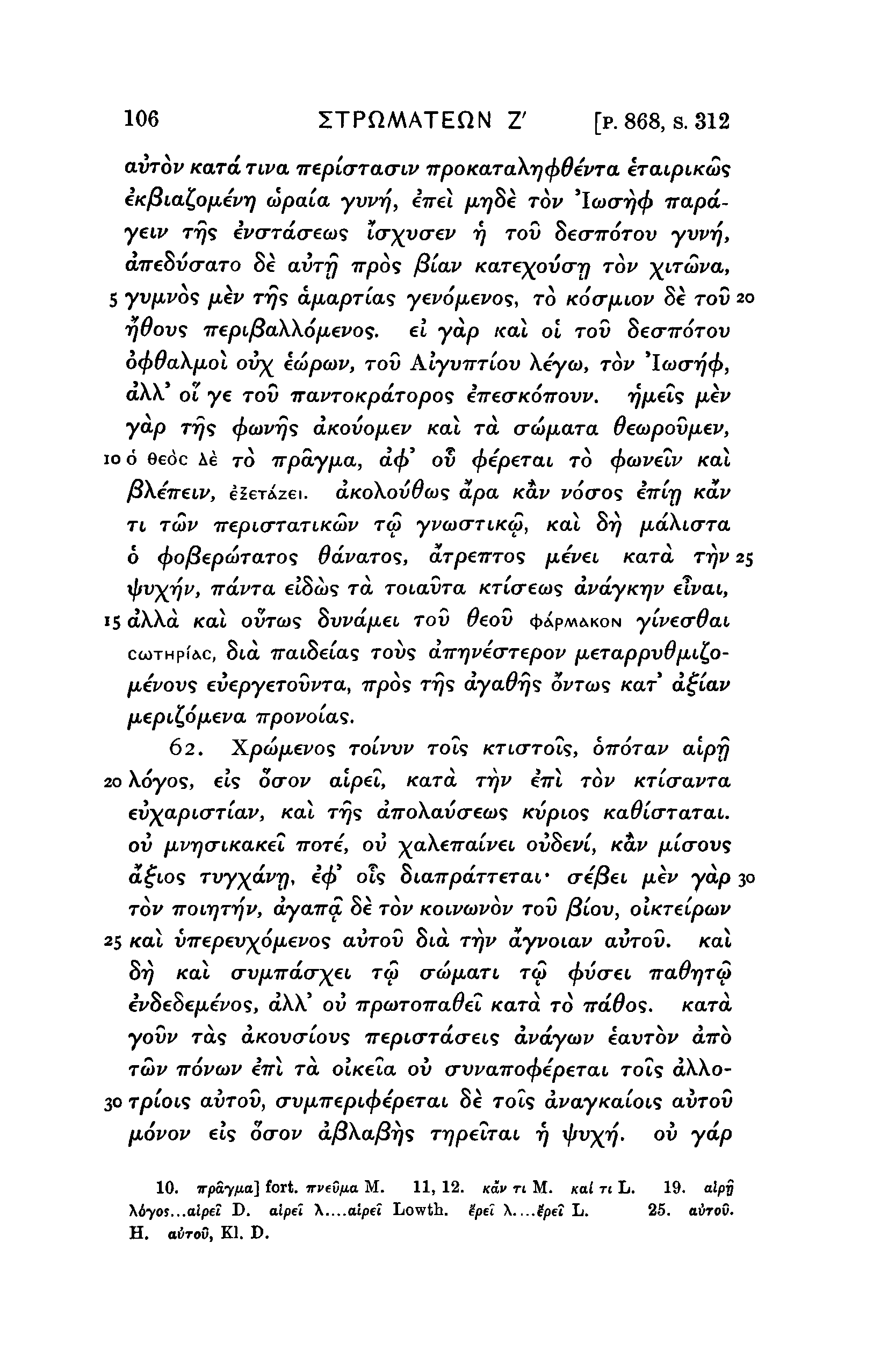
[p. 868, s. 312 avTov Kara Tiva TrepicrTacnv vpoKaTa\r)(f)$evTa eraipiKais iK^iat,ofj.4vr} (opaua yvvrj, iiret ju/rjSe TOV 'laxrrjKJ) irapdyeiv rrjs eVcrracrea)? la")(ycr€V rj TOV Seo-norov yvvq, dneSva-aTO Se avrfj TT/DOS ySiav Kare)(ovo-r) TOV XITCOVO,, 5 yvfivos fiev 7175 afiapTias yevofjievos,
TO KOO-IXLOV Se TOV 20
r/uovs 7r€pt.j3a\\6fjieuo<s. et yap t<al oi TOV SecnroTov 6<f>0a\iJLol ov% icopcov, TOV AlyviTTiov Xeyw, TOV 'lh)cn]<f>, dW oi ye TOV iravTOKpaTopos iweo-Koirovv. rjfiel^ fxev yap Trj<s (fxDvrjs aKovofxev KCU TO. o~cofiaTa deapovfiev, 10 6 6eoc Ae TO Trpayfia, d<f>' ov <f>4perai TO <j>a}ve2v KOL fiXeireiv, elerize\. aKoXovdw; dpa KOLV voaos liri-rj Kav Tl TWV Ttepi<TTO.TlK(tiV TW yVOi<TTlKM, KCU Si) jU,a\tO"Ta 6 <^>o/SepfUTaTos Qdva,TO%, a/rpeTTTos fxivei
KCLTO. TTJV 25
\ffvj(rjv, vdvTa etSws TO, ToiauTa /CTicrews dvdyKTjv elvai, 15 dXXa /cal OUTWS Zvvdfxet TOV Oeov 4>APMA.KON yivecrdai ccoTHpiAc, Std TratSetas TOUS d-irr}vecrTepov (jLeTappv6(uC,ofievovs evepyeTovvTd,
TT/SOS T^S dyadrj<; OVTO)<; KCLT d^iav 62.
Xpcofxevos To'ivvv TOIS KTIO-TOIS, OTroT 20 Xoyos, eis ocroi' atpet, /caTct Tr)^ iirl TOV ev)(apL<TTLav, KOLL TT?S (X7roX.avcreci>s Kvpios K ov /jLvrjcriKOLKei irori, ov ^aXeTratvet ovSevt, /cav a^ios Tvy)(dvr), i<f> ol<s SianpaTTeTac crefiei /xkv yap 30 TOV TTOI7]TIIJV, dyaira, 8e TOV KOIVCOVOV TOV /3Cov, olKTeCpatv
25 /cat vvepev^oiJLevo's avTov Sid r»)v dyvoiav OVTOV.
/cal u/A7rdo"^€t T&5 acofian T<O cf>vcrei s, dXX' oi5 TrpcoTonaOel Kara TO 7rd^os. y o w Tcts d/fouo"tous TreptcrTdcets dvdyo>v kavTov drrb
TWV TTOVOJV em Ta oi/ceia ov crwa7ro<^epeTai TOIS dXXo30 Tptoi? auTou, crv(jLirepL<f>dpeTai. Se TOIS dvay/catots auTou fiovov eis ocrov d^XajS^s rrjpeiTai rj \JJV)(TJ.
OV yap 10.
Trpav/ta] fort, irveu/io M.
11, 12. rav TI M.
KO( TI L.
19. oipj Xi70S...oipej D. alpe'i \ alpei Lowth.
£peZ \ (pet L.
25. airov.
H . a^Tow, Kl. D. https://doi.org/10.1017/CBO9780511695513.010 Published online by Cambridge University Press
C. XI. §| 61, 62]
MISCELLANIES, BOOK VII.
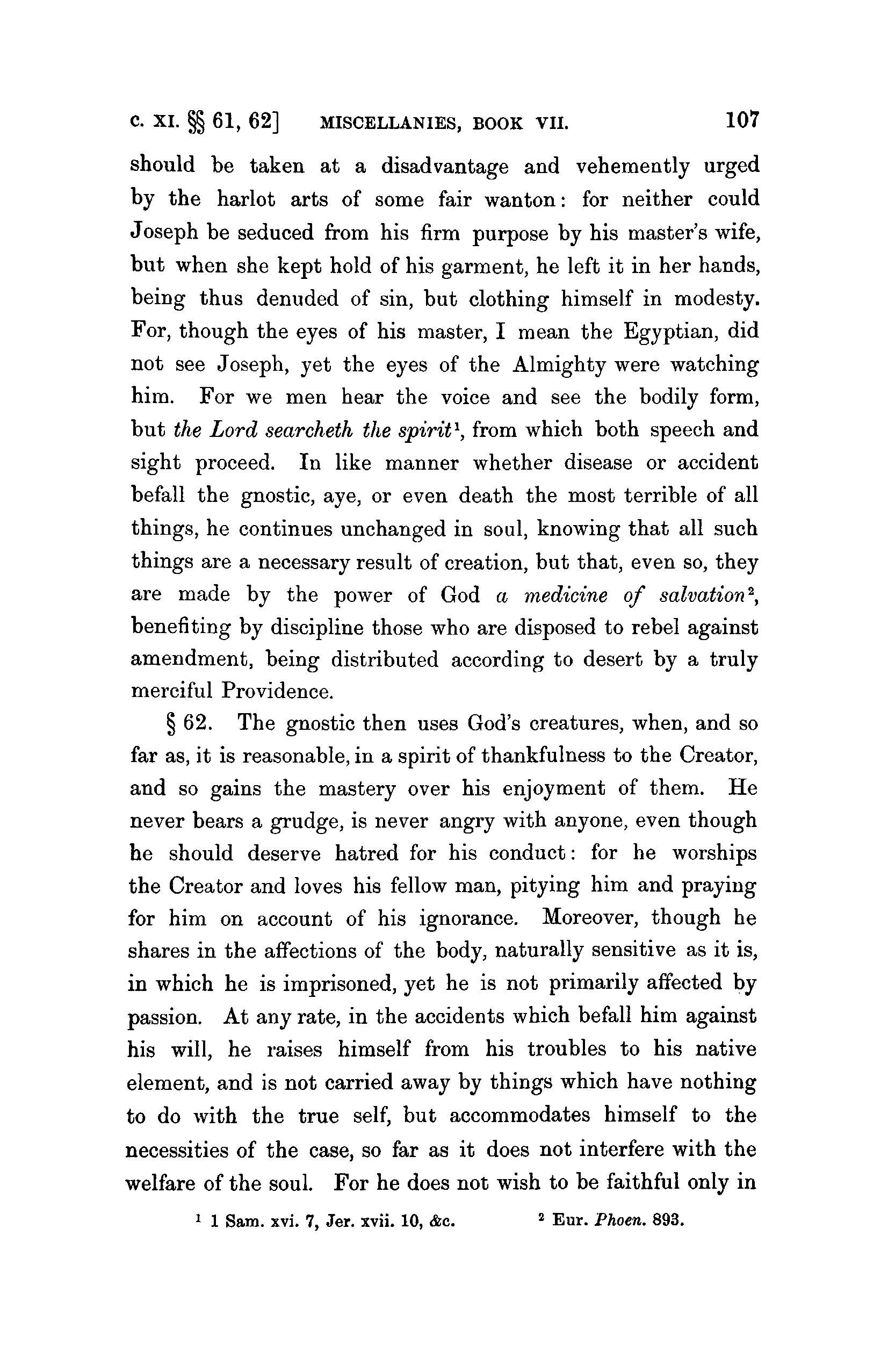
should be taken at a disadvantage and vehemently urged by the harlot arts of some fair wanton: for neither could
Joseph be seduced from his firm purpose by his master's wife, but when she kept hold of his garment, he left it in her hands, being thus denuded of sin, but clothing himself in modesty.
For, though the eyes of his master, I mean the Egyptian, did not see Joseph, yet the eyes of the Almighty were watching him. For we men hear the voice and see the bodily form, but the Lord searcheth the spirit1, from which both speech and sight proceed. In like manner whether disease or accident befall the gnostic, aye, or even death the most terrible of all things, he continues unchanged in soul, knowing that all such things are a necessary result of creation, but that, even so, they are made by the power of God a medicine of salvation2, benefiting by discipline those who are disposed to rebel against amendment, being distributed according to desert by a truly merciful Providence.
§ 62. The gnostic then uses God's creatures, when, and so far as, it is reasonable, in a spirit of thankfulness to the Creator, and so gains the mastery over his enjoyment of them. He never bears a grudge, is never angry with anyone, even though he should deserve hatred for his conduct: for he worships the Creator and loves his fellow man, pitying him and praying for him on account of his ignorance. Moreover, though he shares in the affections of the body, naturally sensitive as it is, in which he is imprisoned, yet he is not primarily affected by passion. At any rate, in the accidents which befall him against his will, he raises himself from his troubles to his native element, and is not carried away by things which have nothing to do with the true self, but accommodates himself to the necessities of the case, so far as it does not interfere with the welfare of the soul. For he does not wish to be faithful only in 1 1 Sam. xvi. 7, Jer. xvii. 10, &c.
2 Eur. Phoen. 893. https://doi.org/10.1017/CBO9780511695513.010 Published online by Cambridge University Press
ITPQMATEQN Z
[p.868, s.312
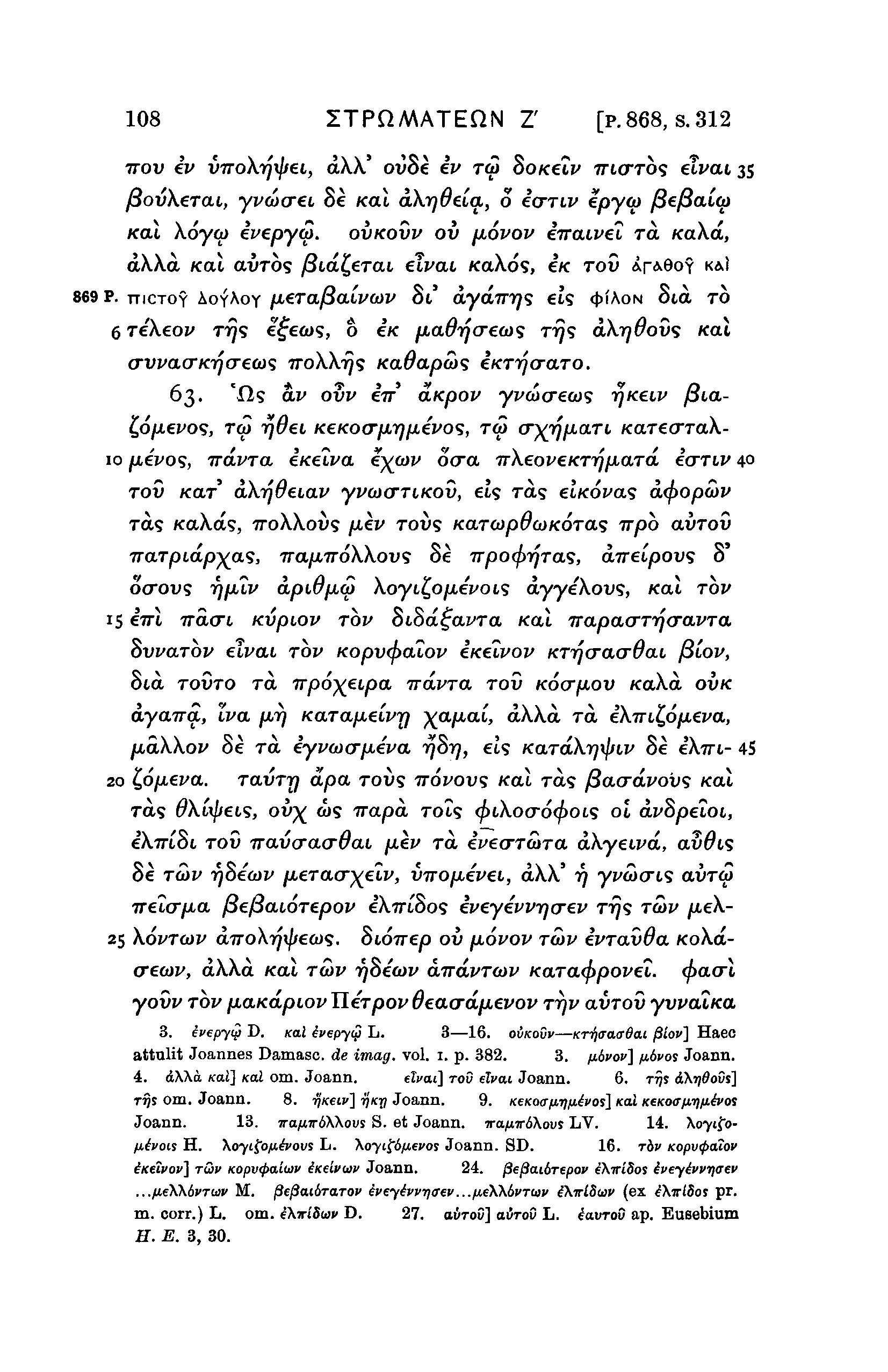
TTOV iv vTTokrj-tyei, dXX' ovSe iv T<U SOKCIV TTICTTOS eXvai 35 , yvaxrei. Se /cai dXrjdeCq, 6 icmv epya> /3e{ia[a> /cat Xoyco ivepyai.
OVKOVV OV JJLOVOV eTraivei TO. Ka\d, dXXa /cai OUTOS )8id£eTai eivai /caXds, e/c TOV APAQOY KA!
869 P. TTICTOY AOYAOY fi€Ta^aCvo)v St' dydwr]? eis <))IAON Sta TO 6 TeXeov Trj<s e^etus, o e«: /xa^crew? rij? dX.^^o{)s Kat crvi'acr/fTjcreaJS iroXX^s KaOapcos eKTi]o-aTO.
63.
'Us av ovx' C7T aKpov yvatcrecos r)K£iv )8tarw ^f^ei KeKoo~fir)ix€vo^, TW cr^TjfiaTi, KaTecrraXrdvTa i.Keiva €^cav oo~a irXeoveKTTJfiaTd icmv 40
TOV /caT' dXTj^etav y^aicrTiKou, ets Tas eiKoi'a? d<f>op(ov Tas KaXds, TTOXXOUS /^ev TOUS KaTapdcoKOTas irpb avTov
TraTpidp^as, TrapTroWovs Se vpocfriJTas, aireCpovs S' oo"ous i7)u.ri' dpidfiw Xoyt^OjoteVois dyye'Xov?, /cai TOV 15 e7rl iracri nvpiov TOV StSdfavTa Kat Trapao~TijcravTa Bvvarbv etvai TOV Kopv<j>a2ov eKeivov KTT\<TO.O~QCX.I fiCov,
Stct TOUTO TO, Trpo^eipa ndvTa TOV Koo~fx,ov KaXa. OVK. dyaira, Iva prj KaTafieCvr/ ^a/Aai, dXXa TO. iXTntpfjieva, fiaXXov Se Ta iyvoi(rp.eva 17817, ets KaTaXyj^Jiv Se e'XTTi45
20 £o/Aei>a.
TavTT) dpa Toil's TTQVOW; KOX T<X5 fiacrdvovs KOU Tas OXixpeis, ovx &>s Trapd TOIS <^tXoo-d<^ots ot dvSpeloi, eXmSi TOU iravcracrdai /xev T«X iveo~TaiTa dXyetvd, au0is Se T(iv r)8ea)v fjieTacr^elv, virofjuevei, dXX' r/ yvSia
7reto"/Aa fiefiaioTepov iXniSos iveyevvr)o~ev TT75 TOW 25 XdvTftjv aT7o\i7»//eaJS. Sionep ov JJLOVOV TWV ivTavOa. KoXdo~e<av, dXXd KCU TUIV r/Sd(ov amdvTOiv KaTa<j>pove2.
(f>ao~l yovv TOV fLOLKapiov Herpov Qea.crdp.evov TT)V avTov yvvaiKa.
3. tvepyip D.
KOI ivepyi^ L.
3—16. OVKOVV—Kriio~a<r6cu /3/OK] Haeo attulit Joannes Damaso. de imag. vol. i. p. 382.
3. iibvov] /idvos Joann.
4. d\\& (cai] Kod om. Joann. eTvcu] rod elcoi Joann.
6. rrjs oWyBovs] rrjs om. Joann.
8. ^retr] TJKTJ Joann.
9. KeKoanriiiivoi] KCLL KeKo<rp.-tfiJ.h>os Joann.
13. irafniroWovs S. et Joann. ira/nirSKovs LV.
14. Xovifontvois H.
\o7ifojuA"ous L. Xo7if6Juei'os Joann. SD.
16.
TOP Kopv<palov ixetvov] TS>V >wpi«paiuv indviav Joann.
24. pepaidrtpov iXviSos heyivvniaev ...ficWdyTav M. fieftailyraTov iveyivvrioev...neWbvrtnv
4\irlSav (ex 4\T18OS pr. m. oorr.) L. om. e\irlSup D.
27. oiroC] OI!TOO L.
(avrov ap. Eusebium
H. E. 3, 30.
https://doi.org/10.1017/CBO9780511695513.010 Published online by Cambridge University Press
C. XI. §§ 62, 63]
MISCELLANIES, BOOK VII.
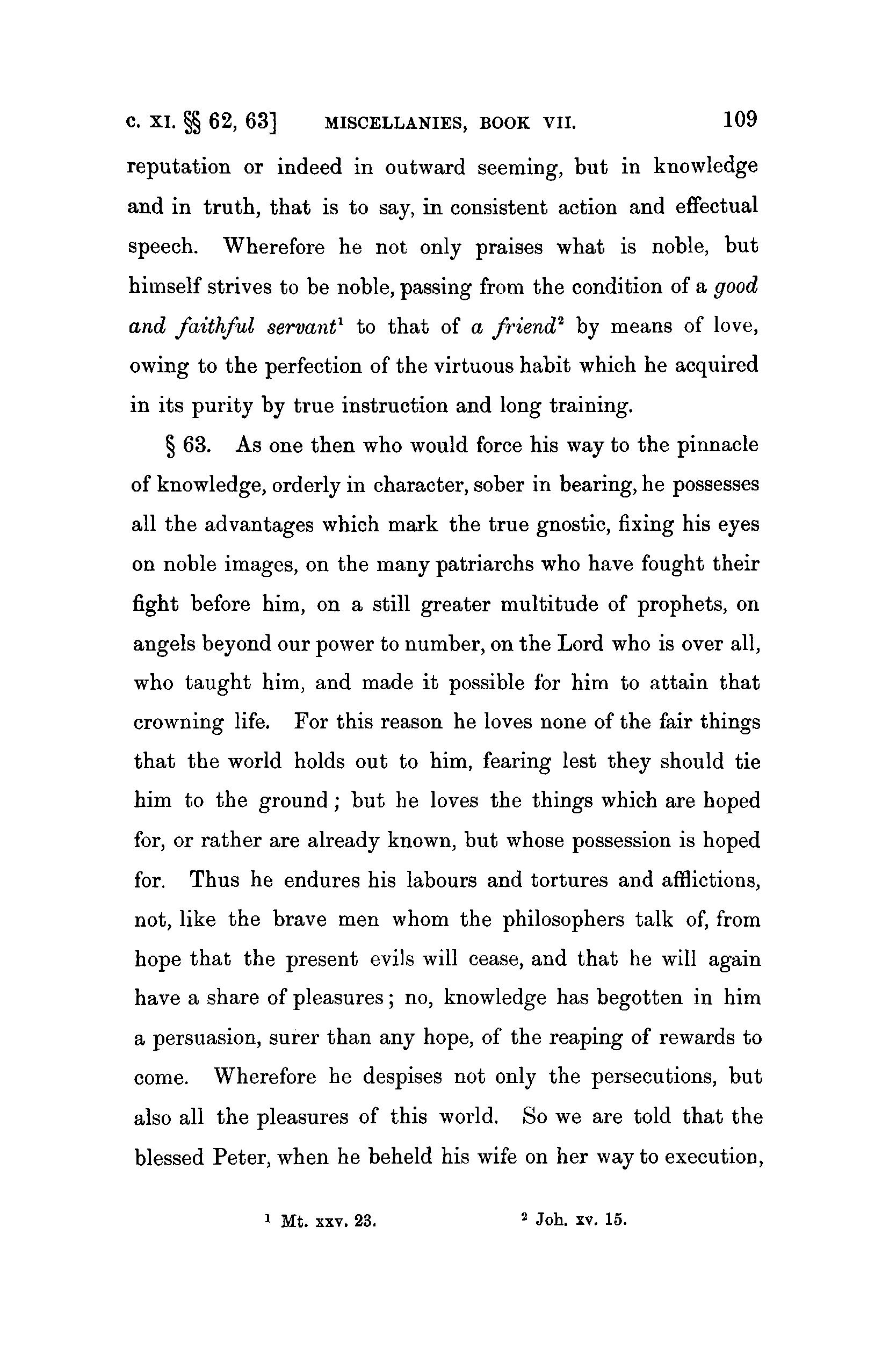
reputation or indeed in outward seeming, but in knowledge and in truth, that is to say, in consistent action and effectual speech. Wherefore he not only praises what is noble, but himself strives to be noble, passing from the condition of a good and faithful servant1 to that of a friend2 by means of love, owing to the perfection of the virtuous habit which he acquired in its purity by true instruction and long training.
§ 63. As one then who would force his way to the pinnacle of knowledge, orderly in character, sober in bearing, he possesses all the advantages which mark the true gnostic, fixing his eyes on noble images, on the many patriarchs who have fought their fight before him, on a still greater multitude of prophets, on angels beyond our power to number, on the Lord who is over all, who taught him, and made it possible for him to attain that crowning life. For this reason he loves none of the fair things that the world holds out to him, fearing lest they should tie him to the ground; but he loves the things which are hoped for, or rather are already known, but whose possession is hoped for. Thus he endures his labours and tortures and afflictions, not, like the brave men whom the philosophers talk of, from hope that the present evils will cease, and that he will again have a share of pleasures; no, knowledge has begotten in him a persuasion, surer than any hope, of the reaping of rewards to come. Wherefore he despises not only the persecutions, but also all the pleasures of this world. So we are told that the blessed Peter, when he beheld his wife on her way to execution,
1 Mt. xxv. 23.
2 Joh. xv. 15. https://doi.org/10.1017/CBO9780511695513.010 Published online by Cambridge University Press
ZTPQMATEQN Z'
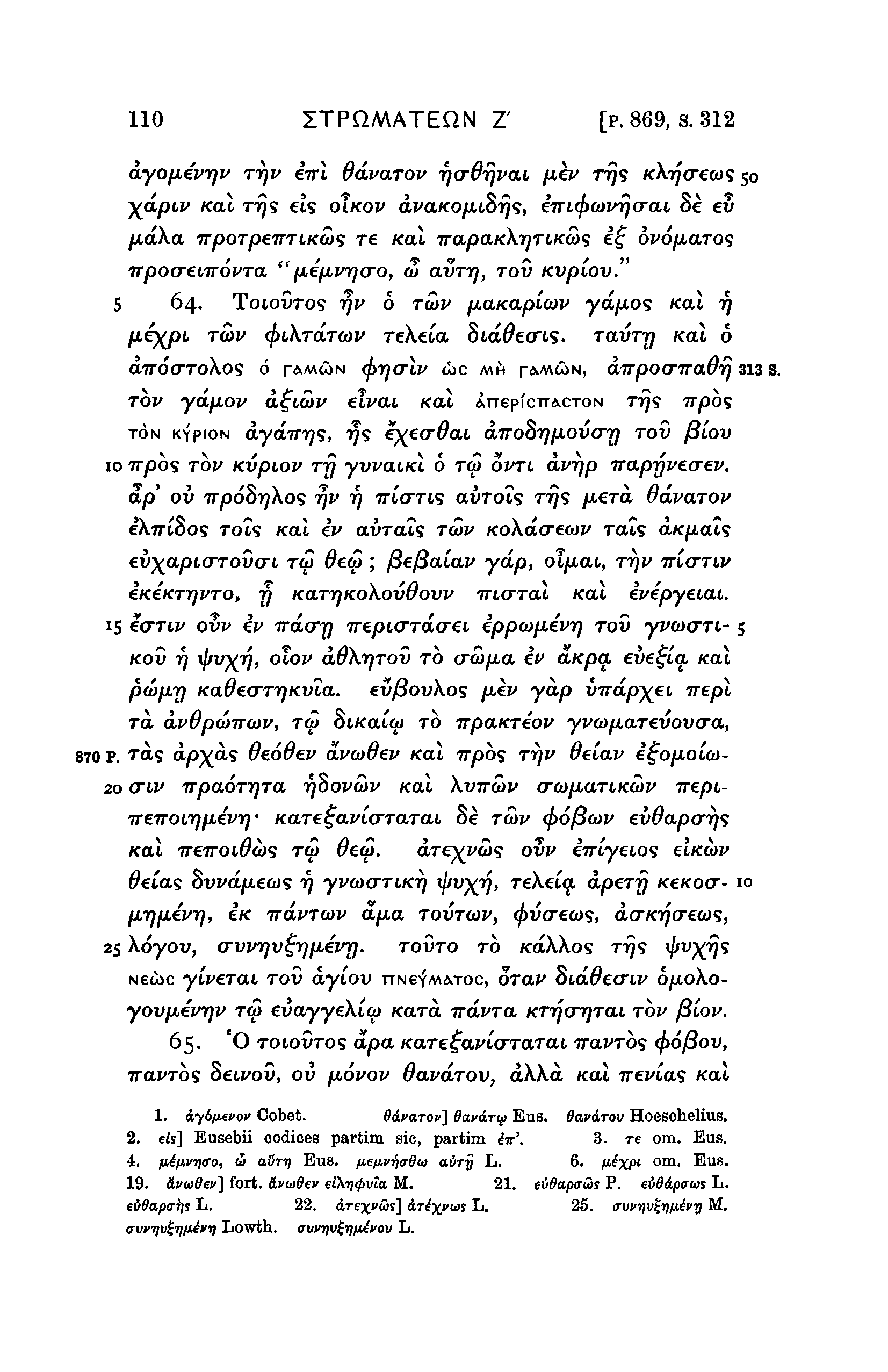
[p. 869, s. 312 dyo^evqv TTJV eVt B6.va.rov i)o-dr\va.i jttev rr}s /cX^crews 50 )(apt.v /cat TTJS eis ol/cov dvaKOfiiSrj<;, iirt^avrjacu
Se ev T6 /Cat 1TapaKkr)TLKW<; i£ OVOfAdTOS fiefiinjcro, d> avrrj, TOV Kvpiov."
64.
TOIOVTOS rjv 6 TO>V fj.a.Kapio>v ya/*os KOX r) i^^XP1 ™v <l><>h-TaiT(i)v reXeia Sia^ecris.
Tavrr) /cat 6 a.7roo"ToXos 6 TAMCJN <f>T)crlv <i>c M^ r*M"Ni airpocnradfj 313 s.
TOV yd/jbov <xi;i£}v eivau KCU &nepfcn*.CTON Trj<; ir/aos TON KypioN dyaTrr/s, ^s e^ecr^at dTToSrjixovarr] TOV /3LOV
10 TT/DOS TOV Kvpiov TTj yvvaiKi 6 T<w OVTI dv»jp TTaprjve.arev. ap' OV TT/JoSijXoS TJV 17 7TIO-T19 auTOtS T^9 /A€TO. ddvCLTOV
Tots /cai ev auTais TWV KoXaaecuv Tais d/c/xais TW ^ew ; /3efiaiav ydp, otjuat, TIJV TTICTTIV iK€KT7jVTo, rj KCLTT^Koikovdovv iriaTcu KQX ivepyeucu.
15 ecrTiv ovv ev irdo~r) irepLCTTdo-ei ippwfJidvr) TOV yvtuoTis KOU 17 \\tvyri, olov ddXrjTOV TO crw/xa iv aKpq. euefta. /cal pwfir} Ka0€o~Tr)KvZa. ev^SovXos jiiev yap vTrdp^ei vepl TO. dvOpcairav, TW SiKauw TO irpaKreov yva>fiaT€vovo~a,
870 P. Tas dp^a? deodev dvwdev KCU npbs TT)V deCav i^ofioico20 o"tv TrpaoTrjTa ^Sovwv /cat Xvniov a-(ofiari,Ka>v irepiTreTroLTjfievr)- Kare^avCcrTaTai Se TWV <f>6fia)v tvdaparrjs
/cat TreTTOidcos T&> ^ew. dTe^vws ouv eVtyeios et/ca>v Suvd/Aeajs 17 yvcaartKr) i//v^, TeXeta dperrj KC/COO"- 10
4K irdvTOiv d^a TOVTCJV, fyvaeois, dcr/ojcrews, 25 Xdyov, crvvrjvtjrjfJLevr).
TOVTO TO /cdXXos TTJS
^ U X ^ S
Neobc ytveTat TOU dytou nNeyM&Toc, oTav Std^eo"tv o/xoXoyovfj,4vt)v TW euayyeXtw /caTa ndvra
KTrja~rjTai TOV fiiov.
65.
'O TOIOVTOS dyja /caTefavto"TaTat rravTos <f>6fiov, 7ravTos Seivou, ou JJLOVOV davdrov, dWd /cai Trevta? /cat 1. ifbixevov Cobet. ffdcaTov] 0oi'(iT%) Eug.
6O.V6.TOV Hoesohelius.
2. eis] Eusebii codices partim sic, partim ^TT'.
3. re om. Eus.
4. p.tiu>i\tso, (5 aJ/Ti; Eus. jiiiw-qaSia airy L.
6. M^XP' o m > Eus.
19. dvwBcv] fort. &vdi9ev el\i)<pvia M.
21. eiBafxrwi P. evffdpaws L. ei0apaT\s L.
22. dTex"Ss] <Wx>"">s L.
25. avvtiv%tn*£vxi M.
LOWth.
GUVTtvfafjUvOV L. https://doi.org/10.1017/CBO9780511695513.010 Published online by Cambridge University Press
C XI. §§ 63—65]
MISCELLANIES, BOOK VII.
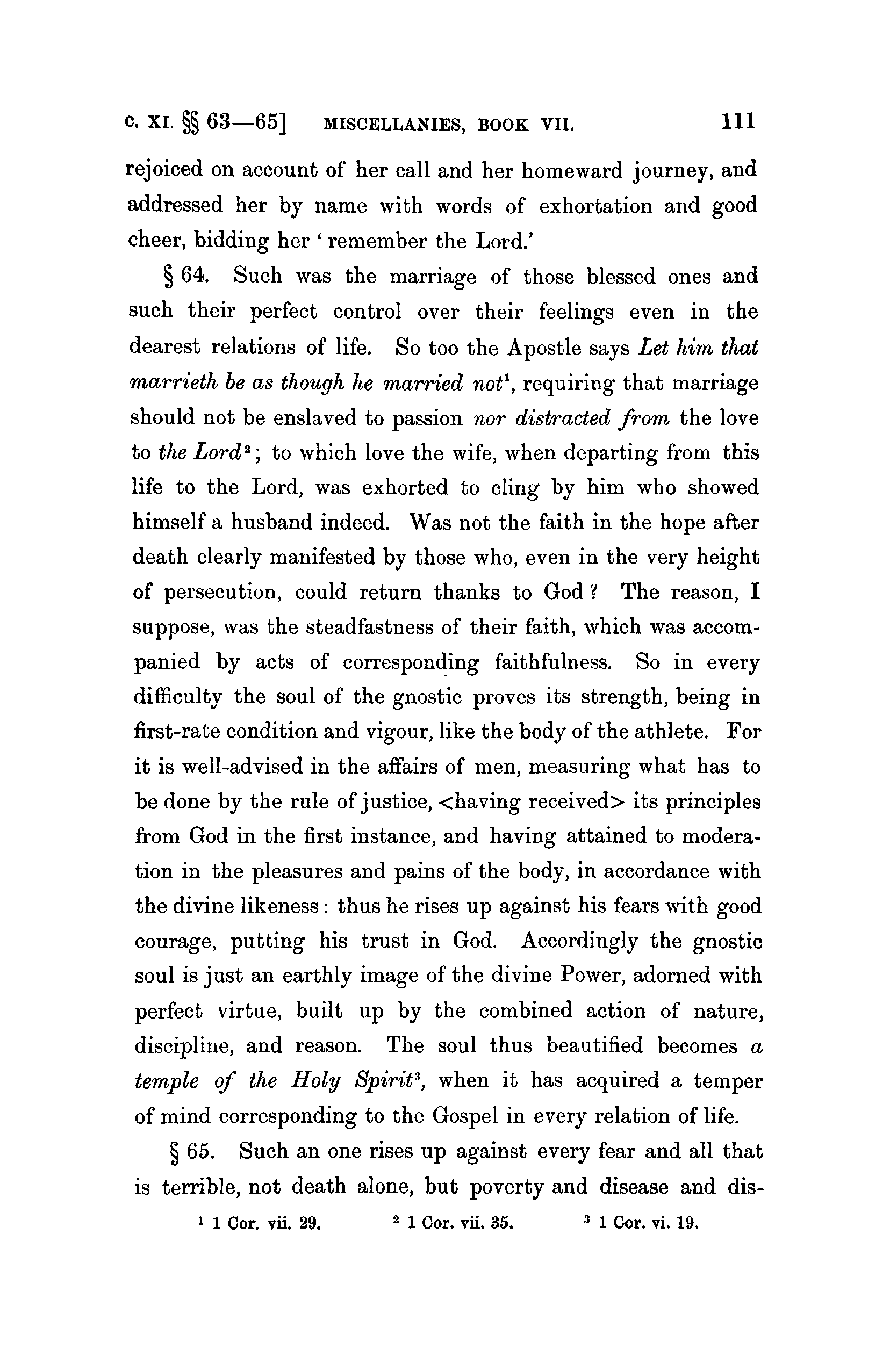
I l l rejoiced on account of her call and her homeward journey, and addressed her by name with words of exhortation and good cheer, bidding her ' remember the Lord.'
§ 64. Such was the marriage of those blessed ones and such their perfect control over their feelings even in the dearest relations of life. So too the Apostle says Let him that marrieth be as though he married not1, requiring that marriage should not be enslaved to passion nor distracted from the love to the Lord1; to which love the wife, when departing from this life to the Lord, was exhorted to cling by him who showed himself a husband indeed. Was not the faith in the hope after death clearly manifested by those who, even in the very height of persecution, could return thanks to God ? The reason, I suppose, was the steadfastness of their faith, which was accompanied by acts of corresponding faithfulness.
So in every difficulty the soul of the gnostic proves its strength, being in first-rate condition and vigour, like the body of the athlete. For it is well-advised in the affairs of men, measuring what has to be done by the rule of justice, <having received> its principles from God in the first instance, and having attained to moderation in the pleasures and pains of the body, in accordance with the divine likeness: thus he rises up against his fears with good courage, putting his trust in God. Accordingly the gnostic soul is just an earthly image of the divine Power, adorned with perfect virtue, built up by the combined action of nature, discipline, and reason. The soul thus beautified becomes a temple of the Holy Spirit3, when it has acquired a temper of mind corresponding to the Gospel in every relation of life.
§ 65. Such an one rises up against every fear and all that is terrible, not death alone, but poverty and disease and dis1 1 Cor. vii. 29.
2 1 Cor. vii. 35.
3 1 Cor. vi. 19. https://doi.org/10.1017/CBO9780511695513.010 Published online by Cambridge University Press
STPQMATEQN Z'
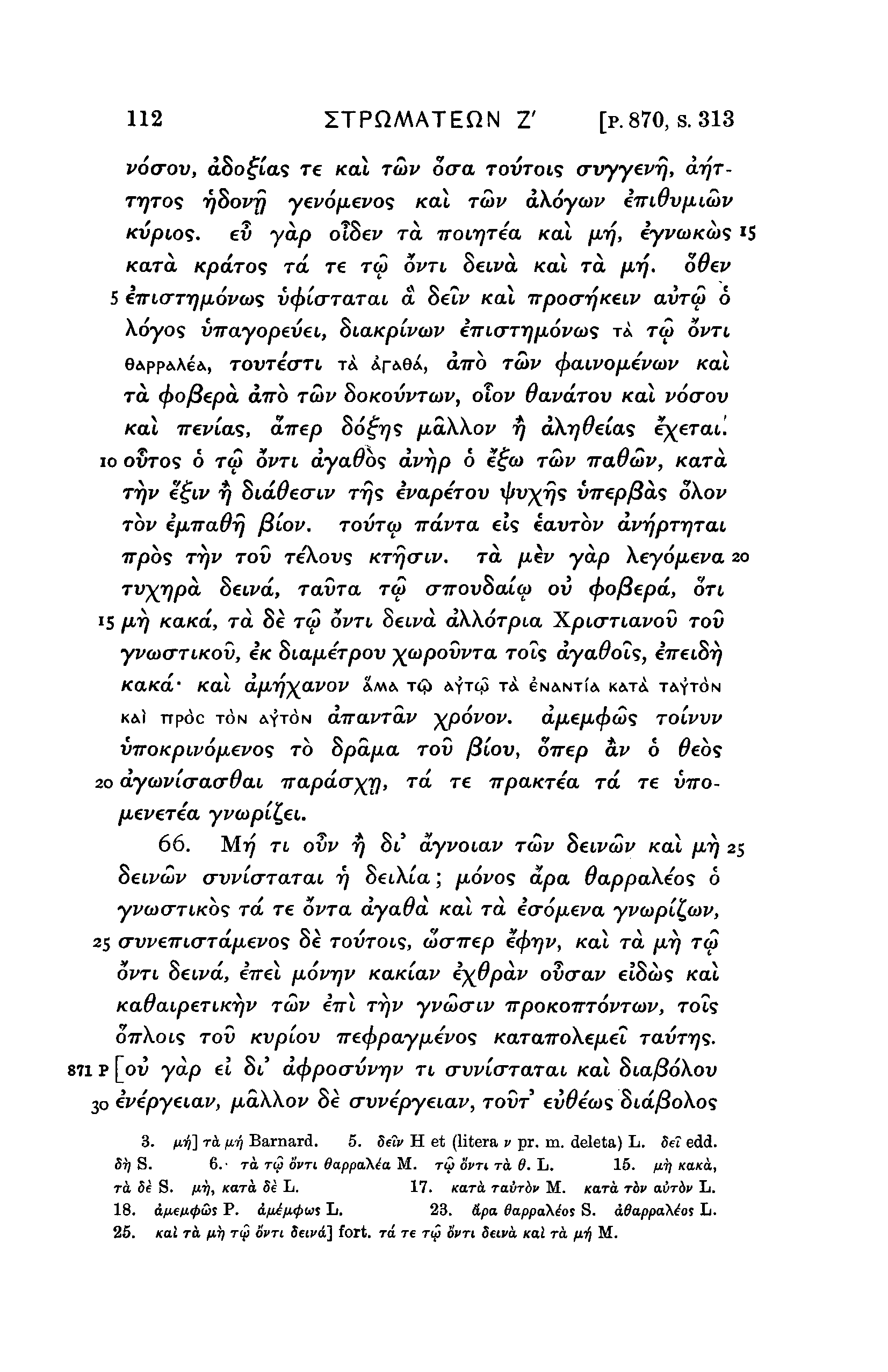
[p.870, s. 313 vocrov, dSofias re Kal TWV oVa TOVTOIS o-vyyevfj, dtjrTTJTOS rjSovfj yevopevos Kal TCOV dXoycov iiridvfiiSJv Kvpios. ev yap olSev ra Trotr/Tea Kal pfq, iyvcoKcos 'S
/cara /cparos rd re ra OVTI Beiva Kal TO. /xtf.
60ev 5 e.TncrT-qfLov<o<; vfyicrTaTai a Selv Kal Trpocrr\Ke.iv aura) 6 Xoyos vwayopevei, hiaKpivcav eTTio~Ty)fx6va><; T& Tea OVTI e&pp&Ae&, TOVTeo-Ti T<i A|-*9<S dwo Toiv (jiaivo/Jidvctiv Kal
TO. cj>o/3epa dnb TWV SOKOVVTOV, olov davaTov Kal vocrov Kal TrevCas, dnep S d ^ s /JLCLWOV ^ d\r)0e£a<i e^erat! io OVTOS 6 TW OVTI dyadbs dvrjp 6 ££co TS>V Tradwv, Kara TT)V ££LV ^ hidOecriv TT}<S evapeTov V»v^9 VTrepfias okov
TOV ifjLTradyj fiiov.
TOVTCO irdvTa ei<s kavTOv dvrjpTrjTai irpbs TY)V TOV reXous KTrjo~iv. TO. phs yap Xeyo/xeva 20
TVXVPa Stiva, ravTa TO o-irovhaiu ov (f>o/3epd, o n 15 /AT) /ca/ca, TO. Se TW OVTI Sewa dWdrpia Xptcrriavoi) rou yvoicrTLKOv, IK Sta/JbeTpov -)(0ipovvTa TOI§ dyaOols, ii KaKaKal dp/rj^avov
AM& T<?) AYTCP T<i INANTIA K&TA
KAI np6c TON AYTON dvavTav xpovov. dfjL€fi(f>S<; TOLVVV VTroKpLvonevos TO Spapa TOV fiiov, oirep av 6 debs 20 dycovicracrdai irapdcrxV1 T<* T e irpaKTea rd re 66.
Mi^ ri ovi' "^ Si' dyvoiav TCOV Seii'&jf /cal /ATJ 25 o~vvio~TaTai r\ SeiXia; fiovos dpa dappakios
b1; rd re ovra dyada Kal T<X io~6fji€va yviapitfav, 25 crvveTncrTafjievos Se TOUTOIS, (oo~irep £<f>r)v, Kal TO. /JLTJ TW
OVTI Seu>d, CTTCI fioviqv KaKiav ir^dpdv ovo~av eiSws /cal KadaLpeTLKr/v TCOV iirl TTJV yvSicriv irpoKOTTTOVTCov, TOL?
077X015 TOV KvpLOV Tre<f>payfJL€vos KaTairoXe/xeL TavTrjs.
871 p [ou yap ei Si' dtppocrvvyjv TL crvvicTTaTat Kal Sia/SdXou 30 ivepyeiav, fxaWov Se crvvepyeiav, TOVT' evdeco<i S1CI/S0X05 3. fiij] rii. fi-q Barnard.
5. 8eu> H et (litera v pr. m. deleta) L. Set edd.
ST] S.
6.- TO T(p 6VTI dapfiakia M. T £ oWt ™ S. L.
15. ^?) Kara, Ti 5e S. ^ , xara 5e L.
17. Kari. ravrbv M.
KOTO rbv airiv L.
18. ifxe)J.<pS)S F. dfjj/j,<j>wi L.
23. dpa 6appa\ios S. d8appa\ios h.
25.
Kai ra ^r; TI^ OTTI iei^d] fort, TO re TI^J w n Seiva Koi r i p.i) M. https://doi.org/10.1017/CBO9780511695513.010 Published online by Cambridge University Press
C. XI. §§ 65, 66]
MISCELLANIES, BOOK VII.
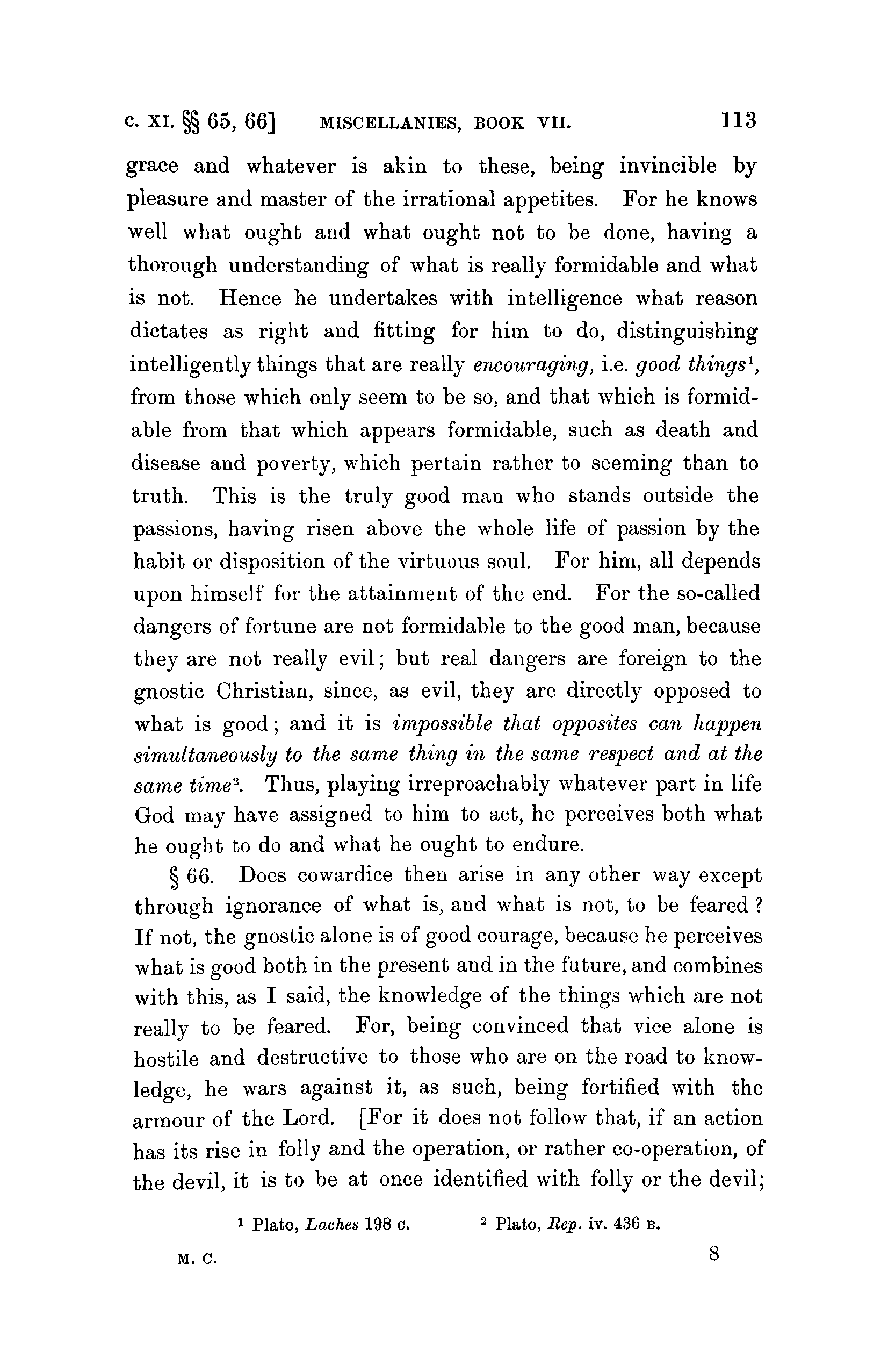
grace and whatever is akin to these, being invincible by pleasure and master of the irrational appetites. For he knows well what ought and what ought not to be done, having a thorough understanding of what is really formidable and what is not. Hence he undertakes with intelligence what reason dictates as right and fitting for him to do, distinguishing intelligently things that are really encouraging, i.e. good things1, from those which only seem to be so, and that which is formidable from that which appears formidable, such as death and disease and poverty, which pertain rather to seeming than to truth. This is the truly good man who stands outside the passions, having risen above the whole life of passion by the habit or disposition of the virtuous soul. For him, all depends upon himself for the attainment of the end. For the so-called dangers of fortune are not formidable to the good man, because they are not really evil; but real dangers are foreign to the gnostic Christian, since, as evil, they are directly opposed to what is good; and it is impossible that opposites can happen simultaneously to the same thing in the same respect and at the same time"-. Thus, playing irreproachably whatever part in life
God may have assigned to him to act, he perceives both what he ought to do and what he ought to endure.
§ 66. Does cowardice then arise in any other way except through ignorance of what is, and what is not, to be feared ?
If not, the gnostic alone is of good courage, because he perceives what is good both in the present and in the future, and combines with this, as I said, the knowledge of the things which are not really to be feared. For, being convinced that vice alone is hostile and destructive to those who are on the road to knowledge, he wars against it, as such, being fortified with the armour of the Lord. [For it does not follow that, if an action has its rise in folly and the operation, or rather co-operation, of the devil, it is to be at once identified with folly or the devil; i Plato, Laches 198 c.
2 Plato, Rep. iv. 436 B.
M. c.
https://doi.org/10.1017/CBO9780511695513.010 Published online by Cambridge University Press
ITPQMATEQN Z'
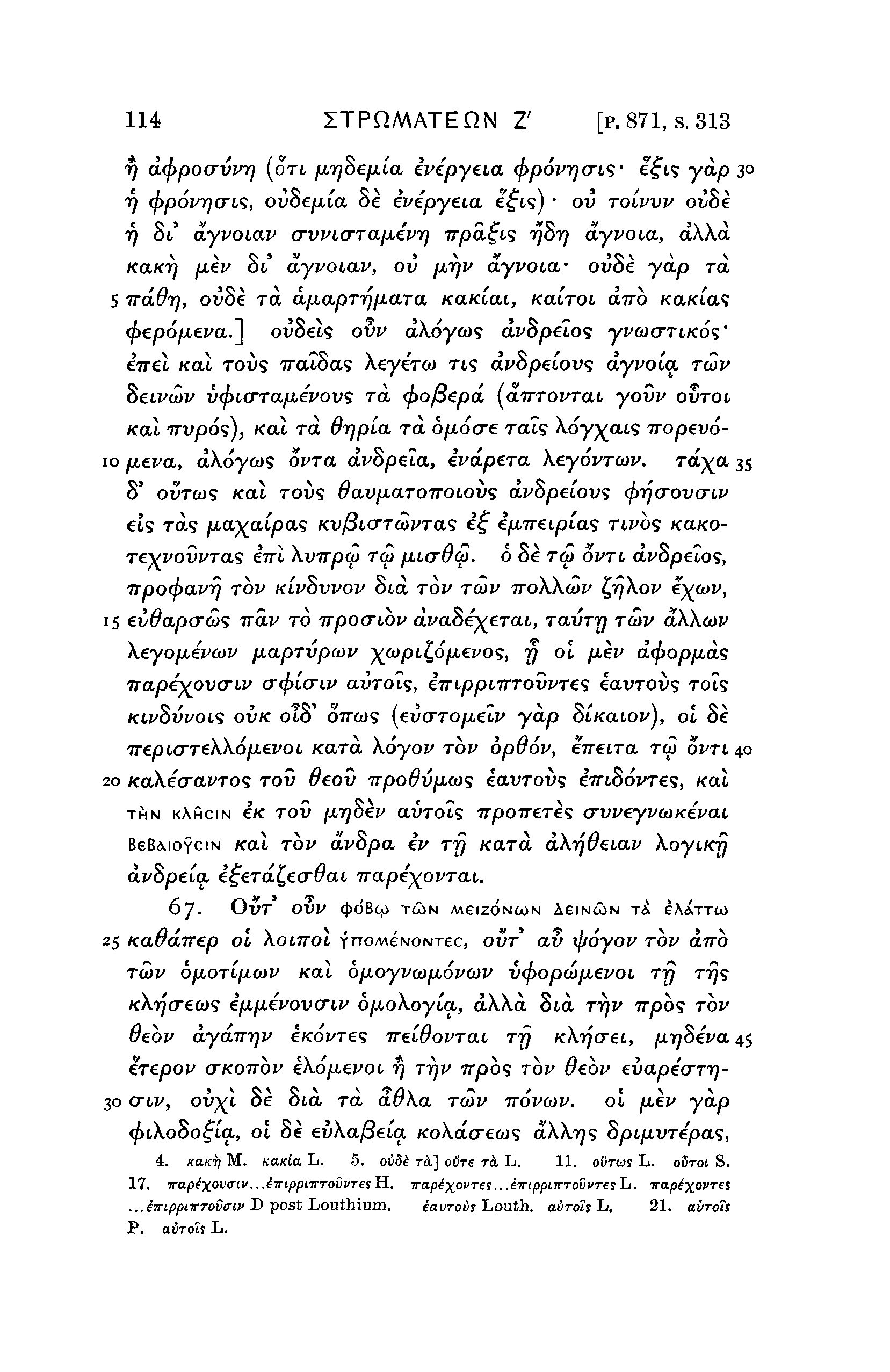
[P. 871, s. 313 r) d<f>poavvr) (on jU/^Se/xta ivcpyeta (j>p6vr)CTL?- efts yap 30 17 <j>p6vr)o~L<;, ouSe/Ata Se ivipyeia efts) • ou TOLVVV ov&e r) Si' dyvoiav crvvicrTajxivt] irpafts 77S7? dyvoia, dXXd Kaxr) /jLev Si' aywiav, ou /A^I' dyvoiaouSe yap rd 5 nd0rj, ovSe r a dfxapTrJiiaTa KaKiai, Kairoi diro
(^epdju-eva.] ovSeis ouv aXdycus dv8pelo<s inel Kal TOVS TraiSas XeyeVaj TIS dvSpetov; dyvoia TWV heivt^v v(f>io~TafJievov<; rd <f>o(3epd (airrovTai yovv OVTOL Kal TTV/DOS), Kal ra diqpia ra o/idcre rais Xdy^ats nopevo10 /j.€va, dXoyavs ovra dvSptla, ivdpera \ey6vratv. r a ^ a 35 S' OUTCOS /cat TOUS 6aviMaTowoLoi)<s dvSpeiow;
(ftrjaovcriv eis Tas fxa^aCpa<; Kvfiio-TuJvTas i£ eyu,7retpta? TIVOS KaKOTexyovvTas inl Xvirpai TS fjLLo~0S. 6 Se TW oi'Tt dvSpeios, npo(f>avrj TOV KLVSVVOV 8ta rov TGJV TTOXXWV ^ X O V 15 evOapaws TTOLV TO irpoo-ibv dvaSe^eTau, Tavrrj T(OV fxapTvputv ^wpt^d/xej/os, rj oi fiev dcfrop/xas ar^iaiv avrots, iutppLTTTOvvTes eavrovs rots
Kiv8vvoi<; OVK otS' oTTcus (^vo~ToiJi€LV ydp hiKaiov), 61 Se vepio-TeXXofievot, Kara. Xoyov TOV 6p66v, eVetra TW OVTI 40
20 Kakeo-avTos TOV deov •apoQvp.oi^ eaurous eVtSdi'Tes, «:al THN KAHCIN IK TOV [xr)Sev aurots irponeTes crvveyvcaKivai BeBMoyciN Kal TOI> dvSpa iv Trj /cara dXijOetav XoyiKrj dvSpeCa ££eTatfio~9ai irapi^ovTai.
6j.
O U T
OVV CJJOB^ TUN MCIZONWN AGINCON TA IA&TTO)
25 Kaddnep oi XOLTTOI YnoMeNONTec, OUT' a u rfjoyov TOV dirb TS>V o/jbOTifJicov Kal o/xoyvcj/xovcov v(f)opcofjL€voi, Trj Trjs /cXyycrews k\x,p,£vovo~iv 6/xoXoyia, dXXa Sta TT\V TT/JO? TOV
8ebv dydTrrjv eKovTes ireWovTai Trj /cX^cret, fxrjhiva 45 tTepov o-Konbv eXofievoi rj Tr)v 7rpb<; TOV 6ebv euape'crTij30 criv, ov%i Se Sta TO. ddXa TU>V novutv. ol (juev ydp <fn,Xo8o£la, ol Se evXa/3eia KoXdo~ea)<; aXXij? Spt/AUTepas,
4. ica/cr; M. Kaxla L.
5. oi)S^ ra] otfre ra L.
11. OBTOIS L.
OBTOI S.
17. wap4xovffiy...iT!-ipptTTo0vTesH..
7ra^%oi'Tes...fTrippiirToC>'TesL. irapixovres ... £wipptirToQ<nv D post Louthium.
^auroils Louth. aijrois L.
21. aurois P. ai)vois L. https://doi.org/10.1017/CBO9780511695513.010 Published online by Cambridge University Press
C. XI. §§ 66, 67]
MISCELLANIES, BOOK VII.
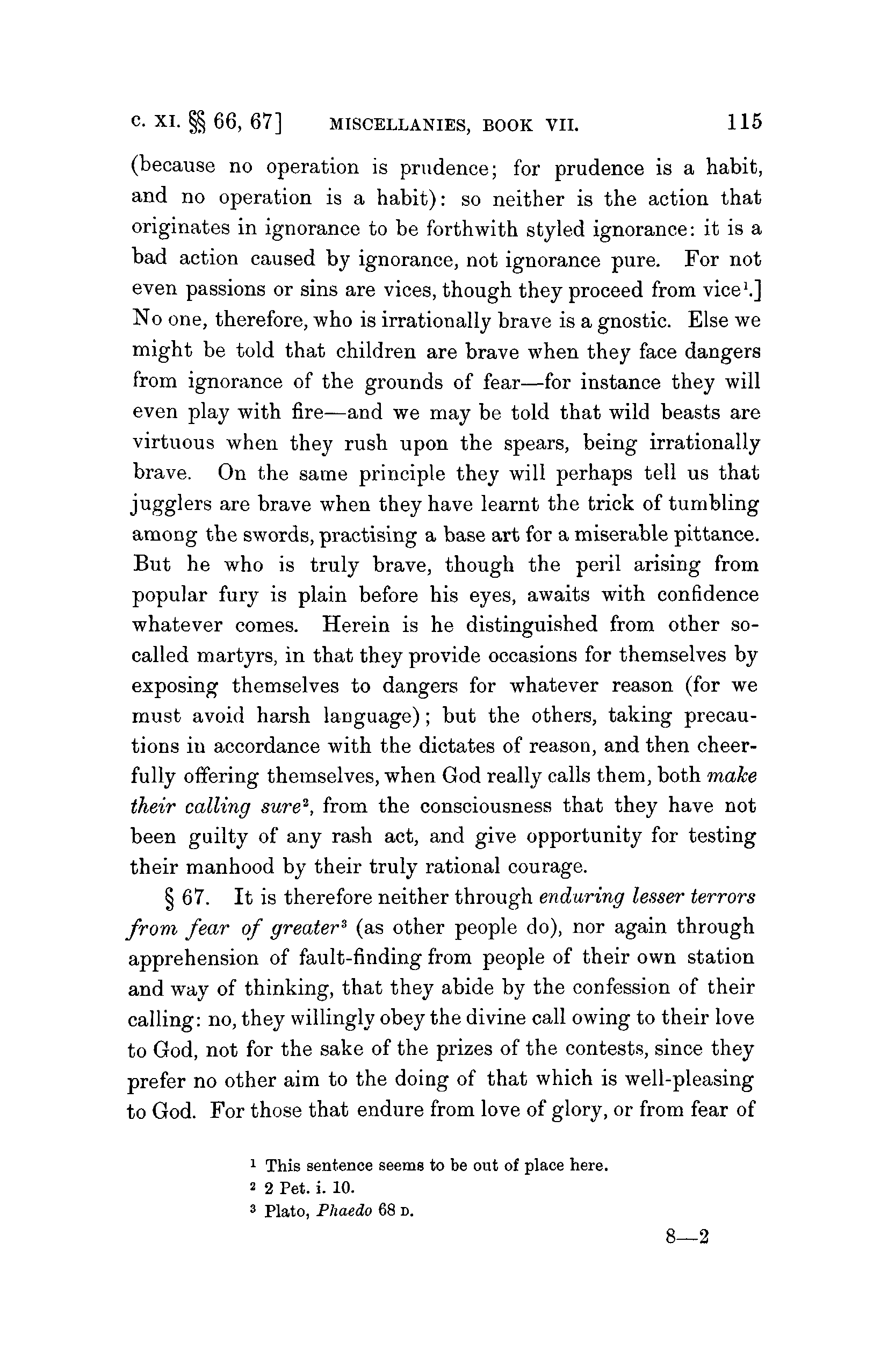
(because no operation is prudence; for prudence is a habit, and no operation is a habit): so neither is the action that originates in ignorance to be forthwith styled ignorance: it is a bad action caused by ignorance, not ignorance pure. For not even passions or sins are vices, though they proceed from vice1.]
No one, therefore, who is irrationally brave is a gnostic. Else we might be told that children are brave when they face dangers from ignorance of the grounds of fear—for instance they will even play with fire—and we may be told that wild beasts are virtuous when they rush upon the spears, being irrationally brave. On the same principle they will perhaps tell us that jugglers are brave when they have learnt the trick of tumbling among the swords, practising a base art for a miserable pittance.
But he who is truly brave, though the peril arising from popular fury is plain before his eyes, awaits with confidence whatever comes. Herein is he distinguished from other socalled martyrs, in that they provide occasions for themselves by exposing themselves to dangers for whatever reason (for we must avoid harsh language); but the others, taking precautions iu accordance with the dictates of reason, and then cheerfully offering themselves, when God really calls them, both make their calling sure2, from the consciousness that they have not been guilty of any rash act, and give opportunity for testing their manhood by their truly rational courage.
§ 67. It is therefore neither through enduring lesser terrors from fear of greater5 (as other people do), nor again through apprehension of fault-finding from people of their own station and way of thinking, that they abide by the confession of their calling: no, they willingly obey the divine call owing to their love to God, not for the sake of the prizes of the contests, since they prefer no other aim to the doing of that which is well-pleasing to God. For those that endure from love of glory, or from fear of 1 This sentence seems to be out of place here.
2 2 Pet. i. 10.
3 Plato, Phaedo 68 D. https://doi.org/10.1017/CBO9780511695513.010 Published online by Cambridge University Press
ITPQMATEQN Z
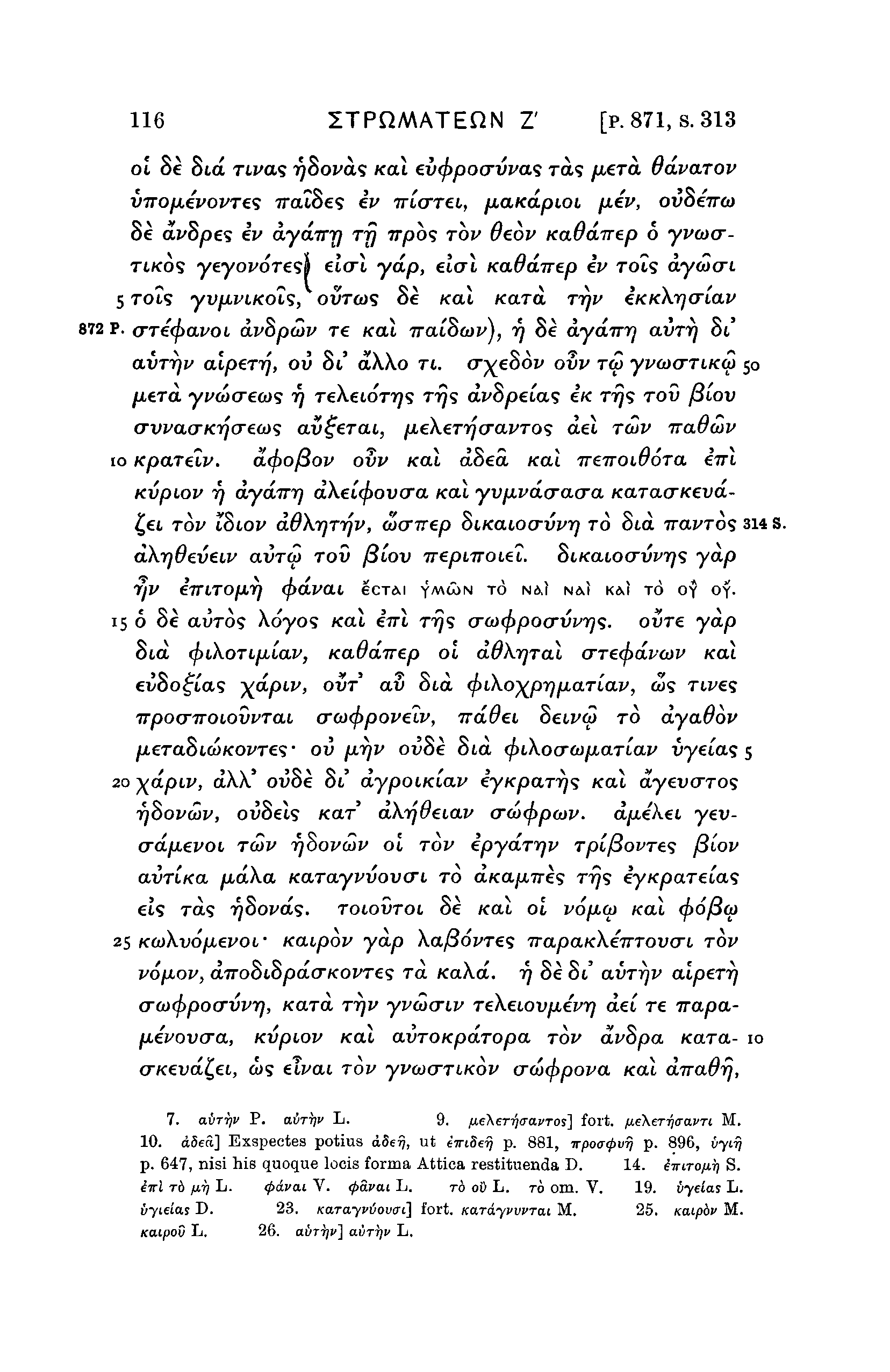
[p. 871, s. 313 ot Se Sid rivas r)8ova<i KOU eixfypoo-vvas rd? [xerd 66.va.rov VTTOfj.dvovTc<i 7ratSes iv morel, fj.aKa.pLOi p.iv, ovoeiro) Se dvSpes iv dyaTTTj Trj irpo<$ TOV Oeov KaOaTrep 6 yvcoo-TIKOS yeyovoresji eio~i ydp, eio~i Ka6direp iv rots dywcrt
5 TOIS yvjJLviKol1;, OUTWS Se Kai Kara ri^v iKKhrjaiav 872 p. o~T€<f>avoL dvSpcov re (ecu TTciiSajv), 7) Se dya7nj aw?) St' avTTjv aiperrj, ov Si' aAAo TI. cr^eSoi' oS^ TW yz/wcrri/cft) 50
/A€Ta yt>(ucrews 17 reXeioTTjs T^S avSyoetas e«: rrjs rou y8tou crvt'acr/CTjcrecjs au^erat, jneXer^crai'Tos aei T&JV iraOwv
10 KpaTelv. ci(f>ofSov ovv KCU. aSea, /ecu vetTOidora CTTI KvpLov 7) arya/rn) aAeu^oucra Kai yvp.v6.o~a.o-a. Ka.Ta.o~K.ev6- £ei TOZ/ iStov a\Q\r)T'r\v, a)o~Trep SiKaLOcrvvrj TO Std Trcwros 314 S. ak.i)6eve.i.v avTW TOU ^tov Trepnroiel.
StKaioo-vvrjs yap 7/v €Tri,TOfxrj (fiavan, ecT<\i YMCON TO NA,! NA! KAI TO oy of15 6 Se auro? Xoyos Kal CTTI T^S omo)(f)pocrwrjs. ovre yap Sia <f)i\oTifJLLav, Kaddirep ol ddkrjTal o-Tecj>dv<i)v Kal evSofias -)(dptv, OVT av Sia <^iko^prjp.ariav, ws rives Trpoo'TTOiovvrai o~ct)<f)pov€iv, irddei 8et,va> TO dyadov vresou jn^v oz5Se Sia (f)i\oao3p.aTLav vyeias 5 v, ctXX' or3Se Si' dypoLKiav ey/cpar^s /cai dyeucrros
, ouSels /car' dX.rj6ei.av o~(o<j>pa)v. dfxekeL yevrac T^SOVWI' 01 rot' ipydrrjv
TpC/3ovTe.s j3iov avTLKa fidXa Karayvvovcrt.
TO d/caja7res rrj's ey/cpareia? e£s rds i^Sovas. roiouroi Se /cai 01 vofiqt Kal <f>6f$h> 25 KwXvo^ievoc Kaupov yap Xa/3ovTes Trapa/cXeVToucri TOV vofxov, dTroBtSpdo-KOVTes rd /caXd.
17 Se Si' ai)Tr)v alperr) o-co(f>poo"6vri, Kara TT/V yvdo'iv TeXeLOVfievr/ dei re irapafjLevovo~a, Kvpiov KO.1 avTOKparopa
TOV dvSpa Kara10 o~/cei;d£ei, a>s etvai TOV yvojo-TLKOv o~(a^>pova KOX dnadrj,
7. avTTjV P. aiirrjf L.
9. jxekeT-qvavTos] fort. /xeXeTTjcavTi M.
10. d5eS] Exspectes potius dSe^, ut i-iriSey p. 881, Trpo<rtpv9j p. 896, 67177 p. 647, nisi his quoque locis forma Attica restituenda D.
14. iiriTofiri S. iirl T6 JU.17 L.
<f>dvai V.
(pavai L.
TO oi> L. ro om. V.
19. iyeias L. uyieias D.
23.
Kcn-ayptfowi] fort. KarayvvvTcu M.
25. Kcupbv M.
Ktxipov L.
26. ail'T'fy*'] ai)r7;i' L. https://doi.org/10.1017/CBO9780511695513.010 Published online by Cambridge University Press
C. XI. § 67]
MISCELLANIES, BOOK VII.
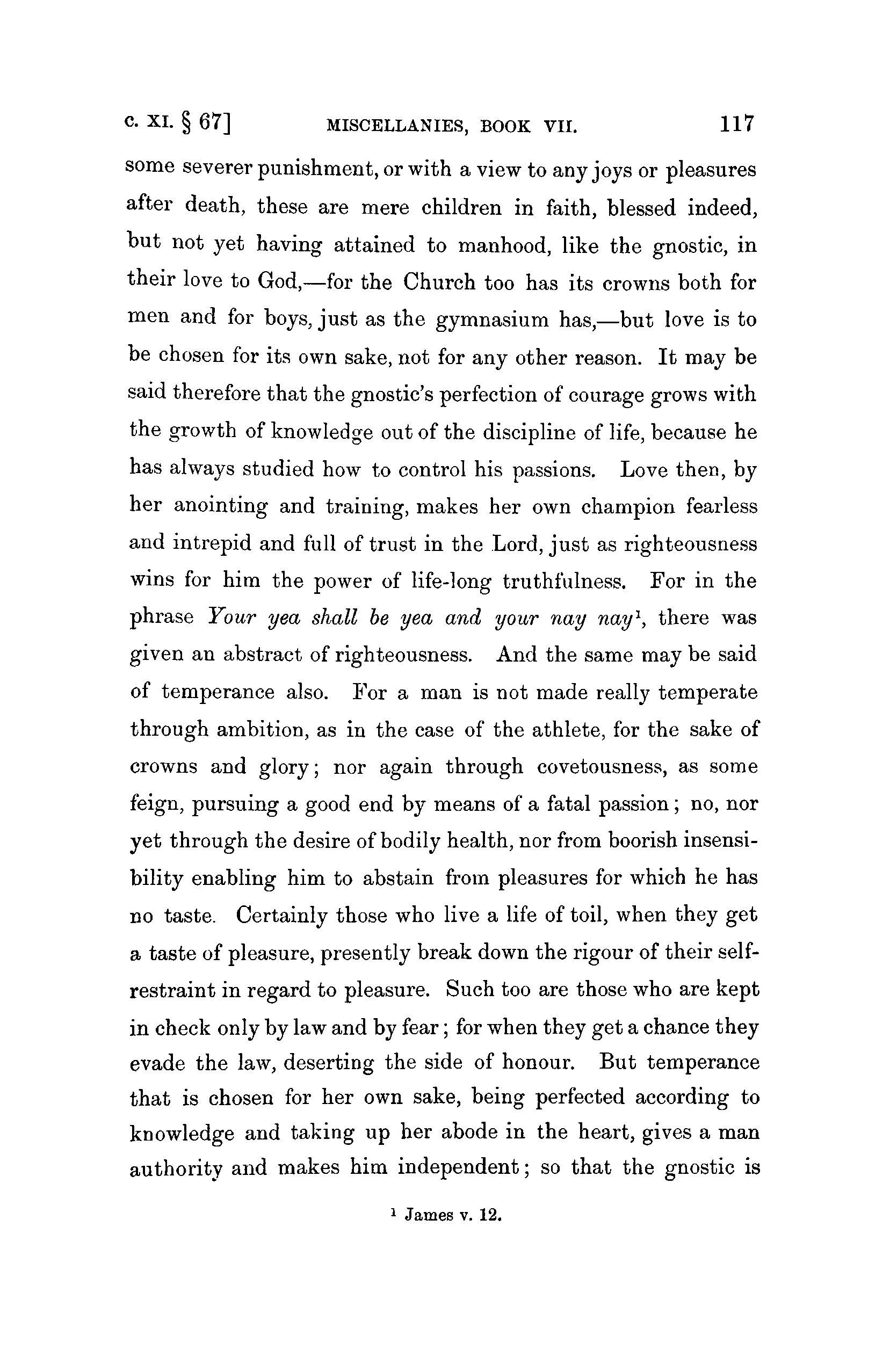
some severer punishment, or with a view to any joys or pleasures after death, these are mere children in faith, blessed indeed, but not yet having attained to manhood, like the gnostic, in their love to God,—for the Church too has its crowns both for men and for boys, just as the gymnasium has,—but love is to be chosen for its own sake, not for any other reason. It may be said therefore that the gnostic's perfection of courage grows with the growth of knowledge out of the discipline of life, because he has always studied how to control his passions. Love then, by her anointing and training, makes her own champion fearless and intrepid and full of trust in the Lord, just as righteousness wins for him the power of life-long truthfulness.
For in the phrase Your yea shall be yea and your nay nay1, there was given an abstract of righteousness. And the same may be said of temperance also. For a man is not made really temperate through ambition, as in the case of the athlete, for the sake of crowns and glory; nor again through covetousness, as some feign, pursuing a good end by means of a fatal passion; no, nor yet through the desire of bodily health, nor from boorish insensibility enabling him to abstain from pleasures for which he has no taste. Certainly those who live a life of toil, when they get a taste of pleasure, presently break down the rigour of their selfrestraint in regard to pleasure. Such too are those who are kept in check only by law and by fear; for when they get a chance they evade the law, deserting the side of honour. But temperance that is chosen for her own sake, being perfected according to knowledge and taking up her abode in the heart, gives a man authority and makes him independent; so that the gnostic is
1 James v. 12. https://doi.org/10.1017/CBO9780511695513.010 Published online by Cambridge University Press
ITPQMATEQN Z'
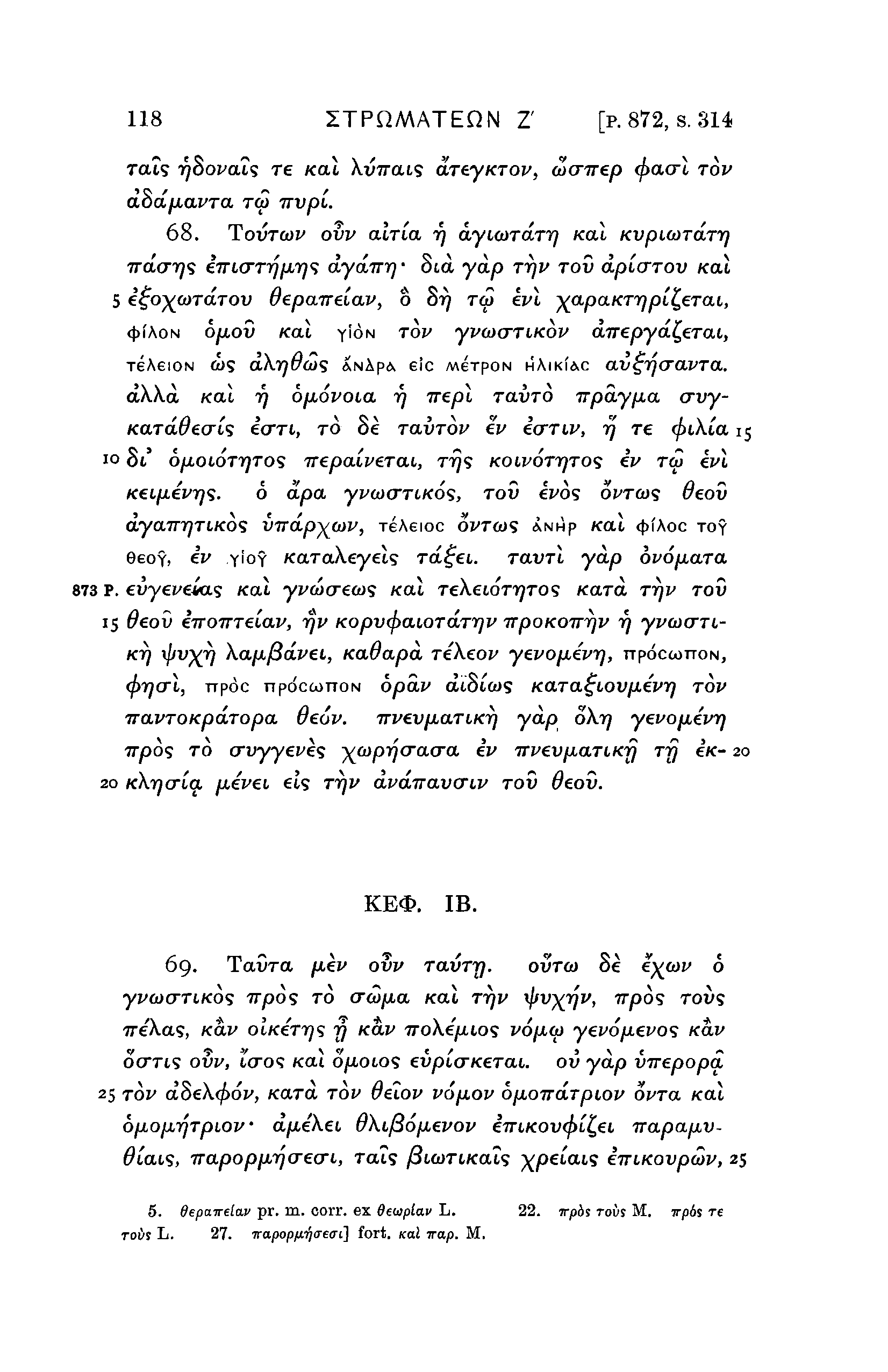
[p. 872, s. 314 rats r/SovaLs re Kai Xu7rats dreyKTOv, a>cnrep <j>acrl TOV dBdfJLCLVTa T(S TTVpL 68.
TOVTCJV ovv atria rj ayLcoTdrrj Kai Kvpiciirdrrj Trd(rrj<s iTTL<TT7]iJLri<; dydirrj • Sid yap
TT/V TOV dpicnov KOU 5 i^o^caTaTOV Oepaireiav, o 8r) raJ evl 4>(AON 6ju,ou
KOL Y'ON TOV
yvwo-TiKov TeAeiON ft)S a.Xy)uo)<s AN^P*. eic MBTPON HAIKI&C avgrfo~avTa. aXXa Kai rj OJXOVOIOL r) Trepl raiiro irpayjia crvyKOLTd6eO-LS i<TTL, TO Se TCLVTOV iv icTTLV, 7j T€ (f)lklO. 15
10 hi OjJLOLOTTjTOS TTepaiveTOLl, Tr)<S KOlVOTr/TOS €1/ T(a ivl 6 apa yvoMTTiKos, TOV ivos OVTCO? 6eov VTtdpyuiv, TeAeioc ovrws ANHP KOX 4>IAOC TOY eeoy, eV Yio? KaraXeyels ra^ei. ravTi yap bvojiara 873 p. evyeveias Kai yv(ao-e.u><; Kai TeXeior^ros Kara, TYJV TOV
15 deov iiroTTTeCav, rjv Kopv^aioTaTrjv irpoKOirrjv rj yva>o~TiKr) tyvyrj Xajx/3dveL, Kadapd Tekeov yevofxevr/, npoccorroN,
(jyrjcrl, npoc npdcwnoN opav aiSiws Kara^Lovfievr) TOV TtavTOKpdrropa deov.
TrvevjJuaTiKyj yap okij yevofjuevr) irpos TO crvyyeves -^coprjo-ao-a iv irvevfLaTLKfj Trj CK20 20 Kkrjo-iq. jxevei eis Tr/v dvatravcnv TOV deov.
KE<I>.
IB.
69.
TavTa fiev ovv TavTj).
OVTO) Se e^cov
irpos TO crcSjiia Kai T-TJV \jfV)(T]V, 77/305 TOUS Tre'Xas, Kav ot/cenys 7) KOLV 77oXe)iAtos vofxai yevofievos KOLV ocrris ow, uroq Kai O/AOIOS evpCaKeTai. ov yap tirepopa 25 rot' dSe\(f>6v, Kara ro^ delov VOJIOV ojioiraTpiov oVra /cat 6/JLOfxTjTpiov d/xeXei 6\t^6jxevov eiriKovfyitfii irapajAVs, irapopjirjo-ea-i, rat9 /Siwri/cats ^/oetais ivLKovpwv, 25 5.
Sepairetav pr. in. oorr. ex Oeuptav L.
22. TrpJs TOUS M.
?rp6s roi)y L.
27.
7rapop/ji'fi<Te(ri] fort, /cai 7ra/). M. https://doi.org/10.1017/CBO9780511695513.010 Published online by Cambridge University Press