
7. Rowland Taylor
7. ROWLAND TAYLOR
The history of Doctor Rowland Taylor, which suffered for the truth of God's word, under the tyranny of the Roman Bishop. 1555. the ninth day of February.
The town of Hadleigh* was one of the fi rst that received the word of God in all England at the preaching of Master Thomas
Bilney:* by whose industry the gospel of Christ had such gracious success, and took such root there, that a great number of that parish became exceeding well learned in the holy scriptures, as well woman as men: so that a man might have found among them many that had often read the whole Bible through, and that could have said a great part of Saint Paul's epistles by heart, and very well and readily have given a godly learned sentence* in any matter of controversy. Their children and servants were also brought up and trained so diligently in the right knowledge of God's word, that the whole town seemed rather an university of the learned, than a town of cloth-making or labouring people: and that most is to be commended, they were for the more part faithful followers of God's word in their living.
Hadleigh town commended.
Thomas Bilney.
In this town was Doctor Rowland Taylor, doctor in both the civil and canon laws,* and a right perfect divine, parson. Who at his fi rst entering into his benefi ce, did not, as the common sort of benefi ced men do, let out his benefi ce to a farmer,* that should gather up the profi ts, and set in an ignorant unlearned priest to serve the cure, and so they may have the fl eece, little or nothing care for feeding the fl ock: but contrarily he forsook the Archbishop of Canterbury Thomas Cranmer, with whom he before was in household, and made his personal abode and dwelling in Hadleigh among the people committed to his charge.
Where he as a good shepherd, abiding and dwelling among his sheep, gave himself wholly to the study of holy scriptures most faithful endeavouring himself to fulfi l that charge, which the Lord gave unto Peter, saying, 'Peter lovest thou me? Feed my lambs, feed my sheep, feed my sheep.' * This love of Christ so Doctor Taylor, a doctor in both laws and a divine.
Thomas Cranmer, Archbishop of Canterbury.
A good shepherd and his conditions.
John 2. Feed with word.
Rowland Taylor
wrought in him, that no Sunday nor holy day passed, nor other time when he might get the people together, but he preached to them the word of God, the doctrine of their salvation.
Not only was his word a preaching unto them, but all his life and conversation was an example of unfeigned Christian life, and true holiness. He was void of all pride, humble, and meek as any child: so that none were so poor, but they might boldly as unto their father, resort unto him, neither was his lowliness childish or fearful, but as occasion, time and place required, he would be stout in rebuking the sinful and evil doers, so that none was so rich but he would tell him plainly his fault, with such earnest and grave rebukes as became a good curate and pastor.
He was a man very mild, void of all rancour, grudge or evil will, ready to do good to all men, readily forgiving his enemies, and never sought to do evil to any.
Feed with example.
To the poor that were blind, lame, sick, bedridden, or that had many children, he was a very father, a careful patron, and diligent provider, insomuch that he caused the parishioners to make a general provision for them: and he himself (beside the continual relief that they always found at his house) gave an honest portion yearly, to the common alms box. His wife also was an honest, discreet, and sober matron, and his children well nurtured, brought up in the fear of God and good learning.
Feed with alms.
Commendation of Doctor Taylor's wife and his children.
To conclude, he was a right and lively image or pattern of all those virtuous qualities described by Saint Paul in a true bishop,* a good salt of the earth savourly biting the corrupt manners of evil men, a light in God's house set upon a candlestick* for all good men to imitate and follow.
Thus continued this good shepherd among his fl ock, governing and leading them through this wilderness of the wicked world, all the days of the most innocent and holy king of blessed memory, Edward the sixth. But after it pleased God to take King Edward from this vale of misery unto his most blessed rest, the papists, who ever sembled and dissembled, both with King Henry the eighth, and King Edward his son, now seeing the time convenient for their purpose, uttered their false hypocrisy, openly refusing all good reformation made by the said two most godly kings,* and contrary to that, they had all these two kings' days preached, taught, written, and sworn,
The papists and their natural works.
Foxe's Book of Martyrs
they violently overthrew the true doctrine of the gospel, and persecuted with sword and fi re all those that would not agree to receive again the Roman bishop as supreme head of the universal Church, and allow all the errors, superstitions, and idolatries, that before by God's word were disproved and justly condemned, as though now they were good doctrine, virtuous, and true religion.
In the beginning of this rage of Antichrist, a certain petty gentleman after the sort of a lawyer, called Foster, being steward and keeper of courts, a man of no great skill, but a bitter persecutor in those days, with one John Clerk of Hadleigh, which Foster had ever been a secret favourer of all Romish idolatry, conspired with the said Clerk to bring in the pope and his mammetry again into Hadleigh church. For as yet Doctor Taylor, as a good shepherd, had retained and kept in his church, the godly church service and reformation made by King Edward, and most faithfully and earnestly preached against the popish corruptions, which had infected the whole country round about.
Foster a lawyer, and John Clerk of Hadleigh, two notorious papists.
Therefore the foresaid Foster and Clerk hired one John Averth, parson of Aldham, a very money Mammonist,* a blind leader of the blind, a popish idolater, and an open advouterer and whoremonger, a very fi t minister for their purpose, to come to Hadleigh, and there to give the onset to begin again the popish Mass.
John Averth, a right popish priest.
To this purpose they built up with all haste possible the altar, intending to bring in their Mass again, about the Palm
Monday.* But this their device took none effect: for in the night the altar was beaten down. Wherefore they built it up again the second time, and laid diligent watch, lest any should again break it down.
Mark how unwillingly the people were to receive the papacy again.
On the day following came Foster and John Clerk, bringing with them their popish sacrifi cer, who brought with him all his implements and garments, to play his popish pageant, whom they and their men guarded with swords and bucklers, lest any man should disturb him in his missal sacrifi ce.*
When Doctor Taylor, who (according to his custom) sat at his book studying the word of God, heard the bells ring, he arose and went into the church, supposing something had been there to be done, according to his pastoral offi ce: and coming to Doctor Taylor's custom to study.
Rowland Taylor
the church, he found the church doors shut and fast barred, saving the chancel door, which was only latched: where he entering in, and coming into the chancel, saw a popish sacrifi cer in his robes, with a broad new shaven crown, ready to begin his popish sacrifi ce, beset round about with drawn swords and bucklers, lest any man should approach to disturb him.
Mass brought into Hadley with swords and bucklers.
Then said Doctor Taylor: 'Thou devil, who made thee so bold to enter into this church of Christ, to profane and defi le it with this abominable idolatry?' With that start up Foster, and with an ireful and furious countenance, said to Doctor Taylor:
'Thou traitor, what doest thou here, to let and disturb the queen's proceedings?'* Doctor Taylor answered: 'I am no traitor, but I am the shepherd that God and my Lord Christ hath appointed to feed this his fl ock: wherefore I have good authority to be here: and I command thee, thou popish wolf, in the name of God to avoid hence, and not to presume here with such a popish idolatry, to poison Christ's fl ock.'
Doctor Taylor rebuked the devil.
The papists call all their trumpery the queen's proceedings.
For you must remember that Antichrist reigneth by another's arm, and not by his own power.
Read Daniel, of the king of faces, the eighth chapter.
Doctor Taylor here playeth a right Elijah. 3
Regum 18.
Then said Foster: 'Wilt thou traitorly heretic make a commotion, and resist violently the queen's proceedings?'
Doctor Taylor answered: 'I make no commotion, but it is you papists that maketh commotions and tumults.* I resist only with God's word, against your popish idolatries, which are against God's word, the queen's honour, and tend to the utter subversion of this realm of England. And further thou doest against the canon law, which commandeth that no Mass be said, but at a consecrated altar.'
When the parson of Aldham heard that, he began to shrink back, and would have left his saying of Mass. Then start up
John Clerk, and said: 'Master Averth, be not afraid, ye have a super-altar.* Go forth with your business, man.'
Super-altar is a stone consecrated by the bishops, commonly of a foot long which the papists carry instead of an altar, when they Mass for money in gentlemen's houses.
Then Foster with his armed men, took Doctor Taylor, and led him with strong hand out of the church, and the popish prelate proceeded in his Romish idolatry. Doctor Taylor's wife, who followed her husband into the church, when she saw her husband thus violently thrust out of his church, she kneeled down, and held up her hands, and with loud voice said: 'I beseech
God the righteous judge to avenge this injury, that this popish idolater this day doth to the blood of Christ.' Then they thrust her out of the church also, and shut to the doors: for they feared
Foxe's Book of Martyrs
that the people would have rent their sacrifi cer in pieces.
Notwithstanding, one or two threw in great stones at the windows, and missed very little the popish Masser.*
Thus you see how without consent of the people, the popish Mass was again set up, with battle array, with swords and bucklers, with violence and tyranny: which practice the papists have ever yet used. As for reason, law, or scripture, they have none on their part. Therefore they are the same that saith: 'The law of unrighteousness is our strength: come, let us oppress the righteous without any fear,'* et cetera.
The papists' arguments wherewith they maintain their doctrine.
Sapientia 2.
Within a day or two after, with all haste possible, this Foster and Clerk made a complaint of Doctor Taylor, by a letter written to Stephen Gardiner Bishop of Winchester, and Lord
Chancellor.
When the bishop heard this, he sent a letter missive to Doctor Taylor, commanding him within certain days, to come and to appear before him upon his allegiance, to answer such complaints as were made against him.
Doctor Taylor cited by a letter missive.
When Doctor Taylor's friends heard of this, they were exceeding sorry and aggrieved in mind: which then foreseeing to what end the same matter would come, seeing also all truth and justice were trodden under foot, and falsehood with cruel tyranny were set aloft and ruled all the whole rout: his friends I say came to him, and earnestly counselled him to depart and fl y, alleging and declaring unto him, that he could neither be indifferently heard to speak his conscience and mind, nor yet look for justice or favour at the said Chancellor's hands, who as it was well known, was most fi erce and cruel: but must needs (if he went up to him) wait for imprisonment and cruel death at his hands.
Doctor Taylor's friends would have him to fl y.
Then said Doctor Taylor to his friends: 'Dear friends, I most heartily thank you, for that ye have so tender a care over me.
And although I know, that there is neither justice nor truth to be looked for at my adversary's hands, but rather imprisonment and cruel death: yet know I my cause to be so good and righteous, and the truth so strong upon my side, that I will by God's grace go and appear before them and to their beards* resist their false doings.'
The valiant courage of Doctor Taylor in Christ's cause.
Then said his friends: 'Master Doctor, we think it not best so to do. You have suffi ciently done your duty, and testifi ed the
Rowland Taylor
truth, both by your godly sermons, and also in resisting the parson of Aldham, with other that came hither to bring in again the popish Mass. And forasmuch as our Saviour Christ willeth and biddeth us, that when they persecute us in one city, we should fl y into another:* we think in fl ying at this time ye should do best, keeping yourself against another time when the church shall have great need of such diligent teachers, and godly pastors.'
Matthew 10.
'Oh,' (quoth Doctor Taylor), 'what will ye have me to do? I am now old, and have already lived too long to see these terrible and most wicked days. Fly you, and do as your conscience leadeth you. I am fully determined (with God's grace) to go to the bishop, and to his beard to tell him that he doth naught, God shall well hereafter raise up teachers of his people, which shall with much more diligence and fruit teach them, than I have done. For God will not forsake his church, though now for a time he trieth and correcteth us, and not without a just cause.
Doctor Taylor refuseth to fl y.
'As for me, I believe before God, I shall never be able to do God so good service, as I may do now: nor I shall never have so glorious a calling, as I now have, nor so great mercy of God proffered me, as is now at this present. For what Christian man would not gladly die against the pope and his adherents? I know that the papacy is the kingdom of Antichrist, altogether full of lies, altogether full of falsehood: so that all their doctrine, even from Christ's cross be my speed and Saint Nicholas's,* unto the end of their Apocalypse, is nothing but idolatry, superstition, errors, hypocrisy and lies.
The papacy a kingdom of lies.
Sir Richard Yeoman Doctor Taylor's curate, and martyr of Christ.
John Alcock of Hadleigh troubled for God's truth, and died in prison.
'Wherefore I beseech you, and all other my friends, to pray for me, and I doubt not, but God will give me strength and his holy spirit, that all mine adversaries shall have shame of their doings.'
When his friends saw him so constant, and fully determined to go, they with weeping eyes commended him unto God: and he within a day or two prepared himself to his journey, leaving his cure with a godly old priest, named Sir Richard Yeoman, who afterward for God's truth, was burnt at Norwich.
There was also in Hadleigh one Alcock, a very godly man, well learned in the holy scriptures, who (after Sir Richard Yeoman was driven away) used daily to read a chapter, and to say the English litany in Hadleigh church. But him they fetched up to London,
Foxe's Book of Martyrs
and cast him in prison in Newgate: where after a year imprisonment, he died.
But let us return to Doctor Taylor again, who being accompanied with a servant of his own, named John Hull,* took his journey towards London. By the way this John Hull laboured to counsel and persuade him very earnestly to fl y, and not to come to the bishop, and proffered himself to go with him to serve him, and in all perils to venture his life for him, and with him.
Doctor Taylor's journey.
John Hull a faithful servant to But in no wise would Doctor Taylor consent or agree thereunto, but said: 'Oh John, shall I give place to this thy counsel and worldly persuasion, and leave my fl ock in this danger?
Remember the good shepherd Christ, which not only fed his fl ock, but also died for his fl ock. Him must I follow, and with God's grace will do.
Doctor Taylor.
'Therefore good John pray for me: and if thou seest me weak at any time, comfort me, and discourage me not in this my godly enterprise and purpose.' Thus they came up to London, and shortly after Doctor Taylor presented himself to the Bishop of Winchester Stephen Gardiner, then Lord Chancellor of England. . . .
Doctor Taylor again advised to fl y but he refused so to do.
The fi rst meeting between Winchester and Doctor Now when Gardiner saw Doctor Taylor, he according to his common custom, all reviled him, calling him knave, traitor, heretic, with many other villainous reproaches: which all Doctor
Taylor heard patiently, and, at the last, said unto him:
Taylor.
'My Lord,' (quoth he), 'I am neither traitor nor heretic, but a true subject, and a faithful Christian man, and am come according to your commandment, to know what is the cause that your Lordship hath sent for me.'
Doctor Taylor's patience and magnanimity.
Then said the bishop, 'Art thou come, thou villain? How darest thou look me in the face for shame? Knowest thou not who I am?'
'Yes,' (quoth Doctor Taylor), 'I know who ye are. Ye are Doctor Stephen Gardiner Bishop of Winchester, and Lord
Chancellor, and yet but a mortal man I trow. But if I should be afraid of your lordly looks, why fear you not God, the Lord of us all? How dare ye for shame look any Christian man in the face, seeing ye have forsaken the truth, denied our saviour Christ and his word, and done contrary to your own oath and writing?
Stephen Gardiner's lordly looks.
Rowland Taylor
With what countenance will ye appear before the Judgement Seat of Christ, and answer to your oath made, fi rst unto that blessed King Henry the eighth of famous memory, and afterward unto that blessed King Edward the sixth, his son?'
The notable answer of Doctor Taylor to the Bishop of Winchester.
The bishop answered: 'Tush, tush, that was Herod's oath, unlawful and therefore worthy to be broken.* I have done well in breaking it: and (I thank God) I am come home again to our mother to the Catholic Church of Rome, and so I would thou shouldest do.'
Herod's oath.
Here the bishop confesseth unlawful oaths ought not to be kept.
Doctor Taylor answered: 'Should I forsake that Church of Christ, which is founded upon the true foundation of the apostles and prophets, to approve those lies: errors, superstitions and idolatries, that the popes and their company at this day so blasphemously do approve? Nay God forbid.
The true church of Christ whereunto all men ought to turn.
'Let the pope and his return to our saviour Christ, and his word, and thrust out of the churches such abominable idolatries as he maintaineth, and then will Christian men turn unto him.
You wrote truly against him, and were sworn against him.'
'I tell thee,' (quoth the Bishop of Winchester), 'it was Herod's oath, unlawful, and therefore ought to be broken and not kept, and our holy father the pope hath discharged me of it.'
Then said Doctor Taylor: 'But you shall not so be discharged before Christ, who doubtless will require it at your hands, as a lawful oath made to your liege and sovereign lord the king, from whose obedience no man can assoil you, neither the pope nor none of his.'
Christ will require lawful oaths and promises.
'I see,' (quoth the bishop), 'thou art an arrogant knave, and a very fool.'
Gardiner again railing.
'My Lord,' (quoth Doctor Taylor), 'leave your unseemly railing at me, which is not seemly for such a one in authority as you are. For I am a Christian man, and you know that "He that sayeth to his brother Racha is in danger of a counsel, and he that saith thou fool is in danger of hell fi re." '
Railing words become not a magistrate.
Matthew 5[: 22].
The bishop answered, 'Ye are all false, and liars all the sort of you.' 'Nay,' (quoth Doctor Taylor), 'we are true men, and know that it is written . . . "The mouth that lieth slayeth the soul".* And again, "Lord God, thou shalt destroy all that speak lies".* And therefore we abide by the truth of God's
Foxe's Book of Martyrs
word which ye contrary to your own conscience deny and forsake.'
'Thou art married?' (quoth the bishop.) 'Yea,' (quoth Doctor Taylor), 'that I thank God I am, and have had nine children, and all in lawful matrimony, and blessed be God that ordained matrimony, and commanded that every man that hath not the gift of continency should marry a wife of his own, and not live in adultery, or whoredom.'*
Marriage objected to Doctor Taylor.
Marriage defended.
Then said the bishop: 'Thou hast resisted the queen's proceedings, and wouldst not suffer the parson of Aldham a very virtuous and devout priest, to say Mass in Hadleigh.' Doctor
Taylor answered, 'My Lord, I am parson of Hadleigh, and it is against all right, conscience and laws, that any man shall come into my charge and presume to infect the fl ock committed unto me, with venom of the popish idolatrous Mass.'
One idolater holdeth with another.
The Mass.
With that the bishop waxed very angry, and said, 'Thou art a blasphemous heretic indeed, that blasphemest the blessed sacrament,' (and put off his cap), 'and speakest against the holy Mass, which is made a sacrifi ce for the quick and the dead.' Doctor
Taylor answered, 'Nay I blaspheme not the blessed sacrament which Christ instituted, but I reverence it as a true Christian ought to do, and confess that Christ ordained the holy communion in the remembrance of his death and passion, which: when we keep according to his ordinance, we (through faith) eat the body of Christ, and drink his blood giving thanks for our redemption, and this is our sacrifi ce for the quick and the dead, to give
God thanks for his merciful goodness showed to us, in that he gave his son Christ unto the death for us.'
The communion.
The true sacrifi ce for the quick and the dead, what it is.
'Thou sayest well,' (quoth the bishop). 'It is all that thou hast said, and more too, for it is a propitiatory sacrifi ce for the quick and the dead.' Then answered Doctor Taylor, 'Christ gave himself to die for our redemption upon the cross, whose body there offered, was the propitiatory sacrifi ce, full, perfect, and suffi cient unto salvation, for all them that believe in him. And this sacrifi ce did our saviour Christ offer in his own person himself once for all, neither can any priest any more offer him, nor we need no more propitiatory sacrifi ce, and therefore I say with Chrysostom, and all the doctors: "Our sacrifi ce is only memorative, in the remembrance of Christ's death and passion, a sacrifi ce
Propitiatory sacrifi ce offered never more than once.
Our sacrifi ce is only memorative.
Rowland Taylor
of thanksgiving and therefore fathers called it 'Eucharistia': and other sacrifi ce hath the church of God none." '*
'It is true,' (quoth the bishop), 'the sacrament is called "Eucharistia," a thanksgiving, because we there give thanks for our redemption, and it is also a sacrifi ce propitiatory for the quick and the dead, which thou shalt confess ere thou and I have done.' Then called the bishop his men, and said: 'Have this fellow hence, and carry him to the King's Bench, and charge the keeper he be straitly kept.'
Winchester's strong argument carry him to prison.
Then kneeled Doctor Taylor down and held up both his hands, and said: 'Good Lord, I thank thee, and from the tyranny of the Bishop of Rome, and all his detestable errors, idolatries, and abominations, good Lord deliver us: and God be praised for good King Edward.' So they carried him to prison, to the King's
Bench, where he lay prisoner almost two years.
Doctor Taylor's prayer against the pope and his detestable enormities.
☛ This is the sum of that fi rst talk, as I saw it mentioned in a letter that Doctor Taylor wrote to a friend of his, thanking
God for his grace, that he had confessed his truth, and was found worthy for truth to suffer prison and bands, beseeching his friends to pray for him, that he might persevere constant unto the end.
Being in prison, Doctor Taylor spent all his time in prayer, reading the holy scriptures, and writing, and preaching, and exhorting the prisoners and such as resorted to him, to repentance and amendment of life.
The godly behaviour and conversation of Doctor Taylor in the prison.
Within a few days after, were diverse other learned and godly men in sundry counties of England committed to prison for religion, so that almost all the prisons in England were become right Christian schools and churches, so that there was no greater comfort for Christian hearts, than to come to the prisons, to behold their virtuous conversation, and to hear their prayers, preachings, most godly exhortations, and consolations.
Prisons turned into churches, and churches into dens of thieves.
Now were placed in churches, blind and ignorant Mass mongers, with their Latin babblings and apish ceremonies: who like cruel wolves spared not to murder all such, as anything at all, but once whispered against their popery. As for the godly preachers which were in King Edward's time, they were either fl ed the realm, or else, as the prophets did in King Ahab's days, they were privily kept in corners.* As for as many as the papists could
The lamentable distress of God's true worshippers in those days.
Foxe's Book of Martyrs
lay hold on, they were sent into prison, there as lambs waiting when the butchers would call them to the slaughter.
When Doctor Taylor was come into the prison called the King's Bench, he found therein the virtuous and vigilant preacher of God's word, Master Bradford: which man, for his innocent and godly living, his devout, and virtuous preaching, was worthily counted a miracle of our time, as even his adversaries must needs confess. Finding this man in prison, he began to exhort him to faith, strength, and patience, and to persevere constant unto the end. Master Bradford hearing this, thanked God that he had provided him such a comfortable prison fellow: and so they both together lauded God, and continued in prayer, reading, and exhorting one the other: insomuch that Doctor Taylor told his friends that came to visit him, that God had most graciously provided for him, to send him to that prison where he found such an angel of God, to be in his company to comfort him. . . .
John Bradford and Doctor Taylor prison fellows in the King's Bench.
[Further examinations ensue until Rowland Taylor is summoned before the bishops for a fi nal time in the company of John Bradford and Lawrence Saunders.] Upon which day and year aforesaid, Doctor Taylor and Master Bradford, and Master Saunders were again called to appear before the Bishop of Winchester, the Bishop of Norwich, of London, of Salisbury, and of Durham, and there were charged again with heresy and schism, and therefore a determinate answer was required: whether they would submit themselves to the Roman bishop and abjure their errors or else they would according to their laws proceed to their condemnation.
Gardiner.
Hopton.
Bonner.
Capon.
Tunstall.
When Doctor Taylor and his fellows, Master Bradford and Master Saunders heard this, they answered stoutly and boldly, that they would not depart from the truth which they had preached in King Edward's days, neither would they submit themselves to the Romish Antichrist but they thanked God for so great mercy, that he would call them to be worthy to suffer for his word and truth.
The constancy of these men.
When the bishops saw them so boldly, constantly, and unmoveably fi xed in the truth, they read the sentence of death upon them, which when they had heard, they most joyfully
Sentence of death given upon innocents.
Rowland Taylor
gave God thanks, and stoutly said unto the bishops: 'We doubt not but God the righteous judge, will require our blood at your hands, and the proudest of you all shall repent this receiving again of Antichrist, and your tyranny that ye now show against the fl ock of Christ.'
So was Doctor Taylor now condemned, committed to the Clink,* and the keepers charged straitly to keep him: 'For ye have now another manner of charge,' (quoth the Lord Chancellor),
'than ye had before: therefore look ye take heed to it.'
Doctor Taylor condemned.
When the keeper brought him toward the prison, the people fl ocked about to gaze upon him: unto whom he said: 'God be praised (good people). I am come away from them undefi led, and will confi rm the truth with my blood.' So was he bestowed in the Clink till it was toward night, and then he was removed to the Counter by the Poultry.
Doctor Taylor removed from the Clink to the Counter by night.
When Doctor Taylor had lain in the said Counter in the Poultry a seven-night or thereabouts prisoner, the fourth day of February, anno 1555, Edmund Bonner Bishop of London with others, came to the said Counter to disgrade him, bringing with them such ornaments, as do appertain to their massing mummery. Now being come, he called for the said Doctor
Taylor to be brought unto him (the bishop being then in the chamber, where the keeper of the Counter and his wife lay.) So Doctor Taylor was brought down from the chamber above that, to the said Bonner. And at his coming, the bishop said: 'Master
Doctor, I would you would remember yourself, and turn to your mother holy Church: so may you do well enough, and I will sue for your pardon.' Whereunto Master Taylor answered:
'I would you and your fellows would turn to Christ. As for me I will not turn to Antichrist.' 'Well,' (quoth the bishop), 'I am come to disgrade you: wherefore put on these vestures.' 'No,'
(quoth Doctor Taylor), 'I will not.' 'Wilt thou not?' said the bishop. 'I shall make thee, ere I go.' Quoth Doctor Taylor, 'You shall not by the grace of God.' Then he charged him upon his obedience to do it: but he would not do it for him.
Bonner cometh to the Counter to disgrade Doctor Taylor.
Bonner persuading Doctor Taylor to turn.
Doctor Taylor refuseth to turn from Christ to Antichrist.
Doctor Taylor and Bonner striving for putting on the Massing garments.
So he willed another to put them on his back: and when he was thoroughly furnished therewith, he set his hands by his side, walking up and down, and said: 'How say you my Lord, am I not a goodly fool? How say you my masters? If I were in
Foxe's Book of Martyrs
cheap,* should I not have boys enough to laugh at these apish toys, and toying trumpery?' So the bishop scraped his fi ngers thumbs, and the crown of his head, and did the rest of such like devilish observances.
Doctor Taylor derideth the pope's Massing toys.
At the last, when he should have given Doctor Taylor a stroke on the breast with his crosier staff,* the bishop's chaplain said: 'My Lord strike him not, for he will sure strike again.'
'Yea by Saint Peter will I,'* quoth Doctor Taylor. 'The cause is Christ's: and I were no good Christian if I would not fi ght in my master's quarrel.' So the bishop laid his curse upon him, but stroke him not. Then Doctor Taylor said: 'Though you do curse me, yet God doth bless me. I have the witness of my conscience, that ye have done me wrong and violence: and yet I pray God (if it be his will) forgive you. But from the tyranny of the Bishop of Rome, and his detestable enormities, good
Lord deliver us.' And in going up to his chamber, he still said:
'God deliver me from you, God deliver me from you.' And when he came up, he told Master Bradford (for they both lay in one chamber) that he had made the Bishop of London afeard:
'For,' (saith he, laughingly) 'his chaplain gave him counsel not to strike me with his crosier staff, for that I would strike again: and by my troth,' (said he rubbing his hands), 'I made him believe I would do so indeed.'
Doctor Taylor prayeth again against the pope and his detestable enormities.
Bonner afeard of Doctor Taylor.
The night after that he was disgraded, his wife and his son Thomas resorted to him, and were by the gentleness of the keepers permitted to sup with him. For this difference was ever found between the keepers of the bishop's prisons, and the keepers of the king's prisons: that the bishop's keepers were ever cruel, blasphemous, and tyrannous, like their masters: but the keepers of the king's prisons showed for the most part, as much favour, as they possibly might. . . .
Keepers of prison.
On the next morrow, after that Doctor Taylor had supped with his wife in the Counter (as is before expressed) which was the fi fth day of February, the Sheriff of London, with his offi cers came to the Counter by two of the clock in the morning, and so brought forth Doctor Taylor, and without any light led him to the Woolsack, an Inn without Aldgate. Doctor Taylor's wife suspecting that her husband should that night be carried away, watched all night within Saint Botolph's Church porch
Doctor Taylor led from the Counter by night toward Hadleigh.
Rowland Taylor
beside Aldgate, having with her two children, the one named Elizabeth of fourteen years of age (whom being left without father or mother, Doctor Taylor had brought up of alms from three years old) the other named Mary, Doctor Taylor's own daughter.
The last meeting and leave-taking with his wife and children.
Now, when the Sheriff and his company came against* Saint Botolph's church, Elizabeth cried saying: 'O my dear father.
Mother, mother, here is my father led away.' Then cried his wife: 'Rowland, Rowland, where art thou?' For it was a very dark morning, that the one could not see the other. Doctor
Taylor answered: 'Dear wife, I am here,' and stayed. The Sheriff 's men would have led him forth, but the Sheriff said:
'Stay a little masters, I pray you, and let him speak with his wife,' and so they stayed.
This Sheriff was Master Chester.
Then came she to him, and he took his daughter Mary in his arms, and he, his wife, and Elizabeth kneeled down and said the Lord's Prayer. At which sight the Sheriff wept apace, and so did diverse other of the company. After they had prayed, he rose up and kissed his wife, and shook her by the hand, and said: 'Farewell my dear wife, be of good comfort, for I am quiet in my conscience. God shall stir up a father for my children.'
And then he kissed his daughter Mary and said: 'God bless thee, and make thee his servant': and kissing Elizabeth, he said:
'God bless thee. I pray you all stand strong and steadfast unto Christ and his word, and keep you from idolatry.' Then said his wife: 'God be with thee dear Rowland. I will with God's grace meet thee at Hadleigh.'
And so was he led forth to the Woolsack, and his wife followed him. As soon as they came to the Woolsack, he was put into a chamber, wherein he was kept with four yeomen of the guard, and the Sheriff's men. Doctor Taylor, as soon as he was come into the chamber, fell down on his knees and gave himself wholly to prayer. The Sheriff then seeing Doctor Taylor's wife there, would in no case grant her to speak any more with her husband, but gently desired her to go to his house and take it as her own, and promised her she should lack nothing, and sent two offi cers to conduct her thither. Notwithstanding, she desired to go to her mother's, whither the offi cers led her, and charged her mother to keep her there, till they came again.
The Sheriff's gentleness showed to the woman.
Foxe's Book of Martyrs
Thus remained Doctor Taylor in the Woolsack, kept by the Sheriff and his company, till eleven of the clock. At which time the Sheriff of Essex was ready to receive him: and so they set him on horseback within the Inn, the gates being shut.
Doctor Taylor brought to the sign of the Woolsack.
At the coming out of the gates, John Hull (before spoken of) stood at the rails with Thomas Doctor Taylor's son. When
Doctor Taylor saw them, he called them, saying: 'Come hither my son Thomas.' And John Hull lifted the child up, and set him on the horse before his father. And Doctor Taylor put off his hat and said to the people that stood there looking on him: 'Good people, this is mine own son, begotten of my body in lawful matrimony: and God be blessed for lawful matrimony.' Then lift he his cries towards heaven, and prayed for his son, laid his hat upon the child's head, and blessed him, and so delivered the child to John Hull, whom he took by the hand: and said:
'Farewell John Hull, the faithfullest servant that ever man had.'
And so they rode forth, the Sheriff of Essex with four yeomen of the guard, and the Sheriff's men leading him.
Doctor Taylor taketh his leave of his son Thomas and John Hull.
A good testimony for all servants to make.
When they were come almost at Brentwood, one Arthur Faysie, a man of Hadleigh, who before time had been Doctor
Taylor's servant, met with them, and he, supposing him to have been at liberty, said: 'Master Doctor I am glad to see you again at liberty,' and came to him and took him by the hand.
'Soft, sir,' (quoth the Sheriff), 'he is a prisoner: what hast thou to do with him?' 'I cry you mercy,' (said Arthur), 'I knew not so much, and I thought it none offence to talk to a true man.'
The Sheriff was very angry with this, and threatened to carry Arthur with him to prison: notwithstanding, he bade him get him quickly away and so they rode forth to Burntwood: where they caused to be made for Doctor Taylor a close hood, with two holes for his eyes to look out at and a slit for his mouth to breathe at. This they did, that no man should know him, nor he speak to any man. Which practice they used also with others. Their own consciences told them, that they led innocent lambs to the slaughter. Wherefore they feared, lest if the people should have heard them speak, or have seen them, they might have been much more strengthened by their godly exhortations, to stand steadfast in God's word, and to fl y the superstitions and idolatries of the papacy.
Arthur Faysie.
A close hood made for Doctor Taylor that no man should know him.
Christ's adversaries work all by darkness.
Rowland Taylor
All the way Doctor Taylor was joyful and merry, as one that accounted himself going to a most pleasant banquet or bridal.
He spake many notable things to the Sheriff and yeomen of the guard that conducted him, and often moved them to weep through his much earnest calling upon them to repent, and to amend their evil and wicked living. Oftentimes also he caused them to wonder and rejoice, to see him so constant and steadfast, void of all fear, joyful in heart, and glad to dye. Of these yeomen of the guard, three used Doctor Taylor friendly, but the fourth
(whose name was Homes) used him very homely, unkindly, and churlishly.
Doctor Taylor is joyful in his way.
Homes a notorious adversary to Doctor Taylor.
The Sheriff of Essex laboreth Doctor Taylor to return to papism.
At Chelmsford met them the Sheriff of Suffolk, there to receive him, and to carry him forth into Suffolk. And being at supper, the Sheriff of Essex very earnestly laboured him to return to the popish religion, thinking with fair words to persuade him, and said, 'Good Master Doctor, we are right sorry for you, considering what loss is of such one as ye might be if ye would: God hath given you great learning and wisdom, wherefore ye have been in great favour and reputation in times past with the Council and highest of this realm. Besides this, ye are a man of goodly personage, in your best strength, and by nature like to live many years, and without doubt, ye should in time to come be in as good reputation as ever ye were, or rather better. For ye are well beloved of all men, as well for your virtues as for your learning: and me think it were great pity you should cast away yourself willingly, and so come to such a painful and shameful death. Ye should do much better to revoke your opinions, and return to the Catholic Church of Rome, acknowledge the pope's holiness to be the supreme head of the universal church, and reconcile yourself to him.
You may do well yet, if you will: doubt ye not but ye shall fi nd favour at the queen's hands, I and all these your friends will be suitors for your pardon: which, no doubt, ye shall obtain.
This counsel I give you, good Master Doctor, of a good heart, a good will toward you: and thereupon I drink to you.' In like manner said all the yeomen of the guard: 'Upon that condition,
Master Doctor, we will all drink to you.'
The Sheriff's words to Doctor Taylor.
When they had all drunk to him, and the cup was come to him, he stayed a little, as one studying what answer he might give.
Foxe's Book of Martyrs
At the last, thus he answered and said: 'Master Sheriff, and my masters all, I heartily thank you of your good will. I have hearkened to your words and marked well your counsels. And to be plain with you, I do perceive that I have been deceived myself, and am like to deceive a great many of Hadleigh, of their expectation.' With that word they all rejoiced. 'Yea good Master
Doctor,' (quoth the Sheriff), 'God's blessing on your heart: hold you there still. It is the comfortablest word, that we heard you speak yet. What? Should ye cast away yourself in vain? Play a wise man's part, and I dare warrant it, ye shall fi nd favour.' Thus they rejoiced very much at the word, and were very merry.
Doctor Taylor maketh a jest of death, with a meet answer for such Doctors and Counsellors.
At the last: 'Good Master Doctor,' (quoth the Sheriff), 'what meant ye by this, that ye said ye think ye have been deceived yourself, and think ye shall deceive many one in Hadleigh?'
'Would you know my meaning plainly?' quoth he. 'Yea,' (quoth the Sheriff), 'good Master Doctor, tell it us plainly.'
Then said Doctor Taylor, 'I will tell you how I have been deceived, and as I think, I shall deceive a great many. I am as you see, a man that hath a very great carcass, which I thought should have been buried in Hadleigh Churchyard if I had died in my bed, as I well hoped I should have done: but herein I see
I was deceived: and there are a great number of worms in Hadleigh Churchyard, which should have had jolly feeding upon this carrion, which they have looked for many a day. But now I know we be deceived, both I and they: for this carcass must be burnt to ashes and so shall they lose their bait and feeding, that they looked to have had of it.'
Apothegm of Doctor Taylor.
When the Sheriff and his company heard him say so, they were amazed, and looked one on another, marvelling at the man's constant mind, that thus without all fear, made but a jest at the cruel torment, and death now at hand prepared for him.
Thus was their expectation clean disappointed. And in this appeareth what was his meditation in his chiefest wealth and prosperity: namely, that he should shortly die and feed worms in his grave: which meditation if all our bishops, and spiritual men had used, they had not for a little worldly glory forsaken the word of God, and truth, which they in King Edward's days had preached and set forth, nor yet to maintain the Bishop of Rome's authority, have committed so many to the fi re as they did.
A good meditation.
Rowland Taylor
But let us return to Doctor Taylor, who at Chelmsford was delivered to the Sheriff of Suffolk, and by him conducted to Hadleigh, where he suffered. When they were come to Lanham, the Sheriff stayed there two days: and thither came to him a great number of gentlemen and justices upon great horses, which all were appointed to aid the Sheriff. These gentlemen laboured
Doctor Taylor very sore, to reduce him to the Romish religion, promising him his pardon, which said they, 'we have here for you.' They promised him great promotions, yea a bishopric if he would take it: but all their labour and fl attering words were in vain. For he had not built his house upon the sand in peril of falling at every puff of wind, but upon the sure and unmovable rock Christ.* Wherefore he abode constant and unmovable unto the end.
Lanham is a town in Suffolk.
After two days, the Sheriff and his company led Doctor Taylor towards Hadleigh, and coming within a two mile of Hadleigh, he desired to light off his horse to make water: which done, he leapt, and set a frisk or twain, as men commonly do in dancing. 'Why
Master Doctor,' (quoth the Sheriff), 'how do you now?' He answered: 'Well God be praised, good Master Sheriff. Never better: for now I know I am almost at home. I lack not past two stiles to go over, and I am even at my father's house.* But Master
Sheriff,' (said he), 'shall not we go through Hadleigh?' 'Yes,' said the Sheriff, 'you shall go through Hadleigh.' Then said he:
'O good Lord, I thank thee. I shall yet once ere I die see my fl ock, whom thou Lord knowest I have most heartily loved, and truly taught. Good Lord bless them and keep them steadfast in thy word and truth.'
Doctor Taylor rejoiceth that he is nigh home.
Another apothegm of Doctor Taylor.
Doctor Taylor desirous to see his fl ock.
When they were now come to Hadleigh, and came riding over the bridge, at the bridge-foot waited a poor man with fi ve small children: who when he saw Doctor Taylor, he and his children fell down upon their knees, and held up their hands, and cried with a loud voice, and said: 'O dear father, and good shepherd,
Doctor Taylor: God help and succour thee, as thou hast many a time succoured me, and my poor children.' Such witness had the servant of God of his virtuous and charitable alms given in his lifetime. For God would now the poor should testify of his good deeds, to his singular comfort, to the example of others, and confusion of his persecutors and tyrannous adversaries. For the A poor man with fi ve children comforted Doctor Taylor.
Foxe's Book of Martyrs
Sheriff and other that lead him to death, were wonderfully astonied at this: and the Sheriff sore rebuked the poor man for so crying. The streets of Hadleigh were beset on both sides the way with men and women of the town and country, who waited to see him: whom when they beheld so led to death, with weeping eyes and lamentable voices they cried, saying one to another: 'Ah good
Lord, there goeth our good shepherd from us, that so faithfully hath taught us, so fatherly hath cared for us, and so godly hath governed us. O merciful God: what shall we poor scattered lambs do? What shall come of this most wicked world? Good Lord, strengthen him and comfort him': with such other most lamentable and piteous voices. Wherefore the people were sore rebuked by the sheriff and the catchpoles his men, that led him.
And Doctor Taylor evermore said to the people: 'I have preached to you God's word and truth, and am come this day to seal it with my blood.'
The people lament Doctor Taylor.
Doctor Taylor confesseth the Coming against the alms houses, which he well knew, he cast to the poor people money, which remained of that good people had given him in time of his imprisonment. As for his living, they took it from him at his fi rst going to prison, so that he was sustained all the time of his imprisonment by the charitable alms of good people that visited him. truth, and confi rmeth the same with his blood.
Doctor Taylor lived of alms and gave alms.
Therefore the money that now remained, he put in a glove ready for the same purpose, and (as is said) gave it to the poor almsmen standing at their doors to see him. And coming to the last of the alms houses, and not seeing the poor that there dwelt ready in their doors, as the other were, he asked: 'Is the blind man and blind woman, that dwelt here, alive?' It was answered,
'Yea: they are there within.' Then threw he glove and all in at the window, and so rode forth.
Thus this good father and provider for the poor, now took his leave of those, for whom all his life he had a singular care and study. For this was his custom, once in a fortnight at the least, to call upon Sir Henry Doyle, and others the rich cloth makers, to go with him to the alms houses and there to see how the poor lived: what they lacked in meat, drink, clothing, bedding, or any other necessaries. The like did he also to other poor men that had many children, or were sick. Then would he exhort and comfort them, and where he found cause, rebuke the unruly, and what
Note this custom.
Rowland Taylor
they lacked, that gave he after his power: and what he was not able, he caused the rich and wealthy men to minister unto them.
Thus showed he himself in all things an example to his fl ock, worthy to be followed: and taught by his deed, what a great treasure alms is to all such, as cheerfully for Christ's sake do it.
At the last, coming to Aldham Common, the place assigned where he should suffer, and seeing a great multitude of people gathered thither, he asked what place is this, and what meaneth it that so much people are gathered hither? It was answered: 'It is Aldham Common, the place where you must suffer: and the people are come to look upon you.' Then said he: 'Thanked be
God, I am even at home,' and so light from his horse, and with both his hands, rent the hood from his head.
Aldham Common.
Doctor Taylor is come home.
Now was his head notted evil-favouredly, and clipped much like as a man would clip a fool's head: which cost the good bishop
Bonner had bestowed upon him when he disgraded him. But when the people saw his reverend and ancient face, with a long white beard, they burst out with weeping tears, and cried saying:
'God save thee good Doctor Taylor. Jesus Christ strengthen thee, and help thee. The holy ghost comfort thee': with such other like godly wishes. Then would he have spoken to the people: but the yeomen of the guard were so busy about him, that as soon as he opened his mouth, one or other thrust a tipstaff into his mouth, and would in no wise permit him to speak.
Bishop Bonner's cost and liberality upon Doctor Taylor.
The people wisheth God to help him.
Then desired he licence of the Sheriff to speak: but the Sheriff denied it to him, and bade him remember his promise to the Council.
Doctor Taylor could not be suffered to speak to the people.
'Well,' (quoth Doctor Taylor), 'promise must be kept.' What this promise was, it is unknown: but the common fame,* was that after he and others were condemned, the Council sent for them, and threatened them, they would cut their tongues out of their heads, except they would promise, that at their deaths they would keep silence, and not speak to the people: wherefore they desirous to have the use of their tongues, to call upon God as long as they might live, promised silence. For the papists feared much, lest this mutation of religion, from truth to lies, from Christ's ordinances to the popish traditions, should not so quietly have been received, as it was, especially this burning of the preachers: but they measuring others' minds by their own, feared lest the tumult
Foxe's Book of Martyrs
or uproar might have been stirred, the people having so just a cause not to be contented with their doings, or else (that they most feared) the people should more have been confi rmed by their godly exhortations to stand steadfast against their vain popish doctrine, and idolatry. But thanks to God, which gave to his witnesses faith and patience, with stout and manly hearts to despise all torments: neither was their so much as any one man that once showed any sign of disobedience toward the magistrates.
They shed their blood gladly in the defence of the truth, so leaving example unto all men of true and perfect obedience: which is to obey God more than men, and if need require it, to shed their own blood rather than to depart from God's truth.
The gospellers are not seditious, as the papists commonly be.
Doctor Taylor perceiving that he could not be suffered to speak, sat down, and seeing one named Soyce, he called him and said: 'Soyce, I pray thee come and pull off my boots and take them for thy labour. Thou hast long looked for them, now take them.' Then rose he up, and put off his clothes unto his shirt, and gave them away. Which done, he said with loud voice: 'Good people, I have taught you nothing but God's holy word, and those lessons that I have taken out of God's blessed book, the holy
Bible: and I come hither this day to seal it with my blood.' With that word Homes, yeoman of the guard, aforesaid, who had used
Doctor Taylor very cruelly all the way, gave him a great stroke upon the head with a waster,* and said: 'Is that the keeping of thy promise, thou heretic?' Then he seeing they would not permit him to speak, kneeled down and prayed, and a poor woman that was among the people, stepped in and prayed with him: but her they thrust away, and threatened to tread her down with horses: notwithstanding she would not remove, but abode and prayed with him. When he had prayed, he went to the stake and kissed it, and set himself into a pitch barrel, which they had set for him to stand in, and so stood with his back upright against the stake, with his hands folded together, and his eyes toward heaven, and so he continually prayed.
Soyce pulleth off his boots.
Doctor Taylor confesseth the truth.
Homes a cruel tyrant.
Doctor Taylor prayeth.
A good woman coming to pray with him could not be suffered.
Then they bound him with chains: and the Sheriff called one Richard Doningham a butcher, and commanded him to set up faggots: but he refused to do it, and said: 'I am lame Sir, and not able to lift a faggot.' The Sheriff threatened to send him to prison: notwithstanding he would not do it.
Richard Doningham.
Rowland Taylor
Then appointed he one Mulleine of Kersey, a man for his virtues fi t to be a hangman, and Soyce a very drunkard, and Warwick, who in the commotion time in King Edward's days, lost one of his ears for his seditious talk, amongst whom was also one Robert King a deviser of interludes, who albeit was there present and had doing there with the gunpowder, what he meant and did therein (he himself saith he did it for the best, and for quick dispatch) the Lord knoweth which shall judge all, more of this I have not to say.
The tormentors.
Warwick a cruel tormentor.
This King was also one of them which went with his halberd to bring them to death which were burned at Bury.
These four were appointed to set up the faggots and to make the fi re, which they most diligently did: and this Warwick cruelly cast a faggot at him, which lit upon his head, and brake his face, that the blood ran down his visage. Then said Doctor Taylor: 'Oh friend, I have harm enough, what needed that?'
Doctor Taylor is patient.
Furthermore, Sir John Shelton there standing as Doctor Taylor was speaking and saying the psalm Miserere in English, struck him on the lips: 'Ye knave,' said he, 'speak Latin,* I will make thee.' At the last they set to fi re: and Doctor Taylor holding up both his hands, called upon God, and said: 'Merciful father of heaven, for Jesus Christ my Saviour's sake, receive my soul into thy hands.' So stood he still without either crying or moving, with his hands folded together, till Soyce with a halberd struck him on the head that the brains fell out, and the dead corpse fell down into the fi re.
Sir John Shelton.
Doctor Taylor's last words.
Soyce striketh him down with an halberd.
Thus rendered the man of God his blessed soul into the hands of his merciful father, and to his most dear and certain saviour Jesus Christ, whom he most entirely loved, faithfully and earnestly preached obediently followed in living, and constantly glorifi ed in death.
They that were present and familiarly conversant with this Doctor Taylor, reported of him, that they never did see in him any fear of death, but especially and above all the rest which besides him suffered at the same time, always showed himself merry and cheerful in time of his imprisonment, as well before his condemnation as after: he kept one countenance and like behaviour. Whereunto he was the rather confi rmed by the company and presence of Master John Bradford, who then was in prison and chamber with him.
An example of singular courage in Doctor Taylor.
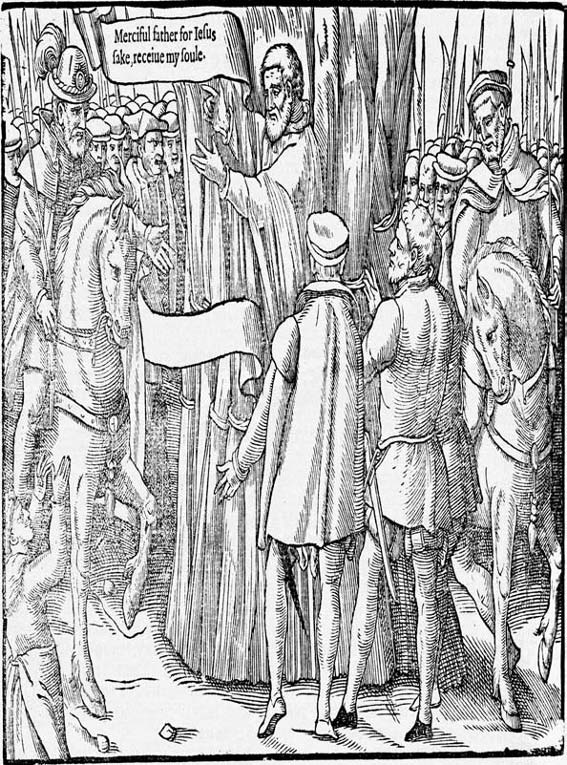
9. Doctor Taylor, burning at Hadleigh for the testimony of the Gospel