
14. whereas he saith, 'If the trumpet giveth an uncertain sound,
3. ANNE ASKEW
The fi rst examination of Mistress Anne Askew before the inquisitors. 1545.
To satisfy your expectation: good people (saith she) this was my fi rst examination in the year of our Lord 1545 and in the month of March.
The fi rst examination of Anne Askew.
First Christopher Dare examined me at Sadler's Hall, being one of the quest, and asked if I did not believe that the sacrament, hanging over the altar, was the very body of Christ really. Then
I demanded this question of him: wherefore Saint Stephen was stoned to death, and he said, he could not tell. Then I answered that no more would I assoil his vain question.
Christopher Dare, inquisitor.
The fi rst article against Anne Askew.
Secondly, he said that there was a woman, which did testify that I should read, how God was not in temples made with hands. Then I showed him the seventh and seventeenth chapters of the Acts of the Apostles, what Stephen and Paul had said therein.* Whereupon he asked me how I took those sentences? I answered, 'I would not throw pearls among swine,* for acorns were good enough.'
The second article.
Thirdly, he asked me wherefore I said that I had rather read fi ve lines in the Bible, than to hear fi ve masses in the temple?
I confessed, that I had said no less: not for the dispraise of either the epistle or the gospel, but because the one did greatly edify me, and the other nothing at all. As Saint Paul doth witness in the fourteenth chapter of his fi rst epistle to the Corinthians, whereas he saith, 'If the trumpet giveth an uncertain sound, who will prepare himself to the battle?'*
The third article.
1 Corinthians 14.
Fourthly: he laid unto my charge that I should say: 'If an ill priest ministered, it was the devil and not God'.
The fourth article.
My answer was, that I never spake any such thing. But this was my saying: that whosoever he were that ministered unto me, his ill conditions could not hurt my faith, but in spirit
I received nevertheless, the body and blood of Christ.
Ill conditions of the ministers hurt not the faith of the receivers.
He asked me what I said concerning confession? I answered him my meaning, which was as Saint James saith, that every
The fi fth article.
Anne Askew
man ought to acknowledge his faults to other, and the one to pray for the other.* Sixthly, he asked me what I said to the King's Book?* And I answered him, that I could say nothing to it, because I never saw it.
The sixth article.
Seventhly, he asked me if I had the spirit of God in me?
I answered, 'If I had not, I was but a reprobate or castaway'.
Then he said he had sent for a priest to examine me, which was here at hand.
The seventh article.
The priest asked me what I said to the sacrament of the altar, and required much to know therein my meaning. But I desired him again, to hold me excused concerning that matter. None other answer would I make him, because I perceived him to be a papist.
A priest brought to examine Anne Askew.
Eighthly he asked me, if I did not think that private Masses* did help souls departed? I said it was great idolatry to believe more in them, than in the death which Christ died for us.
The eighth article. Private Masses'
Idolatry.
Anne Askew brought to the Lord Mayor.
Then they had me thence unto my Lord Mayor, and he examined me, as they had before, and I answered him directly in all things as I answered the quest before. Besides this my
Lord Mayor laid one thing to my charge, which was never spoken of me, but of them: and that was, whether a mouse eating the host, received God or no? This question did I never ask, but indeed they asked it of me, whereunto I made them no answer but smiled.
Then the bishop's chancellor rebuked me and said, that I was much to blame for uttering the scriptures. For Saint Paul (he said) forbade women to speak, or to talk of the word of God.*
I answered him that I knew Paul's meaning as well as he, which is in 1 Corinthians 14, that a woman ought not to speak in the congregation by the way of teaching. And then I asked him, how many women he had seen go into the pulpit and preach?
He said he never saw none. Then I said he ought to fi nd no fault in poor women, except they had offended the law.
Women forbidden to speak in the congregation and how?
Then the Lord Mayor commanded me to ward, I asked him if sureties would not serve me, and he made me short answer, that he would take none. Then was I had to the Counter, and there remained eleven days, no friend admitted to speak with me. But in the mean time there was a priest sent to me, which said that he
Anne Askew commanded to the Counter by the Lord Mayor.
Foxe's Book of Martyrs
was commanded of the bishop to examine me, and to give me good counsel, which he did not. But fi rst he asked me for what cause I was put in the Counter, and I told him, I could not tell.
Then he said it was great pity that I should be there without cause, and concluded that he was very sorry for me.
Talk between Anne Askew and a priest sent to her in prison.
Secondly he said, it was told him, that I should deny the sacrament of the altar. And I answered again that, that I have said, I have said.
Thirdly he asked me if I were shriven, I told him, so that I might have one of these three, that is to say, Doctor Crome,
Sir Guillam, or Huntington. I was contented because I knew them to be men of wisdom, 'as for you or any other I will not dispraise, because I know you not.' Then he said, 'I would not have you think, but that I, or another that shall be brought to you, shall be as honest as they, for if we were not, you may be sure the king would not suffer us to preach.' Then I answered by the saying of Solomon: 'By communing with the wise, I may learn wisdom, but by talking with a fool, I shall take scathe.'* Pro.
Proverbs 1.
Fourthly he asked, 'If the host should fall and a beast did eat it, whether the beast did receive God or no?' I answered,
'Seeing you have taken the pains to ask the question, I desire you also to assoil it yourself: for I will not do it, because I perceive you come to tempt me.' And he said, 'It was against the order of schools that he which asked the question should answer it.' I told him [that] I was but a woman and knew not the course of schools.
Whether a mouse may eat Christ's body in the sacrament, or no.
Fifthly he asked me, if I intended to receive the sacrament at Easter,* or no? I answered, that else I were not Christian woman, and thereat I did rejoice, that the time was so near at hand, and then he departed thence with many fair words.
The twenty-third day of March, my cousin Brittain came into the Counter unto me, and asked me whether I might be put to bail, or no? Then went he immediately unto my Lord
Mayor, desiring of him to be so good unto me. That I might be bailed. My Lord answered him, and said that he would be glad to do the best that in him lay. Howbeit he could not bail me, without the consent of a spiritual offi cer: requiring him to go and speak with the chancellor of London.* For he said, like as he could not commit me to prison without the consent of a Master Brittain seeketh to bail Anne Askew his cousin.
Anne Askew
spiritual offi cer, no more could he bail me without the consent of the same.
So, upon that, he went to the chancellor, requiring of him as he did before of my Lord Mayor. He answered him that the matter was so heinous, that he durst not of himself do it, without my Lord of London were made privy thereunto. But he said he would speak unto my Lord in it, and bade him repair unto him the next morrow, and he should well know my Lord's pleasure: and upon the morrow after, he came thither, and spake both with the chancellor, and with the Bishop of London. The bishop declared unto him, that he was very well contented that I should come forth to a communication, and appointed me to appear before him the next day after, at three, of the clock at afternoon.
Moreover, he said unto him, that he would, there should be at the examination such learned men as I was affectioned to,* that they might see, and also make report that I was handled with no rigour. He answered him that he knew no man that I had more affection to, than to other. Then said the bishop: 'Yes, as I understand, she is affectioned to Doctor Crome, Sir Guillam,
Whitehead, and Huntington that they might hear the matter: for she did know them to be learned and of a godly judgement.' Also he required my cousin Brittain, that he should earnestly persuade me to utter even the very bottom of my heart: and he swore by his fi delity, that no man should take any advantage of my words: neither yet would he lay aught to my charge for anything that I should there speak: but if I said any manner of thing amiss, he with other more would be glad to reform me therein, with most godly counsel.
Master Brittain for the bailing of Anne Askew, sent from the mayor, to the chancellor, from the chancellor, to the bishop.
Bonner's promise to Master Brittain.
On the morrow after, the Bishop of London sent for me, at one of the clock, his hour being appointed at three, and as I came before him, he said he was very sorry of my trouble, and desired to know my opinion in such matters as were laid against me.
He required me also in any wise boldly to utter the secrets of my heart, bidding me not to fear in any point, for whatsoever
I did say in his house, no man should hurt me for it. I answered:
'Forsomuch as your lordship appointed three of the clock, and my friends shall not come till that hour, I desire you to pardon me of giving answer till they come.' Then said he, that he thought it meet to send for those four men which were afore named
Anne Askew brought forth to communication before Bonner.
Foxe's Book of Martyrs
and appointed. Then I desired him not to put them to the pain, for it should not need, because the two gentlemen which were my friends were able enough to testify that I should say. Anon after he went into his gallery with Master Spilman, and willed him in any wise that he should exhort me to utter all that I thought. In the mean while he commanded his archdeacon to common with me, who said unto me: 'Mistress wherefore are you accused and thus troubled here before the bishop?' To whom I answered again and said: 'Sir, ask I pray you my accusers, for I know not as yet.' Then took he my book out of my hand, and said: 'Such books as this, have brought you to the trouble you are in. Beware,'
(saith he), 'beware, for he that made this book and was the author thereof, was an heretic I warrant you, and burnt in Smithfi eld.'
Then I asked him, if he were certain and sure, that it was true that he had spoken. And he said he knew well the book was of John
Frith's making. Then I asked him if he were not ashamed for to judge of the book before he saw it within, or yet knew the truth thereof. I said also, that such unadvised and hasty judgement is a token apparent of a very slender wit. Then I opened the book and showed it him. He said he thought it had been another, for he could fi nd no fault therein. Then I desired him no more to be so unadvisedly rash and swift in judgement, till he thoroughly knew the truth, and so he departed from me.
Talk between the archdeacon and Anne Askew.
Rash judgement reproved.
Good counsel giving to the Immediately after came my cousin Brittain in with diverse other, as Master Hall of Gray's Inn,* and such other like. Then my Lord of London persuaded my cousin Brittain as he had done oft before, which was that I should utter the bottom of my heart in any wise. My Lord said after that unto me, that he would
I should credit the counsel of such as were my friends and well willers* in this behalf, which was, that I should utter all things that burdened my conscience: for he ensured me that I should not need to stand in doubt to say anything. For like as he promised them (he said) he promised me and would perform it: which was that neither he nor any man for him, should take me at advantage of any word I should speak: and therefore he bade me say my mind without fear. I answered him that I had naught to say: for my conscience (I thanked God) was burdened with nothing. archdeacon.
Master Brittain.
Edward Hall.
Talk between Anne Askew and Bonner.
Then brought he forth this unsavoury similitude: that if a man had a wound, no wise surgeon would minister help unto
Bonner's similitude.
Anne Askew
it before he had seen it uncovered. 'In like case,' saith he, 'can I give you no good counsel, unless I know wherewith your conscience is burdened.' I answered, that my conscience was clear in all things: and for to lay a plaster unto the whole skin, it might appear much folly.
'Then you drive me,' (saith he), 'to lay to your charge your own report, which is this: you did say, he that doth receive the sacrament by the hands of an ill priest, or a sinner, receiveth the devil and not God.' To that I answered, that I never spake such words. But as I said afore, both to the quest and to my Lord
Mayor, so say I now again, that the wickedness of the priest should not hurt me, but in spirit and faith, I received no less than the body and blood of Christ. Then said the bishop unto me, 'What saying is this in spirit? I will not take you at the advantage.' Then I answered: 'My Lord without faith and spirit, I cannot receive him worthily.'
Bonner's fi rst objection against Anne Askew.
Then he laid unto me, that I should say that the sacrament remaining in the pyx, was but bread. I answered that I never said so, but indeed the quest asked me such a question, whereunto I would not answer (I said) till such time as they had assoiled me this question of mine: 'Wherefore Stephen was stoned to death?' They said they knew not. Then said I again, no more would I tell them, what it was.
Second article.
Then said my Lord unto me, that I had alleged a certain text of the scripture. I answered that I alleged none other but Saint Paul's own saying to the Athenians in the eighteenth chapter in the Apostle's acts, that God dwelleth not in temples made with hands. Then asked he me what my faith and belief was in that matter? I answered him, 'I believe as the scripture doth teach me.'
Third article.
Then enquired he of me, 'What if the scripture do say that it is the body of Christ?' 'I believe,' said I, 'as the scripture doth teach me.' Then asked he again, 'What if the scripture do say that it is not the body of Christ?' My answer was still, 'I believe as the scripture informeth me.' And upon this argument he tarried a great while, to have driven me to make him an answer to his mind. Howbeit I would not: but concluded this with him, that I believe therein and in all other things as Christ and his holy apostles did leave them.
Fourth article.
Foxe's Book of Martyrs
Then he asked me why I had so few words? And I answered, 'God hath given me the gift of knowledge, but not of utterance.
And Solomon saith: "That a woman of few words is a gift of God." '* Proverbs nineteen.
Anne Askew charged with few words.
Fifthly, my Lord laid unto my charge, that I should say that the mass was superstitious, wicked, and no better than idolatry.
I answered him, 'No: I said not so. Howbeit I say the quest did ask me whether private mass did relieve souls departed or no?
Unto whom then I answered: "O Lord what idolatry is this, that we should rather believe in private masses, than in the healthsome death of the dear Son of God?" ' Then said my
Lord again: 'What an answer is that?' 'Though it be but mean,'
(said I), 'yet it is good enough for the question.'
Fifth article.
Then I told my Lord that there was a priest, which did hear what I said there before my Lord Mayor and them. With that the chancellor answered, which was the same priest. 'So she spake it in very deed,' (saith he), 'before my Lord Mayor and me.'
Then were there certain priests, as Doctor Standish and other, which tempted me much to know my mind. And I an swered them always thus: that I said to my Lord of London,
I have said. Then Doctor Standish desired my Lord to bid me say my mind concerning the same text of Saint Paul's learning, that I being a woman, should interpret the scriptures, specially, where so many wise learned men were.
Doctor Standish's demand.
Then my Lord of London said he was informed, that one should ask of me if I would receive the sacrament at Easter, and I made a mock of it. Then I desired that mine accuser might come forth, which my Lord would not. But he said again unto me, 'I sent one to give you good counsel, and at the fi rst word you called him "papist." ' That I denied not, for I perceived he was no less: yet made I him none answer unto it.
Anne Askew could not have her accuser.
Then he rebuked me, and said that I should report, that there were bent against me threescore priests at Lincoln.
'Indeed,' (quoth I), 'I said so. For my friends told me, if I did come to Lincoln, the priests would assault me and put me to great trouble, as thereof they had made their boast: and when
I heart it, I went thither indeed, not being afraid, because I knew my matter to be good. Moreover, I remained there nine days to see what would be said unto me. And as I was in the minster
The priests of Lincoln against Anne Askew.
Anne Askew
reading upon the Bible, they resorted unto me by two and by two, by fi ve and by six minding to have spoken unto me, yet went they their ways again without words speaking.'
Then my Lord asked, if there were not one that did speak unto me. I told him yes, that there was one of them at the last, which did speak to me indeed. And my Lord then asked me what he said? And I told him his words were of small effect, so that I did not now remember them: then said my Lord, 'There are many that read and know the scripture, and yet follow it not, nor live thereafter.' I said again, 'My Lord I would wish that all men knew my conversation and living in all points, for I am sure of myself this hour that there are none able to prove any dishonesty by me. If you know any that can do it, I pray you bring them forth.'
Anne Askew standeth upon her honesty.
Then my Lord went away, and said he would entitle somewhat of my meaning, and so he wrote a great circumstance. But what it was, I have not all in memory, for he would not suffer me to have the copy thereof. Only do I remember this small portion of it.
'Be it known,' (saith he), 'of all men, that I Anne Askew do confess this to be my faith and belief, notwithstanding my reports made afore to the contrary. I believe that they which are houseled* at the hands of a priest, whether his conversation be good or not, do receive the body and blood of Christ in substance really. Also I do believe, that after the consecration, whether it be received or reserved, it is no less than the very body and blood of Christ in substance. Finally I do believe in this and in all other sacraments of holy church, in all points according to the old Catholic faith of the same. In witness whereof I the said Anne have subscribed my name.'
Bonner's misreport of Anne Askew's confession.
There was somewhat more in it, which because I had not the copy, I cannot now remember. Then he read it to me and asked me if I did agree to it. And I said again, 'I believe so much thereof, as the holy scripture doth agree unto: wherefore I desire you, that ye will add that thereunto.' Then he answered, that I should not teach him what he should write. With that, he went forth into his great chamber, and read the same bill before the audience, which inveigled and willed me to set to my hand, saying also, that I had favour showed me. Then said the Bishop,
'I might thank other, and not myself, of the favour that I found The tenor of Doctor Bonner's writing whereunto Anne Askew subscribed.
Foxe's Book of Martyrs
at his hand,' for he considered (he said) that I had good friends, and also that I was come of a worshipful stock.
Then answered one Christopher, a servant to Master Denny: 'Rather ought you (my Lord) to have done it in such case for God's sake than for man's.' Then my Lord sat down, and took me the writing to set thereto my hand, and I writ after this manner: 'I Anne Askew do believe all manner things contained in the faith of the catholic church.'
And forasmuch as mention here is made of the writing of Bonner, which this godly woman said before she had not in memory, therefore I thought in this place to infer the same, both with the whole circumstance of Bonner, and with the title thereunto prefi xed by the register, and also with her own subscription: to the intent the reader seeing the same subscription, neither to agree with the time of the title above prefi xed, nor with the subscription after the writing annexed, might the better understand thereby what credit is to be given hereafter to such bishops, and to such registers. Then tenor of Bonner's writing proceedeth thus.
The words of the registers.
'The true copy of the confession and belief of Anne Askew, otherwise called Anne Kime, made before the Bishop of London, the twentieth day of March, in the year of our Lord
God after the computation of the Church of England, 1545, and subscribed with her own hand, in the presence of the said bishop and other, whose names hereafter are recited, set forth and published at this present, to the intent the world may see what credence is now to be given unto the same woman, who in so short a time hath most damnably altered and changed her opinion and belief, and therefore rightfully in open court arraigned and condemned', Ex. Registrum.*
Ex Registrum.
'Be it known to all faithful people, that as touching the blessed sacrament of the altar, I do fi rmly and undoubtedly believe, that after the words of consecration be spoken by the priest, according to the common usage of this Church of England, there is present really the body and blood of our saviour Jesus Christ, whether the minister which doth consecrate, be a good man, or a bad man, and that also whensoever the said sacrament is received, whether the receiver be a good man or a bad man, he doth receive it really and corporally.
The copy of the bishops' report upon the confession of Anne Askew as it standeth in the registers.
Anne Askew
And moreover, I do believe, that whether the said sacrament then received of the minister, or else reserved to be put into the pix, or to be brought to any person that is impotent or sick, yet there is the very body and blood of our said saviour: so that whether the minister or the receiver be good or bad, yea whether the sacrament be received or reserved, always there is the blessed body of Christ really.
'And this thing with all other things touching the sacrament and other sacraments of the church, and all things else touching the Christian belief, which are taught and declared in the king's majesty's book lately set forth for the erudition of the Christian people, I Anne Askew, otherwise called Anne Kime, do truly and perfectly believe, and so here presently confess and knowledge. And here I do promise that henceforth I shall never say or do anything against the promises, or against any of them. In witness whereof, I the said Anne have subscribed my name unto these presents. Written the twentieth day of March, in the year of our Lord God 1545.' Ex Registrum.
Ex Registrum Londonium.
By me Anne Askew, otherwise called Anne Kime. . . .
Here mayest thou note gentle Reader in this confession, both in the bishop and his register: a double sleight of false conveyance. For although the confession purporteth the words of the bishop's writing, whereunto she did set her hand, yet by the title prefi xed before, mayest thou see that both she was arraigned and condemned before this was registered, and also that she is falsely reported to have put to her hand, which indeed by this her own book appeareth not so to be, but after this manner and condition: 'I Anne Askew do believe all manner things contained in the faith of the Catholic Church, and not otherwise.' It followeth more in the story.
Bonner and his register reproved with an untruth.
Then because I did add unto it the Catholic Church he fl ang* into his chamber in a great fury. With that my cousin
Brittain followed him, desiring him for God's sake to be good Lord unto me. He answered that I was a woman, and that he was nothing deceived in me. Then my cousin Brittain desired him to take me as a woman, and not to set my weak woman's wit to his lordship's great wisdom.
Bonner Bishop of London in a chafe against Anne Askew.
Then went in unto him Doctor Weston,* and said, that the cause why I did write there 'the Catholic Church', was that Doctor Weston.
Foxe's Book of Martyrs
I understood not 'the church' written afore. So with much ado, they persuaded my Lord to come out again, and to take my name with the names of my sureties, which were my cousin
Brittain, and Master Spilman of Gray's Inn.
This being done, we thought that I should have been put to bail immediately according to the order of the law. Howbeit, he would not suffer it, but committed me from thence to prison again, until the next morrow, and then he willed me to appear in the Guildhall, and so I did. Notwithstanding, they would not put me to bail there neither, but read the bishop['s] writing unto me, as before, and so commanded me again to prison.
Anne Askew brought to the Guildhall.
Then were my sureties appointed to come before them on the next morrow in Paul's Church: which did so indeed. Notwithstanding they would once again have broken off with them because they would not be bound also for another woman at their pleasure, whom they knew not nor yet what matter was laid unto her charge. Notwithstanding at the last, after much ado and reasoning to and fro, they took a bond of them of recognizance for my forthcoming. And thus I was at the last delivered.
Anne Askew bailed at last under sureties with much ado.
Written by me Anne Askew.
The latter apprehension and examination of the worthy martyr of God, Mistress Anne Askew. Anno 1546.
[Although church authorities released Anne Askew after her fi rst examination for heresy in 1545, she underwent a second examination for heresy during the following year. After the prelates handed her over to civil authorities, she was racked until she could no longer stand upright and was condemned to death.]
. . . Hitherto we have entreated of this good woman. Now it remaineth that we touch somewhat as concerning her end and martyrdom. After that she, being born of such stock and kindred, that she might have lived in great wealth and prosperity, if she would rather have followed the world, than Christ, now had been so tormented, that she could neither live long in so great distress, neither yet by her adversaries be suffered to die in secret: the day of her execution being appointed, she was brought into Smithfi eld in a chain, because she could not go on her feet, by Anne Askew brought unto the stake.
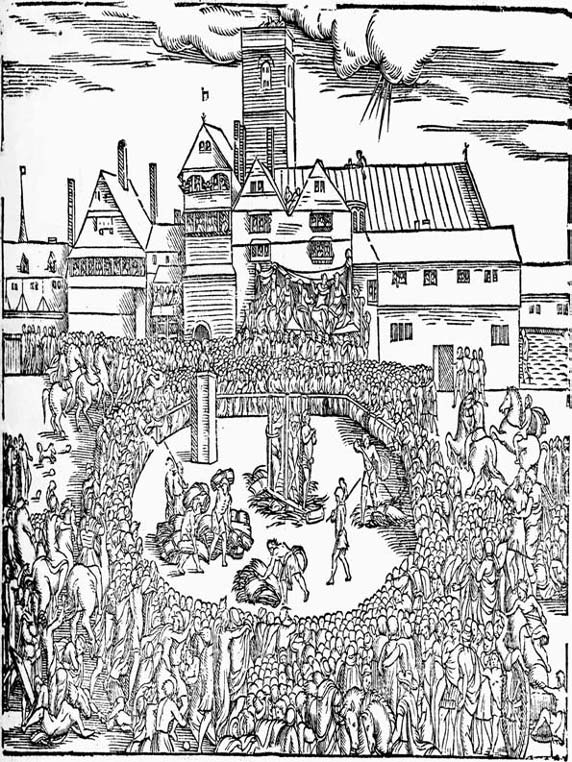
5. Anne Askew, John Lacelles, John Adams, Nicholas Belenian, Smithfi eld
Foxe's Book of Martyrs
means of her great torments. When she was brought unto the stake, she was tied by the middle with a chain that held up her body. When all things were thus prepared to the fi re, Doctor
Shaxton* who was then appointed to preach, began his sermon.
Anne Askew hearing, and answering again unto him, where he said well, confi rmed the same: where he said amiss, there said she, 'He misseth, and speaketh without the book.'*
Anne Askew lamed upon the rack.
Shaxton preached at Anne Askew's burning.
The sermon being fi nished, the martyrs standing there tied at three several stakes ready to their martyrdom, began their prayers. The multitude and concourse of the people was exceeding, the place where they stood being railed about to keep out the press. Upon the bench under Saint Bartholomew's
Church, sat Wriothesley Chancellor of England, the old Duke of Norfolk,* the old Earl of Bedford, the Lord Mayor with diverse other more. Before the fi re should be set unto them, one of the bench hearing that they had gunpowder about them, and being afraid lest the faggots by strength of the gunpowder would come fl ying about their ears, began to be afraid, but the Earl of Bedford declaring unto him how the gunpowder was not laid under the faggots, but only about their bodies to rid them out of their pain, which having vent, there was no danger to them of the faggots, so diminished that fear.
Then Wriothesley Lord Chancellor, sent to Anne Askew letters, offering to her the king's pardon, if she would recant.
Who refusing once to look upon them, made this answer again: that she came not thither to deny her lord and master. Then were the letters likewise offered unto the other, who in like manner, following the constancy of the woman, denied not only to receive them, but also to look upon them. Whereupon the Lord Mayor commanding fi re to be put unto them, cried with a loud voice, 'Fiat justitia.'* Anne Askew refuseth the king's pardon.
Justitia injusta.
And thus the good Anne Askew with these blessed martyrs, being troubled so many manner of ways, and having passed through so many torments, having now ended the long course of her agonies, being compassed in with fl ames of fi re, as a blessed sacrifi ce unto God, she slept in the Lord, anno 1546, leaving behind her a singular example of Christian constancy for all men to follow.