
16. John Philpot
16. JOHN PHILPOT
The process and history of Master John Philpot, examined, condemned, and martyred for the maintenance and defence of the gospel's cause, against the Antichristian See of Rome.
Next followeth the constant martyrdom of Master John Philpot. . . . He was of a worshipful house, a knight's son born in Hampshire, brought up in the New College in Oxford, where he studied the civil law, the space of six or seven years, besides the study of other liberal arts, especially of the tongues, wherein very forwardly he profited, namely in the knowledge of the Hebrew tongue, et cetera. In wit he was pregnant and happy, of a singular courage, in spirit fervent, in religion zealous and also well practised and exercised in the same (which is no small matter in a true divine) of nature and condition plain and apert, far from all flattery, farther from all hypocrisy and deceitful dissimulation. What his learning was, his own examinations penned of his own hand can declare.
December 20.
The history of Master John Philpot, martyr.
John Philpot a knight's son, student of law in New College in Oxford.
From Oxford desirous to see other countries as occasion served thereunto, he went over into Italy, and places thereabouts, where he coming upon a time from Venice to Padua, was in danger through a certain Franciscan friar, accompanying him in his journey, who coming to Padua, sought to accuse him of heresy. At length returning to England his country again, as the time ministered more boldness to him in the days of King
Edward, he had diverse conflicts with Gardiner the bishop, in the city of Winchester. . . .
John Philpot went over to Italy.
John Philpot in danger by an Italian friar.
The return of John Philpot into England.
After that, having an advowson* by the said bishop, he was made there Archdeacon of Winchester, under Doctor Ponet,* who then succeeded Gardiner in that bishopric. Thus during the time of King Edward, he continued to no small profit of those parties thereabout. When that blessed king was taken away, and Mary his sister came in place, whose study was wholly bent to alter the state of religion in the woeful realm of England: first she caused a convocation of the prelates and learned men to be congregated, to the accomplishment of her desire.
John Philpot Archdeacon of Winchester.
This Doctor Ponet Bishop of Winchester fled afterward into Germany, and there deceased.
Anno 1557.
John Philpot
In the which convocation, Master Philpot being present according to his room and degree,* with a few other sustained the cause of the gospel manfully against the adversary part
(as is above recited) for the which cause, notwithstanding the liberty of the house promised before, he was called to accompt before Bishop Gardiner the Chancellor, then being his ordinary, by whom he was first examined, although that examination came not yet to our hands. From thence again he was removed to Bonner and other commissioners, with whom he had diverse and sundry conflicts. . . .
John Philpot sent from Gardiner to Bonner.
[At this point the text shifts from third-person narrative concerning Philpot to his own first-person account of his experience after the accession of Mary I.] After this, I with four other more were brought to the keeper's house in Paternoster Row, where we supped, and after supper
I was called up to a chamber by the Archdeacon of London's servant,* and that in his master's name, who offered me a bed for that night. To whom I gave thanks, saying: that it should be a grief to me to lie well one night, and the next worse:
'Wherefore I will begin,' (said I), 'as I am like to continue, to take such part as my fellows do.' And with that we were brought through Paternoster Row, to my Lord of London's coal house: unto the which is joined a little blind* house, with a great pair of stocks appointed both for hand and foot, but thanks be to God we have not played of those organs yet, although some before us had tried them; and there we found a minister of Essex a married priest, a man of godly zeal, with one other poor man. And this minister (at my coming) desired to speak with me, and did greatly lament his own infirmity, for that through extremity of imprisonment, he was constrained by writing to yield to the Bishop of London: whereupon he was once set at liberty, and afterward felt such a hell in his conscience, that he could scarce refrain from destroying himself, and never could be at quiet until he had gone unto the bishop's register, desiring to see his bill again, the which as soon as he had received, he tore it in pieces: and after he was as joyful as any man might be. Of the which when my Lord of London had understanding, he sent for him, and fell upon him like a lion, and like a manly bishop buffeted him well, so that he made his
Master Philpot laid in Bishop Bonner's coal house.
This godly man was Thomas Whittle, whose story followeth.
Example what an unquiet conscience doth.
Thomas Whittle after his recantation repenteth and tore his subscription.
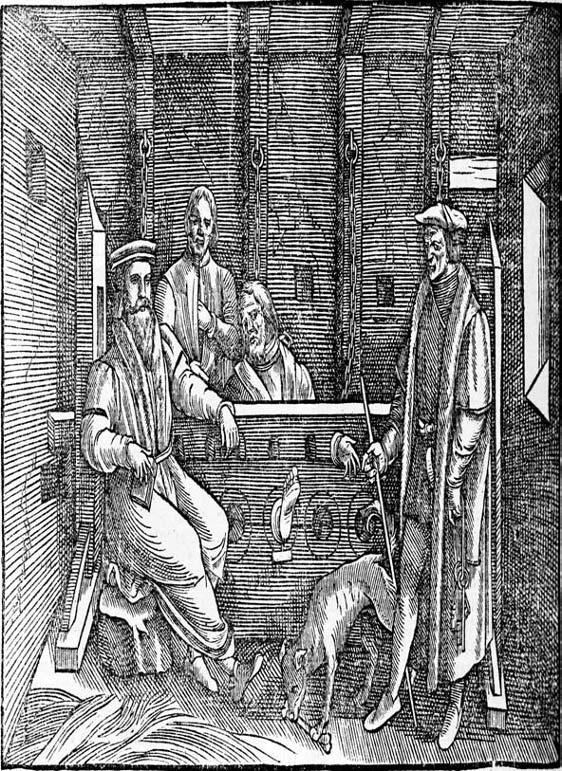
15. Master Philpot and Thomas Whittle, priest, in the stocks
John Philpot
face black and blue, and plucked away a great piece of his beard: but now thanks be to God, he is as joyful under the cross as any of us, and very sorry of his former infirmity. I write this because I would all men to take heed how they do contrary to their conscience: which is to fall into the pains of hell. And here an end. . . .
Bishop Bonner plucked away a great part of Whittle's beard, and made his face black and blue.
[After undergoing seven formal examinations for heresy before Edmund Bonner, Bishop of London, other bishops, Queen's
Commissioners, and others, Philpot recorded the following informal interrogation at his ad hoc prison at the palace of the Bishop of London.] Another private conference between the bishop and Master Philpot in the coal house.
Philpot. The Sunday after, the bishop came into the coal house at night with the keeper, and viewed the house, saying that he was never here afore: whereby a man may guess how he hath kept God's commandment in visiting the prisoners,* seeing he was never with them that have been so nigh his nose: and he came not then for any good zeal, but to view the place, and thought it too good for me, and therefore after supper between eight and nine he sent for me, saying Another private talk or conference between him and the bishop.
Bishop Bonner viewing his coal house.
[Bishop of] London. 'Sir, I have great displeasure of the queen and the Council for keeping you so long, and letting you have so much liberty. And besides that, you be yonder, and strengthen the other prisoners in their errors, as I have laid wait for your doings, and am certified of you well enough:
I will sequester you therefore from them, and you shall hurt no more as you have done, and I will out of hand dispatch you, as I am commanded, unless you will be a conformable man.'
Philpot. 'My Lord, you have my body in your custody: you may transport it whither it please you: I am content. And I would you would make as quick expedition in my judgement, as you say, I long therefore; and as for conformity, I am ready to yield to all truth, if any can bring better than I.'. . .
[Seven more examinations and private conversations preceded Philpot's condemnation and death sentence.]
Foxe's Book of Martyrs
The condemnation of the worthy martyr of God, John Philpot These books, letters, supplications and other matters being thus read, the bishop demanded of him, if the book entitled
The true report of the disputation,* et cetera, were of his penning or not? Whereunto Philpot answered, that it was a good and true book, and of his own penning and setting forth.
Of this book of disputation in the ConvoThe bishops waxing now weary, and being not able by any sufficient ground, either of God's word or of the true ancient
Catholic fathers,* to convince and overcome him, fell by fair and flattering speech, to persuade with him, promising that if he would revoke his opinions, and come home again to their
Romish and Babylonical church, he should not only be pardoned that which was past, but also they would with all favour and cheerfulness of heart, receive him again as a true member thereof. Which words when Bonner saw would take no place: he demandeth of Master Philpot (and that with a charitable affection, I warrant you) whether he had any just cause to allege, why he should not condemn him as a heretic. 'Well,' quoth Master Philpot: 'your idolatrous sacrament which you have found out, ye would fain defend, but ye cannot, nor never shall.' cation. . . .
Ah my Lord what needed this question when no reasonable answer could In the end, the bishop seeing his unmovable steadfastness in the truth, did pronounce openly the sentence of condemnation against him. In the reading whereof . . . Master Philpot said,
'I thank God that I am a heretic out of your cursed church:
I am no heretic before God. But God bless you and give you once grace to repent your wicked doings: and let all men beware of your bloody church.' be allowed.
Sentence of condemnation read against Master Philpot.
Master Philpot's Moreover, whiles Bonner was about the midst of the sentence, the Bishop of Bath* pulled him by the sleeve, and said:
'My Lord, my Lord, know of him first whether he will recant or no?' Then Bonner said (full like himself), 'Oh let me alone': and so read forth the sentence. words in reading the sentence.
And when he had done, he delivered him to the sheriffs: and so two officers brought him through the bishop's house into Paternoster Row, and there his servant met him, and when he saw him, he said: 'Ah dear master.'
Master Philpot delivered to the sheriffs.
John Philpot
Then Master Philpot said to his man: 'Content thyself, I shall do well enough: for thou shalt see me again.'
Master Philpot to his servant.
And so the officers thrust him away, and had his master to Newgate: and as he went, he said to the people: 'Ah good people, blessed be God for this day': and so the officers delivered him to the keeper. Then his man thrust to go in after his master, and one of the officers said unto him: 'Hence fellow what shouldst thou have?' And he said, 'I would go speak with my master.' Master Philpot then turned him about, and said to him, 'Tomorrow you shall speak with me.'
Then the under-keeper said to Master Philpot: 'Is this your man?' And he said, 'Yea.' So he did license his man to go in with him, and Master Philpot and his man were turned into a little chamber on the right hand, and there remained a little time, until Alexander the chief keeper did come unto him: who at his entering, greeted him with these words. 'Ah,' said he,
'hast not thou done well to bring thy self hither?' 'Well,' said Master Philpot, 'I must be content, for it is God's appointment: and I shall desire you to let me have your gentle favour: for you and I have been of old acquaintance.' 'Well,' said
Alexander, 'I will show thee gentleness and favour, so you wilt be ruled by me.' Then said Master Philpot: 'I pray you show me what you would have me to do.'
Master Philpot brought into Newgate, his man permitted to enter with him.
Talk between Master Philpot and Alexander, the keeper.
He said, 'If you would recant, I will show you any pleasure I can.' 'Nay,' said Master Philpot. 'I will never recant whilst
I have my life, that which I have spoken, for it is a most certain truth, and in witness hereof, I will seal it with my blood.' Then
Alexander said: 'This is the saying of all the whole pack of you heretics.' Whereupon he commanded him to be set upon the block, and as many irons upon his legs as he might bear, for that he would not follow his wicked mind.
Good Philpot laden with irons, because he would not recant at Alexander's bidding.
Then the clerk told Alexander in his ear that Master Philpot had given his man money. And Alexander said to his man:
'What money hath thy master given thee?' His man said: 'My master hath given me none.' 'No?' said Alexander. 'Hath he given thee none? That will I know for I will search thee.' 'Do with me what you list, and search me all that you can,' quoth his servant. 'He hath given me a token or two, to send to his friends, as to his brother and sister.' 'Ah,' said Alexander to
Foxe's Book of Martyrs
Master Philpot: 'Thou art a maintainer of heretics. Thy man should have gone to some of thine affinity: but he shall be known well enough.' 'Nay,' said Master Philpot: 'I do send it to my friends. There he is: let him make answer to it. But good
Master Alexander, be so much my friend, that these irons may be taken off.' 'Well,' said Alexander, 'give me my fees, and I will take them off: if not, thou shalt wear them still.'
Alexander taketh Philpot's tokens from his Then said Master Philpot, 'Sir, what is your fees?' He said, four pound was his fees. 'Ah,' said Master Philpot. 'I have not so much: I am but a poor man, and I have been long in prison.'
'What wilt thou give me then?' said Alexander. 'Sir,' (said he), 'I will give you twenty shillings, and that I will send my man for, or else I will lay my gown to gage:* for the time is not long
(I am sure) that I shall be with you: for the bishop said unto me that I should be soon dispatched.' man.
Alexander the cruel keeper requireth four pounds of Master Philpot for his irons.
Then said Alexander unto him, 'What is that to me?' and with that he departed from him, and commanded him to be had into limbo,* and so his commandment was fulfilled: but before he could be taken from the block, the clerk would have a groat.
Master Philpot had into limbo.
Then one Wittrence, steward of the house, took him on his back, and carried him down, his man knew not whither.
Wherefore Master Philpot said to his man: 'Go to Master Sheriff and show him how I am used, and desire Master Sheriff to be good unto me.' And so his servant went straightway, and took an honest man with him.
And when they came to Master Sheriff (which was Master Macham) and showed him how Master Philpot was handled in Newgate. The Sheriff hearing this, took his ring off from his finger, and delivered it unto that honest man which came with Master Philpot's man, and bade him go unto Alexander the keeper, and commanded him to take off his irons, and to handle him more gently, and to give his man again that which he had taken from him. And when they came again to the said
Alexander, and told their message from the Sheriff, Alexander took the ring, and said: 'Ah, I perceive that Master Sheriff is a bearer with him, and all such heretics as he is: therefore tomorrow I will show it to his betters': Yet at ten of the clock he went into Master Philpot where he lay, and took off his
Master Macham Sheriff, a good man, sendeth his ring to take off Master Philpot's irons, and to restore the man's tokens.
Note the spitefulness of this keeper.
John Philpot
irons, and gave him such things as he had taken before from his servant.
Master Philpot with much ado released of his irons.
Upon Tuesday at supper, being the seventeenth day of December there came a messenger from the sheriffs, and bade
Master Philpot make him ready, for the next day he should suffer, and be burned at a stake with fire. Master Philpot answered and said, 'I am ready: God grant me strength, and a joyful resurrection.' And so he went unto his chamber, and poured out his spirit unto the Lord God, giving him most hearty thanks that he of his mercy had made him worthy to suffer for his truth.
December 17.
Master Philpot warned by the sheriffs to prepare him against the next day to the fire.
December 18.
In the morning the sheriffs came according to the order, about eight of the clock, and calleth for him, and he most joyfully came down with them. And there his man did meet him, and said: 'Ah dear master, farewell.' His master said unto him,
'Serve God and he will help thee.' And so he went with the sheriffs unto the place of execution: and when he was entering into Smithfield, the way was foul, and two officers took him up to bear him to the stake. Then he said, merrily, 'What? Will you make me a pope? I am content to go to my journey's end on foot.' But first coming into Smithfield, he kneeled down there saying these words: 'I will pay my vows in thee
O Smithfield.'
Master Philpot brought to the place of martyrdom.
Master Philpot's words going to the stake.
And when he was come to the place of suffering, he kissed the stake and said: 'Shall I disdain to suffer at this stake seeing my redeemer did not refuse to suffer most vile death upon the cross for me?' And then with an obedient heart full meekly he said the one-hundred-sixth, one-hundred-seventh, and onehundred-eighth psalms: and when he had made an end of all his prayers, he said to the officers: 'What have you done for me?' and every one of them declared what they had done: and he gave to every of them money.
Master Philpot's prayers.
John Philpot giveth the officers money.
Then they bound him unto the stake, and set fire unto that constant martyr: who the eighteenth day of December, in the midst of the fiery flames, yielded his soul into the hands of the almighty God, and full like a lamb gave up his breath his body being consumed into ashes.
Thus hast thou (gentle reader) the life and doings of this learned and worthy soldier of the Lord, John Philpot: with all
Foxe's Book of Martyrs
his examinations that came to our hands:* first penned and written with his own hand, being marvellously reserved from the sight and hands of his enemies: who by all manner means sought not only to stop him from all writing, but also to spoil and deprive him of that which he had written. For the which cause he was many times stripped and searched in the prison of his keeper:* but yet so happily these his writings were conveyed and hid in places about him or else his keeper's eyes so blinded that notwithstanding all this malicious purpose of the bishops, they are yet remaining and come to light. . . .
The writings and examinations of Master John Philpot by the providence of almighty God preserved.
[Foxe then appends a variety of letters written by Philpot, including these excerpts.]
To his dear friend in the Lord John Careless* prisoner in the King's Bench My dearly beloved brother Careless, I have received your loving letters full of love and compassion, insomuch that they made my hard heart to weep, to see you so careful for one that hath been so unprofitable a member as I have been and am in Christ's church. God make me worthy of that I am called unto, and I pray you, cease not to pray for me but cease to weep for him who hath not deserved such gentle tears: and praise God with me, for that I now approach to the company of them, whose want you may worthily lament: God give your pitiful heart, his inward consolation. Indeed my dear Careless, I am in this world in hell, and in the shadow of death: but he that hath brought me for my deserts down unto hell, shall shortly lift me up to heaven, where I shall look continually for your coming and others my faithful brethren in the King's Bench. And though I tell you that I am in hell in the judgement of this world, yet assuredly I feel in the same the consolation of heaven, I praise God: and this loathsome and horrible prison is as pleasant to me, as the walk in the garden of the King's Bench.
Good conscience.
Another letter of Master Philpot to John Careless.
Experience of the Lord's comfort in trouble.
You know brother Careless, that the way to heaven out of this life, is very narrow, and we must strive to enter in at a narrow gate.* If God do mitigate the ugliness of mine imprisonment, what will he do in the rage of the fire whereunto I am appointed? And this hath happened unto me that I might be
Example of Christ's comfort to be taken by Master Philpot.
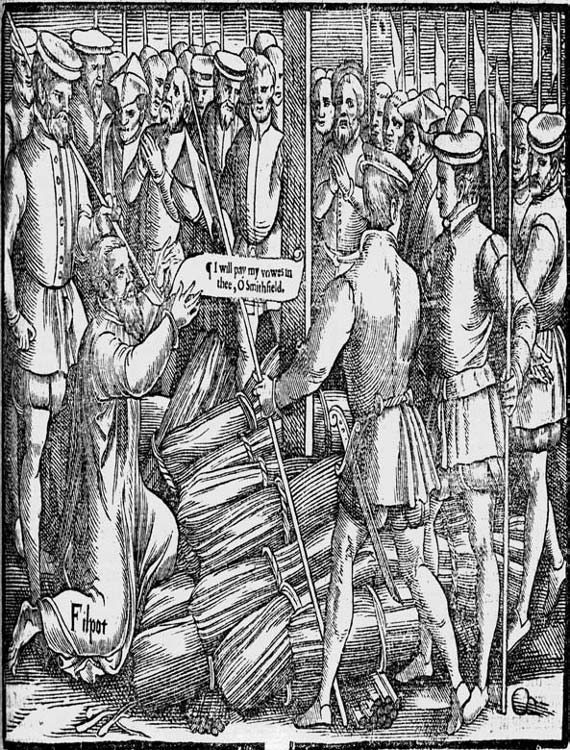
16. John Philpot, kneeling and praying at the stake
Foxe's Book of Martyrs
hereafter an example of comfort, if the like happen unto you or to any other of my dear brethren with you in these cruel days, in the which the devil so rageth at the faithful flock of Christ, but in vain (I trust) against any of us, who be persuaded that neither life neither death is able to separate us from the love of Christ's gospel,* which is God's high treasure committed to your brittle vessels to glorify us by the same. God of his mercy make us faithful stewards to the end, and give us grace to fear nothing whatsoever in his good pleasure we shall suffer for the same. That I have not written unto you erst, the cause is our strait keeping and the want of light by night, for the day serveth us but a while in our dark closet. This is the first letter that I have written since I came to prison, besides the report of mine examinations: and I am fain to scribble it out in haste. . . .
Out of the coal house by your brother John Philpot Another letter to John Careless, profitable to be read of all them which mourn in repentance for their sins.
. . . Since God hath willed you at your baptism in Christ to be careless, why do you make yourself careful:* cast all your care on him. Set the Lord before your eyes always, for he is on your right side, that you shall not be moved. Behold the goodness of God toward me. I am careless, being fast closed in a pair of stocks, which pinch me for very straitness: and will you be careful? I will not have that unseemly addition to your name.
Be as your name pretendeth, for doubtless you have none other cause but so to be. Pray, I beseech you, that I may be still careless in my careful estate, as you have cause to be careless in your easier condition. Be thankful and put away all care, and then I shall be joyful in my strait present care. Commend me to all our brethren, and desire them to pray for me, that I may overcome my temptations: for the devil rageth against me, I am put in the stocks in a place alone, because I would not answer to such articles, as they would charge me withal in a corner at the bishop's appointment, and because I did not come to Mass when the bishop sent for me, I will lie all the days of my life in True Christians how they ought to be careless in their careful estate.
John Philpot
the stocks (by God's grace) rather than I will consent to the wicked generation. Praise God and be joyful, that it hath pleased him to make us worthy to suffer somewhat for his name's sake. The Devil must rage for ten days.* Commend me to Master F.* and thank him for his law books, but law, neither equity will take any place among these blood-thirsty. I would for your sake their unjust dealing were noted unto the parliament house, if it might avail. God shorten these evil days,
I have answered the bishop meetly plain already, and I said to him, if he will call me in open judgement, I will answer him as plainly as he will require: otherwise I have refused, because
I fear they will condemn me in hugger mugger. The peace of God be with you my dear brother. I can write no more for lack of light, and that I have written I cannot read myself, and God knoweth it is written far uneasily. I pray God you may pick out some understanding of my mind towards you. Written in a coal house of darkness, out of a pair of painful stocks, by thine own in Christ.
John Philpot.