
18. Thomas Cranmer
18. THOMAS CRANMER
The life, state,* and story of the reverend pastor and prelate, Thomas Cranmer Archbishop of Canterbury, martyr, burned at Oxford, for the confession of Christ's true doctrine, under Queen Mary.
Anno 1556. March 21.
As concerning the life and estate of that most reverend father in God, and worthy prelate of godly memory, Thomas
Cranmer late Archbishop of Canterbury, and of the original cause and occasion of his preferment unto his archepiscopal dignity, who of many hath been thought to have procured the same by friendship only, and of some other esteemed unworthy of so high a vocation: It is first therefore to be noted and considered, that the same Thomas Cranmer coming of an ancient parentage, from the conquest to be deducted,* and continuing sithens in the name and family of a gentleman, was born in a village called Arselacton in Nottinghamshire. Of whose said name and family there remaineth at these days one manor and mansion house in Lincolnshire, called Cranmer
Hall, et cetera, sometimes of heritage of the said stock and family. Who being from his infancy kept at school, and brought up not without much good civility, came in process of time unto the University of Cambridge, and there prospering in right good knowledge amongst the better sort of students, was chosen fellow of Jesus College in Cambridge. And so being
Master of Art, and fellow of the same college, it chanced him to marry a gentleman's daughter: by means whereof he lost and gave over his fellowship there,* and became the reader in Buckingham College:* and for that he would with more diligence apply that his office of reading, placed his said wife in an Inn, called the Dolphin in Cambridge, the wife of the house being of affinity unto her. By reason whereof, and for that his often resort unto his wife, in that Inn he was much marked of some popish merchants: whereupon rose the slanderous noise and report against him, after he was preferred to March 21.
Thomas Cranmer Archbishop of Canterbury and martyr.
Thomas Cranmer a gentleman born.
Thomas Cranmer first coming to Cambridge.
Thomas Cranmer, fellow of Jesus College.
Cranmer married.
Cranmer reader in Buckingham College.
Thomas Cranmer
the Archbishopric of Canterbury, raised up by the malicious disdain of certain malignant adversaries to Christ and his truth, bruiting abroad everywhere, that he was but an hostler, and therefore without all good learning. Of whose malicious reports, one of their practices in that behalf shall hereafter be declared, as place and time shall serve.
But in the mean time to return to the matter present. Whist this said Master Cranmer continued as reader in Buckingham
College, his wife died in childbed. After whose death, the masters and fellows of Jesus College desirous again of their old companion, namely for his towardness in learning, chose him again fellow of the same college. Where he remaining at his study, became in few years after, the Reader of Divinity lecture* in the same college, and in such special estimation and reputation with the whole university, that being Doctor of Divinity, he was commonly appointed one of the heads
(which are two or three of the chiefest learned men) to examine such as yearly profess in commencement, either bachelors, or doctors of divinity, by whose approbation the whole university licenseth them to proceed unto their degree: and again by whose disallowance the university also rejecteth them for a time to proceed, until they be better furnished with more knowledge.
Thomas Cranmer after the decease of his wife, chosen fellow into Jesus College.
Thomas Cranmer made reader in Jesus College, and Doctor of Divinity.
Doctor Cranmer public examiner in Cambridge of them that were to proceed.
Now, Doctor Cranmer ever much favouring the knowledge of the scripture, would never admit any to proceed in divinity, unless they were substantially seen in the story of the Bible: by means whereof certain friars and other religious persons, who were principally brought up in the study of school authors without regard had to the authority of scriptures, were commonly rejected by him,* so that he was greatly for that his severe examination of the religious sort, much hated, and had in great indignation: and yet it came to pass in the end, that diverse of them being thus compelled to study the scriptures, became afterwards very well learned and well affected, insomuch, that when they proceeded doctors of divinity, could not overmuch extol and commend Master Doctor Cranmer's goodness towards them, who had for a time put them back, to aspire unto better knowledge and perfection. Among whom
Doctor Barret a white friar,* who afterwards dwelt at Norwich, Friars in hatred with Doctor Cranmer.
Foxe's Book of Martyrs
was after that sort handled, giving him no less commendation for his happy rejecting of him for a better amendment. Thus much I repeat that our apish and popish sort of ignorant priests may well understand that this his exercise, kind of life, and vocation was not altogether hostler-like.
Doctor Barret.
Well, to go forwards: like as he was neither in fame unknown, nor in knowledge obscure, so was he greatly solicited by Doctor Capon, to have been one of the fellows in the foundation of Cardinal Wolsey's college in Oxford* (which he utterly refused, not without danger of indignation). . . . For whiles he thus continued in Cambridge, the great and weighty cause of King Henry the eighth, his divorce with the Lady Catherine
Dowager of Spain,* came into question, which being many ways by the space of two or three years amongst the canonists, civilians,* and other learned men diversely disputed and debated, it came to pass that this said Doctor Cranmer, by reason that the plague was in Cambridge, resorted to Waltham
Abbey,* to one Master Cressy's house there, whose wife was of kin to the said Master Cranmer. And for that he had two sons of the said Cressy with him at Cambridge as his pupils, he rested at Waltham Cross, at the house of the said Master
Cressy, with the said two children, during that summer time whiles the plague reigned.
Doctor Cranmer appointed to be fellow of the Cardinal College in Oxford refused.
Question of the king's divorce with Catherine Dowager.
In this summer time Cardinal Campeius* and Cardinal Wolsey, being in commission from the pope, to hear and determine that great cause in controversy between the king and the queen his pretended wife,* dallied and delayed all the summer time until the month of August [1529] came in, hearing the said cause in controversy debated. When August was come, the said Cardinals little minding to proceed to sentence giving, took occasion to finish their commission, and not further to determine therein, pretending not to be permitted by the laws to keep courts of ecclesiastical matters in harvest time, which sudden stay and giving over of the said commission by both the cardinals, being unknown to the king, it so much moved him that he taking it as a mock at the cardinals' hands, commanded the Dukes of Norfolk and Suffolk* to dispatch forthwith Cardinal
Campeius home again to Rome, and so in haste removed himself from London to Waltham, for a night or twain whiles his
Thomas Cranmer
household removed to Greenwich:* by means whereof it chanced that the harbingers* lodged Doctor Stephens secretary,* and Doctor Foxe almoner (who were the chief furtherers, preferers and defenders on the king's behalf of the said cause) in the house of the said Master Cressy, where the said
Doctor Cranmer was also lodged and resident. When suppertime came, they all three doctors met together, Doctor Stephens and Doctor Foxe, much marvelling of Doctor Cranmer's being there. Who declared to them the cause of his there being, namely, for that the plague was in Cambridge. And as they were of old acquaintance, so the secretary and the almoner right well entertained Doctor Cranmer, minding to understand part of his opinion touching their great business they had in hand. And so as good occasion served, whiles they were at supper, they conferred with Doctor Cranmer concerning the king's cause, requesting him of his opinion what he thought therein.
Stephen Gardiner and Doctor Foxe, chief stirrers of the king's divorce.
Doctor Stephens, Doctor Foxe, Doctor Cranmer conferring together in the king's cause.
Whereunto Doctor Cranmer answered, that he could say little to the matter, for that he had not studied nor looked for it. Notwithstanding he said to them, that in his opinion they made more ado in prosecuting the law ecclesiastical, than needed. 'It were better as I suppose,' (quod Doctor Cranmer),
'that the question, whether a man may marry his brother's wife or no, were decided and discussed by the divines, and by the authority of the word of God,* whereby the conscience of the prince might be better satisfied and quieted, than thus from year to year by frustratory* delays to prolong the time, leaving the very truth of the matter unbolted out by* the word of God.
There is but one truth in it, which the scripture will soon declare, make open and manifest, being by learned men well handled, and that may be as well done in England in the universities here, as at Rome or elsewhere in any foreign nation, the authority whereof will compel any judge soon to come to a definitive sentence: and therefore as I take it, you might this way have made an end of this matter long sithens.' When
Doctor Cranmer had thus ended his tale, the other two well liked of his device, and wished that they had so proceeded aforetime, and thereupon conceived some matter of that device to instruct the king withal, who then was minded to send to Rome again for a new commission.
Doctor Cranmer's answer in the question of the king's divorce.
Doctor Cranmer's device well liked of.
Foxe's Book of Martyrs
Now, the next day when the king removed to Greenwich, like as he took himself not well handled by the cardinals in thus deferring his cause, so his mind being unquieted and desirous of an end of his long and tedious suit he called to him these his two principal doers of his said cause, namely the said Doctor
Stephens and Doctor Foxe, saying unto them: 'What now my masters,' (quoth the king), 'shall we do in this infinite cause of mine? I see by it there must be a new commission procured from Rome, and when we shall have an end, God knoweth and not I.' When the king had said somewhat his mind herein, the almoner Doctor Foxe said unto the king again: 'We trust that there shall be better ways devised for your majesty, than to make travail so far as to Rome any more in your highness's cause, which by chance was put into our heads this other night being at Waltham.' The king being very desirous to understand his meaning, said: 'Who hath taken in hand to instruct you by any better or shorter way to proceed in our said cause?'
Then said Doctor Foxe: 'It chanced us to be lodged at Waltham in Master Cressy's house this other night, your highness being there, where we met with an old acquaintance of ours, named
Doctor Cranmer, with whom having conference concerning your highness's cause, he thought that the next way were, first to instruct and quiet your majesty's conscience by trying your highness's question out by the authority of the word of God, and thereupon to proceed to a final sentence.' With this report the secretary was not content with the almoner, for that he did not utter this device as of their own invention. And when the secretary would have seemed by colourable* words to make it appear to the king, that they of themselves had devised that means: the king then said, 'Where is that Doctor
Cranmer? Is he still at Waltham?' They answered that they left him there. 'Marry,' said the king, 'I will surely speak with him, and therefore let him be sent for out of hand. I perceive,' quoth the king, 'that that man hath the sow by the right ear.* And if I had known this device but two year ago, it had been in my way a great piece of money, and had also rid me out of much disquietness.'
The king troubled about the divorce.
Doctor Cranmer's device reported to the king.
Note the glorious head of Doctor Stephens.
Doctor Cranmer sent for to the king.
Whereupon Doctor Cranmer was sent for, and being removed from Waltham to Cambridge, and so towards his
Thomas Cranmer
friends in Nottinghamshire, a post went for him. But when he came to London, he began to quarrel with these two his acquaintances, that he by their means was thus troubled and brought thither to be encumbered in a matter wherein he had nothing at all travailed in study, and therefore most instantly entreated them, that they would make his excuse in such sort, that he might be dispatched away from coming in the king's presence. They promised and took the matter upon them so to do, if by any means they might compass it. But all was in vain, for the more they began to excuse Doctor Cranmer's absence, the more the king chid with them, for that they brought him not out of hand to his presence, so that no excuse serving, he was fain undelayedly to come to the court unto the king, whom the gentle prince benignly accepting, demanded his name, and said unto him: 'Were you not at Waltham such a time, in the company of my secretary and my almoner?' Doctor Cranmer affirming the same, the king said again: 'Had you not conference with them concerning our matter of divorce now in question after this sort, repeating the manner and order thereof?'
'That is right true, if it please your highness,' quod Doctor Cranmer. 'Well,' said the king, 'I well perceive that you have the right scope of this matter. You must understand,' quoth the king, 'that I have been long troubled in conscience, and now I perceive that by this means I might have been long ago relieved one way or other from the same, if we had this way proceeded. And therefore master Doctor I pray you, and nevertheless because you are a subject, I charge and command you
(all your other business and affairs set apart) to take some pains to see this my cause to be furthered according to your device, as much as it may lie in you, so that I may shortly understand whereunto I may trust. For this I protest before God and the world, that I seek not to be divorced from the queen, if by any means I were justly persuaded that our matrimony were inviolable, and not against the laws of God: for otherwise there was never cause to move me to seek any such extremity.
Neither there was ever prince had a more gentler, a more obedient and loving companion and wife than the queen is, nor I never fancied woman in all respects better, if this doubt had not risen: assuring you that for the singular virtues wherewith
Doctor Cranmer seeketh excuses loth to come unto the king's presence.
Doctor Cranmer brought to the king.
Talk between the king and Doctor Cranmer.
The king troubled in conscience.
Mark this you papists, which so rashly judge the king's divorce, and the pope's overthrow to have sprung of light causes.
Foxe's Book of Martyrs
she is endued, besides the consideration of her noble stock, I could be right well contented still to remain with her, if so it would stand with the will and pleasure of almighty God.' And thus greatly commending her many and singular qualities, the king said: 'I therefore pray you with an indifferent eye, and with as much dexterity as lieth in you, that you for your part do handle the matter for the discharging of both our consciences.'
Doctor Cranmer much disabling himself to meddle in so weighty a matter, besought the king's highness to commit the trial and examining of this matter by the word of God, unto the best learned men of both his universities, Cambridge and Oxford. 'You say well,' said the king, 'and I am content therewith. But yet nevertheless, I will have you specially to write your mind therein.' And so calling the Earl of Wiltshire* to him, said: 'I pray you my Lord, let Doctor Cranmer have entertainment in your house at Durham Place for a time, to the intent he may be there quiet to accomplish my request, and let him lack neither books, nay anything requisite for his study.'
And thus after the king's departure, Doctor Cranmer went with my Lord of Wiltshire unto his house, where he incontinent wrote his mind concerning the king's question: adding to the same besides the authorities of the scriptures: of general councils, and of ancient writers: also his opinion which was this: that the Bishop of Rome had no such authority, as whereby he might dispense with the word of God and the scripture.* When Doctor Cranmer had made this book, and committed it to the king, the king said to him: 'Will you abide by this, that you have here written before the Bishop of Rome':
'That will I do, by God's grace,' quoth Doctor Cranmer, 'if your majesty do send me thither.' 'Marry,' quoth the king,
'I will send you even to him in a sure ambassage.'* Doctor Cranmer excusing and disabling himself to the king.
Doctor Cranmer assigned by the king to search the scriptures in the cause of his divorce.
The king first given to understand that the pope hath no authority to dispense with the word of God.
The king's And thus by means of Doctor Cranmer's handling of this matter with the king, not only certain learned men were sent abroad to the most part of the universities in Christendom, to dispute the question, but also the same being by commission disputed by the divines in both the Universities of Cambridge and Oxford, it was there concluded that no such matrimony was by the word of God lawful. Whereupon a solemn ambassage was then prepared and sent to the Bishop of matter removed from the pope's canon law to the trial of the scriptures.
The king's marriage found by God's word unlawful.
Thomas Cranmer
Rome, then being at Bologna, wherein went the Earl of Wiltshire, Doctor Cranmer, Doctor Stokesley, Doctor Carne, Doctor
Benet, and diverse other learned men and gentlemen. And when the time came that they should come before the Bishop of Rome to declare the cause of their ambassage, the bishop sitting on high in his cloth of estate, and in his rich apparel, with his sandals on his feet, offering as it were, his foot to be kissed of the ambassadors, the Earl of Wiltshire disdaining thereat, stood still, and made no countenance thereunto, so that all the rest kept themselves from that idolatry.*
Doctor Cranmer with other sent to Rome ambassador to the pope.
Howbeit, one thing is not here to be omitted, as a prognosticate of our separation from the See of Rome,* which then chanced by a spaniel of the Earl of Wiltshire. For he having there a great spaniel which came out of England with him, stood directly between the Earl and the Bishop of Rome. When the said bishop had advanced forth his foot to be kissed, now whether the spaniel perceived the bishop's foot of another nature than it ought to be, and so taking it to be some kind of repast, or whether it was the will of God to show some token by the dog unto the bishop of his inordinate pride, that his feet were more meet to be bitten of dogs, than kissed of Christian men: the spaniel (I say) when the bishop extended his foot to be kissed, no man regarding the same, straight way (as though he had been of purpose appointed thereunto) went directly to the pope's feet, and not only kissed the same unmannerly, but as some plainly reported and affirmed, took fast with his mouth the great toe of the pope, so that in haste he pulled in his glorious feet from the spaniel. Whereat our men smiling in their sleeves,* what they thought, God knoweth. But in fine, the pontifical bishop after that sought no more at that present for kissing his feet, but without any further ceremony gave ear to the ambassadors what they had to say.
The English ambassadors not hasty to kiss the pope's foot.
The unmannerly nature of a dog presuming to kiss the pope's foot.
Who entering there before the bishop, offered on the king's behalf to be defended,* that no man Jure divino,* could or ought to marry his brother's wife, and that the Bishop of Rome by no means ought to dispense to the contrary. Diverse promises were made, and sundry days appointed, wherein the question should have been disputed, and when our part was ready to answer, no man there appeared to dispute in that behalf.
Arguing to the pope's face, that contrary to the word of God he had no power to dispense.
Foxe's Book of Martyrs
So in the end the bishop, making to our ambassadors good countenance, and gratifying Doctor Cranmer with the office of the penitentiaryship,* dismissed them undisputed withal.
Doctor Cranmer made Whereupon the Earl of Wiltshire and other commissioners, saving Doctor Cranmer, returned home again into England.
And forthwith Doctor Cranmer went to the Emperor* being in his journey towards Vienna, in expedition against the Turk, there to answer such learned men of the Emperor's council, as would or could say anything to the contrary part. Where amongst the rest, at the same time was Cornelius Agrippa,* an high officer in the Emperor's court, who having private conference with Doctor Cranmer in the question, was so fully resolved and satisfied in the matter, that afterwards there was never disputation openly offered to Doctor Cranmer in that behalf. For through the persuasion of Agrippa, all other learned men there were much discouraged: insomuch that after Doctor
Cranmer was returned into England, Agrippa fell into such displeasure with the Emperor, as some men thought, that because of the hindering and discouraging so much the contrary part, he was committed to prison, where he for sorrow ended his life, as it was reported.* In the mean space while the Emperor returned home from Vienna through Germany,
Doctor Cranmer in that voyage had conference with diverse learned men of Germany concerning the said question, who very ambiguously heretofore conceiving the cause, were fully resolved and satisfied by him. the pope's Penitentiary.
Doctor Cranmer ambassador to the Emperor.
Conference between Bishop Cranmer and Cornelius Agrippa.
This matter thus prospering on Doctor Cranmer's behalf, as well touching the king's question, as concerning the invalidity of the Bishop of Rome's authority, Bishop Warham* then
Archbishop of Canterbury, departed this transitory life, whereby that dignity then being in the king's gift and disposition, was immediately given to Doctor Cranmer as worthy for his travail, of such a promotion. Thus much touching the preferment of Doctor Cranmer unto his dignity, and by what means he achieved unto the same: not by flattery, not by bribes, nor by none other unlawful means: which thing
I have more at large discoursed, to stop the railing mouths of such, who being themselves obscure and unlearned, shame not so to detract a learned man most ignominiously with the Doctor Cranmer made Archbishop of Canterbury.
Thomas Cranmer
surname of a hostler, whom for his godly zeal unto sincere religion, they ought with much humility to have had in regard and reputation. . . .
[This narrative continues with a laudatory account of Cranmer's career, during which he retained the confidence of Henry and Edward VI. After falling from grace following the accession of Mary I, he was incarcerated at the Bocardo prison in Oxford and underwent examination for heresy at the University church of St Mary the Virgin. Following his degradation from archiepiscopal office, he recanted and then was made to attend his own funeral sermon prior to execution. When it was over, he delivered the address that follows.] 'Every man (good people) desireth at that time of their death to give some good exhortation, that other may remember the same before their death, and be the better thereby: so I beseech God grant me grace, that I may speak something at this my departing, whereby God may be glorified, and you edified.
The last words of exhortation of the Archbishop to the people.
'First, it is an heavy case to see that so many folk be so much doted upon the love of this false world, and so careful for it, that of the love of God, or the world to come, they seem to care very little or nothing. Therefore this shall be my first exhortation, that you set not your minds over much upon this glozing world, but upon God and upon the world to come: and to learn to know what this lesson meaneth, which Saint John teacheth, "that the love of this world is hatred against God."* Exhortation to contempt of the world.
'The second exhortation is, that next under God you obey your king and queen willingly and gladly, without murmuring or grudging: not for fear of them only, but much more for the fear of God: knowing that they be God's ministers, appointed by God to rule and govern you: and therefore whosoever resisteth them, resisteth the ordinance of God.
Exhortation to obedience.
'The third exhortation is, that you love altogether like brethren and sisters. For alas, pity it is to see what contention and hatred one Christian man beareth to another, not taking each other as brother and sister, but rather as strangers and mortal enemies. But I pray you learn and bear well away this one lesson,
Exhortation to brotherly love.
Foxe's Book of Martyrs
to do good unto all men, as much as in you lieth, and to hurt no man, no more than you would hurt your own natural loving brother or sister. For this you may be sure of, that whosoever hateth any person, and goeth about maliciously to hinder or hurt him, surely, and without all doubt God is not with that man, although he think himself never so much in God's favour.
Exhortation to rich men of 'The fourth exhortation shall be to them that have great substance and riches of this world, that they will well consider and weigh three sayings of the scripture. One is of our saviour
Christ himself, who sayeth: "It is hard for a rich man to enter into the kingdom of heaven."* A sore saying, and yet spoken of him that knoweth the truth. this world moving them to charitable alms. Luke 18.
I John 3.
'The second is of Saint John, whose saying is this: "He that hath the substance of this world, and seeth his brother in necessity, and shutteth up his mercy from him, how can he say that he loveth God?"* 'The third is of Saint James, who speaketh to the covetous rich man after this manner: "Weep you and howl for the misery that shall come upon you: your riches do rot, your clothes be moth eaten, your gold and silver doth canker and rust, and their rust shall bear witness against you, and consume you like fire: you gather a hoard or treasure of God's indignation against the last day."* Let them that be rich, ponder well these three sentences: for if they had occasion to show their charity, they have it now at this present, the poor people being so many, and victuals so dear.
'And now, for as much as I am come to the last end of my life, whereupon hangeth all my life past, and all my life to come, either to live with my master Christ forever in joy, or else to be in pain forever, with wicked devils in hell, and I see before mine eyes presently either heaven ready to receive me, or else hell ready to swallow me up: I shall therefore declare unto you my very faith how I believe, without any colour* or dissimulation: for now is no time to dissemble, whatsoever
I have said or written in time past.
The Archbishop declareth the true confession of his faith without all 'First, I believe in God the father almighty, maker of heaven and earth,* et cetera. And I believe every Article of the catholic faith,* every word and sentence taught by our saviour colour or dissembling.
Thomas Cranmer
Jesus Christ, his apostles and prophets, in the new and old Testament.
'And now I come to the great thing, that so much troubleth my conscience more than anything that ever I did or said in my whole life, and that is the setting abroad of a writing contrary to the truth: which now here I renounce and refuse as things written with my hand, contrary to the truth which I thought in my heart, and written for fear of death, and to save my life if it might be, and that is, all such bills and papers which I have written or signed with my hand since my degradation: wherein
I have written many things untrue. And forasmuch as my hand offended, writing contrary to my heart, my hand shall first be punished therefore: for may I come to the fire, it shall be first burned.
The Archbishop revoketh his former recantation and repenteth the same.
The Archbishop refuseth the pope as Christ's enemy and Antichrist.
'And as for the pope, I refuse him as Christ's enemy and Antichrist, with all his false doctrine.
'And as for the sacrament, I believe as I have taught in my book against the Bishop of Winchester,* the which my book teacheth so true a doctrine of the sacrament, that it shall stand at the last day before the judgement of God, where the papistical doctrine contrary thereto, shall be ashamed to show her face.'
The Archbishop standeth to his book written against Winchester.
Here the standers-by were all astonied, marvelled, were amazed, did look one upon another, whose expectation he had so notably deceived. Some began to admonish him of his recantation, and to accuse him of falsehood.
The expectation of the papists deceived.
Briefly, it was a world to see the doctors beguiled of so great an hope. I think there was never cruelty more notably or better in time deluded and deceived. For it is not to be doubted but they looked for a glorious victory, and a perpetual triumph by this man's retractation.
Who as soon as they heard these things, began to let down their ears, to rage, fret, and fume: and so much the more, because they could not revenge their grief: for they could now no longer threaten or hurt him. For the most miserable man in the world can die but once: and whereas of necessity he must needs die that day, though the papists had been never so well pleased: now being never so much offended with him, yet could he not be twice killed of them. And so when they
The papists in a great chafe against the Archbishop.
Foxe's Book of Martyrs
could do nothing else unto him, yet lest they should say nothing, they ceased not to object unto him his falsehood and dissimulation.
Unto which accusation he answered: 'Ah my masters,'
(quoth he), 'do not you take it so. Always since I lived hitherto, I have been a hater of falsehood, and a lover of simplicity, and never before this time have I dissembled': and in saying this, all the tears that remained in his body, appeared in his eyes.
And when he began to speak more of the sacrament and of the papacy, some of them began to cry out, yelp, and bawl, and specially Cole cried out upon him: 'Stop the heretic's mouth, and take him away.'
Cranmer's answer to the papists.
Cranmer pulled down from the stage.
And then Cranmer being pulled down from the stage, was led to the fire, accompanied with those friars, vexing, troubling, and threatening him most cruelly. 'What madness,' (say they), 'hath brought thee again into this error, by which thou wilt draw innumerable souls with thee into hell?' To whom he answered nothing, but directed all his talk to the people, saving that to one troubling him in the way, he spake and exhorted him to get him home to his study, and apply his book diligently, saying if he did diligently call upon God, by reading more he should get knowledge.
Cranmer led to the fire.
But the other Spanish barker,* raging and foaming, was almost out of his wits, always having this in his mouth: . . .
'Diddest thou it not?'
But when he came to the place where the holy bishops and martyrs of God, Hugh Latimer and Ridley were burnt before him for the confession of the truth, kneeling down, he prayed to God, and not long tarrying in his prayers, putting off his garments to his shirt, he prepared himself to death. His shirt was made long down to his feet. His feet were bare.
Likewise his head, when both his caps were off, was so bare, that one hair could not be seen upon it. His beard was long and thick, covering his face with marvellous gravity. Such a countenance of gravity moved the hearts both of his friends and of his enemies.
The Archbishop brought to the place of execution.
Then the Spanish friars John and Richard . . . began to exhort him and play their parts with him afresh, but with vain and lost labour, Cranmer with steadfast purpose abiding in the
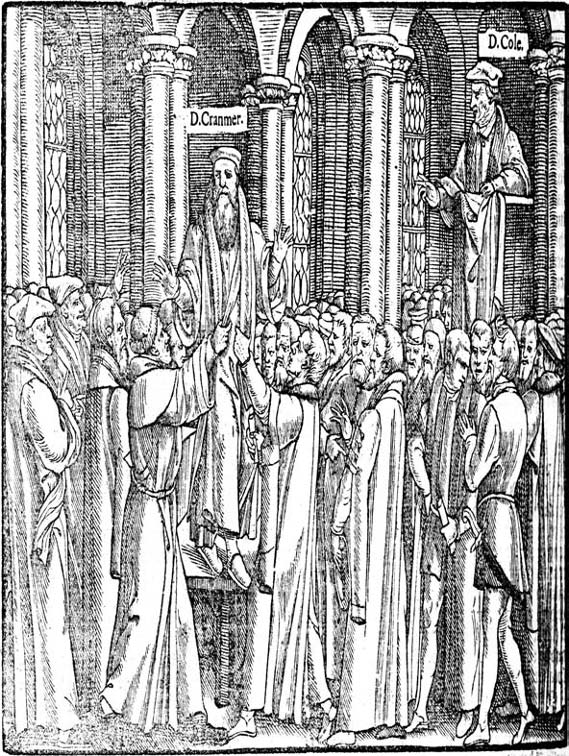
17. Doctor Cranmer, plucked down from the stage
Foxe's Book of Martyrs
profession of his doctrine, gave his hand to certain old men, and other that stood by, bidding them farewell.
And when he had thought to have done so likewise to Ely,* the said Ely drew back his hand and refused, saying: it was not lawful to salute heretics, and specially such a one as falsely returned unto the opinions that he had forsworn. And if he had known before that he would have done so, he would never have used his company so familiarly, and chid those sergeants and citizens, which had not refused to give him their hands. This
Ely was a priest lately made, and student in divinity, being then one of the fellows of Brasenose [College].
Master Ely refuseth to give his hand to the Archbishop.
Then was an iron chain tied about Cranmer, whom when they perceived to be more steadfast than that he could be moved from his sentence, they commanded the fire to be set unto him.
The Archbishop tied to the stake.
And when the wood was kindled, and the fire began to burn near him, stretching out his arm, he put his right hand into the flame: which he held so steadfast and immoveable (saving that once with the same hand he wiped his face) that all men might see his hand burned before his body was touched. His body did so abide the burning of the flame with such constancy and steadfastness, that standing always in one place without moving of his body, he seemed to move no more than the stake to which he was bound: his eyes were lifted up into heaven, and oftentimes he repeated his unworthy right hand, so long as his voice would suffer him: and using often the words of Steven,
'Lord Jesus, receive my spirit,'* in the greatness of the flame, he gave up the ghost. . . .
Cranmer putteth his right hand which subscribed first into the fire.
The last words of Cranmer at his death.
And thus have you the full story concerning the life and death of this reverend Archbishop and martyr of God, Thomas
Cranmer, and also of diverse other the learned sort of Christ's martyrs burned in Queen Mary's time, of whom this Archbishop was the last, being burnt about the very middle time of the reign of that Queen, and almost the very middle man of all the martyrs which were burned in all her reign besides.
Archbishop Cranmer the middle martyr of all the martyrs burnt in Queen Mary's time.
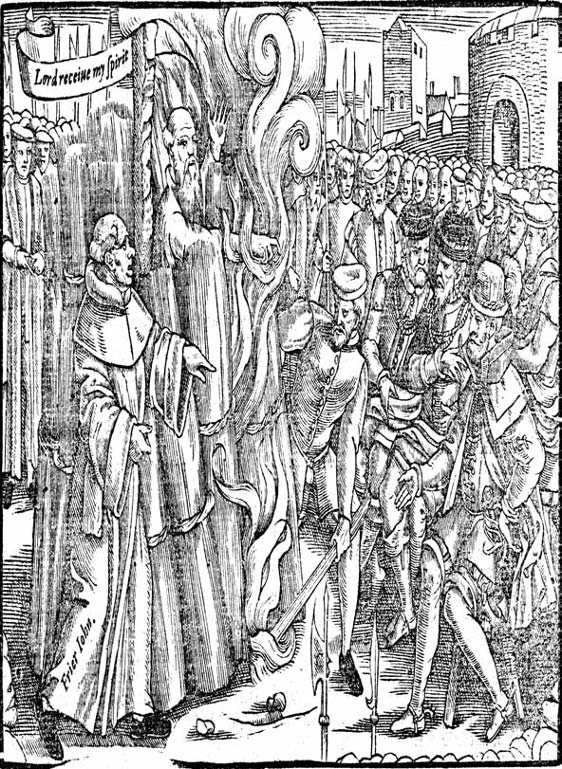
18. Cranmer, in the town dirch at Oxford, with his hand fi rst thrust into the fi re