
25. The Islington Martyrs
25. THE ISLINGTON MARTYRS
The order and occasion of taking certain godly men and women praying together in the fields about Islington, of whom thirteen were condemned by Bonner, and after suffered in the fire for the truth's sake, as in the story here following may appear.
Secretly in a back close* in the field by the town of Islington were collected and assembled together a certain company of godly and innocent persons, to the number of forty, men and women, who there sitting together at prayer, and virtuously occupied in the meditation of God's holy word, first cometh a certain man to them unknown: who looking over unto them, so stayed and saluted them, saying that they looked like men that meant no hurt. Then one of the said company asked the man, if he could tell whose close that was, and whether they might be so bold there to sit. 'Yes,' said he, 'for that ye seem unto me such persons as intend no harm,' and so departed. Within a quarter of an hour after, cometh the constable of Islington, named King, warded with six or seven other, accompanying him in the same business, one with a bow, another with a bill, and other with their weapons likewise. The which six or seven persons the said constable left a little behind him in a close place, there to be ready if need should be while he with one with him should go and view them before. Who so doing, came through them, looking and viewing what they were doing, and what books they had: and so going a little forward, and returning back again, had them deliver their books. They understanding that he was constable, refused not so to do. With that cometh forth the residue of his fellows above touched, who had them stand and not to depart. They answered again [that] they would be obedient and ready to go whither so ever they would have them: and so were they first carried to a brewhouse but a little way off, while that some of the said soldiers ran to the Justice next at hand. But the Justice was not at home: whereupon they were had to Sir Roger Cholmley. In the mean time
June 27.
Twenty-two men taken.
Thirteen martyrs burned.
King constable of Islington.
The Islington Martyrs
some of the women being of the same number of the foresaid forty persons, escaped away from them, some in the close, some before they came to the brewhouse. For so they were carried ten with one man, eight with another, and with some more, with some less, in such sort that it was not hard for them to escape that would. In fine, they that were carried to Sir
Roger Cholmley, were twenty-seven, which Sir Roger Cholmley and the recorder* taking their names in a bill, and calling them one by one so many as answered to their names, they sent to Newgate.
Sir Roger Cholmley, and Recorder of London, persecutors.
. . . These twenty-two were in the said prison of Newgate seven weeks before they were examined, to whom word was sent by Alexander the keeper, that if they would hear a Mass, they should all be delivered. . . .
Ye heard before of those twenty-two taken at Islington, thirteen were burned, and six escaped, albeit very hardly, and some of them not without scourging by the hands of the bishop. In the which number was Thomas Hinshaw and John
Milles, according to the express picture hereafter purported. . . .
[Poem Concerning the Likeness of Bonner] Muse not so much, that nature's work is thus deformed now, With belly blown, and head so swollen, for I shall tell you how:
This cannibal in three years' space three hundreth martyrs slew:
They were his food, he loved so blood, he spared none he knew.
It should appear that blood feeds fat, if men lie well and soft:
For Bonner's belly waxed with blood, though he seemed to fast oft.
O bloody beast, bewail the death of those that thou hast slain:
In time repent, since thou canst not their lives restore again.
G. G.
Foxe's Book of Martyrs
The scourging of Thomas Hinshaw In the godly number above mentioned, which were apprehended at Islington, there congregated together for their exercise of prayer and reading, was this Thomas Hinshaw above named, a young man of the age of nineteen or twenty years, prentice in Paul's churchyard with one Master Pugson. Who with the rest was carried to the constable's of Islington, and there every one of them searched, and led forthwith to the chief Justice Master
Cholmley, dwelling in the Old Bailey in London, and by him then the said Thomas Hinshaw was sent to Newgate, and there remaining prisoner without conference with any, about eight weeks, at the last was sent for to Bonner Bishop of London, and by him, Harpsfield and Cole* examined. After which examination he was sent to Newgate again, where he remained a three weeks following. Which time being over passed, he was sent for again before the said bishop, the day being Saturday, and with him had much talk to little purpose. The next day after also, which was Sunday, they persuaded with him very much in like manner, and perceiving they could not bend him unto their bow, in the afternoon, the Bishop going unto Fulham, took him with him, where immediately after his coming, he was set in the stocks, remaining there all the first night with bread and water.
The story of Thomas Hinshaw.
W. Cholmley Justice.
Bonner, Harpsfield, and Cole.
Hinshaw carried to Fulham and there set in the stocks with bread and water.
The next morning the bishop came and examined him himself, and perceiving no yielding to his mind, he sent Master
Harpsfield to talk with him: who after long talk, in the end fell to raging words, calling the said Thomas Hinshaw 'peevish boy,' and asked him whether he thought he went about to damn his soul, or no, et cetera. Unto which the said Thomas answered, that he was persuaded that they laboured to maintain their dark and devilish kingdom, and not for any love to truth. Then Harpsfield being in a mighty rage, told the bishop thereof. Whereat the bishop fumed and fretted, that scant for anger being able to speak,* he said: 'Doest thou answer my
Archdeacon so, thou naughty boy? I shall handle thee well enough, be assured': so he sent for a couple of rods, and caused him to kneel against a long bench in an arbour in his garden, where the said Thomas without any enforcement of his part, offered himself to the beating, and did abide the fury of the said Bonner, so long as the fat-paunched Bonner could endure
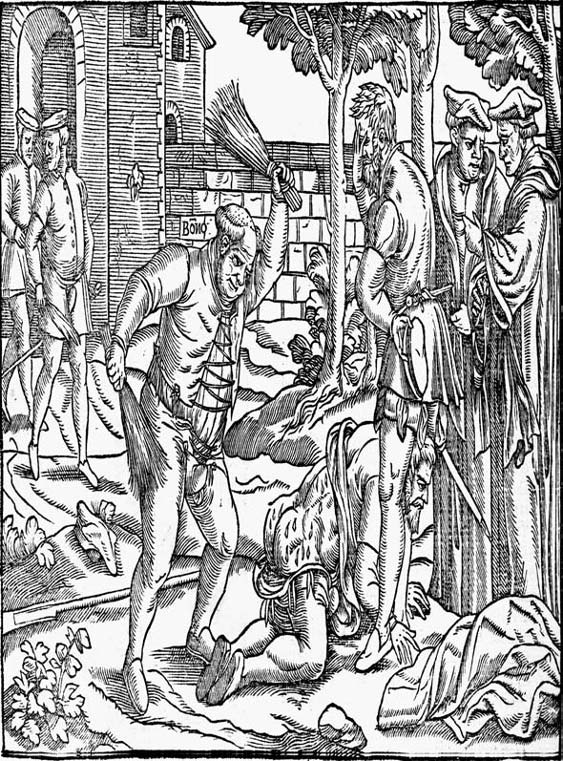
21. Bonner, scourging God's saints in his orchard at Fulham
Foxe's Book of Martyrs
with breath, and till for weariness he was fain to cease, and give place to his shameful act. He had two willow rods, but he wasted but one, and so left off.
Hinshaw beaten with rods. The boy was beholding Now after this scourging, the said Thomas Hinshaw notwithstanding did sustain diverse conflicts and examinations sundry times. At last being brought before the said bishop in his chapel at Fulham, there he had procured witnesses, and gathered articles against him, which the young man denied, and would not affirm, or consent to any interrogatory there and then ministered, do what they could. . . . to Bishop Bonner's grand paunch.
Not long after this his examination, about a fortnight or such a thing, the foresaid examinate fell sick of a burning ague, whereby he was delivered upon entreaty unto his master
Martin Pugson in Paul's Churchyard aforesaid: for the bishop thought verily, he was more like to die than to live. The which his sickness endured a twelvemonth or more, so that in the mean time Queen Mary died. Then he shortly after recovered health, and escaped death, being at the writing of this yet alive, both witness and reporter of the same, the Lord therefore be praised, Amen.
Thomas Hinshaw delivered to Master Pugson his master.
The scourging of John Milles by Bishop Bonner.
Besides the above named, was scourged also by the hands of the said bishop one John Milles a capper,* a right faithful and true honest man in all his dealings and conditions. . . . And being brought before Bonner and there examined, was commanded to the coal house, with the foresaid Thomas Hinshaw, where they remained one night in the stocks. From thence he was sent to Fulham, where he with the said Hinshaw, remained eight or ten days in the stocks: during which time he sustained diverse conflicts with the said Bonner, who had him oft times in examination, urging him, and with a stick which he had in his hand, oft times rapping him on the head, and flirting him* under the chin and on the ears, saying he looked down like a thief. Moreover, after he had assayed all manner of ways to cause him to recant and could not, at length having him to his orchard, there within a little arbour, with his own hands beat him first with a willow rod, and that being worn well nigh to The story of John Milles capper.
John Milles with Thomas Hinshaw laid in the stocks at Fulham.
The Islington Martyrs
the stumps, he called for a birchen rod, which a lad brought out of his chamber. The cause why he so beat him, was this:
Bonner asked him when he had crept to the cross.* He an swered, not since he came to the years of discretion, neither would to be torn with wild horses. Then Bonner bade him make a cross in his forehead, which he refused to do. Whereupon he had him incontinently to his orchard, and there calling for rods, showeth his cruelty upon him, as he did upon Thomas
Hinshaw, as is above declared.
Hinshaw and Milles beaten of Bonner.
This done, he had him immediately to the parish church of Fulham with the said Thomas Hinshaw, and with Robert
Willis, to whom there being severally called before him, he ministered certain Articles, asking if they would subscribe to the same. To the which the said John Milles made his answer according to his conscience, denying them all, except one article which was concerning King Edward's service in English.*
Shortly after this beating, Bonner sent to him in prison a certain old priest lately come from Rome to conjure out the evil spirit from him, who laying his hand upon his head, began with certain words pronounced over him, to conjure as he had been wont before to do. Milles marvelling what the priest was about to do, said he trusted no evil spirit to be within him, and laughed him to scorn, et cetera.
John Milles denyeth to subscribe to Bishop Bonner's articles.
An old conjuring priest.
As this John Milles was diverse times and oft called before Bonner, so much communication and talk passed between them, which to recite all, it were too long. And yet it were not unpleasant for the reader that lusteth to laugh, to see the blind and unsavoury reasons of that bishop which he used to persuade the ignorant withal. As in the process of his other talk with this
Milles, Bonner going about to persuade him not to meddle with matters of the scripture, but rather to believe other men's teaching, which had more skill in the same: first asked if he did believe the scripture: 'Yea,' said he, 'that I do.' Then the bishop: 'Why,' (quoth he). 'St Paul saith: "if the man sleep, the woman is at liberty to go to another man." If thou were asleep having a wife, wouldst thou be content thy wife to take another man? And yet this is the scripture.
The unsavoury reasons or talk of Bishop Bonner going about to persuade John Milles.
'Item,* if thou wilt believe Luther, Zwingli, and such, then thou canst not go right. But if thou wilt believe me, et cetera,
Foxe's Book of Martyrs
thou canst not err. And if thou shouldest err, yet thou art in no peril, thy blood should be required at our hands. As if thou shouldest go to a far country, and meet with a fatherly man as I am,' (for these were his terms), 'and ask the way to the head city, and he should say, "go this way," and thou wilt not believe him, but follow Luther and other heretics of late days, and go a contrary way, how wilt thou come to the place thou askest for? so if thou wilt not believe me, but follow the leading of other heretics, so shalt thou be brought to destruction, and burn both body and soul.
Bonner's judgement, that we should trust more to men, than to the scriptures of God.
This similitude holdeth κατά τήν ἐναντίωσιν.* 'As truly as thou seest the bodies of them in Smithfield burnt, so truly their souls do burn in hell, because they err from the church.'
Rash and presumptuous judgement of Oft times speaking to the said John Milles, he would say:
'they call me, "bloody Bonner." A vengeance on you all. I would fain be rid of you, but you have a delight in burning. But if I might have my will, I would sow your mouths, and put you in sacks, and drown you.'
Bonner.
Bishop Bonner's wish in punishing God's saints.
Now somewhat to say concerning the deliverance of the said John Milles, the same day that he was delivered, Bonner came unto the stocks where he lay, and asked him how he liked his lodging, and his fare.
The occasion and manner of delivering John Milles.
'Well,' said Milles, 'if it would please God I might have a little straw to lie or sit upon.'
Then said Bonner: 'thou wilt show no token of a Christian man'. And upon this his wife came in unknowing unto him, being very great with child, and looking every hour for her lying down, entreating the bishop for her husband, and saying, that she would not go out of the house, but there would lay her belly in the bishop's house, unless she had her husband with her. 'How sayst you,' (quoth Bonner), 'thou heretic? If thy wife miscarry, or thy child, or children, if she be with one, or two, should perish, the blood of them would be required at thy hands.' Then to this agreement he came, that he should hire a bed in the town of Fulham and her husband should go home with her the morrow after, upon this condition, that his kinsman there present (one Robert Rouse) should bring the said
Milles unto his house at Paul's the next day.
Milles's wife entreateth for her husband.
Robert Rouse kinsman to John Milles.
The Islington Martyrs
Whereunto the said Milles said he would not agree, except he might go home by and by. At length his wife being importunate for her husband, and seeing that she would go no further, but there remain unless she had her husband with her, the bishop fearing belike the rumour which might come upon his house thereby, bade the said Milles make a cross and say: 'In nomine patris et filii, et spiritus sancti.* Amen.'
The condition put to John Milles to say, 'In nomine patris', et cetera.
Then the said Milles began to say: 'In the name of the Father, and of the Son, and of the holy ghost, Amen.' 'No, no,' saith Bonner, 'say it me in Latin,* "In nomine patris, et filii, et spiritus sancti," Amen.' Milles understanding the matter of that Latin to be but good, said the same, and so went home with his wife, his foresaid kinsman being charged to bring him the next day unto Paul's, 'either else,' said Bonner, 'if thou doest not bring him, thou art an heretic as well as he.' Notwithstanding, the charge being no greater, this kinsman did not bring him, but he of his own voluntary accord came to the said bishop within a few days after, where the bishop put unto him a certain writing in Latin to subscribe unto, containing as it seemed to him no great matter, that he needed greatly to stick at: albeit, what the bill was, he could not certainly tell. So subscribed he to the bill, and returned home. And thus much concerning the twenty-two taken at Islington.
John Milles sent home with his wife.