
6. John Hooper
6. JOHN HOOPER
The Life and Martyrdom of Master John Hooper, Bishop of Worcester and Gloucester, burnt for the defence of the gospel at Gloucester.
Anno 1555. February 9.
John Hooper student and graduate in the University of Oxford, after the study of other sciences, wherein he had abundantly profited and proceeded, through God's secret vocation was stirred with fervent desire to the love and knowledge of the scriptures. In the reading and searching whereof, as there lacked in him no diligence, joined with earnest prayer: so neither wanted unto him the grace of the Holy Ghost to satisfy his desire, and to open unto him the light of true divinity.
The story, life, and martyrdom of Master John Hooper martyr.
Thus Master Hooper growing more and more by God's grace, in ripeness of spiritual understanding, and showing withal some sparkles of his fervent spirit being then about the beginning of the Six Articles,* in the time of King Henry the eighth, fell eftsoons into displeasure and hatred of certain rabbis* in Oxford, who by and by began to stir coals against him, whereby, and especially by the procurement of Doctor
Smith, he was compelled to void the University, and so removing from thence, was retained in the house of Sir Thomas
Arundel,* and there was his steward, till the time that Sir Thomas Arundel having intelligence of his opinions and religion, which he in no case did favour, and yet exceedingly favouring the person and conditions of the man, found the means to send him in a message to the Bishop of Winchester, writing his letter privily to the bishop, by conference of learning to do some good upon him, but in any case requiring him to send home his servant to him again.
Master Hooper sent to the Bishop of Winchester.
Winchester after long conference with Master Hooper four or five days together, when he at length perceived that neither he could do that good, which he thought, to him, nor that he would take any good at his hand, according to Master Arundel's request, he sent home his servant again, right well condemning
Foxe's Book of Martyrs
his learning and wit, but yet bearing in his breast a grudging stomach against Master Hooper still.
It followed not long after this (as malice is always working mischief) that intelligence was given to Master Hooper to provide for himself, for danger that was working against him.
Whereupon Master Hooper leaving Master Arundel's house, and borrowing a horse of a certain friend (whose life he had saved a little before from the gallows) took his journey to the seaside, to go to France, sending back the horse again by one, which indeed did not deliver him to the owner. Master Hooper being at Paris tarried there not long, but in short time returned into England again, and was retained of Master Sentlow, till the time that he was again molested and laid for:* whereby he was compelled (under the pretence of being captain of a ship going to Ireland) to take the seas, and so escaped he (although not without extreme peril of drowning) through France, to the higher parts of Germany.* Where he entering acquaintance with the learned men, was of them friendly and lovingly entertained, both at Basle, and especially at Zurich of Master
Bullinger, being his singular friend. Where also he married his wife, which was a Burgundian, and applied very studiously the Hebrew tongue.
Master Hooper forced to avoid the house of Sir Thomas Arundel.
Master Hooper flyeth again out of England.
Great friendship between Master Bullinger and At length when God saw it good to stay the bloody time of the Six Articles, and to give us King Edward to reign over this realm, with some peace and rest unto the gospel, amongst many other English exiles,* which then repaired homeward,
Master Hooper also, moved in conscience, thought not to absent himself, seeing such a time and occasion offered to help forward the Lord's work, to the uttermost of his ability. And so coming to Master Bullinger, and other of his acquaintance in Zurich (as duty required) to give them thanks for their singular kindness and humanity toward him manifold ways declared, with like humanity again purposed to take his leave of them at this departing, and so did. . . .
Master Hooper.
To this also may be added another like prophetical demonstration, forshowing before the manner of his martyrdom wherewith he should glorify God, which was this. When
Master Hooper being made Bishop of Worcester and Gloucester should have his arms given him by the herald, as the manner is
A note of Master Hooper's arms presignifying his martyrdom.
John Hooper
here in England, every bishop to have his arms assigned unto him (whether by the appointment of Master Hooper, or by the herald I have not certainly to say) but the arms which were to him allotted was this: a lamb in a fiery bush, and the sun beams from heaven descending down upon the lamb, rightly denoting
(as it seemed) the order of his suffering, which afterward followed.
But now to the purpose of our story again: thus when Master Hooper had taken his farewell of Master Bullinger and his friends in Zurich, he made his repair again into England in the reign of King Edward VI, where he coming to London used continually to preach, most times twice, at least once every day, and never failed.
Master Hooper returneth again into England.
In his sermons, according to his accustomed manner, he corrected sin, and sharply inveighed against the iniquity of the world, and corrupt abuses of the church. The people in great flocks and companies, daily came to hear his voice, as the most melodious sound and tune of Orpheus's harp,* as the proverb saith: insomuch that oftentimes, when he was preaching, the church should be so full, that none could enter further than the doors thereof. In his doctrine he was earnest, in tongue eloquent, in the scriptures perfect, in pains indefatigable.
The notable diligence of Master Hooper in preaching.
Moreover, besides other his gifts and qualities, this is in him to be marvelled, that even as he began so he continued still unto his life's end. For neither could his labour and pain taking break him, neither promotion change him, neither dainty fare corrupt him. His life was so pure and good, that no kind of slander (although diverse went about to reprove it) could fasten any fault upon him. He was of body strong, his health whole and sound, his wit very pregnant, his invincible patience able to sustain whatsoever sinister fortune and adversity could do. He was constant of judgement, a good justicer, spare of diet, sparer of words, and sparest of time. In housekeeping very liberal,* and sometime more free than his living would extend unto. Briefly, of all those virtues and qualities required of Saint Paul in a good bishop in his epistle to Timothy,*
I know not one in this good bishop lacking. He bare in countenance and talk always a certain severe and grave grace, which might peradventure be wished sometimes to have been a little
The singular virtues of Master Hooper described.
Foxe's Book of Martyrs
more popular and vulgar-like in him: but he knew what he had to do best himself.
This by the way I thought to note, for that there was once an honest citizen, and to me not unknown, which having in himself a certain conflict of conscience, came to his door for counsel: but being abashed at his austere behaviour durst not come in, but departed, seeking remedy of his troubled mind at other men's hands, which he afterward by the help of almighty God did find and obtain. Therefore in my judgement, such as are appointed and made governors over the flock of Christ, to teach and instruct them, ought so to frame their life, manners, countenance and external behaviour, as neither they show themselves too familiar and light whereby to be brought in contempt, nor in the other side again, that they appear more lofty and rigorous, than appertaineth to the edifying of the simple flock of Christ. Nevertheless, as every man hath his peculiar gift wrought in him by nature, so this disposition of fatherly gravity in this man neither was excessive, neither did he bear that personage which was in him without great consideration. For it seemed to him peradventure, that this licentious and unbridled life of the common sort, ought to be chastened, not only with words and discipline, but also with the grave and severe countenance of good men.
Discretion how ministers and preachers ought to behave themselves.
After he had thus practised himself in this popular and common kind of preaching: at length, and that not without the great profit of many, he was called to preach before the king's majesty, and soon after, made Bishop of Gloucester by the king's commandment. In that office he continued two years, and behaved himself so well, that his very enemies (except it were for his good doings, and sharp correcting of sin) could find no fault with him: and after that he was made Bishop of Worcester.
Master Hooper made Bishop of Gloucester and Worcester.
But I cannot tell what sinister and unlucky contention concerning the ordering and consecration of bishops, and of their apparel, with such other like trifles, began to disturb the good and lucky beginning of this godly bishop.* For notwithstanding that godly reformation of religion then begun in the church of England, besides other ceremonies more ambitious than profitable or tending to edification, they used to wear such garments and
John Hooper
apparel as the popish bishops were wont to do: first a chimere, and under that a white rochet: then a mathematical cap with four angles, dividing the whole world into four parts.* These trifles tending more to superstition than otherwise, as he could never abide, so in no wise could he be persuaded to wear them.
For this cause he made supplication to the king's majesty, most humbly desiring his highness either to discharge him of the bishopric, or else to dispense with him for such ceremonial orders. Whose petition the king granted immediately, writing his letter to the Archbishop.* . . .
Popish attire.
Both this grant of the king, and also the Earl's letters aforesaid notwithstanding, the bishops still stood earnestly in the defence of the foresaid ceremonies, saying it was but a small matter, and that the fault was in the abuse of the things, and not in the things themselves:* adding moreover, that he ought not to be so stubborn in so light a matter, and that his wilfulness therein was not to be suffered. . . .
The king's request nor the Earl's could take effect.
Master Hooper after all these tumults and vexations sustained about his investing and priestly vestures, at length entering into his diocese, did there employ his time which the Lord lent him under King Edward's reign, with such diligence, as may be a spectacle to all bishops, which shall ever hereafter succeed him, not only in that place, but in whatsoever diocese through the whole realm of England, so careful was he in his cure, that he left neither pains untaken, nor ways unsought, how to train up the flock of Christ in the true word of salvation, continually labouring in the same. Other men commonly are wont for lucre or promotions' sake, to aspire to bishoprics, some hunting for them, and some purchasing or buying them, as men use to purchase lordships, and when they have them, are loath to leave them, and thereupon also loath to commit that thing by worldly laws, whereby to lose them.
To this sort of men Master Hooper was clean contrary, who abhorred nothing more than gain, labouring always to save and preserve the souls of his flock. Who being bishop of two dioceses, so ruled and guided either of them, and both together, as though he had in charge but one family. No father in his household, no gardener in his garden, nor husbandman in his vineyard, was more or better occupied, than he in his diocese
The diligent care of Bishop Hooper in his diocese.
Foxe's Book of Martyrs
amongst his flock, going about his towns and villages in teaching and preaching to the people there.
That time that he had to spare from preaching, he bestowed either in hearing public causes, or else in private study, prayer, and visiting of schools, with his continual doctrine, he adjoined due and discrete correction, not so much severe to any, as to them which for abundance of riches, and wealthy state, thought they might do what they listed. And doubtless he spared no kind of people, but was indifferent to all men, as well rich as poor, to the great shame of no small number of men nowadays.
Whereof many we do see so addicted to the pleasing of great and rich men, that in the mean time they have no regard to the meaner sort of poor people, whom Christ hath bought as dearly as the other.
Master Hooper bishop of two dioceses.
Master Hooper a light to all churchmen.
But now again we will return our talk to Master Hooper, all whose life in fine* was such, that to the church and all churchmen it might be a light and example, to the rest a perpetual lesson and sermon. Finally, how virtuous and good a bishop he was, ye may conceive and know evidently by this: that even as he was hated of none but of them which were evil, so yet the worst of them all could not reprove his life in any one jot.
I have now declared his usage and behaviour abroad in the public affairs of the church: and certainly there appeared in him at home no less example of a worthy prelate's life. For although he bestowed and converted the most part of his care upon the public flock and congregation of Christ, for the which also he spent his blood: yet nevertheless there lacked no provision in him, and to bring up his own children in learning and good manners: even so much that ye could not discern whether he deserved more praise for his fatherly usage at home, or for his bishoply doings abroad. For everywhere he kept one religion in one uniform doctrine and integrity. So that if you entered into the bishop's palace, you would suppose to have entered in to some church or temple. In every corner thereof, there was some smell of virtue, good example, honest conversation, and reading of holy scriptures. There was not to be seen in his house any courtly roisting or idleness: no pomp at all, no dishonest word, no swearing could there be heard.
The order and governance of Master Hooper's house.
The care of Master Hooper in instructing his family.
John Hooper
As for the revenues of both his bishoprics, although they did not greatly exceed, as the matter was handled, yet if anything surmounted thereof, he pursed nothing, but bestowed it in hospitality. Twice I was (as I remember) in his house in Worcester, where in his common hall I saw a table spread with good store of meat, and beset full of beggars and poor folk: and I asking his servants what this meant, they told me that every day their Lord and master's manner was, to have customably to dinner a certain number of poor folk of the said city by course, who were served by four at a mess,* with hot and wholesome meats: and when they were served (being afore examined by him or his deputies of the Lord's Prayer, the articles of their faith, and Ten Commandments) then he himself sat down to dinner, and not before.
The hospitality of Master Hooper.
After this sort and manner Master Hooper executed the office of a most careful and vigilant pastor, by the space of two years and more, so long as the state of religion in King
Edward's time did safely flourish and take place: and would God that all other bishops would use the like diligence, care, and observance in their function. After this, King Edward being dead, and Mary being crowned queen of England, religion being subverted and changed, this good bishop was one of the first that was sent for by a pursuivant to be at London, and that for two causes.
Master Hooper called up to London at Queen Mary's coming in.
First, to answer to Doctor Heath then appointed bishop of that diocese, who was before in King Edward's days deprived thereof for papistry.
Two causes why Master Hooper was called up.
Secondarily, to render account to Doctor Bonner Bishop of London, for that he in King Edward's time was one of his accusers, in that he showed himself not conformable to such ordinances as were prescribed to him by the king and his
Council, openly at Paul's Cross. And although the said Master Hooper was not ignorant of the evils that should happen towards him (for he was admonished by certain of his friends to get him away and shift for himself) yet he would not prevent them, but tarried still, saying: 'Once I did flee and took me to my feet, but now, because I am called to this place and vocation, I am thoroughly persuaded to tarry, and to live and die with my sheep.'
Foxe's Book of Martyrs
And when at the day of his appearance (which was the first of September) he was come to London, before he could come to the foresaid Doctor Heath and Bonner, he was intercepted and commanded violently against his will to appear before the queen and her Council, to answer to certain bonds and obligations, wherein they said he was bound unto her. And when he came before them, Winchester by and by received him very opprobriously, and railing and rating of him, accused him of * religion. He again freely and boldly told his tale, and purged himself. But in fine it came to this conclusion, that by them he was commanded to ward (it being declared unto him by his departure, that the cause of his imprisonment was only for certain sums of money, for the which he was indebted to the queen, and not for religion.) This how false and untrue it was, shall hereafter in his place more plainly appear.
Master Hooper refused to fly away.
Master Hooper cometh up to London.
Master Hooper charged to answer the queen for bonds of debt.
The next year, being 1554 the nineteenth of March, he was called again to appear before Winchester and other the queen's commissioners: where, what for the bishop, and what for the unruly multitude, when he could not be permitted to plead his cause, he was deprived of his bishoprics. . . .
Master Hooper commanded to ward.
Master Hooper deprived of his [Following further interrogation, Hooper returned to prison, where he wrote the following account of his incarceration.] bishoprics.
The true report of Master Hooper's entertainment in the Fleet, written with his own hand, the seventh of January 1554.
The first of September, 1553. I was committed unto the Fleet, from Richmond, to have the liberty of the prison: and within six days after, I paid for my liberty five pounds sterling to the warden for fees: who immediately upon the payment thereof, complained unto Stephen Gardiner Bishop of Winchester, and so was I committed to close prison* one quarter of a year, in the tower chamber of the Fleet, used very extremely. Then by the means of a good gentlewoman, I had liberty to come down to dinner and supper, not suffered to speak with any of my friends: but as soon as dinner and supper was done, to repair to my chamber again. Notwithstanding whilst I came down thus to dinner and supper, the warden and his wife picked
Master Hooper's report of his imprisonment in the Fleet This good gentlewoman is thought to be Mistress Wilkinson.
John Hooper
quarrels with me, and complained untruly of me, to their great friend the bishop of Winchester.
After one quarter of a year and somewhat more. Babington the Warden and his wife fell out with me for the wicked Mass: and thereupon the warden resorted to the bishop of Winchester and obtained to put me into the wards, where I have continued a long time, having nothing appointed to me for my bed, but a little pad of straw, and a rotten covering with a tick and a few feathers therein, the chamber being vile and stinking, until by God's means good people sent me bedding to lie in. Of the one side of which prison is the sink and filth of the house, and on the other side the town ditch, so that the stench of the house hath infected me with sundry diseases.
Babington warden of the Fleet a wicked tyrant to God's people.
During which time I have been sick: and the doors, bars, hasps, and chains being all closed, and made fast upon me,
I have mourned, called and cried for help. But the warden when he hath known me many times ready to die, and when the poor men of the wards have called to help me, hath commanded the doors to be kept fast, and charged that none of his men should come at me, saying: 'Let him alone, it were a good riddance of him.' And among many other times, he did thus the eighteenth of October, 1553, as many can witness.
The barbarous cruelty of the warden of the Fleet.
I paid always like a baron to the said warden, as well in fees, as for my board, which was twenty shillings a week, besides my man's table,* until I was wrongfully deprived of my bishopric, and since that time I have paid him as the best gentleman doth in his house: yet hath he used me worse and more vilely, than the veriest slave* that ever came to the hall commons.
The said warden hath also imprisoned my man William Downton, and stripped him out of his clothes to search for letters, and could find none but only a little remembrance of good people's names, that gave me their alms to relieve me in prison: and to undo them also, the warden delivered the same bill unto the said Stephen Gardiner, God's enemy and mine.
William Downton Master Hooper's man.
I have suffered imprisonment almost eighteen months, my goods, living, friends, and comfort taken from me, the queen owing me by just account eighty pounds or more. She hath put me in prison, and giveth nothing to find me, neither is there suffered any to come at me, whereby I might have relief. I am
Master Hooper eighteen months in prison. Queen Mary indebted to Master Hooper.
Foxe's Book of Martyrs
with a wicked man and woman, so that I see no remedy (saving God's help) but I shall be cast away in prison before I come to judgement. But I commit my just cause to God, whose will be done, whether it be by life or death. Thus much wrote he himself of this matter. . . .
[Following further examination concerning heresy, Hooper is deprived of his episcopal office in the following manner.]
Here followeth the form and manner used in the disgrading of Bishop Hooper The fourth day of February, the year above mentioned, in the chapel in Newgate, the Bishop of London there sitting with his notary and certain other witnesses, came Alexander Andrew the jailer, bringing with him Master Hooper and Master
Rogers, being condemned before by the chancellor: where the said Bishop of London, at the request of the foresaid Winchester, proceeded to the degradation of the parties above mentioned,
Master Hooper and Master Rogers, after this form and manner.
First, he put upon them all the vestures and ornaments belonging to a priest, with all other things to the same order appertaining, as though (being re-vested) they should solemnly execute in their office. Thus they being apparelled and invested, the bishop beginneth to pluck off, first the uttermost vesture, and so by degree and order coming down to the lowest vesture, which they had only in taking benet and collet: and so being stripped and deposed, he deprived them of all order, benefit and privilege belonging to the clergy: and consequently, that being done, pronounced, degreed, and declared the said parties so disgraded, to be given personally to the secular power, as the sheriffs being for that year, Master Davy
Woodruff, and Master William Chester: who, receiving first the said Master Rogers at the hands of the bishop had him away with them, bringing him to the place of execution where he suffered. . . .
The form and manner of disgrading Bishop Hooper.
Alexander Andrew jailer of Newgate, a cruel enemy to God's people.
Master Hooper and Master Rogers disgraded together.
Davy Woodruff, William Chester sheriffs.
The same Monday at night being the fourth of February, his keeper gave him an inkling that he should be sent to Gloucester to suffer death, whereat he rejoiced very much, lifting up his eyes and hands into heaven, and praising God that he saw it good to send him amongst the people, over whom he
John Hooper
was pastor, there to confirm with his death the truth which he had before taught them: not doubting but the Lord would give him strength to perform the same to his glory: and immediately he sent to his servant's house for his boots, spurs, and cloak, that he might be in a readiness to ride when he should be called.
Master Hooper glad that he should suffer amongst his own flock.
The next day following, about four of the clock in the morning before day, the keeper with others came to him and searched him, and the bed wherein he lay, to see if he had written anything, and then he was led by the sheriffs of London and other their officers forth of Newgate, to a place appointed not far from Saint Dunstan's Church in Fleet Street, where six of the queen's guard were appointed to receive him and to carry him to Gloucester, there to be delivered unto the sheriff, who with the Lord Chandos,* Master Wickes, and other commissioners were appointed to see execution done. The which guard brought him to the Angel,* where he brake his fast with them, eating his meat at that time more liberally than he had used to do a good while before. About the break of the day he went to horse, and leapt cheerfully on horseback without help, having a hood upon his head under his hat that he should not be known, and so took his journey joyfully towards Gloucester, and always by the way the guard learned of him where he was accustomed to bait or lodge, and ever carried him to another inn.
Master Hooper carried to Gloucester to be burned.
Upon the Thursday following, he came to a town in his diocese, called Cirencester, fifteen miles from Gloucester, about eleven of the clock, and there dined at a woman's house which had always hated the truth, and spoken all evil she could of Master Hooper. This woman perceiving the cause of his coming, showed him all the friendship she could and lamented his case with tears, confessing that she before had often reported, that if he were put to the trial, he would not stand to his doctrine.
A woman of Cirencester confirmed by the constancy of Master Hooper, which railed at him before.
After dinner he rode forwards, and came to Gloucester about five of the clock, and a mile without the town was much people assembled which cried and lamented his estate: insomuch, that one of the guard rode post into the town, to require aid of the mayor and sheriffs, fearing lest he should have been taken from them.
Master Hooper cometh to Gloucester.
Foxe's Book of Martyrs
The officers and their retinue repaired to the gate with weapons, and commanded the people to keep their houses, et cetera, but there was no man that once gave any signification of any such rescue or violence. So was he lodged at one Ingram's house in Gloucester, and that night (as he had done all the way) he did eat his meat quietly, and slept his first sleep soundly, as it was reported by them of the guard and others. After his first sleep he continued all that night in prayer until the morning, and then he desired that he might go into the next chamber
(for the guard were also in the chamber where he lay) that there being solitary, he might pray and talk with God: so that all that day, saving a little at meat, and when he talked at any time with such as the guard licensed to speak with him, he bestowed in prayer.
The quiet mind of Master Hooper in his troubles.
Amongst other that spake with him, Sir Anthony Kingston knight, was one. Who seeming in times past his very friend, was then appointed by the queen's letters, to be one of the commissioners, to see execution done upon him. Master
Kingston being brought into the chamber, found him at his prayer, and as soon as he saw Master Hooper, he burst forth in tears. Master Hooper at the first blush knew him not. Then said Master Kingston, 'Why my Lord, do ye not know me an old friend of yours, Anthony Kingston?'
Sir Anthony Kingston cometh to Master Hooper.
. . . After these and many other words, the one took leave of the other, Master Kingston with bitter tears, Master Hooper with tears also trickling down his cheeks. At which departure
Master Hooper told him that all the troubles he had sustained in prison, had not caused him to utter so much sorrow.
The same day in the afternoon, a blind boy, after long intercession made to the guard, obtained licence to be brought unto
Master Hooper's speech. The same boy not long afore had suffered imprisonment at Gloucester for confessing of the truth. Master Hooper after he had examined him of his faith, and the cause of his imprisonment, beheld him steadfastly and (the water appearing in his eyes) said unto him: 'Ah poor boy, God hath taken from thee thy outward sight, for what consideration he best knoweth: but he hath given thee another sight much more precious: for he hath endued thy soul with the eye of knowledge and faith. God give thee grace
A blind boy cometh to Master Hooper.
God's grace upon a blind boy at Gloucester.
John Hooper
continually to pray unto him, that thou lose not that sight: for then shouldest thou be blind both in body and soul.'
After that another came to him, whom he knew to be a very papist and a wicked man, which appeared to be sorry for Master Hooper's trouble, saying: 'Sir, I am sorry to see you thus.' 'To see me? Why,' (said he) 'art thou sorry?' 'To see you,' (saith the other), 'in this case. For I hear say ye are come hither to die, for the which I am sorry.' 'Be sorry for thyself man,' (said Master Hooper), 'and lament thine own wickedness: for I am well, I thank God, and death to me for Christ's sake is welcome.'
The same night he was committed by the guard (their commission being then expired) unto the custody of the sheriffs of Gloucester. The name of the one was Jenkins, the other Bond, who with the Mayor and Aldermen repaired to Master
Hooper's lodging, and at the first meeting saluted him, and took him by the hand. Unto whom Hooper spake on this manner. 'Master Mayor, I give most hearty thanks to you, and to the rest of your brethren, that you have vouchsafed to take me a prisoner and a condemned man by the hand: whereby to my rejoicing it is some deal apparent that your old love and friendship towards me, is not altogether extinguished: and I trust also, that all the things I have taught you in times past, are not utterly forgotten, when I was here by the godly king that dead is, appointed to be your bishop and pastor. For the which most true and sincere doctrine, because I will not now account it falsehood and heresy, as many other men do, I am sent hither (as I am sure you know) by the queen's commandment, to die, and am come to where I taught it, to confirm it with my blood. And now master sheriffs I understand by these good men, and my very friends, (meaning the guard) at whose hands I have found so much favour and gentleness by the way hitherward, as a prisoner could reasonably require (for the which also I most heartily thank them) that I am committed to your custody, as unto them that must see me brought tomorrow to the place of execution. My request therefore to you shall be only, that there may be a quick fire, shortly to make an end, and in the mean time I will be as obedient unto you, as yourselves would wish. If you think I do amiss in anything, hold up
Master Hooper committed to the sheriffs of Gloucester.
The words of Master Hooper to the Mayor and sheriffs of Gloucester.
Master Hooper's petition to the sheriffs.
Foxe's Book of Martyrs
your finger, and I have done. For I come not hither as one enforced or compelled to die (for it is well known, I might have had my life with worldly gain:) but as one willing to offer and give my life for the truth, rather than to consent to the wicked papistical religion of the Bishop of Rome, received and set forth by the magistrates in England, to God's high displeasure and dishonour: and I trust by God's grace tomorrow to die a faithful servant of God, and a true obedient subject to the queen.'
These and such like words in effect used Master Hooper to the mayor, sheriffs, and aldermen, whereat many of them mourned and lamented. Notwithstanding, the two sheriffs went aside to consult, and were determined to have lodged him in the common gaol of the town called Northgate, if the guard had not made earnest intercession for him: who declared at large how quietly, mildly, and patiently he had behaved himself in the way, adding thereto, that any child might keep him well enough, and that they themselves would rather take pains to watch with him, than that he should be sent to the common prison. So it was determined at the length he should still remain in Robert Ingram's house, and the sheriffs and the sergeants and other officers did appoint to watch with him that night themselves. His desire was that he might go to bed that night betimes, saying that he had many things to remember: and so did at five of the clock, and slept one sleep soundly, and bestowed the rest of the night in prayer. After he gate up in the morning, he desired that no man should be suffered to come into the chamber, that he might be solitary till the hour of execution.
The guard speaking for Master Hooper.
Master Hooper spendeth the night in prayer.
About eight of the clock came Sir John Brydges Lord Chandos, with a great band of men, Sir Anthony Kingston, Sir
Edmund Bridges, and other commissioners appointed to see execution done. At nine of the clock Master Hooper was willed to prepare himself to be in a readiness, for the time was at hand. Immediately he was brought down from his chamber by the sheriffs, who were accompanied with bills, glaives, and weapons. When he saw the multitude of weapons, he spake to the sheriffs on this wise: 'Master sheriffs,' (said he), 'I am no traitor, neither needed you to have made such a business to Sir John Bridges, Lord Shandois, Sir Edmund Bridges, Sir Anthony Kingston, commissioners.
John Hooper
bring me to the place where I must suffer: for if ye had willed me, I would have gone alone to the stake, and have troubled none of you all.' And afterward looking upon the multitude of people which were assembled, being by estimation to the number of seven thousand (for it was market day, and many also come to see his behaviour towards death) he spake unto those that were about him, saying: 'Alas, why be these people assembled and come together? Peradventure they think to hear something of me now, as they have in times past, but alas, speech is prohibited me. Notwithstanding the cause of my death is well known unto them. When I was appointed here to be their pastor, I preached unto them true and sincere doctrine, and that out of the word of God. Because I will not now accompt the same to be heresy and untruth, this kind of death is prepared for me.'
Master Hooper for preaching true doctrine put to death.
So he went forward led between the two sheriffs, (as it were a lamb to the place of slaughter) in a gown of his host's, his hat upon his head, and a staff in his hand to stay himself withal.
For the grief of the sciatica, which he had taken in prison, caused him something to halt. All the way being straightly charged not to speak, he could not be perceived once to open his mouth, but beholding the people all the way which mourned bitterly for him, he would sometimes lift up his eyes towards heaven, and look very cheerfully upon such as he knew: and he was never known during the time of his being amongst them to look with so cheerful and ruddish a countenance as he did at that present. When he came to the place appointed where he should die, smilingly he beheld the stake and preparation made for him, which as near unto the great elm tree over against the college of priests, where he was wont to preach. The place round about the houses, and the bows of the tree were replenished with people, and in the chamber over the college gate stood the priests of the college. Then kneeled he down (forasmuch as he could not be suffered to speak unto the people) to prayer, and beckoned unto him six or seven times whom he knew well, to hear the said prayer, to make report thereof in time to come (pouring tears upon his shoulders and in his bosom), who gave attentive ears unto the same: the which prayer he made upon the whole creed, wherein he continued
Master Hooper forbidden to speak to the people.
His cheerful going to death.
Master Hooper brought to the place of martyrdom.
Foxe's Book of Martyrs
for the space of half an hour. Now after he was somewhat entered into his prayer, a box was brought and laid before him upon a stool, with his pardon (or at the leastwise it was feigned to be his pardon) from the queen, if he would turn.
At the sight thereof he cried: 'If you love my soul, away with it, if you love my soul, away with it.' The box being taken away, the Lord Chandos said: 'Seeing there is no remedy, dispatch quickly.' Master Hooper said: 'Good my Lord, I trust your Lordship will give me leave to make an end of my prayers.'
Master Hooper refuseth the queen's pardon.
. . . Prayer being done, he prepared himself to the stake, and put off his host's gown, and delivered it to the sheriffs, requiring them to see it restored unto the owner, and put off the rest of his gear, unto his doublet and his hose, wherein he would have burned. But the sheriffs would not permit that, (such was their greediness) unto whose pleasures (good man) he very obediently submitted himself: and his doublet, hose, and petticoat were taken off. Then being in his shirt, he took a point from his hose himself, and trussed his shirt between his legs, where he had a pound of gunpowder in a bladder, and under each arm the like quantity delivered him by the guard. So desiring the people to say the Lord's prayer with him, and to pray for him, (who performed it with tears, during the time of his pains) he went up to the stake. Now when he was at the stake, three irons made to bind him to the stake, were brought: one for his neck, another for his middle, and the third for his legs. But he refusing them said: 'Ye have no need thus to trouble yourselves. For I doubt not but God will give strength sufficient to abide the extremity of the fire, without bands: notwithstanding, suspecting the frailty and weakness of the flesh, but having assured confidence in God's strength, I am content ye do as ye shall think good.'
Master Hooper undresseth himself to the fire.
So the hoop of iron prepared for his middle, was brought, which being made somewhat too short (for his belly was swollen by imprisonment) he shrank and put in his belly with his hand, until it was fastened: and when they offered to have bound his neck and his legs with the other two hoops of iron, he utterly refused them, and would have none, saying: 'I am well assured I shall not trouble you.'
Master Hooper bound to the stake.
John Hooper
Thus being ready, he looked upon the people, of whom he might be well seen (for he was both tall, and stood also on an high stool) and beheld round about him: and in every corner there was nothing to be seen but weeping and sorrowful people. Then lifting up his eyes and hands unto heaven, he prayed to himself. By and by he that was appointed to make the fire, came to him, and did ask him forgiveness. Of whom he asked why he should forgive him, saying: that he knew never any offence he had committed against him. 'Oh sir,' (said the man), 'I am appointed to make the fire.' 'Therein,' (said
Master Hooper), 'thou doest nothing offend me: God forgive thee thy sins and do thine office, I pray thee.' Then the reeds were cast up, and he received two bundles of them in his own hands, embraced them, kissed them, and put under either arm one of them, and showed with his hand how the rest should be bestowed, and pointed to the place where any did lack.
The weeping of the people at Master Hooper's burning.
He forgiveth his executioner.
Anon commandment was given that fire should be set to, and so it was. But because there were put to no fewer green faggots than two horses could carry upon their backs, it kindled not by and by, and was a pretty while also before it took the reeds upon the faggots. At length it burned about him, but the wind having full strength in that place (it was also a lowering and a cold morning) it blew the same from him, so that he was in a manner no more but touched by the fire.
Fire put to Master Hooper.
Within a space after, a few dry faggots were brought, and a new fire kindled with faggots, (for there were no more reeds:) and that burned at the nether parts, but had small power above, because of the wind, saving that it did burn his hair and scorch his skin a little. In the time of which fire, even as at the first flame, he prayed, saying mildly and not very loud (but as one without pains:) 'O Jesus the son of David have mercy upon me, and receive my soul.' After the second was spent, he did wipe both his eyes with his hands, and beholding the people, he said with an indifferent loud voice: 'For God's love (good people) let me have more fire.' And all this while his nether parts did burn: for the faggots were so few, that the flame did not burn strongly at his upper parts.
A new fire made to Master Hooper.
Master Hooper calleth for more fire.
The third fire was kindled within a while after, which was more extreme than the other two: and then the bladders of
Foxe's Book of Martyrs
gunpowder brake, which did him small good, they were so placed, and the wind had such power. In the which fire he prayed with somewhat a loud voice: 'Lord Jesu have mercy upon me: Lord Jesu have mercy upon me: Lord Jesus receive my spirit.' And these were the last words he was heard to utter. But when he was black in the mouth, and his tongue swollen, that he could not speak, yet his lips went till they were shrunk to the gums: and he knocked his breast with his hands, until one of his arms fell off, and then knocked still with the other, what time the fat, water, and blood dropped out at his fingers' ends, until by renewing of the fire, his strength was gone, and his hand did cleave fast in knocking to the iron upon his breast. So immediately bowing forwards, he yielded up his spirit. . . .
The last words of Master Hooper.
The blessed martyr long tormented in Thus was he three quarters of an hour or more in the fire.
Even as a lamb, patiently he abode the extremity thereof, neither moving forwards, backwards, or to any side, but having his nether parts burned, and his bowels fallen out, he died as quietly as a child in his bed: and he now reigneth as a blessed martyr in the joys of heaven prepared for the faithful in Christ, before the foundations of the world: for whose constancy all
Christians are bound to praise God. the fire.
The patient end of this holy martyr.
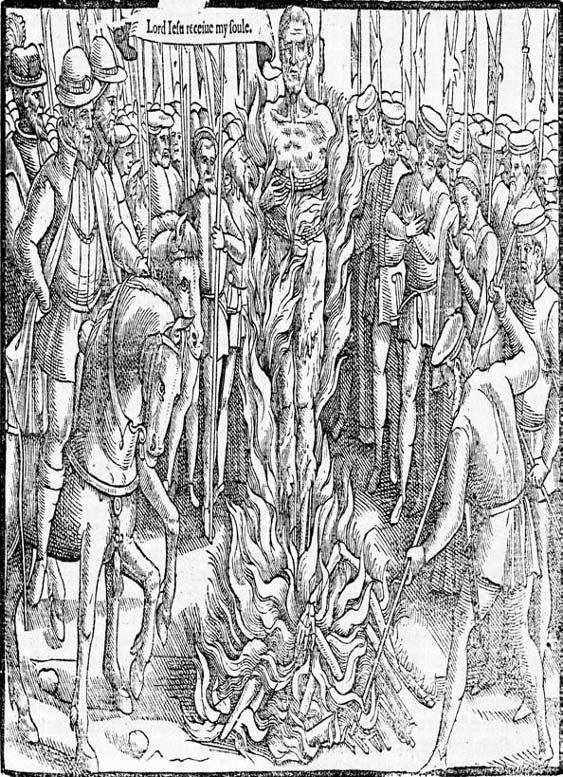
8. The burning of John Hooper, Bishop of Gloucester