
13. JOHN BRADFORD AND: John Leaf
13. JOHN BRADFORD AND
JOHN LEAF
The history of the worthy martyr and servant of God, Master John Bradford, with his life and acts, and sundry conflicts, with his adversaries, and martyrdom at length most constantly suffered for the testimony of Christ and his truth.
As touching first the country and education of John Bradford, he was born at Manchester in Lancashire. His parents did bring him up in learning from his infancy, until he attained such knowledge in the Latin tongue, and skill in writing, that he was able to gain his own living in some honest condition.
Then he became servant to Sir John Harington* knight, who in the great affairs of King Henry the eighth and King Edward the sixth which he had in hand when he was Treasurer of the King's camps and building, at diverse times in Boulogne, had such experience of Bradford's activity in writing, of expertness in the art of auditors, and also of his faithful trustiness, that not only in those affairs, but in many other of his private business he trusted Bradford, in such sort that above all other he used his faithful service.
July 1. The history of Master John Bradford, martyr.
Sir John Harington, knight.
The trusty service of John Bradford under Master Harington.
Thus continued Bradford certain years in a right honest and good trade of life, after the course of this world, like to come forward (as they say) if his mind could so have liked, or had been given to the world as many other be. But the Lord which had elected him unto a better function, and preordained him to preach the gospel of Christ in that hour of grace which in his secret counsel he had appointed, called this his chosen child, to the understanding and partaking of the same gospel of life. In which call, he was so truly taught, that forthwith his effectual call was perceived by the fruits. For then Bradford did forsake his worldly affairs and forwardness in worldly wealth, and after the just accompt given to his master of all his doings, he departed from him, and with marvellous favour to further the kingdom of God by the ministry of his holy word, he gave
Bradford called to the gospel.
Foxe's Book of Martyrs
himself wholly to the study of the holy scriptures. The which his purpose to accomplish the better, he departed from the Temple at London, where the temporal law is studied, and went to the University of Cambridge, to learn by God's law how to further the building of the Lord's Temple. In Cambridge his diligence in study, his profiting in knowledge and godly conversation so pleased all men, that within one whole year after that he had been there, the University did give him the degree of a Master of Art.
Bradford giveth himself to the study of scripture.
Immediately after the Master and Fellows of Pembroke Hall did give him a fellowship in their College with them: yea that man of God Martin Bucer* so liked him, that he had him not only most dear unto him, but also often times exhorted him to bestow his talent in preaching. Unto which Bradford answered always, that he was unable to serve in that office through want of learning. To the which Bucer was wont to reply, saying: 'If thou have not fine manchet bread, yet give the poor people barley bread, or whatsoever else the Lord hath committed unto thee.' And whiles Bradford was thus persuaded to enter into the ministry, Doctor Ridley that worthy Bishop of London and glorious martyr of Christ, according to the order that then was in the Church of England called him to take the degree of deacon. Which order because it was not without some such abuse as to the which Bradford would not consent, the bishop, yet perceiving that Bradford was willing to enter into the ministry, was content to order him deacon without any abuse, even as he desired. This being done, he obtained for him a licence to preach, and did give him a prebend in his cathedral church of Saint Paul's.
Bradford Master of Art and Fellow in Pembroke Hall.
Master Bucer's saying.
John Bradford made deacon by Bishop Ridley without any superstitious abuse therein.
John Bradford made prebendary in In this preaching office by the space of three years, how faithfully Bradford walked, how diligently he laboured, many parts of England can testify. Sharply he opened and reproved sin, sweetly he preached Christ crucified, pithily he impugned heresies and errors, earnestly he persuaded to godly life. After the death of blessed young King Edward the sixth, when
Queen Mary had gotten the crown, still continued Bradford diligent in preaching until he was unjustly deprived both of his office and liberty by the queen and her Council. To the doing whereof, because they had no just cause, they took occasion to Paul's and licensed to preach.
Bradford unjustly deprived of his living and preaching.
John Bradford and John Leaf
do this injury for such an act, as among Turks and infidels would have been with thankfulness rewarded, and with great favour accepted, as indeed it did no less deserve.
The fact was this. The thirteenth day of August, in the first year of the reign of Queen Mary, Master Bourn, then Bishop of Bath, made a seditious sermon at Paul's Cross in London . . . to set popery abroad, in such sort that it moved the people to no small indignation, being almost ready to pull him out of the pulpit. Neither could the reverence of the place, nor the presence of the Bishop Bonner, who then was his master, nor yet the commandment of the Mayor of London, whom the people ought to have obeyed, stay their rage: but the more they spake, the more the people were incensed. At length Bourn seeing the people in such a mood, and himself in such peril (whereof he was sufficiently warned by the hurling of a drawn dagger at him as he stood in the pulpit) and that he was put from ending his sermon, fearing lest against his will, he should there end his wretched life, desired Bradford who stood in the pulpit behind him, to come forth and to stand in his place and speak to the people. Good Bradford at his request was content, and there spake to the people of godly and quiet obedience. Whom as soon as the people saw to begin to speak unto them, so glad they were to hear him, that they cried with a great shout:
'Bradford, Bradford, God save thy life Bradford': well declaring not only what affection they bare unto him, but also what regard they gave to his words. For after that he had entered a little to preach unto them, and to exhort them to quiet and patience, eftsoons all the raging ceased, and they in the end quietly departed each man to his house. Yet in the mean season
(for it was a long time before that so great a multitude could all depart), Bourn thought (and truly) himself not yet full sure of his life till he were safely housed, notwithstanding, that the Mayor and sheriffs of London were there at hand to help him.
Wherefore he desired Bradford not to depart from him till he were in safety: which Bradford according to his promise performed. For while the Mayor and Sheriffs did lead Bourn to the schoolmaster's house, which is next to the pulpit, Bradford went at his back, shadowing him from the people with his gown, and so to set him safe.
Bradford appeaseth the rage of the people, and guardeth the papistical preacher.
The reverent regard and affection of the people to Master Bradford.
Master Bradford procureth Master Bourn's safety.
Foxe's Book of Martyrs
Let the reader now consider the peril of Bourn, the charity of Bradford, and the headiness of the multitude, and also the grudging minds of certain, which yet still there remained behind, grieved not a little their minds, to see that so good a man should save the life of such a popish priest, so impudently and openly railing against King Edward. Among whom, one gentleman said these words: 'Ah, Bradford, Bradford, thou savest him that will help to burn thee. I give thee his life: if it were not for thee, I would (I assure thee) run him through with my sword.' Thus Bourn for that time, through Bradford's means escaped bodily death: but God hath his judgement to be showed in the time appointed.
The same Sunday in the afternoon Bradford preached at the Bow church in Cheapside, and reproved the people sharply for their seditious misdemeanour. After this he did abide still in London with an innocent conscience, to try what should become of his just doing.* Bradford rebuketh the people for the tumult at Paul's Cross.
Within three days after he was sent for to the Tower of London, where the queen then was, to appear there before the Council. There was he charged with this act of saving of Bourn, which act they there called seditious, and also objected against him for preaching, and so by them he was committed first to the Tower, then unto other prisons, out of the which neither his innocency, godliness, nor charitable dealing could purchase him liberty of body, till by death (which he suffered for Christ's cause) he obtained the heavenly liberty, of which neither pope nor papist shall ever deprive him. From the Tower he came to the King's Bench in Southwark: and after his condemnation, he was sent to the Counter in the Poultry in London: in the which two places for the time he did remain prisoner, he preached twice a day continually, unless sickness hindered him: where also the sacrament was often ministered, and through his means (the keepers so well did bear with him) such resort of good folks was daily to his lecture, and to the ministration of the sacrament, that commonly his chamber was well nigh filled therewith. Preaching, reading and praying was all his whole life. He did not eat above one meal a day: which was but very little when he took it: and his continual study was upon his knees. In the midst of dinner he used often to muse
Bradford charged with sedition, for saving the preacher.
Bradford committed to the Tower most unjustly.
Bradford in the King's Bench.
Bradford in the Counter.
Bradford preacheth and ministereth the sacrament in prison.
John Bradford and John Leaf
with himself, having his hat over his eyes, from whence came commonly plenty of tears dropping on his trencher. Very gentle he was to man and child, and in so good credit with his keeper, that at his desire, in an evening (being prisoner in the King's Bench in Southwark) he had licence upon his promise to return again that night, to go into London without any keeper, to visit one that was sick, lying by the Steelyard.
Neither did he fail his promise, but returned unto his prison again, rather preventing his hour,* than breaking his fidelity: so constant was he in word and deed.
Bradford came into London without his keeper, and returned that night to prison again.
The description of Bradford.
Bradford content with a little sleep.
Of personage he was somewhat tall and slender, spare of body, of a faint sanguine colour, with an auburn beard. He slept not commonly above four hours in the night: and in his bed till sleep came, his book went not out of his hand. His chief recreation was in no gaming or other pastime, but only in honest company, and comely talk, wherein he would spend a little time after dinner at the board, and so to prayer and his book again. He counted that hour not well spent, wherein he did not some good, either with his pen, study, or in exhorting of others, et cetera. He was no niggard of his purse, but would liberally participate that he had to his fellow prisoners. And commonly once a week, he visited the thieves, pick-purses, and such others that were with him in the prison where he lay, on the other side: unto whom he would give godly exhortation to learn the amendment of their lives by their troubles, and after that so done, distribute among them some portion of money to their comfort.
Bradford's recreation.
The holy life of Bradford.
Bradford visited the thieves, pickpurses, et cetera.
By the way this I thought not to conceal. While he was in the King's Bench, and Master Saunders in the Marshalsea, both prisoners, on the backside* of those two prisons they met many times, and conferred together when they would: so mercifully did the Lord work for them, even in the midst of their troubles: and the said Bradford was so trusted with his keeper, and had such liberty in the backside, that there was no day but that he might have easily escaped away, if he would, but that the Lord had another work to do for him. In the summertime, while he was in the said King's Bench, he had liberty of his keeper, to ride into Oxfordshire, to a merchant's house of his acquaintance, and horse and all things prepared for him
The meeting and conference between Lawrence Saunders and John Bradford.
Bradford refusing to escape out of prison, though he might.
Foxe's Book of Martyrs
for that journey, and the party in a readiness that should ride with him: but God prevented him by sickness that he went not at all.
One of his old friends and acquaintance came unto him whilst he was prisoner, and asked him, if he sued to get him out, what then he would do, or whither he would go? Unto whom he made answer, as not caring whether he went out or no: but if he did, he said he would marry, and abide still in England secretly, teaching the people as the time would suffer him, and occupy himself that way. He was had in so great reverence and admiration with all good men, that a multitude which never knew him but by fame, greatly lamented his death: yea, and a number also of the papists themselves wished heartily his life. There were few days in which he was thought not to spend some tears before he went to bed, neither was there ever any prisoner with him but by his company he greatly profited, as all they will yet witness, and have confessed of him no less, to the glory of God, whose society he frequented, as among many, one special thing I thought to note, which is this.
Bradford would not fly out of England though he might.
Bradford believed.
Bradford's tears.
Bishop Farrar being in the King's Bench prisoner . . . was travailed withal of the papists in the end of Lent, to receive the sacrament at Easter in one kind,* who after much persuading, yielded to them, and promised so to do. Then (so it happened by God's providence) the Easter even, the day before he should have done it, was Bradford brought to the King's Bench prisoner, where the Lord making him his instrument, Bradford only was the mean that the said Bishop
Farrar revoked his promise and word, and would never after yield to be spotted with that papistical pitch: so effectually the Lord wrought by this worthy servant of his. Such an instrument was he in God's church, that few or none there were that knew him, but esteemed him as a precious jewel and God's true messenger.
Bishop Farrar confirmed in the truth, by John Bradford.
The night before he was had to Newgate, which was the Saturday night, he was sore troubled diverse times in his sleep by dreams, how the chain for his burning was brought to the Counter gate, and how the next day being Sunday, he should be had to Newgate, and on the Monday after burned in
John Bradford and John Leaf
Smithfield, as indeed it came to pass accordingly, which hereafter shall be showed. Now he being vexed so often times in this sort with these dreams, about three of the clock in the morning, he waked him that lay with him, and told him his unquiet sleep, and what he was troubled withal. Then after a little talk, Master Bradford rose out of the bed, and gave himself to his old exercise of reading and prayer, as always he had used before: and at dinner according to his accustomed manner, he did eat his meat, and was very merry, nobody being with him from morning till night, but he that lay with him, with whom he had many times on that day communication of death, of the kingdom of heaven, and of the ripeness of sin in that time.
Bradford dreameth of his burning according as it came to pass.
In the afternoon they two walking together in the keeper's chamber, suddenly the keeper's wife came up, as one half amazed, and seeming much troubled, being almost windless said: 'Oh Master Bradford, I come to bring you heavy news.'
'What is that?' said he. 'Marry,' quoth she, 'tomorrow you must be burned, and your chain is now a-buying,* and soon you must go to Newgate.' With that Master Bradford put off his cap, and lifting up his eyes to heaven, said: 'I thank God for it: I have looked for the same a long time, and therefore it cometh not now to me suddenly, but as a thing waited for every day and hour, the Lord make me worthy thereof': and so thanking her for her gentleness, departed up into his chamber, and called his friend with him, who when he came thither, he went secretly himself, alone a long time and prayed. Which done, he came again to him that was in his chamber, and took him diverse writings and papers, and showed him his mind in those things what he would have done, and after they had spent the afternoon till night in many and sundry such things, at last came to him half a dozen of his friends more, with whom all the evening he spent the time in prayer and other good exercises, so wonderfully, that it was marvellous to hear and see his doings.
Bradford hath word of his burning.
A little before he went out of the Counter, he made a notable prayer of his farewell, with such plenty of tears, and abundant spirit of prayer, that it ravished the minds of the hearers. Also, when he shifted himself* with a clean shirt that was made for Bradford maketh his prayer taking his farewell at the Counter.
Foxe's Book of Martyrs
his burning (by one Master Walter Marlar's wife, who was a good nurse* unto him, and his very good friend) he made such a prayer of the wedding garment,* that some of those that were present, were in such great admiration, that their eyes were as thoroughly occupied in looking on him, as their ears gave place to hear his prayer. At his departing out of the chamber, he made likewise a prayer, and gave money to every servant and officer of the house, with exhortation to them to fear and serve
God, continually labouring to eschew all manner of evil. That done, he turned him to the wall and prayed vehemently, that his words might not be spoken in vain, but that the Lord would work the same in them effectually, for his Christ's sake. Then being beneath in the court, all the prisoners cried out to him and bid him farewell, as the rest of the house had done before with weeping tears.
Bradford's going from the Counter.
The prisoners take their leave of Bradford with tears.
The time they carried him to Newgate, was about eleven or twelve o' clock in the night, when it was thought none would be stirring abroad: and yet contrary to their expectation in that behalf, was there in Cheapside and other places (between the Counter and Newgate) a great multitude of people that came to see him, which most gently bade him farewell, praying for him with most lamentable and pitiful tears, and he again as gently bade them farewell, praying most heartily for them and their welfare. Now, whether it were a commandment from the queen and her Council, or from Bonner and his adherents, or whether it were merrily devised of the Lord
Mayor, Aldermen, and Sheriffs of London, or no, I cannot tell: but a great noise there was overnight about the city by diverse, that Bradford should be burnt the next day in Smithfield, by four of the clock in the morning, before it should be greatly known to any. In which rumour many heads had diverse minds: some thinking the fear of the people to be the cause thereof. Other thought nay, that it was rather because the papists judged, his death would convert many to the truth, and give a great overthrow to their kingdom. So some thought one thing, and some another, that no just conjecture of the cause could be known that ever I heard yet. But this was certain, the people prevented the device suspected: for the next day, at the said hour of four o' clock in the morning, there was
Bradford was carried to Newgate at midnight.
The people in Cheapside bade Bradford farewell.
A noise of Bradford's early burning.
John Bradford and John Leaf
in Smithfield such a multitude of men and women, that many being in admiration thereof, thought it was not possible that they could have warning of his death, being so great a number in so short a time, unless it were by the singular providence of almighty God.
A multitude in Smithfield by four o' clock.
Well, this took not effect as the people thought: for that morning it was nine o' clock of the day, before Master Bradford was brought into Smithfield: which in going through Newgate thitherward, spied a friend of his whom he loved, standing on the one side the way to the keeper's houseward, unto whom he reached his hand over the people, and plucked him to him, and delivered to him from his head, his velvet nightcap, and also his handkerchief, with other things besides. Which after a little secret talk with him, and each of them parting from other, immediately came to him a brother-in-law of his, called Roger
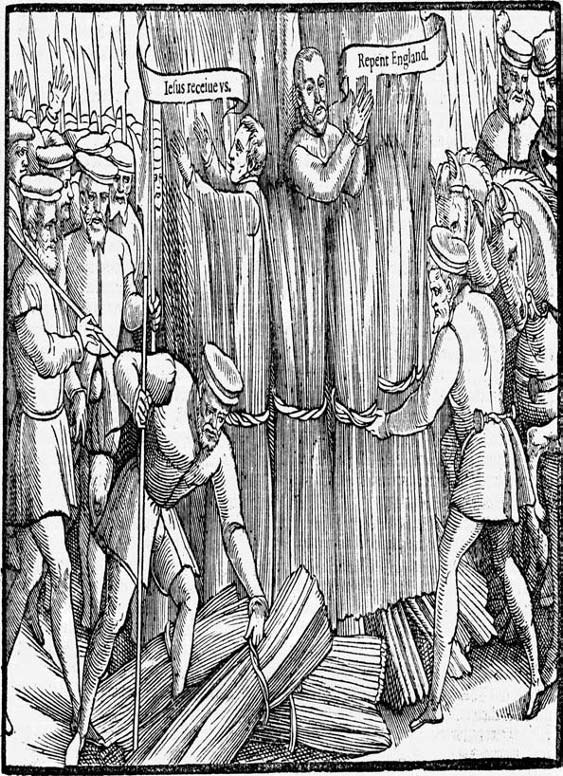
Beswick, which as soon as he had taken the said Bradford by the hand, one of the sheriffs of London called Woodruff, came with his staff and brake the said Roger's head, that the blood ran about his shoulders. Which sight Bradford beholding with grief, bade his brother farewell, willing to commend him to his mother, and the rest of his friends and to get him to some surgeon betimes: and so they departing, had little or no talk at all together. Then was he led forth to Smithfield with a great company of weaponed men, to conduct him thither, as the like was not seen at no man's burning: for in every corner of Smithfield there were some, besides those which stood about the stake. Bradford then being come to the place, fell flat to the ground, secretly making his prayers to almighty God. Then rising again and putting off his clothes unto his shirt, he went to the stake, and there suffered with a young man of twenty years of age, joyfully and constantly, whose name was John
Leaf. . . .
Bradford going to Smithfield.
Bradford gave his nightcap away.
Woodruff breaketh the head of Bradford's brother-in-law.
[An apprentice to a tallow chandler, this youth underwent examination for heresy by Bishop Edmund Bonner.]
Then the bishop after many words to and fro, at last asked him, if he had been Master Rogers's scholar?* To whom the foresaid John Leaf answered again, granting him so to be: and that he the same John did believe in the doctrine of the said
John Leaf Master Rogers's scholar.
Foxe's Book of Martyrs
Rogers, and in the doctrine of Bishop Hooper, Cardmaker,* and other of their opinion, which of late were burned for the testimony of Christ, and that he would die in that doctrine that they died for: and after other replications again of the bishop, moving him to return to the unity of the church, he with a great courage of spirit answered again in these words: 'My
Lord,' quoth he, 'you call mine opinion heresy: it is the true light of the word of God': and again repeating the same, he professed that he would never forsake his staid and well grounded opinion, while that breath should be in his body.
Whereupon the bishop being too weak, either to refute his sentence, or to remove his constancy, proceeded consequently to read the popish sentence of cruel condemnation, whereby this godly and constant young man being committed to the secular power of the sheriffs there present, was then adjudged, and not long after suffered the same day with Master Bradford, confirming with his death that which he had spoken and professed in his life.
Sentence read against John Leaf.
It is reported of the said John Leaf, by one that was in the Counter the same time, and saw the thing, that after his examinations before the bishop, when two bills were sent unto him in the Counter in Breadstreet, the one containing a recantation, the other his confessions, to know to which of them he would put to his hand, first hearing the bill of recantation read unto him (because he could not read nor write himself) that he refused. And when the other was read unto him, which he well liked of, instead of a pen he took a pin, and so pricking his hand, sprinkled the blood upon the said bill, willing the reader thereof, to show the bishop that he had sealed the same bill with his blood already.
John Leaf sealed the bill of his confessions with his blood.
The behaviour of Master John Bradford preacher, and the young man that suffered with him in Smithfield, named John Leaf, a prentice, which both suffered for the testimony of Christ.
First, when they came to the stake in Smithfield to be burned, Master Bradford lying prostrate on the one side of the stake, and the young man John Leaf on the other side, they lay flat on
John Bradford and John Leaf
their faces, praying to themselves the space of a minute of an hour. Then one of the sheriffs said to Master Bradford: 'Arise and make an end, for the press of the people is great.'
Bradford and John Leaf at the stake how they behaved themselves.
At that word they both stood up upon their feet: and then Master Bradford took a faggot in his hand, and kissed it, and so likewise the stake. And when he had so done, he desired of the sheriffs that his servant might have his raiment. 'For,' (said he), 'I have nothing else to give him: and besides that, he is a poor man.' And the sheriff said, 'He should have it.' And so forthwith Master Bradford did put off his raiment, and went to the stake: and holding up his hands and casting his countenance to heaven, he said thus: 'O England, England, repent thee of thy sins, repent thee of thy sins. Beware of idolatry, beware of false
Antichrists take heed they do not deceive you.' And as he was speaking these words, the sheriff bade tie his hands, if he would not be quiet. 'O Master Sheriff,' (said Master Bradford), 'I am quiet: God forgive you this, Master Sheriff.' And one of the officers which made the fire, hearing Master Bradford so speaking to the sheriff, said: 'If you have no better learning than that, you are but a fool, and were best to hold your peace.'
To the which words Master Bradford gave no answer: but asked all the world forgiveness, and forgave all the world, and prayed the people to pray for him, and turned his head unto the young man that suffered with him, and said: 'Be of good comfort Brother, for we shall have a merry supper with the Lord this night': and so spake no more words that any man did hear, but embracing the reeds, said thus: 'Strait is the way, and narrow is the gate that leadeth to eternal salvation, and few there be that find it.'* The words of Master Bradford to England.
The saying of Master Bradford at his death.
And thus they both ended their mortal lives, most likest two lambs, without any alteration of their countenance, being void of all fear, hoping to obtain the price of the game that they had long run at: to the which I beseech almighty God happily to conduct us, through the merits of Jesus Christ our Lord and saviour. Amen.
13. John Bradford and John Leaf