
Front matter
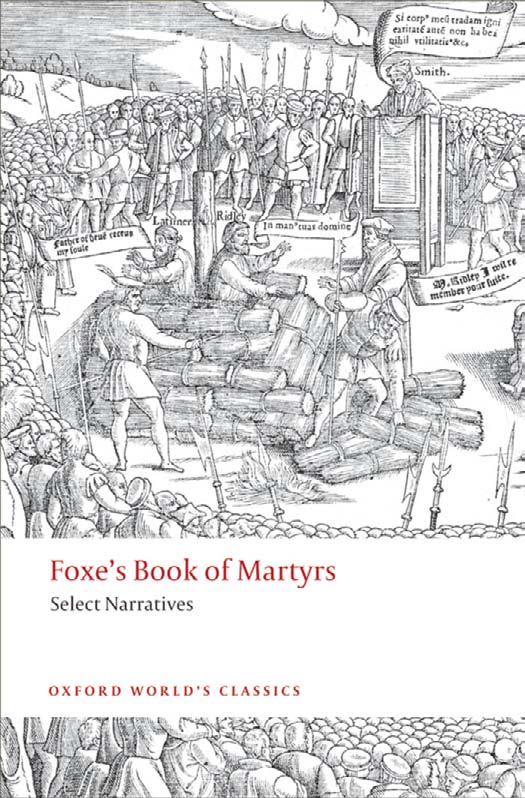
oxford world's classics
FOXE'S BOOK OF MARTYRS
SELECT NARRATIVES
John Foxe (1516/17 – 87) was born at Boston, Lincolnshire.
During his youth, England became embroiled in controversy concerning the advent of new Lutheran ideas, William Tyndale's unauthorized effort to produce a translation of the New Testament, and Henry VIII's endeavour to divorce Catherine of Aragon. Foxe began his studies at the University of Oxford c.1534, close to the time when England broke from the Church of Rome and Henry VIII united church and state. Having become a Protestant, Foxe resigned his fellowship at Magdalen College and then began a career as a publicist during the reign of Edward VI. At the same time, Foxe entered into service to the Duchess of Richmond as tutor to the orphans of her brother, the recently executed Henry Howard, Earl of Surrey, who had joined his father, the 3rd Duke of Norfolk, as a leader of the Roman Catholic faction. When Edward's Roman
Catholic half-sister, Mary I, acceded to the throne she instituted a reign of terror during which hundreds of Protestants were burnt alive as heretics. From exile in Europe, Foxe began to publish martyrological histories in Latin. When he returned to England following the cessation of persecution of Protestants, he entered into collaboration with the London printer, John Day, who published a sequence of four vernacular editions of the Book of Martyrs (1563,
1570, 1576, and 1583). At about four times the length of the Bible, the fourth edition is the most physically imposing, complicated, technically demanding, and best illustrated book of the Shakespearean age.
Although it contains an impressive array of genres, it is best remembered for its many moving accounts of the apprehension, imprisonment, interrogation, and execution of Protestants who had been condemned as heretics.
John N. King is Distinguished University Professor and Hu manities Distinguished Professor of English and of Religious
Studies at The Ohio State University. His publications include English Reformation Literature: The Tudor Origins of the Protestant
Tradition (1982); Tudor Royal Iconography: Literature and Art in an Age of Religious Crisis (1989); Spenser's Poetry and the Reformation
Tradition (1990); Milton and Religious Controversy: Satire and Polemic in Paradise Lost (2000); Voices of the English Reformation: A Sourcebook (2004); and Foxe's Book of Martyrs and Early Modern
Print Culture (2006). He serves as Editor of Reformation and Coeditor of Literature and History.
oxford world's classics For over 100 years Oxford World's Classics have brought readers closer to the world's great literature. Now with over 700 titles— from the 4,000-year-old myths of Mesopotamia to the twentieth century's greatest novels— the series makes available lesser-known as well as celebrated writing.
The pocket-sized hardbacks of the early years contained introductions by Virginia Woolf, T. S. Eliot, Graham Greene, and other literary figures which enriched the experience of reading.
Today the series is recognized for its fine scholarship and reliability in texts that span world literature, drama and poetry, religion, philosophy, and politics. Each edition includes perceptive commentary and essential background information to meet the changing needs of readers.
OXFORD WORLD'S CLASSICS
Foxe's Book of Martyrs Select Narratives Edited with an Introduction and Notes by
JOHN N. KING
Great Clarendon Street, Oxford ox2 6dp Oxford University Press is a department of the University of Oxford.
It furthers the University's objective of excellence in research, scholarship, and education by publishing worldwide in Oxford New York Auckland Cape Town Dar es Salaam Hong Kong Karachi
Kuala Lumpur Madrid Melbourne Mexico City Nairobi New Delhi Shanghai Taipei Toronto With offices in Argentina Austria Brazil Chile Czech Republic France Greece
Guatemala Hungary Italy Japan Poland Portugal Singapore South Korea Switzerland Thailand Turkey Ukraine Vietnam
Oxford is a registered trade mark of Oxford University Press in the UK and in certain other countries
Database right Oxford University Press (maker) First published as an Oxford World's Classics paperback 2009
Oxford University Press, at the address above You must not circulate this book in any other binding or cover and you must impose the same condition on any acquirer
British Library Cataloguing in Publication Data Data available Library of Congress Cataloging-in-Publication Data
Data available Typeset by Cepha Imaging Private Ltd., Bangalore, India Printed in Great Britain on acid-free paper by Clays Ltd., St Ives plc
ISBN 978 – 0 – 19 – 923684 – 8
1 3 5 7 9 10 8 6 4 2
In memory of my parents Revd Dr Luther Waddington and Alba Iregui King and my grandparents Revd William Luther and Mary Ann Waddington King and Salvador Enrique and Maria Luisa Burgos Iregui
ACKNOWLEDGEMENTS
I owe a debt of gratitude to Mark Greengrass and David M. Loades, who serve respectively as Project Director and Editorial Director of Foxe's Book of Martyrs Online, a new digital edition published by the Humanities Research Institute at the University of Sheffield under sponsorship from the British Academy and Humanities Research
Institute. I have incurred debts to others who have been associated with this massive scholarly endeavour. They include Patrick Collinson and the late J. B. Trapp. Editors at Oxford University Press — Judith
Luna, Andrew McNeillie, and Rowena Anketell — have contributed greatly to advancing this edition towards publication. I am further indebted to other individuals on both sides of the Atlantic Ocean, who include Steven Galbraith, the late Ruth Samson Luborsky, and Alexandra Walsham. At my home institution, I am indebted to James
Bracken, with whom I have collaborated on projects related to John Foxe, early modern printing, and the history of the book for many years. For good conversation, wise counsel, and unfailing support,
I am grateful to Joseph Branin, Richard Dutton, Christopher Highley, Valerie Lee, James Phelan, John Roberts, Geoffrey Smith, and Luke Wilson. In particular, I am grateful to Mark Rankin for wise counsel and assistance in transcribing the textual contents of this edition and to Erin Kelly, Erin McCarthy, Aaron Pratt, and Seth
Reno for their gracious support in preparing this edition. Of course, I remain responsible for all errors in this edition.
By permission of John N. King, illustrations are reproduced from his privately owned copy of the 1583 edition of Book of Martyrs.
Above all, I am grateful for the support of my wife, Pauline, and son, Jonathan Paul.
John N. King The Ohio State University
CONTENTS List of Illustrations ix Introduction xi Note on the Text xli Select Bibliography xlv A Chronology of Foxe's Life and Times xlix
FOXE'S BOOK OF MARTYRS
1. Thomas Bilney
2. William Tyndale
3. Anne Askew
4. John Rogers
5. Lawrence Saunders
6. John Hooper
7. Rowland Taylor
8. Thomas Tomkins
9. William Hunter
10. Rawlins White
11. George Marsh
12. Thomas Haukes
13. John Bradford and John Leaf
14. Hugh Latimer and Nicholas Ridley
15. Stephen Gardiner
16. John Philpot
17. Bartlett Green
18. Thomas Cranmer
19. The Guernsey Martyrs
20. Joan Waste
21. William Dangerfield
Contents viii 22. Richard Woodman
23. Rose Allin and Other Colchester Martyrs
24. George Eagles
25. The Islington Martyrs
26. Prest's Wife
27. Edwin Sandys
28. Lady Elizabeth
29. Judgement Tales
Explanatory Notes
Glossary of Words and Terms
Glossary of Persons
Glossary of Places
Concordance of Page References
Index
Biblical Texts Cited
LIST OF ILLUSTRATIONS
1. Title page.
2. John Day.
3. A description of the godly constancy of Thomas Bilney, who being in prison, oftentimes proved the fire with his finger.
4. The martyrdom and burning of Master William Tyndale, in Flanders, by Vilvorde Castle.
5. The order and manner of the burning of Anne Askew, John Lacelles, John Adams, Nicholas Belenian, with certain of the Council sitting in Smithfield.
6. The burning of Master John Rogers, Vicar of St Pulchers and Reader of Paul's in London.
7. The burning of Master Lawrence Saunders at Coventry.
8. The burning of Master John Hooper, Bishop of Gloucester. Anno 1550. February 9.
9. The martyrdom of Doctor Taylor, burned at Hadleigh for the testimony of the Gospel. February 9. Anno 1555.
10. The burning of Thomas Tomkins's hand by Bishop Bonner, who not long after burnt also his body.
11. The cruel burning of George Marsh, Martyr.
12. The Martyrdom of Thomas Haukes in Essex, at a town called Coggeshall. Anno 1555. June 10.
13. The description of the burning of Master John Bradford Preacher, and John Leaf apprentice.
14. A table describing the burning of Bishop Ridley and Father Latimer at Oxford, Doctor Smith there preaching at the time of their suffering.
List of Illustrations x 15. Master Philpot's being in the coal house, where he found Thomas Whittle, priest, sitting in the stocks.
16. The martyrdom of Master John Philpot Archdeacon, with the manner of his kneeling, and praying at the stake.
17. The description of Doctor Cranmer, how he was plucked down from the stage, by friars and papists, for the true confession of his faith.
18. The burning of the Archbishop of Canterbury Doctor Thomas Cranmer, in the town ditch at Oxford, with his hand first thrust into the fire, wherewith he subscribed before.
19. A lamentable spectacle of three women, with the silly infant bursting out of the mother's womb, being first taken out of the fire, and cast again, and so all burned together in the Isle of Guernsey. 1556. July 18.
20. The burning of Rose Allin's hand, by Edmund Tyrrell, as she was going to fetch drink for her mother, lying sick in her bed.
21. The right picture and true counterfeit [i.e. portrayal] of Bonner, and his cruelty, in scourging of God's saints, in his orchard at Fulham.
INTRODUCTION
John Foxe's Acts and Monuments is a vast collection of unforgettable accounts of religious persecution. Best remembered by the popular title of the Book of Martyrs, this sensational book serves as a window into early modern English cultural history. This compilation came to exert a greater influence upon the consciousness of early modern
England and New England than any other book aside from the English Bible and Book of Common Prayer. It is recognized to have been one of the most influential texts in the formation of English national consciousness between 1560 and 1700. As such, it influenced writers as various as Raphael Holinshed, William Shakespeare, Ben
Jonson, Thomas Heywood, John Selden, William Prynne, John Bunyan, John Milton, Andrew Marvell, Cotton Mather, and many others. Not only did it encourage the development in England of a sharply defined Protestant identity, it strongly influenced the nationalistic association between Roman Catholicism and foreign political domination. At the level of popular culture, it generated centuries of emotional anti-Catholicism that was especially strong during the time of the Gunpowder Plot, Civil Wars, and Popish Plot. Its impact upon worldwide anglophone culture endures in scores of poorly edited and inaccurate abridgements and websites. Woodcuts that it contains are among the most famous and often reproduced early modern English pictures.
A graduate of Brasenose College and onetime fellow of Magdalen College, Foxe designed the Book of Martyrs to supplant late medieval legends of saints, which celebrated their subjects' alleged ability to work miracles, cures, and supernatural feats. He believed that his martyrologies differ from old-fashioned saints' lives because they are not filled with fabulous elements. Although the Book of Martyrs contains a myriad of documents in an extraordinary array of genres
(e.g., poems, speeches, tracts, biographies, spiritual memoirs, letters, historical documents, state papers, genealogies, papal bulls, and more), its main appeal for the modern reader lies in scores of highly affective narratives concerning the experience of hundreds of people who were burnt alive for their religious beliefs during the reign of Mary I, who is still best known by the sobriquet of 'Bloody Mary'.
Introduction xii These rousing stories incorporate unforgettable accounts of heresy hunts, apprehensions, interrogations, condemnations, imprisonments, and dying speeches.
Foxean martyrologies include stirring tales about the pacifistic response of low-born women, children, and men who died because they insisted on reading the vernacular Bible; an infant who was thrown into the fire that consumed its mother; a preacher who cut short a letter of pastoral instruction by noting that officials had arrived to lead him to the site where he would be burnt alive; and many more. At times prisoners attested to their confidence in salvation by playing chess or consuming cakes and ale as they awaited execution. Some martyrologies incorporate letters that individuals condemned for heresy composed, despite surveillance, in order to offer consolation to fellow prisoners and to extend advice on how to resist inquisition. The Book of Martyrs is famous for recounting the last words of victims who were about to perish in fire such as Thomas
Cranmer, former Archbishop of Canterbury. After undergoing interrogation for heresy at the church of St Mary the Virgin at the University of Oxford, he was escorted hastily to the pyre in Broad
Street, where he thrust his right hand into the flame to atone for having recanted his religious beliefs. At this time, he uttered the prayer of St Stephen, the protomartyr who led the way for ensuing Christian martyrs when a mob in Jerusalem stoned him to death (Acts 7: 59; see p.196).
Numerous well-crafted woodcuts made this collection the bestillustrated English book of its age. In the popular imagination, the Book of Martyrs is renowned for its spectacular portrayals of the 'roasting' of Sir John Oldcastle, hangings of Lollards, and the burnings of Protestant martyrs. Like the text that they illustrate, these pictures appealed to a broad popular audience. Indeed, they functioned as visual arguments that even the illiterate could understand.
Functioning as illustrations for specific martyrologies, realistic narrative woodcuts incorporate details mentioned in the text. Word balloons frequently contain dying speeches attributed to martyrs.
The present Oxford World's Classics edition contains twentynine selections, accompanied by a selection of some of the original woodcuts, which concentrate on presenting only a tiny proportion of narrative component of this book. Foxe oversaw expansion of the text from about 1,900,000 to 3,800,000 words in four English-language
Introduction xiii editions published in 1563, 1570, 1576, and 1583.1 (Five more unabridged editions and dozens of abridgements were published across the seventeenth and eighteenth centuries.) The fourth edition was the most physically imposing and complex English book of its era. Ordinary people read chained copies of the Bible and the Book of Martyrs side by side in many parish churches. Copies also found places in schools, guildhalls, cathedrals, royal palaces, and private libraries. Each edition reflects its historical moment both as an ideological construction and as an artifact of the hand-operated press.
Foxe's Life and Times John Foxe lived from 1516/17 until 1587, during a time of momentous change in English religion and government.2 Shortly before his birth, an obscure Augustinian monk named Martin Luther ignited controversy over the relative merit of justification by faith versus justification by good works when he tacked his Ninety-Five Theses on the door of Castle Church at Wittenberg, an event that is conventionally viewed as the starting point of the Protestant Reformation.
Based upon his understanding of St Paul's Letter to the Romans, this German theologian argued that Christian believers are wholly reliant on religious faith that comes not from within, but as a divine gift. He took particular exception to the theological principle that good works such as the purchase indulgences (i.e., remissions of temporal punishment for sin), giving of alms, or veneration of saints played any role in justifying souls for salvation. Luther's challenge met with staunch resistance from adherents of the Church of Rome, and the repercussions of this controversy reverberated throughout Western
Europe. By contrast, 1516 seems remarkably tranquil. It witnessed the birth of Princess Mary by Catherine of Aragon and publication of Desiderius Erasmus' Latin – Greek New Testament and Sir Thomas
1 I am indebted to Mark Greengrass for this information.
2 For helpful overviews of historical events, see David M. Loades, The Reign of Mary Tudor (London, 1991); and Alan G. R. Smith, The Emergence of a Nation State:
The Commonwealth of England, 1529 – 1660, 2nd edn. (London, 1997), pts. 1 – 2. Basic sources concerning Foxe's life and times include John N. King, 'John Foxe', in David A.
Richardson (ed.), Sixteenth-Century British Nondramatic Writers: First Series (Detroit,
1993), 131 – 40; Thomas S. Freeman, 'John Foxe: A Biography', in Foxe's Book of Martyrs Online (FBMO); and the Oxford Dictionary of National Biography.
Introduction xiv More's Utopia, which contain no foretaste of Luther's challenge to the Church of Rome.
We know little about Foxe's family background or how he spent his boyhood in the town of Boston in Lincolnshire. He was quite young when church authorities burnt Lutheran books and Henry
VIII published his defence of the traditional system of seven sacraments, Assertio septem sacramentorum (1521), in opposition to the attack mounted in Luther's Babylonian Captivity of the Church (1520). These sacraments consisted of the Eucharist, baptism, confirmation, penance, marriage, ordination, and extreme unction. By the time that Foxe was
10 years of age, William Tyndale had succeeded at overcoming many obstacles to the publication of his English translation of the New
Testament. The disapproval of ecclesiastical and secular authorities, who believed that ordinary people ought not read and interpret the Bible for themselves, forced this translator to go into exile in order to accomplish his life's work. Although his New Testament was publicly burned, smuggled copies poured into England. Furthermore, illicit copies of Tyndale's scriptural commentaries and polemical tracts exerted a powerful influence on the domestication of Lutheran ideas.
Foxe began his studies at the University of Oxford by about 1534.
During this momentous year, the Acts of Succession and Supremacy settled inheritance of the throne on the offspring of Henry VIII and Anne Boleyn, and pronounced the king Supreme Head on Earth of the Church of England. In taking control of the ecclesiastical establishment as a kind of 'English pope', the king united church and state after centuries of dispute concerning whether papal authority is superior to royal power. These events capped years of turbulence dominated by Henry VIII's petition for a divorce from Catherine of Aragon, who had failed to deliver his long-sought-for male heir.
Sitting from 1529 until 1536, the Reformation Parliament promulgated a stream of statutes that brought the ecclesiastical hierarchy under royal control. When Cardinal Thomas Wolsey fell from favour over his failure to secure papal approval for a royal divorce, Sir
Thomas More succeeded him as Lord Chancellor only to resign soon afterwards. Having risen in favour due to his support of the royal divorce, Thomas Cranmer became Archbishop of Canterbury in 1533, a year that also witnessed Henry VIII's marriage to Anne Boleyn while she was pregnant with Princess Elizabeth. During the mid-1530s
Introduction xv Henry VIII appointed Protestants such as Hugh Latimer to serve as bishops.
Foxe completed his undergraduate studies against the backdrop of continuing turbulence. Having become a Protestant while at Oxford, he moved within a circle of reformists who included Alexander
Nowell and Robert Crowley. Sharing evangelical sympathies in common with Cranmer, Thomas Cromwell was the chief agent in promoting ecclesiastical reform as the king's chief minister and vicegerent for religious affairs. Not only did he initiate the Dissolution of the Abbeys, but he also patronized evangelical reformers who included
John Bale, a former friar who composed militantly propagandistic plays, and Miles Coverdale, who compiled the first printed translation of the English Bible. Published in Antwerp in 1535, the Coverdale
Bible completed the translation of the Bible that Tyndale had undertaken. He was executed near Antwerp soon afterwards. Having lost favour due to her failure to deliver a male heir, Anne Boleyn was beheaded on the grounds that she had committed adultery and incest.
Henry VIII then married Jane Seymour, who died soon after she delivered the heir apparent, Prince Edward, on 12 October 1537.
Foxe received his Bachelor of Arts degree during the same year.
A year later he became probationary fellow at Magdalen College.
These events took place against the backdrop of the production of an unauthorized Bible translation by John Rogers, who employed the pseudonym of Thomas Matthews. It incorporated work by Tyndale.
Building upon prior translations, the Great Bible (1539) was then printed under the patronage of Thomas Cromwell. Specifically ordering its use, the Royal Injunctions of 1538 ordered the acquisition of 'one book of the whole Bible of the largest volume, in English' by every parish church, where chained copies were to be freely accessible for the 'reading or hearing' of parishioners.3 Combination of Tyndale's suspect work and that by Coverdale in this officially authorized version attests to how far Cromwell and Cranmer had led England in the direction of religious reform.
In 1539, Foxe became a full fellow of Magdalen College. During the same year, a conservative reaction favoured by the members of the Catholic faction led by Thomas Howard, 3rd Duke of Norfolk, and Stephen Gardiner, Bishop of Winchester, resulted in parliamentary
3 A. G. Dickens and Dorothy Carr (eds.), The Reformation in England to the Accession of Elizabeth I, Documents of Modern History (London, 1967), 82.
Introduction xvi passage of the Act of Six Articles. Even though Henry VIII countenanced administrative reforms introduced by Cranmer and Cromwell, his theological views were conservative, and he favoured retention of the Roman-rite Mass. Because of the stringent penalties that this legislation imposed, the Book of Martyrs terms it the 'whip with six strings'.4 The statute reaffirmed Catholic orthodoxy concerning transubstantiation, celebration of the Mass in one kind (i.e., with reservation of the wine solely for the priest), clerical marriage, and other doctrines. Protestants such as Foxe were united in opposition to a reactionary swerve that foreshadowed the fall and execution of Cromwell. Cranmer retained favour despite conservative attack, but Hugh Latimer resigned as Bishop of Worcester and figures such as Miles Coverdale and John Bale went into exile. In 1543, the year during which Foxe received the degree of Master of Arts, Parliament went on to withdraw permission for commoners to read and interpret the Bible, even though individuals with evangelical sympathies had come into ascendancy at court, most notably Edward Seymour and Henry VIII's sixth wife, Catherine Parr. The conservative faction attempted to counter their influence by lodging heresy charges against Anne Askew, a dissident Protestant who engaged in open disputation concerning biblical interpretation. She was apparently associated with Hugh Latimer and noblewomen in the circle of Catherine Parr.
Foxe resigned his fellowship at Magdalen College in 1545, the year during which Askew underwent her first heresy examination
(i.e., formal inquiry to determine whether an individual is guilty of heresy under ecclesiastical and/or civil law). He left Oxford because of his refusal to comply with the college requirement that he take a vow of celibacy and become a priest. His associate, Robert Crowley, had already resigned his fellowship. From a safe haven in the Rhineland, John Bale fuelled Protestant antipathy by publishing detailed accounts of the interrogation, condemnation, and execution of Askew on 16 July 1546. Late in this year Edward Seymour thwarted the conservatives, with the result that the Duke of Norfolk and his son, Henry Howard, Earl of Surrey, were condemned to death. The younger Howard was decapitated little more than one week before Henry VIII died on 28 January 1547. His father survived
4 Foxe's Book of Martyrs (1583), 1136.
Introduction xvii the late king, but he was imprisoned in the Tower of London throughout the reign of Edward VI.
During the same year, Foxe married Agnes Randall, with whom he had six children. He was employed at this time as tutor to the children of William Lucy, who resided at Charlecote in Warwickshire.
Foxe moved on to London early during the minority of Edward VI, at a time when Protestant lords who controlled the king and his government were advancing a thoroughgoing programme of ecclesiastical reform. Edward Seymour, who became Protector of the Realm and Duke of Somerset, led the way, only to be deposed in 1549 by John Dudley, Earl of Warwick and later Duke of Northumberland.
The Privy Council and Parliament reversed the policy of religious reaction that marked the last years of Henry VIII. Among other measures, Parliament abrogated legislation including the notorious
De haeretico comburendo ('Concerning the burning of heretics'), which dated back to 1401. It imposed the death penalty on those who translated or owned translations of the Bible.
The heady years of the reign of Edward VI, during which Protestants enjoyed unprecedented freedom of expression, were conducive to Foxe's undertaking of historical research that would become his life's work. He attracted the attention of the Duchess of Richmond, the widow of Henry Fitzroy, Henry VIII's natural son.
A notable patroness of Protestant reformers, this peeress lodged Foxe at Mountjoy House, her household in London, where he forged a long-standing acquaintance with John Bale, a fellow guest who had by now returned from exile. The duchess further arranged for Foxe to tutor the newly orphaned offspring of her brother, Henry
Howard, at Reigate Castle. During these years Foxe completed De non plectendis morte adulteri consultatio (1548), a treatise opposed to the execution of adulterers. This work attests to his long-standing opposition to capital punishment. De censura sive excommunicatione ecclesiastica (1551) then called for the use of excommunication in order to punish religious and social infractions. His dedication of this learned appeal to Cranmer suggests that Foxe had gained entrée to high-ranking circles due to the patronage of the Duchess of Richmond.
He was associated with William Cecil, the Principal Secretary to Edward VI, and ordained a deacon by Nicholas Ridley, Bishop of London. Foxe also made the acquaintance of the future martyrs John
Hooper and John Rogers. Foxe's evangelical convictions are further
Introduction xviii apparent in his translations of tracts by Martin Luther, Johannes
Oecolampadius, and Urbanus Rhegius.
Everything changed with the death of Edward VI on 6 July 1553.
After the failure of the Duke of Northumberland's effort to engineer the succession to the throne of his daughter-in-law, Lady Jane Grey
(the 'nine-day queen'), Mary I was acclaimed Queen of England. Her profound Roman Catholic convictions and the likelihood of her marrying her cousin, Philip of Spain, triggered the rebellion led by Sir
Thomas Wyatt the Younger (January – February 1554). As the apparent beneficiary of this plot, Princess Elizabeth was imprisoned in the Tower of London and then placed under house arrest at Woodstock.
Foxe joined Bale, Crowley, and like-minded Protestants in fleeing to the Continent with his wife and family. He gravitated to Strasbourg, where Wendelin Rihel printed the first Latin instalment of his martyrological history of the martyrs, Commentarii rerum in ecclesia gestarum (1554). Dealing with events that took place before 1500, this work focuses on those whom Foxe regards as forerunners of the Reformation. They included John Wyclif, the Lollards, and Jan Hus. Foxe soon moved on to Frankfurt, where he sided with John Knox's effort to extend liturgical reform beyond the second
Edwardian Book of Common Prayer (1552). Foxe then departed for Basle, where he spent the remainder of his exile in the company of Lawrence Humphrey and his friend John Bale. They earned a living by working as learned correctors for printers in Basle, notably
Johannes Oporinus. At this time, Foxe and Bale continued to labour on their own historical and theological projects.
Revalidation of heresy legislation including the De haeretico comburendo ('Concerning the burning of heretics') led the way to prosecution of Protestants, about three hundred of whom were burnt at the stake from February 1555 onward. These executions left an indelible imprint upon Foxe, who joined other Protestants in vilifying Stephen Gardiner and Edmund Bonner, Bishop of London, for promoting persecution. Foxe was the recipient of manuscript transcriptions of interrogations and dying testimonials of the martyrs, many of which were passed on to him by his fellow exile, Edmund
Grindal, later Archbishop of Canterbury under Elizabeth I. As Foxe collected these materials with the intention of incorporating them into his forthcoming martyrological history, he published Christus triumphans (1556), a Latin closet drama (i.e., a play designed to be
Introduction xix read rather than performed) in five acts. This 'apocalyptic comedy' enfolds the 'tragic' sufferings of 'true' Christians within the overarching trajectory of providential history as it is prefigured in the Book of Revelation. The fifth act alludes to the double execution of Hugh Latimer and Nicholas Ridley, who were burnt alive at Oxford on 16 October 1555. This dramatization of the persecution of 'true' believers by the Church of Rome is aligned with John Bale's influential commentary upon Revelation, The Image of Both Churches (1545?), whose vision of enduring conflict between 'true' and 'false' churches would permeate the Book of Martyrs.
When Queen Mary died in 1558, the accession of Elizabeth I allowed for the homecoming of the Protestant exiles and the renewal of expectations for the reform of the English church. Shortly before Foxe returned to England, Oporinus and Nicolaus Brylinger published Rerum in ecclesia gestarum . . . commentarii (1559), an expansion of Foxe's Commentarii. Focusing on the persecution of 'true' believers from the time of the Lollards to the early years of the Marian persecutions, Rerum is heavily indebted to manuscripts gathered by Grindal; John Bale's biographical bibliography of British authors,
Scriptorum illustrium maioris Brytanniae . . . catalogus (1557 – 9); and related materials. Upon his return to London, Foxe lodged at the home of Thomas Howard, 4th Duke of Norfolk, whom he had tutored during the reign of Edward VI. In 1560 Grindal, who had received appointment as Bishop of London, ordained Foxe as a priest.
He later received a prebend (i.e., revenue granted to canon or member of a chapter house at a collegiate church or cathedral) at Salisbury
Cathedral in addition to patronage from John Parkhurst, who served as Bishop of Norwich. Nevertheless, Foxe's opposition to the wearing of ecclesiastical vestments during the first outbreak of Puritan controversy in the 1560s appears to have blocked him from further advancement in the ecclesiastical hierarchy.
From the time of his return to England in late 1559 until close to the end of his life, Foxe worked closely with John Day, who was a committed publisher of Protestant books. On 20 March 1563, Day published the first edition of Book of Martyrs at his Aldersgate printing establishment.5 It is now clear that Foxe did not work alone, but 5 On the publication history of editions of the Book of Martyrs published during the lifetime of Foxe and Day, see John N. King, Foxe's Book of Martyrs and Early Modern
Print Culture (Cambridge, 2006), 92 – 135.
Introduction xx engaged in a collaborative enterprise in constructing this martyrological history.6 This initial publication reflects the optimistic mood of the opening years of the reign of Elizabeth I, when nationalistic
Protestants welcomed the cessation of religious persecution and expectations were high for completion of the programme of ecclesiastical reform embarked upon during the reign of Edward VI. Drawing heavily upon Rerum . . . commentarii, this edition emphasizes ecclesiastical history from roughly 1000 CE, with particular emphasis on the period since the time of John Wyclif. By positioning his account of the imprisonment of Elizabeth when she was a princess close to the conclusion of this book, Foxe reinforces his claim that she miraculously survived to succeed her half-sister due to the intervention of divine providence.
In 1570 John Day published the second edition of the Book of Martyrs. During the preceding seven years, this compilation almost doubled in size to about 3,500,000 words. It established an enduring model for succeeding editions overseen by Foxe and Day in addition to five more unabridged editions published up to 1684. Not only did
Foxe engage in substantial revision of the original text and deletion of previously published material, he expanded the collection in response to stinging assault by Roman Catholic critics, most notably
Nicholas Harpsfield, whose Dialogi sex (Antwerp, 1566) attacked Protestant historians including Foxe under the pseudonym of Alan
Cope. Foxe broadened the scope of his inquiry by going back to the early days of the Christian church in order to place the martyrdoms of Christian believers from the Roman persecutions onwards within the context of the evolving relationship between ecclesiastical and secular authority. Like Bale, Foxe was convinced that the Church of Rome had diverged from the 'true' church from the late Middle
Ages onwards. In collaboration with associates such as Henry Bull, he expanded this heterogeneous collection through the addition of a multitude of letters written by the martyrs, manuscript accounts, and oral testimony.
High-ranking officials encouraged the acquisition of copies of the 1570 version for reading in public places. Chained copies were
6 Patrick Collinson, 'John Foxe and National Consciousness', in Christopher Highley and John N. King (eds.), John Foxe and His World (Aldershot, 2002), 14; King, Foxe's
Book of Martyrs and Early Modern Print Culture, 25 – 37; and Editorial Commentary in FBMO.
Introduction xxi placed in English cathedrals under order from the Convocation, and the Privy Council called for its acquisition by parish churches.
Foxe's intensification of anti-papal animus as the second edition was in press was in keeping with the nationalistic reaction against the recent Roman Catholic challenge to the Elizabethan religious settlement. As Foxe and Day laboured on this edition, a number of northern earls rose in rebellion during October 1569. Plotting to promote a Roman Catholic succession, they aimed to secure the freedom of Mary, Queen of Scots, and to marry her to the 4th Duke of Norfolk.
A decade of relative toleration of English Catholics came to a close in February 1570, when Pope Pius V promulgated Regnans in Excelsis, a bull in which he excommunicated Queen Elizabeth and urged her subjects to overthrow her. At a time when English Catholics fell under suspicion of complicity with the intrigues of foreign Catholic powers, Foxe enhanced the anti-papal content of the Book of Martyrs.
Foxe immersed himself in a variety of projects following publication of the second edition of the Book of Martyrs. Among other endeavours, he edited The Whole Works of William Tyndale, John
Frith, and Doctor [Robert] Barnes (1573) in collaboration with John Day. This edition accords with Foxe's high praise of Tyndale in the laudatory account of his life and death that he incorporated into the Book of Martyrs. Published on 27 June 1576, the third edition of the Book of Martyrs followed along lines similar to those of the previous version even though it is somewhat shorter and contains revisions.
The major change involved John Day's decision to place its production under the supervision of his son, Richard. The employment of cheaper paper and smaller type sizes appears to be the product of a concerted effort to produce a more affordable book. A homily by Foxe and an attack on the papacy were published under the titles of A Sermon Preached at the Christening of a Certain Jew (1578) and The Pope Confuted (1580). Having published the fourth edition of the Book of Martyrs in October 1583, John Day died during July of the following year. At a length of about 3,800,000 words, it is the longest and most complete version of this collection. This collection follows along the lines of the 1570 version, but Foxe continued to add new material and restore some of the material excised from previous editions. At the time of Foxe's death on 18 April 1587, his son, Samuel, and Abraham Fleming were assisting the martyrologist in preparing Eicasmi seu meditationes, in sacram Apocalypsin
Introduction xxii (1587) for publication. It contains an extended commentary on Revelation 1–17.
Theology and Religion Foxe and like-minded Protestants regarded the reign of Edward VI as the high water mark of religious reformation. It represented a radical departure from ecclesiastical reform under Henry VIII, when theology and ritual underwent little change. Earlier changes were largely administrative, because they involved schism from the Church of Rome, submission of the clerical hierarchy to royal authority, the Dissolution of the Monasteries, and so forth. The Roman-rite Mass, wearing of clerical vestments, and religious ceremonies and ritual remained essentially unchanged. The Act of Six Articles upheld traditional doctrinal belief in clerical celibacy; auricular confession (i.e., one heard by a priest); and transubstantiation, whereby the substance
(i.e., essential nature) of the elements of bread and wine undergo transformation into the body and blood of Christ even though the accidents (i.e., material attributes) remain the same.
Everything changed under Edward VI, when Archbishop Cranmer presided over sweeping change of English worship. According to the Book of Martyrs, this time represents the benchmark for evaluating the state of 'true' religion. This is the case, for example, in the account of John Rogers, who remained abroad 'until such time as it pleased God, by the faithful travail of his chosen and dear servant
King Edward the sixth, utterly to banish all popery forth of England, and to receive in true religion, setting God's gospel at liberty' (p. 35).
Not only did exiled preachers return home, but England also became a haven for foreign reformers including Martin Bucer and Pietro
Martire Vermigli. Having resumed his preaching career, Hugh Latimer joined John Hooper and others in preaching on behalf of ecclesiastical reform at Paul's Cross and other pulpits. In addition to sanctioning unrestricted public access to the vernacular Bible, the Royal Injunctions of 1547 ordered all clergy except those licensed to write their own sermons to preach out of the Book of Homilies, a set of government-authorized sermons, and to study Erasmus' Paraphrases of the New Testament. The same orders endorsed widespread iconoclastic attack on relics, religious images, and shrines. Standing almost alone in opposition to the imposition of changes in religion during a
Introduction xxiii royal minority, Stephen Gardiner was imprisoned in the Tower of London.
Within a year of the accession of Edward VI, Parliament had swept away the chantries, the Act of Six Articles, and prior heresy legislation. Doctrines concerning purgatory and clerical celibacy were abandoned. During 1548, the government abolished many religious ceremonies. In a radical departure from the traditional Latin rite,
Cranmer oversaw the gradual introduction of an English church service. Parliament authorized the first Book of Common Prayer, which came into use throughout England on 9 June 1549 (Whitsunday).
Although it rejected transubstantiation, this document retained a vernacular version of the Mass, clerical vestments, and other elements of traditional ritual. Following the fall of Protector Somerset, John
Hooper used his enhanced prominence at the royal court to advance Zwinglian ideas concerning the commemorative nature of Holy
Communion. Conservative bishops, notably Bonner and Gardiner, were deprived of their sees and replaced with evangelical successors such as Hooper and Ridley. They led the way in ordering the removal of rood screens and replacing altars with communion tables placed in chancels of churches. Hooper opposed the wearing of clerical vestments and was a leader of opposition to the first prayer book that resulted in a revised second edition of the Book of Common Prayer.
Introduced in 1552, the new church service did away with the Mass, elevation of the host, altars, and chasubles. Revision of the canon of the Mass made it clear that the sacrament was not an object of veneration. The Privy Council overruled Cranmer when it inserted the 'Black Rubric', which denied that kneeling at communion implied adoration, transubstantiation, or the Real Presence of Christ. Not long before the death of the boy king, the government issued the Forty-Two Articles, which imposed an essentially Protestant settlement of religion.7
The reign of Mary I represented a catastrophe for Protestant reformers. Two Acts of Repeal undid first the Edwardian and then the Henrician Reformation. Clerics such as John Rogers and Rowland
Taylor ran afoul the authorities for preaching in favour of the religious settlement under Edward VI in violation of this legislation and the Marian proclamation against unlicensed preaching. The Book of 7 See Smith, Emergence of a Nation State, 64 – 76.
Introduction xxiv Martyrs praises the latter preacher, for example, because he opposed reinstatement of the Roman-rite Mass: 'For as yet Doctor Taylor, as a good shepherd, had retained and kept in his church, the godly church service and reformation made by King Edward, and most faithfully and earnestly preached against the popish corruptions, which had infected the whole country round about' (p. 74).
The revival of legislation against heresy resulted in the deaths of hundreds of Protestants who remained resolute in their denial of transubstantiation and insistence that Holy Communion represents a commemorative service rather than a repeated sacrifice effected through the officiation of unmarried priests. Attack on celibacy represents a minor concern, but an important one, in these narratives.
Ministers such as Rowland Taylor, John Hooper, and John Rogers receive praise for maintaining 'godly' households in adherence to the Protestant position that celibacy is not mandatory and that it is advisable for clerics to marry.
The doctrinal issue over which scores of alleged heretics were willing to die was their denial that the elements of bread and wine undergo transubstantiation into the body and blood of Christ during the Mass. It should come as no surprise to note that underlying this dispute is a controversy over biblical interpretation, namely the correct meaning of Jesus' words at the time of the Last Supper: 'During supper he took bread, and having said the blessing he broke it and gave it to them, with the words "Take this; this is my body". Then he took a cup, and having offered thanks to God he gave it to them; and they all drank from it. And he said to them, "This is my blood, the blood of the covenant, shed for many" ' (Mark 14: 22 – 4). Zwingli's understanding of these words wholly in a figurative sense underlies his view that Holy Communion represents a commemorative rite.
This interpretation represented a major crux of this controversy.
During heresy examinations, Roman Catholic interrogators attempt over and over again to persuade alleged heretics to recant the Zwingilian position. The martyrs are equally vehement, however, in the manner of William Hunter, who responds to his interrogator that the scriptural text categorically states that ' "Christ took bread but not that he changed it, into another substance, but gave that which he took, and brake that which he gave, which was bread, as is evident by the text. For else he should have had two bodies, which to affirm
I see no reason" ' (p. 107). In the manner of other martyrs, Hunter
Introduction xxv elaborates his position thus: 'And also though Christ call the bread his body, as he doeth also say, that he is a vine, a door, et cetera. Yet is not his body turned into bread, nor more than he is turned into a door, or vine. Wherefore Christ called the bread his body by a figure'
(p. 107). It should come as no surprise to note that William Tyndale articulates the hermeneutical basis for this controversy in his
Obedience of a Christian Man, which rejects the fourfold mode of Scholastic interpretation on the ground that the meaning of the Bible is wholly literal, even though its language is filled with metaphorical usages: 'So in like manner the scripture borroweth words and sentences of all manner things, and maketh proverbs and similitudes or allegories. . . . So when I say, "Christ is a lamb", I mean not a lamb that beareth wool, but a meek and patient lamb which is beaten for other men's faults. Christ is a vine, not that beareth grapes, but out of whose root the branches that believe, suck the spirit of life, and mercy, and grace, and power to be the sons of God and do his will.
The similitudes of the gospel are allegories borrowed of worldly matters to express spiritual things." '8
Martyrological Narratives Although the Book of Martyrs is filled with many kinds of documents, its best-remembered parts consist of detailed narratives concerning the lives of 'true' Christian believers who were condemned to death because of their religious convictions. These martyrologies include moving accounts of William Tyndale's career from his university days until his execution in the Low Countries; Anne Askew's refusal to remain silent concerning biblical interpretation; the death of John Rogers, the proto-martyr who stands at the head of the list of victims of Marian heresy inquisitions; the career of Thomas
Cranmer, the all-too-human prelate who wavered in his beliefs only to reaffirm his faith, as he was consumed with flames, by first burning the hand that signed his recantation; the poignant account of the execution of the Protestant heroes Nicholas Ridley and aged Hugh
Latimer, who were burnt alive in the same pyre in Broad Street at the University of Oxford; and many more.
8 John N. King (ed.), Voices of the English Reformation: A Sourcebook (Philadelphia,
2004), 41. See John 1: 29, 36; and 15: 1.
Introduction xxvi These accounts are disturbing even to readers who are not squeamish, but they provide opportunities for enjoying good, indeed often exciting, stories involving black-and-white confrontations between 'heroes' and 'villains'. We see this, for example, when Anne
Askew talks back to interrogators including Bishop Bonner, all of whom are male. When he questions her concerning Mass bread—
' "What if the scripture do say that it is the body of Christ?" '—she comes back with a quibbling retort that appears to pay lip service to the patriarchal expectation that women should remain chaste, silent, and obedient: ' "I believe," said I, "as the scripture doth teach me" ' (p. 27). Foxe or informants whose narratives he collects employ all of the devices of good storytelling to enthrall the audience, gruesome detail being one of them. This is the case, for instance, in the description of the prolonged suffering of John Hooper, when he is burnt on a pyre of green wood that requires rekindling three times:
But when he was black in the mouth, and his tongue swollen, that he could not speak, yet his lips went till they were shrunk to the gums: and he knocked his breast with his hands, until one of his arms fell off, and then knocked still with the other, what time the fat, water, and blood dropped out at his fingers' ends, until by renewing of the fire, his strength was gone, and his hand did cleave fast in knocking to the iron upon his breast. So immediately bowing forwards, he yielded up his spirit. (p. 70)
These stories are disturbing partly because their unflinching descriptions are so fascinating.
Because of Foxe's unsubtle propagandizing and vilification of Roman Catholics as superstitious persecutors, his history immediately came under attack from hostile critics for being a thin tissue of fictions and lies. Although questioning of the truthfulness of the Book of Martyrs lasted well into the nineteenth century, this kind of inquiry has lost favour with late twentiethand twenty-first-century historiographers. It seems reasonable to claim, then, that Foxe was notable not so much for his truthfulness, but for his masterly ability to construct powerful myths.9 His imaginative embellishments were of less concern at a time when the line between 'history' and 'story'
9 Patrick Collinson, 'Truth and Legend: The Veracity of John Foxe's Book of Martyrs', in A. C. Duke and C. A. Tamse (eds.), Clio's Mirror: Historiography in Britain and the Netherlands (Zutphen, 1985), 151 – 2.
Introduction xxvii was less clearly demarcated than it became in later centuries.10 What mattered was Foxe's effectiveness as a popularizer and skill in lodging highly polemical arguments in a compelling fashion.
Like his Roman Catholic opponents, Foxe subscribes to the Augustinian dictum that 'It is the cause, not the suffering, which makes a martyr'. In line with this sentiment, he excludes those who profess religious beliefs alien to his own. As such, he designs 'true' martyrologies in order to supplant medieval legends of saints, which celebrated their subjects' alleged ability to work miracles, cures, and magical feats. Denying that the Book of Martyrs contains 'anything fabulous', the martyrologist declares that he tells the truth because he has drawn his documents 'from the archives and registers of bishops and from the letters of the martyrs themselves, drawn together to be seen side by side'.11 The suffering experience of saints is a common element in Protestant and Catholic martyrologies, but Foxe and his co-religionists insist that sainthood means risking even life itself to testify on behalf of Christ, rather than in the marvellous elements emphasized in late medieval saints' legends. Instead of the older belief that saints are exceptional individuals who possess miraculous power to intercede on behalf of sinners (e.g., Saints Barbara and Catherine of Alexandra), Protestants believed that sainthood is accessible to any 'true' believer, including Lollard dissidents of the late Middle Ages and lowly peasants and artisans, many of whom died for their faith under Mary I.12
Stories about the martyrs constitute the fundamental narrative units of the Book of Martyrs. Even though Foxe relies on first-person narratives, manuscripts written by eyewitnesses, and oral testimony, he or his sources attempt to impose an orderly shape on disparate materials. Typical of the martyrologist's active role in the framing of narrative is 'A notable history of William Hunter, a young man of nineteen years'. The brief account in early versions of the Book of Martyrs underwent considerable expansion in the second edition due to the addition of a highly circumstantial eyewitness report written
10 See William Nelson, Fact or Fiction: The Dilemma of the Renaissance Storyteller
(Cambridge, Mass. 1973).
11 Foxe's Book of Martyrs (1583), *1v – 2v; trans. supplied.
12 See Helen C. White, Tudor Books of Saints and Martyrs (Madison, 1963), ch. 1.
For a helpful approach to the construction of narrative in Foxe's Book of Martyrs, see
John R. Knott, Discourses of Martyrdom in English Literature, 1563 – 1694 (Cambridge,
1993), chs. 1 – 2.
Introduction xxviii by the victim's own brother, Robert, 'who being present with his brother William, and never left him till his death'. Making no claim to original authorship, Foxe indicates that he 'with like faithfulness placed and recorded the same' within his martyrological history
(p. 102). In the instance of Rawlins White, a Cardiff fisherman, Foxe initially included a simple notice concerning the death of this martyr.
In the 1570 version, however, he adds a moving eyewitness account supplied by John Dane, whose mother aided the prisoner by providing him with 'money and other relief' (p. 117). In the 1576 and 1583 editions, these narratives remained wholly or almost wholly the same.13
Foxe emphasizes the importance of organizing narratives in a clear and compelling manner. This is the case in one of the most interesting stories in the Book of Martyrs, for example, that of Richard
Woodman. By drawing on the martyr's own accounts of his experience and transcriptions of his heresy examinations, Foxe enables
Woodman to address the reader directly in a very appealing and convincing voice. The martyrologist indicates that it is inclusion of Woodman's own words that gives weight to a narrative that might otherwise seem unbelievable: 'Touching the whole discourse whereof, for so much as the matter is something strange, and will peradventure scarce find credit upon my narration, with them which deny all things, that like them not to believe, ye shall hear himself speak, and testify both of the manner of his troubles, and also his own examinations by himself recorded, in order as followeth' (p. 213). This narrative contains many colourful details about Woodman's concealing of himself from heretic hunters by hiding in a concealed chamber within his home and in nearby woods. Foxe notes, furthermore, that it is important to follow chronological order, as in the story about Thomas Haukes, a courtier whose patron turned him in to authorities for religious heterodoxy: 'first, beginning briefly with his godly conversation and institution of life, then showing of his troubles, also of his examinations and conflicts with the bishop and other adversaries according as the order of his story doth require' (p. 133).
Formulaic elements in martyrological narratives include the apprehension of alleged heretics, imprisonment, heresy examination (sometimes in the presence of torture), clerical appeal for recantation,
13 For detailed accounts of the sources for individual narratives, see the Editorial
Commentary in FBMO.
Introduction xxix refusal to recant (sometimes after an initial recantation), conviction, chaining to the stake, recitation of Psalm 51 (a confession of sin and penitential lamentation), and final prayerful utterances. Either through negligence or a desire to save money, executioners sometimes failed to provide an adequate supply of wood or used unseasoned green wood. Martyrs such as Lawrence Saunders accordingly suffered agonizingly drawn-out death over slowly smouldering flames.
Notes that fill the margins of early editions of the Book of Martyrs function not only as place indicators, but also as markers that outline progressive stages in narratives. Foxe also editorializes by introducing evaluative comments within marginal glosses. In the account of the imprisonment and release of Princess Elizabeth, for example, these notes enforce Foxe's thesis that she was the recipient of the 'blessed protection of almighty God . . . in her manifold dangers and troubles' and that she was 'preserved by the Lord's providence from execution in the Tower'. An added comment asserts that divine intervention shielded her from Stephen Gardiner: 'Winchester's platform overthrown' (pp. 265, 272).
The account of Rowland Taylor constitutes an exemplary martyrology that contains familiar components that we witness in many other narratives. Building upon a set of documents contained in Rerum . . . commentarii, Foxe relied on oral testimonials in expanding his story in the 1563 Book of Martyrs. After the addition of further material in 1570, this account remains largely the same in later editions. Opening with an idealized account of Taylor's pastoral career at Hadleigh, Foxe draws on a variety of local witnesses in portraying this minister as a clerical paragon who was 'void of all pride, humble, and meek as any child' in the course of instructing his parishioners in knowledge of the Bible and 'true' religion. Nevertheless, 'he would be stout in rebuking the sinful and evil doers . . . with such earnest and grave rebukes as became a good curate and pastor'
(p. 73). After his highly dramatic resistance to the reinstatement of the Mass following the accession of Mary I, his Roman Catholic opponents report him to clerical authorities. Instead of fleeing, he resolutely submits to interrogation by Stephen Gardiner and other bishops concerning his views on the sacrament. After being remanded to prison, he remains true to his clerical vocation by preaching, praying, and engaging in biblical interpretation with fellow prisoners.
Following repeated examinations by bishops and condemnation for
Introduction xxx heresy, he receives a visit from Bishop Bonner. In order to deprive him of office, the bishop requires him to don episcopal vestments prior to their symbolic removal. Bonner backs down from a threat to strike the prisoner with his episcopal crook when his chaplain restrains him on the ground that Taylor, a heavily built man, would assault him. Indeed, the prisoner indicates that he would emulate
St Peter in fighting on behalf of Christ as his master.
After spending a night at an inn outside London Wall, Taylor and his guards set out for Hadleigh on horseback. Constituting an im portant formulaic element in martyrological narratives, his cheerful readiness to die functions as a mark of martyrological sanctity.
En route to Hadleigh, he was accordingly 'joyful and merry, as one that accounted himself going to a most pleasant banquet or bridal'
(p. 87).14 A marginal note calls attention to his jesting anticipation of his consumption by fire:
I am as you see, a man that hath a great carcass, which I thought should have been buried in Hadleigh churchyard if I had died in my bed, as I well hoped I should have done: but herein I see I was deceived: and there are a great number of worms in Hadleigh churchyard, which should have had jolly feeding on this carrion, which they have looked for many a day. But now I know we be deceived, both I and they: for this carcass must be burnt to ashes and so shall they lose their bait and feeding, that they looked to have had of it. (p. 88) Taylor quibbles on the deceitfulness of death in denying scavengers an opportunity to feast upon his not inconsiderable flesh. Another marginal stresses the condemned man's embrace of death as a heavenly homecoming: 'now I know I am almost at home. I lack not past two stiles to go over, and I am even at my father's house' (p. 89). In styling his forthcoming suffering as an imitation of Christ, these words constitute a witty variation of Jesus' final discourse with the 14 Among other instances of composure in the face of death, we may take note of Thomas Bilney's enjoyment of 'an ale brew with . . . a cheerful heart and quiet mind' on the day before his execution (p. 9); John Rogers's composure during imprisonment, when he was 'merry and earnest in all he went about' (p. 37); John Bradford's consoling words—' "Be of good comfort, brother; for we shall have a merry supper with the Lord this night" '—to the young man with whom he was burnt alive (p. 149);
John Hooper's decision ' "to tarry and to live and die with my sheep" ' rather than flee from his episcopal see (p. 59); and Thomas Haukes's agreement with his friends that he would provide a sign within the flames 'if the rage of the pain were tolerable and might be suffered' (p. 136).
Introduction xxxi disciples: 'There are many dwelling-places in my Father's house; if it were not so I should have told you: for I am going to prepare a place for you' (John 14: 2).
The tight management of the execution site is typical. Guards in attendance deny this gifted preacher an opportunity to exhort bystanders when they force a pointed weapon into his mouth. He has an added incentive to acquiesce if rumour is correct that the Privy
Council has threatened to have martyrs' tongues cut out unless 'they would promise, that at their deaths they would keep silence, and not speak to the people' (p. 91). After all, he wishes to retain the power of speech in the hope that he may deliver a final prayerful testimonial to his religious faith from within the flames. In the manner of other martyrs, he doffs his attire until no more than his 'shirt' (an undergarment) remains. He gives away his clothing and books as a form of alms. As an act of mercy, one bystander provides Taylor with a bag of gunpowder in order to enable him to die swiftly when the fire causes it to explode. The cruelty of the executioners, one of whom draws blood by striking him on the head with a faggot, is not un usual. Another one strikes the doomed man on the lips when he recites Psalm 51 in English, rather than the authorized Latin Vulgate version. At the climactic moment, as the flames rise upwards, Taylor delivers his last words: ' "Merciful father of heaven, for Jesus Christ my Saviour's sake, receive my soul into thy hands" ' (p. 93). In a final act of cruelty, the recipient of the gift of Taylor's boots dashes out his brains with a halberd.
The Book of Martyrs is renowned for recording last words of the kind that Rowland Taylor spoke. Their conventional character is apparent in the recurrence of formulaic utterances. For example, the reader encounters variations of his final prayer in accounts of the burnings of John Hooper, Thomas Haukes, Thomas Cranmer, and others (see pp. 70, 138, 196). These words are appropriate because they are modelled on a prayer uttered by St Stephen. In rehearsing their final performance only moments before they were burnt alive, martyrs behaved in accordance with the ars moriendi ('art of dying'), which presumed that a 'good death' functioned as a testimonial to dying in a state of grace.15 In attempting to silence martyrs, bailiffs acknowledged the power of final words. The sententiousness of dying
15 Mary Hampson Patterson, Domesticating the Reformation: Protestant Best Sellers,
Private Devotion, and the Revolution of English Piety (Teaneck, NJ, 2007), 101 – 54, passim.
Introduction xxxii speeches accords with the widespread belief that last words should command attention because individuals on the verge of death lack any incentive to lie. A preface added to the seventh edition of the Book of Martyrs acknowledges the rhetorical impact of last words in declaring
'the most pathetical speeches of dying saints' afford a good means 'to win the affections' of readers or hearers of its stories'.16 On reading these affective declarations, many early readers must have experienced a frisson that combined religious instruction with entertainment.
Aphorisms, maxims, and other witty sayings abound in words uttered by martyrs before being burnt alive. For example, all but the first edition of the Book of Martyrs ascribes to Hugh Latimer what may be the best-remembered speech in the entire collection. Of the immolation that he was about to share with Nicholas Ridley, the aged cleric is said to have made this epitaphic utterance: 'Be of good comfort Master Ridley, and play the man: we shall this day light such a candle by God's grace in England, as (I trust) shall never be put out'
(p. 154). These words are famous as a rallying cry of the English Reformation. Latimer's punning allusion to wording in the Sermon on the Mount (Matthew 5: 14 – 15) declares that their martyrdom will contribute paradoxically to the endurance of 'true' faith.
In the manner of Hugh Latimer, many martyrs articulated spiritual testaments at the point of death. When Lawrence Saunders arrived at the stake to which he was about to be chained, for example, he embraced and kissed it with the exclamation that styles his death as an imitation of Christ: 'Welcome the cross of Christ; welcome everlasting life'. John Bradford bade farewell to the companion with whom he shared a pyre by paraphrasing an eschatological warning from the Sermon on the Mount: 'Strait is the way, and narrow is the gate that leadeth unto life eternal, and few there be that find it' (Matthew 7:
13 – 14). Other remarks that gained considerable fame include John Philpot's apostrophe to the site of his burning north-west of London
Wall: 'I will pay my vows in thee O Smithfield' (pp. 51, 149, 167).
The Bible The Bible is the most important influence on narratives in the Book of Martyrs. Not only do scriptural quotations and allusions fill stories
16 Book of Martyrs (1631), vol. 1, sig. ()6r – v.
Introduction xxxiii about the martyrs, but they often receive explicit citations within the text or among the marginal glosses. Even more, Foxe and the informants on whom he draws have absorbed biblical phraseology into their own prose in a manner that often goes without acknowledgement.17
This habit of mind reflects the mentality of an era during which individuals engaged in methodical reading of the Bible and often knew large sections or even the whole of the Bible by heart.
One of the major themes of the Book of Martyrs concerns how laypersons ignorant of learned languages became empowered to read and interpret the Bible in the vernacular without the intercession of clerics. This development originates in the humanistic insistence upon returning to original sources in an effort to recover the original state of biblical texts in Hebrew, Greek, and Aramaic. It accords, furthermore, with Erasmus' influential appeal in Paraclesis ('Exhortation'), one of the prefaces to his Latin – Greek edition of the New Testament, for translation of the Bible so that 'even the lowliest women' could study the scriptures for themselves.18
In constructing the first biography of William Tyndale for inclusion in the Book of Martyrs, Foxe praises this humanistic scholar as a Reformation hero for undertaking translation of the New Testament into the English language. Building upon a lost manuscript account presumably written by Richard Webb19 and autobiographical comments in Tyndale's own non-translation prose, the martyrologist narrates a colourful story about how Tyndale exposed the ignorance of unlearned clerics when he served as a tutor to the children of Sir
John Walsh of Little Sodbury, Gloucestershire. The central incident demonstrates the translator's adherence to the Lutheran doctrine of sola scriptura ('by scripture alone') when he countered the words of one who subordinated the authority of the Bible to that of the pope with the zealous rejoinder that 'ere many years he would cause a boy that driveth the plough to know more of the scripture, than he did'
(p. 15). It seems certain that this speech recalls the following appeal for translation of scriptural texts in Erasmus' Paraclesis: 'Would that, as a result, the farmer sing some portion of them at the plow'.20
17 The Explanatory Notes below identify many quotations and allusions that receive no explicit acknowledgement within narratives in this text.
18 Desiderius Erasmus, Christian Humanism and the Reformation: Selected Writings, ed. John C. Olin (New York, 1965), 97.
19 David Daniell, William Tyndale: A Biography (New Haven and London, 1994), 61.
20 Erasmus, Christian Humanism, 97.
Introduction xxxiv Of course, a gulf yawns between Erasmus' use of 'Would that' as opposed to Tyndale's 'I will cause'. Tyndale sets out to accomplish what Erasmus expresses only in the form of a wish.21 The remainder of the Tyndale martyrology incorporates other materials including an account of his residence in Antwerp that appears to have been written by Thomas Poyntz, a kinsman of Lady Anne Walsh, with whom Tyndale lodged at Antwerp prior to his apprehension and execution.
The Book of Martyrs contains many stories about martyrs of lowly status who learn to understand the vernacular Bible in fulfilment of Erasmus's appeal and Tyndale's prophecy. This ideal informs
Rowland Taylor's ministry at Hadleigh, where many parishioners 'became exceeding well learned in the holy scriptures, as well women as men. . . . Their children and servants were also brought up and trained so diligently in the right knowledge of God's word, that the whole town seemed rather an university of the learned, than a town of cloth-making or labouring people' (p. 72). In the account of William Hunter, one reads about an apprentice weaver who debates scriptural interpretation with a cleric.22 Illiterate martyrs who absorb the Bible through hearing it read aloud by others include Joan
Waste, a blind weaver and rope maker, and Rowland White, a Welsh fisherman. Lowly women other than Waste include a spinner who is remembered only as the wife of a man whose surname is Prest.
According to the transcription of her examination for heresy, she is able to employ language laced with Bible quotations and allusions in debating with the Bishop of Exeter concerning the Eucharist (p. 206).
Her abandonment of her husband and children recalls the behaviour of Anne Askew, a gentlewoman who recounts how she flouted patriarchal authority by going to Lincoln Minster to engage in public reading of the Bible: ' "I remained there nine days to see what would be said unto me" ' (p. 28). Not only does Rowland White hear readings from the Bible, but he learns it by heart and becomes an 21 Stephen Greenblatt, Renaissance Self-Fashioning: From More to Shakespeare (Chicago,
1980), 106. On Foxe's engagement with Tyndale, see John N. King, ' "The Light of Printing": William Tyndale, John Foxe, John Day, and Early Modern Print Culture',
Renaissance Quarterly 54 (2001), 52 – 85.
22 Dialogues between learned lay people and ignorant clerics are a familiar component of Protestant propaganda in Germany and England. See John N. King, English
Reformation Literature: The Tudor Origins of the Protestant Tradition (Princeton, 1982),
258 – 62, 286 – 7.
Introduction xxxv itinerant preacher in the hills of Wales. In yet another variation of Tyndale's plowboy, George Eagles is an unlearned tailor who is also known by the name of Trudgeover because of his habit of wandering as an itinerant preacher. As he is dragged on a sledge to the site of his execution, he reads from the Book of Psalms 'all the way with a loud voice till he came there' (p. 234). Bible reading played a transformative role in the life of a dissident ironmaker, Richard Woodman, whose speech is laced with scriptural quotations and allusions. When authorities force him to go into hiding in a forest, he considers it essential to bring with him 'even under a tree . . . my Bible, my pen and mine ink, and other necessaries' (p. 217).
Underlying many of the Bible quotations and allusions in the Book of Martyrs is the typological application of scriptural texts to ecclesiastical history and the experiences of individual believers. Foxe, his informants, and many of the martyrs believed that later events are prefigured by and patterned upon happenings recorded in the Old and New Testaments. These correspondences contribute to a prevailing manner in which martyrs such as Anne Askew, Rowland
Taylor, and Richard Woodman speak in parables and employ language infused with scriptural imagery and symbolism. In the Obedience of a Christian Man, Tyndale describes typological application in terms of the borrowing of 'likenesses or allegories of the scripture, as of Pharaoh and Herod and of the scribes and Pharisees, to express our miserable captivity and persecution under Antichrist the Pope'.23
The reader encounters repeated examples of the most pervasive typological application, imitation of Christ. For example, Thomas
Bilney intimates to his friends that 'he would go to Jerusalem, alluding belike to the words and examples of Christ in the Gospel going up to Jerusalem, what time he was appointed to suffer his passion'
(p. 6). According to the narrator of the story of Rowland Taylor, this martyr discharged his ministry on the model of Jesus Christ as the Good Shepherd: 'Where he as a good shepherd, abiding and dwelling among his sheep, gave himself wholly to the study of holy scriptures most faithful endeavouring himself to fulfil that charge, which the Lord gave unto Peter, saying, "Peter, lovest thou me?
Feed my lambs, feed my sheep, feed my sheep" ' (p. 72). In refusing to save his life by taking flight, furthermore, Taylor himself declares
23 King (ed.), Voices, 43.
Introduction xxxvi to his servant: ' "Remember the good shepherd Christ, which not only fed his flock, but also died for his flock".'24
A related cluster of pastoral metaphors is grounded upon the messianic prophecy concerning the suffering servant who is 'like a sheep led to the slaughter' (Isaiah 53: 7). Christians interpret this text as a prefiguration of the crucifixion of Jesus as the 'Lamb of God' (John 1: 29, Acts 8: 26 – 39). Lamenting the imprisonment of Protestant ministers 'as lambs waiting when the butchers would call them to the slaughter', for example, the narrator of Taylor's story indicates that the consciences of persecutors 'told them, that they led innocent lambs to the slaughter' (p. 86). As members of Christ's
'flock', Christian believers also undergo comparison to lambs or sheep. John Hooper accordingly affirms that he will not flee, but instead ' "tarry and to live and die with my sheep" '. The narrator notes that he proceeds to the site of his execution 'as it were [as] a lamb to the place of slaughter' (p. 67). Beleaguered Protestants likened inquisitors and executioners, furthermore, to butchers of innocent lambs. Chief among them is the Bishop of London whom
Protestants vilified as 'Butcher Bonner'. A related concern elaborates upon an admonition from the Sermon on the Mount: ' "Beware of false prophets, who come to you dressed up as sheep while underneath they are savage wolves" ' (Matthew 7: 15). When friends would come to visit Rowland White during his imprisonment at Cardiff Castle, for example, this fisherman-preacher 'would pass away the time in prayer and exhortations, admonishing them always to beware of false prophets which come in sheep's clothing'. Jesus' warning against dissimulators within the church stuck like pitch to Stephen Gardiner, the cunning
Bishop of Winchester whom Protestants maligned with the unforgettable alliterative epithet: 'Winchester Wolf '.25
Christological overtones come into play in other forms. For ex ample, a marginal gloss likens the manner in which Edmund Bonner sends Lawrence Saunders to Stephen Gardiner to the action of Annas in sending Jesus for interrogation by Caiaphas, the high priest, prior to the crucifixion (p. 47; see John 18: 19, 24). When Woodman speaks of his ability to elude his pursuers—'And yet all mine enemies could lay no hands on me till the hour was full come'—he alludes to Jesus' declaration to the disciples, prior to the crucifixion, that 24 See John 10: 1 – 18.
25 See King (ed.), Voices, 293.
Introduction xxxvii ' "The hour has come for the Son of Man to be glorified" '
(John 12: 23). Continuing in a similar vein when he is apprehended, Woodman applies another declaration of Jesus concerning the crucifixion—' "The Son of Man is going the way appointed for him in the scriptures; but alas for that man by whom the Son of Man is betrayed! It would be better for that man if he had never been born" '
(Matthew 26: 24)—to his own condition: 'This way was appointed of God for me to be delivered into the hands of mine enemies, but woe unto him by whom I am betrayed. It had been good for that man, that he had never been born' (p. 220).
In other cases, martyrs envision their suffering not in terms of imitation of Christ, but as a means of attaining union with Christ after death. This is the case when Rawlins White requested that his sorrowful wife 'send unto him his wedding garment, meaning a shirt, which afterward he was burned in' (p. 120). In a similar vein, John
Bradford uttered a 'prayer of the wedding garment' when he 'shifted himself with a clean shirt that was made for his burning (by one
Master Walter Marlar's wife, who was a good nurse unto him, and his very good friend)' (p. 145– 6). The apocalyptic expectations associated with Christ as the Bridegroom and the Spouse as a figure for the faithful Christian (Revelation 19: 7 – 8) become explicit when the narrator praises the 'cheerful countenance' of Prest's wife 'as though she had been prepared for that day of her marriage to meet the Lamb' (p. 253).
Moreover, a variety of biblical texts offer prefigurations for the experience of a variety of believers. Not only does Princess Elizabeth take solace in reading her Bible upon her entry into the Tower of London, she models her demeanour on the Parable of the Two
Houses (Matthew 7: 24 – 7) when she desires that 'God not to suffer her to build her foundation upon the sands but upon the rock' (p.
271). The narrator furthermore likens Stephen Gardiner to Ahithophel, a counsellor who betrayed King David, when he blames the Bishop of Winchester for seeking Elizabeth's execution (p. 272).26 Marginal glosses liken both Lawrence Saunders and Rowland Taylor to the prophet, Elijah, at the time of his confrontation with the priests of Baal during the reign of King Ahab, who functions as a type for Mary I (pp. 51, 75); see 1 Kings 18). When Foxe praises Hooper
26 See 2 Samuel 15 – 17.
Introduction xxxviii as an ideal bishop, he assigns to him 'virtues and qualities required of Saint Paul in a good bishop in his epistle to Timothy' (p. 55).27 In praising the power of Tyndale's religious faith, Foxe transmits hearsay that 'he converted his keeper, his daughter, and other of his household' during imprisonment that preceded his execution (p. 20).
In so doing, he likens the Bible translator to St Paul, who joined Silas in converting their jailer during imprisonment at Phillippi (Acts 16:
25 – 34). In a similar vein, Pauline associations may underpin the conversion of John Bowler, 'a very perverse papist' who served as a keeper at the Tower of London, to whom Edwin Sandys and John Bradford ministered during their imprisonment (p. 258). In a sermon that he had preached after the death of Edward VI, Sandys himself had applied the Israelites' declaration of allegiance to Joshua after the death of Moses (Joshua 1: 16 – 18) as a precedent for the legality of the succession of Lady Jane Grey as the late king's heir
(p. 254).
Woodcut Illustrations Any overview of the Book of Martyrs would be incomplete if it failed to mention its woodcut illustrations. John Day illustrated the 1583 version with more than 100 woodcuts, many of which occurred more than once, adding up to a total of more than 150 illustrations.28
Representing one of the best-remembered features of Foxe's martyrological history, they attracted a lot of attention from readers, who often wrote inscriptions or marked them in other ways. In addition to the imposing title-page border (Illustration. 1) and printer's device (Illustration 2), which portrays the publisher, many of these pictures are large illustrations that illustrate specific narratives.
These woodcuts characteristically illustrate executions that constitute the climactic moment in martyrologies. The woodcut illustrating the execution of Hugh Latimer and Ridley, for example, portrays the martyrs secured to the stake as attendants pile up faggots only moments before the ignition of fire (Illustration 14). In other cases,
27 See 1 Timothy 3: 1 – 7.
28 Ruth Samson Luborsky and Elizabeth Ingram, A Guide to English Illustrated Books, 1536 – 1603, 2 vols. (Tempe, Ariz., 1998), 382. Luborsky's total of 'one hundred woodcuts in 153 occurrences' underestimates the actual numbers according to Mark
Rankin.
Introduction xxxix martyrs are portrayed within flames. Within this woodcut, the portable pulpit from which Dr Richard Smith delivers a sermon, the cityscape in the background, and the open oval space with a crowd of spectators at its edge constitute distinctive motifs in Day's martyrological woodcuts. This naturalistic scene incorporates horses, which often function as symbols for injustice on the part of officials borne on these steeds. Banderoles (i.e., sinuous word streamers) contain typesettings for the martyrs' last words. Alluding to the dying words of St Stephen and Jesus Christ, Latimer and Ridley respectively pray
'Father of heaven receive my soul' and a Latin version of Jesus' last words on the Cross: 'Father, into thy hands I commit my spirit' (Luke
23: 46). Other banderoles contain the biblical text for Smith's sermon and a remark made by an observer. In a fanciful detail, Thomas
Cranmer prays atop Bocardo Prison: 'O Lord strengthen them'.
Other woodcuts portray unforgettable moments such as the moment when Thomas Bilney tested his resolve to suffer being burnt alive by burning his finger in his prison cell. The radiance of the candle flame and the Bible open before him symbolize his adherence to scriptural 'truth'. Other hand-burning scenes feature in woodcuts illustrating the torture of Thomas Tompkins and Rose Allin, in addition to Thomas Cranmer's thrusting into the flames of the hand that signed his recantation. Bishop Bonner's predilection for brutality is notable in the portrayal of his cruelty to Tompkins and scourging of Thomas Hinshaw. In portraying the constancy of martyrs in extremis, other woodcuts provide a visual complement to memorable narratives concerning William Tyndale, Anne Askew, John Rogers,
Lawrence Saunders, John Hooper, Rowland Taylor, and other victims.
Foxe's Book of Martyrs has attracted the attention of readers, influenced politicians and writers, and aroused controversy ever since its initial publication during the aftermath of the reign of terror experienced by Protestants who suffered under Mary I. Surviving copies that contain bits of candle wax, nutshells, and scribbled responses from outraged readers suggest that many of them nibbled food as they stayed up late at night in order to read about the religious constancy of martyrs, their witty mockery of executioners, and gruesome accounts of their last moments of life. From the beginning, the Book of Martyrs influenced low-born individuals such as Sir Francis
Drake, who read from it as he circumnavigated the globe on the
Introduction xl Golden Hind. At the other end of the social scale, aristocrats such as Sir John Harington, the godson of Queen Elizabeth who earned a well-deserved reputation as a court wit, read from it. He recounts how he translated the story about her imprisonment and threatened execution into Latin when he was a schoolboy at Eton College.29
Elizabethan and Jacobean dramatists alluded to it, as is the case in Christopher Marlowe's Tamburlaine the Great and plays by lesserknown playwrights. In Henry VIII, William Shakespeare and John
Fletcher model their dramatization of courtly plotting against Thomas Cranmer on the Book of Martyrs. Even though we have had to wait until the twenty-first century for the completion of a definitive modern edition of this extraordinary book, readers over the centuries have been lured to corrupt and sometime bowdlerized versions of this book in a host of unabridged editions, abridgements, or transmogrifications that include one that expands and 'updates' Foxe's collection by interpolating accounts of the suffering of Quakers in colonial New England, a sketch of the French Revolution, persecution of Protestant missionaries in nineteenth-century India and the West Indies, and other lurid events.30 The Book of Martyrs remains to the present day a propagandistic book of considerable historical, literary, and cultural importance.
29 King, Foxe's Book of Martyrs and Early Modern Print Culture, 285, 297 – 303.
30 Fox's Book of Martyrs, Or A History of the Lives, Sufferings, and Triumphant Deaths of the Primitive Protestant Missionaries (Philadelphia: Porter and Coates, n.d.).
NOTE ON THE TEXT
John Foxe's Book of Martyrs is the popular title of a famous martyrological history that the London printer, John Day, initially published under the title of Acts and Monuments of These Latter and Perilous
Days, touching matters of the Church. Foxe oversaw expansion of his martyrological history from about 55,000 words in the first of two
Latin precursors to a text that ballooned from about 1,880,000 words to 3,775,000 words in four vernacular editions.1 Published in 1563, the first edition is a large folio volume that contains nearly 1,800 pages. It underwent major revision and expansion in 1570, minor revision in 1576, and further expansion in 1583. Foxe deleted and added material in each of these editions. In some cases, he restored previously deleted material. The 1583 version is made up of two volumes of about two thousand folio pages in double columns. At nearly four times the length of the Bible,2 the monumental fourth edition is the most physically imposing, complicated, and technically demanding English book of its era. It seems safe to say that it is the largest and most complicated book to appear during the first two or three centuries of English printing history. The sheer size of the work staggers the imagination. Taking on a life of its own after the death of Foxe and Day, this collection appeared in five more unabridged editions by 1684. Published in 1631 – 2, the seventh edition underwent reconfiguration due to further subdivision into three volumes and the addition of a 108-page-long 'Continuation of the Histories of Foreign Martyrs' that updates Foxean history by accounting for events up to the 1620s. In addition to these nine unabridged editions, numerous abridgements and selections were published.
Even though investigations of the Book of Martyrs often cease in 1684, the manufacture of folio editions continued unabated after the Company of Stationers published the ninth edition in that year. It was the final unabridged version that reflected the original design of Foxe and Day. When the Licensing Act lapsed in 1695, the Company
1 Word estimates for the English editions are based on personal communication from Professor Mark Greengrass. They exclude headlines and marginal notes.
2 The length of the Authorized Version of 1611 (the 'King James' Version'), including the Apocrypha, approximates 900,000 words.
These changes enabled booksellers to print competing versions of this book in forms that underwent a variety of fundamental transformations in dozens of revisions, abridgements, and selections. Publishers continued to produce folio editions, despite the general shift to quarto format for serious literature during the eighteenth century. In 1732, John Hart and John Lewis printed a folio that truncates the Book of Martyrs into a 900,000-word-long chronicle concerned almost wholly with the persecution of Marian martyrs. When eighteenthcentury readers encountered the Book of Martyrs, they typically read a version that omitted Foxe's extended history of the Christian
Church that preceded the reign of Mary I.3
During the nineteenth century, five unabridged editions were based upon the edition produced in eight volumes by Stephen R.
Cattley (London, 1837 – 41), with a preliminary dissertation by George Townsend. The 1965 facsimile reprint of Cattley's second edition
(London, 1843 – 9), long out of print, is the version of the work that is most readily accessible in academic libraries, but it is relatively inaccessible. This edition provides a faulty basis for scholarship because the text that it contains is inaccurate. Claiming to base his modernization on the 1583 edition, Cattley incorporates some but not all of the material in the 1563 version that Foxe revised or eliminated in later editions. He disrupts the compiler's organization by rearranging material found in the original texts; haphazardly moves material to different places within the work, or to appendices, or to footnotes; and edits, condenses, and amends marginal glosses with extreme freedom, and often moves them into footnotes or into the text as subtitles. Latin extracts find their way into footnotes. Cattley therefore produces a composite text that bears a highly imperfect relationship to Foxe's configuration of his work. The nineteenth-century editions are an unreliable guide to investigation of the substantial differences among the four editions overseen by Foxe because they fail to indicate the edition in which a particular document originated, whether it underwent revision, or whether it was ever eliminated from or restored to particular editions.
3 See John N. King, 'Eighteenth-Century Folio Publication of Foxe's Book of Martyrs', Reformation, 10 (2005), 99 – 105.
Note on the Text xliii At the present moment, a new digital edition of the Book of Martyrs is in progress: Foxe's Book of Martyrs Variorum Edition Online (hereafter cited as FBMO). This edition is published by the Humanities
Research Institute Online, University of Sheffield, under sponsorship from the British Academy and the Arts and Humanities Research
Board. Professors Mark Greengrass and David Loades serve respectively as the Project Director and Editorial Director. FBMO represents a great boon to scholarship, because it provides reliable, searchable transcriptions of the first four editions. They permit scholars to engage in detailed comparison of the four different versions produced by Foxe and Day. For material concerning the reign of Mary I, the apparatus consisting of general introductions; commentaries that identify sources, persons mentioned, and textual variations in the first four editions; and other materials is now complete. The commentary dealing with material before the reign of Queen Mary approaches completion. The online edition incorporates facsimiles of the woodcut illustrations and initial capital letters on the relevant pages of each edition.
The present Oxford World's Classics edition aims to present a much-abridged version of the Book of Martyrs that is designed to address the needs of modern readers. Selections consist of highly readable and moving stories drawn from the narrative component of accounts of three individuals who were executed during the reign of Henry VIII, in addition to accounts of the prosecution and death of many Marian martyrs. Other selections concern Princess Elizabeth and Edwin Sandys, who escaped execution; Stephen Gardiner, who died of natural causes; and tales about 'providential' judgement upon persecutors. Ellipses indicate the omission of material that includes wording in Latin, letters, and other non-narrative documentation.
On occasion, brief summaries within square brackets bridge over eliminated material. On a selective basis, woodcuts are located at appropriate places in narratives. Marginal glosses are included in the margins.
The text retains archaic and obsolete vocabulary. Spelling of words, places, and names is modernized. Contractions and abbreviations are silently expanded. Words appearing in square brackets represent editorial insertions not in Foxe's text and are designed as aids to comprehension. Roman and Arabic numerals are written out. Punctuation is left intact, except in rare instances where it is misleading.
Note on the Text xliv Colons remain in their original locations in order to preserve subtleties of meaning that vanish when replaced by either a comma, full stop, or semicolon. Some substitutions are made for printers' symbols that are no longer in use. Upper case and lower case are employed in accordance with modern usage. Quotation marks are inserted to separate direct discourse from narration. Indirect discourse is not enclosed within quotation marks. Roman type is employed for text that may appear in black letter, italic, or roman type in the original text. When shifts in typeface in the version designate material quoted from sources, inverted commas are employed as quotation marks in the OWC edition. Running titles are not transcribed, and paragraph placement from the original text is maintained. Dates are in new style.
This edition is based on the fourth edition of the Book of Martyrs because it represents the most complete and final edition overseen by Foxe and Day. By courtesy of the Rare Books and Manuscripts
Library at The Ohio State University, this edition contains fresh transcriptions from a copy in its collection (BR1600.F6 1583, copy 1).
In a few cases where printing is unclear, wording is supplied from the editor's personal copy of this edition. Readers who wish to supplement these readings by reference to the unabridged text are advised to consult FBMO.
The Introduction, Explanatory Notes, and Glossaries of Persons and Places rely silently on the following resources: New Encyclopaedia
Britannica, 15th edn., 32 vols. (Chicago, 1986); Oxford Dictionary of National Biography (Online) (Oxford and New York, 2004); Paul J.
Achtemeier, et al. (eds.), Harper's Bible Dictionary (San Francisco, 1985); Alan G. R. Smith, The Emergence of a Nation State: The Commonwealth of England, 1529 – 1660, 2nd edn. (London and New
York, 1997); and Ben Weinreb and Christopher Hibbert (eds.), London Encyclopaedia (London, 1983). Scriptural references are to Oxford Study Bible: Revised English Bible with the Apocrypha, ed.
M. Jack Suggs, Katharine Doob Sakenfeld, and James R. Mueller (New York, 1992). The Glossary of Words and Terms is based on The Oxford English Dictionary, 2nd edn. (Oxford, 1989).
SELECT BIBLIOGRAPHY
Editions Foxe, John, Book of Martyrs (London, 1563). This is the popular title of a book originally entitled Acts and Monuments of These Latter and Perilous
Days, touching matters of the Church.
—— 2nd edn., rev. (London, 1570).
—— 3rd edn., rev. (London, 1576).
—— 4th edn., rev. (London, 1583).
—— ed. Stephen R. Cattley, with an introduction by George Townsend, 2nd edn., 8 vols. (London, 1843 – 9), facsimile reprint (New York,
1965).
Foxe, John, Acts and Monuments . . . The Variorum Edition [online] (hriOnline, Sheffield, 2004). Available from http://www.hrionline. shef.ac.uk/foxe/ [Accessed 12.06.2008]. Hereafter cited as FBMO.
Reference Works Achtemeier, Paul J., et al. (eds.), Harper's Bible Dictionary (San Francisco,
1985).
Bettenson, Henry, ed., Documents of the Christian Church, 2nd edn.
(London, 1963).
Dickens, A. G., and Carr, Dorothy (eds.), The Reformation in England to the Accession of Elizabeth I (London, 1967).
Luborsky, Ruth Samson, and Ingram, Elizabeth, A Guide to English Illustrated Books, 1536 – 1603, 2 vols. (Tempe, Ariz., 1998). This book contains a census of the woodcuts in the first five editions of the Book of Martyrs (1563 – 96), 365 – 82.
The New Encyclopaedia Britannica, 15th edn., 32 vols. (Chicago, 1998).
The Oxford Dictionary of National Biography (Oxford and New York, 2004).
The Oxford Study Bible: Revised English Bible with the Apocrypha, ed.
M. Jack Suggs, Katharine Doob Sakenfeld, and James R. Mueller (New York, 1992).
Pollard, A. W., Redgrave, G. R., Jackson, W. A., Ferguson, F. S., and Pantzer, Katharine F., compilers, A Short-Title Catalogue of Books
Printed in England, Scotland, and Ireland, and of English Books Printed Abroad, 1475 – 1640, 2nd edn., rev. and enlarged, 3 vols. (London,
1976 – 91).
Weinreb, Ben, and Hibbert, Christopher (eds.), The London Encyclopaedia (London, 1983).
Select Bibliography xlvi Biographical Studies Daniell, David, William Tyndale: A Biography (New Haven and London,
1994).
Freeman, Thomas S., 'Life of John Foxe', in FBMO.
King, John N., 'John Foxe', in David A. Richardson (ed.), Sixteenth-Century British Nondramatic Writers: First Series (Detroit, 1993), 131 – 40.
Mozley, J. F., John Foxe and His Book (London, 1940).
Critical and Historical Studies: Books and Collections of Essays Bauckham, Richard, Tudor Apocalypse (Oxford, 1978).
Betteridge, Thomas, Tudor Histories of the English Reformations, 1530 – 1583 (Aldershot, 1999).
Christianson, Paul, Reformers and Babylon: English Apocalyptic Visions from the Reformation to the Eve of the Civil War (Toronto, 1978).
Collinson, Patrick, The Reformation (London and New York, 2003).
Covington, Sarah, The Trail of Martyrdom: Persecution and Resistance in Sixteenth-Century England (Notre Dame, 2003).
Dickens, A. G., The English Reformation (London, 1964).
Firth, Katharine R., The Apocalyptic Tradition in Reformation Britain, 1530 – 1645 (Oxford, 1979).
Greenblatt, Stephen, Renaissance Self-Fashioning: From More to Shakespeare (Chicago, 1980).
Gregory, Brad S., Salvation at Stake: Christian Martyrdom in Early Modern Europe (Cambridge, Mass., 1999).
Haigh, Christopher, The English Reformations: Religion, Politics, and Society under the Tudors (Oxford, 1993).
Haller, William, The Elect Nation: The Meaning and Relevance of Foxe's Book of Martyrs (New York, 1963).
Helgerson, Richard, Forms of Nationhood: The Elizabethan Writing of England (Chicago, 1992).
Highley, Christopher, and King, John N. (eds.), John Foxe and His World (Aldershot, Hants., 2002).
King, John N., English Reformation Literature: The Tudor Origins of the Protestant Tradition (Princeton, 1982).
—— Foxe's Book of Martyrs and Early Modern Print Culture (Cambridge, 2006).
—— (ed.), Voices of the English Reformation: A Sourcebook (Philadelphia, 2004).
Knott, John R., Discourses of Martyrdom in English Literature, 1563 – 1694 (Cambridge, 1993).
Lander, Jesse M., Inventing Polemic: Religion, Print, and Literary Culture in Early Modern England (Cambridge, 2006).
Select Bibliography xlvii Lewis, C. S., English Literature in the Sixteenth Century Excluding Drama
(Oxford, 1954).
Loades, David M., Mary Tudor: A Life (Oxford, 1989).
—— The Oxford Martyrs (New York, 1970).
—— The Reign of Mary Tudor (London, 1979).
—— (ed.), John Foxe and the English Reformation (Aldershot, Hants., 1997).
—— (ed.), John Foxe at Home and Abroad (Aldershot, Hants., 2004).
—— (ed.), John Foxe: An Historical Perspective (Aldershot, Hants., 1999).
Marshall, Cynthia, The Shattering of the Self: Violence, Subjectivity, and Early Modern Texts (Baltimore, 2002).
Oastler, C. L., John Day, the Elizabethan Printer, Occasional Publications of the Oxford Bibliographical Society, No. 10 (Oxford, 1975).
Olsen, V. Norskov, John Foxe and the Elizabethan Church (Berkeley and Los Angeles, 1973).
Patterson, Mary Hampson, Domesticating the Reformation: Protestant Best Sellers, Private Devotion, and the Revolution of English Piety (Teaneck,
NJ, 2007).
Smith, Alan G. R., The Emergence of a Nation State: The Commonwealth of England, 1529 – 1660, 2nd edn. (London and New York, 1997).
White, Helen C., Tudor Books of Saints and Martyrs (Madison, 1963).
Wooden, Warren W., John Foxe (Boston, 1983).
Yates, Frances A., Astraea: The Imperial Theme in the Sixteenth Century (London, 1975).
Critical and Historical Studies: Articles and Chapters in Books Betteridge, Thomas, 'Truth and History in Foxe's Acts and Monuments', in Highley and King (eds.), John Foxe and His World, 145 – 59.
Burks, Deborah, 'Polemical Potency: The Witness of Word and Woodcut', in Highley and King (eds.), John Foxe and His World, 263 – 76.
Collinson, Patrick, 'John Foxe and National Consciousness', in Highley and King (eds.), John Foxe and His World (Aldershot, Hants, 2002),
10 – 36.
—— 'Truth and Legend: The Veracity of John Foxe's Book of Martyrs', in A. C. Duke and C. A. Tamse (eds.), Clio's Mirror: Historiography in Britain and the Netherlands (Zutphen, 1985), 31 – 54.
—— 'Truth, Lies, and Fiction in Sixteenth-Century Protestant Historiography', in Donald R. Kelley and David Harris Sacks (eds.),
The Historical Imagination in Early Modern Britain: History, Rhetoric, and Fiction 1500 – 1800 (Washington, DC, 1997), 37 – 68.
Covington, Sarah, 'The Heresy Examinations of John Philpot: Defiance, Bold Speaking, and the Making of a Martyr', Reformation 7 (2002),
79 – 133.
Select Bibliography xlviii Evenden, Elizabeth, and Freeman, Thomas S., 'John Foxe, John Day and the Printing of the "Book of Martyrs" ', in Robin Myers, Michael
Harris, and Giles Mandelbrote (eds.), Lives in Print: Biography and the Book Trade from the Middle Ages to the 21st Century (London, 2002),
23 – 54.
Fox, Alistair, 'John Foxe's Acts and Monuments as Polemical History', Parergon 14 (1976), 43 – 51.
Freeman, Thomas S., 'Fate, Faction, and Fiction in Foxe's Book of Martyrs', Historical Journal, 43 (2000), 601 – 23.
—— 'Providence and Prescription: The Account of Elizabeth in Foxe's "Book of Martyrs" ' , in Susan Doran and Thomas S. Freeman (eds.),
The Myth of Elizabeth (London, 2003), 27 – 55.
—— 'Publish and Perish: The Scribal Culture of the Marian Martyrs', in Julia Crick and Alexandra Walsham (eds.), The Uses of Script and Print,
1300 – 1700 (Cambridge, 2004), 235 – 54.
—— 'Texts, Lies and Microfilm: Reading and Misreading Foxe's "Book of Martyrs" ', Sixteenth Century Journal: Journal of Early Modern Studies,
30 (1999), 23 – 46.
Hickerson, Megan, 'Negotiating Heresy in Tudor England: Anne Askew and the Bishop of London', Journal of British Studies, 46 (2007), 774 – 95.
King, John N., 'Fiction and Fact in Foxe's Book of Martyrs', in Loades (ed.), John Foxe and the English Reformation, 12 – 35.
—— 'John Day: Master Printer of the English Reformation', in Peter Marshall and Alec Ryrie (eds.), The Beginnings of English Protestantism
(Cambridge, 2002), 180 – 208.
—— 'John Foxe and Tudor Humanism', in Jonathan Woolfson (ed.), Reassessing Tudor Humanism (Houndmills, 2002), 174 – 85.
—— ' "The Light of Printing": William Tyndale, John Foxe, John Day, and Early Modern Print Culture', Renaissance Quarterly, 54 (2001),
52 – 85.
Knott, John R., 'John Foxe and the Joy of Suffering', Sixteenth Century Journal, 27 (1996), 721 – 34.
Luborsky, Ruth, 'The Illustrations: Their Pattern and Plan', in Loades (ed.), John Foxe: An Historical Perspective, 67 – 84.
Robinson, Marsha S., 'Doctors, Silly Poor Women, and Rebel Whores:
The Gendering of Conscience in Foxe's Acts and Monuments', in Highley and King (eds.), John Foxe and His World, 235 – 48.
Wooden, Warren, 'Recent Studies in Foxe', English Literary Renaissance, 11 (1981), 224 – 32.
A CHRONOLOGY OF
FOXE'S LIFE AND TIMES
Events in Foxe's life are printed in bold type.
1516/17 Foxe born at Boston in Lincolnshire.
1517 Martin Luther's Ninety-Five Theses initiate the Protestant Reformation.
1520 Luther's Babylonian Captivity of the Church. Publication of the Complutensian Polyglot Bible (completed in 1522).
1521 Lutheran books burnt in London. Henry VIII's Assertio septem sacramentorum. Diet of Worms. Birth of John Day in this year or 1522.
1522 Luther's German New Testament.
1525 Printing of William Tyndale's English New Testament thwarted in Cologne.
1526 After publication of Tyndale's New Testament in Worms, smuggled copies are prohibited and burnt in England. Persecution of English Protestants (1526 – 7).
1527 Henry VIII pursues divorce from Catherine of Aragon. Emperor Charles V sacks Rome and curtails authority of Pope Clement VII.
Thomas Cranmer enters royal service.
1528 Tyndale's Parable of the Wicked Mammon and Obedience of a Christian Man. More's Dialogue Against Heresy.
1529 Cardinal Thomas Wolsey fails to resolve the divorce question and resigns as Lord Chancellor. Sir Thomas More appointed Lord
Chancellor. Opening session of Reformation Parliament pursues ecclesiastical reform. Simon Fish's Supplication for Beggars.
1531 The House of Commons acknowledges Henry VIII as the Supreme Head of the Church 'as far as the law of Christ allows'. Thomas
Bilney burnt alive at Norwich (19 August).
1532 Submission of the Clergy acknowledges that Henry VIII's authority exceeds that of the pope. More resigns Lord Chancellorship.
Thomas Cromwell serves as Chief Minister. William Thynne's edition of collected works of Chaucer.
1533 Thomas Cranmer becomes Archbishop of Canterbury. Henry VIII divorces Catherine of Aragon. Clement VII excommunicates
Henry VIII, who marries Anne Boleyn. Act in Restraint of Appeals
Chronology l nullifies authority of the Church of Rome. Anne Boleyn gives birth to Princess Elizabeth.
1534 Foxe matriculates at Brasenose College, Oxford (c.1534). Act for the Submission of the Clergy. Act of Succession mandates inheritance of the Crown by offspring of Henry VIII and Anne Boleyn.
Act of Supremacy declares Henry VIII Supreme Head on Earth of the Church of England.
1535 Henry VIII appoints Cromwell vicegerent for religious affairs.
Cromwell extends patronage to evangelical propagandists and initiates the Dissolution of the Monasteries. Beheadings of More and Bishop John Fisher. Publication of Coverdale Bible in Antwerp, the first complete version printed in English.
1536 Beheading of Anne Boleyn. Henry VIII marries Jane Seymour. Act for the Dissolution of the Lesser Monasteries. Pilgrimage of Grace begins. Ten Articles approves compromise with Lutheran theology, notably the reduction of the seven sacraments to the three sacraments of the Eucharist, baptism, and auricular confession. The Royal Injunctions discourage devotion to saints' images and shrines.
Tyndale executed in Brabant (presumably on 6 October). Calvin's Institution of Christian Religion.
1537 Foxe receives Bachelor of Arts degree. Birth of Prince Edward and death of Jane Seymour. Birth of Lady Jane Grey. Publication of an English translation of the Bible under the pseudonym of Thomas
Matthew. John Bale arrested for heresy and released through intervention of Cromwell.
1538 Foxe becomes probationer fellow at Magdalen College. Royal Injunctions order the acquisition of the English Bible by parish churches and prohibit pilgrimages and other ritual practices.
Destruction of the shrine of St Thomas Becket at Canterbury. Bale writes and acts in propagandistic plays performed by a troupe that he led under patronage from Cromwell. John Lambert burnt alive for heresy (22 November).
1539 Foxe becomes fellow of Magdalen College. Greater abbeys dissolved. Act of Six Articles restores orthodox Catholic doctrine concerning transubstantiation, communion in one kind for the laity, clerical celibacy, inability to marry by those who have left religious orders, private Masses, and auricular confession. This legislation imposed stringent penalties for violation of its provisions. Hugh
Latimer resigns appointment as Bishop of Worcester. Publication of the Great Bible. Robert Crowley admitted as a scholarship student at Magdalen College, where he associates with Foxe.
Chronology li 1540 Annulment of Henry VIII's marriage to Anne of Cleves. Fall and execution of Cromwell. John Bale, Miles Coverdale, and others exile themselves to the Continent. Following his criticism of Bishop
Stephen Gardiner, Robert Barnes is burnt alive for heresy. Henry VIII marries Catherine Howard, niece of Thomas Howard, 3rd Duke of Norfolk.
1541 Order for destruction of religious shrines.
1542 Beheading of Catherine Howard (13 February). Birth of Mary, Queen of Scots. Crowley resigns fellowship at Magdalen College, in apparent protest against religious conservatism.
1543 Foxe receives degree of Master of Arts. Henry VIII weds Catherine Parr (12 July) and protects Cranmer against accusations of heresy. Act for the Advancement of True Religion denies commoners access to English Bible.
1544 Sympathizers with evangelical reform threaten Gardiner on the Privy Council. Sir John Cheke, a Protestant humanist, appointed tutor to Prince Edward. Led by Edward Seymour, Earl of Hertford, the English army invades the Scottish lowland.
1545 Foxe resigns fellowship in response to the requirement that he take a vow of clerical celibacy. First heresy examination of Anne Askew. Council of Trent begins. Likely date of publication of John Bale's Image of Both Churches in Antwerp.
1546 Henry VIII in declining health. Thomas Howard, 3rd Duke of Norfolk, and son, Henry Howard, Earl of Surrey, imprisoned in Tower of London. Second examination of Anne Askew, who is burnt at Smithfield along with three others condemned for heresy (16 July).
In anticipation of death, Henry VIII appoints a Council of Regency to govern during the minority of his son, Edward. John Day begins career as London printer-publisher. Bale's edition of First Examination of Anne Askew published abroad (November).
1547 Foxe employed as tutor by Sir William Lucy at Charlecote, Warwickshire. Marriage to Agnes Randall. The Duchess of Richmond appoints Foxe to serve as tutor to Thomas
Howard, later 4th Duke of Norfolk, and the other orphans of Henry Howard, her late brother. Bale's edition of Latter
Examination of Anne Askew published abroad (16 January). Beheading of Henry Howard (19 January). Death of Henry VIII and accession of Edward VI (28 January). Edward Seymour appointed Lord
Protector of the Realm (1 February) and then Duke of Somerset (17 February), with authority to act on the king's behalf from 12 March.
Edward VI, Seymour, and Cranmer extend patronage to Protestant
Chronology lii propagandists and booksellers. Royal Injunctions begin to introduce
Protestant reforms (31 July). Publication of the Book of Homilies for use by unlicensed preachers. Gardiner imprisoned because of his opposition to these events. Parliament sits in November and December and abrogates of the Act of Six Articles, de haeretico comburendo (promulgated in 1401), and other heresy legislation. Suspension of prior censorship and extension to Protestants of relative freedom of publication and reading. Widespread publication of Protestant propaganda. Initial steps toward a Protestant settlement of religion.
Publication of plays by John Bale at about this year or 1548.
1548 Foxe encounters John Bale as guest at the London house of the Duchess of Richmond. Hugh Singleton publishes Foxe's appeal against the imposition of capital punishment for adultery, De non plectendis morte adulteris consultatio. At about this year Singleton also publishes Foxe's translations of Martin
Luther's Sermon of the Angels, Johannes Oecolampadius'
Sermon to Young Men and Maidens, and Urbanus Rhegius' An Instruction of Christian Faith. Latimer's 'Sermon on the Plowers'
(18 January). Gardiner released from prison and imprisoned once again for preaching against religious reform. Royal proclamations order elimination of many religious ceremonies and iconoclastic destruction of religious images and altars. Explosion in publication of Protestant propaganda, including a spate of anti-Mass tracts.
Compilation of an English church service despite resistance by bishops who included Edmund Bonner and Cuthbert Tunstall. Chained copies of Erasmus' Paraphrases of the New Testament, volume 1 (31
January), ed. Nicholas Udall, were placed in churches. From this year until 1551, Robert Crowley is active as bookseller, editor, and writer of satires and tracts favourable to religio-social reform. Bale's
Illustrium maioris Britanniae scriptorum summarium. Pietro Martire Vermigli appointed Regius Professor of Divinity at Oxford. The Act of Uniformity mandates the use of the forthcoming Book of Common Prayer.
1549 The Book of Common Prayer replaces the old Latin rite with an English church service on 9 June. Western Rebellion (June). Kett's
Rebellion (12 July to 27 August). Volume 2 of Erasmus' Paraphrases, ed. Miles Coverdale (16 August). Edmund Bonner imprisoned and deprived of office as Bishop of London. Protector Somerset deposed
(11 October) and imprisoned in Tower of London. John Dudley, Earl of Warwick, supplants him as leading peer in England.
Appointment of Martin Bucer as Regius Professor of Divinity and Paulus Fagius as Reader in Hebrew at Cambridge.
Chronology liii 1550 Foxe ordained as deacon. Seymour released from imprisonment
(6 February). John Hooper appointed Bishop of Gloucester, but his consecration is delayed until 1551 because of his opposition to episcopal vestments. Parliamentary legislation mandates destruction of religious images and Roman-rite service books. Gardiner placed on trial (15 December). Burning of Catholic books at Oxford. Robert
Crowley's editions of Piers Plowman. Joan Bocher, who was also known as Joan Knell and Joan of Kent, was burnt alive because of her Anabaptist convictions (2 May).
1551 Foxe publishes De censura sive excommunicatione ecclesiastica, an argument in favour of the propriety of imposing excommunication on adulterers. John Dudley becomes Duke of Northumberland. John Ponet becomes Bishop of Winchester in succession to Stephen Gardiner (8 March). George van Paris, a Flemish dissident, burnt alive for heresy (24 April). John Hooper appointed bishop of the united diocese of Worcester and Gloucester. Second arrest of Edward Seymour (16 October) and trial for treason (December).
Thomas More's Utopia published in English translation.
1552 Edward Seymour beheaded at Tower (22 January). Revised under the influence of Hooper and other radicals, the Second Book of Common Prayer abolishes the Mass, wearing of surplices, and many ceremonies retained in the first prayer book. The 'Black Rubric' declares that kneeling during the communion service does not signify the Real Presence of Christ. Altars are dismantled and replaced by communion tables set up in the naves of churches
Edmund Spenser born (?).
1553 William Baldwin composes a religious satire entitled Beware the Cat, but it remains in manuscript presumably because of the change in religious policy that followed the death of King Edward. Lady Jane
Grey weds Lord Guildford Dudley (21 May). The Forty-Two Articles define a Protestant settlement of religion that includes the doctrine of justification by faith alone and a Zwinglian formulation of the Eucharist as a memorial celebration (19 June). Death of Edward
VI (6 July). John Dudley, Duke of Northumberland, attempts to alter the succession in favour of Lady Jane Grey, who is acclaimed Queen of England (10 July). Lady Jane Grey deposed and imprisoned in the Tower of London; accession of Mary I (19 July). Thomas Howard,
3rd Duke of Norfolk, released from prison. For support of Lady Jane Grey, Edwin Sandys is imprisoned in the Tower (25 July). Many prominent English Protestants join foreign reformers in fleeing
England. Gardiner and Bonner released from prison. Deprivation from office and imprisonment of Protestant bishops including Cranmer,
Chronology liv Latimer, Ridley, Hooper. First Act of Repeal abrogates legislation that implemented the Edwardian settlement of religion. Surreptitious publication of anti-Marian propaganda under the false imprint of Michael Wood of Rouen (possibly John Day) (October 1553 – May
1554). Performance of Udall's masque, Respublica, during Christmas revels at the royal court.
1554 Foxe in exile on the Continent. Wendelin Rihel publishes Latin precursor of the Book of Martyrs in Strasbourg, under the title of Commentarii rerum in ecclesia gestarum. Continued flight of English Protestants. In opposition to the announced marriage of Mary
I and Philip of Spain, Sir Thomas Wyatt the Younger leads rebels from Kent to London (January). He surrenders after getting as far as Ludgate (7 February). Lady Jane Grey and Guildford Dudley are beheaded as traitors (12 February). Royal Injunctions order bishops to suppress heresy and restore saints' days, religious ceremonies, and processions (March). Princess Elizabeth imprisoned in the Tower of London on suspicion of complicity in Wyatt's Rebellion (18 March).
Wyatt executed (11 April). Edwin Sandys escapes to the Continent.
Elizabeth sent from Tower to house arrest at Woodstock (19 May).
Parliament revalidates heresy legislation, but disallows restoration of monastic land. Marriage of Mary I and Philip of Spain (25 July).
Cardinal Reginald Pole returns from Rome as papal legate (November).
Second Act of Repeal abrogates Act of Supremacy, Act of Succession, and all other Henrician legislation related to the schism from Rome.
John Day imprisoned at Tower (16 October). Republication of Stephen Hawes's The Pastime of Pleasure. Sir Philip Sidney born.
1555 Foxe resident at Basle, where he lives in the same community as John Bale, with whom he works as a corrector at the printing house of Johannes Oporinus. John Day encounters
John Rogers at Newgate Prison. Burning of martyrs including John Rogers (4 February), Lawrence Saunders (8 February), John Hooper and Rowland Taylor (9 February), Rawlins White (March), Thomas
Tomkins (16 March), William Hunter (26 March), George Marsh (24 April), Thomas Haukes (10 June), John Bradford and John Leaf
(1 July), Hugh Latimer and Nicholas Ridley (16 October), and John Philpot (18 December). Elizabeth released from Woodstock and then received by Mary I at Hampton Court (21 May). Gardiner suppresses
The Mirror for Magistrates. Death of Gardiner (12 – 13 November).
Cranmer formally deprived of archiepiscopal office (13 November).
Cardinal Pole appointed Archbishop of Canterbury (December).
1556 Oporinus publishes Foxe's apocalyptic comedy, Christus triumphans. Accession of Philip II as King of Spain (January).
Chronology lv Burning of martyrs including Bartlett Green (27 January), Thomas Cranmer (21 March), Guernsey Martyrs (18 July), and Joan Waste
(1 August). John Day again involved in London book trade. John Heywood's The Spider and the Fly. John Ponet's Short Treatise of Politic Power.
1557 Oporinus publishes Foxe's Ad inclytos ac praepotentes Angliae, which appeals to the British nobility for cessation of persecution, and Locorum communium, which concerns the art of memory. Burning of martyrs including Richard Woodman and nine companions (22 June), Rose Allin (2 August), and George Eagles.
Incorporation of the Stationers' Company. Richard Tottel's Songs and Sonnets ('Tottell's Miscellany') incorporates poems by Thomas
Wyatt the Elder; Henry Howard, Earl of Surrey; and others. Works of Sir Thomas More Knight, ed. William Rastell. Volume 1 of Bale's
Scriptorum illustrium maioris Brytanniae . . . catalogus.
1558 Burning of martyrs including the wife of a man whose surname was Prest (November). Death of Mary I, accession of Elizabeth I, and death of Cardinal Pole (17 November). John Knox's First Blast of the Trumpet Against the Monstrous Regiment of Women.
1559 Foxe contributes to Germaniae ad Angliam, a celebration of the restoration of 'true' religion in England. Oporinus and Nicolaus
Brylinger publish an expanded Latin precursor of the Book of Martyrs under the title of Rerum in ecclesia gestarum . . . commentarii. Foxe returns to England (October) and resides with his former pupil, the 4th Duke of Norfolk. John Day publishes
Foxe's edition of Nicholas Ridley's A Friendly Farewell.
Coronation of Elizabeth I (15 January). Acts of Supremacy and Uniformity. Elizabeth ordained 'Supreme Governor' of the Church of England. Third Book of Common Prayer imposes English church service based largely on the 1552 version. Opposition to the wearing of clerical vestments revives. Catholic bishops deprived of office.
Matthew Parker becomes Archbishop of Canterbury (July). Public reading of English Bible permitted. Iconoclasts destroy religious images. Volume 2 of Bale's Catalogus. First complete edition of The Mirror for Magistrates published without hindrance.
1560 Foxe ordained a priest. Geneva Bible.
1561 Lady Catherine Grey, sister of Lady Jane Grey, imprisoned in Tower of London for marrying Edward Seymour, Earl of Hertford, without royal consent. Castiglione's Book of the Courtier, translated by Sir Thomas Hoby. Calvin's Institution of Christian Religion, translated by Thomas Norton.
Chronology lvi 1562 John Jewel's Apology of the Church of England. John Day publishes
Latimer's collected sermons, ed. Augustine Bernher.
1563 John Day publishes the fi rst edition of Foxe's Book of Martyrs (20 March) and an exposition of the Eucharist, Syllogisticon
(1563?). Foxe receives prebendary at Salisbury Cathedral.
Thirty-Nine Articles of Religion (a revision of the Edwardian FortyTwo Articles) reimpose Protestant settlement of religion. First edition of More's collected Latin writings published at Basle. Death of John Bale. William Shakespeare and Christopher Marlowe born.
1565 Foxe opposes the wearing of clerical vestments. Foxe's friend, Robert Crowley, active in vestiarian controversy.
1566 Nicholas Harpsfield questions veracity of the Book of Martyrs in Dialogi sex.
1567 Abdication of Mary, Queen of Scots and accession of James VI of Scotland (July). Revolt of the Netherlands.
1568 William Allen founds seminary for training of English missionary priests at Douai. Mary, Queen of Scots flees to England. Death of Miles Coverdale. Bishops' Bible. John Skelton, Pithy Works of, ed.
John Stow.
1569 Plot to marry Mary, Queen of Scots to Thomas Howard, 4th Duke of Norfolk (spring). Howard imprisoned in Tower of London
(October). Rebellion of the Northern Earls (October).
1570 John Day publishes the 2nd edition of the Book of Martyrs.
Foxe preaches a Good Friday homily, which Day publishes as A Sermon of Christ Crucified. In this address, the martyrologist defends Elizabeth I during the aftermath of her ex communication by Pope Pius V, whose bull Regnans in Excelsis orders her subjects to depose her. Thomas Cartwright advocates Presbyterianism. Roger Ascham's The Schoolmaster.
Publication of William Baldwin's Beware the Cat.
1571 Day publishes De Christo crucifixo concio, a translation of Foxe's Good Friday sermon. He edits the Gospels of the Four
Evangelists, with parallel texts in Anglo-Saxon and the translation from Bishops' Bible. Convocation calls for placement of Book of Martyrs in cathedral churches and the homes of prelates. Parliament declares it a treasonous offence to deny the Royal Supremacy or to accuse Elizabeth I of heresy.
1572 Foxe's Pandectae locorum communium, a blank commonplace book, published by Day. Foxe in attendance at the execution of his former pupil, the 4th Duke of Norfolk, for complicity in the Ridolfi Plot. Massacre of Huguenots on St Bartholomew's
Chronology lvii Day (24 August). John Field and Thomas Wilcox, Admonition to Parliament. John Whitgift's Answer to a Libel Entitled an Admonition.
1573 Foxe edits The Whole Works of Tyndale, Frith, and Barnes, collected and published by Day.
1574 Persecution of English Catholics begins.
1575 Foxe intercedes on behalf of Anabaptists, who were condemned to death. Death of Matthew Parker (May). Edmund
Grindal becomes Archbishop of Canterbury (December). Anabaptists burnt in England.
1576 John Day publishes the 3rd edition of Foxe's Book of Martyrs (27 June). Opening of the Theatre establishes England's first public playhouse. Grindal declines to execute royal order to suppress
Puritan prophesyings (i.e. gatherings of clergy to study and expound the Bible).
1577 Foxe preaches at baptism of a converted Jew. Grindal suspended from executing his archiepiscopal duties. Raphael Holinshed's
Chronicles.
1578 Publication of Foxe's sermon on the baptism of a Jew under the title of De oliva evangelica. Bishop James Bell translates it as A Sermon Preached at the Christening of a Certain Jew. Foxe contributes a prayer concerning the beleaguered state of the Church Militant to A Book of Christian Prayers, published by John Day and compiled by his son, Richard.
1579 Jesuits found English College at Rome. Hugh Singleton publishes Edmund Spenser's The Shepherds' Calendar.
1580 Foxe publishes an attack on the papacy entitled Papa Confutatus.
Bishop Bell then translates it as The Pope Confuted. The Jesuit Mission to England begins with the arrival of Edmund Campion and Robert Parsons.
1581 Execution of Edmund Campion for treason.
1582 William Allen, Brief History of the Martyrdom of Twelve Priests.
Richard Hakluyt's Diverse Voyages.
1583 John Day publishes the 4th edition of Foxe's Book of Martyrs (October). Sir William Cecil's Execution of Justice in England defends the imposition of capital punishment of Catholic priests as traitors.
1584 William Allen's True, Sincere and Modest Defence of English Catholics.
Death of John Day (23 July).
1586 Trial of Mary, Queen of Scots. Approximate date of performance of Thomas Kyd's Spanish Tragedy.
Chronology lviii 1587 Foxe dies on 18 April. Buried at St Giles Cripplegate.
Publication of his extended commentary on Revelation 1 – 17, Eicasmi, seu meditationes, in sacram Apocalypsin. Beheading of Mary, Queen of Scots. Performance of Christopher Marlowe's
Tamburlaine the Great.