
12. Thomas Haukes
12. THOMAS HAUKES
Here followeth the history and martyrdom of the worthy servant of Christ, Thomas Haukes gentleman, with his examinations and answers had with Bishop
Bonner, recorded and penned with his own hand.
Immediately after the story of Doctor Taylor . . . mention before was made of six men brought and convented before Bishop
Bonner upon the eighth day of February [1555]. The names of which martyrs were Steven Knight, William Pigot, Thomas
Tomkins, John Laurence, William Hunter. In which number was also Thomas Haukes, and condemned likewise with them the ninth day of the foresaid month of February. But because his execution did not so shortly follow with theirs, but was prolonged to this present tenth day of the month of June, wherewith we are now in hand, it followeth therefore now consequently to enter tractation thereof,* fi rst beginning briefl y with his godly conversation and institution of life, then showing of his troubles, also of his examinations and confl icts with the bishop and other adversaries according as the order of his story doth require.
The story of Master Thomas Haukes, martyr.
As touching therefore his education and order of life, fi rst he was of the country of Essex, born of an honest stock, in calling and profession a courtier, brought up daintily from his childhood, and like a gentleman. Besides that, he was of such comeliness and stature, so well endued with excellent qualities, that he might seem on every side a man (as it were) made for the purpose. But his gentle behaviour toward other, and especially his fervent study and singular love unto true religion and godliness did surmount all the rest. Wherein as God did singularly adorn him: even so he being such a valiant martyr of God, may seem to nobilitate* the whole company of other holy martyrs, and as a bright star, to make the church of God and his truth, of themselves bright and clear, more gloriously to shine by his example.
The life and conversation of Thomas Haukes.
The victory of martyrs, is the triumph of Christ.
Ambrose.
For if the conquests of martyrs are the triumphs of Christ (as Saint Ambrose doth notably and truly write *) undoubtedly Christ in few men hath either conquered more notably, or triumphed
Foxe's Book of Martyrs
more gloriously, than in this young man: he stood so wisely in his cause, so godly in his life, and so constantly in his death.
But to the declaration of the matter: fi rst this Haukes following the guise of the court, as he grew in years, entered service with the Lord of Oxford,* where he remained a good space, being there right well esteemed and loved of all the household, so long as Edward the sixth lived. But he dying, all things began to go backward, religion to decay, godliness not only to wax cold, but also to be in danger everywhere and chiefl y in the houses of great men. Haukes misliking the state of things, and especially in such men's houses rather than he would change the profession of true godliness which he had tasted, thought to change the place: and so forsaking the nobleman's house, departed home to his own home, where more freely he might give himself to God, and use his own conscience.
Thomas Haukes fi rst in service with the Earl of Oxford.
Haukes compelled to leave the Earl But what place in this world shall a man fi nd so secret for himself, whither that old wicked Serpent* cannot creep, whereby he may have some matter to overthrow the quietness of the godly? Now in the mean season (as it happened) Haukes keeping his house at home, had born unto him a young son, whose baptism was deferred to the third week, for that he would not suffer him to be baptized after the papistical manner, which thing the adversaries not able to suffer, laying hands upon him did bring him, to the Earl of Oxford, there to be reasoned with, as not sound in religion, in that he seemed to condemn the sacraments of the church. of Oxford's house.
Haukes's child three weeks unchristened.
Haukes brought before the Earl.
The Earl either intending not to trouble himself in such matters, or else seeing himself not able to weigh with him in such cases of religion, sent him up to London with a messenger and letters, and so willing to clear his own hands, put him in the hands of Bonner, Bishop of London. . . .
Haukes sent up by the Earl to Bishop [After recurrent examinations by Edmund Bonner, William Chedsey,
John Feckenham, or John Harpsfi eld, Haukes and his colleagues appeared before the consistory of the diocese of London.]
Bonner.
The public examination of Thomas Haukes After all these private conferences, persuasions, and long debatings had with Thomas Haukes in the bishop's house, as hitherto
Thomas Haukes
have been declared, the bishop, seeing no hope to win him to his wicked ways, was fully set to proceed openly against him after the ordinary course of his popish law. Whereupon Thomas
Haukes shortly after was cited with the rest of his other fellows, above specifi ed, to wit, Thomas Tomkins, Stephen Knight,
William Pygot, John Laurence, and William Hunter, to appear in the bishop's consistory, the eighth day of February, this present year, videlicet 1555. Upon which appearance was laid against him, in like order, as to the other, fi rst the bill of his confession, written with Bonner's hand, to the which bill . . . the blessed servant of God denied to subscribe.
Thomas Haukes cited to the bishop's consistory.
Ex Registro.
The fi rst day's sessions against Thomas Haukes.
After which bill of confession being read, and he constantly standing to the said confession, the bishop then assigned him with the other fi ve the next day following, which was the ninth of February, to appear before him again, to give a resolute answer what they would stick unto. Which day being come, and these foresaid six prisoners being severally called before the bishop, at the coming of Thomas Haukes, the bishop willed him to remember what was said to him yesterday, and now while he had time and space, to advise with himself, what he would answer: for he stood upon life and death. 'Well,' quoth Master
Haukes again, 'I will willingly receive whatsoever shall be put unto me.'
The second day's sessions against Thomas Haukes.
The answer of Thomas Haukes.
Then were certain other interrogatories or articles commenced against him by the said bishop (in like manner as to the other) to the number of four: with another bill also, which Bonner brought out of his bosom containing private matters against the said Thomas Haukes, which the bishop called heresies and errors, but we may better call them Christian verities.
To the which matter being read, the said Haukes answered openly again saying that it was true, and that he was glad it was so true, as it was: with more words to the like effect. And this was on the forenoon, the ninth day of February.
In the afternoon again the said Haukes appearing and hearing the foresaid bill of his confession, with the articles and interrogatories read unto him, with like constancy in answering again to the bishop: 'My Lord,' (said he), 'as you being my friend have caused these my sayings to be written: so do you cause them to be read: and yet I will never go from them.'
The words of Thomas Haukes at his judgement.
Foxe's Book of Martyrs
And then being exhorted by the bishop with many fair words, to return again to the bosom of the mother Church:
'No, my Lord,' (said he), 'that will I not: for if I had an hundredth bodies, I would suffer them all to be torn in pieces, rather than I will abjure or recant.'
The invincible constancy of And so continuing still in the same song, notwithstanding that the doctors and lawyers were ever calling upon him to come again to the unity of the church he ever kept them off with this answer, that he would never go from the belief he was in, so long as he lived. Whereupon Bonner, at last read the sentence of death upon him, and so was he condemned the same day with the residue of his fellows which was the ninth of February.
Thomas Haukes.
Thomas Haukes condemned by Bishop Bonner.
Nevertheless his execution was prolonged, and he remained in prison till the tenth day of June.
The death of Haukes deferred.
Then was he committed to the hands and charge of the Lord Rich,* who being assisted with power suffi cient of the worshipful of the shire, had the foresaid Thomas Haukes down into Essex . . . to suffer martyrdom. . . .
Thomas Haukes brought down to Essex by the Thomas Haukes by the way used much exhortation to his friends, and whensoever opportunity served to talk with them, he would familiarly admonish them.
Lord Rich.
A little before his death certain there were of his familiar acquaintance and friends, who frequenting his company more familiarly, which seemed not a little to be confi rmed both by the example of his constancy, and by his talk: yet notwithstanding the same again being feared with the sharpness of the punishment, which he was going to, privily desired that in the midst of the fl ame he would show them some token if he could, whereby they might be more certain whether the pain of such burning were so great, that a man might not therein keep his mind quiet and patient. Which thing he promised them to do, and so secretly between them it was agreed, that if the rage of the pain were tolerable and might be suffered, then he should lift up his hands above his head toward heaven before he gave up the ghost.
Agreed between Thomas Haukes and his friends to give them a token in the fi re, whether the pain of the burning were so grievous as it seemeth or no.
Not long after, when the hour was come Thomas Haukes was led away to the place appointed for the slaughter, by the Lord Rich and his assistance, who, being now come unto the stake, there mildly and patiently addressed himself to the fi re, having a strait chain cast about his middle, with no small
Thomas Haukes carried to the place of execution.
Thomas Haukes
multitude of people on every side compassing him about. Unto whom after he had spoken many things, but especially unto the Lord Rich, reasoning with him of the innocent blood of saints, at length after his fervent prayers fi rst made, and poured out unto God, the fi re was set unto him.
Thomas Haukes standing at the stake reasoneth with the Lord Rich.
In the which when he continued long, and when his speech was taken away by violence of the fl ame, his skin also drawn together, and his fi ngers consumed with the fi re, so that now all men thought certainly he had been gone, suddenly and contrary to all expectation, the blessed servant of God, being mindful of his promise afore made, reached up his hands burning on a light fi re (which was marvellous to behold) over his head to the living
God, and with great rejoicing, as seemed, struck or clapped them three times together. At the sight whereof there followed such applause and outcry of the people, and especially of them which understood the matter, that the like hath not commonly been heard: and so the blessed martyr of Christ, straightway sinking down into the fi re, gave up his spirit, anno 1555, June 10.
And thus have you plainly and expressly described unto you the whole story, as well of the life, as of the death of Thomas
Haukes, a most constant and faithful witness of Christ's holy gospel.
A token given in the fi re that burning is not so intolerable a pain as it was thought.
The end and martyrdom of Thomas Haukes at Coxehall.
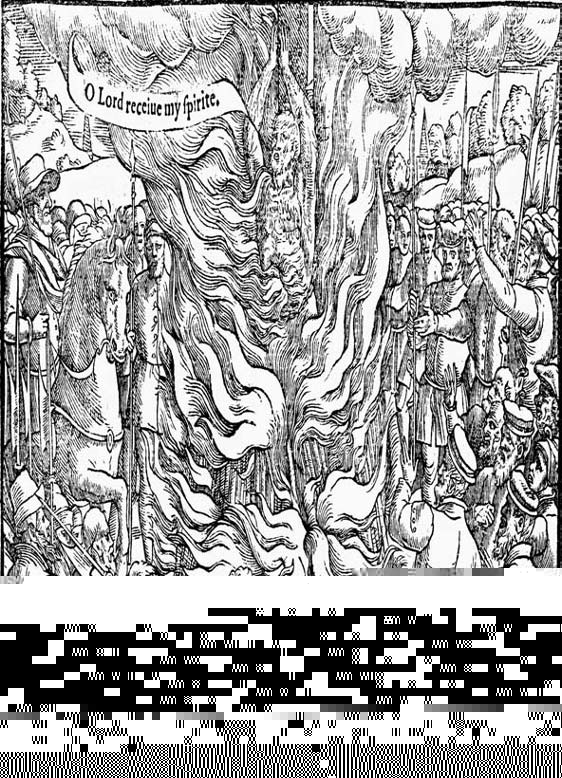
12. The martyrdom of Thomas Haukes, Coggeshall, Essex