
8. Thomas Tomkins
8. THOMAS TOMKINS
The history of Thomas Tomkins, having first his hand burned, after was burned himself by Bishop Bonner, for the constant testimony of Christ's true profession.
[When six alleged heretics were] brought and examined before Bishop Bonner, the eighth of February, . . . [all] received their condemnation together the next day after, yet because the time of their execution was then driven off from February till the next month of March, I did therefore refer the story of them to this present month of March aforesaid, wherein now remaineth severally to entreat of the martyrdom of these six persons, as the order and time of their sufferings severally do require. Of the which six aforenamed martyrs, the first was Thomas
Tomkins burned in Smithfield, the sixteenth day of March, anno 1555.
This Thomas Tomkins a weaver by his occupation, dwelling in Shoreditch, and of the diocese of London, was of such conversation and disposition so godly, that if any woman had come unto him with her web,* as sometime they did three or four in a day, he would always begin with prayer. Or if any other had come to talk of any matter, he would likewise first begin with prayer. And if any had sought unto him to borrow money, he would show him such money as he had in his purse, and bid him take it.
The godly life and disposition of Thomas Tomkins.
And when they came to repay it again, so far off was he from seeking any usury at their hand, or from straight exaction of his due, that he would bid them keep it longer, while they were better able. And these were the conditions of Thomas Tomkins, testified yet to this present day by the most part of all his neighbours, and almost of all his parish which knew him, as Master Skinner, Master Leeke, and other more. Of whom more than half a dozen at once came to me discreet and substantial men, reporting the same unto me, recording moreover as followeth: that Doctor Bonner Bishop of London kept the
Foxe's Book of Martyrs
said Tomkins with him in prison half a year. During which time the said bishop was so rigorous unto him, that he beat him bitterly about the face, whereby his face was swelled. Whereupon the bishop caused his beard to be shaven, and gave the barber twelve pence.
Touching which shaving of Thomas Tomkins's beard, this is more to be added: Bishop Bonner having Tomkins with him prisoner at Fulham, in the month of July, did set him with his other work folks, to make hay. And seeing him to labour so well, the bishop sitting him down, said: 'Well, I like thee well, for thou labourest well: I trust thou wilt be a good Catholic.'
'My lord,' said he, 'Saint Paul saith: "He that doth not labour, is not worthy to eat." '* Bonner said: 'Ah, Saint Paul is a great man with thee.' And so after such other talk, the bishop inferring moreover, wished his beard off, saying, that so he would look like a Catholic. 'My Lord,' said Tomkins, 'before my beard grew, I was, I trust a good Christian, and so I trust to be my beard being on.' But Bonner in fine sent for the barber, and caused his beard to be shaven off. The very cause was for that Bonner had plucked off a piece of his beard before.
Tomkins maketh the bishop's hay.
And so should he be with you, if ye were a right bishop.
The rage of this bishop was not so great against him, but the constancy of the party was much greater with patience to bear it: who although he had not the learning as other have, yet he was so endued with God's mighty spirit, and so constantly planted in the perfect knowledge of God's truth, that by no means he could be removed from the confession of truth, to impiety and error. Whereupon Bonner the Bishop being greatly vexed against the poor man, when he saw that by no persuasions he could prevail with him, devised another practice not so strange as cruel, further to try his constancy, to the intent, that seeing he could not otherwise convince him by doctrine of the scriptures, yet he might overthrow him by some forefeeling and terror of death. So having with him Master
Harpsfield, Master Pendleton, Doctor Chedsey, Master Willerton, and other standing by, he called for Thomas
Tomkins, who coming before the bishop, and standing as he was wont in defence of his faith, the bishop fell from beating to burning. Who, having there a taper or wax candle of three or four wicks standing upon the table, thought there to represent
The notable constancy in a true Christian soldier.
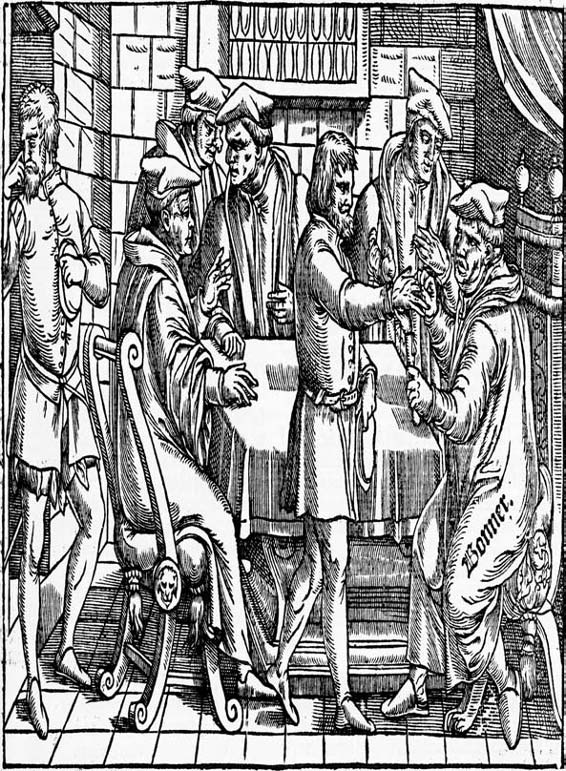
10. The burning of Thomas Tomkins's hand by Bishop Bonner
Foxe's Book of Martyrs
unto us, as it were, the old image of King Porsenna. For as he burned the hand of Scaevola, so this Catholic bishop took
Tomkins by the fingers, and held his hand directly over the flame, supposing that by the smart and pain of the fire being terrified, he would leave off the defence of his doctrine, which he had received.
Bishop Bonner playeth King Porsenna in burning the hand of Scaevola.
Tomkins thinking no otherwise, but there presently to die, began to commend himself unto the Lord, saying: 'O Lord into thy hands I commend my spirit,' et cetera. In the time that his hand was in burning, the said Tomkins afterward reported to one James Hinse, that his spirit was so rapt up, that he felt no pain. In the which burning he never shrunk, till the veins shrunk, and the sinews burst, and the water did spurt into Master Harpsfield's face: insomuch that the said Master Harpsfield moved with pity, desired the bishop to stay, saying, that he had tried him enough. This burning was in the hall at Fulham.
Tomkins compared to Scaevola.
Bonner more cruel than Porsenna the Etruscan.
And where the bishop thought by that means to drive him from his opinions, it proved much otherwise: for this Christian
Scaevola, so valiantly did despise, abide, and endure that burning, that we have less cause hereafter to marvel at the manfulness of that Roman Scaevola: I would to God the other had as well followed the example of that Etruscan tyrant. For he, after the left hand of Scaevola was half burned, either satisfied with his punishment, or overcome by his manhood, or driven away by fear, sent him home safe unto his people: whereas Bonner hitherto not contented with the burning of his hand, rested not until he had consumed his whole body into ashes, at London in Smithfield.* But before we come to his suffering, we will first entreat of some part of his examination and articles, with his answers and confession thereunto annexed, as it is credibly in register recorded.
The first examination of Thomas Tomkins The first examination of This faithful and valiant soldier of God Thomas Tomkins, after he had remained the space (as is said) of half a year in prison, about the eighth day of February, was brought with certain other before Bonner sitting in his consistory, to be examined. To whom first was brought forth a certain bill or Thomas Tomkins before Bonner, Bishop of London.
Thomas Tomkins
schedule subscribed (as it appeared) with his own hand, the fifth day of the same month last before, containing these words following.
Thomas Tomkins of Shoreditch, and of the diocese of London, hath believed and doth believe, that in the sacrament of the altar, under the forms of bread and wine, there is not the very body and blood of our saviour Jesus Christ in substance, but only a token and remembrance thereof, the very body and blood of Christ only being in heaven and nowhere else.
The confession of Tomkins subscribed with his own hand.
By me Thomas Tomkins Whereupon he was asked whether he did acknowledge the same subscription to be of his own hand. To the which he granted, confessing it so to be. This being done, the bishop went about to persuade him, (with words, rather than with reasons) to relinquish his opinions, and to return again to the unity of the catholic church, promising if he would so do, to remit all that was past: but he constantly denied so to do. When the bishop saw he could not so convince him, he brought forth and read to him another writing containing articles and interrogatories whereunto he should come the next day and answer: in the mean time he should deliberate unto himself what to do, and so the next day, being the ninth day of March, at eight of the clock in the morning, to be present in the same place again, to give his determinate answer what he would do in the pre mises, and then either to revoke and reclaim himself, or else in the afternoon the same day to come again and have justice (as he called it) ministered unto him: the copy of which articles here followeth. . . .
Tomkins constant in his faith.
The bishop repeateth again the confession of Thomas Tomkins written before by the said Bishop of London, and subscribed by the said Tomkins, the twenty-sixth day [of]
September, anno 1554, which is this.
The first confession of Tomkins offered to Bishop Bonner, and now here again repeated.
I Thomas Tomkins of the parish of Shoreditch, in the diocese of London, having confessed and declared openly heretofore to Edmund Bishop of London mine ordinary, that my belief hath been many years past, and is at this present: that the body of our saviour Jesus Christ is not truly and in very deed in the sacrament of the altar, but only in heaven, and so in heaven, that it cannot now indeed be really and truly in the sacrament of the altar.
Foxe's Book of Martyrs
And moreover, having likewise confessed and declared to my said ordinary openly many times, that although the church, called the Catholic church, hath allowed and doeth allow the Mass and sacrifice made and done therein, as a wholesome, profitable, and a godly thing: yet my belief hath been many years past, and is at this present, that the said Mass is full of superstition, plain idolatry, and unprofitable for my soul, and so have I called it many times, and take it at this present.
The Mass full of superstition and idolatry.
Having also likewise confessed and declared to my said or dinary, that the sacrament of baptism ought to be only in the vulgar tongue, and not otherwise ministered, and also without any such ceremonies, as customably are used in the Latin church, and otherwise not to be allowed.*
Baptism ought to be ministered in the vulgar tongue.
Finally, being many times and often called openly before my said ordinary, and talked withal touching all my said confessions and declarations, both by the said mine ordinary and diverse other learned men, as well his chaplains as other, and counselled by all them to embrace the truth, and to recant mine error in the premises, which they told me was plain heresy and manifest error: do testify and declare hereby, that I do and will continually stand to my said confession, declaration, and belief, in all the premises and every part thereof, and in no wise recant or go from any part of the same. In witness whereof I have subscribed, and passed this writing the twenty-sixth day of September the year aforesaid.
Tomkins constantly standeth to the truth of the gospel.
By me Thomas Tomkins aforesaid The names of them that sat upon Thomas Tomkins at this session, were these, Edmund Bonner, John Feckenham Dean of Paul's, John Harpsfield Archdeacon of London, John Morwen
Master of Art, Thomas Morton parson of Fulham, Tristram Swadell, Thomas More, Thomas Beckinsaw, James Cline, clerks.
The last appearance of Thomas Tomkins before Bonner and the commissioners.
The last appearance The same day and place, at two of the clock in the afternoon, he was (the last time) brought forth before the bishops of London, Bath, and Saint David's, with others: where he was earnestly exhorted by the said Bishop of Bath, to revoke and and condemnation of Thomas Tomkins, martyr.
Thomas Tomkins
leave off his opinions. Unto whom he answered: 'My Lord, I was born and brought up in ignorance unto now of late years.
And now I know the truth, wherein I will continue unto the death.'
Then Bonner caused all his articles and confession to be again openly read, and so in his accustomed manner persuaded with him to recant. To whom he finally said: 'My Lord, I cannot see but that you would have me to forsake the truth, and to fall into error and heresy.' The bishop seeing he would not recant, did proceed in his law, and so gave sentence of condemnation upon him.
Then he delivered him to the sheriff of London, who carried him straight unto Newgate, where he remained most joyous and constant, unto the sixteenth day of March next after: on which day, he was by the said sheriff conveyed into Smithfield, and there sealed up his faith in the flaming fire, to the glory of God's holy name, and confirmation of the weak.
Sentence read against Thomas Tomkins.
March 16.