
23. ROSE ALLIN AND OTHER: Colchester Martyrs
23. ROSE ALLIN AND OTHER
COLCHESTER MARTYRS
As it is no new thing in those whom we call prelates and priests of the church,* to be raisers up of persecution against Christ and his poor flock: so is it much to be marvelled or rather lamented, that noble persons, and men of honour, and worship, would be made such ministers to serve the affections of these tyrants, as commonly, as well in all the sorrowful days of the late Queen
Mary, as namely in this present story is to be marked.
August 2. The martyrdom of ten godly martyrs, five men and five women, at Colchester.
And first thou remembrest (gentle reader) how mention was made a little before . . . of twenty-two which were sent up prisoners together from Colchester to London by the Earl of Oxford, the Lord Darcy, Master Tyrrell of Saint Osyth's, and other commissioners and justices, et cetera. The which twentytwo (as is aforesaid) through a gentle submission put unto them, were afterward released and delivered.
In the number of these foresaid twenty-two was one William Munt of Muchbently in Essex, husbandman, with Alice his wife, and Rose Allin maid, the daughter of the said Alice
Munt: which coming home again to their house at Muchbently aforesaid, refrained themselves from the unsavoury service of the popish church, and frequented the company of good men and women which gave themselves diligently to reading, invocating, and calling upon the name of God through Christ: whereby they so fretted the wicked priest of the town called Sir
Thomas Tye . . . [petitioned Lord Darcy for redress and] wrote secretly a letter to Edmund Bonner Bishop of London, wherein he maketh his account how he had bestowed his time, and complained of diverse honest men, among the which was the said William Munt and his company. The tenor of which letter hereafter followeth.
William Munt, Alice his wife, Rose Allin her daughter.
Thomas Tye priest, a wicked promoter.
A letter sent to Bonner Bishop of London, from Sir Thomas Tye Priest.
Right honourable Lord, after my bounden duty done in most humble wise, these shall be to signify unto your Lordship the
Rose Allin and Other Colchester Martyrs
state of our parties concerning religion. And first since the coming down, of the twenty-four rank heretics dismissed from you, the detestable sort of schismatics were never so bold since the king and queen's majesty's reigns, as they are now at this present. In Muchbently where your Lordship is Patron of the church, since William Munt, and Alice his wife, with Rose
Allin her daughter came home, they do not only absent themselves from the church, and service of God but do daily allure many other away from the same, which before did outwardly show signs and tokens of obedience.
They assemble together upon the Sabbath day in the time of divine service, sometimes in one house, sometime in another, and there keep their privy conventicles and schools of heresy. The jurates saith, the Lord's Commission is out, and they are discharged of their oath. The quest men in your
Archdeacon's visitation alleged that for as much as they were once presented and now sent home they have no more to do with them nor none other. Your officers saith, namely
Master Boswell, that the council sent them not home without a great consideration. I pray God some of your officers prove not favourers of heretics. The rebels are stout in the town of Colchester.
The ministers of the church are hemmed at in the open streets, and called knaves. The blessed sacrament of the altar is blasphemed and railed upon in every alehouse and tavern.
Prayer and fasting is not regarded. Seditious talks and news are rife, both in town and country, in as ample and large manner, as though there had no honourable Lords and Commissioners been sent for reformation thereof. The occasion riseth partly by reason of John Lone of Colchester Heath (a perverse place) which John Lone was twice indicted of heresy, and thereupon fled with his wife and household, and his goods seized within the town of Colchester, to the king and queen's majesty's use.
Nevertheless the said John is come home again, and nothing said or done to him. Whereupon the heretics are wonderfully encouraged, to the no little discomfort of good and catholic people, which daily prayeth to God for the profit, unity, and restoration of his church again, which thing shall come the sooner to pass, through the travail and pains of such honourable
Foxe's Book of Martyrs
Lords and reverend fathers, as your good Lordship is, unto whom I wish long life and continuance, with increase of much honour.
From Colchester the eighteenth of December.
Your humble beadsman Thomas Tye Priest When Judasly* this wicked priest had thus wrought his malice against the people of God, within a while after, the storms began to arise against those poor persecuted William Munt and his company, whereby they were enforced to hide themselves from the heat thereof. And continuing so a little space at last, the seventh day of March anno 1557 being the first Sunday in Lent, and by two of the clock in the morning, one Master
Edmund Tyrrell (who came of the house of that Tyrells which murdered King Edward the fifth and his brother*) took with him the bailiff of the hundred* called William Simuell, dwelling in Colchester, and the two constables of Muchbently aforesaid named John Baker and William Harries with diverse other, a great number: and besetting the house of the said
William Munt round about, called to them at length to open the door, which being done Master Tyrrell with certain of his company, went into the chamber where the said father Munt and his wife lay, willing them to rise: 'For,' (said he), 'ye must go with us to Colchester Castle.' Mother Munt hearing that, being very sick, desired that her daughter might first fetch her some drink: for she was (she said) very ill at ease.
Tye's letter to Bishop Bonner.
William Simuell, John Baker, William Harries persecutors.
The taking of William Munt, his wife, and Rose Then he gave her leave and bade her go. So her daughter the forenamed Rose Allin, maid, took a stone pot in one hand, and a candle in the other, and went to draw drink for her mother: and as she came back again through the house, Tyrrell met her, and willed to give her father and mother good counsel, and to advertise them to be better Catholic people.
Allin their daughter.
Rose. 'Sir, they have a better instructor than I. For the Holy Ghost doth teach them I hope, which I trust will not suffer them to err.'
Talk between Edmund Tyrrell and Rose Allin.
Tyrrell. 'Why,' said Master Tyrrell, 'art thou still in that mind, thou naughty housewife? Marry, it is time to look upon such heretics indeed.'
Rose. 'Sir, with that which you call heresy, do I worship my Lord God. I tell you troth.'
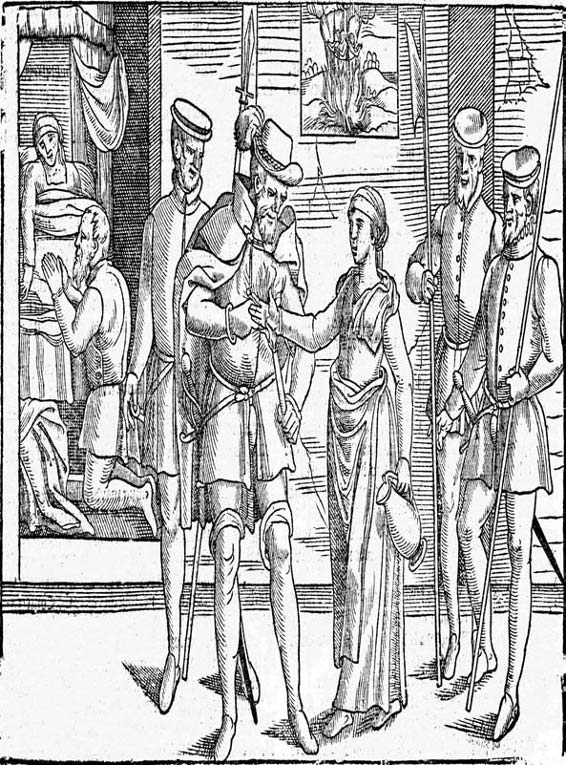
20. The burning of Rose Allin's hand
Foxe's Book of Martyrs
Tyrrell. 'Then I perceive you will burn, gossip, with the rest, for company's sake.'
Rose. 'No sir, not for company's sake, but for my Christ's sake, if so I be compelled, and I hope in his mercies, if he call me to it, he will enable me to bear it.'
Tyrrell. So he turning to his company, said: 'Sirs this gossip will burn: do ye not think it?' 'Marry sir,' quoth one, 'prove her, and you shall see what she will do, by and by.'
Then that cruel Tyrrell taking the candle from her, held her wrist, and the burning candle under her hand, burning cross wise over the back thereof, so long till the very sinews cracked asunder. Witness hereof William Candler then dwelling in Muchbently, which was there present and saw it. Also Mistress
Bright of Romford, with Anne Starkey her maid, to whom Rose Allin both declared the same, and the said Mistress
Bright also ministered salve for the curing thereof, as she lay in her house at Romford going up towards London with other prisoners.
Tyrrell burneth Rose Allin's hand.
In which time of his tyranny, he said often to her: 'Why whore wilt thou not cry? Thou young whore, wilt thou not cry?' Et cetera. Unto which always she answered, that she had no cause, she thanked God, but rather to rejoice. He had, she said more cause to weep than she, if he considered the matter well. In the end, when the sinews (as I said) brake that all the house heard them, he then thrust her from him violently, and said: 'Ha strong whore, thou shameless beast, thou beastly whore,' et cetera, with such like vile words. But she quietly suffering his rage for the time, at the last, said: 'Sir, have ye done what ye will do?' And he said, 'yea, and if thou think it be not well, then mend it.'
The patience of the faithful.
Rose. 'Mend it? Nay, the Lord mend you, and give you repentance, if it be his will. And now if ye think it good begin at the feet, and burn the head also. For he that set you a work, shall pay you your wages one day I warrant you': and so she went and carried her mother drink as she was commanded.
Furthermore, after the searching of the house for more company, at the last they found one John Thurston and Margaret his wife there also, whom they carried with the rest to Colchester Castle immediately.
The devil payeth the persecutors their wages.
Rose Allin and Other Colchester Martyrs
And this said Rose Allin being prisoner, told a friend of hers this cruel act of the said Tyrrell, and showing him the manner thereof, she said: 'While my one hand,' (quoth she), 'was a burning, I having a pot in my other hand, might have laid him on the face with it, if I had would? For no man held my hand to let me therein. But I thank God,' (quoth she), 'with all my heart, I did it not.'
She revengeth not evil for evil.
Also being asked of another how she could abide the painful burning of her hand, she said, at first it was some grief to her, but afterward, the longer she burned the less she felt, or well near none at all.
[Following an account of the suffering of six individuals who were imprisoned at Mote Hall in Colchester, the narrator recounts the interrogation and condemnation of William and Alice Munt, Rose
Allin, and another prisoner at Colchester Castle.] . . .William Munt of Muchbently in Essex, of the age of sixty-one years, said: that the sacrament of the altar was an abominable idol, and that if he should observe any part of their popish proceedings, he should displease God, and bring his curse upon him, and therefore for fear of his vengeance he durst not do it. This good father was examined of many things, but God be thanked, he stood to the truth and in the end therefore had sentence of condemnation read against him.
William Munt condemned.
John Johnson of Thorpe in Essex, widower of the age of thirty-four years, was examined as the rest, and made answer in such sort, as the papists counted them none of theirs, and therefore condemned him with their bloody sentence, as they had done the rest before. This John Johnson affirmed, that in the receiving of the sacrament, according to Christ's institution, he receiveth the body of Christ spiritually, et cetera.
John Johnson condemned.
Alice Munt, the wife of the said William Munt, of the age of sixty-one years, being also examined as the rest, said and confirmed the same in effect as her husband did, and was therefore also condemned by their bloody sentence in like manner.
Alice Munt condemned.
Rose Allin maid, the daughter of the said Alice Munt of the age of twenty years, being examined of the auricular confession, going to the church to hear mass, of the popish seven sacraments, et cetera, answered stoutly that they stank in the Rose Allin.
Foxe's Book of Martyrs
face of God, and she durst not have to do with them for her life, neither was she (she said) any member of theirs: for they were the members of Antichrist, and so should have (if they repented not) the reward of Antichrist. Being asked further, what she could say of the see of the Bishop of Rome, whether she would obey his authority or no: she answered boldly, that she was none of his. 'As for his see,' (quoth she), 'it is for crows, kites, owls and ravens to swim in, such as you be, for by the grace of God I shall not swim in that sea,* while I live, neither will I have anything to do therewith.' Then read they the sentence of condemnation against her, and so sent her unto prison again unto the rest, where she sung with great joy, to the wonder of many.
Rose Allin's answers.
Rose Allin condemned.
Thus these poor condemned lambs, being delivered into the hands of the secular power, were committed again every one unto the prison from whence they came, where they remained with much joy and great comfort (in continual reading, and invocating the name of God) ever looking and expecting the happy day of their dissolution. In which time the cruel papists left not their mischievous attempts against them (although they would seem now to have no more to do with them) for bloody Bonner, whose throat never cried 'Ho,' shortly after got a writ for the burning of the foresaid ten good creatures, and to show the more diligence in the cause, he sent his own trusty man down with it, named Edward Cosin, and with him also his letter for the furtherance of the matter, the thirtieth day of July, the next month after the condemnation.
The writ being thus received of the said bailiffs, and they having then no leisure thereabouts, appointed the day of the execution thereof, to be the second day of August next following. And because the faithful souls were in two several prisons, as the Castle was for the country and the Mote Hall for the town, therefore it was agreed among them, that they in Mote
Hall should be burnt in the forenoon and those at the Castle, by the sheriff of the shire, in the afternoon, as here thou mayest see it more plain how it came to pass accordingly.
The second day of August, 1557, betwixt six and seven of the clock in the morning, was brought from Mote Hall unto a plat of ground hard by the town wall of Colchester on the
Rose Allin and Other Colchester Martyrs
outward side, William Bongeor, William Purcas, Thomas Benold, Agnes Silverside alias Smith, Helen Ewring and Elizabeth Folkes aforenamed, which being there, and all things prepared for their martyrdom at the last these said constant martyrs kneeled down and made their humble prayers to God, but not in such sort as they would: for the cruel tyrants would not suffer them: especially one Master Clere among the rest (who sometime had been a gospeller) showed himself very extreme unto them: the Lord give him repentance (if it be his good will) and grace to be a better man. When they had made their prayers, they rose, and made them ready to the fire. And Elizabeth Folkes when she had plucked off her petticoat, would have given it to her mother, (which came and kissed her at the stake, and exhorted her to be strong in the Lord) but the wicked there attending, would not suffer her to give it. Therefore taking the said petticoat in her hand, she threw it away from her saying: 'Farewell all the world, farewell faith, farewell hope': and so taking the stake in her hand, said: 'Welcome love,' et cetera. Now she being at the stake, and one of the officers nailing the chain about her, in the striking of the staple, he missed the place and strake her with a great stroke of the hammer on the shoulder bone: whereat she suddenly turned her head lifting up her eyes to the Lord, and prayed smilingly, and gave herself to exhorting the people again.
When all six were also nailed likewise at their stakes and the fire about them, they clapped their hands for joy in the fire, that the standers by (which were by estimation thousands) cried generally all almost: 'The Lord strengthen them, the Lord comfort them, the Lord pour his mercies upon them,' with such like words, as was wonderful to hear.
Thus yielded they up their souls and bodies into the Lord's hands, for the true testimony of his truth. The Lord grant we may imitate the same in the like quarrel (if he so vouch us worthy) for his mercy's sake. Amen.
In like manner, the said day in the afternoon, was brought forth into the Castle yard, to a place appointed for the same,
William Munt, John Johnson, Alice Munt, and Rose Allin aforesaid, which godly constant persons, after they had made
Foxe's Book of Martyrs
their prayers, and were joyfully tied to the stakes, calling upon the name of God, and exhorting the people earnestly to flee from idolatry, suffered their martyrdom with such triumph and joy, that the people did no less shout thereat to see it, than at the other that were burnt the same day in the morning.
William Munt, Alice his wife, Rose Allin their daughter, John Johnson, burnt the same day at afternoon.
The age of these Thus ended all these glorious ten souls that day, their happy lives unto the Lord, whose ages all did grow to the sum of four hundred and six years or thereabouts. The Lord grant we may well spend our years and days likewise to his glory. Amen. ten made the sum of four hundred and six.