
1. Thomas Bilney
1. THOMAS BILNEY
This Thomas Bilney was brought up in the University of Cambridge, even from a child,* profiting in all kind of liberal science, even unto the profession of both laws.* But at the last, having got a better schoolmaster, even the holy spirit of Christ, who enduing his heart by privy inspiration with the knowledge of better and more wholesome things, he came at the last unto this point, that forsaking the knowledge of man's laws, he converted his study to those things which tended more unto godliness than gainfulness.
Finally, as he himself was greatly inflamed with the love of true religion and godliness, even so again was in his heart an incredible desire to allure many unto the same, desiring nothing more, than that he might stir up and encourage any to the love of Christ, and sincere religion. Neither was [sic] his labours [in] vain, for he converted many of his fellows unto the knowledge of the Gospel, amongst which number was Thomas Arthur, and Master Hugh Latimer, which Latimer at that time was cross-keeper* at Cambridge, bringing it forth upon procession days. At the last, Bilney forsaking the University, went into many places, teaching and preaching, being associate with Arthur, which accompanied him from the University. The authority of Thomas Wolsey, Cardinal of York, of whom ye heard before, at that time was great in England, but his pomp and pride much greater, which did evidently declare unto all wise men, the manifest vanity not only of his life, but also of all the bishops and clergy. Whereupon Bilney, with other good men marvelling at the incredible insolency of the clergy, which they could now no longer suffer or abide, began to shake and reprove this excessive pomp of the clergy, and also to pluck at the authority of the Bishop of Rome.
Master Latimer Crosskeeper in the University of Cambridge.
Bilney against the pride of the pope and of his cardinals.
Then it was time for the Cardinal to awake, and speedily to look about his business. Neither lacked he in this point any craft or subtlety of a serpent, for he understood well enough upon how slender a foundation their ambitious dignity was grounded, neither was he ignorant that their Luciferous* and
Foxe's Book of Martyrs
proud kingdom could not long continue against the manifest word of God, especially if the light of the Gospel should once open the eyes of men. For otherwise he did not greatly fear the power and displeasure of kings and princes. Only this he feared, the voice of Christ in his Gospel, lest it should disclose and detect their hypocrisy and deceits, and force them to come into an order of godly discipline: wherefore he thought good, speedily in time to withstand these beginnings. Whereupon he caused the said Bilney and Arthur to be apprehended and cast in prison . . .
After this, [on] the twenty-seventh day of November, in the year of our Lord 1527, the said Cardinal, accompanied with a great number of bishops, . . . with many other both divines and lawyers, came into the Chapterhouse of Westminster, where the said Master Thomas Bilney, and Thomas Arthur were brought before them, and the said Cardinal there enquired of Master Bilney, whether he had privately or publicly preached or taught to the people, the opinions of Luther or any other condemned by the Church, contrary to the determination of the Church. Whereunto Bilney answered, that wittingly he had not preached or taught any of Luther's opinions, or any other contrary to the Catholic Church. Then the Cardinal asked him, whether he had not once made an oath before, that he should not preach, rehearse, or defend any of Luther's opinions, but should impugn the same everywhere? He answered, that he had made such an oath, but not lawfully, which interrogatories so ministered, and answers made, the Cardinal caused him to swear, to answer plainly to the articles and errors preached and set forth by him, as well in the city and diocese of London, as in the diocese of Norwich and other places, and that he should do it without any craft, qualifying or leaving out any part of the truth. . . .
Cardinal Wolsey with his [ac]complices, against Bilney and Arthur.
Thus have you the letters, the abjuration and articles of Thomas Bilney. After which abjuration made about the year of our Lord 1529, the said Bilney took such repentance and sorrow, that he was near the point of utter despair: as by the words of Master Latimer, is credibly testified, whose words for my better discharge, I thought here to annex, written in his seventh sermon preached before King Edward, which be
Bilney cast down with repentance.
Thomas Bilney
these: 'I knew a man myself, Bilney, little Bilney, that blessed martyr of God, who what time he had borne his faggot, and was come again to Cambridge, had such conflicts within himself (beholding this image of death) that his friends were afraid to let him be alone. They were fain to be with him day and night, and comfort him as they could, but no comforts would serve.
And as for the comfortable places of scripture, to bring them unto him, it was as though a man should run him through the heart with a sword. Yet for all this, he was revived and took his death patiently, and died well against the tyrannical see of Rome.'
Ex. Latimer Sermon 7.
. . . Again, the said Master Latimer speaking of Bilney in another of his sermons preached in Lincolnshire, hath these words following: 'That same Master Bilney, which was burnt here in England for God's word's sake, was induced and persuaded by his friends to bear a faggot at the time when the Cardinal was aloft, and bore the swing.* Now, when the same
Bilney came to Cambridge again, a whole year after, he was in such an anguish and agony, that nothing did him good, neither eating nor drinking, nor any other communication of God's word: for he thought that all the whole scriptures were against him, and sounded to his condemnation. So that I many a time commoned with him (or I was familiarly acquainted with him) but all things whatsoever any man could allege to his comfort seemed unto him to make against him. Yet for all that, afterward he came again: God endued him with such strength and perfectness of faith: that he not only confessed his faith in the Gospel of our Saviour Jesu Christ, but also suffered his body to be burned for that same Gospel's sake, which we now preach in England'. Et cetera. . . .
Furthermore, in the first sermon of the said Master Latimer before the Duchess of Suffolk . . . he yet speaking more of Bilney, inferreth as followeth: Here I have (saith he) occasion to tell you a story which happened at Cambridge. Master Bilney, or rather Saint Bilney, that suffered death for God's word's sake, the same Bilney was the instrument whereby God called me to knowledge.* For I may thank him next to God, for that knowledge that I have in the word of God. For I was an obstinate papist as any was in England: insomuch that when I should be
Latimer called, and converted by Bilney.
Foxe's Book of Martyrs
made bachelor of Divinity, my whole oration went against Philip Melanchthon and against his opinions. Bilney heard me at that time, and perceived that I was zealous without knowledge, and came to me afterward in my study, and desired me for God's sake to hear his confession. I did so: and (to say the truth) by his confession I learned more than afore in many years. So from that time forward I began to smell the word of God, and forsake the school* doctors and such fooleries,* et cetera. . . .
By this it appeareth how vehemently this good man was pierced with sorrow and remorse for his abjuration, that space almost of two years, that is, from the year 1529 to the year
1531. It followed then that he by God's grace and good counsel, came at length to some quiet of conscience, being fully resolved to give over his life for the confession of that truth, which before he had renounced. And thus, being fully determined in his mind, and setting his time he took his leave in Trinity Hall at ten of the clock at night, of certain of his friends, and said that he would go to Jerusalem, alluding belike to the words and examples of Christ in the Gospel going up to Jerusalem, what time he was appointed to suffer his passion.*
And so Bilney meaning to give over his life for the testimony of Christ's Gospel told his friends that he would go up to Jerusalem, and so would see them no more, and immediately departed to Norfolk, and there preached first privily in households to confirm the brethren and sistern, and also to confirm the anchoress whom he had converted to Christ. Then preached he openly in the fields, confessing his fact and preaching publicly that doctrine, which he before had abjured, to be the very truth, and willed all men to beware by him, and never to trust to their fleshly friends in causes of religion. And so setting forward in his journey toward the celestial Jerusalem, he departed from thence to the anchoress in Norwich, and there gave her a New Testament of Tyndale's translation, and the Obedience of a Christian Man,* whereupon he was apprehended and carried to prison there to remain, till the blind bishop Nix sent up for a writ to burn him.
Bilney returneth again from his abjuration.
Nam facies eius erat euntis Hierosolyman.
Bilney goeth up to Jerusalem.
In the mean season, the friars and religious men, with the residue of their doctors, civil and canon* resorted to him, busily labouring to persuade him not to die in those opinions,
Four orders of friars against Bilney.
Thomas Bilney
saying he should be damned body and soul, if he so continued.
Among whom, first were sent to him of * the bishop Doctor Call minister: (as they call him) or provincial of the grey friars: and Doctor Stokes an Augustine friar, who lay with him in prison in disputation, till the writ came that he should be burned.
Doctor Call by the word of God, through the means of Bilney's doctrine, and good life, whereof he had good experience, was somewhat reclaimed to the Gospel's side. Doctor Stokes remained obdurate, and doth yet to this day, whose heart also the Lord, if it be his will, reform and open the eyes of his old age, that he may forsake the former blindness of his youth.
Another great doer against him, was one friar Byrd, with one eye, Provincial of the white friars. This Byrd was a Suffragan in Coventry, and after, Bishop of Chester, and was he that brought, apples to Bonner, mentioned in the story of Haukes.* Another was a black friar, called Hodgkins, who, after, being under the Archbishop of Canterbury, married, and afterward in Queen
Mary's time, put away his wife.* These four orders of friars* were sent (as is said) to bait Bilney: who notwithstanding, as he had planted himself upon the firm rock of God's word, was at a point,* and so continued unto the end. . . .
Doctor Call, and Doctor Stokes, sent to dispute with Bilney. Doctor Call, called by Bilney.
Friar Byrd busy about Bilney.
Friar Hodgkins a black friar, against Bilney.
Thomas Bilney, after his examination and condemnation before Doctor Pelles, doctor of Law and Chancellor,* first was degraded by Suffragan Underwood according to the custom of their popish manner, by the assistance of all the friars and doctors of the same suit. Which done, he was immediately committed to the lay power and to the two sheriffs of the city, of whom Thomas Necton was one. This Thomas Necton was
Bilney's special good friend, and sorry to accept him to such execution as followed. But such was the tyranny of that time and dread of the Chancellor and friars, that he could no otherwise do, but needs must receive him. Who notwithstanding, as he could not bear in his conscience himself to be present at his death: so, for the time that he was in his custody, he caused him to be more friendly looked unto, and more wholesomely kept concerning his diet than he was before.
Thomas Necton Sheriff of Norwich.
After this, the Friday following at night, which was before the day of his execution, being Saint Magnus day and Saturday
[1531], the said Bilney had diverse of his friends resorting unto
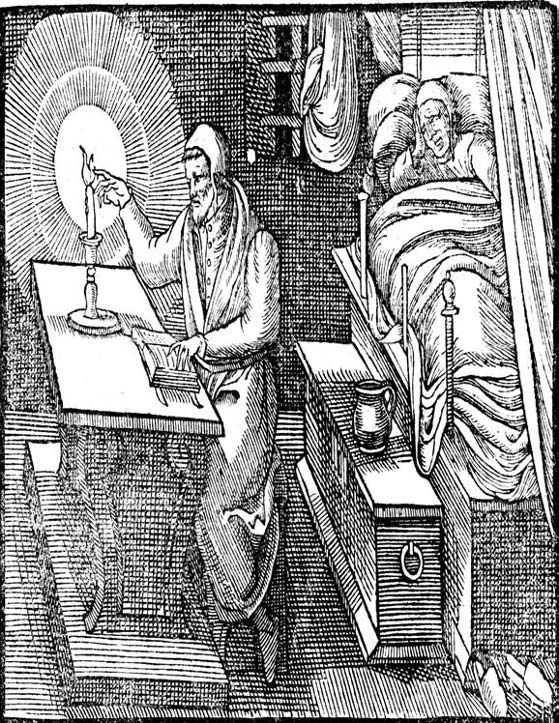
3. Thomas Bilney, proving the fire with his finger
Thomas Bilney
him in the guildhall,* where he was kept. Amongst whom one of the said friends finding him eating of an ale brew with such a cheerful heart and quiet mind as he did, said that he was glad to see him at that time, so shortly before his heavy and painful departure, so heartily to refresh himself. Whereunto he answered:
'Oh,' said he, 'I follow the example of the husbandmen of the country who having a ruinous house to dwell in, yet bestow cost as long as they may, to hold it up, and so do I now with this ruinous house of my body, and with God's creatures in thanks to him, refresh the same as ye see'. Then sitting with his said friends in godly talk, to their edification some put him in mind that though the fire, which he should suffer the next day should be of great heat unto his body, yet the comfort of God's spirit should cool it to his everlasting refreshing. At this word the said Thomas Bilney putting his hand toward the flame of the candle burning before them (as also he did divers times besides) and feeling the heat thereof, 'O', (said he), 'I feel by experience, and have known it long by philosophy,* that fire by God's ordinance is naturally hot, but yet I am persuaded by God's holy word, and by the experience of some spoken of in the same, that in the flame they felt no heat, and in the fire they felt no consumption: and I constantly believe, that howsoever that stubble of this my body shall be wasted by it, yet my soul and spirit shall be purged thereby: a pain for the time, whereon notwithstanding followeth joy unspeakable'. And here he much entreated of this place of scripture: . . . 'Fear not, for I redeemed thee, and called thee by name; thou art mine own.
When thou goest through the water, I will be with thee, and the strong floods shall not overflow thee. When thou walkest in the fire, it shall not burn thee, and the flame shall not kindle upon thee, for I am the Lord thy God, the holy one of Israel'.*
Which he did most comfortably entreat of, as well in respect of himself as applying it to the particular use of his friends there present, of whom, some took such sweet fruit therein, that they caused the whole said sentence to be fair written in tables,* and some in their books. The comfort whereof (in diverse of them) was never taken from them to their dying day.
The good courage of Bilney before his death.
Bilney tasted the fire with his finger.
The Saturday next following, when the officers of execution (as the manner is) with their gleaves and halberds were ready
Foxe's Book of Martyrs
to receive him, and to lead him to the place of execution without the city gate, called Bishopsgate, in a low valley commonly called the Lollards' Pit,* under Saint Leonard's hill environed about with great hills (which place was chosen for the people's quiet sitting to see the execution) at the coming forth of the said Thomas Bilney out of the prison door, one of his friends came to him with few words, as he durst, spake to him and prayed him and in God's behalf, to be constant and to take his death as patiently as he could. Whereunto the said Bilney answered, with a quiet and mild countenance: 'Ye see when the mariner is entered his ship to sail on the troublous sea, how he for a while is tossed in the billows of the same but yet in hope that he shall once come to the quiet haven, he beareth in better comfort, the perils which he feeleth: so am I now toward this sailing, and whatsoever storms I shall feel, yet shortly after shall my ship be in the haven: as I doubt not thereof by the grace of God, desiring you to help me with your prayers to the same effect'. And so he, going forth in the streets, giving much alms by the way, by the hands of one of his friends, and accompanied with one Doctor Warner doctor of Divinity and parson of Winterton, whom he did choose as his old acquaintance, to be with him for his ghostly comfort: came at the last, to the place of execution, and ascended down from the hill to the same, apparelled in a layman's gown with his sleeves hanging down, and his arms out, his hair being piteously mangled at his degradation (a little single body in person, but always of a good upright countenance), and drew near to the stake prepared, and somewhat tarrying* the preparation of the fire, he desired that he might speak some words to the people, and there standing, thus he said:
Constant Bilney exhorted to constancy.
Thomas Bilney going to his death.
'Good people, I am come hither to die, and born I was to live under that condition, naturally to die again, and that ye might testify that I depart out of this present life as a true Christian man in a right belief towards almighty God, I will rehearse unto you in a fast faith, the articles of my creed', and then began to rehearse them in order as they be in the common creed, with oft elevating his eyes and hands to almighty God, and at the article of Christ's incarnation having a little meditation in himself, and coming to the word 'crucified', he humbly bowed
The words of Thomas Bilney at the stake.
Thomas Bilney
himself and made great reverence, and then proceeding in the articles and coming to these words, 'I believe the Catholic
Church', there he paused and spake these words: 'Good people I must here confess to have offended the Church in preaching once against the prohibition of the same, at a poor cure belonging to Trinity Hall in Cambridge where I was fellow, earnestly entreated thereunto by the curate and other good people of the parish, showing that they had no sermon thereof long time before: and so in my conscience moved, I did make a poor collation* unto them, and thereby ran into the disobedience of certain authority in the church, by whom I was prohibited: howbeit I trust at the general day, charity that moved me to this act, shall bear me out at the judgement seat of God': And so he proceeded on, without any manner of words of recantation, or charging any man for procuring him to his death.
Thomas Bilney put to death preaching, being thereunto desired.
Master More proved a liar by witnes[ses] present at Bilney's death.
This once done, he put off his gown, and went to the stake, and, kneeling upon a little ledge coming out of the stake, whereon he should afterward stand to be better seen, he made his private prayer with such earnest elevation of his eyes and hands to heaven, and in so good quiet behaviour, that he seemed not much to consider the terror of his death; and ended at the last, his private prayers with the one hundred forty-third psalm . . . That is, 'Hear my prayer O Lord, consider my desire': and the next verse he repeated in deep meditation thrice . . . . :
'And enter not into judgement with thy servant, for in thy sight shall no man living be justified',* and so finishing that psalm he ended his private prayers.
Thomas Bilney praying at the stake.
Psalm 143.
After that, he turned himself to the officers, asking them if they were ready, and they answered, 'Yea'. Whereupon he put off his jacket and doublet and stood in his hose and shirt, and went unto the stake, standing upon that ledge, and the chain was cast about him, and standing thereon, the said Doctor Warner came to him to bid him farewell, which spake but few words for* weeping.
Upon whom the said Thomas Bilney did most gently smile, and inclined his body to speak to him a few words of thanks, and the last were these: 'O Master Doctor, . . . Feed your flock, feed your flock,* that when the Lord cometh, he may find you so doing, and farewell good Master Doctor, and pray for me', and so he departed without any answer, sobbing and weeping.
Doctor Warner taking his farewell of Thomas Bilney.
The words of Thomas Bilney to Doctor Warner.
Foxe's Book of Martyrs
And while he thus stood upon the ledge at the stake, certain friars, doctors and priors of their houses being there present
(as they were uncharitably and maliciously present at his examination and degradation, et cetera) came to him and said:
'O Master Bilney the people be persuaded that we be the causers of your death, and that we have procured the same, and thereupon it is like that they will withdraw their charitable alms from us all, except you declare your charity towards us and discharge us of the matter'. Whereupon the said Thomas
Bilney spake with a loud voice to the people, and said: 'I pray you good people be never the worse to these men for my sake, as though they should be the authors of my death. It was not they', and so he ended.
The friars desire Bilney to speak for them.
Then the officers put reed and faggots about his body and set fire on the reed, which made a very great flame which sparkled and deformed the visor* of his face, he holding up his hands and knocking upon his breast, crying sometimes 'Jesus', sometimes 'Credo.'* Which flame was blown away from him by the violence of the wind, which was that day and two or three days before notable great, in which it was said that the fields were marvellously plagued by the loss of corn: and so for a little pause, he stood without flame, the flame departing and recoursing thrice ere the wood took strength to be the sharper to consume him: and then he gave up the ghost, and his body being withered bowed downward upon the chain. Then one of the officers with his halberd smite out the staple in the stake behind him, and suffered his body to fall into the bottom of the fire, laying wood on it, and so he was consumed.
The patient death and martyrdom of Master Bilney.
Thus have ye (good readers) the true history, and martyrdom of this good man, that is, of blessed Saint Bilney (as Master
Latimer doth call him) without any recantation, testified and ratified by the authority above said. By the which authority and party being there present and yet alive, it is furthermore constantly affirmed that Bilney not only did never recant, but also that he never had any such bill, or script or scroll in his hand to read, either softly, or apertly, as Master More per licentiam
Poeticam,* would bear us down. Wherefore even as ye see Master More deal in this, so ye may trust him in the residue* of his other tales, if ye will.
Saint Bilney.
Master More's false report refuted.