
14. HUGH LATIMER AND: Nicholas Ridley
14. HUGH LATIMER AND
NICHOLAS RIDLEY
The Behaviour of Doctor Ridley and Master Latimer, at the time of their death, which was the sixteenth of October. Anno 1555.
Upon the north side of the town, in the ditch over against Balliol College, the place of execution was appointed: and for fear of any tumult that might arise, to let the burning of them, the Lord Williams* was commanded by the queen's letters, and the householders of the city to be there assistant, sufficiently appointed, and when everything was in a readiness, the prisoners were brought forth by the mayor and bailiffs.
The order and manner of Bishop Ridley and Master Latimer going to the stake.
Master Ridley had a fair black gown furred, and faced with foins, such as he was wont to wear being bishop, and a tippet of velvet furred likewise about his neck, a velvet nightcap upon his head, and a corner cap upon the same, going in a pair of slippers to the stake, and going between the Mayor and an Alderman, et cetera.
After him came Master Latimer in a poor Bristol frieze frock all worn, with his buttoned cap, and a kerchief on his head, all ready to* the fire, a new long shroud hanging over his hose down to the feet, which at the first sight, stirred men's hearts to rue upon them, beholding on the one side, the honor they sometime had, on the other, the calamity whereunto they were fallen.
Master Doctor Ridley, as he passed toward Bocardo,* looking up where Master Cranmer did lie, hoping belike to have seen him at the glass window, and to have spoken unto him. But then
Master Cranmer was busy with Friar Soto* and his fellows disputing together, so that he could not see him through that occasion. Then Master Ridley looking back, espied Master Latimer coming after. Unto whom he said: 'Oh be ye there?' 'Yea,' said
Master Latimer, 'have after as fast as I can follow.' So he following a pretty way* off, at length they came both to the stake, one after the other, where first Doctor Ridley entering the place,
Doctor Ridley and Master Latimer brought together to the stake.
Foxe's Book of Martyrs
marvellous earnestly holding up both his hands, looked towards heaven: then shortly after espying Master Latimer, with a wonderous cheerful look, ran to him, embraced, and kissed him, and as they that stood near reported, comforted him, saying: 'Be of good heart brother, for God will either assuage the fury of the flame, or else strengthen us to abide it.'
The behaviour of Doctor Ridley and Master Latimer at the stake.
With that went he to the stake, kneeled down by it, kissed it, most effectuously prayed, and behind him Master Latimer kneeled, as earnestly calling upon God as he. After they arose, the one talked with the other a little while, till they which were appointed to see the execution removed themselves out of the sun. What they said, I can learn of * no man.
Then Doctor Smith,* of whose recantation in King Edward's time, ye heard before, began his sermon to them, upon this text of Saint Paul, in the thirteenth chapter of the first epistle to the Corinthians: . . . That is, if I yield my body to the fire to be burnt and have not charity, I shall gain nothing thereby.* Wherein he alleged, that the goodness of the cause, and not the order of death: maketh the holiness of the person:* which he confirmed by the examples of Judas, and of a woman in Oxford that of late hanged herself, for that they and such like as he recited, might then be adjudged righteous, which desperately sundered their lives from their bodies, as he feared that those men that stood before him would do. But he cried still to the people to beware of them, for they were heretics, and died out of the Church. And on the other side, he declared their diversities in opinions, as Lutherans, Oecolampadians,* Zwinglians, of which sect they were, (he said) and that was the worst: but the old Church of Christ, and the Catholic faith* believed far otherwise. At which place they lifted up both their hands and eyes to heaven, as it were calling God to witness of the truth. The which countenance they made in many other places of his sermon, whereas they thought he spake amiss. He ended with a very short exhortation to them to recant and come home again to the Church, and save their lives and souls, which else were condemned. His sermon was scant in all a quarter of an hour.
Doctor Smith preaching at the burning of Bishop Ridley and Master Latimer.
Doctor Smith raileth against the martyrs.
Christ's congregation burdened with diversity of opinions.
Doctor Ridley said to Master Latimer, 'Will you begin to answer the sermon, or shall I?' Master Latimer said, 'Begin you first, I pray you.' 'I will,' said Master Ridley.
Hugh Latimer and Nicholas Ridley
Then the wicked sermon being ended, Doctor Ridley and Master Latimer kneeled down upon their knees towards my Lord Williams of Thame, the Vice Chancellor of Oxford,* and diverse other commissioners appointed for that purpose, which sat upon a form* thereby. Unto whom Master Ridley said: 'I beseech you my lord even for Christ's sake, that I may speak but two or three words,' and whilst my lord bent his head to the Mayor and Vice Chancellor, to know (as it appeared) whether he might give him leave to speak, the bailiffs and Doctor Marshall* Vice Chancellor ran hastily unto him, and with their hands stopped his mouth and said: 'Master
Ridley, if you will revoke your erroneous opinions, and recant the same, you shall not only have liberty so to do, but also the benefit of a subject, that is, have your life.' 'Not otherwise?' said Master Ridley. 'No,' quoth Doctor Marshall. 'Therefore if you will not do so, then there is no remedy but you must suffer for your deserts.' 'Well,' quoth Master Ridley, 'so long as the breath is in my body, I will never deny my Lord Christ, and his known truth: God's will be done in me.' And with that he rose up, and said with a loud voice: 'Well, then I commit our cause to Almighty God, which shall indifferently judge all.'
Doctor Ridley ready to answer Doctor Smith's sermon, but could not be suffered.
Doctor Marshall Vice Chancellor of Oxford, stoppeth Doctor Ridley's mouth.
Bishop Ridley committeth his cause to God.
To whose saying, Master Latimer added his old poesy.* 'Well, there is nothing hid but it shall be opened':* and he said he could answer Smith well enough if he might be suffered.*
Incontinently they were commanded to make them* ready, which they with all meekness obeyed. Master Ridley took his gown and his tippet, and gave it to his brother-in-law Master
Shipside, who all his time of imprisonment, although he might not be suffered to come to him, lay there at his own charges to provide him necessaries, which from time to time, he sent him by the sergeant that kept him. Some other of his apparel that was little worth, he gave away, other the bailiffs took.
Master Latimer's words when he could not be suffered to answer Doctor Smith.
This was no Popish tippet, but made only to keep his neck warm.
He gave away besides, diverse other small things to gentlemen standing by, and diverse of them pitifully weeping, as to Sir Henry Lee,* he gave a new groat, and to diverse of my
Lord Williams's gentlemen, some napkins, some nutmegs, and races* of ginger, his dial, and such other things as he had about him, to everyone that stood next him. Some plucked the points off his hose. Happy was he that might get any rag of him.
Doctor Ridley giveth away his apparel and other gifts to the people about him.
Foxe's Book of Martyrs
Master Latimer gave nothing, but very quietly suffered his keeper to pull off his hose, and his other array, which to look unto was very simple: and being stripped into his shroud, he seemed as comely a person to them that were there present, as one should lightly* see: and whereas in his clothes, he appeared a withered and crooked silly old man, he now stood bolt upright, as comely a father as one might lightly behold.
Master Latimer standing at the stake in his shirt.
Then Master Ridley standing as yet in his truss,* said to his brother: 'It were best for me to go in my truss still.' 'No,' quoth his brother, 'it will put you to more pain: and the truss will do a poor man good.' Whereunto Master Ridley said: 'Be it, in the name of God,' and so unlaced himself. Then being in his shirt, he stood upon the foresaid stone, and held up his hands and said: 'Oh heavenly Father, I give unto thee most hearty thanks, for that thou hast called me to be a professor of thee, even unto death. I beseech thee Lord God take mercy upon this realm of England, and deliver the same from all her enemies.'
Bishop Ridley thanketh God for his martyrdom, and prayeth for England.
Then the smith took a chain of iron, and brought the same about both Doctor Ridley's, and Master Latimer's middles: and as he was knocking in a staple, Doctor Ridley took the chain in his hand, and shaked the same, for it did gird in his belly, and, looking aside to the smith, said: 'Good fellow knock it in hard, for the flesh will have his course.' Then his brother did bring him gunpowder in a bag,* and would have tied the same about his neck. Master Ridley asked what it was.
His brother said, 'Gunpowder.' Then said he, 'I take it to be sent of God, therefore I will receive it as sent of him.' 'And have you any,' said he, 'for my brother?' meaning Master
Latimer. 'Yea sir, that I have,' quoth his brother. 'Then give it unto him,' said he, 'betime, lest you come too late.' So his brother went, and carried of the same gunpowder unto Master
Latimer. . . .
Gunpowder given to the martyrs.
Then brought they a faggot kindled with fire, and laid the same down at Doctor Ridley's feet. To whom Master Latimer spake in this manner: 'Be of good comfort Master Ridley, and play the man:* we shall this day light such a candle by God's grace in England, as (I trust) shall never be put out.'*
The church lightened by the martyrdom And so the fire being given unto them, when Doctor Ridley saw the fire flaming up toward him, he cried with a wonderful of saints.*
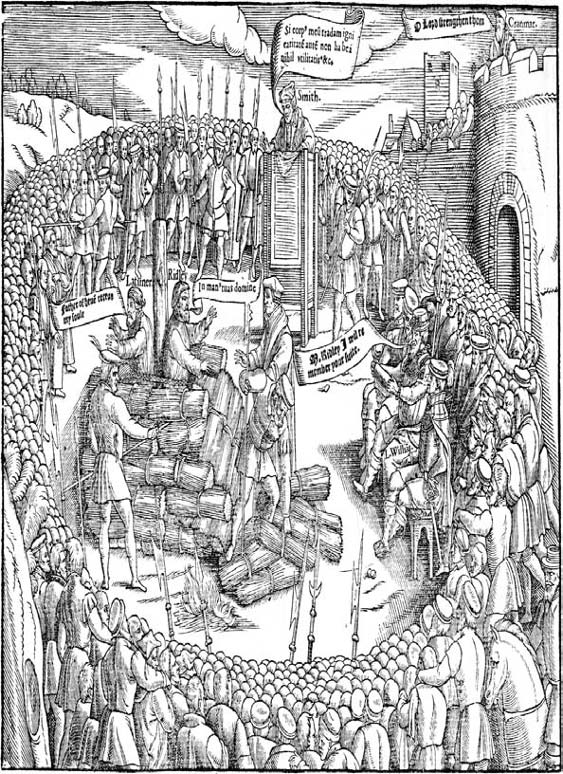
14. The burning of Latimer and Ridley at Oxford, Doctor Smith preaching
Foxe's Book of Martyrs
loud voice: . . . 'Lord, Lord, receive my spirit.'* Master Latimer crying as vehemently on the other side: 'Oh Father of Heaven, receive my soul,' who received the flame as it were embracing of it. After, as he had stroked his face with his hands and (as it were) bathed them a little in the fire, he soon died (as it appeared) with very little pain or none. And thus much concerning the end of this old and blessed servant of God, Master
Latimer, for whole laborious travails, fruitful life, and constant death, the whole realm hath cause to give great thanks to almighty God.
Master Latimer's prayer and martyrdom.
But Master Ridley by reason of the evil* making of the fire unto him, because the wooden faggots were laid about the goss,* and over-high built, the fire burned first beneath, being kept down by the wood.* Which when he felt, he desired them for Christ's sake to let the fire come unto him. Which when his brother-in-law heard, but not well understood, intending to rid him out of his pain (for the which cause he gave attendance) as one in such sorrow, not well advised what he did, heaped faggots upon him, so that he clean covered him, which made the fire more vehement beneath, that it burned clean all his nether parts before it once touched the upper, and that made him leap up and down under the faggots, and often desire them to let the fire come unto him, saying, 'I cannot burn,' which indeed appeared well: for after his legs were consumed by reason of his stringling through the pain (whereof he had no release, but only his contentation in God) he showed that side toward us clean, shirt and all untouched with flame.Yet in all this torment he forgot not to call unto God still, having in his mouth, 'Lord have mercy upon me,' intermeddling this cry, 'Let the fire come unto me; I cannot burn.' In which pains he laboured, till one of the standers-by with his bill, pulled off the faggots above, and where he saw the fire flame up, he wrested himself unto that side. And when the flame touched the gunpowder, he was seen [to] stir no more, but burned on the other side, falling down at Master Latimer's feet.
Which some said happened, by reason that the chain loosed: other said that he fell over the chain by reason of the poise* of his body, and the weakness of the nether limbs.
The order of Bishop Ridley's burning.
Doctor Ridley long in burning.
The death and martyrdom of Doctor Ridley.
Some say that before he was like to fall from the stake he desired them to hold him to it with their bills. Howsoever it
Hugh Latimer and Nicholas Ridley
was, surely it moved hundreds to tears, in beholding the horrible sight. For I think there was none that had not clean exiled all humanity and mercy, which would not have lamented to behold the fury of the fire so to rage upon their bodies. Signs there were of sorrow on every side. Some took it grievously to see their deaths, whose lives they held full dear. Some pitied their persons that thought their souls had no need thereof. His brother moved many men, seeing his miserable case: seeing
(I say) him compelled to such infelicity, that he thought then to do him best service, when he hastened his end. Some cried out of the luck, to see his endeavour, who most dearly loved him, and sought his release, turn to his greater vexation, and increase of pain. But whoso considered their preferments in time past, the places of honour that they sometime occupied in this commonwealth, the favour they were in with their princes, and the opinion of learning they had, could not choose but sorrow with tears, to see so great dignity, honour, and estimation, so necessary members sometime accounted, so many godly virtues, the study of so many years, such excellent learning, to be put into the fire, and consumed in one moment. Well, dead they are, and the reward of this world they have already. What reward remaineth for them in Heaven, the day of the Lord's glory when he cometh with his Saints, shall shortly I trust declare.
The lamenting hearts of the people, at the martyrdom of these two saints.