
2. William Tyndale
2. WILLIAM TYNDALE
The life and story of the true servant and martyr of God, William Tyndale: Who for his notable pains and travail may well be called the apostle of England in this our latter age.
William Tyndale the faithful minister and constant martyr of Christ, was born about the borders of Wales and brought up from a child in the University of Oxford, where he by long continuance grew up, and increased as well in the knowledge of tongues, and other liberal arts, as especially in the knowledge of the scriptures: whereunto his mind was singularly addicted: in so much that he lying then in Magdalen Hall, read privily to certain students and fellows of Magdalen College, some parcel of Divinity: instructing them in the knowledge and truth of the scriptures. Whose manners also and conversation being correspondent to the same, were such, that all they which knew him, reputed and esteemed him to be a man of most virtuous disposition, and of life unspotted.
W. Tyndale Martyr.
{Anno 1536.} The first taste of God's truth in Magdalen College, by the means of Master Tyndale.
Thus he in the University of Oxford increasing more and more in learning and proceeding in degrees of the schools, spying his time, removed from thence to the University of Cambridge, where after he had likewise made his abode a certain space, being now further ripened in the knowledge of God's word, leaving that university also, he resorted to one Master
Walsh a knight of Gloucestershire, and was there schoolmaster to his children, and in good favour with his master. This gentleman, as he kept a good ordinary commonly at his table, there resorted to him many times sundry abbots, deans, archdeacons, with other diverse doctors and great beneficed men: who there together with Master Tyndale sitting at the same table, did use many times to enter communication and talk of learned men, as of Luther and of Erasmus: also of diverse other controversies and questions upon the scripture.
Tyndale disputing with the doctors.
Then Master Tyndale, as he was learned and well practised in God's matters, so he spared not to show unto them simply
Foxe's Book of Martyrs
and plainly his judgement in matters, as he thought: and when as they at any time did vary from Tyndale in opinions and judgement, he would show them in the book and lay plainly before them the open and manifest places of the scriptures, to confute their errors, and to confirm his sayings. And thus continued they for a certain season, reasoning and contending together diverse and sundry times, till at length they waxed weary, and bare a secret grudge in their hearts against him.
Not long after this, it happened that certain of these great doctors had invited Master Walsh and his wife to a banquet: where they had talk at will and pleasure, uttering their blindness and ignorance without any resistance or gainsaying. Then
Master Walsh and his wife coming home and calling for Master Tyndale, began to reason with him about those matters, whereof the priests had talked before at their banquet. Master Tyndale answering by scriptures, maintained the truth, and reproved their false opinions. Then said the Lady Walsh, a stout and a wise woman (as Tyndale reported). 'Well', (said she), 'there was such a doctor which may dispend a hundred pounds and another two hundred pounds and another three hundred pounds and what? Were it reason, think you, that we should believe you before them?' Master Tyndale gave her no answer at that time, nor also after that (because he saw it would not avail) he talked but little in those matters. At that time he was about the translation of a book called Enchiridion militis Christiani,* which being translated, he delivered to his master and lady.
Who, after they had read and well perused the same, the doctorly* prelates were no more so often called to the house, neither had they the cheer and countenance when they came, as before they had. Which thing they marking and well perceiving, and supposing no less but it came by the means of Master Tyndale, refrained themselves, and at last utterly withdrew themselves, and came no more there.
Tyndale instructeth Master Walsh and his wife in the truth.
Enchiridion a book of Erasmus, translated by Tyndale.
As this grew on, the priests of the country clustering together, began to grudge and storm against Tyndale, railing against him in alehouses and other places. Of whom Tyndale* himself in his prologue before the first book of Moses, this testifieth in his own words, and reporteth that he suffered much in that country by a sort of unlearned priests, being full rule and ignorant
The priests storm against Tyndale.
William Tyndale
(sayeth he) God knoweth: which have seen no more Latin than that only which they read in their portases and missals. . . .
The rudeness of the country priests.
The blasphemy of a blind doctor.
It was not long after, but Master Tyndale happened to be in the company of a certain divine recounted for a learned man, and, in commoning and disputing with him, he drove him to that issue, that the said great doctor burst out into these blasphemous words, and said: 'we were better to be without God's law than the pope's'. Master Tyndale hearing this, full of godly zeal, and not bearing that blasphemous saying, replied again and said: 'I defy the pope and all his laws': and further added, that if God spared him life, ere many years he would cause a boy that driveth the plough to know more of the scripture, than he did.
The pope's law preferred before God's law.
After this, the grudge of the priests increasing still more and more against Tyndale, they never ceased barking and rating at him, and laid many sore things to his charge, saying that he was an heretic in sophistry, an heretic in logic, an heretic in divinity: and said moreover to him, that he bare himself bold of the gentlemen there in that country: but notwithstanding, shortly he should be otherwise talked withal. To whom Master
Tyndale answering again thus said, that he was contented they should bring him into any country in all England, giving him ten pounds a year to live with, and binding him to no more but to teach children and to preach.
To be short, Master Tyndale, being so molested and vexed in the country by the priests, was constrained to leave that country and to seek another place: and so coming to Master Walsh, he desired him of his good will, that he might depart from him, saying on this wise to him: 'Sir I perceive I shall not be suffered to tarry long here in this country, neither shall you be able though you would, to keep me out of the hands of the spirituality, and also what displeasure might grow thereby to you by keeping me, God knoweth: for the which I should be right sorry'. So that in fine, Master Tyndale with the good will of his master, departed, and eftsoons came up to London, and there preached a while, according as he had done in the country before, and specially about the town of Bristol, and also in the said town, in the common place called Saint Austin's Green.
At length he bethinking himself of Cuthbert Tunstall, then Tyndale departeth from Master Walsh.
Tyndale cometh to London.
Foxe's Book of Martyrs
Bishop of London, and especially for the great commendation of Erasmus, who in his annotations so extolleth him for his learning, thus cast with himself, that if he might attain unto his service he were a happy man. And so coming to Sir Henry
Guildford the king's controller, and bringing with him an oration of Isocrates,* which he had then translated out of Greek into English, he desired him to speak to the said bishop of London for him. Which he also did, and willed him moreover to write an epistle to the bishop, and to go himself with him.
Which he did likewise, and delivered his epistle to a servant of his, named William Hebilthwaite, a man of his old acquaintance. But God, who secretly disposeth the course of things, saw that was not the best for Tyndale's purpose, nor for the profit of his church, and therefore gave him to find little favour in the bishop's sight. The answer of whom was this, that his house was full, he had more than he could well find, and advised him to seek in London abroad, where he said he could lack no service. Et cetera. And so remained he in London the space almost of a year, beholding and marking with himself the course of the world, and especially the demeanour of the preachers, how they boasted themselves and set up their authority and kingdom: beholding also the pomp of the prelates, with other things more which greatly misliked him: Insomuch that he understood, not only there to be no room in the bishop's house for him to translate the New Testament: but also that there was no place to do it in all England. And therefore finding no place for his purpose within the realm, and having some aid and provision, by God's providence ministered unto him by Humphrey
Monmouth* . . . and certain other good men, he took his leave of the realm, and departed into Germany. Where the good man being inflamed with a tender care and zeal of his country, refused no travail nor diligence how by all means possible, to reduce his brethren and countrymen of England to the same taste and understanding of God's holy word and verity, which the Lord had endued him withal.
An oration of Isocrates translated out of Greek into English by William Tyndale.
Tyndale sueth to bishop Tunstall to be his chaplain.
Tunstall refuseth Master Tyndale.
Tyndale departeth into Germany.
The causes Whereupon he considering in his mind, and partly also conferring with John Frith, thought with himself no way more to conduce thereunto, than if the scripture were turned into the vulgar speech, that the poor people might also read and see the moving Tyndale to translate the scripture into the English tongue.
William Tyndale
simple plain word of God. For first he wisely casting in his mind, perceived by experience, how that it was not possible to establish the lay people in any truth, except the scripture were so plainly laid before their eyes in their mother tongue, that they might see the process, order, and meaning of the text: for else what so ever truth should be taught them, these enemies of the truth would quench it again, either with apparent reasons of sophistry and traditions of their own making, founded without all ground of scripture: either else juggling with the text, expounding it in such a sense, as impossible it were to gather of the text, if the right process, order, and meaning thereof were seen.
Again, right well he perceived and considered this only, or most chiefly to be the cause of all mischief in the church, that the scriptures of God were hidden from the people's eyes: for so long the abominable doings and idolatries maintained by the Pharisaical clergy, could not be espied, and therefore all their labour was with might and main* to keep it down, so that either it should not be read at all, or if it were, they would darken the right sense with the mist of their sophistry, and so entangle them which rebuked or despised their abominations, with arguments of philosophy, and with worldly similitudes, and apparent reasons of natural wisdom: and with wresting the scripture unto their own purpose, contrary unto the process, order, and meaning of the text, would so delude them in descanting upon it with allegories, and amaze them, expounding it in many senses laid before the unlearned lay people, that though thou felt in thy heart, and were sure that all were false that they said yet couldest not thou solve their subtle riddles.*
Hiding of scripture the cause of mischief.
For these and such other considerations, this good man was moved (and no doubt stirred up of God) to translate the scripture into his mother tongue, for the public utility and profit of the simple vulgar people of the country: first, setting in hand with the New Testament, which he first translated about the year of our Lord 1527. After that he took in hand to translate the Old Testament, finishing the five books of Moses, with sundry most learned and godly prologues prefixed before every one, most worthy to be read and read again of all good
Christians: as the like also he did upon the New Testament.
The New Testament and the five books of Moses translated with Tyndale's prologues.
Foxe's Book of Martyrs
He wrote also diverse other works under sundry titles, among the which is that most worthy monument of his, entitled: The Obedience of a Christian Man: wherein with singular dexterity he instructeth all men in the office and duty of Christian obedience, with diverse other treatises: as The Wicked Mammon: The Practice of Prelates, with expositions upon certain parts of the scripture, and other books also answering to Sir Thomas More and other adversaries of the truth, no less delectable, than also most fruitful to be read, which partly before being unknown unto many, partly also being almost abolished and worn out by time, the printer hereof (good Reader) for conserving and restoring such singular treasures, hath collected and set forth in print the same in one general volume, all and whole together, as also the works of John Frith, Barnes,* and other, as are to be seen most special and profitable for thy reading.
These books of William Tyndale being compiled, published and sent over into England, it cannot be spoken what a door of light they opened to the eyes of the whole English nation, which before were many years shut up in darkness.
At his first departing out of the realm, he took his journey into the further parts of Germany, as into Saxony, where he had conference with Luther and other learned men in those quarters. Where, after that he had continued a certain season, he came down from thence into the Netherlands, and had his most abiding in the town of Antwerp, unto the time of his apprehension: whereof more shall be said God willing hereafter.
Tyndale went into Saxony.
Tyndale came to Antwerp.
Amongst his other books which he compiled, one work he made also for the declaration of the sacrament (as it was then called) of the altar: the which he kept by him, considering how the people were not as yet fully persuaded in other matters tending to superstitious ceremonies and gross idolatry. Wherefore he thought as yet time was not come, to put forth that work, but rather that it should hinder the people from other instructions, supposing that it would seem to them odious to hear any such thing spoken or set forth at that time, sounding against their great goddess Diana, that is, against their Mass, being had everywhere in great estimation, as was the goddess Diana amongst the Ephesians* whom they thought to come from heaven.
William Tyndale
Wherefore Master Tyndale being a man both prudent in his doings, and no less zealous in the setting forth of God's holy truth, after such sort as it might take most effect with the people, did forbear the putting forth of that work, not doubting but by God's merciful grace, a time should come, to have that abomination openly declared, as it is at this present day: the Lord almighty be always praised therefore. Amen.
Tyndale bearing with time.
These godly books of Tyndale, and specially the New Testament of his translation, after that they began to come into men's hands, and to spread abroad, as they wrought great and singular profit to the godly: so the ungodly envying and disdaining that the people should be anything wiser than they, and again fearing lest by the shining beams of truth, their false hypocrisy and works of darkness should be discerned: began to stir with no small ado, like as at the birth of Christ, Herod and all Jerusalem was troubled with him. But especially Satan the prince of darkness, maligning the happy course and success of the Gospel, set to his might also, how to impeach and hinder the blessed travails of that man: as by this, and also by sundry other ways may appear . . .
Darkness hateth light.
Satan an enemy to all good purposes, especially to the Gospel.
[After publication of his translation of the New Testament, Tyndale migrated to Antwerp, where he lodged with Thomas Poyntz, a relative of Lady Anne Walsh, whom he had served as a tutor in Gloucestershire.
Henry Phillips betrayed Tyndale to Imperial authorities.] Then said Phillips, 'Master Tyndale you shall be my guest here this day'. 'No', said Master Tyndale, 'I go forth this day to dinner, and you shall go with me and be my guest, where you shall be welcome'. So when it was dinnertime, Master Tyndale went forth with Phillips, and at the going forth of Poyntz's house, was a long narrow entry, so that two could not go in a front.* Master Tyndale would have put Phillips before him, but Phillips would in no wise, but put Master Tyndale afore, for that he pretended to show great humanity. So Master
Tyndale being a man of no great stature, went before, and Phillips a tall comely person followed behind him, who had set officers on either side of the door upon two seats: which being there, might see who came in the entry, and coming through the same entry, Phillips pointed with his finger over Master
How Tyndale was betrayed into his enemies' hands.
Foxe's Book of Martyrs
Tyndale's head down to him, that the officers which sat at the door, might see that it was he whom they should take, as the officers that took Master Tyndale, afterward told Poyntz, and said to Poyntz when they had laid him in prison, that they pitied to see his simplicity when they took him. Then they took him and brought him to the Emperor's attorney or Procurer
General, where he dined. Then came the Procurer General to the house of Poyntz, and sent away all that was there of Master
Tyndale's, as well his books as other things: and from thence Tyndale was had to the Castle of Vilvorde, eighteen English miles from Antwerp, and there he remained until he was put to death . . .
Tyndale had to the Castle of Vilvorde.
At last, after much reasoning, when no reason would serve, although he deserved no death, he was condemned by virtue of the Emperor's decree made in the assembly at Augsburg . . . and upon the same, brought forth to the place of execution, was there tied to the stake, and then strangled first by the hangman, and afterward with fire consumed in the morning at the town of Vilvorde, anno 1536, crying this at the stake with a fervent zeal, and a loud voice: 'Lord, open the king of England's eyes'.
The condemnation of Master Tyndale.
The martyrdom of William Tyndale.
{Anno 1536} The prayer of Master Tyndale.
Such was the power of his doctrine, and sincerity of his life, that during the time of his imprisonment (which endured a year and a half) it is said, he converted his keeper, his daughter, and other of his household.* Also the rest that were with him conversant in the castle reported of him that if he were not a good Christian man, they could not tell whom to trust.
Master Tyndale converted his keeper.
The Procurer General the Emperor's attorney being there, left this testimony of him, that he was . . . a learned, a good, and a godly man.
Commendation of Master Tyndale by them that were about him.
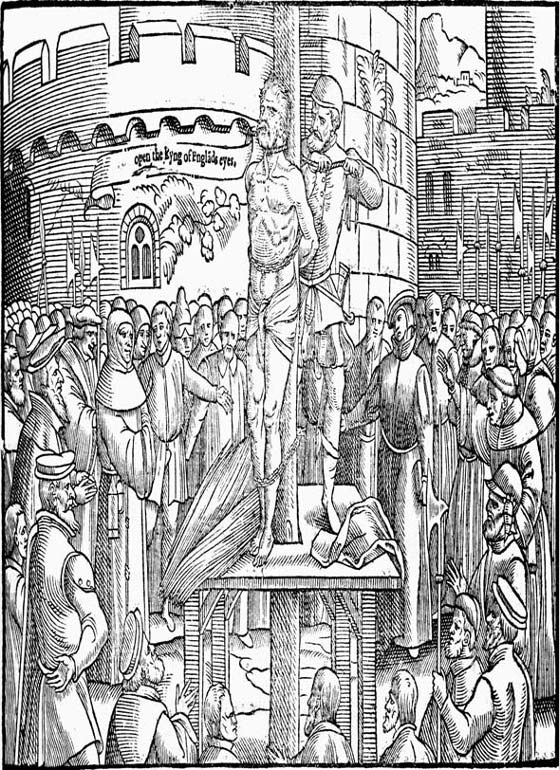
4. William Tyndale, at the stake at Vilvorde Castle, Flanders