
5. Lawrence Saunders
5. LAWRENCE SAUNDERS
The history and martyrdom of Lawrence Saunders, burned for the defence of the gospel at Coventry.
Anno 1555. February 8.
After that Queen Mary by public proclamation in the first year of her reign, had inhibited the sincere preaching of God's holy word, as is before declared, diverse godly ministers of the word which had the cure and charge of souls committed to them, did notwithstanding, according to their bounded duty, feed their flock faithfully, not as preachers authorized by public authority
(as the godly order of the realm was in the happy days of blessed King Edward) but as the private pastors of particular flocks,* among whom Lawrence Saunders was one, a man of worshipful parentage. His bringing up was in learning from his youth, in places meet for that purpose, as namely in the school of Eton. From whence (according to the manner there used) he was chosen to go to the King's College in Cambridge, where he continued scholar of the College three whole years, and there profited in knowledge, and learning very much for that time: shortly after that, he did forsake the university, and went to his parents, upon whose advice he minded to become a merchant, for that his mother was a gentlewoman of good estimation, being left a widow, and having a good portion for him among his other brethren, she thought to set him up wealthily, and so he coming up to London, was bound prentice with a merchant, named Sir William Chester (who afterward chanced to be Sheriff of London the same year that Saunders was burned at Coventry). Thus by the mind of his friends
Lawrence should needs have been a merchant, but almighty God which hath his secret working in all things, saw better for his servant, as it fell out in the end, for although that Saunders was bound by fast indenture to play the merchant, yet the Lord so wrought inwardly in his heart, that he could find no liking in that vocation: so that when his other fellows were busily occupied about that kind of trade, he would secretly withdraw
February 8.
The story of Lawrence Saunders, martyr.
Scholars are taken out of Eton College into the King's College at Cambridge.
Master Saunders first bound prentice with Master Chester.
Lawrence Saunders
himself into some privy corner, and there fall into his solitary lamentations, as one not liking with that kind and trade of life.
It happened that his master, being a good man, and hearing his prentice thus in his secret prayer inwardly to mourn by himself, called him unto him to know what the cause was of that his solitariness and lamentation, who then perceiving his mind nothing to fantasize* that kind of life, (for so Saunders declared unto him) and perceiving also his whole purpose to be bent to the study of his book, and spiritual contemplation, like a good man, directed his letters incontinently unto his friends, and giving him his indenture, so set him free. And thus
Lawrence Saunders being ravished with the love of learning, and especially with the reading of God's word, tarried not long time in the traffic of merchandise, but shortly returned to Cambridge again to his study, where he began to couple to the knowledge of the Latin, the study of the Greek tongue, wherein he profited in small time very much: therewith also he joined the study of the Hebrew. Then gave he himself wholly to the study of the holy scripture, to furnish himself to the office of a preacher.
Master Saunders, appointed to the trade of merchandise, could not away with that kind of life.
Master Saunders from merchandise returneth to his study.
In study he was diligent and painful, in godly life he declared the fruits of a well-exercised* conscience, he prayed often and with great fervour, and in his prayers as also at other times, he had his part of spiritual exercises, which his hearty sighing to God declared. In which when any special assault did come, by prayer he felt present relief: then was his company marvellous comfortable.* For as his exercises were special teachings, so in the end they proved singular consolations: wherein he became so expert, that within short space he was able to comfort other which were in any affliction, by the consolation wherewith the Lord did comfort him. Thus continued he in the university, till he proceeded Master of Art, and a long space after.
In the beginning of King Edward's reign, when God's true religion was begun to be restored, after licence obtained, he began to preach, and was so well liked of them which then had authority, that they appointed him to read a Divinity lecture in the College at Fotheringhay,* where by doctrine and life he edified the godly, drew many ignorant to God's true knowledge,
Master Saunders reader in the College of Fotheringay.
Foxe's Book of Martyrs
and stopped the mouth of the adversaries. He married about that time, and in the married estate led a life unblameable before all men. The College of Fotheringhay being dissolved, he was placed to be reader in the minster at Litchfield: where he so behaved himself in teaching and living, that the very adversaries did give him a full report as well of learning, as of much godliness. After a certain space, he departed from Litchfield to a benefice in Leicestershire, called Churchlangton, whereupon he keeping residence, taught diligently, and kept a liberal house. From thence he was orderly called to take a benefice in the City of London, named All Hallows in Breadstreet.
Then minded he to give over his cure in the country: and therefore after he had taken possession of his benefice in London, he departed from London into the country, clearly to discharge himself thereof. And even at that time began the broil about the claim that Queen Mary made to the crown, by reason whereof he could not accomplish his purpose.
Saunders after reader at Litchfield.
In this trouble, and even among the beginners of it, (such I mean as were for the queen) he preached at Northampton, nothing meddling with the estate,* but boldly uttered his conscience against the popish doctrine and Antichrist's damnable errors, which were like to spring up again in England as a just plague for the little love which the English nation did bear to the blessed word of God, which had been so plentifully offered unto them.* The queen's men which were there and heard him, were highly displeased with him for his sermon, and for it kept him among them as prisoner. But partly for love of his brethren and friends, which were chief doers for the queen among them, partly because there was no law broken by his preaching, they dismissed him. He seeing the dreadful days at hand, inflamed with the fire of godly zeal, preached with diligence at both those benefices, as time could serve him, seeing he could resign neither of them now, but into the hand of a papist.
The constant purpose of Master Saunders.
Thus passed he to and fro in preaching, until that proclamation was put forth, of which mention is made in the beginning.
At which time he was at his benefice in the country, where he (notwithstanding the proclamation aforesaid) taught diligently
God's truth, confirming the people therein, and arming them
Lawrence Saunders
against false doctrine, until he was not only commanded to cease, but also with force resisted, so that he could not proceed there in preaching. Some of his friends perceiving such fearful menacings, counselled him to fly out of the realm, which he refused to do. But seeing he was with violence kept from doing good in that place, he returned towards London, to visit the flock, of which he had there the charge.
Master Saunders refuseth to fly the realm.
On Saturday, the fourteenth of October, as he was coming nigh to the City of London, Sir John Mordant a Councillor to Queen Mary, did overtake him, and asked him whither he went.
'I have,' (said Saunders), 'a cure in London, and now I go to instruct my people according to my duty.' 'If you will follow my counsel,' quoth Master Mordant, 'let them alone, and come not at them.' To this Saunders answered: 'how shall I then be discharged before God, if any be sick and desire consolation, if any want good counsel and need instruction, or if any should slip into error and receive false doctrine?'
Master Mordant dissuadeth Lawrence Saunders from preaching.
. . . Master Mordant of an uncharitable mind, went to give warning to Bonner Bishop of London, that Saunders would preach in his cure the next day. Saunders resorted to his lodging, with a mind bent to do his duty. Where because he seemed to be somewhat troubled, one which was there about him asked him how he did. 'In very deed,' (saith he), 'I am in prison till I be in prison': meaning that his mind was unquiet until he had preached, and that then he should have quietness of mind, though he were put in prison.
Master Saunders in prison, till he was in prison.
Master Saunders's sermon at All Hallows. 2
Corinthians 11[: 2-3].
The next day which was Sunday, in the forenoon he made a sermon in his parish, entreating that place which Paul writeth to the Corinthians: 'I have coupled you to one man, that ye should make of yourselves a chaste virgin unto Christ. But I fear lest it come to pass, that as the serpent beguiled Eve: even so your wits should be corrupt from the singleness which ye had towards Christ.' He recited a sum of that true Christian doctrine, through which they were coupled to Christ, to receive of him free justification through faith in his blood. The papistical doctrine he compared to the serpent's deceiving, and lest they should be deceived by it, he made a comparison between the voice of God, and the voice of the popish serpent: descending to more particular declaration thereof, as it were to
Foxe's Book of Martyrs
let them plainly see the difference that is between the order of the Church service set forth by King Edward in the English tongue: comparing it with the popish service then used in the Latin tongue.
The first he said was good, because it was according to the word of God. Corinthians 14. and the order of the primitive church. The other he said was evil, and though in that evil he intermingled some good Latin words: yet was it but as a little honey or milk mingled with a great deal of poison, to make them to drink up all. This was the sum of his sermon.
In the afternoon he was ready in his church to have given another exhortation to his people. But the Bishop of London interrupted him by sending an officer for him. This officer charged him upon the pain of disobedience and contumacy, forthwith to come to the bishop his master. Thus, as the apostles were brought out of the Temple where they were teaching, unto the rulers of the priests,* so was Lawrence Saunders brought before this bishop in his Palace of London, who had in his company the aforenamed Sir John Mordant and some of his chaplains. The bishop laid no more to Lawrence Saunders's charge but treason for breaking the queen's proclamation, heresy and sedition for his sermon.
Master Saunders apprehended by Bishop Bonner at his sermon.
Sir John Mordant accuser of Lawrence Saunders.
Preaching of God's word made treason The treason and sedition, his charity was content to let slip, until another time. But an heretic he would now prove him and all those, he said, which did teach and believe that the administration of the sacraments and all orders of the church are most pure, which do come most nigh to the order of the primitive church. For the church was then but in her infancy, and could not abide that perfection which was afterward to be furnished with ceremonies. And for this cause Christ himself, and after him the apostles did in many things bear with the rudeness of the church. To this Lawrence Saunders answered with the authority of Saint Augustine, that ceremonies were even from the beginning invented and ordained for the rude infancy and weak infirmity of man, and therefore it was a token of the more perfection of the primitive church, that it had few ceremonies, and of the rudeness of the church papistical, because it had so many ceremonies, partly blasphemous, partly unsavoury and unprofitable. with Bishop Bonner.
Ceremonies invented only for weak infirmity.
Lawrence Saunders
After much talk had concerning this matter, the bishop willed him to write what he believed of transubstantiation.
Lawrence Saunders did so, saying: 'My Lord, ye do seek my blood, and ye shall have it: I pray God that ye may be so baptized in it, that ye may thereafter loathe bloodsucking, and become a better man.' This writing the bishop kept for his purpose, even to cut the writer's throat, as shall appear hereafter.
The bishop when he had his will, sent Lawrence Saunders to the Lord Chancellor,* as Annas sent Christ to Caiaphas:* and like favour found Saunders as Christ his master did before him. But the Chancellor being not at home, Saunders was constrained to tarry for him by the space of four hours, in the utter* chamber, where he found a chaplain of the bishop's very merrily disposed with certain gentlemen playing at the tables,* with diverse other of the same family or house, occupied there in the same exercise.
Bishop Bonner seeketh the blood of Master Saunders.
Master Saunders sent from Annas to Caiaphas.
All this time Saunders stood very modestly and soberly at the screen or cupboard, bareheaded, Sir John Mordant his guide or leader walking up and down by him: who (as I said before) was then one of the Council. At the last, the bishop returned from the court, whom, as soon as he was entered, a great many suitors met and received: so that, before he could get out of one house into another, half an hour was passed. At the last, he came into the chamber where Saunders was, and went through into another chamber: where in the mean way
Saunders's leader gave him a writing containing the cause, or rather the accusation of the said Saunders, which when he had perused, 'Where is the man?' said the bishop. Then Saunders being brought forth to the place of examination, first, most lowly and meekly kneeled down, and made curtsy before the table where the bishop did sit: unto whom the bishop spake on this wise.
Winchester's talk with Master Saunders.
Master Saunders's answer to Master Winchester.
'How happeneth it,' (said he), 'that notwithstanding the queen's proclamation to the contrary, you have enterprised to preach?'
Saunders denied that he did preach: saying, that forsomuch as he saw the perilous times now at hand, he did but (according as he was admonished, and warned by Ezekiel the prophet,*) exhort his flock and parishioners to persevere and stand steadfastly,
Foxe's Book of Martyrs
in the doctrine which they had learned, saying also, that he was moved and pricked forward thereunto by that place of the apostle wherein he was commanded rather to obey God than man:* and moreover, that nothing more moved or stirred him thereunto, than his own conscience.
'A goodly conscience surely,' said the bishop. 'This your conscience could make our queen a bastard or misbegotten: would it not I pray you?'
Winchester.
Then said Saunders, 'We,' (said he), 'do not declare or say that the queen is base or misbegotten, neither go about any such matter. But for that let them care whose writings are yet in the hands of men, witnessing the same, not without the great reproach and shame of the author': privily taunting the bishop himself, which had before (to get the favour of Henry the eighth) written and set forth in print a book of true obedience,* wherein he had openly declared Queen Mary to be a bastard.
Now Master Saunders going forwards in his purpose, said:
'We do only profess and teach the sincerity and purity of the word, the which albeit it be now forbidden us to preach with our mouths, yet notwithstanding I do not doubt, but that our blood hereafter shall manifest the same.' The bishop being in this sort prettily nipped and touched,* said: 'Carry away this frenzy fool to prison.' Unto whom Master Saunders answered, that he did give God thanks which had given him at the last, a place of rest and quietness, whereas he might pray for the bishop's conversion.
Master Saunders.
A privy nip to Winchester.
Winchester's book De Vera Obedientia.
Note how Winchester confuteth Master Saunders.
Furthermore, he that did lie with him afterwards in prison in the same bed, reported that he heard him say that even in the time of his examination, he was wonderfully comforted, insomuch as not only in spirit, but also in body, he received a certain taste of that holy communion of saints, whilst a most pleasant refreshing did issue from every part and member of the body unto the seat and place of the heart, and from thence did ebb and flow to and fro, unto all the parts again.
A notable example of the Lord comforting his servants in their troubles.
Master Saunders in prison a year This Saunders continued in prison a whole year and three months. In all which space he sent diverse letters to diverse men: as one to Cranmer, Ridley, and Latimer: and other to his wife and also to others, certifying them both of the public calamity of the time, and also of his private afflictions, and of and three months.
Lawrence Saunders
sundry his conflicts with his adversaries: As in writing to his friend, he speaketh of Weston* conferring with him in prison, whereof you shall hear anon (by the leave of the Lord) as followeth in the story. In the mean time the Chancellor, after this little talk with Master Saunders (as is aforesaid) sent him to the prison of the Marshalsea, et cetera. For the Caiaphas
(Winchester, I mean) did nothing but bait him with some of his currish eloquence, and so committed him to the prison of the Marshalsea, where he was kept prisoner one whole year and a quarter. . . .
As the said Master Saunders was in prison, straight charge was given to the keeper, that no person should speak with him.
His wife yet came to the prison gate with her young child in her arms, to visit her husband. The keeper, though for his charge, he durst not suffer her to come into the prison, yet did he take the little babe out of her arms, and brought him unto his father. Lawrence Saunders seeing him, rejoiced greatly, saying, that he rejoiced more to have such a boy, than he should if two thousand pound were given him. And unto the standers by, which praised the goodliness of the child, he said: 'What man fearing God would not lose this life present, rather than by prolonging it here, he should adjudge this boy to be a bastard, his wife a whore, and himself a whoremonger? Yea, if there were no other cause, for which a man of my estate should lose his life, yet who would not give it, to advouch this child to be legitimate, and his marriage to be lawful and holy?'
Master Saunders's wife not suffered to speak with him in prison.
I do (good reader) recite this saying, not only to let thee see what he thought of priest's marriage: but chiefly to let all married couples and parents learn to bear in their bosom true affections: natural, but yet seasoned with the true salt of the spirit, unfeignedly and thoroughly mortified to do the natural works and offices of married couples and parents, so long as with their doing they make keep Christ with a free confessing faith, in a conscience unsoiled: otherwise, both they and their own lives are so to be forsaken, as Christ required them to be denied, and given in his cause. . . .
[Following formal examination for heresy, Saunders is deprived of his clerical office and sentenced to death.]
Foxe's Book of Martyrs
The fourth day of February, the bishop of London did come to the prison where he was, to disgrade him: which when he had done, Lawrence Saunders said to him: 'I thank God I am none of your church.'
Master Saunders degraded by Bishop Bonner.
The day following in the morning, the Sheriff of London delivered him to certain of the queen's guard, which were appointed to carry him to the city of Coventry, there to be burned. The first night they came to Saint Albans, where
Master Grimald* (a man who had more store of good gifts, than of great constancy*) did speak with him.
Master Saunders carried to Coventry.
After Master Saunders had given him a lesson meet for his lightness, he took a cup into his hand, and asked him if he would pledge him of that cup, of which he would begin to him.
Grimald by his shrugging and shrinking showing what it was, said: 'Of that cup which is in your hand, I will pledge you: but of that other which you mean I will not promise you.' 'Well,' said Master Saunders, 'my dear Lord Jesus Christ hath begone of a more bitter cup* than mine shall be, and shall I not pledge my most sweet saviour? Yes I hope.'
After they were come to Coventry, the same night a poor shoemaker, which was wont to serve him of shoes, came to him after his manner and said: 'Oh my good Master God strengthen and comfort you.' 'Gramercies good shoemaker,' quoth Master
Saunders, 'and I pray thee to pray for me: for I am the unmeetest man for this high office, that ever was appointed to it: but my gracious God and dear father is able to make me strong enough.' That same night he was put into the common jail among other prisoners, where he slept little, but spent the night in prayer, and instructing of others.
A good shoemaker of Coventry.
Master Saunders put in the common gaol in Coventry.
The next day, which was the eighth of February he was led to the place of execution in the park without the city, going in an old gown, and a shirt, barefooted, and at times fell flat on the ground and prayed. When he was come nigh to the place, the officer appointed to see the execution done, said to Master
Saunders, that he was one of them which marred the queen's realm with false doctrine and heresy: 'Wherefore thou hast deserved death' (quoth he), 'but yet, if thou wilt revoke thy heresies, the queen hath pardoned thee: if not, yonder fire is prepared for thee.' To whom Master Saunders answered: 'It is
February 8.
Master Saunders brought to the place of execution.
Lawrence Saunders
not I, nor my fellow preachers of God's truth, that have hurt the queen's realm, but it is yourself, and such as you are, which have always resisted God's holy word: it is you which have and do mar the queen's realm.* I do hold no heresies, but the doctrine of God, the blessed gospel of Christ: that hold I, that believe I, that have I taught, and that will I never revoke.' With that this tormentor cried, 'Away with him,' and away from him went Master Saunders with a merry courage towards the fire.
He fell to the ground, and prayed: he rose up again, and took the stake to which he should be chained, in his arms and kissed it saying: 'Welcome the cross of Christ, welcome everlasting life': and being fastened to the stake, and fire put to him, full sweetly he slept in the Lord.* Ahab accuseth Elijah, for troubling Israel.
And thus have ye the full history of Lawrence Saunders whom I may well compare to Saint Lawrence,* or any other of the old martyrs of Christ's church: both for the fervent zeal of the truth and gospel of Christ, and the most constant patience in his suffering: as also for the cruel torments that he in his patient body did sustain in the flame of fire. For so his cruel enemies handled him, that they burned him with green wood, and other smothering rather than burning fuel,* which put him to much more pain, but that the grace and most plentiful consolation of Christ, which never forsaketh his servants, and gave strength to Saint Lawrence gave also patience to this
Lawrence, above all that his torments could work against: which well appeared by his quiet standing, and sweet sleeping in the fire, as is above declared.
A comparison between Lawrence Saunders and Saint Lawrence.
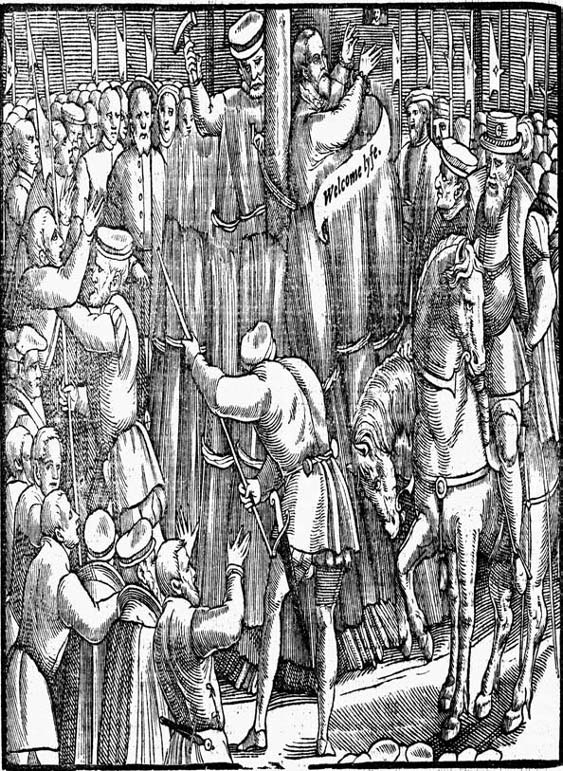
7. The burning of Lawrence Saunders at Coventry