
4. John Rogers
4. JOHN ROGERS
The Story, Life, and Martyrdom of Master John Rogers.
The fourth day of February [1555], suffered the constant martyr of God, Master John Rogers, concerning whose life, examinations, and suffering, here followeth in order set forth.
And fi rst touching his life and bringing up.
February 4.
The life and story of Master John Rogers.
John Rogers brought up in the University of Cambridge, where he profi tably travailed in good learning, at the length was chosen and called by the Merchant Adventurers,* to be their chaplain at Antwerp in Brabant, whom he served to their good contentation many years. It chanced him there to fall in company with that worthy servant and martyr of God, William
Tyndale, and with Miles Coverdale (which both for the hatred they have to popish superstition and idolatry, and love to true religion, had forsaken their native country.) In conferring with them the scriptures, he came to great knowledge in the gospel of God, insomuch that he cast off the heavy yoke of popery, perceiving it to be impure and fi lthy idolatry, and joined himself with them two in that painful and most profi table labour of translating the Bible into the English tongue, which is entitled:
The Translation of Thomas Matthew.* He knowing by the scriptures, that unlawful vows* may lawfully be broken, and that matrimony is both honest and honourable amongst all men, joined himself in lawful matrimony, and so went to Wittenberg in Saxony, where he with much soberness of living did not only greatly increase in all good and godly learning: but also so much profi ted in the knowledge of the Dutch tongue,* that the charge of a congregation was orderly committed to his cure.
Master Rogers chaplain to the Merchant Adventurers at Antwerp.
Master Rogers brought to the gospel by Master William Tyndale, and Master Coverdale.
Of Master Rogers's doing in this translation read afore.
Master Rogers goeth to Wittenberg.
In which ministry, he diligently and faithfully served many years, until such time as it pleased God, by the faithful travail of his chosen and dear servant King Edward the sixth, utterly to banish all popery forth of England, and to receive in true religion, setting God's gospel at liberty. He then being orderly called, having both a conscience and a ready good will to help
Master Rogers returneth from Saxony into England in King Edward's time.
Foxe's Book of Martyrs
forward the work of the Lord in his native country, left such honest and certain conditions as he had in Saxony, and came into England to preach the gospel, without certainty of any condition. In which office, after he had a space diligently and faithfully travailed, Nicholas Ridley then Bishop of London, gave him a prebend in the Cathedral Church of Paul's, and the Dean and the Chapter chose him to be the reader of the Divinity lesson there, wherein he diligently travailed, until such time as Queen Mary obtaining the crown, banished the gospel and true religion, and brought in the Antichrist of Rome, with his idolatry and superstition.
Master Rogers, reader and prebendary in Paul's.
After the queen was come to the Tower of London,* he being orderly called thereunto, made a godly and vehement sermon at Paul's Cross, confi rming such true doctrine as he and other had there taught in King Edward's days, exhorting the people constantly to remain in the same, and to beware of all pestilent popery, idolatry, and superstition. The Council being then overmatched with popish and bloody bishops, called him to accompt for his sermon: to whom he made a stout, witty, and godly answer, and yet in such sort handled himself that at that time he was clearly dismissed. But after that, proclamation was set forth by the queen to prohibit true preaching, he was called again before the Council, (for the bishops thirsted after his blood). The Council quarrelled with him concerning his doctrine, and in conclusion commanded him as prisoner to keep his own house, and so he did: although by fl ying he might easily have escaped their cruel hands, and many things that were, which might have moved him thereunto. He did see the recovery of religion in England for that present, desperate: he knew he could not want a living in Germany, and he could not forget his wife and ten children, and to seek means to succour them. But all these things set apart, after he was called to answer in Christ's cause, he would not depart, but stoutly stood in defence of the same, and for the trial of that truth, was content to hazard his life.
Master Rogers called to accompt for his sermon at Paul's Cross.
Master Rogers again called before the Council, and commanded to keep his house.
Thus he remained in his own house as prisoner a long time, till at length through the uncharitable procurement of Bonner
Bishop of London, who could not abide such honest neighbours to dwell by him, he was removed from his own house,
John Rogers
to the prison called Newgate, where he was lodged among thieves and murderers, for a great space: during which time, what business he had with the adversaries of Christ, all is not known, neither yet any certainty of his examinations, further than he himself did leave in writing, which God would not to be lost, but to remain for a perpetual testimony in the cause of God's truth, as here followeth recorded and testifi ed by his own writing. . . .
Master Rogers sent to Newgate.
After that John Rogers (as ye have heard) had been long and straightly imprisoned, lodged in Newgate amongst thieves, often examined: and very uncharitably entreated and at length unjustly and most cruelly by wicked Winchester condemned the fourth of February, in the year of our Lord 1555, being
Monday in the morning, he was warned suddenly by the keeper's wife of Newgate, to prepare himself to the fi re: who then being sound asleep, scarce with much shoggling could be awaked. At length being raised and waked, and bid to make haste, 'Then,' said he, 'if it be so, I need not to tie my points':* and so was had down, fi rst to Bonner to be disgraded. That done, he craved of Bonner but one petition. Bonner asking what that should be: nothing said he: but that he might talk a few words with his wife, before his burning. But that could not be obtained of him. 'Then,' said he, 'you declare your charity, what it is': and so he was brought into Smithfi eld by Master
Chester, and Master Woodruff, then Sheriffs of London, there to be burnt, where he showed most constant patience, not using many words, for he could not be permitted, but only exhorting the people constantly to remain in that faith and true doctrine which he before had taught and they had learned, and for the confi rmation whereof he was not only content patiently to suffer and bear all such bitterness and cruelty as had been showed him, but also most gladly to resign up his life, and to give his fl esh to the consuming fi re for the testimony of the same.
February 4.
Master Rogers warned to prepare to death.
Master Rogers disgraded.
Master Rogers could not be suffered of Bonner to speak to his wife before his burning.
Master Rogers brought to Smithfi eld.
Briefl y and in few words to comprehend the whole order of his life, doings, and martyrdom, fi rst this godly Master
Rogers was committed to prison (as is above said) and there continued a year and a half. In prison he was merry, and earnest in all he went about. He wrote much: his examinations he penned with his own hand, which else had never come to light.
Foxe's Book of Martyrs
Wherein is to be noted by the way a memorable working of God's providence. Ye heard a little above how Master Rogers craved of Bonner, going to his burning, that he might speak a few words before with his wife, which could not be granted.
What these words were which he had to say to his wife, it is for no man certainly to defi ne. Likely it may be supposed that his purpose was, amongst other things, to signify unto her of the book written of his examinations and answers which he had privily hid in a secret corner of the prison where he lay. But where man's power lacketh, see how God's providence worketh. For notwithstanding that during the time of his imprisonment straight search there was to take away his letters and writings: yet after his death, his wife and one of her sons called
Daniel, coming into the place where he lay, to seek for his books and writings, and now ready to go away, it chanced her son aforenamed, casting his eye aside to spy a black thing (for it had a black cover belike because it should not be known) lying in a blind corner under a pair of stairs. Who willing his mother to see what it was, found it to be the book written with his own hand, containing these his examinations and answers with other matter above specifi ed. In the latter end whereof this also was contained, which because it concerneth a prophetical forewarning of things pertaining to the church I thought to place the same his words, as they be there written, which are these. 'If God look not mercifully upon England, the seeds of utter destruction are sown in it already, by these hypocritical tyrants, and Antichristian prelates, popish papists, and double traitors to their natural country. And yet they speak of mercy, of blessing, of the Catholic Church, of unity, of power, and strengthening of the realm. This double dissimulation will show itself one day when the plague cometh, which will undoubtedly light upon these crown-shorn* captains, and that shortly, whatsoever the godly and the poor realm suffer in the meanwhile by God's sufferance and will.'
The copy of Master Rogers's examinations by God's providence preserved.
Master Rogers seemeth to prophesy here of England, and that truly.
'Spite of Nebuchadnezzar's* beard, and maugre his heart, the captive, thrall, and miserable Jews must come home again, and have their city and temple builded up again by Zerubabbel,
Esdras, and Nehemiah,* et cetera. And the whole kingdom of
John Rogers
Babylon must go to ruin and be taken of strangers, the Persians and Medes.* So shall the disparkled* English stock of Christ be brought again into their former estate, or to a better I trust in the Lord god, than it was in innocent King Edward's days, and our bloody Babylonical bishops, and the whole crownshorn company, brought to utter shame: rebuke, ruin, decay, and destruction, for God cannot and undoubtedly will not suffer forever their abominable lying, false doctrine, their hypocrisy, blood thirst, whoredom, idleness, their pestilent life pampered in all kind of pleasure: their thrasonical* boasting, pride, their malicious, envious, and poisoned stomachs which they bear towards his poor and miserable Christians. Peter truly warneth that "if judgement beginneth in the house of god, what shall be the end of them that believe not the gospel?
If the righteous shall scant be saved, where shall the ungodly and sinful appear?"* Some shall have their punishment here in this world and in the world to come, and they that do escape in this world, shall not escape everlasting damnation. This shall be your sauce O ye wicked papists, make ye merry here as long as ye may.'
He meaneth here of the return of the exiles into England.
1 Peter 4.
Furthermore, amongst other his words and sayings, which may seem prophetically to be spoken of him, this also may be added, and is notoriously to be marked, that he spake being then in prison, to the printer of this present book,* who then also was laid up for the like cause of religion: 'Thou,' said he,
'shalt live to see the alteration of this religion and the gospel to be freely preached again: And therefore have me commended to my brethren, as well in exile as others, and bid them be circumspect in displacing the papists, and putting good ministers into churches, or else their end will be worse than ours.'
Master Rogers prophesieth of the return of the gospel.
. . . To proceed now further in describing the doings of this man, during the time while he remained prisoner in Newgate, he was to the prisoners benefi cial and liberal, for whom he had thus devised, that he with his fellows should have but one meal a day, they paying notwithstanding, for the charges of the whole: the other meal should be given to them that lacked on the other side of the prison. But Alexander their keeper, a straight man, and a right Alexander, a coppersmith* indeed,
Provision by Master Rogers for the prisoners.
Foxe's Book of Martyrs
of whose doings more shall be said God willing hereafter, would in no case suffer that. The Sunday before he suffered, he drunk to Master Hooper (being then underneath him) and bade them commend him unto him, and tell him, there was never little fellow better would stick to a man than he would stick to him, presupposing they should both be burned together, although it happened otherwise, for Master Rogers was burnt alone. And thus much briefl y concerning the life and such acts of Master Rogers as I thought worthy noting.
Alexander Andrew jailer of Newgate compared to Alexander the coppersmith.
Now when the time came, that he being delivered to the sheriffs, should be brought out of Newgate to Smithfi eld the place of his execution, fi rst came to him Master Woodruff one of the foresaid sheriffs, and calling Master Rogers unto him, asked him if he would revoke his abominable doctrine, and his evil opinion of the sacrament of the altar. Master
Rogers answered and said: 'That which I have preached, I will seal with my blood.' Then, quoth Master Woodruff, 'Thou art an heretic.' 'That shall be known,' quoth Rogers, 'at the Day of Judgement.'* 'Well,' quoth Master Woodruff, 'I will never pray for thee.' 'But I will pray for you,' quoth Master Rogers, and so was brought the same day, which was Monday the fourth of February, by the sheriffs toward Smithfi eld, saying the psalm Miserere by the way, all the people wonderfully rejoicing at his constancy, with great praises and thanks to God for the same: and there in the presence of Master Rochester,*
Comptroller of the queen's household, Sir Richard Southwell,* both the sheriffs, and a wonderful number of people, he was burned into ashes, washing his hands in the fl ame as he was in burning. A little before his burning at the stake, his pardon was brought if he would have recanted, but he utterly refused it.
He was the fi rst protomartyr* of all that blessed company that suffered in Queen Mary's time, that gave the fi rst adventure upon the fi re. His wife and children, being eleven in number, ten able to go, and one sucking on her breast, met him by the way as he went towards Smithfi eld: this sorrowful sight of his own fl esh and blood could nothing move him, but that he constantly and cheerfully took his death with wonderful patience, in the defence and quarrel of Christ's gospel.
The words of Master Woodruff to Master Rogers.
Master Rogers refuseth his pardon.
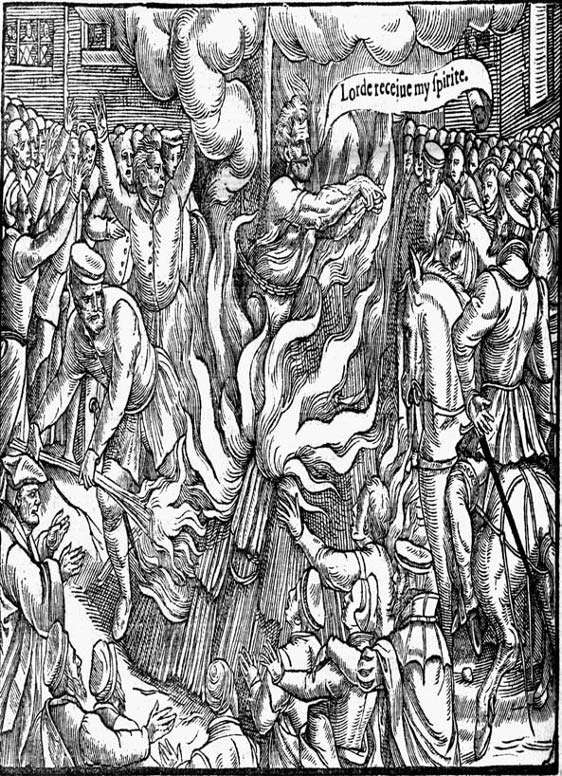
6. John Rogers, Vicar of St Pulchers and Reader of Paul's, London