
2 Introduction
INTRODUCTION
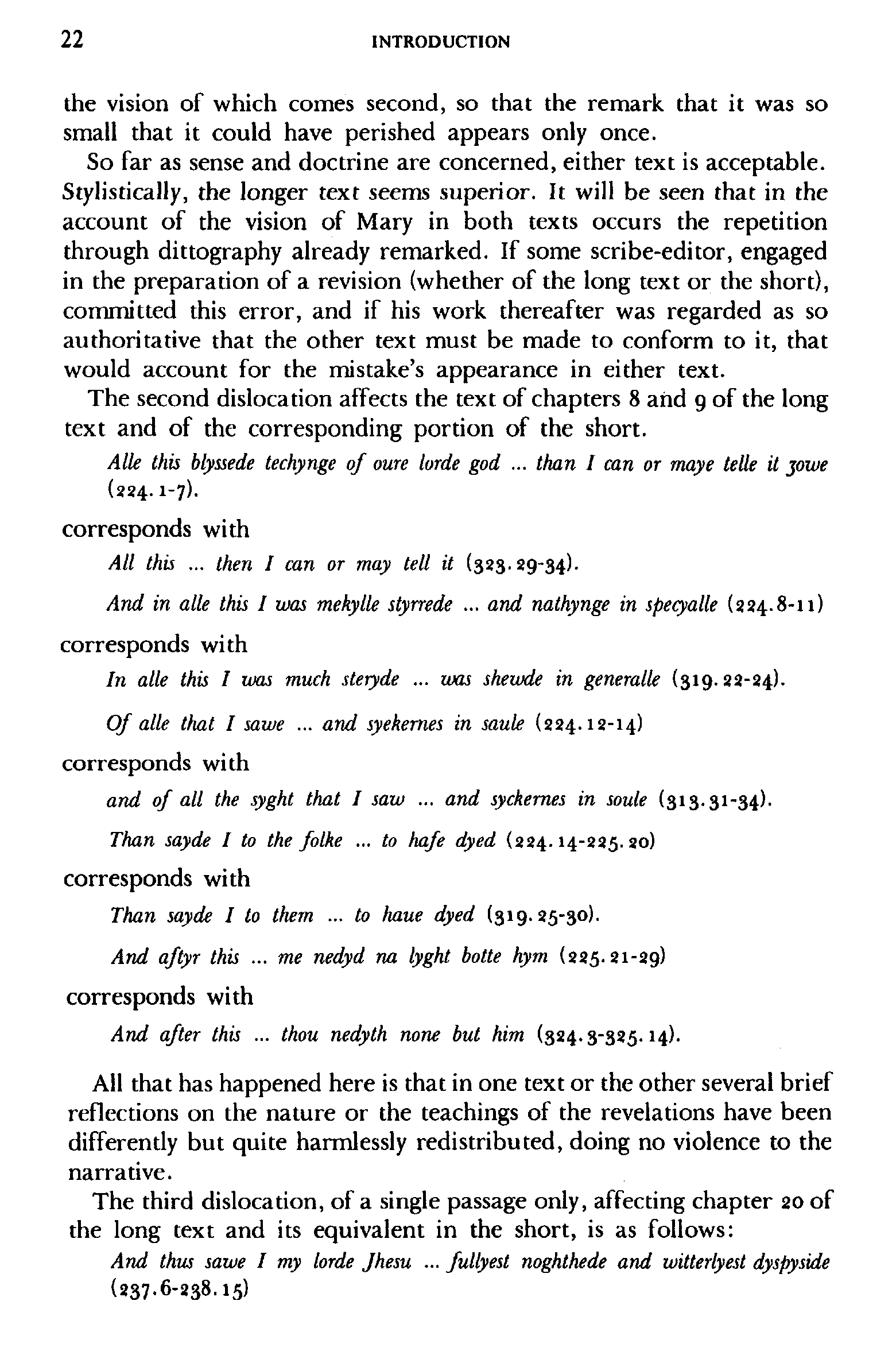
the vision of which comes second, so that the remark that it was so small that it could have perished appears only once.
So far as sense and doctrine are concerned, either text is acceptable.
Stylistically, the longer text seems superior. It will be seen that in the account of the vision of Mary in both texts occurs the repetition through dittography already remarked. If some scribe-editor, engaged in the preparation of a revision (whether of the long text or the short), committed this error, and if his work thereafter was regarded as so authoritative that the other text must be made to conform to it, that would account for the mistake's appearance in either text.
The second dislocation affects the text of chapters 8 and 9 of the long text and of the corresponding portion of the short.
Alle this blyssede techynge of oure lorde god ... than I can or maye telle it jowe
(224.1-7). corresponds with All this ... then I can or may tell it (323.29-34).
And in alle this I was mekylle styrrede ... and nathynge in specyalle (224.8-11) corresponds with In alle this I was much steryde ... was shewde in generalle (319.22-24).
Of alle that I sawe ... and syekemes in saule (224.12-14) corresponds with and of all the syght that I saw ... and syckernes in soule (313.31-34).
Than sayde I to the folke ... to hafe dyed (224.14-225.20) corresponds with Than sayde I to them ... to haue dyed (319.25-30).
And aftyr this ... me nedyd na lyght botte hym (225.21-29) corresponds with And after this ... thou nedyth none but him (324.3-325.14).
All that has happened here is that in one text or the other several brief reflections on the nature or the teachings of the revelations have been differently but quite harmlessly redistributed, doing no violence to the narrative.
The third dislocation, of a single passage only, affecting chapter 20 of the long text and its equivalent in the short, is as follows:
And thus sawe I my lorde Jhesu ... fullyest noghthede and witterlyest dyspyside (237.6-238.15)
Ill SHORT AND LONG TEXTS
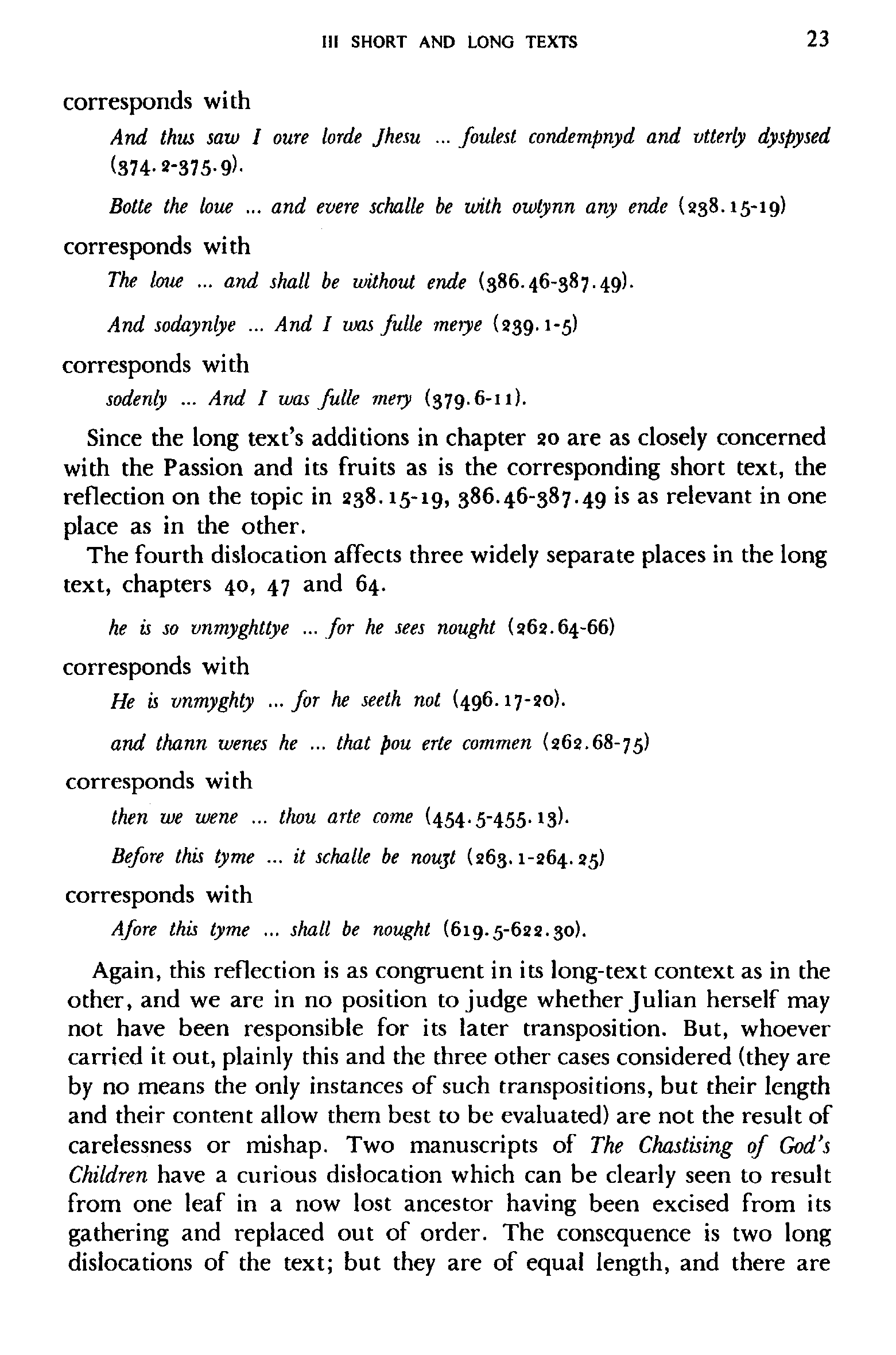
corresponds with And thus saw I oure lorde Jhesu ... foulest condempnyd and vtterly dyspysed
(374-2-375-9)Botte the hue ... and evere schalle be with owtynn any ende (238.15-19) corresponds with The loue ... and shall be without ende (386.46-387.49).
And sodaynlye ... And I was fulle merye (239.1-5) corresponds with sodenly ... And I was fulle mery (379.6-11).
Since the long text's additions in chapter 20 are as closely concerned with the Passion and its fruits as is the corresponding short text, the reflection on the topic in 238.15-19, 386.46-387.49 is as relevant in one place as in the other.
The fourth dislocation affects three widely separate places in the long text, chapters 40, 47 and 64. he is so vnmyghttye ...for he sees nought (262.64-66) corresponds with He is vnmyghty ...for he seeth not (496.17-20). and thann wenes he ... that pou erte commen (262.68-75) corresponds with then we wene ... thou arte come (454.5-455.13).
Before this tyme ... it schalle be noutf (263.1-264.25) corresponds with Afore this tyme ... shall be nought (619.5-622.30).
Again, this reflection is as congruent in its long-text context as in the other, and we are in no position to judge whether Julian herself may not have been responsible for its later transposition. But, whoever carried it out, plainly this and the three other cases considered (they are by no means the only instances of such transpositions, but their length and their content allow them best to be evaluated) are not the result of carelessness or mishap. Two manuscripts of The Chastising of God's
Children have a curious dislocation which can be clearly seen to result from one leaf in a now lost ancestor having been excised from its gathering and replaced out of order. The consequence is two long dislocations of the text; but they are of equal length, and there are
INTRODUCTION
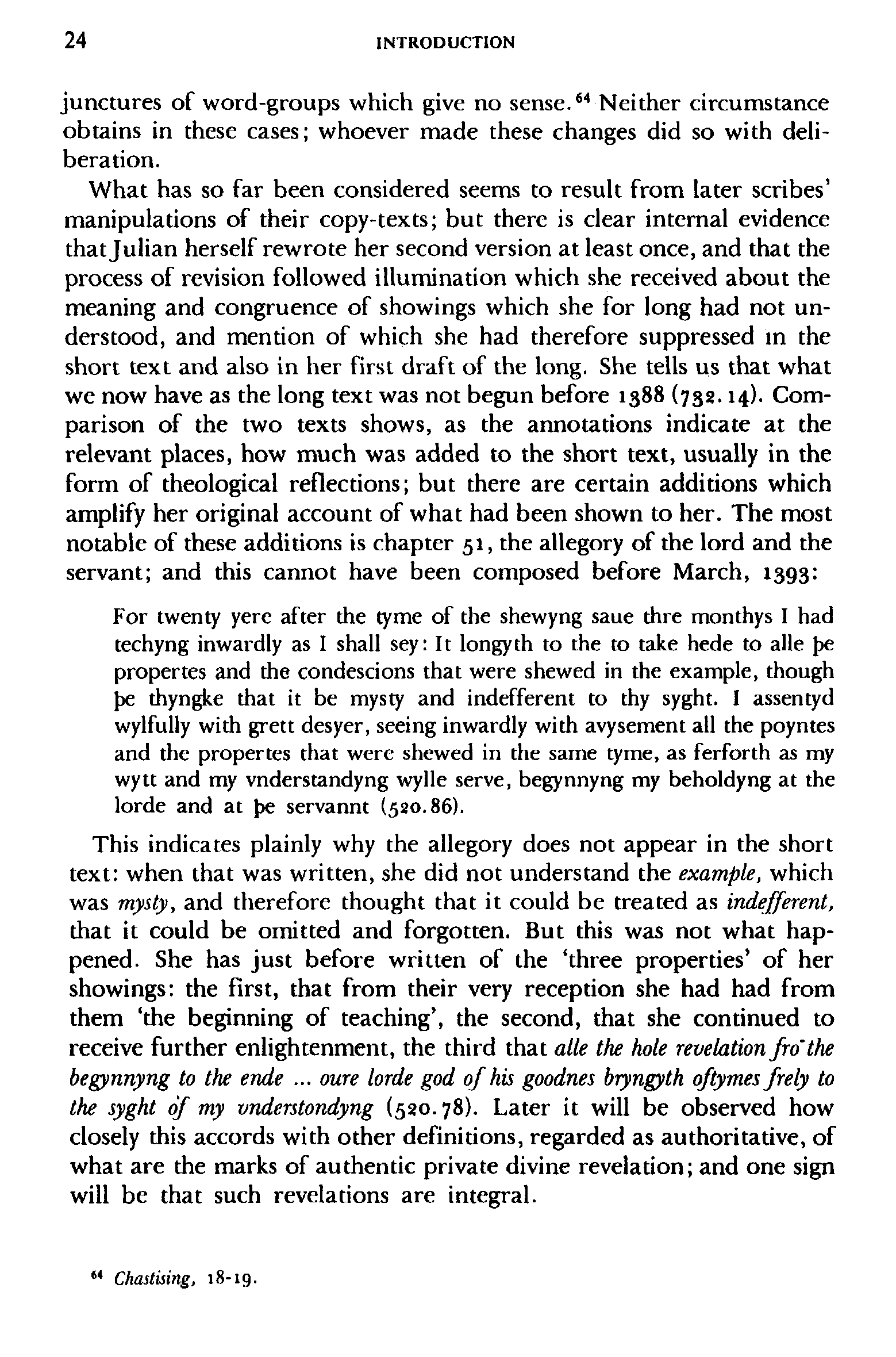
junctures of word-groups which give no sense.64 Neither circumstance obtains in these cases; whoever made these changes did so with deliberation.
What has so far been considered seems to result from later scribes' manipulations of their copy-texts; but there is clear internal evidence that Julian herself rewrote her second version at least once, and that the process of revision followed illumination which she received about the meaning and congruence of showings which she for long had not understood, and mention of which she had therefore suppressed in the short text and also in her first draft of the long. She tells us that what we now have as the long text was not begun before 1388 (732.14). Comparison of the two texts shows, as the annotations indicate at the relevant places, how much was added to the short text, usually in the form of theological reflections; but there are certain additions which amplify her original account of what had been shown to her. The most notable of these additions is chapter 51, the allegory of the lord and the servant; and this cannot have been composed before March, 1393:
For twenty yere after the tyme of the shewyng saue thre monthys I had techyng inwardly as I shall sey: It longyth to the to take hede to alle £>e propertes and the condescions that were shewed in the example, though
J>e thyngke that it be mysty and indefferent to thy syght. I assentyd wylfully with grett desyer, seeing inwardly with avysement all the poyntes and the propertes that were shewed in the same tyme, as ferforth as my wytt and my vnderstandyng wylle serve, begynnyng my beholdyng at the lorde and at Jje servannt (520.86).
This indicates plainly why the allegory does not appear in the short text: when that was written^ she did not understand the example, which was mysty, and therefore thought that it could be treated as indefferent, that it could be omitted and forgotten. But this was not what happened. She has just before written of the 'three properties' of her showings: the first, that from their very reception she had had from them 'the beginning of teaching', the second, that she continued to receive further enlightenment, the third that alle the hole revelation fro'the begynnyng to the ende ... oure lorde god of his goodnes bryngyth oftymesfrely to the syght of my vnderstondyng (520.78). Later it will be observed how closely this accords with other definitions, regarded as authoritative, of what are the marks of authentic private divine revelation; and one sign will be that such revelations are integral.
64 Chastising, 18-19.
IV LONG TEXT WITNESSES
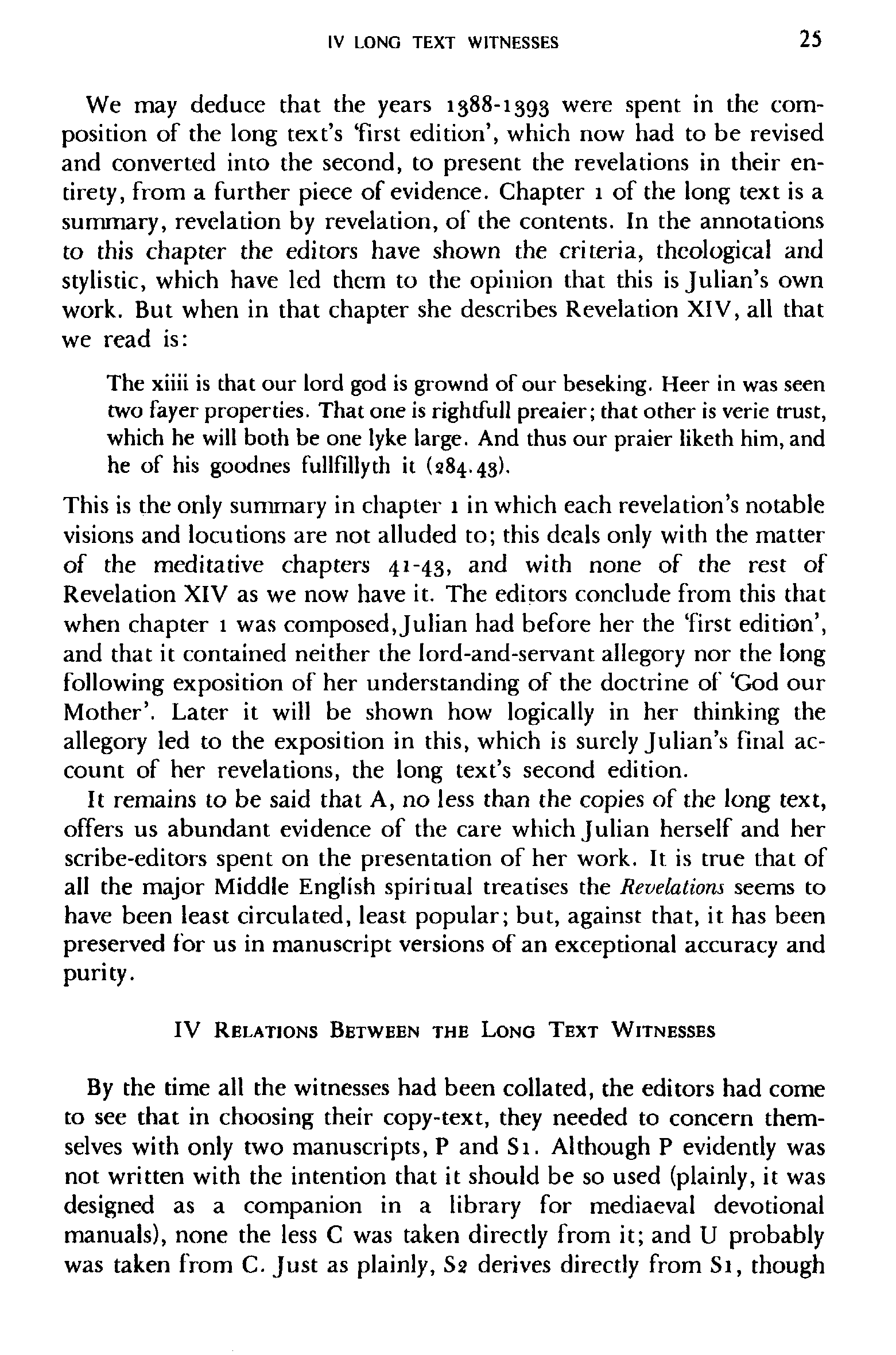
We may deduce that the years 1388-1393 were spent in the composition of the long text's 'first edition', which now had to be revised and converted into the second, to present the revelations in their entirety, from a further piece of evidence. Chapter i of the long text is a summary, revelation by revelation, of the contents. In the annotations to this chapter the editors have shown the criteria, theological and stylistic, which have led them to the opinion that this is Julian's own work. But when in that chapter she describes Revelation XIV, all that we read is:
The xiiii is that our lord god is grownd of our beseking. Heer in was seen two fayer properties. That one is rightfull preaier; that other is verie trust, which he will both be one lyke large. And thus our praier liketh him, and he of his goodnes fullfillyth it (284.43).
This is the only summary in chapter i in which each revelation's notable visions and locutions are not alluded to; this deals only with the matter of the meditative chapters 41-43, and with none of the rest of Revelation XIV as we now have it. The editors conclude from this that when chapter i was composed,Julian had before her the 'first edition', and that it contained neither the lord-and-servant allegory nor the long following exposition of her understanding of the doctrine of 'God our
Mother'. Later it will be shown how logically in her thinking the allegory led to the exposition in this, which is surely Julian's final account of her revelations, the long text's second edition.
It remains to be said that A, no less than the copies of the long text, offers us abundant evidence of the care which Julian herself and her scribe-editors spent on the presentation of her work. It is true that of all the major Middle English spiritual treatises the Revelations seems to have been least circulated, least popular; but, against that, it has been preserved for us in manuscript versions of an exceptional accuracy and purity.
IV RELATIONS BETWEEN THE LONG TEXT WITNESSES
By the time all the witnesses had been collated, the editors had come to see that in choosing their copy-text, they needed to concern themselves with only two manuscripts, P and Si. Although P evidently was not written with the intention that it should be so used (plainly, it was designed as a companion in a library for mediaeval devotional manuals), none the less C was taken directly from it; and U probably was taken from C. Just as plainly, 82 derives directly from Si, though
INTRODUCTION
the 82 scribe seems to have collated with C as the work progressed.
Thus we have only two independent witnesses.
P and Si exhibit separate characteristics, and cannot be descended from any immediate common ancestor. This can best be shown by the confusion about where Revelation XV, chapter 64 should begin. It seems that both manuscripts derive from one in which the title showing this had accidentally been omitted, so that later scribes, remarking the failure, had to make their own decisions. One such, the ancestor of P or P itself, ended his chapter 63 at 618.47: that alle manner thyng shall be welle. Another, Si's ancestor or Si, ended at 619.4: shulde be brougt agayne in to hym by grace. The editors, it will be seen (619. i e.s.) consider that both choices are wrong. Other instances of such textual crises differently solved will be found at 362.21, 371.22, 379.1-2, 449.4, 461.19,
547.14.
Frequently it has been possible to emend, where P is evidently mistaken in a reading, in the light of Si's superior transmission. Examples of this are at 302.36, 331.66, 335-95, 357-10, 474.68 (=669.40),
497-29, 544-315, 549-40 ( = 640.10, 709-17), 552-77, 556.22, 575-54, 659. i. Only rarely, in such conflicts, is P demonstrably superior — e.g.
348.22, 440.49, 622..32. At 473.58, 689.7, both manuscripts are patently wrong.
But in very many cases P and Si offer differing readings equally acceptable; and in almost every such instance P has not been emended.
There was never any serious question but that P must be chosen as the basjc text. It is the work of a not very intelligent copyist, anxious to transcribe faithfully what was before him. (For convention's sake, and in the lack of positive evidence, we call the P and SS scribes 'he', though it is highly probable that they, as certainly were the four scribes of U, were nuns at Cambrai or Paris). Si was written on quite different principles; it is an eclectic mixture of preserved archaic forms and modernizations, most of them well-informed and perceptive (although a few archaisms defeated the scribe — e.g. 289. 7, 319.31), and it — and, consequently, S2 — are marred throughout by the persistent omission of words and phrases which the scribe — or his copy — had deemed superfluous to the sense, but which destroys Julian's rhetorical Figures, which are integral to her thought.
Accordingly, this critical edition has been based on P; and in presenting it, the editors have perforce been guided by a conservative policy.
One of the chief difFiculties offered by P is its orthography, which is eccentric and erratic. Partly, this seems to have been because of a desire to make the Finished product appear as 'mediaeval' as possible, but,
IV LONG TEXT WITNESSES
even more, because of uncertainty as to how English of any epoch should be written. (If our guess as to the scribe's identity were correct, we might speculate whether she had not when young been sent abroad with little or no schooling, and, thereafter, had received insufficient formal instruction in writing). Had it been decided to emend P's work, it would have been virtually impossible to establish canons for such emendations; and the result would have been a text with scarcely an unemended line. Instead, it was judged better to transmit P, wherever possible, as it is, and, when its state is likely to present readers with serious difficulties, to give them the help, in the apparatus, of the C and SS spellings, or, in the last resort, of editorial comment in the annotations.
Here C is above all useful, for without question we have in Cressy's text a highly literate and intelligent man's presentation of what P had written (or, occasionally, what he thought P had written — 312.25,
3i3-34> 339-34> 354-9> 355-12, 674.27 are all nonsense-readings of his).
The frequency with which he copies P's errors is alone guarantee that it was P and no other which served as his copy-text; e.g. 495.2, 58^5.30,
633.17, 640.10 ( = 640.11), 653.35, 678.3, 680.19, 684.8, 693.39, 698.17.
Often this involves him in P's disagreements with SS; of this, awne/geyn (330.55) is the clearest example. Sometimes C has achieved a reading superior to P's by independent criticism; e.g. 356.28, 542.302, 558.37,
720.29.
The fidelity of the text of 82 to that of Si leaves no doubt that the younger manuscript was copied from the older; and this is clearly shown at 684. i in Si, where the scribe had omitted the chapter heading and number, which Sa's scribe has supplied in the elegant capital
Roman numerals which appear throughout 82. Many of Si's archaisms have been modernized; and it would seem that, linguistically, the 82 scribe was something of a purist (e.g. 310.2, 315.56).
W, the only pre-Dissolution witness of the long text, offers little help towards criticism; textually and linguistically it is colourless, but none the less it is clear that it derives from an ancestor which it shares with SS but not with P; e.g. 305.22, 3°7-45> 384-24-385-25Even more colourless is U, which may well have been made not from a manuscript but from C (e.g. 411.35, 414.6-7, 415.12).
Chronologically, this is not impossible; the chief scribe of U, Barbara Constable, it has been seen, lived for fourteen years after the publication of C.
In editing both the short and long texts, wherever possible emendation has been avoided, even though this does make greater demands
INTRODUCTION
upon the perspicacity of readers. The great temptation, in looking at past ages' transmission of texts, is to deny to the scribes, so much closer than we to what they were copying, the dignity and credibility to which they are entitled. Once we begin establishing an 'ideal text', we unconsciously arrogate to ourselves the conviction that we know better than they what they were writing about. Julian shared with such contemporaries as the author of Piers Plowman a reverence for the word of Scripture, and it is only in reference to that word that either writer can be evaluated. Their 'ideal text' was the sacred text; and both writers were seeking to interpret that text, so as to make it reflect the situation of their own age, and also to affirm the entire message of Christian hope which they had learned from the Gospel. There is no one scribe of the Julian manuscripts who did not know this, who did not approach the task with his or her own reverence for the text, and the editors have sought, in evaluating their work, to show them a like reverence.
Two other matters concerning the interrelations between the texts are worth comment. There is some evidence that Si (or an ancestor) had been in places accomodated to the readings of a manuscript of the short text; e.g. 649.14 and note. And, in examining the SS variants, it is remarkable how often NED states that individual words, found in SS but not in P, survived into the sixteenth and seventeenth centuries only in the Northern and Scottish dialects (cf. 358.14, 441.66, notes). Placid
Spearritt, when we enquired of him, informed us that in the second half of the seventeenth century at Cambrai there was one Scottish woman,
Melchiora Campbell, daughter of an earl of Argyll, and no less than eight Northumbrians, with names such as Shafto, Fenwick and Errington, all those of well-known local recusant families.
Although U had singularly little to offer in the preparation of the text, the certainty with which its hands have been identified makes it of quite exceptional value as evidence of the probability that we must thank Augustine Baker, and the spiritual school which he founded,65 for the survival of the long text in any complete form.
V LINGUISTIC CHARACTERISTICS OF THE MANUSCRIPTS
i The Language of A The dialect of the short text as it is preserved in A shows us that this copy must be several removes at least from what Julian wrote, if she spoke and composed in the North-East Midland dialect of Norwich, as 65 See Spearritt's article, The Survival of Mediaeval Spirituality'.
V LINGUISTIC
CHARACTERISTICS
we must suppose in the lack of contrary evidence. The dialect is a mixed one, with sounds, inflexions and vocabulary both Northern
(which, for general purposes, means 'north of the river Humber') and non-Northern. This dialect mixture is in itself insufficient to support the theory that Julian was a Yorkshirewoman; those who have sought to support it with linguistic evidence seem in the first place to have been attracted to it by a belief that her devotion to St. John of Beverley could so be explained; but, as will be shown elsewhere, she could have learned of his legend in many parts of England.
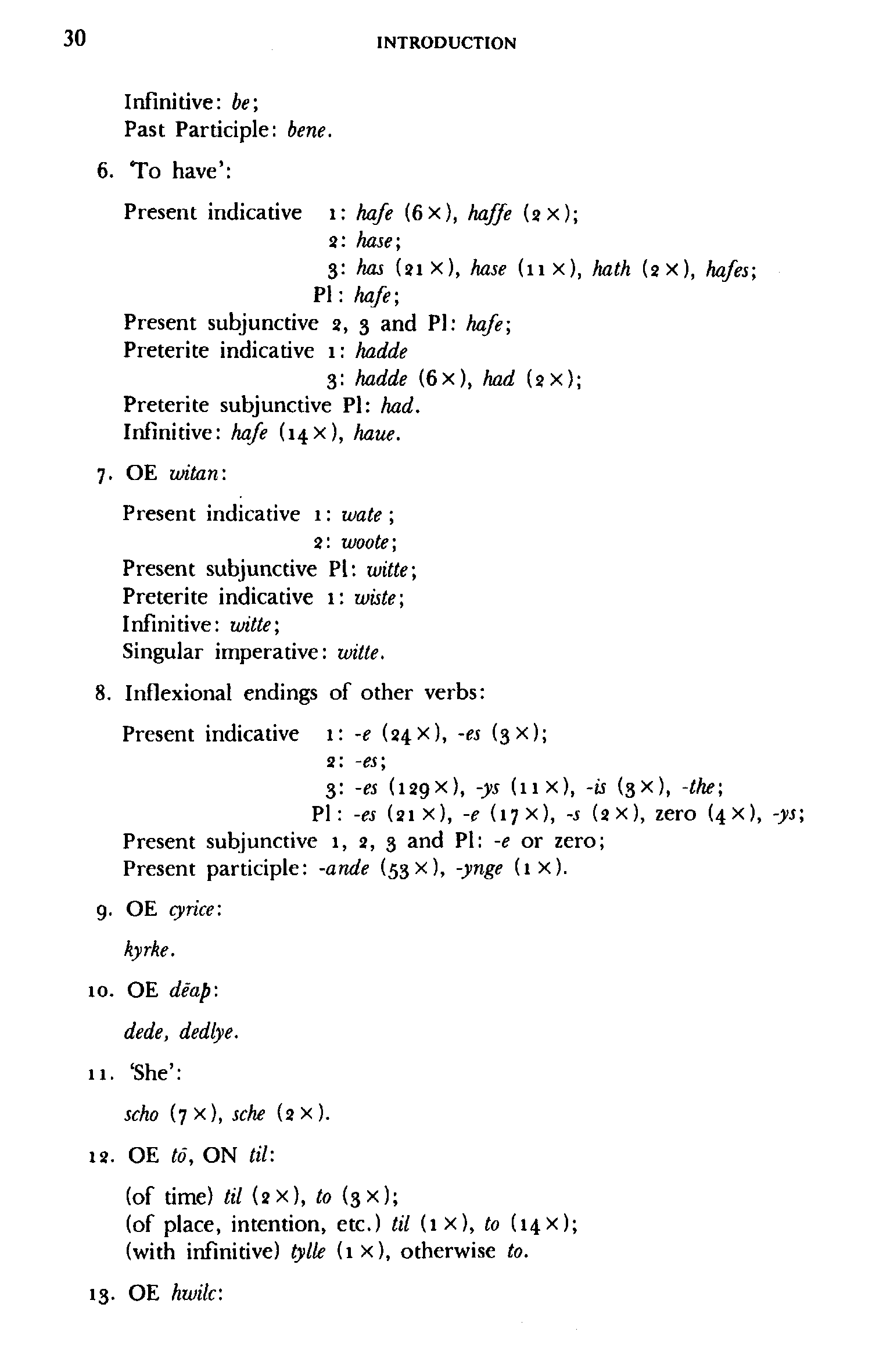
What follows is a selection only of the dialect characteristics of the short text:66
1. Developments of OE a: abode, awe, awne, bathe (3 X) bothe (i X), clothes, fra, gaste, gaste(lye) (25 x), gostelye ( a x ) , hale ( i x ) , hole (ax), halye (20x), holye (ix), hamiy (sx), homely (i X), hate, knawe, lathe ( i x), lothe (\ x), loo, mare (46 x), more (4 x), maste dox), moste (5X), othere « OE dwper), sare, sawlle, s(w)a (3X), so (4x), takyns, tha, tho, twa (5x), two (5 X), tua (5x), woo (2 X), wate-faX), woote ( i x ) , wha, whamm.
2. OE a + nasal: ane (27 x), one (4X), anly (4X), onlye (\ x), anej, aned, anyng, banes, na
(4 x), nane (9 x), none (3 x), nothere, nathynge (9 X ), nothynge (2 x), noujt, ta.
3. OE -aid-: aide, behalde, behaldynge, calde, halde.
4. OE 5: goodenes, othere.
5. To be':
Present indicative i: am; 2: erte (4X), arte, ert, er; 3: is (166 X), es (fyx), ys (28 X); PI: ere (18 x), er (17 x), are (ax), ar U x ) ;
Present subjunctive (singular and Pi): be; Preterite indicative i and 3: was; PI: ware dox), were ( 2 X ) ; Preterite subjunctive i and 3: ware (18 x), were ( a x ) ;
Pi: ware ($X ), were; 66 The criteria considered are those employed by Joyce Bazirc: The Dialect of the Manuscripts of The Chastising of God's Children'.
INTRODUCTION
Infinitive: be; Past Participle: bene.
6. To have':
Present indicative i: hafe (6x), haffe (ax); 2: hase; 3: has (21 X), hase (nx), hath (*x), hafes;
PI: Ao/fc; Present subjunctive 2, 3 and PI: hafe; Preterite indicative i: hadde 3: hadde (6x), had (*x); Preterite subjunctive Pi: /wrf.
Infinitive: hafe (i4X), haue.
7. OE witan:
Present indicative i: wate ; 2: woote; Present subjunctive Pi: witte; Preterite indicative i: wiste; Infinitive: witte; Singular imperative: witte.
8. Inflexional endings of other verbs:
Present indicative i: -e (24x), -es (sx); 2: -es; 3: -es (i2gx), -ys ( i i x ) , -is (sx), -the;
Pi: -es (21 x), -e (17 x), -s ( a x ) , zero (4X), -ys; ^Present subjunctive i, 2, 3 and Pi: -e or zero;
Present participle: -ande (53x), -ynge ( i x ) .
9. OE cyrice: kyrke.
10. OE deap: dede, dedlye.
11. 'She': scho (7 x), sche (ax).
12. OE to, ON ft'/:
(of time) til (ax), to (sx); (of place, intention, etc.) til ( i x ) , to (14x);
(with infinitive) tylle (ix), otherwise to.
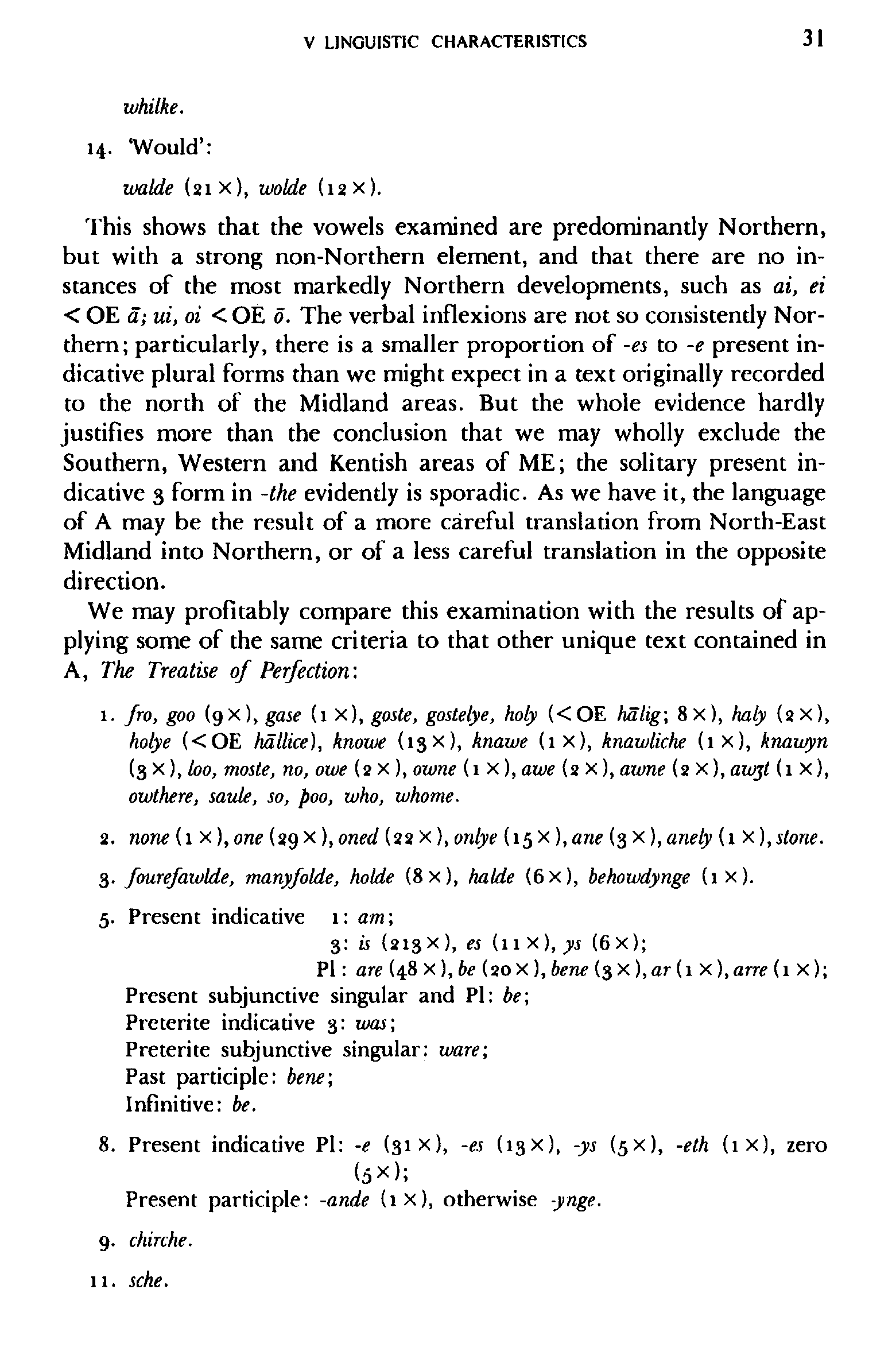
13. OE hwilc:
V LINGUISTIC CHARACTERISTICS
whilke.
14. 'Would': walde (21 x), wolde (12 x).
This shows that the vowels examined are predominantly Northern, but with a strong non-Northern element, and that there are no instances of the most markedly Northern developments, such as ai, ei
< OE d; ui, oi < OE o. The verbal inflexions are not so consistently Northern; particularly, there is a smaller proportion of -es to -e present indicative plural forms than we might expect in a text originally recorded to the north of the Midland areas. But the whole evidence hardly justifies more than the conclusion that we may wholly exclude the Southern, Western and Kentish areas of ME; the solitary present indicative 3 form in -the evidently is sporadic. As we have it, the language of A may be the result of a more careful translation from North-East
Midland into Northern, or of a less careful translation in the opposite direction.
We may profitably compare this examination with the results df applying some of the same criteria to that other unique text contained in A, The Treatise of Perfection: lfro> 8°° (9 XK Sase (* x)» goste, gostelye, holy «OE halig; 8x), haly (ax), holye (<OE hallice), knowe dsx), knawe ( i x ) , knawliche ( i x ) , knawyn
(3 X), loo, moste, no, owe (2 x ), owne (i x), awe (2 x), awne (2 X), awjt (i X), owthere, saule, so, poo, who, whome.
2. none (i x ) , o n e ( 2 g x ) , o n e d ( z 2 X ) , o n l y e (i$x),ane (^x),anely (i x),stone.
3. fourefawlde, manyfolde, holde (8x), halde (6x), behowdynge ( i x ) .
5. Present indicative i: am; 3: is (2isX), es ( n X ) , ys (6x); PI: are (^8x),be (yox),bene ($x),ar(i x),arre(i x);
Present subjunctive singular and Pi: be; Preterite indicative 3: was; Preterite subjunctive singular: ware; Past participle: bene; Infinitive: be.
8. Present indicative Pi: -e (six), -es (i3X), -ys (5X), -eth ( i x ) , zero (5*); Present participle: -ande ( i x ) , otherwise -ynge.
9. chirche.
11. sche.
INTRODUCTION
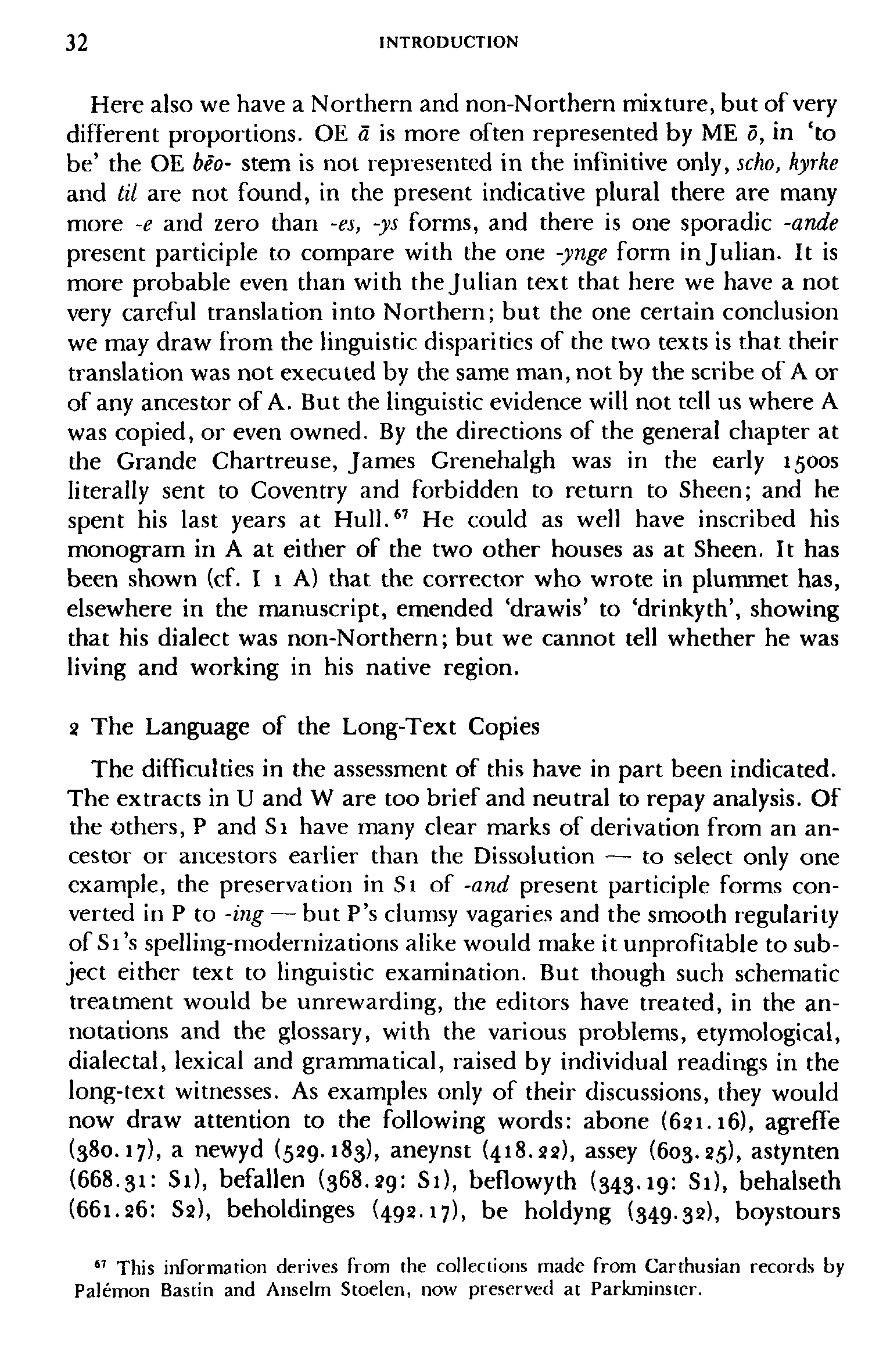
Here also we have a Northern and non-Northern mixture, but of very different proportions. OE a is more often represented by ME 5, in 'to be' the OE beostem is not represented in the infinitive only, scho, kyrke and til are not found, in the present indicative plural there are many more -e and zero than -es, -ys forms, and there is one sporadic -ande present participle to compare with the one -ynge form in Julian. It is more probable even than with the Julian text that here we have a not very careful translation into Northern; but the one certain conclusion we may draw from the linguistic disparities of the two texts is that their translation was not executed by the same man, not by the scribe of A or of any ancestor of A. But the linguistic evidence will not tell us where A was copied, or even owned. By the directions of the general chapter at the Grande Chartreuse, James Grenehalgh was in the early 15005 literally sent to Coventry and forbidden to return to Sheen; and he spent his last years at Hull.67 He could as well have inscribed his monogram in A at either of the two other houses as at Sheen. It has been shown (cf. I i A) that the corrector who wrote in plummet has, elsewhere in the manuscript, emended 'drawis' to 'drinkyth', showing that his dialect was non-Northern; but we cannot tell whether he was living and working in his native region.
2 The Language of the Long-Text Copies The difficulties in the assessment of this have in part been indicated.
The extracts in U and W are too brief and neutral to repay analysis. Of the pthers, P and Si have many clear marks of derivation from an ancestor or ancestors earlier than the Dissolution — to select only one example, the preservation in Si of -and present participle forms converted in P to -ing — but P's clumsy vagaries and the smooth regularity of Si's spelling-modernizations alike would make it unprofitable to subject either text to linguistic examination. But though such schematic treatment would be unrewarding, the editors have treated, in the annotations and the glossary, with the various problems, etymological, dialectal, lexical and grammatical, raised by individual readings in the long-text witnesses. As examples only of their discussions, they would now draw attention to the following words: abone (621.16), agreffe
(380.17), a newyd (529.183), aneynst (418.22), assey (603.25), astynten (668.31: Si), befallen (368.29: Si), beflowyth (343.19: Si), behalseth
(661.26: 82), beholdinges (492.17), be holdyng (349.32), boystours 67 This information derives from the collections made from Carthusian records by Palemon Bastin and Anselm Stoelen, now preserved at Parkminster.
VI JULIAN: BIOGRAPHICAL DATA
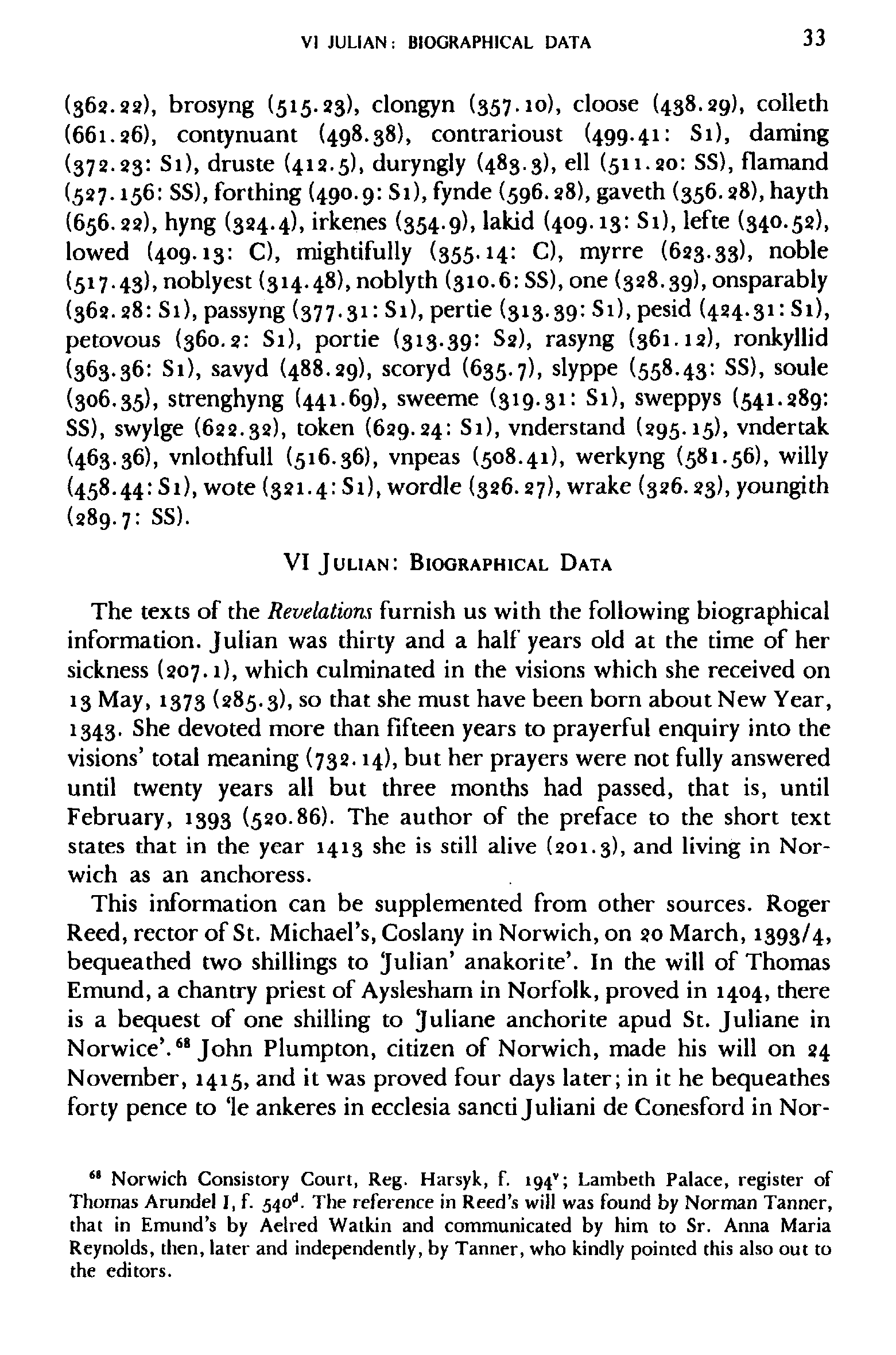
(362.22), brosyng (515.23), clongyn (357.10), cloose (438.29), colleth (661.26), comynuant (498.38), contrarioust (499.41: Si), darning
(372.23: Si), druste (412.5), duryngly (483.3), ell (511.20: SS), flamand (527.156: SS),forthing (490.9: Si),fynde (596.28), gaveth (356.28), hayth
(656.22), hyng (324.4), irkenes (354-9K lakid (409-13' Si), lefte (340.52), lowed (409.13: C), mightifully (355.14: C), myrre (623.33), noble
(5!7-43)> noblyest (314.48), noblyth (310.6: SS), one (328.39), onsparably (362.28: Si),passyng(377.3i:Si),pertie (313-39: Si),pesid (424.31:81), petovous (360.2: Si), portie (313.39: 82), rasyng (361.12), ronkyllid
(363.36: Si), savyd (488.29), scoryd (635.7), slyppe (558.43: SS), soule (306.35), strenghyng (441.69), sweeme (319.31: Si), sweppys (541.289:
SS), swylge (622.32), token (629.24: Si), vnderstand (295.15), vndertak (463.36), vnlothfull (516.36), vnpeas (508.41), werkyng (581.56), willy
(458.44:81), wote (32i.4:Si),wordle (326.27), wrake (326.2s),youngith
(289.7: SS).
VI JULIAN: BIOGRAPHICAL DATA
The texts of the Revelations furnish us with the following biographical information. Julian was thirty and a half years old at the time of her sickness (207. i), which culminated in the visions which she received on 13 May, 1373 (285.3), so that she must have been born about New Year,
1343. She devoted more than Fifteen years to prayerful enquiry into the visions' total meaning (732.14), but her prayers were not fully answered until twenty years all but three months had passed, that is, until
February, 1393 (520.86). The author of the preface to the short text states that in the year 1413 she is still alive (201.3), and living in Norwich as an anchoress.
This information can be supplemented from other sources. Roger Reed, rector of St. Michael's, Coslany in Norwich, on 20 March, 1393/4, bequeathed two shillings to Julian' anakorite'. In the will of Thomas
Emund, a chantry priest of Ayslesham in Norfolk, proved in 1404, there is a bequest of one shilling to Juliane anchorite apud St. Juliane in Norwice'.68 John Plumpton, citizen of Norwich, made his will on 24
November, 1415, and it was proved four days later; in it he bequeathes forty pence to 'le ankeres in ecclesia sancti Juliani de Conesford in Nor68 Norwich Consistory Court, Reg. Harsyk, f. 194"; Lambeth Palace, register of Thomas Arundel I, f. 540d. The reference in Reed's will was found by Norman Tanner, that in Emund's by Aelred Watkin and communicated by him to Sr. Anna Maria
Reynolds, then, later and independently, by Tanner, who kindly pointed this also out to the editors.
INTRODUCTION
wice', and twelve pence each to her serving-maid and to Alice, her former maid.69 This shows at least that Plumpton knew that at this time the anchorhold was occupied by a woman; and his knowledge of the identity of her former servant may indicate a closer personal acquaintance with Julian, who must be the anchoress concerned, as the countess of Suffolk's bequest will show. If Aelred Watkin's guess is right, and the chalice listed in the inventory of St. Giles, Norwich, 'ex dono
Alicie hermyte', was given by the same woman,70 that she had the means for such a gift suggests that she had served Julian out of devotion, not necessity; and 'Alice the Hermit' could be a friendly nickname given in her days of service, or it could show that after she left Julian she herself embraced some form of solitary living.
The fourth such will is that of Isabel Ufford, daughter of Thomas Beauchamp, earl of Warwick, who had married first John Lestrange of Blackmere, and then William Ufford, second earl of Suffolk, by whom she had no children. Shortly after he died in 1385? she entered the house of Augustinian canonesses at Campsey Ash in Suffolk, where she remained until her death in 1416, when she was buried in the conventual church beside her second husband.71 She may have been professed there, but if so she must have been permitted to retain at least some of her goods and income, as had been done in 1347, when
Margaret, countess of Ulster, took the habit at Campsey.72 At the time of Isabel's death her sister-in-law Maud was a nun there, to whom, as to the prioress and to every other sister, she made bequests. There are legacies to various other religious houses, and, 'pur le graunt busogne qe je me soute avez des preiers come de mese chaunter', to every house of the four mendicant orders in Suffolk and Norfolk; but the only recluse mentioned is 'Itemjeo devyse a Julian recluz a Norwich aos'.73
In the case of John Plumpton's bequest and that of Lady Suffolk, we must allow for the possibility, recently indicated by R. M. Wilson,74 that between 1413 and 1415 (or i4i6)Julian had died and had been succeeded in the cell by another recluse who had also taken the name of the church's patron saint. But if we can rely on the authenticity of the short text's prologue, Emund's bequest must be to Julian; and it
69 E. F. Jacob: The Register of Henry Chichele, 3 413.
70 Inventory of Church Goods, i 18, 2 161.
71 T. F. Tout, art.: 'Ufford, William de, second earl of Suffolk of his house' (DNB).
72 Eileen Power: Medieval English Nunneries, 39.
73 E. F. Jacob: The Register of Henry Chichele, 2 94-97.
74 Reviewing Robert K. Stone: Middle English Prose Style: Margery Kempe and Julian of Norwich, in MAL 42, 1973, 183-184.
VI JULIAN: BIOGRAPHICAL DATA
therefore confirms the tradition, which hitherto had relied solely on Blomefield's statement, made three hundred years and more after the event, that it was in the anchorhold at St. Julian's that she lived. Hope
Allen in her unpublished papers shows unwonted scepticism concerning such biographical data; and she justly observed how much confusion there has been of the author of the Revelations with her namesake,
Juliana Lampit, who seems to have been enclosed in nearby Carrow nunnery for the greater part of the fifteenth century, and who is often mentioned in wills. But Miss Allen's doubts should have been silenced by her own major discovery, The Book of Margery Kempe.
More significant than these sporadic records of bequests, which undoubtedly show reliance on the intercessory prayers of enclosed women, and, possibly, veneration for Julian herself as an intercessor, but which tell us nothing of personal contacts between her and her benefactors, is the account which Margery Kempe has left of her 'holy dalyawns' with the anchoress. In what she presents as a series of connected episodes, she tells us that she was divinely directed to go to Norwich and seek the counsel of '{>e vykary of Seynt Stefenys' about the private vow of chastity which she wished to take whilst she was still bearing children and had recently given birth to one,75 that she was then commanded to seek out the Norwich Carmelite friar William
Southfield,76 and that thereafter she was led to ask the advice of Julian with regard to the special grace which God had accorded her, Tor fie ankres was expert in swech thyngys and good cownsel cowd jeuyn'.77
Dundas Harford had demonstrated that Richard Caister became vicar of St. Stephen's on 20 May, 1402 ;78 and Sandford Meech showed, conclusively, it would seem, that the private agreement between Margery and her husband to live chastely was made on asjune, 1413,79 so that, if these consultations of Caister, Southfield and Julian all took place, as Margery seems to suggest, during the same visit to Norwich, this must have been earlier than 1415, when a later stay in the city can be established.80
Julian's advice to Margery, as it is reported, is a model of prudence and expertise; and it accords well, sometimes with remarkable exact75 The Book of Margeiy Kempe, 38.
76 Ibid. 41.
77 Ibid. 42.
78 Ibid. 276.
79 Ibid. 269.
80 Ibid, xlix, 308.