
282 The Long Text
THE LONG TEXT
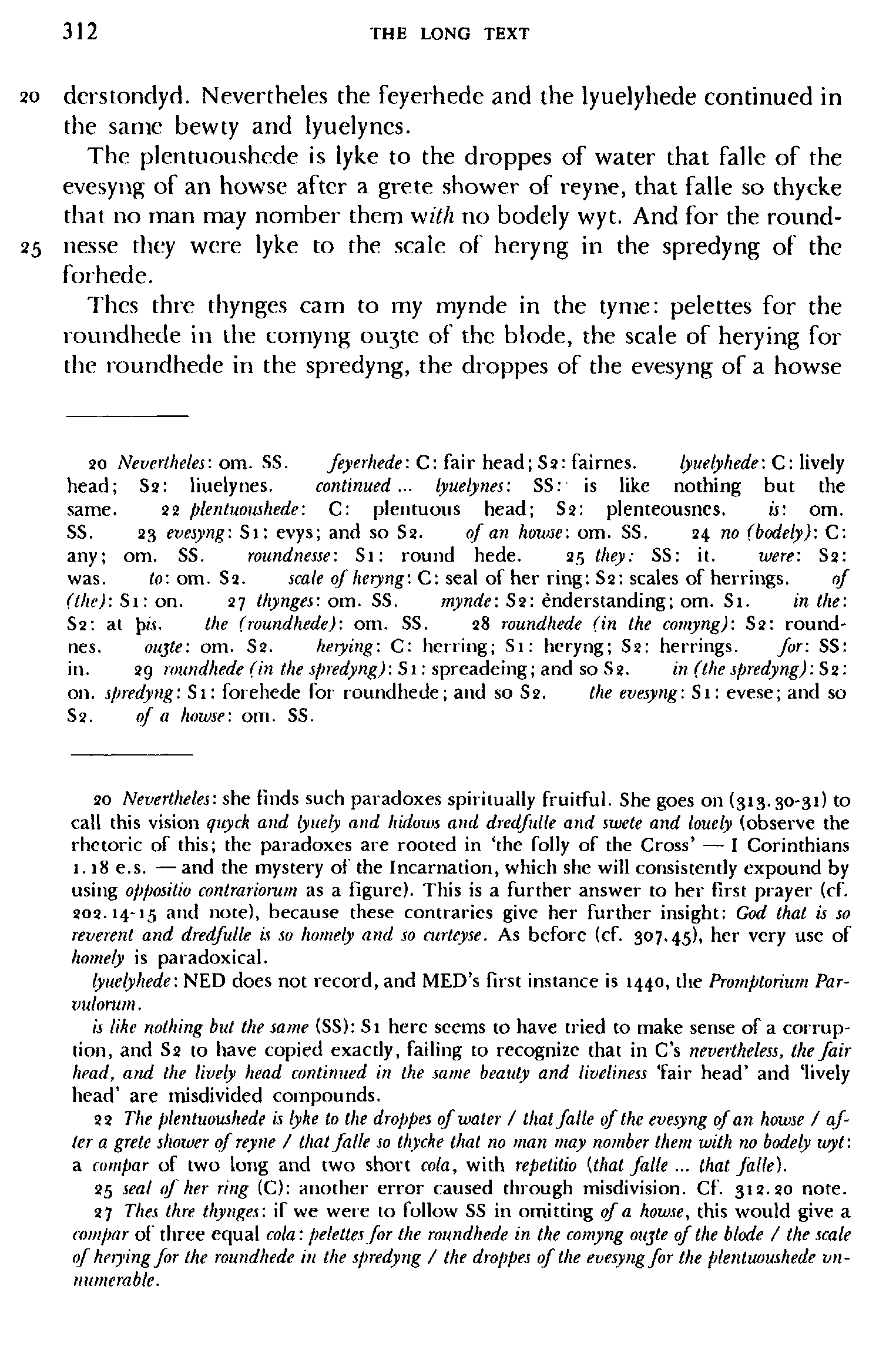
20 derstondyd. Nevertheles the feyerhede and the lyuelyhede continued in the same bewty and lyuelynes.
The plentuoushede is lyke to the droppes of water that falle of the evesyng of an howse after a grete shower of reyne, that falle so thycke that no man may nomber them with no bodely wyt. And for the round25 nesse they were lyke to the scale of heryng in the spredyng of the forhede.
Thcs thre thynges cam to my mynde in the tyme: pelettes for the roundhede in the cornyng ou3te of the blode, the scale of herying for the roundhede in the spredyng, the droppes of the evesyng of a howse
20 Nevertheles: om. SS. feyerhede: C: fair head; 82: fairnes. lyuelyhede: C: lively head; 82: liuelynes. continued... lyuelynes:
SS: is like nothing but the same.
22 plentuoushede:
C: plentuous head; 82: plenteousnes. is: om.
88.
23 evesyng: Si: evys; and so 82. of an howse: om. 88.
24 no (bodely): C: any; om.
88. roundnesse: Si: round hede.
2,5 they: SS: it. were: 82: was. to: om. 82. scale of heryng: C: seal of her ring: 82: scales of herrings. of (the): Si: on.
27 thynges: om. SS. mynde: 82: enderstanding; om. Si. in the:
82: at pw. the (roundhede): om. SS.
28 roundhede (in the comyng): 82: roundnes. oujte: om. 82. herying: C: herring; Si: heryng; 82: herrings. for: 88: in.
29 roundhede (in the spredyng): Si: spreadeing; and so 82. in (the spredyng): 82: on. spredyng: Si: forehede for roundhede; and so 82. the evesyng: Si: evese; and so 82. of a howse: om. SS.
20 Nevertheles: she finds such paradoxes spiritually fruitful. She goes on (313.30-31) to call this vision quyck and lyuely and hidows and dredfulle and swete and lonely (observe the rhetoric of this; the paradoxes are rooted in 'the folly of the Cross' — I Corinthians
1.18 e.s. — and the mystery of the Incarnation, which she will consistently expound by using oppositio contrariorum as a figure). This is a further answer to her first prayer (cf.
202.14-15 and note), because these contraries give her further insight: God that is so reverent and dredfulle is so homely and so curteyse. As before (cf. 307.45), her very use of homely is paradoxical. lyuelyhede: NED does not record, and MED's first instance is 1440, the Promptorium Parvulorum. is like nothing but the same (SS): Si here seems to have tried to make sense of a corruption, and 82 to have copied exactly, failing to recognize that in C's nevertheless, the fair head, and the lively head continued in the same beauty and liveliness 'fair head' and 'lively head' are misdivided compounds.
22 The plentuoushede is lyke to the droppes of water / that falle of the evesyng of an howse / after a grete shower of reyne / that falle so thycke that no man may nomber them with no bodely wyt: a compar of two long and two short cola, with repetitio (that falle ... that falle}.
25 seal of her ring (C): another error caused through misdivision. Cf. 312.20 note.
27 Thes thre thynges: if we were to follow SS in omitting of a howse, this would give a compar of three equal cola: pelettes for the roundhede in the comyng oujte of the blode / the scale of hetying for the roundhede in the spredyng / the droppes of the evesyng for the plentuoushede vnnumerable.
CHAPTER 7, REVELATION 1
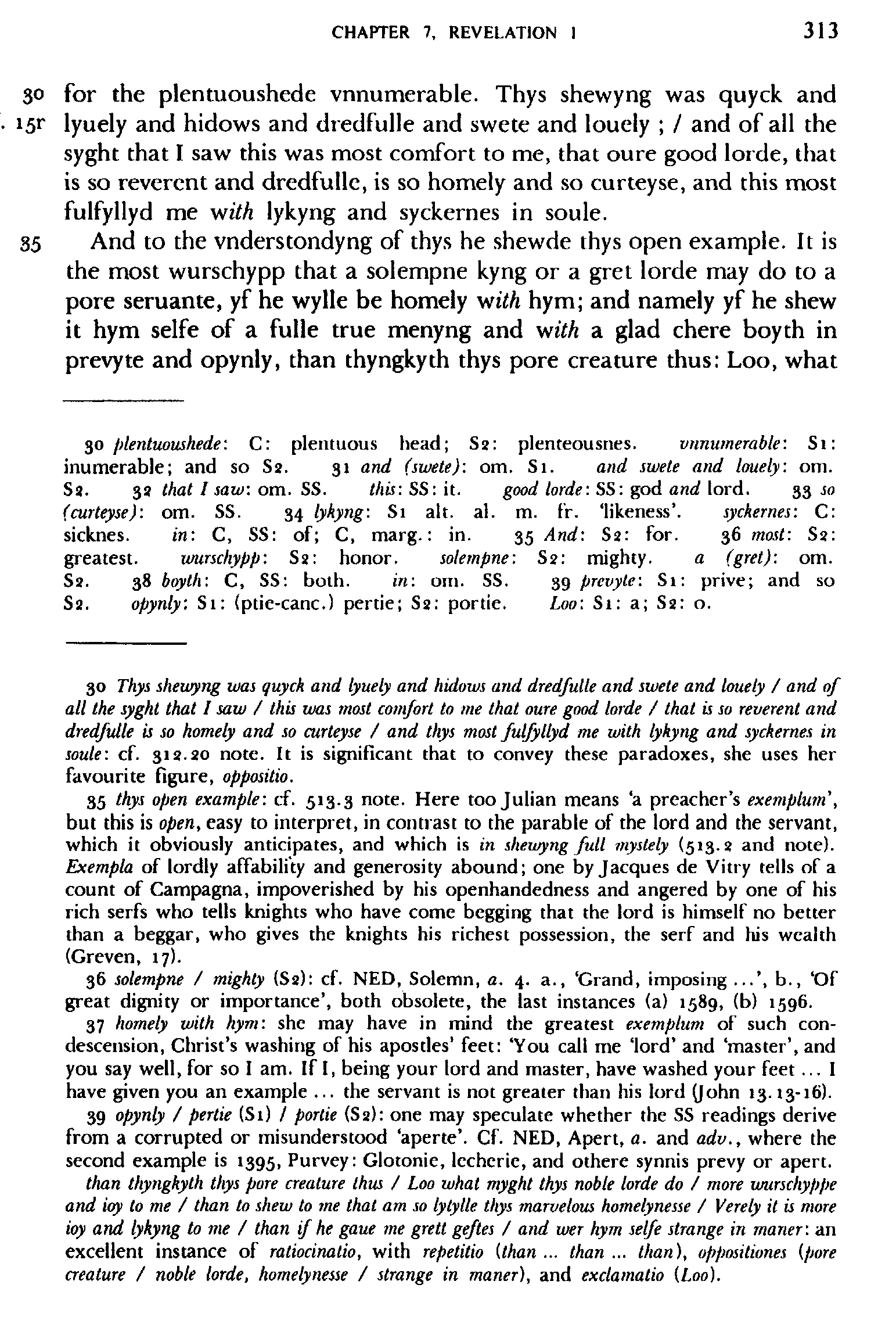
30 for the plentuoushede vnnumerable. Thys shewyng was quyck and . i5r lyuely and hidows and dredfulle and swete and louely ; / and of all the syght that I saw this was most comfort to me, that oure good lorde, that is so reverent and dredfulle, is so homely and so curteyse, and this most fulfyllyd me with lykyng and syckernes in soule.
And to the vnderstondyng of thys he shewde thys open example. It is the most wurschypp that a solempne kyng or a gret lorde may do to a pore seruante, yf he wylle be homely with hym; and namely yf he shew it hym selfe of a fulle true menyng and with a glad chere boyth in prevyte and opynly, than thyngkyth thys pore creature thus: Loo, what
30 plentuoushede:
C: plentuous head; 82: plenteousnes. vnnumerable: Si: inumerable; and so 82.
31 and (swete): om. Si. and swete and louely: om.
82.
32 that I saw: om. 88. this: 88: it. good lorde: 88: god and lord.
33 so (curteyse): om. 88.
34 lykyng: Si alt. al. m. fr.
'likeness'. sychernes: C: sicknes. in: C, 88: of; C, marg.: in.
35 And: 82: for.
36 most: 82: greatest. unirschypp:
82: honor. solempne:
82: mighty. a (gret): om.
Sa.
38 boyth: C, 88: both. in: om. SS.
39 prcvyte: Si: prive; and so 82. opynly: Si: (ptie-canc.) pertie; 82: portie.
Loo: Si: a; 82: o.
30 Thys shewyng was quyck and lyuely and hidows and dredfulle and swete and louely / and of all the syght that I saw / this was most comfort to me that oure good lorde / that is so reverent and dredfulle is so homely and so curteyse / and thys most fulfyllyd me with lykyng and syckernes in soule: cf. 312.20 note. It is significant that to convey these paradoxes, she uses her favourite figure, oppositio.
35 thys open example: cf. 513.3 note. Here too Julian means 'a preacher's exemplum', but this is open, easy to interpret, in contrast to the parable of the lord and the servant, which it obviously anticipates, and which is in shewyng full ?nystely (513.2 and note).
Exempla of lordly affability and generosity abound; one by Jacques de Vitry tells of a count of Campagna, impoverished by his openhandedness and angered by one of his rich serfs who tells knights who have come begging that the lord is himself no better than a beggar, who gives the knights his richest possession, the serf and his wealth
(Greven, 17).
36 solempne / mighty (82): cf. NED, Solemn, a. 4. a., 'Grand, imposing ...', b., 'Of great dignity or importance', both obsolete, the last instances (a) 1589, (b) 1596.
37 homely with hym: she may have in mind the greatest exemplum of such condescension, Christ's washing of his apostles' feet: 'You call me 'lord and 'master', and you say well, for so I am. If I, being your lord and master, have washed your feet ... I have given you an example ... the servant is not greater than his lord (John 13.13-16).
39 opynly / pertie (Si) / portie (82): one may speculate whether the SS readings derive from a corrupted or misunderstood 'aperte'. Cf. NED, Apert, a. and adv., where the second example is 1395, Purvey: Glotonie, lecherie, and othere synnis prevy or apert. than thyngkyth thys pore creature thus / Loo what myght thys noble lorde do / more wurschyppe and ioy to me / than to shew to me that am so lytylle thys marvelous homelynesse / Verely it is more toy and lykyng to me / than if he gaue me grett geftes / and wer hym selfe strange in maner: an excellent instance of ratiocinatio, with repetitio (than ... than ... than), oppositions
(pore creature / noble lorde, homelynesse / strange in maner), and exclamatio (Loo).
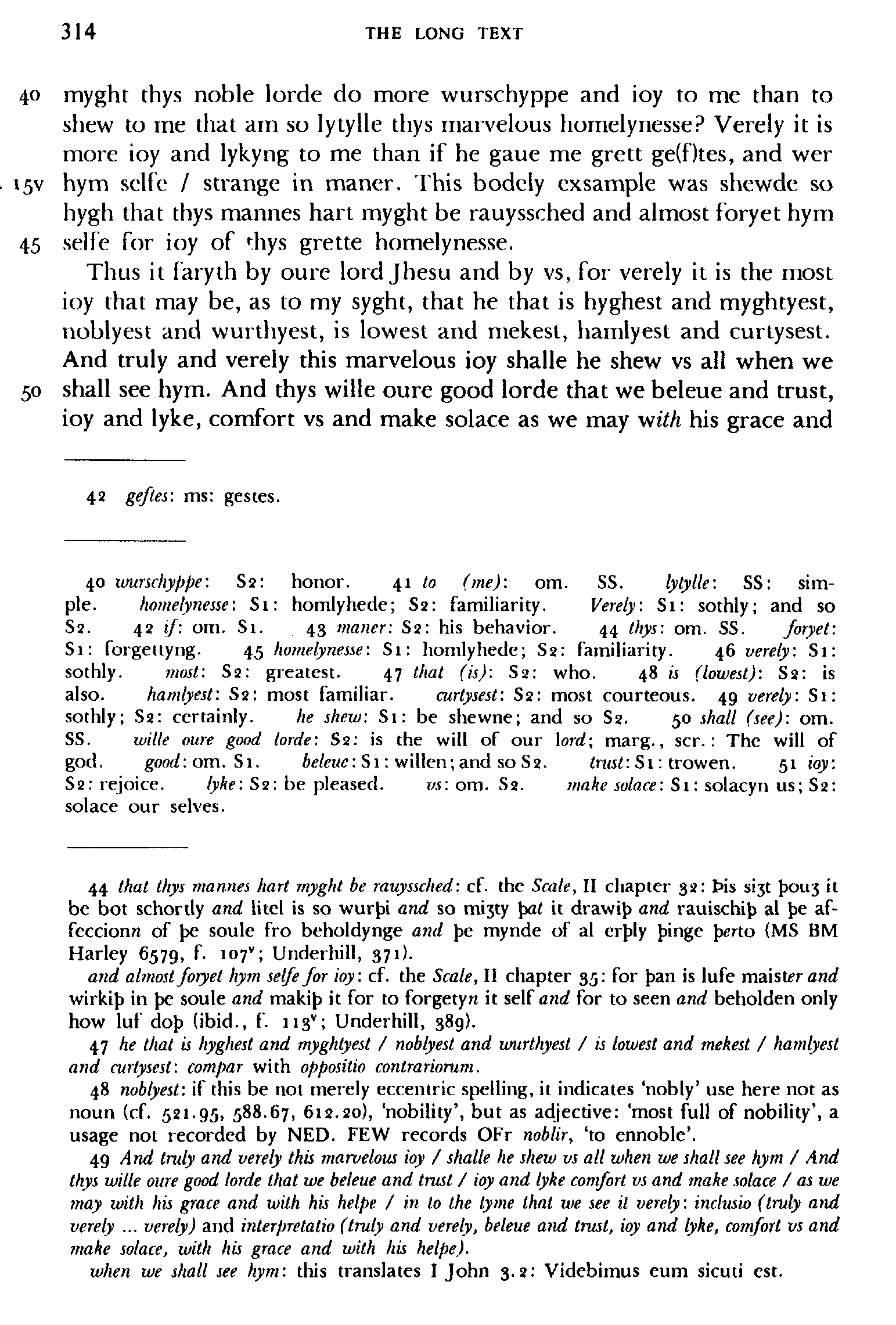
THE LONG TEXT 40 myght thys noble lorde do more wurschyppe and ioy to me than to shew to me that am so lytylle thys marvelous hornelynesse? Verely it is more ioy and lykyng to me than if he gaue me grett ge(f)tes, and wer
. i5v hym selfe / strange in maner. This bodely exsample was shewde so hygh that thys mannes hart myght be rauyssched and almost foryet hym
45 selfe for ioy of fhys grette hornelynesse.
Thus it faryth by oure lord Jhesu and by vs, for verely it is the most ioy that may be, as to my syght, that he that is hyghest and myghtyest, noblyest and wurthyest, is lowest and mekest, harnlyest and curtysest.
And truly and verely this marvelous ioy shalle he shew vs all when we 50 shall see hym. And thys wille oure good lorde that we beleue and trust, ioy and lyke, comfort vs and make solace as we may with his grace and
gefles: ms: gestes.
40 wurschyppe:
82: honor.
41 to (me): om.
SS. lytylle:
SS: simple, homelynesse: Si: homlyhede; 82: familiarity.
Verely: Si: sothly; and so 82.
42 if: om. Si.
43 maner: 82: his behavior.
44 thys: om. SS. foryet:
Si: forgettyng.
45 homelynesse: Si: homlyhede; 82: familiarity.
46 verely: Si: sothly. most: 82: greatest.
47 that (is): 82: who.
48 is (lowest): 82: is also. harnlyest: 82: most familiar. curtysest: 82: most courteous.
49 verely: Si: sothly; 82: certainly. he shew: Si: be shevvne; and so 82.
50 shall (see): om.
SS. wille oure good lorde: 82: is the wil! of our lord; marg., scr. : The will of god. goorf: om. Si. beleuc: Si: wilien; and so 82. trust: Si: trowen.
51 ioy:
82: rejoice. lyke: 82: be pleased. vs: om. 82. make solace: Si: solacyn us; 82: solace our selves.
44 that thys mannes hart myght be rauyssched: cf. the Scale, II chapter 32: £>is sijt pou3 it be bot schortly and litel is so wurpi and so misty Jxzi it drawip and rauischip al pe affeccionw of pe soule fro beholdynge and pe mynde of al erply pinge perto (MS BM
Harley 6579, f. 107*; Underbill, 371). and almost foryet hym selfe for ioy: cf. the Scale, II chapter 35: for pan is lufe maister and wirkip in pe soule and makija it for to forgetyn it self and for to seen and beholden only how luf dop (ibid., f. iisv; Underbill, 389).
47 he that is hyghest and myghtyest / noblyest and wurthyest / is lowest and mekest / harnlyest and curtysest: compar with oppositio contrariorum.
48 noblyest: if this be not merely eccentric spelling, it indicates 'nobly' use here not as noun (cf. 521.95, 588.67, 612.20), 'nobility', but as adjective: 'most full of nobility', a usage not recorded by NED. FEW records OFr noblir, 'to ennoble'.
49 And truly and verely this marvelous ioy / shalle he shew vs all when we shall see hym / And thys wille oure good lorde that we beleue and trust / ioy and lyke comfort vs and make solace / as we may with his grace and with his helpe / in to the tyrne that we see it verely: inclusio (truly and verely ... verely) and interpretatio (truly and verely, beleue and trust, ioy and lyke, comfort vs and make solace, with his grace and with his helpe). when we shall see hym: this translates I John 3.2: Videbimus eum sicuti est.
CHAPTER 7, REVELATION I
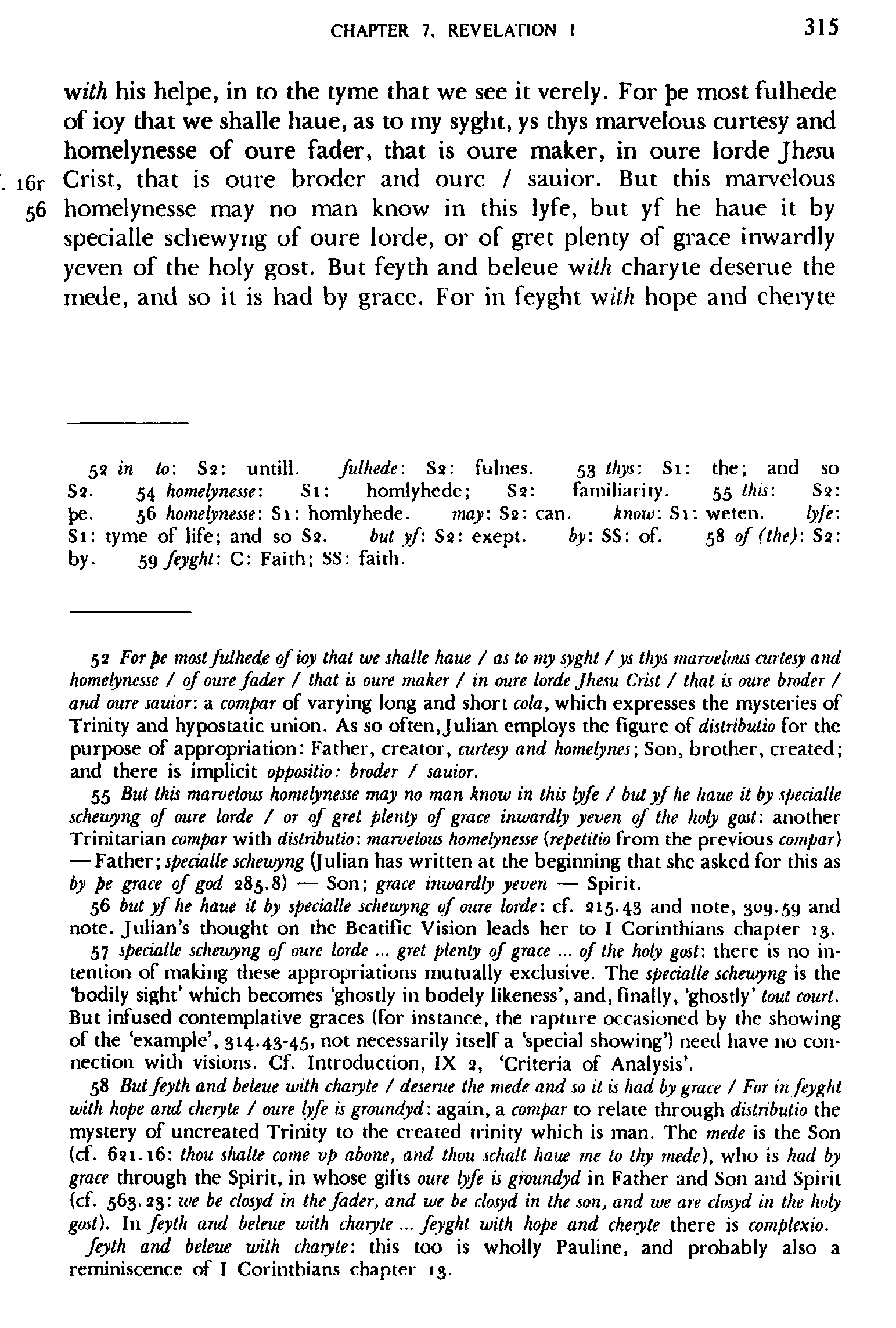
with his helpe, in to the tyme that we see it verely. For Jae most fulhede of ioy that we shalle haue, as to my syght, ys thys marvelous curtesy and homelynesse of oure fader, that is oure maker, in oure lorde Jhmi
. i6r Crist, that is oure broder and oure / sauior. But this marvelous 56 homelynesse may no man know in this lyfe, but yf he haue it by specialle schewyng of oure lorde, or of gret plenty of grace inwardly yeven of the holy gost. But feyth and beleue with charyte deserue the mede, and so it is had by grace. For in feyght with hope and cheryte
52 in to: 82: untill. fulhede:
82: fulnes.
53 thys: Si: the; and so Sa.
54 homelynesse:
Si: homlyhede; 82: familiarity.
55 this:
82: jje.
56 homelynesse: Si: homlyhede. may: 82: can. know: Si: weten. lyfe:
Si: tyme of life; and so 82. but yf: 82: exept. by: SS: of.
58 of (the): 82: by59 feyght: C: Faith; SS: faith.
52 For pe most fulhede of ioy that we shalle haue / as to my syght / ys thys marvelous curtesy and homelynesse / of oure fader / that is oure maker / in oure lorde Jhesu Crist / that is oure broder / and oure sauior: a compar of varying long and short cola, which expresses the mysteries of Trinity and hypostatic union. As so often,Julian employs the figure of distributio for the purpose of appropriation: Father, creator, curtesy and homelynes; Son, brother, created; and there is implicit oppositio: broder / sauior.
55 But this marvelous homelynesse may no man know in this lyfe / but yf he haue it by specialle schewyng of oure lorde / or of gret plenty of grace inwardly yeven of the holy gost: another
Trinitarian compar with distributio: marvelous homelynesse (repetitio from the previous compar)
— Father; specialle schewyng (Julian has written at the beginning that she asked for this as by pe grace of god 285.8) — Son; grace inwardly yeven — Spirit.
56 but yf he haue it by specialle schewyng of oure lorde: cf. 215.43 and note, 309.59 and note. Julian's thought on the Beatific Vision leads her to I Corinthians chapter 13.
57 specialle schewyng of oure lorde ... gret plenty of grace ... of the holy gost: there is no intention of making these appropriations mutually exclusive. The specialle schewyng is the 'bodily sight' which becomes 'ghostly in bodely likeness', and, finally, 'ghostly' tout court.
But infused contemplative graces (for instance, the rapture occasioned by the showing of the 'example', 314.43-45, not necessarily itself a 'special showing') need have no connection with visions. Cf. Introduction, IX 2, 'Criteria of Analysis'.
58 But feyth and beleue with charyte / deserue the mede and so it is had by grace / For in feyght with hope and cheryte / oure lyfe is groundyd: again, a compar to relate through distributio the mystery of uncreated Trinity to the created trinity which is man. The mede is the Son
(cf. 621.16: thou shalte come vp abone, and thou schalt haue me to thy mede), who is had by grace through the Spirit, in whose gifts oure lyfe is groundyd in Father and Son and Spirit
(cf. 563.23: we be closyd in the fader, and we be closyd in the son, and we are closyd in the holy gost). In feyth and beleue with charyte ... feyght with hope and cheryte there is complexio. feyth and beleue with charyte: this too is wholly Pauline, and probably also a reminiscence of I Corinthians chapter 13.