
282 The Long Text
THE LONG TEXT
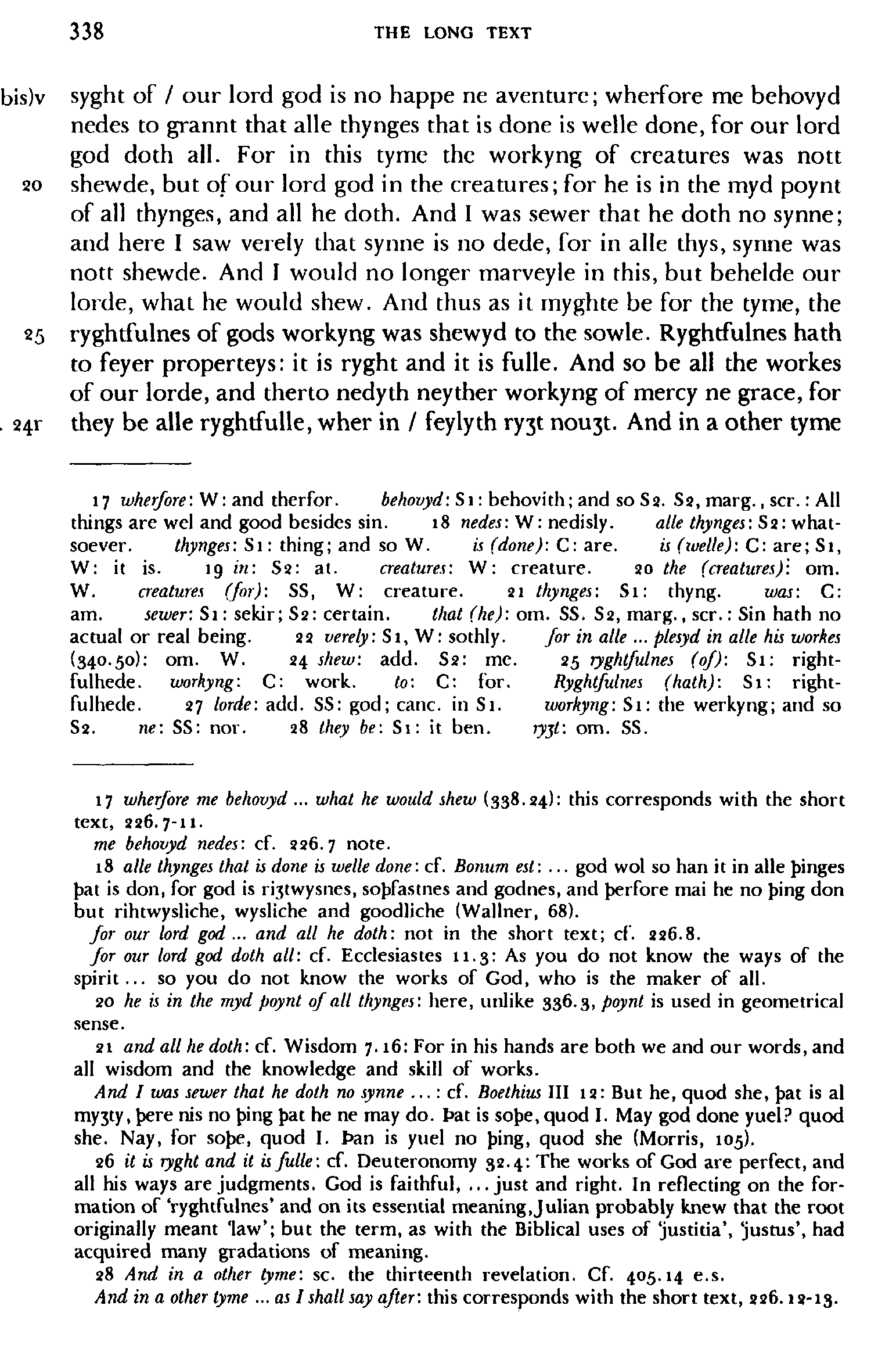
bis)v syght of / our lord god is no happe ne aventurc; wherfore me behovyd nedes to grannt that alle thynges that is done is welle done, for our lord god doth all. For in this tyme the workyng of creatures was nott
shewde, but of our lord god in the creatures; for he is in the myd poynt of all thynges, and all he doth. And I was sewer that he doth no synne; and here I saw verely that synne is no dede, for in alle thys, synne was nott shewde. And I would no longer marveyle in this, but behelde our lorde, what he would shew. And thus as it rnyghte be for the tyme, the 25 ryghtfulnes of gods workyng was shewyd to the sowle. Ryghtfulnes hath to feyer properteys: it is ryght and it is fulle. And so be all the workes of our lorde, and therto nedyth neyther workyng of mercy ne grace, for . 24r they be alle ryghtfulle, wher in / feylyth ry3t nou3t. And in a other tyme
17 wherfore: W: and therfor. behovyd: Si: behovith; and so Sa. Sa, marg., scr.: All things are wel and good besides sin.
18 nedes: W: nedisly. alle thynges: Sa: whatsoever, thynges: Si: thing; and so W. is (done): C: are. is (welle): C: are; Si, W: it is.
19 in: Sa: at. creatures: W: creature.
20 the (creatures): oin.
W. creatures (for):
SS, W: creature.
21 thynges: Si: thyng. was: C: am. sewer: Si: sekir; Sa: certain. that (he): om. SS. Sa, marg., scr.: Sin hath no actual or real being.
22 verely: Si, W: sothly. for in alle ... plesyd in alle his workes (340.50): om.
24 shew: add.
Sa: me.
25 ryghtfulnes (of): Si: rightfulhede. workyng:
C: work. to: C: for.
Ryghtfulnes (hath):
Si: rightfulhede.
27 lorde: add. SS: god; cane, in Si. workyng: Si: the werkyng; and so 82. ne: SS: nor.
28 they be: Si: it ben. ryjt: om. SS.
17 wherfore me behovyd ... what he would shew (338.24): this corresponds with the short text, 226.7-11. me behovyd nedes: cf. 226.7 note.
18 alle thynges that is done is welle done: cf. Bonum est: ... god wol so han it in alle Binges pat is don, for god is ri3twysnes, sopfastnes and godnes, and perfore mai he no ping don but rihtwysliche, wysliche and goodliche (Wallner, 68). for our lord god ... and all he doth: not in the short text; cf. 226.8. for our lord god doth all: cf. Ecclesiastes 11.3: As you do not know the ways of the spirit ... so you do not know the works of God, who is the maker of all.
20 he is in the myd poynt of all thynges: here, unlike 336.3, poynt is used in geometrical sense.
21 and all he doth: cf. Wisdom 7.16: For in his hands are both we and our words, and all wisdom and the knowledge and skill of works.
And I was sewer that he doth no synne ...: cf. Boethius III 12: But he, quod she, pat is al my3ty, pere nis no {ring pat he ne may do. I>at is sope, quod I. May god done yuel? quod she. Nay, for sope, quod I. I>an is yuel no ping, quod she (Morris, 105).
26 it is ryght and it is fulle: cf. Deuteronomy 32.4: The works of God are perfect, and all his ways are judgments. God is faithful, ...just and right. In reflecting on the formation of 'ryghtfulnes' and on its essential meaning,Julian probably knew that the root originally meant 'law'; but the term, as with the Biblical uses of 'justitia', 'Justus', had acquired many gradations of meaning.
28 And in a other tyme: sc. the thirteenth revelation. Cf. 405.14 e.s.
And in a other tyme ... as I shall say after: this corresponds with the short text, 226.12-13.
CHAPTER 11, REVELATION 3
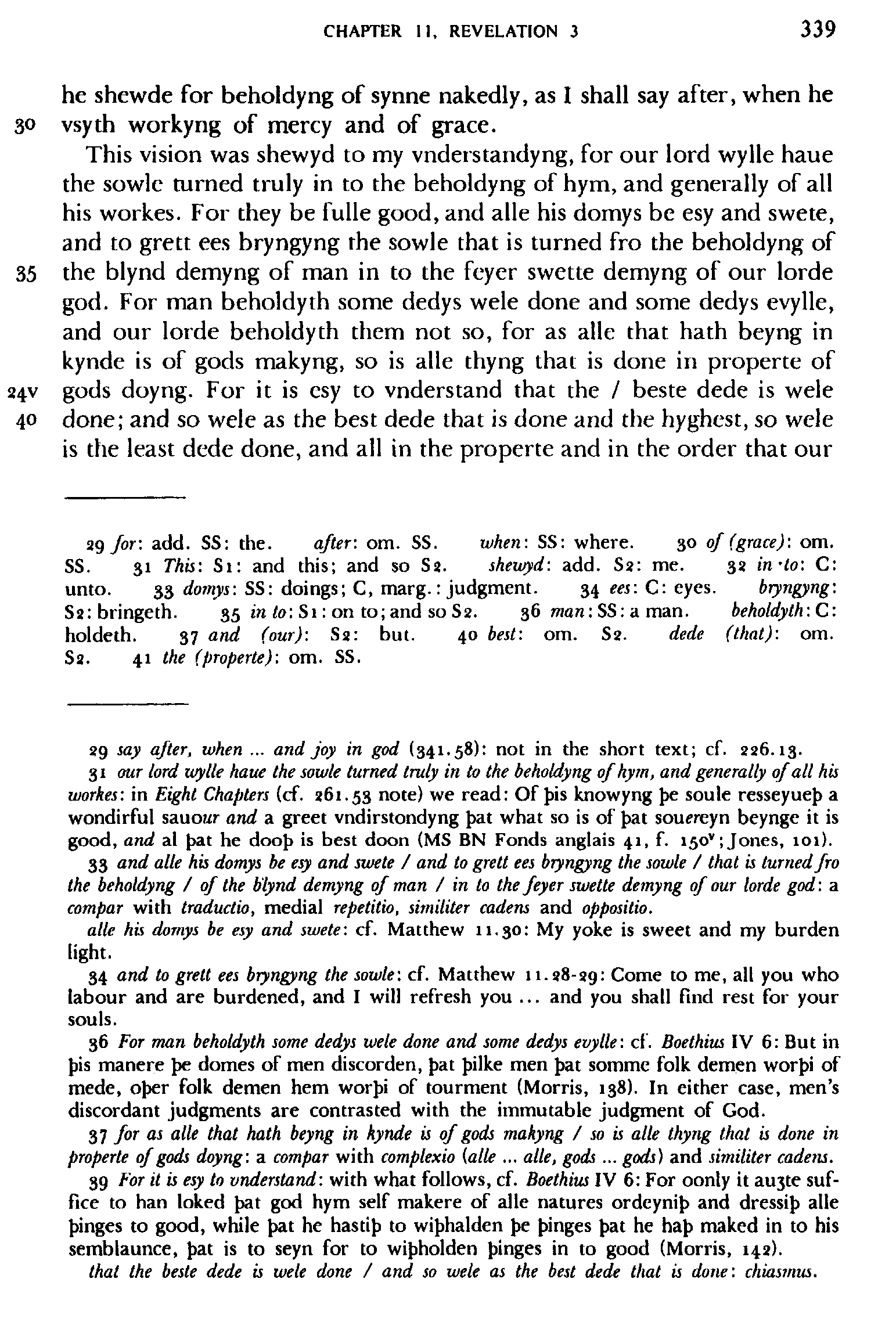
he shewde for beholdyng of synne nakedly, as I shall say after, when he 30 vsyth workyng of mercy and of grace.
This vision was shewyd to my vnderstandyng, for our lord wylle haue the sowle turned truly in to the beholdyng of hym, and generally of all his workes. For they be fulle good, and alle his domys be esy and swete, and to grett ees bryngyng the sowle that is turned fro the beholdyng of 35 the blynd demyng of man in to the feyer swette demyng of our lorde god. For man beholdyth some dedys wele done and some dedys evylle, and our lorde beholdyth them not so, for as alle that hath beyng in kynde is of gods makyng, so is alle thyng that is done in properte of 24v gods doyng. For it is csy to vnderstand that the / beste dede is wele
40 done; and so wele as the best dede that is done and the hyghest, so wele is the least dede done, and all in the properte and in the order that our
29 for: add. SS: the. after: om. SS. when: SS: where.
30 of (grace): om.
SS.
31 This: Si: and this; and so 82. shewyd: add. 82: me.
32 in'to: C: unto.
33 domys: SS: doings; C, marg.: judgment.
34 ees: C: eyes. bryngyng:
S2:bringeth.
35 in to: Si: on to; and so 82.
36 man: SS: a man. beholdylh:C: holdeth.
37 and (our):
82: but.
40 best: om.
82. dede (that): om.
82.
41 the (properte): om. SS.
29 say after, when ... and joy in god (341.58): not in the short text; cf. 226.13.
31 our lord wylle haue the sowle turned truly in to the beholdyng of hym, and generally of all his workes: in Eight Chapters (cf. 261.53 note) we read: Of pis knowyng pe soule resseyuep a wondirful sauour and a greet vndirstondyng pat what so is of pat souereyn beynge it is good, and al pat he doop is best doon (MS BN Fonds anglais 41, f. 150*; Jones, 101).
33 and alle his domys be esy and swete / and to grett ees bryngyng the sowle / that is turned fro the beholdyng / of the blynd demyng of man / in to the feyer swette demyng of our lorde god: a compar with traductio, medial repetitio, similiter cadens and oppositio. alle his domys be esy and swete: cf. Matthew 11.30: My yoke is sweet and my burden light.
34 and to grett ees bryngyng the sowle: cf. Matthew 11.28-29: Come to me, all you who labour and are burdened, and I will refresh you ... and you shall find rest for your souls.
36 For man beholdyth some dedys wele done and some dedys evylle: cf. Boethius IV 6: But in pis manere pe domes of men discorden, pat j)ilke men pat somme folk demen worj)i of mede, oper folk demen hem worpi of tourment (Morris, 138). In either case, men's discordant judgments are contrasted with the immutable judgment of God.
37 for as alle that hath beyng in kynde is of gods makyng / so is alle thyng that is done in properte of gods doyng: a compar with complexio (alle ... alle, gods ... gods) and similiter cadens.
39 For it is esy to vnderstand: with what follows, cf. Boethius IV 6: For oonly it au3te suffice to han loked pat god hym self makere of alle natures ordeynip and dressip alle
Binges to good, while pat he has tip to wiphalden pe Binges pat he hap maked in to his semblaunce, pat is to seyn for to wipholden pinges in to good (Morris, 142). that the beste dede is wele done / and so wele as the best dede that is done: chtas?nus.
THE LONG TEXT
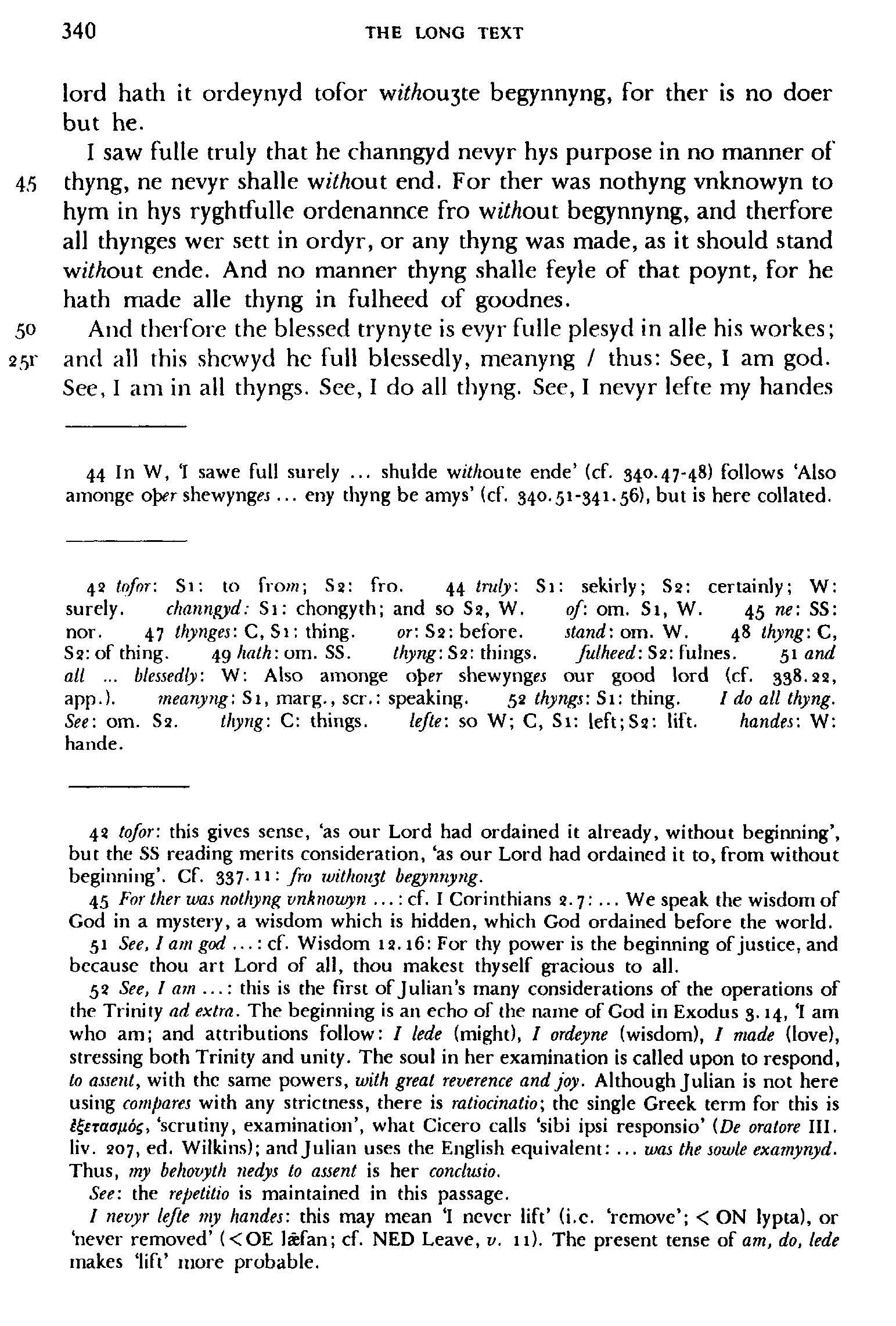
lord hath it ordeynyd tofor w^/tou3te begynnyng, for ther is no doer but he.
I saw fulle truly that he channgyd nevyr hys purpose in no manner of
thyng, ne nevyr shalle without end. For ther was nothyng vnknowyn to hym in hys ryghtfulle ordenannce fro without begynnyng, and therfore all thynges wer sett in ordyr, or any thyng was made, as it should stand without ende. And no manner thyng shalle feyle of that poynt, for he hath made alle thyng in fulheed of goodnes.
And therfore the blessed trynyte is evyr fulle plesyd in alle his workes; 2.51' and all this shcwyd he full blessedly, meanyng / thus: See, I am god.
See, I am in all thyngs. See, I do all thyng. See, I nevyr lefte my handes 44 In W, 'I sawe full surely ... shulde without? ende' (cf. 340.47-48) follows 'Also amonge o{xr shewyngw ... eny thyng be amys' (cf. 340.51-341.56), but is here collated.
42 tofor:
Si: to from; Ss: fro.
44 truly: Si: sekirly; 82: certainly; W: surely. channgyd: Si: chongyth; and so 82, W. of: om. Si, W.
45 ne: SS: nor.
47 thynges: C, Si: thing. or: 82: before. stand: om. W.
48 thyng: C, 82: of thing.
49 hath: om. SS. thyng: 82: things. fulheed: 82: fulnes.
51 and all ... blessedly: W: Also amonge oper shewynges our good lord (cf.
338.22, app.). meanyng: Si, marg., scr.: speaking.
52 thyngs: Si: thing.
I do all thyng.
See: om. 82. thyng: C: things. lefte: so W; C, Si: left; 82: lift. handes: W: hande.
42 tofor: this gives sense, 'as our Lord had ordained it already, without beginning', but the SS reading merits consideration, 'as our Lord had ordained it to, from without beginning'. Cf. 337-u:/ro withoujt begynnyng.
45 For ther was nothyng vnknowyn ...: cf. I Corinthians 2.7: ... We speak the wisdom of God in a mystery, a wisdom which is hidden, which God ordained before the world.
51 See, I am god ...: cf. Wisdom 12.16: For thy power is the beginning of justice, and because thou art Lord of all, thou makest thyself gracious to all.
52 See, I am ...: this is the first of Julian's many considerations of the operations of the Trinity ad extra. The beginning is an echo of the name of God in Exodus 3.14, 'I am who am; and attributions follow: / lede (might), / ordeyne (wisdom), / made (love), stressing both Trinity and unity. The soul in her examination is called upon to respond, to assent, with the same powers, with great reverence and joy. Although Julian is not here using compares with any strictness, there is ratiocination the single Greek term for this is i&Taonos, 'scrutiny, examination', what Cicero calls 'sibi ipsi responsio' (De oratore III. liv. 207, ed. Wilkins); and Julian uses the English equivalent: ... was the sowle examynyd.
Thus, my behovyth nedys to assent is her conclusio.
See: the repetitio is maintained in this passage.
/ nevyr lefte my handes: this may mean 'I never lift' (i.e. 'remove'; < ON lypta), or 'never removed' (<OE laefan; cf. NED Leave, v. 11). The present tense of am, do, lede makes 'lift' more probable.
CHAPTER I I , REVELATION 3
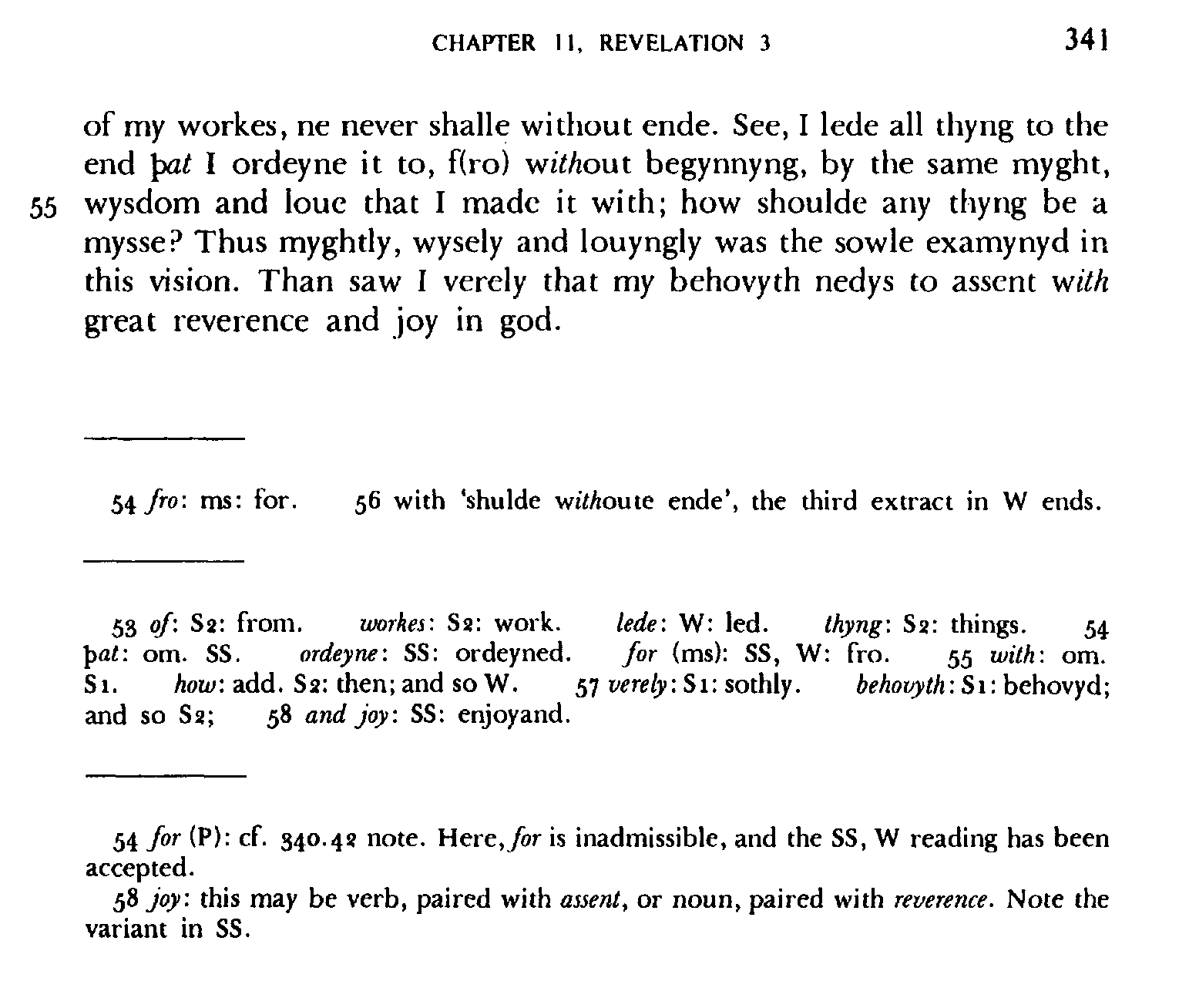
of my workes, ne never shalle without ende. See, I lede all thyng to the end Ipat I ordeyne it to, f(ro) without begynnyng, by the same myght,
55 wysdom and loue that I made it with; how shoulde any thyng be a mysse? Thus myghtly, wysely and louyngly was the sowle examynyd in this vision. Than saw I verely that my behovyth nedys to assent with great reverence and joy in god.
54 fro: ms: for.
56 with 'shulde withoute ende', the third extract in W ends.
53 of: 82: from. workes: 82: work. lede: W: led. thyng: 82: things.
J>a<: om. SS. ordeyne: SS: ordeyned. for (ms): SS, W: fro.
55 with: om.
Si. how: add. 82: then; and so W.
57 verely: Si: sothly. behovyth: Si: behovyd; and so 82; 58 and joy: SS: enjoyand.
54 for (P): cf. 340.42 note. Here, for is inadmissible, and the 88, W reading has been accepted.
58 joy: this may be verb, paired with assent, or noun, paired with reverence. Note the variant in 88.
THE LONG TEXT
The iiij Reuelation The xij Chapter And after this I saw beholdyng the body plentuous bledyng in sernyng of the scoregyng, as thus. The feyer skynne was broken full depe in to 25v the tendyr flessch, with sharpe smytynges all a bout the sweete / body.
6 The hote blode ranne out so plentuously that ther was neyther seen skynne ne wounde, but as it were all blode. And when it cam wher it shuld haue falle downe, ther it vanysschyd. Not with standyng the bledyng contynued a whyle, tyll it myght be seen with avysement. And i Si: How it liketh god rather and better to wash us in his blode from syrme than in water, for his blode is most pretious (82: pretious, alt. al. m. and marg.: ple/ztivous).
3 plentuous: C: plentuously; and so SS.
6 seen: 82: to be seen.
7 ne:
82: nor.
8 ther: Si: than; and so Sz. i How it liketh god ... (Si): this chapter-heading does not correspond with the summary of Revelation IV, 282.13-14.
3 And after this ... plentuous bledyng: this corresponds with the short text, 227.14. in semyng: cf. NED Seeming, vbl. sb. 2, 'the form in which a person or thing seems or appears' ... c. 1400 Secreta Secret., '... he steigh to J»e emperien heuene in {>e semynge of fir'. Cf. 227.16, the semes, and NED Seam sb. i 4, 'A line, groove, furrow' ... c. 1400, R.
Brunne ... 4b 'on the face or body: a long, incised wound' ... c. 1400 Laud Troy Book.
Either reading makes excellent sense. If the first be preferred, we must understand that this vision represented the Flagellation but was not of the event itself.
4 The feyer skynne ... seen with avysement: not in the short text; cf. 227.16.
The feyer skynne was broken ... tendyr flessch: cf. the Privity: As some doctours says, one euery knott was a scharpe hok of iryne, Jjat with euery stroke {>ey rofe his tendyr flesche
(Horstman i 203, which seems to be an addition, not found in Stallings or Ragusa and Green).
5 sharpe smytynges all a bout the sweete body: cf. the Privity: one euery syde stremys downe Jje kynges blode of heuene fro euery parte of his blyssed body (ibid.; Stallings,
106; Ragusa and Green, 328).
6 was neyther seen skynne ne wounde, but as it were all blode: cf. the Privity: He es betyne and betyne agayne, blester appone blester and wonde appone wonde... (ibid.).
Pseudo-Bonaventure or Julian may be the inspiration for a lyric, Our Lady's Imprecation, recorded in three fifteenth-century manuscripts: ... With sharpe scourgis {sei hym bete
/ And rent his flessh fro £e bon, / Till his blode stode at his fete, / With in his body lefte f»ei non (C. Brown, XV 20).
The hote blode ... our owne kynde (343.18): this corresponds with the short text, 227.1619-
CHAPTER 12, REVELATION 4
10 this was so plentuous to my syght that me thought if it had ben so in kynde and in substance, for that tyme it shulde haue made the bedde all on bloude, and haue passyde over all about.
Than cam to my mynde that god hath made waters plentuous in erth to our servys, and to our bodely eese, for tendyr loue that he hath to vs.
. a6r But yet lykyth hym better that we take full holsomly hys blessyd / blode 16 to wassch vs of synne; for ther is no lycour that is made that lykyth hym so wele to yeue vs. For it is most plentuous, as it is most precious, and that by the vertu of the blessyd godhead. And it is our owne kynde, and blessydfully ovyr flowyth vs by the vertu of his precious loue.
10 if: 82: that if.
12 passyde over all about: 82: overflowed on every side.
13 Than:Si: and than; and so 82. hath (made): 82: had. waters: 82: water. in: 82: on.
15 yet: add. 82: it. holsomly: 88: homely; cf. A (227.22): fullye. blessyd: 82: pretious.
16 of: C, 82: from. lykyth hym: Si: he lekyth: and so 82.
18 the (blessyd): 88: his. owne: om. 88; cf. A (227.24): of oure kynde.
19 blessydfully: Si: al blisfully; and so 82. ovyr flowyth: Si: beflowyth; and so 82.
10 me thought if it had ben so: Julian is stressing that at the moment of the revelation, she was aware that it was not so, that this was what the Chastising (using the example of Peter's vision of the edible beasts) calls 'a spiritual vision or imagynatiP, adding 'al po
Binges pat he say ... weren no bodili Binges, but ymages of bodili J>ingis' (Bazire and Colledge, 169, 171).
13 Than cam to my mynde: there may be the same distinction between this and was brought to my mind (304.3), he brought to mynd (375.14), as has been observed (225.27 and note) in the short text, Julian's attempt to differentiate between the revelations themselves and her meditations upon them. god hath made waters ...: cf. Psalm 64.10: Thou hast visited the earth, and hast plentifully watered it; thou hast many ways enriched it; the river of God is filled with water; thou hast prepared their food, for so is its preparation.
15 holsomly: 'medicinally, healingly'. MED quotes the Promptorium parvulorum: Holsumnysse, salubritas; and cf. an addition of the English translator of the Stimulus: £at blod is medicyne for alle synnes (H. J. Kane, 11; Kirchberger, 52). But the synonym in the short text fullye suggests that Julian (or a later scribe-editor) may here have written
'holely' (<OE hXllice), 'wholely', which became differently corrupted in PC and SS.
17 as it is most precious ... blessyd godhead: not in the short text; cf. 227.24. and that by the vertu of the blessyd godhead: it is probable that herejulian has in mind the traditional Trinitarian text in I John 5.6-8: This is he who came by water and blood,
Jesus Christ; not by water only but by water and blood. And it is the Spirit who testifies that Christ is the truth. And there are three who give testimony in heaven ... and these three are one. And there are three which give testimony on earth ... and these three are one. This is yet another example of the way in which Julian brings together popular devotion and her own Scriptural and theological learning.
18 and blessydfully... the number that fay lyth: not in the short text: cf. 227.24.
19 beflowyth (Si): cf. NED, Beflow, v., Obs., the first example a 1000, the last 1387,
MED biflouen, v., the last example a 1400.
THE LONG TEXT
The dere worthy bloude of our lorde Jhesu Crist, also verely as it is most precious, as verely it is most plentuous. Beholde and see the vertu of this precious plenty ofhys dere worthy blode. It descendyd downe in to helle and brak her bondes, and delyuerd them all that were there which belongh to the courte of hevyn. The precious plenty of his dere
26v worthy blode ovyrflowyth all erth, and is redy to wash / all creatures of 26 synnc which be of good wyll, haue ben and shall be. The precious plenty of his dereworthy blode ascendyth vp into hevyn in the blessed body of our lorde Jesu Crist, and ther is in hym, bledyng, preyeng for vs
20 also: SS: as.
21 as (verely): 82: so. the vertu of: om. SS.
22 this: SS: the.
It: om. SS.
23 and (brak): om. 82. brak: Si: braste; and so 82. them: om.
SS.
24 which: 82: who. belongh: C: belongeth; Si; longyd; 82: belonged.
25 all (erth): add. 82: the. of (synne): 82: from.
26 and: C: or.
27 ascendyth: Si: ascended; and so 82. in (the) SS: to.
28 bledyng: add.
Si: and; and so 82.
20 also verely as it is most precious / as verely it is most plentuous: a compar, with medial repetitio (it is ... it is) and similiter cadem (\wecwus ... plentuous).
21 Beholde and see ...: cf. the English Stimulus: Lo now J>e 3ate of paradise is openyd, and porou vertu of his blod is putt awey pe brennande pliaunt swerd (H. J. Kane, 11;
Kirchberger, 52).
22 It descendyd downe in to helle: cf. the English Stimulus: Lo his woundes ouercomen pe fendes power, and baarst £e 3ates of helle (H. J. Kane, 16-17; Kirchberger, 57). The same poem in which affinities with pseudo-Bonaventure and Julian have been remarked
(342.6 note) may here be drawing on her or the Stimulus: Then to hell he toke pe way, /
With wondis wyde and al blody. / ... And harrowid helle euery noke, / With in hit lefte he sowlis non ... / And toke his pray pat he had bojt, / And put hem in to endlesse welle (C. Brown, XV 21-22).
23 and brak her bondes: 'helle' (<OE *halja) is a strong feminine in all the Germanic languages; and NED, Hell, sb., 3.3., quotes 1382, the Lollard version of Isaias 5.14:
Therfore helle spredde abrod his soule, and openede his (i6th c. version: her) mouth.
Cf. 203.36 note, the quotation from A Book to a Mother, contemporary with Julian, where
'hell' is also treated as feminine.
24 The precious plenty...: the theology of this passage is immediately Pauline. In Romans 5, the love of God is poured out in our hearts (5), Christ died for the ungodly
(6), God gives us his love (8), because he gives us Christ to die for us, who justifies us by his blood (9). We were reconciled to God by his Son's death do), we shall be saved by his (heavenly) life do), and we have glory in God. The gift of God by the grace of the man Jesus Christ has abounded to many (15) who receive abundance of grace through the man Jesus Christ (17).
25 ovyrflowyth all erth: cf. the English Stimulus: ... for man he helde hit ow3te as watir, al his blode for to make hym wy3te (H. J. Kane, 39; Kirchberger, 75).
28 preyeng for vs to the father: cf. the English Stimulus: For wite pou wel pat Cristes blood is 3itt als hote and as fresh as hit was wenne he died on good friday, and shal be so in holy chirche vn to the dai of doom, bettir criande aftir mercy of pe fadir of heuene for vs synfull wrecchis panne pe blode of Abeel (H. J. Kane, 35; Kirchberger, 72). The reference is to Genesis 4.10.
CHAPTER 12, REVELATION 4
to the father, and is and shal be as long as vs nedyth. And ovyr more it 3° flowyth in all heauen, enjoying the saluacion of all mankynd that be ther and shall be, fulfylling the number that faylyth.
29 vs (nedyth): SS: it.
30 heauen: 82: heavens.
39 And ovyr more itjlowyth in all heauen: a few lines later, the Stimulus continues: Jxm^e woche blood al so grace is graunted, heuene is openid, ioye and blis shal be 3euen to vs with outen ende (H. J. Kane, 36; Kirchberger, 72).
31 fulfyllyng the number that faylyth: cf. Apocalypse 6.11: And white robes were given, to every one of them one. And it was said to them that they should rest for a little time till their fellow servants and their brethren who are to be slain even as they should be filled up.
THE LONG TEXT
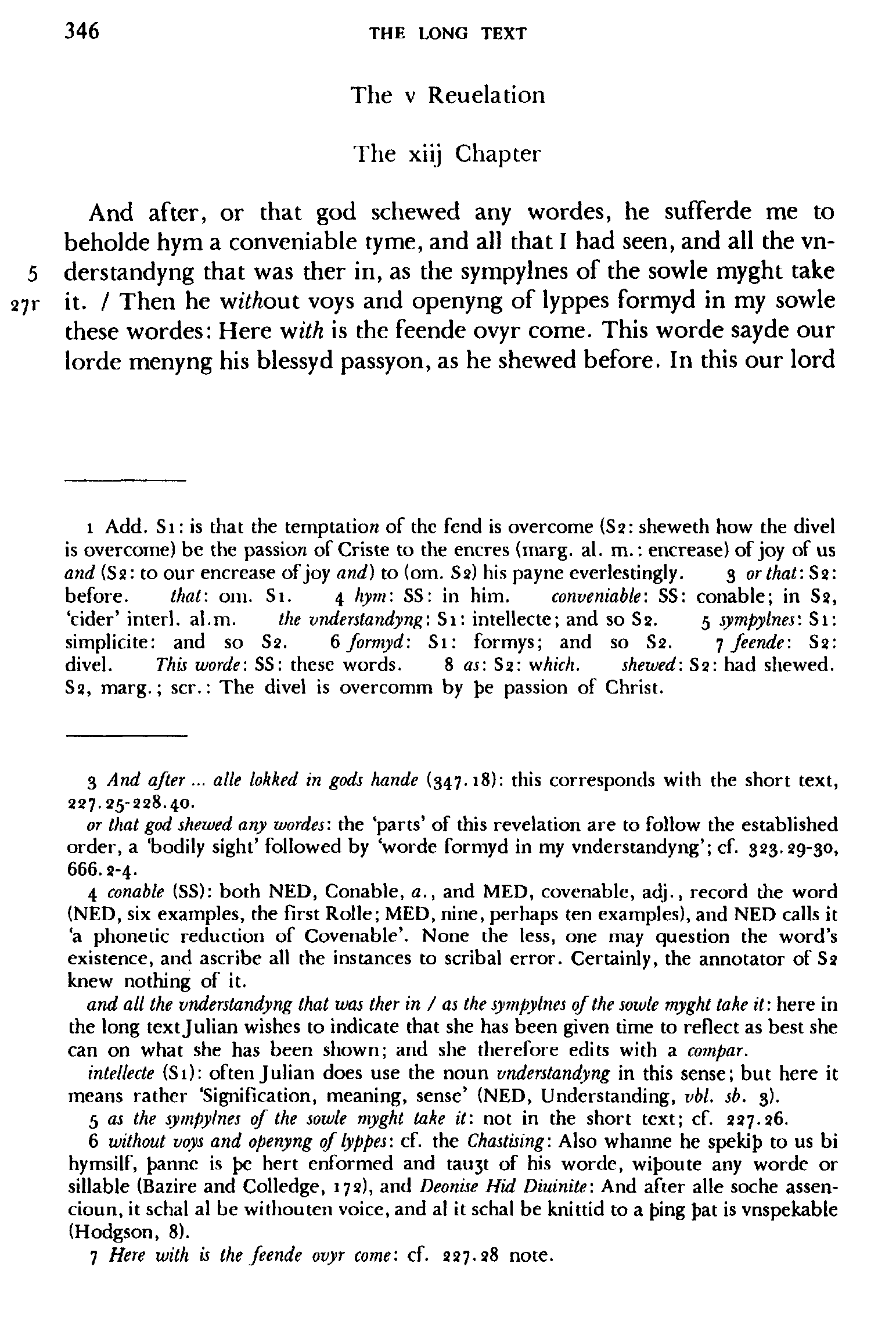
The v Reuelation The xiij Chapter And after, or that god schewed any wordes, he sufferde me to beholde hym a conveniable tyme, and all that I had seen, and all the vn5 derstandyng that was ther in, as the sympylnes of the sowle myght take
27r it. / Then he without voys and openyng of lyppes formyd in my sowle these wordes: Here with is the feende ovyr come. This worde sayde our lorde menyng his blessyd passyon, as he shewed before. In this our lord i Add. Si: is that the temptatiow of the fend is overcome (82: sheweth how the divel is overcome) be the passio/z of Criste to the encres (marg. al. m.: encrease) of joy of us and ($2: to our encrease of joy and) to (om. 82) his payne everlestingly.
3 or that: 82: before. that: om. Si.
4 hym: SS: in him. conveniable: SS: conable; in 82, 'cider' interl. al.m. the vnderstandyng: Si: intellecte; and so 82.
5 sympylnes: Si: simplicite: and so 82.
6 formyd: Si: formys; and so 82.
7 feende:
82: divel.
This worde: SS: these words.
8 as: 82: which. shewed: 82: had shewed.
82, marg.; scr.: The divel is overcomm by Jje passion of Christ.
3 And after ... alle lohked in gods hande (347.18): this corresponds with the short text,
227.25-228.40. or that god shewed any wordes: the 'parts' of this revelation are to follow the established order, a 'bodily sight' followed by 'worde formyd in my vnderstandyng'; cf. 323.29-30,
666.2-4.
4 conable (SS): both NED, Conable, a., and MED, covenable, adj., record the word
(NED, six examples, the first Rolle; MED, nine, perhaps ten examples), and NED calls it
'a phonetic reduction of Covenable'. None the less, one may question the word's existence, and ascribe all the instances to scribal error. Certainly, the annotator of 82 knew nothing of it. and all the vnderstandyng that was ther in / as the sympylnes of the sowle myght take it: here in the long text Julian wishes to indicate that she has been given time to reflect as best she can on what she has been shown; and she therefore edits with a cornpar. intellecte (Si): often Julian does use the noun vnderstandyng in this sense; but here it means rather 'Signification, meaning, sense' (NED, Understanding, vbl. sb. 3).
5 as the sympylnes of the sowle myght take it: not in the short text; cf. 227.26.
6 without voys and openyng of lyppes: cf. the Chastising: Also whanne he spekif) to us bi hymsilf, £anne is Jje hert enformed and tau3t of his worde, wijjoute any worde or sillable (Bazire and Colledge, 172), and Deonise Hid Diuinite: And after alle soche assencioun, it schal al be withouten voice, and al it schal be knittid to a |)ing Jjat is vnspekable
(Hodgson, 8).
7 Here with is the feende ovyr come: cf. 227.28 note.
CHAPTER 13, REVELATION 5
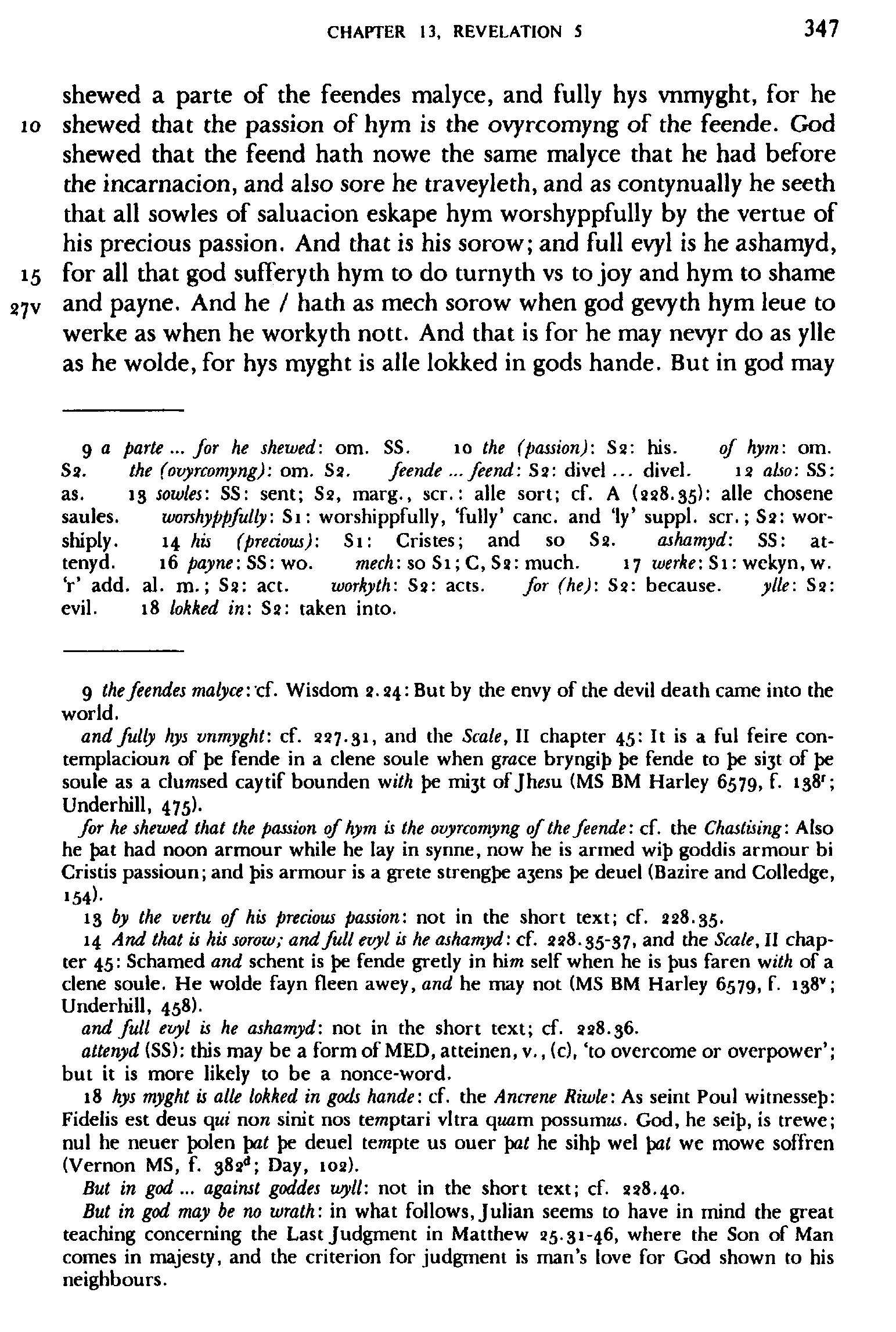
shewed a parte of the feendes malyce, and fully hys vnmyght, for he 10 shewed that the passion of hym is the ovyrcomyng of the feende. God shewed that the feend hath nowe the same malyce that he had before the incarnacion, and also sore he traveyleth, and as contynually he seeth that all sowles of saluacion eskape hym worshyppfully by the vertue of his precious passion. And that is his sorow; and full evyl is he ashamyd, for all that god sufferyth hym to do turnyth vs to joy and hym to shame and payne. And he / hath as mech sorow when god gevyth hym leue to werke as when he workyth nott. And that is for he may nevyr do as ylle as he wolde, for hys myght is alle lokked in gods hande. But in god may
.27V 9 a parte ... for he shewed: om. SS.
10 the (passion): Sa: his. of hym: om.
Sa. the (ovyrcomyng): om. Sa. feende ...feend: Sa: divel ... divel.
12 also: SS: as.
13 sowles: SS: sent; Sa, marg., scr.: alle sort; cf. A (338.35): alle chosene saules. worshyppfully: Si: worshippfully, 'fully' cane, and 'ly' suppl. scr.; Sa: worshiply.
14 his (precious):
Si:
Cristes; and so Sa. ashamyd:
SS: attenyd.
16 payne: SS: wo. mech: so Si; C, Sa: much.
17 werke: Si: wekyn, w.
V add. al. m.; Sa: act. workyth: Sa: acts. for (he): Sa: because. ylle: Sa: evil.
18 lokked in: Sa: taken into.
9 the feendes malyce :'cf. Wisdom a. 34: But by the envy of the devil death came into the world. and fully hys vnmyght: cf. 887.31, and the Scale, II chapter 45: It is a ful feire contemplacioun of pe fende in a clene soule when grace bryngip pe fende to pe si3t of pe soule as a clumsed caytif bounden with pe mi3t of Jh«u (MS BM Harley 6579, f. 138';
Underhill, 475). for he shewed that the passion of hym is the ovyrcomyng of the feende: cf. the Chastising: Also he pat had noon armour while he lay in synne, now he is armed wip goddis armour bi
Cristis passioun; and pis armour is a grete strengpe ajens pe deuel (Bazire and Colledge,
154).
13 by the vertu of his precious passion: not in the short text; cf. 338.35.
14 And that is his sorow; and full evyl is he ashamyd: cf. 338.35-37, and the Scale, II chapter 45: Schamed and schent is pe fende gretly in him self when he is pus faren with of a clene soule. He wolde fayn fleen awey, and he may not (MS BM Harley 6579, f. 138*;
Underhill, 458). and full evyl is he ashamyd: not in the short text; cf. 338.36. attenyd (SS): this may be a form of MED, atteinen, v., (c), 'to overcome or overpower'; but it is more likely to be a nonce-word.
18 hys myght is alle lokked in gods hande: cf. the Ancrene Riwle: As seint Poul witnessed:
Fidelis est deus que now sink nos te/nptari vltra quam possunms. God, he seip, is trewe; nul he neuer polen pa£ pe deuel tempte us ouer pa/ he sihj) wel \at we mowe soffren
(Vernon MS, f. 38ad; Day, 103).
But in god ... against goddes wyll: not in the short text; cf. 338.40.
But in god may be no wrath: in what follows, Julian seems to have in mind the great teaching concerning the Last Judgment in Matthew 35.31-46, where the Son of Man comes in majesty, and the criterion for judgment is man's love for God shown to his neighbours.
THE LONG TEXT
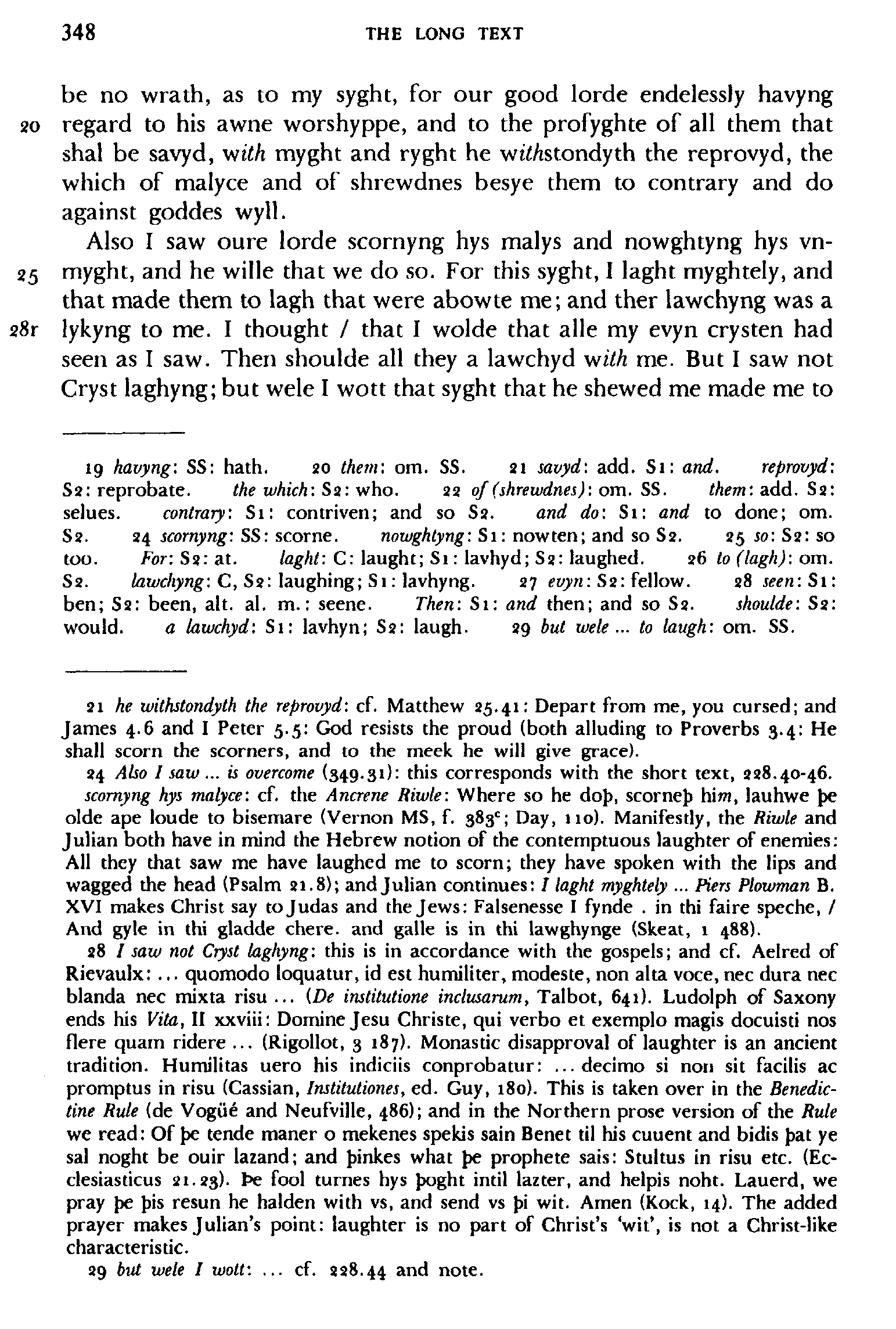
be no wrath, as to my syght, for our good lorde endelessly havyng 20 regard to his awne worshyppe, and to the profyghte of all them that shal be savyd, with myght and ryght he w^/zstondyth the reprovyd, the which of malyce and of shrewdnes besye them to contrary and do against goddes wyll.
Also I saw oure lorde scornyng hys malys and nowghtyng hys vn25 myght, and he wille that we do so. For this syght, I laght myghtely, and that made them to lagh that were abowte me; and ther lawchyng was a 28r lykyng to me. I thought / that I wolde that alle my evyn crysten had seen as I saw. Then shoulde all they a lawchyd -with me. But I saw not Cryst laghyng; but wele I wott that syght that he shewed me made me to 19 havyng: SS: hath.
20 them: om. SS.
21 savyd: add. Si: and, reprovyd:
82: reprobate. the which: 82: who.
22 of (shrewdnes): om. SS. them: add. 82: selues. contrary: Si: contriven; and so 82. and do: Si: and to done; om.
82.
24 scornyng: SS: scorne. nowghtyng: Si: nowten; and so 82.
25 so: 82: so too.
For: 82: at. laght: C: laught; Si: lavhyd; 82: laughed.
26 to (lagh): om.
82. lawchyng: C, 82: laughing; Si: lavhyng.
27 evyn: 82: fellow.
28 wn:Si: ben; 82: been, alt. al. m.: scene.
Then: Si: and then; and so 82. shoulde: 82: would. a lawchyd: Si: lavhyn; Ss: laugh.
29 but wele... to laugh: om. SS.
21 he withstondyth the reprovyd: cf. Matthew 25.41: Depart from me, you cursed; and James 4.6 and I Peter 5.5: God resists the proud (both alluding to Proverbs 3.4: He shall scorn the scorners, and to the meek he will give grace).
24 Also I saw... is overcome (349.31): this corresponds with the short text, 228.40-46. scornyng hys malyce: cf. the Ancrene Riwle: Where so he doj>, scornej) him, lauhwe |)e olde ape loude to bisemare (Vernon MS, f. 383°; Day, no). Manifestly, the Riwle and Julian both have in mind the Hebrew notion of the contemptuous laughter of enemies:
All they that saw me have laughed me to scorn; they have spoken with the lips and wagged the head (Psalm 21.8); and Julian continues: / laght myghtely ... Piers Plowman B.
XVI makes Christ say to Judas and the Jews: Falsenesse I fynde . in thi faire speche, /
And gyle in thi gladde chere. and galle is in thi lawghynge (Skeat, i 488).
28 / saw not Cryst laghyng: this is in accordance with the gospels; and cf. Aelred of Rievaulx: ... quomodo loquatur, id est humiliter, modeste, non alta voce, nee dura nee blanda nee mixta risu ... (De institutione inclusarum, Talbot, 641). Ludolph of Saxony ends his Vita, II xxviii: Domine Jesu Christe, qui verbo et exemplo magis docuisti nos flere quarn ridere ... (Rigollot, 3 187). Monastic disapproval of laughter is an ancient tradition. Humilitas uero his indiciis conprobatur: ...decimo si non sit facilis ac promptus in risu (Cassian, Institutiones, ed. Guy, 180). This is taken over in the Benedictine Rule (de Vogue and Neufville, 486); and in the Northern prose version of the Rule we read: Of \>e tende maner o mekenes spekis sain Benet til his cuuent and bidis J>at ye sal noght be ouir lazand; and pinkes what pe prophete sais: Stultus in risu etc. (Ecclesiasticus 21.23). £>e fool turnes hys Jxsght intil lazter, and helpis noht. Lauerd, we pray f>e pis resun he halden with vs, and send vs |>i wit. Amen (Kock, 14). The added prayer makes Julian's point: laughter is no part of Christ's 'wit', is not a Christ-like characteristic.
29 but wele I wott: ... cf. 228.44 and note.