
282 The Long Text
THE LONG TEXT
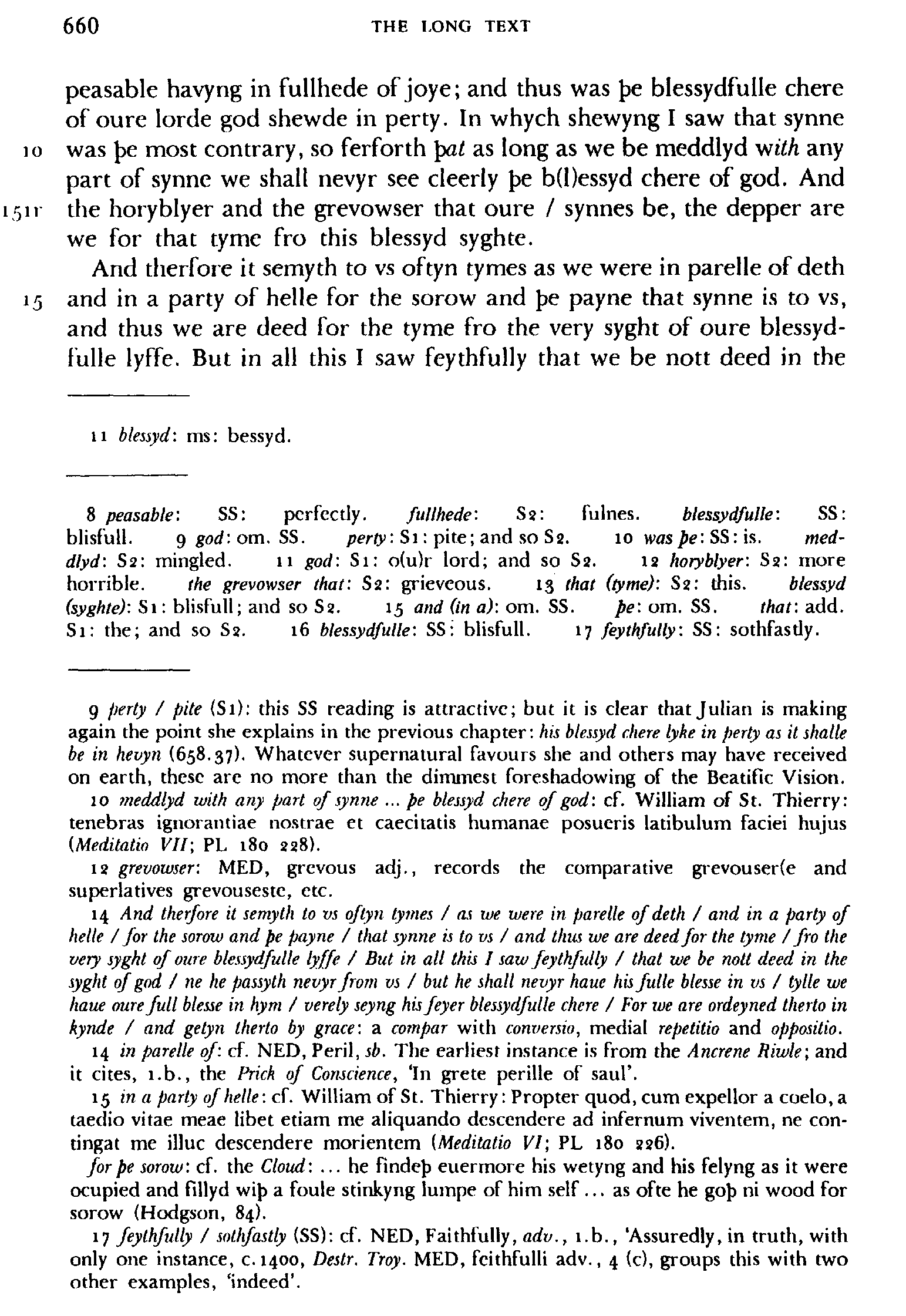
peasable havyng in fullhede of joye; and thus was £>e blessydfulle chere of oure lorde god shewde in perty. In whych shewyng I saw that synne
10 was J>e most contrary, so ferforth Ipat as long as we be meddlyd with any part of synne we shall nevyr see cleerly Jje b(l)essyd chere of god. And 1511the horyblyer and the grevowser that oure / synnes be, the depper are we for that tyme fro this blessyd syghte.
And therfoi e it semyth to vs oftyn tymes as we were in parelle of deth 15 and in a party of helle for the sorow and Jae payne that synne is to vs, and thus we are deed for the tyme fro the very syght of oure blessydfulle lyffe. But in all this I saw feythfully that we be nott deed in the 11 blessyd: ms: bessyd.
8 peasable:
88: perfectly. fullhede:
82: fulnes. blessydfulle:
SS: blisfull.
9 god: om. SS. perty: Si: pile; and so 82.
10 waspe: SS: is. meddlyd: 82: mingled.
11 god: Si: o(u)r lord; and so 82.
12 horyblyer: 82: more horrible. the grevowser that: 82: grieveous.
13 that (tyme): 82: this. blessyd (syghte): Si: blisfull; and so 82.
15 and (in a): om. 88. pe: om. SS. that: add.
Si: the; and so 82.
16 blessydfulle: SS: blisfull.
17 feythfully: 88: sothfastly.
9 perty / pile (Si): this SS reading is attractive; but it is clear that Julian is making again the point she explains in the previous chapter: his blessyd chere lyke in perty as it shalle be in hevyn (658.37). Whatever supernatural favours she and others may have received on earth, these are no more than the dimmest foreshadowing of the Beatific Vision.
10 meddlyd with any part of synne ... be blessyd chere of god: cf. William of St. Thierry: tenebras ignorantiae nostrae et caecitatis humanae posueris latibulum faciei hujus
(Meditatio VII \ PL 180 228).
12 grevowser: MED, grevous adj., records the comparative grevouser(e and superlatives grevouseste, etc.
14 And therfore it semyth to vs oftyn tymes / as we were in parelle of deth / and in a party of helle /for the sorow and pe payne / that synne is to vs / and thus we are deed for the tyme /fro the very syght of oure blessydfulle lyffe / But in all this I saw feythfully / that we be nott deed in the syght of god / ne he passyth nevyr from vs / but he shall nevyr haue hisfulle blesse in vs / tylle we haue oure full blesse in hym / verely seyng hisfeyer blessydfulle chere / For we are ordeyned therto in kynde / and getyn therto by grace: a cornpar with conversio, medial repetitio and oppositio.
14 in parelle of: cf. NED, Peril, sb. The earliest instance is from the Ancrene Riwle; and it cites, i.b., the Prick of Conscience, 'In grete perille of saul'.
15 in a party of helle: cf. William of St. Thierry: Propter quod, cum expellor a coelo, a taedio vitae meae libet etiam me aliquando descendere ad infernum viventem, ne contingat me illuc descendere morientem (Meditatio VI; PL 180 226). for pe sorow: cf. the Cloud: ... he findep euermore his wetyng and his felyng as it were ocupied and fillyd wip a foule stinkyng lumpe of him self ... as ofte he gop ni wood for sorow (Hodgson, 84).
17 feythfully / sothfastly (SS): cf. NED, Faithfully, adv., i.b., 'Assuredly, in truth, with only one instance, c.i40o, Destr. Troy. MED, feithfulli adv., 4 (c), groups this with two other examples, 'indeed'.
CHAPTER 72, REVELATION 16
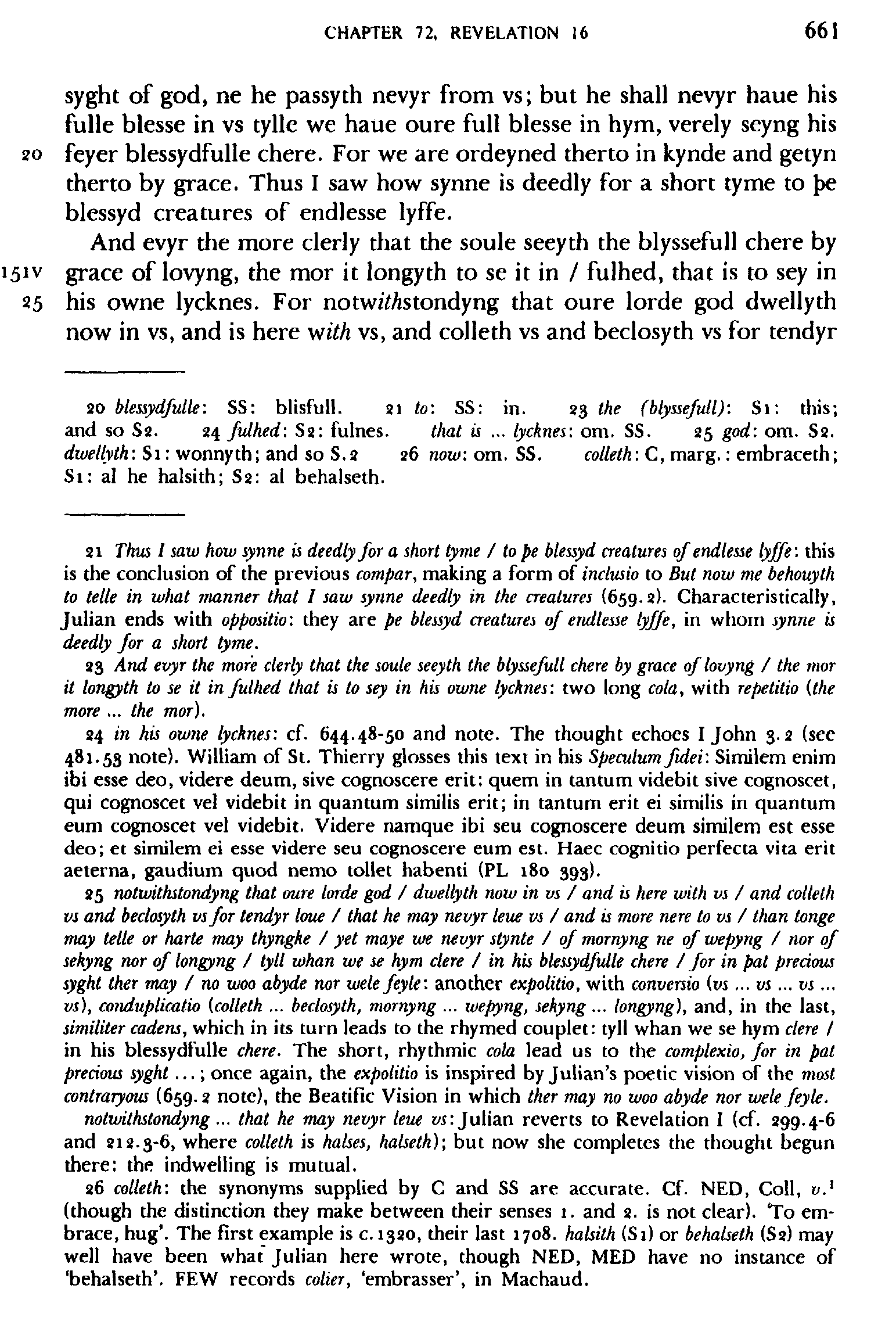
syght of god, ne he passyth nevyr from vs; but he shall nevyr haue his fulle blesse in vs tylle we haue oure full blesse in hym, verely seyng his
20 feyer blessydfulle chere. For we are ordeyned therto in kynde and getyn therto by grace. Thus I saw how synne is deedly for a short tyme to he blessyd creatures of endlesse lyffe.
And evyr the more clerly that the soule seeyth the blyssefull chere by !51V grace of lovyng, the mor it longyth to se it in / fulhed, that is to sey in 25 his owne lycknes. For notwzMstondyng that oure lorde god dwellyth now in vs, and is here with vs, and colleth vs and beclosyth vs for tendyr
20 blessydfulle:
SS: blisfull.
21 to: SS: in.
23 the (blyssefull):
Si: this; and so Ss.
24 fulhed: 82: fulnes. that is ... lycknes: om. SS.
25 god: om. S2. dwellyth: Si: wonnyth; and so S.2
26 now: om. SS. colleth: C, marg.: embraceth; Si: al he halsith; S2: al behalseth.
21 Thus I saw how synne is deedly for a short tyme / to pe blessyd creatures of endlesse lyffe: this is the conclusion of the previous compar, making a form of inclusio to But now me behouyth to telle in what manner that I saw synne deedly in the creatures (659.2). Characteristically,
Julian ends with oppositio: they are pe blessyd creatures of endlesse lyffe, in whom synne is deedly for a short tyme.
23 And evyr the more clerly that the soule seeyth the blyssefull chere by grace of lovyng / the mor it longyth to se it in fulhed that is to sey in his owne lycknes: two long cola, with repetitio (the more ... the mor).
24 in his owne lycknes: cf. 644.48-50 and note. The thought echoes I John 3.2 (see
481.53 note). William of St. Thierry glosses this text in his Speculum fuiei: Similem enim ibi esse deo, videre deum, sive cognoscere erit: quem in tantum videbit sive cognoscet, qui cognoscet vel videbit in quantum similis erit; in tantum erit ei similis in quantum eum cognoscet vel videbit. Videre namque ibi seu cognoscere deum similem est esse deo; et similem ei esse videre seu cognoscere eum est. Haec cognitio perfecta vita erit aeterna, gaudium quod nemo toilet habenti (PL 180 393).
25 notwithstondyng that oure lorde god / dwellyth now in vs / and is here with vs / and colleth vs and beclosyth vsfor tendyr loue / that he may nevyr leue vs / and is more nere to vs / than tonge may telle or harte may thyngke / yet maye we nevyr stynte / of mornyng ne of wepyng / nor of sekyng nor of longyng / tyll whan we se hym clere / in his blessydfulle chere /for in pat precious syght ther may / no woo abyde nor welefeyle: another expolitio, with conversio (vs... vs ... vs... vs), conduplicatio (colleth ... beclosyth, mornyng ... wepyng, sekyng ... longyng), and, in the last, similiter cadens, which in its turn leads to the rhymed couplet: tyll whan we se hym clere I in his blessydfulle chere. The short, rhythmic cola lead us to the complexio, for in pat precious syght...; once again, the expolitio is inspired by Julian's poetic vision of the most contraryous (659.2 note), the Beatific Vision in which ther may no woo abyde nor welefeyle. notwithstondyng ... that he may nevyr leue vs: Julian reverts to Revelation I (cf. 299.4-6 and 212.3-6, where colleth is halses, halseth); but now she completes the thought begun there: the indwelling is mutual.
26 colleth: the synonyms supplied by C and SS are accurate. Cf. NED, Coll, v.1
(though the distinction they make between their senses i. and 2. is not clear). To embrace, hug'. The first example is c. 1320, their last 1708. halsith (Si) or behalseth (Sa) may well have been what Julian here wrote, though NED, MED have no instance of 'behalseth'. FEW records colter, 'embrasser', in Machaud.
THE LONG TEXT
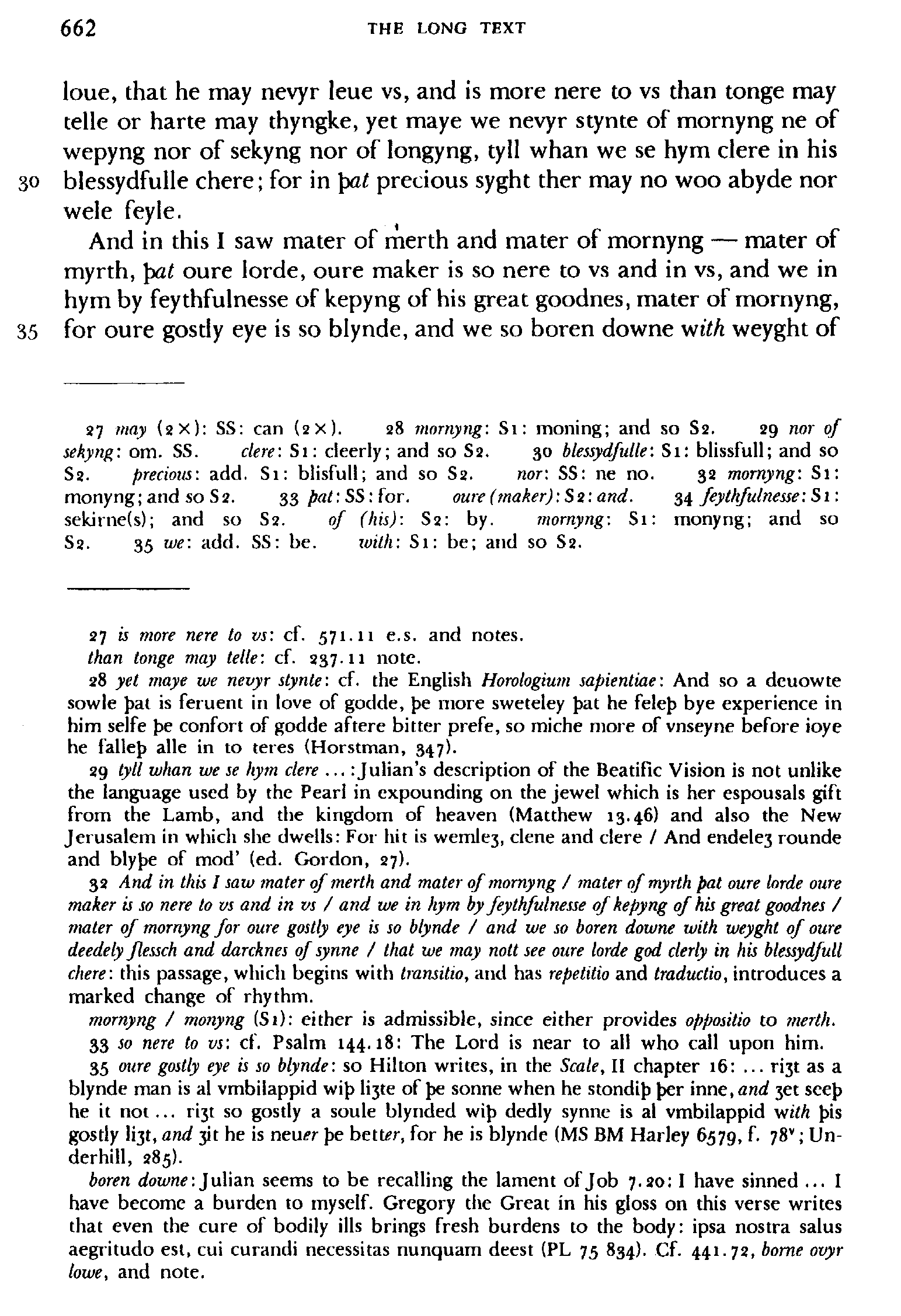
loue, that he may nevyr leue vs, and is more nere to vs than tonge may telle or harte may thyngke, yet maye we nevyr stynte of mornyng ne of wepyng nor of sekyng nor of longyng, tyll whan we se hym clere in his
30 blessydfulle chere; for in \Mt precious syght ther may no woo abyde nor wele feyle.
And in this I saw mater of merth and mater of mornyng — mater of myrth, \>at oure lorde, oure maker is so nere to vs and in vs, and we in hym by feythfulnesse of kepyng of his great goodnes, mater of mornyng,
35 for oure gostly eye is so blynde, and we so boren downe with weyght of 27 may ( a x ) : SS: can ( z x ) .
28 mornyng: Si: moning; and so 82.
29 nor of sekyng: om. SS. clere: Si: cleerly; and so 82.
30 blessydfulle: Si: blissfull; and so Sa. precious: add. Si: blisfull; and so 82. nor: SS: ne no.
32 mornyng: Si: monyng; and so 82.
33 pat: SS: for. oure(?naker):Sn:and.
34 feythfulnesse: 81: sekirne(s); and so 82. of (his): 82: by. mornyng: Si: monyng; and so 82.
35 we: add. SS: be. with: Si: be; and so 82.
27 is more nere to vs: cf. 571.11 e.s. and notes. than tonge may telle: cf. 237.11 note.
28 yet maye we nevyr stynte: cf. the English Horologium saf)ientiae: And so a deuowte sowle pat is feruent in love of godde, pe more sweteley pat he felej) bye experience in him selfe £e confort of godde aftere bitter prefe, so miche more of vnseyne before ioye he fallep alle in to teres (Horstman, 347).
29 tyll whan we se hym clere ...: Julian's description of the Beatific Vision is not unlike the language used by the Pearl in expounding on the jewel which is her espousals gift from the Lamb, and the kingdom of heaven (Matthew 13.46) and also the New
Jerusalem in which she dwells: For hit is wemle3, clene and clere / And endele3 rounde and blype of mod' (ed. Gordon, 27).
32 And in this I saw mater of merth and mater of mornyng / mater of myrth pat oure lorde oure maker is so nere to vs and in vs / and we in hym by feythfulnesse of kepyng of his great goodnes / mater of mornyng for oure gostly eye is so blynde / and we so boren downe with weyght of oure deedely flessch and darcknes of synne / that we may nott see oure lorde god derly in his blessydfull chere: this passage, which begins with transitio, and has repetitio and traductio, introduces a marked change of rhythm. mornyng / monyng (Si): either is admissible, since either provides oppositio to merth.
33 so nere to vs: cf. Psalm 144.18: The Lord is near to all who call upon him.
35 oure gostly eye is so blynde: so Hilton writes, in the Scale, II chapter 16: ... 031 as a blynde man is al vmbilappid wij) Ii3te of pe sonne when he stondij) per inne, and 3« seep he it not... ri3t so gostly a soule blynded wip dedly synne is al vmbilappid with pis gostly 1131, and yt he is neuer pe better, for he is blynde (MS BM Harley 6579, f. 78"; Underhill, 285). boren downe: Julian seems to be recalling the lament of Job 7.20: I have sinned ... I have become a burden to myself. Gregory the Great in his gloss on this verse writes that even the cure of bodily ills brings fresh burdens to the body: ipsa nostra salus aegritudo est, cui curandi necessitas nunquam deest (PL 75 834). Cf. 441.72, borne ovyr lowe, and note.
CHAFFER 72, REVELATION 16
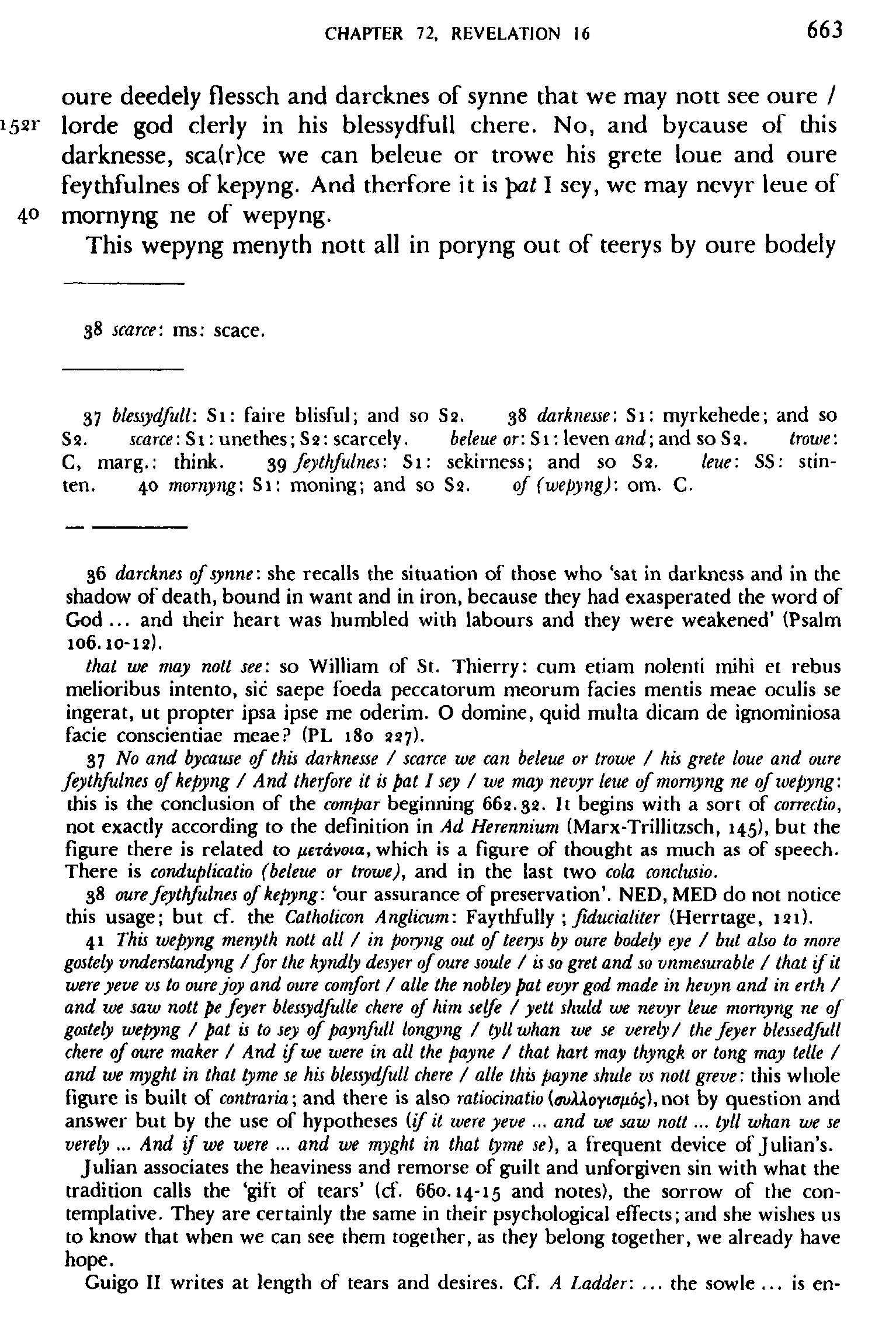
oure deedely flessch and darcknes of synne that we may nott see oure / 1521lorde god clerly in his blessydfull chere. No, and bycause of this darknesse, sca(r)ce we can beleue or trowe his grete loue and oure feythfulnes of kepyng. And therfore it is \>at I sey, we may nevyr leue of 4° mornyng ne of wepyng.
This wepyng menyth nott all in poryng out of teerys by oure bodely scarce: ms: scace.
37 blessydfull: Si: faire blisful; and so 82.
38 darknesse: Si: myrkehede; and so 82. scarce: Si: unethes; Sa: scarcely. beleue or: Si: leven and; and so 82. trowe:
C, marg.: think.
39 feythfulnes:
Si: sekirness; and so Sa. leue: SS: sunten.
40 mornyng: Si: moning; and so 82. of (wepyng): om. C.
36 darcknes of synne: she recalls the situation of those who 'sat in darkness and in the shadow of death, bound in want and in iron, because they had exasperated the word of God ... and their heart was humbled with labours and they were weakened' (Psalm
106.10-12). that we may nott see: so William of St. Thierry: cum etiam nolenti mihi et rebus melioribus intento, sic saepe foeda peccatorum meorum facies mentis meae oculis se ingerat, ut propter ipsa ipse me oderim. O domine, quid multa dicam de ignominiosa facie conscientiae meae? (PL 180 227).
37 No and bycause of this darknesse / scarce we can beleue or trowe / his grete loue and oure feythfulnes of kepyng /And therfore it is pat I sey / we may nevyr leue of mornyng ne of wepyng: this is the conclusion of the cornpar beginning 662.32. It begins with a sort of correctio, not exactly according to the definition in Ad Herennium (Marx-Trillitzsch, 145), but the figure there is related to fjierdvoia, which is a figure of thought as much as of speech.
There is conduplicatio (beleue or trowe), and in the last two cola conclusio.
38 oure feythfulnes of kepyng: 'our assurance of preservation'. NED, MED do not notice this usage; but cf. the Catholicon Anglicum: Faythfully ; fiducialiter (Herrtage, 121).
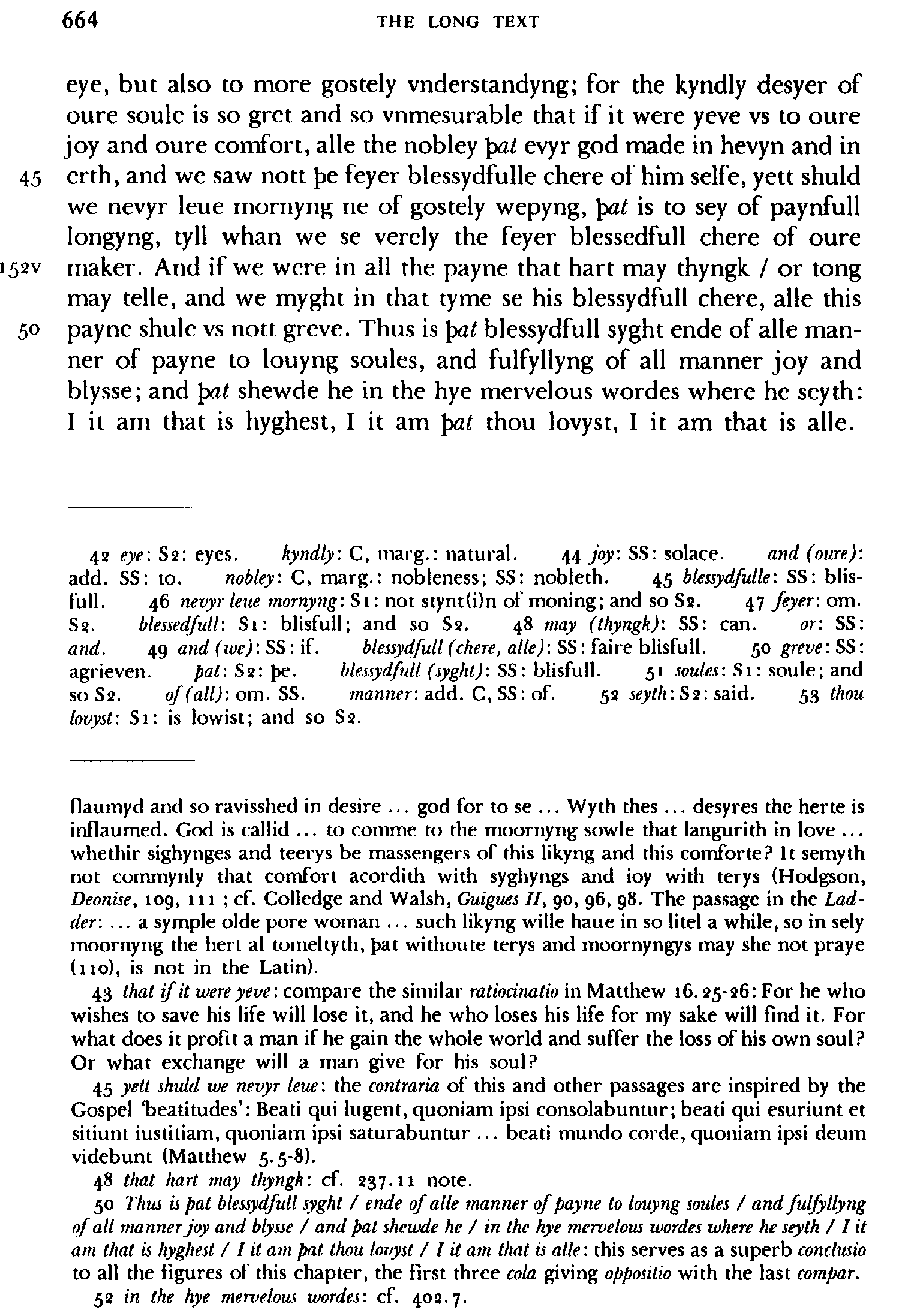
41 This wepyng menyth nott all / in poryng out of teerys by oure bodely eye / but also to more gostely vnderstandyng /for the kyndly desyer of oure soule / is so gret and so vnmesurable / that if it were yeve vs to oure joy and oure comfort / alle the nobley pat evyr god made in hevyn and in erth / and we saw nott pe feyer blessydfulle chere of him selfe / yett shuld we nevyr leue mornyng ne of gostely wepyng / pat is to sey of paynfull longyng / tyII whan we se verely/ the feyer blessedfull chere of oure maker / And if we were in all the payne / that hart may thyngk or long may telle / and we myght in that lyme se his blessydfull chere / alle this payne shule vs nott greve: this whole figure is built of contraria; and there is also ratiocinatio (au^oYiffHog), not by question and answer but by the use of hypotheses (if it were yeve ... and we saw nott... tyll whan we se verely ... And if we were ... and we myght in that tyme se), a frequent device of Julian's.
Julian associates the heaviness and remorse of guilt and unforgiven sin with what the tradition calls the 'gift of tears' (cf. 660.14-15 and notes), the sorrow of the contemplative. They are certainly the same in their psychological effects; and she wishes us to know that when we can see them together, as they belong together, we already have hope.
Guigo II writes at length of tears and desires. Cf. A Ladder: ... the sowle ... is en-
THE LONG TEXT
eye, but also to more gostely vnderstandyng; for the kyndly desyer of oure soule is so gret and so vnmesurable that if it were yeve vs to oure joy and oure comfort, alle the nobley \>at evyr god made in hevyn and in 45 erth, and we saw nott be feyer blessydfulle chere of him selfe, yett shuld we nevyr leue mornyng ne of gostely wepyng, \>at is to sey of paynfull longyng, tyll whan we se verely the feyer blessedfull chere of oure i52v maker. And if we were in all the payne that hart may thyngk / or long may telle, and we myght in that tyme se his blessydfull chere, alle this
50 paync shule vs nott greve. Thus is \&t blessydfull syght ende of alle manner of payne to louyng soules, and fulfyllyng of all manner joy and blysse; and \>at shewde he in the hye mervelous wordes where he seyth:
I it am that is hyghest, I it am \>at thou lovyst, I it am that is alle.
42 eye: 82: eyes. kyndly: C, niarg.: natural.
44 joy: SS: solace. and (oure): add. SS: to. nobley: C, marg.: nobleness; SS: nobleth.
45 blessydfulle: SS: blisfull.
46 nevyr leue mornyng: Si: not stynt(i)n of moning; and so 82.
47 feyer: om.
82. blessedfull: Si: blisfull; and so 82.
48 may (thyngk): SS: can. or: SS: and.
49 and ( w e ) : S S : i f . blessydfull (chere, alle): SS: faire blisfull.
50 greve: SS: agrieven. pat: 82: pe. blessydfull (syght): SS: blisfull.
51 soules: Si: soule; and 5082. of(all):om.SS. manner: add. C, 88: of.
52 seyth: 82: said.
53 thou lovyst: Si: is lowist; and so 82. flaumyd and so ravisshed in desire ... god for to se ... Wyth thes ... desyres the herte is infiaumed. God is callid ... to comme to the moornyng sowle that langurith in love ... whethir sighynges and teerys be massengers of this likyng and this comforte? It semyth not commynly that comfort acordith with syghyngs and ioy with terys (Hodgson,
Deonise, 109, 111 ; cf. Colledge and Walsh, Guigues II, 90, 96, 98. The passage in the Ladder: ... a symple olde pore woman ... such likyng wille haue in so litel a while, so in sely moornyng the hert al tomeltyth, pat withoute terys and moornyngys may she not praye
(no), is not in the Latin).
43 that if it were yeve: compare the similar ratiodnatio in Matthew 16.25-26: For he who wishes to save his life will lose it, and he who loses his life for my sake will find it. For what does it profit a man if he gain the whole world and suffer the loss of his own soul ?
Or what exchange will a man give for his soul?
45 yett shuld we nevyr leue: the contraria of this and other passages are inspired by the Gospel "beatitudes': Beati qui lugent, quoniam ipsi consolabuntur; bead qui esuriunt et sitiunt iustitiam, quoniam ipsi saturabuntur ... beati mundo corde, quoniam ipsi deum videbunt (Matthew 5.5-8).
48 that hart may thyngk: cf. 237.11 note.
50 Thus is pat blessydfull syght / ende of alle manner of payne to louyng soules / and fulfyllyng of all manner joy and blysse / and pat shewde he / in the hye mervelous wordes where he seyth / I it am that is hyghest / I it am pat thou lovyst / I it am that is alle: this serves as a superb condusio to all the figures of this chapter, the first three cola giving oppositio with the last cornpar.
52 in the hye mervelous wordes: cf. 402.7.
CHAPTER 72, REVELATION 16
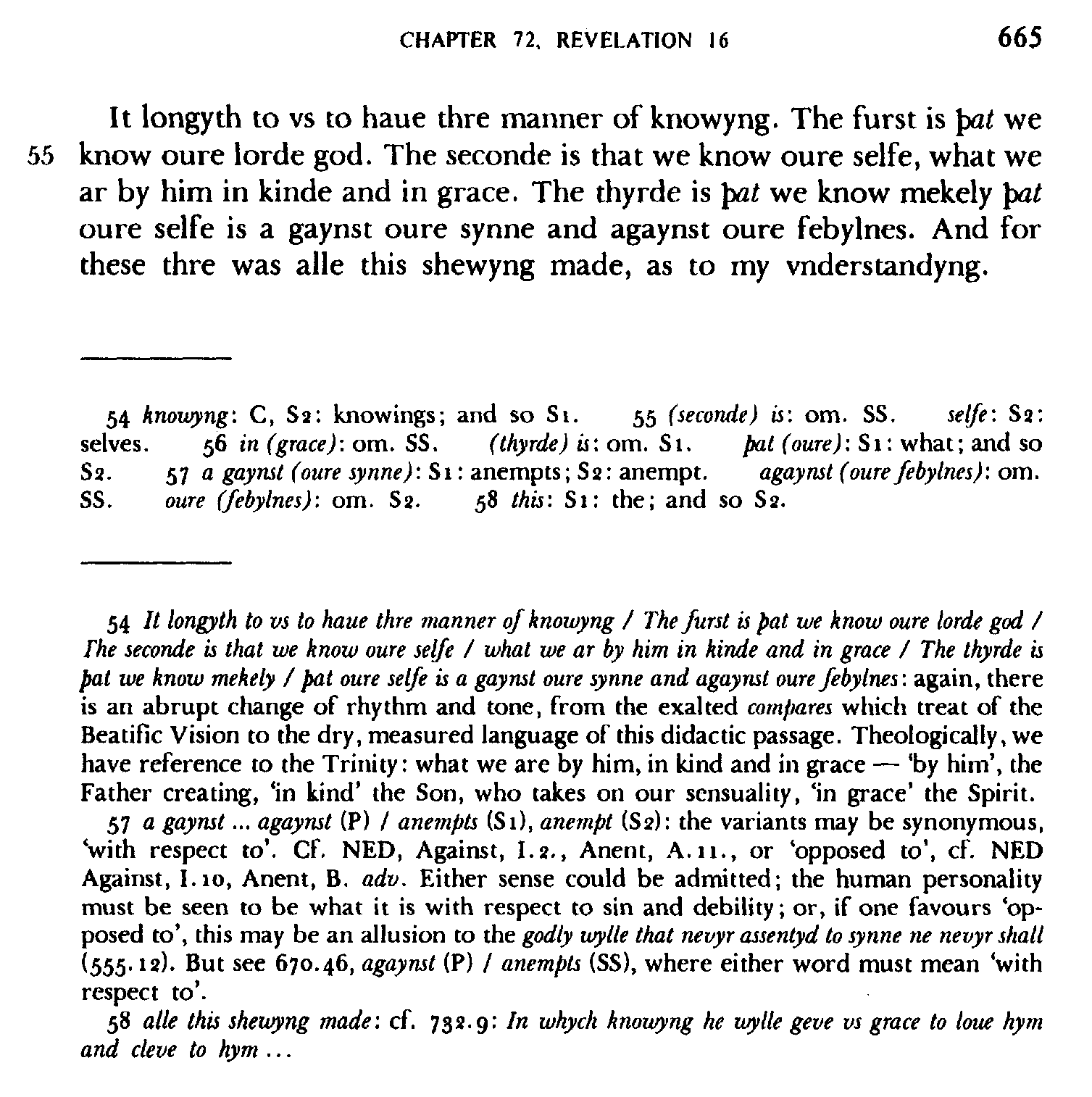
It longyth to vs to haue thre manner of knowyng. The furst is Ipat we 55 know oure lorde god. The seconde is that we know oure selfe, what we ar by him in kinde and in grace. The thyrde is \>at we know mekely \>at oure selfe is a gaynst oure synne and agaynst oure febylnes. And for these thre was alle this shewyng made, as to my vnderstandyng.
54 knowyng: C, 82: knowings; and so Si.
55 (seconde) is: om. SS. selfe: 82: selves.
56 in (grace): om. SS.
(thyrde) is: om. Si. pat (oure): Si: what; and so 82.
57 a gaynst (oure synne): Si: anempts; 82: anempt. agaynst (ourefebylnes): om.
SS. oure (febylnes): om. 82.
58 this: Si: the; and so 82.
54 // longyth to vs to haue thre manner of knowyng / The furst is pat we know oure lorde god /
Phe seconde is that we know oure selfe / what we ar by him in kinde and in grace / The thyrde is pat we know mekely / pat oure selfe is a gaynst oure synne and agaynst oure febylnes: again, there is an abrupt change of rhythm and tone, from the exalted compares which treat of the Beatific Vision to the dry, measured language of this didactic passage. Theologically, we have reference to the Trinity: what we are by him, in kind and in grace — 'by him', the Father creating, 'in kind' the Son, who takes on our sensuality, 'in grace' the Spirit.
57 a gaynst... agaynst (?) I anempts (Si), anempt (82): the variants may be synonymous,
'with respect to'. Cf. NED, Against, I.a., Anent, A.u., or 'opposed to', cf. NED
Against, I.io, Anent, B. adv. Either sense could be admitted; the human personality must be seen to be what it is with respect to sin and debility; or, if one favours 'opposed to', this may be an allusion to the godly wylle that nevyr assentyd to synne ne nevyr shall
(555-12). But see 670.46, agaynst (P) / anempts (SS), where either word must mean 'with respect to'.
58 alle this shewyng made: cf. 732.9: In whych knowyng he wylle geve vs grace to loue hyrn and cleve to hym ...
THE LONG TEXT
The Ixxiij Chapter
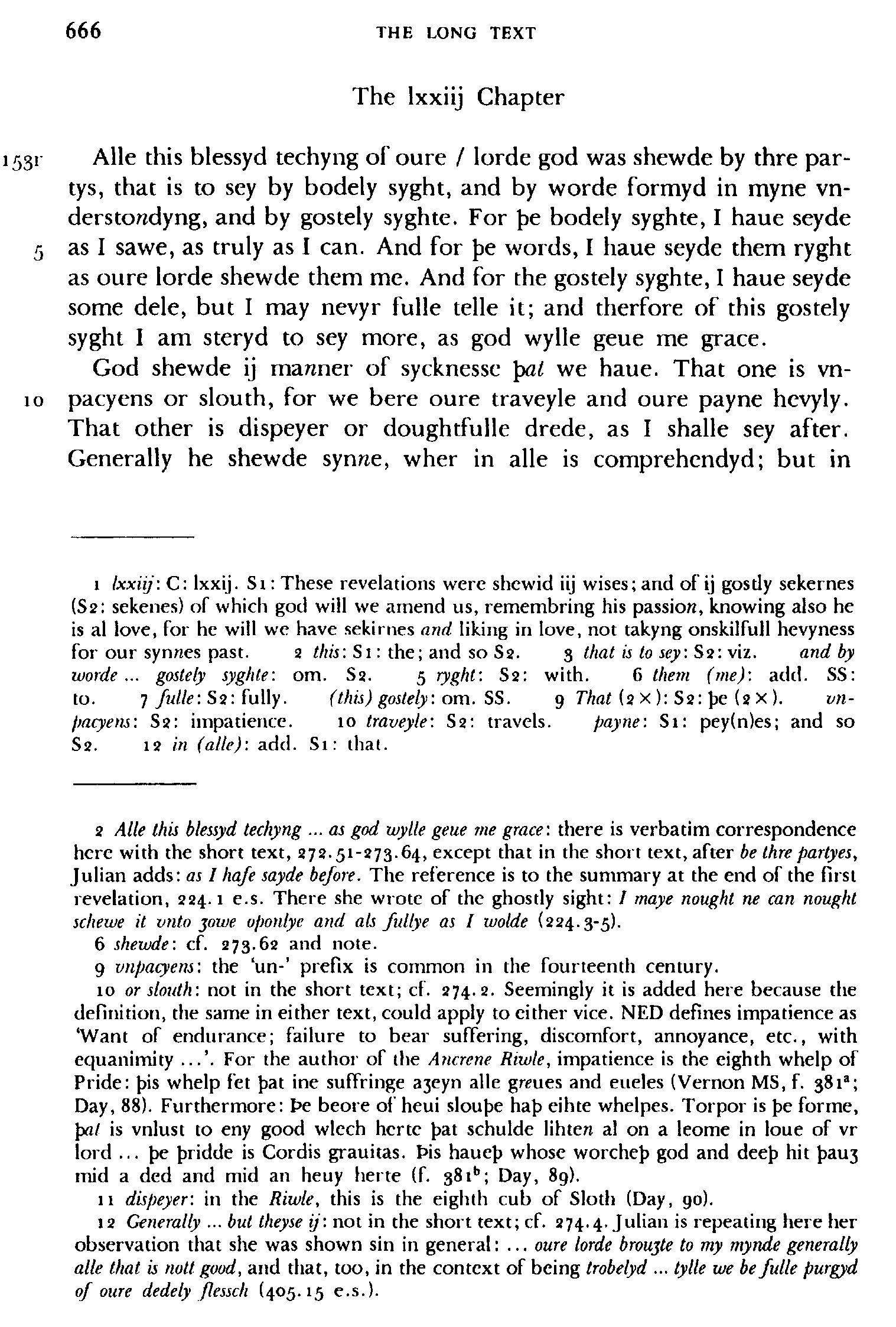
Alle this blessyd techyng of oure / lorde god was shewde by thre partys, that is to sey by bodely syght, and by worde formyd in myne vnderstondyng, and by gostely syghte. For be bodely syghte, I haue seyde
5 as I sawe, as truly as I can. And for IDC words, I haue seyde them ryght as oure lorde shewde them me. And for the gostely syghte, I haue seyde some dele, but I may nevyr fulle telle it; and therfore of this gostely syght I am steryd to sey more, as god wylle geue me grace.
God shewde ij manner of sycknesse Jxz/ we haue. That one is vn10 pacyens or slouth, for we bere oure traveyle and oure payne hevyly.
That other is dispeyer or doughtfulle drede, as I shalle sey after.
Generally he shewde synwe, wher in alle is comprehendyd; but in i Ixxiij: C: Ixxij. Si: These revelations were shewid iij wises; and of ij gostly sekernes
(82: sekenes) of which god will we amend us, remembring his passion, knowing also he is al love, for he will we have sekirnes and liking in love, not takyng onskilfull hevyness for our syn/ies past.
2 this: Si: the; and so 82.
3 that is to sey: 82: viz. and by worde... gostely syghte: om. 82.
5 ryght: 82: with.
6 them (me): add. 88: to.
7 fulle-.Ss: fully.
(this) gostely: om. 88.
9 That (3 x ): 82: t>e (i?x ). vnpacyens: 82: impatience.
10 traveyle: 82: travels. payne: Si: pey(n)es; and so 82.
12 in (alle): add. Si: that.
2 Alle this blessyd techyng ... as god wylle geue trie grace: there is verbatim correspondence here with the short text, 272.51-273.64, except that in the short text, after be thre partyes,
Julian adds: as I hafe sayde before. The reference is to the summary at the end of the first revelation, 224. i e.s. There she wrote of the ghostly sight: / rnaye nought ne can nought schewe it vnto jowe oponlye and als fullye as I wolde (224.3-5).
6 shewde: cf. 273.62 and note.
9 vnpacyem: the 'un-' prefix is common in the fourteenth century.
10 or slouth: not in the short text; cf. 274.2. Seemingly it is added here because the definition, the same in either text, could apply to cither vice. NED defines impatience as 'Want of endurance; failure to bear suffering, discomfort, annoyance, etc., with equanimity ...'. For the author of the Ancrene Riwle, impatience is the eighth whelp of Pride: pis whelp fet pat ine suffringe ajeyn alle groies and eueles (Vernon MS, f. 38ia;
Day, 88). Furthermore: t>e beore of heui sloupe hap eihte whelpes. Torpor is pe forme,
Jw/ is vnlust to eny good wlcch hcrte pat schulde lihten al on a leome in loue of vr lord ... pe bridde is Cordis grauitas. f>is hauep whose worchep god and deej) hit pau3 mid a ded and mid an heuy herte (f. 38ib; Day, 89).
11 dispeyer: in the Riwle, this is the eighth cub of Sloth (Day, 90).
12 Generally ... but theyse ij: not in the short text; cf. 274.4. Julian is repeating here her observation that she was shown sin in general: ... oure lorde broujte to my mynde generally alle that is nott good, and that, too, in the context of being trobelyd ... tylle we be fulle purgyd of oure dedely flessch (405.15 e.s.).
CHAPTER 73, REVELATION 16
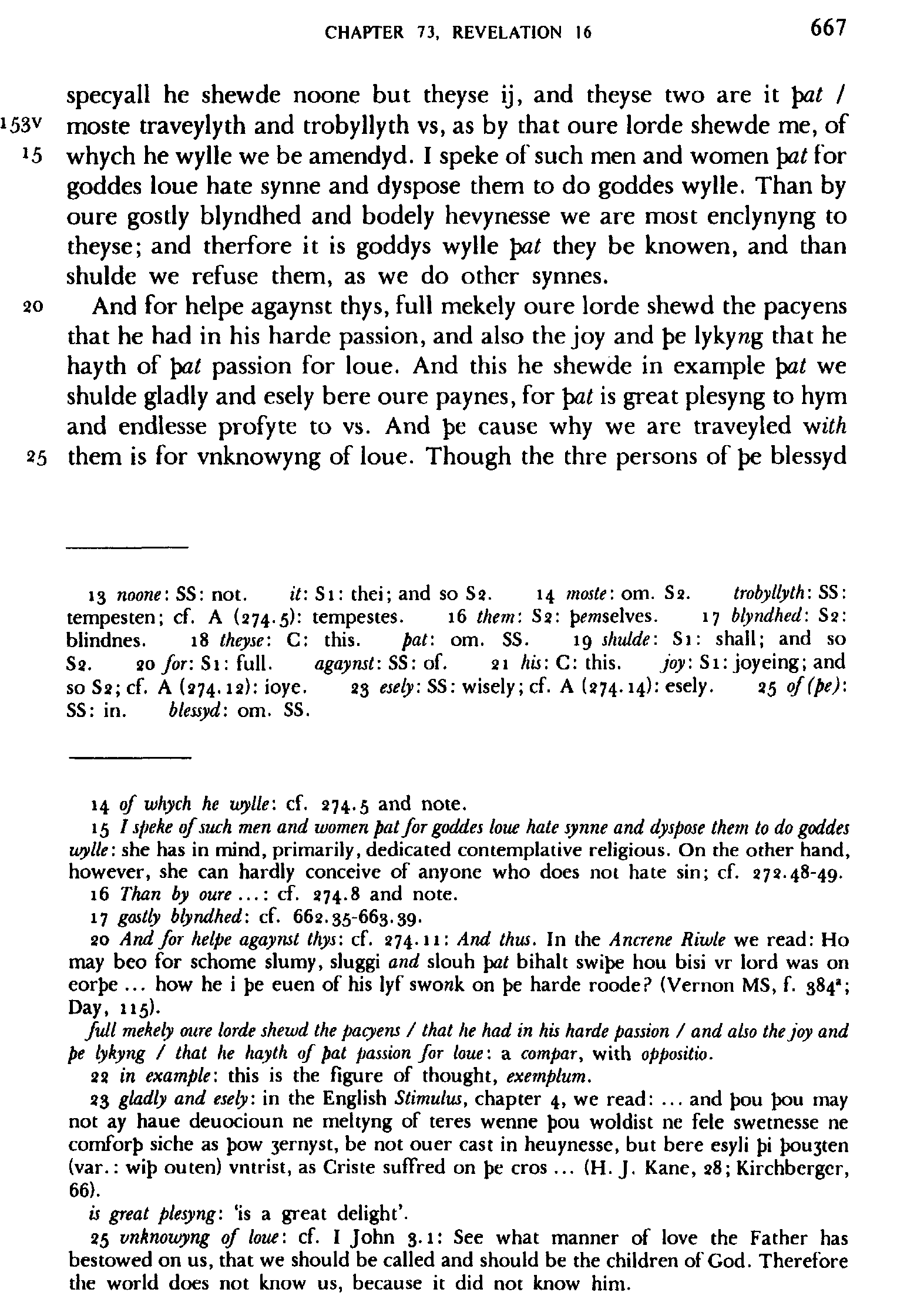
specyall he shewde noone but theyse ij, and theyse two are it Jxz£ / !53V moste traveylyth and trobyllyth vs, as by that oure lorde shewde me, of 15 whych he wylle we be amendyd. I speke of such men and women \Mt for goddes loue hate synne and dyspose them to do goddes wylle. Than by oure gostly blyndhed and bodely hevynesse we are most enclynyng to theyse; and therfore it is goddys wylle \>at they be knowen, and than shulde we refuse them, as we do other synnes.
And for helpe agaynst thys, full mekely oure lorde shewd the pacyens that he had in his harde passion, and also the joy and J>e lykyng that he hayth of \>at passion for loue. And this he shewde in example tyit we shulde gladly and esely bere oure paynes, for \>at is great plesyng to hym and endlesse profyte to vs. And JDC cause why we are traveyled with 25 them is for vnknowyng of loue. Though the thre persons of {)e blessyd
13 noone: SS: not. it: Si: thei; and so 82.
14 moste: om. 82. trobyllyth: SS: tempesten; cf. A (274.5): tempestes.
16 them: 82: pmselves.
17 blyndhed: 82: blindnes.
18 theyse: C: this. pat: om. SS.
19 shulde: Si: shall; and so 82.
20 for: Si: full. agaynst: SS: of.
21 his: C: this. joy: Si: joyeing; and so 82; cf. A (274.12): ioye.
23 esely: 88: wisely; cf. A (274.14): esely.
25 of(pe):
SS: in. blessyd: om. 88.
14 of whych he wylle: cf. 274.5 and note.
15 / speke of such men and women pat for goddes loue hate synne and dyspose them to do goddes wylle: she has in mind, primarily, dedicated contemplative religious. On the other hand, however, she can hardly conceive of anyone who does not hate sin; cf. 272.48-49.
16 Than by oure...: cf. 274.8 and note.
17 gostly blyndhed: cf. 662.35-663.39.
20 And for helpe agaynst thys: cf. 274.11: And thus. In the Ancrene Riwle we read: Ho may beo for scheme slumy, sluggi and slouh \>at bihalt swipe hou bisi vr lord was on eorpe ... how he i pe euen of his lyf swowk on pe harde roode? (Vernon MS, f. 384";
Day, 115). full mekely oure lorde shewd the pacyens / that he had in his harde passion / and also the joy and pe lykyng / that he hayth of pat passion for loue: a compar, with oppositio.
22 in example: this is the figure of thought, exemplum.
23 gladly and esely: in the English Stimulus, chapter 4, we read: ... and pou pou may not ay haue deuocioun ne meltyng of teres wenne pou woldist ne fele swetnesse ne comforp siche as pow 3ernyst, be not ouer cast in heuynesse, but bere esyli pi po^ten
(var.: wip outen) vntrist, as Criste suffred on pe cros ... (H. J. Kane, 28; Kirchberger,
66). is great plesyng: 'is a great delight'.
25 vnknowyng of loue: cf. I John 3.1: See what manner of love the Father has bestowed on us, that we should be called and should be the children of God. Therefore the world does not know us, because it did not know him.
THE LONG TEXT
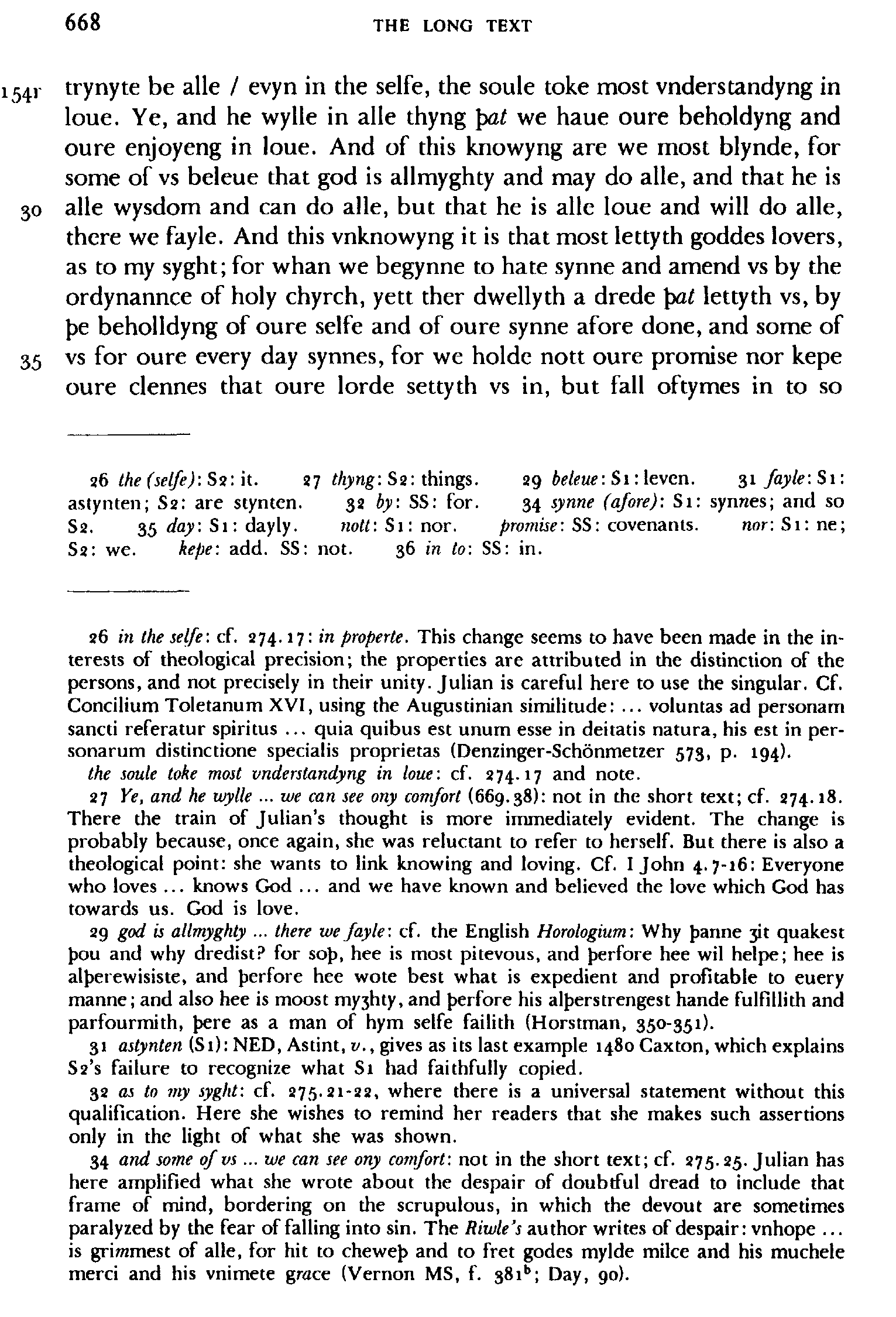
1541 trynyte be alle / evyn in the selfe, the soule toke most vnderstandyng in loue. Ye, and he wylle in alle thyng \>at we haue oure beholdyng and oure enjoyeng in loue. And of this knowyng are we most blynde, for some of vs beleue that god is allmyghty and may do alle, and that he is
30 alle wysdom and can do alle, but that he is alle loue and will do alle, there we fayle. And this vnknowyng it is that most lettyth goddes lovers, as to my syght; for whan we begynne to hate synne and amend vs by the ordynannce of holy chyrch, yett ther dwellyth a drede \>at lettyth vs, by pe beholldyng of oure selfe and of oure synne afore done, and some of 35 vs for oure every day synnes, for we holde nott oure promise nor kepe oure clennes that oure lorde settyth vs in, but fall oftymes in to so 26 the (selfe): 82: it.
27 thyng: Sa: things.
29 beleue: Si: leven.
31 fayle: Si: astynten; 82: are stynten.
32 by: SS: for.
34 synne (afore): Si: synnes; and so 82.
35 day: Si: dayly. nott: Si: nor. promise: SS: covenants. nor: Si: ne; 82: we. kepe: add. SS: not.
36 in to: SS: in.
26 in the selfe: cf. 274.17: in properte. This change seems to have been made in the interests of theological precision; the properties are attributed in the distinction of the persons, and not precisely in their unity. Julian is careful here to use the singular. Cf.
Concilium Toletanum XVI, using the Augustinian similitude: ... voluntas ad personam sancti referatur spiritus ... quia quibus est unum esse in deitatis natura, his est in personarum distinctione specialis proprietas (Denzinger-Schonmetzer 573, p. 194). the soule toke most vnderstandyng in loue: cf. 274.17 and note.
27 Ye, and he wylle ... we can see ony comfort (669.38): not in the short text; cf. 274.18.
There the train of Julian's thought is more immediately evident. The change is probably because, once again, she was reluctant to refer to herself. But there is also a theological point: she wants to link knowing and loving. Cf. I John 4.7-16: Everyone who loves ... knows God ... and we have known and believed the love which God has towards us. God is love.
29 god is allmyghty ... there we fayle: cf. the English Horologium: Why {>anne 3it quakest pou and why dredist? for so}), hee is most pitevous, and Jjerfore hee wil helpe; hee is alperewisiste, and perfore hee wote best what is expedient and profitable to euery manne; and also hee is moost my3hty, and perfore his alperstrengest hande fulfillith and parfourmith, pere as a man of hym selfe failith (Horstman, 350-351).
31 astynten (Si): NED, Astint, v., gives as its last example 1480 Caxton, which explains
S2's failure to recognize what Si had faithfully copied.
32 as to my syght: cf. 275.21-22, where there is a universal statement without this qualification. Here she wishes to remind her readers that she makes such assertions only in the light of what she was shown.
34 and some of vs ... we can see ony comfort: not in the short text; cf. 275.25. Julian has here amplified what she wrote about the despair of doubtful dread to include that frame of mind, bordering on the scrupulous, in which the devout are sometimes paralyzed by the fear of falling into sin. The Riwle's author writes of despair: vnhope ... is grimmest of alle, for hit to chewep and to fret godes mylde milce and his muchele merci and his vnimete grace (Vernon MS, f. 38ib; Day, 90).
CHAPTER 73, REVELATION 16
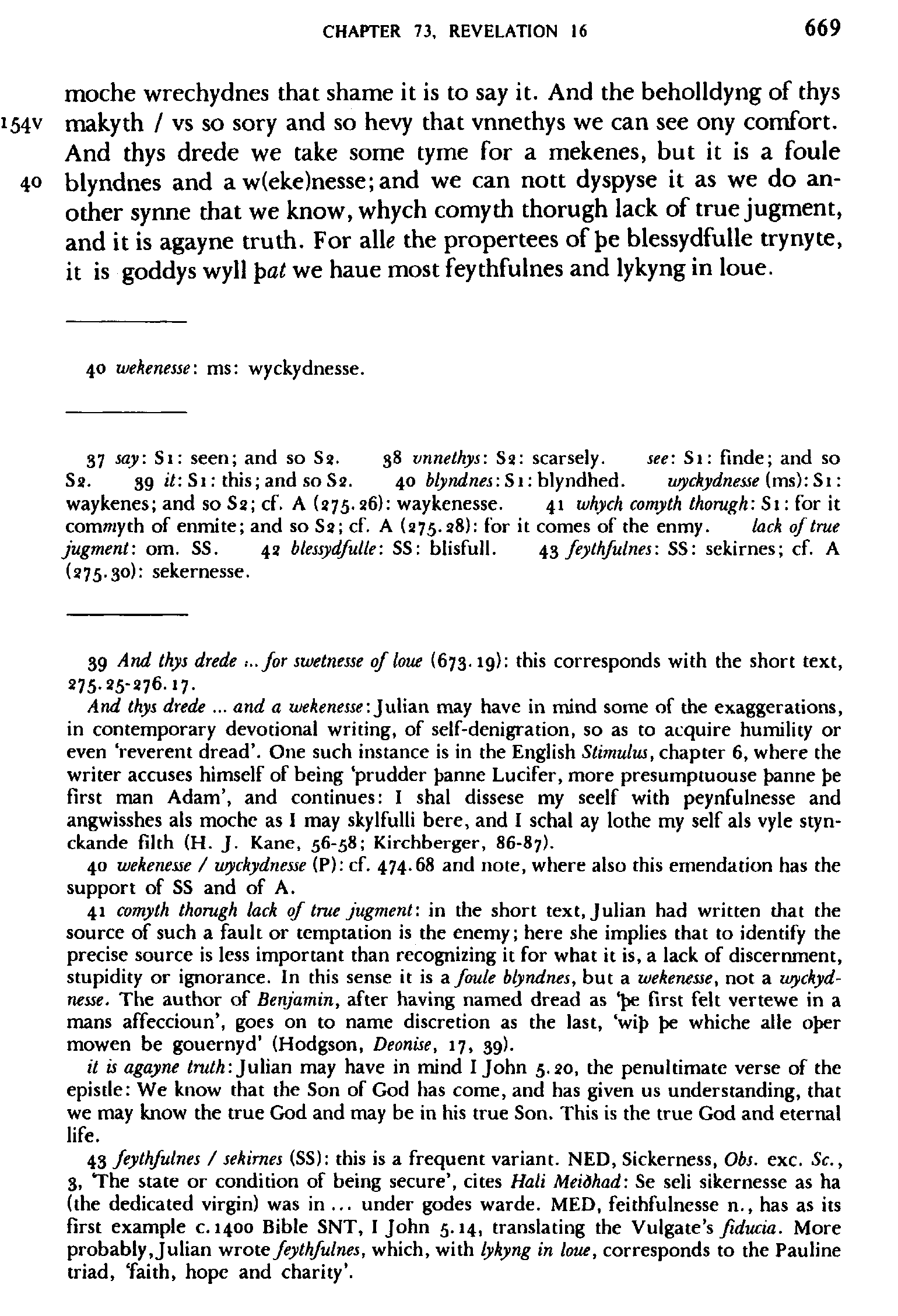
moche wrechydnes that shame it is to say it. And the beholldyng of thys ^54v makyth / vs so sory and so hevy that vnnethys we can see ony comfort.
And thys drede we take some tyme for a mekenes, but it is a foule 40 blyndnes and a w(eke)nesse;and we can nott dyspyse it as we do another synne that we know, whych cornyth thorugh lack of true jugment, and it is agayne truth. For all* the propertees of J>e blessydfulle trynyte, it is goddys wyll ]>at we haue most feythfulnes and lykyng in loue.
40 wekenesse: ms: wyckydnesse.
37 say. Si: seen; and so 82.
38 vnnethys: Sa: scarsely. see: Si: finde; and so 82.
39 it: Si: this; and so Sa.
40 blyndnes: Si: blyndhed. wyckydnesse (ms): Si: waykenes; and so 82; cf. A (275.26): waykenesse.
41 whych corny th thorugh: Si: for it comwyth of enmite; and so 82; cf. A (275.28): for it comes of the enmy. lack of true jugment: om. SS.
42 blessydfulle: SS: blisfull.
43 feythfulnes: SS: sekirnes; cf. A (275.30): sekernesse.
39 And thys drede .-../or swetnesse of loue (673.19): this corresponds with the short text,
275-25-276.17And thys drede ... and a wekenesse:Julian may have in mind some of the exaggerations, in contemporary devotional writing, of self-denigration, so as to acquire humility or even 'reverent dread'. One such instance is in the English Stimulus, chapter 6, where the writer accuses himself of being 'prudder Janne Lucifer, more presumptuouse Jjanne J>e first man Adam', and continues: I shal dissese my seelf with peynfulnesse and angwisshes als moche as I may skylfulli bere, and I schal ay lothe my self als vyle stynckande filth (H. J. Kane, 56-58; Kirchberger, 86-87).
40 wekenesse / wyckydnesse (P): cf. 474.68 and note, where also this emendation has the support of SS and of A.
41 comyth thorugh lack of true jugment: in the short text, Julian had written that the source of such a fault or temptation is the enemy; here she implies that to identify the precise source is less important than recognizing it for what it is, a lack of discernment, stupidity or ignorance. In this sense it is a foule blyndnes, but a wekenesse, not a wyckydnesse. The author of Benjamin, after having named dread as *f>e first felt vertewe in a mans affeccioun', goes on to name discretion as the last, 'wij) J>e whiche alle ot>er mowen be gouernyd' (Hodgson, Deonise, 17, 39). it is agayne truth: Julian may have in mind I John 5.20, the penultimate verse of the epistle: We know that the Son of God has come, and has given us understanding, that we may know the true God and may be in his true Son. This is the true God and eternal life.
43 feythfulnes / sekirnes (SS): this is a frequent variant. NED, Sickerness, Obs. exc. Sc.,
3, The state or condition of being secure', cites Mali Meidhad: Se seli sikernesse as ha
(the dedicated virgin) was in ... under godes warde. MED, feithfulnesse n., has as its first example c. 1400 Bible SNT, I John 5.14, translating the Vulgate's fiducia. More probably,Julian -wrote feythfulnes, which, with lykyng in loue, corresponds to the Pauline triad, 'faith, hope and charity'.
THE LONG TEXT
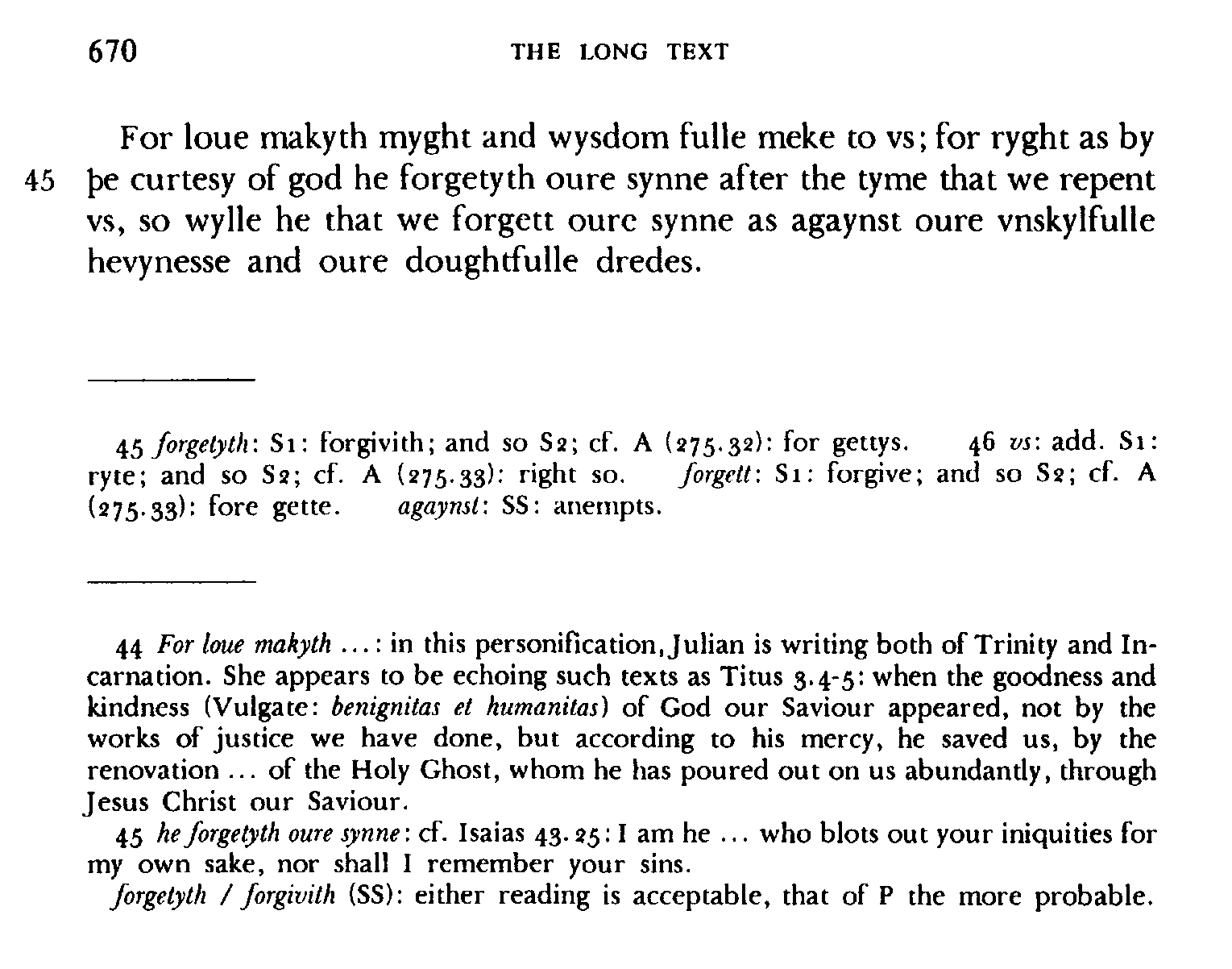
For loue makyth myght and wysdom fulle meke to vs; for ryght as by 45 pe curtesy of god he forgetyth cure synne after the tyme that we repent vs, so wylle he that we forgett oure synne as agaynst oure vnskylfulle hevynesse and oure doughtfulle dredes.
45 forgetyth: Si: forgivith; and so 82; cf. A (275.32): for gettys.
46 vs: add. Si: ryte; and so 82; cf. A (275.33): right so. forgett: Si: forgive; and so 82; cf. A (275.33): fore gette. agaynst: SS: anempts.
44 For loue makyth ...: in this personification, Julian is writing both of Trinity and Incarnation. She appears to be echoing such texts as Titus 3.4-5: when the goodness and kindness (Vulgate: benignitas et humanitas) of God our Saviour appeared, not by the works of justice we have done, but according to his mercy, he saved us, by the renovation ... of the Holy Ghost, whom he has poured out on us abundantly, through Jesus Christ our Saviour.
45 he forgetyth oure synne: cf. Isaias 43.25:1 am he ... who blots out your iniquities for my own sake, nor shall I remember your sins. forgetyth /forgivith (SS): either reading is acceptable, that of P the more probable.
CHAPTER 74, REVELATION 16
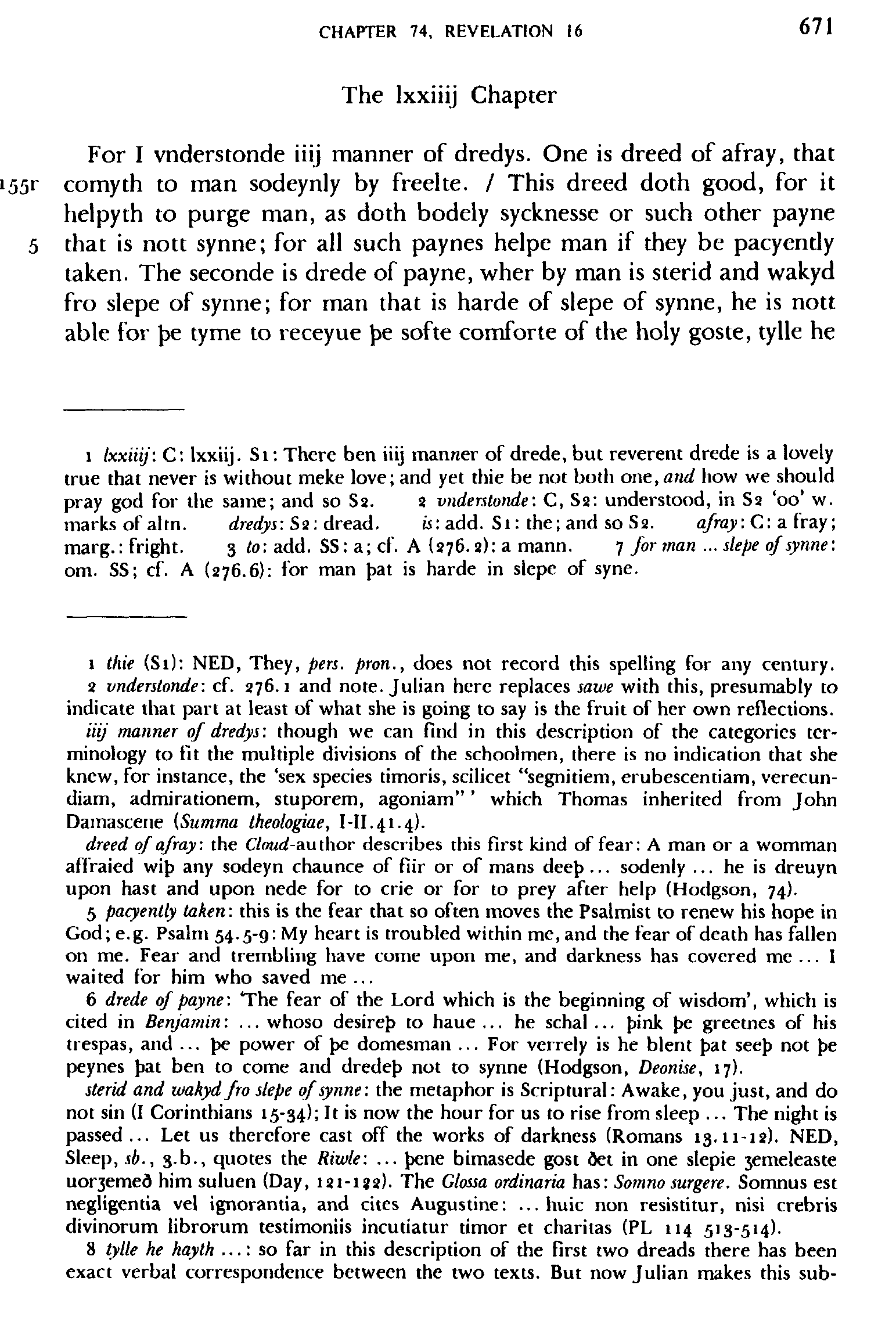
The Ixxiiij Chapter For I vnderstonde iiij manner of dredys. One is dreed of afray, that
comyth to man sodeynly by freelte. / This dreed doth good, for it helpyth to purge man, as doth bodely sycknesse or such other payne
5 that is nott synne; for all such paynes helpe man if they be pacyently taken. The seconde is drede of payne, wher by man is sterid and wakyd fro slepe of synne; for man that is harde of slepe of synne, he is nott able for pe tyme to receyue pe softe comforte of the holy goste, tylle he i Ixxiiij: C: Ixxiij. Si: There ben iiij manner of drede, but reverent drede is a lovely true that never is without meke love; and yet thie be not both one, and how we should pray god for the same; and so 82.
2 vnderstonde: C, 82: understood, in 82 'oo' w. marks of al tn. dredys: S 2: dread. is: add. 81: the; and so 8 2. afray: C: a fray; marg.: fright.
3 to: add. SS: a; cf. A (276.2): a mann.
7 for man ... slepe of synne: om. 88; cf. A (276.6): for man pat is harde in slepe of syne.
1 thie (Si): NED, They, pen. pron., does not record this spelling for any century.
2 vnderstonde: cf. 276.1 and note. Julian here replaces same with this, presumably to indicate that part at least of what she is going to say is the fruit of her own reflections. iiij manner of dredys: though we can find in this description of the categories terminology to fit the multiple divisions of the schoolmen, there is no indication that she knew, for instance, the 'sex species timoris, scilicet "segnitiem, erubescentiam, verecundiarn, admirationem, stuporem, agoniam"' which Thomas inherited from John
Damascene (Summa theologiae, 1-11.41.4). dreed of afray: the Cloud-author describes this first kind of fear: A man or a womman affraied wij> any sodeyn chaunce of fiir or of mans deejj... sodenly ... he is dreuyn upon hast and upon nede for to crie or for to prey after help (Hodgson, 74).
5 pacyently taken: this is the fear that so often moves the Psalmist to renew his hope in God; e.g. Psalm 54.5-9: My heart is troubled within me, and the fear of death has fallen on me. Fear and trembling have come upon me, and darkness has covered me ... I waited for him who saved me ...
6 drede of payne: The fear of the Lord which is the beginning of wisdom', which is cited in Benjamin: ... whoso desire£> to haue ... he schal ... pink pe greetnes of his trespas, and ... pe power of pe domesman ... For verrely is he blent pat seej) not pe peynes pat ben to come and drede}) not to synne (Hodgson, Deonise, 17). sterid and wakyd fro slepe of synne: the metaphor is Scriptural: Awake, you just, and do not sin (I Corinthians 15-34); I* 's n°w the hour for us to rise from sleep ... The night is passed ... Let us therefore cast off the works of darkness (Romans 13.11-12). NED,
Sleep, sb., s.b., quotes the Riwle: ... pene bimasede gost flet in one slepie jemeleaste uorjemed him suluen (Day, 121-122). The Glossa ordinaria has: Somno surgere. Somnus est negligentia vel ignorantia, and cites Augustine: ... huic non resistitur, nisi crebris divinorum librorum testimoniis incutiatur timor et charitas (PL 114 513-514).
8 tylle he hayth ...: so far in this description of the first two dreads there has been exact verbal correspondence between the two texts. But now Julian makes this sub-
THE LONG TEXT
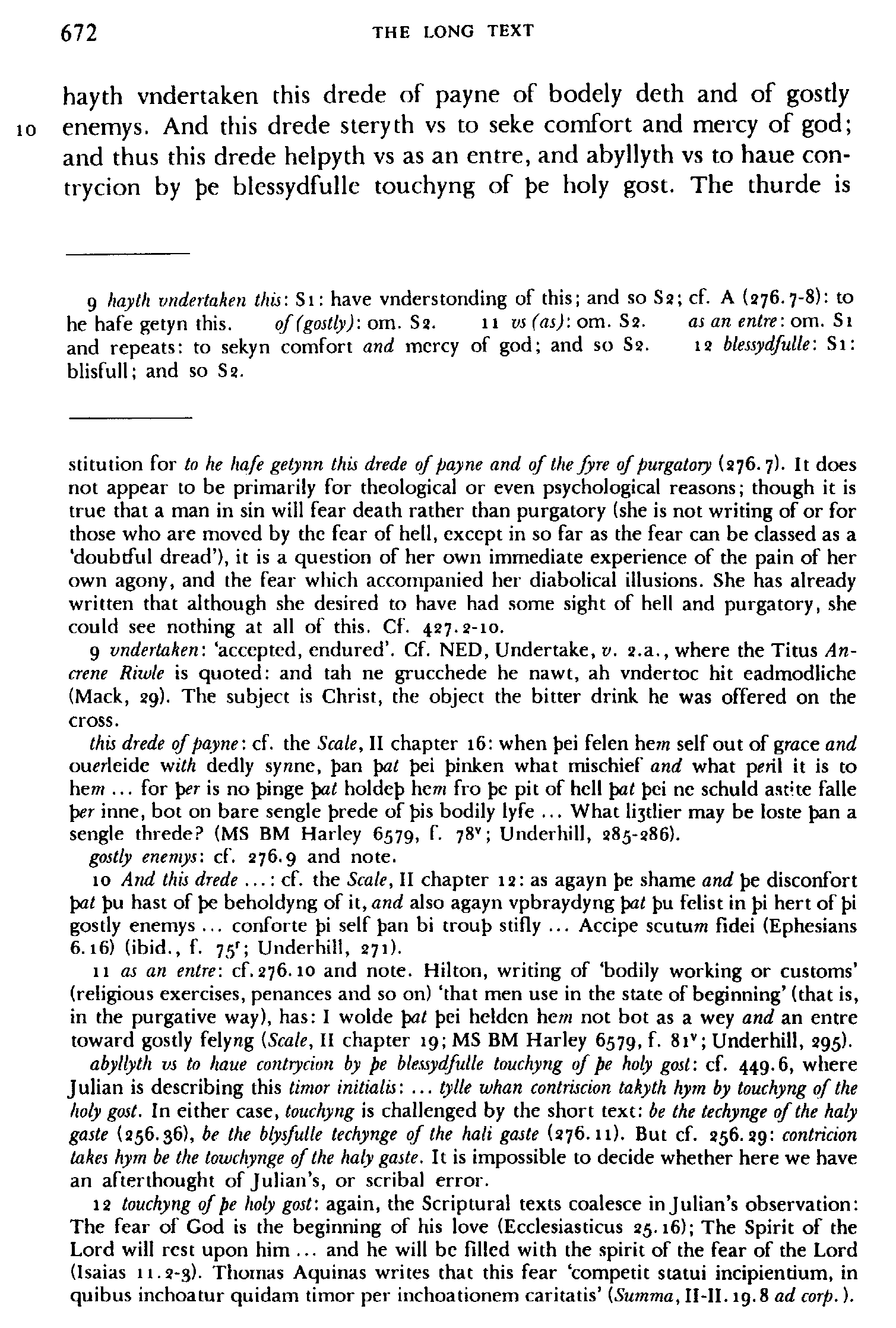
hayth vndertaken this drede of payne of bodely deth and of gostly 10 enemys. And this drede steryth vs to seke comfort and mercy of god; and thus this drede helpyth vs as an entre, and abyllyth vs to haue contrycion by £e blessydfulle touchyng of be holy gost. The thurde is
9 hayth vndertaken Urn: Si: have vnderstonding of this; and so 82; cf. A (276.7-8): to he hafe getyn this. of (gostly): om. 82.
11 vs (as): om. 82. as an entre: om. Si and repeats: to sekyn comfort and mercy of god; and so 82.
12 blessydfulle: Si: blisfull; and so 82. stitution for to he hafe getynn this drede of payne and ofthefyre of purgatory (276. 7). It does not appear to be primarily for theological or even psychological reasons; though it is true that a man in sin will fear death rather than purgatory (she is not writing of or for those who are moved by the fear of hell, except in so far as the fear can be classed as a 'doubtful dread'), it is a question of her own immediate experience of the pain of her own agony, and the fear which accompanied her diabolical illusions. She has already written that although she desired to have had some sight of hell and purgatory, she could see nothing at all of this. Cf. 427.2-10.
9 vndertaken: 'accepted, endured'. Cf. NED, Undertake, v. 2.a., where the Titus Ancrene Riwle is quoted: and tah ne grucchede he nawt, ah vndertoc hit eadmodliche
(Mack, 29). The subject is Christ, the object the bitter drink he was offered on the cross. this drede of payne: cf. the Scale, II chapter 16: when pei felen he/n self out of grace and ou^rleide with dedly syrcne, J>an pat pei f>inken what mischief and what peril it is to hem ... for per is no J>inge pat holdej) hem fro pc pit of hell pat pci ne schuld astite falle per inne, bot on bare sengle {jrede of pis bodily lyfe ... What Ii3tlier may be loste J>an a sengle threde? (MS BM Harley 6579, f. 78*; Underbill, 285-286). gostly enemys: cf. 276.9 and note.
10 And this drede ...: cf. the Scale, II chapter 12: as agayn pe shame and pe disconfort pat pu hast of pe beholdyng of it, and also agayn vpbraydyng pat pu felist in pi hert of pi gostly enemys ... conforte pi self pan bi troup stifly ... Accipe scutum fidei (Ephesians
6.16) (ibid., f. 75r; Underbill, 271).
11 as an entre: cf.276.10 and note. Hilton, writing of 'bodily working or customs'
(religious exercises, penances and so on) 'that men use in the state of beginning' (that is, in the purgative way), has: I wolde pat pci heldcn hem not bot as a wey and an entre toward gostly felyng (Scale, II chapter 19; MS BM Harley 6579, f. 8iv; Underbill, 295). abyllyth vs to haue contrycion by pe blessydfulle touchyng of pe holy gost: cf. 449.6, where
Julian is describing this timor initialis: ... tylle whan contriscion takyth hym by touchyng of the holy gost. In either case, touchyng is challenged by the short text: be the techynge of the haly gaste (256.36), be the blysfulle techynge of the halt gaste (276.11). But cf. 256.29: contridon takes hym be the towchynge of the haly gaste. It is impossible to decide whether here we have an afterthought of Julian's, or scribal error.
12 touchyng of pe holy gost: again, the Scriptural texts coalesce in Julian's observation:
The fear of God is the beginning of his love (Ecclesiasticus 25.16); The Spirit of the Lord will rest upon him ... and he will be filled with the spirit of the fear of the Lord
(Isaias 11.2-3). Thomas Aquinas writes that this fear 'competit statui incipientium, in quibus inchoatur quidam timor per inchoationem caritatis' (Summa, II-II. 19.8 ad corp.).
CHAPTER 74, REVELATION 16
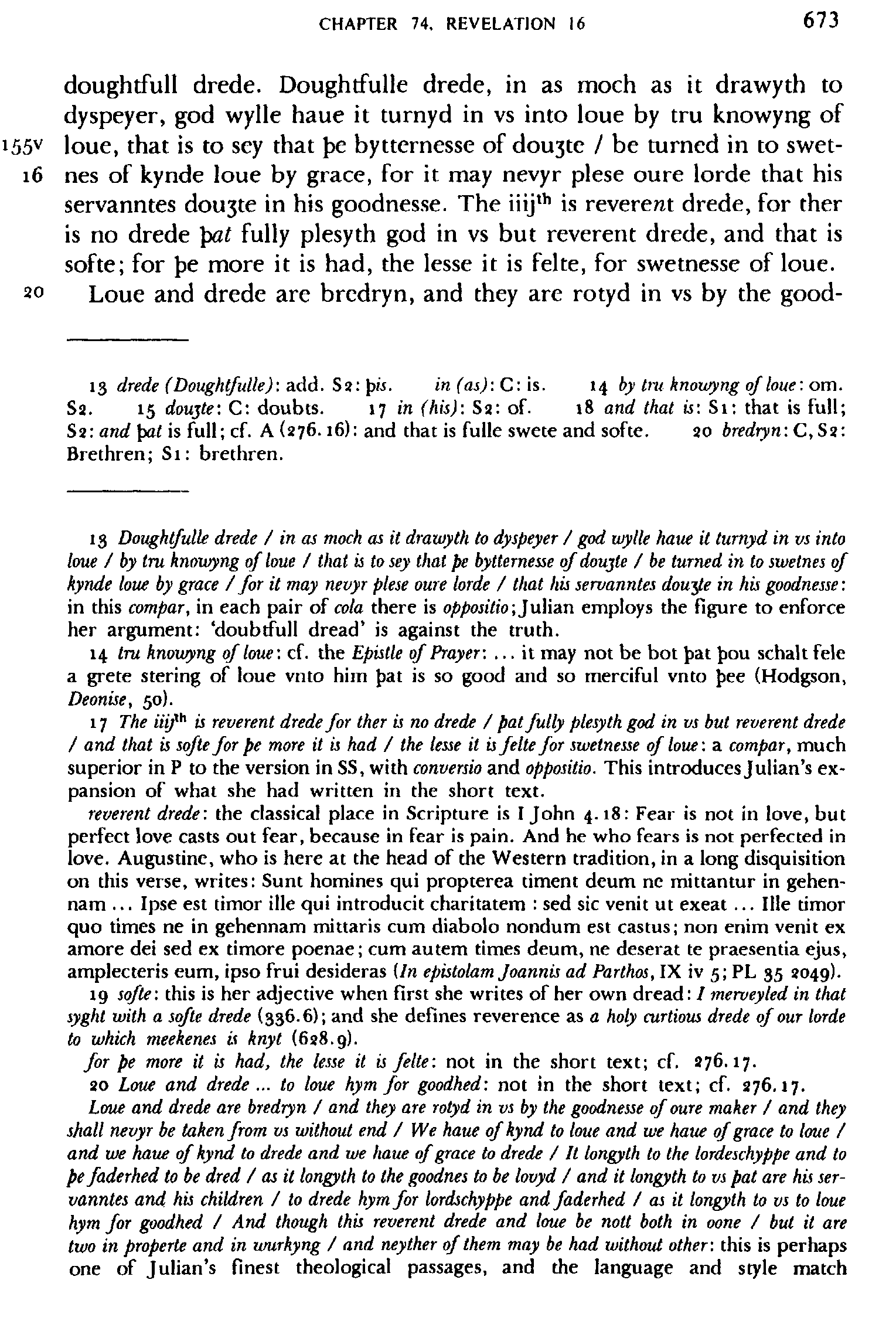
doughtfull drede. Doughtfulle drede, in as moch as it drawyth to dyspeyer, god wylle haue it turnyd in vs into loue by tru knowyng of i55v loue, that is to sey that J>e bytternesse of dougte / be turned in to swet16 nes of kynde loue by grace, for it may nevyr plese oure lorde that his servanntes dou3te in his goodnesse. The iiijth is reverent drede, for ther is no drede ]xit fully plesyth god in vs but reverent drede, and that is softe; for J)e more it is had, the lesse it is felte, for swetnesse of loue.
Loue and drede are bredryn, and they are rotyd in vs by the good13 drede (Doughtfulle): add. 82: \>is. in (as): C: is.
14 by tru knowyng of loue: om.
82.
15 doujte: C: doubts.
17 in (his): Sa: of.
18 and that is: Si: that is full; 82: and \>at is full; cf. A (276.16): and that is fulle swete and softe.
20 bredryn: C,S2:
Brethren; Si: brethren.
13 Doughtfulle drede / in as moch as it drawyth to dyspeyer / god wylle haue it turnyd in vs into loue / by tru knowyng of loue / that is to sey that pe bytternesse of double / be turned in to swetnes of kynde loue by grace /for it may nevyr plese oure lorde / that his servanntes double in his goodnesse: in this compar, in each pair of cola there is oppositio;Julian employs the figure to enforce her argument: 'doubtfull dread' is against the truth.
14 tru knowyng of loue: cf. the Epistle of Prayer: ... it may not be bot £at JDOU schalt fele a grete stering of loue vnto him Jjat is so good and so merciful vnto J>ee (Hodgson,
Deonise, 50).
17 The iiifh is reverent drede for ther is no drede / pat fully plesyth god in vs but reverent drede
/ and that is softe for pe more it is had / the lesse it is felte for swetnesse of loue: a compar, much superior in P to the version in SS, with conversio and oppositio. This introduces Julian's expansion of what she had written in the short text. reverent drede: the classical place in Scripture is I John 4.18: Fear is not in love, but perfect love casts out fear, because in fear is pain. And he who fears is not perfected in love. Augustine, who is here at the head of the Western tradition, in a long disquisition on this verse, writes: Sunt homines qui propterea timent deum ne mittantur in gehennam ... Ipse est timor ille qui introducit charitatem : sed sic venit ut exeat ... Ille timor quo times ne in gehennam mittaris cum diabolo nondum est castus; non enim venit ex amore dei sed ex timore poenae; cum autem times deum, ne deserat te praesentia ejus, amplecteris eum, ipso frui desideras (In epistolam Joannis ad Parthos, IX iv 5; PL 35 2049).
19 softe: this is her adjective when first she writes of her own dread: / merveyled in that syght with a softe drede (336.6); and she defines reverence as a holy curtious drede of our lorde to which meekenes is knyt (628.9). for pe more it is had, the lesse it is felte: not in the short text; cf. 276.17.
20 Loue and drede ... to loue hym for goodhed: not in the short text; cf. 276.17.
Loue and drede are bredryn / and they are rotyd in vs by the goodnesse of oure maker / and they shall nevyr be taken from vs without end / We haue ofkynd to loue and we haue of grace to loue / and we haue of kynd to drede and we haue of grace to drede / It longyth to the lordeschyppe and to pefaderhed to be dred / as it longyth to the goodnes to be lovyd / and it longyth to vs pat are his servanntes and his children / to drede hym for lordschyppe andfaderhed / as it longyth to vs to loue hym for goodhed / And though this reverent drede and loue be nott both in oone / but it are two in properte and in wurkyng / and neyther of them may be had without other: this is perhaps one of Julian's finest theological passages, and the language and style match
THE LONG TEXT
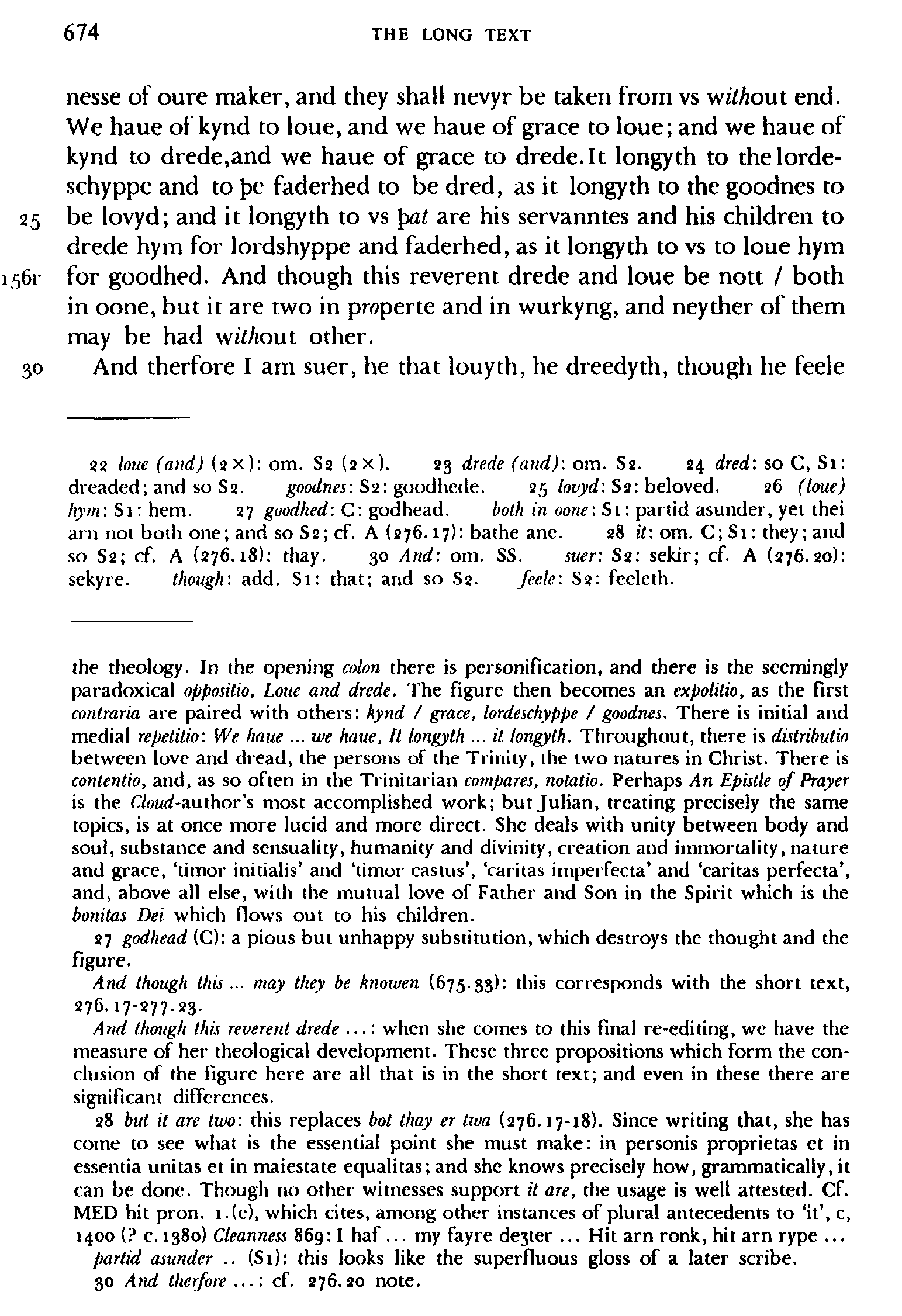
nesse of oure maker, and they shall nevyr be taken from vs without end.
We haue of kynd to loue, and we haue of grace to loue; and we haue of kynd to drede,and we haue of grace to drede.lt longyth to thelordeschyppe and to pe faderhed to be dred, as it longyth to the goodnes to 25 be lovyd; and it longyth to vs \>at are his servanntes and his children to drede hym for lordshyppe and faderhed, as it longyth to vs to loue hym
1.561 for goodhed. And though this reverent drede and loue be nott / both in oone, but it are two in properte and in wurkyng, and neyther of them may be had without other.
And therfore I am suer, he that louyth, he dreedyth, though he feele 82 loue (and) ( a x ) : om. 82 ( a x ) .
23 drede (and): om. 82.
24 dred: so C, Si: dreaded; and so 82. goodnes: 82: goodhede.
25 lovyd: 82: beloved.
26 (loue) hym: Si: hem.
27 goodhed: C: godhead. both in oone: Si: partid asunder, yet thei am not both one; and so 82; cf. A (276.17): bathe anc.
28 it: om. C; Si: they; and so 82; cf. A (276.18): thay.
30 And: om. SS. suer: 82: sekir; cf. A (276.20): sckyre. though: add. Si: that; and so 82. feele: 82: feeleth. the theology. In the opening colon there is personification, and there is the seemingly paradoxical oppositio, Loue and drede. The figure then becomes an expolitio, as the first contraria are paired with others: kynd / grace, lordeschyppe / goodnes. There is initial and medial repetitio: We haue ...we haue, It longyth ... it longyth. Throughout, there is dutributio between love and dread, the persons of the Trinity, the two natures in Christ. There is contentio^ and, as so often in the Trinitarian compares, notatio. Perhaps An Epistle of Prayer is the Cloud-author's most accomplished work; but Julian, treating precisely the same topics, is at once more lucid and more direct. She deals with unity between body and soul, substance and sensuality, humanity and divinity, creation and immortality, nature and grace, 'timor initialis' and 'timor castus', 'caritas imperfecta' and 'caritas perfecta', and, above all else, with the mutual love of Father and Son in the Spirit which is the bonitas Dei which flows out to his children.
27 godhead (C): a pious but unhappy substitution, which destroys the thought and the figure.
And though this ... may they be knowen (675.33): this corresponds with the short text,
276.17-277.23.
And though this reverent drede ...: when she comes to this final re-editing, we have the measure of her theological development. These three propositions which form the conclusion of the figure here are all that is in the short text; and even in these there are significant differences.
28 but it are two: this replaces hot thay er twa (276.17-18). Since writing that, she has come to see what is the essential point she must make: in personis proprietas et in essentia unitas et in maiestate equalitas; and she knows precisely how, grammatically, it can be done. Though no other witnesses support it are, the usage is well attested. Cf.
MED hit pron. i.(e), which cites, among other instances of plural antecedents to 'it', c,
1400 (? c. 1380) Cleanness 869:1 haf ... my fayre dejter ... Hit arn ronk, hit arn rype ... partid asunder .. (Si): this looks like the superfluous gloss of a later scribe.
30 And therfore ...: cf. 276.20 note.
CHAPTER 74, REVELATION 16
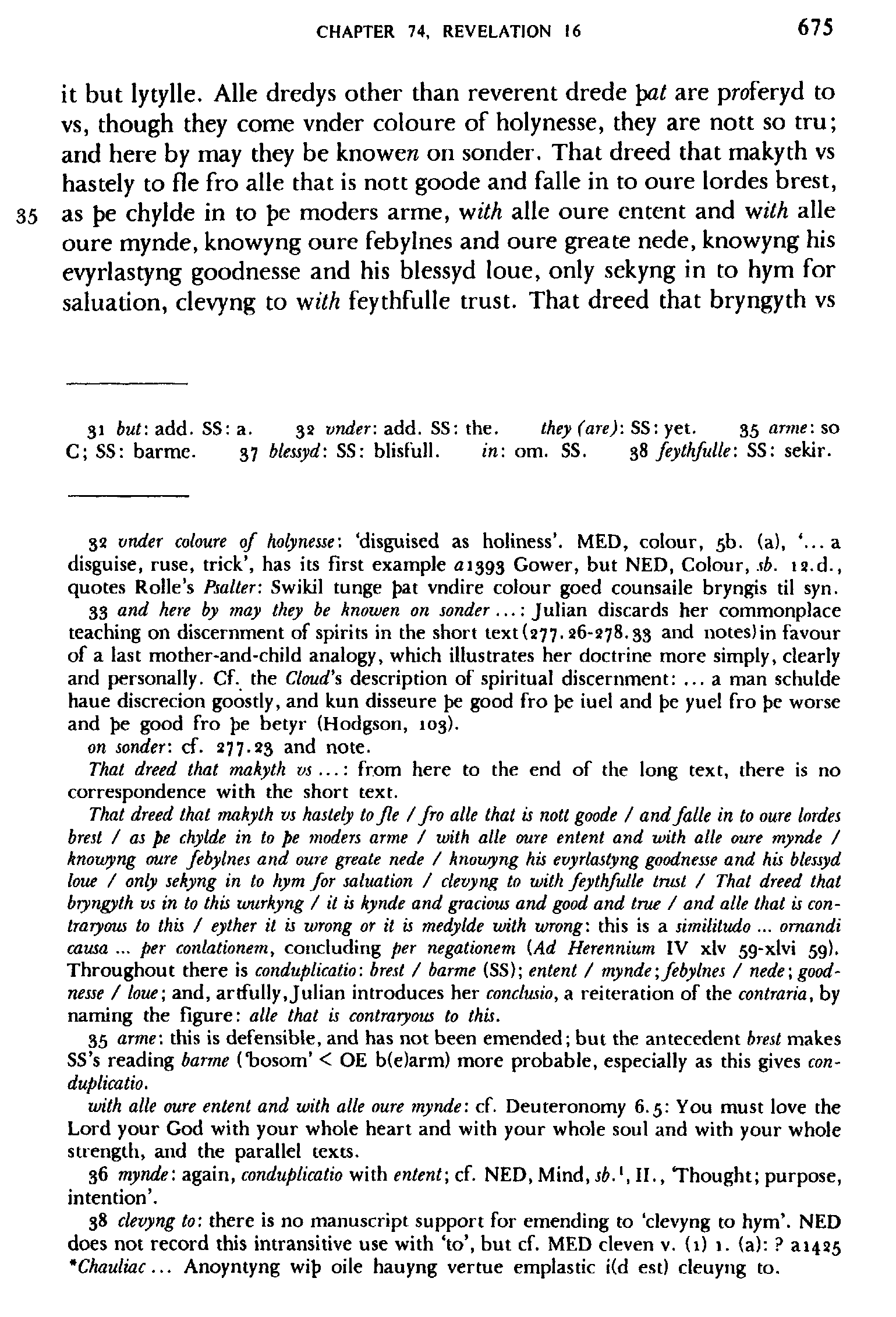
it but lytylle. Alle dredys other than reverent drede $at are proferyd to vs, though they come vnder coloure of holynesse, they are nott so tru; and here by may they be knowen on sender. That dreed that makyth vs hastely to fie fro alle that is nott goode and falle in to oure lordes brest,
35 as J>e chylde in to be moders arme, with alle oure en tent and with alle oure mynde, knowyng oure febylnes and oure greate nede, knowyng his evyrlastyng goodnesse and his blessyd loue, only sekyng in to hym for saluation, clevyng to with feythfulle trust. That dreed that bryngyth vs
31 but: add. SS: a.
35? vnder: add. SS: the. they (are): SS: yet.
35 arme: so C; SS: barme.
37 blessyd: SS: blisfull. in: om. SS.
38 feythfulle: SS: sekir.
32 vnder coloure of holynesse: 'disguised as holiness'. MED, colour, 5b. (a), "... a disguise, ruse, trick', has its first example 01393 Gower, but NED, Colour, sb. i2.d., quotes Rolle's Psalter: Swikil tunge }>at vndire colour goed counsaile bryngis til syn.
33 and here by may they be knowen on sonder ...: Julian discards her commonplace teaching on discernment of spirits in the short text (277.26-278.33 and notes)in favour of a last mother-and-child analogy, which illustrates her doctrine more simply, clearly and personally. Cf. the Cloud's description of spiritual discernment: ... a man schulde haue discrecion goostly, and kun disseure £>e good fro £>e iuel and J>e yuel fro f>e worse and £>e good fro f>e betyr (Hodgson, 103). on sonder: cf. 277.23 and note.
That dreed that makyth vs...: from here to the end of the long text, there is no correspondence with the short text.
That dreed that makyth vs hastely to fie /fro alle that is nott goode / and falle in to oure lordes brest / as pe chylde in to pe moders arme / with alle oure entent and with alle oure mynde / knowyng oure febylnes and oure greate nede / knowyng his evyrlastyng goodnesse and his blessyd loue / only sekyng in to hym for saluation / clevyng to with feythfulle trust / That dreed that bryngyth vs in to this wurkyng / it is kynde and gracious and good and true / and alle that is contraryous to this / eyther it is wrong or it is medylde with wrong: this is a similitudo ... ornandi causa ... per conlationem, concluding per negationem (Ad Herennium IV xlv 5g-xlvi 59).
Throughout there is conduplicatio: brest / barme (SS); entent / mynde;febylnes / nede\ goodnesse / loue; and, artfully,Julian introduces her conclusio, a reiteration of the contraria, by naming the figure: alle that is contraryous to this.
35 arme: this is defensible, and has not been emended; but the antecedent brest makes
SS's reading barme ("bosom" < OE b(e)arm) more probable, especially as this gives conduplicatio. with alle oure entent and with alle oure mynde: cf. Deuteronomy 6.5: You must love the Lord your God with your whole heart and with your whole soul and with your whole strength, and the parallel texts.
36 mynde: again, conduplicatio with entent; cf. NED, Mind, sb.l,ll., Thought; purpose, intention'.
38 clevyng to: there is no manuscript support for emending to 'clevyng to hym'. NED does not record this intransitive use with 'to', but cf. MED eleven v. (i) i. (a): ? 31425
*Chauliac... Anoyntyng wij) oile hauyng vertue emplastic i(d est) cleuyng to.
THE LONG TEXT
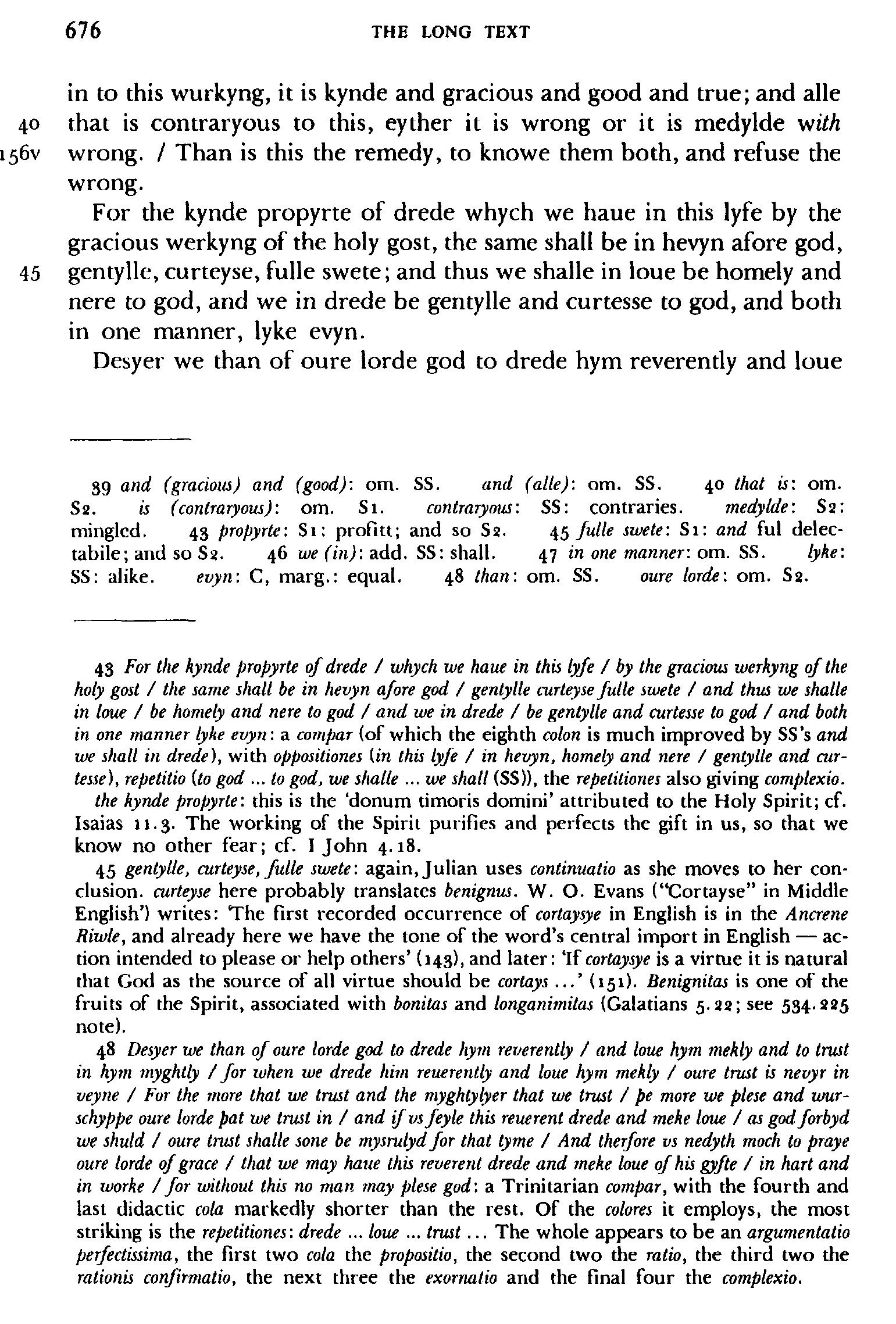
in to this wurkyng, it is kynde and gracious and good and true; and alle
that is contraryous to this, eyther it is wrong or it is medylde -with i56v wrong. / Than is this the remedy, to knowe them both, and refuse the wrong.
For the kynde propyrte of drede whych we haue in this lyfe by the gracious werkyng of the holy gost, the same shall be in hevyn afore god,
gentylle, curteyse, fulle swete; and thus we shalle in loue be homely and nere to god, and we in drede be gentylle and curtesse to god, and both in one manner, lyke evyn.
Desyer we than of oure lorde god to drede hym reverently and loue 39 and (gracious) and (good): om. SS. and (alle): om. SS.
40 that is: om.
82. is (contraryous): om.
Si. contraryous:
SS: contraries. medylde:
82: mingled.
43 propyrte: Si: profit*; and so 82.
45 fulle swete: Si: and ful delectabile; and so 82.
46 we (in): add. SS: shall.
47 in one manner: om. SS. lyke:
SS: alike. evyn: C, marg.: equal.
48 than: om. SS. oure lorde: om. 82.
43 For the kynde propyrte of drede / whych we haue in this lyfe I by the gracious werkyng of the holy gost / the same shall be in hevyn afore god / gentylle curteyse fulle swete / and thus we shalle in loue / be homely and nere to god / and we in drede / be gentylle and curtesse to god / and both in one manner lyke evyn: a cornpar (of which the eighth colon is much improved by SS's and we shall in drede), with oppositiones (in this lyfe / in hevyn, homely and nere / gentylle and curtesse), repetitio (to god ... to god, we shalle ... we shall (88)), the repetitiones also giving complexio. the kynde propyrte: this is the 'donum timoris domini' attributed to the Holy Spirit; cf.
Isaias 11.3. The working of the Spirit purifies and perfects the gift in us, so that we know no other fear; cf. I John 4.18.
45 gentylle, curteyse, fulle swete: again, Julian uses continuatio as she moves to her conclusion, curteyse here probably translates benignus. W. O. Evans ("Cortayse" in Middle
English') writes: The first recorded occurrence of cortaysye in English is in the Ancrene
Riwle, and already here we have the tone of the word's central import in English — action intended to please or help others' (143), and later: 'If cortaysye is a virtue it is natural that God as the source of all virtue should be cortays ..." (151). Benignitas is one of the fruits of the Spirit, associated with bonitas and longanimitas (Galatians 5.22; see 534.225 note).
48 Desyer we than of oure lorde god to drede hym reverently / and loue hym mekly and to trust in hym myghtly / f o r when we drede him reuerently and loue hym mekly / oure trust is nevyr in veyne / For the more that we trust and the myghtylyer that we trust / pe more we plese and wurschyppe oure lorde pat we trust in / and ifvsfeyle this reuerent drede and meke loue / as godforbyd we shuld / oure trust shalle sone be mysrulydfor that tyme I And therfore vs nedyth moch to praye oure lorde of grace / that we may haue this reverent drede and meke loue of his gyfte / in hart and in worke / f o r without this no man may plese god: a Trinitarian compar, with the fourth and last didactic cola markedly shorter than the rest. Of the colores it employs, the most striking is the repetitiones: drede ... loue ... trust... The whole appears to be an argumentatio perfectissima, the first two cola the propositio, the second two die ratio, the third two the rationis confirmatio, the next three the exornatio and the final four the complexio.
CHAPTER 74, REVELATION 16
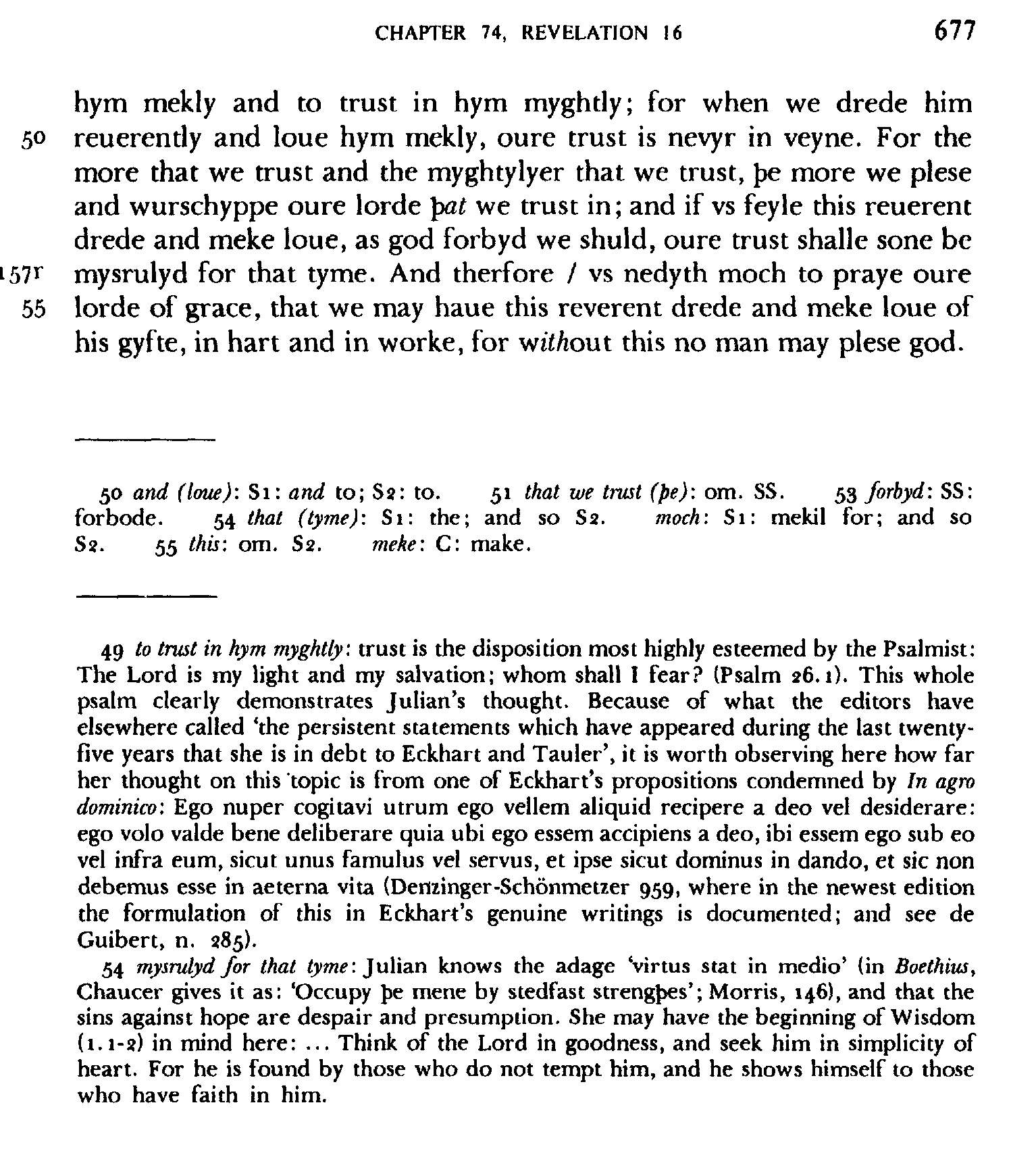
hym mekly and to trust in hym myghtly; for when we drede him 50 reuerently and loue hym mekly, oure trust is nevyr in veyne. For the more that we trust and the myghtylyer that we trust, {>e more we plese and wurschyppe oure lorde \>at we trust in; and if vs feyle this reuerent drede and meke loue, as god forbyd we shuld, oure trust shalle sone be
57r mysrulyd for that tyme. And therfore / vs nedyth moch to praye oure 55 lorde of grace, that we may haue this reverent drede and meke loue of his gyfte, in hart and in worke, for without this no man may plese god.
50 and (loue): Si: and to; 82: to.
51 that we trust (pe): om. SS.
53 forbyd: SS: forbode.
54 that (tyme): Si: the; and so 82. moch: Si: mekil for; and so 82.
55 this: om. 82. meke: C: make.
49 to trust in hym myghtly: trust is the disposition most highly esteemed by the Psalmist:
The Lord is my light and my salvation; whom shall I fear? (Psalm 26.1). This whole psalm clearly demonstrates Julian's thought. Because of what the editors have elsewhere called 'the persistent statements which have appeared during the last twentyfive years that she is in debt to Eckhart and Tauler', it is worth observing here how far her thought on this 'topic is from one of Eckhart's propositions condemned by In agro dominico: Ego nuper cogitavi utrum ego vellem aliquid recipere a deo vel desiderare: ego volo valde bene deliberare quia ubi ego essem accipiens a deo, ibi essem ego sub eo vel infra eum, sicut unus famulus vel servus, et ipse sicut dominus in dando, et sic non debemus esse in aeterna vita (Denzinger-Schonmetzer 959, where in the newest edition the formulation of this in Eckhart's genuine writings is documented; and see de
Guibert, n. 285).
54 mysrulyd for that tyme: Julian knows the adage Virtus stat in medio' (in Boethius,
Chaucer gives it as: 'Occupy J>e mene by stedfast strengjjes'; Morris, 146), and that the sins against hope are despair and presumption. She may have the beginning of Wisdom
(1.1-2) in mind here: ... Think of the Lord in goodness, and seek him in simplicity of heart. For he is found by those who do not tempt him, and he shows himself to those who have faith in him.
THE LONG TEXT
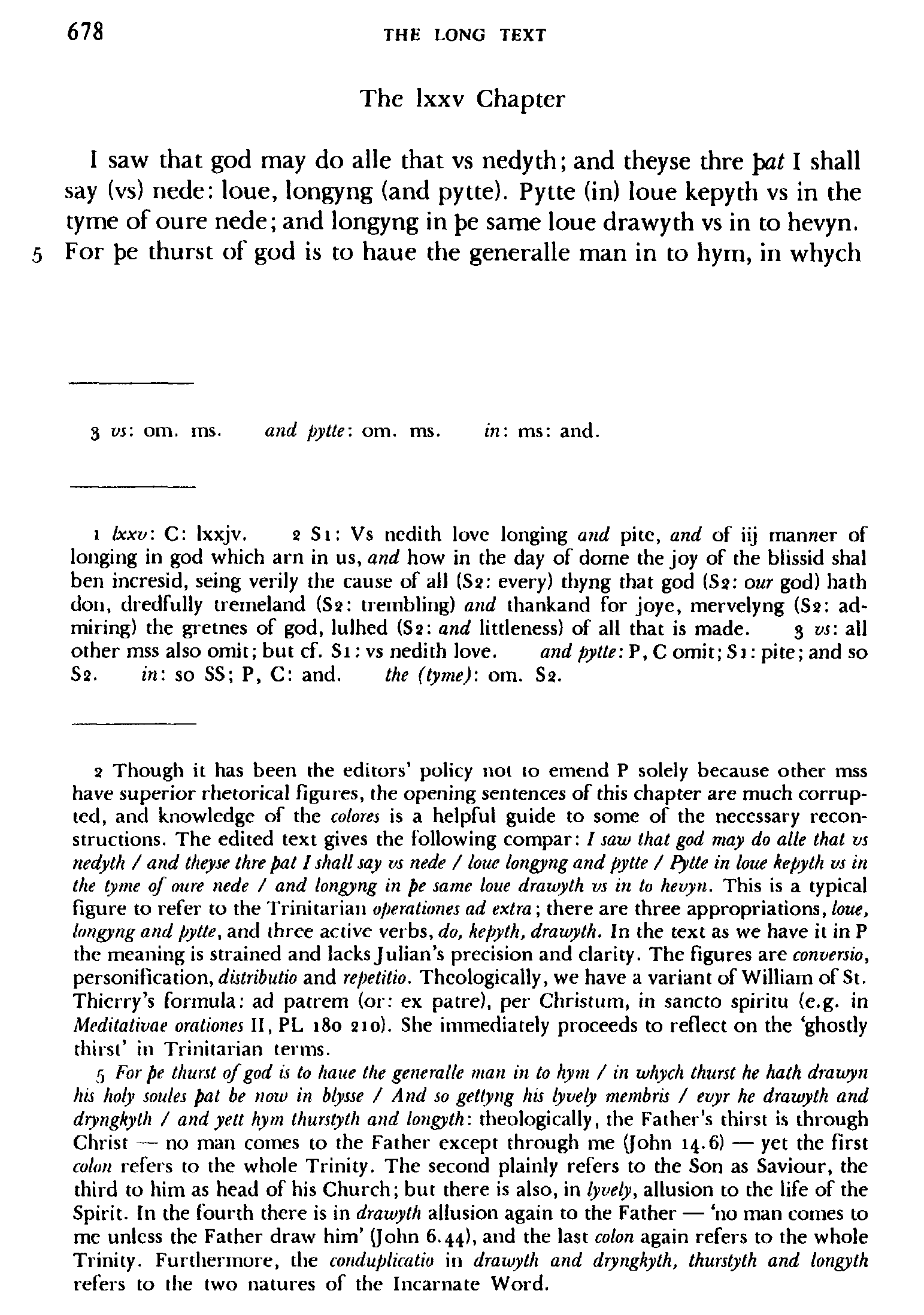
The Ixxv Chapter I saw that god may do alle that vs nedyth; and theyse thre \Mt I shall say (vs) nede: loue, longyng (and pytte). Pytte (in) loue kepyth vs in the tyme of oure nede; and longyng in £e same loue drawyth vs in to hevyn.
5 For ]De thurst of god is to haue the generalle man in to hym, in whych 3 vs: om. ms. and pytte: om. rns. in: ms: and. i Ixxv: C: Ixxjv.
2 Si: Vs nedith love longing and pitc, and of iij manner of longing in god which arn in us, and how in the day of dome the joy of the blissid shal ben incresid, seing verily the cause of all (82: every) thyng that god (82: our god) hath don, dredfully tremeland (82: trembling) and lhankand for joye, mervelyng (82: admiring) the gretnes of god, lulhed (82: and littleness) of all that is made.
3 vs: all other mss also omit; but cf. Si: vs nedith love. and pytte: P, C omit; Si: pile; and so 82. in: so 88; P, C: and. the (tyme): om. 82.
2 Though it has been the editors' policy not 10 emend P solely because other mss have superior rhetorical figures, the opening sentences of this chapter are much corrupted, and knowledge of the colores is a helpful guide to some of the necessary reconstructions. The edited text gives the following compar: / saw that god may do alle that vs nedyth / and theyse thre pat I shall say vs nede / loue longyng and pytte / Pytte in loue kepyth vs in the tyme of oure nede / and longyng in pe same loue drawyth vs in to hevyn. This is a typical figure to refer to the Trinitarian operationes ad extra; there are three appropriations, loue, longyng and pytte, and three active verbs, do, kepyth, drawyth. In the text as we have it in P the meaning is strained and lacks Julian's precision and clarity. The figures are conversio, personification, distributio and repetitio. Theologically, we have a variant of William of St.
Thierry's formula: ad patrem (or: ex patre), per Christum, in sancto spiritu (e.g. in Meditativae orationes II, PL 180 210). She immediately proceeds to reflect on the 'ghostly thirst' in Trinitarian terms. f. For pe thurst of god is to haue the generalle man in to hym / in whych thurst he hath drawyn his holy soules pat be now in blysse / And so gettyng his lyvely membra / evyr he drawyth and dryngkyth / andyett hym thurstyth and longyth: theologically, the Father's thirst is through Christ — no man comes to the Father except through me (John 14.6) — yet the first colon refers to the whole Trinity. The second plainly refers to the Son as Saviour, the third to him as head of his Church; but there is also, in lyvely, allusion to the life of the Spirit. In the fourth there is in drawyth allusion again to the Father — 'no man comes to me unless the Father draw him' (John 6.44), and the last colon again refers to the whole
Trinity. Furthermore, the conduplicatio in drawyth and dryngkyth, thurstyth and longyth refers to the two natures of the Incarnate Word.
CHAPTER 75, REVELATION 16
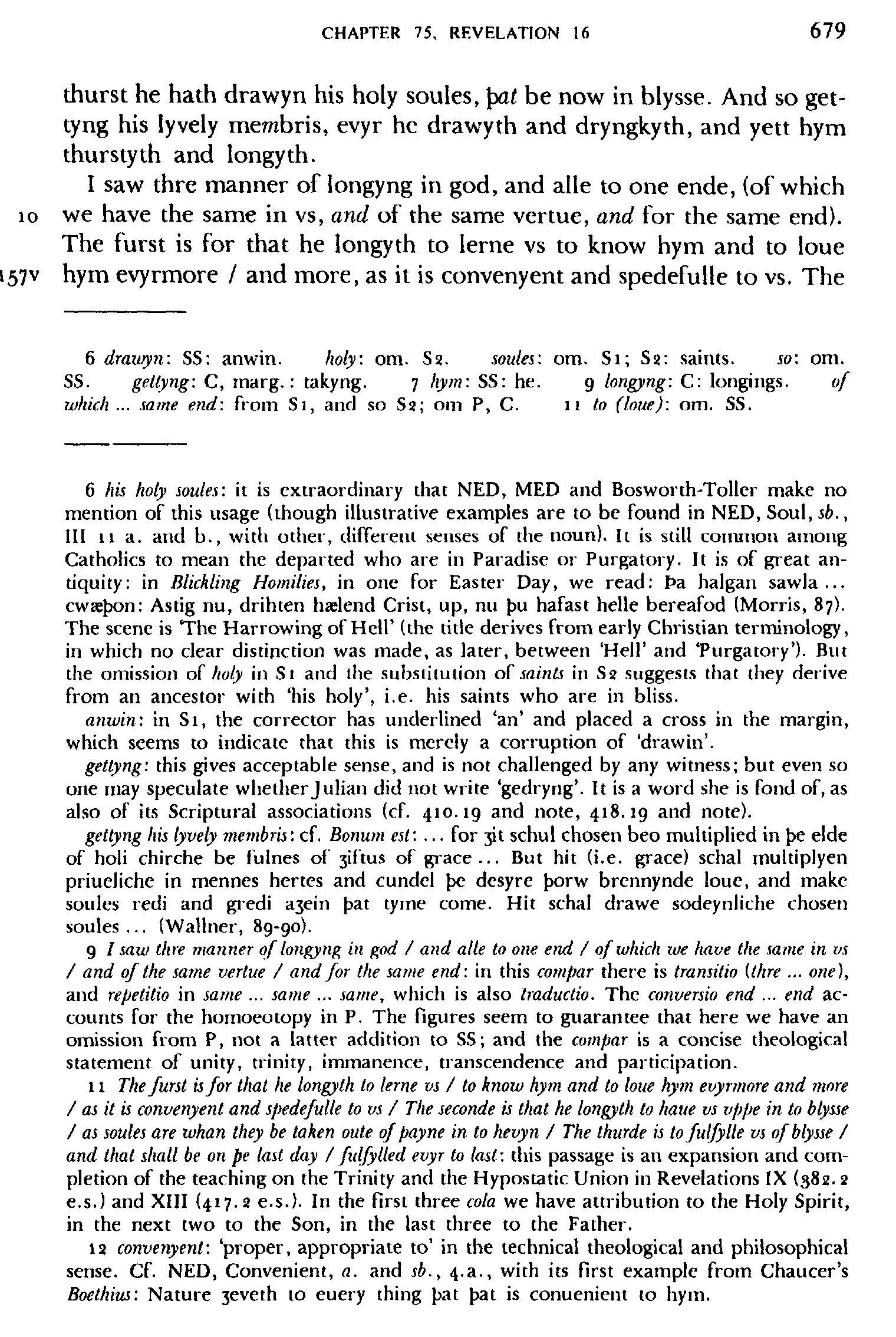
thurst he hath drawyn his holy soules, \>at be now in blysse. And so gettyng his lyvely membris, evyr he drawyth and dryngkyth, and yett hym thurstyth and longyth.
I saw thre manner of longyng in god, and alle to one ende, (of which 10 we have the same in vs, and of the same vertue, and for the same end).
The furst is for that he longyth to lerne vs to know hym and to loue i57v hym evyrmore / and more, as it is convenyent and spedefulle to vs. The & drawyn: SS: anwin. holy: om. 82. soules: om. Si; Sa: saints. so: om.
SS. geltyng: C, rnarg.: takyng.
7 hym: SS: he.
9 longyng: C: longings. of which ... same end: from Si, and so Sa; om P, C.
11 to (loue): om. SS.
6 his holy soules: it is extraordinary that NED, MED and Bosworth-Toller make no mention of this usage (though illustrative examples are to be found in NED, Soul, sb.,
Ill 11 a. and b., with other, different senses of the noun). It is still common among Catholics to mean the departed who are in Paradise or Purgatory. It is of great antiquity: in Blickling Homilies, in one for Easter Day, we read: Pa halgan sawla... cwajpon: Astig nu, drihten haslend Crist, up, nu f>u hafast helle bereafod (Morris, 87).
The scene is The Harrowing of Hell' (the title derives from early Christian terminology, in which no clear distinction was made, as later, between 'Hell' and 'Purgatory'). But the omission of holy in Si and the substitution of saints in 82 suggests that they derive from an ancestor with 'his holy', i.e. his saints who are in bliss. anwin: in Si, the corrector has underlined 'an' and placed a cross in the margin, which seems to indicate that this is merely a corruption of 'drawin'. gettyng: this gives acceptable sense, and is not challenged by any witness; but even so one may speculate whether Julian did not write 'gedryng'. It is a word she is fond of, as also of its Scriptural associations (cf. 410.19 and note, 418.19 and note). gettyng his lyvely membris: cf. Bonum est: ... for jit schul chosen beo multiplied in {?e elde of holi chirche be fulnes of jiftus of grace... But hit (i.e. grace) schal multiplyen priueliche in mennes hertes and cundel jae desyre Jjorw brennynde loue, and make soules redi and gredi ajein J>at tyme come. Hit schal drawe sodeynliche chosen soules... (Wallner, 89-90).
9 / saw thre manner of longyng in god / and alle to one end / of which we have the same in vs
/ and of the same vertue / and for the same end: in this compar there is transitio (thre ... one), and repetitio in same ... same ... same, which is also traductio. The conversio end ... end accounts for the homoeotopy in P. The figures seem to guarantee that here we have an omission from P, not a latter addition to SS; and the compar is a concise theological statement of unity, trinity, immanence, transcendence and participation.
11 The furst is for that he longyth to lerne vs / to know hym and to loue hym evyrmore and more
/ as it is convenyent and spedefulle to vs / The seconde is that he longyth to haue vs vppe in to blysse
/ as soules are whan they be taken oute of payne in to hevyn / The thurde is tofulfylle vs of blysse / and that shall be on pe last day / fulfylled evyr to last: this passage is an expansion and completion of the teaching on the Trinity and the Hypostatic Union in Revelations IX (382.2 e.s.) and XIII (417.2 e.s.). In the first three cola we have attribution to the Holy Spirit, in the next two to the Son, in the last three to the Father.
12 convenyent: 'proper, appropriate to' in the technical theological and philosophical sense. Cf. NED, Convenient, a. and 5^., 4.a., with its first example from Chaucer's
Boethius: Nature jeveth to euery thing pat Jjat is conuenient to hym.
THE LONG TEXT
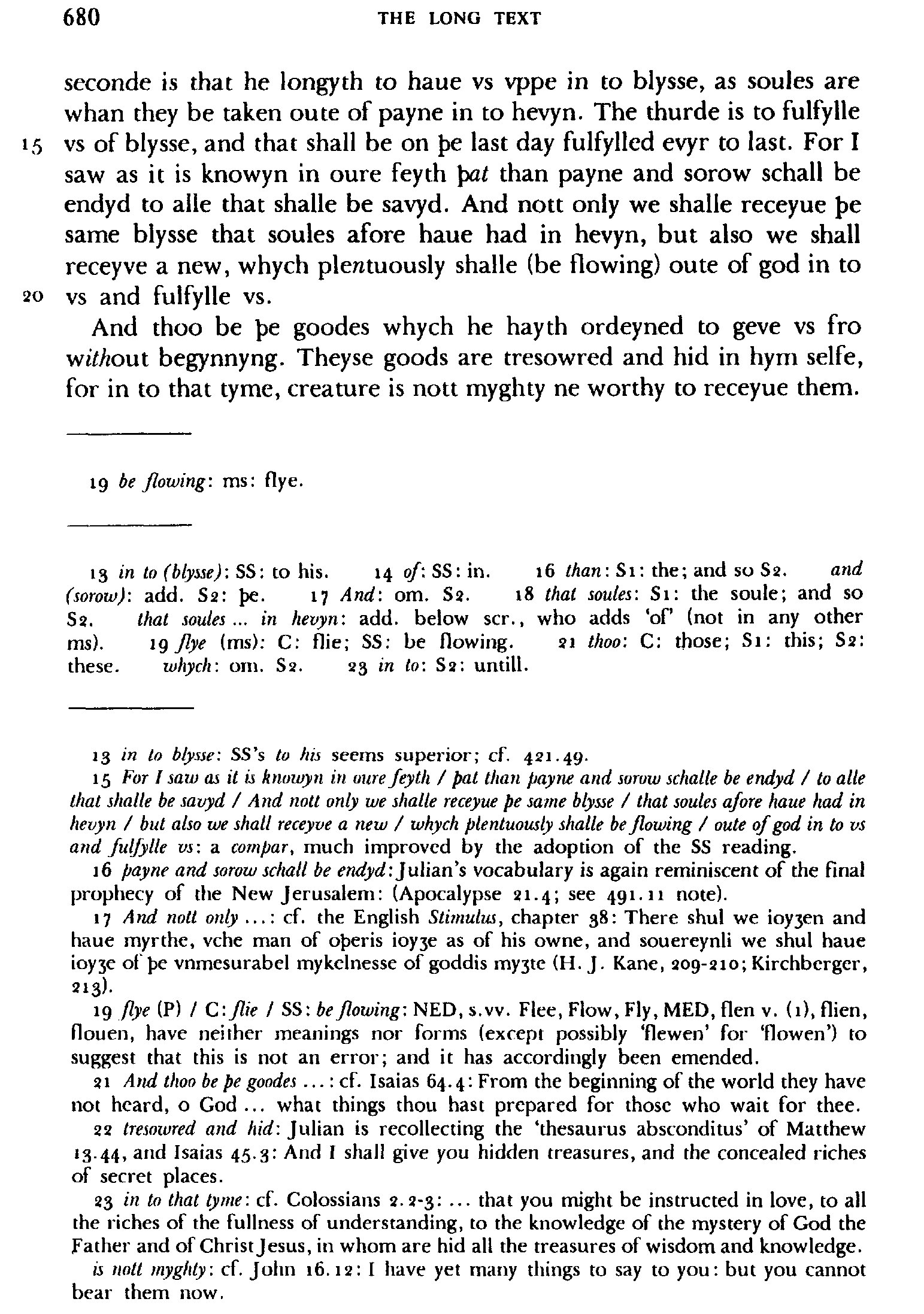
seconde is that he longyth to haue vs vppe in to blysse, as soules are whan they be taken oute of payne in to hevyn. The thurde is to fulfylle
15 vs of blysse, and that shall be on J>e last day fulfylled evyr to last. For I saw as it is knowyn in oure feyth \>at than payne and sorow schall be endyd to alle that shalle be savyd. And nott only we shalle receyue J>e same blysse that soules afore haue had in hevyn, but also we shall receyve a new, whych plentuously shalle (be flowing) oute of god in to 20 vs and fulfylle vs.
And thoo be }>e goodes whych he hayth ordeyned to geve vs fro without begynnyng. Theyse goods are tresowred and hid in hyrn selfe, for in to that tyme, creature is nott myghty ne worthy to receyue them.
19 be flowing: ms: flye.
13 in to (blysse): SS: to his.
14 of: SS: in.
16 than: Si: the; and so 82. and (sorow): add. 82: Jje.
17 And: om. 82.
18 that soules: Si: the soule; and so 82. that soules... in hevyn: add. below scr., who adds 'of (not in any other ms).
19 flye (ms): C: flie; SS: be flowing.
21 thoo: C: those; Si: this; 82: these. whych: om. 82.
23 in to: 82: untill.
13 in to blysse: SS's to his seems superior; cf. 421.49.
15 For I saw as it is knowyn in oure feyth / pat than payne and sorow schalle be endyd / to alle that shalle be savyd I And nott only we shalle receyue pe same blysse / that soules afore haue had in hevyn / but also we shall receyve a new / whych plentuously shalle be flowing / oute of god in to vs and fulfylle vs: a compar, much improved by the adoption of the SS reading.
16 payne and sorow schall be endyd: Julian's vocabulary is again reminiscent of the final prophecy of the New Jerusalem: (Apocalypse 21.4; see 491.11 note).
17 And nott only ...: cf. the English Stimulus, chapter 38: There shul we ioy3en and haue myrthe, vche man of operis ioy3e as of his owne, and souereynli we shul haue ioy3e of pe vnmesurabel mykelnesse of goddis myste (H. J. Kane, 209-210; Kirchbcrger,
213)- 19 flye (P) / C:flie / 88: be flowing: NED, s.vv. Flee, Flow, Fly, MED, flen v. (i), flien, flouen, have neither meanings nor forms (except possibly 'flewen' for 'flowen') to suggest that this is not an error; and it has accordingly been emended.
21 And thoo be pe goodes ...: cf. Isaias 64.4: From the beginning of the world they have not heard, o God ... what things thou hast prepared for those who wait for thee.
22 tresowred and hid: Julian is recollecting the 'thesaurus absconditus' of Matthew
13.44, ar>d Isaias 45.3: And I shall give you hidden treasures, and the concealed riches of secret places.
23 in to that tyme: cf. Colossians 2. 2-3: ... that you might be instructed in love, to all the riches of the fullness of understanding, to the knowledge of the mystery of God the Father and of Christ Jesus, in whom are hid all the treasures of wisdom and knowledge. is nott myghty: cf. John 16.12: I have yet many things to say to you: but you cannot bear them now.
CHAPTER 75, REVELATION 16
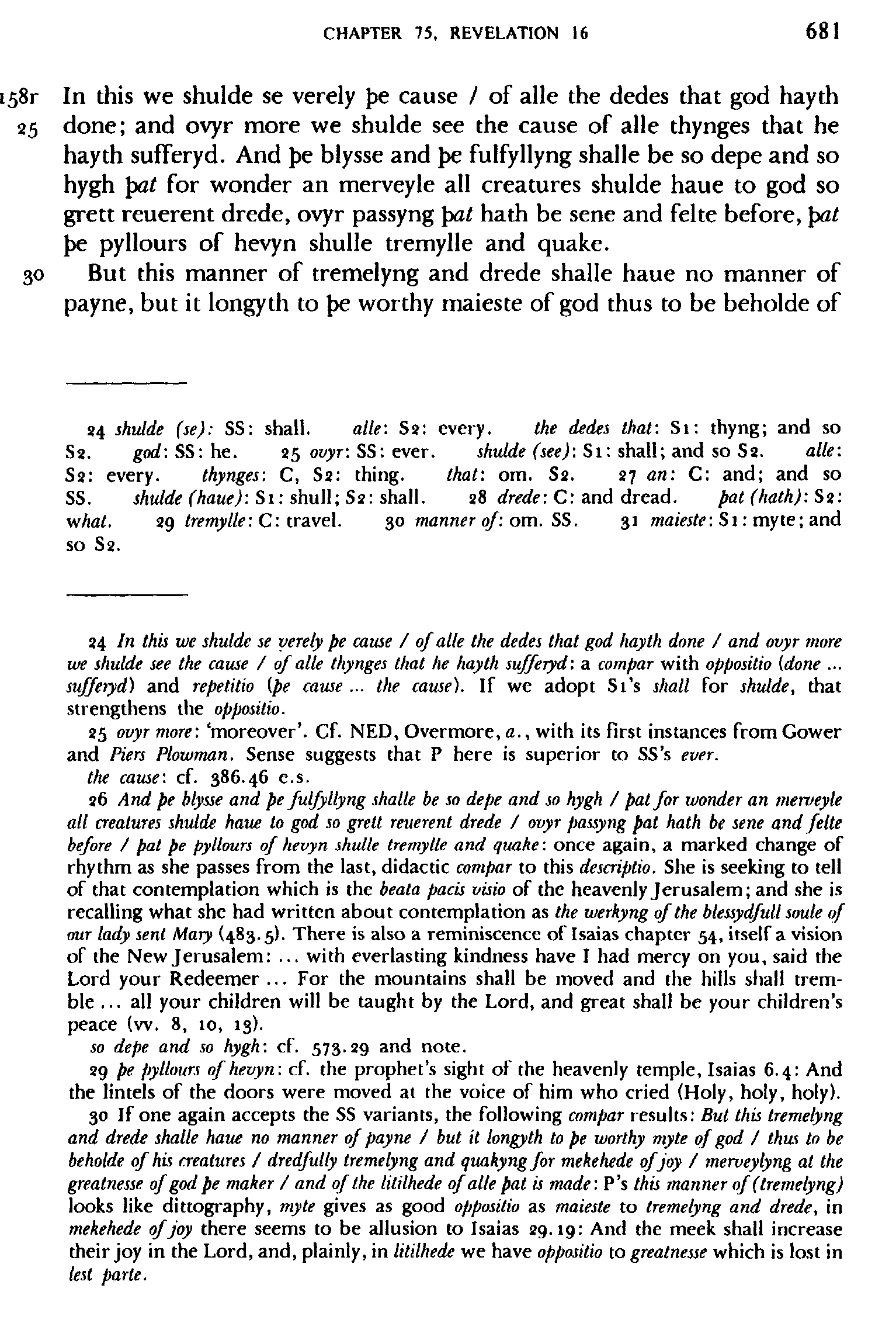
i58r In this we shulde se verely £>e cause / of alle the dedes that god hayth 25 done; and ovyr more we shulde see the cause of alle thynges that he hayth sufferyd. And J>e blysse and J>e fulfyllyng shalle be so depe and so hygh Ipat for wonder an merveyle all creatures shulde haue to god so grett reuerent drede, ovyr passyng \>at hath be sene and felte before, \>at J>e pyllours of hevyn shulle tremylle and quake.
But this manner of tremelyng and drede shalle haue no manner of payne, but it longyth to J>e worthy maieste of god thus to be beholde of 24 shulde (se): SS: shall. alle: Sa: every. the dedes that: Si: thyng; and so Ss. god: SS: he.
25 ovyr: SS: ever. shulde (see): Si: shall; and so Sa. alle:
82: every. thynges: C, Sa: thing. that: om. Sa.
27 an: C: and; and so SS. shulde (haue): Si: shull; Sa: shall.
28 drede: C: and dread. pat (hath): 82: what.
29 tremylle: C: travel.
30 manner of: om. SS.
31 maieste: Si: myte; and so Sa.
24 In this we shulde se verely pe cause / of alle the dedes that god hayth done / and ovyr more we shulde see the cause / of alle thynges that he hayth sufferyd: a compar with oppositio (done ... sufferyd) and repetitio (pe cause ... the cause). If we adopt Si's shall for shulde, that strengthens the oppositio.
25 ovyr more: 'moreover'. Cf. NED, Overmore, a., with its first instances from Gower and Piers Plowman. Sense suggests that P here is superior to SS's ever. the cause: cf. 386.46 e.s.
26 And pe blysse and pe fulfyllyng shalle be so depe and so hygh / pat for wonder an merveyle all creatures shulde haue to god so grett reuerent drede / ovyr passyng pat hath be sene and felte before / pat pe pyllours of hevyn shulle tremylle and quake: once again, a marked change of rhythm as she passes from the last, didactic compar to this descriptio. She is seeking to tell of that contemplation which is the beata pacis visio of the heavenly Jerusalem; and she is recalling what she had written about contemplation as the werkyng of the blessydfull soule of our lady sent Mary (483.5). There is also a reminiscence of Isaias chapter 54, itself a vision of the New Jerusalem: ... with everlasting kindness have I had mercy on you, said the Lord your Redeemer ... For the mountains shall be moved and the hills shall tremble ... all your children will be taught by the Lord, and great shall be your children's peace (w. 8, 10, 13). jo depe and so hygh: cf. 573.29 and note.
29 pe pyllours of hevyn: cf. the prophet's sight of the heavenly temple, Isaias 6.4: And the lintels of the doors were moved at the voice of him who cried (Holy, holy, holy).
30 If one again accepts the SS variants, the following compar results: But this tremelyng and drede shalle haue no manner of payne / but it longyth to pe worthy myte of god / thus to be beholde of his creatures / dredfully tremelyng and quakyngfor mekehede of joy / merveylyng at the greatnesse of god pe maker / and of the litilhede of alle pat is made: P's this manner of (tremelyng) looks like dittography, myte gives as good oppositio as maieste to tremelyng and drede, in mekehede of joy there seems to be allusion to Isaias 29.19: And the meek shall increase their joy in the Lord, and, plainly, in litilhede we have oppositio to greatnesse which is lost in lest parte.
THE LONG TEXT
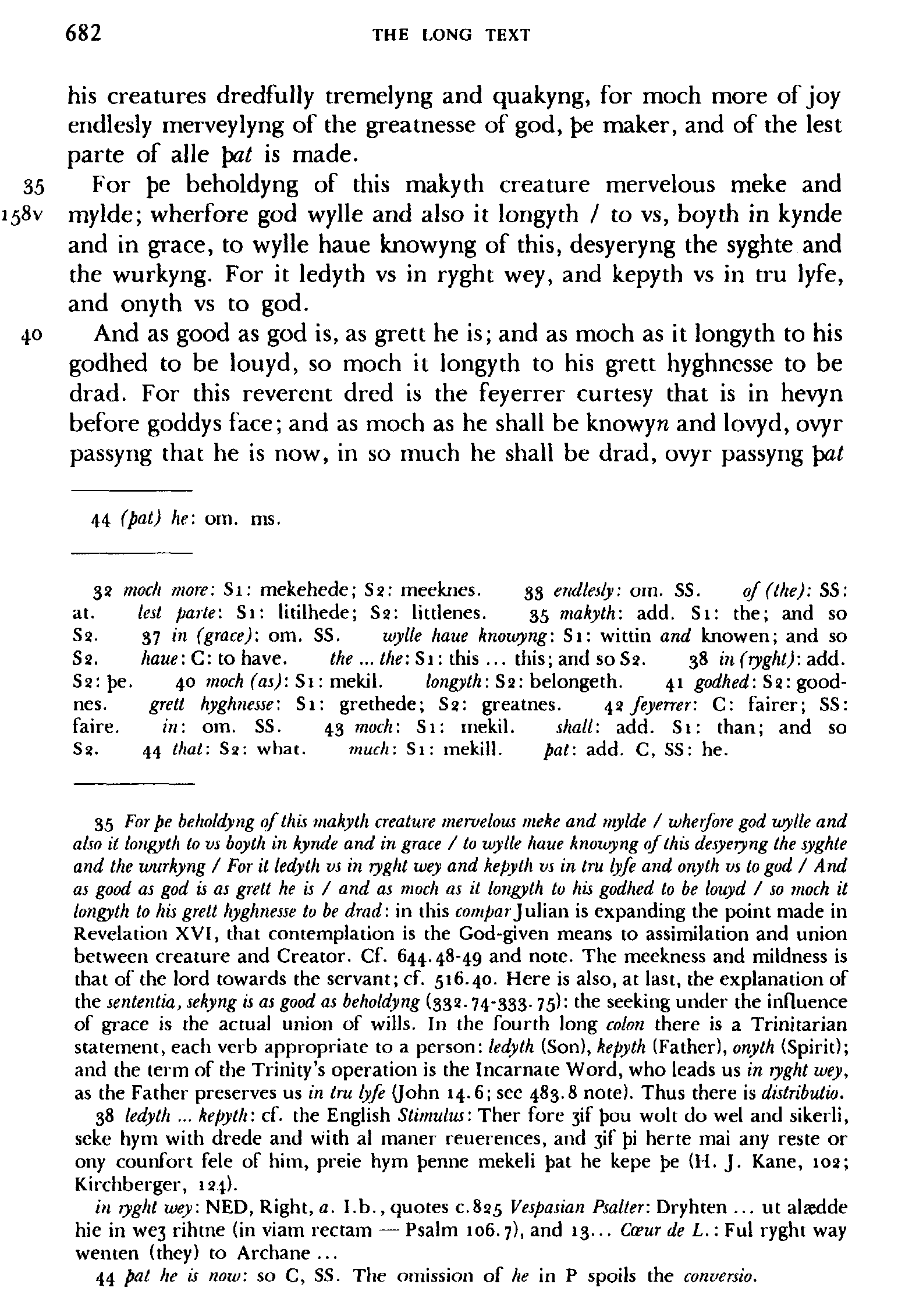
his creatures dredfully tremelyng and quakyng, for moch more of joy endlesly merveylyng of the greatnesse of god, be maker, and of the lest parte of alle Jxz£ is made.
For pe beholdyng of this makyth creature mervelous meke and i58v mylde; wherfore god wylle and also it longyth / to vs, boyth in kynde and in grace, to wylle haue knowyng of this, desyeryng the syghte and the wurkyng. For it ledyth vs in ryght wey, and kepyth vs in tru lyfe, and onyth vs to god.
And as good as god is, as grett he is; and as moch as it longyth to his godhed to be louyd, so moch it longyth to his grett hyghnesse to be drad. For this reverent dred is the feyerrer curtesy that is in hevyn before goddys face; and as moch as he shall be knowyn and lovyd, ovyr passyng that he is now, in so much he shall be drad, ovyr passyng \xit
44 (pat) he: om. ms.
32 moch more: Si: mekehede; 82: meeknes.
33 endlesly: om. SS. of (the): SS: at. lest parte: Si: lidlhede; 82: littlenes.
35 makyth: add. Si: the; and so 82.
37 in (grace): om. SS. wylle haue knowyng: Si: wittin and knowen; and so 82. haue: C: to have. the ... the: Si: this ... this; and so 82.
38 in (ryght): add.
82: pe.
40 moch (as): Si: mekil. longyth: 82: belongeth.
41 godhed: 82: goodnes. grett hyghnesse: Si: grethede; 82: greatnes.
42 feyerrer: C: fairer; SS: faire. in: om. SS.
43 moch: Si: mekil. shall: add. Si: than; and so 82.
44 that: Sa: what. much: Si: mekill. pat: add. C, SS: he.
35 For pe beholdyng of this makyth creature mervelous meke and mylde / wherfore god wylle and also it longyth to vs boyth in kynde and in grace / to wylle haue knowyng of this desyeryng the syghte and the wurkyng / For it ledyth vs in ryght wey and kepyth vs in tru lyfe and onyth vs to god /And as good as god is as grett he is / and as moch as it longyth to his godhed to be louyd / so moch it longyth to his grett hyghnesse to be drad: in this comparJulian is expanding the point made in Revelation XVI, that contemplation is the God-given means to assimilation and union between creature and Creator. Cf. 644.48-49 and note. The meekness and mildness is that of the lord towards the servant; cf. 516.40. Here is also, at last, the explanation of the sententia, sekyng is as good as beholdyng (332.74-333. 75): the seeking under the influence of grace is the actual union of wills. In the fourth long colon there is a Trinitarian statement, each verb appropriate to a person: ledyth (Son), kepyth (Father), onyth (Spirit); and the term of the Trinity's operation is the Incarnate Word, who leads us in ryght wey, as the Father preserves us in tru lyfe (John 14.6; see 483.8 note). Thus there is distributio.
38 ledyth ... kepyth: cf. the English Stimulus: Ther fore 3if pou wolt do wel and sikerli, seke hym with drede and with al maner reuerences, and jif pi herte mai any reste or ony counfort fele of him, preie hym penne mekeli pat he kepe pe (H. J. Kane, 102;
Kirchberger, 124). in ryght wey: NED, Right, a. I.b., quotes c.825 Vespasian Psalter: Dryhten ... ut alsedde hie in we3 rihtne (in viam rectam — Psalm 106.7), and 13... Cceur de L.: Ful ryght way wen ten (they) to Archane...
44 pat he is now: so C, 88. The omission of he in P spoils the conversio.
CHAPTER 75, REVELATION 16
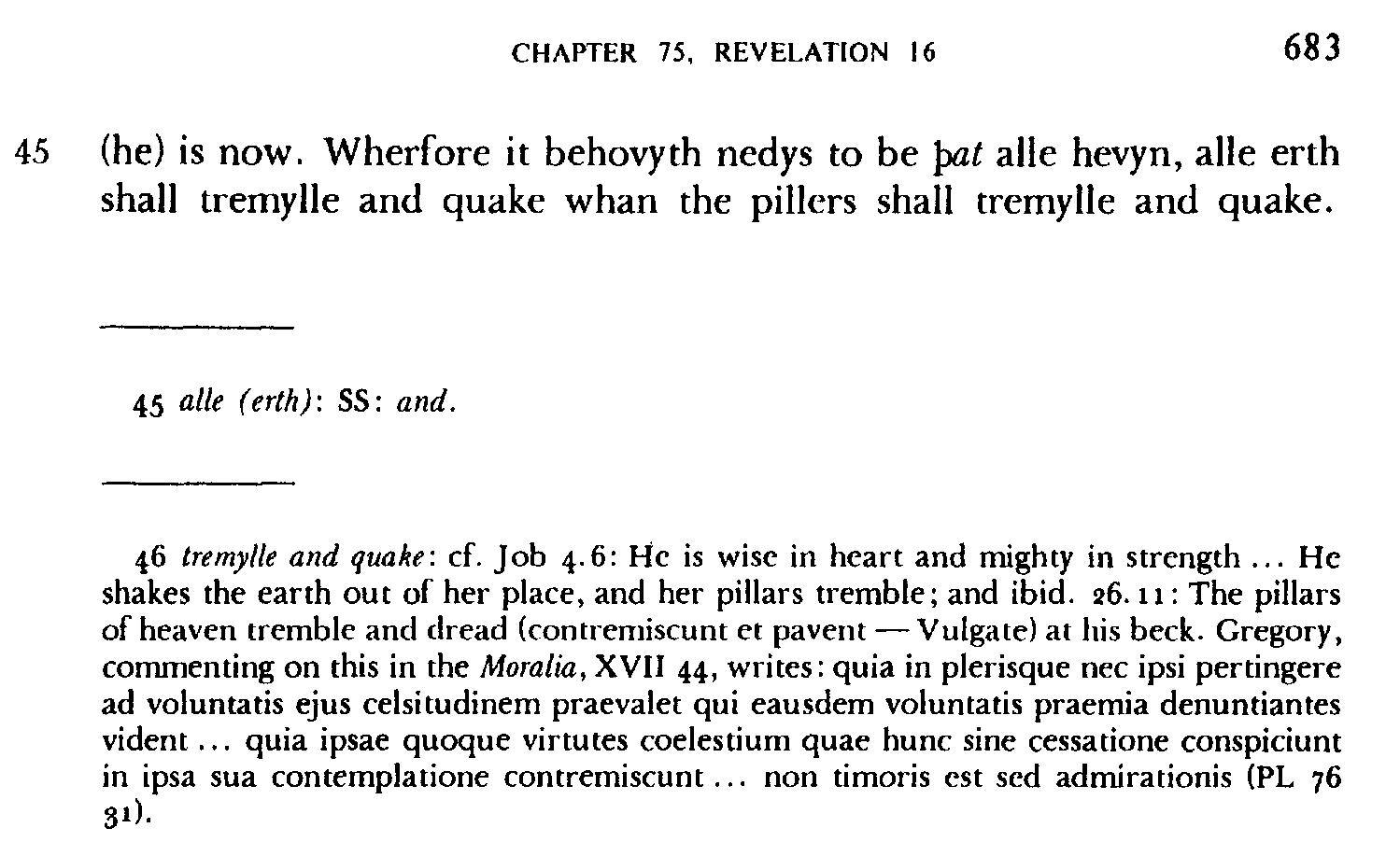
(he) is now. Wherfore it behovyth nedys to be ^at alle hevyn, alle erth shall tremylle and quake whan the pillers shall tremylle and quake.
45 alle (erth): SS: and.
46 tremylle and quake: cf. Job 4.6: He is wise in heart and mighty in strength ... He shakes the earth out of her place, and her pillars tremble; and ibid. 26.11: The pillars of heaven tremble and dread (contremiscunt et pavent — Vulgate) at his beck. Gregory, commenting on this in the Moralia, XVII 44, writes: quia in plerisque nee ipsi pertingere ad voluntatis ejus celsitudinem praevalet qui eausdem voluntatis praemia denuntiantes vident... quia ipsae quoque virtutes coelestium quae hunc sine cessatione conspiciunt in ipsa sua contemplatione contremiscunt ... non timoris est sed admirationis (PL 76
31)-
THE LONG TEXT
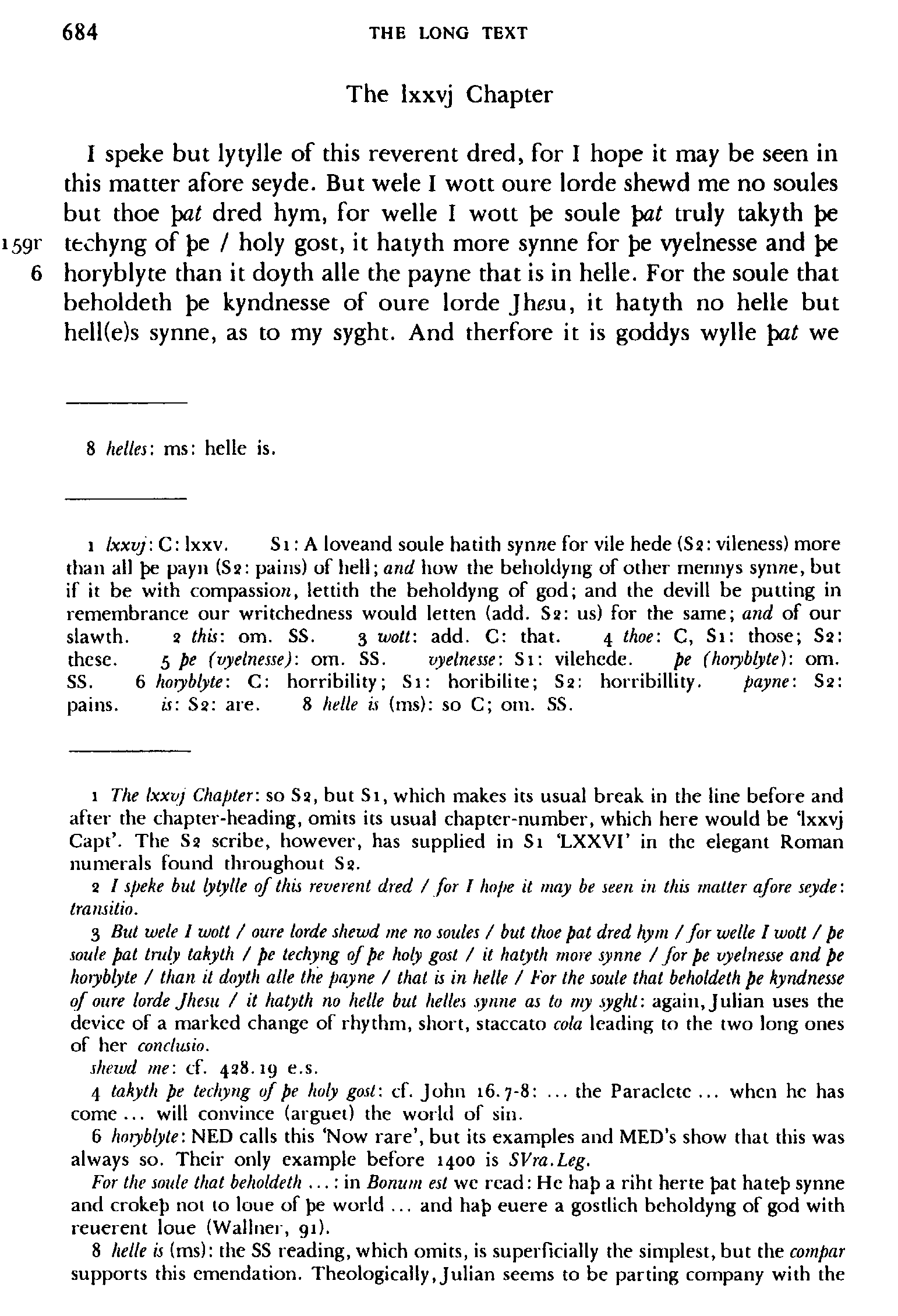
The Ixxvj Chapter I speke but lytylle of this reverent dred, for I hope it may be seen in this matter afore seyde. But wele I wott oure lorde shewd me no soules but thoe Ipat dred hym, for welle I wott ]>e soule \>at truly takyth $e i5gr techyng of |>e / holy gost, it hatyth more synne for J)e vyelnesse and J)e
6 horyblyte than it doyth alle the payne that is in helle. For the soule that beholdeth f>e kyndnesse of oure lorde Jhe.su, it hatyth no helle but hell(e)s synne, as to my syght. And therfore it is goddys wylle \>at we
8 helles: ms: helle is. i Ixxvj: C: Ixxv.
Si: A loveand soule hatith synne for vile hede (82: vileness) more than all J>e payn (82: pains) of hell; and how the beholdyng of other mennys synne, but if it be with compassion, lettith the beholdyng of god; and the devill be putting in remembrance our writchedness would letten (add. 82: us) for the same; and of our slawth.
2 this: om. 88.
3 wott: add. C: that.
4 thoe: C, Si: those; 82: these.
5 pe (vyelnesse): om. 88. vyelnesse: Si: vilehede. pe (horyblyte): om.
SS.
6 horyblyte:
C: horribility; Si: horibilite; 82: horribillity. payne: 82: pains. is: 82: are.
8 helle is (ms): so C; om. 88.
1 The Ixxv/ Chapter: so 82, but Si, which makes its usual break in the line before and after the chapter-heading, omits its usual chapter-number, which here would be 'Ixxvj
Capt'. The 82 scribe, however, has supplied in Si 'LXXVI' in the elegant Roman numerals found throughout 82.
2 / speke but lytylle of this reverent dred / for I hope it may be seen in this matter afore seyde: transitio.
3 But wele 1 wott / oure lorde shewd me no soules / but thoe pat dred hym /for welle I wott / pe soule pat truly takyth / pe techyng of pe holy gost / it hatyth more synne / for pe vyelnesse and pe horyblyte / than it doyth alle the payne / that is in helle / For the soule that beholdeth pe kyndnesse of oure lorde Jhesu / it hatyth no helle but helles synne as to my syght: again, Julian uses the device of a marked change of rhythm, short, staccato cola leading to the two long ones of her concliaio. shewd me: cf. 428.19 e.s.
4 takyth pe techyng of pe holy gost: cf. John 16.7-8: ... the Paraclete ... when he has come... will convince (arguet) the world of sin.
6 horyblyte: NED calls this 'Now rare', but its examples and MED's show that this was always so. Their only example before 1400 is SVra.Leg.
For the soule that beholdeth ...: in Bonum est we read: He haf> a riht herte J>at hatej) synne and croke|) not to lone of Jje world ... and ha]> euere a gostlich beholdyng of god with reuerent loue (Wallnei, 91).
8 helle is (ms): the 88 reading, which omits, is superficially the simplest, but the compar supports this emendation. Theologically,Julian seems to be parting company with the
CHAPTER 76, REVELATION 16
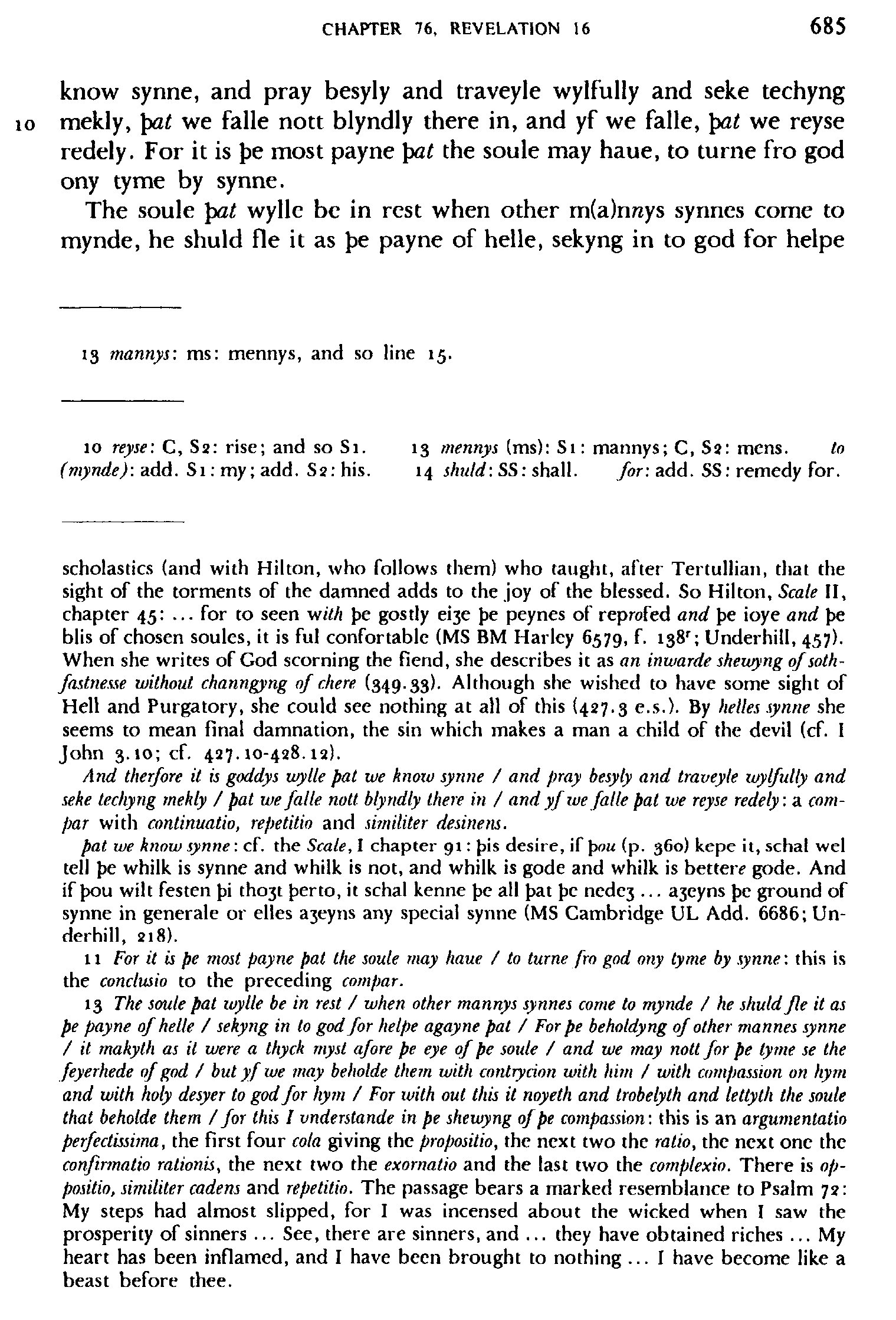
know synne, and pray besyly and traveyle wylfully and seke techyng 10 mekly, \>at we falle nott blyndly there in, and yf we falle, \at we reyse redely. For it is })e most payne ]xit the soule may haue, to turne fro god ony tyme by synne.
The soule \>at wylle be in rest when other m(a)nrays synnes come to mynde, he shuld fle it as £>e payne of helle, sekyng in to god for helpe
13 mannys: ms: mennys, and so line 15.
10 reyse: C, Sa: rise; and so Si.
13 mennys (ms): Si: mannys; C, Sa: mens. to (mynde): add. Si: my; add. Sa: his.
14 shuld: SS: shall. for: add. SS: remedy for. scholastics (and with Hilton, who follows them) who taught, after Tertullian, that the sight of the torments of the damned adds to the joy of the blessed. So Hilton, Scale II, chapter 45: ... for to seen with pe gostly ei3e pe peynes of reprofed and pe ioye and pe blis of chosen soules, it is ful confortable (MS BM Harley 6579, f. 138'; Underbill, 457).
When she writes of God scorning the fiend, she describes it as an inwarde shewyng ofsothfastnesse without channgyng of chere (349.33). Although she wished to have some sight of Hell and Purgatory, she could see nothing at all of this (427.3 e.s.). By helles synne she seems to mean final damnation, the sin which makes a man a child of the devil (cf. I John 3.10; cf. 427.10-428.12).
And therfore it is goddys wylle pat we know synne / and pray besyly and traveyle wylfully and seke techyng mekly /pat we falle nott blyndly there in / and yf we falle pat we reyse redely: a cornpar with continuatio, repetitio and similiter desinem. pat we know synne: cf. the Scale, I chapter 91: {jis desire, if \>ou (p. 360) kepe it, serial wel tell pe whilk is synne and whilk is not, and whilk is gode and whilk is better? gode. And if pou wilt festen pi tho3t perto, it schal kenne pe all pat pe nede3 ... a3eyns pc ground of synne in generale or elles a3eyns any special synne (MS Cambridge UL Add. 6686; Underhill, ai8).
11 For it is pe most payne pat the soule may haue / to turne fro god ony tyme by synne: this is the conclusio to the preceding compar.
13 The soule pat wylle be in rest / when other mannys synnes come to mynde / he shuld fle it as pe payne of helle / sekyng in to god for helpe agayne pat / For pe beholdyng of other mannes synne
/ it makyth as it were a thyck myst afore pe eye of pe soule / and we may nott for pe tyme se the feyerhede of god / but yf we may beholde them with contrycion with him / with compassion on hyrn and with holy desyer to god for hym / For with out this it noyeth and trobelyth and lettyth the soule that beholde them /for this I vnderstande in pe shewyng ofpe compassion: this is an argumentatio perfectissima, the first four cola giving the propositio, the next two the ratio, the next one the confirmatio ralionis, the next two the exornatio and the last two the complexio. There is oppositio, similiter cadens and repetitio. The passage bears a marked resemblance to Psalm 72:
My steps had almost slipped, for I was incensed about the wicked when I saw the prosperity of sinners ... See, there are sinners, and ... they have obtained riches ... My heart has been inflamed, and I have been brought to nothing ... I have become like a beast before thee.
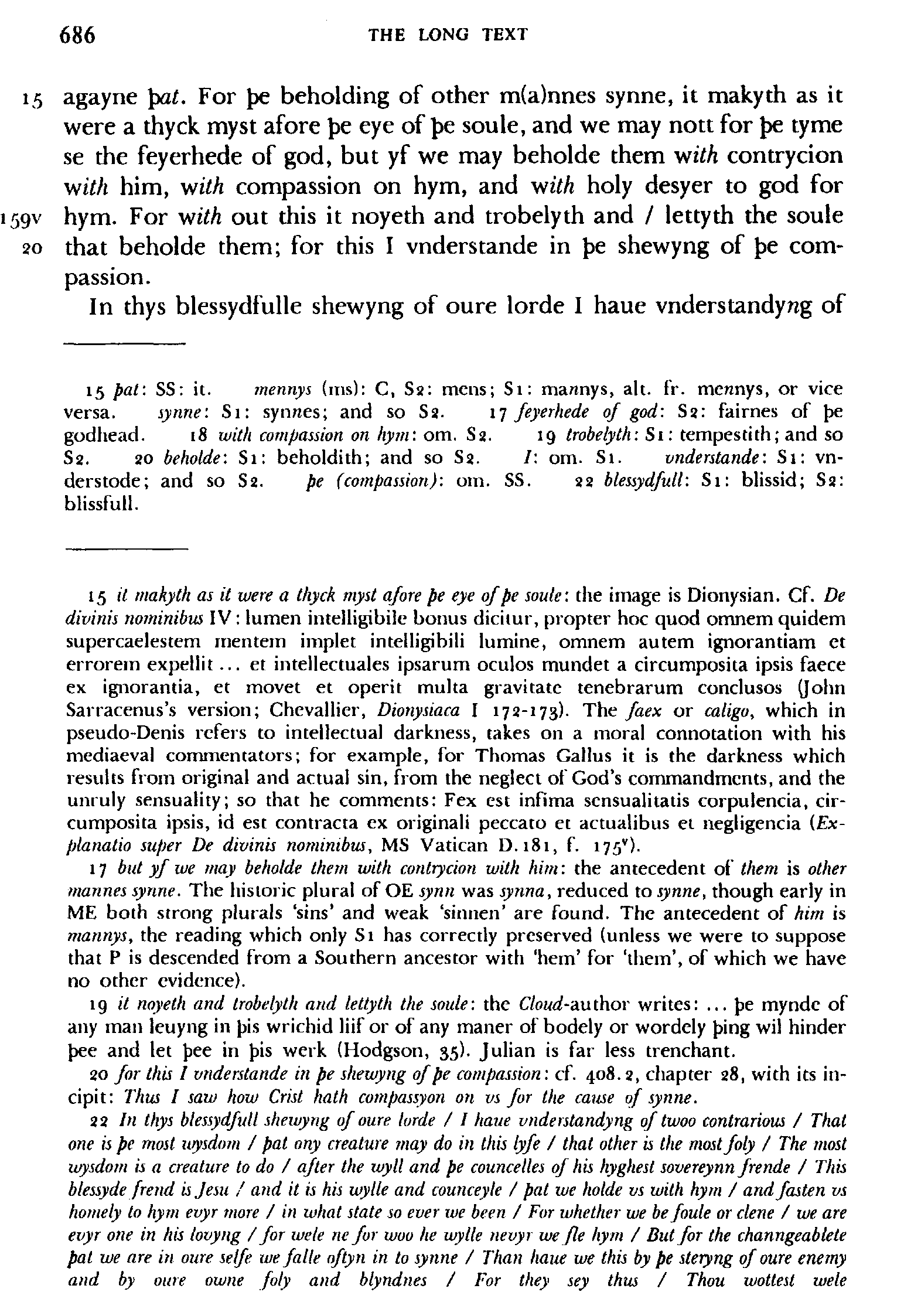
THE LONG TEXT
15 agayne |xz£. For J>e beholding of other m(a)nnes synne, it makyth as it were a thyck myst afore J>e eye of J>e soule, and we may nott for J>e tyme se the feyerhede of god, but yf we may beholde them with contrycion
"with him, with compassion on hym, and with holy desyer to god for 159%' hym. For with out this it noyeth and trobelyth and / lettyth the soule
20 that beholde them; for this I vnderstande in J>e shewyng of J>e compassion.
In thys blessydfulle shewyng of oure lorde I haue vnderstandyng of 15 pat: SS: it. mennys (ins): C, 82: mens; Si: mannys, alt. fr. mennys, or vice versa. synne: Si: sy lines; and so 82.
17 feyerhede of god: 82: fairnes of pe godhead.
18 with compassion on hym: om. 82.
19 trobelyth: Si: tempestith; and so 82.
20 beholde: Si: beholdith; and so 82.
/: om. Si. vnderstande: Si: vnderstode; and so 82. pe (compassion): om. SS.
22 blessydfull: Si: blissid; 82: blissfull.
15 it makyth as it were a thyck myst afore pe eye ofpe soule: the image is Dionysian. Cf. De divinis nominibus IV: lumen intelligibile bonus dicilur, propter hoc quod omnem quidem supercaelestem rnentem implet intelligibili lumine, omnem autem ignorantiam et errorem expellit... et intellectuales ipsarum oculos mundet a circumposita ipsis faece ex ignorantia, et movet et operit multa gravitate tenebrarum conclusos (John
Sarracenus's version; Chevallier, Dionysiaca I 172-173). The faex or caligo, which in pseudo-Denis refers to intellectual darkness, takes on a moral connotation with his mediaeval commentators; for example, for Thomas Gallus it is the darkness which results from original and actual sin, from the neglect of God's commandments, and the unruly sensuality; so that he comments: Fex est infima sensualitatis corpulencia, circumposita ipsis, id est contracta ex original! peccato et actualibus et negligencia (Explanatio super De divinis nominibus, MS Vatican D.iSi, f. 175").
17 but yf we may beholde them with contrycion with him: the antecedent of them is other marines synne. The historic plural of OE synn was synna, reduced to synne, though early in ME both strong plurals 'sins' and weak 'sinnen' are found. The antecedent of him is mannys, the reading which only Si has correctly preserved (unless we were to suppose that P is descended from a Southern ancestor with 'hem' for 'them', of which we have no other evidence).
19 it noyeth and Irobelyth and lettyth the soule: the Cloud-author writes: ... pe mynde of any man leuyng in pis wrichid liif or of any maner of bodely or wordely ping wil hinder pee and let pee in pis werk (Hodgson, 35). Julian is far less trenchant.
20 for this I vnderstande in pe shewyng of pe compassion: cf. 408.2, chapter 28, with its incipit: Thus I saw how Crist hath compassyon on vs for the cause of synne.
22 In thys blessydfull shewyng of oure lorde / I haue vnderstandyng of twoo contrarious / That one is pe most nysdom I pat any creature may do in this lyfe / that other is the mostfoly / The most wysdom is a creature to do / after the wyll and pe councelles of his hyghest sovereynn frende / This blessyde frend isjesu / and it is his wylle and counceyle / pat we holde vs with hym / and fasten vs homely to hym evyr more / in what state so ever we been / For whether we befoule or dene / we are evyr one in his lovyng /for wele ne for woo he wylle nevyr we fie hym / But for the channgeablete pat we are in oure selfe wefalle oftyn in to synne / Than haue we this by pe steryng of oure enemy and by oure owne foly and blyndnes / For they sey thus / Thou wottest wele
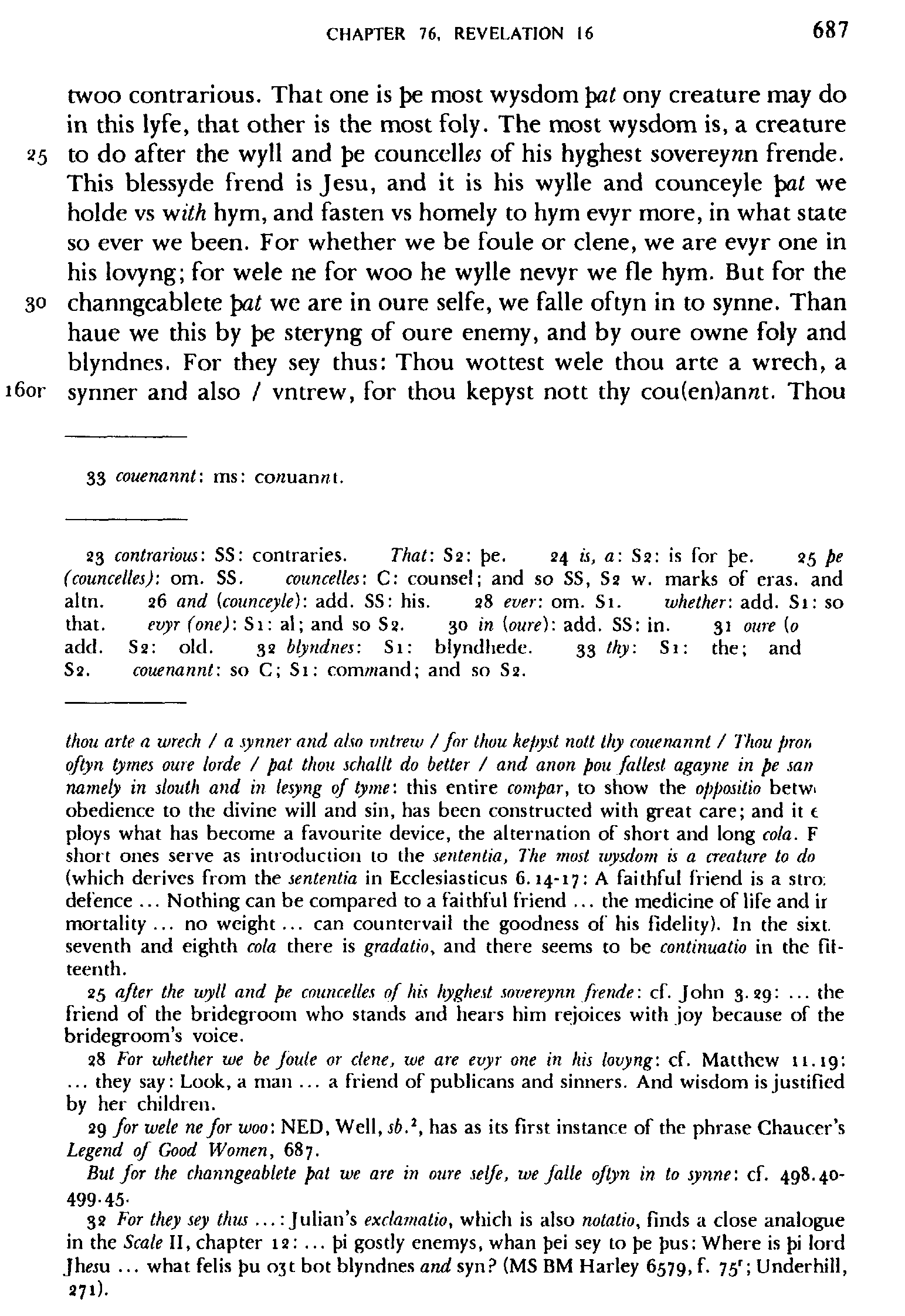
CHAPTER 76, REVELATION 16
twoo contrarious. That one is pe most wysdom ipat ony creature may do in this lyfe, that other is the most foly. The most wysdom is, a creature
25 to do after the wyll and J>e councelkj of his hyghest sovereywn frende.
This blessyde frend is Jesu, and it is his wylle and counceyle \>at we holde vs with hym, and fasten vs homely to hym evyr more, in what state so ever we been. For whether we be foule or clene, we are evyr one in his lovyng; for wele ne for woo he wylle nevyr we fie hym. But for the 30 channgeablete \>at we are in oure selfe, we falle oftyn in to synne. Than haue we this by J>e steryng of oure enemy, and by oure owne foly and blyndnes. For they sey thus: Thou wottest wele thou arte a wrech, a 5or synner and also / vntrew, for thou kepyst nott thy cou(en)annt. Thou
33 couenannt: ms: co/manwt.
23 contrarious: SS: contraries.
That: Ss: f>e.
24 is, a: Ss: is for }>e.
25 pe (councelles): om. SS. councelles: C: counsel; and so SS, 82 w. marks of eras, and altn.
26 and (counceyle): add. SS: his.
28 ever: om. Si. whether: add. Si: so that. evyr (one): Si: al; and so Ss.
30 in (oure): add. SS: in.
31 oure (o add.
82: old.
32 blyndnes:
Si: blyndhede.
33 thy: Si: the; and 82. couenannt: so C; Si: com/wand; and so 82. thou arte a wrech / a synner and also vntrew /for thou kefiyst nott thy couenannt / Thou pror, oftyn tymes oure lorde / pat thou schallt do better / and anon pou fattest agayne in pe san namely in slouth and in lesyng of tyme: this entire cornpar, to show the oppositio betwi obedience to the divine will and sin, has been constructed with great care; and it e ploys what has become a favourite device, the alternation of short and long cola. F short ones serve as introduction to the sententia, The most wysdom is a creature to do
(which derives from the sententia in Ecclesiasticus 6.14-17: A faithful friend is a stro; defence ... Nothing can be compared to a faithful friend ... the medicine of life and ir mortality ... no weight ... can countervail the goodness of his fidelity). In the sixt. seventh and eighth cola there is gradatio, and there seems to be continuatio in the fifteenth.
25 after the wyll and pe councelles of his hyghest sovereynn frende: cf. John 3.29: ... the friend of the bridegroom who stands and hears him rejoices with joy because of the bridegroom's voice.
28 For whether we be Joule or clene, we are evyr one in his lovyng: cf. Matthew 11.19:
... they say: Look, a man ... a friend of publicans and sinners. And wisdom is justified by her children.
29 for wele ne for woo: NED, Well, sb.2, has as its first instance of the phrase Chaucer's
Legend of Good Women, 687.
But for the channgeablete pat we are in oure selfe, we falle oflyn in to synne: cf. 498.40499-45.
32 For they sey thus ...:Julian's exclamatio, which is also notatio, finds a close analogue in the Scale II, chapter 12: ... \>i gostly enemys, whan J)ei sey to {je f>us: Where is JM lord
]hesu ... what felis }>u 031 bot blyndnes and syn? (MS BM Harley 6579, f. 75'; Underbill,
271).
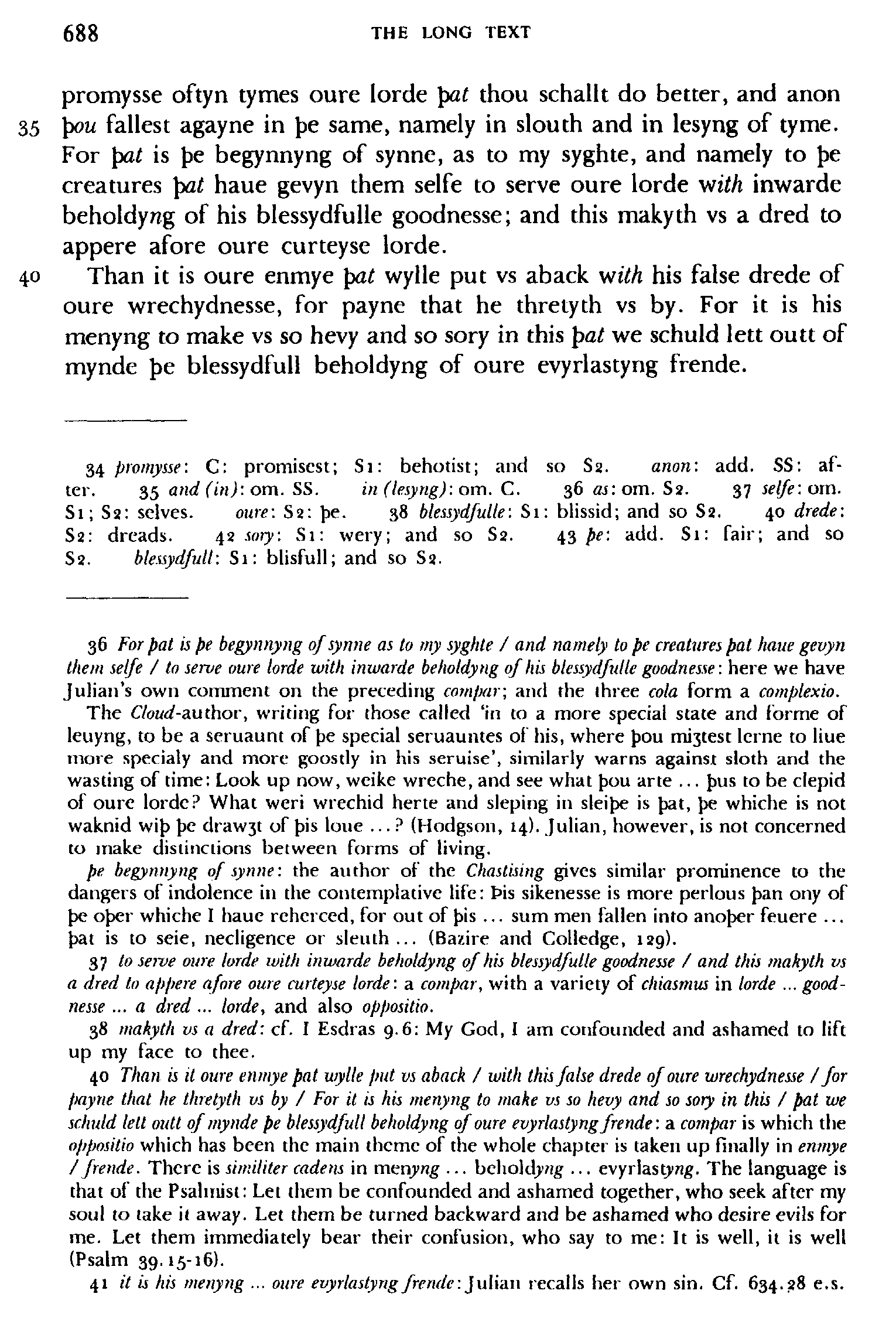
THE LONG TEXT
promysse oftyn tymes oure lorde \>at thou schallt do better, and anon 35 \)ou fallest agayne in J>e same, namely in slouth and in lesyng of tyme.
For \>at is b,e begynnyng of synne, as to my syghte, and namely to J>e creatures \jat haue gevyn them selfe to serve oure lorde "with inwarde beholdyrcg of his blessydfulle goodnesse; and this makyth vs a dred to appere afore oure curteyse lorde.
Than it is oure enmye \>at wylle put vs aback with his false drede of oure wrechydnesse, for payne that he thretyth vs by. For it is his menyng to make vs so hevy and so sory in this fyat we schuld lett outt of mynde }>e blessydfull beholdyng of oure evyrlastyng frende.
34 promysse: C: promiscst; Si: behotist; and so 82. anon: add.
SS: after.
35 and (in): om. SS. in (lesyng): om. C.
36 as:om. 82.
37 selfe: om.
Si; 82: selves. oure: 82: pe.
38 blessydfulle: Si: blissid; and so 82.
40 drede:
82: dreads.
42 sory: Si: wery; and so 82.
43 pe: add. Si: fair; and so 82. blessydfull: Si: blisfull; and so 82.
36 For pat is pe begynnyng of synne as to my syghte / and namely to pe creatures pat haue gevyn them selfe / to serve oure lorde with inwarde beholdyng of his blessydfulle goodnesse: here we have
Julian's own comment on the preceding compar; and the three cola form a complexio.
The Cloud-author, writing for those called 'in to a more special state and forme of leuyng, to be a seruaunt of pe special seruauntes of his, where pou mijtest lerne to Hue more specialy and more goostly in his seruise', similarly warns against sloth and the wasting of time: Look up now, weike wreche, and see what pou arte ... pus to be clepid of oure lorde? What weri wrechid herte and sleping in sleipe is pat, pe whiche is not waknid wif> pe draw3t of pis lone ...? (Hodgson, 14). Julian, however, is not concerned to make distinctions between forms of living. pe begynnyng of synne: the author of the Chastising gives similar prominence to the dangers of indolence in the contemplative life: t>is sikenesse is more perlous pan ony of pe oper whiche I haue reherced, for out of pis ... sum men fallen into anoper feuere ... pat is to seie, necligence or sleuth... (Bazire and Colledge, 129).
37 to serve oure lorde with inwarde beholdyng of his blessydfulle goodnesse / and this makyth vs a dred to appere afore oure curteyse lorde: a compar, with a variety of chiasmus in lorde ... goodnesse ... a dred ... lorde, and also oppositio.
38 makyth vs a dred: cf. I Esdras 9.6: My God, I am confounded and ashamed to lift up my face to thee.
40 Than is it owe enmye pat wylle put vs aback / with this false drede of oure wrechydnesse /for payne that he thretyth vs by / For it is his menyng to make vs so hevy and so sory in this / pat we schuld lett outt of mynde pe blessydfull beholdyng of oure evyrlastyng frende: a compar is which the oppositio which has been the main theme of the whole chapter is taken up finally in enmye
/frende. There is similiter cadens in meiy/zg ... behokhwg ... evyrlastyng. The language is that of the Psalmist: Let them be confounded and ashamed together, who seek after my soul to take it away. Let them be turned backward and be ashamed who desire evils for me. Let them immediately bear their confusion, who say to me: It is well, it is well
(Psalm 39.15-16).
41 it is his menyng ... oure evyrlastyng frende: ]U\\-A\\ recalls her own sin. Cf. 634.28 e.s.
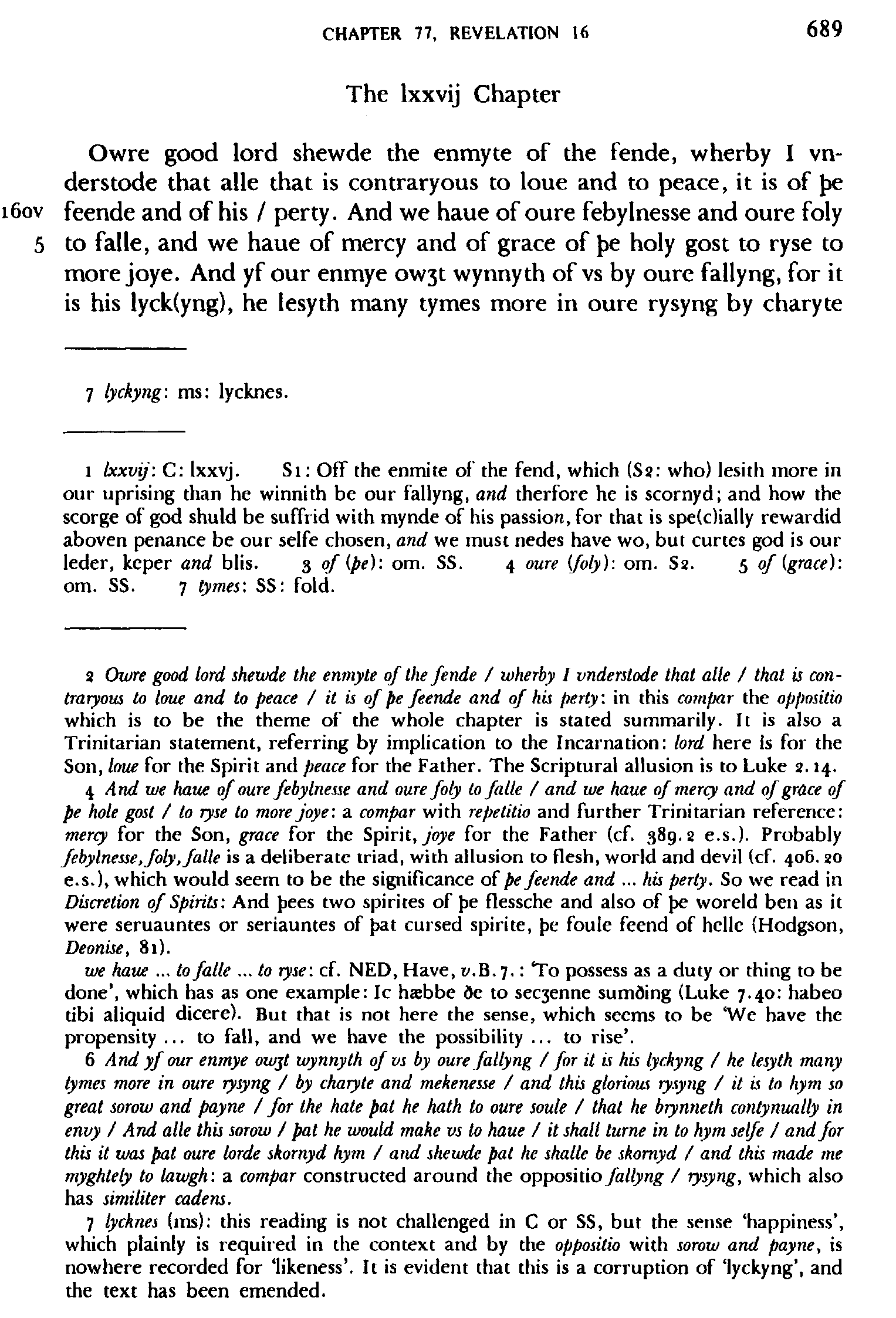
CHAPTER 77, REVELATION !6
The Ixxvij Chapter Owre good lord shewde the enmyte of the fende, wherby I vnderstode that alle that is contraryous to loue and to peace, it is of Jje i6ov feende and of his / perty. And we haue of oure febylnesse and oure foly
5 to falle, and we haue of mercy and of grace of J>e holy gost to ryse to more joye. And yf our enmye ow3t wynnyth of vs by oure fallyng, for it is his lyck(yng), he lesyth many tymes more in oure rysyng by charyte
7 lyckyng: ms: lycknes. i Ixxvij: C: Ixxvj.
Si: Off the enmite of the fend, which (Si?: who) lesith more in our uprising than he winnith be our fallyng, and therfore he is scornyd; and how the scorge of god shuld be suffrid with mynde of his passion, for that is spe(c)ially rewardid aboven penance be our selfe chosen, and we must nedes have wo, but curtes god is our leder, kcper and blis.
3 of (pe): om. SS.
4 oure (foly): om. Sn.
5 of (grace): om. SS.
7 tymes: SS: fold.
2 Owre good lord shewde the enmyte of the fende / wherby I vnderstode that alle / that is contraryous to loue and to peace / it is of pe feende and of his perty: in this compar the oppositio which is to be the theme of the whole chapter is stated summarily. It is also a Trinitarian statement, referring by implication to the Incarnation: lord here is for the Son, loue for the Spirit and peace for the Father. The Scriptural allusion is to Luke 2.14.
4 And we haue of oure febylnesse and oure foly to falle / and we haue of mercy and of grace of pe hole gost / to ryse to more joye: a compar with repetitio and further Trinitarian reference: mercy for the Son, grace for the Spirit, joye for the Father (cf. 389.2 e.s.). Probably febylnesse, foly,falle is a deliberate triad, with allusion to flesh, world and devil (cf. 406. 20 e.s.), which would seem to be the significance of pe feende and ... his perty. So we read in Discretion of Spirits: And pees two spirites of f>e flessche and also of |je woreld ben as it were seruauntes or seriauntes of pat cursed spirite, pe foule feend of hclle (Hodgson,
Deonise, Si). we haue ... to falle ... to ryse: cf. NED, Have, i/.B. 7.: To possess as a duty or thing to be done', which has as one example: Ic haebbe de to sec3enne sumding (Luke 7.40: habeo tibi aliquid dicere). But that is not here the sense, which seems to be 'We have the propensity ... to fall, and we have the possibility ... to rise'.
6 And yf our enmye owjt wynnyth of vs by oure fallyng /for it is his lyckyng / he lesyth many tymes more in oure rysyng / by charyte and mekenesse / and this glorious rysyng / it is to hym so great sorow and payne / for the hate pat he hath to oure soule / that he brynneth contynually in envy /And alle this sorow / pat he would make vs to haue / it shall turne in to hym selfe / and for this it was pat oure lorde skornyd hym / and shewde pat he shalle be skomyd / and this made me myghtely to lawgh: a compar constructed around the oppositio fallyng / rysyng, which also has similiter cadens.
1 lycknes (ms): this reading is not challenged in C or SS, but the sense 'happiness', which plainly is required in the context and by the oppositio with sorow and payne, is nowhere recorded for 'likeness'. It is evident that this is a corruption of 'lyckyng', and the text has been emended.
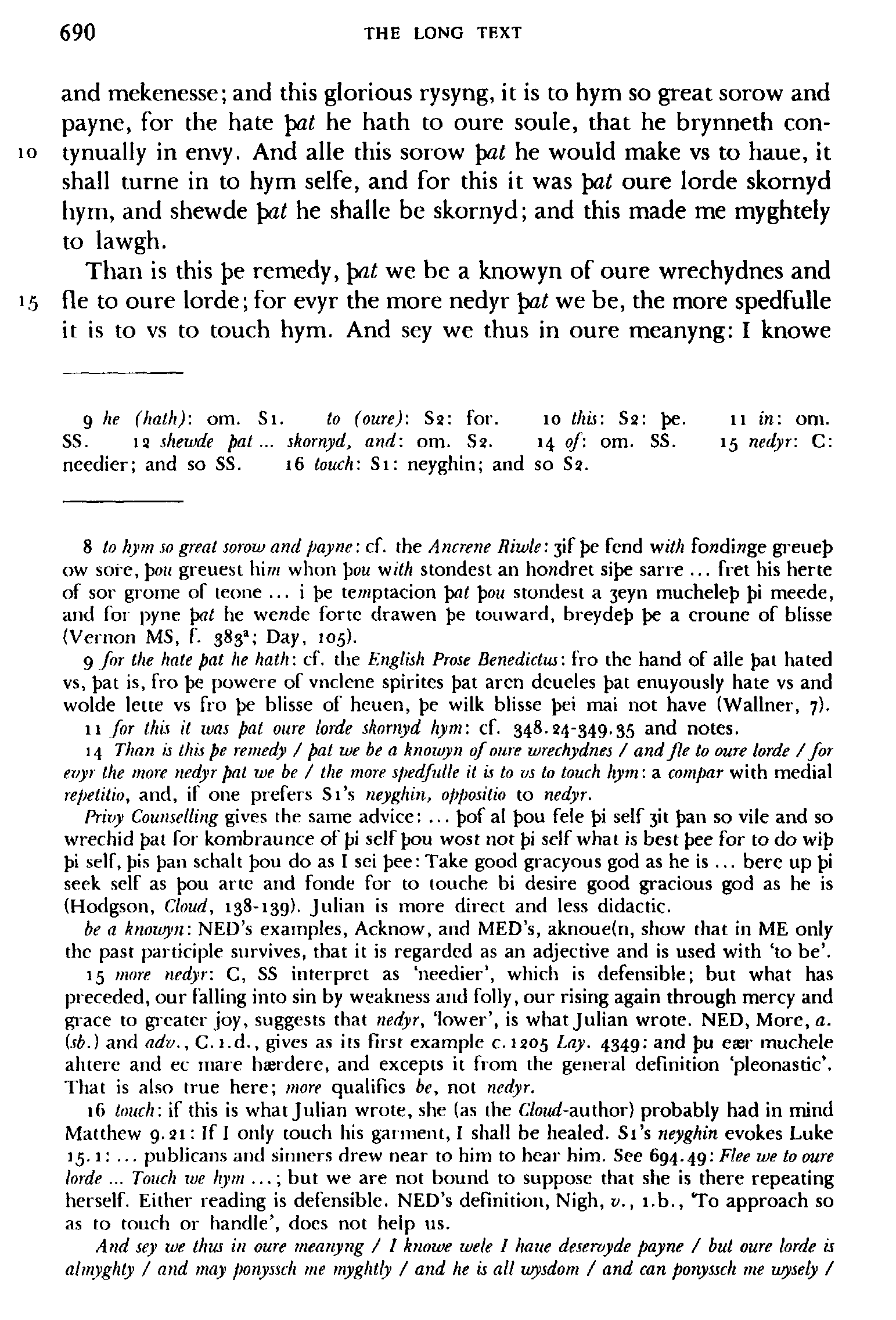
THE LONG TEXT
and mekenesse; and this glorious rysyng, it is to hym so great sorow and payne, for the hate 1pat he hath to oure soule, that he brynneth con10 tynually in envy. And alle this sorow \Mt he would make vs to haue, it shall turne in to hym selfe, and for this it was \>at oure lorde skornyd hym, and shewde tyt he shalle be skornyd; and this made me myghtely to lawgh.
Than is this Jje remedy, Ipat we be a knowyn of oure wrechydnes and 15 fie to oure lorde; for evyr the more nedyr Ipat we be, the more spedfulle it is to vs to touch hym. And sey we thus in oure meanyng: I knowe
9 he (hath)', om. Si. to (oure)'. 82: for.
10 this'. Sa: pe.
11 in: om.
SS.
12 shewde pat ... skornyd, and: om.
82.
14 of: om.
SS.
15 nedyr: C: needier; and so SS.
16 touch: Si: neyghin; and so 82.
8 to hym so great sorow and f>ayne: cf. the Ancrene Riwle: yf pe fend with fondmge greuep ow sore, ]>ou greuest him whon \>ou with stondest an hondret sipe sarre ... fret his herte of sor grome of teone ... i pe te/«ptacion \>at pow stondest a jeyn muchelep pi meede, and for pyne \xit he wercde forte drawen pe ton ward, breydep pe a croune of blisse
(Vernon MS, f. 383"; Day, 105).
9 for the hate pat he hath: cf. the English Prose Benedidus: fro the hand of alle pat hated vs, pat is, fro pe powere of vnclene spirites pat arcn deueles pat enuyously hate vs and wolde lette vs fro pe blisse of heuen, pe wilk blisse pei mai not have (Wallner, 7).
11 for this it was pat oure lorde skornyd hym: cf. 348.24-349.35 and notes.
14 Than is this pe remedy / pat we be a knowyn of oure wrechydnes / and fie to oure lorde /for evyr the more nedyr pat we be / the more sfiedfulle it is to vs to touch hym: a compar with medial repetitio, and, if one prefers Si's neyghin, oppositio to nedyr.
Privy Counselling gives the same advice: ... pof al pou fele pi self 3it pan so vile and so wrechid pat for kombraunce of pi self pou wost not pi self what is best pee for to do wip pi self, pis pan schalt pou do as I sei pee: Take good gracyous god as he is ... bere up pi seek self as pou artc and fonde for to louche bi desire good gracious god as he is
(Hodgson, Cloud, 138-139). Julian is more direct and less didactic. be a knowyn: NED's examples, Acknow, and MED's, aknoue(n, show that in ME only the past participle survives, that it is regarded as an adjective and is used with 'to be'.
15 more nedyr: C, SS interpret as 'needier', which is defensible; but what has preceded, our falling into sin by weakness and folly, our rising again through mercy and grace to greater joy, suggests that nedyr, 'lower', is what Julian wrote. NED, More, a.
(sb.) and adv., C.i.d., gives as its first example c.1205 Lay. 4349: and pu eaer muchele ahtere and ec mare haerdere, and excepts it from the general definition 'pleonastic*.
That is also true here; more qualifies be, not nedyr.
16 touch: if this is what Julian wrote, she (as the C/ottd-author) probably had in mind
Matthew 9.21: If I only touch his garment, I shall be healed. Si's neyghin evokes Luke
15. i: ... publicans and sinners drew near to him to hear him. See 694.49: Flee we to oure lorde ... Touch we hym ...; but we are not bound to suppose that she is there repeating herself. Either reading is defensible. NED's definition, Nigh, v., i.b., To approach so as to touch or handle', does not help us.
And sey we thus in oure meanyng / I knowe wele I haue deservyde payne / but oure lorde is almyghty / and may ponyssch me myghtly / and he is all wysdom / and can ponyssch me wysely /
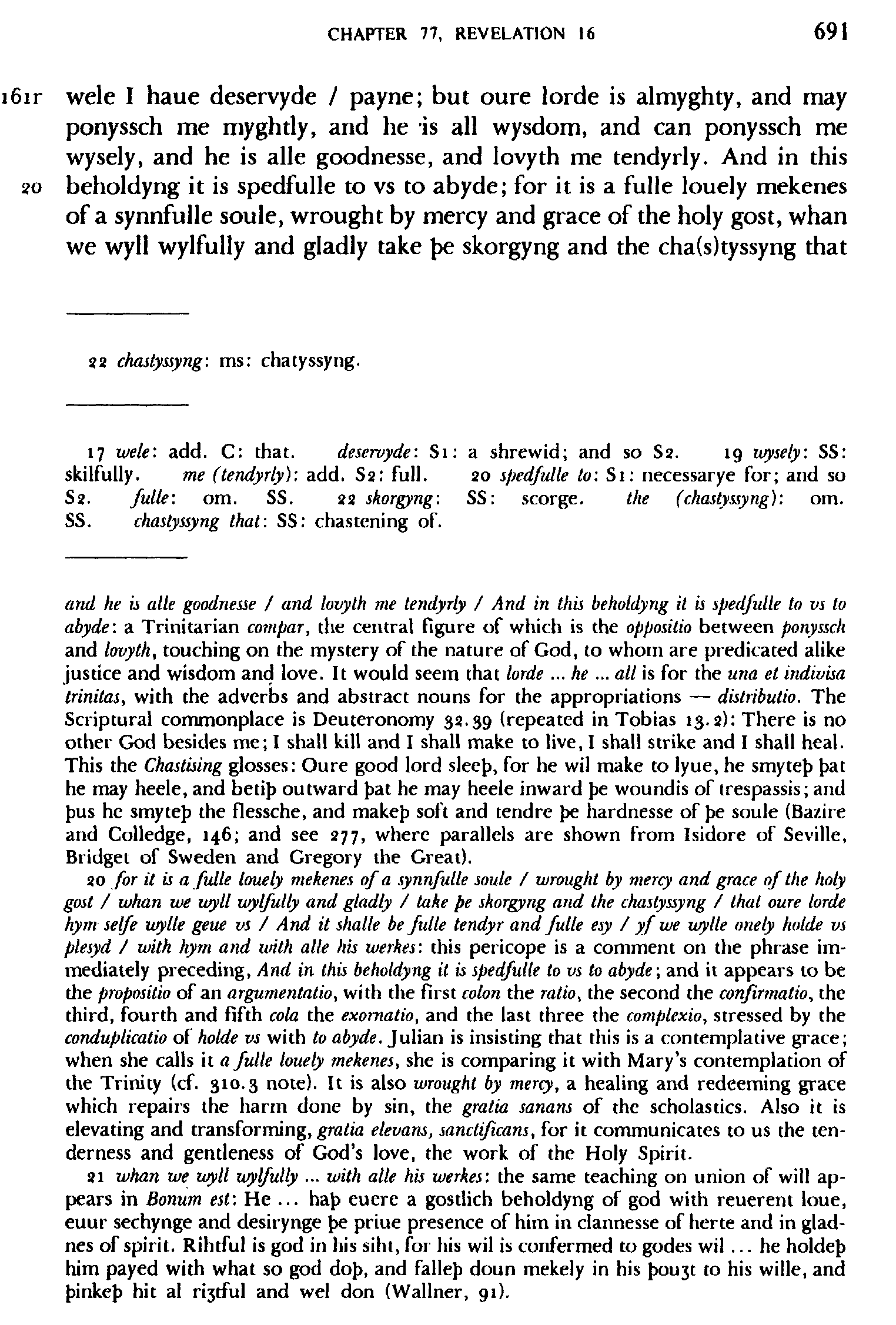
CHAPTER 77, REVELATION 16
i6ir wele I haue deservyde / payne; but oure lorde is almyghty, and may ponyssch me myghtly, and he is all wysdom, and can ponyssch me wysely, and he is alle goodnesse, and lovyth me tendyrly. And in this
20 beholdyng it is spedfulle to vs to abyde; for it is a fulle louely mekenes of a synnfulle soule, wrought by mercy and grace of the holy gost, whan we wyll wylfully and gladly take J>e skorgyng and the cha(s)tyssyng that 22 chastyssyng: ms: chatyssyng.
17 wele: add. C: that. deservyde: Si: a shrewid; and so 82.
19 wysely: SS: skilfully. me (tendyrly): add. 82: full.
20 spedfulle to: Si: necessarye for; and so 82. fulle: om.
88.
22 skorgyng:
88: scorge. the (chastyssyng): om.
88. chastyssyng that: 88: chastening of. and he is alle goodnesse / and lovyth me tendyrly /And in this beholdyng it is spedfulle to vs to abyde: a Trinitarian cornpar, the central figure of which is the oppositio between ponyssch and lovyth, touching on the mystery of the nature of God, to whom are predicated alike justice and wisdom and love. It would seem that lorde ... he ... all is for the una et indivisa trinitas, with the adverbs and abstract nouns for the appropriations — distributio. The Scriptural commonplace is Deuteronomy 32.39 (repeated in Tobias 13.2): There is no other God besides me; I shall kill and I shall make to live, I shall strike and I shall heal.
This the Chastising glosses: Oure good lord sleej>, for he wil make to lyue, he smyteb bat he may heele, and betib outward bat he may heele inward be woundis of trespassis; and bus he smyteb the flessche, and makeb soft and tendre be hardnesse of be soule (Bazire and Colledge, 146; and see 277, where parallels are shown from Isidore of Seville,
Bridget of Sweden and Gregory the Great).
20 for it is a fulle louely mekenes of a synnfulle soule / wrought by mercy and grace of the holy gost / whan we wyll wylfully and gladly / take pe skorgyng and the chastyssyng / that oure lorde hym selfe wylle geue vs / And it shalle be fulle tendyr and fulle esy / yf we wylle onely holds vs plesyd / with hym and with alle his werkes: this pericope is a comment on the phrase immediately preceding, And in this beholdyng it is spedfulle to vs to abyde; and it appears to be the propositio of an argumentatio, with the first colon the ratio, the second the conftrmatio, the third, fourth and fifth cola the exornatio, and the last three the complexio, stressed by the conduplicatio of hotde vs with to abyde. Julian is insisting that this is a contemplative grace; when she calls it a fulle louely mekenes, she is comparing it with Mary's contemplation of the Trinity (cf. 310.3 note). It is also wrought by mercy, a healing and redeeming grace which repairs the harm done by sin, the gratia sanans of the scholastics. Also it is elevating and transforming, gratia elevans, sandificans, for it communicates to us the tenderness and gentleness of God's love, the work of the Holy Spirit.
21 whan we wyll wylfully ... with alle his werkes: the same teaching on union of will appears in Bonum est: He ... hab euere a gostlich beholdyng of god with reuerent loue, euur sechynge and desirynge be priue presence of him in clannesse of herte and in gladnes of spirit. Rihtful is god in his siht, for his wil is confermed to godes wil ... he holdeb him payed with what so god dob, and falleb doun mekely in his bou3t to his wille, and binkeb hit al rijtful and wel don (Wallner, 91).
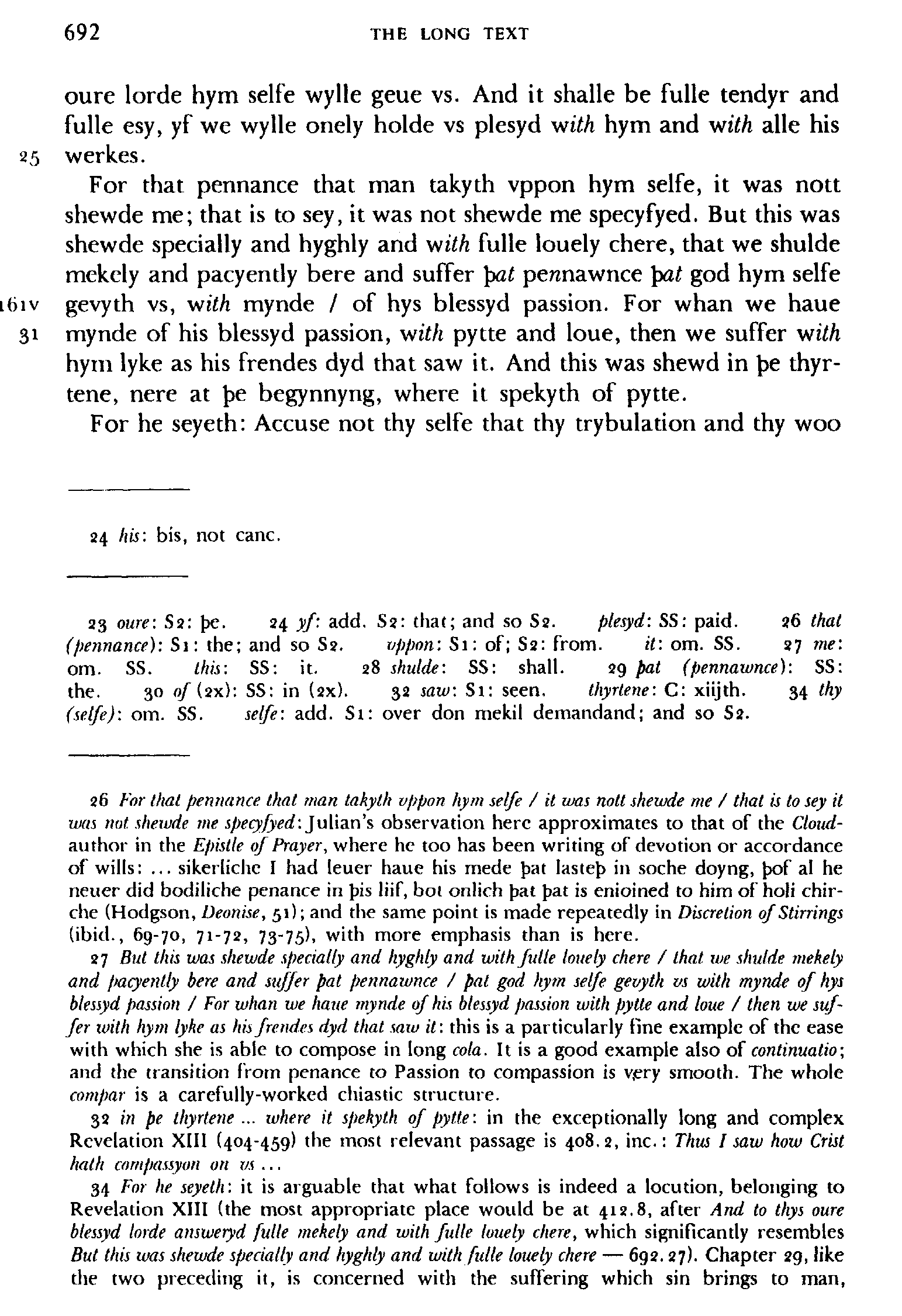
THE LONG TEXT
oure lorde hym selfe wylle geue vs. And it shalle be fulle tendyr and fulle esy, yf we wylle onely holde vs plesyd with hym and with alle his
25 werkes.
For that pennance that man takyth vppon hym selfe, it was nott shewde me; that is to sey, it was not shewde me specyfyed. But this was shewde specially and hyghly and with fulle louely chere, that we shulde mekely and pacyently here and suffer \xit pennawnce ^at god hym selfe i6iv gevyth vs, with mynde / of hys blessyd passion. For whan we haue
31 mynde of his blessyd passion, with pytte and loue, then we suffer with hym lyke as his frendes dyd that saw it. And this was shewd in Jje thyrtene, nere at J>e begynnyng, where it spekyth of pytte.
For he seyeth: Accuse not thy selfe that thy trybulation and thy woo 24 his: bis, not cane.
23 oure: Sa: pe.
24 yf: add. 82: that; and so 82. plesyd: SS: paid.
36 that (pennance): Si: the; and so 82. vppon: Si: of; 82: from. it: om. 88.
27 me: om.
88. this: 88: it.
28 shulde:
SS: shall.
29 pat (pennawnce):
SS: the.
30 o/"(2x): 88: in (ax).
32 saw: Si: seen. thyrtene: C: xiijth.
34 thy (selfe): om. SS. selfe: add. Si: over don mekil demandand; and so 82.
26 For thai pennance that man takyth vppon hym selfe / it was nott shewde me / that is to sey it was not shewde me specyfyed: Julian's observation here approximates to that of the Cloudauthor in the Epistle of Prayer, where he too has been writing of devotion or accordance of wills: ... sikerliche I had leuer haue his mede pat laste^ in soche doyng, pof al he neuer did bodiliche penance in pis liif, bot onlich Jjat pat is enioined to him of holi chirche (Hodgson, Deonise, 51); and the same point is made repeatedly in Discretion of Stirrings
(ibid., 69-70, 71-72, 73-75), with more emphasis than is here.
27 But this was shewde specially and hyghly and with fulle louely chere / that we shulde mekely and pacyently here and suffer pat pennawnce I pat god hym selfe gevyth vs with mynde of hys blessyd passion I For whan we haue mynde of his blessyd passion with pytte and loue / then we suffer with hym lyke as his frendes dyd that saw it: this is a particularly fine example of the ease with which she is able to compose in long cola. It is a good example also of continuatio; and the transition from penance to Passion to compassion is very smooth. The whole compar is a carefully-worked chiastic structure.
32 in pe thyrtene ... where it spekyth of pytte: in the exceptionally long and complex
Revelation XIII (404-459) the most relevant passage is 408.2, inc.: Thus I saw how Crist hath cornpassyon on vs ...
34 For he seyeth: it is arguable that what follows is indeed a locution, belonging to Revelation XIII (the most appropriate place would be at 412.8, after And to thys oure blessyd lorde answeryd fulle mekely and with fulle louely chere, which significantly resembles
But this was shewde specially and hyghly and with fulle louely chere — 692.27). Chapter 29, like the two preceding it, is concerned with the suffering which sin brings to man,
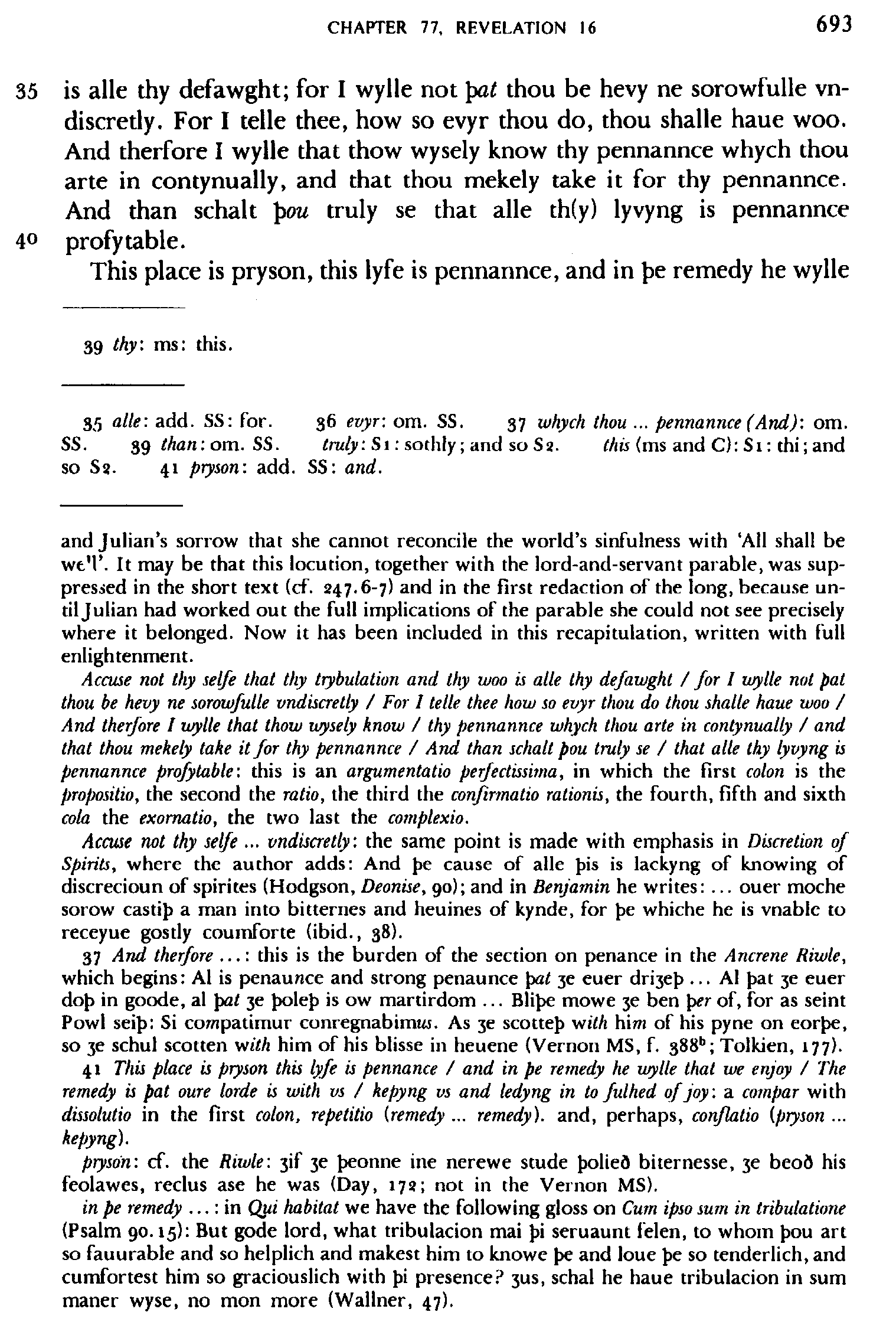
CHAPTER 77, REVELATION 16
35 is alle thy defawght; for I wylle not \>at thou be hevy ne sorowfulle vndiscretly. For I telle thee, how so evyr thou do, thou shalle haue woo.
And therfore I wylle that thow wysely know thy pennannce whych thou arte in contynually, and that thou mekely take it for thy pennannce.
And than schalt pow truly se that alle th(y) lyvyng is pennannce 4° profy table.
This place is pryson, this lyfe is pennannce, and in pe remedy he wylle 39 thy: ms: this.
35 alle: add. SS: for.
36 evyr: om. SS.
37 whych thou ... pennannce (And): om.
SS.
39 than: om. SS. truly: Si: sothly; and so Ss. this (ms and C): Si: thi; and so Sa.
41 pryson: add. SS: and. and Julian's sorrow that she cannot reconcile the world's sinfulness with 'All shall be wtM'. It may be that this locution, together with the lord-and-servant parable, was suppressed in the short text (cf. 247.6-7) and in the first redaction of the long, because until Julian had worked out the full implications of the parable she could not see precisely where it belonged. Now it has been included in this recapitulation, written with full enlightenment.
Accuse not thy selfe that thy trybulation and thy woo is alle thy defawght / for I wylle not pat thou be hevy ne sorowfulle vndiscretly / For I telle thee how so evyr thou do thou shalle haue woo /
And therfore I wylle that thow wysely know / thy pennannce whych thou arte in contynually / and that thou mekely take it for thy pennannce / And than schalt pou truly se / that alle thy lyvyng is pennannce profitable: this is an argumentatio perfectissima, in which the first colon is the propositio, the second the ratio, the third the confirmatio rationis, the fourth, fifth and sixth cola the exornatio, the two last the complexio.
Accuse not thy selfe ... vndiscretly: the same point is made with emphasis in Discretion of Spirits, where the author adds: And pe cause of alle pis is lackyng of knowing of discrecioun of spirites (Hodgson, Deonise, 90); and in Benjamin he writes: ... ouer moche sorow castip a man into bitternes and heuines of kynde, for pe whiche he is vnablc to receyue gostly coumforte (ibid., 38).
37 And therfore ...: this is the burden of the section on penance in the Ancrene Riwle, which begins: Al is penaunce and strong penaunce po£ y euer dri3ef>... Al pat 36 euer dop in goode, al \>at 36 polefi is ow martirdom ... BliJ)e mowe 36 ben per of, for as seint
Fowl seip: Si cowjpatimur conregnabimwj. As 36 scottej) with him of his pyne on eorpe, so 36 schul scotten with him of his blisse in heuene (Vernon MS, f. 388b; Tolkien, 177).
41 This place is pryson this lyfe is pennance / and in pe remedy he wylle that we enjoy / The remedy is pat oure lorde is with vs / kepyng vs and ledyng in to fulhed of joy: a compar with dissolutio in the first colon, repetitio (remedy ... remedy), and, perhaps, conflatio (pryson ... kepyng). pryson: cf. the Riwle: 3if 36 peonne ine nerewe stude polied biternesse, 36 beod his feolawes, reclus ase he was (Day, 172; not in the Vernon MS). in pe remedy ...: in Qui habitat we have the following gloss on Cum ipso sum in tribulatione
(Psalm 90.15): But gode lord, what tribulacion mai pi seruaunt felen, to whom pou art so fauurable and so helplich and makest him to knowe J>e and loue pe so tenderlich, and cumfortest him so graciouslich with pi presence? 3us, schal he haue tribulacion in sum maner wyse, no mon more (Wallner, 47).
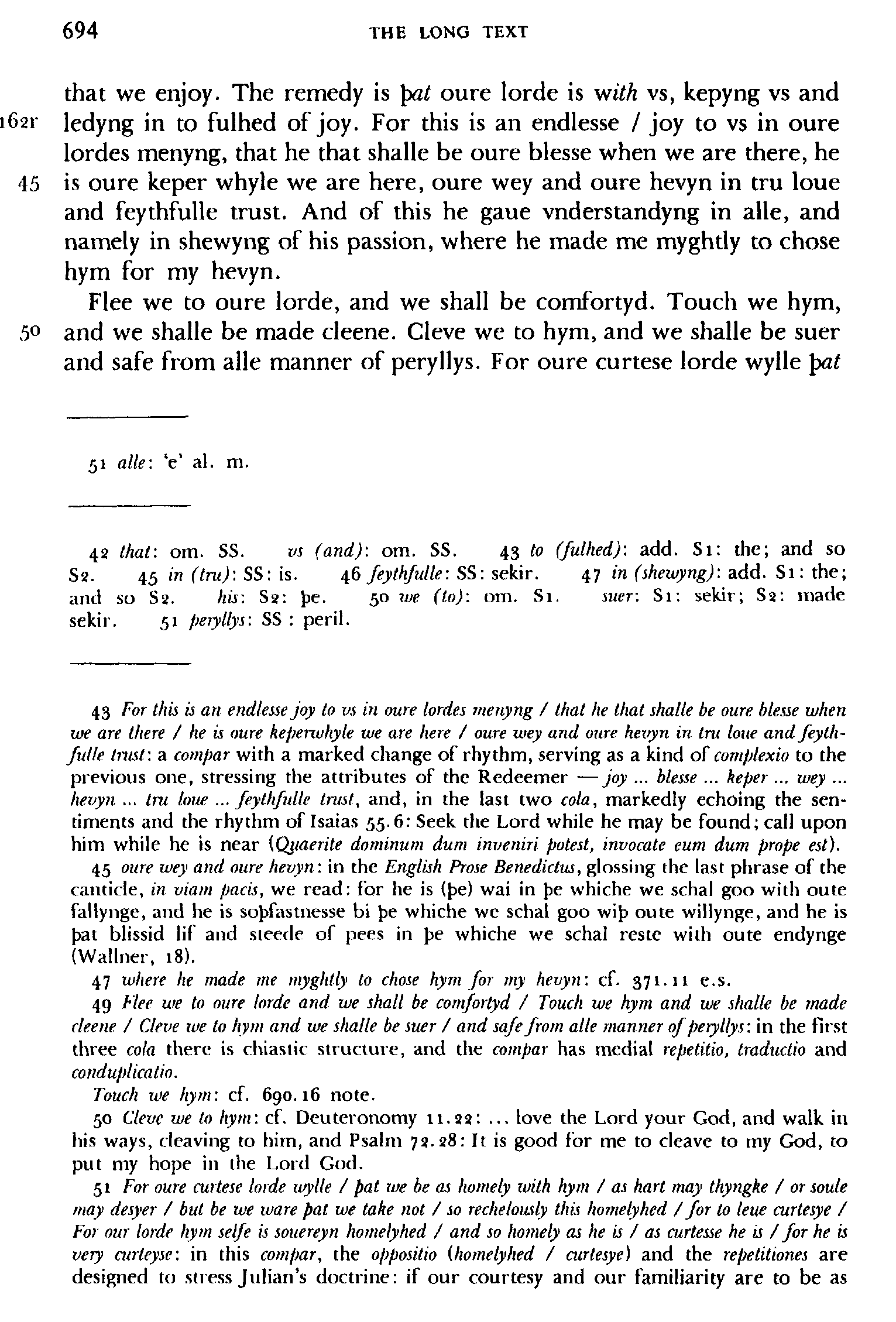
THE LONG TEXT
that we enjoy. The remedy is \>at oure lorde is with vs, kepyng vs and
ledyng in to fulhed of joy. For this is an endlesse / joy to vs in oure lordes menyng, that he that shalle be oure blesse when we are there, he
45 is oure keper whyle we are here, oure wey and oure hevyn in tru loue and feythfulle trust. And of this he gaue vnderstandyng in alle, and namely in shewyng of his passion, where he made me myghtly to chose hym for my hevyn.
Flee we to oure lorde, and we shall be comfortyd. Touch we hym, 5° and we shalle be made cleene. Cleve we to hym, and we shalle be suer and safe from alle manner of peryllys. For oure curtese lorde wylle \>at 51 alle: 'e' al. m.
42 that: om. SS. vs (and): om. SS.
43 to (fulhed): add. Si: the; and so 82.
45 in (tru): SS: is.
46 feythfulle: SS: sekir.
47 in (shewyng): add. Si: the; and so 82. his: Sa: f>e.
50 we (to): om. Si. suer: Si: sekir; 82: made sekir.
51 peiyllys: SS : peril.
43 For this is an endlesse joy to vs in oure lordes menyng / that he that shalle be oure blesse when we are there / he is oure keperwhyle we are here / oure wey and oure hevyn in tru loue and feythfulle trust: a compar with a marked change of rhythm, serving as a kind of cornfilexio to the previous one, stressing the attributes of the Redeemer —joy ... blesse ... keper ... wey ... hevyn ... tru loue ...feythfulle trust, and, in the last two cola, markedly echoing the sentiments and the rhythm of Isaias 55.6: Seek the Lord while he may be found; call upon him while he is near (Qiiaerite dominum dum inveniri potest, invocate eum dum prope est).
45 oure wey and oure hevyn: in the English Prose Benedictus, glossing the last phrase of the canticle, in viam pads, we read: for he is (fie) wai in £>e whiche we schal goo with oute fallynge, and he is sojjfastnesse bi \>e whiche we schal goo wi{> oute willynge, and he is
£>at blissid lif and sieede of pees in f>e whiche we schal reste with oute endynge
(Wallner, 18).
47 where he made me myghtly to chose hym for my hevyn: cf. 371.11 e.s.
49 Flee we to oure lorde and we shall be comfortyd / Touch we hym and we shalle be made cleene / Cleve we to hym and we shalle be suer / and safe from alle manner of peryllys: in the first three cola there is chiasiic structure, and the compar has medial repetitio, traductio and condu/tlicatio.
Touch we hym: cf. 690.16 note.
50 Cleve we to hym: cf. Deuteronomy 11.22: ... love the Lord your God, and walk in his ways, cleaving to him, and Psalm 72.28: It is good for me to cleave to my God, to put my hope in the Lord God.
51 For oure curtese lorde wylle / pat we be as homely with hym / as hart may thyngke / or soule may desyer / but be we ware pat we take not / so rechelously this homelyhed /for to leue curtesye /
For our lorde hym selfe is souereyn homelyhed / and so homely as he is / as curtesse he is /for he is very curleyse: in this compar, the oppositio (homelyhed / curtesye) and the repetitiones are designed to stress Julian's doctrine: if our courtesy and our familiarity are to be as
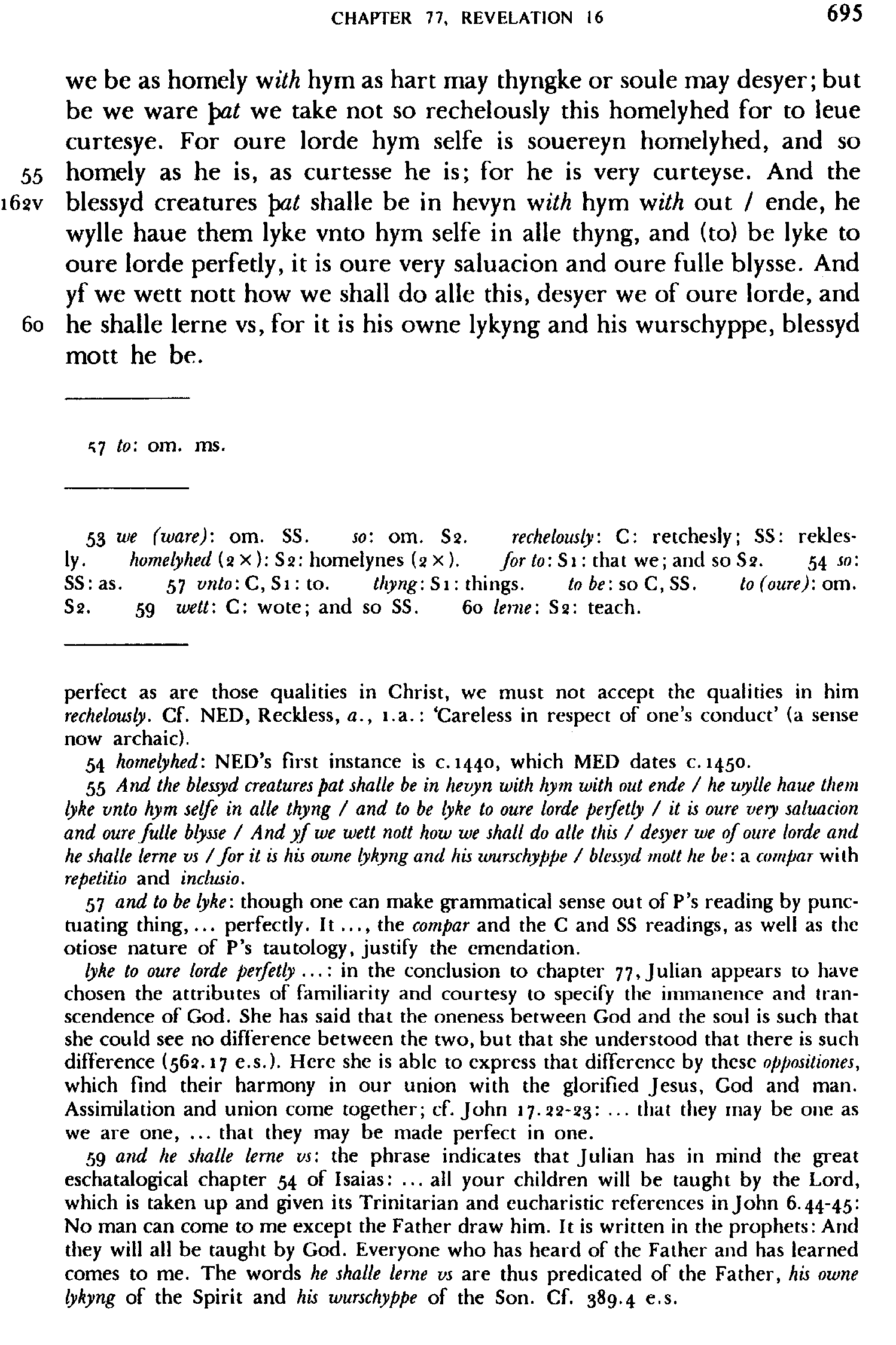
CHAPTER 77, REVELATION 16
we be as homely with hym as hart may thyngke or soule may desyer; but be we ware Jxz£ we take not so rechelously this homelyhed for to leue curtesye. For oure lorde hym selfe is souereyn homelyhed, and so 55 homely as he is, as curtesse he is; for he is very curteyse. And the i6s?v blessyd creatures \>at shalle be in hevyn with hym with out / ende, he wylle haue them lyke vnto hym selfe in alle thyng, and (to) be lyke to oure lorde perfetly, it is oure very saluacion and oure fulle blysse. And yf we wett nott how we shall do alle this, desyer we of oure lorde, and 60 he shalle lerne vs, for it is his owne lykyng and his wurschyppe, blessyd mott he be.
<;7 to\ am. ms.
53 we (ware): om.
SS. so: om.
Sa. rechelously: C: retchesly; SS: reklesly. homelyhed (2 x ): 82: homely nes (2 x ). for to: Si: that we; and so 82.
54 so:
SS:as.
57 vnto: C, Si: to. thyng: Si: things. tobe:soC,SS. to (oure): om.
82.
59 wett: C: wote; and so 88.
60 leme: 82: teach. perfect as are those qualities in Christ, we must not accept the qualities in him rechelously. Cf. NED, Reckless, a., i.a.: 'Careless in respect of one's conduct' (a sense now archaic).
54 homelyhed: NED's first instance is c.1440, which MED dates c.i450.
55 And the blessyd creatures pat shalle be in hevyn with hym with out ende / he wylle haue them lyke vnto hym selfe in alle thyng / and to be lyke to oure lorde perfetly / it is oure very saluacion and oure fulle blysse / And yf we wett nott how we shall do alle this / desyer we of oure lorde and he shalle lerne vs /for it is his owne lykyng and his wurschyppe / blessyd mott he be: a compar with repetitio and inclusio.
57 and to be lyke: though one can make grammatical sense out of P's reading by punctuating thing,... perfectly. It ..., the compar and the C and SS readings, as well as the otiose nature of P's tautology, justify the emendation. lyke to oure lorde perfetly ...: in the conclusion to chapter 77, Julian appears to have chosen the attributes of familiarity and courtesy to specify the immanence and transcendence of God. She has said that the oneness between God and the soul is such that she could see no difference between the two, but that she understood that there is such difference (562.17 e.s.). Here she is able to express that difference by these oppositiones, which find their harmony in our union with the glorified Jesus, God and man.
Assimilation and union come together; cf. John 17.22-23: ... that they may be one as we are one, ... that they may be made perfect in one.
59 and he shalle lerne vs: the phrase indicates that Julian has in mind the great eschatalogical chapter 54 of Isaias: ... all your children will be taught by the Lord, which is taken up and given its Trinitarian and eucharistic references in John 6.44-45:
No man can come to me except the Father draw him. It is written in the prophets: And they will all be taught by God. Everyone who has heard of the Father and has learned comes to me. The words he shalle lerne vs are thus predicated of the Father, his owne lykyng of the Spirit and his wurschyppe of the Son. Cf. 389.4 e.s.
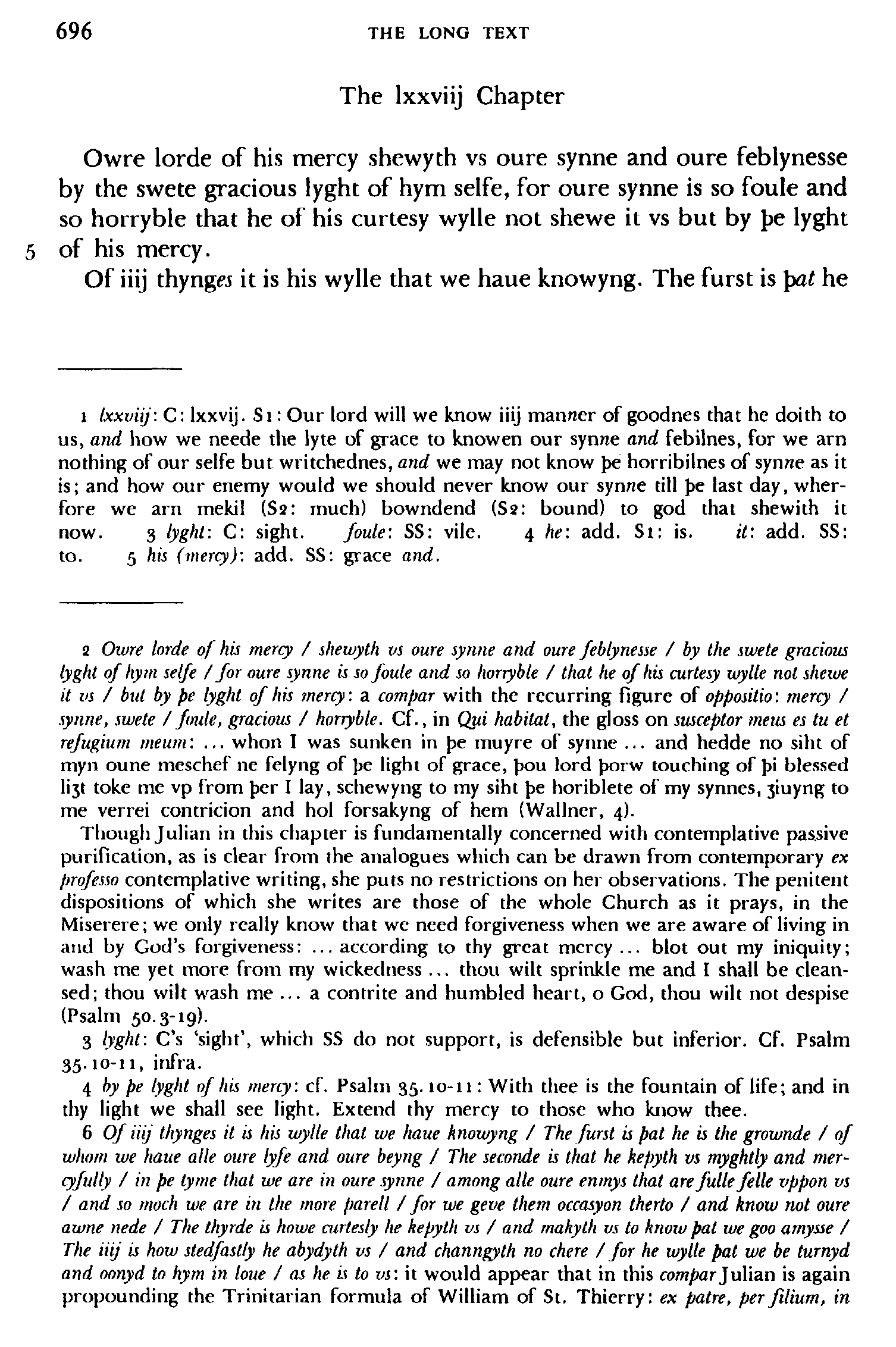
THE LONG TEXT
The Ixxviij Chapter Owre lorde of his mercy shewyth vs oure synne and oure feblynesse by the swete gracious lyght of hym selfe, for oure synne is so foule and so horryble that he of his curtesy wylle not shewe it vs but by be lyght
5 of his mercy.
Of iiij thyng« it is his wylle that we haue knowyng. The furst is \>at he i Ixxviij: C: Ixxvij. Si: Our lord will we know iiij manner of goodnes that he doith to us, and how we neede the lyte of grace to knowen our synne and febilnes, for we arn nothing of our selfe but writchednes, and we may not know }>e horribilnes of synne as it is; and how our enemy would we should never know our synne till f>e last day, wherfore we arn mekil (82: much) bowndend (Sa: bound) to god that shewith it now.
3 lyght: C: sight. foule: SS: vile.
4 he: add. Si: is. it: add. SS: to.
5 his (mercy): add. SS: grace and.
2 Owre lorde of his mercy / shewyth vs oure synne and oure feblynesse / by the swete gracious lyght of hym selfe /for oure synne is so foule and so horryble / that he of his curtesy wylle not shewe it vs / but by pe lyght of his mercy: a compar with the recurring figure of oppositio: mercy / synne, swete /foule, gracious / horryble. Cf., in Qui habitat, the gloss on susceptor rneus es tu et refugium meum: ... whon I was sunken in £>e muyre of synne ... and hedde no siht of myn oune meschef ne felyng of Jse light of grace, Jsou lord Jjorw touching of J>i blessed
Ii3t toke me vp from f>er I lay, schewyng to my siht f>e horiblete of my synnes, 3iuyng to me verrei contricion and hoi forsakyng of hem (Wallner, 4).
Though Julian in this chapter is fundamentally concerned with contemplative passive purification, as is clear from the analogues which can be drawn from contemporary ex professo contemplative writing, she puts no restrictions on her observations. The penitent dispositions of which she writes are those of the whole Church as it prays, in the Miserere; we only really know that we need forgiveness when we are aware of living in and by God's forgiveness: ... according to thy great mercy ... blot out my iniquity; wash me yet more from my wickedness ... thou wilt sprinkle me and I shall be cleansed; thou wilt wash me ... a contrite and humbled heart, o God, thou wilt not despise
(Psalm 50.3-19).
3 lyght: C's 'sight', which SS do not support, is defensible but inferior. Cf. Psalm
35.10-11, infra.
4 by pe lyght of his mercy: cf. Psalm 35.10-11: With thee is the fountain of life; and in thy light we shall see light. Extend thy mercy to those who know thee.
6 Of iiij thynges it is his wylle that we haue knowyng / The furst is pat he is the grownde / of whom we haue alle oure lyfe and oure beyng / The seconde is that he kepyth vs myghtly and mercyfully / in pe tyrne that we are in oure synne / among alle oure enmys that are fulle felle vppon vs
/ and so moch we are in the more parell /for we geve them occasyon therto / and know not oure awne nede / The thyrde is howe curtes/y he kepylh vs / and makyth vs to know pat we goo amysse /
The iiij is how stedfast/y he abydyth vs / and channgyth no chere /for he wylle pat we be turnyd and oonyd to hym in loue / as he is to vs: it would appear that in this compar Julian is again propounding the Trinitarian formula of William of St. Thierry: ex patre, perfilium, in
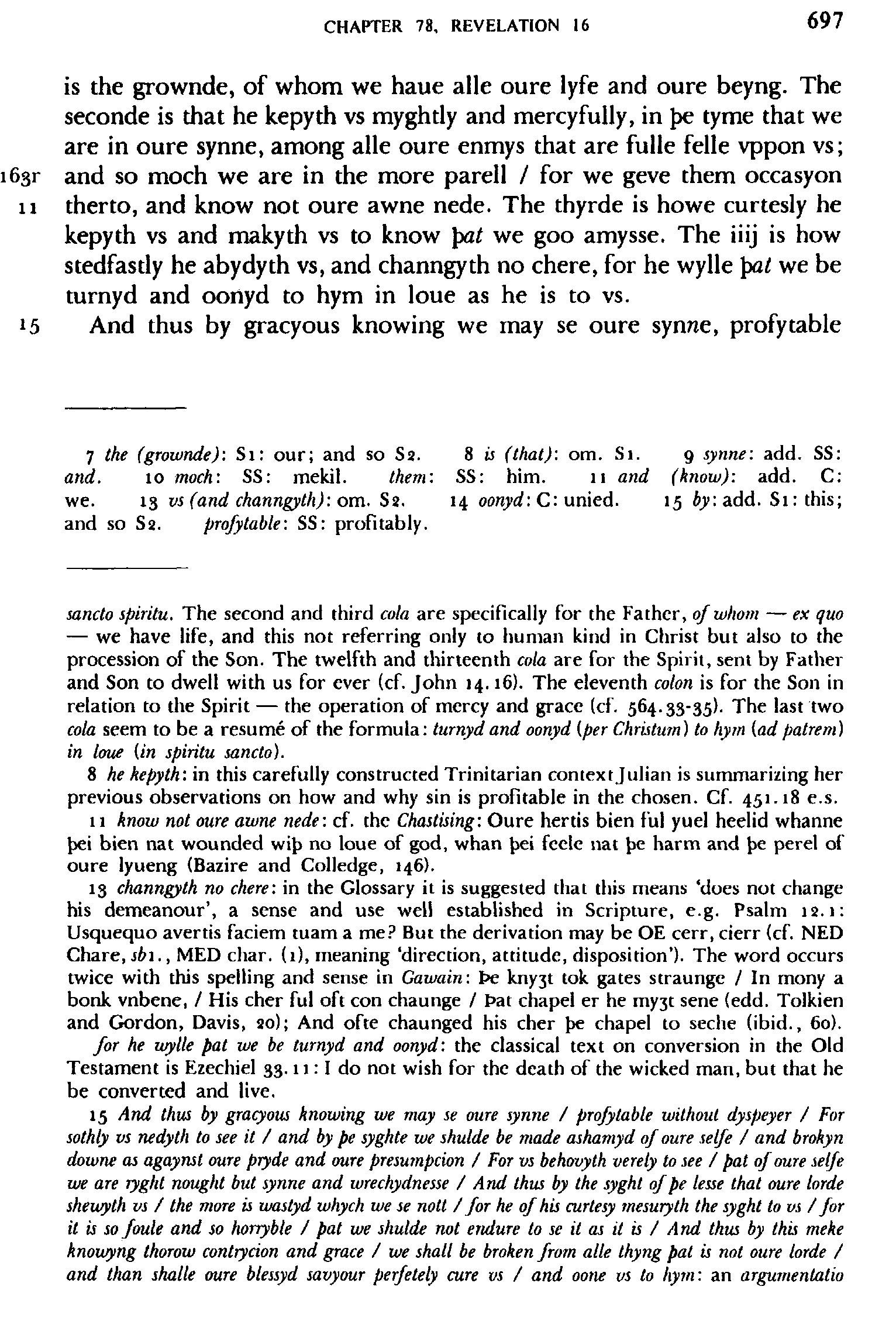
CHAPTER 78, REVELATION 16
is the grownde, of whom we haue alle oure lyfe and oure beyng. The seconde is that he kepyth vs myghtly and mercyfully, in J>e tyme that we are in oure synne, among alle oure enmys that are fulle felle vppon vs; i6sr and so moch we are in the more parell / for we geve them occasyon n therto, and know not oure awne nede. The thyrde is howe curtesly he kepyth vs and makyth vs to know \>at we goo amysse. The iiij is how stedfastly he abydyth vs, and channgyth no chere, for he wylle Jw/ we be turnyd and oonyd to hym in loue as he is to vs.
And thus by gracyous knowing we may se oure synne, profytable 7 the (grownde): Si: our; and so Sa.
8 is (that): om. Si.
9 synne: add. SS: and.
10 moch: SS: mekil. them: SS: him. n and (know): add.
C: we.
13 vs (and channgyth): om. Ss.
14 oonyd: C: unied.
15 by: add. Si: this; and so 82. profytable: SS: profitably. sancto spiritu. The second and third cola are specifically for the Father, of whom — ex quo
— we have life, and this not referring only to human kind in Christ but also to the procession of the Son. The twelfth and thirteenth cola are for the Spirit, sent by Father and Son to dwell with us for ever (cf. John 14.16). The eleventh colon is for the Son in relation to the Spirit — the operation of mercy and grace (cf. 564.33-35). The last two cola seem to be a resume of the formula: turnyd and oonyd (per Christum) to hym (ad patrem) in loue (in spiritu sancto).
8 he kepyth: in this carefully constructed Trinitarian context Julian is summarizing her previous observations on how and why sin is profitable in the chosen. Cf. 451.18 e.s.
11 know not oure awne nede: cf. the Chastising: Oure herds bien f'ul yuel heelid whanne t>ei bien nat wounded wi{) no loue of god, whan Jjei feele nat \>e harm and Jje perel of oure lyueng (Bazire and Colledge, 146).
13 channgyth no chere: in the Glossary it is suggested that this means 'does not change his demeanour', a sense and use well established in Scripture, e.g. Psalm 12.1:
Usquequo avertis faciem tuam a me? But the derivation may be OE cerr, cierr (cf. NED
Chare, sbi., MED char, (i), meaning 'direction, attitude, disposition'). The word occurs twice with this spelling and sense in Gauiain: Pe kny3t tok gates straunge / In mony a bonk vnbene, / His cher ful oft con chaunge / t»at chapel er he my3t sene (edd. Tolkien and Gordon, Davis, 20); And ofte chaunged his cher J>e chapel to seche (ibid., 60). for he wylle pat we be turnyd and oonyd: the classical text on conversion in the Old
Testament is Ezechiel 33.11:1 do not wish for the death of the wicked man, but that he be converted and live.
15 And thus by gracyous knowing we may se oure synne / profytable without dyspeyer / For sothly vs nedyth to see it / and by pe syghte we shulde be made ashamyd of oure selfe / and brokyn downe as agaynst oure pryde and oure presumpcion / For vs behovyth verely to see / pat of oure selfe we are ryght nought but synne and wrechydneise / And thus by the syght of pe lesse that oure lorde shewyth vs / the more is wastyd whych we se nott /for he of his curtesy mesuryth the syght to vs /for it is sofoule and so horryble / pat we shulde not endure to se it as it is / And thus by this meke knowyng thorow contrycion and grace / we shall be broken from alle thyng pat is not oure lorde / and than shalle oure blessyd savyour perfetely cure vs / and oone vs to hym: an argumentatio
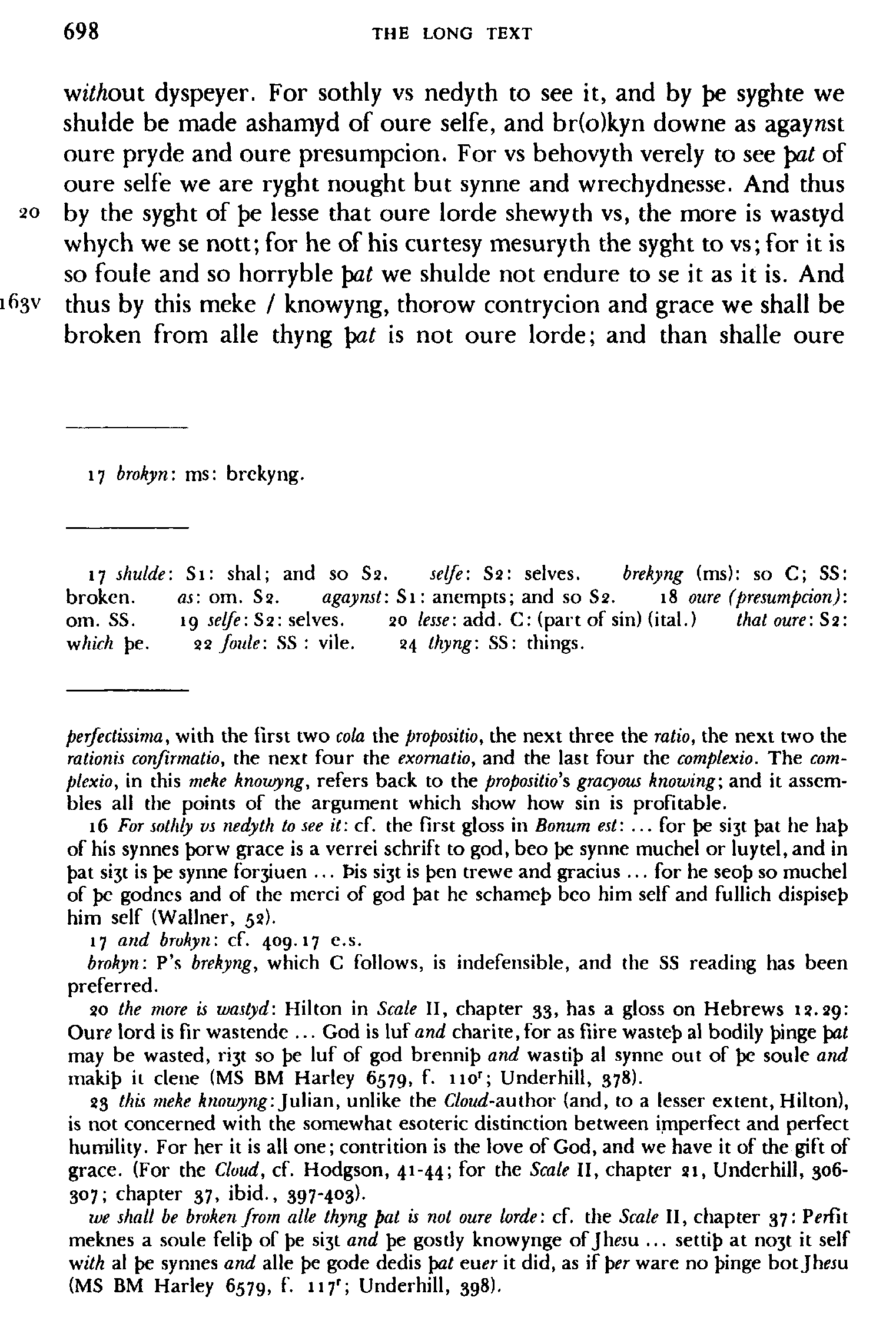
THE LONG TEXT
-without dyspeyer. For sothly vs nedyth to see it, and by J)e syghte we shulde be made ashamyd of oure selfe, and br(o)kyn downe as agaynst oure pryde and oure presumpcion. For vs behovyth verely to see \at of oure selfe we are ryght nought but synne and wrechydnesse. And thus
20 by the syght of pe lesse that oure lorde shewyth vs, the more is wastyd whych we se nott; for he of his curtesy mesuryth the syght to vs; for it is so foule and so horryble \xit we shulde not endure to se it as it is. And i6sv thus by this meke / knowyng, thorow contrycion and grace we shall be broken from alle thyng \xit is not oure lorde; and than shalle oure
17 brokyn: ms: brekyng.
17 shulde: Si: shal; and so Sa. selfe: Sa: selves. brekyng (ms): so C; SS: broken. as: om. Sa. agaynst: Si: anempts; and so Sa.
18 oure (presumpcion): om. SS.
19 selfe: Sa: selves. ao lesse: add. C: (part of sin) (ital.) that oure: Sa: which Jae. aa/cw/e: SS : vile.
34 thyng: SS: things. perfectissima, with the first two cola the propositio, the next three the ratio, the next two the rationis confirmatio, the next four the exornatio, and the last four the complexio. The complexio, in this meke knowyng, refers back to the propositions gracyous knowing; and it assembles all the points of the argument which show how sin is profitable.
16 For sothly vs nedyth to see it: cf. the first gloss in Bonum est: ... for f>e 5(31 £at he haj> of his synnes Jxjrw grace is a verrei schrift to god, beo pe synne muchel or luytel, and in f>at si3t is f>e synne for3iuen ... £>is si3t is Jjen trewe and gracius ... for he seof> so muchel of J>e godnes and of the merci of god |>at he schamejj bco him self and fullich dispisej) him self (Wallner, 53).
17 and brokyn: cf. 409.17 e.s. brokyn: P's brekyng, which C follows, is indefensible, and the SS reading has been preferred. ao the more is wastyd: Hilton in Scale II, chapter 33, has a gloss on Hebrews 13.39:
Oure lord is fir wastende ... God is luf and charite, for as Pure waste}> al bodily fringe \at may be wasted, ri3t so £>e luf of god brennijj and wastijj al synne out of J>e soule and makij) it clene (MS BM Harley 6579, f. iior; Underbill, 378).
33 this ?neke knouyng: Julian, unlike the Cloud-author (and, to a lesser extent, Hilton), is not concerned with the somewhat esoteric distinction between imperfect and perfect humility. For her it is all one; contrition is the love of God, and we have it of the gift of grace. (For the Cloud, cf. Hodgson, 41-44; for the Scale II, chapter 21, Underhill, 306307; chapter 37, ibid., 397-403)we shall be broken Jrom alle thyng pat is not oure lorde: cf. the Scale II, chapter 37: P^rfit meknes a soule felij) of \>e si^i and pe gostly knowynge of Jh«u ... setup at no3t it self with al pe synnes and alle pe gode dedis pa£ euer it did, as if \>er ware no Jjinge bot Jh«u
(MS BM Harley 6579, f. 117'; Underhill, 398).
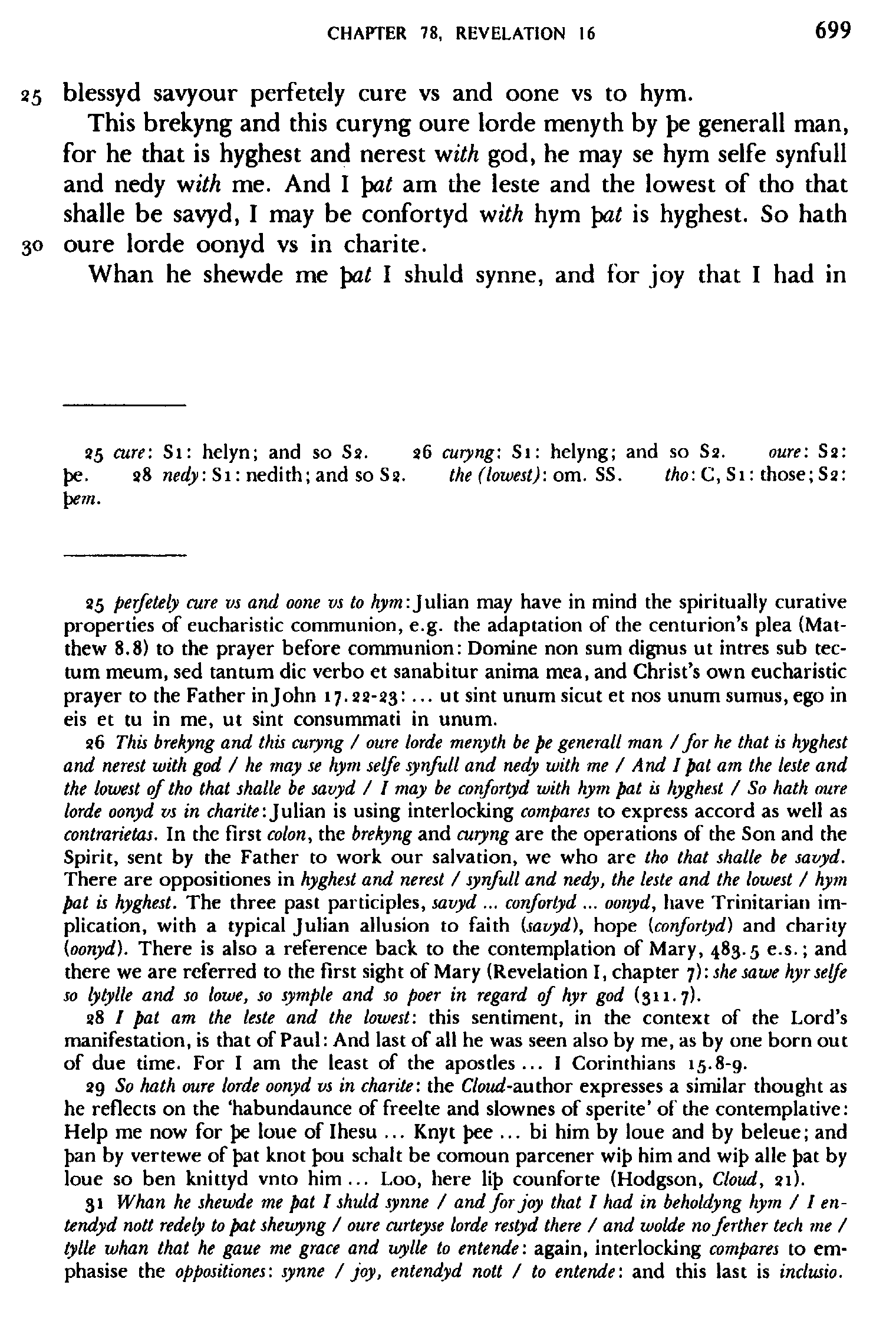
CHAPTER 78, REVELATION 16
25 blessyd savyour perfetely cure vs and oone vs to hym.
This brekyng and this curyng oure lorde menyth by Jje generall man, for he that is hyghest and nerest with god, he may se hym selfe synfull and nedy with me. And I \Mt am the leste and the lowest of tho that shalle be savyd, I may be confortyd with hym \Mt is hyghest. So hath
30 oure lorde oonyd vs in charite.
Whan he shewde me Jxz£ I shuld synne, and for joy that I had in 25 cure: Si: helyn; and so Sa.
26 curyng: Si: helyng; and so 82. oure: 82: pe.
28 nedy: Si: nedith;and so 82. the (lowest): om. SS. tho: C, Si: those; 82: pm.
25 perfetely cure vs and oone vs to hym:Julian may have in mind the spiritually curative properties of eucharistic communion, e.g. the adaptation of the centurion's plea (Matthew 8.8) to the prayer before communion: Domine non sum dignus ut intres sub tectum meum, sed tantum die verbo et sanabitur anima mea, and Christ's own eucharistic prayer to the Father in John 17.22-23: • • • ut sint unum sicut et nos unum sumus, ego in eis et tu in me, ut sint consummati in unum.
26 This brekyng and this curyng / oure lorde menyth be pe generall man /for he that is hyghest and nerest with god / he may se hym selfe synfull and nedy with me / And I pat am the leste and the lowest of tho that shalle be savyd / I may be confortyd with hym pat is hyghest / So hath oure lorde oonyd vs in charite-.Julian is using interlocking compares to express accord as well as contrarietas. In the first colon, the brekyng and curyng are the operations of the Son and the Spirit, sent by the Father to work our salvation, we who are tho that shalle be savyd.
There are oppositiones in hyghest and nerest / synfull and nedy, the leste and the lowest / hym pat is hyghest. The three past participles, savyd ... confortyd ... oonyd, have Trinitarian implication, with a typical Julian allusion to faith (savyd), hope (confortyd) and charity
(oonyd). There is also a reference back to the contemplation of Mary, 483.5 e.s.; and there we are referred to the first sight of Mary (Revelation I, chapter 7): she sawe hyrselfe so lytylle and so lowe, so symple and so poer in regard of hyr god (311.7).
28 / pat am the leste and the lowest: this sentiment, in the context of the Lord's manifestation, is that of Paul: And last of all he was seen also by me, as by one born out of due time. For I am the least of the apostles ... I Corinthians 15.8-9.
29 So hath oure lorde oonyd vs in charite: the Cloud-author expresses a similar thought as he reflects on the 'habundaunce of freelte and slownes of sperite' of the contemplative:
Help me now for pe loue of Ihesu ... Knyt pee ... bi him by loue and by beleue; and pan by vertewe of pat knot pou schalt be comoun parcener wij) him and wip alle pat by loue so ben knittyd vnto him... Loo, here lip counforte (Hodgson, Cloud, 21).
31 Whan he shewde me pat I shuld synne / and for joy that I had in beholdyng hym / I entendyd nott redely to pat shewyng / oure curteyse lorde restyd there / and wolde noferther tech me / tylle whan that he gaue me grace and wylle to entende: again, interlocking compares to emphasise the oppositiones: synne /joy, entendyd nott / to entende: and this last is inclusio.
THE LONG TEXT
beholdyng hym, I entendyd nott redely to \>at shewyng, oure curteyse lorde restyd there, and wolde no ferther tech me, tylle whan that he gaue me grace and wylle to entende. And herof was I lerned, though
35 \>at we be hyely lyftyd in to contemplacyon by the specialle gyfte of oure 1641 lorde, yett vs behovyth nedys / therwzM to haue knowyng and syght of oure synne and of oure febylnes; for without this knowyng we may not haue trew meknesse, and withoutyn this we may nott be safe. And also I 32 oure curteyse lorde: ms: and oure curteyse lorde.
32 beholdyng: add. SS:of. entendyd: Si: entend.
33 restyd: Si: stynte; 82: stinted.
Ho:SS:not. whan:om. SS.
34 to: Si: for to. lemed: Si: Icrid; and so Sa.
35 lyftyd: add. SS: up.
37 (and) of: om. SS.
32 oure curteyse lorde: P's reading, and oure ... (found in all the witnesses) gives an ambiguity of syntax uncharacteristic of Julian. C solves it as follow: ... oned us in Charity, when he shewed ... should sin. And for joy ... to that shewing. And our courteous
Lord ...; but this division is arbitrary. What follows plainly has Whan he ihewde me pat I shuld synne as its protasis. The simplest solution has seemed to be to suppress and (oure curteyse lorde), so making that unambiguously the main clause.
33 tylle whan that he gaue me grace ...: in the compares first three cola Julian has written of beholdyng in the sense of infused contemplation; now, with to entende, of the acquired contemplation that can be had by grace, through will. This is still an activity of grace, less passive than the first. See the phrase enjoy in his louyng (480.43), in the final chapter of Revelation XIV, where, writing of unitive prayer, she insists that the joy in beholding must always be accompanied by a high and powerful desire to be entirely united with God.
34 And herof was I lerned ...: in what follows there is no more than an approximation to compar; and one asks whether the passage may have been tampered with. But even without the colores, it is an important biographical reflection. She recognizes that her shewings are gifts of high contemplation, and that the weaknesses of humanity, far from being left behind at such moments, are integral to them. That is, Julian is teaching the exact opposite of the 'Brethren of the Free Spirit' and other pseudo-spiritual writers tainted by false Quietism. Her teaching is firmly rooted in the, mystery of Christ, the incarnate Word. Then she reflects on private revelations such as she has received; at the heart of spiritual discernment is the power of Christ's meekness, the knowledge of self without which knowledge of God is impossible.
38 and withoutyn this we may nott be safe: again, the syntax is ambiguous; but it is more probable that the antecedent of this is meknesse. So in the Cloud we read that the cause of imperfect meekness is: f>e filpe, pe wrecchidnes and pe freelte of man, into pe whiche is fallen by synne ... a trewe knowyng and a felyng of my self a wrech as I am ... it is inpossible a sinner to gete or to kepe when it is getyn }je parfite vertewe of meeknes wip outen it (Hodgson, 40-41).
CHAPTER 78, REVELATION 16
saw we may nott haue thys knowyng of oure selfe, nor of none of all 40 oure gostly enmys, for they wylle nott vs so moch goode. For if it were by ther wylle, we shoulde nevyr se it tylle oure endyng day. Than are we moch bounde to god, that he wylle hym selfe for loue shewe it vs, in tyme of mercy and of grace.
39 saw. add. Si: that;and so 82.
40 moch (2 x ): Si: mekil (2 x ).
41 nevyr: SS: not. tylle: Si: into; 82: unto.
43 of (grace): om. C, SS.
39 Accepting the SS variants, which improve the cola, we have: And also I saw that / we may nott haue thys knowyng of oure selfe / nor of none of all oure gostly enmys /for they wylle nott vs so mekil goode / For if it were by ther wylle / we shoulde nevyr se it into oure endyng day / Than are we mekil bounde to god / that he wylle hym selfe for loue shewe it vs / in tyme of mercy and grace. We have here the necessary elements of an argumentatio. The second and third cola present the propositio, which contains a logical (not rhetorical) disjunctio. No ratio is needed, for it has already been stated: for we geve them occasyon therto and know not oure awne nede (697.10). The fourth colon is the rationis confirmatio, the fifth and sixth cola the exornatio; and the complexio one might expect (that since we can have this knowledge neither from ourselves nor from our enemies, it must come from God) is there only by implication, to provide a further conclusion, in the last three cola, that when this knowledge does come from God we are the more indebted to him.
Theologically, Julian indicates that she knows the common doctrine, 'De actione angelorum in homines'; Thomas Aquinas argues (Summa theologiae I.ui.i) that although angels have the power to enlighten man's mind, it is the devil's office to tempt him, not to help him but to hurt him: Diabolus autem semper tentat ut noceat, in peccatum praecipitando (ibid., 1.114.2 in corp.) To the possible question, might not a good angel do us this service? she will presently answer that she was never shown the ministrations of good angels, only that God does all that we need (cf. 710.22 e.s.).
42 for loue shewe it vs: cf. 733.18. in tyme of mercy and of grace: Paul, urging his Corinthians not to neglect the grace of God which they have received, cites Isaias 49.8: At the favourable time I have listened to you, on the day of salvation I came to your help; and he states that now is the favourable time (II Corinthians 6.2).
THE LONG TEXT
The Ixxix Chapter Also I had in this more voderstandyng, in \Mt he shewde me \Mt I shulde synne. I toke it nakydly to myn owne synguler person, for I was no notherwysc steryd in \xit tyrne, but by the hygh gracious comfort of 5 oure lorde that folowde aftyr, I saw that his menyng was for J>e generalle man, that is to sey allc man, whych is synfulle and shall be in i64v to £>e last day, / of whych man I am a membre, as I hope, by Jje mercy i Ixxix: C: Ixxviij. Si: We are lernyd to our syrme and not to our neighbore but for (82: taught to be dredful and see our own sin but not our neighbors except it be for) their helpe, and god will we know what somever stering we have contrary to this shewing, it comith of our enemy, for the gret love of god knowen we should not ben {>e more reckles to fallen, and if we fallen we must hastily risen, or ell (82: else) we are grctly onkend to god.
4 in: SS: at. of oure lorde: om. C.
6 whych: 82:
\xit. in: om. 82.
3 / toke it nakydly to myn owne synguler person /for I was no notherwyse steryd in pat tyme / but by the hygh gracious comfort of oure lorde that folowde aftyr / I saw that his menyng was for pe generalle man that is to sey alle man / whych is synfulle and shall be in to pe last day / of whych man I am a membre as I hope by pe mercy of god /for the blessyd comfort pat I sawe it is large inough for vs alle: Julian, in referring back to the long and complex Revelation XIII, which begins with chapter 13, 404.2 e.s., is re-examining various elements of that revelation which she grasped only in her final understanding of the parable of the lord and the servant. Here she is concerned to stress the implications of incorporation into Christ (cf. 532.211 e.s.) which are set out in her 'equation': the servant = the second person of the Trinity; the servant = Adam = everyman = Christ's manhood = the true
Adam, and in her conclusion: For in alle this oure good lorde shewed his owne son and Adam but one man (534.228).
4 the hygh gracious comfort of oure lorde that folowde aftyr: the reference is probably both to the end of the parable, 544.317 e.s., and also to Revelation XVI concerning the mutual indwelling, 646.63 e.s. There may here be an echo of II Corinthians 1.3-7.
6 alle man, whych is synfulle and shall be: one of the closest parallels to this statement about the condition of Christ's Body in via is to be found in the Second Vatican Council's 'Dogmatic Constitution on the Church', Lumen gentium, no. 8: '... the Church embracing sinners in her bosom is at the same time holy and always in need of being purified, and incessantly pursues the path of penance and renewal' (W. M. Abbott: The Documents of Vatican II, 24).
7 of whych man I am a membre, as I hope: cf. Ephesians 4.4: One body and one spirit, as you are called in one hope of your calling. as I hope: 'as I believe'. This sense is not recorded in NED, but cf. MED, hopen, v.(i),
2.(a): "... to believe, infer, suppose'. Julian does not need to hope or believe that she is a member of the human race; she knows that she is. But she believes that although she shares in mankind's sinfulness, she will also share in God's mercy towards 'all who are of salvation'.
CHAPTER 79, REVELATION 16
of god, for the blessyd comfort \>at I sawe, it is large inough for vs alle.
And ther was I lernyd that I shulde se my awne synne and nott other 10 mennys, but if it may be for comfort or helpe of my evyn crysten.
And also in pe same shewyng, ther I saw pat I shuld synne, ther was I lernyd to be dradfull for vnsykernesse of my selfe, for I wot nott how I shalle falle, ne I know not the mesure ne JDC gretnesse of my synne. For that wolde I awyst dredfull, and ther to I had no answere.
Also oure curteyse lorde, in that same tyme he shewde fulle swetly and fulle myghtely the endleshed and the vnchanngeabylte of his loue.
9 ther: SS: here. lernyd: Si: lerid; and so 82.
10 mennys: add. Si: synns; and so 82. but if: 82: exept. or: SS: and. helpe: 82: healing.
11 pe: Si: this. ther (I): SS: where. ther (was): Si: then.
12 lernyd: Si: leryd; and so 82. dradfull: C: dreadful; Si: dredfull; 82: dreadfull. vnsykernesse: C, marg.: frailty. my: om. SS.
14 wolde I awyst dredfull: C, marg.: I desired with fear to have known.
15 that: SS: be. swetly: 88: sekirly.
16 fulle (myghtely): om.
SS. endleshed: 82: endlesnes.
(and) the: om. 82. vnchanngeabylte: 82: unchangeablenes.
8 large inough for vs alle: cf. Revelation XVI, 394.6: large jnow for alle mankynde that shalle be savyd. Here Julian indicates briefly the theology which is the basis of devotion to the Sacred Heart of Jesus.
9 / shulde se my awne synne and nott other mennys: in the Scale, I chapter 16, there is: E>e felyng of bis low;jnes schal putt out of bi hert vnskilful beholdyng of ober mennys misliuyng and ... dedes, and it schal dryue only be to be hold biself... for mykelhed of synne and filth bat bou schalt fynd and fele in be (MS Cambridge UL Add.6686, p. 290;
Underhill, 34).
11 And also in pe same shewyng / ther I saw pat I shuld synne / ther was I lemyd to be dradfull
/for vnsykernesse of my selfe /for I wot nott how I shalle fade / ne I know not the mesure ne pe gretnesse of my synne / For that wolde I awyst dredfull / and therlo I had no answere: a compar of short cola, evidently so composed to convey emotional stress. In wot ... know ... awyst there is conduplicatio, 12 dradfull for vnsykernesse of my selfe: in Qui habitat, the verse Non timebis a timore nocturno is glossed: ... a newe turned mon ... feleb him so vnwis and so weik ... be frelete of him self is schewed so fulliche to his siht bat him binkeb bat he mihte not stonden
(Wallner, 15). dradfull: the word and the sentiment seem to echo the Biblical cliche timor et tremor.
Paul's use of it, especially in connection with the crucified and glorified Christ (cf. I Corinthians 2.3 and Philippians 2.12) corresponds to Julian's reverent drede (673.17).
15 Also oure curteyse lorde / in that same tyme he shewde /fulle swetly and fulle myghtely / the endleshed and the vnchanngeabylte of his loue / and also his grete goodnesse and his gracious inwardely kepyng / that pe loue ofhym and of oure sowlys shalle nevyr be depertyd / vnto withouten ende: in this compar, similiter cadens is used. Theologically .Julian is assembling the various aspects of the locution / kepe the fulle suerly (442.10) into a complex Trinitarian statement: swetly ... myghtely; endleshed ... vnchanngeabylte; loue ... goodnesse ... kepyng; gracious inwardely, and into the consequent reference to the unitive work of God through the Incarnate Word, in all who will be saved.
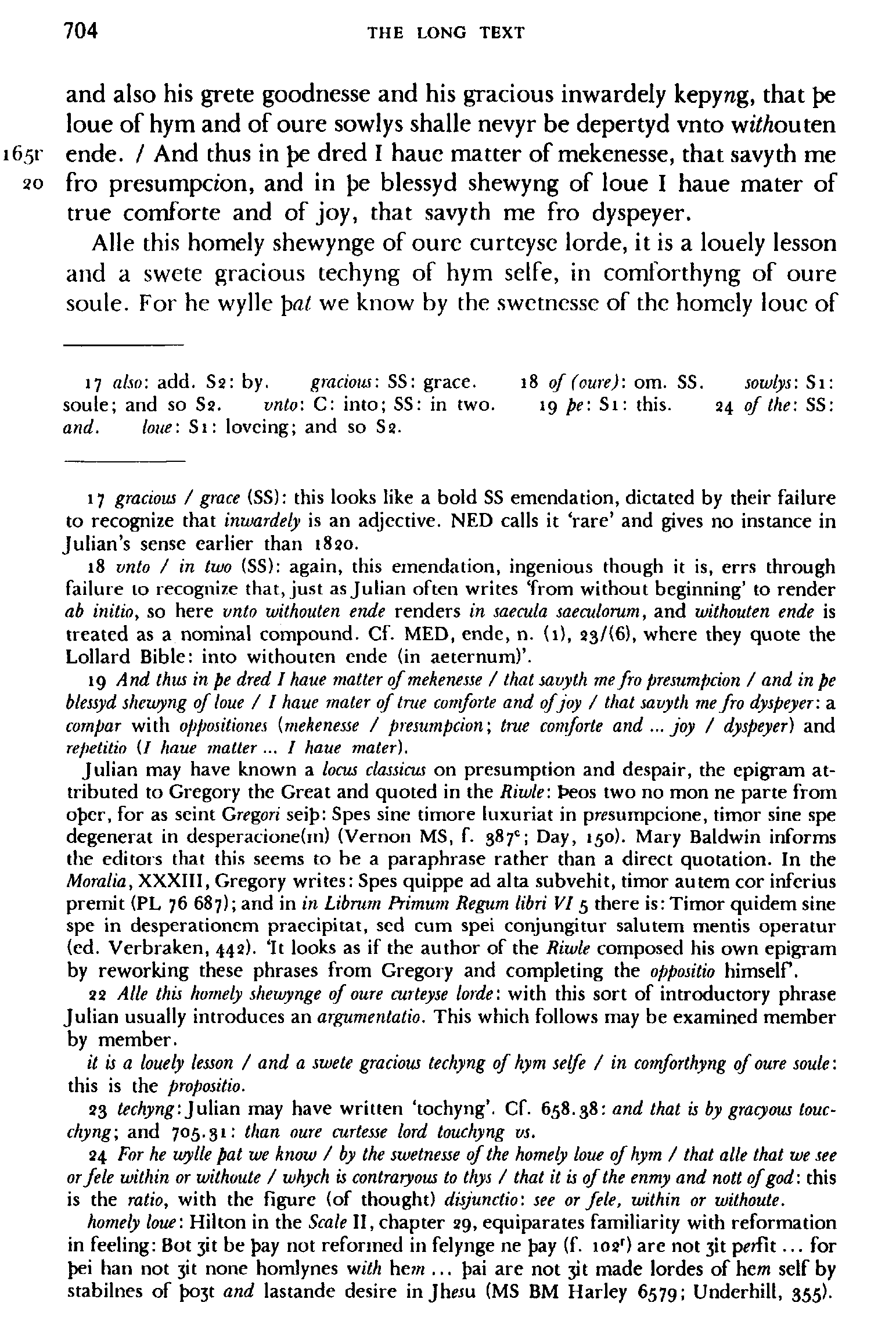
THE LONG TEXT
and also his grete goodnesse and his gracious inwardely kepyrcg, that {>e loue of hym and of oure sowlys shalle nevyr be depertyd vnto w^/iouten
1651 ende. / And thus in J>e dred I hauc matter of mekenesse, that savyth me 20 fro presumpczon, and in pe blessyd shewyng of loue I haue mater of true comforte and of joy, that savyth me fro dyspeyer.
Alle this homely shewynge of ourc curteysc lorde, it is a louely lesson and a swete gracious techyng of hym selfe, in comforthyng of oure soule. For he wylle 1pat we know by the swetnesse of the homely loue of 17 aha: add. 82: by. gracious: SS: grace.
18 of (oure): om. SS. sowlys: Si: soule; and so Si?. vnto: C: into; SS: in two.
19 pe: Si: this.
24 of the: SS: and. loue: Si: lovcing; and so 82.
17 gracious / grace (SS): this looks like a bold SS emendation, dictated by their failure to recognize that inwardely is an adjective. NED calls it 'rare' and gives no instance in Julian's sense earlier than 1820.
18 vnto / in two (SS): again, this emendation, ingenious though it is, errs through failure to recognize that, just as Julian often writes 'from without beginning' to render ab initio, so here vnto withouten ende renders in saecula saeculorum, and withouten ende is treated as a nominal compound. Cf. MED, ende, n. (i), 23/(6), where they quote the Lollard Bible: into withouten ende (in aeternum)'.
19 And thus in pe dred I haue matter of mekenesse / that savyth me fro presumption / and in pe blessyd shewyng of loue / I haue mater of true comforte and of joy / that savyth me fro dyspeyer: a cornpar with oppositions (mehenesse / presumption; true comforte and ... joy / dyspeyer) and repetitio (I haue matter ... I haue mater).
Julian may have known a locus dassicus on presumption and despair, the epigram attributed to Gregory the Great and quoted in the Riwle: t>eos two no mon ne parte from oper, for as seint Gregori seijj; Spes sine timore luxuriat in presumpcione, timor sine spe degenerat in desperacione(m) (Vernon MS, f. 387°; Day, 150). Mary Baldwin informs the editors that this seems to be a paraphrase rather than a direct quotation. In the Moralia, XXXIII, Gregory writes: Spes quippe ad alta subvehit, timor autem cor inferius premit (PL 76 687); and in in Librum Primum Regum libri VI 5 there is: Timor quidem sine spe in desperationem praecipitat, sed cum spei conjungitur salutem mentis operatur
(ed. Verbraken, 442). 'It looks as if the author of the Riwle composed his own epigram by reworking these phrases from Gregory and completing the oppositio himself.
22 Alle this homely shewynge of oure curteyse lorde: with this sort of introductory phrase
Julian usually introduces an argumentatio. This which follows may be examined member by member. it is a louely lesson / and a swete gracious techyng of hym selfe / in comforthyng of oure soule: this is the propositio.
23 techyng: Julian may have written 'tochyng'. Cf. 658.38: and that is by gracyous toucchyng; and 705.31: than oure curtesse lord touchyng vs.
24 For he wylle pat we know / by the swetnesse of the homely loue of hym / that alle that we see orfele within or withoute / whych is contraryous to thys / that it is of the enmy and nott of god: this is the ratio, with the figure (of thought) disjunctio: see or fete, within or withoute. homely loue: Hilton in the Scale II, chapter 29, equiparates familiarity with reformation in feeling: Bot ;jit be J>ay not reformed in felynge ne pay (f. i02r) are not 3it perfit... for J)ei han not 3it none homlynes with hem ... pai are not jit made lordes of hem self by stabilnes of |x>3t and lastande desire in Jh«u (MS BM Harley 6579; Underbill, 355).
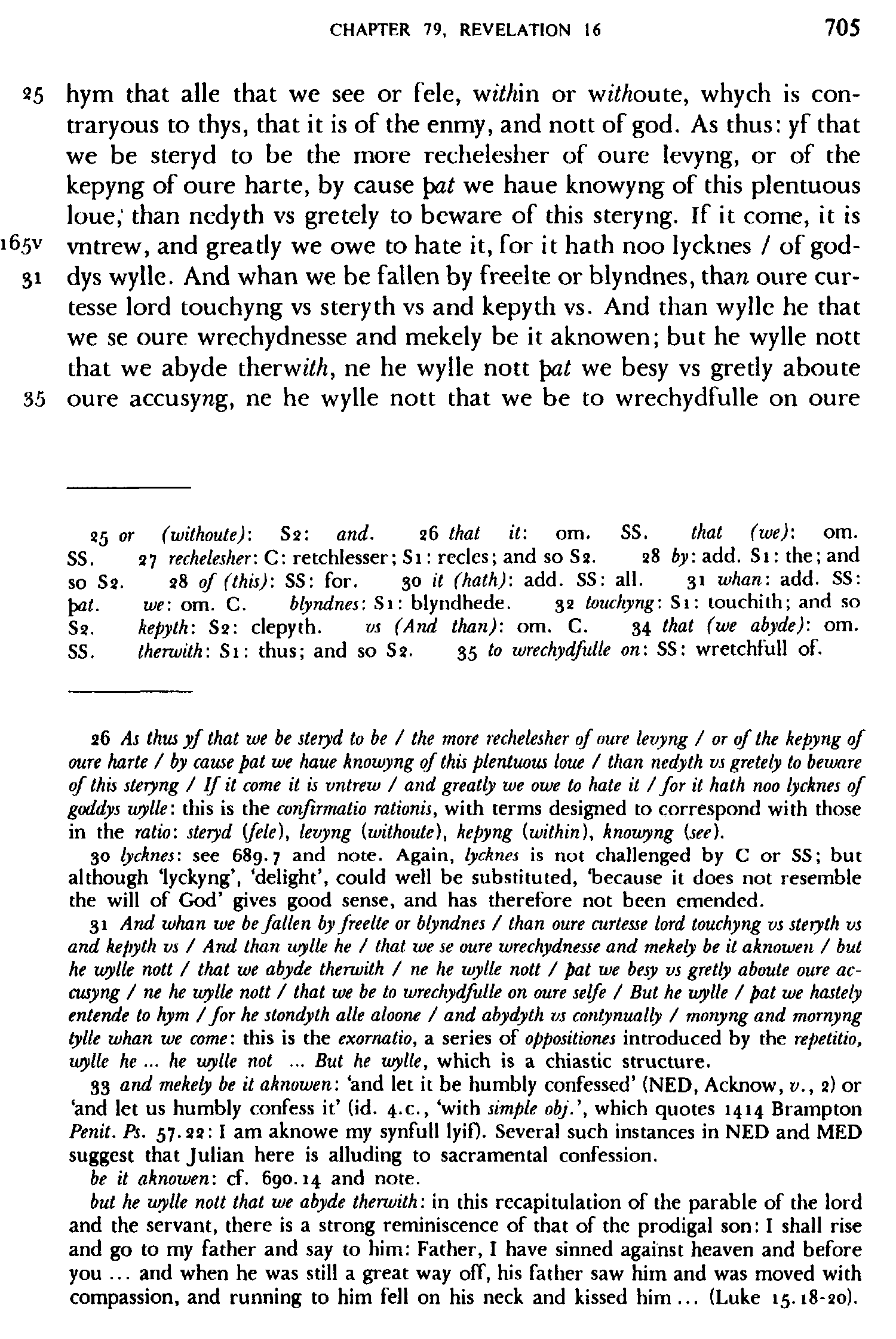
CHAPTER 79, REVELATION 16
25 hym that alle that we see or fele, within or withoute, whych is contraryous to thys, that it is of the enmy, and nott of god. As thus: yf that we be steryd to be the more rechelesher of oure levyng, or of the kepyng of oure harte, by cause \>at we haue knowyng of this plentuous loue,1 than nedyth vs gretely to beware of this steryng. If it come, it is
65V vntrew, and greatly we owe to hate it, for it hath noo lycknes / of godSi dys wylle. And whan we be fallen by freelte or blyndnes, than oure curtesse lord touchyng vs steryth vs and kepyth vs. And than wylle he that we se oure wrechydnesse and mekely be it aknowen; but he wylle nott that we abyde therwith, ne he wylle nott \>at we besy vs gretly aboute
35 oure accusyng, ne he wylle nott that we be to wrechydfulle on oure 25 or (withoute):
82: and.
26 that it: om.
SS. that (we): om.
SS.
27 rechelesher: C: retchlesser; Si: recles; and so 82.
28 by: add. Si: the; and so 82.
28 of (this): SS: for.
30 it (hath): add. 88: all.
31 whan: add. SS:
Jxzi. we: om. C. blyndnes: Si: blyndhede.
32 touchyng: Si: touchith; and so 82. kepyth: 82: clepyth. vs (And than): om. C.
34 that (we abyde): om.
SS. therwith: Si: thus; and so 82.
35 to wrechydfulle on: SS: wretchfull of.
26 As thus yf that we be steryd to be / the more rechelesher of oure levyng / or of the kepyng of oure harte / by cause pat we haue knowyng of this plentuous loue / than nedyth vs gretely to beware of this steryng / If it come it is vntrew / and greatly we owe to hate it /for it hath noo lycknes of goddys wylle: this is the conftrmatio rationii, with terms designed to correspond with those in the ratio: steryd (fele), levyng (withoute), kepyng (within), knowyng (see).
30 lycknes: see 689.7 anc' note. Again, lycknes is not challenged by C or SS; but although 'lyckyng', 'delight', could well be substituted, "because it does not resemble the will of God' gives good sense, and has therefore not been emended.
31 And whan we befallen by freelte or blyndnes / than oure curtesse lord touchyng vs steryth vs and kepyth vs / And than wylle he / that we se oure wrechydnesse and mekely be it aknowen / but he wylle nott / that we abyde therwith / ne he wylle nott / pat we besy vs gretly aboute oure accusyng / ne he wylle nott / that we be to wrechydfulle on oure selfe / But he wylle / pat we hastely entende to hym /for he stondyth alle aloone / and abydyth vs contynually / monyng and mornyng tylle whan we come: this is the exornatio, a series of oppositiones introduced by the repetitio, wylle he ... he wylle not ... But he wylle, which is a chiastic structure.
33 and mekely be it aknowen: 'and let it be humbly confessed' (NED, Acknow, v., 2) or 'and let us humbly confess it' (id. 4-c., 'with simple obj.\ which quotes 1414 Brampton
Penit. Ps. 57.22:1 am aknowe my synfull lyif). Several such instances in NED and MED suggest that Julian here is alluding to sacramental confession. be it aknowen: cf. 690.14 and note. but he wylle nott that we abyde therwith: in this recapitulation of the parable of the lord and the servant, there is a strong reminiscence of that of the prodigal son: I shall rise and go to my father and say to him: Father, I have sinned against heaven and before you ... and when he was still a great way off, his father saw him and was moved with compassion, and running to him fell on his neck and kissed him ... (Luke 15.18-20).
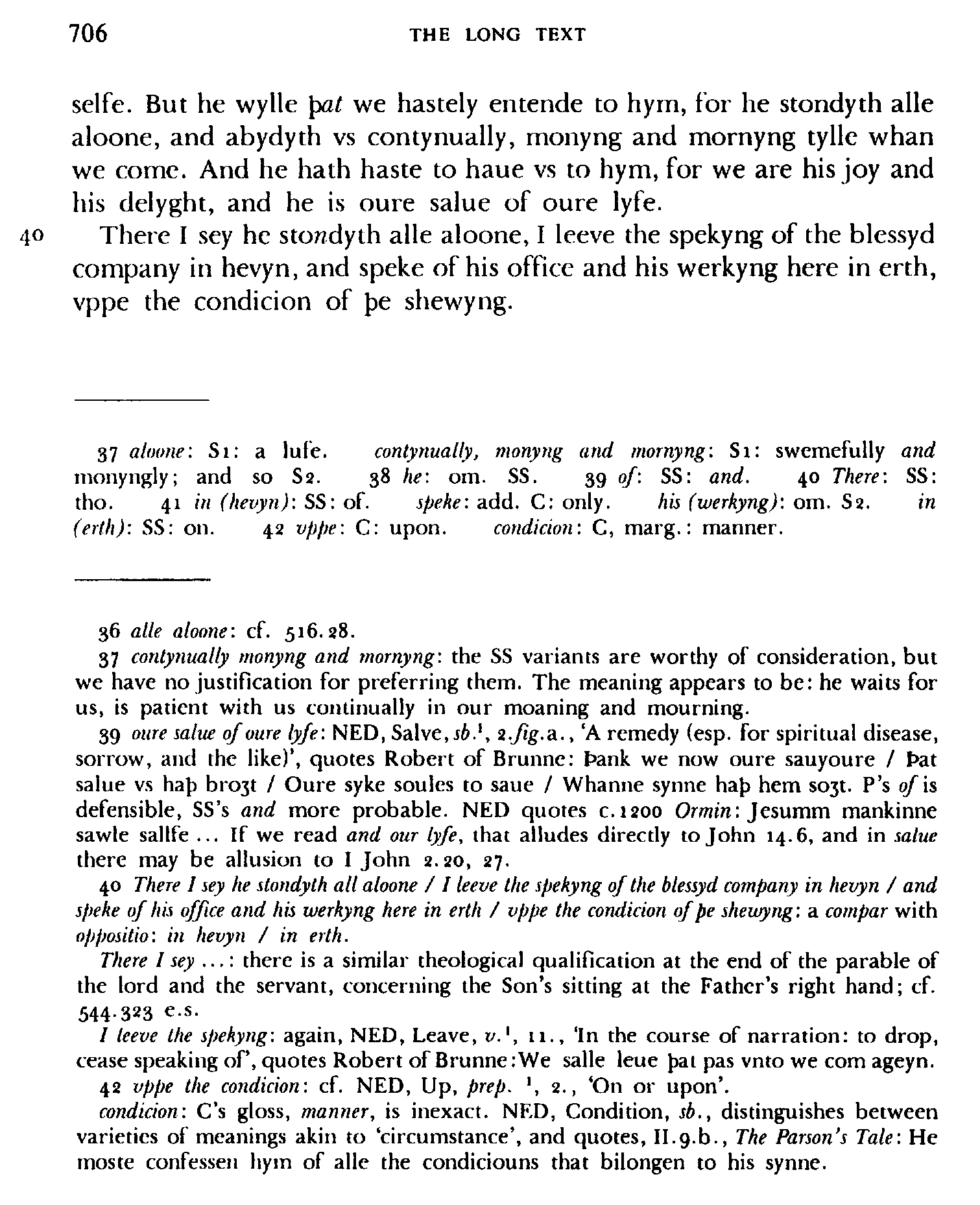
THE LONG TEXT
selfe. But he wylle \Mt we hastely entende to hym, for he stondyth alle aloone, and abydyth vs contynually, monyng and mornyng tylle whan we come. And he hath haste to haue vs to hym, for we are his joy and his delyght, and he is oure salue of oure lyfe.
There I sey he stondyth alle aloone, I leeve the spekyng of the blessyd company in hevyn, and speke of his office and his werkyng here in erth, vppe the condicion of Jje shewyng.
37 aloone: Si: a lufe. contynually, monyng and mornyng: Si: swemefully and monyngly; and so Sa.
38 he: om.
SS.
39 of: SS: and.
40 There: SS: tho.
41 in (hevyn): SS: of. speke: add. C: only. his (werkyng): om. 82. in (erth): SS: on.
42 vppe: C: upon. condicion: C, marg.: manner.
36 alle aloone: cf. 516.28.
37 contynually monyng and mornyng: the SS variants are worthy of consideration, but we have no justification for preferring them. The meaning appears to be: he waits for us, is patient with us continually in our moaning and mourning.
39 oure salue of oure lyfe: NED, Salve, sb.1, s.fig.a.., 'A remedy (esp. for spiritual disease, sorrow, and the like)', quotes Robert of Brunne: f>ank we now oure sauyoure / t>at salue vs ha£> brojt / Oure syke soules to saue / Whanne synne haj> hem 5031. P's of is defensible, SS's and more probable. NED quotes c.iaoo Ormm:Jesumm mankinne sawle sallfe ... If we read and our lyfe, that alludes directly to John 14.6, and in salue there may be allusion to I John 2.20, 27.
40 There I sey he stondyth all aloone / I leeve the spekyng of the blessyd company in hevyn / and speke of his office and his werkyng here in erth / vppe the condicion ofpe shewyng: a compar with oppositio: in hevyn / in erth.
There I sey ...: there is a similar theological qualification at the end of the parable of the lord and the servant, concerning the Son's sitting at the Father's right hand; cf.
544.323 e.s.
/ leeve the spekyng: again, NED, Leave, i/.', 11., 'In the course of narration: to drop, cease speaking of, quotes Robert of Brunne: We salle leue J»t pas vnto we com ageyn.
42 vppe the condicion: cf. NED, Up, prep. ' , 2 . , 'On or upon'. condicion: C's gloss, manner, is inexact. NED, Condition, sb., distinguishes between varieties of meanings akin to 'circumstance', and quotes, Il.g.b., The Parson's Tale: He moste confessen hym of alle the condiciouns that bilongen to his synne.
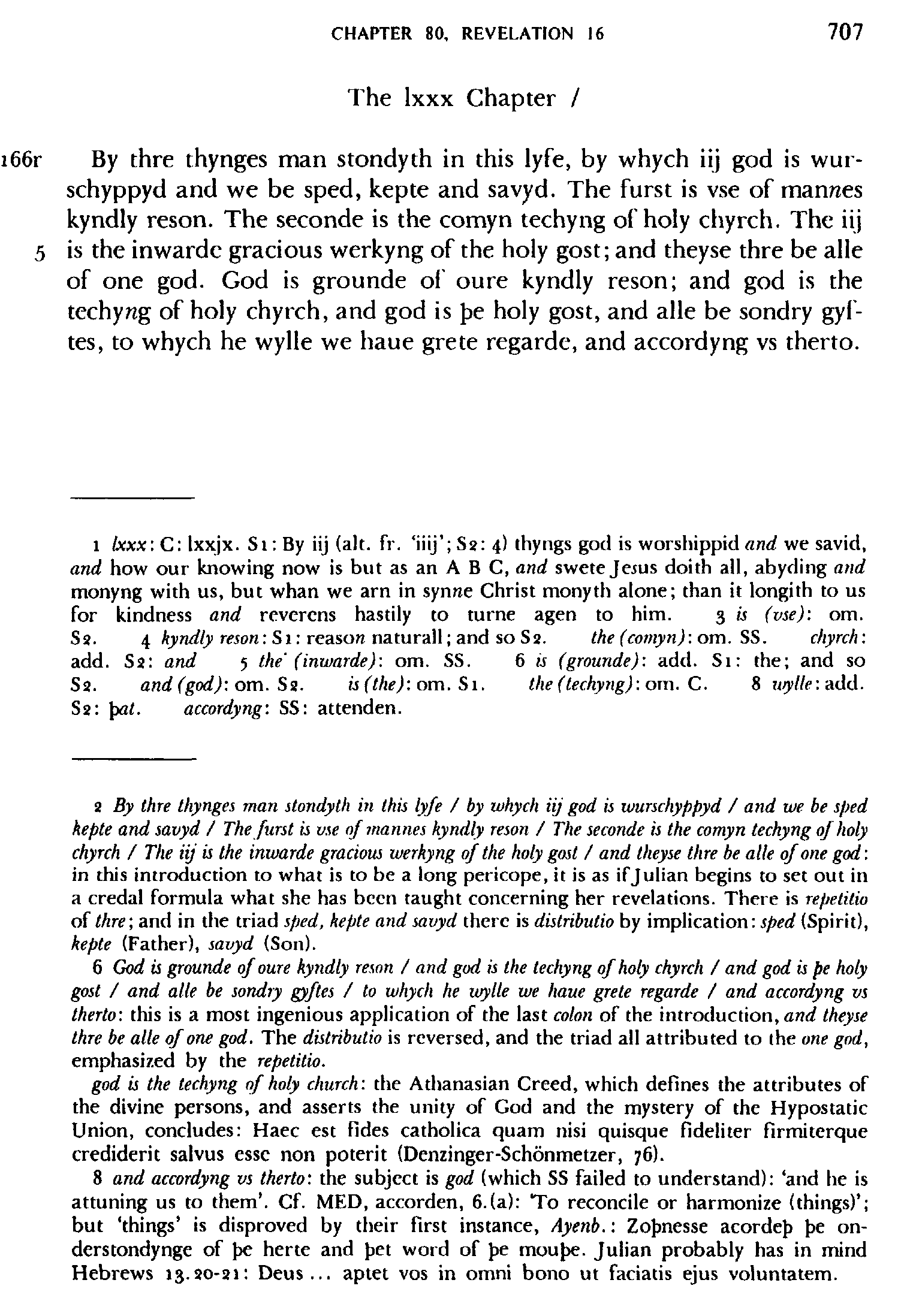
CHAPTER 80, REVELATION 16
The Ixxx Chapter / i66r By thre thynges man stondyth in this lyfe, by whych iij god is wurschyppyd and we be sped, kepte and savyd. The furst is vse of mamzes kyndly reson. The seconde is the comyn techyng of holy chyrch. The iij
5 is the inwarde gracious werkyng of the holy gost; and theyse thre be alle of one god. God is grounde of oure kyndly reson; and god is the techyng of holy chyrch, and god is JDC holy gost, and alle be sondry gyftes, to whych he wylle we haue grete regarde, and accordyng vs therto. i Ixxx: C: Ixxjx. Si: By iij (alt. fr. 'iiij'; 82: 4) thyngs god is worshippid and we savid, and how our knowing now is but as an A B C, and swete Jesus doith all, abyding and monyng with us, but whan we arn in synree Christ monyth alone; than it longith to us for kindness and reverens hastily to turne agen to him.
3 is (vse): om.
82.
4 kyndly reson: Si: reasow naturall; and so 82. the (comyn): om. 88. chyrch: add. 82: and 5 the'(inwarde): om. SS.
6 « (grounde): add. Si: the; and so 82. and (god): om. 82. is (the): om. Si. the (techyng): om. C.
8 wylle: add.
82: \>at. accordyng: 88: attenden.
2 By thre thynges man stondyth in this lyfe / by whych iij god is wurschyppyd / and we be sped kepte and savyd / The furst is vse of marines kyndly reson / The seconde is the comyn techyng of holy chyrch / The iij is the inwarde gracious werkyng of the holy gost / and theyse thre be alle of one god: in this introduction to what is to be a long pericope, it is as ifjulian begins to set out in a credal formula what she has been taught concerning her revelations. There is refietitio of thre; and in the triad sped, kepte and savyd there is distributio by implication: sped (Spirit), kepte (Father), savyd (Son).
6 God is grounde of oure kyndly reson / and god is the techyng of holy chyrch / and god is pe holy gost / and alle be sondry gyftes / to whych he wylle we haue grete regarde / and accordyng vs therto: this is a most ingenious application of the last colon of the introduction, and theyse thre be alle of one god. The distributio is reversed, and the triad all attributed to the one god, emphasized by the repetitio. god is the techyng of holy church: the Athanasian Creed, which defines the attributes of the divine persons, and asserts the unity of God and the mystery of the Hypostatic
Union, concludes: Haec est fides catholica quam nisi quisque fideliter firmiterque crediderit salvus esse non poterit (Denzinger-Schonmetzer, 76).
8 and accordyng vs therto: the subject is god (which SS failed to understand): 'and he is attuning us to them*. Cf. MED, accorden, 6.(a): To reconcile or harmonize (things)'; but 'things' is disproved by their first instance, Ayenb.: Zopnesse acordej) pe onderstondynge of pe herte and pet word of pe moupe. Julian probably has in mind
Hebrews 13.20-21: Deus... aptet vos in omni bono ut faciatis ejus voluntatem.
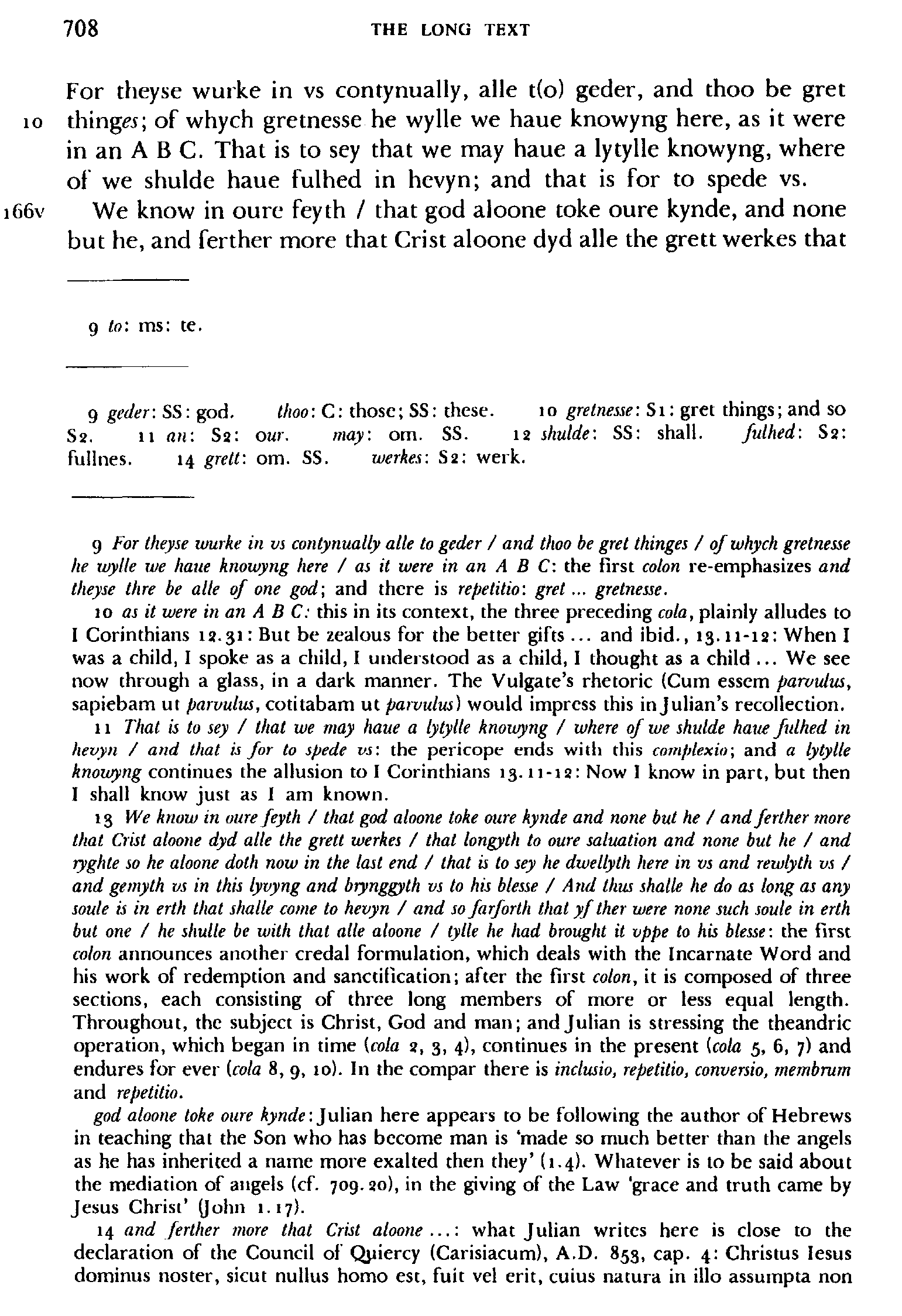
THE LONG TEXT
For theyse wurke in vs contynually, alle t(o) geder, and thoo be gret 10 things; of whych gretnesse he wylle we haue knowyng here, as it were in an A B C. That is to sey that we may haue a lytylle knowyng, where of we shulde haue fulhed in hevyn; and that is for to spede vs. iG6v We know in oure feyth / that god aloone toke oure kynde, and none but he, and ferther more that Crist aloone dyd alle the grett werkes that 9 to: ms: te.
9 geder: SS: god. thoo: C: those; SS: these.
10 gretnesse: Si: gret things; and so 82.
11 an: 82: our. may: om. SS.
12 shulde: SS: shall. fulhed: 82: fullnes.
14 grett: om. 88. werkes: 82: werk.
9 For theyse wurke in vs contynually alle to geder / and thoo be gret thinges / of whych gretnesse he wylle we haue knowyng here / as it were in an A B C: the first colon re-emphasizes and theyse thre be alle of one god; and there is repetitio: gret... gretnesse.
10 as it were in an A B C: this in its context, the three preceding cola, plainly alludes to I Corinthians 12.31: But be zealous for the better gifts ... and ibid., 13.11-12: When I was a child, I spoke as a child, I understood as a child, I thought as a child ... We see now through a glass, in a dark manner. The Vulgate's rhetoric (Cum essem parvulus, sapiebam ut parvulus, cotitabam ut parvulus) would impress this in Julian's recollection.
11 That is to sey / that we may haue a lytylle knowyng / where of we shulde haue fulhed in hevyn / and that is for to spede vs: the pericope ends with this complexio; and a lytylle knowyng continues the allusion to I Corinthians 13.11-12: Now I know in part, but then
I shall know just as I am known.
13 We know in oure feyth / that god aloone toke oure kynde and none but he / and ferther more that Crist aloone dyd alle the grett werkes / that longyth to oure saluation and none but he / and ryghte so he aloone doth now in the last end / that is to sey he dwellyth here in vs and rewlyth vs / and gemyth vs in this lyvyng and brynggyth vs to his blesse / And thus shalle he do as long as any soule is in erth that shalle come to hevyn / and sofarforth that yfther were none such soule in erth but one / he shulle be with that alle aloone / tylle he had brought it vppe to his blesse: the first colon announces another credal formulation, which deals with the Incarnate Word and his work of redemption and sanctification; after the first colon, it is composed of three sections, each consisting of three long members of more or less equal length.
Throughout, the subject is Christ, God and man; and Julian is stressing the theandric operation, which began in time (cola 2, 3, 4), continues in the present (cola 5, 6, 7) and endures for ever (cola 8, 9, 10). In the compar there is inclusio, repetitio, conversio, membrum and repetitio. god aloone toke oure kynde: Julian here appears to be following the author of Hebrews in teaching that the Son who has become man is 'made so much better than the angels as he has inherited a name more exalted then they' (1.4). Whatever is to be said about the mediation of angels (cf. 709.20), in the giving of the Law 'grace and truth came by Jesus Christ' (John 1.17).
14 and ferther more that Crist aloone...: what Julian writes here is close to the declaration of the Council of Quiercy (Carisiacum), A.D. 853, cap. 4: Christus lesus dominus noster, sicut nullus homo est, fuit vel erit, cuius natura in illo assumpta non
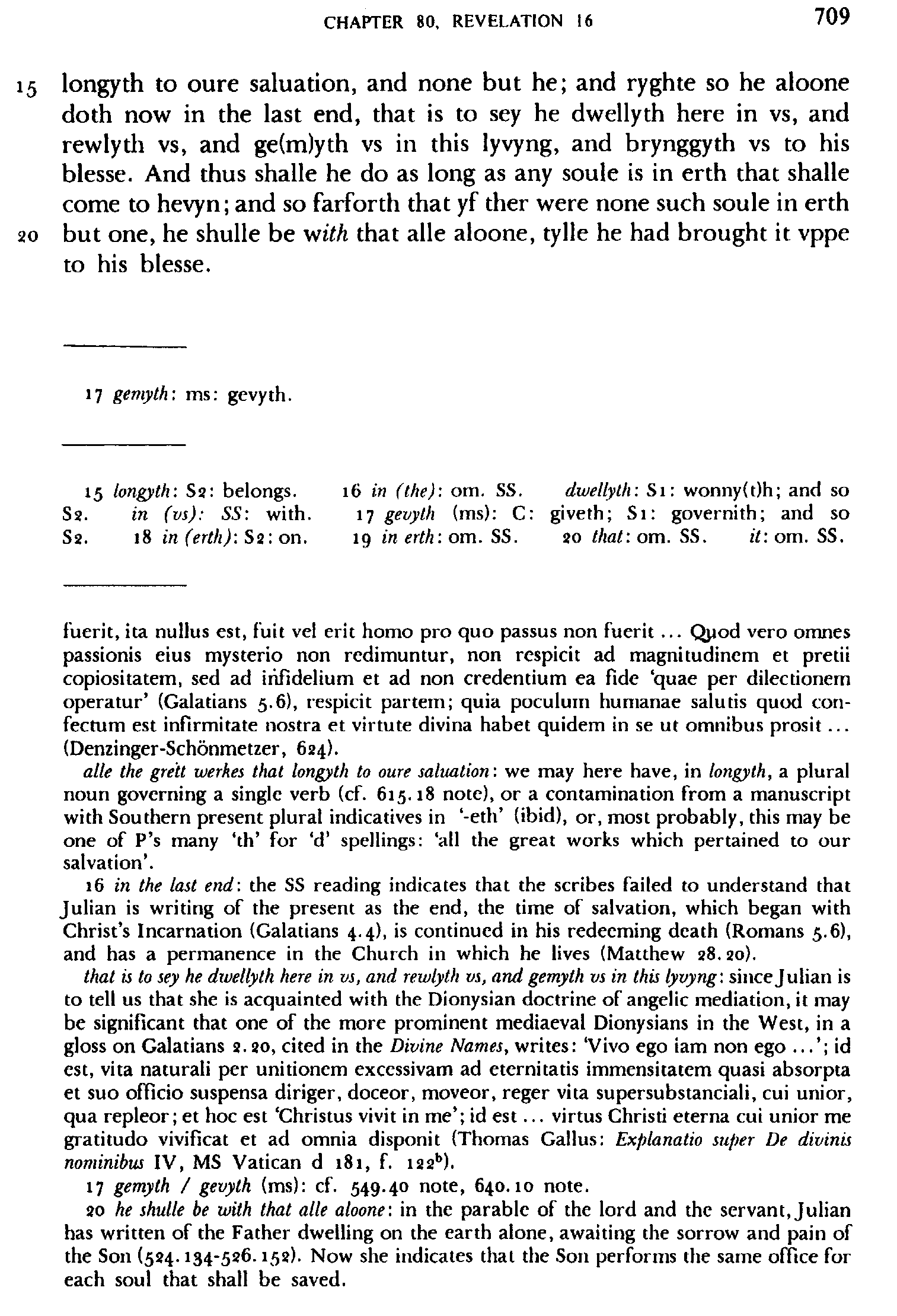
CHAPTER 80, REVELATION 16
15 longyth to oure saluation, and none but he; and ryghte so he aloone doth now in the last end, that is to sey he dwellyth here in vs, and rewlyth vs, and ge(m)yth vs in this lyvyng, and brynggyth vs to his blesse. And thus shalle he do as long as any soule is in erth that shalle come to hevyn; and so farforth that yf ther were none such soule in erth
20 but one, he shulle be with that alle aloone, tylle he had brought it vppe to his blesse.
17 gemyth: ms: gevyth.
15 longyth: S s : belongs.
16 in (the): om. SS. dwellyth: Si: wonny(t)h; and so 82. in (vs): SS: with.
17 gevylh (ms): C: giveth; Si: governith; and so Sa.
18 in (erth): Ss: on.
19 in erth: om. SS.
20 that: om. SS. it: om. SS. fuerit, ita nullus est, f'uit vel erit homo pro quo passus non fuerit ... Quod vero omnes passionis eius mysterio non redimuntur, non respicit ad magnitudinem et pretii copiositatem, sed ad infidelium et ad non credentium ea fide 'quae per dilectionem operatur' (Galatians 5.6), respicit par tern; quia poculum humanae salutis quod confectum est infirmitate nostra et virtute divina habet quidem in se ut omnibus prosit ...
(Denzinger-Schonmetzer, 624). alle the grett werkes that longyth to oure saluation: we may here have, in longyth, a plural noun governing a single verb (cf. 615.18 note), or a contamination from a manuscript with Southern present plural indicatives in '-eth' (ibid), or, most probably, this may be one of P's many 'th' for 'd' spellings: 'all the great works which pertained to our salvation'.
16 in the last end: the SS reading indicates that the scribes failed to understand that Julian is writing of the present as the end, the time of salvation, which began with Christ's Incarnation (Galatians 4.4), is continued in his redeeming death (Romans 5.6), and has a permanence in the Church in which he lives (Matthew 28.20). that is to sey he dwellyth here in vs, and rewlyth vs, and gemyth vs in this lyvyng: since Julian is to tell us that she is acquainted with the Dionysian doctrine of angelic mediation, it may be significant that one of the more prominent mediaeval Dionysians in the West, in a gloss on Galatians 2.20, cited in the Divine Names, writes: 'Vivo ego iam non ego ...'; id est, vita naturali per unitionem excessivam ad eternitatis immensitatem quasi absorpta et suo officio suspensa diriger, doceor, moveor, reger vita supersubstanciali, cui unior, qua repleor; et hoc est 'Christus vivit in me'; id est... virtus Christ! eterna cui unior me gratitude vivificat et ad omnia disponit (Thomas Gallus: Explanatio suffer De divinis nominibus IV, MS Vatican d 181, f. i22b).
17 gemyth / gevyth (ms): cf. 549.40 note, 640.10 note.
20 he shulle be with that alle aloone: in the parable of the lord and the servant, Julian has written of the Father dwelling on the earth alone, awaiting the sorrow and pain of the Son (524.134-526.152). Now she indicates that the Son performs the same office for each soul that shall be saved.
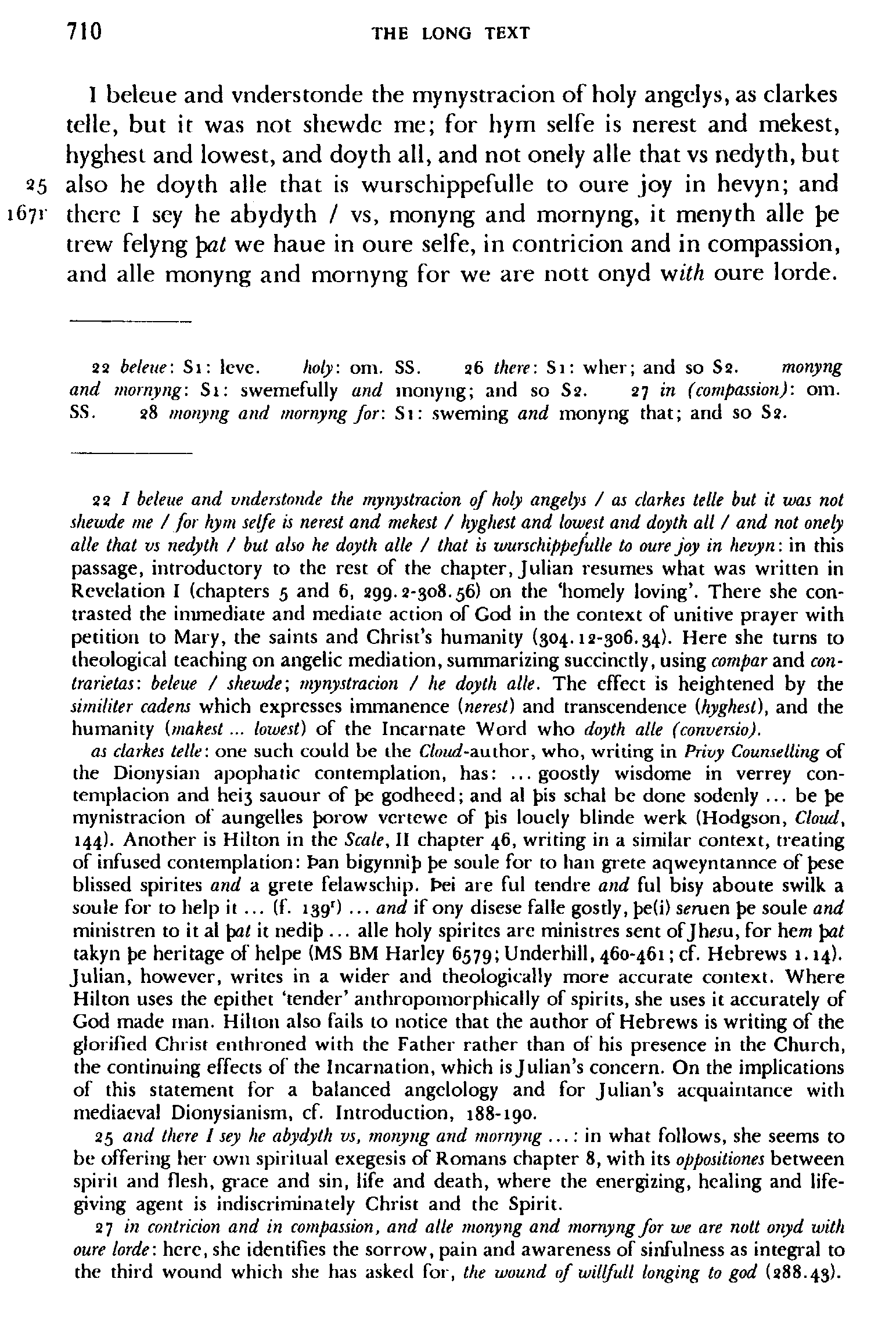
THE LONG TEXT
I beleue and vnderstonde the mynystracion of holy angclys, as clarkes telle, but it was not shewdc me; for hym selfe is nerest and mekest, hyghest and lowest, and doyth all, and not onely alle that vs nedyth, but 25 also he doyth alle that is wurschippefulle to oure joy in hevyn; and 1671 there I sey he abydyth / vs, monyng and mornyng, it menyth alle fye trew felyng \>at we haue in oure selfe, in contricion and in compassion, and alle monyng and mornyng for we are nott onyd with oure lorde.
22 beleue: Si: Icve. holy: om. SS.
26 there: Si: wher; and so 82. monyng and mornyng: Si: swemefully and monyng; and so 82.
27 in (compassion): om.
SS.
28 monyng and mornyng for: Si: sweming and monyng that; and so 82.
22 / beleue and vnderstonde the mynystracion of holy angelys / as clarkes telle but it was not shewde me /for hym selfe is nerest and mekest / hyghest and lowest and doyth all / and not onely alle that vs nedyth / but also he doyth alle / that is wurschippefulle to oure joy in hevyn: in this passage, introductory to the rest of the chapter, Julian resumes what was written in Revelation I (chapters 5 and 6, 299.2-308.56) on the 'homely loving'. There she contrasted the immediate and mediate action of God in the context of unitive prayer with petition to Mary, the saints and Christ's humanity (304.12-306.34). Here she turns to theological teaching on angelic mediation, summarizing succinctly, using compar and contrarietas: beleue / shewde; mynystracion / he doyth alle. The effect is heightened by the similiter cadens which expresses immanence (nerest) and transcendence (hyghest), and the humanity (rnakest... lowest) of the Incarnate Word who doyth alle (conversio). as clarkes telle: one such could be the Cloud-author, who, writing in Privy Counselling of the Dionysian apophatic contemplation, has: ...goostly wisdome in verrey contemplacion and hei3 sauour of f>e godheed; and al J>is schal be done sodenly ... be J)e mynistracion of aungelles Jxirow vcrtewe of f>is louely blinde werk (Hodgson, Cloud,
144). Another is Hilton in the Scale, II chapter 46, writing in a similar context, treating of infused contemplation: t>an bigynnif> J>e soule for to han grete aqweyntannce of Jjese blissed spirites and a grete felawschip. t>ei are ful tendre and ful bisy aboute swilk a soule for to help it ... (f. 139') ... and if ony disese falle gostly, J>e(i) smien pe soule and ministren to it al \Mt it nedi|j... alle holy spirites are ministres sent of Jhmi, for hew \>at takyn |>e heritage of helpe (MS BM Harley 6579; Underhill, 460-461; cf. Hebrews 1.14).
Julian, however, writes in a wider and theologically more accurate context. Where
Hilton uses the epithet 'tender' anthropomorphically of spirits, she uses it accurately of God made man. Hilton also fails to notice that the author of Hebrews is writing of the glorified Christ enthroned with the Father rather than of his presence in the Church, the continuing effects of the Incarnation, which is Julian's concern. On the implications of this statement for a balanced angclology and for Julian's acquaintance with mediaeval Dionysianism, cf. Introduction, 188-190.
25 and there I sey he abydyth vs, monyng and mornyng ...: in what follows, she seems to be offering her own spiritual exegesis of Romans chapter 8, with its oppositiones between spirit and flesh, grace and sin, life and death, where the energizing, healing and lifegiving agent is indiscriminately Christ and the Spirit.
27 in contricion and in compassion, and alle monyng and mornyng for we are nott onyd with oure lorde: here, she identifies the sorrow, pain and awareness of sinfulness as integral to the third wound which she has asked for, the wound of willfull longing to god (288.43).
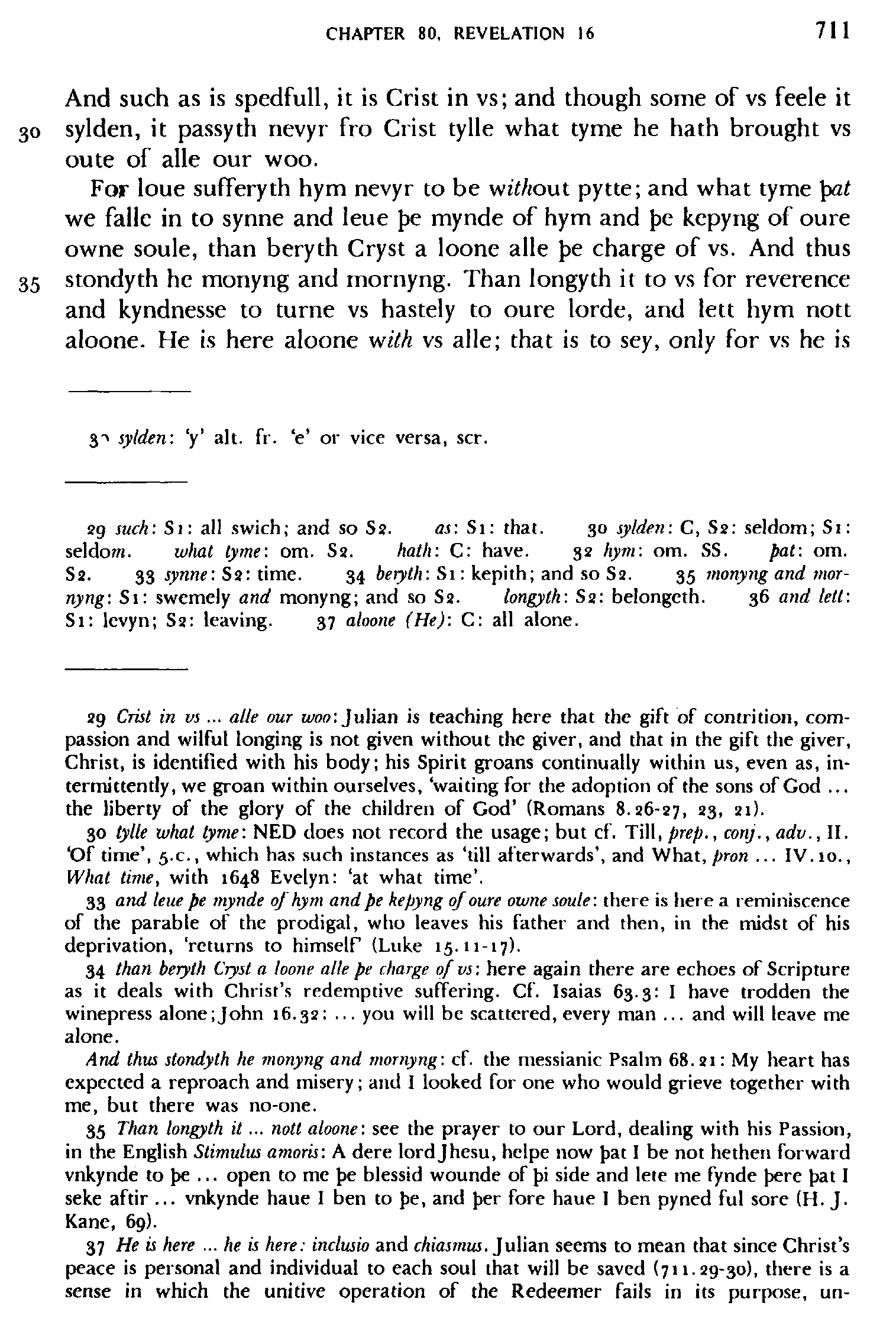
CHAPTER 80, REVELATION 16
And such as is spedfull, it is Crist in vs; and though some of vs feele it 30 sylden, it passyth nevyr fro Crist tylle what tyme he hath brought vs oute of alle our woo.
For loue sufferyth hym nevyr to be without pytte; and what tyme \>at we fallc in to synne and leue ]3e mynde of hym and \>c kepyng of oure owne soule, than beryth Cryst a loone alle JDC charge of vs. And thus
35 stondyth he monyng and mornyng. Than longyth it to vs for reverence and kyndnesse to turne vs hastely to oure lorde, and lett hym nott aloone. He is here aloone with vs alle; that is to sey, only for vs he is
31 sylden: 'y' alt. fr. 'e' or vice versa, scr.
29 such: Si: all swich; and so Si?. as: Si: that.
30 sylden: C, 82: seldom; Si: seldom. what tyme: om. 82. hath: C: have.
32 hym: om. SS. pat: om.
82.
33 synne: 82: time.
34 beryth: Si: kepith; and so 82.
35 monyng and mornyng: Si: swemely and monyng; and so 82. longyth: 82: belongeth.
36 and lett:
Si: levyn; 82: leaving.
37 aloone (He): C: all alone.
29 Crist in vs ... alle our woo: Julian is teaching here that the gift of contrition, compassion and wilful longing is not given without the giver, and that in the gift the giver,
Christ, is identified with his body; his Spirit groans continually within us, even as, intermittently, we groan within ourselves, 'waiting for the adoption of the sons of God ... the liberty of the glory of the children of God' (Romans 8.26-27, 23, 21).
30 tylle what tyme: NED does not record the usage; but cf. Till, prep., conj., adv., II.
'Of time', 5-c., which has such instances as 'till afterwards', and What, pron ... IV. 10.,
What time, with 1648 Evelyn: 'at what time'.
33 and leue pe mynde oj hym and pe kepyng of oure owne soule: there is here a reminiscence of the parable of the prodigal, who leaves his father and then, in the midst of his deprivation, 'returns to himself (Luke 15.11-17).
34 than beryth Cryst a loone alle pe charge of vs: here again there are echoes of Scripture as it deals with Christ's redemptive suffering. Cf. Isaias 63.3: I have trodden the winepress alone;John 16.32: ... you will be scattered, every man ... and will leave me alone.
And thus stondyth he monyng and mornyng: cf. the messianic Psalm 68.21: My heart has expected a reproach and misery; and I looked for one who would grieve together with me, but there was no-one.
35 Than longyth it ... nott aloone: see the prayer to our Lord, dealing with his Passion, in the English Stimulus amoris: A dere lordjhesu, helpe now pat I be not hethen forward vnkynde to pe ... open to me pe blessid wounde of pi side and lete me fynde pere pat I seke aftir ... vnkynde haue I ben to pe, and per fore haue I ben pyned ful sore (H. J.
Kane, 69).
37 He is here ... he is here: indusio and chiasmus. Julian seems to mean that since Christ's peace is personal and individual to each soul that will be saved (711.29-30), there is a sense in which the unitive operation of the Redeemer fails in its purpose, un-
THE LONG TEXT
i6yv here. And what tyme I be straunge to hym by synne, / dyspeyr or slowth, then I lett my lorde stonde aloone, in as moch as he is in me.
4° And thus it faryth with vs all whych be synners; but though it be so \>at we do thus oftyn tymes, his goodnesse sufferyth vs nevyr to be a l<£one, but lastyngly he is with vs and tendyrly he excusyth vs, and evyr kepyth vs from blame in his syght.
38 be:
SS: am.
39 moch:
Si: mekill. he:
SS: it.
40 whych:
82:
\>at.
42 kepyth: Si: sheildith; and so Sa. less and until it is achieved in and with each soul which is destined for heaven. Cf. II Corinthians 5.15: And Christ died for all, so that they also who live may not now live for themselves but for him who died for them.
38 And what tyme I be straunge to hym / by synne dyspeyr or slowth / then I lett my lorde stonde aloone / And thus it faryth with vs all whych be synners / but though it be so pat we do thus oftyn tymes / his goodnesse sufferyth vs nevyr to be a loone / but lastyngly he is with vs / and tendyrly he excusyth vs / and evyr kepyth vs from blame in his syght: the chapter concludes with this
Trinitarian compar (his goodnesse sufferyth vs nevyr — Unity; lastyngly he is with vs — Spirit; tendyrly he excusyth — Son; evyr kepyth — Father) which emphasizes, with its conversio
(lett... aloone — nevyr ... a loone) and its similiter desinens (lastyngly ... tendyrly) the essential oppositio between man's sinful conduct and the Lord's love towards him. straunge to hym: cf. NED, Strange, a., 6., 'With from: Alien, far removed ...', and 7.,
'Unknown, unfamiliar', which quotes 1500-1520, Dunbar: 'so nyce array, so strange to thair abbay'.
CHAPTER 81, REVELATION 16
The Ixxxi Chapter Owre good lorde shewde hym to his creature in dyverse manner both in hevyn and in erth; but I saw hym take no place but in mannes soule. i Ixxxi: C: Ixxx. Si: This blissid woman saw god in divers manners, but she saw him take no resting place but in manys soule; and he will we enjoyen more in his love then sorowen for often falling, remembring reward everlasting and liveing gladly in penance; and why god suffrith synne; and so Ss.
2 to his creature: om. SS. manner: Si: manners; and so 82.
3 and (in): om. Si.
1 The Ixxxi Chapter: after her solemn credal statements of the previous chapter,Julian now begins to review the sum of all her revelations; and this chapter opens with a Trinitarian expotitio.
2 Owre good lorde shewde hym to his creature / in dyverse manner both in hevyn and in erth / but I saw hym take no place' but in mannes soule / He shewde hym in erth in the swete incarnacion and hys blessyd passion / and in other manner he shewde hym in erth where I seyde I saw god in a poynt / and in other manner he shewde hym in erth thus / as it were a pylgrymage / that is to sey he is here with vs ledyng vs / and shalle be tylle whan he hath brought vs / alle to his blysse in hevyn / He shewde hym dyuerse tymes reignyng / as it is afore sayde / but pryncypally in mannes soule / he hath take there his restyng place / and his wurschypfulle cytte / Oute of whych wurschypfulle see / he schalle nevyr ryse ne remeve withoute ende: the topic here is the presence of God, one and three, in his creation, and the manifestation of that presence in and to man. This is stated in the first three cola, and then elaborated, with distributio and repetitio
— complexio. The fourth colon is for the Son, the fifth and sixth cola for the Father, the seventh and eighth for the Spirit; and he is here with vs ledyng vs... explains the Trinitarian purpose of all revelation. With He shewde ... we have a transitio to the second half of the topic, the eternal quality of God's presence in man.
In this catalogue of her shewings, Julian deliberately uses the Johannine term for god's revealing himself in Christ and through his creation, ln<pavi&iv and yavepow, both rendered by the Vulgate as 'manifestare', and here as shewde. The capital text is John
14.21-23: Qui diligit me ... ego diligam eum, et manifestabo ei me ipsum ... Domine, quid ... manifestaturus es nobis te ipsum et non mundo? ... Pater meus diligit eum ... et mansionem apud eum faciemus. to his creature: she has not employed this term for herself since the very beginning of the long text: This reuelation was made to a symple creature vnlettyrde ... (285.2). Here, it is not supported by SS; it is otiose in the context of I saw hym, which immediately follows; and in all probability it is some scribe's gloss. in dyverse manner: there may be in this an echo of the opening of the Epistle to the Hebrews: God who at various times and in different manners spoke in times past...
(1.1).
3 / saw hym take no place but in mannes soule: cf. 643.33: for in mannes soule is his very dwellyng.
THE LONG TEXT
He shewde hym in erth in the swete incarnadon and hys blessyd 5 passion, and in other manner he shewde hym in erth, where I seyde I saw god in a poynt; and in other manner he shewde hym in erth thus, as it were a pylgrymage, that is to sey he is here with vs ledyng vs, and i68r shalle be tylle whan he hath / brought vs alle to his blysse in hevyn.
He shewde hym dyuerse tymes reignyng, as it is a Fore sayde, but 10 pryncypally in mannes soule; he hath take there his restyng place and his wurschypfulle cytte. Oute of whych wurschypfulle see he shalle nevyr ryse ne remeve withoute cnde.
4 hym (in erth in): 82: himself. in (erth in): 82: on. and (hys): add. SS: in.
5 hym (in erth, where): om. 82. seyde: Si: sey; and so 82.
6 in (erth thus):
82: on.
7 a: SS: in. ledyng: Si: bidand; 82: biddand.
8 whan: om.
82.
9 it: om. 82.
10 there: om. 82.
11 see: C, marg.: seat.
4 in the swete incarnadon: this may refer to the first revelation of Mary, in the stature as she was when she conceivede (297.30). More probably, however, it is a general reference to all the sights she had of the Word made flesh. hys blessyd passion: she had written: oure curteyse lorde shewyd his passyon to me in fyue mannered (389.8).
5 where I seyde I saw god in a poynt: cf. chapter 11, beginning: And after this I saw god in a poynte (336.3), which goes on to describe the operation of God in his creatures, which operation, she affirms, is Trinitarian.
6 and in other manner ... to his blysse in hevyn: it is not immediately obvious to which shewing or shewings she is here referring, which may account for the SS stumbling over P's ledyng, which is the obvious word suggested by pylgrymage. as it were a pylgrymage: this analogy for human existence is a mediaeval commonplace, inspiring, in Julian's day alone, William de Guilleville's Pilgrimage of the Life of Man, Piers
Plowman and the long analogy of the pilgrimage to Jerusalem in the Scale, Book II. In Lollai litel child a mother says to her babe: Child, jjou ert a pilgrim in wikidnis ibor, /
£>ou wandrest in J>is fals world, Jjou loke £e bifor (C. Brown, XIV 36). John Sheppey, bishop of Rochester 1352-1360, in a poem inspired by the Apocalypse likens Christ to a bridegroom, a knight, a merchant and a pilgrim; and many contemporary writers compare 'the hardship and loneliness of the pilgrim's lot ... with the lineaments of the Suffering Servant' (cf. E. Colledge: 'A Middle English Christological Poem').
9 He shewde hym dyuerse tymes reignyng, as it is afore sayde: cf. especially 567.30. And Julian's extensive regal and curial vocabulary, with its Scriptural antecedents, is concentrated in her account of the vision of the indwelling in Revelation XVI. Cf. 639-642 and notes.
10 his restyng place: cf. 545.328, 639.6-640.9. As in the Epistle to the Hebrews (3.64.11), the idea of pilgrimage is contrasted with that of a place of peace and rest, with Christ 'as the Son in his own house'.
11 wurschypfulle see: cf. NED, See, sb.{, 2.a., The seat, chair, or throne of a bishop'.
Julian again thinks of the Son as the high priest of Hebrews 4.14-15; cf. 330.57 and note. She has described him in chapter 68 as enthroned in her heart, hyghest byschoppe
(640.7). he shalle nevyr ryse ne remeve withoute ende: cf. 641.15-16.
CHAPTER 81, REVELATION 16
Marvelous and solempne is the place where be lorde dwellyth; and therfore he wylle that we redely intend to his gracious touchyng, more
15 enjoyeng in his hole loue than sorowyng in oure oftyn fallynges.
For it is the most wurschyppe to hym of ony thyrig that we may do that we leue gladly and merely for his loue in oure pennannce. For he beholdyth vs so tendyrly that he seth alle oure lyvyng here to be penanwce. For kynde longyng in vs to hym is a lastyng penannce in vs, / i68v whych penannce he werkyth in vs, and mercyfully he helpyth vs to here
21 it. For his loue makyth hym to long, his wysdom and his truth with his 13 lorde: Si: lond. dwellyth: Si: wonnyth; and so Sa.
15 in (his): Sa: with.
16 to hym: om.
Sa. that: om.
82.
17 leue: C, Sa: live; Si: liven.
18 here to be: SS: and.
19 longyng: Si: loveand; Sa: loving. in vs to hym is a: SS: is to him ay.
20 he (helpyth): om. C.
13 Mervelous and solempne is the place where pe lorde dwellyth / and therfore he wylle / that we redely intend to his gracious touchyng / more enjoyeng in his hole loue / than sorowyng in oure oftyn fallynges: this serves as tramitio to the argumentatio which is to follow.
14 his gracious touchyng: a reminder that the indwelling is dynamic; cf. Ephesians 3.20
(see 480.40 note). More probably, Julian here means the operation of grace (as at 707.5), rather than the felt presence to which she refers at, e.g., 631.36.
15 his hole loue: this seems to refer back to 668.30: he is alle loue.
16 For it is the most wurschyppe to hym / of ony thyng that we may do / that we leue gladly and merely / f o r his loue in oure pennannce: this is the proposilio. the most wurschyppe: the author of the Riwle proposes the same view: Lokep nou hou witterliche vr lord self hit witnessip: Cum sederit filius hominis in sede maiestatis sue
(Matthew 19.28) ... pe seete is reste and ese bitoknep, a3ein pe swynke Jxz< heer is ...
(Vernon MS, f. s88d; Day, 162).
17 For he beholdyth vs so tendyrly / that he seth alle oure lyvyng here to be penannce: this is the ratio. In it, Julian seems to be recalling that the blessed of the Lord are the poor, those who mourn, hunger and thirst and suffer persecution (Matthew 5.3-10).
18 that he seth alle oure lyvyng here to be penannce: this is the view proposed at the beginning of the section on penance in the Riwle: Al is penaunce and strong penaunce \>at je euer dri3ep, myne leoue sustren, al pat 3e euer dop in goode, al pa£ 36 polej> is ow martirdom (Vernon MS, f. 388b; Day, 157).
19 For kynde longyng in vs to hym / is a lastyng pennanceln vs / whych penannce he werkylh in vs / and mercyfully he helpyth vs to here it: this is the rationis confirmatio.
20 and mercyfully he helpyth vs to here it: so in the Riwle we read: ure louerd pet is pe soule spus pet isihd al det heo ded, pauh he heie sitte, he is ful wel ipaied pet heo murned efter him, and he wule bien toward hire mucheles pe swudere mid 3eoue of his grace (Day, 167; not in the Vernon MS).
81 For his loue makyth hym to long / his wysdom and his truth with his ryghtfulhed / makyth hym to suffer vs here / and in this manner he wylle se it in vs: this is the exornatio.
For his loue makyth hym to long: in this complex description of penance Julian is recapitulating all the oppositiones belonging to the revelation which derive from the mystery of the Hypostatic Union; it is the human experience, integral to the existence
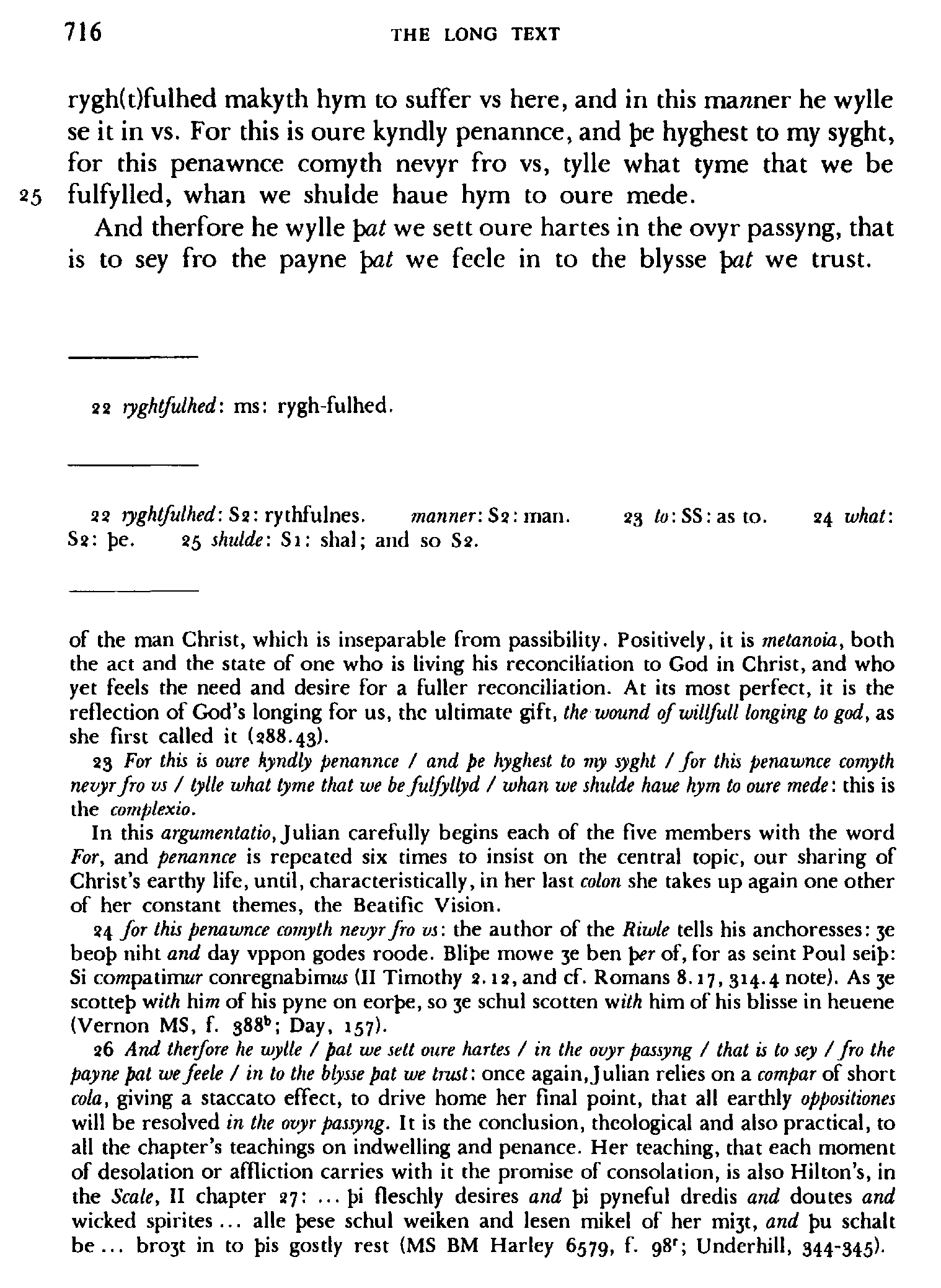
THE LONG TEXT
rygh(t)fulhed makyth hym to suffer vs here, and in this manner he wylle se it in vs. For this is oure kyndly penannce, and J)e hyghest to my syght, for this penawnce cornyth nevyr fro vs, tylle what tyme that we be
25 fulfylled, whan we shulde haue hym to oure mede.
And therfore he wylle \xit we sett oure hartes in the ovyr passyng, that is to sey fro the payne \>at we feele in to the blysse \>at we trust.
22 ryghtfulhed: ms: rygh-fulhed.
22 ryghtfulhed: 82: rythfulnes. manner: 82: man.
23 to: 88: as to.
24 what:
82: pe.
25 shulde: Si: shal; and so 82. of the man Christ, which is inseparable from passibility. Positively, it is metanoia, both the act and the state of one who is living his reconciliation to God in Christ, and who yet feels the need and desire for a fuller reconciliation. At its most perfect, it is the reflection of God's longing for us, the ultimate gift, the wound ofwillfull longing to god, as she first called it (288.43).
23 For this is oure kyndly penannce / and pe hyghest to my syght /for this penawnce comyth nevyr fro vs / tylle what tyme that we befulfyllyd
/ whan we shulde haue hym to oure mede: this is the complexio.
In this argumentatio, Julian carefully begins each of the five members with the word
For, and penannce is repeated six times to insist on the central topic, our sharing of Christ's earthy life, until, characteristically, in her last colon she takes up again one other of her constant themes, the Beatific Vision.
24 for this penawnce comyth nevyr fro vs: the author of the Riwle tells his anchoresses: 36 beoj) niht and day vppon godes roode. Bli^e mowe 36 ben \>er of, for as seint Poul sei]j:
Si cowpatimwr conregnabimw (II Timothy 2.12, and cf. Romans 8.17, 314.4 note). As 36 scottej) with him of his pyne on eorjje, so 36 schul scotten wzf/z him of his blisse in heuene
(Vernon MS, f. 388"; Day, 157).
26 And therfore he wylle / pat we sett oure hartes / in the ovyr passyng / that is to sey /fro the payne pat we feele / in to the blysse pat we trust: once again,Julian relies on a compar of short cola, giving a staccato effect, to drive home her final point, that all earuhly oppositiones will be resolved in the ovyr passyng. It is the conclusion, theological and also practical, to all the chapter's teachings on indwelling and penance. Her teaching, that each moment of desolation or affliction carries with it the promise of consolation, is also Hilton's, in the Scale, II chapter 27: ... J>i fleschly desires and J>i pyneful dredis and doutes and wicked spirites ... alle £ese schul weiken and lesen mikel of her mi3t, and J)u schalt be... bro3t in to Jais gostly rest (MS BM Harley 6579, f. g8r; Underhill, 344-345).
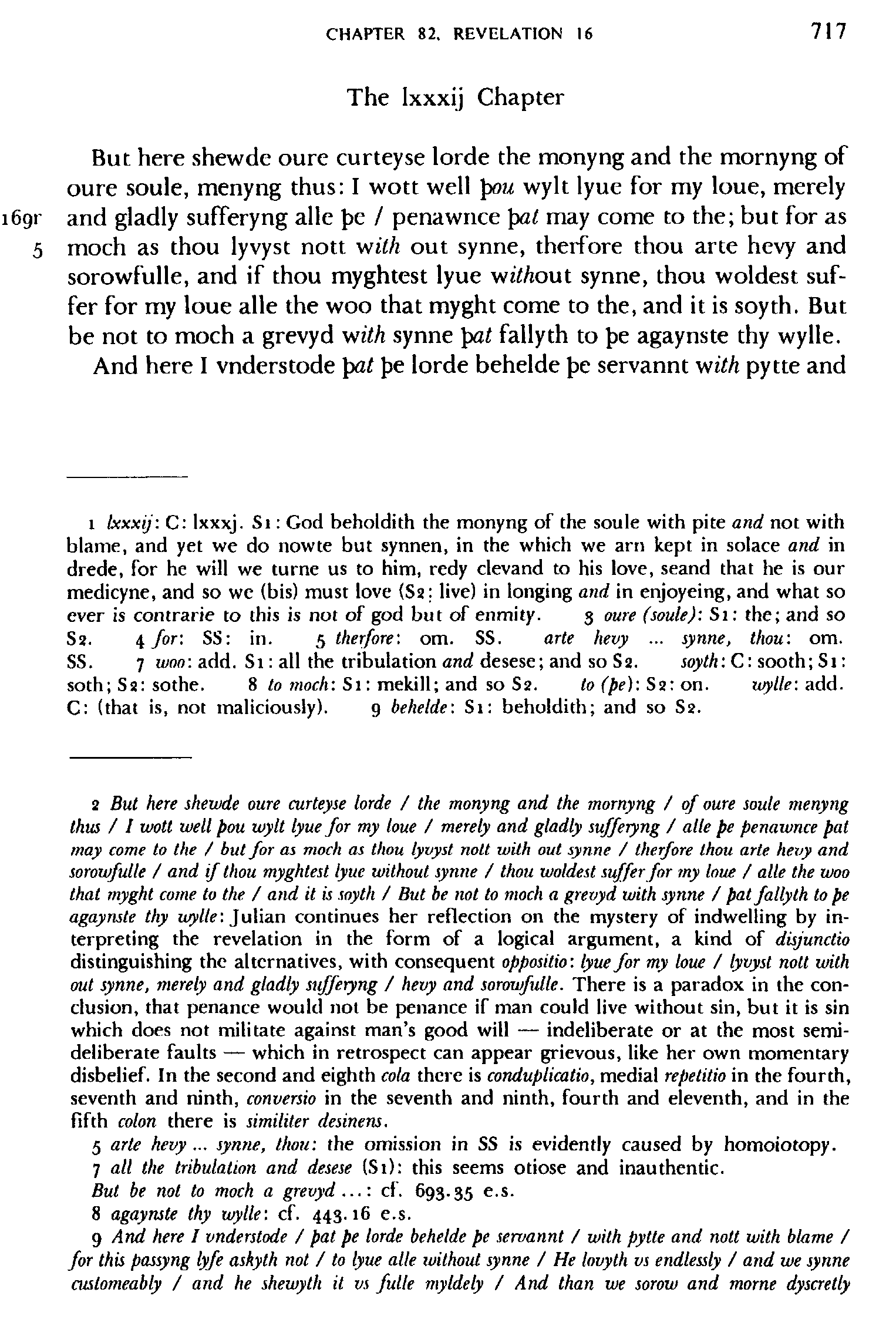
CHAPTER 82, REVELATION 16
The Ixxxij Chapter But here shewde oure curteyse lorde the monyng and the mornyng of oure soule, menyng thus: I wott well tyu wylt lyue for my loue, merely i6gr and gladly sufferyng alle J)e / penawnce \>at may come to the; but for as 5 moch as thou lyvyst nott with out synne, therfore thou arte hevy and sorowfulle, and if thou myghtest lyue -without synne, thou woldest suffer for my loue alle the woo that myght come to the, and it is soyth. But be not to moch a grevyd with synne \>at fallyth to Jse agaynste thy wylle.
And here I vnderstode ]xit £>e lorde behelde JDC servannt -with pytte and i Ixxxij: C: Ixxxj. Si: God beholdith the monyng of the soule with pite and not with blame, and yet we do nowte but synnen, in the which we arn kept in solace and in drede, for he will we turne us to him, redy clevand to his love, seand that he is our medicyne, and so we (bis) must love (Sa; live) in longing and in enjoyeing, and what so ever is contrarie to this is not of god but of enmity.
3 oure (soule): Si: the; and so 82.
4 for: SS: in.
5 therfore: om. SS. arte hevy ... synne, thou: om.
SS.
7 woo: add. Si: all the tribulation and desese; and so S2. soyth: C: sooth; Si: soth; 82: sothe.
S to moch: Si: mekill; and so 82. to (pe): 82: on. wylle: add.
C: (that is, not maliciously).
9 behelde: Si: beholdith; and so 82.
2 But here shewde oure curteyse lorde / the monyng and the mornyng / of oure soule menyng thus / I wott well POU wylt lyue for my loue / merely and gladly sufferyng / alle pe penawnce pat may come to the / but for as moch as thou lyvyst nott with out synne / therfore thou arte hevy and sorowfulle / and if thou myghtest lyue without synne / thou woldest suffer for my loue / alle the woo that myght come to the / and it is soyth / But be not to moch a grevyd with synne / pat fallyth to pe agaynste thy wylle: Julian continues her reflection on the mystery of indwelling by interpreting the revelation in the form of a logical argument, a kind of disjunctio distinguishing the alternatives, with consequent oppositio: lyue for my loue / lyvyst nott with out synne, merely and gladly sufferyng / hevy and sorowfulle. There is a paradox in the conclusion, that penance would not be penance if man could live without sin, but it is sin which does not militate against man's good will — indeliberate or at the most semideliberate faults — which in retrospect can appear grievous, like her own momentary disbelief. In the second and eighth cola there is conduplicatio, medial repetitio in the fourth, seventh and ninth, conversio in the seventh and ninth, fourth and eleventh, and in the fifth colon there is similiter desinens.
5 arte hevy ... synne, thou: the omission in SS is evidently caused by homoiotopy.
7 all the tribulation and desese (Si): this seems otiose and inau then tic.
But be not to moch a grevyd...: cf. 693.35 e.s.
8 agaynste thy wylle: cf. 443.16 e.s.
9 And here I vnderstode / pat pe lorde behelde pe servannt / with pytte and nott with blame / for this passyng lyfe askyth not / to lyue alle without synne / He lovyth vs endlessly / and we synne cuslomeably / and he shewyth it vs fulle myldely /And than we sorow and morne dyscretly
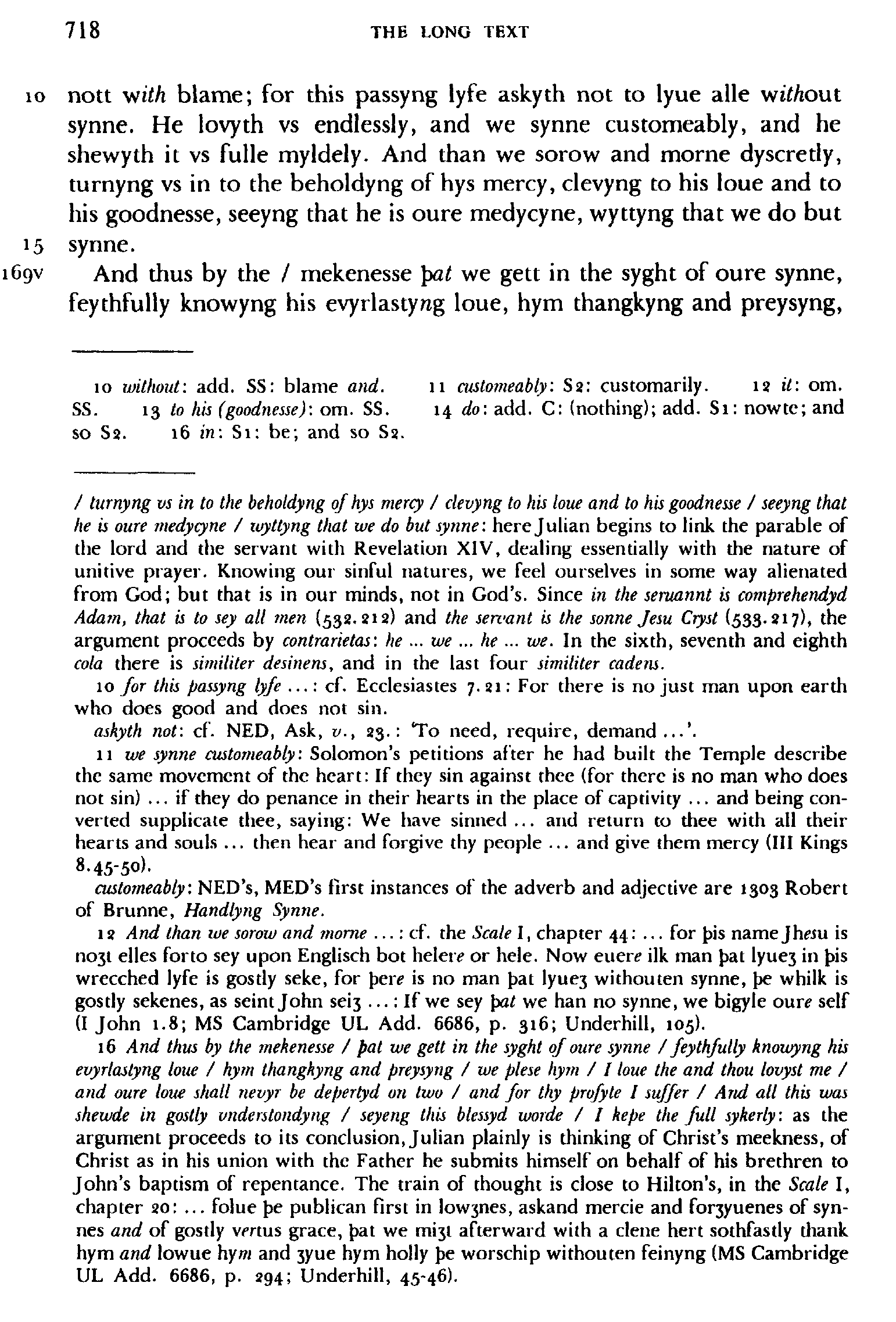
THE LONG TEXT
10 nott with blame; for this passyng lyfe askyth not to lyue alle without synne. He lovyth vs endlessly, and we synne customeably, and he shewyth it vs fulle myldely. And than we sorow and morne dyscretly, turnyng vs in to the beholdyng of hys mercy, clevyng to his loue and to his goodnesse, seeyng that he is oure medycyne, wyttyng that we do but 15 synne. i6gv And thus by the / mekenesse ]xz£ we gett in the syght of oure synne, feythfully knowyng his evyrlastyrcg loue, hym thangkyng and preysyng,
10 without: add. SS: blame and.
11 customeably. Sa: customarily.
12 it: om.
SS.
13 to his (goodnesse): om. SS.
14 do: add. C: (nothing); add. Si: nowtc; and so 82.
16 in: Si: be; and so Sa.
/ turnyng vs in to the beholdyng of hys mercy / clevyng to his loue and to his goodnesse / seeyng that he is oure medycyne / wyttyng that we do but synne: here Julian begins to link the parable of the lord and the servant with Revelation XIV, dealing essentially with die nature of unitive prayer. Knowing our sinful natures, we feel ourselves in some way alienated from God; but that is in our minds, not in God's. Since in the seruannt is comprehendyd
Adam, that is to sey all men (532.212) and the servant is the sonne Jesu Cryst (533.217), the argument proceeds by contrarietas: he ... we ... he ... we. In the sixth, seventh and eighth cola there is similiter desinens, and in the last four similiter cadens.
10 for this passyng lyfe ...: cf. Ecclesiastes 7. 21: For there is no just man upon earth who does good and does not sin. askyth not: cf. NED, Ask, i/., 23.: To need, require, demand...'.
11 we synne customeably: Solomon's petitions after he had built the Temple describe the same movement of the heart: If they sin against thee (for there is no man who does not sin) ... if they do penance in their hearts in the place of captivity ... and being converted supplicate thee, saying: We have sinned ... and return to thee with all their hearts and souls ... then hear and forgive thy people ... and give them mercy (III Kings
8.45-50). customeably: NED's, MED's first instances of the adverb and adjective are 1303 Robert of Brunne, Handlyng Synne.
12 And than we sorow and morne ...: cf. the Scale I , chapter 44: ... for pis name Jhmi is no3t elles forto sey upon Englisch bot helere or hele. Now euere ilk man pat lyuej in pis wrecched lyfe is gostly seke, for peiY is no man pat lyuej withouten synne, pe whilk is gostly sekenes, as seint John sei3 ...: If we sey \>at we han no synne, we bigyle oure self
(I John 1.8; MS Cambridge UL Add. 6686, p. 316; Underhill, 105).
16 And thus by the mekenesse / pat we gett in the syght of oure synne /feythfully knowyng his evyrlastyng loue / hym thangkyng and preysyng / we plese hym / I loue the and thou lovyst me / and oure loue shall nevyr be depertyd on two / and for thy profyte I suffer /And all this was shewde in gostly vnderstondyng / seyeng this blessyd worde / I kepe the full sykerly: as the argument proceeds to its conclusion, Julian plainly is thinking of Christ's meekness, of Christ as in his union with the Father he submits himself on behalf of his brethren to John's baptism of repentance. The train of thought is close to Hilton's, in the Scale I, chapter 20: ... folue pe publican first in Iow3nes, askand mercie and for3yuenes of synnes and of gostly vmus grace, pat we mi3t afterward with a clene hert sothfastly diank hym and lowue hym and 3yue hym holly pe worschip withouten feinyng (MS Cambridge
UL Add. 6686, p. 294; Underhill, 45-46).
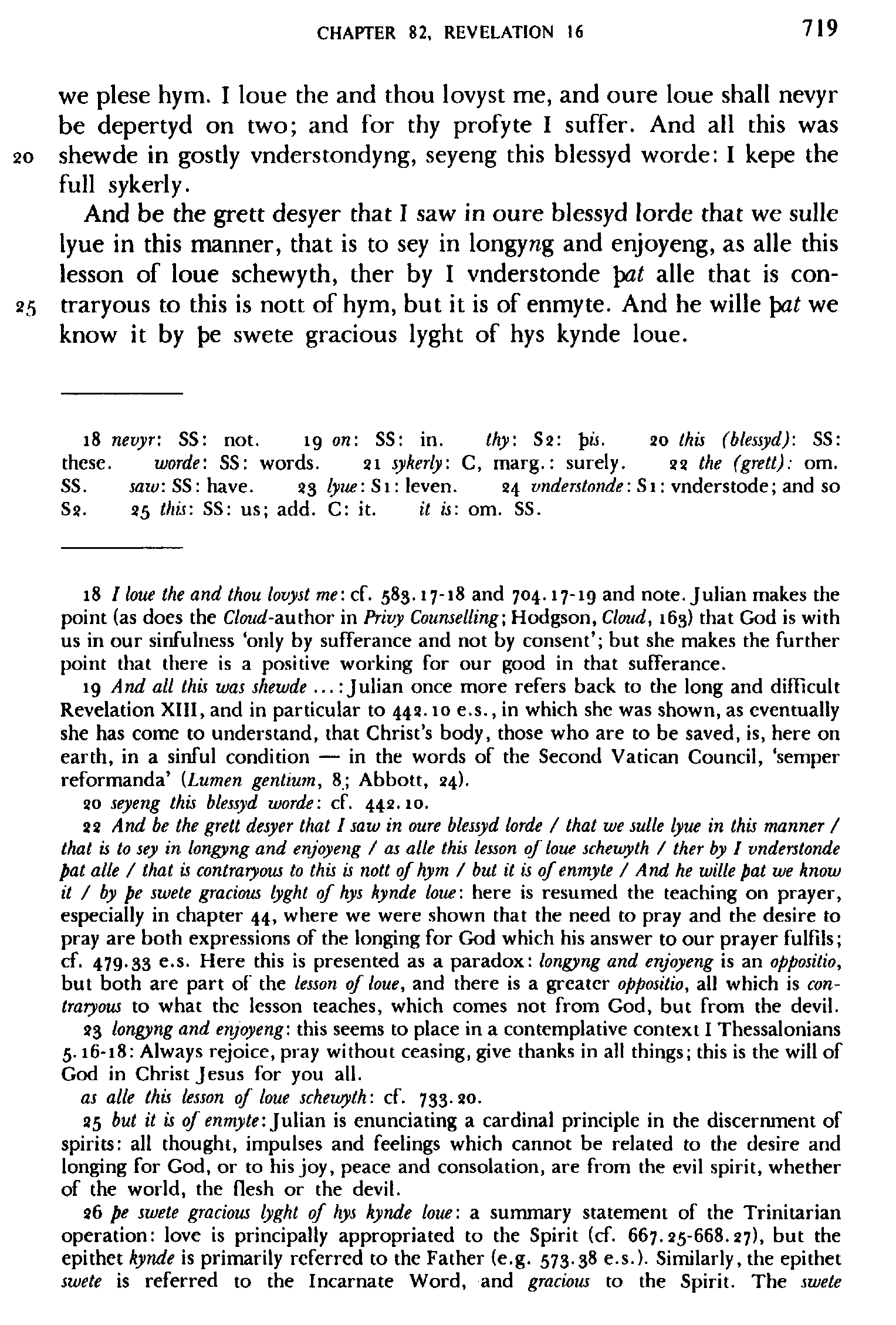
CHAPTER 82, REVELATION 16
we plese hym. I loue the and thou lovyst me, and oure loue shall nevyr be depertyd on two; and for thy profyte I suffer. And all this was
20 shewde in gostly vnderstondyng, seyeng this blessyd worde: I kepe the full sykerly.
And be the grett desyer that I saw in oure blessyd lorde that we sulle lyue in this manner, that is to sey in longyng and enjoyeng, as alle this lesson of loue schewyth, ther by I vnderstonde Ipat alle that is con2.5 traryous to this is nott of hym, but it is of enmyte. And he wille \xit we know it by ]>e swete gracious lyght of hys kynde loue.
18 nevyr: SS: not.
19 on: SS: in. thy: 82: \>is.
20 this (blessyd):
SS: these. worde: SS: words.
21 sykerly: C, marg.: surely.
22 the (grett): om.
SS. saw: SS: have.
23 lyue: Si: leven.
24 vnderstonde: Si: vnderstode; and so 82.
25 this: SS: us; add. C: it. it is: om. SS.
18 / loue the and thou lovyst me: cf. 583.17-18 and 704.17-19 and note. Julian makes the point (as does the C/owrf-author in Privy Counselling; Hodgson, Cloud, 163) that God is with us in our sinfulness 'only by sufferance and not by consent'; but she makes the further point that there is a positive working for our good in that sufferance.
19 And all this was shewde ...: Julian once more refers back to the long and difficult
Revelation XIII, and in particular to 442.10 e.s., in which she was shown, as eventually she has come to understand, that Christ's body, those who are to be saved, is, here on earth, in a sinful condition — in the words of the Second Vatican Council, 'semper reformanda' (Lumen gentium, 8; Abbott, 24).
20 seyeng this blessyd worde: cf. 442.10.
22 And be the grett desyer that I saw in oure blessyd lorde / that we sulle lyue in this manner / that is to sey in longyng and enjoyeng / as alle this lesson of loue schewyth / ther by I vnderstonde pat alle / that is contraryous to this is nott of hym / but it is of enmyte / And he wille pat we know it / by pe swete gracious lyght of hys kynde loue: here is resumed the teaching on prayer, especially in chapter 44, where we were shown that the need to pray and the desire to pray are both expressions of the longing for God which his answer to our prayer fulfils; cf' 479-33 e>s> Here this is presented as a paradox: longyng and enjoyeng is an oppositio, but both are part of the lesson of loue, and there is a greater oppositio, all which is contraryous to what the lesson teaches, which comes not from God, but from the devil.
23 longyng and enjoyeng: this seems to place in a contemplative context I Thessalonians
5.16-18: Always rejoice, pray without ceasing, give thanks in all things; this is the will of God in Christ Jesus for you all. as alle this lesson of loue schewyth: cf. 733.20.
25 but it is of enmyte: Julian is enunciating a cardinal principle in the discernment of spirits: all thought, impulses and feelings which cannot be related to the desire and longing for God, or to his joy, peace and consolation, are from the evil spirit, whether of the world, the flesh or the devil.
26 pe swete gracious lyght of hys kynde loue: a summary statement of the Trinitarian operation: love is principally appropriated to the Spirit (cf. 667.25-668.27), but the epithet kynde is primarily referred to the Father (e.g. 573.38 e.s.). Similarly, the epithet swete is referred to the Incarnate Word, and gracious to the Spirit. The swete
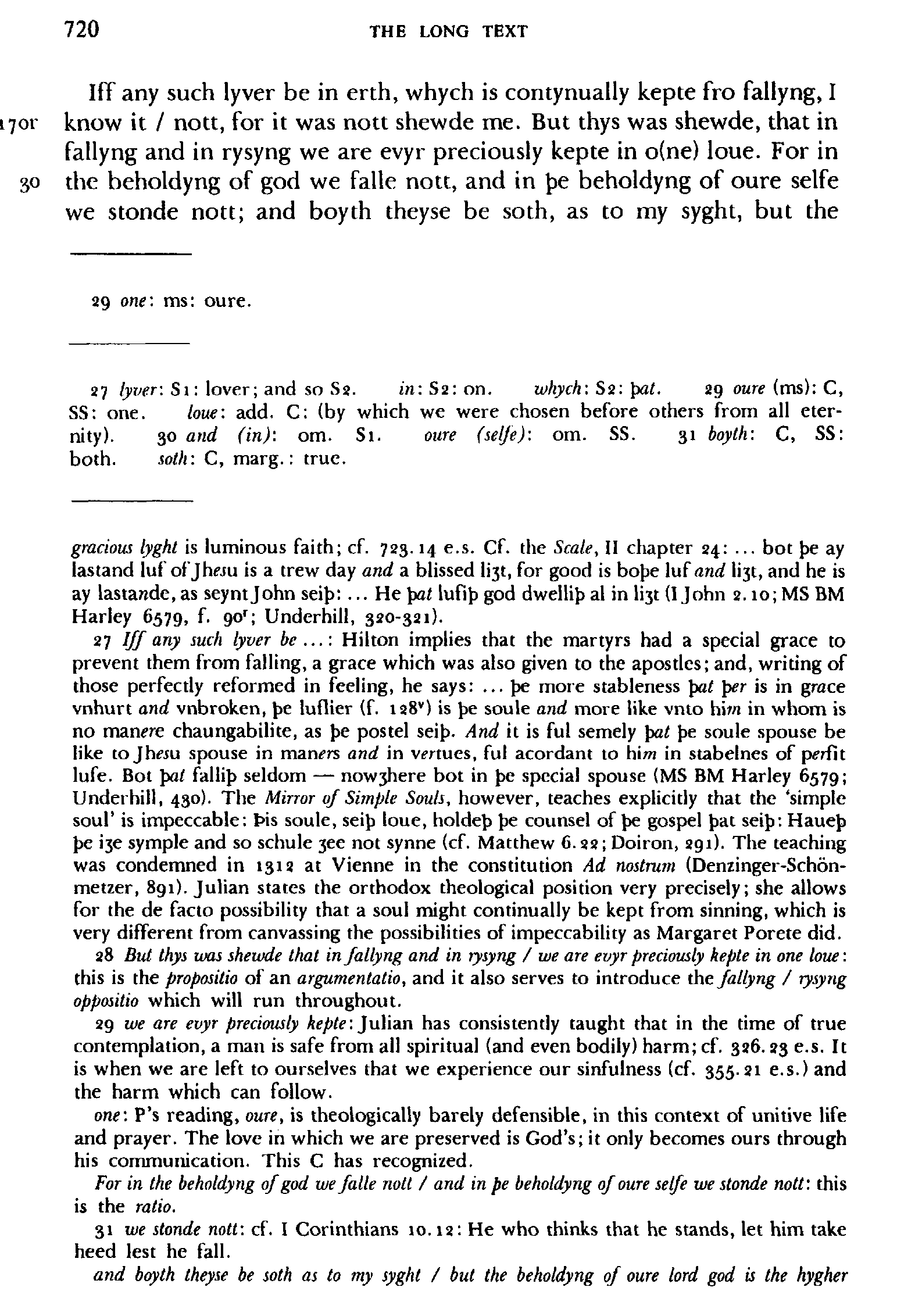
THE LONG TEXT
Iff any such lyver be in erth, whych is contynually kepte fro fallyng, I i?or know it / nott, for it was nott shewde me. But thys was shewde, that in fallyng and in rysyng we are evyr preciously kepte in o(ne) loue. For in 30 the beholdyng of god we falle nott, and in f>e beholdyng of oure selfe we stonde nott; and boyth theyse be soth, as to my syght, but the 29 one: ms: oure.
27 lyver: Si: lover; and so 82. in: 82: on. whych: 82: pat.
29 oure (ms): C, SS: one. loue: add. C: (by which we were chosen before others from all eternity).
30 and (in): om.
Si. oure (selfe): om.
SS.
31 boyth:
C, SS: both. soth: C, marg.: true. gracious lyght is luminous faith; cf. 723.14 e.s. Cf. the Scale, II chapter 24: ... bot £>e ay lastand luf of Jhmi is a trew day and a blissed 1(31, for good is bojje luf and li$t, and he is ay lastarcde.as seyntjohn seip: ... He txzl lufit> god dwelli{> al in list (I John a.iojMSBM
Harley 6579, f. gor; Underbill, 320-321).
27 Iff any such lyver be ...: Hilton implies that the martyrs had a special grace to prevent them from falling, a grace which was also given to the apostles; and, writing of those perfectly reformed in feeling, he says: ... pe more stableness |xz£ p^r is in grace vnhurt and vnbroken, pe luflier (f. 128") is pe soule and more like vnto him in whom is no manure chaungabilite, as pe postel seip. And it is ful semely \>at pe soule spouse be like to Jhmi spouse in manors and in virtues, ful acordant to him in stabelnes of perfit lufe. Bot \>at falli£> seldom — nowshere bot in pe special spouse (MS BM Harley 6579;
Underbill, 430). The Minor of Simple Souls, however, teaches explicitly that the 'simple soul' is impeccable: t>is soule, seijj loue, holdej) pe counsel of pe gospel pat seip: HaueJ> pe ise symple and so schule 3ee not synne (cf. Matthew 6.22; Doiron, 291). The teaching was condemned in 1312 at Vienne in the constitution Ad nostrum (Denzinger-Schonmetzer, 891). Julian states the orthodox theological position very precisely; she allows for the de facto possibility that a soul might continually be kept from sinning, which is very different from canvassing the possibilities of impeccability as Margaret Porete did.
28 But thys was shewde that in fallyng and in rysyng / we are evyr preciously kepte in one loue: this is the propositio of an argumentatio, and it also serves to introduce the fallyng / rysyng oppositio which will run throughout.
29 we are evyr preciously kepte: Julian has consistently taught that in the time of true contemplation, a man is safe from all spiritual (and even bodily) harm; cf. 326.23 e.s. It is when we are left to ourselves that we experience our sinfulness (cf. 355.21 e.s.) and the harm which can follow. one: P's reading, oure, is theologically barely defensible, in this context of unitive life and prayer. The love in which we are preserved is God's; it only becomes ours through his communication. This C has recognized.
For in the beholdyng of god we falle nott / and in pe beholdyng of oure selfe we stonde nott: this is the ratio.
31 we stonde nott: cf. I Corinthians 10.12: He who thinks that he stands, let him take heed lest he fall. and boyth theyse be soth as to my syght / but the beholdyng of oure lord god is the hygher
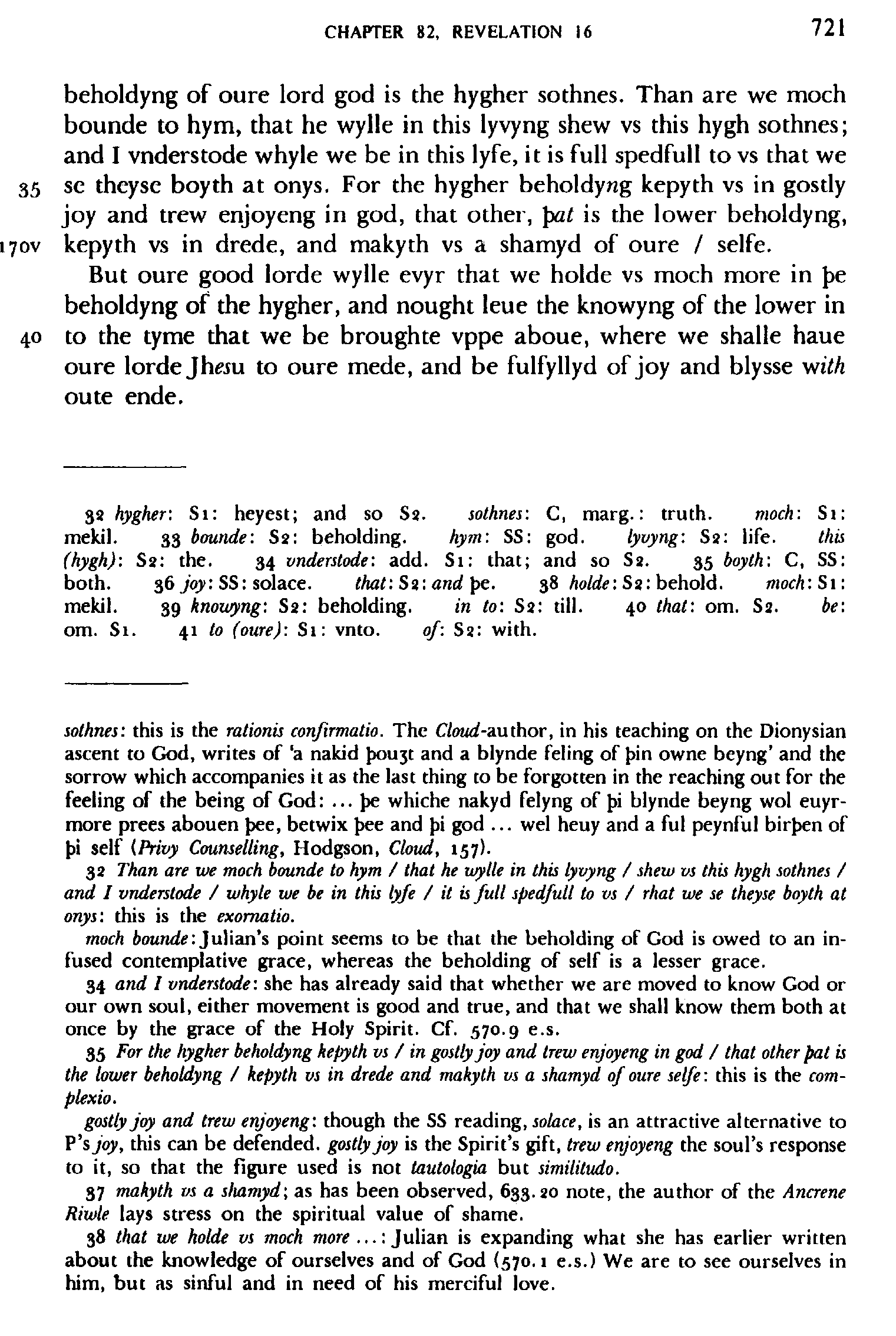
CHAPTER 82, REVELATION
beholdyng of oure lord god is the hygher sothnes. Than are we moch bounde to hym, that he wylle in this lyvyng shew vs this hygh sothnes; and I vnderstode whyle we be in this lyfe, it is full spedfull to vs that we
35 se theyse boyth at onys. For the hygher beholdyng kepyth vs in gostly joy and trew enjoyeng in god, that other, \Mt is the lower beholdyng, iyov kepyth vs in drede, and makyth vs a shamyd of oure / selfe.
But oure good lorde wylle evyr that we holde vs moch more in J)e beholdyng of the hygher, and nought leue the knowyng of the lower in 40 to the tyme that we be broughte vppe aboue, where we shalle haue oure lorde ]hem to oure mede, and be fulfyllyd of joy and blysse with oute ende.
33 hygher: Si: heyest; and so 82. sothnes: C, marg.: truth. moch: Si: mekil.
33 bounde: Ss: beholding. hym: SS: god. lyvyng: 82: life. this (hygh): 82: the.
34 vnderstode: add. Si: that; and so 82.
35 boyth: C, SS: both.
36 joy: SS: solace. that:Ss: and J>e.
38 holde:Sa: behold. moch: Si: mekil.
39 knowyng: 82: beholding. in to: 82: till.
40 that: om. Ss. be: om. Si.
41 to (oure): Si: vnto. of: 82: with. sothnes: this is the rationis confirmatio. The Cloud-author, in his teaching on the Dionysian ascent to God, writes of 'a nakid fyouy and a blynde feling of {)in owne beyng' and the sorrow which accompanies it as the last thing to be forgotten in the reaching out for the feeling of the being of God: ... J)e whiche nakyd felyng of J>i blynde beyng wol euyrmore prees abouen pee, betwix pee and pi god ... wel heuy and a ful peynful birpen of pi self (Privy Counselling, Hodgson, Cloud, 157).
32 Than are we moch bounde to hym / that he wylle in this lyvyng / shew vs this hygh sothnes / and I vnderstode / whyle we be in this lyfe / it is full spedfull to vs / rhat we se theyse boyth at onys: this is the exomatio. moch bounde: Julian's point seems to be that the beholding of God is owed to an infused contemplative grace, whereas the beholding of self is a lesser grace.
34 and I vnderstode: she has already said that whether we are moved to know God or our own soul, either movement is good and true, and that we shall know them both at once by the grace of the Holy Spirit. Cf. 570.9 e.s.
35 For the hygher beholdyng kepyth vs / in gostly joy and trew enjoyeng in god / that other bat is the tower beholdyng / kepyth vs in drede and makyth vs a shamyd of oure selfe: this is the complexio. gostly joy and trew enjoyeng: though the SS reading, solace, is an attractive alternative to P'sjoy, this can be defended, gostly joy is the Spirit's gift, trew enjoyeng the soul's response to it, so that the figure used is not tautologia but similitudo.
37 makyth vs a sliamyd; as has been observed, 633.20 note, the author of the Ancrene
Riwle lays stress on the spiritual value of shame.
38 that we holde vs moch more ...: Julian is expanding what she has earlier written about the knowledge of ourselves and of God (570. i e.s.) We are to see ourselves in him, but as sinful and in need of his merciful love.
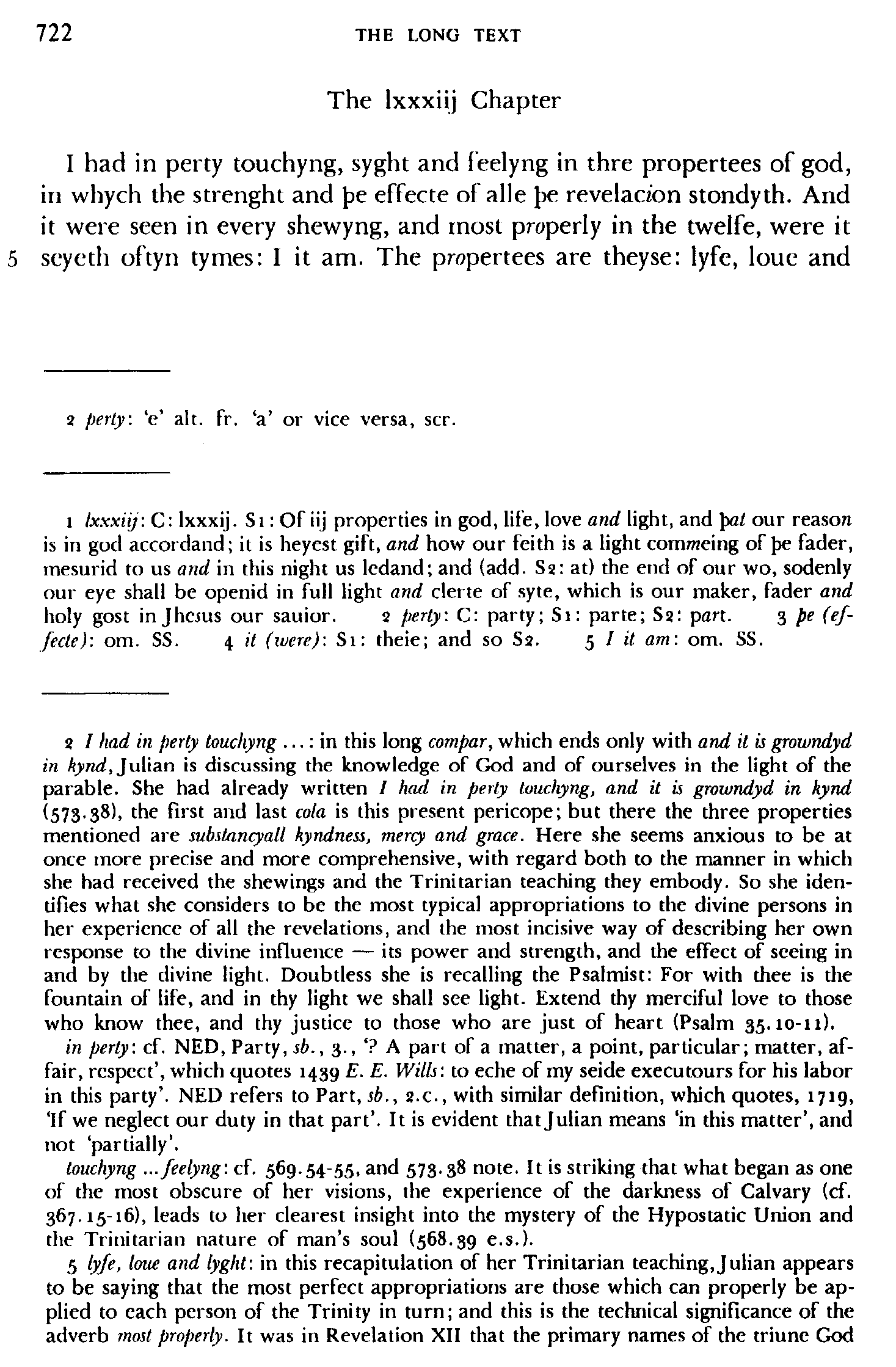
THE LONG TEXT
The Ixxxiij Chapter I had in perty touchyng, syght and feelyng in thre propertees of god, in whych the strenght and J)e effecte of alle j^e revelaczon stondyth. And it were seen in every shewyng, and most properly in the twelfe, were it
5 seyeth oftyn tymes: I it am. The propertees are theyse: lyfc, loue and 2 perty: 'e' alt. fr. 'a' or vice versa, scr. i Ixxxiij: C: Ixxxij. Si: Of iij properties in god, life, love and light, and \Mt our reason is in god accordand; it is heyest gift, and how our feith is a light comweing of pe fader, mesurid to us and in this night us ledand; and (add. 82: at) the end of our wo, sodenly our eye shall be openid in full light and clerte of syte, which is our maker, fader and holy gost injhe^us our sauior.
2 perty: C: party; Si: parte; Sa: part.
3 pe (effecte): om. SS.
4 it (were): Si: theie; and so 82.
5 / it am: om. SS.
2 / had in perty touchyng ...: in this long compar, which ends only with and it is growndyd in kynd, Julian is discussing the knowledge of God and of ourselves in the light of the parable. She had already written / had in perty touchyng, and it is growndyd in kynd
(573.38), the first and last cola is this present pericope; but there the three properties mentioned are substancyall kyndness, mercy and grace. Here she seems anxious to be at once more precise and more comprehensive, with regard both to the manner in which she had received the shewings and the Trinitarian teaching they embody. So she identifies what she considers to be the most typical appropriations to the divine persons in her experience of all the revelations, and the most incisive way of describing her own response to the divine influence — its power and strength, and the effect of seeing in and by the divine light. Doubtless she is recalling the Psalmist: For with thee is the fountain of life, and in thy light we shall see light. Extend thy merciful love to those who know thee, and thy justice to those who are just of heart (Psalm 35.10-11). in perty: cf. NED, Party, sb., 3., '? A part of a matter, a point, particular; matter, affair, respect', which quotes 1439 E. E. Wills: to eche of my seide executours for his labor in this party'. NED refers to Part, sb., 2.C., with similar definition, which quotes, 1719,
'If we neglect our duty in that part'. It is evident that Julian means 'in this matter', and not 'partially'. touchyng ...feelyng: cf. 569.54-55, and 573.38 note. It is striking that what began as one of the most obscure of her visions, the experience of the darkness of Calvary (cf.
367.15-16), leads to her clearest insight into the mystery of the Hypostatic Union and the Trinitarian nature of man's soul (568.39 e.s.).
5 lyfe, loue and lyght: in this recapitulation of her Trinitarian teaching,Julian appears to be saying that the most perfect appropriations are those which can properly be applied to each person of the Trinity in turn; and this is the technical significance of the adverb most properly. It was in Revelation XII that the primary names of the triune God
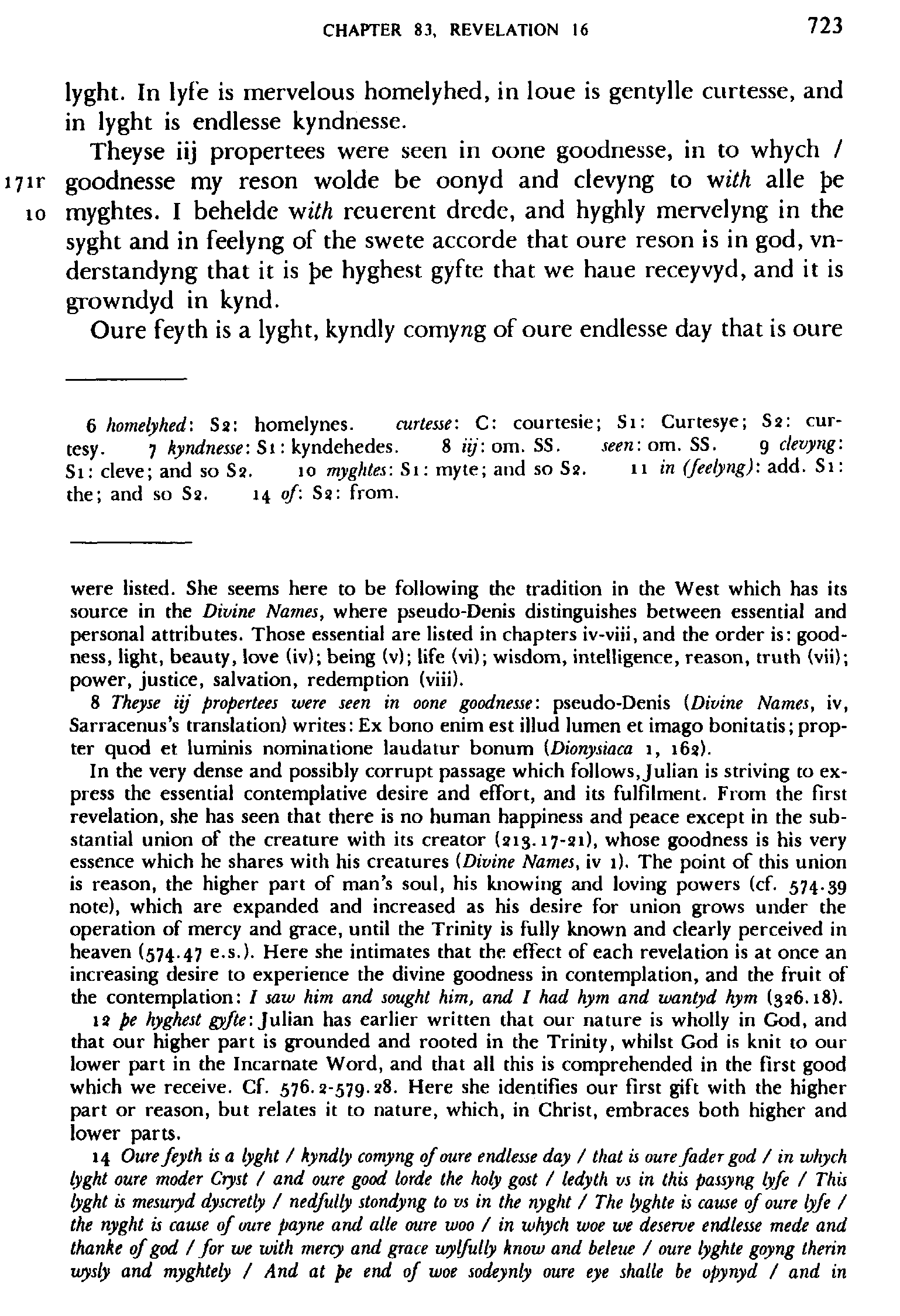
CHAPTER 83, REVELATION 16
lyght. In lyfe is mervelous homelyhed, in loue is gentylle curtesse, and in lyght is endlesse kyndnesse.
Theyse iij propertees were seen in oone goodnesse, in to whych / iyir goodnesse my reson wolde be oonyd and clevyng to with alle £>e
10 myghtes. I behelde with reuerent drede, and hyghly mervelyng in the syght and in feelyng of the swete accorde that oure reson is in god, vnderstandyng that it is be hyghest gyfte that we haue receyvyd, and it is growndyd in kynd.
Oure feyth is a lyght, kyndly comyng of oure endlesse day that is oure 6 homelyhed: Sa: homelynes. curtesse: C: courtesie; Si: Curtesye; Sa: curtesy.
7 kyndnesse: Si: kyndehedes.
8 iij: om. SS. seen: om. SS.
9 clevyng:
Si: cleve; and so Sa.
10 myghtes: Si: myte; and so Sa.
11 in (feelyng): add. Si: the; and so Sa.
14 of: Sa: from. were listed. She seems here to be following the tradition in the West which has its source in the Divine Names, where pseudo-Denis distinguishes between essential and personal attributes. Those essential are listed in chapters iv-viii, and the order is: goodness, light, beauty, love (iv); being (v); life (vi); wisdom, intelligence, reason, truth (vii); power, justice, salvation, redemption (viii).
8 Theyse iij propertees were seen in oone goodnesse: pseudo-Denis (Divine Names, iv,
Sarracenus's translation) writes: Ex bono enim est illud lumen et imago bonitatis; propter quod et luminis nominatione laudatur bonum (Dionysiaca i, 163).
In the very dense and possibly corrupt passage which follows,Julian is striving to express the essential contemplative desire and effort, and its fulfilment. From the first revelation, she has seen that there is no human happiness and peace except in the substantial union of the creature with its creator (313.17-31), whose goodness is his very essence which he shares with his creatures (Divine Names, iv i). The point of this union is reason, the higher part of man's soul, his knowing and loving powers (cf. 574-39 note), which are expanded and increased as his desire for union grows under the operation of mercy and grace, until the Trinity is fully known and clearly perceived in heaven (574.47 e.s.). Here she intimates that the effect of each revelation is at once an increasing desire to experience the divine goodness in contemplation, and the fruit of the contemplation: / saw him and sought him, and I had hym and wantyd hym (336.18).
12 pe hyghest gyfte: Julian has earlier written that our nature is wholly in God, and that our higher part is grounded and rooted in the Trinity, whilst God is knit to our lower part in the Incarnate Word, and that all this is comprehended in the first good which we receive. Cf. 576.3-579.28. Here she identifies our first gift with the higher part or reason, but relates it to nature, which, in Christ, embraces both higher and lower parts.
14 Oure feyth is a lyght / kyndly comyng of oure endlesse day / that is oure fader god / in whych lyght oure moder Cryst / and oure good lorde the holy gost / ledyth vs in this passyng lyfe / This lyght is mesuryd dyscretly / nedfully stondyng to vs in the nyght / The lyghte is cause of oure lyfe / the nyght is cause of oure payne and alle oure woo / in whych woe we deserve endlesse mede and thanke of god /for we with mercy and grace wylfully know and beleue / oure lyghte goyng therin wysly and myghtely / And at pe end of woe sodeynly oure eye shalle be opynyd / and in
THE LONG TEXT
15 fader, god, in whych lyght oure moder, Cryst, and oure good lorde the holy gost ledyth vs in this passyng lyfe. This lyght is mesuryd dyscretly, nedfully stondy(ng) to vs in the nyght. The lyghte is cause of oure lyfe, the nyght is cause of oure payne and alle oure woo, in whych woe we deserve endlesse mede and thanke of god, for we with mercy and grace
17 iv wylfully know and beleue oure lyghte goyng / therin wysly and 21 myghtely. And at £e end of woe, sodeynly oure eye shalle be opynyd,
17 stondyng: ms: stondyth.
20 know and: ms: knowand.
17 stondyth (ms): Si: standand; 82: standing.
18 oure (payne): 82: all our. alle:
Si: of al. woe: om. SS.
19 endlesse: om. SS.
20 know and beleue: Si: knowen and leven; and so 82. clernes of syght oure lyght shalle be fulle / whych lyght is god oure maker fadyr and holy gost / in Crist Jhesu oure savyour / Thus I sawe and vnderstode / that oure fey th is oure lyght in oure nyght / whych lyght is god oure endlesse day: the entire compar is an expolitio, with the last three cola for condusio. It is resoundingly Johannine both in its genesis and its process. Faith, which is a given knowledge, power and perception, is the recognition which makes us sons of God in him who is Son (John 1.9); but the light is only effective when it is consciously and willingly received in the new birth from our parent, God, who 'is light and in him there is no darkness' (I John 1.5). This light, which is the glory of the onlybegotten of the Father, is the fullness of grace and truth (John 1.14), the grace which is measured out to us from his fullness (ibid. 1.16). The light is also life (ibid. 1.4), and whilst we have the light, darkness does not overtake us (ibid. 12.35); an^ if we believe in the light, we are the children of light (ibid. 12.36), we walk in the light and not in the darkness (I John 1.7), because we follow Christ, who is the light of the world (John
8.12), so that we 'know and believe that the Father is in me and I in the Father' (ibid.
10.38).
16 ledyth: so C, 88. The syntax here makes it difficult not to suppose that this is an extraneous Southern '-eth' plural indicative suffix. Cf. 709.14-15 note.
17 nedfully: NED records only the sense 'necessarily', but cf. Nedfull, a. (and sb.),
2.a., 'Characterized by need, necessity, or straits', which is how the adverb here is used:
'in our need'. stondyng: the emendation, supported by the present participles in SS, is required by the syntax.
18 the nyght is cause of oure payne: Bonum est, commenting on Ad annunciandum mane misericordiam tuam, et veritatem tuam per noctem, has: Niht betoknej) aduersite and wontyng of cumfort, bodiliche or gostliche (Wallner, 55). in whych woe we deserve endlesse mede and thanke of god: in the Scale, II chapter 27, we read: ... Ii3t schal spryngen to pe in mirknes ... and pi mirknes schal be as midday. t>at is, pi mirknes of traueiland desire and pi blynde trust in god \>at pu hast first schal twrne in to clere knowynge and in to sikirnes of luf (MS BM Harley 6579, f. 98'; Underbill,
344)- 21 And at pe end of woe, sodeynly oure eye shalle be opynd: cf. II Peter 1.19: We have the more firm prophetical word, to which you do well to attend, as to a light that shines in a dark place, until the day dawn and the day star arise in your hearts. sodeynly: cf. the Scale, II chapter 40: ... a sijend soule to seen pe face of Jhe.su whan it
CHAPTER 83, REVELATION 16
and in clernes of syght oure lyght shalle be fulle, whych lyght is god, oure maker, fadyr, and holy gost in Crist ]hesu oure savyour.
Thus I sawe and vnderstode that oure feyth is oure lyght in oure 25 nyght, whych lyght is god, oure endlesse day.
22 clernes: Si: clerte; 82: clarity. syght: SS: light. lyght: SS: sight.
23 fadyr: om. SS. is touchid pour3 grace of pe holy gost, it is sodenly chaungid and turned fro pe plijt pa< it was in to a nop?r maner feling (MS BM Harley 6579, f. 123*; Underbill, 417). oure eye shalle be opynyd: cf. ibid, chapter 41: (S)chew me pan a soule pa/ pur3 inspiration of grace hap openynge of pe gostly ei3e in to beholdynge of Jhmi ... J>is soule brennyth al in luf and schynyth in gostely Ii3t (ibid., f. 127'; 426).
22 whych lyght is god ...: cf. ibid., chapter 46: pan is it opned sopfastly to pe €136 of j>e soule pe onhed in substance and distincionn of persons in pe blissid trinitee (ibid., f.
I39r; 462)-
THE LONG TEXT
The Ixxxiiij Chapter Thys lyght is charite, and the mesuryng of this lyght is done to vs profitably by the wysdom of god; for neyther f>e lyght is so large tyit we may se clerly oure blessydfulle day, ne it is all sperryd fro vs, but it is such a lyghte in whych we may lyue medfully with traveyle, deservyng
|DC wurschypfull thangke of god. And this was sene in the syxte
i Ixxxiiij: C: Ixxxiij. Si: Charite is this light which is not so litil but that it is nedefull
(Sa: medefull) with travel to deserven endles worshipfull thanke of god, for feith and hope leden us to charite, which is in iij manners.
2 Thys: SS: the.
4 clerly: om.
SS. blessydfulle: Si: blisfull; and so Sa. all: om. SS. sperryd: C, marg.: shut up.
5 medfully:
C, marg.: meritoriously. deservyng:
C: reserving.
6 wurschypfull thangke: Si: endles worship; and so 82. thangke: C: thanks.
2 Thys lyght is charite ... alle shalle be charite: in this compar, not surprisingly, the source is
Paul's celebrated hymn to charity in I Corinthians chapter 13, As he does, Julian personifies charity, and relates it firmly to faith and hope. But she makes explicit what is implicit in Paul's text: the identification of charity with the sight and knowledge of God, its partial possession here and its fullness in the Beatific Vision: Charity never falls away
(8) ... For we know in part (9) ... but when that which is perfect has come, that which is partial shall be done away (10) ... We see now through a glass in a dark manner; but then we shall see face to face. Now I know partially, but then I shall know just as I am known (12) ... and now there remain these three, faith, hope and charity (13) ... the greatest of these is charity ...
This doctrine is also Hilton's, in the Scale, II chapter 37: And pus is pe soule made meke ... bi pe wirkyng of pe holy gost, pa< is pe gifte of luf, for he opnej> pe ije of pe soule for to seen and lufenjhwu ... and su?n han it more fully for J>ei han clerer si3t of Jhtf.su, and pei fele more of his loue (MS BM Harley 6579, f. n8v; Underhill, 403).
3 profitably: this is a clarification of dyscretly (724.16). The discretion of the Trinity in the divine operationes ad extra coincides with the good pleasure (This is my beloved Son, in whom I am well pleased'; Matthew 3.17) which looks simply to the growth in wellbeing of the creature, after the pattern of the Incarnate Christ. Cf. John 16.12-13: I have many things to say to you, but you cannot bear them now. But when he, the Spirit of truth, has come, he will teach you all things.
5 medfully with traveyle: cf. the Scale, II chapter 25: forfor applie pin hen fully to pe stirynge of grace, and vse for to wonen in pis mirknes and be often assaynge to ben homly p^rin ... and pe trew Ii3t of gostly knowynge schal sprynge to pe, not al at ones bot prmely by litel and by litel ... (f. 92*) ... bi smale sodeyn Ii3tynges Jxzf glideren out purgh smale caues ... for wete pu wele paw3 \>at pi soule be in pis restful mirknes ... it is not 3it eloped al in Ii3t ne turned al into fiire of luf (MS BM Harley 6579; Underhill,
328).
6 in the syxte shewyng: cf. 351.3. Revelation VI speaks of reward and thanking, of homeliness and courtesy, of solace and bliss, and concludes: And the more that the lovyng soule seeth this curtesy of god, the levyr she ys to serve hym all her lyfe (353.35).
CHAPTER 84, REVELATION 16
shewyng, wher he seyth: I thanke the of thy servyse and of thy traveyle. lyar Thus charite kepyth vs in feyth and in hope. / And feyth and hope ledyth vs in charite, and at be ende allc shalle be charite.
I had iij manner of vnderstondyngw in this lyght of (c)ha(r)ite. The furst is charite vnmade, the seconnde is charyte made, the thyrde is charyte gevyn. Charyte vnmade is god, charyte made is oure soule in god, charyte gevyn is vertu, and \>at is a gracious gyfte of wurkyng, in whych we loue god for hym selfe, and oure selfe in god, and alle Ipat god
15 lovyth for god.
10 charite: ms: thacite.
7 seyth: Si: seid; and so 82. of: Si: soft.
8 feyth and: om. SS.
10 vnderstondynges: Si: vnderstonding; and so 82. charite: so C, SS.
14 (oure) selfe: SS: selves. alle: om. SS.
10 / had iij manner of vnderstondynges / in this lyght of charite / The furst is charite vnmade / the seconnde is charyte made / the thyrde is charyte gevyn I Charyte vnmade is god / charyte made is oure soule in god / charyte gevyn is vertu / and pat is a gracious gyfte of wurkyng / in whych we loue god for hym selfe / and oure selfe in god / and alle pat god lovyth for god: in the first colon,
Julian tells us that what is to follow will be an expolitio. So the figures follow: in the third, fourth and fifth cola there is repetitio (the) and medial repetitio (charite) which may also be complexio; and in the sixth, seventh and eighth there is commutatio, repetitio and dissolutio.
Julian here writes with the clarity and simplicity of the accomplished theologian. St.
Thomas, among others, distinguishes between charity uncreated (the Holy Spirit himself dwelling in the soul; Summa, II-II.23.2 in corp.), and created charity, which is our participation in the Holy Spirit who is the love between the Father and the Son (ibid., II11.24.2 in corp.). He also teaches that charity is an infused virtue (ibid.), given us by the Spirit; and he quotes I Corinthians 12.11: All these things one and the same Spirit works, dividing to each one according to his will; and Ephesians 4.7: To every one of us is given grace, according to the measure of die giving of Christ (ibid., II-II. 24.3 in corp.).
11 charite vnmade ... charyte made ... charyte gevyn: the Scale, II chapter 34, makes a similar distinction, which lacks, however,Julian's precision: Holy wryters seyn,am/ sop it is, p3£ per is two maner of gostly lufe. On is called vnformed, an oper is callid formed.
Lufe (f. 11 ir) vnformed is god him self... pe h°l' gost... Luf formed is pe affeccioun of pe soule made bi pe holy gost of pe si3t and pe knowynge of sopfastnes pa< is god only
(MS BM Harley 6579; Underbill, 381).
13 and pat is a gracious gyfte of wurkyng...: a succinct exegesis of the 'great commandment', as enunciated for example in Matthew 22.37-40. The Cloud-author gives his own contemplative specification to this wurkyng: ... in pe tyme of pis werk schal alle be iliche homly vnto hym ... so pat alle schul be louyd pleinly and nakidly for god, and as wel as him self (Hodgson, 60).
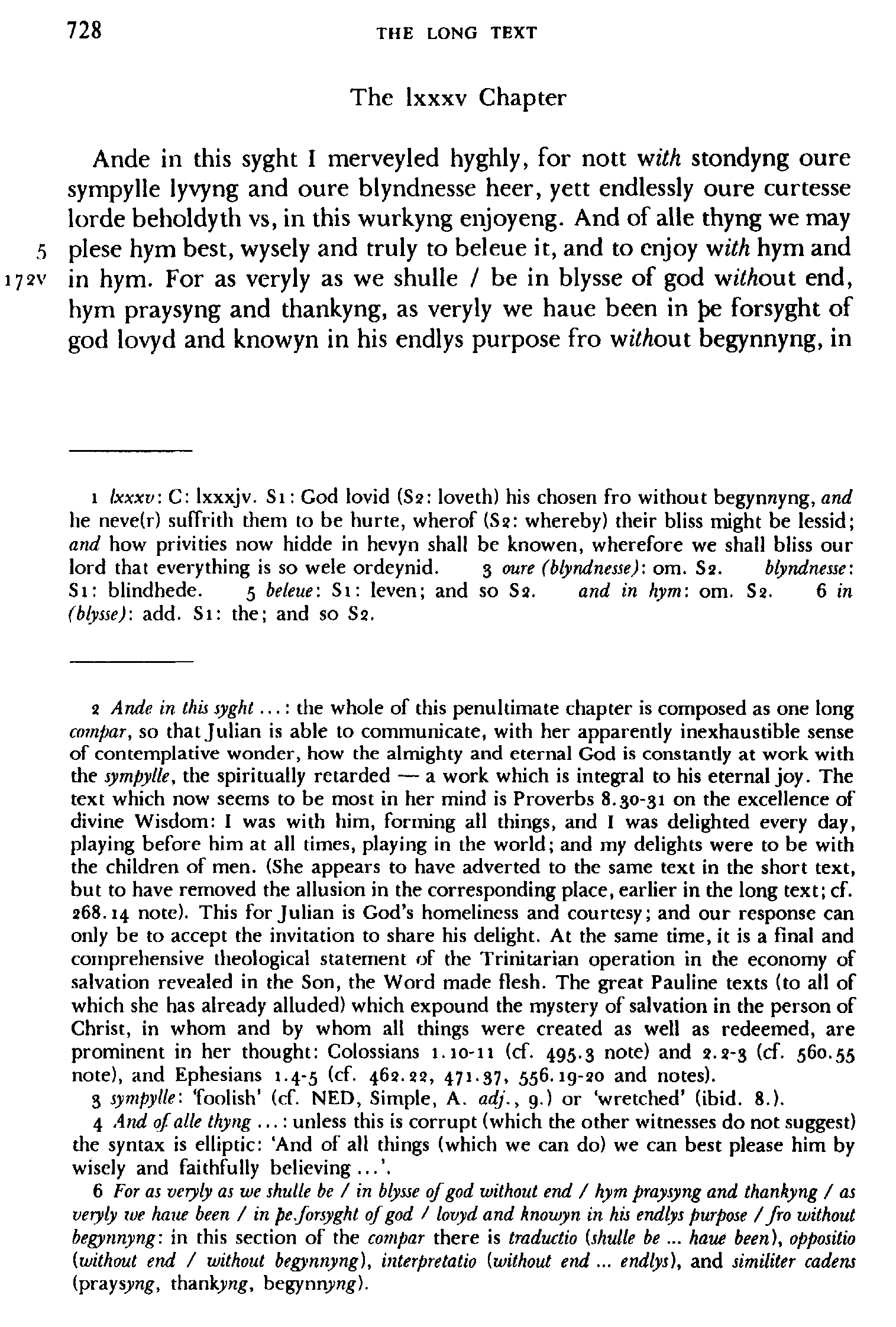
THE LONG TEXT
The Ixxxv Chapter Ande in this syght I merveyled hyghly, for nott with stondyng cure sympylle lyvyng and oure blyndnesse heer, yett endlessly oure curtesse lorde beholdyth vs, in this wurkyng enjoyeng. And of alle thyng we may
5 plese hym best, wysely and truly to beleue it, and to enjoy with hym and lyav in hym. For as veryly as we shulle / be in blysse of god w^Aout end, hym praysyng and thankyng, as veryly we haue been in |>e forsyght of god lovyd and knowyn in his endlys purpose fro without begynnyng, in i Ixxxv: C: Ixxxjv. Si: God lovid (82: loveth) his chosen fro without begyrmyng, and he neve(r) suffrith them to be hurte, wherof (82: whereby) their bliss might be lessid; and how privities now hidde in hevyn shall be knowen, wherefore we shall bliss our lord that everything is so wele ordeynid.
3 oure (blyndnesse): om. 82. blyndnesse:
Si: blindhede.
5 beleue: Si: leven; and so 82. and in hym: om. 82.
6 in (blysse): add. Si: the; and so 82.
2 Ande in this syght...: the whole of this penultimate chapter is composed as one long compar, so that Julian is able to communicate, with her apparently inexhaustible sense of contemplative wonder, how the almighty and eternal God is constantly at work with the sympylle, the spiritually retarded — a work which is integral to his eternal joy. The text which now seems to be most in her mind is Proverbs 8.30-31 on the excellence of divine Wisdom: I was with him, forming all things, and I was delighted every day, playing before him at all times, playing in the world; and my delights were to be with the children of men. (She appears to have adverted to the same text in the short text, but to have removed the allusion in the corresponding place, earlier in the long text; cf.
268.14 note). This for Julian is God's homeliness and courtesy; and our response can only be to accept the invitation to share his delight. At the same time, it is a final and comprehensive theological statement of the Trinitarian operation in the economy of salvation revealed in the Son, the Word made flesh. The great Pauline texts (to all of which she has already alluded) which expound the mystery of salvation in the person of Christ, in whom and by whom all things were created as well as redeemed, are prominent in her thought: Colossians 1.10-11 (cf. 495.3 note) and 2.2-3 (cf560.55 note), and Ephesians 1.4-5 (cf462.22, 471.37, 556.19-20 and notes).
3 sympylle: 'foolish' (cf. NED, Simple, A. adj., 9.) or 'wretched' (ibid. 8.).
4 And of alle thyng ...: unless this is corrupt (which the other witnesses do not suggest) the syntax is elliptic: 'And of all things (which we can do) we can best please him by wisely and faithfully believing...'.
6 For as veryly as we shulle be / in blysse of god without end / hym praysyng and thankyng / as veryly we haue been / in pe.forsyght of god / lovyd and knowyn in his endlys purpose /fro without begynnyng: in this section of the compar there is traductio (shulle be ... haue been), oppositio
(without end / without begynnyng), interpretatio (without end ... endlys), and similiter cadens
(praysyng, thankyng, begynnyng).
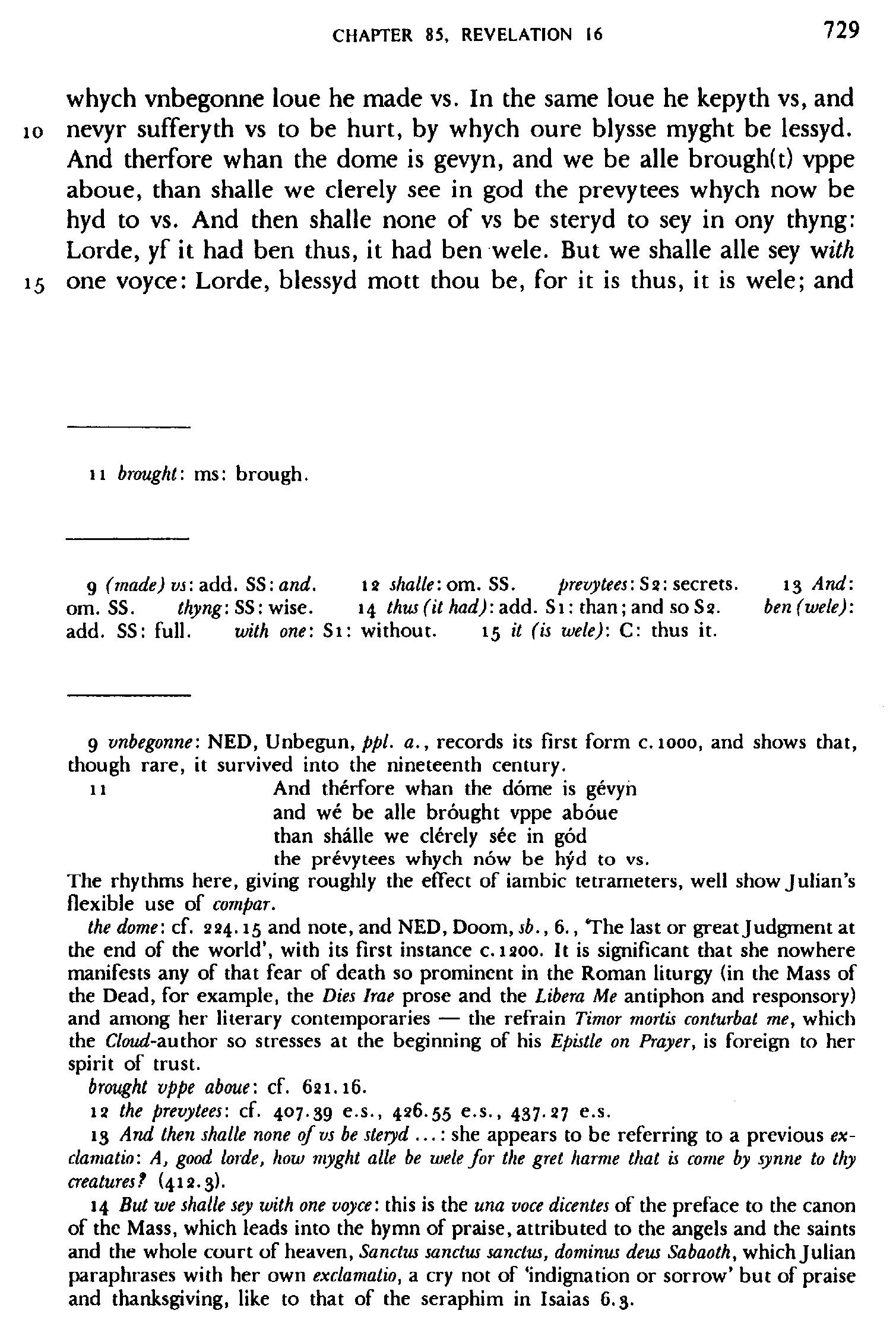
CHAPTER 85, REVELATION 16
whych vnbegonne loue he made vs. In the same loue he kepyth vs, and 10 nevyr sufferyth vs to be hurt, by whych oure blysse myght be lessyd.
And therfore whan the dome is gevyn, and we be alle brough(t) vppe aboue, than shalle we clerely see in god the prevytees whych now be hyd to vs. And then shalle none of vs be steryd to sey in ony thyng:
Lorde, yf it had ben thus, it had ben wele. But we shalle alle sey with 15 one voyce: Lorde, blessyd mott thou be, for it is thus, it is wele; and 11 brought: ms: brough.
9 (made) vs: add. SS:and.
12 shalle: om. SS. prevytees: 82: secrets.
13 And: om. SS. thyng: SS: wise.
14 thus(it had): add. Si: than; and so82. ben(wele): add. SS: full. with one: Si: without.
15 it (is wele): C: thus it.
9 vnbegonne: NED, Unbegun, ppl. a., records its first form c.iooo, and shows that, though rare, it survived into the nineteenth century.
And therfore whan the dome is gevyn and we be alle brought vppe aboue than shalle we clerely see in god the prevytees whych now be hyd to vs.
The rhythms here, giving roughly the effect of iambic tetrameters, well show Julian's flexible use of compar. the dome: cf. 224.15 and note, and NED, Doom, sb., 6., The last or great Judgment at the end of the world', with its first instance c. 1200. It is significant that she nowhere manifests any of that fear of death so prominent in the Roman liturgy (in the Mass of the Dead, for example, the Dies Irae prose and the Libera Me antiphon and responsory) and among her literary contemporaries — the refrain Timor mortis conturbat me, which the Cloud-ZLUthor so stresses at the beginning of his Epistle on Prayer, is foreign to her spirit of trust. brought vppe aboue: cf. 621.16.
12 the prevytees: cf. 407.39 e.s., 426.55 e.s., 437.27 e.s.
13 And then shalle none ofvs be steryd ...: she appears to be referring to a previous exdamatio: A, good lorde, how myght alle be wele for the gret harme that is come by synne to thy creatures? (412.3).
14 But we shalle sey with one voyce: this is the una voce dicentes of the preface to the canon of the Mass, which leads into the hymn of praise, attributed to the angels and the saints and the whole court of heaven, Sanctus sanctus sanctus, dominus deus Sabaoth, which Julian paraphrases with her own exclamatio, a cry not of 'indignation or sorrow' but of praise and thanksgiving, like to that of the seraphim in Isaias 6.3.
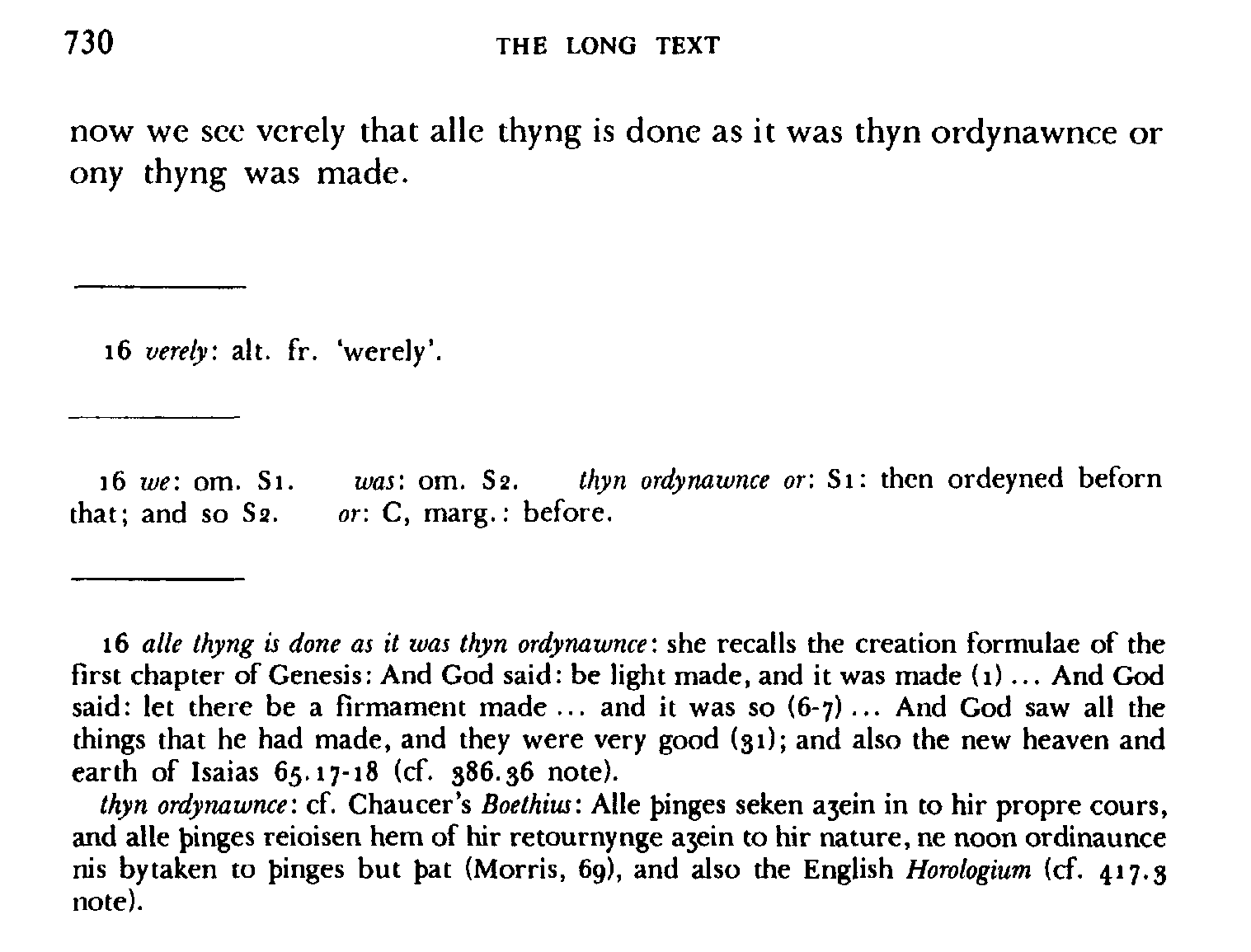
THE LONG TEXT
now we sec verely that alle thyng is done as it was thyn ordynawnce or ony thyng was made.
16 verely: alt. fr. 'werely'.
16 we: om. Si. was: om. 82. thyn ordynawnce or: Si: then ordeyned beforn that; and so Sa. or: C, marg.: before.
16 alle thyng is done as it was thyn ordynawnce: she recalls the creation formulae of the first chapter of Genesis: And God said: be light made, and it was made (i) ... And God said: let there be a firmament made ... and it was so (6-7) ... And God saw all the things that he had made, and they were very good (31); and also the new heaven and earth of Isaias 65.17-18 (cf. 386.36 note). thyn ordynawnce: cf. Chaucer's Boethius: Alle Binges seken a3ein in to hir propre cours, and alle Binges reioisen hem of hir retournynge a3ein to hir nature, ne noon ordinaunce nis by taken to pinges but pat (Morris, 69), and also the English Horologium (cf. 417.3 note).
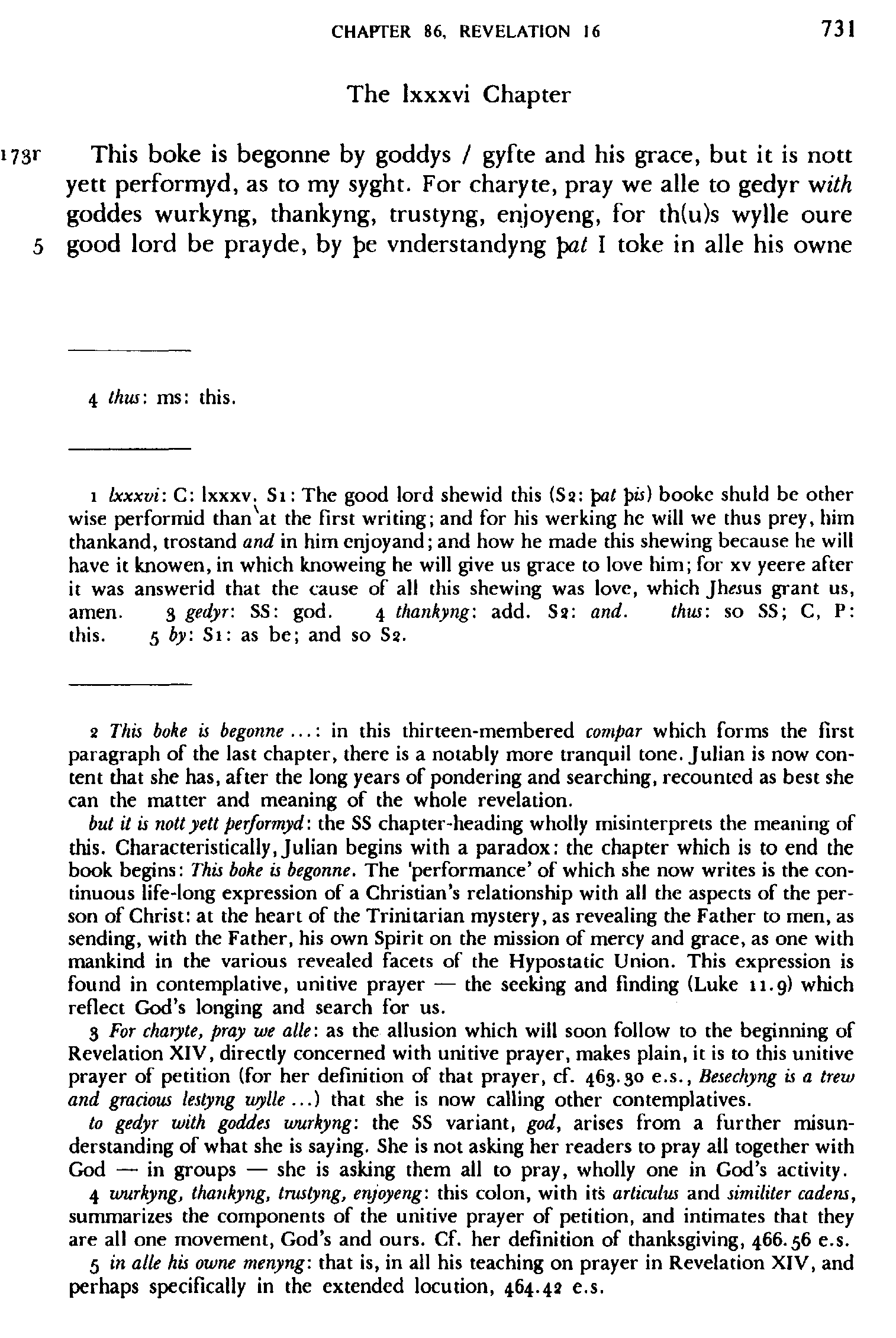
CHAPTER 86, REVELATION 16
The Ixxxvi Chapter i73r This boke is begonne by goddys / gyfte and his grace, but it is nott yett performyd, as to my syght. For charyte, pray we alle to gedyr -with goddes wurkyng, thankyng, trustyng, enjoyeng, for th(u)s wylle oure
5 good lord be prayde, by JDC vnderstandyng \>at I toke in alle his owne 4 thus: ms: this. i Ixxxvi: C: Ixxxv. Si: The good lord shewid this (82: \>at J>«) booke shuld be other wise performid than at the first writing; and for his werking he will we thus prey, him thankand, trostand and in him enjoyand; and how he made this shewing because he will have it knowen, in which knoweing he will give us grace to love him; for xv yeere after it was answerid that the cause of all this shewing was love, which Jhwus grant us, amen.
3 gedyr: SS: god.
4 thankyng: add. 82: and. thus: so SS; C, P: this.
5 by: Si: as be; and so 82.
2 This boke is begonne ...: in this thirteen-membered compar which forms the first paragraph of the last chapter, there is a notably more tranquil tone. Julian is now content that she has, after the long years of pondering and searching, recounted as best she can the matter and meaning of the whole revelation. but it is nott yett performyd: the SS chapter-heading wholly misinterprets the meaning of this. Characteristically,Julian begins with a paradox: the chapter which is to end the book begins: This boke is begonne. The 'performance' of which she now writes is the continuous life-long expression of a Christian's relationship with all the aspects of the person of Christ: at the heart of the Trinitarian mystery, as revealing the Father to men, as sending, with the Father, his own Spirit on the mission of mercy and grace, as one with mankind in the various revealed facets of the Hypostatic Union. This expression is found in contemplative, unitive prayer — the seeking and finding (Luke 11.9) which reflect God's longing and search for us.
3 For charyte, pray we alle: as the allusion which will soon follow to the beginning of Revelation XIV, directly concerned with unitive prayer, makes plain, it is to this unitive prayer of petition (for her definition of that prayer, cf. 463.30 e.s., Besechyng is a trew and gracious lestyng wylle ...) that she is now calling other contemplatives. to gedyr with goddes wurkyng: the SS variant, god, arises from a further misunderstanding of what she is saying. She is not asking her readers to pray all together with God — in groups — she is asking them all to pray, wholly one in God's activity.
4 wurkyng, thankyng, trustyng, enjoyeng: this colon, with its articulus and similiter cadens, summarizes the components of the unitive prayer of petition, and intimates that they are all one movement, God's and ours. Cf. her definition of thanksgiving, 466.56 e.s.
5 in alle his owne menyng: that is, in all his teaching on prayer in Revelation XIV, and perhaps specifically in the extended locution, 464.42 e.s.