
282 The Long Text
THE LONG TEXT
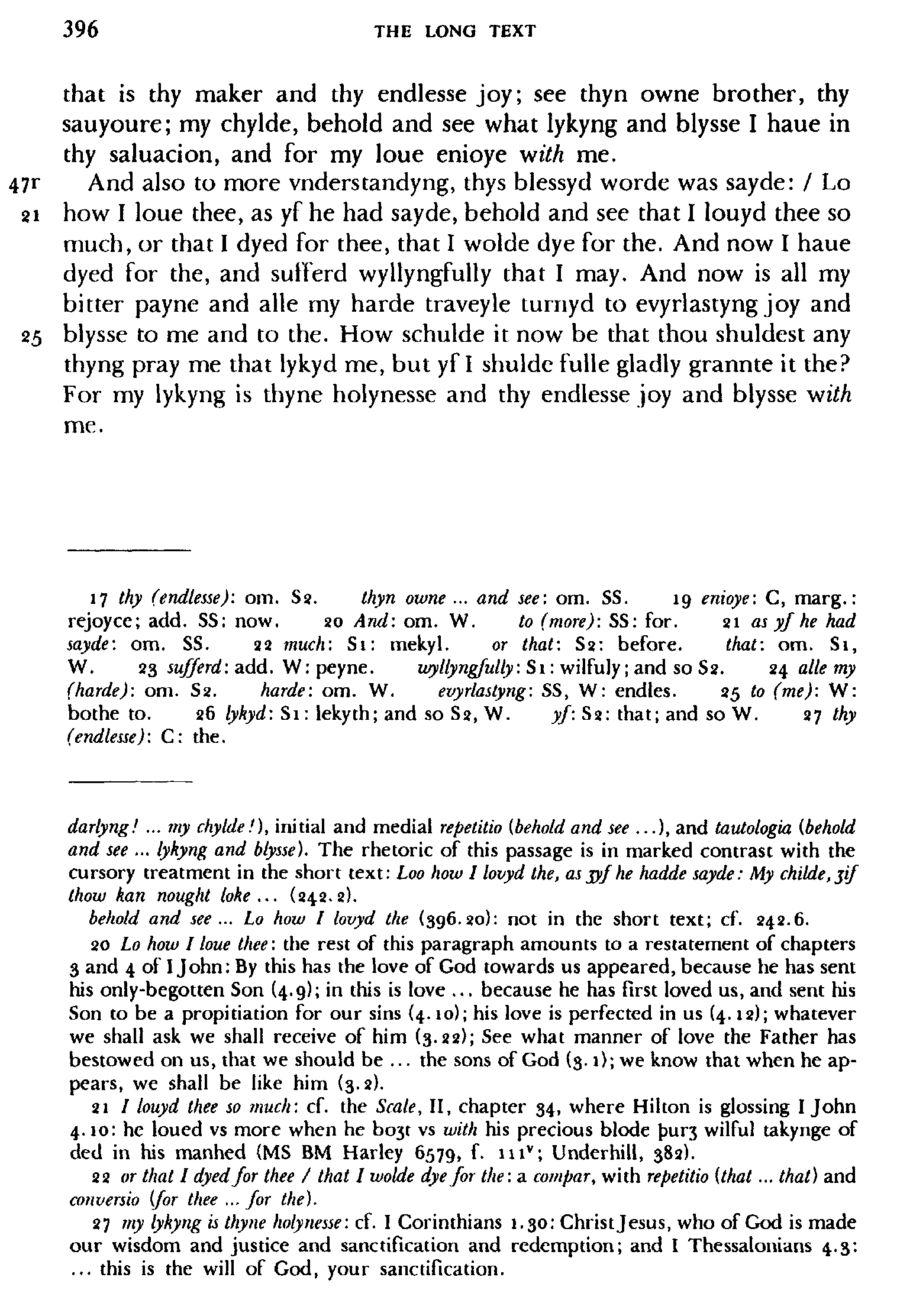
that is thy maker and thy endlesse joy; see thyn owne brother, thy sauyoure; my chylde, behold and see what lykyng and blysse I haue in thy saluacion, and for my loue enioye with me.
47r And also to more vnderstandyng, thys blessyd worde was sayde: / Lo 21 how I loue thee, as yf he had sayde, behold and see that I louyd thee so much, or that I dyed for thee, that I wolde dye for the. And now I haue dyed for the, and sufferd wyllyngfully that I may. And now is all my bitter payne and alle my harde traveyle turnyd to evyrlastyng joy and 25 blysse to me and to the. How schulde it now be that thou shuldest any thyng pray me that lykyd me, but yf I shuldc fulle gladly grannte it the?
For my lykyng is thyne holynesse and thy endlesse joy and blysse wz/A me.
17 thy (endlesse): om. 82. thyn owne ... and see: om. SS.
19 enioye: C, marg.: rejoyce; add. SS: now.
20 And: om. W. to (more): SS: for.
21 as yf he had sayde: om. SS.
22 much: Si: tnekyl. or that: 82: before. that: om. Si, W.
23 sufferd: add. W: peyne. wyllyngfully: Si: wilfuly; and so 82.
24 alle my (harde): om. 82. harde: om. W. evyrlastyng: SS, W: endles.
25 to (me): W: bothe to.
26 lykyd: Si: lekyth; and so 82, W. yf: 82: that; and so W.
27 thy (endlesse): C: the. darlyng! ... my chylde!), initial and medial repetitio (behold and see ...), and tautologia (behold and see ... lykyng and blysse). The rhetoric of this passage is in marked contrast with the cursory treatment in the short text: Loo how I lovyd the, as jyfhe hadde sayde: My childe,jif thow kan nought lake... (242.2). behold and see ... Lo how I lovyd the (396.20): not in the short text; cf. 242.6.
20 Lo how I loue thee: the rest of this paragraph amounts to a restatement of chapters
3 and 4 of I John: By this has the love of God towards us appeared, because he has sent his only-begotten Son (4.9); in this is love ... because he has first loved us, and sent his
Son to be a propitiation for our sins (4.10); his love is perfected in us (4.12); whatever we shall ask we shall receive of him (3.22); See what manner of love the Father has bestowed on us, that we should be ... the sons of God (3. i); we know that when he appears, we shall be like him (3.2).
21 / louyd thee so much: cf. the Scale, II, chapter 34, where Hilton is glossing I John
4.10: he loued vs more when he boy vs with his precious blode £ur3 wilful takynge of ded in his manhed (MS BM Harley 6579, f. mv; Underbill, 382).
22 or that I dyed for thee / that I wolde dye for the: a compar, with repetitio (that... that) and conversio (for thee ... for the).
27 my lykyng is thyne holynesse: cf. I Corinthians 1.30: Christ Jesus, who of God is made our wisdom and justice and sanetification and redemption; and I Thessalonians 4.3:
... this is the will of God, your sanctification.
CHAPTER 24, REVELATION 10
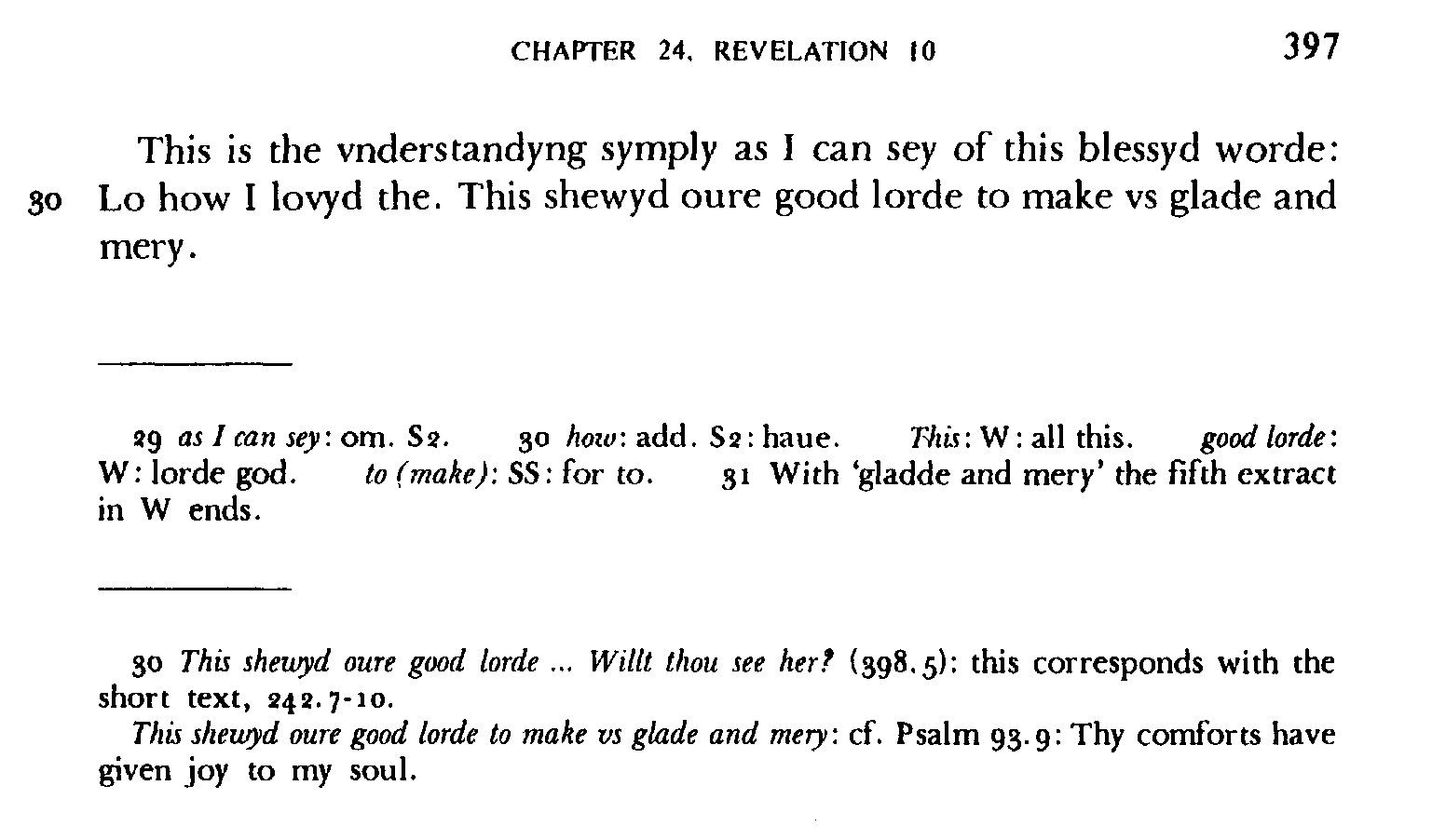
This is the vnderstandyng symply as I can sey of this blessyd worde:
30 Lo how I lovyd the. This shewyd oure good lorde to make vs glade and mery.
29 as lean sey: om. 82.
30 how: add. S s : haue.
TJiit: W: all this. goodlorde:
W: lorde god. to (make): SS: for to.
31 With 'gladde and mery' the fifth extract in W ends.
30 This shewyd oure good lorde ... Willt thou see her? (398.5): this corresponds with the short text, 242.7-10.
This shewyd oure good lorde to make vs glade and mery: cf. Psalm 93.9: Thy comforts have given joy to my soul.
THE LONG TEXT
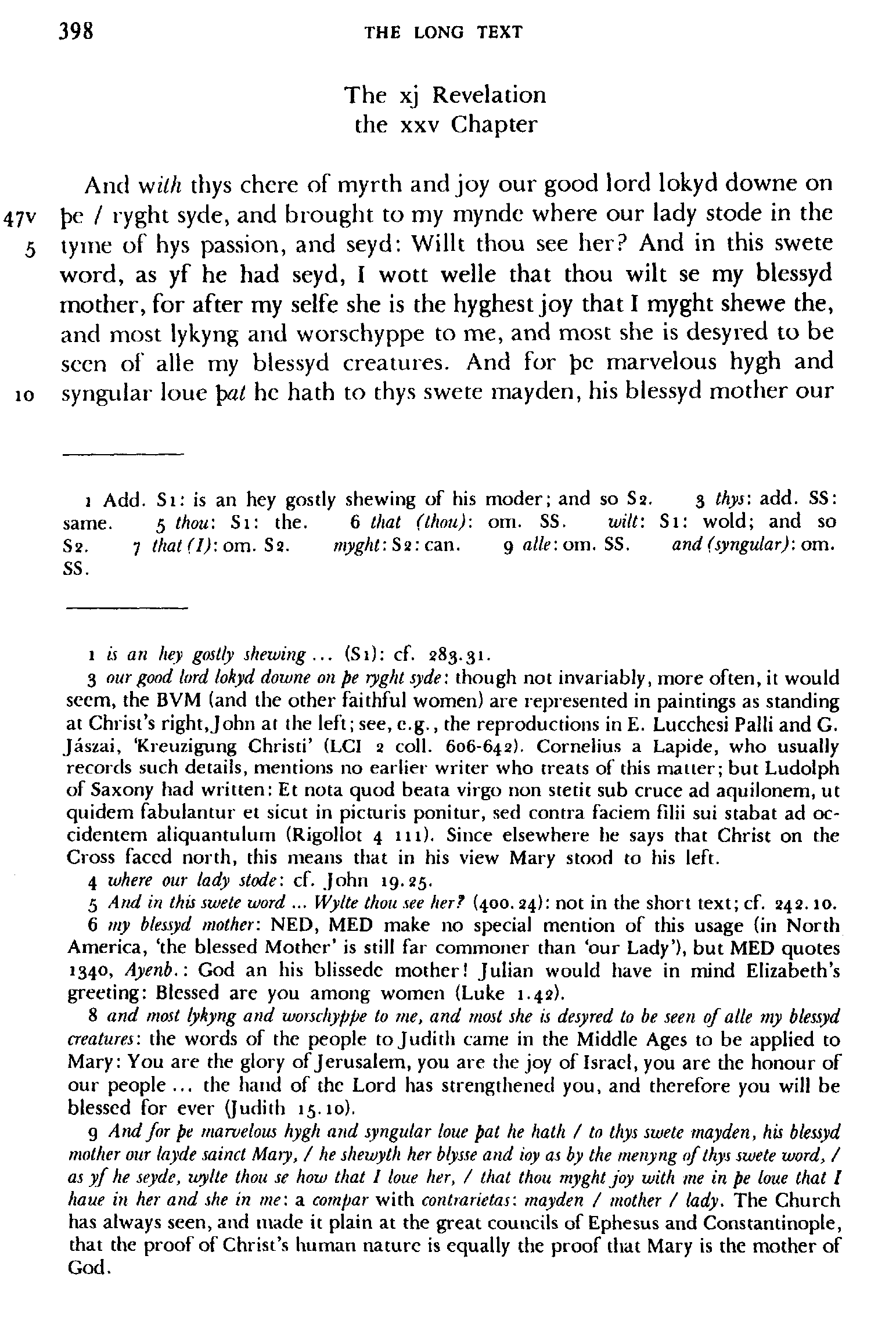
The xj Revelation the xxv Chapter And wz7/i thys chere of myrth and joy our good lord lokyd downe on 47v \)C I ryght syde, and brought to my mynde where our lady stode in the 5 tyme of hys passion, and seyd: Willt thou see her? And in this swete word, as yf he had seyd, I wott welle that thou wilt se my blessyd mother, for after my selfe she is the hyghest joy that I myght shewe the, and most lykyng and worschyppe to me, and most she is desyred to be seen of alle my blessyd creatures. And for IDC marvelous hygh and 10 syngular loue \>al he hath to thys swete mayden, his blessyd mother our i Add. Si: is an hey gostly shewing of his moder; and so Ss.
3 thys: add. SS: same.
5 thou: Si: the.
6 that (thou): om. SS. wilt: Si: wold; and so Sz.
7 that(I):om.Sn. myght: S2: can. ga//i:om. SS. and (syngular): om.
SS. i is an hey gostly shewing... (Si): cf. 283.31.
3 our good lord lokyd downe on pe ryght syde: though not invariably, more often, it would seem, the BVM (and the other faithful women) are represented in paintings as standing at Christ's right,John at the left; see, e.g., the reproductions in E. Lucchesi Palli and G.
Jaszai, 'Kreuzigung Christ!' (LCI 2 coll. 606-642). Cornelius a Lapide, who usually records such details, mentions no earlier writer who treats of this matter; but Ludolph of Saxony had written: Et nota quod beata virgo non stetit sub cruce ad aquilonem, ut quidem fabulantur et sicut in picturis ponitur, sed contra faciem filii sui stabat ad occidentem aliquantulum (Rigollot 4 111). Since elsewhere he says that Christ on the Cross faced north, this means that in his view Mary stood to his left.
4 where our lady stode: cf. John 19.25.
5 And in this swete word ... Wylte thou see her? (400. 24): not in the short text; cf. 242.10.
6 my blessyd mother: NED, MED make no special mention of this usage (in North America, 'the blessed Mother' is still far commoner than 'our Lady'), but MED quotes
1340, Ayenb.: God an his blissede mother! Julian would have in mind Elizabeth's greeting: Blessed are you among women (Luke 1.42).
8 and most lykyng and worschyppe to me, and most she is desyred to be seen of alle my blessyd creatures: the words of the people to Judith came in the Middle Ages to be applied to Mary: You are the glory of Jerusalem, you are the joy of Israel, you are the honour of our people ... the hand of the Lord has strengthened you, and therefore you will be blessed for ever (Judith 15.10).
9 And for pe marvelous hygh and syngular loue pat he hath / to thys swete mayden, his blessyd mother our layde sainct Mary, / he shewyth her blysse and ioy as by the menyng of thys swete word, / as yf he seyde, wylte thou se how that I loue her, / that thou myght joy with me in pe loue that I haue in her and she in me: a com/jar with contrarietas: mayden / mother / lady. The Church has always seen, and made it plain at the great councils of Ephesus and Constantinople, that the proof of Christ's human nature is equally the proof that Mary is the mother of God.
CHAPTER 25, REVELATION I I
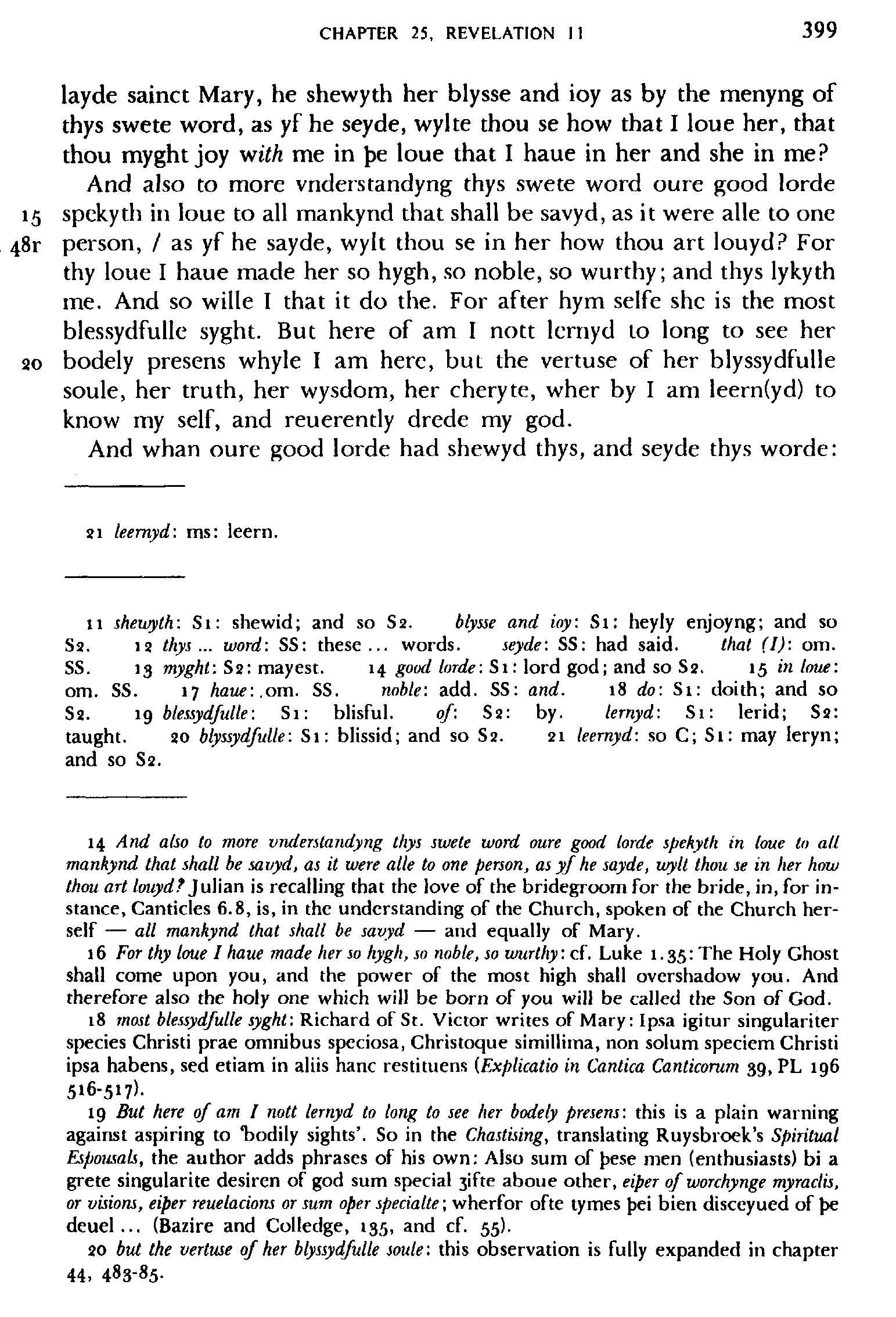
layde sainct Mary, he shewyth her blysse and ioy as by the menyng of thys swete word, as yf he seyde, wylte thou se how that I loue her, that thou myght joy with me in J>e loue that I haue in her and she in me?
And also to more vnderstandyng thys swete word oure good lorde 15 spekyth in loue to all mankynd that shall be savyd, as it were alle to one
48r person, / as yf he sayde, wylt thou se in her how thou art louyd? For thy loue I haue made her so hygh, so noble, so wurthy; and thys lykyth me. And so wille I that it do the. For after hym selfe she is the most blessydfulle syght. But here of am I nott Icrnyd to long to see her
20 bodely presens whyle I am here, but the vertuse of her blyssydfulle soule, her truth, her wysdom, her cheryte, wher by I am leern(yd) to know my self, and reuerently drede my god.
And whan oure good lorde had shewyd thys, and seyde thys worde: si leernyd: ms: leern.
11 shewyth: Si: shewid; and so Ss. blysse and ioy: Si: heyly enjoyng; and so 82. is thys ... word: SS: these... words. seyde: SS: had said. that (I): om.
SS.
13 myght: Ss: mayest.
14 good lorde: Si: lord god; and so Sa.
15 in loue: om. SS.
17 haue:.om. SS. noble: add. SS: and.
18 do: Si: doith; and so Sa.
19 blessydfulle:
Si: blisful. of:
Ss: by. lernyd:
Si: lerid; Sa: taught. ao blyssydfulle: Si: blissid; and so Sa. ai leernyd: so C; Si: may leryn; and so Sa.
14 And also to more vnderstandyng thys swete word oure good lorde spekyth in loue to all mankynd that shall be savyd, as it were alle to one person, as yf he sayde, wylt thou se in her how thou art louyd? Julian is recalling that the love of the bridegroom for the bride, in, for instance, Canticles 6.8, is, in the understanding of the Church, spoken of the Church herself — all mankynd that shall be savyd — and equally of Mary.
16 For thy loue I haue made her so hygh, so noble, so wurthy: cf. Luke i. 35: The Holy Ghost shall come upon you, and the power of the most high shall overshadow you. And therefore also the holy one which will be born of you will be called the Son of God.
18 most blessydfulle syght: Richard of St. Victor writes of Mary: Ipsa igitur singulariter species Christi prae omnibus speciosa, Christoque simillima, non solum speciem Christi ipsa habens, sed etiam in aliis hanc restituens (Explicatio in Cantica Canticorum 39, PL 196
516-517).
19 But here of am I nott lernyd to long to see her bodely presens: this is a plain warning against aspiring to *bodily sights'. So in the Chastising, translating Ruysbroek's Spiritual
Espousals, the author adds phrases of his own: Also sum of J^ese men (enthusiasts) bi a grete singularite desiren of god sum special jifte aboue other, eiper ofworchynge myraclis, or visions, eiper reuelacions or sum oper spedalte; wherfor ofte tymes £ei bien disceyued of fc>e deuel... (Bazire and Colledge, 135, and cf. 55).
20 but the vertuse of her blyssydfulle soule: this observation is fully expanded in chapter
44, 483-85.
THE LONG TEXT
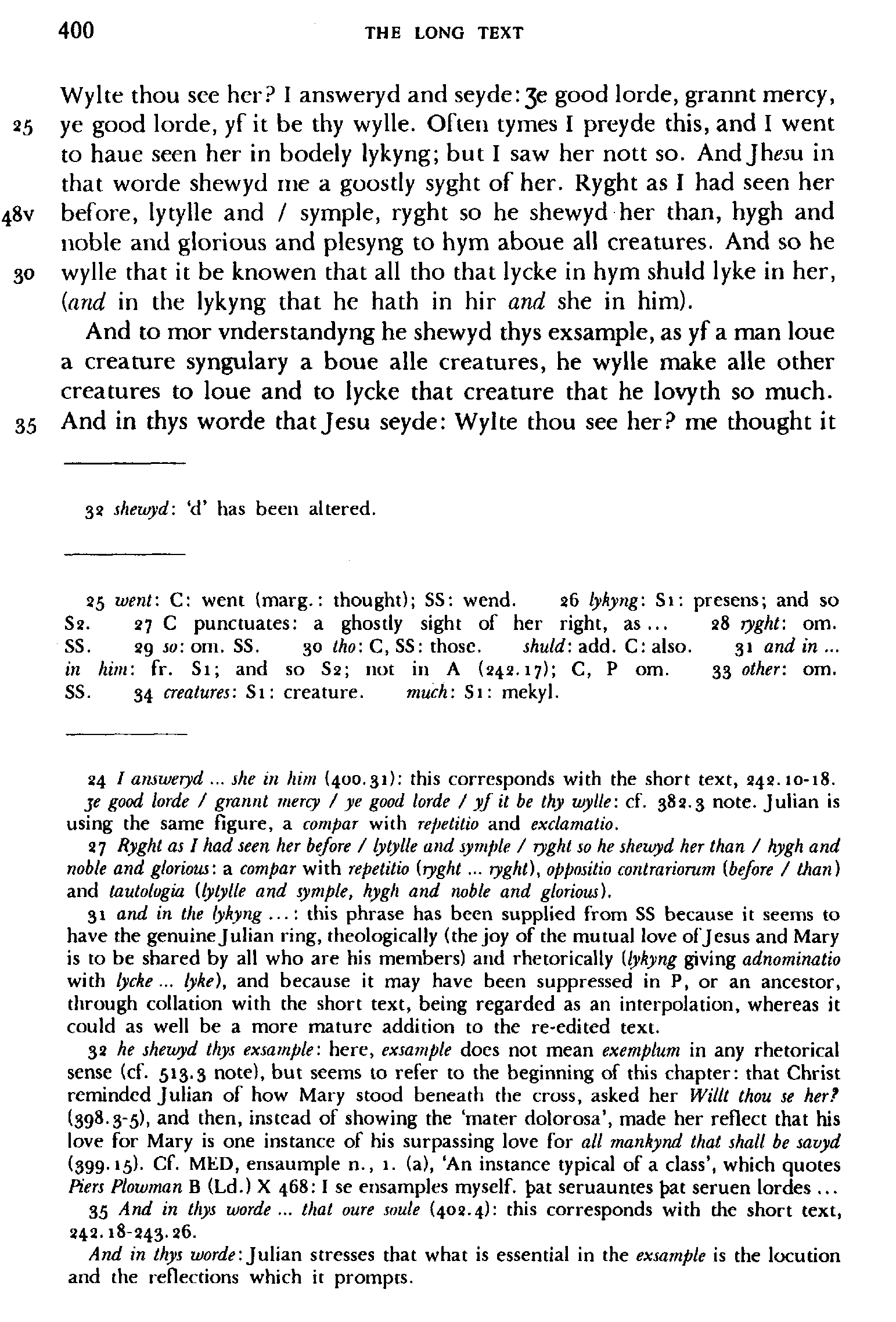
Wylte thou see her? I answeryd and seyde:3e good lorde, grannt mercy, 25 ye good lorde, yf it be thy wylle. Often tymes I preyde this, and I went to haue seen her in bodely lykyng; but I saw her nott so. And Jhesu in that worde shewyd me a goostly syght of her. Ryght as I had seen her
48v before, lytylle and / symple, ryght so he shewyd her than, hygh and noble and glorious and plesyng to hym aboue all creatures. And so he
30 wylle that it be knowen that all tho that lycke in hym shuld lyke in her, (and in the lykyng that he hath in hir and she in him).
And to mor vnderstandyng he shewyd thys exsample, as yf a man loue a creature syngulary a boue alle creatures, he wylle make alle other creatures to loue and to lycke that creature that he lovyth so much.
35 And in thys worde that Jesu seyde: Wylte thou see her? me thought it 32 shewyd: 'd' has been altered.
25 went: C: went (marg.: thought); SS: wend.
26 lykyng: Si: presens; and so 82.
27 C punctuates: a ghostly sight of her right, as...
28 ryght: om.
SS.
29 so: om. SS.
30 tho: C, SS: those. shuld: add. C: also.
31 and in ... in him: fr. Si; and so 82; not in A (242.17); C, P om.
33 other: om.
SS.
34 creatures: Si: creature. much: Si: mekyl.
24 / answeryd ... she in him (400.31): this corresponds with the short text, 242.10-18. y good lorde / grannt mercy / ye good lorde / yf it be thy wylle: cf. 382.3 note. Julian is using the same figure, a compar with refietitio and exclamatio.
27 Ryght as I had seen her before / lytylle and symple / ryght so he shewyd her than / hygh and noble and glorious: a compar with repetitio (ryght ... ryght), oppositio contrariorum (before / than) and tautologia (lytylle and symple, hygh and noble and glorious).
31 and in the lykyng ...: this phrase has been supplied from SS because it seems to have the genuine Julian ring, theologically (the joy of the mutual love of Jesus and Mary is to be shared by all who are his members) and rhetorically (lykyng giving adnominatio with lycke ... lyke), and because it may have been suppressed in P, or an ancestor, through collation with the short text, being regarded as an interpolation, whereas it could as well be a more mature addition to the re-edited text.
32 he shewyd thys exsample: here, exsample does not mean exemplum in any rhetorical sense (cf. 513.3 note), but seems to refer to the beginning of this chapter: that Christ reminded Julian of how Mary stood beneath the cross, asked her Willt thou se her?
(398.3-5), and then, instead of showing the 'mater dolorosa', made her reflect that his love for Mary is one instance of his surpassing love for all mankynd that shall be savyd
(399.15). Cf. MED, ensaumple n., i. (a), 'An instance typical of a class', which quotes
Piers Plowman B (Ld.) X 468:1 se ensamples myself, pat seruauntes pat seruen lordes ...
35 And in thys worde ... that oure soule (402.4): this corresponds with the short text,
242.18-243.26.
And in thys worde: Julian stresses that what is essential in the exsample is the locution and the reflections which it prompts.
CHAPTER 25, REVELATION
I I
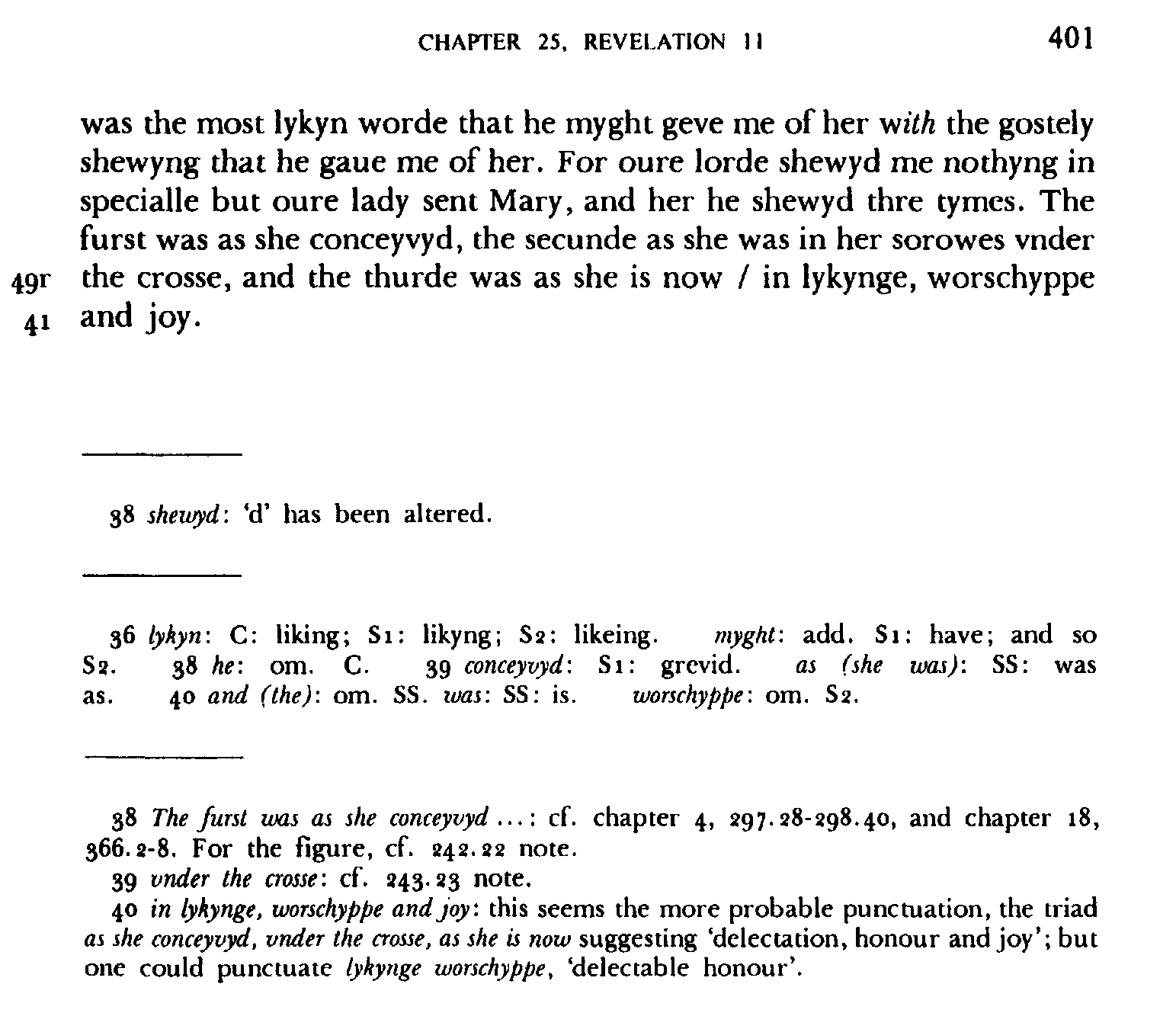
was the most lykyn worde that he myght geve me of her with the gostely shewyng that he gaue me of her. For oure lorde shewyd me nothyng in specialle but oure lady sent Mary, and her he shewyd thre tymes. The furst was as she conceyvyd, the secunde as she was in her sorowes vnder
4gr the crosse, and the thurde was as she is now / in lykynge, worschyppe 41 and joy.
38 shewyd: 'd' has been altered.
36 lykyn: C: liking; Si: likyng; $2: likeing. myght: add. Si: have; and so 82.
38 he: om.
39 conceyvyd:
Si: grevid. as (she was): SS: was as.
40 and (the): om. SS. was: SS: is. worschyppe: om. Sa.
38 The furst was as she conceyvyd...: cf. chapter 4, 297.28-298.40, and chapter 18,
366.2-8. For the figure, cf. 242.22 note.
39 vnder the crosse: cf. 243.23 note.
40 in lykynge, worschyppe and joy: this seems the more probable punctuation, the triad as she conceyvyd, vnder the crosse, as she is now suggesting 'delectation, honour and joy'; but one could punctuate lykynge worschyppe, 'delectable honour'.
THE LONG TEXT
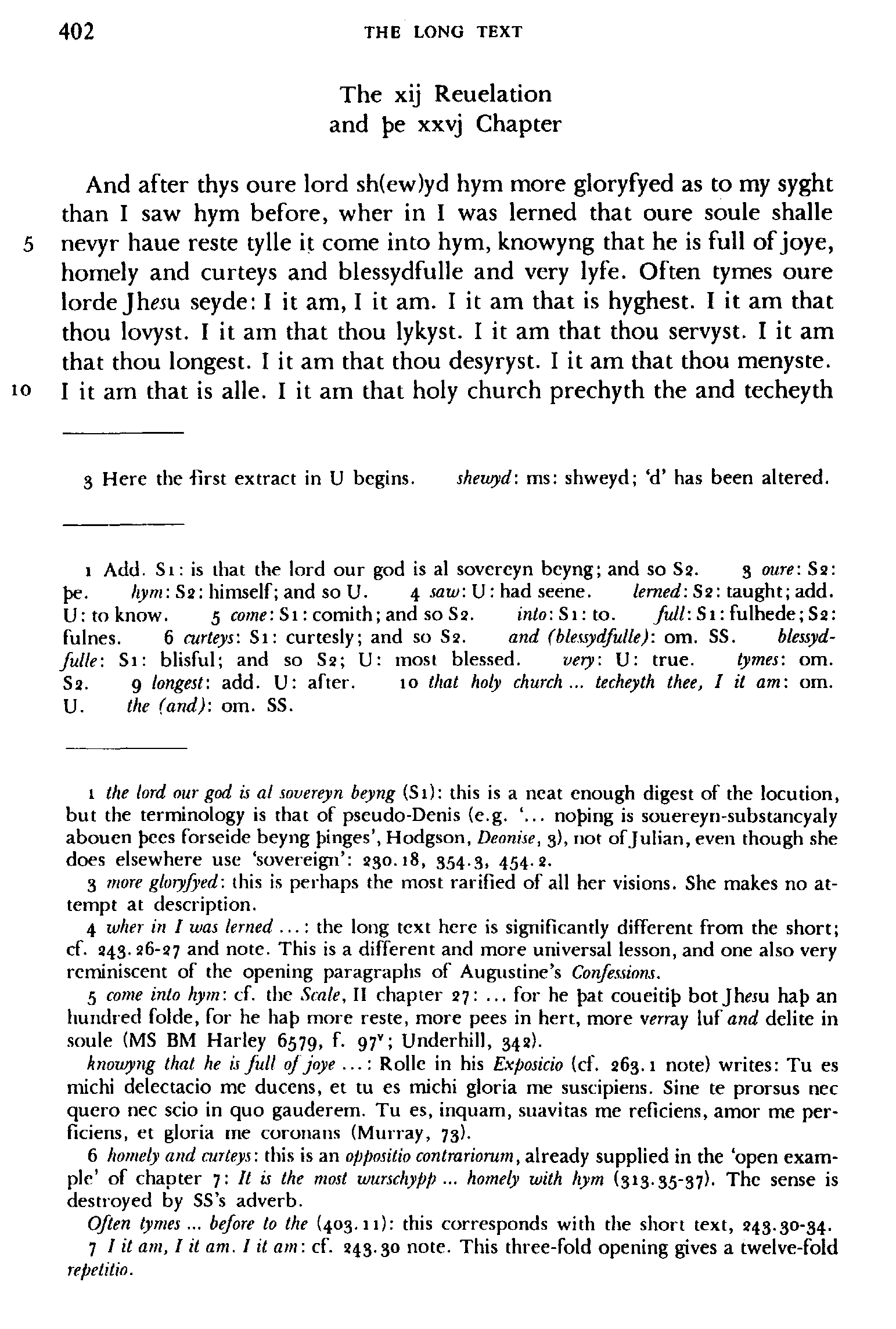
The xij Reuelation and be xxvj Chapter And after thys cure lord sh(ew)yd hym more gloryfyed as to my syght than I saw hym before, wher in I was lerned that oure soule shalle
nevyr haue reste tylle it come into hym, knowyng that he is full of joye, homely and curteys and blessydfulle and very lyfe. Often tymes oure lorde Jh«u seyde: I it am, I it am. I it am that is hyghest. I it am that thou lovyst. I it am that thou lykyst. I it am that thou servyst. I it am that thou longest. I it am that thou desyryst. I it am that thou menyste.
I it am that is alle. I it am that holy church prechyth the and techeyth 3 Here the first extract in U begins. sheuyd: ms: shweyd; 'd' has been altered. i Add. Si: is that the lord our god is al sovereyn beyng; and so 82.
3 oure: Ss:
{je. hym: 82: himself; and so U.
4 saw. U: had scene. lerned: 82: taught; add.
U: to know.
5 come: Si: comith; and so 82. intoiSi: to. full: Si: fulhede;Sa: fulnes.
6 curteys: Si: curtesly; and so 82. and (blessydfulle): om. SS. blessydfulle: Si: blisful; and so 82; U: most blessed. very: U: true. tymes: om.
82.
9 longest: add. U: after.
10 that holy church... techeyth thee, I it am: om.
U. the (and): om. SS. i the lord our god is al sovereyn beyng (Si): this is a neat enough digest of the locution, but the terminology is that of pseudo-Denis (e.g. '... noting is souereyn-substaricyaly abouen {jees forseide beyng Binges', Hodgson, Deonise, 3), not of Julian, even though she does elsewhere use 'sovereign': 230.18, 354.3, 454.2.
3 more gloryfyed: this is perhaps the most rarified of all her visions. She makes no attempt at description.
4 wher in I was lerned ...: the long text here is significantly different from the short; cf. 243. 26-27 and note. This is a different and more universal lesson, and one also very reminiscent of the opening paragraphs of Augustine's Confessions.
5 come into hym: cf. the Scale, II chapter 27: ... for he pat coueitij) bot Jhmi ha}> an hundred folde, for he hajj more reste, more pees in hert, more verray luf and delite in soule (MS BM Harley 6579, f. 97V; Underbill, 342). knowyng that he is full of joye ...: Rolle in his Exposicio (cf. 263.1 note) writes: Tu es michi delectacio me ducens, et tu es michi gloria me suscipiens. Sine te prorsus nee quero nee scio in quo gauderem. Tu es, inquam, suavitas me reddens, amor me perficiens, et gloria me corunans (Murray, 73).
6 homely and curteys: this is an oppositio contrariorum, already supplied in the 'open example' of chapter 7: It is the most wurschypp ••• homely with hym (313-35-37). The sense is destroyed by SS's adverb.
Often tymes ... before to the (403.11): this corresponds with the short text, 243.30-34.
7 / it am, I it am. I it am: cf. 243.30 note. This three-fold opening gives a twelve-fold repelitio.
40333
CHAPTER 26, REVELATION 12
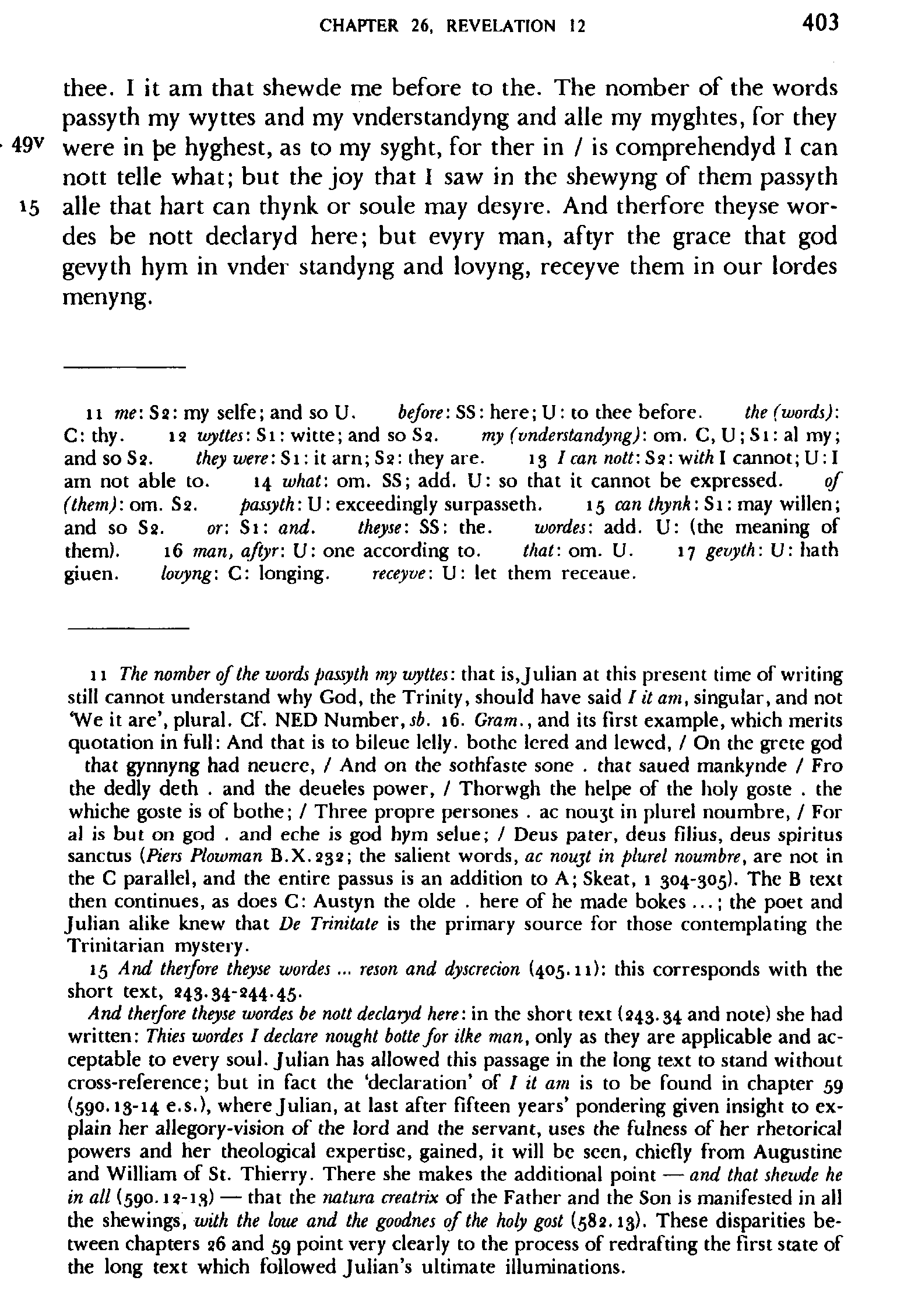
thee. I it am that shewde me before to the. The nomber of the words passyth my wyttes and my vnderstandyng and alle my myghtes, for they
- 49V were in £e hyghest, as to my syght, for ther in / is comprehendyd I can nott telle what; but the joy that I saw in the shewyng of them passyth
15 alle that hart can thynk or soule may desyre. And therfore theyse wordes be nott declaryd here; but evyry man, aftyr the grace that god gevyth hym in vnder standyng and lovyng, receyve them in our lordes menyng.
11 me: S 2: my selfe; and so U. before: SS: here; U: to thee before. the (words):
C: thy.
12 wyttes: Si: witte; and so Sa. my (vnderstandyng): om. C, U; Si: al my; and so 82. they were:Si: it arn;S2: they are.
13 lean nott: Ss: with I cannot; U: I am not able to.
14 what: om. SS; add. U: so that it cannot be expressed. of (them): om. 82. passyth: U: exceedingly surpasseth.
15 can thynk: Si: may willen; and so 82. or: Si: and. theyse: SS: the. wordes: add. U: (the meaning of them).
16 man, aftyr: U: one according to. that: om. U.
17 gevyth: U: hath giuen. lovyng: C: longing. receyve: U: let them receaue.
11 The nomber of the words passyth my wyttes: that is, Julian at this present time of writing still cannot understand why God, the Trinity, should have said / it am, singular, and not 'We it are', plural. Cf. NED Number, sb. 16. Gram., and its first example, which merits quotation in full: And that is to bileue lelly. bothe lered and lewed, / On the grete god
. that gynnyng had neuere, / And on the sothfaste sone . that saued mankynde / Fro the dedly deth . and the deueles power, / Thorwgh the helpe of the holy goste . the whiche goste is of bothe; / Three propre persones . ac nou3t in plurel noumbre, / For al is but on god . and eche is god hym selue; / Deus pater, deus filius, deus spiritus sanctus (Piers Plowman B.X.232; the salient words, ac noujt in plurel noumbre, are not in the C parallel, and the entire passus is an addition to A; Skeat, i 304-305). The B text men continues, as does C: Austyn the olde . here of he made bokes ...; the poet and Julian alike knew that De Trinitate is the primary source for those contemplating the Trinitarian mystery.
15 And therfore theyse wordes ... reson and dyscrecion (405.11): this corresponds with the short text, 243.34-244.45.
And therfore theyse wordes be nott declaryd here: in the short text (243.34 and note) she had written: Thies wordes I declare nought bottefor tike man, only as they are applicable and acceptable to every soul. Julian has allowed this passage in the long text to stand without cross-reference; but in fact the 'declaration' of / it am is to be found in chapter 59
(590.13-14 e.s.), where Julian, at last after fifteen years' pondering given insight to explain her allegory-vision of the lord and the servant, uses the fulness of her rhetorical powers and her theological expertise, gained, it will be seen, chiefly from Augustine and William of St. Thierry. There she makes the additional point — and that shewde he in all (590.12-13) — that the natura matrix of the Father and the Son is manifested in all die shewings, with the loue and the goodnes of the holy gost (582.13). These disparities between chapters 26 and 59 point very clearly to the process of redrafting the first state of the long text which followed Julian's ultimate illuminations.
THE LONG TEXT
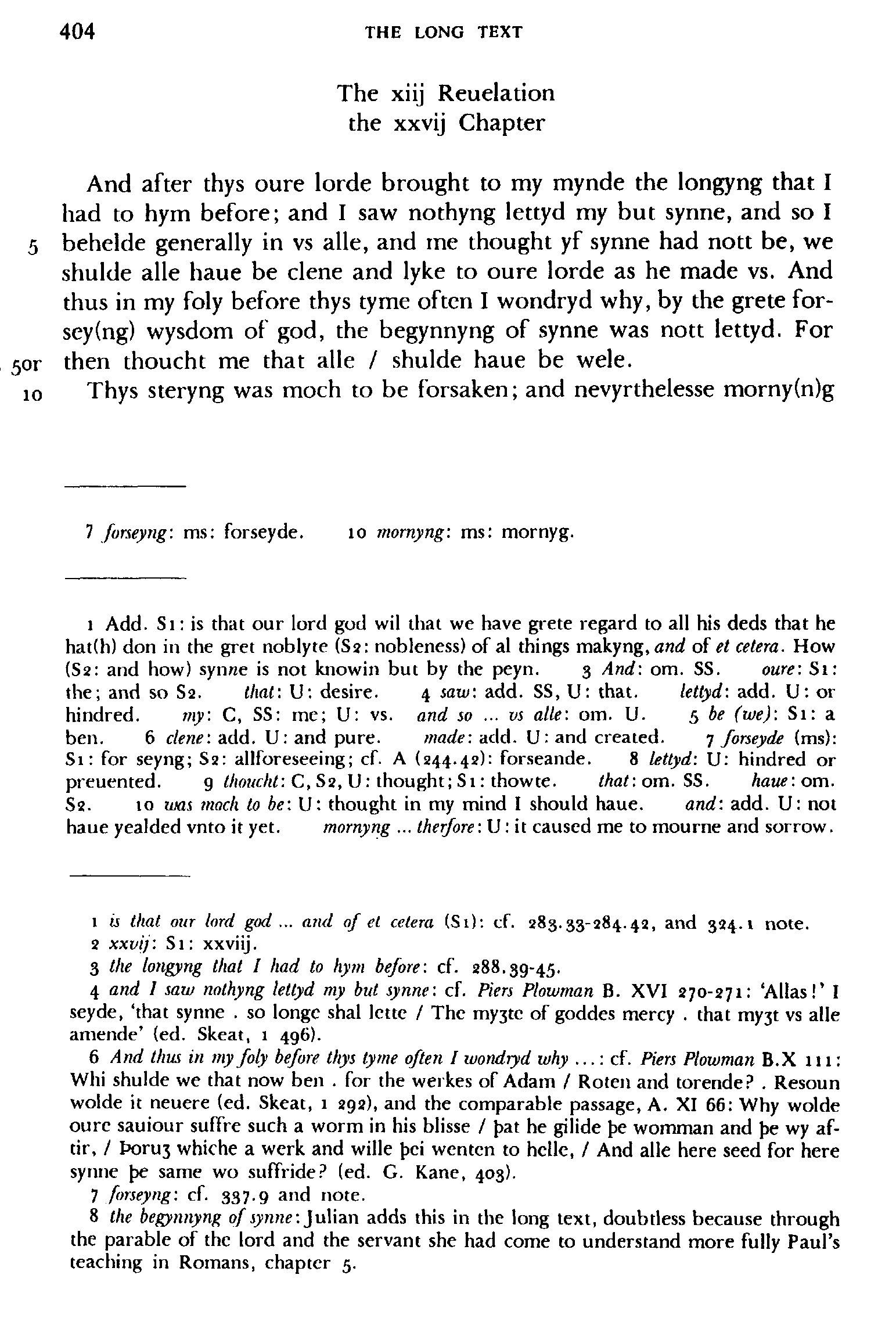
The xiij Reuelation the xxvij Chapter And after thys oure lorde brought to my mynde the longyng that I had to hym before; and I saw nothyng lettyd my but synne, and so I 5 behelde generally in vs alle, and me thought yf synne had nott be, we shulde alle haue be clene and lyke to oure lorde as he made vs. And thus in my foly before thys tyme often I wondryd why, by the grete forsey(ng) wysdom of god, the begynnyng of synne was nott lettyd. For 5or then thoucht me that alle / shulde haue be wele.
Thys steryng was moch to be forsaken; and nevyrthelesse morny(n)g 7 forseyng: ms: forseyde.
10 mornyng: ms: mornyg. i Add. Si: is that our lord god wil that we have grete regard to all his deds that he hat(h) don in the gret noblyte (Sa: nobleness) of al things makyng.and of et cetera. How
(Sa: and how) synne is not knowin but by the peyn.
3 And: om. SS. oure: Si: the; and so Sa. that: U: desire.
4 saw: add. SS, U: that. lettyd: add. U: or hundred. my: C, SS: rne; U: vs. and so ... vs alle: om. U.
5 be (we): Si: a ben.
6 dene: add. U: and pure. made: add. U: and created.
7 forseyde (ms):
Si: for seyng; Sa: allforeseeing; cf. A (244.43): forseande.
8 lettyd: U: hindred or preuented.
9 thoucht: C, Sa, U: thought; Si: thowte. that: om. SS. haue: om.
Ss.
10 wan moch to be: U: thought in my mind I should haue. and: add. U: not haue yealded vnto it yet. mornyng ... therfore: U: it caused me to mourne and sorrow.
1 is that our lord god ... and of et cetera (Si): cf. 383.33-384.42, and 324.1 note.
2 xxvij: Si: xxviij.
3 the longyng that I had to hym before: cf. 388.39-45.
4 and I saw nothyng lettyd my but synne: cf. Piers Plowman B. XVI 270-271: 'Alias!' I seyde, 'that synne . so longc shal lette / The myste of goddes mercy . that my3t vs alle amende' (ed. Skeat, i 496).
6 And thus in my foly before thys tyme often I wondryd why ...: cf. Piers Plowman B.X 111:
Whi shulde we that now ben . for the werkes of Adam / Roten and torende? . Resoun wolde it neuere (ed. Skeat, i 393), and the comparable passage, A. XI 66: Why wolde oure sauiour suffre such a worm in his blisse / }>at he gilide \>e womman and \>e wy aftir, / J>oru3 whiche a werk and wille Jjei wentcn to helle, / And alle here seed for here synne f>e same wo suffride? (ed. G. Kane, 403).
7 forseyng: cf. 337.9 and note.
8 the begynnyng of synne: Julian adds this in the long text, doubtless because through the parable of the lord and the servant she had come to understand more fully Paul's teaching in Romans, chapter 5.
CHAPTER 27, REVELATION 13
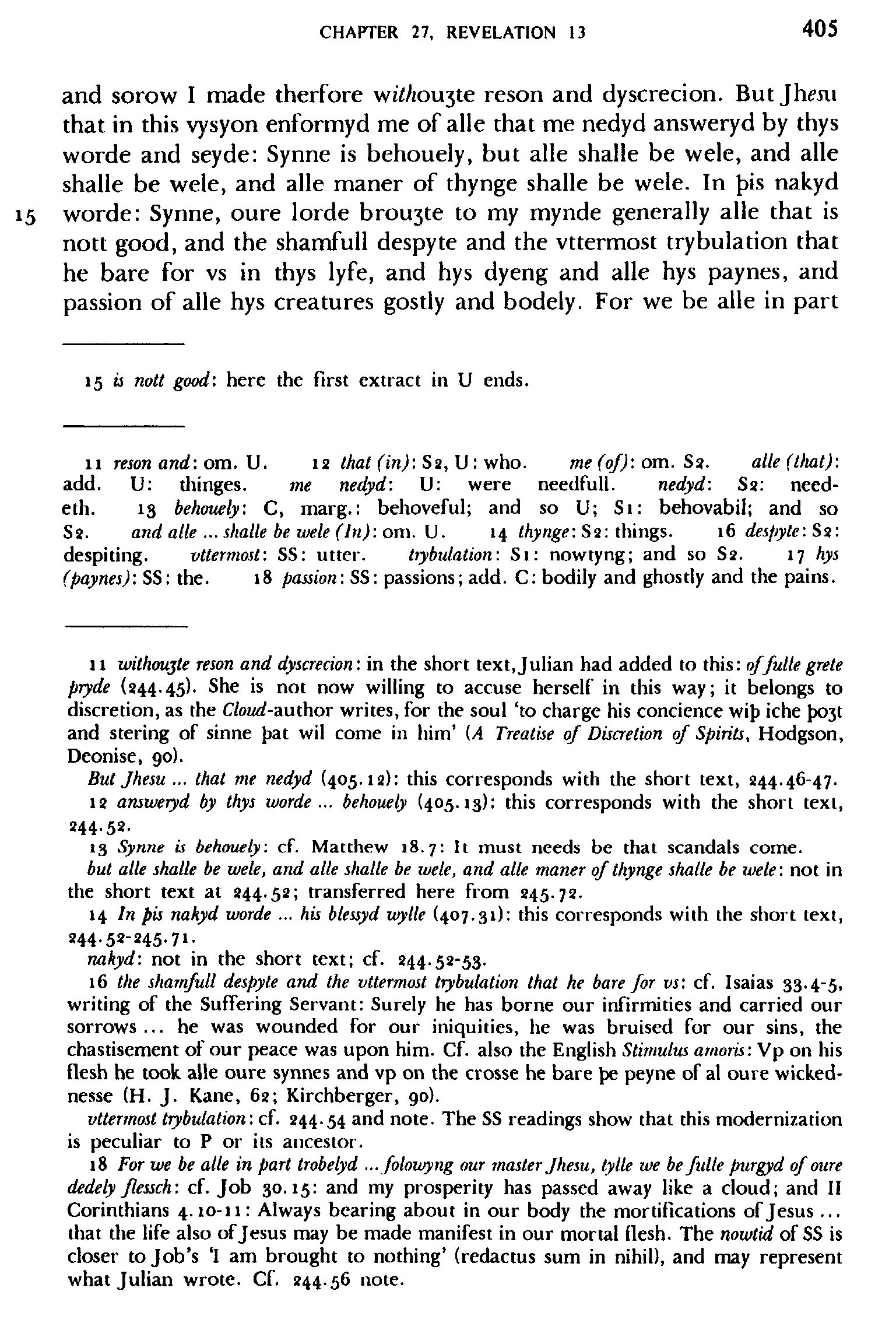
and sorow I made therfore withou^te reson and dyscrecion. But Jhmi that in this vysyon enformyd me of alle that me nedyd answeryd by thys worde and seyde: Synne is behouely, but alle shalle be wele, and alle shalle be wele, and alle maner of thynge shalle be wele. In JMS nakyd
15 worde: Synne, cure lorde brou3te to my mynde generally alle that is nott good, and the shamfull despyte and the vttermost trybulation that he bare for vs in thys lyfe, and hys dyeng and alle hys paynes, and passion of alle hys creatures gostly and bodely. For we be alle in part
15 is nott good: here the first extract in U ends.
11 reson and: om. U. '
12 that (in): 82, U: who. me (of): om. S3. alle (that): add.
U: thinges. me nedyd:
U: were needfull. nedyd:
Sa: needeth.
13 behouely: C, marg.: behoveful; and so U; Si: behovabil; and so Sa. and alle ... shalle be wele (In): om. U.
14 thynge: 82: things.
16 despyte:Sz: despiting. vttermost: SS: utter. trybulation: Si: nowtyng; and so Sa.
17 hys (paynes): SS: the.
18 passion: SS: passions; add. C: bodily and ghostly and the pains.
11 withoujte reson and dyscrecion: in the short text,Julian had added to this: offullegrete pryde (344.45). She is not now willing to accuse herself in this way; it belongs to discretion, as the Cloud-author writes, for the soul 'to charge his concience wif> iche Jxrjt and stering of sinne pat wil come in him' (A Treatise of Discretion of Spirits, Hodgson,
Deonise, 90).
But Jhesu ... that me nedyd (405.13): this corresponds with the short text, 344.46-47. ia answeryd by thys worde... behouely (405.13): this corresponds with the short text,
244.53.
13 Synne is behouely: cf. Matthew 18.7: It must needs be that scandals come. but alle shalle be wele, and alle shalle be wele, and alle maner of thynge shalle be wele: not in the short text at 244.53; transferred here from 245.72.
14 In pis nakyd worde ... his blessyd wylle (407.31): this corresponds with the short text,
344.53-845.71. nakyd: not in the short text; cf. 344.53-53.
16 the shamfull despyte and the vttermost trybulation that he bare for vs: cf. Isaias 33.4-5, writing of the Suffering Servant: Surely he has borne our infirmities and carried our sorrows... he was wounded for our iniquities, he was bruised for our sins, the chastisement of our peace was upon him. Cf. also the English Stimulus amoris: Vp on his flesh he took alle oure synnes and vp on the crosse he bare pe peyne of al oure wickednesse (H. J. Kane, 62; Kirchberger, 90). vttermost trybulation: cf. 344.54 an^ note. The SS readings show that this modernization is peculiar to P or its ancestor.
18 For we be alle in part trobelyd ...folowyng our master Jhesu, tylle we be fulle purgyd of oure dedely flessch: cf. Job 30.15: and my prosperity has passed away like a cloud; and II Corinthians 4.10-11: Always bearing about in our body the mortifications of Jesus ... that the life also of Jesus may be made manifest in our mortal flesh. The nowtid of SS is closer to Job's 'I am brought to nothing' (redactus sum in nihil), and may represent what Julian wrote. Cf. 344.56 note.
THE LONG TEXT
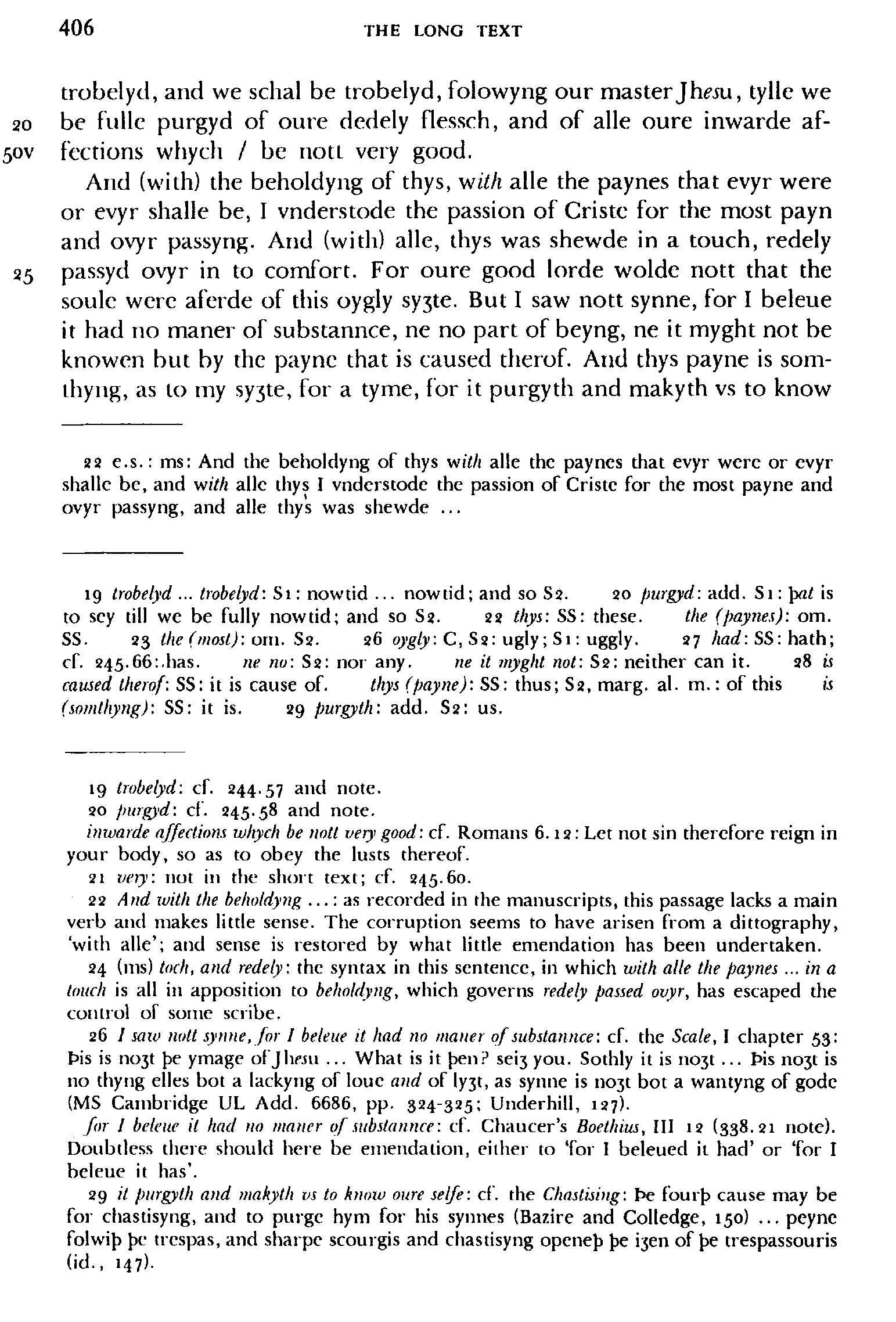
trobelyd, and we schal be trobelyd, folowyng our master Jh^ju, tylle we
be fullc purgyd of oure dedely flessch, and of alle oure inwarde af5ov fcctions whych / be nott very good.
And (with) the beholdyng of thys, w///z alle the paynes that evyr were or evyr shalle be, I vnderstode the passion of Criste for the most payn and ovyr passyng. And (with) alle, thys was shewde in a touch, redely
passyd ovyr in to comfort. For oure good lorde wolde nott that the soulc were aferde of this oygly syjte. But I saw nott synne, for I beleue it had no maner of substannce, ne no part of beyng, ne it myght not be knowen but by the paync that is caused therof. And thys payne is somthyng, as to my sy3te, for a tyme, for it purgyth and makyth vs to know
22 e.s.: ms: And the beholdyng of thys with alle the paynes that evyr were or evyr shalle be, and with alle thys I vnderstode the passion of Criste for the most payne and ovyr passyng, and alle thys was shewde ...
19 trobelyd ... trobelyd: Si: nowtid ... nowtid; and so 82.
20 purgyd: add. Si: ]xit is to scy till we be fully nowtid; and so 82.
22 thys: SS: these. the (paynes): om.
SS.
23 the (most): om. 82.
26 oygly: C, 82: ugly; Si: uggly.
27 had: SS: hath; cf. 245.66:.has. ne no: 82: nor any. ne it myght not: 82: neither can it.
28 is mused therof: SS: it is cause of. thys (payne): SS: thus; 82, marg. al. m.: of this is (sornthyng): SS: it is.
29 purgyth: add. 82: us.
19 trobelyd: cf. 244.57 and note.
20 purg)<d: cf. 245.58 and note. inwarde affections whych be nott very good: cf. Romans 6.12: Let not sin therefore reign in your body, so as to obey the lusts thereof.
21 very: not in the short text; cf. 245.60.
22 And with the beholdyng ...: as recorded in the manuscripts, this passage lacks a main verb and makes little sense. The corruption seems to have arisen from a dittography,
'with alle'; and sense is restored by what little emendation has been undertaken.
24 (ms) toch, and redely: the syntax in this sentence, in which with alle the paynes ... in a touch is all in apposition to beholdyng, which governs redely passed ovyr, has escaped the control of some scribe.
26 / saw nott synne, for I beleue it had no maner of substannce: cf. the Scale, I chapter 53: t>is is 11031 pe ymage of Jhmi ... What is it pen? sei3 you. Sothly it is 11031 ... £>is 11031 is no thyng elles bot a lackyng of loue and of Iy3t, as synne is 11031 bot a wantyng of godc
(MS Cambridge UL Add. 6686, pp. 324-325; Underbill, 127). for I beleue it had no maner of substannce: cf. Chaucer's Boethius, III 12 (338.21 note).
Doubtless there should here be emendation, either to Tor I beleued it had' or Tor I beleue it has'.
29 it purgyth and makyth vs to know oure seife: cf. the Chastising: £>e f'ourp cause may be for chastisyng, and to purge hym for his synnes (Bazire and Colledge, 150) ... peyne folwij) pc trcspas, and sharpe scourgis and chastisyng openep pe i3en of pe trespassouris
(id., 147).
CHAPTER 27, REVELATION 13
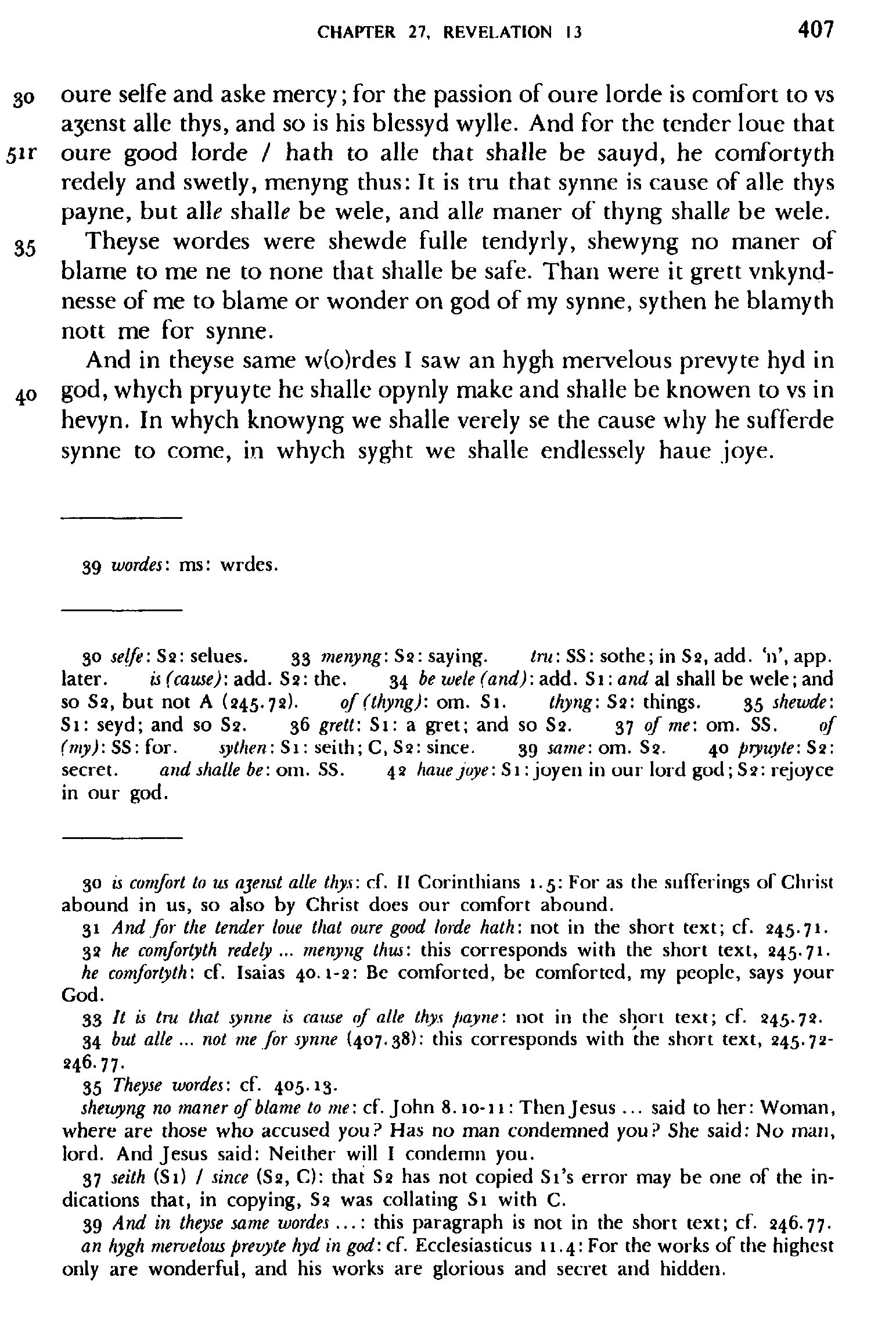
30 oure selfe and aske mercy; for the passion of cure lorde is comfort to vs a3enst alle thys, and so is his blessyd wylle. And for the tender loue that 5ir oure good lorde / hath to alle that shalle be sauyd, he comfortyth redely and swetly, menyng thus: It is tru that synne is cause of alle thys payne, but all? shall? be wele, and all? maner of thyng shall? be wele.
Theyse wordes were shewde fulle tendyrly, shewyng no maner of blame to me ne to none that shalle be safe. Than were it grett vnkyndnesse of me to blame or wonder on god of my synne, sythen he blamyth nott me for synne.
And in theyse same w(o)rdes I saw an hygh mervelous prevyte hyd in 40 god, whych pryuyte he shalle opynly make and shalle be knowen to vs in hevyn. In whych knowyng we shalle verely se the cause why he sufferde synne to come, in whych syght we shalle endlessely haue joye.
39 wordes: ms: wrdes.
30 selfe: Sa: selues.
33 menyng: Sa: saying. tru: SS: sothe; in Sa, add. V, app. later. is (cause): add. Sa: the.
34 be wele (and): add. Si: and al shall be wele; and so Sa, but not A (345.72). of (thyng): om. Si. thyng: Sa: things.
35 shewde:
Si: seyd; and so Sa.
36 grett: Si: a gret; and so Sa.
37 of me: om. SS. of (my): SS: for. sythen: Si: seith; C, Sa: since.
39 same: om. 83.
40 pryuyte: Sa: secret. and shalle be: om. SS.
42 haue joye: Si: joyen in our lord god; 82: rejoyce in our god.
30 is comfort to us aynst alle thys: cf. II Corinthians 1.5: For as the sufferings of Christ abound in us, so also by Christ does our comfort abound.
31 And for the tender loue that oure good lorde hath: not in the short text; cf. 245.71.
32 he comfortyth redely ... menyng thus: this corresponds with the short text, 245.71. he comfortyth: cf. Isaias 40.1-2: Be comforted, be comforted, my people, says your
God.
33 It is tru that synne « cause of alle thys ftayne: not in the short text; cf. 245.72.
34 but alle ... not me for synne (407.38): this corresponds with the short text, 245.73346.77.
35 Theyse wordes: cf. 405.13. shewyng no maner of blame to me: cf. John 8.10-11: Then Jesus ... said to her: Woman, where are those who accused you? Has no man condemned you? She said: No man, lord. And Jesus said: Neither will I condemn you.
37 seith (Si) / since (Sa, C): that 82 has not copied Si's error may be one of the indications that, in copying, 82 was collating Si with C.
39 And in theyse same wordes ...: this paragraph is not in the short text; cf. 246.77. an hygh mervelous prevyte hyd in god: cf. Ecclesiasticus 11.4: For the works of the highest only are wonderful, and his works are glorious and secret and hidden.
THE LONG TEXT
The xxviij Chapter / 5iv Thus I saw how Crist hath compassyon on vs for the cause of synne; and ryght as I was before in the passion of Crist fulfyllyd -with payne and compassion, lyke in thys I was in party fulfylled with compassion of alle
5 my evyn cristcn, for fulle wele he lovyth pepylle that shalle be savyd, that is to seye goddes servanntes. Holy chyrch shalle be shakyd in sorow and anguyssch and trybulacion in this worlde as men shakyth a cloth in the wynde; and as to thys oure lorde answeryd, shewyng on this maner:
A, a grett thyng shalle I make herof in hevyn of endlesse wurshyppe and 10 of evyrlastyng joye.< 3e, so farforth I saw oure lord enjoyeth of the 2 Here the second extract in U begins. i Si: How the children of salvation shal be shakyn in sorowis, but Criste enjoyth wyth compassiow, and a remedye agayn tribulation; and so 82. xxviij: C: xxxiij; Si: xxvijth.
2 hath: 82: had.
3 and ryght as ... my evyn cristen: om. U.
4 lyke: 82: so.
5 evyn cristen: 82: fellow Christians. fulle: SS: pa£, he (lovyth): SS: wel; U: our lord. lovyth: Si: belovid; and so 82.
6 shalle: add. 82: all. sorow: Ss'. sorrows.
7 as (men): U: as a.
8 shewyng: om. SS. on: 82, U: in.
A: om.
88.
10 of (evyrlastyng): om.
SS. joye: SS: joyes. saw: add. C, 88, U: that. enjoyeth: Si: joyth; and so 82; U: reioyceth.
1 xxviij: C: xxxiij, through substitution of V for V; but the running title to p. 64 has 'Chap. 33', whereas on p. 65 it is 'Chap. 28'.
2 Thus I saw ... my evyn cristen (408.5): this corresponds with the short text, 246.77-80.
4 fulfylled with compassion of alle my evyn cristen: cf. I Peter 3.8: having compassion of one another, being lovers of the brotherhood.
5 for fulle wele...: the rest of this paragraph is not in the short text; cf. 246.80. for fulle wele he lovyth pepylle that shalle be savyd: cf. the English Stimulus amoris: And ry3t so wenne a man is besi in al pat he may to conforme him to pat pile pat Crist shewid in his passioun, sothely he plesith mykel Criste. Soche a soule Criste loueth tendirli, for hit is like hym, she felep als he dothe (H. J. Kane, 50; Kirchberger, 82).
6 Holy chyrch shalle be shakyd ...as men shakyth a cloth in the wynde: Julian has her earlier simile in mind, where she compares Christ crucified with a cloth hung in the wind to dry (363.39-40). Margery Kempe uses equally homely language when she tells how it was revealed to her, 'You will be eaten and gnawed by the people of the world as any rat gnaws on a stockfish' (Book of Margery Kempe, 17). The English Horologium uses similar language, alluding to Matthew 28.20: Neuerpeles I haue byhei3t in pe gospelle pat I schalle dwelle with trewe cristen men into pe worldes ende, and pat I schalle neuer suffire {DC schyppc of Petir, pat is holy chirche, perysche, powgh hit be ofte sypes schaken and turbled in dyuerse maners (Horstman, 383).
10-17 This could serve as a summary of the Chastising, 146-148, on the spiritual benefits of afflictions, and especially how 'sharpe scourgis and chastisyng openep pe i3en
CHAPTER 28, REVELATION 13
tribulacions of hys sarvanntes •with pyte and compassion; and to ech 52r person that he lovyth to his blysse for to bryng, he leyth / on him som thyng that is no lacke in his syght, wher by they be lowhyd and dyspysed in thys worlde, scornyd and mokyd and cast out. And thys he doth for 15 to lett the harme Ipat they shulde take of the pompe and of the pryde and the veyne glorye of thys wrechyd lyffe, and make ther wey redy to come to hevyn in blysse wil/iout ende evyrlastyng. For he seyth: I shal alle to breke yow from yowre veyne affeccions and yowre vyscious
11 tribulacions: C, U: tribulation. pyte: SS: reuth. and (to): om. SS; U: that.
12 to his blysse ... bryng: U: and intendeth to bring to his blisse. leyth: Si: levyth; and so Ss. on him: Si: vpon them; and so Sa. som thyng: add. U: that is to say some affliction or tribulation.
13 lacke: C, marg., U: impediment; add. U: to f>e soule. his syght: U: f>e sight of god. lowhyd: C: lowed; marg.: humbled; S i: lakid; marg., al. m.: not liked of, from pe Dutch word lacken to dispraise, to blame, being the opposite to pe Dutch word prijsen, to praise; Sa: lakkid; U: humbled.
14 and (mokyd): om. Sa, U. mokyd: Si: apyd; 82: japyd. cast out: Si: outcasten; and so Sa; U: contemned by others. for (to): om. U.
15 lett: C, marg., U: hinder; add.
U: and prevent.
'pat: W: which. they shulde: U: they are apt to fall into and would. take of: U: incurre by. and of: om. U. and of the pryde; om. SS.
16 the (veyne): om. Sa; C: of the. and (make): add. U: for to. redy: U: the more readdy and better prepare them to come.
17 in blysse: Si: and heynen them in his bliss; and so 82; U: and enioy his blisse. evyrlastyng: Si: lestyng; and so Sa.
18 from: SS: for. of pe trespassouris, whos i3en amonge vices were made blynde wip sikernesse' (Bazire and Colledge, 147). Evidently Julian has in mind at least the Scripture quoted at this point by the Chastising: Deuteronomy 33.39,Job 5.17, Hebrews ia.6: and cf. alsojohn
15.18-21.
13 lowhyd / lowed (C) / lakid (Si) / lakkid (Sa): this indicates a crux differently solved by the ancestors of P and of SS. Cressy may have been right in resolving it as an eccentric P spelling, supplying lowed and glossing it as 'humbled', which U has followed.
Cf. NED, Low, r/.' i., To abase, humble, lower', with its first instance 1382, Wycliffite
Philippians 2.7: He lowyde him silf (semetipsum exinanivit), and with fourteenth and fifteenth-century forms such as loowj, lowgh. But lowhyd may mean 'laughed'. Cf. NED,
Laugh, v. 5. trans., To laugh or mock at, deride', with its first example c. 950, Lindisfarne Gospels, Matthew 9.24: Gehlogun hine (deridebant eum). The SS solution, lakid, is also reasonable: cf. NED, Lack, v.1 5. trans., 'to find fault with, abuse, blame'
(the entry's suggested etymology, 'Cf. MDu taken, to be wanting, to blame', shows the remarkable accuracy of the marginal comment in Si).
1 7 / shal alle to breke yow /from yowre veyne affeccions / and yowre vyscious pryde / and aftyr that I shalle gaderyow / and make yow meke and mylde: a membrum of five cola, with oppositio contrariorum (to breke yow / gader yow, veyne affecctions, vyscious pryde / meke and mylde).
THE LONG TEXT
pryde, and aftyr that I shall*? gader yow and make yow meke and mylde, 20 clcnc and holy by onyng to me.
And than saw I that ech kynde compassion that man hath on hys evyn cristen with charyte, it is Crist in hym, that ych maner noughtyng that he
52v shewde in hys passion, it was shewde a3ene in thys compassion, / wher in were two maner of vnderstondynges in oure lordes menyng. That 25 one was the blysse that we be brought to, wher in he wille that we enioye. That other is for comfort in oure payne, for he wille that we
22 '-ughtyng... thys compassion', scr., on slip pasted over.
19 gader: Si: togeder gader; and so $2.
20 onyng: C, marg: uniting; U: vniting you.
22 hym, that... in hys passion: U: in him whose loue to man made him to esteeme little of all pe paines he suffered in his passion. ych maner: SS: same. he: C, SS: was.
23 it: U: which loue.
24 maner of vnderstondynges: U: thinges to be vnderstood.
That: Si: the; and so 82, U.
25 brought: Si: bowte; and so 82. to:
U: vnto. he wille: U: his will is. that we enioye: SS: be enjoyen.
26 enioye: C, marg.: rejoyce; and so U. for: add. U: our. payne: add. U: and tribulation.
19 I shade gader yow: cf. Matthew 23.37: How often would I have gathered together your children; Matthew 11.28-29: Come to me ... and I will refresh you ... Learn of me, because I am meek and humble of heart; Ephesians 5.25-26: Christ also loved the Church... that he might sanctify it.
21 And than saw I... Crist in hym (410. 22): cf. 246. 77, 79, 80 and notes. The long text here has rearranged and rewritten the short text so as to give a new sequence, in which Christ's compassion for sinners, which the charity between Christians shares, is put first.
22 that ych maner noughtyng ...: the rest of this paragraph is not in the short text; cf.
246.83.
24 That one was the blysse ...: cf. the English Stimulus amoris: ... and pat is wenne a sowle is molten and resolued pourse brennande mynde of Criste3 passioun; penne for3etith pe soule fulli hit self and all ertheli pyng also, and vnspekabley is rauysshed in to pe loue of Jhesu Crist (H. J. Kane, 34; Kirchberger, 70).
25 brought / bowte (Si): either reading is defensible: 'the joy to which we are brought',
'the joy for which we are purchased' (by Christ's sufferings and death).
26 That other is for comfort in our payne ...: so in the English Horologium we read: And so if pou se pi belovede with pe eye of loue, pou shah mowe se him fulle of charite and loue, pe whiche not onely schewede is love bye wordes, as manye loveres of pis worlde done, but also he prouede him selfe trewe lovynge in dedes. Wherfor hit folowefi opunlye pat pc abieccione and vnsemelynesse of pe vttere manne pat he toke of pe bitternesse of passione is raper chewynge and profe of loue (Horstman, 338).
That other is for comfort in oure payne /for he wille that we wytt / that it alle shalle be turned vs
/ to wurschyp and to profyjte / by the vertu of hys passyon / and fiat we wytte that we sufferyd ryght nought aloone / but with hym and see hym oure grownde: a compar with oppositio (comfort / payne, profyjte / passyon, aloone / with hym).
CHAPTER 28, REVELATION 13
wytt that it alle shalle be turned vs to wurschyp and to profy3te by the vertu of hys passyon, and \>at we wytte that we sufferyd ryght nought aloone, but -with hym, and see hym oure grownde. And that we see his
30 paynes and hys trybuladon passe so ferre alle that we may suffer, that it may nott be full thought. And the well beholdyng of thys wylle doth saue vs from grugyng and despeyer in the felyng of our paynes; and yf we see verely that oure synne deserve it, 36tt hys loue excusyth vs. And 53r of hys gret curtesy he doth away alle / oure blame, and beholdeth vs
35 with ruth and pytte, as chyldren innocens and vnlothfulle.
27 be turned: fae', 'ed' cane.
31 doth: cane.
35 Here the second extract in U ends.
27 wytt: C, marg., 82, U: know. it: om. C, U. be turned: C: turn; and so U. vs: om. SS, U. to (wurschyp): add. U: his. to (profyjte): om. 82; add. U: our.
28 hys: add. U: holy. wytte: U: know. sufferyd: 88: suffer, ryght: om.
SS. nought: U: nothing.
29 see (his): U: \>at we see.
30 trybuladon: SS: nowthing. passe: 82: passeth; U: to exceed and surpasse. may (suffer):
U: can.
31 may nott: 82, U: cannot. full: 82, U: fully. thought: 82: conceived; U: thought or imagined. well: om. SS. beholdyng: add. U: and considering. doth: om. C, SS, U.
32 saue: U: keepe. grugyng: U: ouermuch trouble. yf: om.
33 verely: Si: sothly; and so 82. synne: U: sinnes. deserve: C: deserveth; and so SS.
34 and beholdeth... and pytte: om.
82. beholdeth: Si: he holdyth.
35 ruth and pytte: U: ruth and (compassion — cane.) merueilous pitty. innocens: Si: inocents; and so 82. vnlothfulle: C, marg.: unspotted; and so U.
28 that we sufferyd ryght nought aloone, but with hym: cf. the Chastising: Oure lordjhesu
Crist stondip wij> his goostli children (Bazire and Colledge, 122).
29 his paynes and hys trybuladon passe so ferre alle that we may suffer: cf. the English
Stimulus amoris, in an addition to the Latin: Ymagyne we Jjenne pat als mykel peyne as alle men my3t suffre, 3if pei hadden ben alle o man and o man hadde pe my3th of alle men, pus myche pyne and 3it moche moore suffred Jhesu in his persone alone (H. J.
Kane, 29; Kirchberger, 67).
31 doth saue vs from grugyng and despeyer: cf. the English prose Bonurn est: He is not angri a3eynes god, demynde in him hardnes, ne he dispeirep not of himself for drede of his wikkednes, for hit is al for3iuen. But he abydep in pis merke ni3t... (Wallner, 56).
33 And of hys gret curtesy he doth away alle oure blame: cf. another addition to the English
Stimulus amoris: Pis is a curteysie of oure lord, that he so hy3e and so good wole deyne for to haue me to his sone and hym to my fadir (H. J. Kane, 177; Kirchberger, 187).
35 as chyldren innocens: compare the oratio super populutn for the Wednesday after Quadragesima: Deus innocentiae restitutor et amator, dirige ad te tuorum corda servorum, ut spiritus tui fervore concepto, et in fide invenianiur stabiles et in opere efficaces (Bruylants no. 235, 2 72). vnlothfulle: cf. 516.36 note. Here, plainly, the meaning must be some antonym of 'loathful', 'hateful', some synonym of 'innocent'. Cf. NED, Unloathfulness, which quotes Dives et Pauper: Swete lesu Cryste, what is thy gylt / That thou thus for me arte spylt, / Floure of vnlothfulnes? innocens and vnlothfulle is interpretatio, and C's marginal gloss is perceptive.
THE LONG TEXT
The xxix Chapter But in this I stode beholdyng generally, swemly and mornyngly seyyng thus to oure lorde in my menyng with fulle gret drede: A, good lorde, how myght alle be wele for the gret harme that is come by synne
to thy creatures? And here I desyeryd as I druste to haue some more opyn declaryng wher with that I myght be esyd in thys. And to thys oure blessyd lorde answeryd fulle mekely and with fulle louely chere, and shewd that Adams synne was the most harme that evyr was done or evyr shalle in to the worldes end. And also he shewde that thys is
10 opynly knowyn in alle holy church in erth.
53V Ferthermore he lernyd that I shulde beholde / the glorious asseeth, for thys asseeth makyng is more plesyng to the blessyd godhed and more i xxix alt. fr. 'xxviij'. i Si: Adam (82: Adams) synne was gretest, but the satisfaction (add. 82: (made)) for it is more plesyng to god then ever was the synne harmfull. a swemly: C: sweinly; marg.: darkly. mornyngly. Si: mournyng; and so 82.
3 menyng'. Si, marg., al. m.: thought.
4 myght: 82: can. harme: Si: hurte; and so 82. come: C: to come.
5 thy: 88: the. druste: C, SS: durst.
6 that: om. 88.
7 blessyd: Si: blisfull; and so 82.
9 shalle: add. C: be. in to: SS: to.
11 lemyd: SS: leryd. asseeth: C, marg.: satisfaction; Si, marg., al. m.: satisfaction.
12 the blessyd godhed: SS: god.
1 satisfaction (Si): Julian's term is asseeth, which C, 412.11, had so glossed.
2 But in this ... as we shalle be than (418.20): this corresponds with the short text, 247. i250.18.
I stode: cf. 247. i: / schalte studye. It is impossible to say whether this is scribal error or eccentric orthography. sweinly - darkly (C): cf. 319.31 note.
5 druste: MED, durren, v., gives 'drust(e), drost, draste' as forms of the preterite.
8 Adams synne was the most harme...: cf. Wisdom 2.23-24: God created man incorruptible ... but by envy of the devil death came into the world; Romans 5.13: Death reigned from Adam until Moses, even over them also who have not sinned;James 1.15:
Sin, when it is completed, begets death. Cf. also 404.4 note, citing Piers Plowman B.XVI 270-271.
12 more plesyng to the blessyd godhed and more wurschypfulle ... than evyr was the synne of Adam harmfulle: cf. thePraeconium Paschale,the rite for the blessing of the Paschal candle on Easter Eve: O certe necessarium Ade peccatum et nostrum quod Christi morte deletum est. O felix culpa que talem ac tantum meruit habere redemptorem (J.
Wickham Legge, ed.: Missale ad usum ecclesie Westmonasteriensis, 2 col. 581). The conceit is re-echoed in the second stanza of Adam lay ibowndyn: Ne hadde f>e appil take ben, taken ben, / Ne hadde neuer our lady a ben heuene qwen; / Blyssid be t>e tyme f>at appil take was, / t>erfore we mown syngyn 'deo gracias!' (C. Brown, XV 120).
CHAPTER 29, REVELATION 13
wurschypfulle for mannys saluacion wz/A oute comparyson than evyr was the synne of Adam harmfulle. Then menyth oure blessyd lorde
15 thus, and in thys techyng that we shulde take hede to thys: For sythen that I haue made welle the most harm, than it is my wylle that thou know ther by that I shalle make wele alle that is lesse.
15 and: om. SS.
16 that (I): om. SS. welle: add. C: by. thou: Sa: ye.
15 For sythen that I haue made welle I the most harm / than it is my wylle / that thou know ther by / that I shalle make wele / alle that is lesse: a membrum, with adnominatio (welle ... wylle) and conversio (welle ... wele).
For sythen that I haue made welle the most harm ...: cf. the English Horologium: Why maye not £e vertue of J>e auctor and maker of kynde strecche hym to gretter merueiles manyfolde in his worchynge? Also, if hit seme possibil £at J)e maker of the worlde seyde and alle thinges were made of nojte, why schulde hee not turne one thinge in to an oj>ere |x>row his priuey power? And |>erfore, ri;jhte as alle thinge t>at hee wolde he made, ri3hte so j>ere is no thinge to hym inpossibil £at he wole haue done (Horstman,
366-367).
16 by the most harm (C): this refers to the allusion which has just preceded to thefelix culpa; but there is no support from A (247.15) or SS for C's emendation.
THE LONG TEXT
The xxxlh Chapter He gaue vnderstondyng of ij partyes. That one party is oure saviour and oure saluacyon. Thys blessyd parte is opyn, clere, feyer and lyght and plentuouse, for alle mankynde that is of good wylle and that shalle
5 be is comprehendyd in this part. Here to we be bounde of god and 54r drawyn and connceylyd and lernyd inwardly by the / holy gost, and outward by holy chyrch in the same grace. In this wylle oure lorde that we be occupyed and joyeng in hym, for he enjoyth in vs. And the more plentuously that we take of thys with reuerence and mekenesse, the 10 more thanke we deserue of hym, and the more spede to oure selfe. And thus may we see and enjoye oure parte is oure lorde.
7 In this wylle: here the third extract in U begins. i Si: How we shuld joye and trusten in our savior Jesus, not presumyng to know his privy counsell; and so 82.
2 gaue: add. SS: me.
That: Ss: pe. party; om.
SS.
3 opyn, clere: add. SS: and ... and.
4 that (shalle): om. SS.
6 lernyd: Si: lerid; 82: taught. outward: SS: outwardly.
7 wylle oure lorde that we be: U: our lords will is to haue vs. and (joyeng): om. SS.
8 joyeng: U: exercise to joy. enjoyth: C: joyeth; and so U.
9 that (we): om. 82. thys: add. U: (ioying in our salluation). mekenesse: U: humility.
10 thanke: U: thankes. spede: C, marg.: profit; U: speedy and expedient it is. selfe: 82, U: selues.
11 see: Si: sey. and enjoye: Si: enjoyeng; and so 82. enjoye: C, marg.: rejoyce in that; add.
U: or reioyce in that.
3 Thys blessyd parte: cf. 247.18 note. opyn, clere, feyer and lyght and plentuouse: cf. John i. 14, 16: And we saw his glory ... full of grace and truth ... and of his fullness we have all received, and grace for grace.
5 Here to we be bounde of god and drawyn: cf. John 6.44: No man can come to me, except the Father who has sent me draw him.
6 connceylyd and lernyd inwardly by the holy gost: cf. John 14.26: But the paraclete, the Holy Ghost... he will teach you all things and bring all things to your mind;John
16.13: The Spirit of truth... will teach you all trudi.
8 and joyeng in hym, for he enjoyth in vs: cf. John 16.22: I will see you again and your heart shall rejoice; Hebrews 12.2: Looking on Jesus ... who, having joy set before him, endured the cross, despising the shame, and now sits at the right hand of the throne of God.
11 see and enjoye: cf. 248.26: saye, enioyande, with which Si and, partly, Ss agree.
CHAPTER 30, REVELATION 13
That other is hyd and sparryd fro vs, that is to sey alle that is besyde oure saluacion; for that is oure lordes prevy conncelk, and it longyth to the ryalle lordschyppe of god to haue hys pryvy connceyles in pees, and 15 it longyth to his saruanntes for obedyence and reverence nott wylle to know hys connceyles.
Oure lorde hath pitte and compassion on vs for \>at some creatures 54v make them so besy therin; and I am suer yf we / wyst how gretly that we shuld plese hym and ese oure selfe to leue it, we wolde. The seyntes
20 in hevyn, they wylle nothyng wytt but that oure lorde wylle shew them, 12 That: 82: but pe; U: the. other: add. U: part. sparryd: C,marg.: shut up;U: shutt vp or concealed.
13 that (is oure): SS: it. longyth... longyth: 82, U: belongeth... belongeth.
14 connceyles: Si: councell; and so 82.
15 saruanntes:
Si: servant. reverence: add. U: to him. wylle: C, 82: to will; Si: to wel; U: to haue a will or desire. to know: SS: wetyn.
18 make them so besy therin: U: do busy themselues so much therein (seeking and desiring to know and vnderstand f>e secrets of allmighty god). suer: Si: sekir; 82: certain. wyst: C, marg., 82, U: knew. that (we): om. C, SS, U.
19 selfe: 82, U: selues. leue: U: forbear. wolde: add. U: do it. seyntes: add. Si: \>at be; and so 82.
20 they: om. 82. wylle nothyng wytt:
U: haue a will to know nothing. that: C, 82: what; U: \at which.
12 hyd and sparryd fro vs ...for that is oure lordes prevy conncelle: cf. Romans 11.33: O the depths of the riches of the wisdom and of the knowledge of God! How incomprehensible are his judgments and how unsearchable his ways! Cf. also Piers
Plowman A.XI 74 e.s.: Non plus sapere quarn oportet (Romans 12.3) / WilneJ) neuere to wyte why that god wolde / Suffre Sathan his sed to bigile, / Ac beleue lelly on pe lore of holy chirche ... (G. Kane, 404).
13 for that is oure lordes prevy conncelle: cf. 248.28 note. The Figure has been exactly preserved from the short text.
14 prevy conncelle ... ryalle lordschyppe ... saruanntes: God's inscrutable judgments are compared with the consilium privatum on which a mediaeval king relied for good government. NED, Privy council, 2., The private counsellors of the sovereign', gives as its first instance 1375, Barbour, Bruce.
17 Oure lorde hath pitte and compassion on vs: Julian may be recalling the incident when die disciples ask Christ for a sign concerning the end of the world: Tell us when these things shall be ... Of that day and hour no man knows, neither the angels in heaven nor the Son, but only the Father (Mark 13.4, 32).
19 The seyntes in hevyn ...: cf. the anonymous Tractatus de dominica oracione: I>inne awene will be done in erthe als it es donne in heuene ... in heuene es goddes wylle donne perfitely ... for angells, archangells ... and all Jje sawles J>at er in heuene before gode er bowande till hyme, and perfitely wirkes his will and duse his commandemente3
(Horstman, i 263); and Rolle says precisely this in his Exposicio (cf. 263.1 note): Non enim quis sanctus est quia multas litteras didicit, set quia voluntatem suam divine voluntati in omnibus conformavit (Murray, 29). Mechtild of Hackborn in her Book of Special Grace makes Christ say: ... alle the lovynge or worscheppynge of seyntes and ioy ande blessedhede be ordeynede atte my wille (Halligan, 369).
THE LONG TEXT
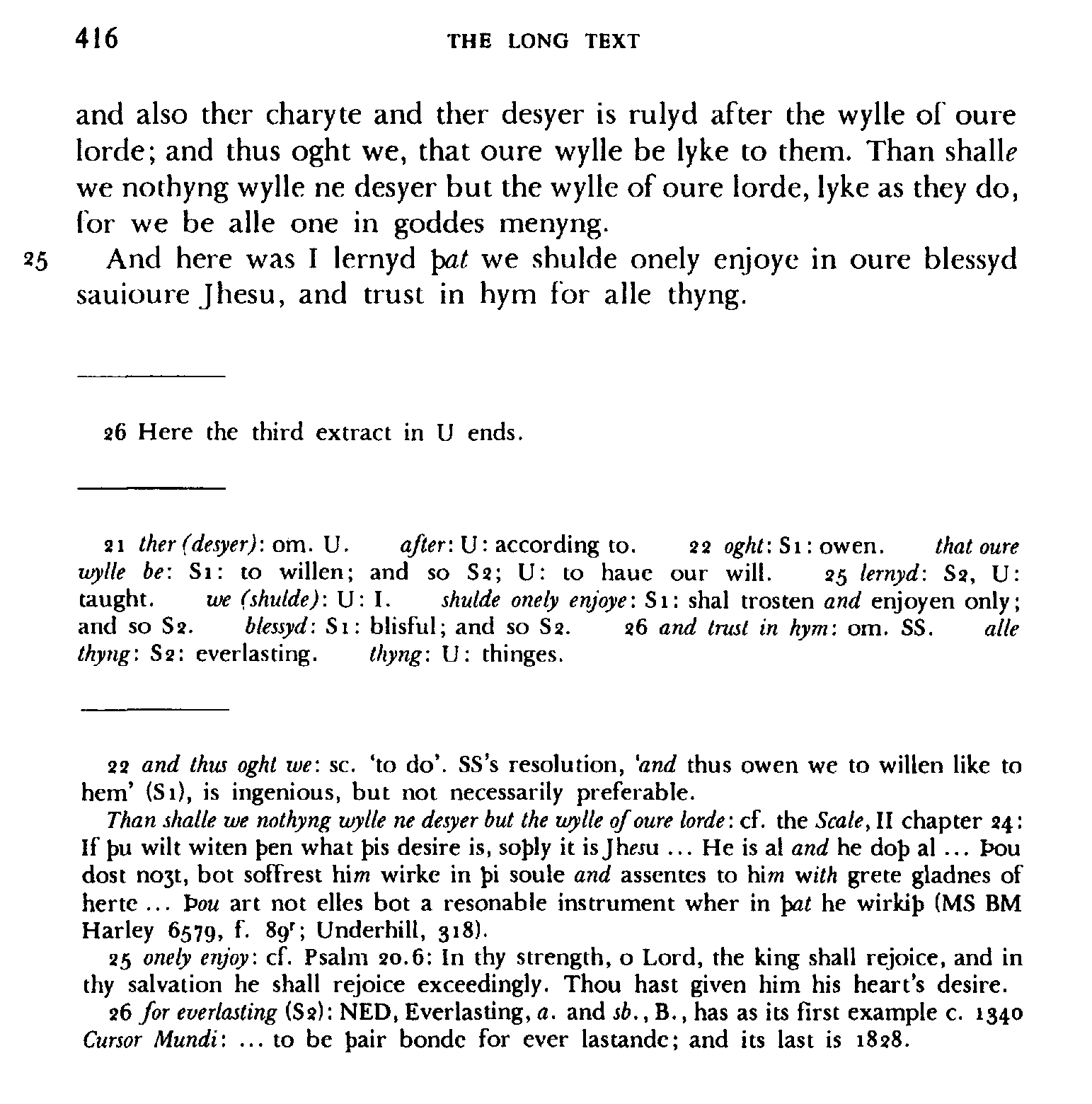
and also ther charyte and ther desyer is rulyd after the wylle of oure lorde; and thus oght we, that oure wylle be lyke to them. Than shall? we nothyng wylle ne desyer but the wylle of oure lorde, lyke as they do, for we be alle one in goddes menyng.
And here was I lernyd \>at we shulde onely enjoye in oure blessyd sauioure Jhesu, and trust in hym for alle thyng.
26 Here the third extract in U ends.
21 ther (desyer): om. U. after: U: according to.
22 oght: Si: owen. that oure wylle be: Si: to willen; and so 82; U: to haue our will.
25 lernyd: 82, U: taught. we (shulde): U: I. shulde onely enjoye: Si: shal trosten and enjoyen only; and so 82. blessyd: Si: blisful; and so 82.
26 and trust in hym: om. SS. alle thyng: 82: everlasting. thyng: U: thinges.
22 and thus oght we: sc. 'to do'. SS's resolution, 'and thus owen we to willen like to hem' (Si), is ingenious, but not necessarily preferable.
Than shalle we nothyng wylle ne desyer but the wylle of oure lorde: cf. the Scale, II chapter 24:
If J)U wilt witen {jen what J)is desire is, sojily it is Jhrni ... He is al and he dojj al ... £>ou dost no3t, bot soffrest him wirke in }>i soule and assentes to him with grete gladnes of herte ... t>ou art not elles bot a resonable instrument wher in \>at he wirkijj (MS BM
Harley 6579, f. 8gr; Underbill, 318).
25 onely enjoy: cf. Psalm 20.6: In thy strength, o Lord, the king shall rejoice, and in thy salvation he shall rejoice exceedingly. Thou hast given him his heart's desire.
26 for everlasting (82): NED, Everlasting, a. and sb., B., has as its first example c. 1340
Cursor Mundi: ... to be £air bondc for ever lastande; and its last is 1828.
CHAPTER 31, REVELATION 13
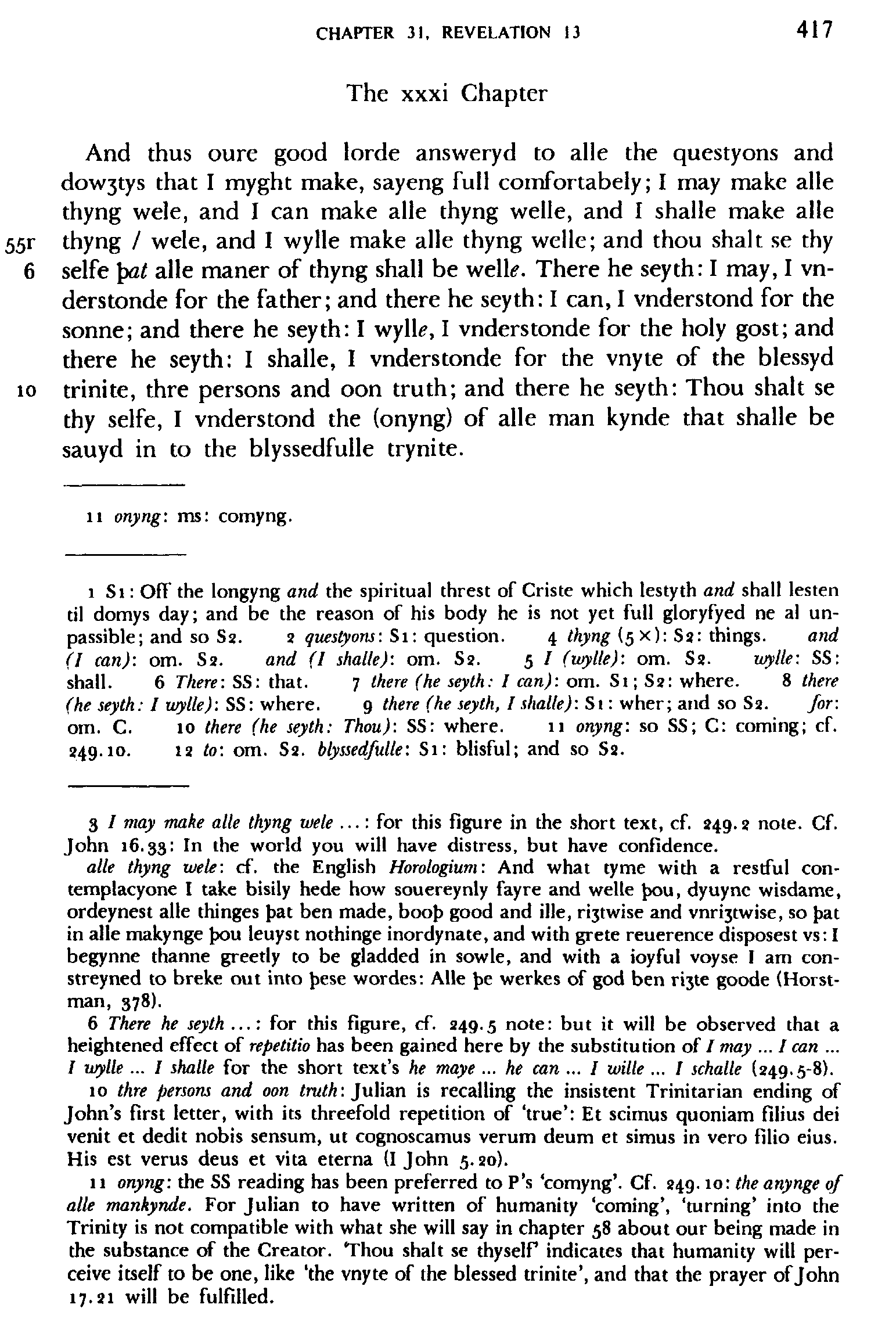
The xxxi Chapter And thus oure good lorde answeryd to alle the questyons and dow3tys that I myght make, sayeng full comfortabely; I may make alle thyng wele, and I can make alle thyng welle, and I shalle make alle
55r thyng / wele, and I wylle make alle thyng welle; and thou shalt se thy
selfe \>at alle maner of thyng shall be welk. There he seyth: I may, I vnderstonde for the father; and there he seyth: I can, I vnderstond for the sonne; and there he seyth: I wylle, I vnderstonde for the holy gost; and there he seyth: I shalle, I vnderstonde for the vnyte of the blessyd
10 trinite, thre persons and oon truth; and there he seyth: Thou shalt se thy selfe, I vnderstond the (onyng) of alle man kynde that shalle be sauyd in to the blyssedfulle trynite.
11 onyng: ms: cornyng. i Si: OfT the longyng and the spiritual threst of Criste which lestyth and shall lesten til domys day; and be the reason of his body he is not yet full gloryfyed ne al unpassible; and so 82.
2 questyons: Si: question.
4 thyng (sx): 82: things. and (I can): om. 82. and (I shalle): om. 82.
5 / (wylle): om. 82. wylle: 88: shall.
6 There: SS: that.
7 there (he seyth: I can): orn. Si; 82: where.
8 there (he seyth: I wylle): SS: where.
9 there (he seyth, I shalle): Si: wher; and so 82. for: om. C.
10 there (he seyth: Thou): SS: where.
11 onyng: so SS; C: coming; cf.
249.10.
12 to: om. 82. blyssedfulle: Si: blisful; and so 82.
3 / may make alle thyng wele ...: for this figure in the short text, cf. 249.2 note. Cf.
John 16.33: In the world you will have distress, but have confidence. alle thyng wele: cf. the English Horologium: And what tyme with a restful contemplacyone I take bisily hede how souereynly fayre and welle J>ou, dyuyne wisdame, ordeynest alle thinges l>at ben made, booj) good and ille, ristwise and vnri3twise, so Jjat in alle makynge Jxau leuyst nothinge inordynate, and with grete reuerence disposest vs: I begynne thanne greedy to be gladded in sowle, and with a ioyful voyse I am constreyned to breke out into pese wordes: Alle J>e werkes of god ben ri3te goode (Horstman, 378).
6 There he seyth .,.; for this figure, cf. 249.5 note: but it will be observed that a heightened effect of repetitio has been gained here by the substitution of / may ... I can ...
I wylle ... I shalle for the short text's he maye ... he can ... I wille ... I schalle (249.5-8).
10 thre persons and oon truth: Julian is recalling the insistent Trinitarian ending of John's first letter, with its threefold repetition of 'true': Et scimus quoniam filius dei venit et dedit nobis sensum, ut cognoscamus verum deum et simus in vero filio eius.
His est verus deus et vita eterna (I John 5.20).
11 onyng: the SS reading has been preferred to P's 'comyng'. Cf. 249.10: the anynge of alle mankynde. For Julian to have written of humanity 'coming', 'turning' into the Trinity is not compatible with what she will say in chapter 58 about our being made in the substance of the Creator. Thou shalt se thyself indicates that humanity will perceive itself to be one, like 'the vnyte of the blessed trinite', and that the prayer of John
17.21 will be fulfilled.
THE LONG TEXT
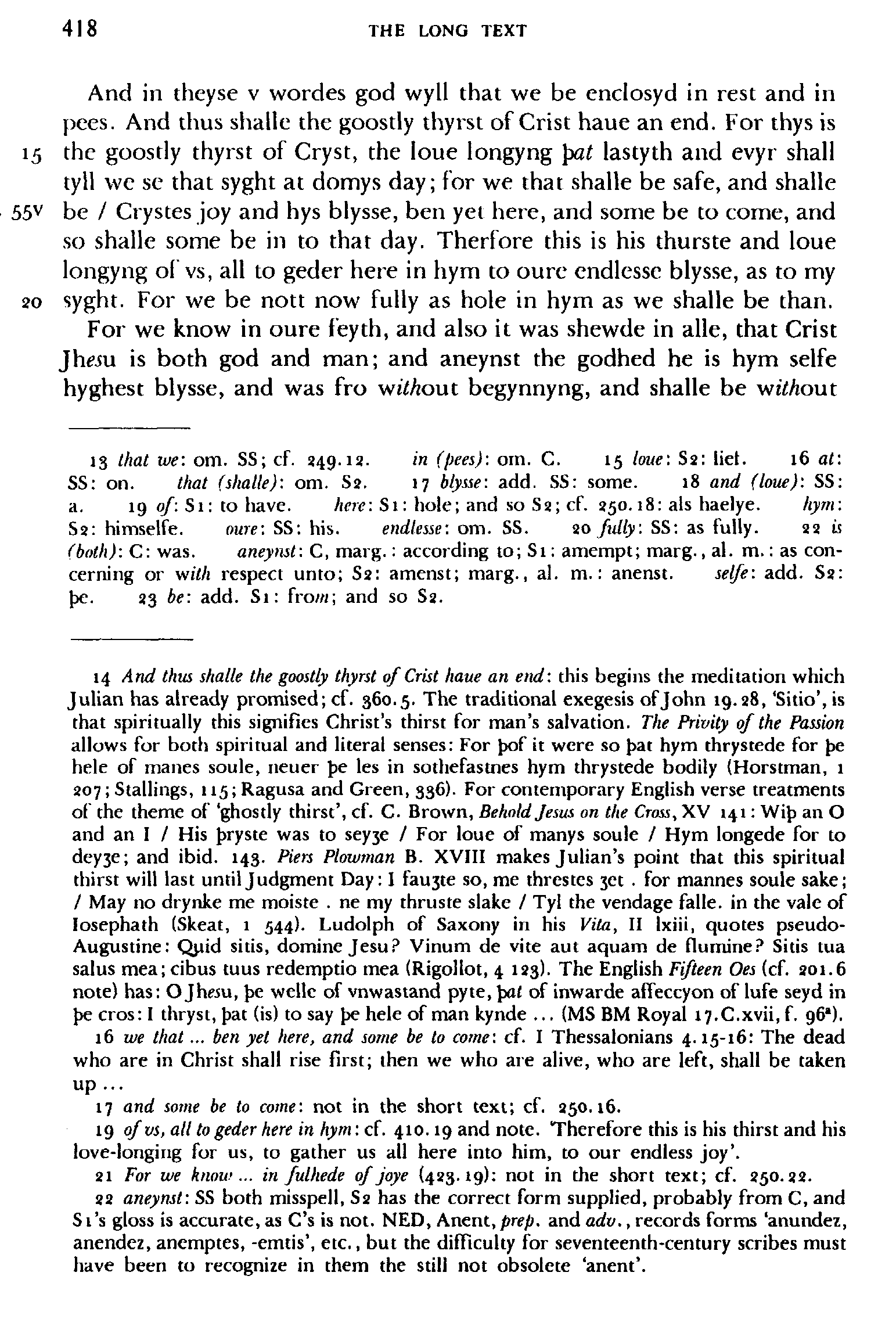
And in theyse v wordes god wyll that we be enclosyd in rest and in pees. And thus shalle the goostly thyrst of Crist haue an end. For thys is
15 the goostly thyrst of Cryst, the loue longyng pat lastyth and evyr shall tyll we se that syght at domys day; for we that shalle be safe, and shalle
55V be / Crystes joy and hys blysse, ben yet here, and some be to come, and so shalle some be in to that day. Therfore this is his thurste and loue longyng of vs, all to geder here in hym to oure endlesse blysse, as to my
20 syght. For we be nott now fully as hole in hym as we shalle be than.
For we know in oure feyth, and also it was shewde in alle, that Crist Jh<?ju is both god and man; and aneynst the godhed he is hym selfe hyghest blysse, and was fro without begynnyng, and shalle be without 13 that we: om. SS; cf. 249.12. in (pees): om. C.
15 loue: 82: liet.
16 at:
SS: on. that (shalle): om. 82.
17 blysse: add. SS: some.
18 and (loue): SS: a.
19 of: Si: to have. here: Si: hole; and so 82; cf. 250.18: als haelye. hym:
82: himselfe. oure: SS: his. endlesse: om. SS.
20 fully: SS: as fully.
22 is (both): C: was. aneymt: C, marg.: according to; Si: amempt; marg., al. m.: as concerning or with respect unto; 82: amenst; marg., al. m.: anenst. selfe: add. 82: pe.
23 be: add. Si: fro///; and so 82.
14 And thus shalle the goostly thyrst of Crist haue an end: this begins the meditation which Julian has already promised; cf. 360.5. The traditional exegesis of John 19.28, 'Sitio', is that spiritually this signifies Christ's thirst for man's salvation. The Privity of the Passion allows for both spiritual and literal senses: For Jxaf it were so |>at hym thrystede for £e hele of manes soule, neuer £>e les in sothefastnes hym thrystede bodily (Horstman, i 207; Stallings, 115; Ragusa and Green, 336). For contemporary English verse treatments of the theme of 'ghostly thirst', cf. C. Brown, Behold Jesus on the Cross, XV 141: Wijj an O and an I / His Jjryste was to sey3e / For loue of manys soule / Hym longede for to deyje; and ibid. 143. Piers Plowman B. XVIII makes Julian's point that this spiritual thirst will last until Judgment Day: I faujte so, me threstes jet . for mannes soule sake;
/ May no drynke me moiste . ne my thruste slake / Tyl the vendage falle. in the vale of losephath (Skeat, i 544). Ludolph of Saxony in his Vita, II Ixiii, quotes pseudoAugustine: Quid sitis, domine Jesu? Vinum de vite aut aquam de flumine? Sitis tua salus mea; cibus tuus redemptio mea (Rigollot, 4 123). The English Fifteen Oes (cf. 201.6 note) has: O Jhmi, J>e welle of vnwastand pyte, \>at of inwarde affeccyon of lufe seyd in f>e cros: I thryst, fiat (is) to say Jie hele of man kynde ... (MS BM Royal 17-C.xvii, f. 96").
16 we that... ben yet here, and some be to come: cf. I Thessalonians 4.15-16: The dead who are in Christ shall rise first; then we who are alive, who are left, shall be taken up...
17 and some be to come: not in the short text; cf. 250.16.
19 of vs, all to geder here in hym: cf. 410.19 and note. Therefore this is his thirst and his love-longing for us, to gather us all here into him, to our endless joy'.
21 For we know... in fulhede ofjoye (423.19): not in the short text; cf. 250.22.
22 aneynst: SS both misspell, 82 has the correct form supplied, probably from C, and Si's gloss is accurate, as C's is not. NED, Anent,prep, and adv., records forms 'anundez, anendez, anemptes, -emtis', etc., but the difficulty for seventeenth-century scribes must have been to recognize in them the still not obsolete 'anent'.
CHAPTER 31, REVELATION 13
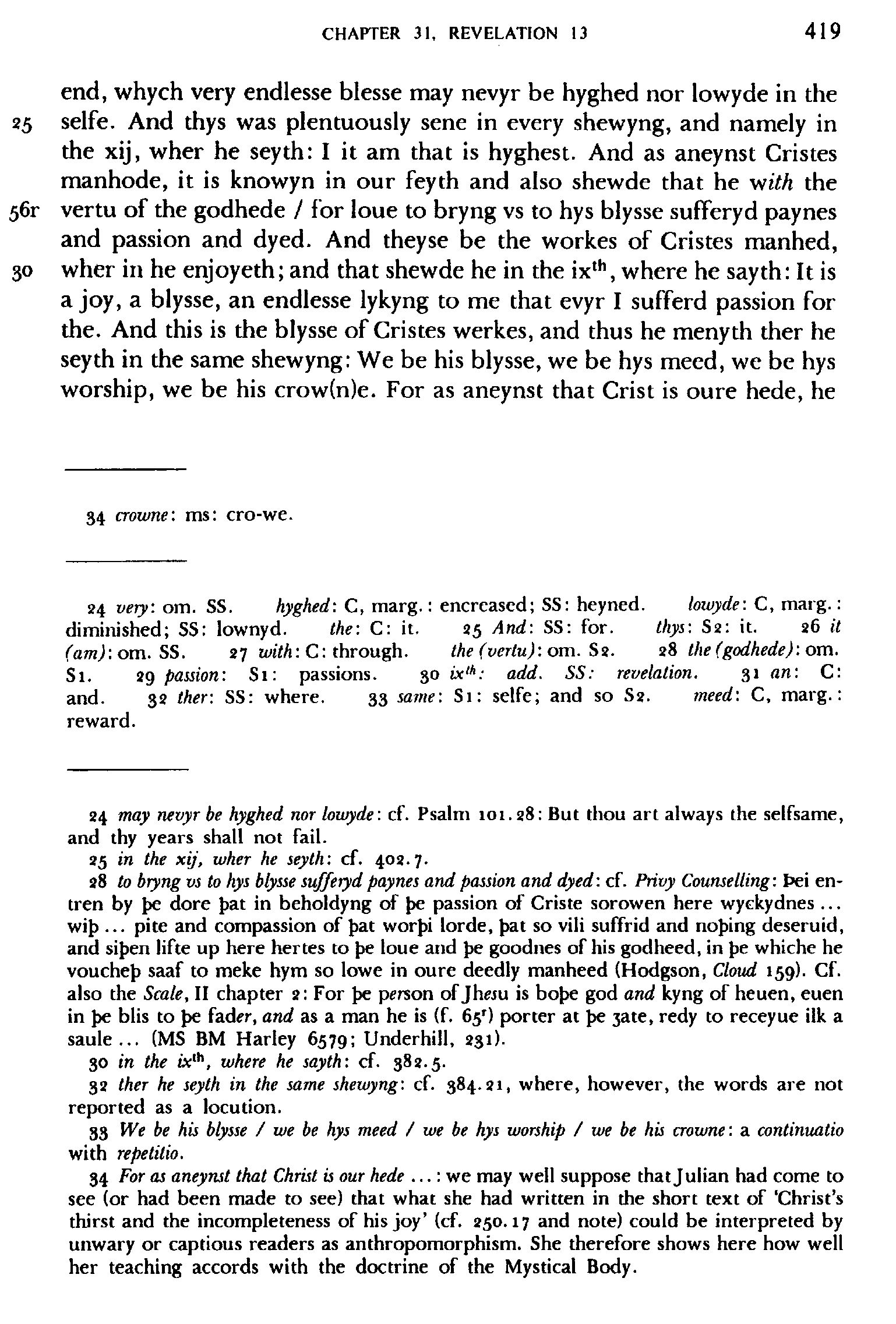
end, whych very endlesse blesse may nevyr be hyghed nor lowyde in the
selfe. And thys was plentuously sene in every shewyng, and namely in the xij, wher he seyth: I it am that is hyghest. And as aneynst Cristes manhode, it is knowyn in our feyth and also shewde that he with the 56r vertu of the godhede / for loue to bryng vs to hys blysse sufferyd paynes and passion and dyed. And theyse be the workes of Cristes manhed,
30 wher in he enjoyeth; and that shewde he in the ixth, where he sayth: It is a joy, a blysse, an endlesse lykyng to me that evyr I sufferd passion for the. And this is the blysse of Cristes werkes, and thus he menyth ther he seyth in the same shewyng: We be his blysse, we be hys meed, we be hys worship, we be his crow(n)e. For as aneynst that Crist is oure hede, he
34 crowne: ms: cro-we.
24 very: om. SS. hyghed: C, marg.: encreased; SS: heyned. lowyde: C, marg.: diminished; SS: lownyd. the: C: it.
25 And: SS: for. thys: 82: it.
26 it (am):om.SS.
27 with: C: through. the (vertu): om. 82.
28 the (godhede): om.
Si.
29 passion:
Si: passions.
30 ixlh: add. SS: revelation.
31 an:
C: and.
32 ther: SS: where.
33 same: Si: selfe; and so 82. meed: C, marg.: reward.
24 may nevyr be hyghed nor lowyde: cf. Psalm 101.28: But thou art always the selfsame, and thy years shall not fail.
25 in the xij, wher he seyth: cf. 402.7.
28 to bryng vs to hys blysse sufferyd paynes and passion and dyed: cf. Privy Counselling: t>ei entren by pe dore pat in beholdyng of pe passion of Criste sorowen here wyekydnes ... wip... pite and compassion of pat worpi lorde, pat so vili suffrid and noting deseruid, and sipen lifte up here hertes to pe loue and pe goodnes of his godheed, in pe whiche he vouchep saaf to meke hym so lowe in oure deedly manheed (Hodgson, Cloud 159). Cf. also the Scale, II chapter 2: For pe person of Jhmi is hope god and kyng of heuen, euen in pe blis to pe fader, and as a man he is (f. 65') porter at pe jate, redy to receyue ilk a saule... (MS BM Harley 6579; Underbill, 231).
30 in the ivth, where he sayth: cf. 382.5.
32 ther he seyth in the same shewyng: cf. 384.21, where, however, the words are not reported as a locution.
33 We be his blysse / we be hys meed / we be hys worship / we be his crowne: a continuatio with repetitio.
34 For as aneynst that Christ is our hede ...: we may well suppose that Julian had come to see (or had been made to see) that what she had written in die short text of 'Christ's thirst and the incompleteness of his joy' (cf. 250.17 and note) could be interpreted by unwary or captious readers as anthropomorphism. She therefore shows here how well her teaching accords with the doctrine of the Mystical Body.
THE LONG TEXT
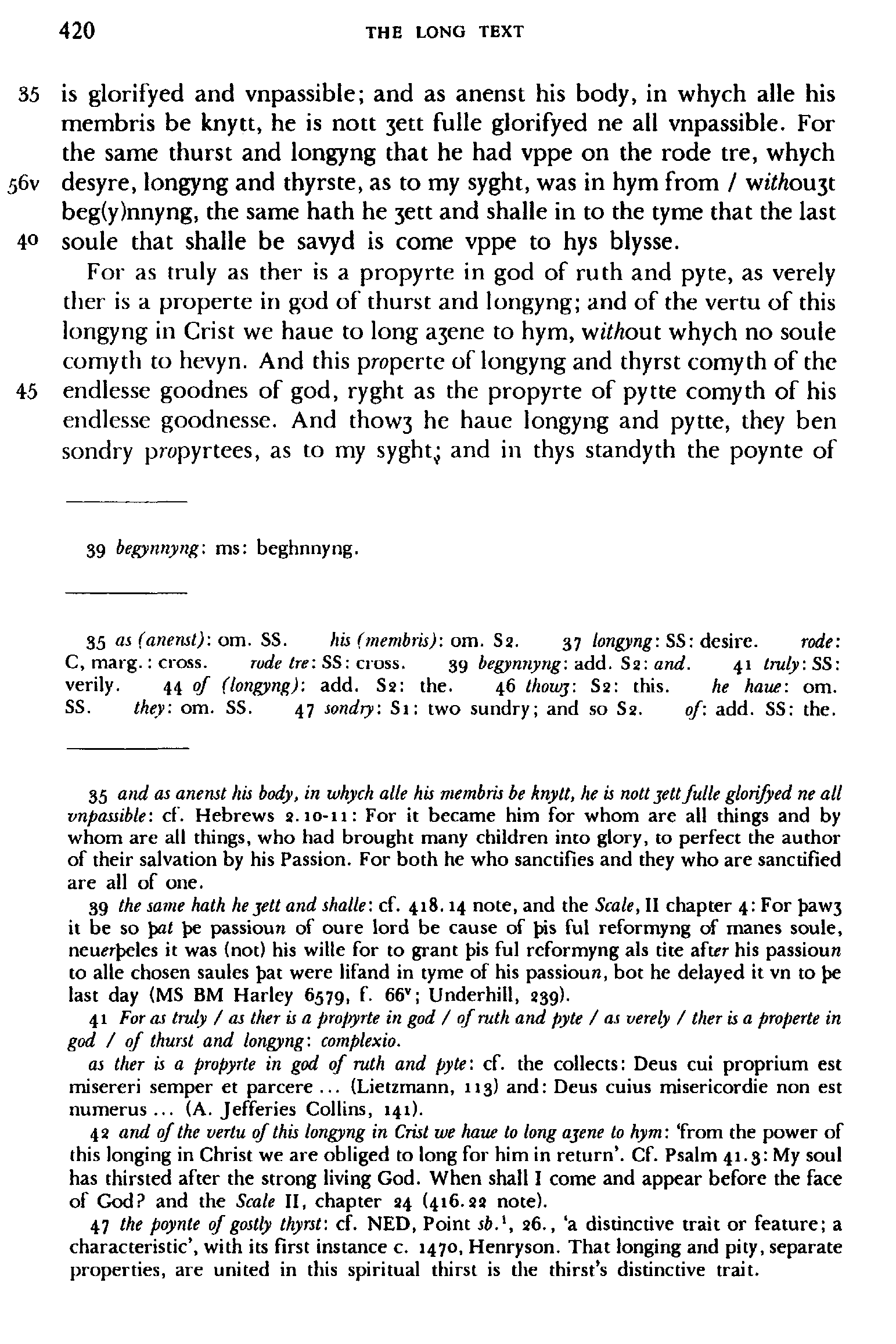
35 is glorifyed and vnpassible; and as anenst his body, in whych alle his membris be knytt, he is nott 3ett fulle glorifyed ne all vnpassible. For the same thurst and longyng that he had vppe on the rode tre, whych
56v desyre, longyng and thyrste, as to my syght, was in hym from / vfithou^t beg(y)nnyng, the same hath he 3ett and shalle in to the tyme that the last
4° soule that shalle be savyd is come vppe to hys blysse.
For as truly as ther is a propyrte in god of ruth and pyte, as verely ther is a properte in god of thurst and longyng; and of the vertu of this longyng in Crist we haue to long ajene to hym, without whych no soule cornyth to hevyn. And this properte of longyng and thyrst comyth of the 45 endlesse goodnes of god, ryght as the propyrte of pytte comyth of his endlesse goodnesse. And thow3 he haue longyng and pytte, they ben sondry propyrtees, as to my syght^ and in thys standyth the poynte of 39 begynnyng: ms: beghnnyng.
35 as (anewt): om. SS. his (membris): om. 82.
37 longyng: SS: desire. rode:
C, marg.: cross. rude tre: SS: cross.
39 begynnyng: add. 82: and.
41 truly: SS: verily.
44 of (longyng): add. 82: the.
46 thowj: 82: this. he haue: om.
SS. they: om. SS.
47 sondry: Si: two sundry; and so 82. of: add. SS: the.
35 and as anenst his body, in whych alle his membris be knytt, he is nott jettfulle glorifyed ne all vnpassible: cf. Hebrews 2.10-11: For it became him for whom are all things and by whom are all things, who had brought many children into glory, to perfect the author of their salvation by his Passion. For both he who sanctifies and they who are sanctified are all of one.
39 the sa?ne hath he ytt and shalle: cf. 418.14 note, and the Scale, II chapter 4: For paw3 it be so pa< pe passioun of oure lord be cause of pis ful reformyng of manes soule, neu^rpeles it was (not) his wille for to grant pis ful reformyng als tite after his passioun to alle chosen saules pat were lifand in tyme of his passioun, bot he delayed it vn to pe last day (MS BM Harley 6579, f. 66V; Underbill, 239).
41 For as truly / as ther is a propyrte in god / of ruth and pyte / as verely / ther is a properte in god / of thurst and longyng: cornplexio. as ther is a propyrte in god of ruth and pyte: cf. the collects: Deus cui proprium est misereri semper et parcere ... (Lietzmann, 113) and: Deus cuius misericordie non est numerus... (A. Jefferies Collins, 141).
42 and of the vertu of this longyng in Crist we haue to long ajene to hym: 'from the power of this longing in Christ we are obliged to long for him in return'. Cf. Psalm 41.3: My soul has thirsted after the strong living God. When shall I come and appear before the face of God? and the Scale II, chapter 24 (416.22 note).
47 the poynte of gostly thyrst: cf. NED, Point sb.1, 26., 'a distinctive trait or feature; a characteristic', with its first instance c. 1470, Henryson. That longing and pity, separate properties, are united in this spiritual thirst is the thirst's distinctive trait.
CHAPTER 31, REVELATION 13
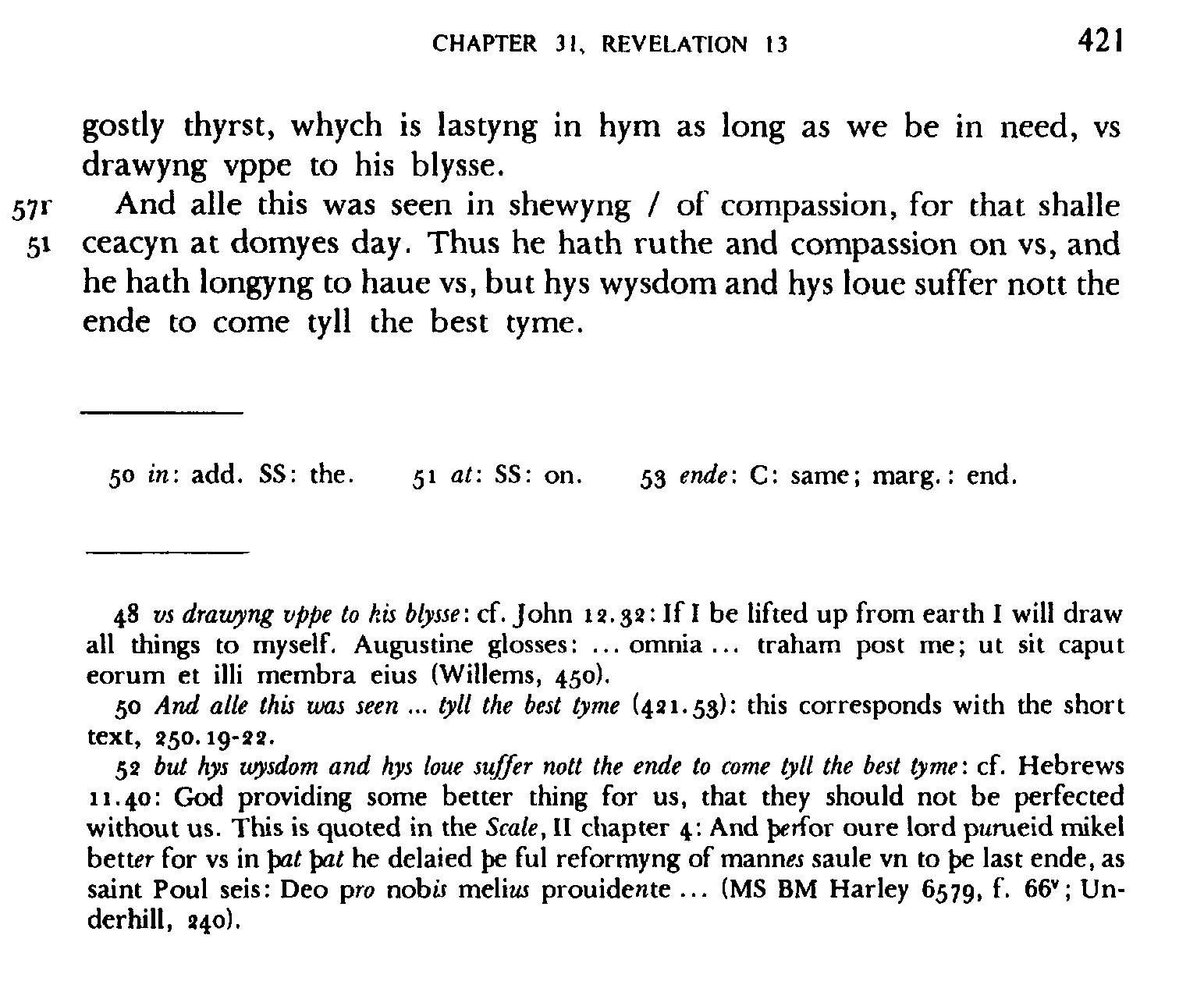
gostly thyrst, whych is lastyng in hym as long as we be in need, vs drawyng vppe to his blysse.
57r And alle this was seen in shewyng / of compassion, for that shalle 51 ceacyn at domyes day. Thus he hath ruthe and compassion on vs, and he hath longyng to haue vs, but hys wysdom and hys loue suffer nott the ende to come tyll the best tyme.
50 in: add. SS: the.
51 at: SS: on.
53 ende: C: same; marg.: end.
48 vs drawyng vppe to kis blysse: cf. John 19.32: If I be lifted up from earth I will draw all things to myself. Augustine glosses: ...omnia... traham post me; ut sit caput eorum et illi membra eius (Willems, 450).
50 And alle this was seen ... tyll the best tyme (421.53): this corresponds with the short text, 250.19-22.
52 but hys wysdom and hys loue suffer nott the ende to come tyll the best tyme: cf. Hebrews
11.40: God providing some better thing for us, that they should not be perfected without us. This is quoted in the Scale, II chapter 4: And tyrfor oure lord purueid mikel better for vs in }>at pa< he delaied pe ful reformyng of mann^i saule vn to pe last ende, as saint Poul seis: Deo pro nobis meliw prouidente ... (MS BM Harley 6579, f. 66V; Underhill, 240).
THE LONG TEXT
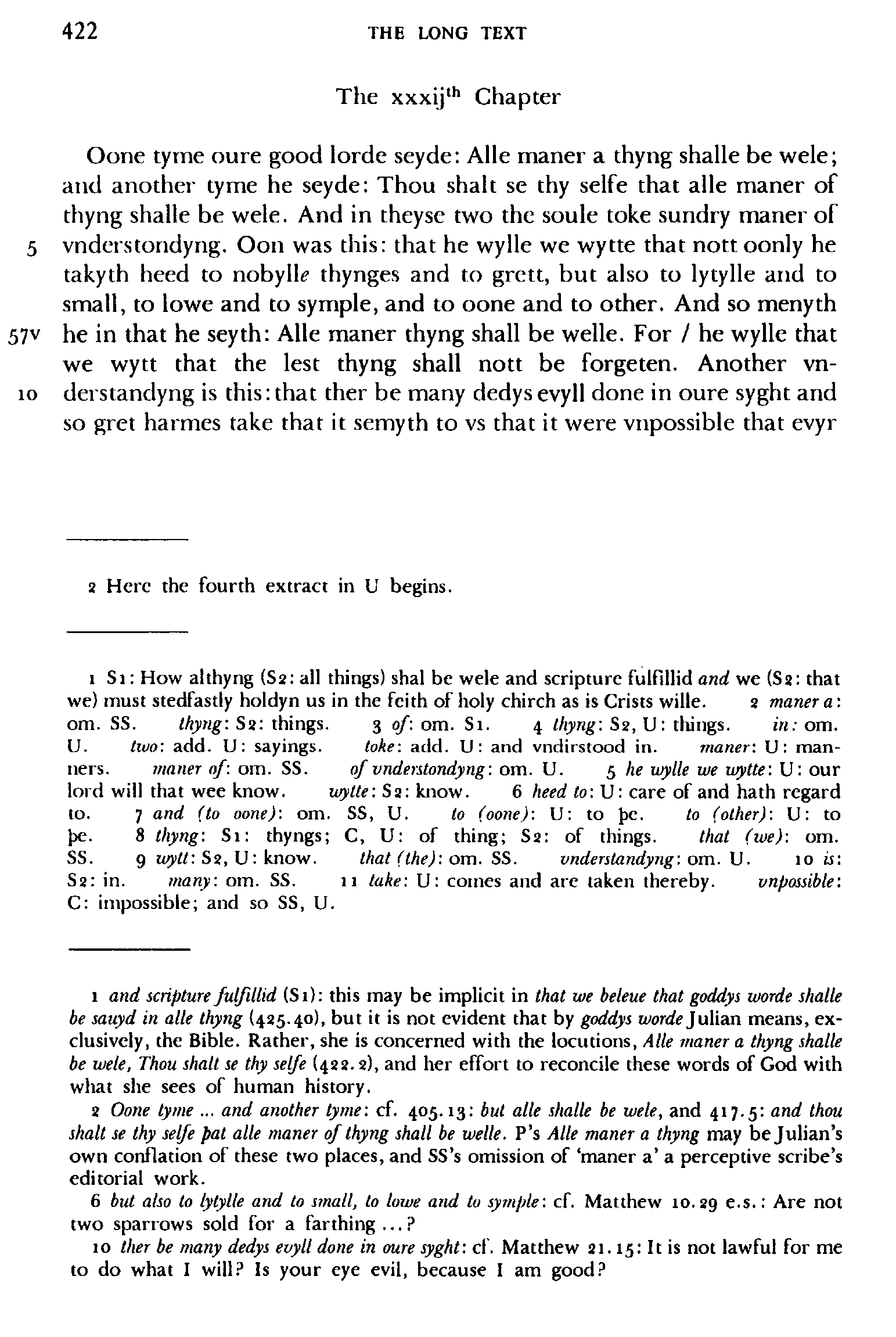
The xxxijth Chapter Gone tyrne oure good lorde seyde: Alle maner a thyng shalle be wele; and another tyme he seyde: Thou shalt se thy selfe that alle maner of thyng shalle be wele. And in theyse two the soule toke sundry maner of 5 vnderstondyng. Oon was this: that he wylle we wytte that nott oonly he takyth heed to nobylk thynges and to grett, but also to lytylle arid to small, to lowe and to symple, and to oone and to other. And so menyth
5?v he in that he seyth: Alle maner thyng shall be welle. For / he wylle that we wytt that the lest thyng shall nott be forgeten. Another vn10 dei standyng is this: that ther be many dedys evyll done in oure syght and so gret harmes take that it semyth to vs that it were vnpossible that evyr
2 Here the fourth extract in U begins. i Si: How althyng (82: all things) shal be wele and scripture fulfillid and we (82: that we) must stedfastly holdyn us in the feith of holy chirch as is Grists wille.
2 maner a: om. 88. thyng: 82: things.
3 of: om. Si.
4 thyng: 82, U: things. in: om.
U. two: add. U: sayings. lake: add. U: and vndirstood in. maner: U: manners, maner of: om. SS. of vnderstondyng: om. U.
5 he wylle we wytte: U: our lord will that wee know. wytte: Sa: blow.
6 heed to: U: care of and hath regard to.
7 and (to oone): om. SS, U. to (oone): U: to Jie. to (other): U: to \>c.
8 thyng: Si: thyngs; C, U: of thing; 82: of things. that (we): om.
SS.
9 wytt: 82, U: know. that (the): om. SS. vnderstandyng: om. U.
10 is:
82: in. many: om. SS.
11 take: U: comes and are taken thereby. vnpossible:
C: impossible; and so SS, U.
1 and scripture fulfillid (Si): this may be implicit in that we beleue that goddys worde shalle be sauyd in alle thyng (425.40), but it is not evident that by goddys worde Julian means, exclusively, the Bible. Rather, she is concerned with the locutions, Alle maner a thyng shalle be wele, Thou shalt se thy selfe (422.2), and her effort to reconcile these words of God with what she sees of human history.
2 Oone tyme ... and another tyme: cf. 405.13: but alle shalle be wele, and 417.5: and thou shalt se thy selfe pat alle maner of thyng shall be welle. P's Alle maner a thyng may be Julian's own conflation of these two places, and SS's omission of 'maner a' a perceptive scribe's editorial work.
6 but also to lytylle and to small, to lowe and to symple: cf. Matthew 10.29 e > s- : Are not two sparrows sold for a farthing ... ?
10 ther be many dedys evyll done in oure syght: cf. Matthew 21.15: It is not lawful for me to do what I will? Is your eye evil, because I am good?
CHAPTER 32, REVELATION 13
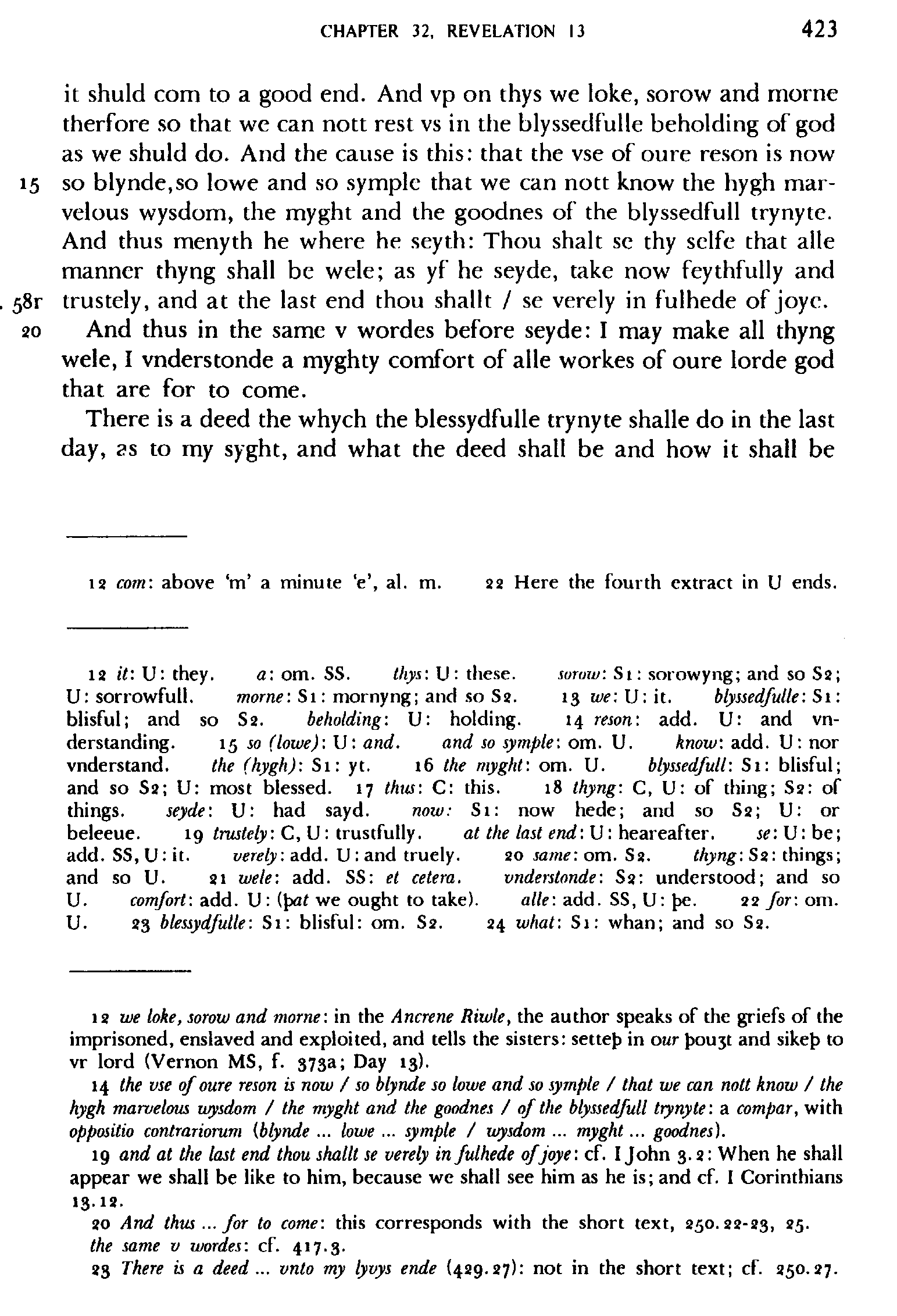
it shuld com to a good end. And vp on thys we loke, sorow and rnorne therfore so that we can nott rest vs in the blyssedfulle beholding of god as we shuld do. And the cause is this: that the vse of oure reson is now
15 so blynde,so lowe and so symple that we can nott know the hygh marvelous wysdom, the myght and the goodnes of the blyssedfull trynyte.
And thus menyth he where he seyth: Thou shalt se thy selfe that alle manner thyng shall be wele; as yf he seyde, take now feythfully and 58r trustely, and at the last end thou shallt / se verely in fulhede of joye.
And thus in the same v wordes before seyde: I may make all thyng wele, I vnderstonde a myghty comfort of alle workes of oure lorde god that are for to come.
There is a deed the whych the blessydfulle trynyte shalle do in the last day, PS to my syght, and what the deed shall be and how it shall be
12 com: above W a minute 'e', al. m.
22 Here the fourth extract in U ends.
12 it: U: they. a: om. SS. thys: U: these. sorow: Si: sorowyng; and so 82; U: sorrowfull. morne: Si: mornyng; and so 82.
13 we: U: it. blyssedfulle: Si: blisful; and so 82. beholding: U: holding.
14 reson: add.
U: and vnderstanding.
15 so (lowe): U: and. and so symple: om. U. know: add. U: nor vnderstand. the (hygh): Si: yt.
16 the myght: om. U. blyssedfull: Si: blisful; and so 82; U: most blessed.
17 thus: C: this.
18 thyng: C, U: of thing; 82: of things. seyde: U: had sayd. now: Si: now hede; and so 82; U: or beleeue.
19 trustely: C, U: trustfully. at the last end: U: heareafter. se: U: be; add. 88, U: it. verely: add. U: and truely.
20 same: om. 82. thyng: 82: things; and so U.
21 wele: add. 88: et cetera. vnderstonde: 82: understood; and so U. comfort: add. U: (^at we ought to take). alle: add. SS, U: J>e.
22 for: om.
23 blessydfulle: Si: blisful: om. 82.
24 what: Si: whan; and so 82.
12 we loke, sorow and morne: in the Ancrene Riwle, the author speaks of the griefs of the imprisoned, enslaved and exploited, and tells the sisters: settej) in our Jjou3t and sikej) to vr lord (Vernon MS, f. 3733; Day 13).
14 the vse of oure reson is now / so blynde so lowe and so symple / that we can nott know / the hygh marvelous wysdom / the myght and the goodnes / of the blyssedfull trynyte: a compar, with oppositio contrariorum (blynde ... lowe ... symple / wysdom ... myght... goodnes).
19 and at the last end thou shallt se verely in fulhede ofjoye: cf. I John 3.2: When he shall appear we shall be like to him, because we shall see him as he is; and cf. I Corinthians
13.12.
20 And thus ... for to come: this corresponds with the short text, 250.22-23, 25. the same v wordes: cf. 417.3.
23 There is a deed... vnto my lyvys ende (429.27): not in the short text; cf. 250.27.
THE LONG TEXT
25 done, it is vnknowen of alle creaturys whych are beneth Crist, and shall be tylle whan it shalle be done. The goodnesse and the loue of our lorde god wylle that we wytte that it shall be; and the myght and the wysdom of hym by the same loue wylle heyle it and hyde it fro vs, what it shalle be and how it shalle be done. And the cause why he wylle we
30 wytte it thus is for he wylle we be the more esyd in oure soule and 58v peesable in loue, levyng the beholdyng of alle / tempestes that myght lett vs of true enjoyeng in hym.
This is the grett deed ordeyned of oure lorde god fro withou^t begynnyng, tresured and hyd in hys blessyd brest, only knowyn to hym selfe,
35 by whych deed he shalle make all thyng wele. For ryght as the blessyd trinite made alle thyng of nought, ryght so the same blessyd trynyte shalle make wele alle that is nott welle. And in this syght I marveyled gretly, and be held oure feyth, menyng thus: oure feyth is groundyd in 25 whych: Si: that: and so Sa.
26 whan: om. 82. shalle be: Si: is; 82: be.
The goodnesse... shalle be done: om.
SS.
27 wytte:
C, marg.: know.
28 heyle: C: hill; marg.: conceal.
29 why: om. SS.
30 wytte: SS: know. it thus: om. SS. for: Sa: because. wylle we be: Sa: would haue us.
31 peesable: Si: pcsid; Sa: appeased; add. scr.: and quieted.
32 lett: C, marg.: hinder. true: Si: trewth; and so 82.
33 the: 82: \>at, 35 thyng: Si: thyngs; and so 82.
38 menyng: Si: merveland; and so 82.
25 it is vnknowen of alle creaturys whych are beneth Crist: cf. the Cloud: Reson is a my3t
J)orou pe whiche we departe pe iuel fro pe good ... bot now it is so blendid wij> Jje original synne pat it may not kon worche pis werk (Hodgson, 116).
26 The goodnesse and the loue of our lorde god / wylle that we wytte that it shall be / and the myght and the wysdom of hym / by the same love / wylle heyle it and hyde it fro vs / what it shalle be and how it shalle be done: complexio with interpretatio (goodnesse / [one, myght / wysdom, heyle
/ hyde, shalle be / shalle be done).
27 the myght and the wysdom of hym ... wylle heyle it and hyde it fro vs: cf. Chaucer's
Boethius, III 9: ... folk suffren hem self to ben so blynde pat hem ne recchip nat to knowe where pilke goodes ben yhidd (Morris, 82), and III 10: Pilke same blisfulnesse ... is souereyne power, souereyne reuerence, souereyne clerncsse or noblesse and souereyne delit (ibid., 92).
31 pesid (Si): cf. NED, Peace, v. «OFr paiser), 3. To reduce to peace ..." The first instance is c. 1330, the last 1541.
34 tresured and hyd in hys blessyd brest: cf. Colossians 2.2-3: ... the knowledge of the mystery of God the Father and of Christ Jesus, in whom are hid all the treasures of wisdom and knowledge.
35 by whych deed he shalle make all thyng wele / For ryght as the blessyd trinite made alle thyng of nought / ryght so the same blessyd trynyte shalle make wele / alle that is nott welle: membrum with repetitio (ryght as the blessyd trinite ... ryght so the same blessyd trynyte) and conversio (wele ... wele ... welle). Comparison with the same figure in its rudimentary form in die short text, 250.25-27, will show how Julian has gained in rhetorical skills.
For ryght... nott wele (424.37): this corresponds with the short text, 250.25-27.
38 oure feyth is groundyd in goddes words: cf. Romans 10.17: Faith then comes by hearing, and hearing by the word of Christ.
CHAPTER 32, REVELATION 13
goddes worde, and it longyth to oure feyth that we beleue that goddys 40 worde shalle be sauyd in alle thyng. And one poynt of oure feyth is that many creatures shall be dampnyd, as angelis that felle ou3t of hevyn for $r pride, whych be now fendys, and meny in erth that / dyeth out of the feyth of holy chyrch, that is to sey tho that be hethyn, and also many that hath receyvyd cristondom and lyvyth vncristen lyfe and so dyeth
45 ou3te of cheryte. All theyse shalle be dampnyd to helle withou-$t (e)nde, as holy chyrch techyth me to beleue.
And stondyng alle thys, me thought it was vnpossible that alle rnaner of thyng shuld be wele, as oure lorde shewde in thys tyme. And as to 45 ende: ms: ande.
39 longyth: 82: belongeth. beleue: Si: levyn.
40 thyng: 88: things.
41 as: add. 82: pe.
42 fendys: 82: devils. meny: Si: man; 82: men. in: 82: on.
43 tho: Si: thei; and so 82. hethyn: add. 88: men. many: Si: man; 82: those.
44 and (lyvyth):
82: but. vncristen: Si: an cristen; 82: an unchristian.
47 stondyng: so 82, w. 'under' interl. scr.
48 of: om. Si. thyng: 82: things. in: 82: at.
39 we beleue that goddys worde shalle be sauyd in alle thyng: cf. Matthew 24.35: Heaven and earth shall pass, but my words shall not pass.
41 as angelis that felle oujt of hevyn: cf. Matthew 25.41: Depart from me, you cursed, into everlasting fire, which was prepared for the devil and his angels. for pride: cf. Isaias 14.12-14: How are you fallen from heaven, o Lucifer ... who said in your heart: I will ascend into heaven ... I will be like the Most High.
42 whych be now fendys: though Julian calls this one poynt of oure feyth, what she writes here of the fall of the angels is a common opinion, never defined. See ODCC, art.
'Devil'. In Piers Plowman A.I 109 we read: Lucifer wij) legionis ... / ... was £>e louelokest of si3t aftir oure lord, / Til he brak buxumnesse I>oru3 bost of hymseluen. / t>anne fil he wip his felawis and fendis bicome; / Out of heuene into helle hobelide pei faste (G.
Kane, 196).
43 many that hath receyvyd cristondom and lyvyth vncristen lyfe: cf. the English prose Qui habitat: ... ri$t so schalt pou sen pe streit rihtwysnesse of him in punissching of reproued soules and in jeldyng peine for here synnes at pe day of dome ... For he pat wolde euere liuen in synne and in lustes of pis lyue, and neuur haue opur ioye, 3if he mihte haue pat, hit is rihtful pat he be aftur pis Hue in endeles peyne and neuur fele ioye
(Wallner, 28-29).
47 And stondyng alle thys: 'And all this being the case'. Cf. 328.42 note. S2's afterthought, understanding, is unhappy; the circumstances are what make it impossible for Julian to understand the locution.
48 as oure lorde shewde: cf. 422.2.
THE LONG TEXT
thys I had no other answere in shewyng of oure lorde but thys: That \>at
is vnpossible to the is nott vnpossible to me. I shalle saue my worde in alle thyng, and I shalle make althyng wele. And in thys I was taught by the grace of god that I shuld stedfast(l)y holde me in the feyth as I had before vnderstond, and ther with Jxz/ I shulde stonde and sadly beleue /
5Qv that alle maner thyng shall be welle, as oure lorde shewde in that same 55 tyme. For thys is £>e grete dede that oure lorde god shalle do, in whych dede he shalle saue his worde in alle thyng. And he shalle make wele all that is nott welle. But what £>e dede shal be, and how it shall be done, there is no creature beneth Crist that wot it, ne shalle wytt it tyll it is done, as to the vnderstandyng that I toke of oure lordys menyng in thys
60 tyme.
52 stedfastly: rns: stedfasty.
57 welle: the final V al. m.
49 lorde: add. SS: god.
That: 82: what. pat: om. SS.
51 thyng ... thyng: SS: things... things.
And in thys: SS: thus.
53 stonde and: om. SS. sadly: C, marg.: firmly. beleue: Si: levyn.
54 maner: om. SS. thyng: Sa: things. m:
Ss: at. that:C,SS: the.
55 god:om. SS.
56 thyng: Ss: things.
57 But what pe dede shal be: om. SS.
58 wot: Ss: knows. ne:S$:or. wytt: S2: know. is (done): Sa: be.
59 in: Sa: at.
49 That pat is vnpossible to the is nott vnpossible to me: cf. Luke 18.26-27: And they that heard it said: Who then can be saved? He said to them: The things that are impossible with man are possible with God; and Luke 1.37: No word shall be impossible with God. Julian has here constructed a compar, with oppositio contrariotwn, and adnominatio (to the ... to me).
50 / shalle saue my worde in alle thyng / and I shalle make althyng wele: another compar, with repetitio (I shalle ... I shalle).
52 as I had before vnderstond ... I shulde stonde: adnominatio, lost in SS.
55 For thys is pe grete dede / that oure lorde god shalle do / in whych dede he shalle saue / his worde in alle thyng: another compar, with conversio (shalle do ... shalle saue).
CHAPTER 33, REVELATION 13
The xxxiij Chapiter And jitt in this I desyeryd as I durste that I myght haue had som sy3t of hel and of purgatory; but it was nott my menyng to take pre(f)e of ony thyng that longyth to oure feyth, for I beleued sothfastly that hel
5 and purgatory is for £>e same ende \>at holy chyrch techyth for. But my 6or menyng was \Mt I myght haue seen for lernyng / in alle thyng that longyth to my feyth, wher by I my3t lyue the more to goddes wurschyppe and to my profyjte. And for ought \>at I culde desyer, I ne culde se of thys ryght nou3t but as it is before seyde in JDC fyfte shewyng,
10 wher that I saw Jje devylle is reprovyd of god and endlessly dampned. In 3 prefe: ms: prese.
5 ende: first V alt. al. m. fr. 'a'; cf. 425.45.
6 alle: V al. m. i Si: Al dampnyd soule (82: souls) be dispisid in pe syte of god as pe devil, and these revelations withdraw not pe feith of holy church but comfortith and the (82: confirmes it and \at pe) more we besy to know gods privites (82: secrets), the less we knowen (82: know of p?m).
2 had; om. C. som: Si: ful; 82: a full.
3 of (purgatoiy): orn.
SS. to take prefe:
C: to take proof; Si: to maken privy; 82: of making privy.
4 longyth:Ss: belongeth. oure: SS: the. beleued: 81: levyd. sothfastly:
C, rnarg.: assuredly; 82: stedfastly.
5 for (But): om. SS.
6 lernyng: Si: leryng; 82: instruction. thyng: 82: things.
7 longyth: 82: belongeth.
8 ought pat I culde:SS:my. ne:om. SS. gie:om. SS. fyfteC: first. i o pe (devylle): S i:
\at \>at pe; 82: that pe. endlessly: C: endless by.
2 som syjt of hel and of purgatory: cf. Scale II, chapter 45: ... for to seen with pe gasdy ei3e pe peynes of reprofed and pe ioye and pe blis of chosen soules, it is ful confortable
(MS BM Harley 6579, f. 138'; Underbill, 457).
3 to take prefe: NED, MED do not record 'to take proof, and cf. NED Proof n. 2, c.
1325: 'And i say and make a pref. MED preven n, cites many examples of 'to make proof, 'i.e. 'to make trial of, which is manifestly the sense here. P, C and SS seem to be differently corrupt, and SS's 'make-' is probably superior to 'take'.
5 for pe same ende pat holy chyrch techyth for: cf. Scale I, chapter 21: pe behoue3 forto haue ... a sikere trouth in alle articles of pe feith ... Sett pi feith generaly in pe feith of holy kyrk ... t>e feith of holy kyrk is pi feith, po3 pou neipir se it ne fele it (MS Cambridge UL Add. 6686, p. 294; Underbill, 47).
6 pat I myght haue seen for lernyng: cf. Romans 15.4: For whatsoever things were written were written for our learning.
9 as it is before seyde in pe fyfte shewyng: cf. 348.22 e.s.
THE LONG TEXT
whych syjt I vnderstond $at alle the creatures \>at be of the devylles condiscion in thys lyfe and ther in endyng, ther is no more mencyon made of them before god and alle his holyn then of the devylle, notwythstondyng that they be of mankynde, wheder they haue be cristend
1.5 or nought; for though the reuelation was shewde of goodnes, in whych was made lytylle mencion of evylle, 3ett I was nott drawen ther by from ony poynt of the feyth \>at holy chyrch techyth me to beleue. For I had syght of be passion of Crist in dyuerse shewyng; in the furst, in the 6ov secunde, in J>e / iiij t h, in be viijth as it is before seyde, wher in I had in 20 part felyng of b,e sorow of oure lady and of hys tru frendys that saw hys paynes. But I saw nott so properly specyfyed thejewes that dyd hym to deth; but nott wzMstondyng I knew in my feyth that they ware a cursyd and dampnyd -without ende, savyng tho ^at were convertyd by grace.
11 the (creatures): om. SS.
12 endyng: Si: enden; 82: end.
13 holyn: C: holy ones; SS: holy.
15 shewde: SS: made.
17 poynt: 82: part. beleue: Si: levyn.
18 shewyng: Si: shewyngs; and so 82.
19 t'iy'*: Si: v and; Sa: 3d and. it:om.Ss. wher in: Si: wheras; and so 82.
20 part: add. SS: a. saw:
Si: sen. hys paynes: Si: hym in payne; and so 82.
21 dyd: Sa: put.
22 but (nott): om. SS.
23 tho: C, SS: those. were convertyd: Si: converten.
12 ther is no more mencyon made of them: cf. Apocalypse 20.15: And whosoever was not found written in the book of life was cast into the pool of fire; and Psalm 68.29: Let them be blotted out of the book of the living, and with the just let them not be written.
18 in the furst: cf. 294.1. in the secunde: cf. 324.1.
19 in pe iiijih: cf. 342.1. in pe i/iylh: cf. 357. i. wher in I had in part felyng of pe sorow of oure lady: cf. 366.2-367.11.
22 they ware a cursyd and dampnyd without ende, savyng tho pat were convertyd by grace: it is significant that Julian here concedes the possibility of the salvation of Jews. To her contemporary, the author of Piers Plowman, a great problem was 'die reconciliation of man's fallen state and the orthodox belief about hell and damnation with his hopes that all men may yet be saved' (E. Colledge and W. O. Evans, 'Piers Plowman" (in PreReformation Spirituality, ed. J. Walsh), 126). At times his standpoint is Julian's: And al the luwen ioye. vnioignen and vnlouken; / And but thei reuerencen his rode . and his resurexioun, / And bileue on a new lawe . be lost lyf and soule (B. XVIII; Skeat i 536).
But in the same passus the poet makes Christ say of the Last Judgment: And thanne shal
I come as a kynge . crouned with angeles, / And han out of helle . alle mennes soules ... / For we beth bretheren of blode . but nou3te in baptesme alle (Skeat i 544).
These ambiguities seem to reflect the poet's own perplexities. a cursyd and dampnyd without ende: cf. Matthew 25.41: Depart from me, you cursed, into everlasting fire.
CHAPTER 33, REVELATION 13
And I was strenghed and lernyd generally to kepe me in the feyth in 25 evyry poynt, and in all as I had before vnderstonde, hopyng \>at I was ther in 'with mercy and the grace of god, desyryng and preyeng in my menyng Jxz£ I myght contenue ther in vnto my lyvys ende.
It is goddes wylle that we haue grete regarde to alle the dedys that he hath done, for he wille ther by we know, trust and beleue alle that he
30 shalle do. But evyrmore vs nedyth leue the beholdyng, what the dede Sir shalle be, and desyer we to be lyke to our bretherne, / whych be the seyntes in hevyn, that wille ryght nought but goddes wylle. Than shalle we only enjoye in god and be welle apayde both with hydyng and shewyng. For I saw verely in our lordes menyng, the more we besy vs to 35 know hys prevytes in that or any other thyng, the ferthermore shalle we be from the knowyng.
24 strenghed: C: strengthed; and so Si; 82: strengtned. lemyd: Si: lered; 82: taught.
26 with: add. Si: pe; and so 82. the: om. 82.
28 It: SS: and it. the: Si: pe (cane.) his (subst. scr.); 82: his.
29 for he wille ... shalle do: om.
SS. we: C: that we.
30 ty: SS: it us.
31 to (our): om. SS. bretherne: C, 82:
Brethren; Si: brethren. the:om. SS.
32 that: 82: who.
33 and (shewyng): SS: and with.
34 saw: om. 82. verely: Si: sothly; and so 82. vs: 82: our selues.
35 prevytes: 82: secrets. that: Si: this; and so 82. ferthermore: Si: ferther; and so 82.
36 knowyng: add. 88: thereof.
24 to kepe me in the feyth in evyry poynt: cf. Apocalypse 14.12: Here is the patience of the saints, who keep the commandments of God and the faith of Jesus.
25 pat I was ther in with mercy and the grace of god: cf. II Timothy 1.14: Keep the good thing committed to your trust by the Holy Spirit, who dwells in us.
28 It is goddes wylle ... he shalle do (429.30): this corresponds with the short text, 250.2728. that we haue grete regarde to alle the dedys that he hath done: cf. Psalm no. 3-4: His work is praise and magnificence ... He has made a remembrance of his wonderful works.
30 But evyrmore ... the prechyng and techyng of holy chyrch (431.14): not in the short text; cf. 250.28-29.
32 that wille ryght nought but goddes wylle: cf. Matthew 6.10: Thy will be done on earth as it is in heaven; Piers Plowman C.VI: Fiat voluntas tua . fynt ous alle thynges (Skeat i 121); and the Minor of St. Edmund: ... and pat swa in erthe als in heuene, pat es to say, als Michaelle ... and all pase pat are ordeynede to pe endles lyfe in ioy (Horstman i 233). Julian is using traductio (wille, verb ... wylle, noun).
35 the ferthermore: cf. NED, Furthermore, adv., 2., To a greater extent, more', the first instance a. 1300, the last c. 1450.
THE LONG TEXT
The xxxiiij Chapter Oure lord shewyd two maner of prevytes. One is thys grett prevyte with all the prevy poyntes therto belongyng, and theyse prevytes he wylle we know thus hyd in to the tymc that he wylle clerly shew them to 5 vs. That other are the prevytes whych hym selfe shewyd openly in thys reuelation, for tho are prevytes whych he wylle make open and knowyn to vs, for he wylle \>at we wytt that it is hys wylle we knowe them. They
6iv are prevytes to vs, but nott only for that he wylle they / be prevytes to vs, but they are prevytes to vs for oure blyndhed and oure vnknowyng.
10 And therfore hath he grett reuth, and therfore he wylle make them opyn to vs hym selfe, wher by we may knowe hym and loue hym and i Si: God shewyth the privityes (Sa: secrets \>at are) necessarye to his lovers, and how they plese god mekill (82: much) \>at receive diligently the prechyng of holy church.
2 lord: add. SS: god. prevytes: C, marg., Sa: secrets. prevyte: 82: secret.
3 therto belongyng: Si: \>at longen therto; and so 82. prevytes: 82: secrets. thus: om. 88. in to: 82: unto.
5 That: 82: the. the prevytes: Sa: those secrets. whych hym selfe ... prevytes: om. SS.
6 tho: C: those. whych (he):
SS: \>at.
7 pat (we): om. SS. we (knowe): C: that we.
They: 88: it.
8 but: om. SS. for (that): om. 88. they... they: SS: i t . . . it.
9 blyndhed: 82: blindnesse. oure vnknowyng: 82: ignorance.
10 therfore (hath): Si: therof; arid so 82.
11 opyn: Si: more (knowen - cane.), opyn (subst. scr.); 82: more open. wher by: 82: \at so. and cleue to hym: om. 82.
2 Oure lord shewyd two maner of prevytes: cf. the English Bonum est: t»i priue domes, lord, are forto dreden with loue and reuerence ... A meke soule |>at louej) god schal gon aboue £>e watur ful sikerliche ... and askej> no resons whi he doj> so ... and J>en is al good inou3 (Wallner, 64-65).
3 prevytes: observe the seven-fold repetitio in what follows.
6 for tho are prevytes whych he wylle make open: cf. the Ancrene Wisse: ... for i bade (sc. the Old and New Testaments) me ifint J>aet godd his dearne runes and heouenliche priuitez schawde his leoueste freond nawt i monne floe, ah dude per ha weren ane
(Tolkien, 80); and the Cloud: tan wil he sumtyme parauenture seend oute a beme of goostly h'3t... and schewe f>ee sum of his priuete (Hodgson, 62).
9 they are prevytes to vs for oure blyndhed: cf. Isaias 51. i, Luke 4.18: The spirit of the Lord is upon me ... to preach deliverance to the captives and sight to the blind; and Luke 1.78: ... the dawn from on high has visited us to enlighten them who sit in darkness.
11 wher by we may knowe hym and loue hym and cleue to hym: cf. Psalm 72.28: But it is good for me to cling to my God, to put my hope in the Lord God; and John 6.45: It is written in the prophets, 'And they shall all be taught of God' (Isaias 54.13). Everyone who has heard of the Father and has learned comes to me.
CHAPTER 34, REVELATION 13
cleue to hym. For alle that is spedfulle to vs to wytt and for to knowe, fulle curtesly oure good lorde wylle shew vs what it is with alle the prechyng and techyng of holy chyrch.
God shewde fulle grett plesannce that he hath in alle men and women that myghtly and wysely take the prechyng and the techyng of holy chyrch, for he it is, holy chyrch. He is the grounde, he is the substannce, he is the techyng, he is the techer, he is the ende and he is the mede wherfore every kynde soule travelyth; and thys is knowen and shall be
20 knowen to ech soule to whych the holy gost declaryth it. And I hope 6ar truly alle tho that seke thus they shalle spede, / for they seke god.
Alle thys that I haue now seyde, and more as I shalle sey aftyr, is comfortyng ageynst synne; for in the thyrde shewyng, whan I saw that god doyth all that is done, I saw nott synn, and than saw I that alle is welle.
25 But whan god shewyde me for synne, than sayde he: Alle schalle be wele.
12 spedfulle:
C, marg.: profitable. to (vs): 82: for. wytt and for to: om.
Sa. for: om. Si.
13 oure good lorde wylle: Si: wil our lord will; Sa: will the \ord. vs: Sa: unto us. what it is: Si: and that is this; and so Sa.
15 plesannce:
Sa: pleasure; marg., scr.: Loue preaching of holy church.
16 wysely: Si: mekely and wilfully; and so Sa. the (techyng): om. C, SS.
17 he (it): om. SS. is (holy): SS: is his.
18 ende: Si: lend (alt. scr. fr. 'leng'); Sa: leryd; marg., al. m.: lend. and (he): om. SS. ao ech: SS: every.
/: om. SS.
21 truly: Si: sothly that; and so Sa. tho: C.SS: those. thus: Si: this; and so Sa. they (shalle): SS: he. aa as:
SS: \Mt. aftyr: C: hereafter.
34 nott: SS: no.
13 with alle the prechyng and techyng of holy chyrch: cf. Matthew a8. 20: Teaching them to observe all things, whatever I have commanded you.
15 God shewde ...for alle shalle be wele (433.13): this corresponds with the short text,
353.1-12.
17 for he it is, holy chyrch. He is the grounde ... he is the ende: cf. Apocalypse 1.8, a 1.6,
28.13:1 am alpha and omega, the beginning and the end; and Piers Plowman A, I: 'Holy chirche I am', qua]} heo . 't>ou attest me to knowe; / I undirfang J>e ferst . and \>i feij>
J>e tau3te' (G. Kane, 193-193).
He is the grounde ...: this figure has been preserved unimpaired from the short text.
Cf. 852.3 note and 252.5 note. P's mede is a more probable reading than A's myddes.
18 he is the mede wherfore every kynde soule travelyth: cf. Philippians 3.14: I press ... to the prize of the supernal vocation of God in Christ Jesus.
19 and shall be knowen to ech soule to whych the holy gost declaryth it: cf. John 16.13: But when he, the Spirit of truth, will come he will teach you all truth.
20 / hope truly alle tho that seke thus they shalle spede: cf. Matthew 7.8: For everyone who asks receives, and he who seeks finds ...
21 for they seke god: cf. Psalm 68.33: Seek God, and your soul shall live; and Psalm
69.5: Let all who seek thee rejoice and be glad in thee.
23 in the thyrde shewyng, whan I saw that god doyth all that is done: cf. 336.7.
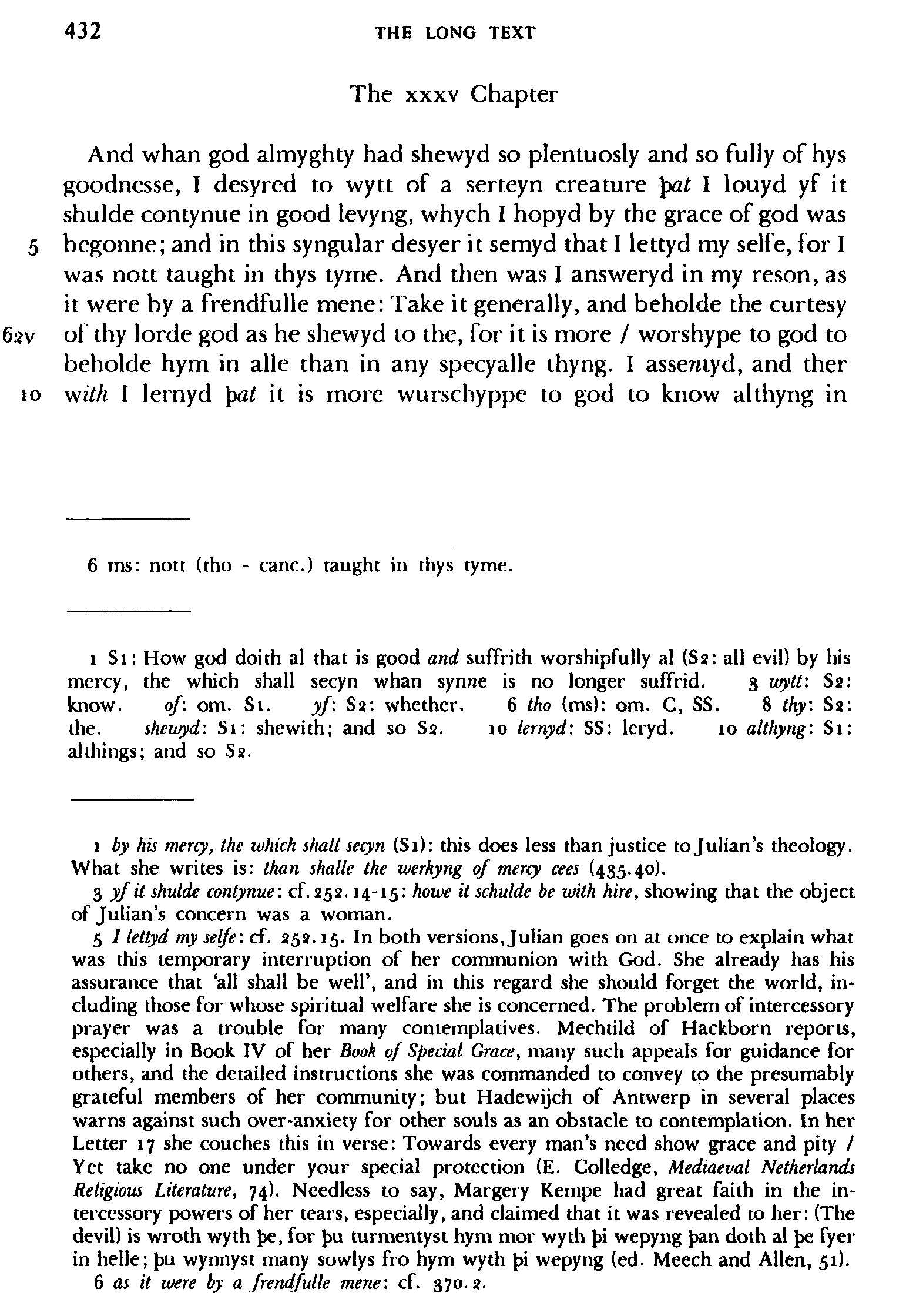
THE LONG TEXT
The xxxv Chapter And whan god almyghty had shewyd so plentuosly and so fully of hys goodnesse, I desyred to wytt of a serteyn creature ^at I louyd yf it shulde contynue in good levyng, whych I hopyd by the grace of god was
5 bcgonne; and in this syngular desyer it semyd that I lettyd my selfe, for I was nott taught in thys tyrrie. And then was I answeryd in my reson, as it were by a frendfulle mene: Take it generally, and beholde the curtesy
6sv of thy lorde god as he shewyd to the, for it is more / worshype to god to beholde hym in alle than in any specyalle thyng. I assentyd, and ther
10 -with I lernyd \>at it is more wurschyppe to god to know althyng in 6 ms: nott (tho - cane.) taught in thys tyme. i Si: How god doith al that is good and suffrith worshipfully al (Si?: all evil) by his mercy, the which shall secyn whan synwe is no longer suffrid.
3 wytt: Sa: know. of: om. Si. yf: Sa: whether.
6 tho (ms): om. C, SS.
8 thy: Sa: the. shewyd: Si: shewith; and so Sa.
10 lernyd: SS: leryd.
10 althyng: Si: al things; and so Sa. i by his mercy, the which shall secyn (Si): this does less than justice to Julian's theology.
What she writes is: than shalle the werkyng of mercy cees (435.40).
3 yf it shulde contynue: cf. 252.14-15: howe it schulde be with hire, showing that the object of Julian's concern was a woman.
5 / lettyd my selfe: cf. 252.15. In both versions, Julian goes on at once to explain what was this temporary interruption of her communion with God. She already has his assurance that 'all shall be well', and in this regard she should forget the world, including those for whose spiritual welfare she is concerned. The problem of intercessory prayer was a trouble for many contemplatives. Mechtild of Hackborn reports, especially in Book IV of her Booh of Special Grace, many such appeals for guidance for others, and the detailed instructions she was commanded to convey to the presumably grateful members of her community; but Hadewijch of Antwerp in several places warns against such over-anxiety for other souls as an obstacle to contemplation. In her
Letter 17 she couches this in verse: Towards every man's need show grace and pity /
Yet take no one under your special protection (E. Colledge, Mediaeval Netherlands
Religious Literature, 74). Needless to say, Margery Kempe had great faith in the intercessory powers of her tears, especially, and claimed that it was revealed to her: (The devil) is wroth wyth J>e, for J)u turmentyst hym mor wyth J)i wepyng J>an doth al pe fyer in helle; pu wynnyst many sowlys fro hym wyth J>i wepyng (ed. Meech and Allen, 51).
6 as it were by a frendfulle mene: cf. 370.2.
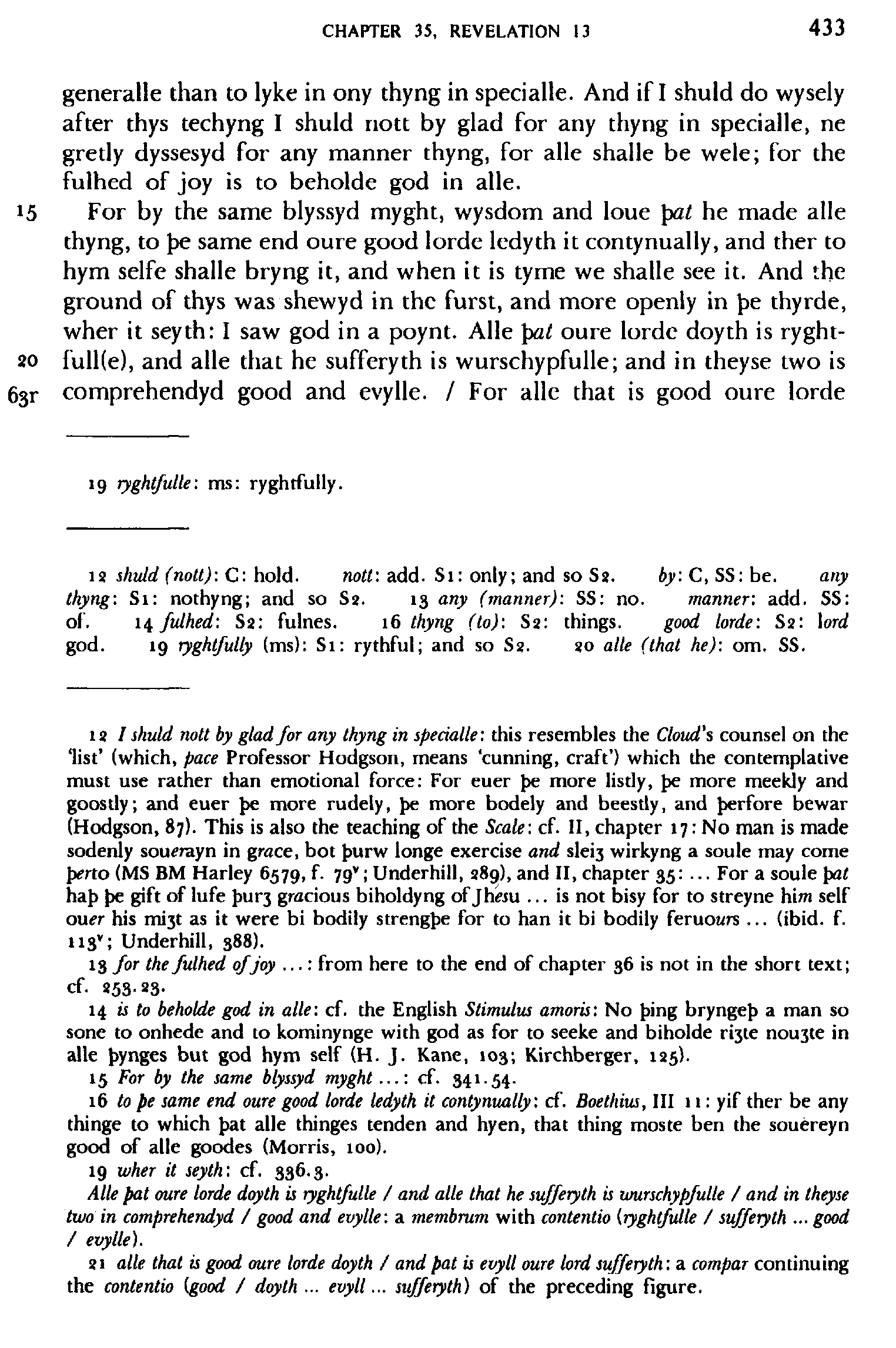
CHAPTER 35, REVELATION 13
generalle than to lyke in ony thyng in specialle. And if I shuld do wysely after thys techyng I shuld nott by glad for any thyng in specialle, ne gretly dyssesyd for any manner thyng, for alle shalle be wele; for the fulhed of joy is to beholde god in alle.
For by the same blyssyd myght, wysdom and loue \at he made alle thyng, to \>e same end oure good lorde ledyth it contynually, and ther to hym selfe shalle bryng it, and when it is tyme we shalle see it. And the ground of thys was shewyd in the furst, and more openly in pe thyrde, wher it seyth: I saw god in a poynt. Alle pa/ oure lordc doyth is ryght20 full(e), and alle that he sufferyth is wurschypfulle; and in theyse two is
6ar comprehendyd good and evylle. / For alle that is good oure lorde 19 ryghtfulle: ms: ryghtfully.
12 shuld (nott): C: hold. nott: add. Si: only; and so 82. by: C, SS: be. any thyng: Si: nothyng; and so 82.
13 any (manner): SS: no. manner: add. SS: of.
14 fulhed: 82: fulnes.
16 thyng (to): 82: things. good lorde: 82: lord god.
19 ryghtfully (ms): Si: rythful; and so 82.
20 alle (that he): om. SS.
12 I shuld nott by glad for any thyng in specialle: this resembles the Cloud's counsel on the 'list' (which, pace Professor Hodgson, means 'cunning, craft') which the contemplative must use rather than emotional force: For euer J>e more listly, J>e more meekly and goostly; and euer pe more rudely, Jje more bodely and beestly, and Jierfore bewar
(Hodgson, 87). This is also the teaching of the Scale: cf. II, chapter 17: No man is made sodenly sou^rayn in grace, bot J)urw longe exercise and sleis wirkyng a soule may come ftfrto (MS BM Harley 6579, f. 79*; Underhill, 289), and II, chapter 35: ... For a soule \xit haj) J)e gift of lufe J>ur3 gracious biholdyng of Jh«u ... is not bisy for to streyne him self ouer his mi3t as it were bi bodily strengj>e for to han it bi bodily feruowrs ... (ibid. f.
113"; Underhill, 388).
13 for the fulhed of joy ...: from here to the end of chapter 36 is not in the short text; cf. 253.23.
14 is to beholde god in alle: cf. the English Stimulus amoris: No J>ing bryngejj a man so sone to onhede and to kominynge with god as for to seeke and biholde ri3te nou3te in alle |>ynges but god hym self (H. J. Kane, 103; Kirchberger, 125).
15 For by the same blyssyd myght ...: cf. 341.54.
16 to pe same end oure good lorde ledyth it contynually: cf. Boethius, III 11: yif ther be any thinge to which £>at alle thinges tenden and hyen, that thing moste ben the souereyn good of alle goodes (Morris, 100).
19 wher it seyth: cf. 336.3.
Alle pat oure lorde doyth is ryghtfulle I and alle that he sufferyth is wurschypfulle / and in theyse two in comprehendyd / good and evylle: a membrum with contentio (ryghtfulle / sufferyth ... good
/ evylle).
21 alle that is good oure lorde doyth / and pat is evyll oure lord sufferyth: a compar continuing the contentio (good / doyth ... evyll... sufferyth) of the preceding figure.
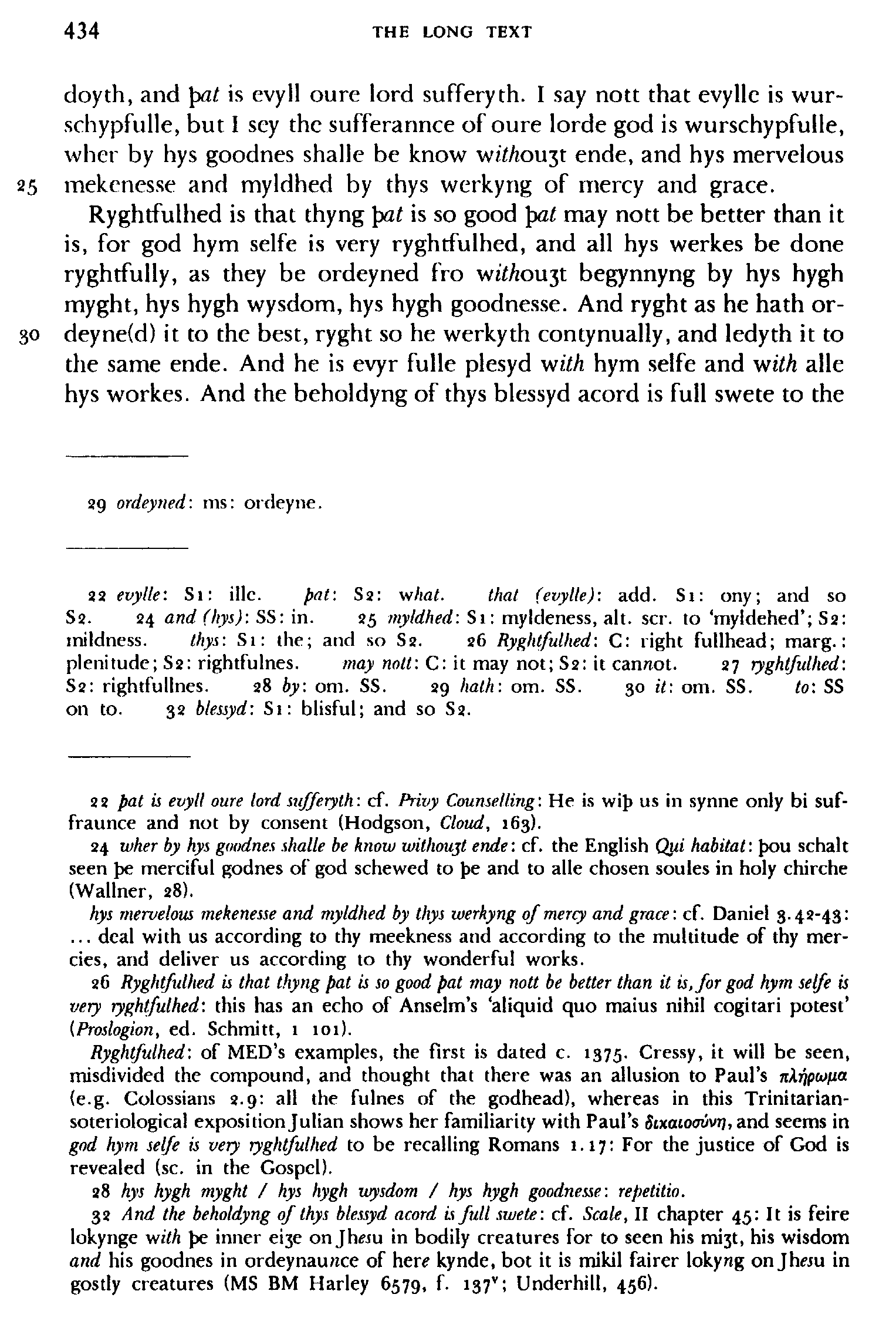
THE LONG TEXT
doyth, and \>at is evyll oure lord sufferyth. I say nott that evyllc is wurschypfulle, but I sey the sufferannce of oure lorde god is wurschypfulle, wher by hys goodnes shalle be know withou^t ende, and hys mervelous
25 mekenesse and myldhed by thys werkyng of mercy and grace.
Ryghtfulhed is that thyng \>at is so good \>at may nott be better than it is, for god hym selfe is very ryghtfulhed, and all hys werkes be done rygh(fully, as they be ordeyned fro withouQ begynnyng by hys hygh myght, hys hygh wysdom, hys hygh goodnesse. And ryght as he hath or30 deyne(d) it to the best, ryght so he werkyth contynually, and ledyth it to the same ende. And he is evyr fulle plesyd with hym selfe and with alle hys workes. And the beholdyng of thys blessyd acord is full swete to the 29 ordeyned: ms: orcleyne.
22 evylle: Si: illc. pat: 82: what. that (evylle): add. Si: ony; and so 82.
24 and (hys): SS: in.
25 myldhed: Si: myldeness, alt. scr. to Ynyldehed'; 82: mildness. thys: Si: the; and so 82.
26 Ryghtfulhed: C: right fullhead; marg.: plenitude; 82: rightfulnes. may nott: C: it may not; 82: it cannot.
27 ryghtfulhed:
82: rightfullnes.
28 by: om. 88.
29 hath: om. SS.
30 it: om. SS. to: SS on to.
32 blessyd: Si: blisful; and so 82.
22 pat is evyll oure lord sufferyth: cf. Privy Counselling: He is wi]) us in synne only bi suffraunce and not by consent (Hodgson, Cloud, 163).
24 wher by hys goodnes shalle be know withoujt ende: cf. the English Qj«' habitat: J>ou schalt seen J>e merciful godnes of god schewed to J>e and to alle chosen soules in holy chirche
(Wallner, 28). hys mervelous mekenesse and myldhed by thys werkyng of mercy and grace: cf. Daniel 3.42-43:
... deal with us according to thy meekness and according to the multitude of thy mercies, and deliver us according to thy wonderful works.
26 Ryghtfulhed is that thyng pat is so good pat may nott be better than it is, for god hym selfe is very ryghtfulhed: this has an echo of Anselm's 'aliquid quo maius nihil cogitari potest'
(Proslogion, ed. Schmitt, i 101).
Ryghtfulhed: of MED's examples, the first is dated c. 1375. Cressy, it will be seen, misdivided the compound, and thought that there was an allusion to Paul's nXfipwua (e.g. Colossians 2.9: all the fulnes of the godhead), whereas in this Trinitariansoteriological exposition Julian shows her familiarity with Paul's Stxaioovvr), and seems in god hym selfe is very ryghtfulhed to be recalling Romans 1.17: For the justice of God is revealed (sc. in the Gospel).
28 hys hygh myght / hys hygh wysdom / hys hygh goodnesse: repetitio.
32 And the beholdyng of thys blessyd acord is full swete: cf. Scale, II chapter 45: It is feire lokynge with £e inner ei3e onjhmi in bodily creatures for to seen his mijt, his wisdom and his goodnes in ordeynauwce of her? kynde, bot it is mikil fairer lokyng onjhmi in gostly creatures (MS BM Harley 6579, f. i37v; Underhill, 456).
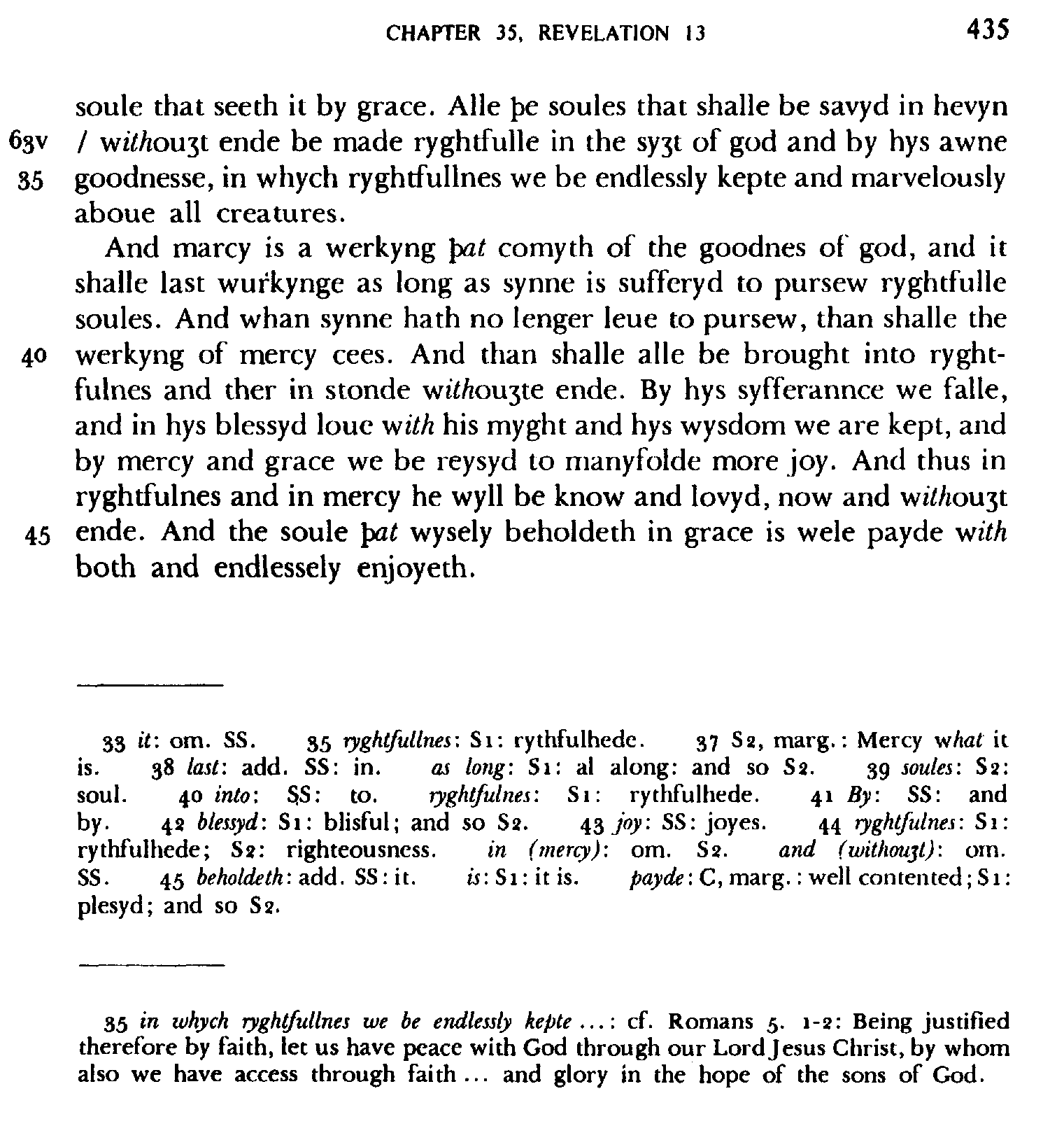
CHAPTER 35, REVELATION 13
soule that seeth it by grace. Alle pe soules that shalle be savyd in hevyn GSV / without ende be made ryghtfulle in the sygt of god and by hys awne
35 goodnesse, in whych ryghtfullnes we be endlessly kepte and marvelously aboue all creatures.
And marcy is a werkyng pa£ cornyth of the goodnes of god, and it shalle last wurkynge as long as synne is sufferyd to pursew ryghtfulle soules. And whan synne hath no lenger leue to pursew, than shalle the 40 werkyng of mercy cees. And than shalle alle be brought into ryghtfulnes and ther in stonde withou^te ende. By hys syfferannce we falle, and in hys blessyd loue with his myght and hys wysdom we are kept, and by mercy and grace we be reysyd to manyfolde more joy. And thus in ryghtfulnes and in mercy he wyll be know and lovyd, now and withou^t
45 ende. And the soule $at wysely beholdeth in grace is wele payde with both and endlessely enjoyeth.
33 it: om. SS.
35 ryghtfullnes: Si: rythfulhede.
37 82, marg.: Mercy what it is.
38 last: add. SS: in. as long: Si: al along: and so 82.
39 soules: 82: soul.
40 into:
SS: to. ryghtfulnes:
Si: rythfulhede.
41 By:
SS: and by.
42 blessyd: Si: blisful; and so 82.
43 joy: SS: joyes.
44 ryghtfulnes: Si: rythfulhede; 82: righteousness. in (mercy): om.
82. and (withoujt): om.
SS.
45 beholdeth: add. SS: it. is: Si: it is. payde: C, marg.: well contented;Si: plesyd; and so 82.
35 in whych ryghtfullnes we be endlessly kepte ...: cf. Romans 5. 1-2: Being justified therefore by faith, let us have peace with God through our Lord Jesus Christ, by whom also we have access through faith ... and glory in the hope of the sons of God.
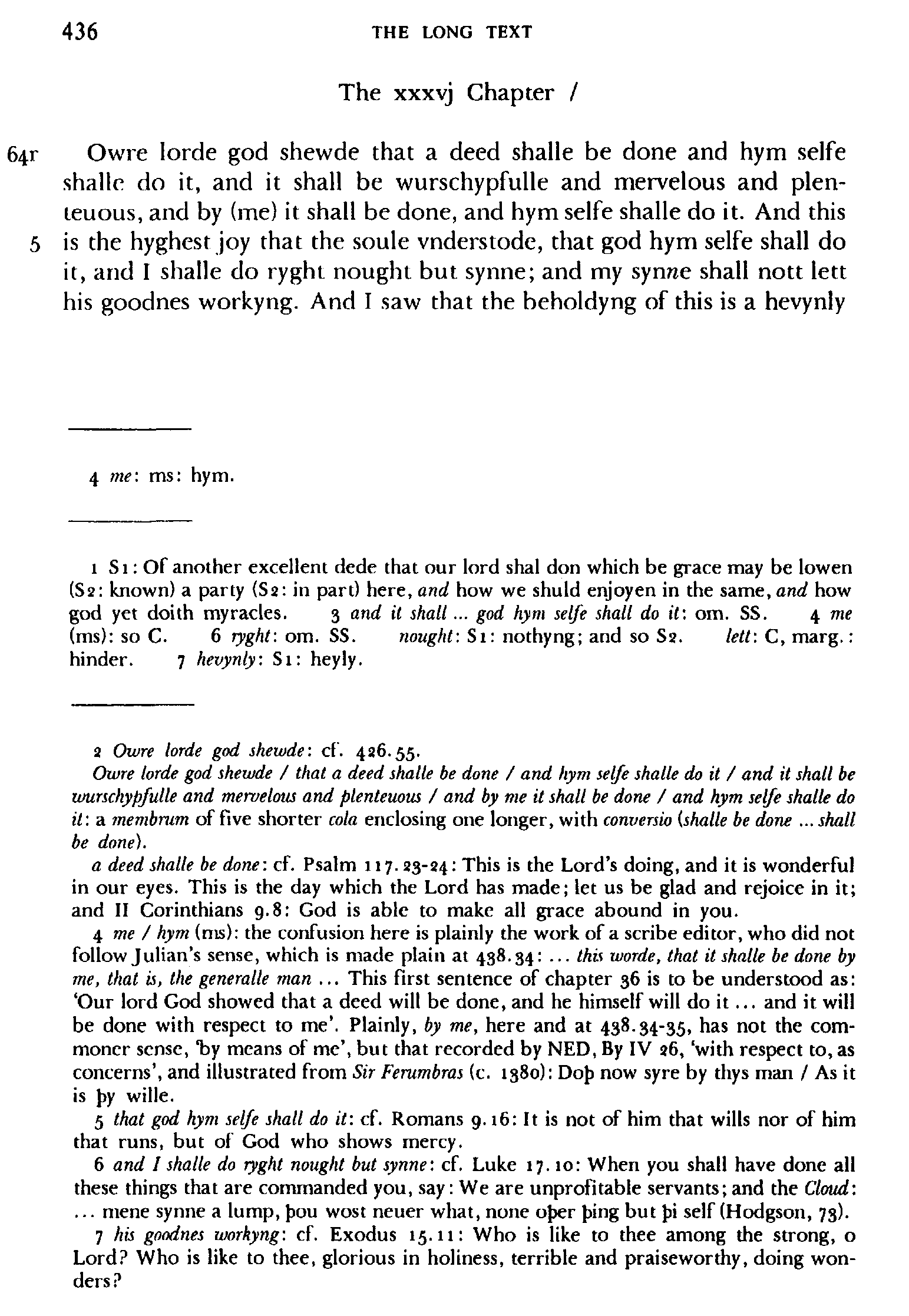
THE LONG TEXT
The xxxvj Chapter / 64r Owre lorde god shewde that a deed shalle be done and hym selfe shalle do it, and it shall be wurschypfulle and mervelous and plenteuous, and by (me) it shall be done, and hym selfe shalle do it. And this
5 is the hyghest joy that the soule vnderstode, that god hym selfe shall do it, and I shalle do ryght nought but synne; and my synwe shall nott lett his goodnes workyng. And I saw that the beholdyng of this is a hevynly
4 me: ms: hym. i S i: Of another excellent dede that our lord shal don which be grace may be lowen
(82: known) a party (Sa: in part) here, and how we shuld enjoyen in the same, and how god yet doith myracles.
3 and it shall... god hym selfe shall do it: om. SS.
4 me (ms): so C.
6 ryght: om. SS. nought: Si: nothyng; and so 82. lett: C, marg.: hinder.
7 hevynly: Si: heyly.
2 Owre lorde god shewde: cf. 426.55.
Owre lorde god shewde / that a deed shalle be done / and hym selfe shalle do it / and it shall be wurschypfulle and mervelous and plenteuous / and by me it shall be done / and hym selfe shalle do it: a membrum of five shorter cola enclosing one longer, with conversio (shalle be done ... shall be done). a deed shalle be done: cf. Psalm 117.23-24: This is the Lord's doing, and it is wonderful in our eyes. This is the day which the Lord has made; let us be glad and rejoice in it; and II Corinthians 9.8: God is able to make all grace abound in you.
4 me / hym (ms): the confusion here is plainly the work of a scribe editor, who did not follow Julian's sense, which is made plain at 438.34: ... this worde, that it shalle be done by me, that is, the generalle man ... This first sentence of chapter 36 is to be understood as:
'Our lord God showed that a deed will be done, and he himself will do it... and it will be done with respect to me'. Plainly, by me, here and at 438.34-35, has not the commoner sense, "by means of me', but that recorded by NED, By IV 26, 'with respect to, as concerns', and illustrated from Sir Ferumbras (c. 1380): Dof> now syre by thys man / As it is J>y wille.
5 that god hym selfe shall do it: cf. Romans 9.16: It is not of him that wills nor of him that runs, but of God who shows mercy.
6 and I shalle do ryght nought but synne: cf. Luke 17.10: When you shall have done all these things that are commanded you, say: We are unprofitable servants; and the Cloud:
... mene synne a lump, Jjou wost neuer what, none of>er J>ing but J>i self (Hodgson, 73).
7 his goodnes workyng: cf. Exodus 15.11: Who is like to thee among the strong, o
Lord? Who is like to thee, glorious in holiness, terrible and praiseworthy, doing wonders?
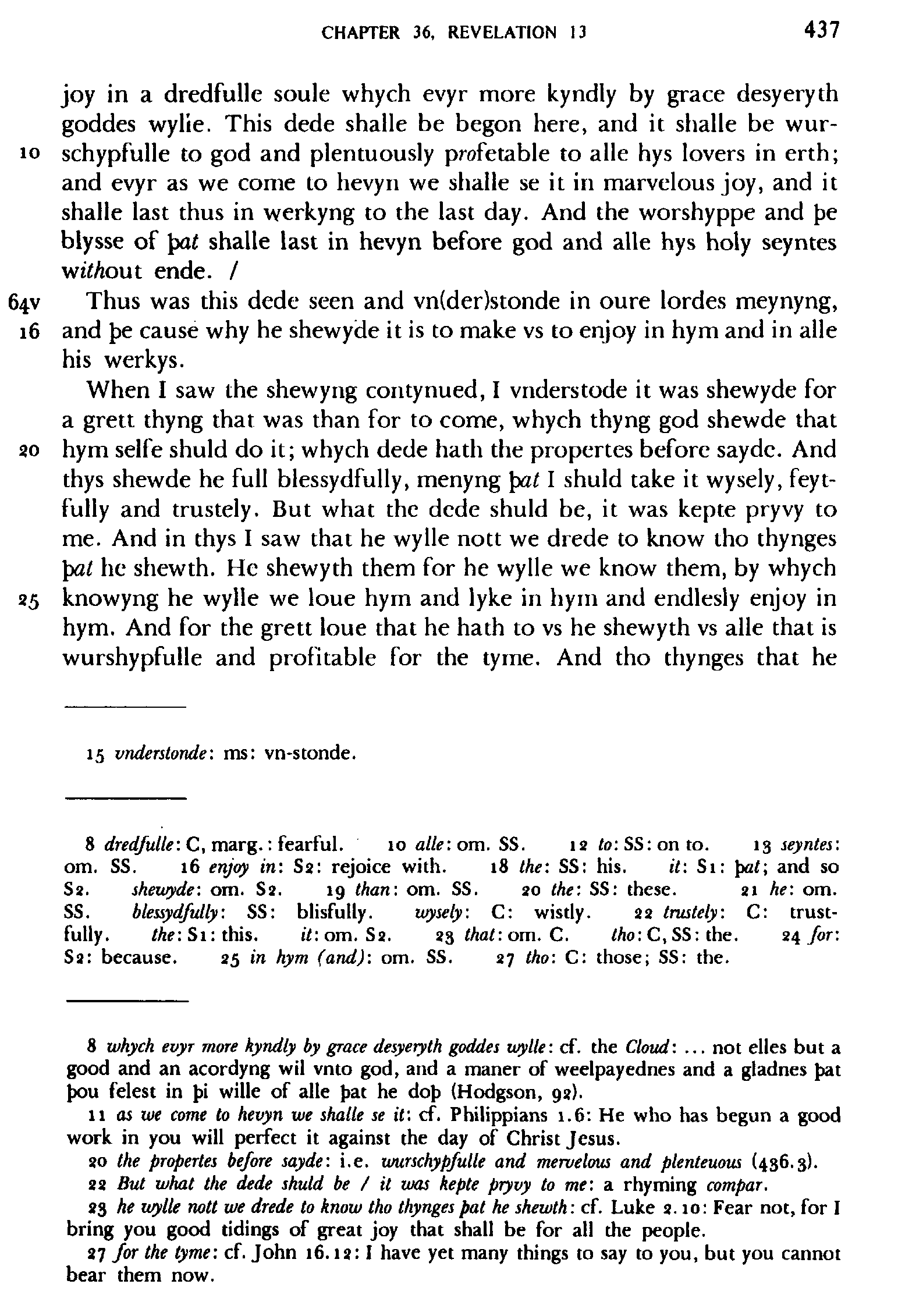
CHAPTER 36, REVELATION 13
joy in a dredfulle soule whych evyr more kyndly by grace desyeryth goddes wylie. This dede shalle be begon here, and it shalle be wur10 schypfulle to god and plentuously profetable to alle hys lovers in erth; and evyr as we come to hevyn we shalle se it in marvelous joy, and it shalle last thus in werkyng to the last day. And the worshyppe and be blysse of ba£ shalle last in hevyn before god and alle hys holy seyntes without ende. / 64v Thus was this dede seen and vn(der)stonde in oure lordes meynyng,
16 and be cause why he shewyde it is to make vs to enjoy in hym and in alle his werkys.
When I saw the shewyng contynued, I vnderstode it was shewyde for a grett thyng that was than for to come, whych thyng god shewde that 20 hym selfe shuld do it; whych dede hath the propertes before saydc. And thys shewde he full blessydfully, menyng \Mt I shuld take it wysely, feytfully and trustely. But what the dede shuld be, it was kepte pryvy to me. And in thys I saw that he wylle nott we drede to know tho thynges
\>at he shewth. He shewyth them for he wylle we know them, by whych 25 knowyng he wylle we loue hym and lyke in hym and endlesly enjoy in hym. And for the grett loue that he hath to vs he shewyth vs alle that is wurshypfulle and profitable for the tyrne. And tho thynges that he
15 vnderstonde: ms: vn-stonde.
8 dredfulle: C, marg.: fearful.
10 alle: om. SS.
12 to: SS: on to.
13 seyntes: om. SS.
16 enjoy in: 82: rejoice with.
18 the: SS: his. it: Si: \>at\ and so Ss. shewyde: om. 82.
19 than: om. SS.
20 the: SS: these.
21 he: om.
SS. blessydfully:
SS: blisfully. wysely:
C: wistly.
22 trustely:
C: trustfully. lA?: Si: this. zY: om. 82.
23 that: om. C. tho: C, SS: the.
24 for:
82: because.
25 in hym (and): om. SS.
27 tho: C: those; SS: the.
8 whych evyr more kyndly by grace desyeryth goddes wylle: cf. the Cloud: ... not elles but a good and an acordyng wil vnto god, and a maner of weelpayednes and a gladnes J>at l»u felest in t>i wille of alle }>at he doj) (Hodgson, 92).
11 as we come to hevyn we shalle se it: cf. Philippians 1.6: He who has begun a good work in you will perfect it against the day of Christ Jesus.
20 the propertes before sayde: i.e. wurschypfulle and mervelous and plenteuous (436.3).
22 But what the dede shuld be / it was kepte pryvy to me: a rhyming compar.
23 he wylle nott we drede to know tho thynges pat he shewth: cf. Luke 2.10: Fear not, for I bring you good tidings of great joy that shall be for all die people.
27 for the tyme: cf. John 16.12:1 have yet many things to say to you, but you cannot bear them now.
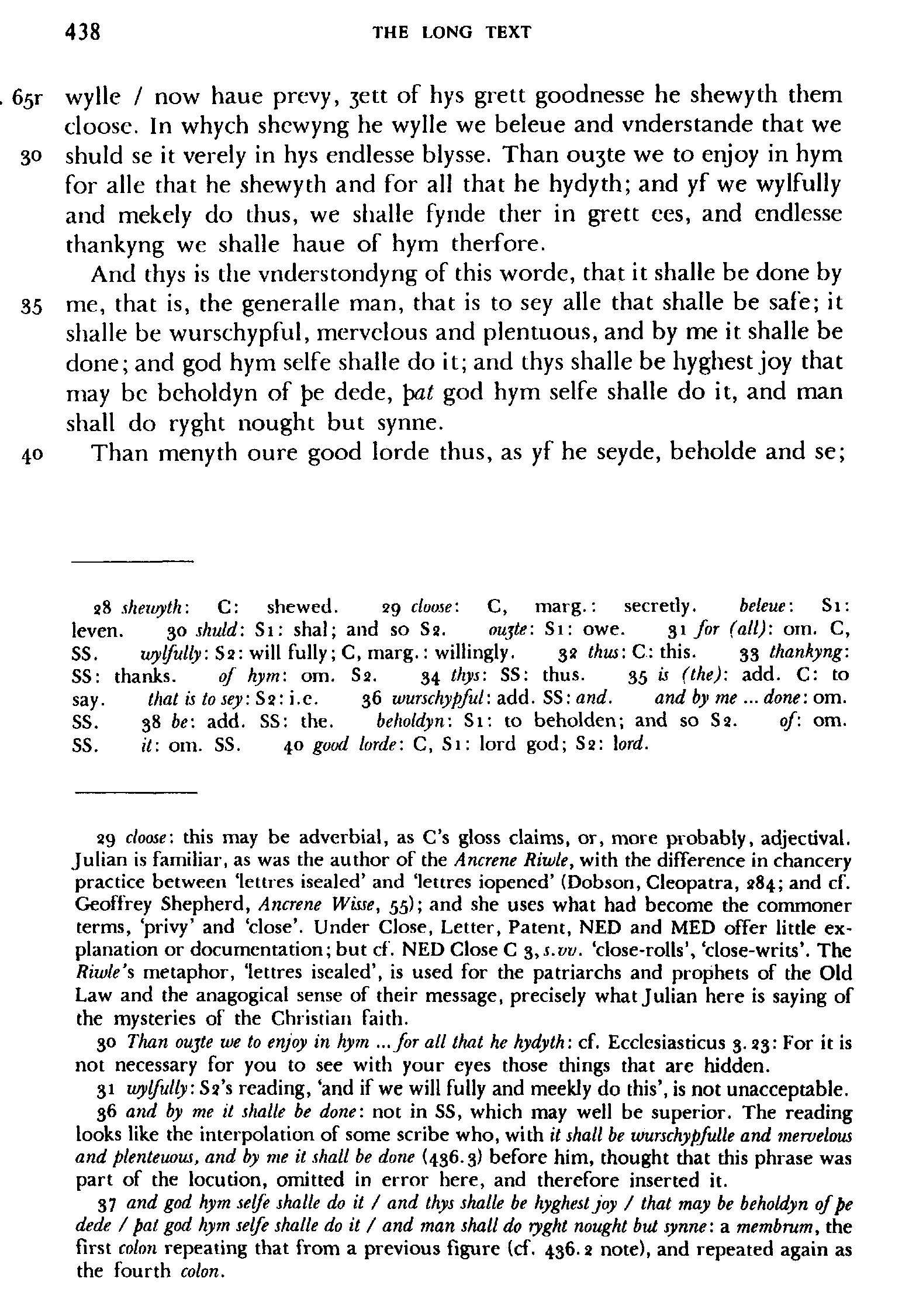
THE LONG TEXT
. 65r wylle / now haue prevy, 3ett of hys grett goodnesse he shewyth them cloose. In whych shcwyng he wylle we beleue and vnderstande that we
30 shuld se it verely in hys endlesse blysse. Than ou3te we to enjoy in hym for alle that he shewyth and for all that he hydyth; and yf we wylfully and mekely do thus, we shalle fynde ther in grett ees, and endlesse thankyng we shalle haue of hym therfore.
And thys is the vnderstondyng of this worde, that it shalle be done by 35 me, that is, the generalle man, that is to sey alle that shalle be safe; it shalle be wurschypful, mervclous and plentuous, and by me it shalle be done; and god hym selfe shalle do it; and thys shalle be hyghest joy that may be beholdyn of £>e dede, \>at god hym selfe shalle do it, and man shall do ryght nought but synne.
Than menyth oure good lorde thus, as yf he seyde, beholde and se; 28 shewyth:
C: shewed.
29 cloose:
C, marg.: secretly. beleue:
Si: leven.
30 shuld: Si: shal; and so 82. outfe: Si: owe.
31 for (all): oin. C, SS. wylfully: Sa: will fully; C, marg.: willingly.
32 thus: C: this.
33 thankyng:
SS: thanks. of hym: om. Sa.
34 thys: SS: thus.
35 is (the): add. C: to say. that is to sey: 82: i.e.
36 wurschypful: add. SS: and. and by me ... done: om.
SS.
38 be: add. SS: the. beholdyn: Si: to beholden; and so 82. of: om.
SS. it: om. SS.
40 good lorde: C, Si: lord god; 82: lord.
29 cloose: this may be adverbial, as C's gloss claims, or, more probably, adjectival.
Julian is familiar, as was the author of the Ancrene Riwle, with the difference in chancery practice between 'lettres isealed' and 'lettres iopened' (Dobson, Cleopatra, 284; and cf.
Geoffrey Shepherd, Ancrene Wisse, 55); and she uses what had become the commoner terms, 'privy' and 'close'. Under Close, Letter, Patent, NED and MED offer little explanation or documentation; but cf. NED Close C s,s.vv. 'close-rolls', 'close-writs'. The Riwle's metaphor, 'lettres isealed', is used for the patriarchs and prophets of the Old
Law and the anagogical sense of their message, precisely what Julian here is saying of the mysteries of the Christian faith.
30 Than oujte we to enjoy in hym ...for all that he hydyth: cf. Ecclesiasticus 3.23: For it is not necessary for you to see with your eyes those things that are hidden.
31 wylfully: Sa's reading, 'and if we will fully and meekly do this', is not unacceptable.
36 and by me it shalle be done: not in SS, which may well be superior. The reading looks like the interpolation of some scribe who, with it shall be wurschypfulle and mervelous and plenteuous, and by me it shall be done (436.3) before him, thought that this phrase was part of the locution, omitted in error here, and therefore inserted it.
37 and god hym selfe shalle do it / and thys shalle be hyghest joy / that may be beholdyn ofpe dede / pat god hym selfe shalle do it / and man shall do ryght nought but synne: a membrum, the first colon repeating that from a previous figure (cf. 436.2 note), and repeated again as the fourth colon.
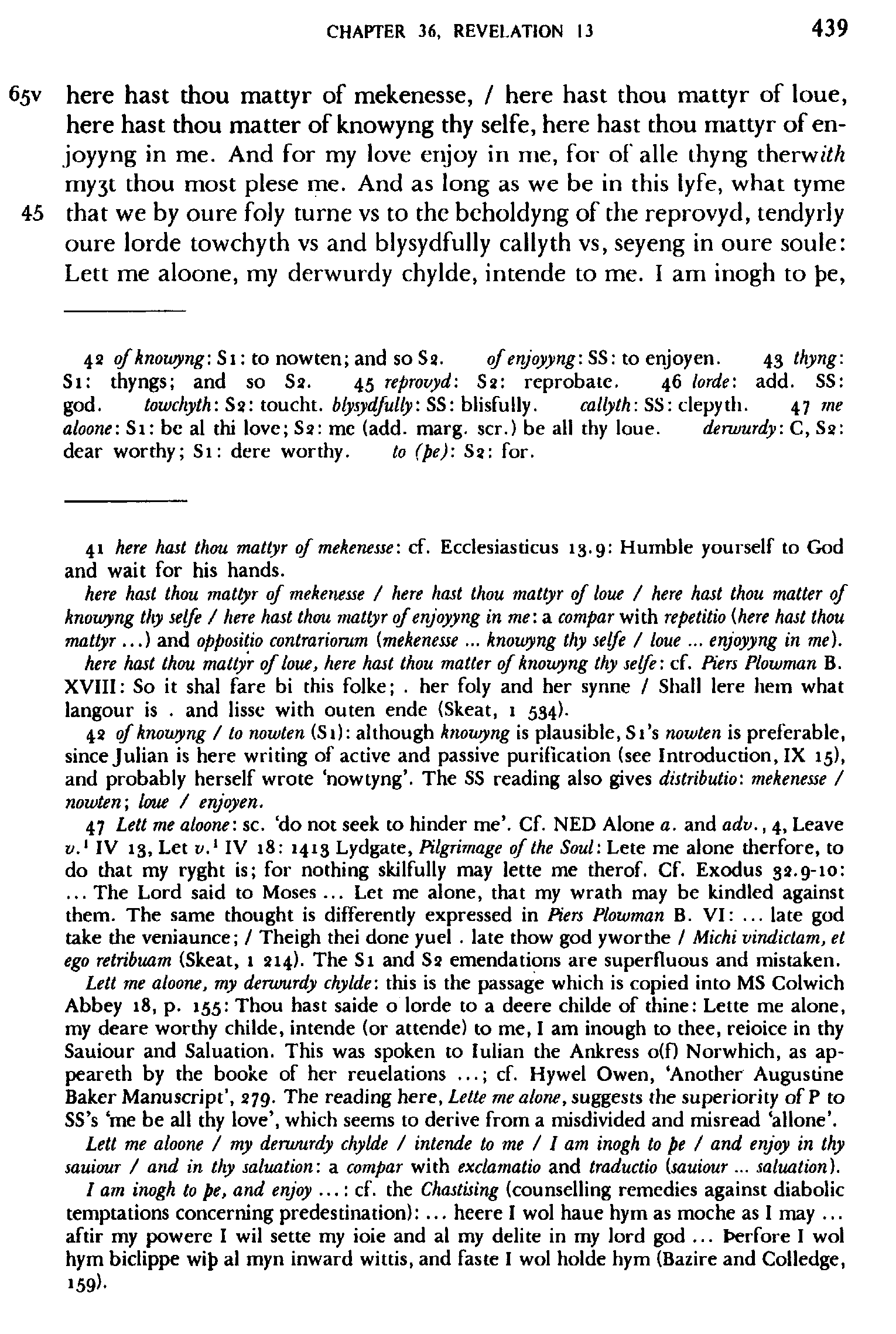
CHAPTER 36, REVELATION 13
65v here hast thou mattyr of mekenesse, / here hast thou mattyr of loue, here hast thou matter of knowyng thy selfe, here hast thou mattyr of enjoyyng in me. And for my love enjoy in me, for of alle thyng thervwY/t myst thou most plese me. And as long as we be in this lyfe, what tyme
45 that we by oure foly turne vs to the beholdyng of the reprovyd, tendyrly oure lorde towchyth vs and blysydfully callyth vs, seyeng in oure soule:
Lett me aloone, my derwurdy chylde, intende to me. I am inogh to £e, 42 of knowyng: Si: to nowten; and so Sa. ofenjoyyng: 88: to enjoyen.
43 thyng:
Si: thyngs; and so 82.
45 reprovyd:
82: reprobate.
46 lorde: add. SS: god. towchyth: 82: toucht. blysydfully: SS: blisfully. callyth: SS: clepyth.
47 me aloone: Si: be al thi love; 82: me (add. marg. scr.) be all thy loue. derwurdy: C, 82: dear worthy; Si: dere worthy. to (pe): 82: for.
41 here hast thou mattyr of mekenesse: cf. Ecclesiasticus 13.9: Humble yourself to God and wait for his hands. here hast thou mattyr of mekenesse / here hast thou mattyr of loue / here hast thou matter of knowyng thy selfe / here hast thou mattyr ofenjoyyng in me: a compar with repetitio (here hast thou mattyr ...) and oppositio contrariorum (mekenesse ... knowyng thy selfe / loue ... enjoyyng in me). here hast thou mattyr of loue, here hast thou matter of knowyng thy selfe: cf. Piers Plowman B.
XVIII: So it shal fare bi this folke; . her foly and her synne / Shall lere hem what langour is . and lisse with outen ende (Skeat, i 534).
42 of knowyng / to nowten (Si): although knowyng is plausible, Si's nowten is preferable, since Julian is here writing of active and passive purification (see Introduction, IX 15), and probably herself wrote 'nowtyng'. The SS reading also gives distributio: mekenesse / nowten; hue / enjoyen.
47 Lett me aloone: sc. 'do not seek to hinder me'. Cf. NED Alone a. and adv., 4, Leave v.1 IV 13, Let i/.1 IV 18: 1413 Lydgate, Pilgrimage of the Soul: Lete me alone therfore, to do that my ryght is; for nothing skilfully may lette me therof. Cf. Exodus 32.9-10:
... The Lord said to Moses ... Let me alone, that my wrath may be kindled against them. The same thought is differently expressed in Piers Plowman B. VI: ... late god take the veniaunce; / Theigh thei done yuel . late thow god yworthe / Michi vindidam, et ego retribuam (Skeat, i 214). The Si and 82 emendations are superfluous and mistaken.
Lett me aloone, my derwurdy chylde: this is the passage which is copied into MS Colwich
Abbey 18, p. 155: Thou hast saide o lorde to a deere childe of thine: Lette me alone, my deare worthy childe, intende (or attende) to me, I am inough to thee, reioice in thy
Sauiour and Saluation. This was spoken to lulian the Ankress o(f) Norwhich, as appeareth by the booke of her reuelations ...; cf. Hywel Owen, 'Another Augustine
Baker Manuscript', 279. The reading here, Lette me alone, suggests the superiority of P to SS's 'me be all thy love', which seems to derive from a misdivided and misread 'allone'.
Lett me aloone / my derwurdy chylde / intende to me / I am inogh to pe / and enjoy in thy sauiour / and in thy saluation: a compar with exclamatio and traductio (sauiour ... saluation).
I am inogh to pe, and enjoy ...: cf. the Chastising (counselling remedies against diabolic temptations concerning predestination): ... heere I wol haue hym as moche as I may ... aftir my powere I wil sette my ioie and al my delite in my lord god ... t»erfore I wol hym biclippe wij> al myn inward wittis, and faste I wol holde hym (Bazire and Colledge,
159)-
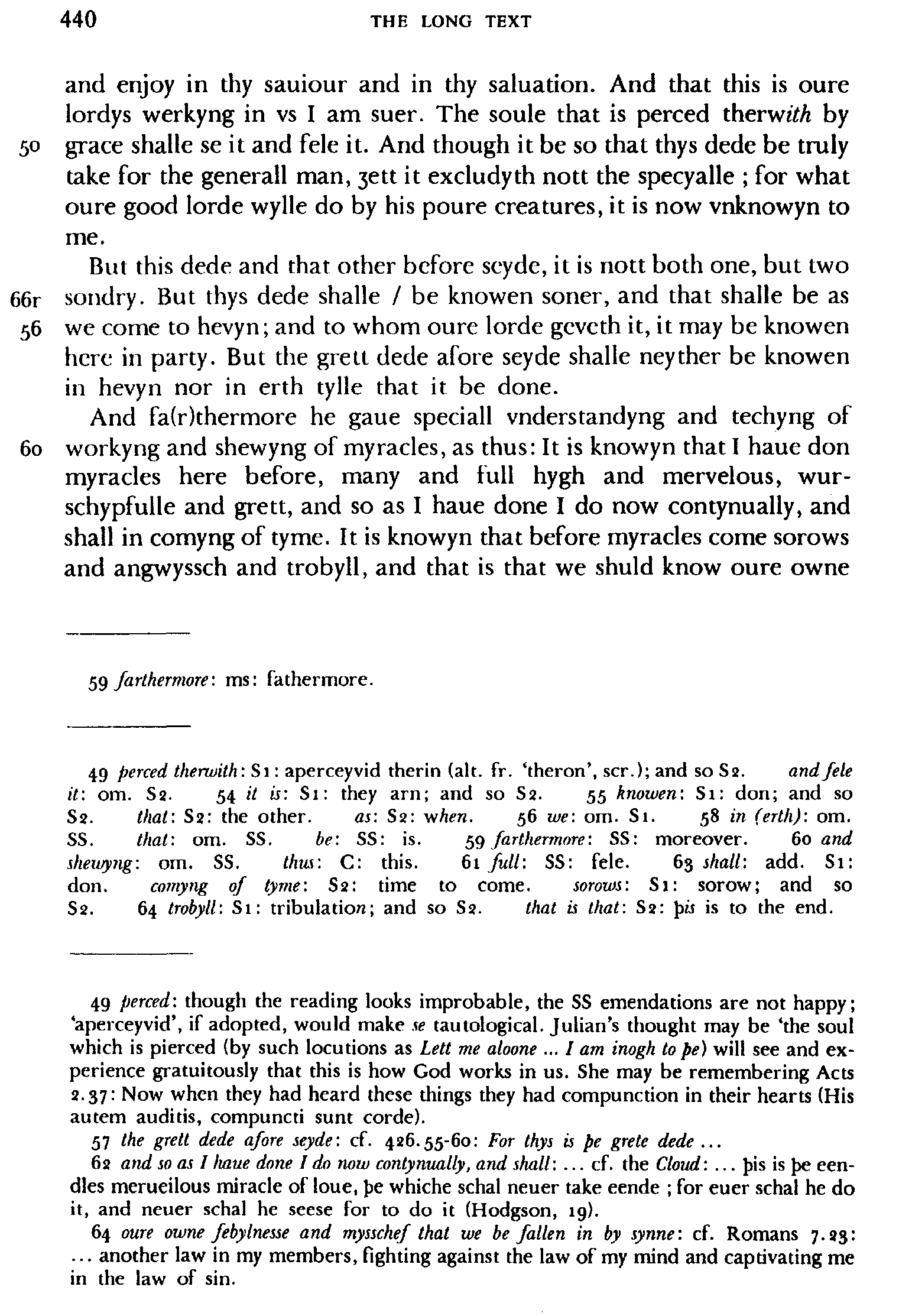
THE LONG TEXT
and enjoy in thy sauiour and in thy saluation. And that this is oure lordys werkyng in vs I am suer. The soule that is perced therwith by 50 grace shalle se it and fele it. And though it be so that thys dede be truly take for the generall man, 3ett it excludyth nott the specyalle ; for what oure good lorde wylle do by his poure creatures, it is now vnknowyn to me.
But this dede and that other before seyde, it is nott both one, but two 66r sondry. But thys dede shalle / be knowen soner, and that shalle be as 56 we come to hevyn; and to whom oure lorde geveth it, it may be knowen here in party. But the grett dede afore seyde shalle neyther be knowen in hevyn nor in erth tylle that it be done.
And fa(r)thermore he gaue speciall vnderstandyng and techyng of 60 workyng and shewyng of myracles, as thus: It is knowyn that I haue don myracles here before, many and full hygh and mervelous, wurschypfulle and grett, and so as I haue done I do now contynually, and shall in comyng of tyme. It is knowyn that before myracles come sorows and angwyssch and trobyll, and that is that we shuld know oure owne
59 furthermore: ms: fathermore.
49 perced therwith: Si: aperceyvid therin (alt. fr. 'theron', scr.); and so 82. and fele it; om. 82.
54 it is: Si: they arn; and so 82.
55 knowen: Si: don; and so 82. that: 82: the other. as: 82: -when.
56 we: om. Si.
58 in (erth): om.
88. that: om.
SS. be: 88: is.
59 furthermore: 88: moreover.
60 and shewyng: om.
SS. thus: C: this.
61 full:
SS: fele.
63 shall: add.
Si: don. comyng of tyme:
82: time to come. sorows: Si: sorow; and so 82.
64 trobyll: Si: tribulation; and so 82. that is that: 82: \)is is to the end.
49 perced: though the reading looks improbable, the SS emendations are not happy;
'aperceyvid', if adopted, would make se tautological. Julian's thought may be 'the soul which is pierced (by such locutions as Lett me aloone ... I am inogh to pe) will see and experience gratuitously that this is how God works in us. She may be remembering Acts
2.37: Now when they had heard these things they had compunction in their hearts (His autem auditis, compuncti sunt corde).
57 the grett dede afore seyde: cf. 426.55-60: For thys is pe grete dede ...
62 and so as I haue done I do now contynually, and shall: ... cf. the Cloud: ... J>is is |>e eendles merueilous miracle of loue, \>e whiche schal neuer take eende ; for euer schal he do it, and neuer schal he seese for to do it (Hodgson, 19).
64 oure owne febylnesse and mysschef that we be fallen in by synne: cf. Romans 7.23:
... another law in my members, fighting against the law of my mind and captivating me in the law of sin.
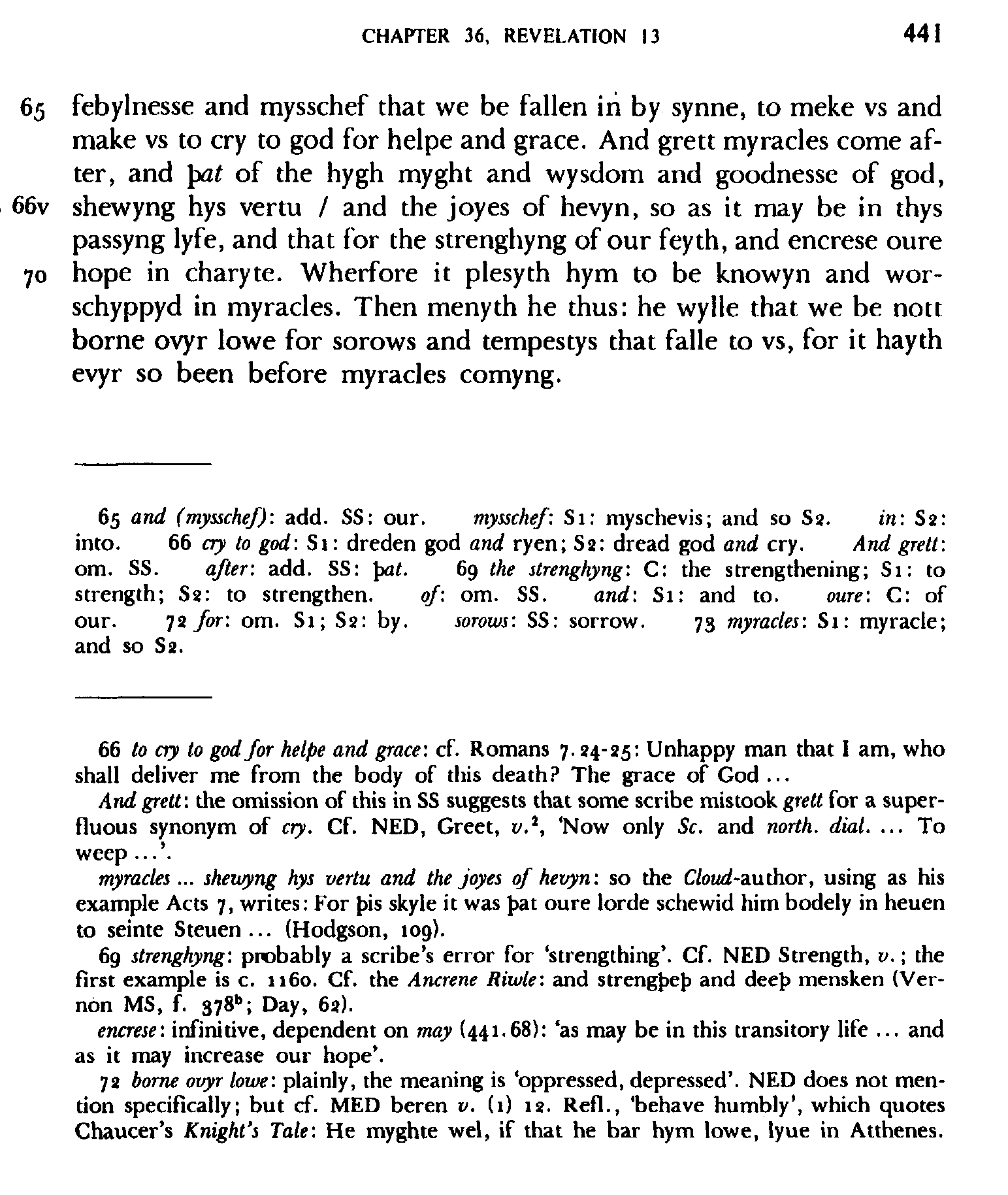
CHAPTER 36, REVELATION 13
65 febylnesse and mysschef that we be fallen in by synne, to meke vs and make vs to cry to god for helpe and grace. And grett myracles come after, and ]xit of the hygh myght and wysdom and goodnesse of god,
. 66v shewyng hys vertu / and the joyes of hevyn, so as it may be in thys passyng lyfe, and that for the strenghyng of our feyth, and encrese oure
70 hope in charyte. Wherfore it plesyth hym to be knowyn and worschyppyd in myracles. Then menyth he thus: he wylle that we be nott borne ovyr lowe for sorows and tempestys that falle to vs, for it hayth evyr so been before myracles comyng.
65 and (mysschef): add. SS: our. mysschef: Si: myschevis; and so 82. in: 82: into.
66 ay to god: Si: dreden god and ryen; 82: dread god and cry.
And grett: om. SS. after: add. SS: \>at.
69 the strenghyng: C: the strengthening; Si: to strength; 82: to strengthen. of: om. SS. and: Si: and to. oure: C: of our.
72 for: om. Si; 82: by. sorows: SS: sorrow.
73 myracles: Si: myracle; and so 82.
66 to cry to god for helpe and grace: cf. Romans 7.24-25: Unhappy man that I am, who shall deliver me from the body of this death? The grace of God ...
And grett: the omission of this in SS suggests that some scribe mistook grett for a superfluous synonym of cry. Cf. NED, Greet, i/.2, 'Now only Sc. and north, dial. ... To weep ...'. myracles... shewyng hys vertu and the joyes of hevyn: so the C/owd-author, using as his example Acts 7, writes: For pis skyle it was £at oure lorde schewid him bodely in heuen to seinte Steuen ... (Hodgson, 109).
69 strenghyng: probably a scribe's error for 'strengthing'. Cf. NED Strength, v.; the first example is c. 1160. Cf. the Ancrene Riwle: and strengjjej) and deej> mensken (Vernon MS, f. 378"; Day, 62). encrese: infinitive, dependent on may (441.68): 'as may be in this transitory life ... and as it may increase our hope*.
72 borne ovyr lowe: plainly, the meaning is 'oppressed, depressed'. NED does not mention specifically; but cf. MED beren v. (i) 12. Red., 'behave humbly", which quotes
Chaucer's Knight's Tale: He myghte wel, if that he bar hym lowe, lyue in Atthenes.
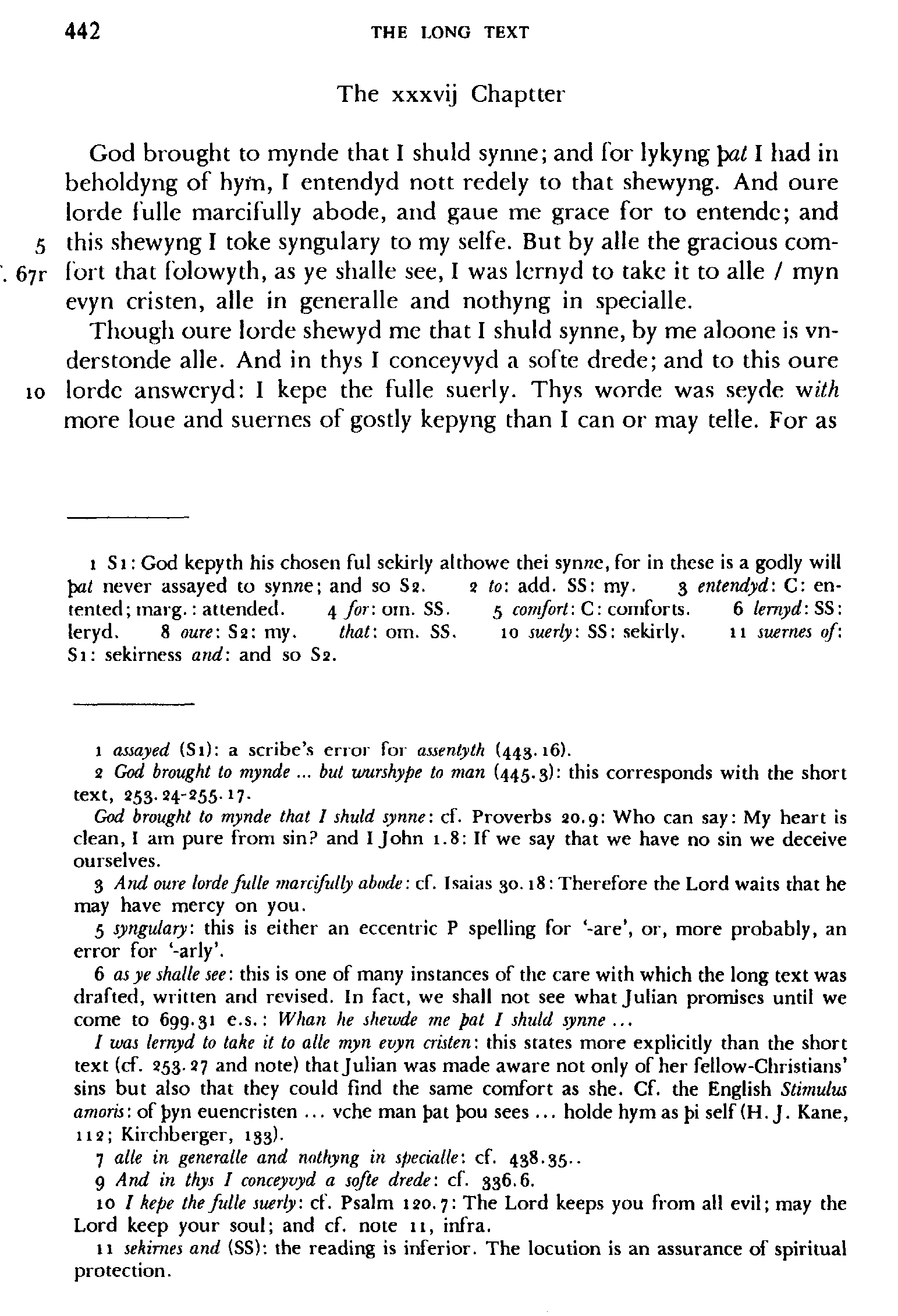
THE LONG TEXT
The xxxvij Chaptter God brought to mynde that I shuld synne; and for lykyng \xit I had in beholdyng of hyiti, I entendyd nott redely to that shewyng. And oure lorde fulle marcifully abode, and gaue me grace for to entendc; and 5 this shewyng I toke syngulary to my selfe. But by alle the gracious comf. 6yr fort that folowyth, as ye shalle see, I was lernyd to take it to alle / myn evyn cristen, alle in generalle and nothyng in specialle.
Though oure lorde shewyd me that I shuld synne, by me aloone is vnderstonde alle. And in thys I conceyvyd a softe drede; and to this oure
10 lorde answeryd: I kepe the fulle suerly. Thys worde was seyde with more loue and suernes of gostly kepyng than I can or may telle. For as i Si: God kepyth his chosen ful sekirly althowe thei synne, for in these is a godly will
\at never assayed to synrce; and so 82.
2 to: add. SS: my.
3 entendyd: C: entented; marg.: attended.
4 for: oin. SS.
5 comfort: C: comforts.
6 lernyd:SS: leryd.
8 oure: Sa: my. that: om. SS.
10 suerly: SS: sekirly.
11 suernes of:
Si: sekirness and: and so Sa.
1 assayed (Si): a scribe's error for assentyth (443.16).
2 God brought to mynde ... but wurshype to man (445.3): this corresponds with the short text, 253.24-255.17.
God brought to mynde that I shuld synne: cf. Proverbs 20.9: Who can say: My heart is clean, I am pure from sin? and I John 1.8: If we say that we have no sin we deceive ourselves.
3 And oure lorde fulle marcifully abode: cf. Isaias 30.18: Therefore the Lord waits that he may have mercy on you.
5 syngulary: this is either an eccentric P spelling for '-are', or, more probably, an error for '-arly'.
6 as ye shalle see: this is one of many instances of the care with which the long text was drafted, written and revised. In fact, we shall not see what Julian promises until we come to 699.31 e.s.: Whan he shewde me pat I shuld synne ...
I was lernyd to take it to alle myn evyn cristen: this states more explicitly than the short text (cf. 253.27 and note) that Julian was made aware not only of her fellow-Christians' sins but also that they could find the same comfort as she. Cf. the English Stimulus amoris: of f>yn euencristen ... vche man £at }x>u sees ... holde hym as |>i self (H. J. Kane,
112; Kirchberger, 133).
7 alle in generalle and nothyng in special le: cf. 438.35..
9 And in thys I conceyvyd a softe drede: cf. 336.6.
10 / kepe the fulle suerly: cf. Psalm 120. 7: The Lord keeps you from all evil; may the Lord keep your soul; and cf. note u, infra. u sekirnes and (SS): the reading is inferior. The locution is an assurance of spiritual protection.
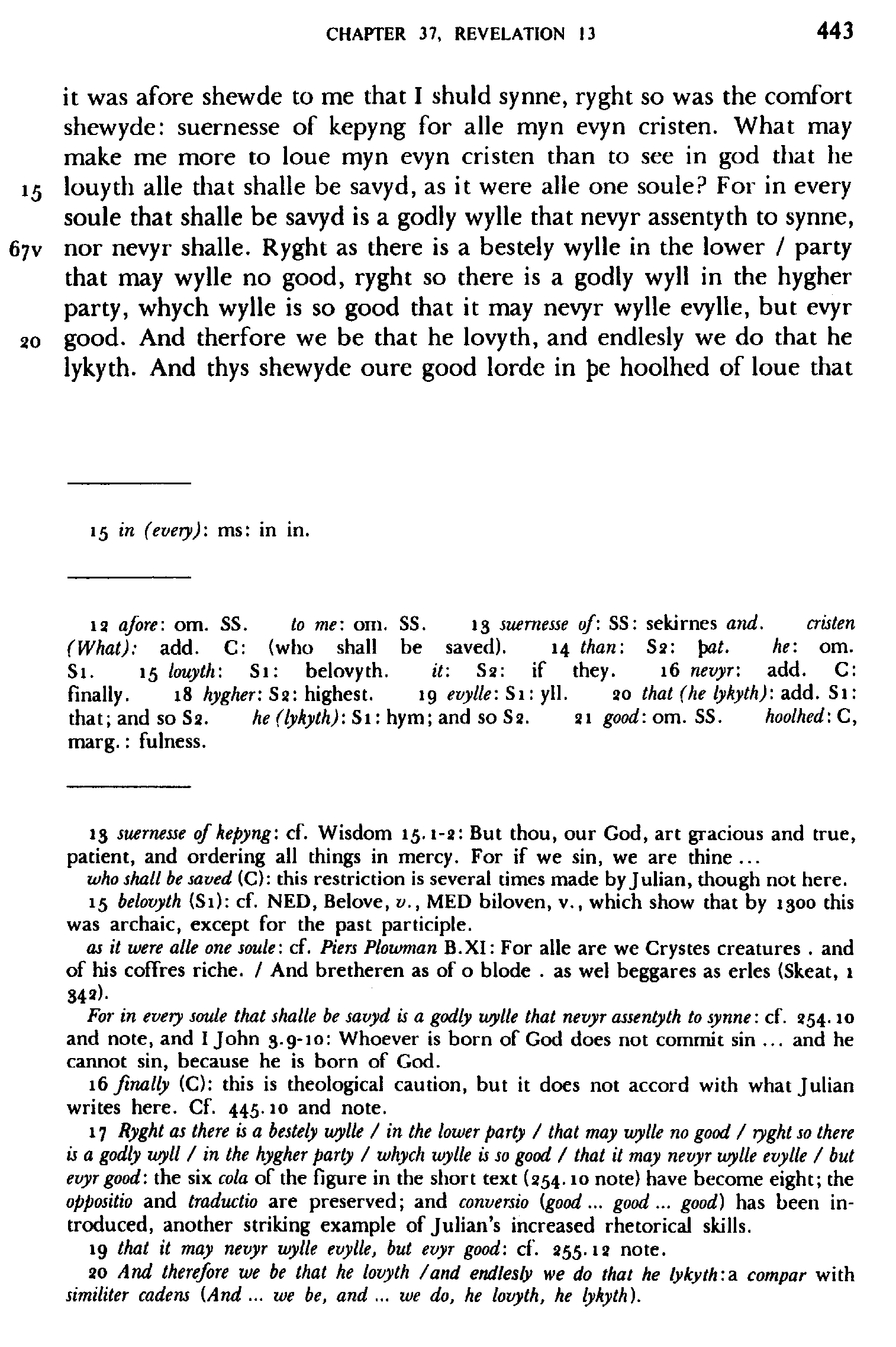
CHAPTER 37, REVELATION 13
it was afore shewde to me that I shuld synne, ryght so was the comfort shewyde: suernesse of kepyng for alle myn evyn cristen. What may make me more to loue myn evyn cristen than to see in god that he
15 louyth alle that shalle be savyd, as it were alle one soule? For in every soule that shalle be savyd is a godly wylle that nevyr assentyth to synne,
6yv nor nevyr shalle. Ryght as there is a bestely wylle in the lower / party that may wylle no good, ryght so there is a godly wyll in the hygher party, whych wylle is so good that it may nevyr wylle evylle, but evyr
20 good. And therfore we be that he lovyth, and endlesly we do that he lykyth. And thys shewyde oure good lorde in J)e hoolhed of loue that 15 in (every): ms: in in.
12 afore: om. SS. to me: orn. SS.
13 suernesse of: SS: sekirnes and. cristen (What): add.
(who shall be saved).
14 than: Ss:
\>at. he: om.
Si.
15 louyth:
Si: belovyth. it:
82: if they.
16 nevyr: add.
C: finally.
18 hygher: Ss: highest.
19 evylle: Si: yll.
20 that (he lykyth): add. Si: that; and so 82. he (lykyth): Si: hym; and so 82.
21 good: om. SS. hoolhed: C, marg.: fulness.
13 suernesse of kepyng: cf. Wisdom 15.1-2: But thou, our God, art gracious and true, patient, and ordering all things in mercy. For if we sin, we are thine ... who shall be saved (C): this restriction is several times made by Julian, though not here.
15 belovyth (Si): cf. NED, Belove, v., MED biloven, v., which show that by 1300 this was archaic, except for the past participle. as it were alle one soule: cf. Piers Plowman B.XI: For alle are we Crystes creatures . and of his coffres riche. / And bretheren as of o blode . as wel beggares as erles (Skeat, i 342)For in every soule that shalle be savyd is a godly wylle that nevyr assentyth to synne: cf. 254.10 and note, and I John 3.9-10: Whoever is born of God does not commit sin ... and he cannot sin, because he is born of God.
16 finally (C): this is theological caution, but it does not accord with what Julian writes here. Cf. 445.10 and note.
17 Ryght as there is a bestely wylle / in the lower party / that may wylle no good / ryght so there is a godly wyll / in the hygher party / whych wylle is so good I that it may nevyr wylle evylle / but evyr good: the six cola of the figure in the short text (254.10 note) have become eight; the oppositio and traductio are preserved; and conversio (good... good... good) has been introduced, another striking example of Julian's increased rhetorical skills.
19 that it may nevyr wylle evylle, but evyr good: cf. 255.12 note.
20 And therefore we be that he lovyth /and endlesly we do that he lykyth:a compar with similiter cadens (And ... we be, and ... we do, he lovyth, he lykyth).
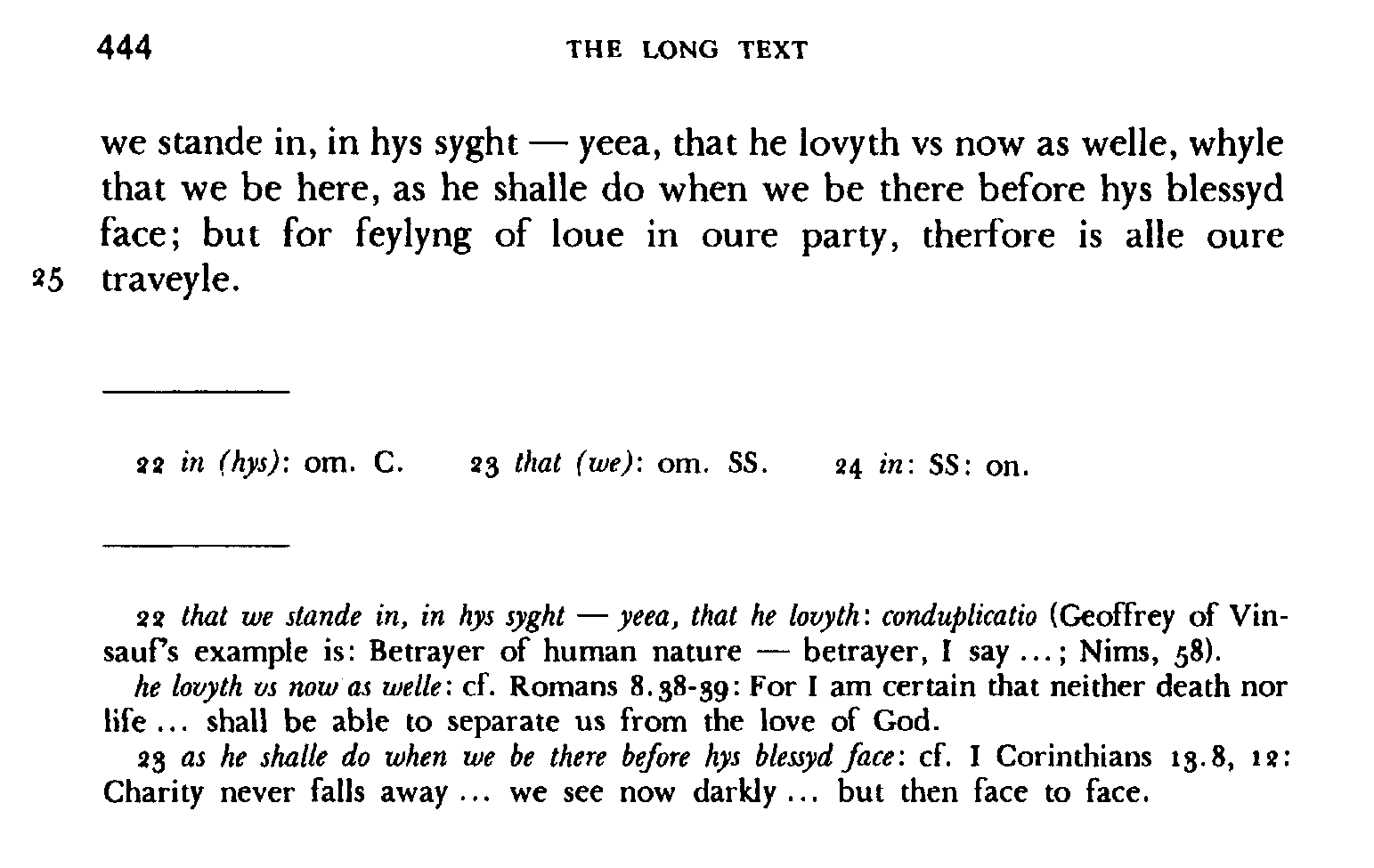
THE LONG TEXT
we stande in, in hys syght — yeea, that he lovyth vs now as welle, whyle that we be here, as he shalle do when we be there before hys blessyd face; but for feylyng of loue in oure party, therfore is alle oure
25 traveyle.
22 in (hys): om. C.
23 that (we): om. SS.
24 in: SS: on.
22 that we stande in, in hys syght —yeea, that he lovyth: conduplicatio (Geoffrey of Vinsaufs example is: Betrayer of human nature — betrayer, I say ...; Nims, 58). he lovyth vs now as welle: cf. Romans 8.38-39: For I am certain that neither death nor life ... shall be able to separate us from the love of God.
23 as he shalle do when we be there before hys blessyd face: cf. I Corinthians 13.8, 12:
Charity never falls away ... we see now darkly ... but then face to face.
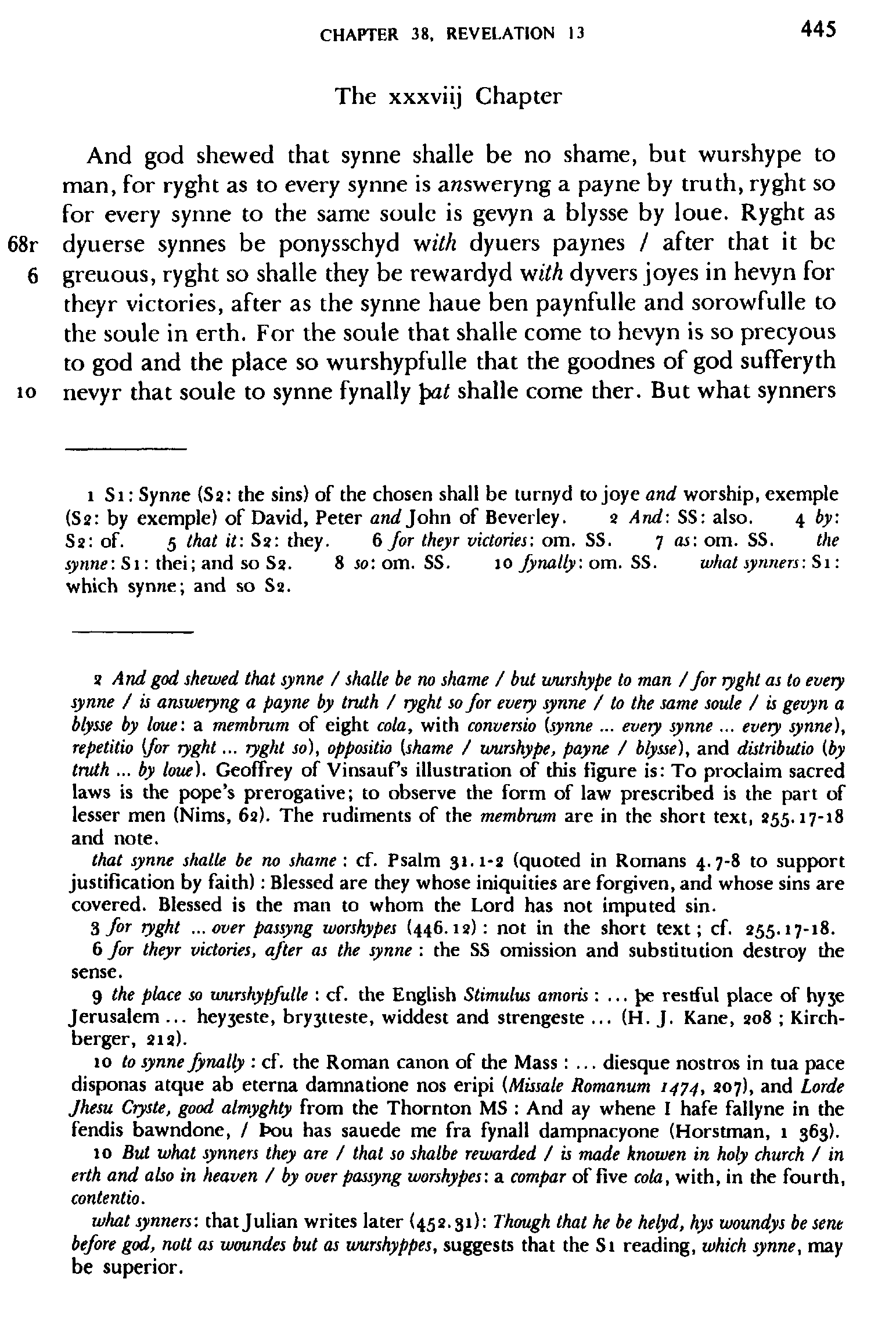
CHAPTER 38, REVELATION 13
The xxxviij Chapter And god shewed that synne shalle be no shame, but wurshype to man, for ryght as to every synne is arcsweryng a payne by truth, ryght so for every synne to the same soule is gevyn a blysse by loue. Ryght as 68r dyuerse synnes be ponysschyd with dyuers paynes / after that it be
6 greuous, ryght so shalle they be rewardyd 'with dyvers joyes in hevyn for theyr victories, after as the synne haue ben paynfulle and sorowfulle to the soule in erth. For the soule that shalle come to hevyn is so precyous to god and the place so wurshypfulle that the goodnes of god sufferyth
10 nevyr that soule to synne fynally \Mt shalle come ther. But what synners i Si: Synne (82: the sins) of the chosen shall be turnyd to joye and worship, exemple
(82: by exemple) of David, Peter and John of Beverley.
2 And: SS: also.
4 by.
82: of.
5 that it: 82: they.
6 for theyr victories: om. SS.
7 as: om. SS. the synne: Si: thei; and so 82.
8 so: om. 88.
10 fynally: om. SS. what synners: Si: which synrae; and so 82.
2 And god shewed that synne / shalle be no shame / but wurshype to man /for ryght as to every synne / is answeryng a payne by truth / ryght so for every synne / to the same soule / is gevyn a blysse by loue: a membrum of eight cola, with conversio (synne ... every synne ... every synne), repetitio (for ryght... ryght so), oppositio (shame / wurshype, payne / blysse), and distributio (by truth ... by loue). Geoffrey of VinsauPs illustration of this figure is: To proclaim sacred laws is the pope's prerogative; to observe the form of law prescribed is the part of lesser men (Nims, 62). The rudiments of the membrum are in the short text, 255.17-18 and note. that synne shalle be no shame : cf. Psalm 31.1-2 (quoted in Romans 4.7-8 to support justification by faith): Blessed are they whose iniquities are forgiven, and whose sins are covered. Blessed is the man to whom the Lord has not imputed sin.
3 f°r ryght ...over passyng worshypes (446.12) : not in the short text; cf. 255.17-18.
6 for theyr victories, after as the synne : the SS omission and substitution destroy the sense.
9 the place so wurshypfulle : cf. the English Stimulus amoris: ... J>e restful place of hyy
Jerusalem ... heyseste, brystteste, widdest and strengeste ... (H. J. Kane, 208 ; Kirchberger, 212).
10 to synne fynally : cf. the Roman canon of the Mass : ... diesque nostros in tua pace disponas atque ab eterna damnatione nos eripi (Missale Romanum 1474, 207), and Lorde
Jhesu Cryste, good almyghty from the Thornton MS : And ay whene I hafe fallyne in the fendis bawndone, / t>ou has sauede me fra fynall dampnacyone (Horstman, i 363).
10 But what synners they are / that so shalbe rewarded / is made knowen in holy church / in erth and also in heaven / by over passyng worshypes: a compar of five cola, with, in the fourdi, contentio. what synners: that Julian writes later (452.31): Though that he be helyd, hys woundys be sent before god, nott as woundes but as wurshyppes, suggests that the Si reading, which synne, may be superior.
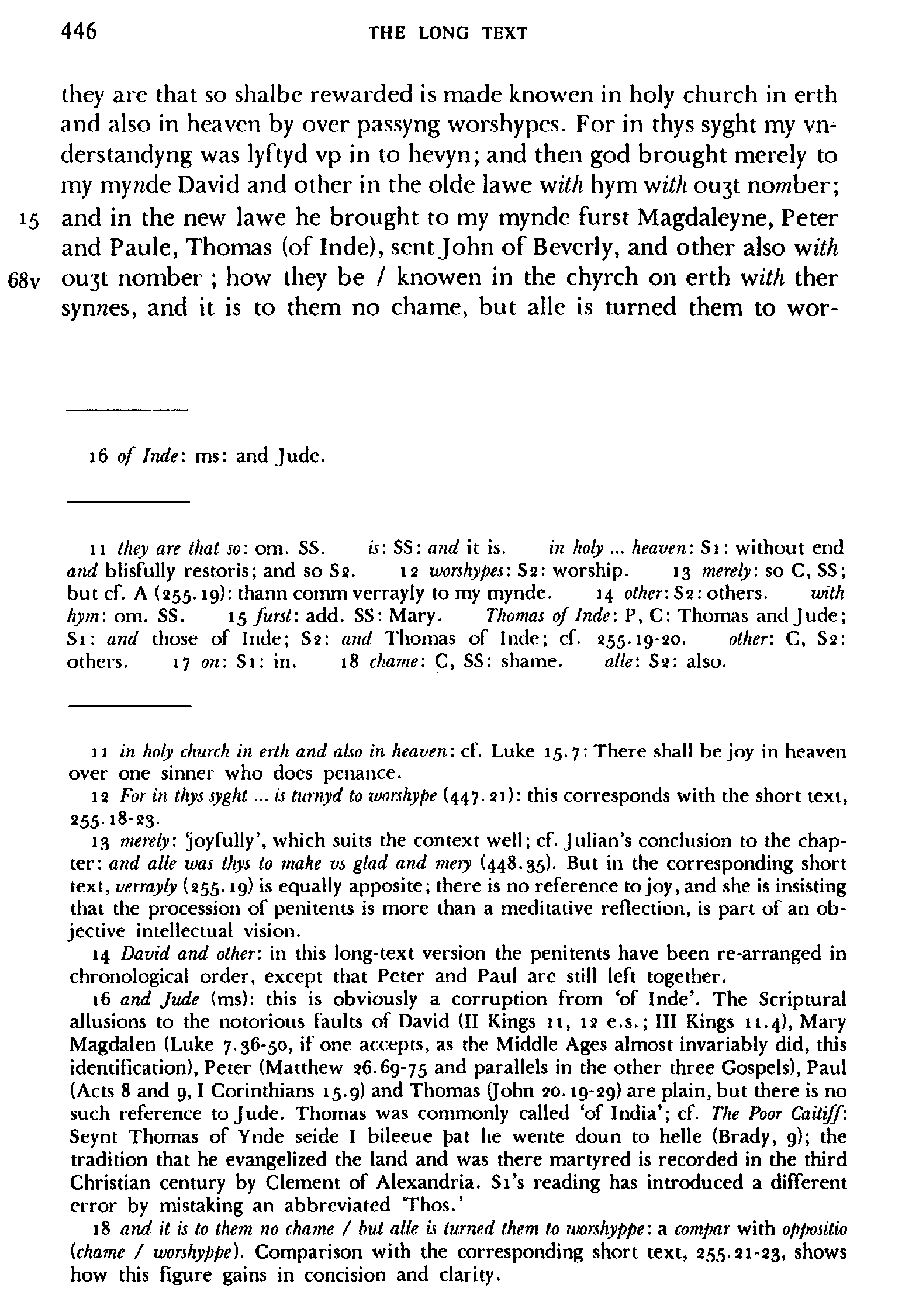
THE LONG TEXT
they are that so shalbe rewarded is made knowen in holy church in erth and also in heaven by over passyng worshypes. For in thys syght my vnderstandyng was lyftyd vp in to hevyn; and then god brought merely to my mynde David and other in the olde lawe with hym with ou$t nomber;
15 and in the new lawe he brought to my mynde furst Magdaleyne, Peter and Paule, Thomas (of Inde), sent John of Beverly, and other also with 68v ou3t nomber ; how they be / knowen in the chyrch on erth with ther synnes, and it is to them no chame, but alle is turned them to wor16 of Inde: ms: and Judc.
11 they are that so: om. SS. is: SS: and it is. in holy ... heaven: Si: without end and blisfully restoris; and so Sa.
12 worshypes: Sa: worship.
13 merely: so C, SS; but cf. A (855.19): thann comm verrayly to my mynde.
14 other: Sa: others. with hym: om. SS.
15 furst: add. SS: Mary.
Thomas of Inde: P, C: Thomas andjude; Si: and those of Inde; Sa: and Thomas of Inde; cf. 355.19-20. other: C, Sa: others.
17 on: Si: in.
18 chame: C, SS: shame. alle: Sa: also.
11 in holy church in erth and also in heaven: cf. Luke 15. 7: There shall be joy in heaven over one sinner who does penance.
12 For in thys syght ... is turnyd to worshype (447. ai): this corresponds with the short text,
255.18-23.
13 merely: 'joyfully', which suits the context well; cf. Julian's conclusion to the chapter: and alle was thys to make vs glad and mery (448.35). But in the corresponding short text, verrayly (255.19) is equally apposite; there is no reference to joy, and she is insisting that the procession of penitents is more than a meditative reflection, is part of an objective intellectual vision.
14 David and other: in this long-text version the penitents have been re-arranged in chronological order, except that Peter and Paul are still left together.
16 and Jude (ms): this is obviously a corruption from 'of Inde'. The Scriptural allusions to the notorious faults of David (II Kings 11, 12 e.s.; Ill Kings 11.4), Mary
Magdalen (Luke 7.36-50, if one accepts, as the Middle Ages almost invariably did, this identification), Peter (Matthew 26.69-75 and parallels in the other three Gospels), Paul
(Acts 8 and 9,1 Corinthians 15.9) and Thomas (John 20.19-39) are plain, but there is no such reference to Jude. Thomas was commonly called 'of India'; cf. The Poor
Caitiff:
Seynt Thomas of Ynde seide I bileeue bat he wente doun to helle (Brady, 9); the tradition that he evangelized the land and was there martyred is recorded in the third
Christian century by Clement of Alexandria. Si's reading has introduced a different error by mistaking an abbreviated Trios."
18 and it is to them no chame / but alle is turned them to worshyppe: a compar with oppositio
(chame / worshyppe). Comparison with the corresponding short text, 255.21-23, shows how this figure gains in concision and clarity.
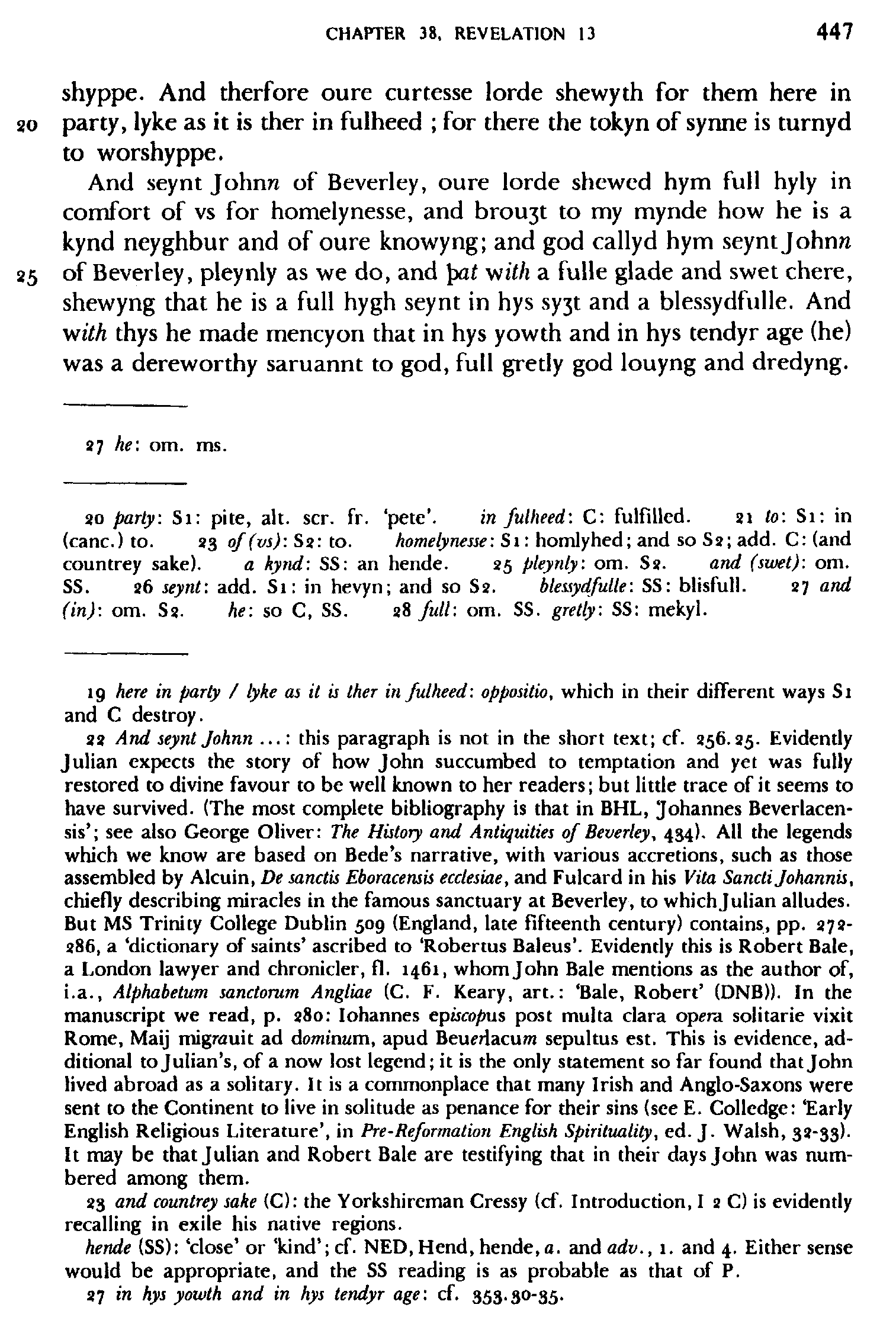
CHAPTER 38, REVELATION 13
shyppe. And therfore oure curtesse lorde shewyth for them here in 20 party, lyke as it is ther in fulheed ; for there the tokyn of synne is turnyd to worshyppe.
And seynt Johnn of Beverley, oure lorde shewed hym full hyly in comfort of vs for homelynesse, and brou3t to my mynde how he is a kynd neyghbur and of oure knowyng; and god callyd hym seynt Johnw
25 of Beverley, pleynly as we do, and \xit with a fulle glade and swet chere, shewyng that he is a full hygh seynt in hys syjt and a blessydfulle. And with thys he made mencyon that in hys yowth and in hys tendyr age (he) was a dereworthy saruannt to god, full gretly god louyng and dredyng.
27 he: om. ms.
20 party: Si: pite, alt. scr. fr. 'pete'. in fulheed: C: fulfilled.
21 to: Si: in (cane.) to.
23 of(vs): 82: to. homelynesse: Si: homlyhed; and so 82; add. C: (and countrey sake). a kynd: SS: an hende.
25 pleynly: om. 82. and (swet): om.
SS.
26 seynt: add. Si: in hevyn; and so 82. blessydfulle: SS: blisfull.
27 and (in): om. 82. he: so C, SS.
28 full: om. SS. gretly: SS: mekyl.
19 here in party / lyke as it is ther in fulheed: oppositio, which in their different ways Si and C destroy.
22 And seynt Johnn ...: this paragraph is not in the short text; cf. 256.25. Evidently
Julian expects the story of how John succumbed to temptation and yet was fully restored to divine favour to be well known to her readers; but little trace of it seems to have survived. (The most complete bibliography is that in BHL, Johannes Beverlacensis'; see also George Oliver: The History and Antiquities of Beverley, 434). All the legends which we know are based on Bede's narrative, with various accretions, such as those assembled by Alcuin, De sanctis Eboracensis ecdesiae, and Fulcard in his Vita Sanctijohannis, chiefly describing miracles in the famous sanctuary at Beverley, to whichjulian alludes.
But MS Trinity College Dublin 509 (England, late fifteenth century) contains, pp. 272286, a 'dictionary of saints' ascribed to 'Robertus Baleus'. Evidently this is Robert Bale, a London lawyer and chronicler, fl. 1461, whom John Bale mentions as the author of, i.a., Alphabetum sanctorum Angliae (C. F. Keary, art.: 'Bale, Robert' (DNB)). In the manuscript we read, p. 280: lohannes episcopus post multa clara opera solitarie vixit
Rome, Maij migrauit ad dominum, apud BeuMacuwi sepultus est. This is evidence, additional to Julian's, of a now lost legend; it is the only statement so far found that John lived abroad as a solitary. It is a commonplace that many Irish and Anglo-Saxons were sent to the Continent to live in solitude as penance for their sins (see E. Colledge: 'Early
English Religious Literature', in Pre-Reformation English Spirituality, ed. J. Walsh, 32-33).
It may be that Julian and Robert Bale are testifying that in their days John was numbered among them.
23 and countrey sake (C): the Yorkshireman Cressy (cf. Introduction, I 2 C) is evidently recalling in exile his native regions. hende (SS): 'close' or 'kind'; cf. NED, Hend, hende, a. and adv., i. and 4. Either sense would be appropriate, and the SS reading is as probable as that of P.
27 in hys yowth and in hys tendyr age: cf. 353.30-35.
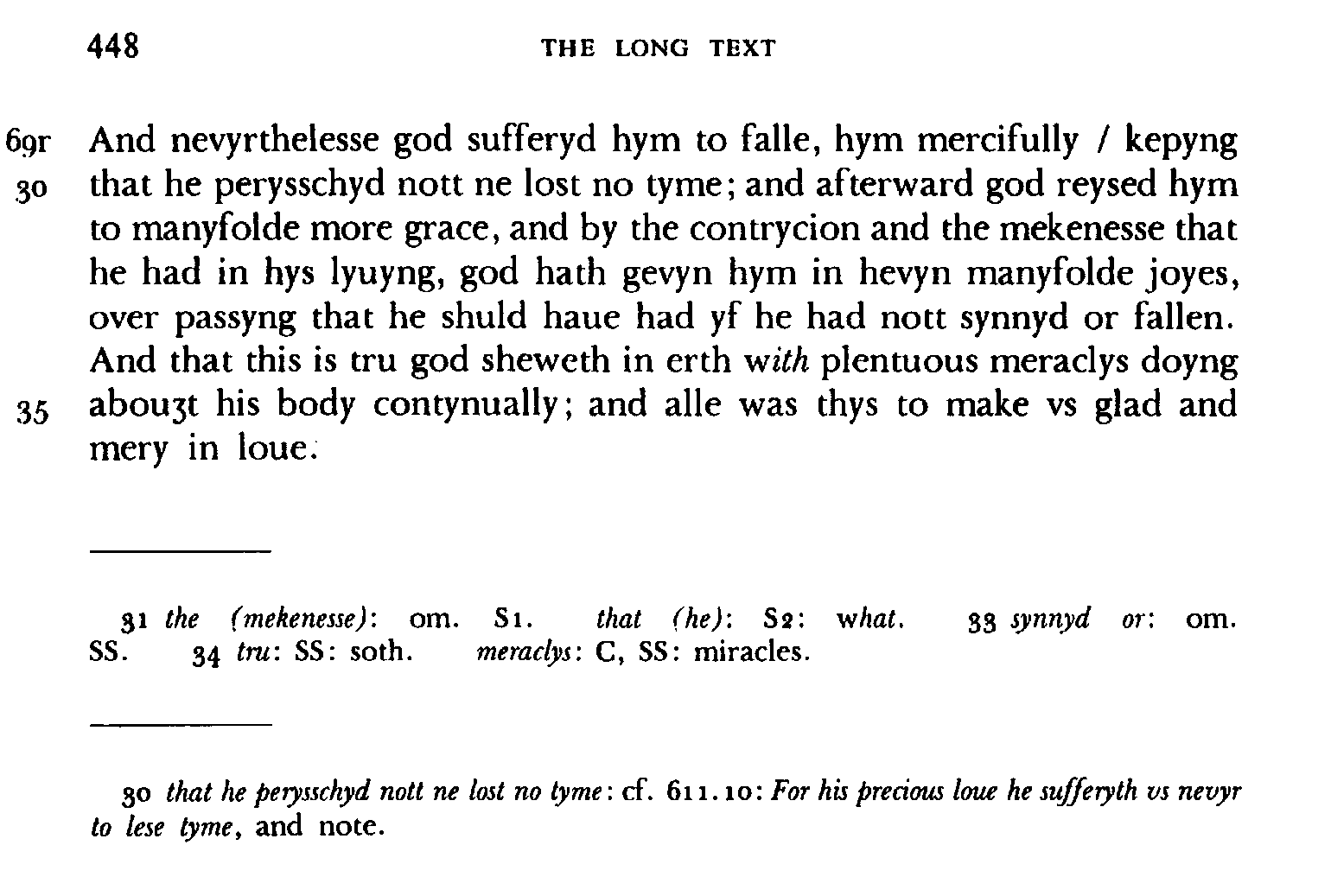
THE LONG TEXT
6gr And nevyrthelesse god sufferyd hym to falle, hym mercifully / kepyng 30 that he perysschyd nott ne lost no tyme; and afterward god reysed hym to manyfolde more grace, and by the contrycion and the mekenesse that he had in hys lyuyng, god hath gevyn hym in hevyn manyfolde joyes, over passyng that he shuld haue had yf he had nott synnyd or fallen.
And that this is tru god sheweth in erth with plentuous meraclys doyng 35 abou3t his body contynually; and alle was thys to make vs glad and mery in loue.
31 the (mekenesse): om.
Si. that (he):
82: what.
33 synnyd or: om.
SS.
34 tru: SS: soth. meraclys: C, SS: miracles.
30 that he perysschyd nott ne lost no tyme: cf. 611.10: For his precious loue he sufferyth vs nevyr to lese tyme, and note.
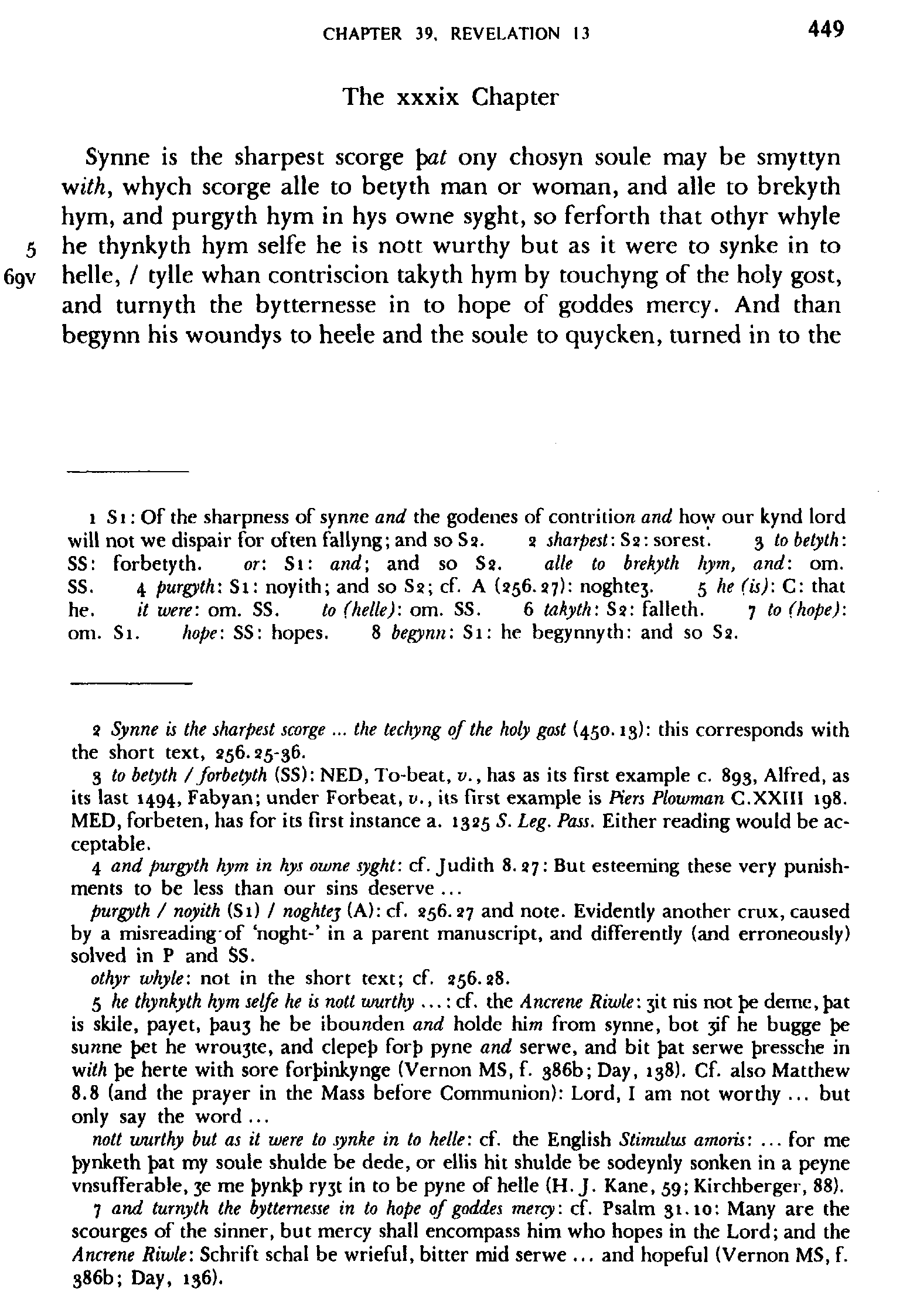
CHAPTER 39, REVELATION 13
The xxxix Chapter Synne is the sharpest scorge \>at ony chosyn soule may be smyttyn with, whych scorge alle to betyth man or woman, and alle to brekyth hym, and purgyth hym in hys owne syght, so ferforth that othyr whyle
5 he thynkyth hym selfe he is nott wurthy but as it were to synke in to 6gv helle, / tylle whan contriscion takyth hym by touchyng of the holy gost, and turnyth the bytternesse in to hope of goddes mercy. And than begynn his woundys to heele and the soule to quycken, turned in to the i Si: Of the sharpness of synwe and the godenes of contrition and how our kynd lord will not we dispair for often fallyng; and so 82.
2 sharpest: 82: sorest.
3 to betyth:
SS: forbetyth. or: Si: and; and so 82. alle to brekyth hym, and: om.
SS.
4 purgyth: Si: noyith; and so 82; cf. A (256.27): noghte35 he (is): C: that he. it were: om. SS. to (helle): om. SS.
6 takyth: 82: falleth.
7 to (hope): om. Si. hope: SS: hopes.
8 begynn: Si: he begynnyth: and so 82.
2 Synne is the sharpest scorge ... the techyng of the holy gost (450.13): this corresponds with the short text, 256.25-36.
3 to betyth /forbetyth (SS): NED, To-beat, v., has as its first example c. 893, Alfred, as its last 1494, Fabyan; under Forbeat, v., its first example is Piers Plowman C.XXIII 198.
MED, forbeten, has for its first instance a. 1325 S. Leg. Pass. Either reading would be acceptable.
4 and purgyth hym in hys owne syght: cf. Judith 8.27: But esteeming these very punishments to be less than our sins deserve ... purgyth / noyith (Si) / noghtej (A): cf. 256.27 and note. Evidently another crux, caused by a misreading'of 'noght-' in a parent manuscript, and differently (and erroneously) solved in P and SS. othyr whyle: not in the short text; cf. 256.28.
5 he thynkyth hym selfe he is nott wurthy ...: cf. the Ancrene Riwle: yt nis not pe deme, pat is skile, payet, pau3 he be ibouwden and holde him from synne, bot ;jif he bugge J>e surane pet he wrou3te, and clepe}> forf) pyne and serwe, and bit pat serwe pressche in with pe herte with sore forj>inkynge (Vernon MS, f. 386b; Day, 138). Cf. also Matthew
8.8 (and the prayer in the Mass before Communion): Lord, I am not worthy ... but only say the word ... nott wurthy but as it were to synke in to helle: cf. the English Stimulus amoris: ... for me pynketh pat my soule shulde be dede, or ellis hit shulde be sodeynly sonken in a peyne vnsufferable, 36 me pynkp ry3t in to be pyne of helle (H. J. Kane, 59; Kirchberger, 88).
7 and turnyth the bytternesse in to hope of goddes mercy: cf. Psalm 31.10: Many are the scourges of the sinner, but mercy shall encompass him who hopes in the Lord; and the Ancrene Riwle: Schrift schal be wrieful, bitter mid serwe ... and hopeful (Vernon MS, f.
386b; Day, 136).
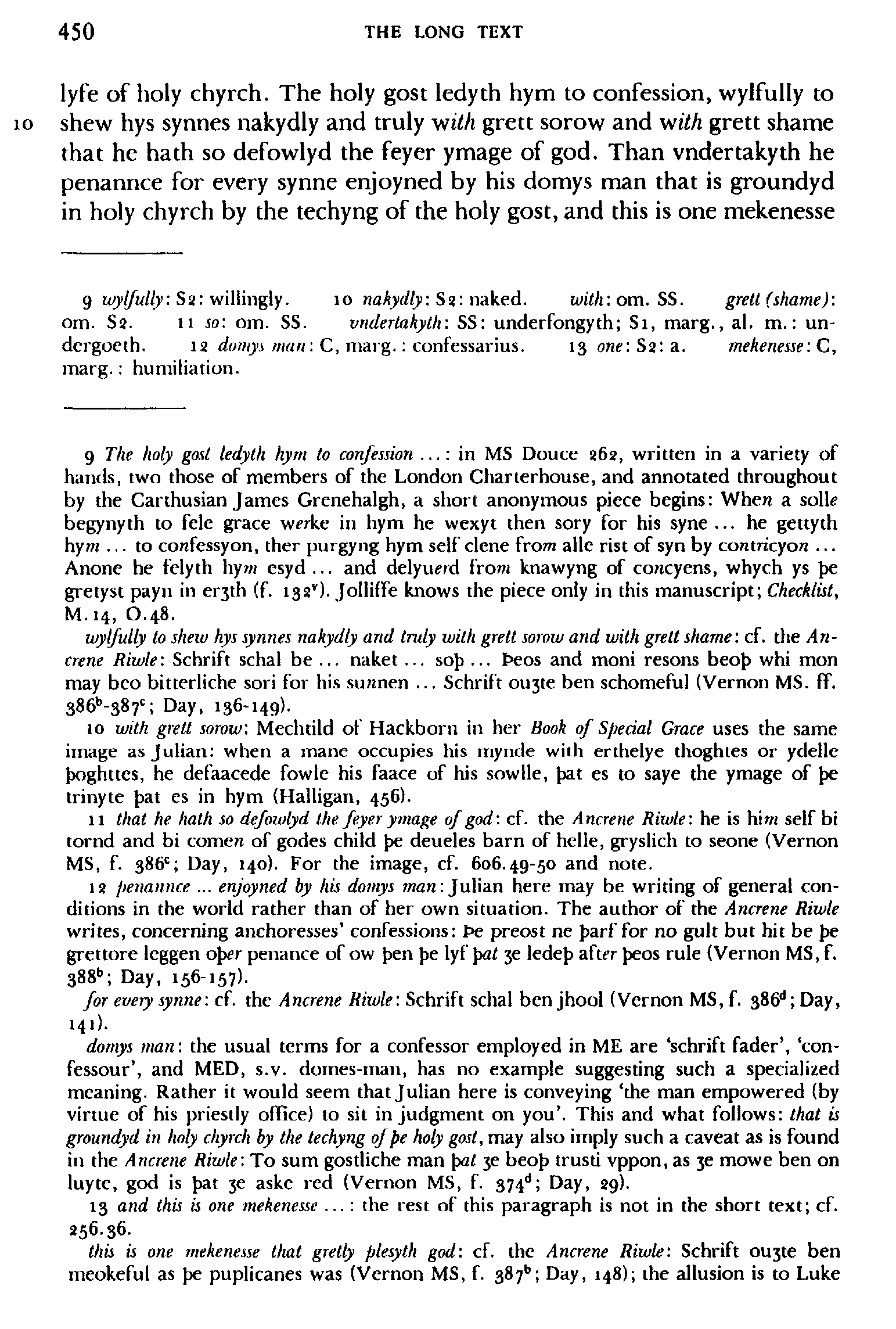
THE LONG TEXT
lyfe of holy chyrch. The holy gost ledyth hym to confession, wylfully to 10 shew hys synnes nakydly and truly -with grett sorow and with grett shame that he hath so defowlyd the feyer ymage of god. Than vndertakyth he penannce for every synne enjoyned by his domys man that is groundyd in holy chyrch by the techyng of the holy gost, and this is one mekenesse
9 wylfully: S2: willingly.
10 nakydly: 82: naked. with: om. SS. grett (shame): om. 82.
11 so: om. SS. vndertakyth: SS: underfongyth; Si, marg., al. m.: undcrgoeth.
12 domys man: C, marg.: confessarius.
13 on?: S?: a. mekenesse: C, marg.: humiliation.
9 The holy gost ledyth hym to confession ...: in MS Douce 262, written in a variety of hands, two those of members of the London Charterhouse, and annotated throughout by the Carthusian James Grenehalgh, a short anonymous piece begins: When a soil? begynyth to fele grace w^rke in hym he wexyt then sory for his syne ... he gettyth hym ... to confessyon, ther purgyng hym self clene from alle rist of syn by contrz'cyon ...
Anone he felyth hym esyd ... and delyuerd from knawyng of concyens, whych ys pe gretyst payn in erjth (f. 132"). Jolliffe knows the piece only in this manuscript; Checklist,
M-H, 0.48.
wylfully to shew hys synnes nakydly and truly with grett sorow and with grett shame: cf. the Ancrene Riwle: Schrift schal be ... naket ... sop... £>eos and moni resons beop whi mon may beo bitterliche sori for his sunnen ... Schrift oujte ben schomeful (Vernon MS. ff.
386b-387c; Day, 136-149).
10 with grett sorow: Mechtild of Hackborn in her Book of Special Grace uses the same image as Julian: when a mane occupies his myride with erthelye thoghtes or ydelle poghttes, he defaacede fowle his faace of his sowlle, pat es to saye the ymage of pe trinyte pat es in hym (Halligan, 456).
11 that he hath so defowlyd the feyer ymage of god: cf. the Ancrene Riwle: he is him self bi tornd and bi comen of godes child pe deueles barn of helle, gryslich to seone (Vernon
MS, f. 386C; Day, 140). For the image, cf. 606.49-50 and note.
12 ftenannce ... enjoyned by his domys man: Julian here may be writing of general conditions in the world rather than of her own situation. The author of the Ancrene Riwle writes, concerning anchoresses' confessions: Pe preost ne parf for no gult but hit be pe grettore leggen oper penance of ow pen pe lyf pa£ 36 ledep after peos rule (Vernon MS, f.
388"; Day, 156-157)for every synne: cf. the Ancrene Riwle: Schrift schal ben jhool (Vernon MS, f. 386d; Day,
141). domys man: the usual terms for a confessor employed in ME are 'schrift fader', 'confessour', and MED, s.v. domes-man, has no example suggesting such a specialized meaning. Rather it would seem that Julian here is conveying 'the man empowered (by virtue of his priestly office) to sit in judgment on you'. This and what follows: that is groundyd in holy chyrch by the techyng ofpe holy gost, may also imply such a caveat as is found in the Ancrene Riwle: To sum gostliche man \>al ye beop trusti vppon, as 36 mowe ben on luyte, god is pat 36 aske red (Vernon MS, f. 374d; Day, 29).
13 and this is one mekenesse ...: the rest of this paragraph is not in the short text; cf.
256.36. this is one mekenesse that gretly plesyth god: cf. the Ancrene Riwle: Schrift ou3te ben meokeful as pe puplicanes was (Vernon MS, f. 387b; Day, 148); the allusion is to Luke
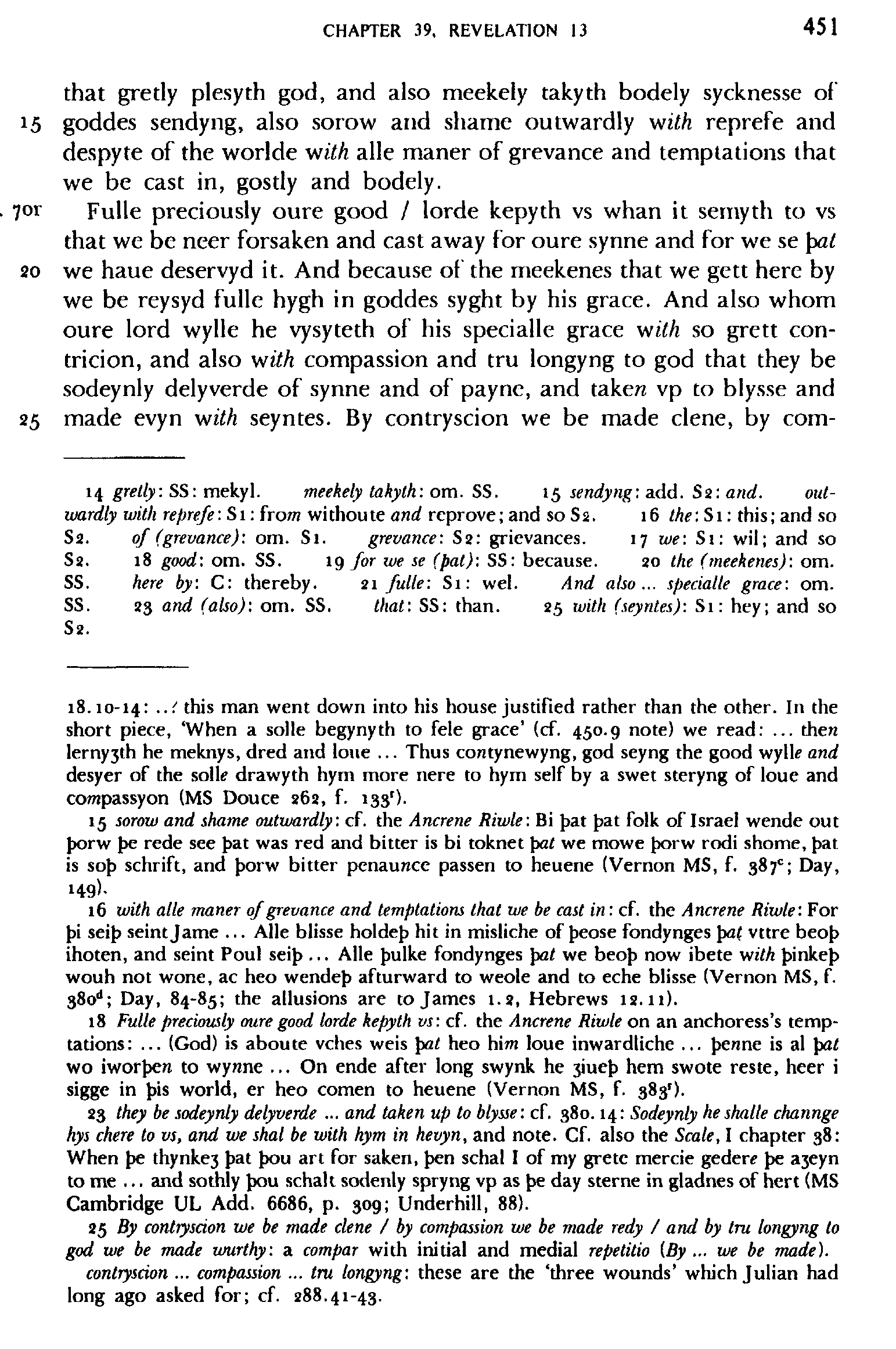
CHAPTER 39, REVELATION 13
that gretly plesyth god, and also meekely takyth bodely sycknesse of 15 goddes sendyng, also sorow and shame outwardly with reprefe and despyte of the worlde with alle maner of grevance and temptations that we be cast in, gostly and bodely.
. 7or Fulle preciously oure good / lorde kepyth vs whan it sernyth to vs that we be neer forsaken and cast away for oure synne and for we se \>at 20 we haue deservyd it. And because of the meekenes that we gett here by we be reysyd fulle hygh in goddes syght by his grace. And also whom oure lord wylle he vysyteth of his specialle grace with so grett contricion, and also with compassion and tru longyng to god that they be sodeynly delyverde of synne and of paync, and taken vp to blysse and 25 made evyn with seyntes. By contryscion we be made clene, by corn14 gretly: SS: mekyl. meekely takyth: om. SS.
15 sendyng: add. 82: and. outwardly with reprefe: S i: from withou te and reprove; and so Sa. i6 the: S i: this; and so Si?. of (grevance): om. Si. grevance: 82: grievances.
17 we: Si: wil; and so 82.
18 good: om. SS.
19 for we se (pat): SS: because.
20 the (meekenes): om.
SS. here by: C: thereby. si fulle: Si: wel.
And also... specialle grace: om.
SS.
23 and (also): om. SS. that: SS: than.
25 with (seyntes): Si: hey; and so 82.
18.10-14: ..'. this man went down into his house justified rather than the other. In the short piece, 'When a solle begynyth to fele grace' (cf. 450.9 note) we read: ... men
Ierny3th he meknys, dred and loue ... Thus corctynewyng, god seyng the good wylle and desyer of the sol\e drawyth hym more nere to hym self by a swet steryng of loue and compassyon (MS Douce 262, f. 133').
15 sorow and shame outwardly: cf. the Ancrene Riwle: Bi pat pat folk of Israel wende out porw pe rede see pat was red and bitter is bi toknet pa< we mowe porw rodi shome, pat is sop schrift, and porw bitter penaunce passen to heuene (Vernon MS, f. 387°; Day,
149).
16 with alle maner of grevance and temptations that we be cast in: cf. the Ancrene Riwle: For pi seip seint Jame ... Alle blisse holdep hit in misliche of peose fondynges pa£ vttre beop ihoten, and seint Poul seip ... Alle pulke fondynges \>at we beop now ibete with pinkep wouh not wone, ac heo wendep afturward to weole and to eche blisse (Vernon MS, f.
38od; Day, 84-85; the allusions are to James 1.2, Hebrews 12.11).
18 Fulle preciously oure good lorde kepyth vs: cf. the Ancrene Riwle on an anchoress's temptations: ... (God) is aboute vches weis pa< heo him loue inwardliche ... pewne is al pai wo iworpen to wynne ... On ende after long swynk he 3iuep hem swote reste, heer i sigge in pis world, er heo comen to heuene (Vernon MS, f. 383').
23 they be sodeynly delyverde ... and taken up to blysse: cf. 380.14: Sodeynly heshalle channge hys chere to vs, and we shal be with hym in hevyn, and note. Cf. also the Scale, I chapter 38:
When pe thynke3 pat pou art for saken, pen schal I of my grete mercie gedere pe a3eyn to me ... and sothly pou schal t sodenly spryng vp as pe day sterne in gladnes of hert (MS
Cambridge UL Add. 6686, p. 309; Underbill, 88).
25 By contryscion we be made clene / by compassion we be made redy / and by tru longyng to god we be made wurthy: a compar with initial and medial repetitio (By ... we be made}. contryscion ... compassion ...tru longyng: these are the 'three wounds' which Julian had long ago asked for; cf. 288.41-43.
THE LONG TEXT
passion we be made redy, and by tru longyng to god we be made wurthy. Theyse be thre menys, as I vnderstode, wher by that alle soules com to hevyn, that is to sey that haue ben synners in erth and shalle be savyd.
7ov For by theyse medycins behovyth that every synnfulle / soule be 31 helyd. Though that he be helyd, hys woundys be sene before god, nott as woundes but as wurshyppes. And so on the contrary wyse, as we be ponysschyd here with sorow and with penannce, we shall be rewardyd in hevyn by the curtesse loue of oure god almyghty, that wylle that none
35 that come ther leese hys traveyle in any degre. For he beholdyth synne as sorow and paynes to his louers, in whom he assignyth no blame for loue.
The mede that we undertake shall nott be lytylle, but it shalle be hygh, glorious and wurshyppfulle. And so shalle alle shame turne to 27 Theyse'. Si: this. vnderstode: Sa: understand, 'an' w. marks of alt. that (alle): om.
Sa.
30 medycim: add. Sa: it. synnfulle: om. SS.
31 that (he): om.
SS.
33 penannce: 82: penances.
34 god: Si: lord god; and so 82. that wylle:
Sa: who wils.
35 hys: 82: their. any: Si: no. beholdyth: Si: holdyth; and so Sa.
36 paynes: Si: peyne; and so Sa.
38 undertake: Si: shall underfongyn; 82: shall recieve.
39 alle : om. SS. turne: Si: be turnyd; and so Sa.
26 tru longyng: there is great similarity between Julian's teaching here and that of the Cloud-auihor in his Epistle of Prayer: ... what for pe general si3t pat pou hast of pe mercy and pe goodnes of god and pis special experience pat pou felist of his mercy and his goodnes ... it may not be bot pat pou schalt fele a grete stering of loue vnto him ... pis... onliche bi itself plesep to almisty god and deseruif) to haue mede of him
(Hodgson, Deonise, 50-51).
30 For by theyse medycim ... leese hys traveyle (452.35): this corresponds with the short text, 356.36-42. by theyse medycins behovyth that every synfulle soule be helyd: cf. Privy Counselling: Take good gracyous god as he is, plat and pleyn as a piastre, and legge it to pi seek self as pou arte ... pe touching of whome is eendeles helpe by witnes of pe womman in pe gospel ... 'If I touche bot pe hemme of his eloping, I schal be saaf (Hodgson, Cloud, 138139; the citation conflates Matthew 9.20 and 21).
32 as we be ponysschyd here ... we shall be rewardyd: cf. the Ancrene Riwle: Al is penaunce and strong penaunce pai 3e euer dri3ep ... Blipe mowe 36 ben p?r of, for as seint Poul seip ... As 36 scottep with him of his pyne on eorpe, so 36 schul scotten with him of his blisse in heuene (Vernon MS, f. 388b, quoting Romans 8.17); and Luke 6.22-23: Blessed shall you be when men shall hate you ... your reward is great in heaven; and cf. II Timothy 2.12, 716.34 note.
35 in any degre... blame for loue: not in the short text; cf. 256.42.
38 The mede ... and to joy (453.40): this corresponds with the short text, 256.43-45.
The mede...: cf. 256.43 note.
39 And so schalle alle shame turne to worschyppe and to joy: cf. the Ancrene Riwle: he pat is on rode and hauep blisse p?r of, he twmep scheme to menske and wo in to winne, and of seruep forpi huyre on huyre (Vernon MS, f. 388C; Day, 160).
CHAPTER 39, REVELATION 13
40 worschyppe and to joy. For oure curtesse lorde wylle nott that hys seruantys despeyer for oftc fallyng ne for grevous fallyng; for oure fallyng lettyth nott hym to loue vs. Pees and loue is evyr in vs, beyng
. yir and workyng, but we be nott evyr in pees / and in loue; but he wylle we take hede thus that he is ground of alle oure hoole lyfe in loue, and fer45 thermore that he is oure evyrlastyng keper, and myghtely defendyth vs a3enst alle oure enmys that be full felle and full fers vpon vs, and so much oure nede is, the more for we geue them occasion by oure fallyng.
47 them: alt. fr. 'hym'.
40 to (joy): SS: more.
41 fallyng: C: failing: om. SS.
42 is: Si: arn; 82: be.
43 evyr (in pees): Si: alway; Sa: alwayes. we (take): SS: that we.
46 alle: om. SS. full (felle): om. Ss. full (fers): om. SS.
47 them: Si: hym; and so C, Sa.
40 For oure curtesse lorde ... only for loue (457.32): not in the short text; cf. 256.45. oure curtesse lorde wylle not that hys seruantys despeyer: cf. the Ancrene Riwle: Vnhope ... is griwmest of alle, for hit to chewej> and to fret godes mylde milce and his muchele merci and his vnimete grace (Vernon MS, f. 38ib; Day, go).
41 oure fallyng lettyth nott hym to loue vs: cf. the Chastising: t>e pile of god is so grete t>at... if a man haue be neuer so yuel ... oure lord gladli take{> hym and louyngli biclippij) hym (Bazire and Colledge, 152).
42 Pees and loue is evyr in vs / beyng and workyng / but we be not evyr in pees and in loue: a compar with oppositio (in vs / in pees and in loue) and commutatio.
Pees and loue is evyr in vs: cf. Piers Plowman B. XVIII: Than after werre and wo . whan loue and pees be maistres, / Was neuere werre in this worlde . ne wykkednesse so kene,
/ That ne loue and hym luste . to laughynge ne brou3te, / And pees thorw pacience . alle perilles stopped (Skeat, i 548).
44 he is ground of alle oure hoole lyfe in loue: cf. I Corinthians 3.11: Other foundation no man can lay but that which is laid, which is Christjesus, and Ephesians 3.17 e.s: Rooted and founded in charity ...
45 myghtely defendyth vs ajenst alle oure enmys: cf. the Ancrene Riwle: whon je help clepejj, ne beo 36 not a fert, ne drede 36 (f. 384°) heom nou3t, f>au3 heo ben stronge and monye. f>e fiht is min, nou3t ouren (Vernon MS, translating II Paralipomenon 20.15).
THE LONG TEXT
The xl Chapter And this is a sovereyne frenschypp of oure curtesse lorde, that he kepyth vs so tenderly whyle we be in oure synne; and ferthermore he touchyth vs fulle prevely, and shewyth vs oure synne by the swet lyght
5 of mercy and grace. But when we se oure selfe so fowle, then we wene that god were wroth with vs for oure synne. Than be we steryd of the holy gost by contriscion in to prayer, and desyer amendyng of oure selfe
?iv -with alle oure myght to slake / the wrath of god, vnto the tyme we fynde a rest in soule and softnes in consciens. And than hope we \>at 10 god hath forgevyn vs oure synne; and it is true. And than shewyth oure i Si: Us nedyth (82: it behoveth us) to longyn in love with Jesus and schewyng (82:
Jesus eschewing) synne for love. The vylenes of synne passith al peynes, and god lovith wel tenderly us (82: us very tenderly) while be (82: we are) in synne, and so us nedyth to doe our (82: to our) neybor.
2 And: om. 88.
3 oure (synne): om. 88.
5 selfe:
82: selves.
6 were:
82: is. synne: add.
88: and.
7 prayer:
88: prayers. desyer: add. 88: to. selfe: 88: life.
8 myght: Si: mytes. slake: C: slack.
10 synne: Si: synnes; and so 82. true: SS: soth.
2 he kepyth vs so tenderly whyle we be in oure synne: cf. Romans 5.8-9: But God commends his charity to us, because when we were still sinners ... Christ died for us; and the Scale,
I chapter 39 (citing Ecclesiasticus 4.18-21): In temptacion oure lord forsake3 0031 a man, bot he gos with hym, ... drawe3 a man to hym (MS Cambridge UL Add. 6686, p. 310;
Underhill, 89).
4 shewyth vs oure synne by the swet lyght of mercy and grace: cf. the English Qui habitat:
... whon I was sunken in f>e muyre of synne, (Wallner, 4; cf. 696.2-5 note).
5 then we wene ... by contriscion (454.7): this corresponds with the short text, 262.68-69.
On the editing here, see Introduction, IX 15. then we wene that god were wroth with vs for oure synne: cf. the Scale, I chapter 38 (citing
Isaias 54.6-7): I suffred Jx; forto be taried a litel, and in a poynt of my wrath I smote
Jje ... (MS Cambridge UL Add. 6686, p. 309; Underhill, 88, where, however, 'teased' as a translation of 'taried', 'dereliqui', is inadequate and incorrect).
6 of the holy gost: not in the short text; cf. 262.69.
7 amendyng of oure selfe with alle oure myght: not in the short text; cf. 262.69.
8 to slake the wrath of god: cf. Psalm 84.5-9: Convert us, o God ... turn off thine anger from us ... Thou wilt turn, o God, and bring us to life ... for he will speak peace to his people; and the English Stimulus amoris: ... y f l flee, I wole not flee but fro goddes wratthe to goddes merci (H. J. Kane, 57; Kirchbergcr, 86).
9 a rest in soule and softnes in consciens: cf. Matthew 11.29: Take up my yoke ... and learn of me ... and you shall find rest to your souls.
10 And than shewyth oure curtesse lorde hym selfe...: cf. 379.6-9.
CHAPTER 40, REVELATION 13
curtesse lorde hym selfe to the soule merely and of fulle glad chere, with frendfully wellcomyng, as if it had ben in payne and in preson, seyeng thus: My dere darlyng, I am glad thou arte come to me in alle thy woe.
I haue evyr ben with the, and now seest thou me louyng, and we be 15 onyd in blysse.
Thus are synnes forgevyn by grace and mercy, and oure soule worschypfully rcceyvyd in joy, lyke as it shalle be whan it cornyth in to hevyn, as ofte tymes as it corny th by the gracious werkyng of the holy goste and the vertu of Cristes passion.
Here vnderstode I verely that alle maner of thyng is made redy to vs 20 With 'Also I vnderstond', the sixth extract in W begins.
11 to: 82: unto. soule: add.
Si: wol; add.
82: wel. of fulle:
SS: with. is frendfully: Si: frendful; and so Sa. it: SS: he. seyeng: add. 82: sweetly.
13 dere: am. SS.
17 in(to):om. SS.
18 tymes: om. 82.
20 Here:
W: also. vnderstode: Si: vnderstond; and so 82, W. verely: 88, W: sothly. of: om. 88, W.
11 merely and of fulle glad chere, with frendfully wellcomyng: not in the short text; cf.
262.73.
13 My dere darlyng / I am glad thou arte come / to me in alle thy woe: a compar with exclamatio.
My dere darlyng: not in the short text; cf. 262.74.
I am glad thou arle come to me in alle thy woe: cf. Matthew 11. 28: Come to me, all you that labour and are burdened. to me in alle thy woe: cf. 262.75: to reste.
14 / haue evyr ben with the / and now seest thou me louyng / and we be onyd in blysse: a membrum ( I . . . the / thou ... me / we) with chiasmus. Comparison of these two figures with their counterparts in the short text, 262.74-76, shows how much more clarity this rhetorical treatment gives to the thought.
/ haue ... in blysse: cf. 262.75: for I haue euer loued the and nowe loues the, and pou me.
16 Thus are synnes ... in to hym by grace (619.4): not in the short text; cf. 262.78.
17 lyke as it shalle be whan it comyth in to hevyn: cf. the English Qui habitat: Whon J>ou art turned from loue of J>e world to \>e loue of god ... |>ou felest £i concience muche iclansed and wel pesed porw grace ... J>en schalt J>ou beholden with pin eije ... soply god
(Wallner, 26).
18 by the gracious werkyng of the holy goste and the vertu of Cristes passion: cf. 500.2-4; and cf. also the Scale, I chapter 44: Crie mercie and ask only sauacionn by pe virtue of pis preciouse passionn mekely and treistily, and withouten doute pou schalt haue it (MS
Cambridge UL Add. 6686, p. 315; Underbill, 103).
20 alle maner of thyng is made redy to vs by the grett goodnes of god: cf. I Corinthians 2.9-10.
12, quoting Isaias 64.4: '... eye has not seen ... what things God has prepared for them that love him', but to us God has revealed them, by his Spirit... that we may know the things that are given us from God.
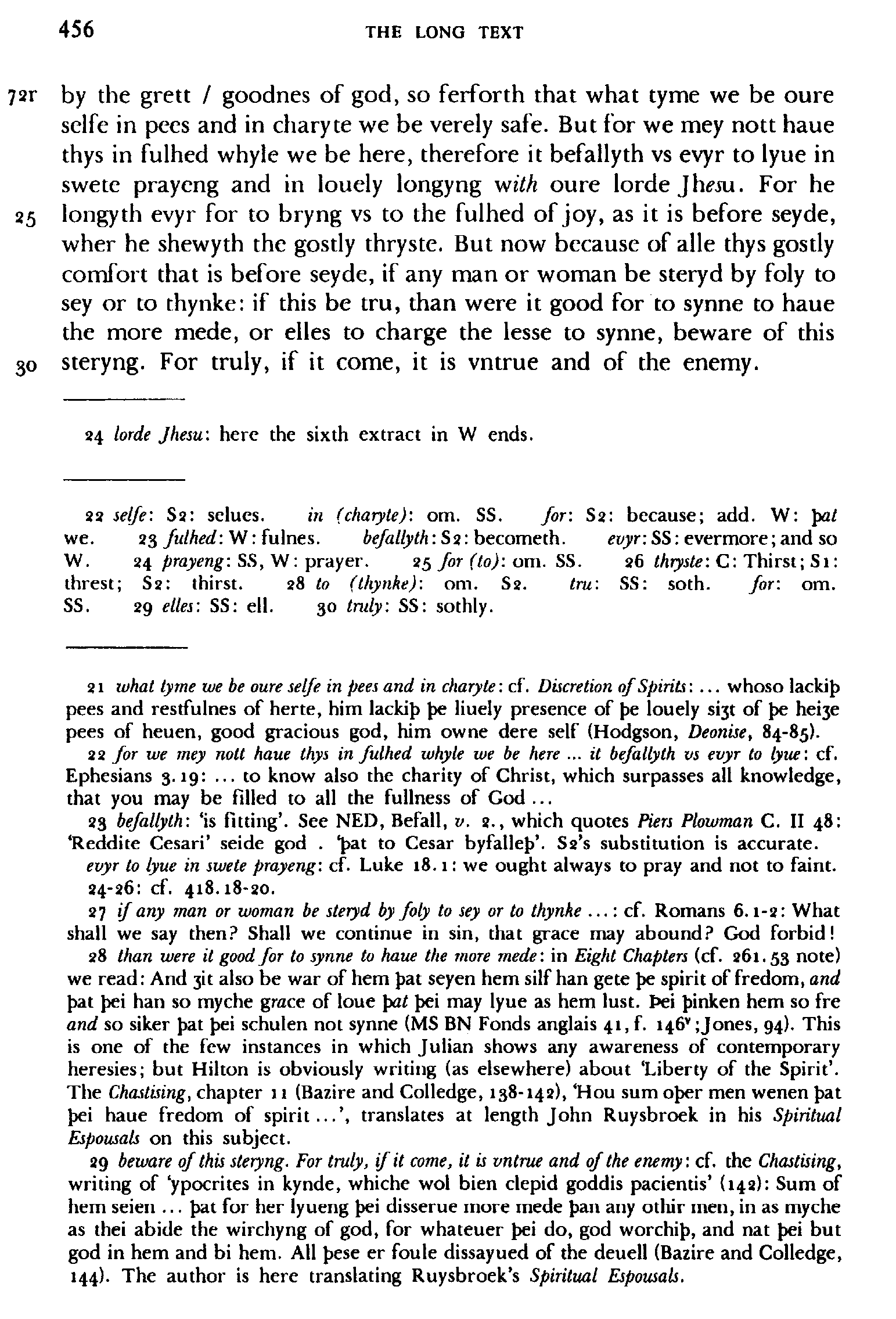
THE LONG TEXT
yar by the grett / goodnes of god, so ferforth that what tyme we be oure selfe in pees and in charyte we be verely safe. But for we mey nott haue thys in fulhed whyle we be here, therefore it befallyth vs evyr to lyue in swete prayeng and in louely longyng with oure lorde Jhwu. For he
25 longyth evyr for to bryng vs to the fulhed of joy, as it is before seyde, wher he shewyth the gostly thryste. But now because of alle thys gostly comfort that is before seyde, if any man or woman be steryd by foly to sey or to thynke: if this be tru, than were it good for to synne to haue the more mede, or elles to charge the lesse to synne, beware of this
30 steryng. For truly, if it come, it is vntrue and of the enemy.
24 lorde Jhesu: here the sixth extract in W ends. as selfe: 82: selues. in (charyte): om. SS. for: 82: because; add. W: pa/ we.
23 fulhed: W: fulnes. befallyth: 82: becometh. evyr:SS: ever more; and so W.
24 prayeng: SS, W: prayer.
25 for (to): om. SS.
26 thryste: C: Thirst; Si: threst; 82: thirst.
28 to (thynke): om.
82. tru: SS: soth. for: om.
SS.
29 elles: SS: ell.
30 truly: 88: sothly.
21 what tyme we be oure selfe in pees and in charyte: cf. Discretion of Spirits: ... whoso lackip pees and restfulnes of herte, him lackip pe liuely presence of pe louely sijt of pe hei3e pees of heuen, good gracious god, him owne dere self (Hodgson, Deonise, 84-85).
22 for we mey nott haue thys in fulhed whyle we be here ... it befallyth vs evyr to lyue: cf.
Ephesians 3.19: ... to know also the charity of Christ, which surpasses all knowledge, that you may be filled to all the fullness of God ...
23 befallyth: 'is fitting'. See NED, Befall, v. 2., which quotes Piers Plowman C. II 48:
'Reddite Cesari' seide god . "pat to Cesar byfallep'. 82*5 substitution is accurate. evyr to lyue in swete prayeng: cf. Luke 18. i: we ought always to pray and not to faint.
24-26: cf. 418.18-20.
27 if any man or woman be steryd by foly to sey or to thynke ...: cf. Romans 6.1-2: What shall we say then? Shall we continue in sin, that grace may abound? God forbid!
28 than were it good for to synne to haue the more mede: in Eight Chapters (cf. 261.53 note) we read: And jit also be war of hem pat seyen hem silf han gete pe spirit of fredom, and pat pei han so myche grace of loue pa* pei may lyue as hem lust. I>ei pinken hem so fre and so siker pat pei schulen not synne (MS BN Fonds anglais 41, f. 146* ;Jones, 94). This is one of the few instances in which Julian shows any awareness of contemporary heresies; but Hilton is obviously writing (as elsewhere) about 'Liberty of the Spirit'.
The Chastising, chapter 11 (Bazire and Colledge, 138-142), 'Hou sumoper men wenen pat pei haue fredom of spirit...', translates at length John Ruysbroek in his Spiritual
Espousals on this subject.
29 beware of this steryng. For truly, if it come, it is vntrue and of the enemy: cf. the Chastising, writing of 'ypocrites in kynde, whiche wol bien clepid goddis pacientis' (142): Sum of hem seien ... pat for her lyueng pei disserue more mede pan any othir men, in as myche as thei abide the wirchyng of god, for whateuer pei do, god worchip, and nat pei but god in hem and bi hem. All pese er foule dissayued of the deuell (Bazire and Colledge,
144). The author is here translating Ruysbroek's Spiritual Espousals.
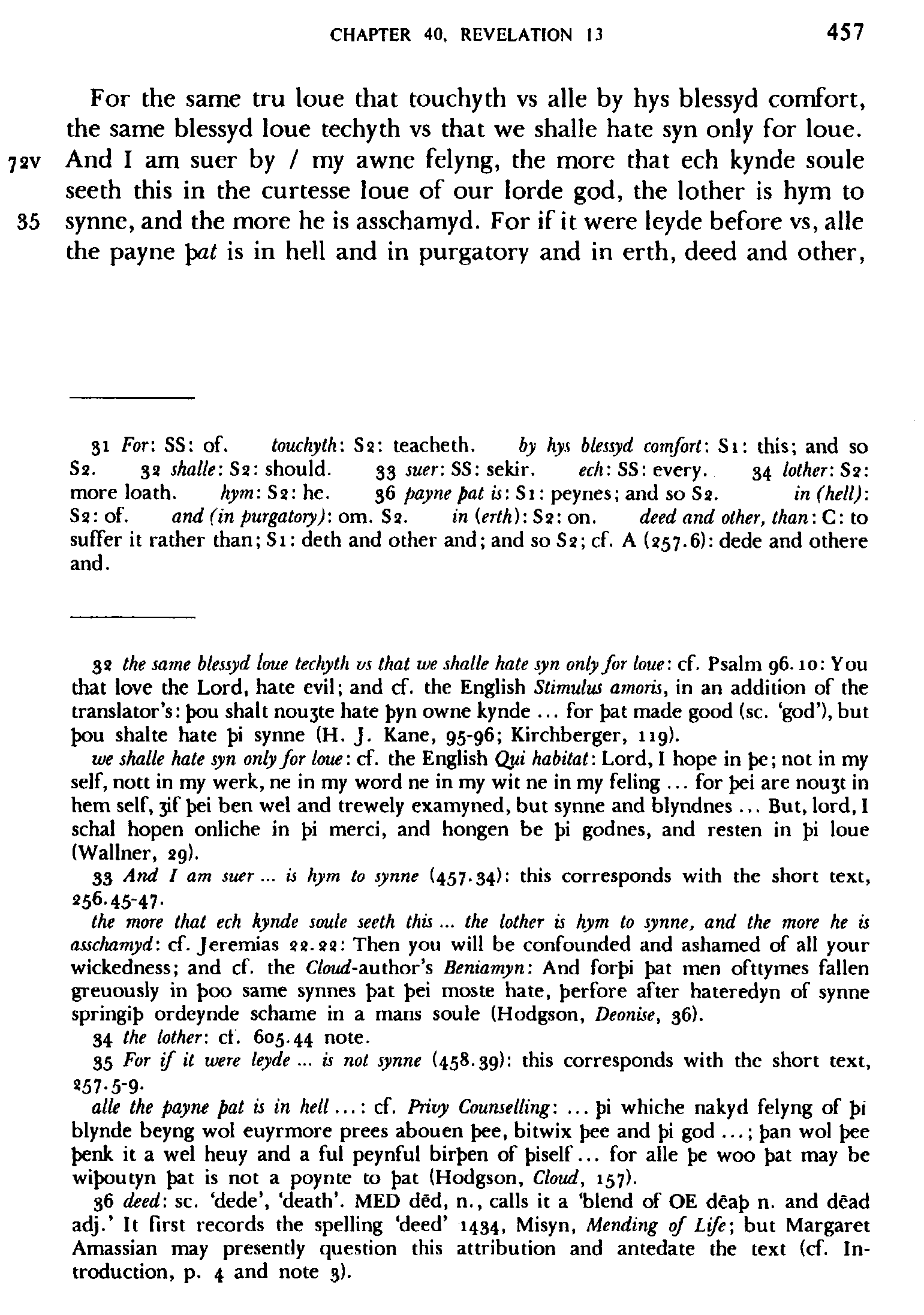
CHAPTER 40, REVELATION 13
For the same tru loue that touchyth vs alle by hys blessyd comfort, the same blessyd loue techyth vs that we shalle hate syn only for loue.
72V And I am suer by / my awne felyng, the more that ech kynde soule seeth this in the curtesse loue of our lorde god, the lother is hym to 35 synne, and the more he is asschamyd. For if it were leyde before vs, alle the payne Ipat is in hell and in purgatory and in erth, deed and other,
31 For: SS: of. touchyth: Sa: teacheth. by hys blessyd comfort: Si: this; and so Sa.
32 shalle: Ss: should.
33 suer: SS: sekir. ech: SS: every.
34 lother: Sa: more loath. hym: Sa: he.
36 payne pat is: Si: peynes; and so Sa. in (hell):
Sa: of. and (in purgatory): om. Sa. in (erth): Sa: on. deed and other, than: C: to suffer it rather than; Si: deth and other and; and so Sa; cf. A (257.6): dede and othere and.
33 the same blessyd loue techyth vs that we shalle hate syn only for loue: cf. Psalm 96.10: You that love the Lord, hate evil; and cf. the English Stimulus amoris, in an addition of the translator's: pou shalt nou3te hate pyn owne kynde ... for pat made good (sc. 'god'), but pou shalte hate pi synne (H. J. Kane, 95-96; Kirchberger, 119). we shalle hate syn only for loue: cf. the English Qui habitat: Lord, I hope in pe; not in my self, nott in my werk, ne in my word ne in my wit ne in my feling ... for pei are nou3t in hem self, jif pei ben wel and trewely examyned, but synne and blyndnes ... But, lord, I schal hopen onliche in pi merci, and hongen be pi godnes, and resten in pi loue
(Wallner, 39).
33 And I am suer ... is hym to synne (457.34): this corresponds with the short text,
256.45-47the more that ech kynde soule seeth this ... the lother is hym to synne, and the more he is asschamyd: cf. Jeremias 22.22: Then you will be confounded and ashamed of all your wickedness; and cf. the Cloud-author's Beniamyn: And forpi pat men ofttymes fallen greuously in poo same synnes pat pei moste hate, perfore after hateredyn of synne springip ordeynde schame in a mans soule (Hodgson, Deonise, 36).
34 the lather: cf. 605.44 note.
35 For if it were leyde ... is not synne (458.39): this corresponds with the short text,
257-5-9alle the payne pat is in hell...: cf. Privy Counselling: ... pi whiche nakyd felyng of pi blynde beyng wol euyrmore prees abouen pee, bitwix pee and pi god ...; pan wol pee penk it a wel heuy and a ful peynful birpen of piself... for alle pe woo pat may be wipoutyn pat is not a poynte to pat (Hodgson, Cloud, 157).
36 deed: sc. 'dede', 'death'. MED ded, n., calls it a 'blend of OE deap n. and dead adj.' It first records the spelling 'deed' 1434, Misyn, Mending of Life; but Margaret
Amassian may presently question this attribution and antedate the text (cf. Introduction, p. 4 and note 3).
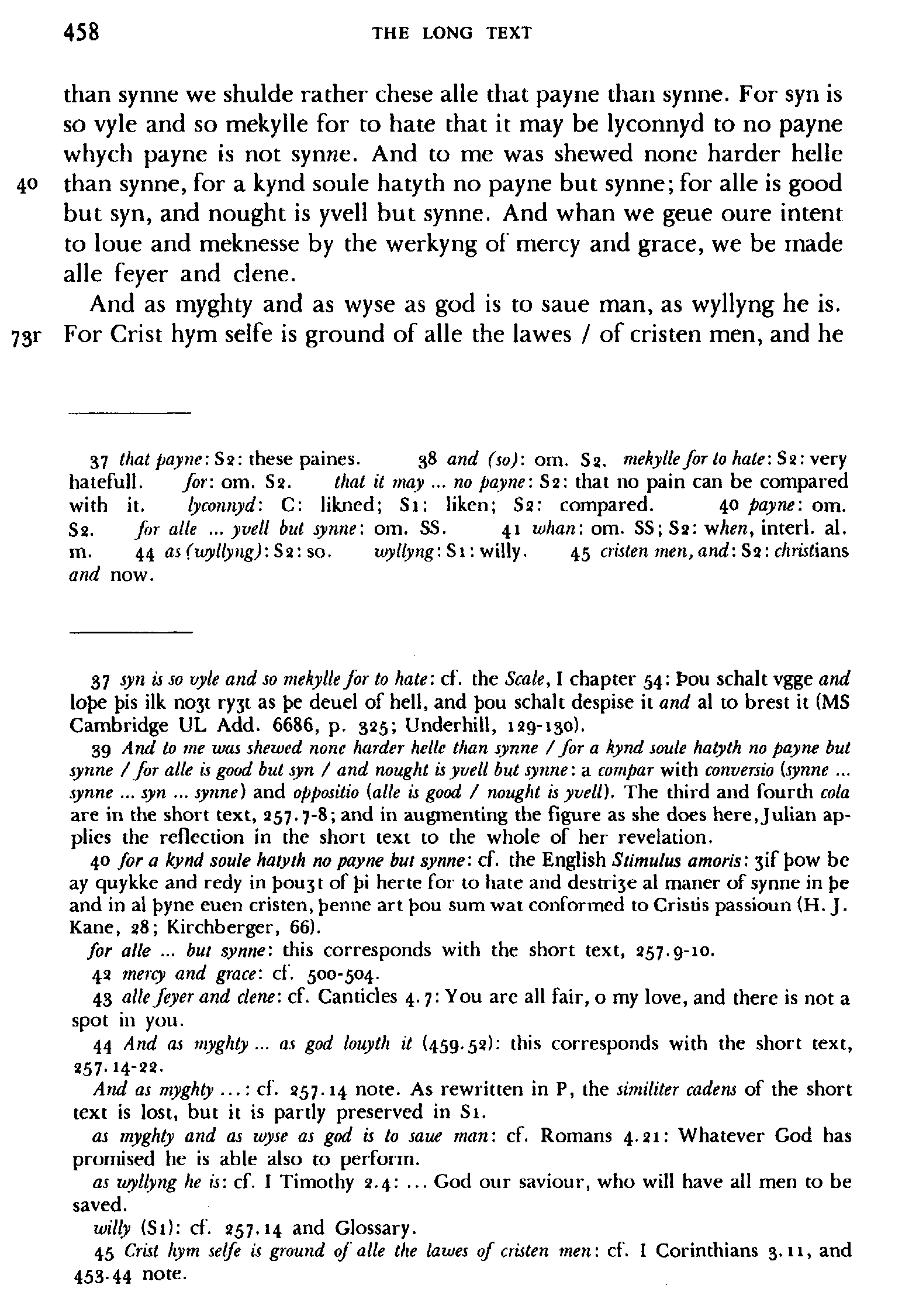
THE LONG TEXT
than synne we shulde rather chese alle that payne than synne. For syn is so vyle and so mekylle for to hate that it may be lyconnyd to no payne whych payne is not synne. And to me was shewed none harder helle
40 than synne, for a kynd soule hatyth no payne but synne; for alle is good but syn, and nought is yvell but synne. And whan we geue oure intent to loue and meknesse by the werkyng of mercy and grace, we be made alle feyer and clene.
And as myghty and as wyse as god is to saue man, as wyllyng he is.
73r For Crist hym selfe is ground of alle the lawes / of cristen men, and he 37 that payne: 82: these paines.
38 and (so): om. 82. mekylle for to hate: 82: very hatefull. for: om. 82. that it may ... no payne: 82: that no pain can be compared with it. lyconnyd: C: likned; Si: liken; 82: compared.
40 payne: om.
82. for alle ... yvell but synne: om. SS.
41 whan: om. 88; 82: when, interl. al. m.
44 as (wyllyng): 82: so. wyllyng: Si: willy.
45 cristen men, and: 82: Christians and now.
37 syn is so vyle and so mekylle for to hate: cf. the Scale, I chapter 54: t>ou schalt vgge and lope pis ilk no3t ry3t as pe deuel of hell, and pou schalt despise it and al to brest it (MS
Cambridge UL Add. 6686, p. 325; Underbill, 129-130).
39 And to me was shewed none harder helle than synne /for a kynd soule hatyth no payne but synne /for alle is good but syn / and nought is yvell but synne: a compar with conversio (synne ... synne ... syn ... synne) and oppositio (alle is good / nought is yvell). The third and fourth cola are in the short text, 257.7-8; and in augmenting the figure as she does here,Julian applies the reflection in the short text to the whole of her revelation.
40 for a kynd soule hatyth no payne but synne: cf. the English Stimulus amoris: jif pow be ay quykke and redy in poujt of pi herte for to hate and destine al maner of synne in pe and in al pyne euen cristen, penne art pou sum wat conformed to Cristis passioun (H. J.
Kane, 28; Kirchberger, 66). for alle ... but synne: this corresponds with the short text, 257.9-10.
42 mercy and grace: cf. 500-504.
43 alle feyer and clene: cf. Canticles 4.7: You are all fair, o my love, and there is not a spot in you.
44 And as myghty... as god louyth it (459.52): this corresponds with the short text,
257.14-22.
And as myghty ...: cf. 257.14 note. As rewritten in P, the similiter cadens of the short text is lost, but it is partly preserved in Si. as myghty and as wyse as god is to saue man: cf. Romans 4.21: Whatever God has promised he is able also to perform. as wyllyng he is: cf. I Timothy 2.4: ... God our saviour, who will have all men to be saved. willy (Si): cf. 257.14 and Glossary.
45 Crist hym selfe is ground of alle the lawes of cristen men: cf. I Corinthians 3.11, and 453.44 note.
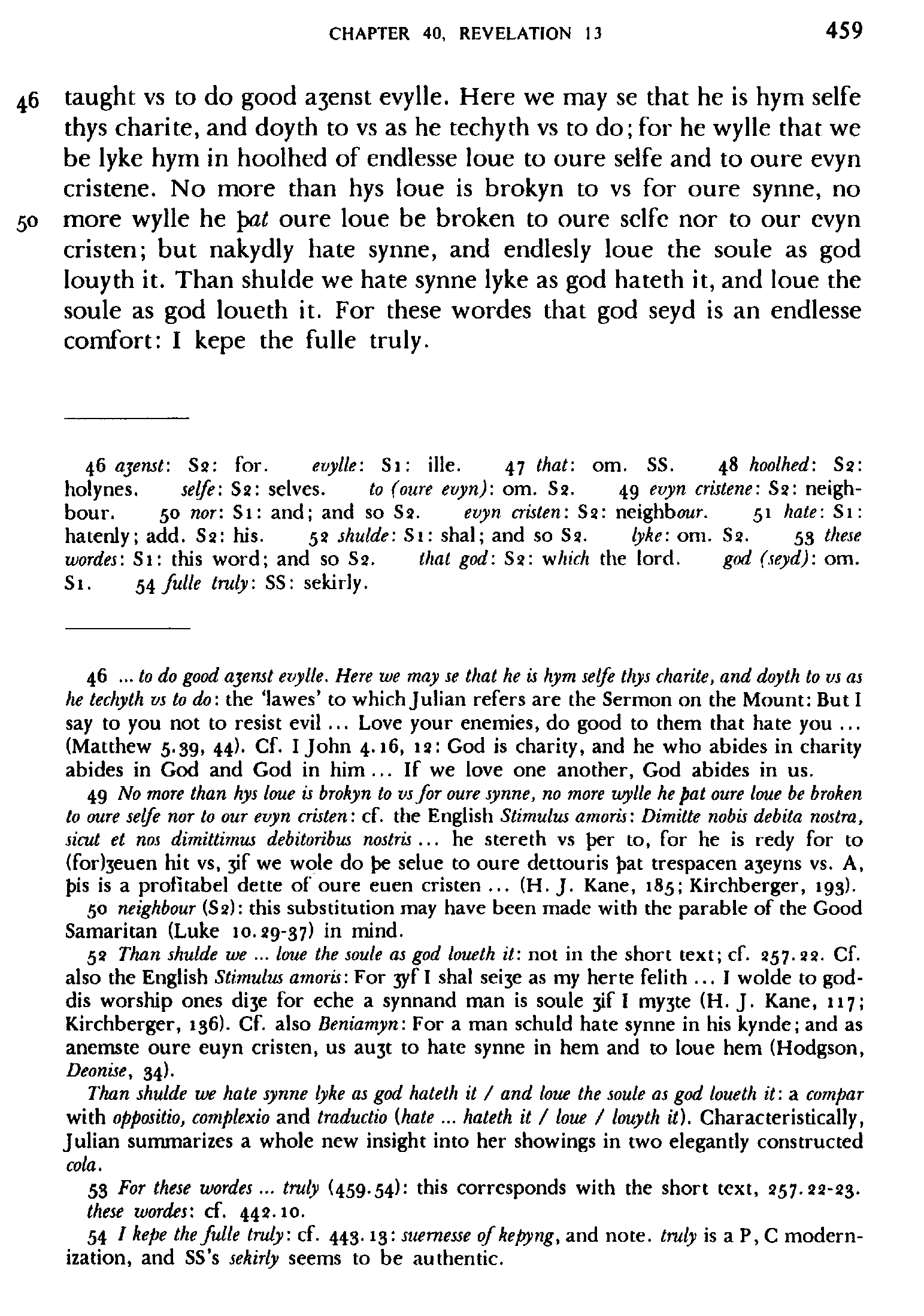
CHAPTER 40, REVELATION 13
46 taught vs to do good a3enst evylle. Here we may se that he is hym selfe thys charite, and doyth to vs as he techyth vs to do; for he wylle that we be lyke hym in hoolhed of endlesse loue to oure selfe and to oure evyn cristene. No more than hys loue is brokyn to vs for oure synne, no 50 more wylle he 1pat oure loue be broken to oure selfe nor to our evyn cristen; but nakydly hate synne, and endlesly loue the soule as god louyth it. Than shulde we hate synne lyke as god hateth it, and loue the soule as god loueth it. For these wordes that god seyd is an endlesse comfort: I kepe the fulle truly.
46 ajenst: 82: for. evylle: Si: ille.
47 that: om.
SS.
48 hoolhed: 82: holynes. selfe: 82: selves. to (oure evyn): om. 82.
49 evyn cristene: 82: neighbour.
50 nor: Si: and; and so 82. evyn cristen: 82: neighbour.
51 hate: Si: hatenly; add. 82: his.
52 shulde: Si: shal; and so 82. lyke: om. 82.
53 these wordes: Si: this word; and so 82. that god: 82: which the lord. god (seyd): om.
Si.
54 fulle truly: SS: sekirly.
46 ... to do good aynst evylle. Here we may se that he is hym selfe thys charite, and doyth to vs as he techyth vs to do: the 'lawes' to which Julian refers are the Sermon on the Mount: But I say to you not to resist evil ... Love your enemies, do good to them that hate you ...
(Matthew 5.39, 44). Cf. I John 4.16, 12: God is charity, and he who abides in charity abides in God and God in him ... If we love one another, God abides in us.
49 No more than hys loue is brokyn to vsfor oure synne, no more wylle he pat oure loue be broken to oure selfe nor to our evyn cristen: cf. the English Stimulus amoris: Dimitte nobis debita nostra, sicut et nos dimittimus debitoribus nostris ... he stereth vs per to, for he is redy for to (for)3euen hit vs, yf we wole do Jje selue to oure dettouris pat trespacen aseyns vs. A, j>is is a profitabel dette of oure euen cristen ... (H. J. Kane, 185; Kirchberger, 193).
50 neighbour (82): this substitution may have been made with the parable of the Good
Samaritan (Luke 10.29-37) in mind.
52 Than shulde we ... loue the soule as god loueth it: not in the short text; cf. 257. 22. Cf. also the English Stimulus amoris: For 3yf I shal sei3e as my herte felith ... I wolde to goddis worship ones dije for eche a synnand man is soule yf I myjte (H. J. Kane, 117;
Kirchberger, 136). Cf. also Beniamyn: For a man schuld hate synne in his kynde; and as anemste oure euyn cristen, us au3t to hate synne in hem and to loue hem (Hodgson,
Deonise, 34).
Than shulde we hate synne lyke as god hateth it / and loue the soule as god loueth it: a cornpar with oppositio, complexio and traductio (hate ... hateth it I loue / louyth it). Characteristically,
Julian summarizes a whole new insight into her showings in two elegantly constructed cola.
53 For these wordes ... truly (459.54): this corresponds with the short text, 257.22-23. these wordes: cf. 442.10.
54 I kepe the fulle truly: cf. 443.13: suernesse ofkepyng, and note, truly is a P, C modernization, and SS's sekirly seems to be authentic.
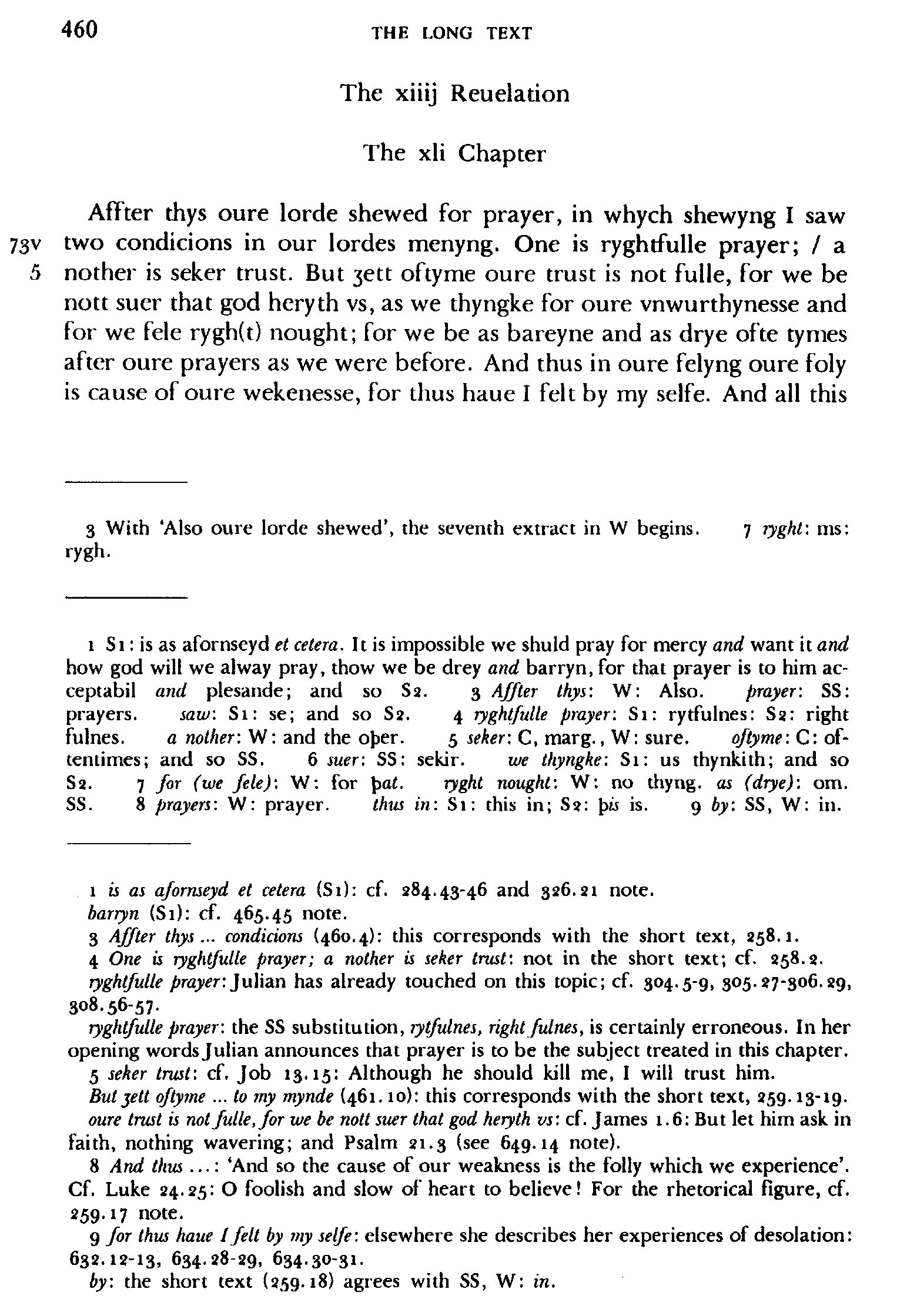
THE LONG TEXT
The xiiij Reuelation The xli Chapter Affter thys oure lorde shewed for prayer, in whych shewyng I saw
73v two condicions in our lordes menyng. One is ryghtfulle prayer; / a 5 nother is seker trust. But jett oftyme oure trust is not fulle, for we be nott suer that god heryth vs, as we thyngke for oure vnwurthynesse and for we fele rygh(t) nought; for we be as bareyne and as drye ofte tymes after oure prayers as we were before. And thus in oure felyng oure foly is cause of oure wekenesse, for thus haue I felt by my selfe. And all this
3 With 'Also oure lorde shewed', the seventh extract in W begins.
7 ryght: ms: rygh. i Si: is as afornseyd et cetera. It is impossible we shuld pray for mercy and want it and how god will we alway pray, thow we be drey and barryn, for that prayer is to him acceptabil and plesande; and so Sa.
3 Affter thys: W: Also. prayer: SS: prayers. saw: Si: se; and so 82.
4 ryghtfulle prayer: Si: rytfulnes: 82: right fulnes. a nother: W: and the ober.
5 seker: C, marg., W: sure. oftyme: C: oftentimes; and so SS.
6 suer: SS: sekir. we thyngke: Si: us thynkith; and so 82.
7 for (we fele): W: for \>at. ryght nought: W: no thyng. as (drye): om.
SS.
8 prayers: W: prayer. thus in: Si: this in; 82: bis is.
9 by: SS, W: in. i is as afornseyd et cetera (Si): cf. 284.43-46 and 326.21 note. barryn (Si): cf. 465.45 note.
3 Affter thys... condicions (460.4): this corresponds with the short text, 258.1.
4 One is ryghtfulle prayer; a nother is seker trust: not in the short text; cf. 258.2. ryghtfulle prayer: Julian has already touched on this topic; cf. 304.5-9, 305.27-306.29,
308.56-57. ryghtfulle prayer: the SS substitution, rytfulnes, right fulnes, is certainly erroneous. In her opening words Julian announces that prayer is to be the subject treated in this chapter.
5 seker trust: cf. Job 13.15: Although he should kill me, I will trust him.
But ytt oftyme ... to my mynde (461.10): this corresponds with the short text, 259.13-19. oure trust is not fulle, for we be nott suer that god heryth vs: cf. James 1.6: But let him ask in faith, nothing wavering; and Psalm 21.3 (see 649.14 note).
8 And thus ...: 'And so the cause of our weakness is the folly which we experience'.
Cf. Luke 24.25: O foolish and slow of heart to believe! For the rhetorical figure, cf.
259.17 note.
9 for thus haue I felt by my selfe: elsewhere she describes her experiences of desolation:
632.12-13, 634.28-29, 634.30-31. by: the short text (259.18) agrees with SS, W: in.
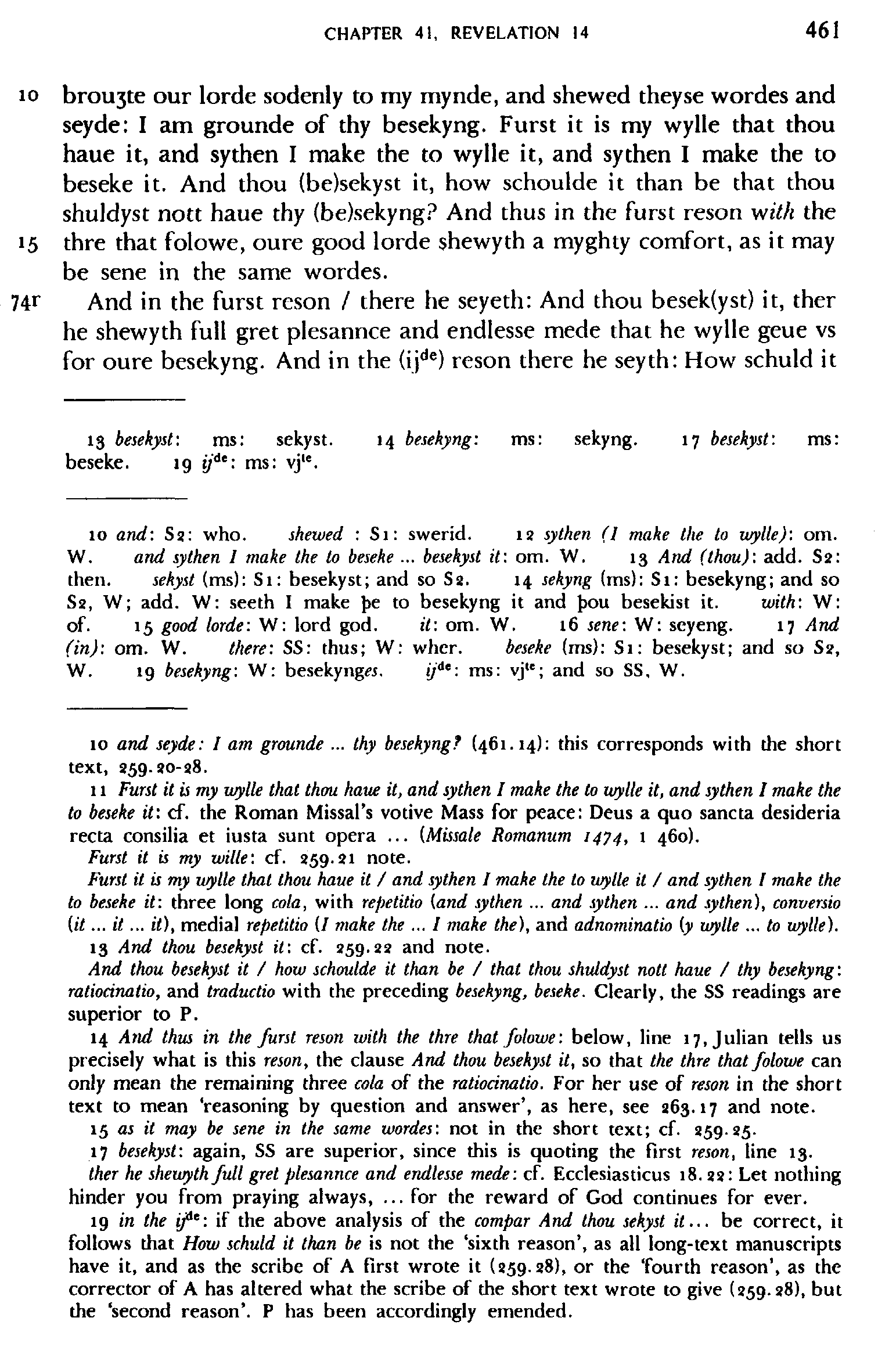
CHAPTER 41, REVELATION 14
10 Bronte our lorde sodenly to my mynde, and shewed theyse wordes and seyde: I am grounde of thy besekyng. Furst it is my wylle that thou haue it, and sythen I make the to wylle it, and sythen I make the to beseke it. And thou (be)sekyst it, how schoulde it than be that thou shuldyst nott haue thy (be)sekyng? And thus in the furst reson with the 15 thre that folowe, oure good lorde shewyth a myghty comfort, as it may be sene in the same wordes.
74r And in the furst reson / there he seyeth: And thou besek(yst) it, ther he shewyth full gret plesannce and endlesse mede that he wylle geue vs for oure besekyng. And in the (ijde) reson there he seyth: How schuld it
13 besekyst: ms: sekyst.
14 besekyng: ms: sekyng.
17 besekyst: ms: beseke.
19 y'de: ms: vjle.
10 and: Ss: who. shewed : Si: swerid.
12 sythen (I make the to wylle): om.
W. and sythen I make the to beseke ... besekyst it: om. W.
13 And (thou): add. 82: then. sekyst (ms): Si: besekyst; and so 82.
14 sekyng (ms): Si: besekyng; and so 82, W; add. W: seeth I make |>e to besekyng it and £ou besekist it. with: W: of.
15 good lorde: W: lord god. it: om. W.
16 sene: W: seyeng.
17 And (in): om. W. there: SS: thus; W: wher. beseke (ms): Si: besekyst; and so 82, W.
19 besekyng: W: besekyngw. yde: ms: vjle; and so SS, W.
10 and seyde: I am grounde ... thy besekyng? (461.14): this corresponds with the short text, 259.20-28.
11 Furst it is my wylle that thou haue it, and sythen I make the to wylle it, and sythen I make the to beseke it: cf. the Roman Missal's votive Mass for peace: Deus a quo sancta desideria recta consilia et iusta sunt opera ... (Missale Romanum 1474, i 460).
Furst it is my wille: cf. 259.21 note.
Furst it is my wylle that thou haue it / and sythen I make the to wylle it / and sythen I make the to beseke it: three long cola, with repetitio (and sythen ... and sythen ... and sythen), conversio
(it... it... it), medial repetitio (I make the ... I make the), and adnominatio (y wylle ... to wylle).
13 And thou besekyst it: cf. 259.22 and note.
And thou besekyst it / how schoulde it than be / that thou shuldyst nott haue / thy besekyng: ratiodnatio, and traductio with the preceding besekyng, beseke. Clearly, the SS readings are superior to P.
14 And thus in the furst reson with the thre that folowe: below, line 17, Julian tells us precisely what is this reson, the clause And thou besekyst it, so that the thre that folowe can only mean the remaining three cola of the ratiodnatio. For her use of reson in the short text to mean 'reasoning by question and answer', as here, see 263.17 and note.
15 as it may be sene in the same wordes: not in the short text; cf. 259.25.
17 besekyst: again, SS are superior, since this is quoting the first reson, line 13. ther he shewyth full gret plesannce and endlesse mede: cf. Ecclesiasticus 18.22: Let nothing hinder you from praying always, ... for the reward of God continues for ever.
19 in the yde: if the above analysis of the compar And thou sekyst it... be correct, it follows that How schuld it than be is not the 'sixth reason', as all long-text manuscripts have it, and as the scribe of A first wrote it (259.28), or the 'fourth reason', as the corrector of A has altered what the scribe of die short text wrote to give (259.28), but the 'second reason'. P has been accordingly emended.
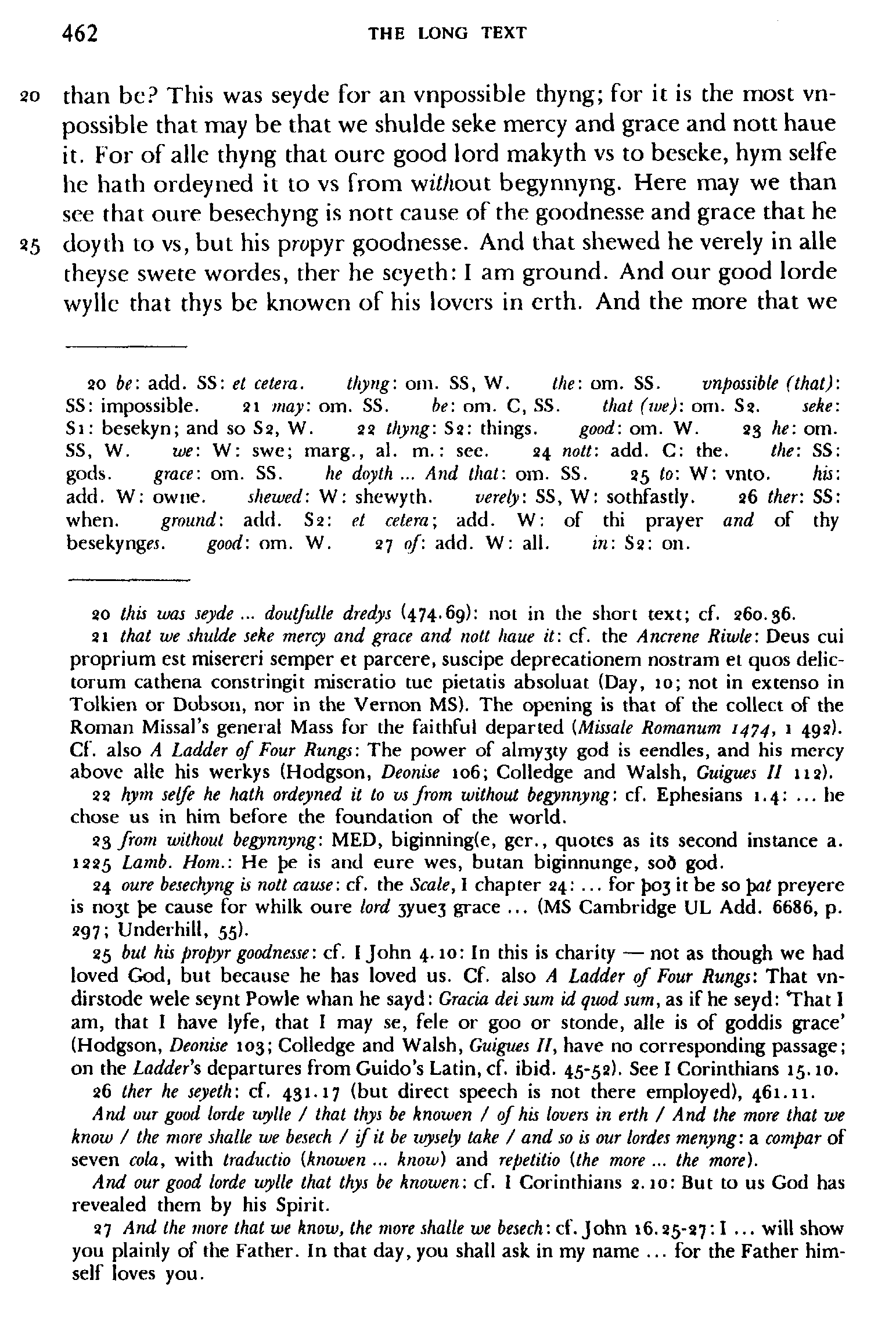
THE LONG TEXT
20 than be? This was seyde for an vnpossible thyng; for it is the most vnpossible that may be that we shulde seke mercy and grace and nott haue it. For of alle thyng that oure good lord makyth vs to beseke, hym selfe he hath ordeyned it to vs from wz//*out begynnyng. Here may we than see that oure besechyng is nott cause of the goodnesse and grace that he
25 doyth to vs, but his propyr goodnesse. And that shewed he verely in alle theyse swete wordes, ther he seyeth: I am ground. And our good lorde wylle that thys be knowen of his lovers in erth. And the more that we
20 be: add. SS: et cetera. thyng: om. SS, W. the: om. SS. vnpossible (that):
SS: impossible.
21 may: om. SS. be: om. C, SS. that (we): om. 82. seke:
Si: besekyn; and so Sa, W.
22 thyng: 82: things. good: om. W.
23 he: om.
SS, W. we: W: swe; marg., al. m.: see.
24 nott: add. C: the. the: SS: gods. grace: om. SS. he doyth ... And that: om. SS.
25 to: W: vnto. his: add. W: owne. shewed: W: shewyth. verely: SS, W: sothfastly.
26 ther: SS: when. ground: add.
82: et cetera; add.
W: of thi prayer and of thy besekyngw. good: om. W.
27 of: add. W: all. in: 82: on.
20 this was seyde... doutfulle dredys (474.69): not in the short text; cf. 260.36.
21 that we shulde seke mercy and grace and nott haue it: cf. the Ancrene Riwle: Deus cui proprium est misereri semper et parcere, suscipe deprecationem nostram et quos delictorum cathena constringit miseratio tue pietatis absoluat (Day, 10; not in extenso in Tolkien or Dobson, nor in the Vernon MS). The opening is that of the collect of the Roman Missal's general Mass for the faithful departed (Missale Romanum 1474, i 492).
Cf. also A Ladder of Four Rungs: The power of alrnysty god is eendles, and his mercy above alle his werkys (Hodgson, Deonise 106; Colledge and Walsh, Guigues II 112).
22 hym selfe he hath ordeyned it to vs from without begynnyng: cf. Ephesians 1.4: ... he chose us in him before the foundation of the world.
23 from without begynnyng: MED, biginning(e, ger., quotes as its second instance a.
1225 Lamb. Horn.: He Jje is and cure wes, butan biginnunge, sod god.
24 oure besechyng is nott cause: cf. the Scale, I chapter 24: ... for Jjoj it be so |xz£ preyere is no3t f>e cause for whilk oure lord jyuej grace ... (MS Cambridge UL Add. 6686, p.
297; Underbill, 55).
25 but his propyr goodnesse: cf. I John 4.10: In this is charity — not as though we had loved God, but because he has loved us. Cf. also A Ladder of Four Rungs: That vndirstode wele seynt Powle whan he sayd: Gracia dei sum id quod sum, as if he seyd: That I am, that I have lyfe, that I may se, fele or goo or stonde, alle is of goddis grace*
(Hodgson, Deonise 103; Colledge and Walsh, Guigues II, have no corresponding passage; on the Ladder's departures from Guide's Latin, cf. ibid. 45-52). See I Corinthians 15.10.
26 ther he seyeth: cf. 431.17 (but direct speech is not there employed), 461.11.
And our good lorde wylle / that thys be knowen / of his lovers in erth / And the more that we know / the more shalle we besech / if it be wysely take / and so is our lordes menyng: a compar of seven cola, with traductio (knowen ... know) and repetitio (the more ... the more).
And our good lorde wylle that thys be knowen: cf. I Corinthians 2.10: But to us God has revealed them by his Spirit.
27 And the more that we know, the more shalle we besech: cf. John 16.25-27:1 ... will show you plainly of the Father. In that day, you shall ask in my name ... for the Father himself loves you.
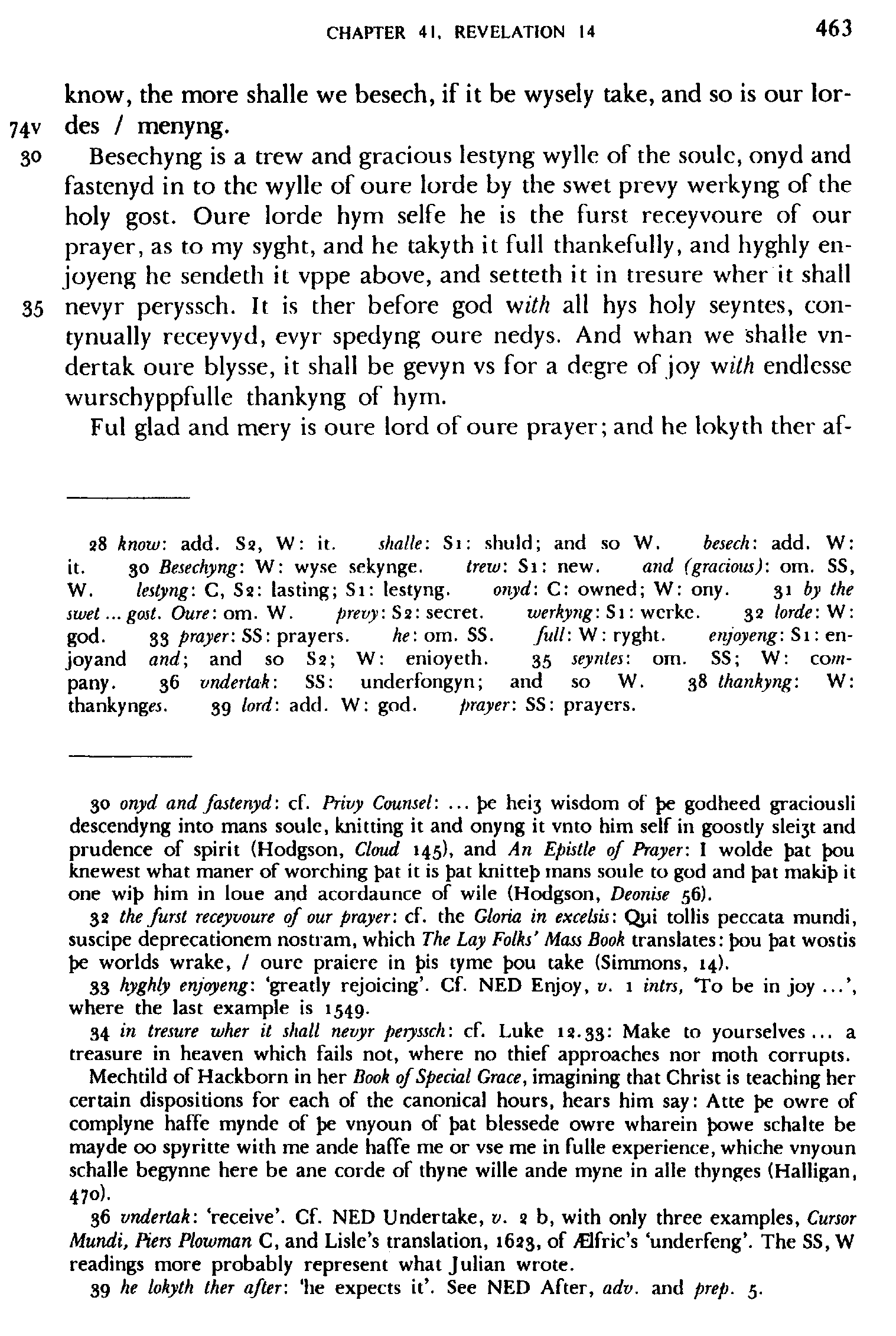
CHAPTER 41, REVELATION 14
know, the more shalle we besech, if it be wysely take, and so is our lor74v des / menyng.
Besechyng is a trew and gracious lestyng wylle of the soulc, onyd and fastenyd in to the wylle of oure lorde by the swet prevy werkyng of the holy gost. Oure lorde hym selfe he is the furst receyvoure of our prayer, as to my syght, and he takyth it full thankefully, and hyghly enjoyeng he sendeth it vppe above, and setteth it in tresure wher it shall
35 nevyr peryssch. It is ther before god with all hys holy seyntes, contynually receyvyd, evyr spedyng oure nedys. And whan we shalle vndertak oure blysse, it shall be gevyn vs for a degre of joy with endlesse wurschyppfulle thankyng of hym.
Ful glad and mery is oure lord of oure prayer; and he lokyth ther af28 know. add. 82, W: it. shalle: Si: shuld; and so W. besech: add. W: it.
30 Besechyng: W: wyse sekynge. trew: Si: new. and (gracious): om. SS, W. lestyng: C, Sa: lasting; Si: lestyng. onyd: C: owned; W: ony.
31 by the swet... gost. Oure: om. W. prevy: 82: secret. werkyng: Si: werke.
32 lorde: W: god.
33 prayer: SS: prayers. he: om. SS. full: W: ryght. enjoyeng: S i: enjoyand and; and so 82; W: enioyeth.
35 seyntes: om.
SS; W: company.
36 vndertak:
SS: underfongyn; and so W.
38 thankyng:
W: thankyngw.
39 lord: add. W: god. prayer: SS: prayers.
30 onyd and fastenyd: cf. Privy Counsel: ... J>e hei3 wisdom of J>e godheed graciousli descendyng into mans soule, knitting it and onyng it vnto him self in goostly slei3t and prudence of spirit (Hodgson, Cloud 145), and An Epistle of Prayer: I wolde J>at JXDU knewest what maner of worching f>at it is f>at knittej) mans soule to god and J>at makij) it one wijj him in loue and acordaunce of wile (Hodgson, Deonise 56).
32 the furst receyvoure of our prayer: cf. the Gloria in excelsis: Qui tollis peccata mundi, suscipe deprecationem nostram, which The Lay Folks' Mass Book translates: Jjou {>at wostis
\>e worlds wrake, / oure praiere in {>is tyme J>ou take (Simmons, 14).
33 hyghly enjoyeng: 'greatly rejoicing'. Cf. NED Enjoy, v. i intrs, To be in joy ...', where the last example is 1549.
34 in tresure wher it shall nevyr peryssch: cf. Luke 12.33: Make to yourselves... a treasure in heaven which fails not, where no thief approaches nor moth corrupts.
Mechtild of Hackborn in her Book of Special Grace, imagining that Christ is teaching her certain dispositions for each of the canonical hours, hears him say: Atte f>e owre of complyne haffe mynde of l>e vnyoun of J>at blessede owre wharein ]x>we schalte be mayde oo spyritte with me ande haffe me or vse me in fulle experience, whiche vnyoun schalle begynne here be ane corde of thyne wille ande myne in alle thynges (Halligan,
470).
36 vndertak: 'receive'. Cf. NED Undertake, v. 3 b, with only three examples, Cursor
Mundi, Piers Plowman C, and Lisle's translation, 1623, of /Elfric's 'underfeng'. The SS, W readings more probably represent what Julian wrote.
39 he lokyth ther after: 'he expects it'. See NED After, adv. and prep. 5.
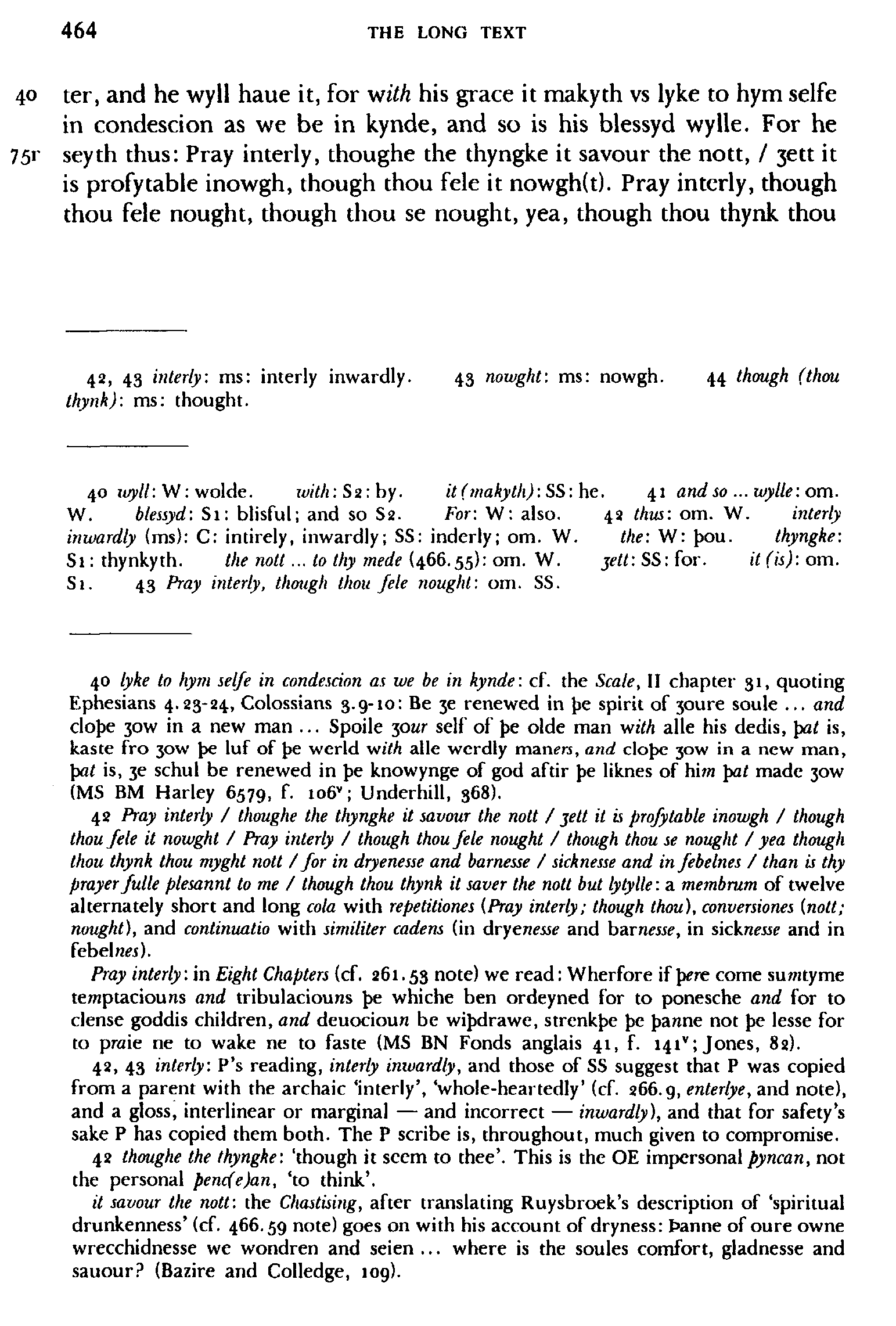
THE LONG TEXT
40 ter, and he wyll haue it, for with his grace it makyth vs lyke to hym selfe in condescion as we be in kynde, and so is his blessyd wylle. For he
751' seyth thus: Pray interly, thoughe the thyngke it savour the nott, / 3ett it is profytable inowgh, though thou fele it nowgh(t). Pray interly, though thou fele nought, though thou se nought, yea, though thou thynk thou
42, 43 interly; ms: interly inwardly.
43 nowght: ms: nowgh.
44 though (thou thynk): ms: thought.
40 wyll: W: wolde. with: Sa'.hy. it(makytli): SS: he.
41 and so ...wylle: om.
W. blessyd: Si: blisful; and so 82.
For: W: also.
42 thus: om. W. interly inwardly (ms): C: intirely, inwardly; SS: inderly; om. W. the: W: {x>u. thyngke:
Si: thynkyth. the nott... to thy rnede (466.55): om. W. ytt: SS: for. it (is): om.
Si.
43 Pray interly, though thou fele nought: om. SS.
40 lyke to hym selfe in condescion as we be in kynde: cf. the Scale, II chapter 31, quoting
Ephesians 4.23-24, Colossians 3.9-10: Be je renewed in }je spirit of 3oure soule ... and elope 3ow in a new man ... Spoile y>ur self of pe olde man with alle his dedis, {xz£ is, kaste fro 3OW Jie luf of J>e werld with alle wcrdly manm, and clof>e 3ow in a new man,
\xit is, 3e schul be renewed in f>e knowynge of god aftir pe liknes of hiw pa£ made 3ow
(MS BM Harley 6579, f. io6v; Underbill, 368).
42 Pray interly / thoughe the thyngke it savour the nott / ytt it is profytable inowgh / though thou fele it nowght / Pray interly / though thou fele nought / though thou se nought /yea though thou thynk thou myght nott /for in dryenesse and barnesse / sicknesse and infebelnes / than is thy prayerfulle plesannt to me / though thou thynk it saver the nott but lytylle: a membrum of twelve alternately short and long cola with repetitions (Pray interly; though thou), conversiones (nott; nought), and continuatio with similiter cadens (in dryenesse and barnesse, in sicknesse and in febelnej).
Pray interly: in Eight Chapters (cf. 261.53 note) we read: Wherfore if p^re come su/Htyme te/nptaciouns and tribulaciouns pe whiche ben ordeyned for to ponesche and for to dense goddis children, and deuocioun be wipdrawe, strenkpe pe panne not pe lesse for to praie ne to wake ne to faste (MS BN Fonds anglais 41, f. 141*; Jones, 82).
42, 43 interly: P's reading, interly inwardly, and those of SS suggest that P was copied from a parent with the archaic 'interly', 'whole-heartedly' (cf. 266.9, enterlye, and note), and a gloss, interlinear or marginal — and incorrect — inwardly), and that for safety's sake P has copied them both. The P scribe is, throughout, much given to compromise.
42 thoughe the thyngke: 'though it seem to thee'. This is the OE impersonal pyncan, not the personal penc(e)an, 'to think'. it savour the nott: the Chastising, after translating Ruysbroek's description of 'spiritual drunkenness' (cf. 466.59 note) goes on with his account of dryness: f>anne of oure owne wrecchidnesse we wondren and seien ... where is the soules comfort, gladnesse and sauour? (Bazire and Colledge, 109).
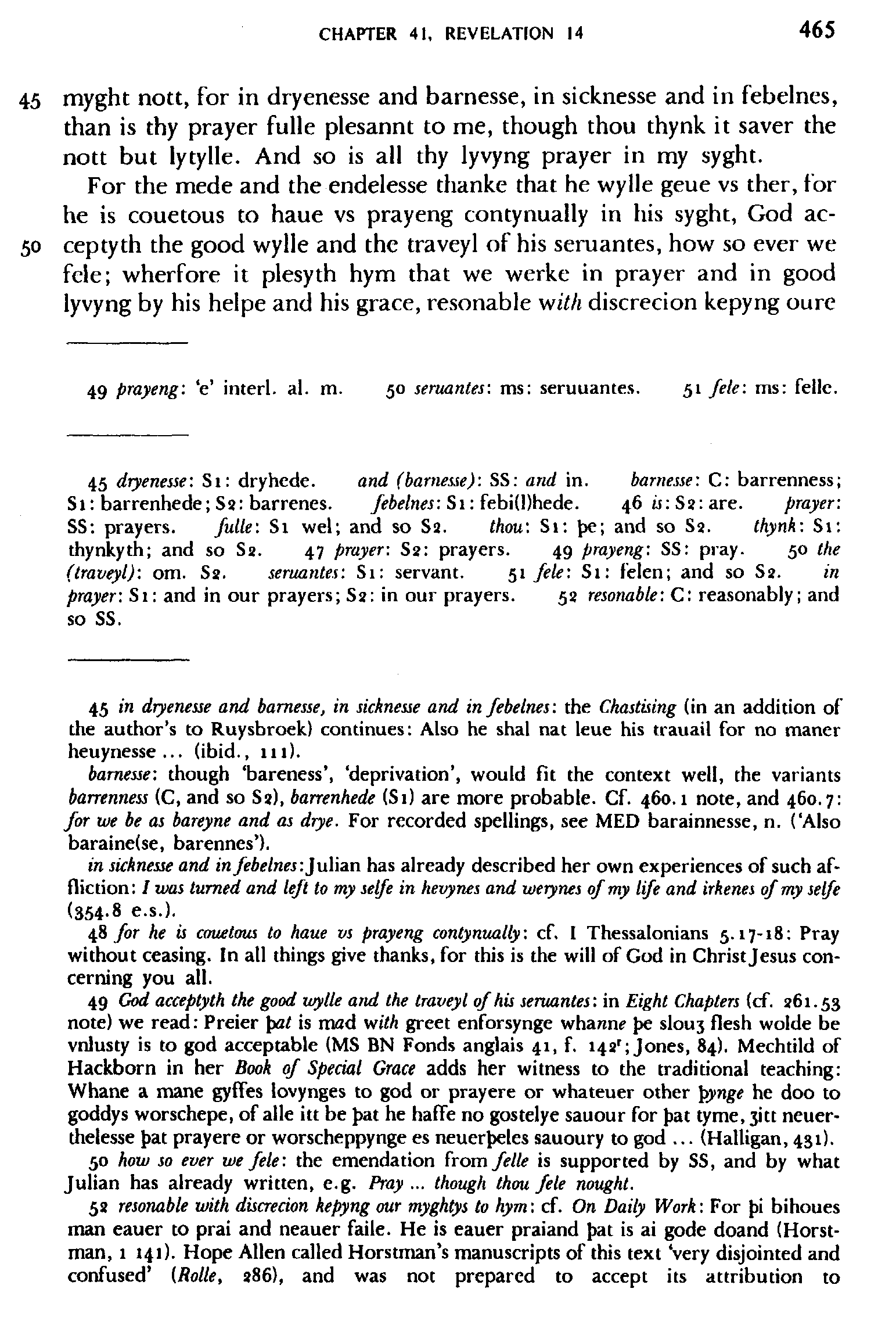
CHAPTER 41, REVELATION 14
45 myght nott, for in dryenesse and barnesse, in sicknesse and in febelnes, than is thy prayer fulle plesannt to me, though thou thynk it saver the nott but lytylle. And so is all thy lyvyng prayer in my syght.
For the mede and the endelesse thanke that he wylle geue vs ther, for he is couetous to haue vs prayeng contynually in his syght, God ac50 ceptyth the good wylle and the traveyl of his seruantes, how so ever we fele; wherfore it plesyth hym that we werke in prayer and in good lyvyng by his helpe and his grace, resonable with discrecion kepyng oure
49 prayeng: 'e' interl. al. m.
50 seruantes: ms: seruuantes.
51 fele: ms: fellc.
45 dryenesse: Si: dryhede. and (barnesse): SS: and in. barnesse: C: barrenness; Si: barrenhede; 82: barrenes. febelnes: Si: febi(!)hede.
46 is: 82: are. prayer:
SS: prayers. fulle: Si wel; and so 82. thou: Si: pe; and so 82. thynk: Si: thynkyth; and so 82.
47 prayer: 82: prayers.
49 prayeng: SS: pray.
50 the (traveyl): om. Sa. seruantes: Si: servant.
51 fele: Si: felen; and so 82. in prayer: Si: and in our prayers; Sa: in our prayers.
52 resonable: C: reasonably; and so SS.
45 in dryenesse and barnesse, in sicknesse and in febelnes: the Chastising (in an addition of the author's to Ruysbroek) continues: Also he shal nat leue his trauail for no maner heuynesse... (ibid., 111). barnesse: though 'bareness', 'deprivation', would fit the context well, the variants barrenness (C, and so Sa), barrenhede (Si) are more probable. Cf. 460. i note, and 460.7: for we be as bareyne and as drye. For recorded spellings, see MED barainnesse, n. ('Also baraine(se, barennes'). in sicknesse and infebelnes:]u\ian has already described her own experiences of such affliction: / was turned and left to my selfe in hevynes and werynes of my life and irkenes of my selfe
(354.8 e.s.).
48 for he is couetous to haue vs prayeng contynually: cf. I Thessalonians 5.17-18: Pray without ceasing. In all things give thanks, for this is the will of God in Christ Jesus concerning you all.
49 Cod acceptyth the good wylle and the traveyl of his seruantes: in Eight Chapters (cf. 261.53 note) we read: Preier ]pat is mad with greet enforsynge whann? Jje slous flesh wolde be vnlusty is to god acceptable (MS BN Fonds anglais 41, f. 142'; Jones, 84). Mechtild of Hackborn in her Book of Special Grace adds her witness to the traditional teaching:
Whane a mane gyffes lovynges to god or pray ere or whateuer other tynge he doo to goddys worschepe, of alle itt be ]>at he haffe no gostelye sauour for Jjat tyme, 3itt neuerthelesse J>at prayere or worscheppynge es neuerjjeles sauoury to god ... (Halligan, 431).
50 how so ever we fele: the emendation fromfelle is supported by SS, and by what
Julian has already written, e.g. Pray... though thou fele nought.
52 resonable with discrecion kepyng our myghtys to hym: cf. On Daily Work: For pi bihoues man eauer to prai and neauer faile. He is eauer praiand l>at is ai gode doand (Horstman, i 141). Hope Allen called Horstman's manuscripts of this text Very disjointed and confused'
(Rolle, 286), and was not prepared to accept its attribution to
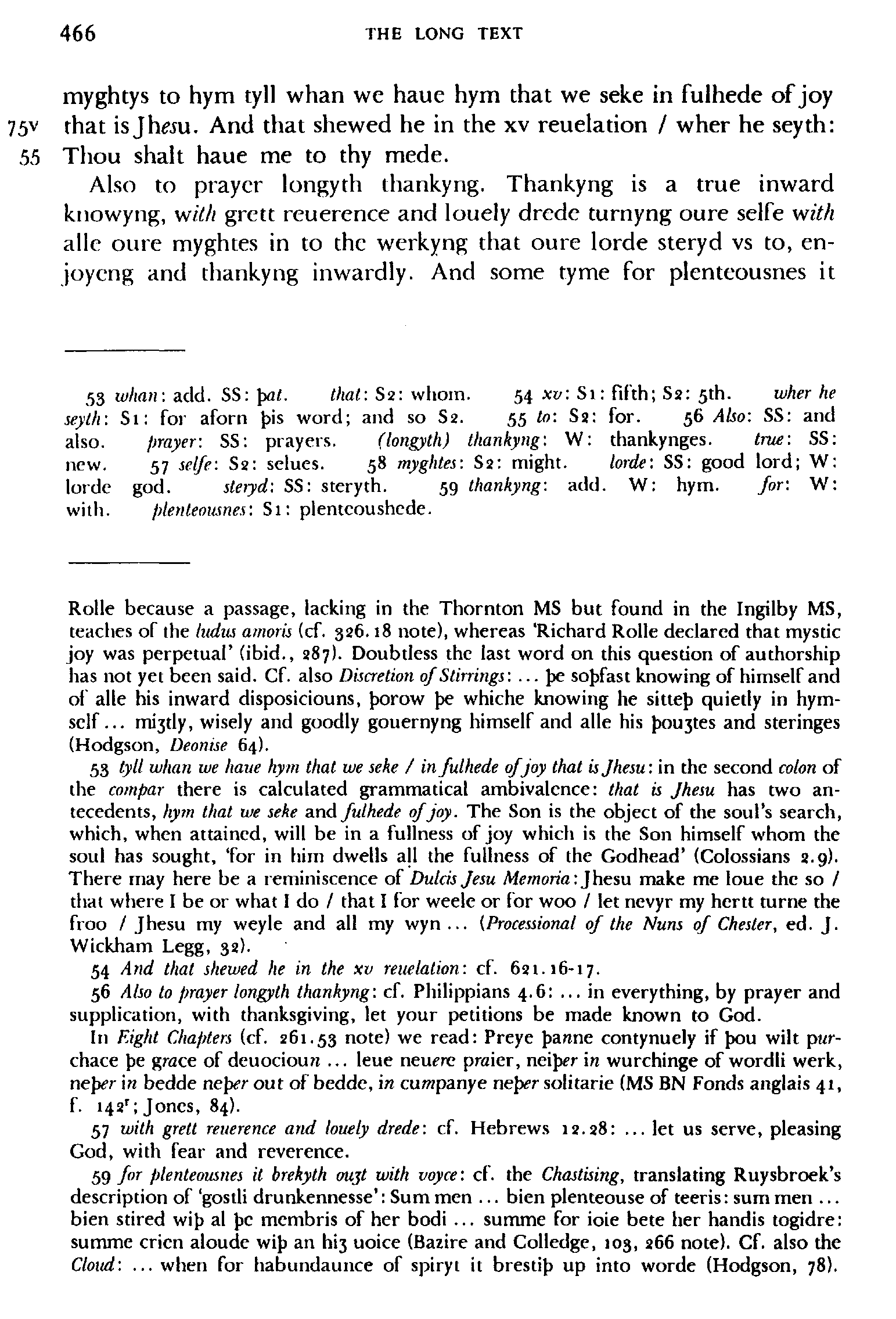
THE LONG TEXT
myghtys to hym tyll whan we haue hym that we seke in fulhede of joy 75v that isjhmi. And that shewed he in the xv reuelation / wher he seyth:
55 Thou shall haue me to thy mede.
Also to prayer longyth thankyng. Thankyng is a true inward knowyng, with grett reuerence and louely dredc turnyng oure selfe with alle oure myghtes in to the werkyng that oure lorde steryd vs to, enjoycng and thankyng inwardly. And some tyme for plenteousnes it
53 whan: add. SS: pat. that: 82: whom.
54 xv: Si: fifth; 82: 5th. wher he seyth: Si: for aforn bis word; and so 82.
55 to: 82: for.
56 Also: SS: and also. prayer: SS: prayers.
(longyth) thankyng: W: thankynges. true: SS: new.
57 selfe: 82: selues.
58 myghtes: 82: might. lorde: SS: good lord; W: lorde god. steryd: 88: steryth.
59 thankyng: add.
W: hym. for:
W: with. plenteousnes: Si: plenteoushede.
Rolle because a passage, lacking in the Thornton MS but found in the Ingilby MS, teaches of the Indus amoris (cf. 326.18 note), whereas 'Richard Rolle declared that mystic joy was perpetual' (ibid., 287). Doubtless the last word on this question of authorship has not yet been said. Cf. also Discretion of Stirrings: ... be sobfast knowing of himself and of alle his inward disposiciouns, borow be whiche knowing he sitteb quietly in hymsclf... mistly, wisely and goodly gouernyng himself and alle his bodies and steringes
(Hodgson, Deonise 64).
53 tyll whan we haue hym that we seke / in fulhede of joy that isjhesu: in the second colon of the compar there is calculated grammatical ambivalence: that is Jhesu has two antecedents, hym that we seke and fulhede of joy. The Son is the object of the soul's search, which, when attained, will be in a fullness of joy which is the Son himself whom the soul has sought, Tor in him dwells ajl the fullness of the Godhead' (Colossians 2.9).
There may here be a reminiscence of Dulcis Jesu Memoria: Jhesu make me loue the so / that where I be or what I do / that I for weele or for woo / let nevyr my hertt turne the froo / Jhesu my weyle and all my wyn ... (Processional of the Nuns of Chester, ed. J.
Wickham Legg, 32).
54 And that shewed he in the xv reuelation: cf. 621.16-17.
56 Also to prayer longyth thankyng: cf. Philippians 4.6: ... in everything, by prayer and supplication, with thanksgiving, let your petitions be made known to God.
In Eight Chapters (cf. 261.53 note) we read: Preye banne contynuely if bou wilt purchace be grace of deuocioura ... leue neuerc praier, neiber in wurchinge of wordli werk, neper in bedde neper out of bedde, in cuw/panye neper solitarie (MS BN Fonds anglais 41, f. 142'; Jones, 84).
57 with grett reuerence and louely drede: cf. Hebrews 12.28: ... let us serve, pleasing
God, with fear and reverence.
59 for plenteousnes it brekyth oujt with voyce: cf. the Chastising, translating Ruysbroek's description of 'gostli drunkennesse': Sum men ... bien plenteouse of teeris: sum men ... bien stired wib al be membris of her bodi ... summe for ioie bete her handis togidre: summe crien aloude wib an hi3 uoice (Bazire and Colledge, 103, 266 note). Cf. also the Cloud: ... when for habundaunce of spiryt it brestib up into worde (Hodgson, 78).
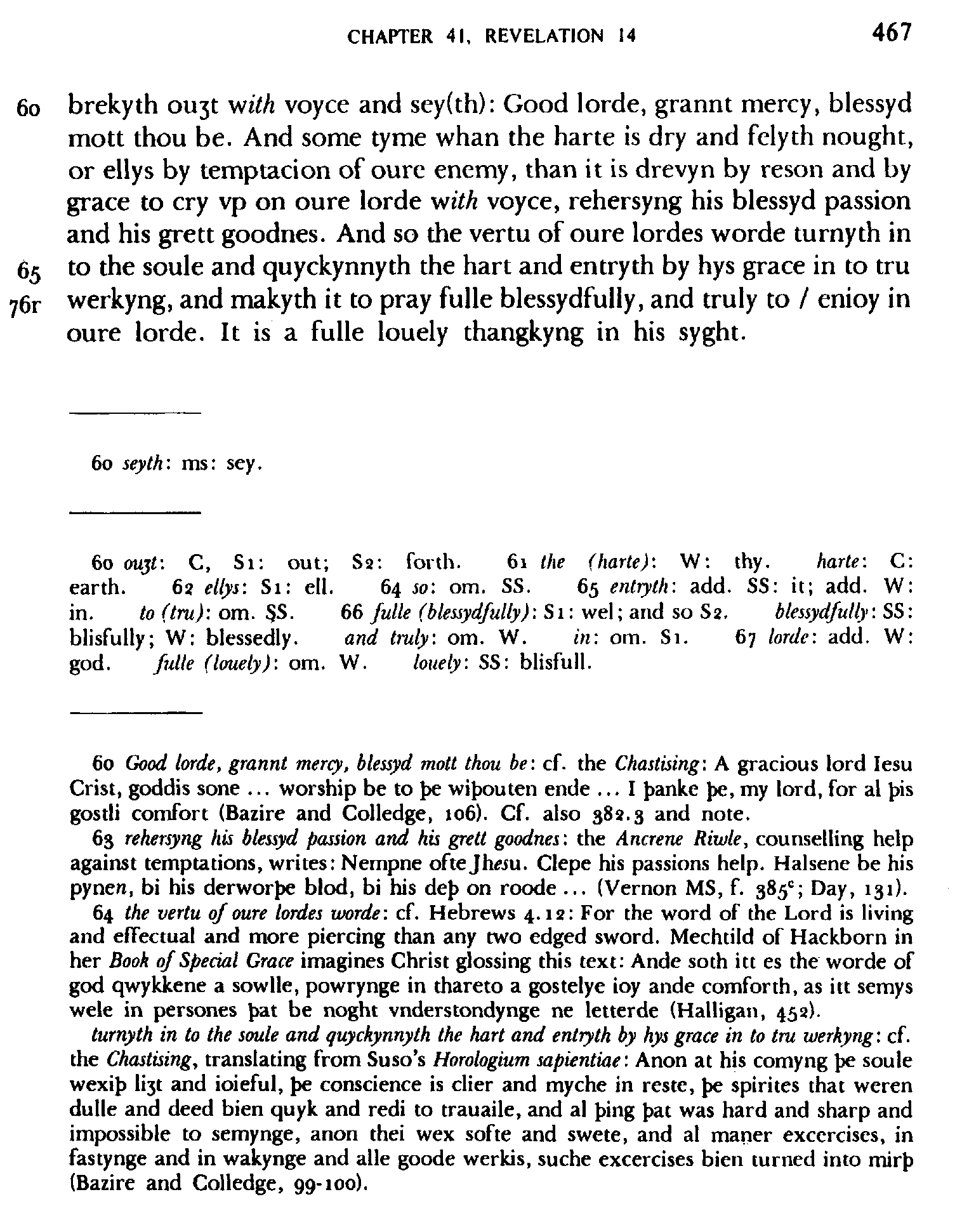
CHAPTER 41, REVELATION
60 brekyth 01131 with voyce and sey(th): Good lorde, grannt mercy, blessyd mott thou be. And some tyme whan the harte is dry and felyth nought, or ellys by temptacion of oure enemy, than it is drevyn by reson and by grace to cry vp on oure lorde -with voyce, rehersyng his blessyd passion and his grett goodnes. And so the vertu of oure lordes worde turnyth in to the soule and quyckynnyth the hart and entryth by hys grace in to tru werkyng, and makyth it to pray fulle blessydfully, and truly to / enioy in oure lorde. It is a fulle louely thangkyng in his syght.
76R 60 seyth: ms: sey.
60 oujt:
C, Si: out; Sa: forth.
61 the (harte):
W: thy. harte:
C: earth.
62 ellys: Si: ell.
64 50: om. SS.
65 entryth: add. SS: it; add. W: in. to (tru): om. §S.
66 fulle (blessydfully): Si: wel; and so 82. blessydfully: SS: blisfully; W: blessedly. and truly: om. W. in: om. Si.
67 lorde: add. W: god. fulle (louely): om. W. louely: SS: blisfull.
60 Good lorde, grannt mercy, blessyd mott thou be: cf. the Chastising: A gracious lord lesu
Crist, goddis sone ... worship be to f>e wipouten ende ... I J>anke J>e, my lord, for al J)is gostli comfort (Bazire and Colledge, 106). Cf. also 382.3 and note.
63 rehersyng his blessyd passion and his grett goodnes: the Ancrene Riwle, counselling help against temptations, writes: Nempne oftejhmi. Clepe his passions help. Halsene be his pynen, bi his derworj>e blod, bi his def> on roode ... (Vernon MS, f. 385°; Day, 131).
64 the vertu of oure lordes worde: cf. Hebrews 4.12: For the word of the Lord is living and effectual and more piercing than any two edged sword. Mechtild of Hackborn in her Book of Special Grace imagines Christ glossing this text: Ande soth itt es the worde of god qwykkene a sowlle, powrynge in thareto a gostelye ioy ande comforth, as itt semys wele in persones {>at be noght vnderstondynge ne letterde (Halligan, 452). turnyth in to the soule and quyckynnyth the hart and entryth by hys grace in to tru werkyng: cf. the Chastising, translating from Suso's Horologium sapientiae: Anon at his comyng f»e soule wexij) Ii3t and ioieful, J>e conscience is clier and myche in reste, |)e spirites that weren dulle and deed bien quyk and redi to trauaile, and al J>ing pat was hard and sharp and impossible to semynge, anon thei wex softe and swete, and al maner excercises, in fastynge and in wakynge and alle goode werkis, suche excercises bien turned into mirp
(Bazire and Colledge, 99-100).
THE LONG TEXT
The xlij Chapitur Owre lorde wylle that we haue tru vnderstondyng, and namely in thre thynges that longyth to oure prayer.
The furst is by whom and howe that oure prayer spryngyth. By 5 whom he shewyth whan he seyth: I am grounde; and how by hys goodnesse for he seyth: Furst it is my wylle.
For pe seconde, in what maner and how \>at we shulde vse oure prayers; and that is that oure wylle be turned in to the wylle of oure lorde enjoyeng. And so menyth he whan he seyeth: I make the to wylle
it.
For the thurde, \>at we know the fruyt and the ende of oure prayer, that is to be onyd and lyke to oure lorde in althyng. And to this menyng and for thys ende was alle thys louely lesson shewed, and he wylle helpe
;6v vs, and he shalle make / it so, as he seyth hym selfe, blessyd mot he be. i The V has been erased to make space for 'in his syght' (467.67), add. scr. i Si: Off iij thyngs that longyn (Sa: belong) to prayer, and how we shuld pray, and of the goodnes of god that supplyeth alwey our imperfection and febilnes whan we do that (Sa: what) longyth to us to do.
2 lorde: add. SS: god. that: om. SS.
3 longyth:
Sa: belong. prayer... prayer:
SS: prayers... prayers.
5 shewyth:
W: shewed. seyth: W: seyd. how: om. Si.
7 For: W: and for. pat: om. SS, W. oure prayers; and: om. W.
9 lorde: add. W: god.
11 the (ende): om.
C. prayer: SS: prayers. la althyng: Sa: all things.
13 for: Sa: to.
14 he (shalle): SS: we. seyth: C: seeth.
5 whan he seyth: cf. 461.11.
6 for he seyth: cf. 461.11.
7 pat we shulde vse oure prayers: cf. the Scale, I chapter 24: Preyer? is profitable and spcdefull to vse for to gete clennes of hert (MS Cambridge UL Add. 6686, p. 297; Underhill, 55), and NED Use ^.3, 'to do, perform'.
9 whan he seyeth: cf. 461.12.
11 pat we know the fruyt and the ende of oure prayer, that is to be onyd and lyke to oure lorde in althyng: the Cloud-author, in An Epistle of Prayer, compares the life of the loving soul with a tree full of fruit, its roots the fear of God, its trunk and branches hope and its fruit
Veuerent affeccioun' (Hodgson, Deonise, 52); and he continues: 'And f>erfore I sette it in {)i gardine, for I wolde £at f>ou gaderist J>e frute £>erof and keptest it to |>i lorde (ibid.,
56).
13 and he wylle helpe vs: cf. Psalm 36.5: Commit your way to the Lord and trust in him, and he will do it. and he wylle helpe vs / and he shalle make it so / as he seyth hym selfe / blessyd mot he be: a. compar, with exclamatio.
CHAPTER 42, REVELATION 14
For this is oure lordes wylle, that oure prayer and oure trust be both a lyke large. For if we trust nott as mekyll as we praye we do nott fulle worshyppe to oure lorde in oure prayer, and also we tary and payne oure selfe; and the cause is, as I beleue, for we know not truly that oure lorde is grounde in whom that oure prayer spryngyth, and also that we
20 know nott that it is gevyn vs by grace of hys loue. For yf we knew thys, it wolde make vs to truste to haue of oure lordes 3efte alle that we desyer.
For I am suer that no man askyth mercy and grace -with tru menyng but yf mercy and grace be furst gevyn to hym. But somtyme it comyth
25 to oure mynde that we haue prayde long tyme, and 3ett it thyngkyth vs yyr that we haue nott oure askyng. But here fore shulde / we nott be hevy, for I am suer by oure lordes menyng that eyther we a byde a better tyme, or more grace, or a beter 3yfte. He wylle that we haue true
15 prayer: SS: prayers.
16 mekyll: C, marg.: much; and so W.
17 prayer: SS: prayers.
18 selfe: Ca: selves. beleue: Si: leve; and so S3. oure (lorde): Ss: the.
19 lorde: add. W: god. in: SS: on; W: hymselfe of. that (oure): om. SS, W. prayer: SS: prayers.
20 by: Si: be the; and so Sa; W: by his. hys: add. W: grete and tender. .
21 to (truste): om. W. that: Sa: what.
33 suer: SS: sekir. man: add. W: pat. and: Sa: or.
34 yf: om. SS, W. to (hym): W: vnto. somtyme: W: somme tymes.
35 ytt: W: pei. it: om.
SS; W: we. thyngkyth:
Sa: think; and so W. vs: om.
Sa, W. a6 that: om.
Sa.
37 suer: SS: sekir.
38 or (a): add. W: else. that: om. SS.
15 For this is oure lordes wylle, that oure prayer and oure trust be both a lyke large: cf. Matthew 15.25, a8: ... she came and adored him, saying: Lord, help me ... Then Jesus answering said to her: O woman, your faith is great. Be it done to you as you wish. Cf. also 360.31 e.s.: Thus wille oure lorde,..
16 For if we trust nott as mekyll as we praye: cf. A Talking of the Love of God: ... hose wole in meditacion swete fruit fynden ... pat he truste sikerliche to fynden pat he sechep
(Westra, a). ai it wolde make vs to truste to haue of oure lordes jefte alle that we desyer: cf. I Timothy
6.17: ... (trust) in the living God, who gives us abundantly all things to enjoy.
35 we haue prayde long tyme, and ytt it thyngkyth vs that we haue nott oure askyng: cf. Psalm
81.3 (see 649.14 note) and Habacuc i.a: How long, o Lord, shall I cry, and thou wilt not hear?
26 But here fore shulde we nott be hevy ...: cf. the Scale, I chapter 33: When thou schalt preye ... £03 {x>u be neuere so mykel letted aseyns pi first will, be nott to mykel adredd ne to angrie with piself (MS Cambridge UL Add. 6686, p. 304; Underbill, 74).
38 He wylle that we haue true knowyng in hym selfe that he is beyng ...: cf. Psalm 35.10:
For with thee is the fountain of life, and in thy light we shall see light. In Eight Chapters
(see 361.53 note) we read: The best loue and trewist is whawne a soule is reised and lijtned in to knowynge of pe beynge of god in Crist, as whanne pe soule seep ... pat no ping hap sopfast beinge but god (MS BN Fonds anglais 41, f. 150"; Jones, 101). that we haue true knowyng ... alle our menyng: Julian is teaching that 'the fruit of all our
THE LONG TEXT
knowyng in hym selfe that he is beyng; and in thys knowyng he wylle 30 that oure vnderstandyng be groundyd with alle oure myghtes and alle oure intent and alle our menyng. And in this grounde he wylle that we take oure stede and oure dwellyng. And by the gracious lyght of hym selfe he wylle that we haue vnderstandyng of thre thynges that folow.
The furst is our noble and excelent makyng, the seconde oure 30 myghtes: Sa: might.
31 menyng: C: meanings.
32 stede: C: steeds; marg.: resting place. dwellyng: Si: wonynge; and so 82, W.
33 that (we): om.
SS. thre: Si: the; and so 82. that folow: om. W.
34 our: W: thi. seconde: add. W: is. oure: W: pe. prayer is to be oned and like to our Lord' (468.12). This is in fact the case for 'all that shall be saved'; the problem is that we do not know — feel — that it is so. But this knowing — feeling — is integral to our existence in him and his in us, it is what Holy
Church teaches (471.39-40). This knowledge — feeling — basically is faith; cf. chapter
54, pp. 563-564, and especially 564.30-33. true knowyng in hym selfe that he is beyng: cf. the Treatise of Perfection: ... thayre euermore schynes that simple beynge of the clerenesse of god, in the whiche we be growndyd, that is to saye, the whiche of oureselfe drawys vs into the moste hy3e beynge and felaschip of his loue (Bazire and Colledge, Chastising, 246-247).
29 he wylle that oure vnderstandyng be groundyd ...: cf. Ephesians 3.17-19, where Paul, writing of the glorified Christ, prays for his hearers That Christ may dwell by faith in your hearts, that being rooted and founded in charity, you may ... know also the charity of Christ, which surpasses all knowledge; and The Treatise of Perfection of the Sons of God: Wherfore vs behoues to grownde oure lyfe vpon a profounde depenesse ... the incomprehensible depnesse of charite ... in the whiche we schalle ... be ... stable euerlastyngly (Bazire and Colledge, Chastising, 233).
30 with alle oure myghtes and alle oure intent and alle our menyng: cf. Deuteronomy 6.5 and Matthew 22.37 (see 3°9-62 note); and the Treatise of Perfection: ... vs muste hafe trewe experience and vndyrstandynge in oure selfe, that we may be made one lyfe and one spirit with god (Bazire and Colledge, 237).
31 that we take oure stede and oure dwellyng: cf. John 14.2 (see 289.7 note). It is noteworthy that the Promptorium parvulontm translates 'stede' as situs, 'dwelling place* as mancio, habitaculum, and 'wonynge' as mansio (Mayhew 433, 134, 533). Probably Julian wrote 'wonynge', as in Si, and dwellyng is a later scribe's modernization.
32 by the gracious lyght of hym selfe: cf. 654.8: oure precyous louer helpyth vs with goostely lyghte; 696.3: by the swete gracious lyght of hym selfe; and 725.24: ourefeyth is oure lyght in oure nyght, whych lyght is god, oure endlesse day.
34 our noble and excelent makyng: cf. Psalm 8.5-6: What is man ... ? Thou hast made him a little less than the angels, thou hast crowned him with glory and honour, and hast set him over the works of thy hands; and the English Stimulus amoris: ... bigynneth he for to vndirstonde of wat worthynesse and of wat dignyte and nobeleye is be kynde of his soule, for whos resstoringe goddis sone wolde be dede (H. J. Kane, 39; Kirchberger,
75)oure precious and derwurthy agayne beyng: cf. A Talking of the Love of God: But yt... not onliche madest bou me of nou3t ... a3eyn bou hottest me wib deb so deore vppon pe roode (Westra, 64).
CHAPTER 42, REVELATION 14
35 precious and derwurthy agayne beyng, the thyrde althyng that he hath made beneth vs to serue vs and for oure loue kepyth it. Than menyth he thus, as if he seyde: Beholde and se that I haue done alle thys before thy
. yyv prayer, and now / thou arte and prayest me. And thus he menyth that it longyth to vs to wytt that the grettyst dedys be done as holy chyrch
40 techyth.
And in the beholdyng of thys with thankyng we ow to pray fore the 39 holy chyrch techyth'. here the seventh extract in W ends.
35 agayne beyng: C, marg.: redemption. beyng: C: being; Si: byeing; 82: buying; W: byeng. althyng: Sa: all things; W: is |>at all Jjyng.
36 and: W: he. kepyth it: 82: keep and preserues \>em.
38 prayer: SS: prayers. thus he: W: pis our lord god.
39 to (wytt): orn. Si; W: for to.
41 ow: Si: owte; Sa: ought.
35 agayne beyng: 'redemption'. 'Modelled on LLat red-imere' (MED ayen-bien, v.); cf.
NED, Again-buy, v., all entries in both suggesting that it is characteristically i4th-cent., much used in Wycliffite writings. The Promptorium translates 'Ageyn-byer' Redernptor,
'Ageyn-byyng' Redempcio (Mayhew, 7).
37 / haue done alle thys before thy prayer: cf. Ephesians 1.4 (see 463. aa note).
39 as holy chyrch techyth:Julian is affirming the Church's age-old statements, 'omnium visibilium et invisibilium factorem' (our noble and excelent makyng), 'qui propter nostram salutem descendit' (oure precious and derwurthy agayne beyng), 'per quem omnia facta sunt'
(althyng that he hath made), and, by implication, refuting false Gnosticism, teaching that creation has a dual origin and that the material world is inherently evil, refuting also such doctrines as that imputed, in 1312 in Clement V's Ad nostrum, to the Begards, 'that it would be imperfection to descend from the purity and heights of contemplation ... to think at all of the sufferings of Christ's humanity' (Denzinger-Schonmetzer, 898), teaching which is implicit in The Mirror of Simple Souls, circulating in English translation in Julian's day (Colledge and Guarnieri, 373).
41 beholdyng (and 473.49): cf. 484.14 note. This difficult passage, concerned with the contemplative effort, may be rendered as follows: 'And as we contemplate this with thanksgiving, we ought to pray for what is at this moment taking place: that God may rule us and guide us to live to his glory in this life, and may bring us to his bliss; and he has done all that is necessary for this. So it is his intention that we see that this is what he is doing, and that we pray that he may do it. For one (without the other) is not enough, because if we pray to him but do not perceive what he is doing, that makes us despondent and doubting, which does not give glory to him. And if we perceive what he is doing and do not pray, we are not fulfilling our duty. (One or the other) must not be, because that is not contemplating God. But to perceive what he is doing and to go on praying (that he may do it) gives glory to God and wins merit for us'. Julian is warning other contemplatives against two dangers: Pelagian reliance on our own efforts unassisted by grace (with its consequent psychological disorders), and the false Quietism denounced in Ad nostrum (Denzinger-Schonmetzer, 893), and amply represented in the English Mirror of Simple Souls, e.g.: This doujter of Syon desirej) neij>ir massis ne sermons, fastinges ne orisons (Doiron, 370; and cf. Colledge and Guarnieri, 372).
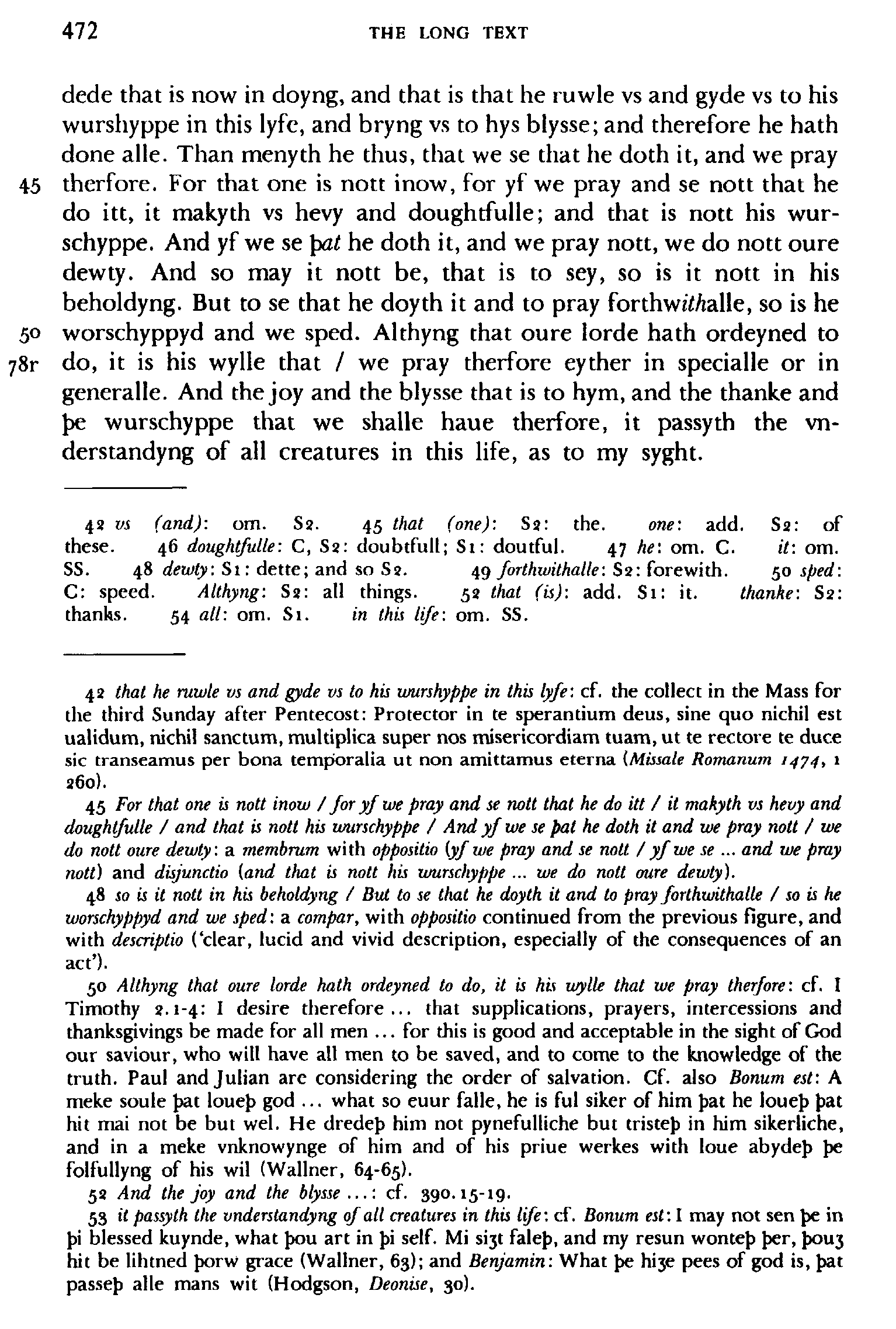
THE LONG TEXT
dede that is now in doyng, and that is that he ruwle vs and gyde vs to his wurshyppe in this lyfc, and bryng vs to hys blysse; and therefore he hath done alle. Than menyth he thus, that we se that he doth it, and we pray
45 therfore. For that one is nott inow, for yf we pray and se nott that he do itt, it makyth vs hevy and doughtfulle; and that is nott his wurschyppe. And yf we se \>at he doth it, and we pray nott, we do nott oure dewty. And so may it nott be, that is to sey, so is it nott in his beholdyng. But to se that he doyth it and to pray forthwzY/ialle, so is he
50 worschyppyd and we sped. Althyng that oure lorde hath ordeyned to y8r do, it is his wylle that / we pray therfore eyther in specialle or in generalle. And the joy and the blysse that is to hym, and the thanke and f>e wurschyppe that we shalle haue therfore, it passyth the vnderstandyng of all creatures in this life, as to my syght.
42 vs (and): om.
82.
45 that (one):
82: the. one: add.
82: of these.
46 doughtfulle: C, 82: doubtfull; Si: doutful.
47 he: om. C. it: om.
88.
48 dewty: Si: dette; and so 82.
49 forthwithalle: 82: forewith.
50 sped:
C: speed.
Althyng: 82: all things.
52 that (is): add. Si: it. thanke: 82: thanks.
54 all: om. Si. in this life: om. 88.
42 that he ruwle vs and gyde vs to his wurshyppe in this lyfe: cf. the collect in the Mass for the third Sunday after Pentecost: Protector in te sperantium deus, sine quo nichil est ualidum, nichil sanctum, multiplica super nos misericordiam tuam, ut te rectore te duce sic transeamus per bona temporalia ut non amittamus eterna (Missale Romanum 1474, i 260).
45 For that one is nott inow / for yj we pray and se nott that he do itt / it makyth vs hevy and doughtfulle / and that is nott his wurschyppe / And yfwe se pat he doth it and we pray nott / we do nott oure dewty: a membrum with oppositio (yfwe pray and se nott / yfwe se ... and we pray nott) and disjunctio (and that is nott his wurschyppe ... we do nott oure dewty).
48 so is it nott in his beholdyng / But to se that he doyth it and to pray forthwithalle / so is he worschyppyd and we sped: a compar, with oppositio continued from the previous figure, and with descriptio ('clear, lucid and vivid description, especially of the consequences of an act').
50 Althyng that oure lorde hath ordeyned to do, it is his wylle that we pray therfore: cf. I Timothy 2.1-4: I desire therefore... that supplications, prayers, intercessions and thanksgivings be made for all men ... for this is good and acceptable in the sight of God our saviour, who will have all men to be saved, and to come to the knowledge of the truth. Paul and Julian are considering the order of salvation. Cf. also Bonum est: A meke soule pat louep god ... what so euur falle, he is ful siker of him pat he louep pat hit mai not be but wel. He dredep him not pynefulliche but tristep in him sikerliche, and in a meke vnknowynge of him and of his priue werkes with loue abydep pe folfullyng of his wil (Wallner, 64-65).
52 And the joy and the blysse...: cf. 390.15-19.
53 it passyth the vnderstandyng of all creatures in this life: cf. Bonum est: I may not sen pe in pi blessed kuynde, what pou art in pi self. Mi sijt falep, and my resun wontep per, pou3 hit be lihtned porw grace (Wallner, 63); and Benjamin: What pe hi3e pees of god is, pat passep alle mans wit (Hodgson, Deonise, 30).
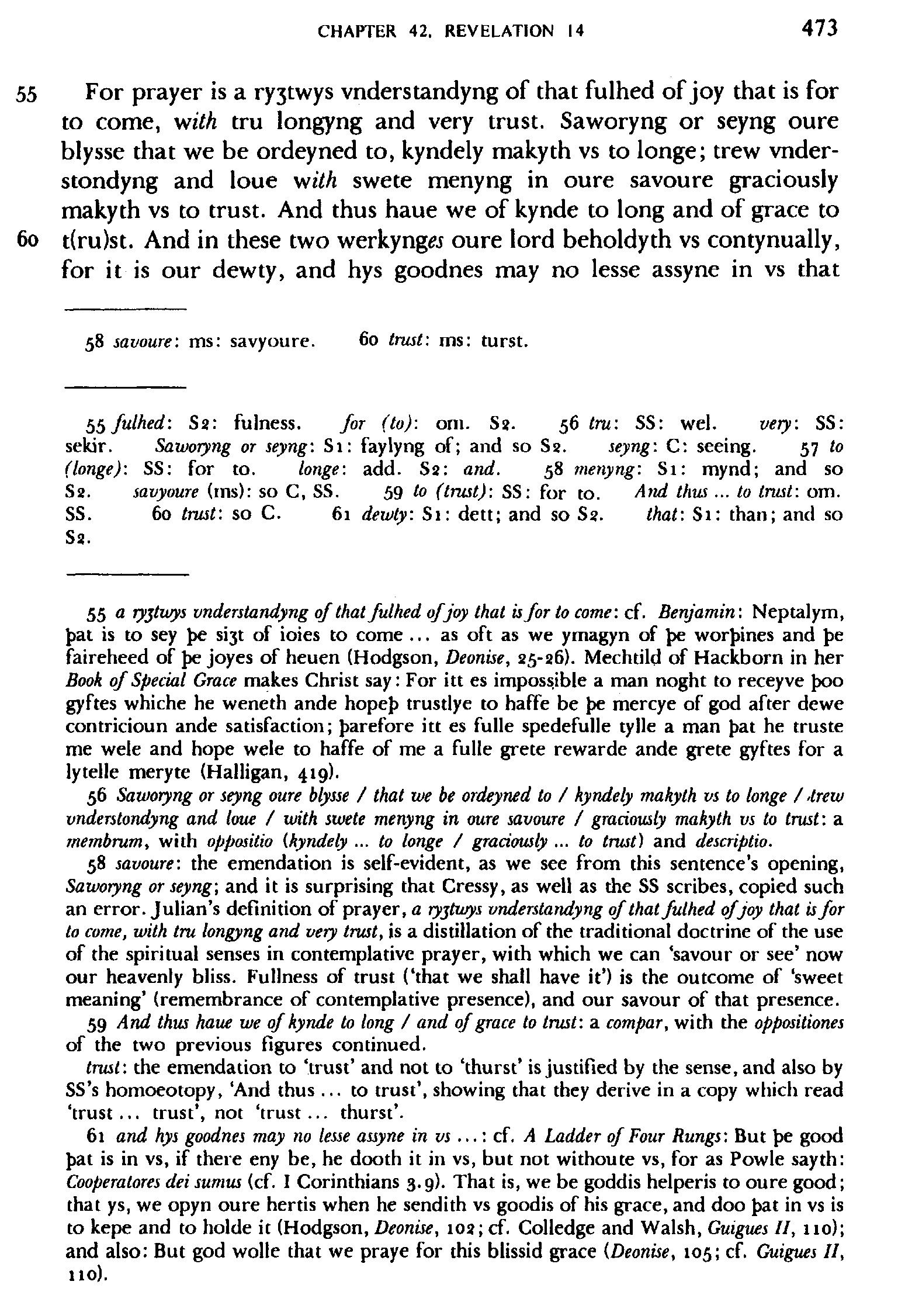
CHAPTER 42. REVELATION 14
For prayer is a ry3twys vnderstandyng of that fulhed of joy that is for to come, with tru longyng and very trust. Saworyng or seyng oure blysse that we be ordeyned to, kyndely makyth vs to longe; trew vnderstondyng and loue with swete menyng in oure savoure graciously makyth vs to trust. And thus haue we of kynde to long and of grace to 60 t(ru)st. And in these two werkyngw oure lord beholdyth vs contynually, for it is our dewty, and hys goodnes may no lesse assyne in vs that 58 savoure: ms: savyoure.
60 trust: ms: turst.
55 fulhed: Ss: fulness. for (to): orn. 82.
56 tru: SS: wel. very: SS: sekir.
Saworyng or seyng: Si: faylyng of; and so 82. seyng: C: seeing.
57 to (longe): SS: for to. longe: add. 82: and.
58 menyng: Si: mynd; and so 82. savyoure (ins): so C, SS.
59 to (trust): SS: for to.
And thus ... to trust: om.
SS.
60 trust: so C.
61 dewty: Si: dett; and so 82. that: Si: than; and so 82.
55 a Wit™?3 understanding of that fulhed of joy that is for to come: cf. Benjamin: Neptalym, pat is to sey )>e sijt of ioies to come ... as oft as we ymagyn of pe worpines and pe faireheed of pe joyes of heuen (Hodgson, Deonise, 25-26). Mechtild of Hackborn in her
Book of Special Grace makes Christ say: For itt es impossible a man noght to receyve poo gyftes whiche he weneth ande hopep trustlye to haffe be pe mercye of god after dewe contricioun ande satisfaction; parefore itt es fulle spedefulle tylle a man pat he truste me wele and hope wele to haffe of me a fulle grete rewarde ande grete gyftes for a lytelle meryte (Halligan, 419).
56 Saworyng or seyng oure blysse / that we be ordeyned to / kyndely makyth vs to longe / ,trew vnderstondyng and loue / with swete menyng in oure savoure / graciously makyth vs to trust: a membrum, with oppositio (kyndely ... to longe / graciously ... to trust) and descriptio.
58 savoure: the emendation is self-evident, as we see from this sentence's opening,
Saworyng or seyng; and it is surprising that Cressy, as well as the SS scribes, copied such an error. Julian's definition of prayer, a ryjtwys vnderstandyng of that fulhed of joy that is for to come, with tru longyng and very trust, is a distillation of the traditional doctrine of the use of the spiritual senses in contemplative prayer, with which we can 'savour or see' now our heavenly bliss. Fullness of trust ('that we shall have it') is the outcome of 'sweet meaning' (remembrance of contemplative presence), and our savour of that presence.
59 And thus haue we of kynde to long / and of grace to trust: a compar, with the oppositiones of the two previous figures continued. trust: the emendation to 'trust' and not to 'thurst' is justified by the sense, and also by SS's homoeotopy, 'And thus ... to trust1, showing that they derive in a copy which read
'trust... trust', not 'trust... thurst'.
61 and hys goodnes may no lesse assyne in vs...: cf. A Ladder of Four Rungs: But pe good pat is in vs, if there eny be, he dooth it in vs, but not withoute vs, for as Powle sayth:
Cooperatores deisumus (cf. I Corinthians 3.9). That is, we be goddis helperis to oure good; that ys, we opyn oure herds when he sendith vs goodis of his grace, and doo pat in vs is to kepe and to holde it (Hodgson, Deonise, 102; cf. Colledge and Walsh, Guigues II, no); and also: But god wolle that we praye for this blissid grace (Deonise, 105; cf. Guigues II,
110).
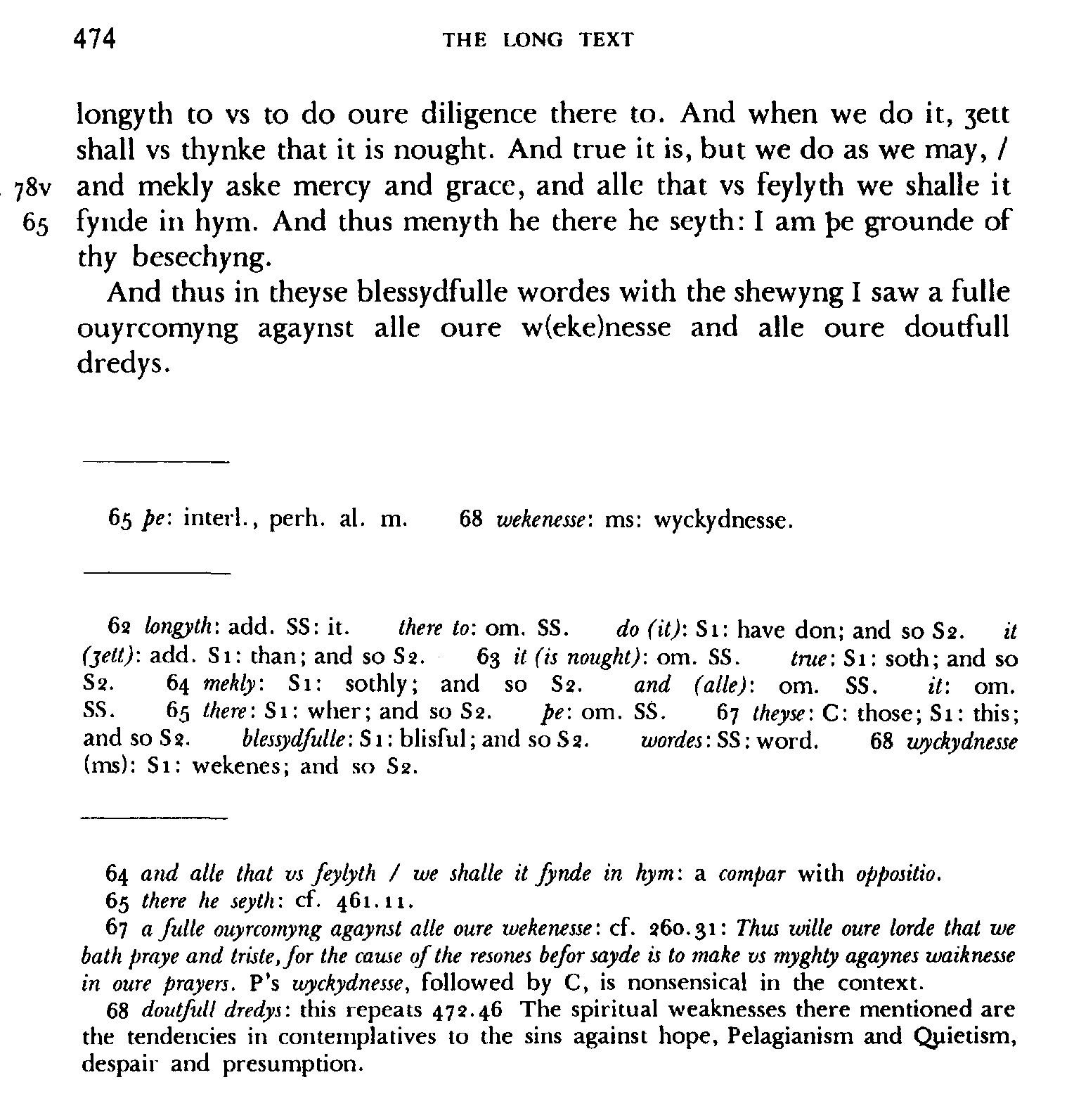
THE LONG TEXT
longyth to vs to do oure diligence there to. And when we do it, jett shall vs thynke that it is nought. And true it is, but we do as we may, / ySv and mekly aske mercy and grace, and alle that vs feylyth we shalle it
65 fynde in hym. And thus menyth he there he seyth: I am be grounde of thy besechyng.
And thus in theyse blessydfulle wordes with the shewyng I saw a fulle ouyrcomyng agaynst alle oure w(eke)nesse and alle oure doutfull dredys.
65 pe: interl., perh. al. m.
68 wekenesse: ms: wyckydnesse.
62 longyth: add. SS: it. there to: om. SS. do (it): Si: have don; and so 82. it (jett): add. Si: than; and so 82.
63 it (is nought): om. SS. true: Si: soth; and so 82.
64 mekly: Si: sothly; and so 82. and (alle): om.
SS. it: om.
SS.
65 there: Si: wher; and so 82. pe: om. SS.
67 theyse: C: those; Si: this; and so 82. blessydfulle: Si: blisful; and so 82. wordes: 88: word.
68 wyckydnesse (ms): Si: wekenes; and so 82.
64 and alle that vs feylyth / we shalle it fynde in hym: a compar with oppositio.
65 there he seyth: cf. 461.11.
67 a fulle ouyrcomyng agaynst alle oure wekenesse: cf. 260.31: Thus wille oure lorde that we bath praye and triste,for the cause of the resones befor sayde is to make vs myghty agaynes waiknesse in oure prayers. P's wyckydnesse, followed by C, is nonsensical in the context.
68 doutfull dredys: this repeats 472.46 The spiritual weaknesses there mentioned are the tendencies in contemplatives to the sins against hope, Pelagianism and Qjiietism, despair and presumption.
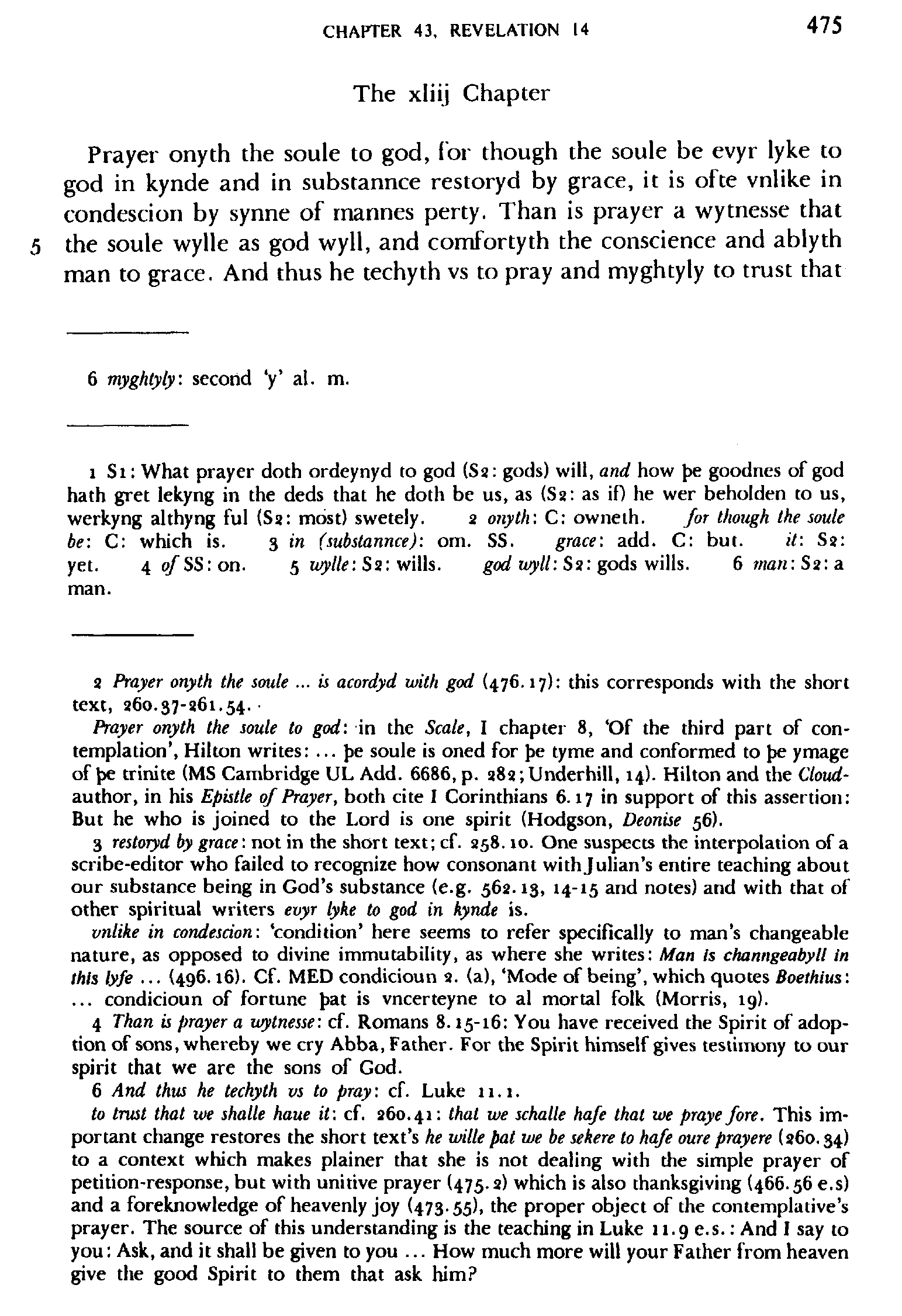
CHAPTER 43, REVELATION 14
The xliij Chapter Prayer onyth the soule to god, for though the soule be evyr lyke to god in kynde and in substannce restoryd by grace, it is ofte vnlike in condescion by synne of rnannes perty. Than is prayer a wytnesse that 5 the soule wylle as god wyll, and comfortyth the conscience and ablyth man to grace. And thus he techyth vs to pray and myghtyly to trust that 6 myghtyly: second 'y' almi Si: What prayer doth ordeynyd to god (Sa: gods) will, and how pe goodnes of god hath gret lekyng in the deds that he doth be us, as (82: as if) he wer beholden to us, werkyng althyng ful (Sa: most) swetely. a onyth: C: owneth. for though the soule be: C: which is.
3 in (substannce): om. SS. grace: add. C: but. it: 82: yet.
4 ofSS:on.
5 wylle: Sa: wills. god wyll: S2: gods wills.
6 ?nan:Sa:a man. a Prayer onyth the soule ... is acordyd with god (476.17): this corresponds with the short text, 260.37-261.54. • Prayer onyth the soule to god: in the Scale, I chapter 8, 'Of the third part of contemplation', Hilton writes: ... pe soule is oned for pe tyme and conformed to pe ymage of pe trinite (MS Cambridge UL Add. 6686, p. 382; Underbill, 14). Hilton and the Cloudauthor, in his Epistle of Prayer, both cite I Corinthians 6.17 in support of this assertion:
But he who is joined to the Lord is one spirit (Hodgson, Deonise 56).
3 restoryd by grace: not in the short text; cf. 358.10. One suspects the interpolation of a scribe-editor who failed to recognize how consonant withjulian's entire teaching about our substance being in God's substance (e.g. 562.13, 14-15 and notes) and with that of other spiritual writers evyr lyke to god in kynde is. vnlike in condescion: 'condition' here seems to refer specifically to man's changeable nature, as opposed to divine immutability, as where she writes: Man is channgeabyll in this lyfe ... (496.16). Cf. MED condicioun 2. (a), 'Mode of being', which quotes Boethius:
... condicioun of fortune pat is vncerteyne to al mortal folk (Morris, 19).
4 Than is prayer a wytnesse: cf. Romans 8.15-16: You have received the Spirit of adoption of sons, whereby we cry Abba, Father. For the Spirit himself gives testimony to our spirit that we are the sons of God.
6 And thus he techy th vs to pray: cf. Luke 11. i. to trust that we shalle haue it: cf. 260.41: that we schalle hafe that we praye fore. This important change restores the short text's he wille pat we be sekere to hafe oure prayers (360.34) to a context which makes plainer that she is not dealing with the simple prayer of petition-response, but with unitive prayer (475.2) which is also thanksgiving (466.56 e.s) and a foreknowledge of heavenly joy (473.55), the proper object of the contemplative's prayer. The source of this understanding is the teaching in Luke 11.9 e.s.: And I say to you: Ask, and it shall be given to you ... How much more will your Father from heaven give the good Spirit to them that ask him?
THE LONG TEXT
we shalle haue it; for he beholdyth vs in loue, and wylle make vs perygr teyner of his good wylle and dede. And therfore / he steryth vs to pray that that lykyth hym to do, for whych prayer and good wylle that we
10 haue of hys gyfte he wylle rewarde vs and geue vs endlesse mede. And thys was shewyd in this worde: And thou besekyst it.
In this wordc god shewyd so grett plesannce and so grett lykyng, as he were much beholdyng to vs for ech good dede that we do; and yet it is he that doth it. And for that we besech hym myghtly to do that thyng
15 that hym lykyth, as yf he seyd: What myght thou plese me more then to besech myghtly, wysely and wylfully to do that thyng that I wyll haue doen? Arid thus J>e soule by prayer is acordyd with god.
7 perteymr: 82: partakers.
8 good: 82: goodnes. wylle and: om. SS. dede: om. 82. vs: add. 82: up.
9 prayer: 82: prayers. we: Si: he wil; and so 82.
12 as: 82: as if.
13 much: 88: mekyl. beholdyng: 82: beholdin (alt. to 'beholden') beholding (cane.). ech: 88: every.
14 that (thyng): SS: al.
16 that (thyng): 82: the. wyql haue doen: 81: shal do; and so 82.
17 is acordyd with: Si: accordyth to; and so 82.
7 for he beholdyth vs in loue: cf. Mark 10.21: And Jesus looking on him loved him. See
260.43 note. perteyner of his good wylle and dede: cf. A Ladder of Four Rungs: God he is as felawe in half getyng in werkes of god, and doothe with vs as a felawe that wille wynnyng haue ... We
3evyn oure love to the feend and oure worshipe to the worlde and to the flessh, and so oure love ys withdrawe from oure gracious partenere (Hodgson, Deonise 104; this is an addition to the Latin; cf. Colledge and Walsh, Guigues II; cf. 462.25 note).
12 as he were much beholdyng to vsfor ech good dede that we do; and yet it is he that doth it: cf. Matthew 25.21: Well done, good and faithful servant; because you have been faithful over a few things, I shall set you over many. Enter into the joy of your lord; and I Corinthians 3.7-8: Neither the one who plants is anything, nor the one who waters, but God, who gives the increase.
13 beholdyng: MED, biholden, v. 5, records this spelling for 'beholden' in Malory
(twice).
15 then to besech myghtly wysely and wylfully / to do that thyng that I wyll haue doen: a cornpar, with continuatio in the first colon and traductio (to do ... haue doen) in the second. The figure is in the short text, 261.51, but it has been subtly reworded to furnish the colores which express Julian's deeper insights.
16 myghtly: this is substituted for besily (261.50), because Julian now sees that all prayer should be to Father, Son and Spirit, since it is through the revelation of the Father in Christ by the power of the Spirit that the gift of prayer is given. wysely and wylfully to do that thyng that I wyll haue doen: cf. the English Stimulus amoris:
And pere fore as pi wille is done and fulfilled in heuene ... so mote hit be done in erpe, pat is in vs erthely men, pat we aftir pe abeltee of ou3re vertu we my3te be conformed to pi wille (H. J. Kane, 182; Kirchberger, 191). In A Ladder of Four Rungs we have: The pridde grace is more specialle ... the 3ifte of the holy goste pat steryth men to doo good werkes ... god makyng and 3evyng this grace. This grace is tokenyng of specialle love of god to them that he sendyth hit... god wolle diat we praye for this blissid grace
(Hodgson, Deonise, 105; cf. Colledge and Walsh, Guigues II, 110).
17 pe soule by prayer is acordyd with god: in Eight Chapters (cf. 261.53 note) we read:
... wharme Ihesu Crist and a soule ben ... acoordably oonyd and bounden to gidere (MS
BN Fonds anglais 41, f. 152'; Jones, 103).
CHAPTER 43, REVELATION 14
But whan cure curtesse lorde of his speciall grace shewyth hym selfe to oure soule, we haue that we desyer, and then we se nott for the tyme
'9v what we shiHde more pray, but all oure / entent with alle oure myghtys 21 is sett hoole in to the beholdyng of hym. And this is an hygh vnp^rceyvable prayer, as to my syghte; for alle the cause wherfore we pray is to be onyd in to the syght and the beholdyng of him to whom we pray, mervelously enjoyeng with reuerent drede, and so grett swettnessc and 25 dely3te in hym that we can pray ryght nought but as he steryth vs for the tyme.
18 With 'And in thee selfe', the eighth extract in W begins.
23 to be: add. marg. al. m.
24 enjoyeng: first 'en' interl. al. m.
18 speciall: om. SS. shewyth hym selfe: W: And in thee selfe.
19 soule: W: soulis. that: Ss: what.
20 entent: 82: content. myghtys: Si: myte; and so 82.
21 hoole: Si: holy. in: om. SS. hygh: add. W: and.
22 pray: C: prayer. is to be: SS: it is.
23 to be: om.
W. the (beholdyng): om.
C, SS.
25 can pray ryght nought: W: can not pray no thyng.
18 of his speciall grace: cf. the quotation above from A Ladder of Four Rungs.
19 we haue that we desyer: cf. 261.54 note. The whole of this following passage seems to be inspired by the traditional spiritual exegesis of the Canticles, e.g.: I sat down under his shadow whom I desired (2.3); your voice is sweet and your face is comely (2.14);
I found hjm whom my soul loves (3.4); I held him and I will not let him go (ibid.); how beautiful you are, my love (4.1); I to my beloved and my beloved to me (6.2). Julian never, however, feels called upon, as do Rolle (especially in his Exposicio) and the Cloudauthor (cf. An Epistle of Discretions of Stirrings, Hodgson, Deonise 72) to draw attention to the erotic imagery by citing the words of the text. Her mervelously enjoyeng is always associated with reuerent drede. Cf. Introduction.
21 vnperceyvable: NED's first example is from the Scale of Perfection, II 8: Thorugh a pryue vnperceyuable worchyng of the holy ghost. The context of NED's quotation is:
... bot he may noj^r see ne fele pe reformyng of his soule, how it is wonderly and vnperceyuablely channged fro pe filpe of a fende to pe fairhed of an anngel ... to pe liknes of god borw a pn'ue vnperceuable wirkyng of pe holy gost... (MS Harley 6579, f. 69'; Undcrhill, 250-251). The rare occurrence of the term suggests that Julian may here have in mind the same connotations as Hilton's, which are explicitly sacramental.
23 to be onyd in to the syght and the beholdyng of him to whom we pray: in Eight Chapters (cf.
261.53 note) we read: ... pa< Crist is in pe soule and pe soule is in him so fully as if pei bope weren o spirit ... pawne feelij) pe soule hi3e pingis and pryue of Crist Ih«u and of his fadir and of his holi spirit, and it tastip siche delectaciouns of Cristes charite pat pei may not fulli be con-(f. i52v)seyued with J>ou3tis of mannys resouw ne declarid forj> wi{> wordis of maranys tuwge (MS BN Fonds anglais 41; Jones, 104).
24 reuerent drede: in Eight Chapters there is: ... for in pat come}) pe grace of pe holy goost doun in to a soule, and panne it lijtnej) and purgip so pe soule pa/ it is al as $36 and it anoyntij) pe soule (ibid., f. 147*; Jones, 96).
THE LONG TEXT
And welle I wott the more the soule seeth of god, the more she desyeryth hym by grace; but whan we se hym nott so, than fele we nede and cause to praye, for feylyng and for vnablynes of oure selfe tojhtf.su.
30 For whan a soule is temptyd, troblyde and le(f)te to her selfe by her vnrest, then is it tyme to praye to make her selfe suppull and buxom to 30 lefte: ms: Icste; cf. 262.61.
27 she: SS: W: it.
28 by: Si: be his; and so 82.
29 and (for): om. SS. vnablynes: Si, W: ablyng; and so 82; cf. A (262.60): habelynge. selfe:
82: selves.
Jhesu: W: our lord Jh«u.
30 a: SS: the. temptyd: SS, W: tempested; cf. A (262.60): tempted; add. Si: and; and so W. her (selfe by): Si: hym; and so 82; W: it. by her vnrest: om. W. her (vnrest): om. SS.
31 it: om. W. her selfe (suppull): Si, W: hym; and so 82. buxom: C: asterisk in text, but no marg. gloss.
27 the more the soule seeth of god, the more she desyeryth hym by grace: cf. A Ladder of Four
Rungs: Thus it faryth sumtyme by goddis loveris that from J)e tyme that they hadde tastyd of this pyment, that is of the swettnesse of god, such lykyng Jjei founde theryn that as drunkyn men they did spende that they hadde (Hodgson, Deonise 113-114). This is not in Guigo's Latin; the English translator draws out the simile of the drunkard — the more he drinks, the more he wants to drink — making also the point that it is God who provides the drink, just as Julian here writes: we can pray ryght nought but as he steryth vs for the tyme.
28 but whan we se hym nott so ... oon lyke in loue (479.33): this corresponds with the short text, 261.59-262.63.
29 for feylyng and for vnablynes of oure selfe: cf. the Chastising: in his absence we bien al cold and drie, swetnesse haue we noon ne sauoure in deuocion, slou3 we bien to preie or to trauaile, f>e wreched saule sodanly is chaunged and made ful heuy and ful of sorwe and care (Bazire and Colledge, 98).
30 For whan a soule is temptyd troblyde / and lefte to her selfe by her vnrest / then is it tyme to praye / to make her selfe suppull and buxom to god: a compar with oppositio (temptyd troblyde and lefte to her selfe / suppull and buxom to god). The figure is in the short text; but the oppositio requires suppull; and to praye to make — to ask for the grace to achieve this — is much more likely to be what Julian wrote also in the short text than to pray and to make, with its Jansenist flavour.
31 suppull and buxom to god: cf. 262.62: symple and boxsomm to god, and note. If symple be not scribal error, it would seem as if Julian herself emended what she had originally written, when she finally came to understand, in the great parable, why she never saw
God shewyng to vs no more blame then if we were as dene and as holy as angelis (511.14). This is a deeper penetration into the Johannine teaching (e.g. John 14.20-24) that we are enabled to be obedient because the love which is God abides in us, a love which is always the same, and we always abide in it, unless we positively reject it, whether we see God-love or not.
CHAPTER 43, REVELATION 14
god. But he by no manner of prayer makyth god suppell to hym; for he is evyr oon lyke in loue. And thus I saw that what tyme we se nede
8or wherfore / we praye, then our lord god folowyth vs, helpyng our 35 desyre. And whan we of his speciall grace pleynly beholde hym, seyeng none other, nedys then we folowe hym, and he drawyth vs to hym by loue. For I saw and felt that his mervclous and his fulsom goodnesse fulfyllyth all oure myghtys; and ther with I saw that hys contynuall
32 he (by): ms: she; cf. 262.62.
33 oon lyke: ms: oon-Iyke.
37 felt: ms: felft.
32 he (by): so SS, W.
33 oon lyke:C: one lyke; S i, W: alyke; and so 82. se nede:
W: sedis. nede: Si: nedys; and so 82.
34 lord god: Si: good lord; and so Sa.
36 none: add. C: of. to: SS, W; into.
37 his (fulsom): C, marg.: plentiful.
38 oure: W: other. ther: 82: ben. witlr.om.SS. contynuall: SS: continuate; W: contynuynge.
32 for he is evyr oon lyke in loue: cf. Psalm 101. 28: Thou art always the self-same; and Hebrews 13.8.-Jesus Christ, yesterday and today and the same for ever.
33 And thus I saute ... helpyng our desyre: cf. the Roman collect for the Ember Saturday in Lent: Actiones nostras, quaesumus Domine, aspirando praeveni et adjuvando prosequere, ut cuncta nostra oratio et operatic a te semper incipiat, et per te coepta finiatur (Bruylants 2 no. 18), and the Cloud, quoting Gregory and Augustine: For not what bou arte ne what bou hast ben beholdeb god wib his mercyful ly, bot bat bou woldest be ... alle holy desires growen bi delaies ... al be liif of a good cristen man is not elles bot holy desire (Hodgson, 132-133).
34 helpyng our desyre: cf. Luke 24.32: Was not our heart burning within us whilst he spoke on the way?
35 whan we ... pleynly beholde hym: Luke 24.31: Their eyes were opened, and they knew him. seyeng none other: cf. Matthew 17.8: And they lifting up their eyes saw no one but only
Jesus.
36 nedys then we folowe hym: cf. John 14.6: No man comes to the Father but by me. and he drawyth vs to hym by loue: Rolle in his Exposicio (cf. 263. i note) quotes Osee 11.4:
I will draw them with the cords of Adam, with the bands of love, and writes: Itaque patet quod nisi per vincula caritatis trahi cupimus, proculdubio ad Christum non veniemus (Murray, 59).
38 fulfyllyth all oure myghtys: cf. the Cloud: And he by him self... is sufficient at be fulle ... to fulfille be wille and be desire of oure soule. And oure soule ... is mad sufficient at be fulle to comprehende al him by loue (Hodgson, 18).
/ saw ... mene of thynke: cf. John 5.17-20: My Father works until now, and I work ... whatever things (the Father) does, the Son also does ... The Father ... shows him all things which he himself does, and greater works than these will he show him. Mechtild of Hackborn in her Book of Special Grace makes Christ say: My fader into his tyme worschith ande I worch... Ande I wyrke in the swylke worke borowe myne devyne wysdome, whiche werke passene by wittes. The holy goste also werkes in the a werke borowe his grete pytee of be, whiche werke bowe maye noght 3itte haffe be taaste
(Halligan, 399).
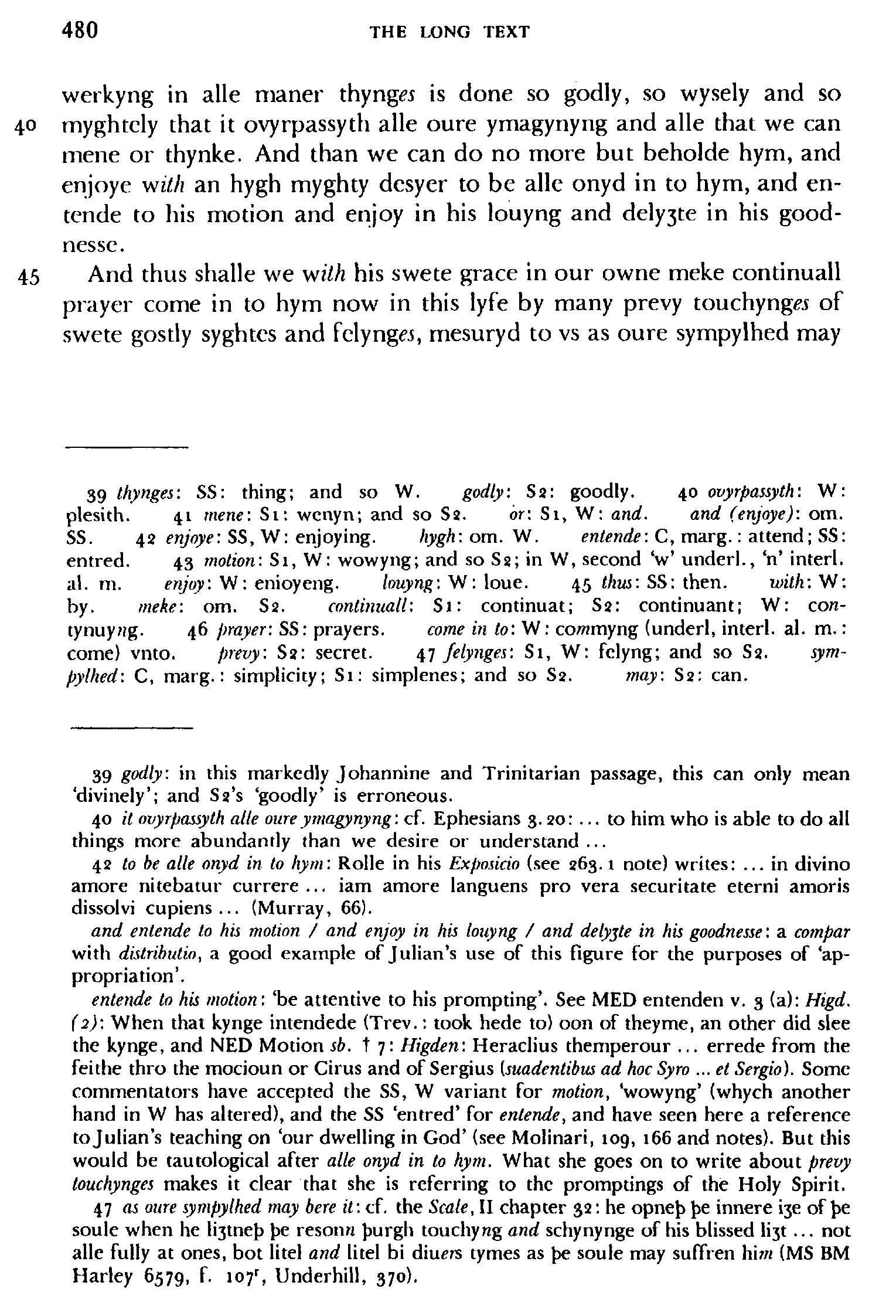
THE LONG TEXT
werkyng in alle maner thyngw is done so godly, so wysely and so 40 myghtcly that it ovyrpassyth alle oure ymagynyng and alle that we can mene or thynke. And than we can do no more but beholde hym, and enjoye with an hygh myghty dcsyer to be alle onyd in to hym, and entende to his motion and enjoy in his louyng and delyjte in his goodnesse.
And thus shalle we with his swete grace in our owne meke continuall prayer come in to hym now in this lyfe by many prevy touchyng^s of swete gostly syghtes and felyngw, mesuryd to vs as oure sympylhed may
39 thynges: SS: thing; and so W. godly: Sa: goodly.
40 ovyrpassyth:
W: plesith.
41 mene: Si: wcnyn; and so 82. or: Si, W: and. and (enjoye): om.
SS.
42 enjoye: SS, W: enjoying. hygh: om. W. entende: C, marg.: attend; SS: entred.
43 motion: Si, W: wowyng; and so Sa; in W, second 'w' under!., 'n' interl. al. m. enjoy: W: enioyeng. louyng: W: loue.
45 thus: SS: then. with: W: by. meke: om.
Ss. continuall: Si: continual; 82: continuant; W: contynuy»g.
46 j>rayer: SS: prayers. come in to: W: cowmyng (under!, interl. al. m.: come) vnto. prevy: 82: secret.
47 felynges: Si, W: felyng; and so 82. sympylhed: C, marg.: simplicity; Si: simplenes; and so 82. may: 82: can.
39 godly: in this markedly Johannine and Trinitarian passage, this can only mean
'divinely'; and Sa's 'goodly' is erroneous.
40 it ovyrpassyth alle oure ymagynyng: cf. Ephesians 3. 20: ... to him who is able to do all things more abundantly than we desire or understand ...
42 to be alle onyd in to hym: Rolle in his Exposicio (see 263. i note) writes: ... in divino amore nitebatur currere... iam amore languens pro vera securitate eterni amoris dissolvi cupiens ... (Murray, 66). and entende to his motion / and enjoy in his louyng / and delyjte in his goodnesse: a compar with distributio, a good example of Julian's use of this figure for the purposes of 'appropriation'. entende to his motion: 'be attentive to his prompting'. See MED entenden v. 3 (a): Higd.
(2): When that kynge intendede (Trev.: took hede to) oon of theyme, an other did slee the kynge, and NED Motion sb. t 7: Higden: Heraclius themperour ... errede from the feithe thro the mocioun or Cirus and of Sergius (suadentibus ad hoc Syro ... et Sergio). Some commentators have accepted the 88, W variant for motion, 'wowyng' (whych another hand in W has altered), and the SS 'entred' for entende, and have seen here a reference tojulian's teaching on 'our dwelling in God' (see Molinari, 109, 166 and notes). But this would be tautological after alle onyd in to hym. What she goes on to write about prevy touchynges makes it clear that she is referring to the promptings of the Holy Spirit.
47 as oure sympylhed may here it: cf. the Scale, II chapter 32: he opnep pe innere {36 of pe soule when he Ii3tnejj }>e resonn purgh touchyng and schynynge of his blissed lijt ... not alle fully at ones, bot litel and litel bi dium tymes as pe soule may suffren him (MS BM
Harley 6579, f. io7r, Underbill, 370).
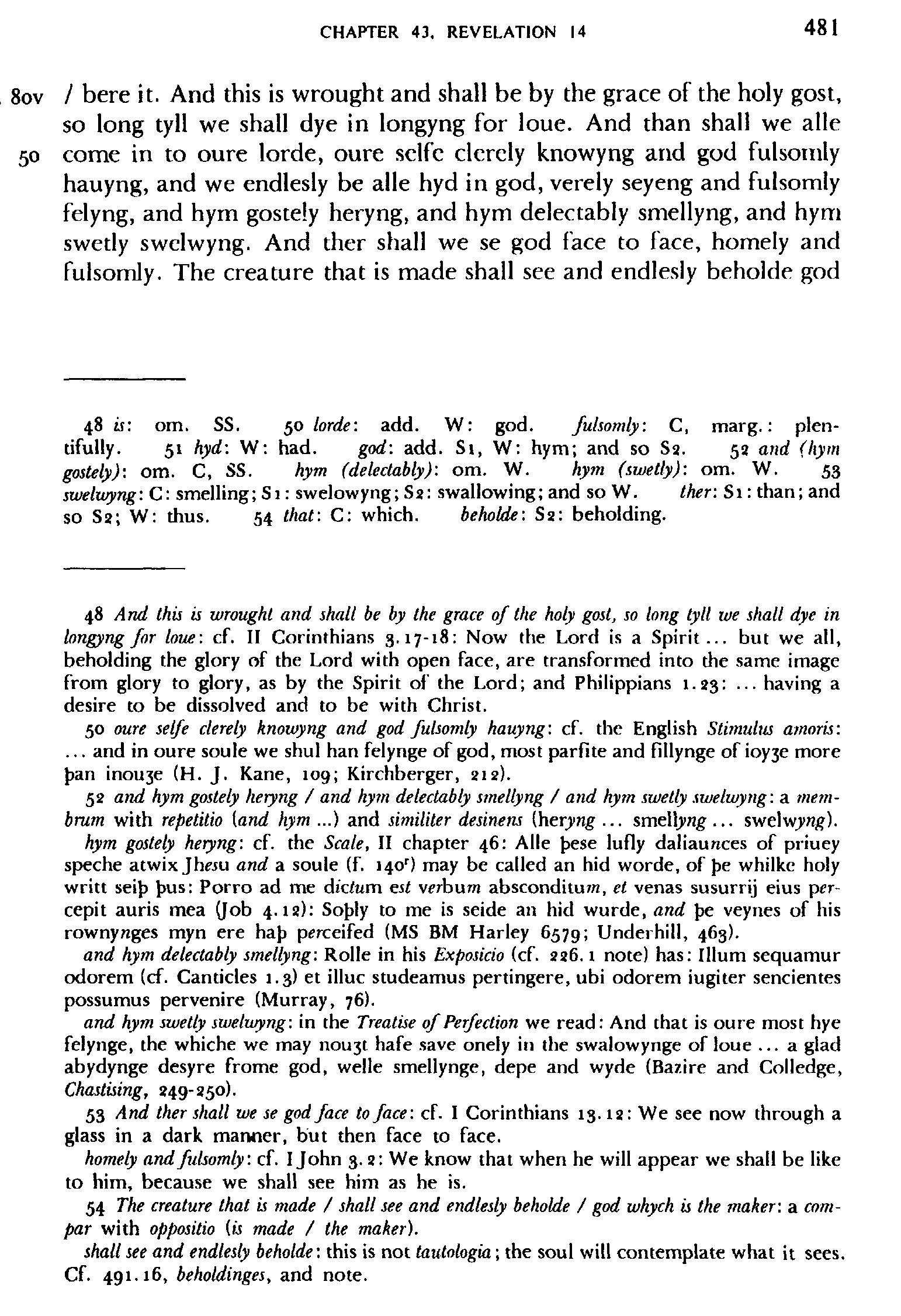
CHAPTER 43, REVELATION 14
8ov / here it. And this is wrought and shall be by the grace of the holy gost, so long tyll we shall dye in longyng for loue. And than shall we alle
50 come in to oure lorde, oure selfe clerely knowyng and god fulsomly hauyng, and we endlesly be alle hyd in god, verely seyeng and fulsomly felyng, and hym gostely heryng, and hym delectably smellyng, and hym swetly swelwyng. And ther shall we se god face to face, homely and fulsomly. The creature that is made shall see and endlesly beholde god
48 is: om.
SS.
50 lorde: add.
W: god. fulsomly:
C, marg.: plentifully.
51 hyd: W: had. god: add. Si, W: hym; and so 82.
52 and (hym gostely): om. C, SS. hym (delectably): om. W. hym (swetly): om. W.
swelwyng: C: smelling; Si: swelowyng; Sa: swallowing; and so W. ther: Si: than; and so 82; W: thus.
54 that: C: which. beholde: Sa: beholding.
48 And this is wrought and shall be by the grace of the holy gost, so long tyll we shall dye in longyng for loue: cf. II Corinthians 3.17-18: Now the Lord is a Spirit... but we all, beholding the glory of the Lord with open face, are transformed into the same image from glory to glory, as by the Spirit of the Lord; and Philippians 1.23: ... having a desire to be dissolved and to be with Christ.
50 oure selfe clerely knowyng and god fulsomly hauyng: cf. the English Stimulus amoris:
... and in oure soule we shul han felynge of god, most parfite and fillynge of ioyje more
£an inouse (H. J. Kane, 109; Kirchberger, 21 a).
52 and hym gostely heryng / and hym delectably smellyng / and hym swetly swelwyng: a membrum with repetitio (and hym ...) and similiter desinens (heryng ... smelling ... swelwyng). hym gostely heryng: cf. the Scale, II chapter 46: Alle Jjese lufly daliaunces of priuey speche atwix Jhmi and a soule (f. 140') may be called an hid worde, of })e whilke holy writt seijj j>us: Porro ad me dictum est verbum abscondituwz, et venas susurrij eius percepit auris mea (Job 4.12): SoJ>ly to me is seide an hid wurde, and pe veynes of his rownyrcges myn ere hajj p<?rceifed (MS BM Harley 6579; Underbill, 463). and hym delectably smellyng: Rolle in his Exposicio (cf. 226. i note) has: Ilium sequamur odorem (cf. Canticles 1.3) et illuc studeamus pertingere, ubi odorem iugiter sencientes possumus pervenire (Murray, 76). and hym swetly swelwyng: in the Treatise of Perfection we read: And that is oure most hye felynge, the whiche we may noujt hafe save onely in the swalowynge of loue ... a glad abydynge desyre frome god, welle smellynge, depe and wyde (Ba/ire and Colledge,
Chastising, 249-250).
53 And ther shall we se god face to face: cf. I Corinthians 13.12: We see now through a glass in a dark manner, but then face to face. homely and fulsomly: cf. I John 3.2: We know that when he will appear we shall be like to him, because we shall see him as he is.
54 The creature that is made / shall see and endlesly beholde / god whych is the maker: a cornpar with oppositio (is made / the maker). shall see and endlesly beholde: this is not tautologia; the soul will contemplate what it sees.
Cf. 491.16, beholdinges, and note.
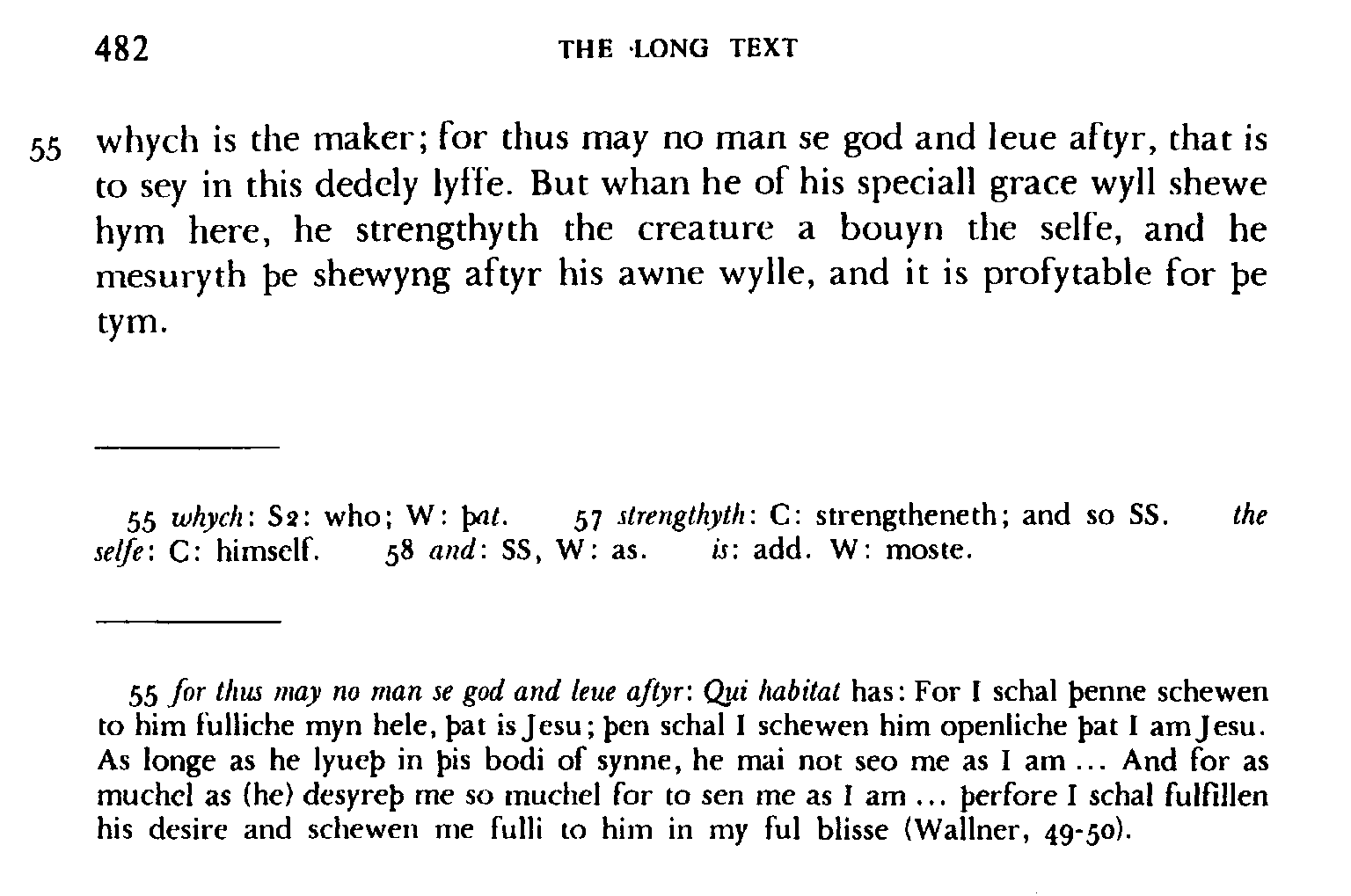
THE LONG TEXT
55 whych is the maker; for thus may no man se god and leue aftyr, that is to sey in this dedely lyf'f'e. But whan he of his speciall grace wyll shewe hym here, he strengthyth the creature a bouyn the selfe, and he mesuryth £>e shewyng aftyr his awne wylle, and it is profytable for pe tym.
55 whych: 82: who; W: \xit.
57 strengthyth: C: strengtheneth; and so SS. the selfe: C: himself.
58 and: SS, W: as. is: add. W: moste.
55 for thus may no man se god and leue aftyr: Qui habitat has: For I schal ^enne schewen to him fulliche myn hele, Jjat isjesu; J>en schal I schewen him openliche Jjat I amjesu.
As longe as he lyuej) in {)is bodi of synne, he mai not seo me as I am ... And for as muchel as (he) desyrep me so muchel for to sen me as I am ... perfore I schal fulfillen his desire and schewen me full! to him in my ful blisse (Wallner, 49-50).
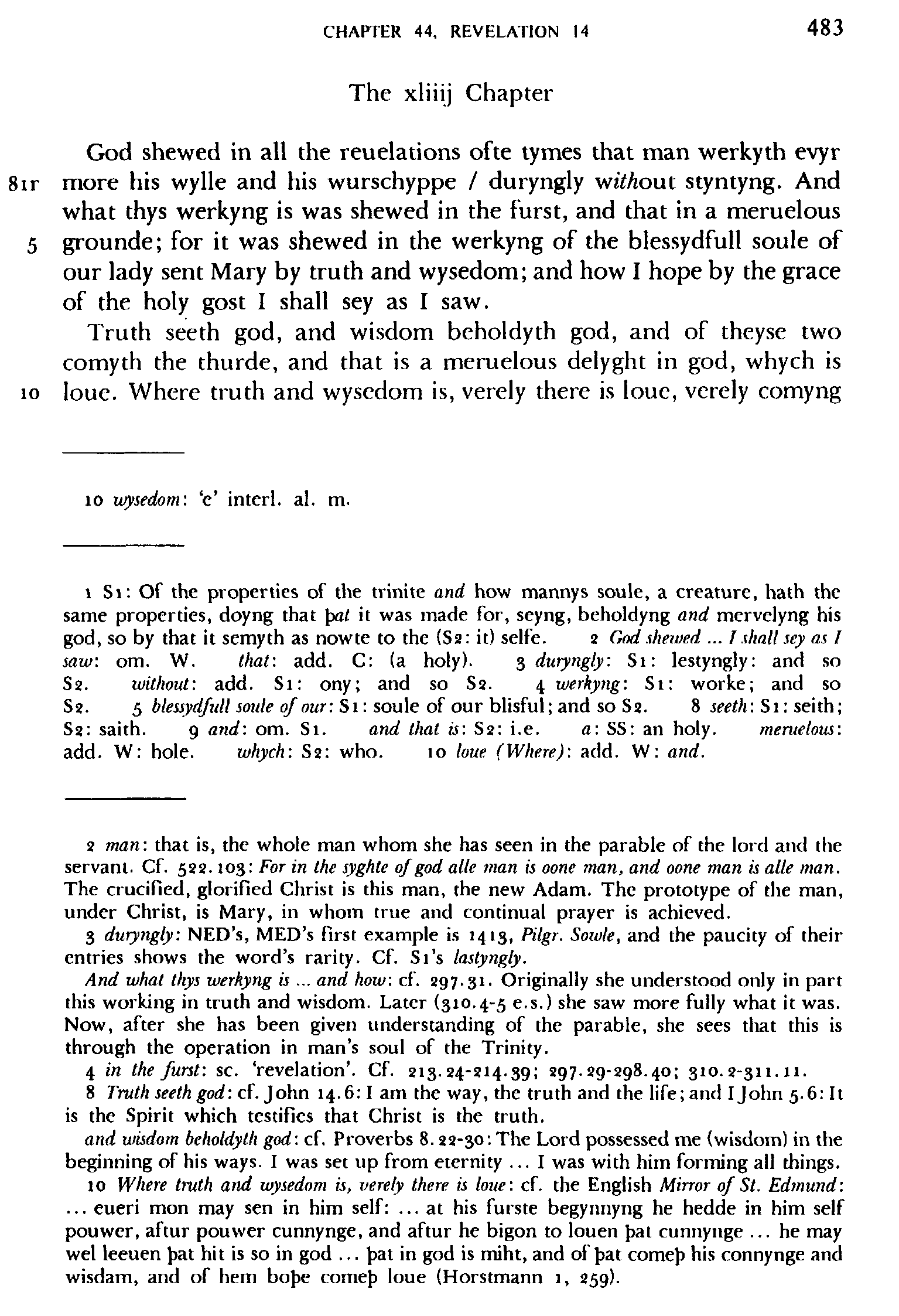
CHAPTER 44, REVELATION 14
The xliiij Chapter God shewed in all the reuelations ofte tymes that man werkyth evyr
Sir more his wylle and his wurschyppe / duryngly -without styntyng. And what thys werkyng is was shewed in the furst, and that in a meruelous
5 grounde; for it was shewed in the werkyng of the blessydfull soule of our lady sent Mary by truth and wysedom; and how I hope by the grace of the holy gost I shall sey as I saw.
Truth seeth god, and wisdom beholdyth god, and of theyse two comyth the thurde, and that is a meruelous delyght in god, whych is
10 loue. Where truth and wysedom is, verely there is loue, verely comyng 10 wysedom: 'e' interl. al. m. i Si: Of the properties of the trinite and how mannys soule, a creature, hath the same properties, doyng that \>at it was made for, seyng, beholdyng and mervelyng his god, so by that it semyth as nowte to the (82: it) selfe.
2 God shewed ... I shall sey as 1 saw: om. W. that: add.
C: (a holy).
3 duryngly: Si: lestyngly: and so 82. without: add.
Si: ony; and so 82.
4 werkyng: Si: worke; and so 82.
5 blessydfull soule of our: Si: soule of our blisful; and so 82.
8 seeth: Si: seith; 82: saith.
9 and: om. Si. and that is: 82: i.e. a: 88: an holy. meruelous: add. W: hole. whych: 82: who.
10 loue (Where): add. W: and.
2 man: that is, the whole man whom she has seen in the parable of the lord and the servant. Cf. 522.103: For in the syghte of god alle man is oone man, and oone man is alle man.
The crucified, glorified Christ is this man, the new Adam. The prototype of the man, under Christ, is Mary, in whom true and continual prayer is achieved.
3 duryngly: NED's, MED's first example is 1413, Pilgr. Sowle, and the paucity of their entries shows the word's rarity. Cf. Si's lastyngly.
And what thys werkyng is ... and how: cf. 297.31. Originally she understood only in part this working in truth and wisdom. Later (310.4-5 e.s.) she saw more fully what it was.
Now, after she has been given understanding of the parable, she sees that this is through the operation in man's soul of the Trinity.
4 in the furst: sc. 'revelation'. Cf. 213.24-214.39; 297.29-298.40; 310.2-311.11.
8 Truth seeth god: cf. John 14.6:1 am the way, the truth and the life; and I John 5.6: It is the Spirit which testifies that Christ is the truth. and wisdom beholdyth god: cf. Proverbs 8.22-30: The Lord possessed me (wisdom) in the beginning of his ways. I was set up from eternity ... I was with him forming all things.
10 Where truth and wysedom is, verely there is loue: cf. the English Mirror of St. Edmund:
... eueri mon may sen in him self: ... at his furste begynnyng he hedde in him self pouwer, aftur pouwer cunnynge, and aftur he bigon to louen f>at cunnynge ... he may wel leeuen |>at hit is so in god .,. f>at in god is miht, and of {jat comef> his connynge and wisdam, and of hem boj)e comej) loue (Horstmann i, 259).
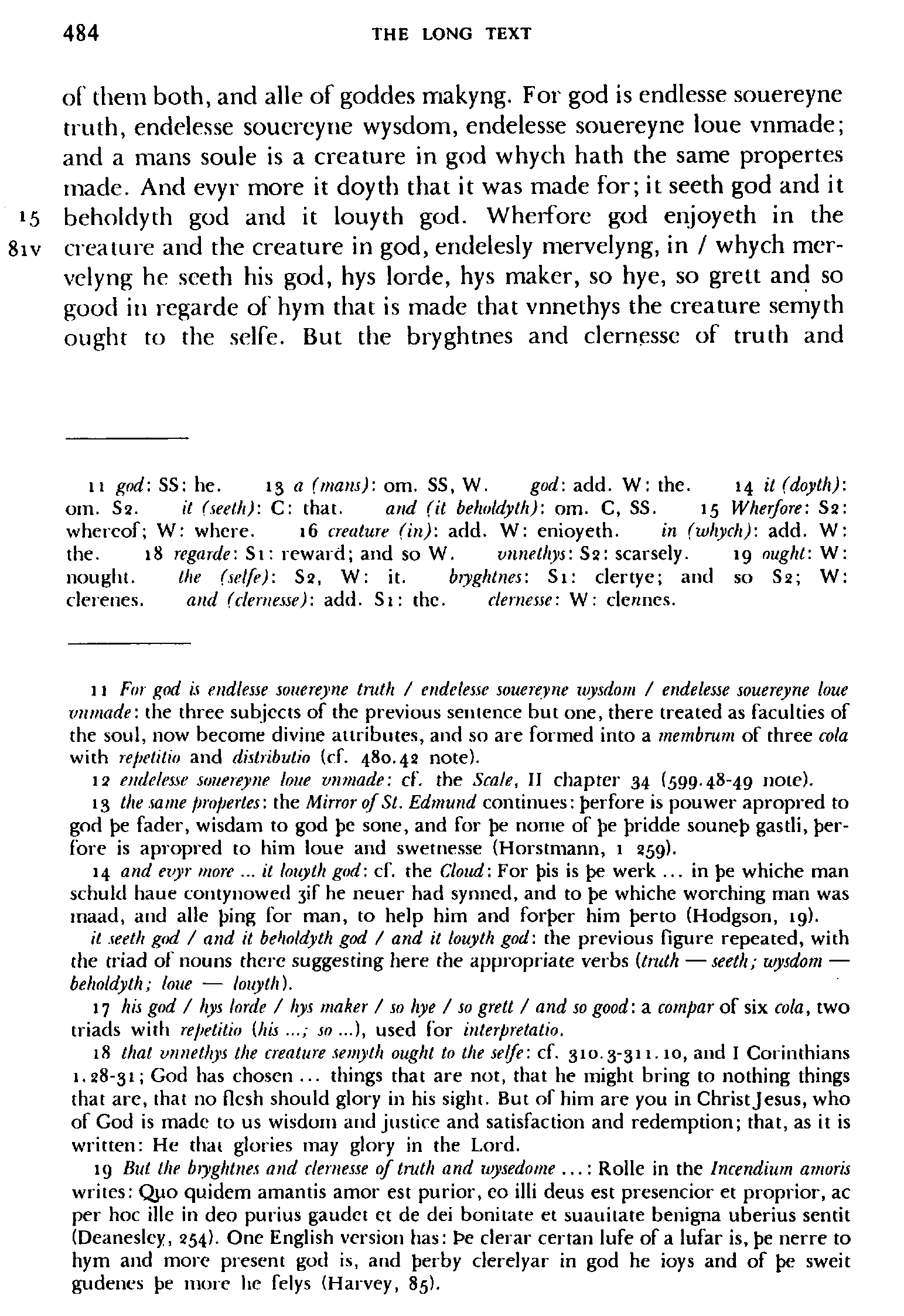
THE LONG TEXT
of them both, and alle of goddes makyng. For god is endlesse souereyne truth, endelesse souereyne wysdom, endelesse souereyne loue vnmade; and a mans soule is a creature in god whych hath the same propertes made. And evyr more it doyth that it was made for; it seeth god and it
15 beholdyth god and it louyth god. Wherfore god enjoyeth in the 8iv creature and the creature in god, endelesly mervelyng, in / whych mervclyng he seeth his god, hys lorde, hys maker, so hye, so grett and so good in regarde of hym that is made that vnnethys the creature semyth ought to the selfe. But the bryghtnes and clernesse of truth and 11 god: SS: he.
13 a (mam): om. SS, W. god: add. W: the.
14 it (doyth): om. 82. it (seeth): C: that. and (it beholdyth): om. C, SS.
15 Wherfore: S s : whereof; W: where.
16 creature (in): add. W: enioyeth. in (whych): add. W: the.
18 regarde: Si: reward; and so W. vnnethys: Sa: scarsely.
19 ought: W: nought. the (selfe):
Sa, W: it. bryghtnes: Si: clertye; and so Sa; W: clerenes. and (clernesse): add. Si: the. clernesse: W: clennes.
11 For god is endlesse souereyne truth / endelesse souereyne wysdom / endelesse souereyne loue vnmade: the three subjects of the previous sentence but one, there treated as faculties of the soul, now become divine attributes, and so are formed into a membrum of three cola with refwtitio and distributio (cf. 480.42 note).
12 endelesse souereyne loue vnmade: cf. the Scale, II chapter 34 (599.48-49 note).
13 the same (>rofjertes: the Mirror of St. Edmund continues: perfore is pouwer apropred to god \>e fader, wisdam to god £>e sone, and for f>e nome of pe pridde sounejj gastli, {jerfore is apropred to him loue and swetnesse (Horstmann, i 259).
14 and evyr more ... it louyth god: cf. the Cloud: For pis is pe werk ... in pe whiche man schuld haue contynowed 3if he neuer had synned, and to pe whiche worching man was maad, and alle ping for man, to help him and former him perto (Hodgson, 19).
// seeth god / and it beholdyth god / and it louyth god: the previous figure repeated, with the triad of nouns there suggesting here the appropriate verbs (truth —seeth; wysdom — beholdyth; loue — louyth).
17 his god / hys lorde / hys maker / so hye / so grett / and so good: a compar of six cola, two triads with rejielitio (his ...; so ...), used for interpretatio.
18 that vnnethys the creature semyth ought to the selfe: cf. 310.3-311.10, and I Corinthians
1.28-31; God has chosen ... things that are not, that he might bring to nothing things that are, that no flesh should glory in his sight. But of him are you in Christjesus, who of God is made to us wisdom and justice and satisfaction and redemption; that, as it is written: He thai glories may glory in the Lord.
19 But the bryghtnes and clernesse of truth and wysedome ...: Rolle in the Incendium a?noris writes: Quo quidem amantis amor est purior, eo illi deus est presencior et proprior, ac per hoc ille in deo purius gaudet et de dei bonitate et suauitate benigna uberius sentit
(Deanesley, 254). One English version has: t>e clerar certan lufe of a lufar is, pe nerre to hym and more present god is, and perby clerelyar in god he ioys and of J>e sweit gudenes pe more he felys (Harvey, 85).
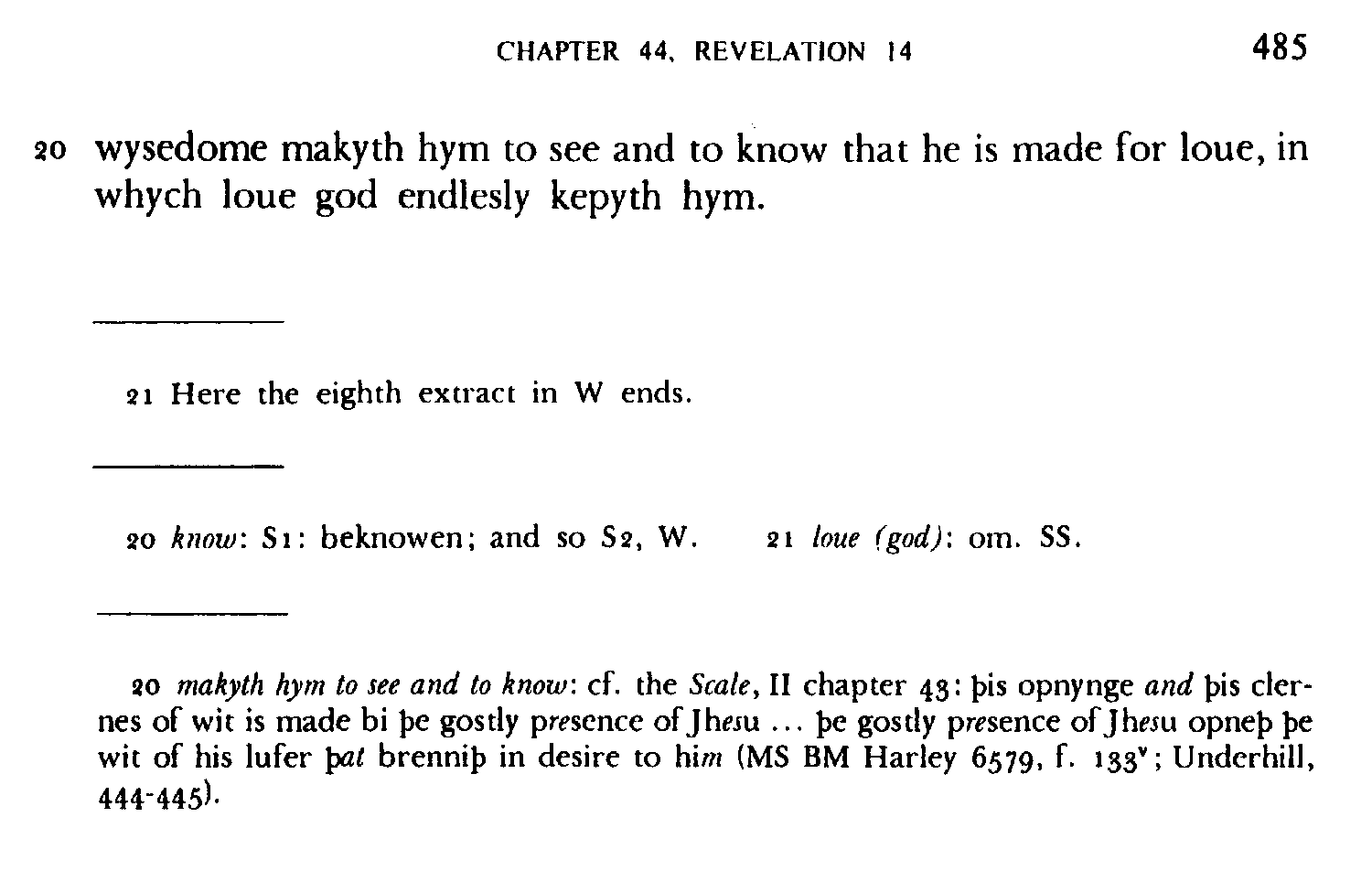
CHAPTER 44, REVELATION 14
20 wysedome makyth hym to see and to know that he is made for loue, in whych loue god endlesly kepyth hym.
21 Here the eighth extract in W ends.
20 know: Si: beknowen; and so 82, W.
21 loue (god): om. SS.
20 makyth hym to see and to know. cf. the Scale, II chapter 43: {)is opnynge and Jjis clernes of wit is made bi f>e gostly presence of Jh«u ... £e gostly presence of Jh«u opnej) J>e wit of his lufer ^at brennij) in desire to him (MS BM Harley 6579, f. 133*; Underbill,
444-445).
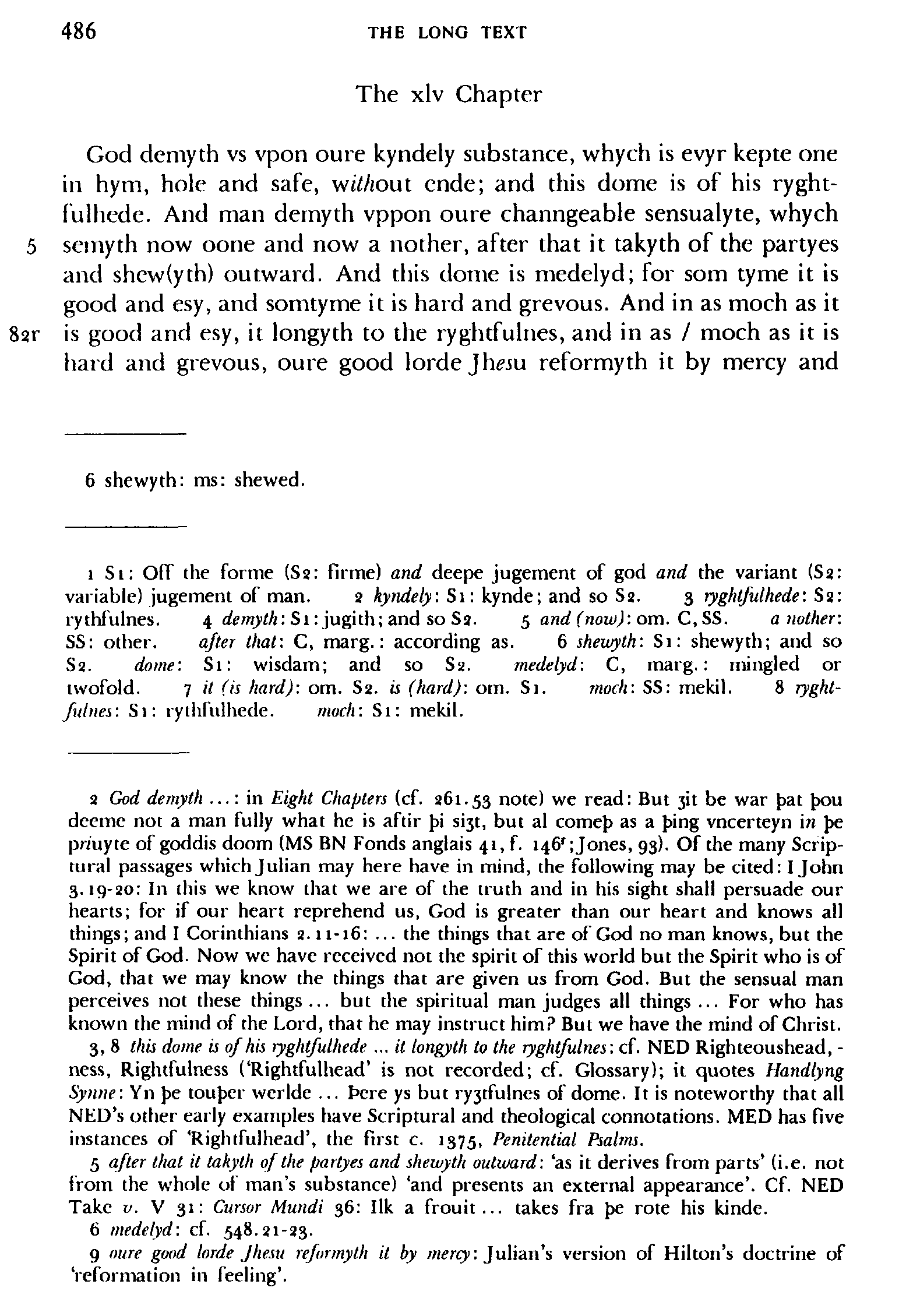
THE LONG TEXT
The xlv Chapter God demyth vs vpon oure kyndely substance, whych is evyr kepte one in hym, hole and safe, without cnde; and this dome is of his ryghtfulhede. And man demyth vppon oure channgeable sensualyte, whych
5 semyth now oone and now a nother, after that it takyth of the partyes and shew(yth) outward. And this dome is medelyd; for som tyme it is good and esy, and somtyme it is hard and grevous. And in as moch as it
8sr is good and esy, it longyth to the ryghtfulnes, and in as / moch as it is hard and grevous, oure good lordejhmi reformyth it by mercy and 6 shewyth: ms: shewed. i Si: Off the forme (Sa: firme) and deepe jugement of god and the variant (82: variable) jugement of man.
2 kyndely: Si: kynde; and so $2.
3 ryghtfulhede: Sa: rythfulnes.
4 demyth: Si: jugith; and so 82.
5 and (now): om. C.SS. another:
SS: other. after that: C, marg.: according as.
6 shewyth: Si: shewyth; and so Sa. dome:
Si: wisdam; and so Sa. medelyd:
C, marg.: mingled or twofold.
7 it (is hard): om. Sa. is (hard): om. Si. moch: SS: mekil.
8 ryghtfulnes: Si: rythfulhede. moch: Si: mekil. a God demyth ...: in Eight Chapters (cf. 361.53 note) we read: But 3it be war fciat Jx>u deeme not a man fully what he is aftir £>i si3t, but al come}) as a f>ing vncerteyn in f>e pr/uyte of goddis doom (MS BN Fonds anglais 41, f. 146';Jones, 93). Of the many Scriptural passages which Julian may here have in mind, the following may be cited: I John
3. ig-ao: In this we know that we are of the truth and in his sight shall persuade our hearts; for if our heart reprehend us, God is greater than our heart and knows all things; and I Corinthians a. 11-16: ... the things that are of God no man knows, but the Spirit of God. Now we have received not the spirit of this world but the Spirit who is of God, that we may know the things that are given us from God. But the sensual man perceives not these things ... but the spiritual man judges all things ... For who has known the mind of the Lord, that he may instruct him? But we have the mind of Christ.
3, 8 this dome is of his ryghtfulhede ... it longyth to the ryghtfulnes: cf. NED Righteoushead, ness, Rightfulness ('Rightfulhead' is not recorded; cf. Glossary); it quotes Handlyng
Synne: Yn }>e tourer werlde ... t>ere ys but ry3tfulnes of dome. It is noteworthy that all
NED's other early examples have Scriptural and theological connotations. MED has five instances of 'Rightfulhead', the first c. 1375, Penitential Psalms.
5 after that it takyth of the partyes and shewyth outward: 'as it derives from parts' (i.e. not from the whole of man's substance) 'and presents an external appearance'. Cf. NED
Take v. V 31: Cursor Mundi 36: Ilk a frouit ... takes fra J)e rote his kinde.
6 medelyd: cf. 548.31-23.
9 oure good lorde Jhesu reformyth it by mercy: Julian's version of Hilton's doctrine of 'reformation in feeling'.
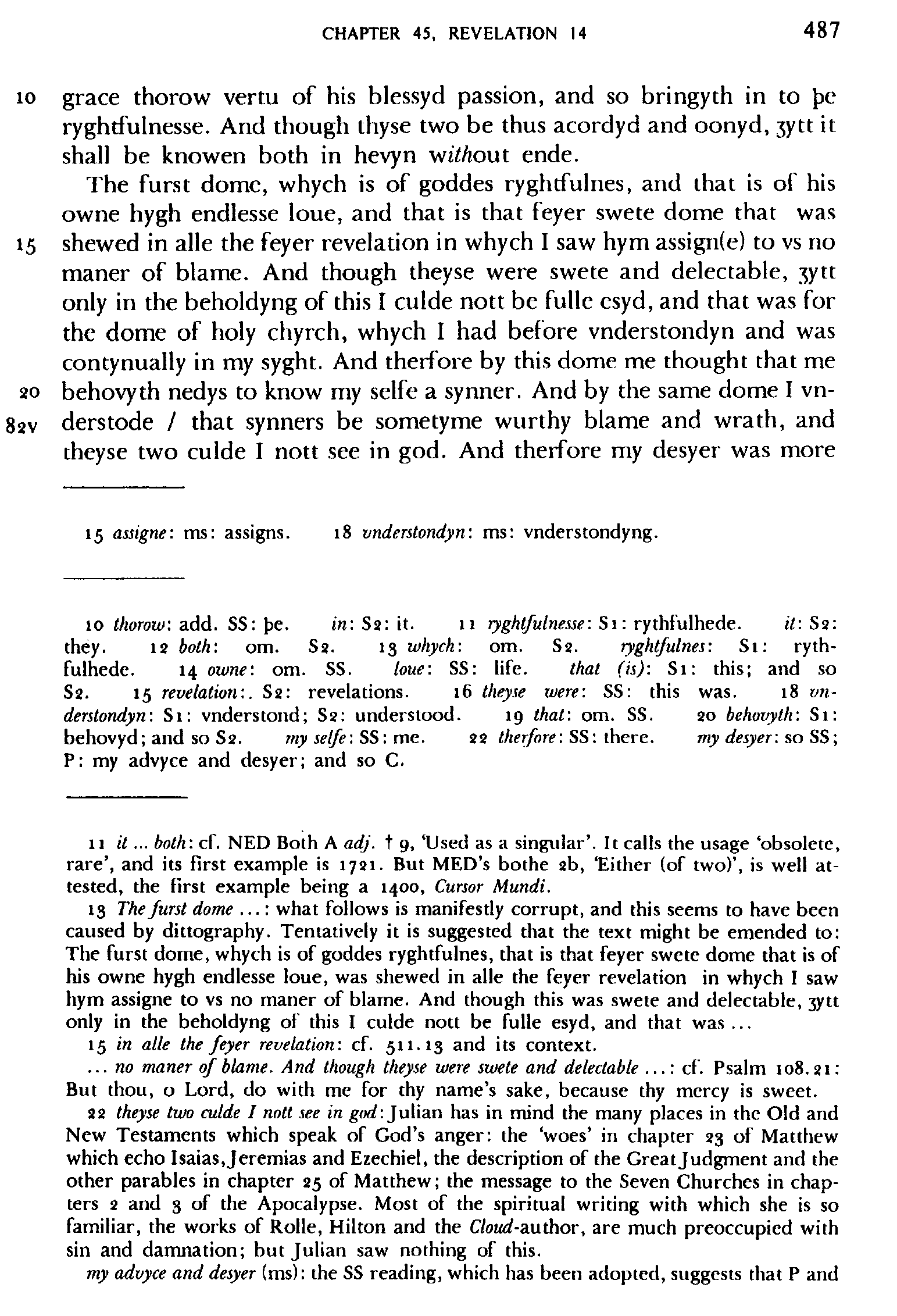
CHAPTER 45, REVELATION 14
10 grace thorow vertu of his blessyd passion, and so bringyth in to Jie ryghtfulnesse. And though thyse two be thus acordyd and oonyd, jytt it shall be knowen both in hevyn without ende.
The furst dome, whych is of goddes ryghtfulnes, and that is of his owne hygh endlesse loue, and that is that feyer swete dome that was
15 shewed in alle the feyer revelation in whych I saw hym assign(e) to vs no maner of blame. And though theyse were swete and delectable, ^ytt only in the beholdyng of this I culde nott be fulle csyd, and that was for the dome of holy chyrch, whych I had before vnderstondyn and was contynually in my syght. And therfore by this dome me thought that me
20 behovyth nedys to know my selfe a synner. And by the same dome I vn8av derstode / that synners be sometyme wurthy blame and wrath, and theyse two culde I nott see in god. And theifore my desyer was more
15 assigne: ms: assigns.
18 vnderstondyn: ms: vnderstondyng.
10 thorow: add. SS: J)e. in: 82: it.
11 ryghtfulnesse: Si: rythfulhede. it: 82: they.
12 both: om.
82.
13 whych: om.
82. ryghtfulnes:
Si: rythfulhede.
14 owne: om.
SS. loue: SS: life. that (is): Si: this; and so 82.
15 revelation:. 82: revelations.
16 theyse were: SS: this was.
18 vnderstondyn: Si: vnderstond; 82: understood.
19 that: om. SS.
20 behovyth: Si: behovyd; and so 82. my selfe: SS: me.
22 therfore: SS: there. my desyer: so SS; P: my advyce and desyer; and so C.
11 it... both: cf. NED Both A adj. t 9, 'Used as a singular'. It calls the usage 'obsolete, rare', and its first example is 1721. But MED's bothe 2b, 'Either (of two)', is well attested, the first example being a 1400, Cursor Mundi.
13 The furst dome ...: what follows is manifestly corrupt, and this seems to have been caused by dittography. Tentatively it is suggested that the text might be emended to:
The furst dome, whych is of goddes ryghtfulnes, that is that feyer swete dome that is of his owne hygh endlesse loue, was shewed in alle the feyer revelation in whych I saw hym assigne to vs no maner of blame. And though this was swete and delectable, 3ytt only in the beholdyng of this I culde nott be fulle esyd, and that was ...
15 in alle the feyer revelation: cf. 511.13 and its context.
... no maner of blame. And though theyse were swete and delectable ...: cf. Psalm 108.21 :
But thou, o Lord, do with me for thy name's sake, because thy mercy is sweet.
22 theyse two culde I nott see in god: Julian has in mind the many places in the Old and New Testaments which speak of God's anger: the 'woes' in chapter 23 of Matthew which echo Isaias.Jeremias and Ezechiel, the description of the Great Judgment and the other parables in chapter 25 of Matthew; the message to the Seven Churches in chapters 2 and 3 of the Apocalypse. Most of the spiritual writing with which she is so familiar, the works of Rolle, Hilton and the Cloud-author, are much preoccupied with sin and damnation; but Julian saw nothing of this. my advyce and desyer (ms): the 88 reading, which has been adopted, suggests that P and
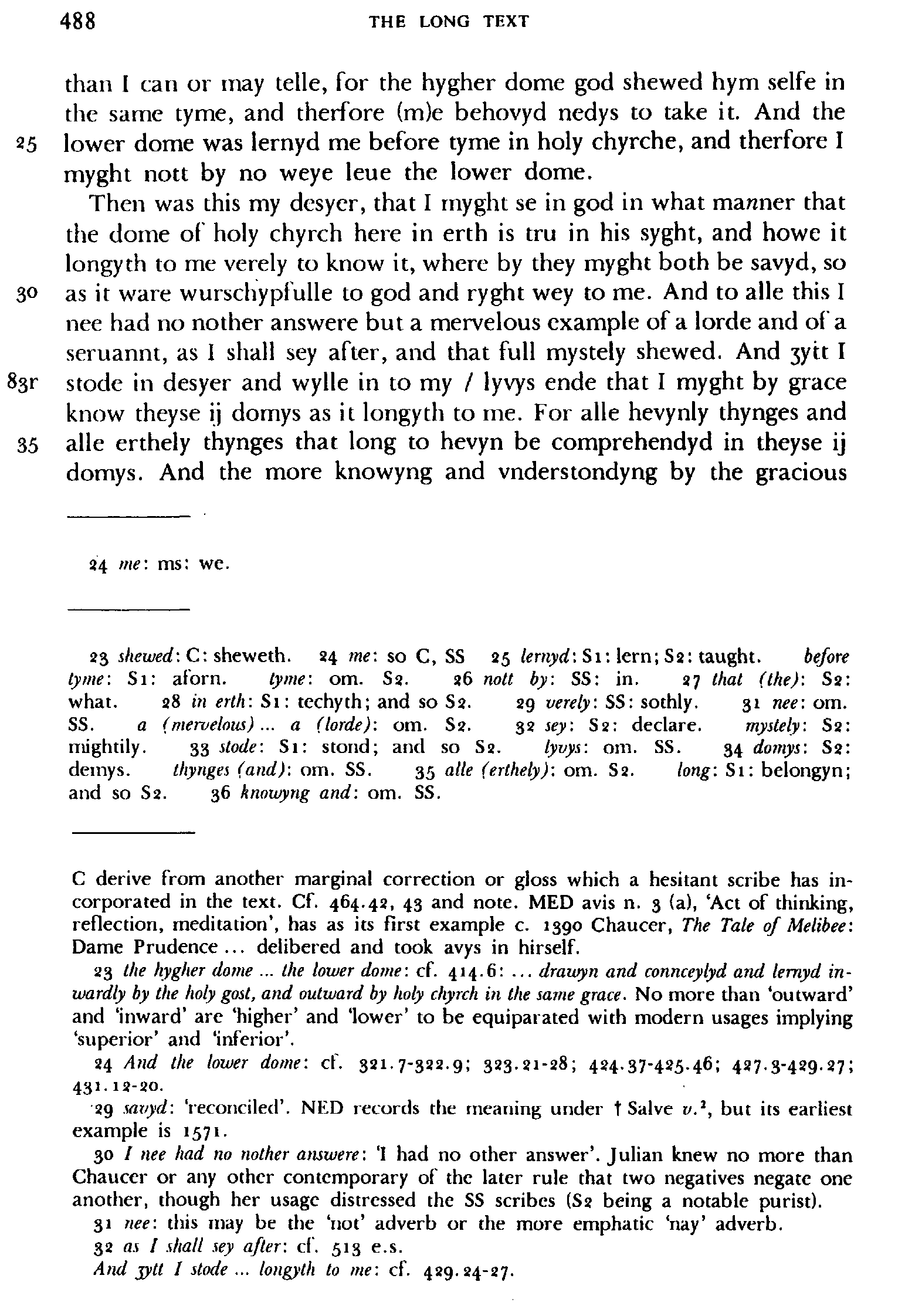
THE LONG TEXT
than I can or may telle, for the hygher dome god shewed hym selfe in the same tyme, and therfore (m)e behovyd nedys to take it. And the 25 lower dome was lernyd me before tyme in holy chyrche, and therfore I myght nott by no weye leue the lower dome.
Then was this my desyer, that I rnyght se in god in what manner that the dome of holy chyrch here in erth is tru in his syght, and howe it longyth to me verely to know it, where by they myght both be savyd, so 3° as it ware wurschypfulle to god and ryght wey to me. And to alle this I nee had no nother answere but a mervelous example of a lorde and of a seruannt, as I shall sey after, and that full mystely shewed. And 3ytt I §3r stode in desyer and wylle in to my / lyvys ende that I myght by grace know theyse ij domys as it longyth to me. For alle hevynly thynges and 35 alle erthely thynges that long to hevyn be comprehendyd in theyse ij domys. And the more knowyng and vnderstondyng by the gracious
24 me: ms: we.
23 shewed: C: sheweth.
24 me: so C, SS 25 lernyd: Si: lern; 82: taught. before tyme: Si: aforn. tyme: om.
82.
26 nott by: SS: in.
27 that (the): Sa: what.
28 in erth: Si: techyth; and so 82.
29 verely: SS: sothly.
31 nee: om.
SS. a (mervelous)... a (lorde): om.
82.
32 sey: 82: declare. mystely: 82: mightily.
33 stode: Si: stond; and so 82. lyvys: om. SS.
34 domys: 82: demys. thynges (and): om. SS.
35 alle (erthely): om. 82. long: Si: belongyn; and so 82.
36 knowyng and: om. SS.
C derive from another marginal correction or gloss which a hesitant scribe has incorporated in the text. Cf. 464.42, 43 and note. MED avis n. 3 (a), 'Act of thinking, reflection, meditation', has as its first example c. 1390 Chaucer, The Tale of Melibee:
Dame Prudence ... delibered and took avys in hirself.
23 the hygher dome ... the lower dome: cf. 414.6: ... drawyn and connceylyd and lernyd inwardly by the holy gost, and outward by holy chyrch in the same grace. No more than 'outward' and 'inward' are 'higher' and 'lower' to be equiparated with modern usages implying
'superior' and 'inferior'.
24 And the lower dome: cf. 321.7-322.9; 323.21-28; 424.37-425.46; 427.3-429.27; 431.12-20.
29 savyd: 'reconciled'. NED records the meaning under t Salve v.1, but its earliest example is 1571.
30 / nee had no nother amwere: 'I had no other answer". Julian knew no more than
Chaucer or any other contemporary of the later rule that two negatives negate one another, though her usage distressed the SS scribes (82 being a notable purist).
31 nee: this may be the 'not' adverb or the more emphatic 'nay' adverb.
32 as I shall sey after: cf. 513 e.s.
And jytt I stode ... longyth to me: cf. 429.24-27.
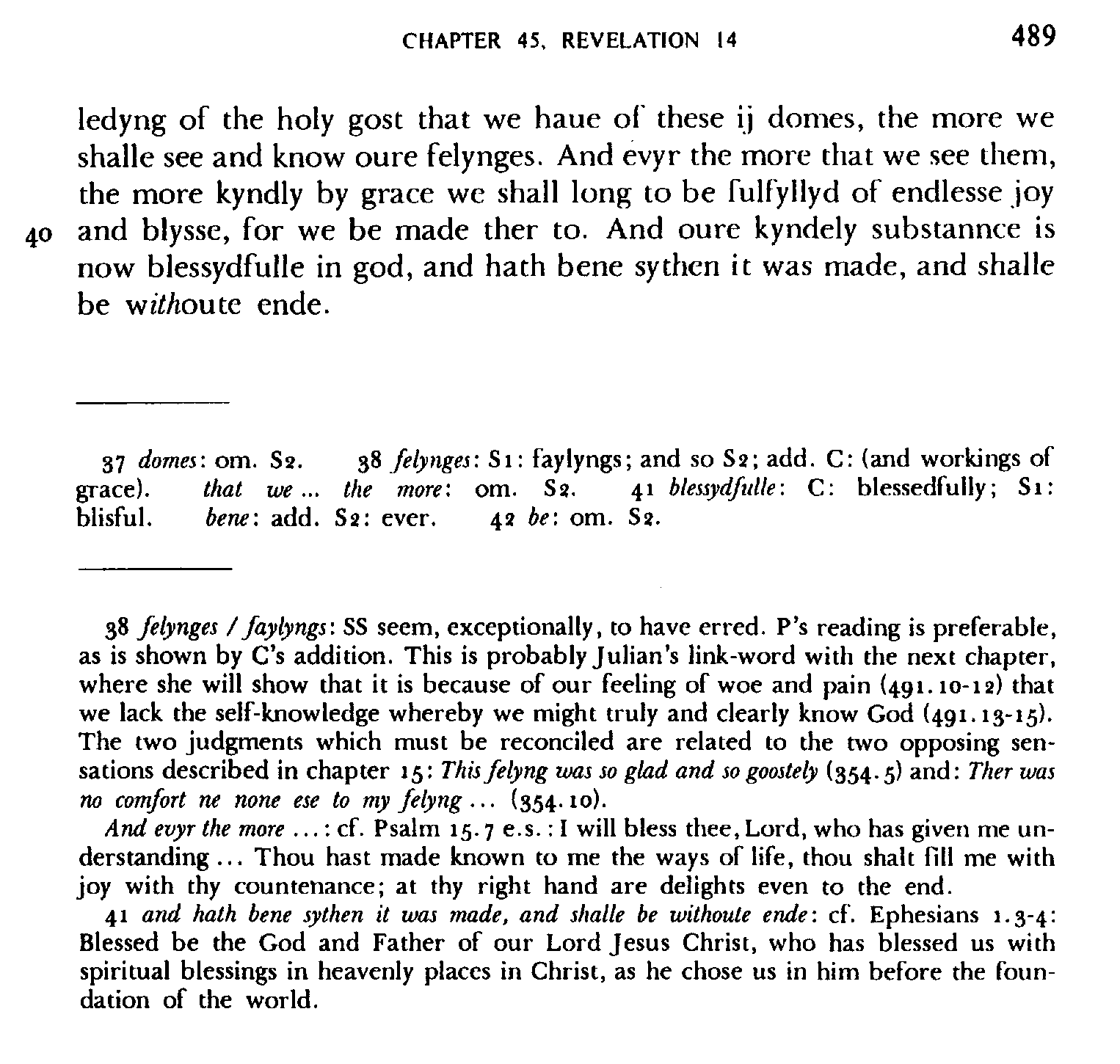
CHAPTER 45, REVELATION 14
ledyng of the holy gost that we haue of these ij domes, the more we shalle see and know oure felynges. And evyr the more that we see them, the more kyndly by grace we shall long to be fulfyllyd of endlesse joy
40 and blysse, for we be made ther to. And oure kyndely substannce is now blessydfulle in god, and hath bene sythen it was made, and shalle be withoutc ende.
37 domes: om. 82.
38 felynges: Si: faylyngs; and so 82; add. C: (and workings of grace). that we... the more: om.
82.
41 blessydfulle:
C: blessedfully; Si: blisful. bene: add. 82: ever.
42 be: om. 82.
38 felynges /faylyngs: 88 seem, exceptionally, to have erred. P's reading is preferable, as is shown by C's addition. This is probably Julian's link-word with the next chapter, where she will show that it is because of our feeling of woe and pain (491.10-12) that we lack the self-knowledge whereby we might truly and clearly know God (491.13-15).
The two judgments which must be reconciled are related to the two opposing sensations described in chapter 15: Thisfelyng was so glad and so goostely (354.5) and: Ther was no comfort ne none ese to myfelyng...
(354.10).
And evyr the more ...: cf. Psalm 15.7 e.s.: I will bless thee, Lord, who has given me understanding ... Thou hast made known to me the ways of life, thou shall fill me with joy with thy countenance; at thy right hand are delights even to the end.
41 and hath bene sythen it was made, and shalle be withoute ende: cf. Ephesians 1.3-4:
Blessed be the God and Father of our Lord Jesus Christ, who has blessed us with spiritual blessings in heavenly places in Christ, as he chose us in him before the foundation of the world.
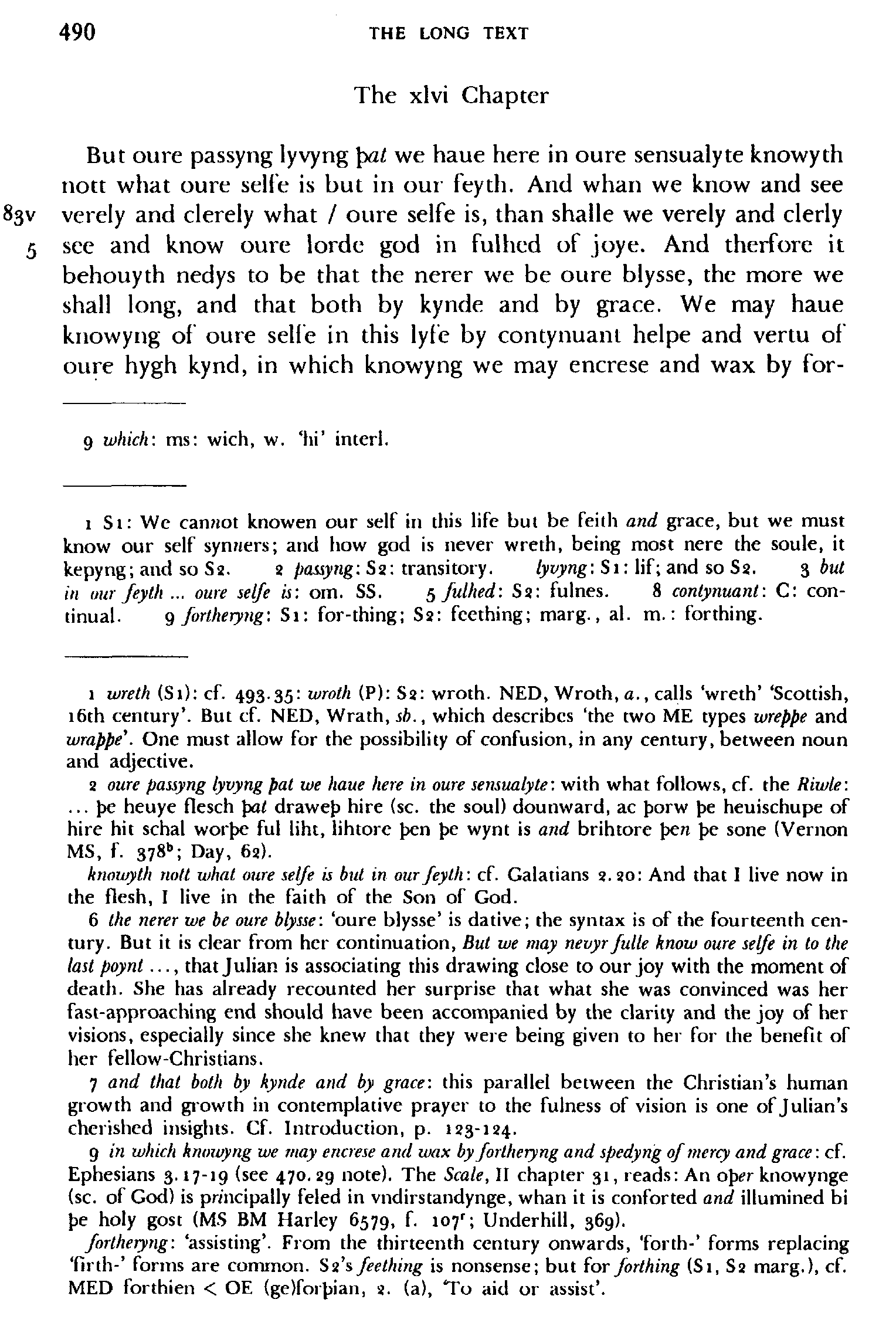
THE LONG TEXT
The xlvi Chapter But oure passyng lyvyng \>at we haue here in oure sensualyte knowyth nott what oure selfe is but in our feyth. And whan we know and see
8sv verely and clerely what / oure selfe is, than shalle we verely and clerly 5 see and know oure lorde god in fulhed of joye. And therfore it behouyth nedys to be that the nerer we be oure blysse, the more we shall long, and that both by kynde and by grace. We may haue knowyng of oure selfe in this lyfc by contynuant helpe and vertu of oure hygh kynd, in which knowyng we may encrese and wax by for9 which: ms: wich, w. 'hi' inter 1. i Si: We can«ot knowen our self in this life but be feiih and grace, but we must know our self synwers; and how god is never wreth, being most nere the soule, it kepyng; and so 82.
2 passyng: 82: transitory. lyvyng: Si: lif; and so S2.
3 but in our feyth ... oure selfe is: om. SS.
5 fulhed: 82: fulnes.
8 contynuant: C: continual.
9 fortheryng: Si: for-thing; 82: fcething; marg., al. m.: forthing.
1 wreth (Si): cf. 493.35: wroth (P): 82: wroth. NED, Wroth, a., calls 'wreth' 'Scottish, i6th century'. But cf. NED, Wrath, sb., which describes 'the two ME types wreppe and wrapped One must allow for the possibility of confusion, in any century, between noun and adjective.
2 oure passyng lyvyng pat we haue here in oure sensualyte: with what follows, cf. the Riwle:
... Jx; heuye flesch \at drawej? hire (sc. the soul) dounward, ac Jjorw Jje heuischupe of hire hit schal worjje ful liht, lihtore J>en \>e wynt is and brihtore pen \>e sone (Vernon
MS, f. 378"; Day, 62). knowyth nott what oure selfe is but in our feyth: cf. Galatians 2.20: And that I live now in the flesh, I live in the faith of the Son of God.
6 the nerer we be oure blysse: 'oure blysse' is dative; the syntax is of the fourteenth century. But it is clear from her continuation, But we may nevyrfulle know oure selfe in to the last poynt..., that Julian is associating this drawing close to our joy with the moment of death. She has already recounted her surprise that what she was convinced was her fast-approaching end should have been accompanied by the clarity and the joy of her visions, especially since she knew that they were being given to her for the benefit of her fellow-Christians.
7 and that both by kynde and by grace: this parallel between the Christian's human growth and growth in contemplative prayer to the fulness of vision is one of Julian's cherished insights. Cf. Introduction, p. 123-124.
9 in which knowyng we may encrese and wax by fortheryng and spedyng of mercy and grace: cf.
Ephesians 3.17-19 (see 470. 29 note). The Scale, II chapter 31, reads: An o\>er knowynge
(sc. of God) is principally feled in vndirstandynge, whan it is conforted and illumined bi
£e holy gost (MS BM Harley 6579, f. 107'; Underbill, 369). fortheryng: 'assisting'. From the thirteenth century onwards, 'forth-' forms replacing
'firth-' forms are common. Sa'sfeething is nonsense; but for forthing (Si, 82 marg.), cf.
MED foi thien < OE (ge)foitjian, 2. (a), To aid or assist'.
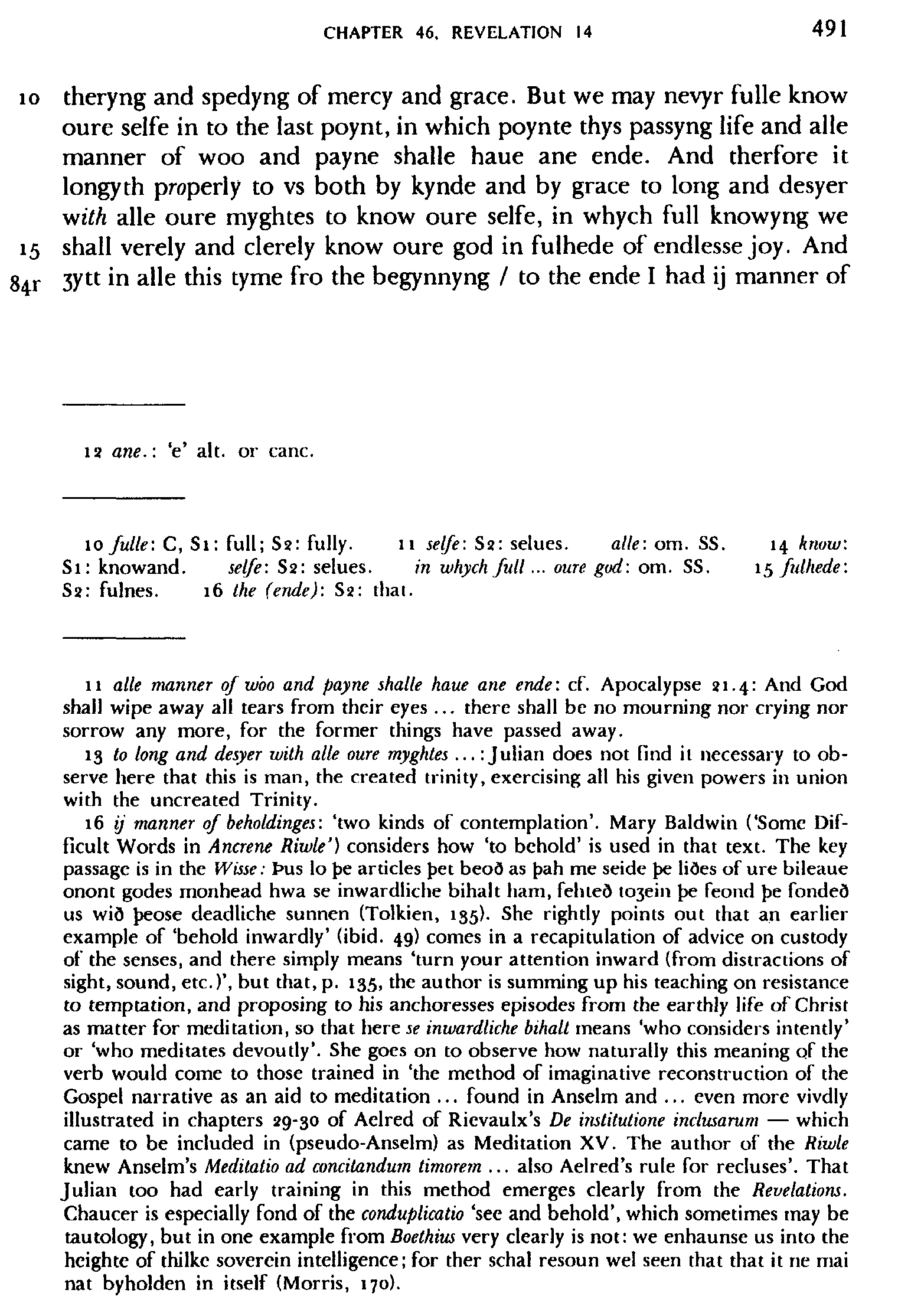
CHAPTER 46, REVELATION 14
10 theryng and spedyng of mercy and grace. But we may nevyr fulle know oure selfe in to the last poynt, in which poynte thys passyng life and alle manner of woo and payne shalle haue ane ende. And therfore it longyth properly to vs both by kynde and by grace to long and desyer with alle oure myghtes to know oure selfe, in whych full knowyng we shall verely and clerely know oure god in fulhede of endlesse joy. And 3ytt in alle this tyme fro the begynnyng / to the ende I had ij manner of
84R 12 ane.: V alt. or cane.
10 fulle: C, Si: full; 82: fully.
11 selfe: 82: selues. alle: om. SS.
14 know:
Si: knowand. selfe: 82: selues. in whych full... oure god: om. 88.
15 fulhede:
82: fulnes.
16 the (ende): 82: that.
11 alle manner of woo and payne shalle haue ane ende: cf. Apocalypse 21.4: And God shall wipe away all tears from their eyes ... there shall be no mourning nor crying nor sorrow any more, for the former things have passed away.
13 to long and desyer with alle oure myghtes ...:Julian does not find it necessary to observe here that this is man, the created trinity, exercising all his given powers in union with the uncreated Trinity.
16 y manner of beholdinges: 'two kinds of contemplation'. Mary Baldwin ('Some Difficult Words in Ancrene Riwle') considers how 'to behold' is used in that text. The key passage is in the Wisse: Pus lo f>e articles Jjet beod as f>ah me seide J>e lides of ure bileaue onont godes monhead hwa se inwardliche bihalt ham, fehted 1036111 £>e feond Jje fonded us wid J>eose deadliche sunnen (Tolkien, 135). She rightly points out that an earlier example of 'behold inwardly' (ibid. 49) comes in a recapitulation of advice on custody of the senses, and there simply means 'turn your attention inward (from distractions of sight, sound, etc.)', but that, p. 135, the author is summing up his teaching on resistance to temptation, and proposing to his anchoresses episodes from the earthly life of Christ as matter for meditation, so that here se inwardliche bihalt means 'who considers intently' or 'who meditates devoutly'. She goes on to observe how naturally this meaning of the verb would come to those trained in 'the method of imaginative reconstruction of the Gospel narrative as an aid to meditation ... found in Anselm and ... even more vivdly illustrated in chapters 29-30 of Aelred of Rievaulx's De itistitutione inclusarum — which came to be included in (pseudo-Anselm) as Meditation XV. The author of the Riwle knew Anselm's Meditatio ad concitandum timorem ... also Aelred's rule for recluses'. That Julian too had early training in this method emerges clearly from the Revelations.
Chaucer is especially fond of the conduplicatio 'see and behold', which sometimes may be tautology, but in one example from Boethius very clearly is not: we enhaunse us into the heighte of thilkc soverein intelligence; for ther schal resoun wel seen that that it ne rnai nat byholden in itself (Morris, 170).
THE LONG TEXT
bcholdinga. That one was endlesse conntyn(ua)nt loue with suernesse of kepyng and blysful saluacion, for of this was all the shewyng. That othyr was the comyn techyng of holy chyrch, of whych I was befor en20 formyd and groundyd and wylfully hauyng in vse and in vnderstondyng. And the beholdyng of thys cam nott from me, for by the shewyng I was nott steryd nor led ther fro in no manner poynt; but I had ther in techyng to loue it and lyke it, wher by I myght with the helpe of oure lorde and his grace encrese and ryse to more hevynly
25 knowyng and hyer lovyng.
And thus in alle this beholdyng me thought it behovyd nedys to se and to know that we be synners and do many evylles that we ou3te to leue, and leue many good dedys vndone that we oujte to do, wherfore
17 conntynuant: ms: conntynannt.
17 beholdinges: Si: beholdyng; and so 82.
That: C: the. suernesse: SS: sekirnes.
18 That: 82: the.
19 of (whych): SS: in.
20 in (vnderstondyng): om. C, SS.
23 with: Si: be; and so 82.
24 oure: 82: pe.
27 evylles: Si: evill; and so 82. oujte ... oujte: 82: intend... intend.
18 blysful saluacion: Julian has a much wider and more ecclesial understanding of salvation than most spiritual writers of her time. Rolle and the Cloud-author, especially, in their defence of the ex professo contemplative life make a cliche of the distinction between salvation and perfection. Thus in Privy Counselling we read: I make a difference bitwix hem t>at ben clepid to saluacion and hem J>at ben clepid to perfeccion (Hodgson,
Cloud, 161). for of this was all the shewyng: the theme of all the revelations is the immensity of God's love, which is declared variously in creation and in man's life and soul, all the works which belong to man's blysful saluacion, but especially the works of Jesus crucified and glorified. Hence Julian can use shewyng in the singular, just as, later, she will write of the pryvytes of the reuelacyon (519.72), to refer indiscriminately to all sixteen or to a single one.
27 and do many evylles that we oujte to leue, and leue many good dedys vndone that we ou$te to do: though the Roman Confiteor — quia peccavi nimis, cogitatione, verbo et opere — makes no specific mention of sins of omission, there were many local and monastic variants which did. Cf. Archdale King: Notes on the Catholic Liturgies 91-92, 194.
28 wherfore we deserve payne, blame and wrath: cf. the Riwle: Seint Anselme seijj Jseose dredful wordes: Hinc erum accusancia peccata, illinc terrews iusticia, supra natus iudex, subtra patens horriduw chaos inferni, intus vrens consciencia, foris ardens mundus.
Peccator sic deprehensus, in quam partew se premet? O Jje on half o domes day schullen vr swarte suwnen strongliche biclepen us of vre soule morjjere, on J>e ojser half stont rihtwysnesse f>at no reuphe nis wijj, dredful and grisful and fereful to biholden (MS Vernon, f. s86b; Day, 137). For Anselm's Latin in its context, see S. Anselmi opera omnia,
'Meditatio ad concitandum timorem' (Schmitt 3 78-79).
CHAPTER 46, REVELATION 14
84v we deserve payne, blame and / wrath. And nott with stondyng alle this I 30 saw verely that oure lorde was nevyr wroth nor nevyr shall. For he is god, he is good, he is truth, he is loue, he is pees; and hys myght, hys wysdom, hys charyte and his vnyte suHeryth hym nott to be wroth. For I saw truly that it is agaynst the propyrte of hys myght to be wroth, and agayrist J)e properte of hys wysdom, and agaynst the propyrte of hys
35 goodnes. God is that goodnesse that may nott be wroth, for god is nott but goodnes. Oure soule is onyd to hym, vnchanngeable goodnesse.
And betwen god and oure soule is neyther wrath nor forgevenesse in hys syght. For oure soule is so fulsomly onyd to god of hys owne goodnesse that betwene god and oure soule may be ryght nought.
29 blame: om. SS.
30 verely: SS: sothfastly.
31 he is (good), he is (truth), lie is (loue): om. SS. good: 82: goodnes. truth: Si: life, trueth. he (is pees): C: and he. and hys myght, hys wysdom: om. SS.
35 that: Si: the. god (is nott): SS: he. nott (but): 82: not (cane.); marg., scr.: nought.
36 is (onyd): Si in (underl.; marg., al. m.: ) is. onyd: 82: united. hym: add. 82: who is the.
37 soule (is neyther): 82: souls.
38 so: om. SS. onyd: 82: united.
39 oure: Si; 82: the.
30 For he is god / he is good / he is truth / he is loue / he is pees: a compar with continuatio.
For he is god: because God is God, these qualities are of his being.
31 he is good: cf. Matthew 19.17 : Only one is good, God; and Privy Counselling: For 3if bou sey 'Good' or 'Fair Lorde' or 'Swete'... al it is hid and enstorid in pis litil worde 'is'
(Hodgson, Cloud, 143). he is truth: cf. John 14.6 and 483.8 note. he is loue: cf. I John 4.8: For God is love. he is pees: cf. Ephesians 2.14: For he is our peace... and hys myght / hys wysdom / hys charyte / and his vnyte: a compar with continuatio.
33 it is agaynst the propyrte of hys myght... / and agaynst pe properte of hys wysdom / and agaynst the propyrte of hys goodnes: once again, Julian is using the figure of distributio for the purposes of 'appropriation'; and, in calling myght, wysdom, goodnes each a propyrte, she shows how familiar she is with the name and the process of 'appropriation'.
35 God is that goodnesse that may nott be wroth /for god is nott but goodnes / Oure soule is onyd to hym vnchanngeable goodnesse /And betwen god and oure soule is neyther wrath / nor forgevenesse in hys syght / For oure soule is so fulsomly onyd to god of hys owne goodnesse / that betwene god and oure soule may be ryght nought: a membrum with double conversio (wroth ... wrath; goodnes ... goodnesse ... goodnesse). for god is nott but goodnes: cf. 304.10-11.
36 vnchanngeable goodnesse: in Eight Chapters (cf. 261.53 note) we read: God is in him silf vnchaungeable and a soule is chaurcgeable (ms: vnchaungeable) of it silf; but £>arme whanne be soule is oonyd to Crist bi loue, be moore \xit it is oonyd to him, Jje moore vnchaungeable it is (MS BN Fonds anglais 41, f. 153*; Jones, 107). Cf. 475.3.
THE LONG TEXT
And to this vnderstondyng was J)e soule led by loue and drawyn by 8£r myght in every shewyng; that it is thus, oure / good lorde shewed, and how it is thus, verely of his grett goodnesse; and that he wylle we desyer to wytt, that is to sey as it longyth to his creature to wytte it. For all thyng that the symple soule vnderstode, god wyll that it be shewed and 45 knowyn; for those thynges that he wylle haue prevy, myghtely and wysely hym selfe hydyth them for loue. For I saw in the same shewyng that moch pryvete is hyd whych may nevyr be knowen in to the tyme that god of hys goodnes hath made vs wurthy to se it. And ther with I am well apayde, abydyng oure lords wylle in this hye marveyle. And 50 now I jelde me to my modyr holy chyrch, as a sympyll chylde owyth.
42 verely: SS: sothly. that (lie): om. SS.
43 that (is): add. Sa: it. creature:C: creatures.
45 those: Si: the; and so 82.
46 hym selfe: add. SS: he. them: om.
82.
47 that (moch): om.
Si. in to: 82: untill.
48 hath:
82: shall haue.
49 apayde: C, marg.: content; Si: paid; and so 82.
50 my : C: our.
40 And to this vnderstondyng...: cf. 732.15-733.19.
43 as it longyth to his creature to wytte it: cf. Romans 12.3: ... not to be more wise (plus sapere) than it behoves to be wise, but to be soberly wise, as God has divided to everyone the measure of faith.
For all thyng that the symple soule vnderstode ...: Julian's teaching on the showing of hidden mysteries appears to derive from Ephesians 3.1-10.
47 in to the tyme that god of hys goodnes hath made vs wurthy to se it: cf. Ephesians 3.2:
... the dispensation of the grace of God which is given me towards you.
50 as a sympyll chylde owyth: cf. Matthew 18.3-4: Unless you be converted and become as little children, you shall not enter into the kingdom of heaven. Whoever therefore humbles himself as this little child ...
CHAPTER 47, REVELATION 14
The xlvij Chapter Two poyntes longyn to our soule by dett. One is that we reverently
85v marveyle; that othyr is that we meekly suffer, evyr enjoyeng / in god.
For he wyll that we know that we shalle in short tyme se clerely in hym 5 selfe all that we desyer. And not wzYAstondyng all thys I behelde and merveylyd gretly what is the mercy and forgevenesse of god; for by the techyng that I had before, I vnderstode that the mercy of god shalle be forgeuenesse of hys wrath after the tyme that we haue synned. For me thought that to a soulc whose menyng and desyer is to loue, that the 10 wrath of god were harder than ony other payne. And therfore I toke that the forgevenesse of his wrath shulde be one of the pryncypall poyn2 longyn: ms: longyng. i Si: We must reverently mervelyn (Sa: admire) and mekly sufTren ever enjoyand in god, and how our blyndhede (82: blindnes) in \>at we se not god is cause of synne.
2 longyn: C: belonging; Si: longen; 82: belong. soule: 82: souls. by:C: are.
3 that (othyr): 82: the. evyr: C: every. enjoyeng: Sa: rejoicing.
4 (hat.
(me know): om. SS.
7 be: add. SS: the.
9 that (to): om. SS.
2 longyn: SS discerned, as P and C did not, that here we have the Midland present plural indicative -en suffix. reverently marveyle: Julian makes the point in passing that contemplative disposition and prayer are in some way the duty of every Christian, a teaching belonging to an earlier tradition and rooted in Scripture, but certainly not that of her contemporaries.
Cf. 492.18 note.
3 meekly suffer: cf. Colossians 1.10-11: That you may walk worthy of God ... in all patience and longsuffering with joy.
4 For he wyll that we know / that we shalle in short tyme / se clerely in hym selfe / all that we desyer: a compar. in short tyme: Cf. Romans 8.18: For I reckon that the sufferings of this time are not worthy to be compared with the glory to come.
6 for by the techyng that I had before: cf. 487.19-21.
7 the mercy of god shalle be forgeuenesse of hys wrath: cf. Psalm 59.3: O God, thou hast cast us off and destroyed us, thou hast been angry and hast had mercy on us.
11 the forgevenesse of his wrath shulde be one of the pryncypall poyntes of his mercy, compare the liturgical prayer for the souls of the faithful departed: Deus cui proprium est misereri semper et parcere (Bruylants, 2 nos. 207, 208). This prayer is prescribed in the Riwle (cf. 462.21 note): f>e pride fyue for alle cristene soules. After pe forme fyue kyrieleyson chmtdeyson kyryeleyson Pater noster Saluos fac seruos tuos et ancillas tuas deus meus sperantes in te. Orenwj. Deus cui proprium. After J>e oper fyue ... (Vernon
MS, f. 340 (recte 372>d; Day, 10). These highly abbreviated quotations of Latin opening phrases of liturgical forms imply that the anchoresses did not require them written out in full, since they had their own Latin service-books; and most texts of the Riwle (e.g.
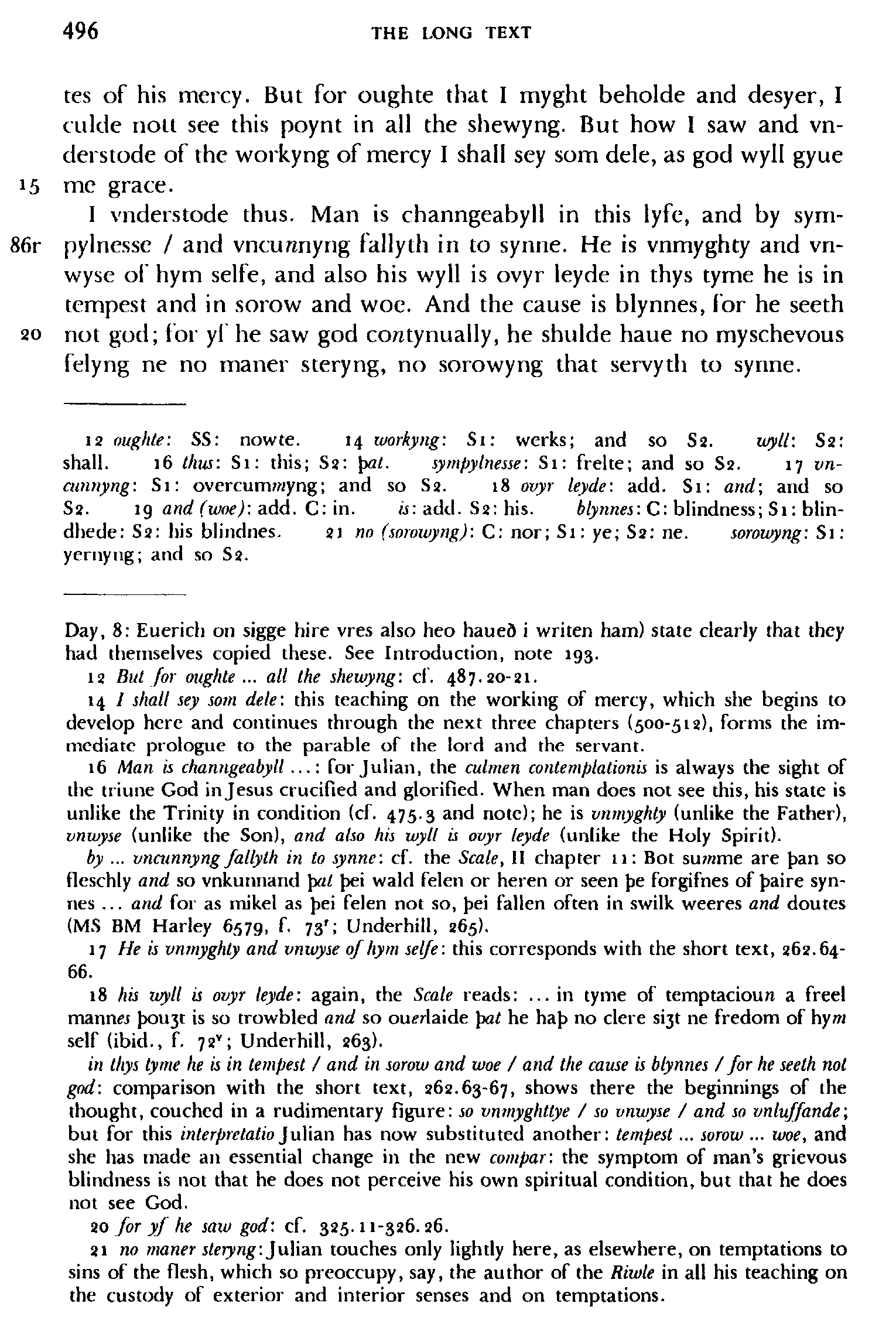
THE LONG TEXT
tes of his mercy. But for oughte that I myght beholde and desyer, I culde nott see this poynt in all the shewyng. But how I saw and vnderstode of the workyng of mercy I shall sey som dele, as god wyll gyue
15 me grace.
I vnderstode thus. Man is channgeabyll in this lyfe, and by sym86r pylnesse / and vncunnyng fallyth in to synne. He is vnmyghty and vnwyse of hym selfe, and also his wyll is ovyr leyde in thys tyme he is in tempest and in sorow and woe. And the cause is blynnes, for he seeth
20 not god; for yf he saw god contynually, he shulde haue no myschevous felyng ne no maner steryng, no sorowyng that servyth to synne.
12 oughte: 88: novvte.
14 workyng: Si: werks; and so 82. wyli. 82: shall.
16 tints: Si: this; 82: fxz/. sympylnesse: Si: frelte; and so 82.
17 vncunnyng: Si: ovcrcumwyng; and so 82.
18 ovyr leyde: add. Si: and; and so 82.
19 and (woe): add. C: in. is: add. 82: his. blynnes: C: blindness; Si: blindhede: 82: his blindnes.
21 no (sorowyng): C: nor; Si: ye; 82: ne. sorowyng: Si: yernyng; and so 82.
Day, 8: Euerich on sigge hire vres also heo haued i writen ham) state clearly that they had themselves copied these. See Introduction, note 193.
12 But for oughte... all the shewyng: cf. 487.20-21.
14 / shall sey som dele: this teaching on the working of mercy, which she begins to develop here and continues through the next three chapters (500-512), forms the immediate prologue to the parable of the lord and the servant.
16 Man is channgeabyll ...: for Julian, the culmen contemplationis is always the sight of the triune God injesus crucified and glorified. When man does not see this, his state is unlike the Trinity in condition (cf. 475.3 and note); he is vnmyghty (unlike the Father), vnwyse (unlike the Son), and also his wyll it ovyr leyde (unlike the Holy Spirit). by ... vncunnyng fallyth in to synne: cf. the Scale, II chapter 11: Bot su/nme are pan so fieschly and so vnkunnand \xit pei wald felen or heren or seen pe forgifnes of paire synnes ... and for as mikel as pei felen not so, pei fallen often in swilk weeres and doutes
(MS BM Harley 6579, f. 73'; Underbill, 265).
17 He is vnmyghty and vnwyse of hym selfe: this corresponds with the short text, 262.6466.
18 his wyll is ovyr leyde: again, the Scale reads: ... in tyme of temptacioun a freel mann^j poujt is so trowbled and so ou<?rlaide \>at he haj> no clere si3t ne fredom of hym self (ibid., f. 72*; Underbill, 263). in thys tyme he is in tempest / and in sorow and woe / and the cause is blynnes /for he seeth not god: comparison with the short text, 262.63-67, shows there the beginnings of the thought, couched in a rudimentary figure: so vnmyghtlye / so vnwyse / and so vnluffande; but for this interpretatio Julian has now substituted another: tempest... sorow ... woe, and she has made an essential change in the new compar: the symptom of man's grievous blindness is not that he does not perceive his own spiritual condition, but that he does not see God.
20 for yf he saw god: cf. 325.11-326.26.
21 no maner steryng: Julian touches only lightly here, as elsewhere, on temptations to sins of the flesh, which so preoccupy, say, the author of the Riwle in all his teaching on the custody of exterior and interior senses and on temptations.
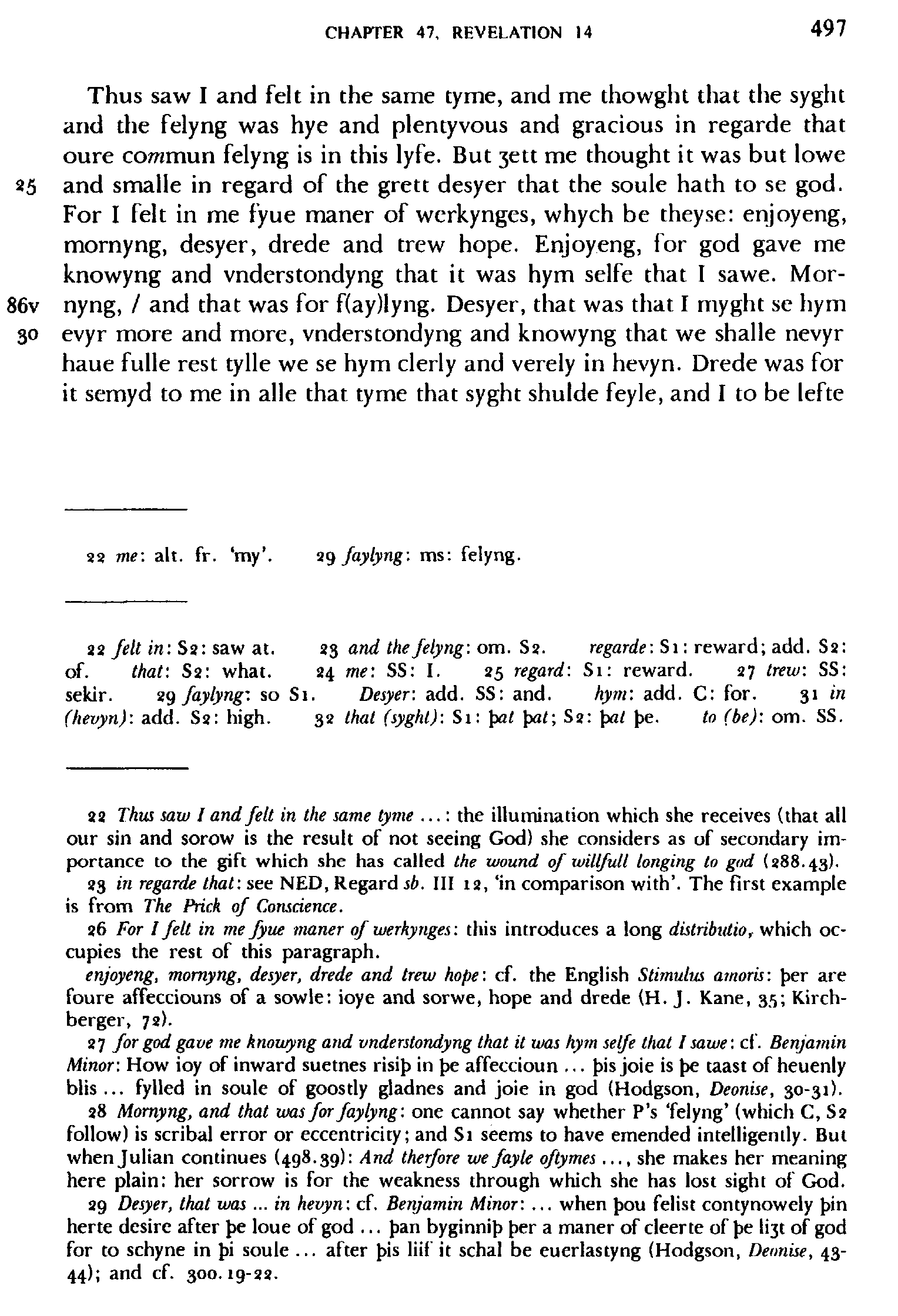
CHAPTER 47, REVELATION 14
Thus saw I and felt in the same tyme, and me thowght that the syght and the felyng was hye and plentyvous and gracious in regarde that oure cowmun felyng is in this lyfe. But jett me thought it was but lowe
25 and smalle in regard of the grett desyer that the soule hath to se god.
For I felt in me fyue maner of wcrkynges, whych be theyse: enjoyeng, mornyng, desyer, drede and trew hope. Enjoyeng, for god gave me knowyng and vnderstondyng that it was hym selfe that I sawe. Mor86v nyng, / and that was for f(ay)lyng. Desyer, that was that I myght se hyrn
30 evyr more and more, vnderstondyng and knowyng that we shalle nevyr haue fulle rest tylle we se hym clerly and verely in hevyn. Drede was for it semyd to me in alle that tyme that syght shulde feyle, and I to be lefte
22 me: alt. fr. 'my'.
29 faylyng: ms: felyng.
22 felt in: Sa: saw at.
23 and the felyng: om. 82. regarde: Si: reward; add. 82: of. that: 82: what.
24 me: 88: I.
25 regard: Si: reward.
27 trew: 88: sekir.
29 faylyng: so Si.
Desyer: add. 88: and. hym: add. C: for.
31 in (hevyn): add. 82: high.
32 that (syght): Si: Jxz/ pa<; 82: \>at pe. to (be): om. SS.
22 Thus saw I and felt in the same tyme ...: the illumination which she receives (that all our sin and sorow is the result of not seeing God) she considers as of secondary importance to the gift which she has called the wound of willfull longing to gad (288.43).
23 in regarde that: see NED, Regard sb. Ill 12, 'in comparison with'. The first example is from The Prick of Conscience.
26 For I felt in me fyue maner of we rkynges: this introduces a long distributer which occupies the rest of this paragraph. enjoyeng, mornyng, desyer, drede and trew hope: cf. the English Stimulus amoris: per are foure affecciouns of a sowle: ioye and sorwe, hope and drede (H. J. Kane, 35; Kirchberger, 72).
27 for god gave me knowyng and vnderstondyng that it was hym selfe that I sawe: cf. Benjamin
Minor: How ioy of inward suetnes risif> in pe affeccioun ... pis joie is pe taast of heuenly blis ... fylled in soule of goostly gladnes and joie in god (Hodgson, Deonise, 30-31).
28 Mornyng, and that was for faylyng: one cannot say whether P's 'felyng' (which C, 82 follow) is scribal error or eccentricity; and Si seems to have emended intelligently. But when Julian continues (498.39): And therfore wefayle oftymes..., she makes her meaning here plain: her sorrow is for the weakness through which she has lost sight of God.
29 Desyer, that was ... in hevyn: cf. Benjamin Minor: ... when pou felist contynowely pin herte desire after pe loue of god ... pan byginni}) per a maner of cleerte of pe lijt of god for to schyne in pi soule ... after pis liif it schal be euerlastyng (Hodgson, Deimise, 4344); and cf. 300.19-22.
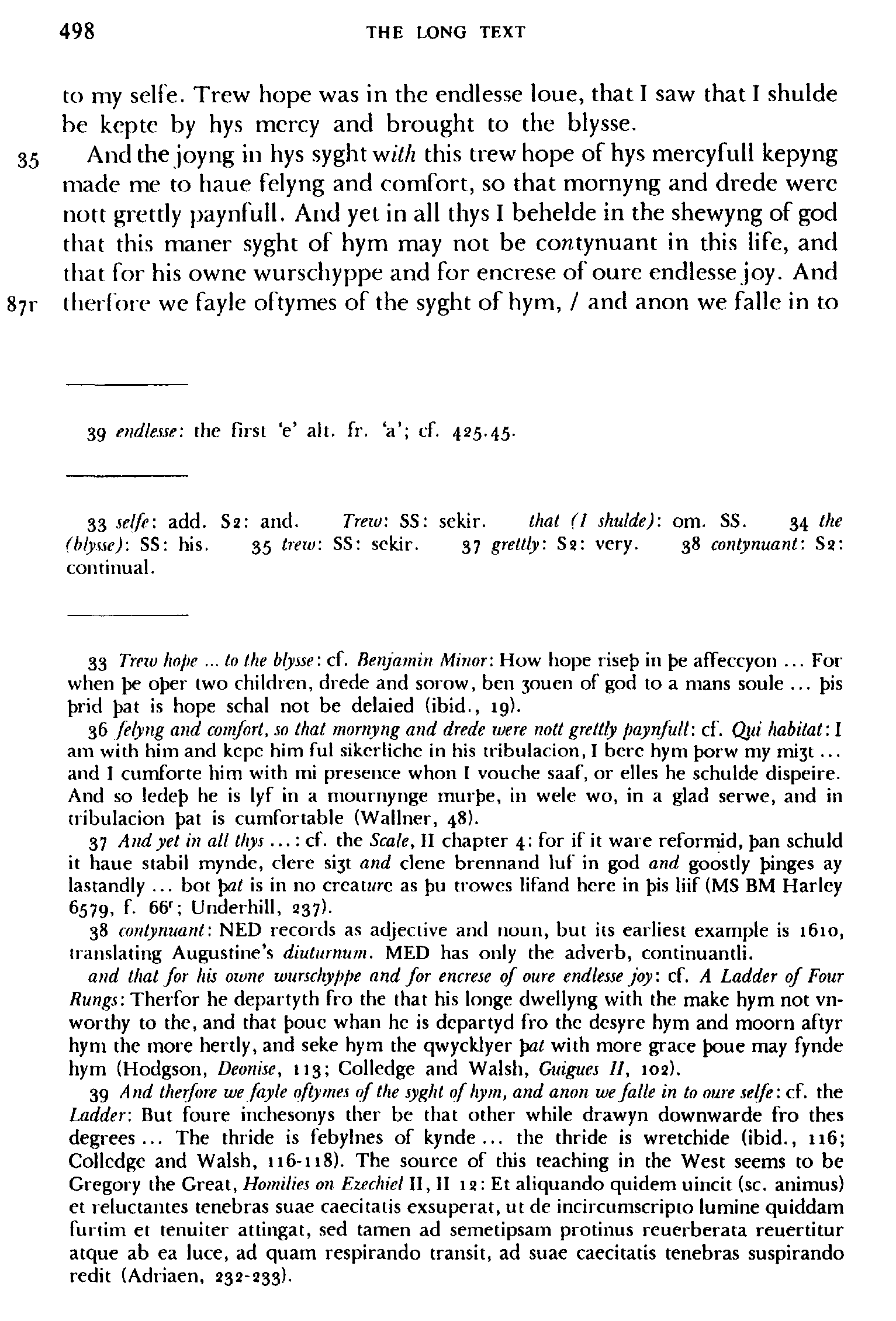
THE LONG TEXT
to my selfe. Trew hope was in the endlesse loue, that I saw that I shulde be kepte by hys mercy and brought to the blysse.
And the joyng in hys syght w///i this trew hope of hys mercyfull kepyng made me to haue felyng and comfort, so that mornyng and drede were nott grettly paynfull. And yet in all thys I behelde in the shewyng of god that this maner syght of hym may not be contynuant in this life, and that for his ownc wurschyppe and for encrese of oure endlesse joy. And 8yr therfore we fayle oftymes of the syght of hym, / and anon we falle in to 39 endlesse: the first 'e' alt. fr. 'a'; cf. 425.45.
33 selfe: add. 82: and.
Trew: SS: sekir. that (I shulde): om. SS.
34 the (blysse): SS: his.
35 trew. SS: sckir.
37 grettly: 82: very.
38 contynuant: 82: continual.
33 Trew hope ...to the blysse: cf. Benjamin Minor: How hope risep in pe affeccyon ... For when pe oper two children, drede and sorow, ben 3ouen of god to a mans soule ... pis pi id pat is hope schal not be delaied (ibid., 19).
36 felyng and comfort, so that mornyng and drede were nott grettly paynfull: cf. Qui habitat: I am with him and kepc him ful sikerlichc in his tribulacion, I berc hym porw my mi3t ... and I cumforte him with mi presence whon I vouche saaf, or elles he schulde dispeire.
And so ledep he is lyf in a mournynge murpe, in wele wo, in a glad serwe, and in tribulacion pat is cumfortable (Wallner, 48).
37 And yet in all thys ...: cf. the Scale, II chapter 4: for if it ware reformid, pan schuld it haue stabil mynde, clere 5131 and clene brennand luf in god and goostly pinges ay lastandly ... bot pa£ is in no crcat;/rc as pu trowes lifand here in pis liif (MS BM Harley
6579, f. 66r; Underbill, 237).
38 contynuant: NED records as adjective and noun, but its earliest example is 1610, translating Augustine's diuturnum. MED has only the adverb, continuantli. and that for his owne wurschyppe and for encrese of oure endlesse joy: cf. A Ladder of Four
Rungs: Therfor he departyth fro the that his longe dwellyng with the make hym not vnworthy to the, and that poue whan he is dcpartyd fro the dcsyre hym and moorn aftyr hym the more hertly, and seke hym the qwycklyer pa/ with more grace poue may fynde hym (Hodgson, Deonise, 113; Colledge and Walsh, Guigues II, 102).
39 And therfore we fayle oftymes of the syght of hym, and anon we falle in to oure selfe: cf. the Ladder: But foure inchesonys ther be that other while drawyn downwarde fro thes degrees... The thride is febylnes of kynde... the thride is wretchide (ibid., 116;
Colledge and Walsh, 116-118). The source of this teaching in the West seems to be
Gregory the Great, Homilies on Ezechiel II, II 12: Et aliquando quidem uincit (sc. animus) et reluctantes tenebras suae caecitatis exsuperat, ut de incircumscripto lumine quiddam furtim et tenuiter attingat, sed tamen ad semetipsam protinus reuerberata reuertitur atque ab ea luce, ad quam respirando transit, ad suae caecitatis tenebras suspirando redit (Adriaen, 232-233).
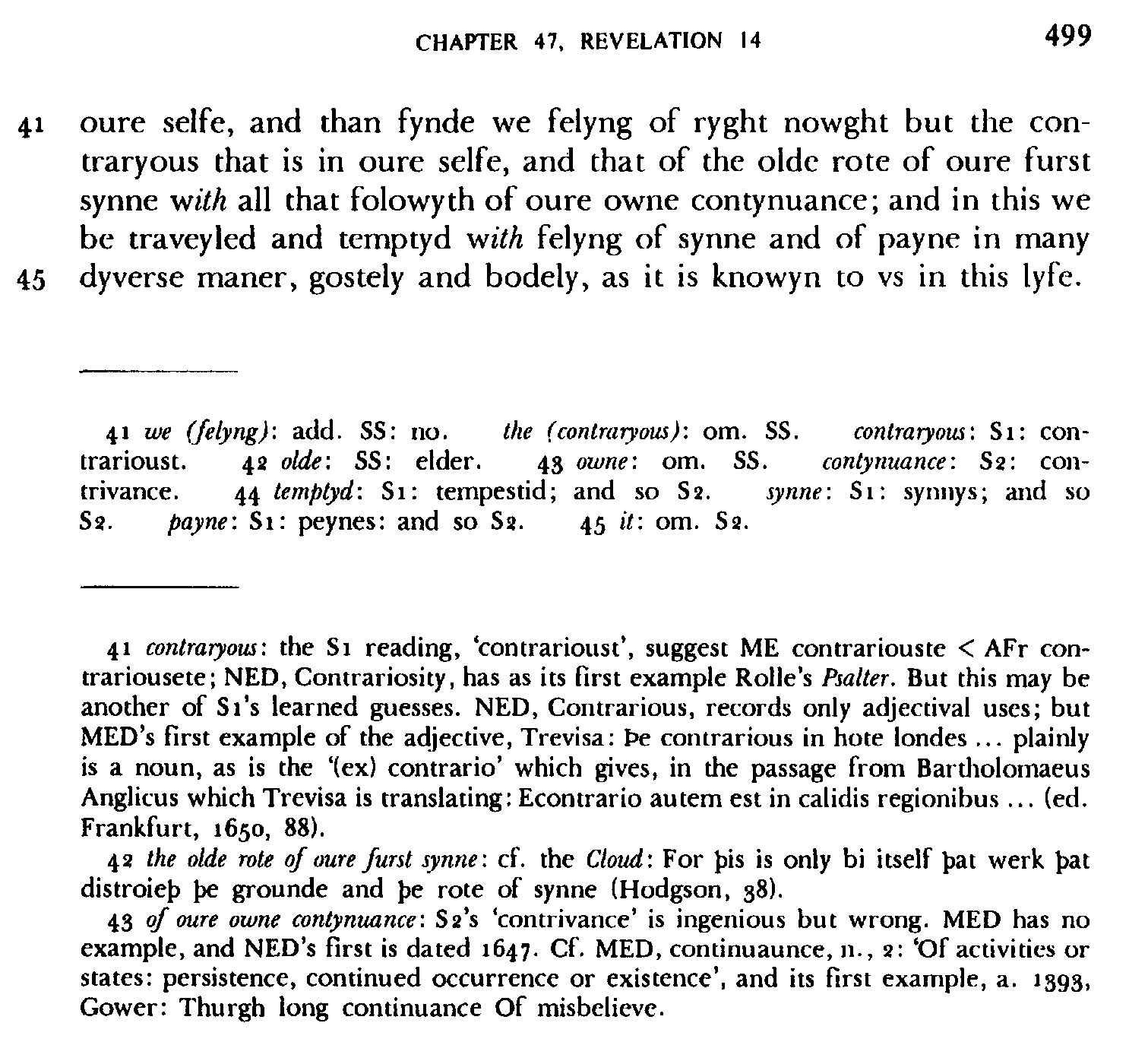
CHAPTER 47, REVELATION 14
41 oure selfe, and than fynde we felyng of ryght nowght but the contraryous that is in oure selfe, and that of the olde rote of oure furst synne with all that folowyth of oure owne contynuance; and in this we be traveyled and temptyd with felyng of synne and of payne in many
45 dyverse maner, gostely and bodely, as it is knowyn to vs in this lyfe.
41 we (felyng): add. SS: no. the ( contrary ous): om. SS. contraryous: Si: contrarioust.
42 olde: SS: elder.
43 owne: om.
SS. contynuance: 82: contrivance.
44 temptyd: Si: tempestid; and so 82. synne: Si: synnys; and so 82. payne: Si: peynes: and so 82.
45 it: om. 82.
41 contraryous: the Si reading, 'contrarioust', suggest ME contrariouste < AFr contrariousete; NED, Contrariosity, has as its first example Rolle's Psalter. But this may be another of Si's learned guesses. NED, Contrarious, records only adjectival uses; but MED's first example of the adjective, Trevisa: t>e contrarious in hote londes ... plainly is a noun, as is the '(ex) contrario' which gives, in the passage from Bartholomaeus
Anglicus which Trevisa is translating: Econtrario autem est in calidis regionibus ... (ed.
Frankfurt, 1650, 88).
42 the olde rote of oure furst synne: cf. the Cloud: For J>is is only bi itself f»at werk }>at distroiej) Jje grounde and }>e rote of synne (Hodgson, 38).
43 of oure owne contynuance: Ss's 'contrivance' is ingenious but wrong. MED has no example, and NED's first is dated 1647. Cf. MED, continuaunce, n., 2: 'Of activities or states: persistence, continued occurrence or existence', and its first example, a. 1393,
Gower: Thurgh long continuance Of misbelieve.
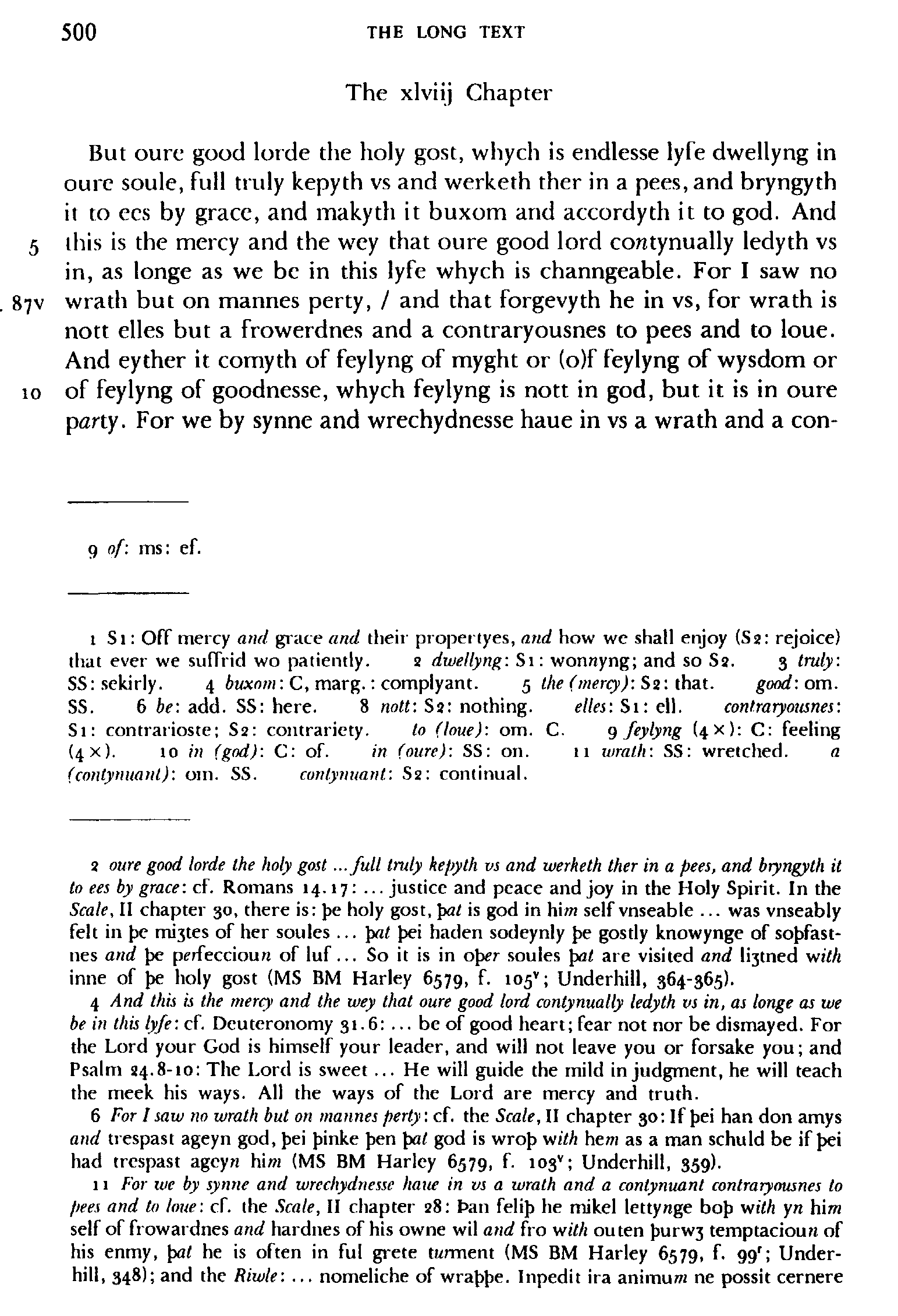
THE LONG TEXT
The xlviij Chapter But oure good lorde the holy gost, whych is endlesse lyfe dwellyng in ourc soule, full truly kepyth vs and werketh ther in a pees, and bryngyth it to ecs by grace, and makyth it buxom and accordyth it to god. And
this is the mercy and the wey that oure good lord contynually ledyth vs in, as longe as we be in this lyfe whych is channgeable. For I saw no . 8?v wrath but on mannes perty, / and that forgevyth he in vs, for wrath is nott elles but a frowerdnes and a contraryousnes to pees and to loue.
And eyther it comyth of feylyng of myght or (o)f feylyng of wysdom or 10 of feylyng of goodnesse, whych feylyng is nott in god, but it is in oure party. For we by synne and wrechydnesse haue in vs a wrath and a con9 of: ms: ef. i Si: Off mercy and grace and their propei tyes, and how we shall enjoy (82: rejoice) that ever we sufTrid wo patiently.
2 dwellyng: Si: wormyng; and so 82.
3 truly:
SS:sekirly.
4 buxom: C, marg.: complyant.
5 the (mercy): Ss: that. good: om.
SS.
6 be: add. SS: here.
8 nott: 82: nothing. elles: Si: ell. contraryousnes:
Si: contrarioste; 82: contrariety. to (loue): om. C.
9 feylyng ( 4 X ) : C: feeling
( 4 X ) .
10 in (god): C: of. in (oure): SS: on.
11 wrath: SS: wretched. a (contyniiant): om. SS. contynuant: 82: continual.
2 oure good lorde the holy gost ...full truly kepyth vs and werketh ther in a pees, and bryngyth it to ees by grace: cf. Romans 14.17: ... justice and peace and joy in the Holy Spirit. In the Scale, II chapter 30, there is: pe holy gost, pa/ is god in him self vnseable ... was vnseably felt in pe mi3tes of her soules ... pa< pei haden sodeynly pe gostly knowynge of sopfastnes and pe p^rfeccioun of luf ... So it is in op«r soules pa/ are visited and lijtned with inne of pe holy gost (MS BM Harley 6579, f. io5v; Underhill, 364-365).
4 And this is the mercy and the wey that oure good lord contynually ledyth vs in, as longe as we be in this lyfe: cf. Deuteronomy 31.6: ... be of good heart; fear not nor be dismayed. For the Lord your God is himself your leader, and will not leave you or forsake you; and Psalm 24.8-10: The Lord is sweet ... He will guide the mild in judgment, he will teach the meek his ways. All the ways of the Lord are mercy and truth.
6 For I saw no wrath but on mannes perty: cf. the Scale, II chapter 30: If pei han don amys and trespast ageyn god, pei pinke pen bat god is wrof> with hem as a man schuld be if pei had trespast agcyn him (MS BM Harley 6579, f. io3v; Underhill, 359).
11 for we by synne and wrechydnesse haue in vs a wrath and a contynuant contraryousnes to pees and to loue: cf. the Scale, II chapter 28: tan felijj he mikel lettywge bob with yn him self of fi owardnes and hardnes of his owne wil and fro with outen purw3 temptaciouw of his enmy, bat he is often in ful grete twrment (MS BM Harley 6579, f. 99'; Underhill, 348); and the Riwle: ... nomeliche of wrappe. Inpedit ira animum ne possit cernere
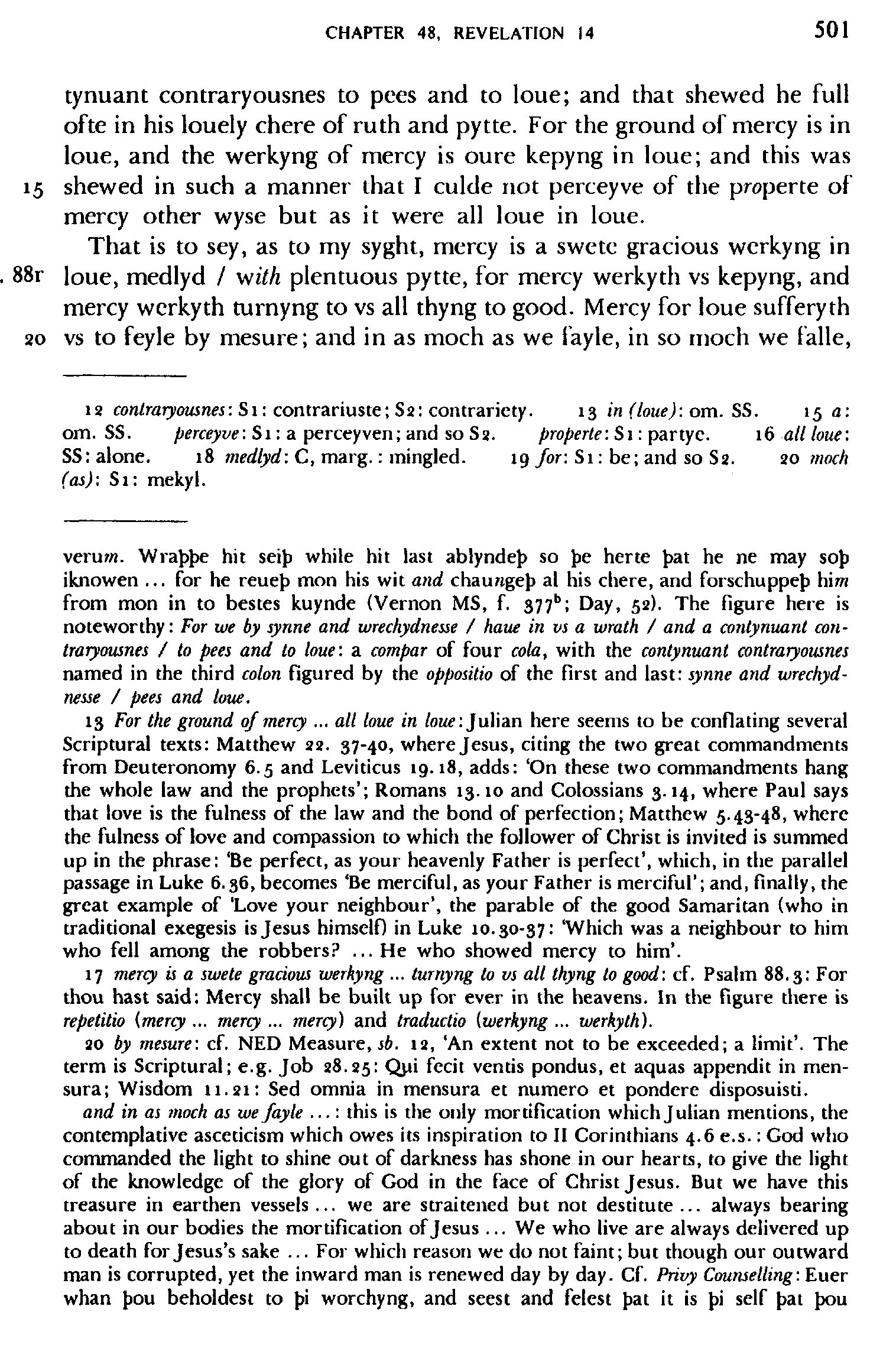
CHAPTER 48, REVELATION 14
tynuant contraryousnes to pees and to loue; and that shewed he full ofte in his louely chere of ruth and pytte. For the ground of mercy is in loue, and the werkyng of mercy is oure kepyng in loue; and this was
15 shewed in such a manner that I culde not perceyve of the properte of mercy other wyse but as it were all loue in loue.
That is to sey, as to my syght, mercy is a swete gracious werkyng in . 88r loue, medlyd / with plentuous pytte, for mercy werkyth vs kepyng, and mercy werkyth turnyng to vs all thyng to good. Mercy for loue sufferyth
20 vs to feyle by mesure; and in as moch as we fayle, in so rnoch we falle, 12 contraryousnes: Si: contrariuste; 82: contrariety.
13 in (loue): om. SS.
15 a: om. SS. perceyve: Si: a perceyven; and so 82. properte: Si: partyc.
16 all loue:
SS: alone.
18 medlyd: C, marg.: mingled.
19 for: Si: be; and so Sa.
20 moch (as): Si: mekyl. veruw. Wrappe hit seip while hit last ablyndep so pe herte pat he ne may sop iknowen ... for he reuep mon his wit and chaungep al his chere, and forschuppep him from mon in to bestes kuynde (Vernon MS, f. 377b; Day, 52). The figure here is noteworthy: For we by synne and wrechydnesse / haue in vs a wrath / and a contynuant contraryousnes / to pees and to loue: a compar of four cola, with the contynuant contraryousnes named in the third colon figured by the oppositio of the first and last: synne and wrechydnesse / pees and loue.
13 For the ground of mercy ...all loue in loue: Julian here seems to be conflating several
Scriptural texts: Matthew 22. 37-40, where Jesus, citing the two great commandments from Deuteronomy 6.5 and Leviticus 19.18, adds: 'On these two commandments hang the whole law and the prophets'; Romans 13.10 and Colossians 3.14, where Paul says that love is the fulness of the law and the bond of perfection; Matthew 5.43-48, where the fulness of love and compassion to which the follower of Christ is invited is summed up in the phrase: 'Be perfect, as your heavenly Father is perfect', which, in the parallel passage in Luke 6.36, becomes 'Be merciful, as your Father is merciful'; and, finally, the great example of 'Love your neighbour', the parable of the good Samaritan (who in traditional exegesis is Jesus himself) in Luke 10.30-37: 'Which was a neighbour to him who fell among the robbers? ... He who showed mercy to him'.
17 mercy is a swete gracious werkyng ... turnyng to vs all thyng to good: cf. Psalm 88.3: For thou hast said: Mercy shall be built up for ever in the heavens. In the figure there is repetitio (mercy ... mercy ... mercy) and traductio (werkyng ... werkyth).
20 by mesure: cf. NED Measure, sb. 12, 'An extent not to be exceeded; a limit'. The term is Scriptural; e.g. Job 28.25: Qui fecit vends pondus, et aquas appendit in mensura; Wisdom 11.21: Sed omnia in mensura et numero et pondere disposuisti. and in as moch as we fayle ...: this is the only mortification which Julian mentions, the contemplative asceticism which owes its inspiration to II Corinthians 4.6 e.s.: God who commanded the light to shine out of darkness has shone in our hearts, to give the light of the knowledge of the glory of God in the face of Christ Jesus. But we have this treasure in earthen vessels ... we are straitened but not destitute ... always bearing about in our bodies the mortification of Jesus ... We who live are always delivered up to death for Jesus's sake ... For which reason we do not faint; but though our outward man is corrupted, yet the inward man is renewed day by day. Cf. Privy Counselling: Euer whan pou beholdest to pi worchyng, and seest and felest pat it is pi self pat pou
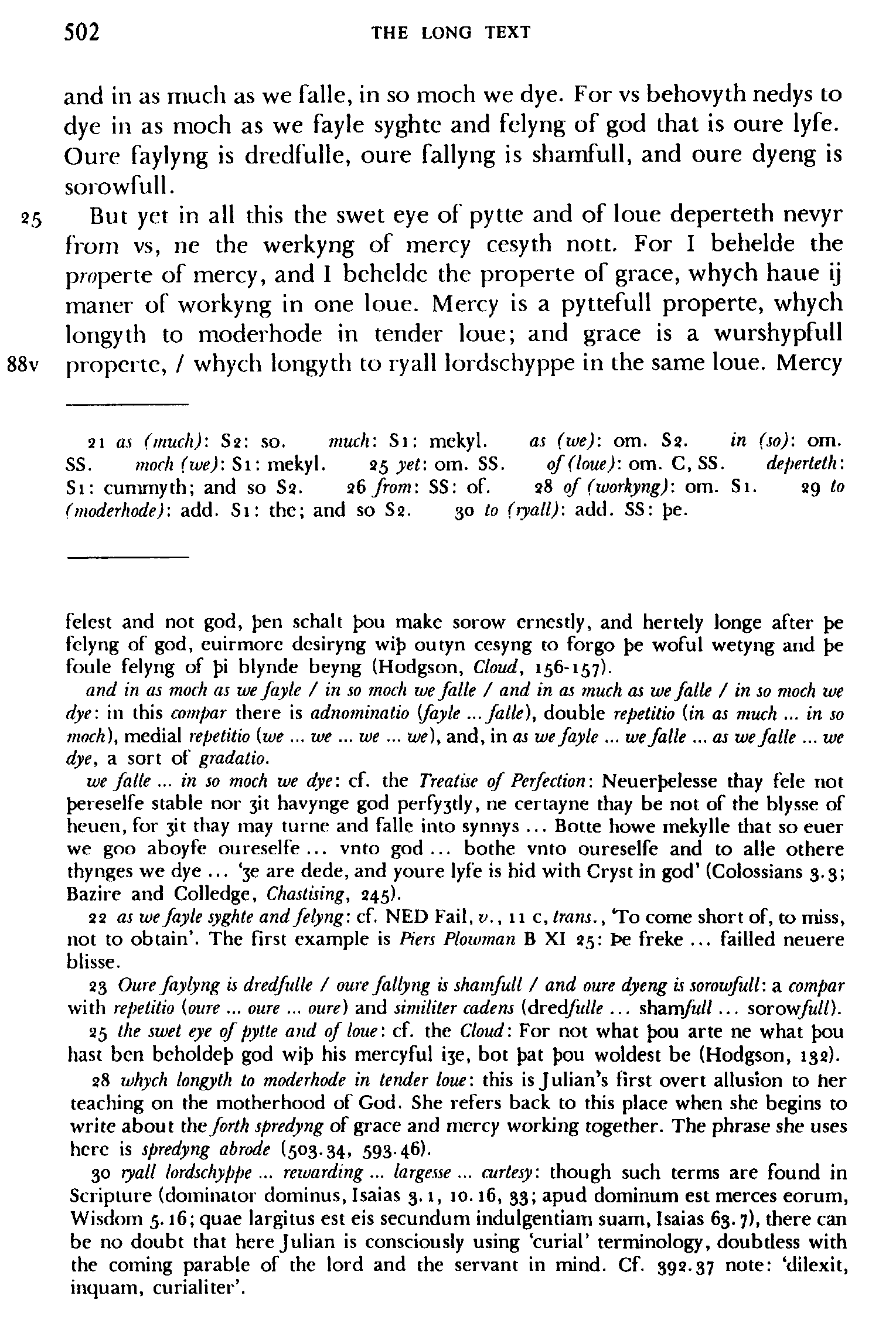
THE LONG TEXT
and in as much as we falle, in so moch we dye. For vs behovyth nedys to dye in as moch as we fayle syghte and fclyng of god that is oure lyfe.
Oure faylyng is dredfulle, oure fallyng is shamfull, and oure dyeng is sorowfull.
But yet in all this the swet eye of pytte and of loue deperteth nevyr from vs, ne the werkyng of mercy cesyth nott. For I behelde the properte of mercy, and I behelde the properte of grace, whych haue ij maner of workyng in one loue. Mercy is a pyttefull properte, whych longyth to moderhode in tender loue; and grace is a wurshypfull
!8v properte, / whych longyth to ryall lordschyppe in the same loue. Mercy .8
21 ait (much): 82: so. much: Si: mekyl. as (we): om. 82. in (so): om.
SS. moch (we): Si: mekyl.
25 yet: om. 88. of (loue): om. C, SS. deperteth:
Si: cummyth; and so 82.
26 from: 88: of.
28 of (workyng): om. Si.
29 to (moderhode): add. Si: the; and so 82.
30 to (ryall): add. 88: Jje. felest and not god, }>en schalt Jjou make sorow ernesdy, and hertely longe after Jje felyng of god, euirmore desiryng wif> outyn cesyng to forgo J>e woful wetyng and J>e foule felyng of J)i blynde beyng (Hodgson, Cloud, 156-157). and in as moch as we fayle / in so moch we falle / and in as much as we falle / in so moch we dye: in this compar there is adnominatio (fayle ...falle), double repetitio (in as much ... in so moch), medial repetitio (we ... we ... we ... we), and, in as we fayle ... we falle ... as we falle ... we dye, a sort of gradatio. we falle ... in so moch we dye: cf. the Treatise of Perfection: Neuerjjelesse thay fele not Jsereselfe stable nor 3it havynge god perfy3tly, ne certayne thay be not of the blysse of heuen, for yt thay may turne and falle into synnys ... Botte howe mekylle that so euer we goo aboyfe oureselfe... vnto god... bothe vnto oureselfe and to alle othere thynges we dye ... '36 are dede, and youre lyfe is hid with Cryst in god' (Colossians 3.3;
Bazire and Colledge, Chastising, 245).
22 as we fayle syghte and felyng: cf. NED Fail, v., 11 c, trans., To come short of, to miss, not to obtain'. The first example is Piers Plowman B XI 25: £>e freke ... failled neuere blisse.
23 Oure faylyng is dredfulle / oure fallyng is shamfull / and oure dyeng is sorowfull: a compar with repetitio (oure ... oure ... oure) and similiter cadens (dredfulle ... shamfull... sorowfull).
25 the swet eye of pytte and of loue: cf. the Cloud: For not what J>ou arte ne what pou hast ben beholdeb god wi)) his mercyful ije, bot pat pou woldest be (Hodgson, 132).
28 whych longyth to moderhode in tender loue: this is Julian's first overt allusion to her teaching on the motherhood of God. She refers back to this place when she begins to write about the forth spredyng of grace and mercy working together. The phrase she uses here is spredyng abrode (503.34, 593.46).
30 ryall lordschyppe ... rewarding ... largesse ... curtesy: though such terms are found in Scripture (dominator dominus, Isaias 3. i, 10.16, 33; apud dominum est merces eorum,
Wisdom 5.16; quae largitus est eis secundum indulgentiam suam, Isaias 63.7), there can be no doubt that here Julian is consciously using 'curial' terminology, doubtless with the coming parable of the lord and the servant in mind. Cf. 392.37 note: 'dilexit, inquain, curialiter'.
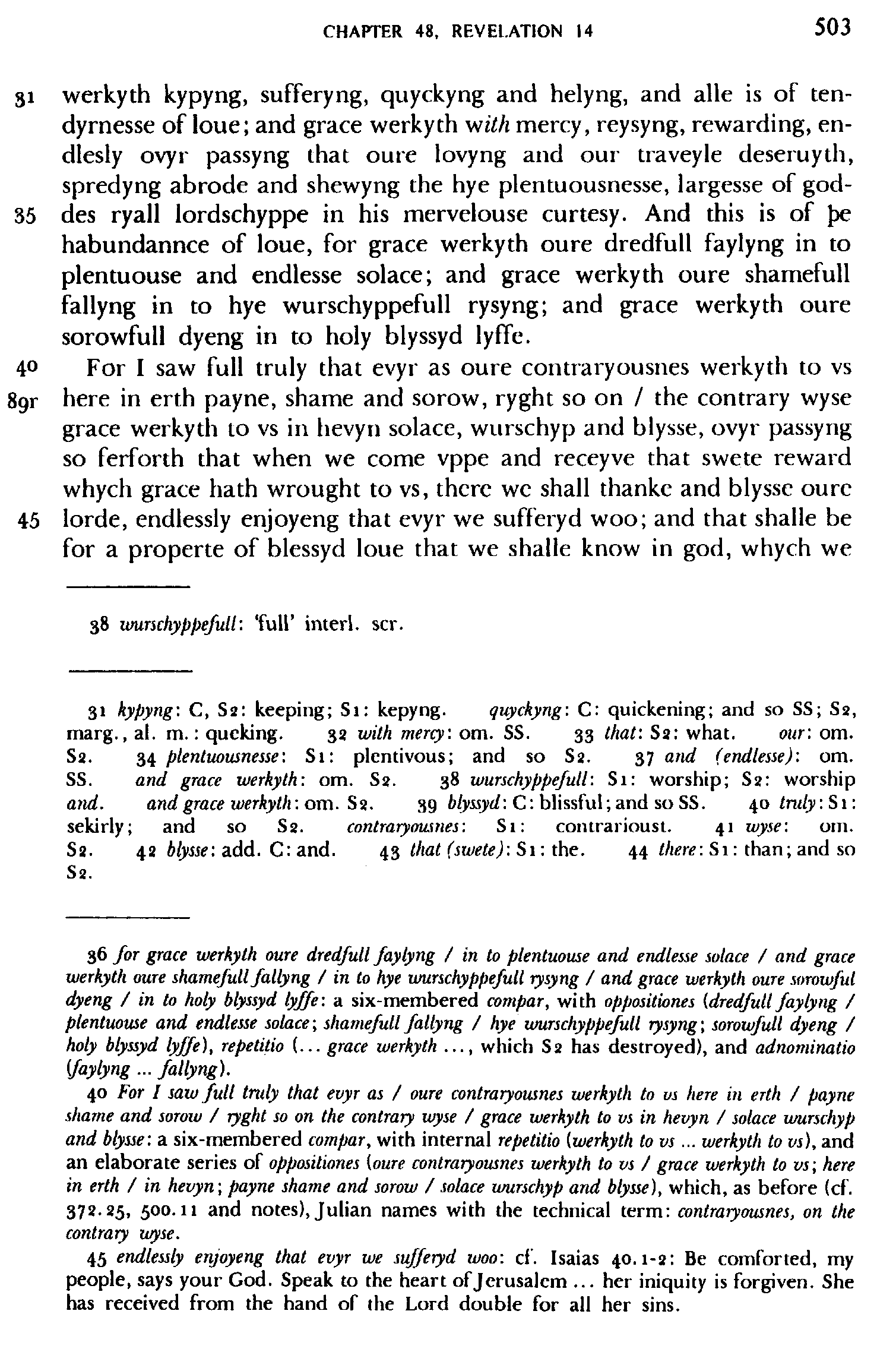
CHAPTER 48, REVELATION
31 werkyth kypyng, sufferyng, quyckyng and helyng, and alle is of tendyrnesse of loue; and grace werkyth with mercy, reysyng, rewarding, endlesly ovyr passyng that oure lovyng and our traveyle deseruyth, spredyng abrode and shewyng the hye plentuousnesse, largesse of god35 des ryall lordschyppe in his mervelouse curtesy. And this is of J)e habundannce of loue, for grace werkyth oure dredfull faylyng in to plentuouse and endlesse solace; and grace werkyth oure shamefull fallyng in to hye wurschyppefull rysyng; and grace werkyth oure sorowfull dyeng in to holy blyssyd lyffe.
For I saw full truly that evyr as oure contraryousnes werkyth to vs here in erth payne, shame and sorow, ryght so on / the contrary wyse grace werkyth to vs in hevyn solace, wurschyp and blysse, ovyr passyng so ferforth that when we come vppe and receyve that swete reward whych grace hath wrought to vs, there we shall thanke and blysse oure
45 lorde, endlessly enjoyeng that evyr we sufferyd woo; and that shalle be for a properte of blessyd loue that we shalle know in god, whych we
89R 38 wurschyppefull: 'full' interl. scr.
31 kypyng: C, Sa: keeping; Si: kepyng. quyckyng: C: quickening; and so SS; Sa, marg., al. m.: qucking.
33 with mercy: om. SS.
33 that: Sa: what. our: om.
Sa.
34 plentuousnesse: Si: plentivous; and so Sa.
37 and (endlesse): om.
SS. and grace werkyth: om. Sa.
38 wurschyppefull: Si: worship; Sa: worship and. and grace werkyth: om. Sa.
39 blyssyd: C: blissful; and so SS.
40 truly: S i: sekirly; and so Sa. contraryousnes:
Si: contrarioust.
41 wyse: om.
Sa.
43 blysse: add. C: and.
43 that (swete): Si: the.
44 there: Si: than; and so Sa.
36 for grace werkyth oure dredfull faylyng / in to plentuouse and endlesse solace / and grace werkyth oure shamefull fallyng / in to hye wurschyppefull rysyng / and grace werkyth oure sorowful dyeng / in to holy blyssyd lyffe: a six-membered compar, with oppositions (dredfull faylyng / plentuouse and endlesse solace; shamefull fallyng / hye wurschyppefull rysyng; sorowfull dyeng / holy blyssyd lyffe), repetitio (... grace werkyth ..., which Sa has destroyed), and adnominatio
(faylyng ... fallyng).
40 For I saw full truly that evyr as I oure contraryousnes werkyth to vs here in erth / payne shame and sorow / ryght so on the contrary wyse / grace werkyth to vs in hevyn / solace wurschyp and blysse: a six-membered compar, with internal repetitio (werkyth to vs ... werkyth to vs), and an elaborate series of oppositions (oure contraryousnes werkyth to vs / grace werkyth to vs; here in erth / in hevyn; payne shame and sorow / solace wurschyp and blysse), which, as before (cf.
372-25, 500.11 and notes), Julian names with the technical term: contraryousnes, on the contrary wyse.
45 endlessly enjoyeng that evyr we sufferyd woo: cf. Isaias 40.1-3: Be comforted, my people, says your God. Speak to the heart of Jerusalem ... her iniquity is forgiven. She has received from the hand of the Lord double for all her sins.
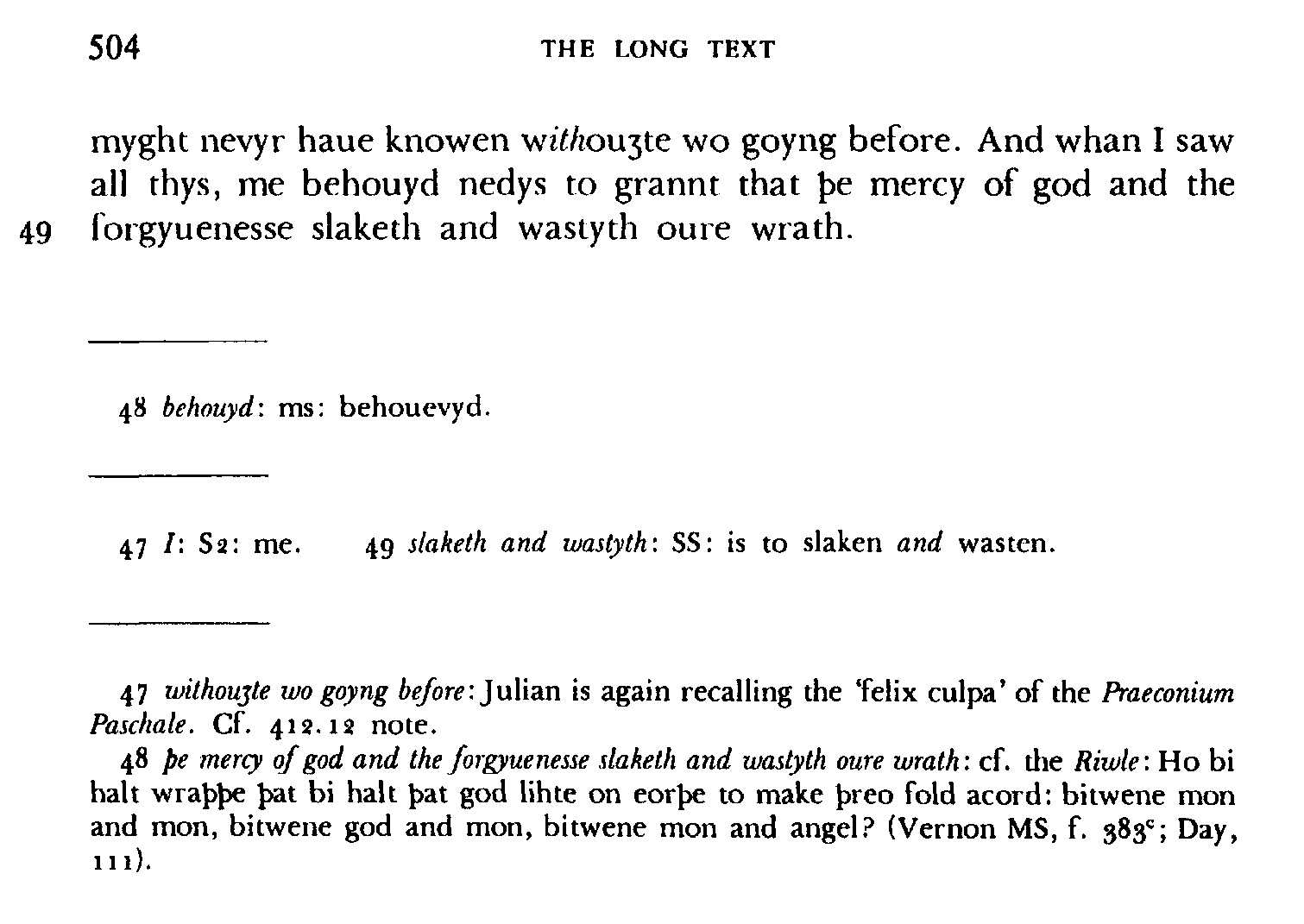
THE LONG TEXT
myght nevyr haue knowen withou^te wo goyng before. And whan I saw all thys, me behouyd nedys to grannt that J)e mercy of god and the 49 forgyuenesse slaketh and wastyth oure wrath.
48 behouyd: ms: behouevyd.
47 /: Sa: me.
49 slaketh and wastyth: SS: is to slaken and wasten.
47 withoujte wo goyng before: Julian is again recalling the Telix culpa' of the Praeconium
Paschale. Cf. 412.12 note.
48 pe mercy of god and the forgyuenesse slaketh and wastyth oure wrath: cf. the Riwle: Ho bi halt wra{>|)e f>at bi halt J>at god lihte on eorjje to make J>reo fold acord: bitwene mon and mon, bitwene god and mon, bitwene mon and angel? (Vernon MS, f. 383°; Day,
111).
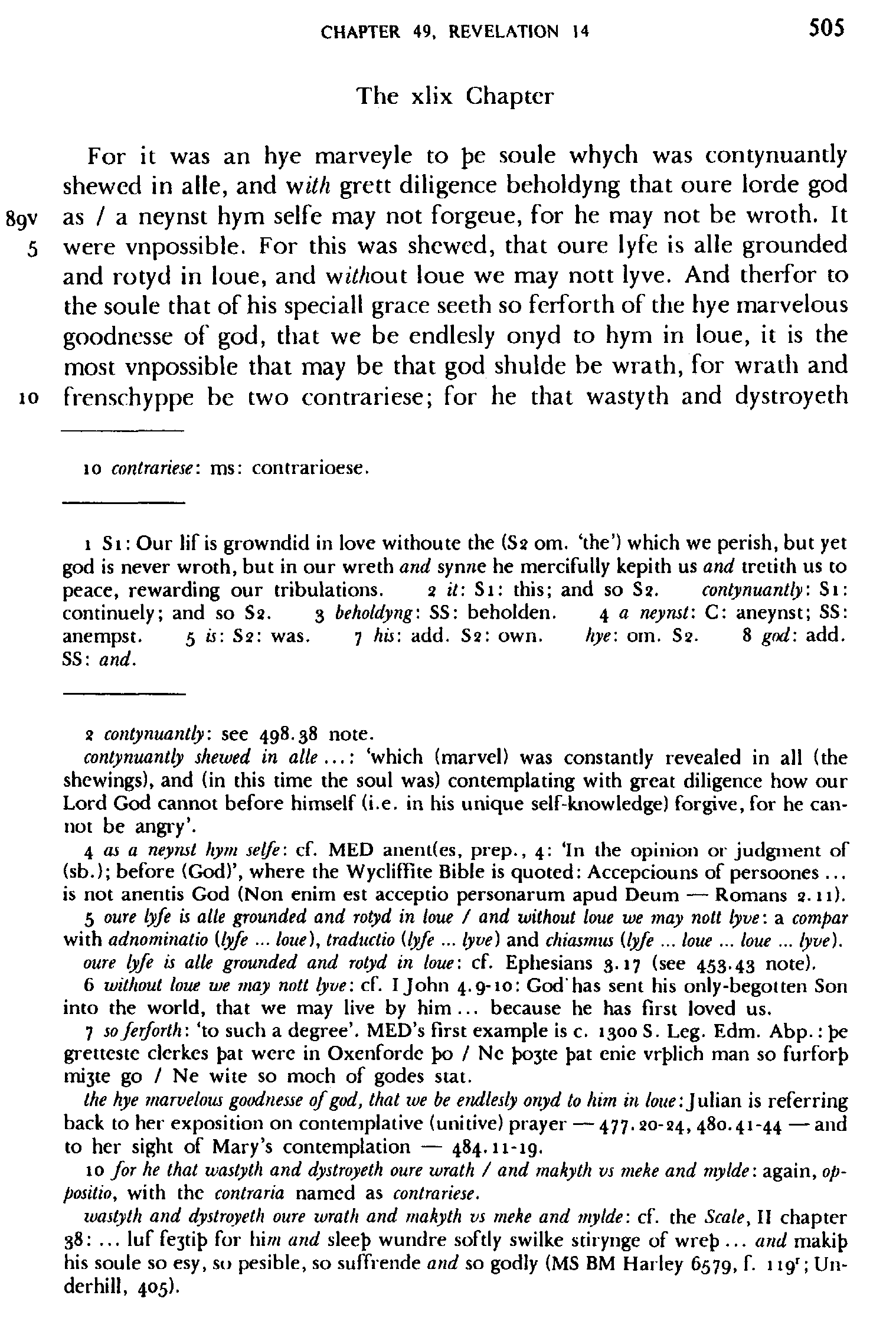
CHAPTER 49, REVELATION 14
The xlix Chapter For it was an hye marveyle to £>e soule whych was contynuantly shewed in alle, and with grett diligence beholdyng that oure lorde god
8gv as / a neynst hym selfe may not forgeue, for he may not be wroth. It 5 were vnpossible. For this was shewed, that oure lyfe is alle grounded and rotyd in loue, and without loue we may nott lyve. And therfor to the soule that of his speciall grace seeth so ferforth of the hye marvelous goodnesse of god, that we be endlesly onyd to hym in loue, it is the most vnpossible that may be that god shulde be wrath, for wrath and 10 frenschyppe be two contrariese; for he that wastyth and dystroyeth
10 contrariese: ms: contrarioese. i Si: Our lif is growndid in love withoute the (82 om. 'the') which we perish, but yet god is never wroth, but in our wreth and synwe he mercifully kepith us and tretith us to peace, rewarding our tribulations.
2 it: Si: this; and so 82. contynuantly: Si: continuely; and so 82.
3 beholdyng: SS: beholden.
4 a neynst: C: aneynst; SS: anempst.
5 is: 82: was.
7 his: add. 82: own. hye: om. 82.
8 god: add.
SS: and.
2 contynuantly: see 498.38 note. contynuantly shewed in alle...: 'which (marvel) was constantly revealed in all (the shewings), and (in this time the soul was) contemplating with great diligence how our
Lord God cannot before himself (i.e. in his unique self-knowledge) forgive, for he cannot be angry'.
4 as a neynst hym selfe: cf. MED anent(es, prep., 4: 'In the opinion or judgment of (sb.); before (God)', where the Wycliffite Bible is quoted: Accepciouns of persoones ... is not anentis God (Non enim est acceptio personarum apud Deum — Romans 2.11).
5 oure lyfe is alle grounded and rotyd in loue / and without loue we may nott lyve: a compar with adnominatio (lyfe ... loue), traductio (lyfe ... lyve) and chiasmus (lyfe ... loue ... loue ... lyve). oure lyfe is alle grounded and rotyd in loue: cf. Ephesians 3.17 (see 453.43 note).
6 without loue we may nott lyve: cf. I John 4.9-10: God'has sent his only-begotten Son into the world, that we may live by him ... because he has first loved us.
7 so ferforth: 'to such a degree'. MED's first example is c. 1300 8. Leg. Edm. Abp.: J>e gretteste clerkes f>at were in Oxenforde J>o / Ne J>O3te Jjat enie vrjilich man so furforf) mi3te go / Ne wite so moch of godes stat. the hye marvelous goodnesse of god, that we be endlesly onyd to him in loue: Julian is referring back to her exposition on contemplative (unitive) prayer — 477.20-24, 480.41-44 —and to her sight of Mary's contemplation — 484.11-19.
10 for he that wastyth and dystroyeth oure wrath / and makyth vs meke and mylde: again, opfjositio, with the contraria named as contrariese. wastyth and dystroyeth oure wrath and makyth vs meke and mylde: cf. the Scale, II chapter
38: ... luf fejtif) for him and sleef) wundre softly swilke stirynge of wrej)... and makij) his soule so esy, so pesible, so suffrende and so godly (MS BM Harley 6579, f. 119'; Underhill, 405).
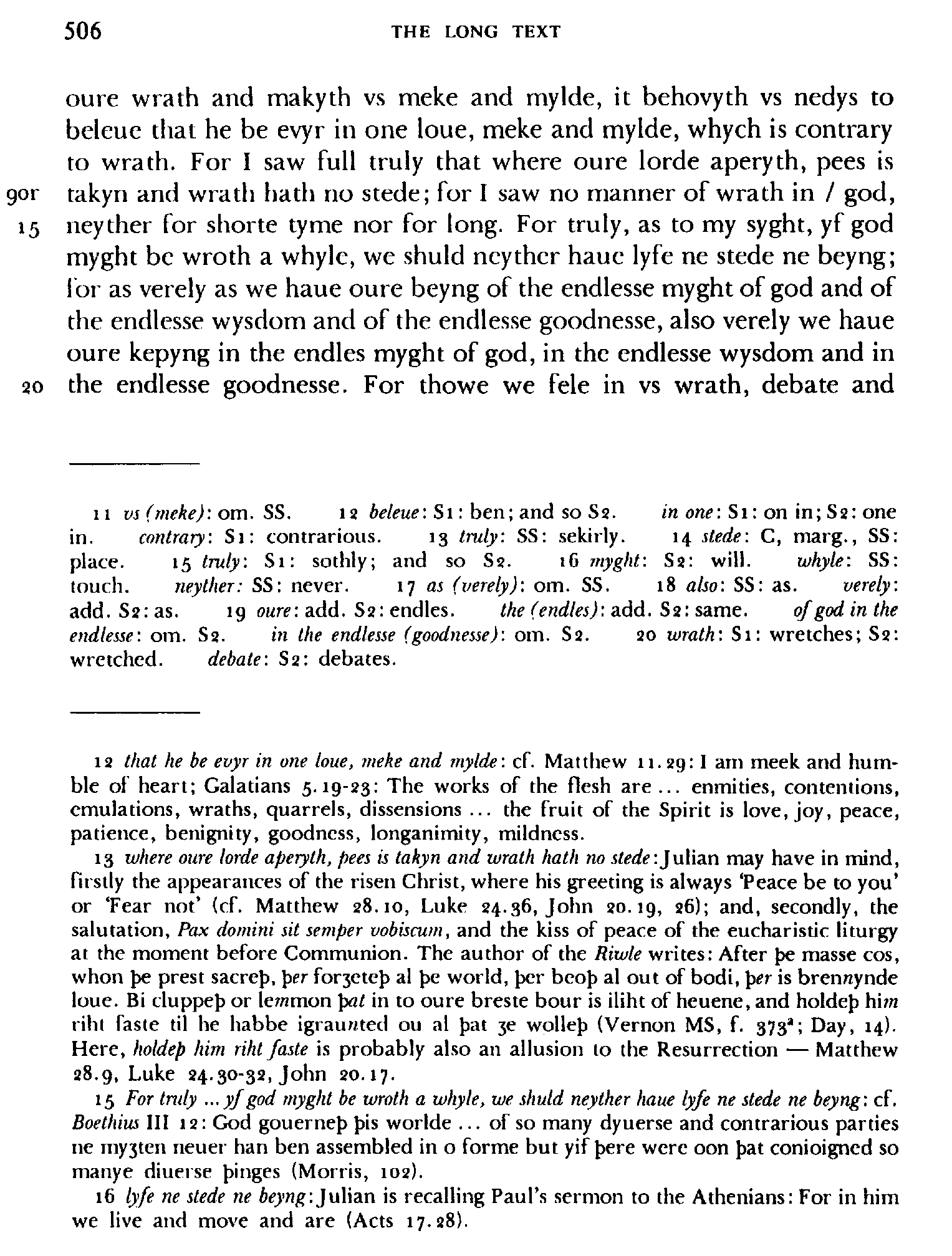
THE LONG TEXT
oure wrath and makyth vs meke and mylde, it behovyth vs nedys to beleuc that he be evyr in one loue, meke and mylde, whych is contrary to wrath. For I saw full truly that where oure lorde aperyth, pees is
takyn and wrath hath no stede; for I saw no manner of wrath in / god, 15 neyther for shorte tyme nor for long. For truly, as to my syght, yf god myght be wroth a whyle, we shuld neyther haue lyfe ne stede ne beyng; lor as verely as we haue oure beyng of the endlesse myght of god and of the endlesse wysdom and of the endlesse goodnesse, also verely we haue oure kepyng in the endles myght of god, in the endlesse wysdom and in 20 the endlesse goodnesse. For thowe we fele in vs wrath, debate and 11 vs (meke): om. SS.
12 beleue: Si: ben; and so Ss. in one: Si: on in; 82: one in. contrary: Si: contrarious.
13 truly: SS: sekirly.
14 stede: C, marg., SS: place.
15 truly: Si: sothly; and so 82.
16 myght: 82: will. whyle: SS: touch. neyther: SS: never.
17 as (verely): om. SS.
18 also: SS: as. verely: add. 82: as.
19 oure: add. 82: endles. the (endles): add. 82: same. of god in the endlesse: om. 82. in the endlesse (goodnesse): om. 82.
20 wrath: Si: wretches; 82: wretched. debate: 82: debates.
12 that he be evyr in one loue, meke and mylde: cf. Matthew 11.29: I am meek and humble of heart; Galatians 5.19-23: The works of the flesh are... enmities, contentions, emulations, wraths, quarrels, dissensions ... the fruit of the Spirit is love, joy, peace, patience, benignity, goodness, longanimity, mildness.
13 where oure lorde aperyth, pees is takyn and wrath hath no stede:Julian may have in mind, firstly the appearances of the risen Christ, where his greeting is always 'Peace be to you' or Tear not' (cf. Matthew 28.10, Luke 24.36, John 20.19, 26); and, secondly, the salutation, Pax domini sit semper vobiscum, and the kiss of peace of the eucharisuc liturgy at the moment before Communion. The author of the Riwle writes: After {>e masse cos, whon pe prest sacrejj, \>er fo^etcp al pe world, per beop al out of bodi, tyr is brenrcynde loue. Bi cluppep or le;«mon \>at in to oure breste bour is iliht of heuene, and holdep him riht faste til he habbe igraunted ou al pat je wollep (Vernon MS, f. 373"; Day, 14).
Here, holdep him riht faste is probably also an allusion to the Resurrection — Matthew
28.9, Luke 24.30-32, John 20.17.
15 For truly ... yf god myght be wroth a whyle, we shuld neyther haue lyfe ne stede ne beyng: cf.
Boethius III 12: God gouernep pis worlde ... of so many dyuerse and contrarious parties ne my3ten neuer han ben assembled in o forme but yif pere were oon pat conioigned so manye diuerse pinges (Morris, 102).
16 lyfe ne stede ne beyng:Julian is recalling Paul's sermon to the Athenians: For in him we live and move and are (Acts 17.28).
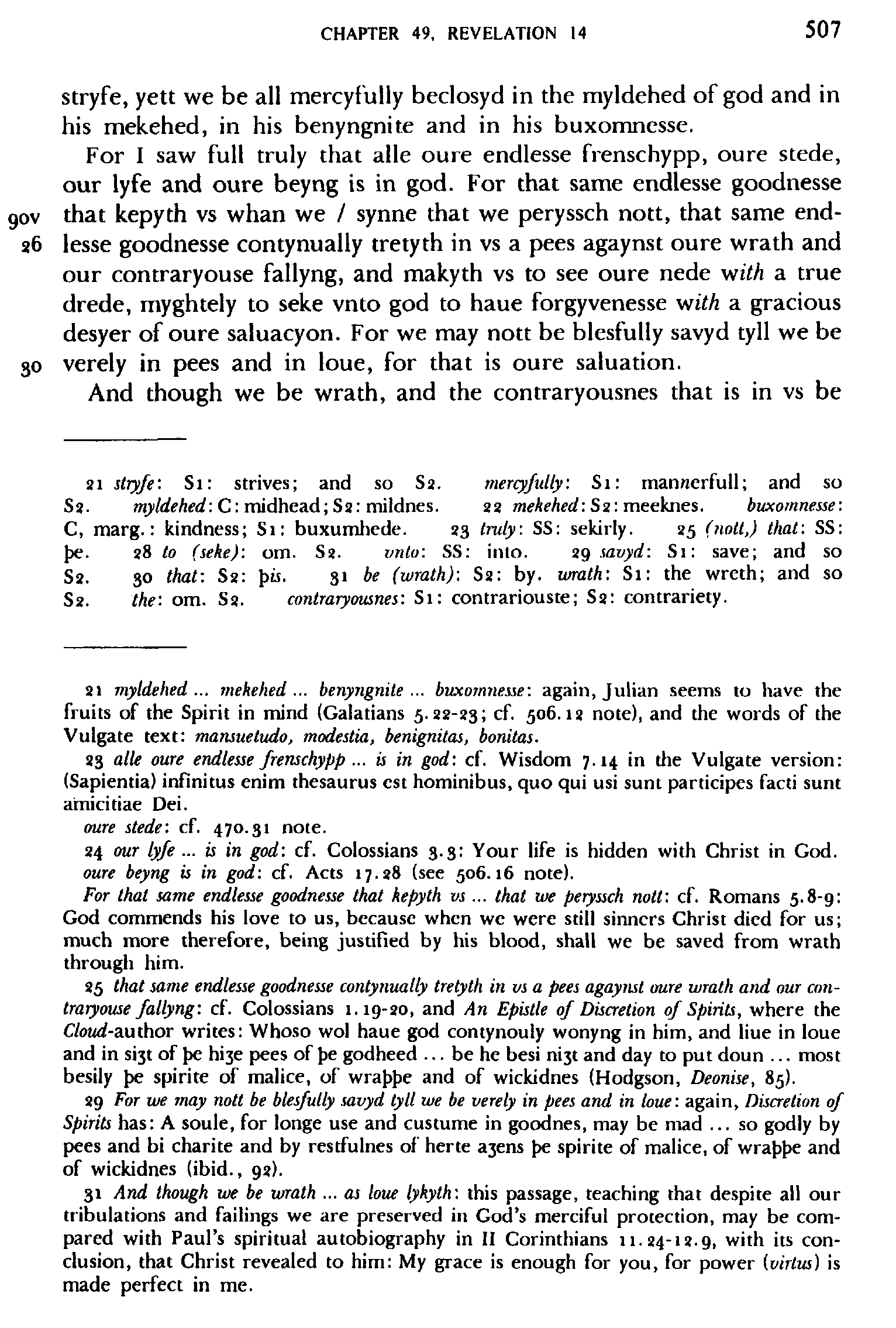
CHAPTER 49, REVELATION 14
stryfe, yett we be all mercyf ully beclosyd in the myldehed of god and in his mekehed, in his benyngnite and in his buxomnesse.
For I saw full truly that alle oure endlesse frenschypp, oure stede, our lyfe and oure beyng is in god. For that same endlesse goodnesse gov that kepyth vs whan we / synne that we peryssch nott, that same end26 lesse goodnesse contynually tretyth in vs a pees agaynst oure wrath and our contraryouse fallyng, and makyth vs to see oure nede with a true drede, myghtely to seke vnto god to haue forgyvenesse with a gracious desyer of oure saluacyon. For we may nott be blesfully savyd tyll we be
30 verely in pees and in loue, for that is oure saluation.
And though we be wrath, and the contraryousnes that is in vs be 21 stryfe:
Si: strives; and so 82. mercyfully:
Si: manwerfull; and so S2. myldehed: C: midhead 582: mildnes.
2 2 mekehed: S 2: meeknes. buxomnesse:
C, marg.: kindness; Si: buxumhede.
23 truly: SS: sekirly.
25 (nott,) that: SS:
Jx?.
28 to (seke): om.
82. vnto: SS: into.
29 savyd: Si: save; and so 82.
30 that: 82: \>is.
31 be (wrath): 82: by. wrath: Si: the wreth; and so 82. the: om. 82. contraryousnes: Si: contrariouste; 82: contrariety.
21 myldehed... mekehed... benyngnite... buxomnesse: again, Julian seems to have the fruits of the Spirit in mind (Galatians 5.22-23; cf. 506.12 note), and the words of the Vulgate text: mansuetudo, modestia, benignitas, bonitas.
23 alle oure endlesse frenschypp ... is in god: cf. Wisdom 7.14 in the Vulgate version:
(Sapientia) infinitus enim thesaurus est hominibus, quo qui usi sunt participes facti sunt amicitiae Dei. oure stede: cf. 470.31 note.
24 our lyfe ... is in god: cf. Colossians 3.3: Your life is hidden with Christ in God. oure beyng is in god: cf. Acts 17.28 (see 506.16 note).
For that same endlesse goodnesse that kepyth vs ... that we peryssch nott: cf. Romans 5.8-9:
God commends his love to us, because when we were still sinners Christ died for us; much more therefore, being justified by his blood, shall we be saved from wrath through him.
25 that same endlesse goodnesse contynually tretyth in vs a pees agaynst oure wrath and our contraryouse fallyng: cf. Colossians 1.19-20, and An Epistle of Discretion of Spirits, where the Cloud-author writes: Whoso wol haue god contynouly wonyng in him, and Hue in loue and in si3t of j>e hise pees of ]>e godheed ... be he besi ni3t and day to put doun ... most besily J>e spirite of malice, of wraj^e and of wickidnes (Hodgson, Deonise, 85).
29 For we may nott be blesfully savyd tyll we be verely in pees and in loue: again, Discretion of Spirits has: A soule, for longe use and custume in goodnes, may be mad ... so godly by pees and bi charite and by restfulnes of herte a3ens f>e spirite of malice, of wrajj^e and of wickidnes (ibid., 92).
31 And though we be wrath ... as loue lykyth: this passage, teaching that despite all our tribulations and failings we are preserved in God's merciful protection, may be compared with Paul's spiritual autobiography in II Corinthians 11.24-12.9, with its conclusion, that Christ revealed to him: My grace is enough for you, for power (virtus) is made perfect in me.
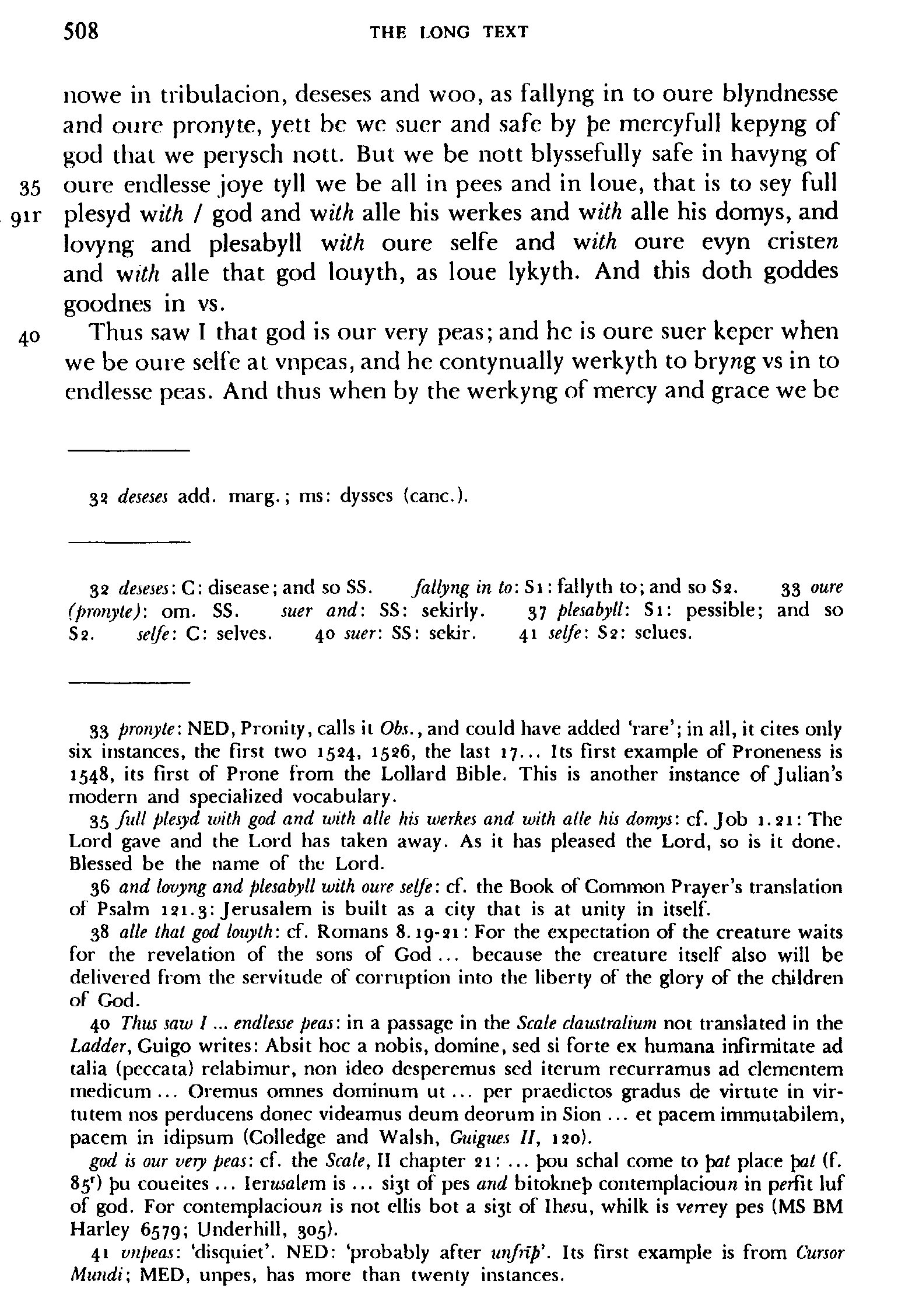
THE LONG TEXT
nowe in tribulacion, deseses and woo, as fallyng in to oure blyndnesse and oure pronyte, yett be we suer and safe by ]3e mercyfull kepyng of god that we perysch nott. But we be nott blyssefully safe in havyng of 35 oure endlesse joye tyll we be all in pees and in loue, that is to sey full
91 r plesyd with I god and with alle his werkes and with alle his domys, and lovyng and plesabyll with oure selfe and with oure evyn cristew and with alle that god louyth, as loue lykyth. And this doth goddes goodnes in vs.
Thus saw I that god is our very peas; and he is oure suer keper when we be oure selfe at vnpeas, and he contynually werkyth to bryng vs in to endlesse peas. And thus when by the werkyng of mercy and grace we be
32 deseses add. marg.; ms: dysscs (cane.) 32 deseses: C: disease; and so SS. fallyng in to: Si: fallyth to; and so 82.
33 oure (pronyte): om. SS. suer and: SS: sekirly.
37 plesabyll: Si: possible; and so 82. selfe: C: selves.
40 suer: SS: sekir.
41 selfe: 82: sclues.
33 pronyte: NED, Pronity, calls it Obs., and could have added 'rare'; in all, it cites only six instances, the first two 1524, 1526, the last 17... Its first example of Proneness is
1548, its first of Prone from the Lollard Bible. This is another instance of Julian's modern and specialized vocabulary.
35 full plesyd with god and with alle his werkes and with alle his domys: cf. Job 1.21: The Lord gave and the Lord has taken away. As it has pleased the Lord, so is it done.
Blessed be the name of the Lord.
36 and lovyng and plesabyll with oure selfe: cf. the Book of Common Prayer's translation of Psalm 121.3: Jerusalem is built as a city that is at unity in itself.
38 alle that god louyth: cf. Romans 8.19-21: For the expectation of the creature waits for the revelation of the sons of God ... because the creature itself also will be delivered from the servitude of corruption into the liberty of the glory of the children of God.
40 Thus saw I... endlesse peas: in a passage in the Scale damtralium not translated in the Ladder, Guigo writes: Absit hoc a nobis, domine, sed si forte ex humana infirmitate ad talia (peccata) relabimur, non ideo desperemus sed iterum recurramus ad clementem rnedicum ... Oremus omnes dominum ut ... per praedictos gradus de virtute in virtutem nos perducens donee videamus deum deorum in Sion ... et pacem immutabilem, pacem in idipsum (Colledge and Walsh, Guigues II, 120). god is our very peas: cf. the Scale, II chapter 21: ... pou schal come to \at place \>at (f.
85') \>u coueites ... lerusalem is ... 5)31 of pes and bitoknej) contemplaciourc in pwfit luf of god. For contemplacioun is not ellis bot a si3t of Ihmi, whilk is wrrey pes (MS BM
Harley 6579; Underbill, 305).
41 vnpeas: 'disquiet'. NED: 'probably after unfrip'1. Its first example is from Cursor
Mundi; MED, unpes, has more than twenty instances.
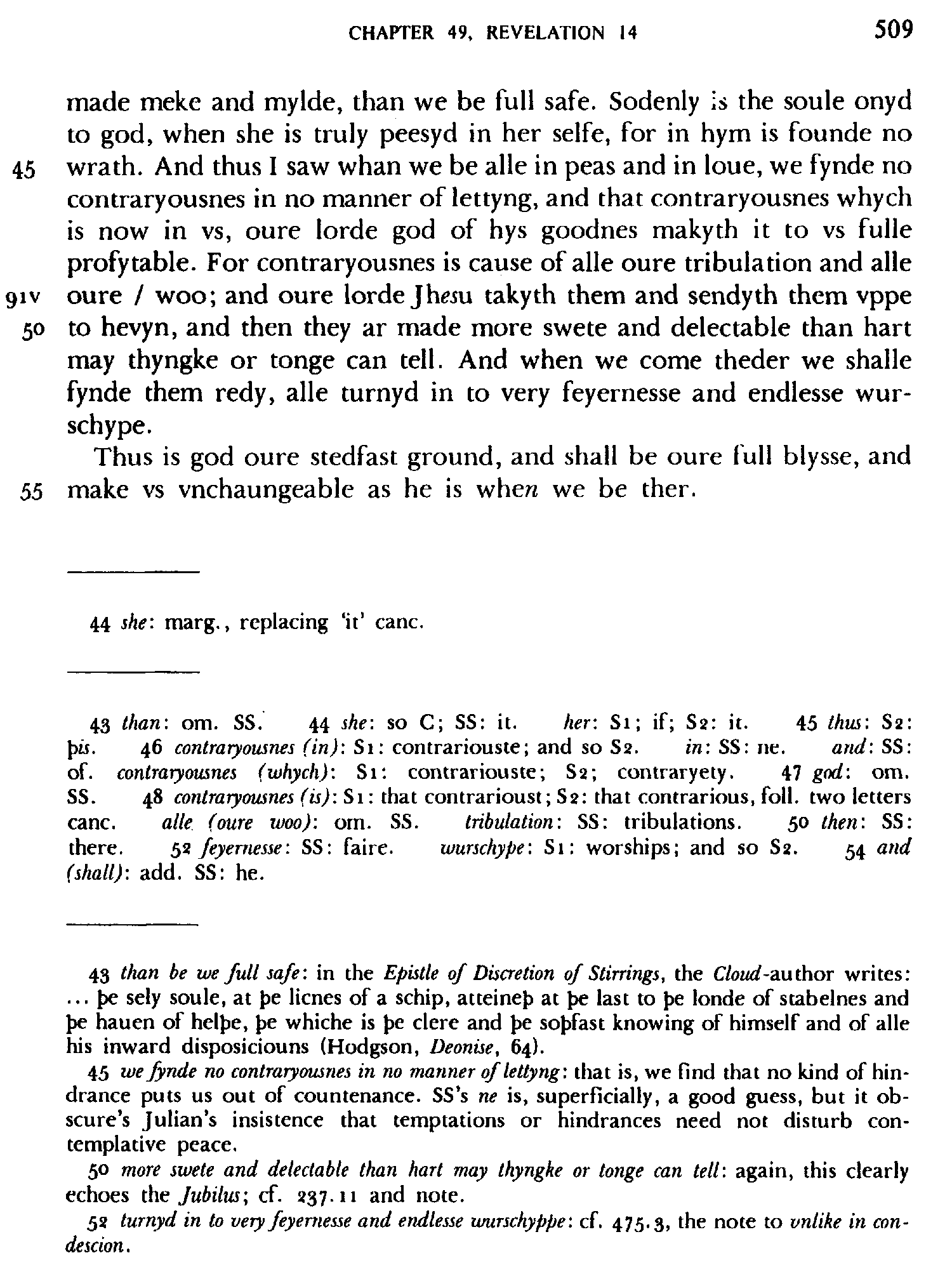
CHAPTER 49, REVELATION 14
made meke and mylde, than we be full safe. Sodenly is the soule onyd to god, when she is truly peesyd in her selfe, for in hym is founde no 45 wrath. And thus I saw whan we be alle in peas and in loue, we fynde no contraryousnes in no manner of lettyng, and that contraryousnes whych is now in vs, oure lorde god of hys goodnes makyth it to vs fulle profytable. For contraryousnes is cause of alle oure tribulation and alle giv oure / woo; and oure lorde Jh^m takyth them and sendyth them vppe
50 to hevyn, and then they ar made more swete and delectable than hart may thyngke or tonge can tell. And when we come theder we shalle fynde them redy, alle turnyd in to very feyernesse and endlesse wurschype.
Thus is god oure stedfast ground, and shall be oure full blysse, and 55 make vs vnchaungeable as he is when we be ther.
44 she: marg., replacing 'it1 cane.
43 than: om. SS.
44 she: so C; SS: it. her: Si; if; 82: it.
45 thus: 82: f>is.
46 contraryousnes (in): Si: contrariouste; and so 82. in: SS: ne. and: SS: of. contraryousnes (whych): Si: contrariouste; 82; contraryety.
47 god: om.
SS.
48 contraryousnes (is): Si: that contrarioust; 82: that contrarious, foil, two letters cane. alle (oure woo): om. 88. tribulation: SS: tribulations.
50 then: SS: there.
52 feyernesse: 88: faire. wurschype: Si: worships; and so 82.
54 and (shall); add. 88: he.
43 than be we full safe: in the Epistle of Discretion of Stirrings, the Cloud-author writes:
... |>e sely soule, at |>e licnes of a schip, atteine}> at f»e last to J>e londe of stabelnes and l>e hauen of hel^e, |je whiche is J>e clere and J>e so^fast knowing of himself and of alle his inward disposiciouns (Hodgson, Deonise, 64).
45 we fynde no contraryousnes in no manner of lettyng: that is, we find that no kind of hindrance puts us out of countenance. SS's ne is, superficially, a good guess, but it obscure's Julian's insistence that temptations or hindrances need not disturb contemplative peace.
50 more swete and delectable than hart may thyngke or tonge can tell: again, this clearly echoes the Jubilus; cf. 237.11 and note.
52 turnyd in to very feyernesse and endlesse wurschyppe: cf. 475.3, the note to vnlike in condescion.
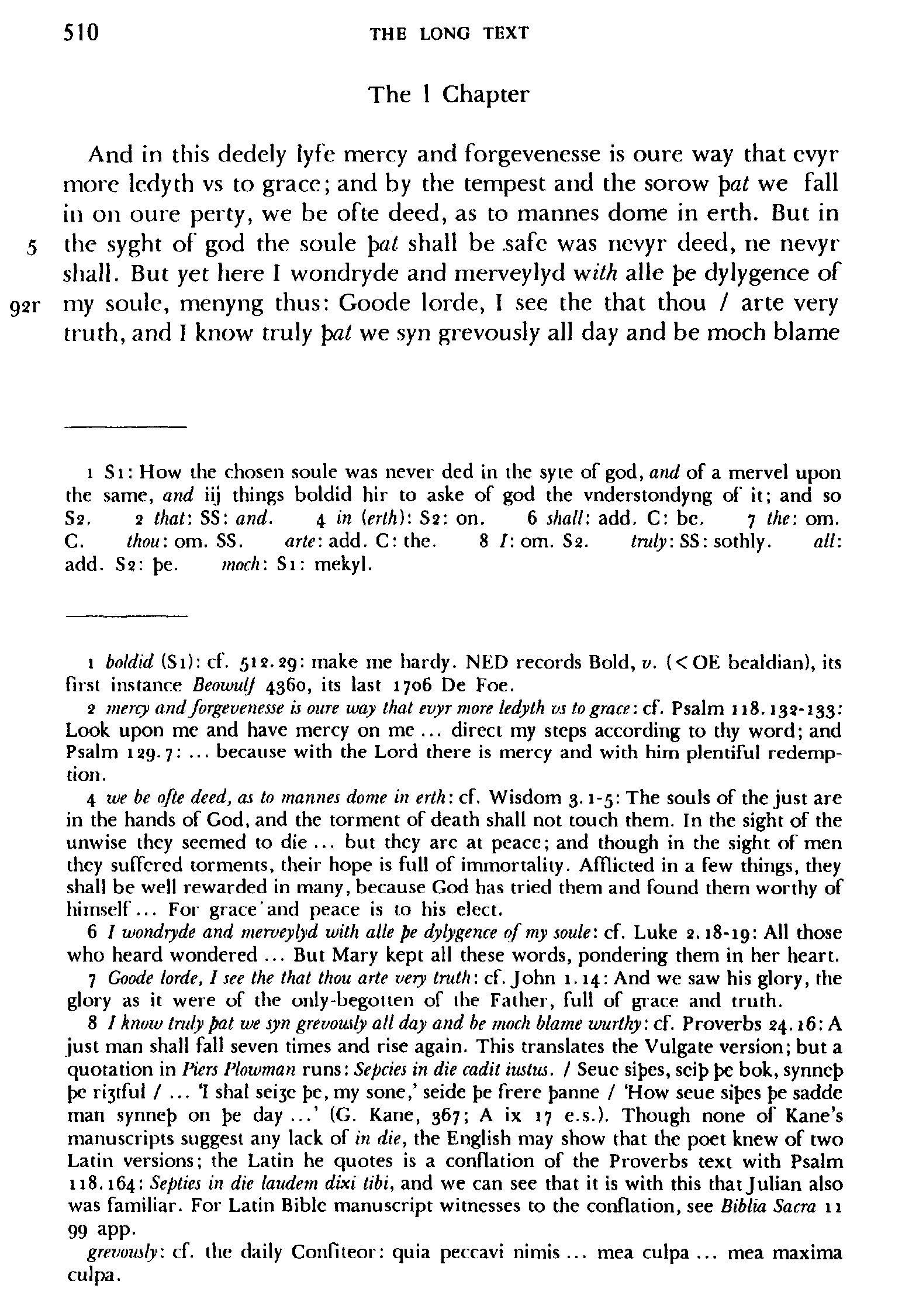
THE LONG TEXT
The 1 Chapter And in this dedely lyfe mercy and forgevenesse is oure way that evyr more ledyth vs to grace; and by the tempest and the sorow fyat we fall in on oure perty, we be ofte deed, as to mannes dome in erth. But in
the syght of god the soule \>at shall be .safe was nevyr deed, ne nevyr shall. But yet here I wondryde and merveylyd with alle £>e dylygence of gar my soulc, menyng thus: Goode lorde, I see the that thou / arte very truth, and I know truly Jxz/ we syn grevously all day and be moch blame i Si: How the chosen soule was never ded in the syte of god, and of a mervel upon the same, and iij things boldid hir to aske of god the vnderstondyng of it; and so Sa.
2 that: SS: and.
4 in (erth): Sa: on.
6 shall: add. C: be.
7 the: om.
C. thou:om. SS. arte: add. C: the.
8 /: om. Sa. truly: SS: sothly. all: add. Sa: pe. moch: Si: mekyl.
1 boldid (Si): cf. 512.29: make me hardy. NED records Bold, v. «OE bealdian), its first instance Beowulf 4360, its last 1706 De Foe.
2 mercy and forgevenesse is oure way that evyr more ledyth vs to grace: cf. Psalm 118.132-133:
Look upon me and have mercy on me ... direct my steps according to thy word; and Psalm 129.7: ... because with the Lord there is mercy and with him plentiful redemption.
4 we be ofte deed, as to mannes dome in erth: cf. Wisdom 3.1-5: The souls of the just are in the hands of God, and the torment of death shall not touch them. In the sight of the unwise they seemed to die ... but they are at peace; and though in the sight of men they suffered torments, their hope is full of immortality. Afflicted in a few things, they shall be well rewarded in many, because God has tried them and found them worthy of himself... For grace and peace is to his elect.
6 / wondryde and merveylyd with alle pe dylygence of my soule: cf. Luke a. 18-19: All those who heard wondered ... But Mary kept all these words, pondering them in her heart.
7 Goode lorde, I see the that thou arte very truth: cf. John 1.14: And we saw his glory, the glory as it were of the only-begotten of the Father, full of grace and truth.
8 / know truly pat we syn grevotaly all day and be moch blame wurthy: cf. Proverbs 24.16: A just man shall fall seven times and rise again. This translates the Vulgate version; but a quotation in Piers Plowman runs: Sepcies in die cadit iustus. / Seuc sipes, seip pe bok, synnep be rijtful / ... 'I shal sei3c pe, my sone,' seide be frere panne / 'How seue sipes pe sadde man synnef) on pe day ...' (G. Kane, 367; A ix 17 e.s.). Though none of Kane's manuscripts suggest any lack of in die, the English may show that the poet knew of two
Latin versions; the Latin he quotes is a conflation of the Proverbs text with Psalm
118.164: Septies in die laudem dixi tibi, and we can see that it is with this that Julian also was familiar. For Latin Bible manuscript witnesses to the conflation, see Biblia Sacra 11
99 app. grevously: cf. the daily Confiteor: quia peccavi nimis ... mea culpa ... mea maxima culpa.
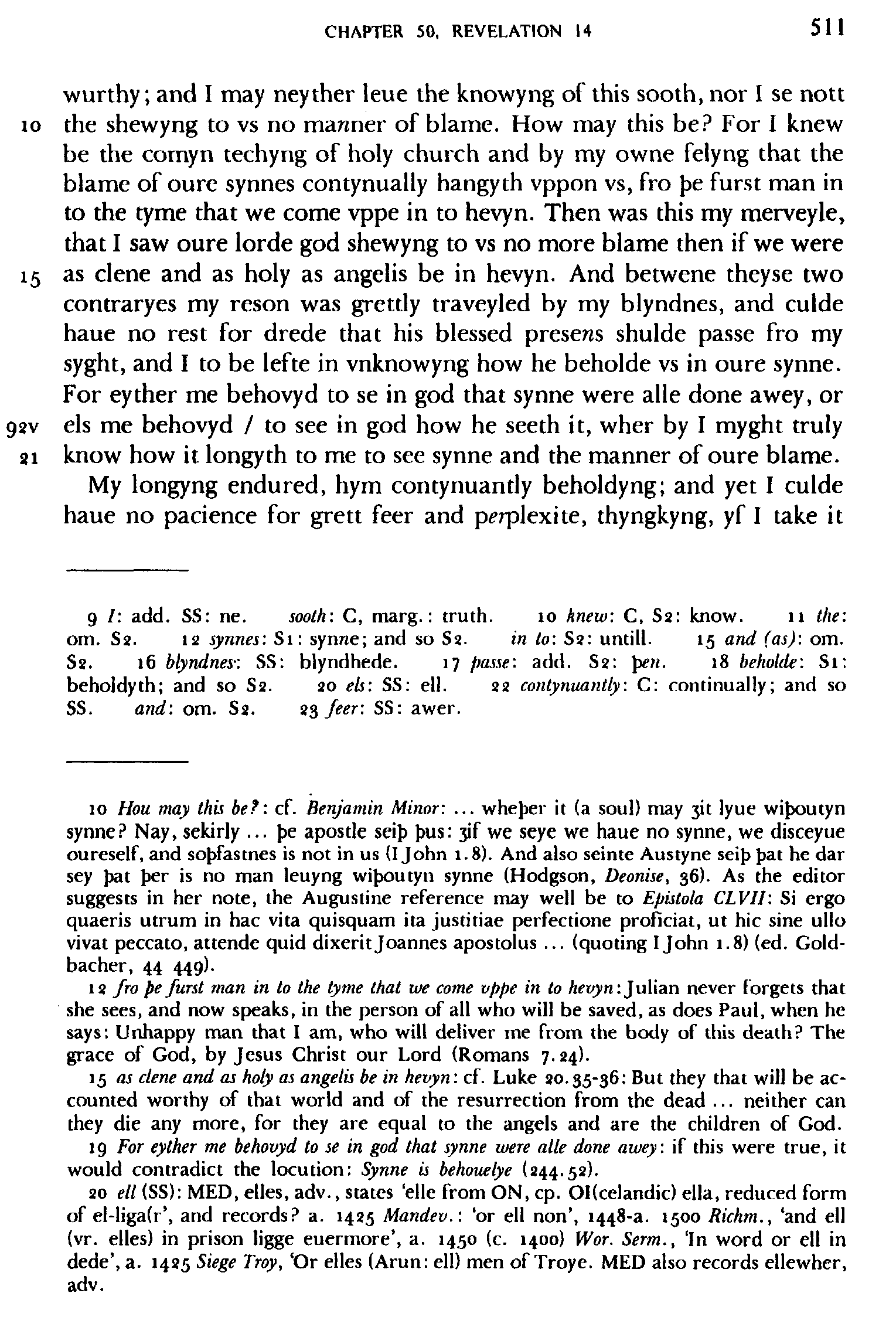
CHAPTER 50, REVELATION 14
5 1 1 wurthy; and I may neyther leue the knowyng of this sooth, nor I se nott 10 the shewyng to vs no manner of blame. How may this be? For I knew be the comyn techyng of holy church and by my owne felyng that the blame of oure synnes contynually hangyth vppon vs, fro be furst man in to the tyme that we come vppe in to hevyn. Then was this my merveyle, that I saw oure lorde god shewyng to vs no more blame then if we were
15 as clene and as holy as angelis be in hevyn. And betwene theyse two contraryes my reson was grettly traveyled by my blyndnes, and culde haue no rest for drede that his blessed presets shulde passe fro my syght, and I to be lefte in vnknowyng how he beholde vs in oure synne.
For eyther me behovyd to se in god that synne were alle done awey, or gav els me behovyd / to see in god how he seeth it, wher by I myght truly
21 know how it longyth to me to see synne and the manner of oure blame.
My longyng endured, hym contynuantly beholdyng; and yet I culde haue no pacience for grett feer and p^rplexite, thyngkyng, yf I take it
9 /: add. SS: ne. sooth: C, marg.: truth.
10 knew: C, 82: know.
11 the: om. 82.
12 synnes: Si: synne; and so 82. in to: 82: untill.
15 and (as): om.
82.
16 blyndnes-: SS: blyndhede.
17 passe: add. 82: pen.
18 beholde: Si: beholdyth; and so 82.
20 els: SS: ell.
22 contynuantly: C: continually; and so SS. and: om. 82.
23 feer: SS: awer.
10 Hou may this be?: cf. Benjamin Minor: ... wheper it (a soul) may 3it lyue wijxnityn synne? Nay, sekirly ... Jje apostle sell? pus: ;jif we seye we haue no synne, we disceyue oureself, and sopfastnes is not in us (I John 1.8). And also seinte Austyne seip pat he dar sey fat per is no man leuyng wipoutyn synne (Hodgson, Deonise, 36). As the editor suggests in her note, the Augustine reference may well be to Epistola CLVI1: Si ergo quaeris utrum in hac vita quisquam ita justitiae perfectione proficiat, ut hie sine ullo vivat peccato, attende quid dixerit Joannes apostolus ... (quoting I John 1.8) (ed. Goldbacher, 44 449).
12 fro pe furst man in to the tyme that we come vppe in to hevyn: Julian never forgets that she sees, and now speaks, in the person of all who will be saved, as does Paul, when he says: Unhappy man that I am, who will deliver me from the body of this death? The grace of God, by Jesus Christ our Lord (Romans 7.24).
15 as clene and as holy as angelis be in hevyn: cf. Luke 20.35-36: But they that will be accounted worthy of that world and of the resurrection from the dead ... neither can they die any more, for they are equal to the angels and are the children of God.
19 For eyther me behovyd to se in god that synne were alle done awey: if this were true, it would contradict the locution: Synne is behouelye (244.52).
20 ell (SS): MED, elles, adv., states 'elle from ON, cp. OKcelandic) ella, reduced form of el-liga(r', and records? a. 1425 Mandev.: 'or ell non', 1448-3. 1500 Richm., 'and ell
(vr. elles) in prison ligge euermore', a. 1450 (c. 1400) Wor. Serm., 'In word or ell in dede', a. 1425 Siege Troy, 'Or elles (Arun: ell) men of Troye. MED also records ellewher, adv.
THE LONG TEXT
thus, \>at we be no synners nor no blame wurthy, it semyth as I shulde 25 erre and faile of knowyng of this soth. And yf it be tru that we be synners and blame wurthy, good lorde, how may it than be that I can nott see this truth in the, whych arte my god, my maker in whom I desyer to se alle truth?
For thre poyntcs make me hardy to aske it. The furst is for it is so 30 lowe athyng, for if it were an hye I shulde be adred. The secunde is that it is so comon; for if it were specyall and prevy, also I shulde be adred. gsr The thyrde is that it nedyth me to wytt, as me / thyngkyth, if I shall lyve here, for knowyng of good and evyll, wher by I may by reson and by grace the more deperte them a sonder, and loue goodnesse and hate
35 evyll as holy chyrch techyth. I cryde inwardly wzY/i all my myght, sekyng in to god for helpe, menyng thus: A, lorde Jhesu, kyng of blysse, how shall I be esyde, who shall tell me and tech me that me nedyth to wytt, if I may nott at this tyme se it in the?
24 no (synners): SS: not.
25 of (this): om. 82. tru: 88: so.
27 truth: Si: sothnes; and so 82. whych: 82: who.
28 truth: Si: trueths; and so 82.
30 be adred: C, marg.: fear.
32 wytt: 82: know; add. 88: it.
33 by (grace): om.
SS.
36 in to: C, 82: unto.
37 who: add. SS: that. me (and): om. 82.
26 that I can nott see this truth in the, whych arte my god: cf. Psalm 24.4: Shew, o Lord, thy ways to me, teach me thy paths, direct me in thy truth and teach me.
30 if it were an hye I shulde be adred: cf. Psalm 130. i: Lord, my heart is not exalted, nor are my eyes lofty; neither have I walked in great matters, nor in wonderful things above me.
31 it is so comon: Julian seems to be thinking of all those lovers of Christ in whom there is the 'doubtful fear' of God.
33 for knowyng of good and evyll: cf. the Cloud: Reson is a my$t borou be whiche we departe be iuel fro be good ... Before er man synncd, mi3t reson haue done al bis by kynde. Bot now it is so blendid wib be original synne bat it may not kon worche bis werk bot jif it be illuminid by grace (Hodgson, 116).
36 A, lorde Jhesu, kyng of blysse: the ejaculatory form of petitionary prayer by those in felt need, already traditional in the early Christian communities when the synoptic gospels were written (e.g. Matthew 9.27, 20.30; Mark 10.47; Luke 17.13, 18.38) has contemplative profundity which was soon recognized in the West as well as in the East; e.g. Augustine, Tract, in lohannem XLVIII (ed. R. Willems, 412), Bede, In Lucam V xviii 38-39 (ed. D. Hurst, 331-332). Cf. the English Stimulus: A preier to oure lord aboute his passioun. A swete lorde Jhesu Criste... (H. J. Kane, 67; Kirchberger, 96).
37 who shall tell me: cf. Acts 8.30-31, 35: Philip ... heard him reading the prophet
Isaias. And he said: Do you think that you understand what you read? And he said:
How can I, unless some man show me? ... Then Philip ... preached Jesus to him. In the disputation between Mercy and Truth, pseudo-Bonaventure writes: ... nihilominus
Veritas fortissime allegat: Domine, contra te ista quaestio intorquetur, et est cavendum ne verbum Patris evacuetur (Peltier, 12 512; Ragusa and Green, 8).
CHAPTER 51, REVELATION 14
The Ij Chapter And then oure curteyse lorde answeryd in shewyng full mystely by a wonderfull example of a lorde that hath a servannt, and gaue me syght i Si: The answare to the doute afor (82: to the foregoing doubt) by a mervelous example of a lord and a servant; and (82 om. 'and') god will be abidyn, for it was nere xx yeres after ere (Ss om. 'ere) she fully vnderstode this example; and how it is vnderstod pa/ Crist syttith on the ryth hand of the fader.
2 mystely: C, marg.: darkly; 82: mightily.
1 for it was nere xx yeres after (Si): cf. 520.86, 732.14.
2 full mystely: NED, Mistily, adv., defines 'In a misty manner; in early quots. ,fig.'\ but the four earliest quotations (Prick of Conscience, alluding to the Apocalypse, Wycliffe to Christ's parables, Chaucer, Canon's Yeoman's Tale, to 'philosophers' — that is, alchemists
— Merlin to his book of prophecies) show clearly that the word was used in late Middle
English as a blend of OE mist, 'mist', and ME mystike, to mean 'conveyed darkly and symbolically, after the manner of Scriptural parables'. Julian is here writing with hindsight, to describe not only the reception of the showing, but also her later difficulties over it.
God first answered by showing very mistily a wonderful example, and then, after many years of contemplation, enlightened her to understand what both lord and servant signified. The SS title makes this very clear.
3 example: although MED's treatment of this noun (if one conflates ensaumple n. 3,
'Something spoken or written to teach a lesson... a parable', and exaumple 3) is superior to NED Example, neither work makes the essential point that Julian (whom they do not quote) and many of her contemporaries (e.g. MED, ensaumple, Piers
Plowman, Gower, the Romaunt of the Rose, exaumple, the Catholicon anglicum) use the word as a technical term of rhetoric to mean a preacher's exemplum. Welter, L'Exemplum, 75, quotes from his edition of the Franciscan Speculum laicorum: Ego de simplicium numero minimus ad honorem dei erudicionemque rudium de sanctorum patrum et doctorurn legendis et scriptis temporumque preteritorum ac modernorum quibusdam eventibus exemplisque naturalibus, non margaritas set siliquas collegi quasi pecoribus erogandas ut paradigmatibus saltern et parabolis foveantur et exemplis. So Chaucer's Pardoner in his Prologue says: Thanne telle I hem ensamples many oon / Of olde stories longe tyme agoon / For lewed peple loven tales olde ...,and Robinson comments: '"exempla", the term regularly applied to the illustrative anecdotes of preachers' (ed., 180, 835).
Chaucer is satirizing popular preaching, but he is himself notoriously prone to this embellishment. of a lorde that hath a servannt: throughout this chapter she seems to have constantly in mind the passages in Isaias, now called the 'Servant Songs', or 'Oracles of DeuteroIsaias', particularly 42.1-9, 49.1-13, 50.4-9, 52.9-53.12. In the tradition of the Church, the 'Lord' is firmly and consistently identified with God the Father, the 'Servant' with God the Son made man (with all his Scriptural titles), and particularly with Christ in his
Passion — the Suffering Servant — who is glorified in the Resurrection; so that there are other passages in the prophecy, especially 11. i, 51.1-5, 52.6-7, 53.1-12, 54.1-13 and
THE LONG TEXT
to my vnderstandyng of both. Whych syght was shewed double in £>e 5 lorde, and the syght was shewed double in the servannt. That one perty was shewed gostly in bodely lycknesse. That other p^rty was shewed gsv more gostly wz//ioute bodely lycknes. For / the furst thus I sawe two persons in bodely lycknesse, that is to sey a lorde and a servannt; and therw/M god gaue me gostly vnderstandyng. The lorde syttyth solemp10 nely in rest and in pees. The servannt stondyth before his lorde, reverently redy to do his lordes wylle. The lorde lokyth vppon his seruannt full louely and swetly and mekely. He sendyth hym in to a certeyne place to do his wyll. The servannt nott onely he goyth, but sodenly he stertyth and rynnyth in grett hast for loue to do his lordes
5 That (one): Si: than; and so 82.
6 lycknesse: add. SS: and.
That (other): Si: the; and so 82.
10 in (f)ees): om. 82. before: Si: by aforn; and so 82.
12 louely and: om. 82. in: oin. 88.
13 nott onely: om. 82.
61.1-3, which are assimilated to the theme of the Lord and the Servant. As the Douai titles to some of these chapters illustrate (e.g. chapter 61, The office of Christ, the mission of the Apostles, the happiness of their converts'), there is much that is symbolic or allegorical, so that Julian's in shewyngfull mystely is equally applicable to her sources and to her 'example'.
6 gostly in bodely lycknesse ... gostly withoute bodely lycknes: these two types of seeing differ from what Julian calls 'bodily sight' and 'ghostly sight', which concludes what she has to say about the first revelation (323. 29-30).
8 in bodely lycknesse: cf. 313.35-314.45 and 313.36 note, a short but open example of a so/empne kyng or a gret lorde and a pore seruante. This seems to be the same type of shewing,
'ghostly in bodily likeness'. It was shewde so hygh that thys tnannes hart myght be rauyssched.
11 reverently redy to do his lordes wylle: cf. the Treatise of Perfection: He that from that hey3t of god into the vayle of wrycchednesse is ordayned or sente ... he is euer abydynge and redy to do whale as god commawndys (Bazire and Colledge, Chastising,
257)- 12 He sendyth hym in to a certeyne place to do his wyll: cf. John 17.18: As thou hast sent me into the world, I also have sent them into the world.
13 The servannt nott onely he goyth, but sodenly he sterlyth: cf. Psalm 118.32:! have run the way of thy commandments, when thou didst enlarge my heart.
14 sodenly: 'promptly'. Cf. NED Sudden, a., adv., and sb. 3: 'Performed or taking place without delay; speedy; prompt, immediate'. Cf. An Epistle of Prayer, where the Cloud-zuihor writes: Me {>ink {sat seinte Bernard acordej) to t»is worching where he seij) f>at alle Binges schuld be done swiftlich and gladliche (Hodgson, Deonise, 51). The editor is probably right, 136, in identifying the probable source of 'Bernard' as Vitis mystica sen tractatus de passione Domini, chapter 9: Sunt autem nonnulli qui bona quidem opera faciunt vel coactione vel necessitate vel consuetudine, sed ad haec agenda nulla alacritate moventur ... (PL 184 674). Although it is now accepted that the ascription of Vitis mystica to Bernard is spurious, it is of Julian's age, and the kind of treatise which, if she knew it, she would esteem. Jolliffe does not list any translation of the work.
CHAPTER 51, REVELATION 14
15 wylk. And anon he fallyth in a slade, and takyth ful grett sorow; and than he gronyth and monyth and wallow_X/i and wryeth, but he may nott ryse nor helpe hym selfe by no manner of weye. And of all this the most myschefe that I saw hym in was feylyng of comfort, for he culde nott turne his face to loke vppe on his lovyng lorde, whych was to hym
94r full nere, / in whom is full comfort; but as a man that was full febyll 21 and vnwyse for the tyme, he entendyd to his felyng and enduryng in woo, in whych woo he sufferyd vij grett paynes. The furst was the score brosyng that he toke in his fallyng, whych was to hym moch payne. The seconde was J>e hevynesse of his body. The thyrde was fybylnesse that 25 folowyth of theyse two. The iiij was that he was blyndyd in his reson
15 slade: C, marg.: precipice. ful: om. 82. sorow: SS: sore.
16 wallowyth:
Si: waylith; and so 82. wryeth: Si: writhith; and so 82. may nott: 88: ne may.
17 of: om. SS.
19 whych: 82: who.
20 full (febyll): om. SS.
21 enduryng: Si: induryd; and so 82.
23 brosyng: C: brusing; Si: brosyng; 82: bruising. moch: Si: felable; and so 82.
24 fybylnesse: C: feebleness; Si: febilnes; 82: feeblenes. that (folowyth): om. SS.
25 folowyth: C: followed; Si: folowyng; and so 82. was (that): om. SS.
15 And anon he fallyth...: there can be no doubt that here she is contemplating the suffering Christ as she had seen him, in the first six revelations and, especially, in the eighth. She may also have had in mind the traditional falling of Christ along the Way of the Cross. In her day all who had been on pilgrimage to Jerusalem must have known the tradition; Margery Kempe, who had, probably before she visited Julian, writes:
Anojjer day erly in f>e morwenyng {>ei went ageynes {)e gret hyllys, and her gydes teld wher owyr lord bare J>e cros on hys bakke, and wher hys modyr met wyth hym, and how she swownyd, and how sche fel down and he fel down also (Book of Margery Kemfte,
72).
18 for he culde nott turne his face to loke vppe on his lovyng /on&:Julian may be comparing this with her own situation, when she said, in answer to the inward voice, Loke vppe to hevyn to hys father, Nay, I may nott... (370.7-371.11).
20 is full comfort: cf. II Corinthians 1.3: Blessed be ... the Father of mercies and the God of all comfort. a man that was full febyll and vnwyse: Very weak and lacking in wisdom'. Julian does not write 'fully', completely, and, though SS have deemed it prudent to omit 'full', it in no way impugns her Christology.
23 brosyng: cf. NED Brisen, v., brisinge, ger., which cites pseudo-Bonaventure, The Privity of the Passion: They renewede all his olde bryssynges and his drye wondes (Horstmann i 205). Cf. Isaias 53.5: He was wounded for our iniquities, he was bruised for our sins (Ipse autem vulneratus est propter iniquitates nostras, attritus est propter scelera nostra).
24 pe hevynesse of his body. cf. Isaias 53.4: Surely he has borne our infirmities and carried our sorrows.
25 blyndyd in his reson ...: observe that Julian writes allmost he hadforgeten; cf. the note above to (20) full febyll.
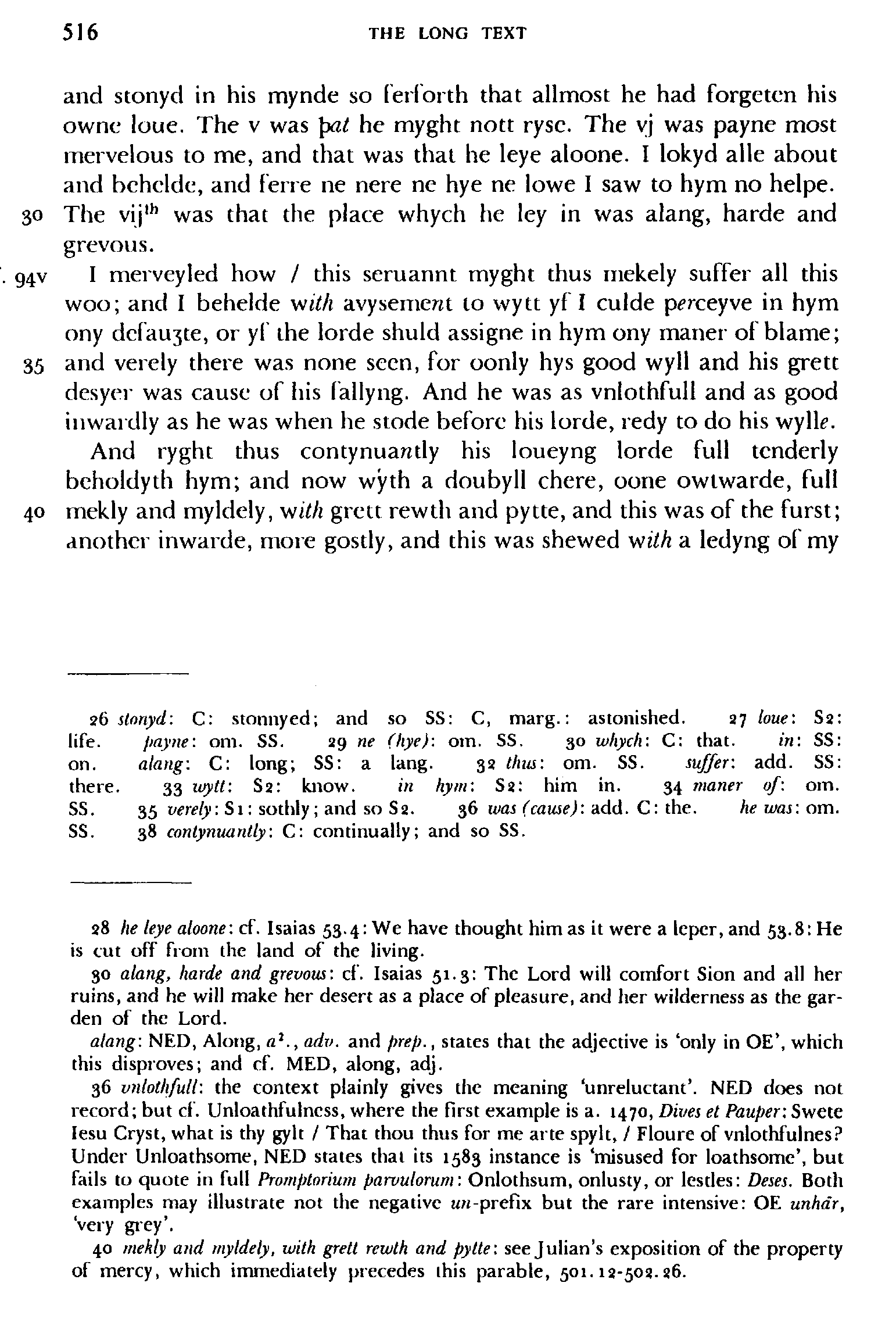
THE LONG TEXT
and stonyd in his mynde so feriorth that allmost he had forgetcn his ownc loue. The v was \xit he myght nott ryse. The vj was payne most mervelous to me, and that was that he leye aloone. I lokyd alle about and behclde, and f en e ne nere ne hye ne lowe I saw to hym no helpe.
30 The vijth was that the place whych he ley in was alang, harde and grevous.
. 94v I mei veyled how / this seruannt myght thus mekely suffer all this woo; and I behelde with avysemewt to wytt yf I culde p^rceyve in hym ony defau3te, or yf the lorde shuld assigne in hym ony maner of blame;
35 and verely there was none seen, for oonly hys good wyll and his grett desyer was cause of his fallyng. And he was as vnlothfull and as good inwardly as he was when he stode before his lorde, redy to do his wyll?.
And ryght thus contynuantly his loueyng lorde full tenderly beholdyth hym; and now wyth a doubyll chere, oone owtwarde, full
40 mekly and myldely, w///i grett rewth and pytte, and this was of the furst; another inwarde, more gostly, and this was shewed with a ledyng of my
26 stonyd: C: stonnyed; and so SS: C, marg.: astonished.
27 loue: 82: life. fiayne: om. SS.
29 ne (hye): om. SS.
30 whych: C: that. in: SS: on. alang: C: long; SS: a lang.
32 thus: om.
SS. suffer: add.
SS: there.
33 wytt:
82: know. in hym: 82: him in.
34 maner of: om.
SS.
35 verely: Si: sothly; and so 82.
36 was (cause): add. C: the, he was: om.
SS.
38 contynuantly: C: continually; and so SS.
28 he leye aloone: cf. Isaias 53.4: We have thought him as it were a leper, and 53.8: He is cut off from the land of the living.
30 alang, harde and grevous: cf. Isaias 51.3: The Lord will comfort Sion and all her ruins, and he will make her desert as a place of pleasure, and her wilderness as the garden of the Lord. alang: NED, Along, a1., adv. and firef)., states that the adjective is 'only in OE', which this disproves; and cf. MED, along, adj.
36 vnlothfull: the context plainly gives the meaning 'unreluctant'. NED does not record; but cf. Unloathfulncss, where the first example is a. 1470, Dives et Pauper: Swete lesu Cryst, what is thy gylt / That thou thus for me arte spylt, / Floure of vnlothfulnes?
Under Unloathsome, NED states that its 1583 instance is 'misused for loathsome', but fails to quote in full Pramptorium parvulorum: Onlothsum, onlusty, or Icstles: Deses. Both examples may illustrate not the negative w«-prefix but the rare intensive: OE unhdr,
Very grey'.
40 mekly and myldely, with grett rewth and pytte: see Julian's exposition of the property of mercy, which immediately precedes this parable, 501.12-502.26.
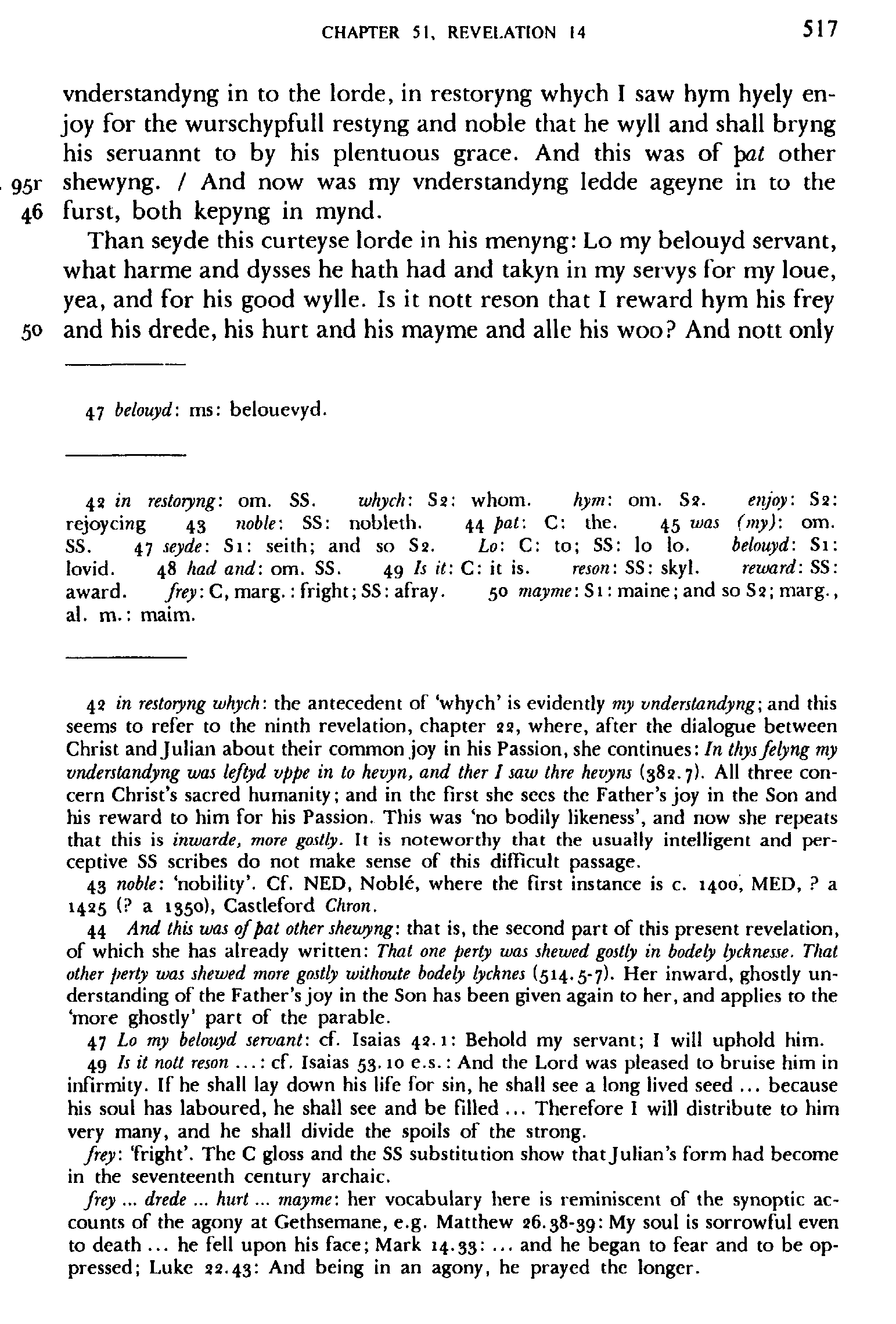
CHAPTER 51, REVELATION 14
vnderstandyng in to the lorde, in restoryng whych I saw hym hyely enjoy for the wurschypfull restyng and noble that he wyll and shall bryng his seruannt to by his plentuous grace. And this was of \>at other
Q5r shewyng. / And now was my vnderstandyng ledde ageyne in to the 46 furst, both kepyng in mynd.
Than seyde this curteyse lorde in his menyng: Lo my belouyd servant, what harme and dysses he hath had and takyn in my servys for my loue, yea, and for his good wylle. Is it nott reson that I reward hym his frey
50 and his drede, his hurt and his mayme and alle his woo? And nott only 47 belouyd: ms: belouevyd.
42 in restoryng'. om. SS. whych: 82: whom. hym: om. 82. enjoy: 82: rejoycing
noble: SS: nobleth.
44 pat: C: the.
45 was (my): om.
SS.
47 seyde: Si: seith; and so 82.
Lo: C: to; 88: lo lo. belouyd: Si: lovid.
48 had and: om. SS.
49 Is it: C: it is. reson: SS: skyl. reward: SS: award. frey: C, marg.: fright; SS: afray.
50 mayme: Si: maine; and so 82; marg., al. m.: maim.
42 in restoryng whych: the antecedent of 'whych' is evidently my vnderstandyng; and this seems to refer to the ninth revelation, chapter 22, where, after the dialogue between Christ and Julian about their common joy in his Passion, she continues: In thysfelyng my vnderstandyng was leftyd vppe in to hevyn, and ther I saw thre hevyns (382.7). All three concern Christ's sacred humanity; and in the first she sees the Father's joy in the Son and his reward to him for his Passion. This was 'no bodily likeness', and now she repeats that this is inwarde, more gostly. It is noteworthy that the usually intelligent and perceptive SS scribes do not make sense of this difficult passage.
43 noble: 'nobility'. Cf. NED, Noble, where the first instance is c. 1400, MED, ? a 1425 (? a 1350), Castleford Chron.
44 And this was of pat other shewyng: that is, the second part of this present revelation, of which she has already written: That one perty was shewed gostly in bodely lychnesse. That other perty was shewed more gostly withoute bodely lycknes (514.5-7). Her inward, ghostly understanding of the Father's joy in the Son has been given again to her, and applies to the 'more ghostly' part of the parable.
47 Lo my belouyd servant: cf. Isaias 42.1: Behold my servant; I will uphold him.
49 Is it nott reson ...: cf. Isaias 53.10 e.s.: And the Lord was pleased to bruise him in infirmity. If he shall lay down his life for sin, he shall see a long lived seed ... because his soul has laboured, he shall see and be filled ... Therefore I will distribute to him very many, and he shall divide the spoils of the strong. frey: fright'. The C gloss and the SS substitution show that Julian's form had become in the seventeenth century archaic. frey ... drede ... hurt... mayme: her vocabulary here is reminiscent of the synoptic accounts of the agony at Gethsemane, e.g. Matthew 26.38-39: My soul is sorrowful even to death ... he fell upon his face; Mark 14.33: ... and he began to fear and to be oppressed; Luke 22.43: And being in an agony, he prayed the longer.
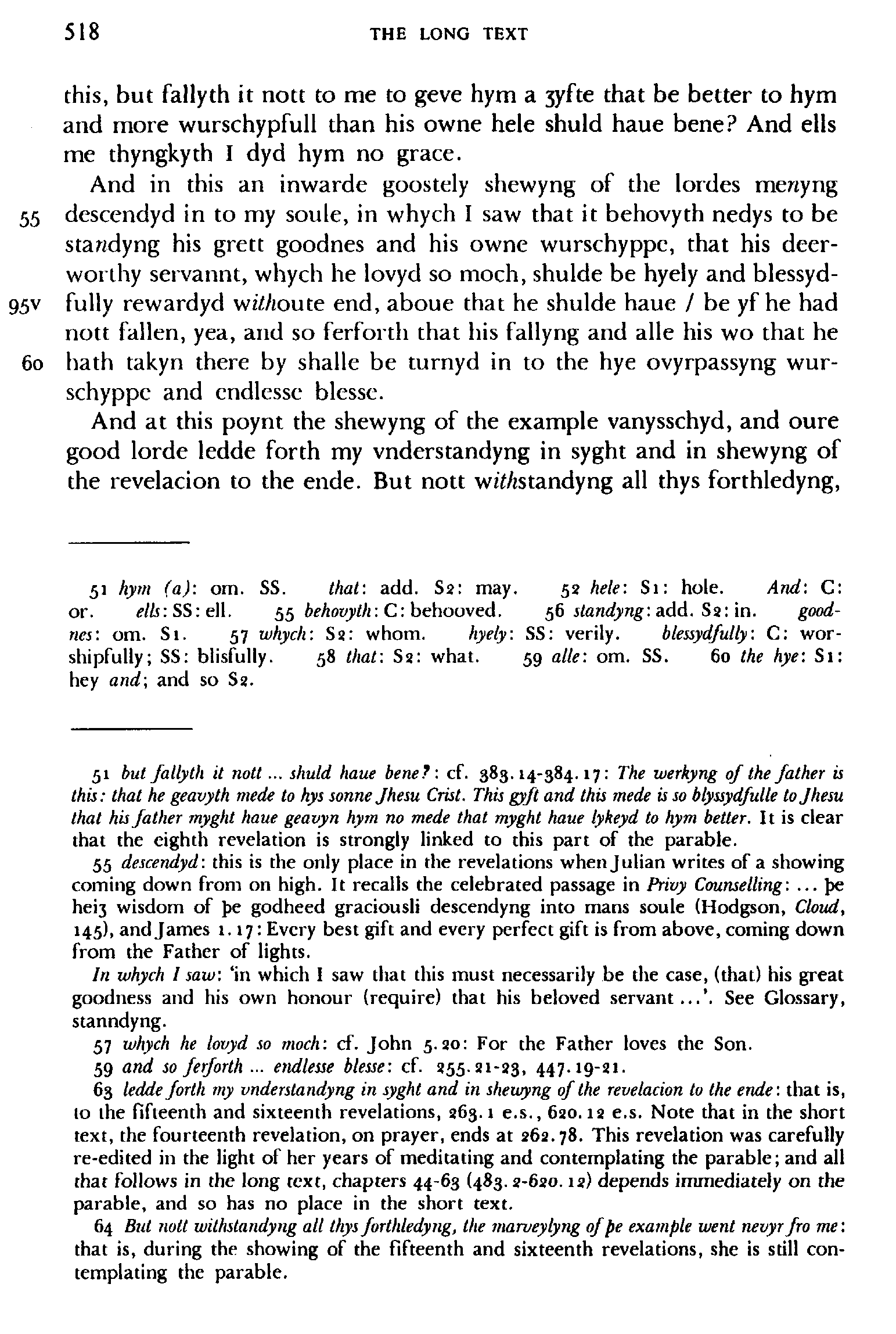
THE LONG TEXT
this, but fallyth it nott to me to geve hym a jyfte that be better to hym and more wurschypfull than his owne hele shuld haue bene? And ells me thyngkyth I dyd hym no grace.
And in this an inwarde goostely shewyng of the lordes menyng 55 descendyd in to my soule, in whych I saw that it behovyth nedys to be standyng his grett goodnes and his owne wurschyppe, that his deerworthy servannt, whych he lovyd so moch, shulde be hyely and blessyd95v fully rewardyd withoute end, aboue that he shulde haue / be yf he had nott fallen, yea, and so ferforth that his fallyng and alle his wo that he
60 hath takyn there by shalle be turnyd in to the hye ovyrpassyng wurschyppe and endlesse blesse.
And at this poynt the shewyng of the example vanysschyd, and oure good lorde ledde forth my vnderstandyng in syght and in shewyng of the revelacion to the ende. But nott w^standyng all thys forthledyng,
51 hym (a): om. SS. that: add. 82: may.
52 hele: Si: hole.
And: C: or. elk:SS:el\.
55 behovyth: C: behooved.
56 standing: add. 82: in. goodnes: om. Si.
57 whych: 82: whom. hyely: SS: verily. blessydfully: C: worshipfully; SS: blisfully.
58 that: Sa: what.
59 alle: om. SS.
60 the hye: Si: hey and\ and so 82.
51 but fallyth it nott... shuld haue bene?: cf. 383.14-384.17: The werkyng of the father is this: that he geavyth mede to hys sonnejhesu Crist. This gyft and this mede is so blyssydfulle tojhesu that his father myght haue geavyn hym no mede that myght haue lykeyd to hym better. It is clear that the eighth revelation is strongly linked to this part of the parable.
55 descendyd: this is the only place in the revelations when Julian writes of a showing coming down from on high. It recalls the celebrated passage in Privy Counselling: ... pe hei3 wisdom of J>e godheed graciousli descendyng into mans soule (Hodgson, Cloud,
145), and James 1.17: Every best gift and every perfect gift is from above, coming down from the Father of lights.
In whych I saw: 'in which I saw that this must necessarily be the case, (that) his great goodness and his own honour (require) that his beloved servant...'. See Glossary, stanndyng.
57 whych he lovyd so moch: cf. John 5.20: For the Father loves the Son.
59 and so ferforth ... endlesse blesse: cf. 255.21-23, 447.19-21.
63 ledde forth my vnderstandyng in syght and in shewyng of the revelacion to the ende: that is, to the fifteenth and sixteenth revelations, 263. i e.s., 620.12 e.s. Note that in the short text, the fourteenth revelation, on prayer, ends at 262.78. This revelation was carefully re-edited in the light of her years of meditating and contemplating the parable; and all that follows in the long text, chapters 44-63 (483.2-620.12) depends immediately on the parable, and so has no place in the short text.
64 But nott withstandyng all thys forthledyng, the marveylyng ofpe example went nevyrfro me: that is, during the showing of the fifteenth and sixteenth revelations, she is still contemplating the parable.
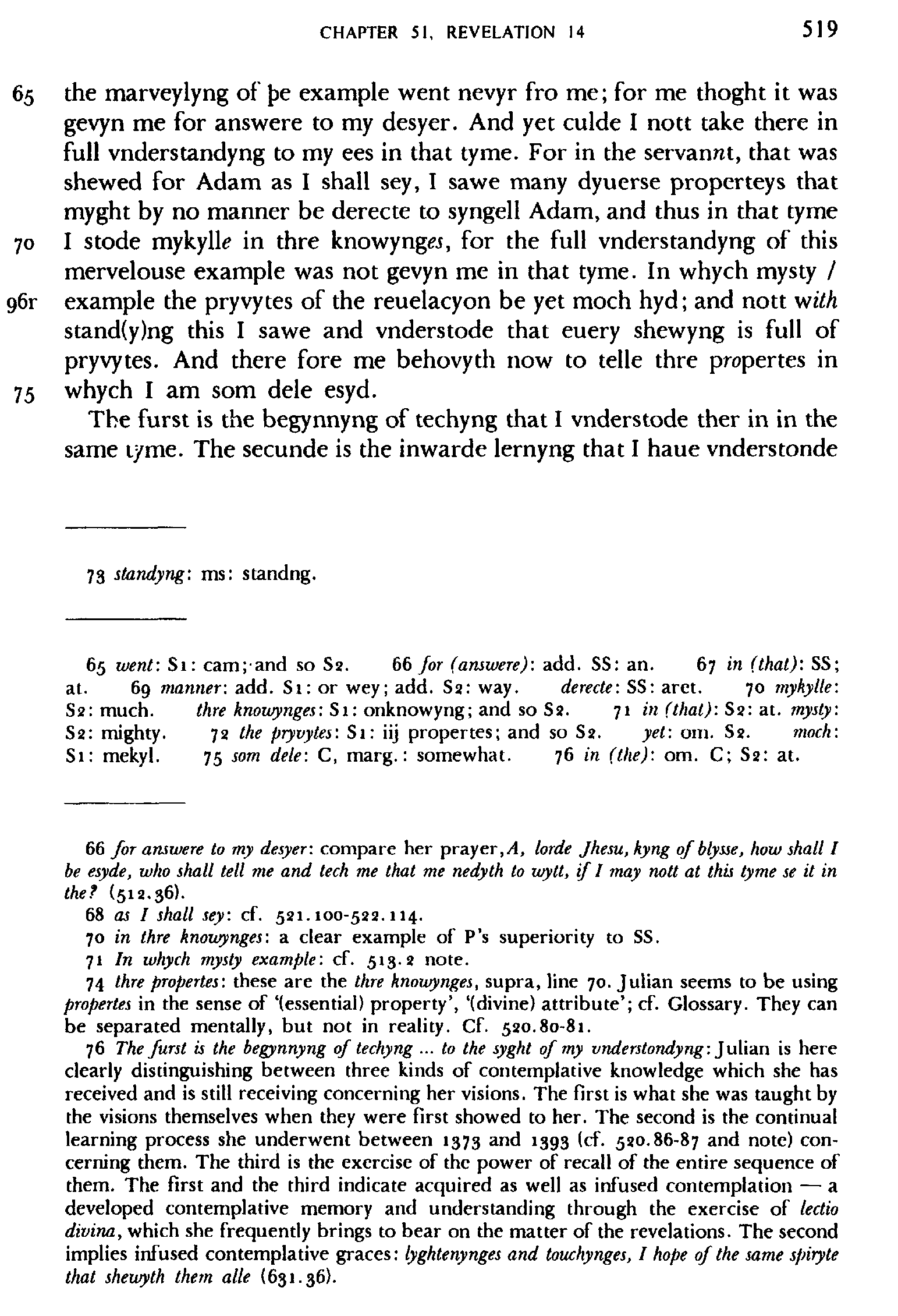
CHAPTER 51, REVELATION 14
the marveylyng of JDC example went nevyr fro me; for me thoght it was gevyn me for answere to my desyer. And yet culde I nott take there in full vnderstandyng to my ees in that tyme. For in the servannt, that was shewed for Adam as I shall sey, I sawe many dyuerse properteys that myght by no manner be derecte to syngell Adam, and thus in that tyme
I stode mykylltf in thre knowyng^, for the full vnderstandyng of this mervelouse example was not gevyn me in that tyme. In whych mysty / g6r example the pryvytes of the reuelacyon be yet moch hyd; and nott with stand(y)ng this I sawe and vnderstode that euery shewyng is full of pryvytes. And there fore me behovytli now to telle thre propertes in
whych I am som dele esyd.
The furst is the begynnyng of techyng that I vnderstode ther in in the same tyme. The secunde is the inwarde lernyng that I haue vnderstonde
73 standing: ms: standng.
65 went: Si: cam;-and so 82.
66 for (answere): add. SS: an.
67 in (that): SS; at.
69 manner: add. Si: or wey; add. 82: way. derecte: SS: arct.
70 mykylle:
82: much. thre knowynges: Si: onknowyng; and so 82.
71 in (that): 82: at. mysty:
82: mighty.
72 the pryvytes: Si: iij propertes; and so 82. yet: om. 82. moch:
Si: mekyl.
75 som dele: C, marg.: somewhat.
76 in (the): om. C; 82: at.
66 for answere to my desyer: compare her prayer, A, lorde Jhesu, kyng of blysse, how shall I be esyde, who shall tell me and tech me that me nedyth to wytt, if I may nott at this tyme se it in the? (512.36).
68 as I shall sey: cf. 521.100-522.114.
70 in thre knowynges: a clear example of P's superiority to SS.
71 In whych mysty example: cf. 513.2 note.
74 thre propertes: these are the thre knowynges, supra, line 70. Julian seems to be using propertes in the sense of '(essential) property', '(divine) attribute'; cf. Glossary. They can be separated mentally, but not in reality. Cf. 520.80-81.
76 The furst is the begynnyng of techyng ...to the syght of my vnderstondyng: Julian is here clearly distinguishing between three kinds of contemplative knowledge which she has received and is still receiving concerning her visions. The first is what she was taught by the visions themselves when they were first showed to her. The second is the continual learning process she underwent between 1373 and 1393 (cf. 520.86-87 and note) concerning them. The third is the exercise of the power of recall of the entire sequence of them. The first and the third indicate acquired as well as infused contemplation — a developed contemplative memory and understanding through the exercise of lectio divina, which she frequently brings to bear on the matter of the revelations. The second implies infused contemplative graces: lyghtenynges and touchynges, I hope of the same spiryte that shewyth them alle (631.36).
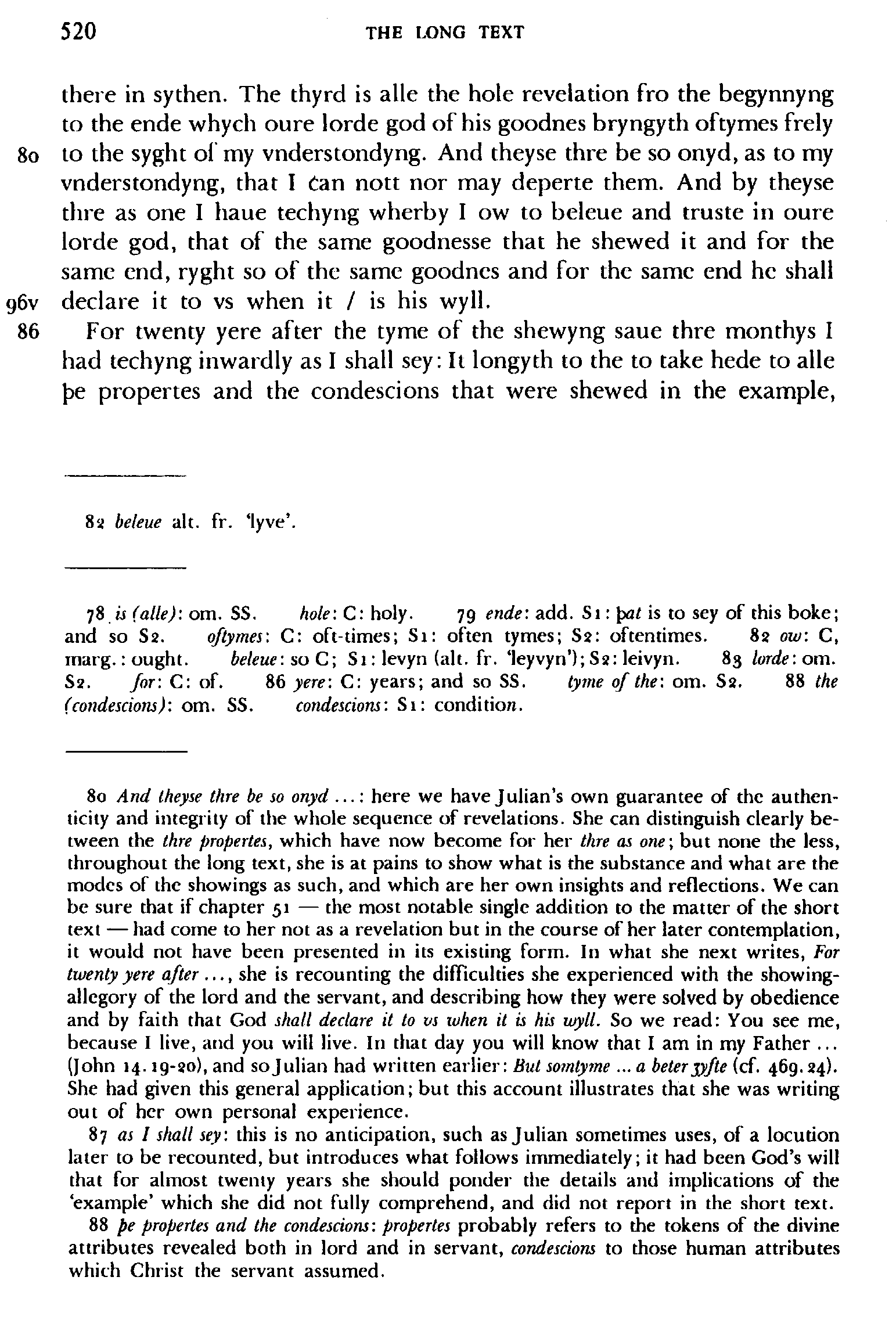
THE LONG TEXT
there in sythen. The thyrd is alle the hole revelation fro the begynnyng to the ende whych oure lorde god of his goodnes bryngyth oftymes frely
80 to the syght of my vnderstondyng. And theyse thre be so onyd, as to my vnderstondyng, that I tan nott nor may deperte them. And by theyse thre as one I haue techyng wherby I ow to beleue and truste in oure lorde god, that of the same goodnesse that he shewed it and for the same end, ryght so of the same goodnes and for the same end he shall g6v declare it to vs when it / is his wyll.
For twenty yere after the tyme of the shewyng saue thre monthys I had techyng inwardly as I shall sey: It longyth to the to take hede to alle
IDC propertes and the condescions that were shewed in the example, 82 beleue alt. fr. 'lyve'.
78 is (alle): om. SS. hole: C: holy.
79 ende: add. Si: Jxz/ is to sey of this boke; and so 82. oftymes: C: oft-times; Si: often tymes; 82: oftentimes.
82 ow. C, inarg.: ought. beleue: so C; Si: levyn (alt. fr. 'leyvyn'); 82: leivyn.
83 lorde: om.
Sa. for: C: of.
86 yere: C: years; and so SS. tyme of the: om. 82.
88 the (condescions): om. SS. condescions: Si: condition.
80 And theyse thre be so onyd ...: here we have Julian's own guarantee of the authenticity and integrity of the whole sequence of revelations. She can distinguish clearly between the thre propertes, which have now become for her thre as one; but none the less, throughout the long text, she is at pains to show what is the substance and what are the modes of the showings as such, and which are her own insights and reflections. We can be sure that if chapter 51 — the most notable single addition to the matter of the short text — had come to her not as a revelation but in the course of her later contemplation, it would not have been presented in its existing form. In what she next writes, For twenty yere after..., she is recounting the difficulties she experienced with the showingallegory of the lord and the servant, and describing how they were solved by obedience and by faith that God shall declare it to vs when it is his wyll. So we read: You see me, because I live, and you will live. In that day you will know that I am in my Father ...
(John 14.19-20), and so Julian had written earlier: But sorntyme ... a beterjyfte (cf. 469.24).
She had given this general application; but this account illustrates that she was writing out of her own personal experience.
87 as I shall sey: this is no anticipation, such as Julian sometimes uses, of a locution later to be recounted, but introduces what follows immediately; it had been God's will that for almost twenty years she should ponder the details and implications of the 'example' which she did not fully comprehend, and did not report in the short text.
88 pe propertes and the condescions: propertes probably refers to die tokens of die divine attributes revealed both in lord and in servant, condescions to those human attributes which Christ the servant assumed.
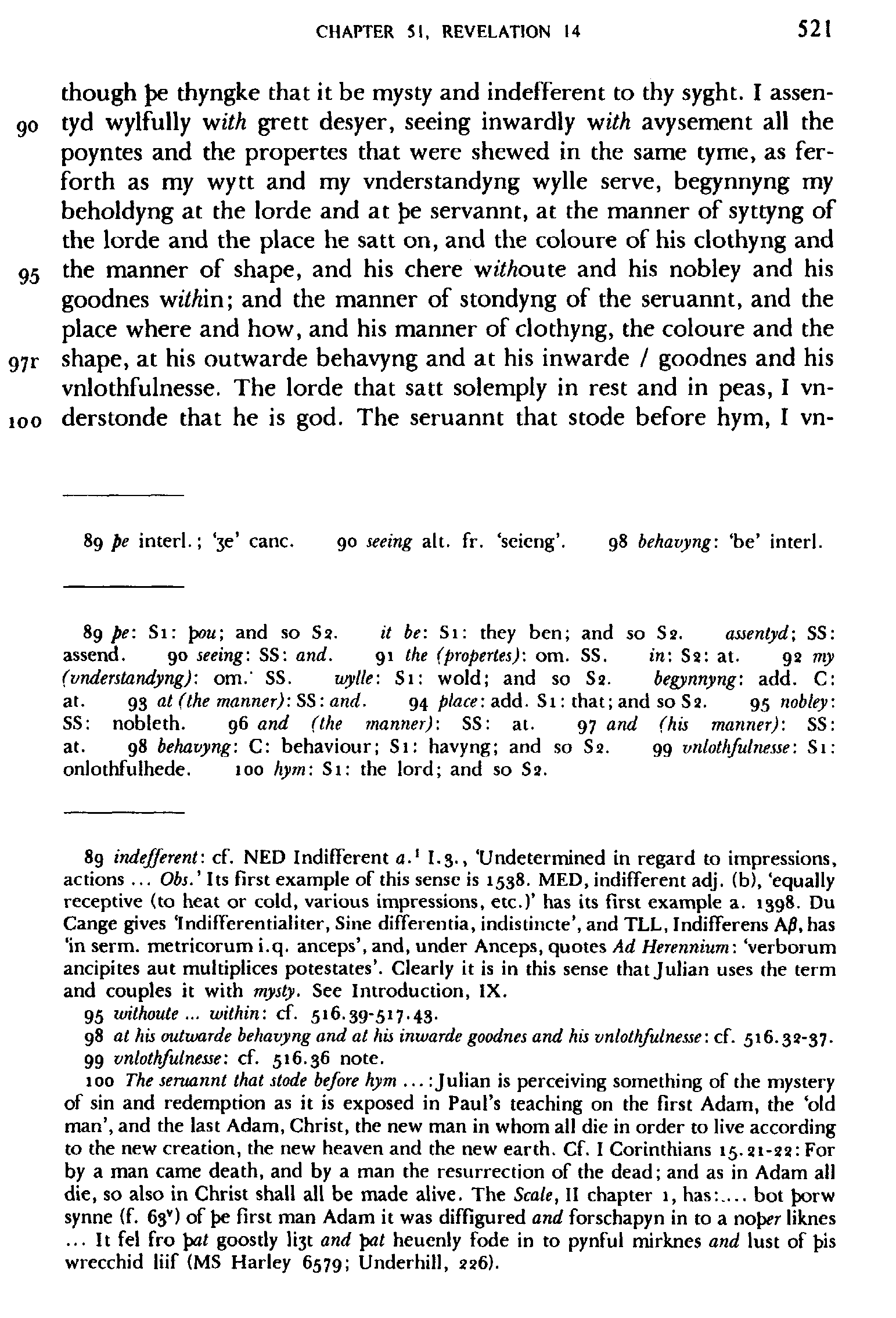
CHAPTER 51, REVELATION 14
though J>e thyngke that it be mysty and indefferent to thy syght. I assen90 tyd wylfully with grett desyer, seeing inwardly with avysement all the poyntes and the propertes that were shewed in the same tyme, as ferforth as my wytt and my vnderstandyng wylle serve, begynnyng my beholdyng at the lorde and at pe servannt, at the manner of syttyng of the lorde and the place he satt on, and the coloure of his clothyng and 95 the manner of shape, and his chere withoute and his nobley and his goodnes within; and the manner of stondyng of the seruannt, and the place where and how, and his manner of clothyng, the coloure and the gyr shape, at his outwarde behavyng and at his inwarde / goodnes and his vnlothfulnesse. The lorde that satt solemply in rest and in peas, I vn100 derstonde that he is god. The seruannt that stode before hym, I vn89 pe interl.; 'je' cane.
90 seeing alt. fr. 'scicng'.
98 behavyng: 'be' interl.
89^: Si: psw; and so 82. it be: Si: they ben; and so Sa. assentyd; SS: assend.
90 seeing: SS: and.
91 the (propertes): om. SS. in: Sa: at.
92 my (vnderstandyng): om.' SS. wylle: Si: wold; and so Sa. begynnyng: add. C: at.
93 at (the manner): SS: and.
94 place: add. Si: that; and so S2.
95 nobley:
SS: nobleth.
96 and (the manner):
SS: at.
97 and (his manner):
SS: at.
98 behavyng: C: behaviour; Si: havyng; and so Sa.
99 vnlothfulnesse: Si: onlothfulhede.
100 hym: Si: the lord; and so S2.
89 indefferent: cf. NED Indifferent a.1 1.3., 'Undetermined in regard to impressions, actions ... Obs.' Its first example of this sense is 1538. MED, indifferent adj. (b), 'equally receptive (to heat or cold, various impressions, etc.)' has its first example a. 1398. Du
Cange gives 'Indifferentialiter, Sine differentia, indistincte', and TLL, Indifferens A/?, has
'in serm. metricorum i.q. anceps', and, under Anceps, quotes Ad Herennium: 'verborum ancipites aut multiplices potestates'. Clearly it is in this sense that Julian uses the term and couples it with mysty. See Introduction, IX.
95 withoute ... within: cf. 516.39-517.43.
98 at his outwarde behavyng and at his inwarde goodnes and his vnlothfulnesse: cf. 516.32-37.
99 vnlothfulnesse: cf. 516.36 note.
100 The seruannt that stode before hym ...: Julian is perceiving something of the mystery of sin and redemption as it is exposed in Paul's teaching on the first Adam, the 'old man', and the last Adam, Christ, the new man in whom all die in order to live according to the new creation, the new heaven and the new earth. Cf. I Corinthians 15.21-22: For by a man came death, and by a man the resurrection of the dead; and as in Adam all die, so also in Christ shall all be made alive. The Scale, II chapter i, has:.... hot porw synne (f. 63*) of Jje first man Adam it was diffigured and forschapyn in to a no\>er liknes
... It fel fro $at goostly Ii3t and \>at heuenly fode in to pynful mirknes and lust of Jjis wrecchid liif (MS Harley 6579; Underbill, 226).
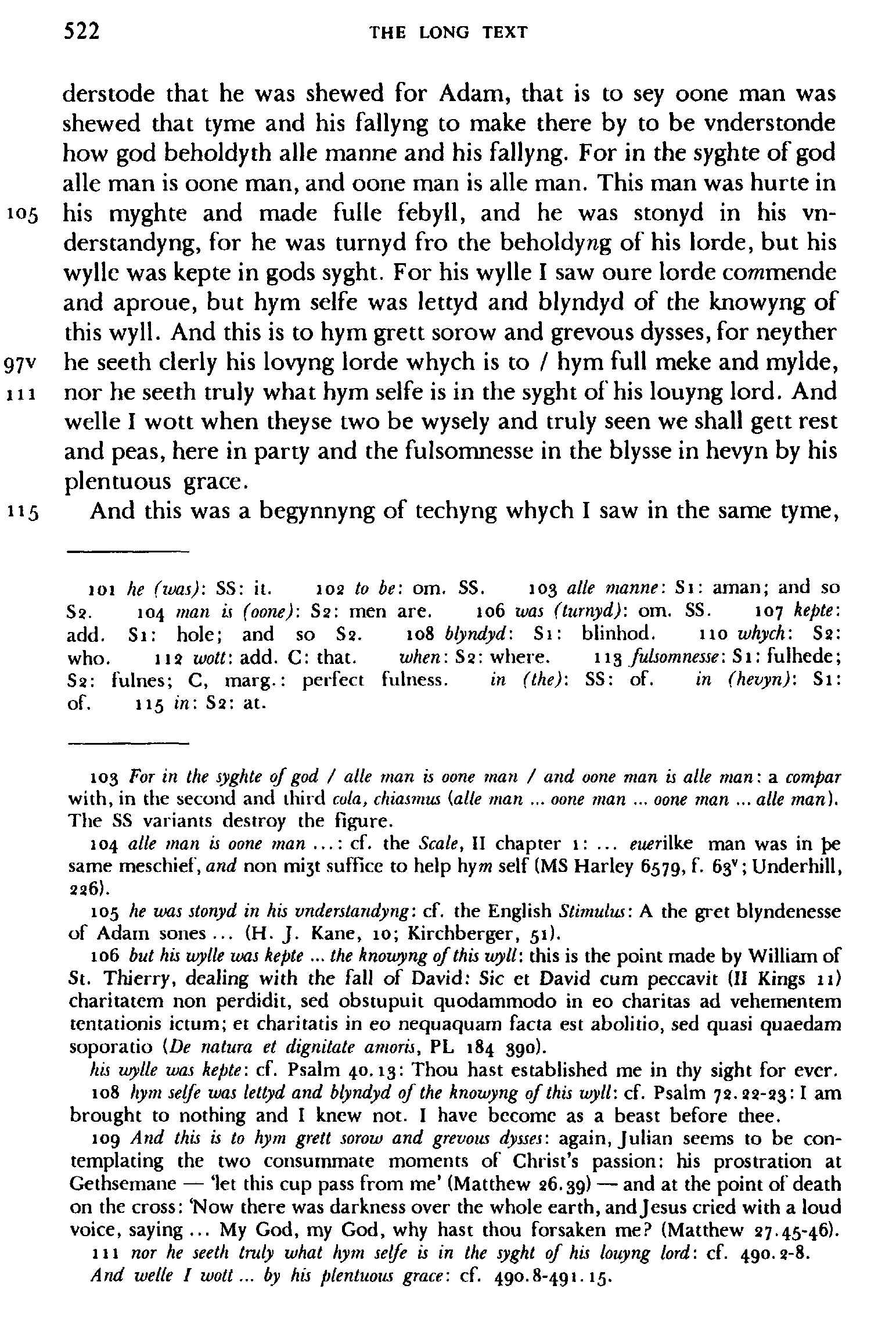
THE LONG TEXT
derstode that he was shewed for Adam, that is to sey oone man was shewed that tyme and his fallyng to make there by to be vnderstonde how god beholdyth alle manne and his fallyng. For in the syghte of god alle man is oone man, and oone man is alle man. This man was hurte in 105 his myghte and made fulle febyll, and he was stonyd in his vnderstandyng, for he was turnyd fro the beholdyng of his lorde, but his wylle was kepte in gods syght. For his wylle I saw oure lorde commende and aproue, but hym selfe was lettyd and blyndyd of the knowyng of this wyll. And this is to hym grett sorow and grevous dysses, for neyther gyv he seeth clerly his lovyng lorde whych is to / hym full meke and mylde,
111 nor he seeth truly what hym selfe is in the syght of his louyng lord. And welle I wott when theyse two be wysely and truly seen we shall gett rest and peas, here in party and the fulsomnesse in the blysse in hevyn by his plentuous grace.
And this was a begynnyng of techyng whych I saw in the same tyme, 101 he (was): SS: it.
102 to be: om. SS.
103 alle manne: Si: aman; and so 82.
104 man is (oone): Sa: men are.
106 was (turnyd): om. SS.
107 kepte: add.
Si: hole; and so 82.
108 blyndyd:
Si: blinhod. no whych:
82: who.
112 wott: add. C: that. when: Sa: where.
113 fulsomnesse: Si: fulhede; Sa: fulnes; C, marg.: perfect fulness. in (the): SS: of. in (hevyn): Si: of.
115 in: 82: at.
103 For in the syghte of god / alle man is oone man / and oone man is alle man: a compar with, in the second and third cola, chiasmus (alle man ... oone man ... oone man ... alle man).
The SS variants destroy the figure.
104 alle man is oone man ...: cf. the Scale, II chapter i: ... fzimlke man was in pe same meschief, and non miy suffice to help hym self (MS Harley 6579, f. 63*; Underhill,
226).
105 he was stonyd in his vnderstandyng: cf. the English Stimulus: A the gret blyndenesse of Adam sones ... (H. J. Kane, 10; Kirchberger, 51).
106 but his wylle was kepte ... the knowyng of this wyll: this is the point made by William of St. Thierry, dealing with the fall of David: Sic et David cum peccavit (II Kings 11) charitatem non perdidit, sed obstupuit quodammodo in eo charitas ad vehementem tentationis ictum; et charitatis in eo nequaquam facta est abolitio, sed quasi quaedam soporatio (De natura et dignitate amoris, PL 184 390). his wylle was kepte: cf. Psalm 40.13: Thou hast established me in thy sight for ever.
108 hym selfe was lettyd and blyndyd of the knowyng of this wyll: cf. Psalm 72.22-23:1 am brought to nothing and I knew not. I have become as a beast before dice.
109 And this is to hym grett sorow and grevous dysses: again, Julian seems to be contemplating the two consummate moments of Christ's passion: his prostration at Gethsemane — 'let this cup pass from me' (Matthew 26.39) — and at the point of death on the cross: 'Now there was darkness over the whole earth, and Jesus cried with a loud voice, saying ... My God, my God, why hast thou forsaken me? (Matthew 27.45-46).
111 nor he seeth truly what hym selfe is in the syght of his louyng lord: cf. 490.2-8.
And welle I wott... by his plentuous grace: cf. 490.8-491.15.
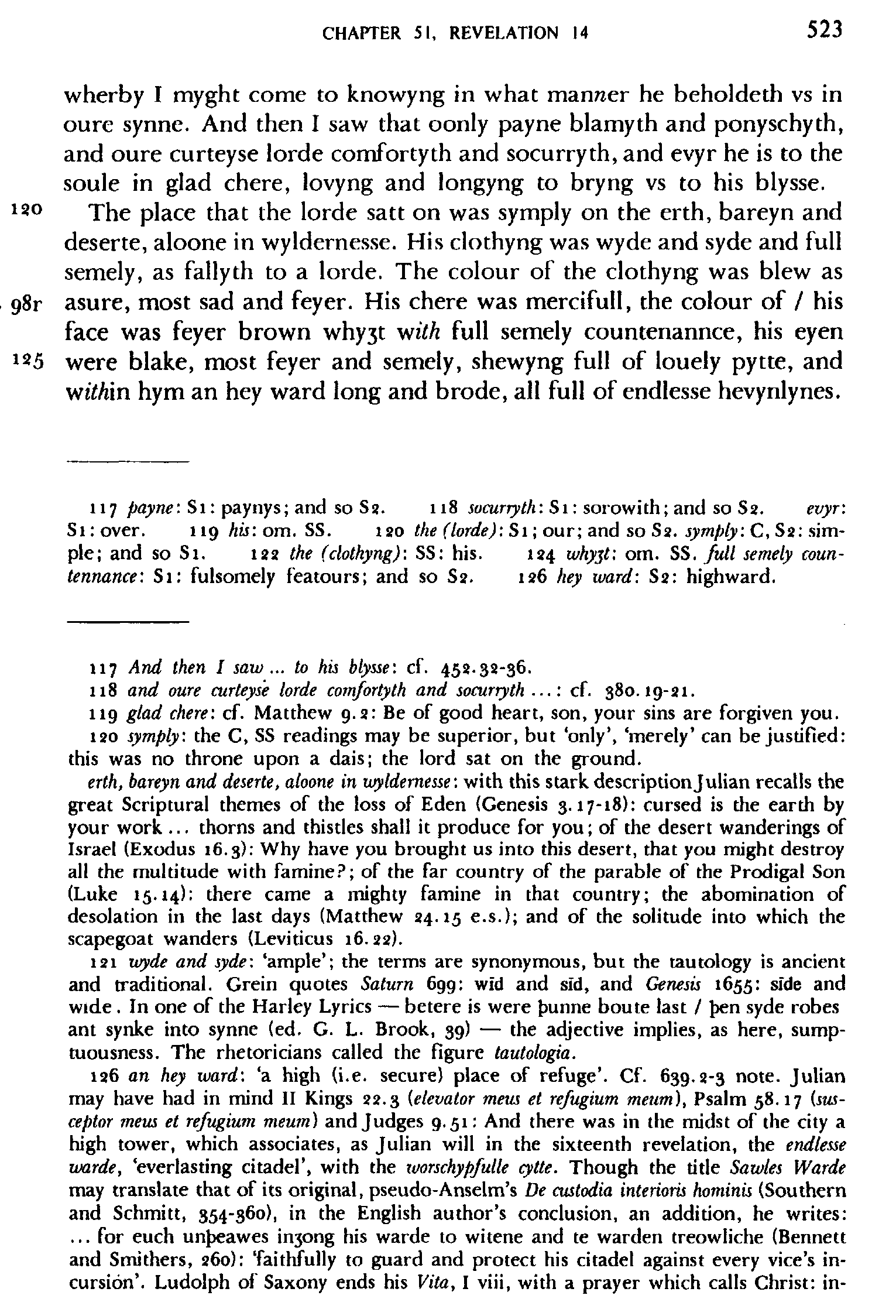
CHAPTER 51, REVELATION 14
wherby I myght come to knowyng in what manner he beholdeth vs in oure synne. And then I saw that oonly payne blamyth and ponyschyth, and oure curteyse lorde comfortyth and socurryth, and evyr he is to the soule in glad chere, lovyng and longyng to bryng vs to his blysse.
The place that the lorde satt on was symply on the erth, bareyn and deserte, aloone in wyldernesse. His clothyng was wyde and syde and full sernely, as fallyth to a lorde. The colour of the clothyng was blew as . g8r asure, most sad and feyer. His chere was mercifull, the colour of / his face was feyer brown whyjt with full semely countenannce, his eyen
125 were blake, most feyer and semely, shewyng full of louely pytte, and within hym an hey ward long and brode, all full of endlesse hevynlynes.
117 payne: Si: paynys; and so 82.
118 socurryth: Si: sorowith; and so Sa. evyr:
Si: over.
119 his: om. SS.
120 the (lorde): Si; our; and so Sa. symply: C, Sa: simple; and so Si.
122 the (clothyng): SS: his.
124 whyjt: om. SS. full semely countennance: Si: fulsomely featours; and so Sa.
126 hey ward: Sa: highward.
117 And then I saw ... to his blysse: cf. 452.32-36.
118 and oure curteyse lorde comfortyth and socurryth ...: cf. 380.19-21.
119 glad chere: cf. Matthew 9.2: Be of good heart, son, your sins are forgiven you.
120 symply: the C, SS readings may be superior, but 'only', 'merely' can be justified: this was no throne upon a dais; the lord sat on the ground. erth, bareyn and deserte, aloone in wyldernesse: with this stark description Julian recalls the great Scriptural themes of the loss of Eden (Genesis 3.17-18): cursed is the earth by your work ... thorns and thistles shall it produce for you; of the desert wanderings of Israel (Exodus 16.3): Why have you brought us into this desert, that you might destroy all the multitude with famine?; of the far country of the parable of the Prodigal Son
(Luke 15.14): there came a mighty famine in that country; the abomination of desolation in the last days (Matthew 24.15 e.s.); and of the solitude into which the scapegoat wanders (Leviticus 16.22).
121 wyde and syde: 'ample'; the terms are synonymous, but the tautology is ancient and traditional. Grein quotes Saturn 699: wid and sid, and Genesis 1655: side and wide. In one of the Harley Lyrics — betere is were punne boute last / Jien syde robes ant synke into synne (ed. G. L. Brook, 39) — the adjective implies, as here, sumptuousness. The rhetoricians called the figure tautologia.
126 an hey ward: 'a high (i.e. secure) place of refuge'. Cf. 639.2-3 note. Julian may have had in mind II Kings 22.3 (elevator meus et refugium meum), Psalm 58.17 (susceptor mem et refugium meum) and Judges 9.51: And there was in the midst of the city a high tower, which associates, as Julian will in the sixteenth revelation, the endlesse warde, 'everlasting citadel', with the worschypfulle cytte. Though the title Sawles Warde may translate that of its original, pseudo-Anselm's De custodia interioru hominh (Southern and Schmitt, 354-360), in the English author's conclusion, an addition, he writes:
... for euch unjjeawes in3ong his warde to witene and te warden treowliche (Bennett and Smithers, 260): 'faithfully to guard and protect his citadel against every vice's incursion'. Ludolph of Saxony ends his Vita, I viii, with a prayer which calls Christ: in-
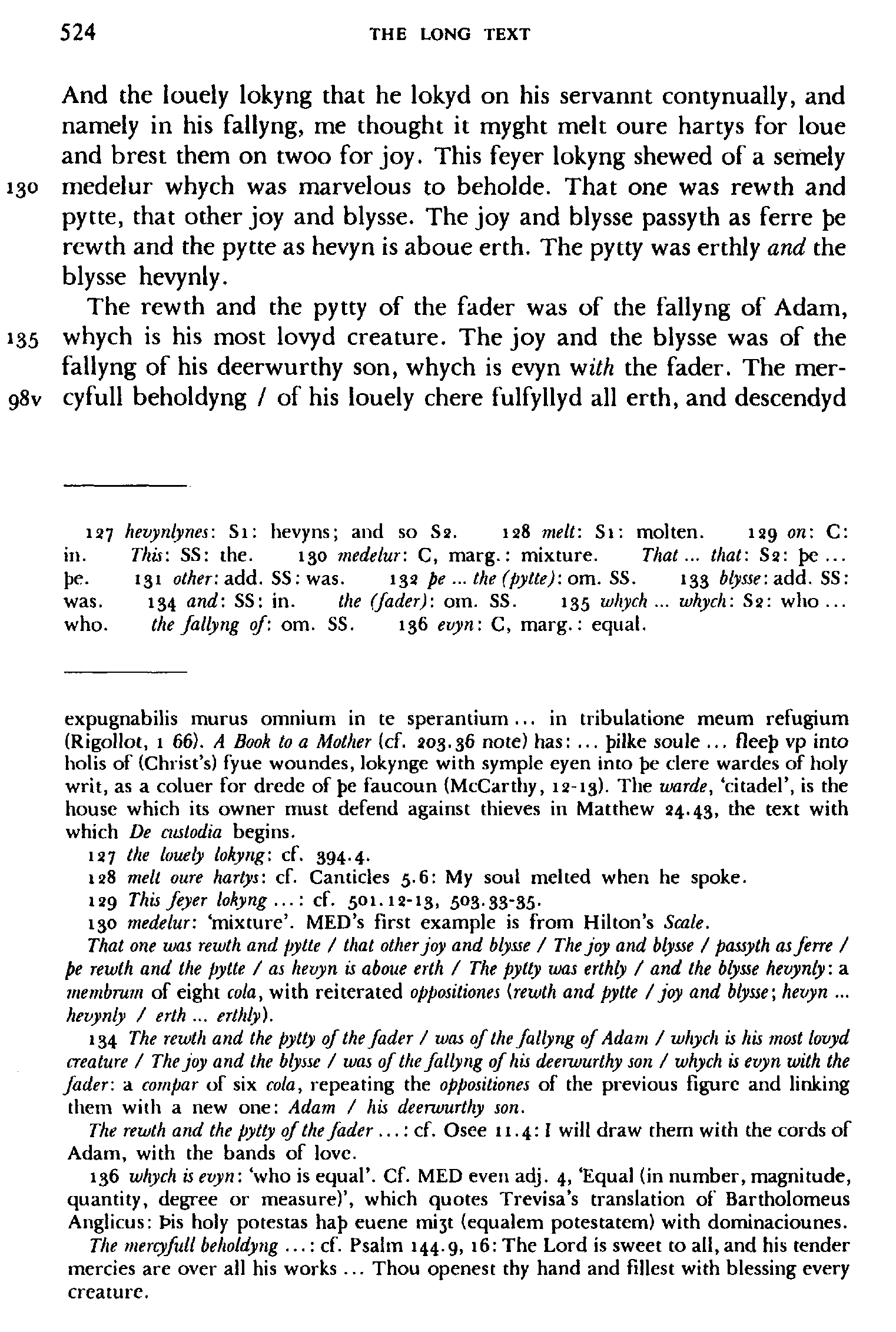
THE LONG TEXT
And the louely lokyng that he lokyd on his servannt contynually, and namely in his fallyng, me thought it myght melt oure hartys for loue and brest them on twoo for joy. This feyer lokyng shewed of a semely
130 medelur whych was marvelous to beholde. That one was rewth and pytte, that other joy and blysse. The joy and blysse passyth as ferre £e rewth and the pytte as hevyn is aboue erth. The pytty was erthly and the blysse hevynly.
The rewth and the pytty of the fader was of the fallyng of Adam, 135 whych is his most lovyd creature. The joy and the blysse was of the fallyng of his deerwurthy son, whych is evyn with the fader. The mer98v cyfull beholdyng / of his louely chere fulfyllyd all erth, and descendyd
127 hevynlynes: Si: hevyns; and so 82.
128 melt: Si: molten.
129 on: C: in.
This: SS: the.
130 medelur: C, marg.: mixture.
That... that: 82: J>e... pe.
131 other: add. SS: was.
132 pe ... the (pytte): om. SS.
133 blysse: add. SS: was.
134 and: SS: in. the (fader): om. SS.
135 whych ... whych: 82: who... who. the fallyng of: om. SS.
136 evyn: C, marg.: equal. expugnabilis murus omnium in te sperantium ... in tribulatione meum refugium
(Rigollot, i 66). A Book to a Mother (cf. 203.36 note) has: ... Jjilke soule ... flee|> vp into holis of (Christ's) fyue woundes, lokynge with symple eyen into £e clere wardes of holy writ, as a coluer for drede of J>e faucoun (McCarthy, 12-13). The warde, 'citadel', is the house which its owner must defend against thieves in Matthew 24.43, tne text with which De custodia begins.
127 the louely lokyng: cf. 394.4.
128 melt oure hartys: cf. Canticles 5.6: My soul melted when he spoke.
129 This feyer lokyng...: cf. 501.12-13, 5°3-33-35130 medelur: 'mixture'. MED's first example is from Hilton's Scale.
That one was rewth and pytte / that other joy and blysse / The joy and blysse I passyth as ferre / pe rewth and the pytte I as hevyn is aboue erth / The pytty was erthly / and the blysse hevynly: a membrum of eight cola, with reiterated oppositiones (rewth and pytte /joy and blysse; hevyn ... hevynly / erth ... erthly).
134 The rewth and the pytty of the fader / was of the fallyng of Adam / whych is his most lovyd creature / The joy and the blysse / was of the fallyng of his deerwurthy son / whych is evyn with the fader: a cornpar of six cola, repeating the oppositiones of the previous figure and linking them with a new one: Adam / his deerwurthy son.
The rewth and the pytty of the fader ...: cf. Osee 11.4:! will draw them with the cords of Adam, with the bands of love.
136 whych is evyn: 'who is equal'. Cf. MED even adj. 4, 'Equal (in number, magnitude, quantity, degree or measure)', which quotes Trevisa's translation of Bartholomeus
Anglicus: t>is holy potestas hajj euene mi3t (equalem potestatem) with dominaciounes.
The mercyfull beholdyng ...: cf. Psalm 144.9, *6: The Lord is sweet to all, and his tender mercies are over all his works ... Thou openest thy hand and fillest with blessing every creature.
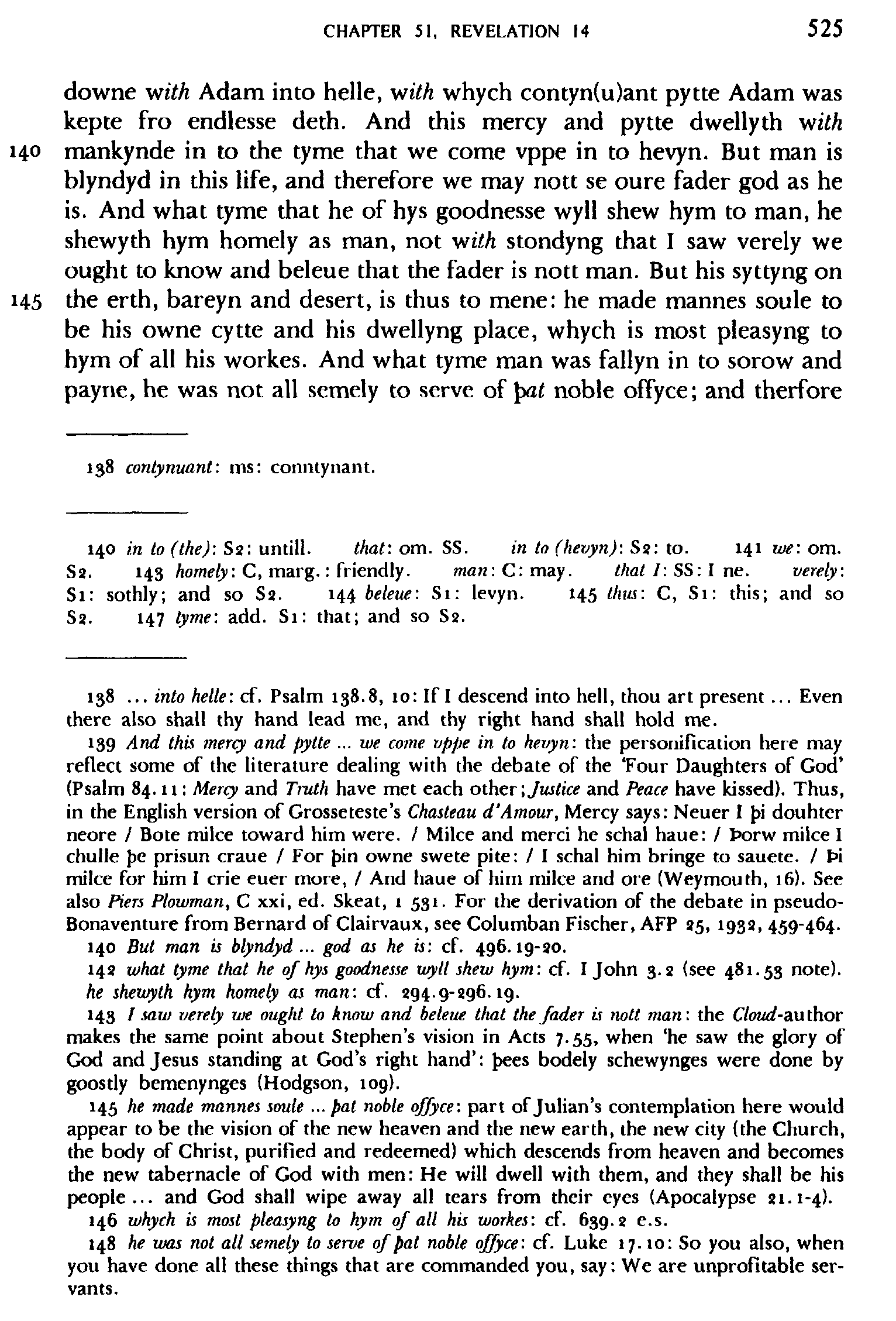
CHAPTER 51, REVELATION 14
downe with Adam into helle, with whych contyn(u)ant pytte Adam was kepte fro endlesse deth. And this mercy and pytte dwellyth with 14° mankynde in to the tyme that we come vppe in to hevyn. But man is blyndyd in this life, and therefore we may nott se oure fader god as he is. And what tyme that he of hys goodnesse wyll shew hym to man, he shewyth hym homely as man, not with stondyng that I saw verely we ought to know and beleue that the fader is nott man. But his syttyng on 145 the erth, bareyn and desert, is thus to mene: he made mannes soule to be his owne cytte and his dwellyng place, whych is most pleasyng to hym of all his workes. And what tyme man was fallyn in to sorow and payrie, he was not all semely to serve of \>at noble offyce; and therfore
138 contynuant: ms: conntynant.
140 in to (the): 82: untill. that: om. SS. in to (hevyn): 82: to.
141 we: om.
82.
143 homely: C, marg.: friendly. man: C: may. that I: SS: I ne. verely:
Si: sothly; and so 82.
144 beleue: Si: levyn.
145 thus: C, Si: this; and so 82.
147 tyme: add. Si: that; and so 82.
138 ... into helle: d. Psalm 138.8, 10: If I descend into hell, thou art present ... Even there also shall thy hand lead me, and thy right hand shall hold me.
139 And this mercy and pytte ... we come vppe in to hevyn: the personification here may reflect some of the literature dealing with the debate of the Tour Daughters of God'
(Psalm 84.11: Mercy and Truth have met each other; Justice and Peace have kissed). Thus, in the English version of Grosseteste's Chasteau d'Amour, Mercy says: Neuer I J)i douhter neore / Bote milce toward him were. / Milce and merci he schal haue: / I>orw milce I chulle Jje prisun craue / For Jjin owne swete pite: / I schal him bringe to sauete. / t>i milce for him I crie euer more, / And haue of him milce and ore (Weymouth, 16). See also Piers Plowman, C xxi, ed. Skeat, i 531. For the derivation of the debate in pseudoBonaventure from Bernard of Clairvaux, see Columban Fischer, AFP 25, 1932, 459-464.
140 But man is blyndyd... god as he is: cf. 496.19-20.
142 what tyme that he of hys goodnesse wyll shew hym: cf. I John 3.2 (see 481.53 note). he shewyth hym homely as man: cf. 294.9-296.19.
143 / saw verely we ought to know and beleue that the fader is nott man: the Cloud-author makes the same point about Stephen's vision in Acts 7.55, when 'he saw the glory of God and Jesus standing at God's right hand': pees bodely schewynges were done by goostly bemenynges (Hodgson, 109).
145 he made mannes soule ... pat noble offyce: part of Julian's contemplation here would appear to be the vision of the new heaven and the new earth, the new city (the Church, the body of Christ, purified and redeemed) which descends from heaven and becomes the new tabernacle of God with men: He will dwell with them, and they shall be his people... and God shall wipe away all tears from their eyes (Apocalypse 21.1-4).
146 whych is most pleasyng to hym of all his workes: cf. 639.2 e.s.
148 he was not all semely to serve of pat noble offyce: cf. Luke 17.10: So you also, when you have done all these things that are commanded you, say: We are unprofitable servants.
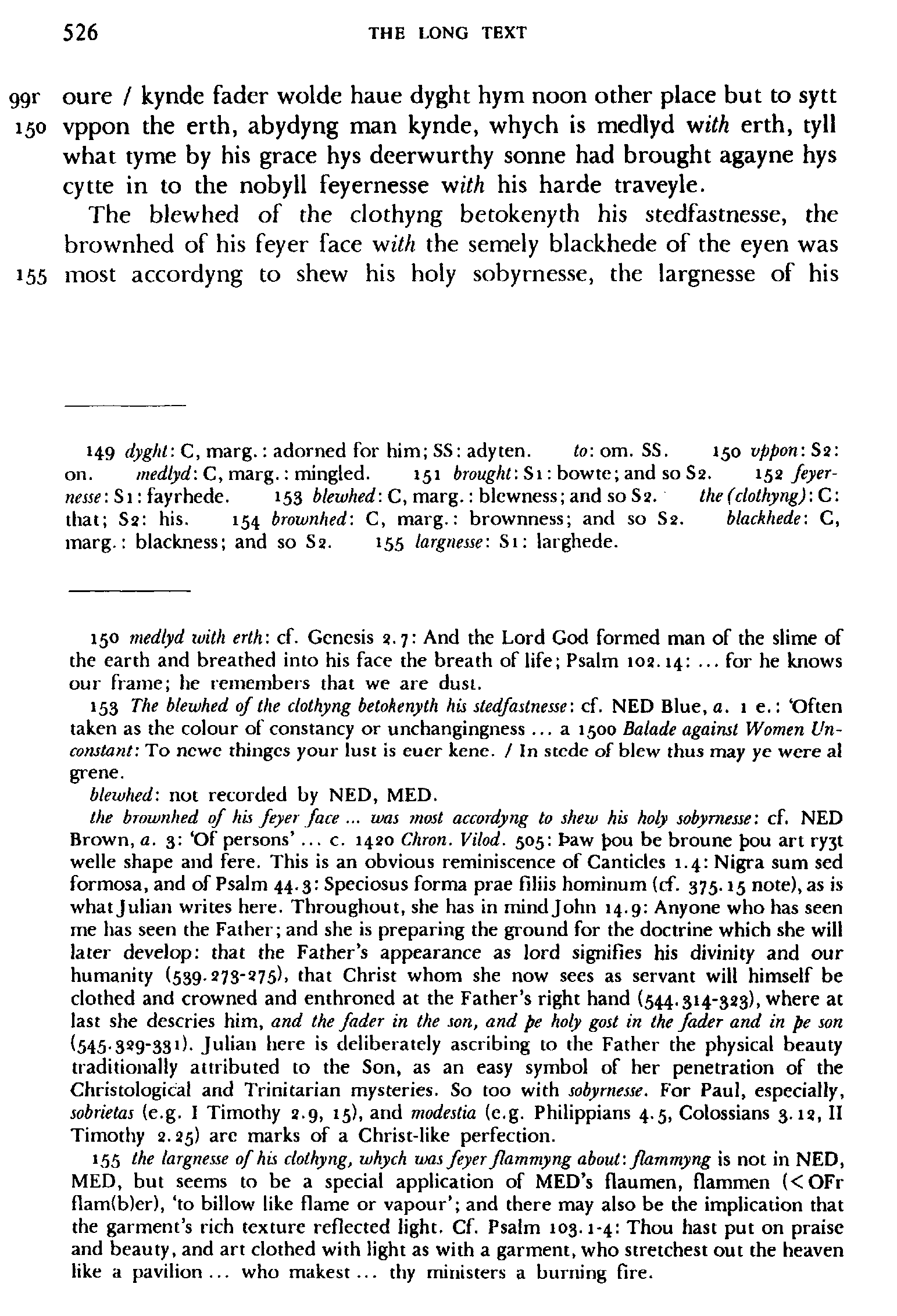
THE LONG TEXT
ggr cure / kynde fader wolde haue dyght hym noon other place but to sytt 150 vppon the erth, abydyng man kynde, whych is medlyd with erth, tyll what tyme by his grace hys deerwurthy sonne had brought agayne hys cytte in to the nobyll feyernesse -with his harde traveyle.
The blewhed of the clothyng betokenyth his stedfastnesse, the brownhed of his feyer face -with the semely blackhede of the eyen was
155 most accordyng to shew his holy sobyrnesse, the largnesse of his H9 dyght: C, marg.: adorned for him; SS: adyten. to: om. SS.
150 vppon: 82: on. medlyd: C, marg.: mingled.
151 brought: Si: bowte; and so 82.
152 feyernesse: Si: fayrhede.
153 blewhed: C, marg.: blewness; and so 82. the (clothyng): C: that; 82: his.
154 brownhed: C, marg.: brownness; and so 82. blackhede: C, marg.: blackness; and so 82.
155 largnesse: Si: larghede.
150 medlyd with erth: cf. Genesis 2.7: And the Lord God formed man of the slime of the earth and breathed into his face the breath of life; Psalm 102.14: ... for he knows our frame; he remembers that we are dust.
153 The blewhed of the clothyng betokenyth his stedfastnesse: cf. NED Blue, a. i e.: 'Often taken as the colour of constancy or unchangingness ... a 1500 Balade against Women Unconstant: To ncwc thingcs your lust is euer kene. / In stede of blew thus may ye were al grene. blewhed: not recorded by NED, MED. the brownhed of his feyer face ... was most accordyng to shew his holy sobyrnesse: cf. NED
Brown, a. 3: 'Of persons' ... c. 1420 Chron. Vilod. 505: t>aw J>ou be broune J>ou art ry3t welle shape and fere. This is an obvious reminiscence of Canticles 1.4: Nigra sum sed formosa, and of Psalm 44.3: Speciosus forma prae filiis hominum (cf. 375.15 note), as is what Julian writes here. Throughout, she has in mind John 14.9: Anyone who has seen me has seen the Father; and she is preparing the ground for the doctrine which she will later develop: that the Father's appearance as lord signifies his divinity and our humanity (539.273-275). that Christ whom she now sees as servant will himself be clothed and crowned and enthroned at the Father's right hand (544.314-323), where at last she descries him, and the fader in the son, and pe holy gost in the fader and in pe son
(545-329-331). Julian here is deliberately ascribing to the Father the physical beauty traditionally attributed to the Son, as an easy symbol of her penetration of the Christological and Trinitarian mysteries. So too with sobyrnesse. For Paul, especially, sobrietas (e.g. I Timothy 2.9, 15), and modestia (e.g. Philippians 4.5, Colossians 3.12, II Timothy 2.25) are marks of a Christ-like perfection.
155 the largnesse of his clothyng, whych was feyer flammyng about: Jlammyng is not in NED,
MED, but seems to be a special application of MED's flaumen, flammen (<OFr flam(b)er), 'to billow like flame or vapour'; and there may also be the implication that the garment's rich texture reflected light. Cf. Psalm 103.1-4: Thou hast put on praise and beauty, and art clothed with light as with a garment, who stretchest out the heaven like a pavilion... who makest... thy ministers a burning fire.
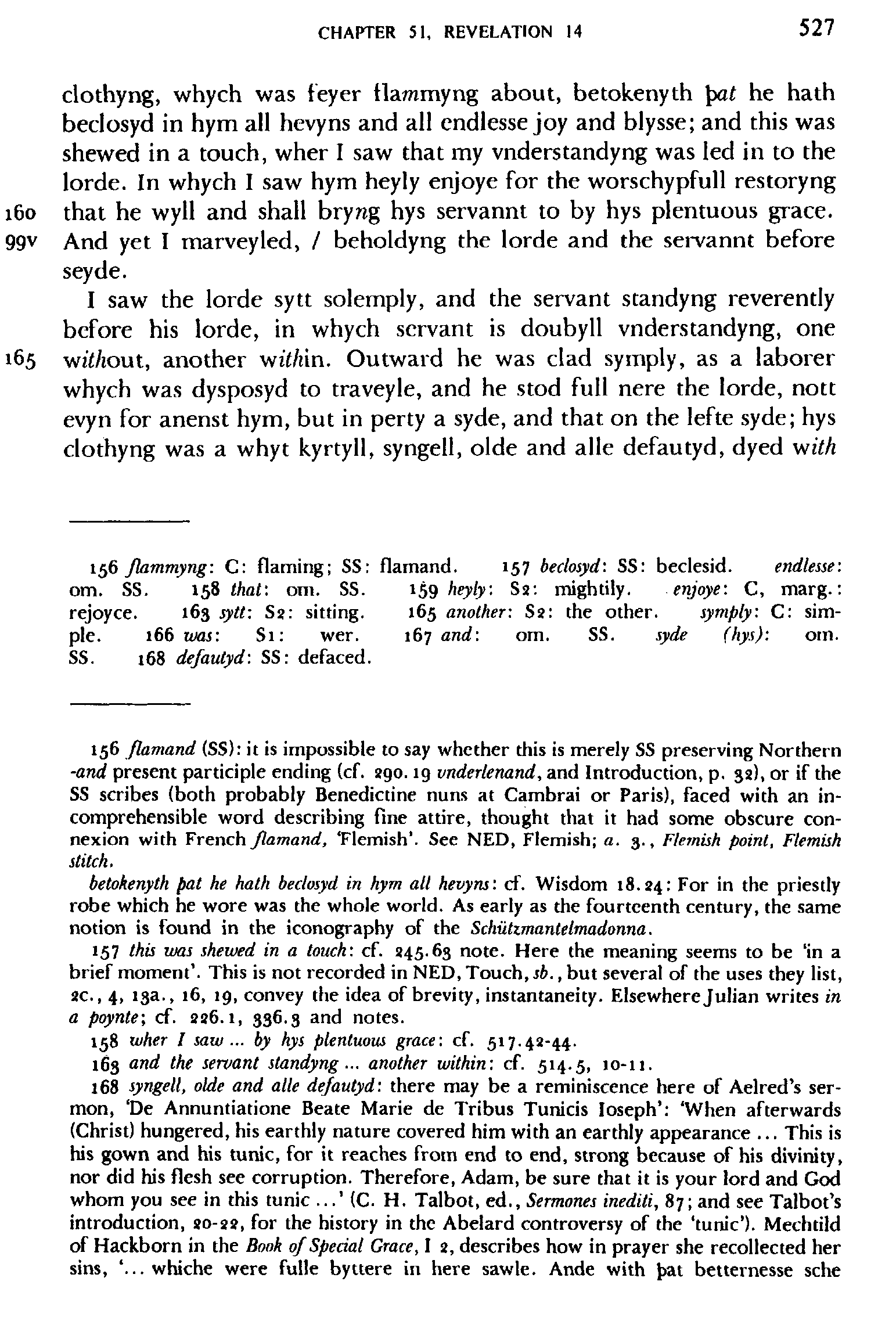
CHAPTER 51, REVELATION 14
clothyng, whych was feyer flawmyng about, betokenyth \xit he hath beclosyd in hym all hevyns and all endlesse joy and blysse; and this was shewed in a touch, wher I saw that my vnderstandyng was led in to the lorde. In whych I saw hym heyly enjoye for the worschypfull restoryng
160 that he wyll and shall brywg hys servannt to by hys plentuous grace, 99v And yet I marveyled, / beholdyng the lorde and the servannt before seyde.
I saw the lorde sytt solemply, and the servant standyng reverently before his lorde, in whych servant is doubyll vnderstandyng, one
165 without, another within. Outward he was clad syrnply, as a laborer whych was dysposyd to traveyle, and he stod full nere the lorde, nott evyn for anenst hym, but in perty a syde, and that on the lefte syde; hys clothyng was a whyt kyrtyll, syngell, olde and alle defautyd, dyed with 156 Jlammyng: C: flaming; SS: flamand.
157 beclosyd: SS: beclesid. endlesse: om.
SS.
158 that: om.
SS.
159 heyly: 82: mightily. enjoye: C, marg.: rejoyce.
163 sytt: Ss: sitting.
165 another: Sa: the other. symply: C: simple.
166 was:
Si: wer.
167 and: om.
SS. syde (hys): om.
SS.
168 defautyd: SS: defaced.
156 flamand (SS): it is impossible to say whether this is merely SS preserving Northern
-and present participle ending (cf. 290.19 vnderlenand, and Introduction, p. 32), or if the SS scribes (both probably Benedictine nuns at Cambrai or Paris), faced with an incomprehensible word describing fine attire, thought that it had some obscure connexion with French flamand, 'Flemish'. See NED, Flemish; a. 3., Flemish point, Flemish stitch. betokenyth pat he hath beclosyd in hym all hevyns: cf. Wisdom 18.24: For in the priestly robe which he wore was the whole world. As early as the fourteenth century, the same notion is found in the iconography of the Schutzmantelmadonna.
157 this was shewed in a touch: cf. 245.63 note. Here the meaning seems to be 'in a brief moment'. This is not recorded in NED, Touch, sb., but several of the uses they list, ac., 4, 133., 16, 19, convey the idea of brevity, instantaneity. Elsewhere Julian writes in a poynte; cf. 226.1, 336.3 and notes.
158 wher I saw... by hys plentuous grace: cf. 517.42-44.
163 and the servant standyng... another within: cf. 514.5, 10-11.
168 syngell, olde and alle defautyd: there may be a reminiscence here of Aelred's sermon, 'De Annuntiatione Beate Marie de Tribus Tunicis Joseph': 'When afterwards
(Christ) hungered, his earthly nature covered him with an earthly appearance ... This is his gown and his tunic, for it reaches from end to end, strong because of his divinity, nor did his flesh see corruption. Therefore, Adam, be sure that it is your lord and God whom you see in this tunic ...' (C. H. Talbot, ed., Sermones inediti, 87; and see Talbot's introduction, 20-22, for the history in the Abelard controversy of the 'tunic'). Mechtild of Hackborn in the Book of Special Grace, I 2, describes how in prayer she recollected her sins, '... whiche were fulle byttere in here sawle. Ande with J>at betternesse sche
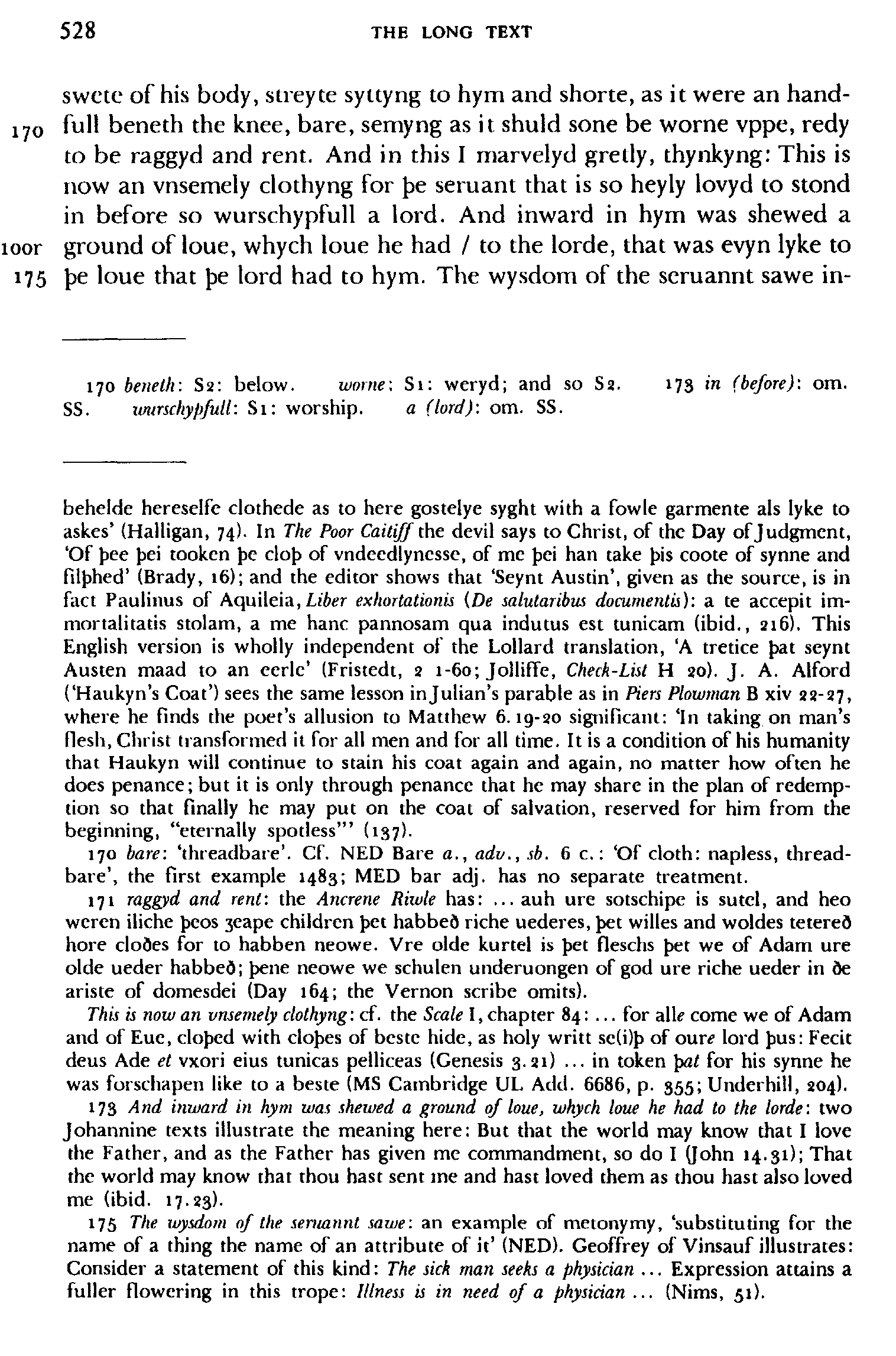
THE LONG TEXT
swctc of his body, streyte syttyng to hym and shorte, as it were an handijo full beneth the knee, bare, semyng as it shuld sone be worne vppe, redy to be raggyd and rent. And in this I marvelyd gretly, thynkyng: This is now an vnsemely clothyng for J)e seruant that is so heyly lovyd to stond in before so wurschypfull a lord. And inward in hym was shewed a loor ground of loue, whych loue he had / to the lorde, that was evyn lyke to 175 Ipe loue that J>e lord had to hym. The wysdom of the seruannt sawe in170 beneth: 82: below. worne: Si: weryd; and so 82.
173 in (before): om.
SS. wurschypfull: Si: worship. a (lord): om. SS. behelde hereselfe clothede as to here gostelye syght with a fowle garmente als lyke to askes' (Halligan, 74). In The Poor Caitiff the devil says to Christ, of the Day of Judgment,
'Of £>ee f>ei tooken J>e cloj> of vndeedlynesse, of me £ei han take J>is coote of synne and filphed' (Brady, 16); and the editor shows that 'Seynt Austin', given as the source, is in fact Paulinus of Aquileia,Lifo?r exhortation^ (De salutaribus documents): a te accepit immortalitatis stolam, a me hanc pannosam qua indutus est tunicam (ibid., 216). This
English version is wholly independent of the Lollard translation, 'A tretice pat seynt
Austen maad to an eerie' (Fristedt, 2 1-60; Jolliffe, Check-List H 20). J. A. Alford
('Haukyn's Coat') sees the same lesson injulian's parable as in Piers Plowman B xiv 22-27, where he finds the poet's allusion to Matthew 6.19-20 significant: 'In taking on man's flesh, Christ transformed it for all men and for all time. It is a condition of his humanity that Haukyn will continue to stain his coat again and again, no matter how often he does penance; but it is only through penance that he may share in the plan of redemption so that finally he may put on the coat of salvation, reserved for him from the beginning, "eternally spotless"' (137).
170 bare: 'threadbare'. Cf. NED Bare a., adv., sb. 6 c.: 'Of cloth: napless, threadbare', the first example 1483; MED bar adj. has no separate treatment.
171 raggyd and rent: the Ancrene Riwle has: ... auh ure sotschipe is sutcl, and heo weren iliche J>eos 3eape children pet habbed riche uederes, pet willes and woldes tetered hore clofles for to habben neowe. Vre olde kurtel is pet fleschs {jet we of Adam ure olde ueder habbed; pene neowe we schulen underuongen of god ure riche ueder in de ariste of domesdei (Day 164; the Vernon scribe omits).
This is now an vnsemely clothyng: cf. the Scale I, chapter 84: ... for all* come we of Adam and of Eue, closed with clones of beste hide, as holy writt se(i)J) of our? lord pus: Fecit deus Ade et vxori eius tunicas pelliceas (Genesis 3.21) ... in token tyt for his synne he was forschapen like to a beste (MS Cambridge UL Acid. 6686, p. 355; Underbill, 204).
173 And inward in hym was shewed a ground of loue, whych loue he had to the lorde: two
Johannine texts illustrate the meaning here: But that the world may know that I love the Father, and as the Father has given me commandment, so do I (John 14.31); That the world may know that thou hast sent me and hast loved them as thou hast also loved me (ibid. 17.23).
175 The wysdom of the seruannt sawe: an example of metonymy, 'substituting for the name of a thing the name of an attribute of it' (NED). Geoffrey of Vinsauf illustrates:
Consider a statement of this kind: The sick man seeks a physician ... Expression attains a fuller flowering in this trope: Illness is in need of a physician ... (Nims, 51).
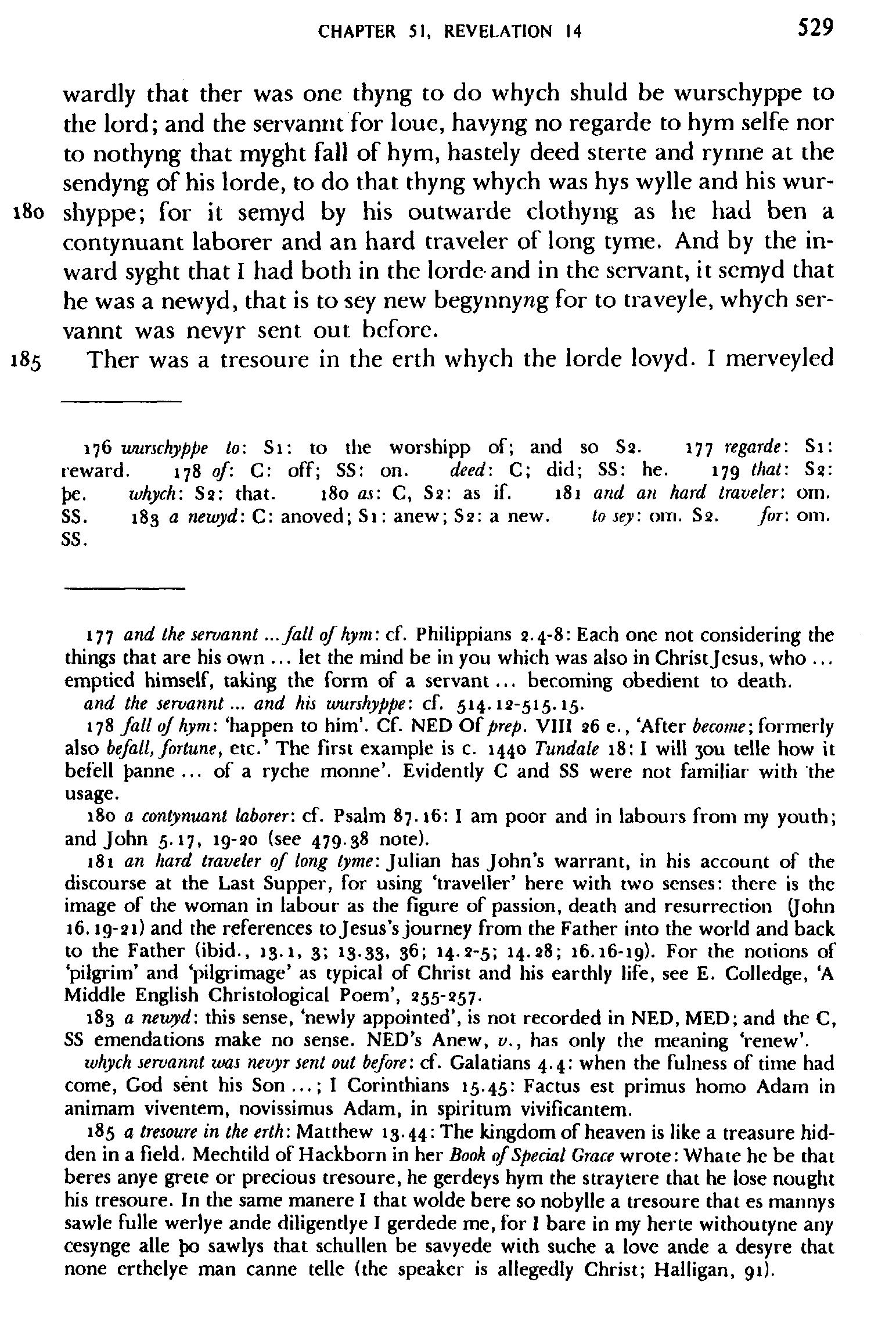
CHAPTER 51, REVELATION 14
wardly that ther was one thyng to do whych shuld be wurschyppe to the lord; and the servannt for loue, havyng no regarde to hym selfe nor to nothyng that myght fall of hym, hastely deed sterte and rynne at the sendyng of his lorde, to do that thyng whych was hys wylle and his wur180 shyppe; for it semyd by his outwarde clothyng as he had ben a contynuant laborer and an hard traveler of long tyme. And by the inward syght that I had both in the lorde and in the servant, it scmyd that he was a newyd, that is to sey new begynnyng for to traveyle, whych servannt was nevyr sent out before.
Ther was a tresoure in the erth whych the lorde lovyd. I merveyled 176 wurschyppe to: Si: to the worshipp of; and so 82.
177 regarde: Si: reward.
178 of: C: off; SS: on. deed: C; did; SS: he.
179 that: 82: pe. whych: 82: that.
180 as: C, 82: as if.
181 and an hard traveler: om.
SS.
183 a newyd: C: anoved; Si: anew; 82: a new. to sey: om. 82. for: om.
SS.
177 and the servannt ...fall of hym: cf. Philippians 2.4-8: Each one not considering the things that are his own ... let the mind be in you which was also in Christjcsus, who ... emptied himself, taking the form of a servant... becoming obedient to death. and the servannt... and his wurshyppe: cf. 514.12-515.15.
178 fall of hym: 'happen to him'. Cf. NED Of prep. VIII 26 e., 'After become; formerly also befall, fortune, etc.' The first example is c. 1440 Tundale 18:1 will 3011 telle how it befell panne ... of a ryche monne'. Evidently C and 88 were not familiar with the usage.
180 a contynuant laborer: cf. Psalm 87.16: I am poor and in labours from my youth; and John 5.17, 19-20 (see 479.38 note).
181 an hard traveler of long tyme: Julian has John's warrant, in his account of the discourse at the Last Supper, for using 'traveller' here with two senses: there is the image of the woman in labour as the figure of passion, death and resurrection (John
16.19-21) and the references to Jesus's journey from the Father into the world and back to the Father (ibid., 13.1, 3; 13.33, 36; 14.2-5; 14.28; 16.16-19). For the notions of 'pilgrim' and 'pilgrimage' as typical of Christ and his earthly life, see E. Colledge, 'A Middle English Christological Poem', 255-257.
183 a newyd: this sense, 'newly appointed', is not recorded in NED, MED; and the C,
SS emendations make no sense. NED's Anew, v., has only the meaning 'renew'. whych servannt was nevyr sent out before: cf. Galatians 4.4: when the fulness of time had come, God sent his Son ...; I Corinthians 15.45: Factus est primus homo Adam in animam viventem, novissimus Adam, in spiritum vivificantem.
185 a tresoure in the erth: Matthew 13.44: The kingdom of heaven is like a treasure hidden in a field. Mechtild of Hackborn in her Book of Special Grace wrote: Whate he be that beres anye grete or precious tresoure, he gerdeys hym the straytere that he lose nought his tresoure. In the same manere I that wolde bere so nobylle a tresoure that es mannys sawle fulle werlye ande diligentlye I gerdede me, for I bare in my herte withoutyne any cesynge alle po sawlys that schullen be savyede with suche a love ande a desyre that none erthelye man canne telle (the speaker is allegedly Christ; Halligan, 91).
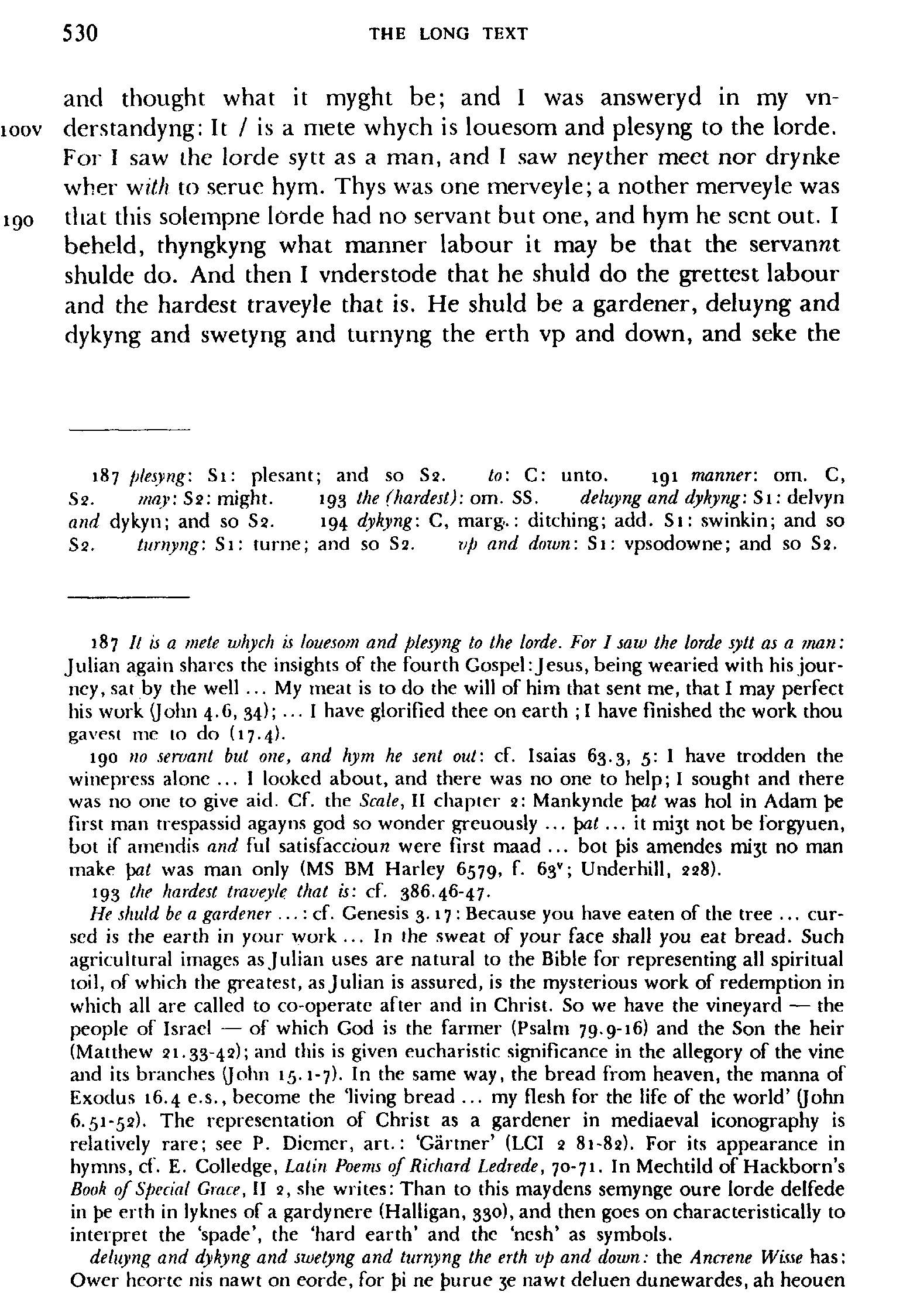
THE LONG TEXT
and thought what it myght be; and I was answeryd in my vnloov derstandyng: It / is a mete whych is louesom and plesyng to the lorde.
For I saw the lorde sytt as a man, and I saw neyther meet nor drynke wher -with to serue hym. Thys was one merveyle; a nother merveyle was
that this solempne lorde had no servant but one, and hym he sent out. I beheld, thyngkyng what manner labour it may be that the servannt shulde do. And then I vnderstode that he shuld do the grettest labour and the hardest traveyle that is. He shuld be a gardener, deluyng and dykyng and swetyng and turnyng the erth vp and down, and seke the 187 plesyng: Si: plesant; and so 82. to: C: unto.
191 manner: om. C, S2. may: 82: might.
193 the (hardest): om. SB. deluyng and dykyng: Si: delvyn and dykyn; and so Sa.
194 dykyng: C, marg..: ditching; add. Si: swinkin; and so Sa. turnyng: Si: turne; and so Sa. vp and down: Si: vpsodowne; and so Sz.
187 // is a mete whych is louesom and plesyng to the lorde. For I saw the lorde sytt as a man:
Julian again shares the insights of the fourth Gospel :Jesus, being wearied with his journey, sat by the well ... My meat is to do the will of him that sent me, that I may perfect his work (John 4.6, 34); ... I have glorified thee on earth ; I have finished the work thou gavest me to do (17.4).
190 no servant but one, and hym he sent out: cf. Isaias 63.3, 5: I have trodden the winepress alone ... I looked about, and there was no one to help; I sought and there was no one to give aid. Cf. the Scale, II chapter a: Mankynde ba< was hoi in Adam be first man trespassid agayns god so wonder greuously ... ba< ... it mi3t not be forgyuen, bot if amendis and ful satisfaco'oun were first maad ... bot bis amendes mijt no man make \tat was man only (MS BM Harley 6579, f. 63"; Underbill, 228).
193 the hardest traveyle that is: cf. 386.46-47.
He shuld be a gardener ...: cf. Genesis 3.17 : Because you have eaten of the tree ... cursed is the earth in your work ... In the sweat of your face shall you eat bread. Such agricultural images as Julian uses are natural to the Bible for representing all spiritual toil, of which the greatest, as Julian is assured, is the mysterious work of redemption in which all are called to co-operate after and in Christ. So we have the vineyard — the people of Israel — of which God is the farmer (Psalm 79,9-16) and the Son the heir
(Matthew 31.33-42); and this is given eucharistic significance in the allegory of the vine and its branches (John 15.1-7). In the same way, the bread from heaven, the manna of Exodus 16.4 e.s., become the 'living bread ... my flesh for the life of the world' (John
6.51-52). The representation of Christ as a gardener in mediaeval iconography is relatively rare; see P. Diemcr, art.: 'Gartner' (LCI a 81-82). For its appearance in hymns, cf. E. Colledge, Latin Poems of Richard Ledrede, 70-71. In Mechtild of Hackborn's
Book of Special Grace, II 2, she writes: Than to this may dens semynge oure lorde delfede in be erth in lyknes of a gardynere (Halligan, 330), and then goes on characteristically to interpret the 'spade', the 'hard earth' and the 'nesh' as symbols. deluyng and dykyng and swetyng and turnyng the erth vp and down: the Ancrene Wisae has:
Ower hcorte nis nawt on eorde, for pi ne purue 36 nawt deluen dunewardes, ah heouen
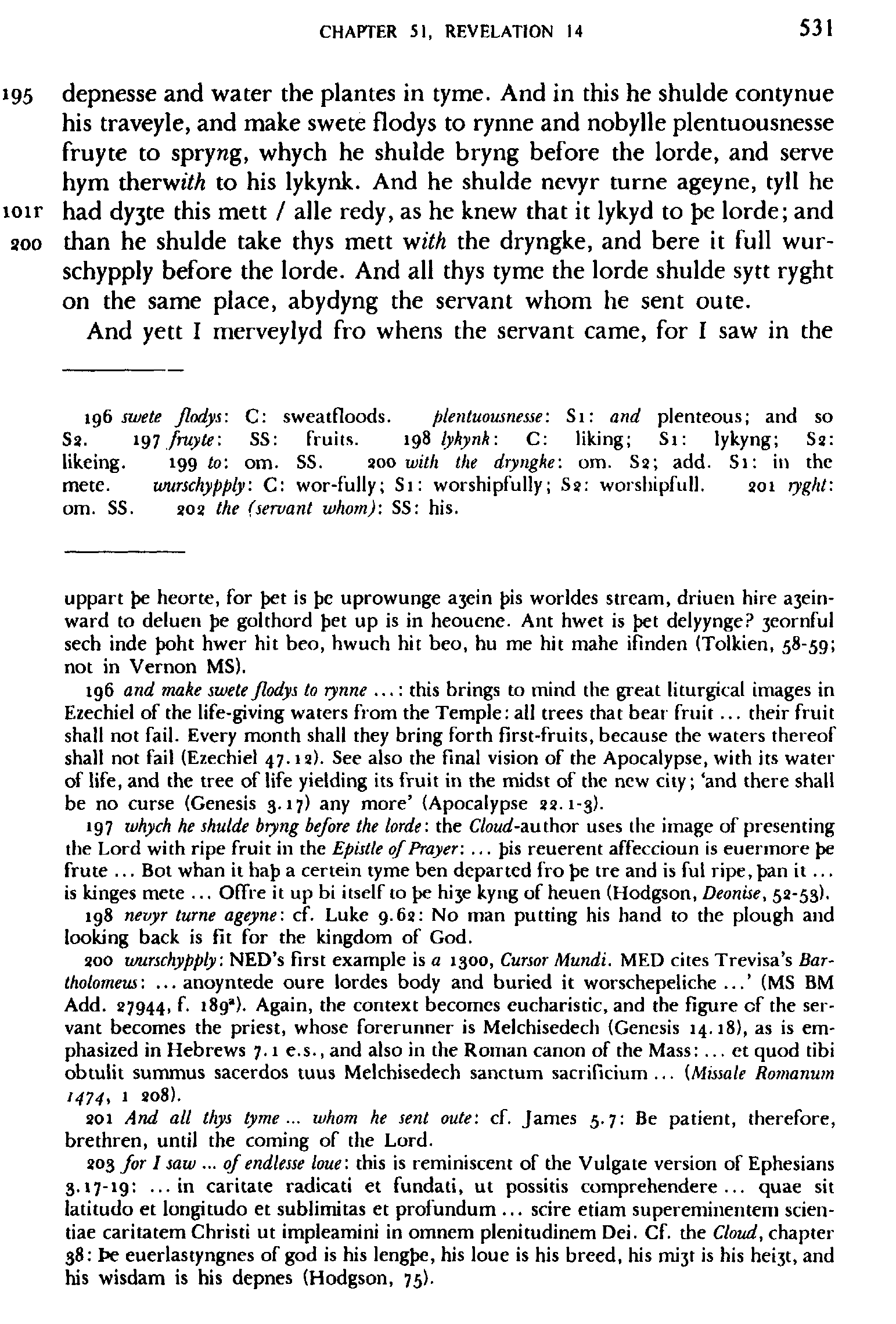
CHAPTER 51, REVELATION 14
195 depnesse and water the plantes in tyme. And in this he shulde contynue his traveyle, and make swete flodys to rynne and nobylle plentuousnesse fruyte to spryng, whych he shulde bryng before the lorde, and serve hym therwi/A to his lykynk. And he shulde nevyr turne ageyne, tyll he ioir had dy3te this mett / alle redy, as he knew that it lykyd to J>e lorde; and 200 than he shulde take thys mett with the dryngke, and bere it full wurschypply before the lorde. And all thys tyme the lorde shulde sytt ryght on the same place, abydyng the servant whom he sent oute.
And yett I merveylyd fro whens the servant came, for I saw in the 196 swete flodys: C: sweatfloods. plentuousnesse: Si: and plenteous; and so 82.
197 fruyte:
SS: fruits.
198 lykynk:
C: liking; Si: lykyng; 82: likeing.
199 to: om. SS.
200 with the dryngke: om. 82; add. Si: in the mete. wurschypply: C: wor-fully; Si: worshipfully; Sa: worshipfull.
201 ryght: om. SS.
202 the (servant whom); SS: his. uppart }>e heorte, for £>et is Jje uprowunge a3ein {>is worldes stream, driuen hire a3einward to deluen J>e golthord £et up is in heouene. Ant hwet is {set delyynge? 3eornful sech inde Jxjht hwer hit beo, hwuch hit beo, hu me hit mahe ifinden (Tolkien, 58-59; not in Vernon MS).
196 and make swete flodys to rynne ...: this brings to mind the great liturgical images in Ezechiel of the life-giving waters from the Temple: all trees that beat fruit ... their fruit shall not fail. Every month shall they bring forth first-fruits, because the waters thereof shall not fail (Ezechiel 47.12). See also the final vision of the Apocalypse, with its water of life, and the tree of life yielding its fruit in the midst of the new city; 'and there shall be no curse (Genesis 3.17) any more' (Apocalypse 22.1-3).
197 whych he shulde bryng before the lorde: the Cloud-author uses the image of presenting the Lord with ripe fruit in the Epistle of Prayer: ... J>is reuerent affeccioun is euermore £e frute ... Bot whan it haj> a certein tyme ben departed fro \>e tre and is ful ripe, J>an it... is kinges mete ... Offre it up bi itself to Jje hi3e kyng of heuen (Hodgson, Deonise, 52-53).
198 nevyr turne ageyne: cf. Luke 9.62: No man putting his hand to the plough and looking back is fit for the kingdom of God.
200 wurschypply: NED's first example is a 1300, Cursor Mundi. MED cites Trevisa's Bartholomew: ... anoyntede oure lordes body and buried it worschepeliche ..." (MS BM
Add. 27944, f- '89*). Again, the context becomes eucharistic, and the figure of the servant becomes the priest, whose forerunner is Melchisedech (Genesis 14.18), as is emphasized in Hebrews 7. i e.s., and also in the Roman canon of the Mass: ... et quod tibi obtulit summus sacerdos tuus Melchisedech sanctum sacrificium ... (Missale Romanum
1474, i 208).
201 And all thys tyme... whom he sent oute: cf. James 5.7: Be patient, therefore, brethren, until the coming of the Lord.
203 for I saw ... of endlesse loue: this is reminiscent of the Vulgate version of Ephesians
3.17-19: ...in caritate radicati et fundati, ut possitis comprehendere ... quae sit latitudo et longitude et sublimitas et profundum ... scire etiam supereminentem scientiae caritatem Christ! ut impleamini in omnem plenitudinem Dei. Cf. the Cloud, chapter
38: t>e euerlastyngnes of god is his lengf>e, his loue is his breed, his mi3t is his hei3t, and his wisdam is his depnes (Hodgson, 75).
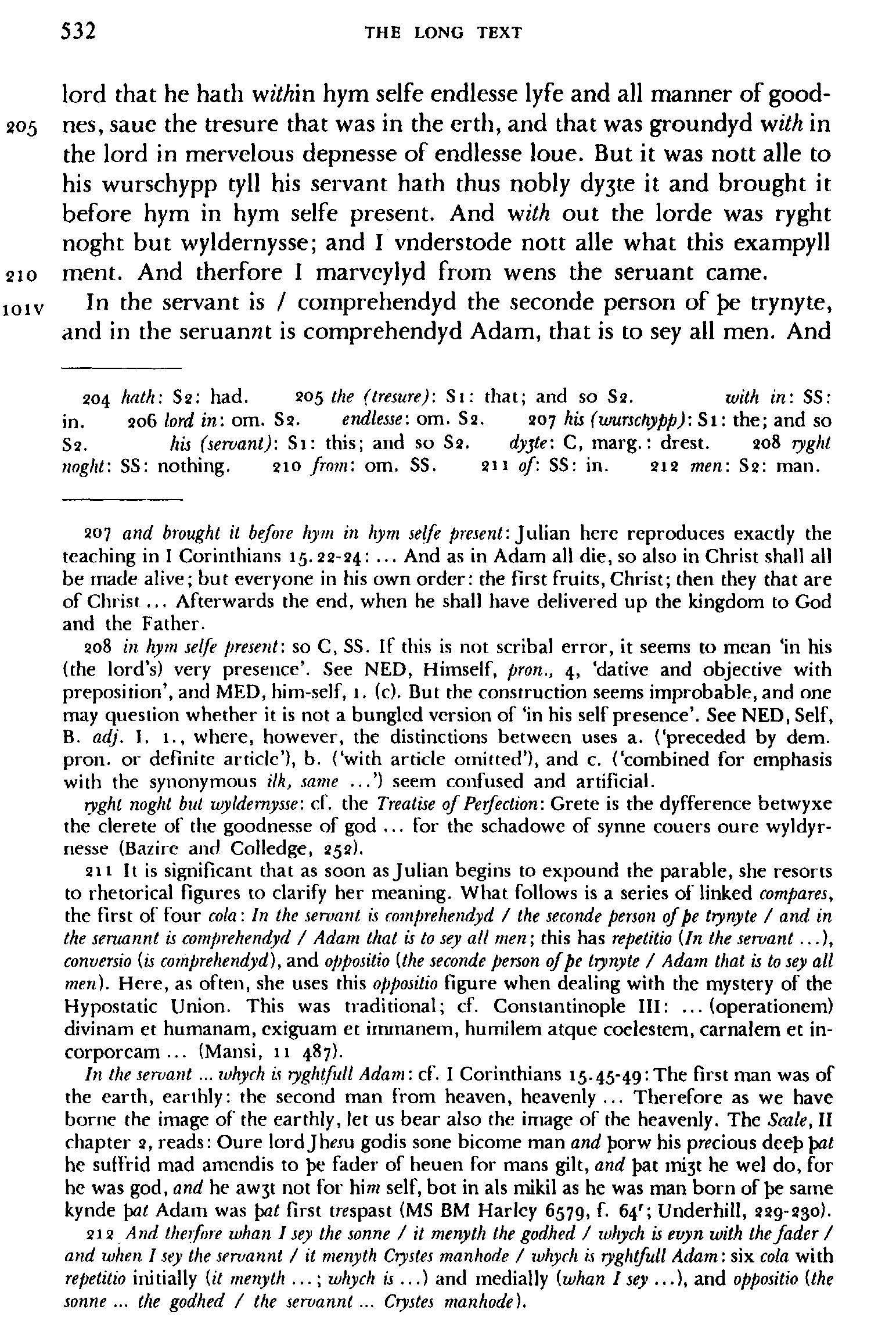
THE LONG TEXT
lord that he hath within hym selfe endlesse lyfe and all manner of good205 nes, saue the tresure that was in the erth, and that was groundyd with in the lord in mervelous depnesse of endlesse loue. But it was nott alle to his wurschypp tyll his servant hath thus nobly dy3te it and brought it before hym in hym selfe present. And with out the lorde was ryght noght but wyldernysse; and I vnderstode nott alle what this exampyll
210 ment. And therfore I marveylyd from wens the seruant came. ioiv In the servant is / comprehendyd the seconde person of J>e trynyte, and in the seruannt is comprehendyd Adam, that is to sey all men. And 204 hath: 82: had.
205 the (tresure): Si: that; and so 82. with in: 88: in.
206 lord in: om. 82. endlesse: om. 82.
207 his (wurschypp): Si: the; and so 82. his (servant): Si: this; and so 82. dyjte: C, marg.: drest.
208 ryght noght: 88: nothing.
210 from: om. 88.
211 of: 88: in.
212 men: 82: man.
207 and brought it before hym in hym selfe present: Julian here reproduces exactly the teaching in I Corinthians 15.22-24: ... And as in Adam all die, so also in Christ shall all be made alive; but everyone in his own order: the first fruits, Christ; then they that are of Christ ... Afterwards the end, when he shall have delivered up the kingdom to God and the Father.
208 in hym selfe present: so C, 88. If this is not scribal error, it seems to mean 'in his
(the lord's) very presence'. See NED, Himself, pron., 4, 'dative and objective with preposition', and MED, him-self, i. (c). But the construction seems improbable, and one may question whether it is not a bungled version of 'in his self presence'. See NED, Self,
B. adj. I. i., where, however, the distinctions between uses a. ('preceded by dem. pron. or definite article'), b. ('with article omitted'), and c. ('combined for emphasis with the synonymous ilk, same ...') seem confused and artificial. ryghl noght but wyldernysse: cf. the Treatise of Perfection: Crete is the dyfference betwyxe the clerete of the goodnesse of god ,.. for the schadowe of synne couers oure wyldyrnesse (Bazire and Colledge, 252).
211 It is significant that as soon as Julian begins to expound the parable, she resorts to rhetorical figures to clarify her meaning. What follows is a series of linked compares, the first of four cola: In the servant is comprehendyd / the seconde person ofpe trynyte / and in the seruannt is comprehendyd / Adam that is to sey all men; this has repetitio (In the servant ...), conversio (is comprehendyd), and oppositio (the seconde person ofpe trynyte / Adam that is to sey all men). Here, as often, she uses this oppositio figure when dealing with the mystery of the Hypostatic Union. This was traditional; cf. Constantinople III: ... (operationem) divinam et humanam, cxiguam et immanem, humilem atque coelestem, carnalem et incorpoream... (Mansi, n 487).
In the servant ... whych it ryghtfull Adam: cf. I Corinthians 15.45-49: The first man was of the earth, earthly: the second man from heaven, heavenly ... Therefore as we have borne the image of the earthly, let us bear also the image of the heavenly. The Scale, II chapter 2, reads: Oure lordJhmi godis sone bicome man and Jjorw his precious deej) \>at he suffrid mad amcndis to pe fader of heuen for mans gilt, and J>at 111131 he wel do, for he was god, and he aw3t not for him self, bot in als mikil as he was man born of pe same kynde pa/ Adam was ]xit first trespast (MS BM Harley 6579, f. 64'; Underbill, 229-230).
212 And therfore whan I sey the sonne I it menyth the godhed / whych is evyn with the fader I and when I sey the seruannt / it menyth Crystes manhode / whych it ryghtfull Adam: six cola with repetitio initially (it menyth ...; whych is ...) and medially (whan I sey ...), and oppositio (the sonne ... the godhed / the seruannt ... Crystes manhode).
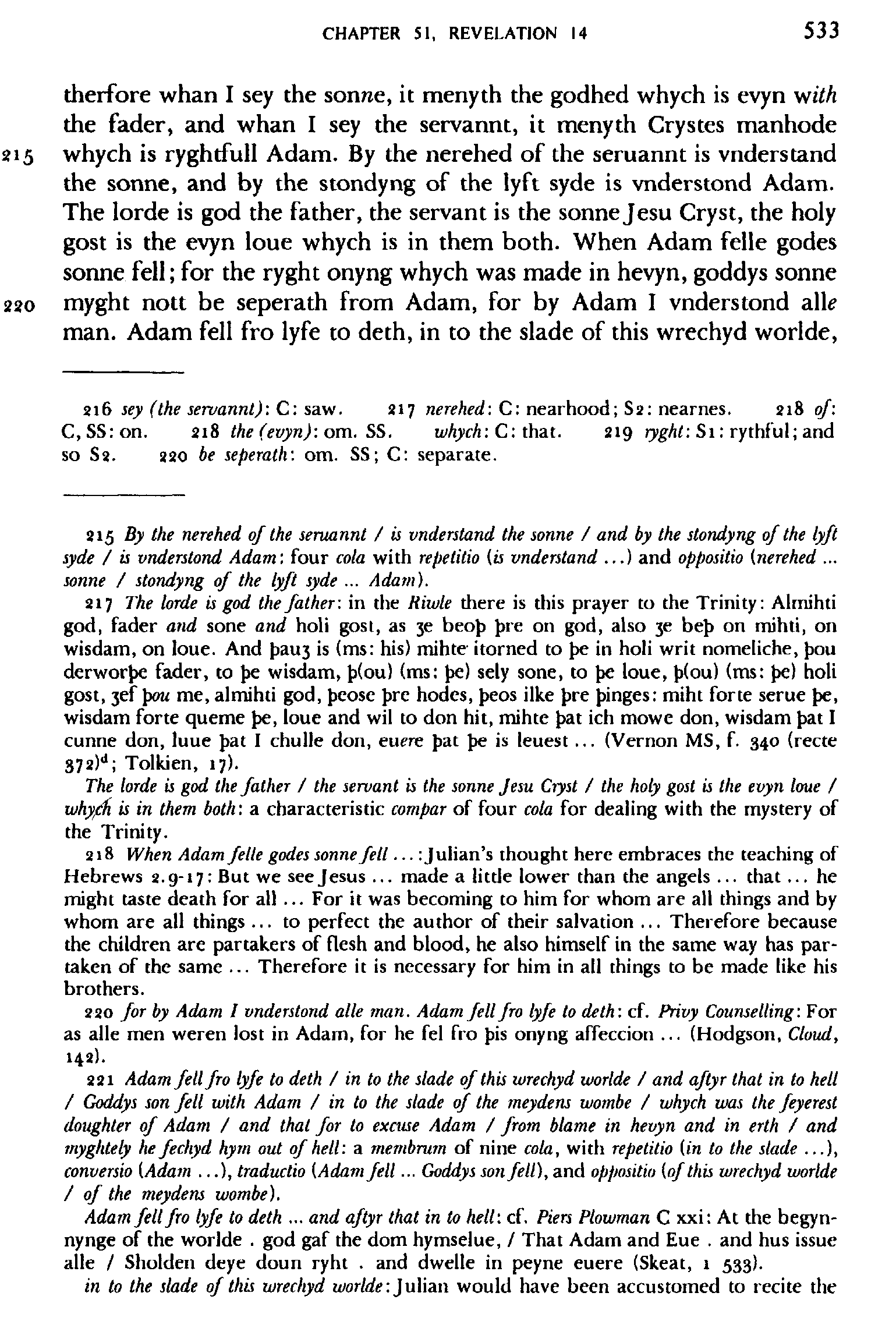
CHAPTER 51, REVELATION 14
therfore whan I sey the sonne, it menyth the godhed whych is evyn with the fader, and whan I sey the servannt, it menyth Crystes manhode
whych is ryghtfull Adam. By the nerehed of the seruannt is vnderstand the sonne, and by the stondyng of the lyft syde is vnderstond Adam.
The lorde is god the father, the servant is the sonne Jesu Cryst, the holy gost is the evyn loue whych is in them both. When Adam felle godes sonne fell; for the ryght onyng whych was made in hevyn, goddys sonne
myght nott be seperath from Adam, for by Adam I vnderstond alle man. Adam fell fro lyfe to deth, in to the slade of this wrechyd worlde,
216 sey (the servannt): C: saw.
217 nerehed: C: near hood; 82: nearnes.
218 of:
C, SS: on.
218 the (evyn): om. SS. whych: C: that.
219 ryght: Si: rythful; and so 82.
220 be seperath: om. SS; C: separate.
215 By the nerehed of the seruannt / is vnderstand the sonne / and by the stondyng of the lyft syde / is vnderstond Adam: four cola with repetitio (is vnderstand ...) and oppositio (nerehed ... sonne / stondyng of the lyft syde ... Adam).
217 The lorde is god the father: in the Riwle there is this prayer to the Trinity: Almihti god, fader and sone and holi gost, as 36 beop J>re on god, also 36 be|> on mihti, on wisdam, on loue. And bau3 is (ms: his) mihte itorned to J>e in holi writ nomeliche, J>ou derwor|>e fader, to J>e wisdam, |>(ou) (ms: j>e) sely sone, to |>e loue, J)(ou) (ms: |>e) holi gost, 3ef J»w me, almihti god, peose }>re hodes, J>eos ilke J>re pinges: miht forte serue }>e, wisdam forte queme {je, loue and wil to don hit, mihte J>at ich mowe don, wisdam pat I cunne don, luue J>at I chulle don, euere f>at J>e is leuest ... (Vernon MS, f. 340 (recte
372)d; Tolkien, 17).
The lorde is god the father / the servant is the sonne Jesu Cryst / the holy gost is the evyn loue / whych is in them both: a characteristic compar of four cola for dealing with the mystery of the Trinity.
218 When Adam felle godes sonne fell...: Julian's thought here embraces the teaching of Hebrews 2.9-17: But we see Jesus ... made a little lower than the angels ... that ... he might taste death for all ... For it was becoming to him for whom are all things and by whom are all things ... to perfect the author of their salvation ... Therefore because the children are partakers of flesh and blood, he also himself in the same way has partaken of the same ... Therefore it is necessary for him in all things to be made like his brothers.
220 for by Adam I vnderstond alle man. Adam fell fro lyfe to deth: cf. Privy Counselling: For as alle men weren lost in Adam, for he fel fro pis onyng affeccion ... (Hodgson, Cloud,
142).
221 Adam fell fro lyfe to deth / in to the slade of this wrechyd worlde / and aftyr that in to hell
/ Goddys son fell with Adam / in to the slade of the meydens wombe / whych was the feyerest daughter of Adam / and that for to excuse Adam / from blame in hevyn and in erth / and myghtely he fechyd hym out of hell: a membrum of nine cola, with repetitio (in to the slade ...), conversio (Adam ...), traductio (Adam fell... Goddys son fell), and oppositio (of this wrechyd worlde
/ of the meydens wombe).
Adam fell fro lyfe to deth ... and aftyr that in to hell: cf. Piers Plowman C xxi: At die begynnynge of the worlde. god gaf the dorm hymselue,/ Adam and Eue . and hus issue alle / Sholden deye doun ryht . and dwelle in peyne euere (Skeat, i 533). in to the slade of this wrechyd worlde: Julian would have been accustomed to recite the
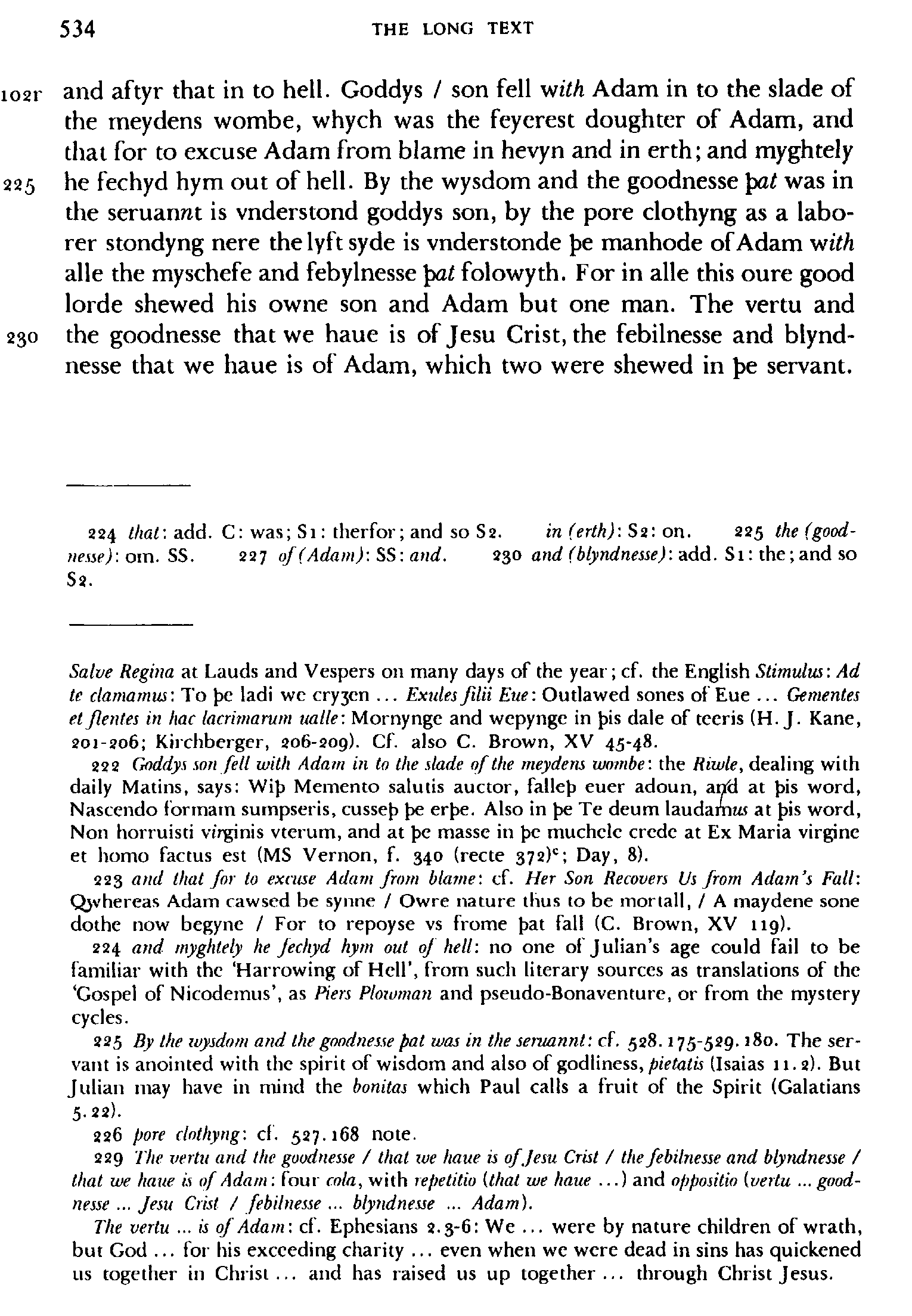
THE LONG TEXT
1021and aftyr that in to hell. Goddys / son fell v^ith Adam in to the slade of the rneydens wombe, whych was the fey crest dough ter of Adam, and that for to excuse Adam from blame in hevyn and in erth; and myghtely
he fechyd hym out of hell. By the wysdom and the goodnesse \>at was in the seruannt is vnderstond goddys son, by the pore clothyng as a laborer stondyng nere the lyft syde is vnderstonde J>e manhode of Adam with alle the myschefe and febylnesse Ipat folowyth. For in alle this oure good lorde shewed his owne son and Adam but one man. The vertu and
the goodnesse that we haue is of Jesu Crist, the febilnesse and blyndnesse that we haue is of Adam, which two were shewed in J>e servant.
224 that: add. C: was; Si: therfor; and so 82. in (erth): 82: on.
225 the (goodnesse): om. SS.
227 of (Adam): SS: and.
230 and (blyndnesse): add. Si: the; and so S*.
Salve Regina at Lauds and Vespers on many days of the year; cf. the English Stimulus: Ad te clamamus: To \>c ladi we cry3en ... Exulesftlii Eue: Outlawed sones of Eue ... Gementes etflentes in hac lacrimarum ualle: Mornynge and wepynge in {jis dale of teeris (H. J. Kane,
201-206; Kirchberger, 206-209). Cf. also C. Brown, XV 45-48.
222 Goddys son fell with Adam in to the slade of the meydem wombe: the Riwle, dealing with daily Matins, says: Wi{? Memento salutis auctor, falle^ euer adoun, and at Jris word,
Nascendo forrnam sumpseris, cusse}) f>e erjje. Also in J>e Te deum laudamus at J?is word,
Non horruisti vtrginis vterum, and at f>c masse in fie muchclc credc at Ex Maria virgine et homo factus est (MS Vernon, f. 340 (recte 372)°; Day, 8).
223 and that for to excuse Adam from blame: cf. Her Son Recovers Us from Adam's Fall:
Qwhereas Adam cawsed be synne / Owre nature thus to be mortall, / A maydene sone dothe now begyne / For to repoyse vs frome J>at fall (C. Brown, XV 119).
224 and myghtely he Jechyd hym out oj hell: no one of Julian's age could fail to be familiar with the 'Harrowing of Hell', from such literary sources as translations of the 'Gospel of Nicodemus', as Piers Plowman and pseudo-Bonaventure, or from the mystery cycles.
225 By the wysdom and the goodnesse pat was in the seruannt: cf. 528.175-529.180. The servant is anointed with the spirit of wisdom and also of godliness, pietatis (Isaias 11.2). But Julian may have in mind the bonitas which Paul calls a fruit of the Spirit (Galatians
5.22).
226 pore clothyng: cf. 527.168 note.
229 The vertu and the goodnesse / that we haue is of Jesu Crist / the febilnesse and blyndnesse / that we haue is of Adam: four cola, with repetitio (that we haue . . . ) and oppositio (vertu ... goodnesse ... Jesu Crist / febilnesse ... blyndnesse ... Adam).
The vertu ... is of Adam: cf. Ephesians 2.3-6: We ... were by nature children of wrath, but God ... for his exceeding charity ... even when we were dead in sins has quickened us together in Christ... and has raised us up together... through Christ Jesus.
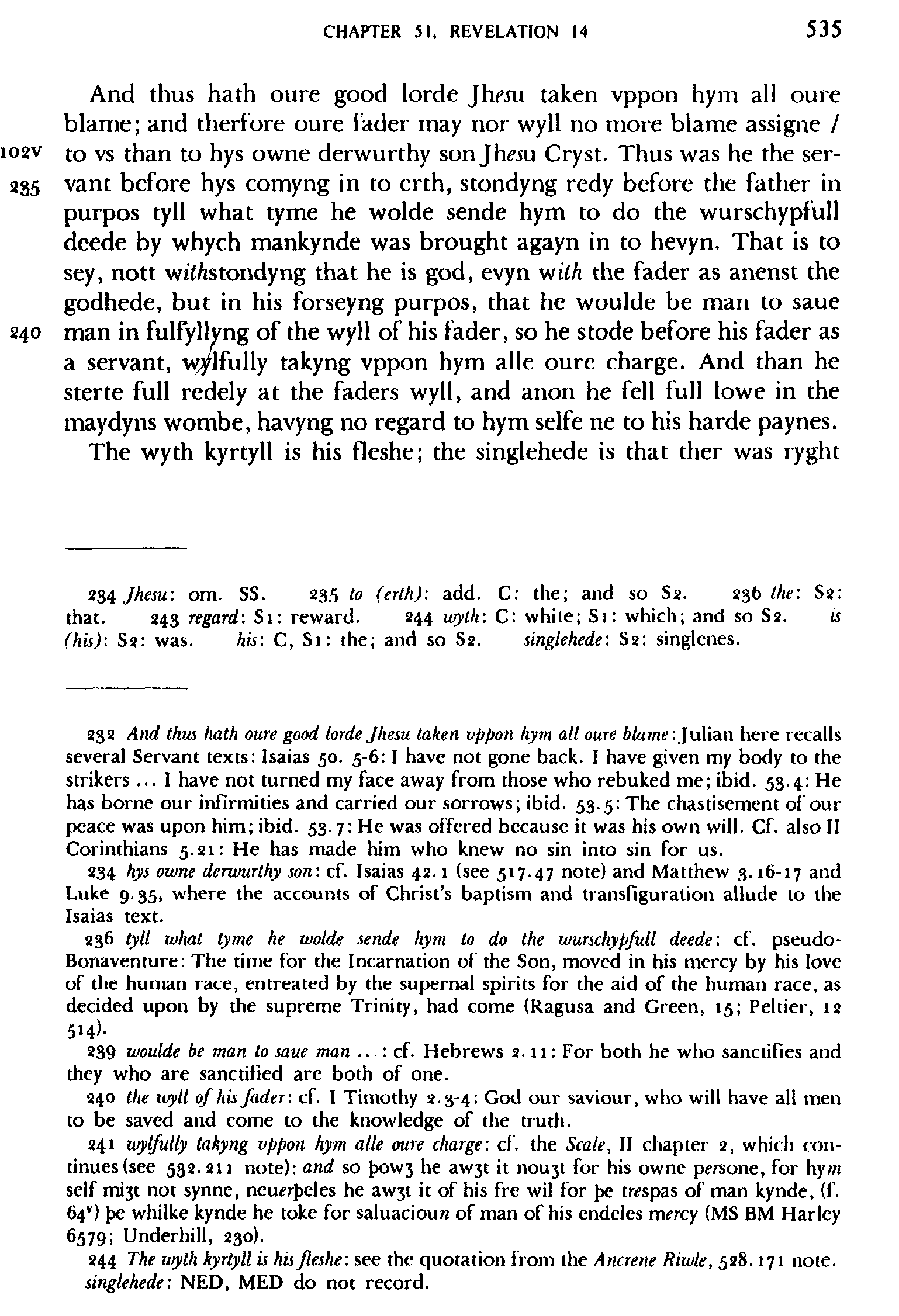
CHAPTER 51, REVELATION 14
And thus hath oure good lorde Jhesu taken vppon hym all oure blame; and therfore oure fader may nor wyll no more blame assigne / io2v to vs than to hys owne derwurthy son Jhesu Cryst. Thus was he the ser235 vant before hys comyng in to erth, stondyng redy before the father in purpos tyll what tyme he wolde sende hym to do the wurschypfull deede by whych mankynde was brought agayn in to hevyn. That is to sey, nott wz'Mstondyng that he is god, evyn with the fader as anenst the godhede, but in his forseyng purpos, that he woulde be man to saue
240 man in fulfyllyng of the wyll of his fader, so he stode before his fader as a servant, wilfully takyng vppon hym alle oure charge. And than he sterte full redely at the faders wyll, and anon he fell full lowe in the maydyns wombe, havyng no regard to hym selfe ne to his harde paynes.
The wyth kyrtyll is his fleshe; the singlehede is that ther was ryght 234 Jhesu: om. SS.
235 to (erth): add. C: the; and so 82.
236 the: 82: that.
243 regard: Si: reward.
244 wyth: C: white; Si: which; and so 82. is (his): 82: was. his: C, Si: the; and so 82. singlehede: 82: singlenes.
232 And thus hath oure good lorde Jhesu taken vppon hym all oure blame: Julian here recalls several Servant texts: Isaias 50. 5-6:1 have not gone back. I have given my body to the strikers ... I have not turned my face away from those who rebuked me; ibid. 53.4: He has borne our infirmities and carried our sorrows; ibid. 53.5: The chastisement of our peace was upon him; ibid. 53.7: He was offered because it was his own will. Cf. also II Corinthians 5.21: He has made him who knew no sin into sin for us.
234 hys owne derwurthy son: cf. Isaias 42. i (see 517.47 note) and Matthew 3.16-17 and Luke 9.35, where the accounts of Christ's baptism and transfiguration allude to the Isaias text.
5236 tyll what tyme he wolde sende hym to do the wurschypfull deede: cf. pseudoBonaventure: The time for the Incarnation of the Son, moved in his mercy by his love of the human race, entreated by the supernal spirits for the aid of the human race, as decided upon by the supreme Trinity, had come (Ragusa and Green, 15; Peltier, 12
514).
239 woulde be man to saue man ..: cf. Hebrews 2.11: For both he who sanctifies and they who are sanctified are both of one.
240 the wyll of his fader: cf. I Timothy 2.3-4: God our saviour, who will have all men to be saved and come to the knowledge of the truth.
241 wylfully takyng vppon hym alle oure charge: cf. the Scale, II chapter 2, which continues (see 532.211 note): and so pow3 he aw3t it nou3t for his owne prnone, for hy/n self mi3t not synne, neu^rpeles he aw3t it of his fre wil for pe trespas of man kynde, (f.
64V) pe whilke kynde he toke for saluaciourc of man of his endcles mercy (MS BM Harley
6579; Underbill, 230).
244 The wyth kyrtyll is his fleshe: see the quotation from the Ancrene Riwle, 528.171 note. singlehede: NED, MED do not record.
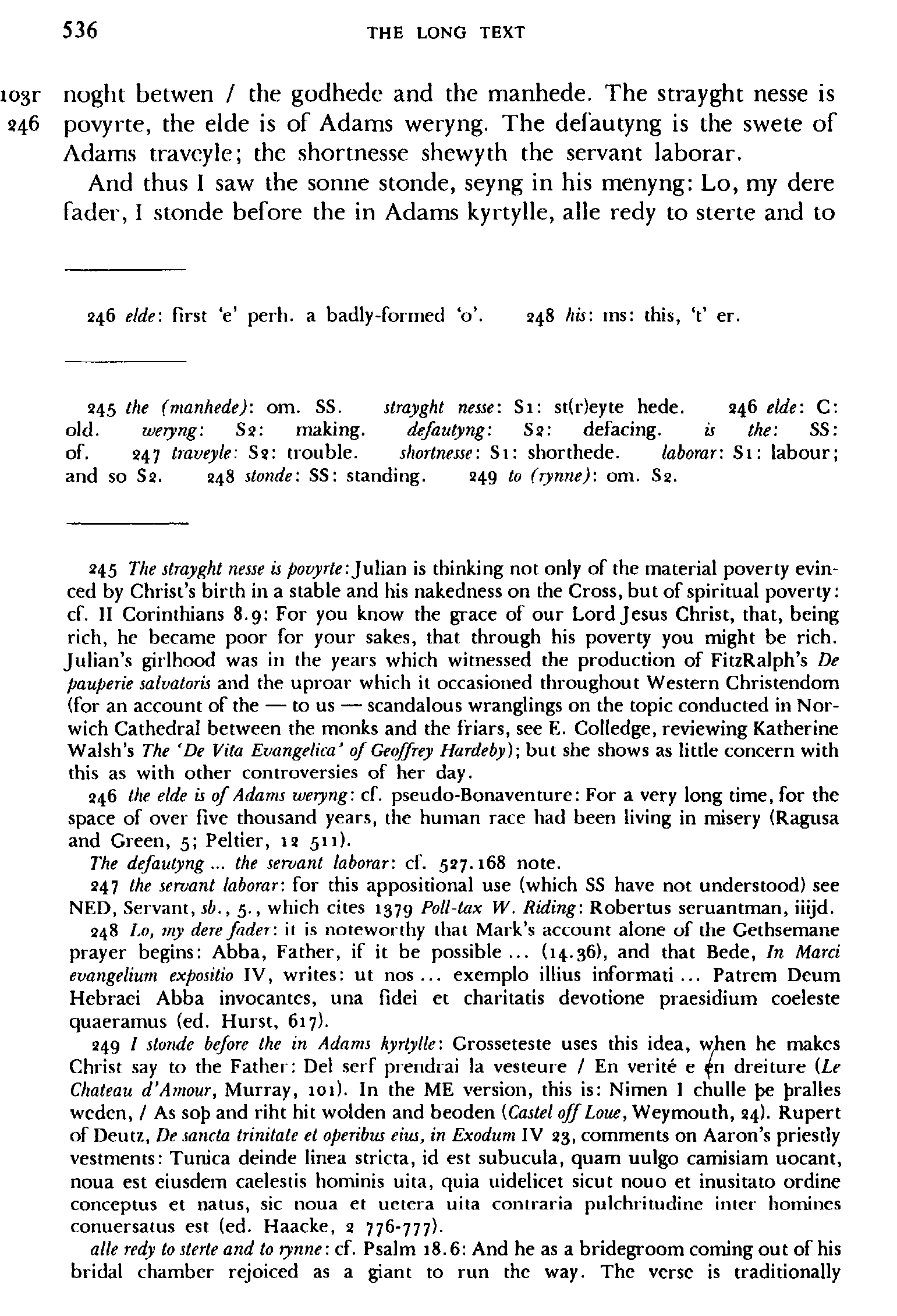
THE LONG TEXT
i03r noght betwen / the godhedc and the manhede. The strayght nesse is 246 povyrte, the elde is of Adams weryng. The defautyng is the swete of Adams travcyle; the shortnesse shewyth the servant laborar.
And thus I saw the sonne stonde, seyng in his menyng: Lo, my dere fader, I stonde before the in Adams kyrtylle, alle redy to sterte and to 246 elde: first 'e' perh. a badly-formed 'o'.
248 his: rns: this, V er.
245 the (manhede): om. SS. strayght nesse: Si: st(r)eyte hede.
246 elde: C: old. weryng:
82: making. defautyng:
82: defacing. is the:
SS: of.
247 traveyle: 82: trouble. shortnesse: Si: shorthede. laborar: Si: labour; and so 82.
248 stonde: 88: standing.
249 to (rynne): om. 82.
245 The strayght nesse is povyrte: Julian is thinking not only of the material poverty evinced by Christ's birth in a stable and his nakedness on the Cross, but of spiritual poverty: cf. II Corinthians 8.9: For you know the grace of our Lord Jesus Christ, that, being rich, he became poor for your sakes, that through his poverty you might be rich.
Julian's girlhood was in the years which witnessed the production of FitzRalph's De pauperie salvatoris and the uproar which it occasioned throughout Western Christendom
(for an account of the — to us — scandalous wranglings on the topic conducted in Norwich Cathedral between the monks and the friars, see E. Colledge, reviewing Katherine
Walsh's The 'De Vita Evangetica' of Geoffrey Hardeby); but she shows as little concern with this as with other controversies of her day.
246 the elde is of Adams weryng: cf. pseudo-Bonaventure: For a very long time, for the space of over five thousand years, the human race had been living in misery (Ragusa and Green, 5; Peltier, 12 511).
The defautyng... the servant laborar: cf. 527.168 note.
247 the servant laborar: for this appositional use (which SS have not understood) see
NED, Servant, .st., 5., which cites 1379 Poll-tax W. Riding: Robertus seruantman, iiijd.
248 Lo, my dere fader: it is noteworthy that Mark's account alone of the Gethsemane prayer begins: Abba, Father, if it be possible ... (14.36), and that Bede, In Marti evangelium expositio IV, writes: ut nos... exemplo illius informati ... Patrem Deum
Hcbraei Abba invocantes, una fidei et charitatis devotione praesidium coeleste quaeramus (ed. Hurst, 617).
249 / stonde before the in Adams kyrtylle: Grosseteste uses this idea, when he makes
Christ say to the Father: Del serf prendrai la vesteure / En verite e fn dreiture (Le
Chateau d'Amour, Murray, 101). In the ME version, this is: Nimen I chulle Jje Jjralles weden, / As soj> and riht hit wolden and beoden (Castel off Lone, Weymouth, 24). Rupert of Deutz, De sancta trinitate et operibus eius, in Exodum IV 23, comments on Aaron's priestly vestments: Tunica deinde linea stricta, id est subucula, quam uulgo camisiam uocant, noua est eiusdem caelestis hominis uita, quia uidelicet sicut nouo et inusitato ordine conceptus et natus, sic noua et uetera uita contraria pulchritudine inter homines conuersatus est (ed. Haacke, 2 776-777). alle redy to sterte and to rynne: cf. Psalm 18.6: And he as a bridegroom coming out of his bridal chamber rejoiced as a giant to run the way. The verse is traditionally
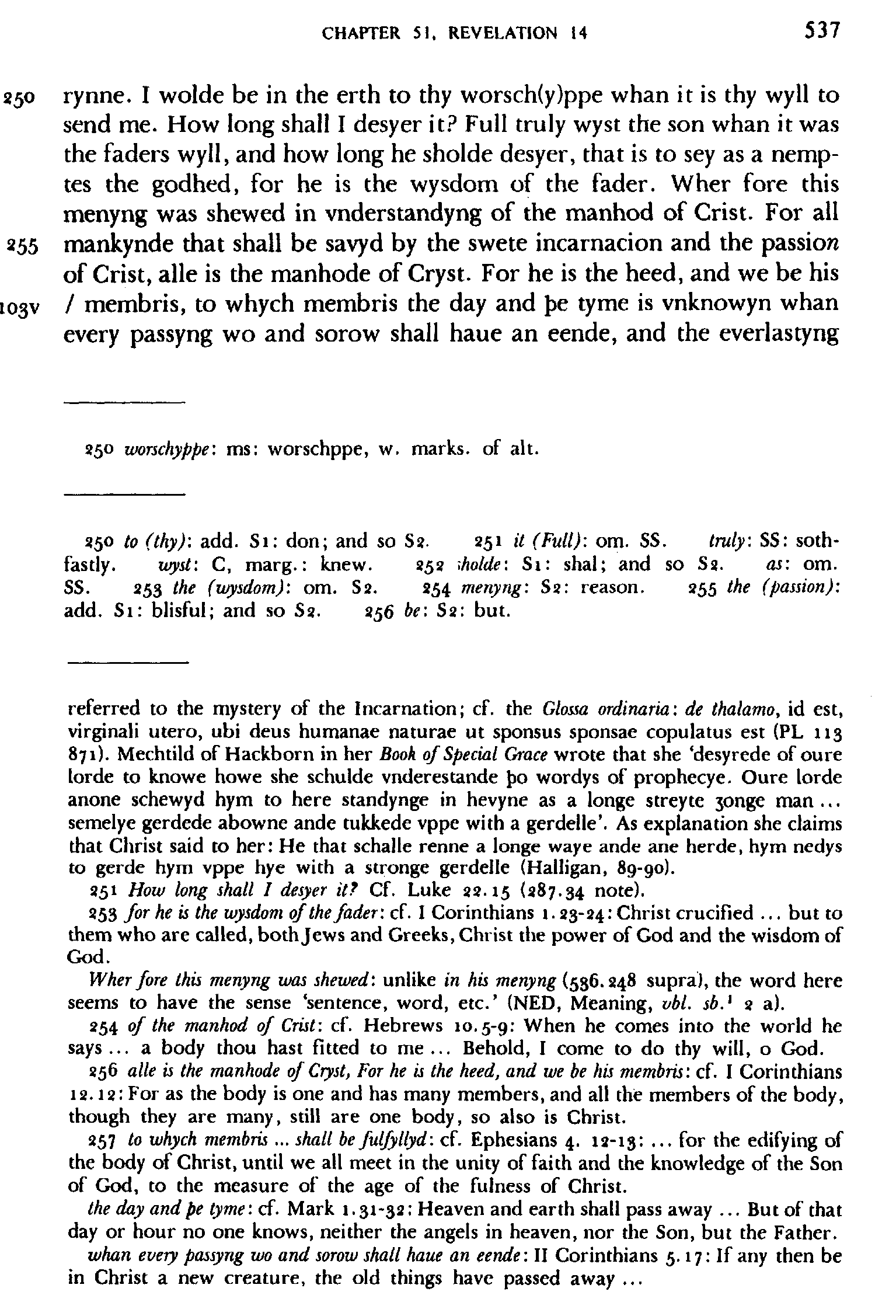
CHAPTER 51, REVELATION 14
250 rynne. I wolde be in the erth to thy worsch(y)ppe whan it is thy wyll to send me. How long shall I desyer it? Full truly wyst the son whan it was the faders wyll, and how long he sholde desyer, that is to sey as a nemptes the godhed, for he is the wysdom of the fader. Wher fore this menyng was shewed in vnderstandyng of the manhod of Crist. For all
255 mankynde that shall be savyd by the swete incarnacion and the passiow of Crist, alle is the manhode of Cryst. For he is the heed, and we be his losv / membris, to whych membris the day and pe tyme is vnknowyn whan every passyng wo and sorow shall haue an eende, and the everlastyng
250 worschyppe: ms: worschppe, w. marks, of alt.
350 to (thy): add. Si: don; and so 82.
251 it (Full): om. SS. truly: SS: sothfasdy. wyst: C, marg.: knew.
252 >holde: Si: shal; and so S2. as: om.
SS.
253 the (wysdom): om. 82.
254 menyng: Sa: reason.
255 the (passion): add. Si: blisful; and so $2.
256 be: Sa: but. referred to the mystery of the Incarnation; cf. the Glossa ordinaria: de thalamo, id est, virginali utero, ubi deus humanae naturae ut sponsus sponsae copulatus est (PL 113
871). Mechtild of Hackborn in her Book of Special Grace wrote that she 'desyrede of oure lorde to knowe howe she schulde vnderestande Jx> wordys of prophecye. Oure lorde anone schewyd hym to here standynge in hevyne as a longe streyte 3onge man ... semelye gerdede abowne ande tukkede vppe with a gerdelle'. As explanation she claims that Christ said to her: He that schalle renne a longe waye ande ane herde, hym nedys to gerde hym vppe hye with a stronge gerdelle (Halligan, 89-90).
251 How long shall I desyer it? Cf. Luke 22.15 (287.34 note).
253 for he is the wysdom of the fader: cf. I Corinthians i. 23-24: Christ crucified ... but to them who are called, both Jews and Greeks, Christ the power of God and the wisdom of God.
Wher fore this menyng was shewed: unlike in his menyng (536.248 supra), the word here seems to have the sense 'sentence, word, etc.' (NED, Meaning, vbl. sb.1 2 a).
254 of the manhod of Crist: cf. Hebrews 10.5-9: When he comes into the world he says ... a body thou hast fitted to me ... Behold, I come to do thy will, o God.
256 alle is the manhode of Cryst, For he is the heed, and we be his membris: cf. I Corinthians
12.12: For as the body is one and has many members, and all the members of the body, though they are many, still are one body, so also is Christ.
257 to whych membris... shall befulfyllyd: cf. Ephesians 4. 12-13: ... for the edifying of the body of Christ, until we all meet in the unity of faith and the knowledge of the Son of God, to the measure of the age of the fulness of Christ. the day andpe tyme: cf. Mark 1.31-32: Heaven and earth shall pass away ... But of that day or hour no one knows, neither the angels in heaven, nor the Son, but the Father. whan every passyng wo and sorow shall haue an eende: II Corinthians 5.17: If any then be in Christ a new creature, the old things have passed away ...
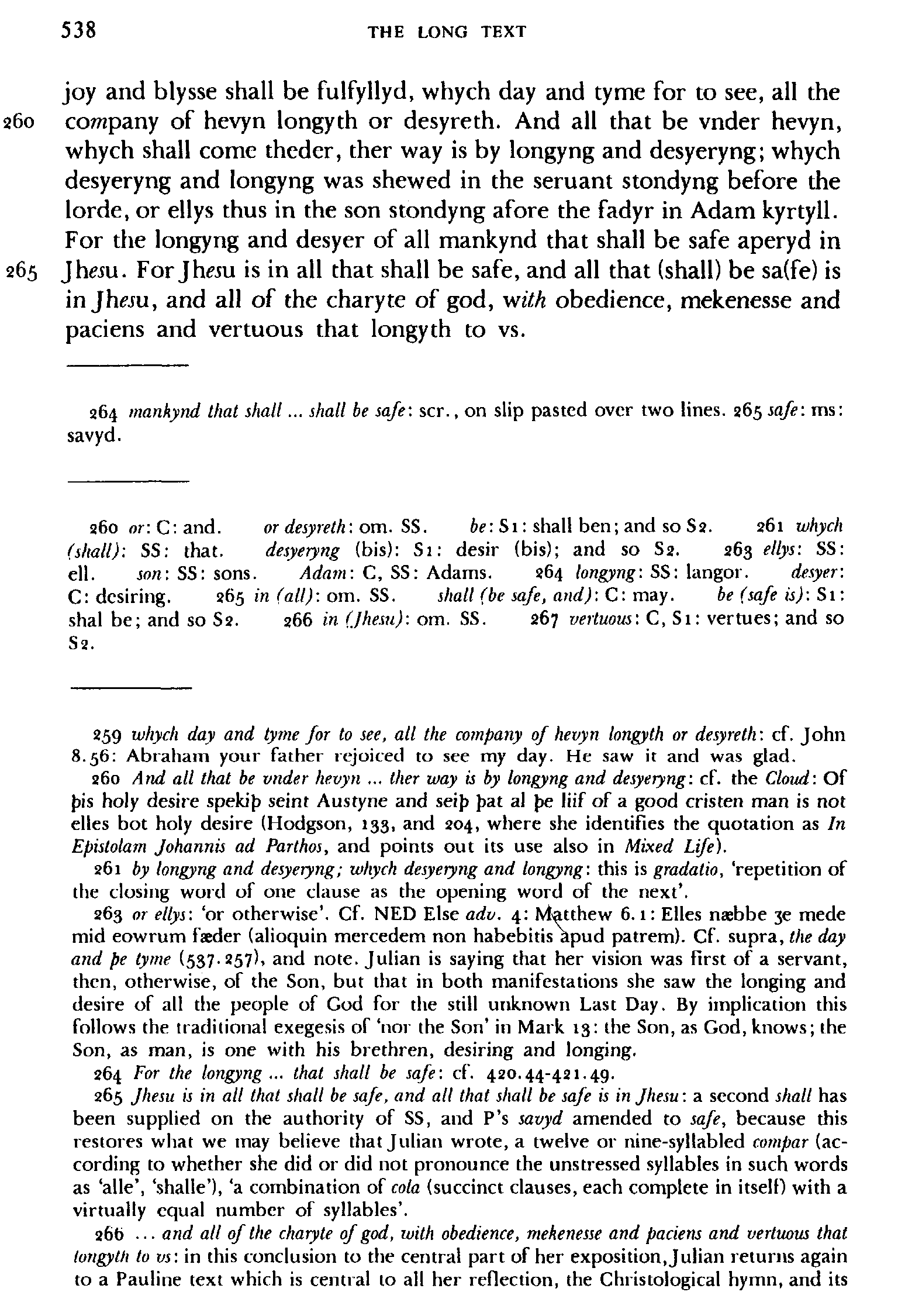
THE LONG TEXT
joy and blysse shall be fulfyllyd, whych day and tyme for to see, all the
company of hevyn longyth or desyreth. And all that be vnder hevyn, whych shall come theder, ther way is by longyng and desyeryng; whych desyeryng and longyng was shewed in the seruant stondyng before the lorde, or ellys thus in the son stondyng afore the fadyr in Adam kyrtyll.
For the longyng and desyer of all mankynd that shall be safe aperyd in 265 Jhmi. For Jhmi is in all that shall be safe, and all that (shall) be sa(fe) is in Jhesu, and all of the charyte of god, with obedience, mekenesse and paciens and vertuous that longyth to vs.
264 mankynd that shall... shall be safe: scr., on slip pasted over two lines. 265 safe: ms: savyd.
260 or: C: and. or desyreth: om. SS. be: Si: shall ben; and so Sa.
261 whych (shall): SS: that. desyeryng (bis): Si: desir (bis); and so 82.
263 ellys: SS: ell. son: SS: sons.
Adam: C, SS: Adams.
264 longyng: SS: langor. desyer:
C: desiring.
265 in (all): om. SS. shall (be safe, and): C: may. be (safe is): Si: shal be; and so 82.
266 in (Jhesu): om. SS.
267 vertuous: C, Si: vertues; and so 82.
259 whych day and tyme for to see, all the company of hevyn longyth or desyreth: cf. John
8.56: Abraham your father rejoiced to see my day. He saw it and was glad.
260 And all that be vnder hevyn ... ther way is by longyng and desyeryng: cf. the Cloud: Of |)is holy desire spekij) seint Austyne and sei{> Jjat al jje liif of a good cristen man is not elles bot holy desire (Hodgson, 133, and 204, where she identifies the quotation as In Epistolam Johannu ad Parthos, and points out its use also in Mixed
Life).
261 by longyng and desyeryng; whych desyeryng and longyng: this is gradatio, 'repetition of the closing word of one clause as the opening word of the next'.
263 or ellys: 'or otherwise'. Cf. NED Else adv. 4: Matthew 6. i: Elles naebbe 3e mede mid eowrum faeder (alioquin mercedem non habebitis apud patrem). Cf. supra, the day and pe tyme (537-257), and note. Julian is saying that her vision was first of a servant, then, otherwise, of the Son, but that in both manifestations she saw the longing and desire of all the people of God for the still unknown Last Day. By implication this follows the traditional exegesis of 'nor the Son' in Mark 13: the Son, as God, knows; the Son, as man, is one with his brethren, desiring and longing.
264 For the longyng... that shall be safe: cf. 420.44-421.49.
265 Jhesu is in all that shall be safe, and all that shall be safe is in Jhesu: a second shall has been supplied on the authority of SS, and P's savyd amended to safe, because this restores what we may believe that Julian wrote, a twelve or nine-syllabled compar (according to whether she did or did not pronounce the unstressed syllables in such words as 'alle', 'shalle'), 'a combination of cola (succinct clauses, each complete in itself) with a virtually equal number of syllables'.
266 ... and all of the charyte of god, with obedience, mekenesse and paciem and vertuous that longyth to vs: in this conclusion to the central part of her exposition,Julian returns again to a Pauline text which is central to all her reflection, the Christological hymn, and its
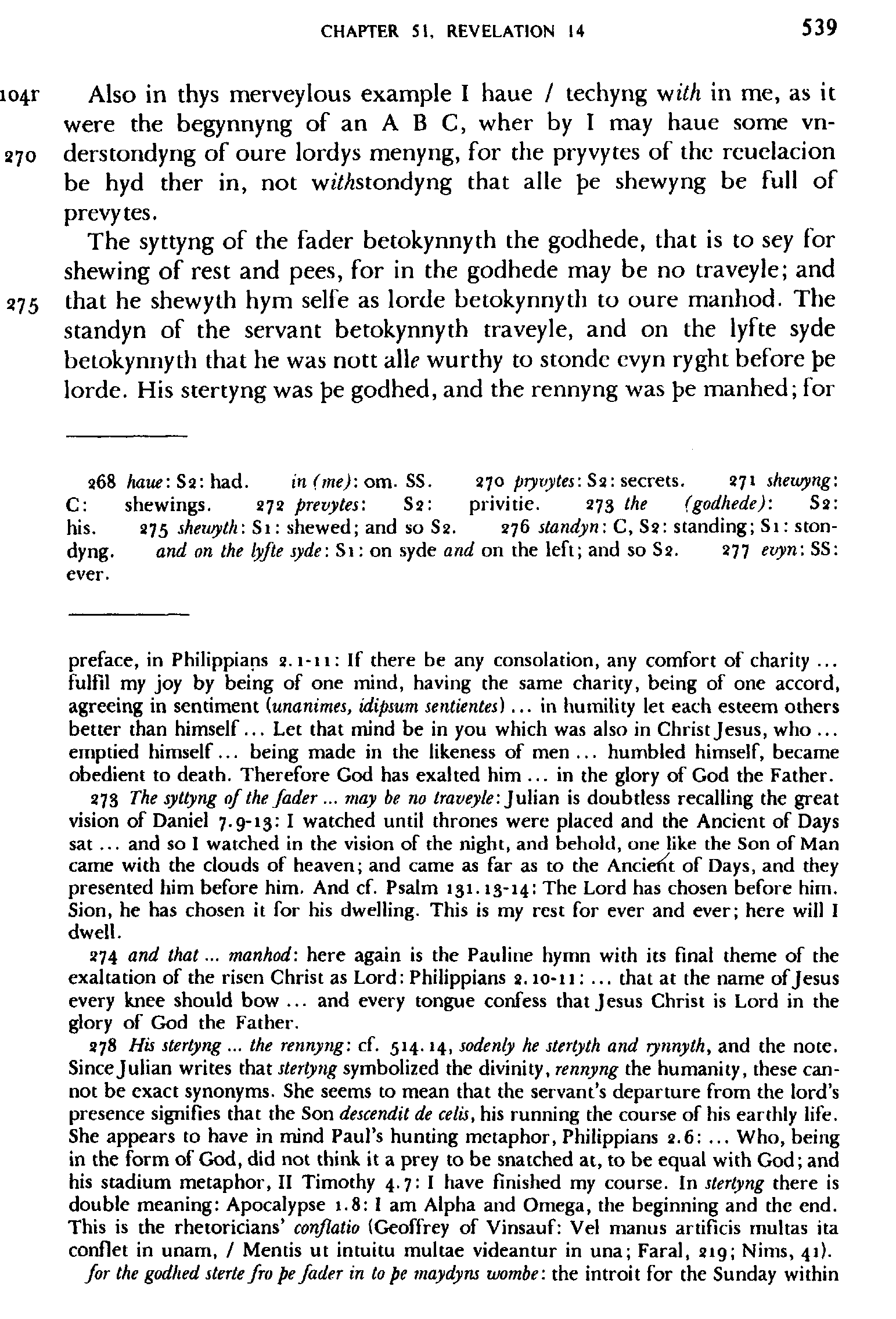
CHAPTER 51, REVELATION 14
io4T Also in thys merveylous example I haue / techyng with in me, as it were the begynnyng of an A B C, wher by I may haue some vn270 derstondyng of oure lordys menyng, for the pryvytes of the reuelacion be hyd ther in, not w^Astondyng that alle be shewyng be full of prevy tes.
The syttyng of the fader betokynnyth the godhede, that is to sey for shewing of rest and pees, for in the godhede may be no traveyle; and
that he shewyth hym selfe as lorde betokynnyth to oure manhod. The standyn of the servant betokynnyth traveyle, and on the lyfte syde betokynnyth that he was nott all? wurthy to stonde evyn ryght before he lorde. His stertyng was be godhed, and the rennyng was be manned; for 268 haue: 82: had. in (me): om. SS.
270 pryvytes: 82: secrets.
271 shewyng:
C: shewings.
272 prevytes:
82: privitie.
273 the (godhede):
82: his.
275 shewyth: Si: shewed; and so 82.
276 standyn: C, 82: standing; Si: stondyng. and on the lyfte syde: Si: on syde and on the left; and so 82.
277 evyn: 88: ever. preface, in Philippians 2.1-11: If there be any consolation, any comfort of charity ... fulfil my joy by being of one mind, having the same charity, being of one accord, agreeing in sentiment (unanimes, idipsum sentientes) ... in humility let each esteem others better than himself... Let that mind be in you which was also in Christ Jesus, who ... emptied himself... being made in the likeness of men ... humbled himself, became obedient to death. Therefore God has exalted him ... in the glory of God the Father.
273 The syttyng of the fader... may be no traveyle: Julian is doubtless recalling the great vision of Daniel 7.9-13: I watched until thrones were placed and the Ancient of Days sat ... and so I watched in the vision of the night, and behold, one like the Son of Man came with the clouds of heaven; and came as far as to the Anciefit of Days, and they presented him before him. And cf. Psalm 131.13-14: The Lord has chosen before him.
Sion, he has chosen it for his dwelling. This is my rest for ever and ever; here will I dwell.
274 and that... manhod: here again is the Pauline hymn with its final theme of the exaltation of the risen Christ as Lord: Philippians 2.10-11: ... that at the name of Jesus every knee should bow ... and every tongue confess that Jesus Christ is Lord in the glory of God the Father.
278 His stertyng ... the rennyng: cf. 514.14, sodenly he stertyth and rynnyth, and the note.
Sincejulian writes that stertyng symbolized the divinity, rennyng the humanity, these cannot be exact synonyms. She seems to mean that the servant's departure from the lord's presence signifies that the Son descendit de celts, his running the course of his earthly life.
She appears to have in mind Paul's hunting metaphor, Philippians 2.6: ... Who, being in the form of God, did not think it a prey to be snatched at, to be equal with God; and his stadium metaphor, II Timothy 4.7: I have finished my course. In stertyng there is double meaning: Apocalypse 1.8: I am Alpha and Omega, the beginning and the end.
This is the rhetoricians' conflatio (Geoffrey of Vinsauf: Vel manus artificis rnultas ita conflet in unam, / Mentis ut intuitu multae videantur in una; Faral, 219; Nirns, 41). for the godhed sterte fro pe fader in to pe maydyns wombe: the introit for the Sunday within
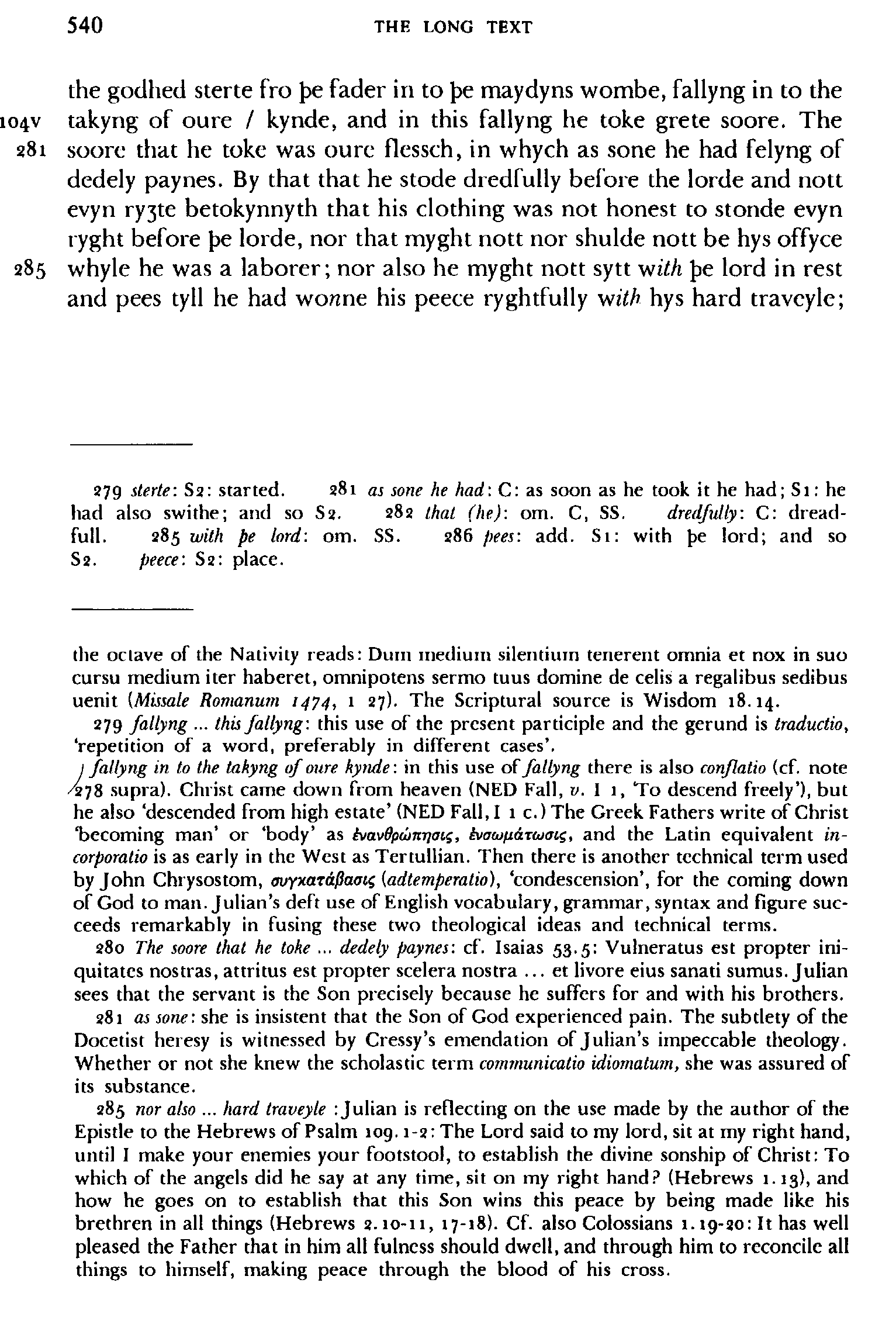
THE LONG TEXT
the godhed sterte fro J>e fader in to J)e maydyns wombe, fallyng in to the io4v takyng of oure / kynde, and in this fallyng he toke grete soore. The 281 soorc that he toke was oure flessch, in whych as sone he had felyng of dedely paynes. By that that he stode dredfully before the lorde and nott evyn ry3te betokynnyth that his clothing was not honest to stonde evyn ryght before be lorde, nor that myght nott nor shulde nott be hys offyce
285 whyle he was a laborer; nor also he myght nott sytt with Jje lord in rest and pees tyll he had wonne his peece ryghtfully 'with hys hard travcyle;
279 sterte: 82: started.
281 as sone he had: C: as soon as he took it he had; Si: he had also swithe; and so 82.
282 that (he): om. C, 88. dredfully:
C: dreadfull.
285 with pe lord: om.
SS.
286 f>ees: add. Si: with J>e lord; and so 82. peece: 82: place. the octave of the Nativity reads: Duin medium silentium tenerent omnia et nox in suo cursu medium iter haberet, omnipotens sermo tuus domine de celis a regalibus sedibus uenit (Missale Romanum 1474, i 27). The Scriptural source is Wisdom 18.14.
279 fallyng ... this fallyng: this use of the present participle and the gerund is traductio,
'repetition of a word, preferably in different cases'. i fallyng in to the takyng of oure kynde: in this use of fallyng there is also conflatio (cf. note
/278 supra). Christ came down from heaven (NED Fall, v. I i, To descend freely'), but he also 'descended from high estate' (NED Fall, l i e . ) The Greek Fathers write of Christ
"becoming man' or 'body' as tvavdpunriatg, &<7w/i<ZTW<7££, and the Latin equivalent incorporatio is as early in the West as Tertullian. Then there is another technical term used by John Chrysostom, ffuyxctTd/taatg (adtemperatio), 'condescension', for the coming down of God to man. Julian's deft use of English vocabulary, grammar, syntax and figure succeeds remarkably in fusing these two theological ideas and technical terms.
280 The soore that he toke ... dedely paynes: cf. Isaias 53.5: Vulneratus est propter iniquitates nostras, attritus est propter scelera nostra ... et livore eius sanati sumus. Julian sees that the servant is the Son precisely because he suffers for and with his brothers.
281 as sone: she is insistent that the Son of God experienced pain. The subtlety of the Docetist heresy is witnessed by Cressy's emendation of Julian's impeccable theology.
Whether or not she knew the scholastic term communicatio idiomatum, she was assured of its substance.
285 nor also ... hard traveyle : Julian is reflecting on the use made by the author of the Epistle to the Hebrews of Psalm 109.1-2: The Lord said to my lord, sit at my right hand, until I make your enemies your footstool, to establish the divine sonship of Christ: To which of the angels did he say at any time, sit on my right hand? (Hebrews 1.13), and how he goes on to establish that this Son wins this peace by being made like his brethren in all things (Hebrews 2.10-11, 17-18). Cf. also Colossians 1.19-20: It has well pleased the Father that in him all fulness should dwell, and through him to reconcile all things to himself, making peace through the blood of his cross.
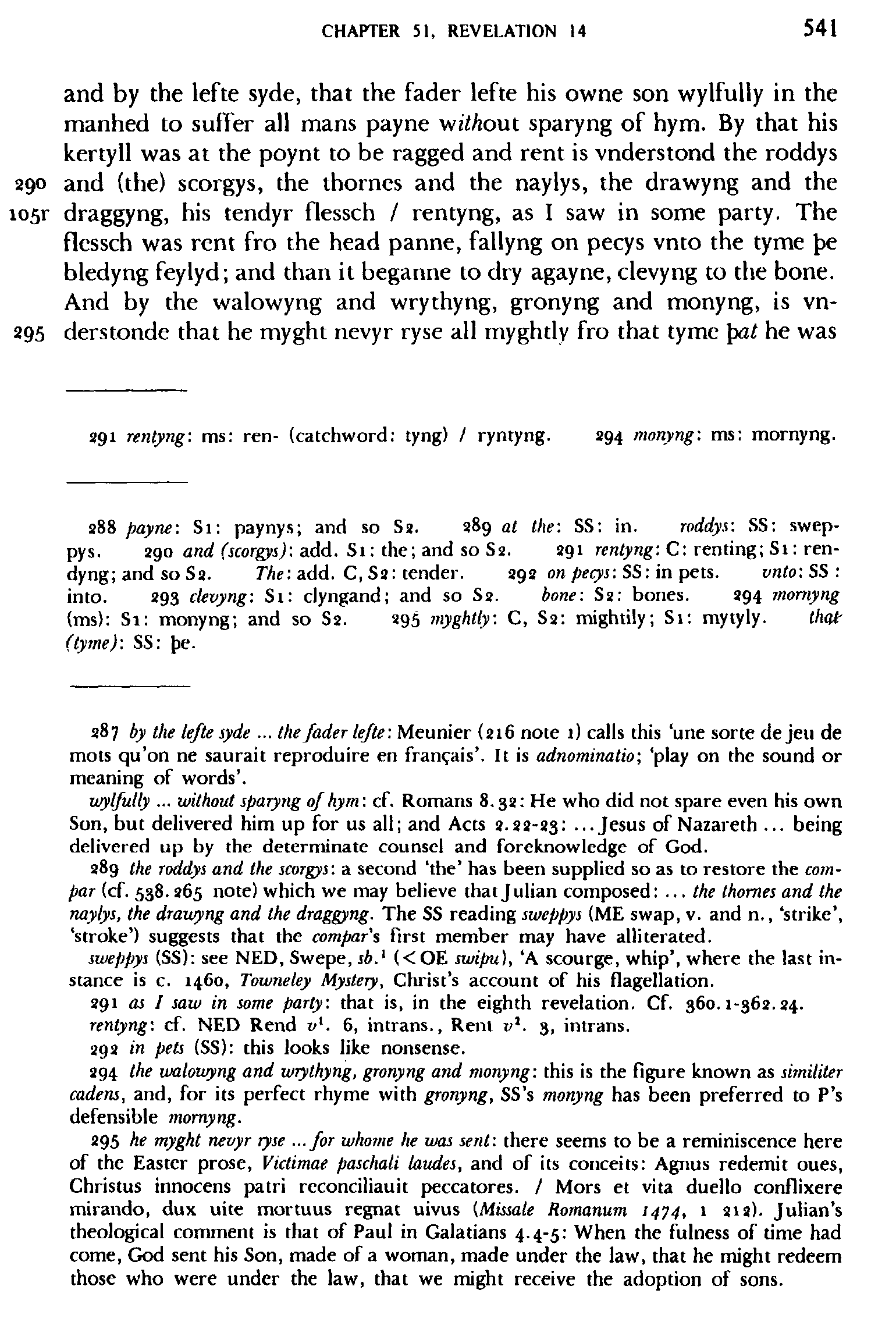
CHAPTER 51, REVELATION 14
and by the lefte syde, that the fader lefte his owne son wylfully in the manhed to suffer all mans payne without sparyng of hym. By that his kertyll was at the poynt to be ragged and rent is vnderstond the roddys
290 and (the) scorgys, the thornes and the naylys, the drawyng and the io5r draggyng, his tendyr flessch / rentyng, as I saw in some party. The flessch was rent fro the head panne, fallyng on pecys vnto the tyme J>e bledyng feylyd; and than it beganne to dry agayne, clevyng to the bone.
And by the walowyng and wrythyng, gronyng and monyng, is vn295 derstonde that he myght nevyr ryse all myghtly fro that tyme \>at he was
291 rentyng: ms: ren- (catchword: tyng) / ryntyng.
294 monyng: ms: mornyng.
288 payne: Si: paynys; and so 82.
289 at the: SS: in. roddys: SS: sweppys.
290 and (scorgys): add. Si: the; and so 82.
291 rentyng: C: renting; Si: rendyng; and so 82.
The: add. C, 82: tender.
292 on pecys: SS: in pets. vnto: SS : into.
293 clevyng: Si: clyngand; and so 82. bone; 82: bones.
294 mornyng (ms): Si: monyng; and so 82.
295 myghtly: C, 82: mightily; Si: mytyly. that"
(tyme): SS: pe.
287 by the lefte syde ... the fader lefte: Meunier (216 note i) calls this 'une sorte de jeu de mots qu'on ne saurait reproduire en francais'. It is adnominatio', 'play on the sound or meaning of words'. wylfully ... without sparyng of hym: cf. Romans 8.32: He who did not spare even his own
Son, but delivered him up for us all; and Acts 2.22-23: ...Jesus of Nazareth ... being delivered up by the determinate counsel and foreknowledge of God.
289 the roddys and the scorgys: a second 'the' has been supplied so as to restore the cornpar (cf. 538.265 note) which we may believe that Julian composed: ... the thornes and the naylys, the drawyng and the draggyng. The SS reading sweppys (ME swap, v. and n., 'strike',
'stroke') suggests that the compar's first member may have alliterated. sweppys (SS): see NED, Swepe, sb.' «OE swipu), 'A scourge, whip', where the last instance is c. 1460, Towneley Mystery, Christ's account of his flagellation.
291 as I saw in some party: that is, in the eighth revelation. Cf. 360.1-362.24. rentyng: cf. NED Rend »'. 6, intrans., Rent v*. 3, intrans.
292 in pets (SS): this looks like nonsense.
294 the walowyng and wrythyng, gronyng and monyng: this is the figure known as similiter cadens, and, for its perfect rhyme with gronyng, SS's monyng has been preferred to P's defensible mornyng.
295 he myght nevyr ryse ...for whome he was sent: there seems to be a reminiscence here of the Easter prose, Victimae paschali laudes, and of its conceits: Agnus redemit oues,
Christus innocens patri reconciliauit peccatores. / Mors et vita duello conflixere mirando, dux uite mortuus regnat uivus (Missale Romanum 1474, i 212). Julian's theological comment is that of Paul in Galatians 4.4-5: When the fulness of time had come, God sent his Son, made of a woman, made under the law, that he might redeem those who were under the law, that we might receive the adoption of sons.
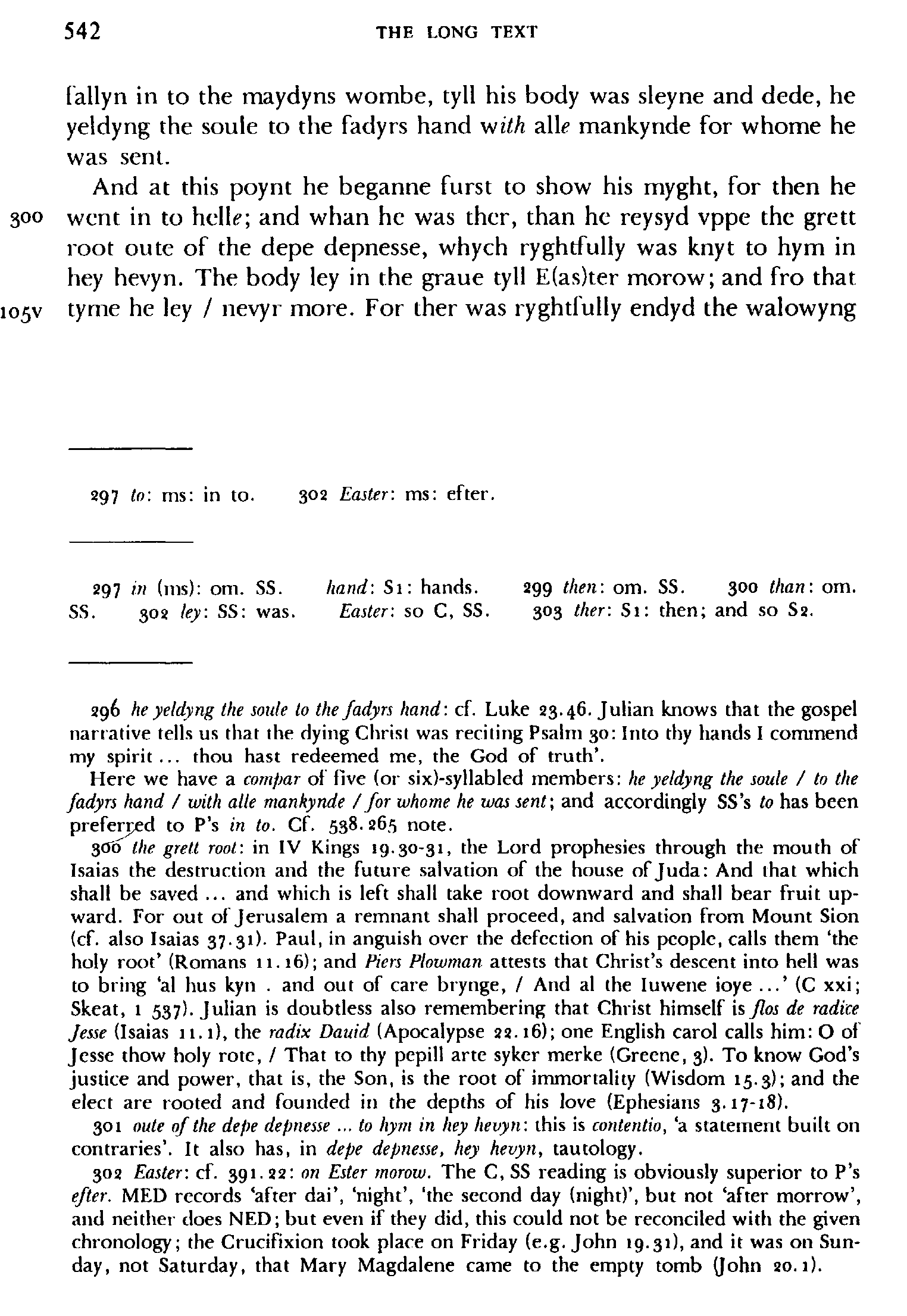
THE LONG TEXT
fallyn in to the maydyns wombe, tyll his body was sleyne and dede, he yeldyng the soule to the fadyrs hand -with alk mankynde for whome he was sent.
And at this poynt he beganne furst to show his myght, for then he 300 went in to hell?; and whan he was ther, than he reysyd vppe the grett root oute of the depe depnesse, whych ryghtfully was knyt to hym in hey hevyn. The body ley in the graue tyll E(as)ter morow; and fro that io5v tyme he ley / nevyr more. For ther was ryghtfully endyd the walowyng
297 to: ms: in to.
302 Easter: ms: efter.
297 in (ms): om. SS. hand: Si: hands.
299 then: om. SS.
300 than: om.
SS.
302 ley: SS: was.
Easter: so C, SS.
303 ther: Si: then; and so 82.
296 he yeldyng the soule to the fadyrs hand: cf. Luke 23.46. Julian knows that the gospel narrative tells us that the dying Christ was reciting Psalrn 30: Into thy hands I commend my spirit ... thou hast redeemed me, the God of truth'.
Here we have a corn/far of five (or six)-syllabled members: he yeldyng the soule / to the fadyrs hand / with alle mankynde /for whome he was sent; and accordingly SS's to has been preferred to P's in to. Cf. 538.26.5 note.
3Otf the grett root: in IV Kings 19.30-31, the Lord prophesies through the mouth of Isaias the destruction and the future salvation of the house of Juda: And that which shall be saved ... and which is left shall take root downward and shall bear fruit upward. For out of Jerusalem a remnant shall proceed, and salvation from Mount Sion
(cf. also Isaias 37.31). Paul, in anguish over the defection of his people, calls them 'the holy root' (Romans 11.16); and Piers Plowman attests that Christ's descent into hell was to bring 'al bus kyn . and out of care brynge, / And al the luwene ioye ...' (C xxi;
Skeat, i 537). Julian is doubtless also remembering that Christ himself is flos de radice
Jesse (Isaias 11. i), the radix Dauid (Apocalypse 22.16); one English carol calls him: O of Jesse thow holy rote, / That to thy pepill arte syker merke (Greene, 3). To know God's justice and power, that is, the Son, is the root of immortality (Wisdom 15.3); and the elect are rooted and founded in the depths of his love (Ephesians 3.17-18).
301 oute of the depe depnesse ... to hym in hey hevyn: this is contentio, 'a statement built on contraries'. It also has, in depe depnesse, hey hevyn, tautology.
302 Easter: cf. 391.22: on Ester morow. The C, SS reading is obviously superior to P's efter. MED records 'after dai', 'night', 'the second day (night)', but not 'after morrow', and neither does NED; but even if they did, this could not be reconciled with the given chronology; the Crucifixion took place on Friday (e.g. John 19.31), and it was on Sunday, not Saturday, that Mary Magdalene came to the empty tomb (John 20.1).
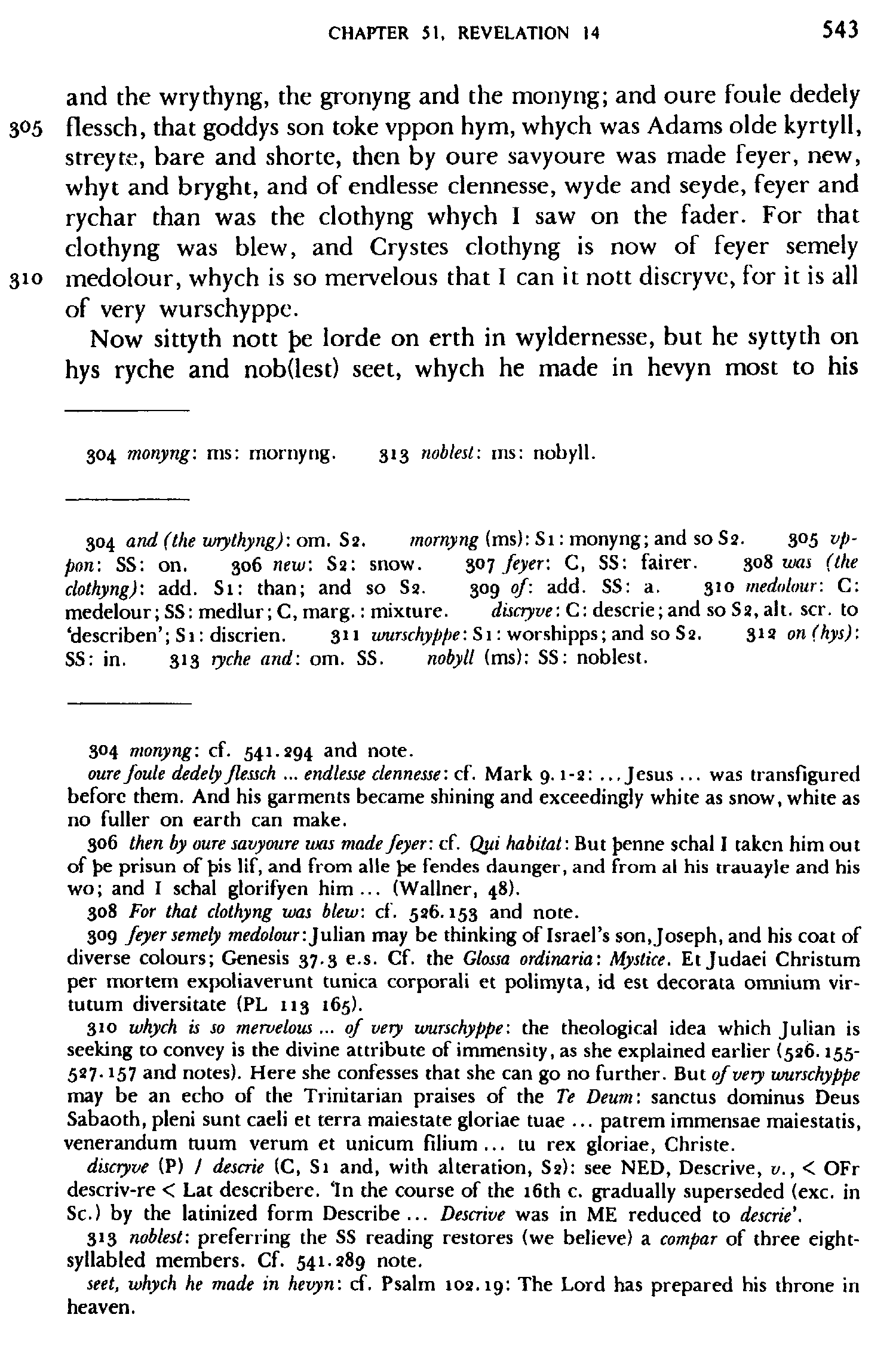
CHAPTER 51, REVELATION 14
and the wrythyng, the gronyng and the monyng; and oure foule dedely 3°5 flessch, that goddys son toke vppon hym, whych was Adams olde kyrtyll, streyte, bare and shorte, then by oure savyoure was made feyer, new, whyt and bryght, and of endlesse clennesse, wyde and seyde, feyer and rychar than was the clothyng whych I saw on the fader. For that clothyng was blew, and Crystes clothyng is now of feyer semely
310 medolour, whych is so mervelous that I can it nott discryve, for it is all of very wurschyppe.
Now sittyth nott pe lorde on erth in wyldernesse, but he syttyth on hys ryche and nob(lest) sect, whych he made in hevyn most to his
304 monyng: ms: mornyng.
313 noblest: ins: nobyll.
304 and (the wrythyng): om. 82. mornyng (ms): Si: monyng; and so Sa.
3°5 vppon: SS: on.
306 new: 82: snow.
307 feyer: C, 88: fairer.
308 was (the clothyng): add. Si: than; and so 82.
309 of: add. SS: a.
310 medolour: C: medelour; 88: medlur; C, marg.: mixture. discryve: C: descrie; and so 82, alt. scixto
'describen'; Si: discrien.
311 wurschyppe: Si: worshipps; and so 82.
312 on(hys):
SS: in.
313 ryche and: om. SS. nobyll (ms): SS: noblest.
304 monyng: cf. 541.294 and note. oure foule dedely flessch ... endlesse clennesse: cf. Mark 9.1-2: .. .Jesus ... was transfigured before them. And his garments became shining and exceedingly white as snow, white as no fuller on earth can make.
306 then by oure savyoure was made feyer: cf. Qui habitat: But Jjenne schal I taken him out of t>e prisun of \>is lif, and from alle }je fendes daunger, and from al his trauayle and his wo; and I schal glorifyen him... (Wallner, 48).
308 For that clothyng was blew: cf. 526.153 and note.
309 feyer semely medolour: Julian may be thinking of Israel's son,Joseph, and his coat of diverse colours; Genesis 37.3 e.s. Cf. the Glossa ordinaria: Mystice. Et Judaei Christum per mortem expoliaverunt tunica corporali et polimyta, id est decorata omnium virtutum diversitate (PL 113 165).
310 whych is so mervelous ... of very wurschyppe: the theological idea which Julian is seeking to convey is the divine attribute of immensity, as she explained earlier (526.155527.157 and notes). Here she confesses that she can go no further. But of very wurschyppe may be an echo of the Trinitarian praises of the Te Deum: sanctus dominus Deus
Sabaoth, pleni sunt caeli et terra maiestate gloriae tuae ... patrem immensae maiestatis, venerandum tuum verum et unicum filium... tu rex gloriae, Christe. discryve (P) / descrie (C, Si and, with alteration, 82): see NED, Descrive, v., < OFr descriv-re < Lat describere. 'In the course of the i6th c. gradually superseded (exc. in Sc.) by the latinized form Describe... Descrive was in ME reduced to descrie'.
313 noblest: preferring the SS reading restores (we believe) a compar of three eightsyllabled members. Cf. 541.289 note. seet, whych he made in hevyn: cf. Psalm 102.19: The Lord has prepared his throne in heaven.
THE LONG TEXT
lykyng. Now stondyth nott the son before the fader as a servant before io6r the lorde, (unornely) clothyd, in perty / nakyd, but he stondyth before 316 the fader evyn ryghte rychely clothyd in blyssefull largenesse, with a crowne vpon his hed of precyous rychenes. For it was shewede that we be his crowne, whych crowne is the faders joy, £e sonnes wurshyppe, the holy gostys lykyng, and endlesse mervelous blysse to all? that be in 320 hevyn.
Now stondyth not the sonne before the fader on the lyfte syde as a laborer, but he syttyth on the faders ryght hande in endlesse rest an pees. But it is nott merit that the sonne syttyth on the ryght hand besyde, as one man syttyth by an other in this lyfe, for ther is no such
315 unornely: ms: dredfully.
315 dredfully clothyd (ms): so C; SS: unornely clad.
316 evyn: SS: ever. clothyd:
SS: clad. largenesse: SS: largess.
317 rychenes: Si: richess; and so 82.
322 the (faders): SS; his.
323 hand: add. Si: syde; and so 82.
315 unornely clothyd: see the detailed description, 527.167-528.171, and NED Unorn, a., Unornly, adv., 'mean(ly), wretched(ly). There is no example of 'dreadful(ly)' in its modern, colloquial sense, earlier than Shakespeare. It may be observed that unornely clothyd, in perty nakyd is a compar of two five-syllabled members. Cf. 541.289 note. but he stondyth: cf. Isaias 52.13: My servant ... shall be exalted and extolled, and shall be exceedingly high.
316 evyn ryghte: 'immediately in front'. NED Even adv., (in early combinations) \quotes 1382 Wycliffe Ecclesiasticus 49.3: He is euene ri3t (directus) godly in the penaunce of folc. See 527.167, where Julian says that the servant was not standing evyn for anemt. rychely clothyd ... precyous rychenes: I will greatly rejoice in the Lord, and my soul shall be joyful in my God. For he has clothed me with the garments of salvation and with the robe of justice he has covered me; as a bridegroom decked with a crown and as a bride adorned with her jewels (Isaias 61.10). a crowne: in An Epistle of Discretion of Stirrings, the Cloud-author, discoursing of wisdom, discretion and the perfection of virtue as the crown of life, cites James 1.12: Blessed is the man who endures temptations, for when he has been proved he will receive the crown of life, which God has promised to those who love him (Deonise, 64).
317 it was schewede: in the ninth revelation; cf. 384.21-23, 389.4-6, 393.50-51.
322 he syttyth on the faders ryght hande in endlesse rest and pees: The Lay Folks Mass Book translates the Apostles' Creed: Now syttus he on his fadur ry3hte honde in maieste (Simmons, 21). Cf. Hebrews 8. i: ... a high priest who is set on the right hand of the throne of majesty in the heavens. For Julian, the contemplative context is liturgical and sacramental as well as Scriptural.
324 for ther is no such syttyng, as to my syght, in the trynyte: we may contrast this remark with Margery Kempe's jejune symbol for the Trinity: FerJ>ermor t>u thynkist sum-
CHAPTER 51, REVELATION 14
325 syttyng, as to my syght, in the trynyte; but he syttyth on his faders ryght honde, that is to sey ryght in the hyest nobylyte of the faders joy. Now io6v is the / spouse, goddys son, in pees with his lovyd wyfe, whych is the feyer maydyn of endlesse joy. Now syttyth the son, very god and very man, in his cytte in rest and in pees, whych his fader hath dyjte to hym
330 of endlesse purpose, and the fader in the son, and the holy gost in the fader and in f>e son.
326 ryght: om. SS. nobylyte: SS: nobleth. joy: SS: joyes.
32? lovyd: om.
82.
328 very (man): om.
SS.
329 in (rest):
82: with. in (pees): om.
SS.
330 of: add. SS: his. tyme, dowtyr, as |>ow }ju haddist a cuschyn of gold, anojjer of red veluet, ]>e thryd of white sylke in thy sowle ... (Book, 210). When representations of the Trinity began again to be made, after a long period when this was virtually unknown, through, it is said, the influence of Augustine (W. Braunfels, art.: 'Dreifaltigkeit', LCI i 528), one such commonly showed three men seated side by side (ibid., fig. 5). Julian plainly is of Augustine's mind: Quern si cogitare conamur quantum sinit et donat, nullus cogitetur per locorum spatia contactus aut complexus quasi trium corporum (De trinitate VIII ii, ed. Mountain and Glorie i 270). Cf. 525.143 note.
326 Now is the spouse ... endlesse joy: cf. 582.14-583.18.
328 Now syttyth ... and in pees: cf. 639.5-640.10.
329 whych his fader hath dyjte to hym of endlesse purpose: cf. Apocalypse 21.2:! ... saw the holy city, the new Jerusalem, coming out of heaven from God, prepared as a bride adorned for her husband.
THE LONG TEXT
The lij Chapter And thus I saw that god enjoyeth that he is our fader, and god enjoyeth that he is our moder, and god enjoyeth that he is our very spouse, and our soule his lovyd wyfe. And Crist enjoyeth jxz£ he is our
5 broder, and Jhmi enioyeth that he is our savyour. Theyse be v hye joyes, as I vnderstonde, in whych he wylle that we enioye, hym praysyng, (hym) thankyng, hym lovyng, hym endlessly blessyng, alle that shall be savyd. i07r For ^e tyme of this lyfe we haue in vs a mervelous / medelur both of 7 hym (thankyng): ms. om. i Si: God enjoyeth (82: rejoyceth) Jxz/ he is our fadir, b(r)other (Sa: mother) and spouse, and how the chosen have here a medlur of wele and wo; but god is with us in iij manner, and how we may eschew synne, but never it (82: never perfectly as in heaven) 2 enjoyeth (that ... fader): C, marg.: rejoyce.
3 and (god ... spouse): om.
SS.
4 soule: add. SS: is.
5 Theyse be: Si: ther arn; and so Sa.
6 vnderstonde: Sa: understood.
7 praysyng: add. C, SS: hym.
9 medelur: C, marg.: mixture. a Julian is summarizing her insights in the mysteries of the Trinity, of the Incarnate
Word, of the Redeemer and his solidarity with mankind. god enjoyeth that he is our moder: cf. Isaias 66.13: As one whom the mother caresses, so will I comfort you.
3 god enjoyeth that he is our very spouse: cf. Isaias 63.5: And the bridegroom will rejoice over the bride, and your God will rejoice over you.
4 Crist enjoyeth pat he is our broder: cf. Hebrews 2.17 (see 556.24-26 note).
5 Jhesu enioyeth that he is our savyour: cf. Isaias 12.3: You will draw waters in joy out of die Saviour's fountains.
Theyse be v hye joyes: the five appear to be signified by the five following verbs, enioye ... praysyng ... thankyng ... lovyng ... blessyng.
6 hym praysyng, hym thankyng ...: here we have articulus, 'a series of words without connectives, giving a staccato effect', and, by restoring the second hym recorded by C,
SS, similiter cadens. Cf. Apocalypse 7.10-12: Salvation to our God, who sits upon the throne, and to the Lamb ... blessing and glory and wisdom and thanksgiving and honour and power and strength to our God for ever and ever.
9 For pe tyme of this lyfe ... of wele and of woo: cf. me seventh revelation, 354.2.
CHAPTER 52, REVELATION 14
wele and of woo. We haue in vs oure lordejhmi Cryst vp resyn, and we haue in vs the wrechydnesse and the myschef of Adams fallyng. Dyeng by Cryst we be lastynly kept, and by hys gracyous touchyng we be reysed in to very trust of saluacyon. And by Adams fallyng we be so broken in oure felyng on dyverse manner by synne and by sondry
15 paynes, in whych we be made derke and so blynde that vnnethys we can take any comforte. But in oure menyng we abyde god, and feythfully trust to haue mercy and grace; and this is his owne werkyng in vs, and of his goodnesse openyth the ey of oure vnderslanding, by whych we
10 of(woo):om. SS.
Cryst: om. SS. and (we): om. SS. is lastynly: 82: stedfastly. gracyous: SS: grace.
13 very: SS: sekir. fallyng: Sa: fall.
14 manner:
C: manners by synne: Si: besynes; om. Sa.
15 vnnethys: Sa: scarce.
18 goodnesse: add. SS: he.
10 We haue in vs oure lorde Jhesu Cryst vp resyn, / and we haue in vs the wrechydnesse and the myschef of Adams fallyng. / Dyeng by Cryst we be lastynly kept, / and by hys gracyous touchyng we be reysed in to very trust of saluacyon: here is both contentio and chiasmus, 'a grammatical figure by which the order of words in one of two parallel clauses is inverted in the other' (NED).
12 by hys gracyous touchyng: 'by the touching of his grace'; this adjective always has this theological context for Julian: every gratuitous spiritual gift profitable to man's salvation in the full sense, reforming and building him according to God's image as revealed in Christ. This is the primary meaning of the word in ME literature; and the use of gracious to render such words asfortunatus (MED, 2, first example) or prosper (ibid.
3(d), first example) is derived from the theological sense, and not vice versa.
13 in to very trust of saluacyon: she is speaking of this life, and her wording is theologically precise. Here we possess salvation in sure hope; Romans 15.13: Now the God of hope fill you with all joy and peace in believing, that hope may abound in you by the power of the Holy Spirit.
14 broken: she employs the word in its theological and well as its psychological sense, to render contritus. Jeretnias 8.21: For the affliction (contritione) of the daughter of my people I am afflicted (contritus) and made sorrowful ... by synne: Si's besynes, which 82 has intelligently omitted, suggests that Julian may have written *by sycknes', garbled in a common ancestor, differently resolved by the parents of the two groups.
16 we abyde god, and feythfully trust to haue mercy and grace: the two clauses are synonymous for Julian, who always uses 'abide' in the Biblical sense of 'expectation'.
Cf. the Promptorium parvulorum: Abydyng: expectacio (Mayhew, 4).
17 and this is his owne werkyng in vs: cf. 496.13-498.39.
18 openyth the ey of oure -understanding, by whych we haue syght: cf. the Scale, II chapter 43:
... a soule ... purs inspiraciouw of grace bi opnynge of J)e gostly eise ... seej> Jxz/ it... only hangiJD on J>e mercy and godenes of Jhmi (MS BM Harley 6579, f. 133'; Underbill,
444). Cf. also the Nativity Preface: Quia per incarnati uerbi misterium noua mentis nostre occulis lux tue claritatis infulsit (Missale Romanum 1474, i 202). Julian appears to be referring to 'ghostly sight' in the strict sense. Cf. 639.2: opynnyd my gostely eye.
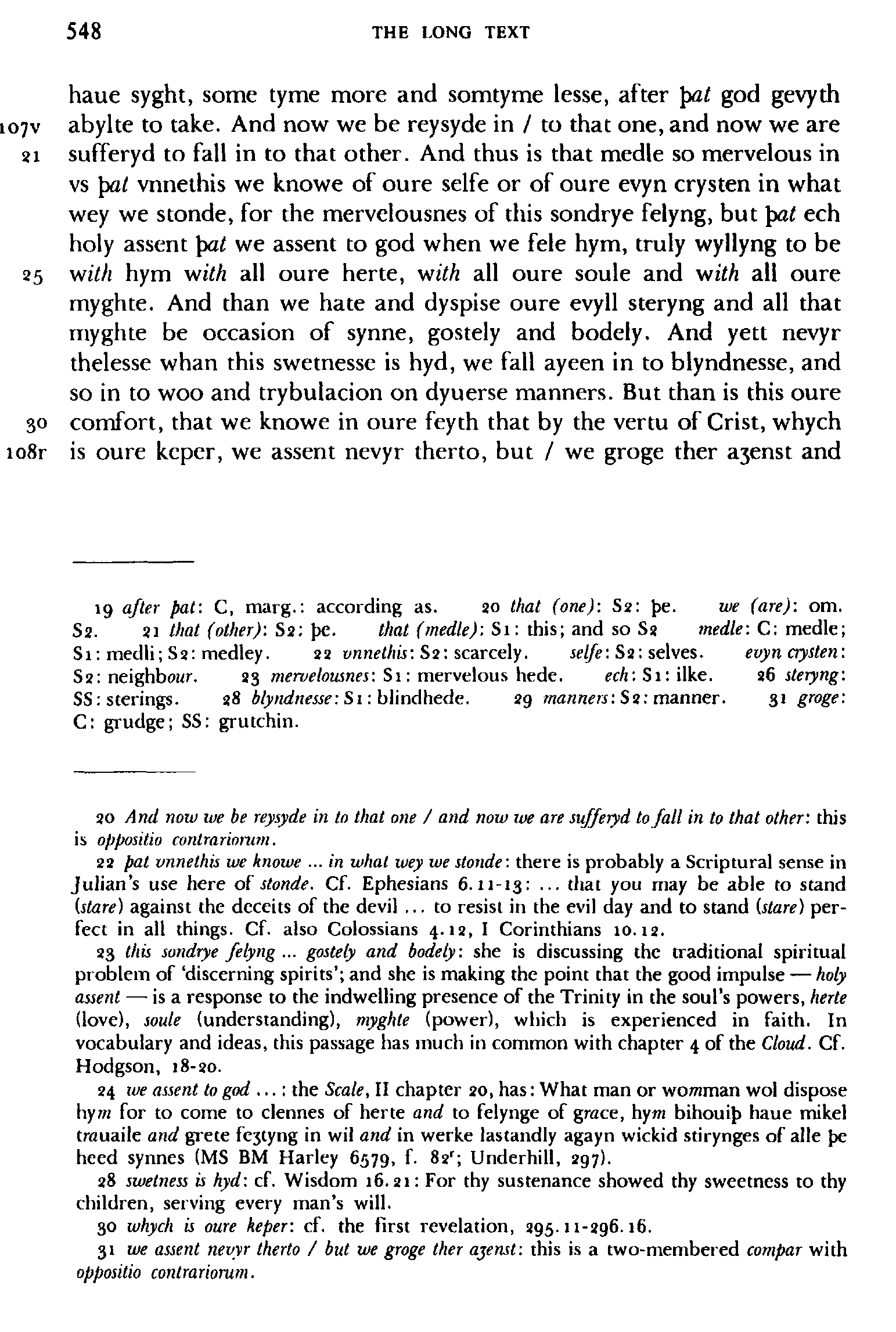
THE LONG TEXT
haue syght, some tyme more and somtyme lesse, after \>at god gevyth io7v abylte to take. And now we be reysyde in / to that one, and now we are
sufferyd to fall in to that other. And thus is that medle so mervelous in vs \>at vnnethis we knowe of oure selfe or of oure evyn crysten in what wey we stonde, for the mervelousnes of this sondrye felyng, but \>at ech holy assent fyat we assent to god when we fele hym, truly wyllyng to be
25 with hym with all oure herte, with all oure soule and with all oure myghte. And than we hate and dyspise oure evyll steryng and all that my glue be occasion of synne, gostely and bodely. And yett nevyr thelesse whan this swetnesse is hyd, we fall ayeen in to blyndnesse, and so in to woo and trybulacion on dyuerse manners. But than is this oure
30 comfort, that we knowe in oure feyth that by the vertu of Crist, whych io8r is oure kcper, we assent nevyr therto, but / we groge ther a3enst and 19 after pat: C, marg.: according as.
20 that (one): 82: {)e. we (are): om.
82.
21 that (other): 82: t>e. that (medle): Si: this; and so 82 medle: C: medle; Si: medli; 82: medley.
22 vnnethis: 82: scarcely. selfe: 82: selves. evyn crysten:
82: neighbour.
23 mervelousnes: Si: mervelous hede. ech: Si: ilke.
26 steryng:
SS:sterings.
28 blyndnesse: Si: blindhede.
29 manners: 82: manner.
31 groge:
C: grudge; 88: grutchin.
20 And now we be reysyde in to that one / and now we are sufferyd to fall in to that other: this is oppositio contrariomm.
22 pat vnnethis we knowe ... in what wey we stonde: there is probably a Scriptural sense in Julian's use here of stonde. Cf. Ephesians 6.11-13: ... that you may be able to stand
(stare) against the deceits of the devil ... to resist in the evil day and to stand (stare) perfect in all things. Cf. also Colossians 4.12, I Corinthians 10.12.
23 this sondrye felyng ... gostely and bodely: she is discussing the traditional spiritual problem of 'discerning spirits'; and she is making the point that the good impulse — holy assent — is a response to the indwelling presence of the Trinity in the soul's powers, herte
(love), soule (understanding), myghte (power), which is experienced in faith. In vocabulary and ideas, this passage has much in common with chapter 4 of the Cloud. Cf.
Hodgson, 18-20.
24 we assent to god ...: the Scale, II chapter 20, has: What man or womman wol dispose hym for to come to clennes of herte and to felynge of grace, hym bihouijj haue mikel trauaile and grete fejtyng in wil and in werke lastandly agayn wickid stirynges of alle J>e heed synnes (MS BM Harley 6579, f. 82'; Underbill, 297).
28 swetness is hyd: cf. Wisdom 16.21: For thy sustenance showed thy sweetness to thy children, serving every man's will.
30 whych is oure keper: cf. the first revelation, 295.11-296.16.
31 we assent nevyr therto / but we groge ther aynst: this is a two-membered compar with oppositio contrariomm.
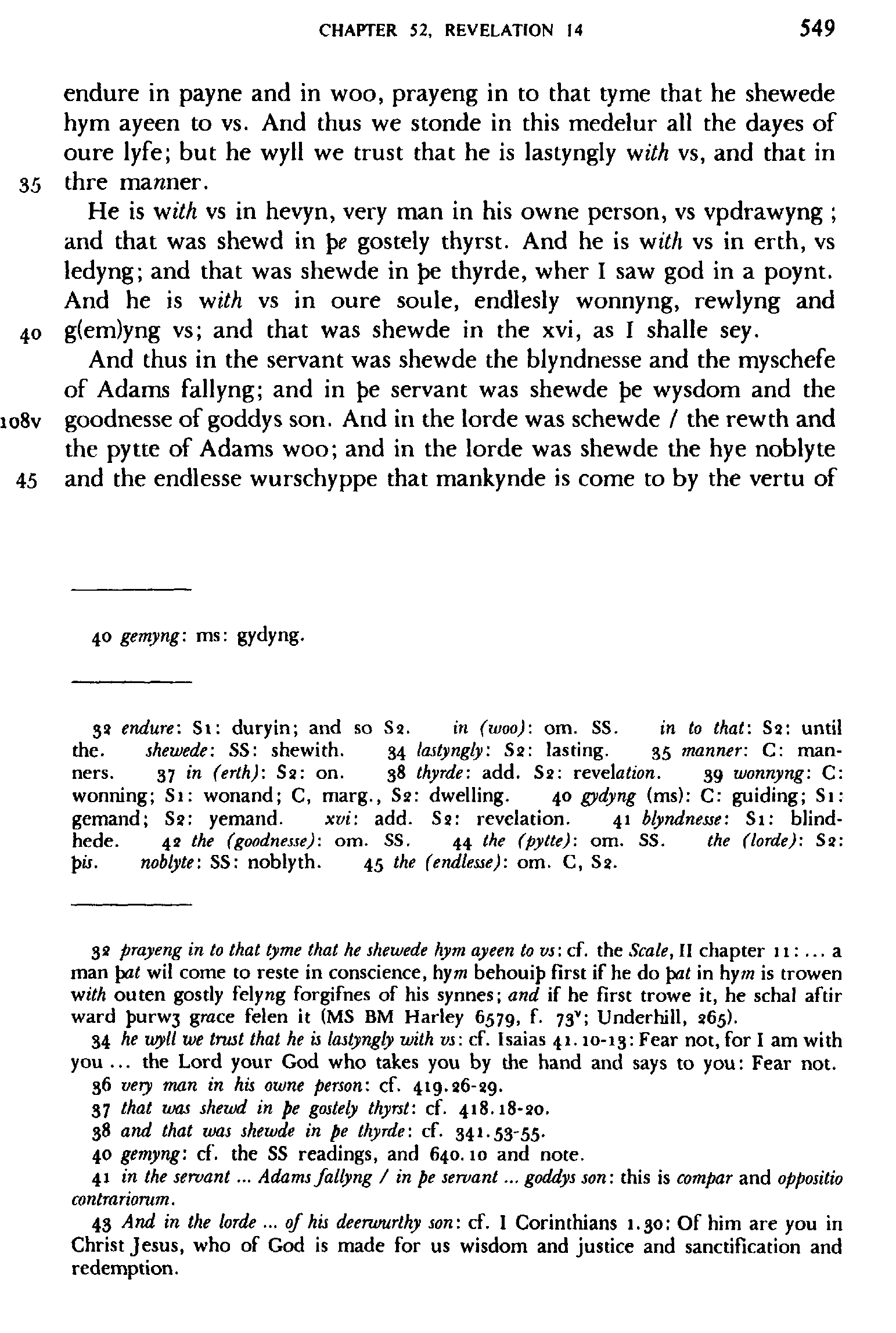
CHAPTER 52, REVELATION 14
endure in payne and in woo, prayeng in to that tyme that he shewede hym ayeen to vs. And thus we stonde in this medelur all the dayes of oure lyfe; but he wyll we trust that he is lastyngly with vs, and that in 35 thre manner.
He is 'with vs in hevyn, very man in his owne person, vs vpdrawyng ; and that was shewd in \>e gostely thyrst. And he is with vs in erth, vs ledyng; and that was shewde in J>e thyrde, wher I saw god in a poynt.
And he is with vs in oure soule, endlesly wonnyng, rewlyng and 40 g(em)yng vs; and that was shewde in the xvi, as I shalle sey.
And thus in the servant was shewde the blyndnesse and the myschefe of Adams fallyng; and in J>e servant was shewde J>e wysdom and the io8v goodnesse of goddys son. And in the lorde was schewde / the rewth and the pytte of Adams woo; and in the lorde was shewde the hye noblyte
45 and the endlesse wurschyppe that mankynde is come to by the vertu of 40 gemyng: ms: gydyng.
32 endure: Si: duryin; and so 82. in (woo): om. SS. in to that: Ss: until the. shewede: SS: shewith.
34 lastyngly: Ss: lasting.
35 manner: C: manners.
37 in (erth): Sa: on.
38 thyrde: add. Ss: revelation.
39 wonnyng: C: wonning; Si: wonand; C, marg., Ss: dwelling.
40 gydyng (ms): C: guiding; Si: gemand; Sa: yemand. xvi: add. Ss: revelation.
41 blyndnesse: Si: blindhede.
42 the (goodnesse): om. SS.
44 the (pytte): om. SS. the (lorde): Ss: pis. noblyte: SS: noblyth.
45 the (endlesse): om. C, 82.
32 prayeng in to that tyme that he shewede hym ayeen to vs: cf. the Scale, II chapter 11: ... a man pat wil come to reste in conscience, hym behouij) first if he do pat in hym is trowen with outen gostly felyng forgifnes of his synnes; and if he first trowe it, he schal aftir ward f»urw3 grace felen it (MS BM Harley 6579, f. 73*; Underhill, 265).
34 he wyll we trust that he is lastyngly with vs: cf. Isaias 41.10-13: Fear not, for I am with you ... the Lord your God who takes you by the hand and says to you: Fear not.
36 very man in his owne person: cf. 419.26-29.
37 that was shewd in pe gostely thyrst: cf. 418.18-20.
38 and that was shewde in pe thyrde: cf. 341.53-55.
40 gemyng: cf. the SS readings, and 640.10 and note.
41 in the servant... Adams fallyng / in pe servant... goddys son: this is compar and oppositio contrariorum.
43 And in the lorde ... of his deerwurthy son: cf. I Corinthians 1.30: Of him are you in Christ Jesus, who of God is made for us wisdom and justice and sanctification and redemption.
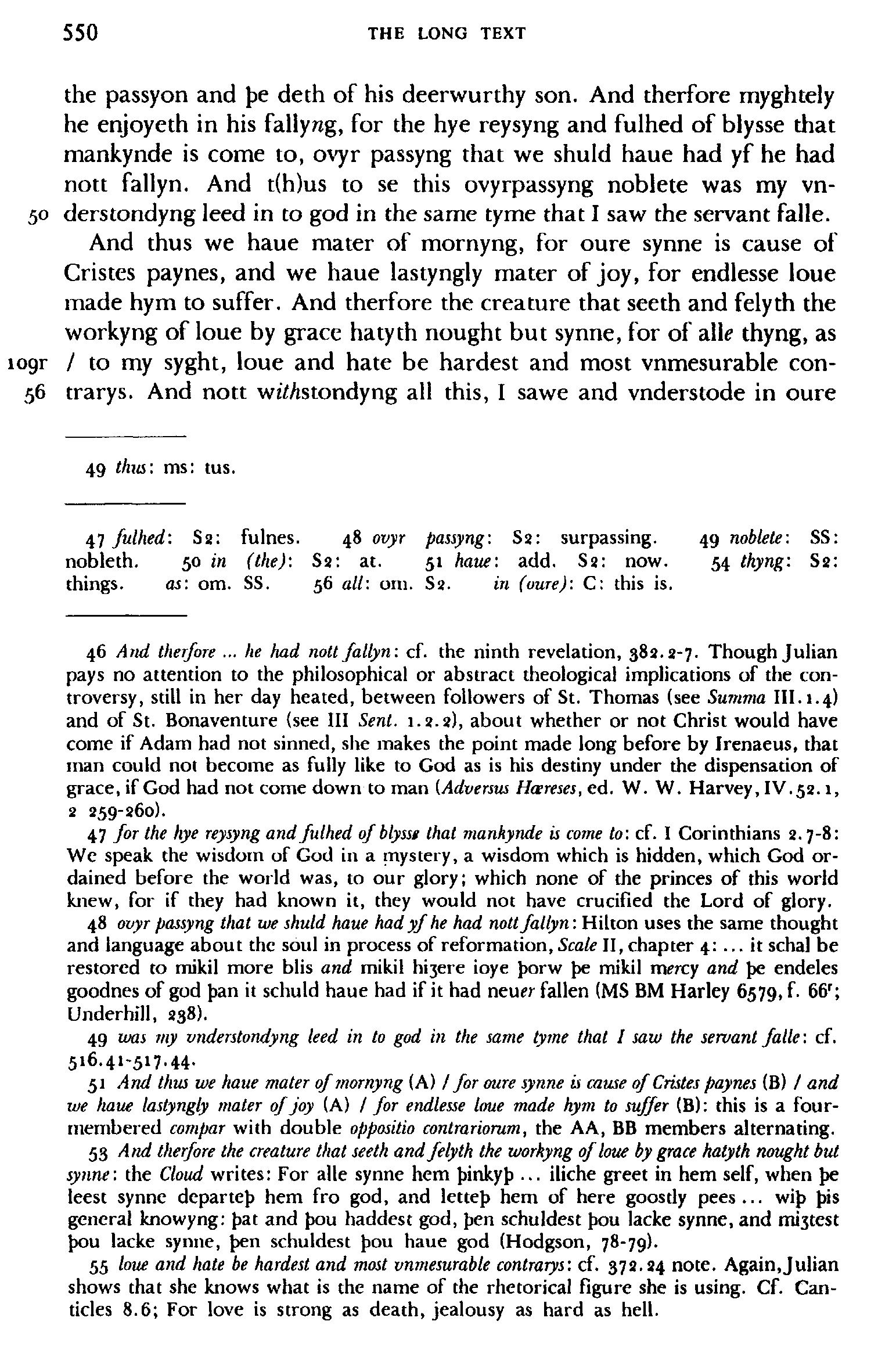
THE LONG TEXT
the passyon and be deth of his deerwurthy son. And therfore myghtely he enjoyeth in his fallywg, for the hye reysyng and fulhed of blysse that mankynde is come to, ovyr passyng that we shuld haue had yf he had nott fallyn. And t(h)us to se this ovyrpassyng noblete was my vn50 derstondyng leed in to god in the same tyme that I saw the servant falle.
And thus we haue mater of mornyng, for oure synne is cause of Cristes paynes, and we haue lastyngly mater of joy, for endlesse loue made hym to suffer. And therfore the creature that seeth and felyth the workyng of loue by grace hatyth nought but synne, for of alle thyng, as iogr / to my syght, loue and hate be hardest and most vnmesurable con56 trarys. And nott wzYAstondyng all this, I sawe and vnderstode in oure
49 tints: ms: tus.
47 fulhed:
82: fulnes.
48 ovyr passyng:
82: surpassing.
49 noblete:
SS: nobleth.
50 in (the):
82: at.
51 haue: add.
82: now.
54 thyng: 82: things. as: om. SS.
56 all: orn. 82. in (oure): C: this is.
46 And therfore ... he had nott fallyn: cf. the ninth revelation, 382.2-7. Though Julian pays no attention to the philosophical or abstract theological implications of the controversy, still in her day heated, between followers of St. Thomas (see Sumrna 111.1.4) and of St. Bonaventure (see III Sent. 1.2.2), about whether or not Christ would have come if Adam had not sinned, she makes the point made long before by Irenaeus, that man could not become as fully like to God as is his destiny under the dispensation of grace, if God had not come down to man (Adverse Haereses, ed. W. W. Harvey, IV.52. i,
2 259-260).
47 for the hye reysyng and fulhed of blysse that mankynde is come to: cf. I Corinthians 2.7-8:
We speak the wisdom of God in a mystery, a wisdom which is hidden, which God ordained before the world was, to our glory; which none of the princes of this world biew, for if they had known it, they would not have crucified the Lord of glory.
48 ovyr passyng that we shuld haue had yf he had nott fallyn: Hilton uses the same thought and language about the soul in process of reformation, Scale II, chapter 4: ... it schal be restored to mikil more blis and mikil hi3ere ioye porw pe mikil mercy and pe endeles goodnes of god pan it schuld haue had if it had neuer fallen (MS BM Harley 6579, f. 66r;
Underbill, 238).
49 was my vnderstondyng leed in to god in the same tyme that I saw the servant falle: cf.
516.41-517.44.
51 And thus we haue mater of mornyng (A) I for oure synne is cause of Cristes paynes (B) / and we haue lastyngly mater of joy (A) / for endlesse loue made hym to suffer (B): this is a fourmembered cornpar with double oppositio contrariorum, the AA, BB members alternating.
53 And therfore the creature that seeth and felyth the workyng of loue by grace hatyth nought but synne: the Cloud writes: For alle synne hem pinky£ ... iliche greet in hem self, when pe leest synne departej) hem fro god, and lettep hem of here goostly pees ... wip pis general knowyng: pat and pou haddest god, pen schuldest pou lacke synne, and mijtest pou lacke synne, pen schuldest pou haue god (Hodgson, 78-79).
55 loue and hate be hardest and most vnmesurable contrarys: cf. 373.24 note. Again,Julian shows that she knows what is the name of the rhetorical Figure she is using. Cf. Canticles 8.6; For love is strong as death, jealousy as hard as hell.
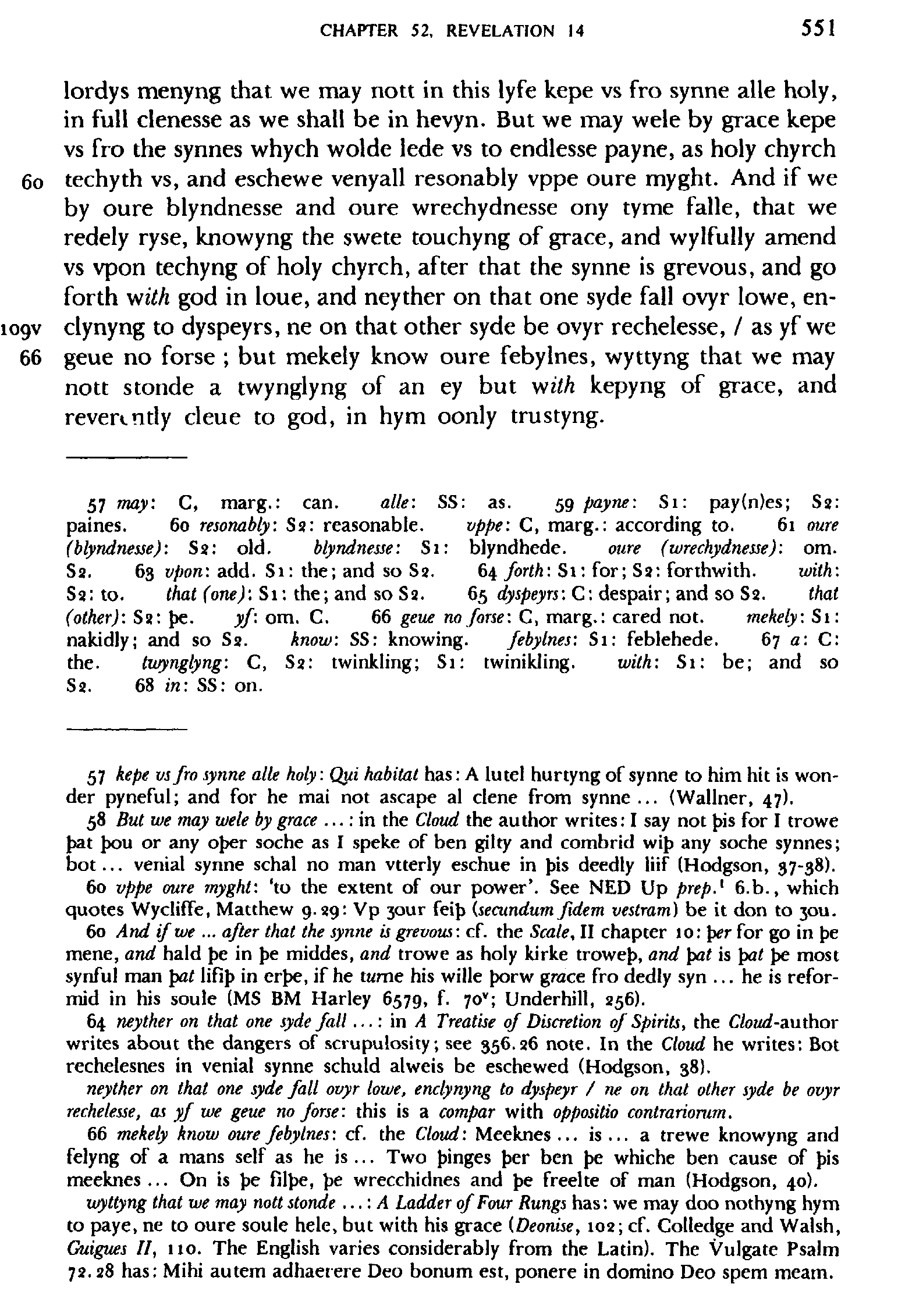
CHAPTER 52, REVELATION 14
lordys menyng that we may nott in this lyfe kepe vs fro synne alle holy, in full clenesse as we shall be in hevyn. But we may wele by grace kepe vs fro the synnes whych wolde lede vs to endlesse payne, as holy chyrch
60 techyth vs, and eschewe venyall resonably vppe oure myght. And if we by oure blyndnesse and oure wrechydnesse ony tyme falle, that we redely ryse, knowyng the swete touchyng of grace, and wylfully amend vs vpon techyng of holy chyrch, after that the synne is grevous, and go forth with god in loue, and neyther on that one syde fall ovyr lowe, enlogv clynyng to dyspeyrs, ne on that other syde be ovyr rechelesse, / as yf we
66 geue no forse ; but mekely know oure febylnes, wyttyng that we may nott stonde a twynglyng of an ey but with kepyng of grace, and reverently cleue to god, in hym oonly trustyng.
57 may: C, marg.: can. alle:
SS: as.
59 payne:
Si: pay(n)es; Sa: paines.
60 resonably: Sa: reasonable. vppe: C, marg.: according to.
61 oure (blyndnesse):
Sa: old. blyndnesse: Si: blyndhede. oure (wrechydnesse): om.
Sa.
63 vpon: add. Si: the; and so Sa.
64 forth: Si: for; Sa: forthwith. with:
Sa: to. that (one): Si: the; and so Sa.
65 dyspeyrs: C: despair; and so Ss. that (other): Sa: pe. yf: om. C.
66 geue no forse: C, marg.: cared not. mekely: Si: nakidly; and so Sa. know: SS: knowing. febylnes: Si: feblehede.
67 a: C: the. twynglyng:
C, Sa: twinkling; Si: twinikling. with: Si: be; and so Sa.
68 in: SS: on.
57 kepe vsfw synne alle holy: Qui habitat has: A lutel hurtyng of synne to him hit is wonder pyneful; and for he mai not ascape al clene from synne ... (Wallner, 47).
58 But we may wele by grace ...: in the Cloud the author writes: I say not pis for I trowe pat pou or any oper soche as I speke of ben gilty and combrid wijj any soche synnes; bot... venial synne schal no man vtterly eschue in pis deedly liif (Hodgson, 37-38).
60 vppe oure myght: 'to the extent of our power'. See NED Up prep.1 6.b., which quotes Wycliffe, Matthew 9.89: Vp 3our feij) (secundum fidem vestram) be it don to 3ou.
60 And if we ... after that the synne is grevous: cf. the Scale, II chapter 10: tyr for go in pe mene, and hald pe in pe middes, and trowe as holy kirke trowejs, and \>at is pa< pe most synful man pa/ lifij> in erpe, if he twme his wille porw grace fro dedly syn ... he is reformid in his soule (MS BM Harley 6579, f. 70"; Underbill, 256).
64 neyther on that one syde fall...: in A Treatise of Discretion of Spirits, the Cloud-author writes about the dangers of scrupulosity; see 356.26 note. In the Cloud he writes: Bot rechelesnes in venial synne schuld alweis be eschewed (Hodgson, 38). neyther on that one syde fall ovyr lowe, enclynyng to dyspeyr / ne on that other syde be ovyr rechelesse, as yf we geue no forse: this is a compar with oppositio contrariomm.
66 mekely know oure febylnes: cf. the Cloud: Meeknes ... is ... a trewe knowyng and felyng of a mans self as he is ... Two pinges per ben pe whiche ben cause of pis meeknes ... On is pe filpe, pe wrecchidnes and pe freelte of man (Hodgson, 40). wyttyng that we may nott stonde ...: A Ladder of Four Rungs has: we may doo nothyng hym to paye, ne to oure soule hele, but with his grace (Deonise, 102; cf. Colledge and Walsh,
Guigues II, no. The English varies considerably from the Latin). The Vulgate Psalm
73. a8 has: Mihi autem adhaerere Deo bonum est, ponere in domino Deo spem meam.
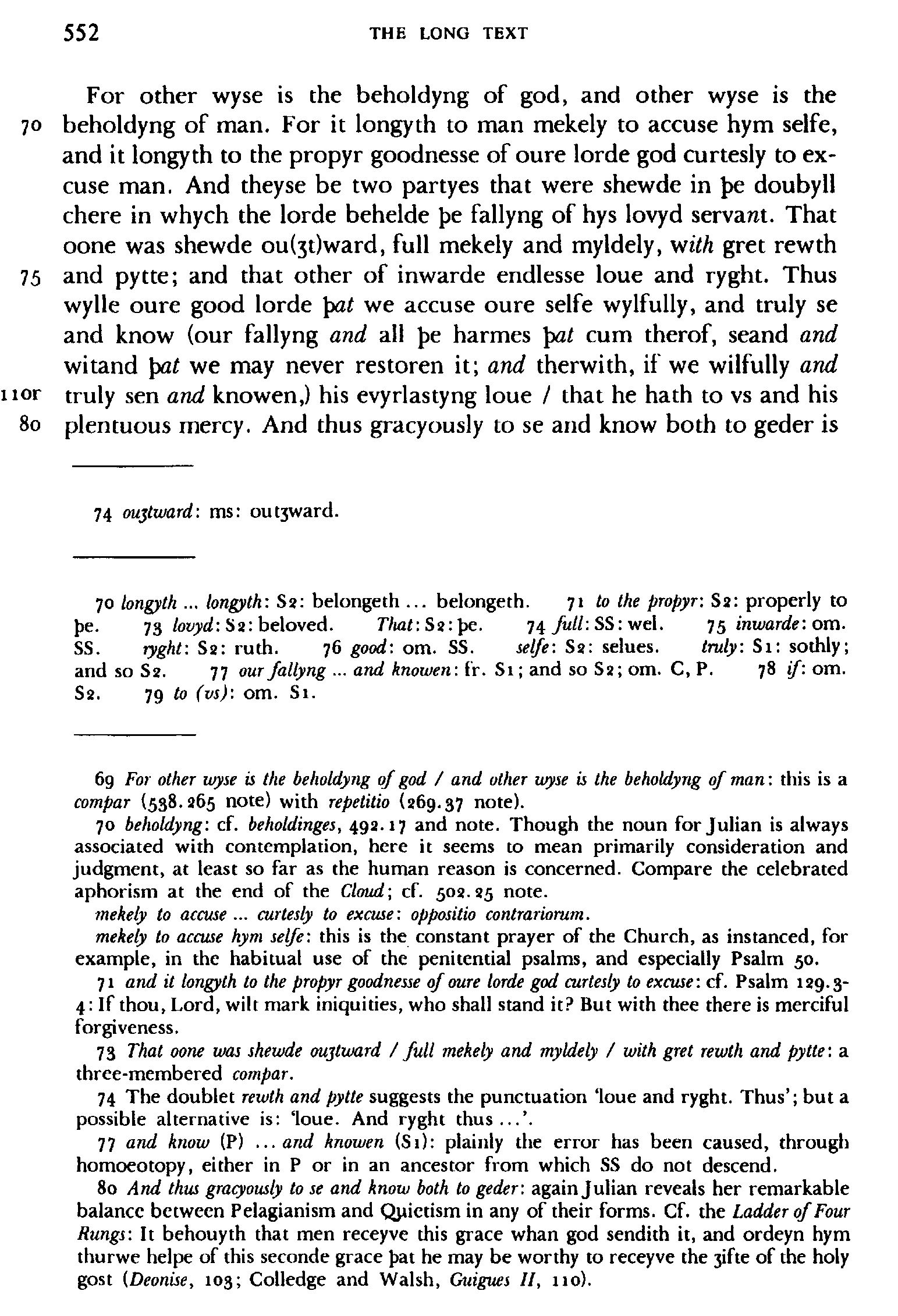
THE LONG TEXT
For other wyse is the beholdyng of god, and other wyse is the 70 beholdyng of man. For it longyth to man mekely to accuse hym selfe, and it longyth to the propyr goodnesse of oure lorde god curtesly to excuse man. And theyse be two partyes that were shewde in J>e doubyll chere in whych the lorde behelde be fallyng of hys lovyd servant. That oone was shewde ou(3t)ward, full mekely and myldely, with gret rewth
75 and pytte; and that other of inwarde endlesse loue and ryght. Thus wylle oure good lorde \>at we accuse oure selfe wylfully, and truly se and know (our fallyng and all J>e harmes Ipat cum therof, seand and witand \>at we may never restoren it; and therwith, if we wilfully and nor truly sen and knowen,) his evyrlastyng loue / that he hath to vs and his
80 plentuous mercy. And thus gracyously to se and know both to geder is 74 outward: ms: out3ward.
70 longyth ... longyth: 82: belongeth ... belongeth.
71 to the propyr: 82: properly to pe.
73 lovyd: 82: beloved.
7VwJ:S2:pe.
74 full: SS: wel.
75 inwarde: om.
SS. ryght: 82: ruth.
76 good: om. SS. selfe; 82: selues. truly: Si: sothly; and so 82.
77 our fallyng ... and knowen: fr. Si; and so 82; om. C, P.
78 if: om.
82.
79 to (vs): om. Si.
69 For other wyse is the beholdyng of god / and other wyse is the beholdyng of man: this is a compar (538.265 note) with repetitio (269.37 note).
70 beholdyng: cf. beholdinges, 492.17 and note. Though the noun for Julian is always associated with contemplation, here it seems to mean primarily consideration and judgment, at least so far as the human reason is concerned. Compare the celebrated aphorism at the end of the Cloud; cf. 502.25 note. mekely to accuse ... curtesly to excuse: oppositio contrariorum. mekely to accuse hym selfe: this is the constant prayer of the Church, as instanced, for example, in the habitual use of the penitential psalms, and especially Psalm 50.
71 and it longyth to the propyr goodnesse of oure lorde god curtesly to excuse: cf. Psalm 129.34: If thou, Lord, wilt mark iniquities, who shall stand it? But with thee there is merciful forgiveness.
73 That oone was shewde outward /full mekely and myldely / with gret rewth and pytte: a three-membered compar.
74 The doublet rewth and pytte suggests the punctuation 'loue and ryght. Thus'; but a possible alternative is: 'loue. And ryght thus...'.
77 and know (P) ...and knowen (Si): plainly the error has been caused, through homoeotopy, either in P or in an ancestor from which SS do not descend.
80 And thus gracyously to se and know both to geder: again Julian reveals her remarkable balance between Pelagianism and Quietism in any of their forms. Cf. the Ladder of Four
Rungs: It behouyth that men receyve this grace whan god sendith it, and ordeyn hym thurwe helpe of this seconde grace pat he may be worthy to receyve the 3ifte of the holy gost (Deonise, 103; Colledge and Walsh, Guigues II, 110).
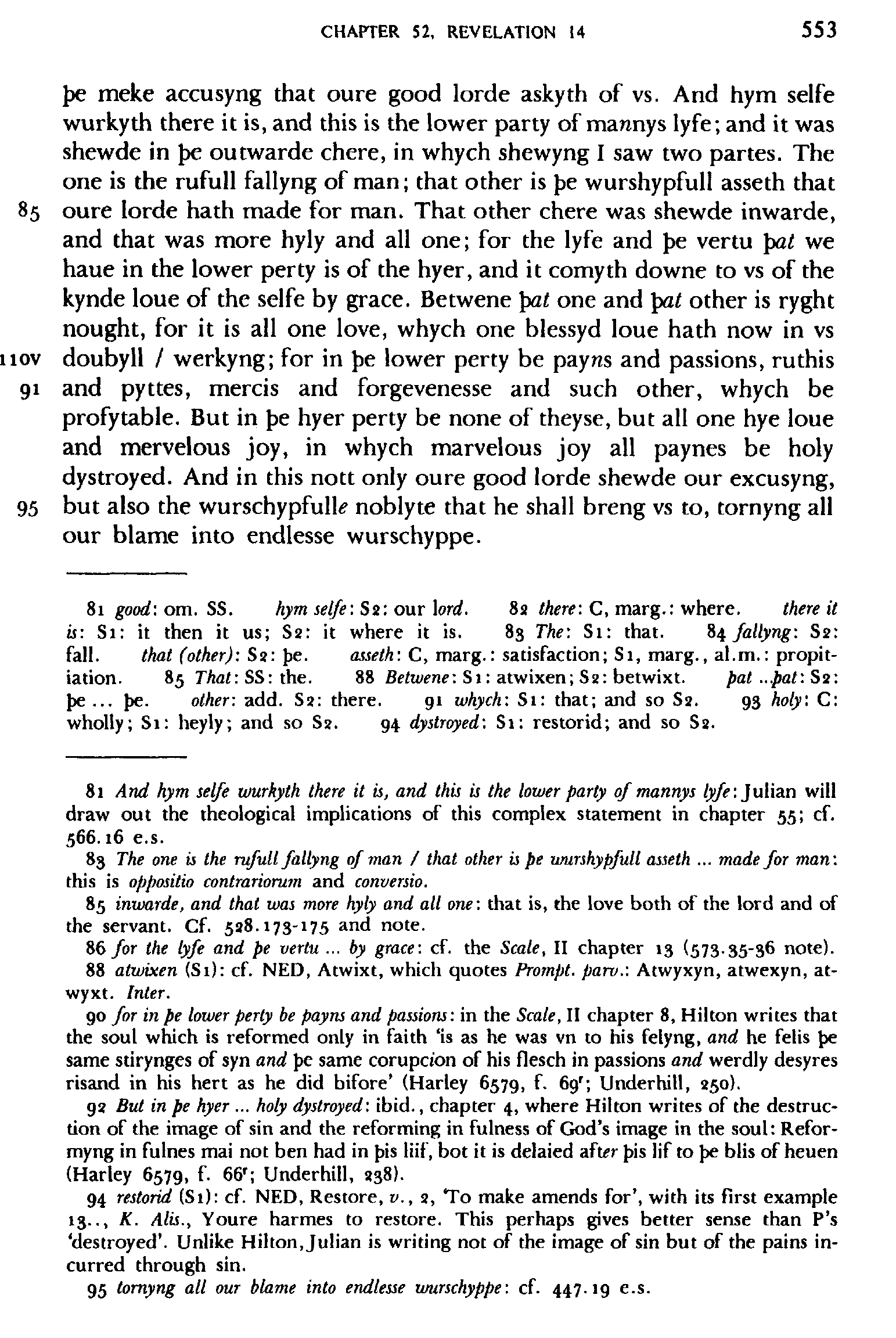
CHAPTER 52, REVELATION 14
pe meke accusyng that oure good lorde askyth of vs. And hym selfe wurkyth there it is, and this is the lower party of mawnys lyfe; and it was shewde in pe outwarde chere, in whych shewyng I saw two partes. The one is the rufull fallyng of man; that other is pe wurshypfull asseth that 85 oure lorde hath made for man. That other chere was shewde inwarde, and that was more hyly and all one; for the lyfe and pe vertu \>at we haue in the lower perty is of the hyer, and it comyth downe to vs of the kynde loue of the selfe by grace. Betwene ]xit one and Ipat other is ryght nought, for it is all one love, whych one blessyd loue hath now in vs iiov doubyll / werkyng; for in pe lower perty be payns and passions, ruthis
91 and pyttes, mercis and forgevenesse and such other, whych be profytable. But in pe hyer perty be none of theyse, but all one hye loue and mervelous joy, in whych marvelous joy all paynes be holy dystroyed. And in this nott only oure good lorde shewde our excusyng,
95 but also the wurschypfulk noblyte that he shall breng vs to, tornyng all our blame into endlesse wurschyppe.
81 good: om. SS. hym selfe: Si?: our lord.
8s there: C, marg.: where. there it is: Si: it then it us; 82: it where it is.
83 The: Si: that.
84 fallyng: 82: fall. that (other): Ss: pe. asseth: C, marg.: satisfaction; Si, marg., al.m.: propitiation.
85 That: 88: the.
88 Betwene: Si: atwixen; 82: betwixt. pat ...pat: Ss: pe ... pe. other: add. 82: there.
91 whych: Si: that; and so 82.
93 holy: C: wholly; Si: heyly; and so 82.
94 dystroyed: Si: restorid; and so 82.
81 And hym selfe wurkyth there it is, and this is the lower party of mannys lyfe: Julian will draw out the theological implications of this complex statement in chapter 55; cf.
566.16 e.s.
83 The one is the rufull fallyng of man / that other is pe wurshypfull asseth ... made for man: this is oppositio contrariorum and conversio.
85 inwarde, and that was more hyly and all one: that is, the love both of the lord and of the servant. Cf. 528.173-175 and note.
86 for the lyfe and pe vertu ... by grace: cf. the Scale, II chapter 13 (573.35-36 note).
88 atwixen (Si): cf. NED, Atwixt, which quotes Prompt, paw.: Atwyxyn, atwexyn, atwyxt. Inter.
90 for in pe lower perty be payns and passions: in the Scale, II chapter 8, Hilton writes that the soul which is reformed only in faith 'is as he was vn to his felyng, and he felis pe same stirynges of syn and pe same corupa'on of his flesch in passions and werdly desyres risand in his hert as he did bifore' (Harley 6579, f. 6gr; Underbill, 250).
92 But in pe hyer ... holy dystroyed: ibid., chapter 4, where Hilton writes of the destruction of the image of sin and the reforming in fulness of God's image in the soul: Reformyng in fulnes mai not ben had in pis liif, bot it is delaied after pis lif to pe blis of heuen
(Harley 6579, f. 66r; Underbill, 238).
94 restorid (Si): cf. NED, Restore, v., 2, To make amends for', with its first example
13.., K. Alls., Youre harmes to restore. This perhaps gives better sense than P's
'destroyed'. Unlike Hilton, Julian is writing not of the image of sin but of the pains incurred through sin.
95 tornyng all our blame into endlesse wurschyppe: cf. 447.19 e.s.
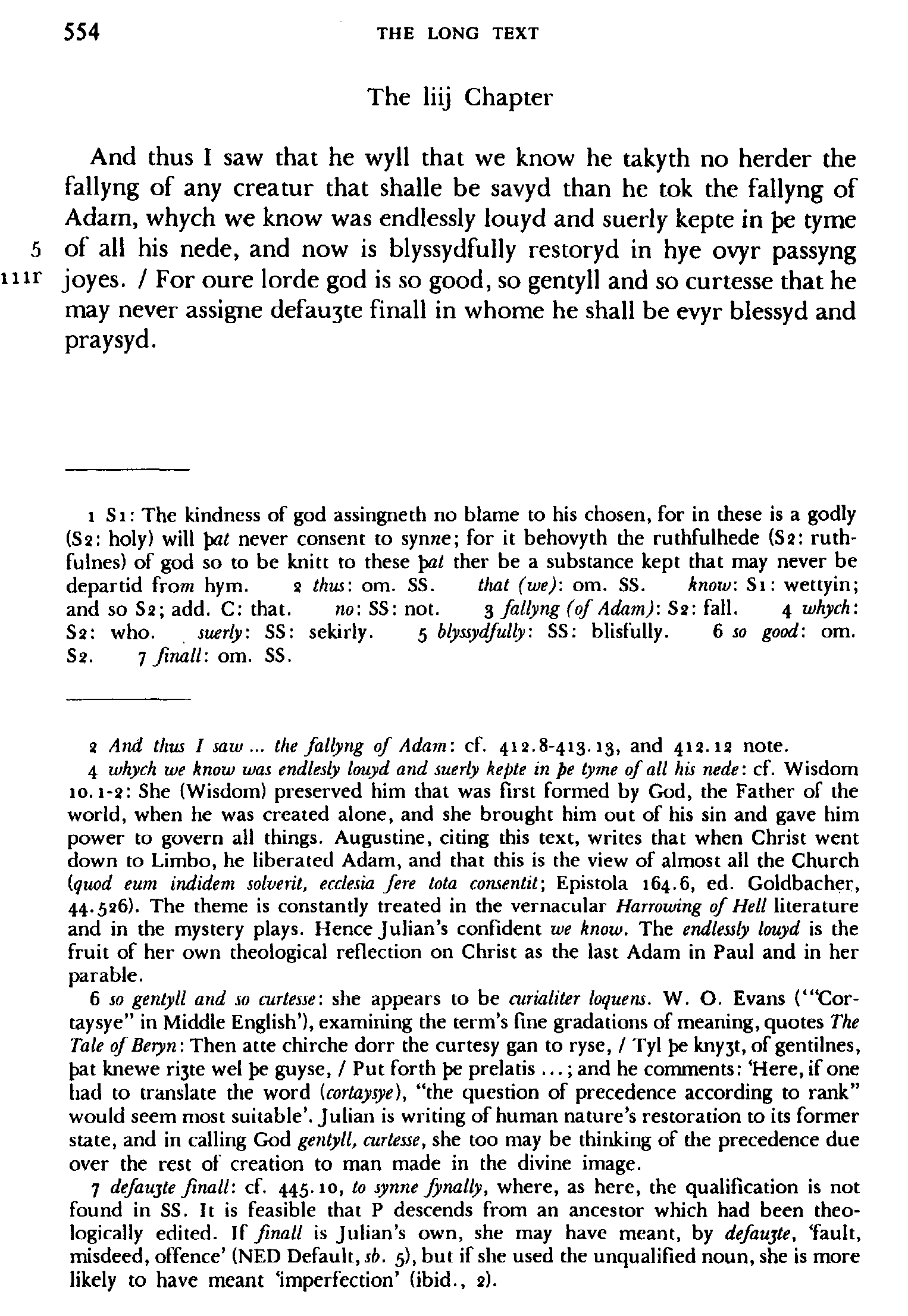
THE LONG TEXT
The liij Chapter And thus I saw that he wyll that we know he takyth no herder the fallyng of any creatur that shalle be savyd than he tok the fallyng of Adam, whych we know was endlessly louyd and suerly kepte in J>e tyme
5 of all his nede, and now is blyssydfully restoryd in hye ovyr passyng inr joyes. / For oure lorde god is so good, so gentyll and so curtesse that he may never assigne defaujte finall in whome he shall be evyr blessyd and praysyd. i Si: The kindness of god assingneth no blame to his chosen, for in these is a godly
(82: holy) will \>at never consent to synne; for it behovyth the ruthfulhede (82: ruthfulnes) of god so to be knitt to these ]>at ther be a substance kept that may never be departid frowi hym. a thus: om. SS. that (we): om. SS. know: Si: wettyin; and so 82; add. C: that. no: SS: not.
3 fallyng (of Adam): 82: fall.
4 whych:
82: who. suerly: SS: sekirly.
5 blyssydfully:
SS: blisfully.
6 so good: om.
82.
7 finall: om. SS.
2 And thus I saw ... the fallyng of Adam: cf. 412.8-413.13, and 412.12 note.
4 whych we know was endlesly louyd and suerly kepte in pe tyme of all his nede: cf. Wisdom
10.1-2: She (Wisdom) preserved him that was first formed by God, the Father of the world, when he was created alone, and she brought him out of his sin and gave him power to govern all things. Augustine, citing this text, writes that when Christ went down to Limbo, he liberated Adam, and that this is the view of almost all the Church
(quod eum indidem solvent, ecclesia fere tola consentit; Epistola 164.6, ed. Goldbacher,
44.526). The theme is constantly treated in the vernacular Harrowing of Hell literature and in the mystery plays. Hence Julian's confident we know. The endlessly louyd is the fruit of her own theological reflection on Christ as the last Adam in Paul and in her parable.
6 so gentyll and so curtesse: she appears to be curialiter loquens. W. O. Evans ("'Cortaysye" in Middle English'), examining the term's fine gradations of meaning, quotes The Tale ofBeryn: Then atte chirche dorr the curtesy gan to ryse, / Tyl j>e kny3t, of gentilnes,
£>at knewe ri3te wel f»e guyse, / Put forth Jje prelatis ...; and he comments: 'Here, if one had to translate the word (cortaysye), "the question of precedence according to rank" would seem most suitable'. Julian is writing of human nature's restoration to its former state, and in calling God gentyll, curtesse, she too may be thinking of die precedence due over the rest of creation to man made in the divine image.
7 defaujte finall: cf. 445.10, to synne fynally, where, as here, the qualification is not found in SS. It is feasible that P descends from an ancestor which had been theologically edited. If finall is Julian's own, she may have meant, by defaujte,
'fault, misdeed, offence' (NED Default, 56. 5), but if she used the unqualified noun, she is more likely to have meant 'imperfection' (ibid., 2).
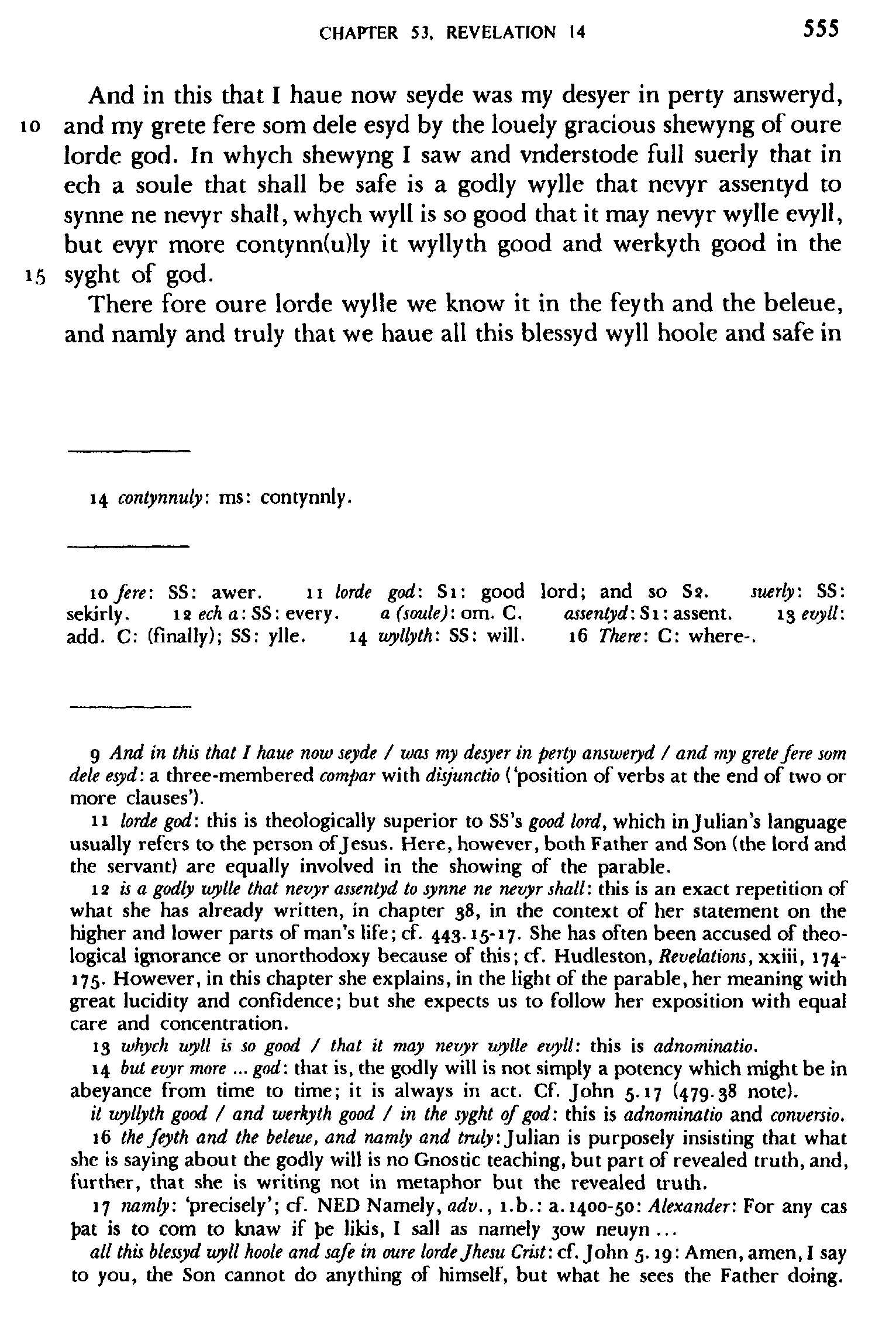
CHAPTER 53, REVELATION 14
And in this that I haue now seyde was my desyer in perty answeryd, 10 and my grete fere som dele esyd by the louely gracious shewyng of oure lorde god. In whych shewyng I saw and vnderstode full suerly that in ech a soule that shall be safe is a godly wylle that nevyr assentyd to synne ne nevyr shall, whych wyll is so good that it may nevyr wylle evyll, but evyr more contynn(u)ly it wyllyth good and werkyth good in the 15 syght of god.
There fore oure lorde wylle we know it in the feyth and the beleue, and namly and truly that we haue all this blessyd wyll hoole and safe in 14 contynnuly: ms: contynnly.
10 fere: SS: awer.
11 lorde god: Si: good lord; and so Sa. suerly: SS: sekirly.
12 ech a: SS: every. a (soule): om. C. assentyd: Si: assent.
13 evyll: add. C: (finally); SS: ylle.
14 wyllyth: SS: will.
16 There: C: where-.
9 And in this that I haue now seyde / was my desyer in perty answeryd / and my grete fere som dele esyd: a three-membered compar with disjunctio ('position of verbs at the end of two or more clauses').
11 lorde god: this is theologically superior to SS's good lord, which in Julian's language usually refers to the person of Jesus. Here, however, both Father and Son (the lord and the servant) are equally involved in the showing of the parable.
12 is a godly wylle that nevyr assentyd to synne ne nevyr shall: this is an exact repetition of what she has already written, in chapter 38, in the context of her statement on the higher and lower parts of man's life; cf. 443.15-17. She has often been accused of theological ignorance or unorthodoxy because of this; cf. Hudleston, Revelations, xxiii, 174175. However, in this chapter she explains, in the light of the parable, her meaning with great lucidity and confidence; but she expects us to follow her exposition with equal care and concentration.
13 whych wyll is so good / that it may nevyr wylle evyll: this is adnominatio.
14 but evyr more ... god: that is, the godly will is not simply a potency which might be in abeyance from time to time; it is always in act. Cf. John 5.17 (479.38 note). it wyllyth good / and werkyth good / in the syght of god: this is adnominatio and conversio.
16 the feyth and the beleue, and namly and truly: Julian is purposely insisting that what she is saying about the godly will is no Gnostic teaching, but part of revealed truth, and, further, that she is writing not in metaphor but the revealed truth.
17 namly: 'precisely'; cf. NED Namely, adv., i.b.: 3.1400-50: Alexander: For any cas
J>at is to com to knaw if Jje likis, I sail as namely 3ow neuyn ... all this blessyd wyll hoole and safe in oure lorde Jhesu Crist: cf. John 5.19: Amen, amen, I say to you, the Son cannot do anything of himself, but what he sees the Father doing.
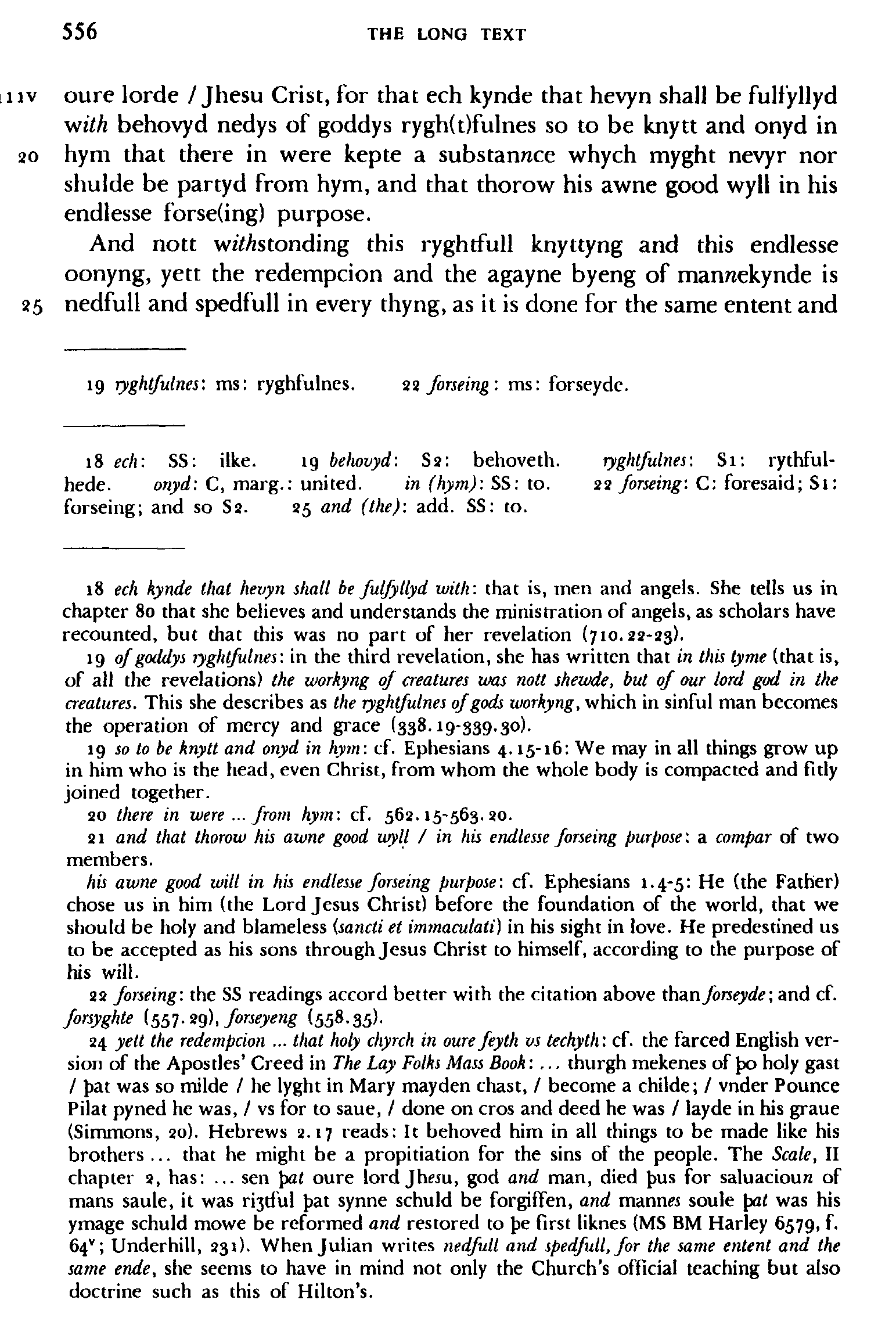
THE LONG TEXT
11 iv oure lorde / Jhesu Crist, for that ech kynde that hevyn shall be fulfyllyd
•with behovyd nedys of goddys rygh(t)fulnes so to be knytt and onyd in 20 hym that there in were kepte a substannce whych myght nevyr nor shulde be partyd from hym, and that thorow his awne good wyil in his endlesse forse(ing) purpose.
And nott wtMstonding this ryghtfull knyttyng and this endlesse oonyng, yett the redempcion and the agayne byeng of manrcekynde is
25 nedfull and spedfull in every thyng, as it is done for the same entent and 19 ryghtfulnes: ms: ryghfulnes.
22 forseing: ms: forseyde.
18 ech: SS: ilke.
19 behovyd:
82: behoveth. ryghtfulnes:
Si: rythfulhede. onyd: C, marg.: united. in (hym): SS: to.
22 forseing: C: foresaid; Si: forseing; and so Ss.
25 and (the): add. SS: to.
18 ech kynde that hevyn shall be fulfyllyd with: that is, men and angels. She tells us in chapter 80 that she believes and understands the ministration of angels, as scholars have recounted, but that this was no part of her revelation (710.22-23).
19 of goddys ryghtfulnes: in the third revelation, she has written that in this tyme (that is, of all the revelations) the workyng of creatures was nott shewde, but of our lord god in the creatures. This she describes as the ryghtfulnes of gods workyng, which in sinful man becomes the operation of mercy and grace (338.19-339.30).
19 so to be knytt and onyd in hym: cf. Ephesians 4.15-16: We may in all things grow up in him who is the head, even Christ, from whom the whole body is compacted and fitly joined together.
20 there In were ... from hym: cf. 562.15-563.20.
21 and that thorow his awne good wyll / in his endlesse forseing purpose: a compar of two members. his awne good will in his endlesse forseing purpose: cf. Ephesians 1.4-5: He (the Father) chose us in him (the Lord Jesus Christ) before the foundation of die world, that we should be holy and blameless (sancti et immaculati) in his sight in love. He predestined us to be accepted as his sons through Jesus Christ to himself, according to the purpose of his will.
22 forseing: the SS readings accord better with the citation above than forseyde; and cf. forsyghte (557.29). foneyeng (558.35)- 24 yett the redempcion ... that holy chyrch in oure fey th vs techy th: cf. the farced English version of the Apostles' Creed in The Lay Folks Mass Book: ... thurgh mekenes of po holy gast
/ pat was so milde / he lyght in Mary mayden chast, / become a childe; / vnder Pounce
Pilat pyned he was, / vs for to saue, / done on cros and deed he was / layde in his graue
(Simmons, 20). Hebrews 2.17 reads: It behoved him in all things to be made like his brothers ... that he might be a propitiation for the sins of the people. The Scale, II chapter 2, has: ... sen \>at oure lord Jhwu, god and man, died J>us for saluacioun of mans saule, it was ri3tful pat synne schuld be forgiffen, and mannes soule pa< was his ymage schuld mowe be reformed and restored to pe first liknes (MS BM Harley 6579, f.
64*; Underbill, 231). When Julian writes nedfull and spedfull, for the same entent and the same ende, she seems to have in mind not only the Church's official teaching but also doctrine such as this of Hilton's.
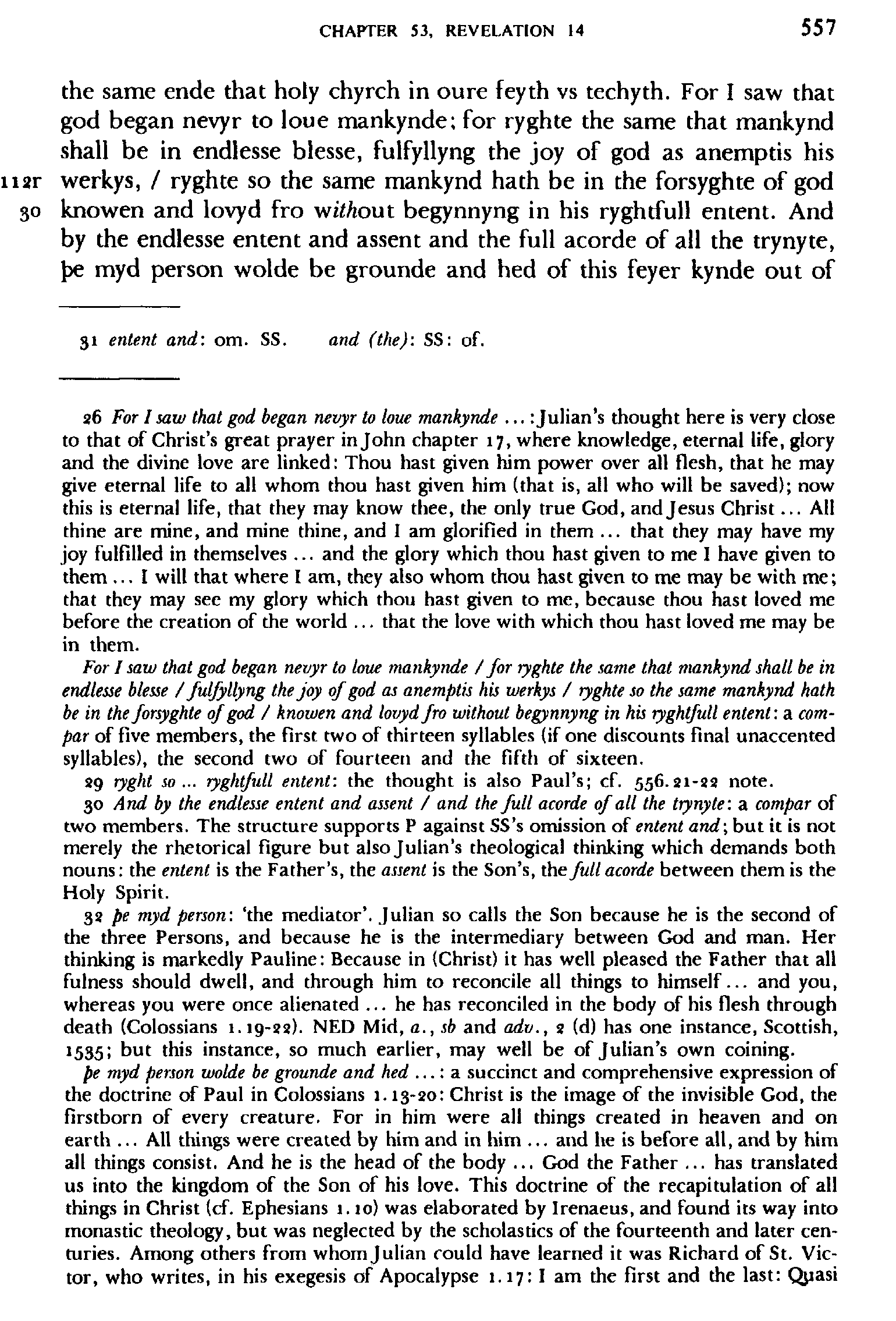
CHAPTER 53, REVELATION 14
the same ende that holy chyrch in oure feyth vs techyth. For I saw that god began nevyr to loue mankynde; for ryghte the same that mankynd shall be in endlesse blesse, fulfyllyng the joy of god as anemptis his liar werkys, / ryghte so the same mankynd hath be in the forsyghte of god
30 knowen and lovyd fro without begynnyng in his ryghtfull entent. And by the endlesse entent and assent and the full acorde of all the trynyte, be myd person wolde be grounde and hed of this feyer kynde out of 31 entent and: om. SS. and (the): SS: of.
26 For I saw that god began nevyr to lone mankynde ...: Julian's thought here is very close to that of Christ's great prayer in John chapter 17, where knowledge, eternal life, glory and the divine love are linked: Thou hast given him power over all flesh, that he may give eternal life to all whom thou hast given him (that is, all who will be saved); now this is eternal life, that they may know thee, the only true God, and Jesus Christ... All thine are mine, and mine thine, and I am glorified in them ... that they may have my joy fulfilled in themselves ... and the glory which thou hast given to me I have given to them ... I will that where I am, they also whom thou hast given to me may be with me; that they may see my glory which thou hast given to me, because thou hast loved me before the creation of the world ... that the love with which thou hast loved me may be in them.
For I saw that god began nevyr to loue mankynde /for ryghte the same that mankynd shall be in endlesse blesse /fulfyllyng the joy of god as anemptis his werkys / ryghte so the same mankynd hath be in the forsyghte of god / knowen and lovyd fro without begynnyng in his ryghtfull entent: a cornpar of five members, the first two of thirteen syllables (if one discounts final unaccented syllables), the second two of fourteen and the fifth of sixteen.
29 ryght so... ryghtfull entent: the thought is also Paul's; cf. 556.21-22 note.
30 And by the endlesse entent and assent / and the full acorde of all the trynyte: a compar of two members. The structure supports P against SS's omission of entent and; but it is not merely the rhetorical figure but also Julian's theological thinking which demands both nouns: the entent is the Father's, the assent is the Son's, the full acorde between them is the Holy Spirit.
32 pe myd person: 'the mediator'. Julian so calls the Son because he is the second of the three Persons, and because he is the intermediary between God and man. Her thinking is markedly Pauline: Because in (Christ) it has well pleased the Father that all fulness should dwell, and through him to reconcile all things to himself... and you, whereas you were once alienated ... he has reconciled in the body of his flesh through death (Colossians 1.19-22). NED Mid, a., sb and adv., a (d) has one instance, Scottish,
1535; but this instance, so much earlier, may well be of Julian's own coining. pe myd person wolde be grounde and hed ...: a succinct and comprehensive expression of the doctrine of Paul in Colossians 1.13-20: Christ is the image of the invisible God, the firstborn of every creature. For in him were all things created in heaven and on earth ... All things were created by him and in him ... and he is before all, and by him all things consist. And he is the head of the body ... God the Father ... has translated us into the kingdom of the Son of his love. This doctrine of the recapitulation of all things in Christ (cf. Ephesians 1.10) was elaborated by Irenaeus, and found its way into monastic theology, but was neglected by the scholastics of the fourteenth and later centuries. Among others from whom Julian could have learned it was Richard of St. Victor, who writes, in his exegesis of Apocalypse 1.17: I am the first and the last: Quasi
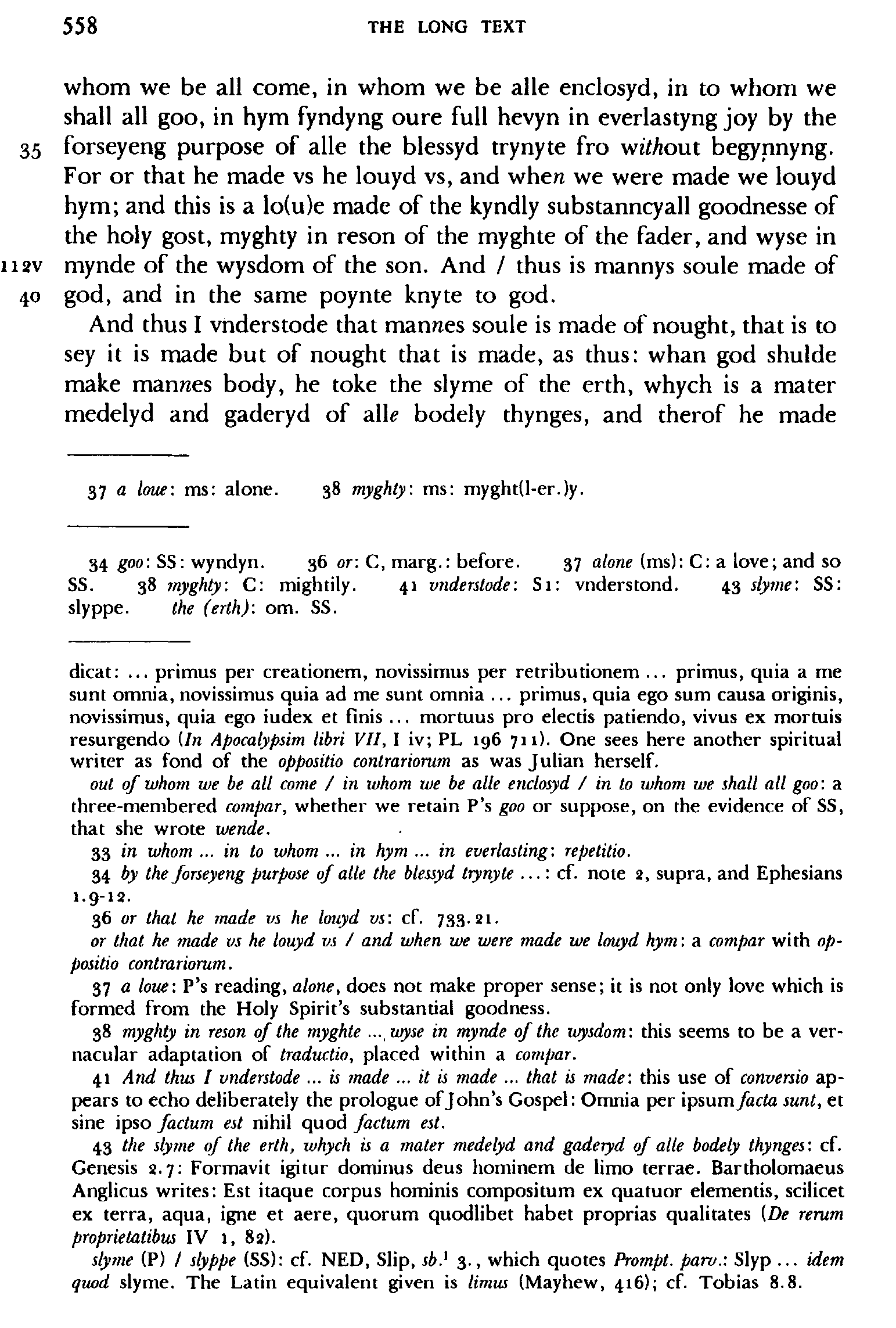
THE LONG TEXT
whom we be all come, in whom we be alle enclosyd, in to whom we shall all goo, in hym fyndyng oure full hevyn in everlastyng joy by the 35 forseyeng purpose of alle the blessyd trynyte fro without begynnyng.
For or that he made vs he louyd vs, and when we were made we louyd hym; and this is a lo(u)e made of the kyndly substanncyall goodnesse of the holy gost, myghty in reson of the myghte of the fader, and wyse in ii2v mynde of the wysdom of the son. And / thus is mannys soule made of 40 god, and in the same poynte knyte to god.
And thus I vnderstode that mannes soule is made of nought, that is to sey it is made but of nought that is made, as thus: whan god shulde make mannes body, he toke the slyme of the erth, whych is a mater medelyd and gaderyd of all? bodely thynges, and therof he made
37 a ioue: ms: alone.
38 myghty: ms: myght(l-er.)y.
34 goo: SS: wyndyn.
36 or: C, rnarg.: before.
37 alone (ms): C: a love; and so SS.
38 myghty: C: mightily.
41 vnderstode: Si: vnderstond.
43 slyme: SS: slyppe. the (erth): om. SS. dicat: ... primus per creationem, novissimus per retributionem ... primus, quia a me sunt omnia, novissimus quia ad me sunt omnia ... primus, quia ego sum causa originis, novissimus, quia ego iudex et finis ... mortuus pro electis patiendo, vivus ex mortuis resurgendo (In Apocalypsim libri VII, I iv; PL 196 711). One sees here another spiritual writer as fond of the oppositio contrariorum as was Julian herself. out of whom we be all come / in whom we be alle enclosyd / in to whom we shall all goo: a three-membered compar, whether we retain P's goo or suppose, on the evidence of SS, that she wrote wende.
33 in whom ... in to whom ... in hym ... in everlasting: repetitio.
34 by the forseyeng purpose of alle the blessyd trynyte ...: cf. note 2, supra, and Ephesians
1.9-12.
36 or that he made vs he louyd w: cf. 733.21. or that he made vs he louyd vs / and when we were made we louyd hym: a compar with oppositio contrariorum.
37 a Ioue: P's reading, alone, does not make proper sense; it is not only love which is formed from the Holy Spirit's substantial goodness.
38 myghty in reson of the myghte ...,wyse in mynde of the wysdom: this seems to be a vernacular adaptation of traductio, placed within a compar.
41 And thus I vnderstode ... is made ... it is made ... that is made: this use of conversio appears to echo deliberately the prologue of John's Gospel: Omnia per ipsumfacta sunt, et sine ipso factum est nihil quod factum est.
43 the slyme of the erth, whych is a mater medelyd and gaderyd of alle bodely thynges: cf.
Genesis 2.7: Formavit igitur dominus deus hominem de limo terrae. Bartholomaeus Anglicus writes: Est itaque corpus hominis compositum ex quatuor elementis, scilicet ex terra, aqua, igne et acre, quorum quodlibet habet proprias qualitates (De rerum proprietatibus IV i, 82). slyme (P) / slyppe (SS): cf. NED, Slip, sb.1 3., which quotes Prompt, paw:. Slyp ... idem quod slyme. The Latin equivalent given is limits (Mayhew, 416); cf. Tobias 8.8.
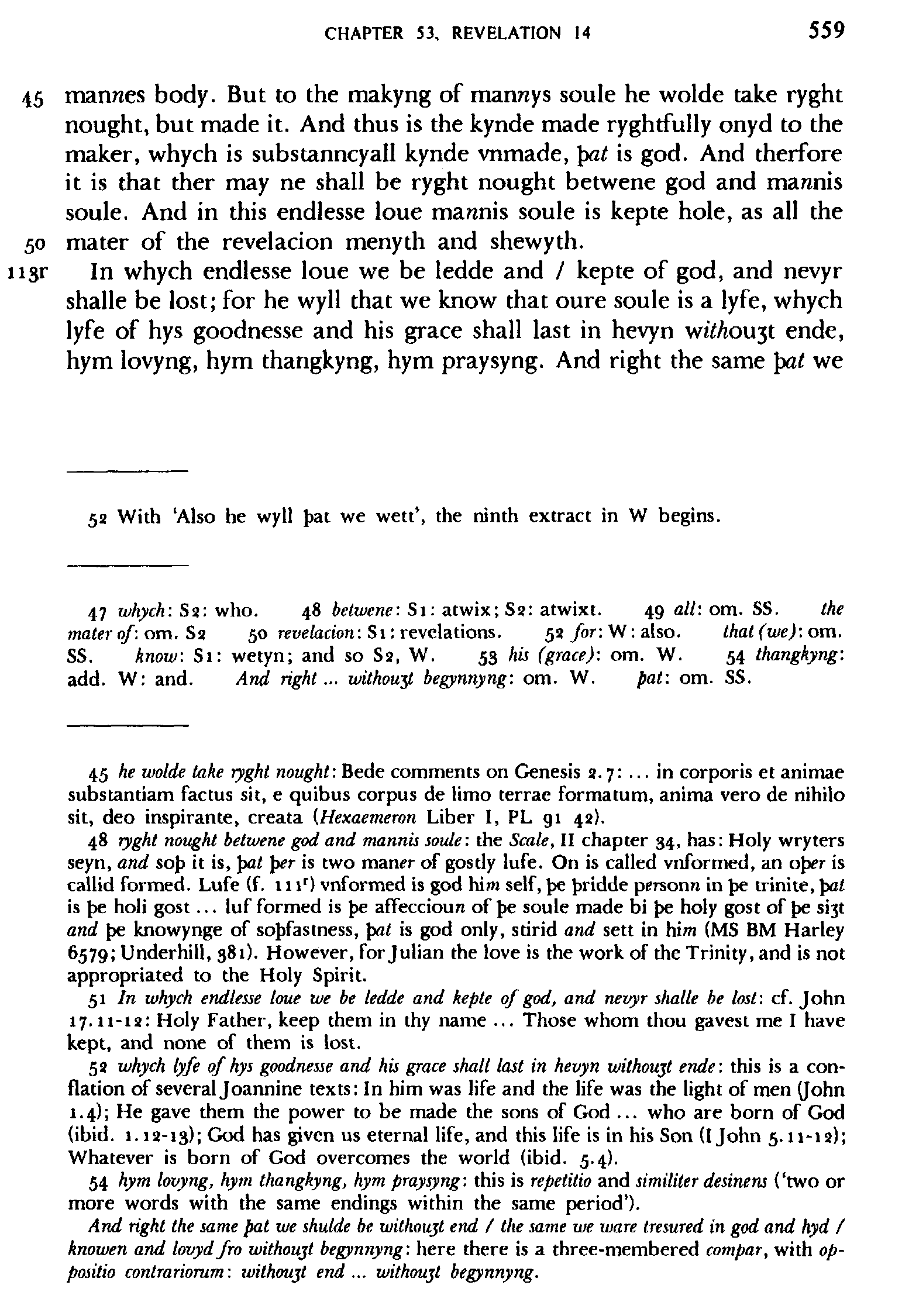
CHAPTER 53, REVELATION 14
45 marines body. But to the makyng of manrzys soule he wolde take ryght nought, but made it. And thus is the kynde made ryghtfully onyd to the maker, whych is substanncyall kynde vnmade, \>at is god. And therfore it is that ther may ne shall be ryght nought betwene god and maranis soule. And in this endlesse loue maranis soule is kepte hole, as all the 50 mater of the revelacion menyth and shewyth. ugr In whych endlesse loue we be ledde and / kepte of god, and nevyr shalle be lost; for he wyll that we know that oure soule is a lyfe, whych lyfe of hys goodnesse and his grace shall last in hevyn withou^t ende, hym lovyng, hym thangkyng, hym praysyng. And right the same \>at we
52 With 'Also he wyll pat we wett', the ninth extract in W begins.
47 whych: Ss: who.
48 betwene: Si: atwix; 82: atwixt.
49 all: om. SS. the mater of: om. Sa 50 revelacion: Si: revelations.
52 for: W: also. that (we): om.
SS. know: Si: wetyn; and so Sa, W.
53 his (grace): om. W.
54 thangkyng: add. W: and.
And right... without begynnyng: om. W. pat: om. SS.
45 he wolde take ryght nought: Bede comments on Genesis 2.7: ... in corporis et animae subs tan tiam factus sit, e quibus corpus de limo terrae formatum, anima vero de nihilo sit, deo inspirante, creata (Hexaemeron Liber I, PL 91 42).
48 ryght nought betwene god and mannis soule: the Scale, II chapter 34, has: Holy wryters seyn, and sop it is, \Mt \>er is two man^r of gostly lufe. On is called vnformed, an oper is callid formed. Lufe (f. 11 ir) vnformed is god him self, pe pridde pmonre in pe trinite, \>at is pe holi gost ... luf formed is pe affeccioun of pe soule made bi pe holy gost of pe SITJL and pe knowynge of sopfastness, pa/ is god only, stirid and sett in him (MS BM Harley
6579; Underbill, 381). However, for Julian the love is the work of the Trinity, and is not appropriated to the Holy Spirit.
51 In whych endlesse loue we be ledde and kepte of god, and nevyr shalle be lost: cf. John
17.11-12: Holy Father, keep them in thy name ... Those whom thou gavest me I have kept, and none of them is lost.
52 whych lyfe of hys goodnesse and his grace shall last in hevyn withoujt ende: this is a conflation of several Joannine texts: In him was life and the life was the light of men (John
1.4); He gave them the power to be made the sons of God ... who are born of God (ibid. 1.12-13); God has given us eternal life, and this life is in his Son (I John 5.11-12);
Whatever is born of God overcomes the world (ibid. 5.4).
54 hym lovyng, hym thangkyng, hym praysyng: this is repetitio and similiter desineru ('two or more words with the same endings within the same period').
And right the same pat we shulde be withoujt end / the same we ware tresured in god and hyd / knowen and lovydfro withoujt begynnyng: here there is a three-membered compar, with oppositio contrariorum: withoujt end... withoujt begynnyng.
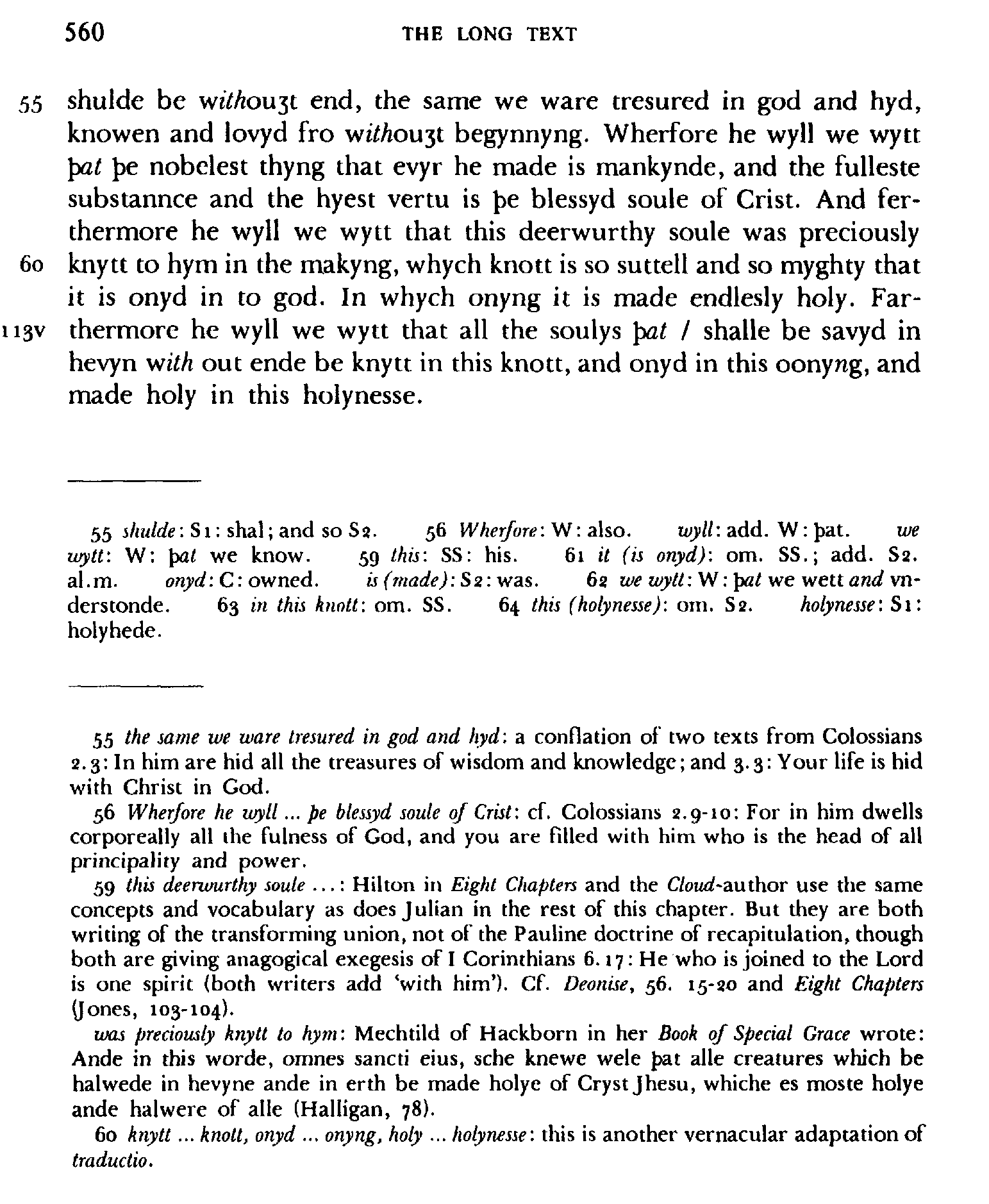
THE LONG TEXT
55 shulde be wzY/ioujt end, the same we ware tresured in god and hyd, knowen and lovyd fro vfithou^t begynnyng. Wherfore he wyll we wytt
Jxz£ Jje nobelest thyng that evyr he made is mankynde, and the fulleste substannce and the hyest vertu is |)e blessyd soule of Crist. And ferthermore he wyll we wytt that this deerwurthy soule was preciously
60 knytt to hym in the makyng, whych knott is so suttell and so myghty that it is onyd in to god. In whych onyng it is made endlesly holy. Fariisv thermore he wyll we wytt that all the soulys Ipat I shalle be savyd in hevyn with out ende be knytt in this knott, and onyd in this oonyng, and made holy in this holynesse.
55 shulde: Si: shal; and so Sa.
56 Wherfore: W: also. wyll: add. W: pat. we wytt: W: \>at we know.
59 this: SS: his.
61 it (is onyd): om. SS.; add. Sa. al.m. onyd: C: owned. is (made): Sa: was.
6a we wytt: W: pa/ we wett and vnderstonde.
63 in this knott: om. SS.
64 this (holynesse): om. Sa. holynesse: Si: holyhede.
55 the same we ware tresured in god and hyd: a conflation of two texts from Colossians
3.3: In him are hid all the treasures of wisdom and knowledge; and 3.3: Your life is hid with Christ in God.
56 Wherfore he wyll... pe blessyd soule of Crist: cf. Colossians a.9-10: For in him dwells corporeally all the fulness of God, and you are filled with him who is the head of all principality and power.
59 this deerwurthy soule ...: Hilton in Eight Chapters and the Cloud-author use the same concepts and vocabulary as does Julian in the rest of this chapter. But they are both writing of the transforming union, not of the Pauline doctrine of recapitulation, though both are giving anagogical exegesis of I Corinthians 6.17: He who is joined to the Lord is one spirit (both writers add 'with him'). Cf. Deonise, 56. 15-30 and Eight Chapters
(Jones, 103-104). was preciously knytt to hym: Mechtild of Hackborn in her Book of Special Grace wrote:
Ande in this worde, omnes sancti eius, sche knewe wele pat alle creatures which be halwede in hevyne ande in erth be made holye of Cryst Jhesu, whiche es moste holye ande halwere of alle (Halligan, 78).
60 knytt... knott, onyd ... onyng, holy ... holynesse: this is another vernacular adaptation of traductio.
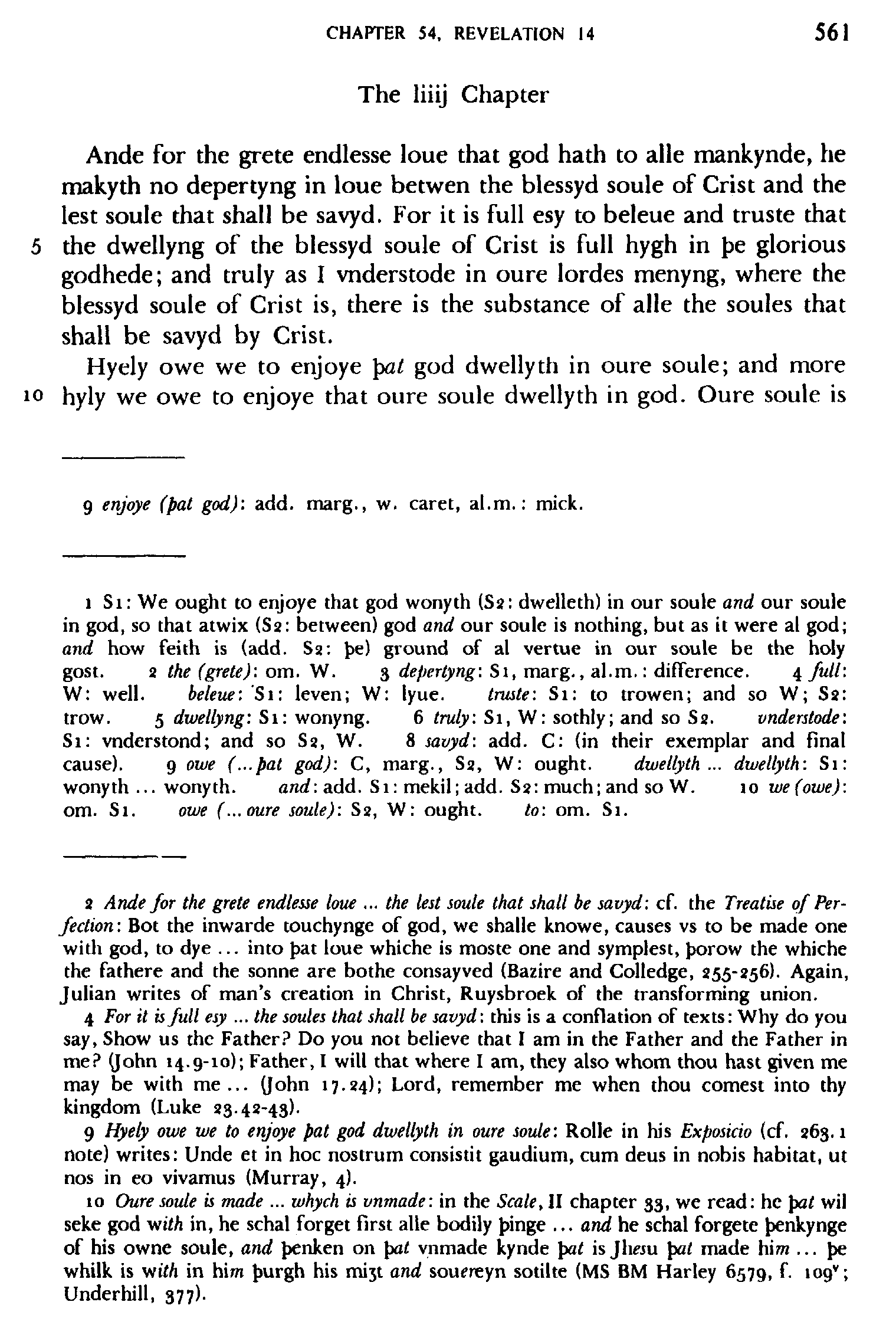
CHAPTER 54, REVELATION 14
The liiij Chapter Ande for the grete endlesse loue that god hath to alle mankynde, he makyth no depertyng in loue betwen the blessyd soule of Crist and the lest soule that shall be savyd. For it is full esy to beleue and truste that 5 the dwellyng of the blessyd soule of Crist is full hygh in l>e glorious godhede; and truly as I vnderstode in oure lordes menyng, where the blessyd soule of Crist is, there is the substance of alle the soules that shall be savyd by Crist.
Hyely owe we to enjoye \>at god dwellyth in oure soule; and more 10 hyly we owe to enjoye that oure soule dwellyth in god. Oure soule is
9 enjoye (pat god)', add. marg., w. caret, al.m.: mick. i Si: We ought to enjoye that god wonyth (82: dwelleth) in our soule and our soule in god, so that atwix (82: between) god and our soule is nothing, but as it were al god; and how feith is (add. 82: pe) ground of al vertue in our soule be the holy gost.
2 the (grete): om. W.
3 depertyng: Si, marg., al.m.: difference.
4 full:
W: well. beleue: 'Si: leven; W: lyue. truste: Si: to trowen; and so W; 82: trow.
5 dwellyng: Si: wonyng.
6 truly: Si, W: sothly; and so 82. vnderstode:
Si: vnderstond; and so 82, W.
8 savyd: add. C: (in their exemplar and final cause).
9 owe (...pat god): C, marg., 82, W: ought. dwellyth... dwellyth: Si: wonyth ... wonyth. and:add. Si: mekil; add. 82: much; and so W.
10 we(owe): om. Si. owe (...oure soule): 82, W: ought. to: om. Si.
2 Ande for the grete endlesse loue ... the lest soule that shall be savyd: cf. the Treatise of Perfection: Bot the inwarde touchynge of god, we shalle knowe, causes vs to be made one with god, to dye ... into pat loue whiche is moste one and symplest, ]x>row the whiche the fathere and the sonne are bothe consayved (Bazire and Colledge, 255-256). Again,
Julian writes of man's creation in Christ, Ruysbroek of the transforming union.
4 For it is full esy ... the soules that shall be savyd: this is a conflation of texts: Why do you say, Show us the Father? Do you not believe that I am in the Father and the Father in me? (John 14.9-10); Father, I will that where I am, they also whom thou hast given me may be with me ... (John 17.24); Lord, remember me when thou comest into thy kingdom (Luke 23.42-43).
9 Hyely owe we to enjoye pat god dwellyth in oure soule: Rolle in his Exfiosicio (cf. 263. i note) writes: Unde et in hoc nostrum consistit gaudium, cum deus in nobis habitat, ut nos in eo vivamus (Murray, 4).
10 Oure soule is made ... whych is vnmade: in the Scale, II chapter 33, we read: he \at wil seke god with in, he schal forget first alle bodily pinge ... and he schal forgete penkynge of his owne soule, and penken on \at vnmade kynde pa/ is Jh«u pa* made him ... pe whilk is with in him purgh his mi3t and sowneyn sotilte (MS BM Harley 6579, f. iog¥;
Underbill, 377).
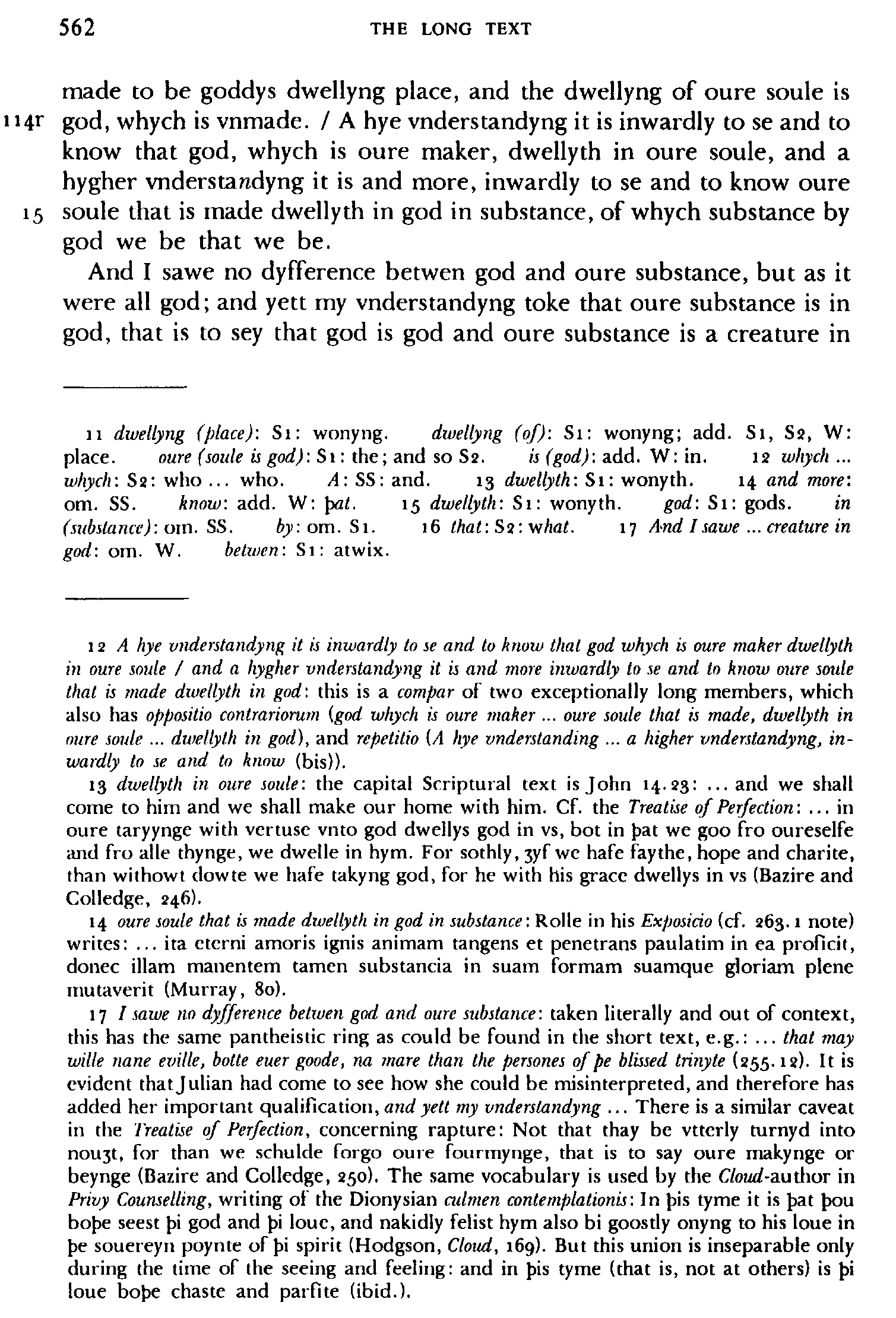
THE LONG TEXT
made to be goddys dwellyng place, and the dwellyng of oure soule is ii4.r god, whych is vnmade. / A hye vnderstandyng it is inwardly to se and to know that god, whych is oure maker, dwellyth in oure soule, and a hygher vnderstandyng it is and more, inwardly to se and to know oure
15 soule that is made dwellyth in god in substance, of whych substance by god we be that we be.
And I sawe no dyfference betwen god and oure substance, but as it were all god; and yett my vnderstandyng toke that oure substance is in god, that is to sey that god is god and oure substance is a creature in 11 dwellyng (f)lace):
Si: wonyng. dwellyng (of): Si: wonyng; add. Si, Sa, W: place. oure (soule is god): Si: the; and so Sa. is (god): add. W: in.
12 whych ... whych: Sa: who ... who.
A: SS: and.
13 dwellyth: Si: wonyth.
14 and more: om. SS. know: add. W: pa/.
15 dwellyth: Si: wonyth. god: Si: gods. in (substance): om. SS. by.om.Si.
16 that: Sa: what.
17 And I sawe ... creature in god: om. W. betwen: Si: atwix.
1 2 / 4 hye vnderstandyng it is inwardly to se and to know that god whych is oure maker dwellyth in oure soule / and a hygher vnderstandyng it is and more inwardly to se and to know oure soule that is made dwellyth in god: this is a compar of two exceptionally long members, which also has oppositio contrariorum (god whych is oure maker ... oure soule that is made, dwellyth in oure soule ... dwellyth in god), and repetitio (A hye vnderstanding ... a higher vnderstandyng, inwardly to se and to know (bis)).
13 dwellyth in oure soule: the capital Scriptural text is John 14.23: ... and we shall come to him and we shall make our home with him. Cf. the Treatise of Perfection: ... in oure taryynge with vertuse vnto god dwellys god in vs, bot in pat we goo fro oureselfe and fro alle thynge, we dwelle in hym. For sothly, 3yf we hafe faythe, hope and charite, than withowt dowte we hafe takyng god, for he with his grace dwellys in vs (Bazire and Colledge, 246).
14 oure soule that is made dwellyth in god in substance: Rolle in his Exposido (cf. 263. i note) writes: ... ita etcrni amoris ignis animam tangens et penetrans paulatim in ea proficit, donee illam manentem tamen substancia in suam formam suamque gloriam plene mutaverit (Murray, 80).
17 / sawe no dyfference betwen god and oure substance: taken literally and out of context, this has the same pantheistic ring as could be found in the short text, e.g.: ... that may wille none eville, botte euer goods, na mare than the persones of pe blissed trinyte (255.12). It is evident that Julian had come to see how she could be misinterpreted, and therefore has added her important qualification, and yett my vnderstandyng ... There is a similar caveat in the Treatise of Perfection, concerning rapture: Not that thay be vtterly turnyd into nou3t, for than we schulde forgo oure fourmynge, that is to say oure makynge or beynge (Bazire and Colledge, 250). The same vocabulary is used by the C/ow^-author in Privy Counselling, writing of the Dionysian admen contemplation^'. In pis tyme it is pat pou bope seest pi god and pi louc, and nakidly felist hym also bi goostly onyng to his loue in pe souereyn poynte of pi spirit (Hodgson, Cloud, 169). But this union is inseparable only during the time of the seeing and feeling: and in pis tyme (that is, not at others) is pi loue bo{>e chaste and parfite (ibid.).
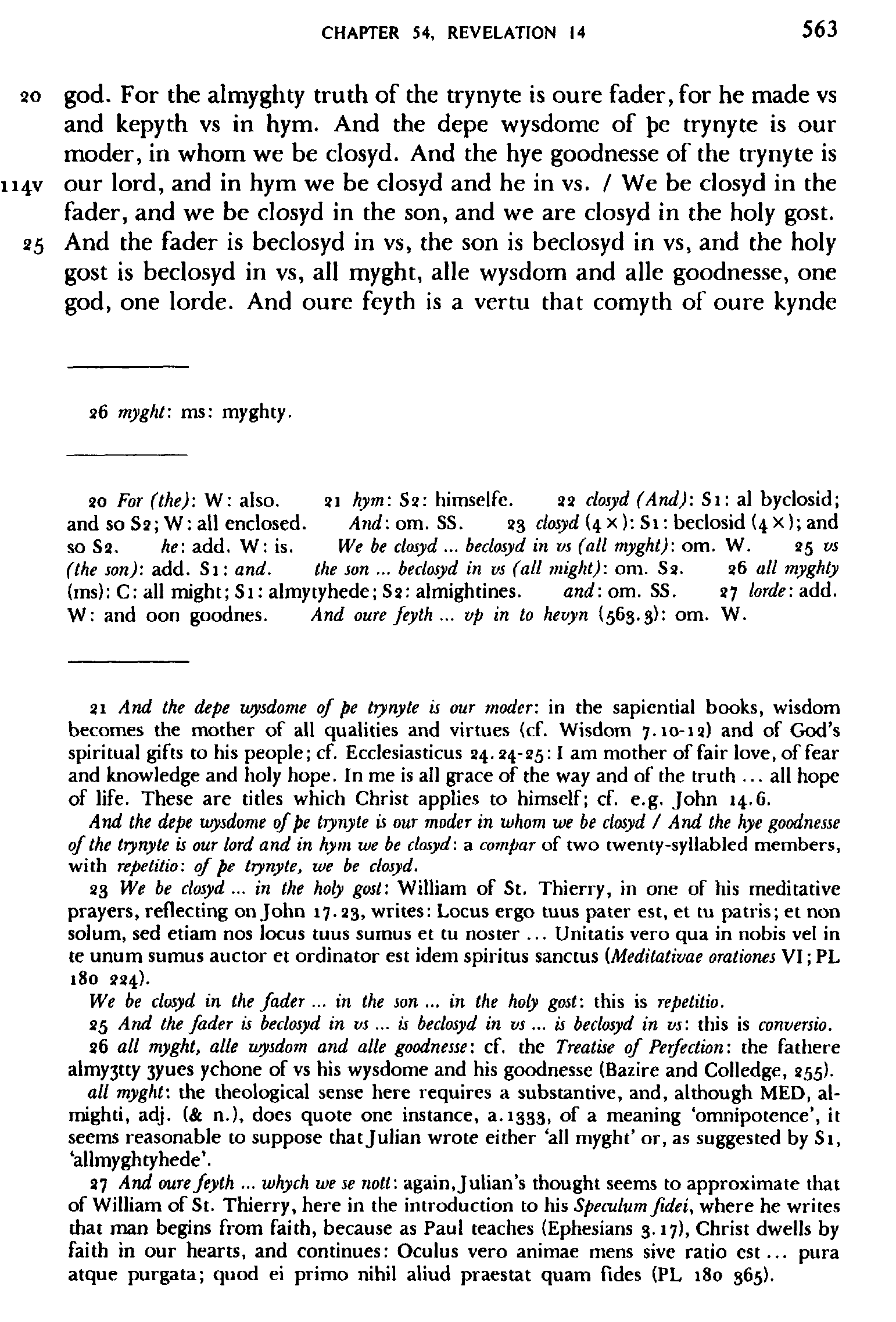
CHAPTER 54, REVELATION 14
20 god. For the almyghty truth of the trynyte is oure fader, for he made vs and kepyth vs in hym. And the depe wysdome of Jje trynyte is our moder, in whom we be closyd. And the hye goodnesse of the trynyte is i4v our lord, and in hym we be closyd and he in vs. / We be closyd in the 114v fader, and we be closyd in the son, and we are closyd in the holy gost.
25 And the fader is beclosyd in vs, the son is beclosyd in vs, and the holy gost is beclosyd in vs, all myght, alle wysdom and alle goodnesse, one god, one lorde. And oure feyth is a vertu that comyth of oure kynde
26 myght: ms: myghty.
20 For (the): W: also.
21 hym: 82: himselfe.
22 closyd (And): Si: al byclosid; and so 82; W: all enclosed.
And: om. SS.
23 closyd (4 x): Si: beclosid (4 x); and so 82. he: add. W: is.
We be closyd ... beclosyd in vs (all myght): om. W.
25 vs (the son): add. Si: and. the son ... beclosyd in vs (all might): om. 82.
26 all myghty (ins): C: all might; Si: almytyhede; 82: almightines. and: om. SS.
27 lorde: add.
W: and oon goodnes.
And oure feyth ... vp in to hevyn (563.3): om. W.
21 And the depe wysdome of pe trynyte is our moder: in the sapiential books, wisdom becomes the mother of all qualities and virtues (cf. Wisdom 7.10-12) and of God's spiritual gifts to his people; cf. Ecclesiasticus 24.24-25:1 am mother of fair love, of fear and knowledge and holy hope. In me is all grace of the way and of the truth ... all hope of life. These are titles which Christ applies to himself; cf. e.g. John 14.6.
And the depe wysdome of pe trynyte is our moder in whom we be closyd / And the hye goodnesse of the trynyte is our lord and in hym we be closyd: a compar of two twenty-syllabled members, with repetitio: of pe trynyte, we be closyd.
23 We be closyd... in the holy gost: William of St. Thierry, in one of his meditative prayers, reflecting on John 17.23, writes: Locus ergo tuus pater est, et tu patris; et non solum, sed etiam nos locus tuus sumus et tu noster ... Unitatis vero qua in nobis vel in te unum sumus auctor et ordinator est idem spiritus sanctus (Meditativae orationes VI; PL
180 224).
We be closyd in the fader ... in the son ... in the holy gost: this is repetitio.
25 And the fader is beclosyd in vs ... is beclosyd in vs ... is beclosyd in vs: this is conversio.
26 all myght, alle wysdom and alle goodnesse: cf. the Treatise of Perfection: the fa there almy3tty 3yues ychone of vs his wysdome and his goodnesse (Bazire and Colledge, 255). all myght: the theological sense here requires a substantive, and, although MED, alrnighti, adj. (& n.), does quote one instance, 3.1333, of a meaning 'omnipotence', it seems reasonable to suppose that Julian wrote either 'all myght' or, as suggested by Si,
'allmyghtyhede'.
27 And oure feyth ... whych we se nott: again, Julian's thought seems to approximate that of William of St. Thierry, here in the introduction to his Speculum fidei, where he writes that man begins from faith, because as Paul teaches (Ephesians 3.17), Christ dwells by faith in our hearts, and continues: Oculus vero animae mens sive ratio est... pura atque purgata; quod ei primo nihil aliud praestat quam fides (PL 180 365).
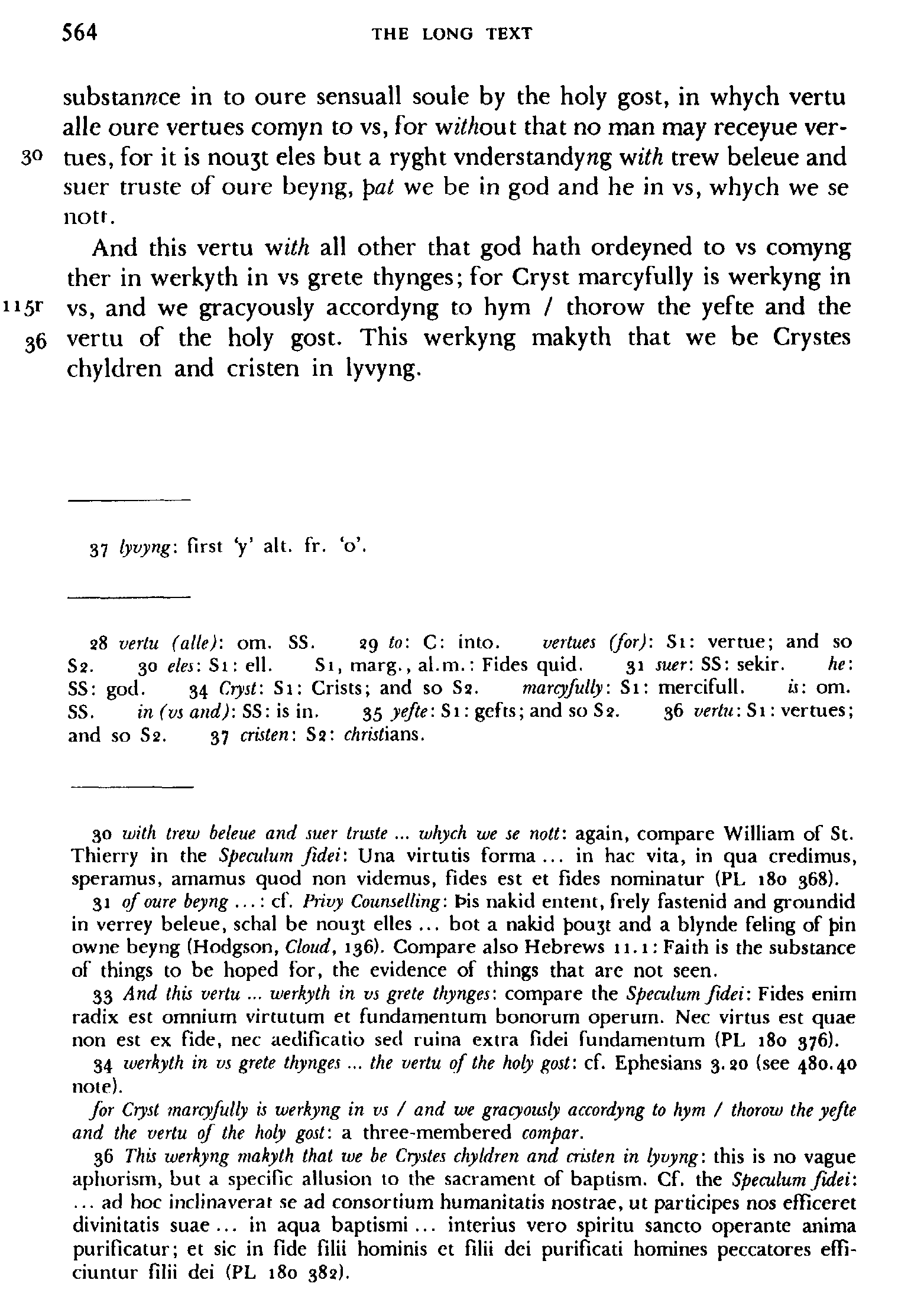
THE LONG TEXT
substarmce in to oure sensuall soule by the holy gost, in whych vertu alle oure vertues comyn to vs, for -without that no man may receyue ver3° tues, for it is nou3t eles but a ryght vnderstandyng with trew beleue and suer truste of oure beyng, \>at we be in god and he in vs, whych we se notr.
And this vertu with all other that god hath ordeyned to vs comyng ther in werkyth in vs grete thynges; for Cryst marcyfully is werkyng in Il5r vs, and we gracyously accordyng to hym / thorow the yefte and the 36 vertu of the holy gost. This werkyng makyth that we be Crystes chyldren and cristen in lyvyng.
37 lyvyng: first 'y' allfr- '°'
28 vertu (alle): om. SS.
29 to: C: into. vertues (for): Si: vertue; and so 82.
30 eles: Si: ell.
Si, marg., al.m.: Fides quid.
31 suer: SS: sekir. he:
SS: god.
34 Cryst: Si: Grists; and so 82. marcyfully: Si: mercifull. is: om.
SS. in (vi and): SS: is in.
35 yefte: Si: gefts; and so 82.
36 vertu: Si: vertues; and so 82.
37 cristen: 82: Christians.
30 with trew beleue and suer truste ... whych we se nott: again, compare William of St.
Thierry in the Speculum ftdei: Una virtutis forma... in hac vita, in qua credimus, speramus, amamus quod non videmus, fides est et fides nominatur (PL 180 368).
31 of oure beyng ...: cf. Privy Counselling: t>is nakicl entent, frely fastenid and groundid in verrey beleue, schal be nou3t elles ... bot a nakid pou3t and a blynde feling of fyin owne beyng (Hodgson, Cloud, 136). Compare also Hebrews M.I: Faith is the substance of things to be hoped for, the evidence of things that are not seen.
33 And this vertu ... werkyth in vs grete thynges: compare the Speculum fidei: Fides enim radix est omnium virtutum et fundamentum bonorum operum. Nee virtus est quae non est ex fide, nee aedificatio sed ruina extra fidei fundamentum (PL 180 376).
34 werkyth in vs grete thynges ... the vertu of the holy gost: cf. Ephesians 3.20 (see 480.40 note). for Cryst marcyfully is werkyng in vs / and we gracyously accordyng to hym / thorow the yefte and the vertu of the holy gost: a three-membered compar.
36 This werkyng makyth that we be Crystes chyldren and cristen in lyvyng: this is no vague aphorism, but a specific allusion to the sacrament of baptism. Cf. the Speculum fidei:
... ad hoc inclinaverat se ad consortium humanitatis nostrae, ut participes nos efficeret divinitatis suae... in aqua baptismi... interius vero spiritu sancto operante anima purificatur; et sic in fide filii hominis et filii dei purificati homines peccatores eificiuntur filii dei (PL 180 382).
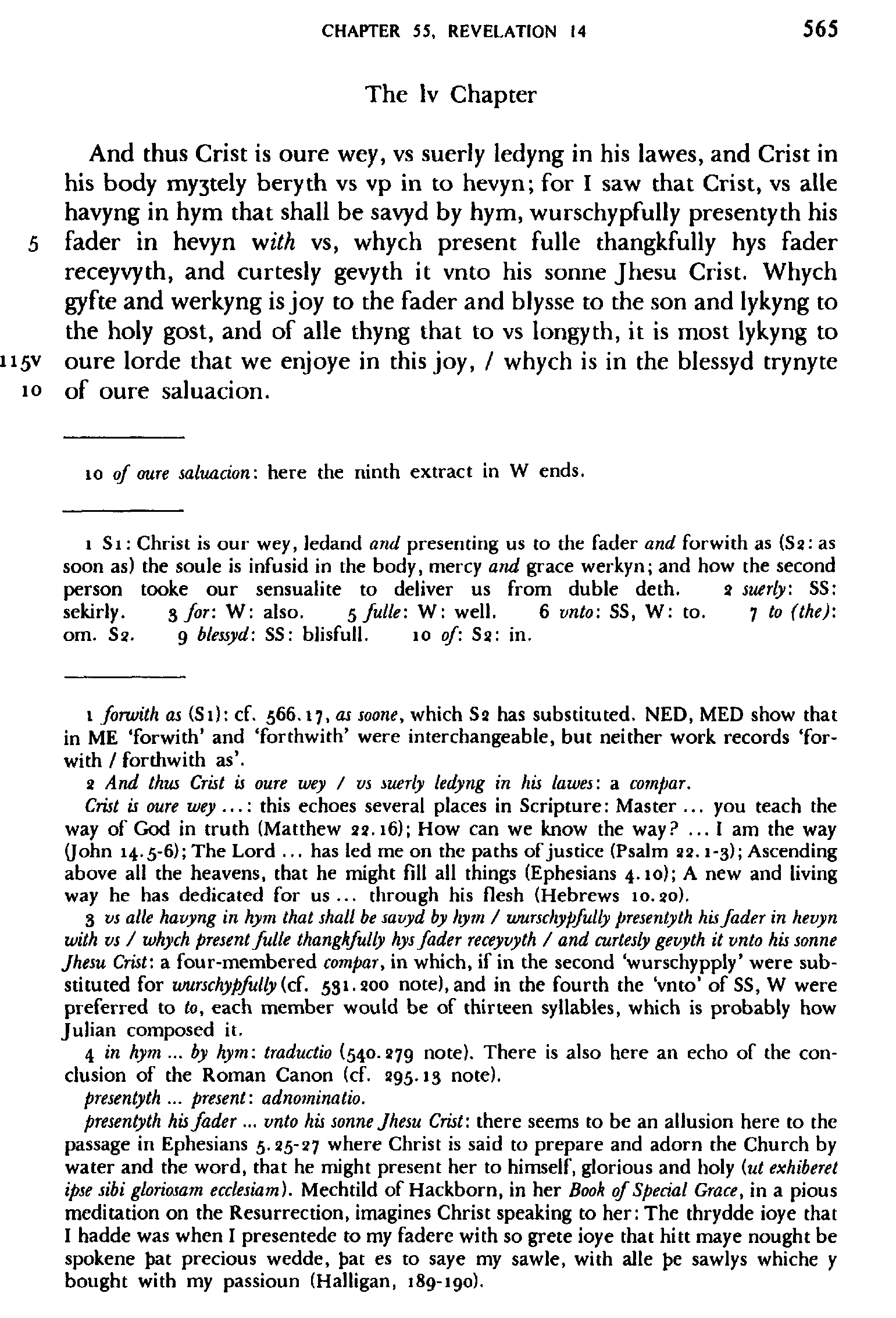
CHAPTER 55, REVELATION 14
The Iv Chapter And thus Crist is oure wey, vs suerly ledyng in his lawes, and Crist in his body myjtely beryth vs vp in to hevyn; for I saw that Crist, vs alle havyng in hym that shall be savyd by hym, wurschypfully presentyth his
5 fader in hevyn with vs, whych present fulle thangkfully hys fader receyvyth, and curtesly gevyth it vnto his sonne Jhesu Crist. Whych gyfte and werkyng is joy to the fader and blysse to the son and lykyng to the holy gost, and of alle thyng that to vs longyth, it is most lykyng to ii5v oure lorde that we enjoye in this joy, / whych is in the blessyd trynyte
10 of oure saluacion.
10 of oure saluacion: here the ninth extract in W ends. i Si: Christ is our wey, ledand and presenting us to the fader and forwith as (82: as soon as) the soule is infusid in the body, mercy and grace werkyn; and how the second person tooke our sensualite to deliver us from duble deth.
2 suerly: SS: sekirly.
3 for: W: also.
5 fulle: W: well.
6 vnto: SS, W: to.
7 to (the): om. J>2.
9 blessyd: SS: blisfull.
10 of: 82: in.
1 forwith as (Si): cf. 566.17, as soone, which 82 has substituted. NED, MED show that in ME 'forwith' and 'forthwith' were interchangeable, but neither work records 'forwith / forthwith as'.
2 And thus Crist is oure wey / vs suerly ledyng in his lawes: a compar.
Crist is oure wey ...: this echoes several places in Scripture: Master ... you teach the way of God in truth (Matthew 22.16); How can we know the way? ... I am the way
(John 14.5-6); The Lord ... has led me on the paths of justice (Psalm 22.1-3); Ascending above all the heavens, that he might fill all things (Ephesians 4.10); A new and living way he has dedicated for us... through his flesh (Hebrews 10.20).
3 vs alle havyng in hym that shall be savyd by hym / wurschypfully presentyth his fader in hevyn with vs / whych present fulle thangkfully hys fader receyvyth / and curtesly gevyth it vnto his sonne
Jhesu Crist: a four-membered compar, in which, if in the second 'wurschypply' were substituted for wurschypfully (cf. 531.200 note), and in the fourth the Vnto' of SS, W were preferred to to, each member would be of thirteen syllables, which is probably how
Julian composed it.
4 in hym ... by hym: traductio (540.279 note). There is also here an echo of the conclusion of the Roman Canon (cf. 295.13 note). presentyth ... present: adnominatio. presentyth his fader ... vnto his sonne Jhesu Crist: there seems to be an allusion here to the passage in Ephesians 5.25-27 where Christ is said to prepare and adorn the Church by water and the word, that he might present her to himself, glorious and holy (ut exhiberet ipse sibi gloriosam ecdesiam). Mechtild of Hackborn, in her Book of Special Grace, in a pious meditation on the Resurrection, imagines Christ speaking to her: The thrydde ioye that I hadde was when I presentede to my fadere with so grete ioye that hitt maye nought be spokene £at precious wedde, J>at es to saye my sawle, with alle |>e sawlys whiche y bought with my passioun (Halligan, 189-190).
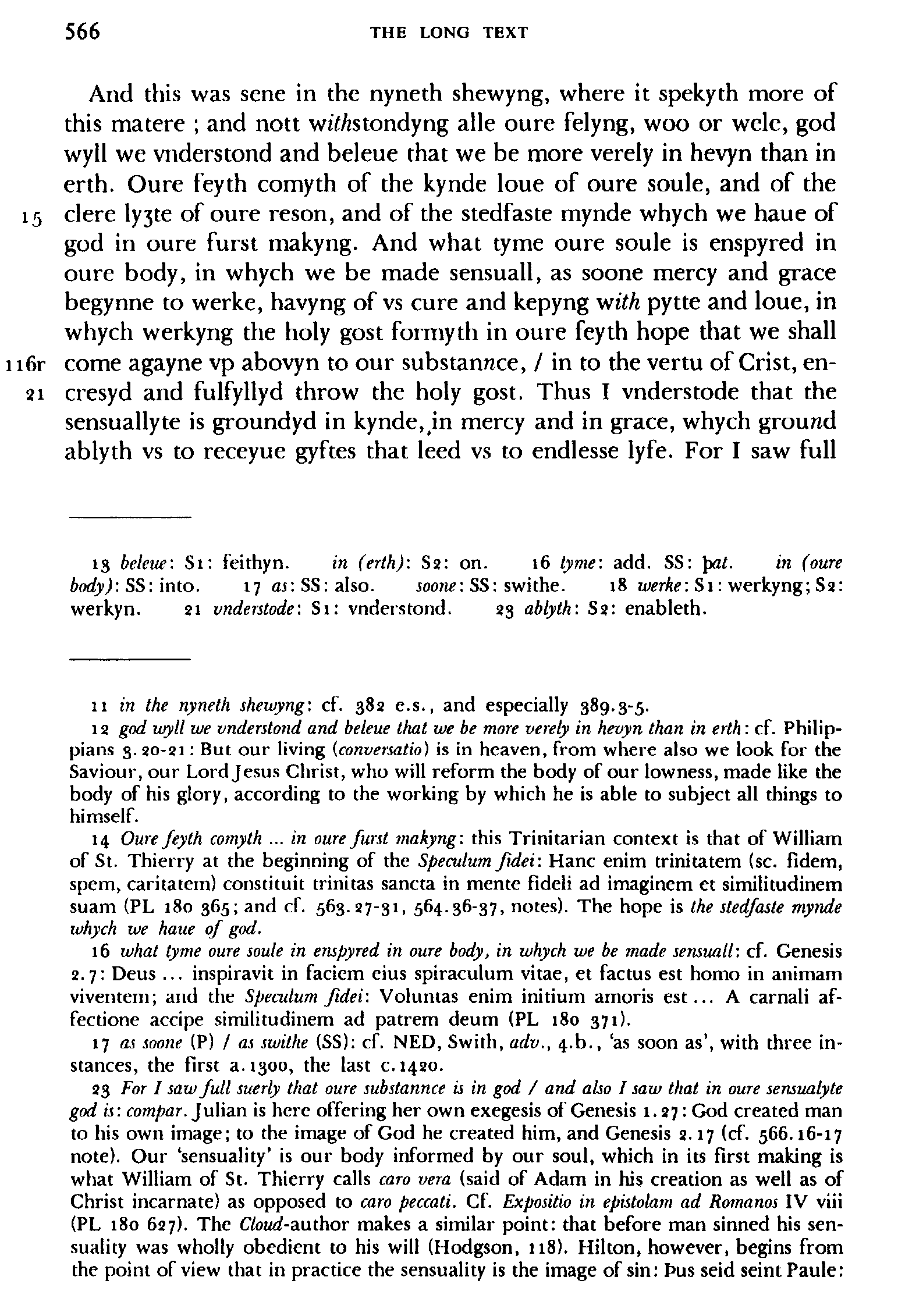
THE LONG TEXT
And this was sene in the nyneth shewyng, where it spekyth more of this matere ; and nott w^/istondyng alle oure felyng, woo or wele, god wyll we vnderstond and beleue that we be more verely in hevyn than in erth. Oure feyth comyth of the kynde loue of oure soule, and of the 15 clere Iy3te of oure reson, and of the stedfaste mynde whych we haue of god in oure furst makyng. And what tyme oure soule is enspyred in oure body, in whych we be made sensuall, as soone mercy and grace begynne to werke, havyng of vs cure and kepyng with pytte and loue, in whych werkyng the holy gost formyth in oure feyth hope that we shall ii6r come agayne vp abovyn to our substannce, / in to the vertu of Crist, en21 cresyd and fulfyllyd throw the holy gost. Thus I vnderstode that the sensuallyte is groundyd in kynde,tin mercy and in grace, whych ground ablyth vs to receyue gyftes that leed vs to endlesse lyfe. For I saw full
13 beleue: Si: feithyn. in (erth): Sa: on.
16 tyme: add. SS: tyt. in (oure body): SS: into.
17 as: SS: also. soone: SS: swithe.
18 werke: Si: werkyng; Sa: werkyn.
21 vnderstode: Si: vnderstond.
23 ablyth: 82: enableth.
11 in the nyneth shewyng: cf. 382 e.s., and especially 389.3-5.
12 god wyll we vnderstond and beleue that we be more verely in hevyn than in erth: cf. Philippians 3. 20-21: But our living (conversatio) is in heaven, from where also we look for the Saviour, our Lord Jesus Christ, who will reform the body of our lowness, made like the body of his glory, according to the working by which he is able to subject all things to himself.
14 Oure feyth comyth ... in oure furst ?nakyng: this Trinitarian context is that of William of St. Thierry at the beginning of the Speculum fidei: Hanc enim trinitatem (sc. fidem, spem, caritatem) constituit trinitas sancta in mente fideli ad imaginem et similitudinem suam (PL 180 365; and cf. 563.27-31, 564.36-37, notes). The hope is the stedfaste mynde whych we haue of god.
16 what tyme oure soule in enspyred in oure body, in whych we be made sensuall: cf. Genesis
2.7: Deus ... inspiravit in faciem eius spiraculum vitae, et factus est homo in animam viventem; and the Speculum fidei: Voluntas enim initium amoris est... A carnali affectione accipe similitudinem ad patrem deum (PL 180 371).
17 as soone (P) / as swithe (SS): cf. NED, Swith, adv., 4-b., 'as soon as", with three instances, the first 3.1300, the last c.1420.
23 For I saw full suerly that oure substannce is in god / and also I saw that in oure sensualyte god is: compar. Julian is here offering her own exegesis of Genesis 1.27: God created man to his own image; to the image of God he created him, and Genesis 2.17 (cf. 566.16-17 note). Our 'sensuality' is our body informed by our soul, which in its first making is what William of St. Thierry calls caw vera (said of Adam in his creation as well as of Christ incarnate) as opposed to caro peccati. Cf. Expositio in epistolam ad Romanos IV viii (PL 180 627). The Cloud-author makes a similar point: that before man sinned his sensuality was wholly obedient to his will (Hodgson, 118). Hilton, however, begins from the point of view that in practice the sensuality is the image of sin: t>us seid seint Paule:
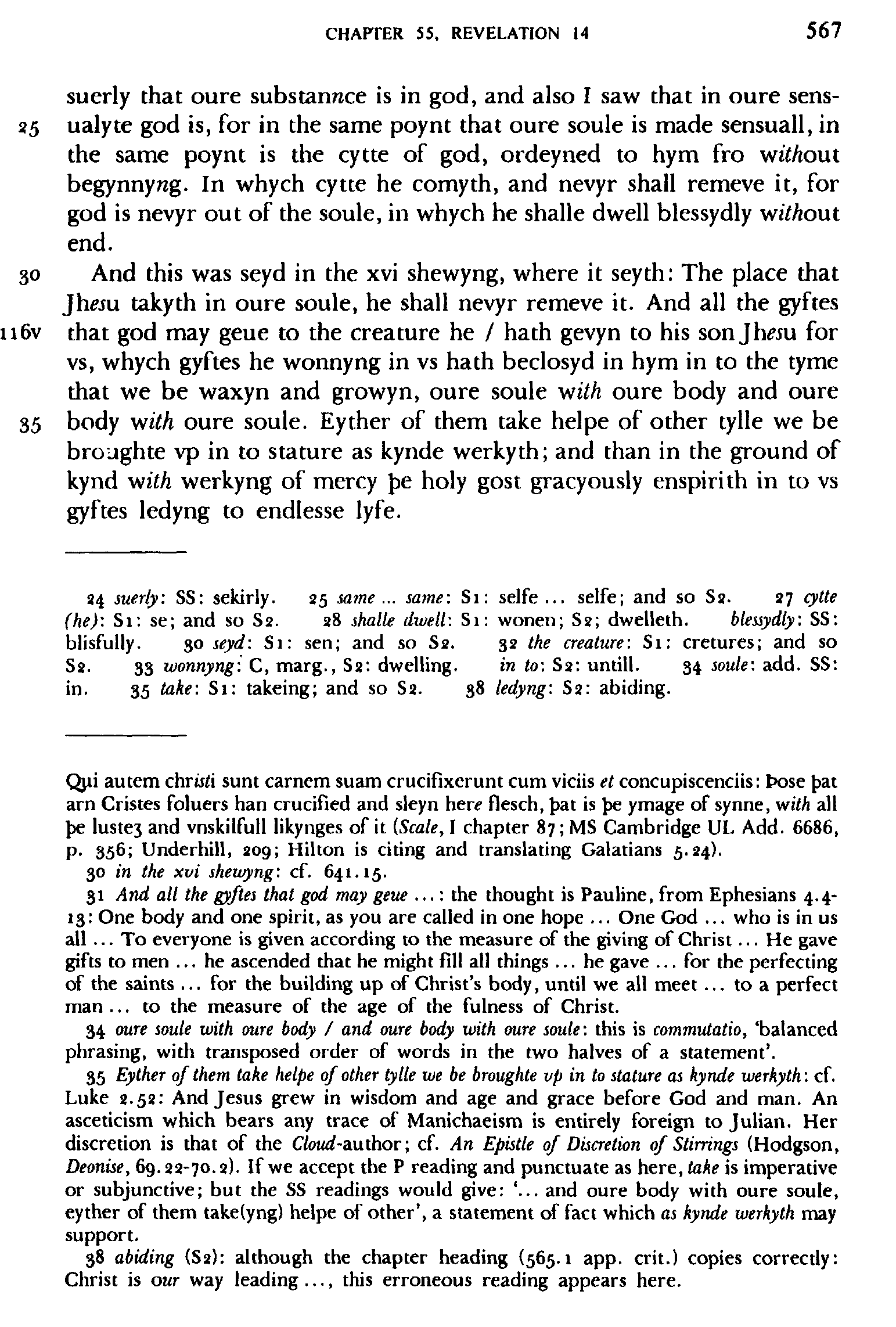
CHAPTER 55, REVELATION 14
suerly that cure substannce is in god, and also I saw that in oure sens-
ualyte god is, for in the same poynt that oure soule is made sensuall, in the same poynt is the cytte of god, ordeyned to hym fro without begynnyrag. In whych cytte he comyth, and nevyr shall remeve it, for god is nevyr out of the soule, in whych he shalle dwell blessydly without end.
And this was seyd in the xvi shewyng, where it seyth: The place that ]hesu takyth in oure soule, he shall nevyr remeve it. And all the gyftes ii6v that god may geue to the creature he / hath gevyn to his sonjhmi for vs, whych gyftes he wonnyng in vs hath beclosyd in hym in to the tyme that we be waxyn and growyn, oure soule with oure body and oure
35 body with oure soule. Eyther of them take helpe of other tylle we be broughte vp in to stature as kynde werkyth; and than in the ground of kynd with werkyng of mercy fie holy gost gracyously enspirith in to vs gyftes ledyng to endlesse lyfe.
24 suerly: SS: sekirly.
25 same ... same: Si: selfe ... selfe; and so 82.
27 cytte (he): Si: se; and so 82.
28 shalle dwell: Si: wonen; 82; dwelleth. blessydly: SS: blisfully.
30 seyd: Si: sen; and so 82.
32 the creature: Si: cretures; and so 82.
33 wonnyng: C, marg., 82: dwelling. in to: 82: untill.
34 soule: add. SS: in.
35 take: Si: takeing; and so 82.
38 ledyng: 82: abiding.
Qui autem christi sunt carnem suam crucifixerunt cum viciis et concupiscenciis: t>ose f>at arn Cristes foluers han crucified and sleyn here flesch, pat is }je ymage of synne, -with all pe Iuste3 and vnskilfull likynges of it (Scale, I chapter 87; MS Cambridge UL Add. 6686, p. 356; Underbill, 209; Hilton is citing and translating Galatians 5.24).
30 in the xvi shewyng: cf. 641.15.
31 And all the gyftes that god may geue ...: the thought is Pauline, from Ephesians 4.413: One body and one spirit, as you are called in one hope ... One God ... who is in us all ... To everyone is given according to the measure of the giving of Christ... He gave gifts to men ... he ascended that he might fill all things ... he gave ... for the perfecting of the saints ... for the building up of Christ's body, until we all meet... to a perfect man ... to the measure of the age of the fulness of Christ.
34 oure soule with oure body / and oure body with oure soule: this is commutatio, 'balanced phrasing, with transposed order of words in the two halves of a statement'.
35 Eyther of them take helpe of other tylle we be broughte vp in to stature as kynde werkyth: cf.
Luke 2.52: And Jesus grew in wisdom and age and grace before God and man. An asceticism which bears any trace of Manichaeism is entirely foreign to Julian. Her discretion is that of the Cloud-author; cf. An Epistle of Discretion of Stirrings (Hodgson,
Deonise, 69.22-70.2). If we accept the P reading and punctuate as here, take is imperative or subjunctive; but the SS readings would give: '... and oure body with oure soule, eyther of them take(yng) helpe of other', a statement of fact which as kynde werkyth may support.
38 abiding (82): although the chapter heading (565.1 app. crit.) copies correctly:
Christ is our way leading ..., this erroneous reading appears here.
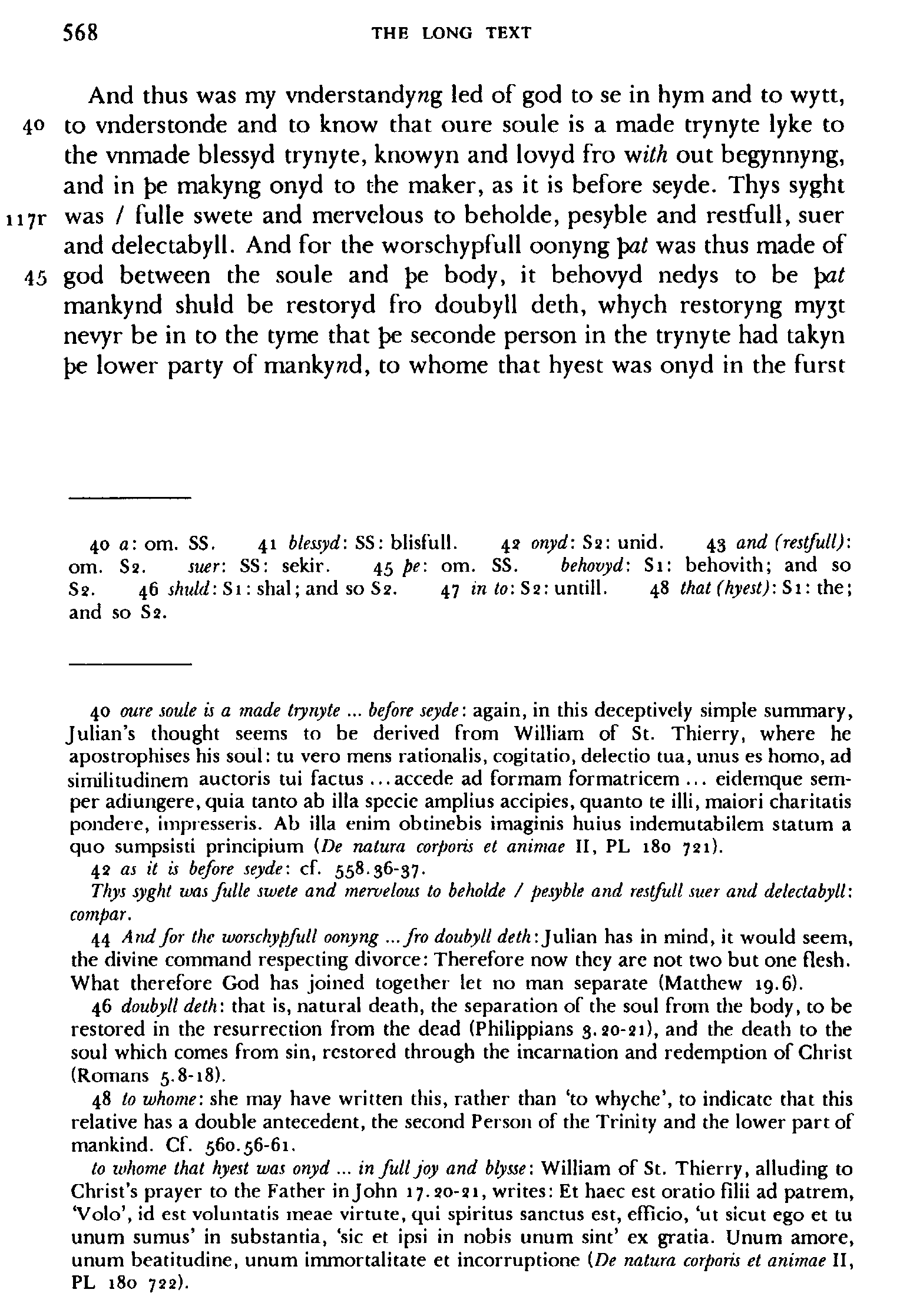
THE LONG TEXT
And thus was my vnderstandyng led of god to se in hym and to wytt, 4° to vnderstonde and to know that oure soule is a made trynyte lyke to the vnmade blessyd trynyte, knowyn and lovyd fro with out begynnyng, and in Jje makyng onyd to the maker, as it is before seyde. Thys syght iiyr was / fulle swete and mervelous to beholde, pesyble and restfull, suer and delectabyll. And for the worschypfull oonyng \xit was thus made of 45 god between the soule and be body, it behovyd nedys to be ]Mt mankynd shuld be restoryd fro doubyll deth, whych restoryng my3t nevyr be in to the tyme that £>e seconde person in the trynyte had takyn
£>e lower party of mankynd, to whome that hyest was onyd in the furst 40 a: om. SS.
41 blessyd: SS: blisfull.
42 onyd: 82: unid.
43 and (restfull): om. 82. suer: SS: sekir.
45 pe: om. SS. behovyd: Si: behovith; and so 82.
46 shuld: Si: shal; and so 82.
47 in to: 82: untill.
48 that (hyest): Si: the; and so 82.
40 oure soule is a made trynyte ... before seyde: again, in this deceptively simple summary,
Julian's thought seems to be derived from William of St. Thierry, where he apostrophises his soul: tu vero mens rationalis, cogitatio, delectio tua, unus es homo, ad similitudinem auctoris tui factus ...accede ad formam formatricem ... eidemque semper adiungere, quia tanto ab ilia specie amplius accipies, quanto te illi, maiori charitatis pondere, impresseris. Ab ilia enim obtinebis imaginis huius indemutabilem statum a quo sumpsisti principium (De natura carports et animae II, PL 180 721).
42 as it is before seyde: cf. 558.36-37.
Thys syght was fulle swete and mervelous to beholde / pesyble and restfull suer and delectabyll: compar.
44 And for the worschypfull oonyng ...fro doubyll deth: Julian has in mind, it would seem, the divine command respecting divorce: Therefore now they are not two but one flesh.
What therefore God has joined together let no man separate (Matthew 19.6).
46 doubyll deth: that is, natural death, the separation of the soul from/the body, to be restored in the resurrection from the dead (Philippians 3.20-21), ana the death to the soul which comes from sin, restored through the incarnation and redemption of Christ
(Romans 5.8-18).
48 to whome: she may have written this, rather than 'to whyche', to indicate that this relative has a double antecedent, the second Person of the Trinity and the lower part of mankind. Cf. 560.56-61. to whome that hyest was onyd ... in full joy and blysse: William of St. Thierry, alluding to Christ's prayer to the Father injohn 17.20-21, writes: Et haec est oratio filii ad patrem,
'Volo', id est voluntatis meae virtute, qui spiritus sanctus est, efficio, 'ut sicut ego et tu unum sumus' in substantia, 'sic et ipsi in nobis unum sint" ex gratia. Unum amore, unum beatitudine, unum immortalitate et incorruptione (De natura corporis et animae II,
PL 180 722).
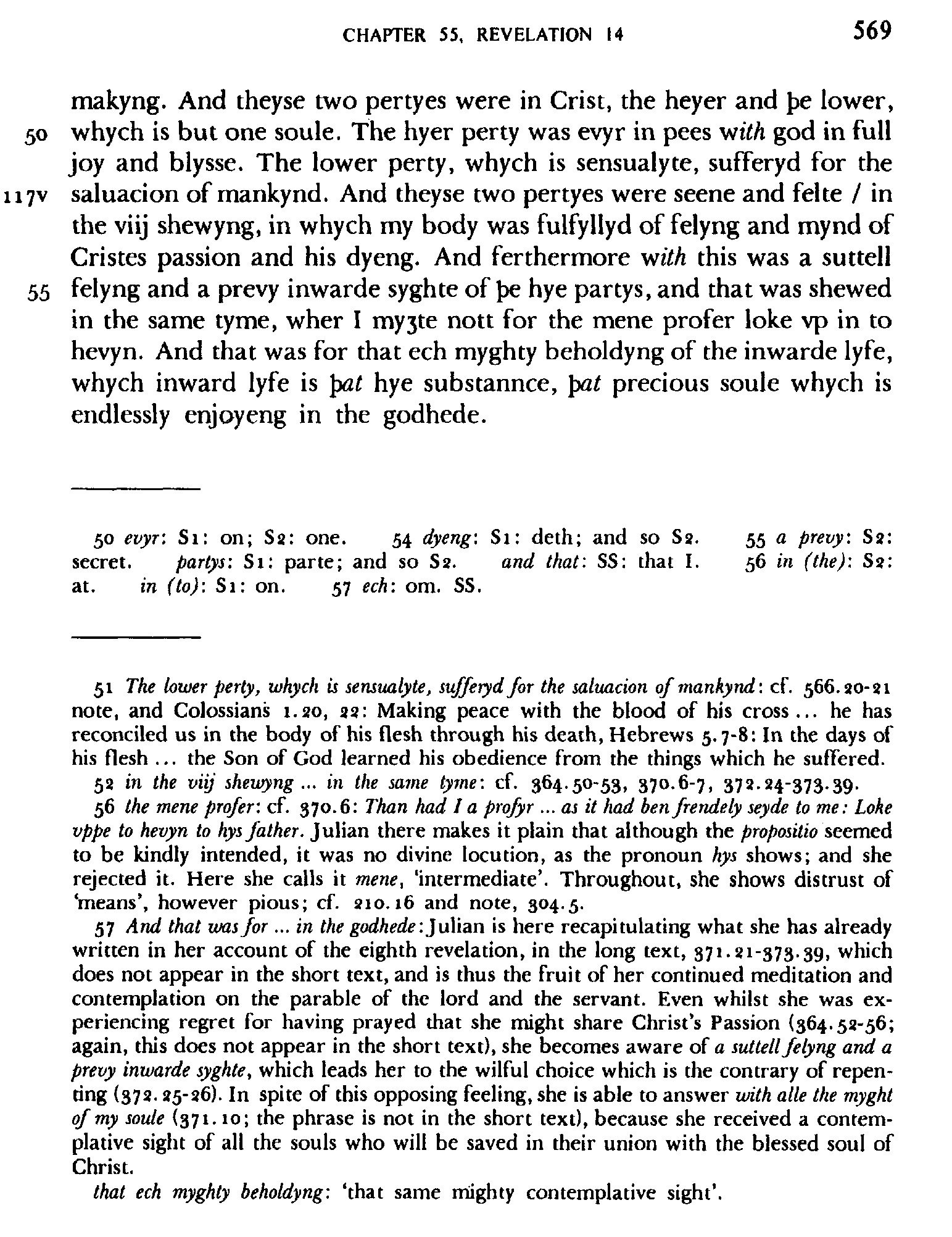
CHAPTER 55, REVELATION 14
makyng. And theyse two pertyes were in Crist, the heyer and pe lower, 50 whych is but one soule. The hyer perty was evyr in pees with god in full joy and blysse. The lower perty, whych is sensualyte, sufferyd for the ii7v saluacion of mankynd. And theyse two pertyes were scene and felte / in the viij shewyng, in whych my body was fulfyllyd of felyng and mynd of Cristes passion and his dyeng. And ferthermore with this was a suttell
55 felyng and a prevy inwarde syghte of pe hye partys, and that was shewed in the same tyme, wher I my3te nott for the mene profer loke vp in to hevyn. And that was for that ech myghty beholdyng of the inwarde lyfe, whych inward lyfe is \>at hye substannce, \>at precious soule whych is endlessly enipyeng in the godhede.
50 evyr: Si: on; 82: one.
54 dyeng: Si: deth; and so 82.
55 a prevy: Sa: secret. partys: Si: parte; and so Sa. and that: SS: that I.
56 in (the): 82: at. in (to): Si: on.
57 ech: om. SS.
51 The lower perty, whych is sensualyte, sufferyd for the saluacion of mankynd: cf. 566.20-21 note, and Colossians 1.20, 22: Making peace with the blood of his cross ... he has reconciled us in the body of his flesh through his death, Hebrews 5.7-8: In the days of his flesh ... the Son of God learned his obedience from the things which he suffered.
52 in the viij shewyng ... in the same tyme: cf. 364.50-53, 370.6-7, 372.24-373.39.
56 the mene profer: cf. 370.6: Than had la profyr ... as it had benfrendely seyde to me: Loke vppe to hevyn to hys father. Julian there makes it plain that although the propositio seemed to be kindly intended, it was no divine locution, as the pronoun hys shows; and she rejected it. Here she calls it mene, 'intermediate'. Throughout, she shows distrust of 'means', however pious; cf. 210.16 and note, 304.5.
57 And that was for ... in the godhede: Julian is here recapitulating what she has already written in her account of the eighth revelation, in the long text, 371.21-373.39, which does not appear in the short text, and is thus the fruit of her continued meditation and contemplation on the parable of the lord and the servant. Even whilst she was experiencing regret for having prayed that she might share Christ's Passion (364.52-56; again, this does not appear in the short text), she becomes aware of a suttell felyng and a prevy inwarde syghte, which leads her to the wilful choice which is the contrary of repenting (372.25-26). In spite of this opposing feeling, she is able to answer with alle the myght of my soule (371.10; the phrase is not in the short text), because she received a contemplative sight of all the souls who will be saved in their union with the blessed soul of Christ. that ech myghty beholdyng: 'that same mighty contemplative sight'.
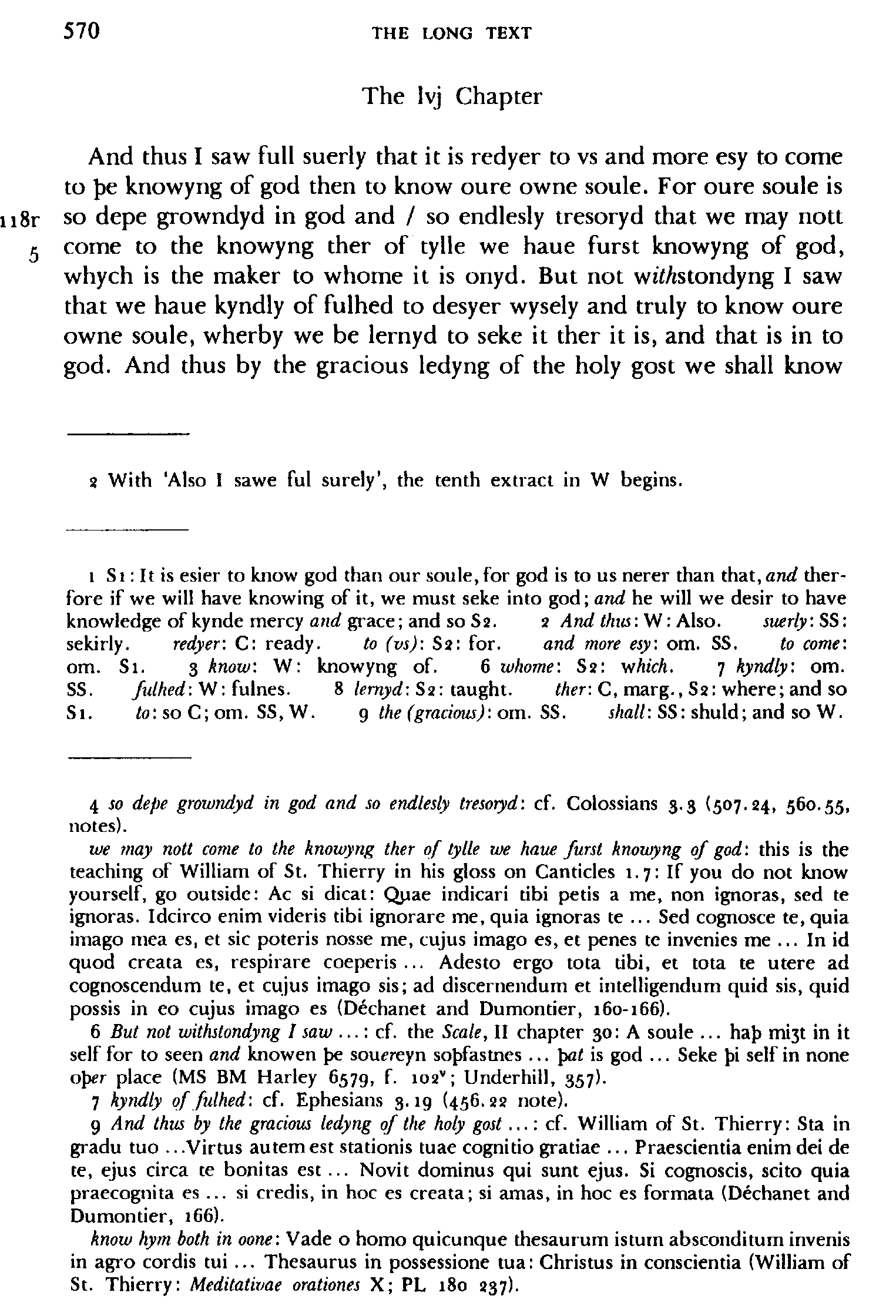
THE LONG TEXT
The Ivj Chapter And thus I saw full suerly that it is redyer to vs and more esy to come to J?e knowyng of god then to know oure owne soule. For oure soule is ii8r so depe growndyd in god and / so endlesly tresoryd that we may nott
5 come to the knowyng ther of tylle we haue furst knowyng of god, whych is the maker to whome it is onyd. But not wzMstondyng I saw that we haue kyndly of fulhed to desyer wysely and truly to know oure owne soule, wherby we be lernyd to seke it ther it is, and that is in to god. And thus by the gracious ledyng of the holy gost we shall know
2 With 'Also I sawe ful surely', the tenth extract in W begins. i Si: It is esier to know god than our soule,for god is to us nerer than that,and therfore if we will have knowing of it, we must seke into god; and he will we desir to have knowledge of kynde mercy and grace; and so Sa.
2 And thus: W: Also. suerly.SS: sekirly. redyer: C: ready. to (vs): Sa: for. and more esy: om. SS. to come: om. Si.
3 know: W: knowyng of.
6 whome: Sa: which.
7 kyndly: om.
SS. fulhed: W: fulnes.
8 lernyd: Sa: taught. ther: C, marg., Sa: where; and so Si. to: so C; om. SS, W.
9 the (gracious): om. SS. shall: SS: shuld; and so W.
4 so depe growndyd in god and so endlesly tresoryd: cf. Colossians 3.3 (507.24, 560.55, notes). we may nott come to the knowyng ther of tylle we haue furst knowyng of god: this is the teaching of William of St. Thierry in his gloss on Canticles 1.7: If you do not know yourself, go outside: Ac si dicat: Quae indicari tibi petis a me, non ignoras, sed te ignoras. idcirco enim videris tibi ignorare me, quia ignoras te ... Sed cognosce te, quia imago mea es, et sic poteris nosse me, cujus imago es, et penes te invenies me ... In id quod creata es, respirare coeperis... Adesto ergo tota tibi, et tota te utere ad cognoscendum te, et cujus imago sis; ad discernendum et intelligendum quid sis, quid possis in eo cujus imago es (Dechanet and Dumontier, 160-166).
6 But not withstondyng I saw ...: cf. the Scale, II chapter 30: A soule ... ha}) mijt in it self for to seen and knowen f>e souereyn so^fastnes ... Jxz£ is god ... Seke J>i self in none ofx?r place (MS BM Harley 6579, f. ioav; Underbill, 357).
7 kyndly of fulhed: cf. Ephesians 3.19 (456.22 note).
9 And thus by the gracious ledyng of the holy gost ...: cf. William of St. Thierry: Sta in gradu tuo .. .Virtus autem est stadonis tuae cognitio gratiae ... Praescientia enim dei de te, ejus circa te bonitas est ... Novit dominus qui sunt ejus. Si cognoscis, scito quia praecognita es ... si credis, in hoc es creata; si amas, in hoc es formata (Dechanet and Dumontier, 166). know hym both in oone: Vade o homo quicunque diesaurum istum absconditum invenis in agro cordis tui ... Thesaurus in possessione tua: Christus in conscientia (William of St. Thierry: Meditativae orationes X; PL 180 237).
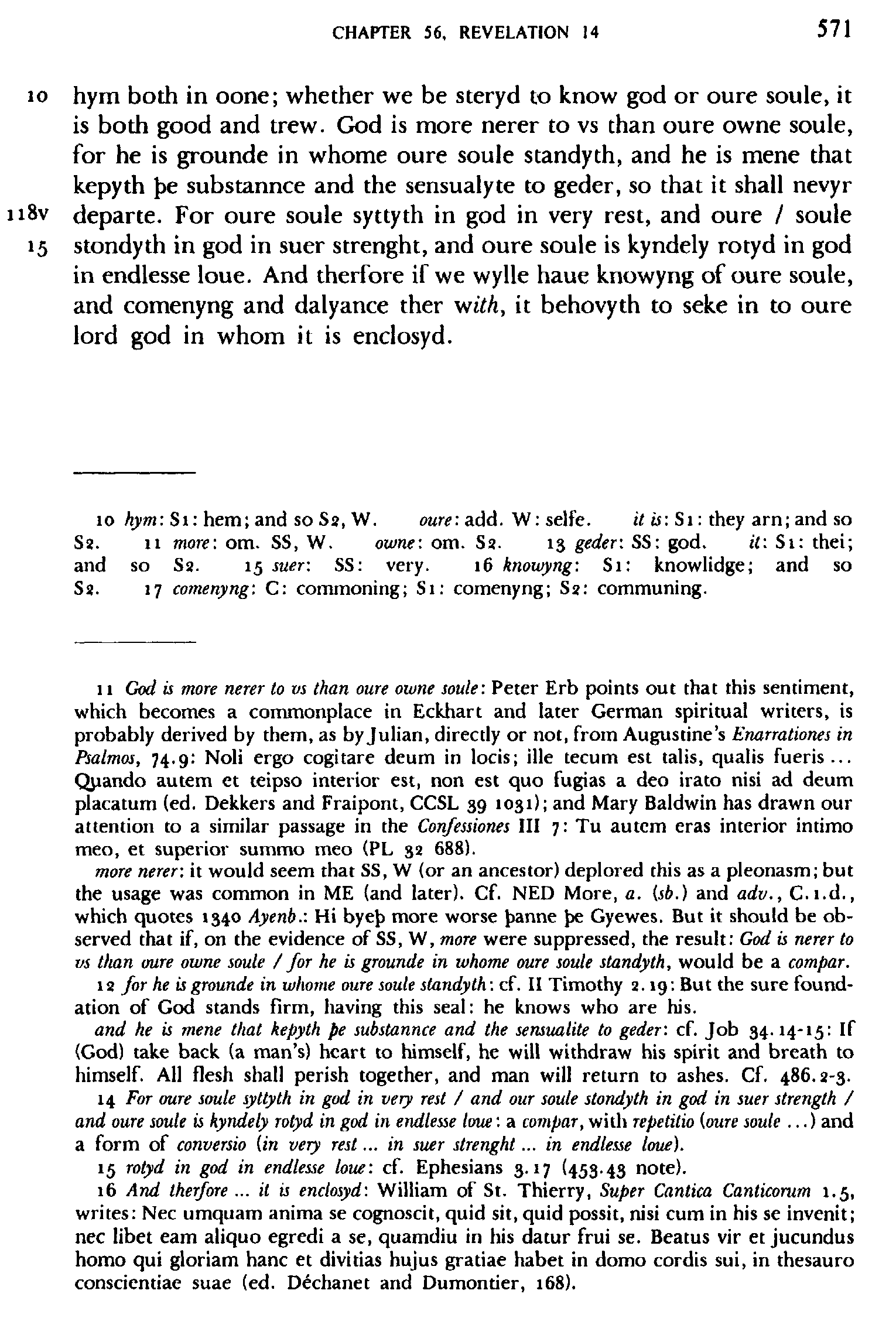
CHAPTER 56, REVELATION 14
10 hym both in oone; whether we be steryd tp know god or oure soule, it is both good and trew. God is more nerer to vs than oure owne soule, for he is grounde in whome oure soule standyth, and he is mene that kepyth f>e substannce and the sensualyte to geder, so that it shall nevyr n8v departe. For oure soule syttyth in god in very rest, and oure / soule
15 stondyth in god in suer strenght, and oure soule is kyndely rotyd in god in endlesse loue. And therfore if we wylle haue knowyng of oure soule, and comenyng and dalyance ther 'with, it behovyth to seke in to oure lord god in whom it is enclosyd.
10 hym: Si: hem; and so Sa, W. oure: add. W: selfe. it is: Si: they arn; and so 82.
11 more: om. SS, W. owne: om. 82.
13 geder: 88: god. it: Si: thei; and so 82.
15 suer:
SS: very.
16 knowyng:
Si: knowlidge; and so 82.
17 comenyng: C: commoning; Si: comenyng; 82: communing. n God is more nerer to vs than oure owne soule: Peter Erb points out that this sentiment, which becomes a commonplace in Eckhart and later German spiritual writers, is probably derived by them, as by Julian, directly or not, from Augustine's Enarrationes in Psalmos, 74.9: Noli ergo cogitare deum in locis; ille tecum est talis, qualis fueris ...
Quando autem et teipso interior est, non est quo fugias a deo irato nisi ad deum placatum (ed. Dekkers and Fraipont, CCSL 39 1031); and Mary Baldwin has drawn our attention to a similar passage in the Confessiones III 7: Tu autem eras interior intimo meo, et superior summo meo (PL 32 688). more nerer: it would seem that SS, W (or an ancestor) deplored this as a pleonasm; but the usage was common in ME (and later). Cf. NED More, a. (sb.) and adv., C.i.d., which quotes 1340 Ayenb.: Hi byej> more worse Jjanne Jje Gyewes. But it should be observed that if, on the evidence of SS, W, more were suppressed, the result: God is nerer to vs than oure owne soule /for he is grounde in whome oure soule standyth, would be a compar.
12 for he is grounde in whome oure soule standyth: cf. II Timothy 2.19: But the sure foundation of God stands firm, having this seal: he knows who are his. and he is mene that kepyth pe substannce and the sensualite to geder: cf. Job 34.14-15: If (God) take back (a man's) heart to himself, he will withdraw his spirit and breath to himself. All flesh shall perish together, and man will return to ashes. Cf. 486.2-3.
14 For oure soule syttyth in god in very rest / and our soule stondyth in god in suer strength / and oure soule is kyndely rotyd in god in endlesse lone: a compar, with repetitio (oure soule ...) and a form of conversio (in very rest... in suer strenght... in endlesse loue).
15 rotyd in god in endlesse loue: cf. Ephesians 3.17 (453.43 note).
16 And therfore ... it is enclosyd: William of St. Thierry, Super Cantica Canticorum 1.5, writes: Nee umquam anima se cognoscit, quid sit, quid possit, nisi cum in his se invenit; nee libet earn aliquo egredi a se, quamdiu in his datur frui se. Beatus vir et jucundus homo qui gloriam hanc et divitias hujus gratiae habet in domo cordis sui, in thesauro conscientiae suae (ed. Dechanet and Dumontier, 168).
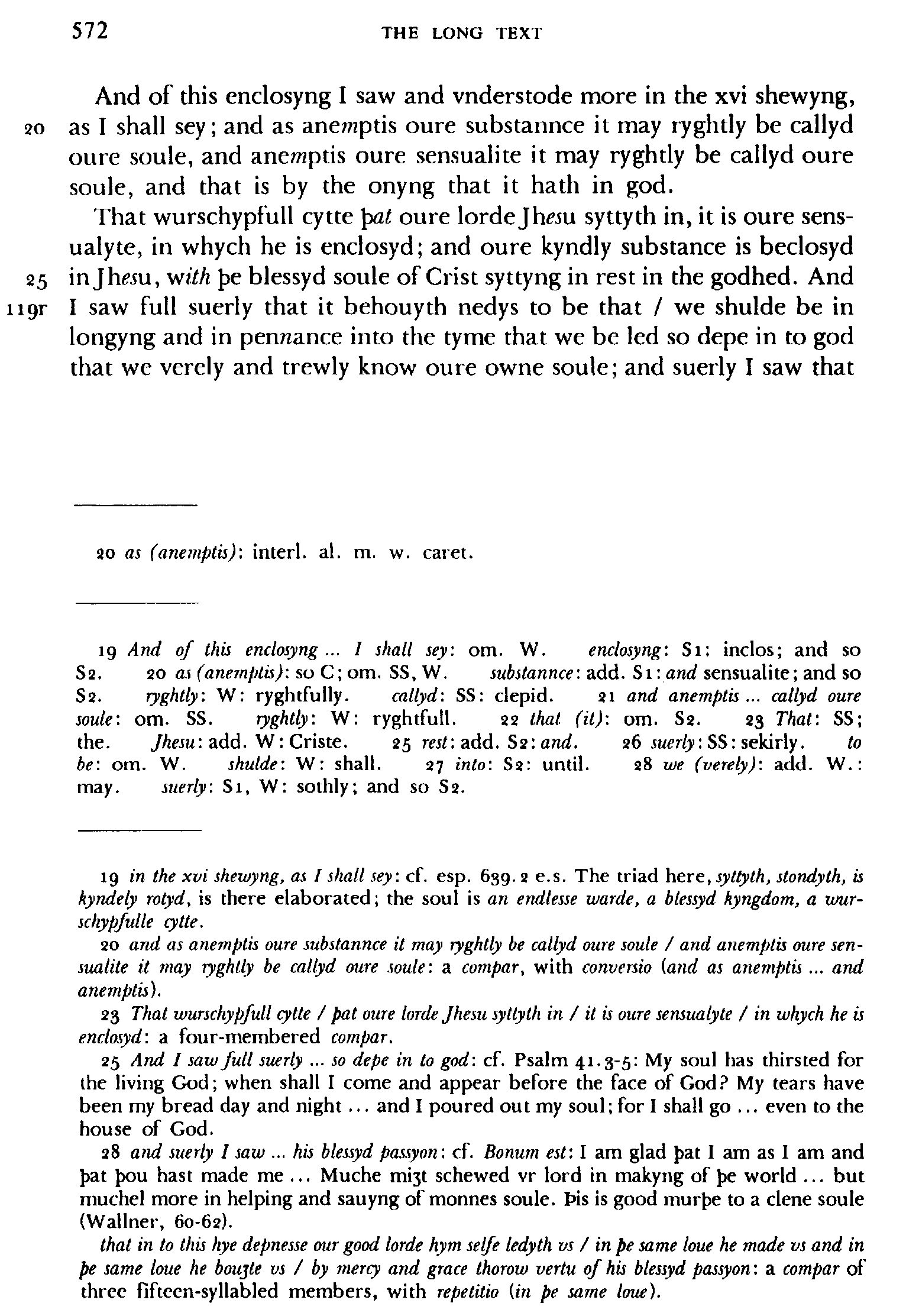
THE LONG TEXT
And of this enclosyng I saw and vnderstode more in the xvi shewyng, 20 as I shall sey; and as anemptis oure substannce it may ryghtly be callyd oure soule, and anemptis oure sensualite it may ryghtly be callyd oure soule, and that is by the onyng that it hath in god.
That wurschypfull cytte \>at oure lordejhmi syttyth in, it is oure sensualyte, in whych he is enclosyd; and oure kyndly substance is beclosyd
25 injhmi, with J>e blessyd soule of Crist syttyng in rest in the godhed. And iigr I saw full suerly that it behouyth nedys to be that / we shulde be in longyng and in pennance into the tyme that we be led so depe in to god that we verely and trewly know oure owne soule; and suerly I saw that 20 as (anemptis): interl. al. m. w. caret.
19 And of this enclosyng... I shall sey: om. W. enclosyng: Si: inclos; and so Sa.
20 as (anemptis): so C; om. SS, W. substannce: add. Si: and sensualite; and so 82. ryghtly: W: ryghtfully. callyd: SS: clepid.
21 and anemptis... callyd oure soule: om.
SS. ryghtly: W: ryghtfull.
22 that (it): om. 82.
23 That: SS; the.
Jhesu: add. W: Criste.
25 rest: add. 82: and.
26 suerly: SS: sekirly. to be: om. W. shulde: W: shall.
27 into: Ss: until.
28 we (verely): add. W.: may. suerly: Si, W: sothly; and so 82.
19 m the xvi shewyng, as I shall sey: cf. esp. 639. 2 e.s. The triad here, syttyth, stondyth, is kyndely rotyd, is there elaborated; the soul is an endlesse warde, a blessyd hyngdom, a wurschypfulle cytte.
20 and as anemptis oure substannce it may ryghtly be callyd oure soule / and anemptis oure sensualite it may ryghtly be callyd oure soule: a compar, with conversio (and as anemptis ... and anemptis).
23 That wurschypfull cytte / pat oure lords Jhesu syttyth in / it is oure sensualyte / in whych he is enclosyd: a four-membered compar.
25 And I saw full suerly ... so depe in to god: cf. Psalm 41.3-5: My soul has thirsted for the living God; when shall I come and appear before the face of God ? My tears have been my bread day and night ... and I poured out my soul; for I shall go ... even to the house of God.
28 and suerly I saw ... his blessyd passyon: cf. Bonum est: I am glad }>at I am as I am and pat pou hast made me ... Muche mi3t schewed vr lord in makyng of pe world ... but muchel more in helping and sauyng of monnes soule. f>is is good murpe to a clene soule
(Wallner, 60-62). that in to this hye depnesse our good lorde hym selfe ledyth vs / in pe same hue he made vs and in pe same loue he boujte vs / by mercy and grace thorow vertu of his blessyd passyon: a compar of three fifteen-syllabled members, with repetitio (in pe same loue).
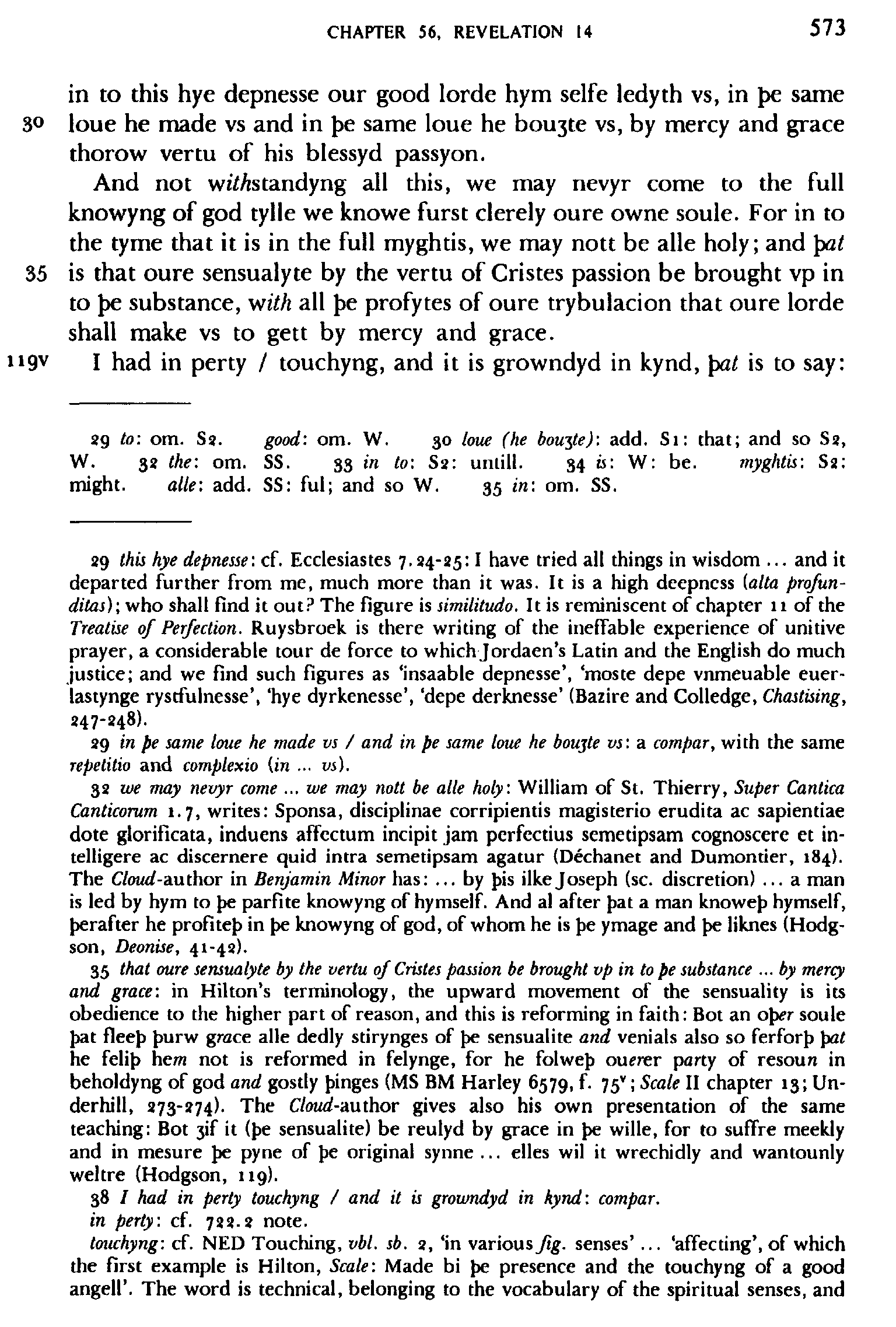
CHAPTER 56, REVELATION 14
in to this hye depnesse our good lorde hym selfe ledyth vs, in J>e same 3° loue he made vs and in J>e same loue he boujte vs, by mercy and grace thorow vertu of his blessyd passyon.
And not wz'Mstandyng all this, we may nevyr come to the full knowyng of god tylle we knowe furst clerely oure owne soule. For in to the tyme that it is in the full myghtis, we may nott be alle holy; and ^at 35 is that oure sensualyte by the vertu of Cristes passion be brought vp in to J>e substance, with all J>e profytes of oure trybulacion that oure lorde shall make vs to gett by mercy and grace.
H9V I had in perty / touchyng, and it is growndyd in kynd, pvz/ is to say:
29 to: om. 82. good: om. W.
30 loue (he bou^te): add. Si: that; and so 82, W.
32 the: om. SS.
33 in to: 82: untill.
34 is: W: be. myghtis: 82: might. alle: add. 88: ful; and so W.
35 in: om. 88.
29 this hye depnesse: cf. Ecclesiastes 7.24-25:1 have tried all things in wisdom ... and it departed further from me, much more than it was. It is a high deepness (alta profunditas); who shall find it out? The figure is similitude. It is reminiscent of chapter 11 of the Treatise of Perfection. Ruysbroek is there writing of the ineffable experience of unitive prayer, a considerable tour de force to which Jordaen's Latin and the English do much justice; and we find such figures as 'insaable depnesse', 'moste depe vnmeuable euerlastynge rystfulnesse', 'hye dyrkenesse', 'depe derknesse' (Bazire and Colledge, Chastising,
247-248).
29 in pe same loue he made vs / and in pe same loue he boujte vs: a compar, with the same repetitio and complexio (in ... vs).
32 we may nevyr come ... we may nott be alle holy: William of St. Thierry, Super Cantica
Canticorum 1.7, writes: Sponsa, disciplinae corripientis magisterio erudita ac sapientiae dote glorificata, induens affectum incipit jam perfectius semetipsam cognoscere et intelligere ac discernere quid intra semetipsam agatur (Dechanet and Dumontier, 184).
The CYoi#/-author in Benjamin Minor has: ... by pis ilkeJoseph (sc. discretion) ... a man is led by hym to pe parfite knowyng of hymself. And al after pat a man knowejj hymself, perafter he profite{> in pe knowyng of god, of whom he is pe ymage and pe liknes (Hodgson, Deonise, 41-42).
35 that oure sensualyte by the vertu of Cristes passion be brought vp in to pe substance ...by mercy and grace: in Hilton's terminology, the upward movement of the sensuality is its obedience to the higher part of reason, and this is reforming in faith: Bot an opfr soule pat fleejj purw grace alle dedly stirynges of pe sensualite and venials also so ferforj) pa/ he felij) hem not is reformed in felynge, for he folwej) ouerer party of resoun in beholdyng of god and gostly pinges (MS BM Harley 6579, f. 75*; Scale II chapter 13; Underhill, 273-274). The Cloud-author gives also his own presentation of the same teaching: Bot 3if it (pe sensualite) be reulyd by grace in pe wille, for to suffre meekly and in mesure pe pyne of pe original synne ... elles wil it wrechidly and wantounly weltre (Hodgson, 119).
38 / had in perty touchyng / and it is growndyd in kynd: compar. in perty: cf. 722.2 note. touchyng: cf. NED Touching, vbl. sb. 2, 'in variousytg. senses' ... 'affecting', of which the first example is Hilton, Scale: Made bi pe presence and the touchyng of a good angell'. The word is technical, belonging to the vocabulary of the spiritual senses, and
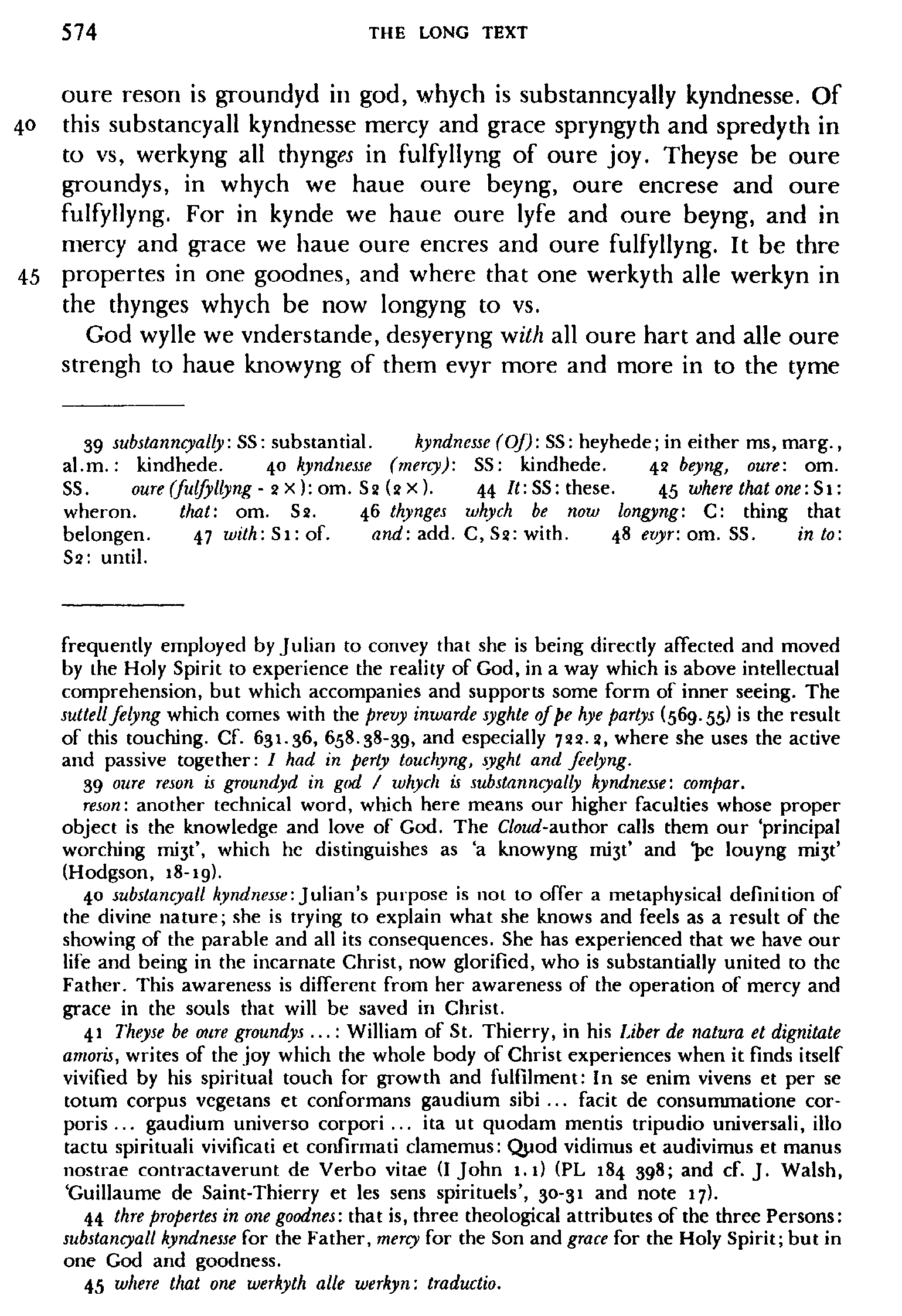
THE LONG TEXT
oure reson is groundyd in god, whych is substanncyally kyndnesse. Of
this substancyall kyndnesse mercy and grace spryngyth and spredyth in to vs, werkyng all thyngw in fulfyllyng of oure joy. Theyse be oure groundys, in whych we haue oure beyng, oure encrese and oure fulfyllyng. For in kynde we haue oure lyfe and oure beyng, and in mercy and grace we haue oure encres and oure fulfyllyng. It be thre
45 propertes in one goodnes, and where that one werkyth alle werkyn in the thynges whych be now longyng to vs.
God wylle we vnderstande, desyeryng -with all oure hart and alle oure strengh to haue knowyng of them evyr more and more in to the tyme
39 substanncyally: SS: substantial. kyndnesse (Of): SS: heyhede; in either ms, marg., al.m.: kindhede.
40 kyndnesse (mercy):
SS: kindhede.
42 beyng, oure: om.
SS. oure (fulfyllyng - 2 x ): om. 82 (2 x).
44. It: SS: these.
45 where that one:Si: wheron. that: om.
82.
46 thynges whych be now longyng: C: thing that belongen.
47 with: Si: of. and: add. C, 82: with.
48 evyr: om. SS. into:
82: until. frequently employed by Julian to convey that she is being directly affected and moved by the Holy Spirit to experience the reality of God, in a way which is above intellectual comprehension, but which accompanies and supports some form of inner seeing. The suttell felyng which comes with the prevy inwarde syghte ofpe hye partys (569.55) is the result of this touching. Cf. 631.36, 658.38-39, and especially 722.2, where she uses the active and passive together: / had in perly touchyng, syght and feelyng.
39 oure reson is groundyd in god / whych is substanncyally kyndnesse: cornpar. reson: another technical word, which here means our higher faculties whose proper object is the knowledge and love of God. The Cloud-author calls them our 'principal worching mi3t', which he distinguishes as 'a knowyng mi3t' and t>e louyng mi3t'
(Hodgson, 18-19).
40 substancyall hyndnesse: Julian's purpose is not to offer a metaphysical definition of the divine nature; she is trying to explain what she knows and feels as a result of the showing of the parable and all its consequences. She has experienced that we have our life and being in the incarnate Christ, now glorified, who is substantially united to the Father. This awareness is different from her awareness of the operation of mercy and grace in the souls that will be saved in Christ.
41 Theyse be oure groundys ...: William of St. Thierry, in his Liber de natura et dignitate amoris, writes of the joy which the whole body of Christ experiences when it finds itself vivified by his spiritual touch for growth and fulfilment: In se enim vivens et per se totum corpus vegetans et conformans gaudium sibi ... facit de consummatione corporis ... gaudium universe corpori ... ita ut quodam mentis tripudio universal!, illo tactu spirituali vivificati et confirmati clamemus: Quod vidimus et audivimus et manus nostrae contractaverunt de Verbo vitae (I John 1.1) (PL 184 398; and cf. J. Walsh,
'Guillaume de Saint-Thierry et les sens spirituels', 30-31 and note 17).
44 thre propertes in one goodnes: that is, three theological attributes of the three Persons: substancyall kyndnesse for the Father, mercy for the Son and grace for the Holy Spirit; but in one God and goodness.
45 where that one werkyth alle werkyn: traductio.
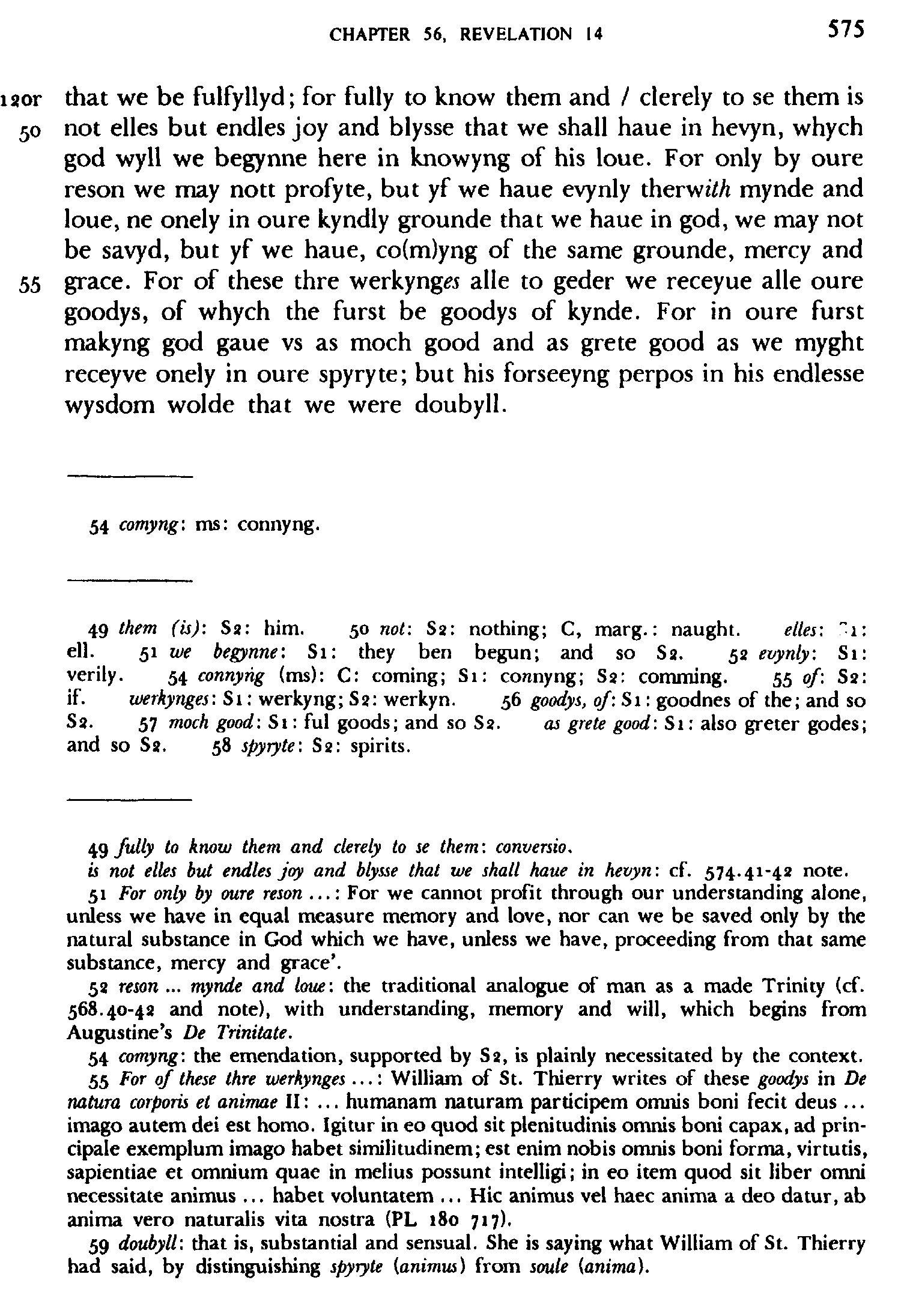
CHAPTER 56, REVELATION 14
isor that we be fulfyllyd; for fully to know them and / clerely to se them is 50 not elles but endles joy and blysse that we shall haue in hevyn, whych god wyll we begynne here in knowyng of his loue^\For only by oure reson we may nott profyte, but yf we haue evynly therwzY/z mynde and loue, ne onely in oure kyndly grounde that we haue in god, we may not be savyd, but yf we haue, co(m)yng of the same grounde, mercy and 55 grace. For of these thre werkyng^ alle to geder we receyue alle oure goodys, of whych the furst be goodys of kynde. For in oure furst makyng god gaue vs as moch good and as grete good as we myght receyve onely in oure spyryte; but his forseeyng perpos in his endlesse wysdom wolde that we were doubyll.
54 comyng: ms: connyng.
49 them (is): 82: him.
50 not: 82: nothing; C, marg.: naught. elles: "i: ell.
51 we begynne: Si: they ben begun; and so 82.
52 evynly:
Si: verily.
54 connyng (ms): C: coming; Si: cownyng; 82: comming.
55 of: 82: if. werkynges: Si: werkyng; 82: werkyn.
56 goodys, of: Si: goodnes of the; and so 82.
57 moch good: Si: ful goods; and so 82. as grete good: Si: also greter godes; and so 82.
58 spyryte: 82: spirits.
49 fully to know them and clerely to se them: conversio. is not elles but endles joy and blysse that we shall haue in hevyn: cf. 574.41-42 note.
51 For only by oure reson ...: For we cannot profit through our understanding alone, unless we have in equal measure memory and love, nor can we be saved only by the natural substance in God which we have, unless we have, proceeding from that same substance, mercy and grace'.
52 reson ... mynde and loue: die traditional analogue of man as a made Trinity (cf.
568.40-42 and note), with understanding, memory and will, which begins from Augustine's De Trinitate.
54 comyng: the emendation, supported by 82, is plainly necessitated by the context.
55 For of these thre werkynges .,.: William of St. Thierry writes of diese goodys in De natura carports el animae II: ... humanam naturam participem omnis boni fecit deus ... imago autem dei est homo. Igitur in eo quod sit plenitudinis omnis boni capax, ad principale exemplum imago habet similitudinem; est enim nobis omnis boni forma, virtutis, sapientiae et omnium quae in melius possunt intelligi; in eo item quod sit liber omni necessitate animus ... habet voluntatem ... Hie animus vel haec anima a deo datur, ab anima vero naturalis vita nostra (PL 180 717),
59 doubyll: that is, substantial and sensual. She is saying what William of St. Thierry had said, by distinguishing spyryte (animus) from soule (anima).
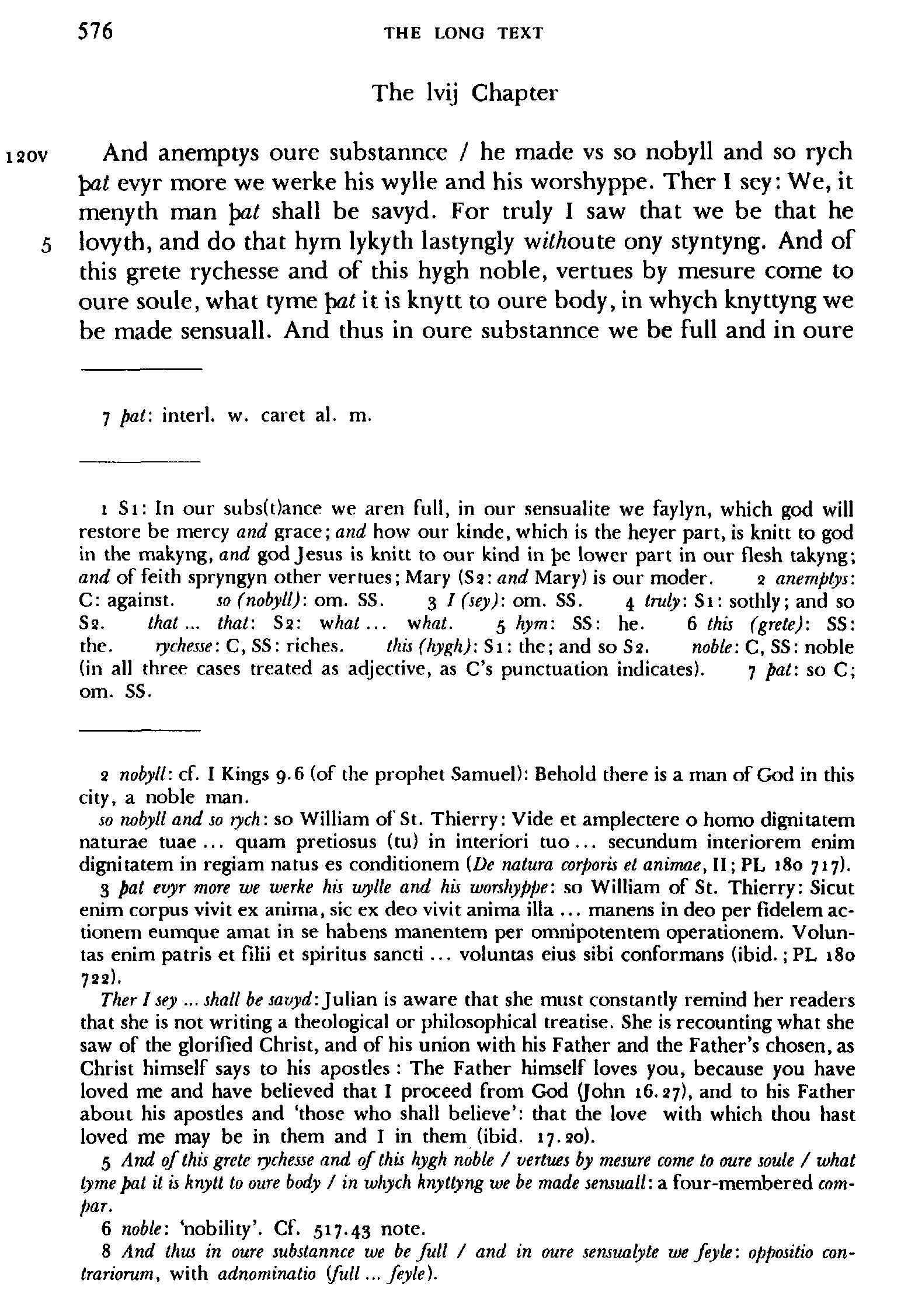
THE LONG TEXT
The Ivij Chapter i2ov And anemptys cure substannce / he made vs so nobyll and so rych
\>at evyr more we werke his wylle and his worshyppe. Ther I sey: We, it menyth man \>at shall be savyd. For truly I saw that we be that he
lovyth, and do that hym lykyth lastyngly wzY/ioute ony styntyng. And of this grete rychesse and of this hygh noble, vertues by mesure come to oure soule, what tyme \>at it is knytt to oure body, in whych knyttyng we be made sensuall. And thus in oure substannce we be full and in oure
7 pat; interl. w. caret al. m. i Si: In our subs(t)ance we aren full, in our sensualite we faylyn, which god will restore be mercy and grace; and how our kinde, which is the heyer part, is knitt to god in the makyng, and god Jesus is knitt to our kind in JDC lower part in our flesh takyng; and of feith spryngyn other vertues; Mary (82: and Mary) is our moder.
2 anemptys:
C: against. so (nobyll): om. SS.
3 I (sey): om. SS.
4 truly: Si: sothly; and so Ss. that... that: 82: what... what.
5 hym: SS: he.
6 this (grete): SS: the. rychesse: C, SS: riches. this (hygh): Si: the; and so Sa. noble: C, SS: noble (in all three cases treated as adjective, as C's punctuation indicates).
7 pat: so C; om. SS.
2 nobyll: cf. I Kings 9.6 (of the prophet Samuel): Behold there is a man of God in this city, a noble man. jo nobyll and so rych: so William of St. Thierry: Vide et amplectere o homo dignitatem naturae tuae... quam pretiosus (tu) in interiori tuo... secundum interiorem enim dignitatem in regiam natus es conditionem (De natura corporis et animae, II; PL 180 717).
3 pat evyr more we werke his wylle and his worshyppe: so William of St. Thierry: Sicut enim corpus vivit ex anima, sic ex deo vivit anima ilia ... manens in deo per fidelem actionem eumque amat in se habens manentem per omnipotentem operationem. Voluntas enim patris et filii et spiritus sancti ... voluntas eius sibi conformans (ibid.; PL 180
722).
Ther I sey ... shall be savyd: Julian is aware that she must constantly remind her readers that she is not writing a theological or philosophical treatise. She is recounting what she saw of the glorified Christ, and of his union with his Father and the Father's chosen, as Christ himself says to his apostles : The Father himself loves you, because you have loved me and have believed that I proceed from God (John 16.27), and to his Father about his aposdes and 'those who shall believe': dial die love with which thou hast loved me may be in them and I in them (ibid. 17.20).
5 And of this grete rychesse and of this hygh noble / vertues by mesure come to oure soule / what tyme pat it is knytt to oure body / in whych knyttyng we be made sensuall: a four-membered cornpar.
6 noble: 'nobility'. Cf. 517.43 note.
8 And thus in oure substannce we be full / and in oure sensualyte we feyle: oppositio contrariorum, with adnominatio (full... feyle).
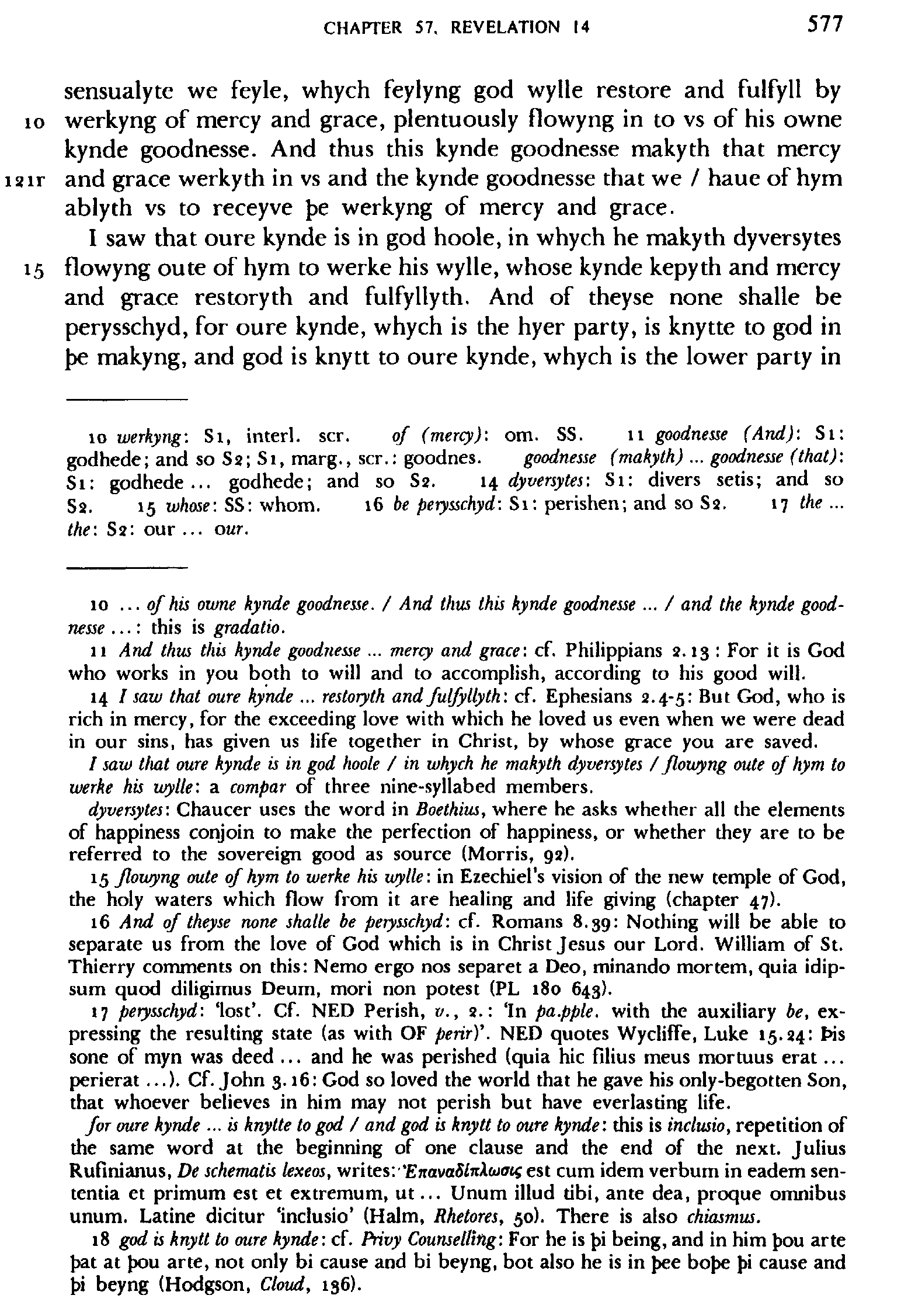
CHAPTER 57. REVELATION 14
sensualyte we feyle, whych feylyng god wylle restore and fulfyll by 10 werkyng of mercy and grace, plentuously flowyng in to vs of his owne kynde goodnesse. And thus this kynde goodnesse makyth that mercy lair and grace werkyth in vs and the kynde goodnesse that we / haue of hym ablyth vs to receyve be werkyng of mercy and grace.
I saw that oure kynde is in god hoole, in whych he makyth dyversytes 15 flowyng oute of hym to werke his wylle, whose kynde kepyth and mercy and grace restoryth and fulfyllyth. And of theyse none shalle be perysschyd, for oure kynde, whych is the hyer party, is knytte to god in pe makyng, and god is knytt to oure kynde, whych is the lower party in 10 werkyng: Si, interl. scr. of (mercy): om. SS.
11 goodnesse (And): Si: godhede; and so 82; Si, marg., scr.: goodnes. goodnesse (makyth) ... goodnesse (that):
Si: godhede... godhede; and so Sz.
14 dyversytes: Si: divers setis; and so Sa.
15 whose: SS: whom.
16 be perysschyd: Si: perishen; and so Sa.
17 the ... the: Sa: our ... our.
10 ... of his owne kynde goodnesse. /And thus this kynde goodnesse ... / and the kynde goodnesse ...: this is gradatio.
11 And thus this kynde goodnesse ... mercy and grace: cf. Philippians a. 13 : For it is God who works in you both to will and to accomplish, according to his good will.
14 / saw that oure kynde ... restoryth and fulfyllyth: cf. Ephesians 2.4-5: But God, who is rich in mercy, for the exceeding love with which he loved us even when we were dead in our sins, has given us life together in Christ, by whose grace you are saved.
/ saw that oure kynde is in god hoole / in whych he makyth dyversytes /flowyng oute of hym to werke his wylle: a compar of three nine-syllabed members. dyversytes: Chaucer uses die word in Boethius, where he asks whether all the elements of happiness conjoin to make the perfection of happiness, or whether they are to be referred to the sovereign good as source (Morris, 92).
15 flowyng oute of hym to werke his wylle: in Ezechiel's vision of the new temple of God, the holy waters which flow from it are healing and life giving (chapter 47).
16 And of theyse none shade be perysschyd: cf. Romans 8.39: Nothing will be able to separate us from the love of God which is in Christ Jesus our Lord. William of St.
Thierry comments on this: Nemo ergo nos separet a Deo, minando mortem, quia idipsum quod diligimus Deum, mori non potest (PL 180 643).
17 perysschyd: 'lost'. Cf. NED Perish, v., 2.: 'In pa.pple. with die auxiliary be, expressing the resulting state (as with OF perir)'. NED quotes Wycliffe, Luke 15.24: t>is sone of myn was deed ... and he was perished (quia hie filius meus mortuus erat... perierat...). Cf. John 3.16: God so loved the world that he gave his only-begotten Son, that whoever believes in him may not perish but have everlasting life. for oure kynde ... is knytte to god / and god is knytt to oure kynde: this is inclusio, repetition of the same word at the beginning of one clause and the end of die next. Julius
Rufmianus, De schemata lexeos, writes: 'EnavaSinXuats est cum idem verbum in eadem sententia et primum est et extremum, ut... Unum illud tibi, ante dea, proque omnibus unum. Latine dicitur 'inclusio' (Halm, Rhetores, 50). There is also chiasmus.
18 god is knytt to oure kynde: cf. Privy Counselling: For he is pi being, and in him pou arte pat at pou arte, not only bi cause and bi beyng, bot also he is in pee bope pi cause and pi beyng (Hodgson, Cloud, 136).
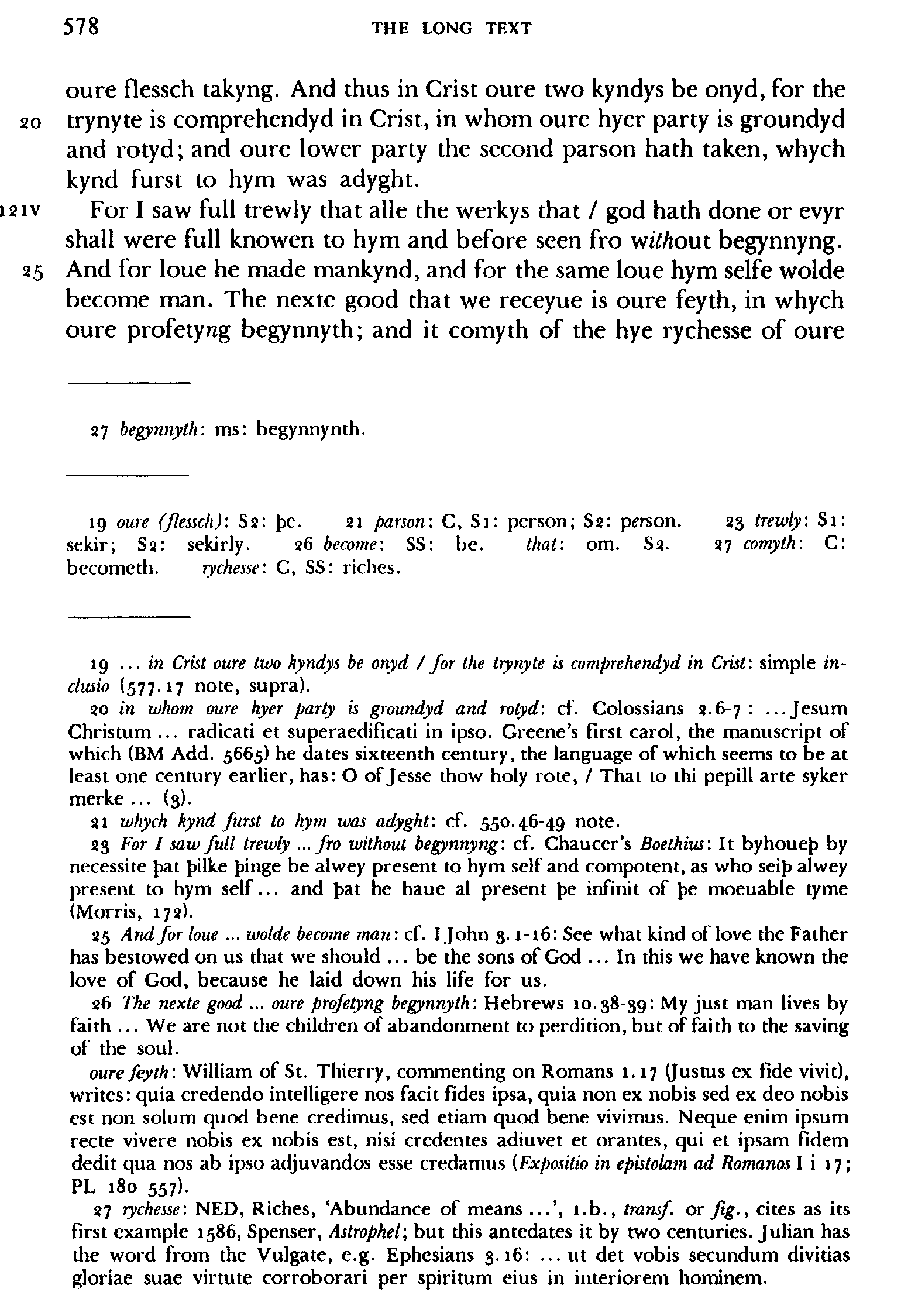
THE LONG TEXT
oure flessch takyng. And thus in Crist oure two kyndys be onyd, for the 20 trynyte is comprehendyd in Crist, in whom oure hyer party is groundyd and rotyd; and oure lower party the second parson hath taken, whych kynd furst to hym was adyght. i2iv For I saw full trewly that alle the werkys that / god hath done or evyr shall were full knowen to hym and before seen fro -without begynnyng.
25 And for loue he made mankynd, and for the same loue hym selfe wolde become man. The nexte good that we receyue is oure feyth, in whych oure profetyng begynnyth; and it comyth of the hye rychesse of oure
21 begynnyth: ms: begynnynth.
19 oure (flessch): 82: be.
21 parson: C, Si: person; 82: person.
23 trewly: Si: sekir; 82: sekirly.
26 become:
SS: be. that: om.
82.
27 comyth:
C: becometh. rychesse: C, SS: riches.
19 ... in Crist oure two kyndys be onyd /for the trynyte is comprehendyd in Crist: simple inclusio (577.17 note, supra).
20 in whom oure hyer party is groundyd and rotyd: cf. Colossians 2.6-7 : ...Jesum
Christum ... radicati et superaedificati in ipso. Greene's first carol, the manuscript of which (BM Add. 5665) he dates sixteenth century, the language of which seems to be at least one century earlier, has: O of Jesse thow holy rote, / That to thi pepill arte syker merke ... (3).
21 whych kynd furst to hym was adyght: cf. 550.46-49 note.
23 For I saw full trewly ...fro without begynnyng: cf. Chaucer's Boethius: It byhoueb by necessite bat Jailke binge be alwey present to hym self and compotent, as who seib alwey present to hym self... and bat he haue al present be infinit of be moeuable tyme
(Morris, 172).
25 And for loue ... wolde become man: cf. I John 3.1-16: See what kind of love the Father has bestowed on us that we should ... be the sons of God ... In this we have known the love of God, because he laid down his life for us.
26 The nexte good ... oure profetyng begynnyth: Hebrews 10.38-39: My just man lives by faith ... We are not the children of abandonment to perdition, but of faith to the saving of the soul. oure feyth: William of St. Thierry, commenting on Romans 1.17 (Justus ex fide vivit), writes: quia credendo intelligere nos facit fides ipsa, quia non ex nobis sed ex deo nobis est non solum quod bene credimus, sed etiam quod bene vivimus. Neque enim ipsum recte vivere nobis ex nobis est, nisi credentes adiuvet et orantes, qui et ipsam fidem dedit qua nos ab ipso adjuvandos esse credamus (Expositio in epistolam ad Romanos I i 17;
PL 180 557).
27 rychesse: NED, Riches, 'Abundance of means ...', i.b., transf. or fig., cites as its first example 1586, Spenser, Astrophel; but this antedates it by two centuries. Julian has the word from the Vulgate, e.g. Ephesians 3.16: ... ut det vobis secundum divitias gloriae suae virtute corroborari per spiritum eius in interiorem hominem.
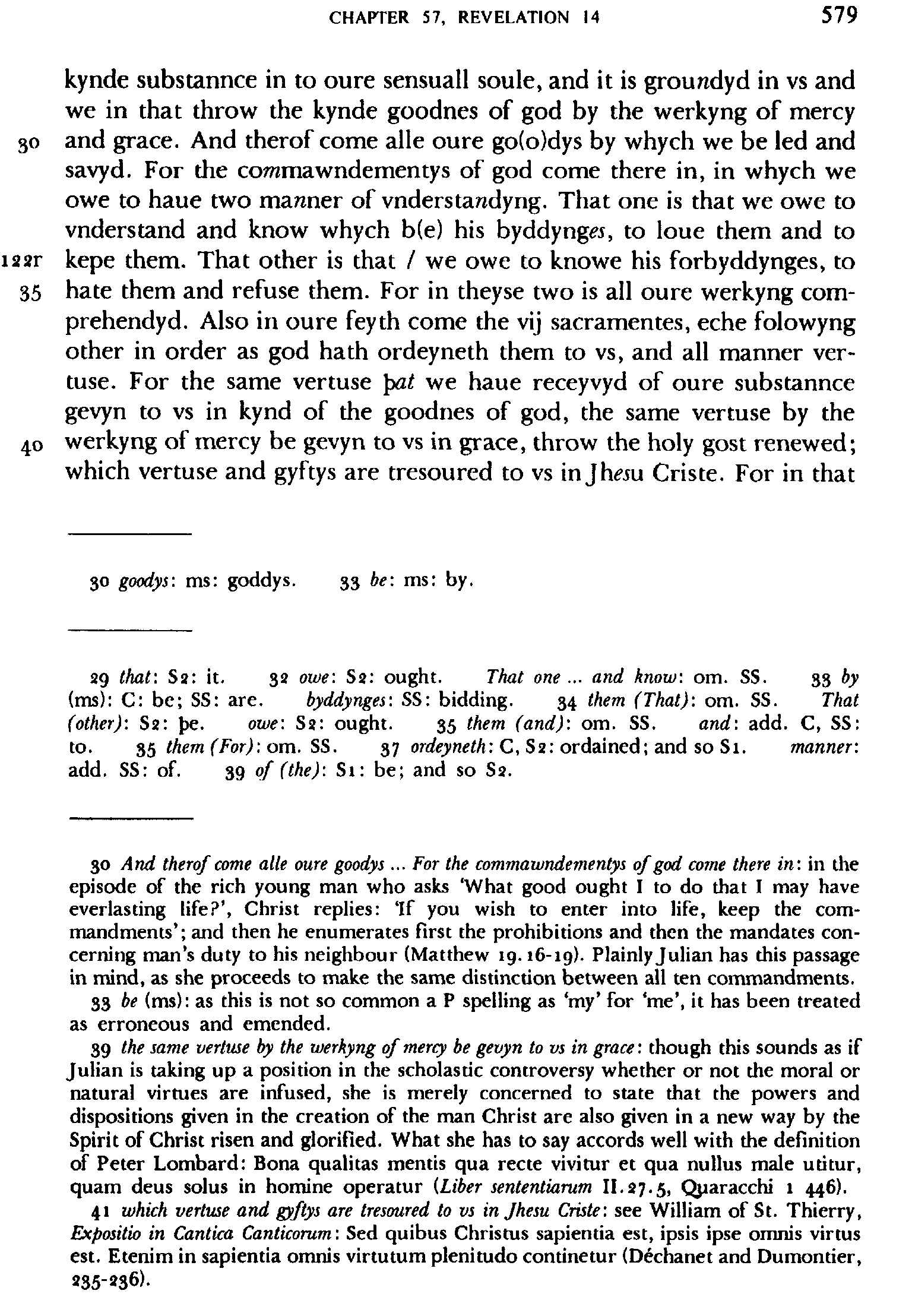
CHAPTER 57, REVELATION 14
kynde substannce in to oure sensuall soule, and it is groundyd in vs and we in that throw the kynde goodnes of god by the werkyng of mercy
30 and grace. And therof come alle oure go(o)dys by whych we be led and savyd. For the coramawndementys of god come there in, in whych we owe to haue two manner of vnderstandyng. That one is that we owe to vnderstand and know whych b(e) his byddyng^, to loue them and to isar kepe them. That other is that / we owe to knowe his forbyddynges, to 35 hate them and refuse them. For in theyse two is all oure werkyng comprehendyd. Also in oure feyth come the vij sacramentes, eche folowyng other in order as god hath ordeyneth them to vs, and all manner vertuse. For the same vertuse Ipat we haue receyvyd of oure substannce gevyn to vs in kynd of the goodnes of god, the same vertuse by the 40 werkyng of mercy be gevyn to vs in grace, throw the holy gost renewed; which vertuse and gyftys are tresoured to vs in]hesu Criste. For in that 30 goodys: ms: goddys.
33 be: ms: by.
29 that: 82: it.
32 owe: 82: ought.
That one ... and know. om. SS.
33 by (ms): C: be; SS: are. byddynges: SS: bidding.
34 them (That): om. SS.
That (other): 82: pe. owe: 82: ought.
35 them (and): om. 88. and: add. C, SS: to.
35 them (For): om. SS.
37 ordeyneth: C, 82: ordained; and so Si. manner: add. SS: of.
39 of (the): Si: be; and so 82.
30 And therof come alle oure goodys ... For the commawndementys of god come there in: in the episode of the rich young man who asks 'What good ought I to do that I may have everlasting life?', Christ replies: 'If you wish to enter into life, keep the commandments'; and then he enumerates first the prohibitions and then the mandates concerning man's duty to his neighbour (Matthew 19.16-19). Plainlyjulian has diis passage in mind, as she proceeds to make the same distinction between all ten commandments.
33 be (ms): as this is not so common a P spelling as 'my' for 'me', it has been treated as erroneous and emended.
39 the same vertuse by the werkyng of mercy be gevyn to vs in grace: though this sounds as if Julian is taking up a position in the scholastic controversy whether or not the moral or natural virtues are infused, she is merely concerned to state that the powers and dispositions given in the creation of the man Christ are also given in a new way by the Spirit of Christ risen and glorified. What she has to say accords well with the definition of Peter Lombard: Bona qualitas mentis qua recte vivitur et qua nullus male utitur, quam deus solus in homine operatur (Liber sententiarum 11.27.5, Quaracchi i 446).
41 which vertuse and gyftys are tresoured to vs in Jhesu Criste: see William of St. Thierry,
Expositio in Cantica Canticorum: Sed quibus Christus sapientia est, ipsis ipse omnis virtus est. Etenim in sapientia omnis virtutum plenitudo continetur (Dechanet and Dumontier,
235-236).
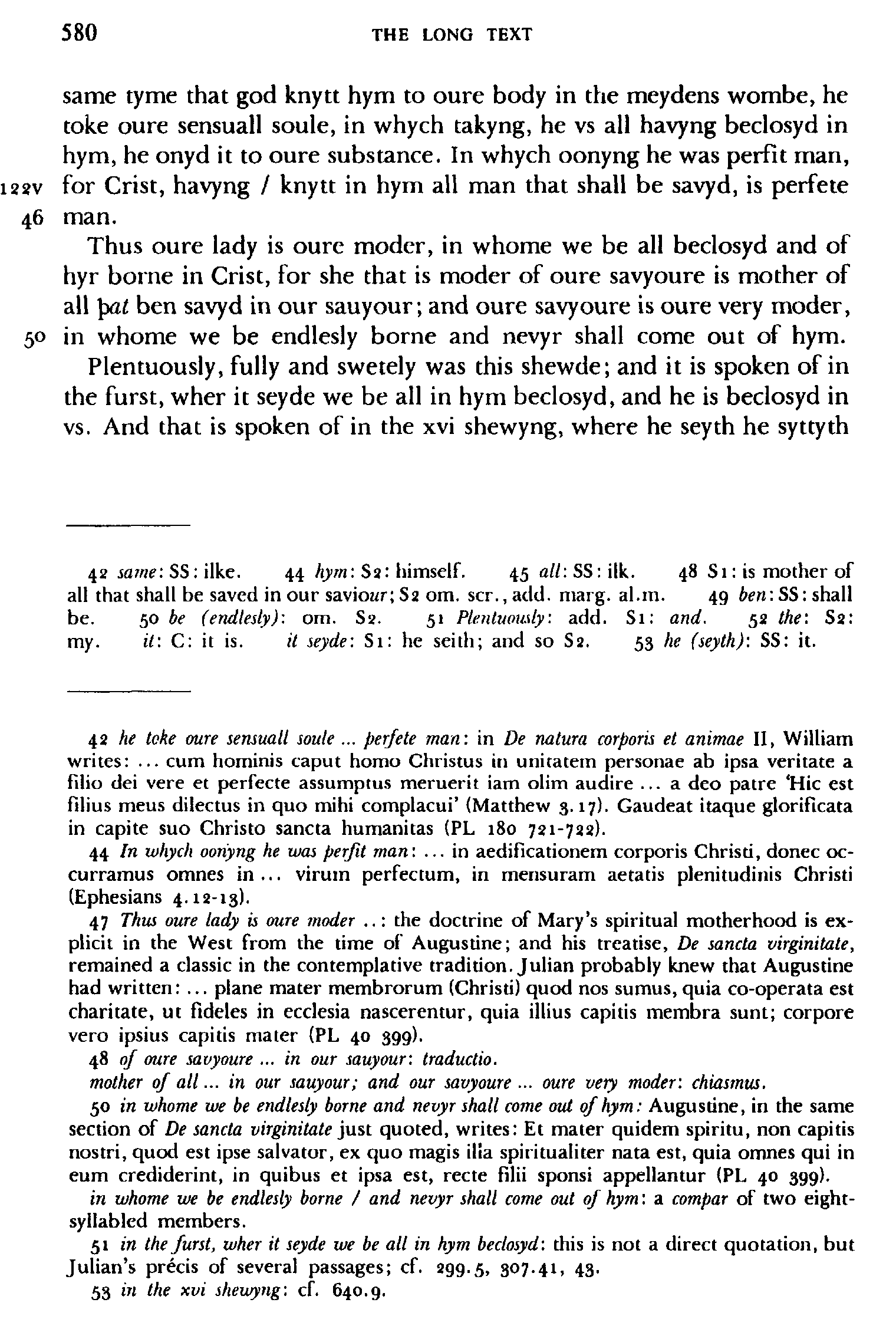
THE LONG TEXT
same tyme that god knytt hym to oure body in the meydens wombe, he toke oure sensuall soule, in whych takyng, he vs all havyng beclosyd in hym, he onyd it to oure substance. In whych oonyng he was perfit man, i22v for Crist, havyng / knytt in hym all man that shall be savyd, is perfete
46 man.
Thus oure lady is oure moder, in whome we be all beclosyd and of hyr borne in Crist, for she that is moder of oure savyoure is mother of all \Mt ben savyd in our sauyour; and oure savyoure is oure very moder,
50 in whome we be endlesly borne and nevyr shall come out of hym.
Plentuously, fully and swetely was this shewde; and it is spoken of in the furst, wher it seyde we be all in hym beclosyd, and he is beclosyd in vs. And that is spoken of in the xvi shewyng, where he seyth he syttyth
42 same'. SS: ilke.
44 hym: 82: himself.
45 all: SS: ilk.
48 Si: is mother of all that shall be saved in our saviour; 82 om. scr., add. marg. al.m.
49 ben: SS: shall be.
50 be (endlesly): om.
82.
51 Plentuously: add. Si: and.
52 the: Sa: my. it: C: it is. it seyde: Si: he seith; and so 82.
53 he (seyth): SS: it.
42 he toke oure sensuall soule ... perfete man: in De natura corporis et animae II, William writes: ... cum hominis caput homo Christus in unitatem personae ab ipsa veritate a filio dei vere et perfecte assumptus meruerit iam olim audire ... a deo patre 'Hie est filius meus dilectus in quo mihi complacui' (Matthew 3.17). Gaudeat itaque glorificata in capite suo Christo sancta humanitas (PL 180 721-722).
44 In whych oonyng he was perfit man: ... in aedificationem corporis Christi, donee occurramus omnes in ... virum perfectum, in mensuram aetatis plenitudinis Christi
(Ephesians 4.12-13).
47 Thus oure lady is oure moder ..: the doctrine of Mary's spiritual motherhood is explicit in the West from the time of Augustine; and his treatise, De sancta virginitate, remained a classic in the contemplative tradition. Julian probably knew that Augustine had written: ... plane mater membrorum (Christi) quod nos sumus, quia co-operata est charitate, ut fideles in ecclesia nascerentur, quia illius capitis membra sunt; corpore vero ipsius capitis mater (PL 40 399).
48 of oure savyoure ... in our sauyour: traductio. mother of all... in our sauyour; and our savyoure ... oure very moder: chiasmus.
50 in whome we be endlesly borne and nevyr shall come out of hym: Augustine, in the same section of De sancta virginitate just quoted, writes: Et mater quidem spiritu, non capitis nostri, quod est ipse salvator, ex quo magis ilia spiritualiter nata est, quia omnes qui in eum crediderint, in quibus et ipsa est, recte filii sponsi appellantur (PL 40 399). in whome we be endlesly borne / and nevyr shall come out of hym: a compar of two eightsyllabled members.
51 in the furst, wher it seyde we be all in hym beclosyd: diis is not a direct quotation, but Julian's precis of several passages; cf. 299.5, 3Q7-41. 4353 in the xvi shewyng: cf. 640.9.
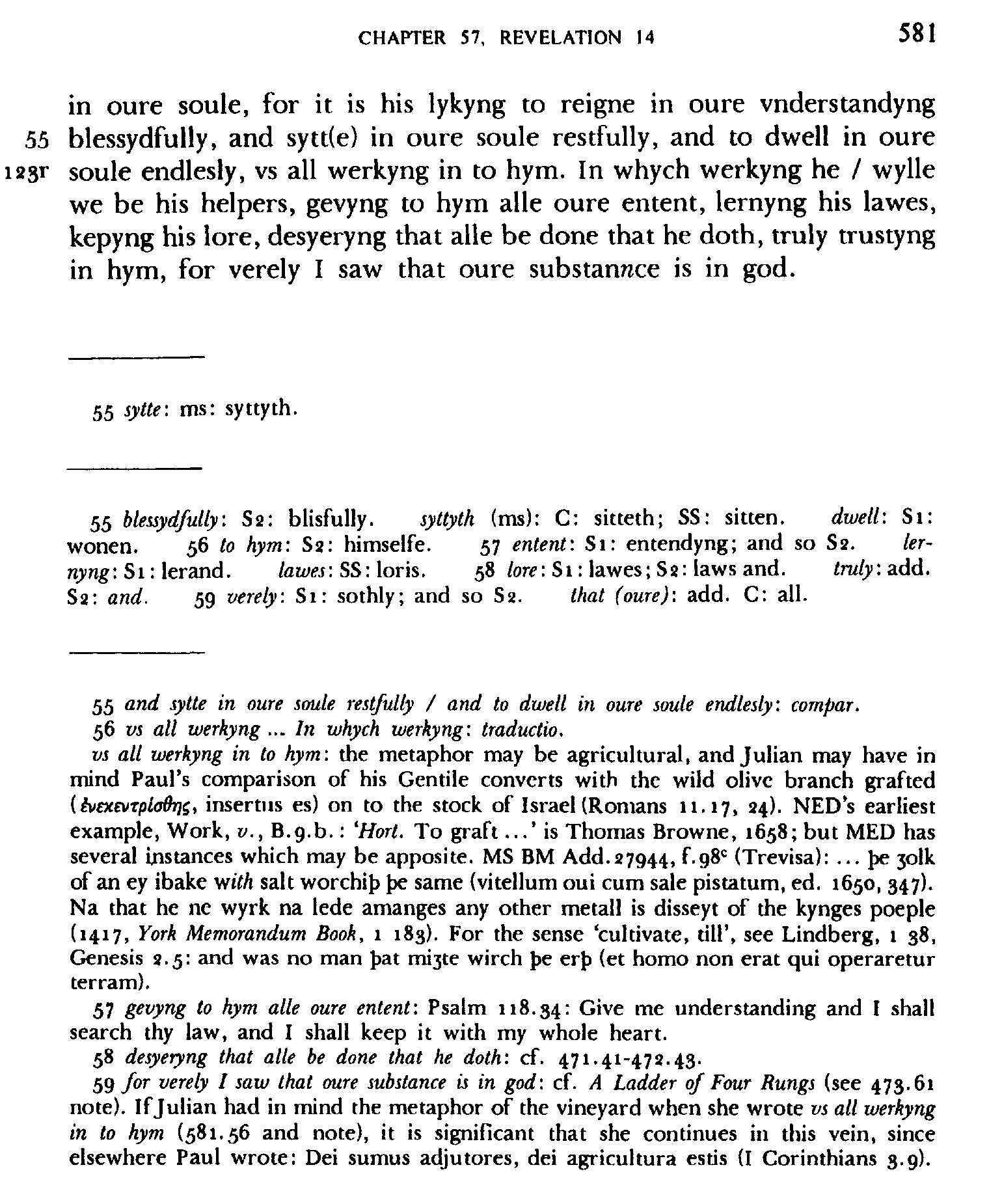
CHAPTER 57, REVELATION 14
in oure soule, for it is his lykyng to reigne in oure vnderstandyng 55 blessydfully, and sytt(e) in oure soule restfully, and to dwell in oure i23r soule endlesly, vs all werkyng in to hym. In whych werkyng he / wylle we be his helpers, gevyng to hym alle oure entent, lernyng his lawes, kepyng his lore, desyeryng that alle be done that he doth, truly trustyng in hym, for verely I saw that oure substannce is in god.
55 sytte: ms: syttyth.
55 blessydfully:
Sa: blisfully. syttyth (ms): C: sitteth; SS: sitten. dwell: Si: wonen.
56 to hym: Sa: himselfe.
57 entent: Si: entendyng; and so Sa. lernyng: Si: lerand. lawes: SS: loris.
58 lore: Si: lawes; Sa: laws and. truly: add.
Sa: and.
59 verely: Si: sothly; and so Sa. that (oure): add. C: all.
55 and sytte in oure soule restfully / and to dwell in oure soule endlesly: compar.
56 vs all werkyng ...In whych werkyng: traductio. vs all werkyng in to hym: the metaphor may be agricultural, and Julian may have in mind Paul's comparison of his Gentile converts with the wild olive branch grafted
(tv£X£VTplo(h]$, insertus es) on to the stock of Israel (Romans 11.17, 24)- NED's earliest example, Work, v., B.g.b.: 'Hort. To graft..." is Thomas Browne, 1658; but MED has several instances which may be apposite. MS BM Add.37944, f-9^c (Trevisa): ... \>e 3olk of an ey ibake with salt worchij) f>e same (vitellum oui cum sale pistatum, ed. 1650, 347).
Na that he ne wyrk na lede amanges any other metall is disseyt of the kynges poeple
(1417, York Memorandum Book, i 183). For the sense 'cultivate, till', see Lindberg, i 38,
Genesis 3.5: and was no man J>at mi3te wirch J>e erj) (et homo non erat qui operaretur terram).
57 gevyng to hym alle oure entent: Psalm 118.34: Give me understanding and I shall search thy law, and I shall keep it with my whole heart.
58 desyeryng that alle be done that he doth: cf. 471.41-473.43.
59 for verely I saw that oure substance is in god: cf. A Ladder of Four Rungs (see 473.61 note). If Julian had in mind the metaphor of the vineyard when she wrote vs all werkyng in to hym (581.56 and note), it is significant that she continues in this vein, since elsewhere Paul wrote: Dei sumus adjutores, dei agricultura estis (I Corinthians 3.9).
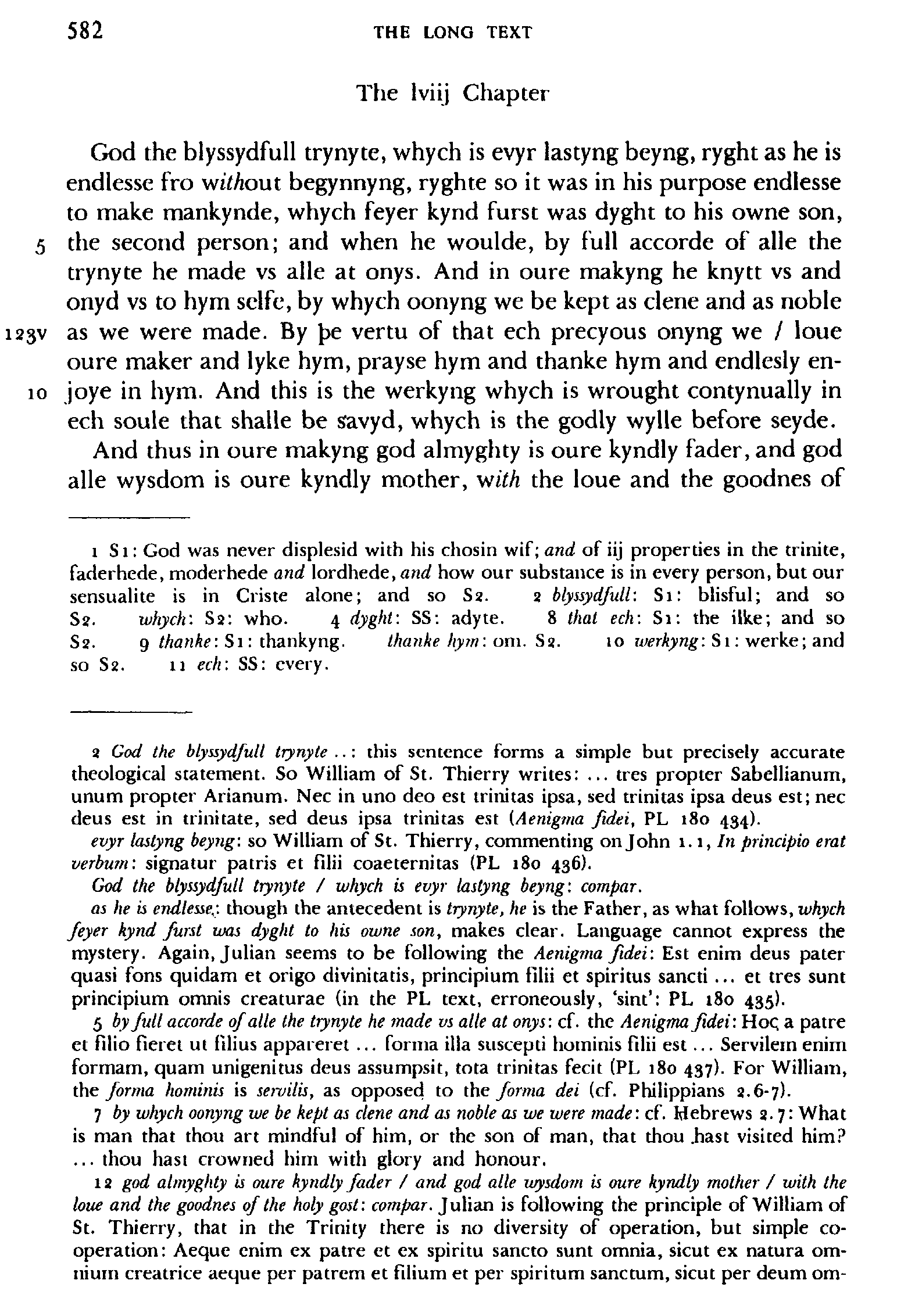
THE LONG TEXT
The Iviij Chapter God the blyssydfull trynyte, whych is evyr lastyng beyng, ryght as he is endlesse fro without begynnyng, ryghte so it was in his purpose endlesse to make mankynde, whych feyer kynd furst was dyght to his owne son,
5 the second person; and when he woulde, by full accorde of alle the trynyte he made vs alle at onys. And in oure makyng he knytt vs and onyd vs to hym selfe, by whych oonyng we be kept as clene and as noble lasv as we were made. By pe vertu of that ech precyous onyng we / loue oure maker and lyke hym, prayse hym and thanke hym and endlesly en10 joye in hym. And this is the werkyng whych is wrought contynually in ech soule that shalle be savyd, whych is the godly wylle before seyde.
And thus in oure makyng god almyghty is oure kyndly fader, and god alle wysdom is oure kyndly mother, with the loue and the goodnes of i Si: God was never displesid with his chosin wif; and of iij properties in the trinite, faderhede, moderhede and lordhede, and how our substance is in every person, but our sensualite is in Criste alone; and so 82.
2 blyssydfull:
Si: blisful; and so Sa. whych: Sa: who.
4 dyght: SS: adyte.
8 that ech: Si: the ilke; and so Sa.
9 thanke: Si: thankyng. thanke hym: orn. Sa.
10 werkyng: Si: werke; and so Sa.
11 ech: SS: every. a God the blyssydfull trynyte ..: this sentence forms a simple but precisely accurate theological statement. So William of St. Thierry writes: ... tres propter Sabellianum, unum propter Arianum. Nee in uno deo est trinitas ipsa, sed trinitas ipsa deus est; nee deus est in trinitate, sed deus ipsa trinitas est (Aenig?na fidei, PL 180 434). evyr lastyng beyng: so William of St. Thierry, commenting on John 1.1, In principle erat verbum: signatur patris et filii coaeternitas (PL 180 436).
God the blyssydfull trynyte / whych is evyr lastyng beyng: compar. as he is endlesse,: though the antecedent is trynyte, he is the Father, as what follows, whych feyer kynd furst was dyght to his owne son, makes clear. Language cannot express the mystery. Again, Julian seems to be following the Aenigma ftdei: Est enim deus pater quasi fons quidam et origo divinitatis, principium filii et spiritus sancti ... et tres sunt principium omnis creaturae (in the PL text, erroneously, 'sint': PL 180 435).
5 by full accorde of alle the trynyte he made vs alle at onys: cf. the Aenigma fidei: Hoc. a patre et filio fieret ut films appareret ... forma ilia suscepti hominis filii est ... Servilern enim formam, quam unigenitus deus assumpsit, tota trinitas fecit (PL 180 437). For William, the forma hominis is sewilis, as opposed to the forma del (cf. Philippians 2.6-7).
7 by whych oonyng we be kept as clene and as noble as we were made: cf. Hebrews 3.7: What is man that thou art mindful of him, or the son of man, that thou .hast visited him?
... thou hast crowned him with glory and honour.
12 god almyghty is oure kyndly fader / and god alle wysdom is oure kyndly mother / with the loue and the goodnes of the holy gost: compar. Julian is following the principle of William of St. Thierry, that in the Trinity there is no diversity of operation, but simple cooperation: Aeque enim ex patre et ex spiritu sancto sunt omnia, sicut ex natura omnium creatrice aeque per patrem et filium et per spiritum sanctum, sicut per deum om-
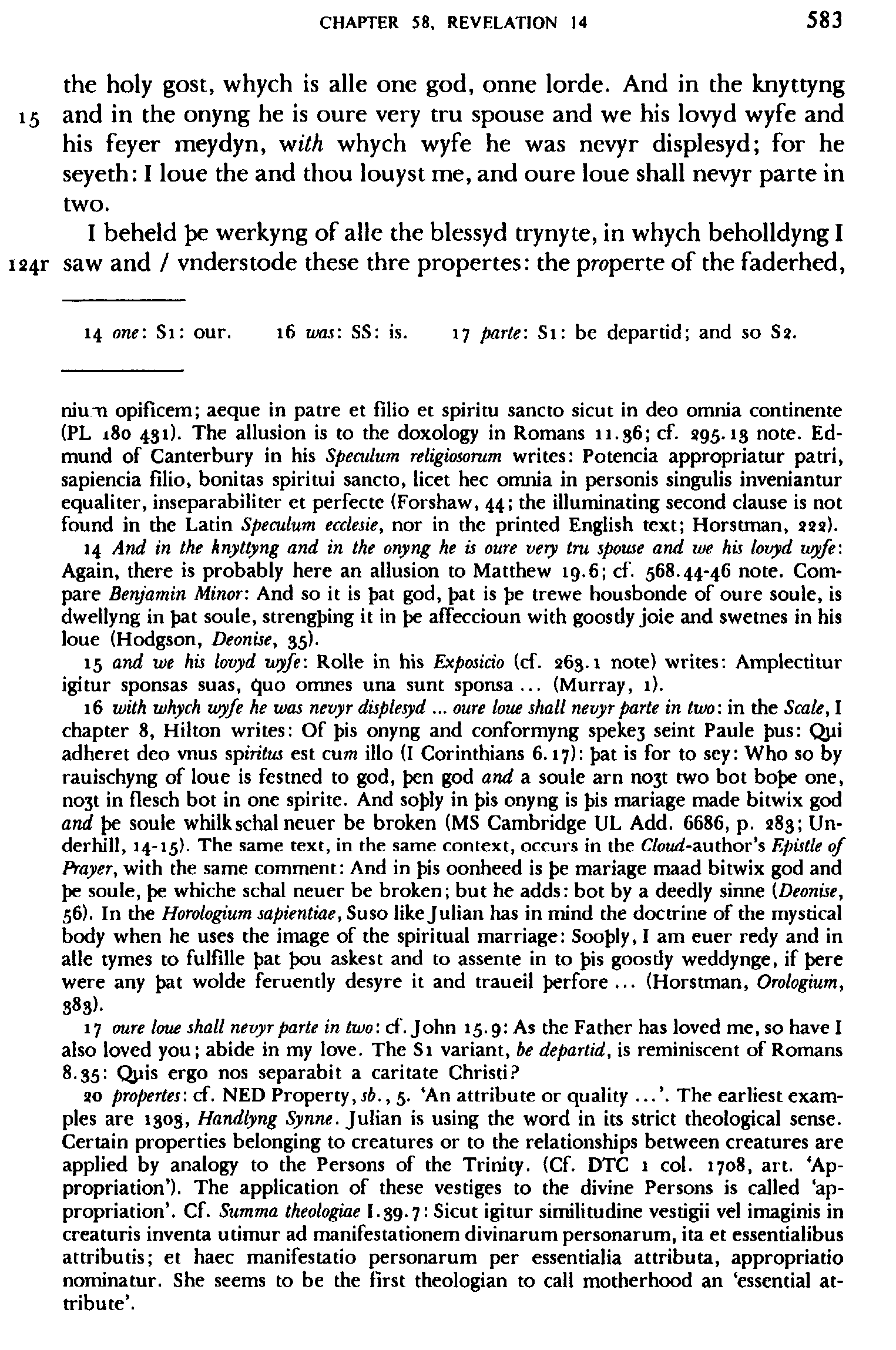
CHAPTER 58, REVELATION 14
the holy gost, whych is alle one god, onne lorde. And in the knyttyng 15 and in the onyng he is oure very tru spouse and we his lovyd wyfe and his feyer meydyn, with whych wyfe he was nevyr displesyd; for he seyeth: I loue the and thou louyst me, and oure loue shall nevyr parte in two.
I beheld J>e werkyng of alle the blessyd trynyte, in whych beholldyng I i24r saw and / vnderstode these thre propertes: the properte of the faderhed,
14 one: Si: our.
16 was: SS: is.
17 parte: Si: be departid; and so 82. niu-n opificem; aeque in patre et filio et spiritu sancto sicut in deo omnia continente
(PL 180 431). The allusion is to the doxology in Romans 11.36; cf. 295.13 note. Edmund of Canterbury in his Speculum religiosorum writes: Potencia appropriatur patri, sapiencia filio, bonitas spiritui sancto, licet hec omnia in personis singulis inveniantur equaliter, inseparabiliter et perfecte (Forshaw, 44; the illuminating second clause is not found in the Latin Speculum ecclesie, nor in the printed English text; Horstman, 222).
14 And in the knyttyng and in the onyng he is oure very tru spouse and we his lovyd wyfe:
Again, there is probably here an allusion to Matthew 19.6; cf. 568.44-46 note. Compare Benjamin Minor: And so it is pat god, bat is be trewe housbonde of oure soule, is dwellyng in bat soule, strengbing it in be affeccioun with goostly joie and swetnes in his loue (Hodgson, Deonise, 35).
15 and we his lovyd wyfe: Rolle in his Exposicio (cf. 263.1 note) writes: Amplectitur igitur sponsas suas, quo omnes una sunt sponsa... (Murray, i).
16 with whych wyfe he was nevyr displesyd ... oure loue shall nevyr parte in two: in the Scale, I chapter 8, Hilton writes: Of bis onyng and conformyng spekej seint Paule pus: Qui adheret deo vnus spiritus est cum illo (I Corinthians 6.17): bat is for to sey: Who so by rauischyng of loue is festned to god, pen god and a soule arn no3t two bot bobe one, nojt in flesch bot in one spirite. And sobly in pis onyng is pis mariage made bitwix god and be soule whilkschalneuer be broken (MS Cambridge UL Add. 6686, p. 283; Underhill, 14-15). The same text, in the same context, occurs in the Cloud-author's Epistle of Prayer, with the same comment: And in bis oonheed is be mariage maad bitwix god and be soule, be whiche schal neuer be broken; but he adds: bot by a deedly sinne (Deonise,
56). In the Horologium sapientiae, Suso like Julian has in mind the doctrine of the mystical body when he uses the image of the spiritual marriage: Soobly, I am euer redy and in alle tymes to fulfille bat bou askest and to assente in to bis goostly weddynge, if bere were any bat wolde feruently desyre it and traueil berfore ... (Horstman, Orologium,
383).
17 oure loue shall nevyr parte in two: cf. John 15.9: As the Father has loved me, so have I also loved you; abide in my love. The Si variant, be departid, is reminiscent of Romans
8.35: Quis ergo nos separabit a caritate Christi?
20 propertes: cf. NED Property, sb., 5. 'An attribute or quality ...'. The earliest examples are 1303, Handlyng Synne. Julian is using the word in its strict theological sense.
Certain properties belonging to creatures or to the relationships between creatures are applied by analogy to the Persons of the Trinity. (Cf. DTC i col. 1708, art. 'Appropriation'). The application of these vestiges to the divine Persons is called 'appropriation'. Cf. Summa theologiae 1.39.7: Sicut igitur similitudine vestigii vel imaginis in creaturis inventa utimur ad manifestationem divinarum personarum, ita et essentialibus attributis; et haec manifestatio personarum per essentialia attributa, appropriatio nominatur. She seems to be die first theologian to call motherhood an 'essential attribute'.
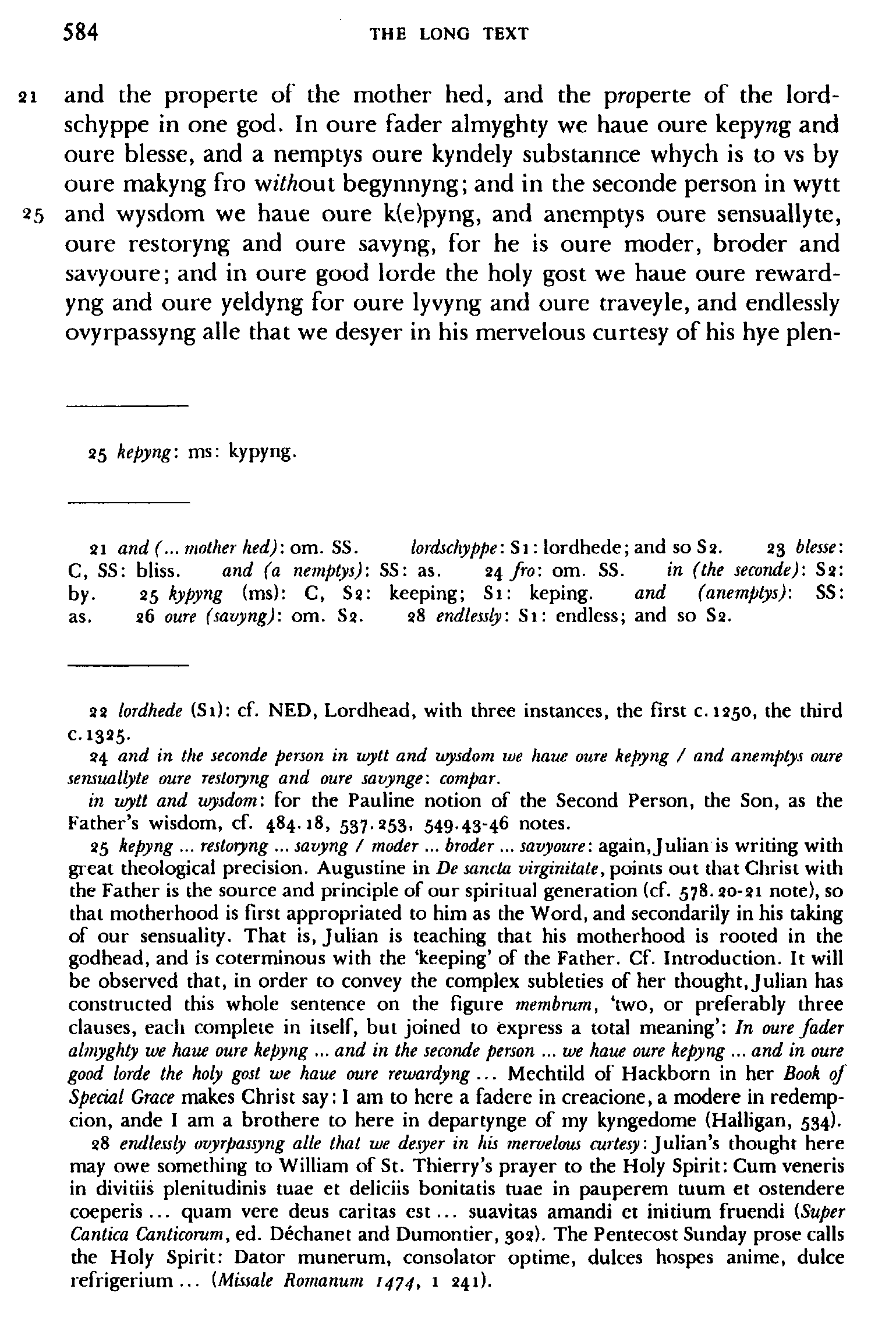
THE LONG TEXT
21 and the properte of the mother hed, and the properte of the lordschyppe in one god. In oure fader almyghty we haue oure kepyng and oure blesse, and a nemptys oure kyndely substannce whych is to vs by oure makyng fro without begynnyng; and in the seconde person in wytt
25 and wysdom we haue oure k(e)pyng, and anemptys oure sensuallyte, oure restoryng and oure savyng, for he is oure moder, broder and savyoure; and in oure good lorde the holy gost we haue oure rewardyng and oure yeldyng for oure lyvyng and oure traveyle, and endlessly ovyrpassyng alle that we desyer in his mervelous curtesy of his hye plen25 kepyng: ms: kypyng.
21 and (...mother hed): om. SS. lordschyppe: Si: lordhede; and so 82.
23 blesse:
C, SS: bliss. and (a nemptys): SS: as.
24 fro: om. SS. in (the seconde): 82: by.
25 kypyng (ms): C, 82: keeping; Si: keping. and (anemptys):
SS: as.
26 oure (savyng): om. 82.
28 endlessly: Si: endless; and so 82.
22 lordhede (Si): cf. NED, Lordhead, with three instances, the first 0.1250, the third c. 1325.
24 and in the seconde person in wytt and wysdom we haue oure kepyng / and anemptys oure sensuallyte oure restoryng and oure savynge: compar. in wytt and wysdom: for the Pauline notion of the Second Person, the Son, as the Father's wisdom, cf. 484.18, 537.253, 549-43-46 notes.
25 kepyng ... restoryng ... savyng / moder ... broder ... savyoure: again,Julian is writing with great theological precision. Augustine in De sancta virginitate, points out that Christ with the Father is the source and principle of our spiritual generation (cf. 578.20-21 note), so that motherhood is first appropriated to him as the Word, and secondarily in his taking of our sensuality. That is, Julian is teaching that his motherhood is rooted in the godhead, and is coterminous with the 'keeping' of the Father. Cf. Introduction. It will be observed that, in order to convey the complex subleties of her thought, Julian has constructed this whole sentence on the figure membrum, 'two, or preferably three clauses, each complete in itself, but joined to express a total meaning': In oure fader almyghty we haue oure kepyng ... and in the seconde person ...we haue oure kepyng ... and in oure good lorde the holy gost we haue oure rewarding ... Mechtild of Hackborn in her Book of Special Grace makes Christ say: I am to here a fadere in creacione,a modere in redempcion, ande I am a brothere to here in departynge of my kyngedome (Halligan, 534).
28 endlessly ovyrpassyng alle that we desyer in his mervelous curtesy: Julian's thought here may owe something to William of St. Thierry's prayer to the Holy Spirit: Cum veneris in divitiis plenitudinis tuae et deliciis bonitatis tuae in pauperem tuum et ostendere coeperis ... quam vere deus caritas est... suavitas amandi et initium fruendi (Super
Cantica Canticorum, ed. Dechanet and Dumontier, 302). The Pentecost Sunday prose calls the Holy Spirit: Dator munerum, consolator optime, dulces hospes anime, dulce refrigerium ... (Missale Romanwn 1474, i 241).
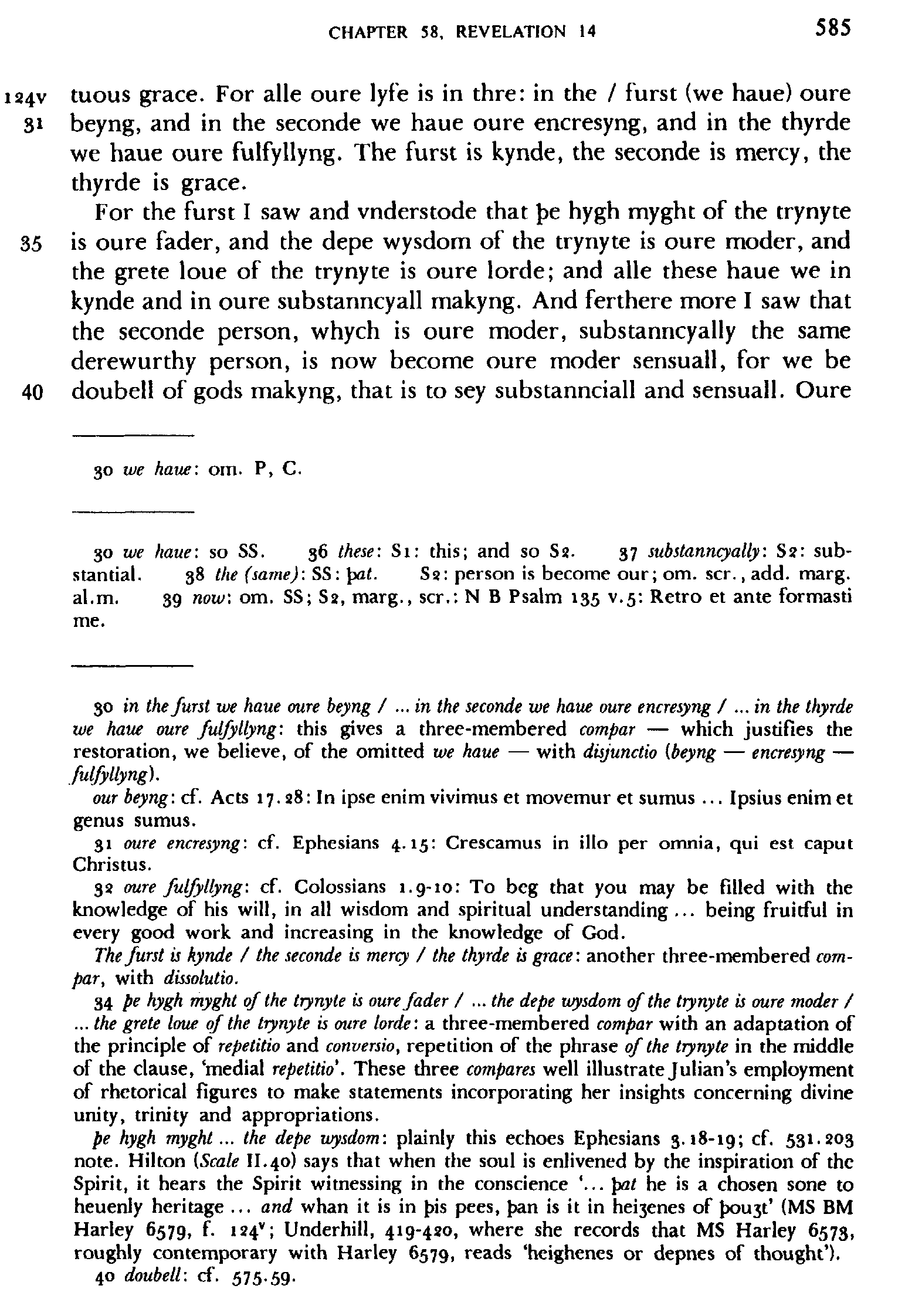
CHAPTER 58, REVELATION 14
124V tuous grace. For alle oure lyfe is in thre: in the / furst (we haue) oure 31 beyng, and in the seconde we haue oure encresyng, and in the thyrde we haue oure fulfyllyng. The furst is kynde, the seconde is mercy, the thyrde is grace.
For the furst I saw and vnderstode that be hygh myght of the trynyte
is oure fader, and the depe wysdom of the trynyte is oure moder, and the grete loue of the trynyte is oure lorde; and alle these haue we in kynde and in oure substanncyall makyng. And ferthere more I saw that the seconde person, whych is oure moder, substanncyally the same derewurthy person, is now become oure moder sensuall, for we be
doubell of gods makyng, that is to sey substannciall and sensuall. Oure 30 we haue'. om. P, C.
30 we haue: so SS.
36 these'. Si: this; and so 82.
37 substanncyally: 82: substantial.
38 the (same): SS: JxzL 82: person is become our; om. scr., add. marg. al.m.
39 now: om. SS; 82, marg., scr.: N B Psalm 135 v-5: Retro et ante formasti me.
30 in the furst we haue oure beyng / ... in the seconde we haue oure encresyng / ... in the thyrde we haue oure fulfyllyng: this gives a three-membered compar — which justifies the restoration, we believe, of the omitted we haue — with disjunctio (beyng — encresyng — fulfyllyng). our beyng: cf. Acts 17.28: In ipse enim vivimus et movemur et sumus ... Ipsius enim et genus sumus.
31 oure encresyng: cf. Ephesians 4.15: Crescamus in illo per omnia, qui est caput
Christus.
32 oure fulfyllyng: cf. Colossians 1.9-10: To beg that you may be filled with the knowledge of his will, in all wisdom and spiritual understanding ... being fruitful in every good work and increasing in the knowledge of God.
The furst is kynde / the seconde is mercy / the thyrde is grace: another three-membered compar, with dissolutio.
34 pe hygh myght of the trynyte is oure fader / ...the depe wysdom of the trynyte is oure moder /
... the grete loue of the trynyte is oure lorde: a three-membered compar with an adaptation of the principle of repetitio and conversio, repetition of the phrase of the trynyte in the middle of the clause, 'medial repetitio'. These three compares well illustrate Julian's employment of rhetorical figures to make statements incorporating her insights concerning divine unity, trinity and appropriations. pe hygh myght... the depe wysdom: plainly this echoes Ephesians 3.18-19; cf. 531.203 note. Hilton (Scale 11.40) says that when the soul is enlivened by the inspiration of the Spirit, it hears the Spirit witnessing in the conscience '... \xit he is a chosen sone to heuenly heritage ... and whan it is in J>is pees, Jsan is it in hei3enes of pou3t' (MS BM
Harley 6579, f. 124*; Underbill, 419-420, where she records that MS Harley 6573, roughly contemporary with Harley 6579, reads 'heighenes or depnes of thought1).
40 doubell: cf. 575-59-
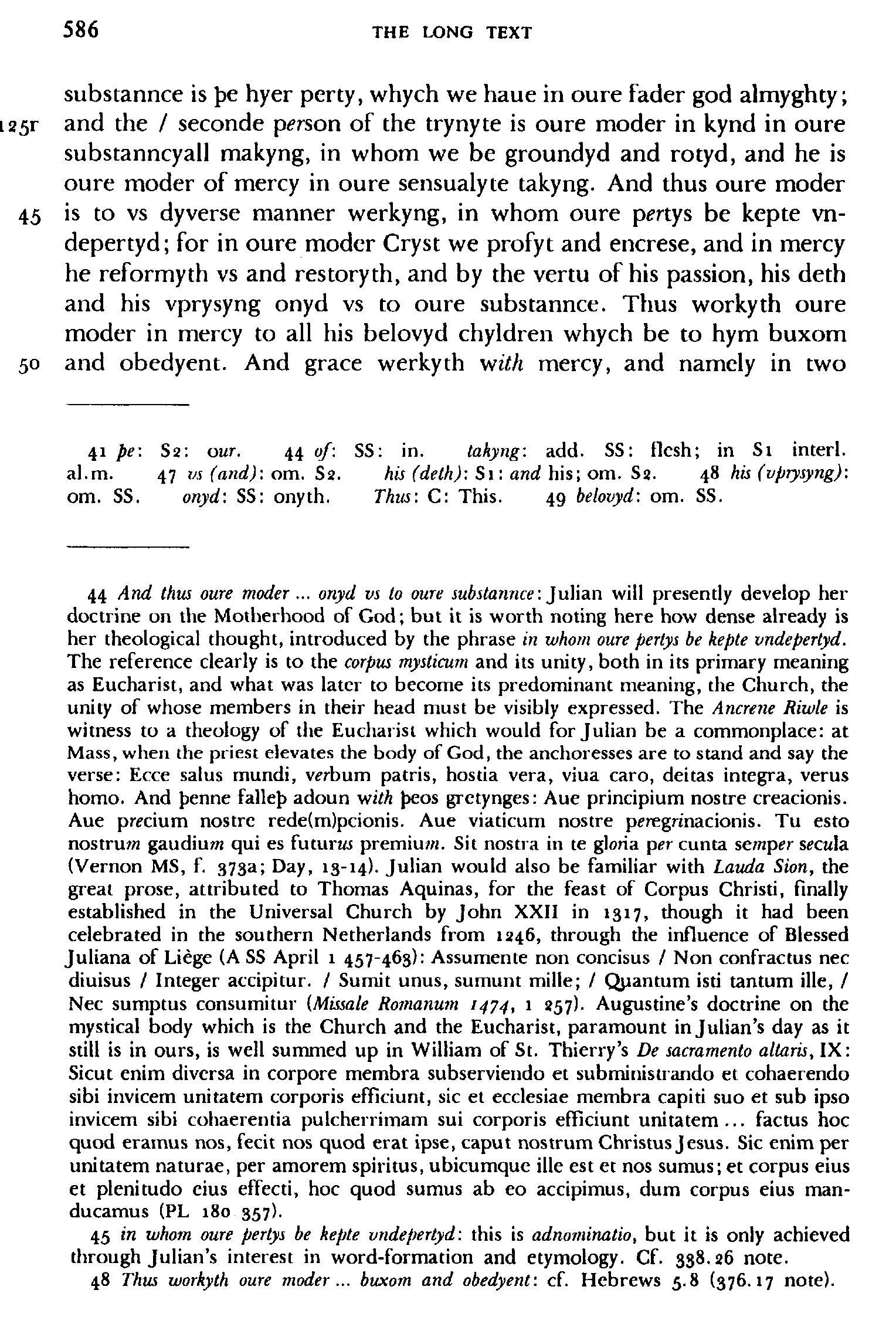
THE LONG TEXT
substannce is pe hyer perty, whych we haue in oure fader god almyghty; i25r and the / seconde person of the trynyte is oure moder in kynd in oure substanncyall makyng, in whom we be groundyd and rotyd, and he is oure moder of mercy in oure sensualyte takyng. And thus oure moder
45 is to vs dyverse manner werkyng, in whom oure pmys be kepte vndepertyd; for in oure moder Cryst we profyt and encrese, and in mercy he reformyth vs and restoryth, and by the vertu of his passion, his deth and his vprysyng onyd vs to oure substannce. Thus workyth oure moder in mercy to all his belovyd chyldren whych be to hym buxom
50 and obedyent. And grace werkyth with mercy, and namely in two 41 pe: 82: our.
44 of: SS: in. takyng: add.
SS: flesh; in Si interl. al.m.
47 vs (and): om. 82. his (deth): Si: and his; om. Sa.
48 his (vprysyng): om. SS. onyd: SS: onyth.
Thus: C: This.
49 belovyd: om. SS.
44 And thus oure moder... onyd vs to oure substannce: Julian will presently develop her doctrine on the Motherhood of God; but it is worth noting here how dense already is her theological thought, introduced by the phrase in whom oure pertys be kepte vndepertyd.
The reference clearly is to the corpus mysticum and its unity, both in its primary meaning as Eucharist, and what was later to become its predominant meaning, the Church, the unity of whose members in their head must be visibly expressed. The Ancrene Riwle is witness to a theology of the Eucharist which would for Julian be a commonplace: at Mass, when the priest elevates the body of God, the anchoresses are to stand and say the verse: Ecce salus mundi, wrbum patris, hostia vera, viua caro, deltas integra, verus homo. And Jjenne falleji adoun with Jjeos gretynges: Aue principium nostre creacionis.
Aue precium nostre rede(m)pcionis. Aue viaticum nostre pfregnnacionis. Tu esto nostrum gaudium qui es futurwi premium. Sit nostra in te gloria per cunta semper secula.
(Vernon MS, f. 3733; Day, 13-14). Julian would also be familiar with Lauda Sion, the great prose, attributed to Thomas Aquinas, for the feast of Corpus Christi, finally established in the Universal Church by John XXII in 1317, though it had been celebrated in the southern Netherlands from 1246, through the influence of Blessed
Juliana of Liege (ASS April i 457-463): Assumente non concisus / Non confractus nee diuisus / Integer accipitur. / Sumit unus, sumunt mille; / Quantum isti tantum Hie, /
Nee sumptus consumitur (Missale Romanum 1474, i 257). Augustine's doctrine on the mystical body which is the Church and the Eucharist, paramount in Julian's day as it still is in ours, is well summed up in William of St. Thierry's De sacramento altaris, IX:
Sicut enim diversa in corpore membra subserviendo et subministrando et cohaerendo sibi invicem unitatem corporis efficiunt, sic et ecclesiae membra capiti suo et sub ipso invicem sibi cohaerentia pulcherrimam sui corporis efficiunt unitatem ... factus hoc quod erarnus nos, fecit nos quod erat ipse, caput nostrum Christus Jesus. Sic enim per unitatem naturae, per amorem spiritus, ubicumque ille est et nos sumus; et corpus eius et plenitudo eius effecti, hoc quod sumus ab eo accipimus, dum corpus eius manducamus (PL 180 357).
45 in whom oure pertys be kepte vndepertyd: this is adnominatio, but it is only achieved through Julian's interest in word-formation and etymology. Cf. 338.26 note.
48 Thus workyth oure moder... buxom and obedyent: cf. Hebrews 5.8 (376.17 note).
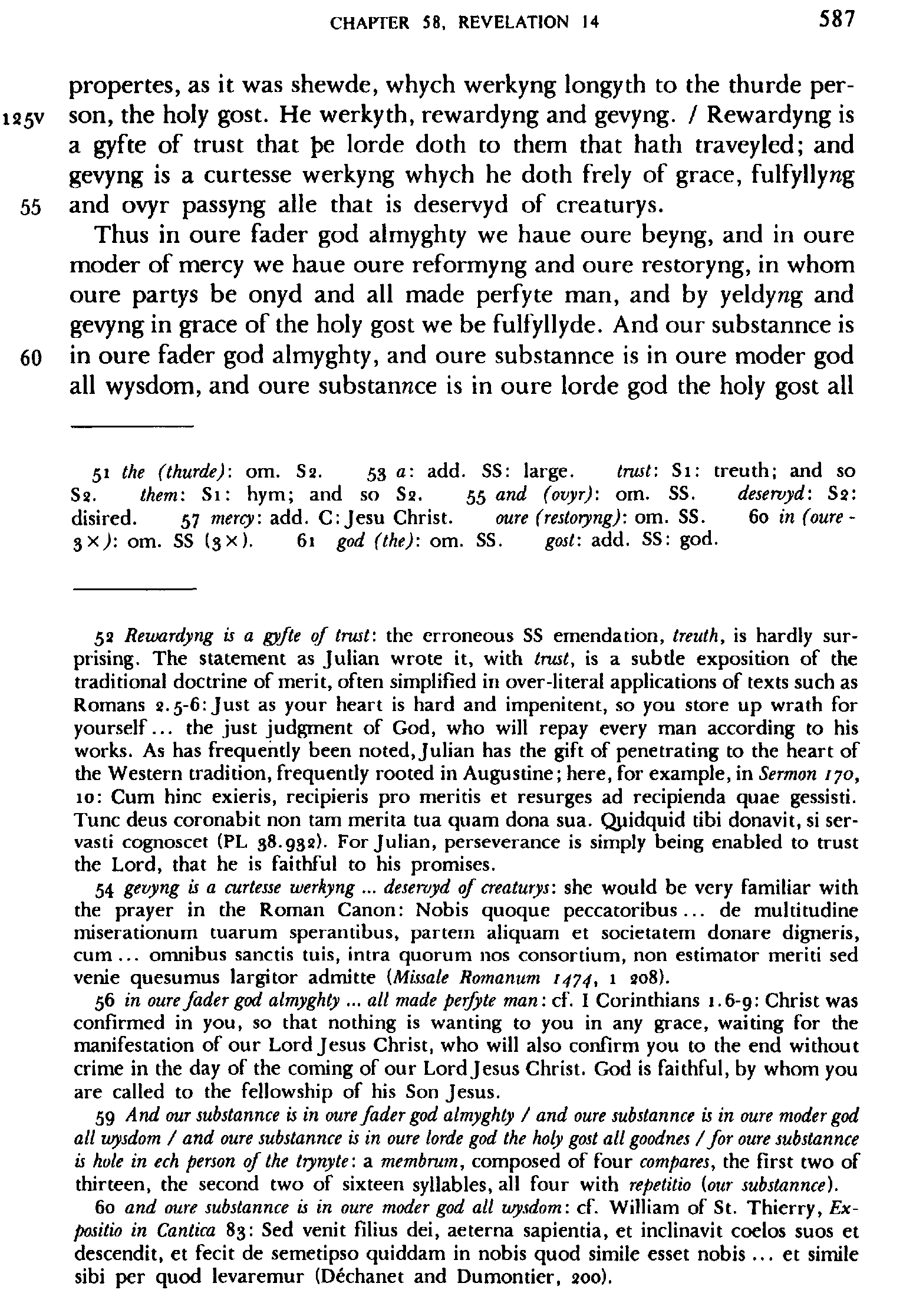
CHAPTER 58, REVELATION 14
propertes, as it was shewde, whych werkyng longyth to the thurde peri25v son, the holy gost. He werkyth, rewardyng and gevyng. / Rewardyng is a gyfte of trust that J)e lorde doth to them that hath traveyled; and gevyng is a curtesse werkyng whych he doth frely of grace, fulfyllywg
55 and ovyr passyng alle that is deservyd of creaturys.
Thus in oure fader god almyghty we haue oure beyng, and in oure moder of mercy we haue oure reformyng and oure restoryng, in whom oure partys be onyd and all made perfyte man, and by yeldyng and gevyng in grace of the holy gost we be fulfyllyde. And our substannce is
in oure fader god almyghty, and oure substannce is in oure moder god all wysdom, and oure substannce is in oure lorde god the holy gost all
51 the (thurde): om. Sa.
53 a: add. SS: large. trust: Si: treuth; and so 82. them: Si: hym; and so Sa.
55 and (ovyr): om. SS. deservyd: Ss: disired.
57 mercy: add. C:Jesu Christ. oure (restoryng): om. SS.
60 in (oure3 X ) : om. SS (jx).
61 god (the): om. SS. gost: add. SS: god.
52 Rewardyng is a gyfte of trust: the erroneous SS emendation, treuth, is hardly surprising. The statement as Julian wrote it, with trust, is a subtle exposition of the traditional doctrine of merit, often simplified in over-literal applications of texts such as Romans 2.5-6: Just as your heart is hard and impenitent, so you store up wrath for yourself... the just judgment of God, who will repay every man according to his works. As has frequently been noted, Julian has the gift of penetrating to the heart of the Western tradition, frequently rooted in Augustine; here, for example, in Sermon 170,
10: Cum hinc exieris, recipieris pro meritis et resurges ad recipienda quae gessisti.
Tune deus coronabit non tarn merita tua quam dona sua. Quidquid tibi donavit, si servasti cognoscet (PL 38.932). For Julian, perseverance is simply being enabled to trust the Lord, that he is faithful to his promises.
54 gevyng is a curtesse werkyng ... deservyd of creaturys: she would be very familiar with the prayer in the Roman Canon: Nobis quoque peccatoribus ... de multitudine miserationum tuarum sperantibus, partem aliquam et societatem donare digneris, cum ... omnibus sanctis tuis, intra quorum nos consortium, non estimator meriti sed venie quesumus largitor admitte (Missale Romanum 1474, i 208).
56 in oure fader god almyghty ... all made perfyte man: cf. I Corinthians 1.6-9: Christ was confirmed in you, so that nothing is wanting to you in any grace, waiting for the manifestation of our Lord Jesus Christ, who will also confirm you to the end without crime in the day of the coming of our Lord Jesus Christ. God is faithful, by whom you are called to the fellowship of his Son Jesus.
59 And our substannce is in oure fader god almyghty / and oure substannce is in oure moder god all wysdom / and oure substannce is in oure lorde god the holy gost all goodnes /for oure substannce is hole in ech person of the trynyte: a membrum, composed of four compares, the first two of thirteen, the second two of sixteen syllables, all four with repetitio (our substannce).
60 and oure substannce is in oure moder god all wysdom: cf. William of St. Thierry, Expositio in Cantica 83: Sed venit filius dei, aeterna sapientia, et inclinavit coelos suos et descendit, et fecit de semetipso quiddam in nobis quod simile esset nobis ... et simile sibi per quod levaremur (Dechanet and Dumontier, 200).
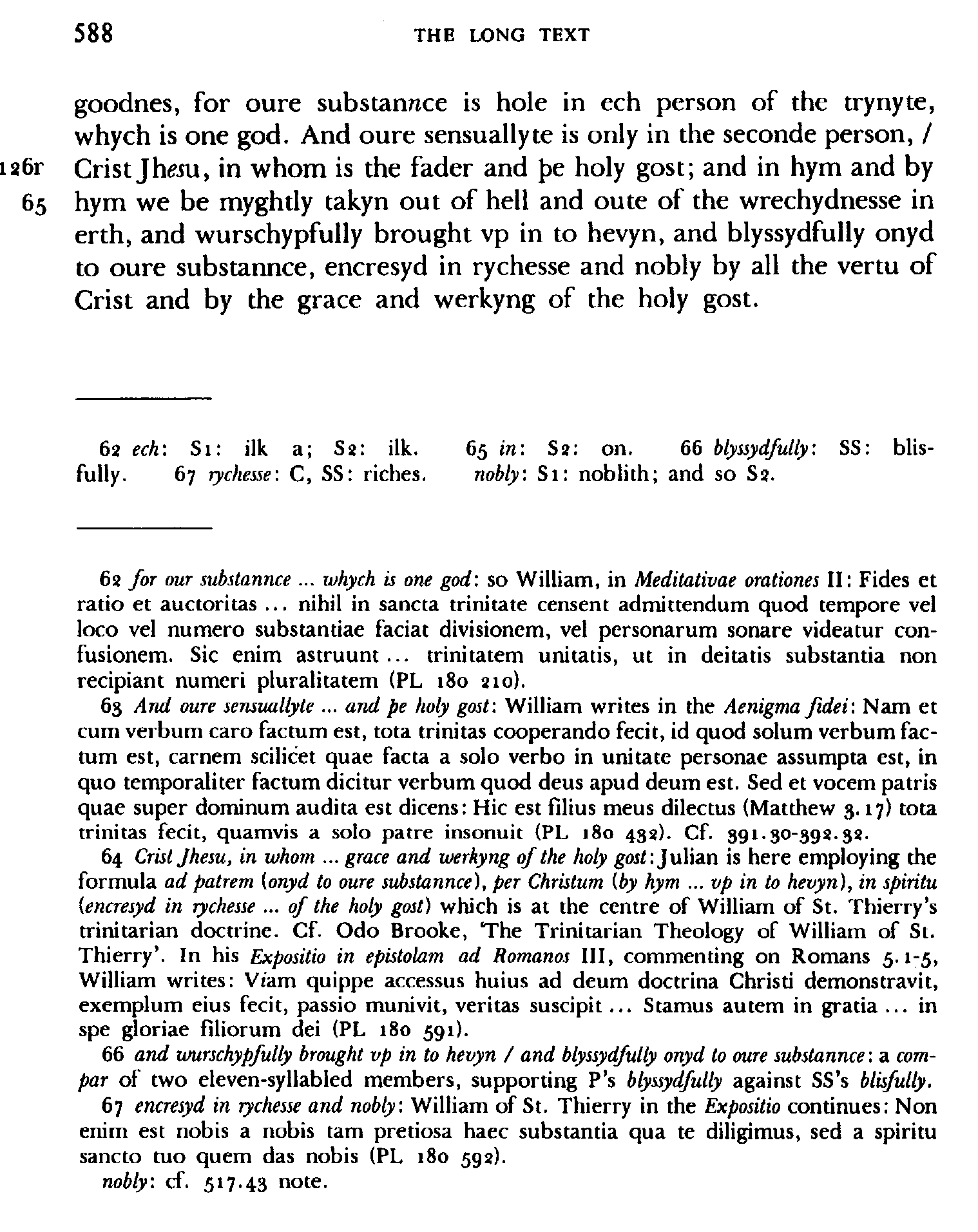
THE LONG TEXT
goodnes, for oure substannce is hole in ech person of the trynyte, whych is one god. And oure sensuallyte is only in the seconde person, / iz6r Crist Jhmi, in whom is the fader and be holy gost; and in hym and by 65 hym we be myghtly takyn out of hell and oute of the wrechydnesse in erth, and wurschypfully brought vp in to hevyn, and blyssydfully onyd to oure substannce, encresyd in rychesse and nobly by all the vertu of Crist and by the grace and werkyng of the holy gost.
62 ech: Si: ilk a; 82: ilk.
65 in: Ss: on.
66 blyssydfully:
SS: blisfully.
67 rychesse: C, SS: riches. nobly: Si: noblith; and so Ss.
62 for our substannce ... whych is one god: so William, in Meditativae orationes II: Fides et ratio et auctoritas ... nihil in sancta trinitate censent admittendum quod tempore vel loco vel numero substantiae facial divisionem, vel personarum sonare videatur confusionem. Sic enim astruunt... trinitatem unitatis, ut in deitatis substantia non recipiant numeri pluralitatem (PL 180 210).
63 And oure sensuallyte ... and pe holy gost: William writes in the Aenigma fideii: Nam et cum verbum caro factum est, tota trinitas cooperando fecit, id quod solum verbum factum est, carnem scilicet quae facta a solo verbo in unitate personae assumpta est, in quo temporaliter factum dicitur verbum quod deus apud deum est. Sed et vocem patris quae super dominum audita est dicens: Hie est films meus dilectus (Matthew 3.17) tota trinitas fecit, quamvis a solo patre insonuit (PL 180 432). Cf. 391.30-392.32.
64 Crist Jhesu, in whom ... grace and werkyng of the holy gost: Julian is here employing the formula ad patrem (onyd to oure substannce), per Christum (by hym ... vp in to hevyn), in spiritu
(encresyd in rychesse ... of the holy gost) which is at the centre of William of St. Thierry's trinitarian doctrine. Cf. Odo Brooke, The Trinitarian Theology of William of St.
Thierry'. In his Expositio in epistolam ad Romanos III, commenting on Romans 5.1-5,
William writes: Viam quippe accessus huius ad deum doctrina Christi demonstravit, exemplum eius fecit, passio munivit, veritas suscipit ... Stamus autem in gratia ... in spe gloriae filiorum dei (PL 180 591).
66 and wurschypfully brought vp in to hevyn / and blyssydfully onyd to oure substannce: a cornpar of two eleven-syllabled members, supporting P's blyssydfully against SS's blisfully.
67 encresyd in rychesse and nobly: William of St. Thierry in the Expositio continues: Non enim est nobis a nobis tarn pretiosa haec substantia qua te diligimus, sed a spiritu sancto tuo quem das nobis (PL 180 592). nobly: cf. 517.43 note.
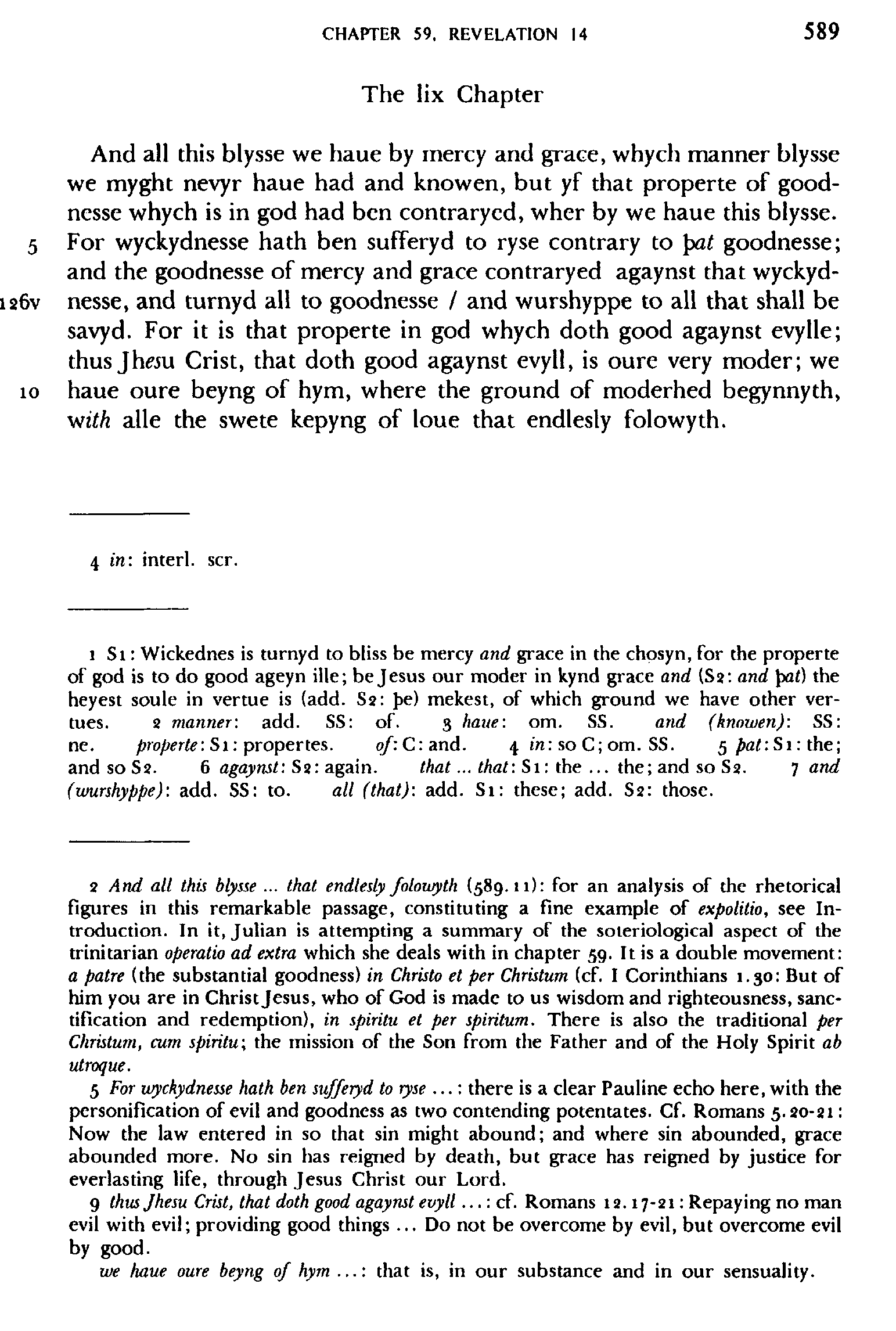
CHAPTER 59, REVELATION 14
The lix Chapter And all this blysse we haue by mercy and grace, whych manner blysse we myght nevyr haue had and knowen, but yf that properte of goodnesse whych is in god had ben contraryed, wher by we haue this blysse.
For wyckydnesse hath ben sufferyd to ryse contrary to \Mt goodnesse; and the goodnesse of mercy and grace contraryed agaynst that wyckydis6v nesse, and turnyd all to goodnesse / and wurshyppe to all that shall be savyd. For it is that properte in god whych doth good agaynst evylle; thus Jhmi Crist, that doth good agaynst evyll, is oure very moder; we
10 haue oure beyng of hym, where the ground of moderhed begynnyth, with alle the swete kepyng of loue that endlesly folowyth.
4 in: interl. scr. i Si: Wickednes is turnyd to bliss be mercy and grace in the chosyn, for the properte of god is to do good ageyn ille; be Jesus our moder in kynd grace and (82: and Jxz£) the heyest soule in vertue is (add. 82: J>e) mekest, of which ground we have other vertues.
2 manner: add.
SS: of.
3 haue: om.
88. and (knowen):
SS: ne. properte:Si: propertes. of: C: and.
4 in: so C; om.88.
5 pat: Si: the; andsoS2.
6 agaynst: 82: again. that ...that: Si: the ... the; and so 82.
7 and (wurshyppe): add. SS: to. all (that): add. Si: these; add. 82: those.
2 And all this blysse ... that endlesly folowyth (589.11): for an analysis of the rhetorical figures in this remarkable passage, constituting a fine example of expolitio, see Introduction. In it, Julian is attempting a summary of the soteriological aspect of the trinitarian operatio ad extra which she deals with in chapter 59. It is a double movement: a patre (the substantial goodness) in Christo et per Christum (cf. I Corinthians 1.30: But of him you are in Christ Jesus, who of God is made to us wisdom and righteousness, sanctification and redemption), in spiritu et per spiritum. There is also the traditional per
Christum, cum spiritu; the mission of the Son from the Father and of the Holy Spirit ab utroque.
5 For wychydnesse hath ben sufferyd to ryse ...: there is a clear Pauline echo here, with the personification of evil and goodness as two contending potentates. Cf. Romans 5.20-21:
Now the law entered in so that sin might abound; and where sin abounded, grace abounded more. No sin has reigned by death, but grace has reigned by justice for everlasting life, through Jesus Christ our Lord.
9 thusjhesu Crist, that doth good agaynst evyll...: cf. Romans 12.17-21: Repaying no man evil with evil; providing good things ... Do not be overcome by evil, but overcome evil by good. we haue oure beyng of hym ...: that is, in our substance and in our sensuality.
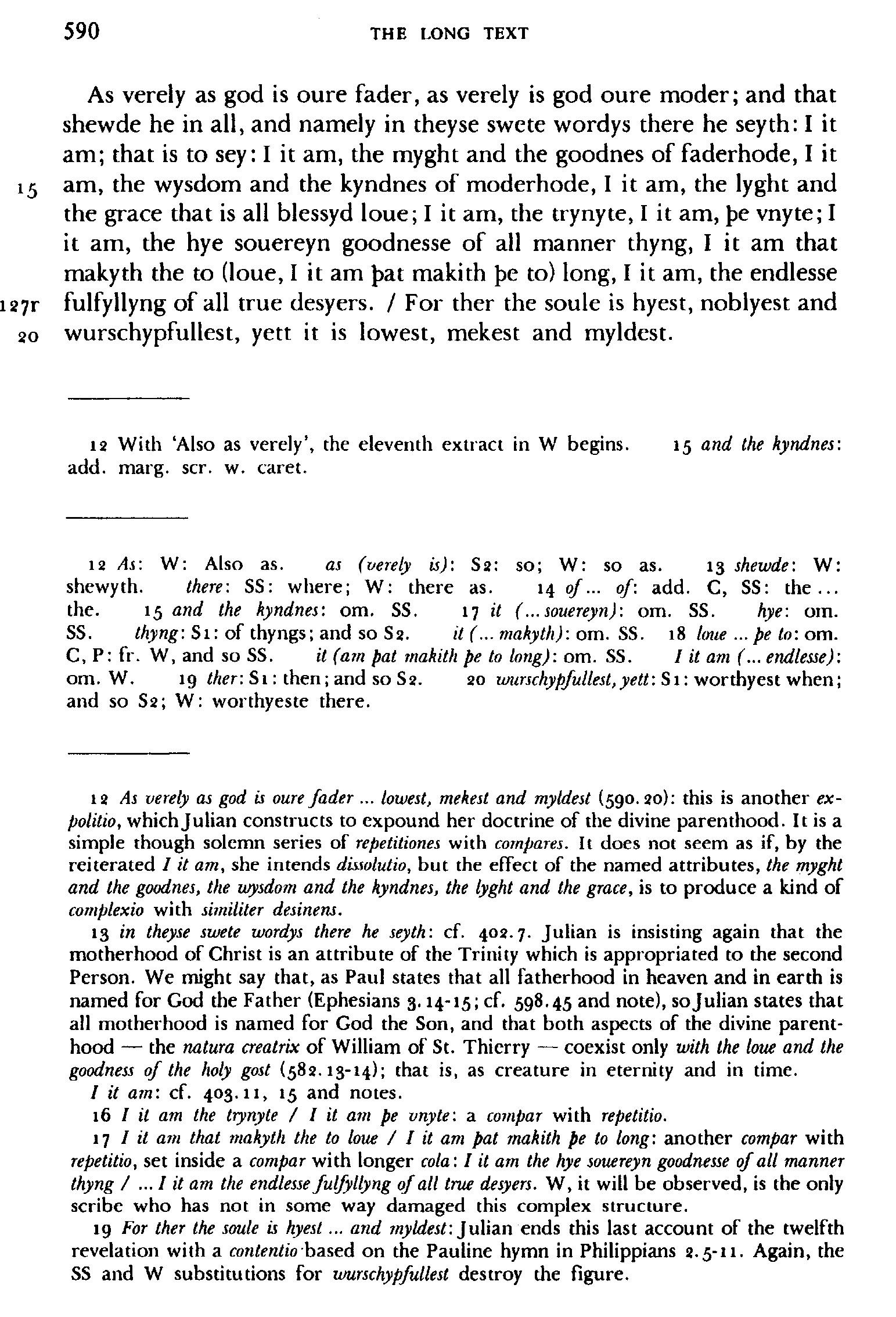
THE LONG TEXT
As verely as god is oure fader, as verely is god oure moder; and that shewde he in all, and namely in theyse swete wordys there he seyth: I it am; that is to sey: I it am, the myght and the goodnes of faderhode, I it
15 am, the wysdom and the kyndnes of moderhode, I it am, the lyght and the grace that is all blessyd loue; I it am, the trynyte, I it am, be vnyte; I it am, the hye souereyn goodnesse of all manner thyng, I it am that makyth the to (loue, I it am Jjat makith £>e to) long, I it am, the endlesse layr fulfyllyng of all true desyers. / For ther the soule is hyest, noblyest and 20 wurschypfullest, yett it is lowest, mekest and myldest.
12 With 'Also as verely', the eleventh extract in W begins.
15 and the kyndnes: add. marg. scr. w. caret.
12 As: W: Also as. as (verely is): 82: so; W: so as.
13 shewde: W: shewyth. there: SS: where; W: there as.
14 of... of: add. C, SS: the... the.
15 and the kyndnes: om.
SS.
17 it (...souereyn): om. SS. hye: om.
SS. thyng: Si: of thyngs; and so 82. it (... makyth): om. SS.
18 loue ... pe to: om.
C, P: fr. W, and so SS. it (am pat makith pe to long): om. SS.
/ it am (... endlesse); om. W.
19 ther: Si: then; and so 82.
20 wurschypfullest,yett: Si: worthyest when; and so 82; W: worthyeste there.
12 As verely as god is oure fader ... lowest, mekest and myldest (590.20): this is another expolitio, which Julian constructs to expound her doctrine of the divine parenthood. It is a simple though solemn series of repetitiones with compares. It does not seem as if, by the reiterated I it am, she intends dissolutio, but the effect of the named attributes, the myght and the goodnes, the wysdom and the kyndnes, the lyght and the grace, is to produce a kind of complexio with similiter desinens.
13 in theyse swete wordys there he seyth: cf. 402.7. Julian is insisting again that the motherhood of Christ is an attribute of the Trinity which is appropriated to die second
Person. We might say that, as Paul states that all fatherhood in heaven and in earth is named for God the Father (Ephesians 3.14-15; cf. 598.45 and note), sojulian states that all motherhood is named for God the Son, and that both aspects of the divine parenthood — the natura creatrix of William of St. Thierry — coexist only with the loue and the goodness of the holy gost (582.13-14); that is, as creature in eternity and in time.
/ it am: cf. 403.11, 15 and notes.
16 / it am the trynyte / I it am pe vnyte: a compar with repetitio.
17 I it am that makyth the to loue / I it am pat makith pe to long: another compar with repetitio, set inside a compar with longer cola: I it am the hye souereyn goodnesse of all manner thyng / ... I it am the endlesse fulfyllyng of all true desyers. W, it will be observed, is the only scribe who has not in some way damaged this complex structure.
19 For ther the soule is hyest... and myldest: Julian ends this last account of the twelfth revelation with a contentio based on the Pauline hymn in Philippians 2.5-11. Again, the SS and W substitutions for wurschypfullest destroy die figure.
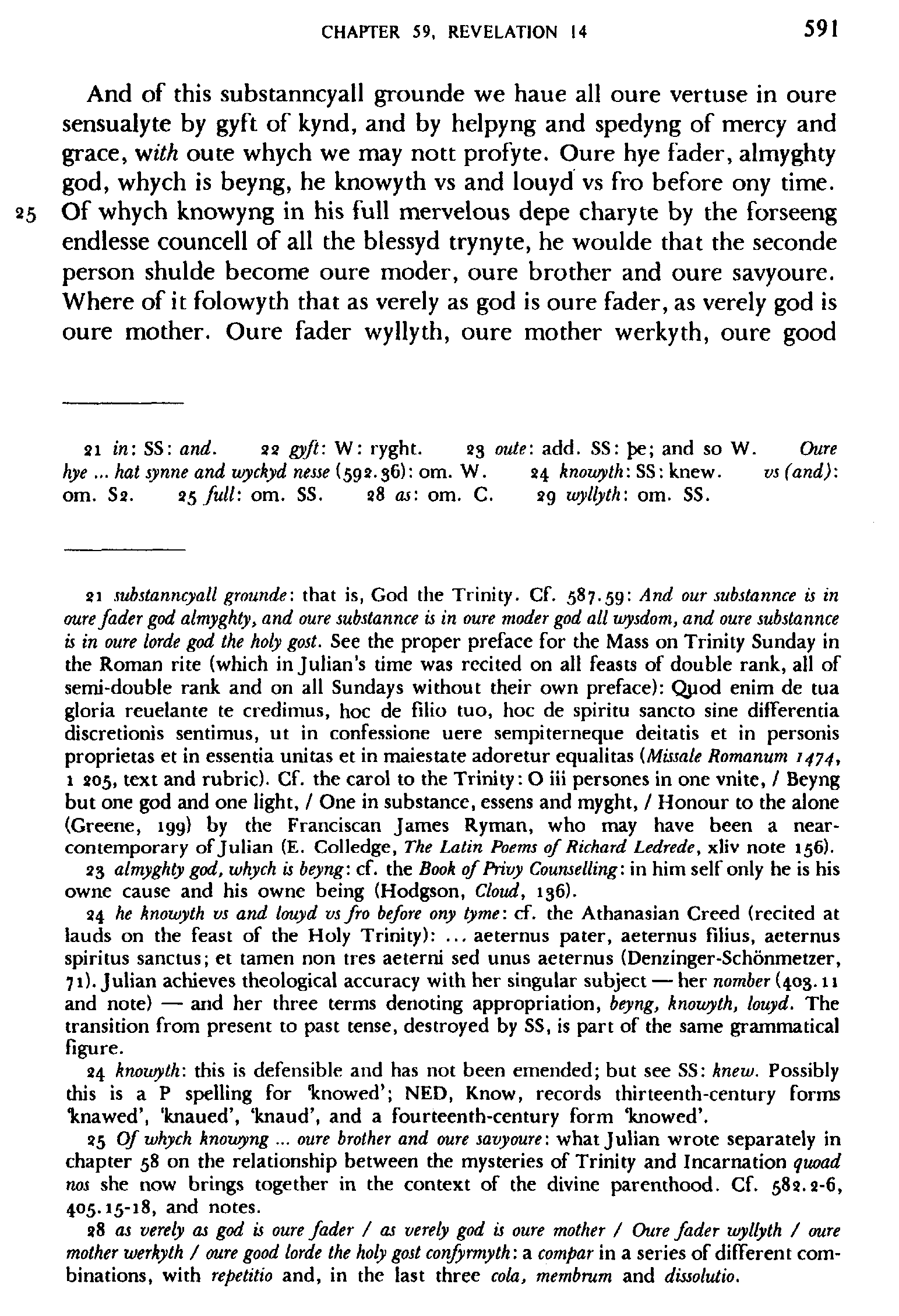
CHAPTER 59, REVELATION 14
And of this substanncyall grounde we haue all cure vertuse in oure sensualyte by gyft of kynd, and by helpyng and spedyng of mercy and grace, with oute whych we may nott profyte. Oure hye fader, almyghty god, whych is beyng, he knowyth vs and louyd vs fro before ony time.
25 Of whych knowyng in his full mervelous depe chary te by the forseeng endlesse councell of all the blessyd trynyte, he woulde that the seconde person shulde become oure moder, oure brother and oure savyoure.
Where of it folowyth that as verely as god is oure fader, as verely god is oure mother. Oure fader wyllyth, oure mother werkyth, oure good
21 in: SS: and.
22 gyft: W: ryght.
23 oute: add. SS: Jje; and so W.
Oure hye ... hat synne and wyckyd nesse (592.36): om. W.
24 knowyth: SS: knew. vs (and): om. 82.
25 full: om. SS.
28 as: om. C.
29 wyllyth: om. SS.
21 substanncyall grounde: that is, God the Trinity. Cf. 587.59: And our substannce is in oure fader god almyghty, and oure substannce is in oure moder god all wysdom, and oure substannce is in oure lorde god the holy gost. See the proper preface for the Mass on Trinity Sunday in the Roman rite (which in Julian's time was recited on all feasts of double rank, all of semi-double rank and on all Sundays without their own preface): Quod enim de tua gloria reuelante te credimus, hoc de filio tuo, hoc de spiritu sancto sine differentia discretionis sentimus, ut in confessione uere sempiterneque deitatis et in personis proprietas et in essentia unitas et in maiestate adoretur equalitas (Missale Romanum 1474, i 205, text and rubric). Cf. the carol to the Trinity: O iii persones in one vnite, / Beyng but one god and one light, / One in substance, essens and myght, / Honour to the alone
(Greene, 199) by the Franciscan James Ryman, who may have been a nearcontemporary of Julian (E. Colledge, The Latin Poems of Richard Ledrede, xliv note 156).
23 almyghty god, whych is beyng: cf. the Book of Privy Counselling: in him self only he is his owne cause and his owne being (Hodgson, Cloud, 136).
24 he knowyth vs and louyd vsfro before ony tyme: cf. the Athanasian Creed (recited at lauds on the feast of the Holy Trinity): ... aeternus pater, aeternus filius, aeternus spiritus sanctus; et tamen non tres aeterni sed unus aeternus (Denzinger-Schonmetzer,
71). Julian achieves theological accuracy with her singular subject — her nomber (403.11 and note) — and her three terms denoting appropriation, beyng, knowyth, louyd. The transition from present to past tense, destroyed by SS, is part of the same grammatical figure.
24 knowyth: this is defensible and has not been emended; but see SS: knew. Possibly this is a P spelling for "knowed'; NED, Know, records thirteenth-century forms
Tcnawed', 'knaued', 'knaud', and a fourteenth-century form 'knowed'.
25 Of whych knowyng ... oure brother and oure savyoure: what Julian wrote separately in chapter 58 on the relationship between the mysteries of Trinity and Incarnation quoad nos she now brings together in the context of the divine parenthood. Cf. 582.2-6,
405.15-18, and notes.
28 as verely as god is oure fader / as verely god is oure mother / Oure fader wyllyth / oure mother werkyth / oure good lorde the holy gost confyrmyth: a compar in a series of different combinations, with repetitio and, in the last three cola, membrum and dissolutio.
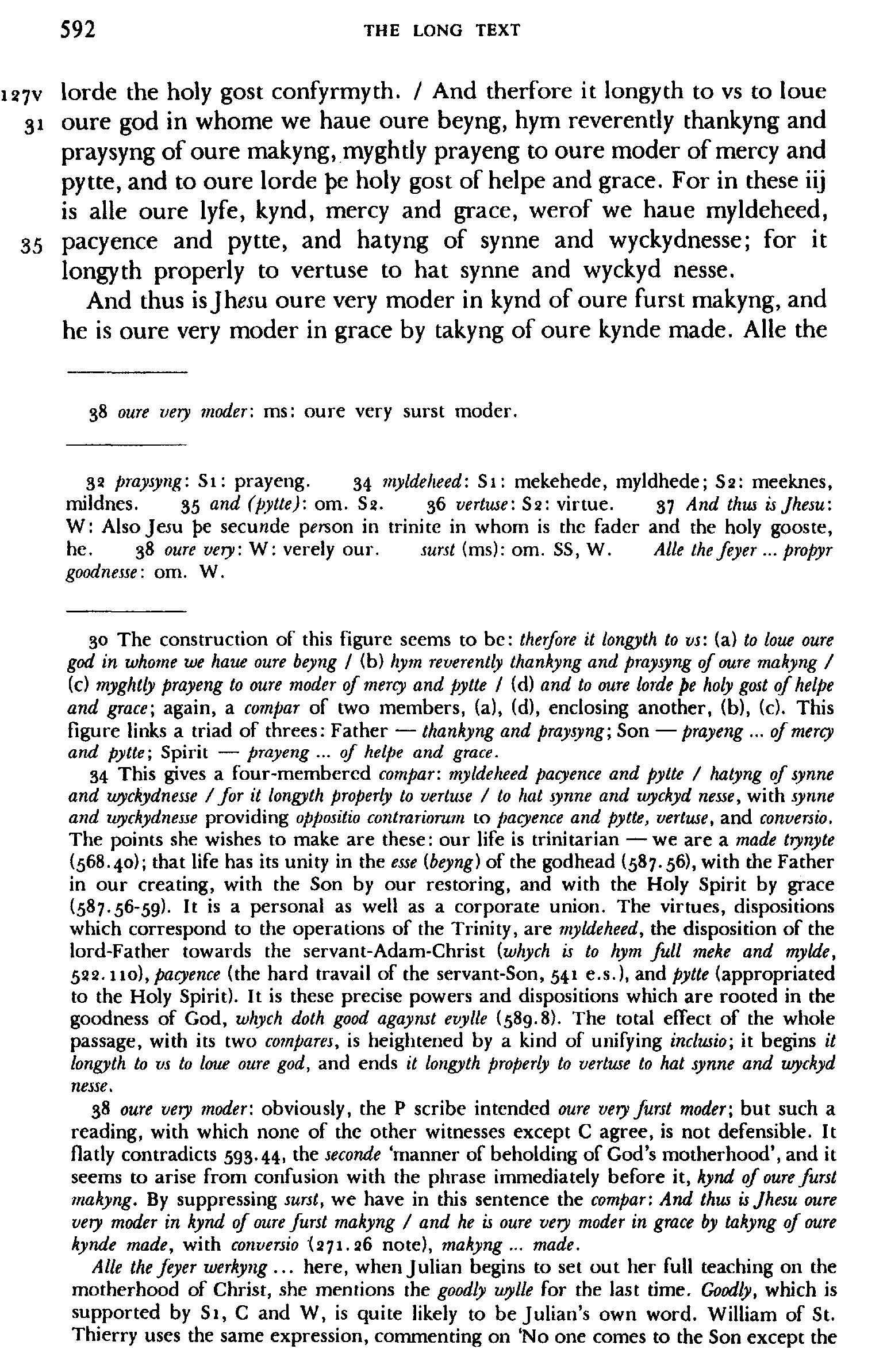
THE LONG TEXT
i27v lorde the holy gost confyrmyth. / And therfore it longyth to vs to loue 31 oure god in whome we haue oure beyng, hym reverently thankyng and praysyng of oure makyng, myghtly prayeng to oure moder of mercy and pytte, and to oure lorde pe holy gost of helpe and grace. For in these iij is alle oure lyfe, kynd, mercy and grace, werof we haue myldeheed,
35 pacyence and pytte, and hatyng of synne and wyckydnesse; for it longyth properly to vertuse to hat synne and wyckyd nesse.
And thus isjhmi oure very moder in kynd of oure furst makyng, and he is oure very moder in grace by takyng of oure kynde made. Alle the
oure very moder: ms: oure very surst moder.
32 praysyng: Si: prayeng.
34 myldeheed: Si: mekehede, myldhede; 82: meeknes, mildnes.
35 and (pytte): om. 82.
36 vertuse: 82: virtue.
37 And thus is Jhesu:
W: Alsoje.su }>e secunde person in trinite in whom is the fader and the holy gooste, he.
38 oure very: W: verely our. surst (ms): om. SS, W.
Alle the feyer ... propyr inesse: om. W. g0 30 The construction of this figure seems to be: therfore it longyth to vs: (a) to loue oure god in whome we haue oure beyng / (b) hym reverently thankyng and praysyng of oure makyng /
(c) myghtly prayeng to oure moder of mercy and pytte I (d) and to oure lorde fre holy gost of helpe and grace; again, a cornpar of two members, (a), (d), enclosing another, (b), (c). This figure links a triad of threes: Father — thankyng and praysyng; Son —prayeng ... of mercy and pytte; Spirit — prayeng ... of helpe and grace.
34 This gives a four-membercd compar: myldeheed pacyence and pytte / hatyng of synne and wyckydnesse /for it longyth properly to vertuse / to hat synne and wyckyd nesse, with synne and wyckydnesse providing oppositio contrariorum to pacyence and pytte, vertuse, and conversio.
The points she wishes to make are these: our life is trinitarian —we are a made trynyte
(568.40); that life has its unity in the esse (beyng) of the godhead (587.56), with the Father in our creating, with the Son by our restoring, and with the Holy Spirit by grace
(587.56-59). It is a personal as well as a corporate union. The virtues, dispositions which correspond to the operations of the Trinity, are myldeheed, the disposition of the lord-Father towards the servant-Adam-Christ (whych is to hym full meke and mylde,
522. no), pacyence (the hard travail of the servant-Son, 541 e.s.), and pytte (appropriated to the Holy Spirit). It is these precise powers and dispositions which are rooted in the goodness of God, whych doth good agaynst evylle (589.8). The total effect of the whole passage, with its two compares, is heightened by a kind of unifying inclusio; it begins it longyth to vs to loue oure god, and ends it longyth properly to vertuse to hat synne and wyckyd nesse.
38 oure very moder: obviously, the P scribe intended oure very furst moder; but such a reading, with which none of the other witnesses except C agree, is not defensible. It flatly contradicts 593.44, the seconde 'manner of beholding of God's motherhood', and it seems to arise from confusion with the phrase immediately before it, kynd of oure furst makyng. By suppressing surst, we have in this sentence the compar: And thus isjhesu oure very moder in kynd of oure furst makyng / and he is oure very moder in grace by takyng of oure kynde made, with conversio (271.26 note), makyng... made.
Alle the feyer werkyng ... here, when Julian begins to set out her full teaching on the motherhood of Christ, she mentions the goodly wylle for the last time. Goodly, which is supported by Si, C and W, is quite likely to be Julian's own word. William of St.
Thierry uses the same expression, commenting on 'No one comes to the Son except the
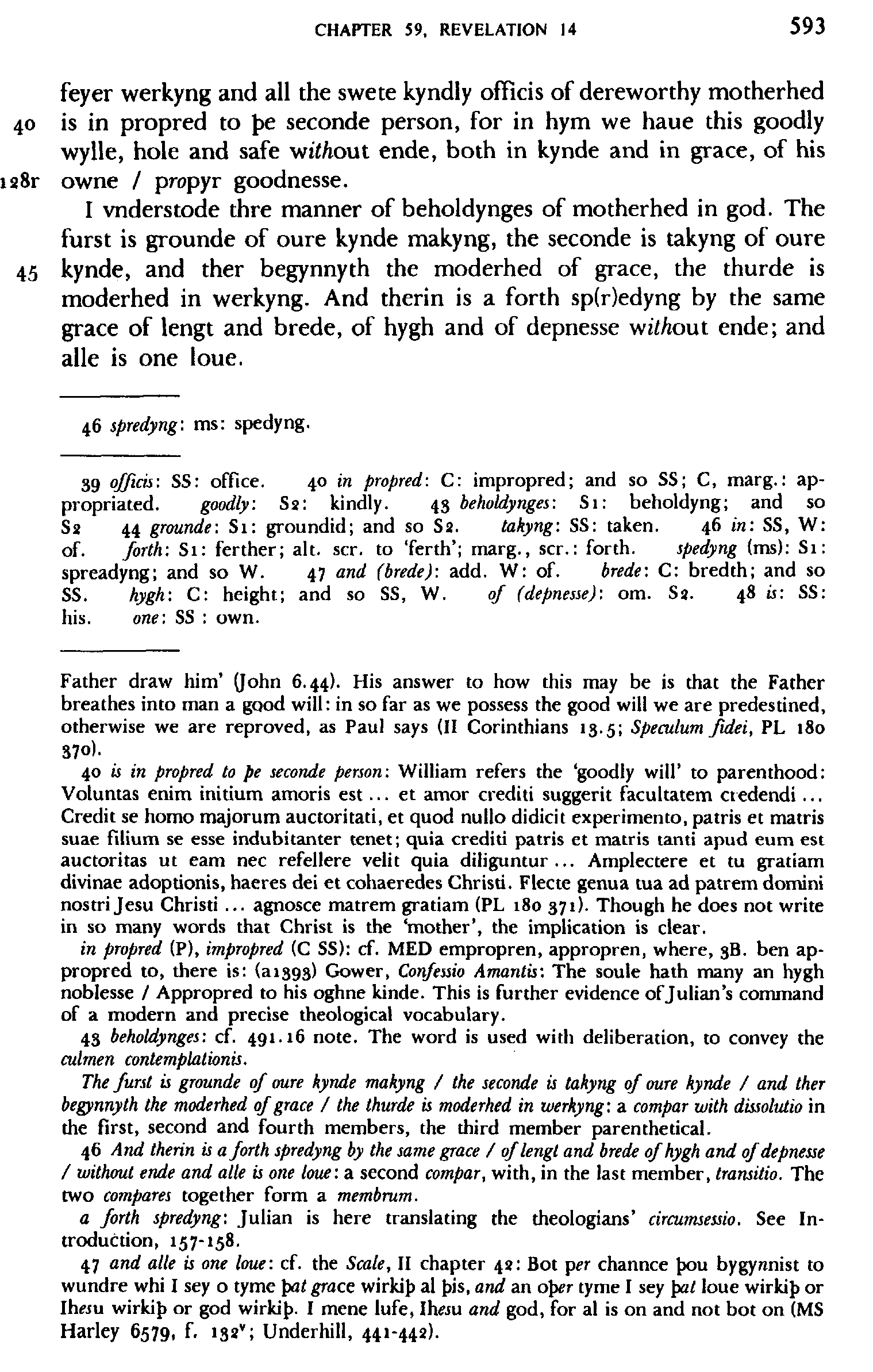
CHAPTER 59, REVELATION 14
feyer werkyng and all the swete kyndly officis of dereworthy motherhed 40 is in propred to J>e seconde person, for in hym we haue this goodly wylle, hole and safe without ende, both in kynde and in grace, of his ia8r owne / propyr goodnesse.
I vnderstode thre manner of beholdynges of motherhed in god. The furst is grounde of oure kynde makyng, the seconde is takyng of oure
45 kynde, and ther begynnyth the moderhed of grace, the thurde is moderhed in werkyng. And therin is a forth sp(r)edyng by the same grace of lengt and brede, of hygh and of depnesse without ende; and alle is one loue.
46 spredyng: ms: spedyng.
39 officis: SS: office.
40 in propred: C: impropred; and so SS; C, marg.: appropriated, goodly:
82: kindly.
43 beholdynges:
Si: beholdyng; and so
44 grounde: Si: groundid; and so 82. takyng: SS: taken.
46 in: SS, W: of. forth: Si: ferther; alt. scr. to 'ferth'; marg., scr.: forth. spedyng (ms): Si: spreadyng; and so W.
47 and (brede): add. W: of. brede: C: bredth; and so SS. hygh: C: height; and so SS, W. of (depnesse): om. 82.
48 is: SS: his. one: 88 : own.
Father draw him' (John 6.44). His answer to how this may be is that the Father breathes into man a good will: in so far as we possess the good will we are predestined, otherwise we are reproved, as Paul says (II Corinthians 13.5; Speculum fidei, PL 180
370).
40 is in propred to pe seconde person: William refers the 'goodly will' to parenthood:
Voluntas enim initium amoris est... et amor crediti suggerit facultatem ctedendi ...
Credit se homo majorum auctoritati, et quod nullo didicit experimento, patris et matris suae filium se esse indubitanter tenet; quia crediti patris et matris tanti apud eum est auctoritas ut earn nee refellere velit quia diliguntur ... Amplectere et tu gratiam divinae adoptionis, haeres dei et cohaeredes Christi. Flecte genua tua ad patrem domini nostrijesu Christi ... agnosce matrem gratiam (PL 180 371). Though he does not write in so many words that Christ is the 'mother', the implication is clear. in propred (P), impropred (C SS): cf. MED empropren, appropren, where, 38. ben appropred to, there is: (31393) Gower, Confessio Amantis: The soule hath many an hygh noblesse / Appropred to his oghne kinde. This is further evidence of Julian's command of a modern and precise theological vocabulary.
43 beholdynges: cf. 491.16 note. The word is used with deliberation, to convey the oilmen contemplation^.
The furst is grounde of oure kynde makyng / the seconde is takyng of oure kynde / and ther begynnyth the moderhed of grace / the thurde is moderhed in werkyng: a compar with dissolutio in the first, second and fourth members, the third member parenthetical.
46 And therin is a forth spredyng by the same grace / of lengt and brede of hygh and of depnesse
/ without ende and alle is one loue: a second compar, with, in the last member, transitio. The two compares together form a membrum. a forth spredyng: Julian is here translating the theologians' circumsessio. See Introduction, 157-158.
47 and alle is one loue: cf. the Scale, II chapter 42: Bot per channce pou bygyrcnist to wundre whi I sey o tyme \>at grace wirkij) al pis, and an oper tyme I sey Ipat loue wirkij) or Ihesu wirkip or god wirkip. I mene lufe, Ihmi and god, for al is on and not bot on (MS
Harley 6579, f. 132*; Underhill, 441-442).
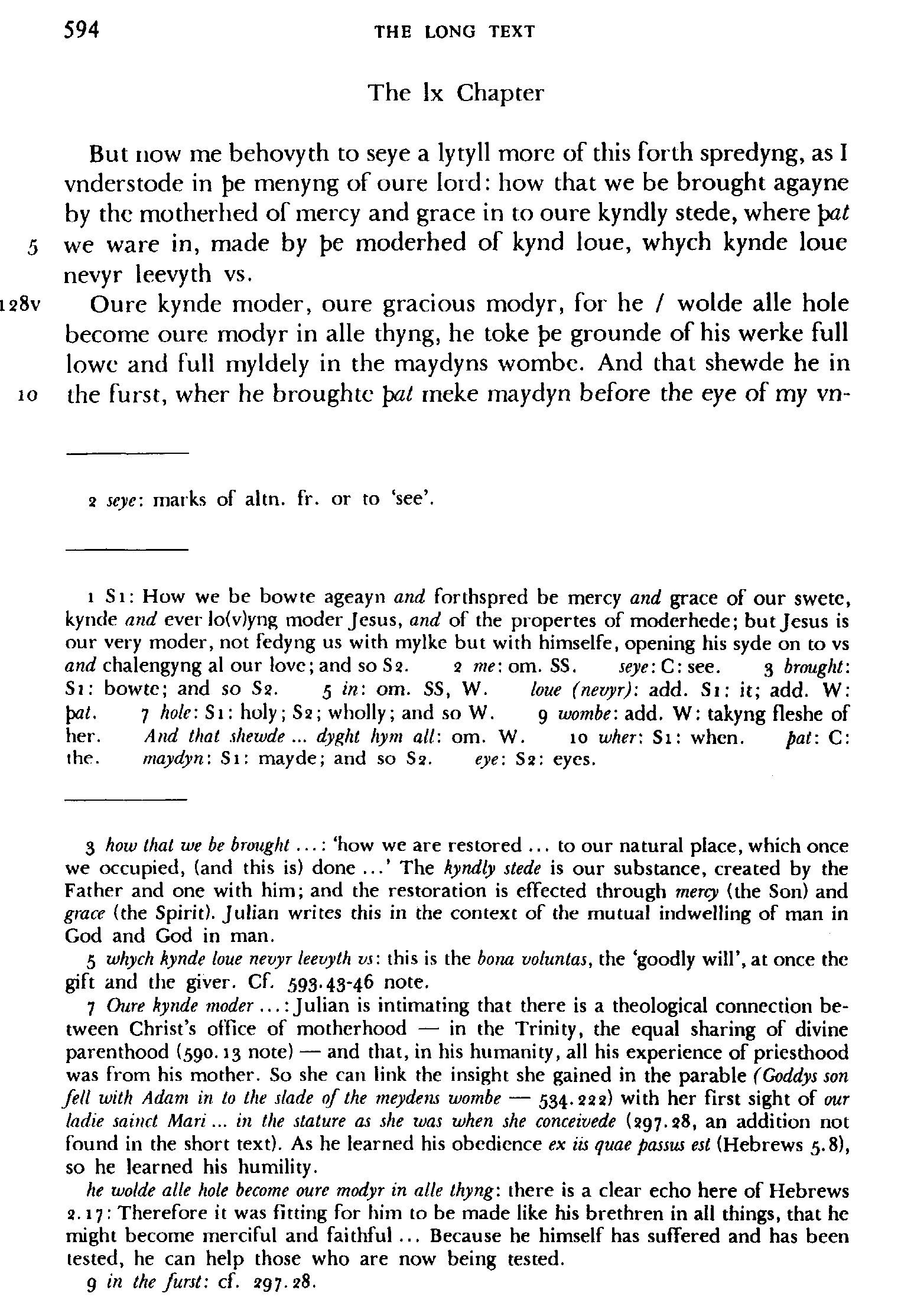
THE LONG TEXT
The Ix Chapter But now me behovyth to seye a lytyll more of this forth spredyng, as I vnderstode in he menyng of oure lord: how that we be brought agayne by the motherhed of mercy and grace in to oure kyndly stede, where }xit
5 we ware in, made by he moderhed of kynd loue, whych kynde loue nevyr leevyth vs. i28v Oure kynde moder, oure gracious modyr, for he / wolde alle hole become oure modyr in alle thyng, he toke he grounde of his werke full lowe and full myldely in the maydyns wombe. And that shewde he in
the furst, wher he broughte Ipat rneke maydyn before the eye of my vn2 seye: marks of altn. fr. or to 'see'. i Si: How we be bowte ageayn and forthspred be mercy and grace of our swete, kynde and ever lo(v)yng moder Jesus, and of the propertes of moderhede; but Jesus is our very moder, not fedyng us with mylke but with himselfe, opening his syde on to vs and chalengyng al our love; and so 82.
2 me: om. SS. seye: C: see.
3 brought:
Si: bowte; and so 82.
5 in: om. SS, W. loue (nevyr): add. Si: it; add. W: pa<.
7 hole: Si: holy; 82; wholly; and so W.
9 wombe: add. W: takyng fleshe of her.
And that shewde... dyght hym all: om. W.
10 wher: Si: when. pat: C: the. maydyn: Si: mayde; and so 82. eye: 82: eyes.
3 how that we be brought ...: 'how we are restored ... to our natural place, which once we occupied, (and this is) done ...' The kyndly stede is our substance, created by the Father and one with him; and the restoration is effected through mercy (the Son) and grace (the Spirit). Julian writes this in the context of the mutual indwelling of man in God and God in man.
5 whych kynde loue nevyr leevyth vs: this is the bona voluntas, the 'goodly will', at once the gift and the giver. Cf. 593.43-46 note.
7 Oure kynde moder ...: Julian is intimating that there is a theological connection between Christ's office of motherhood — in the Trinity, the equal sharing of divine parenthood (590.13 note) — and that, in his humanity, all his experience of priesdiood was from his mother. So she can link the insight she gained in the parable (Goddys son fell with Adam in to the slade of the meydens wombe — 534.222) with her first sight of our ladie sainct Mari... in the stature as she was when she conceivede (297.28, an addition not found in the short text). As he learned his obedience ex its quae passus est (Hebrews 5.8), so he learned his humility. he wolde alle hole become oure modyr in alle thyng: there is a clear echo here of Hebrews
2.17: Therefore it was fitting for him to be made like his brethren in all things, that he might become merciful and faithful ... Because he himself has suffered and has been tested, he can help those who are now being tested.
9 in the furst: cf. 297.28.
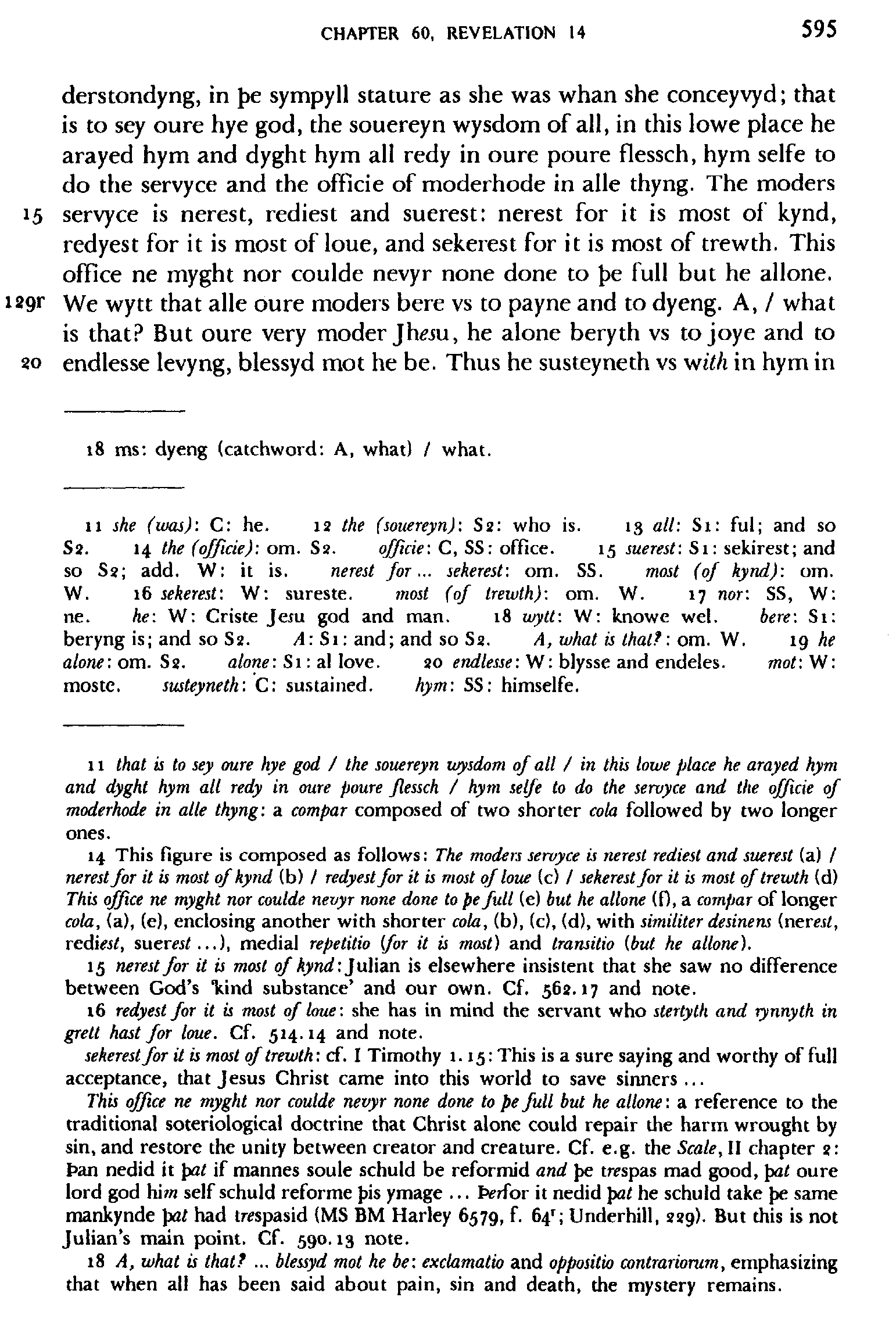
CHAPTER 60, REVELATION 14
derstondyng, in J>e sympyll stature as she was whan she conceyvyd; that is to sey oure hye god, the souereyn wysdom of all, in this lowe place he arayed hym and dyght hym all redy in oure poure flessch, hym selfe to do the servyce and the officie of moderhode in alle thyng. The moders
15 servyce is nerest, rediest and suerest: nerest for it is most of kynd, redyest for it is most of loue, and sekerest for it is most of trewth. This office ne myght nor coulde nevyr none done to be full but he allone. lagr We wytt that alle oure moders here vs to payne and to dyeng. A, / what is that? But oure very moder Jheju, he alone beryth vs to joye and to 20 endlesse levyng, blessyd mot he be. Thus he susteyneth vs with in hym in 18 ms: dyeng (catchword: A, what) / what.
11 she (was): C: he.
12 the (souereyn): Sa: who is.
13 all: Si: ful; and so 82.
14 the (offitie): om. 82. officie: C, SS: office.
15 suerest: Si: sekirest; and so 82; add. W: it is. nerest for... sekerest: om. SS. most (of kynd): om.
16 sekerest: W: sureste. most (of trewth): om.
17 nor: SS, W: ne. he: W: Criste Jem god and man.
18 wytt: W: knowe wel. here: Si: beryng is; and so 82.
A: Si: and; and so 82.
A, what is that?: om. W.
19 he alone: om. 82. alone: Si: al love.
20 endlesse: W: blysse and endeles. mot: W: moste. susteyneth: C: sustained. hym: SS: himselfe.
11 that is to sey oure hye god / the souereyn wysdom of all / in this lowe place he arayed hym and dyght hym all redy in oure poure flessch / hym selfe to do the servyce and the officie of moderhode in alle thyng: a compar composed of two shorter cola followed by two longer ones.
14 This figure is composed as follows: The moders servyce is nerest rediest and suerest (a) / nerest for it is most of kynd (b) / redyest for it is most of loue (c) / sekerest for it is most of trewth (d)
This office ne myght nor coulde nevyr none done to pefull (e) but he allone (f), a compar of longer cola, (a), (e), enclosing another with shorter cola, (b), (c), (d), with similiter desinens (nerest, rediest, suerest ...), medial repetitio (for it is most) and transitio (but he allone).
15 nerest for it is most of kynd: Julian is elsewhere insistent that she saw no difference between God's "kind substance' and our own. Cf. 562.17 and note.
16 redyest for it is most of loue: she has in mind the servant who stertyth and rynnyth in grett hast for loue. Cf. 514.14 and note. sekerest for it is most of trewth: cf. I Timothy 1.15: This is a sure saying and worthy of full acceptance, that Jesus Christ came into this world to save sinners ...
This office ne myght nor coulde nevyr none done to pefull but he allone: a reference to the traditional soteriological doctrine that Christ alone could repair the harm wrought by sin, and restore the unity between creator and creature. Cf. e.g. the Scale, II chapter 2:
Pan nedid it \>at if mannes soule schuld be reformid and pe trespas mad good, pai oure lord god him self schuld reforme pis ymage ... tvrfor it nedid fwf he schuld take pe same mankynde paf had trespasid (MS BM Harley 6579, f. 64'; Underbill, 229). But diis is not Julian's main point. Cf. 590.13 note.
18 A, what is that? ... blessyd mot he be: exclamatio and oppositio contrariorum, emphasizing that when all has been said about pain, sin and death, die mystery remains.
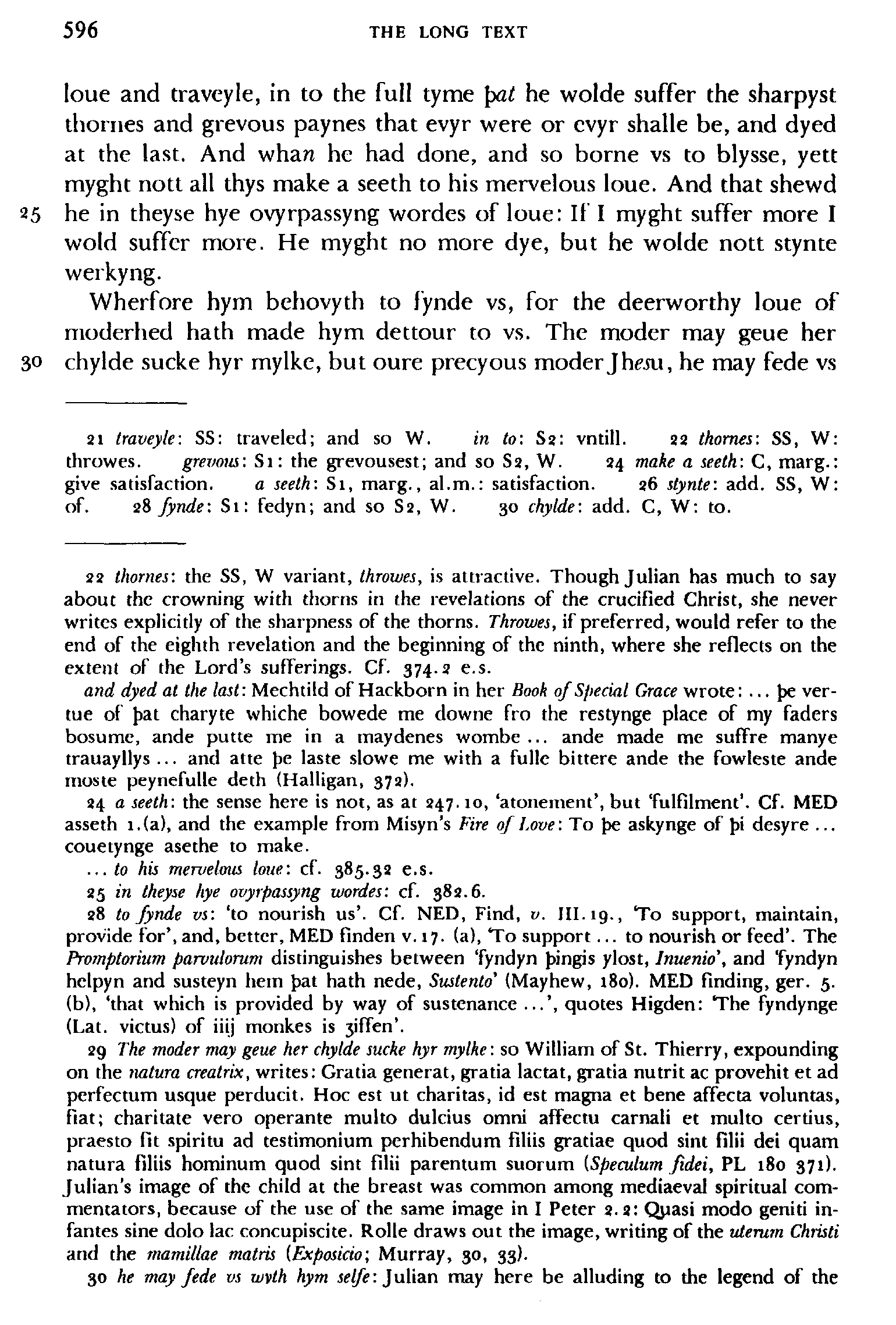
THE LONG TEXT
loue and traveyle, in to the full tyme \xit he wolde suffer the sharpyst thornes and grevous paynes that evyr were or evyr shalle be, and dyed at the last. And whan he had done, and so borne vs to blysse, yett myght nott all thys make a seeth to his mervelous loue. And that shewd
25 he in theyse hye ovyrpassyng wordes of loue: If I myght suffer more I wold suffer more. He myght no more dye, but he wolde nott stynte werkyng.
Wherfore hym behovyth to fynde vs, for the deerworthy loue of moderhed hath made hym dettour to vs. The moder may geue her
30 chylde sucke hyr mylke, but oure precyous moder Jhwu, he may fede vs 21 traveyle: SS: traveled; and so W. in to: S z : vntill.
22 themes: SS, W: throwes. grevous: Si: the grevousest; and so 82, W.
24 make a seeth: C, marg.: give satisfaction. a seeth: Si, marg., al.m.: satisfaction.
26 stynte: add. SS, W: of.
28 fynde: Si: fedyn; and so 82, W.
30 chylde: add. C, W: to.
22 thornes: the SS, W variant, throwes, is attractive. Though Julian has much to say about the crowning with thorns in the revelations of die crucified Christ, she never writes explicitly of the sharpness of the thorns. Throwes, if preferred, would refer to the end of the eighth revelation and the beginning of the ninth, where she reflects on the extent of the Lord's sufferings. Cf. 374.2 e.s. and dyed at the last: Mechtild of Hackborn in her Book of Special Grace wrote: ... pe vertue of bat charyte whiche bowede me downe fro the restynge place of my faders bosume, ande putte me in a maydenes wombe ... ande made me suffre manye trauayllys ... and atte be laste slowe me with a fulle bittere ande the fowleste ande moste peynefulle deth (Halligan, 372).
24 a seeth: the sense here is not, as at 247.10, 'atonement', but 'fulfilment'. Cf. MED asseth i.(a), and the example from Misyn's Fire of Love: To be askynge of bi desyre ... couetynge asethe to make.
... to his mervelous loue: cf. 385.32 e.s.
25 in theyse hye ovyrpassyng wordes: cf. 382.6.
28 to fynde vs: 'to nourish us'. Cf. NED, Find, v. III. 19., To support, maintain, provide for', and, better, MED finden v. 17. (a), To support... to nourish or feed'. The Promptorium parvulorum distinguishes between Tyndyn bingis ylost, Inuenio', and Tyndyn helpyn and susteyn hem bat hath nede, Sustento' (Mayhew, 180). MED finding, ger. 5.
(b), 'that which is provided by way of sustenance ...', quotes Higden: The fyndynge
(Lat. victus) of iiij monkes is 3iffen'.
29 The moder may geue her chylde sucke hyr mylke: so William of St. Thierry, expounding on the natura matrix, writes: Gratia general, gratia lactat, gratia nutrit ac provehit et ad perfectum usque perducit. Hoc est ut charitas, id est magna et bene affecta voluntas, fiat; charitate vero operante multo dulcius omni affectu carnali et multo certius, praesto fit spiritu ad testimonium perhibendum filiis gratiae quod sint filii dei quam natura filiis hominum quod sint filii parentum suorum (Speculum fidei, PL 180 371).
Julian's image of the child at the breast was common among mediaeval spiritual commentators, because of the use of the same image in I Peter 2.2: Quasi modo geniti infantes sine dolo lac concupiscite. Rolle draws out the image, writing of the uterurn Christi and the mamillae matris (Exposicio; Murray, 30, 33).
30 he may fede vs wvth hym selfe: Julian may here be alluding to die legend of the
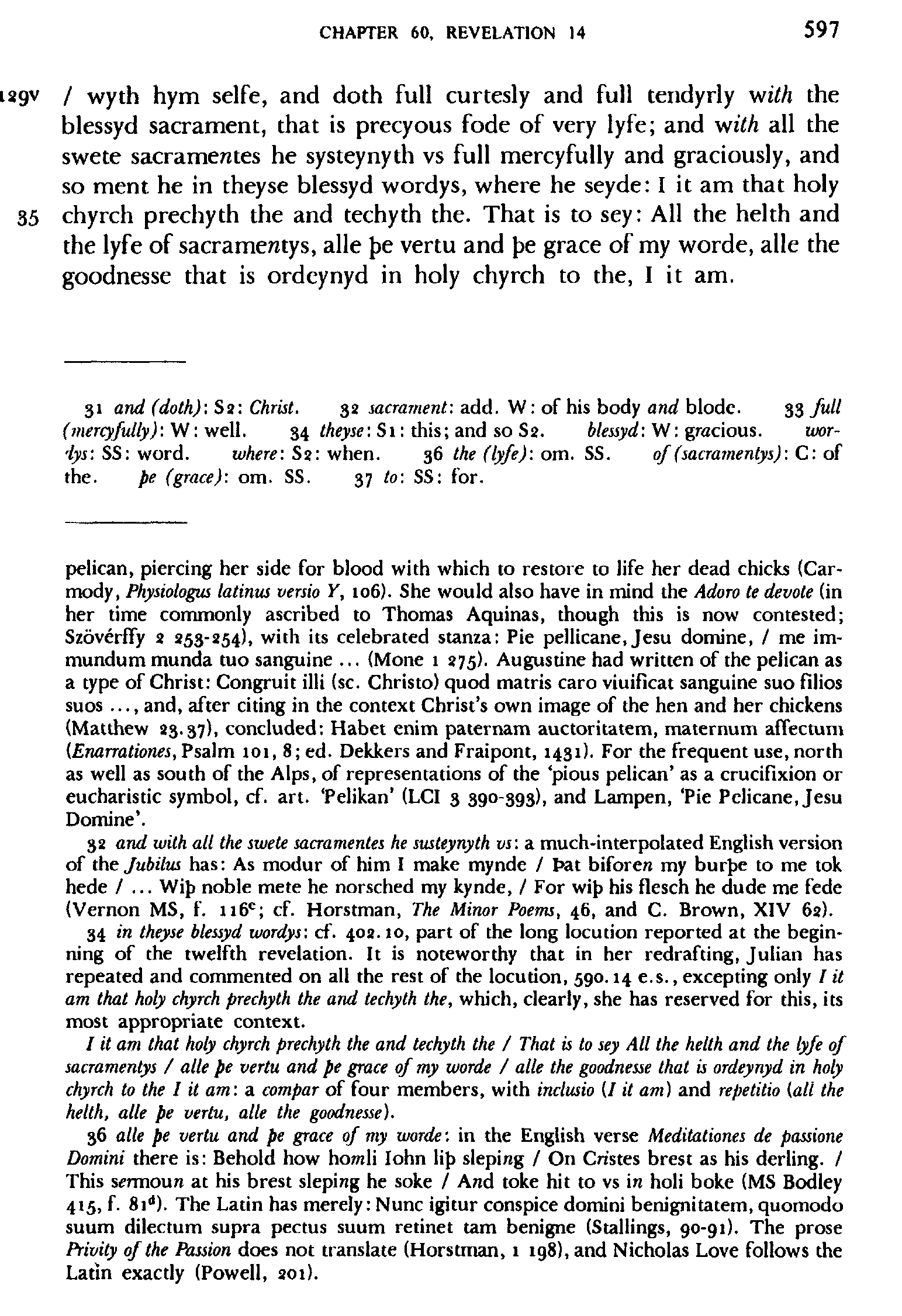
CHAPTER 60, REVELATION 14
isgv / wyth hym selfe, and doth full curtesly and full tendyrly with the blessyd sacrament, that is precyous fode of very lyfe; and with all the swete sacramentes he systeynyth vs full mercyfully and graciously, and so ment he in theyse blessyd wordys, where he seyde: I it am that holy
35 chyrch prechyth the and techyth the. That is to sey: All the helth and the lyfe of sacramewtys, alle Jje vertu and f>e grace of my worde, alle the goodnesse that is ordeynyd in holy chyrch to the, I it am.
31 and (doth); 82: Christ.
32 sacrament: add. W: of his body and blode.
33 full (mercyfully): W: well.
34 theyse: Si: this; and so 82. blessyd: W: gracious. wor- 'lys: 88: word. where: 82: when.
36 the (lyfe): om. 88. of(sacramentys): C: of the. pe (grace): om. 88.
37 to: 88: for. pelican, piercing her side for blood with which to restore to life her dead chicks (Carmody, Physiologus latinus versio Y, 106). She would also have in mind the Adoro te devote (in her time commonly ascribed to Thomas Aquinas, though this is now contested;
Szoverffy 2 253-254), with its celebrated stanza: Pie pellicane, Jesu domine, / me immundum munda tuo sanguine ... (Mone i 275). Augustine had written of the pelican as a type of Christ: Congruit illi (sc. Christo) quod matris caro viuificat sanguine suo filios suos ..., and, after citing in the context Christ's own image of the hen and her chickens
(Matthew 23.37), concluded: Habet enim paternam auctoritatem, maternum affectum (Enarrationes, Psalm 101, 8; ed. Dekkers and Fraipont, 1431). For the frequent use, north as well as south of the Alps, of representations of the 'pious pelican' as a crucifixion or eucharistic symbol, cf. art. 'Pelikan' (LCI 3 390-393), and Lampen, 'Pie Pelicane.Jesu
Domine'.
32 and with all the swete sacramentes he susteynyth vs: a much-interpolated English version of the Jubilus has: As modur of him I make mynde / E>at biforere my burjje to me tok hede / ... WiJ) noble mete he norsched my kynde, / For wij> his flesch he dude me fede
(Vernon MS, f. n6e; cf. Horstman, The Minor Poems, 46, and C. Brown, XIV 62).
34 in theyse blessyd wordys: cf. 402.10, part of the long locution reported at the beginning of the twelfth revelation. It is noteworthy that in her redrafting, Julian has repeated and commented on all the rest of the locution, 590.14 e.s., excepting only / it am that holy chyrch prechyth the and techyth the, which, clearly, she has reserved for this, its most appropriate context.
/ it am that holy chyrch prechyth the and techyth the I That is to sey All the helth and the lyfe of sacramentys / alle pe vertu and pe grace of my worde / alle the goodnesse that is ordeynyd in holy chyrch to the I it am: a compar of four members, with inclusio (I it am) and repetitio (all the helth, alle pe vertu, alle the goodnesse).
36 alle pe vertu and pe grace of my worde: in the English verse Meditationes de passione
Domini there is: Behold how homli lohn li}> sleping / On Cn'stes brest as his derling. /
This smnoun at his brest sleping he soke / And toke hit to vs in holi boke (MS Bodley
415, f. 8id). The Latin has merely: Nunc igitur conspice domini benignitatem.quomodo suum dilectum supra pectus suum retinet tam benigne (Stallings, 90-91). The prose
Privity of the Passion does not translate (Horstman, i 198), and Nicholas Love follows the Latin exactly (Powell, 201).
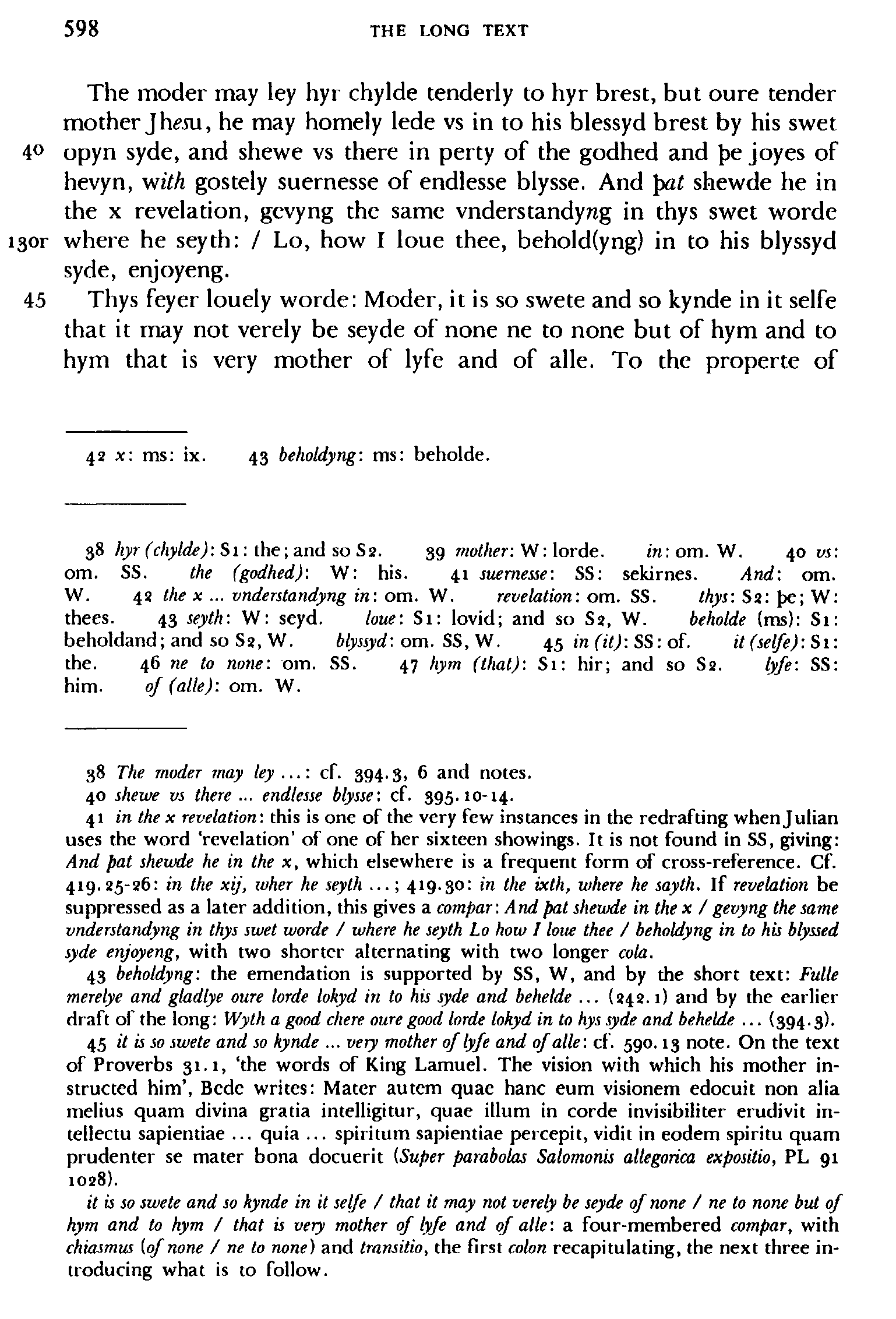
THE LONG TEXT
The moder may ley hyr chylde tenderly to hyr brest, but oure tender mother Jh«u, he may homely lede vs in to his blessyd brest by his swet
4° opyn syde, and shewe vs there in perty of the godhed and {>e joyes of hevyn, with gostely suernesse of endlesse blysse. And fyat shewde he in the x revelation, gevyng the same vnderstandyng in thys swet worde i3or where he seyth: / Lo, how I loue thee, behold(yng) in to his blyssyd syde, enjoyeng.
Thys feyer louely worde: Moder, it is so swete and so kynde in it selfe that it may not verely be seyde of none ne to none but of hym and to hym that is very mother of lyfe and of alle. To the properte of 42 x: ms: ix.
43 beholdyng: ms: beholde.
38 hyr (chylde): Si: the; and so 82.
39 mother: W: lorde. in: om. W.
40 vs: om.
SS. the (godhed):
W: his.
41 suemesse: SS: sekirnes.
And: om.
42 the x ... vnderstandyng in: om. W. revelation: om. SS. thys: 82: f>e; W: thees.
43 seyth: W: seyd. loue: Si: lovid; and so 82, W. beholde (ms): Si: beholdand; and so S 2, W. blyssyd: om. SS, W.
45 in (it): SS: of. it (selfe): S i: the.
46 ne to none: om. SS.
47 hym (that): Si: hir; and so 82. lyfe: SS: him. of (alle): om. W.
38 The moder may ley ...: cf. 394.3, 6 and notes.
40 shewe vs there ... endlesse blysse: cf. 395.10-14.
41 in the x revelation: this is one of the very few instances in the redrafting when Julian uses the word 'revelation' of one of her sixteen showings. It is not found in SS, giving:
And pat shewde he in the x, which elsewhere is a frequent form of cross-reference. Cf.
419.25-26: in the xij, wher he seyth ...; 419.30: in the ixth, where he sayth. If revelation be suppressed as a later addition, this gives a compar: And pat shewde in the x / gevyng the same vnderstandyng in thys swet worde / where he seyth Lo how I loue thee / beholdyng in to his blyssed syde enjoyeng, with two shorter alternating with two longer cola.
43 beholdyng: the emendation is supported by SS, W, and by the short text: Fulle merelye and gladlye oure lorde lokyd in to his syde and behelde ... (242. i) and by the earlier draft of the long: Wyth a good chere oure good lorde lokyd in to hys syde and behelde ... (394.3).
45 it is so swete and so kynde ... very mother of lyfe and of alle: cf. 590.13 note. On the text of Proverbs 31.1, 'the words of King Lamuel. The vision with which his mother instructed him', Bede writes: Mater autem quae hanc eum visionem edocuit non alia melius quam divina gratia intelligitur, quae ilium in corde invisibiliter erudivit intellectu sapientiae ... quia ... spiritum sapientiae percepit, vidit in eodem spiritu quam prudenter se mater bona docuerit (Super parabolas Salomons allegorica expositio, PL 91
1028). it is so swete and so kynde in it selfe / that it may not verely be seyde of none / ne to none but of hym and to hym / that is very mother of lyfe and of alle: a four-membered compar, with chiasmus (of none / ne to none) and transitio, the first colon recapitulating, the next three introducing what is to follow.
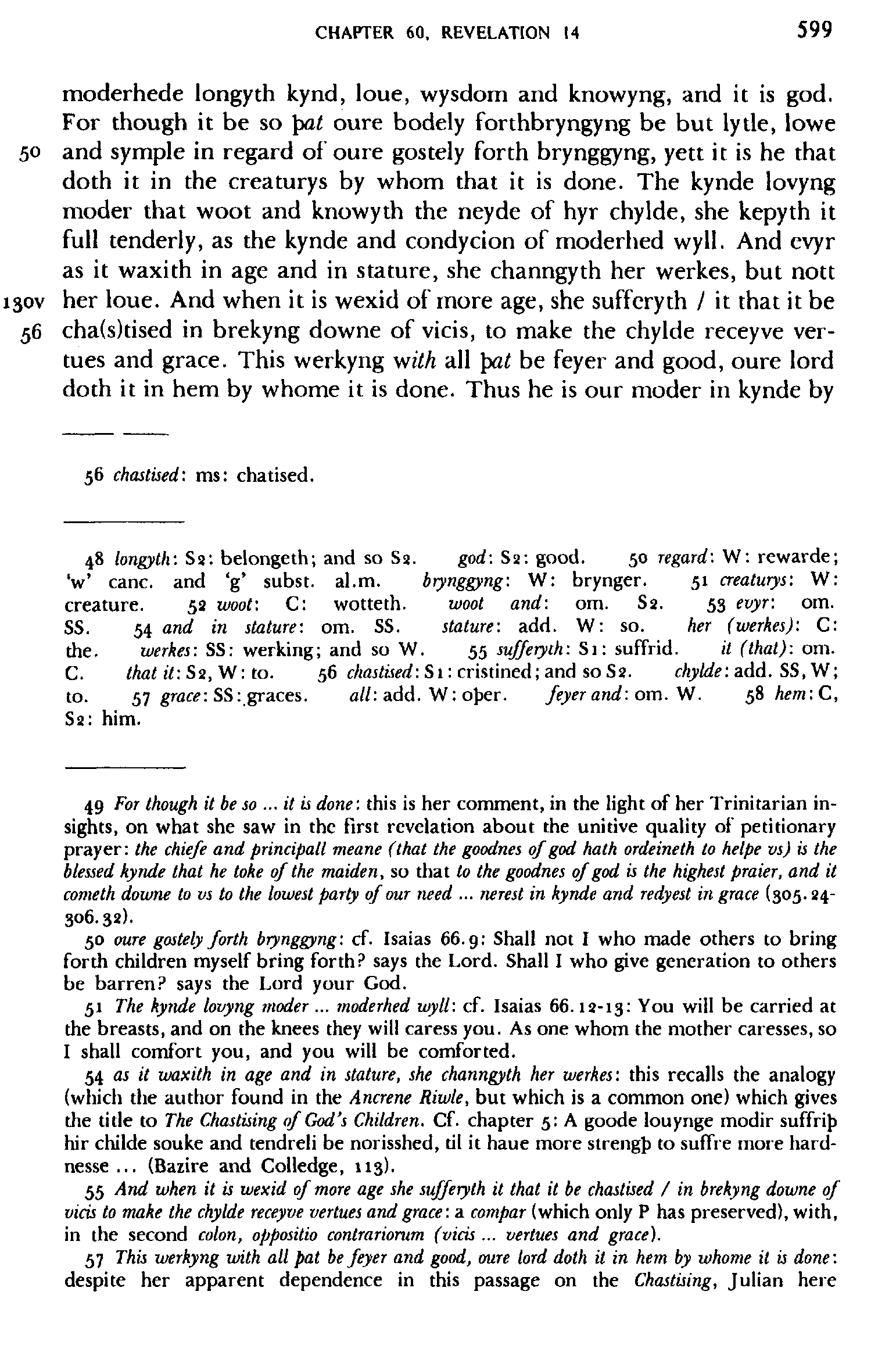
CHAPTER 60, REVELATION 14
moderhede longyth kynd, loue, wysdom and knowyng, and it is god.
For though it be so ]>at oure bodely forthbryngyng be but lytle, lowe 50 and symple in regard of oure gostely forth brynggyng, yett it is he that doth it in the creaturys by whom that it is done. The kynde lovyng moder that wool and knowyth the neyde of hyr chylde, she kepyth it full tenderly, as the kynde and condycion of moderhed wyll. And evyr as it waxith in age and in stature, she channgyth her werkes, but nott isov her loue. And when it is wexid of more age, she suffcryth / it that it be
56 cha(s)tised in brekyng downe of vicis, to make the chylde receyve vertues and grace. This werkyng vtith all Jxz/ be feyer and good, oure lord doth it in hem by whome it is done. Thus he is our moder in kynde by 56 chastised: ms: chatised.
48 longyth: 83: belongeth; and so 82. god: 82: good.
50 regard: W: rewarde; V cane, and 'g' subst. al.m. brynggyng: W: brynger.
51 creaturys: W: creature.
52 wool:
C: wotteth. woot and: om.
82.
53 evyr: om.
SS.
54 and in stature: om.
SS. stature: add. W: so. her (werkes):
C: the. werkes: SS: werking; and so W.
55 sufferyih: Si: sufTrid. it (that): om.
C. that it: 82, W: to.
56 chastised: Si: cristined; and so 82. chylde: add. SS, W; to.
57 grace: SS: graces. all: add. W: oj>er. feyer and: om. W.
58 hem:C, Sa: him.
49 For though it be so ... it is done: this is her comment, in the light of her Trinitarian insights, on what she saw in the first revelation about the unitive quality of petitionary prayer: the chiefe and principall meane (that the goodnes of god hath ordeineth to helpe vs) is the blessed kynde that he take of the maiden, so that to the goodnes of god is the highest praier, and it cometh downe to vs to the lowest party of our need ... nerest in kynde and redyest in grace (305.34306.32).
50 oure gostely forth brynggyng: cf. Isaias 66.9: Shall not I who made others to bring forth children myself bring forth? says the Lord. Shall I who give generation to others be barren? says the Lord your God.
51 The kynde lovyng moder ... moderhed wyll: cf. Isaias 66.13-13: You will be carried at the breasts, and on the knees they will caress you. As one whom the mother caresses, so I shall comfort you, and you will be comforted.
54 as it waxith in age and in stature, she channgyth her werkes: this recalls the analogy
(which the author found in the Ancrene Riwle, but which is a common one) which gives the title to The Chastising of God's Children. Cf. chapter 5: A goode louynge modir suffrij) hir childe souke and tendreli be norisshed, til it haue more strengp to suffre more hardnesse... (Bazire and Colledge, 113).
55 And when it is wexid of more age she sufferyth it that it be chastised / in brekyng downe of vicis to make the chylde receyve vertues and grace: a compar (which only P has preserved), with, in the second colon, oppositio contrariorum (vicis ... vertues and grace).
57 This werkyng with all pat be feyer and good, oure lord doth it in hem by whome it is done: despite her apparent dependence in this passage on the Chastising, Julian here
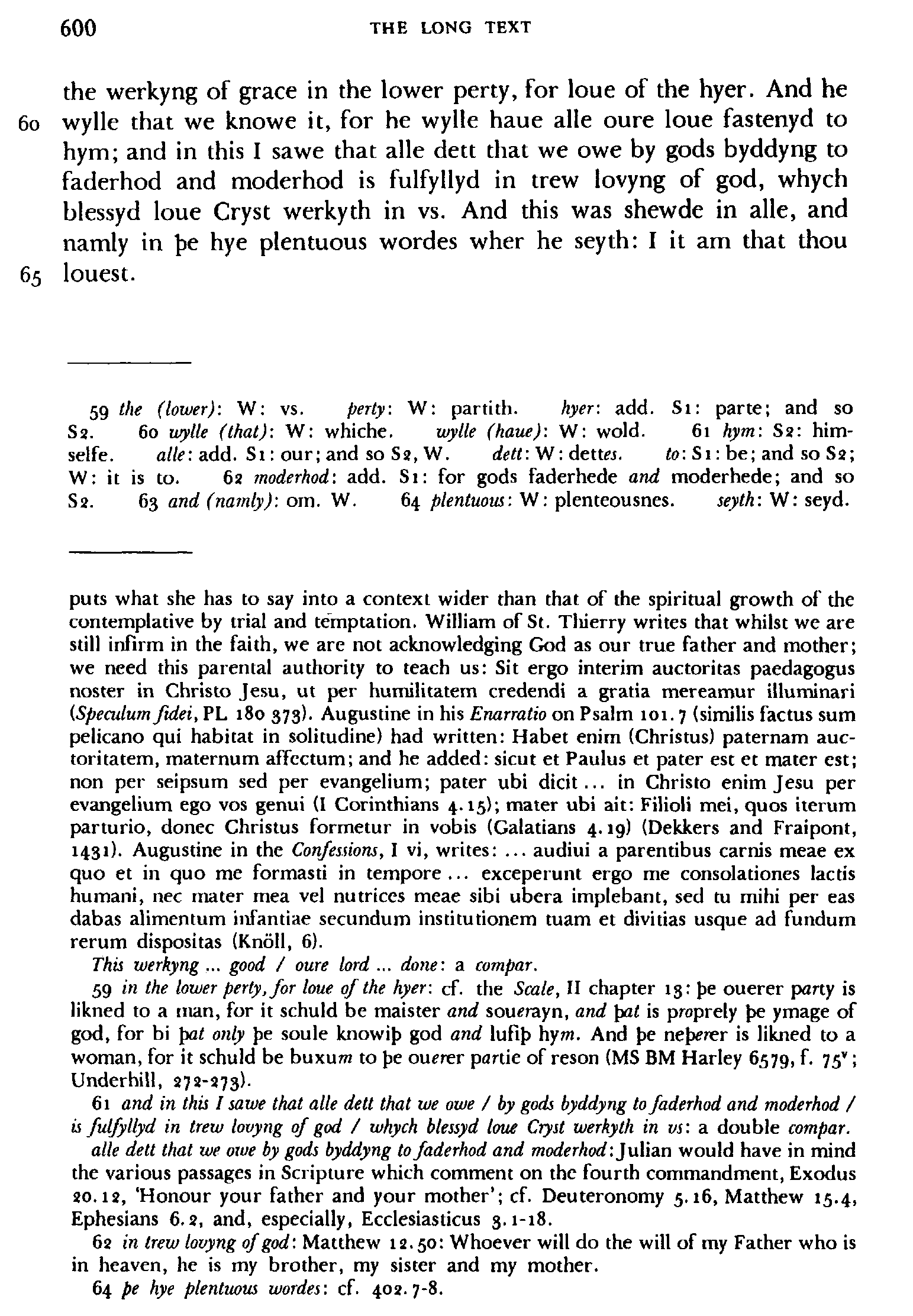
THE LONG TEXT
the werkyng of grace in the lower perty, for loue of the hyer. And he 60 wylle that we knowe it, for he wylle haue alle oure loue fastenyd to hym; and in this I sawe that alle dett that we owe by gods byddyng to faderhod and moderhod is fulfyllyd in trew lovyng of god, whych blessyd loue Cryst werkyth in vs. And this was shewde in alle, and namly in J>e hye plentuous wordes wher he seyth: I it am that thou
65 louest.
59 the (lower): W: vs. perty: W: partith. hyer: add. Si: parte; and so 82.
60 wylle (that): W: whiche. wylle (haue): W: wold.
61 hym: 82: himselfe. alle: add. Si: our; and so 82, W. dett:W:dettes. to: Si: be; and so 82; W: it is to.
62 moderhod: add. Si: for gods faderhede and moderhede; and so 82.
63 and (namly): orn. W.
64 plentuous: W: plenteousnes. seyth: W: seyd. puts what she has to say into a context wider than that of the spiritual growth of the contemplative by trial and temptation. William of St. Thierry writes that whilst we are still infirm in the faith, we are not acknowledging God as our true father and mother; we need this parental authority to teach us: Sit ergo interim auctoritas paedagogus noster in Christo Jesu, ut per humilitatem credendi a gratia mereamur illuminari
(Speculum fidei, PL 180 373). Augustine in his Enarratio on Psalm 101.7 (similis factus sum pelicano qui habitat in solitudine) had written: Habet enim (Christus) paternam auctoritatem, maternum affcctum; and he added: sicut et Paulus et pater est et mater est; non per seipsum sed per evangelium; pater ubi dicit... in Christo enim Jesu per evangelium ego vos genui (I Corinthians 4.15); mater ubi ait: Filioli mei, quos iterum parturio, donee Christus formetur in vobis (Galatians 4.19) (Dekkers and Fraipont,
1431). Augustine in the Confessions, I vi, writes: ... audiui a parentibus carnis meae ex quo et in quo me formasti in tempore ... exceperunt ergo me consolationes lactis human!, nee rnater mea vel nutrices meae sibi ubera implebant, sed tu mihi per eas dabas alimentum infantiae secundum institutionem tuam et divitias usque ad fundum rerum dispositas (Knoll, 6).
This werkyng ... good / oure lord ... done: a compar.
59 in the lower perty, for loue of the hyer: cf. the Scale, II chapter 13: pe ouerer party is likned to a man, for it schuld be maister and sou^rayn, and pa< is proprely pe ymage of god, for bi }Mt only pe soule knowip god and lufip hym. And pe nearer is likned to a woman, for it schuld be buxu/n to pe ouerer partie of reson (MS BM Harley 6579, f. 75*;
Underbill, 272-273).
61 and in this I sawe that alle dett that we owe / by gods byddyng to faderhod and moderhod / is fulfyllyd in trew lovyng of god / whych blessyd loue Cryst werkyth in vs: a double compar. alle dett that we owe by gods byddyng to faderhod and moderhod: Julian would have in mind the various passages in Scripture which comment on the fourth commandment, Exodus
20.12, 'Honour your father and your mother'; cf. Deuteronomy 5.16, Matthew 15.4,
Ephesians 6.2, and, especially, Ecclesiasticus 3.1-18.
62 in trew lovyng of god: Matthew 12.50: Whoever will do the will of my Father who is in heaven, he is my brother, my sister and my mother.
64 pe hye plentuous wordes: cf. 402.7-8.
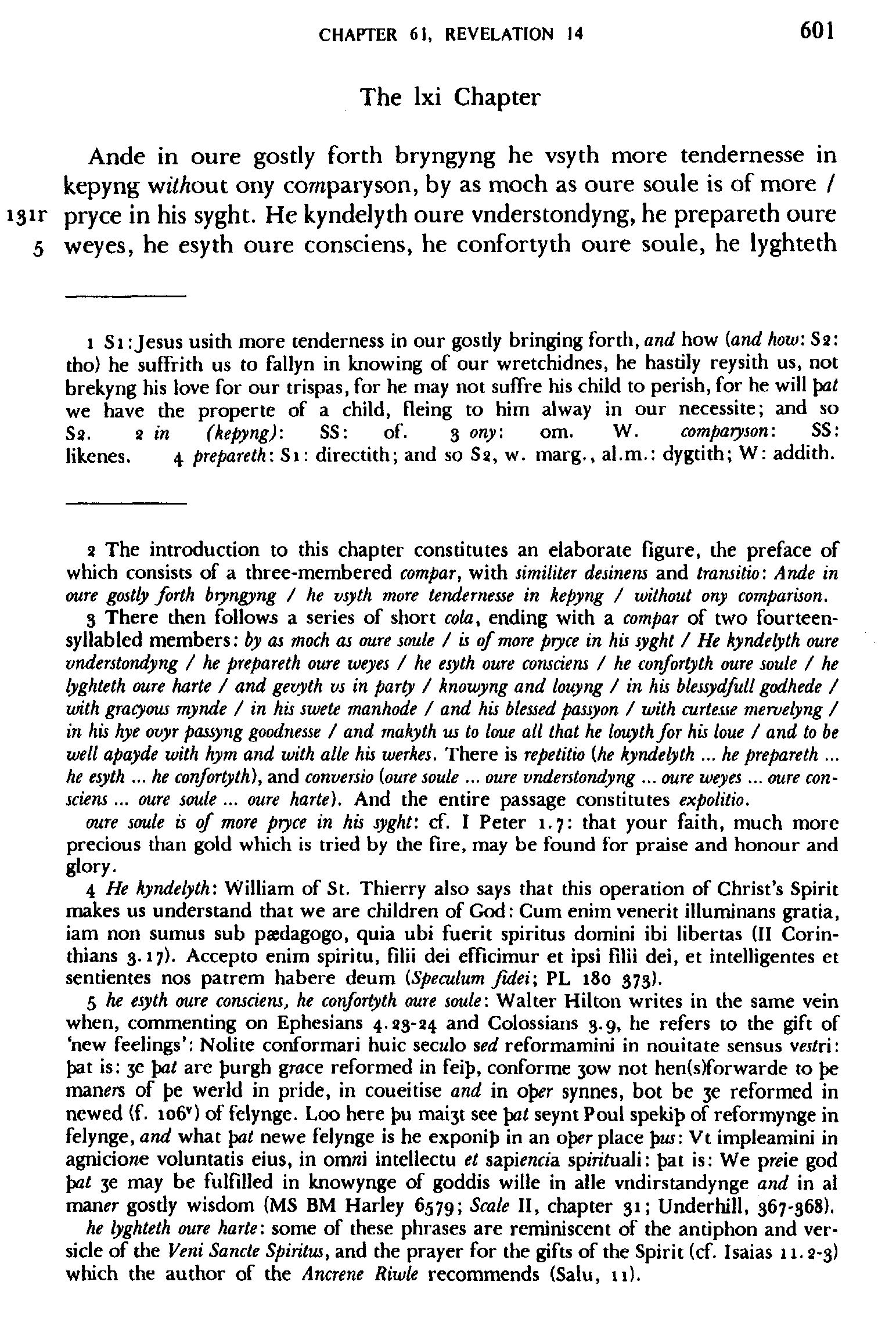
CHAPTER 61, REVELATION 14
The Ixi Chapter Ande in oure gostly forth bryngyng he vsyth more tendernesse in kepyng without ony comparyson, by as moch as oure soule is of more / igir pryce in his syght. He kyndelyth oure vnderstondyng, he prepareth oure
5 weyes, he esyth oure consciens, he confortyth oure soule, he lyghteth i Si:Jesus usith more tenderness in our gostly bringing forth, and how (and how. 82: tho) he sufFrith us to fallyn in knowing of our wretchidnes, he hastily reysith us, not brekyng his love for our trispas, for he may not suffre his child to perish, for he will pa/ we have the properte of a child, fleing to him alway in our necessite; and so 82.
2 in (kepyng):
SS: of.
3 ony: om.
W. comparyson:
SS: likenes.
4 prepareth: Si: directith; and so 82, w. marg., al.m.: dygtith; W: addith.
2 The introduction to this chapter constitutes an elaborate figure, the preface of which consists of a three-membered compar, with similiter desinens and transitio: Ande in oure gostly forth bryngyng / he vsyth more tendernesse in kepyng / without ony comparison.
3 There then follows a series of short cola, ending with a compar of two four teensyllabled members: by as moch as oure soule / is of more pryce in his syght / He kyndelyth oure vnderstondyng / he prepareth oure weyes I he esyth oure consciens / he confortyth oure soule / he lyghteth oure harte / and gevyth vs in party / knowyng and louyng / in his blessydfull godhede / with gracyous mynde / in his swete manhode / and his blessed passyon / with curtesse mervelyng / in his hye ovyr passyng goodnesse / and mahyth us to loue all that he louythfor his loue / and to be well apayde with hym and with alle his werkes. There is repetitio (he kyndelyth ...he prepareth ... he esyth ... he confortyth), and conversio (oure soule ... oure vnderstondyng ... oure weyes... oure consciens ... oure soule ... oure harte). And the entire passage constitutes expolitio. oure soule is of more pryce in his syght: cf. I Peter 1.7: that your faith, much more precious than gold which is tried by the fire, may be found for praise and honour and glory.
4 He kyndelyth: William of St. Thierry also says that this operation of Christ's Spirit makes us understand that we are children of God: Cum enim venerit illuminans gratia, iam non sumus sub paedagogo, quia ubi fuerit spiritus domini ibi libertas (II Corinthians 3.17). Accepto enim spiritu, filii dei efficimur et ipsi filii dei, et intelligentes et sentientes nos patrem habere deum (Speculum Jidei; PL 180 373).
5 he esyth oure consciens, he confortyth oure soule: Walter Hilton writes in the same vein when, commenting on Ephesians 4.23-24 and Colossians 3.9, he refers to the gift of 'new feelings': Nolite conformari huic secwlo sed reformamini in nouitate sensus vestri: pat is: 36 l>at are purgh grace reformed in feip, conforme 3ow not hen(s)forwarde to pe manors of pe werld in pride, in coueitise and in op^r synnes, bot be 36 reformed in newed (f. io6v) of felynge. Loo here pu mai3t see \at seynt Poul spekip of reformynge in felynge, and what pa/ newe felynge is he exponip in an op*r place pus: Vt impleamini in agniciowe voluntatis eius, in omni intellectu et sapienciz spinluali: pat is: We pme god pa/ 36 may be fulfilled in knowynge of goddis wille in alle vndirstandynge and in al maner gostly wisdom (MS BM Harley 6579; Scale II, chapter 31; Underhill, 367-368). he lyghteth oure harte: some of these phrases are reminiscent of the antiphon and versicle of the Veni Sancte Spiritus, and the prayer for the gifts of the Spirit (cf. Isaias 11.2-3) which the author of the Ancrene Riwle recommends (Salu, 11).
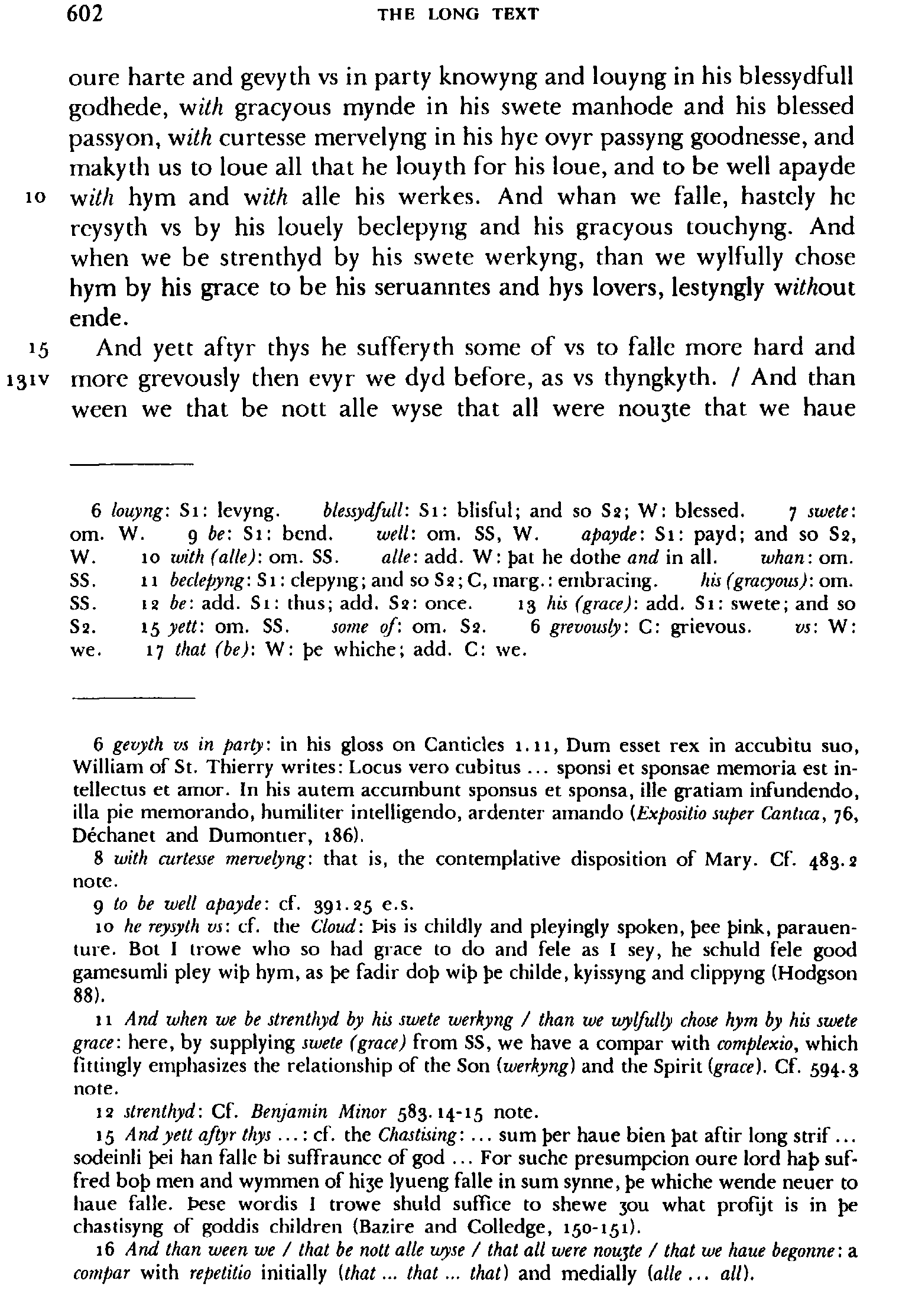
THE LONG TEXT
oure harte and gevyth vs in party knowyng and louyng in his blessydfull godhede, with gracyous mynde in his swete manhode and his blessed passyon, with curtesse mervelyng in his hye ovyr passyng goodnesse, and makyth us to loue all that he louyth for his loue, and to be well apayde
10 \v#/i hym and with alle his werkes. And whan we falle, hastely he rcysyth vs by his louely beclepyng and his gracyous touchyng. And when we be strenthyd by his swete werkyng, than we wylfully chose hym by his grace to be his seruanntes and hys lovers, lestyngly without ende.
And yett aftyr thys he sufferyth some of vs to falle more hard and i3iv more grevously then evyr we dyd before, as vs thyngkyth. / And than ween we that be nott alle wyse that all were nou3te that we haue
6 louyng: Si: levyng. blessydfull: Si: blisful; and so 82; W: blessed.
7 swete: om. W.
9 be: Si: bend. well: om. SS, W. apayde: Si: payd; and so 82, W.
10 with (alle): om. SS. alle: add. W: j>at he dothe and in all. whan: om.
SS.
11 beclepyng: Si: clepyng; and so 82; C, inarg.: embracing. his (gracyous): om.
SS.
12 be: add. Si: thus; add. 82: once.
13 his (grace): add. Si: swete; and so Sa.
15 yett: om. SS. some of: om. 82.
6 grevously: C: grievous. vs: W: we.
17 that (be): W: pe whiche; add. C: we.
6 gevyth vs in party: in his gloss on Canticles 1.11, Dum esset rex in accubitu suo,
William of St. Thierry writes: Locus vero cubitus ... sponsi et sponsae memoria est intellectus et amor. In his autem accumbunt sponsus et sponsa, ille gratiam infundendo, ilia pie memorando, humiliter intelligendo, ardenter amando (Expositio super Cantica, 76,
Dechanet and Dumontier, 186).
8 with curtesse mervelyng: that is, the contemplative disposition of Mary. Cf. 483.2 note.
9 to be well apayde: cf. 391.25 e.s.
10 he reysyth vs: cf. the Cloud: t>is is childly and pleyingly spoken, pee pink, parauenture. Bot I trowe who so had grace to do and fele as I sey, he schuld fele good gamesumli pley wij> hym, as pe fadir dof> wip pe childe, kyissyng and clippyng (Hodgson
88).
11 And when we be strenthyd by his swete werkyng / than we wylfully chose hym by his swete grace: here, by supplying swete (grace) from SS, we have a compar with complexio, which fittingly emphasizes the relationship of the Son (werkyng} and the Spirit (grace). Cf. 594.3 note.
12 strenthyd: Cf. Benjamin Minor 583.14-15 note.
15 And yett aftyr thys ...: cf. the Chastising: ... sum per haue bien pat aftir long strif ... sodeinli pei han falle bi suffrauncc of god ... For suche presumpcion oure lord haf> suffred boj) men and wymmen of hi36 lyueng falle in sum synne, pe whiche wende neuer to haue falle. f>ese wordis I trowe shuld suffice to shewe 3ou what profijt is in pe chastisyng of goddis children (Ba/ire and Colledge, 150-151).
16 And than ween we / that be nott alle wyse / that all were noujte / that we haue begonne: a compar with repetitio initially (that... that... that) and medially (alle... all).
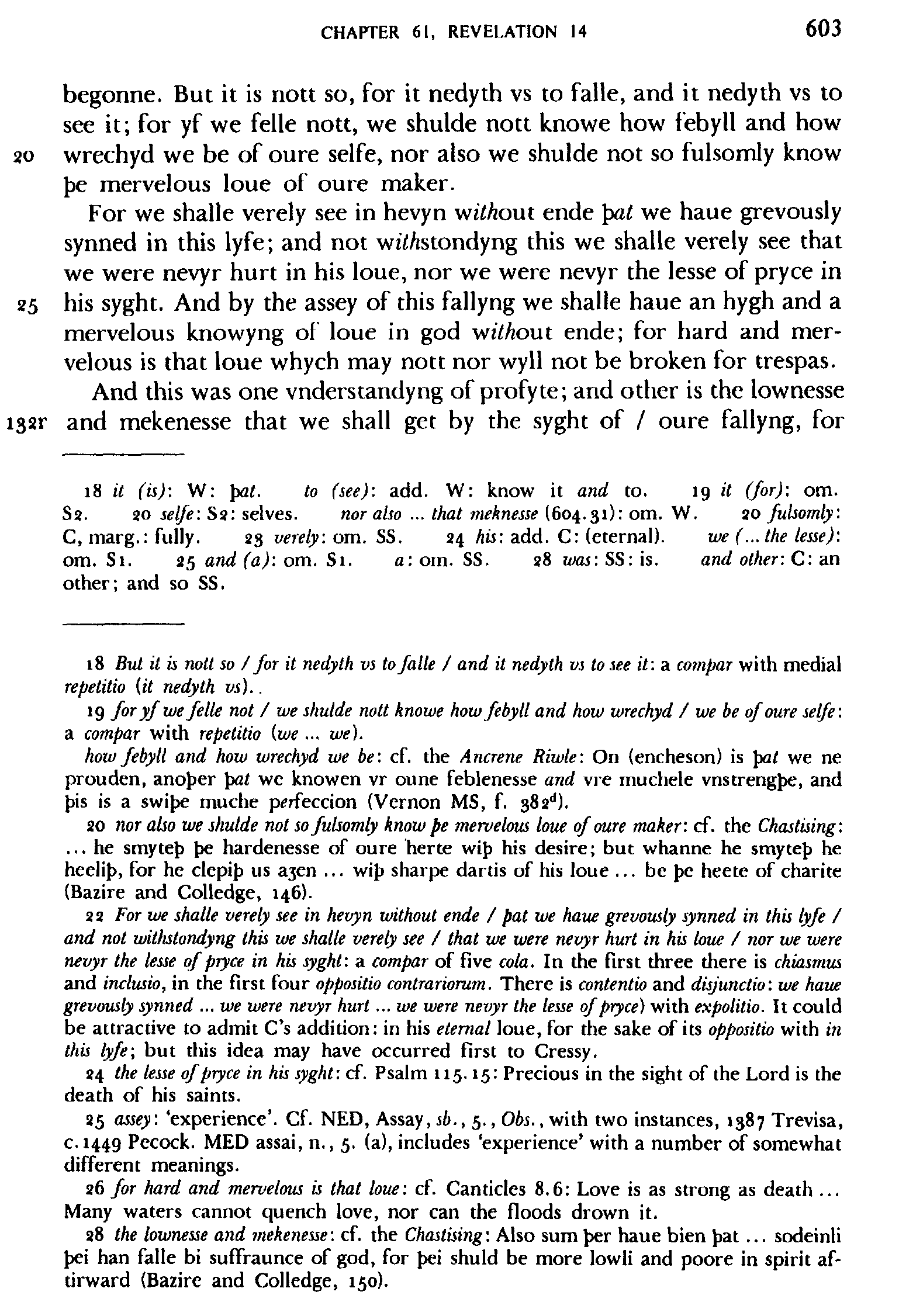
CHAPTER 61, REVELATION 14
begonne. But it is nott so, for it nedyth vs to falle, and it nedyth vs to see it; for yf we felle nott, we shulde nott knowe how febyll and how
wrechyd we be of oure selfe, nor also we shulde not so fulsomly know be mervelous loue of oure maker.
For we shalle verely see in hevyn without ende Jxz£ we haue grevously synned in this lyfe; and not w^/zstondyng this we shalle verely see that we were nevyr hurt in his loue, nor we were nevyr the lesse of pryce in 25 his syght. And by the assey of this fallyng we shalle haue an hygh and a mervelous knowyng of loue in god without ende; for hard and mervelous is that loue whych may nott nor wyll not be broken for trespas.
And this was one vnderstandyng of profyte; and other is the lownesse 2r and mekenesse that we shall get by the syght of / oure fallyng, for or 18 it (is): W:
Jxzf. to (see): add. W: know it and to.
19 it (for): om.
Ss.
20 selfe: Ss: selves. nor also ... that meknesse (604.31): om. W.
20 fulsomly:
C, marg.: fully.
23 verely: om. SS.
24 his: add. C: (eternal). we (...the lesse): om. Si.
25 and (a): om. Si. a: orn. SS.
28 was: SS: is. and other: C: an other; and so SS.
18 But it is nott so /for it nedyth vs to falle / and it nedyth vs to see it: a compar with medial repetitio (it nedyth vs)..
19 for yf we felle not / we shulde nott knowe how febyll and how wrechyd / we be of oure selfe: a compar with repetitio (we ... we). how febyll and how wrechyd we be: cf. the Ancrene Riwle: On (encheson) is pa/ we ne prouden, anoper pa/ we knowen vr oune feblenesse and vre rnuchele vnstrengpe, and pis is a swipe muche perfection (Vernon MS, f. 382d).
20 nor also we shulde not so fulsomly know pe mervelous loue of oure maker: cf. the Chastising:
... he smytep pe hardenesse of oure herte wip his desire; but whanne he smytep he heelip, for he clepip us ajen ... wip sharpe dartis of his loue ... be pe heete of charite
(Bazire and Colledge, 146).
22 For we shalle verely see in hevyn without ende / pat we haue grevously synned in this lyfe / and not witlistondyng this we shalle verely see / that we were nevyr hurt in his loue / nor we were nevyr the lesse of pryce in his syght: a compar of five cola. In the first three there is chiasmus and inclusio, in the first four oppositio contrariorum. There is contentio and disjunctio: we haue grevously synned ... we were nevyr hurt... we were nevyr the lesse of pryce) with expolitio. It could be attractive to admit C's addition: in his eternal loue, for the sake of its oppositio with in this lyfe; but this idea may have occurred first to Cressy.
24 the lesse of pryce in his syght: cf. Psalm 115.15: Precious in the sight of the Lord is the death of his saints.
25 assey: 'experience'. Cf. NED, Assay, sb., 5., Obs., with two instances, 1387 Trevisa, c. 1449 Pecock. MED assai, n., 5. (a), includes 'experience' with a number of somewhat different meanings.
26 for hard and mervelous is that loue: cf. Canticles 8.6: Love is as strong as death ...
Many waters cannot quench love, nor can the floods drown it.
28 the lownesse and mekenesse: cf. the Chastising: Also sum per haue bien pat ... sodeinli pei han falle bi suffraunce of god, for pei shuld be more lowli and poore in spirit aftirward (Bazire and Colledge, 150).
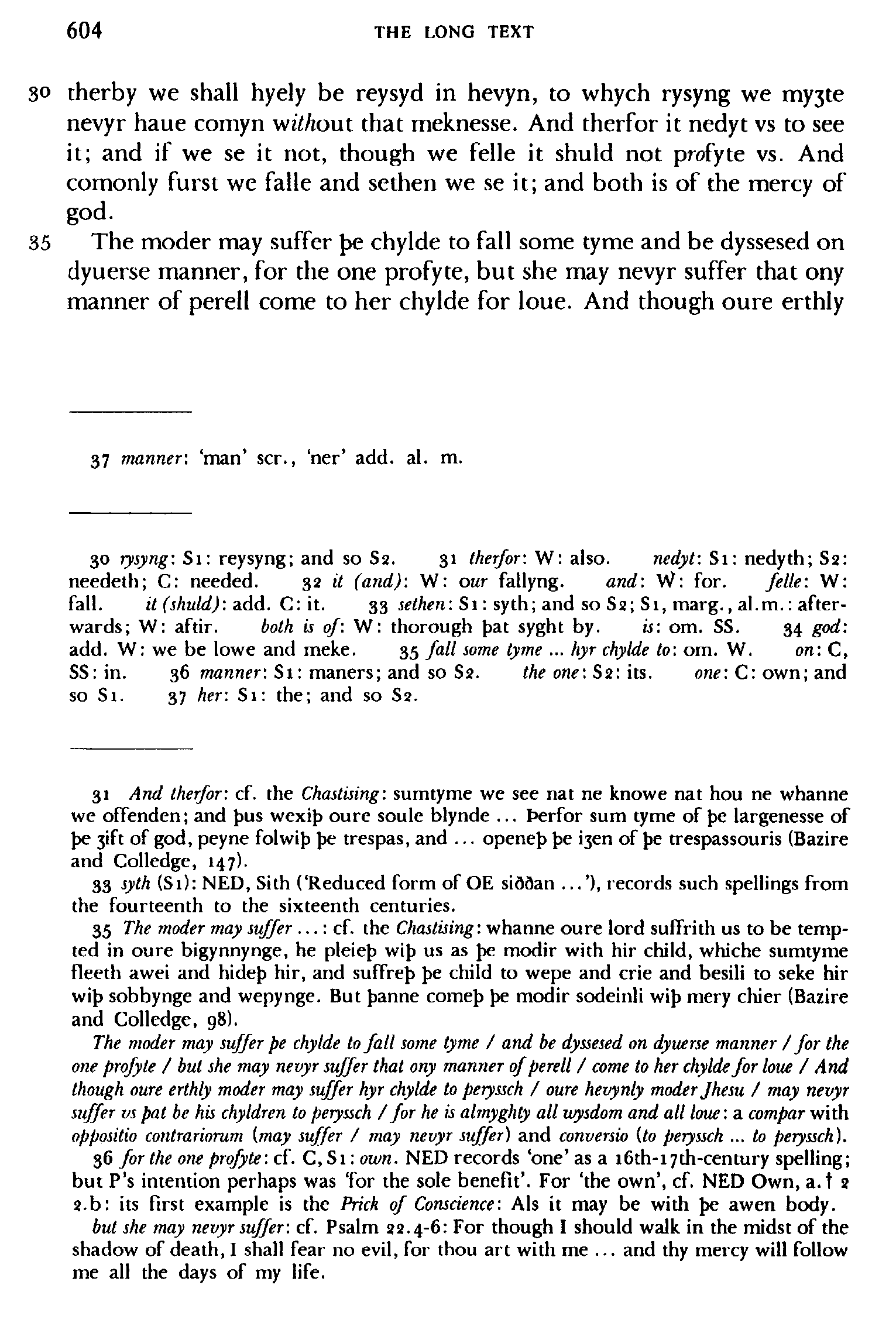
THE LONG TEXT
30 therby we shall hyely be reysyd in hevyn, to whych rysyng we my3te nevyr haue comyn without that meknesse. And therfor it nedyt vs to see it; and if we se it not, though we felle it shuld not profyte vs. And comonly furst we falle and sethen we se it; and both is of the mercy of god.
The moder may suffer be chylde to fall some tyme and be dyssesed on dyuerse manner, for the one profyte, but she may nevyr suffer that ony manner of perell come to her chylde for loue. And though oure erthly
37 manner: 'man' scr., 'ner' add. al. m.
30 rysyng: Si: reysyng; and so 82.
31 therfor: W: also. nedyt: Si: nedyth; 82: needeth; C: needed.
32 it (and): W: our fallyng. and: W: for. felle: W: fall. it (shuld): add. C: it.
33 sethen: Si: syth; and so 82; Si, marg., al.m.: afterwards; W: aftir. both isof:W: thorough pat syght by. is: om. SS.
34 god: add. W: we be lowe and meke.
35 fall some tyme ... hyr chylde to: om. W. on: C, SS: in.
36 manner: Si: maners; and so 82. the one: 82: its. one: C: own; and so Si.
37 her: Si: the; and so 82.
31 And therfor: cf. the Chastising: sumtyme we see nat ne knowe nat hou ne whanne we offenden; and pus wexij) oure soule blynde ... E>erfor sum tyme of pe largenesse of pe 3ift of god, peyne folwip pe trespas, and ... openep pe \$en of pe trespassouris (Bazire and Colledge, 147).
33 syth (Si): NED, Sith ('Reduced form of OE sifldan ...'), records such spellings from the fourteenth to the sixteenth centuries.
35 The moder may suffer ...: cf. the Chastising: whanne oure lord suffrith us to be tempted in oure bigynnynge, he pleie^ wijj us as pe modir with hir child, whiche sumtyme fleeth awei and hidej) hir, and suffrep pe child to wepe and crie and besili to seke hir wip sobbynge and wepynge. But panne comep pe modir sodeinli wip mery chier (Bazire and Colledge, 98).
The moder may suffer pe chylde to fall some tyme / and be dyssesed on dyuerse manner /for the one profyte / but she may nevyr suffer that ony manner of perell / come to her chylde for loue /And though oure erthly moder may suffer hyr chylde to peryssch / oure hevynly moder Jhesu / may nevyr suffer vs pat be his chyldren to peryssch /for he is almyghty all wysdom and all loue: a compar with oppositio contrariorum (may suffer / may nevyr suffer) and conversio (to peryssch ... to peryssch).
36 for the one profyte: cf. C, Si: own. NED records 'one' as a 16th-17th-century spelling; but P's intention perhaps was Tor the sole benefit'. For 'the own', cf. NED Own, a. t 2
2.b: its first example is the Prick of Conscience: Als it may be with pe awen body. but she may nevyr suffer: cf. Psalm 22.4-6: For though I should walk in the midst of the shadow of death, I shall fear no evil, for thou art with me ... and thy mercy will follow me all the days of my life.
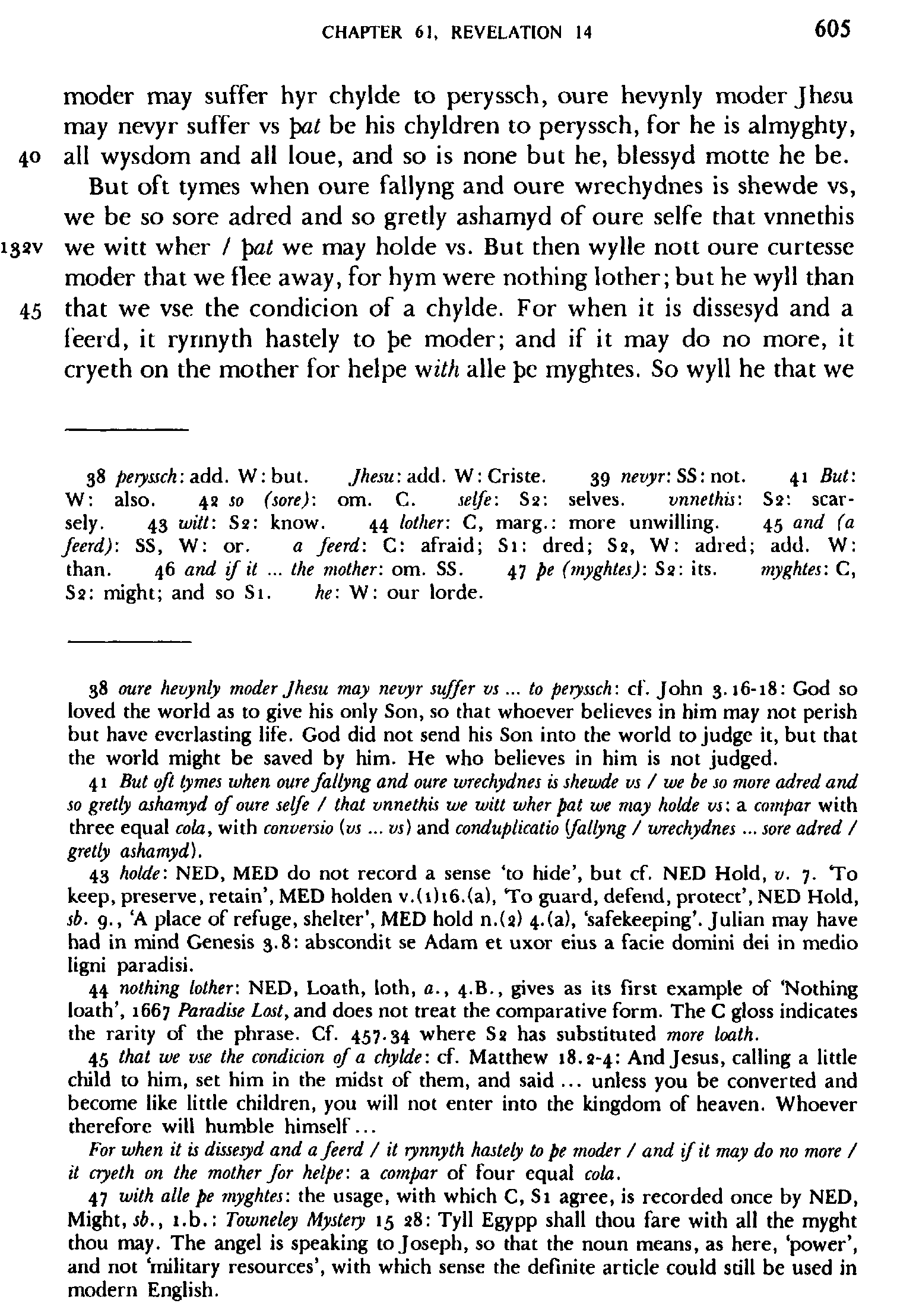
CHAPTER 61, REVELATION 14
moder may suffer hyr chylde to peryssch, cure hevynly moder Jhmi may nevyr suffer vs \>at be his chyldren to peryssch, for he is almyghty,
40 all wysdom and all loue, and so is none but he, blessyd motte he be.
But oft tymes when oure fallyng and oure wrechydnes is shewde vs, we be so sore adred and so gretly ashamyd of oure selfe that vnnethis i32v we witt wher / \>at we may holde vs. But then wylle nott oure curtesse moder that we flee away, for hym were nothing lother; but he wyll than
45 that we vse the condicion of a chylde. For when it is dissesyd and a feerd, it ryrmyth hastely to J>e moder; and if it may do no more, it cryeth on the mother for helpe with alle J>e myghtes. So wyll he that we
38 peryssch: add. W: but.
Jhesu: add. W: Criste.
39 nevyr: SS: not.
41 But:
W: also.
42 so (sore): om.
C. selfe:
Sa: selves. vnnethis: Sa: scarsely.
43 witt: Sa: know.
44 lother: C, marg.: more unwilling.
45 and (a feerd): SS, W: or. a feerd: C: afraid; Si: dred; 82, W: adred; add. W: than.
46 and if it ... the mother: om. SS.
47 pe (myghtes): 82: its. myghtes: C, 82: might; and so Si. he: W: our lorde.
38 oure hevynly moder Jhesu may nevyr suffer vs ... to peryssch: cf. John 3.16-18: God so loved the world as to give his only Son, so that whoever believes in him may not perish but have everlasting life. God did not send his Son into the world to judge it, but that the world might be saved by him. He who believes in him is not judged.
41 But oft tymes when oure fallyng and oure wrechydnes is shewde vs / we be so more adred and so gretly ashamyd of oure selfe / that vnnethis we witt wher pat we may holde vs: a compar with three equal cola, with conversio (vs ... vs) and conduplicatio (fallyng / wrechydnes ... sore adred / gretly ashamyd).
43 holde: NED, MED do not record a sense 'to hide', but cf. NED Hold, v. 7. To keep, preserve, retain', MED holden v.(1)16.(a), To guard, defend, protect', NED Hold, sb. 9., 'A place of refuge, shelter', MED hold n.(s) 4.(a), 'safekeeping'. Julian may have had in mind Genesis 3.8: abscondit se Adam et uxor eius a facie domini dei in medio ligni paradisi.
44 nothing lother: NED, Loath, loth, a., 4.8., gives as its first example of 'Nothing loath', 1667 Paradise Lost, and does not treat the comparative form. The C gloss indicates the rarity of the phrase. Cf. 457.34 where Ss has substituted more loath.
45 that we vse the condicion of a chylde: cf. Matthew 18.2-4: And Jesus, calling a little child to him, set him in the midst of them, and said ... unless you be converted and become like little children, you will not enter into the kingdom of heaven. Whoever therefore will humble himself...
For when it is dissesyd and a feerd / it rynnyth hastely to pe moder / and if it may do no more / it cryeth on the mother for helpe: a compar of four equal cola.
47 with alle pe myghtes: the usage, with which C, Si agree, is recorded once by NED,
Might, sb., i.b.: Towneley Mystery 15 28: Tyll Egypp shall thou fare with all the myght thou may. The angel is speaking to Joseph, so that the noun means, as here, 'power', and not 'military resources', with which sense the definite article could still be used in modern English.
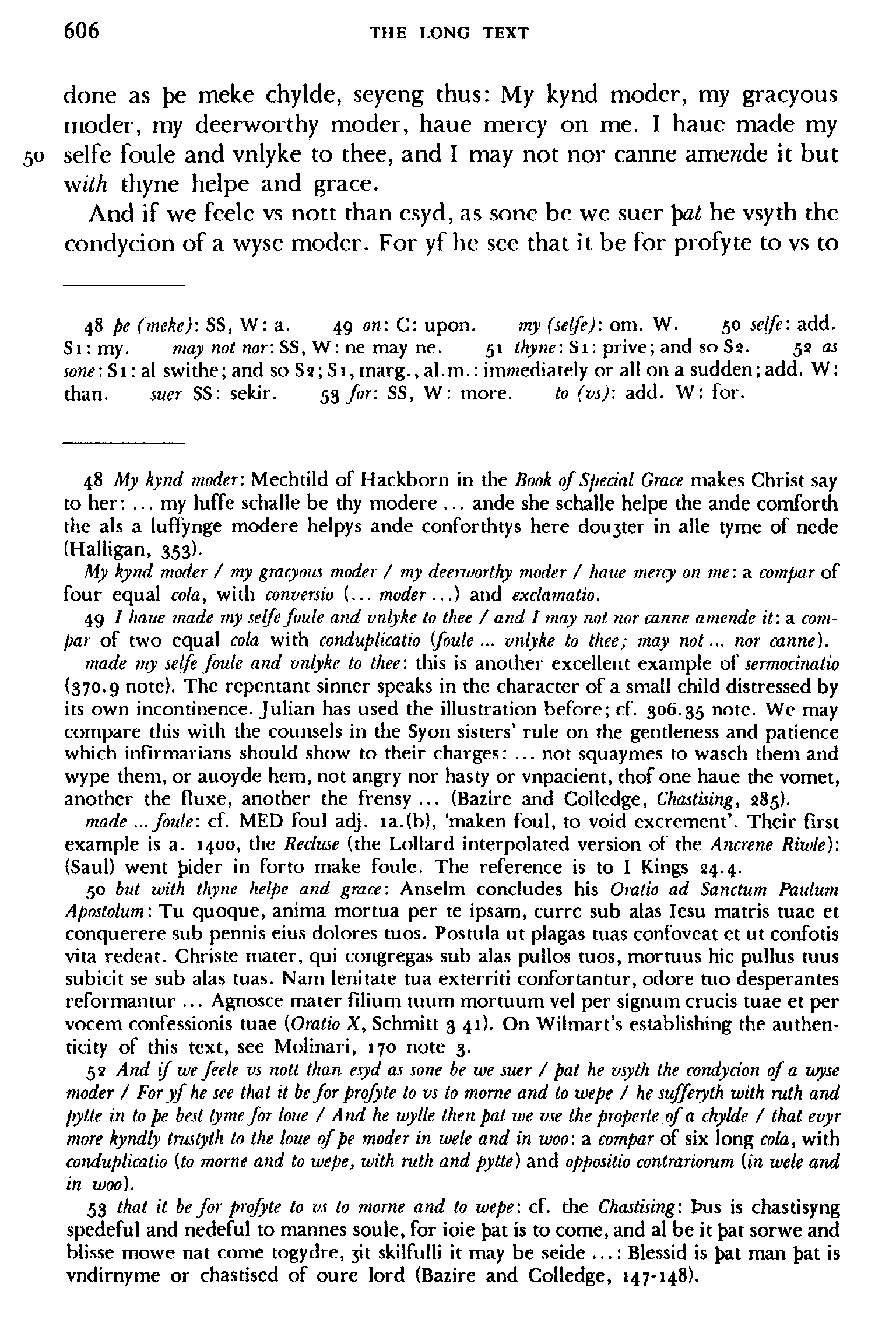
THE LONG TEXT
done as J)e meke chylde, seyeng thus: My kynd moder, my gracyous moder, my deerworthy moder, haue mercy on me. I haue made my
50 selfe foule and vnlyke to thee, and I may not nor canne amende it but with thyne helpe and grace.
And if we feele vs nott than esyd, as sone be we suer ]Mt he vsyth the condycion of a wyse moder. For yf he see that it be for profyte to vs to 48 pe (meke): SS, W: a.
49 on: C: upon. my (selfe): om. W.
50 selfe: add.
Si: my. may not nor: SS, W: ne may ne.
51 thyne: Si: prive; and so 82.
52 05 sone: Si: al swithe; and so 82; Si, rnarg., al.rn.: immediately or all on a sudden; add. W: than. suer SS: sekir.
53 for: SS, W: more. to (vs): add. W: for.
48 My kynd moder: Mechtild of Hackborn in the Book of Special Grace makes Christ say to her: ... my luffe schalle be thy modere ... ande she schalle helpe the ande comforth the als a luffynge modere helpys ande conforthtys here dorter in alle tyme of nede
(Halligan, 353).
My kynd moder / my gracyous moder / my deerworthy moder / haue mercy on me: a compar of four equal cola, with conversio (... moder...) and exclarnatio.
49 / haue made my selfe foule and vnlyke to thee / and I may not nor canne amende it: a coinpar of two equal cola with conduplicatio (foule ... vnlyke to thee; may not... nor canne). made my selfe foule and vnlyke to thee: this is another excellent example of sermocinatio
(370.9 note). The repentant sinner speaks in the character of a small child distressed by its own incontinence. Julian has used the illustration before; cf. 306.35 note. We may compare this with the counsels in the Syon sisters' rule on the gentleness and patience which infirmarians should show to their charges: ... not squaymes to wasch them and wype them, or auoyde hem, not angry nor hasty or vnpacient, thof one haue the vomet, another the fluxe, another the frensy ... (Bazire and Colledge, Chastising, 285). made ...foule: cf. MED foul adj. ia.(b), 'maken foul, to void excrement'. Their first example is a. 1400, the Recluse (the Lollard interpolated version of the Ancrene Riwle):
(Saul) went J>ider in forto make foule. The reference is to I Kings 24.4.
50 but with thyne helpe and grace: Anselm concludes his Oratio ad Sanctum Paulum
Apostolum: Tu quoque, anima mortua per te ipsam, curre sub alas lesu matris tuae et conquerere sub pennis eius dolores tuos. Postula ut plagas tuas confoveat et ut confotis vita redeat. Christe mater, qui congregas sub alas pullos tuos, mortuus hie pullus tuus subicit se sub alas tuas. Nam lenitate tua exterriti confortantur, odore tuo desperantes reformantur ... Agnosce mater filium tuum mortuum vel per signum crucis tuae et per vocem confessionis tuae (Oratio X, Schmitt 3 41). On Wilmart's establishing the authenticity of this text, see Molinari, 170 note 3.
52 And if we feele vs nott than esyd as sone be we suer / pat he vsyth the condycion of a wyse moder / For yf he see that it be for profyte to vs to mome and to wepe / he sufferyth with ruth and pytte in to pe best tyme for loue / And he wylle then pat we vse the properte of a chylde / that evyr more kyndly trwtyth to the loue of pe moder in wele and in woo: a compar of six long cola, with conduplicatio (to morne and to wepe, with ruth and pytte) and oppositio contrariorum (in wele and in woo).
53 that it be for profyte to vs to morne and to wepe: cf. the Chastising: tois is chastisyng spedeful and nedeful to mannes soule, for ioie J>at is to come, and al be it f>at sorwe and blisse mowe nat come togydre, yt skilfulli it may be seide ...: Blessid is |>at man Jjat is vndirnyme or chastised of oure lord (Bazire and Colledge, 147-148).
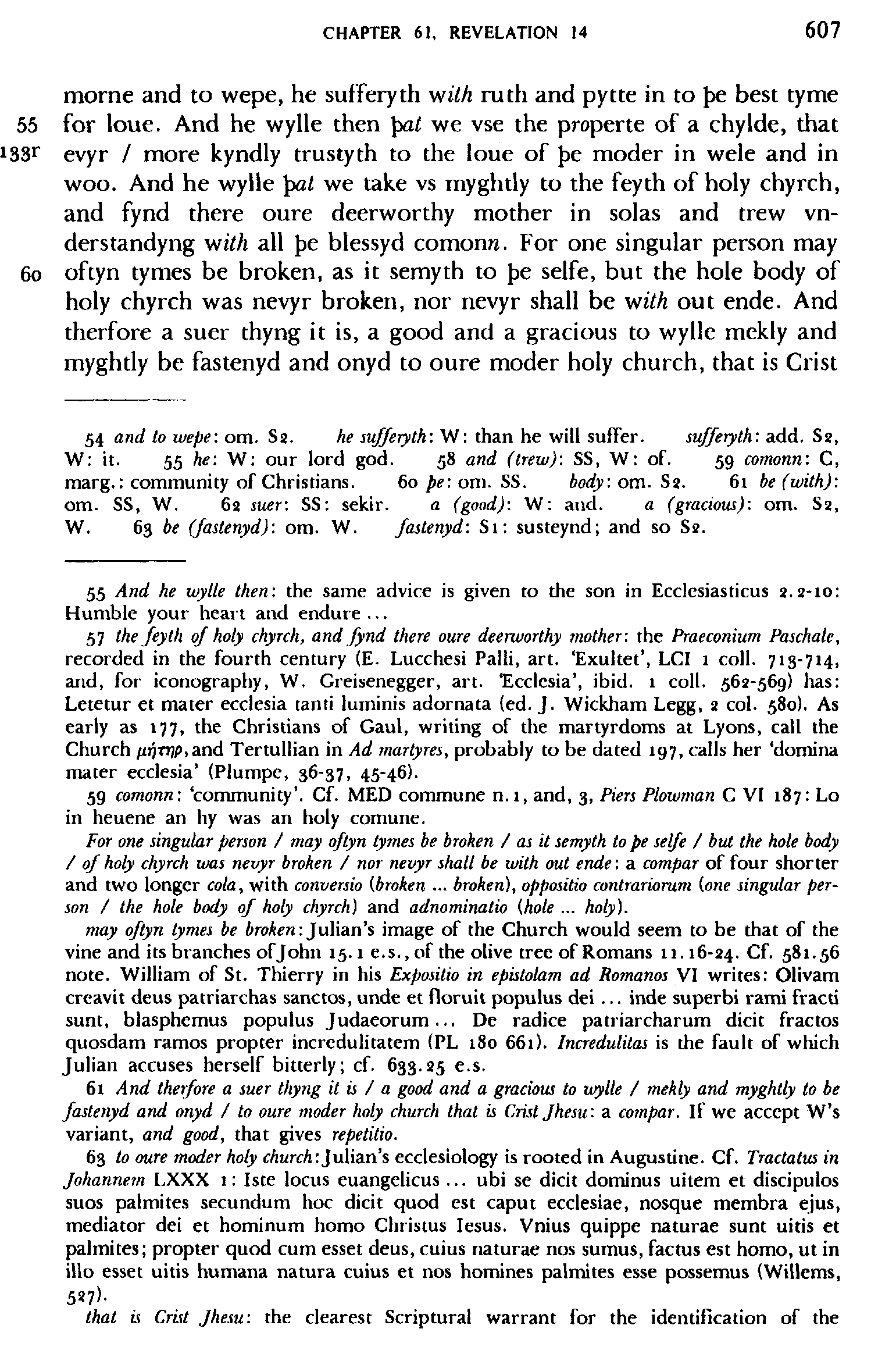
CHAPTER 61, REVELATION 14
morne and to wepe, he sufferyth 'with ruth and pytte in to f>e best tyme 55 for loue. And he wylle then \>at we vse the properte of a chylde, that !33r evyr / more kyndly trustyth to the loue of £>e moder in wele and in woo. And he wylle \>at we take vs myghtly to the feyth of holy chyrch, and fynd there oure deerworthy mother in solas and trew vnderstandyng with all Jje blessyd comonrc. For one singular person may
60 oftyn tymes be broken, as it semyth to JDC selfe, but the hole body of holy chyrch was nevyr broken, nor nevyr shall be with out ende. And therfore a suer thyng it is, a good and a gracious to wylle mekly and myghtly be fastenyd and onyd to oure moder holy church, that is Crist
54 and to wepe: om. 82. he sufferyth: W: than he will suffer. sufferyth: add. 82, W: it.
55 he: W: our lord god.
58 and (trew): 88, W: of.
59 comonn: C, marg.: community of Christians.
60 pe: om. 88. body: om. 82.
61 be (with): om. 88, W.
62 suer: 88: sekir. a (good): W: and. a (gracious): om. 82, W.
63 be (fastenyd): om. W. fastenyd: Si: susteynd; and so 82.
55 And he wylle then: the same advice is given to the son in Ecclesiasticus 2.2-10:
Humble your heart and endure...
57 the feyth of holy chyrch, and fynd there oure deerworthy mother: the Praeconium Paschale, recorded in the fourth century (E. Lucchesi Palli, art. 'Exultet', LCI i coll. 713-714, and, for iconography, W. Greisenegger, art. 'Ecclcsia', ibid, i coll. 562-569) has:
Letetur et mater ecclesia tanti luminis adornata (ed. J. Wickham Legg, 2 col. 580). As early as 177, the Christians of Gaul, writing of the martyrdoms at Lyons, call the Church /*7}TTjp,and Tertullian in Ad martyres, probably to be dated 197, calls her 'domina mater ecclesia' (Plumpe, 36-37, 45-46).
59 comonn: 'community'. Cf. MED commune n.i, and, 3, Piers Plowman C VI 187: Lo in heuene an hy was an holy comune.
For one singular person / may oftyn tymes be broken / as it semyth to pe selfe / but the hole body
/ of holy chyrch was nevyr broken / nor nevyr shall be with out ende: a compar of four shorter and two longer cola, with conversio (broken ... broken), oppositio contrariorum (one singular person / the hole body of holy chyrch) and adnominatio (hole ... holy). may oftyn tymes be broken: Julian's image of the Church would seem to be that of the vine and its branches of John 15. i e.s., of the olive tree of Romans 11.16-24. Cf. 581.56 note. William of St. Thierry in his Expositio in epistolam ad Romanos VI writes: Olivam creavit deus patriarchas sanctos, unde et floruit populus dei ... inde superbi rami fracti sunt, blasphemus populus Judaeorum... De radice patriarcharum dicit fractos quosdam ramos propter incredulitatem (PL 180 661). Incredulitas is the fault of which Julian accuses herself bitterly; cf. 633.25 e.s.
61 And therfore a suer thyng it is / a good and a gracious to wylle / mekly and myghtly to be fastenyd and onyd / to oure moder holy church that is Crist Jhesu: a compar. If we accept W's variant, and good, that gives repetitio.
63 to oure moder holy church:Julian's ecclesiology is rooted in Augustine. Cf. Tractatus in Johannem LXXX i: Iste locus euangelicus ... ubi se dicit dominus uitem et discipulos suos palmites secundum hoc dicit quod est caput ecclesiae, nosque membra ejus, mediator dei et hominum homo Christus lesus. Vnius quippe naturae sunt uitis et palmites; propter quod cum esset deus, cuius naturae nos sumus, factus est homo, ut in illo esset uitis humana natura cuius et nos homines palmites esse possemus (Willems,
58?)that is Crist Jhesu: the clearest Scriptural warrant for the identification of the
THE LONG TEXT
Jhtf.m. For the flode of mercy that is his deerworthy blode and precious 65 water is plentuous to make vs feyer and clene. The blessed woundes of oure sauiour be opyn and enjoye to hele vs. The swet gracious handes of oure moder be redy and diligent a bout vs; for he in alle this / i33v werkyng vsyth the very office of a kynde norysse, that hath not elles to done but to entende about the saluation of hyr chylde.
It is his office to saue vs, it is his worshyppe to do it, and it is hys wylle we know it; for he wyll we loue hym swetely and trust in hym
69 entende: ms: entenned, alt. to 'emended'.
64 Jlode: Si: foode; and so 82, alt. scr. fr. 'flood'.
65 is (plentuous): W: it is. woundes: Si: wound.
66 enjoye: C, marg.: rejoyce.
67 diligent: Ss: diligently.
68 veiy: om. SS. that: SS: and. not.: C: nought; W: no{>inge. elles: SS: ell.
69 entende: W: attend. about: C: to.
70 his office: W: J>e office of oure lorde Jesu Criste. it (and): SS: us.
71 wyll: add. W: Jjat.
Church with Christ is the account of Paul's conversion, Acts 9.1-7: And Saul, breathing out threats against the disciples of the Lord ... falling to the ground, heard a voice saying to him: Saul, Saul, why are you persecuting me? ... I am Jesus whom you are persecuting.
64 Jlode: P's is the superior reading. Cf. 344.24: The precious plenty of his dere worthy blode ovyrflowyth all erth. precious water: Mechtild of Hackborn, in one of the less attractive imaginings in her
Book of Special Grace, sees a great river flowing from the heart of Christ, who says to her:
Lo, I wille be thy goode modere. Ande als goode moders teche here gostelye chyldrene, so schalle I teche the (Halligan, 436).
65 to make vs feyer and clene: Julian may have in mind the petition of the Anima Christi:
Aqua lateris Christi laua me (e.g. MS Cambridge UL Ff. 6.8, f. 72'). Despite innumerable Latin texts of this in England surviving from Julian's time and earlier, no mediaeval English version of this prayer has so far been found.
The blessed woundes of oure sauiour be opyn and enjoye to hele vs / The swet gracious handes of oure moder be redy and diligent about vs: a compar, with conversio (vs... vs), with balancing interpretatio (blessed woundes ... swet gracious handes, opyn and enjoye ... redy and diligent).
67 for he in alle this werkyng vsyth / the very office of a kynde norysse: another compar, which, taken with the previous figure, gives notatio.
68 a kynde norysse: Ephesians 5.29-30: For no man ever hated his own flesh, but nurses it and cherishes it, as Christ does the Church, because we are members of his body, of his flesh and of his bones.
70 It is his office to saue vs / it is his worshyppe to do it / and it is hys wylle we know it: a compar with repetitio in all three cola and conversio in the second and third.
71 for he wyll we loue hym swetely / and trust in hym mekely and myghtly: a two-membered compar with similiter desinens (swetely... mekely... myght/y).
CHAPTER 61, REVELATION 14
mekely and myghtly. And this shewde he in these gracious wordes: I kepe the fulle suerly.
72 / kepe the fulle suerly: here the eleventh extract in W ends.
72 in: W: on.
72 And this shewde he in these gracious wordes / I kepe the fulle suerly: another compar. The three figures are full of rhetorical allusions to the mystery of the Trinity. in these gracious wordes: cf. 442.10.
THE LONG TEXT
The Ixij Chapter For in that tyme he shewde oure fraylte and oure fallyng, oure brckynges and oure noughtynges, oure dispytes and oure chargynges and alle oure woo, as farre forth as me thought that it myght falle in 5 thys lyfe. And therwz7/i lie shewde his blyssyd myght, his blessyd wysdome, his blessyd loue, that he kepyth vs in this tymc as tendyrly and i34r as swetely to hys wurschyppe and as suerly to oure saluacion as / he doth when we be in most solace and comfort, and ther to reysyth vs gostly and hyely in hevyn, and turnyth alle to his wurshypp and to oure i Si: The love of god suffrith never his chosen to lose tyme, for all their treble is turnyd into endless joye; and how we arn al bownden to god for kindness and for grace, for every kind is in man, and us neclyth not to seke out to know sondry kindes, but to holy church; and so Ss?. a fallyng; C, Sa: fallings; Si: faylyngs (cane.) fallyngs.
3 chargynges:
SS: outcastings.
4 as (farre):
SS: so. that: om.
SS.
6 wysdome: add.
Si?: and.
7 suerly:
SS: sekirly.
8 to: add.
SS: he.
9 turnyth: add. SS: it. to (oure): om. 82.
2 The whole of this first paragraph is in fact one complex figure, which may be treated as follows: For in that tyme he shewde / oure fraylte and oure fallyng / oure brekynges and oure noughtynges / oure dispytes and oure chargynges / and alle oure woo / as farre forth as me thought / that it myght falle in thys lyfe: a compar of seven cola, with repetitio (oure ...), similiter cadens (fallyng... brekynges... noughtynges... chargynges) and adnominatio
(fallyng... falle).
5 And therwith he shewde his blyssyd myght / his blessyd wysdome his blessyd loue: in these two cola there is oppositio contrariorurn with the previous figure: human sinfulness and misery are contrasted with his blyssyd myght ... wysdome ... loue. Here there is internal repetitio
(blyssyd ... blessyd ... blyssyd) and the two figures together give a form of articulus.
6 that he kepyth vs in this tyme as tendyrly and as swetely / to his wurschyppe and as surely to oure saluacion / as he doth when we be in most solace and comfort / and ther to reysyth vs gostly and hyely in hevyn / and turnyth alle to his wurshypp and to oure joye with out ende: in these five cola there is again oppositio with the first figure: solace and comfort... his wurshyppe and oure joy. There \ssimiliterdesinens: tendyr/y ... swete/y... gost/y... hyely. he kepyth vs in this tyme as tendyrly ...: in Bonum est we read: But he abydep in pis merke ni3t and schewep to pe, lord, ful trustiliche pi sopfastnes ... He knowep wel pat grace is with drawen from him in o manere. But hit is giuen to him in anopur manere as god wole, not so sweteli ne so felabli as hit was, but more priueli and more mi3tili and more godly ... In pis nijt is muche Ii3t, but hit schinejj not: hit schal schynen whon pe niht is passed ouer and pe ful day schewep (Wallner, 56-57; the allusion is to II Peter 1.19). It is probable that Julian had in mind Psalm 91.14-15: They that are planted in the house of the Lord shall flourish ... they shall still increase in a fruitful old age; and they shall be well treated, that they may show that the Lord our God is just.
CHAPTER 62, REVELATION 14
10 joye with out ende. For his precious loue he sufferyth vs nevyr to lese tyme; and all this is of the kynde goodnes of god by the werkyng of grace.
God is kynd in his being; that is to sey that goodnesse that is kynd, it is god. He is the grounde, he is }>e substannce, he is the same thyng that 15 is kyndnesse, and he is very fader and very modyr of kyndys. And alle
10 precious: om. SS. he: om. SS. n tyme: add. C: (since all things turn to our greater good) (ital.) 13 kynd: C, marg.: nature.
15 and (he): om. Sa. kyndys:
82: kind.
10 For his precious loue he sufferyth vs nevyr to lese tyme / and all this is of the kynde goodnes of god by the werkyng of grace: there is here a subtle incltuio with the previous figure: he kepyth vs in this tyme ... he sufferyth vs nevyr to lese tyme. The whole constitutes another remarkable example of expolitio, with its skilful combinations of compares for the Trinitarian mystery and oppositio for that of the Hypostatic Union. The first figure is shewed for Adam ... and his fallyng to make there by to be vnderstonde how god beholdyth alle manne and his fallyng
(522.101}. The second we see that by the wysdom and the goodnesse pat was in the seruannt is vnderstond goddys son (534225). The third deals with the attributes of the Trinity, so that the Father kepyth vs, the Son to oure saluacion ... reysyth vs, the Spirit works in us to his wurshypp and to oure joye. And in the final colon we have defmitio: all this is of the kynde goodnes of god by the werkyng of grace. nevyr to lese l)>m?:Julian is aware that the devout can become over-anxious about time and its use and abuse, and unlike the Cloud-author (see Cloud, 20, and Deonise, 48), she has come to terms with the problem. In MS Fitzwilliam Museum 55, f. 127*, there is a prayer to the Father for time for contrition: ... concede michi queso famulo tuo ut in die mortis mee tantum spacium presentis saltern quo ad mensuram ut omnia peccata mea ualeam deplorare et veniam et graciam secundum misericordiam tuam consequi merear.
13 This paragraph is an expolitio, consisting of four compares. The first (God is kynd ... it is god), of four cola, with inclusio (God ... god) and chiasmus (God ... being ... goodnesse ... god) treats of the divine unity. The second (He is the grounde ... modyr of kyndys), of four cola, with repetitio (He is ...) and conversio (kyndnesse ... kyndys) deals with divine Fatherhood and Motherhood. The third (And alle kyndes ... werkyng of grace), of four cola, with traductio
(werke ... werkyng), considers the Father as Creator, the Son as Redeemer. The fourdi
(For of all kyndys ... and wurschyppe), of eight cola, with oppositio (dyverse ... party / hole ... fullheed), inclusio (all kyndys ... alle the hole) and similiter cadens (ryalte, nobly*?, solempnyte), demonstrates the Trinitarian operatio ad extra. Part of the expolitio''s effect is achieved through reiteration from one compar to another: God ... god ... He ... he ... The thought is radically Pauline, a statement of the great Chris tological teaching of Colossians 1.12-20; and this Christology is linked to William of St. Thierry's development of Augustine's
Trinitarian theology. See especially De natura corporis et animae II: Omnis quippe anima... tribus individuis subsistit... (PL 180 722).
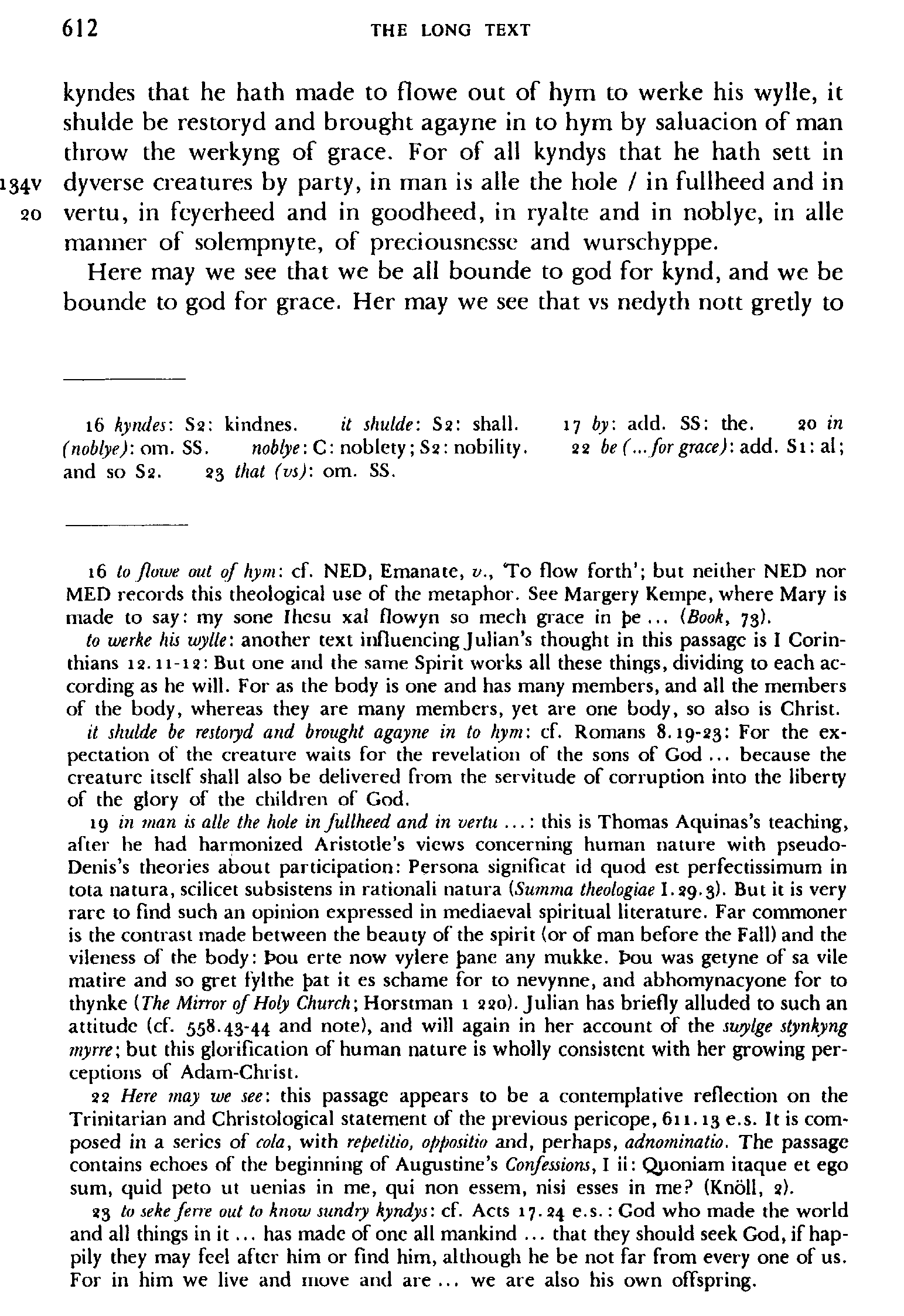
THE LONG TEXT
kyndes that he hath made to flowe out of hym to werke his wylle, it shulde be restoryd and brought agayne in to hym by saluacion of man throw the werkyng of grace. For of all kyndys that he hath sett in i34v dyverse creatures by party, in man is alle the hole / in fullheed and in 20 vertu, in feyerheed and in goodheed, in ryalte and in noblye, in alle manner of solempnyte, of preciousnesse and wurschyppe.
Here may we see that we be all bounde to god for kynd, and we be bounde to god for grace. Her may we see that vs nedyth nott gretly to 16 kyndes: 82: kindnes. it shulde: 82: shall.
17 by: add. SS: the.
20 in (noblye): am. SS. noblye: C: noblety; 82: nobility.
22 be (...forgrace): add. Si: al; and so 82.
23 that (vs): om. SS.
16 to flowe out of hym: cf. NED, Emanate, v., To flow forth'; but neither NED nor MED records this theological use of the metaphor. See Margery Keinpe, where Mary is made to say: my sone Ihesu xal flowyn so mech grace in ^e ... (Book, 73). to werke his wylle: another text influencing Julian's thought in this passage is I Corinthians 12.11-12: But one and the same Spirit works all these things, dividing to each according as he will. For as the body is one and has many members, and all the members of the body, whereas they are many members, yet are one body, so also is Christ. it shulde be restoryd and brought agayne in to hym: cf. Romans 8.19-23: For the expectation of the creature waits for the revelation of the sons of God ... because the creature itself shall also be delivered from the servitude of corruption into the liberty of the glory of the children of God.
19 in man is alle the hole in fullheed and in vertu ...: this is Thomas Aquinas's teaching, after he had harmonized Aristotle's views concerning human nature with pseudoDenis's theories about participation: Persona significat id quod est perfectissimum in tota natura, scilicet subsistens in rationali natura (Summa theologiae 1.29.3). But it is very rare to find such an opinion expressed in mediaeval spiritual literature. Far commoner is the contrast made between the beauty of the spirit (or of man before the Fall) and the vileness of the body: t>ou erte now vylere {>ane any mukke. Pou was getyne of sa vile matire and so gret fylthe f>at it es schame for to nevynne, and abhomynacyone for to thynke (The Mirror of Holy Church; Horstman i 220). Julian has briefly alluded to such an attitude (cf. 558.43-44 and note), and will again in her account of the swylge stynkyng myrre; but this glorification of human nature is wholly consistent with her growing perceptions of Adam-Christ.
22 Here may we see: this passage appears to be a contemplative reflection on the Trinitarian and Christological statement of the previous pericope, 611.13 e.s. It is composed in a series of cola, with repelitio, o/)/)ositio and, perhaps, adnominatio. The passage contains echoes of the beginning of Augustine's Confessions, I ii: Quoniam itaque et ego sum, quid peto ut uenias in me, qui non essem, nisi esses in me? (Knoll, 2).
23 to seke fern out to know sundry kyndys: cf. Acts 17. 24 e.s.: God who made the world and all things in it... has made of one all mankind ... that they should seek God, if happily they may feel after him or find him, although he be not far from every one of us.
For in him we live and move and are ... we are also his own offspring.
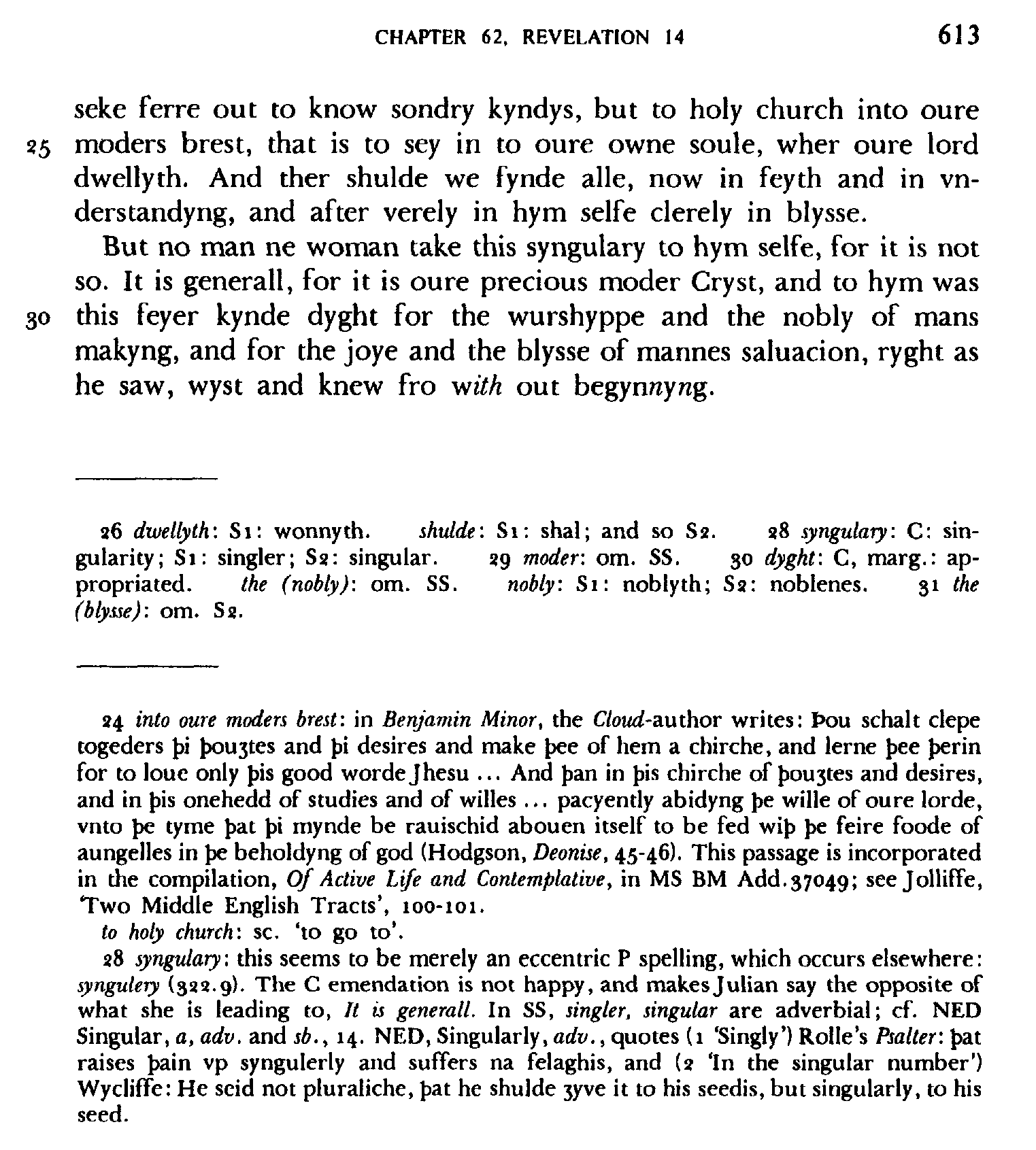
CHAPTER 62, REVELATION 14
seke ferre out to know sondry kyndys, but to holy church into oure 25 moders brest, that is to sey in to oure owne soule, wher oure lord dwellyth. And ther shulde we fynde alle, now in feyth and in vnderstandyng, and after verely in hym selfe clerely in blysse.
But no man ne woman take this syngulary to hym selfe, for it is not so. It is generall, for it is oure precious moder Cryst, and to hym was
30 this feyer kynde dyght for the wurshyppe and the nobly of mans makyng, and for the joye and the blysse of mannes saluacion, ryght as he saw, wyst and knew fro with out begynnyrcg.
26 dwellyth: Si: wonnyth. shulde: Si: shal; and so Sa.
28 syngulary: C: singularity; Si: singler; Sa: singular.
29 moder: om. SS.
30 dyght: C, marg.: appropriated, the (nobly): om. SS. nobly: Si: noblyth; Sa: noblenes.
31 the (blysse): om. Sa.
24 into oure moders brest: in Benjamin Minor, the C/owrf-author writes: t>ou schalt clepe togeders pi pou3tes and pi desires and make pee of hem a chirche, and lerne pee perin for to loue only pis good wordejhesu ... And pan in pis chirche of poujtes and desires, and in pis onehedd of studies and of willes ... pacyently abidyng pe wille of oure lorde, vnto pe tyme pat pi mynde be rauischid abouen itself to be fed wip pe feire foode of aungelles in pe beholdyng of god (Hodgson, Deonise, 45-46). This passage is incorporated in the compilation, Of Active Life and Contemplative, in MS BM Add. 37049; see Jolliffe,
Two Middle English Tracts', 100-101. to holy church: sc. 'to go to'.
28 syngulary: this seems to be merely an eccentric P spelling, which occurs elsewhere: syngulery (322.9). The C emendation is not happy, and makes Julian say the opposite of what she is leading to, It is generall. In SS, singler, singular are adverbial; cf. NED
Singular, a, adv. and sb., 14. NED, Singularly, adv., quotes (i 'Singly') Rolle's Psalter: pat raises pain vp syngulerly and suffers na felaghis, and (2 'In the singular number')
Wycliffe: He seid not pluraliche, pat he shulde 3yve it to his seedis, but singularly, to his seed.
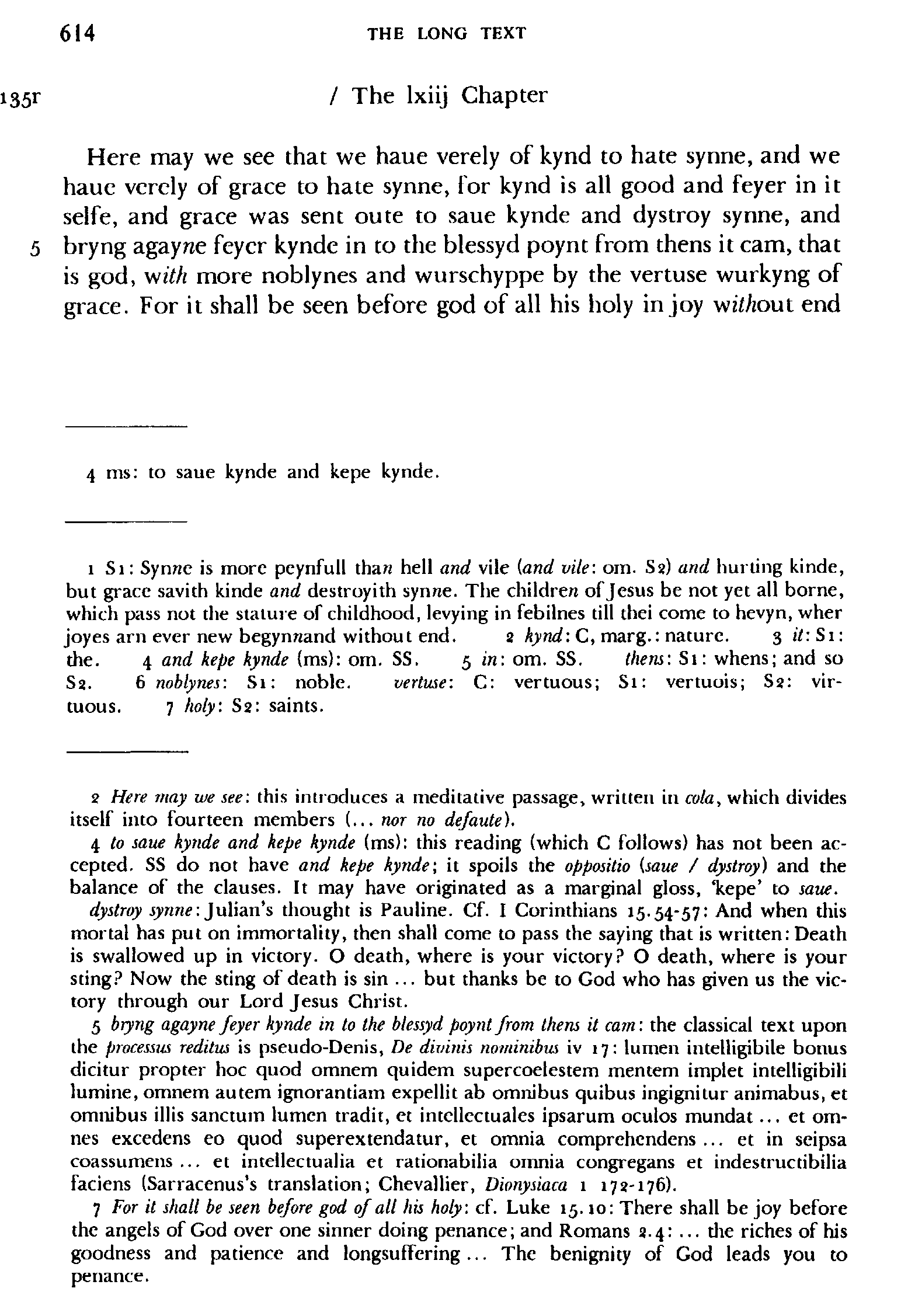
THE LONG TEXT
i35r / The Ixiij Chapter Here may we see that we haue verely of kynd to hate synne, and we haue verely of grace to hate synne, for kynd is all good and feyer in it selfe, and grace was sent oute to saue kynde and dystroy synne, and 5 bryng agaywe feyer kynde in to the blessyd poynt from thens it cam, that is god, "with more noblynes and wurschyppe by the vertuse wurkyng of grace. For it shall be seen before god of all his holy in joy without end
4 ms: to saue kynde and kepe kynde. i Si: Synne is more peynfull than hell and vile (and vile: om. 82) and hurting kinde, but grace savith kinde and destroyith synne. The children of Jesus be not yet all borne, which pass not the stature of childhood, levying in febilnes till thei come to hevyn, wher joyes arn ever new begynnand without end.
2 kynd: C, marg.: nature.
3 it: Si: the.
4 and kepe kynde (ms): om. SS.
5 in: om. SS. thens: Si: whens; and so 82.
6 noblynes: Si: noble. vertuse: C: vertuous; Si: vertuois; 82: virtuous.
7 holy: 82: saints.
2 Here may we see: this introduces a meditative passage, written in cola, which divides itself into fourteen members (... nor no defaute).
4 to saue kynde and kepe kynde (ms): this reading (which C follows) has not been accepted. SS do not have and kepe kynde; it spoils the oppositio (saue / dystroy) and the balance of the clauses. It may have originated as a marginal gloss, 'kepe' to saue. dystroy synne: Julian's thought is Pauline. Cf. I Corinthians 15.54-57: And when this mortal has put on immortality, then shall come to pass the saying that is written: Death is swallowed up in victory. O death, where is your victory? O death, where is your sting? Now the sting of death is sin ... but thanks be to God who has given us the victory through our Lord Jesus Christ.
5 bryng agayne feyer kynde in to the blessyd poynt from thens it cam: the classical text upon the processus reditus is pseudo-Denis, De divinis nominibus iv 17: lumen intelligibile bonus dicitur propter hoc quod omnem quidem supercoelestem mentem implet intelligibili lumine, omnem autem ignorantiam expellit ab omnibus quibus ingignitur animabus, et omnibus illis sanctum lumen tradit, et intellectuales ipsarum oculos mundat... et omnes excedens eo quod superextendatur, et omnia comprehendens ... et in seipsa coassumens ... et intellectualia et rationabilia ornnia congregans et indestructibilia faciens (Sarracenus's translation; Chevallier, Dionysiaca i 172-176).
7 For it shall be seen before god of all his holy: cf. Luke 15.10: There shall be joy before the angels of God over one sinner doing penance; and Romans 2.4: ... die riches of his goodness and patience and longsuffering... The benignity of God leads you to penance.
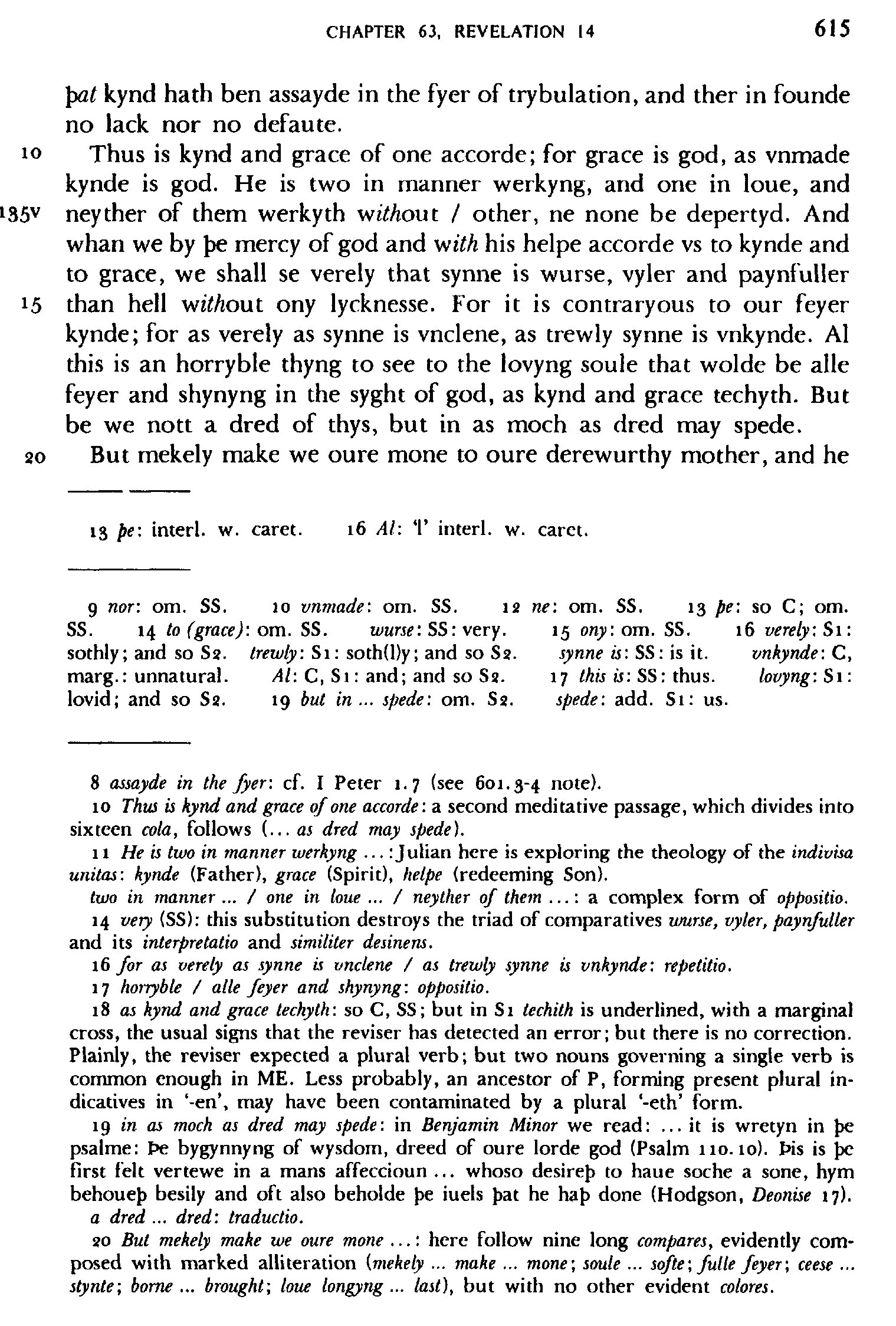
CHAPTER 63, REVELATION 14
Jxz£ kynd hath ben assayde in the fyer of trybulation, and ther in founde no lack nor no defaute.
Thus is kynd and grace of one accorde; for grace is god, as vnmade kynde is god. He is two in manner werkyng, and one in loue, and !35V neyther of them werkyth without I other, ne none be depertyd. And whan we by J)e mercy of god and with his helpe accorde vs to kynde and to grace, we shall se verely that synne is wurse, vyler and paynfuller
15 than hell without ony lycknesse. For it is contraryous to our feyer kynde; for as verely as synne is vnclene, as trewly synne is vnkynde. Al this is an horryble thyng to see to the lovyng soule that wolde be alle feyer and shynyng in the syght of god, as kynd and grace techyth. But be we nott a dred of thys, but in as moch as dred may spede.
But mekely make we oure mone to oure derewurthy mother, and he 13 pe: interl. w. caret.
16 Al: T interl. w. caret.
9 nor: om. SS.
10 vnmade: om. SS.
12 ne: om. SS.
13 pe: so C; om.
SS.
14 to (grace): om. SS. wurse: SS: very.
15 ony: om. SS.
16 verely: Si: sothly; and so 82. trewly: Si: soth(l)y; and so 82. synne is: SS: is it. vnkynde:C, marg.: unnatural.
Al: C, Si: and; and so 82.
17 this is: SS: thus. lovyng: Si: lovid; and so Sa.
19 but in... spede: om. 82. spede: add. Si: us.
8 assayde in the fyer: cf. I Peter 1.7 (see 601.3-4 note).
10 Thus is kynd and grace of one accorde: a second meditative passage, which divides into sixteen cola, follows (... as dred may spede).
11 He is two in manner werkyng ...: Julian here is exploring the theology of the indivisa unitas: kynde (Father), grace (Spirit), helpe (redeeming Son). two in manner ... / one in loue ... / neyther of them ...: a complex form of oppositio.
14 very (SS): this substitution destroys the triad of comparatives wurse, vyler, paynfuller and its interpretatio and similiter desinens.
16 for as verely as synne is vnclene / as trewly synne is vnkynde: repetitio.
17 horryble / alle feyer and shynyng: oppositio.
15 as kynd and grace techyth: so C, SS; but in Si techith is underlined, with a marginal cross, the usual signs that the reviser has detected an error; but there is no correction.
Plainly, the reviser expected a plural verb; but two nouns governing a single verb is common enough in ME. Less probably, an ancestor of P, forming present plural indicatives in '-en', may have been contaminated by a plural '-eth' form.
19 in as moch as dred may spede: in Benjamin Minor we read: ... it is wretyn in pe psalme: Pe bygynnyng of wysdom, dreed of oure lorde god (Psalm no. 10). t»is is pe first felt vertewe in a mans affeccioun ... whoso desirej) to haue soche a sone, hym behouep besily and oft also beholde pe iuels pat he haj> done (Hodgson, Deonise 17). a dred ... dred: traductio.
20 But mekely make we oure mone ...: here follow nine long compares, evidently composed with marked alliteration (mekely ... make ... mone; soule ... softe; fulle feyer; ceese ... stynte; home ... brought; loue longyng ... last), but with no other evident colores.
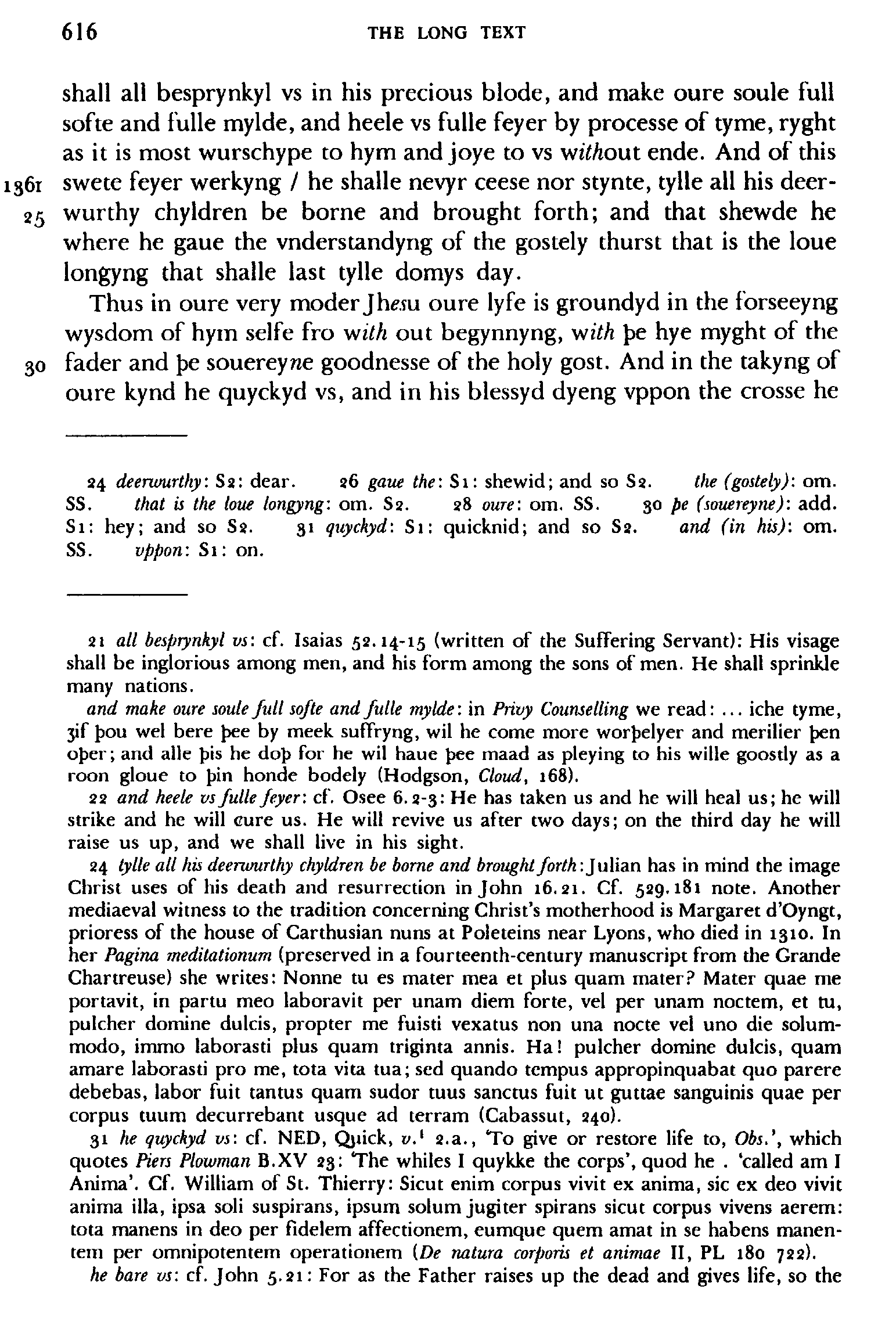
THE LONG TEXT
shall all besprynkyl vs in his precious blode, and make oure soule full softe and fulle mylde, and heele vs fulle feyer by processe of tyme, ryght as it is most wurschype to hym and joye to vs without ende. And of this
1361 swete feyer werkyng / he shalle nevyr ceese nor stynte, tylle all his deer25 wurthy chyldren be borne and brought forth; and that shewde he where he gaue the vnderstandyng of the gostely thurst that is the loue longyng that shalle last tylle domys day.
Thus in oure very moder Jhe.m oure lyfe is groundyd in the forseeyng wysdom of hym selfe fro with out begynnyng, with be hye myght of the 30 fader and be souereyne goodnesse of the holy gost. And in the takyng of oure kynd he quyckyd vs, and in his blessyd dyeng vppon the crosse he
24 deerwurthy: Sa: dear.
26 gaue the: Si: shewid; and so Sa. the (gostely): om.
SS. that is the loue longyng: om. 82.
28 oure: om. SS.
30 pe (souereyne): add.
Si: hey; and so Sa.
31 quyckyd: Si: quicknid; and so Sa. and (in his): om.
SS. vppon: Si: on.
21 all besprynkyl vs: cf. Isaias 53.14-15 (written of the Suffering Servant): His visage shall be inglorious among men, and his form among the sons of men. He shall sprinkle many nations. and make oure soule full softe and fulle mylde: in Privy Counselling we read: ... iche tyme,
3if Jjou wel here Jjee by meek suffryng, wil he come more wor^elyer and merilier J)en ojjer; and alle £is he do]) for he wil haue f>ee maad as pleying to his wille goostly as a roon gloue to J)in honde bodely (Hodgson, Cloud, 168).
22 and heele vs fulle feyer: cf. Osee 6.2-3: He has taken us and he will heal us; he will strike and he will cure us. He will revive us after two days; on die third day he will raise us up, and we shall live in his sight.
24 tylle all his deerwurthy chyldren be borne and brought forth: Julian has in mind the image
Christ uses of his death and resurrection in John 16.21. Cf. 539.181 note. Another mediaeval witness to the tradition concerning Christ's motherhood is Margaret d'Oyngt, prioress of the house of Carthusian nuns at Poleteins near Lyons, who died in 1310. In her Pagina meditationum (preserved in a fourteenth-century manuscript from die Grande
Chartreuse) she writes: Nonne tu es mater mea et plus quam mater? Mater quae me portavit, in partu meo laboravit per unam diem forte, vel per unam noctem, et tu, pulcher domine dulcis, propter me fuisti vexatus non una nocte vel uno die solummodo, immo laborasti plus quam triginta annis. Ha! pulcher domine dulcis, quam amare laborasti pro me, tota vita tua; sed quando tempus appropinquabat quo parere debebas, labor fuit tantus quam sudor tuus sanctus fuit ut guttae sanguinis quae per corpus tuum decurrebant usque ad terram (Cabassut, 240).
31 he quyckyd vs: cf. NED, Qjiick, v.1 a.a., To give or restore life to, Obs.', which quotes Piers Plowman B.XV 23: The whiles I quykke the corps', quod he . 'called am I Anima'. Cf. William of St. Thierry: Sicut enim corpus vivit ex anima, sic ex deo vivit anima ilia, ipsa soli suspirans, ipsum solum jugiter spirans sicut corpus vivens aerem: tota manens in deo per fidelem affectionem, eumque quern amat in se habens manentem per omnipotentem operationem (De natura carports et animae II, PL 180 722). he bare vs: cf. John 5.21: For as the Father raises up the dead and gives life, so the
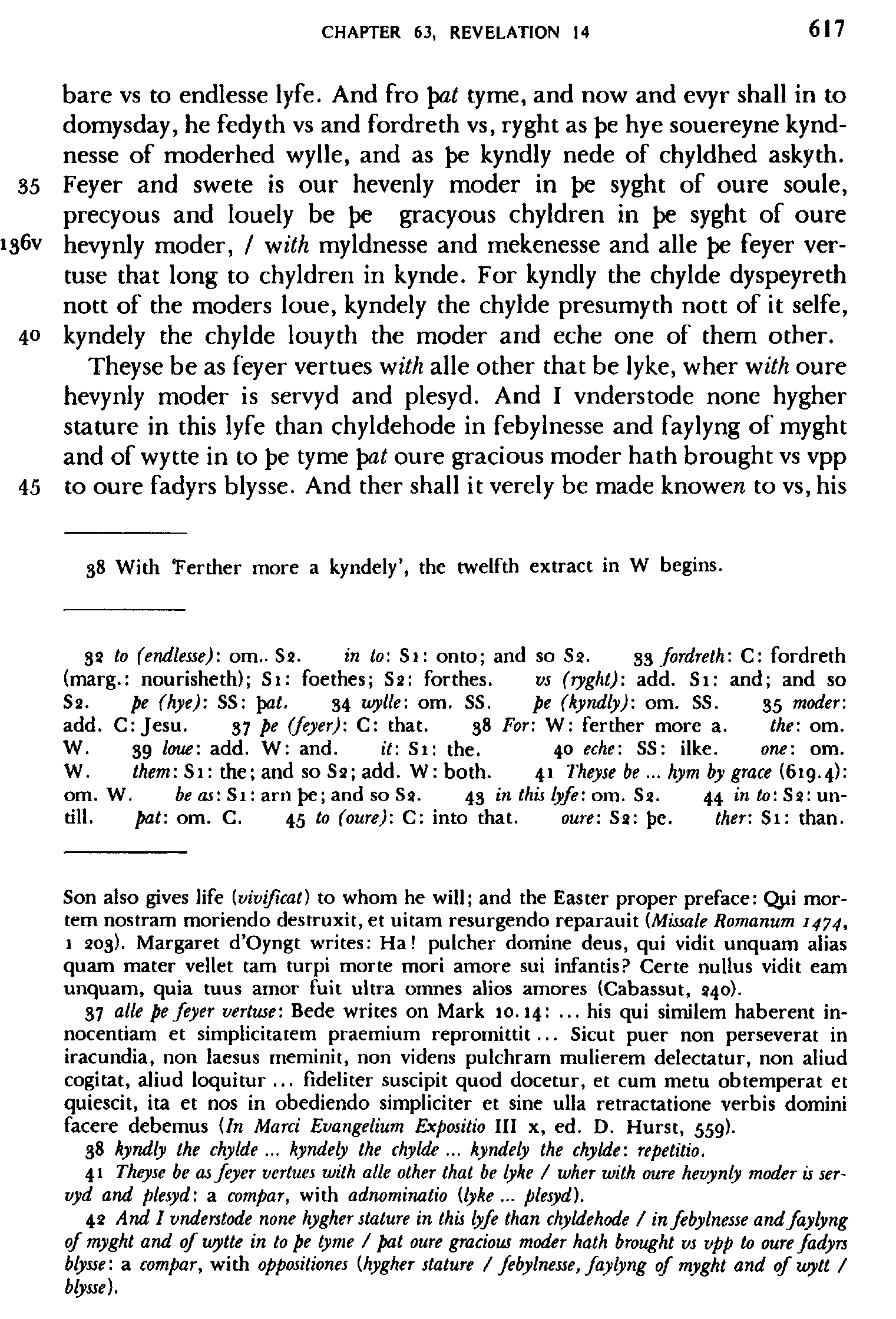
CHAPTER 63, REVELATION 14
bare vs to endlesse lyfe. And fro ^at tyme, and now and evyr shall in to domysday, he fedyth vs and fordreth vs, ryght as be hye souereyne kyndnesse of moderhed wylle, and as he kyndly nede of chyldhed askyth.
35 Feyer and swete is our hevenly moder in he syght of oure soule, precyous and louely be he gracyous chyldren in he syght of oure is6v hevynly moder, / with myldnesse and mekenesse and alle he feyer vertuse that long to chyldren in kynde. For kyndly the chylde dyspeyreth nott of the moders loue, kyndely the chylde presumyth nott of it selfe,
4° kyndely the chylde louyth the moder and eche one of them other.
Theyse be as feyer vertues "with alle other that be lyke, wher with oure hevynly moder is servyd and plesyd. And I vnderstode none hygher stature in this lyfe than chyldehode in febylnesse and faylyng of myght and of wytte in to be tyme \>at oure gracious moder hath brought vs vpp
45 to oure fadyrs blysse. And ther shall it verely be made knowerc to vs, his With 'Farther more a kyndely', the twelfth extract in W begins.
32 to (endlesse): om.. 82. in to: Si: onto; and so 82.
33 fordreth: C: fordreth (marg.: nourisheth); Si: foethes; 82: forthes. vs (ryght): add. Si: and; and so S2. pe (hye): SS: }Mt.
34 wylle: om. SS. pe (kyndly): om. SS.
35 moder: add. C: Jesu.
37 pe (feyer): C: that.
38 For: W: ferther more a. the: om.
39 loue: add. W: and. it: Si: the.
40 eche: SS: ilke. one: om.
W. them: Si: the; and so Sa; add. W: both.
41 Theyse be ... hym by grace (619.4): om. W. be as: Si: arn Jie; and so Sa.
43 in this lyfe: om. Sa.
44 in to: Sa: untill. pat: om. C.
45 to (oure): C: into that. oure: Sa: j)e. ther: Si: than.
Son also gives life (viviftcat) to whom he will; and the Easter proper preface: Qui mortem nostram moriendo destruxit, et uitam resurgendo reparauit (Missale Romanum 1474, i 203). Margaret d'Oyngt writes: Ha! pulcher domine deus, qui vidit unquam alias quam mater vellet tam turpi morte mori amore sui infantis? Certe nullus vidit earn unquam, quia tuus amor fuit ultra omnes alios amores (Cabassut, 340).
37 alle pe feyer vertuse: Bede writes on Mark 10.14: ... his qui similem haberent innocentiam et simplicitatem praemium repromittit... Sicut puer non perseverat in iracundia, non laesus meminit, non videns pulchram mulierem delectatur, non aliud cogitat, aliud loquitur ... fideliter suscipit quod docetur, et cum metu obtemperat et quiescit, ita et nos in obediendo simpliciter et sine ulla retractatione verbis domini facere debemus (In Marci Evangelium Expositio III x, ed. D. Hurst, 559).
38 kyndly the chylde ... kyndely the chylde ... kyndely the chylde: repetitio.
41 Theyse be as feyer vertues with alle other that be lyke / wher with oure hevynly moder is servyd and plesyd: a compar, with adnominatio (lyke ... plesyd).
42 And I vnderstode none hygher stature in this lyfe than chyldehode / in febylnesse and faylyng of myght and of wytte in to pe tyme / pat oure gracious moder hath brought vs vpp to oure fadyrs blysse: a compar, with oppositiones (hygher stature / febylnesse, faylyng of myght and of wytt / blysse).
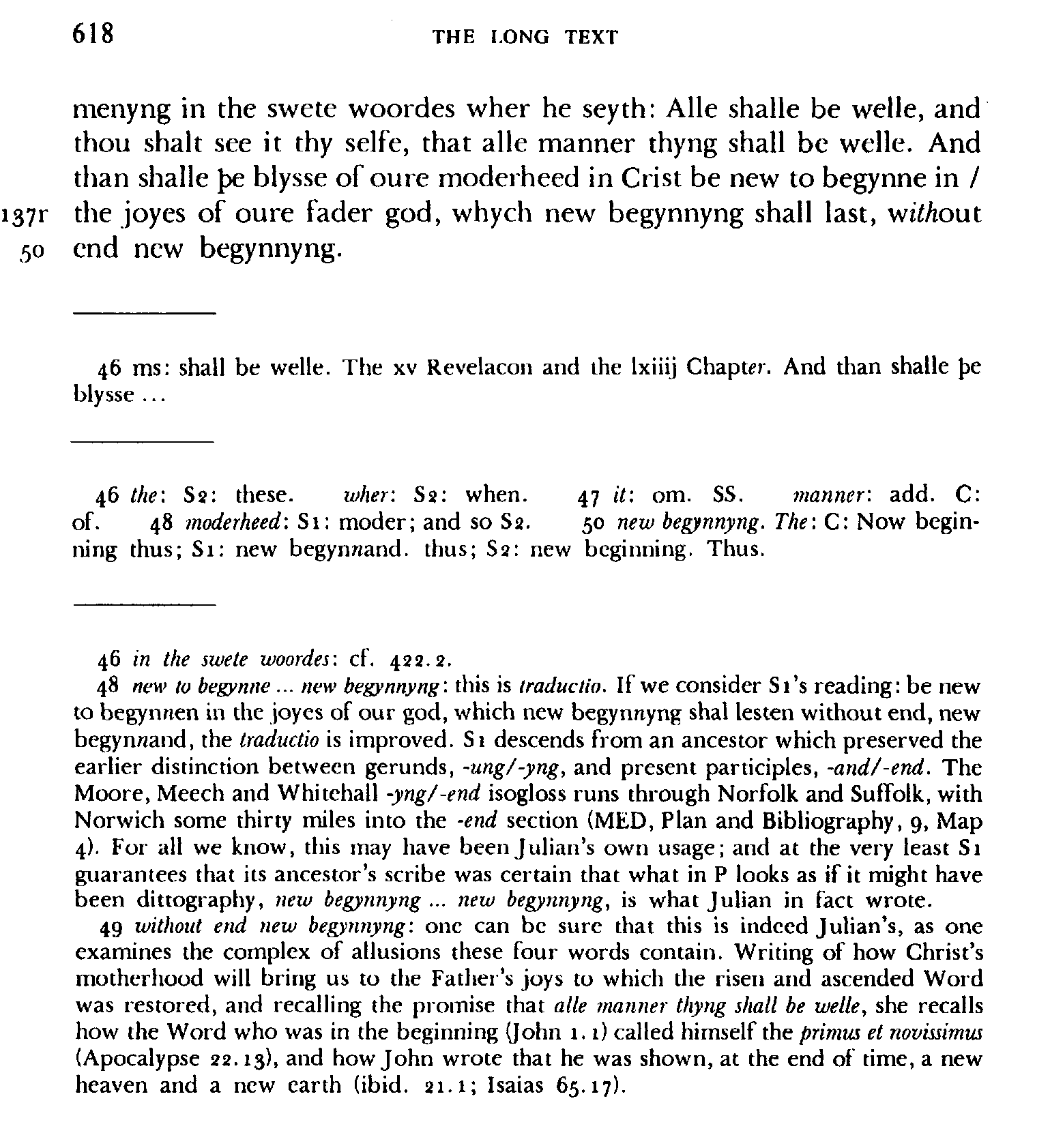
THE LONG TEXT
menyng in the swete woordes wher he seyth: Alle shalle be weile, and thou shalt see it thy selfe, that alle manner thyng shall be welle. And than shalle J>e blysse of oure moderheed in Crist be new to begynne in / i3?r the joyes of oure fader god, whych new begynnyng shall last, without 50 end new begynnyng.
46 ms: shall be welle. The xv Revelacon and the Ixiiij Chapter. And than shalle pe blysse ...
46 the: Sa : these. wher: 82: when.
47 it: om. SS. manner: add.
C: of.
48 moderheed: Si: moder; and so 82.
50 new begynnyng. The: C: Now beginning thus; Si: new begynrcand. thus; Ss: new beginning. Thus.
46 in the swete woordes: cf. 422.2.
48 new to begynne ... new begynnyng: this is traductio. If we consider Si's reading: be new to begyn»en in the joyes of our god, which new begynrayng shal lesten without end, new begyn«and, the traductio is improved. Si descends from an ancestor which preserved the earlier distinction between gerunds, -ung/-yng, and present participles, -and/-end. The Moore, Meech and Whitehall -yng/-end isogloss runs through Norfolk and Suffolk, with Norwich some thirty miles into the -end section (MED, Plan and Bibliography, 9, Map
4). For all we know, this may have been Julian's own usage; and at the very least Si guarantees that its ancestor's scribe was certain that what in P looks as if it might have been dittography, new begynnyng ... new begynnyng, is what Julian in fact wrote.
49 without end new begynnyng: one can be sure that this is indeed Julian's, as one examines the complex of allusions these four words contain. Writing of how Christ's motherhood will bring us to the Father's joys to which the risen and ascended Word was restored, and recalling the promise that alle manner thyng shall be welle, she recalls how the Word who was in the beginning (John 1.1) called himself the primus et novissimus
(Apocalypse 22.13), and how John wrote that he was shown, at the end of time, a new heaven and a new earth (ibid. 21.1; Isaias 65.17).
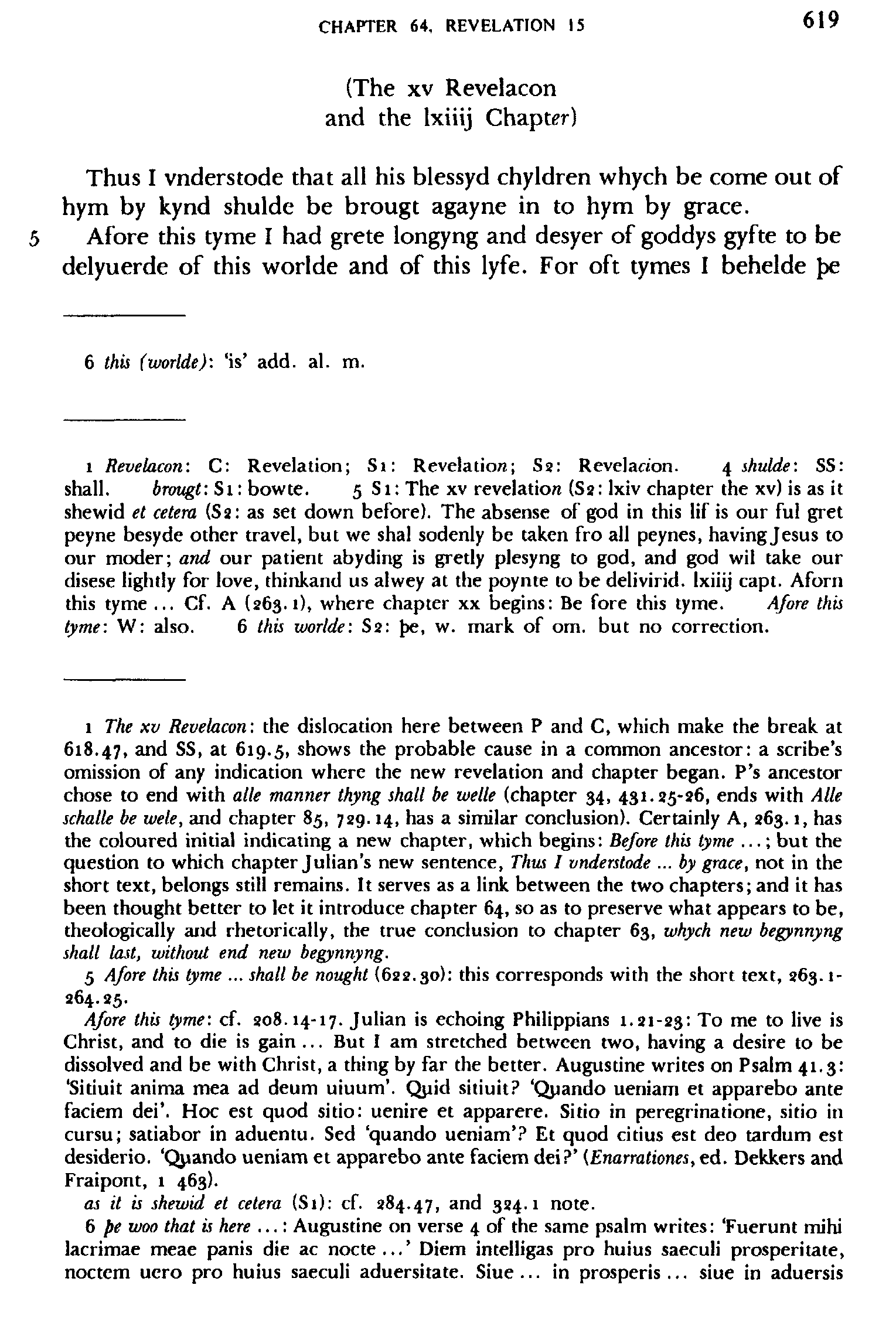
CHAPTER 64, REVELATION 15
(The xv Revelacon and the Ixiiij Chapter) Thus I vnderstode that all his blessyd chyldren whych be come out of hym by kynd shulde be brougt agayne in to hym by grace.
Afore this tyme I had grete longyng and desyer of goddys gyfte to be delyuerde of this worlde and of this lyfe. For oft tymes I behelde Jje
6 this (worlde): 'is' add. al. m. i Revelacon: C: Revelation; Si: Revelation; 82: Revelaaon.
4 shulde: SS: shall. brougt: Si: bowte.
581: The xv revelation (Sz: Ixiv chapter the xv) is as it shewid et cetera (Ss: as set down before). The absense of god in this lif is our ful gret peyne besyde other travel, but we shal sodenly be taken fro all peynes, havingjesus to our moder; and our patient abyding is gretly plesyng to god, and god wil take our disese lightly for love, thinkand us alwey at the poynte to be delivirid. Ixiiij capt. Aforn this tyme ... Cf. A (263.1), where chapter xx begins: Be fore this tyme.
Afore this tyme: W: also.
6 this worlde: Ss: })e, w. mark of om. but no correction. i The xv Revelacon: the dislocation here between P and C, which make the break at 618.47, and SS, at 619.5, shows the probable cause in a common ancestor: a scribe's omission of any indication where the new revelation and chapter began. P's ancestor chose to end with alle manner thyng shall be welle (chapter 34, 431.25-26, ends with Alle schalle be wele, and chapter 85, 729.14, has a similar conclusion). Certainly A, 263. i, has the coloured initial indicating a new chapter, which begins: Before this tyme ...; but the question to which chapter Julian's new sentence, Thus I vnderstode ... by grace, not in the short text, belongs still remains. It serves as a link between the two chapters; and it has been thought better to let it introduce chapter 64, so as to preserve what appears to be, theologically and rhetorically, the true conclusion to chapter 63, whych new begynnyng shall last, without end new begynnyng.
5 Afore this tyme ... shall be nought (622.30): this corresponds with the short text, 263. i264.25.
Afore this tyme: cf. 208.14-17. Julian is echoing Philippians 1.21-23: To me to live is
Christ, and to die is gain ... But I am stretched between two, having a desire to be dissolved and be with Christ, a thing by far the better. Augustine writes on Psalm 41.3:
'Sitiuit anima mea ad deum uiuum'. Quid sitiuit? 'Quando ueniam et apparebo ante faciem dei'. Hoc est quod sitio: uenire et apparere. Sitio in peregrinatione, sitio in cursu; satiabor in aduentu. Sed 'quando ueniam'? Et quod citius est deo tardum est desiderio. 'Quando ueniam et apparebo ante faciem dei?' (Enarrationes, ed. Dekkers and Fraipont, i 463). as it is shewid et cetera (Si): cf. 284.47, and 324.1 note.
6 pe woo that is here ...: Augustine on verse 4 of the same psalm writes: 'Fuerunt mihi lacrimae meae panis die ac nocte ..." Diem intelligas pro huius saeculi prosperitate, noctem uero pro huius saeculi aduersitate. Siue ... in prosperis ... siue in aduersis
THE LONG TEXT
woo that is here and J)e wele and the blessyd beyng that is there; and yf there had no payne ben in this lyfe but the absens of oure lorde, me thought some tyme pat it was more than I myght bere, and this made
10 me to morne and besely to longe, and also of my owne wretchydnesse, slowth and werynesse, \>at my lykyd not to lyue and to traveyle as me felle to do.
And to all this oure curteyse lorde answeryd for comfort and pacyens, and seyde these wordes: Sodeynly thou shake be taken from / isyv all thy payne, from alle thy sycknesse, from alle thy dyseses and fro alle
7 here: add. W: in pis lyfe. blessyd beyng: SS: bliss. is: add. Si: beyng; and so Sa; add W: in heuyn, and me thought sowme tymes. and yf: W; bough.
8 lorde: add.
W: god.
8 me thought some tyme pat: om.
10 of: om.
11 werynesse:
Si: wekehede; Sa: weakens; W: irkenesse halpe berto so.
13 this: om. W. lorde: add. W: god.
14 and seyde these wordes: om. 82. rebus saeculi, ego desiderii mei lacrimas fundo, ego desiderii mei auiditatem non desero; et cum in mundo bene est... huius saeculi prosperitas ... nonne deceptoria est? ... Quamdiu sumus in corpore, peregrinamur a domino (id. i 463). Cf. also an English version of Aelred of Rievaulx's De institutione indusarum: ... and bu be saad and haue despyt of the wordle and byn owne flehs be to be sorwe, certes than coueytest bu deeb wit gret desyr. (f. hd). For deeb put awey heuynesse of l>ys lyf and makeb an ende of saadnesse of bis wordle and deliuereb be body out of much sorwe (Vernon MS; cf.
A. Hoste and Ch. Talbot, i 677).
8 the absens of oure lorde: the Chastising calls this 'the play of love', which is a commonplace in late mediaeval spiritual literature: t>is is a queynt pleie — what is bis pley, bat bus heuy we bien in be absence of oure loue ? t>e pley of loue is ioye and sorwe ... bi be presence and absence of him bat is oure loue (Bazire and Colledge, 99, borrowing from the Horologium sapientiae; ibid., 264).
9 and this made me to morne and besely to longe / and also of my owne wretchydnesse slowth and werynesse / pat my lykyd not to lyue and traveyle as me felle to do: at the end of a whole passage composed in compares come these three, composed like the exornatio and complexio of the argumentatio perfectissima, with conduplicatio (to morne ... to longe; wretchydnesse slowth and werynesse}.
10 to morne and besely to longe: cf. Matthew 5.5: Happy are they who mourn, for they will be comforted. Bede glosses this: ...amore coelestium desideriorum... quia aeterna laetitia consolabuntur (In Matthaei Evangelium Expositio I, PL 92 24). and also ...felle to do: with this passage (which is not in the short text — cf. 263.8), compare the Chastising, writing of this desolation: Sume bi sloub and folie wilfulli leuen her trauaile... (Bazire and Colledge, no).
13 And to all this oure curteyse lorde answeryd /for comfort and pacyens and seyde these wordes: a compar, with conduplicatio (curteyse ... comfort... pacyens) mitigating the austerity of the short text's Than god sayde to me, for patience and for sufferannce, thus (263.9).
CHAPTER 64, REVELATION 15
16 thy woo. And thou shake come vp abone, and thou schalt haue me to thy mede, and thou shake be fulfyllyd of joye and blysse, and thou shake nevyr more haue no manner of paynne, no manner of sycknes, no manner mysselykyng, no wantyng of wylle, but evyr joy and blysse
20 wilhoute end. What shulde it than agrevyn thee to suffer a whyle, sythen it is my wylle and my wurschyppe?
And in thys worde: Sodeynly thou shake be taken, I saw that god rewardyd man of the pacience that he hath in abydyng goddys wylle and of hys tyme, and that man lengyth his pacyence ovyr be tyme of his
21 and my wunchyppef: here the twelfth extract in W ends.
16 abone: C: above; Si: aboven; 82: above; W: a boue.
17 more: om.
SS. paynne: add.
W: nejjer. sycknes, no manner: om.
SS.
19 manner (mysselykyng): add.
W: of. no (wantyng):
W: ne no. evyr: add.
W: in.
20 What: 82: why. agrevyn: C: grieve; and so 82, W.
21 sythen: Si: sen that; 82: seeing.
22 thys: 82: J>e.
23 rewardyd: C: rewarded; Si: rewardith; 82: rewardeth; and cf. A (263.18): rewardys. goddys: C: of Gods.
24 of (hys): om.
82. lengyth: so C, SS; C, marg.: lengthneth. ovyr: C, marg.: far above.
16 abone: the files of NED and MED contain examples of 'a bone', 'aboune', 'abown',
'abowne', 'o bown', from texts which all have Northern or Northeastern characteristics. thou schalt haue me ... but evyr joy and blvsse withoute end: in Eight Chapters (cf. 261.53 note) we read: Najielees yt schalt J>ou triste and hope Jxi< as J>ou ert felawe with him in peyne and in dissese, litil if it be, so schalt paw be felawe with him in his ioie and in his blis, for as \>e apostil seij>, if we ben felawes of Cristis passions, we schu-(f. I45r)-len be felawes of his blessid consolaciouns (II Corinthians 1.7; MS BN Fonds anglais 41;Jones,
89-90).
20 What shulde it than agrevyn thee ...: this interrogatio is also found in the short text,
263.15.
22 And in thys worde: cf. 263.17: Also in this resonn, and note. Julian may have replaced the rhetoricians' resonn with worde in case it were thought that Sodeynly ... is not a locution.
23 rewardyd: the SS readings and A shows that this is a P 'd' for 'th' spelling which C failed to interpret. pacience: cf. Luke 21.19: In your patience you shall possess your souls. Bede glosses this: Possessio animae in virtute patientiae ponitur, quia radix omnium custosque virtutum patientia est (In Lucae Evangelium Expositio VI, ed. D. Hurst, 367).
24 that man lengyth his pacyence: in a prayer to God the Son for a good death we read:
Concede michi domine spacium vite et graciam bene viuendi. Ante diem exitus mei veram cordis contricionem, puram confessionem et veram penitenciam h(a)bere merear... (MS Cambridge Fitzwilliam Museum 55, f. 139'). ovyrpe tyme ... ovyr that tyme: cf. NED, Over, adv., IV. 12., Through its whole extent, to the end ...', where the first example is 1399, Richard Redeles: ... And if 36 sauere sum dell, se it forth ouere.
THE LONG TEXT
lyvyng for vnknowyng of hys tyme of passyng. This is a greate profyte, for yf man knew hys tyme, he shulde nott haue pacience ovyr that tyme. iS^r And also god wylle that whyle the / soule is in the body, it seeme to it selfe ]pat it is evyr at JDC poynte to be takyn. For alle this lyfe and thys longyng that we haue here is but a poynt, and when we be takyn
30 sodeynly out of payne in to blesse, than payn shall be nought.
And in thys tyme I sawe a body lyeng on £>e erth, whych body shewde heuy and feerfulle and -with oute shape and forme, as it were a swylge
25 of hys tyme of: C: the time of his.
This: Si: \>at\ and so 82.
26 yf: add. C, SS: a.
27 also: SS: as. that: orn. SS. seeme: Si: semyt; 82: scemeth. it (selfe):
Si: f>e; and so 82.
28 takyn: add.
(out thereof).
29 longyng:
SS: langor.
32 feerfulle: Si: vgglcy; and so 82. and (with oute): om. SS. swylge: C, marg.: foul: Si: bolned quave of; al.m. (corner of leaf torn): (bol)ned (qua)ue: puffed up, a quaggmire; 82: bolned quave of.
25 for vnknowyng of hys tyme of passyng: cf. Mark 13.32: (see 537.257 note).
2 7 that whyle the soule is in the body / it seeme to it selfe pat it is / evyr at pe poynte to be takyn: ' a compar of three cola, also found in the short text, 264.22.
28 poynte: 'Instant, moment'. Cf. 226.1 note, 264.23 note.
For alle this lyfe and thys longyng / that we haue here is but a poynt / and when we be takyn sodeynly out of payne / in to blesse than payn shall be nought: a further compar, with transitio from the previous figure, with oppositio (payne ... blesse; alle this lyfe ... but a poynt).
29 longyng: cf. 264.24: langoure, and SS: langor, which is probably the better reading.
It is not in Julian's mind to refer here to desire; that is for her a source of consolation, and now she is writing merely of woo.
30 than payn shall be nought: cf. 264.25 note.
31 And in thys tyme ... blysse without ende (625.59): not in the short text; cf. 264.25.
And in thys tyme I sawe a body lyeng on pe erth / whych body shewde heuy and feerfulle and with oute shape and forme / as it were a swylge stynkyng myne / and sodeynly oute of this body / sprang afullefeyer creature / a lyttylle chylldfull shapyn andformyd / swyft and lyfly and whytter then the lylye / whych sharpely glydyd vppe in to hevyn: a compar, the whole of which is an extended imago, which is also a parable, details of which are to be explained. In body ... erth / body ... heuy there is chiasmus; there is also oppositio: heuy and feerfulle and with oute shape and forme / swyft and lyfly and whytter then the lylye.
I sawe a body: apart from the long chapter 51, this is the only occasion when a'bodily sight' is described which is not already reported in the short text. erth ... with oute shape and forme: Julian seems to be echoing Genesis 1.2: Terra erat inanis et vacua, et tenebrae erant super faciem abyssi. Guigues II, reflecting on this text, notes that an alternative translation for vacua is incomposita, which precisely renders with oute shape and forme. He adds: Peccator abyssus est ... Terra mentis meae adhuc inanis et vacua... velut quoddam chaos confusione sua teterrimum et involutum
(Colledge and Walsh, 148-150).
32 a swylge stynkyng myrre: 'a pit stinking of mud'. It is hard to know what to make of the SS variants, apart from the Si commentator's quaggmire. Cf. NED, Swallow, n.1, and MED swelgh. A. H. Smith, English Place-Name Elements, 2 171-172, cites the recorded
OE (ge)swelg, swelh, and postulates OE "swylg as the root in Swillaton, Swilly; and
CHAPTER 64, REVELATION 15
stynkyng myrre; and sodeynly oute of this body sprong a tulle feyer creature, a lyttylle chylld, full shapyn and formyd, swyft and lyfly and 35 whytter then the lylye, whych sharpely glydyd vppe in to hevyn.
The swylge of the body betokenyth grette wretchydnesse of oure dedely flessch; and the lyttylnes of the chylde betokenyth the clennes and the puernesse of oure soule. And I thought: with thys body blyueth
34 and (whytter): om. SS.
35 the (lylye): om. SS. in to: SS: on to.
36 The:
Si: and the; and so 82. swylge: C: swilge; C, marg.: foul; SS: bolnehede.
37 and the:SS:of.
38 puernesse: SS: purity. of oure: SS: in }>e.
/: om. SS. blyueth:
C, marg.: abideth; Si: belevith; and so Sa.
MED mir n. records the spelling 'myrre', a 1500 Henley's Husbandry; but 'swylge' and 'myrre' may be no more than P's scribal vagaries.
This is the closest that Julian comes to the language of her times in describing the miseries of the flesh. Cf. e.g. the English Stimulus, chapter 37:1 stynke foule in J>y nose grilles, 3e so foule J>at ne were £>at J)i loue helde tpe, Jjou woldest fleen Jie filpe of me as I wolde don pe stynke of a caryoun (H. J. Kane, 190-191; Kirchberger, 198). Generally, she shows the same restraint as does Augustine, when he writes of the raising of Lazarus: ... incipit enim habere pessimam famam, tamquam odorem teterrimum ...
Quando te audit quern terra sic premit, et tabe corrumpitur, et mole consuetudinis praegrauatur? Nee ad ipsum tamen resuscitandum minor fuit uirtus Christi (Willems,
421).
33 and sodeynly ...: this account closely resembles mediaeval representations of death and the soul's departure. Charles Singer, fig. 107, reproduces an illustration from a manuscript of Hildegard of Bingen's Scivias, 'written at Bingen about 1180', showing a young woman from whose mouth a naked child emerges to fly up to welcoming angels, escaping the devils who lurk in wait for it (From Magic to Science).
36 The swylge of the body betokenyth grette wretchydnesse of oure dedely flessch / and the lyttylnes of the chylde betokenyth the clennes and the puernesse of oure soule: a compar of two long cola, improved if we were to adopt the SS readings (i) and the, (2) the. The figure insists on the oppositiones: swylge / the clennes and the puernesse; grette wretchydnesse / the lyttylnes of the chylde. bolnehede (SS): 'swelling, swollenness'. Cf. NED, Bell, v.1, Bollen, ppl. a. Obs., MED bellen v. (i), bolnen v. Neither NED nor MED records this compound. grette wretchydnesse of oure dedely flessch: Ludolph of Saxony ends his Vita, II xvii, with a prayer comparing his sinful soul with Lazarus's buried and corrupting body: mole malae consuetudinis oppressum et sepultum, jamque quatriduanum et foetidum, et me a sepulchre vitiorum resuscita (Rigollot, 3 123).
38 with thys body blyueth / nofeyernesse of thys chylde / ne of this chylde dwellyth / nofoulnes of the body: a compar, with commutatio (thys body ... thys chylde ... this chylde ... the body), conduplicatio (blyueth ... dwellyth), repetitio (thys ... thys ... this ...), and oppositio (nofeyernesse / no foulnes). blyueth: 'remains'. Cf. NED, Beleave, v., and MED bileven v. (i) 3 (a).
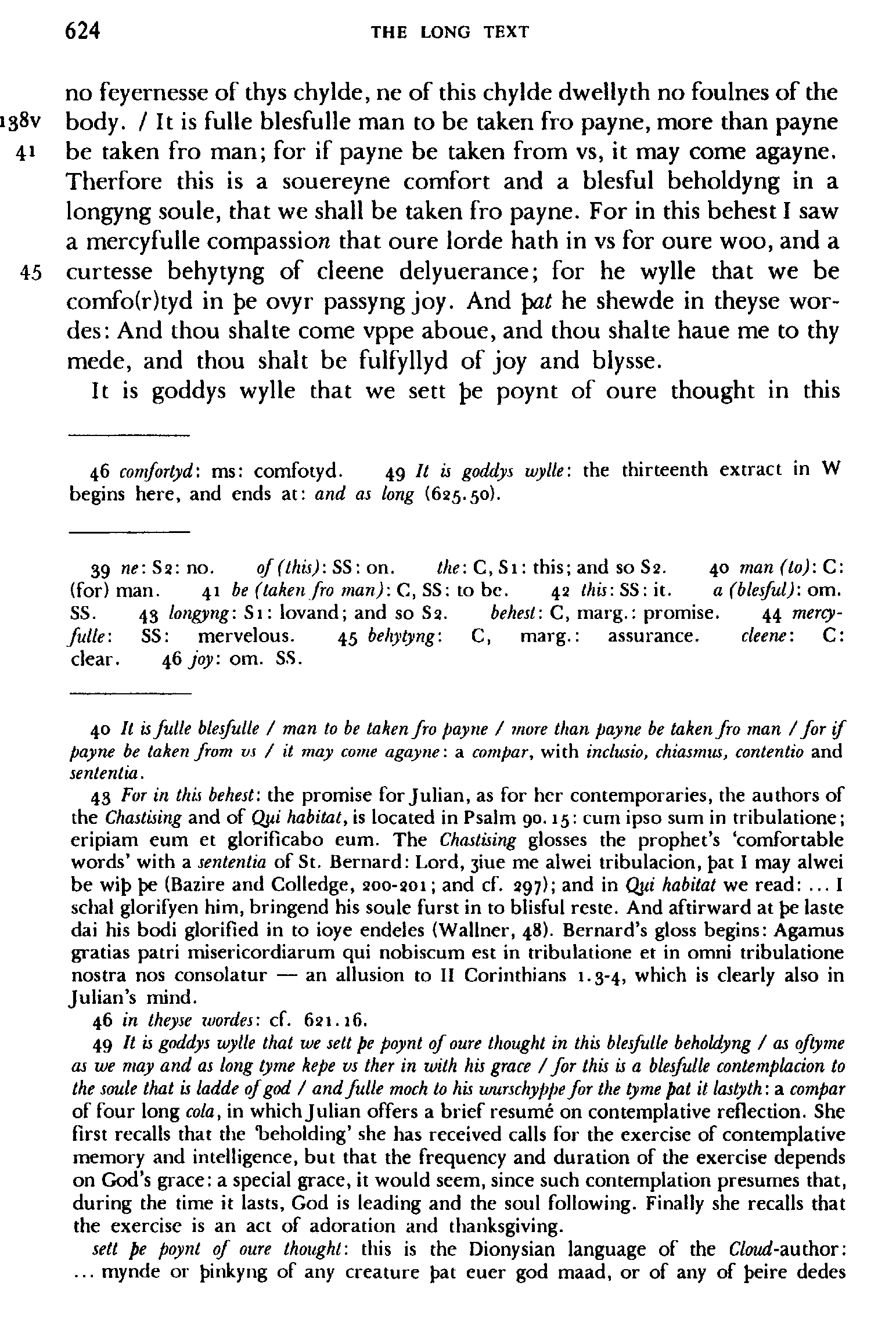
THE LONG TEXT
no feyernesse of thys chylde, ne of this chylde dwellyth no foulnes of the is8v body. / It is fulle blesfulle man to be taken fro payne, more than payne
be taken fro man; for if payne be taken from vs, it may come agayne.
Therfore this is a souereyne comfort and a blesful beholdyng in a longyng soule, that we shall be taken fro payne. For in this behest I saw a mercyfulle compassion that oure lorde hath in vs for oure woo, and a 45 curtesse behytyng of cleene delyuerance; for he wylle that we be comfo(r)tyd in J>e ovyr passyng joy. And \>at he shewde in theyse wordes: And thou shake come vppe aboue, and thou shake haue me to thy mede, and thou shalt be fulfyllyd of joy and blysse.
It is goddys wylle that we sett J>e poynt of oure thought in this 46 comfortyd: ms: comfotyd.
49 It is goddys wylle: the thirteenth extract in W begins here, and ends at: and as long (625.50).
39 ne: 82: no. of (this): SS: on. the: C, Si: this; and so 82.
40 man (to): C:
(for) man.
41 be (taken fro man): C, SS: to be.
42 this: SS: it. a (blesful): om.
SS.
43 longyng: Si: lovand; and so 82. behest: C, marg.: promise.
44 mercyfulle:
SS: mervelous.
45 behytyng:
C, marg.: assurance. cleene:
C: clear.
^6 joy: om. SS.
40 It is fulle blesfulle / man to be taken fro payne / more than payne be taken fro man /for if payne be taken from vs / it may come agayne: a compar, with inclusio, chiasmus, contentio and sententia.
43 For in this behest: the promise for Julian, as for her contemporaries, the authors of the Chastising and of Qui habitat, is located in Psalm 90.15: cum ipso sum in tribulatione; eripiam eum et glorificabo eum. The Chastising glosses the prophet's 'comfortable words' with a sententia of St. Bernard: Lord, 3iue me alwei tribulacion, pat I may alwei be wij> pe (Bazire and Colledge, 200-201; and cf. 297); and in Qui habitat we read: ... I schal glorifyen him, bringend his soule furst in to blisful reste. And aftirward at pe laste dai his bodi glorified in to ioye endeles (Wallner, 48). Bernard's gloss begins: Agamus gi alias patri misericordiarum qui nobiscum est in tribulatione et in omni tribulatione nostra nos consolatur — an allusion to II Corinthians 1.3-4, which is clearly also in Julian's mind.
46 in theyse wordes: cf. 621.16.
49 // is goddys wylle that we sett pe poynt of oure thought in this blesfulle beholdyng / as oftyme as we may and as long tyrne kepe vs ther in with his grace / f o r this is a blesfulle contempladon to the soule that is ladde of god / and fulle moch to his wurschyppe for the tyme pat it lastyth: a compar of four long cola, in which Julian offers a brief resume on contemplative reflection. She first recalls that the 'beholding' she has received calls for the exercise of contemplative memory and intelligence, but that the frequency and duration of the exercise depends on God's grace: a special grace, it would seem, since such contemplation presumes that, during the time it lasts, God is leading and the soul following. Finally she recalls that the exercise is an act of adoration and thanksgiving. sett pe poynt of oure thought: this is the Dionysian language of the C/0t#/-author:
... mynde or pinkyng of any creature pat euer god maad, or of any of peire dedes
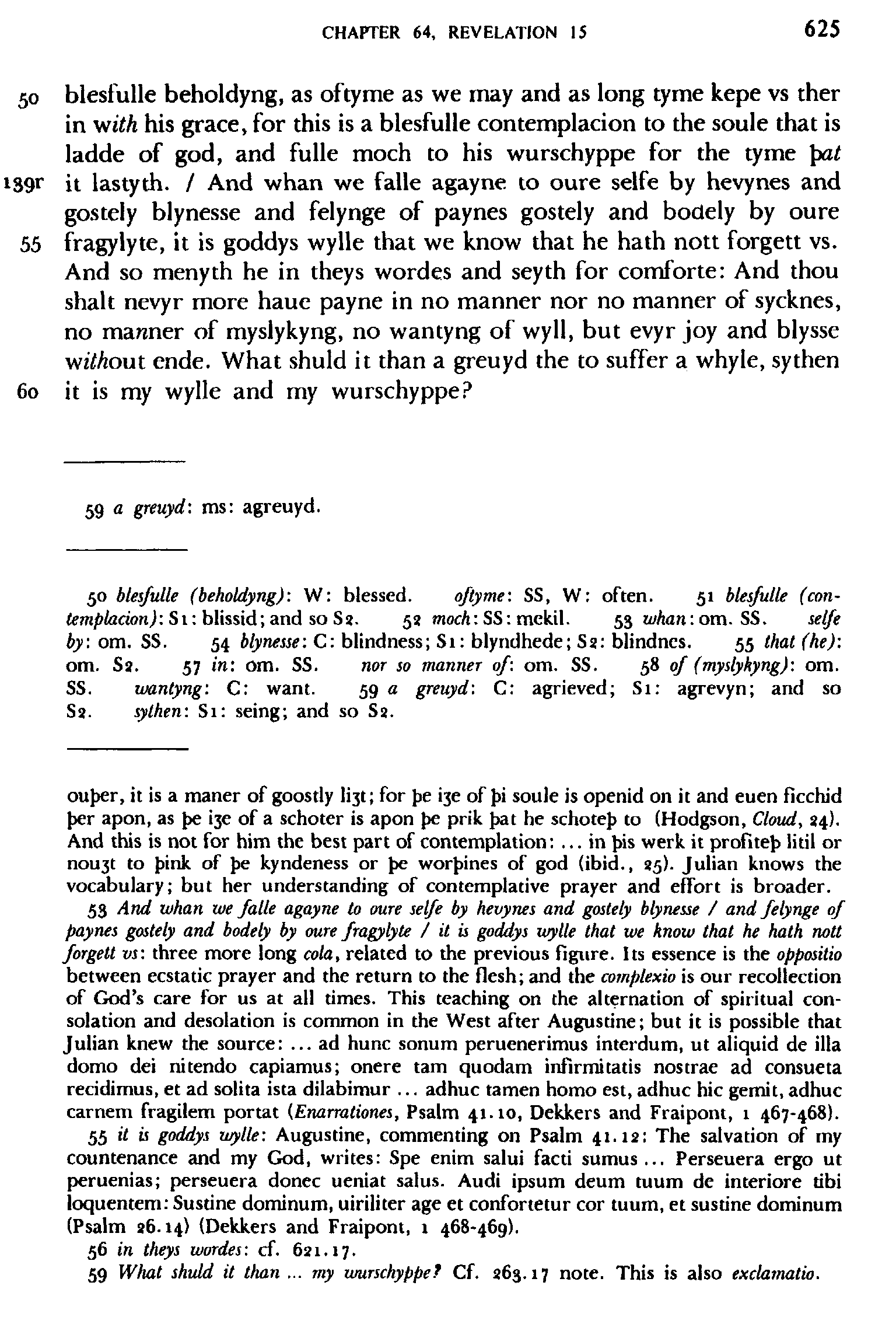
CHAPTER 64, REVELATION 15
50 blesfulle beholdyng, as oftyme as we may and as long tyme kepe vs ther in with his grace, for this is a blesfulle contemplacion to the soule that is ladde of god, and fulle moch to his wurschyppe for the tyme \>at i39r it lastyth. / And whan we falle agayne to oure selfe by hevynes and gostely blynesse and felynge of paynes gostely and bodely by oure
55 fragylyte, it is goddys wylle that we know that he hath nott forgett vs.
And so menyth he in theys wordes and seyth for comforte: And thou shalt nevyr more haue payne in no manner nor no manner of sycknes, no manner of myslykyng, no wantyng of wyll, but evyr joy and blysse
-without ende. What shuld it than a greuyd the to suffer a whyle, sythen 60 it is my wylle and my wurschyppe?
59 a greuyd: ms: agreuyd.
50 blesfulle (beholdyng): W: blessed. oftyme: SS, W: often.
51 blesfulle (contemplation): Si: blissid; and so 82.
52 moch: SS: mckil.
53 whan:om. SS. selfe by: om. SS.
54 blynesse: C: blindness; Si: blyndhede; 82: blindnes.
55 that (he): om. 82.
57 in: om. SS. nor so manner of: om. SS.
58 of (myslykyng): om.
SS. wantyng: C: want.
59 a greuyd: C: agrieved; Si: agrevyn; and so 82. sythen: Si: seing; and so 82. ouper, it is a maner of goostly lijt; for pe ije of pi soule is openid on it and euen ficchid per apon, as pe {36 of a schoter is apon pe prik pat he schotej) to (Hodgson, Cloud, 24).
And this is not for him the best part of contemplation: ... in pis werk it profile^ litil or noi>3t to pink of pe kyndeness or pe worpines of god (ibid., 25). Julian knows the vocabulary; but her understanding of contemplative prayer and effort is broader.
53 And whan we falle agayne to oure selfe by hevynes and gostely blynesse / and felynge of paynes gostely and bodely by oure fragylyte I it is goddys wylle that we know that he hath nott forgett vs: three more long cola, related to the previous figure. Its essence is the oppositio between ecstatic prayer and the return to the flesh; and the complexio is our recollection of God's care for us at all times. This teaching on the alternation of spiritual consolation and desolation is common in the West after Augustine; but it is possible that Julian knew the source: ... ad hunc sonum peruenerimus interdum, ut aliquid de ilia domo dei nitendo capiamus; onere tam quodam infirmitatis nostrae ad consueta recidimus, et ad solita ista dilabimur ... adhuc tamen homo est, adhuc hie gemit, adhuc carnem fragilem portat (Enarrationes, Psalm 41.10, Dekkers and Fraipont, i 467-468).
55 it is goddys wylle: Augustine, commenting on Psalm 41.12: The salvation of my countenance and my God, writes: Spe enim salui facti sumus ... Perseuera ergo ut peruenias; perseuera donee ueniat salus. Audi ipsum deum tuum de interiore tibi loquentem: Sustine dominum, uiriliter age et confortetur cor tuum, et sustine dominum
(Psalm 26.14) (Dekkers and Fraipont, i 468-469).
56 in theys wordes: cf. 621.17.
59 What shuld it than ... my wurschyppe f Cf. 263.17 note. This is also exclamatio.
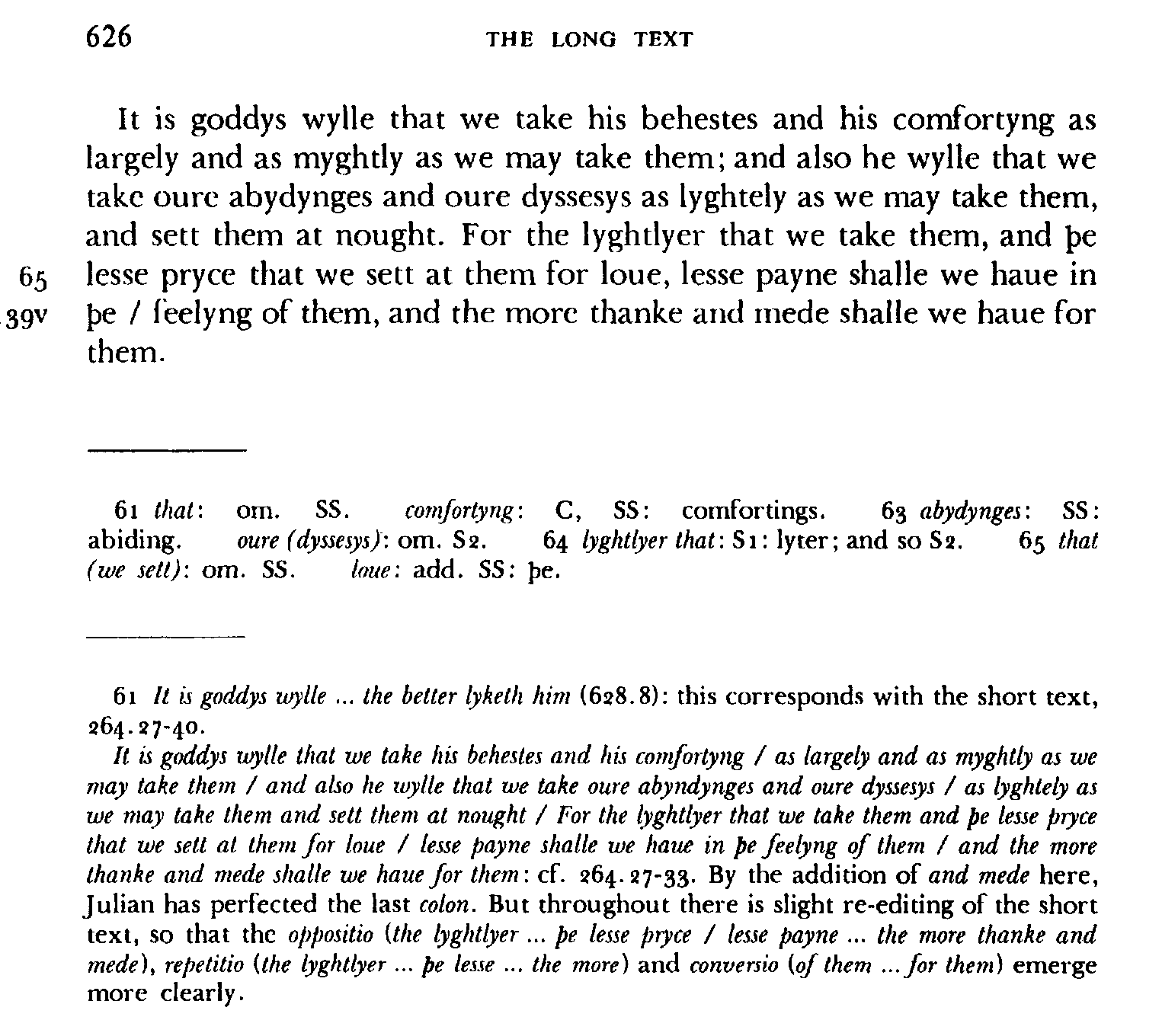
THE LONG TEXT
It is goddys wylle that we take his behestes and his comfortyng as largely and as myghtly as we may take them; and also he wylle that we take oure abydynges and oure dyssesys as lyghtely as we may take them, and sett them at nought. For the lyghtlyer that we take them, and ]3e
lesse pryce that we sett at them for loue, lesse payne shalle we haue in *39V t>e / feelyng of them, and the more thanke and mede shalle we haue for them.
61 that: om.
SS. comfortyng:
C, SS: comfortings.
63 abydynges:
SS: abiding. oure (dyssesys): om. Sa.
64 lyghtlyer that: Si: lyter; and so 82.
65 that (we sett): om. SS. loue: add. SS: £e.
61 It is goddys wylle ... the better lyketh him (628.8): this corresponds with the short text,
264.27-40.
It is goddys wylle that we take his behestes and his comfortyng / as largely and as myghtly as we may take them / and also he wylle that we take oure abyndynges and oure dyssesys / as lyghtely as we may take them and sett them at nought / For the lyghtlyer that we take them and pe lesse pryce that we sett at them for loue / lesse payne shalle we haue in pe feelyng of them / and the more lhanke and mede shalle we haue for them: cf. 264.27-33. By me addition of and mede here,
Julian has perfected the last colon. But throughout there is slight re-editing of the short text, so that the of>f)ositio (the lyghtlyer ... pe lesse pryce / lesse payne ... the more thanke and mede), repetitio (the lyghtlyer ... pe lesse ... the more) and conversio (of them ...for them) emerge more clearly.
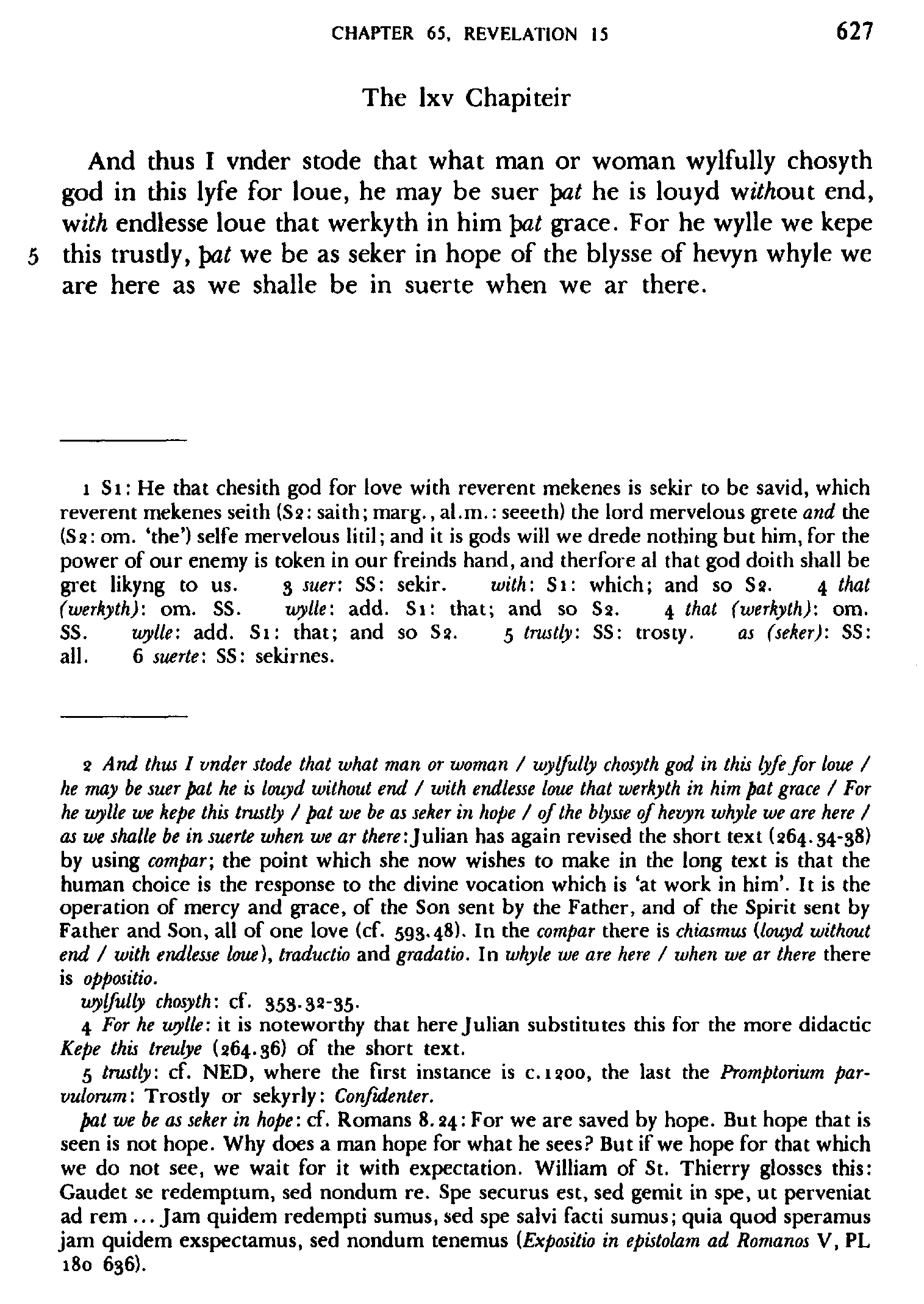
CHAPTER 65, REVELATION 15
The Ixv Chapiteir And thus I vnder stode that what man or woman wylfully chosyth god in this lyfe for loue, he may be suer Jxz£ he is louyd without end, with endlesse loue that werkyth in him \xit grace. For he wylle we kepe
5 this trusdy, Jxz£ we be as seker in hope of the blysse of hevyn whyle we are here as we shalle be in suerte when we ar there. i Si: He that chesith god for love with reverent mekenes is sekir to be savid, which reverent mekenes seith (82: saith; marg., al.m.: seeeth) the lord mervelous grete and the (82: om. 'the') selfe mervelous litil; and it is gods will we drede nothing but him, for the power of our enemy is token in our freinds hand, and therfore al that god doith shall be gret likyng to us.
3 suer: SS: sekir. with: Si: which; and so 82.
4 that (werkyth): om. SS. wylle: add. Si: that; and so S2.
4 that (werkyth): om.
SS. wylle: add. Si: that; and so 82.
5 trustly: SS: trosty. as (seker): SS: all.
6 suerte: SS: sekirnes.
2 And thus I vnder stode that what man or woman / wylfully chosyth god in this lyfe for loue / he may be suer pat he is louyd without end / with endlesse loue that werkyth in him pat grace / For he wylle we kepe this trustly / pat we be as seker in hope / of the blysse of hevyn whyle we are here / as we shalle be in suerte when we ar there:]u\ian has again revised the short text (264.34-38) by using compar; the point which she now wishes to make in the long text is that the human choice is the response to the divine vocation which is 'at work in him*. It is the operation of mercy and grace, of the Son sent by the Father, and of the Spirit sent by Father and Son, all of one love (cf. 593.48). In the compar there is chiasmus (louyd without end / with endlesse loue), traductio and gradatio. In whyle we are here / when we ar there there is oppositio. wylfully chosyth: cf. 353-32-354 For he wylle: it is noteworthy that here Julian substitutes this for the more didactic
Kepe this treulye (264.36) of the short text.
5 trustly: cf. NED, where the first instance is c. 1200, the last the Promptorium parvulorum: Trosdy or sekyrly: Conftdenter. pat we be as seker in hope: cf. Romans 8.24: For we are saved by hope. But hope that is seen is not hope. Why does a man hope for what he sees? But if we hope for that which we do not see, we wait for it with expectation. William of St. Thierry glosses this:
Gaudet se redemptum, sed nondum re. Spe securus est, sed gemit in spe, ut perveniat ad rem ... Jam quidem redempti sumus, sed spe salvi facti sumus; quia quod speramus jam quidem exspectamus, sed nondum tenemus (Expositio in epistolam ad Romanos V, PL
180 636).
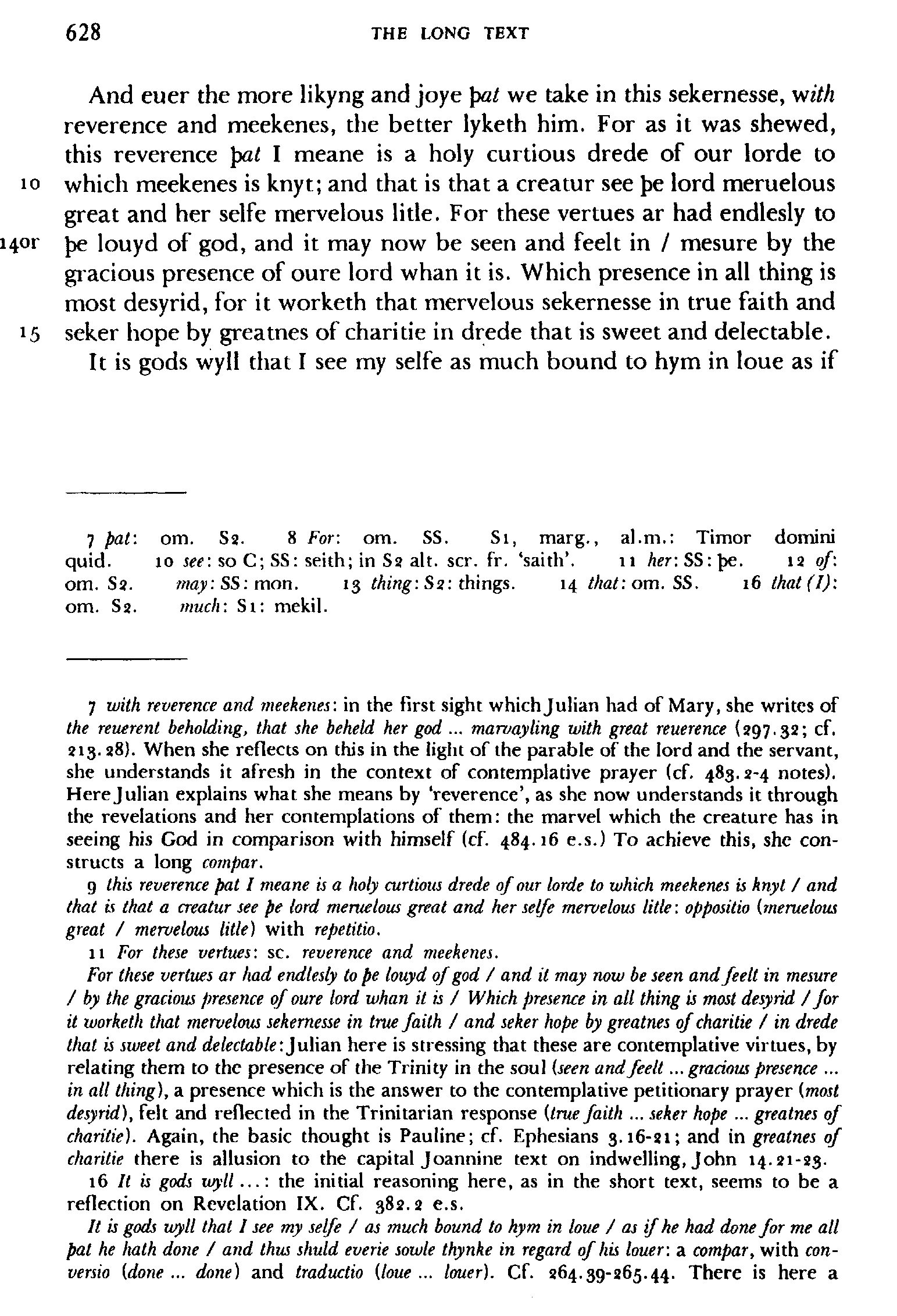
THE LONG TEXT
And euer the more likyng and joye \xit we take in this sekernesse, with reverence and meekenes, the better lyketh him. For as it was shewed, this reverence \Mt I meane is a holy curtious drede of our lorde to 10 which meekenes is knyt; and that is that a creatur see l>e lord meruelous great and her selfe mervelous litle. For these vertues ar had endlesly to 1401j)e louyd of god, and it may now be seen and feelt in / mesure by the gracious presence of oure lord whan it is. Which presence in all thing is most desyrid, for it worketh that mervelous sekernesse in true faith and 15 seker hope by greatnes of charitie in drede that is sweet and delectable.
It is gods wyll that I see my selfe as much bound to hym in loue as if 7 pat: om.
82.
8 For: om.
SS.
Si, marg., al.m.: Timor domini quid.
10 see: so C; SS: seith; in Sa alt. scr. fr. 'saith'.
11 her: SS: £e.
12 of: om. 82. wfO}>: SS: mon.
13 thing: 82: things.
14 thaf.om. SS.
16 that (I): om. 82. much: Si: mekil.
7 with reverence and meekenes: in the first sight which Julian had of Mary, she writes of the renerent beholding, that she beheld her god ... marvayling with great reuerence (297.32; cf.
213.28). When she reflects on this in the light of the parable of the lord and the servant, she understands it afresh in the context of contemplative prayer (cf. 483.2-4 notes).
Herejulian explains what she means by 'reverence', as she now understands it through the revelations and her contemplations of them: the marvel which the creature has in seeing his God in comparison with himself (cf. 484.16 e.s.) To achieve this, she constructs a long compar.
9 this reverence pat I meane is a holy curtious drede of our lorde to which meekenes is knyt / and that is that a creatur see fie lord meruelous great and her selfe mervelous litle: oppositio (meruelous great / mervelous litle) with repetitio.
11 For these vertues: sc. reverence and meekenes.
For these vertues ar had endlesly to pe louyd of god / and it may now be seen and feelt in mesure
/ by the gracious presence of oure lord whan it is / Which presence in all thing is most desyrid /for it worketh that meruelous sekernesse in true faith / and seker hope by greatnes of charitie / in drede that is sweet and delectable:]\\\\s.n here is stressing that these are contemplative virtues, by relating them to the presence of the Trinity in the soul (seen and feelt... gracious presence ... in all thing), a presence which is the answer to the contemplative petitionary prayer (most desyrid), felt and reflected in the Trinitarian response (true faith ... seker hope ... greatnes of charitie). Again, the basic thought is Pauline; cf. Ephesians 3.16-21; and in greatnes of charitie there is allusion to the capital Joannine text on indwelling, John 14.21-23.
16 It is gods wyll...: the initial reasoning here, as in the short text, seems to be a reflection on Revelation IX. Cf. 382.2 e.s.
It is gods wyll that I see my selfe / as much bound to hym in loue / as if he had done for me all pat he hath done / and thus shuld everie sowle thynhe in regard of his louer: a compar, with conversio (done ... done) and traductio (loue ... louer). Cf. 264.39-265.44. There is here a
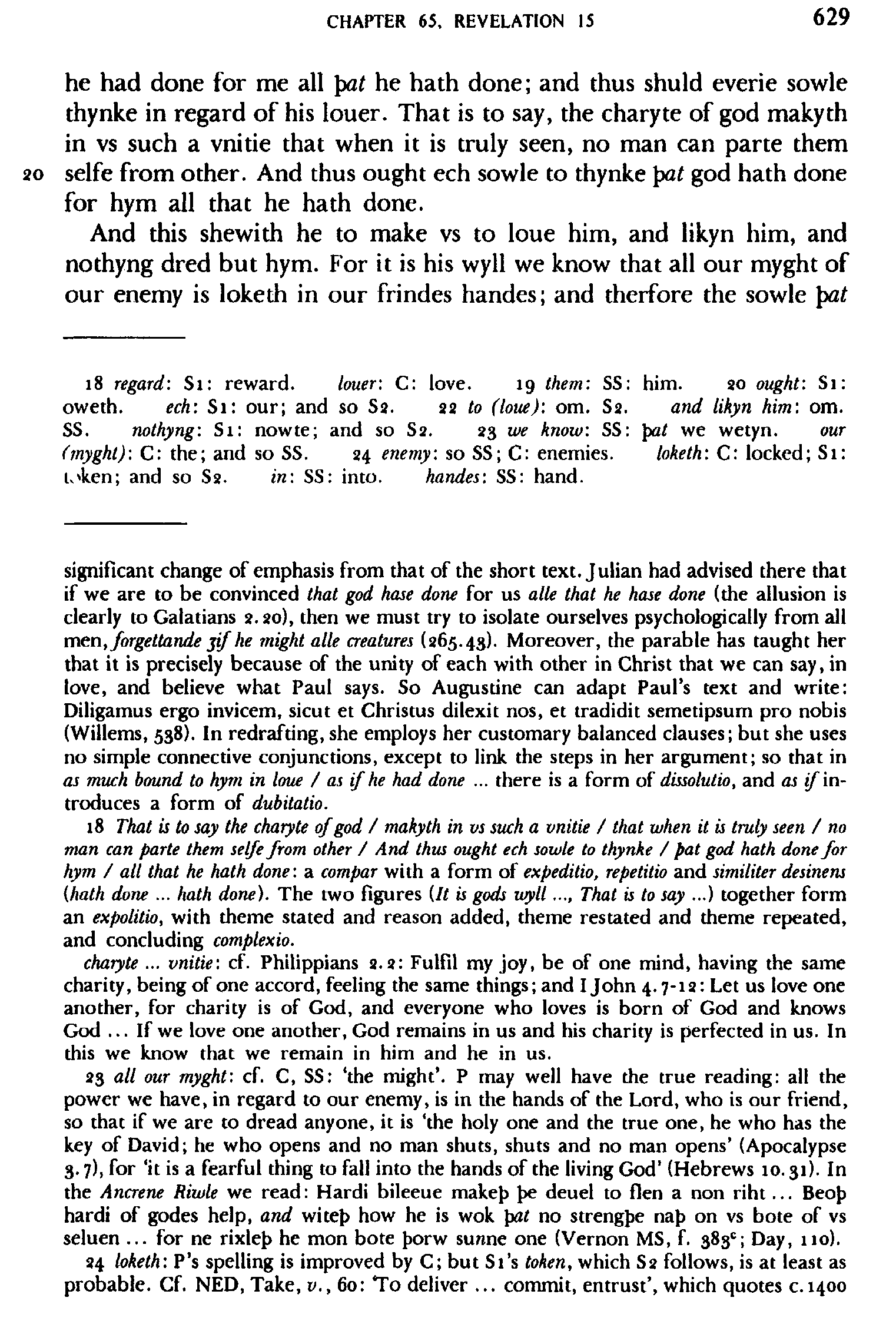
CHAPTER 65, REVELATION 15
he had done for me all \>at he hath done; and thus shuld everie sowle thynke in regard of his louer. That is to say, the charyte of god makyth in vs such a vnitie that when it is truly seen, no man can parte them
20 selfe from other. And thus ought ech sowle to thynke Jxz£ god hath done for hym all that he hath done.
And this shewith he to make vs to loue him, and likyn him, and nothyng dred but hym. For it is his wyll we know that all our myght of our enemy is loketh in our frindes handes; and therfore the sowle \>at 18 regard: Si: reward. louer: C: love.
19 them: SS: him.
20 ought: Si: oweth. ech: Si: our; and so Si?.
22 to (loue): om. Sa. and likyn him: om.
SS. nothyng: Si: nowte; and so 82.
23 we know: SS: \at we wetyn. our (myght): C: the; and so SS.
24 enemy: so SS; C: enemies. loketh: C: locked; Si: t.'ken; and so 82. in: SS: into. handes: SS: hand. significant change of emphasis from that of the short text. Julian had advised there that if we are to be convinced that god hose done for us alle that he hase done (the allusion is clearly to Galatians 2.20), then we must try to isolate ourselves psychologically from all men,forgettande yf he might alle creatures (265.43). Moreover, the parable has taught her that it is precisely because of the unity of each with other in Christ that we can say, in love, and believe what Paul says. So Augustine can adapt Paul's text and write:
Diligamus ergo invicem, sicut et Christus dilexit nos, et tradidit semetipsum pro nobis
(Willems, 538). In redrafting, she employs her customary balanced clauses; but she uses no simple connective conjunctions, except to link the steps in her argument; so that in as much bound to hym in loue / as if he had done ... there is a form of dissolutio, and as if introduces a form of dubitatio.
18 That is to say the charyte of god / makyth in vs such a vnitie / that when it is truly seen / no man can parte them selfe from other / And thus ought ech sowle to thynke / pat god hath done for hym / all that he hath done: a compar with a form of expeditio, repetitio and similiter desinens
(hath done ... hath done). The two figures (It is gods wyll..., That is to say ...) together form an expolitio, with theme stated and reason added, theme restated and theme repeated, and concluding complexio. charyte ... vnitie: cf. Philippians 2.2: Fulfil my joy, be of one mind, having the same charity, being of one accord, feeling the same things; and I John 4.7-12: Let us love one another, for charity is of God, and everyone who loves is born of God and knows
God ... If we love one another, God remains in us and his charity is perfected in us. In this we know that we remain in him and he in us.
23 all our myght: cf. C, SS: 'the might'. P may well have the true reading: all the power we have, in regard to our enemy, is in the hands of the Lord, who is our friend, so that if we are to dread anyone, it is 'the holy one and the true one, he who has the key of David; he who opens and no man shuts, shuts and no man opens' (Apocalypse
3.7), for 'it is a fearful thing to fall into the hands of the living God' (Hebrews 10.31). In the Ancrene Riwle we read: Hardi bileeue makep pe deuel to flen a non riht... Beop hardi of godes help, and witep how he is wok pfli no strengpe nap on vs bote of vs seluen ... for ne rixlep he mon bote porw suwne one (Vernon MS, f. 38sc; Day, 110).
24 loketh: P's spelling is improved by C; but Si's token, which 82 follows, is at least as probable. Cf. NED, Take, v., 60: To deliver ... commit, entrust', which quotes c. 1400
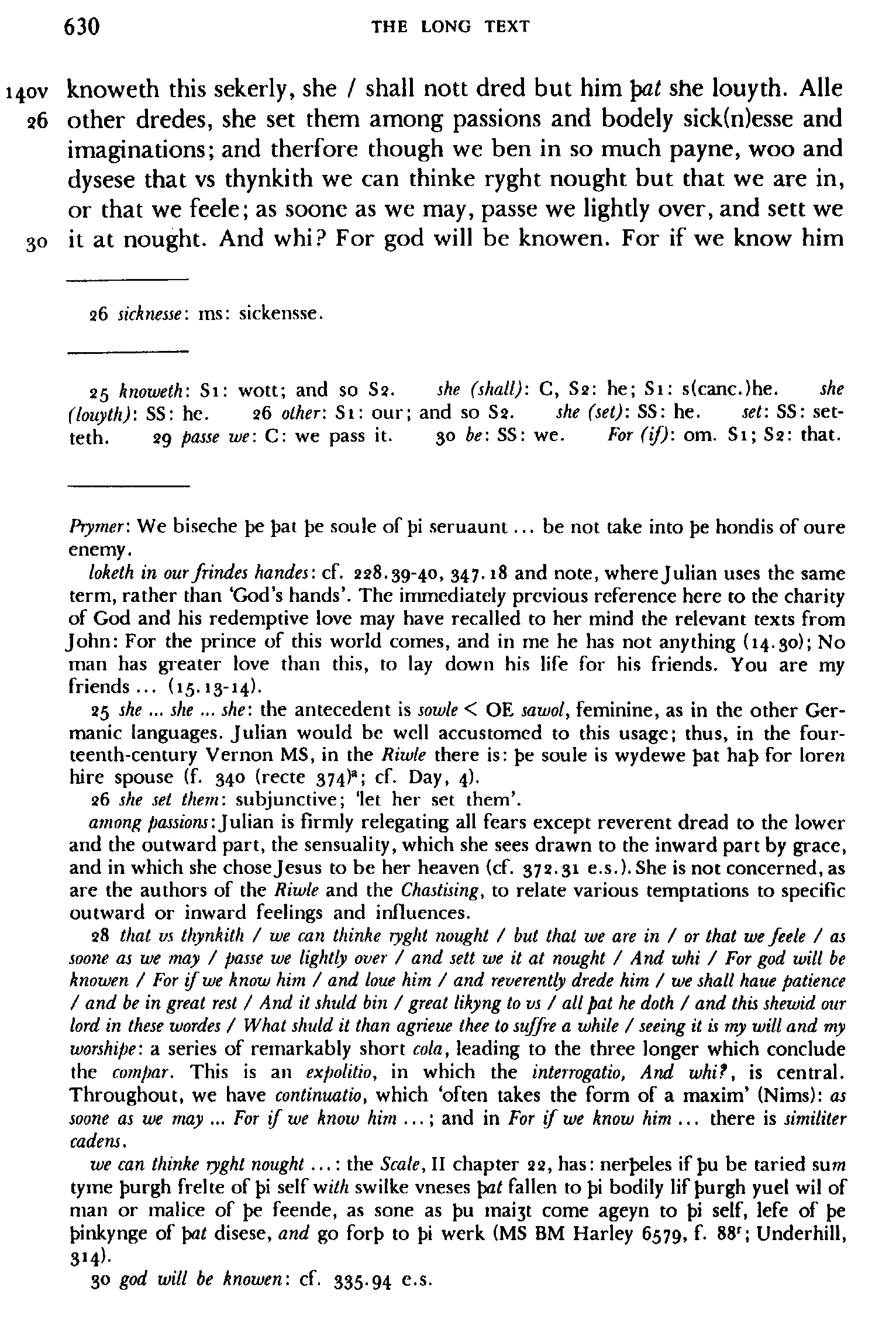
THE LONG TEXT
i4ov knoweth this sekerly, she / shall nott dred but him \>at she louyth. Alle 26 other dredes, she set them among passions and bodely sick(n)esse and imaginations; and therfore though we ben in so much payne, woo and dysese that vs thynkith we can thinke ryght nought but that we are in, or that we feele; as soone as we may, passe we lightly over, and sett we
30 it at nought. And whi? For god will be knowen. For if we know him 26 sicknesse: ms: sickemse.
25 knoweth: Si: wott; and so 82. she (shall): C, 82: he; Si: s(canc.)he. she (louyth): SS: he.
26 other: Si: our; and so 82. she (set): SS: he. set: SS: setteth.
29 passe we: C: we pass it.
30 be: SS: we.
For (if): om. Si; 82: that.
Prymer: We biseche }>e pat pe soule of pi seruaunt... be not take into pe hondis of oure enemy. loketh in ourfrindes handes: cf. 228.39-40, 347.18 and note, where Julian uses the same term, rather than 'God's hands'. The immediately previous reference here to the charity of God and his redemptive love may have recalled to her mind the relevant texts from John: For the prince of this world comes, and in me he has not anything (14.30); No man has greater love than this, to lay down his life for his friends. You are my friends ... (15.13-14).
25 she ... she ... she: the antecedent is sowle < OE sawot, feminine, as in the other Germanic languages. Julian would be well accustomed to this usage; thus, in the fourteenth-century Vernon MS, in the Riwle there is: pe soule is wydewe pat hap for loren hire spouse (f. 340 (recte 374)*; cf. Day, 4).
26 she set them: subjunctive; 'let her set them'. among passions: Julian is firmly relegating all fears except reverent dread to the lower and the outward part, the sensuality, which she sees drawn to the inward part by grace, and in which she chosejesus to be her heaven (cf. 372.31 e.s.). She is not concerned, as are the authors of the Riwle and the Chastising, to relate various temptations to specific outward or inward feelings and influences.
28 that vi thynkith / we can thinke ryght nought / but that we are in / or that we feele / as soone as we may / passe we lightly over / and sett we it at nought /And whi / For god will be knowen / For if we know him / and loue him / and reverently drede him / we shall haue patience
/ and be in great rest / And it shuld bin / great likyng to vs / all pat he doth / and this shewid our lord in these wordes / What shuld it than agrieue thee to suffre a while / seeing it is my will and my worshipe: a series of remarkably short cola, leading to the three longer which conclude the compar. This is an expolitio, in which the interrogatio, And whi?, is central.
Throughout, we have continuatio, which 'often takes the form of a maxim' (Nims): as soone as we may ... For if we know him ...; and in For if we know him ... there is similiter cadens. we can thinke ryght nought ...: the Scale, II chapter 22, has: nerpeles if pu be taried sum tyme purgh frelte of pi self with swilke vneses pa/ fallen to pi bodily lif purgh yuel wil of man or malice of pe feende, as sone as pu mai3t come ageyn to pi self, lefe of pe pinkynge of \>at disese, and go forp to pi werk (MS BM Harley 6579, f. 88r; Underhill,
314).
30 god will be knowen: cf. 335.94 e.s.
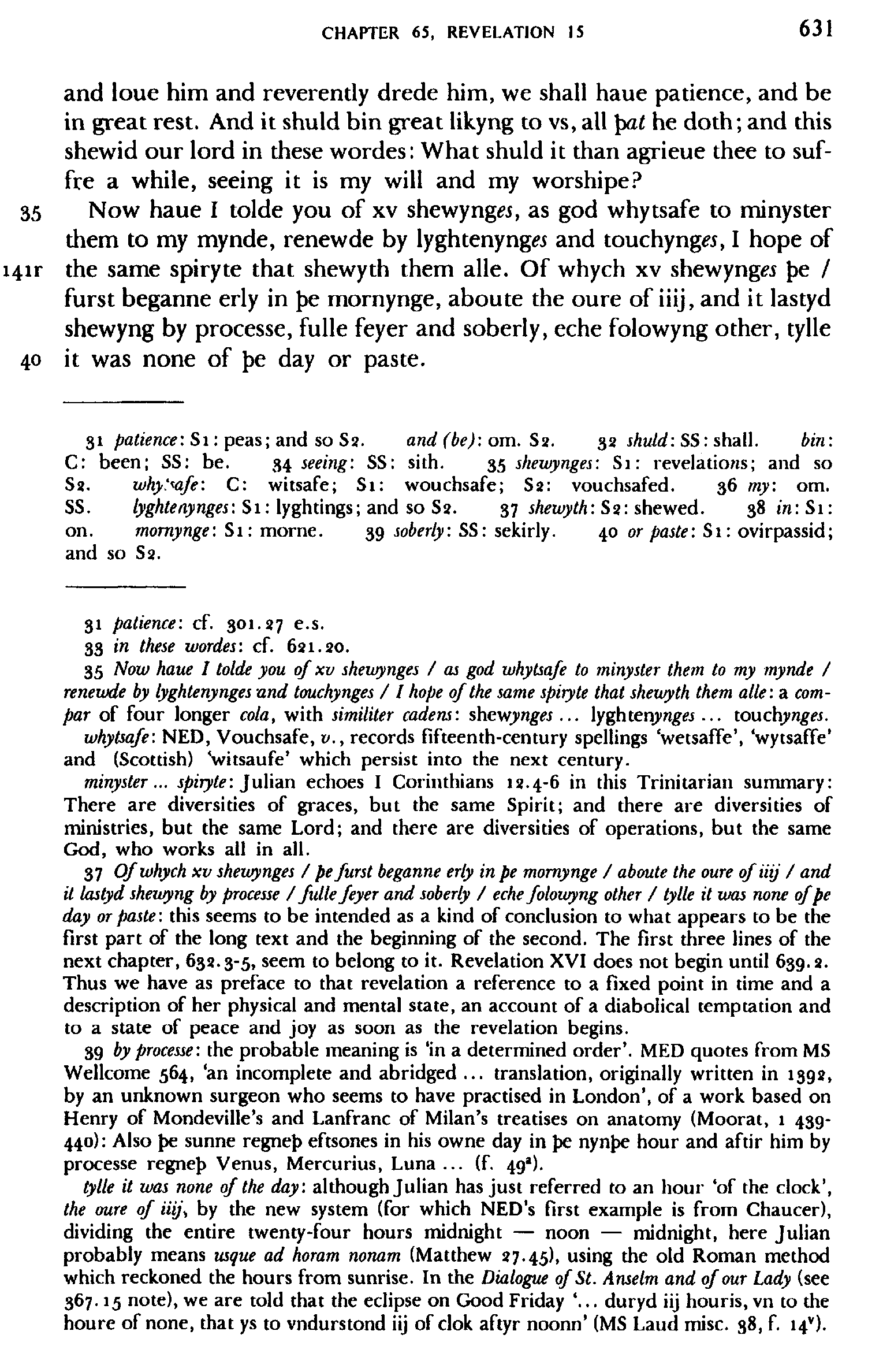
CHAPTER 65, REVELATION 15
and loue him and reverently drede him, we shall haue patience, and be in great rest. And it shuld bin great likyng to vs, all \>at he doth; and this shewid our lord in these wordes: What shuld it than agrieue thee to suffre a while, seeing it is my will and my worshipe?
Now haue I tolde you of xv shewyng£$, as god whytsafe to minyster them to my mynde, renewde by lyghtenyngw and touchyngw, I hope of 4ir the same spiryte that shewyth them alle. Of whych xv shewyngw pe / furst beganne erly in pe mornynge, aboute the oure of iiij, and it lastyd shewyng by processe, fulle feyer and soberly, eche folowyng other, tylle
40 it was none of pe day or paste.
31 patience: Si: peas; and so 82. and (be): om. 82.
32 shuld: 88: shall. bin:
C: been; SS: be.
34 seeing: 88: sith.
35 shewynges: Si: revelations; and so 82. why'wfe:
C: witsafe; Si: wouchsafe; 82: vouchsafed.
36 my: om.
SS. lyghtenynges: Si: lyghtings; and so 82.
37 shewyth: 82: shewed.
38 in: Si: on. momynge: Si: morne.
39 soberly: SS: sekirly.
40 or paste: Si: ovirpassid; and so 82.
31 patience: cf. 301.27 e.s.
33 in these wordes: cf. 621.20.
35 Now haue I tolde you of xv shewynges / as god whytsafe to minyster them to my mynde / renewde by lyghtenynges -and touchynges / I hope of the same spiryte that shewyth them alle: a cornpar of four longer cola, with similiter cadens: shewynges ... lyghtenynges ... touchynges. whytsafe: NED, Vouchsafe, v., records fifteenth-century spellings 'wetsaffe', 'wytsaffe' and (Scottish) 'witsaufe* which persist into the next century. minyster... spiryte: Julian echoes I Corinthians 12.4-6 in this Trinitarian summary:
There are diversities of graces, but the same Spirit; and there are diversities of ministries, but the same Lord; and there are diversities of operations, but the same
God, who works all in all.
37 Of whych xv shewynges / pe furst beganne erly in pe mornynge / aboute the oure of iiij / and it lastyd shewyng by processe / fulle feyer and soberly / eche folowyng other / tylle it was none ofpe day or paste: this seems to be intended as a kind of conclusion to what appears to be the first part of the long text and the beginning of the second. The first three lines of the next chapter, 632.3-5, seem to belong to it. Revelation XVI does not begin until 639.2.
Thus we have as preface to that revelation a reference to a fixed point in time and a description of her physical and mental state, an account of a diabolical temptation and to a state of peace and joy as soon as the revelation begins.
39 by processe: the probable meaning is 'in a determined order'. MED quotes from MS
Wellcome 564, 'an incomplete and abridged ... translation, originally written in 1392, by an unknown surgeon who seems to have practised in London', of a work based on Henry of Mondeville's and Lanfranc of Milan's treatises on anatomy (Moorat, i 439440): Also pe sunne regnep eftsones in his owne day in pe nynpe hour and aftir him by processe regnep Venus, Mercurius, Luna... (f. 49"). tylle it was none of the day: although Julian has just referred to an hour 'of the clock', the oure of iiij\ by the new system (for which NED's first example is from Chaucer), dividing the entire twenty-four hours midnight — noon — midnight, here Julian probably means usque ad horam nonam (Matthew 27.45), using the old Roman method which reckoned the hours from sunrise. In the Dialogue of St. Anselm and of our Lady (see
367.15 note), we are told that the eclipse on Good Friday '... duryd iij houris, vn to the houre of none, that ys to vndurstond iij of clok aftyr noonn' (MS Laud misc. 38, f. 14*).
THE LONG TEXT
The xvj Reuelation and the Ixvi Chapter Ande after this the goode lorde shewde the xvj revelation on the nyght folowyng, as I shalle sey after; whych xvj was conclusyon and 5 confirmation to all the xv. But furst me behovyth to telle yow as anenst my febylnes, wretchydnes and blyndnes. I haue seyde at the begynnyng, wher it seyth: And in this sodeynly all my payne was taken fro me; of whych payne I had no grefe ne no dysesses as long as }>e xv shewynges lastyd in shewyng. And at the ende alle was close, and I saw no more.
10 And soone I feelt that I should life longer. And anone my sycknes cam asene, furst in my hed, with a sownde and anoyse. And sodeynly all my i4iv body / was fulfyllyd with sycknes lyke as it was before, and I was as baryn and as drye as I had nevyr had comfort but lytylle, and as a wrech mornyd hevyly for feelyng of my bodely paynes, and for fautyng
15 of comforte gostly and bodely.
Then cam a relygyous person to me and askyd me how I faryd, and I i Add. Si: And it is (add. 82: a) conclusion and confirmation to (82: of) all xv (82: {je xv foregoing); and of hir frelte and morning in disese and lyfe, speking after the gret comfort of Jesus, seying (82: in saying) she had ravid, which being hir gret sekenes I suppose was but venial synne. But yet the devil after that had gret power to vexin hir ner to deth.
Reuelation: add. 82: et cetera.
3 revelation: om. 88.
5 the (xv): om.
88.
6 at: 88: in.
7 wher it seyth: om. 88.
8 no (dysesses): om. 88. dysesses: C, 82: disease; and so Si.
9 in shewyng: Si: folowand; and so 82.
10 longer: Si: and langiren; and so 82.
11 anoyse: Si: a dynrce; and so 82.
13 had (comfort): om.
88.
. 1 4 wrech: add. SS: I. hevyly: Si: and hevyed; and so 82. fautyng: Si: fayling; and so 82; cf. A (266.5): faylynge.
16 to: C: unto. to me: om. 82. i And it is ... ner to deth (Si): this does not correspond with the summary of Revelation
XVI in chapter i, 284.51-54.
3 Ande after this ... gostly and bodely: throughout, Julian uses compares to give tautness and urgency to her narrative.
7 wher it seyth: cf. 292.35.
8 dysesses: C's disease, with which SS agree, is more probable. Cf. NED, Disease, 56., i.b., 'A cause of discomfort or distress'. The first example of the plural, 2.b., 'an individual case or instance of (illness)', is 1526.
10 And anone ... as it was before: not in the short text; cf. 266.2.
13 and as a wrech ... my bodely paynes (14): this corresponds with the short text, 266.23- 16 Then cam a relygyous person ... in my throte (635.3): this corresponds with the short text, 266.5-267.27.
CHAPTER 66, REVELATION 16
seyde I had ravyd to day. And he loght lowde and in(ter)ly. And I seyde: The crosse that stode before my face, me thought it bled fast; and with this worde the person \>at I spake to waxsed all sad, and mer-
veylyd. And anone I was sore ashamyd and astonyd for my rechelesnesse, and I thought: this man takyth sadly the lest worde that I myght sey, that sawe no more therof. And when I saw that he toke it so sadly and with so grete reverence, I waxsyd full grettly ashamyd, and
wolde / a bene shryvyn. But I cowlde telle it to no prest, for I thought, 25 how shulde a preste belieue me when I by seaying I ravid, I shewed my
17 interly: ms: inwardly.
17 loght: Si: leuhc. loght lowde: 82: ben helond. inwardly (ms): so C; SS: inderly;S2, marg.,al.m.: he leuhe loud and inderly.
18 bled:SS:b\ode.
20 7:S2: he. aitonyd: C: astonished.
21 lest: 82: best.
22 myght: C: may. that (sawe): Si: than; and so 82. sawe: add. SS: I; cf. A (266.13): that says na mare tyrto. so (sadly): om. SS.
23 waxsyd: Si: wepid; and so 82; cf. A (266.14): i wex.
24 shryvyn: C, marg.: confessed; add. Si: at that tyme; and so 82. to: om.
SS.
25 belieue: Si: levyn; and so 82. when I... my selfe: om. SS.
17 interly: cf. 266.9 and note. P's inwardly, followed by C, is barely defensible. See
NED, Inwardly, adv., 3-b., '... heartily, fervently, earnestly'; but none of the instances qualify verbs in any way suggesting mirth.
18 me thought: not in the short text (266.9), where Julian tells the religious that the crucifix did bleed; but cf. 343.10 and note, where (in both texts)Julian stresses that the bleeding is not a physical reality.
20 ashamyd and astonyd: cf. 266.11: aschamed. The conduplicatio here explains more precisely her state of mind.
22 that sawe no more therof: this has been left unemended, since it can perhaps be defended. NED, MED do not record a meaning 'nothing' for 'no more'; but Julian may mean 'who saw no more of this than I had told him' (though, even so, he had in fact seen nothing). The SS reading is scarcely happier, and they and P probably have different corruptions of an archetype which corresponded with the short text (266.12-13),
'who says nothing more about this'.
25 how shulde a preste belieue me: Julian is pointing out a very important psychological fact about auricular confession. The author of the Riwle is merely affirming the tradition when he writes that confession must be truthful (Day, 152). In this connexion, see E. J. Dobson's recent and important demonstration of the derivation of the Riwle's teachings on confession from the Moralia super Evangelia, in the light of which some of the Riwle's cruces are more easily resolved (Moralities on the Gospels, chapter I and Appendix, 152-157). But equally (and this is not so often stated) the confessor must believe in the good will of his penitent, that he is telling the truth; and what is more, if the penitent cannot presume this, he also cannot presume that he will receive absolution.
Julian is not stating that she was too ashamed to confess; she has just stated the opposite: / waxsyd full grettly ashamyd, and wolde a bene shryvyn. She knows, with the Riwle's author, that confession must be made with shame (Day, 149). The question is that of the confessor's credence; and she asks why she ought to presume on anyone's credence,
THE LONG TEXT
selfe nott to belyue oure lorde god? Nott w^/istanding I beleft hym truly for the tyme \>at I saw hym; and so was than my wylle and my menyng ever for to do without end. But as a fole I lett it passe oute of my mynde.
A, loo how wrechyd I was! This was a grett synne and a grett vnkyndnesse, that I for foly of (f)elyng of a lytylle bodely payne so vnwysely left for {>e tyme the comfort of alle this blessyd shewyng of oure lorde god. Here may yow se what I am of my selfe; but here in woulde oure curtesse lorde nott leeue me. And I ley stylle tylle nyght, trustyng
35 in his mercy, and than I began to slepe. / 31 felyng: ms: selyng.
26 nott to belyue: SS: I leve not.
Nott withstanding: om. SS.
/ beleft hym truly: Si: this I levid sothfastly; 82: this (I - interl. al.m.) levid sothely; cf. A (266.16): This I leued sothfastlye.
28 to: om. SS. oute of: SS: fro.
30 how wrechyd I was!: SS: I wretch; cf. A (267.20): Loo I, wrich! a (grett vnkyndnesse): om. SS.
31 selyng (ms): C, 82: feeling; Si: feling. of (a): om. 82.
32 left: SS: lost; cf. A (267.21): lefte.
34 / (ley): om. SS.
35 began: SS: gan. when she herself had doubted God's credence. Karl Rahner has observed: La theologie mystique, comme la theologie fondamentale, affirme: Dieu peut se reveler — au sens strict de revelation verbale — et donner au beneficiaire de la revelation une certitude suffisante de 1'origine divine de son experience personnelle par dcs criteres internes ou externes ... le destinataire immediat, au rnoins, peut avoir le droit et memc le devoir d'adherer par un acte de foi a leur contenu ('Les revelations privees', 506-507). when I by seayng I ravid, I shewed my selfe nott to belyue oure lorde god: the ratiocinatio is present in the short text, but Julian, in redrafting, emphasizes her argument by specifying wherein exactly her disbelief lay: But I cowlde telle it to no prest / for I thought how shulde a preste belieue me / when I be seaying I ravid / I shewed my selfe nott to belyue oure lorde god. Here there is also membrum.
26 Nott withstanding I beleft hym truly / for the tyme pat I saw hym / and so was than my wylle and my menyng / ever for to do without end: cf. 266.16-18. The small changes in the long text, in addition to giving better balance in the cola, give emphasis to what Julian seeks to stress; she did not deliberately change her intention — weakness and folly obscured it. Cf. 460.9 and note.
30 A, loo how wrechyd I was!: the short text's exclamatio, Loo I, wrich! (267.20) is more striking; but perhaps Julian modified it here to make it plain that this was a state which has passed, on which she is now soberly reflecting.
33 Here may yow se ...: there may be a reminiscence here of II Corinthians 12.5-6: For myself, I shall glory only in my infirmities. For though I may wish to glory, I shall speak the truth. I shall be sparing, lest any man should think more of me than what he sees in me.
33 but here in woulde oure curtesse lorde nott leeue me: again, compare II Corinthians 12.9:
And he said to me: My grace is sufficient for you, for power is made perfect in infirmity. Gladly therefore shall I glory in my infirmity, so that the power of Christ may dwell in me.
CHAPTER 67, REVELATION 16
i42v The Ixvij Chapter Ande in my slepe at the begynnywg me thought the fende sett hym in my throte, puttyng forth a vysage fulle nere my face lyke a yonge man, and it was longe and wonder leen. I saw nevyr none such; the coloure
5 was reed, lyke }>e tylle stone whan it is new brent, with blacke spottes there in lyke frakylles, fouler than J)e tyle stone. His here was rede as rust, not scoryd afore, with syde lockes hangyng on J>e thonwonges. He grynnyd vpon me with a shrewde loke, shewde me whyt teth and so i In SS, no chapter-division or heading.
2 my: Si: the.
5 tylle: C: Tile; SS: tile.
6 there in: om. Sa. frakylles: Si: blak steknes; Sa: black frecknes.
7 not scoryd: C: not scoured; Si: evisid; and so Sa. on pe thonwonges: C: down in flakes. thonwonges: Si: thoungs; Sa: thowongs.
8 vpon: SS: on. loke, shewde me: SS: semelant shewing. shewde: C: and shewed. i The Ixvij Chapter: SS make no chapter division here; cf. 639.1 note. Cf. the conclusion of the SS chapter heading at 633. i: But yet the devil after that had gret power to vexin hir ner to deth. This might indicate that the long text, as originally prepared by Julian, had neither chapter divisions nor titles, but simply the divisions according to the revelations and their subject-matter, as indicated in the first chapter of P, C and SS. a Ande in my slepe: it is noteworthy how many of the details in this account of diabolic visitation, and in the corresponding passage in the short text (367.36-40) are enumerated in the Speculum christiani, in an extract attributed to Gregory, 'De penis inferni': Fire vnquenchable, colde insuperable, worme vndedly, stynke vnsuffrable, derknes thik to be felede, scorges of deueles betynge, gastful syght of fendes, despeyr of al gude thynges schal be in helle (Holmstedt, lao). It is tempting to consider whether, with reading-matter such as this available to her,Julian may after twenty years be embellishing the details of her nightmare. But this would be to impugn her integrity, and her constant solicitude, especially in the long text, to record only what she saw.
3 puttyng forth a vysage ... he helde me in the throte: not in the short text; cf. 367.27.
6 His here was rede as rust not scoryd afore: P's reading makes sense: 'His hair was as red as rust, (and) not cut short in front', although NED, Score, ».,!., To cut, mark with incisions', has no example referring to the cutting of hair. It has therefore been retained, although SS is probably superior: his here was rede as rust, evisid aforn (Si): '... clipped in front'. Cf. NED, Evese, v., Obs., which gives as one of its examples Walter of Bibbesworth: Monn top vus pri estancez — Evese my cop. C's scoured is certainly a misinterpretation of P, even though sense can be imputed to it: 'his hair in front was as red as unsecured rust'.
7 thonwonges: 'temples'. Cf. NED, Thunwang. MED quotes Walter of Bibbesworth: uhonewon: les temples.
He grynnyd: cf. the English Horologium: Oo my god, how dreedful a si3te! Loo, pe cruel bestes, pe horrible faces of deuiles, and blak forschapen pinges with oute noum-
THE LONG TEXT
mekylle me thought it the more vgly. Body ne handes had he none 10 shaply, but with hys pawes he helde me in the throte, and woulde a stoppyd my breth and kylde me, but he myght not.
This vgly shewyng was made slepyng, and so was none other; and in 1431 all this tyme / I trustyd to be savyd and kepte by Jje mercy of god. And 9 mekylle: C: my kill; marg.: much. n stoppyd my breth and kylde: Si: stranglid; and so 82. bre haue envyrouned me, aspiynge and abidynge my wrecched soule (Horstman, 363).
In the Vita Antonii, the devil appears 'stridens dentibus ... puer horridus atque niger'
(De vitis patrum I iv, PL 73 130).
9 the more vgly: the prayer for a good death in MS Cambridge Fitzwilliam Museum 55
(cf. 621.23 note) contains the following petition: et libera in hora mortis mee de horribili vultu diaboli (f. 139*).
Body ne handes had he none shaply: this probably reflects the common mediaeval belief that if the devil appear in human shape, he will always be recognizable by some physical defect (which, often, he will go to pains to conceal). So the Cloud tells us that he has only one nostril, up which one may look to his brain, which is the fire of hell
(Hodgson, 103).
Body ne handes had he none shaply / but with hys pawes he helde me in the throte / and would a stoppyd my breth and kylde me / but he myght not: in adding the details of the nightmare not in the short text, Julian again uses balanced cola, with oppositio (handes ... pawes) and conduplicatio (stoppyd ... kylde}.
10 but with hys pawes: here we have the common fusion of two originally distinct traditions, one representing the devil as a man, the other as a beast or monster. See
Beat Brenk, art.: Teufel' (LCI 4 295-300).
12 This vgly shewyng was made slepyng / and so was none other / and in all this tyme / I trustyd to be savyd / and kepte by pe mercy of god / And oure curtesse lorde gaue me grace to wake
/ and vnnethys had any lyfe: the Figure continues, with oppositio (slepyng ... to wake) and conduplicatio (savyd and kepte).
This vgly shewyng... pe mercy of god: not in the short text; cf. 267.27-28.
This vgly shewyng was made slepyng: though Julian uses the word 'shewyng', she is careful to distinguish this event from the revelations. The office of compline is witness to how seriously the monastic tradition took the feasibility of diabolic temptations in the night. After the opening invocation, 'Noctem quietam et finem perfectam concedat nobis dominus omnipotens', the following verse from I Peter 5.8 is always recited as the chapter: Be sober and watch, because your adversary the devil as a roaring lion goes about seeking whom he may devour; and the hymn contains the following strophe:
Procul recedant somnia / et noctium phantasmata / hostemque nostrum comprime / ne polluantur corpora.
13 / trustyd to be savyd: compare Alcuin's prayer for the night hours: Qui placido in puppi carpebat pectore somnum / Exurgens ventis imperat et pelago / Fessa labore gravi quamvis hie membra quiescant / Ad se concedat cor vigilare meum / Agne dei, mundi qui crimina cuncta tulisti, / Conserva requiem mitis ab hoste meam (ed. Duemmler, 350).
And oure curtesse lorde ... homelyest home (641.16): this corresponds with the short text,
267.28-268.14.
CHAPTER 67, REVELATION 16
oure curtesse lorde gaue me grace to wake, and vnnethys had ony lyfe.
15 The persons that were with me beheld me and wett my templys, and my harte beganne to comfort. And anon a lyttyll smoke cam it at }>e dorre
•with a greete heet and a foule stynch. And than I seyd: Benedicite dominus! Is it alle on fyer that is here? And I went it had bene a bodely fyer that shuld a burne vs all to deth. I asked them \>at were with me if 20 they felt ony stynch. They seyde nay, they felt noone. I seyde: Blessyd be god! for than wyst I wele it was the fende that was come only to tempte
14 lorde: add. 82: god. vnnethys: 82: oneth; C, marg.: scarcely. had ony: 88: had I my; cf. A (267.28): hadde I my.
16 to comfort: so C; 88: to comforten. lyttyll: Si: lyte; and so 82. in at: 82: into; Si: in.
17 And than: om.
88.
18 dominus: Si: domine; and so 82, alt. scr. fr. 'domini'.
Is it: 82: it is. went: so C; Si: we...id; 82: wened.
19 a (burne): om. C. burne: SS: brent. deth: SS: dede.
21 than: SS: that. only: om. 88. tempte: SS: tempest; cf. A (267.36): tempest.
16 to comfort: 'to take comfort'. MED records no intransitive use, and NEC's single instance, called 'ofo. rare', is from As You Like It, II vi 5, where Orlando says to Adam, who claims that he is dying: 'Live a little; comfort a little; cheer thyself a little'. But the SS
-en suffixes are some indication of the form's antiquity. a lyttyll smoke: in the life of St. Abraham the hermit we read that when he was tempted by the devil in the form of a young man, he said: Nomen siquidem domini mei et salvatoris Jesu Christi ... mihi validissimus murus est, in quo te increpo, immunde canis, ac ter miserande. Et dicente eo haec, confestim ut fumus ab oculis ejus evanuit
(De vitis patrum I, PL 73 289).
17 a foule stynch: it is told of the Abbot Pachomius that the devil appeared to him in the guise of a monk; but when the old man cursed him, he dissolved in a kind of dust, and filled the cell with a foul odour: factus veluti pulvis, cellulam eius molestissimo fetore complevit, ita ut ipsum corrumperet aerem (ibid., 266-267). Cf. an English version of Aelred of Rievaulx's De institutione indusarum: And in caas f>at whan Jm wakest, sodeynliche ... J>e hete of f>y flehs be styred, and Jjyn cruel enemy (f. aO wolde drawe \>e in to nyce fantacye ... (Vernon MS; cf. Hoste and Talbot, i 652). Julian does not state what would be obvious to her contemporaries, the symbolism of this vgly sheivyng.
Benedicite dominus: cf. 211.17 note.
18 Is it alle on fyer: in a prayer to God and the angels for protection, in MS Cambridge
Fitzwilliam Museum 55, there is: ... et omnes celorum virtutes, summa dei potencia, prestent michi auxilium ut nullus inimicus michi nocere aut dampnifica(re) possint in via nee in domo nee in terra nee in aqua nee in igne nee extra, nee morte subitanea a(u)t improuisa (f. 140*).
19 if they felt ony stynch: cf. NED, Feel, v., which gives as the primary meaning To examine or explore by touch', but has, 7., To perceive by smell or taste'. This is called
'Obs. exc. dial.\ but there are examples from c. 1220 to 1884.
21 come only to tempte me: on another occasion, the devil leapt and tore at Pachomius
(suis velut unguibus foede laceravit); but he disappeared when the old man made the sign of the cross: Intelligebat enim cunctas inimici versutias; et... illusiones ejus pro nihilo computabat (PL 73 240).
THE LONG TEXT
me. And anon I toke me to that cure lorde had shewed me on J)e same daye with alle £e feyth of holy church, for I behelde it as both in one, i43v and fled ther to as to my / comfort. And a non alle vanysschyd awey,
25 and I was brought to grete reste and peas, without sycknesse of body or drede of conscience.
22 me (to): om. SS. to (that): om. 82.
23 as both in: Si: is bother; 82: is bothen; cf. A (267.38): as bathe.
24 comfort: Si: comforts; cf. A (267.38): comforth.
22 And anon I loke me to that oure lorde had shewed me / on pe same daye with alle pefeyth of holy church / f o r I behelde it as both in one / and fled ther to as to my comfort: compar.
I take me to that: cf. 629.24 loketh, note. Julian here supplies her own synonym, and fled ther to.
23 holy church... comfort: Hilton writes in the Scale, II chapter 21: ...vnclene spirites ... spoile {DCC and bete J>e J>urw3 dium temptaciouns, {)i lif schal ay be safe.
And ... J)u schalt askape alle p^riles and meschiefs and come to £>e sitee of lerusalem with in schorl tyme (MS BM Harley 6579, f. 86r; Underbill, 308).
CHAPTER 68, REVELATION 16
The Ixviij Chapter And then oure good lorde opynnyd my gostely eye and shewde me my soule in J>e myddys of my harte. I saw }>e soule so large as it were an endlesse warde, and also as it were a blessyd kyngdom; and by the con5 dicions Ipat I saw there in I vnderstode Jjat it is a wurschypfulle cytte, in myddes of that cytte (sitts) oure lorde]hesu, very god and very man, a 6 sitts: om. ms. i Ixviij: SS: Ixvij.
Add Si: Of the worshipful! syte (82: sight) of the soule, which is so nobly create JxzJ it myte no better a be made, in which the trinite joyeth everlastingly, and (82: and that) the soule may have rest in nothing but in god, which (82: who) sittith therin reuling al things.
2 good: om. SS.
3 pe (myddys): om. SS. an: C: and.
4 warde: C, SS: world. also: om. SS. blessyd: SS: blisfull.
5 pat (I): om. 88. is: 82: was. cytte (2 x ): Si: syte; 82: city; marg. al.m.: syte (2 x ). in (myddes): add. Si: the; and so 82.
6 cytte (oure): add. Si: sitts; and so 82; cf. A (268.5): sittes. very ... very: om. SS; cf. A (268.5): verraye god and verray man.
1 the Ixviij Chapter: SS number this 'Ixvij'.
2 And then oure good lorde opynnyd my gostely eye and shewde me my soule in pe myddys of my harte: cf. the short text: and than owre lorde opennedde my gastely eyenn and schewyd me my saule in myddys of my herte (268. i). The additions here, 'oure good lorde', 'in pe middys', produce a perfect compar. With regard to the conflict eye/eyenn, compare the Scale, II chapter 29: ... ne J>e i3e of her soule is not 311 opened to J>e beholdynge of gostly Binges
(MS BM Harley 6579, f. ioar; Underbill, 355).
3 an endlesse warde: cf. 523.126 note. Julian introduces this new phrase under the influence of the parable of the lord and the servant. She has scriptural warranty for the as it ware a kyngdome of the short text, 268.3; cf. Luke 17.21: Neither shall they say,
Look here or Look there; for behold, the kingdom of God is within you. Bede's gloss reads: Regnum dei seipsurn dicit, intra illos positum, hoc est in cordibus eorum, ubi credidere regnantem (In Lucae evangelium expositio V, PL 92 545). Here in the long text she seems anxious to emphasize the theological fact of the mutual indwelling, which she does by constructing a compar: p? soule so large as it were an endlesse warde / and also as it were a blessyd kyngdom, with medial repetitio: as it were, and with the additional Scriptural allusion: Come you blessed ... possess the kingdom (Matthew 25.34). Hilton, the Scale,
II chapter 32, writes of *J>is maner knowynge of Jh«u ..." (sc. a clearer sight and purer love of Jesus, in whom is all the blessed Trinity), which is *pe openynge of heuene to pe iy of a clene soule of jje whilk holy men speken in here writyng' (MS BM Harley 6579, f. io8v; Underbill, 374). One such which Julian may have read is William of St.
Thierry's Meditativae orationes, VI: Cum autem nos inhabitas, coelum tuum sumus, utique, sed non quo sustenteris ut inhabites, sed quod sustentes ut inhabitetur; tu quoque coelum nobis existens, ad quern ascendamus, ut inhabitemus (PL 180 224).
6 sitts: the SS reading, which is supported by A, seems superior.
THE LONG TEXT
feyer person and of large stature, hyghest bysschoppe, most solempne kynge, wurschypfullest lorde. And I saw hym clothyd solemply in wurschyppw. He syttyth in Jje soule evyn ryghte in peas and rest, and he
1441rulyth and 3e(m)yth hevyn and erth and all that is. The manhode / with 11 the godhed syttyth in rest, the godhede rulyth and 3e(m)eth wzY/ioutyn ony instrument or besynesse. And £>e soule is alle occupyed with f»e blessyd godhed, \>at is souereyne myghte, souereyne wysdom and souereyn goodnesse.
10 ymyth: ms: 3evyth.
11 ymeth: ms: jeveth.
7 most solempne: Si: solemnest; and so 82.
8 wurschypfullest:
C: worshipful, clothyd: 88: clad. in (wurschyppes): 88: and. wurschyppes: C: worship; Si: worshiply; 82: worshififully; cf. A (268.7): in wyrschippes.
9 he (rulyth): Si: the godhede; and so 82.
10 jevyth (ms): C: giveth; 88: gemeth; cf. A (268.8):
3611163. and all that u ... rulyth and ymeth: om. 82.
The manhode ... blessyd godhed pat is: om. Si.
11 yveth (ms): C: giveth; not in 88.
12 ony: om. 82.
13 blessyd:
82: blisfull.
7 hyghest bysschoppe, most solempne kynge, wurschypfullest lorde: J ulian expands both the compar and the membrum of the short text (cf. 268.4 note) for theological enrichment.
Cf. I Peter 2.25: You are now converted to the shepherd and bishop of your souls. She calls Christ bysschoppe as the pontiff, the priestly head of the Church which is his body of the Epistle to the Hebrews. MED observes, bishop 3, that in her day the word is often used to mean high priest, pontiff of the Hebrews. The context here is liturgical, and wurschypfullest is used with deliberation. She has in mind the 'king of kings and lord of lords' of the Apocalypse (17.14); cf. 525.145 note, and Ezechiel chapter 40 e.s., which Hilton interprets as his Jerusalem (Scale II, chapter 25). Much of Mechtild of Hackborn's interminable descriptions of the 'city of the heart' is based on these passages in Ezechiel and the Apocalypse. Thus she makes our Lord say: Thys pyne sawle es inclusede alwaye in myne herte, ande y am inclusede in pe herte of thy sawle. Ande allebehitt powe conteyne me in the moste inwarde parties of thy sawle so pat y be more inwarde to the be my beynge with the pan alle thyne inwardenes, jitt neuerpelesse pe herte of my godhede es so excellente ande so ouerepassynge pyne sawle patt hitt semys to the pere maye no sawle atteyne pareto in no wyse (Halligan, 184).
10 As in the short text, Julian makes her doctrinal points by means of oppositio: The manhode with the godhed syttyth in rest (Jesus is true man, but is of one substance with the Father) / the godhede rulyth and ymeth withoutyn ony instrument or besynesse (God's work does not change him) / And pe soule is alle occupyed with pe blessyd godhed (the soul is at one with the humanity of Jesus, and works with him for the Father's glory) / pat is souereyne myghte souereyne wysdom and souereyn goodnesse (Trinitas, indivisa unitas — the Trinitarian works ad extra).
11 syttyth in rest: cf. the metre O qui perpetua in Chaucer's Boethius: O pou fadir creatour of heuene and of erpes pat gouernest pis worlde by perdurable resoun, pat comaundist pe tymes for to gon from tyme pat age hadde begynnyng, pou pat dwellest pi selfe ay stedfast and stable and 3iuest alle oper pinges to ben moeued ... (Morris, 87).
12 pe soule: cf. 268.10: my saule: cf. 639.2-3 note.
CHAPTER 68, REVELATION 16
The place that Jhesu takyth in oure soule he shall nevyr remoue withouten ende, as to my syght, for in vs is his homelyest home and his endlesse dwellyng. And in this he shewde the lykyng that he hath of the makyng of mannes soule; for as wele as the fader myght make a 15 remoue: add. SS: it; cf. A (268.13): remove it.
17 dwellyng: Si: wonyng; and so Sa. shewde: C: sheweth.
15 The place that Jhesu takyth in oure soule / he shall nevyr remoue withouten ende / as to my syght /for in vs is / his homelyest home and his endlesse dwellyng:Julian has discarded the cornpar of four cola in the short text for this more subtle and varied arrangement, which enables her to emphasize through oppositio the various aspects of the Trinity's relationship in Christ with us; place and dwellyng, which give indusio. indicate the chief oppositio between man and God, resolved in Christ's person. This is the burden of William of St.
Thierry's argument in the prayer cited above: that 'place' and 'God' are contraries:
Nam, o conditor omnium, et locorum et temporum, tu nee tempore noveris nee loco teneris, nee coelo corporeo sustentaris ne cadas, nee sic in eo habitas ut coelem et terram non impleas: ubique praesens, si de illocali hoc dici potest; ubique totus, si in te vel de te praedicari potest totitas in quo non est particularitas (PL 180 223).
The place ...:Julian's teaching, as has frequently been observed, has its source in the Johannine discourse at the Last Supper. So William writes: Locus ergo tuus pater est, et tu patris; et non solum sed etiam nos locus tuus sumus, et tu noster. Cum ergo, o dominejesu, tu es in patre et pater in te, o summa et indivisa trinitas, tu tibi locus es, tu tibi coelum es, sicut non habens ex quo, sic non indigens in quo subsistas, nisi ex teipso in teipso (ibid., 224). remoue: cf. NED, Remove, v., 6.: To go away from, to quit (a place or position), Obs. rare\ with only two examples, c. 1440 and c. 1450.
16 withouten ende: this derives from Julian's capital text on the doctrine of inhabitation: I shall ask the Father, and he will give you another paraclete, that he
(which refers to both Father and Spirit) may stay with you for ever, the Spirit of truth ... you will know him because he will abide with you and be in you (John 14.1617). his homelyest home: this tautologia is of special importance to her teaching on the Trinity and the Hypostatic Union, and merits analysis. Almost at the end, she proposes three properties in whych the strenght andpe effecte ofalle pe revelacion stondyth: the properties are lyfe, loue and lyght; and she continues: In lyfe is mervelous homelyhed (722.3 e.s.). So too in Benjamin the C/owrf-author writes: Fro now forj) begynnej) a maner of homlynes for to growe bitwix God and mans soule ... oft tymes he felij> hym not only be visityd of god bot greetly coumfortyd in his comyng. t>is homlynes and pis kyndelyng ... (Deonise, 20).
17 And in this he shewde ... shulde lyke him with out ende: again, this long figure describes die Trinitarian operationes ad extra, using complexio (for as wele as the fader myght make a creature / and as wele as pe son myght make a creature ...), similiter desinens (as wele ... as wele ... so wele), and oppositio (myght make ... were made). the fader myght make a creature: cf. the Treatise of Perfection: ... anone than we fele the hete of the holye goste and the oned of god burnynge and makynge vs lyquet. And there we hyre the voyce of the fathere drawynge vs in, and techynge vs, thus spekyn vnto his welbeloued in this euerlastynge worde: This, he says, is my welbeloued sonne, in whome I am wele plesed (Bazire and Colledge, 256). The editors supply some lines of Ruysbroek's Latin which are omitted in the English: Sciendum namque, patrem cum filio filiumque curn patre eternam excercuisse complacentiam de eo quod filius humanitatem nostram erat assumpturus (ibid., 339), which is Julian's precise point.
THE LONG TEXT
creature, and as wele as pe son myght make a creature, so wele wolde 20 pe holy gost that mannys soule were made, and so it was done. And therfore the blessydfulle trynyte enjoyeth without ende in jae makyng of mannys soule, for he sawe without begynnyng what shulde lyke him with out ende. i44v Al thyng that he / hath made shewyth his lordschyppe, as vn25 derstandyng was gevyn in the same tyme by example of a creature that is led to se grete noblynesse and kyngdoms longyng to a lorde; and when it had sene all the nobylnes beneth, than mervelyng it was steryd to seke vppe aboue to that hygh place where the lorde dwellyth, knowyng by reson Jxz£ hys dwellyng is in the wurthyest place. And thus I 30 vnderstonde truly that oure soule may never haue rest in thyng 1pat is
19 (son) myght: Si: cowth; and so 82.
21 blessydfulle:
Si: blissid; and so 82. trynyte: here and at 643.38 82 employs the symbol 'A\ 22 sawe: add. Si: fro; and so 82.
25 in: SS: at. a6ted:om. SS. noblynesse: SS: noblyes. longyng:
82: belonging. a (lorde): add. 82: great.
27 nobylnes: SS: noblyth. than: Si: ther; and so 82.
28 vppe: om. SS. that: SS: the. dwellyth'. Si: wonnyth; and so 82.
30 vnderstonde: Si: vnderstode; and so 82. truly: Si: sothly; and so 82. thyng: C, SS: things. is: 82: are.
20 And therfore ...: cf. Isaias 65.18-19: But you will be glad and rejoice for ever in these things which I create: for see, I create Jerusalem a rejoicing ... and I shall rejoice in Jerusalem, and joy in my people ...
22 for lie sawe: cf. 389.2.
24 Al thyng ... is his very dwellyng (643.34): this whole paragraph is built up on carefully balanced cola. Theologically, Julian wishes to emphasize lordship, the attribute of the Holy Spirit; but there is present the notion of transcendence as well as immanence. It is feasible that Augustine helps to shape both her thought and language here; and example of a creature may well mean here also the rhetorical figure (cf. 513.3 note), 'the citing of something done or said in the past', as well as the preacher's exemplum. In the celebrated dialogue between Augustine and his mother, we find the same 'ascensio mends': perambulauimus gradatim cuncta corporalia et ipsumcoelum, unde sol et luna et stellae lucent super terrain et adhuc ascendebamus ... mirando opera tua et venimus in mentes nostras et transcendimus eas, ut attingeremus regionem ubertatis indeficientis
(Confessionum VIII, Knoll, 216).
26 and when it had sene: compare Augustine's gloss on Psalm 41.4: Ubi est deus tuus:
Ubi enim domus dei mei, super animam meam... habet etiam in terra tabernaculum ... et quamvis admirabile sit tabernaculum, stupeo cum pervenio usque ad domum dei (Dekkers and Fraipont, i 466).
29 And thus I vnderstonde: again, compare Augustine: Quaero ego deum meum in omni corpore, siue terrestri siue caelesti, et non invenio; quaero substantiam eius in anima mea et non invenio; meditatus sum tamen inquisitionem dei mei ... effudi super me animam meam, et non iam restat quern tangam, nisi deum meum (ibid., 465).
30 oure soule may never haue rest ...; cf. 216.49 note. Even more clearly, this recalls
Augustine: Thou hast made us for thyself, and our hearts are restless till they rest in thee (Confessions I i, trans. F. J. Sheed, 3; cf. PL 32 661).
CHAPTER 68, REVELATION 16
beneth it selfe. And whan it comyth aboue alle creatures in to it selfe, yett may it not abyde in the beholdyng of it selfe; but alle IDC beholdyng is blyssydfully sett in god, that is the maker, dwellyng ther in, for in mannes soule is his very dwellyng.
And the hyghest lyght and the bryghtest shynyng of {>e sytte is the / 1451 glorious loue of oure lorde god, as to my syght. And what may make vs more enjoye in god than to see in hym \>at he enjoyeth in vs hyghest of all his werkes? For I saw in the same shewyng that yf £e blessyd trynyte myght a made mannes soule ony better, ony feyerer, ony nobeler than it
31 it (selfe, yett): Si: the.
32 pe: 82: \>at.
33 blyssydfully: SS: blisfully. that:
82: who.
34 dwellyng: Si: wonyng; and so 82.
35 sytte: C: City; Si: cite; 82: city.
36 god: om. 88.
37 more: add. 88.: to. than: 82: ^at. in vs: om.
88. hyghest: Si: hylicst; and so 82.
39 ony (feyerer):
82: and; corr. al.m.: any. nobeler: Si: noblyer. than: Si: that; and so 82.
32 yett may it not abyde: cf. the Scale, II chapter 30: Nerpeles I sey not \>at J>i soule schal reste stil in J)is knowynge, but it schal bi f>is seke hi3ere knowynge aboue it self, and \Mt is £>e kynde of god (MS BM Harley 6579, f. io2v; Underbill, 357-358). beholdyng ... in god: cf. William of St. Thierry, Meditativae orationes VI: Ad te domine, ad te oculi mei semper, qui habitas in coelis; ad domum tuam, ad civitatem tuam
Jerusalem, unde ad nos descendisti, cujus tecum tam mirabile exemplar nobis detulisti
(PL 180 226-227).
34 his very dwellyng: in this passage Julian has been reflecting on the Holy Spirit and his lordschyppe, so that the Pauline texts which stress the Spirit's indwelling are in her mind. Cf. I Corindiians 3.17, 5.19, II Corinthians 6.16.
35 the hyghest lyght ... the bryghtest shynyng ... the glorious loue: cf. Apocalypse 21.23: And the city has no need of the sun, nor of the moon to shine in it, for the glory of God has enlightened it, and the Lamb is its lamp. This is a compar with similiter cadens.
36 And what may make vs / more enjoye in god / than to see in hym / pat he enjoyeth in vs / hyghest of all his werkes: compar with medial repetitio (enjoye in... enjoyeth in).
38 For I saw in the same shewyng / that yf pe blessyd trynyte / myght a made mannes soule / ony better ony feyerer ony nobeler / than it was made / he shulde nott a been full plesyd / with makyng of mannys soule / But for he made mannes soule / asfeyer as good as precious / as he myght make it a creature / therfore pe blessyd trynyte / isfulle plesyd withoute ende / in pe makyng of mannes soule / And he wylle that our hartes / be myghtly reysed / aboue pe depnesse of pe erth / and alle veyne sorowes / and enjoye in hym: a compar of short cola, with much repetitio, with articulus (one better ony feyerer only nobeler ... asfeyer as good as precious). Julian is also using the figures to emphasize her logical argument. The major premise is that yf pe blessyd trynyte ... he shulde nott a been full plesyd; the minor premise is But for (Atque) ... as he myght make it a creature; and the conclusion is therfore (Ergo) ... and enjoye in hym. This is a perfectly constructed ovti-ofioiios (ratiocinatio; cf. Ad Herennium, Marx-Trillit/sch, 130 e.s.).
Julian is using the valid form of the conditional (hypothetical) syllogism: the major posits the hypothesis in its protasis, the minor asserts the truth of the condition, so that die conclusion establishes the apodosis.
39 myght a made mannes soule ony better: the first chapter of Hebrews still seems to be integral to her reflection: He has been made so much better than the angels, and has inherited a more excellent name than they (1.4).
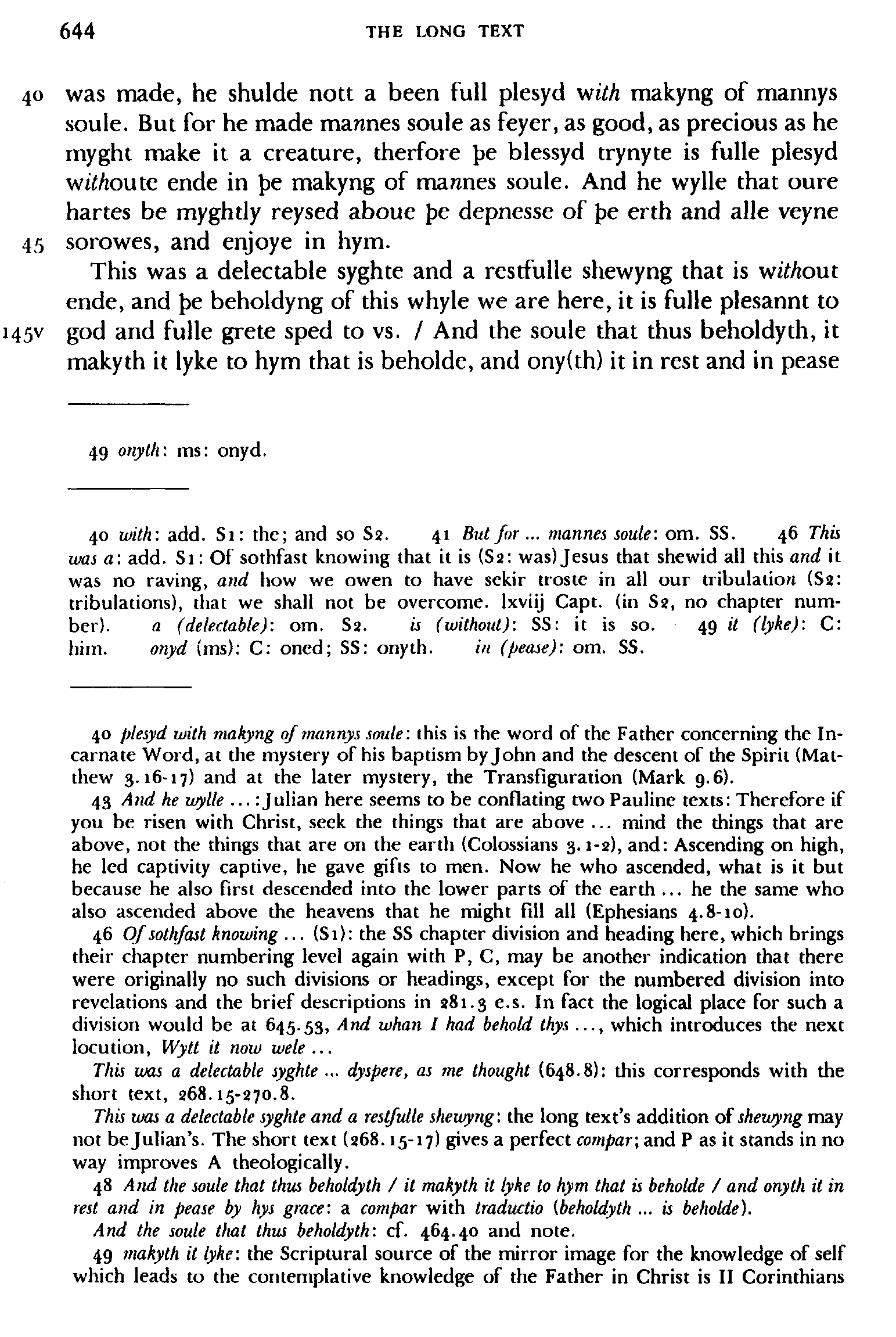
THE LONG TEXT
40 was made, he shulde nott a been full plesyd with makyng of mannys soule. But for he made mannes soule as feyer, as good, as precious as he myght make it a creature, therfore £>e blessyd trynyte is fulle plesyd withoutc ende in £e makyng of mawnes soule. And he wylle that oure hartes be myghtly reysed aboue {je depnesse of b,e erth and alle veyne
45 sorowes, and enjoye in hym.
This was a delectable syghte and a restfulle shewyng that is without ende, and ]>e beholdyng of this whyle we are here, it is fulle plesannt to i45v god and fulle grete sped to vs. / And the soule that thus beholdyth, it makyth it lyke to hym that is beholde, and ony(th) it in rest and in pease
49 onyth: ms: onyd.
40 with: add. Si: the; and so 82.
41 But for ... mannes soule: om. SS.
46 This was a: add. Si: Of sothfast knowing that it is (82: was) Jesus that shewid all this and it was no raving, and how we owen to have sekir troste in all our tribulation (82: tribulations), that we shall not be overcome. Ixviij Capt. (in 82, no chapter number), a (delectable): om.
82. is (without): 88: it is so.
49 it (lyke): C: him. onyd (ms): C: oned; SS: onyth. iji (pease): om. SS.
40 plesyd with makyng of mannys soule: this is the word of the Father concerning the Incarnate Word, at the mystery of his baptism by John and the descent of the Spirit (Matthew 3.16-17) and at the later mystery, the Transfiguration (Mark 9.6).
43 And he wylle ...:Julian here seems to be conflating two Pauline texts: Therefore if you be risen with Christ, seek the things that are above ... mind the things that are above, not the things that are on the earth (Colossians 3.1-2), and: Ascending on high, he led captivity captive, he gave gifts to men. Now he who ascended, what is it but because he also first descended into the lower parts of the earth ... he the same who also ascended above the heavens that he might fill all (Ephesians 4.8-10).
46 Of sothfast knowing ... (Si): the SS chapter division and heading here, which brings their chapter numbering level again with P, C, may be another indication that there were originally no such divisions or headings, except for the numbered division into revelations and the brief descriptions in 281.3 e.s. In fact the logical place for such a division would be at 645.53, And whan I had behold thys ..., which introduces the next locution, Wytt it now wele ...
This was a delectable syghte ... dyspere, as me thought (648.8): this corresponds with the short text, 268.15-270.8.
This was a delectable syghte and a restfulle shewyng: the long text's addition of shewyng may not bejulian's. The short text (268.15-17) gives a perfect cornpar; and P as it stands in no way improves A theologically.
48 And the soule that thus beholdyth / it makyth it lyke to hym that is beholde / and onyth it in rest and in pease by hys grace: a compar with traductio (beholdyth ... is beholde).
And the soule that thus beholdyth: cf. 464.40 and note.
49 makyth it lyke: the Scriptural source of the mirror image for the knowledge of self which leads to the contemplative knowledge of the Father in Christ is II Corinthians
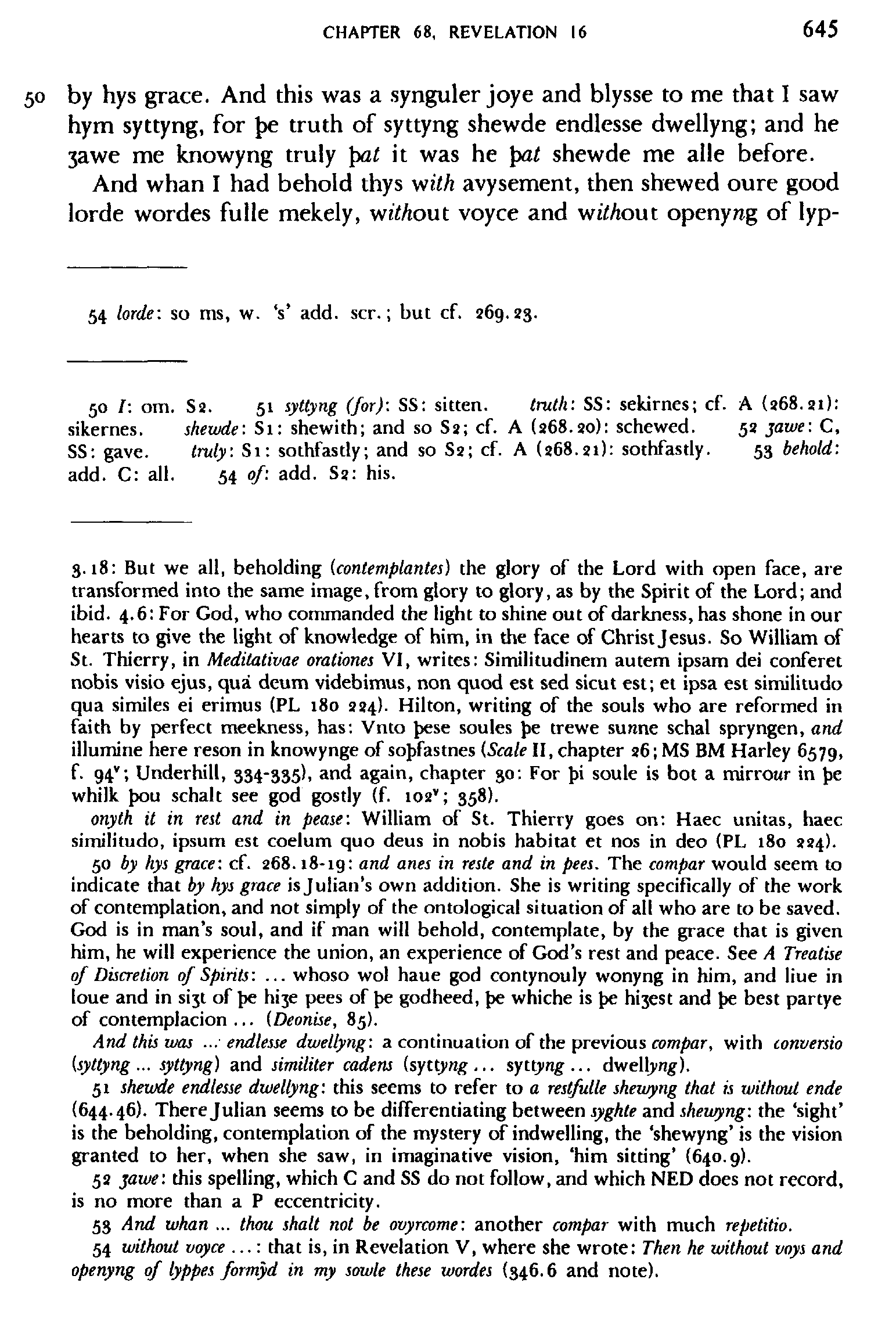
CHAPTER 68, REVELATION 16
50 by hys grace. And this was a synguler joye and blysse to me that I saw hym syttyng, for J>e truth of syttyng shewde endlesse dwellyng; and he
3awe me knowyng truly \>at it was he Jxz£ shewde me alle before.
And whan I had behold thys with avysement, then shewed oure good lorde wordes fulle mekely, without voyce and without openyrag of lyp54 lorde: so ms, w. V add. scr.; but cf. 269.23.
50 /: om. Sa.
51 syttyng (for): SS: sitten. truth: SS: sekirnes; cf. A (268.21): sikernes. shewde: Si: shewith; and so 82; cf. A (268.20): schewed.
52 jawe: C, SS: gave. truly: Si: sothfastly; and so Sa; cf. A (268.21): sothfasdy.
53 behold: add. C: all.
54 of: add. 82: his.
3.18: But we all, beholding (contemplantes) the glory of the Lord with open face, are transformed into the same image, from glory to glory, as by the Spirit of the Lord; and ibid. 4.6: For God, who commanded the light to shine out of darkness, has shone in our hearts to give the light of knowledge of him, in the face of Christ Jesus. So William of St. Thierry, in Meditativae orationes VI, writes: Similitudinem autem ipsam dei conferet nobis visio ejus, qua deum videbimus, non quod est sed sicut est; et ipsa est similitude qua similes ei erimus (PL 180 224). Hilton, writing of the souls who are reformed in faith by perfect meekness, has: Vnto l>ese soules J>e trewe suwne schal spryngen, and illumine here reson in knowynge of sojjfastnes (Scale II, chapter 26; MS BM Harley 6579, f. 94*; Underbill, 334-335), and again, chapter 30: For J)i soule is bot a mirroMr in £e whilk pou schalt see god gostly (f. io2v; 358). onyth it in rest and in pease: William of St. Thierry goes on: Haec unitas, haec similitude, ipsum est coelum quo deus in nobis habitat et nos in deo (PL 180 224).
50 by hys grace: cf. 268.18-19: and anes in reste and in pees. The compar would seem to indicate that by hys grace is Julian's own addition. She is writing specifically of the work of contemplation, and not simply of the ontological situation of all who are to be saved.
God is in man's soul, and if man will behold, contemplate, by the grace that is given him, he will experience the union, an experience of God's rest and peace. See A Treatise of Discretion of Spirits: ... whoso wol haue god contynouly wonyng in him, and liue in loue and in sijt of pe hi3e pees of J>e godheed, pe whiche is pe hi3est and pe best partye of contemplacion ... (Deonise, 85).
And this was ...endlesse dwellyng: a continuation of the previous compar, with conversio
(syttyng... syttyng) and similiter cadens (syttyng... syttyng... dwelling).
51 shewde endlesse dwellyng: this seems to refer to a restfulle shewyng that is without ende
(644.46). There Julian seems to be differentiating between syghte and shewyng: the 'sight' is the beholding, contemplation of the mystery of indwelling, the 'shewyng' is the vision granted to her, when she saw, in imaginative vision, 'him sitting" (640.9).
52 jawe: this spelling, which C and SS do not follow, and which NED does not record, is no more than a P eccentricity.
53 And whan ... thou shall not be ovyrcome: another compar with much repetitio.
54 without voyce ...: that is, in Revelation V, where she wrote: Then he without voys and openyng of typpes formyd in my sowle these wordes (346.6 and note).
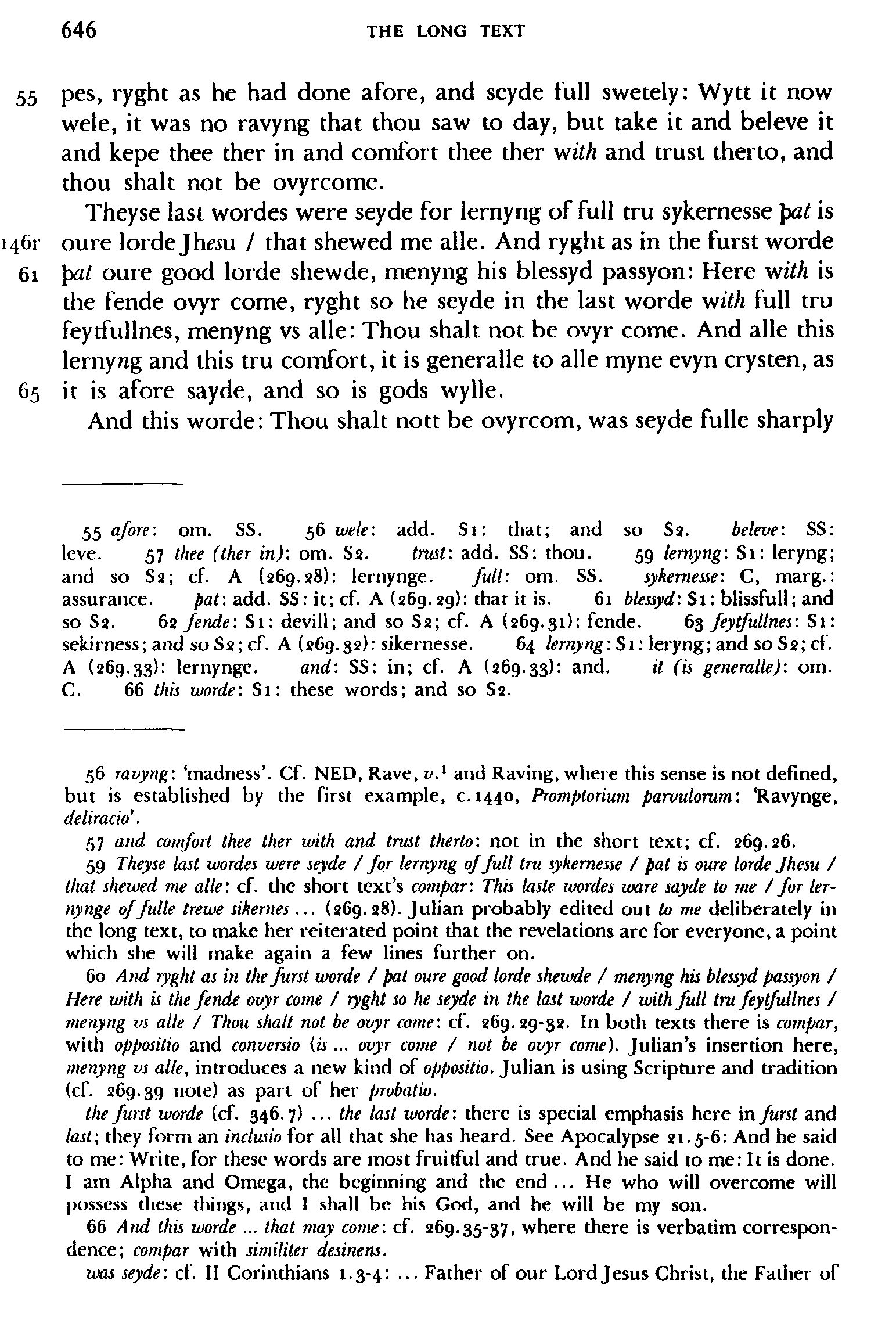
THE LONG TEXT
55 pes, ryght as he had done afore, and seyde full swetely: Wytt it now wele, it was no ravyng that thou saw to day, but take it and beleve it and kepe thee ther in and comfort thee ther wzY/i and trust therto, and thou shalt not be ovyrcome.
Theyse last wordes were seyde for lernyng of full tru sykernesse \tat is 1461 oure lorde Jh£$u / that shewed me alle. And ryght as in the furst worde
61 tyt oure good lorde shewde, menyng his blessyd passyon: Here -with is the fende ovyr come, ryght so he seyde in the last worde with full tru feytfullnes, menyng vs alle: Thou shalt not be ovyr come. And alle this lernyng and this tru comfort, it is generalle to alle myne evyn crysten, as 65 it is afore sayde, and so is gods wylle.
And this worde: Thou shalt nott be ovyrcom, was seyde fulle sharply 55 afore: om.
SS.
56 wele: add.
Si: that; and so Sa. beleve: SS: leve.
57 thee (ther in): om. Sa. trust: add. SS: thou.
59 lemyng: Si: leryng; and so Sa; cf. A (369.28): lernynge. full: om. SS. sykernesse: C, marg.: assurance. pat: add. SS: it; cf. A (269.29): that it is.
61 blessyd: Si: blissfull; and so Sa.
6a fende: Si: devill; and so Sa; cf. A (269.31): fende.
63 feytfullnes: Si: sekirness; and so Sa; cf. A (369.33): sikernesse.
64 lernyng: Si: leryng; and so Sa; cf.
A (269.33): lernynge. and: SS: in; cf. A (369.33): and, it (is generalle): om.
66 this worde: Si: these words; and so Sa.
56 ravyng: 'madness'. Cf. NED, Rave, v.1 and Raving, where this sense is not defined, but is established by the first example, C.144O, Promptorium parvulorum: 'Ravynge, deliracio'.
57 and comfort thee ther with and trust therto: not in the short text; cf. 369.36.
59 Theyse last wordes were seyde / for lernyng of full tru sykernesse / pat is oure lorde Jhesu / that shewed me alle: cf. the short text's compar: This laste wordes ware sayde to me /for lernynge of fulle trewe sikernes ... (369.38). Julian probably edited out to me deliberately in the long text, to make her reiterated point that the revelations are for everyone, a point which she will make again a few lines further on.
60 And ryght as in the furst worde / pat oure good lorde shewde / menyng his blessyd passyon /
Here with is the fende ovyr come / ryght so he seyde in the last worde I with full tru feytfullnes / menyng vs alle / Thou shall not be ovyr come: cf. 369. 39-33. In both texts there is compar, with oppositio and conversio (is ... ovyr come / not be ovyr come). Julian's insertion here, menyng vs alle, introduces a new kind of oppositio. Julian is using Scripture and tradition
(cf. 369.39 note) as part of her probatio. the furst worde (cf. 346.7) ... the last worde: there is special emphasis here in furst and last; they form an inclusio for all that she has heard. See Apocalypse 31.5-6: And he said to me: Write, for these words are most fruitful and true. And he said to me: It is done.
I am Alpha and Omega, the beginning and the end ... He who will overcome will possess these things, and I shall be his God, and he will be my son.
66 And this worde ... that may come: cf. 369.35-37, where there is verbatim correspondence; compar with similiter desinens. was seyde: cf. II Corinthians 1.3-4: ... Father of our Lord Jesus Christ, the Father of
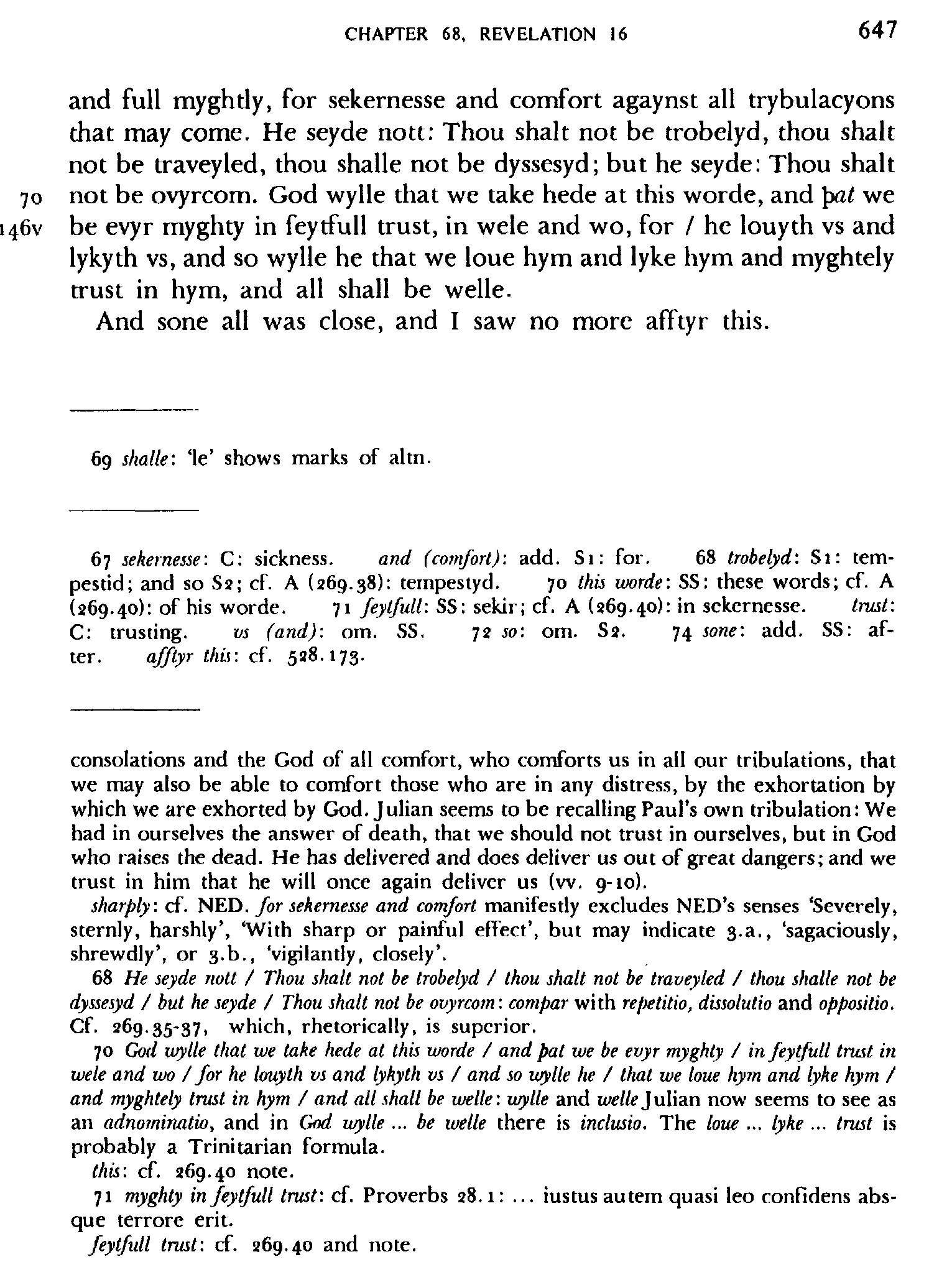
CHAPTER 68, REVELATION 16
and full myghtly, for sekernesse and comfort agaynst all trybulacyons that may come. He seyde nott: Thou shalt not be trobelyd, thou shalt not be traveyled, thou shalle not be dyssesyd; but he seyde: Thou shalt
70 not be ovyrcom. God wylle that we take hede at this worde, and \>at we i46v be evyr myghty in feytfull trust, in wele and wo, for / he louyth vs and lykyth vs, and so wylle he that we loue hym and lyke hym and myghtely trust in hym, and all shall be welle.
And sone all was close, and I saw no more afftyr this.
69 shalle: 'Ie' shows marks of altn.
67 sekernesse: C: sickness. and (comfort): add. Si: for.
68 trobelyd: Si: tempestid; and so Sa; cf. A (269.38): ternpestyd.
70 this worde: SS: these words; cf. A (269.40): of his worde.
71 feytfull: SS: sekir; cf. A (269.40): in sekernesse. trust:
C: trusting. vs (and): om. SS.
72 so: om. 82.
74 sone: add. SS: after, afftyr this: cf. 528.173. consolations and the God of all comfort, who comforts us in all our tribulations, that we may also be able to comfort those who are in any distress, by the exhortation by which we are exhorted by God. Julian seems to be recalling Paul's own tribulation: We had in ourselves the answer of death, that we should not trust in ourselves, but in God who raises the dead. He has delivered and does deliver us out of great dangers; and we trust in him that he will once again deliver us (w. 9-10). sharply: cf. NED. for sekernesse and comfort manifestly excludes NED's senses 'Severely, sternly, harshly', 'With sharp or painful effect', but may indicate 3.3., 'sagaciously, shrewdly', or 3-b., Vigilantly, closely'.
68 He seyde nott / Thou shalt not be trobelyd / thou shalt not be traveyled / thou shalle not be dyssesyd / but he seyde / Thou shalt not be ovyrcom: compar with repetitio, dissolutio and oppositio.
Cf. 269.35-37, which, rhetorically, is superior.
70 God wylle that we take hede at this worde / and pat we be evyr myghty / in feytfull trust in wele and wo /for he louyth vs and lykyth vs / and so wylle he / that we loue hym and lyke hym / and myghtely trust in hym / and all shall be welle: wylle and welle Julian now seems to see as an adnorniruitio, and in God wylle ... be welle there is indusio. The loue ... lyke ... trust is probably a Trinitarian formula. this: cf. 269.40 note.
71 myghty in feytfull trust: cf. Proverbs 28. i: ... Justus autern quasi leo confidens absque terrore erit. feytfull trust: cf. 269.40 and note.
THE LONG TEXT
The Ixix Chapter The feende came agayne -with his heet and with his stynch, and made me fulle besy. The stynch was so vyle and so paynfulle, and bodely heet also dredfull and traveylous; also I harde a bodely talkyng, as it had
5 been of two bodyes, and both to my thyngkyrcg talkyd at one tyme, as they had holde a perlement with greate besynes, and all was softe whystryn. And I vnderstode nott what they seyd, and alle this was to stere me to dyspere, as me thought, semyng to me as they scornyd byd1471 dyng of bedys whych are seyde boystosly with moch faylyng / devout ini The Ixix Chapter: om. Si (cf. 644.46), and add: Of the second long temptation of the devill to despeir, but she mytyly trosted to god and to the feith of holy church, rehersing the passion of Christe, be pe which she was deliverid; and so 82.
2 The feende: Si:
Aftir this the fend (cf. 647.74); and so 82.
3 bodely heet: om. SS.
4 talkyng: Si: jangeling; and so 82 ; cf. A (270.4): iangelynge.
5 talkyd: Si: janglyd; and so 82; cf.
A (270.5): iangled. as: add. SS: if.
6 with: add. SS: a.
7 whystryn: C: whistering; SS: muttering; cf. A (270.6): mutterynge.
And (I): SS: as.
9 boystosly: 82: boisterously. moch: 82: mouth. faylyng: add. C: of. i The Ixix Chapter: cf. app. crit. and 639. i, 644.46, notes. 82 agrees with P, C; and Si, though it does not number the chapter, makes its usual break in the lines before and after the chapter-heading.
3 The stynch was so vyle ... and bodely heet also dredfull: cf. 637.17 note.
4 a bodely talkyng: in a satiric poem, On Chattering in Church, women who do so are called 'al of the deuelis rowte' (C. Brown, XV 277). One of the desert fathers saw a crowd of demons circling such a man's head like bees, and grinding their teeth over him
(De vitis patrum, VI, PL 73 994). Cf. the Ancrene Riwle, where Mary's taciturnity is contrasted with the garrulity to which the devil tempted Eve (e.g. Tolkien, 35 e.s.).
6 perlement with greate besynes: Cassian reports a vision granted to one of the brethren, in which demons were gathered in quodam tribunali, where the leader uniuscuinsque actus diligenti coepit examinatione ducutere (Conlationes VIII 16; Petschenig, 232).
7 whystryn: 'whispering'. The etymology is dubious, and the earliest examples in NED, MED are 1382, the first Wycliffite Bible. to stere me to dyspere: cf. the Chastising: Also sum bien ... stired and priked: sum bien taried and troublid wi{> sum ternptaciones a3ens her wil, wipouten any assentyng, as wip dispeir and obstinacie (Bazire and Colledge, 167).
8 as they scornyd byddyng of bedys whych are seyde boystosly: 'as if they were mocking the recitation of prayers which are said imperfectly'. scornyd: cf. NED, which quotes the Prick of Conscience, 1189: Bot pa pat wille him folow he ledes / And pam scornes and taries in his nedes (this is written of the world, that is, of the pride of life; Morris, 33).
9 bedys: 'prayers'. MED, bede, 3 a., gives 'rosary' as the meaning, citing Piers Plowman
A.V 8 (Skeat i, 123), but diis is anachronistic; the very earliest pictorial representations
CHAPTER 69, REVELATION 16
10 tendyng and wyse diligence, the whych we owe to god in oure prayer.
And oure good lorde god gaue me grace myghtly to trust in hym and to comfort my soule with bodely spech, as I shulde a done to a nother person \>at had been traveyled. Me thought that besynes myght nott be lykened to no bodely lykenesse.
10 prayer: 82: prayers.
11 good: om. SS. to (trust): Si: for to.
14 lykenesse:
Si: bysynes; and so 82; cf. A (270.11): besenes. of rosary beads which Eithne Wilkins was able to date are of the early 14005 (The RoseGarden Game), boystosly: NED: 'Of uncertain etymology ... The phonology and form suggest French origin, and in form the ME word exactly answers to OFr boisteus ... lame; but no connexion of sense appears to be traceable'; but MED records 'c. 1450, Pilg.L.M. 108: the goutous, the encrampised, the boistous ...', and 'lamely' perfectly fits this context. Cf.
362.22, boystours, and note.
11 gaue me grace: cf. the short text: / trlste besely in god ... This alteration is typical of Julian's theological thoroughness in her second recension: there is no trust nor comfort in the order of salvation except that which is specifically given. She would think that / triste besely could be interpreted in a semi-Pelagian way. myghtly to trust in hym: cf. 269.42. is as I shulde a done: she is writing with the assurance of a spiritual director, in the contemplative context of diabolic illusions. The counsel which she gives herself follows directly.
14 lykenesse: the SS readings provide one of numerous instances that, even if their text were derived from an ancestor which P shared, there had been careful collation with a short text having readings agreeing with A; but either reading is defensible. A (270.10):
'It seemed to me that this activity could not be compared with any human activity'; P:
'... with any bodily apparition'.
THE LONG TEXT The Ixx Chapter Mi bodely eye I sett in the same crosse there I had seen in comforte afore \>at tyme, my tong with spech of Cristes passion and rehersyng the feyth of holy church, and my harte to fasten on god -with alle the truste i InSS, no chapter-division or heading. a there: Si: wher; and so 82. seen: Si: ben; and so 82; cf. A (270.12): sene.
3 my tong with spech: cf. A (270.12-13): my tunge I occupyed with speche.
2 Mi bodely eye ... seyde afore (651.16): this corresponds with the short text, 270.11-25.
Mi bodely eye I sett in the same crosse / there I had seen in comforte afore pat tyme / my tong with spech of Cristes passion / and rehersyng the feyth of holy church / and my harte to fasten on god / with alle the truste and pe myghte / that I thought to my selfe menyng / thou hast now great besenes / to kepe the in pe feyth / for pat thou shuldest nott / be taken ofthyne enemys / Woldest thou now fro this tyme evyr more / be so besy to kepe pefro synne / this were a good and a souereyne occupacion / For I thought fay thfully / were I safe fro synne / I werefulle safe /fro alle thefeendys in helle / and enemys of my soule: cf. the short text, 270.11-19. The rhetorical structure of the passage has been polished, and the changes and additions are also of considerable theological significance. All the balanced cola are now made to depend on the first two:
Mi bodely eye I sett... afore pat tyme. She wishes to write that she can use her external senes to respond to the image of the crucified Saviour, whom she has also seen glorified in comforte); she rejoices in her sufferings when she is comforted (cf. Colossians 1.24) in haring Christ's sufferings (cf. Philippians 3.10); she can also, in that recollection,
;spond with her inward senses (my harte) in affective prayer. This is the contemplative
Tort as she has described it in Revelation II: And this vision was a lemyng to my vnrstandyng that the contynually sekyng of the soule plesyth god moch. For it may do no more than
'e, suffer and trust (332.68-70). my ... my ... my gives repetitio; thou hast now great besenes / to ie the in pe feyth /for pat thou shuldest nott I be taken of thyne enemys is exclamatio, which o becomes a form of ratiocinatio, with a wish instead of a question, but still a <7wAAoy4<j/io$ (cf. 643.38-45 note); and these four cola are the statement of what she is now doing which sums up what has gone before. For I thought faythfully ... expands the apodosis of the conditional.
3 my tong with spech of Cristes passion and rehersyng the feyth of holy church: she repeated prayers and creeds to ward off diabolic temptation. Ludolph of Saxony, Vita I Ixxii, has a prayer: Opto etiam et desidero ... ut quotiescumque malignus spiritus abominandas cogitationes blasphemiae mihi immiserit, toties ex voto omnium desideriorum meorum ineffabilis laus et gratiarum actio tibi sit (Rigollot, 2 221). rehersyng the feyth: the author of the Ancrene Riwle has this gloss on Hebrews 11.33: J>e holy halewen alle ou^rcomen Jjorw bileeue |>is deueles rixlynge (Vernon MS, f. 383°;
Day, 111).
4 to fasten: cf. 270.14: Ifestende; there is no reason to regard the long text's reading as inferior, any more than faythfully need be rejected for sothly (270.18). They are both significant changes; Julian can no longer say 'I fastened', only 'I directed my heart towards being fastened'.
CHAPTER 70, REVELATION 16
5 and J>e myghte, that I thought to my selfe, menyng: thou hast now great besenes to kepe the in £e feyth, for }>at thou shuldest nott be taken of thyne enemys. Woldest thou now fro this tyme evyr more be so besy to i47v kepe {>e fro synne, this / were a good and a souereyne occupacion. For I thought faythfully, were I safe fro synne I were fulle safe fro alle the 10 feendys in helle and enemys of my soule.
And thus he occupyed me alle that nyght and on }>e morow tylle it was about pryme day, and anon they were alle goone and passyd, and there lefte nothyng but stynke; and that lastyd styll a whyle. And I scornede hym, and thus was I delyured of hym by be vertu of Crystes
15 passion. For ther with is be feend ovyrcome, as oure lorde Jhmi Cryst seyde afore.
In alle this blessyde shewyng oure good lorde gave vnderstandyng \>at 5 myghte, that I thought: cf. A (270.15): myght that was in me. And I thou3t. that:
SS: and.
6 pat: om.
SS.
7 thyne: Si: the; and so 82. enemys: 82: enimy.
8 a (souereyne): om. 82.
9 faythfully: Si: sothly; and so 82; cf. A (270.18): sothlye.
10 in: 88: of.
11 morow: SS: morne.
12 and (passyd): add. SS: all.
13 there:.82: tyn. that: om. C. styll: 82: till.
14 hym (by): Si: hem.
17 In alle this: add. Si: In all tribulation we owe to be stedfast in the feith, trosting mytyly in god, for if our faith had no enimyte it should deserve no mede, and how all these shewings arn in the faith. Ixx capt.; and so 82.
11 he: cf. 270.20, thay, which is probably what Julian wrote here; but he (the feende,
648.2) is defensible. In Privy Counselling, the Cloud-author, writing of the three spirits of wickedness, has: ... pou schalt not be takyn by no sleist ne gile of pin enemys, pe feend and his fautours, pe woreld and pi flessche (Hodgson, Cloud, 148-149).
12 pryme day: cf. 270.21 note.
13 / scornede hym: this is the counsel of the Ancrene Riwle: Spite him a midde pe bert to hoker and to scorn pat flikerejj so with pe (Vernon MS, f. 385°; Day, 131). Cf. the Chastising: Also it is grete confusion to pe deuel whan he is repreued and dispised ... f>erfor it is a spedeful remedie, whan a man or womman feelil> ony stirynge of pese temptacions, anoon panne to speke out and seie, pat pe deuel may knowe what a man sei|> to his shame and confusion (Bazire and Colledge, 204).
14 hym: cf. 270.23, thame with which Si's hem agrees.
15 as oure lorde Jhesu Cryst seyde afore: cf. 346.7.
17 In alle this blessyde shewyng / oure good lorde gave vnderstandyng / pat pe syght shulde passe
/ whych blessyd shewyng the feyth kepyth / with his owne good wylle and his grace / for he lefte with me neyther sygne ne tokyn / where by I myght know it / But he lefte with me his owne blessyd worde / in tru vnderstandyng / byddyng me fulle myghtly that I shulde beleue it / and so I do blessyd molt he be: here Julian is assembling and setting out her probatio; alle this blessyde shewyng probably refers directly to Revelation XVI and the consequent locution, but this, as she writes at the beginning, is conclusion and confirmation to all fifteen. Cf.
632.3. At this point she is clear in her mind that though the showings are the
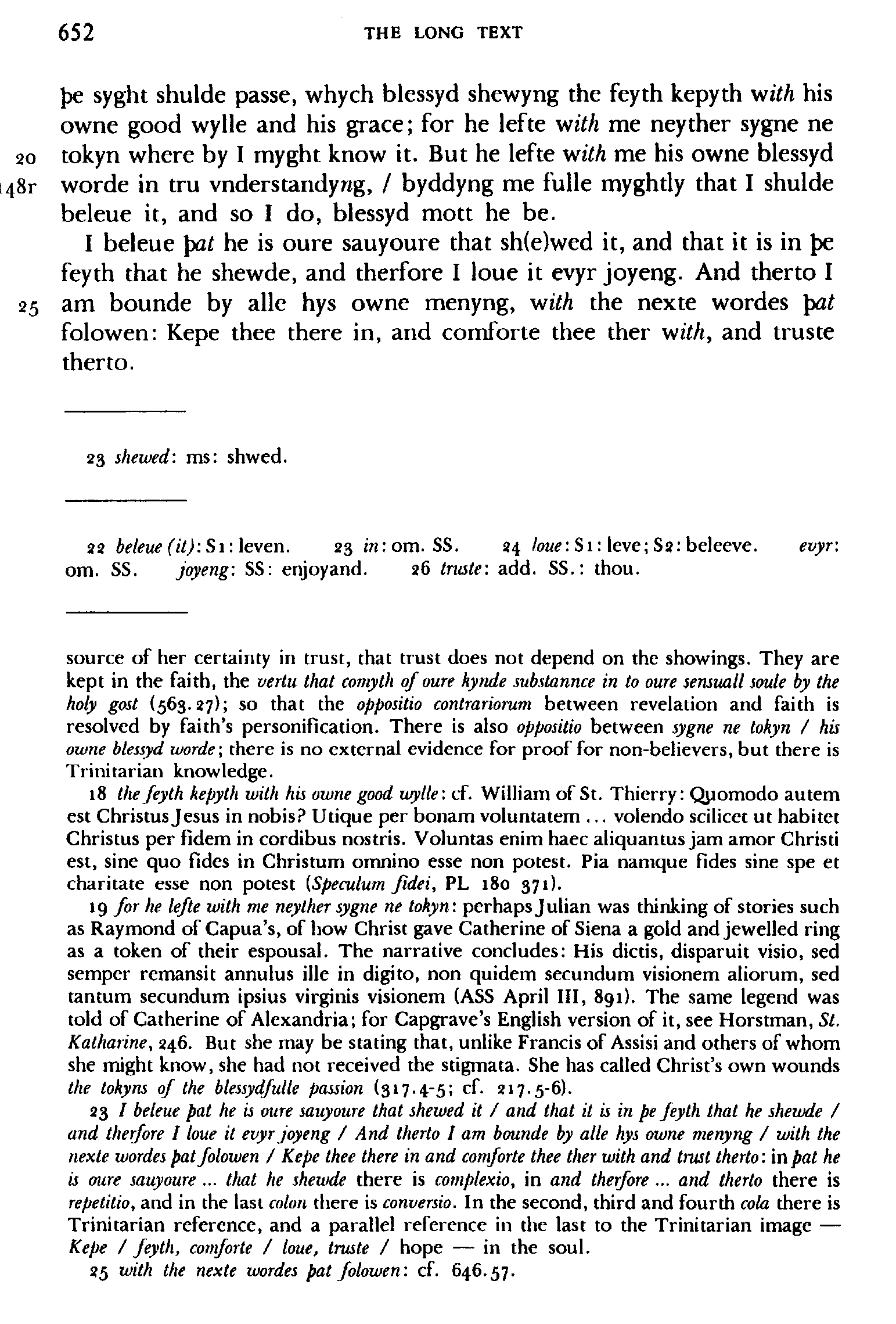
THE LONG TEXT
pe syght shulde passe, whych blessyd shewyng the feyth kepyth with his owne good wylle and his grace; for he lefte with me neyther sygne ne
20 tokyn where by I myght know it. But he lefte with me his owne blessyd i48r worde in tru vnderstandywg, / byddyng me fulle myghtly that I shulde beleue it, and so I do, blessyd mott he be.
I beleue pa/ he is oure sauyoure that sh(e)wed it, and that it is in pe feyth that he shewde, and therfore I loue it evyr joyeng. And therto I 25 am bounde by alle hys owne menyng, with the nexte wordes \>at folowen: Kepe thee there in, and comforte thee ther with, and truste therto.
23 shewed: ms: shwed.
22 beleue (it): S i: leven.
23 in: om. SS.
24 loue: S i: leve 582: beleeve. evyr; om. SS. joyeng: SS: enjoyand.
26 truste: add. SS.: thou. source of her certainty in trust, that trust does not depend on the showings. They are kept in the faith, the vertu that comyth of oure kynde substannce in to oure sensuall soule by the holy gost (563.27); so that the oppositio contrariorum between revelation and faith is resolved by faith's personification. There is also oppositio between sygne ne tokyn / his owne blessyd worde; there is no external evidence for proof for non-believers, but there is
Trinitarian knowledge.
18 the feyth kepyth with his owne good wylle: cf. William of St. Thierry: Quomodo autem est Christus Jesus in nobis? Utique per bonam voluntatem ... volendo scilicet ut habitct
Christus per fidem in cordibus nostris. Voluntas enim haec aliquantus jam amor Christ! est, sine quo fides in Christum omnino esse non potest. Pia namque fides sine spe et charitate esse non potest (Speculum fidei, PL 180 371).
19 for he lefte with me neylher sygne ne tokyn: perhaps Julian was thinking of stories such as Raymond of Capua's, of how Christ gave Catherine of Siena a gold and jewelled ring as a token of their espousal. The narrative concludes: His dictis, disparuit visio, sed semper remansit annulus ille in digito, non quidem secundum visionem aliorum, sed tantum secundum ipsius virginis visionem (ASS April III, 891). The same legend was told of Catherine of Alexandria; for Capgrave's English version of it, see Horstman, St.
Katharine, 246. But she may be stating that, unlike Francis of Assisi and others of whom she might know, she had not received the stigmata. She has called Christ's own wounds the tokyns of the blessydfulle passion (317.4-5; cf. 217.5-6).
23 / beleue pat he is oure sauyoure that shewed it / and that it is in pe feyth that he shewde / and therfore I loue it evyr joyeng /And therto I am bounde by alle hys owne menyng / with the nexte wordes pat folowen / Kepe thee there in and comforte thee ther with and trust therto: in pat he is oure sauyoure ... that he shewde there is complexio, in and therfore ... and therto there is repetitio, and in the last colon there is conversio. In the second, third and fourth cola there is
Trinitarian reference, and a parallel reference in the last to the Trinitarian image —
Kepe /feyth, comforte / loue, truste / hope — in the soul.
25 with the nexte wordes pat folowen: cf. 646.57.
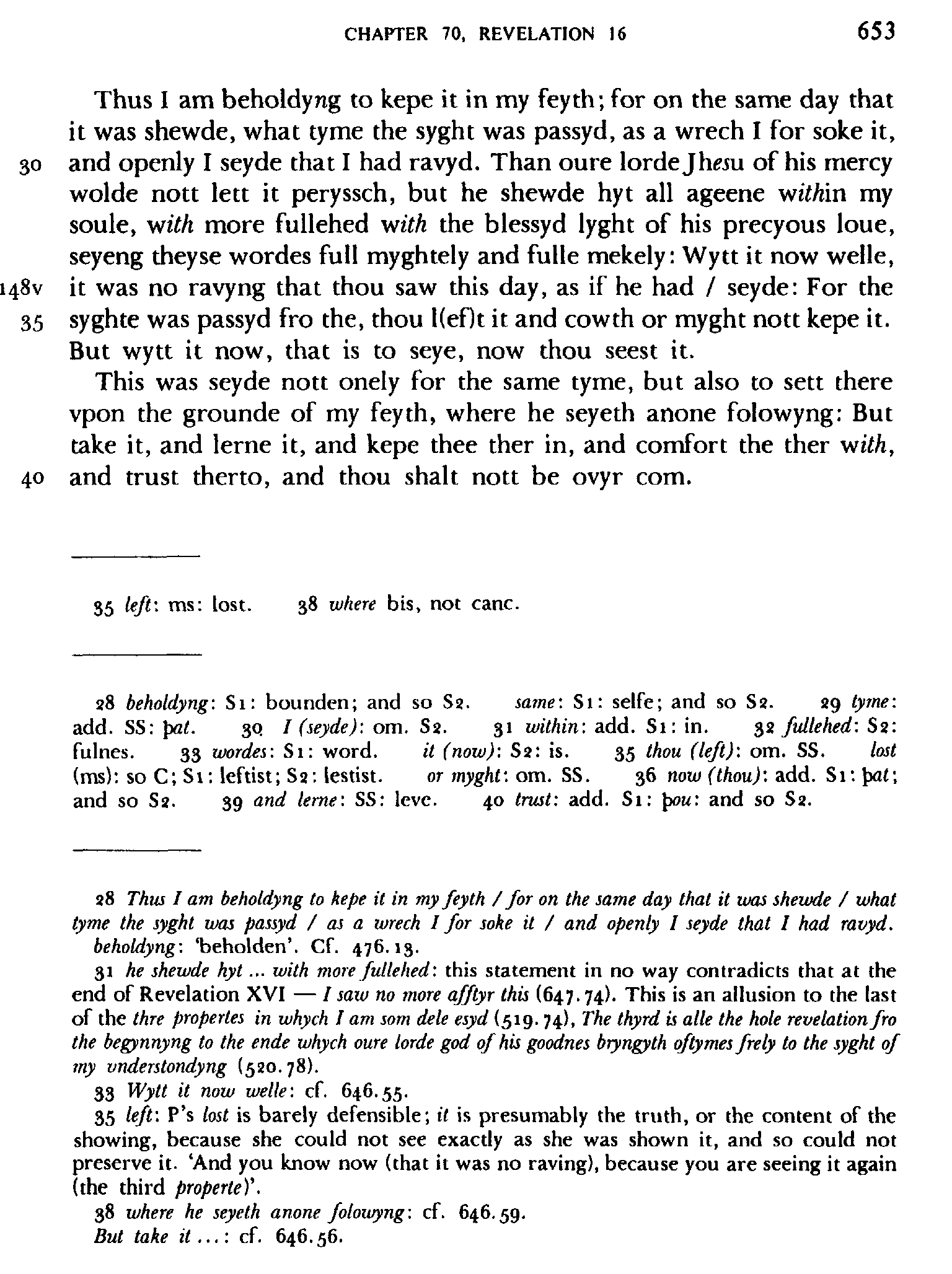
CHAPTER 70, REVELATION 16
Thus I am beholdyng to kepe it in my feyth; for on the same day that it was shewde, what tyme the syght was passyd, as a wrech I for soke it,
30 and openly I seyde that I had ravyd. Than oure lordejhem of his mercy wolde nott lett it peryssch, but he shewde hyt all ageene -within my soule, with more fullehed with the blessyd lyght of his precyous loue, seyeng theyse wordes full myghtely and fulle mekely: Wytt it now welle, i48v it was no ravyng that thou saw this day, as if he had / seyde: For the 35 syghte was passyd fro the, thou l(ef)t it and cowth or myght nott kepe it.
But wytt it now, that is to seye, now thou seest it.
This was seyde nott onely for the same tyme, but also to sett there vpon the grounde of my feyth, where he seyeth anone folowyng: But take it, and lerne it, and kepe thee ther in, and comfort the ther with,
40 and trust therto, and thou shalt nott be ovyr com.
35 left: ms: lost.
38 where bis, not cane.
28 beholdyng: Si: bounden; and so 82. same: Si: selfe; and so 82.
29 tyme: add. SS: pat.
3Q I (seyde): om. 82.
31 within: add. Si: in.
32 fullehed: 82: fulnes.
33 wordes: Si: word. it (now): 82: is.
35 thou (left): om. SS. lost (ms): so C; Si: leftist; 82: lestist. or myght: om. SS.
36 now (thou): add. Si: ^at\ and so 82.
39 and lerne: SS: levc.
40 trust: add. Si: \x>u: and so 82.
28 Thus I am beholdyng to kepe it in my feyth /for on the same day that it was shewde / what tyme the syght was passyd / as a wrech I for sake it /and openly I seyde that I had ravyd. beholdyng: 'beholden'. Cf. 476.13.
31 he shewde hyt... with more fullehed: this statement in no way contradicts that at the end of Revelation XVI — / saw no more afftyr this (647.74). This is an allusion to the last of the thre propertes in whych I am som dele esyd (519. 74), The thyrd is alle the hole revelation fro the begynnyng to the ende whych oure lorde god of his goodnes bryngyth oftymesfrely to the syght of my vnderstondyng (520.78).
33 Wytt it now welle: cf. 646.55.
35 left: P's lost is barely defensible; it is presumably the truth, or the content of the showing, because she could not see exactly as she was shown it, and so could not preserve it. 'And you know now (that it was no raving), because you are seeing it again
(the third properteY.
38 where he seyeth anone folowyng: cf. 646.59.
But take it...: cf. 646.56.
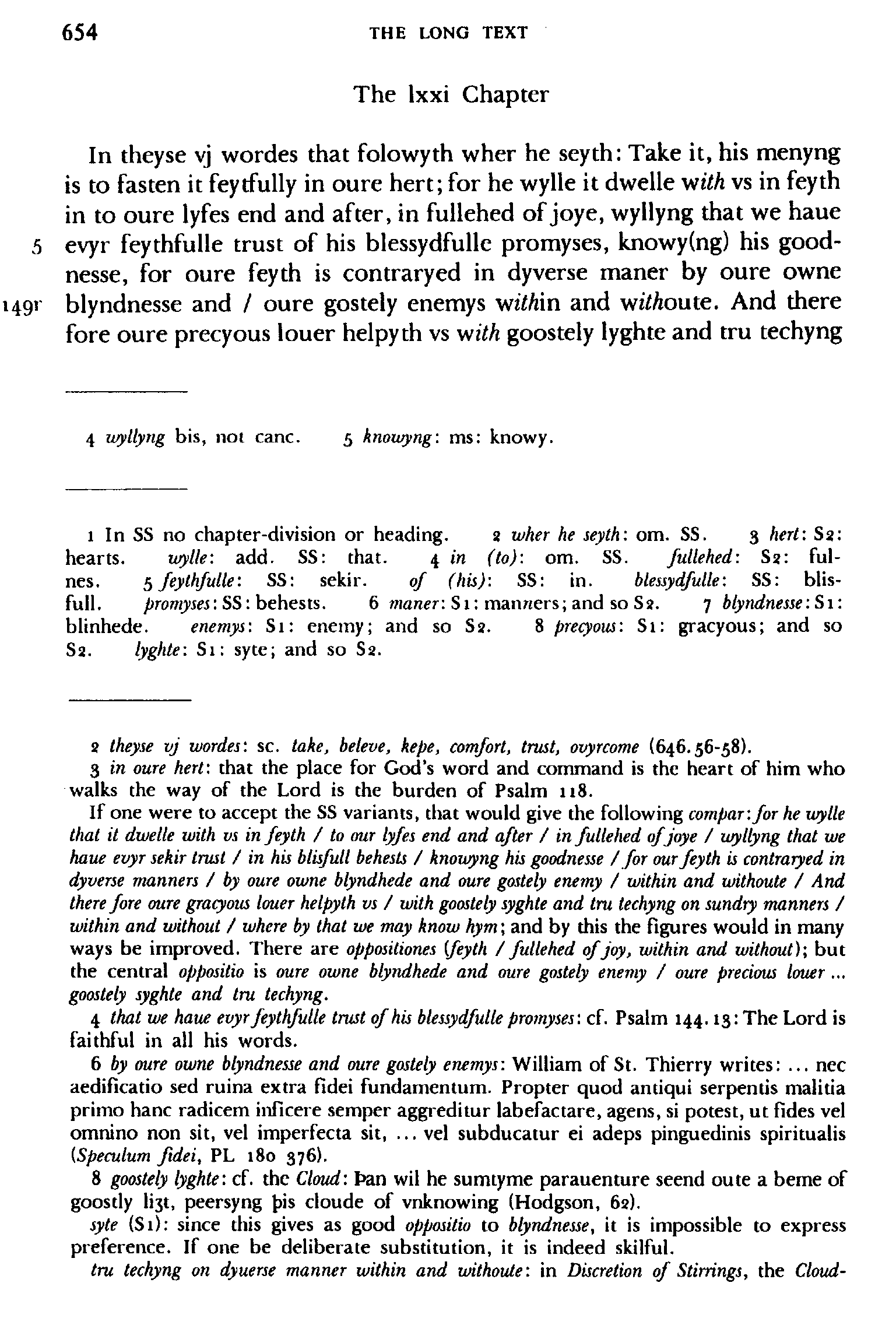
THE LONG TEXT
The Ixxi Chapter In theyse vj wordes that folowyth wher he seyth: Take it, his menyng is to fasten it feytfully in cure hert; for he wylle it dwelle with vs in feyth in to oure lyfes end and after, in fullehed of joye, wyllyng that we haue
5 evyr feythfulle trust of his blessydfulle promyses, knowy(ng) his goodnesse, for oure feyth is contraryed in dyverse maner by oure owne
491 blyndnesse and / oure gostely enemys within and withoute. And there fore oure precyous louer helpyth vs with goostely lyghte and tru techyng
4 wyllyng bis, not cane.
5 knowyng: ms: knowy. i In SS no chapter-division or heading.
2 wher he seyth: om. SS.
3 hert: 82: hearts. ivylle: add.
SS: that.
4 in (to): om.
SS. fullehed:
82: fulnes.
5 feythfulle:
SS: sekir. of (his):
SS: in. blessydfulle:
SS: blisfull. promyses: SS: behests.
6 maner: Si: manners; and so 82.
^ blyndnesse: Si: blinhede. enemys: Si: enemy; and so 82.
8 precyous: Si: gracyous; and so 82. lyghte: Si: syte; and so 82.
2 theyse vj wordes: sc. take, beleve, kepe, comfort, trust, ovyrcome (646.56-58).
3 in oure hert: that the place for God s word and command is the heart of him who walks the way of the Lord is the burden of Psalm 118.
If one were to accept the 88 variants, that would give the following compar:for he wylle that it dwelle with vs in feyth / to our lyfes end and after / in fullehed of joye / wyllyng that we haue evyr sekir trust / in his blisfull behests / knowyng his goodnesse /for our feyth is contraryed in dyverse manners / by oure owne blyndhede and oure gostely enemy / within and withoute / And there fore oure gracyous louer helpyth vs I with goostely syghte and tru techyng on sundry manners / within and without / where by that we may know hym; and by mis the figures would in many ways be improved. There are oppositiones (feyth /fullehed of joy, within and without); but the central oppositio is oure owne blyndhede and oure gostely enemy / oure precious louer ... goostely syghte and tru techyng.
4 that we haue evyr feythfulle trust of his blessydfulle promyses: cf. Psalm 144.13: The Lord is faithful in all his words.
6 by oure owne blyndnesse and oure gostely enemys: William of St. Thierry writes: ... nee aedificatio sed ruina extra fidei fundarnentum. Propter quod antiqui serpentis malitia primo hanc radicem inficere semper aggreditur labefactare, agens, si potest, ut fides vel omnino non sit, vel imperfecta sit, ... vel subducatur ei adeps pinguedinis spiritualis
(Speculum ftdei, PL 180 376).
8 goostely lyghte: cf. the Cloud: Pan wil he sumtyme parauenture seend oute a beme of goostly lijt, peersyng J>is cloude of vnknowing (Hodgson, 62). syte (Si): since this gives as good oppositio to blyndnesse, it is impossible to express preference. If one be deliberate substitution, it is indeed skilful. tru techyng on dyuerse manner within and withoute: in Discretion of Stirrings, the Cloud-
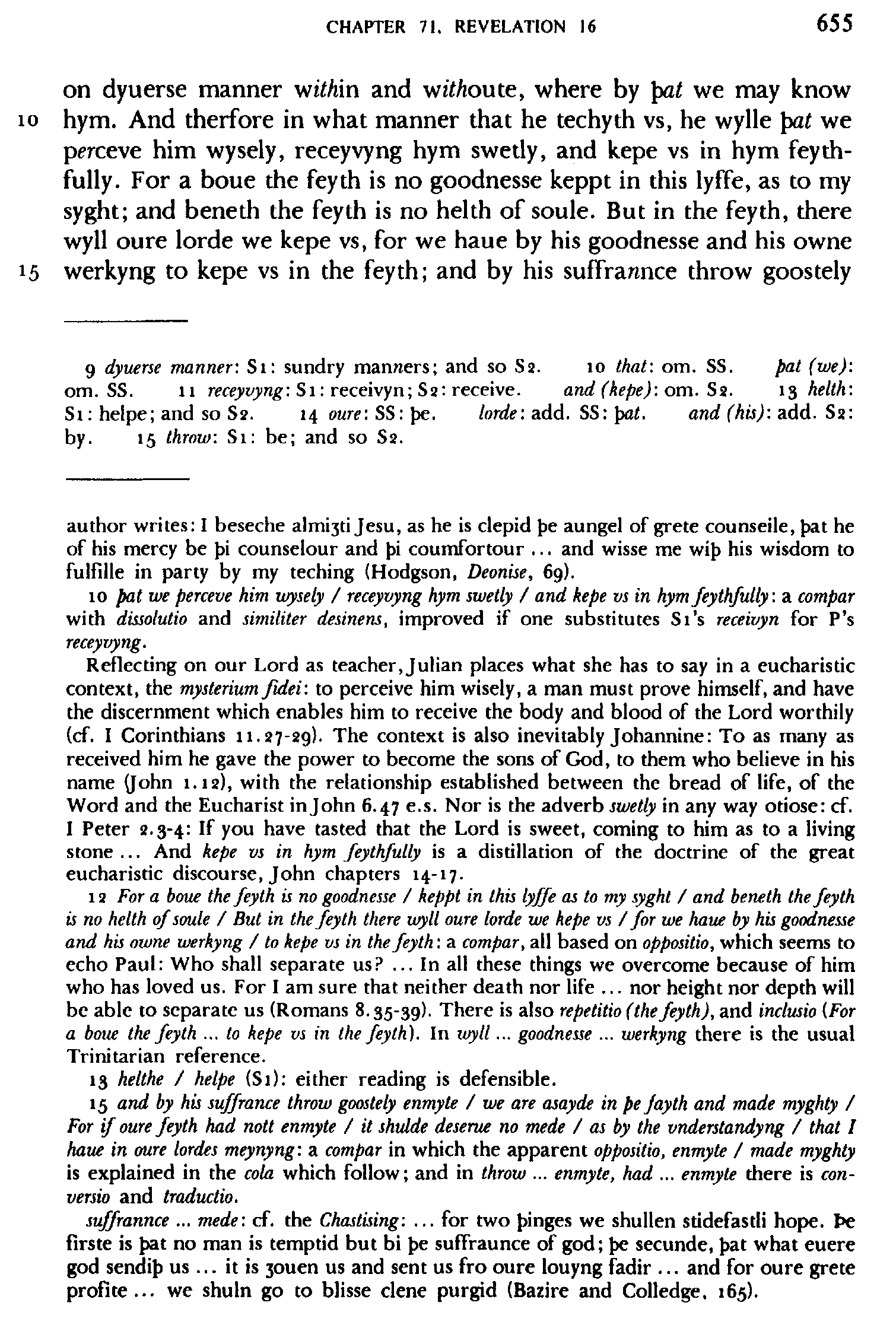
CHAPTER 71. REVELATION 16
on dyuerse manner within and w^/ioute, where by \at we may know 10 hym. And therfore in what manner that he techyth vs, he wylle Ipat we p^rceve him wysely, receyvyng hym swetly, and kepe vs in hym feythfully. For a boue the feyth is no goodnesse keppt in this lyffe, as to my syght; and beneth the feyth is no helth of soule. But in the feyth, there wyll oure lorde we kepe vs, for we haue by his goodnesse and his owne
15 werkyng to kepe vs in the feyth; and by his suffrannce throw goostely 9 dyuerse manner: Si: sundry manners; and so 82.
10 that: om. SS. pat (we): om. SS.
11 receyvyng: Si: receivyn; Sa: receive. and (kepe): om. 82.
13 helth:
Si: helpe; and so 82.
14 oure: 88: pe. lorde: add. SS: ]xit. and (his): add. 82: by.
15 throw: Si: be; and so 82. author writes: I beseche alrr^tijesu, as he is clepid pe aungel of grete counseile, pat he of his mercy be pi counselour and pi coumfortour ... and wisse me wip his wisdom to fulfille in party by my teching (Hodgson, Deonise, 69).
10 pat we perceve him wysely / receyvyng hym swetly / and kepe vs in hymfeythfully: a compar with dissolutio and similiter desinens, improved if one substitutes Si's receivyn for P's receyvyng.
Reflecting on our Lord as teacher, Julian places what she has to say in a eucharistic context, the mysterium fidel: to perceive him wisely, a man must prove himself, and have the discernment which enables him to receive the body and blood of the Lord worthily
(cf. I Corinthians 11.27-29). The context is also inevitably Johannine: To as many as received him he gave the power to become the sons of God, to them who believe in his name (John 1.12), with the relationship established between the bread of life, of the Word and the Eucharist in John 6.47 e.s. Nor is the adverb swetly in any way otiose: cf.
I Peter 2.3-4: If you have tasted that the Lord is sweet, coming to him as to a living stone ... And kepe vs in hym feythfully is a distillation of the doctrine of the great eucharistic discourse, John chapters 14-17.
12 For a boue the feyth is no goodnesse / keppt in this lyffe as to my syght / and beneth the feyth is no helth of soule / But in the feyth there wyll oure lorde we kepe vs /for we haue by his goodnesse and his owne werkyng / to kepe vs in the feyth: a compar, all based on oppositio, which seems to echo Paul: Who shall separate us? ... In all these things we overcome because of him who has loved us. For I am sure that neither death nor life ... nor height nor depth will be able to separate us (Romans 8.35-39). There is also repetitio (the feyth), and inclusio (For a boue the feyth ... to kepe vs in the feyth). In wyll... goodnesse ... werkyng there is the usual
Trinitarian reference.
13 helthe / helpe (Si): either reading is defensible.
15 and by his suffrance throw goostely enmyte / we are asayde in pefayth and made myghty /
For if oure feyth had nott enmyte / it shulde deserue no mede / as by the vnderstandyng / that I haue in oure lordes meynyng: a compar in which the apparent oppositio, enmyte I made myghty is explained in the cola which follow; and in throw ... enmyte, had ... enmyte there is conversio and traductio. suffrannce ... mede: cf. the Chastising: ... for two pinges we shullen stidefastli hope. t>e firste is pat no man is temptid but bi pe suffraunce of god; pe secunde, pat what euere god sendip us... it is 3ouen us and sent us fro oure louyng fadir ... and for oure grete profile... we shuln go to blisse clene purgid (Bazire and Colledge. 165).
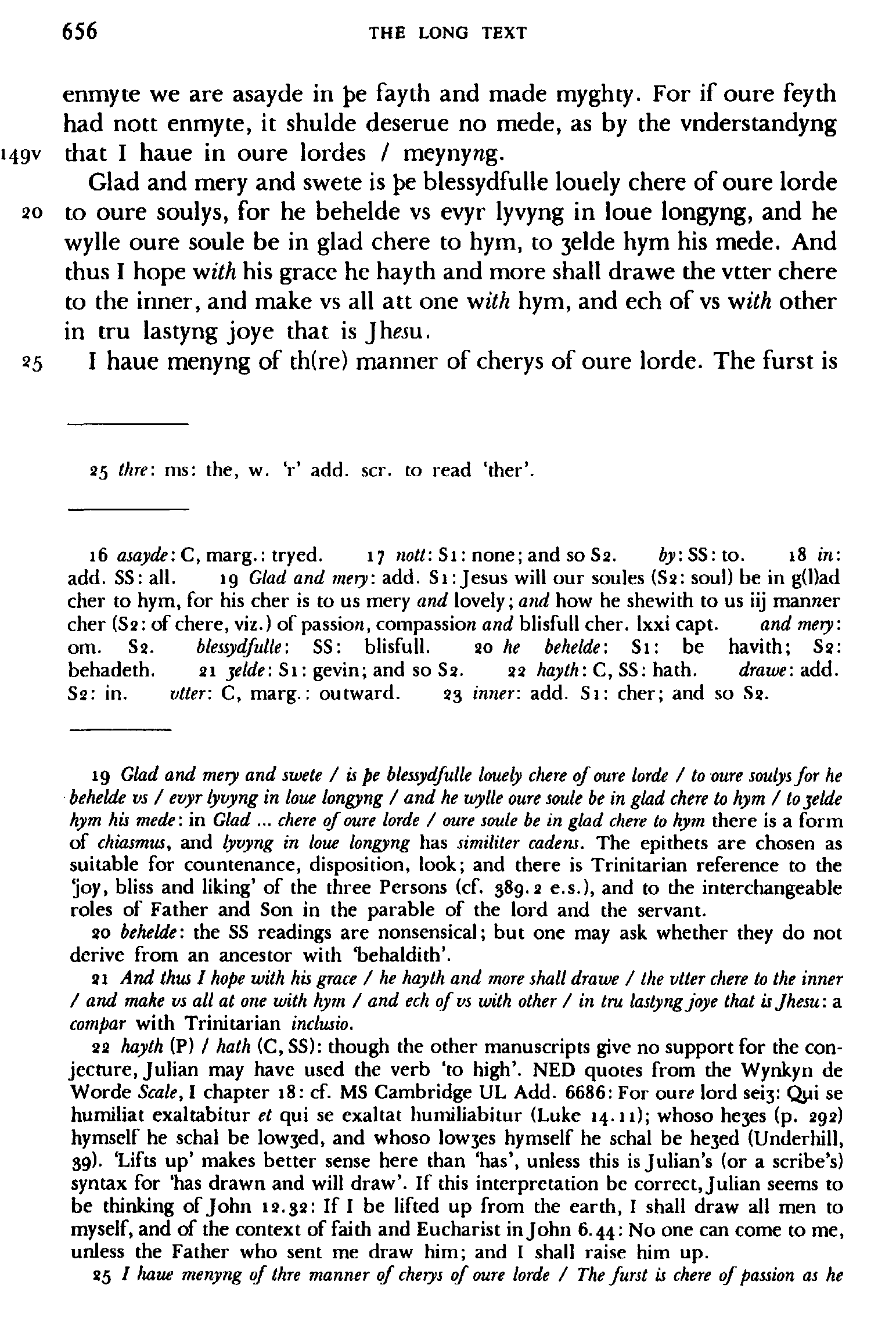
THE LONG TEXT
enmyte we are asayde in be fayth and made myghty. For if oure feyth had nott enmyte, it shulde deserue no mede, as by the vnderstandyng
H9v that I haue in oure lordes / meynyng.
Glad and mery and swete is be blessydfulle louely chere of oure lorde 20 to oure soulys, for he behelde vs evyr lyvyng in loue longyng, and he wylle oure soule be in glad chere to hym, to 3elde hym his mede. And thus I hope with his grace he hayth and more shall drawe the vtter chere to the inner, and make vs all att one with hym, and ech of vs with other in tru lastyng joye that is Jhmi.
I haue menyng of th(re) manner of cherys of oure lorde. The furst is 25 thre: ms: the, w. V add. scr. to read 'ther'.
16 asayde: C, marg.: tryed.
17 nott: Si: none; and so 82.
£y:SS:to.
18 in: add. SS: all.
19 Glad and mery: add. Si: Jesus will our soules (82: soul) be in g(l)ad cher to hym, for his cher is to us mery and lovely; and how he shewith to us iij manner cher (82: of chere, viz.) of passion, compassion and blisfull cher. Ixxi capt. and mery: om.
82. blessydfulle:
SS: blisfull.
20 he behelde:
Si: be havith; 82: behadeth.
21 ylde: Si: gevin; and so 82.
22 hayth: C, SS: hath. drawe: add.
82: in. vtter: C, marg.: outward.
23 inner: add. Si: cher; and so 82.
19 Glad and mery and swete / is pe blessydfulle louely chere of oure lorde / to oure soulys for he behelde vs / evyr lyvyng in loue longyng / and he wylle oure soule be in glad chere to hym / to ylde hym his mede: in Glad ... chere of oure lorde / oure soule be in glad chere to hym there is a form of chiasmus, and lyvyng in loue longyng has similiter cadens. The epithets are chosen as suitable for countenance, disposition, look; and there is Trinitarian reference to the 'joy, bliss and liking' of the three Persons (cf. 389.2 e.s.), and to the interchangeable roles of Father and Son in the parable of the lord and the servant.
20 behelde: the SS readings are nonsensical; but one may ask whether they do not derive from an ancestor with "behaldith".
21 And thus I hope with his grace / he hayth and more shall drawe / the vtter chere to the inner
/ and make vs all at one with hym / and ech ofvs with other / in tru lastyng joye that isjhesu: a compar with Trinitarian inclusio.
22 hayth (P) / hath (C, 88): though the other manuscripts give no support for the conjecture, Julian may have used the verb 'to high'. NED quotes from the Wynkyn de
Worde Scale, I chapter 18: cf. MS Cambridge UL Add. 6686: For oure lord sei3: Qui se humiliat exaltabitur et qui se exaltat humiliabitur (Luke 14.11); whoso he3es (p. 292) hymself he schal be lowjed, and whoso lowses hymself he schal be hejed (Underbill,
39). 'Lifts up' makes better sense here than 'has', unless this is Julian's (or a scribe's) syntax for 'has drawn and will draw'. If this interpretation be correct, Julian seems to be thinking of John 12.32: If I be lifted up from the earth, I shall draw all men to myself, and of the context of faith and Eucharist in John 6.44: No one can come to me, unless the Father who sent me draw him; and I shall raise him up.
25 / haue menyng of thre manner of cherys of oure lorde / The furst is chere of passion as he
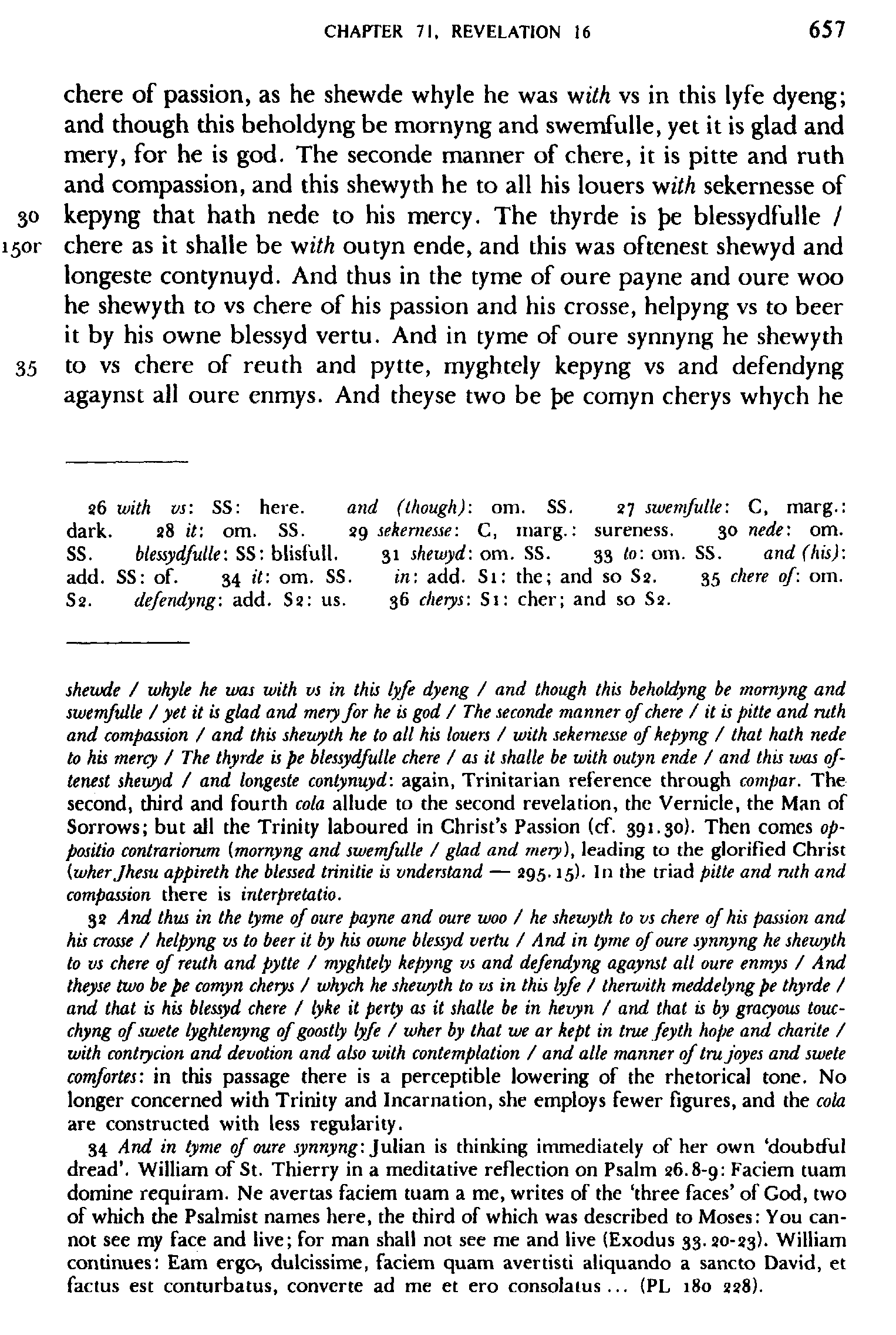
CHAPTER 71, REVELATION 16
chere of passion, as he shewde whyle he was with vs in this lyfe dyeng; and though this beholdyng be mornyng and swemfulle, yet it is glad and mery, for he is god. The seconde manner of chere, it is pitte and ruth and compassion, and this shewyth he to all his louers with sekernesse of 30 kepyng that hath nede to his mercy. The thyrde is J>e blessydfulle /
1501 chere as it shalle be with outyn ende, and this was oftenest shewyd and longeste contynuyd. And thus in the tyme of oure payne and oure woo he shewyth to vs chere of his passion and his crosse, helpyng vs to beer it by his owne blessyd vertu. And in tyme of oure synnyng he shewyth
35 to vs chere of reuth and pytte, myghtely kepyng vs and defendyng agaynst all oure enmys. And theyse two be pe comyn cherys whych he
26 with vs: SS: here. and (though): om.
SS.
27 swemfulle:
C, marg.: dark.
28 it: om.
SS.
29 sekemesse: C, marg.: sureness.
30 nede: om.
SS. blessydfulle: SS: blisf'ull.
31 shewyd: om. SS.
33 to: om. SS. and (his): add. SS: of.
34 it: om. SS. in: add. Si: the; and so 82.
35 chere of: om.
82. defendyng: add. 82: us.
36 cherys: Si: cher; and so S2. shewde / whyle he was with vs in this lyfe dyeng / and though this beholdyng be mornyng and swemfulle / yet it is glad and mery for he is god / The seconde manner of chere / it is pitte and ruth and compassion / and this shewyth he to all his louers / with sekernesse of hepyng / that hath nede to his mercy / The thyrde is pe blessydfulle chere / as it shalle be with outyn ende / and this was oftenest shewyd / and longeste contynuyd: again, Trinitarian reference through compar. The second, third and fourth cola allude to the second revelation, the Vernicle, the Man of Sorrows; but all the Trinity laboured in Christ's Passion (cf. 391.30). Then comes oppositio contrariorum (mornyng and swemfulle / glad and mery), leading to the glorified Christ
(wherjhesu appireth the blessed trinitie is vnderstand — 295.15). In the triad pitte and ruth and compassion there is interpretatio.
32 And thus in the tyme of oure payne and oure woo / he shewyth to vs chere of his passion and his crosse / helpyng vs to beer it by his owne blessyd vertu / And in tyme of oure synnyng he shewyth to vs chere of reuth and pytte / myghtely kepyng vs and defendyng agaynst all oure enmys / And theyse two be pe comyn cherys / whych he shewyth to vs in this lyfe / therwith meddelyng pe thyrde / and that is his blessyd chere / tyke it perty as it shalle be in hevyn / and that is by gracyous toucchyng ofswete lyghtenyng ofgoostly lyfe / wher by that we ar kept in true feyth hope and charite / with contrycion and devotion and also with contemplation / and alle manner oftrujoyes and swete comfortes: in this passage there is a perceptible lowering of the rhetorical tone. No longer concerned with Trinity and Incarnation, she employs fewer figures, and the cola are constructed with less regularity.
34 And in tyme of oure synnyng: Julian is thinking immediately of her own 'doubtful dread'. William of St. Thierry in a meditative reflection on Psalm 26.8-9: Faciem tuam domine requiram. Ne avertas faciem tuam a me, writes of the 'three faces' of God, two of which the Psalmist names here, the third of which was described to Moses: You cannot see my face and live; for man shall not see me and live (Exodus 33.20-23). William continues: Earn ergc^ dulcissime, faciem quam avertisti aliquando a sancto David, et factus est conturbatus, convene ad me et ero consolatus ... (PL 180 228).
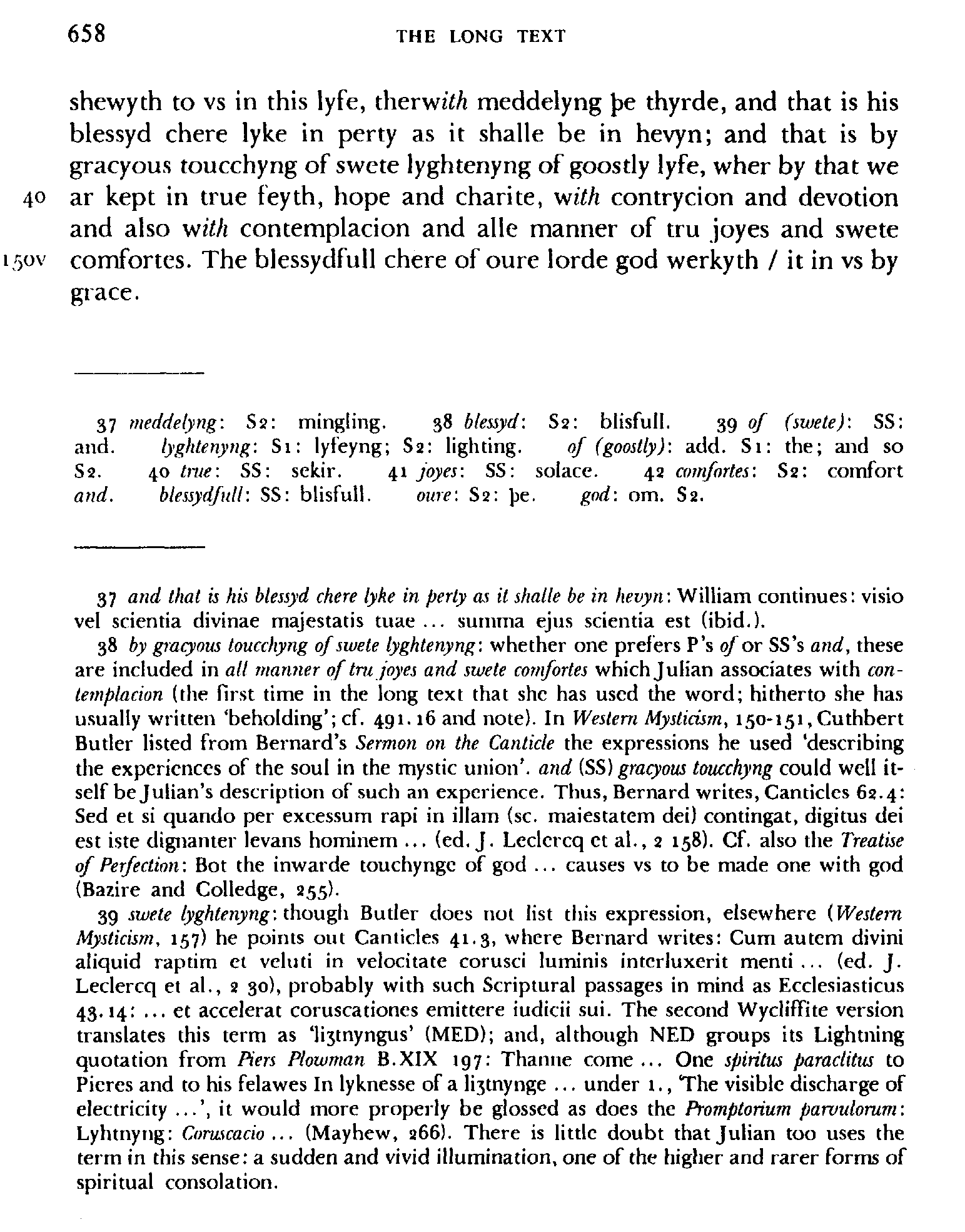
THE LONG TEXT
shewyth to vs in this lyfe, therw^/i meddelyng J>e thyrde, and that is his blessyd chere lyke in perty as it shalle be in hevyn; and that is by gracyous toucchyng of swete lyghtenyng of goostly lyfe, wher by that we
40 ar kept in true feyth, hope and charite, 'with contrycion and devotion and also with contemplacion and alle manner of tru joyes and swete i5ov comfortes. The blessydfull chere of oure lorde god werkyth / it in vs by grace.
37 meddelyng:
Sa: mingling.
38 blessyd:
82: blisfull.
39 of (swete):
SS: and. lyghtenyng: Si: lyfeyng; 82: lighting. of (goostly): add. Si: the; and so 82.
40 true: SS: sekir.
41 joyes: SS: solace.
42 comfortes:
82: comfort and. blessydfull: SS: blisfull. owe: 82: Jje. god: om. 82.
37 and that is his blessyd chere lyke in perty as it shalle be in hevyn: William continues: visio vel scientia divinae majestatis tuae ... suinma ejus scientia est (ibid.).
38 by gracyous toucchyng of swete lyghtenyng: whether one prefers P's of or SS's and, these are included in all manner of tru joyes and swete comfortes which Julian associates with contemplacion (the first time in the long text that she has used the word; hitherto she has usually written 'beholding'; cf. 491.16 and note). In Western Mysticism, 150-151, Cuthbert
Butler listed from Bernard's Sermon on the Canticle the expressions he used 'describing the experiences of the soul in the mystic union', and (SS) gracyous toucchyng could well itself be Julian's description of such an experience. Thus, Bernard writes, Canticles 62.4:
Sed et si quando per excessum rapi in illam (sc. maiestatem dei) contingat, digitus dei est iste dignanter levans hominem ... (ed. J. Leclcrcq et al., 2 158). Cf. also the Treatise of Perfection: Bot the inwarde touchyngc of god ... causes vs to be made one with god
(Bazire and Colledge, 255).
39 swete lyghtenyng: though Butler does not list this expression, elsewhere (Western
Mysticism, 157) he points out Canticles 41.3, where Bernard writes: Cum autem divini aliquid raptim et veluti in velocitate corusci luminis intcrluxerit menti... (ed. J.
Leclercq et al., 2 30), probably with such Scriptural passages in mind as Ecclesiasticus
43.14: ... et accelerat coruscationes emittere iudicii sui. The second Wycliffite version translates this term as 'lijtnyngus' (MED); and, although NED groups its Lightning quotation from Piers Plowman B.XIX 197: Thanne come... One spiritus paraditus to Pieres and to his felawes In lyknesse of a Ii3tnynge ... under i., The visible discharge of electricity ...', it would more properly be glossed as does the Promptonum paruulorum:
Lyhtnyng: Coruscacio ... (Mayhew, 266). There is little doubt that Julian too uses the term in this sense: a sudden and vivid illumination, one of the higher and rarer forms of spiritual consolation.
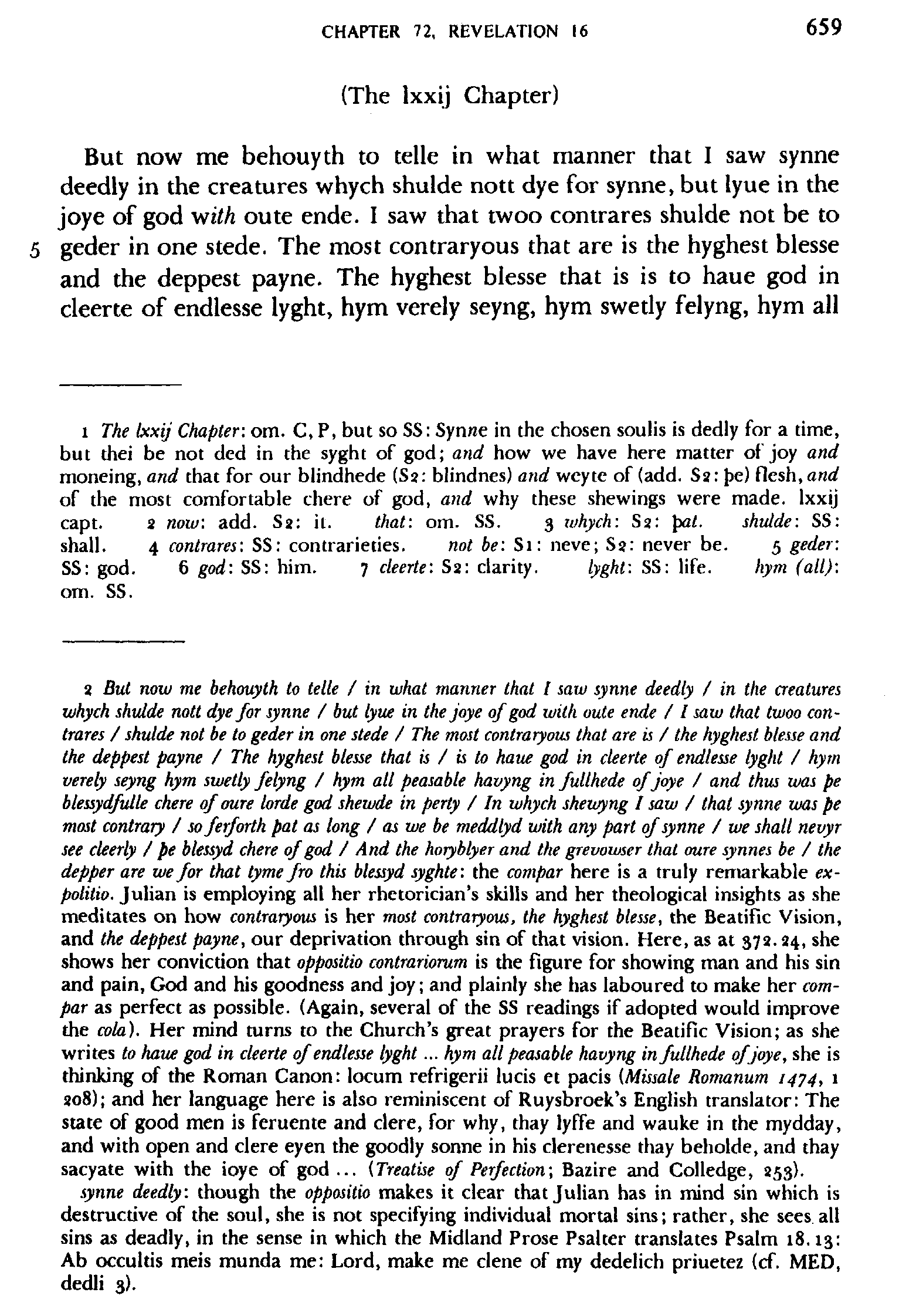
CHAPTER 72, REVELATION 16
(The Ixxij Chapter) But now me behouyth to telle in what manner that I saw synne deedly in the creatures whych shulde nott dye for synne, but lyue in the joye of god -with oute ende. I saw that twoo contrares shulde not be to 5 geder in one stede. The most contraryous that are is the hyghest blesse and the deppest payne. The hyghest blesse that is is to haue god in cleerte of endlesse lyght, hym verely seyng, hym swetly felyng, hym all i The Ixxij Chapter: om. C, P, but so SS: Synne in the chosen soulis is dedly for a time, but thei be not ded in the syght of god; and how we have here matter of joy and moneing, and that for our blindhede (82: blindnes) and weyte of (add. 82: Jje) flesh, and of the most comfortable chere of god, and why these shewings were made. Ixxij capt.
2 now. add. 82: it. that: om. SS.
3 whych: 82: \>at. shulde: SS: shall.
4 contrares: SS: contrarieties. not be: Si: neve; 82: never be.
5 geder:
SS: god.
6 god: SS: him.
7 cleerte: Ss: clarity. lyght: SS: life. hym (all): om. SS.
2 But now me behouyth to telle / in what manner that I saw synne deedly / in the creatures whych shulde nott dye for synne / but lyue in the joye of god with oute ende / I saw that twoo contrares / shulde not be to geder in one stede / The most contraryous that are is / the hyghest blesse and the deppest payne / The hyghest blesse that is / is to haue god in cleerte of endlesse lyght / hym verely seyng hym swetly felyng / hym all peasable havyng in fullhede of joye / and thus was pe blessydfulle chere ofoure lorde god shewde in perty / In whych shewyng I saw / that synne was pe most contrary / soferforth pat as long / as we be meddlyd with any part of synne / we shall nevyr see cleerly / pe blessyd chere of god / And the horyblyer and the grevowser that cure synnes be / the depper are we for that tymefro this blessyd syghte: the compar here is a truly remarkable expolitio. Julian is employing all her rhetorician's skills and her theological insights as she meditates on how contraryous is her most contraryous, the hyghest blesse, the Beatific Vision, and the deppest payne, our deprivation through sin of that vision. Here, as at 372.24, she shows her conviction that oppositio contrariorum is the figure for showing man and his sin and pain, God and his goodness and joy; and plainly she has laboured to make her compar as perfect as possible. (Again, several of the SS readings if adopted would improve the cola). Her mind turns to the Church's great prayers for the Beatific Vision; as she writes to haue god in cleerte of endlesse lyght... hym all peasable havyng in fullhede of joye, she is thinking of the Roman Canon: locum refrigerii lucis et pacis (Missale Romanum 1474, i 208); and her language here is also reminiscent of Ruysbroek's English translator: The state of good men is feruente and clere, for why, thay lyffe and wauke in the mydday, and with open and clere eyen the goodly sonne in his clerenesse thay beholde, and thay sacyate with the ioye of god ... (Treatise of Perfection; Bazire and Colledge, 253). synne deedly: though the oppositio makes it clear that Julian has in mind sin which is destructive of the soul, she is not specifying individual mortal sins; rather, she sees all sins as deadly, in the sense in which the Midland Prose Psalter translates Psalm 18.13:
Ab occultis meis munda me: Lord, make me clene of my dedelich priuetez (cf. MED, dedli 3).