
282 The Long Text
THE LONG TEXT
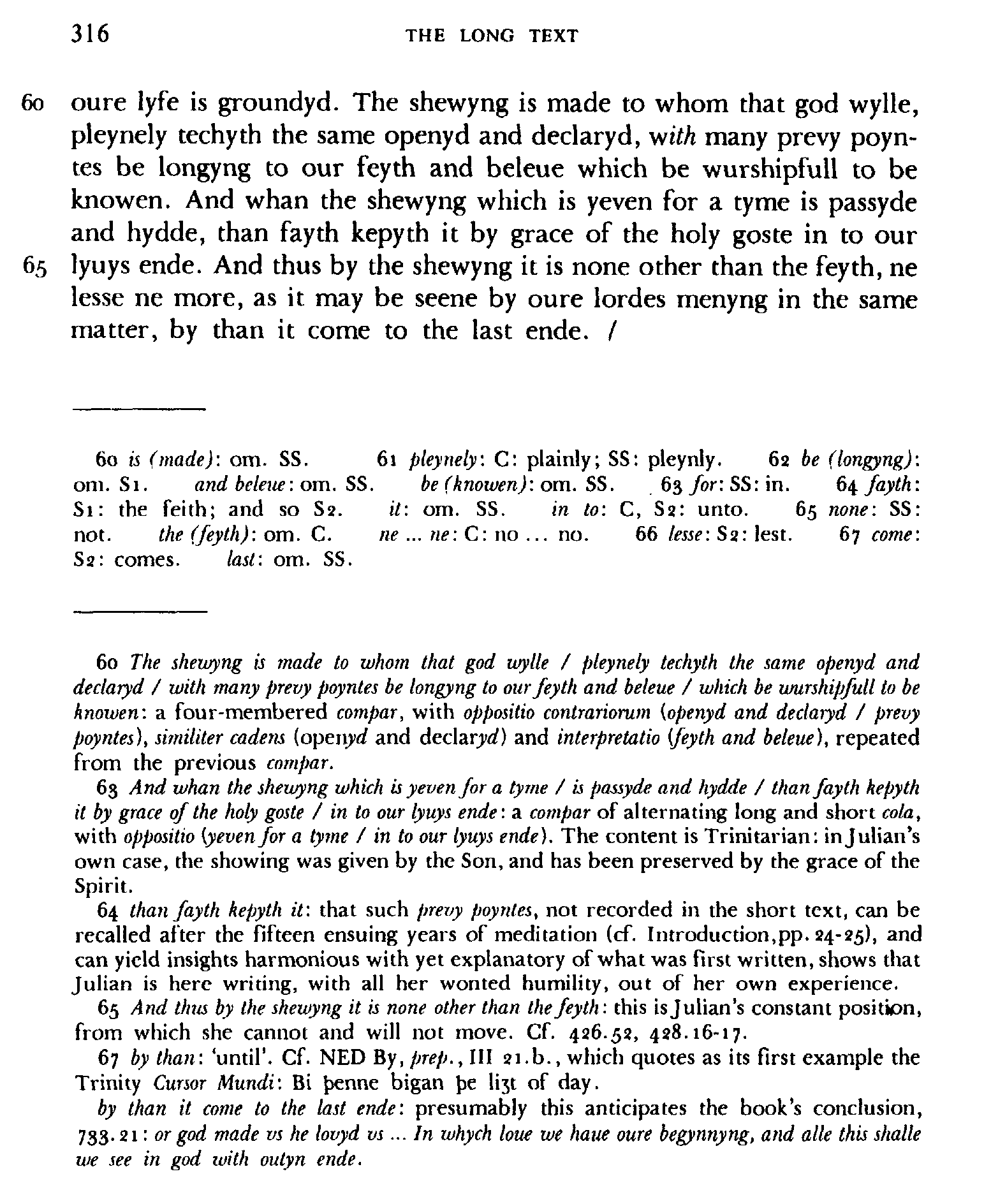
60 cure lyfe is groundyd. The shewyng is made to whom that god wylle, pleynely techyth the same openyd and declaryd, -with many prevy poyntes be longyng to our feyth and beleue which be wurshipfull to be knowen. And whan the shewyng which is yeven for a tyme is passyde and hydde, than fayth kepyth it by grace of the holy goste in to our
65 lyuys ende. And thus by the shewyng it is none other than the feyth, ne lesse ne more, as it may be scene by oure lordes menyng in the same matter, by than it come to the last ende. /
60 is (made): om. SS.
61 pleynely: C: plainly; SS: pleynly.
62 be (longyng): om. Si. and beleue: om. SS. be (knowen): om. SS.
63 for: SS: in.
64 fayth'.
Si: the feith; and so 82. it: om. SS. in to: C, 82: unto.
65 none: SS: not. the (feyth): om. C. ne ... ne: C: no ... no.
66 lesse: 82: lest.
67 come:
S a : comes. last: om. SS.
60 The shewyng is made to whom that god wylle / pleynely techyth the same openyd and declaryd / with many prevy poyntes be longyng to our feyth and beleue / which be wurshipfull to be knowen: a four-membered compar, with oppositio contrariorum (openyd and declaryd / prevy poyntes), similiter cadens (openyd and declared) and interpretatio (feyth and beleue), repeated from the previous cornpar.
63 And whan the shewyng which is yeven for a tyme / is passyde and hydde / than fayth kepyth it by grace of the holy goste / in to our lyuys ende: a compar of alternating long and short cola, with oppositio (yeven for a tyme / in to our lyuys ende). The content is Trinitarian: in Julian's own case, the showing was given by the Son, and has been preserved by the grace of the Spirit.
64 than fayth kepyth it: that such prevy poyntes, not recorded in the short text, can be recalled after the fifteen ensuing years of meditation (cf. Introduction,pp. 24-25), and can yield insights harmonious with yet explanatory of what was first written, shows that Julian is here writing, with all her wonted humility, out of her own experience.
65 And thus by the shewyng it is none other than the feyth: this is Julian's constant position, from which she cannot and will not move. Cf. 426.52, 428.16-17.
67 by than: 'until'. Cf. NED By, prep., Ill 21.b., which quotes as its first example the Trinity Cursor Mundi: Bi f>enne bigan pe 1(31 of day. by than it come to the last ende: presumably this anticipates the book's conclusion,
733.21: or god made vs he lovyd vs ... In whych hue we haue oure begynnyng, and alle this shalle we see in god with outyn ende.
CHAPTER 8, REVELATION I
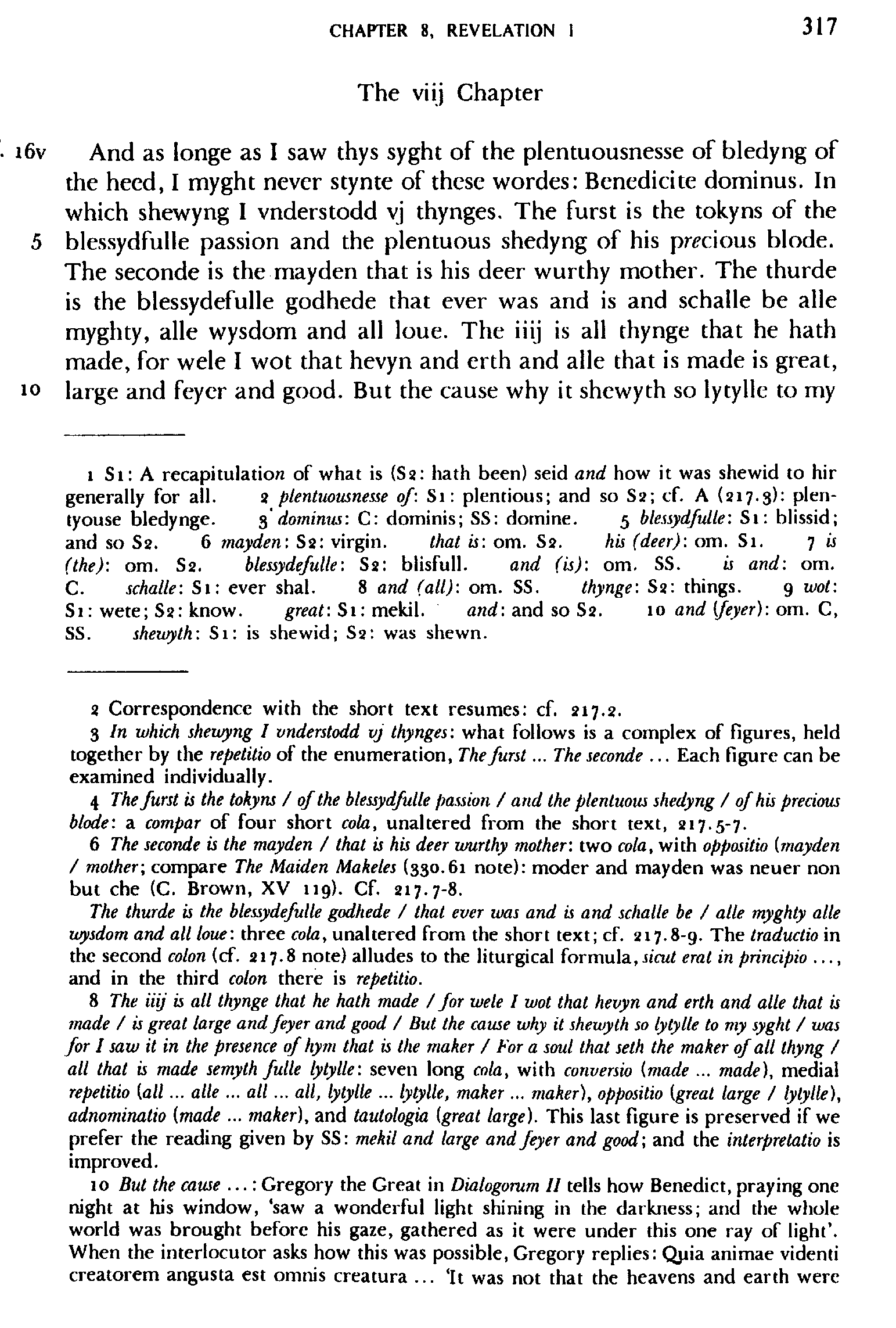
The viij Chapter - i6v And as longe as I saw thys syght of the plentuousnesse of bledyng of the heed, I myght never stynte of these wordes: Benedicite dominus. In which shewyng I vnderstodd vj thynges. The furst is the tokyns of the 5 blessydfulle passion and the plentuous shedyng of his precious blode.
The seconde is the mayden that is his deer wurthy mother. The thurde is the blessydefulle godhede that ever was and is and schalle be alle myghty, alle wysdom and all loue. The iiij is all thynge that he hath made, for wele I wot that hevyn and erth and alle that is made is great,
10 large and feyer and good. But the cause why it shewyth so lytylle to my i Si: A recapitulation of what is (82: hath been) seid and how it was shewid to hir generally for all.
2 plentuousnesse of: Si: plentious; and so 82; cf. A (217.3): plentyouse bledynge. g'dominus: C: dominis; SS: dornine.
5 blessydfulle: Si: blissid; and so 82.
6 mayden: 82: virgin. that is: om. 82. his (deer): om. Si.
7 is (the): om.
82. blessydefulle:
82: blisfull. and (is): om.
SS. is and: om.
C. schalle: Si: ever shal.
8 and (all): om. SS. thynge: 82: things.
9 wot:
Si: wete; 82: know. great: Si: mekil. and: and so 82.
10 and (feyer): om. C, SS. shewyth: Si: is shewid; 82: was shewn.
2 Correspondence with the short text resumes: cf. 217.2.
3 In which shewyng I vnderstodd vj thynges: what follows is a complex of figures, held together by the repetitio of the enumeration, The furst... The seconde ... Each figure can be examined individually.
4 The furst is the tokyns / of the blessydfulle passion / and the plentuous shedyng / of his precious blode: a compar of four short cola, unaltered from the short text, 217.5-7.
6 The seconde is the mayden / that is his deer wurthy mother: two cola, with oppositio (mayden
/ mother; compare The Maiden Makeles (330.61 note): moder and mayden was neuer non but che (C. Brown, XV 119). Cf. 217.7-8.
The thurde is the blessydefulle godhede / that ever was and is and schalle be / alle myghty alle wysdom and all loue: three cola, unaltered from the short text; cf. 217.8-9. The traductio in the second colon (cf. 217.8 note) alludes to the liturgical formula,sicut erat in principio ..., and in the third colon there is repetitio.
8 The iiij is all thynge that he hath made /for wele I wot that hevyn and erth and alle that is made / is great large and feyer and good / But the cause why it shewyth so lytylle to my syght / was for I saw it in the presence of hym that is the maker / For a soul that seth the maker of all thyng / all that is made semyth fulle lytylle: seven long cola, with conversio (made ... made), medial repetitio (all... alle ... all... all, lytylle ... lytylle, maker ... maker), oppositio (great large / lytylle), adnominatio (made ... maker), and tautologia (great large). This last figure is preserved if we prefer the reading given by SS: mekil and large and feyer and good; and the interpretatio is improved.
10 But the cause ...: Gregory the Great in Dialogorum II tells how Benedict, praying one night at his window, 'saw a wonderful light shining in the darkness; and the whole world was brought before his gaze, gathered as it were under this one ray of light'.
When the interlocutor asks how this was possible, Gregory replies: Qjiia animae videnti creatorem angusta est omnis creatura ... 'It was not that the heavens and earth were
THE LONG TEXT
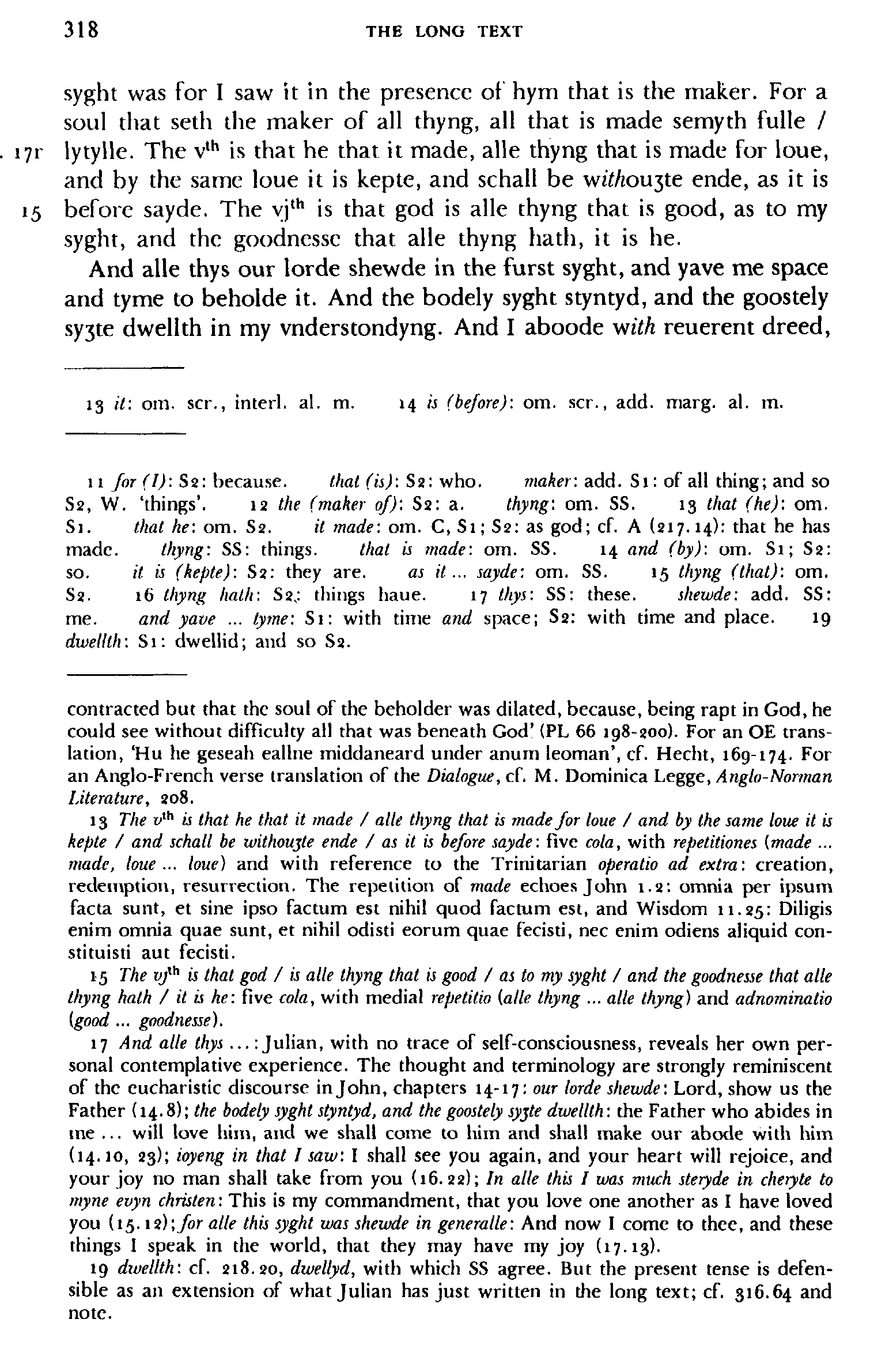
syght was for I saw it in the presence of hym that is the maker. For a soul that seth the maker of all thyng, all that is made semyth fulle /
. 171lytylle. The vth is that he that it made, alle thyng that is made for loue, and by the same loue it is kepte, and schall be withou^te ende, as it is
15 before sayde. The yjth is that god is alle thyng that is good, as to my syght, and the goodnessc that alle thyng hath, it is he.
And alle thys our lorde shewde in the furst syght, and yave me space and tyme to beholde it. And the bodely syght styntyd, and the goostely syjte dwellth in my vnderstondyng. And I aboode with reuerent dreed,
13 it: om. scr., interl. al. m.
14 is (before): om. scr., add. marg. al. m.
11 for (I): 82: because. that (is): 82: who. maker: add. Si: of all thing; and so 82, W. 'things'.
12 the (maker of): 82: a. thyng: om. 88.
13 that (he): om.
Si. that he: om. 82. it made: om. C, Si; 82: as god; cf. A (217.14): that he has made. thyng: SS: things. that is made: om. SS.
14 and (by): om. Si; 82: so. it is (kepte): 82: they are. as it ... sayde: om. 88.
15 thyng (that): om.
82.
16 thyng hath: 82; things haue.
17 thys: SS: these. shewde: add. SS: me. and yave ... tyme: Si: with time and space; 82: with time and place.
dwellth: Si: dwellid; and so 82. contracted but that the soul of the beholder was dilated, because, being rapt in God, he could see without difficulty all that was beneath God* (PL 66 198-200). For an OE translation, 'Hu he geseah eallne middaneard under anum leoman', cf. Hecht, 169-174. For an Anglo-French verse translation of the Dialogue, cf. M. Dominica Legge, Anglo-Norman
Literature, 208.
13 The vth is that he that it made / alle thyng that is made for loue / and by the same loue it is kepte / and schall be withoujte ende / as it is before sayde: five cola, with repetitiones (made ... made, loue... loue) and with reference to the Trinitarian operatio ad extra: creation, redemption, resurrection. The repetition of made echoes John 1.2: omnia per ipsum facta sunt, et sine ipso factum est nihil quod factum est, and Wisdom 11.25: Diligis enim omnia quae sunt, et nihil odisti eorum quae fecisti, nee enim odiens aliquid constituisti aut fecisti.
15 The vfh is that god / is alle thyng that is good / as to my syght / and the goodnesse that alle thyng hath / it is he: five cola, with medial repetitio (alle thyng ... alle thyng) and adnominatio
(good ... goodnesse).
17 And alle thys ...: Julian, with no trace of self-consciousness, reveals her own personal contemplative experience. The thought and terminology are strongly reminiscent of the eucharistic discourse in John, chapters 14-17: our lorde shewde: Lord, show us the Father (14.8); the bodely syght styntyd, and the goostely syjte dwellth: the Father who abides in me ... will love him, and we shall come to him and shall make our abode with him
(14.10, 23); ioyeng in that I saw: I shall see you again, and your heart will rejoice, and your joy no man shall take from you (16.22); In alle this I was much steryde in cheryte to myne evyn christen: This is my commandment, that you love one another as I have loved you (15.12); for alle this syght was shewde in generalle: And now I come to thee, and these things I speak in the world, that they may have my joy (17.13).
19 dwellth: cf. 218.20, dwellyd, with which SS agree. But the present tense is defensible as an extension of what Julian has just written in the long text; cf. 316.64 and note.
CHAPTER 8, REVELATION 1
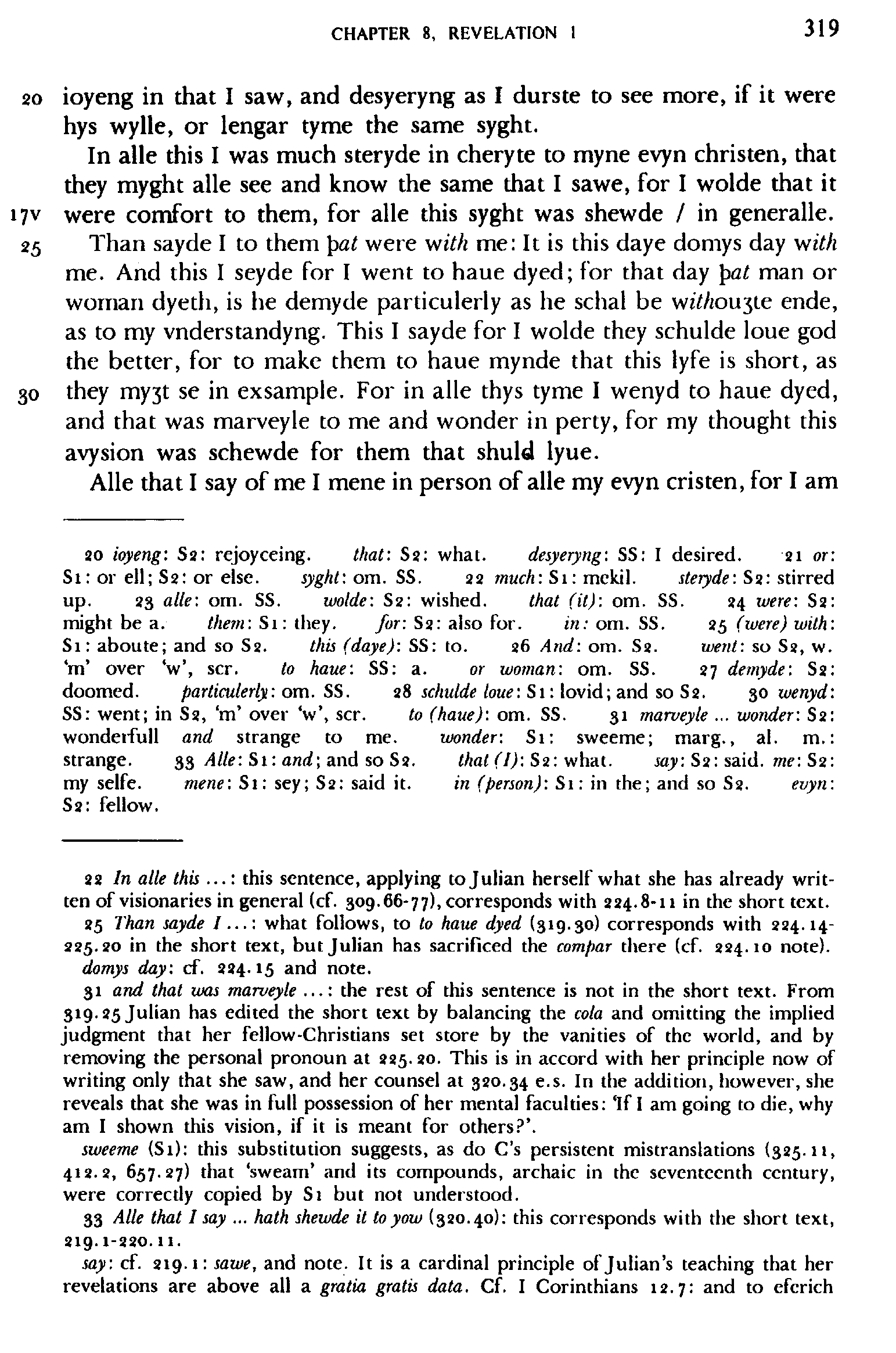
20 ioyeng in that I saw, and desyeryng as I durste to see more, if it were hys wylle, or lengar tyme the same syght.
In alle this I was much steryde in cheryte to myne evyn christen, that they myght alle see and know the same that I sawe, for I wolde that it i?v were comfort to them, for alle this syght was shewde / in generalle.
Than sayde I to them ]>at were with me: It is this daye domys day with me. And this I seyde for I went to haue dyed; for that day \>at man or woman dyeth, is he dernyde particulerly as he schal be withou^le ende, as to my vnderstandyng. This I sayde for I wolde they schulde loue god the better, for to make them to haue mynde that this lyfe is short, as
they my3t se in exsample. For in alle thys tyme I wenyd to haue dyed, and that was marveyle to me and wonder in perty, for my thought this avysion was schewde for them that shuld lyue.
Alle that I say of me I mene in person of alle my evyn cristen, for I am 20 ioyeng: Sa: rejoyceing. that: 83: what. desyeryng: SS: I desired.
21 or:
Si: or ell; 82: or else. syght: om. SS.
22 much: Si: mckil. steryde: Sa: stirred up.
23 alle: om. SS. wolde: 82: wished. that (it): om. SS.
24 were: Sa: might be a. them: Si: they. for: Sa: also for. in: om. SS.
35 (were) with:
Si: aboute; and so Sa. this (daye): SS: to.
26 And: om. Sa. went: so 82, w.
Yn' over V, scr. to haue: SS: a. or woman: om. SS.
27 demyde: Sa: doomed. particulerly: om. SS.
28 schulde loue: Si: lovid; and so Sa.
30 wenyd:
SS: went; in 82, 'm' over 'w', scr. to (haue): om. SS.
31 marveyle ... wonder: 82: wondeifull and strange to me. wonder:
Si: sweeme; marg., al. m.: strange.
33 Alle: Si: and; and so Sa. that (I): Sa: what. say: Sa: said, me: 82: my selfe. mene: Si: sey; Sa: said it. in (person): Si: in the; and so Sa. evyn:
Sa: fellow.
22 In alle this ...: this sentence, applying to Julian herself what she has already written of visionaries in general (cf. 309.66-7 7), cor responds with 234.8-11 in the short text.
25 Than sayde I...: what follows, to to haue dyed (319.30) corresponds with 224.14335.30 in the short text, but Julian has sacrificed the compar there (cf. 334.10 note). domys day: cf. 334.15 and note.
31 and that was marveyle ...: the rest of this sentence is not in the short text. From 319.35 Julian has edited the short text by balancing the cola and omitting the implied judgment that her fellow-Christians set store by the vanities of the world, and by removing the personal pronoun at 335.30. This is in accord with her principle now of writing only that she saw, and her counsel at 330.34 e.s. In the addition, however, she reveals that she was in full possession of her mental faculties: If I am going to die, why am I shown this vision, if it is meant for others?'. sweeme (Si): this substitution suggests, as do C's persistent mistranslations (335.11,
413.3, 657.37) that 'sweam' and its compounds, archaic in the seventeenth century, were correctly copied by Si but not understood.
33 Alle that I say ... hath shewde it to yow (330.40): this corresponds with the short text,
319.1-220. n. say: cf. 219.1: sawe, and note. It is a cardinal principle of Julian's teaching that her revelations are above all a gratia, gratis data. Cf. I Corinthians 12.7: and to efcrich
THE LONG TEXT
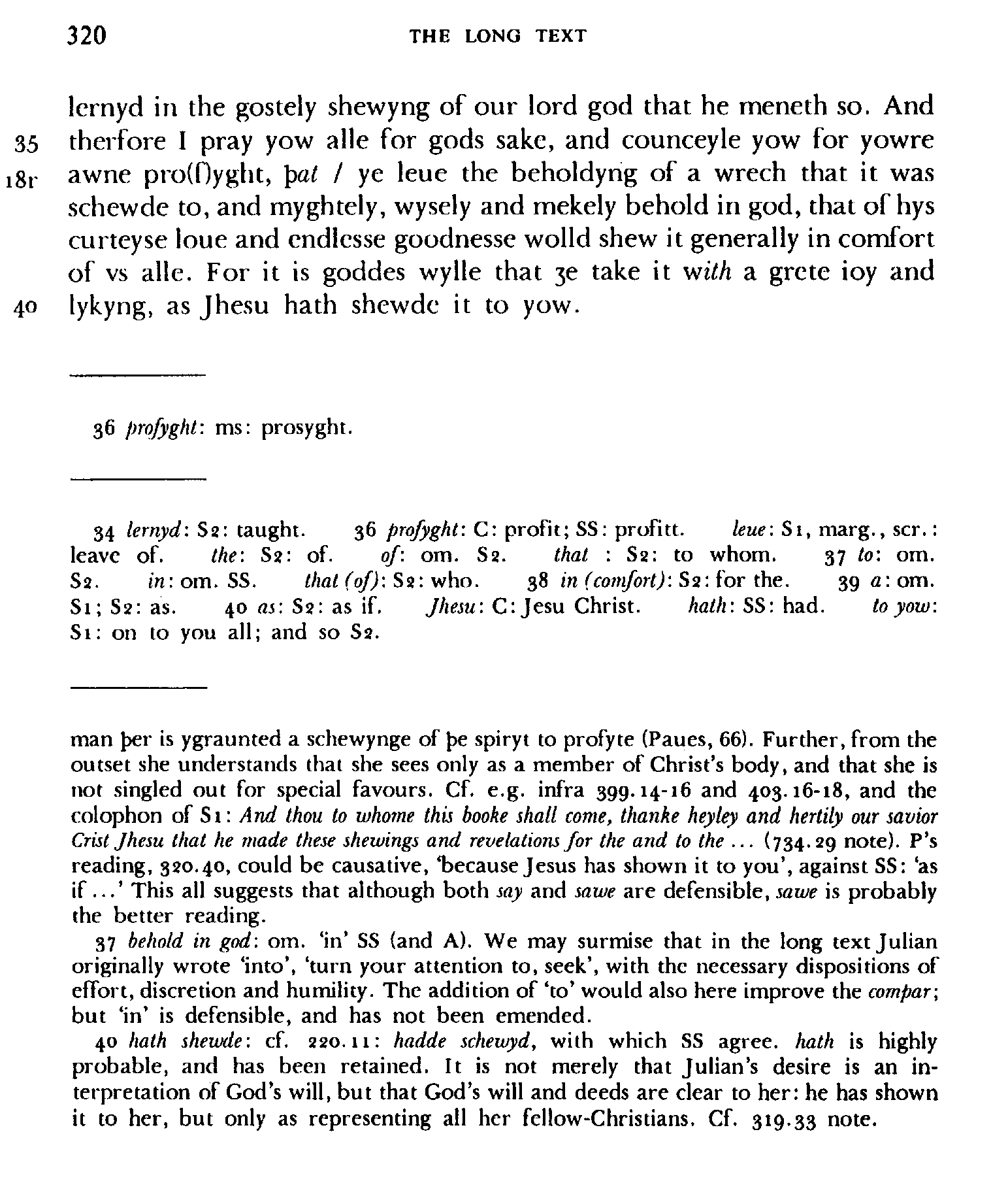
Icrnyd in the gostely shewyng of our lord god that he meneth so. And 35 therfore I pray yow alle for gods sake, and counceyle yow for yowre
awne pro(f)yght, \>at I ye leue the beholdyng of a wrech that it was schewde to, and myghtely, wysely and mekely behold in god, that of hys curteyse loue and endlesse goodnesse wolld shew it generally in comfort of vs alle. For it is goddes wylle that 36 take it -with a grete ioy and
lykyng, as Jhesu hath shewde it to yow.
36 profyght: ms: prosyght.
34 lernyd: 82: taught.
36 profyght: C: profit; SS: profitt. leue: Si, marg., scr.: leave of. the: 82: of. of: om. 82. that : 82: to whom.
37 to: om.
82. m:om. SS. that (of): Sa: who.
38 in (comfort): 82: for the.
390:0111.
Si; 82: as.
40 as: 82: as if.
Jhesu: C:Jesu Christ. hath: SS: had. to yow:
Si: on to you all; and so 82. man f>er is ygraunted a schewynge of pe spiryt to profyte (Paues, 66). Further, from the outset she understands that she sees only as a member of Christ's body, and that she is not singled out for special favours. Cf. e.g. infra 399.14-16 and 403.16-18, and the colophon of Si: And thou to whome this booke shall come, thanke heyley and hertily our savior
Crist Jhesu that he made these shewing* and revelations for the and to the ... (734. 29 note). P's reading, 320.40, could be causative, 'because Jesus has shown it to you', against SS: 'as if...' This all suggests that although both say and sawe are defensible, sawe is probably the better reading.
37 behold in god: om. 'in' 88 (and A). We may surmise that in the long text Julian originally wrote 'into', 'turn your attention to, seek', with the necessary dispositions of effort, discretion and humility. The addition of 'to' would also here improve the compar; but 'in' is defensible, and has not been emended.
40 hath shewde: cf. 220.11: hadde schewyd, with which SS agree, hath is highly probable, and has been retained. It is not merely that Julian's desire is an interpretation of God's will, but that God's will and deeds are clear to her: he has shown it to her, but only as representing all her fellow-Christians. Cf. 319.33 note.
CHAPTER 9, REVELATION I
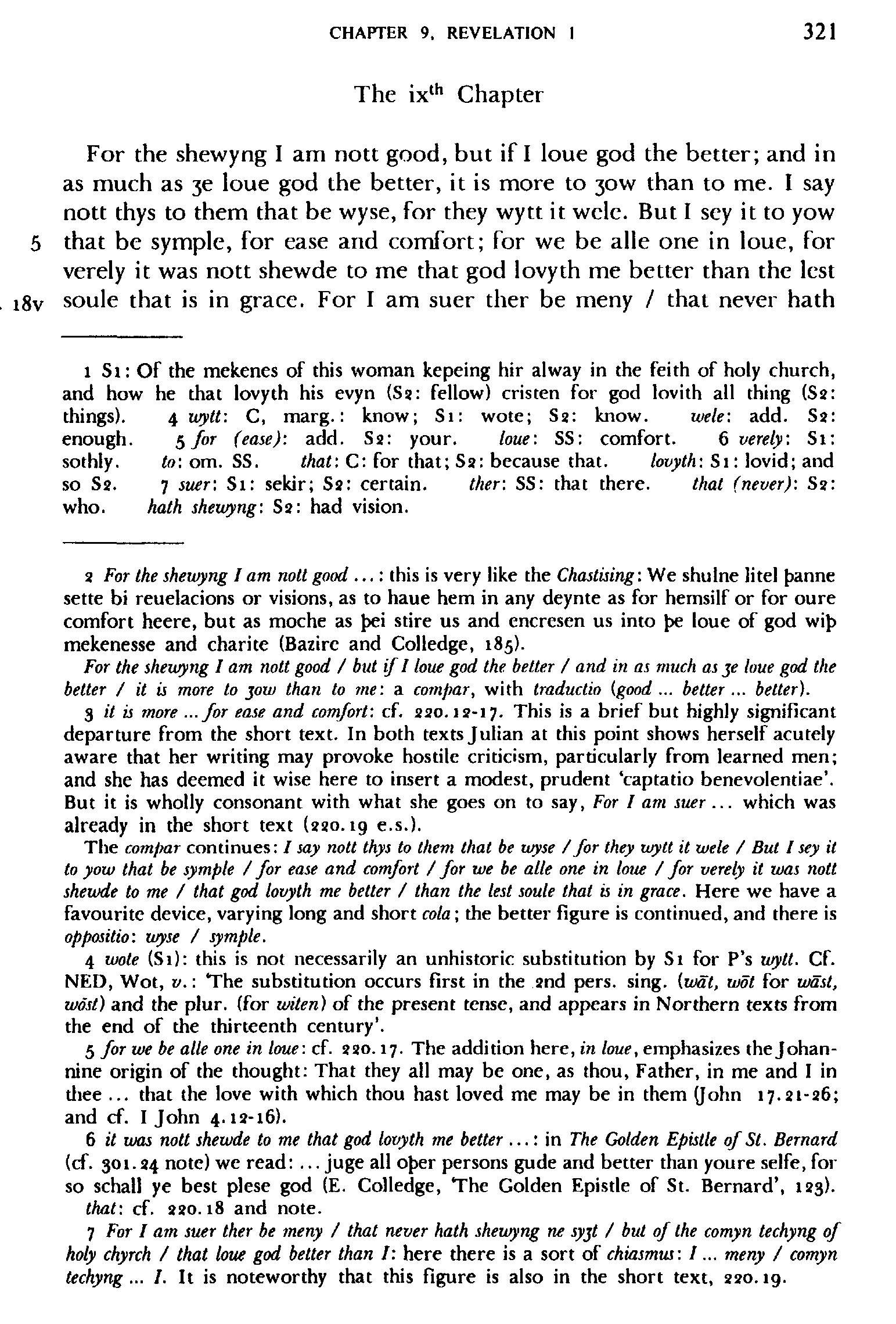
The ixth Chapter For the shewyng I am nott good, but if I loue god the better; and in as much as 36 loue god the better, it is more to 3ow than to me. I say nott thys to them that be wyse, for they wytt it wele. But I sey it to yow
5 that be symple, for ease and comfort; for we be alle one in loue, for verely it was nott shewde to me that god lovyth me better than the lest
. i8v soule that is in grace. For I am suer ther be meny / that never hath i Si: Of the mekenes of this woman kepeing hir alway in the feith of holy church, and how he that lovyth his evyn (Sa: fellow) cristen for god lovith all thing (Sa: things).
4 wytt: C, marg.: know; Si: wote; Sa: know. wele: add.
Sa: enough.
5 for (ease): add. Sa: your. loue: SS: comfort.
6 verely: Si: sothly. to: om. SS. that: C: for that; Sa: because that. lovyth: Si: lovid; and so Sa.
7 suer: Si: sekir; Sa: certain. ther: SS: that there. that (never): Sa: who. hath shewyng: Sa: had vision. a For the shewyng I am nott good ...: this is very like the Chastising: We shulne litel fjanne sette bi reuelacions or visions, as to haue hem in any deynte as for hemsilf or for oure comfort heere, but as moche as Jjei stire us and encresen us into pe loue of god wip mekenesse and charite (Bazire and Colledge, 185).
For the shewyng I am nott good / but if I loue god the better I and in as much as y loue god the better / it is more to jow than to me: a cornpar, with traductio (good ... better ... better).
3 it is more ...for ease and comfort: cf. 330.13-17. This is a brief but highly significant departure from the short text. In both texts Julian at this point shows herself acutely aware that her writing may provoke hostile criticism, particularly from learned men; and she has deemed it wise here to insert a modest, prudent 'captatio benevolentiae'.
But it is wholly consonant with what she goes on to say, For I am suer ... which was already in the short text (220.19 e.s.).
The compar continues: / say nott thys to them that be wyse /for they wytt it wele / But I sey it to yow that be symple / for ease and comfort / for we be alle one in loue / for verely it was nott shewde to me / that god lovyth me better / than the lest soule that is in grace. Here we have a favourite device, varying long and short cola; die better figure is continued, and there is oppositio: wyse / symple.
4 wote (Si): this is not necessarily an unhistoric substitution by Si for P's wytt. Cf.
NED, Wot, v.: The substitution occurs first in the and pers. sing, (wat, wot for wast, wdst) and the plur. (for witen) of the present tense, and appears in Northern texts from the end of the thirteenth century'.
5 for we be alle one in loue: cf. aao. 17. The addition here, in loue, emphasizes thejohannine origin of the thought: That they all may be one, as thou, Father, in me and I in dice ... that the love with which thou hast loved me may be in them (John 17.21-36; and cf. I John 4.13-16).
6 it was nott shewde to me that god lovyth me better ...: in The Golden Epistle of St. Bernard
(cf. 301.24 note) we read: ... juge all o£>er persons gude and better than youre selfe, for so schall ye best plese god (E. Colledge, The Golden Epistle of St. Bernard', 123). that: cf. 220.18 and note.
7 For I am suer ther be meny / that never hath shewyng ne syjt / but of the comyn techyng of holy chyrch / that loue god better than I: here there is a sort of chiasmus: I... meny I comyn techyng ... I. It is noteworthy that this figure is also in the short text, aao. 19.
THE LONG TEXT
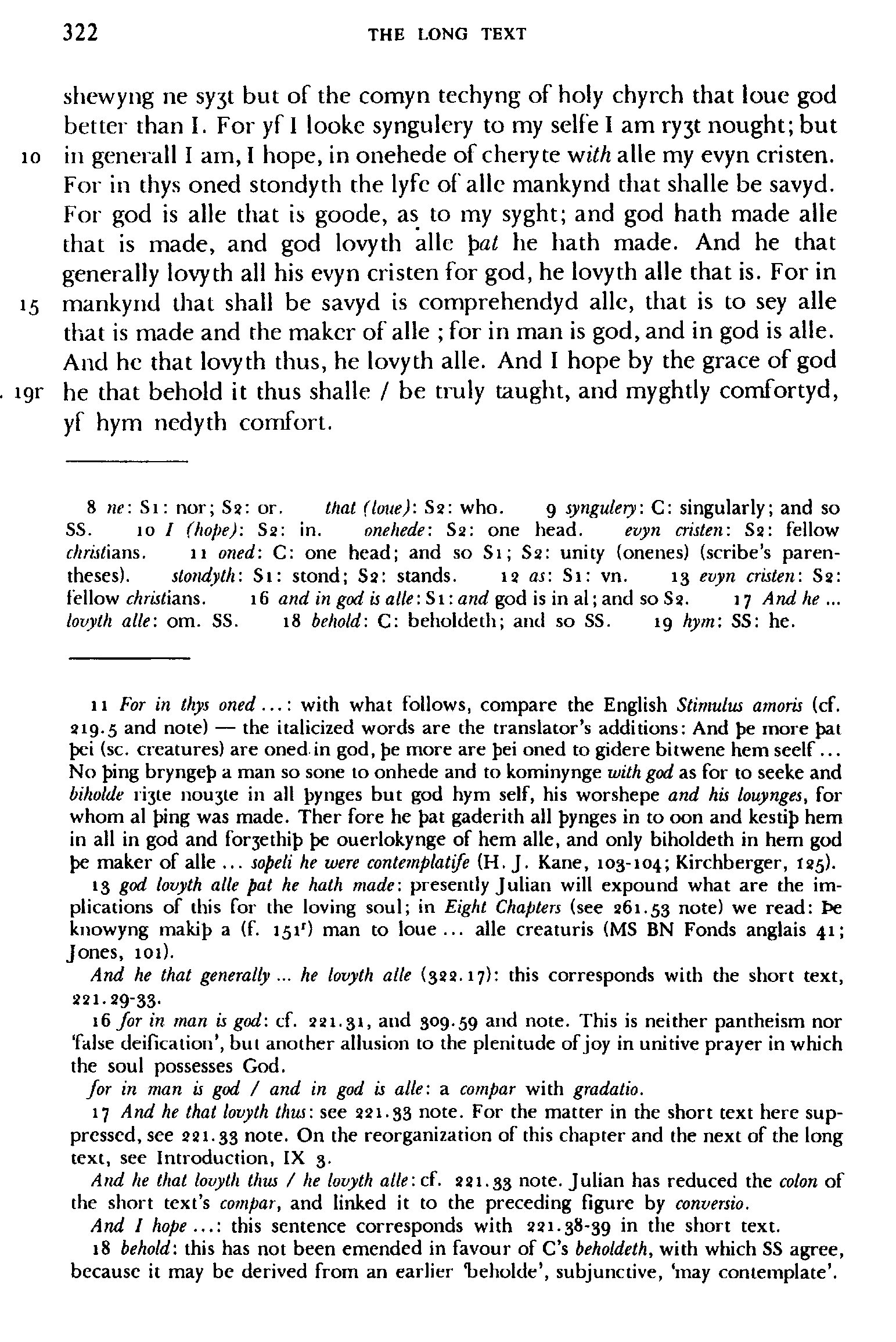
shewyng ne sy^t but of the cornyn techyng of holy chyrch that loue god better than I. For yf I looke syngulery to my selfe I am ry3t nought; but 10 in generall I am, I hope, in onehede of chery te -with alle my evyn cristen.
For in thys oned stondyth the lyfe of alle mankynd that shalle be savyd.
For god is alle that is goode, as to my syght; and god hath made alle that is made, and god lovyth alle Jja/ he hath made. And he that generally lovyth all his evyn cristen for god, he lovyth alle that is. For in 15 mankynd that shall be savyd is comprehendyd alle, that is to sey alle that is made and the maker of alle ; for in man is god, and in god is alle.
And he that lovyth thus, he lovyth alle. And I hope by the grace of god . igr he that behold it thus shalle / be truly taught, and myghtly comfortyd, yf hym nedyth comfort.
8 ne: Si: nor; 82: or. that (loue): 82: who.
9 syngulery: C: singularly; and so 88.
10 / (hope): 82: in. onehede'. 82: one head. evyn cristen: 82: fellow Christians.
11 oned: C: one head; and so Si; 82: unity (onenes) (scribe's parentheses), stondyth: Si: stond; 82: stands.
12 as: Si: vn.
13 evyn cristen: 82: fellow Christians.
16 and in god is alle: 81: and god is in al; and so 82.
17 And he ... lovyth alle: om. 88.
18 behold: C: beholdeth; and so 88.
19 hym: 88: he.
11 For in thys oned...: with what follows, compare the English Stimulus amoris (cf.
219.5 and note) — the italicized words are the translator's additions: And pe more pat pei (sc. creatures) are oned in god, pe more are pei oned to gidere bitwene hem seelf ...
No ping bryngej) a man so sone to onhede and to kominynge with god as for to seeke and biholde ri^ie nou3te in all pynges but god hym self, his worshepe and his louynges, for whom al ping was made. Ther fore he pat gaderith all pynges in to oon and kestij) hem in all in god and for3ethij) pe ouerlokynge of hem alle, and only biholdeth in hem god pe maker of alle ... sopeli he were contemplative (H. J. Kane, 103-104; Kirchberger, 125).
13 god lovyth alle pat he hath made: presently Julian will expound what are the implications of this for the loving soul; in Eight Chapters (see 261.53 note) we read: t>e knowyng maki|> a (f. 151') man to loue ... alle creaturis (MS BN Fonds anglais 41;
Jones, 101).
And he that generally ... he lovyth alle (322.17): this corresponds with the short text,
221.29-33.
16 for in man is god: cf. 221.31, and 309.59 and note. This is neither pantheism nor 'false deification', but another allusion to the plenitude of joy in unitive prayer in which the soul possesses God. for in man is god / and in god is alle: a compar with gradatio.
17 And he that lovyth thus: see 221.33 note. For the matter in the short text here suppressed, see 221.33 note. On the reorganization of this chapter and the next of the long text, see Introduction, IX 3.
And he that lovyth thus / he lovyth alle: cf. 221.33 note. Julian has reduced the colon of the short text's compar, and linked it to the preceding figure by conversio.
And I hope ...: this sentence corresponds with 221.38-39 in the short text!
18 behold: this has not been emended in favour of C's beholdeth, with which SS agree, because it may be derived from an earlier "beholde1, subjunctive, 'may contemplate'.
CHAPTER 9,... REVELATION 1
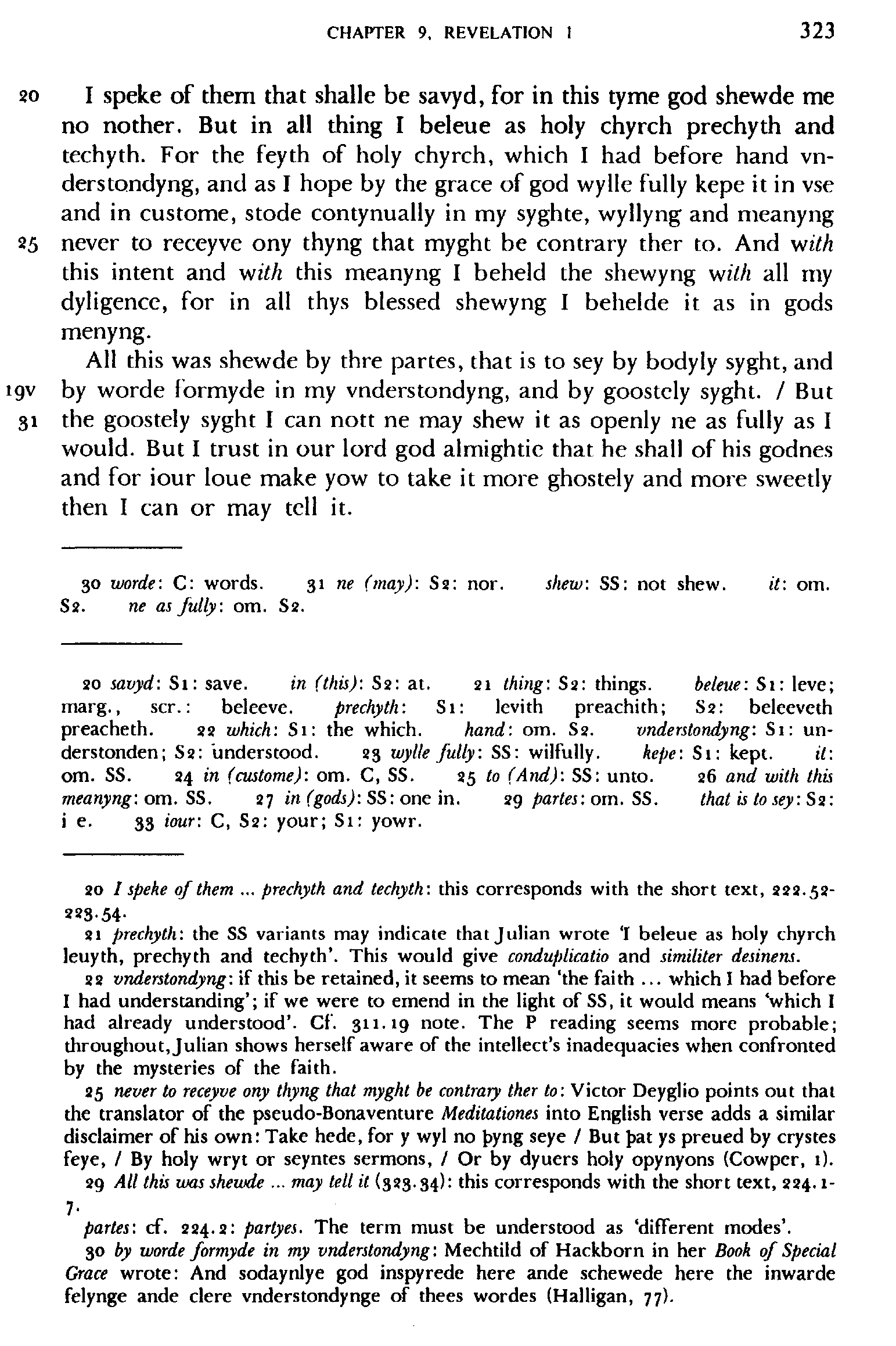
I speke of them that shalle be savyd, for in this tyme god shewde me no nother. But in all thing I beleue as holy chyrch prechyth and techyth. For the feyth of holy chyrch, which I had before hand vnderstondyng, and as I hope by the grace of god wylle fully kepe it in vse and in custome, stode contynually in my syghte, wyllyng and meanyng
25 never to receyve ony thyng that myght be contrary ther to. And with this intent and with this meanyng I beheld the shewyng with all my dyligence, for in all thys blessed shewyng I behelde it as in gods menyng.
All this was shewde by thre partes, that is to sey by bodyly syght, and igv by worde formyde in my vnderstondyng, and by goostcly syght. / But 31 the goostely syght I can nott ne may shew it as openly ne as fully as I would. But I trust in our lord god almightie that he shall of his godnes and for iour loue make yow to take it more ghostely and more sweetly then I can or may tell it.
30 worde: C: words.
31 ne (may): 82: nor. shew: SS: not shew. it: om.
82. ne as fully: om. 82.
20 savyd: Si: save. in (this): 82: at.
21 thing: 82: things. beleue: Si: leve; marg., scr.: beleeve. prechyth:
Si: levith preachith; 82: beleeveth preacheth.
22 which: Si: the which. hand: om. 82. vnderstondyng: Si: understonden; 82: understood.
23 wylle fully: 88: wilfully. kepe: Si: kept. it: om. SS.
24 in (custome): om. C, 88.
25 to (And): 88: unto.
26 and with this meanyng: om. SS.
27 in (gods): SS: one in.
29 partes: om. 88. that is to sey: 82: i e.
33 iour: C, 82: your; Si: yowr.
20 I speke of them ... prechyth and techyth: this corresponds with the short text, 222.52223-5421 prechyth: the SS variants may indicate that Julian wrote 'I beleue as holy chyrch leuyth, prechyth and techyth'. This would give conduplicatio and similiter desinens.
22 vnderstondyng: if this be retained, it seems to mean 'the faith ... which I had before I had understanding'; if we were to emend in the light of SS, it would means 'which I had already understood'. Cf. 311.19 note. The P reading seems more probable; throughout, Julian shows herself aware of the intellect's inadequacies when confronted by the mysteries of the faith.
25 never to receyve ony thyng that myght be contrary ther to: Victor Deyglio points out that the translator of the pseudo-Bonaventure Meditationes into English verse adds a similar disclaimer of his own: Take hede, for y wyl no £>yng seye / But J>at ys preued by crystes feye, / By holy wryt or seyntes sermons, / Or by dyuers holy opynyons (Cowper, i).
29 All this was shewde ... may tell it (323.34): this corresponds with the short text, 224. i7partes: cf. 224.2: partyes. The term must be understood as 'different modes'.
30 by worde formyde in my vnderstondyng: Mechtild of Hackborn in her Book of Special
Grace wrote: And sodaynlye god inspyrede here ande schewede here the inwarde felynge ande clere vnderstondynge of thees wordes (Halligan, 77).
THE LONG TEXT
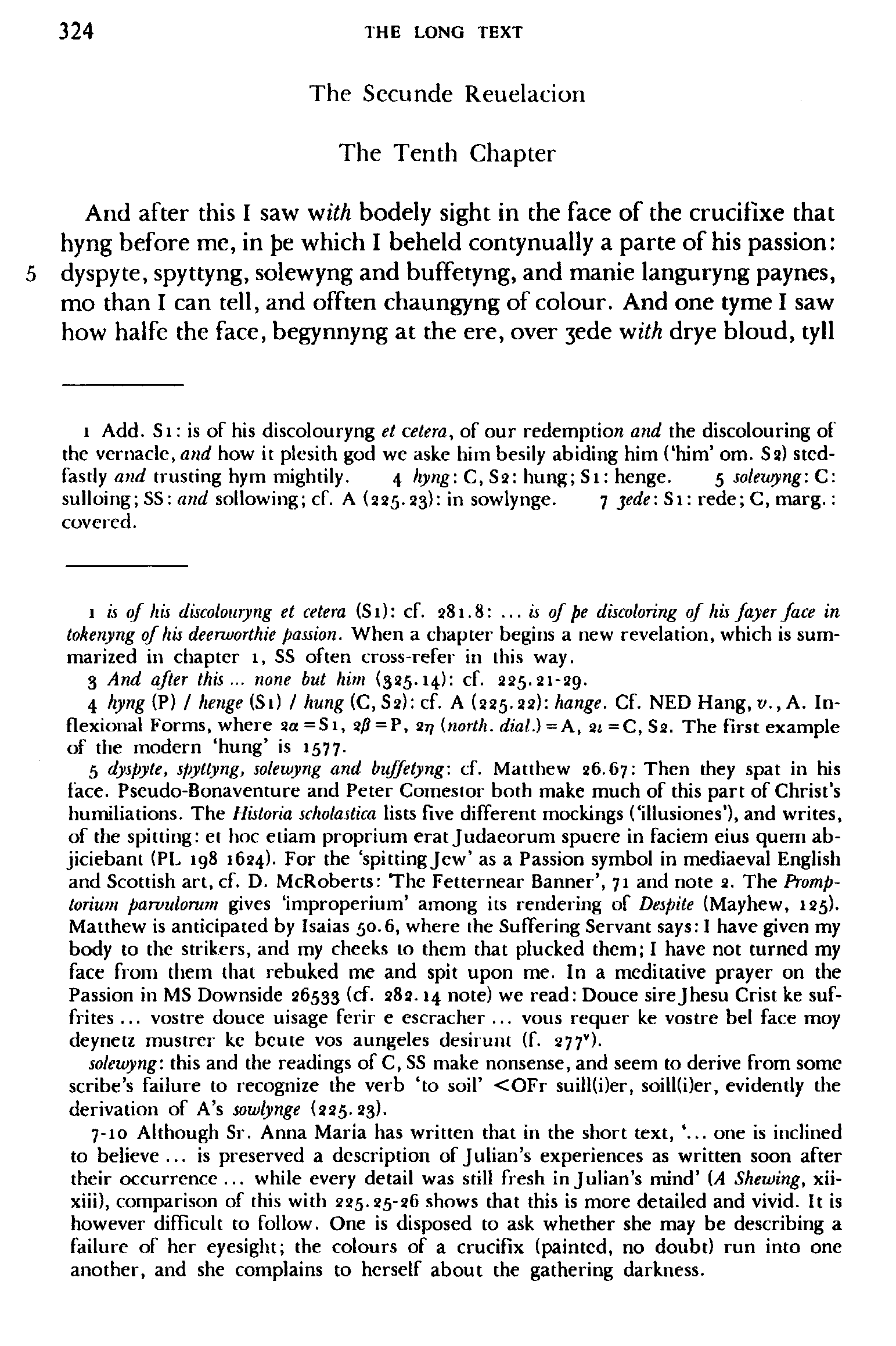
The Secunde Reuelacion The Tenth Chapter And after this I saw with bodely sight in the face of the crucifixe that hyng before me, in J)e which I beheld contynually a parte of his passion:
5 dyspyte, spyttyng, solewyng and buffetyng, and manie languryng paynes, mo than I can tell, and off ten chaungyng of colour. And one tyme I saw how halfe the face, begynnyng at the ere, over 3ede with drye bloud, tyll i Add. Si: is of his discolouryng et cetera, of our redemption and the discolouring of the vernacle, and how it plesith god we aske him besily abiding him ('him' om. 82) stedfastly and trusting hym mightily.
4 hyng: C, Sa: hung; Si: henge.
5 solewyng: C: sulloing; SS: and sollowing; cf. A (225.23): in sowlynge.
7 yde: Si: rede; C, marg.: covered. i is of his discolouryng et cetera (S i): cf. 281.8: ... is of pe discoloring of his fayer face in tokenyng of his deerworthie passion. When a chapter begins a new revelation, which is summarized in chapter i, SS often cross-refer in this way.
3 And after this ... none but him (325.14): cf. 225.21-29.
4 hyng (P) / henge (Si) / hung (C, 82): cf. A (225.22): hange. Cf. NED Hang, v., A. Inflexional Forms, where act =Si, 20 = P, 277 (north, dial.) = A, 21 =C, 82. The first example of the modern 'hung' is 1577.
5 dyspyte, spyttyng, solewyng and buffetyng: cf. Matthew 26.67: Then they spat in his face. Pseudo-Bonaventure and Peter Comestor both make much of this part of Christ's humiliations. The Hisloria scholastica lists five different mockings Cillusiones'), and writes, of the spitting: et hoc etiam proprium erat Judaeorum spuere in faciem eius quem abjiciebant (PL 198 1624). For the 'spittingjew' as a Passion symbol in mediaeval English and Scottish art, cf. D. McRoberts: The Fetternear Banner', 71 and note 2. The Promptorium parvulorum gives 'improperium' among its rendering of Despite (Mayhew, 125).
Matthew is anticipated by Isaias 50.6, where the Suffering Servant says: I have given my body to the strikers, and my cheeks to them that plucked them; I have not turned my face from them that rebuked me and spit upon me. In a meditative prayer on the Passion in MS Downside 26533 (cf. 282.14 note) we read: Douce sirejhesu Crist ke suffrites ... vostre douce uisage ferir e escracher ... vous requer ke vostre bel face moy deynetz mustrer ke beute vos aungeles desirunt (f. 277*). solewyng: this and the readings of C, SS make nonsense, and seem to derive from some scribe's failure to recognize the verb 'to soil' <OFr suill(i)er, soill(i)er, evidently the derivation of A's sowlynge (225.23).
7-10 Although Sr. Anna Maria has written that in the short text, '... one is inclined to believe ... is preserved a description of Julian's experiences as written soon after their occurrence ... while every detail was still fresh in Julian's mind' (A Shewing, xiixiii), comparison of this with 225.25-26 shows that this is more detailed and vivid. It is however difficult to follow. One is disposed to ask whether she may be describing a failure of her eyesight; the colours of a crucifix (painted, no doubt) run into one another, and she complains to herself about the gathering darkness.
CHAPTER 10, REVELATION 2
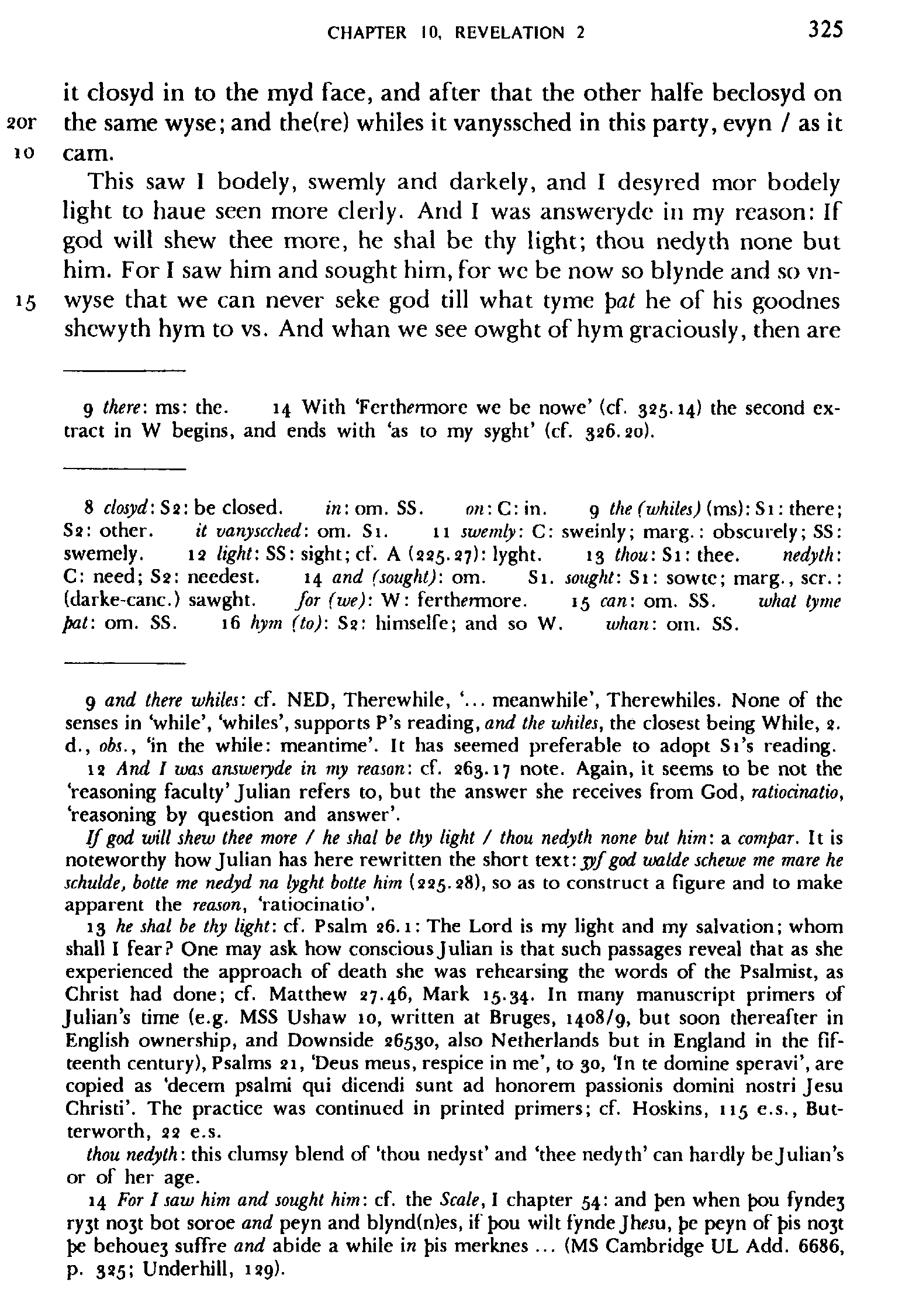
it closyd in to the myd face, and after that the other halfe beclosyd on 2or the same wyse; and the(re) whiles it vanyssched in this party, evyn / as it
cam.
This saw I bodely, swemly and darkely, and I desyred mor bodely light to haue seen more clerly. And I was answeryde in my reason: If god will shew thee more, he shal be thy light; thou nedyth none but him. For I saw him and sought him, for we be now so blynde and so vn15 wyse that we can never seke god till what tyme ]jat he of his goodnes shewyth hym to vs. And whan we see owght of hym graciously, then are
9 there: ms: the.
14 With 'Ferthmnore we be nowe' (cf. 325.14) the second extract in W begins, and ends with 'as to my syght' (cf. 326.20).
8 closyd: 82: be closed. irr.om. SS. o«:C:in.
9 the (whiles) (ms): Si: there; 82: other. it vanyscched: om. Si.
11 swemly: C: sweinly; marg.: obscurely; SS: swemely.
12 light: SS: sight; cf. A (225.27): lyght.
13 thou: Si: thee. nedyth:
C: need; 82: needest.
14 and (sought): om.
Si. sought: Si: sowte; marg., scr.:
(darke-canc.) sawght. for (we): W: ferth^rmore.
15 can: om. SS. what tyme pat: om. SS.
16 hym (to): 82: himselfe; and so W. whan: om. SS.
9 and there whiles: cf. NED, Therewhile, '... meanwhile', Therewhiles. None of the senses in 'while', 'whiles', supports P's reading, and the whiles, the closest being While, 2. d., obs., 'in the while: meantime'. It has seemed preferable to adopt Si's reading.
12 And I was answeryde in my reason: cf. 263.17 note. Again, it seems to be not the 'reasoning faculty'Julian refers to, but the answer she receives from God, ratiocinatio,
'reasoning by question and answer'.
If god will shew thee more / he shal be thy light / thou nedyth none but him: a compar, 11 is noteworthy how Julian has here rewritten the short text: $>f god walde schewe me mare he schulde, botte me nedyd na lyght botte him (225. 28), so as to construct a figure and to make apparent the reason, 'ratiocinatio'.
13 he shal be thy light: cf. Psalm 26. i: The Lord is my light and my salvation; whom shall I fear? One may ask how conscious Julian is that such passages reveal that as she experienced the approach of death she was rehearsing the words of the Psalmist, as Christ had done; cf. Matthew 27.46, Mark 15.34. In many manuscript primers of Julian's time (e.g. MSS Ushaw 10, written at Bruges, 1408/9, but soon thereafter in English ownership, and Downside 26530, also Netherlands but in England in the fifteenth century), Psalms 21, 'Deus meus, respice in me', to 30, 'In te domine speravi', are copied as 'decem psalmi qui dicendi sunt ad honorem passionis domini nostri Jesu
Chrisu". The practice was continued in printed primers; cf. Hoskins, 115 e.s., Butterworth, 22 e.s. thou nedyth: this clumsy blend of 'thou nedyst' and 'thee nedyth' can hardly be Julian's or of her age.
14 For I saw him and sought him: cf. the Scale, I chapter 54: and pen when pou fynde3 ry3t no3t bot soroe and peyn and blynd(n)es, if pou wilt fynde Jhmi, pe peyn of pis m>3t pe behoue3 suffre and abide a while in pis merknes ... (MS Cambridge UL Add. 6686,
P325; Underbill, 129).
THE LONG TEXT
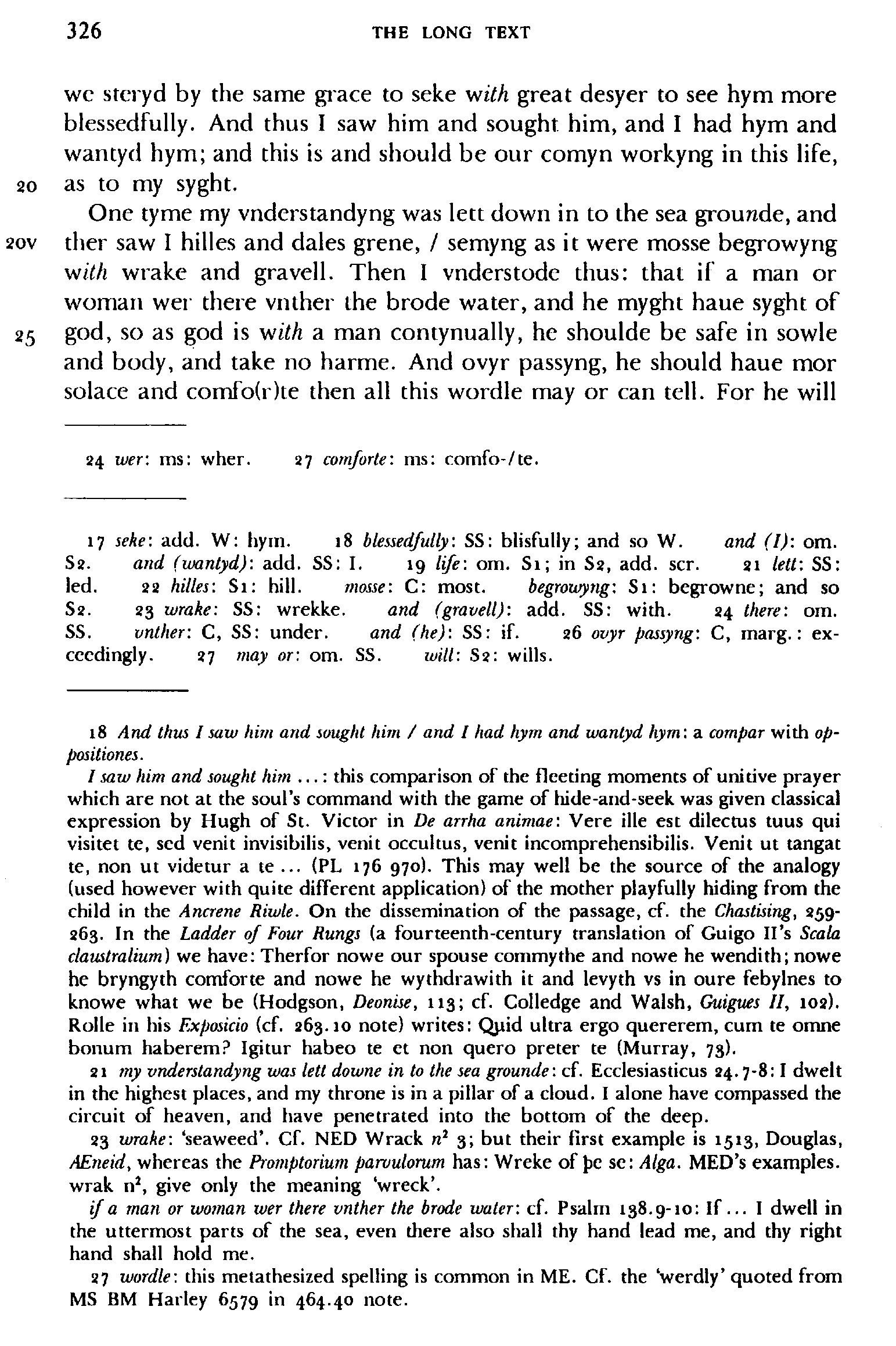
we stcryd by the same grace to seke with great desyer to see hym more blessedfully. And thus I saw him and sought him, and I had hym and wantyd hym; and this is and should be our comyn workyng in this life,
as to my syght.
One tyme my vnderstandyng was lett down in to the sea grounde, and 2ov ther saw I hilles and dales grene, / semyng as it were mosse begrowyng with wrake and gravell. Then I vnderstode thus: that if a man or woman wer there vnther the brode water, and he myght haue syght of
god, so as god is with a man contynually, he shoulde be safe in sowle and body, and take no harme. And ovyr passyng, he should haue mor solace and comfo(r)te then all this wordle may or can tell. For he will
24 wer: ms: wher.
27 comforte: ms: comfo/te.
17 seke: add. W: hym.
18 blessedfully: SS: blisfully; and so W. and (I): om.
82. and (wantyd): add. SS: I.
19 life: om. Si; in 82, add. scr.
21 lett: SS: led.
22 hilles: Si: hill. mosse: C: most. begrowyng: Si: begrowne; and so 82.
23 wrake: SS: wrekke. and (gravell): add. SS: with.
24 there: om.
SS. vnther: C, SS: under. and (he): SS: if.
26 ovyr passyng: C, marg.: exceedingly.
27 may or: om. SS. will: 82: wills.
18 And thus I saw him and sought him / and I had hym and wantyd hym: a compar with oppositiones.
I saw him and sought him ...: this comparison of the fleeting moments of unitive prayer which are not at the soul's command with the game of hide-and-seek was given classical expression by Hugh of St. Victor in De arrha animae: Vere ille est dilectus tuus qui visitet te, sed venit invisibilis, venit occultus, venit incomprehensibilis. Venit ut tangat te, non ut videtur a te ... (PL 176 970). This may well be the source of the analogy
(used however with quite different application) of the mother playfully hiding from the child in the Ancrene Riwle. On the dissemination of the passage, cf. the Chastising, 259263. In the Ladder of Four Rungs (a fourteenth-century translation of Guigo II's Scala claustralium) we have: Therfor nowe our spouse commythe and nowe he wendith; nowe he bryngyth comforte and nowe he wythdrawith it and levyth vs in oure febylnes to knowe what we be (Hodgson, Deonise, 113; cf. Colledge and Walsh, Guigues II, 102).
Rolle in his Exposido (cf. 263.10 note) writes: Quid ultra ergo quererem, cum te omne bonum haberem? Igitur habeo te et non quero preter te (Murray, 73).
21 my vnderstandyng was lett downe in to the sea grounde: cf. Ecclesiasticus 24.7-8:1 dwelt in the highest places, and my throne is in a pillar of a cloud. I alone have compassed the circuit of heaven, and have penetrated into the bottom of the deep.
23 wrake: 'seaweed'. Cf. NED Wrack n1 3; but their first example is 1513, Douglas,
AEneid, whereas the Promptorium parvulorum has: Wreke of J>e se: Alga. MED's examples, wrak n2, give only the meaning 'wreck'. if a man or woman wer there vnther the brode water: cf. Psalm 138.9-10: If... I dwell in the uttermost parts of the sea, even there also shall thy hand lead me, and thy right hand shall hold me.
27 wordle: this metathesized spelling is common in ME. Cf. the werdly' quoted from MS BM Harley 6579 in 464.40 note.
CHAPTER 10, REVELATION 2
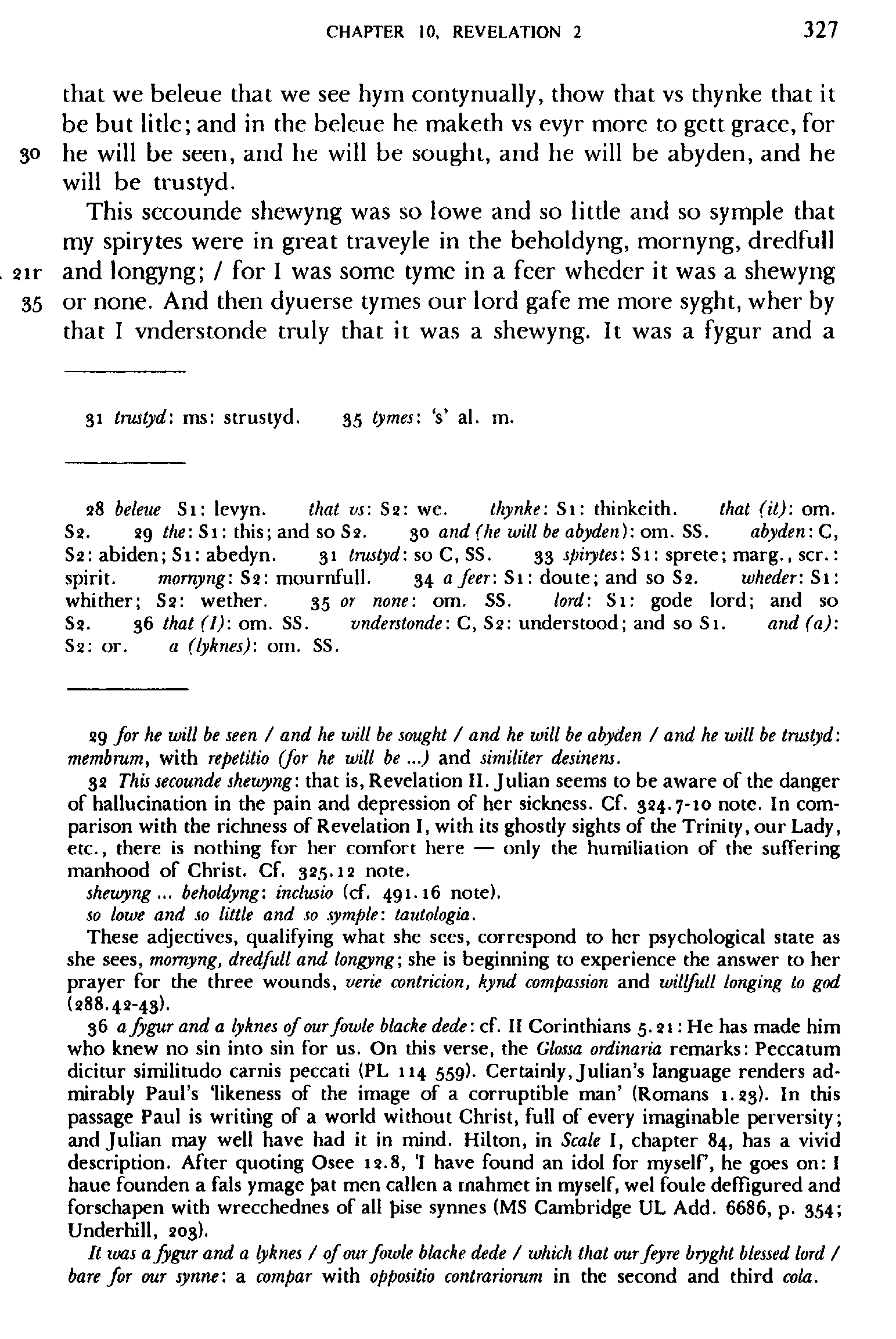
that we beleue that we see hym contynually, thow that vs thynke that it be but litle; and in the beleue he maketh vs evyr more to gett grace, for 30 he will be seen, and he will be sought, and he will be abyden, and he will be trustyd.
This secounde shewyng was so lowe and so little and so symple that my spirytes were in great traveyle in the beholdyng, mornyng, dredfull
. 2ir and longyng; / for I was some tyme in a feer wheder it was a shewyng 35 or none. And then dyuerse tymes our lord gafe me more syght, wher by that I vnderstonde truly that it was a shewyng. It was a fygur and a 31 trustyd: ms: strustyd.
35 tymes: V al. m.
28 beleue Si: levyn. that vs: 82: we. thynke: Si: thinkeith. that (it): om.
Ss.
29 the: Si: this; and so 82.
30 and (he will be abyden): om. SS. abyden: C, Sa: abiden; Si: abedyn.
31 trustyd: so C, SS.
33 spirytes: Si: sprete; marg., scr.: spirit. mornyng: Sa: mournfull.
34 a feer: Si: doute; and so Sa. wheder: Si: whither; Sa: wether.
35 or none: om. SS. lord: Si: gode lord; and so Sa.
36 that (I): om. SS. vnderstonde: C, Sa: understood; and so Si. and (a):
Sa: or. a (lyknes): om. SS.
39 for he will be seen / and he will be sought / and he will be abyden / and he will be trustyd: membrum, with repetitio (for he will be ...) and similiter desinens.
32 This secounde shewyng: that is, Revelation II. Julian seems to be aware of the danger of hallucination in the pain and depression of her sickness. Cf. 324.7-10 note. In comparison with the richness of Revelation I, with its ghostly sights of the Trinity, our Lady, etc., there is nothing for her comfort here — only the humiliation of the suffering manhood of Christ. Cf. 325.13 note. shewyng... beholdyng: indusio (cf. 491.16 note). so lowe and so little and so symple: tautologia.
These adjectives, qualifying what she sees, correspond to her psychological state as she sees, mornyng, dredfull and longyng; she is beginning to experience the answer to her prayer for the three wounds, verie contrition, kynd compassion and willfull longing to god
(288.42-43).
36 a fygur and a lyknes ofourfowle blacke dede: cf. II Corinthians 5.21: He has made him who knew no sin into sin for us. On this verse, the Glossa ordinaria remarks: Peccatum dicitur similitude carnis peccati (PL 114 559). Certainly .Julian's language renders admirably Paul's 'likeness of the image of a corruptible man' (Romans 1.23). In this passage Paul is writing of a world without Christ, full of every imaginable perversity; and Julian may well have had it in mind. Hilton, in Scale I, chapter 84, has a vivid description. After quoting Osee 12.8, 'I have found an idol for myself, he goes on: I haue founden a fals ymage J>at men callen a rnahmet in myself, wel foule deffigured and forschapen with wrecchednes of all Jjise synnes (MS Cambridge UL Add. 6686, p. 354;
Underbill, 203).
It was a fygur and a lyknes / ofourfowle blacke dede / which that ourfeyre bryght blessed lord / bare for our synne: a compar with oppositio contrariorum in the second and third cola.
THE LONG TEXT
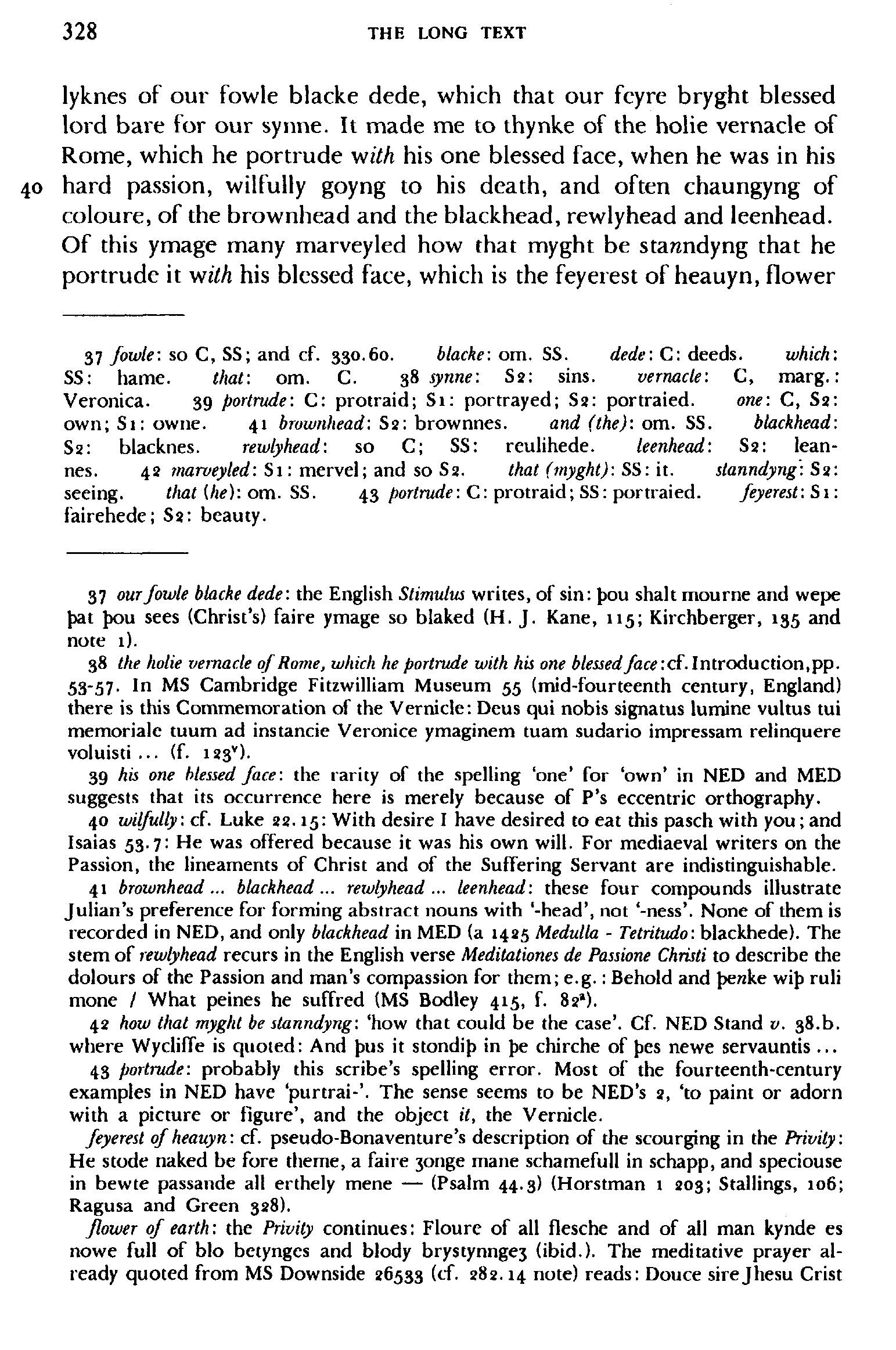
lyknes of our fowle blacke dede, which that our fcyre bryght blessed lord bare for our synne. It made me to thynke of the holie vernacle of Rome, which he portrude with his one blessed face, when he was in his
40 hard passion, wilfully goyng to his death, and often chaungyng of coloure, of the brownhead and the blackhead, rewlyhead and leenhead.
Of this ymage many marveyled how that myght be stanndyng that he portrude it with his blessed face, which is the feyerest of heauyn, flower
37 fowle: so C, SS; and cf. 330.60. blacke: om. SS. dede: C: deeds. which:
88: hame. that: om.
38 synne:
Sa: sins. vernacle:
C, marg.:
Veronica.
39 portrude: C: protraid; Si: portrayed; 82: portraied. one: C, Sa: own; Si: owne.
41 brownhead: 82: brownnes. and (the): om. SS. blackhead:
82: blacknes. rewlyhead: so C; SS: reulihede. leenhead:
82: leannes.
42 marveyled: Si: mervel; and so 82. that (myght): SS: it. stanndyng: 82: seeing. that (he): om. 88.
43 portrude: C: protraid; SS: portraied. feyerest: Si: fairehede; 82: beauty.
37 our fowle blacke dede: the English Stimulus writes, of sin: bou shall mourne and wepe bat bou sees (Christ's) faire ymage so blaked (H. J. Kane, 115; Kirchberger, 135 and note i).
38 the holie vernacle of Rome, which he portrude with his one blessed face :cf. Introduction, pp.
53-57In MS Cambridge Fitzwilliam Museum 55 (mid-fourteenth century, England) there is this Commemoration of the Vernicle: Deus qui nobis signatus lumine vultus tui memoriale tuum ad instancie Veronice ymaginem tuam sudario impressam relinquere voluisti ... (f. 123*).
39 his one blessed face: the rarity of the spelling 'one' for 'own' in NED and MED suggests that its occurrence here is merely because of P's eccentric orthography.
40 wilfully: cf. Luke 22.15: With desire I have desired to eat this pasch with you; and Isaias 53.7: He was offered because it was his own will. For mediaeval writers on the Passion, the lineaments of Christ and of the Suffering Servant are indistinguishable.
41 brownhead... blackhead... rewlyhead... leenhead: these four compounds illustrate
Julian's preference for forming abstract nouns with '-head', not '-ness'. None of them is recorded in NED, and only blackhead in MED (a 1425 Medulla - Tetritudo: blackhede). The stem of rewlyhead recurs in the English verse Meditationes de Passione Christi to describe the dolours of the Passion and man's compassion for them; e.g.: Behold and be«ke wib ruli mone / What peines he suffred (MS Bodley 415, f. 82").
42 how that myght be stanndyng: 'how that could be the case'. Cf. NED Stand v. 38.b. where Wycliffe is quoted: And bus it stondib in be chirche of bes newe servauntis ...
43 portrude: probably this scribe's spelling error. Most of the fourteenth-century examples in NED have 'purtrai-'. The sense seems to be NED's 2, 'to paint or adorn with a picture or figure', and the object it, the Vernicle. feyerest of heauyn: cf. pseudo-Bonaventure's description of the scourging in the Privity:
He stode naked be fore theme, a faire 3onge mane schamefull in schapp, and speciouse in bewte passande all erthely mene — (Psalm 44.3) (Horstman i 203; Stallings, 106;
Ragusa and Green 328). flower of earth: the Privity continues: Floure of all flesche and of all man kynde es nowe full of bio betynges and blody brystynnge3 (ibid.). The meditative prayer already quoted from MS Downside 26533 (cf. 282.14 note) reads: Douce sirejhesu Crist
CHAPTER 10, REVELATION 2
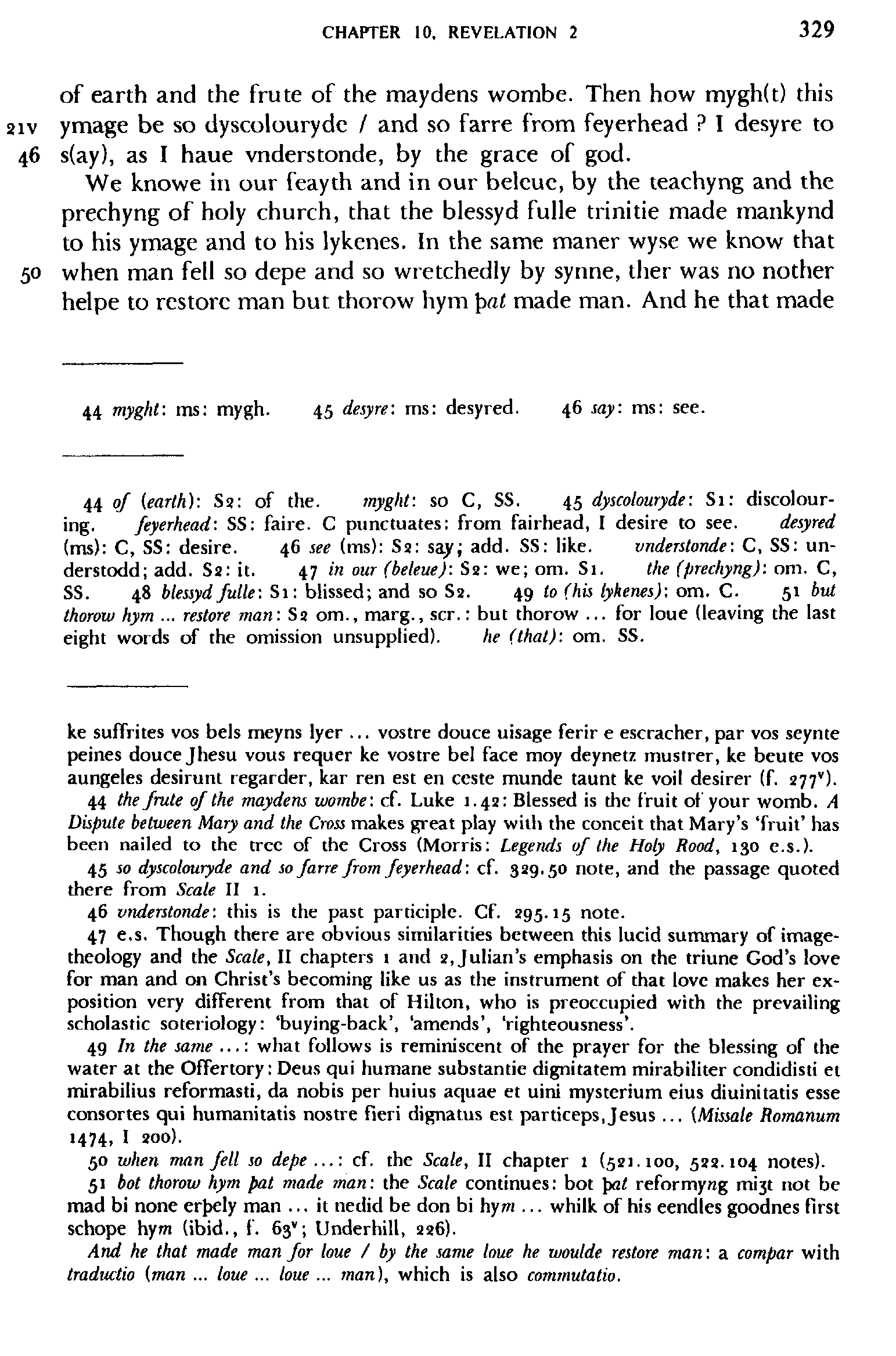
of earth and the frute of the maydens wombe. Then how mygh(t) this 2iv ymage be so dyscolouryde / and so farre from feyerhead ? I desyre to 46 s(ay), as I haue vnderstonde, by the grace of god.
We knowe in our feayth and in our beleue, by the teachyng and the prechyng of holy church, that the blessyd fulle trinitie made mankynd to his yrnage and to his lykenes. In the same maner wyse we know that 50 when man fell so depe and so wretchedly by synne, ther was no nother helpe to restore man but thorow hym ]>at made man. And he that made
44 myght: ms: mygh.
45 desyre: ms: desyred.
46 say: ms: see.
44 of (earth): 82: of the. myght: so C, SS.
45 dyscolouryde: Si: discolouring, feyerhead: SS: faire. C punctuates: from fairhead, I desire to see. desyred (ms): C, SS: desire.
46 see (ms): 82: say; add. SS: like. vnderstonde: C, SS: understodd; add. 82: it.
47 in our (beleue): Ss: we; om. Si. the (prechyng): om. C, SS.
48 blessyd fulle: Si: blissed; and so 82.
49 to (his lykenes): om. C.
51 but thorow hym ... restore man: 82 om., marg., scr.: but thorow ... for loue (leaving the last eight words of the omission unsupplied). he (that): om. SS. ke suffrites vos bels meyns Iyer ... vostre douce uisage ferir e escracher, par vos seynte peines douce Jhesu vous requer ke vostre bel face moy deynetz mustrer, ke beute vos aungeles desirunt regarder, kar ren est en ceste munde taunt ke voil desirer (f. 277").
44 the frute of the maydens wombe: cf. Luke 1.42: Blessed is die fruit of your womb. A Dispute between Mary and the Cross makes great play with the conceit that Mary's 'fruit' has been nailed to the tree of the Cross (Morris: Legends of the Holy Rood, 130 e.s.).
45 50 dyscolouryde and so farre from feyerhead: cf. 329.50 note, and the passage quoted diere from Scale II i.
46 vnderstonde: this is the past participle. Cf. 295.15 note.
47 e.s. Though there are obvious similarities between this lucid summary of imagetheology and the Scale, II chapters i and 2, Julian's emphasis on the triune God's love for man and on Christ's becoming like us as the instrument of that love makes her exposition very different from that of Hilton, who is preoccupied with the prevailing scholastic soteriology: 'buying-back', 'amends', 'righteousness*.
49 In the same ...: what follows is reminiscent of the prayer for the blessing of the water at the Offertory: Deus qui humane substantie dignitatem mirabiliter condidisti et mirabilius reformasti, da nobis per huius aquae et uini mysterium eius diuinitatis esse consortes qui human!tatis nostre fieri dignatus est particeps,Jesus ... (Missale Rornanum
1474, I 200).
50 when man fell so depe ...: cf. the Scale, II chapter i (521.100, 522.104 notes).
51 bot thorow hym pat made man: the Scale continues: bot ^at reformyrcg mi3t not be mad bi none erj>ely man ... it nedid be don bi hym ... whilk of his eendles goodnes first schope hym (ibid., f. 63"; Underbill, 226).
And he that made man for loue / by the same loue he woulde restore man: a compar with traductio (man ... loue ... loue ... man), which is also commutatio.
THE LONG TEXT
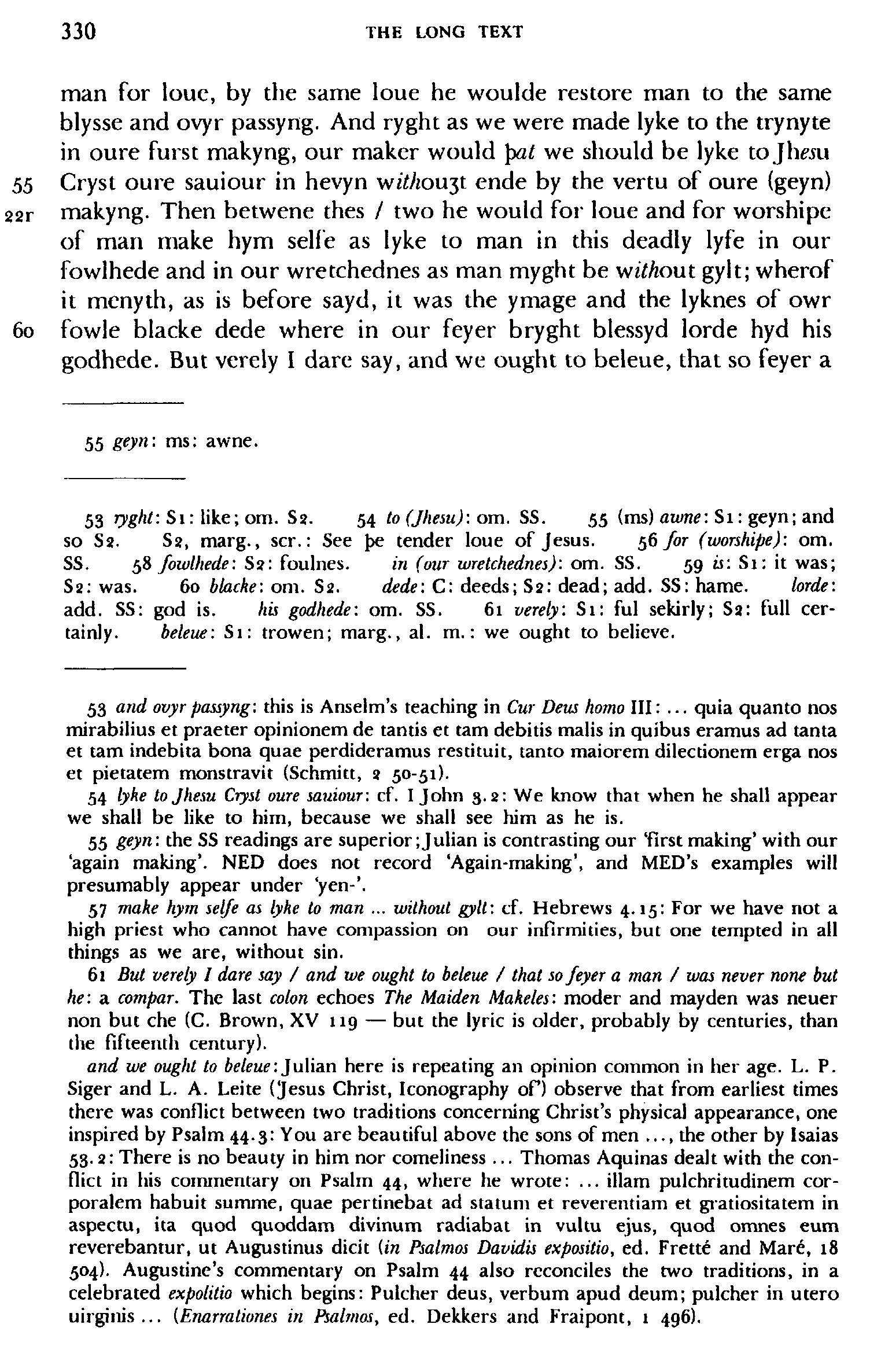
man for loue, by the same loue he woulde restore man to the same blysse and ovyr passyng. And ryght as we were made lyke to the trynyte in oure furst makyng, our maker would ^at we should be lyke tojhwu
55 Cryst oure sauiour in hevyn withouQ ende by the vertu of oure (geyn) asr makyng. Then betwene thes / two he would for loue and for worshipe of man make hym selfe as lyke to man in this deadly lyfe in our fowlhede and in our wretchednes as man myght be •without gylt; wherof it menyth, as is before sayd, it was the ymage and the lyknes of owr
60 fowle blacke dede where in our feyer bryght blessyd lorde hyd his godhede. But verely I dare say, and we ought to beleue, that so feyer a 55 ggyn: ms: awne.
53 ryght'- Si: like; om. 82.
54 to (Jhesu): om. SS.
55 (ms) awne: Si: geyn; and so 82.
82, marg., scr.: See pe tender loue of Jesus.
56 for (worshipe): om.
88.
58 fowlhede: Sa: foulnes. in (our wretchednes): om. 88.
59 is: Si: it was; 82: was.
60 blacke: om. 82. dede: C: deeds; 82: dead; add. 88: hame. lorde: add. 88: god is. his godhede: om. SS.
61 verely: Si: ful sekirly; 82: full certainly, beleue: Si: trowen; marg., al. m.: we ought to believe.
53 and ovyr passyng: this is Anselm's teaching in Cur Deus homo III: ... quia quanto nos mirabilius et praeter opinionem de tantis et tarn debitis malis in quibus eramus ad tanta et tarn indebita bona quae perdideramus restituit, tanto maiorem dilectionem erga nos et pietatem monstravit (Schmitt, 2 50-51).
54 lyke to Jhesu Cryst oure sauiour: cf. I John 3.2: We know that when he shall appear we shall be like to him, because we shall see him as he is.
55 geyn: the SS readings are superior;Julian is contrasting our 'first making' with our
'again making'. NED does not record 'Again-making', and MED's examples will presumably appear under 'yen-'.
57 make hym selfe as lyke to man ... without gylt: cf. Hebrews 4.15: For we have not a high priest who cannot have compassion on our infirmities, but one tempted in all things as we are, without sin.
61 But verely I dare say / and we ought to beleue / that so feyer a man / was never none but he: a compar. The last colon echoes The Maiden Makeles: moder and mayden was neuer non but che (C. Brown, XV 119 — but the lyric is older, probably by centuries, than the fifteenth century). and we ought to beleue: Julian here is repeating an opinion common in her age. L. P.
Siger and L. A. Leite (Jesus Christ, Iconography of') observe that from earliest times there was conflict between two traditions concerning Christ's physical appearance, one inspired by Psalm 44.3: You are beautiful above the sons of men ..., the other by Isaias
53.2: There is no beauty in him nor comeliness ... Thomas Aquinas dealt with the conflict in his commentary on Psalm 44, where he wrote: ... illam pulchritudinem corporalem habuit summe, quae pertinebat ad statum et reverentiam et gratiositatem in aspectu, ita quod quoddam divinum radiabat in vultu ejus, quod omnes eum reverebantur, ut Augustinus dicit (in Psalmos Davidis expositio, ed. Frette and Mare, 18
504). Augustine's commentary on Psalm 44 also reconciles the two traditions, in a celebrated expolitio which begins: Pulcher deus, verbum apud deum; pulcher in utero uirginis... (Enarrationes in Psalmos, ed. Dekkers and Fraipont, i 496).
CHAPTER 10, REVELATION 2
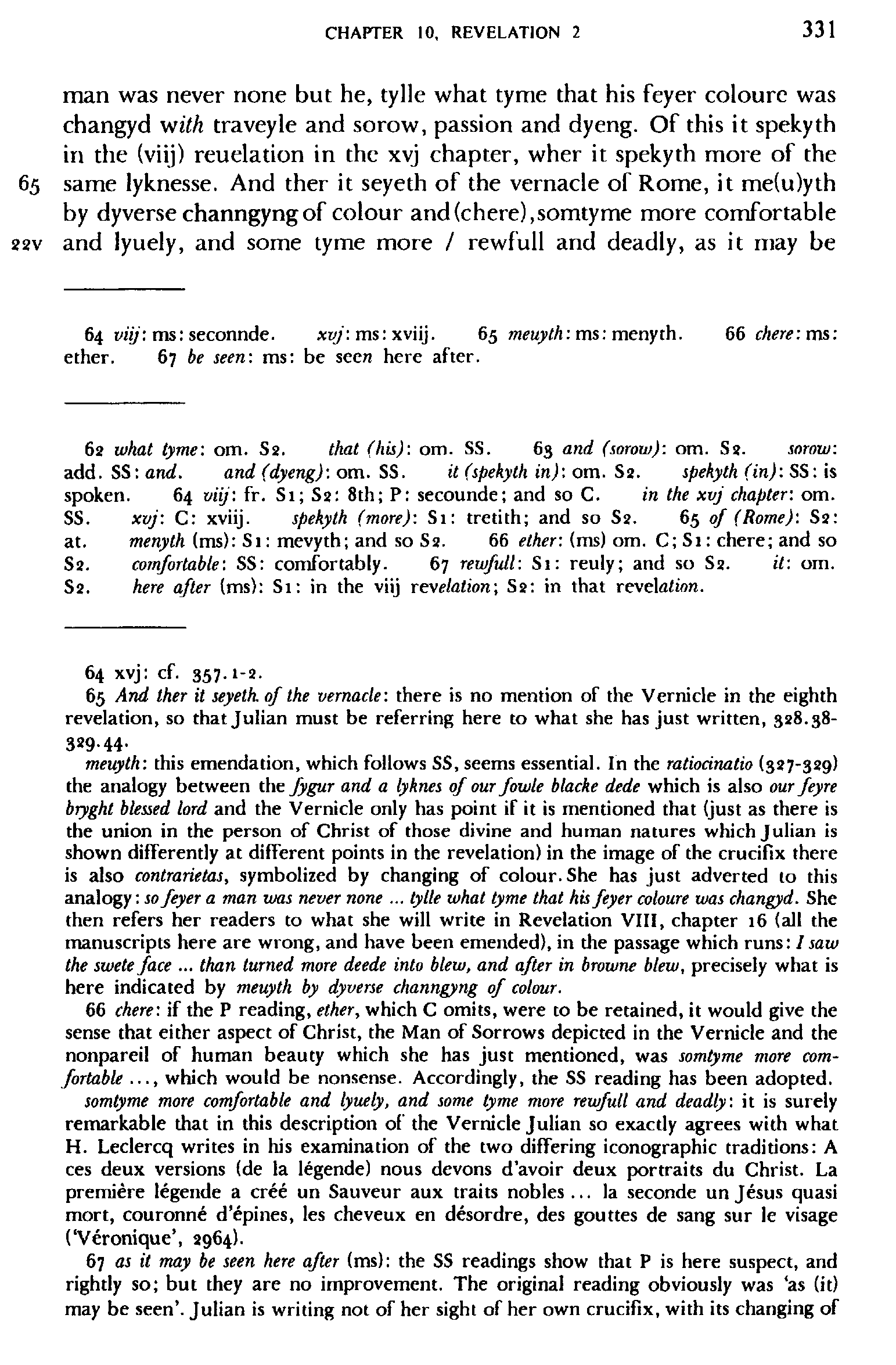
man was never none but he, tylle what tyme that his feyer colourc was changyd with traveyle and sorow, passion and dyeng. Of this it spekyth in the (viij) reuelation in the xvj chapter, wher it spekyth more of the 65 same lyknesse. And ther it seyeth of the vernacle of Rome, it me(u)yth by dyverse channgyngof colour and(chere),somtyme more comfortable
22v and lyuely, and some tyme more / rewfull and deadly, as it may be 64 viij': ms: seconnde. xvj: ms: xviij.
65 meuyth: ms: menyth.
66 chere:ms: ether.
67 be seen: ms: be seen here after.
62 what tyme: om. Sa. that (his): om. 88.
63 and (sorow): om. 82. sorow: add. SS: and. and (dyeng): om. SS. it (spekyth in): om. 82. spekyth (in): SS: is spoken.
64 viij: fr. Si; 82: 8th; P: secounde; and so C. in the xvj chapter: om.
SS. xvj: C: xviij. spekyth (more): Si: tretith; and so 82.
65 of (Rome): 82: at. menyth (ms): Si: mevyth; and so 82.
66 ether: (ms) om. C; Si: chere; and so 82. comfortable: SS: comfortably.
67 rewfull: Si: reuly; and so 82. it: om.
82. here after (ms): Si: in the viij revelation; 82: in that revelation.
64 xvj: cf. 357.1-2.
65 And ther it seyeth. of the vernacle: there is no mention of the Vernicle in the eighth revelation, so that Julian must be referring here to what she has just written, 328.38329.44. meuyth: this emendation, which follows SS, seems essential. In the ratiocinatio (327-329) the analogy between the^gwr and a lyknes ofourfowle blacke dede which is also our f eyre bryght blessed lord and the Vernicle only has point if it is mentioned that (just as there is the union in the person of Christ of those divine and human natures which Julian is shown differently at different points in the revelation) in the image of the crucifix there is also contrarietas, symbolized by changing of colour. She has just adverted to this analogy: so feyer a man was never none ... tylle what tyme that his feyer coloure was changyd. She then refers her readers to what she will write in Revelation VIII, chapter 16 (all the manuscripts here are wrong, and have been emended), in the passage which runs: I saw the sweteface ... than turned more deede into blew, and after in browne blew, precisely what is here indicated by meuyth by dyverse channgyng of colour.
66 chere: if the P reading, ether, which C omits, were to be retained, it would give the sense that either aspect of Christ, the Man of Sorrows depicted in the Vernicle and the nonpareil of human beauty which she has just mentioned, was somtyme more comfortable ..., which would be nonsense. Accordingly, the 88 reading has been adopted. somtyme more comfortable and lyuely, and some tyme more rewfull and deadly: it is surely remarkable that in this description of the Vernicle Julian so exactly agrees with what
H. Leclercq writes in his examination of the two differing iconographic traditions: A ces deux versions (de la legende) nous devons d'avoir deux portraits du Christ. La premiere legende a cree un Sauveur aux traits nobles ... la seconde un Jesus quasi mort, couronne d'epines, les cheveux en desordre, des gouttes de sang sur le visage
CVeronique', 2964).
67 as it may be seen here after (ms): the SS readings show that P is here suspect, and rightly so; but they are no improvement. The original reading obviously was 'as (it) may be seen'. Julian is writing not of her sight of her own crucifix, with its changing of
THE LONG TEXT
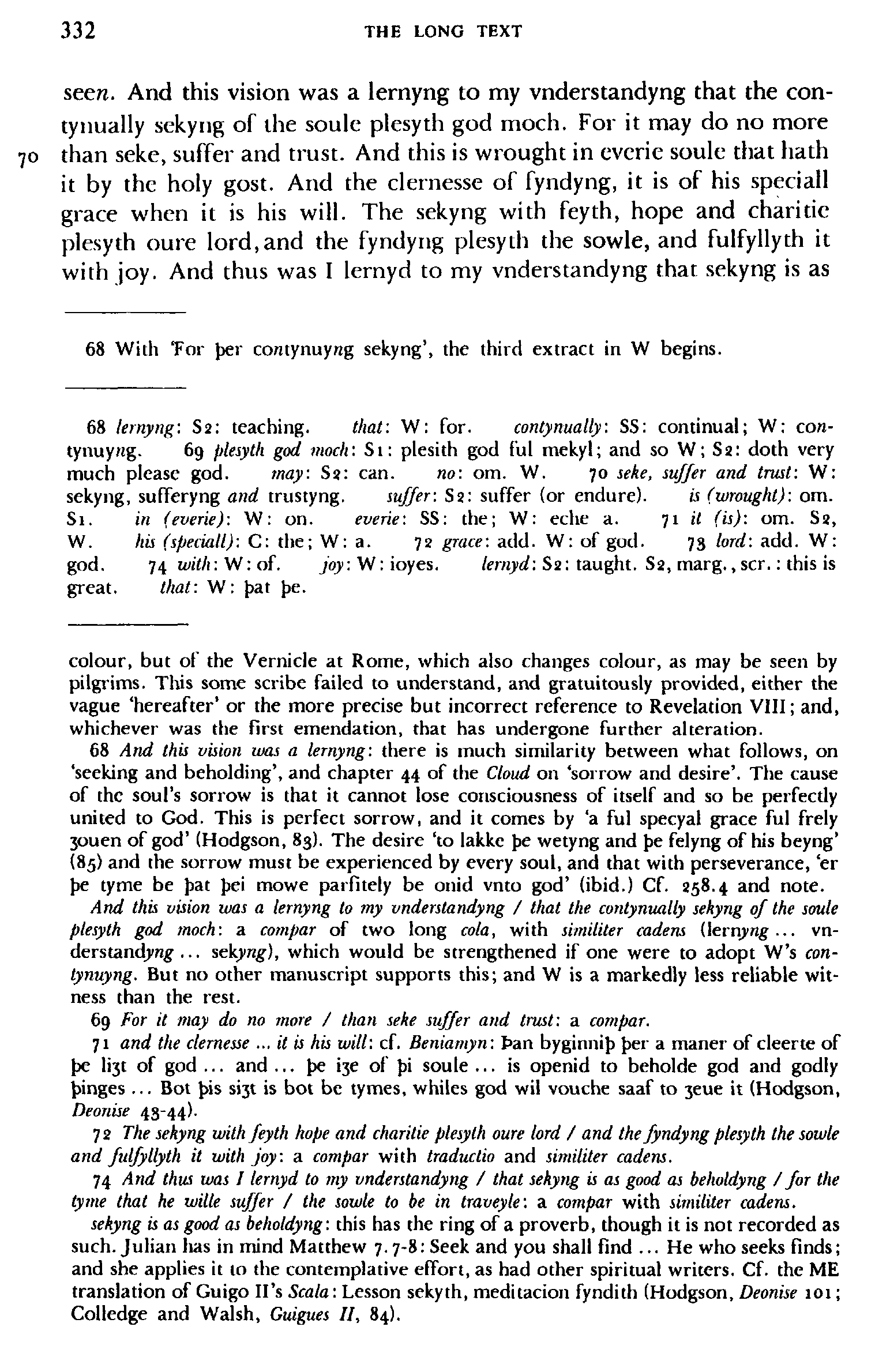
seerc. And this vision was a lernyng to my vnderstandyng that the contynually sekyng of the soule plesyth god moch. For it may do no more
70 than seke, suffer and trust. And this is wrought in evcrie soule that hath it by the holy gost. And the clernesse of fyndyng, it is of his speciall grace when it is his will. The sekyng with feyth, hope and chad tie plesyth oure lord, and the fyndyng plesyth the sowle, and fulfyllyth it with joy. And thus was I lernyd to my vnderstandyng that sekyng is as 68 With 'For per contynuyng sekyng', the third extract in W begins.
68 lernyng: 82: teaching. that: W: for. contynually: SS: continual; W: contynuyng.
69 plesyth god moch: Si: plesith god ful mekyl; and so W; 82: doth very much please god. may: 82: can. no: om. W.
70 seke, suffer and trust: W: sekyng, sufferyng and trustyng. suffer: 82: suffer (or endure). is (wrought): om.
Si. in (everie): W: on. everie: SS: the; W: eche a.
71 it (is): om. 82, W. his (speciall): C: the; W: a.
72 grace: add. W: of god.
73 lord: add. W: god.
74 with: W: of. joy: W: ioyes. lernyd: 82: taught. 82, marg., scr.: this is great. that: W: pat pe. colour, but of the Vernicle at Rome, which also changes colour, as may be seen by pilgrims. This some scribe failed to understand, and gratuitously provided, either the vague 'hereafter' or the more precise but incorrect reference to Revelation VIII; and, whichever was the first emendation, that has undergone further alteration.
68 And this vision was a lernyng: there is much similarity between what follows, on 'seeking and beholding', and chapter 44 of the Cloud on 'sorrow and desire'. The cause of the soul's sorrow is that it cannot lose consciousness of itself and so be perfectly united to God. This is perfect sorrow, and it comes by 'a ful specyal grace ful frely
3ouen of god' (Hodgson, 83). The desire 'to lakke pe wetyng and pe felyng of his beyng'
(85) and the sorrow must be experienced by every soul, and that with perseverance, 'er pe tyme be pat pei mowe parfitely be onid vnto god' (ibid.) Cf. 258.4 and note.
And this vision was a lernyng to my vnderstandyng / that the contynually sekyng of the soule plesyth god moch: a compar of two long cola, with similiter cadens (lernyng... vnderstandyng ... sekyng), which would be strengthened if one were to adopt W's contynuyng. But no other manuscript supports this; and W is a markedly less reliable witness than the rest.
69 For it may do no more / than seke suffer and trust: a compar.
71 and the clernesse ... it is his will: cf. Beniamyn: f>an byginnip per a maner of cleerte of pe Ii3t of god ... and ... pe ije of pi soule ... is openid to beholde god and godly pinges ... Bot pis sJ3t is bot be tymes, whiles god wil vouche saaf to 3eue it (Hodgson,
Deonise 43-44).
72 The sekyng with feyth hope and charitie plesyth oure lord / and the fyndyng plesyth the sowle and fulfyllyth it with joy: a compar with traductio and similiter cadens.
74 And thus was I lernyd to my vnderstandyng / that sekyng is as good as beholdyng /for the tyme that he wille suffer / the sowle to be in traveyle: a compar with similiter cadens. sekyng is as good as beholdyng: this has the ring of a proverb, though it is not recorded as such. Julian has in mind Matthew 7.7-8: Seek and you shall find ... He who seeks finds; and she applies it to the contemplative effort, as had other spiritual writers. Cf. the ME translation of Guigo II's Scala: Lesson sekyth, meditacion fyndith (Hodgson, Deonise 101;
Colledge and Walsh, Guigues II, 84).
CHAPTER 10, REVELATION 2
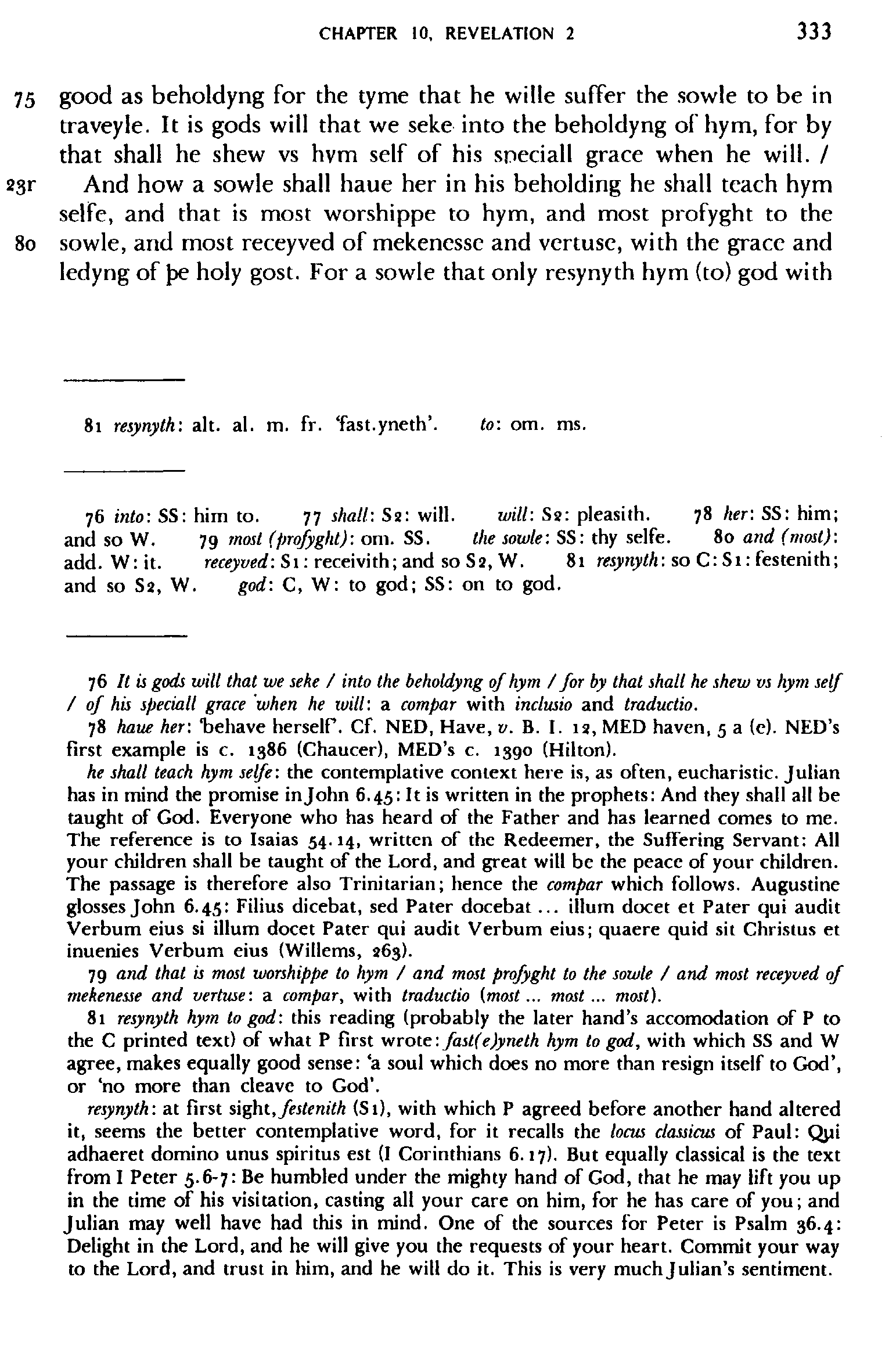
75 good as beholdyng for the tyme that he wille suffer the sowle to be in traveyle. It is gods will that we seke into the beholdyng of hym, for by that shall he shew vs hvm self of his speciall grace when he will. /
2sr And how a sowle shall haue her in his beholding he shall teach hym selfe, and that is most worshippe to hym, and most profyght to the 80 sowle, and most receyved of mekenesse and vcrtuse, with the grace and ledyng of be holy gost. For a sowle that only resynyth hym (to) god with 81 resynyth: alt. al. m. fr. 'fast.yneth'. to: om. ms.
76 into: SS: him to.
77 shall: Ss: will. will: Ss: pleasith.
78 her: SS: him; and so W.
79 most (profyght): om. SS. the sowle: SS: thy selfe.
80 and (most): add. W: it. receyved: Si: receivith; and so Sa, W.
81 resynyth: so C: Si: festenith; and so 82, W. god: C, W: to god; SS: on to god.
T 6 It is gods will that we seke / into the beholdyng of hym /for by that shall he shew vs hym self
/ of his speciall grace when he will: a compar with indusio and traductio.
78 haue her: 'behave herself. Cf. NED, Have, v. B. I. 12, MED haven, 5 a (e). NED's first example is c. 1386 (Chaucer), MED's c. 1390 (Hilton). he shall teach hym selfe: the contemplative context here is, as often, eucharistic. Julian has in mind the promise in John 6.45: It is written in the prophets: And they shall all be taught of God. Everyone who has heard of the Father and has learned comes to me.
The reference is to Isaias 54.14, written of the Redeemer, the Suffering Servant: All your children shall be taught of the Lord, and great will be the peace of your children.
The passage is therefore also Trinitarian; hence the compar which follows. Augustine glosses John 6.45: Filius dicebat, sed Pater docebat ... ilium docet et Pater qui audit
Verbum eius si ilium docet Pater qui audit Verbum eius; quaere quid sit Christus et inuenies Verbum eius (Willems, 263).
79 and that is most worshippe to hym / and most profyght to the sowle / and most receyved of mekenesse and vertuse: a compar, with traductio (most... most... most).
81 resynyth hym to god: this reading (probably the later hand's accomodation of P to the C printed text) of what P first wrote: fast(e)yneth hym to god, with which SS and W agree, makes equally good sense: 'a soul which does no more than resign itself to God', or 'no more than cleave to God'. resynyth: at first sight,festenith (Si), with which P agreed before another hand altered it, seems the better contemplative word, for it recalls the locus dassicus of Paul: Qjii adhaeret domino unus spiritus est (I Corinthians 6.17). But equally classical is the text from I Peter 5.6-7: Be humbled under the mighty hand of God, that he may lift you up in the time of his visitation, casting all your care on him, for he has care of you; and Julian may well have had this in mind. One of the sources for Peter is Psalm 36.4:
Delight in the Lord, and he will give you the requests of your heart. Commit your way to the Lord, and trust in him, and he will do it. This is very muchjulian's sentiment.
THE LONG TEXT
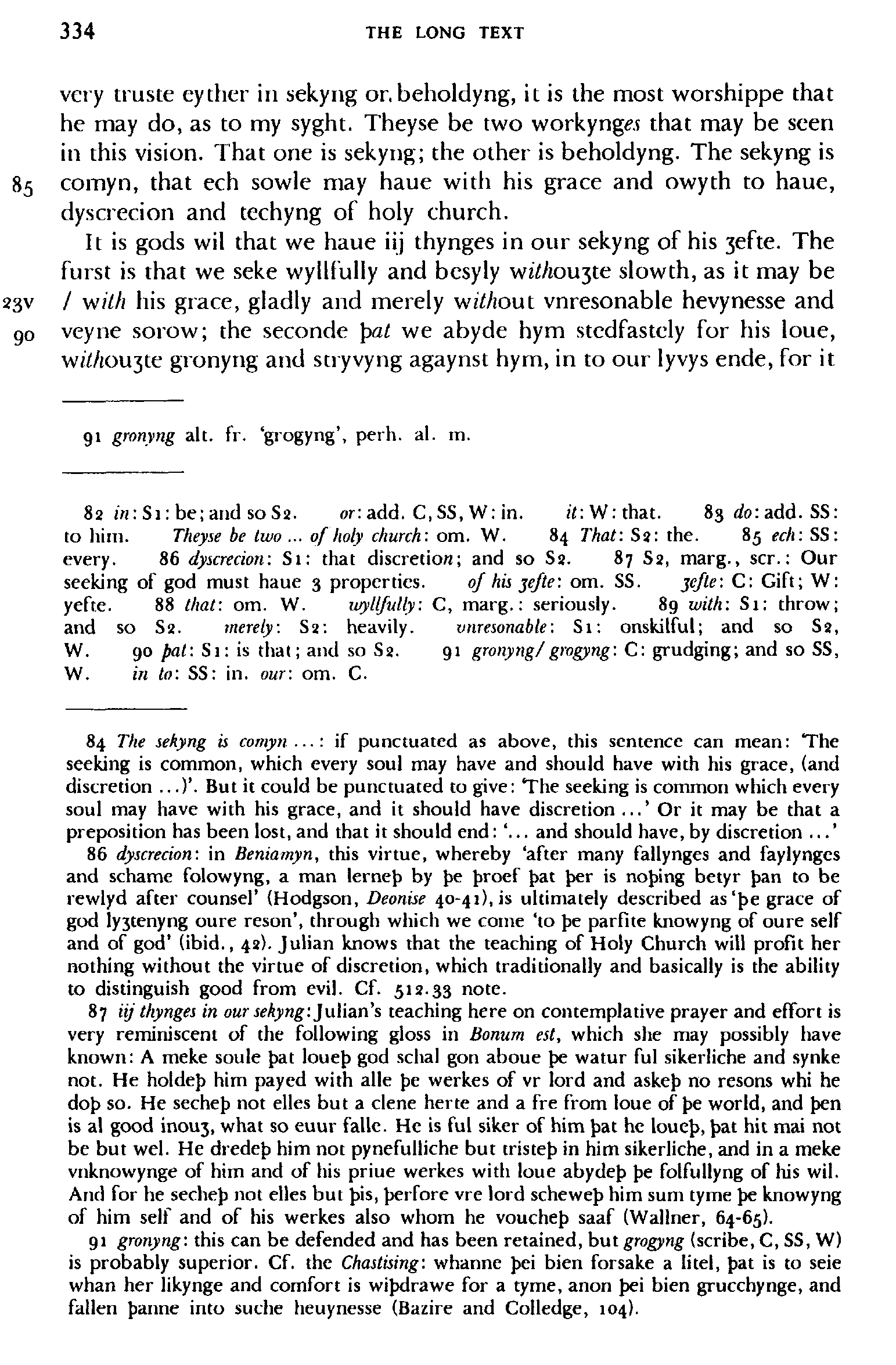
very truste eyther in sekyng or, beholdyng, it is the most worshippe that he may do, as to my syght. Theyse be two workyng^.s that may be seen in this vision. That one is sekyng; the other is beholdyng. The sekyng is
85 cornyn, that ech sowle may haue with his grace and owyth to haue, dyscrecion and techyng of holy church.
It is gods wil that we haue iij thynges in our sekyng of his 3efte. The furst is that we seke wyllfully and besyly withou$te slowth, as it may be asv / w//// his grace, gladly and merely without vnresonable hevynesse and go veyne sorow; the seconde \>at we abyde hym stedfastely for his loue, w//Aou3te gronyng and stryvyng agaynst hym, in to our lyvys ende, for it
91 gronyng alt. fr. 'grogyng', perh. al. in.
82 I'M: Si: be; and so 82. or: add. C,SS, W: in.
/f:W:that.
8srfo:add.SS: to him.
Theyse be two ... of holy church', om. W.
84 That: 82: the.
85 ech: SS: every.
86 discretion: Si: that discretion; and so 82.
87 82, marg., scr.: Our seeking of god must haue 3 properties. of his yfte: om. SS. jefte: C: Gift; W: yefte.
88 that: om. W. wyllfully: C, marg.: seriously.
89 with: Si: throw; and so 82. merely: 82: heavily. vnresonable: Si: onskilful; and so 82, W.
90 pat: Si: is that; and so 82.
91 gronyng/grogyng: C: grudging; and so SS, W. in to: SS: in. our: om. C.
84 The sekyng is comyn ...: if punctuated as above, this sentence can mean: The seeking is common, which every soul may have and should have with his grace, (and discretion ...)'. But it could be punctuated to give: The seeking is common which every soul may have with his grace, and it should have discretion ..." Or it may be that a preposition has been lost, and that it should end: '... and should have, by discretion ...'
86 dyscrecion: in Beniamyn, this virtue, whereby 'after many fallynges and faylynges and schame folowyng, a man lernej> by pe proef ]>at per is noting betyr pan to be rewlyd after counsel' (Hodgson, Deonise 40-41), is ultimately described as'pe grace of god lyjtenyng oure reson', through which we come 'to pe parfite knowyng of oure self and of god' (ibid., 42). Julian knows that the teaching of Holy Church will profit her nothing without the virtue of discretion, which traditionally and basically is the ability to distinguish good from evil. Cf. 512.33 note.
87 iij thynges in our sekyng: Julian's teaching here on contemplative prayer and effort is very reminiscent of the following gloss in Bonum est, which she may possibly have known: A meke soule pat louej) god schal gon aboue pe watur ful sikerliche and synke not. He holde}) him payed with alle pe werkes of vr lord and askef> no resons whi he do}) so. He sechejj not elles but a clene herte and a fre from loue of pe world, and pen is al good inou3, what so euur falle. He is ful siker of him pat he louep, pat hit mai not be but wel. He drede£> him not pynefulliche but tristef) in him sikerliche, and in a meke vnknowynge of him and of his priue werkes with loue abydej) pe folfullyng of his wil.
And for he sechej) not elles but pis, perfore vre lord schewej) him sum tyme pe knowyng of him self and of his werkes also whom he vouchej) saaf (Wallner, 64-65).
91 gronyng: this can be defended and has been retained, but grogyng (scribe, C, SS, W) is probably superior. Cf. the Chastising: whanne pei bien forsake a litel, pat is to seie whan her likynge and comfort is wipdrawe for a tyme, anon pei bien grucchynge, and fallen panne into suche heuynesse (Bazire and Colledge, 104).
CHAPTER 10, REVELATION 2
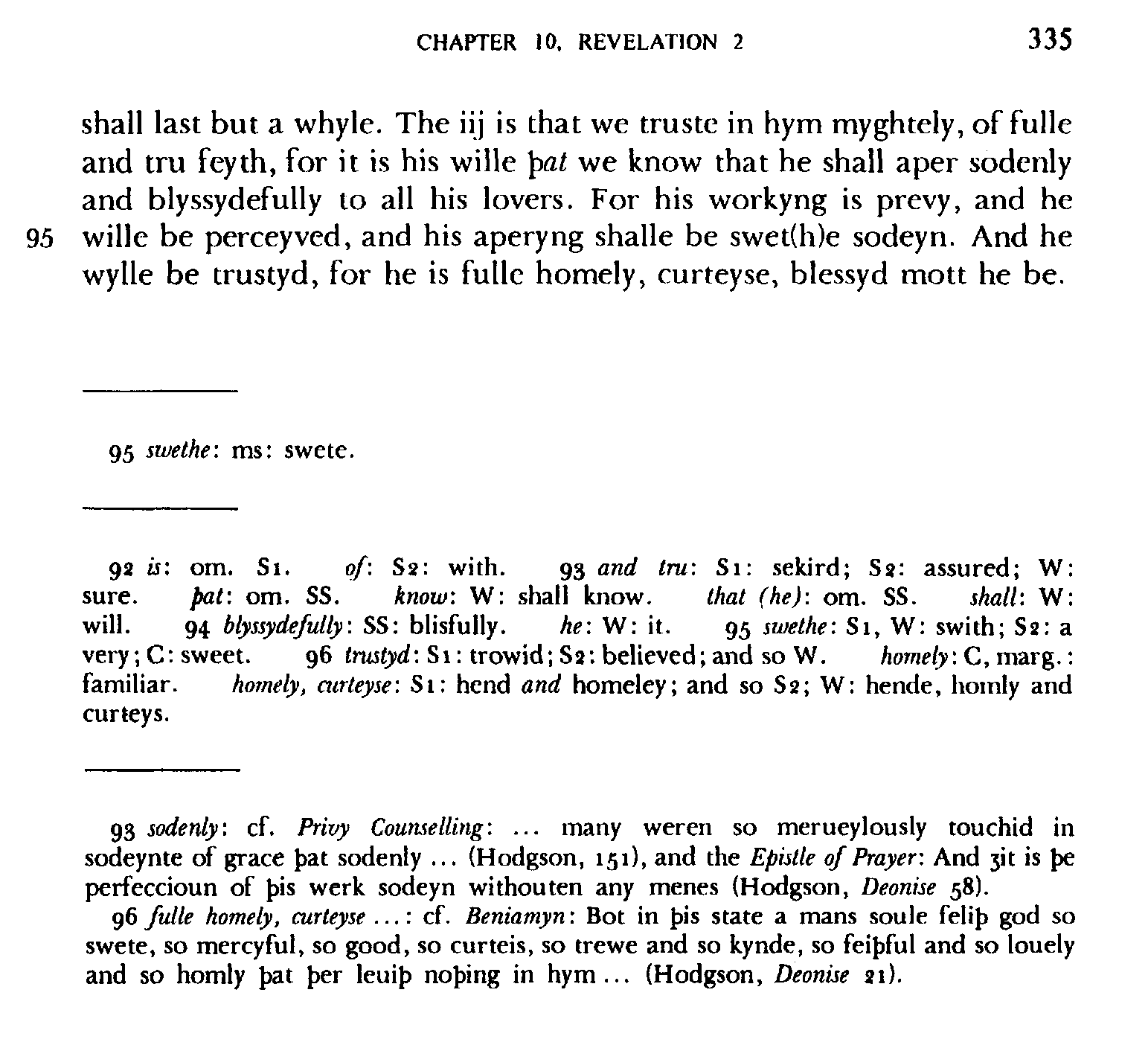
shall last but a whyle. The iij is that we truste in hym myghtely, of fulle and tru feyth, for it is his wille ^>at we know that he shall aper sodenly and blyssydefully to all his lovers. For his workyng is prevy, and he
95 wille be perceyved, and his aperyng shalle be swet(h)e sodeyn. And he wylle be trustyd, for he is fulle homely, curteyse, blessyd mott he be.
95 swethe: ms: swete.
92 is: om. Si. of: 82: with.
93 and tru: Si: sekird; 82: assured; W: sure. pat: om. SS. know: W: shall know. that (he): om. SS. shall: W: will.
94 blyssydefully: SS: blisfully. he: W: it.
95 swethe: Si, W: swith; Ss: a very; C: sweet.
96 trustyd: Si: trowid; 82: believed; and so W. homely: C, marg.: familiar. homely, curteyse: Si: hend and homeley; and so Sa; W: hende, homly and curteys.
93 sodenly: cf. Privy Counselling: ... many weren so merueylously touchid in sodeynte of grace £>at sodenly ... (Hodgson, 151), and the Epistle of Prayer: And 3it is J)e perfeccioun of J)is werk sodeyn withouten any menes (Hodgson, Deonise 58).
96 fulle homely, curteyse ...: cf. Beniamyn: Bot in J)is state a mans soule felij> god so swete, so mercyful, so good, so curteis, so trewe and so kynde, so feififul and so louely and so homly £at £er leui£> noting in hym... (Hodgson, Deonise 21).
THE LONG TEXT
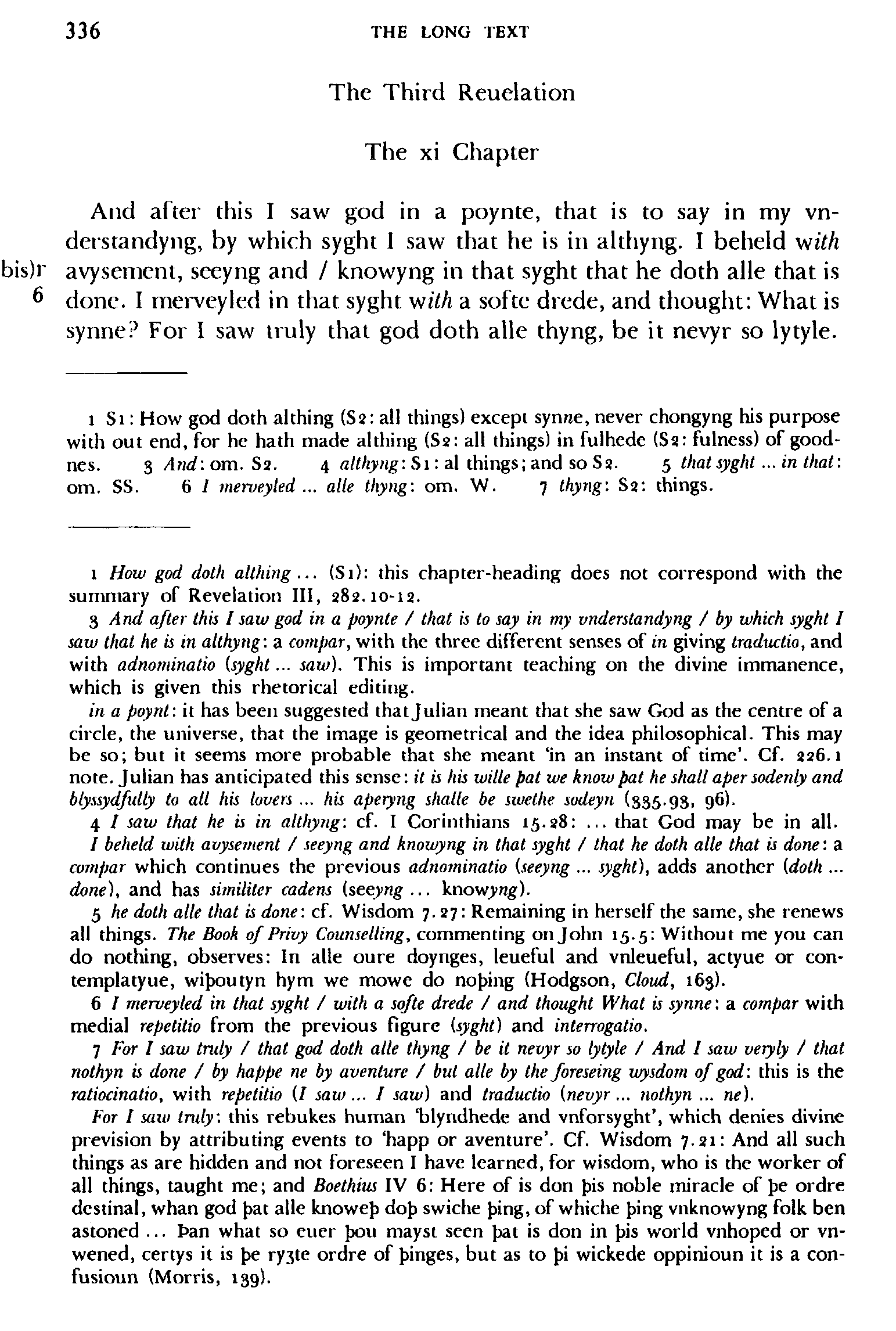
The Third Reuelation The xi Chapter And after this I saw god in a poynte, that is to say in my vnderstandyng, by which syght I saw that he is in althyng. I beheld with (bis)r avysement, seeyng and / knowyng in that syght that he doth alle that is
6 done. I merveyled in that syght with a softe drede, and thought: What is synne? For I saw truly that god doth alle thyng, be it nevyr so lytyle. i Si: How god doth althing (82: all things) except syrwe, never chongyng his purpose with out end, for he hath made althing (82: all things) in fulhede (Sa: fulness) of goodnes.
3 And:om. Sa.
4 althyng: Si: al things; and so 82.
5 that syght ... in that: om. 88.
6 7 merveyled ... alle thyng: om. W.
7 thyng: 82: things. i How god doth althing... (Si): this chapter-heading does not correspond with the summary of Revelation III, 282.10-12.
3 And after this I saw god in a poynte / that is to say in my vnderstandyng / by which syght I saw that he is in althyng: a compar, with the three different senses of in giving traductio, and with adnominatio (syght... saw). This is important teaching on the divine immanence, which is given this rhetorical editing. in a poynt: it has been suggested that Julian meant that she saw God as the centre of a circle, the universe, that the image is geometrical and the idea philosophical. This may be so; but it seems more probable that she meant 'in an instant of time'. Cf. 226.1 note. Julian has anticipated this sense: it is his wille pat we know pat he shall aper sodenly and blyssydfully to all his lovers ... his aperyng shalle be swelhe sodeyn (335.93, 96).
4 / saw that he is in althyng: cf. I Corinthians 15.28: ... that God may be in all.
/ beheld with avysement / seeyng and knowyng in that syght / that he doth alle that is done: a compar which continues the previous adnominatio (seeyng ... syght), adds another (doth ... done), and has similiter cadens (seeyng... knowyng).
5 he doth alle that is done: cf. Wisdom 7.27: Remaining in herself the same, she renews all things. The Book of Privy Counselling, commenting on John 15.5: Without me you can do nothing, observes: In alle oure doynges, leueful and vnleueful, actyue or contemplatyue, wijxautyn hym we mowe do noting (Hodgson, Cloud, 163).
6 / merveyled in that syght / with a softe drede / and thought What is synne: a compar with medial repetitio from the previous figure (syght) and interrogatio.
1 For I saw truly / that god doth alle thyng / be it nevyr so lytyle / And I saw veryly / that nothyn is done / by happe ne by aventure / but alle by theforeseing wysdotn of god: this is the ratiocinatio, with repetitio (I saw ... I saw) and traductio (nevyr ... nothyn ... ne).
For I sau> truly: this rebukes human 'blyndhede and vnforsyght', which denies divine prevision by attributing events to 'happ or aventure'. Cf. Wisdom 7.21: And all such things as are hidden and not foreseen I have learned, for wisdom, who is the worker of all things, taught me; and Boethius IV 6: Here of is don J)is noble miracle of J>e ordre destinal, whan god |>at alle knowef) doj> swiche {ring, of whiche {ring vnknowyng folk ben astoned ... t>an what so euer {xni mayst seen f>at is don in pis world vnhoped or vnwened, certys it is \>e ryjte ordre of Binges, but as to J)i wickede oppinioun it is a confusioun (Morris, 139).
CHAPTER 11, REVELATION 3
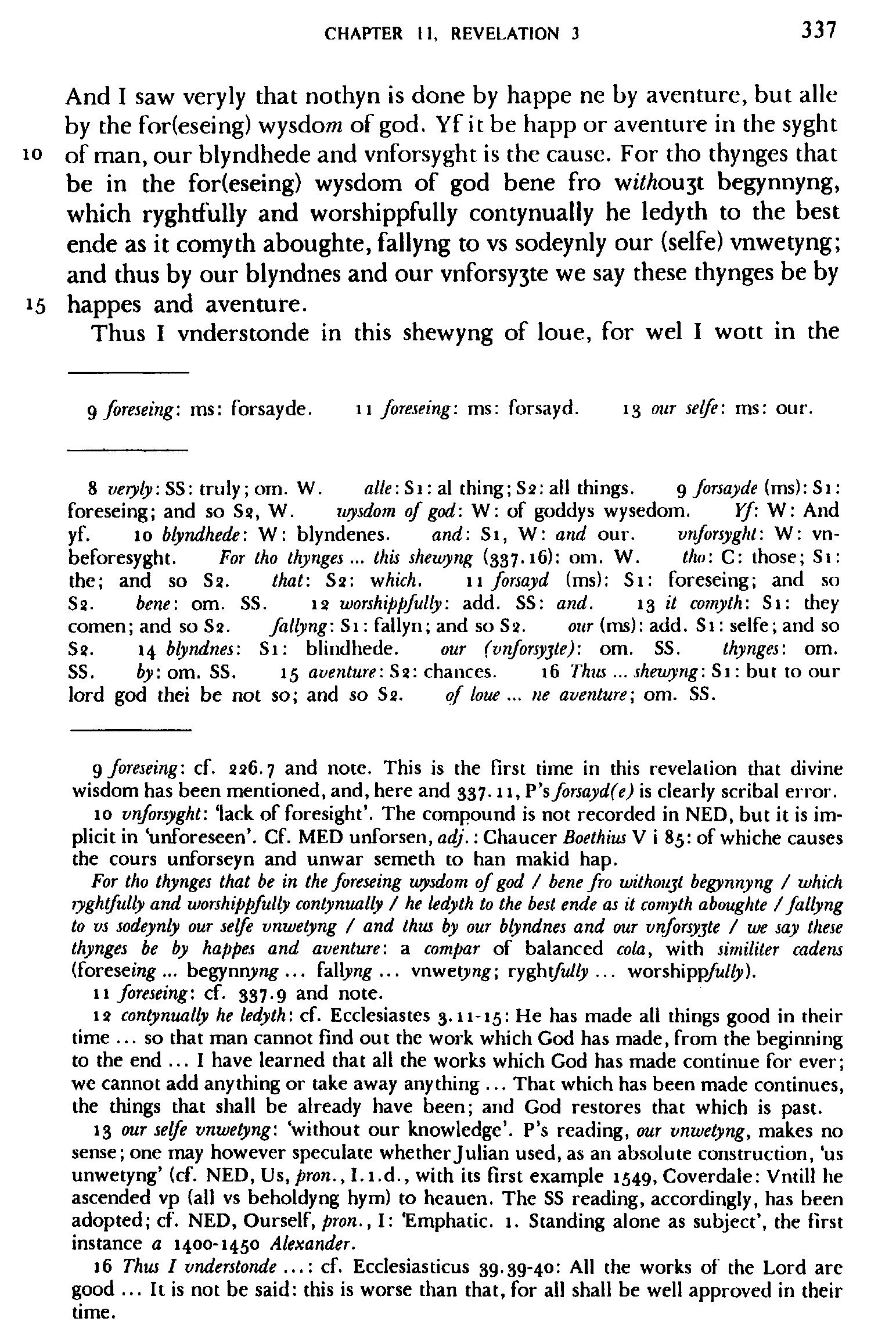
And I saw veryly that nothyn is done by happe ne by aventure, but alle by the for(eseing) wysdora of god. Yf it be happ or aventure in the syght
10 of man, our blyndhede and vnforsyght is the cause. For tho thynges that be in the for(eseing) wysdom of god bene fro wz^ou3t begynnyng, which ryghtfully and worshippfully contynually he ledyth to the best ende as it cornyth aboughte, fallyng to vs sodeynly our (selfe) vnwetyng; and thus by our blyndnes and our vnforsy3te we say these thynges be by 15 happes and aventure.
Thus I vnderstonde in this shewyng of loue, for wel I wott in the 9 foreseing: ms: forsayde.
11 foreseing: ms: forsayd.
13 our selfe: ms: our.
8 veryly: SS: truly; orn. W. alle: Si: al thing; Sa: all things.
9 forsayde (ms): Si: foreseing; and so Sa, W. wysdom of god: W: of goddys wysedom.
Yf: W: And yf.
10 blyndhede: W: blyndenes. and: Si, W: and our. vnforsyght: W: vnbeforesyght.
For tho thynges ... this shewyng (337.16): om. W. tho: C: those; Si: the; and so Sa. that: Sa: which.
11 forsayd (ms): Si: foreseing; and so Sa. bene: om. SS.
12 worshippfully: add. SS: and.
13 it corny th: Si: diey comen; and so Sa. fallyng: Si: fallyn; and so 82. our (ms): add. Si: selfe; and so Sa.
14 blyndnes: Si: blindhede. our (vnforsyjte): om.
SS. thynges: om.
SS. by: om. SS.
15 aventure: Sa: chances.
16 Thus ... shewyng: Si: but to our lord god thei be not so; and so Sa. of loue ... ne aventure; om. SS.
9 foreseing: cf. 336.7 and note. This is the first time in this revelation that divine wisdom has been mentioned, and, here and 337.11, P'sforsayd(e) is clearly scribal error.
10 vnforsyght: 'lack of foresight'. The compound is not recorded in NED, but it is implicit in 'unforeseen'. Cf. MED unforsen, adj.: Chaucer Boethius V i 85: of whiche causes the cours unforseyn and unwar semeth to han makid hap.
For tho thynges that be in the foreseing wysdom of god / bene fro withoujt begynnyng / which ryghtfully and worshippfully contynually / he ledyth to the best ende as it comyth aboughte /fallyng to vs sodeynly our selfe vnwetyng / and thus by our blyndnes and our vnforsyjte / we say these thynges be by happes and aventure: a compar of balanced cola, with similiter cadens
(foreseing... begynnyng... fallyng... vnwetyng; ryghtfully... worshipp/w//)i).
11 foreseing: cf. 337.9 and note. la contynually he ledyth: cf. Ecclesiastes 3.11-15: He has made all things good in their time ... so that man cannot find out the work which God has made, from the beginning to the end ... I have learned that all the works which God has made continue for ever; we cannot add anything or take away anything ... That which has been made continues, the things that shall be already have been; and God restores that which is past.
13 our selfe vnwetyng: 'without our knowledge'. P's reading, our vnwetyng, makes no sense; one may however speculate whether Julian used, as an absolute construction, 'us unwetyng' (cf. NED, \Js,pron., I.i.d., with its first example 1549, Coverdale: Vntill he ascended vp (all vs beholdyng hym) to heauen. The SS reading, accordingly, has been adopted; cf. NED, Ourself, pron., I: 'Emphatic, i. Standing alone as subject', the first instance a 1400-1450 Alexander.
16 Thus I vnderstonde ...: cf. Ecclesiasticus 39.39-40: All the works of the Lord are good ... It is not be said: this is worse than that, for all shall be well approved in their time.