
Chapter 5, Revelation ! 299
CHAPTER 13, REVELATION 5
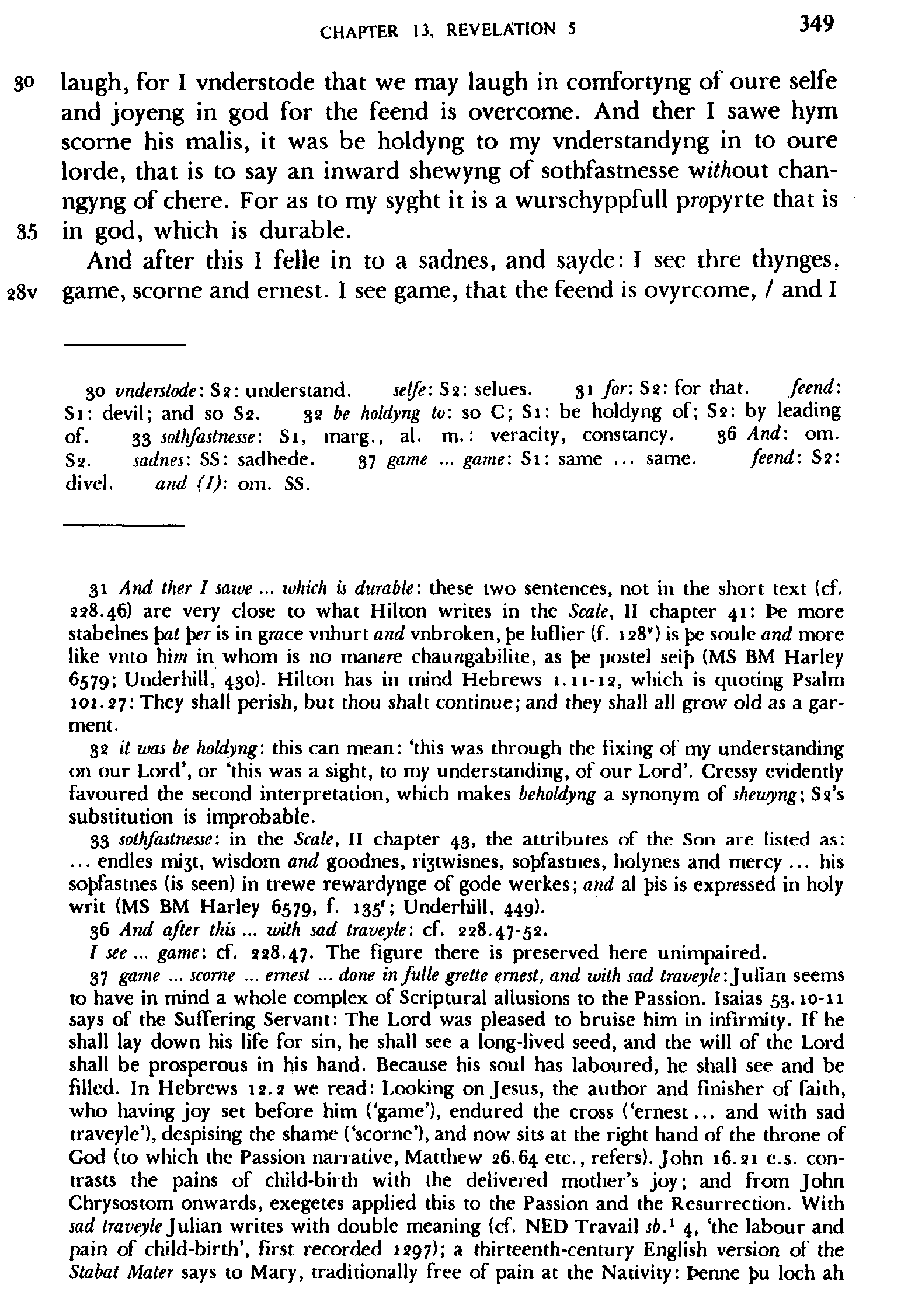
3° laugh, for I vnderstode that we may laugh in comfortyng of cure selfe and joyeng in god for the feend is overcome. And ther I sawe hym scorne his malis, it was be holdyng to my vnderstandyng in to oure lorde, that is to say an inward shewyng of sothfastnesse -without channgyng of chere. For as to my syght it is a wurschyppfull propyrte that is
35 in god, which is durable.
And after this I felle in to a sadnes, and sayde: I see thre thynges, a8v game, scorne and ernest. I see game, that the feend is ovyrcome, / and I 30 vnderstode: 82: understand. selfe: 82: selues.
31 for: Ss: for that. feend:
Si: devil; and so 82.
32 be holdyng to: so C; Si: be holdyng of; Ss: by leading of.
33 sothfastnesse:
Si, marg., al. m.: veracity, constancy.
36 And: om.
82. sadnes: SS: sadhede.
37 game ... game: Si: same ... same. feend: Ss: divel. and (I): om. SS.
31 And ther I sawe ... which is durable: these two sentences, not in the short text (cf.
228.46) are very close to what Hilton writes in the Scale, II chapter 41: t»e more stabelnes \>at \>er is in grace vnhurt and vnbroken, J>e luflier (f. 128*) is J>e soule and more like vnto him in whom is no manure chaungabilite, as f>e postel seijj (MS BM Harley
6579; Underbill, 430). Hilton has in mind Hebrews 1.11-12, which is quoting Psalm
101.27: They shall perish, but thou shall continue; and they shall all grow old as a garment.
32 it was be holdyng: this can mean: 'this was through the fixing of my understanding on our Lord", or 'this was a sight, to my understanding, of our Lord'. Crcssy evidently favoured the second interpretation, which makes beholdyng a synonym of shewyng; 82*8 substitution is improbable.
33 sothfastnesse: in the Scale, II chapter 43, the attributes of the Son are listed as:
... endles mi3t, wisdom and goodnes, ristwisnes, sojjfastnes, holynes and mercy ... his sojjfastnes (is seen) in trewe rewardynge of gode werkes; and al {>is is expressed in holy writ (MS BM Harley 6579, f. 135'; Underbill, 449).
36 And after this ... with sad traveyle: cf. 228.47-52.
/ see ... game: cf. 228.47. The figure there is preserved here unimpaired.
37 game ... scorne ... ernest ... done infulle grette emest, and with sad traveyle: Julian seems to have in mind a whole complex of Scriptural allusions to the Passion. Isaias 53.10-11 says of the Suffering Servant: The Lord was pleased to bruise him in infirmity. If he shall lay down his life for sin, he shall see a long-lived seed, and the will of the Lord shall be prosperous in his hand. Because his soul has laboured, he shall see and be filled. In Hebrews 12.2 we read: Looking on Jesus, the author and finisher of faith, who having joy set before him ('game'), endured the cross ('ernest... and with sad traveyle'), despising the shame ('scorne'), and now sits at the right hand of the throne of God (to which the Passion narrative, Matthew 26.64 etc., refers). John 16.21 e.s. contrasts the pains of child-birth with the delivered mother's joy; and from John
Chrysostom onwards, exegetes applied this to the Passion and the Resurrection. With sad traveyle Julian writes with double meaning (cf. NED Travail sb.1 4, 'the labour and pain of child-birth', first recorded 1297); a thirteenth-century English version of the Stabat Mater says to Mary, traditionally free of pain at the Nativity: t>enne pu loch ah
THE LONG TEXT
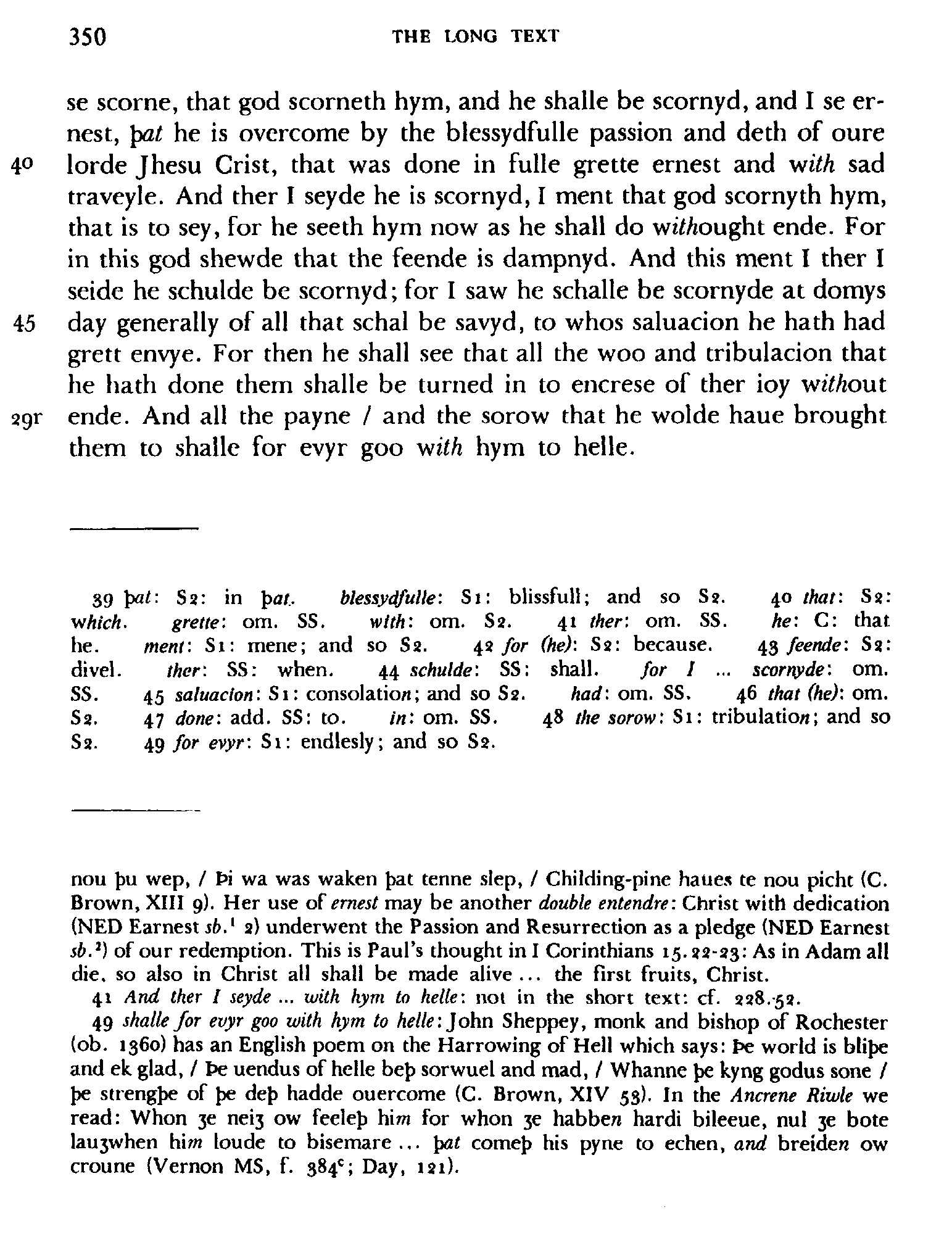
se scorne, that god scorneth hym, and he shalle be scornyd, and I se ernest, \>at he is overcome by the blessydfulle passion and deth of oure
4° lorde Jhesu Crist, that was done in fulle grette ernest and with sad traveyle. And ther I seyde he is scornyd, I ment that god scornyth hym, that is to sey, for he seeth hym now as he shall do wrought ende. For in this god shewde that the feende is dampnyd. And this ment I ther I seide he schulde be scornyd; for I saw he schalle be scornyde at domys
day generally of all that schal be savyd, to whos saluacion he hath had grett envye. For then he shall see that all the woo and tribulacion that he hath done them shalle be turned in to encrese of ther ioy w^Aout agr ende. And all the payne / and the sorow that he wolde haue brought them to shalle for evyr goo with hym to helle.
39 \>at: 82: in pat.. blessydfulle:
Si: blissful!; and so 82.
40 that: 82: which. grette: om. 88. with: om. 82.
41 ther: om. 88. he: C: that he. ment: Si: mene; and so 82.
42 for (he): 82: because.
43 feende: 82: divel. ther: 88: when.
44 schulde: 88: shall. for I ... scornyde: om.
88.
45 saluacion: Si: consolation; and so 82. had: om. SS, 46 that (he): om.
82.
47 done: add. SS: to. in: om. SS.
48 the sorow: Si: tribulation; and so 82.
49 for evyr: Si: endlesly; and so 82. nou bu wep, / t>i wa was waken bat tenne slep, / Childing-pine haues te nou picht (C.
Brown, XIII 9). Her use of ernest may be another double entendre: Christ with dedication
(NED Earnest sb.' 2) underwent the Passion and Resurrection as a pledge (NED Earnest sb.2) of our redemption. This is Paul's thought in I Corinthians 15.22-23: As in Adam all die, so also in Christ all shall be made alive ... the first fruits, Christ.
41 And ther I seyde ... with hym to helle: not in the short text: cf. 228.-52.
49 shalle for evyr goo with hym to helle: John Sheppey, monk and bishop of Rochester
(ob. 1360) has an English poem on the Harrowing of Hell which says: t»e world is blibe and ek glad, / t>e uendus of helle beb sorwuel and mad, / Whanne be kyng godus sone / be strengbe of be dej) hadde ouercome (C. Brown, XIV 53). In the Ancrene Riwle we read: Whon 36 nei3 ow feeleb him for whon je habberz hardi bileeue, nul 36 bote
Iau3when him loude to bisemare ... pat comeb his pyne to echen, and breidew ow croune (Vernon MS, f. 384°; Day, 121).
CHAPTER 14, REVELATION 6
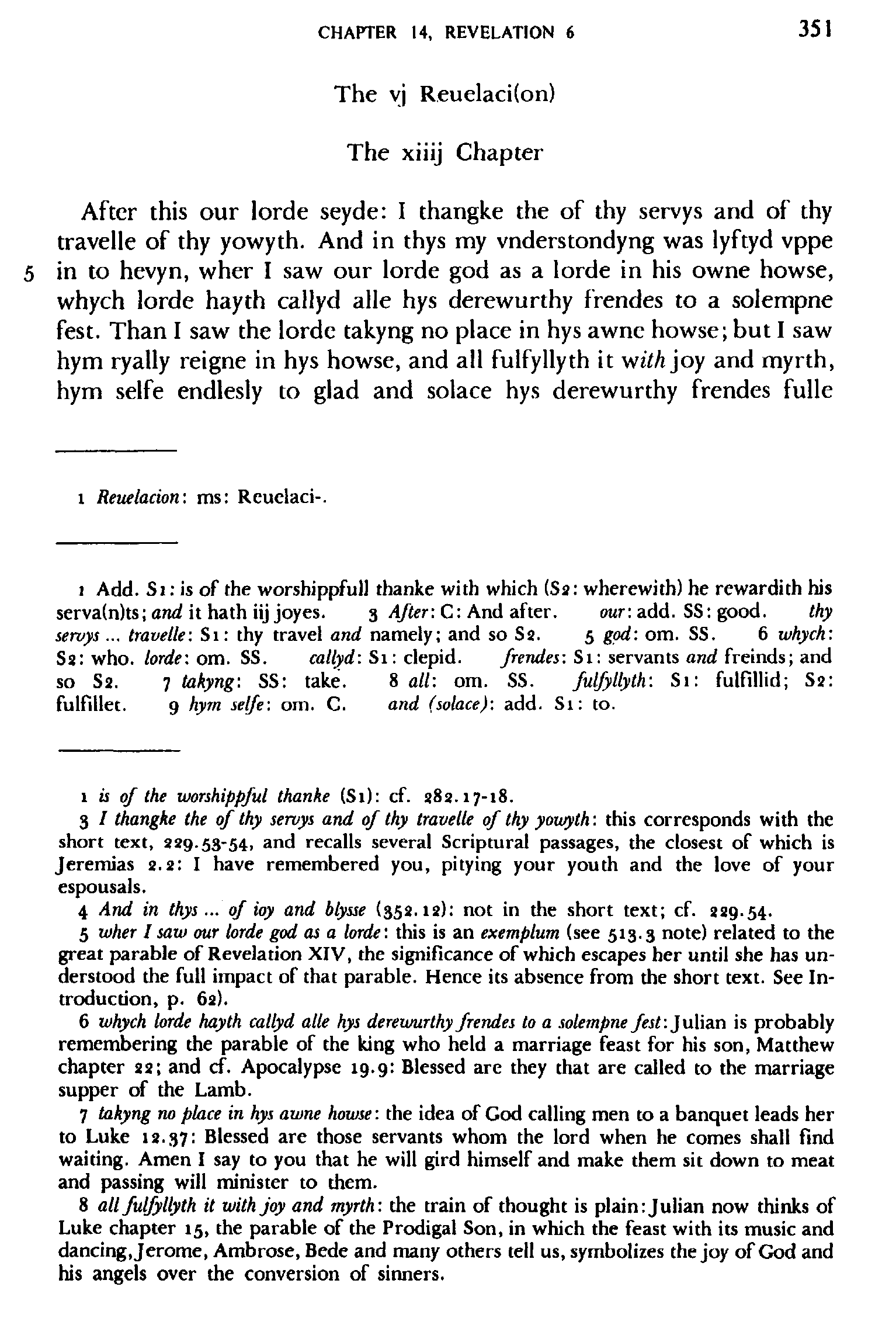
The yj Reuelaci(on) The xiiij Chapter After this our lorde seyde: I thangke the of thy servys and of thy travelle of thy yowyth. And in thys my vnderstondyng was lyftyd vppe
5 in to hevyn, wher I saw our lorde god as a lorde in his owne howse, whych lorde hayth callyd alle hys derewurthy frendes to a solempne fest. Than I saw the lorde takyng no place in hys awne howse; but I saw hym ryally reigne in hys howse, and all fulfyllyth it with joy and myrth, hym selfe endlesly to glad and solace hys derewurthy frendes fulle i Reuelation: ms: Reuclaci-. i Add. Si: is of the worshippfull thanke with which (Sa: wherewith) he rewardith his serva(n)ts; and it hath iij joyes.
3 After: C: And after. our: add. SS: good. thy servys ... travelle: Si: thy travel and namely; and so Sa.
5 god: om. SS.
6 whych:
Sa: who. lorde: om. SS. callyd: Si: clepid. frendes: Si: servants and freinds; and so 82.
7 takyng: SS: take.
8 all: om.
SS. fulfyllyth:
Si: fulfillid; Sa: fulfillet.
9 hym selfe: om. C. and (solace): add. Si: to. i is of the vjorshippful thanke (Si): cf. 382.17-18.
3 / thangke the of thy servys and of thy travelle of thy yowyth: this corresponds with the short text, 229.53-54, and recalls several Scriptural passages, the closest of which is
Jeremias 2.2: I have remembered you, pitying your youth and the love of your espousals.
4 And in thys... of ioy and blysse (352.13): not in the short text; cf. 229.54.
5 wher I saw our lorde god as a lorde: this is an exemplum (see 513.3 note) related to the great parable of Revelation XIV, the significance of which escapes her until she has understood the full impact of that parable. Hence its absence from the short text. See Introduction, p. 6a).
6 whych lorde hayth callyd alle hys derewurthy frendes to a solempne fest: Julian is probably remembering the parable of the king who held a marriage feast for his son, Matthew chapter 32; and cf. Apocalypse 19.9: Blessed are they that are called to the marriage supper of the Lamb.
7 takyng no place in hys awne howse: the idea of God calling men to a banquet leads her to Luke 12.37: Blessed are those servants whom the lord when he comes shall find waiting. Amen I say to you that he will gird himself and make them sit down to meat and passing will minister to them.
8 all fulfyllyth it with joy and myrth: the train of thought is plain: Julian now thinks of Luke chapter 15, the parable of the Prodigal Son, in which the feast with its music and dancing.Jerome, Ambrose, Bede and many others tell us, symbolizes the joy of God and his angels over the conversion of sinners.
THE LONG TEXTT
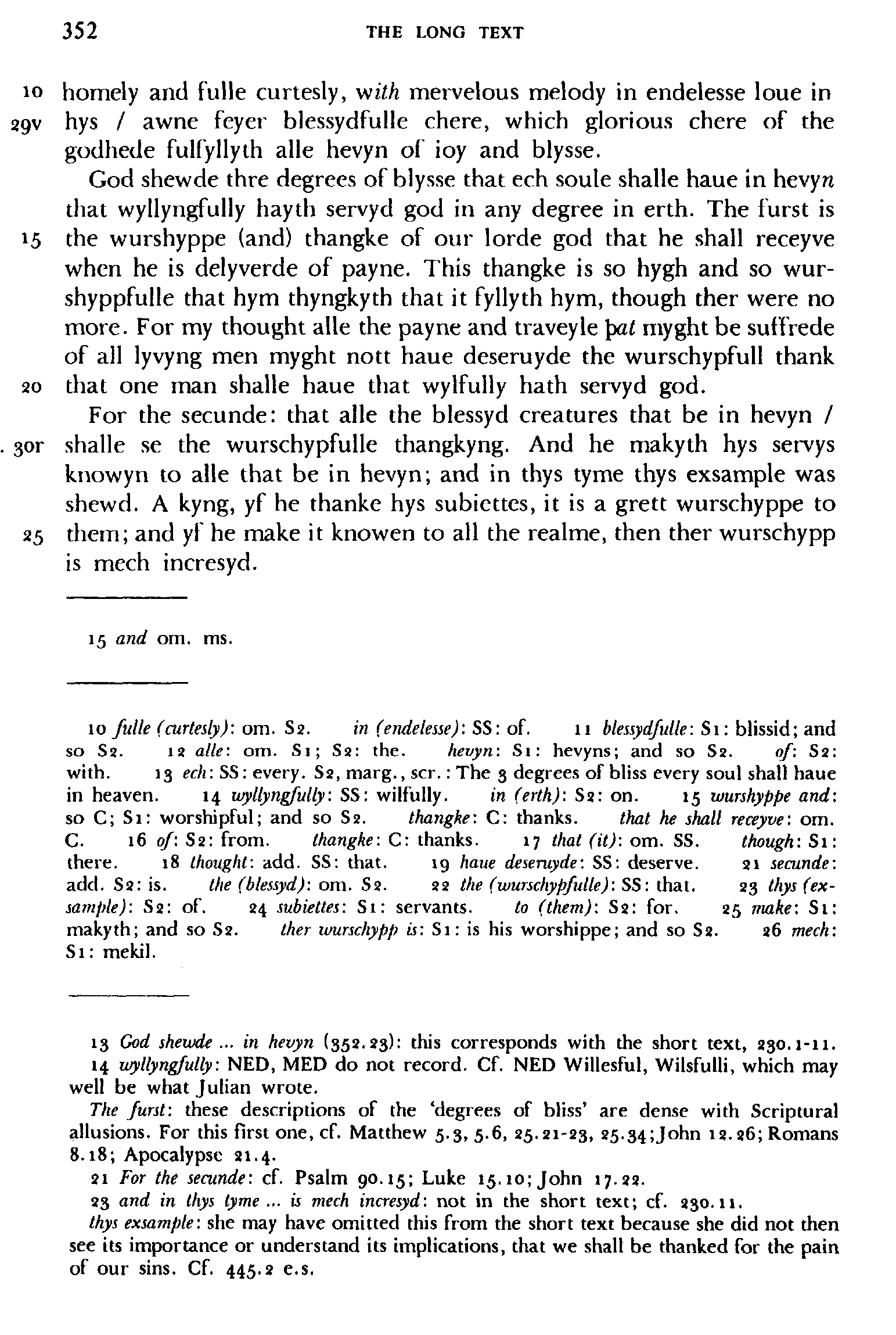
A 10 homely and fulle curtesly, with mervelous melody in endelesse loue in agv hys / awne feyer blessydfulle chere, which glorious chere of the godhede fulfyllyth alle hevyn of ioy and blysse.
God shewde thre degrees of blysse that ech soule shalle haue in hevyw that wyllyngfully hayth servyd god in any degree in erth. The furst is
15 the wurshyppe (and) thangke of our lorde god that he shall receyve when he is delyverde of payne. This thangke is so hygh and so wurshyppfulle that hym thyngkyth that it fyllyth hym, though ther were no more. For my thought alle the payne and traveyle \Mt myght be suffrede of all lyvyng men myght nott haue deseruyde the wurschypfull thank
20 that one man shalle haue that wylfully hath servyd god.
For the secunde: that alle the blessyd creatures that be in hevyn / . 3or shalle se the wurschypfulle thangkyng. And he makyth hys servys knowyn to alle that be in hevyn; and in thys tyme thys exsample was shewd. A kyng, yf he thanke hys subiettes, it is a grett wurschyppe to 25 them; and yf he make it knowen to all the realme, then ther wurschypp is mech incresyd.
15 and om. ms.
10 fulle (curtesly): om. 82. in (endelesse): SS: of.
11 blessydfulle: Si: blissid; and so 82.
12 alle: om. Si; 82: the. hevyn: Si: hevyns; and so 82. of: 82: with.
13 ech: SS: every. Sa, marg., scr.: The 3 degrees of bliss every soul shall haue in heaven.
14 wyllyngfully: SS: wilfully. in (erth): Sa: on.
15 wurshyppe and: so C; Si: worshipful; and so Sa. thangke: C: thanks. that he shall receyve: om.
16 of: Sa: from. thangke: C: thanks.
17 that (it): om. SS. though: Si: there.
18 thought: add. SS: that.
19 haue deseruyde: SS: deserve. ai secunde: add. Sa: is. the (blessyd): om. Sa. a a the (wurschypfulle): SS: that.
33 thys (ex sample): Sa: of.
34 subiettes: Si: servants. to (them): Sa: for.
35 make: Si: makyth; and so Sa. ther wurschypp is: Si: is his worshippe; and so Sa.
36 mech:
Si: mekil.
13 God shewde ... in hevyn (353.23): this corresponds with the short text, 330.1-11.
14 wyllyngfully: NED, MED do not record. Cf. NED Willesful, Wilsfulli, which may well be what Julian wrote.
The furst: these descriptions of the 'degrees of bliss' are dense with Scriptural allusions. For this first one, cf. Matthew 5.3, 5.6, 35.31-23, 25-34;John ia.a6; Romans
8.18; Apocalypse 21.4.
21 For the secunde: cf. Psalm 90.15; Luke 15.10; John 17.22.
23 and in thys tyme ... is mech incresyd: not in the short text; cf. 230.11. thys exsample: she may have omitted this from the short text because she did not then see its importance or understand its implications, that we shall be thanked for the pain of our sins. Cf. 445.2 e.s.
CHAPTER 14, REVELATION 6
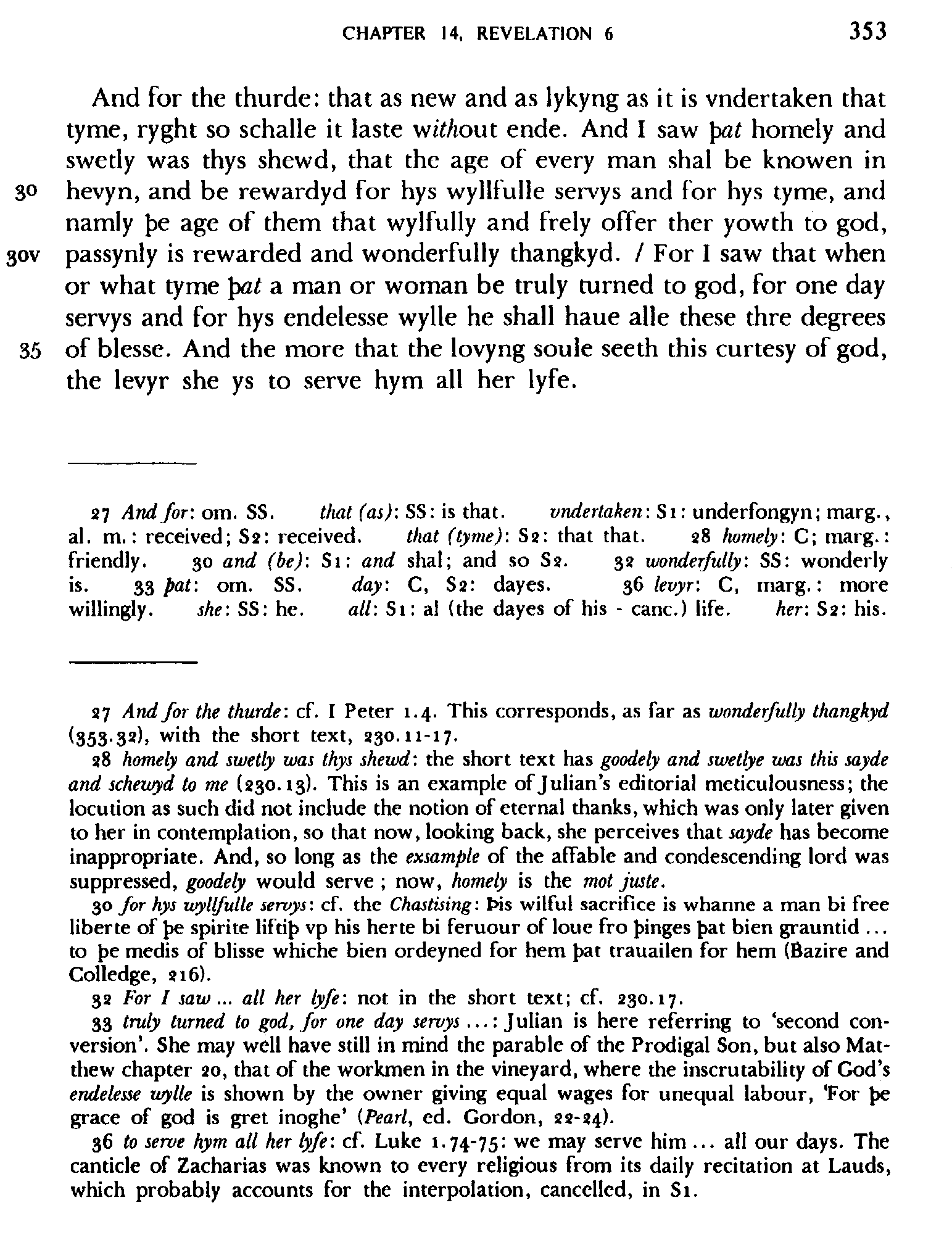
And for the thurde: that as new and as lykyng as it is vndertaken that tyme, ryght so schalle it laste without ende. And I saw \>at homely and swetly was thys shewd, that the age of every man shal be knowen in 3° hevyn, and be rewardyd for hys wyllfulle servys and for hys tyme, and namly JDC age of them that wylfully and frely offer ther yowth to god,
3ov passynly is rewarded and wonderfully thangkyd. / For I saw that when or what tyme \>at a man or woman be truly turned to god, for one day servys and for hys endelesse wylle he shall haue alle these thre degrees
35 of blesse. And the more that the lovyng soule seeth this curtesy of god, the levyr she ys to serve hym all her lyfe.
27 And for: om. SS. that (as): SS: is that. vndertaken: Si: underfongyn; marg., al. m.: received; 82: received. that (tyme): 82: that that.
28 homely: C; marg.: friendly.
30 and (be): Si: and shal; and so 82.
32 wonderfully: SS: wonderly is.
33 pat: om.
SS. day: C, 82: dayes.
36 levyr: C, marg.: more willingly. she: SS: he. all: Si: al (the dayes of his - cane.) life. her: 82: his.
27 And for the thurde: cf. I Peter 1.4. This corresponds, as far as wonderfully thangkyd
(353.32), with the short text, 230.11-17.
28 homely and swetly was thys shewd: the short text has goodely and swetlye was this sayde and schewyd to me (230.13). This is an example of Julian's editorial meticulousness; the locution as such did not include the notion of eternal thanks, which was only later given to her in contemplation, so that now, looking back, she perceives that sayde has become inappropriate. And, so long as the exsample of the affable and condescending lord was suppressed, goodely would serve; now, homely is the mot juste.
30 for hys wyllfulle servys: cf. the Chastising: I>is wilful sacrifice is whanne a man bi free liberte of |>e spirite liftij> vp his herte bi feruour of loue fro Binges J>at bien grauntid ... to {je medis of blisse whiche bien ordeyned for hem Jjat trauailen for hem (Bazire and Colledge, 216).
32 For I saw ... all her lyfe: not in the short text; cf. 230.17.
33 truly turned to god, for one day servys ...: Julian is here referring to 'second conversion'. She may well have still in mind the parable of the Prodigal Son, but also Matthew chapter 20, that of the workmen in the vineyard, where the inscrutability of God's endelesse wylle is shown by the owner giving equal wages for unequal labour, 'For £e grace of god is gret inoghe" (Pearl, ed. Gordon, 22-24).
36 to serve hym all her lyfe: cf. Luke 1.74-75: we may serve him... all our days. The canticle of Zacharias was known to every religious from its daily recitation at Lauds, which probably accounts for the interpolation, cancelled, in Si.
THE LONG TEXT
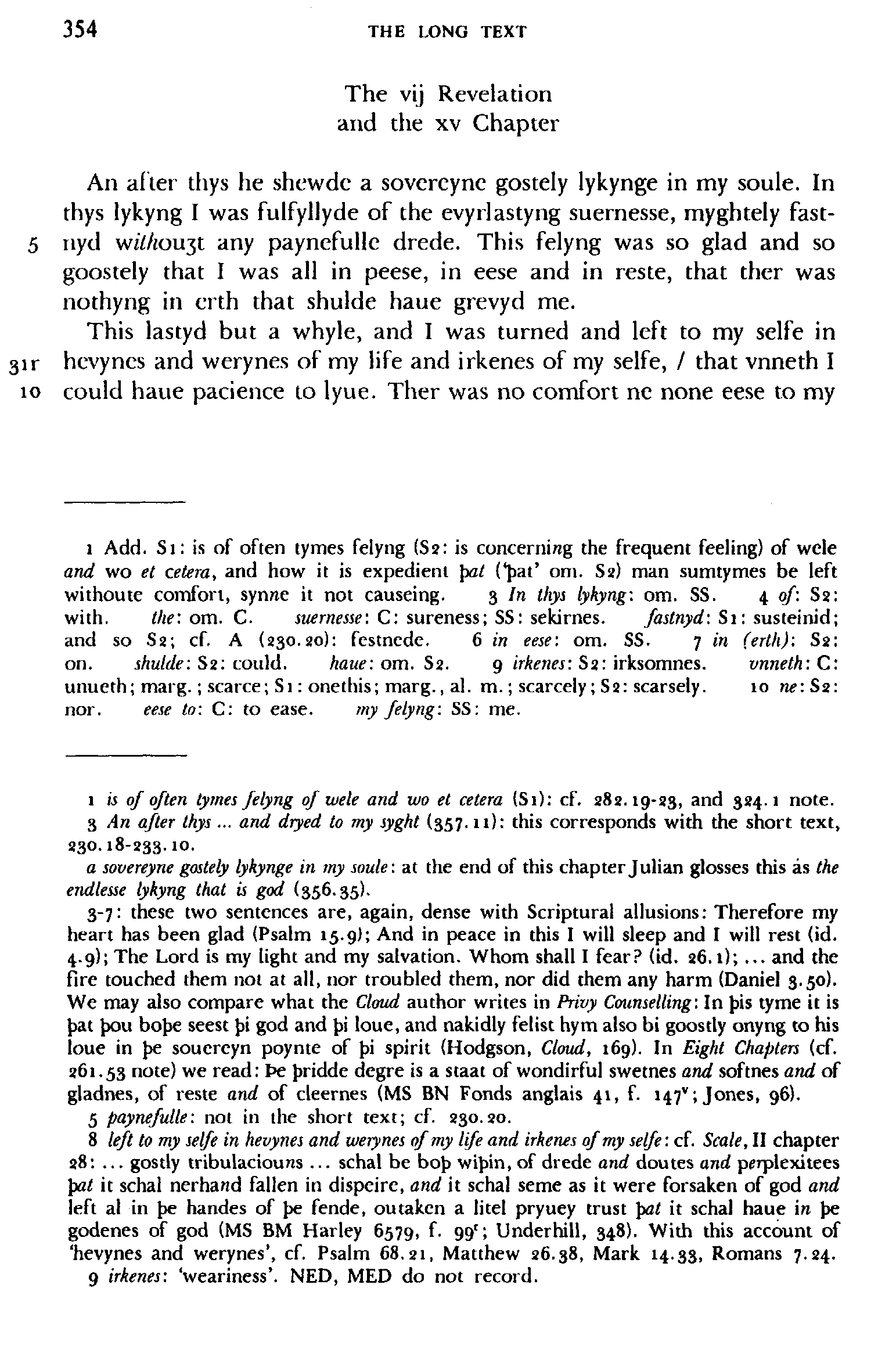
The vij Revelation and the xv Chapter An after thys he shewde a sovereyne gostely lykynge in my soule. In thys lykyng I was fulfyllyde of the evyrlastyng suernesse, myghtely fast5 nyd wilhou^t any paynefulle drede. This felyng was so glad and so goostely that I was all in peese, in eese and in reste, that ther was nothyng in erth that shulde haue grevyd me.
This lastyd but a whyle, and I was turned and left to my selfe in sir hevynes and werynes of my life and irkenes of my selfe, / that vnneth I 10 could haue pacience to lyue. Ther was no comfort nc none eese to my i Add. Si: is of often tymes felyng (82: is concerning the frequent feeling) of wele and wo et cetera, and how it is expedient \>at Cpat' om. 82) man sumtymes be left withoute comfort, synne it not causeing.
3 In thys lykyng: om. SS.
4 of: 82: with. the: om. C. suernesse: C: sureness; SS: sekirnes. fastnyd: Si: susteinid; and so 82; cf. A (230.20): festnede.
6 in eese: om. SS.
7 in (erth): 82: on. shulde: 82: could. haue: om. 82.
9 irkenes: 82: irksomnes. vnneth: C: unueth; marg.; scarce; Si: onethis; marg., al. m.; scarcely; 82: scarsely.
10 ne: 82: nor. eese to: C: to ease. my felyng: SS: me. i is of often tyrnes felyng of wele and wo et cetera (Si): cf. 282.19-23, and 324.1 note.
3 An after thys ... and dryed to my syght (357.11): this corresponds with the short text,
230.18-233.10. a sovereyne gostely lykynge in my soule: at the end of this chapter Julian glosses this as the endlesse lykyng that is god (356.35).
3-7: these two sentences are, again, dense with Scriptural allusions: Therefore my heart has been glad (Psalm 15.9); And in peace in this I will sleep and I will rest (id.
4.9); The Lord is my light and my salvation. Whom shall I fear? (id. 26. i); ... and the fire touched them not at all, nor troubled them, nor did them any harm (Daniel 3.50).
We may also compare what the Cloud author writes in Privy Counselling: In pis tyme it is pat pou bope seest pi god and pi loue, and nakidly felist hym also bi goostly onyng to his loue in pe souercyn poynte of pi spirit (Hodgson, Cloud, 169). In Eight Chapters (cf.
261.53 note) we read: Pe pridde degre is a staat of wondirful swetnes and softnes and of gladnes, of reste and of cleernes (MS BN Fonds anglais 41, f. i47v; Jones, 96).
5 paynefulle: not in the short text; cf. 230.20.
8 left to my selfe in hevynes and werynes of my life and irkenes of my selfe: cf. Scale, II chapter
28: ... gostly tribulaciouws ... schal be bop wipin, of drede and doutes and p^rplexitees pa£ it schal nerhand fallen in dispeire, and it schal seme as it were forsaken of god and left al in pe handes of pe fende, outaken a litel pryuey trust Jxz/ it schal haue in pe godenes of god (MS BM Harley 6579, f. 99'; Underbill, 348). With this account of 'hevynes and werynes', cf. Psalm 68.21, Matthew 26.38, Mark 14.33, Romans 7.24.
9 irkenes: 'weariness'. NED, MED do not record.
CHAPTER 15, REVELATION 7
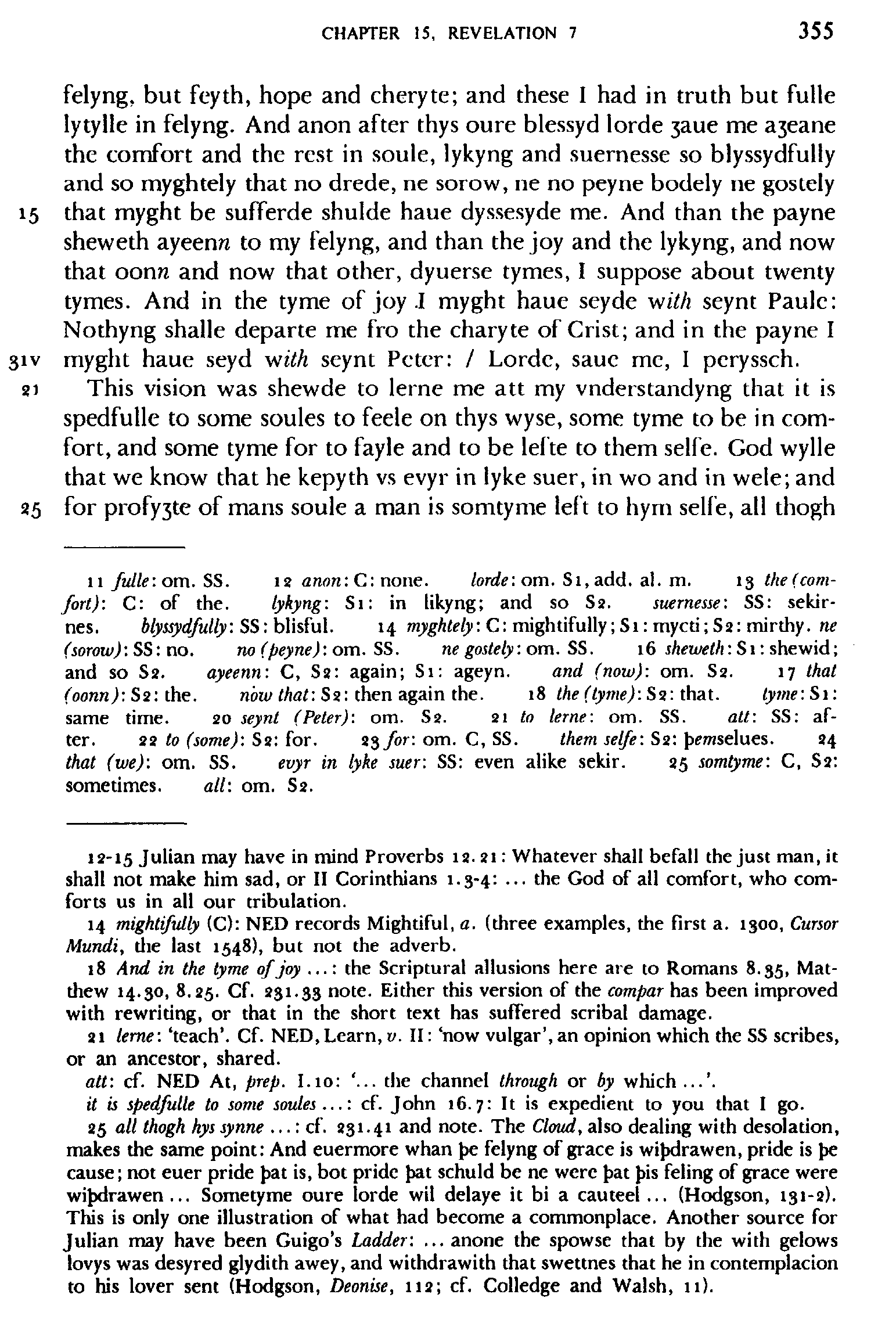
felyng. but feyth, hope and cheryte; and these I had in truth but fulle lytylle in felyng. And anon after thys oure blessyd lorde 3aue me a3eane the comfort and the rest in soule, lykyng and suernesse so blyssydfully and so myghtely that no drede, ne sorow, ne no peyne bodely ne gostely
15 that myght be sufferde shulde haue dyssesyde me. And than the payne sheweth ayeenw to my felyng, and than the joy and the lykyng, and now that oonn and now that other, dyuerse tymes, I suppose about twenty tymes. And in the tyme of joy .1 myght haue seyde with seynt Paulc:
Nothyng shalle departe me fro the charyte of Crist; and in the payne I siv myght haue seyd with seynt Peter: / Lorde, sauc me, I peryssch.
This vision was shewde to lerne me att my vnderstandyng that it is spedfulle to some soules to feele on thys wyse, some tyme to be in comfort, and some tyme for to fayle and to be lefte to them selfe. God wylle that we know that he kepyth vs evyr in lyke suer, in wo and in wele; and 25 for profy3te of mans soule a man is somtyme left to hym selfe, all thogh
11 fulle: om. SS.
12 anon: C: none. lorde: om. Si, add. al. m. i^thefcomfort):
C: of the. lykyng: Si: in likyng; and so 82. suernesse: SS: sekirnes. blyssydfully: SS: blisful.
14 myghtely: C: mightifully; Si: mycti; Sa: mirthy. ne (sorow): SS: no. no (peyne): om. SS. ne gostely: om. SS.
16 sheweth: S i: shewid; and so 82. ayeenn: C, 82: again; Si: ageyn. and (now): om. 82.
17 that (oonn): 82: the. now that: 82: then again the.
18 the (tyme): 82: that. tyme: Si: same time.
20 seynt (Peter): om. 82.
21 to lerne: om.
SS. att: SS: after.
22 to (some): 82: for.
S3 for: om. C, SS. them selfe: 82: ^mselues.
that (we): om. SS. evyr in lyke suer: SS: even alike sekir.
25 somtyme: C, Sa: sometimes. all: om. Sa.
18-15 Julian may have in mind Proverbs 12. 21: Whatever shall befall the just man, it shall not make him sad, or II Corinthians 1.3-4: ... the God of all comfort, who comforts us in all our tribulation.
14 mightifully (C): NED records Mightiful, a. (three examples, the first a. 1300, Cursor
Mundi, die last 1548), but not the adverb.
18 And in the tyme of joy ...: the Scriptural allusions here are to Romans 8.35, Matdiew 14.30, 8.25. Cf. 231.33 note. Either this version of the compar has been improved with rewriting, or that in the short text has suffered scribal damage.
21 lerne: 'teach'. Cf. NED, Learn, v. II: 'now vulgar', an opinion which the SS scribes, or an ancestor, shared. att: cf. NED At, prep. I.io: '... the channel through or by which ...'. it is spedfulle to some soules...: cf. John 16.7: It is expedient to you that I go.
25 all thogh hyssynne ...: cf. 231.41 and note. The Cloud, also dealing with desolation, makes the same point: And euermore whan \>e felyng of grace is wijxlrawen, pride is fie cause; not euer pride J>at is, bot pride Jat schuld be ne were f>at |>is feling of grace were wijxlrawen ... Sometyme oure lorde wil delaye it bi a cauteel... (Hodgson, 131-2).
This is only one illustration of what had become a commonplace. Another source for Julian may have been Guigo's Ladder: ... anone the spowse that by the with gelows lovys was desyred glydith awey, and withdrawith that swettnes that he in contemplacion to his lover sent (Hodgson, Deonise, 112; cf. Colledge and Walsh, 11).
THE LONG TEXT
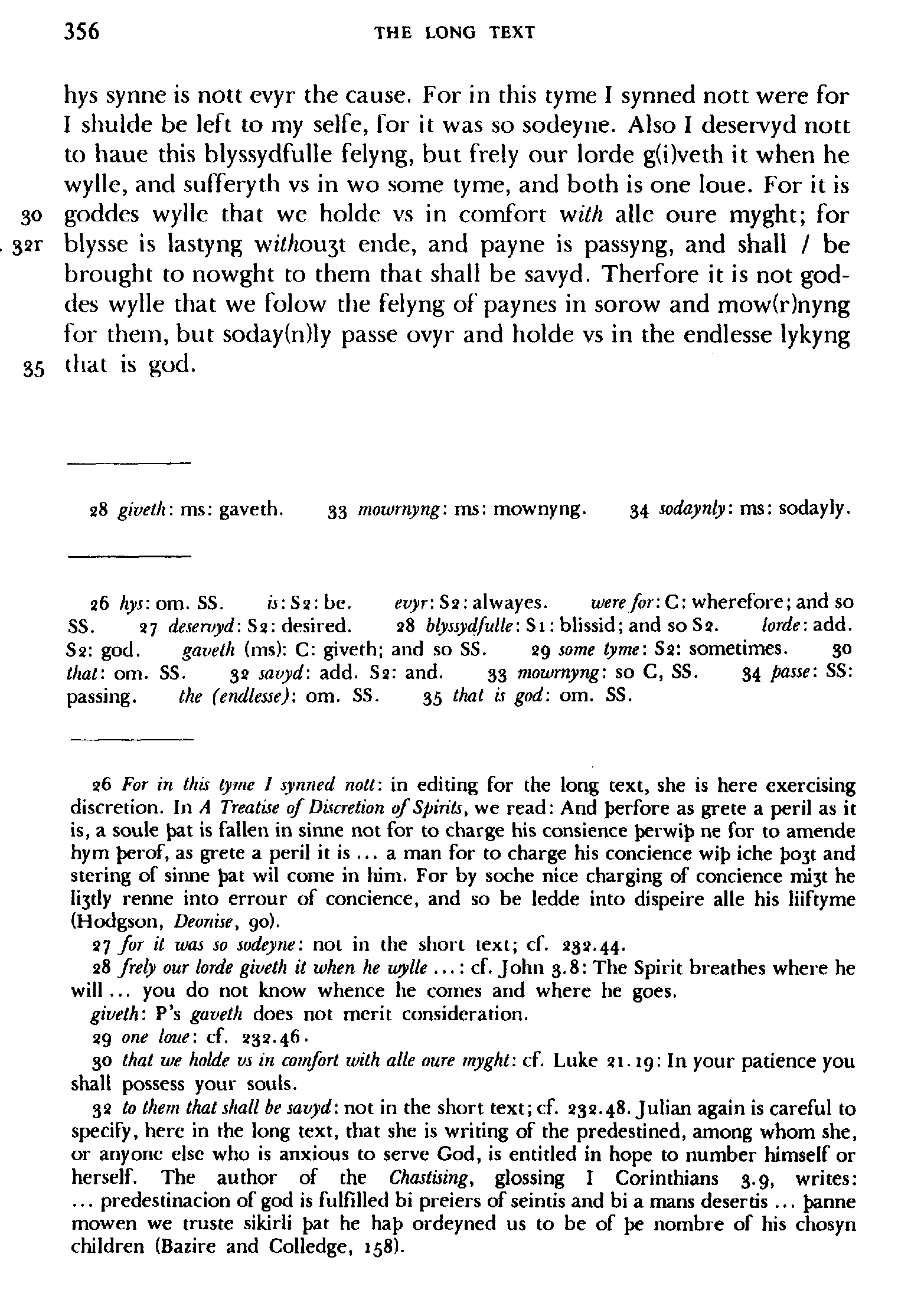
hys synne is nott evyr the cause. For in this tyme I synned nott were for I shulde be left to my selfe, for it was so sodeyne. Also I deservyd nott to haue this blyssydfulle felyng, but frely our lorde g(i)veth it when he wylle, and sufferyth vs in wo some tyme, and both is one loue. For it is
30 goddes wylle that we holde vs in comfort with alle cure myght; for . 32r blysse is lastyng withou^t ende, and payne is passyng, and shall / be brought to nowght to them that shall be savyd. Therfore it is not goddes wylle that we folow the felyng of paynes in sorow and mow(r)nyng for them, but soday(n)ly passe ovyr and holde vs in the endlesse lykyng
35 that is god.
28 givetlr. ms: gaveth.
33 mowrnyng: ms: mownyng.
34 sodaynly: ms: sodayly.
26 hys: om. SS. is: 82: be. evyr: 82: alwayes. were for: C: wherefore; and so SS.
27 deservyd: 82: desired.
28 blyssydfulle: Si: blissid; and so 82. lorde: add.
82: god. gaveth (ms): C: giveth; and so SS.
29 some tyme: Sa: sometimes.
that: om. SS.
32 savyd: add. Sa: and.
33 mowrnyng: so C, SS.
34 posse: SS: passing. the (endlesse): om. SS.
35 that is god: om. SS.
26 For in this tyme I synned nott: in editing for the long text, she is here exercising discretion. In A Treatise of Discretion of Spirits, we read: And perfore as grete a peril as it is, a soule pat is fallen in sinne not for to charge his consience perwip ne for to amende hym perof, as grete a peril it is ... a man for to charge his concience wip iche £031 and stering of sinne pat wil come in him. For by soche nice charging of concience mi3t he
Ii3tly renne into errour of concience, and so be ledde into dispeire alle his liiftyme
(Hodgson, Deonise, go).
27 for it was so sodeyne: not in the short text; cf. 232.44.
28 frely our lorde giveth it when he wylle ...: cf. John 3.8: The Spirit breathes where he will ... you do not know whence he comes and where he goes. giveth: P's gaveth does not merit consideration.
29 one loue: cf. 232.46.
30 that we holde vs in comfort with alle oure myght: cf. Luke 21.19: In your patience you shall possess your souls.
32 to them that shall be savyd: not in the short text; cf. 232.48. Julian again is careful to specify, here in the long text, that she is writing of the predestined, among whom she, or anyone else who is anxious to serve God, is entitled in hope to number himself or herself.
The author of the Chastising, glossing I Corinthians 3.9, writes:
... predestinacion of god is fulfilled bi preiers of seintis and bi a mans desertis ... panne mowen we truste sikirli pat he hap ordeyned us to be of pe nombre of his chosyn children (Bazire and Colledge, 158).
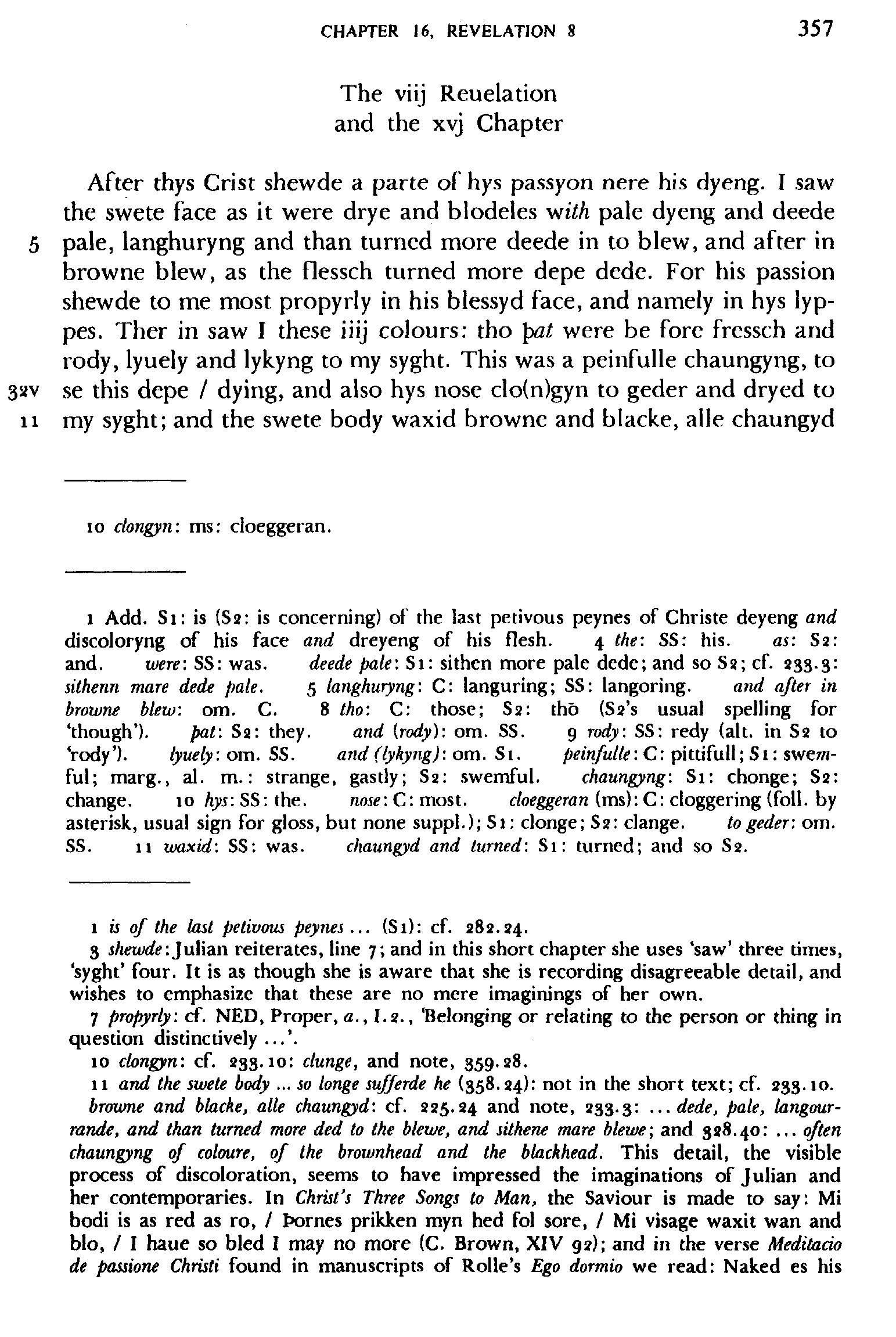
CHAPTER 16, REVELATION 8
The viij Reuelation and the xvj Chapter After thys Crist shewde a parte of hys passyon nere his dyeng. I saw the swete face as it were drye and blodeles with pale dyeng and deede
5 pale, langhuryng and than turned more deede in to blew, and after in browne blew, as the flessch turned more depe dede. For his passion shewde to me most propyrly in his blessyd face, and namely in hys lyppes. Ther in saw I these iiij colours: tho ba£ were be fore fressch and rody, lyuely and lykyng to my syght. This was a peinfulle chaungyng, to sav se this depe / dying, and also hys nose clo(n)gyn to geder and dryed to 11 my syght; and the swete body waxid browne and blacke, alle chaungyd
10 dongyn: ms: cloeggeran. i Add. Si: is (82: is concerning) of the last petivous peynes of Christe deyeng and discoloryng of his face and dreyeng of his flesh.
4 the: SS: his. as: 82: and. were: 88: was. deede pale: Si: sithen more pale dede; and so 82; cf. 233.3: sithenn mare dede pale.
5 langhuryng: C: languring; SS: langoring. and after in browne blew: om. C.
8 tho: C: those; 82: thb (82*5 usual spelling for 'though'). pat: 82: they. and (rody): om. SS.
9 rody: SS: redy (alt. in 82 to 'rody'). lyuely: om. SS. and (lykyng): om. Si. peinfulle: C: pittifull; Si: swewiful; marg., al. m.: strange, gastly; 82: swemful. chaungyng: Si: chonge; 82: change.
10 hys: SS: the. nose: C: most. cloeggeran (ms): C: cloggering (foil, by asterisk, usual sign for gloss, but none suppl.); Si: clonge; 82: clange. to geder: om.
SS.
11 waxid: SS: was. chaungyd and turned: Si: turned; and so 82. i is of the last petivous peynes ... (Si): cf. 282.24.
3 shewde:Julian reiterates, line 7; and in this short chapter she uses 'saw' three times,
'syght' four. It is as though she is aware that she is recording disagreeable detail, and wishes to emphasize that these are no mere imaginings of her own.
7 propyrly: cf. NED, Proper, a., 1.2., 'Belonging or relating to the person or thing in question distinctively ...'.
10 clongyn: cf. 233.10: clunge, and note, 359.28.
11 and the swete body ... so longe sufferde he (358.24): not in the short text; cf. 233.10. browne and blacke, alle chaungyd: cf. 225.24 and note, 233.3: ... dede, pale, langourrande, and than turned more ded to the blewe, and sithene mare blewe; and 328.40: ... often chaungyng of coloure, of the brownhead and the blackhead. This detail, the visible process of discoloration, seems to have impressed the imaginations of Julian and her contemporaries. In Christ's Three Songs to Man, the Saviour is made to say: Mi bodi is as red as ro, / f>ornes prikken myn hed fol sore, / Mi visage waxit wan and bio, / I haue so bled I may no more (C. Brown, XIV 92); and in the verse Meditacio de passione Christi found in manuscripts of Rolle's Ego dormio we read: Naked es his
THE LONG TEXT
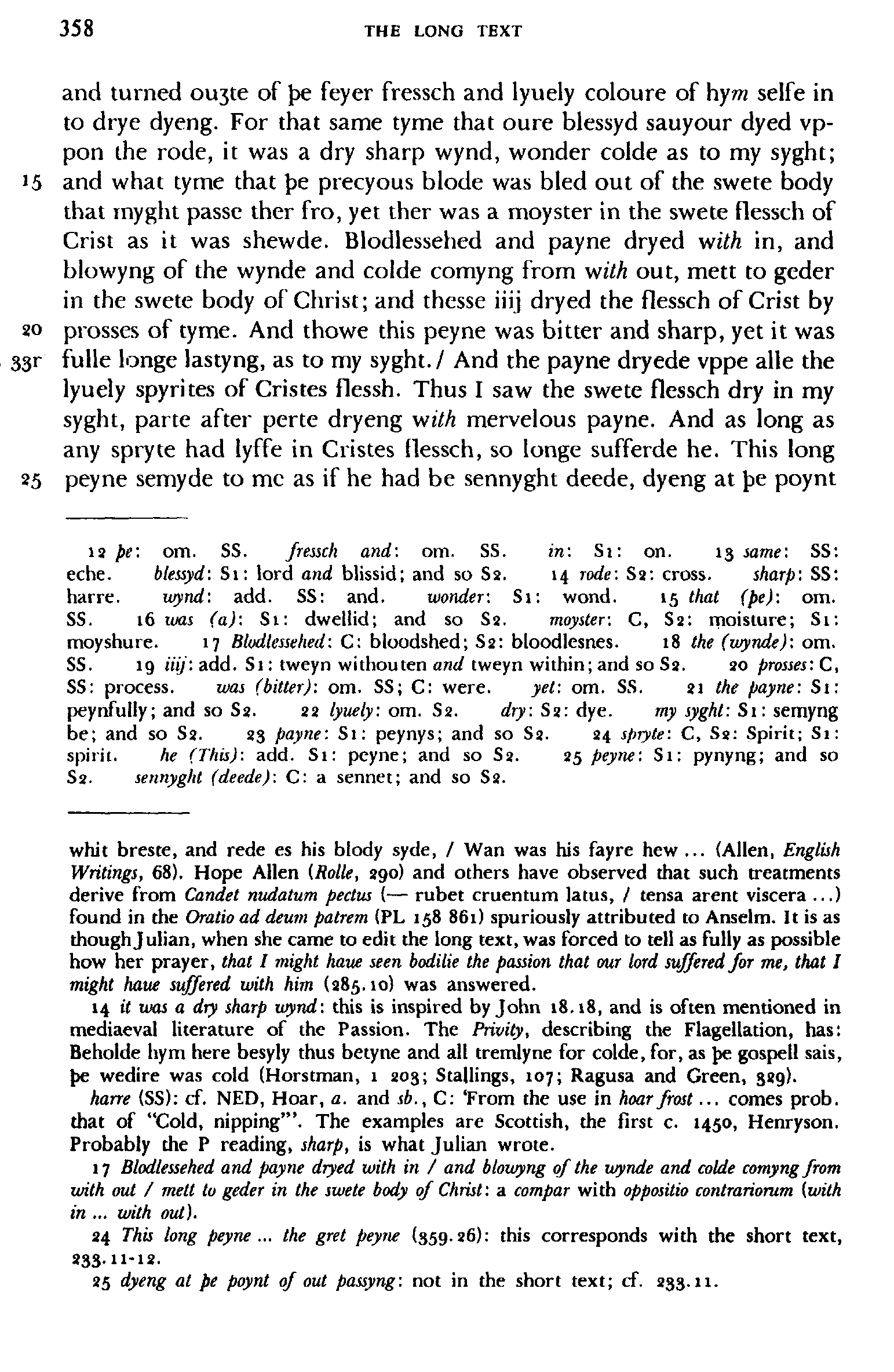
and turned oujte of |je feyer fressch and lyuely coloure of hym selfe in to drye dyeng. For that same tyme that oure blessyd sauyour dyed vppon the rode, it was a dry sharp wynd, wonder colde as to my syght;
15 and what tyme that pe precyous blode was bled out of the swete body that rnyght passe ther fro, yet ther was a moyster in the swete flessch of Crist as it was shewde. Blodlessehed and payne dryed with in, and blowyng of the wynde and colde comyng from with out, mett to geder in the swete body of Christ; and thesse iiij dryed the flessch of Crist by 20 presses of tyme. And thowe this peyne was bitter and sharp, yet it was
33r fulle longe lastyng, as to my syght. / And the payne dryede vppe alle the lyuely spyrites of Cristes flessh. Thus I saw the swete flessch dry in my syght, parte after perte dryeng with mervelous payne. And as long as any spryte had lyffe in Cristes flessch, so longe sufferde he. This long
25 peyne semyde to me as if he had be sennyght deede, dyeng at pe poynt 12 pe: om.
SS. fressch and: om.
SS. in: Si: on.
13 same: SS: eche. blessyd: Si: lord and blissid; and so 82.
14 rode: 82: cross. sharp: SS: harre. wynd: add.
SS: and. wonder: Si: wond.
15 that (pe): om.
SS.
16 ivas (a): Si: dwellid; and so 82. moyster: C, 82: moisture; Si: moyshure.
17 Blodlessehed: C: bloodshed; 82: bloodlesnes.
18 the (wynde): om.
SS.
19 iiij: add. Si: tweyn withouten and tweyn within; and so 82.
20 presses: C, SS: process. was (bitter): om. SS; C: were. yet: om. SS.
21 the payne: Si: peynfully; and so 82.
22 lyuely: om. 82. dry: 82: dye. my syght: Si: semyng be; and so 82.
23 payne: Si: peynys; and so 82.
24 spryte: C, 82: Spirit; Si: spirit. he (This): add. Si: peyne; and so 82.
25 peyne: Si: pynyng; and so 82. sennyght (deede): C: a sennet; and so 82. whit breste, and rede es his blody syde, / Wan was his fayre hew ... (Allen, English
Writings, 68). Hope Allen (Rolle, 290) and others have observed that such treatments derive from Candet nudatum pectus (— rubet cruentum latus, / tensa arent viscera ...) found in the Oratio ad deum patrem (PL 158 861) spuriously attributed to Anselm. It is as though Julian, when she came to edit the long text, was forced to tell as fully as possible how her prayer, that I might haue seen bodilie the passion that our lord suffered for me, that I might haue suffered with him (285.10) was answered.
14 it was a dry sharp wynd: this is inspired by John 18.18, and is often mentioned in mediaeval literature of the Passion. The Privity, describing the Flagellation, has:
Beholde hym here besyly thus betyne and all tremlyne for colde, for, as pe gospell sais,
£e wedire was cold (Horstman, i 203; Stallings, 107; Ragusa and Green, 329). harre (SS): cf. NED, Hoar, a. and sb., C: 'From the use in hoarfrost... comes prob. that of "Cold, nipping'". The examples are Scottish, the first c. 1450, Henryson.
Probably the P reading, sharp, is what Julian wrote.
17 Blodlessehed and payne dryed with in / and blowyng of the wynde and colde comyng from with out / mett to geder in the swete body of Christ: a compar with oppositio contrariorum (with in ... with out).
24 This long peyne... the gret peyne (359.26): this corresponds with the short text,
233.11-12.
25 dyeng at pe poynt of out passyng: not in the short text; cf. 233.11.
CHAPTER
16, REVELATION 8
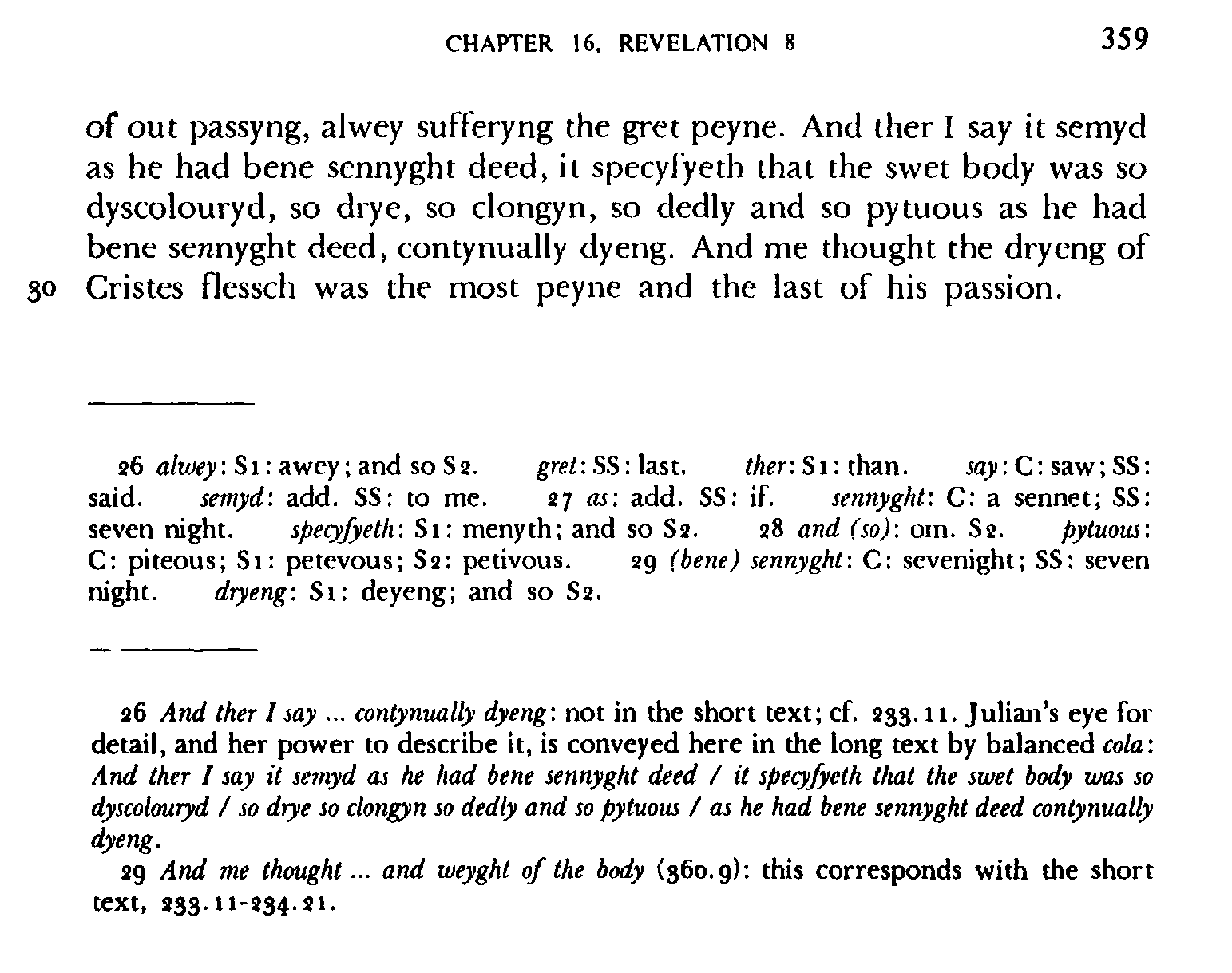
of out passyng, alwey sufferyng the gret peyne. And ther I say it semyd as he had bene scnnyght deed, it specyiyeth that the swet body was so dyscolouryd, so drye, so clongyn, so dedly and so pytuous as he had bene sennyght deed, contynually dyeng. And me thought the dryeng of 30 Cristes flessch was the most peyne and the last of his passion.
26 alwey. Si: awey; and so 82. gr<?£: SS: last, ther: Si: than. say: C: saw; SS: said. semyd: add. SS: to me.
27 as: add. SS: if. sennyght: C: a sennet; SS: seven night. specyfyeth: Si: menyth; and so Sa.
28 and (so): om. 82. pytuous:
C: piteous; Si: petevous; 82: petivous.
29 (bene) sennyght: C: sevenight; SS: seven night. dryeng: Si: deyeng; and so 82.
26 And ther I say ... contynually dyeng: not in the short text; cf. 233. M. Julian's eye for detail, and her power to describe it, is conveyed here in the long text by balanced cola:
And ther I say it semyd as he had bene sennyght deed I it specyfyeth that the swet body was so dyscolouryd I so drye so clongyn so dedly and so pytuous / as he had bene sennyght deed contynually dyeng.
29 And me thought... and weyght of the body (360.9): this corresponds with the short text, 233.11-234.21.
THE LONG TEXT
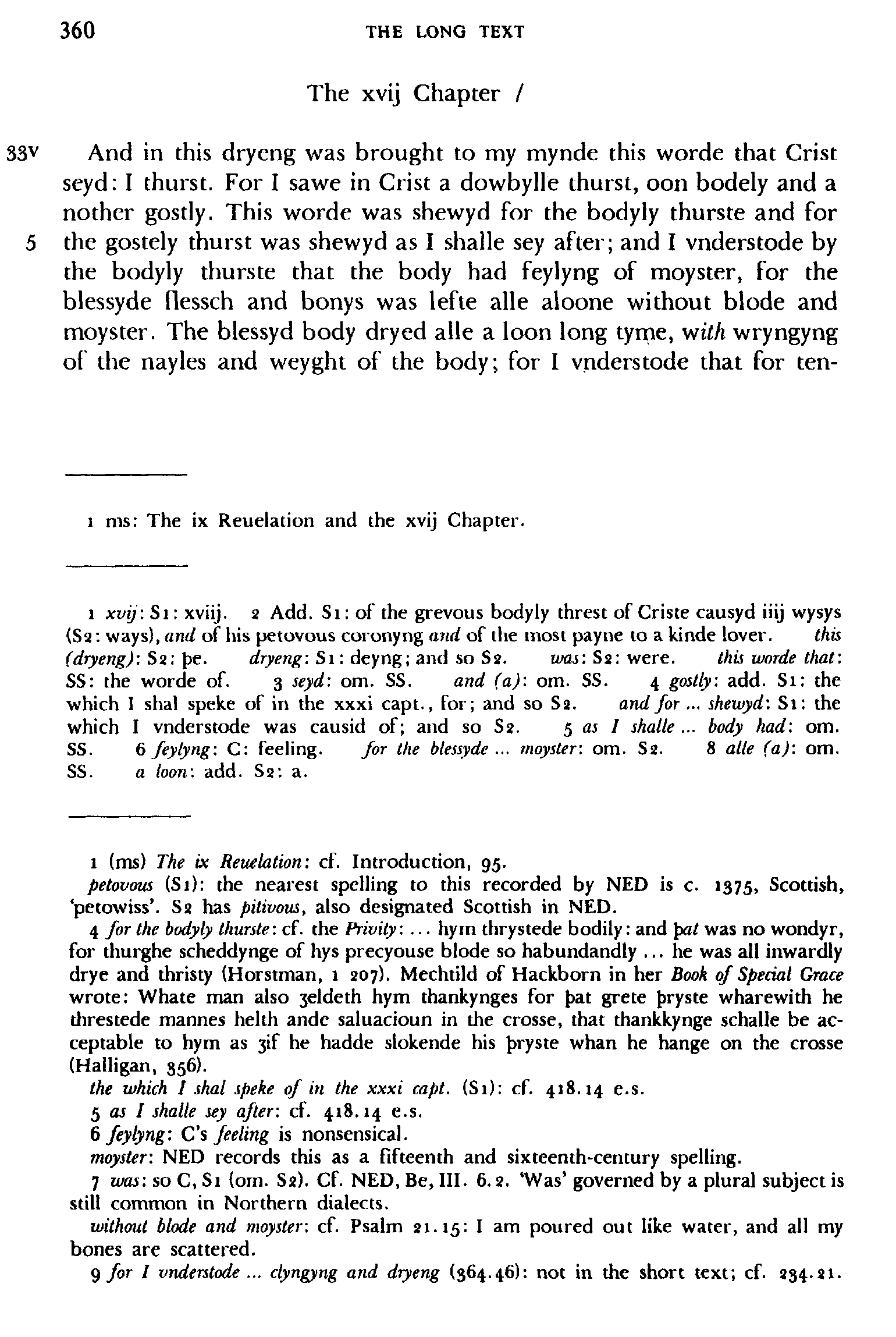
The xvij Chapter / 33v And in this dryeng was brought to my mynde this worde that Crist seyd: I thurst. For I sawe in Crist a dowbylle thurst, oon bodely and a nother gostly. This worde was shewyd for the bodyly thurste and for
the gostely thurst was shewyd as I shalle sey after; and I vnderstode by the bodyly thurste that the body had feylyng of moyster, for the blessyde flessch and bonys was lefte alle aloone without blode and moyster. The blessyd body dryed alle a loon long tyme, with wryngyng of the nayles and weyght of the body; for I vnderstode that for teni ms: The ix Reuelation and the xvij Chapter. i xvij: Si: xviij.
2 Add. Si: of the grevous bodyly threst of Criste causyd iiij wysys (82: ways), and of his petovous coronyng and of the most payne to a kinde lover. this (dryeng): 82: f>e. dryeng: Si: deyng; and so 82. was: 82: were. this worde that:
SS: the worde of.
3 seyd: om. SS. and (a): om. SS.
4 gostly: add. Si: the which I shal speke of in the xxxi capt., for; and so 82. and for... shewyd: Si: the which I vnderstode was causid of; and so 82.
5 as I shalle ... body had: om.
SS.
6 feylyng: C: feeling. for the blessyde... moyster: om. 82.
8 alle (a): om.
SS. a loon: add. 82: a. i (ms) The ix Reuelation: cf. Introduction, 95. petovous (Si): the nearest spelling to this recorded by NED is c. 1375, Scottish,
'petowiss'. 82 has pitivous, also designated Scottish in NED.
4 for the bodyly thurste: cf. the Privity: ... hyrn thrystede bodily: and ^at was no wondyr, for thurghe scheddynge of hys precyouse blode so habundandly ... he was all inwardly drye and thristy (Horstman, i 207). Mechtild of Hackborn in her Book of Special Grace wrote: Whate man also jeldeth hym thankynges for |>at grete jjryste wharewith he direstede mannes helth ande saluacioun in the crosse, that thankkynge schalle be acceptable to hym as 3if he hadde slokende his J>ryste whan he hange on the crosse
(Halligan, 356). the which I shal speke of in the xxxi capt. (Si): cf. 418.14 e.s.
5 as I shalle sey after: cf. 418.14 e.s.
6 feylyng: C's feeling is nonsensical. moyster: NED records this as a fifteenth and sixteenth-century spelling.
7 was: so C, Si (orn. 82). Cf. NED, Be, III. 6.2. 'Was' governed by a plural subject is still common in Northern dialects. without blode and moyster: cf. Psalm 21.15: I am poured out like water, and all my bones are scattered.
9 for I vnderstode... clyngyng and dryeng (364.46): not in the short text; cf. 234.21.
CHAPTER 17, REVELATION 8
10 dyrnes of the swete handes and the swete feet by the grete hardnes and grevous of the naylys, the woundys waxid wyde, and the body satylde for weyght, by long tyme hangyng and persyng and rasyng of pe heed
. 34r and byndyng of the crowne alle / bakyn -with drye blode, with the swet here clyngyng the drye flessch to the thornys, and the thornys to the 15 flessch dryeng. And in the begynnyng, whyle the flessch was fressch and 12 rasyng: ms: ransyng.
10 and (the): add. SS: of. grete hardnes: Si: gretnes hardhede; 82: greatnes hardnes.
11 grevous: C: grievousness; and so 82; Si: grevoushed. satylde: C: steled; Si: saggid; and so 82.
12 ransyng (ms): C: raising; Si: wrangyng; and so 82.
14 clyngyng: add. SS: and.
15 dryeng: Si: deyand; and so 82.
10 grete hardnes and grevous: this gives acceptable sense, 'the great and cruel hardness', and has not been emended, but S2*s reading, carefully punctuated by the scribe, the greatnes, hardnes, and grieveousnes, says more: the nails were big, as well as hard and cruel; and it has similiter desinens. But this could easily be Sa's own work.
12 rasyng: 'scraping, shaving'. The emendation is suggested by 362.18, rasyd, it is supported by C's 'raising', and see NED, Rase i/.1 i, and the Promptorium paruulorum:
Racynge or scrapynge of bokis or oder lyke: abrasio (Mayhew, 365). The definition alludes to the scraping smooth of parchment, the next process after it has been stretched; see 363.39 note. The English verse Meditatlones de passione Christi describe how
Mary held her dead son's head: She beheld hit how it was ibroke / Prikked and brissed wip mani a stroke / Shaue also bojie herd and hed / WiJ) J>ornes irent of blod al red
(MS Bodley 415, f. 86a). Cf. Stallings, 121, where the Latin states that this was revealed by Christ 'cuidam devote sue', and that it was in fulfilment of Isaias 50.6. Stallings adduces only Bonaventure's Vitis mystica, where he too says this (156); but the 'devota' is probably Mechtild of Hackborn. In her Book of Special Grace we read: ... sche begane to thenke wheyjjere cure lorde Jhesu hadde any reward in blis off the fadere in hevene for the terynge of his berde in his passyoun (Book II, chapter 10; Halligan, 340).
13 and byndyng of the crowne alle bakyn with drye blode: for a representation of a closelywoven crown, covering Christ's entire head, which four Jews are using their whole weight and crossed staves to press down, see E. Luccesi Palli and R. Hausherr, 'Dornenkronung' (LCI i coll. 513-516), pi. 2. In a Dispute between Mary and the Cross, one bystander on Calvary says: t>orwout his helm, f>e harde hat, / t>e Jxjrnes into his flesch gan crepe (Furnivall: Minor Poems of the Vernon MS, 620). MED helm (b) gives two earlier examples of the noun used to describe the crown of thorns. with the swet here clyngyng the drye flessch ...: if this punctuation be correct, clyngyng must be transitive, 'making the dry flesh adhere', but NED Cling, v., 7, 8 has as its first instance 1583 Stanyhurst AEneis, and MED records no transitive example. Alternatively, the passage could be punctuated: ... alle bakyn with drye blode with the swete here clyngyng, the drye flessch to the thornys and the thornys to the flessch dryeng. This would give commutatio.
14 and the thornys...: this and other details in what follows to the end of this paragraph are repeated in the elucidation of the parable of the lord and die servant, chapter 51; cf. 541.288-293.
THE LONG TEXT
bledyng, the contynualle syttyng of the thornes made the woundes wyde. And ferthermore I saw that the swet skynne and the te(n)dyr flessch with the here and with the blode was alle rasyd and losyde aboue with the thornes and brokyn in many pecis, and were hangyng as they
20 wolde hastely haue fallen downe whyle it had kyride moyster. How it was doone I saw nott, but I vnderstode that it was with the sharpe thornes and the boystours grevous syttyng on of the garlonde, not sparyng and without pytte, that alle tho brake the swet skynne with the flessch, and \)C here losyd it from the boone. Wher thorow it was broken on 34v pecys as a / cloth, and saggyng downwarde, semyng as it wolde hastely
26 haue fallen for heuynes and for lowsenes. And that was grete sorow and drede to me, for me though(t) that I wolde nott for my life haue seen it fall.
17 tendyr: ms: terdyr.
27 thought: ms: though.
16 contynualle'.
Si: continuant. syttyng:
C: setting. woundes:
Sa: wound.
17 the (tendyr): om. 82. terdyr (ms):C,SS: tender.
18 with (the blode): orn.
SS. aboue: C: about.
19 with the thornes ... pe here losyd it: om.
SS.
21 doone: C: down.
22 boystours: C, SS: boystrous.
23 alle tho: C: altho.
24 boone: add. Si: with the thornys; and so Sa.
Wher thorow: 82: by which. was broken on pecys: Si: were daggyd on many pecys; 82. was jagged on many pieces. on (pecys): C: in.
25 and saggyng: SS: that were saggand. downwarde: om. SS. semyng: om. C, SS. hastely: Sa: suddenly.
26 fallen: add. Si: of; and so 82. for (lowsenes): Si: lose while it had kynde moysture (supplying part of the previous omission — cf. 362.20); and so 82, w. 'naturall' for 'kynde'.
27 that (I): om. SS.
28 fall: SS now supply more of the previous omission: Si: How it was don I saw not, but understode it was with the sharpe thornys and the boystrous and grevous setting on of the garland onsparengly Cengly' cane, 'ably' corr. scr.; 82: unsparably) and without pety.
22 boystours: the C and SS variants suggest that this is a bungled P spelling of "boistrous1 (cf. NED Boisterous, MED boistreous, boistres), but how 'boistrous' developed in late ME from 'boistous' (cf. NED Boistous, MED boistous) is so problematical — NED's suggestion is 'some obscure analogy' — that it has been judged better to leave P's evidence, for what it is worth, unaltered.
23 alle tho: 'all those', that is, the many injuries caused by the thorns. C's altho is another example of misdivision; cf. 312.20 note.
24 broken: this has been retained, but Si's daggyd, followed by as a doth, is plausible.
Cf. NED, Dag, v.\ "To cut the edge of a garment into long, pointed jags; to slash, vandyke', and one quotation in MED daggen, v (i): She repreuej) my dagged elopes / And longe pyked crakowed shon (a 1450). NED's last example for this sense is 1523, Skelton; and S2's substitution, jagged, shows that by then, the late seventeenth century, it was archaic.
28 onsparengly / onsparably (Si) / unsparably (82): the scribe of Si has recognized that 'unsparably' is a nonce-word.
CHAPTER 17, REVELATION 8
This contynued a whyle, and after it began to chaunge; and I behelde 30 and marveylyd how it myght be. And than I saw it was, for it beganne to dry and stynt a parte of the weyght that was rownd about the garland, and so it was enuyroned all about, as it were garland vpon garland. The garlonde of thornes was deyde -with the blode; and that other garlond and the hede, all was one colowre, as cloteryd blode
35 when it was dryed. The skynne and the flesshe that semyd of the face and of the body was smalle rympylde with a tawny coloure, lyke a drye bord when it is agyd, and the face more browne than the body.
35r I saw / iiij maner of dryeng. The furst was blodlesse, the secunde payne folowyng after, the thurde is that he was hangyng vppe in the 40 eyer as men hang a cloth for to drye, the fowyrth that the bodely kynde
29 after: Si: sone; and so 82.
30 saw. add. 82: how.
31 that was: Si: and sette; and so 82.
32 so: SS: thus. was (enuyroned): om. SS.
33 of(thomes): add. 88: the. deyde: 82: dryed. blode: C: garland of blood.
34 all was one:Ss: were all of a. cloteryd: Si: cloderyd; and so 82.
35 was dryed: Si: is drey; and so 82. and (the):
88: of.
36 rympylde:
Si: ronkyllid; 82: wrinkeled. tawny:
Si: tannyd.
37 agyd: 88: akynned.
38 dryeng: Si: dryengs; and so 82. blodlesse:
82: pe want of blood. secunde: add. SS: was.
39 is that he was: om.
SS.
40 for: om. Si; 82: up. kynde: 82: nature.
36 rympylde: this gives excellent sense; cf. NED, Rimple, v. and n. But so does Si's ronkyllid; in Gawain, the shining beauty of the younger lady is contrasted with the appearance of her hideous and bedizened companion: Riche red on |>at on rayled ayquere, / Rugh ronkled chekez J>at oj>er on rolled (Tolkien and Gordon, 27).
37 akynned (SS): in Si the word is underlined, the usual mark of a reading questioned by the corrector; but there is no marginal correction. It is impossible to suggest sense.
39 he was hangyng vppe in the eyer as men hang a cloth for to drye: Victor Deyglio observes the striking similarity of this to the English Privity: And whene he was thus sprede obrode one pe crosse more straite pan any parchemyne skyne es sprede one pe harowe .... which is repeated in the Cambridge UL MS Add. 3042 version of Rolle's
Meditationes (Horstman i 206, 100). This is evidently an addition of the translator, not found in Stailings (113) or Ragusa and Green (334). In a Dispute between Mary and the Cross, Mary says: Mi loue ilolled vp in pe eyr (Morris: Legends of the Holy Rood, 134).
Christ's Testament is probably following the Privity in making Christ describe himself: And strayte istreynet on pe rode, / Streynet to druye on rode tre / As parchemyn owep for to be (Furnivall, ed.: The Minor Poems of the Vernon MS 2, 643). The same simile, probably also derived from the Privity, is found in The Poor Caitiff (Brady, 128).
40 the bodely kynde askyd lycoure: cf. Psalm 68.22: ... and in my thirst they gave me vinegar to drink.
THE LONG TEXT
askyd lycoure, and ther was no maner of comfort mynystryd to hym. A, hard and grevous was that payne; but much more harder and grevous it was when be moystur fayled, and all began to drye, thus clyngyng.
Theyse were ij paynes that shewde in the blyssed hed. The furst 45 wrought to the dryeng whyle it was moyst, and that other slow with clyngyng and dryeng, -with blowyng of wynde fro without, that dryed hym more and payned with colde than my hart can thingke, and all other peynes, for which paynes I saw that alle is to lytylle that I can sey,
35v for it / may nott be tolde.
The shewyng of Cristes paynes fylled me fulle of peynes, for I wyste welle he suffyryde but onys, but as he wolde shewe it me and fylle me with mynde, as I had before desyerde. And in alle thys tyme of Cristes presens, I felte no peyne, but for Cristes paynes; than thought me I knew fulle lytylle what payne it was that I askyd, and as a wrech I repentyd
55 me, thyngkyng if I had wyste what it had be, loth me had been to haue preyde it. For me thought my paynes passyd ony bodely deth. I 41 askyd: Si: asky; 82: requires. hym: add. Si: in al his wo. and disese; and so 82.
42 that: SS: his. harder: C, SS: hard.
44 ij: SS: the. shewde: 82: appeared, blyssed: Si: blissful; and so 82.
45 dryeng: Si: deyng; and so 82.
46 and (dryeng): om.
SS. of:
SS: of the.
47 all (other): om.
SS.
49 may nott: 82: cannot, tolde: 82: exprest.
50 The (shewyng): add. Si: which; and so 82. paynes: Si: payne; and so 82.
51 welle: add. C: that.
53 pmew.
Si: paynys; and so Sz.
54 fulle: SS: but.
/ (repentyd): om. SS.
56 ony: om.
SS.
41 ther was no maner of comfort mynystryd to hym: Julian may be contrasting the Passion with the sojourn in the desert, at the end of which angels came to minister to "the hungry and thirsty Christ (Matthew 4.11).
43, 46 clyngyng: 'shrivelling'. Cf. NED Cling, v.1 2, 'the ... shrivelling up of animal or vegetable tissues', where the first example is c. 1000, Aelfric, and the last 1414. This gives added force to line 39 above, where Christ suspended on the Cross is compared with a cloth hung up in the wind to dry (and, it may be, to shrink in the process, as the Privity states; cf. 363.39 note.
46 that dryed hym more ... may nott be tolde (364.49): this corresponds with the short text,
233-iS-234-2547 than my hart can thingke: cf. 237.11 and note.
50 The shewyng ... before desyerde (364.52): this corresponds with the short text, 234.262951 he suffryde but onys: cf. Hebrews 9.11-12: But Christ... by his own blood entered once into the holy of holies, having obtained eternal redemption.
53 / knew fulle lytylle what payne it was that I askyd: cf. Matthew 20.22: You know not what you ask. Can you drink the chalice that I shall drink? And cf. the English Minor of St. Edmund: For if all pe sekenes of pis werlde and all pe sorowe ware in pe body of a mane anely, and pat man myghte consayfe alls mekill noye and angwysce and sorowe in his body als all pe mene of pis werlde moghte thynke, ytt it ware full littill or els noghte to regarde of pe sorowe pat he sufferde for vs ane houre of pe daye (Horstman, i 236).
54 and as a wrech ... to haue preyde it: not in the short text; cf. 234.35.
CHAPTER 17, REVELATION 8
thought: Is ony payne in helle lyk thys? And I was answeryd in my reson: Helle is a nother peyne, for ther is dyspyer. But of alle peyne \>at leed to saluacion, thys is the most, to se the louer to suffer. How myght ony peyne be more then to / see hym that is alle my lyfe, alle my blysse and alle my joy suffer? Here felt I stedfastly that I louyd Crist so much aboue my selfe that ther was no peyne that myght be sufferyd lyke to 36r
that sorow that I had to see hym in payne.
57 in helle: om. SS.
58 dyspyer: C: Despair; Si: despey; 82: despaire. 82, marg., scr'.: The greatest pain of a true lover. peyne: C: pains; and so 88.
59 most: 82: greatest pain. the louer: Si: thy love; and so 82. to (suffer): om. SS. more: add.
SS: to me. is (alle): om. Si; in 82, in parentheses.
61 felt: C: lest. stedfastly:
Si: sothfastly; 82: assuredly.
57 Is ony payne in helle lyk thys? Cf. the Mirror of St. Edmund: l>enne may sum mon seyen pat pe serwe pat he suffrede for vs on pe crois was grettore pen pe peyne of helle is, in so luytel tyme: for W3i? No creature mi3te so muche suffren asjhesu, for per hedde non so gret vertu in him; but sum creature may suffren pe peines of helle: pen is pe peyne of helle lasse for pe tyme pen pe peyne of Jesu. I sey not pis certeynliche, but for sum mennes concience (Horstman, i 256). in my r«on:Julian may mean 'in my reasoning faculty'; but it does not seem as if this is what she is describing. She has asked a question, and she receives this answer 'to my question'. Cf. 263.17 and note, suggesting that resonn there is the rhetoricians' ratiodnatio, 'reasoning by question and answer'.
58 Helle is a nother peyne ...: cf. 235.38 and note.
60 alle my lyfe / alle my blysse / and alle my joy: repetitio.
62 that ther was no peyne that myght be sufferyd lyke to that sorow: cf. 235.42: it hadde beene a grete eese to me to hafe dyede bodylye. Here in the long text Julian seems to have in mind
Lamentations 1.12: See if there be any sorrow like to my sorrow.
THE LONG TEXT
The xviij C(h)apter Here I saw in parte the compassion of our blessed lady sainct Mary; for Crist and she was so onyd in loue that the grettnes of her loue was cause of the grettnes of her peyne. For in this I saw a substance of 5 kynde loue contynued by grace that his creatures haue to hym, which kynde loue was most fulsomly shewde in his swete mother, and ovyrpassyng, for so much as she louyd hym more then alle other, her peyne passyd alle other. For ever the hygher, the myghtyer, the swetter that s6v the loue is, the more sorow / it is to the lover to se that body in payne
10 that he lovyd. And so alle hys dyscyples and alle his tru lovers sufferyd i Chapter: ms: Capter. i Si: Of the spiritual martyrdom of our lady and other lovers of Criste, and how althings suffryd hym goode and ylle; and so S?.
2 in: SS: a. parte; add. SS: of. blessed: om. SS.
3 was (so): SS: were. onyd: C, marg., Sa: united. her (loue):
Sa: his. loue (was):
Si: lovyng; and so Ss.
4 grettnes:
Si: mekylhede.
5 his: om. SS.
6 fulsomly: C, marg.: plenteous. ovyrpassyng: Sa: surpassing.
7 peyne: Si: panys; 82: paines.
& other: Sa: others. myghtyer: add.
Sa: and.
9 is (the): Si: be.
10 he: SS: is. so: om. SS.
1 spiritual martyrdom (Si): this has the ring of the seventeenth century. Julian would most probably have written 'ghostly passion'.
2 Here I saw ... of her peyne (366.4): this corresponds with the short text, 235.43-45. the compassion of our blessed lady: cf. the Privity: ... his sorowfull modir, whas sorow and compassione was gretly }>e cause of encressyng of hir dere sones passione, and |>e sones passione ekede J>e modire serowe (Horstman, i 206; Stallings, 113; Ragusa and Green,
335)- 4 For in this I saw ... that he lovyd: not in the short text; cf. 235.45.
For in this I saw a substance of kynde loue / contynued by grace that his creatures haue to hym / which kynde loue was most fulsomly shewde / in his swete mother and ovyrpassyng /for so much as she louyd hym / more then alle other her peyne passyd alle other / For ever the hygher the myghtyer the swetter that the loue is / the more sorow it is to the lover to se that body in payne that he lovyd: a compar of seven cola, with repetitio (kynde loue ... kynde loue) and articulus (the hygher the myghtyer the swetter) with shniliter cadens (louyd... passyd). The content of the compar is
Trinitarian: she is writing of the relationship of creatures to Christ in virtue of the participation in the substance of the Father in Christ, which is continued by grace through the Holy Spirit.
10 And so alle... sufferyd with hym (367.16): this corresponds with the short text,
235-46-52alle hys dyscyples and alle his true lovers sufferyd: cf. the Privity: ... Jjey had gret compassione of our lordjhesu ... (Horstman, i 206; Stallings, 114; Ragusa and Green, 335).
CHAPTER 18, REVELATION 8
more payn than ther awne bodely dyeng, for I am suer by my awne felyng that the lest of them lovyd hym so farre abovyn them selfe that it passyth alle that I can sey.
Here saw I a grett onyng betwene Crist and vs, to my vnderstondyng; 15 for when he was in payne we ware in payne, and alle creatures that myght suffer payne sufferyd with hym. That is to say, alle creatures that god hath made to oure servys, £e fyrmamente and erth, feylyd for sorow in ther kynd in the tyme of Cristes dyeng, for it longyth kyndly to ther properte to know hym for ther lorde, in whom alle ther vertuse
37r stondyth. And whan he feylyd, / then behovyd nedys to them for kynd-
nes to feyle with hym, in as moch as they myght, for sorow of hys paynes. And thus tho that were hys fryndes suffered payne for loue, and generally alle; that is to sey, they that knew hym nott sufferde for feylynge of all maner comfort, saue the myghty pryve kepyng of god. I 11 suer: SS: sekir.
12 them selfe: so Si; C: himself; 82: themselues.
14 onyng:
C, marg.: union; 82: union or onenes. to my vnderstondyng: om. 82.
17 to (oure):
82: for. and (erth): Si: the.
18 in (ther): 82: at. kyndly:
C, marg.: natural.
19 lorde: SS: god. vertuse: C: vertue; and so SS.
20 And: om.
SS. feylyd: C: feeled. behovyd: add. 88: it. si feyle: C: feel. in: om.
SS.
22 tho: C: they; and so SS.
24 maner: add. C, SS: of. pryve: 82: secret.
11 for I am suer by my awne felyng / that the lest of them lovyd hym / so farre abovyn them selfe / that it passyth alle that I can sey: a compar to achieve conclusio.
12 the lest of them lovyd hym so farre abovyn them selfe: cf. Luke 7.47: ... because she
(Mary Magdalen) has loved much. that it passyth alle that I can sey: not in the short text; cf. 235.49.
14 From here to the end of the chapter corresponds with the short text, 235.49236.56; but from the propositio and ratio there,Julian has now constructed an argumentatio perfectissima: propositio (Here saw I... vnderstondyng), ratio (for when he was in payne ... sufferyd with hym), confirmatio rationis (That is to say ...for sorow of hys paynes), exornatio (And thus tho ... were in sorow that tyme), and complexio (Thus was oure lord ... this maner of payne with hym). The detail and the quality of the long exornatio depend on the information derived from the Historia scholastica (see 368.27 note), which makes it probable that she read
Peter Comestor after she had completed the short text.
14 a grett onyng betwene Crist and vs: cf. Colossians 1.16-19: For in him were all things created ... and he is before all, and by him all things consist... because in him it has well pleased (the Father) that all fullness should dwell, and through him to reconcile all things to himself, making peace through the blood of his cross.
15 alle creatures: in the Dialogue of St. Anselm and of our Lady (the attribution is spurious; cf. Bernard Muir), Mary says: Se, Anselme, how the elementes shewd tokens of compassionn for the deth of my sonn, excepte only the lewys Jjat were indurate (MS
Bodleian Laud misc. 38, f. i4v).
24 saue the myghty pryve kepyng ... as I shalle sey after (369.38): not in the short text; cf.
336.56-
THE LONG TEXT
25 mene of ij maner of people that knew hym nott, as it may be vnderstond by ij persons.
That oone was Pylate; that other person was seynt Dyonisi of France, whych was that tyme a paynym. For whan he saw wonders and merveyles, sorowse and dredys that befelle in that tyme, he seyde: Eyther
30 the worlde is now at an ende, or elles he that is maker of kyndes suf25 y (matter): 82: {)e. people: Si: folke; and so 82. that knew hym nott: om.
SS.
27 That (oone):
82:
£>e. that (other):
82: and the. person: om.
SS.
28 whych: 82: who. paynym: 82: heathen. wonders: Si: wonderows; and 5082. merveyles: Si: mervelous; and so 82.
29 befelle: Si: befallen. w:C, 82: at.
30 kyndes: C, marg.: nature; and so Si, marg., al. m.; 82: kind.
27 Pylale: cf. Matthew, chapter 27; John, chapters 18-19. seynt Dyonisi of France: in common with most of her Western contemporaries, Julian believed that the author of the Mystica theologia, whom scholars now call 'pseudo-Denis'
(since his assumption of the identity of Paul's convert — Acts 17.34 — l s n° more than a literary fiction) was identical with the martyr-patron of France. But it is to pseudoDenis's Letter to Polycarp that she goes on to allude, where he 'describes the prodigies of the noonday darkness and the earthquake that accompanied Christ's death' (F. X. Murphy; and cf. E. Colledge: The Hours of the Planets'). Even though Peter Comestor maintained that there had been on the first Good Friday no such disturbance of the planetary system as pseudo-Denis asserted, it is from Peter Comestor's narrative that Julian derived her information: 'It is said that in Athens at that time there was a flourishing studium, and when the philosophers enquired into the cause of the darkness and were unable to discover it, Denis the Areopagite said that the god of nature was suffering. And they made an altar and wrote on it: "To the unknown God'" (Historia scholastica chapter 75, PL 198 1631). R. J. Loenertz states that the second "Passion of St.
Denis' (Post beatam el gloriosam, BHL 2178, composed and circulating in the first quarter of the ninth century) is the earliest source which identifies Paul's convert with the Denis who evangelized Paris and was martyred there under Domitian. The possibility that Julian may have had vernacular sources on which to draw is illustrated by the Blairs
College MS 22, one of the so-called Talbot Hours' (at present Dep. 221 MS B in the National Library of Scotland), commissioned and executed in France in the early fifteenth century for an English purchaser and containing some English and much French material. Ff. 63^64', below a miniature of the Man of Sorrows, there is: Ung philosophe estoit et disoit en ce jour en ceste maniere: / Le monde define en ce four ou le dieu de nature a souffert mort, le quel philosophe ne congnoissoit pas nostre sire
Jhmi Crist. Puis il fu conuerti par la predicacion saint Pol, et dit on que ce fut saint
Denis en France. The same matter is found in the closely-related MSS Fitzwilliam
Museum, Cambridge, Add. 176 and 177 (olim Yates Thompson 83 and 84): cf. A Descriptive Catalogue of the Series ..., 221, 234 (these descriptions are by M. R. James).
28 wonderows and mervelous (Si): these adjectives are made to qualify sorowse and dredys, which is not unacceptable.
29 befallen (Si): for fourteenth and fifteenth-century instances ctifallas preterite, see
NED, Fall, v.
CHAPTER 18, REVELATION 8
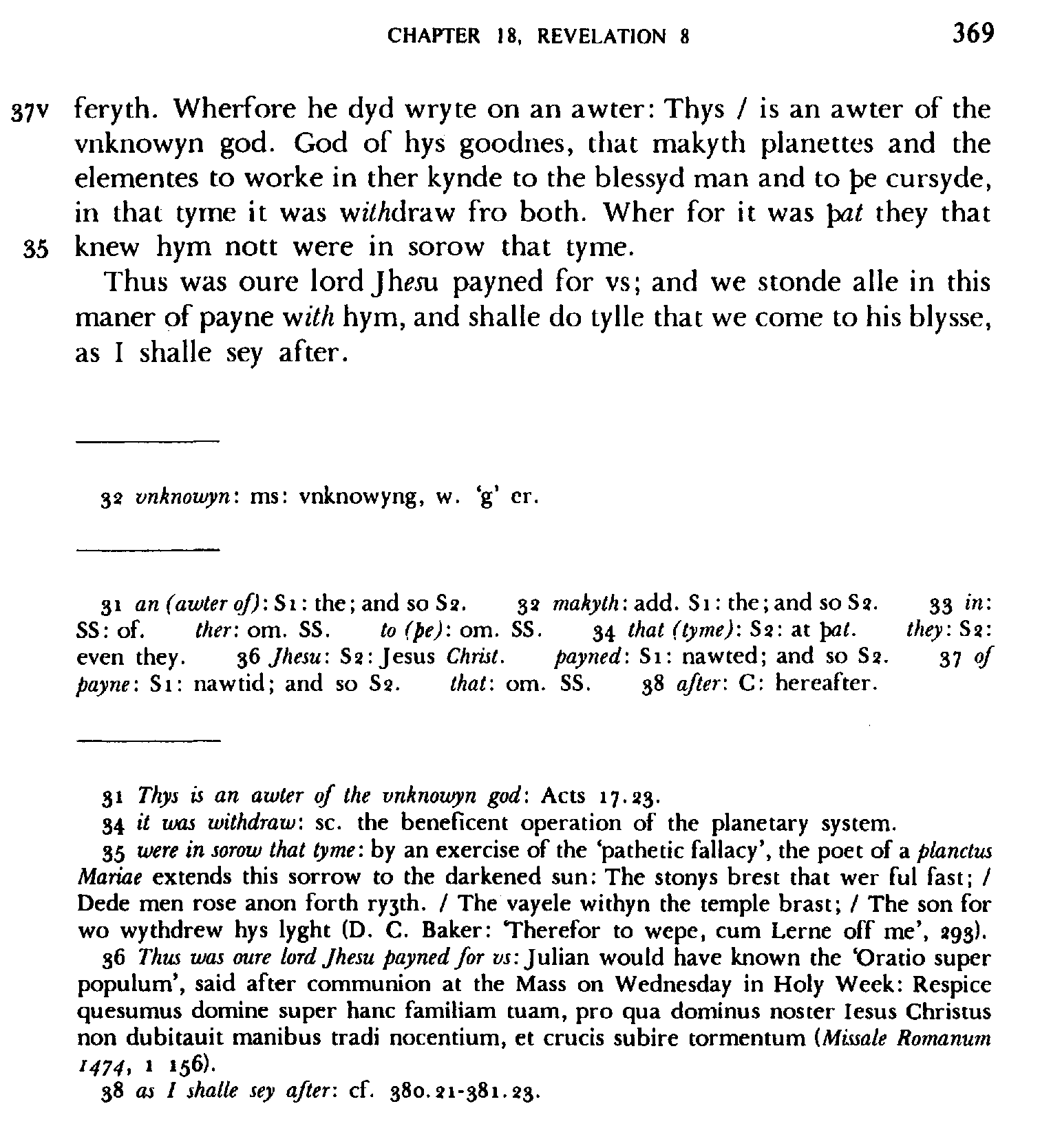
3?v feryth. Wherfore he dyd wryte on an awter: Thys / is an awter of the vnknowyn god. God of hys goodnes, that makyth pianettes and the elementes to worke in ther kynde to the blessyd man and to be cursyde, in that tyrne it was wz/Adraw fro both. Wher for it was \>at they that 35 knew hym nott were in sorow that tyme.
Thus was oure lord Jhesu payned for vs; and we stonde alle in this maner of payne with hym, and shalle do tylle that we come to his blysse, as I shalle sey after.
32 vnknowyn: ms: vnknowyng, w. 'g' cr.
31 an (awter of): Si: the; and so Si?.
32 makyth: add. Si: the;and so 82.
33 in:
SS: of. ther: om. SS. to (pe): om. SS.
34 that (tyme): 82: at ^at. they: 82: even they.
36 Jhesu: 82: Jesus Christ. payned: Si: nawted; and so 82.
37 of payne: Si: nawtid; and so 82. that: om. 88.
38 after: C: hereafter.
31 Thys is an awter of the vnknowyn god: Acts 17.23.
34 it was withdraw: sc. the beneficent operation of the planetary system.
35 were in sorow that tyme: by an exercise of the 'pathetic fallacy', the poet of a planctus
Mariae extends this sorrow to the darkened sun: The stonys brest that wer ful fast; /
Dede men rose anon forth ryyh. I The vayele withyn the temple brast; / The son for wo wythdrew hys lyght (D. C. Baker: Therefor to wepe, cum Lerne off me', 293).
36 Thus was oure lord Jhesu payned for w: Julian would have known the 'Oratio super populum', said after communion at the Mass on Wednesday in Holy Week: Respice quesumus domine super hanc familiam tuam, pro qua dominus noster lesus Christus non dubitauit manibus tradi nocentium, et crucis subire tormentum (Musale Romanum
1474, i 156).
38 as I shalle sey after: cf. 380.21-381.23.
THE LONG TEXT
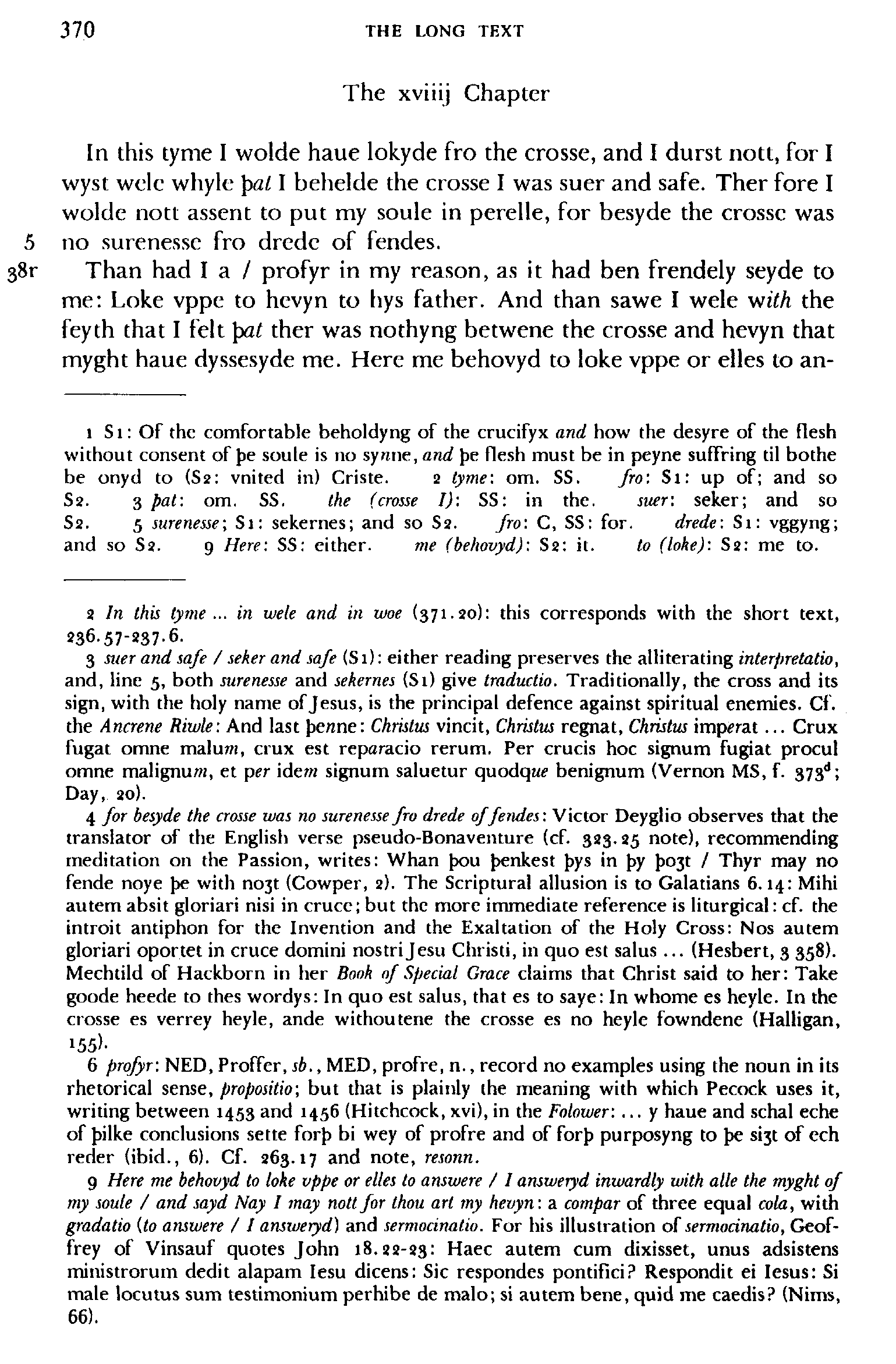
The xviiij Chapter In this tyme I wolde haue lokyde fro the crosse, and I durst nott, for I wyst wele whyle \>al I behelde the crosse I was suer and safe. Ther fore I wolde nott assent to put my soule in perelle, for besyde the crosse was
no surenesse fro drede of fendes. s8r Than had l a / profyr in my reason, as it had ben frendely seyde to me: Loke vppe to hevyn to hys father. And than sawe I wele with the feyth that I felt \>at ther was nothyng betwene the crosse and hevyn that myght haue dyssesyde me. Here me behovyd to loke vppe or elles to ani Si: Of the comfortable beholdyng of the crucifyx and how the desyre of the flesh without consent of be soule is no symie, and be flesh must be in peyne suffring til bothe be onyd to (82: vnited in) Criste.
2 tyme: om. SS. fro: Si: up of; and so 82.
3 pat: om.
SS. the (crosse I):
SS: in the. suer: seker; and so 82.
5 surenesse; Si: sekernes; and so 82. fro: C, SS: for. drede: Si: vggyng; and so 82.
9 Here: 88: either. me (behovyd): 82: it. to (loke): 82: me to.
2 In this tyme... in wele and in woe (371.20): this corresponds with the short text,
236.57-237-6.
3 suer and safe / seker and safe (Si): either reading preserves the alliterating interpretatio, and, line 5, both surenesse and sekernes (Si) give traductio. Traditionally, the cross and its sign, with the holy name of Jesus, is the principal defence against spiritual enemies. Cf. the Ancrene Riwle: And last be/me: Christus vincit, Christus regnat, Christus imp^rat... Crux fugat omne malum, crux est reparacio rerum. Per crucis hoc signum fugiat procul omne malignu/n, et per idem signum saluetur quodque benignum (Vernon MS, f. 373**;
Day, 20).
4 for besyde the crosse was no surenesse fro drede of fendes: Victor Deyglio observes that the translator of the English verse pseudo-Bonaventure (cf. 323.25 note), recommending meditation on the Passion, writes: Whan bou benkest bys in by {5031 / Thyr may no fende noye be with mrjt (Cowper, 2). The Scriptural allusion is to Galatians 6.14: Mihi autem absit gloriari nisi in crucc; but the more immediate reference is liturgical: cf. the introit antiphon for the Invention and the Exaltation of the Holy Cross: Nos autem gloriari oportet in cruce domini nostrijesu Christi, in quo est salus ... (Hesbert, 3 358).
Mechtild of Hackborn in her Book of Special Grace claims that Christ said to her: Take goode heede to thes wordys: In quo est salus, that es to saye: In whome es heyle. In the crosse es verrey heyle, ande withoutene the crosse es no heyle fowndene (Halligan,
155)- 6 profyr: NED, Proffer, sb., MED, profre, n., record no examples using the noun in its rhetorical sense, proposition but that is plainly the meaning with which Pecock uses it, writing between 1453 and 1456 (Hitchcock, xvi), in the Folower: ... y haue and schal eche of bilke conclusions sette forb bi wey of profre and of forb purposyng to be si3t of ech reder (ibid., 6). Cf. 263.17 and note, resonn.
9 Here me behovyd to loke vppe or elles to answere / 1 answeryd inwardly with alle the myght of my soule / and sayd Nay I may nott for thou art my hevyn: a compar of three equal cola, with gradatio (to answere / I answeryd) and sermodnatio. For his illustration of sermodnatio, Geoffrey of Vinsauf quotes John 18.22-23: Haec autem cum dixisset, unus adsistens ministrorum dedit alapam lesu dicens: Sic respondes pontifici? Respondit ei lesus: Si male locutus sum testimonium perhibe de malo; si autem bene, quid me caedis? (Nims,
66).
CHAPTER 19, REVELATION 8
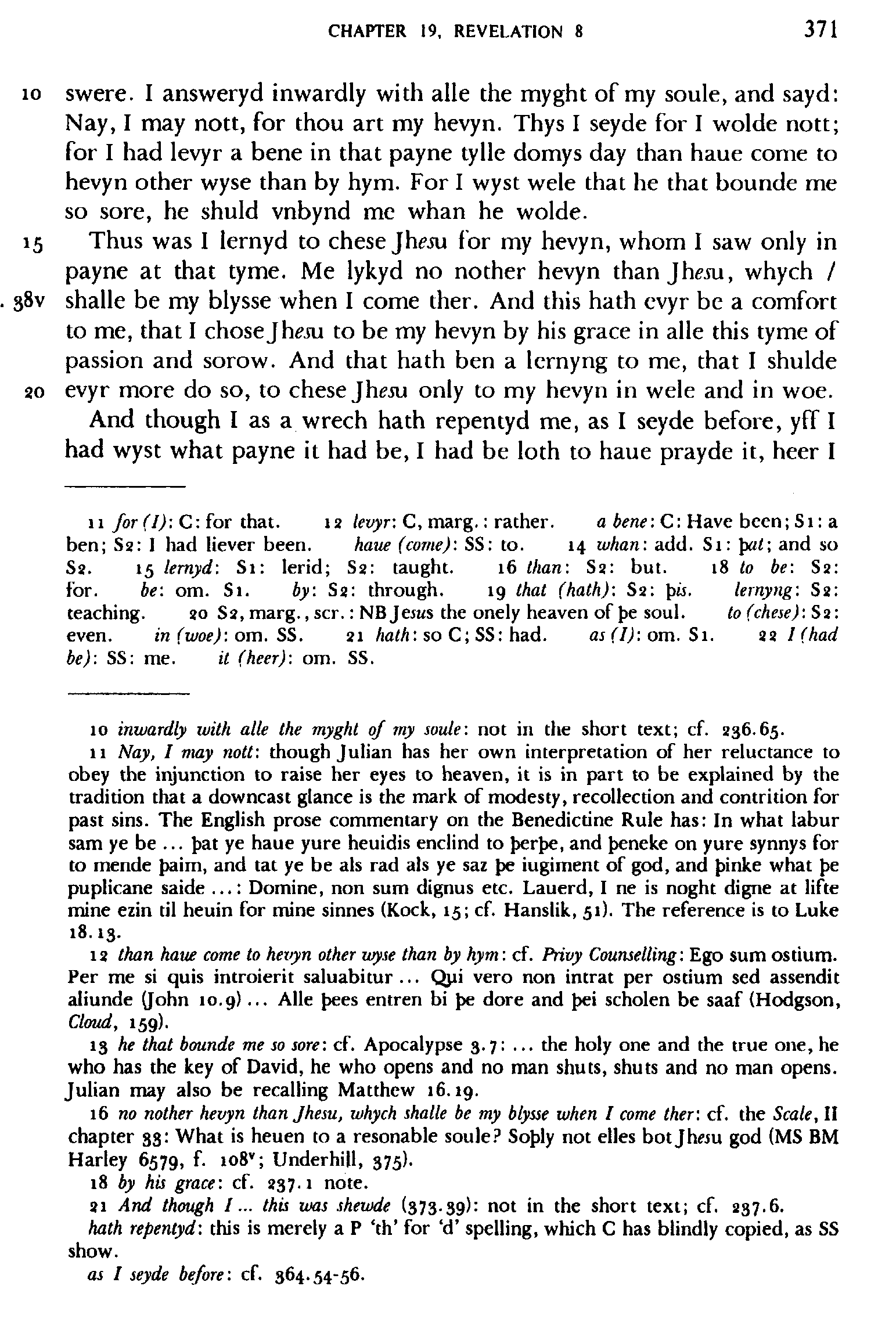
10 swere. I answeryd inwardly with alle the myght of my soule, and sayd:
Nay, I may nott, for thou art my hevyn. Thys I seyde for I wolde nott; for I had levyr a bene in that payne tylle domys day than haue come to hevyn other wyse than by hym. For I wyst wele that he that bounde me so sore, he shuld vnbynd me whan he wolde.
Thus was I lernyd to chese Jhesu for my hevyn, whom I saw only in payne at that tyme. Me lykyd no nother hevyn thanjhou, whych /
38v shalle be my blysse when I come ther. And this hath evyr be a comfort to me, that I chose Jh^ju to be my hevyn by his grace in alle this tyme of passion and sorow. And that hath ben a lernyng to me, that I shulde
20 evyr more do so, to chese ]hesu only to my hevyn in wele and in woe.
And though I as a wrech hath repentyd me, as I seyde before, yff I had wyst what payne it had be, I had be loth to haue prayde it, heer I 11 for (I):C: for that. is levyr: C, marg.: rather. a bene: C: Have been; Si: a ben; 82: I had liever been. haue (come): SS: to.
14 whan: add. Si: pa/; and so 82.
15 lernyd: Si: lerid; 82: taught.
16 than: 82: but.
18 to be: 82: for. be: om. Si. by: 82: through.
19 that (hath): 82: \>is. lernyng: 82: teaching.
20 82, marg., scr.: NB Jesus the onely heaven of pe soul. to (chese): 82: even. in (woe): om. 88.
21 hath: so C; 88: had. as (I): om. Si.
22 I (had be): 88: me. it (heer): om. SS.
10 inwardly with alle the myght of my soule: not in the short text; cf. 236.65.
11 Nay, I may nott: though Julian has her own interpretation of her reluctance to obey the injunction to raise her eyes to heaven, it is in part to be explained by the tradition that a downcast glance is the mark of modesty, recollection and contrition for past sins. The English prose commentary on the Benedictine Rule has: In what labur sam ye be ... pat ye haue yure heuidis enclind to perpe, and peneke on yure synnys for to mende paim, and tat ye be als rad als ye saz pe iugiment of god, and pinke what pe puplicane saide ...: Domine, non sum dignus etc. Lauerd, I ne is noght digne at lifte mine ezin til heuin for mine sinnes (Kock, 15; cf. Hanslik, 51). The reference is to Luke
18.13.
12 than haue come to hevyn other wyse than by hym: cf. Privy Counselling: Ego sum ostium.
Per me si quis introierit saluabitur ... Qui vero non intrat per ostium sed assendit aliunde (John 10.9)... Alle pees entren bi pe dore and pei scholen be saaf (Hodgson,
Cloud, 159).
13 he that bounde me so sore: cf. Apocalypse 3.7: ... the holy one and the true one, he who has the key of David, he who opens and no man shuts, shuts and no man opens.
Julian may also be recalling Matthew 16.19.
16 no nother hevyn than Jhesu, whych shalle be my blysse when I come ther: cf. the Scale, II chapter 33: What is heuen to a resonable soule? Soply not elles botjhmi god (MS BM
Harley 6579, f. io8v; Underbill, 375).
18 by his grace: cf. 237.1 note.
21 And though I... this was shewde (373.39): not in the short text; cf. 237.6. hath repentyd: this is merely a P 'th' for 'd' spelling, which C has blindly copied, as SS show. as I seyde before: cf. 364.54-56.
THE LONG TEXT
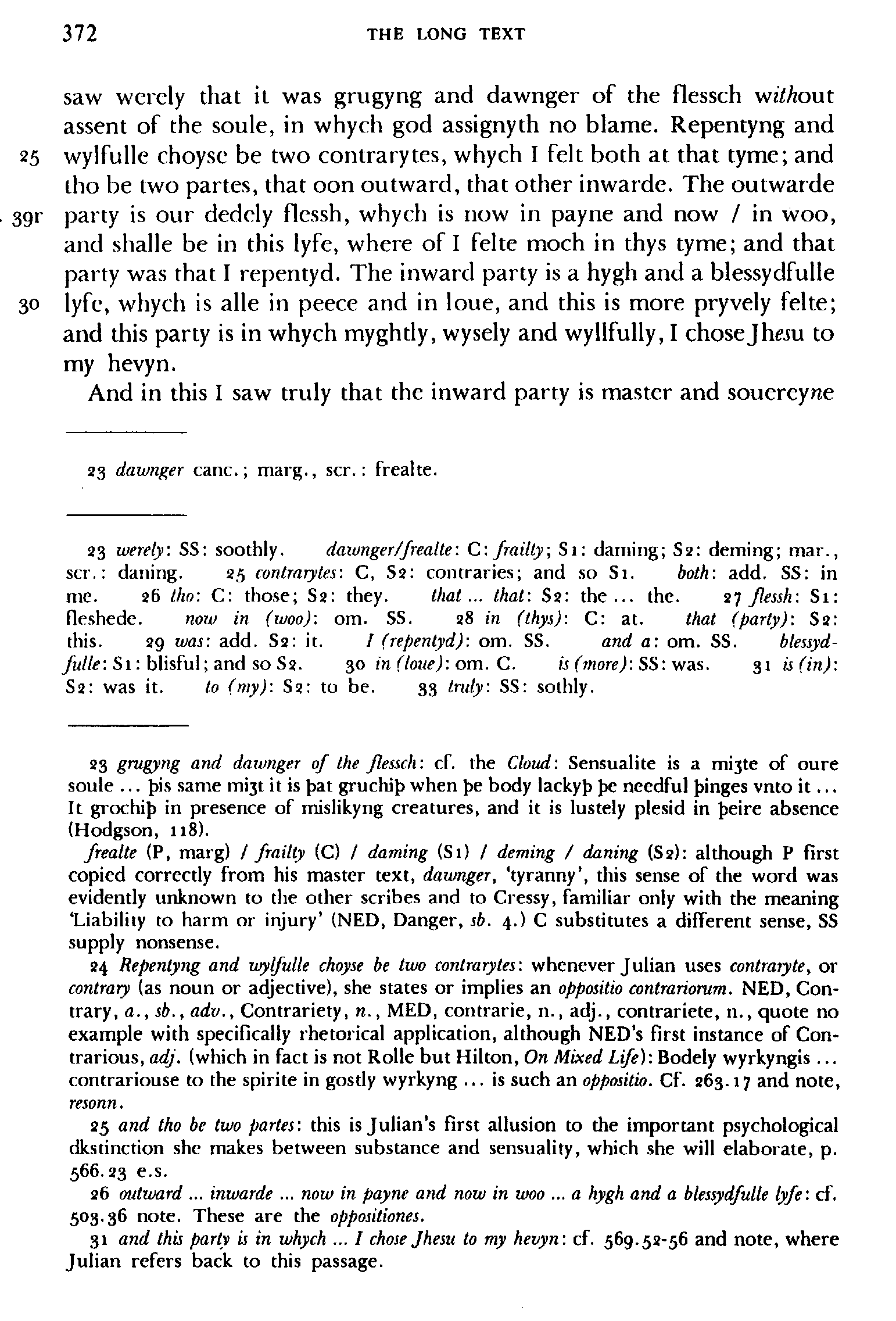
saw wcrely that it was grugyng and dawnger of the flessch w^Aout assent of the soule, in whych god assignyth no blame. Repentyng and 25 wylfulle choyse be two contrarytes, whych I felt both at that tyme; and tho be two partes, that oon outward, that other inwarde. The outwarde
- 39r party is our dedely flessh, whych is now in payne and now / in woo, and shalle be in this lyfe, where of I felte moch in thys tyme; and that party was that I repentyd. The inward party is a hygh and a blessydfulle
30 lyfe, whych is alle in peece and in loue, and this is more pryvely felte; and this party is in whych myghtly, wysely and wyllfully, I chose J hem to my hevyn.
And in this I saw truly that the inward party is master and souereyne 23 dawnger cane.; marg., scr.: frealte.
23 werely: SS: soothly. dawnger/frealte: C\ frailly; Si: darning; 82: deming; mar., scr.: danirig.
25 contrarytes: C, 82: contraries; and so Si. both: add. SS: in me.
26 tho: C: those; 82: they. that... that: 82: the... the.
27 flessh: Si: fleshede. now in (woo): om. SS.
28 in (thys): C: at. that (parly):
82: this.
29 was: add. 82: it.
I (repentyd): om. 88. and a: om. SS. blessydfulle: Si: blisful; and so 82.
30 in (loue): om. C. is (more): SS: was.
31 is (in):
82: was it. to (my): 82: to be.
33 tndy: 88: sothly.
23 grugyng and dawnger of the flessch: cf. the Cloud: Sensualite is a mijte of oure soule ... J)is same mijt it is f>at gruchiji when J>e body lackyj) J>e needful Jjinges vnto it...
It grochit> in presence of mislikyng creatures, and it is lustely plesid in J>eire absence
(Hodgson, 118). frealte (P, marg) /frailty (C) / darning (Si) / deming / daning (82): although P first copied correctly from his master text, dawnger, 'tyranny', this sense of the word was evidently unknown to the other scribes and to Cressy, familiar only with the meaning
'Liability to harm or injury' (NED, Danger, sb. 4.) C substitutes a different sense, SS supply nonsense.
24 Repentyng and wylfulle choyse be two contrarytes: whenever Julian uses contraryte, or contrary (as noun or adjective), she states or implies an oppositio contrariorum. NED, Contrary, a., sb., adv., Contrariety, n., MED, contrarie, n., adj., contrariete, n., quote no example with specifically rhetorical application, although NED's first instance of Contrarious, adj. (which in fact is not Rolle but Hilton, On Mixed Life): Bodely wyrkyngis ... contrariouse to the spirite in gosdy wyrkyng ... is such an oppositio. Cf. 263.17 and note, resonn.
25 and tho be two partes: this is Julian's first allusion to die important psychological dkstinction she makes between substance and sensuality, which she will elaborate, p.
566.23 e.s.
26 outward ... inwarde ... now in payne and now in woo ... a hygh and a blessydfulle lyfe: cf.
503.36 note. These are the oppositiones.
31 and this party is in whych ... I chose Jhem to my hevyn: cf. 569.52-56 and note, where
Julian refers back to this passage.
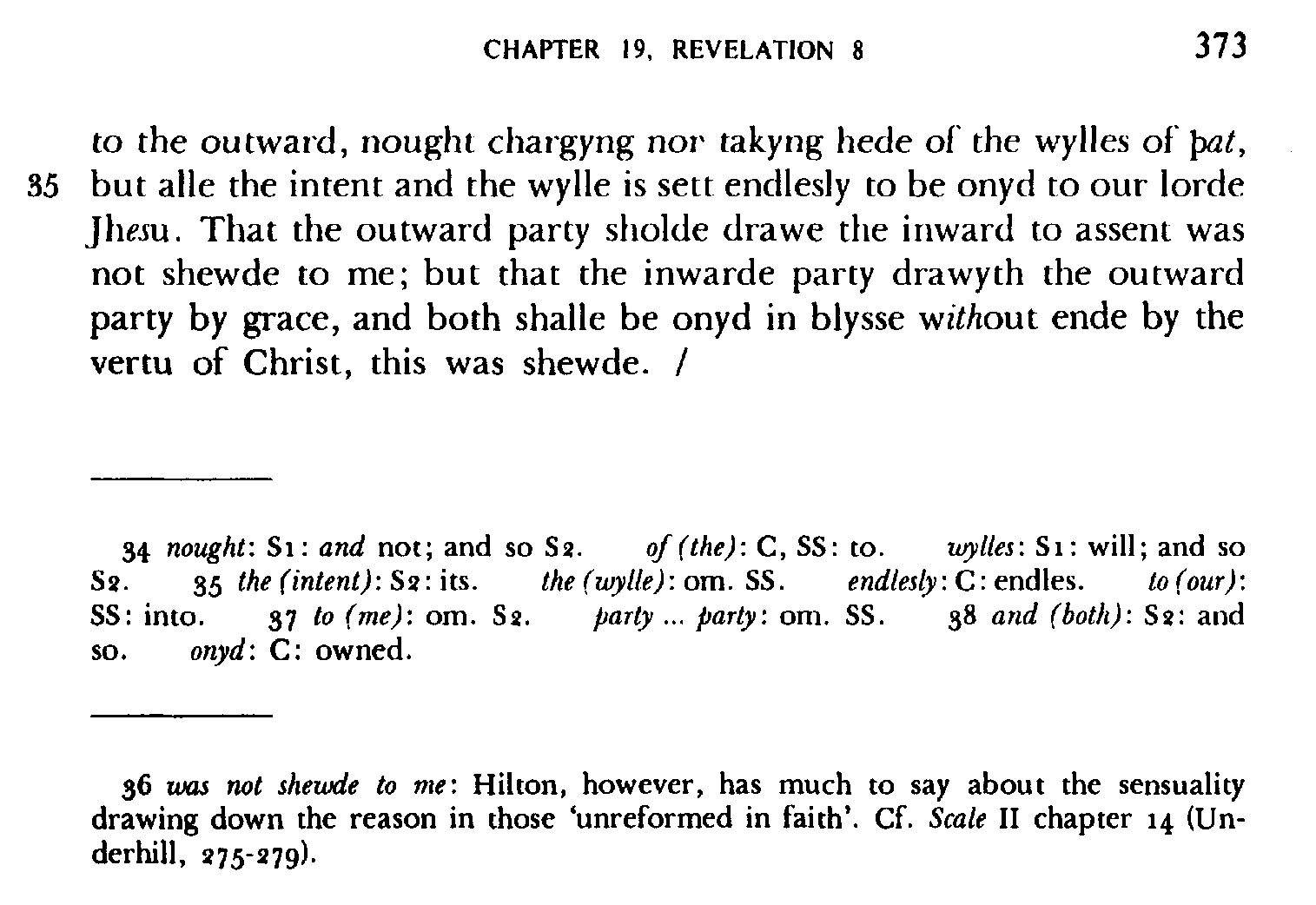
CHAPTER
19, REVELATION 8
to the outward, nought chargyng nor takyng hede of the wylles of \>at, 35 but alle the intent and the wylle is sett endlesly to be onyd to our lorde
Jh«u. That the outward party sholde drawe the inward to assent was not shewde to me; but that the inwarde party drawyth the outward party by grace, and both shalle be onyd in blysse without ende by the vertu of Christ, this was shewde. / 34 nought: Si: and not; and so 82. of (the): C, 88: to. uylles: Si: will; and so 82.
35 the (intent): 82: its. the (wylle): om. SS. endlesly: C: endles. to(our):
SS: into.
37 to (me): om. 82. party ... parly: om. 88.
38 and (both): 82: and so. onyd: C: owned.
36 was not shewde to me: Hilton, however, has much to say about the sensuality drawing down the reason in those 'unreformed in faith'. Cf. Scale II chapter 14 (Underhill, 275-279).
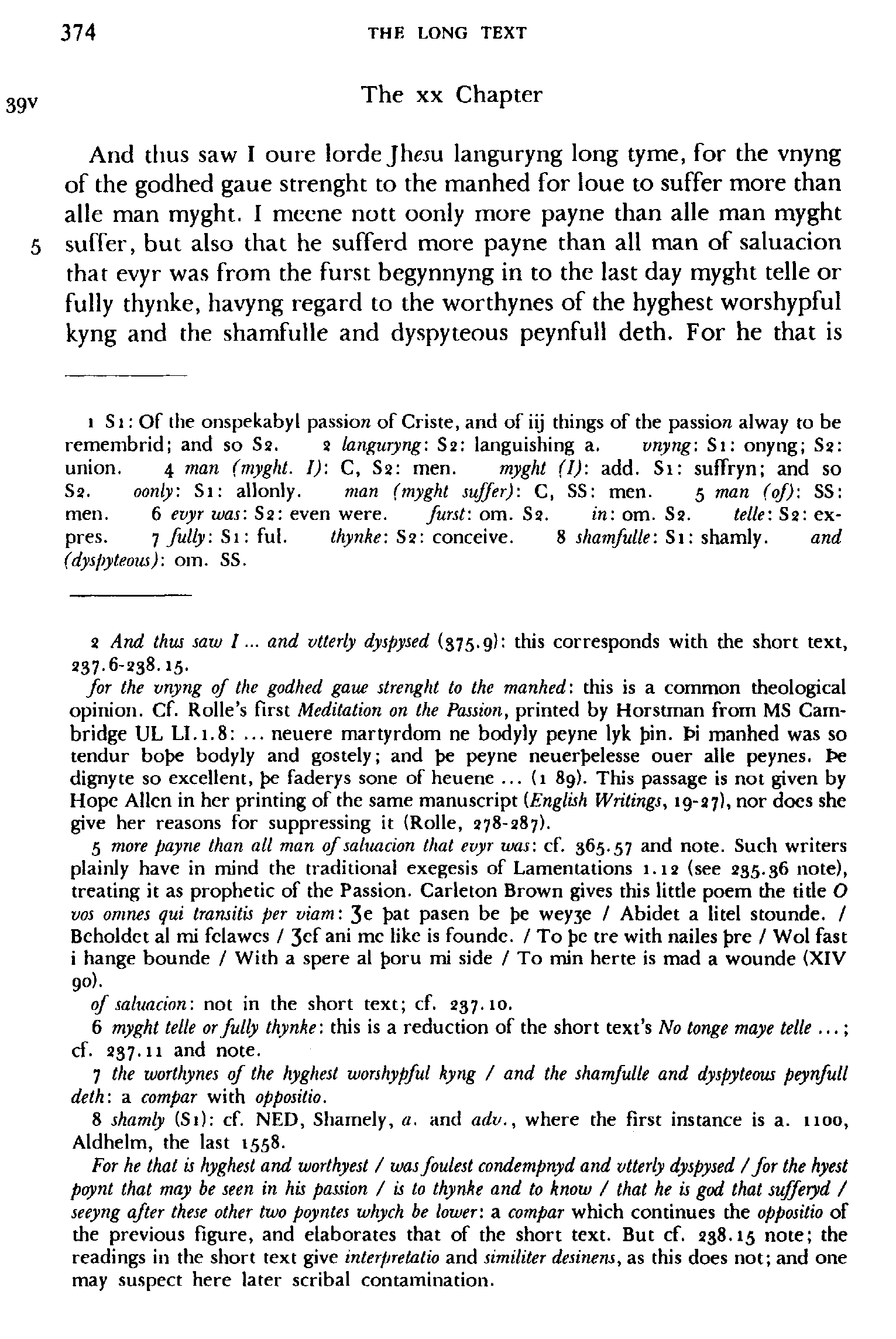
THE LONG TEXT
3gV The xx Chapter And thus saw I cure lorde Jhwu languryng long tyme, for the vnyng of the godhed gaue strenght to the manhed for loue to suffer more than alle man myght. I meene nott oonly more payne than alle man myght
5 suffer, but also that he sufferd more payne than all man of saluacion that evyr was from the furst begynnyng in to the last day myght telle or fully thynke, havyng regard to the worthynes of the hyghest worshypful kyng and the shamfulle and dyspyteous peynfull deth. For he that is i Si: Of the onspekabyl passion of Criste, and of iij things of the passion alway to be remembrid; and so 82.
2 languryng: 82: languishing a. vnyng: Si: onyng; 82: union.
4 man (myght. I): C, 82: men. myght (I): add. Si: suffryn; and so Sa. oonly: Si: allonly. man (myght suffer):
C, SS: men.
5 man (of): SS: men.
6 evyr was: 82: even were. furst: om. 82. in: om. 82. telle: 82: expres.
7 fully: Si: ful. thynke: 82: conceive.
8 shamfulle: Si: shamly. and (dyspyteous): om. SS.
2 And thus saw 1... and utterly dyspysed (375.9): this corresponds with the short text,
237.6-238.15. for the vnyng of the godhed gaue strenght to the manhed: this is a common theological opinion. Cf. Rolle's first Meditation on the Passion, printed by Horstman from MS Cambridge UL LI. 1.8: ... neuere martyrdom ne bodyly peyne lyk pin. £>i manhed was so tendur bope bodyly and gostely; and pe peyne neuerpelesse ouer alle peynes. t>e dignyte so excellent, pe faderys sone of heuene ... (i 89). This passage is not given by Hope Allen in her printing of the same manuscript (English Writings, 19-27), nor does she give her reasons for suppressing it (Rolle, 278-287).
5 more payne than all man of saluacion that evyr was: cf. 365.57 and note. Such writers plainly have in mind the traditional exegesis of Lamentations 1.12 (see 235.36 note), treating it as prophetic of the Passion. Carleton Brown gives this little poem the title O vos omnes qui transitis per viam: 3e pat pasen be J>e weyje / Abidet a litel stounde. /
Beholdet al mi fclawes / 3ef ani me like is foundc. / To pe tre with nailes pre / Wol fast i hange bounde / With a spere al poru mi side / To min herte is mad a wounde (XIV 90). of saluacion: not in the short text; cf. 237.10.
6 myght telle or fully thynke: this is a reduction of the short text's No tonge maye telle ...; cf. 237.11 and note.
7 the worthynes of the hyghest worshypful kyng / and the shamfulle and dyspyteous peynfull deth: a compar with oppositio.
8 shamly (Si): cf. NED, Shamely, a. and adv., where the first instance is a. 1100,
Aldhelm, the last 1558.
For he that is hyghest and worthyest / was foulest condempnyd and utterly dyspysed /for the hyest poynt that may be seen in his passion / is to thynke and to know / that he is god that sufferyd
/ seeyng after these other two poyntes whych be lower: a compar which continues the oppositio of the previous figure, and elaborates that of the short text. But cf. 238.15 note; the readings in the short text give interpretatio and similiter desinens, as this does not; and one may suspect here later scribal contamination.
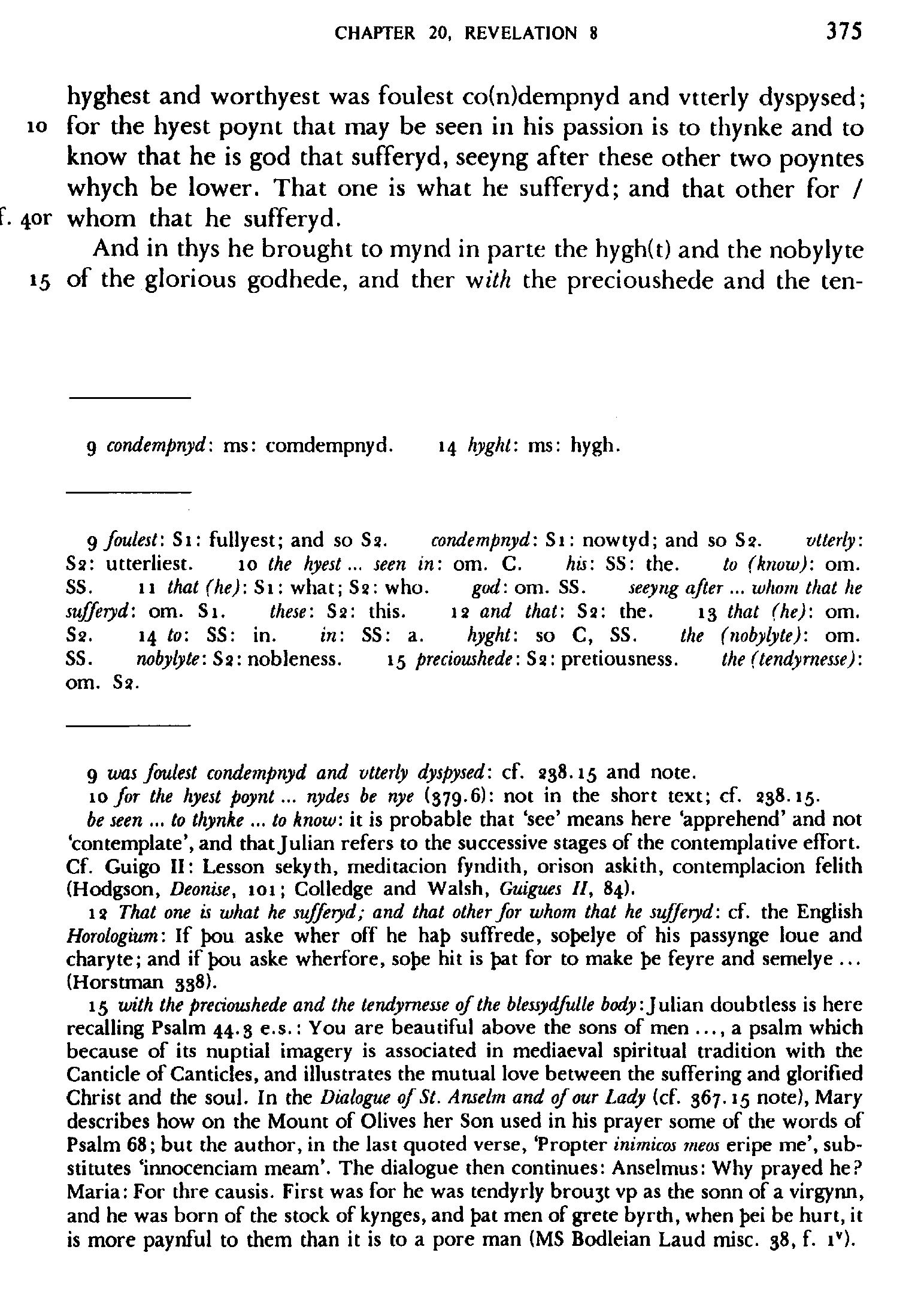
CHAPTER 20, REVELATION 8
hyghest and worthyest was foulest co(n)dempnyd and vtterly dyspysed; 10 for the hyest poynt that may be seen in his passion is to thynke and to know that he is god that sufferyd, seeyng after these other two poyntes whych be lower. That one is what he sufferyd; and that other for / f. 4or whom that he sufferyd.
And in thys he brought to mynd in parte the hygh(t) and the nobylyte 15 of the glorious godhede, and ther -with the precioushede and the ten9 condempnyd: ms: comdempnyd.
14 hyght: ms: hygh.
9 foulest: Si: fullyest; and so 82. condempnyd: Si: nowtyd; and so 82. vtterly:
Ss: utterliest.
10 the hyest... seen in: om. C. his: SS: the. to (know): om.
SS.
11 that (he): Si: what; 82: who. god: om. SS. seeyng after ... whom that he sufferyd: om. Si. these: 82: this.
12 and that: 82: the.
13 that (he): om.
82.
14 to: SS: in. in: SS: a. hyght: so C, SS. the (nobylyte): om.
SS. nobylyte: 82: nobleness.
15 precioushede: 82: pretiousness. the (tendyrnesse): om. 82.
9 was foulest condempnyd and vtterly dyspysed: cf. 238.15 and note. lo/or the hyest poynt... nydes be nye (379.6): not in the short text; cf. 238.15. be seen ... to thynke ... to know: it is probable that 'see' means here 'apprehend' and not 'contemplate', and that Julian refers to the successive stages of the contemplative effort.
Cf. Guigo II: Lesson sekyth, meditacion fyndith, orison askith, contemplacion felith
(Hodgson, Deonise, 101; Colledge and Walsh, Guigues II, 84).
12 That one is what he sufferyd; and that other for whom that he sufferyd: cf. the English
Horologium: If pou aske wher off he haj> suffrede, sopelye of his passynge loue and charyte; and if pou aske wherfore, sope hit is f>at for to make J>e feyre and semelye ...
(Horstman 338).
15 with the precioushede and the tendyrnesse of the blessydfulle body: Julian doubtless is here recalling Psalm 44.3 e.s.: You are beautiful above the sons of men ..., a psalm which because of its nuptial imagery is associated in mediaeval spiritual tradition with the Canticle of Canticles, and illustrates the mutual love between the suffering and glorified
Christ and the soul. In the Dialogue of St. Anselm and of our Lady (cf. 367.15 note), Mary describes how on the Mount of Olives her Son used in his prayer some of the words of Psalm 68; but the author, in the last quoted verse, 'Propter inimicos meos eripe me', substitutes 'innocenciam meam'. The dialogue then continues: Anselmus: Why prayed he?
Maria: For thre causis. First was for he was tendyrly brou3t vp as the sonn of a virgynn, and he was born of the stock of kynges, and pat men of grete byrth, when pei be hurt, it is more paynful to them than it is to a pore man (MS Bodleian Laud misc. 38, f. iv).
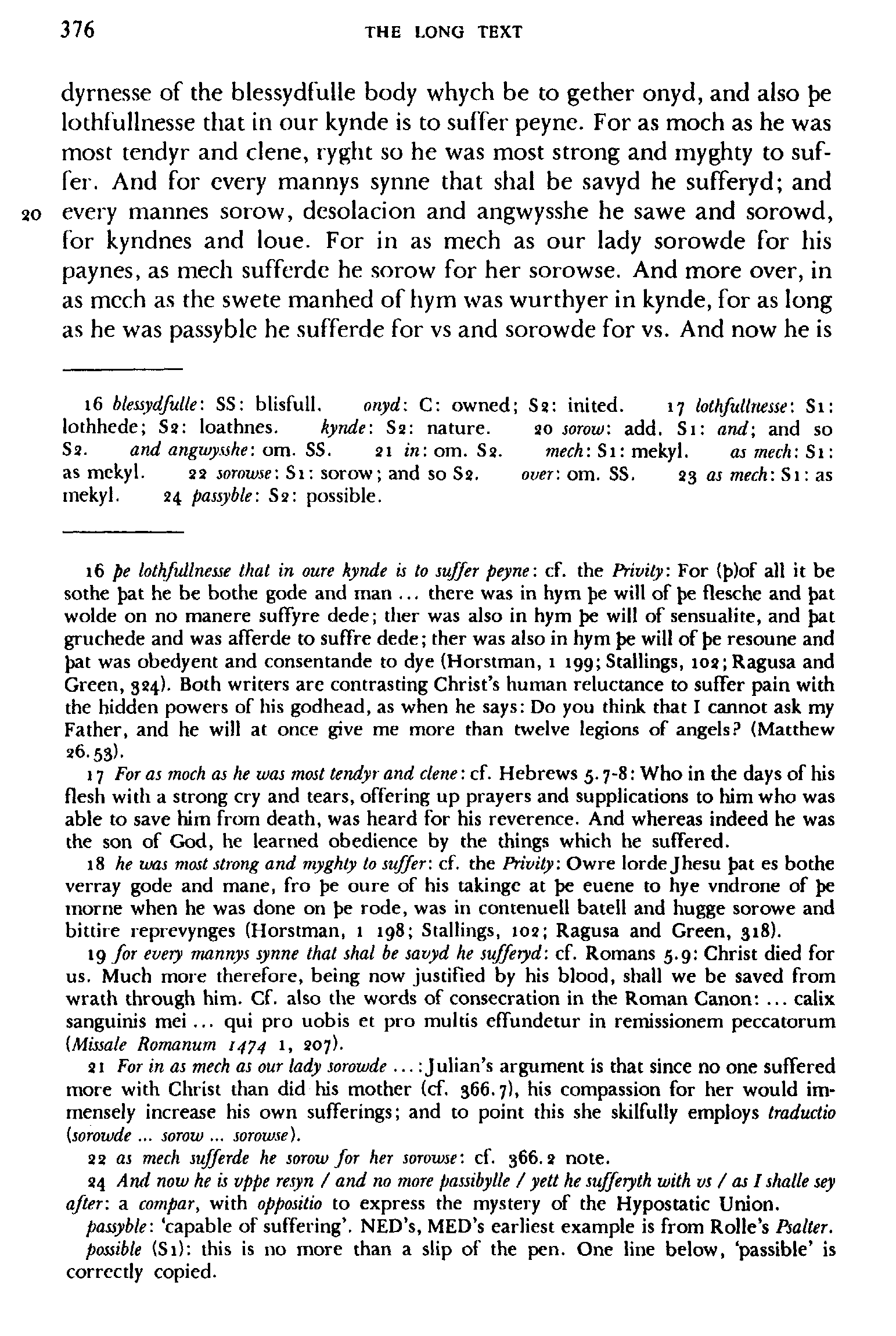
THE LONG TEXT
dyrnesse of the blessydfulle body whych be to gether onyd, and also £>e lothfullnesse that in our kynde is to suffer peyne. For as moch as he was most tendyr and clene, ryght so he was most strong and myghty to suffer. And for every mannys synne that shal be savyd he sufferyd; and 20 every mannes sorow, desolacion and angwysshe he sawe and sorowd, for kyndnes and loue. For in as mech as our lady sorowde for his paynes, as mech sufferde he sorow for her sorowse. And more over, in as mech as the swete manhed of hym was wurthyer in kynde, for as long as he was passyblc he sufferde for vs and sorowde for vs. And now he is
16 blessydfulle: SS: blisfull. onyd: C: owned; 82: inited.
17 lothfullnesse: Si: lothhede; Sa: loathnes. kynde: 82: nature.
20 sorow: add. Si: and; and so 82. and angwysshe: om. SS.
21 in: om. 82. mech: 81: mekyl. as mech: Si: as mekyl.
22 sorowse: Si: sorow; and so 82. over: om. SS.
23 as mech: Si: as mekyl.
24 passyble: 82: possible.
16 pe lothfullnesse that in cure kynde is to suffer peyne: cf. the Privity: For (p)of all it be sothe pat he be bothe gode and man ... there was in hym pe will of pe flesche and pat wolde on no manere suffyre dede; ther was also in hym pe will of sensualite, and pat gruchede and was afferde to suffre dede; ther was also in hym pe will of pe resoune and pat was obedyent and consentande to dye (Horstman, i 199; Stallings, 102; Ragusa and Green, 324). Both writers are contrasting Christ's human reluctance to suffer pain with the hidden powers of his godhead, as when he says: Do you think that I cannot ask my
Father, and he will at once give me more than twelve legions of angels? (Matthew
26.53).
17 For as moch as he was most tendyr and clene: cf. Hebrews 5.7-8: Who in the days of his flesh with a strong cry and tears, offering up prayers and supplications to him who was able to save him from death, was heard for his reverence. And whereas indeed he was the son of God, he learned obedience by the things which he suffered.
18 he was most strong and myghty to suffer: cf. the Privity: Owre lorde Jhesu pat es bothe verray gode and mane, fro pe oure of his takinge at pe euene to hye vndrone of pe morne when he was done on pe rode, was in contenuell batell and hugge sorowe and bittire reprevynges (Horstman, i 198; Stallings, 102; Ragusa and Green, 318).
19 for every mannys synne that shal be savyd he sufferyd: cf. Romans 5.9: Christ died for us. Much more therefore, being now justified by his blood, shall we be saved from wrath through him. Cf. also the words of consecration in the Roman Canon: ... calix sanguinis mei ... qui pro uobis et pro multis effundetur in remissionem peccatorum
(Missale Romanum 1474 i, 207).
21 For in as mech as our lady sorowde ...: Julian's argument is that since no one suffered more with Christ than did his mother (cf. 366.7), his compassion for her would immensely increase his own sufferings; and to point this she skilfully employs traductio
(sorowde ... sorow ... sorowse).
22 as mech sufferde he sorow for her sorowse: cf. 366.2 note.
24 And now he is vppe resyn / and no more passibylle / yett he sufferyth with vs / as I shade sey after: a compar, with oppositio to express the mystery of the Hypostatic Union. passyble: 'capable of suffering'. NED's, MED's earliest example is from Rolle's Psalter. possible (Si): this is no more than a slip of the pen. One line below, 'passible' is correctly copied.
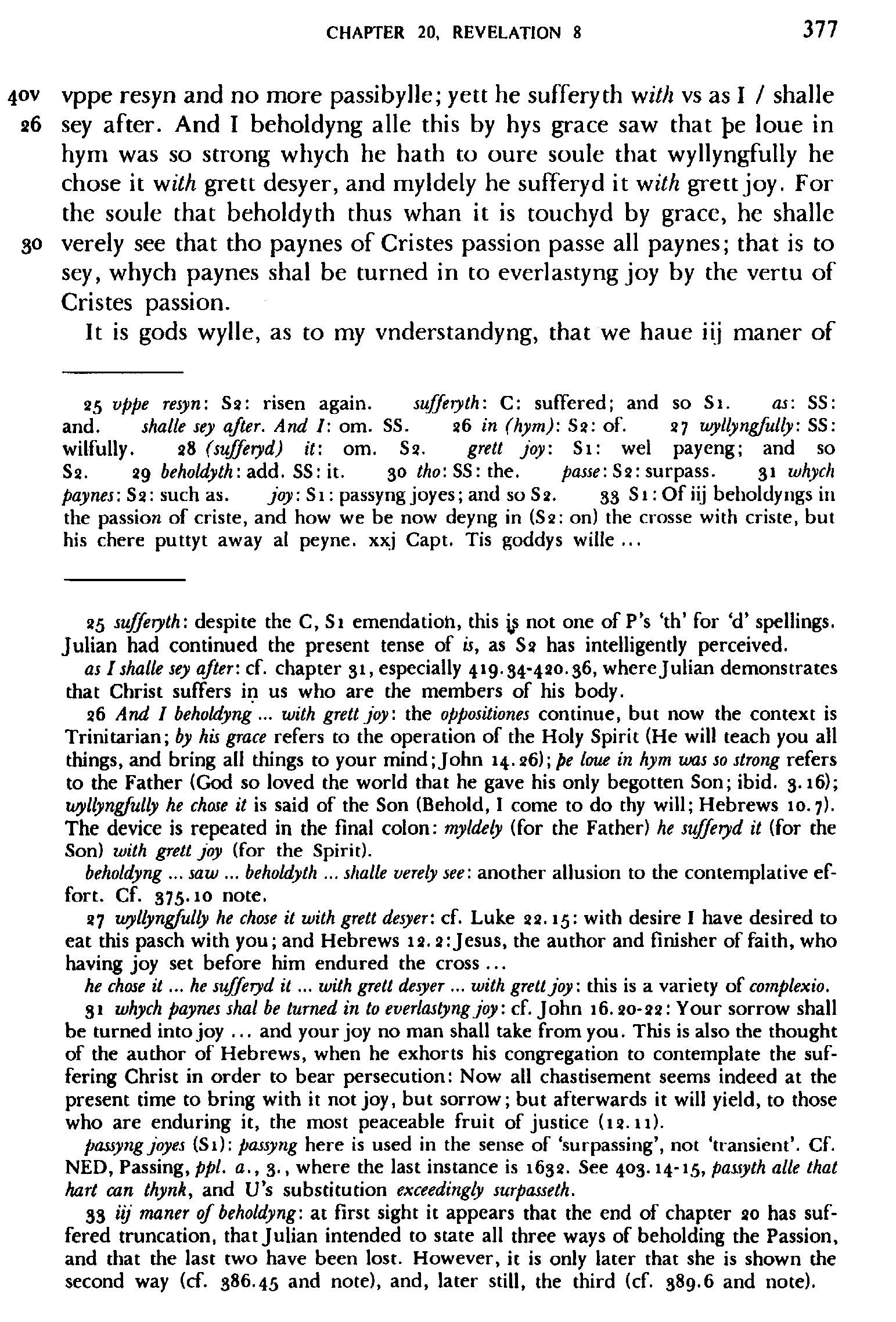
CHAPTER 20, REVELATION 8
4ov vppe resyn and no more passibylle; yett he sufferyth with vs as I / shalle 26 sey after. And I beholdyng alle this by hys grace saw that {je loue in hym was so strong whych he hath to oure soule that wyllyngfully he chose it with grett desyer, and myldely he sufferyd it with grett joy. For the soule that beholdyth thus whan it is touchyd by grace, he shalle
30 verely see that tho paynes of Cristes passion passe all paynes; that is to sey, whych paynes shal be turned in to everlastyng joy by the vertu of Cristes passion.
It is gods wylle, as to my vnderstandyng, that we haue iij maner of 25 vppe resyn: 82: risen again. sufferyth:
C: suffered; and so Si. as: SS: and. shalle sey after. And I: om. SS.
26 in (hym): 82: of.
27 wyllyngfully: SS: wilfully.
28 (sufferyd) it: om.
82. grett joy: Si: wel payeng; and so 82.
29 beholdyth: add. 88: it.
30 Mo: SS: the. passe: 82: surpass.
31 whych paynes: 82: such as. joy: Si: passyng joyes; and so 82.
33 Si: Of iij beholdyngs in the passion of criste, and how we be now deyng in (82: on) the crosse with criste, but his chere puttyt away al peyne. xxj Capt. Tis goddys wille ...
25 sufferyth: despite the C, Si emendation, this i$ not one of P's 'th' for 'd' spellings.
Julian had continued the present tense of is, as 82 has intelligently perceived. as I shalle sey after: cf. chapter 31, especially 419.34-420.36, where Julian demonstrates that Christ suffers in us who are the members of his body.
26 And I beholdyng ... with grett joy: the oppositiones continue, but now the context is
Trinitarian; by his grace refers to the operation of the Holy Spirit (He will teach you all things, and bring all things to your mind; John 14.26); pe loue in hym was so strong refers to the Father (God so loved the world that he gave his only begotten Son; ibid. 3.16); wyllyngfully he chose it is said of the Son (Behold, I come to do thy will; Hebrews 10.7).
The device is repeated in the final colon: myldely (for the Father) he sufferyd it (for the Son) with grett joy (for the Spirit). beholdyng ... saw ... beholdyth ... shalle verely see: another allusion to the contemplative effort. Cf. 375.10 note.
27 wyllyngfully he chose it with grett desyer: cf. Luke 22.15: with desire I have desired to eat this pasch with you; and Hebrews 12.2: Jesus, the author and finisher of faith, who having joy set before him endured the cross ... he chose it... he sufferyd it ... with grett desyer ... with grett joy: this is a variety of complexio.
31 whych paynes shal be turned in to everlastyng joy: cf. John 16.20-22: Your sorrow shall be turned into joy ... and your joy no man shall take from you. This is also the thought of the author of Hebrews, when he exhorts his congregation to contemplate the suffering Christ in order to bear persecution: Now all chastisement seems indeed at the present time to bring with it not joy, but sorrow; but afterwards it will yield, to those who are enduring it, the most peaceable fruit of justice (12.11). passyng joyes (Si): passyng here is used in the sense of 'surpassing', not 'transient'. Cf.
NED, Passing, ppl. a., 3., where the last instance is 1632. See 403.14-15, passyth alle that hart can thynk, and U's substitution exceedingly surpasseth.
33 iij maner of beholdyng: at first sight it appears that the end of chapter 20 has suffered truncation, that Julian intended to state all three ways of beholding the Passion, and that the last two have been lost. However, it is only later that she is shown the second way (cf. 386.45 and note), and, later still, the third (cf. 389.6 and note).
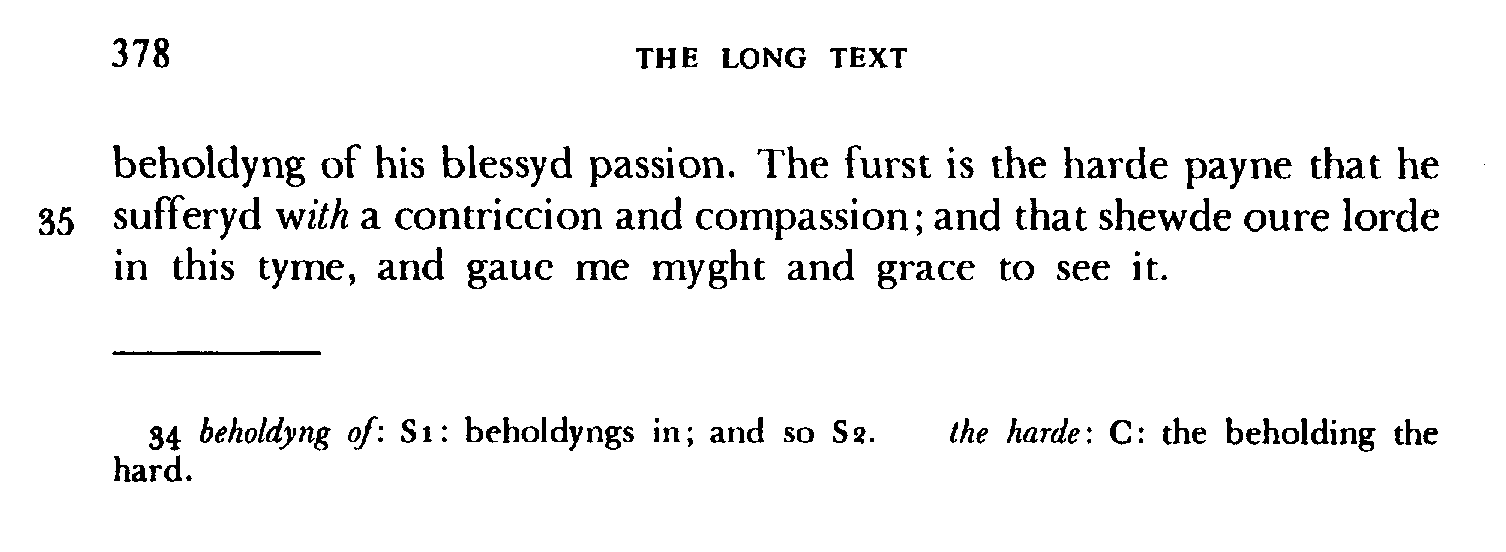
THE LONG TEXT
beholdyng of his blessyd passion. The furst is the harde payne that he 35 sufferyd with a contriccion and compassion; and that shewde oure lorde in this tyme, and gaue me myght and grace to see it.
34 beholdyng of: Si: beholdyngs in; and so Sa. the harde: C: the beholding the hard.
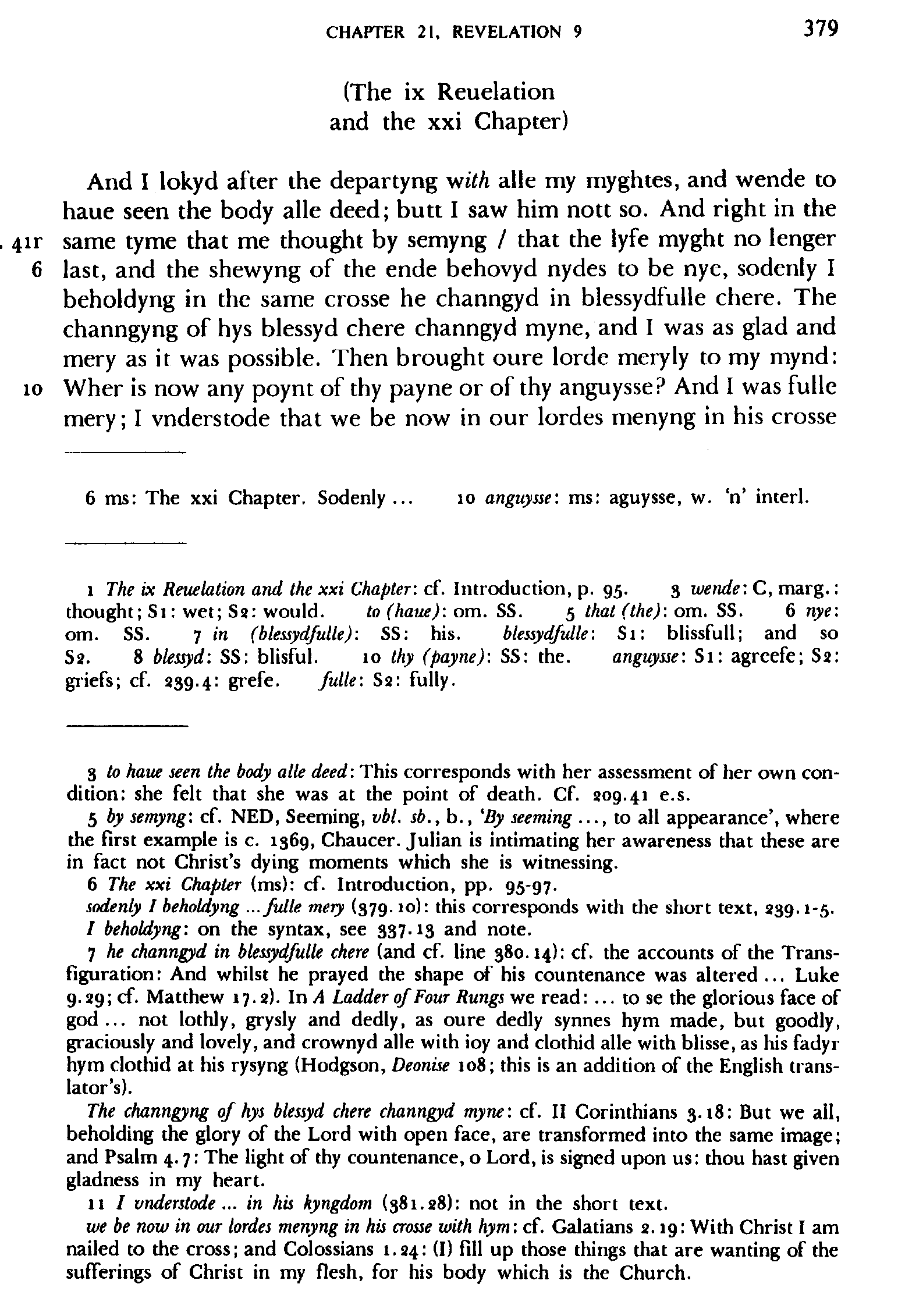
CHAPTER 21, REVELATION 9
(The ix Reuelation and the xxi Chapter) And I lokyd after the departyng with alle my myghtes, and wende to haue seen the body alle deed; butt I saw him nott so. And right in the . 4ir same tyme that me thought by semyng / that the lyfe myght no lenger
6 last, and the shewyng of the ende behovyd nydes to be nye, sodenly I beholdyng in the same crosse he channgyd in blessydfulle chere. The channgyng of hys blessyd chere channgyd myne, and I was as glad and mery as it. was possible. Then brought oure lorde meryly to my mynd:
10 Wher is now any poynt of thy payne or of thy anguysse? And I was fulle mery; I vnderstode that we be now in our lordes menyng in his crosse
6 ms: The xxi Chapter. Sodenly ...
10 anguysse: ms: aguysse, w. 'n' interl. i The ix Reuelation and the xxi Chapter: cf. Introduction, p. 95.
3 wende: C, marg.: thought; Si: wet; 82: would. to (haue): om. SS.
5 that (the): om. SS.
6 nye: om.
SS.
7 in (blessydfulle):
SS: his. blessydfulle:
Si: blissfull; and so 82.
8 blessyd: SS: blisful.
10 thy (payne): SS: the. anguysse: Si: agreefe; 82: griefs; cf. 239.4: grefe. fulle: 82: fully.
3 to haue seen the body alle deed: This corresponds with her assessment of her own condition: she felt that she was at the point of death. Cf. 209.41 e.s.
5 by semyng: cf. NED, Seeming, vbl. sb., b., 'By seeming ..., to all appearance', where the first example is c. 1369, Chaucer. Julian is intimating her awareness that these are in fact not Christ's dying moments which she is witnessing.
6 The xxi Chapter (ms): cf. Introduction, pp. 95-97. sodenly I beholdyng ...fulle mery (379.10): this corresponds with the short text, 239.1-5.
/ beholdyng: on the syntax, see 337.13 and note.
7 he channgyd in blessydfulle chere (and cf. line 380.14): cf. the accounts of the Transfiguration: And whilst he prayed the shape of his countenance was altered ... Luke
9.29; cf. Matthew 17.2). In A Ladder of Four Rungs we read: ... to se the glorious face of god ... not lothly, grysly and dedly, as oure dedly synnes hym made, but goodly, graciously and lovely, and crownyd alle with ioy and clothid alle with blisse, as his fadyr hym clothid at his rysyng (Hodgson, Deonise 108; this is an addition of the English translator's).
The channgyng of hys blessyd chere channgyd myne: cf. II Corinthians 3.18: But we all, beholding the glory of the Lord with open face, are transformed into the same image; and Psalm 4.7: The light of thy countenance, o Lord, is signed upon us: rfiou hast given gladness in my heart.
11 / vnderstode... in his kyngdom (381.28): not in the short text. we be now in our lordes menyng in his crosse with hym: cf. Galatians 2.19: With Christ I am nailed to die cross; and Colossians i. 24: (I) fill up those things that are wanting of the sufferings of Christ in my flesh, for his body which is the Church.
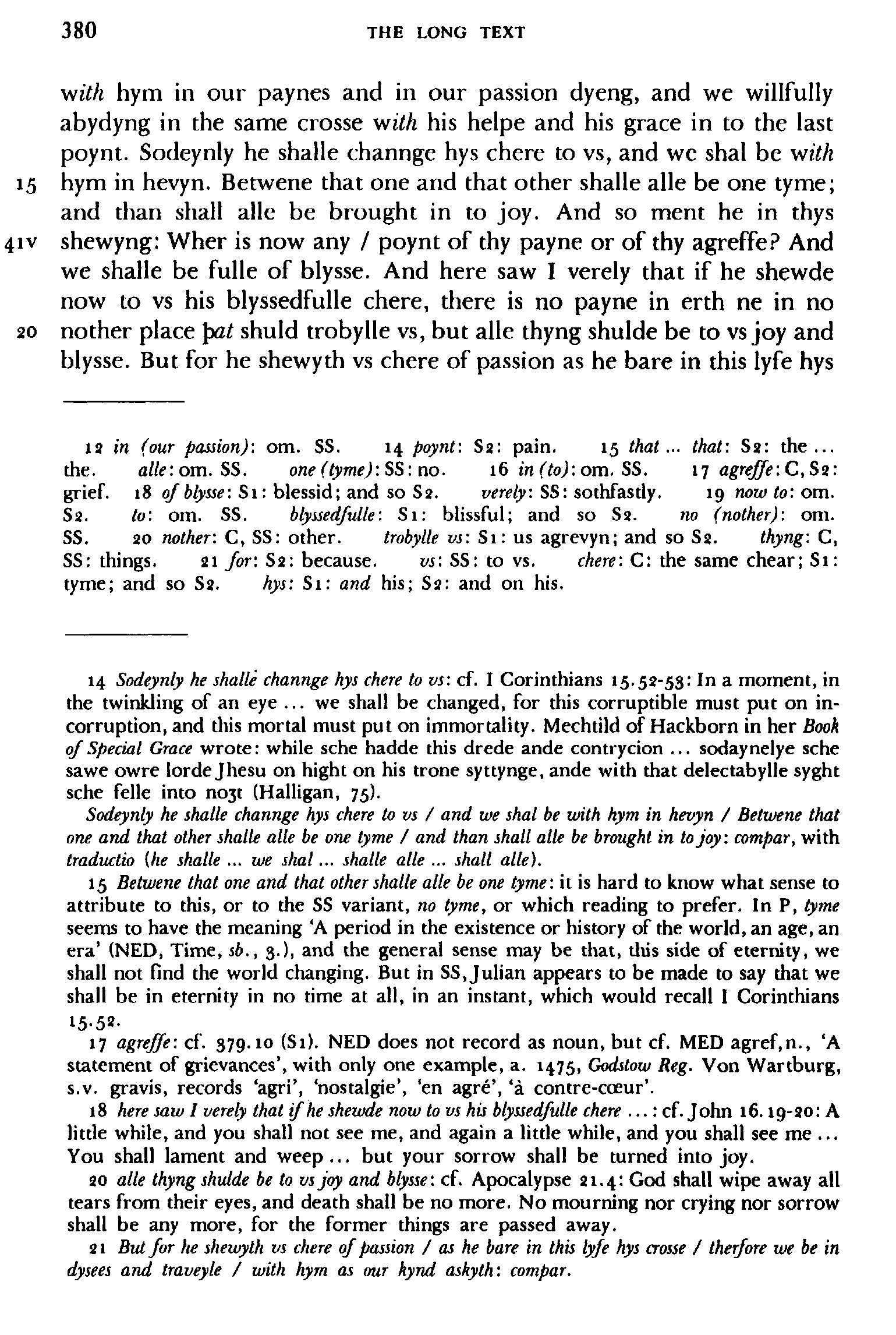
THE LONG TEXT
with hym in our paynes and in our passion dyeng, and we willfully abydyng in the same crosse with his helpe and his grace in to the last poynt. Sodeynly he shalle channge hys chere to vs, and we shal be with 15 hym in hevyn. Betwene that one and that other shalle alle be one tyme; and than shall alle be brought in to joy. And so ment he in thys
4iv shewyng: Wher is now any / poynt of thy payne or of thy agreffe? And we shalle be fulle of blysse. And here saw I verely that if he shewde now to vs his blyssedfulle chere, there is no payne in erth ne in no 20 nother place \>at shuld trobylle vs, but alle thyng shulde be to vs joy and blysse. But for he shewyth vs chere of passion as he bare in this lyfe hys
12 in (our passion)', om. SS.
14 poynt: 82: pain.
15 that... that: 82: the... the. alle:om. SS. one (tyme): SS: no.
16 in(to):om. SS.
agreffe:C,Ss: grief.
18 of blysse: Si: blessid; and so 82. verely: SS: sothfastly.
19 now to: om.
82. to: om.
SS. blyssedfulle:
Si: blissful; and so 82. no (nother): om.
SS.
20 nother: C, SS: other. trobylle vs: Si: us agrevyn; and so 82. thyng: C, SS: things.
21 for: 82: because. vs: SS: to vs. chere: C: the same chear; Si: tyme; and so 82. hys: Si: and his; 82: and on his.
14 Sodeynly he shalle channge hys chere to vs: cf. I Corinthians 15.52-53: In a moment, in the twinkling of an eye ... we shall be changed, for this corruptible must put on incorruption, and this mortal must put on immortality. Mechtild of Hackborn in her Book of Special Grace wrote: while sche hadde this drede ande contrycion ... sodaynelye sche sawe owre lordejhesu on hight on his trone syttynge, ande with that delectabylle syght sche felle into mrjt (Halligan, 75).
Sodeynly he shalle channge hys chere to vs / and we shal be with hym in hevyn / Betwene that one and that other shalle alle be one tyme / and than shall alle be brought in to joy: compar, with traductio (he shalle ... we shal... shalle alle ... shall alle).
15 Betwene that one and that other shalle alle be one tyme: it is hard to know what sense to attribute to this, or to the SS variant, no tyme, or which reading to prefer. In P, tyme seems to have the meaning 'A period in the existence or history of the world, an age, an era' (NED, Time, sb., 3.), and the general sense may be that, this side of eternity, we shall not find the world changing. But in 88,Julian appears to be made to say that we shall be in eternity in no time at all, in an instant, which would recall I Corinthians
15-52.
17 aSreffe:
CI379-1O ^i). NED does not record as noun, but cf. MED agref.n., 'A statement of grievances', with only one example, a. 1475, Godstow Reg. Von Wartburg, s.v. gravis, records 'agri', 'nostalgic', 'en agre', 'a contre-cceur'.
18 here saw I verely that if he shewde now to vs his blyssedfulle chere ...: cf. John 16.19-20: A little while, and you shall not see me, and again a little while, and you shall see me ...
You shall lament and weep... but your sorrow shall be turned into joy.
20 alle thyng shulde be to vsjoy and blysse: cf. Apocalypse 21.4: God shall wipe away all tears from their eyes, and death shall be no more. No mourning nor crying nor sorrow shall be any more, for the former things are passed away.
21 But for he shewyth vs chere of passion / as he bare in this lyfe hys crosse / therfore we be in dysees and traveyle / with hym as our kynd askyth: compar.
CHAPTER 21, REVELATION 9
crosse, therfore we be in dysees and traveyle -with hym as our kynd askyth. And the cause why that he sufferyth is for he wylle of hys goodnes make vs the eyers with hym in hys blysse. And for this lytylle payne
25 that we suffer heer we shalle haue an hygh endlesse knowyng in god, whych we myght nevyr haue -without that. And the harder oure paynes haue ben with hym in hys crosse, the more shalle our worsch(y)ppe be with hym in his kyngdom.
27 worschyppe: ms: worshchppe.
22 kynd: Si: frelete; and so 82.
23 that', om. SS. is: 82 is (this - interl. scr.) 24 eyers: Si: heyer; 82: higher.
25 hygh: add. 82: and.
22 traveyle: this may be noun or verb: 'therefore we are in distress and labour with him'. kynd /frelete (Si): one questions the 88 reading, which seems to be an editorial substitution. Certainly, our frailty contributes to our suffering, but we suffer because we are human.
23 And the cause why that he sufferyth: cf. the Privity: ... hafe sorowe and pete of Cristes passione, for pe appostell sais: If we be felawes of Cristes passione, haueuyng pete and compassione of his pyne and disese pat he sufferde here for vs, than one pe same manere sail we be felawes of gostely comforthe and endles ioye (a conflation of II Corinthians 1.5 and 7; Horstman, i 218; Peltier, 12 621; Ragusa and Green, 370). sufferyth: this, as C and 88 have perceived, is the present tense, not a P 'uY for 'd' spelling. Cf. 377.25 note.
24 the eyers with hym in hys blysse: cf. Romans 8.17: ... joint heirs with Christ, yet so, if we suffer with him, that we may be also glorified with him. eyers / heyer (Si), higher (82): this 88 variant is ingenious but wrong. this lytylle payne: cf. I Peter 5.10: But the God of all grace, who has called us to his eternal glory in Christ Jesus, after you have suffered a little will himself perfect you and confirm you and establish you.
25 we shalle haue an hygh endlesse knowyng in god: cf. II Timothy 2.10-12: I endure all things for the sake of the elect ... for if we be dead with him, we shall live also with him. If we suffer, we shall also reign with him.
26 And the harder oure paynes haue ben / with hym in hys crosse / the more shalle our worschyppe be / with hym in his kyngdom: a compar, with repetitio (with hym ... with hym) and oppositio contra riorum. the harder oure paynes haue ben: cf. Matthew 25.21: His lord said to him: Well done, good and faithful servant. Because you have been faithful in a few things, I will set you over many. Enter into the joy of your lord. In the English Horologium we read: £ere is so grete passynge worthynesse of euerlastynge blisse in regarde of temporel passyouns pat who so wolde wisely byholde and take hede, hee schulde raper chese wilfully to be turmentid many 3eeres in an hoot brennynge ouene of fire panne to be preued of pe leste mede pat is reserued to hym in the blisse pat is to come. And why so? For pe trauaile and disese hath an ende, but pe mede and the blisse is withouten ende (Horstman, 351).
THE LONG TEXT
The xxij Chapter / Then seide oure good lorde askyng: Arte thou well apayd that I sufferyd for thee? I seyde: 36, good lorde, gramercy; ye, good lorde, blessyd moet bow be. Then seyde Jhesu our good lord: If thou arte apayde, I am apayde. It is a joy, a blysse, an endlesse lykyng to me that evyr I sufferd passion for the; and yf I myght suffer more, I wolde suffer more. In thys felyng my vnderstandyng was leftyd vppe in to hevyn, and F.42V
i ms: The ix Reuelation and the xxij Chapter. a With 'Also in the nyneth shewyng our lord god seyd to her thus: Art J>ou...', the fourth extract in W begins.
6 myght suffer ... wolde suffer: ms: myght haue sufferyd ... wolde a sufFeryd. i The ix Reuelation (ms): so C, SS.
Chapter: add Si: is o(0 the lekyng et cetera, of iij hevyns, and the infinite love of Criste, desiring every day to suffre for us if he myght, ahhow it is (82: be) not nedeful.
2 lorde: add. Si: Jesus Christe; and so 82. apayd: C, marg.: content.
3 / (seyde): W: And she.
4 moet: C, W: mote; SS: mot. pow 82: you. good (lord): Si: kinde; and so 82. lord: add. W: god. arte:W:be.
5 an: 82: and; W: and an.
6 suffer ... suffer: so 88, W, A (cf.
239.10).
7 In thys felyng ... and it was fulle blyssydfulle (384.18-19): om. W. leftyd:
C: lifted; Si: lifte; 82: lift.
1 The scribe is in error in beginning Revelation IX here; cf. 379. i, and Introduction,
95is of the lekyng et cetera ...: (Si): cf. 283.25-28, and 324.1 note. althow it is (be) not nedeful (SS): this adaptation of whatjulian writes: He seyde nott:yfit were nedfulle ... (387.51), to some extent distorts it. She knows that the sacrifice on Calvary was 'one, perfect and sufficient'; she writes: the swete manhode of Crist myght suffer but oonse (385.34), and she specifies that this was a single historical event (387.48, and cf.
380.15 note). But if this hyghest profer (386.40) is to make the full effect of its paradox, the question of its necessity must not be raised by Julian, any more than it was in the locution.
2 Then seide ... in Im properte (383.13): this corresponds with the short text, 239.6-17.
3 y good lorde / gramercy / ye good lorde / blessyd moet pow be: a compar with repetitio ($e good lorde ... ye good lorde) and exclamatio (gramercy! ... blessyd moet pow be!). Though the rhetoricians defined this figure as a means of conveying sorrow (Marbodus, De ornamentis verborum, PL 171 1689), it can also be used for other emotions: Respondit
Thomas et dixit ei: Dominus meus et deus meus! (John 20.28).
6 and yf I myght suffer more / I wolde suffer more: complexio. myght haue sufferyd ... wolde a sufferyd
(P): this reading, which C follows, destroys the sense by making the profer refer to the Crucifixion. suffer... suffer: P's change of tense, which does violence to Julian's argument, that Christ is still willing to suffer if that were possible, cannot be hers, and has not been retained.
CHAPTER 22, REVELATION 9
ther I saw thre hevyns; of whych syght I was gretly merveyled, and thought: I see iij hevyns, and alle of the blyssedfulle manhed of Criste.
10 And noone is more, noone is lesse, noone is hygher, noone is lower, but evyn lyke in blysse.
For the furst hevyn, Crist shewyd me his father, in no bodely lycknesse but in his properte and in hys wurkyng. That is to sey, I saw in Crist that the father is. The werkyng of the father is this: that he geavyth mede to / hys sonne Jhmi Crist. This gyft and this mede is so blyssydfulle tojhmi that his father myght haue geavyn hym no mede
45V
9 thought: Si: thow; and so Sa. see: Sa: saw. of (the): SS: in. blyssedfulle: Si: blissid; and so 82.
10 And: om. SS.
11 lyke: Sa: all alike. in: C: of.
12 hevyn: Sa: shewing.
15 mede (to): C, marg.: reward. mede (is): Si, marg., al. m.: reward.
16 blyssydfulle: Si: blisful; and so 82.
8 I was gretly merveyled: cf. NED Marvel, v. 4, To ... be astonished at'. Their first example is 1382, Judith 10.7: Thei ... merueiled (mirati sunt).
9 see: cf. 239.12 and note.
/ see iij hevyns, and alle of the blyssedfulle manhed of Criste: cf. Acts 7.55: Behold, I see the heavens opened and the Son of Man standing at the right hand of God; and the Cloud:
... yf we mou3t se hym as seynte Steuen did, ou|>er stondyng or sittyng or liggyng. For how so his body is in heuen ... wote no man, and it nedijj not to be wetyn; ne no more, bot J>at his body is anhi3ed wij> J>e soule wijxmten departing. t»e body and J>e soule, Jje whiche is be manheed, is onid wib J>e godheed wijxnityn departyng also (Hodgson, 108).
10 And noone is more / noone is lesse / noone is hygher / noone is lower / but evyn lyke in blysse: a compar, with repetitio (and noone ...), oppositio contrariorum (more / lesse, hygher / lower), and, between the first four cola and the last, contentio.
13 in his properte: cf. the Scale, II chapter 34: t>e makynge of a soule is apropred to pe fad<?r, as for J>e sou<?reyn mi3t and power J>at he shewij) in makynge of it (MS BM Harley
6579i fH2r; Underbill, 383). Cf. John 5.17: My father works until now, and I work. wurkyng: cf. 239.17: lykynge. Though 'wurkyng' is not challenged by any other manuscript of the long text, it may well be a corruption of 'lykynge'; 'his properte and his lykynge' could correspond to the werkynge of the father — the creative power, actual creation — and he geavyth mede to the loving power, actual loving.
14 The werkyng... as often he wolde (385.27): this corresponds with the short text,
239.17-240.28. that he geavyth mede to hys sonne: cf. John 5.19-20: The Son cannot do anything of himself, but what he sees the Father doing ... for the Father loves the Son, and shows him all things which he himself does; and John 14.9-10: He who sees me sees the Father also ... Do you not believe that I am in the Father and the Father in me? and 526.153 note.
THE LONG TEXT
that myght haue lykeyd to hym better. For the furst hevyn, that is the plesyng of £e father, shewyd to me as an hevyn, and it was fulle blyssydfulle. For he is wele plesyde with alle the dedes thatjhwu hath done
20 about our saluacion; where for we be nott only hys by his byeng, but also by the curteyse gyfte of hys father. We be his blysse, we be his mede, we be hys wurshype, we be his crowne. And this was a syngular marveyle and a full delectable beholdyng, that we be hys crowne.
Thys that I sey is so grete blysse to ]hesu that he settyth at naught hys 17 haue lykeyd: ms: haue ben lykeyd.
25 W has the following compilation: 'And in these same wordys ... to be same yf it myght be' (385.25-386.36); 'Also it is goddys wyll ... oure soule be occupied' (390.15-18); Tor we be his blysse ... his cruell and shameful! deth' (384.21-385.25); 'the fader is full pleasyd... as it is seyd before'
(384.19-22); 'and bat yefte ... lykyd hym better' (383.15-384.17); Tor in vs he lykyth ...'
(384.17). These fragments have been collated with the corresponding text in P.
17 lykeyd: C, 82: liked; Si: lykyd.
For: om. SS.
18 an:C:in. blyssydfulle: C: blissedfully; Si: blisfull; and so 82.
With 'the fader is', W resumes.
19 wele: Si: ful; and so 82, W. alle: om. W.
20 byeng: C, marg.: redeeming.
22 we (be hys wurshype): W: and. we (be his crowne): W: and we.
23 a (full): om.
24 Jhem: W: oure lorde Je.su. naught: add. Si: al; and so 82, W.
17 haue lykeyd: P's reading, haue ben lykeyd, is certainly erroneous, and SS have been preferred. The earlier, intransitive sense of the verb, 'to be pleasing', is called by NED
'Now only arch, and dial.' (it is still current in Yorkshire). the plesyng of pe father, shewyd to me as an hevyn: Julian seems here to have in mind Matthew 11.25-27: Father, Lord of heaven and erth ... so has it seemed good in thy sight.
All things are delivered to me by my father.
19 For he is wele plesyde: cf. Luke 3.22: Thou art my beloved Son. In thee I am well pleased. Cf. the English Horologium: bows it so be bat alle my life in erbe was to be ioye and lovynge of be hij fader of heuene, neuerbeles hee was be more excellently in manere glorifyed and clarefyed in me what tyme bat I knowlechynge hym in be crosse and ajenbyinge mankynde suffred be sorowful dethe be obedyence (Horstman, 379380).
21 We be his blysse: cf. Luke 15.7: There shall be joy in heaven over one sinner who does penance. Cf. 240.24 note. The figure there is perfectly preserved here. we be his mede: cf. Psalm 127.3: Behold the inheritance of the Lord is children; the reward the fruit of the womb.
22 we be hys wurshype: cf. John 17.10: And all that is mine is thine, and thine is mine, and I am glorified in them. we be his crowne: cf. Philippians 4. i: My dearly beloved brethren and my most desired, my joy and my crown.
24 he settyth at naught hys traveyle and his passion: cf. Luke 24.26: Ought not Christ to have suffered these things and so to enter into his glory?
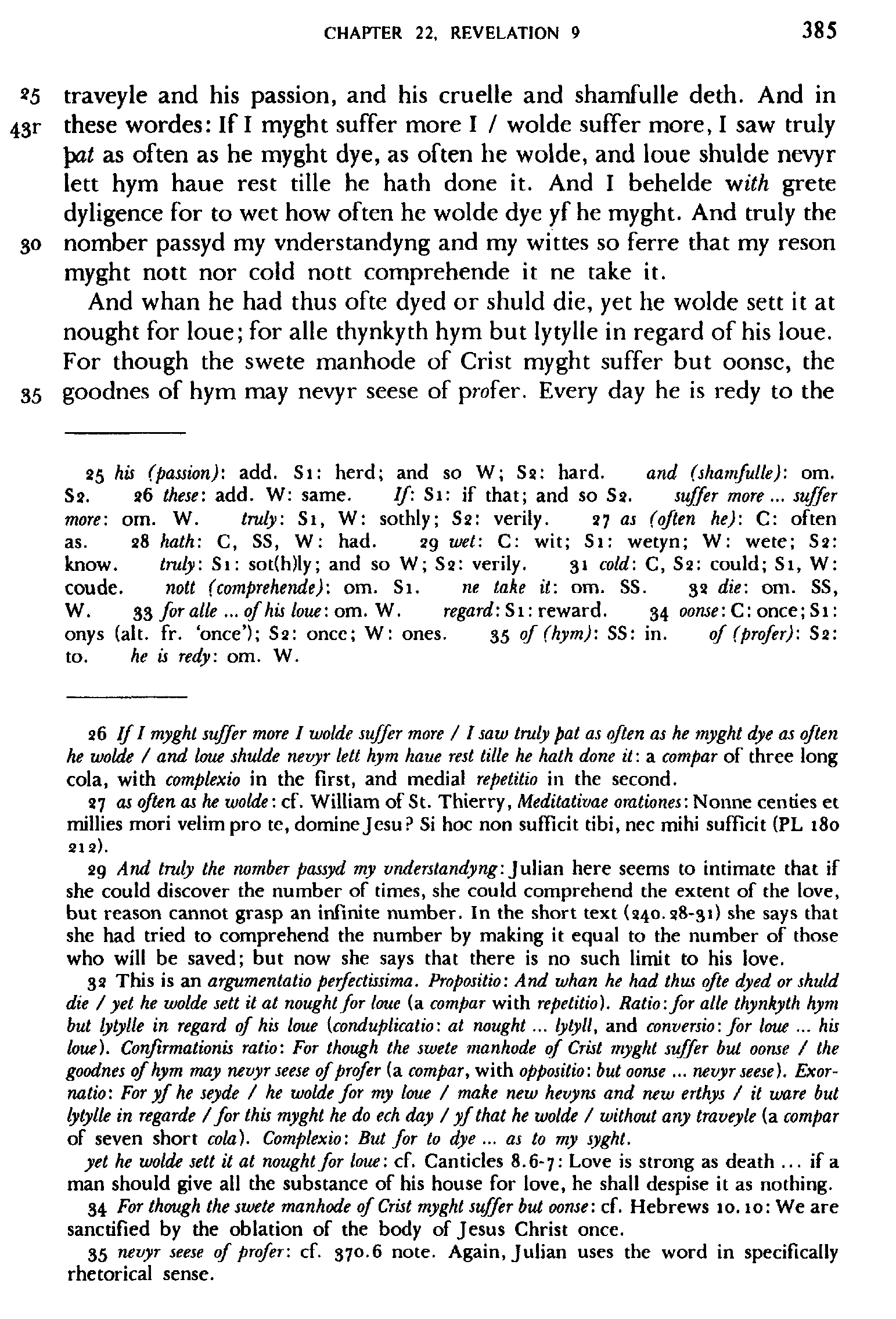
CHAPTER 22, REVELATION 9
25 traveyle and his passion, and his cruelle and shamfulle deth. And in 43r these wordes: If I myght suffer more I / wolde suffer more, I saw truly
\Mt as often as he myght dye, as often he wolde, and loue shulde nevyr lett hym haue rest tille he hath done it. And I behelde -with grete dyligence for to wet how often he wolde dye yf he myght. And truly the 30 nomber passyd my vnderstandyng and my wittes so ferre that my reson myght nott nor cold nott comprehende it ne take it.
And whan he had thus ofte dyed or shuld die, yet he wolde sett it at nought for loue; for alle thynkyth hym but lytylle in regard of his loue.
For though the swete manhode of Crist myght suffer but oonse, the 35 goodnes of hym may nevyr seese of prefer. Every day he is redy to the 25 his (passion): add. Si: herd; and so W; 82: hard. and (shamfulle): om.
82.
26 these: add. W: same.
If: Si: if that; and so 82. suffer more... suffer more: om. W. truly: Si, W: sothly; 82: verily.
27 as (often he): C: often as.
28 hath: C, SS, W: had.
29 wet: C: wit; Si: wetyn; W: wete; 82: know. truly: Si: sot(h)ly; and so W; 82: verily.
31 cold: C, Sa: could; Si, W: coude. nott (comprehende): om. Si. ne take it: om. SS.
32 die: om. SS, W.
33 for alle ... of his loue: om. W. regard: Si: reward.
34 oonse: C: once; Si: onys (alt. fr. 'once'); 82: once; W: ones.
35 of (hym): SS: in. of (profer): 82: to. he is redy: om. W.
26 If I myght suffer more I wolde suffer more / I saw truly pat as often as he myght dye as often he wolde / and loue shulde nevyr lett hym haue rest tille he hath done it: a compar of three long cola, with complexio in the first, and medial repetitio in the second.
27 as often as he wolde: cf. William of St. Thierry, Meditativae orationes: Nonne centies et millies mori velimpro te, dominejesu? Si hoc non sufficit tibi, nee mihi sufficit (PL 180
312).
29 And truly the nomber passyd my vnderstandyng: Julian here seems to intimate that if she could discover the number of times, she could comprehend the extent of the love, but reason cannot grasp an infinite number. In the short text (240.28-31) she says that she had tried to comprehend the number by making it equal to the number of those who will be saved; but now she says that there is no such limit to his love.
32 This is an argumentatio perfectissima. Propositio: And whan he had thus ofte dyed or shuld die /yet he wolde sett it at nought for loue (a compar with repetitio). Ratio: for alle thynkyth hym but lytylle in regard of his loue (conduplicatio: at nought... lytyll, and conversio: for loue ...his loue). Confirmation^ ratio: For though the swete manhode of Crist myght suffer but oonse / the goodnes of hym may nevyr seese of prof er (a compar, with oppositio: but oonse ... nevyr seese). Exornatio: For yf he seyde / he wolde for my loue / make new hevyns and new erthys / it ware but lytylle in regarde /for this myght he do ech day / yf that he wolde / without any traveyle (a compar of seven short cola). Complexio: But for to dye ... as to my syght. yet he wolde sett it at nought for loue: cf. Canticles 8.6-7: Love is strong as death ... if a man should give all the substance of his house for love, he shall despise it as nothing.
34 For though the swete manhode of Crist myght suffer but oonse: cf. Hebrews 10.10: We are sanctified by the oblation of the body of Jesus Christ once.
35 nevyr seese of prof er: cf. 370.6 note. Again, Julian uses the word in specifically rhetorical sense.
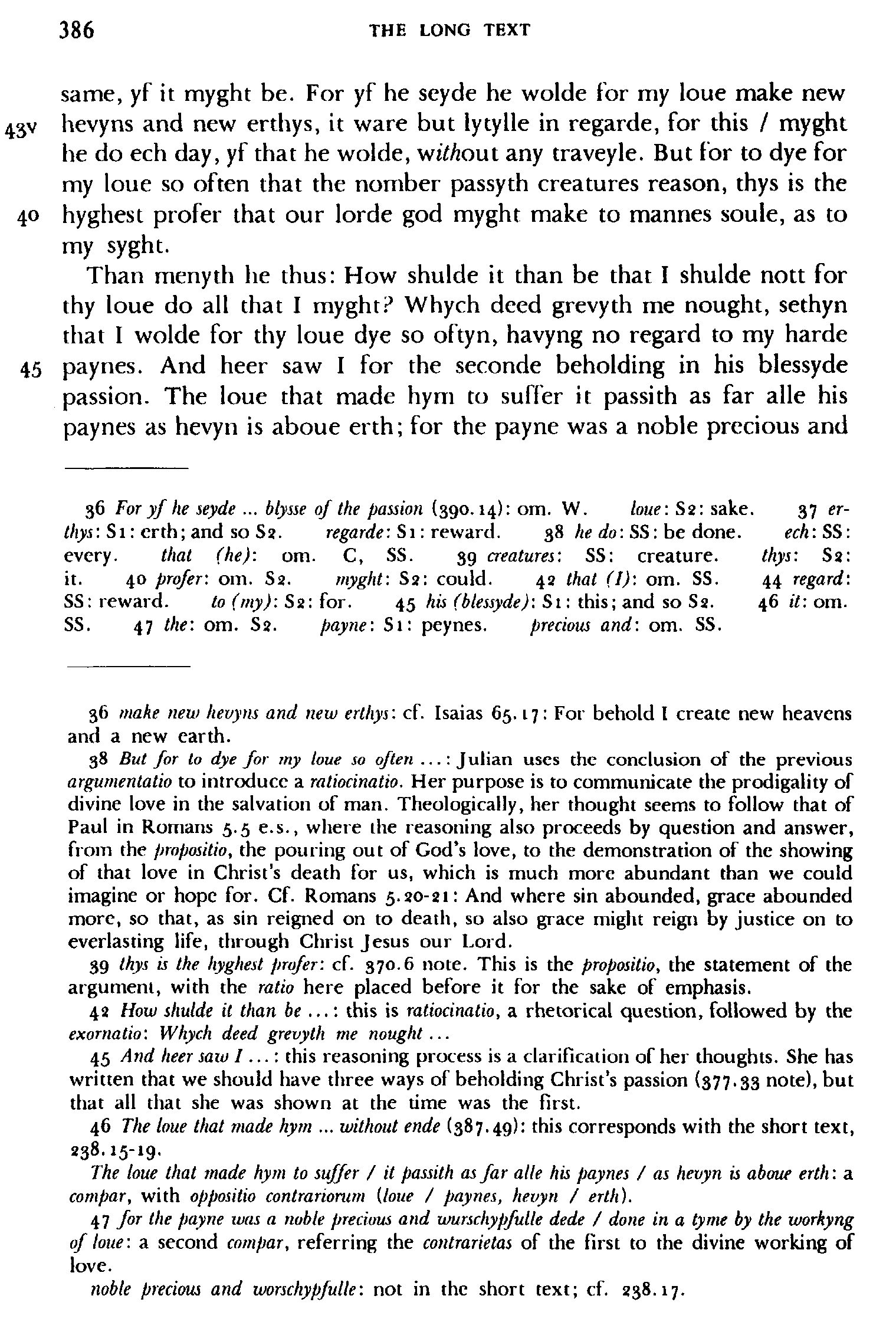
THE LONG TEXT
same, yf it myght be. For yf he seyde he wolde for my loue make new 43V hevyns and new erthys, it ware but lytylle in regarde, for this / myght he do ech day, yf that he wolde, without any traveyle. But for to dye for my loue so often that the nomber passyth creatures reason, thys is the 40 hyghest prefer that our lorde god myght make to mannes soule, as to my syght.
Than menyth he thus: How shulde it than be that I shulde nott for thy loue do all that I myght? Whych deed grevyth me nought, sethyn that I wolde for thy loue dye so oftyn, havyng no regard to my harde
45 paynes. And heer saw I for the seconde beholding in his blessyde passion. The loue that made hym to suffer it passith as far alle his paynes as hevyn is aboue erth; for the payne was a noble precious and 36 For yf he seyde ... blysse of the passion (390.14): om. W. loue: 82: sake.
37 erthys: Si: crth; and so 82. regarde: Si: reward.
38 he do: SS: be done. ech: SS: every. that (he): om.
C, SS.
39 creatures:
SS: creature. thys:
82: it.
40 profer: om. 82. myght: 82: could.
42 that (I): om. SS.
44 regard:
SS: reward. to (my): 82: for.
45 his (blessyde): Si: this; and so 82.
46 it: om.
SS.
47 the: om. 82. payne: Si: peynes. precious and: om. SS.
36 make new hevyns and new erthys: cf. Isaias 65.17: For behold I create new heavens and a new earth.
38 But for to dye for my loue so often ...: Julian uses the conclusion of the previous argumentatio to introduce a ratiocinatio. Her purpose is to communicate the prodigality of divine love in the salvation of man. Theologically, her thought seems to follow that of Paul in Romans 5.5 e.s., where the reasoning also proceeds by question and answer, from the propositio, the pouring out of God's love, to the demonstration of the showing of that love in Christ's death for us, which is much more abundant than we could imagine or hope for. Cf. Romans 5.20-21: And where sin abounded, grace abounded more, so that, as sin reigned on to death, so also grace might reign by justice on to everlasting life, through Christ Jesus our Lord.
39 thys is the hyghest profer: cf. 370.6 note. This is the propositio, the statement of the argument, with the ratio here placed before it for the sake of emphasis.
42 How shulde it than be ...: this is ratiocinatio, a rhetorical question, followed by the exornatio: Whych deed grevyth me nought ...
45 And heer saw I...: this reasoning process is a clarification of her thoughts. She has written that we should have three ways of beholding Christ's passion (377.33 note), but that all that she was shown at the time was the first.
46 The loue that made hym ... without ende (387.49): this corresponds with the short text,
238.15-19.
The loue that made hym to suffer / it passith as far alle his paynes / as hevyn is aboue erth: a compar, with oppositio contrariorurn (loue / paynes, hevyn / erth).
47 for the payne was a noble precious and wurschypfulle dede / done in a tyme by the workyng of loue: a second compar, referring the contrarietas of the first to the divine working of love. noble precious and worschypfulle: not in the short text; cf. 238.17.
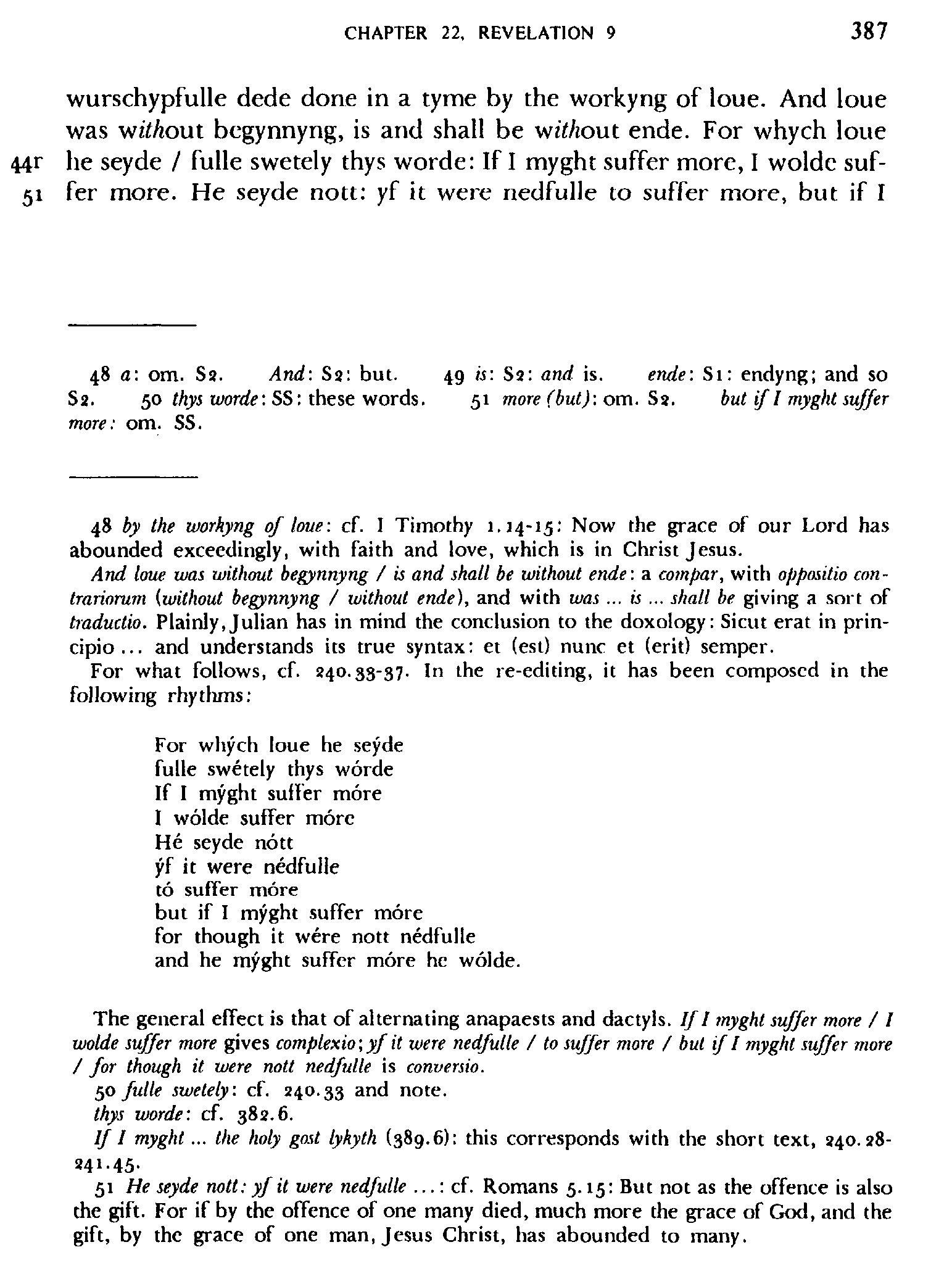
CHAPTER 22, REVELATION 9
wurschypfulle dede done in a tyme by the workyng of loue. And loue was without begynnyng, is and shall be without ende. For whych loue
44r he seyde / fulle swetely thys worde: If I myght suffer more, I wolde suf51 fer more. He seyde nott: yf it were nedfulle to suffer more, but if I 48 a: om. Ss.
And: Sa: but.
49 is: 82: and is. ende: Si: endyng; and so 82.
50 thys worde: SS: these words.
51 more (but): om. 82. but if I myght suffer more: om. SS.
48 by the workyng of loue: cf. I Timothy 1.14-15: Now the grace of our Lord has abounded exceedingly, with faith and love, which is in Christ Jesus.
And loue was without begynnyng / is and shall be without ende: a compar, with oppositio contrariorutn (without begynnyng / without ende), and with was ... is ... shall be giving a sort of traductio. Plainly,Julian has in mind the conclusion to the doxology: Sicut erat in principio... and understands its true syntax: et (est) nunc et (erit) semper.
For what follows, cf. 240.33-37. In the re-editing, it has been composed in the following rhythms:
For whych loue he seyde fulle swetely thys worde If I myght suffer more I wolde suffer more He seyde nott yf it were nedfulle to suffer more but if I myght suffer more for though it were nott nedfulle and he myght suffer more he wolde.
The general effect is that of alternating anapaests and dactyls. If I myght suffer more / I wolde suffer more gives complexio; yf it were nedfulle / to suffer more / but if I myght suffer more
/ for though it were nott nedfulle is conversio.
50 fulle swetely: cf. 240.33 and note. thys worde: cf. 382.6.
If I myght... the holy gost lykyth (389.6): this corresponds with the short text, 240.28241.45.
51 He seyde nott: yf it were nedfulle ...: cf. Romans 5.15: But not as the offence is also the gift. For if by the offence of one many died, much more the grace of God, and the gift, by the grace of one man, Jesus Christ, has abounded to many.
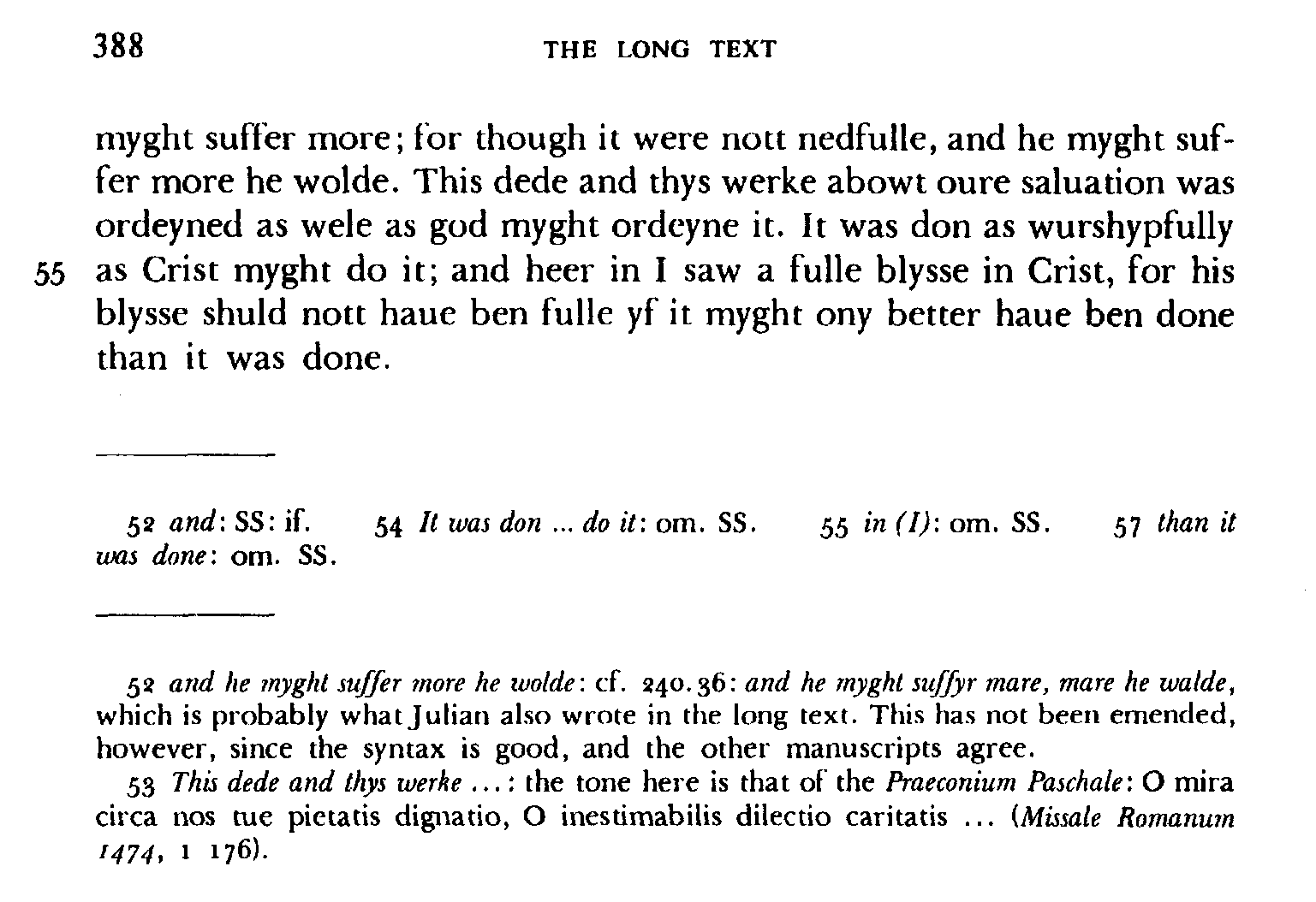
THE LONG TEXT
myght suffer more; for though it were nott nedfulle, and he myght suffer more he wolde. This dede and thys werke abowt oure saluation was ordeyned as wele as god myght ordeyne it. It was don as wurshypfully
55 as Crist myght do it; and heer in I saw a fulle blysse in Crist, for his blysse shuld nott haue ben fulle yf it myght ony better haue ben done than it was done.
52 and: SS: if.
54 It was don ... do it: om. SS.
55 in (I): om. SS.
57 than it was done: om. SS.
52 and he myghl suffer more he wolde: cf. 240.36: and he myght suffyr mare, mare he walde, which is probably what Julian also wrote in the long text. This has not been emended, however, since the syntax is good, and the other manuscripts agree.
53 This dede and thys werke ...: the tone here is that of the Praeconium Paschale: O mira circa nos tue pietatis dignatio, O inestimabilis dilectio caritatis ... (Missale Romanum
1474, i 176).
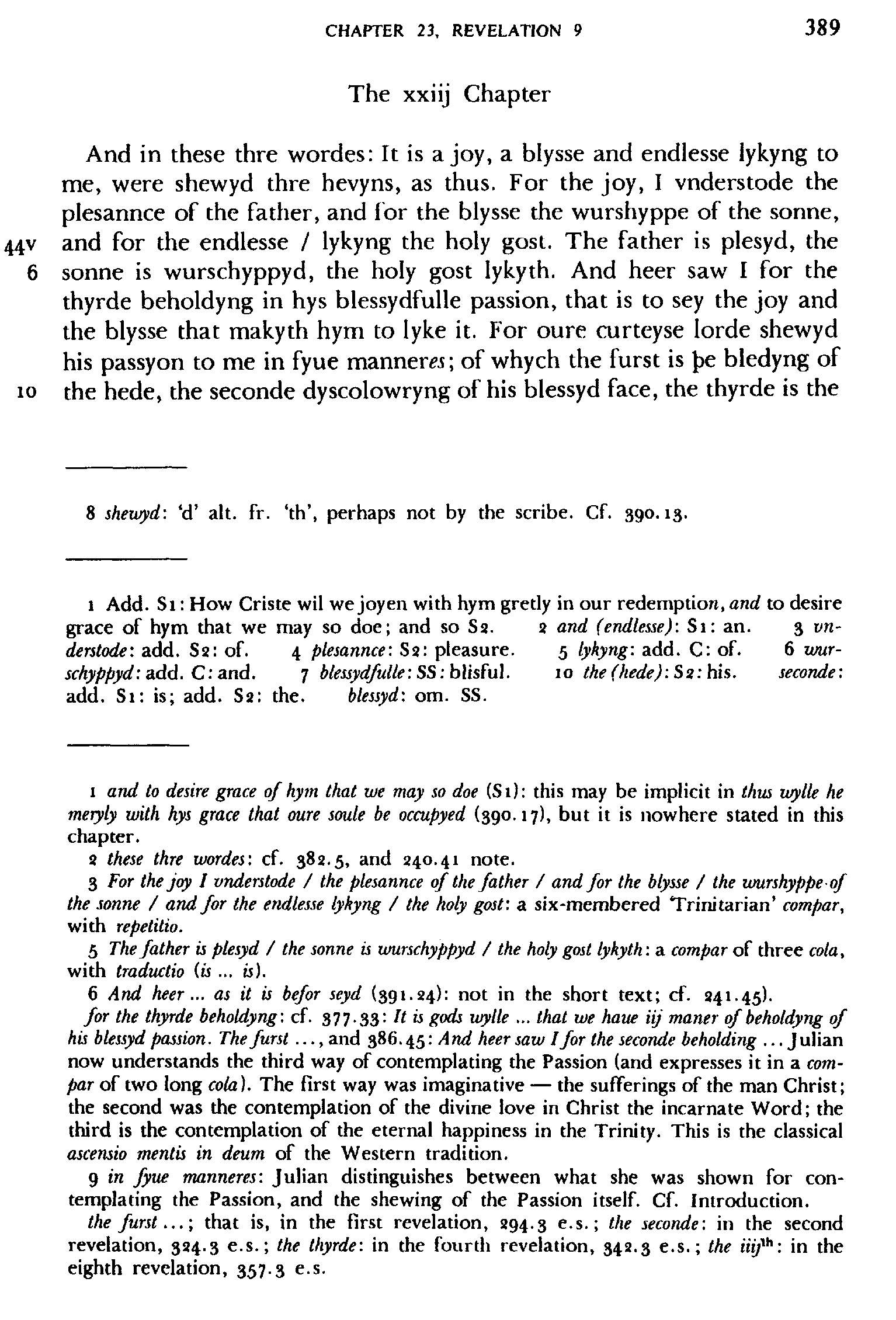
CHAPTER 23, REVELATION 9
The xxiij Chapter And in these thre wordes: It is a joy, a blysse and endlesse lykyng to me, were shewyd thre hevyns, as thus. For the joy, I vnderstode the plesannce of the father, and for the blysse the wurshyppe of the sonne,
44v and for the endlesse / lykyng the holy gost. The father is plesyd, the 6 sonne is wurschyppyd, the holy gost lykyth. And heer saw I for the thyrde beholdyng in hys blessydfulle passion, that is to sey the joy and the blysse that makyth hym to lyke it. For oure curteyse lorde shewyd his passyon to me in fyue mannem; of whych the furst is £e bledyng of 10 the hede, the seconde dyscolowryng of his blessyd face, the thyrde is the 8 shewyd: 'd' alt. fr. W, perhaps not by the scribe. Cf. 390.13. i Add. Si: How Criste wil we joyen with hym gretly in our redemption, and to desire grace of hym that we may so doe; and so 82.
2 and (endlesse): Si: an.
3 vnderstode: add. 82: of.
4 plesannce: 82: pleasure.
5 lykyng: add. C: of.
6 wurschyppyd: add. C: and.
7 blessydfulle: SS: blisful.
10 the (hede): 82: his. seconde: add. Si: is; add. 82: the. blessyd: om. SS.
1 and to desire grace of hym that we may so doe (Si): this may be implicit in thus wylle he meryly with hys grace that oure soule be occupyed (390.17), but it is nowhere stated in this chapter.
2 these thre wordes: cf. 382.5, and 240.41 note.
3 For the joy I vnderstode / the plesannce of the father / and for the blysse / the wurshyppe of the sonne / and for the endlesse lykyng / the holy gost: a six-membered Trinitarian' compar, with repetitio.
5 The father is plesyd / the sonne is wurschyppyd / the holy gost lykyth: a compar of three cola, with traductio (is ... is).
6 And heer... as it is befor seyd (391.24): not in the short text; cf. 241.45). for the thyrde beholdyng: cf. 377.33: It is gods wylle ... that we haue iij maner of beholdyng of his blessyd passion. The furst ..., and 386.45: And heer saw I for the seconde beholding .. .Julian now understands the third way of contemplating the Passion (and expresses it in a compar of two long cola). The first way was imaginative — the sufferings of the man Christ; the second was die contemplation of the divine love in Christ the incarnate Word; the third is the contemplation of the eternal happiness in the Trinity. This is the classical ascensio mentis in deum of the Western tradition.
9 in fyue manneres: Julian distinguishes between what she was shown for contemplating the Passion, and the shewing of the Passion itself. Cf. Introduction. the furst...; that is, in the first revelation, 294.3 es-; the seconde: in the second revelation, 324.3 e.s.; the thyrde: in the fourth revelation, 342.3 e.s.; the iiifh: in the eighth revelation, 357.3 e.s.
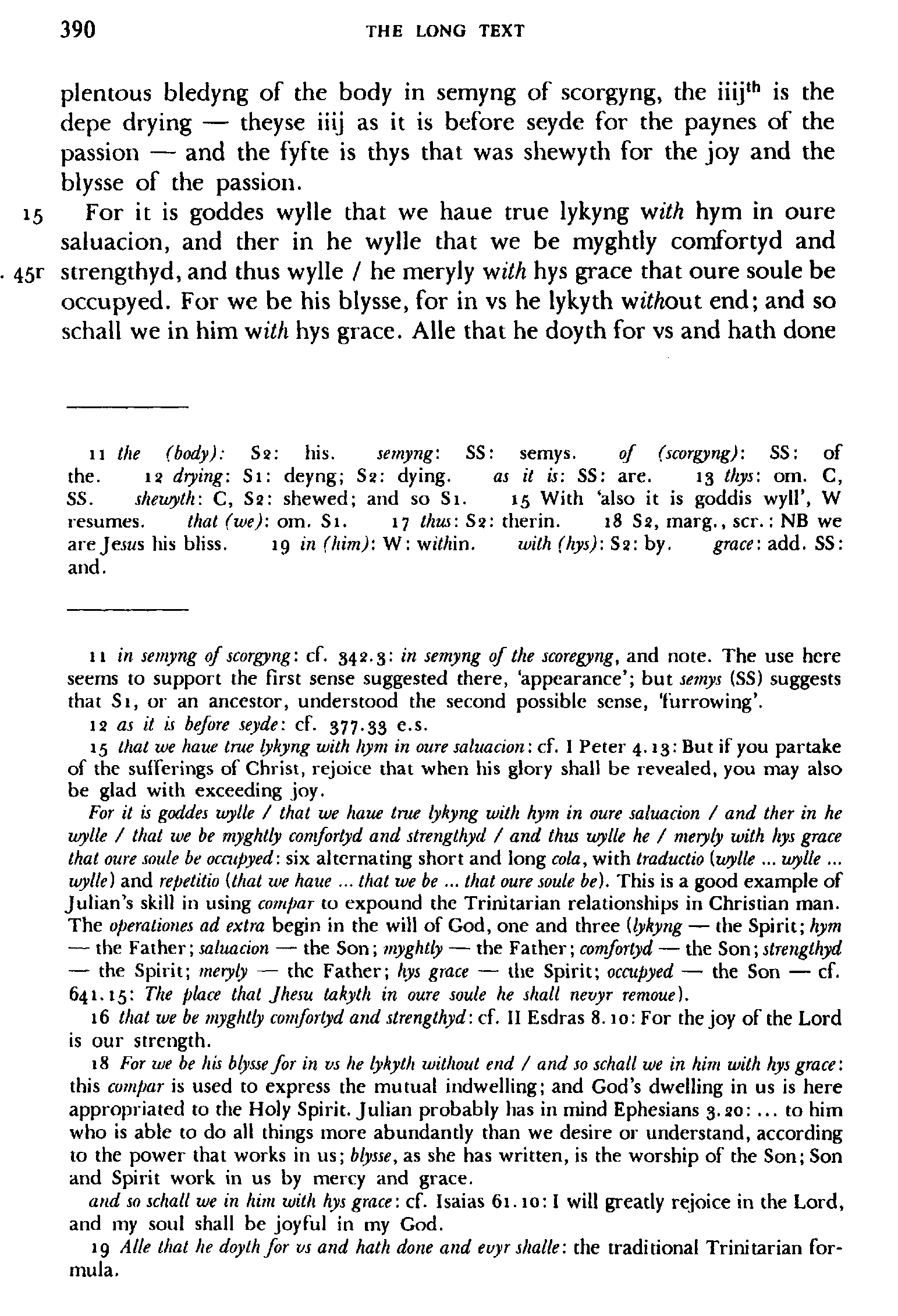
THE LONG TEXT
plentous bledyng of the body in semyng of scorgyng, the iiijth is the depe drying — theyse iiij as it is before seyde for the paynes of the passion — and the fyfte is thys that was shewyth for the joy and the blysse of the passion.
For it is goddes wylle that we haue true lykyng with hym in oure saluacion, and ther in he wylle that we be myghtly comfortyd and . 45r strengthyd, and thus wylle / he meryly with hys grace that oure soule be occupyed. For we be his blysse, for in vs he lykyth without end; and so schall we in him with hys grace. Alle that he doyth for vs and hath done
11 the (body):
82: his. semyng:
SS: semys. of (scorgyng):
SS: of the.
12 drying: Si: deyng; 82: dying. as it is: SS: are.
13 thys: om. C, SS. shewyth: C, 82: shewed; and so Si.
15 With 'also it is goddis wyll', W resumes. that (we): om. Si.
17 thus: 82: therin.
18 82, marg., scr.: NB we are Jews his bliss.
19 in (him): W: within. with (hys): 82: by. grace: add. SS: and.
11 in semyng of scorgyng: cf. 342.3: in semyng of the scoregyng, and note. The use here seems to support the first sense suggested there, 'appearance'; but semys (SS) suggests that Si, or an ancestor, understood the second possible sense, 'furrowing'.
12 as it is before seyde: cf. 377.33 e.s.
15 that we haue true lykyng with hym in oure saluacion: cf. I Peter 4.13: But if you partake of the sufferings of Christ, rejoice that when his glory shall be revealed, you may also be glad with exceeding joy.
For it is goddes wylle / that we haue true lykyng with hym in oure saluacion / and ther in he wylle / that we be myghtly comfortyd and strengthyd /and thus wylle he / meryly with hys grace that oure soule be occupyed: six alternating short and long cola, with traductio (wylle ... wylle ... wylle) and reffetitio (that we haue ... that we be ... that oure soule be). This is a good example of Julian's skill in using com/far to expound the Trinitarian relationships in Christian man.
The operationes ad extra begin in the will of God, one and three (lykyng — the Spirit; hym
— the Father; saluacion — the Son; myghtly — the Father; comfortyd — the Son; strengthyd
— the Spirit; meryly — the Father; hys grace — the Spirit; occupyed — the Son — cf.
641.15: The place that Jhesu takyth in oure soule he shall nevyr remoue).
16 that we be myghtly comfortyd and strengthyd: cf. II Esdras 8.10: For the joy of the Lord is our strength.
18 For we be his blysse for in vs he lykyth without end / and so schall we in him with hys grace: this compar is used to express the mutual indwelling; and God's dwelling in us is here appropriated to the Holy Spirit. Julian probably has in mind Ephesians 3.20: ... to him who is able to do all things more abundantly than we desire or understand, according to the power that works in us; blysse, as she has written, is the worship of the Son; Son and Spirit work in us by mercy and grace. and so schall we in him with hys grace: cf. Isaias 61.10:1 will greatly rejoice in the Lord, and my soul shall be joyful in my God.
19 Alle that he doylh for vs and hath done and evyr shade: the traditional Trinitarian formula.
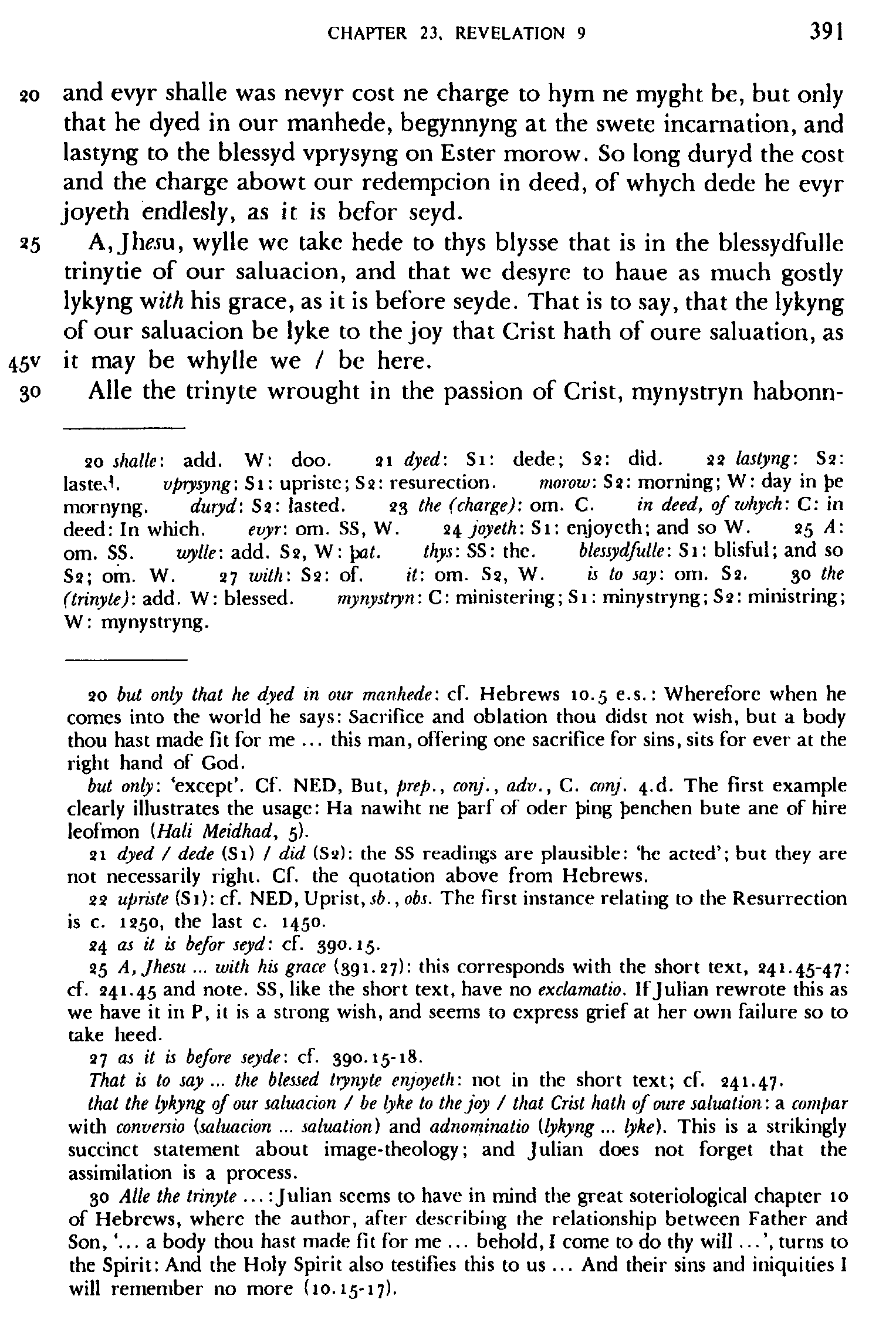
CHAPTER 23, REVELATION 9
20 and evyr shalle was nevyr cost ne charge to hym ne myght be, but only that he dyed in our manhede, begynnyng at the swete incarnation, and lastyng to the blessyd vprysyng on Ester morow. So long duryd the cost and the charge abowt our redempcion in deed, of whych dede he evyr joyeth endlesly, as it is befor seyd.
A, Jh«u, wylle we take hede to thys blysse that is in the blessydfulle trinytie of our saluacion, and that we desyre to haue as much gostly lykyng with his grace, as it is before seyde. That is to say, that the lykyng of our saluacion be lyke to the joy that Crist hath of oure saluation, as it may be why lie we / be here.
.45V Alle the trinyte wrought in the passion of Crist, mynystryn habonn-
20 shalle: add.
W: doo.
21 dyed: Si: dede; 82: did.
22 lastyng: 82: lasted, vprysyng: Si: upristc; 82: resurection. morow: 82: morning; W: day in J?e mornyng. duryd: 82: lasted.
23 the (charge): om. C. in deed, of whych: C: in deed: In which. evyr: om. 88, W.
24 joyeth: Si: enjoyeth; and so W.
25/4: om. SS. wylle: add. 82, W: \xit. thys: SS: the. blessydfulle: Si: blisful; and so 82; om. W.
27 with: 82: of. it: om. 82, W. is to say: om. 82.
30 the (trinyte): add. W: blessed. mynystryn: C: ministering; Si: minystryng; 82: ministring;
W: mynystryng.
20 but only that he dyed in our manhede: cf. Hebrews 10.5 e.s.: Wherefore when he comes into the world he says: Sacrifice and oblation thou didst not wish, but a body thou hast made fit for me ... this man, offering one sacrifice for sins, sits for ever at the right hand of God. but only: 'except'. Cf. NED, But, prep., conj., adv., C. conj. 4>d. The first example clearly illustrates the usage: Ha nawiht ne Jjarf of oder {ring f>enchen bute ane of hire leofmon (Halt Meidhad, 5).
21 dyed / dede (Si) / did (Sa): the SS readings are plausible: 'he acted'; but they are not necessarily right. Cf. the quotation above from Hebrews.
22 uprute (Si): cf. NED, Uprist,j6., obs. The first instance relating to the Resurrection is c. 1250, the last c. 1450.
24 as it is befor seyd: cf. 390.15.
25 A,Jhesu ... with his grace (391.27): this corresponds with the short text, 241.45-47: cf. 241.45 and note. SS, like the short text, have no exclamatio. If Julian rewrote this as we have it in P, it is a strong wish, and seems to express grief at her own failure so to take heed.
27 as it is before seyde: cf. 390.15-18.
That is to say ... the blessed trynyte enjoyeth: not in the short text; cf. 241.47. that the lykyng of our saluacion / be lyke to the joy I that Crist hath of oure saluation: a compar with conversio (saluacion ... saluation) and adnominatio (lykyng ... lyke). This is a strikingly succinct statement about image-theology; and Julian does not forget that the assimilation is a process.
30 Alle the trinyte ...:Julian seems to have in mind the great soteriological chapter 10 of Hebrews, where the author, after describing the relationship between Father and Son,'... a body thou hast made fit for me ... behold, I come to do thy will ...', turns to the Spirit: And the Holy Spirit also testifies this to us ... And their sins and iniquities I will remember no more (10.15-17).
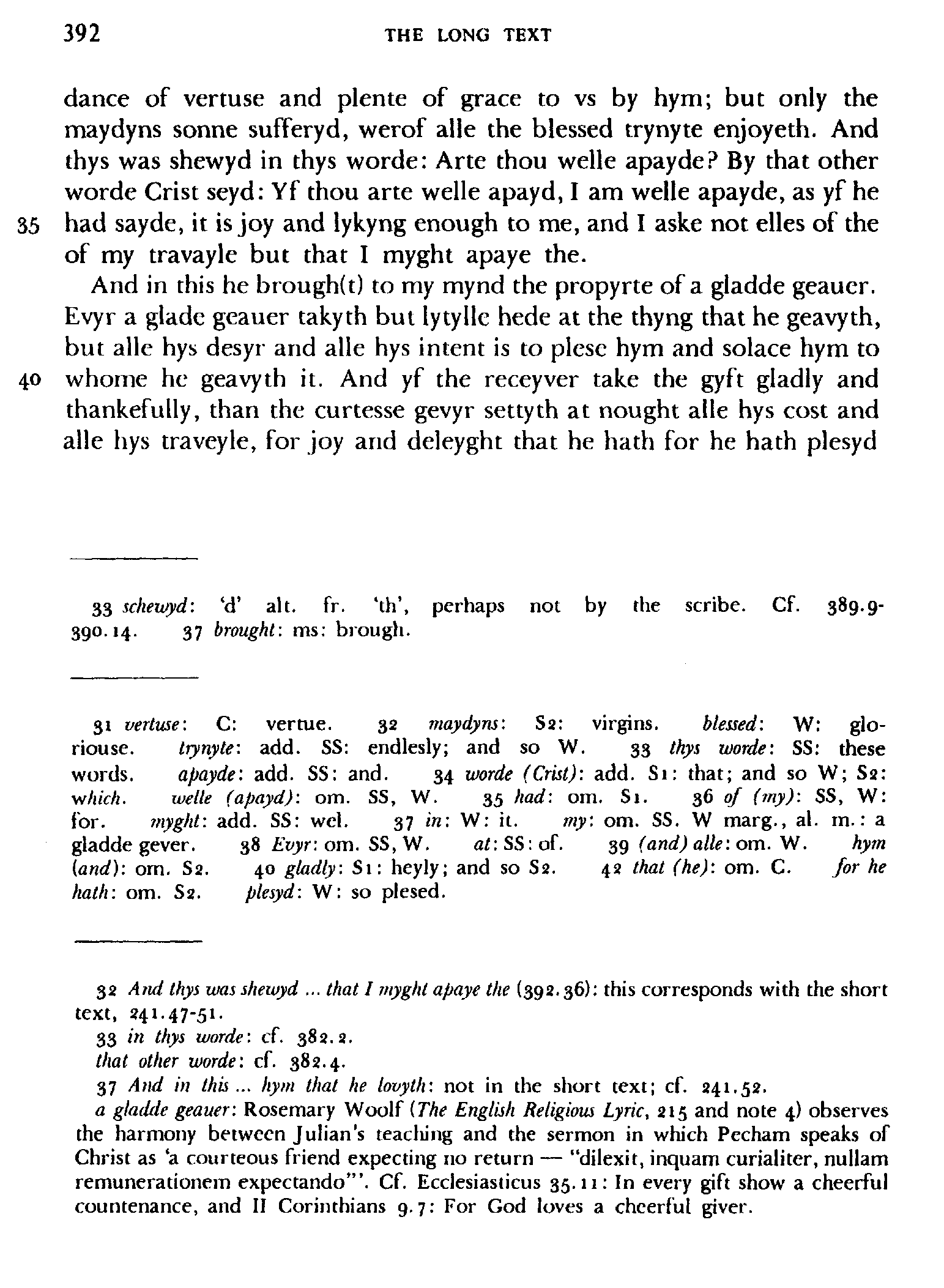
THE LONG TEXT
dance of vertuse and plente of grace to vs by hym; but only the maydyns sonne sufferyd, werof alle the blessed trynyte enjoyeth. And thys was shewyd in thys worde: Arte thou welle apayde? By that other worde Crist seyd: Yf thou arte welle apayd, I am welle apayde, as yf he
35 had sayde, it is joy and lykyng enough to me, and I aske not elles of the of my travayle but that I myght apaye the.
And in this he brough(t) to my mynd the propyrte of a gladde geauer.
Evyr a glade geauer takyth but lytylle hede at the thyng that he geavyth, but alle hys desyr and alle hys intent is to plese hym and solace hym to 40 whome he geavyth it. And yf the receyver take the gyft gladly and thankefully, than the curtesse gevyr settyth at nought alle hys cost and alle hys traveyle, for joy arid deleyght that he hath for he hath plesyd
33 schewyd:
'd' alt. fr.
'th', perhaps not by the scribe.
Cf.
389.9390.14.
37 brought: ms: brough.
31 vertuse:
C: vertue.
maydyns:
Ss: virgins. blessed:
W: gloriouse. trynyte: add.
SS: endlesly; and so W.
33 thys worde: SS: these words. apayde'. add. SS: and.
34 worde (Crist): add. Si: that; and so W; Ss: which. welle (apayd): om. SS, W.
35 had: om. Si.
36 of (my): SS, W: for. myght: add. SS: wel.
37 in: W: it. my: om. SS. W marg., al. in.: a gladde gever.
38 Evyr: om. SS, W. at:SS:of.
39 (and) alle: om. W. hym (and): om. Sa.
40 gladly: Si: heyly; and so S2.
42 that (he): om. C. for he hath: om. Sa. plesyd: W: so plesed.
32 And thys was shewyd ... that I myght apaye the (392.36): this corresponds with the short text, 241.47-51.
33 in thys worde: cf. 382.2. that other worde: cf. 382.4.
37 And in this... hym that he lovyth: not in the short text; cf. 241.52. a gladde geauer: Rosemary Woolf (The English Religious Lyric, 215 and note 4) observes the harmony between Julian's teacliing and the sermon in which Pecham speaks of Christ as 'a courteous friend expecting no return — "dilexit, inquam curialiter, nullam remunerationem expectando'". Cf. Ecclesiasticus 35.11: In every gift show a cheerful countenance, and II Corinthians 9.7: For God loves a cheerful giver.
CHAPTER 23, REVELATION 9
46r and solacyd / hym that he lovyth. Plentuously and fully was thys shewyd.
Thynk as wysely of the gretnesse of thys worde, evyr. For in that was shewyth an hygh knowyng of loue that he hath in our saluation, with manyfolde joyes that folowen of the passion of Crist. One is that he joyeth that he hath done it in dede, and he shalle no more suffer. That other is that he hath ther with bought vs from endlesse paynes of helle.
5° A nother is that he brought vs vp in to hevyn and made vs for to be hys crowne and hys endlesse blysse.
44 shewyd: 'd' alt. fr. 'th', perhaps not by the scribe.
43 he (lovyth): om. Si?. lovyth: C: loved.
44 shewyth (ms): C: shewed; and so SS.
48 joyeth: 82: rejoyceth.
That other: SS: another.
49 is (that): om.
SS. hath ther with ... is that he: om. SS.
51 hys (endlesse): om. SS. blysse: add.
Si: Another is that he hath therwith bawte us from endless paynys of helle; and so Ss, w. 'and another...'
43 Plentuously and fully ... in our saluation (393.46): this corresponds with the short text,
241-51-5545 thys worde: cf. 382.6.
46 shewyth: not in the short text; cf. 241.54. with manyfolde joyes ... hys endlesse blysse (393.51): not in the short text; cf. 241.55.
48 that he hath done it in dede, and he shalle no more suffer: thys worde, evyr appears for Julian to refer to the eternal mind of the Trinity about our salvation, achieved in time by Christ's passion and death, which is now manifest in his eucharistic presence, and in the eternal bliss of the Trinity.
THE LONG TEXT
The Teent Reuelation and the xxiiij Chapter Wyth a good chere oure good lorde lokyd in to hys syde and behelde with joy, and with hys swete lokyng he led forth the vnderstandyng of 5 hys creature by the same wound in to hys syd with in; and ther he shewyd a feyer and delectable place, and large jnow for alle mankynde
3 With 'Also with glad chere' the fifth extract in W begins.
6 shewyd: 'd' alt. fr.
'th', perhaps not by the scribe. i Teent: C: Tenth; Si: X;Sa: iolh.
Add. Si: is that our lordjesus shewith in love his blissid herte cloven in tw (82: two) enjoyand.
3 Wyth: Si: than with; and so Sa; W: Also with. a (good): om. Sa, W. good (chere): SS, W: glad. good (lorde): om. SS, W. lokyd: Sa: looken.
4 with (joy): om. SS, W. joy: SS: enjoyand; and so W.
5 ther: Si: than; and so Sa.
6 and (delectable): om. SS, W. i is that our lord Jesus... (Si): cf. 383.39-30.
3 Wyth a good chere ... and behelde: this corresponds with the short text, 242.1.
What follows, that not only did Christ look into his wounded side but that Julian was able to see hys blessyd hart clovyn on two, reflects contemporary iconography of and devotions to the Sacred Heart (cf. 242. i note). In MS Downside 26533 (cf. 282.14 note), we read: Douce sire ke suffristes pur nostre amitez de la launce percer vostre seynte coste e la place de vostre quer ben nus est mustre ... (f. 278*). The prayer continues:
... vous auet vostre coste ouert pur nus vostre arnur mustrer ... (f. a8or). John
Whiterig, the monk of Fame (cf. 302.37 note), who shows himself attracted by the Ancrene Riwle's mother-and-child analogy and by the imagery if not the theology of the concept of 'God our Mother' ('Meditations', 182, and cf. The Monk of Fame, 64) writes:
Tota die expando in cruce manus meas ad te homo ut te amplexer, capud meuin incline ut amplexatum deosculer, latus meum aperio ut osculatum introducam ad cor meum, et simus duo in carne una (ibid.).
4 with joy, and with ... he shewyd hys blessyd hart: not in the short text; cf. 242.2.
6 a feyer and delectable place, and large jnow for alle mankynde: cf. 242. i note; the notion of the wounded Sacred Heart as mankind's hiding-place reflects one of the petitions of the Anima Christi: In vulncribus tuis late me. In the English Fifteen Oes (cf. 201.6 note) we read: I pray pe for pe deppnes of pi wondes pat went throw pe flesche ... hyde me lorde in pe holes of pi wondes fro pe face of pine ire (MS BM Royal 17-C., f. g6b). John
Whiterig writes: Hoc est quocl dicitur: Columba mea in foraminibus petre (Canticles
2.14) ecclesia in uulneribus Christi (where he is probably alluding to Bernard's Sermo
LXI super Cantica. Opera, ed. J. Leclercq et al., 2 149); de latere enim Christi ecclesia
Christi, sponsa Xhristi ... ('Meditations', 191; cf. The Monk of Fame, 75). The Poor Caitiff has: ...vttirli he hap his side opened, and his herte clouun for oure sake, so pat withoute letting we moun crepe into Cristis herte and reste pere poru3 stidfast bileeue and herti loue (Brady, 131). a feyer and delectable place / and large jnow for alle mankynde / that shalle be savyd / and rest in frees and in loue: membmm.
CHAPTER 24, REVELATION 10
that shalle be savyd and rest in pees and in loue. And ther with he / 46v brought to mynde hys dere worthy blode and hys precious water whych he lett poure out for loue. And with the swete beholdyng he shewyd hys
10 blessyd hart clovyn on two, and with hys enjoyeng he shewyd to my vnderstandyng in part the blyssydfulle godhede as farforth as he wolde that tyme, strengthyng the pour soule for to vnderstande as it may be sayde, that is to mene the endlesse loue that was without begynnyng and is and shal be evyr.
And with this oure good lorde seyde well blessydfully: Lo how I loue the; as yf he had seyde, my darlyng, behold and see thy lorde, thy god,
7 and (rest): SS, W: to. in (loue): om. W.
8 hys (precious): om. SS. g out:
Si: al oute; and so 82, W. the (swete): W: pat.
10 blessyd: Si: blisful; and so 82. hart: add. 82: even; and so W. on: C, 82: in; W: at. hys (enjoyeng): Si: this swete; and so 82, W. to:
SS: on to; W: in.
11 blyssydfulle: Si: blissid; and so 82, W. as farforth ... that tyme: om. SS.
12 that: C, W: at that. strengthyng: C: strengthen; Si: steryng; 82: steryn. the (pour): Si: than the; and so 82. pour: 82: pure.
13 mene: Si, marg., al. m.: conceive.
14 is and: 82: it.
15 good lorde:
W: lord god. well: 81, W: ful; and so S2. blessydfully: S i: blisfully; and so S 2; W: blessedly.
/: SS: $at I. loue: Si: lovid; and so 82, W.
9 hys blessyd hart, clovyn on two: this corresponds with the short text, 242.4.
10 and with hys enjoyeng ... and shal be evyr (395.14): not in the short text; cf. 242.4.
12 as it may be sayde: 'as well as it can be put into words'. This is a ghostly sight, which she can never explain fully. Cf. 666.6 note.
13 the endlesse loue that was without begynnyng and is and shal be evyr: the showing becomes a sight of the Trinity, so that she naturally falls into the language of the Gloria
Patri.
15 Lo how I loue the ... my darlyng (395.16): this corresponds with the short text, 242. 23Lo how I loue the ...: cf. English pseudo-Bonaventure, specifically describing the appearance to the apostles injohn chapter 20: He stode homly among peme, schewyng J>e wondes of his handes and fete and side ... Beholde how all pese thynges were of gostely ioye and gladnes ... Owre lord Jhesu toke gladely servese of hire handes ... A, how blyssefull was f>ene pat house, in the whylke satt bothe god and man, with his modirc qwhene of heuene, and all his oper dere derlynges (Horstman, i 217-218; Peltier, 12
620-621; Ragusa and Green, 368-369). John Whiterig writes: O domine Sabaoth, amabilisJhesu ... hillariter enim et wltu placido proclamando sic respondisti: Dilige et saluus eris ('Meditations', 193; cf. The Monk of Fame, 78). where he seems to be recording a "bodily sight' of Christ crucified. loue the: this present tense in P, C is opposed by SS, W; and cf. 396.20-21, where P also reads: Lo how I lovyd the. But it is feasible that Julian here did write 'loue'; the wound in Christ's side is evidence of his love during the Passion, but she is reflecting on his loving presence even as she writes.
16 as yf he had seyde my darlyng / behold and see thy lorde / thy god that is thy maker / and thy endlesse joy / see thyn owne brother thy sauyoure / my chylde behold and see / what lykyng and blysse / I haue in thy saluacion / and for my loue enioye with me: membrum, with exclamatio (my