
282 The Long Text
THE LONG TEXT
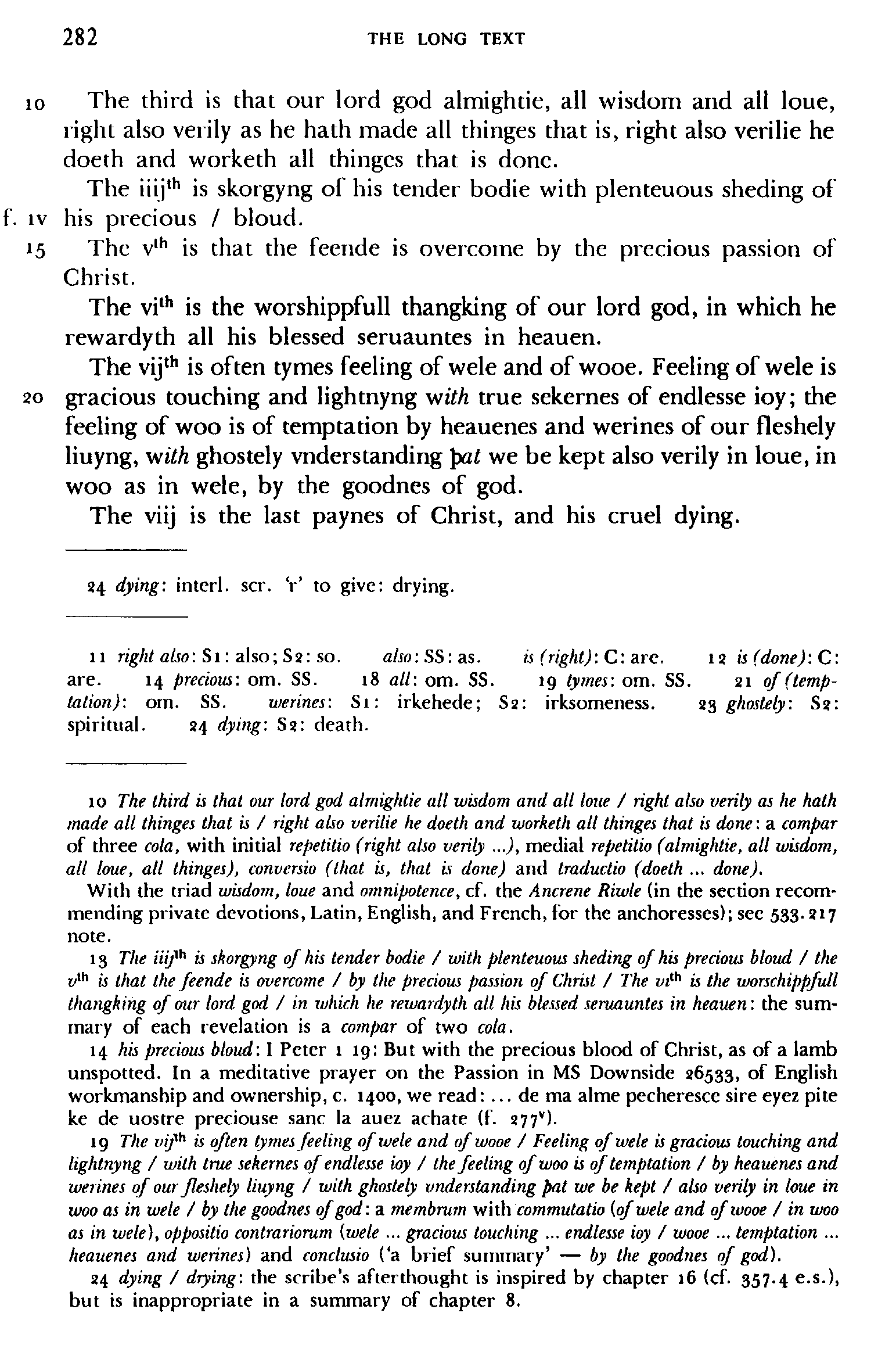
The third is that our lord god almightie, all wisdom and all loue, right also verily as he hath made all thinges that is, right also verilie he doeth and worketh all thinges that is done. th is skorgyng of his tender bodie with plenteuous sheding of f. iv his precious / bloud.
The iiij
The vth is that the feende is overcome by the precious passion of Christ.
The vith is the worshippfull thangking of our lord god, in which he rewardyth all his blessed seruauntes in heauen.
The vijth is often tymes feeling of wele and of wooe. Feeling of wele is 20 gracious touching and lightnyng with true sekernes of endlesse ioy; the feeling of woo is of temptation by heauenes and werines of our fleshely liuyng, with ghostely vnderstanding ]xit we be kept also verily in loue, in woo as in wele, by the goodnes of god.
The viij is the last paynes of Christ, and his cruel dying.
24 dying: intcrl. scr. V to give: drying.
11 rig/it also: Si: also; 82: so. also: SS: as. is (right): C: are.
12 is (done): C: are.
14 precious: om. SS.
18 all: om. SS.
19 tymes: om. SS.
21 of (temptation): orn. SS. werines: Si: irkehede; 82: irksomeness.
23 ghostely: 82: spiritual.
24 dying: 82: death.
10 The third is that our lord god almightie all wisdom and all loue / right also verily as he hath made all thinges that is / right also verilie he doeth and worketh all thinges that is done: a compar of three cola, with initial repetitio (right also verily ...), medial repetitio (almightie, all wisdom, all loue, all thinges), convcrsio (that is, that it done) and traductio (doeth ... done).
With the triad wisdom, loue and omnipotence, cf. the Ancrene Riwle (in the section recommending private devotions, Latin, English, and French, for the anchoresses); see 533.217 note.
13 The z'z'y"
1 is skorgyng of his tender bodie / with plenteuous sheding of his precious bloud / the vih is that the feende is overcome / by the precious passion of Christ / The vith is the worschippfull thangking of our lord god / in which he rewardyth all his blessed seruauntes in heauen: the summary of each revelation is a compar of two cola.
14 his precious bloud: I Peter i 19: But with the precious blood of Christ, as of a lamb unspotted. In a meditative prayer on the Passion in MS Downside 26533, of English workmanship and ownership, c. 1400, we read: ... de ma alme pecheresce sire eyez pite ke de uostre preciouse sane la auez achate (f. 277*).
19 The r;//lh is often tymes feeling of wele and of wooe / Feeling of wele is gracious touching and lightnyng / with true sekernes of endlesse ioy / the feeling of woo is of temptation / by heauenes and werines of our fleshely liuyng / with ghostely vnderstanding pat we be kept / also verily in loue in woo as in wele / by the goodnes of god: a membrum with commutatio (of wele and of wooe / in woo as in wele), oppositio contrariorum (wele ... gracious touching ... endlesse ioy / wooe ... temptation ... heauenes and werines) and condusio ('a brief summary' — by the goodnes of god).
24 dying / drying: the scribe's afterthought is inspired by chapter 16 (cf. 357.4 e.s.), but is inappropriate in a summary of chapter 8.
CHAPTER I
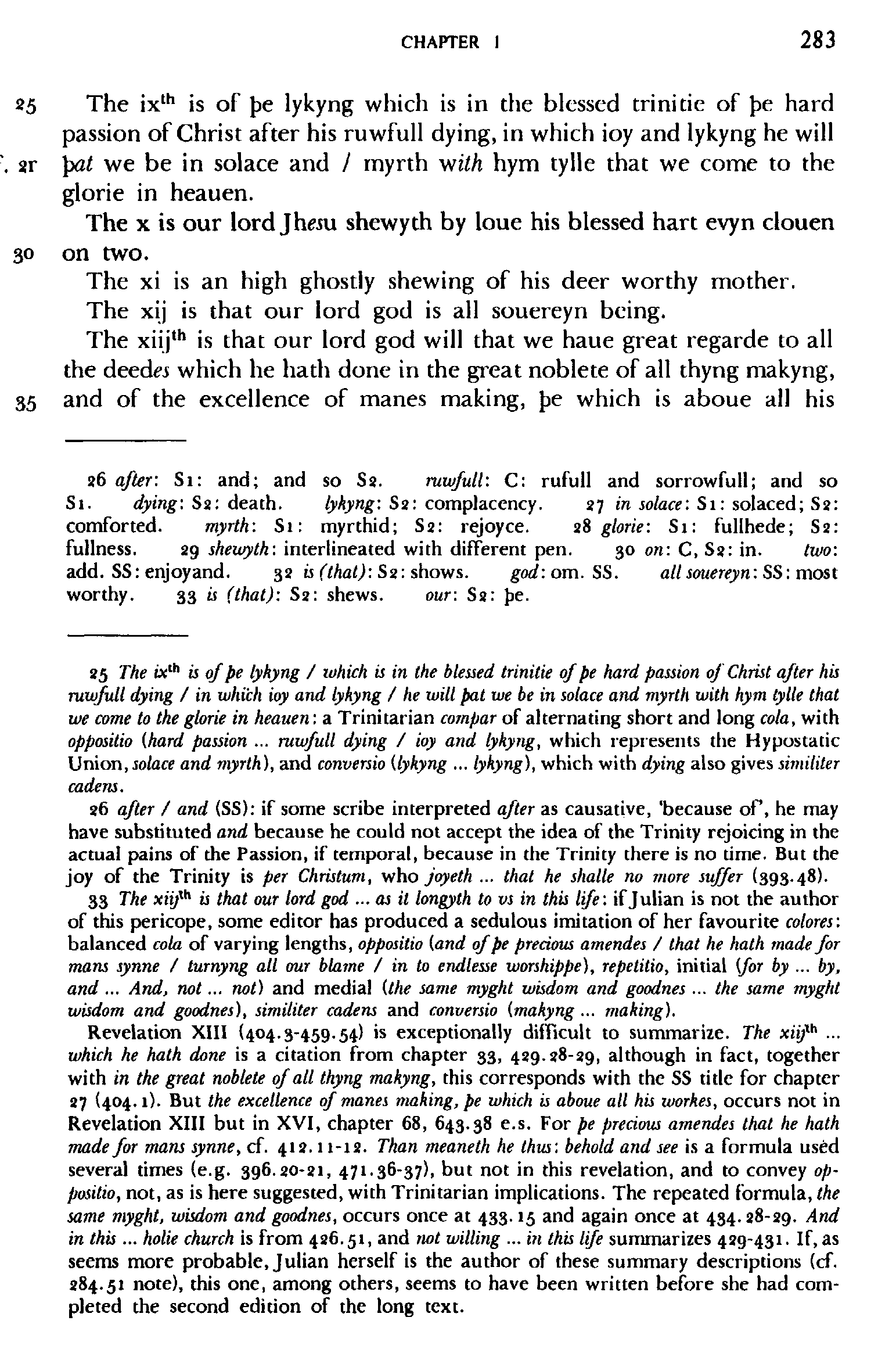
The ixth is of Jje lykyng which is in the blessed trinitie of be hard passion of Christ after his ruwfull dying, in which ioy and lykyng he will
, gr \>at we be in solace and / rnyrth with hym tylle that we come to the glorie in heauen.
The x is our lord Jhesu shewyth by loue his blessed hart evyn clouen
on two.
The xi is an high ghostly shewing of his deer worthy mother.
The xij is that our lord god is all souereyn being.
The xiijth is that our lord god will that we haue great regarde to all the deedes which he hath done in the great noblete of all thyng makyng,
35 and of the excellence of manes making, be which is aboue all his 26 after: Si: and; and so 82. ruwfull: C: rufull and sorrowfull; and so Si. dying: 82: death. lykyng: 82: complacency.
27 in solace: Si: solaced; 82: comforted. myrth: Si: myrthid; 82: rejoyce.
28 glorie: Si: fullhede; 82: fullness.
29 shewyth: interlineated with different pen.
30 on: C, 82: in. two: add. 88: enjoyand.
32 is (that): 82: shows. god: om. 88. all souereyn: 88: most worthy.
33 is (that): 82: shews. our: 82: J)e.
25 The ixth is of pe lykyng / which is in the blessed trinitie of pe hard passion of Christ after his ruwfull dying / in which ioy and lykyng / he will pat we be in solace and myrth with hym tylle that we come to the glorie in heauen: a Trinitarian compar of alternating short and long cola, with oppositio (hard passion ... ruwfull dying / ioy and lykyng, which represents the Hypostatic
Union, solace and myrth), and conversio (lykyng ... lykyng), which with dying also gives similiter cadens.
26 after / and (SS): if some scribe interpreted after as causative, 'because of, he may have substituted and because he could not accept the idea of the Trinity rejoicing in the actual pains of the Passion, if temporal, because in the Trinity there is no time. But the joy of the Trinity is per Christum, who joyeth ... that he shalle no more suffer (393.48).
33 The xiifh is that our lord god ... as it longyth to vs in this life: if Julian is not the author of this pericope, some editor has produced a sedulous imitation of her favourite colores: balanced cola of varying lengths, oppositio (and ofpe precious amendes / that he hath made for mans synne / turnyng all our blame / in to endlesse worshippe), repetitio, initial (for by ... by, and ... And, not... not) and medial (the same myght wisdom and goodnes ... the same myght wisdom and goodnes), similiter cadens and conversio (makyng ... making).
Revelation XIII (404.3-459.54) is exceptionally difficult to summarize. The xiifh ... which he hath done is a citation from chapter 33, 429.28-29, although in fact, together with in the great noblete of all thyng makyng, this corresponds with the SS tide for chapter
27 (404. i). But the excellence of manes making, pe which is aboue all his workes, occurs not in Revelation XIII but in XVI, chapter 68, 643.38 e.s. For pe precious amendes that he hath made for mans synne, cf. 412.11-12. Than meaneth he thus: behold and see is a formula used several times (e.g. 396.20-21, 471.36-37), but not in this revelation, and to convey oppositio, not, as is here suggested, with Trinitarian implications. The repeated formula, the same myght, wisdom and goodnes, occurs once at 433.15 and again once at 434.28-29. And in this ... holie church is from 426.51, and not willing ... in this life summarizes 429-431. If, as seems more probable, Julian herself is the author of these summary descriptions (cf.
284.51 note), this one, among others, seems to have been written before she had completed the second edition of the long text.
THE LONG TEXT
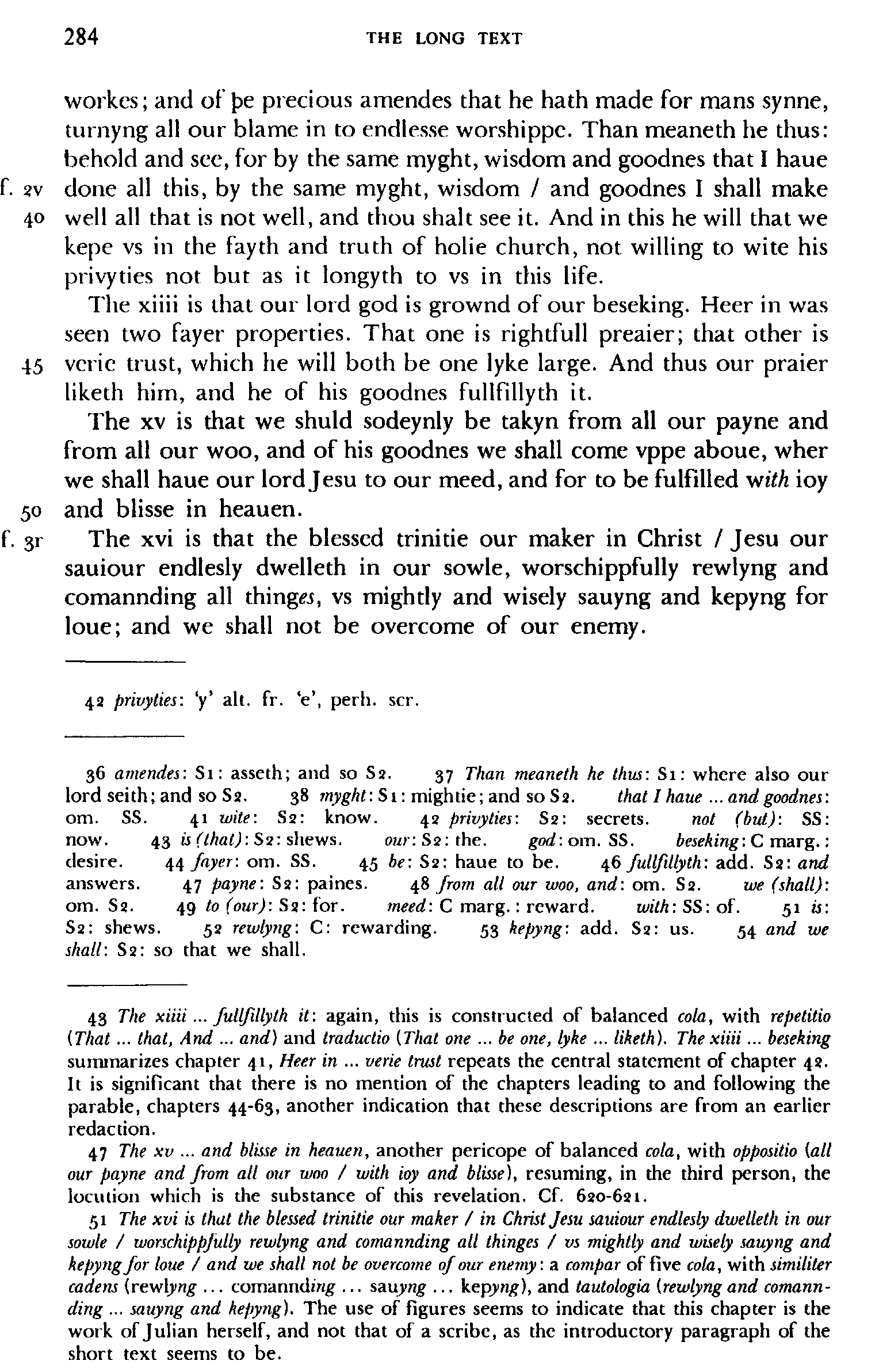
workes; and of f>e precious amendes that he hath made for mans synne, turnyng all our blame in to endlesse worshippe. Than meaneth he thus: behold and see, for by the same myght, wisdom and goodnes that I haue f. 2v done all this, by the same myght, wisdom / and goodnes I shall make
40 well all that is not well, and thou shalt see it. And in this he will that we kepe vs in the fayth and truth of holie church, not willing to wite his privy ties not but as it longyth to vs in this life.
The xiiii is that our lord god is grownd of our beseking. Heer in was seen two fayer properties. That one is rightfull preaier; that other is
45 vcrie trust, which he will both be one lyke large. And thus our praier liketh him, and he of his goodnes fullfillyth it.
The xv is that we shuld sodeynly be takyn from all our payne and from all our woo, and of his goodnes we shall come vppe aboue, wher we shall haue our lord Jesu to our meed, and for to be fulfilled with ioy
50 and blisse in heauen. f. sr The xvi is that the blessed trinitie our maker in Christ / Jesu our sauiour endlesly dwelleth in our sowle, worschippfully rewlyng and comannding all things, vs mightly and wisely sauyng and kepyng for loue; and we shall not be overcome of our enemy.
42 privyties: 'y' alt. fr. V, perh. scr.
36 amendes: Si: asseth; and so 82.
37 Than meaneth he thus: Si: where also our lord seith; and so 82.
38 myght: Si: mightie; and so 82. that I haue ...and goodnes: om.
SS.
41 wite: 82: know.
42 privy ties: 82: secrets. not (but):
SS: now.
43 is (that): 82: shews. our: 82: the. god:om. SS. beseking: C marg.: desire.
44 fayer: om. SS.
45 be: 82: haue to be.
46 fullfillyth: add. 82: and answers.
47 payne: 82: paines.
48 from all our woo, and: om. 82. we (shall): om. 82.
49 to (our): 82: for. meed: C marg.: reward. with: SS: of.
51 is:
82: shews.
52 rewlyng: C: rewarding.
53 kepyng: add. 82: us.
54 and we shall: 82: so that we shall.
43 The xiiii... fullfillyth it: again, this is constructed of balanced cola, with repetitio
(That ... that, And ... and) and traductio (That one ... be one, lyke ... liketh). The xiiii... beseking summarizes chapter 41, Heer in ... verie trust repeats the central statement of chapter 42.
It is significant that there is no mention of the chapters leading to and following the parable, chapters 44-63, another indication that these descriptions are from an earlier redaction.
47 The xv ... and blisse in heauen, another pericope of balanced cola, with oppositio (all our payne and from all our woo / with ioy and blisse), resuming, in the third person, the locution which is the substance of this revelation. Cf. 620-621.
51 The xvi is that the blessed trinitie our maker / in Christ Jesu sauiour endlesly dwelleth in our sowle / worschippfully rewlyng and comannding all thinges / vs mightly and wisely sauyng and kepyng for loue / and we shall not be overcome of our enemy: a compar of five cola, with similiter cadens (re\v\yng ... comanndmg ... sauyng ... kepyng), and tautologia (rewlyng and comannding ... sauyng and kepyng). The use of figures seems to indicate that this chapter is the work of Julian herself, and not that of a scribe, as the introductory paragraph of the short text seems to be.
CHAPTER 2
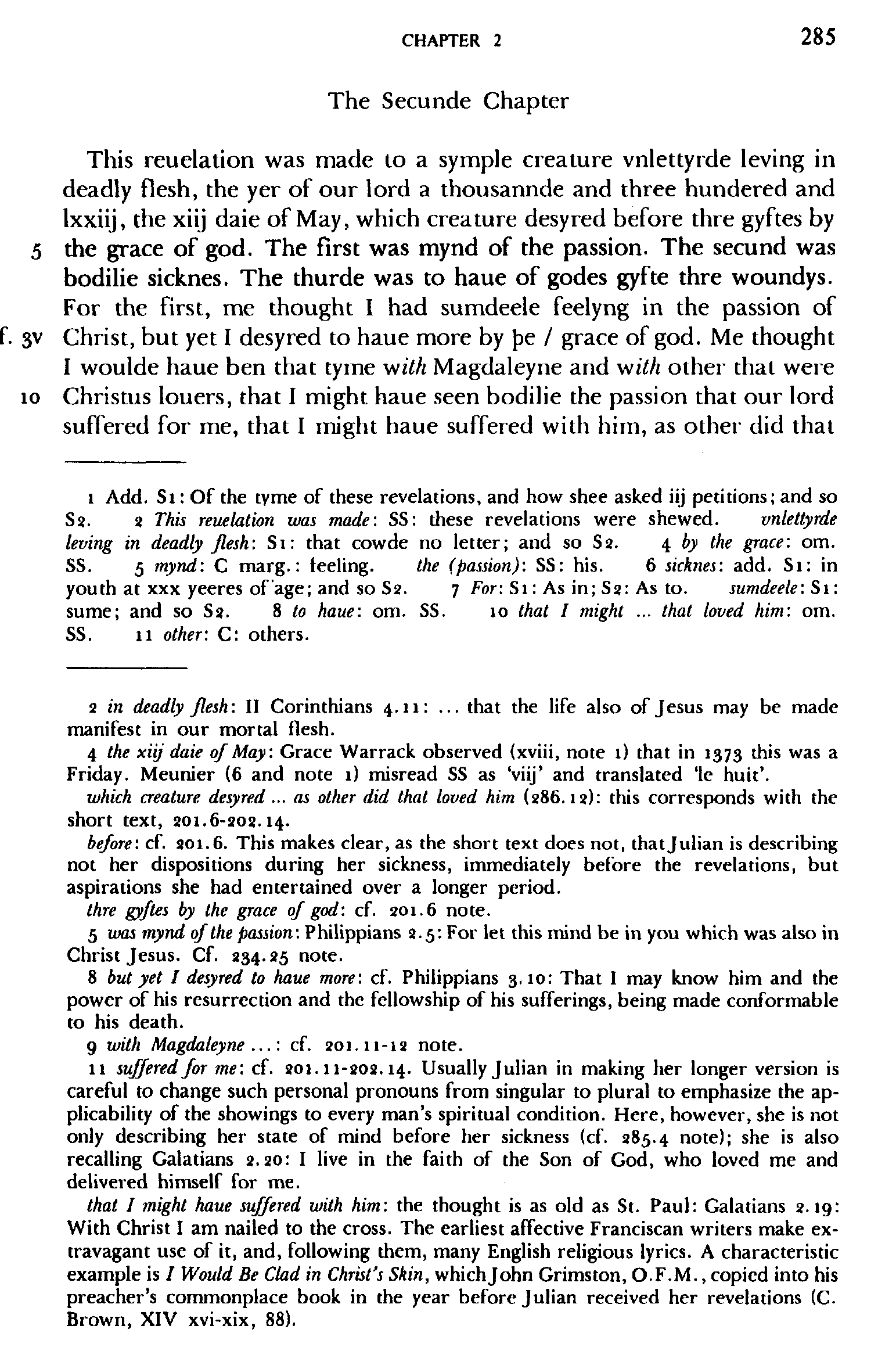
The Secunde Chapter This reuelation was made to a symple creature vnlettyrde leving in deadly flesh, the yer of our lord a thousannde and three hundered and Ixxiij, the xiij daie of May, which creature desyred before thre gyftes by 5 the grace of god. The first was mynd of the passion. The secund was bodilie sicknes. The thurde was to haue of godes gyfte thre woundys.
For the first, me thought I had sumdeele feelyng in the passion of f. sv Christ, but yet I desyred to haue more by J)e / grace of god. Me thought
I woulde haue ben that tyme with Magdaleyne and with other that were 10 Christus louers, that I might haue seen bodilie the passion that our lord suffered for me, that I might haue suffered with him, as other did that i Add. Si: Of the tyme of these revelations, and how shee asked iij petitions; and so Si?.
2 This reuelation was made: SS: these revelations were shewed. vnlettyrde leving in deadly flesh: Si: that cowde no letter; and so 82.
4 by the grace: om.
SS.
5 mynd: C marg.: feeling. the (passion): SS: his.
6 sicknes: add. Si: in youth at xxx yeeres of age; and so Sa.
7 For: Si: As in; 82: As to. sumdeele: Si: sume; and so Ss.
8 to haue: om. SS.
10 that I might ... that loved him: om.
SS.
11 other: C: others.
2 in deadly flesh: II Corinthians 4.11: ... that the life also of Jesus may be made manifest in our mortal flesh.
4 the xiij daie of May: Grace Warrack observed (xviii, note i) that in 1373 this was a Friday. Meunier (6 and note i) misread SS as Viij' and translated 'le huit'. which creature desyred ... as other did that loved him (286.12): this corresponds with the short text, 201.6-202.14. before: cf. 201.6. This makes clear, as the short text does not, thatjulian is describing not her dispositions during her sickness, immediately before the revelations, but aspirations she had entertained over a longer period. thre gyftes by the grace of god: cf. 201.6 note.
5 was mynd of the passion: Philippians 2.5: For let this mind be in you which was also in Christ Jesus. Cf. 234.25 note.
8 but yet I desyred to haue more: cf. Philippians 3.10: That I may know him and the power of his resurrection and the fellowship of his sufferings, being made conformable to his death.
9 with Magdaleyne...: cf. 201.11-12 note.
11 suffered for me: cf. 201.11-202.14. Usually Julian in making her longer version is careful to change such personal pronouns from singular to plural to emphasize the applicability of the showings to every man's spiritual condition. Here, however, she is not only describing her state of mind before her sickness (cf. 285.4 note); she is also recalling Galatians 2.20: I live in the faith of the Son of God, who loved me and delivered himself for me. that I might haue suffered with him: the thought is as old as St. Paul: Galatians 2.19:
With Christ I am nailed to the cross. The earliest affective Franciscan writers make extravagant use of it, and, following them, many English religious lyrics. A characteristic example is / Would Be Clad in Christ's Skin, whichjohn Grimston, O.F.M., copied into his preacher's commonplace book in the year before Julian received her revelations (C.
Brown, XIV xvi-xix, 88).
THE LONG TEXT
loved him. And therfore I desyred a bodely sight, wher in I might haue more knowledge of the bodily paynes of our sauiour, and of the compassion of our lady and of all his true louers that were lyuyng that tyme
15 and saw his paynes; for I would haue be one of them and haue suffered •with them. Other sight nor shewing of god desyred I never none til whan the sowle were deperted from the bodie, for I beleued to be saued by the marcie of god. This was my meaning, for I would after be f. 4r cause of that shewyng haue the more true / mynd in the passion of 20 Christ. For the secunde, came to my mind with contricion, frely without anie sekyng, a wilfull desyre to haue of gods gyfte a bodily sicknes. I 14 that were lyuyng: Si: that scene; 82: who at.
15 and (saw): om. 88. saw: om, Si. haue (be): om. SS. haue (suffered): om. SS.
16 them (Other): SS: him;cf. A (202.14): hym.
17 whan: om. SS. were: SS: was. for I beleued to be saued: Si: the cause of this petition was that; and so 82.
18 by the marcie ... be cause of: om.
SS.
19 that: Si: the; and so 82. haue: Si: I should have; and so 82. true:om.
82.
20 For: om. SS. without: Si: desyreing; and so 82.
21 ante sekyng... I would that: om. SS.
22 wilfull: C marg.: earnest.
12 / desyred a bodely sight ... I ware xxx{h yeare olde (288.39): this corresponds with the short text, 202.19-204.46. wher in I might haue more knowledge: cf. 202.19 note.
14 and of all his true louers: though what follows here is superior to the short text (cf.
202. 22 and note), A, P and SS are all variously corrupt. We may conjecture that what
Julian wrote in the short text and copied in the long was: and ofalle his trewe loverse that were lyuyng that tyme and saw his paynes, and sythene were beleuyng his paynes. There are two separate ideas, one of which is here lost:Julian wants to be one in devotion with those who were eye-witnesses of the Passion, and with those who since then have had faith in the Passion. That some long-text ancestor has 'sythene' is attested by Si's corrupt seene.
The different corruptions appear to have been caused by at least two different errors through homoeotopy.
15 for I would haue be one of them: again, a notion drawn from Scripture (cf. John
19.25), much elaborated in Franciscan spirituality. Cf. the immensely popular pseudonymous Dialogus B. Mariae et Anselmi de passione Domini (PL 159 271-290; and cf.
367.15 note). St. Edmund of Canterbury, writing c. 1240 (in French), quotes what he claims to be a popular English quatrain, Sunset on Calvary (which C. Brown believed that he had himself composed), outstanding for its pungent concision: Nou goth sonne vnder wod — / me reweth, Marie, pi faire rode. / Nou gop sonne vnder tre — / me rewep,
Marie, pi sone and pe (XIII i, 165-166; also printed — with at least two errors — in Forshaw, 93). Cf. 202.23 note.
17 for I beleued to be saued by the marcie of god: the SS variants are plainly corrupt, and P is closest to the short text (203.25): for I trayste sothfastlye that I schulde be safe. The addition, by the marcie of god, accords well with what Julian will later write, in the long text, about the working of mercy; and it completes a compar not found in the short text: Other sight nor shewing of god desyred I never none / til whan the sowle were deperted from the bodie / for I beleued to be saued by the marcie of god.
20 without anie sekyng: cf. 203.28: with owtyn any sekynge. SS's desyreing is nonsensical.
CHAPTER 2
would that that sicknes were so hard as to the death, that I might in that sicknes haue vndertaken all my rightes of the holie church, my selfe weenyng that I should haue died, and that all creatures might suppose
25 be same that saw me; for I would haue no maner of comforte of fleshly ne erthely life in that sicknes. I desyred to haue all maner of paynes, bodily and ghostly, that I should haue if I should haue died, all the dredys and temptations of fiendes, and all maner of other paynes, saue the out passing of the sowle. And this ment I for I would be purgied by f. 4v the mercie of god, and after Hue more to the worshippe / of god by 31 cause of that sicknes. For I hoped that it might haue ben to my reward when I shuld haue died. For I desyred to haue ben soone with my god and maker.
These twey desyers of the passion and of the sicknes that I desyred of 31 my reward: so C; ms: my a reward.
22 were: om. SS. the (death): om. SS. in that sicknes: 82: therein.
23 haue vndertaken: Si: vnderfongyn; 82: receive. my (rightes): C: the. the (holie): om. C, 88.
24 haue died: SS: dye.
25 of (comforte): om.
SS. of fleshly ne: om.
SS.
26 that: Si: this; and so 82. of (paynes): om. SS.
27 haue died, all: Si: dye with all; 82: dye and with all.
28 temptations: SS: tempests; cf. A (203.36): tempestes. ftendis: Si: the fends; 82: J>e devils. and all maner of other paynes: om.
SS. saue: C: saving; Si: except; and so 82.
29 out passing: 82: deperting. purgied: C, SS: purged.
31 For I hoped ... haue ben: Si: and that for the more speede in my deth; and so 82. to my reward ... haue died: om. SS.
32 to haue ben:
SS: to be.
33 and maker: om. SS.
34 These: 82, marg., scr.: How we should make petit(i)on to our Lord God. of (the): om. Si. of the: om. 82. that: om.
SS. of him was: om. SS.
23 rightes: 'rites'. Cf. 203.31 note. Godefroy records Ritement, 'selon les rites', 1391.
MED rite, n., records c. 1400 spellings 'ri3tis' (Lanfranc Cirurgerie), 'ri3t' (Book of Virtues and V.).
27 all the dredys and temptations of fiendes: cf. 203.36 note.
29 And this ment I... of that sicknes (287.31): not in the short text; cf. 203.38 note.
And this ment I for I would be purgied by the mercie of god / and after Hue more to the worshippe of god by cause of that sicknes / For I hoped that it might haue ben to my reward when I shuld haue died / For I desyred to haue ben soone with my god and maker: the addition in the long text of And this ment I... that sicknes (cf. 204.37) constructs a compar of four cola, for I would be purgied: cf. 203.28 and note.
31 to my reward: cf. 264.38: to me a spede; and note that SS omit. Evidently P (or an ancestor) found spede archaic; but there need be no change of meaning implied. Julian is not saying that sufferings in life might increase her reward in heaven, but that they might at her death gain her God's 'regard, consideration' (cf. NED Reward, sb.1 I + i).
34 These twey desyers of the passion and of the sicknes / that I desyred of him was with a condition /for me thought this was not the commune vse of prayer: a compar of three cola, with a figure, desyers ... desyred, which is both traductio and tautologia, which second comes straight from the Vulgate, Luke 22.15: With desire I have desired (desiderio desideravi) to eat this pasch with you before I suffer. The adaptation from the short text (cf. 204.40) not only, by this Scriptural allusion, sets the account of her sufferings in the context of the Passion, but shows that in the true prayer of petition we seek not so much the gifts for which we pray but God who is the giver of all good gifts
THE LONG TEXT
35 him was with a condicion; for me thought this was not the commune vse of prayer; therfor I sayd: Lord, thou knowest what I would, if that it be thy wille that I might haue it, and if it be not thy will, good lord, be not displesed, for I will not but as thou wilt. This sicknes I desyred in my jowth, that I might haue it when I ware xxxth yeare olde.
For the third, by the grace of god and teeching of holie church I conceiued a mightie desyre to receive thre woundes in my life, that is to f. 5r say, the wound of verie contricion, the wound of kynd / compassion and the wound of willfull longing to god. Right as I asked the other twayne with a condicion, so asked I this third mightly with out anie con45 dicion. These twayne desyres before sayd passid from my mynd, and the third dwellid contynually.
35 for me ... therfor I: om. SS.
36 sayd: Si: sey thus; Sa: saying. if (that): C: and if. that: om. SS.
37 might: om. SS.
38 not (but):SS: nought.
This...yeare olde: om. SS.
39 jowth: C: Youth.
43 Right... other twayne: om. SS.
44 a condicion ... mightly: Si: and all this last petition I asked; and so 82. mightly: C: mightilie (et passim).
46 dwellid: add. SS: with me.
36 prayer: cf. 207.2 note. therfor I sayd Lord / thou knowest what I would / if that it be thy wille / that I might haue it: a compar of four cola. In re-editing the short text (cf. 204.42), where the colores are vivid enough,Julian has avoided grawnte it me. Clearly, in thou knowest what I would she has in mind Christ's prayer in Gethsemane, where he too makes no direct petition, but says 'If it be possible, let this chalice pass from me' (Matthew 26.39).
37 and if it be not thy will / good lord be not displesed /for I will not but as thou wilt: these three cola continue the Passion allusion: non sicut ego volo sed quod tu (Mark 14.36).
By altering from the short text the length and relationship of her cola, Julian again directs attention away from herself to God; and the two figures are joined by the exclamatio (382.3 note — Lord ... good lord). For the first time, here or in the short text,
Julian is employing ratiocinatio by hypothesis; cf. 643.38-45 note.
38 in my jowth: this was possibly early in her religious life, when she would be exposed to the sort of legend she recounts in the short text (204.45 and note). Cf. 351.3-4 and Introduction, 59.
39 xxxth yeare olde: cf. 204.46 note.
40 by the grace of god and teeching of holie church: this addition to the short text forms a compar, and it also enables Julian to stress that these petitions fully accord with traditional and orthodox teaching.
/ concerned a mightie desyre ... without anie meane (294.7): this corresponds with the short text, 205.50-210.16.
41 thre woundes: cf. 205.51 note.
42 the wound of verie contricion ...: cf. 206.52 note. It will be seen how the addition here of verie and kynd creates a perfect compar.
43 Right as I asked the other twayne with a condicion / so ashed I this third mightly with out anie condicion: comparison with the short text shows that the addition here of mightly perfects the compar, which has conversio (condicion ... condicion) and commutatio (I asked ... asked I).
46 dwellid contynually: cf. 420.42: of the vertu of this longyng in Crist we haue to long ajene to hym, without whych no soule cornyth to hevyn.
CHAPTER 3
The Third Chapter And when I was xxx'h yere old and a halfe, god sent me a bodily sicknes in the which I ley iij daies and iij nyghtes; and on the iiij nyght I toke all my rightes of holie church, and went not to haue leuen tyll day.
5 And after this I lay two daies and two nightes; and on the third night I weenied often tymes to haue passed, and so wenyd thei that were with me. And yet in this I felt a great louthsomnes to die, but for nothing f. 5v that was in earth that me lyketh to leue for, / ne for no payne that I was afrayd of, for I trusted in god of his mercie. But it was for I would haue i add. Sa: Of J>e sickness she obtained of god by petition.
2 And: Ss: Accordingly. xxxih: C: thirtie; Si: thirty; Ss: 30.
3 the (which): om. C, SS. on: om. 82.
4 rightes: C, marg.: sacraments; C: rights; SS: rites. went: C, marg., 82: thought. to (haue): om. Si.
5 lay: Si: langorid forth; and so 82; cf. A: langoured fur the. two (nightes): om. 82.
7 And yet: SS; and in youngith yet. felt: SS: thought. a (great): om. SS. louthsomnes: C: loathness; Si: sweeme, marg., scr.: regret; 82: sweem.
8 that (was): Si: this; 82: $at, alt. fr. \>is. lyketh: Si: lekid; and so 82. no: Ss: any.
9 it was for I would: om. Ss;for I would: om. Si. haue leued to haue loueved: Si: to have lyved that I might have loved; 82: I desired to live that I might loue god.
3 iij daies and iij nyghtes: cf. 207. 2 note.
7 And yet in this I felt a great louthsommes to die / but for nothing that was in earth that me lyketh to leue for / nefor no payne that I was afrayd of/for I trusted in god of his mercie / But it was for I would haue leued / to haue loueved god better and longer tyme / that I might by the grace of that leuyng / haue the more knowing and louyng / of god in the blisse ofheauen: comparison with the short text (207.6-12) shows that there too this passage was composed as a figure, but that here it has been enhanced by Julian's unobtrusive editing. The two short cola, Botte in this I was ryght sarye / and lothe thoujtfor to dye (207.6-7) have been made into one long colon, balancing with the next.| There are oppositions (louthsomnes / lykede, to die / to leue, I was afrayd / I trusted), inclusio (for nothing ... to leueybr), adnominatio (haue leued ... haue loueved), similiter cadens (better ... longer, \euyng ... knowing ... louyng), most of which colores are in the short text's figure.
Theologically, her thought is inspired by Philippians 1.21-22; cf. 208.14 note. She may well have known the story of St. Martin of Tours on his death-bed: conuersusque ad dominum hac tantum flentibus uoce respondit: Domine, si adhuc populo tuo sum necessarius, non recuso laborem (Sulpicii Seueri epistula III, ed. Halm, 148). She is also subscribing to the traditional doctrine of merit, drawn from such texts as 'In my father's house there are many mansions' (John 14.2) and 'Star differs from star in glory'
(I Corinthians 15.41). In the Glossa ordinaria, at I Corinthians i5.4i,John 14.2 is quoted:
Stella enim a stella differt... In domo patris met mansiones multae sunt, etsi idem denarius, id est vita aeterna omnibus. Una est enim beatitudo quam justi percipiunt, sed dispar retributionis qualitas (PL 114 548). youngith (SS): cf. OE geong, geogup; but most probably a nonsense-word. but for nothing that was in earth: cf. 207.7 note.
THE LONG TEXT
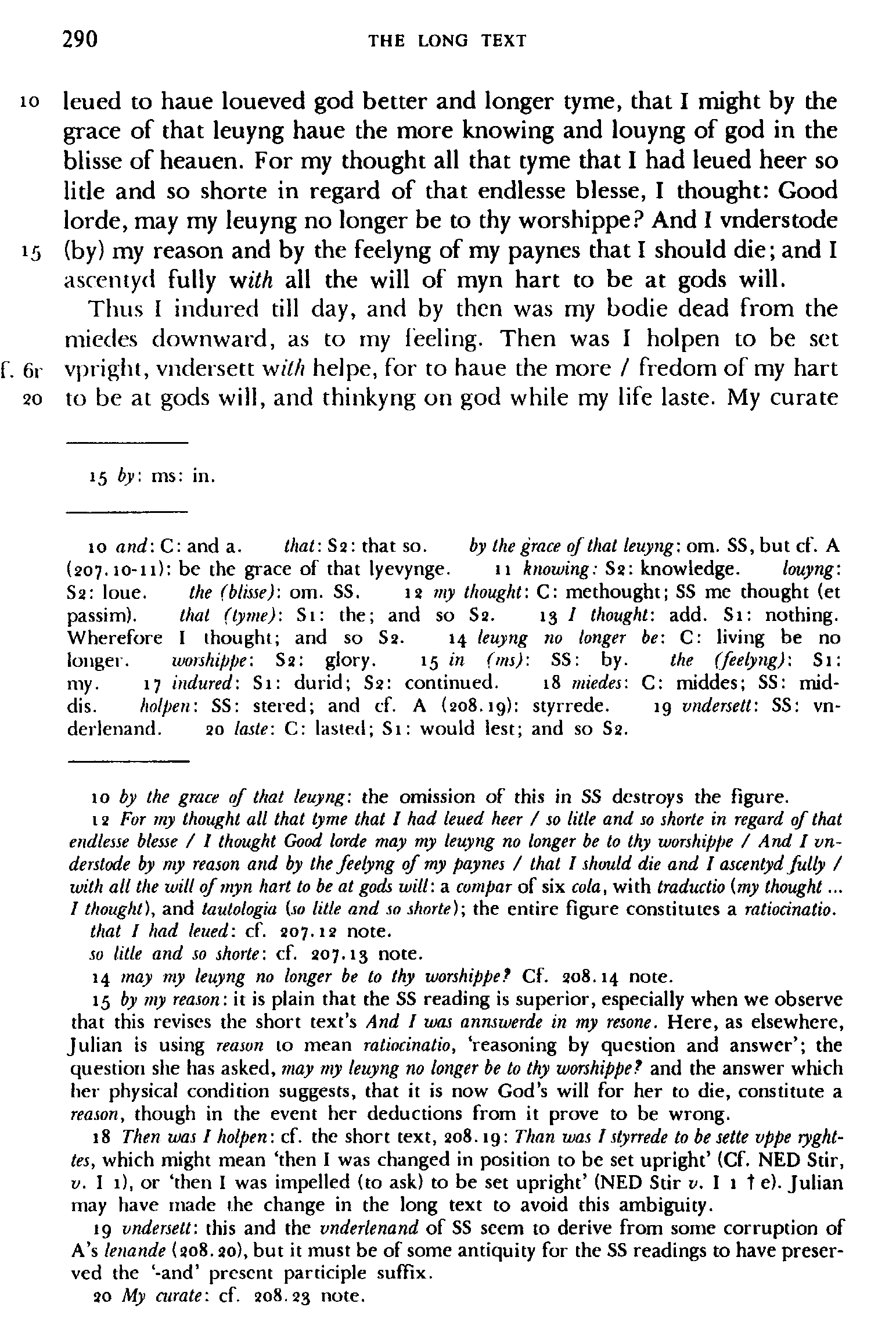
10 leued to haue loueved god better and longer tyme, that I might by the grace of that leuyng haue the more knowing and louyng of god in the blisse of heauen. For my thought all that tyme that I had leued heer so litle and so shorte in regard of that endlesse blesse, I thought: Good lorde, may my leuyng no longer be to thy worshippe? And I vnderstode
15 (by) my reason and by the feelyng of my paynes that I should die; and I ascemyd fully with all the will of myn hart to be at gods will.
Thus I indured till day, and by then was my bodie dead from the miedes downward, as to my feeling. Then was I holpen to be set
6r vpright, vndersett w//A helpe, for to haue the more / fredom of my hart 20 to be at gods will, and thinkyng on god while my life laste. My curate f 15 by: ms: in.
10 and: C: and a. that: 82: that so. by the grace of that leuyng: om. SS, but cf. A (207.10-11): be the grace of that lyevynge.
11 knowing: 82: knowledge. louyng:
82: loue. the (blisse): om. SS.
12 my thought: C: methought; SS me thought (et passim). that (tyme): Si: the; and so 82.
13 / thought: add. Si: nothing.
Wherefore I thought; and so 82.
14 leuyng no longer be: C: living be no longer. worshippe:
82: glory.
15 in (ms): SS: by. the (feelyng):
Si: my.
17 indured: Si: durid; 82: continued.
18 miedes: C: middes; SS: middis. holpen: SS: stered; and cf. A (208.19): styrrede.
19 vndersett: 88: vnderlenand.
20 laste: C: lasted; Si: would lest; and so 82.
10 by the grace of that leuyng: the omission of this in 88 destroys the figure.
12 For my thought all that tyme that I had leued heer / so litle and so shorte in regard of that endlesse blesse / I thought Good lorde may my leuyng no longer be to thy worshippe / And I vnderstode by my reason and by the feelyng of my paynes / that I should die and I ascentyd fully / with all the will of myn hart to be at gods will: a compar of six cola, with traductio (my thought...
I thought), and tautologia (so litle and so shorte); the entire figure constitutes a ratiodnatio. that I had leued: cf. 207.12 note. so litle and so shorte: cf. 207.13 note.
14 may my leuyng no longer be to thy worshipped Cf. 208.14 note.
15 by my reason: it is plain that the SS reading is superior, especially when we observe that this revises the short text's And I was annswerde in my resone. Here, as elsewhere,
Julian is using reason to mean ratiodnatio, 'reasoning by question and answer'; the question she has asked, may my leuyng no longer be to thy worshippe? and the answer which her physical condition suggests, that it is now God's will for her to die, constitute a reason, though in the event her deductions from it prove to be wrong.
18 Then was I holpen: cf. the short text, 208.19: Than was I styrrede to be sette vppe ryghttes, which might mean 'then I was changed in position to be set upright' (Cf. NED Stir, v. I i), or 'then I was impelled (to ask) to be set upright' (NED Stir v. I i t e). Julian may have made the change in the long text to avoid this ambiguity.
19 vndersett: this and the vnderlenand of SS seem to derive from some corruption of A's lenande (208.20), but it must be of some antiquity for the 88 readings to have preserved the '-and' present participle suffix.
20 My curate: cf. 208.23 note.
CHAPTER 3
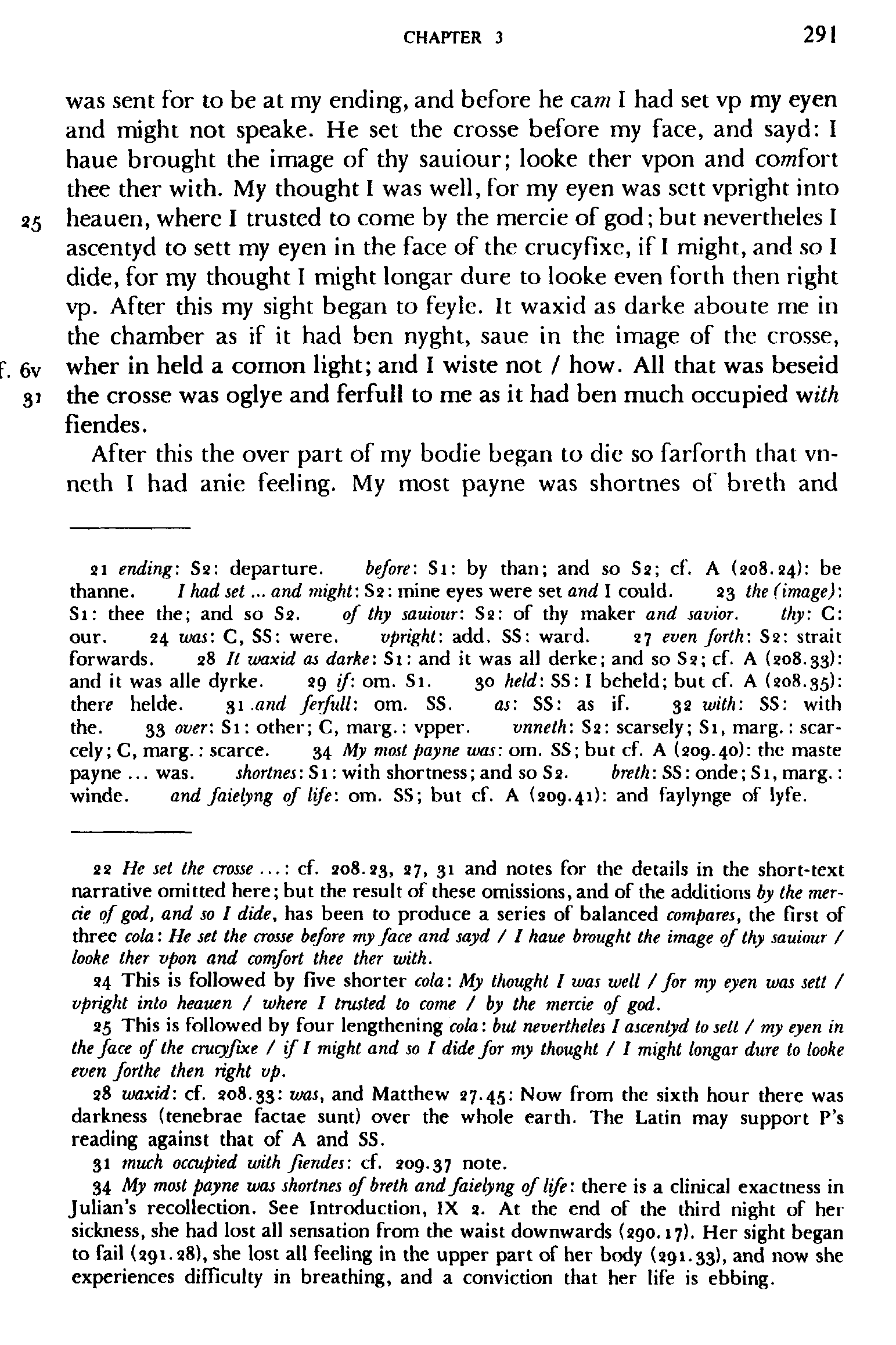
was sent for to be at my ending, and before he caw I had set vp my eyen and might not speake. He set the crosse before my face, and sayd: I haue brought the image of thy sauiour; looke ther vpon and comfort thee ther with. My thought I was well, for my eyen was sett vpright into 25 heauen, where I trusted to come by the mercie of god; but nevertheles I ascentyd to sett my eyen in the face of the crucyfixe, if I might, and so I dide, for my thought I might longar dure to looke even forth then right vp. After this my sight began to feyle. It waxid as darke aboute me in the chamber as if it had ben nyght, saue in the image of the crosse, f. 6v wher in held a comon light; and I wiste not / how. All that was beseid
31 the crosse was oglye and ferfull to me as it had ben much occupied with fiendes.
After this the over part of my bodie began to die so farforth that vnneth I had anie feeling. My most payne was shortnes of breth and 21 ending: 82: departure. before: Si: by than; and so 82; cf. A (208.24): be thanne.
I had set... and might: 82: mine eyes were set and I could.
23 the (image):
Si: thee the; and so 82. of thy sauiour: 82: of thy maker and savior. thy: C: our.
24 was: C, SS: were. vpright: add. SS: ward.
27 even forth: 82: strait forwards.
28 It waxid as darke: Si: and it was all derke; and so 82; cf. A (208.33): and it was alle dyrke.
29 if: om. Si.
30 held: SS: I beheld; but cf. A (208.35): there helde.
31 .and ferfull: om.
SS. as: SS: as if.
32 with: SS: with the.
33 over: Si: other; C, marg.: vpper. vnneth: 82: scarsely; Si, marg.: scarcely; C, marg.: scarce.
34 My most payne was: om. SS; but cf. A (209.40): the maste payne... was. shortnes: Si: with shortness; and so 82. breth: SS: onde; Si, marg.: winde. and faielyng of life: om. SS; but cf. A (209.41): and faylynge of lyfe.
22 He set the crosse ...: cf. 208.23, 27, 31 and notes for the details in the short-text narrative omitted here; but the result of these omissions, and of the additions by the mercie of god, and so I dide, has been to produce a series of balanced compares, the first of three cola: He set the crosse before my face and sayd / I haue brought the image of thy sauiour / looke ther vpon and comfort thee ther with.
24 This is followed by five shorter cola: My thought I was well / f o r my eyen was sett / vpright into heauen / where I trusted to come / by the mercie of god.
25 This is followed by four lengthening cola: but nevertheles I ascentyd to sett / my eyen in the face of the crucyfixe / if I might and so I dide for my thought / I might longar dure to looke even forthe then right vp.
28 waxid: cf. 208.33: was, and Matthew 27.45: Now from the sixth hour there was darkness (tenebrae factae sunt) over the whole earth. The Latin may support P's reading against that of A and SS.
31 much occupied with fiendes: cf. 209.37 note.
34 My most payne was shortnes of breth andfaielyng of life: there is a clinical exactness in Julian's recollection. See Introduction, IX 2. At the end of the third night of her sickness, she had lost all sensation from the waist downwards (290.17). Her sight began to fail (291.28), she lost all feeling in the upper part of her body (291.33), and now she experiences difficulty in breathing, and a conviction that her life is ebbing.
THE LONG TEXT
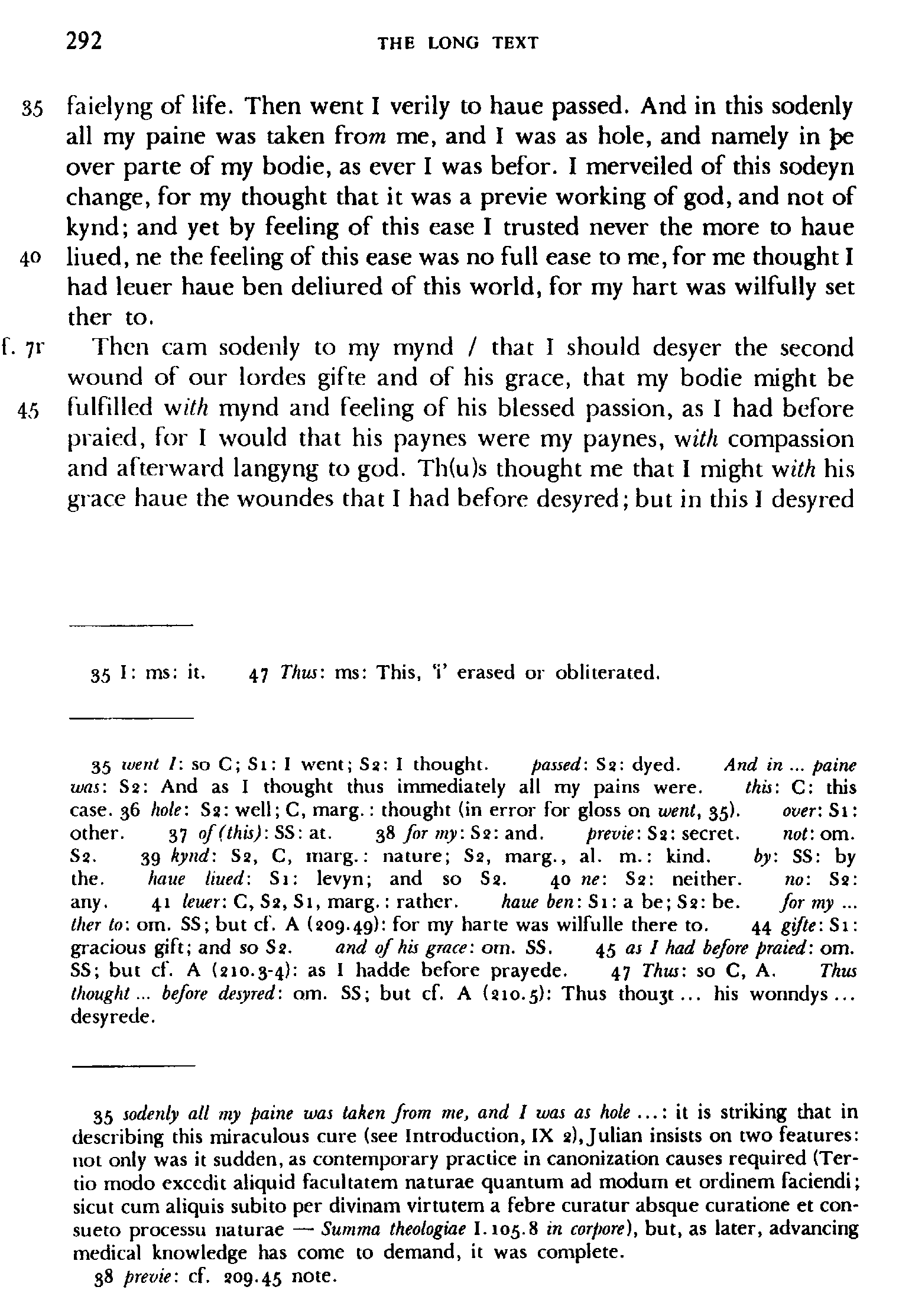
35 faielyng of life. Then went I verily to haue passed. And in this sodenly all my paine was taken from me, and I was as hole, and namely in J>e over parte of my bodie, as ever I was befor. I merveiled of this sodeyn change, for my thought that it was a previe working of god, and not of kynd; and yet by feeling of this ease I trusted never the more to haue
40 liued, ne the feeling of this ease was no full ease to me, for me thought I had leuer haue ben deliured of this world, for my hart was wilfully set ther to. f. ?r Then cam sodenly to my mynd / that I should desyer the second wound of our lordes gifte and of his grace, that my bodie might be
fulfilled with mynd and feeling of his blessed passion, as I had before praied, for I would that his paynes were my paynes, with compassion and afterward langyng to god. Th(u)s thought me that I might with his grace haue the woundes that I had before desyred; but in this I desyred
35 I: ms: it.
47 Thus: ms: This, V erased or obliterated.
35 went I: so C; Si: I went; Sa: I thought. passed: Ss: dyed.
And in ... paine was: Sa: And as I thought thus immediately all my pains were. this: C: this case. 36 hole: Sa: well; C, marg.: thought (in error for gloss on went, 35). over: Si: other.
37 of (this): SS: at.
38 for my: Ss: and. previe: Sa: secret. not: om.
82.
39 kynd: Ss, C, marg.: nature; 82, marg., al. m.: kind. by: SS: by the. haue liued: Si: levyn; and so Sa.
40 ne: Sa: neither. no: Sa: any.
41 leuer: C, Sa, Si, marg.: rather. haue ben: Si: a be; Sa: be. for my ... ther to: om. 88; but cf. A (309.49): for my harte was wilfulle there to.
44 gifte: Si: gracious gift; and so Sa. and of his grace: om. SS.
45 as I had before praied: om.
88; but cf. A (210.3-4): as I hadde before prayede.
47 Thus: so C, A.
Thus thought... before desyred: om. SS; but cf. A (210.5): Thus thou3t... his wonndys... desyrede.
35 sodenly all my paine was taken from me, and I was as hole ...: it is striking that in describing this miraculous cure (see Introduction, IX a),Julian insists on two features: not only was it sudden, as contemporary practice in canonization causes required (Tertio modo excedit aliquid facuhatem naturae quantum ad modum et ordinem faciendi; sicut cum aliquis subito per divinam virtutem a febre curatur absque curatione et consueto processu naturae — Summa theologiae 1.105.8 in corpore), but, as later, advancing medical knowledge has come to demand, it was complete.
38 previe: cf. 309.45 note.
CHAPTER 3
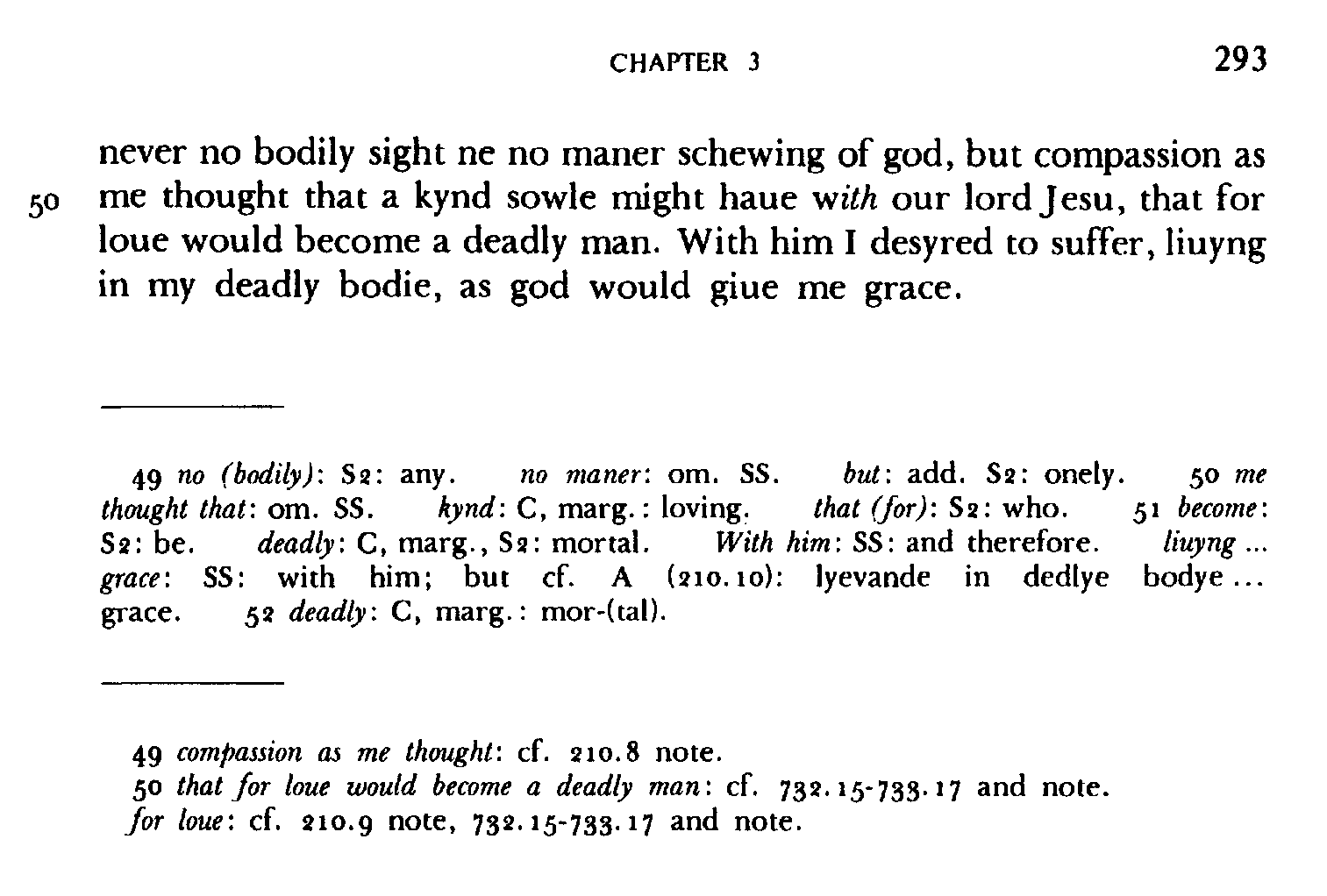
never no bodily sight ne no maner schewing of god, but compassion as 50 me thought that a kynd sowle might haue -with our lord Jesu, that for loue would become a deadly man. With him I desyred to suffer, liuyng in my deadly bodie, as god would giue me grace.
49 no (bodily): 82: any. no maner: om. SS. but: add. 82: onely.
50 me thought that: om. SS. kynd: C, marg.: loving. that (for): Ss: who.
51 become:
82: be. deadly: C, marg., 82: mortal.
With him: 88: and therefore. liuyng... grace:
SS: with him; but cf.
A (210.10): lyevande in dedlye bodye... grace.
52 deadly: C, marg.: mor-(tal).
49 compassion as me thought: cf. 210.8 note.
50 that for loue would become a deadly man: cf. 732.15-733.17 and note. for loue: cf. 210.9 note, 732.15-733.17 and note.
THE LONG TEXT
The First Reuelacion The iiij Chapter And in this sodenly I saw the reed bloud rynnyng downe from vnder f. 7V the garlande, hote and freyshely, / plentuously and liuely, right as it
5 was in the tyme that the garland of thornes was pressed on his blessed head. Right so, both god and man, the same that sufferd for me, I conceived truly and rnightly that it was him selfe that shewed it me without anie meane.
And in the same shewing sodeinly the trinitie fulfilled my hart most 4 ms: plcn- / plentuously. i Si: Here begynnith the first revelation of the pretious crownyng of Criste et cetera
(82: as mena'ond) in the first capt. And how god fullfilleth the herte with most joy, and of his greate meekenesse and how the syght of the passion of Criste is sufficient strength ageyn all temptations of the fends (82: divell), and of the gret excellency and mekenesse of the blissid virgin Mary.
3 And: om. Si.
And in this: 82: where upon. rynnyng: Si: trekelyn; 82: trickling; cf. A (210.11): trekylle.
4 garlande: 82: crown of thornes. plentuously: Si: and ryth plenteously; and so 82. and liuely, right: om. 88; but cf. A (210.12) : and lyvelye, ryght. it was: Si: it were; om. 82.
5 in: 82: at. tyme: add. Si: of his passion; and so 82. that: 82: when. garland: Ss: crown.
6 for: SS: thus for.
7 that (shewed): om. 88.
9 my: 81: the; and so 82. i and of his greate meekenesse (Si): this is perhaps implicit in 296.18: that he that is so reuerent and so dreadfull will be so homely with a synnfull creature ...; but the notion of condescension does not necessarily imply humility. Undoubtedly the author of the SS chapter-headings had in mind 'Learn of me, for I am meek and humble of heart' (Matthew
11.29).
5 the garland of thornes ...: cf. pseudo-Bonaventure: Be holde hym nowe with compassione and terdirnes of herte, hou his heued was thurghe prikkede with scharpe thornes thurghe his blesside brayne, and ofte tyme pey smote hyme with pe septure one pe heued fore scorne and dispite; and beholde his blyssede face all rynnande with rede blode (Horstman i 204; Stallings, 107-108; Ragusa and Green, 329-330). PseudoBonaventure seems to be following the Historia scholastica, which writes of the thorns:
...juncos fuisse marinos, quorum acies non minus spina pungit, quia dura est et penetrativa. Unde et poeta: Et acuta cuspide junci (PL 198 1628; Peter Comestor's poet is Ovid). On garland, see 210.12 note.
9 And in the same ... as to my sight (296.16). This is the first notable addition in the long text (cf. 210.16), and it accords withjulian's account (732.14 e.s.) of the fifteen years of meditation through which she gained new insights. The short text's narrative is in no way augmented; but she has now come to understand that this Vernicle-like vision was given to her not only, as she had prayed, to imprint her mind with Christ's
CHAPTER 4, REVELATION I
ioy,and so I
of , and so I vnderstode it shall be in heauen without end to all that shall come ther. For the trinitie is god, god is the trinitie. The trinitie is our maker, the trinitie is our keper, the trinitie is our everlasting louer, the trinitie is our endlesse ioy and our bleisse, by our lord Jesu Christ, and in our lord Jesu Christ. And this was shewed in the first syght and 15 in all, for wher Jhesu appireth the blessed trinitie is vnderstand, as to my
12 the trinitie is our (keper): SS: and.
13 the trinitie is our (endlesse): S1: and ; om.
S2. endlesse: SS: everlasting. our (bleisse): om. SS. bleisse: C: Blisse; SS : blysse.
14 and in ... Christ: om. SS. syght: om. SS.
15 wher: C: when. sufferings, but to make her understand that all three persons of the Trinity co-operated through the Son's death in our redemption, as they did in our creation and do in our preservaticn, which is the cause of our eternal joy. This is perfectly the mind of the Church, which on Good Friday sings: Crucerm tuam adoramus domine, et sanctam resurrectionem tuam laudamus et glorificamus; ecce enim propter lignum venit gaudium in universo mundo. The Trinitarian doctrine in this passage might be called a summary of Augustine, De trinitate I viii 17-18. sodeinly the trinitie fulfilled my hart most of ioy: in Eight Chapters (cf. 261].53 note) we read: pe v degre is whanne a maw bigynnep for to taaste sopfastly pe eernes of eendelees ioie, and is reised up to pe biholdyng of heuenli pingis, and panne feelip and perseyuep he a glymerynge of heuenly blis. And panne seep he ... how pat alle illumynaciouns and alle gracis of charyte and of goodnes descenden out of pe blessid trynyte vnspeccable in to Ihesu Crist (MS BN Fonds anglais 41, f. 148'; Jones, 97).
It will be julian's constant practice in the long text to use the figure compar to express her insights into the mystery of the Trinity, as here: And in the same shewing / sodeinly the trinitie fulfilled my hart most of ioy / and so I understode / it shall be in heauen without end (two short and two long balancing cola); to all that shall come ther / For the trinitie is god / god is the trinitie / The trinite is our maker / the trinitie is our keper (five equal cola, with chiasmus in the second and third, and repetitio in the second, fourth and fifth); the trinitie is our everlasting louer / the trinitie is our endlesse ioy and our bleisse (two longer cola continuing the repetitio, with dissolutio); by our lord Jesu Christ / and in our lord Jesu Christ (two short concluding cola with conversio).
10 to all that shall come ther: on this first occasion when she mentions spiritual consolation, she refers it both to the happiness of heaven, and to 'all that shall be saved'.
13 by our lord Jesu Christ, and in our lord Jesu Christ: Julian is recalling Romans 11.36: For of him and by him and in him are all things — with which she would also be familiar from the doxology concluding the canon of the Roman Mass. Mechtild of Hackborn in her Book of Special Grace recounts a vision of the doxology being sung at a heavenly liturgy: Ex quo omnia; thay sange that for while thay were in erth thay knewe hym of whome come alle goodes ande goddenesse, be whome alle thynges be made in hevene ande in erthe, ande in whome alle goodes ande goodnesses be hydde (Halligan, 148).
15 for wherjhesu appireth the blessed trinitie is vnderstand: cf. the Scale, II chapter 32: and soply I wote not what were more lefe to swilk a soule pat hap felt a litel of it (sc. the knowledge and love of Jesus) pan vtterly alle oper pinges left and set at no3t only perto for to hafe clerer si3t and clenner luf of Jhesu in whome is alle pe blissid trinite (MS BM
Harley 6579, f. ]io8v; Underfill, 373-374). vnderstand: cf. 329.46, vnderstonde. In either case, this is the past participle. Cf. NED,