
282 The Long Text
THE LONG TEXT
f. 8r sight. And I sayd: Benedicite dominus. This I sayd for / reuerence in my menyng, with a mightie voyce, and full greatly was I a stonned for wonder and marvayle that I had that he that is so reuerent and so dreadfull will be so homely with a synnfull creature liueing in this wretched flesh.
Thus I toke it for that tyme that our lord Jhesu of his curteys loue would shewe me comfort before the tyme of my temptation; for me thought it might well be that I should by the sufferance of god and with his keping be tempted of fiendes before I should die. With this sight of his blessed passion, with the godhead that I saw in my vnderslanding, I 25 knew well that it was strenght inough to me, ye, and to all creaturs
16 dominus: SS: domine.
18 so (dreadfull): om. SS.
19 homely: C, marg., SI, marg., scr.: familiar. this: om. SS.
20 Thus: SS: this. it: om. SS. that our lord ... the tyme: om. SS.
22 it might ... I should: om.
SS. and with: om.
SS.
23 his keping: SS: I should. of fiendes: S2: by the devils. should die: Si: dyed; and so S2.
24 his (blessed): SS: the. S2, marg., scr.: A remedy against temptacion.
Understand, u.: 'In the 15th and i6th cents, three forms of the past pple. were current, viz. (a) the original understanden ... -stonden ... (b) the reduced form of this, understande
(stonde), stand ... (c) the new form understanded (stonded), very common from about 1530 to 1585 ... The modern form understood came into use in the latter part of the16th cent, and was usual by 1600'.
16 And I sayd ... all ghostely enemies (297. 27): this corresponds with the short text,
210.16-211. 27.
Benedicite dominus: cf. 211.17 and note.
This I sayd ... : cf. the short text, 211.17-20. By the addition here of that is so reuerent and so dreadfull, Julian has produced balanced cola: This I sayd for reuerence in my menyng with a mightie uoyce / and full greatly was I a stonned for wonder and marvayle that I had / that he that is so reuerent and so dreadful will be so homely / with a synnfull creature liueing in this wretched flesh. This serves to emphasize the oppositio, so reuerent and so dreadfull / so homely, merely hinted at in the earlier version; and there is traductio (reuerence ... reuerent), and lautologia (wonder and marvayle).
19 homely: cf. 211.19 note.
22 by the sufferance of god: cf. 211.23 note.
23 With this sight...: cf. 211.24 note.
24 his blessed passion ... was strenght inough to me: clearly,Julian here has in mind 'Passio
Christi conforta me' from the Anima Christi. For evidence of the complete prayer's circulation in her time, including MS BM Harley 1260, written in England c. 1370, cf. H.
Thurston, 'Anima Christi'. Some of its petitions were known to the author of the Ancrene Riwle and to much earlier writers; cf. E. Colledge: The Mediaeval Mystics of England,
11-12, and 'Early English Religious Literature II' (inj. Walsh: Pre-Reformation English
Spirituality), 36-37. that I saw: cf. 211.25 note.
CHAPTER 4, REVELATION I
liuyng that sould be saued, against all the fiendes of hell, and against all ghostely enemies. f8v in this he brought our ladie sainct Mari to my vnderstanding. / I saw her ghostly in bodily lykenes, a simple mayden and a meeke, yong of 30 age, a little waxen aboue a chylde, in the stature as she was when she conceivede. Also god shewed me in part the wisdom and the truth of her sowle, wher in I vnderstode the reuerent beholding, that she beheld her god, that is her maker, marvayling -with great reuerence that he would be borne of her that was a symple creature of his makyng. And 35 this wisdome and truth, knowing the greatnes of her maker and the litdehead of her selfe that is made, made her to say full meekely to Gabriell: Loo me here, gods handmayden. In this syght I did vnderstand
31 With 'Oure gracious and goode lorde god shewed me", the first extract in W begins.
34 makyng. And: ms: makyng. For this was her marvayling, that he that was her maker would be borne of her that was made. And ...
37 Before this sentence, in W follows: This wysedom and treuth ... all creaturys; cf. p. 310.4-311.11.
26 that sould... saued: om. SS.
27 ghostely: S2: spiritual. enemies: Si: temptation; and so S2; but cf. A (14 f. 99'): enmyes.
28 ladie sainct Mari: S1: blessid lady; and so 82.
29 a (meeke): om. 82.
30 age: add. Si: and; and so 82. waxen: C, marg.: grown. as: S1: that; om.
S2.
31 me: om. SS. the (truth): om.
82.
32 her: W: pe. sowle'. add. W: of oure blessed lady saynt Mary. reuerent:
C: reverence. that (she): 82: wherewith.
33 that is her: Si: and; and so 82.
34 (ms) makyng. And this...: so C.
35 littlehead: 82: littleness; and so W.
36 that is: S2: who was. made (her): W: caused. made her: S2: by him caused her. to (say): om.
SS.
37 here: om.
SS. did vnderstand:
S1: vnde(r)stoode; and so S2, W.
28 Here some matter from the short text is re-arranged. The vision of Mary, 297.28298.40, corresponds with 213.24-214.30, and the 'ghostly sight of his homely loving',
299.2-299.8, corresponds with 212.1-212.7. See Introduction, IX i and 3.
29 ghostly in bodily lykenes: cf. the Cloud, where the author, writing of the visions of Christ given to St. Stephen and to St. Martin, observes: pof al pei sie soche Binges wip peire bodely iZenn, it was schewyd bot in myracle and in certefiing of ping pat was goostly (Hodgson, 106).
30 a little waxen aboue a chylde: not in the short text; cf. 213.26. In the 'Gospel of the Birth of Mary', spuriously attributed to Jerome, which 'passed almost bodily into the Golden Legend of James of Voragine' (M. R. James, The Apocryphal New Testament, 79),
Mary's betrothal took place when she was fourteen. See 213.26 note.
34 The reading in P, which C follows, is a plain case of dittography, as is the parallel passage in A (cf. 214.30 and note). This shows that there has been contamination between A and P or their ancestors.
37 Loo me here, gods handmayden: cf. Luke 1.38.
THE LONG TEXT
verily that she is more then all that god made beneth her in wordines f9r and in fullhead; for aboue / her is nothing that is made but the blessed
40 manhood of Christ, as to my sight.
38 verily: Si, W: sothly; S2: truly. wordines: C: worthines; SS: worthyness; W: worthynes.
39 in (fullhead): om. SS, C. fullhead: C, marg.: excellency; SS: grace. is (nothing): W; tyr is.
40 manhood: om. SS; S2 add. marg. al. m. sight: add. W: and this our good lord shewed to myne vnderstondywg in lernyng of vs. Also I saw ...
38 in wordines and in fullhead: this seems to be Julian's gloss upon 'gratia plena' (Luke
1.28). In A Song of the Nativity, copied by John Grimston (cf. 285.11 note) we read: Ecce ancilla domini, I |>at was hire ansuere, / 'Wolde god i were worpi /His blisful sone to bere' (C. Brown, XIV 76). The substitution in SS,grace, recognizes the allusion, but suppresses Julian's insistence upon 'plena'. Though this vision is of the Visitation and the Annunciation, Mary is in it the only human figure. This may reflect a consciousness, very natural in a nun or solitary, of Mary's loneliness. Jerome taught that she gave birth unassisted: Nulla ibi obstetrix, nulla muliercularum +sedulitas intercessit (PL 23
20); and in an anonymous English poem recorded in the fifteenth century, De arte lacrimandi, she is alone and helpless, so that Gabriel and a band of angels come to help her (Garrett, 273).
CHAPTER 5, REVELATION !
The vlh Chapter In this same tyme that I saw this sight of the head bleidyng, our good lord shewed a gostly sight of his homely louyng. I saw that he is to vs all thing that is good and comfortable to our helpe. He is oure clothing,
that for loue wrappeth vs and wyndeth vs, halseth vs and all becloseth vs, hangeth about vs for tender loue, pat he may never leeue vs. And so in this sight I saw that he is all thing that is good, as to my vnderstanding.
And in this he shewed a little thing, the quantitie of an haselnott, 10 lying in pe palme of my hand, as me semide, and it was as rounde as a i Si: How god is to us every thing that is gode, tenderly wrappand us. And all thing that is (S2: things pat are) made in regard to almighty god it is (S2: are) nothing, and here (S2: pat) man hath no rest till he nowteth himselfe and all thing (Sa: things) for the love of god.
In this same ... homely louyng: om. W. this (same): Sa: the. that I saw... bleidyng: om. SS. good: om. SS.
3 a: SS: to me a. homely: C, marg.: friendly. he (is to): W: our good lord. all: SS: every.
4 to oure helpe: SS: for us.
5 that: W: |je which. and wyndeth vs: om. SS. halseth: Sa: hedseth; C, marg.: embraceth. all becloseth: W: and ablyth vs and.
6 hangeth about vs: om.
SS.
And so ... I saw: om. SS.
7 that he is: Si: being to vs; and so Sa. all: Sa: every.
9 And: SS: also. shewed: add. W: me. the quantitie: 82: of the bignes.
10 lying: om. SS. as me semide: om. SS; W: as it had semed. a: W: any. i in regard to almighty god it is nothing (Si): again, this is a legitimate deduction from Julian's account of the ratiodnatio concerning the 'little thing', but she does not state this conclusion. a In this same tyme ... betweene my god and me (300.32): this corresponds with the short text, 212.1-313.33.
In this same tyme: this first paragraph of chapter 5 is composed in pairs of cola giving compares.
5 that for loue wrappeth vs and wyndeth vs: cf. a periapt, to God the Son, in MS BM
Harley 2445: Dominus Jhesus Christus apud me sit... circa me sit, ut (me) conseruet, ante me sit, ut me deducat, post me sit, (ut) me iustificet, supra me sit, vt me benedicat
(f. 106).
6 pat he may never leeue vs: cf. a 13.5 note.
7 he is all thing that is good: cf. 313.6 note.
10 lying in pe palme of my hand: cf. a 12.9 note. it was as rounde as a balle: it would seem natural to Julian that the created universe should be represented to her as spherical. Charles Singer records the development of Hildegard of Bingen's theory of the structure of the universe, 'so ... as to bring it more into line with accepted views which treated the universe as a series of concentric spheres'; and he provides a diagram and mediaeval illustrations of her views (From Magic to Science, 211-212, figs. 100, 101, 103).
THE LONG TEXT
balle. I looked theran with the eye of my vnderslanding, and thought: f. gv What may this be? And it was answered generaelly thus: / It is all that is made. I marvayled how it might laste, for me thought it might sodenly haue fallen to nawght for littlenes. And I was answered in my
15 vnderstanding: It lasteth and ever shall, for god loueth it; and so hath all thing being by the loue of god.
In this little thing I saw iij propreties. The first is Ipat god made it, the secund that god loueth it, the thirde that god kepyth it. But what behyld I ther in? Vercly, the maker, the keper, the louer. For till I am
substantially vnyted to him I may never haue full reste ne verie blisse; \>at is to say that I be so fastned to him that ther be right nought that is made betweene my god and me.
This little thing that is made, me thought it might haue fallen to 19 / ther in: add, marg. scr.
11 the (eye): om. Si. eye: Ss: eyes. and (thought): W: and I.
13 might (laste):
82: could.
14 littlenes: Si: littil; and so 82.
16 being: Si: the being; 82: a being; W: his begynnyng; cf. A (213.15): beynge.
18 that (god loueth): SS: is that; and so W. it (the thirde): add. W: and. that (god kepyth): C: is that; and so W.
19 behyld I ther in: SS: is to me; W: is pis to me; cf. A (213.18): is that to me.
Merely: Si, W: sothly;and so 82; cf. A (213.18): sothelye. the (louer): Si: and the; and so Sa, W. louer: add. Si: I canot tell; and so 82.
For: om. 82.
20 vnyted: Si: vnyd; 82: onyd; and so W. verie: 82: true.
21 be (right): Si: \s. right nought: W: no thing.
23 This little... littlenes: om. SS.
11 / looked theran: cf. 212.10 note. with the eye of my vnderstanding: this addition to the short text enables Julian to differentiate between what she has been shown (our good lord shewed a ghostly sight — 299.2), and the understanding later given in answer to her questions. Cf. Introduction, IX 2,
'Criteria of Analysis'.
12 It is all that is made: cf. 212.11 note.
17 propreties: cf. NED Property, sb. 5 ('An attribute or quality'), 6 (The characteristic quality of a person or thing'). Either sense is there illustrated from Robert of Brunne,
Handlyng Synne, A. D. 1303, the earliest example for any sense.
The first is...: for the figure here, cf. 213.16 note.
18 But what behyld I ther in? Cf. 213.17, which indicates that SS and W have retained
A's reading. It is not that Julian saw her creator — she saw a small spherical object — but that the object's spiritual significance for her is the Trinitarian work of creation, love and preservation (cf. 294.9 note). The P scribe's lapse of the pen suggests that the variant was created in this manuscript.
This is a second ratiodnatio which, following the first, is also a form of conduplicatio.
19 Verely, the maker, the keper, the louer: since Julian has just written The first is (hat god made it..., we may suppose that she wrote the maker, the louer, the keper; but the manuscripts do not support an emendation.
CHAPTER 5, REVELATION I
nought for littlenes. Of this nedeth vs to haue knowledge, that vs lyketh lor nought all thing that is made, for to loue / and haue god that is vn26 made. For this is the cause why we be not all in ease of hart and of sowle, for we seeke heer rest in this thing that is so little, wher no reste is in, and we know not our god, that is almightie, all wise and all good, for he is verie reste. God will be knowen, and him lyketh that we rest vs
30 in him; for all that is beneth him suffyseth not to vs. And this is the cause why that no sowle is in reste till it is noughted of all thinges that is made. When she is wilfully noughted for loue, to haue him that is all, then is she able to receive ghostly reste.
And also our good lord shewed fcat it is full great plesannce to him 33 she: ms: he, w. V add.
24 knowledge, that vs lyketh: Si: knoweing of the litdehead of creatures; 82: to know the littlenes of creatures: W: knowynge £at it is lyke.
25 nought (all): Si: to nowtyn; and so W; 82: and to noughten. thing: om. 82. loue: add. C: god. haue: Si, marg., al. m.: know.
26 82, marg., scr.: N B the cause of our trouble. why: C: which; W: why pa/, be: 82: are. all in: 82: at full. of (sowle): om. C, SS, W.
27 heer: om. 82. this thing: Si: these things; 82: those things. wher: Si: wherin; and so 82.
28 is (in): 82: are. we (know): om. 88, W. and (all): om.
SS.
29 verie: Si: the very. him lyketh:
W: it likith hym. vs: om.
SS.
30 suffyseth not to: 82: cannot satisfied. to: om. SS, C.
31 why: om.
82. in reste: Si: restid; and so W; 82: att rest. is (noughted): W: be. noughted:
C, marg.: emptied. thinges: om. W.
32 is (made): C, 82: are.
When: W: and when. she: 88, W: he.
34 And: om. SS, W. good lord: Si: lord god; and so 82; om. W. 'good'. plesannce: C, 82: pleasure.
24 Of this nedeth ... to receive ghostly reste (301.33): this corresponds with the short text,
215.41-216.53; but see Introduction, IX 3, and 215.42 note, for discrepancies. that vs lyketh nought all thing that is made /for to loue and haue god that is vnmade: cf.
215.44-45, where there is the same figure, compar, with double contentio: made / vnmade, nought /loue and haue. that vs lyketh nought all thing that is made: cf. the version of the spurious Golden Epistle of St. Bernard (in the Amherst MS): The fryste is that ye sett no more by transitory and erthely thynges than yf J>ay were not (E. Colledge, The Golden Epistle of St. Bernard',
123).
25 nought: 'to despise'; cf. Si, 82 and 215.43 note.
29 God will be knowen ... to receive ghostly reste: cf. I Corinthians 6.17: But he who is joined to the Lord is one spirit. This is quoted and translated by the Cloud-author in An Epistle of Prayer: Whoso drawep nere to god ... he is o sperit with god (Hodgson, Deonise
56). Julian makes the same deductions as the Epistle: 'to haue him that is all', the soul must be 'naughted for loue'.
32 noughted: see 216.51, 52 note.
34 And also our good lord shewed: with this, a second, longer addition begins, which continues to and passyth alle creatours (311.10). As with the first (cf. 294.9 note) it adds nothing to the narrative of the short text, but provides meditative material derived from it. One important statement will be the superiority of unitive over intercessory prayer, 'making means' (304.2 e.s.), but God's immediate commerce with the soul has already been in Julian's mind. Cf. 210.15, 294.6.
THE LONG TEXT
35 that a sely sowle come to him naked, pleaynly and homly. For this is the kynde (yernyng) of the sowle by the touchyng of the holie ghost, as by iov the vnderstandyng that I haue in this schewying: / God of thy goodnes geue me thy selfe, for thou art inough to me, and I maie aske nothing that is lesse that maie be full worshippe to thee. And if I aske anie thing
40 that is lesse, ever me wanteth; but only in thee I haue all.
And these wordes of the goodnes of god be full louesum to the sowle, 36 yernyng: ms: dwellyng.
35 naked: Si: nakidly; and so 82, W. pleaynly: C: plainlie; Si: pleynly; W: pleynely; 82: and plainly.
36 yernyng: so SS; (ms) dwellyng: so C.
37 that: 82: be.
</:W:for.
38 geue: W: yeue vnto, 39 full: W: fullie. worshippe: om.
82.
40 ever me wanteth: 82:1 am ever in want.
41 of the goodnes of god: W: god of thy goodnes it; om. 88. be: Si: arn; and so 82, W.
36 yernyng: the W reading, supported by SS, has here been preferred to C, P, because
'dwelling' introduces an aspect of immanence which fits neither with what goes before nor with the prayer that follows, which seems in fact to be 'this ... yearning', the expression of the longings of Julian's soul. Later, she will introduce, with the greatest care, her teachings on indwelling; but they have no place here, nor would they be so abruptly begun. 'Dwellyng' could only mean God; but she is far toojohannine to have written in that case 'this' and not 'he'.
37 God of thy goodnes ... I haue all: she is here recalling Psalm 72.25-26: For what have I in heaven, and besides thee what do I desire upon earth? For thee my flesh and my heart have fainted away. Thou art the God of my heart and the God that is my portion forever; and also John 6.35 and 69: He who comes to me shall not hunger ... Lord, to whom shall we go? Thou hast the word of life. So John Whiterigg, the monk of Durham who retired to the priory's solitary cell on Fame Island, where he seems to have received visions, and who died there in 1371 (H. Farmer, The Monk of Fame, 3-6,
18), wrote in his 'Meditation to Christ Crucified': Aliud nolo triticum nisi temetipsum: da michi ergo teipsum et cetera tolle tibi. Quid enim michi est in celo, et quid plus quam te optaui super terram? Certe quicquid est preter te non michi sufficit preter te, nee est munus apud te quod tantum desidero sicut te. Si ergo uelis replere in bonis desiderium meum, nichil aliud michi des nisi temetipsum (Farmer: 'Meditations', 162; cf. The Monk of Fame, 37). Julian's treatment of this theme contrasts significantly with that of Mechtild of Hackborn in her Book of Special Grace: Lorde, I desyre noothynge. Of my wille I seke noght hereof, ande y wille noo othere thynge botte pat bis daye bou be preysede ande worscheppede of byselfe, ande in byselfe, ande be thyselfe, as hyelye ande as perfietlye as euere bou mayste bee commendede, preysede and worscheppede of alle creatures in hevene ande in erth (Halligan, 334). In the prayer, we have a good example of Julian's ratiodnatio, reasoning by hypothesis.
CHAPTER 5, REVELATION 1
and full neer touching the will of our lord, for his goodnes fulfillith all his creaturs and all his blessed workes (and) ouer passith without end.
For he is the endlesshead and he made vs only to him selfe and restored 45 vs by his precious passion, and ever kepeth vs in his blessed loue; and all this is of his goodnes.
^fulfillith: over erasure: ... ndeth.
43 workes ouer passith: cane. and (ouer): om. ms.
42 touching: SS: touchen. will: Ss: well; marg., al. m.: agreeing to his will. lord: SS: god. fulfillith: Si: comprehend! th; and so 82, W.
43 and (ouer): from Si; and so 82, W; om. C.
44 endlesshead: C: endlesse head. he (made): SS, W: he hath.
45 precious: Si: blissid; and so 82. ever: om. SS.
42 comprehendith (SS): if this, with which P seems originally to have agreed, represents what Julian wrote, rather than ful/tllith, she may have had in mind the prologue to John:
And the light shines in darkness, and the darkness did not comprehend it, where the author, like Julian in this chapter, is relating the Genesis account of creation to salvation history.
44 For he is the endlesshead and he made vs only to him selfe and restored vs ... and ever kepeth vs: this is very like what the Cloud author writes in The Booh of Privy Counselling: Bot where schal soche a soule be founden so frely fastnyd and ... so fully mekid in nou3tnyng of it self and so louely led and fed in Jje loue of oure lorde, wi£> ful knowing and felyng of his almijtyheed, his vnwetyn wisdom and his glorious goodnes; hou he is one in alle and alle in hym ... so {>at for J)is nobil nou3tnyng of it self in verrey meeknes ... it deseruej) to haue god ... sokouryng it and kepyng it? (Hodgson, Cloud, 149).
This is a compar of five cola: For he is the endlesshead / and he made vs only to him selfe / and restored vs by his precious passion / and ever kepeth vs in his blessed loue / and all this is of his goodnes, a close-knit Trinitarian statement, with 'God' as the subject of each colon, governing a verb expressing appropriation: made (Father), restored (Son), kepeth (Spirit), and with the first and last cola expressing the unity. Cf. the Athanasian Creed: Pater eternus, filius eternus, spiritus sanctus eternus. There is also initial repetitio (and ... and ... and ... and) and medial repetitio (vs ... vs ... vs). endlesshead: not in NED; MED's only two instances are from Rolle's Psalter. he made vs only to him selfe: cf. 216.49 note.
THE LONG TEXT
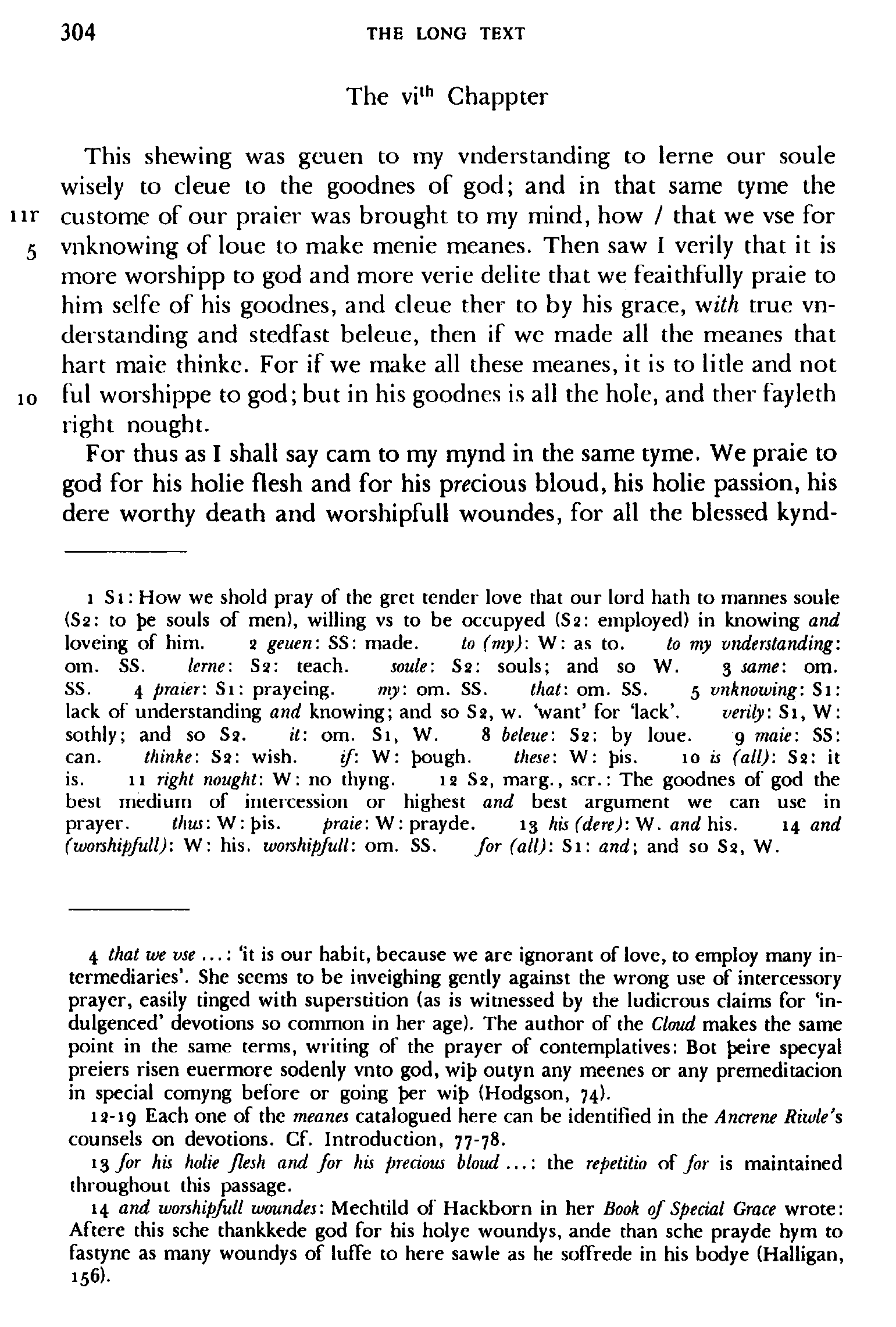
The vith Chappter This shewing was geuen to my vnderstanding to lerne our soule wisely to cleue to the goodnes of god; and in that same tyme the nr custome of our praier was brought to my mind, how / that we vse for 5 vnknowing of loue to make menie meanes. Then saw I verily that it is more worshipp to god and more verie delite that we feaithfully praie to him selfe of his goodnes, and cleue ther to by his grace, with true vnderstanding and stedfast beleue, then if we made all the meanes that hart maie thinke. For if we make all these meanes, it is to litle and not
ful worshippe to god; but in his goodnes is all the hole, and ther fayleth right nought.
For thus as I shall say cam to my mynd in the same tyme. We praie to god for his holie flesh and for his precious bloud, his holie passion, his dere worthy death and worshipfull woundes, for all the blessed kyndi Si: How we shold pray of the gret tender love that our lord hath to marines soule
(82: to J>e souls of men), willing vs to be occupyed (82: employed) in knowing and loveing of him.
2 geuen: SS: made. to (my): W: as to. to my vnderstanding: om.
SS. lerne: 82: teach. soule: 82: souls; and so W.
3 same: om.
88.
4 prater: Si: prayeing. my: om. SS. that: om. SS.
5 vnknowing: Si: lack of understanding and knowing; and so 82, w. 'want' for 'lack'. verily: Si, W: sothly; and so 82. it: om. Si, W.
8 beleue: 82: by loue.
9 maie: SS: can. thinke: 82: wish. if: W: Jiough. these: W: }MS.
10 is (all): 82: it is.
11 right nought: W: no thyng.
12 82, marg., scr.: The goodnes of god the best medium of intercession or highest and best argument we can use in prayer. thus: W: f>is. praie: W: prayde.
13 his (dere): W. and his.
14 and (worshipfull): W: his. worshipfull: om. SS. for (all): Si: and; and so 82, W.
4 that we vse ...: 'it is our habit, because we are ignorant of love, to employ many intermediaries'. She seems to be inveighing gently against the wrong use of intercessory prayer, easily tinged with superstition (as is witnessed by the ludicrous claims for 'indulgenced' devotions so common in her age). The author of the Cloud makes the same point in the same terms, writing of the prayer of contemplatives: Hot peire specyal preiers risen euermore sodenly vnto god, wip outyn any meenes or any premeditation in special comyng before or going f>er wip (Hodgson, 74).
12-19 Each one of the meanes catalogued here can be identified in the Ancrene Riwle's counsels on devotions. Cf. Introduction, 77-78.
13 for his holie flesh and for his precious bloud...: the repetitio of for is maintained throughout this passage.
14 and worshipfull woundes: Mechtild of Hackborn in her Book of Special Grace wrote:
Aftere this sche thankkede god for his holye woundys, ande than sche prayde hym to fastyne as many woundys of luffe to here sawle as he soffrede in his bodye (Halligan,
156).
CHAPTER 6, REVELATION I
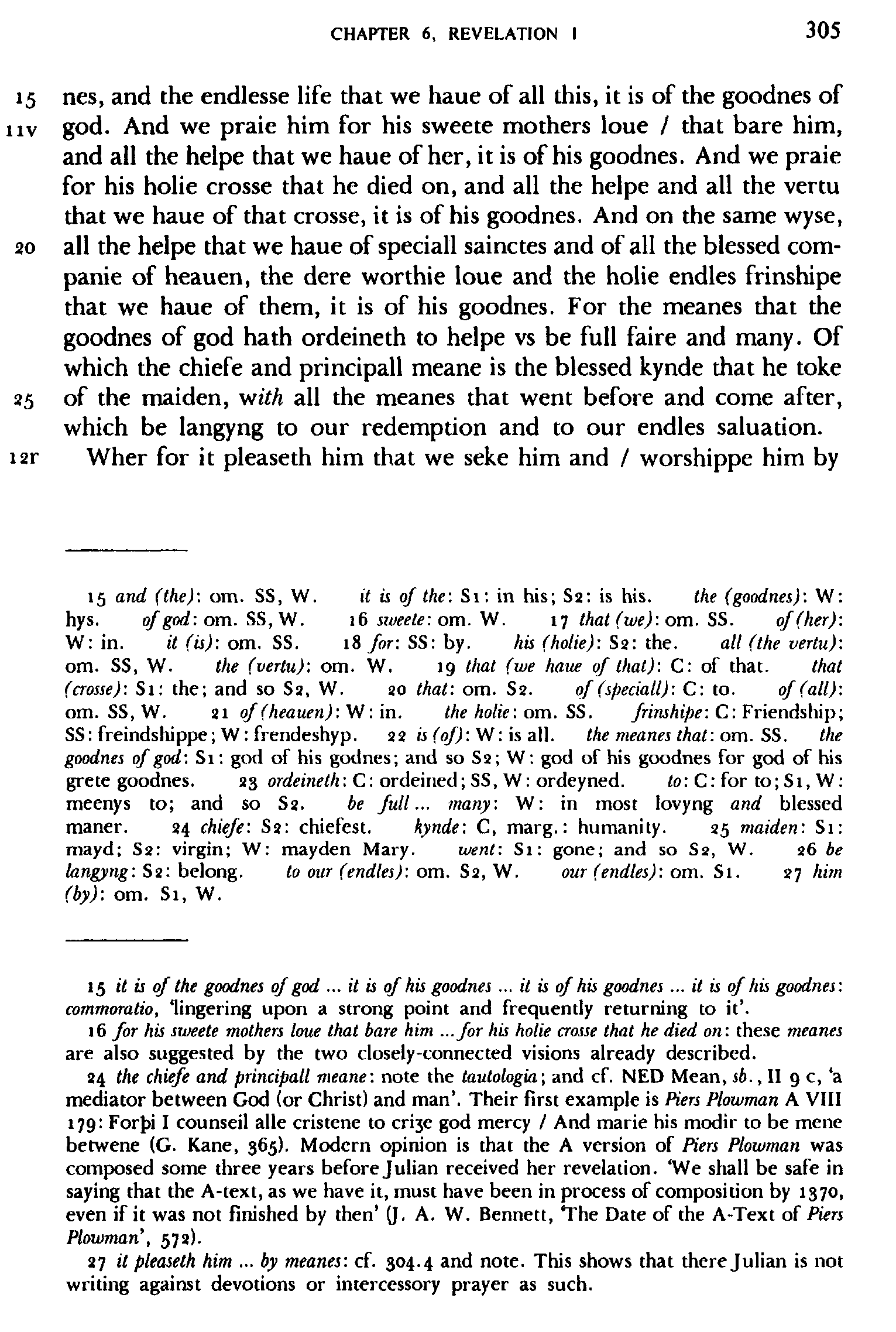
15 nes, and the endlesse life that we haue of all this, it is of the goodnes of iiv god. And we praie him for his sweete mothers loue / that bare him, and all the helpe that we haue of her, it is of his goodnes. And we praie for his holie crosse that he died on, and all the helpe and all the vertu that we haue of that crosse, it is of his goodnes. And on the same wyse,
all the helpe that we haue of special! sainctes and of all the blessed companie of heauen, the dere worthie loue and the holie endles frinshipe that we haue of them, it is of his goodnes. For the meanes that the goodnes of god hath ordeineth to helpe vs be full faire and many. Of which the chiefe and principall meane is the blessed kynde that he toke
of the maiden, with all the meanes that went before and come after, which be langyng to our redemption and to our endles saluation. i2r Wher for it pleaseth him that we seke him and / worshippe him by 15 and (the): om. SS, W. it is of the: Si: in his; Sa: is his. the (goodnes): W: hys. ofgod:om.SS,W.
16 sweete: om. W.
17 that (we): om. SS. of (her):
W: in. it (is): om. SS.
18 for: SS: by. his (holie): Sa: the. all (the vertu): om. SS, W. the (vertu): om. W.
19 that (we haue of that): C: of that. that (crosse): Si: the; and so Sa, W.
20 that: om. Sa. of (speciall): C: to. of (all): om. SS,W.
21 of (heauen): W: in. the holie: om. SS. frinshipe: C: friendship; SS: freindshippe; W: frendeshyp. a2 is (of): W: is all. the meanes that: om. SS. the goodnes of god: Si: god of his godnes; and so Sa; W: god of his goodnes for god of his grete goodnes.
23 ordeineth: C: ordeined; SS, W: ordeyned. to: C: for to; S i, W: meenys to; and so Sa. be full... many: W: in most lovyng and blessed maner.
24 chiefe: Sa: chiefest. kynde: C, marg.: humanity.
35 maiden: Si: mayd; Sa: virgin; W: mayden Mary. went: Si: gone; and so Sa, W.
26 be langyng: Sa: belong. to our (endles): om. Sa, W. our (endles): om. Si.
27 him (by): om. Si, W.
15 it is of the goodnes of god ... it is of his goodnes ... it is of his goodnes ... it is of his goodnes: commoratio, 'lingering upon a strong point and frequently returning to it'.
16 for his sweete mothers loue that bare him ...for his holie crosse that he died on: these meanes are also suggested by the two closely-connected visions already described.
24 the chiefe and principall meane: note the tautologia; and cf. NED Mean, sb., II 9 c, 'a mediator between God (or Christ) and man'. Their first example is Piers Plowman A VIII 179: ForJ)i I counseil alle cristene to cri3e god mercy / And marie his modir to be mene berwene (G. Kane, 365). Modern opinion is that the A version of Piers Plowman was composed some three years before Julian received her revelation. 'We shall be safe in saying that the A-text, as we have it, must have been in process of composition by 1370, even if it was not finished by then' (J. A. W. Bennett, *The Date of the A-Text of Piers
Plowman', 572).
27 it pleaseth him ... by meanes: cf. 304.4 and note. This shows that there Julian is not writing against devotions or intercessory prayer as such.
THE LONG TEXT
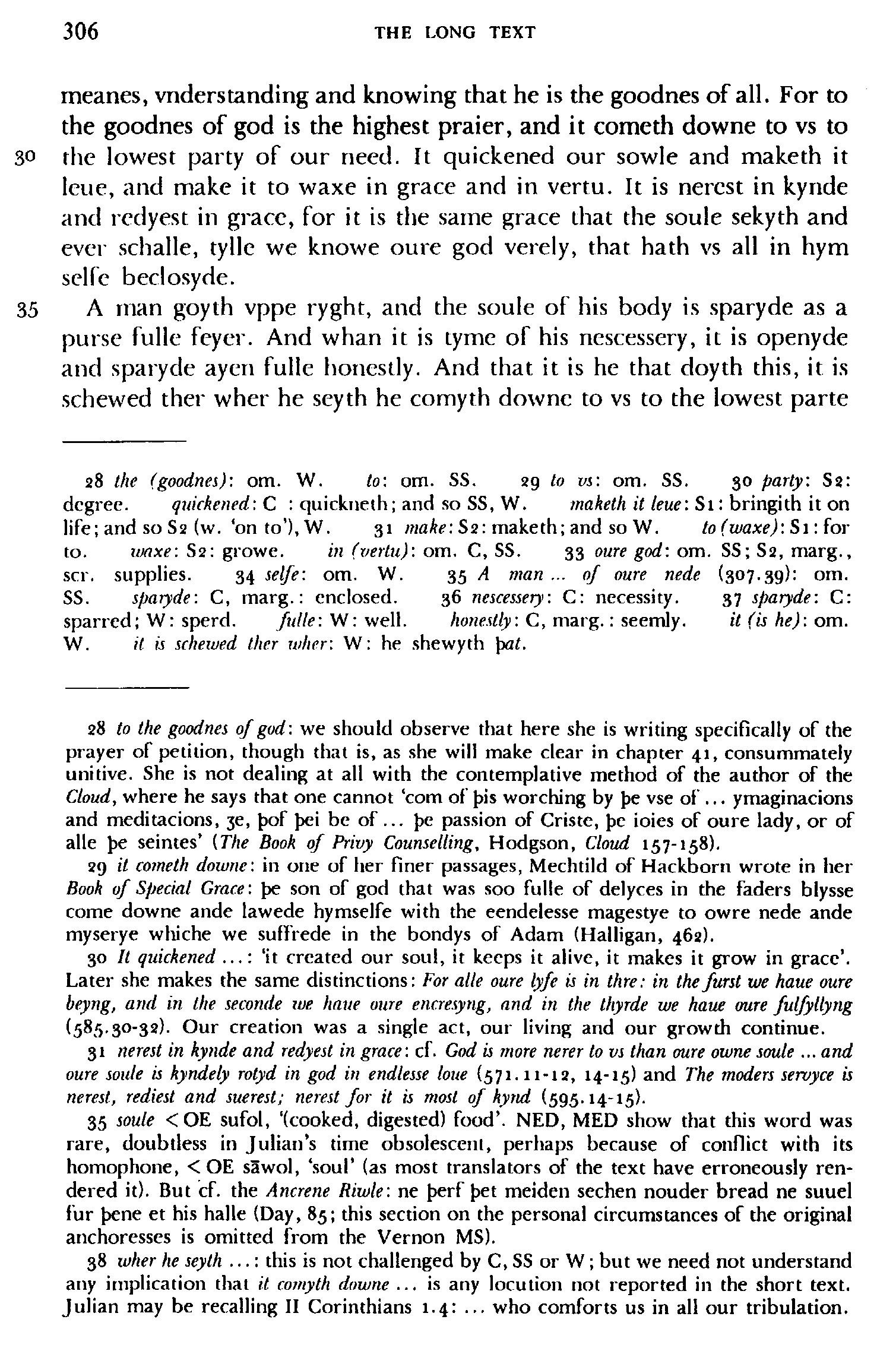
rneanes, vnderslanding and knowing that he is the goodnes of all. For to the goodnes of god is the highest praier, and it cometh downe to vs to 3° the lowest party of our need. It quickened our sowle and maketh it leue, and make it to waxe in grace and in vertu. It is nerest in kynde and rcdyest in grace, for it is the same grace that the soule sekyth and ever schalle, tylle we knowe oure god verely, that hath vs all in hym selfe beclosyde.
A man goyth vppe ryght, and the soule of his body is sparyde as a purse fulle feyer. And whan it is tyme of his nescessery, it is openyde and sparyde ayen fulle honestly. And that it is he that doyth this, it is schewed ther wher he seyth he comyth downe to vs to the lowest parte
28 the (goodnes): om. W. to: om. SS.
29 to vs: om. SS.
30 party: 82: degree. quickened: C : quickneth; and so SS, W. maketh it leue: Si: bringith it on life; and so 82 (w. 'on to'), W.
31 make: S s : maketh; and so W. to (waxe): Si: for to. waxe: 82: growe. in (vertu): om. C, SS.
33 oure god: om. SS; 82, marg., scr. supplies.
34 selfe: om.
35 A man ... of oure nede (307.39): om.
SS. sparyde: C, marg.: enclosed.
36 nescessery: C: necessity.
37 sparyde: C: sparred; W: sperd. fulle: W: well. honestly: C, marg.: seemly. it (is he): om.
W. it is schewed ther wher: W: he shewyth \>at.
28 to the goodnes of god: we should observe that here she is writing specifically of the prayer of petition, though that is, as she will make clear in chapter 41, consummately unitive. She is not dealing at all with the contemplative method of the author of the Cloud, where he says that one cannot 'com of Jjis worching by Jje vse of ... ymaginacions and meditacions, 36, J>of t>ei be of ... }>e passion of Criste, J>e ioies of oure lady, or of alle £>e seintes' (The Book of Privy Counselling, Hodgson, Cloud 157-158).
29 it cometh downe: in one of her finer passages, Mechtild of Hackborn wrote in her
Book of Special Grace: J>e son of god that was soo fulle of delyces in the faders blysse come downe ande lawede hymselfe with the eendelesse magestye to owre nede ande myserye whiche we suffrede in the bondys of Adam (Halligan, 462).
30 It quickened ...: 'it created our soul, it keeps it alive, it makes it grow in grace'.
Later she makes the same distinctions: For alle oure lyfe is in thre: in thefurst we haue oure beyng, and in the seconde we haue oure encresyng, and in the thyrde we haue oure fulfyllyng
(585.30-32). Our creation was a single act, our living and our growth continue.
31 nerest in kynde and redyest in grace: cf. God is more nerer to vs than oure owne soule ... and oure soule is kyndely rotyd in god in endlesse loue (571.11-12, 14-15) and The moders seruyce is nerest, rediest and suerest; nerest for it is most of kynd (595.14-15).
35 soule <OE sufol, '(cooked, digested) food'. NED, MED show that this word was rare, doubtless in Julian's time obsolescent, perhaps because of conflict with its homophone, < OE sawol, 'soul' (as most translators of the text have erroneously rendered it). But cf. the Ancrene Riwle: ne f>erf {>et meiden sechen nouder bread ne suuel fur Jjene et his halle (Day, 85; this section on the personal circumstances of the original anchoresses is omitted from the Vernon MS).
38 wher he seyth ...: this is not challenged by C, SS or W; but we need not understand any implication that it comyth downe ... is any locution not reported in the short text.
Julian may be recalling II Corinthians 1.4: ... who comforts us in all our tribulation.
CHAPTER 6, REVELATION 1
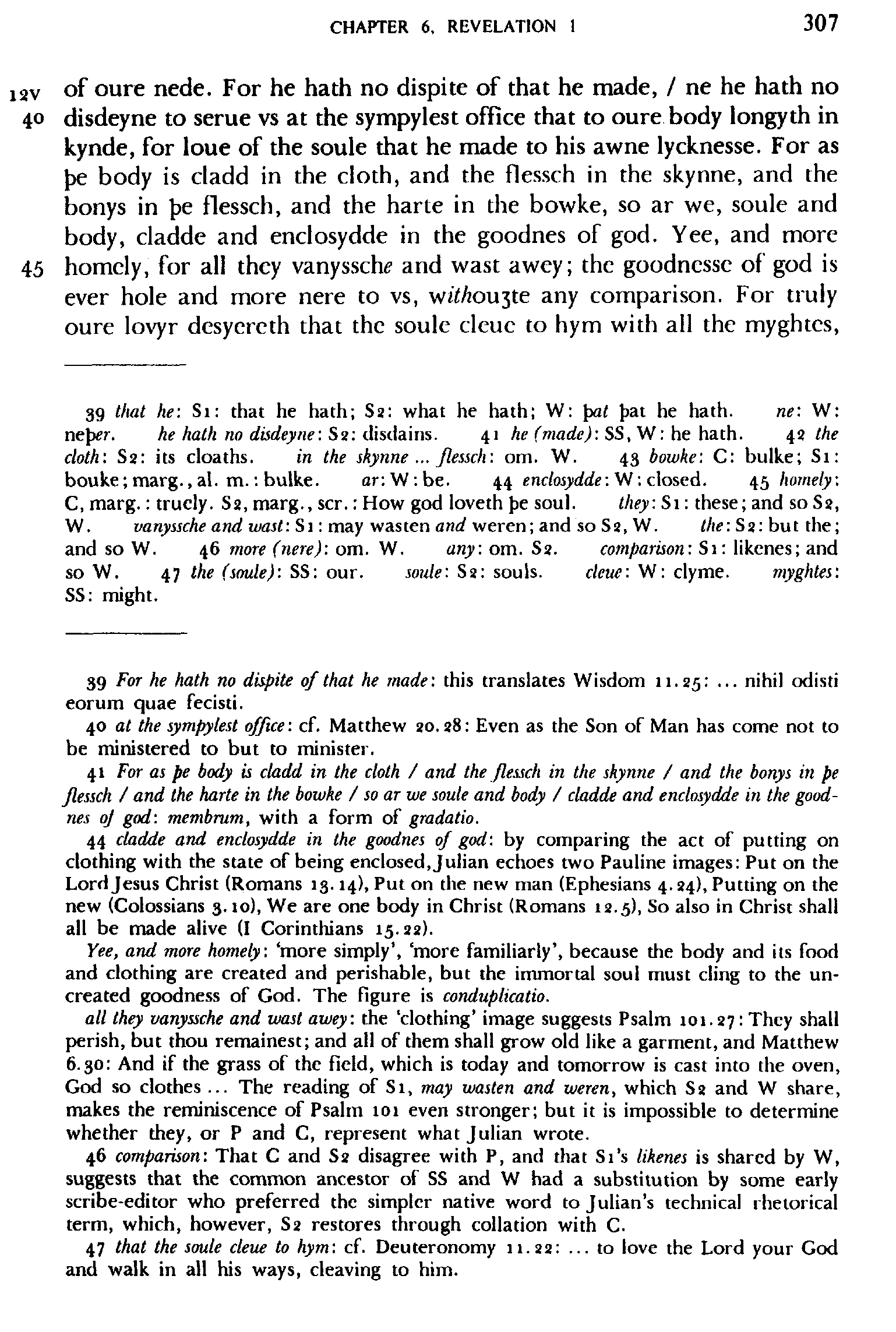
12V of oure nede. For he hath no dispite of that he made, / ne he hath no 40 disdeyne to serue vs at the sympylest office that to oure body longyth in kynde, for loue of the soule that he made to his awne lycknesse. For as |je body is cladd in the cloth, and the flessch in the skynne, and the bonys in be flessch, and the harte in the bowke, so ar we, soule and body, cladde and enclosydde in the goodnes of god. Yee, and more
45 homely, for all they vanyssch? and wast awey; the goodncsse of god is ever hole and more nere to vs, w^/zou3te any comparison. For truly oure lovyr dcsyereth that the soule cleuc to hym with all the myghtes,
39 that he: Si: that he hath; 82: what he hath; W: ^at t>at he hath. ne: W: neptfr. he hath no disdeyne: 82: disdains.
41 he (made): SS, W: he hath.
42 the doth: 82: its cloaths. in the skynne ... flessch: om. W.
43 bowke: C: bulke; Si: bouke; marg., al. m.: bulke. ar:W:be.
44 enclosydde: W: closed.
45 homely:
C, marg.: trucly. 82, marg., scr.: How god loveth pe soul. they: Si: these; and so 82, W. vanyssche and wast: S i: may was ten and weren; and so 8 2, W. the: 8 2: bu t the; and so W.
46 more (nere): om. W. any: om. 82. comparison: Si: likcnes; and so W.
47 the (soule): 88: our. soule: 82: souls. cleue: W: clyme. myghtes:
88: might.
39 For he hath no dis.pite of that he made: this translates Wisdom 11.25: ... nihil odisti eorum quae fecisti.
40 at the sympylest office: cf. Matthew 20.28: Even as the Son of Man has come not to be ministered to but to minister.
41 For as pe body is cladd in the cloth / and the flessch in the skynne / and the bonys in pe
Jlessch / and the harte in the bowke / so ar we soule and body / cladde and enclosydde in the goodnes oj god: membrum, with a form of gradatio.
44 cladde and enclosydde in the goodnes of god: by comparing the act of putting on clothing with the state of being enclosed .Julian echoes two Pauline images: Put on the Lord Jesus Christ (Romans 13.14), Put on the new man (Ephesians 4.24), Putting on the new (Colossians 3.10), We are one body in Christ (Romans 12.5), So also in Christ shall all be made alive (I Corinthians 15.22).
Yee, and more homely: 'more simply', 'more familiarly', because the body and its food and clothing are created and perishable, but the immortal soul must cling to the uncreated goodness of God. The figure is conduplicatio. all they vanyssche and wast awey: the 'clothing' image suggests Psalm 101.27: They shall perish, but thou remainest; and all of them shall grow old like a garment, and Matthew
6.30: And if the grass of the field, which is today and tomorrow is cast into the oven,
God so clothes ... The reading of Si, may wasten and weren, which 82 and W share, makes the reminiscence of Psalm 101 even stronger; but it is impossible to determine whether they, or P and C, represent what Julian wrote.
46 comparison: That C and 82 disagree with P, and that Si's likenes is shared by W, suggests that the common ancestor of SS and W had a substitution by some early scribe-editor who preferred the simpler native word to Julian's technical rhetorical term, which, however, 82 restores through collation with C.
47 that the soule cleue to hym: cf. Deuteronomy 11.22: ... to love the Lord your God and walk in all his ways, cleaving to him.
THE LONG TEXT
and that we be ever more cleuyng to hys goodnes. For of alle thyng that hart may thynke, it plesyth most god and soneste spedyth. For oure
50 soule is so prcsciously louyd / of hym that is hyghest that it ouer passelh the knovvyng of alle creatures. That is to say, ther is no creature that is made that may witt how much and how swetely and how tenderly that oure maker lovyth vs. And therfore we may with hys grace and his helpe stande in gostly bcholdyng, with euer lastyng marveylyng
55 in this hygh ouerpassyng vnmesurable love that oure lorde hath to vs of his goodnes; and therfore we may aske of oure louer with reuerence all that we wille, for oure kyndely wille is to haue god, and the good wylle of god is to haue vs, and we may never sesse of wyllyng ne of louyng
48 more: om. W. cleuyng: W: clymyng. thyng: Sa: things.
49 may: C, Sa: can.
50 Incuriously: SS: specially. louyd: Sa: beloved. ouer fjasseth: Sa: surpasseih.
51 knowyng:
W: knowlegc. alle: W: all o^er.
53 witt:
Sa: know.
53 thai (oure}: om. SS, W. W, marg., al. m.: Amor dc< in nobu.
And therfore: W: wherfor.
54 his hcl/ie stande: W: with his hooly storcdynge. marveylyng:
Sa: admiration.
55 hygh: W: here. ouerpassyng: Sa: surpassing and. vnmesurable: Si: onestimablc; and so Sa. oure lorde: Si: almitie god; and so Sa.
57 kyndely: C, marg.: natural!.
58 sesse: Si, W: blyn; Si, marg., al. m.: cease leave of. of (wyllyng): W: in. ne: 82: nor. louyng: Si: longyng; and so Sa.
56 and therfore we may aske of oure louer... all that we wille: this returns to the meditation's starting-point, that the soul does not need to 'make means' with God. and therfore we may aske of oure louer / with reuerence all that we wille /for oure kyndely wille is to haue god / and the good wylle of god is to haue vs / and we may never sesse of wyllyng ne of louyng / tylle we haue hym infulhede of ioy: a comftar with traductio (we wille ... oure wille ...of wyllyng), chiasmus (oure kyndely wille ... to haue god / the good wylle of god ... to haue vs), refietitio
(wille ... wille ... wylle), and simililer cadens (wyllyng ... louyng).
57 for oure kyndely wille ... to haue vs: cf. the Scale, II chapter 36: for tyr is no gifte of god \xit is bof> f>e gifer and \>c gifte but J)is gift of luf (MS BM Harley 6579, f. 114*; Underhill, 392).
58 sesse / blyn (Si, W): that Sa should agree with P, C and not with Si, W suggests the same explanation as for the comparison / likenes variant (307.46 note). It is impossible to decide what Julian wrote; but, in general, her vocabulary is up-to-date and, where necessary, learned. NED's earliest example of Cease, v., is a 1300, Cursor Mundi, and the entries for Blin, blinn, v., show use (though not common) in the fourteenth and fifteenth centuries.
CHAPTER 6, REVELATION I
tylle we haue hym in fulhede of ioy. And than we may no more wylle, 60 for he wylle that we be occupyed in knowyng and louyng tylle the tyme isv comyth that we shal be / fulfyllede in hevyn.
And here fore was this lesson of loue schewyd with alle that folowyth, as ye schall see, for the strenght and the grounde of alle was schewed in the furst syght. For of alle thyng the beholdyng and the lovyng of the 65 maker makyth the soule to seme lest in his awne syght, and most fyllyth hit with reuerent drede and trew ineknessc, and with plcntc of charyte to his euyn crysten.
67 The first extract in W ends here.
59 fulhede: 82: fullnes; and so W. wylle: W: desyre.
60 occupyed: 82: employed, louyng: add. W: of hym.
61 comyth: W: com; om. SS.
62 And here fore ...furst syght: om. W. here fore: C: therefore; and so SS.
63 the (grounde): om.
82.
64 thyng:
C, 82: things. the (lovyng): om.
82.
65 makyth:
W: causith. to (seme): om. 82. his: 82: its.
66 and (with): om. 88.
67 euyn crysten: Si, marg., al. m.: Christian neighbour.
59 tylle we haue hym in fulhede of ioy: the next sentence makes it plain that Julian here means a plenitude of joy in this life in which the soul 'has God'; cf. 215.43 and note,
301.25. This plenitude will be a foretaste of the Beatific Vision, in which knowledge and love will make an end of desiring. It is clear that she has in mind Paul's doctrine, I Corinthians 13, of the immutability and immortality of love, to which she will revert; cf3J5-58 and note. fulhede /fullnes (82, W): here the grouping is P C Si / 82 W, as in the case of littlehead / littleness (297.35). Throughout, Julian shows marked preference for abstract nouns in '-head'; and the modernization in 82 and W could easily be independent.
And than we may no more wylle /for he wylle that we be occupyed in knowyng and louyng / tylle the tyme comyth that we shal be fulfyllede in hevyn: another compar, continuing the repetitio of the previous figure, and adapting its similiter cadem (knowing... louyng).
62 And here fore was this lesson of loue schewyd ....-Julian places her revelations in the context of the 'Great Commandment' (Deuteronomy 6.5, and cf. Matthew 22.37-40),
'upon which depend the whole law and the prophets'.
65 makyth the soule to seme lest: cf. the Scale, II chapter 37: for he holdi}> him self and alle op^r men as it were euen ilike no3t of hem self anenptes god (MS BM Harley 6579, f. ii7 r; Underhill, 399).
66 trew meknesse: the Cloud teaches that the cause of true humility is *f>e oueraboundaunt loue and £e worthies of god in him self, in beholding of J>e whiche alle kynde quakiJD, alle clerkes ben foles, and alle seintes and aungelles ben blynde' (Hodgson, 40).
THE LONG TEXT
The Seuenth Chapitour And to Icrnc vs thys, as to my vnderstandyng, our good lorde shewyd our lady sent Mary in the same tyme, that is to meane the hyghe wysdom and truth that she had in bcholdyng of her maker. This
5 wysdom and truth made her to beholde hyr god so gret, so hygh, so i4r myghty and so good. This gretnesse and this nobylnesse / of her
4 Cf. 297.37; the text from here to 311.11 corresponds with W, f. 73', earlier interpolated and here collated. i Si: How our lady beholdyng the gretenes of hir maker thowte hir selfe leste (82: less); and of the great droppys of blode renning fro under the garland (82: crown of thornes); and how the most joy to man is that god most (82: who is most) hie and mightie is holyest and curtesiest (82: is also the most homely and most courteous).
2 lerne: 82: teach. good lorde: Si: lord god; and so 82.
3 sent: om.
4 that (she): om. 88. in (beholdyng): add. 82: the.
This wysdom ... hyr god: om. 88.
6 This (gretnesse): W: £>e. nobylnesse: C: noblety; and so W; C., marg: nobleness; 88: noblyth. of her: W: and. her: 88: the.
1 is holyest and curtesiest: at 314.48, Si has correctly copied hamlyest andcurtysest; there,
82 has substituted most familiar and most courteous, here the most homely and most courteous.
The 82 scribe is in general careful and intelligent enough to have been able to recognize and to correct Si's error, especially if (as has already been suggested — 307.46 note), 82 was collating Si with C.
2 And to lerne vs thys ... alle creatours (311.11): not in the short text; cf. 217.1. But, again, what follows here is no innovation, but a recapitulation of the vision of the BVM already recounted, with deeper insights. It has just been said that knowledge of the love of God will convince the soul of its own unworthiness; and this is best exemplified in Mary, most exalted of all creatures after her Son (214.33-36, 297.37-298.40); who yet sawe hyr selfe so lytylle and so lowe ...
3 that is to meane the hyghe wysdom and truth: Julian is here carefully specifying that, unlike the eleventh revelation, this is no 'bodily sight', even though there is marked accord between the insights presented here and those later described. In fact, this showing becomes a contemplation of Mary at prayer (cf. 213.26-214.30 and notes); but it is also a 'ghostly sight' (311.13), which she finally understands, through the teaching of the parable, to be Mary's contemplation of the Trinity (cf. 483.3 e.s. and note).
4 This wysdom and truth made her to beholde hyr god / so gret so hygh so myghty and so good /
This gretnesse and this nobylnesse of her beholdyng of god /fulfylled her of reverend drede and with this / she sawe hyr selfe so lytylle and so lowe / so symple and so poer in regard of hyr god / that thys reuerent drede fulfyllyd her of meknes / And thus by thys grounde she wasfulfyllyd
/ of grace and of alle maner ofvertuous: a membrum, with repetitio (so gret... so symple), conversio (god ... god ... god), and a complex use of gradatio and oppositio contrariorum.
5 beholde ... beholdyng: traductio, emphasizing that this is a 'ghostly sight' of Mary's contemplation.
6 noblyth (88): NED's closest form to this is Noblety, Obs. (the first entry 1340-1370, the last 1500-1520); from which this looks like a nonce-form, better represented in C,
CHAPTER 7, REVELATION 1
beholdyng of god fulfyllyd her of reverend drede; and with this she sawe hyr selfe so lytylle and so lowe, so symple and so poer in regard of hyr god that thys reuerent drede fulfyllyd her ol meknes. And thus by thys
10 grounde sche was fulfyllyd of grace and of alle maner of vertuous, and passyth alle creatours.
And in alle tytt tyme that he schewd thys that I haue now seyde in gostely syght, I saw the bodely syght lastyng of the (plentuous) bledyng of the hede. The grett droppes of blode felle downe fro vnder the 15 garlonde lyke pelottes, semyng as it had comynn ou3te of the veynes.
And in the cornyng ou3te they were bro(wn)e rede, for the blode was full thycke; and in the spredyng abrode they were bryght rede. And whan it ':amrne at the browes, ther they vanysschyd; and not wythstoni4v ding / the bledyng contynued tylle many thynges were sene and vn13 plentuous: ms: pituous, with V alt. to 1e', perh. al. m.
16 browne: ms: brorme.
7 drede: C: deed.
8 symple: 82: little. poer: C: poor; SS, W; pore. in (regard): S 2: in the. regard: S i, W: reward.
9 god: S i: lord god; and so S2. of (meknes): 82: with.
<Au$: W: pis.
10 of (grace): 82: with.
11 passyth: S i: overpassyth; and so W; 82: surpasseth.
12 pat: C, Si: the; 82: pis.
13 pituous (ms): C: plentuous; and so SS. Cf. 217.3.
14 the (hede): 82: his.
15 garlonde: 82: thornes. semyng: Si: semand; marg. al. m.: seeming. it: 82: if it.
16 they: SS: it.
17 they: SS: it.' were: 82: was.
18 at: SS: to. ther they: Si: than it; and so 82. and (not): om. SS.
19 vnderstondyd: Si: understondyn; 82: understood.
7 she sawe hyr selfe so lytylle and so lowe: Julian reverts to the revelation of Mary, because she is the perfect model of reuerent drede and trew meknesse.
11 passyth alle creatours: the language of this passage is naturally reminiscent of the Magnificat: ... all generations shall call me blessed ... he who is mighty has done great things for me ... he has exalted the humble.
12 And in alle pat tyme ... of the hede (311.14): this corresponds with the short text,
217.1-3.
13 plentuous: the reading of C, supported by SS, has been preferred to that of P.
14 The grett droppes of blode ...: the third major addition in the long text begins here, and continues to come to the last ende (316.67). This, however, unlike the first and second additions, begins with details of the bodely syght of Christ crowned with thorns which are not reported in the short text. We may owe them to the care with which she scrutinized her memory on the frequent occasions when God brought to her recollection the whole revelation from beginning to end. Cf. 520.78: the hole revelation fro the begynnyng to the ende whych oure lorde god of his goodnes bryngyth oftymesfrely to the syght of my vnderstondyng.
19 tylle many thynges were sene:Julian is conveying that all the 'ghostly sights' granted her in the first showing made their initial impression against the background of the vision of the bleeding and thorn-crowned head of the crucified Christ. Cf. 318.17-19. vnderstondyd (P, C) / understondyn (Si) understood (82): cf. NED, Stand, v.: 'In English the regular form of the pa. pie., standen (with the variants stande, etc.) continued until the i6th c., when its place was taken by stood from the pa.t. A few examples of a weak form standed occurs in writings of the i6th c.; in compounds (underhanded, withstanded) this formation was less rare, and survived into the 17th c.' The evidence here accords well with this statement.