
202 The Short Text
THE SHORT TEXT
sene bodylye the passiown of oure lorde that he sufferede for me, that I myght have sufferede with hym as others dyd that lovyd hym, not with15 standynge that I leevyd sadlye alle the peynes of Cryste as halye kyrke schewys and techys, and also the payntyngys of crucyfexes that er made be the grace of god after? the techynge of haly kyrke to the lyknes of Crystes passyown, als farfurthe as man ys witte maye reche. Nou3t v/ithstondynge alle this trewe be leve I desyrede a bodylye syght, whare yn y
20 myght have more knawynge of bodelye paynes of oure lorde our? savyoure, and of the compassyonn of oure ladye and of all? his trewe loverse that were be levande his paynes that tyme and sythene; for I wolde have beene one of thame and suffrede with thame. Other? gostely gladnes in J>e passione and in J>e croysse of owre lorde Jhesu, hym nedis with a besy thoghte for to duell in it and all o))er besynes forgette and sett at noghte; and sothely I trowe fully pat who so wolde besy hyme with all his herte and all his mynde and vmbethynke hym of this gloryus passione and all the circumstance thare off, it sulde bryng hym and chaunge hyme in to a new state of lyfynge (Horstman, i 198; Stallings,
95; Ragusa and Green, 317).
14 not withstandynge: cf. 285. u. The rest of this sentence is not in the long text. The reason for its omission there may well be that the Lollard opinion that the use of artobjects for devotional or meditative purposes is reprehensible, current when Julian first wrote, had, twenty years later, been decisively rejected. Cf. J. Russell-Smith, 'Walter
Hilton and a Tract in Defence of the Veneration of Images'. Such an omission, had it occurred in the short text, could have been caused through homoeotopy (not withstandynge ... Noujt withstondynge), but not in the long text, where the words do not occur.
16 payntyngys of crucyfexes: probably this is meant literally: 'pictures of the Crucifixion' or 'painted crucifixes'; but see G. V. Smithers's learned article, Two Typological
Terms in the Ancrene Riwle', showing that there peinture, peintunge mean 'imitation in a portrait', and that the author is reflecting ideas, possibly conveyed to him from Hugh of St. Victor, as old as Plato on the 'idea or form' of an object, on the object itself and on the object's imitation or representation. The Riwle and Julian make exacdy the same point: men's imaginings of heaven and hell (Riwle), an artist's representation of the Crucifixion (Julian), are mere 'paintings', 'shadows' (Riwle), limited by human abilities
— als farfurthe as man ys witte maye reche.
19 / desyrede a bodylye syght ... whene I were in threttye jeere eelde (204.46): this corresponds with the long text, 286.12-288.39. whare yn y myght have more knawynge of bodelye paynes of oure lorde: cf. Psalm 68.21: I looked for one who would grieve together with me.
22 be levande his paynes: cf. 286.14: lyuyng that tyme and saw his paynes, clearly the superior reading; but see 286.14 note.
23 for I wolde have beene one of thame and suffrede with thame: this 'Franciscan' aspiration, characteristic of the religious enthusiasm of Julian's age, is often found in contemporary literature. In the pseudo-Bonaventure Meditationes de passione domini we read:
CHAPTER i
syght of gode ne schewynge desyrede I nevere none tylle atte the sawlle 25 wer? departyd frome the bodye, for I trayste sothfastlye that I schulde be safe; and this was my menynge, for I wolde aftyr be cawse of that schewynge have the more trewe mynde in the passiorcn ofCryste.For the seconnde, come to my mynde with contricionn, frelye with owtyn any sekynge, a wylfulle desyre to hafe of goddys gyfte a bodelye syekenes,
30 and I wolde \>at this bodylye syekenes myght have beene so harde as to 9?v the dede, / so that I myght in the sekenes take alle my ryghtynges of halye kyrke, wenande my selfe that I schulde dye, and that alle creatures that sawe me myght wene the same, for I wolde hafe no comforth of no fleschlye nothere erthelye lyfe. In this sekenes I desyrede to hafe alle
35 manere of paynes, bodelye and gastelye, that I schulde have 3yf I schulde dye, alle the dredes and tempestes of feyndys, and alle manere of (Maria) cum filio pendebat in cruce, et pocius elegit mori cum ipso quam amplius vivere (Stallings, 113; Ragusa and Green, 335), which the English prose version modifies:
For oure lady hange one J>e rode with hire dere childe in soule... (Horstman, i 206). In the versified English adaptation of pseudo-Bernard, Liber de passione Christi, Bernard is made to say to Mary: Alias, whine had pat bale be mine? / I wald haue standen whare pou stode (Horstman, 2 275). The Franciscan John Grimston (cf. 285.11 note) recorded an eight-line poem which contains: I wolde be clad in Cristis skyn, / E>at ran so longe on blode (C. Brown, XIV 88).
Othere syght of gode ne schewynge desyrede I nevere none: cf. 286.16. Julian does not need to say that in the event she was given much more than she had prayed for.
28 with contricionn: cf. 286.20. The long text, for I would be purgied by the mercie of god
(131.10) makes plainer than this that such contrition was for her own past sins. frelye with owtyn any sekynge: cf. 286.20. This notion was no product of her own fancy, but came by inspiration.
29 of goddys gyfte a bodelye syekenes: cf. the Ancrene Riwle on sickness as a divine gift
(Day, 80-81). The author then links his readers' own sufferings with Christ's: Ouer alle oj^re Jx)U3tes, in alle oure passions, J>enkeJ> euere inwardliche vppon godes pynen (Vernon MS, f. 38oc; cf. Day 83). In this and subsequent quotations of the Riwle (as distinct from the Wisse), wherever possible the still unpublished version in Vernon has been quoted, with a reference to a published text, usually Mabel Day's, for those who may wish to read the quotation in its context. See Introduction, p. 77 n. 183.
31 ryghtynges: 'rites'. Cf. 287.23 note. NED does not record, or any verb 'to rite' from which a gerund could be made; but the parallel passage in the long text shows that even if this be Julian's (or a scribe's) nonce-word, it means 'rites, ceremonies'.
36 alle the dredes and tempestes of feyndys: cf. 287.27. Julian shared the belief common to her times that the departing soul is especially exposed to attack from the devil and his agents. Cf. Introduction. For this sense of 'tempest', cf. A Book to a Mother: for right as pilers beren vp an hous and maken hit strong to withstonde tempestes, so pese seuene vertues beren up mannes soule fro erpely loue and maken hire strong a$en tempestes of pe seuene dedly synnes (McCarthy, 7). Its editor dates A Book c. 1380, before orthodox sympathizers with Wycliffe perceived that the Lollards were preaching heresy. If A Book came Julian's way, its anti-religious sentiments and its misogyny would be unlikely to commend it to her.
THE SHORT TEXT
(o|>ere) paynes, safe of the owjte passynge of the sawlle, for I hoped that it my3t be to me a spede whenn I schulde dye, for I desyrede sone to be with my god.
This two desyres of the passyonn and of the seekenes I desyrede thame with a condiczon, for me thought that it passede the comene course of prayers; and therfore I sayde: Lorde, thowe woote whate I wolde. 3yf it be thy wille that I have itt, grawnte itt me, and 3yf it be nou^t thy wille, goode lorde, be nought dysplesede, for I wille nought
45 botte as thowe wille. This sekenes desyrede I yn my Bought, J>at y myght have it whene I were in threttye 3eere eelde. For the thirde, I harde a man telle of halye kyrke of the storye of saynte Cecylle, in the 37 opere: ms: fiayre; cf. 287.28 safe interlineated with caret by the corrector hoped: 'd' interlineated with caret by the corrector.
45 3ou£h!'- ms: thought; cf. 288.39.
46 in: interl. by corrector.
37 for I hoped that it myjt be to me a spede\ by 'spede"Julian probably means that when the actual day of her death came she would be strengthened by experience against diabolical assaults; cf. 287.31 and note.
38 for I desyrede sone to be with my god: cf. 287.32, where the long text reads to have ben.
But either text makes the same point: she is not asking for an early death, but that when death comes she may go at once to God. Cf. Psalm 41.3: When shall I come and appear before the face of God? This was recited in the rite for the blessing of the font on Easter Eve; Missale Romanum 1474, i 189.
42 prayen: cf. 288.36: prayer. That is probably the better reading; 'neither were ordinary petitions'. and therfore I sayde: cf. 288.36 note.
43 jyfit be thy wille that I have itt grawnte itt me / and jyf it be noujt thy wille goode lorde be nought dysplesede /for I wille nought botte as thowe wille: a compar with medial repetitio and conversio.
43 and yf it be noujt thy wille: cf. 288.37 note.
45 yn my Bought: cf. 288.38, and 285.4 note. Though 'juventus', 'youth' could be used then (as now) to indicate differing ages, it is more probable that Julian is looking back to times when she had formed this desire to suffer when she was thirty years old, rather than that she means 'When I was thirty years old I desired to have this sickness, whilst I was still in my youth'.
46 in threttye jeere eelde: she probably specifies this to show that what she had prayed for was answered in detail, and also to associate this event with the life of Christ.
Pseudo-Bonaventure had written: When he had spent twenty-nine years living in the difficult and lonely manner that I have described, the Lord said to his mother: 'It is time for me to go to glorify and manifest my Father ...' (Ragusa and Green, 102; cf.
Peltier 12 533).
46 / harde a man telle of halye kyrke: for this unique acknowledgement, reminiscent of Margery Kempe, of a precise source of information, the long text substitutes by the
CHAPTER
whilke schewynge I vndyrstode that sche hadde thre wonndys with a swerde in the nekke, with the whilke sche pynede to the dede. By the 50 styrrynge of this I conseyvede a myghty desyre, prayande oure lorde god that he wolde grawnte me thre wonndys in my lyfe tyme, that es to saye grace of god and teaching of holie church (288.40), and then suppresses the allusion to St.
Cecilia's legend.
48 sche hadde thre wonndys with a swerde in the nekke:Julian's informant may have been drawing on James of Voragine's Legenda aurea: Quam spiculator tribus ictibus in collo percussit (ed. Lyons, 1493, f. ccixd). In A Book to a Mother (cf. 203.36 note) we have:
... so Katerine, Cecilie, Lucie and monye maidens more freel in kinde and lasse strong in bodi schullen arise at }>e dai of dome and condempne such bodiliche stronge men fiat dispisen chastite and Cristes techinge (McCarthy, 94).
50 / conseyvede a myghty desyre ... with owtyn any meenn (210.16): this corresponds with the long text, 288.40-294.7.
51 that he wolde grawnte me thre wonndys: cf. the English Stimulus amoris: And ;jif Jxaw be
{HIS turned in to hym thorou3 helpe of grace, I may nou3t trowe but J>at Jjow shall be wounded with his woundes and ouer helte wyth peynes of his passioun (H. J. Kane, 15;
Kirchberger, 55). The notion of God 'wounding' the loving soul is a commonplace among exegetes of Canticles 4.9, 5.7. Bernard of Clairvaux combines it ingeniously with an allusion to Ezechiel 11.19, 36.26: ... movit et emollivit et vulneravit cor meum, quoniam durum lapideumque erat et male sanum (Sermon 74.6, ed. Leclercq, Talbot and Rochais, 2 243). But it is under the influence of early Franciscan spiritual writers, and especially of pseudo-Bonaventure's Meditationes, that the idea grows that these wounds will be St. Paul's 'stigmata' (cf. Galatians 6.17), that the soul can take active, dolorous part in the Passion through meditation; and this account of Julian's early aspirations without doubt shows such Franciscan influence. Cf. also Zacharias 13.6:
What are these wounds in the midst of thy hands? The notion of the 'diree noughts' may well have been suggested by a passage in the Scale, II chapter 21: ... meknes and luf, Jjat is, I am nojt, I haue no3t, I coueite no3t bot on (MS BM Harley 6579, f. 85'; Underhill, 305). This found its way into mediaeval English anthologies describing die contemplative life; see P. S. Jolliffe, Three Middle English Tracts ...' (In quoting the heavily-edited fourteenth-century English version of the Stimulus amoris, The Prickynge of Love, the editors regard its attribution to Walter Hilton as probable but not proven.
The many additions to and manipulations of the Latin text indicated by Clare Kirchberger in her edition are by someone deeply involved in spirituality, whose opinions, so far as they can be determined by his treatment of another man's work, seem to coincide with what we find in the Scale and other treatises certainly written by Hilton. H. J.
Kane is less convinced. Rightly, he observes that of the three surviving manuscripts containing the attribution, two derive from a common source and so serve only as a single witness, and that the third is an anthology of short extracts, a work of the type which tended to encourage 'a tendency among medieval copyists to connect admirable anonymous works with prestigious names' (xxxii). Having regard to Kane's other, less forceful arguments against Hilton's authorship, the editors would add that Julian's failure, if she knew the Prickynge, to name Hilton as the author is equally inconclusive.
The Revelations show her deep knowledge of several contemporary spiritual classics, but no interest whatever in the names or personalities of their authors.)
THE SHORT TEXT
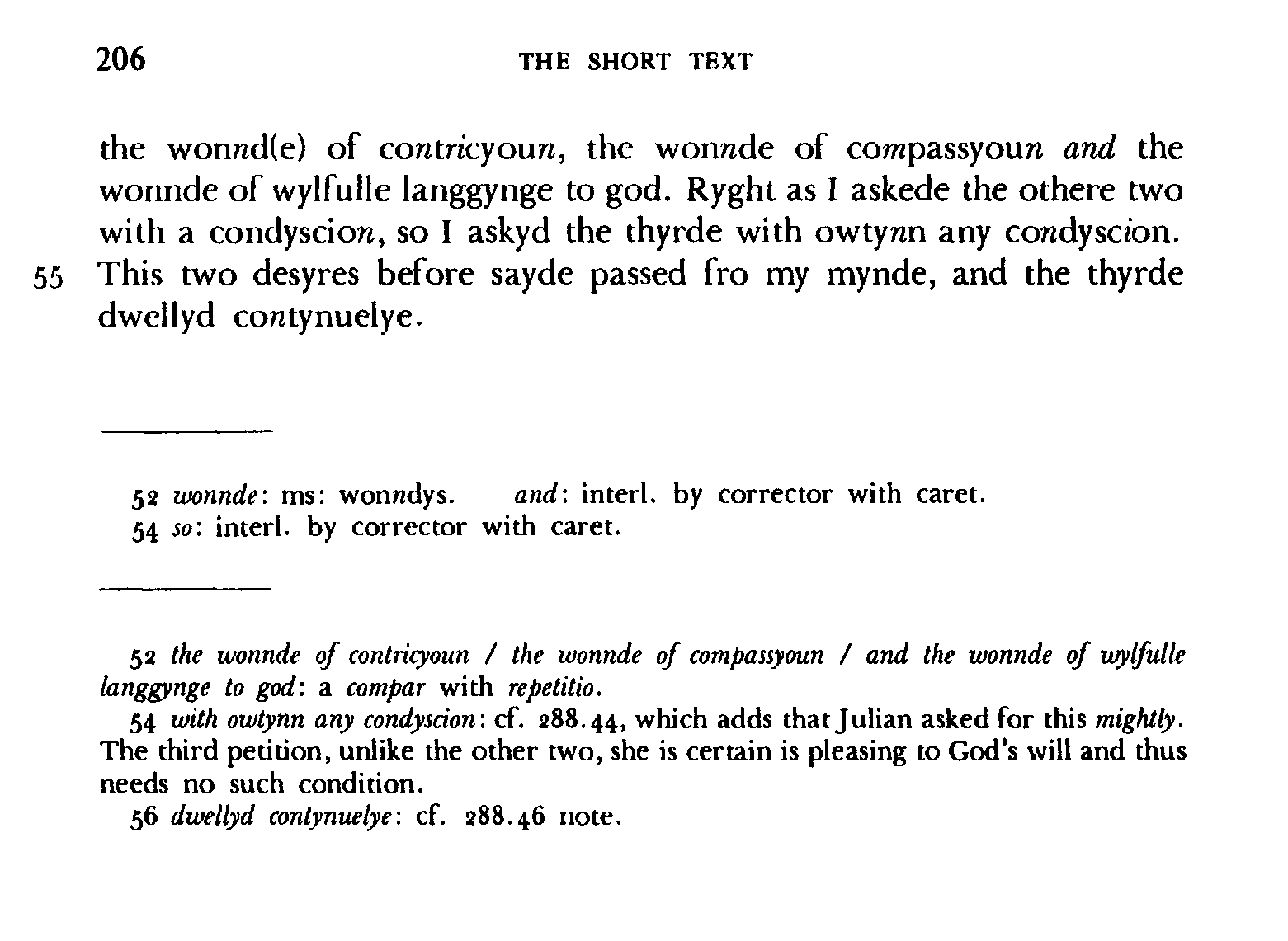
the wonnd(e) of contncyoun, the wonnde of compassyoim and the wonnde of wylfulle langgynge to god. Ryght as I askede the othere two with a condyscion, so I askyd the thyrde with owtynn any condysczon.
55 This two desyres before sayde passed fro my mynde, and the thyrde dwellyd contynuelye.
52 wonnde: ms: wonndys. and: interl. by corrector with caret.
54 so: interl. by corrector with caret.
52 the wonnde of contncyoun I the wonnde of compassyoun / and the wonnde of wylfulle langgynge to god: a compar with repetitio,
54 with owtynn any condyscion: cf. 288.44, which adds that Julian asked for this mightly.
The third petition, unlike the other two, she is certain is pleasing to God's will and thus needs no such condition.
56 dwellyd contynuelye: cf. 288.46 note.
CHAPTER ii
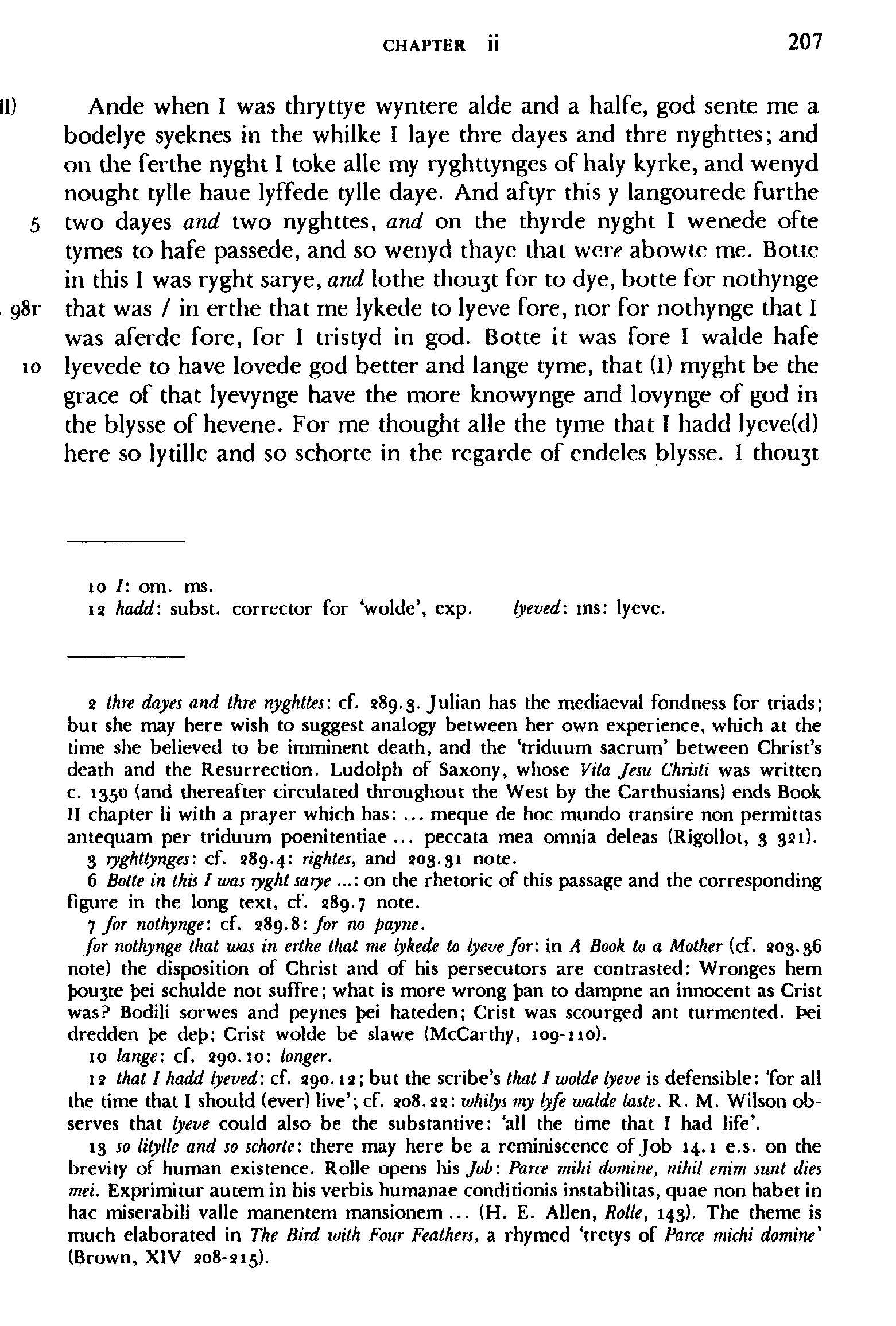
ii) Ande when I was thryttye wyntere aide and a halfe, god sente me a bodelye syeknes in the whilke I laye thre dayes and thre nyghttes; and on the ferthe nyght I toke alle my ryghttynges of haly kyrke, and wenyd nought tylle haue lyffede tylle daye. And aftyr this y langourede furthe
5 two dayes and two nyghttes, and on the thyrde nyght I wenede ofte tymes to hafe passede, and so wenyd thaye that were abowte me. Botte in this I was ryght sarye, and lothe thou3t for to dye, botte for nothynge g8r that was / in erthe that me lykede to lyeve fore, nor for nothynge that I was aferde fore, for I tristyd in god. Botte it was fore I walde hafe
10 lyevede to have lovede god better and lange tyme, that (I) myght be the grace of that lyevynge have the more knowynge and lovynge of god in the blysse of hevene. For me thought alle the tyme that I hadd lyeve(d) here so lytille and so schorte in the regarde of endeles blysse. I thoujt
10 7: om. ms.
12 hadd: subst. corrector for 'wolde', exp. lyeved: ms: lyeve.
2 thre dayes and thre nyghttes: cf. 289.3. Julian has the mediaeval fondness for triads; but she may here wish to suggest analogy between her own experience, which at the time she believed to be imminent death, and the 'triduum sacrum' between Christ's death and the Resurrection. Ludolph of Saxony, whose Vita Jesu Christi was written c. 1350 (and thereafter circulated throughout the West by the Carthusians) ends Book
II chapter Ii with a prayer which has: ... meque de hoc mundo transire non permittas antequam per triduum poenitentiae ... peccata mea omnia deleas (Rigollot, 3 321).
3 ryghttynges: cf. 289.4: rightes, and 203.31 note.
6 Botte in this I was ryght sarye ...: on the rhetoric of this passage and the corresponding figure in the long text, cf. 289.7 note.
7 for nothynge: cf. 289.8: for no payne. for nothynge that was in erthe that me lykede to lyeve for: in A Book to a Mother (cf. 203.36 note) the disposition of Christ and of his persecutors are contrasted: Wronges hem
Jx)U3te J>ei schulde not suffre; what is more wrong |>an to dampne an innocent as Crist was? Bodili sorwes and peynes |)ei hateden; Crist was scourged ant turmented. f>ei dredden f»e de£>; Crist wolde be slawe (McCarthy, 109-110).
10 lange: cf. 290.10: longer.
12 that I hadd lyeved: cf. 290.12; but the scribe's that I wolde lyeve is defensible: Tor all the time that I should (ever) live'; cf. 208.22: whilys my lyfe walde laste. R. M. Wilson observes that lyeve could also be the substantive: 'all the time that I had life'.
13 so litylle and so schorte: there may here be a reminiscence of Job 14.1 e.s. on the brevity of human existence. Rolle opens his Job: Pane mihi domine, nihil enim sunt dies mei. Exprimitur autem in his verbis humanae conditionis instabilitas, quae non habet in hac miserabili valle manentem mansionem ... (H. E. Allen, Rolle, 143). The theme is much elaborated in The Bird with Four Feathers, a rhymed 'tretys of Parce rnichi domine'
(Brown, XIV 208-215).
THE SHORT TEXT
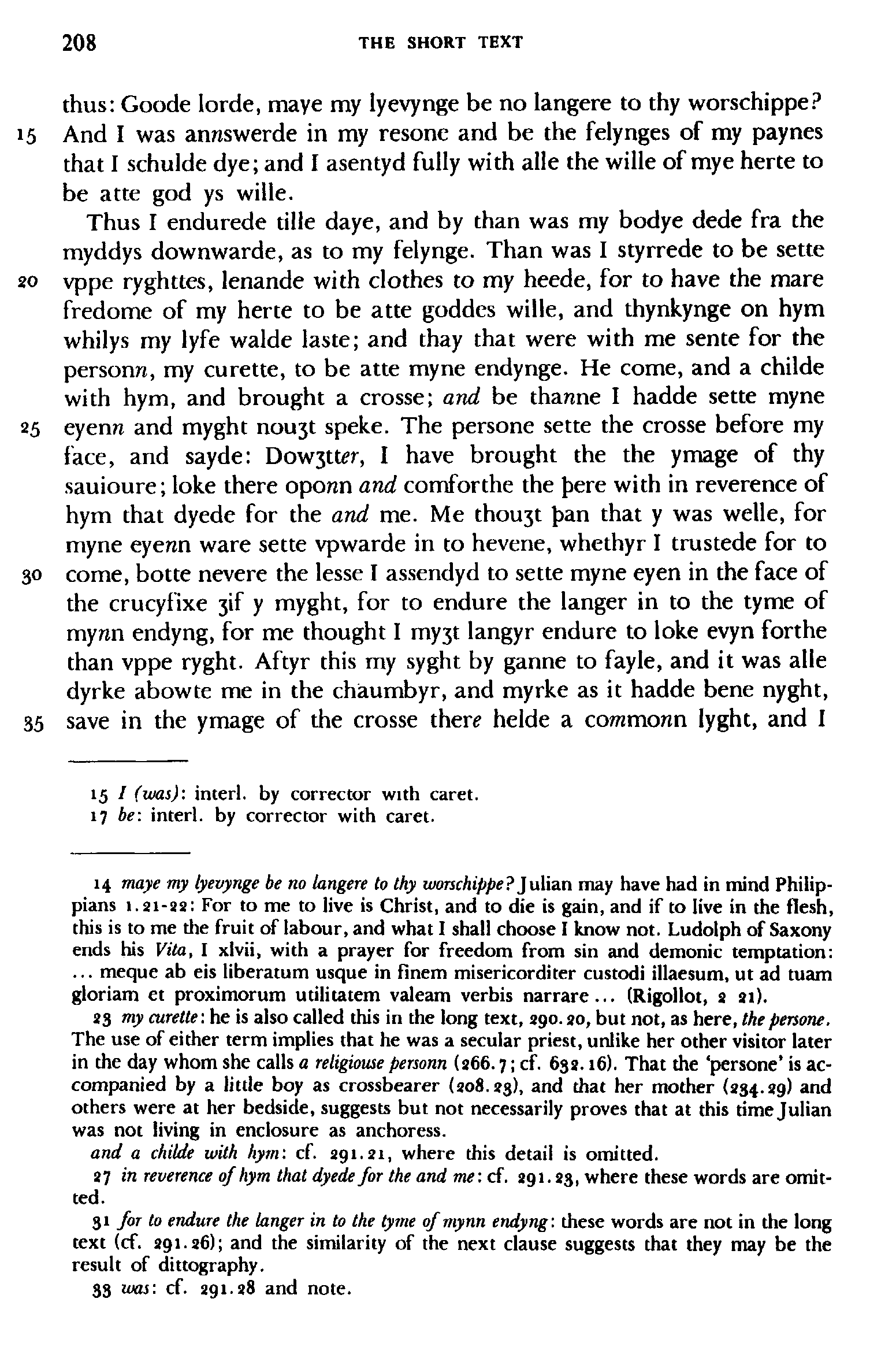
thus: Goode lorde, maye my lyevynge be no langere to thy worschippe?
15 And I was anrcswerde in my resone and be the felynges of my paynes that I schulde dye; and I asentyd fully with alle the wille of mye herte to be atte god ys wille.
Thus I endurede tille daye, and by than was my bodye dede fra the myddys downwarde, as to my felynge. Than was I styrrede to be sette
20 vppe ryghttes, lenande with clothes to my heede, for to have the mare fredome of my herte to be atte goddes wille, and thynkynge on hym whilys my lyfe walde laste; and thay that were with me sente for the personn, my curette, to be atte myne endynge. He come, and a childe with hym, and brought a crosse; and be thanne I hadde sette myne
25 eyenn and myght nou3t speke. The persone sette the crosse before my face, and sayde: Dowjtter, I have brought the the ymage of thy sauioure; loke there oponn and comforthe the £ere with in reverence of hym that dyede for the and me. Me thoust £an that y was welle, for myne eyenn ware sette vpwarde in to hevene, whethyr I trustede for to 30 come, botte nevere the lesse I assendyd to sette myne eyen in the face of the crucyfixe jif y myght, for to endure the langer in to the tyme of mynn endyng, for me thought I my3t langyr endure to loke evyn forthe than vppe ryght. Aftyr this my syght by ganne to fayle, and it was alle dyrke abowte me in the chaumbyr, and myrke as it hadde bene nyght,
35 save in the ymage of the crosse there helde a commonn lyght, and I 15 / (was): interl. by corrector with caret.
17 be: interl. by corrector with caret.
14 maye my lyevynge be no langere to thy worschippe?Julian may have had in mind Philippians 1.21-22: For to me to live is Christ, and to die is gain, and if to live in the flesh, this is to me the fruit of labour, and what I shall choose I know not. Ludolph of Saxony ends his Vita, I xlvii, with a prayer for freedom from sin and demonic temptation:
... meque ab eis liberatum usque in finem misericorditer custodi illaesum, ut ad tuam gloriam et proximorum utilitatem valeam verbis narrare... (Rigollot, a 21).
23 my curette: he is also called this in the long text, 290.20, but not, as here, the persone.
The use of either term implies that he was a secular priest, unlike her other visitor later in the day whom she calls a religiouse personn (266.7; cf. 632.16). That the 'persone' is accompanied by a little boy as crossbearer (208.23), and mat her mother (234.29) and others were at her bedside, suggests but not necessarily proves that at this time Julian was not living in enclosure as anchoress. and a childe with hym: cf. 291.21, where this detail is omitted.
27 in reverence of hym that dyede for the and me: cf. 291.23, where these words are omitted.
31 for to endure the langer in to the tyme of mynn endyng: these words are not in the long text (cf. 291.26); and the similarity of the next clause suggests that they may be the result of dittography.
33 was: cf. 291.28 and note.
CHAPTER ii
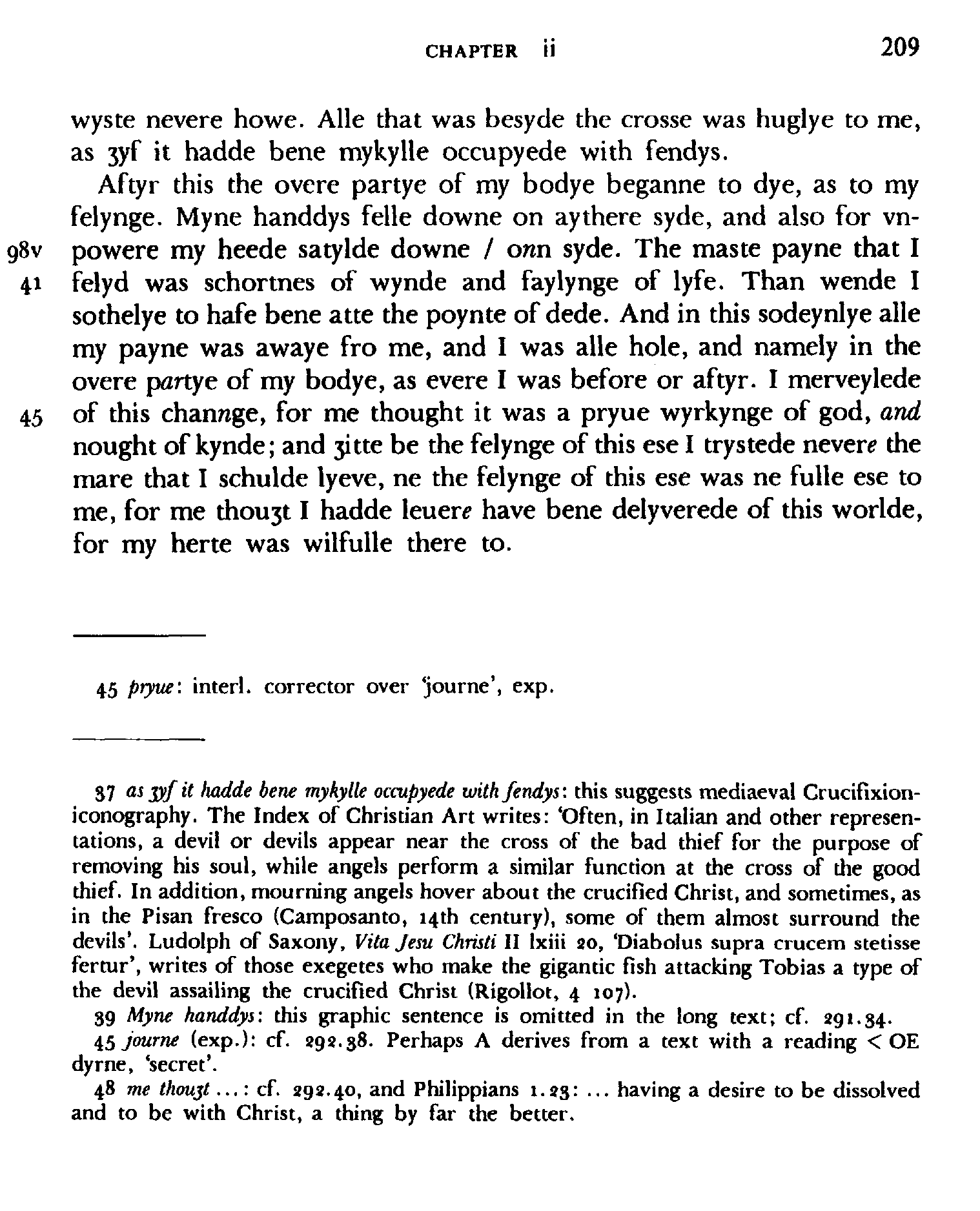
wyste nevere howe. Alle that was besycle the crosse was huglye to me, as 3yf it hadde bene mykylle occupyede with fendys.
Aftyr this the overe partye of my bodye beganne to dye, as to my felynge. Myne handdys felle downe on aythere syde, and also for vng8v powere my heede satylde downe / own syde. The maste payne that I 41 felyd was schortnes of wynde and faylynge of lyfe. Than wende I sothelye to hafe bene atte the poynte of dede. And in this sodeynlye alle my payne was awaye fro me, and I was alle hole, and namely in the overe party e of my bodye, as evere I was before or aftyr. I merveylede
45 of this channge, for me thought it was a pryue wyrkynge of god, and nought of kynde; and 3itte be the felynge of this ese I trystede nevere the mare that I schulde lyeve, ne the felynge of this ese was ne fulle ese to me, for me thou3t I hadde leuere have bene delyverede of this worlde, for my herte was wilfulle there to.
45 pryue: interl. corrector over 'journe', exp.
37 ai3yfit hadde bene mykylle occupyede with fendys: this suggests mediaeval Crucifixioniconography. The Index of Christian Art writes: 'Often, in Italian and other representations, a devil or devils appear near the cross of the bad thief for the purpose of removing his soul, while angels perform a similar function at the cross of the good thief. In addition, mourning angels hover about the crucified Christ, and sometimes, as in the Pisan fresco (Camposanto, 14th century), some of them almost surround the devils'. Ludolph of Saxony, Vita Jem Christi II Ixiii 20, 'Diabolus supra crucem stedsse fertur", writes of those exegetes who make the gigantic fish attacking Tobias a type of the devil assailing the crucified Christ (Rigollot, 4 107).
39 Myne handdys: this graphic sentence is omitted in the long text; cf. 291.34.
45 journe (exp.): cf. 292.38. Perhaps A derives from a text with a reading < OE dyrne, 'secret'.
48 me thoujt...: cf. 292.40, and Philippians 1.23: ... having a desire to be dissolved and to be with Christ, a thing by far the better.
THE SHORT TEXT
(Hi) And sodeynlye comme vnco my mynde that I schulde desyre the seconwde worwde of our^ lordes gyfte and of his grace, that he walde fulfylle my bodye with mynde of felynge of his blessede passyonn as I hadde before prayede, for I wolde that his paynes ware my paynes, with
compassyonn and aftyrwarde langynge to god. Thus thoujt me that I myght with his grace have his wonndys that y hadde before desyrede; but in this I desyrede neu^re ne bodely syght ne no manere schewynge of god, botte cowpassyonn as me thought that a kynde sawlle myght have with oure lorde Jhem, that for love wolde be come man dedlye. With
hym y desyrede to suffere, lyevande in dedlye bodye as god wolde gyffe me grace. And in this sodaynlye I sawe the rede blode trekylle downe fro vndyr the garlande, alle hate, freschlye, plentefully and lyvelye, ryght as me thought that it was in that tyme that the garlonde of thornys was thyrstede on his blessede heede. Ryght so, both god and man, the same
sufferde for me. I conseyvede treulye and myghttyllye that itt was hym selfe that schewyd it me with owtyn any meenn; and than I sayde:
3 mynde of felynge: the long text's mynd and feeling (292.45) is probably superior.
8 comftassyonn as me thought: cf. 293.49, and Ephesians 5.1-2: Be therefore followers of Christ, as most dear children, and walk in love, as Christ also has loved us and has delivered himself ...
9 for love: cf. 732.15-733.17 and note.
12 garlande: cf. 210.13, 294.5, 362.22. NED, s.v. Garland, sb., i b, 'Christ's crown of thorns', cites two examples, one from Piers Plowman B XVIII, and calls this usage 'obs. rare'; but MED, gerlond i(c), has five examples, not including this. Two others may be added, Brown XIV 223, and Person, Cambridge Middle English Lyrics, 10. Mechtild of Hackborn in her Book of Special Grace, I xxxiii, describes how in one vision Christ 'hadde also in his hede a gerlande of dyuerse ande fulle fayre floures', which symbolized the pains inflicted on his head; and in another vision, IV xxxiii,'... owre lorde apperede to here ande helde in his blessede handdys a manere of a serkylle or a garlande of drye tree', signifying man's heart, dried up in sin, which Christ will adorn with the roses of grace (Halligan, 172, 540). There may be a satirical implication in this usage, contrasting Christ's wretchedness with worldlings' vanity. In one of its many reprehensions of contemporary luxury, A Book to a Mother (cf. 203.36 note) has: Ne none nyce dameselis wij) garlondis of gold ne perils ne filettis ne bonettis (McCarthy, 48-49). In the Vulgate, 'corona' means both 'crown' and 'garland': illi quidem ut corruptibilem coronam accipiant (I Corinthians 9.25). In a Marian lament, our Lady is made to say:
Hys chaplet ys thornys sore prykkyng (Wright: Chester Plays, 2 207).
16 meenn: 'intermediary'. Cf. NED Mean n2 Il-g", where the first example is c. 1374
(Chaucer), the second, 9°, Piers Plowman A (i.e. c. 1370). MED mene, n. 3(3), 1389 Guild
Return: he £at is chose mene. Many other instances will be noted of Julian's very modern and literary vocabulary. and than I sayde ... alle gostelye enmyes (211.27): this corresponds with the long text,
296.16-297.27.
CHAPTER iii
Benedicite dominMj. This I sayde reu^rentlye in my menynge, with a myghtty voyce, and fulle gretlye I was astonnyd for wonders and merveyle that y had that he wolde be so homblye with a synfulle creature ggr lyevande in this wrecchyd flesch. / Thus I tokede it for that tyme that 21 oure lorde Jhmi of his curtayse love walde schewe me comforthe before the tyme of my tewptacyonn; for me thought it myght be welle that I schulde be the suffyranwce of god and with his kepynge be temptyd of fendys or I dyede. With this syght of his blyssede passyonn, with the 25 godhede that I saye in myn vndyrstandynge, I sawe that this was strengh ynow3e to me, je, vnto alle creatures lyevande that schulde be saffe agaynes alle the feendys of helle and agaynes alle gostelye enmyes.
20 Jlesch: ms: fle- (which fills the line to its end) schly.
17 Benedicite dominus: cf. 296.16. For 'Benedicite' as a salutation or a blessing, cf. the Ancrene Riwle: ... and goj> forjj mid godes dred to prest. Aller furst confiteor, and per after Benedicite, J>at he oujte siggen (Vernon MS, f. 380°). For 'Benedicite' as a prayer before eating, with the response 'Dominus', cf. J. Baudot, 'Benediction de la table ou des aliments'. However, the 'Canticle of the Three Children' (Daniel 3.52 e.s.) was in such frequent liturgical use, with its differing Latin beginnings, 'Benedicite ornnia opera domino', 'Benedicite dominum', 'Benedictus es domine' (cf. F. Cabrol, 'Benedicite et
Benedictus es Domine'), that it is hardly possible to decide what Julian actually said, and whether it was in blessing, thanking or praising. It is however clear uhat this passage provides no evidence for or against her being 'a woman that could no letter'.
This I sayde ...: cf. 296.16 note.
19 homblye: cf. 296.19: homely. Whether this is a spelling reflecting pronunciation with 'momentary delabialisation', or a confusion of 'homely' with 'humbly', can only be conjectured. R.M. Wilson suggests that homblye may represent the same ml > mbl development as in NE 'bramble'; and this is supported by one spelling, 'homblynesse', recorded by MED.
23 be the suffyrannce of god: cf. 296.22. In the Ancrene Riwle, the 'fifth comfort against temptation" is: pat he ne may no t>ing don vs bote be godes leue (Vernon MS, f. 382d; cf.
Day, 102). In MS Sidney Sussex 80, f. ioiv, there is a prayer to the Virgin: O refugium animarum, tibi supplico quatinus in tuo seruicio semper perseuerare valeam in presenti, vt in exitu anime mee euadere possim terrorem maligni Sathane ...
24 With this syght...: this is a well-constructed compar which Julian has left unchanged in the long text (296.23-297.27): With this syght of his blyssede passyonn / with the godhede that I saye in myn vndyrstandynge / I sawe that this was strengh ynowy to me / y vnto alle creatures lyevande that schulde be saffe / agaynes alle the feendys of helle I and agaynes alle gostelye enmyes.
There is repetitio (With ... with), conduplicatio (to me / y vnto alle), and a second repetitio
(agaynes ... agaynes).
25 saye ... sawe: 'saye' may mean 'I say' ( < OE secge) or 'I saw' ( < OE seah). Modern
English 'saw' is from the plural stem, OE sawon. But the only other example in A, compared with 'sawe' dsx) is / saye the body lye syght (217.2). that this was strengh ynowy to me: cf. 296.24 note.
THE SHORT TEXT
(iv) And this same tyme that I sawe this bodyly syght, oure lorde schewyd me a gastelye sight of his hamly lovynge. I sawe that he es to vs alle thynge £>at is goode and comfortabylle to oure helpe. He es oure clethynge, for loove wappes vs and wyndes vs, halses vs and alle be
teches vs, hynges a boute vs for tendyr loove, that he maye nevere leve vs. And so in this syght y sawe sothelye that he ys alle thynge that ys goode, as to myne vndyrstandynge.
And in this he schewyd me a lytille thynge, the qwantyte of a haselle nutte, lyggande in the palme of my hande, and to my vndyrstandynge
that, it was as rownde as any balle. I lokede tyr oponn and thought:
Whate maye this be? And I was annswerde gen^raly thus: It is alle that 2 hamly. scr.: Anly, which he has alt.
5 vs (hynges): ms: vs vs. i And this same tyme ... betwyxe my god and me (213.21): this corresponds with the long text (299.2-300.22). this bodyly syght: cf. 299.2: this sight of the head bleidyng, which is a reworking (by Julian or another), probably to avoid any possible confusion with the preceding vision,
'ghostly in bodily lykenes' (297.29 and note) of Mary. In the contrast she makes here between the *bodyly syght' and the 'gastelye sight of his hamly lovynge', Julian's perceptions of the modes of the revelations is, like her language, careful and exact.
3 goode and comfortabylle: that God is our comforter is found in the Old Testament as well as the New: cf. e.g. Isaias 49.13, Zacharias 1.13,John 16.27, II Corinthians 1.36.5.
He es oure clethynge, for loove wappes vs: cf. I John 4.8, 10: For God is love ... because he has first loved us. Cf. 299.4, but the reading there, He is oure clothing, that for loue, seems inferior, lacking the Johannine ring.
5 that he maye nevere leve vs: Julian here seems to have in mind John 14.16-18: ... dial he may abide with you forever, the Spirit of truth ... because he shall abide with you and shall be in you. I will not leave you orphans ...
6 he ys alle thynge that ys goode: this may recall Christ's reply: Why do you ask me concerning good? One is good, God (Matthew 19. 17).
7 as to mynf vndyrstandynge: that is, this is a 'gastelye sight'. Cf. 212.1 note.
9 lyggande in the palme of my hande: cf. the Latin Fifteen Oes, (201.6 note): O Jhmi mundi fabricator quern nulla diuisio uero intermino metitur, qui terram palmo concludis ... (MS BM Royal 17 A xxvii, f. giv); O Jhmi maker? of all? pe warlde whos myght no thyng may mesur?, pa/ closes pe herth in pi hand ... (MS BM Royal 17 C xvii, f. 95C).
10 it was as rownde as any balle: cf. 299.10 note.
/ lokede her oponn and thought I Whate maye this be / And I was annswerde generaly thus / It is alle that ys made: a compar with ratiodnatio.
11 It is alle thatys made: this and what follows is so close to the thought and language of Wisdom 11.23-26 that it is hardly likely that this was not the source: For the whole earth before thee is as the least grain of the balance, and as a drop of the morning dew that falls down upon the earth. But thou hast mercy upon all, because thou canst do all things, and overlookest the sins of men for the sake of repentance. For thou lovest all
CHAPTER JV
ys made. I merveylede howe J>at it myght laste, for me thought it myght falle sodaynlye to nought for litille. And I was anrcswerde in myne vndyrstandynge: It lastes and eu^r schalle, for god loves it; and so hath
J5 alle thynge the beynge thorowe the love of god.
In this lytille thynge I sawe thre partyes. The fyrste is that god made it, the seconnde ys that he loves it, the thyrde ys that god kepes it. Botte whate is that to me? Sothelye, the maker?, the lovere, the kepere. For to I am substancyallye aned to hym, I may nevere have love, reste ne ggv varray blysse; that is to saye that / I be so festenede to hym that thare
21 be ryght nought that is made betwyxe my god and me. And wha schalle do this dede? Sothlye hym selfe be his nwcye and his grace, for he has made me there to and blysfullye restoryd.
In this god brought cure ladye to myne vndyrstandynge. I sawe hir 25 gastelye in bodilye lyekenes, a sympilk maydene and a meeke, jonge of age, in the stature that scho was when scho conceyvede. Also god schewyd me in parte the wisdom and the trowthe of hir saule, whare yn
I vndyrstode reu^rente beholdynge, \Mt sche behelde hyre god, that ys 17 (made) it: interl. corrector w. caret.
38 hyre: ms: oure, exp., 'hyre' interl. corrector. things that are, and hatest none of the things which thou hast made, for thou didst not appoint or make any thing hating it. And how could any thing endure if thou wouldst not, or be preserved if not called by dice?
16 partyes: cf. 300.17: propreties, and note. This A reading, though defensible, may be the result of a careless scribe's misinterpretation of 'p(ro)p(er)tyes'. Cf. 583.19: / saw and vnderstode these thre propertes. The Cloud-author writes, in Privy Counselling: ... whiche ben |je propirtees bat fallyn to Jiis perfeccion (Hodgson, Cloud, 153).
The fyrste is that god made it / the seconnde ys that he loves it / the thyrde ys that god kepes it: a compar with complexio.
17 Botte whate is that to me? Cf. 300.18 and note.
19 love: not in the long text. Cf. 300.20.
21 And wha... blysfullye restoryd: not in the long text. Cf. 300.22.
24 In this god brought... the blyssede manhede ofCriste (214.36): this corresponds with the long text, 297.28-298.40. Cf. 297.28 note.
25 gastelye in bodilye lyekenes: cf. 297.29. As with the vision of Christ crowned with thorns, this is corporeal, but even whilst writing the short text,Julian knows that it is also 'gastelye', given not only for its own sake but to convey spiritual truths.
26 in the stature that scho was when scho conceyvede: in Julian's age it was generally received that mis happened when Mary was a mere girl. Cf. MS Trinity College Dublin
423 (England, c. 1450), f. 105*: Sancta Maria fuit in etate quindeciw annoru/n quando peperit Chr«/wm, postea mansit cum eo xxx annis in hoc seculo ... In the Christ Church,
Dublin Liber Niger it is stated mat she conceived at the age of twelve (E. Colledge: The Latin Poems of Richard Ledrede, 132 note).
28 reuerente beholdynge: in Privy Counselling, the Cloud-author writes: For J)is same werk,
3if it be verrely conceyuid, is J)at reuerent affeccion and f>e frute departid fro pe tre pat
THE SHORT TEXT
hir makere, mervelande with grete reu^rence that he wolde be borne of 3° hir that was a sympille creature of his makynge. And this wysdome of trowthe and knawande the gretnes of hir makere and the lytelle heede of hir selfe that ys made, made hir for to saye mekely to the angelle
Gabriell?: Loo me here, goddys hande maydene. In this sight I sawe sothfastlye that scho ys mare than alle Jjat god made benethe hir in wor35 thynes and in fulheede. For abovene hir ys nothynge that is made botte the blyssede manhede of Criste. This lytill? thynge that es made that es benethe oure ladye saynt Marye — god schewyd it vnto me als litille as it hadde beene a hasylle notte — me thought it myght hafe fallene for litille.
30 his makynge ... And this: ms: his makynge. For this was hir mervelynge, that he that was hir makere walde be borne of hir that was a sympille creature of his makynge. And this ...
31 and (knawande): interl. corrector w. caret.
32 made hir for to: scr.: made h (which reaches the ruled margin); the rest add. corrector.
I speke of in f>i lityl pistle of preier (Hodgson, Cloud, 154; and cf. Deonise, 56, where, in the Epistle of Prayer, he quotes I Corinthians 6.17). beholdynge ... behelde: the noun is complementary to wisdom, trowthe, and we must understand 'contemplation, contemplated'. Mary Baldwin ('Some Difficult Words in the Ancrene Riwle'), demonstrates how often the Riwle uses 'bihalden' in this sense, and not with any connotation of physical vision. One of her illustrations is: Inis lo J>e articles ... of oure bileaue onont godes monhead, hwa se inwardliche bihalt ham (Tolkien, 135).
Julian's vocabulary is a practical illustration of Richard of St. Victor's definition: Contemplatio est libera mentis perspicacia in sapientiae spectacula ... (Beniamin Major i 4,
PL 196 67).
29 that he wolde be borne of hir that was a sympille creature of his makynge: this is an 'oppositio contrariorum', of the Creator with the creature. So Richard Ledrede (ob. 1360) in one of his Nativity poems had written: Fit magnus paruulus seruus et dominus /
Contentus continens breuis interminus / Antiquus nascitur distansque comminus / Excelsus humilis et simplex geminus (ibid., 120 and notes). However, G. Rigg (The Poems of Walter of Wimborne, 11-12) shows that Ledrede's asclepiadic verses are adaptations of some of Wimborne's Marie carmina.
30 his makynge ...: the dittography which follows in the manuscript must derive from an ancestor which had been collated with a long text copy, or vice versa. Cf. 297.34 and notes, Introduction, p. 19.
36 This lytille thynge that es made that es, benethe oure ladye: cf. 300.23, where the reference to Mary does not appear. In her reflection on the locution 'All shall be well'
(422.2), Julian speaks of alle creaturys whych are beneth Crist (424.25). Mary is also the prototype of mans soule ... a creature in god whych hath the same properties (the divine attributes of truth and wisdom) made (484.13). It is doubtless this development in her theology which leads her to remove the phrase in the long text as less than accurate.
See Introduction, IX 3.
CHAPTER JV
4° In this blyssede revelaczon god schewyd me thre noughtes of whilke nou3ttes this is the fyrste that was schewyd me. Of this nedes ilke man and woman to hafe knawynge that desyres to lyeve corctewiplatyfelye, that hym lyke to noujt alle thynge that es made for to hafe the love of god that es vn made. For this es the cause why thaye fyat er occupyede
45 wylfullye in erthelye besynes and eumnare sekes warldlye wele er nought here of his in herte and in sawlle; for thaye love and seekes here ryste in this thynge that is so lytille, where no reste ys yn, and knawes nou3t god that es alle myghtty, alle wyse and alle goode, for he is
40 In this blyssede revelation ...: this sentence is not in the long text; cf. 301.24. The first 'nought' is this vision of all that is created (212.11); fallen to nought (300.23) is probably a better reading than fallen, but in either text it is plain that it is creation ex nihilo which Julian has in mind. The second 'nought' is probably sin (226.9), and the third the impotent devil (227.31), whom Christ 'noughts', asking us to do the same
(228.40). noughtes: 'nothings'. The numeral adjective shows that this is a plural noun, not the adverbial genitive. The usage is rare but not without parallel. MED nought cites c.
1400 Book of Vices and Virtues 82.5: But wip-out witt and good auisement, pes pre fringes bej) nou3tes.
41 Of this nedes ... to resayue gostlye reste (216.53): this corresponds with the long text,
301.24-33.
42 that desyres to lyeve contemplatyfelye: cf. 301.24, where this clause is not found. This could indicate that the ancestor of C, SS, P and W had been edited with secular as well as religious readers in mind.
43 that hym lyke to noujt: 'that he find pleasure in despising', which shows that P's nought (301.25) is infinitive, not adverb, as is also indicated by Si: to nowtyn, and 82: to noughten. for to hafe the love: cf. 301.25: for to hue and haue, which is probably superior. An ancestor of Si evidently considered (though needlessly) that 'to love and have" was objectionable.
44 thaye pat er occupyede ... wardlye wele: not in the long text; cf. 301.26 and 215.42 note. The thought here on the rest which is to be found in God alone and not in worldly occupation is directly from Matthew 11.28-29: Come to me, all you that labour and are burdened, and I will refresh you ... and you shall find rest for your souls. The Scale, I chapter 3, has: Contemplatif lyfe ... Ionge3 specialy to hem Jje whilk forsaken for f>e loue of god all wordly ryches worschipes and outward bisynes and holly 3yuen hem bodie and soule ... to pe seruice of god by gostly occupacionn (MS Cambridge UL Add.
6686, p. 279; Underbill, 5).
45 er nought here of his: possibly corrupt. Probably 'be not all in ease' is superior (cf.
301.26), and of his should read 'at ease*. But Julian may be alluding to some such Scripture passage as: Has not God chosen the poor in this world ... heirs of the kingdom which he has promised to those who love him? (James 2.5); and see also Galatians 3.29,
4.7, Romans 8.17, Titus 3.7. Cf. the Treatise of Perfection: And after as euery man sekys and laborys to ouercomme hymselfe ... he felys hym inwardly towched, and swetly to taste the frute of the sonne, thorowe the which taste the holy goste beres hym witnesse to be eyre of god (Bazire and Colledge, Chastising, 254).
THE SHORT TEXT
ioor verraye reste. God wille be knawenn, and hym lykes pa£ I we reste vs in 50 hym; for alle that ar benethe hym suffyces 1101131 to vs. And this is the cause why that na saule ys restede to it be noghthed of alle that es made. Whenn he is noughthid for love, to hafe hym that is alle that is goode, than es he abylle to resayue gostlye reste.
49 God wille be knawenn and hym lykes / pat we reste vs in hym for alle / that ar benethe hym suffyces noujt to vs: a compar of three cola, with medial repetitio (hym ... hym ... hym). This echoes Augustine's 'Fecisti nos ad te...' (Confessions I i, probably one of the most frequently-quoted non-Scriptural sayings in the Christian world); and we may observe a very similar figure, a three-membered compar with repetitio, in Augustine's Latin: quia fecisti nos ad te I et inquietum est cor nostrum / donee requiescat in te (Knoll, i).
51, 52 noghthed, noughthid: 'annihilated'. Cf. NED Nought, P., where the first example is from the Scale, II 20, and MED, which adds 'noujtnyng (Parkminster: nowghtyng)' from the Cloud (Hodgson, 149). Though the examples from secular literature in NED,
MED show that the term quickly gained currency in the sense of 'despise, dispraise', it would seem that it was first used, as here, by spiritual writers to render 'adnihilare'.
52 that is goode: not in the long text; cf. 301.32. This reading looks like some scribeeditor's superfluous addition; Julian is contrasting 'all that is made', which must be noughted if we are to have him 'who is all'.
CHAPTER V
(v) And in that tyme that oure lorde schewyd this that I haue nowe saydene in gastelye syght, I saye the bodylye syght lastande of the plentyuouse bledynge of the hede, and als longe as y sawe that syght y sayde oftynn tyrnes: Benedicite dominus. In this fyrste schewynge of
oure lorde I sawe sex thynges in myne vndyrstandynge. The furste is £e takyns of his blysfulle passionn and the plentevom schedynge of his precyous blode. The seconwde is the maydene, that sche ys his dere worthy modere. The thyrde is the blysfulle godhede Jjat eu^r was and es and euer schalle be alle myghty, alle wysdome and alle love. The ferthe
10 is alle thynge that he has made; it is mykille and fayre and large and goode. Botte the cause why it schewed so lytille to my syght was for I sawe itte in the presence of hym that es makere. For to a sawle that sees the makere of alle thynge, alle that es made semy(s) fulle litylle. The fyfte es that he has made alle thynge that ys made for love, and thorowe
15 the same love it is kepydde, and eu^r schalle be with owtyrni ende, as it 2 in (gastelye): interl. corrector w. caret. saye: not cane., but interl. corrector: saw.
5 pe: interl. corrector w. caret.
11 schewed: add. marg. corrector w. caret.
13 semys: ms: semyd; cf. 318.12.
1 And in that tyme ... of the hede (217.3): this corresponds with the long text, 311.12-14.
2 saydene: 'said'. For the form, cf. NED, Say, v.1, A.;., which quotes 1422, Secreta
Secret.: ... is largely Saydyn.
4 In this ... or the same longer tyme (218.22): this corresponds with the long text, 317. i319.21.
5 sex thynges: in neither text does die recapitulation which follows observe the chronological order of the previous narrative. Julian seems to have regrouped the revelations according to their modes: (i) "bodily sights' — the 'tokens', the crown of thorns and the bleeding; (2) 'ghostly in bodili likeness' — Mary; (3) 'ghostly sights' — the Trinity, the 'homely loving', all creation in comparison with its creator, all created for love, God is all that is good.
6 the plentevous schedynge of his precyous blode: this theme of the plenty of the blood shed at the Passion occurs in the Fifteen Oes (cf. 201.6 note): OJhwu verray and frutefull vine, af mynd on pe ou^rflowyng and pe plenteuus cheddyng of pine blode pa* pew sched plentewsly als grapes pat ere prast wen in pe crose pu trade pe prassur? allone (cf: Isaias
63.3) and brog-/ht furth vntill vs water and blode ... (MS BM Royal 17 C xvii, f. 93c"d).
8 pat euer was and es and euer schalle be / alle myghty alle wysdome and alle love: membrum, with traductio in the second colon.
11 Botte the cause...: cf. 317.10 note.
THE SHORT TEXT
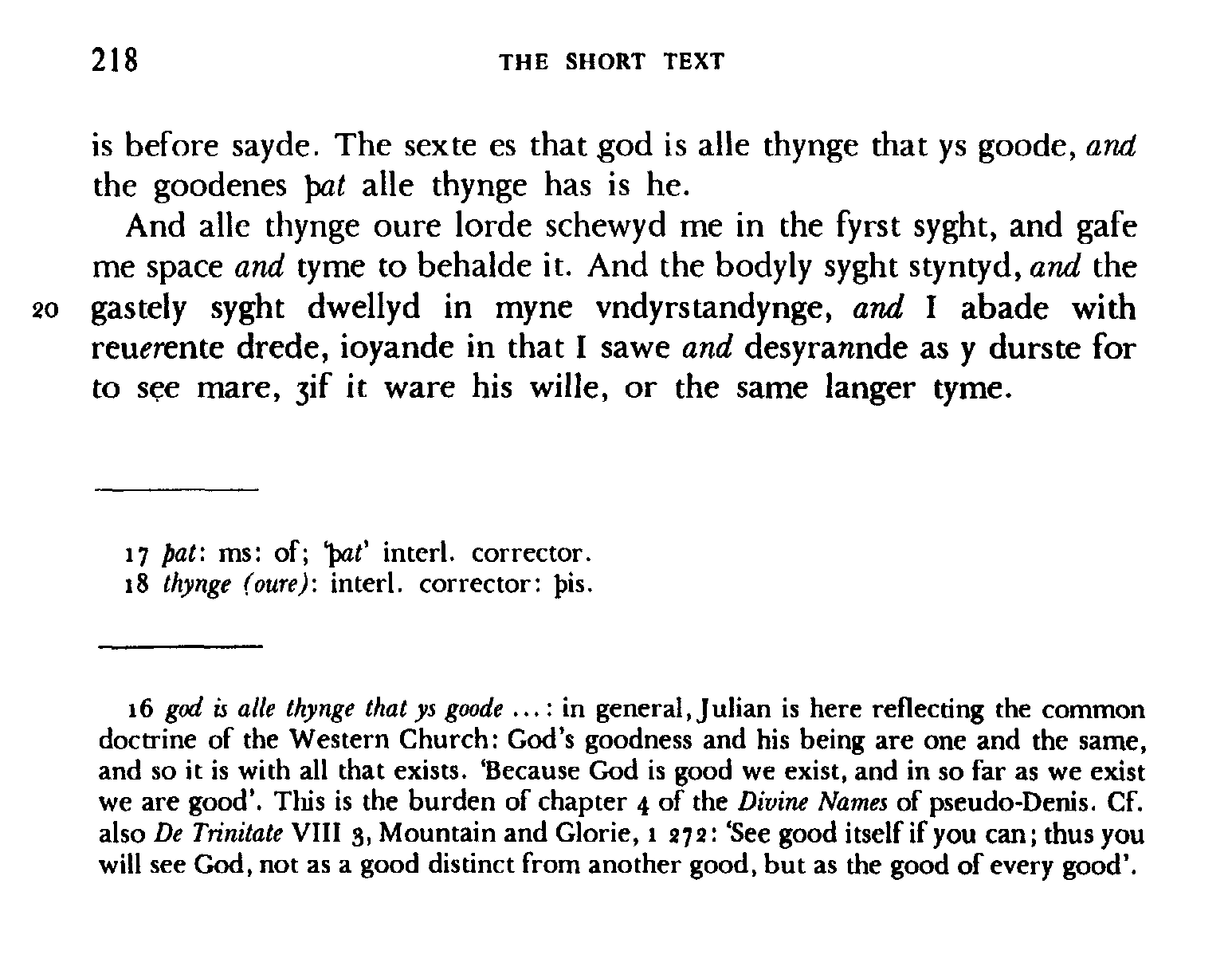
is before sayde. The sexte es that god is alle thynge that ys goode, and the goodenes \>at alle thynge has is he.
And alle thynge oure lorde schewyd me in the fyrst syght, and gafe me space and tyme to behalde it. And the bodyly syght styntyd, and the 20 gastely syght dwellyd in myne vndyrstandynge, and I abade with reuerente drede, ioyande in that I sawe and desyrannde as y durste for to see mare, 3if it ware his wille, or the same langer tyme.
17 pat: ms: of; "^aC interl. corrector.
18 thynge (oure): interl. corrector: t>is.
16 god is alle thynge that ys goode ...: in general, Julian is here reflecting the common doctrine of the Western Church: God's goodness and his being are one and the same, and so it is with all that exists. 'Because God is good we exist, and in so far as we exist we are good'. This is the burden of chapter 4 of the Divine Names of pseudo-Denis. Cf. also De Trinitate VIII 3, Mountain and Glorie, i 272: 'See good itself if you can; thus you will see God, not as a good distinct from another good, but as the good of every good'.
CHAPTER VJ
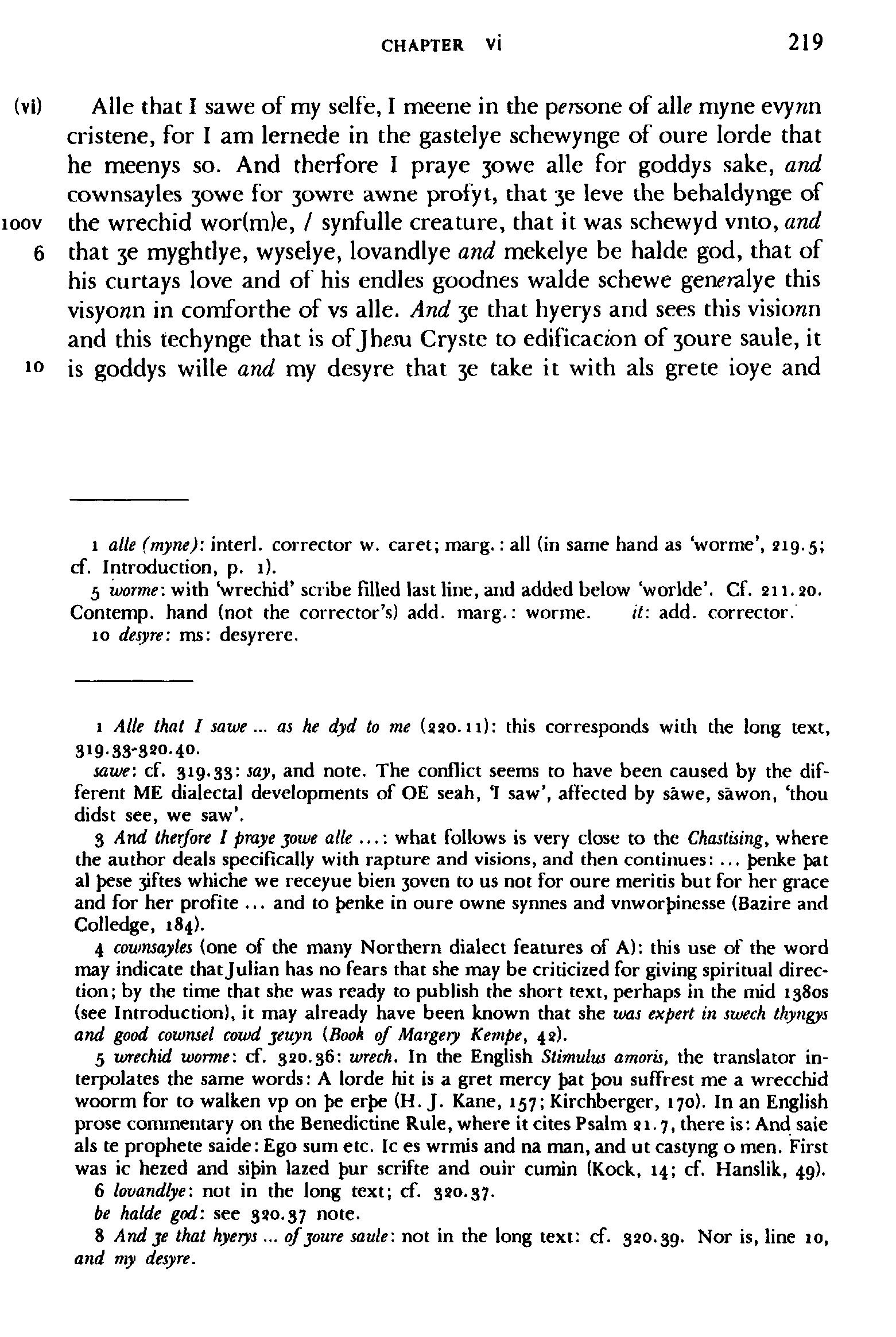
(vi) Alle that I sawe of my selfe, I meene in the persone of all? myne evyrai cristene, for I am lernede in the gastelye schewynge of oure lorde that he meenys so. And therfore I praye 3owe alle for goddys sake, and cownsayles jowe for 3owre awne profyt, that 30 leve the behaldynge of loov the wrechid wor(m)e, / synfulle creature, that it was schewyd vnto, and 6 that 36 myghtlye, wyselye, lovandlye and mekelye be halde god, that of his curtays love and of his endles goodnes walde schewe geraralye this visyown in comforthe of vs alle. And 36 that hyerys and sees this visionn and this techynge that is ofjhwu Cryste to edificadon of 3oure saule, it
10 is goddys wille and my desyre that 36 take it with als grete ioye and i alle (myne): interl. corrector w. caret; marg.: all (in same hand as 'worme', 219.5; cf. Introduction, p. i).
5 worme: with 'wrechid' scribe filled last line, and added below 'worlde'. Cf. 211.20.
Contemp. hand (not the corrector's) add. marg.: worme. it: add. corrector.
10 desyre: ms: desyrere. i Alle that I sawe ... as he dyd to me (220.11): this corresponds with the long text,
319-33-320.40. sawe: cf. 319.33: say, and note. The conflict seems to have been caused by the different ME dialectal developments of OE seah, 'I saw', affected by sawe, sawon, 'thou didst see, we saw'.
3 And therfore I praye jowe alle ...: what follows is very close to the Chastising, where the author deals specifically with rapture and visions, and then continues: ... Jjenke }»t al pese yftes whiche we receyue bien 3oven to us not for oure meritis but for her grace and for her profile ... and to {jenke in oure owne synnes and vnworjjinesse (Bazire and Colledge, 184).
4 cownsayles (one of the many Northern dialect features of A): this use of the word may indicate that Julian has no fears that she may be criticized for giving spiritual direction; by the time that she was ready to publish the short text, perhaps in the mid 13808
(see Introduction), it may already have been known that she was expert in swech thyngys and good cownsel cowd jeuyn (Book of Margery Kempe, 42).
5 wrechid worme: cf. 320.36: wreck. In the English Stimulus amoris, the translator interpolates the same words: A lorde hit is a gret mercy J>at Jx>u suffrest me a wrecchid woorm for to walken vp on l>e erjje (H. J. Kane, 157; Kirchberger, 170). In an English prose commentary on the Benedictine Rule, where it cites Psalm 21.7, there is: And saie als te prophete saide: Ego sum etc. Ic es wrmis and na man, and ut castyng o men. First was ic hezed and si^in lazed |>ur scrifte and ouir cumin (Kock, 14; cf. Hanslik, 49).
6 lovandlye: not in the long text; cf. 320.37. be halde god: see 320.37 note.
8 And y that hyerys ... ofjoure saule: not in the long text: cf. 320.39. Nor is, line 10, and my desyre.
THE SHORT TEXT
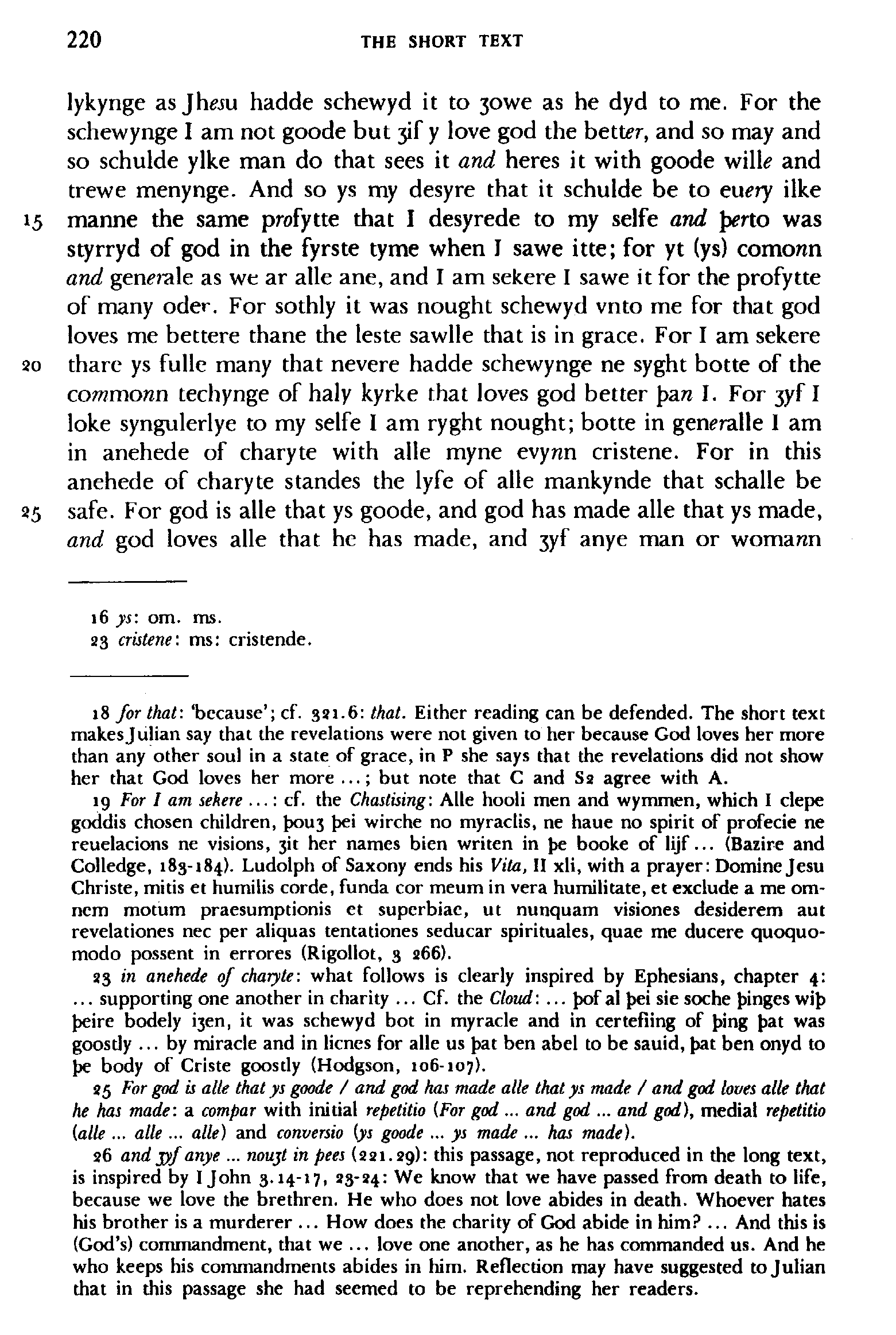
lykynge asjh&m hadde schewyd it to 3owe as he dyd to me. For the schewynge I am not goode but 3if y love god the better, and so may and so schulde ylke man do that sees it and heres it with goode will? and trewe menynge. And so ys my desyre that it schulde be to eu^ry ilke
15 manne the same profytte that I desyrede to my selfe and J^rto was styrryd of god in the fyrste tyme when I sawe itte; for yt (ys) comonn and gen6>7<ile as we ar alle ane, and I am sekere I sawe it for the profytte of many oder. For sothly it was nought schewyd vnto me for that god loves me bettere thane the leste sawlle that is in grace. For I am sekere
thare ys fulle many that nevere hadde schewynge ne syght botte of the cowmonn techynge of haly kyrke that loves god better J>an I. For 3yf I loke syngulerlye to my selfe I am ryght nought; botte in generalle I am in anehede of charyte with alle myne evynn cristene. For in this anehede of charyte standes the lyfe of alle mankynde that schalle be
25 safe. For god is alle that ys goode, and god has made alle that ys made, and god loves alle that he has made, and 3yf anye man or womann if> ys: om. ms.
23 cristene: ms: cristende.
18 for that: 'because'; cf. 321.6: that. Either reading can be defended. The short text makesjulian say that the revelations were not given to her because God loves her more than any other soul in a state of grace, in P she says that the revelations did not show her that God loves her more ...; but note that C and 82 agree with A.
19 For I am sekere ...: cf. the Chastising: Alle hooli men and wymmen, which I clepe goddis chosen children, pou3 pei wirche no myraclis, ne haue no spirit of profecie ne reuelacions ne visions, 3it her names bien writen in pe booke of lijf... (Bazire and Colledge, 183-184). Ludolph of Saxony ends his Vita, II xli, with a prayer: Domine Jesu
Christe, mitis et humilis corde, funda cor meum in vera humilitate, et exclude a me omnem motum praesumptionis et superbiae, ut nunquam visiones desiderem aut revelationes nee per aliquas tentationes seducar spirituales, quae me ducere quoquomodo possent in errores (Rigollot, 3 266).
23 in anehede of charyte: what follows is clearly inspired by Ephesians, chapter 4:
... supporting one another in charity ... Cf. the Cloud: ... pof al pei sie soche Binges wip peire bodely i3en, it was schewyd bot in myracle and in certefiing of ping pat was goostly ... by miracle and in licnes for alle us pat ben abel to be sauid, pat ben onyd to pe body of Criste goostly (Hodgson, 106-107).
25 For god is alle that ys goode / and god has made alle that ys made / and god loves alle that he has made: a compar with initial repetitio (For god ... and god ... and god), medial repetitio
(alle ... alle ... alle) and conversio (ys goode ... ys made ...has made).
26 and jyfanye ... nou^t in pees (221.29): this passage, not reproduced in the long text, is inspired by I John 3.14-17, 23-24: We know that we have passed from death to life, because we love the brethren. He who does not love abides in death. Whoever hates his brother is a murderer ... How does the charity of God abide in him? ... And this is
(God's) commandment, that we ... love one another, as he has commanded us. And he who keeps his commandments abides in him. Reflection may have suggested to Julian that in this passage she had seemed to be reprehending her readers.
CHAPTER VJ
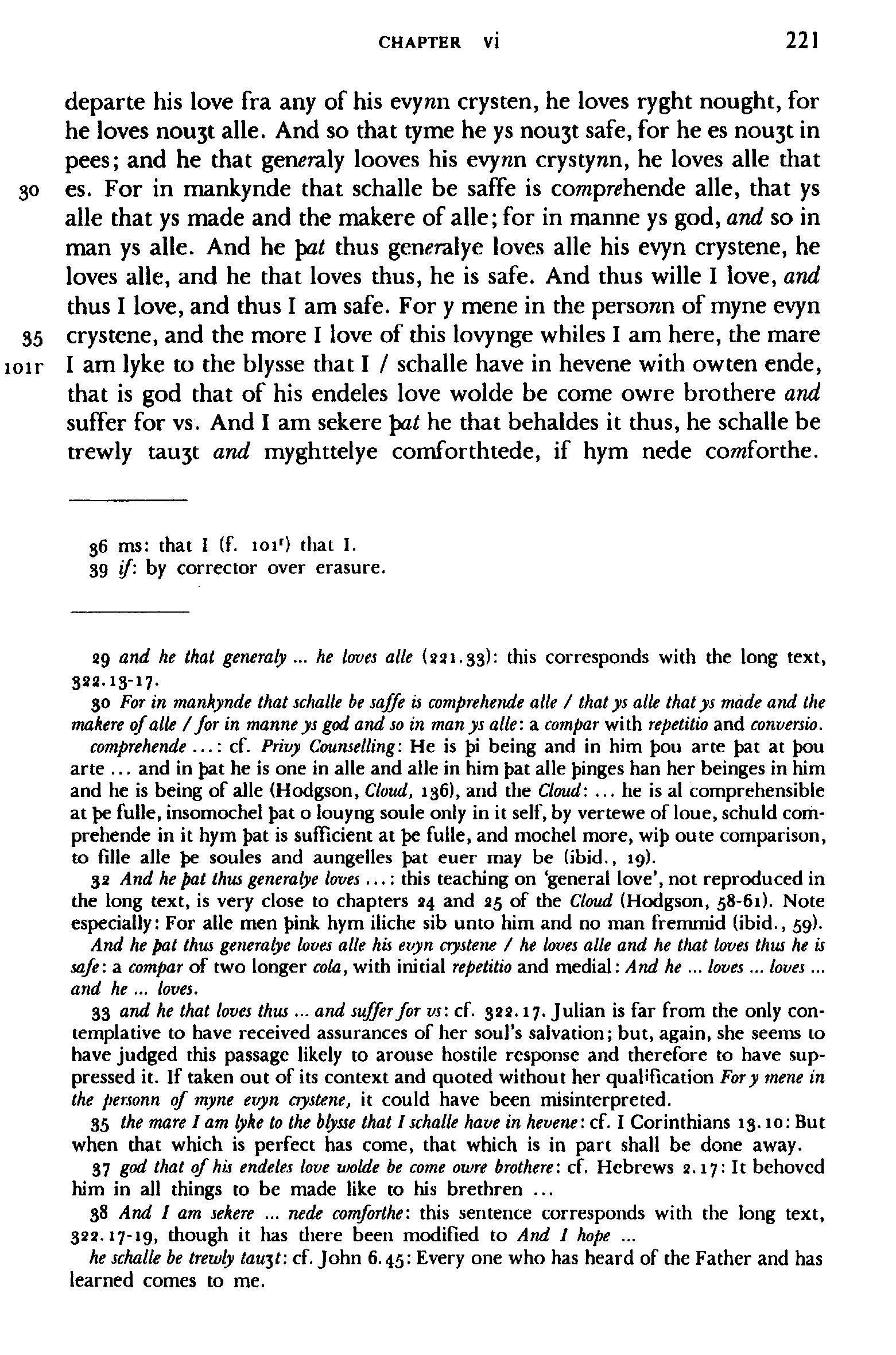
departe his love fra any of his evynn crysten, he loves ryght nought, for he loves nou3t alle. And so that tyme he ys nou3t safe, for he es nou3t in pees; and he that geraraly looves his evynn crystynn, he loves alle that 30 es. For in mankynde that schalle be saffe is comprehende alle, that ys alle that ys made and the makere of alle; for in manne ys god, and so in man ys alle. And he \at thus gen^ralye loves alle his evyn crystene, he loves alle, and he that loves thus, he is safe. And thus wille I love, and thus I love, and thus I am safe. For y mene in the personn of myne evyn
35 crystene, and the more I love of this lovynge whiles I am here, the mare 10ir I am lyke to the blysse that I / schalle have in hevene with owten ende, that is god that of his endeles love wolde be come owre brothere and suffer for vs. And I am sekere Jxz£ he that behaldes it thus, he schalle be trewly tau3t and myghttelye comforthtede, if hym nede comforthe.
36 ms: that I (f. ioir) that I.
39 if: by corrector over erasure.
29 and he that gemraly ... he loves alle (221.33): this corresponds with the long text,
322.13-17.
30 For in mankynde that schalle be saffe is comprehende alle / that ys alle that ys made and the makere of alle /for in manne ys god and so in manys alle: a cornpar with repetitio and conversio. comprehende ...: cf. Privy Counselling: He is f>i being and in him J>ou arte Jjat at J>ou arte ... and in jjat he is one in alle and alle in him £at alle Binges nan her beinges in him and he is being of alle (Hodgson, Cloud, 136), and the Cloud: ... he is al comprehensible at J>e fulle, insomochel f>at o louyng soule only in it self, by vertewe of loue, schuld comprehende in it hym J>at is sufficient at J>e fulle, and mochel more, wif> oute comparison, to fille alle J>e soules and aungelles J>at euer may be (ibid., 19).
32 And he pat thus generalye loves ...: this teaching on 'general love', not reproduced in the long text, is very close to chapters 24 and 25 of the Cloud (Hodgson, 58-61). Note especially: For alle men t>ink hym iliche sib unto him and no man fremmid (ibid., 59).
And he pat thus generalye loves alle his evyn crystene / he loves alle and he that loves thus he is safe: a compar of two longer cola, with initial repetitio and medial: And he ... loves... loves... and he ... loves.
33 and he that loves thus... and suffer for vs: cf. 322.17. Julian is far from the only contemplative to have received assurances of her soul's salvation; but, again, she seems to have judged this passage likely to arouse hostile response and therefore to have suppressed it. If taken out of its context and quoted without her qualification For y mene in the personn of myne evyn crystene, it could have been misinterpreted.
35 the mare I am lyke to the blysse that I schalle have in hevene: cf. I Corinthians 13.10: But when that which is perfect has come, that which is in part shall be done away.
37 god that of his endeles love wolde be come owre brothere: cf. Hebrews 2.17: It behoved him in all things to be made like to his brethren ...
38 And I am sekere ... nede comforthe: this sentence corresponds with the long text,
322.17-19, though it has there been modified to And I hope ... he schalle be trewly tau^t: cf. John 6.45: Every one who has heard of the Father and has learned comes to me.
THE SHORT TEXT
40 Botte god for bede that 36 schulde saye or take it so that I am a techere, for I meene 1101131 soo, no I mente nevere so; for I am a womann, leued, febille and freyll*. Botte I wate wele, this that I saye, I hafe it of the schewynge of hym tha(t) es sou^rayne techare. Botte sothelye charyte styrres me to telle 3owe it, for I wolde god ware knawewn, and mynn
evynn crystene spede, as I wolde be my selfe to the mare hatynge of synne and lovynge of god. Botte for I am a womann, schulde I therfore leve that I schulde nou3t telle 3owe the goodenes of god, syne that I sawe in that same tyme that is his wille, that it be knawenn? And that schalle 3e welle see in the same matere that folowes aftyr, if itte be welle
and trewlye takywn. Thane schalle 36 sone forgette me that am a wrecche, and dose so that I lette 3owe nought, and behalde Jhmi that ys techare of alle. I speke of thame that schalle be safe, for in this tyme
43 that: ms: thas.
49 if: interl. corrector w. caret.
40 Botte god for bede ...: from here to techare of alle (222.52) is not found in the long text; cf. 322.19, 323.20. Again, this defence of herself, so like to Margery Kempe's, as a woman who does not teach, may have been deleted as likely to antagonize male readers; but, on the other hand, the notably more tranquil tone of the long text at this point could suggest that in later years Julian had gained assurance. Plainly,Julian here has in mind the prohibition in I Corinthians 14.34, as had the author of the Riwle: Sum is so wel ileret ojjer so wys iwordet J>at heo ... bicomej) mayster J>at scholde beon ancre, and lerej) him Jiat is icomen hire for to leren (Vernon MS, f. 374*; Day, 28).
41 leued, febille andfreylle: this is no more than modest self-disparagement, and we are not obliged to understand leued as meaning 'illiterate', any more than when Douglas writes in his AEnis 'I say nocht this of Chaucer for offence / Bot till excuse my lawit insuffitience' (NED Lewd 2).
43 of hym that es souerayne techare: cf. Matthew 23.8: For one is your master. charyte styrres me: cf. II Corinthians 5.14: For the charity of Christ presses us.
44 / wolde god ware knawenn: cf. Isaias 66.14: And the hand of the Lord shall be known to his servants. and mynn evynn crystene spede: cf. I Corinthians 12.7: ... the manifestation of the Spirit is given ... for profit.
45 hatynge of synne and lovynge of god: cf. Psalm 96.10: You that love the Lord, hate evil.
50 Thane schalle y sone forgette me that am a wrecche / and dose so that I lette pwe nought I and behalde Jhesu thatys techare of alle: a three-membered compar with oppositio contrariorum.
51 dose: this is the Northern plural imperative: 'and do this (forget me), so that I am no hindrance to you'. behalde Jhesu that ys techare of alle: cf. John 13. 13: You call me master and lord, and you say well, for so I am; and Hebrews 12. 2: ... Jesus, the author and finisher of faith.
52 1 speke of thame ... haly kyrke techis (223.54): this corresponds with the long text,
323.20-23.
CHAPTER vi
god schewyd me non othere; hot in alle thynge I lyeve as haly kyrke techis, for in alle thynge, this blyssede schewynge of oure lorde, I be
55 helde it as ane in god syght, and I vndyrstode neu^r nathynge \>er yn that stone3 me ne lettes me of the trewe techynge of halye kyrke.
THE SHORT TEXT
(vil) Alle this blyssede techynge of oure lorde god was schewyd to me in thre partyes, that is be bodylye syght, and be worde formede in myne vndyrstandynge, and be gastelye syght. Botte the gastelye syght I maye nought ne can nought schewe it vnto 3owe oponlye and als fullye as I 5 wolde; botte I truste in oure lorde god alle myghtty that he schalle of his goodnes and for 3oure love make 3owe to take it mare gastelye and mare swetly than I can or maye telle it 3owe, and so motte it be, for we are all? one in loove. And in alle this I was mekylle styrrede in charyte to myne evynn cristene, that thaye myght alle see and knawe Jje same loiv that I sawe, for I walde that it ware comforthe to thame / alle as it es to n me; for this syght was schewyd in gemralle, and nathynge in specyalle.
Of alle that I sawe, this was the maste cowforthe to me, that oure lorde es so hamlye and so curtayse, and this maste fillyd me with lykynge and syekernes in saule. Than sayde I to the folke that were with me: Itt es to 15 daye domes daye with me. And this I sayde for I wenede to hafe dyed; for that daye that man or womann dyes ys he demyd as he schalle be
6 pwe: ms: i3owe.
12 /: interl. corrector w. caret.
13 fillyd: ms: fil-lyd; 'il' corrector over erasure. i Alle this blyssede techynge ... maye telle it jowe (224.7): this corresponds with the long text, 323-29-347 and so motte it be, for we are alle one in loove: not in the long text; cf. 323.34.
8 And in alle this ... nathynge in specyalle (224.11): this corresponds with the long text,
319.21-25.
10 for I walde that it ware comforthe to thame alle: though Julian is very sure of her own place in contemplative life and its traditions, she is free of the guarded esotericism to be seen in some of even the most orthodox of her peers. For example, the Cloud-author writes that no-one must see his works except those who have forsaken the active life
(Hodgson, 1-2).
11 for this syght was schewyd in generalle I and nathynge in specyalle: oppositio contrariorum.
12 Of alle ... syekemes in saule: this sentence corresponds with 313.31-34 in the long text.
14 Than sayde I... to hafe dyed (225.20): this corresponds with 319.25-31 in the long text.
15 domes daye with me: the only example in NED of the meaning 'particular judgment' is 1579, Lyly: 'Dost thou not know that everyone's death day is his doomesday?' MED does not record the meaning. Hugh of St. Victor seems to have been the first theologian to distinguish clearly between the general and particular judgments, in De sacramentis, where he writes first 'de morientibus, seu de fine hominis', and then 'de fine saeculi'; but the terminology 'particular' and 'general' became current only with the scholastics. Cf. J. Riviere, Jugement'.
CHAPTER vii
with owtynn eende. This I sayde for y walde thaye lovyd god mare and sette the lesse pryse be the vanite of the worlde, for to make thame to hafe mynde that this lyfe es schorte, as thaye myght se in ensampilltf be
me; for in alle J>is tyme I wenede to hafe dyed.
And aftyr this I sawe with bodely syght the face of the crucifixe that hange before me, in whilke I behelde contynuely a party of his passyonn: despite, spittynge in sowlynge of his bodye and buffetynge in his blysfulle face, and manye langoures and paynes, ma than I can telle,
25 and ofte chaungynge of coloure, and alle his blyssede face a tyme closede in dry blode. This I sawe bodylye and hevelye and derkelye; and I desyred mare bodelye lyght to hafe sene more clerelye. And I was annswerde in my resone that 3yf god walde schewe me mare he schulde, botte me nedyd na lyght botte hym.
20 pis: 'is' interl. corrector.
17 and sette the lesse pryse be the vanite of the worlde: not in the long text; cf. 319.29.
21 And aftyr this ... na lyght botte hym (29): cf. 324.3-325.14.
23 spittynge: cf. 324.5 and note. sowlynge: cf. 324.5 and note.
24 langoures and paynes: cf. 324.5: languryng paynes. Either reading is defensible. Cf.
Isaias 53.4: 'Surely he has borne our infirmities and carried our sorrows', which I Peter
2.24 relates to the Passion.
25 ofte chaungynge of coloure: cf. 233.2-8, 357.3-9, 11 and note. These descriptions markedly resemble some lines from the 'imago pietatis' poem, Brother, Abide: 'My visage changed to pale and blew as byse,/ My fleshe beganne to styff and waxid drye, / My hart lokyd lyke a plommet of ise ...' (Brown, XV 174). Though the poet, like Julian, may have known pseudo-Bonaventure (R. Woolf, The English Religious Lyric, 197 and note i), the Meditations are not here the source. Probably both writers are describing contemporary art-objects, 'the payntyngys of crucyfexes that er made be the grace of god' (202.16), such as the horrific illustrations from MS B.M. Add. 37049 reproduced by R. Woolf; and Julian's intention plainly is to heighten the spiritual significance of the contrast between this 'image of pite' and her visions of the risen and glorified Lord.
26 dry blode: pseudo-Bonaventure has a similar detail: 'his clones £at were drye and bakene to his blessid body all abowte hyme in his blyssede blode' (Horstman i 205;
Stallings, 111, Ragusa and Green, 333). hevelye: cf. 325.11: swemly.
27 / was annswerde in my resone: here she seems to be trying to convey a reflective process which is certainly, in her own consideration, assisted by grace, but which differs greatly from the 'part' of the revelation which is *by words formed in my understanding'. It also differs from where she says that diere 'was brought to my mind this word' (360.2), and 'I had a proffer in my reason' (370.6), both of which are also
'gracious' activities, but 'meditative' (discursive) rather than contemplative, acquired rather than infused graces.
28 yf god walde schewe me mare he schulde / botte me nedyd na lyght botte hym: a compar.
29 me nedyd na lyght botte hym: cf. 325.13 and note, and Psalm 22. i: The Lord rules me, and I shall want nothing'.
THE SHORT TEXT
(viii) And aftyr this I sawe god in a poynte, that es in myne vndyrstandynge, by whilke syght I sawe that he es in alle thynge. I behelde with vysemente, wittande and knawande in that syght that he dose alle that es done. I merveylede in this syght with a softe drede, and thought:
5 Whate es synne? For I sawe trulye that god dothe alle thynge, be itt nevere so litille, nor nathynge es done be happe ne be eventure, botte the endeles forluke of the wysdome of god. Whare fore me behovede nedes grawnte that alle thynge that es done es wele done, and I was sekyr that god dose na synne. I>er fore it semed to me \xit synne is nou3t,
10 for in all? thys, synne was noujt schewyd me. And y walde no lengyr mervelle of this, botte behalde oure lorde, whate he wolde schewe me.
And in anothyr tyme god schewyd me whate syne es, nakydlye be the selfe, as y schalle telle aftyr warde.
9 tvr fore ... thys, synne: add., foot of page w. mark of om., corrector.
13 warde: ms: worde; 'a' inter!, al. m. i And aftyr this... of the wysdome of god (226.7): cf. 336.3-337.9. in a poynte: 'in an instant'. Cf. NED Point «' III 7, where the first example is 1382,
Wycliffe: 'At a poynt in a litil I forsoc pe' (Isaias 54.7: 'Ad punctum in modico dereliqui te'). There is an earlier example in Rolle: and led pair dayes in lust and delyces, and in a poynt pai.fel intil hell (Margaret Amassian, ed.: The Commandment, where she observes that Rolle is translating Job 21.13: And in a moment diey go down to hell). He quotes
Job 20.5 in his Exposicio (cf. 263.1 note): In hiis quippe tormentis experimento cognoscent quia lam impiorum brevis est, et gaudium ypocrite ad instar puncti (Murray, 19).
The Speculum christiani, which Holmstedt dated, on internal and manuscript evidence, as of the second half of the fourteenth century, and which elsewhere quotes Rolle's Incendium, writes: thei ledde here dayes in lustes, lykynges and vanites, and thei descendyd to helle in a poynte (204).
5 For I sawe trulye ...: for this ratiodnatio, preserved in the long text, cf. 336.7 note.
7 forluke: cf. MED for(e-lok, n. (2), '... divine prescience, divine providence', and for(e-loken, v. The earliest example of the noun is 1357, the Lay Folks' Catechism. MED calls the verb 'modelled on L provideo', and both entries indicate that the terms were rare and generally confined to theological writings.
Whare fore me behovede nedes grawnte: this is the logical concession of the proof, the answer to the question in the ratiodnatio. For the legal term concessio, see Ad Herennium
I.xiv.24 (Marx-Trillitzsch, 20). Julian shows the same awareness of the philosophical reasoning as she might have found in Chaucer's Boethius: Syn pat he ne may not done yuel pat may done alle pinges ... deceiuest pou me, pat hast so wouen me wip pi resouns (Morris, 105). Cf. 338.21 note.
Whare fore me behovede ... whate he wolde schewe me (226.11): this corresponds with the long text, 338.17-24.
8 alle thynge that es done es wele done: cf. 338.18 note.
9 is noujt: cf. 338.22: is no dede.
12 And in anothyr tyme ... as y schalle telle: cf. 338.28-339.29.
CHAPTER viii
And aftyr this I sawe be haldande the bodye plentevouslye bledande, 15 hate and freschlye and lyfelye, ry3t as I sawe before in the heede. And io2r this was schewyd / me in the semes of scowrgynge, and this ranne so plenteuouslye to my syght that me thought, 3yf itt hadde bene so in kynde, for }>at tyme itt schulde hafe made the bedde alle on blode and hafe passede onn abowte.
God has made waterse plentuouse in erthe to oure servyce and to owre bodylye eese, for tendyr love that he has to vs. Botte 3it lykes hym bettyr that we take fullye his blessede blode to wasche vs with of synne; for thare ys no lykoure that es made that hym lykes so welle to gyffe vs.
For it is so plenteuouse and of oure kynde.
And aftyr this, or god schewyd me any wo(r)des, he suffyrde me to be halde langere, and alle that I hadde scene, and alle that was there yn.
And than was with owtyran voyce and with owte openynge of lyppes formede in my sawlle this worde: Here with ys the feende ou^r commynn.
This worde sayde oure lorde me(n)ande his passyonn, as he schewyd me 3° before. In this oure lorde brought vnto my mynde and schewyd me a perte of the fendys malyce, and fully his vnmyght, and for that he schewyd me that the passyorcn of hym is ou^rcomynge of the fende. God
16 ms: schewyd (f. 102') schewyd.
25 or: ms: houre. wordes: ms: wonwdes; cf. 346.3.
29 menande: ms: mevande; cf. 346.8.
14 And aftyr this ... the semes of scowrgynge: cf. 342.3-4.
16 semes: cf. 342.3: in semyng, and note. and this ranne so plenteuouslye... and of oure kynde (227.24): cf. 342.9-343.18.
20 God has made waterse: see 343.13 note.
25 And aftyr this... lokene in goddys hande (228.40): this corresponds with the long text,
346-3-347-l8or god schewyd me any wordes: see 346.3 note.
26 langere: cf. 346.4: a conveniable tyme.
27 with owtynn voyce...: see 346.6 note.
28 Here with ys the feende ouer commynn: the author of the Ancrene Riwle calls the Passion: herte scheld ayeyn pe fent (he is alluding to Lamentations 3.65); and he continues: hef hit an hei3 abouen pin herte heued ... hold hit vp to3eyn pe fend ... pe si3t per of one bringep him to fleon (Vernon MS, f. 385d; Day, 132).
29 as he schewyd me before: this is probably a general reference to the previous revelations of the suffering Christ, though it may allude to what she has just written,
227.21-22.
31 the fendys malyce: see 347.9 note. and fully his vnmyght: see 347.9 note.
32 the passyonn of hym ...: see 347.10 note.
THE SHORT TEXT
schewyd me that he hase nowe the same malyce that he had before the incarnaczon, and als sare he traveyles, and als ccwtynuelye he sees that 35 alle chosene saules eschapes hym worschipfullye. And that es alle his sorowe; for alle that god suffers hym to do turnes vs to ioye and hym to payne and to schame, and he has als mekylle sorowe when god gyffes hym leve to wyrke as when he werkys nought. And that es for he maye nevere do als ille as he wolde, for his myght es alle lokene in goddys
4° hande. Also I sawe oure lorde scorne his malyce and nought hym, and he wille that we do the same. For this syght, I luglvj myghttelye, and that made thamm to Iaugh3 that were abowte me; and thare laughynge was lykynge to me. I thought y wolde myne evyn cristene hadde sene as I sawe. Than schulde thaye alle hafe laughynn with me. Botte I sawe
45 nou3t Cryste laughj; neuer the lesse hym lykes that we laughs 'n comfortynge of vs, and er ioyande in god for the feende ys ou^r comynn.
And aftyr this I felle into a saddehe(d)e, and sayde: I see. I see thre thynges: game, scorne and arneste. I see game, that the feende ys ouerio2v comewn, and I see scorne, / that god scornes hym and he schalle be
5° scornede, and I see arneste that he es ou^rcomenn be the passionn of oure lorde Jhmi Cryste and be his dede, that was done ful erneste and with sadde travayle.
36 to (do): interl. corrector w. caret. vs: corrector, over erasure.
47 saddehede: ms: sadde hete.
I see (thre): interl. corrector w. caret.
35 alle chosen saules: cf. 347.13: all sowles of salwcion.
And that es alle his sorowe: St. Thomas taught that there is in the devil the sin of envy:
... est in angelo peccante malum invidiae secundum quod de bono hominis doluit (Summa theologiae 1.63.2 ad corpus).
40 Also I sawe ... ys ouer comynn: cf. 348.24-349.31.
44 Botte I sawe noutf Cryste laughy. Julian here is hinting at what in the long text she is able to say with clarity (347.18): that there can be no 'laughing scorn' in God, even as there can be no wrath; what she means when she there writes / sawe hym scorne his malis
(34931) she explains as the quality of his unchanging sothfastnesse.
45 neuer the lesse hym lykes that we laughj: in the long text this is changed to: but wele I wott that syght that he shewed me made me to laugh (348.29-349.30).
47 And aftyr this ... with saddle travayle: cf. 349.36-350.41. saddehede: cf. 349.36: sadnes; SS: sadhede. Plainly A's reading is a corruption of the ancestor as represented by SS. NED, Sad, adj. and adv., II lob, records 'sadde' (c. 1420),
'of a fire: violent'; but the A reading in its context is nonsensical. NED does not record
'Sadhead'.
48 / see game that the feende ys ouercomenn / and I see scorne that god scornes hym and he schalle be scornede / and I see arneste that he es ouercomenn be the passionn of oure lord Jhesu
Cryste: a three-membered compar with repetitio (I see ... I see ... I see ... 1 see ... ouercomenn ... ouercomenn ... scorne ... scornes ... scornede).
CHAPTER viii
Aftyr this oure lorde sayde: I thanke the of thy servyce and of thy trauayle, and namly in J>i sough.
53 Aftyr this oure lorde ... in pi jough: cf. 351.3-4 and note. Ludolph of Saxony ends his
Vita, II xiv (in which he has commented on the parable of the workmen in the vineyard) with a prayer: Dominejesu Christe, summe paterfamilias, tu me primo mane in vineam tuam conduxisti, dum me a juventute mea ad fidem et tuum servitium misericorditer vocasti (Rigollot, 3 98).
THE SHORT TEXT
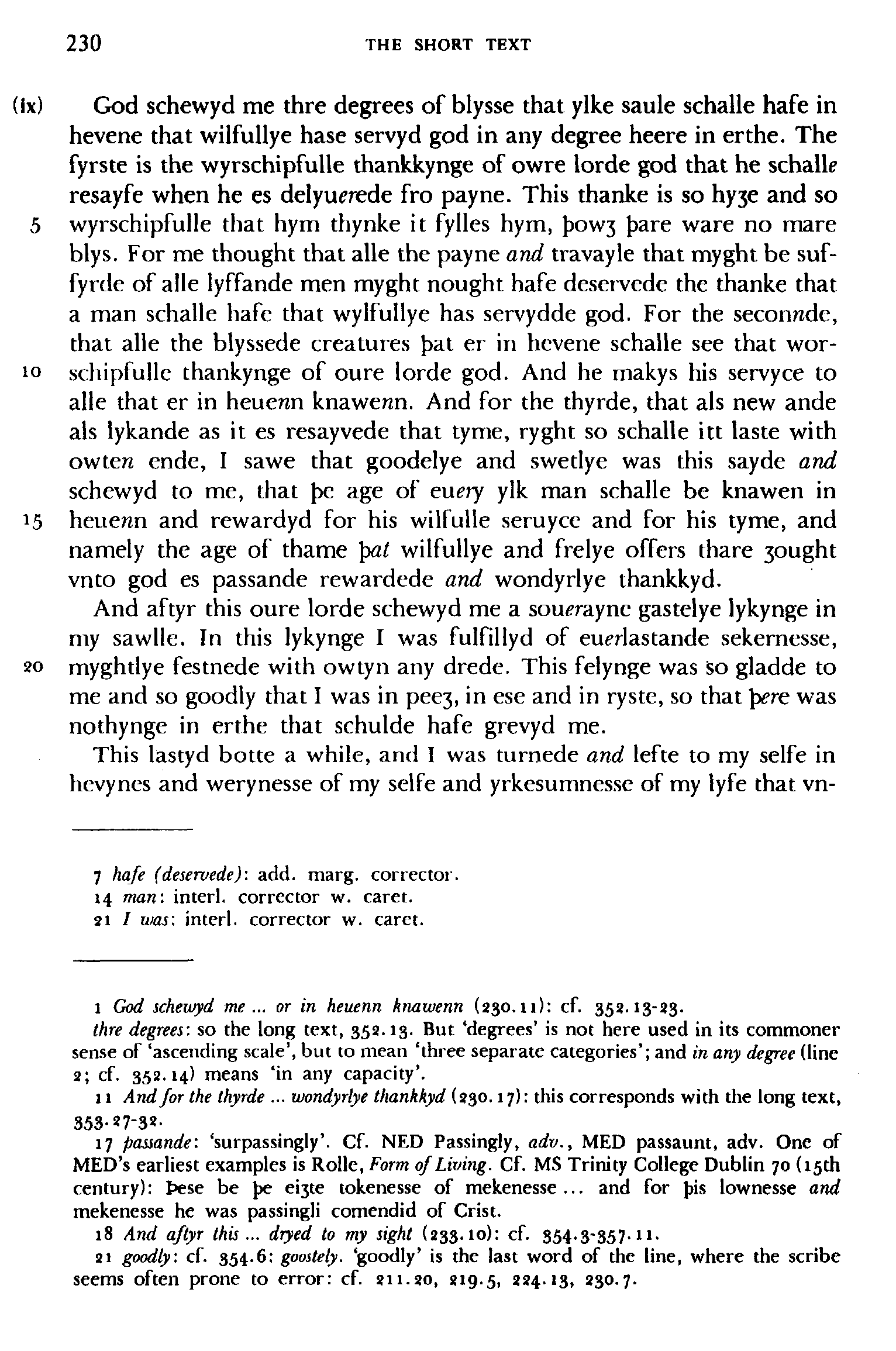
(ix) God schewyd me thre degrees of blysse that ylke saule schalle hafe in hevene that wilfullye hase servyd god in any degree heere in erthe. The fyrste is the wyrschipfulle thankkynge of owre lorde god that he schalle resayfe when he es delyuerede fro payne. This thanke is so hy3e and so
wyrschipfulle that hym thynke it fylles hym, pow3 pare ware no mare blys. For me thought that alle the payne and travayle that myght be suffyrde of alle lyffande men myght nought hafe deservede the thanke that a man schalle hafe that wylfullye has servydde god. For the seconwde, that alle the blyssede creatures pat er in hevene schalle see that wor-
schipfulle thankynge of oure lorde god. And he makys his servyce to alle that er in heuenn knawenn. And for the thyrde, that als new ande als lykande as it es resayvede that tyme, ryght so schalle itt laste with owten ende, I sawe that goodelye and s we dye was this sayde and schewyd to me, that pe age of every ylk man schalle be knawen in 15 heuenn and rewardyd for his wilfulle seruyce and for his tyme, and namely the age of thame \>at wilfullye and frelye offers thare 3ought vnto god es passande rewardede and wondyrlye thankkyd.
And aftyr this oure lorde schewyd me a sou^rayne gastelye lykynge in my sawlle. In this lykynge I was fulfillyd of eue-rlastande sekernesse,
20 myghtlye festnede with owtyn any drede. This felynge was so gladde to me and so goodly that I was in pee3, in ese and in ryste, so that p?re was nothynge in erthe that schulde hafe grevyd me.
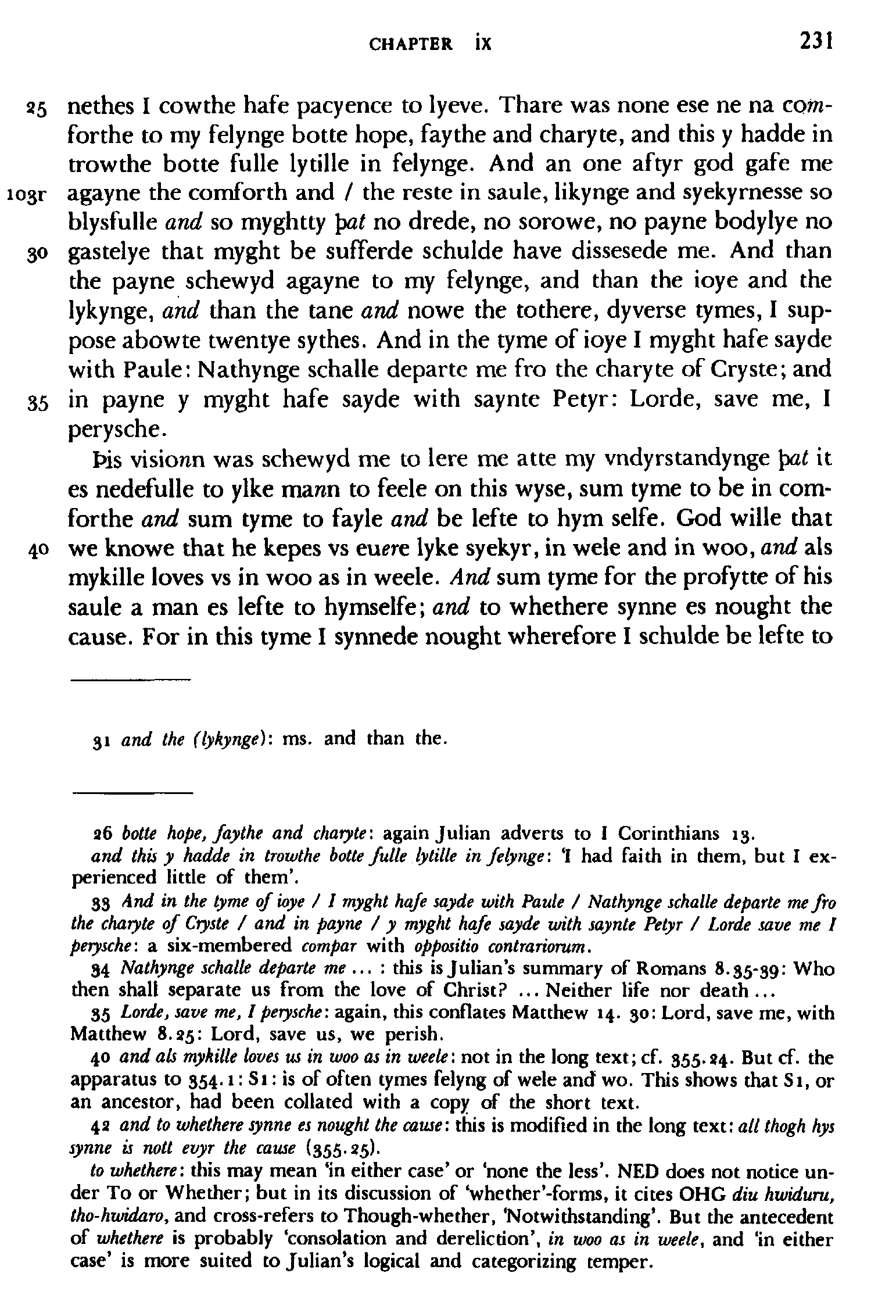
This lastyd botte a while, and I was turnede and lefte to my selfe in hevynes and werynesse of my selfe and yrkesurnnesse of my lyfe that vn7 hafe (deservede): add. marg. corrector.
14 man: interl. corrector w. caret.
21 / was: interl. corrector w. caret. i God schewyd me ... or in heuenn knawenn (230.11): cf. 352.13-23. thre degrees: so the long text, 352.13. But 'degrees' is not here used in its commoner sense of 'ascending scale', but to mean 'three separate categories'; and in any degree (line
2; cf. 352.14) means 'in any capacity'.
11 And for the thyrde ... wondyrlye thankkyd (230.17): this corresponds with the long text,
353-27-32.
17 passande: 'surpassingly'. Cf. NED Passingly, adv., MED passaunt, adv. One of MED's earliest examples is Rolle, Form of Living. Cf. MS Trinity College Dublin 70 (1510 century): frese be }>e ei3te tokenesse of mekenesse... and for |>is lownesse and mekenesse he was passingli comendid of Crist.
18 And aftyr this ... dryed to my sight (233.10): cf. 354.3-357.11. ai goodly: cf. 354.6: goostely. 'goodly' is the last word of the line, where the scribe seems often prone to error: cf. 211.20, 219.5, 224.13, 230.7.
CHAPTER JX
25 nethes I cowthe hafe pacyence to lyeve. Thare was none ese ne na comforthe to my felynge botte hope, faythe and charyte, and this y hadde in trowthe botte fulle lytille in felynge. And an one aftyr god gafe me i03r agayne the comforth and / the reste in saule, likynge and syekyrnesse so blysfulle and so myghtty \>at no drede, no sorowe, no payne bodylye no 30 gastelye that myght be sufferde schulde have dissesede me. And than the payne schewyd agayne to my felynge, and than the ioye and the lykynge, and than the tane and nowe the tothere, dyverse tymes, I suppose abowte twentye sythes. And in the tyme of ioye I myght hafe sayde with Paule: Nathynge schalle departe me fro the charyte of Cryste; and 35 in payne y myght hafe sayde with saynte Petyr: Lorde, save me, I perysche. t>is visiorcn was schewyd me to lere me atte my vndyrstandynge \at it es nedefulle to ylke maran to feele on this wyse, sum tyme to be in comforthe and sum tyme to fayle and be lefte to hym selfe. God wille that 40 we knowe that he kepes vs eu^re lyke syekyr, in wele and in woo, and als mykille loves vs in woo as in weele. And sum tyme for the profytte of his saule a man es lefte to hymselfe; and to whethere synne es nought the cause. For in this tyme I synnede nought wherefore I schulde be lefte to 31 and the (lykynge): ms. and than the.
26 botte hope, faythe and charyte: again Julian adverts to I Corinthians 13. and this y hadde in trowthe botte fulle lytille in felynge: 'I had faith in them, but I experienced little of them'.
33 And in the tyme of ioye / I myght hafe sayde with Paule / Nathynge schalle departe me fro the charyte of Cryste / and in payne / y myght hafe sayde with saynte Petyr / Lorde save me I perysche: a six-membered compar with oppositio contrariorum.
34 Nathynge schalle departe me ... : this is Julian's summary of Romans 8.35-39: Who then shall separate us from the love of Christ? ... Neither life nor death...
35 Lorde, save me, I perysche: again, this conflates Matthew 14. 30: Lord, save me, with Matthew 8.25: Lord, save us, we perish.
40 and als mykille loves us in woo as in weele: not in the long text; cf. 355.24. But cf. the apparatus to 354. i: Si: is of often tymes felyng of wele and wo. This shows that Si, or an ancestor, had been collated with a copy of the short text.
42 and to whethere synne es nought the cause: this is modified in the long text: all thogh hys synne is nott evyr the cause (355.25). to whethere: this may mean 'in either case' or 'none the less'. NED does not notice under To or Whether; but in its discussion of 'whether'-forms, it cites OHG diu hwiduru, tho-hwidaro, and cross-refers to Though-whether, 'Notwithstanding'. But the antecedent of whethere is probably 'consolation and dereliction', in woo as in weele, and 'in either case' is more suited to Julian's logical and categorizing temper.
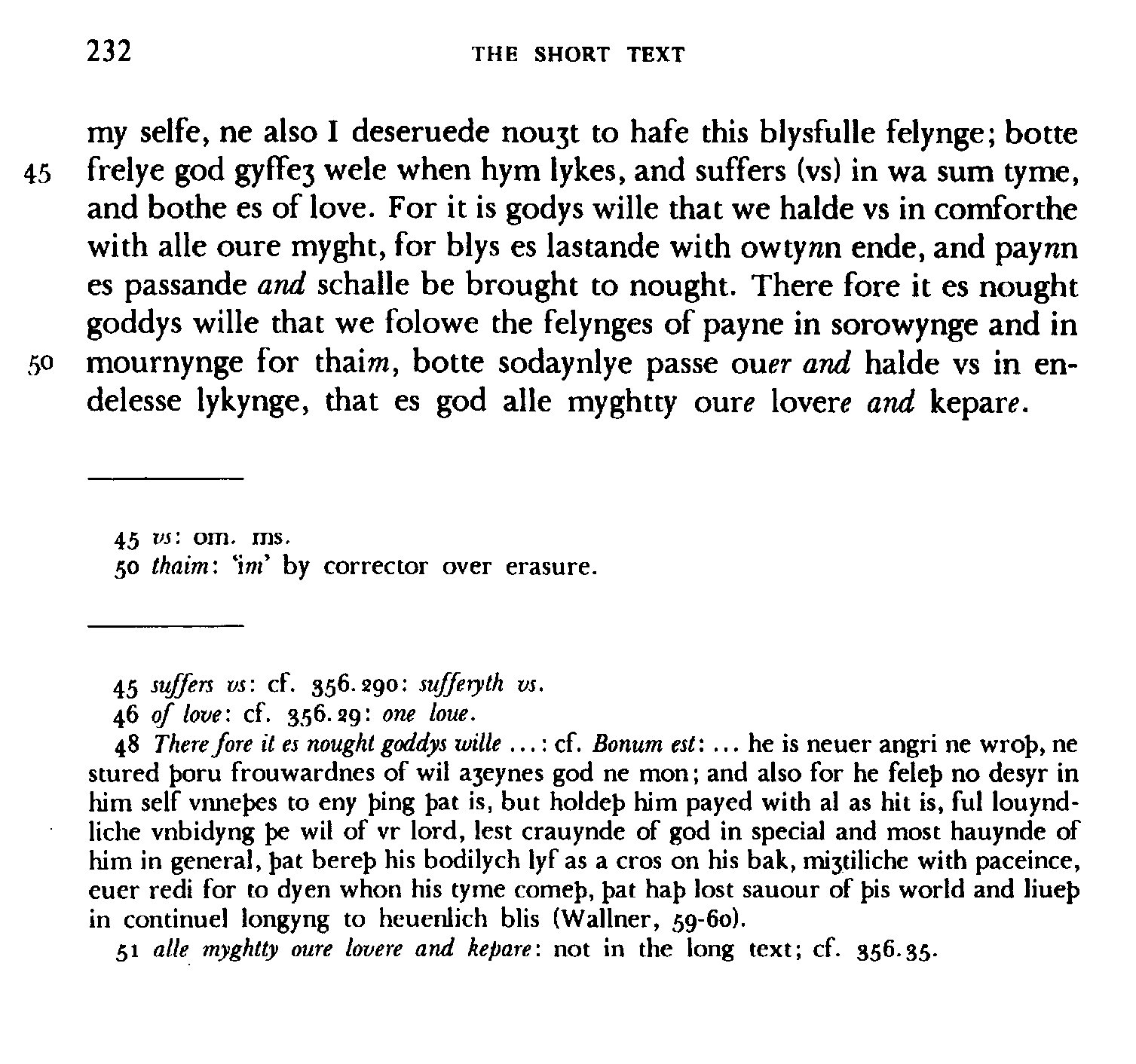
THE SHORT TEXT
my selfe, ne also I deseruede nou3t to hafe this blysfulle felynge; botte
frelye god gyfFe3 wele when hym lykes, and suffers (vs) in wa sum tyme, and bothe es of love. For it is godys wille that we halde vs in comforthe with alle oure myght, for blys es lastande with owtyrai ende, and paynn es passande and schalle be brought to nought. There fore it es nought goddys wille that we folowe the felynges of payne in sorowynge and in 50 mournynge for thaiw, botte sodaynlye passe ouer and halde vs in endelesse lykynge, that es god alle myghtty oure lovers and kepare.
45 vs: om. ms.
50 thaim: l'\ni by corrector over erasure.
45 suffers vs: cf. 356.290: sufferyth vs.
46 of love: cf. 356.29: one hue.
48 Therefore it es nought goddys wille ...: cf. Bonum est: ... he is neuer angri ne wroj), ne stured Jjoru frouwardnes of wil ajeynes god ne mon; and also for he felej) no desyr in him self vnnej>es to eny }>ing J>at is, but holdej) him payed with al as hit is, ful louyndliche vnbidyng J>e wil of vr lord, lest crauynde of god in special and most hauynde of him in general, J)at beref) his bodilych lyf as a cros on his bak, mistiliche with paceince, euer redi for to dyen whon his tyme comej), J>at haj) lost sauour of f>is world and liuej) in continuel longyng to heuenlich blis (Wallner, 59-60).
51 alle myghtty oure lovere and kepare: not in the long text; cf. 356.35.
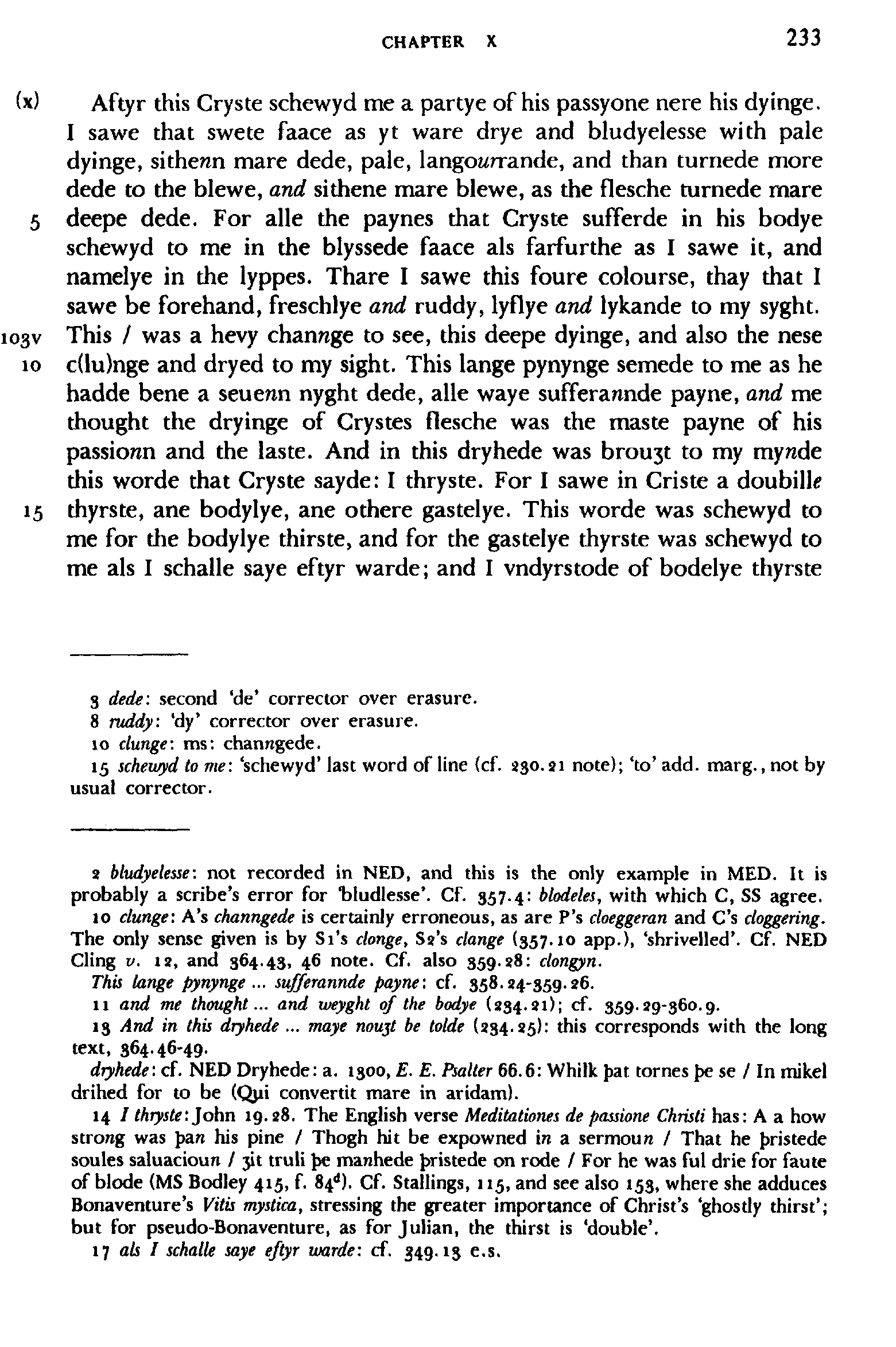
CHAPTER X
(x) Aftyr this Cryste schewyd me a partye of his passyone nere his dyinge.
I sawe that swete faace as yt ware drye and bludyelesse with pale dyinge, sithenn mare dede, pale, langowrrande, and than turnede more dede to the blewe, and sithene mare blewe, as the flesche turnede mare
5 deepe dede. For alle the paynes that Cryste sufferde in his bodye schewyd to me in the blyssede faace als farfurthe as I sawe it, and namelye in the lyppes. Thare I sawe this foure colourse, thay that I sawe be forehand, freschlye and ruddy, lyflye and lykande to my syght. losv This / was a hevy chanwge to see, this deepe dyinge, and also the nese
10 c(lu)nge and dryed to my sight. This lange pynynge semede to me as he hadde bene a seuewn nyght dede, alle waye sufferannde payne, and me thought the dryinge of Crystes flesche was the maste payne of his passionn and the laste. And in this dryhede was brou3t to my mywde this worde that Cryste sayde: I thryste. For I sawe in Criste a doubilk
15 thyrste, ane bodylye, ane othere gastelye. This worde was schewyd to me for the bodylye thirste, and for the gastelye thyrste was schewyd to me als I schalle saye eftyr warde; and I vndyrstode of bodelye thyrste
3 dede: second 'de' corrector over erasure.
8 ruddy: 'dy' corrector over erasure.
10 clunge: ms: channgede.
15 schewyd to me: 'schewyd' last word of line (cf. 230.21 note); 'to' add. marg., not by usual corrector.
2 bludyelesse: not recorded in NED, and this is the only example in MED. It is probably a scribe's error for "bludlesse*. Cf. 357.4: blodeles, with which C, SS agree.
10 clunge: A's channgede is certainly erroneous, as are P's cloeggeran and C's daggering.
The only sense given is by Si's clonge, Ss's clange (357.10 app.), 'shrivelled'. Cf. NED
Cling v. 12, and 364.43, 46 note. Cf. also 359.28: dongyn.
This lange pynynge ... sufferannde payne: cf. 358.24-359.26.
11 and me thought... and weyght of the bodye (234.21); cf. 359-29-360.9.
13 And in this dryhede ... maye noujt be tolde (234.25): this corresponds with the long text, 364.46-49. dryhede: cf. NED Dryhede: a. 1300, E. E. Psalter 66.6: Whilk pat tornes pe se / In rnikel drihed for to be (Qui convert! t mare in aridam).
14 / thryste: John 19.28. The English verse Meditationes de passione Christi has: A a how strong was pan his pine / Thogh hit be expowned in a sermoun / That he pristede soules saluacioun / 311 truli pe manhede pristede on rode / For he was ful drie for faute of blode (MS Bodley 415, f. 84d). Cf. Stallings, 115, and see also 153, where she adduces
Bonaventure's Vitis mystica, stressing the greater importance of Christ's 'ghostly thirst'; but for pseudo-Bonaventure, as for Julian, the thirst is 'double'.
IT als I schalle saye eftyr warde: cf. 249.13 e.s.
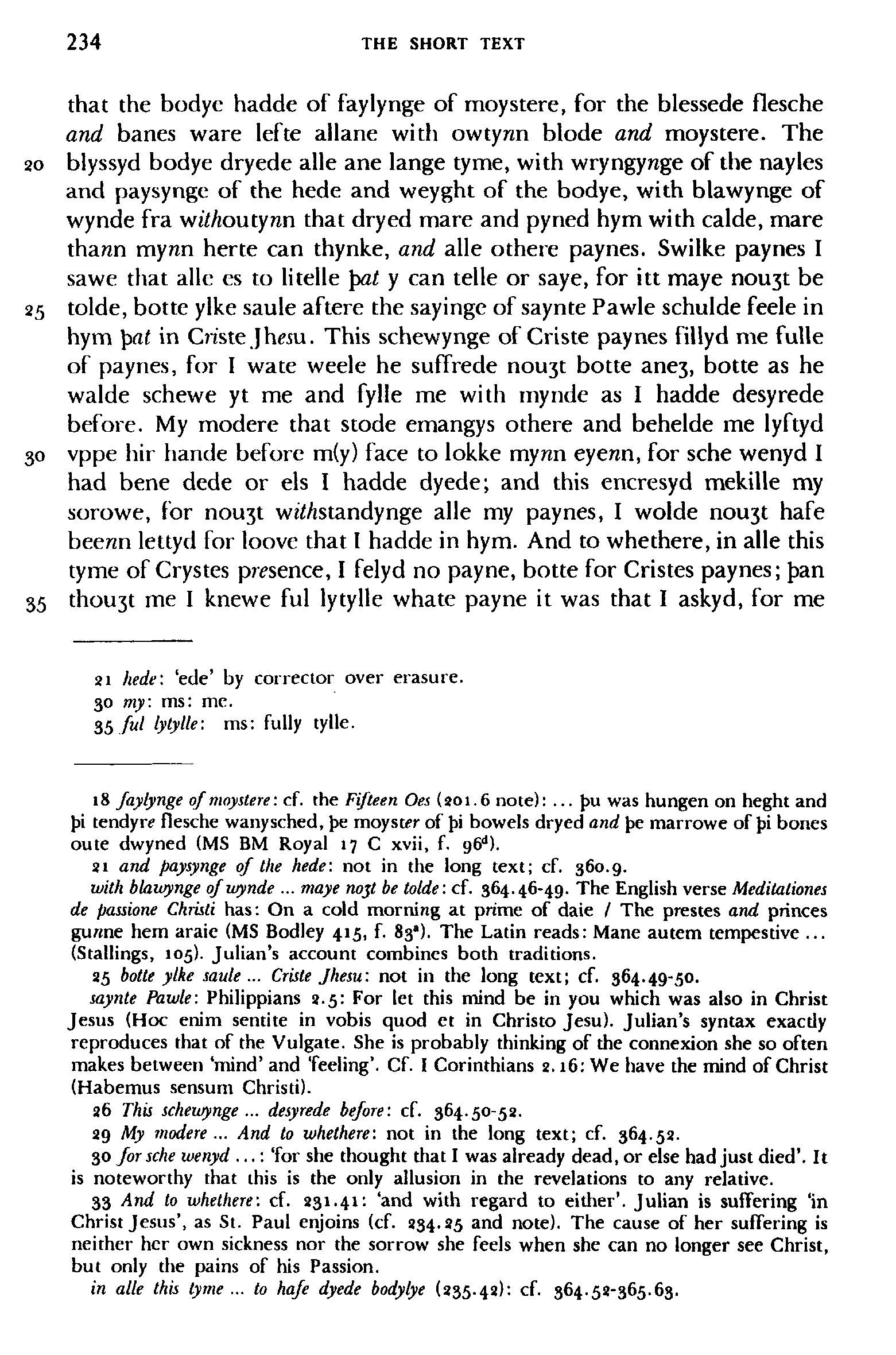
THE SHORT TEXT
that the bodyc hadde of faylynge of moystere, for the blessede flesche and banes ware lefte allane with owtywn blode and moystere. The 20 blyssyd bodye dryede alle ane lange tyme, with wryngynge of the nayles and paysynge of the hede and weyght of the bodye, with blawynge of wynde fra wz'Moutywn that dryed mare and pyned hym with calde, mare thann mynn herte can thynke, and alle othere paynes. Swilke paynes I sawe that alle es to litelle \>at y can telle or saye, for itt maye nou3t be
25 tolde, botte ylke saule aftere the sayinge of saynte Pawle schulde feele in hym ]xit in Cnste Jhmi. This schewynge of Criste paynes fillyd me fulle of paynes, for I wate weele he suffrede nou3t botte ane3, botte as he walde schewe yt me and fylle me with my ride as I hadde desyrede before. My modere that stode emangys othere and behelde me lyftyd
30 vppe hir hande before m(y) face to lokke myrai eyewn, for sche wenyd I had bene dede or els I hadde dyede; and this encresyd mekille my sorowe, for nou3t w^/istandynge alle my paynes, I wolde nou3t hafe beemi lettyd for loove that I hadde in hym. And to whethere, in alle this tyme of Crystes p7?sence, I felyd no payne, botte for Cristes paynes; £an 35 thou3t me I knewe ful lytylle whate payne it was that I askyd, for me
21 hede: 'ede' by corrector over erasure.
30 my: ms: me.
35 ful lytylle: ms: fully tylle.
18 faylynge of moystere: cf. the Fifteen Oes (201.6 note): ... pu was hungen on heght and pi tendyn? flesche wanysched, f»e moyster of J)i bowels dryed and pe marrowe of pi bones oute dwyned (MS BM Royal 17 C xvii, f. g6d).
21 and paysynge of the hede: not in the long text; cf. 360.9. with blawynge of wynde ... maye nojt be tolde: cf. 364.46-49. The English verse Meditationes de passione Christi has: On a cold morning at prime of daie / The prestes and princes gunne hem araie (MS Bodley 415, f. 83*). The Latin reads: Mane autem tempestive ...
(Stallings, 105). Julian's account combines both traditions.
25 botte ylke saule ... Criste Jhesu: not in the long text; cf. 364.49-50. saynte Pawle: Philippians 2.5: For let this mind be in you which was also in Christ
Jesus (Hoc enim sentite in vobis quod et in Christo Jesu). Julian's syntax exactly reproduces that of the Vulgate. She is probably thinking of die connexion she so often makes between 'mind' and feeling'. Cf. I Corinthians 2.16: We have the mind of Christ
(Habemus sensum Christi).
26 This schewynge ... desyrede before: cf. 364.50-52.
29 My modere ... And to whethere: not in the long text; cf. 364.52.
30 for sche wenyd ...: 'for she thought that I was already dead, or else had just died'. It is noteworthy that this is the only allusion in the revelations to any relative.
33 And to whethere: cf. 231.41: 'and with regard to eidier'. Julian is suffering 'in Christ Jesus', as St. Paul enjoins (cf. 234.25 and note). The cause of her suffering is neither her own sickness nor the sorrow she feels when she can no longer see Christ, but only the pains of his Passion. in alle this tyme ... to hafe dyede bodylye (235.42): cf. 364.52-365.63.
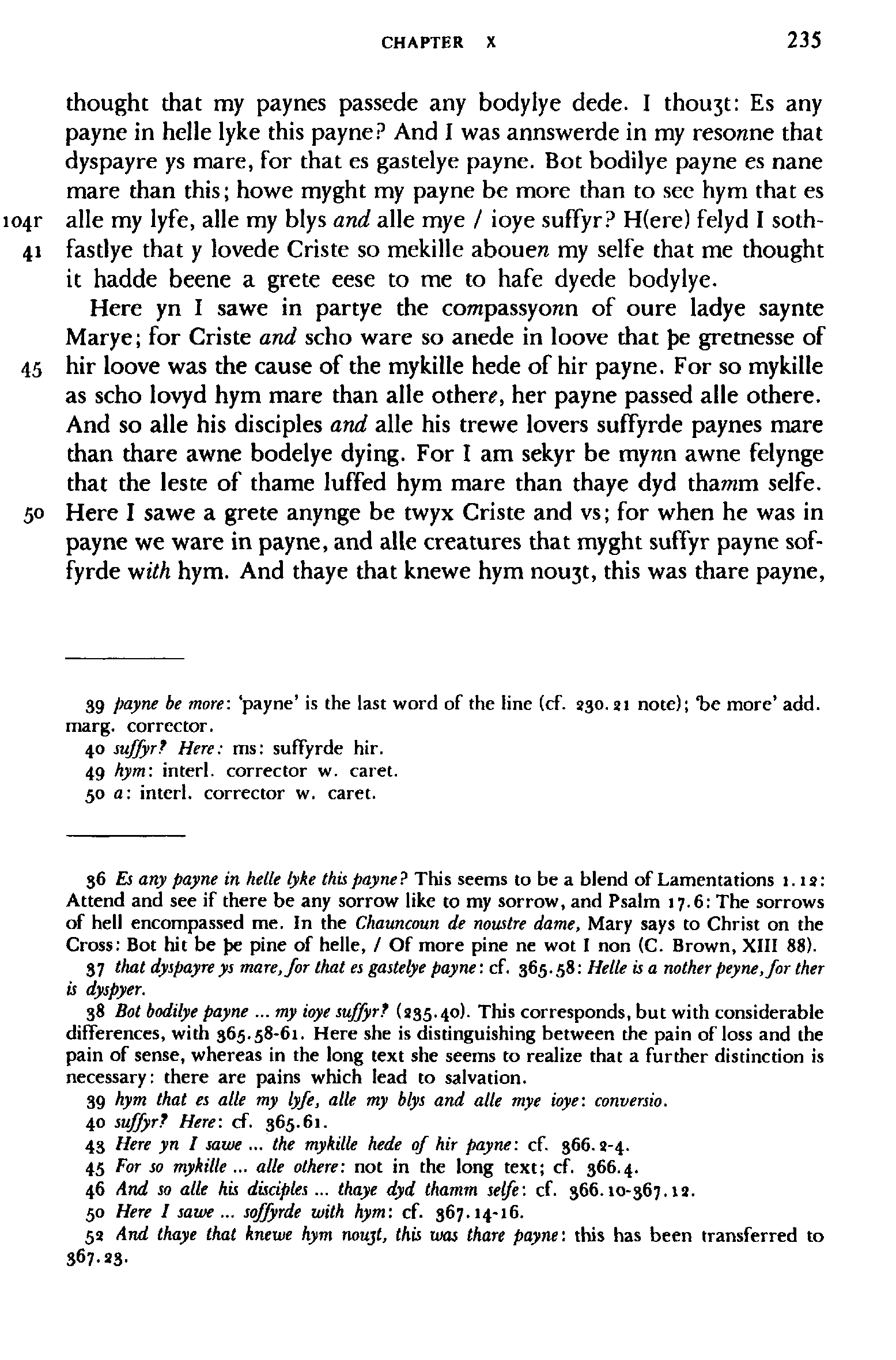
CHAPTER X
thought that my paynes passede any bodylye dede. I thou3t: Es any payne in helle lyke this payne? And I was annswerde in my rescwne that dyspayre ys mare, for that es gastelye payne. Bot bodilye payne es nane mare than this; howe myght my payne be more than to see hym that es io4r alle my lyfe, alle my blys and alle mye / ioye suffyr? H(ere) felyd I soth41 fastlye that y lovede Criste so mekille abouen my selfe that me thought it hadde beene a grete eese to me to hafe dyede bodylye.
Here yn I sawe in partye the compassyorcn of oure ladye saynte Marye; for Criste and scho ware so anede in loove that J>e gretnesse of 45 hir loove was the cause of the mykille hede of hir payne. For so mykille as scho lovyd hym mare than alle others, her payne passed alle othere.
And so alle his disciples and alle his trewe lovers suffyrde paynes mare than thare awne bodelye dying. For I am sekyr be mynn awne felynge that the leste of thame luffed hym mare than thaye dyd thamm selfe.
50 Here I sawe a grete anynge be twyx Criste and vs; for when he was in payne we ware in payne, and alle creatures that myght suffyr payne soffyrde -with hym. And thaye that knewe hym nou3t, this was thare payne,
39 payne be more: 'payne' is the last word of the line (cf. 230.21 note); *be more' add. marg. corrector.
40 suffyr?
Here: ms: suffyrde hir.
49 hym: interl. corrector w. caret.
50 a: interl. corrector w. caret.
36 Es any payne in helle lyke this payne? This seems to be a blend of Lamentations i. is:
Attend and see if there be any sorrow like to my sorrow, and Psalm 17.6: The sorrows of hell encompassed me. In the Chauncoun de noustre dame, Mary says to Christ on the Cross: Bot hit be J>e pine of helle, / Of more pine ne wot I non (C. Brown, XIII 88).
37 that dyspayre ys mare, for that es gastelye payne: cf. 365.58: Helle is a nother peyne,for (her is dyspyer.
38 Bot bodilye payne ... my ioye suffyr? (235.40). This corresponds, but with considerable differences, with 365.58-61. Here she is distinguishing between the pain of loss and the pain of sense, whereas in the long text she seems to realize that a further distinction is necessary: there are pains which lead to salvation.
39 hym that es alle my lyfe, alle my blys and alle mye ioye: conversio.
40 suffyr?
Here: cf. 365.61.
43 Here yn I sawe ... the mykille hede of hir payne: cf. 366.2-4.
45 For so mykille ... alle othere: not in the long text; cf. 366.4.
46 And so alle his disciples ... thaye dyd thamm selfe: cf. 366.10-367.12.
50 Here I sawe ... soffyrde with hym: cf. 367.14-16.
52 And thaye that knewe hym noujt, this was thare payne: this has been transferred to 367.23.
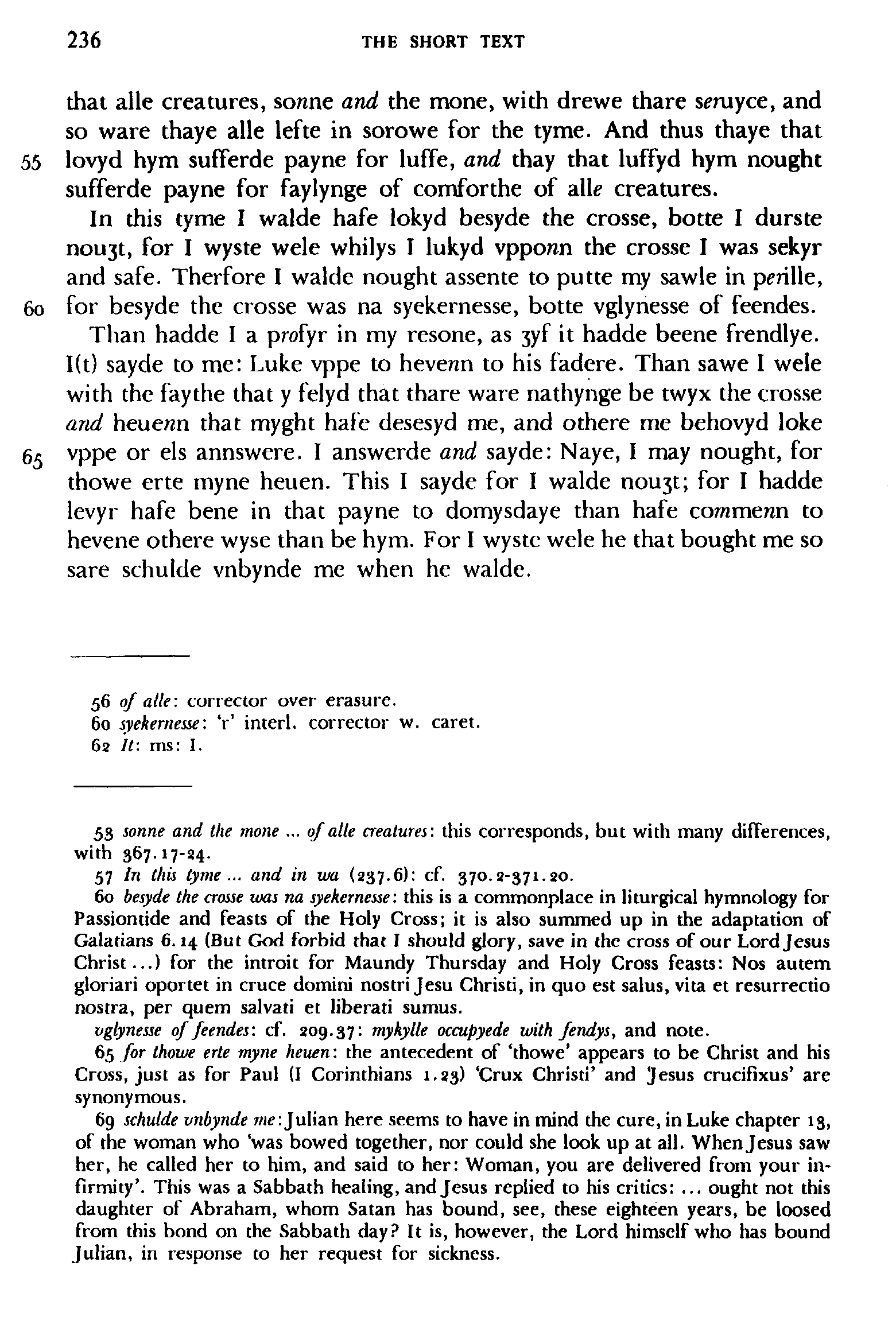
THE SHORT TEXT
that alle creatures, sonne and the mone, with drewe thare smiyce, and so ware thaye alle lefte in sorowe for the tyme. And thus thaye that 55 lovyd hym sufferde payne for luffe, and thay that luffyd hym nought sufferde payne for faylynge of comforthe of alle creatures.
In this tyme I walde hafe lokyd besyde the crosse, botte I durste nou3t, for I wyste wele whilys I lukyd vpponn the crosse I was sekyr and safe. Therfore I walde nought assente to putte my sawle in pmlle,
60 for besyde the crosse was na syekernesse, botte vglynesse of feendes.
Than hadde I a profyr in my resone, as 3yf it hadde beene frendlye.
I(t) sayde to me: Luke vppe to hevenn to his fadere. Than sawe I wele with the fay the that y felyd that thare ware nathynge be twyx the crosse and heuenn that myght hafe desesyd me, and othere me behovyd loke
65 vppe or els annswere. I answerde and sayde: Naye, I may nought, for thowe erte myne heuen. This I sayde for I walde nou3t; for I hadde levyr hafe bene in that payne to domysdaye than hafe cowmenn to hevene othere wyse than be hym. For I wystc wele he that bought me so sare schulde vnbynde me when he walde.
56 of alle: corrector over erasure.
60 syekernesse: Y interl. corrector w. caret.
62 It: ms: I.
53 sonne and the mone ... of alle creatures: this corresponds, but with many differences, with 367.17-24.
57 In this tyme... and in wa (237.6): cf. 370.2-371.20.
60 besyde the crosse was na syekernesse: this is a commonplace in liturgical hymnology for Passiontide and feasts of the Holy Cross; it is also summed up in the adaptation of Galatians 6.14 (But God forbid that I should glory, save in the cross of our Lord Jesus
Christ...) for the introit for Maundy Thursday and Holy Cross feasts: Nos autem gloriari oportet in cruce domini nostri Jesu Christi, in quo est salus, vita et resurrectio nostra, per quem salvati et liberati sumus. vglynesse of feendes: cf. 209.37: mykylle occupyede with fendys, and note.
65 for thowe erte myne heuen: the antecedent of 'thowe' appears to be Christ and his
Cross, just as for Paul (I Corinthians 1.23) 'Crux Christi' and Jesus crucifixus' are synonymous.
69 schulde vnbynde we:Julian here seems to have in mind the cure, in Luke chapter 13, of the woman who 'was bowed together, nor could she look up at all. When Jesus saw her, he called her to him, and said to her: Woman, you are delivered from your infirmity'. This was a Sabbath healing, and Jesus replied to his critics: ... ought not this daughter of Abraham, whom Satan has bound, see, these eighteen years, be loosed from this bond on the Sabbath day? It is, however, the Lord himself who has bound
Julian, in response to her request for sickness.
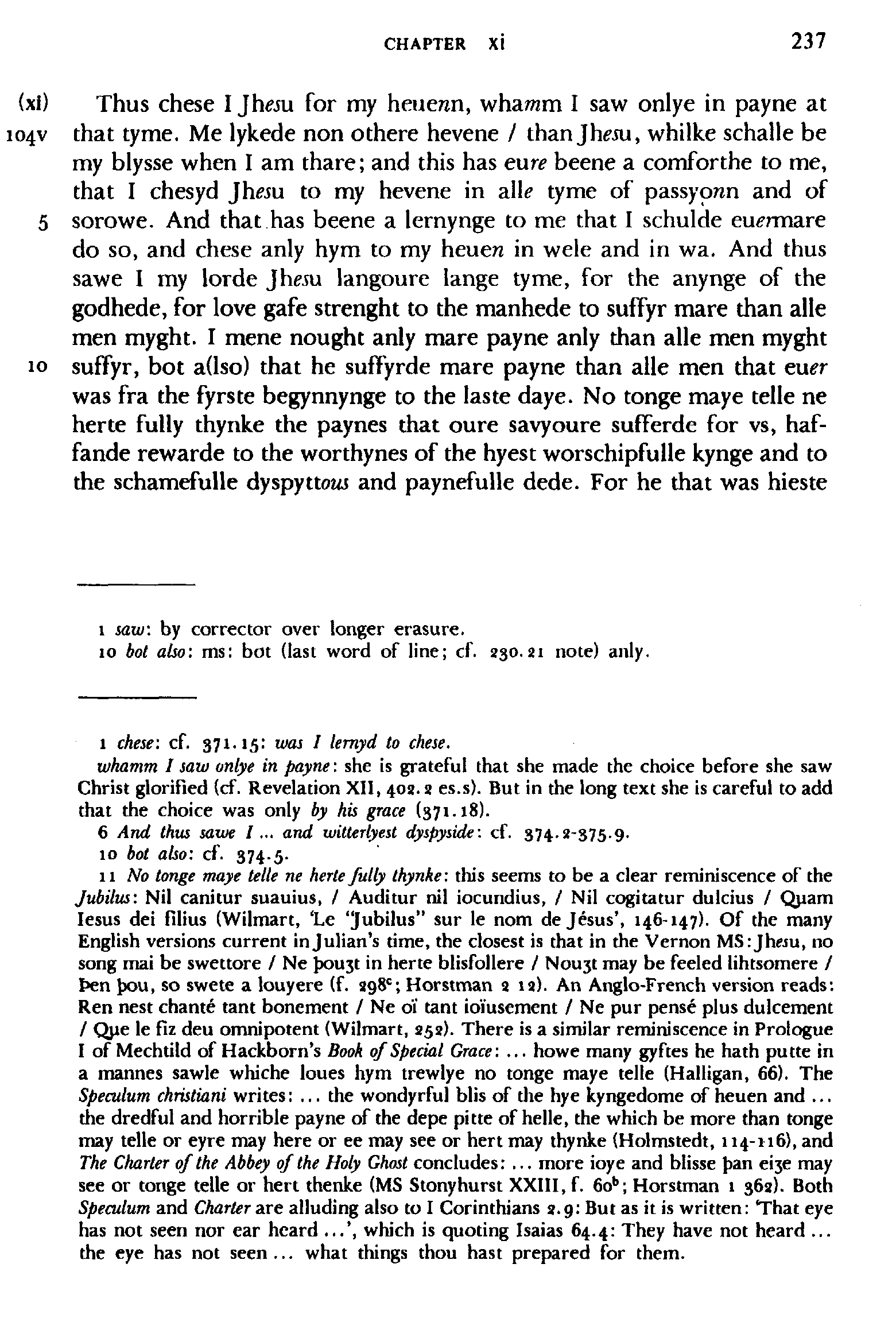
CHAPTER xi
(xi) Thus chese I Jhmi for my heuenn, whawm I saw onlye in payne at io4v that tyme. Me lykede non othere hevene / than ]hesu, whilke schalle be my blysse when I am thare; and this has cure beene a comforthe to me, that I chesyd Jhesu to my hevene in all? tyme of passyonn and of 5 sorowe. And that has beene a lernynge to me that I schulde eu^rmare do so, and chese anly hym to my heuen in wele and in wa. And thus sawe I my lorde Jh«u langoure lange tyme, for the anynge of the godhede, for love gafe strenght to the manhede to suffyr mare than alle men myght. I mene nought anly mare payne anly than alle men myght
10 suffyr, bot a(lso) that he suffyrde mare payne than alle men that eu^r was fra the fyrste begynnynge to the laste daye. No tonge maye telle ne herte fully thynke the paynes that oure savyoure sufferde for vs, haffande rewarde to the worthynes of the hyest worschipfulle kynge and to the schamefulle dyspyttous and paynefulle dede. For he that was hieste i saw. by corrector over longer erasure.
10 bot also: ms: bot (last word of line; cf. 230.21 note) anly. i chese: cf. 371.15: was I lernyd to chese. whamm I saw onlye in payne: she is grateful that she made the choice before she saw
Christ glorified (cf. Revelation XII, 402.2 es.s). But in the long text she is careful to add that the choice was only by his grace (371.18).
6 And thus sawe I... and witterlyest dyspyside: cf. 374.2-375.9.
10 bot also: cf. 374.5. n No tonge maye telle ne herte fully thynke: this seems to be a clear reminiscence of the Jubilus: Nil canitur suauius, / Auditur nil iocundius, / Nil cogitatur dulcius / Quam lesus dei filius (Wilmart, 'Le 'Jubilus" sur le nom de Jesus', 146-147). Of the many
English versions current in Julian's time, the closest is that in the Vernon MS: Jhesu, no song mai be swettore / Ne frouy in herte blisfollere / Nou3t may be feeled lihtsomere /
I>en Jx)u, so swete a louyere (f. 298°; Horstman 2 12). An Anglo-French version reads:
Ren nest chante tant bonement / Ne 01 tant ioiusement / Ne pur pense plus dulcement
/ Que le fiz deu omnipotent (Wilmart, 252). There is a similar reminiscence in Prologue
I of Mechtild of Hackborn's Book of Special Grace: ... howe many gyftes he hath putte in a mannes sawle whiche loues hym trewlye no tonge maye telle (Halligan, 66). The Speculum christiani writes: ... the wondyrful blis of the hye kyngedome of heuen and ... the dredful and horrible payne of the depe pitte of helle, the which be more than tonge may telle or eyre may here or ee may see or hert may thynke (Holmstedt, 114-116), and The Charter of the Abbey of the Holy Ghost concludes: ... more ioye and blisse Jjan ei3e may see or tonge telle or hert thenke (MS Stonyhurst XXIII, f. 6ob; Horstman i 362). Both
Speculum and Charter Are alluding also to I Corinthians 2.9: But as it is written: That eye has not seen nor ear heard ...', which is quoting Isaias 64.4: They have not heard ... the eye has not seen ... what things thou hast prepared for them.
THE SHORT TEXT
15 and worthyest was fullyest noghthede and witterlyest dyspyside. Botte the loue that made hym to suffere alle this, it passes als fare alle his payns as heuen es abouenn erthe. For the paynes was a dede done in a tyme be the wyrkynge of love, botte luffe was wzMowtynn begynnynge and es and evere schalle be with owtynn any ende.
15 was fullyest noghthede and witterlyest dyspyside: 'was most completely brought low, most utterly despised'; cf. 375.9: was foulest condempnyd and vtterly dyspysed, where the SS variants to 'foulest', 'condempnyd' and 'vtterly', agreeing with A, suggest that they and die short text share the better readings.
Botte the loue ... with owtynn any ende: cf. 386.46-387.49.
Botte the loue that made hym to suffere alle this / it passes als fare alle his payns as heuen es abouenn erthe / For the paynes was a dede done in a tyme be the wyrkynge of love / botte luffe was withowtynn begynnynge / and es and evere schalle be with owtynn any ende: a compar of five cola.. In die first two we have oppositio: loue I suffere ... heuen / erthe, to treat of the Hypostatic Union. Then the next diree express the Trinitarian operatio ad extra. In loue ... love diere is gradatio, and, in paynes done in a tyme ... loue / luffe ... withowtyn begynnynge, a form of chiasmus.
CHAPTER xii
(xii) And sodaynlye, me behaldande in the same crosse, he channchede in to blysfulle chere. The chawngynge of his chere channgyd mynne, and I was alle gladde and mery as yt was possybilk. Than brought oure lorde merelye to my mynde: Whate es any poynte of thy payne or of py grefe?
5 And I was fulle merye.
Than sayde oure lorde, askande: Arte thou wele payde that I suffyrde for the? 3a, goode lorde, quod I; gramercy, goode lorde, blissyd mut thowe be. Jyf thowe be payede, quod oure lorde, I am payede. It is a ioye and a blysse and ane endlesse lykynge to me that eu^r y suffyrde
10 passyonn for the, for jyf I myght suffyr mare, I walde suffyr. In this felynge myne vndyrstandynge was lyftyd vppe in to heuenn, and thare I sawe thre hevens; of the whilke syght I was gretlye merveylede, and / io5r thought: I sawe thre heverans, and alle of the blessyd manhede of Cryste. And nane is mare, nane is lesse, nane is hiare, nane is lawere,
15 botte evene like in blysse.
For the fyrste heuenn schewed Criste me his fadere, bot in na bodelye lyknesse, botte in his properte and in his lykynge. The wyrkynge of the fadere it is this: that he gyffes mede tille his sonne Jhesu Criste. This gyfte and this mede is so blysfulle to ]hesu that (his) fadere myght haffe
20 gyffene na mede that myght hafe likede hym betters. For the firste heuenn, that is blissynge of the fadere, schewed to me as a heuenn, and 19 his: oni. ms.
1 And sodaynlye... was fulle merye: cf. 379.7-11.
2 The chawngynge of his chere channgyd mynne: cf. Ecclesiastes 8.1: The wisdom of a man shines in his countenance, and the most might will change his face.
6 Than sayde oure lorde... we er his crowne (240.25): cf. 382.2-384.22.
10 for3yfl myght suffyr mare, I walde suffyr: Sr. Mary Arthur Knowlton comments (122) on the similarity of this to Christ's reproach in C. Brown's Woefully Arrayed: What myght
I suffer more / J>en I haue sufferde, man, for £e? (XV 157); and she suggests a common source in the Good Friday Improperia: Quid ultra debui facere tibi et non feci? (Missale
Romanum 1474, i 171); the allusion is to Isaias 5.4: What is there that I ought to do more to my vineyard that I have not done? Cf. William Herebert's translation: What more shulde ich hauen ydon / I>at Jxm ne hauest nouth underuon? (C. Brown, XIV,
18).
13 sawe: cf. 383.9: see; but 82 reads: saw.
14 And nane is mare / nane is lesse / nane is hiare / nane is lawere: a four-membered cornpar with repetitio and oppositio contrariorum.
17 lykynge: cf. 383.13: wurkyng, and note.
The wyrkynge ... I walde suffyr mare (240.28): this corresponds with the long text, 383.14385-26.
19 his fadere: cf. 383.16.
21 blissynge: cf. 384.18: plesyng.
THE SHORT TEXT
itt was fulle blysfulle. For he is fulle blyssede with alle the dedes that he has done abowjte oure saluaczon, wherefore we ere nought anely his thurgh byingge botte also be the curtayse gyfte of his fadere. We er his
25 blysse, we er his mede, we er his wyrschippe, we er his crowne.
This that I saye is soo grete blysse to]hesu that he settys atte nought his travayle and his harde passionn and cruelly and schamefulle dede.
And in this wordes: 3yf I myght suffyr mare, I walde suffyr mare, I sawe sothly that 3if he myght dye als ofte als fore euer ilke man anes that 30 schalle be safe, as he dyd anes for alle, love schulde neu^r late hym hafe reste to he hadde done it. And whewn he hadde done it, he walde sette it atte nought for luff, for alle thyn(k)e hym botte litylle in regarde of his love. And that schewed he me wele, sobarly sayande this worde:
3yffe I myght suffere mare. He sayde nought: 3if it ware nedfulk to suf35 fyr mare, botte: 3if I myght suffyr mare; for thow3 it be nought nedefulle, and he myght suffyr mare, mare he walde. This dede and this werke abowte our? saluacion was als wele as he myght ordayne it. It was done als wyrschipfullye as Cryste myght do it; and in this I sawe a fulle blysse in Cryste, botte this blysse schulde nought hafe bene done
40 fulle 3yf it myght any bettere hafe bene done J>ann it was done. And in this thre wordes: It is a ioye, a blysse and ane endeles likynge to me, ware schewed to me thre hevens, as thus. For the ioye I vndyrstode the plesannce of the fadere, for the blysse the wirschippe of the sonne, and for the endeles lykynge the haly gaste. The fadere is plesed, the sonne ys
30 dyd: alt. al. m. (not corrector's) w. caret and interl.: dyed.
32 thynke: ms: thynge.
32 blyssede: cf. 384.19: plesyde. that he has done: cf. 384.19: that Jhesu hath done.
24 We er his blysse / we er his mede / we er his wyrschippe / we er his crowne: a compar with repetitio.
26 This that I saye ... he hadde done it: cf. 384.24-385.28.
28 And in this wordes: cf. 239.10. jyj I myght... the haly gaste lykes (241.45): this corresponds with the long text, 387.49389.6.
31 And whenn he hadde done ... of his love: cf. 385.32-33.
32 thynke: cf. 230.5.
33 And that schewed he ... haly gaste lykes (241.45): cf. 387.49-389.6. wele, sobarly: cf. 381.50: fulle swetely, and 269.25 and note.
40 And in this thre wordes: the 'thre wordes' evidently are It is a ioye, (It is) a blysse, and (It is) ane endeles likynge to me. Julian often uses 'word' to mean 'saying'; cf. 242.18,
249.12 and note, 250.29.
42 For the ioye I vndyrstode ...: for this figure, perfectly preserved in the long text, cf.
389.3 note.
44 The fadere is plesed...: for this figure in the long text, cf. 389.5 note.
CHAPTER xii
45 worschippyd, the haly gaste lykes. Jhesu wille that we take heede to this blysse that is in the blyssedfulle trinite of oure saluacionn, and that we io5v lyke als mekylle / with his grace whyles we er here. And this was schewyd me in J>is worde: Erie J>ow wele payed? Be the tothere worde that Cryste sayde: 3yf Jww be payed, I am payd, he schewed me the vn50 dyrstandynge, as 3yf he had sayde: It is ioye and lykynge enough to me, and I aske nought els for my travayle botte that I myght paye the. Plentyuoslye and fully was this schewyd to me.
Thynke also wyselye of the gretnesse of this worde: That eu«r I suffred passionn for the; for in that worde was a hye knawynge of luffe
55 and of lykynge that he hadde in oure saluacion.
45 Jhesu wille ... with his grace: cf. 391.9.5-27, inc.: A, Jhesu, wylle we ...
47 whyles we er here: not in the long text; cf. 391.27.
And this was shewyd ... that I myght paye the: cf. 392.32-36.
48 in pis worde: cf. 239.6. the tothere worde: cf. 239.8.
51 Plentyuoslye and fully ... in oure saluacion: cf. 393.43-46.
53 of this worde: That euer: cf. 393-45: ofthys worde, evyr. The reference to the short text is to 239.9.
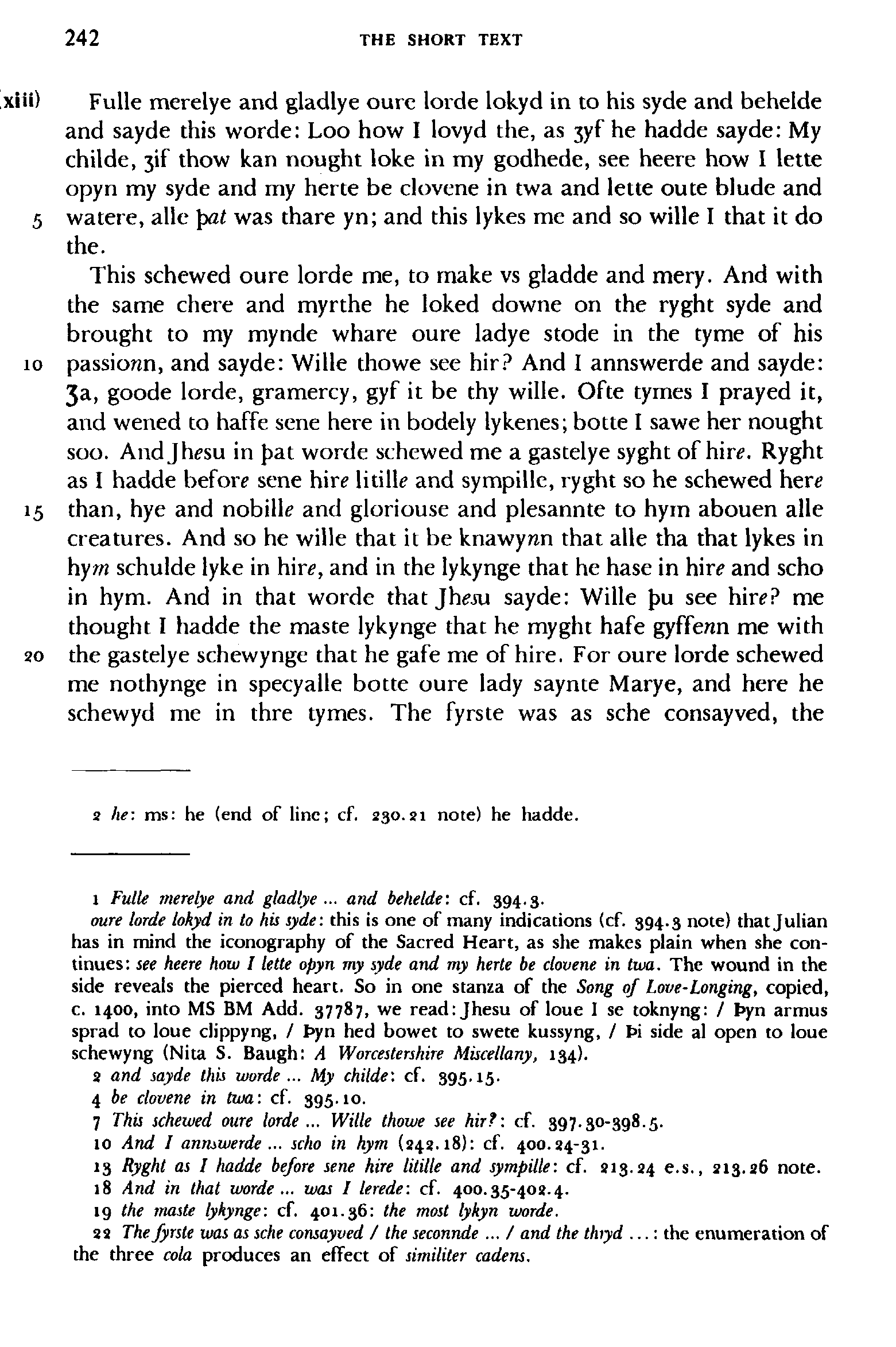
THE SHORT TEXT
(xiii) Fulle merelye and gladlye oure lorde lokyd in to his syde and behelde and sayde this worde: Loo how I lovyd the, as 3yf he hadde sayde: My childe, 3if thow kan nought loke in my godhede, see heere how I lette opyn my syde and my herte be clovene in twa and lette oute blude and 5 watere, alle \>at was thare yn; and this lykes me and so wille I that it do the.
This schewed oure lorde me, to make vs gladde and mery. And with the same chere and myrthe he loked downe on the ryght syde and brought to my mynde whare oure ladye stode in the tyme of his
10 passionn, and sayde: Wille thowe see hir? And I annswerde and sayde:
3a, goode lorde, gramercy, gyf it be thy wille. Ofte tymes I prayed it, and wened to haffe sene here in bodely lykenes; botte I sawe her nought soo. Andjhesu in |)at worde schewed me a gastelye syght of hire. Ryght as I hadde before sene hire litill? and sympille, ryght so he schewed here
15 than, hye and nobill? and gloriouse and plesannte to hym abouen alle creatures. And so he wille that it be knawywn that alle tha that lykes in hym schulde lyke in hire, and in the lykynge that he hase in hire and scho in hym. And in that worde that Jhesu sayde: Wille J>u see hire? me thought I hadde the maste lykynge that he myght hafe gyffewi me with 20 the gastelye schewynge that he gafe me of hire. For oure lorde schewed me nothynge in specyalle botte oure lady saynte Marye, and here he schewyd me in thre tymes. The fyrste was as sche consayved, the a he: ms: he (end of line; cf. 230.21 note) he hadde.
1 Fulle merelye and gladlye ... and behelde: cf. 394.3. oure lorde lokyd in to his syde: this is one of many indications (cf. 394.3 note) that Julian has in mind the iconography of the Sacred Heart, as she makes plain when she continues: see heere how I lette opyn my syde and my herte be clovene in twa. The wound in the side reveals the pierced heart. So in one stanza of the Song of Love-Longing, copied, c. 1400, into MS BM Add. 37787, we read: Jhesu of loue I se toknyng: / t>yn armus sprad to loue clippyng, / Pyn hed bowet to swete kussyng, / f>i side al open to loue schewyng (Nita S. Baugh: A Worcestershire Miscellany, 134).
2 and sayde this worde ... My childe: cf. 395.15.
4 be clovene in twa: cf. 395.10.
7 This schewed oure lorde ... Wille thowe see hir?: cf. 397.30-398.5.
10 And I anmwerde ... scho in hym (242.18): cf. 400.24-31.
13 Ryght as I hadde before sene hire litille and sympille: cf. 213.24 e.s., 213.26 note.
18 And in that worde... was I lerede: cf. 400.35-402.4.
19 the maste lykynge: cf. 401.36: the most lykyn worde.
22 The fyrste was as sche consayved / the seconnde ... / and the thryd ...: the enumeration of the three cola produces an effect of similiter cadew.
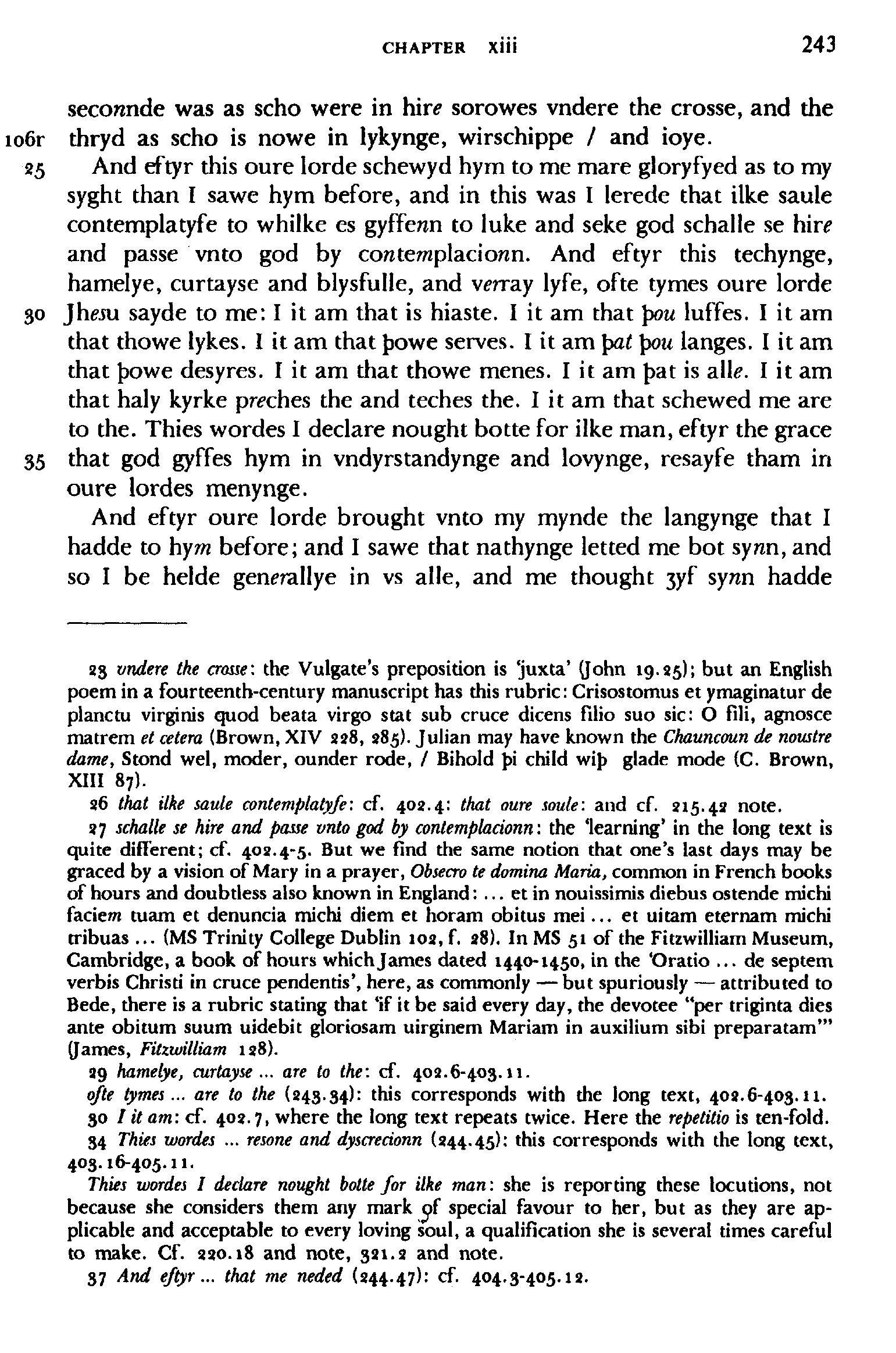
CHAPTER xiii
seccmnde was as scho were in hire sorowes vndere the crosse, and the io6r thryd as scho is nowe in lykynge, wirschippe / and ioye.
And eftyr this cure lorde schewyd hym to me mare gloryfyed as to my syght than I sawe hym before, and in this was I lerede that ilke saule contemplatyfe to whilke es gyffenn to luke and seke god schalle se hire and passe vnto god by cowtewplacionn. And eftyr this techynge, hamelye, curtayse and blysfulle, and wrray lyfe, ofte tymes oure lorde
30 Jhesu sayde to me: I it am that is hiaste. I it am that tyu luffes. I it am that thowe lykes. I it am that J>owe serves. I it am pat bow langes. I it am that bowe desyres. I it am that thowe menes. I it am bat is a\le. I it am that haly kyrke preches the and teches the. I it am that schewed me are to the. Thies wordes I declare nought botte for ilke man, eftyr the grace
35 that god gyffes hym in vndyrstandynge and lovynge, resayfe tham in oure lordes menynge.
And eftyr oure lorde brought vnto my mynde the langynge that I hadde to hym before; and I sawe that nathynge letted me bot synn, and so I be helde gen^rallye in vs alle, and me thought 3yf synn hadde
23 vndere the crosse: the Vulgate's preposition is 'juxta' (John 19.25); but an English poem in a fourteenth-century manuscript has this rubric: Crisostomus et ymaginatur de planctu virginis quod beata virgo stat sub cruce dicens filio suo sic: O fili, agnosce matrem et cetera (Brown, XIV 228, 285). Julian may have known the Chauncaun de noustre dame, Stond wel, moder, ounder rode, / Bihold pi child wij> glade mode (C. Brown,
XIII 87).
26 that ilke saule contemplatyfe: cf. 402.4: that oure soule: and cf. 215.42 note.
27 schalle se hire and passe vnto god by contempladonn: the 'learning' in the long text is quite different; cf. 402.4-5. But we find the same notion that one's last days may be graced by a vision of Mary in a prayer, Obsecro te domina Maria, common in French books of hours and doubtless also known in England: ... et in nouissimis diebus ostende michi faciem tuam et denuncia michi diem et horam obitus mei... et uitam eternam michi tribuas ... (MS Trinity College Dublin 102, f. 28). In MS 51 of the Fitzwilliam Museum,
Cambridge, a book of hours which James dated 1440-1450, in the 'Oratio ... de septem verbis Christ! in cruce pendentis', here, as commonly — but spuriously — attributed to Bede, there is a rubric stating that 'if it be said every day, the devotee "per triginta dies ante obitum suum uidebit gloriosam uirginem Mariam in auxilium sibi preparatam'"
(James, Fitzwilliam 128).
29 hamelye, curtayse... are to the: cf. 402.6-403.11. ofte tymes... are to the (243.34): this corresponds with the long text, 402.6-403.11.
30 / it am: cf. 402.7, where the long text repeats twice. Here the repetitio is ten-fold.
34 Thies wordes ... resone and dyscrecionn (244.45): this corresponds with the long text,
403.16-405.11.
Thies wordes I declare nought botte for ilke man: she is reporting these locutions, not because she considers them any mark of special favour to her, but as they are applicable and acceptable to every loving soul, a qualification she is several times careful to make. Cf. 220.18 and note, 321.2 and note.
37 And eftyr... that me neded (244.47): cf. 404.3-405.12.
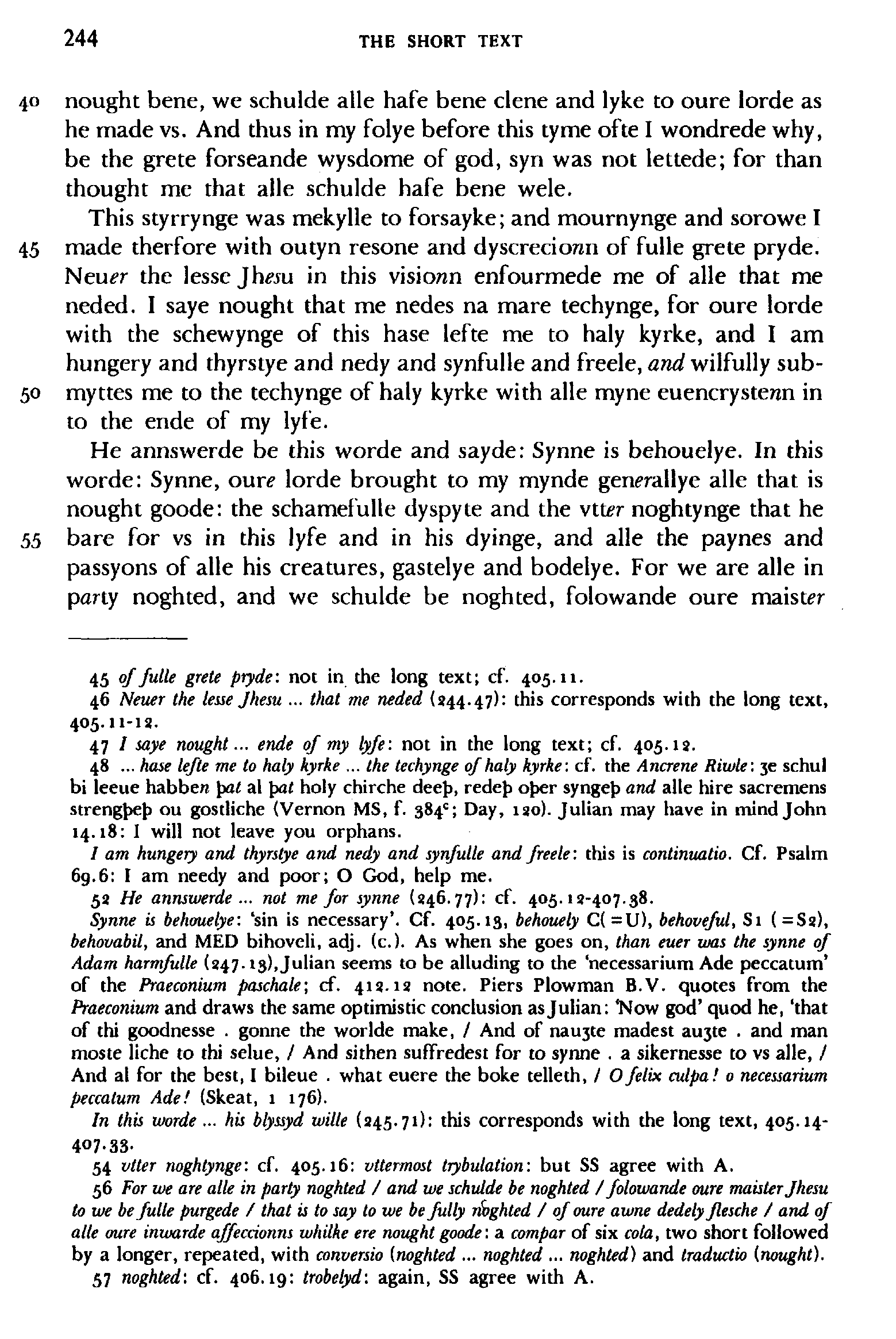
THE SHORT TEXT
40 nought bene, we schulde alle hafe bene clene and lyke to oure lorde as he made vs. And thus in my folye before this tyme ofte I wondrede why, be the grete forseande wysdome of god, syn was not lettede; for than thought me that alle schulde hafe bene wele.
This styrrynge was mekylle to forsayke; and mournynge and sorowe I 45 made therfore with outyn resone and dyscrecionn of fulle grete pryde.
Neu^r the lesse Jhmi in this visionn enfourmede me of alle that me neded. I saye nought that me nedes na mare techynge, for oure lorde with the schewynge of this hase lefte me to haly kyrke, and I am hungery and thyrstye and nedy and synfulle and freele, and wilfully sub50 myttes me to the techynge of haly kyrke with alle myne euencrystewn in to the ende of my lyfe.
He annswerde be this worde and sayde: Synne is behouelye. In this worde: Synne, our? lorde brought to my mynde generallye alle that is nought goode: the schamefulle dyspyte and the vtter noghtynge that he
55 bare for vs in this lyfe and in his dyinge, and alle the paynes and passyons of alle his creatures, gastelye and bodelye. For we are alle in party noghted, and we schulde be noghted, folowande oure maister
45 of fulle grete pryde: not in the long text; cf. 405.11.
46 Neuer the lesse Jhesu ... that me neded (244.47): this corresponds with the long text,
405.11-12.
47 / saye nought... ende of my lyfe: not in the long text; cf. 405.12.
48 ... hase lefte me to haly kyrke ... the techynge of haly kyrke: cf. the Ancrene Riwle: 36 schul bi leeue habbe/i ^at al JxJ< holy chirche deef>, redej) ojier syngejj and alle hire sacremens strength ou gostliche (Vernon MS, f. 384°; Day, 120). Julian may have in mind John
14.18: I will not leave you orphans.
I am hungery and thyrstye and nedy and synfulle and freele: this is continuatio. Cf. Psalm
69.6: I am needy and poor; O God, help me.
52 He annswerde ... not me for synne (246.77): cf. 405.12-407.38.
Synne is behouelye: 'sin is necessary'. Cf. 405.13, behouely C(=U), behoveful, Si (=82), behovabil, and MED bihoveli, adj. (c.). As when she goes on, than euer was the synne of Adam harmfulle (247.13),Julian seems to be alluding to the 'necessarium Ade peccatum' of the Praeconium paschale; cf. 412.12 note. Piers Plowman B.V. quotes from the Praeconium and draws the same optimistic conclusion as Julian: 'Now god' quod he, 'that of thi goodnesse . gonne the worlde make, / And of naujte madest au3te . and man moste liche to thi selue, / And sithen suffredest for to synne . a sikernesse to vs alle, /
And al for the best, I bileue . what euere the boke telleth, / Ofelix culpa! o necessarium peccatum Ade! (Skeat, i 176).
In this worde ... his blyssyd wille (245.71): this corresponds with the long text, 405.14407-3354 vtter noghtynge: cf. 405.16: vttermost tabulation: but SS agree with A.
56 For we are alle in party noghted / and we schulde be noghted /folowande oure maisterjhesu to we be fulle purgede / that is to say to we be fully noghted / of oure awne dedely Jlesche / and of alle oure inwarde affecdonm whilhe ere nought goode: a compar of six cola, two short followed by a longer, repeated, with conversio (noghted ... noghted ... noghted) and traductio (nought).
57 noghted: cf. 406.19: trobelyd: again, SS agree with A.
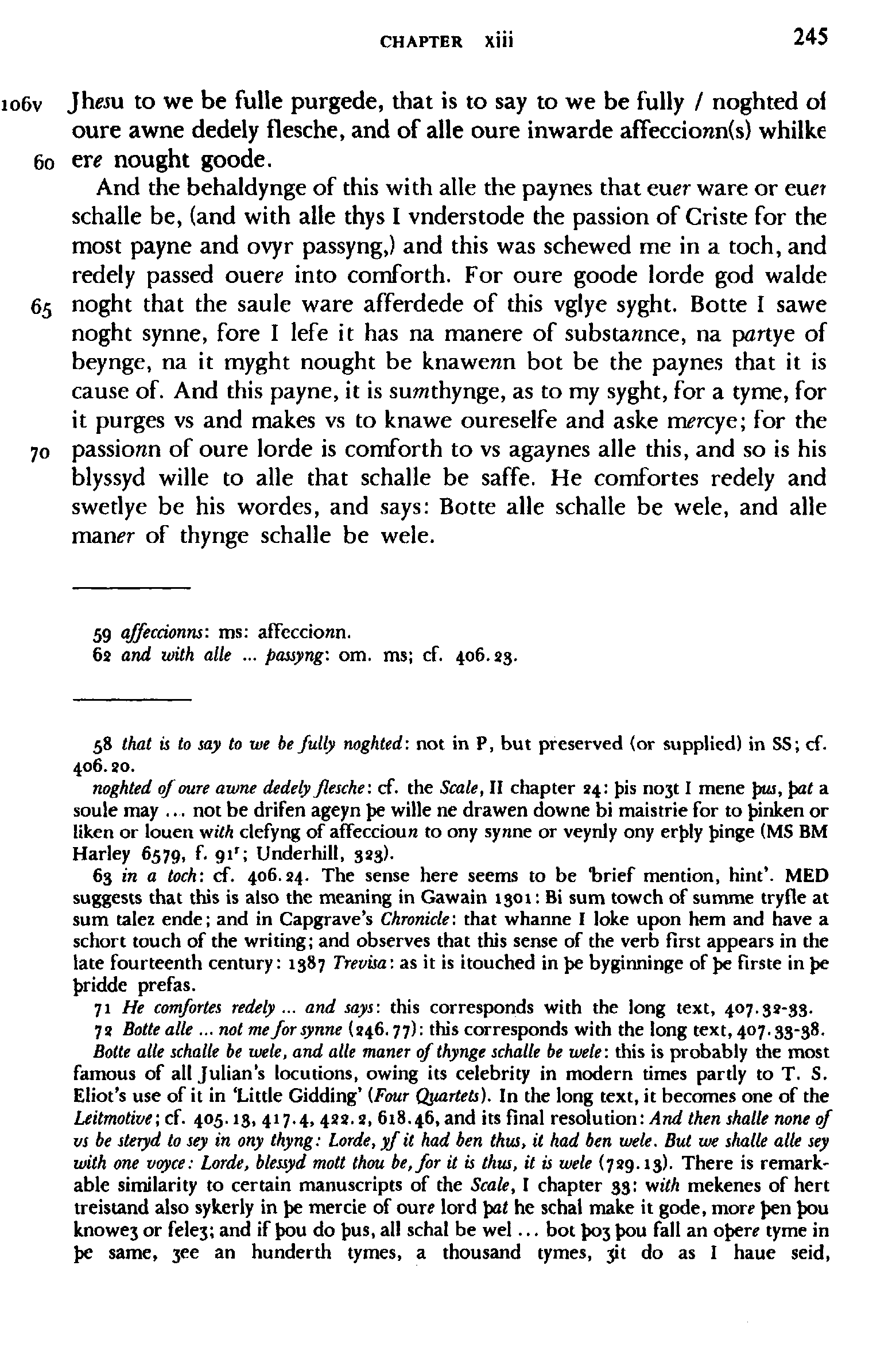
CHAPTER Xlll
io6v Jhesu to we be fulle purgede, that is to say to we be fully / noghted of oure awne dedely flesche, and of alle oure inwarde affecciown(s) whilke
60 en? nought goode.
And the behaldynge of this with alle the paynes that euer ware or euer schalle be, (and with alle thys I vnderstode the passion of Criste for the most payne and ovyr passyng,) and this was schewed me in a toch, and redely passed ouere into comforth. For oure goode lorde god walde
65 noght that the saule ware afferdede of this vglye syght. Botte I sawe noght synne, fore I lefe it has na manere of substarcnce, na pxzrtye of beynge, na it myght nought be knawenn bot be the paynes that it is cause of. And this payne, it is suwthynge, as to my syght, for a tyme, for it purges vs and makes vs to knawe oureselfe and aske rrarcye; for the 70 passionn of oure lorde is comforth to vs agaynes alle this, and so is his blyssyd wille to alle that schalle be saffe. He comfortes redely and swetlye be his wordes, and says: Botte alle schalle be wele, and alle marar of thynge schalle be wele.
59 qffeccionns: ms: affecciown.
62 and with alle ... passyng: om. ms; cf. 406.23.
58 that is to say to we be fully noghted: not in P, but preserved (or supplied) in SS; cf.
406.20. noghted of oure awne dedely flesche: cf. the Scale, II chapter 24: J)is nojt I mene p«5, pa£ a soule may .... not be drifen ageyn pe wille ne drawen downe bi maistrie for to pinken or liken or louen with clefyng of affeccioun to ony synne or veynly ony erjily fringe (MS BM
Harley 6579, f. gir; Underbill, 323).
63 in a toch: cf. 406.24. The sense here seems to be "brief mention, hint'. MED suggests that this is also the meaning in Gawain 1301: Bi sum towch of summe tryfle at sum talez ende; and in Capgrave's Chronicle: that whanne I loke upon hem and have a schort touch of the writing; and observes that this sense of the verb first appears in the late fourteenth century: 1387 Trevisa: as it is itouched in pe byginninge of pe firste in pe pridde prefas.
71 He comfortes redely ... and says: this corresponds with the long text, 407.32-33.
72 Botte alle ... not me for synne (246.77): this corresponds with the long text, 407.33-38.
Botte alle schalle be wele, and alle maner of thynge schalle be wele: this is probably the most famous of all Julian's locutions, owing its celebrity in modern times partly to T. S.
Eliot's use of it in 'Little Gidding' (Four Quartets). In the long text, it becomes one of the Leitmotive;cf. 405.13, 417.4,422.2, 618.46, and its final resolution: And then shade none of vs be steryd to sey in ony thyng: Lorde, yf it had ben thus, it had ben wele. But we shalle alle sey with one voyce: Lorde, blessyd matt thou be, for it is thus, it is wele (729.13). There is remarkable similarity to certain manuscripts of the Scale, I chapter 33: with mekenes of hert treistand also sykerly in pe mercie of oure lord paJ he serial make it gode, more pen pou knowe3 or fele3; and if pou do pus, all schal be wel... bot po3 pou fall an oper* tyme in pe same, 366 an hunderth tymes, a thousand tymes, 3it do as I haue seid,
THE SHORT TEXT
Thyes wordes ware schewed wele tenderlye, schewande na ma(ne)re 75 of blame to me na to nane that schalle be safe. Than were it a grete vnkyndenesse of me to blame or wondyr of god for my synnes, synn he blames not me for synne. Thus I sawe howe Cryste has compassyown of vs for the cause of synne; and ryght as I was be fore with the passyonn of Cryste fulfilled with payne and compassion, lyke in J)is I was in party
80 fyllyd with compassionn of alle mynn euenncnstene; and than sawe I that ylke kynde cowpassyonne that man hase of his evencn'stene with charyte, J>at it is Cnste in hym.
74 manere: ms: mare.
79 lyke in pis ... compassionn (of): added at foot of page with marks of correction, corrector. and all schal be wel (MS Cambridge UL Add. 6686, p. 304). Evelyn Underbill, who did not use Add. 6686, reports, 75 note 2, that Harley 2387 and Lambeth 472 also 'insert* the first 'all schal be wel'; but we must await a critical edition of Scale I to know whether this is a matter of interpolation or omission. If indeed some scribe-editor did interpolate the first occurrence of the phrase, it can only have been to make the passage resemble Julian even more. Michael Sargent points out to the editors that the locution seems also to be the inspiration for the burden of a fifteenth-century carol (punning on the name 'Noel'): Now is well and all is well, / And right well, so have I bliss; / And sithen all things are so well, / I rede we do no more amiss (Rickert, 173).
74 manere: cf. 407.35.
77 Thus I sawe ... alle mynn euenncristene: cf. 408.2-5.
79 lyke in pis ... compassion: cf. 408.4.
80 and than sawe I... Criste in hym: cf. 410.21-22.
CHAPTER xiv
(xiv) Bot in this (I) schalle studye, behaldande gen^rallye, drerelye and mournande, sayande thus to oure lorde in my menynge with fulle grete drede: A, goode lorde, howe myght alle be wele for the grete harme that is comonn by synne to thy creatures? And I desired as I durste to 5 hafe sum mare open declarynge whare with I myght be hesyd in this.
And to this oure blyssede lorde annswerde fulle mekelye and with fulle lovelye chere, and schewed me that Adawmes synne was the maste harme that eu^r was done or ever schalle to the warldes ende. And also he schewed me that this is opynnly knawyn, in alle haly kyrke in erthe.
Forthermare he lered me that I schulde be halde the gloriouse asethe, for this aseth makynge is mare plesande to the blissede godhede and mare wyrschipfulle to marcnes saluaciown with owtene comparysonn loyr than euer was the synne of Adam harmfulk. t>anne / menes oure blyssede lorde thus in this techynge, that we schulde take hede to this:
15 For sewn I hafe made wele the maste harme, it is my wille that f>owe knawe perby that I schalle make wele alle that is the lesse.
He gaffe me vndyrstandynge of twa partyes. The ta party is oure savioure and oure saluaciorcn. This blyssed party is opyrm and clere and fayre and lyght and plcntiouse, for alle mankynde that is of goode wille
20 or £>at schalle be es comprehendyd in this partye. Here to ere we byddynn of god and drawewn and consayled and lered inwardlye be the haly gaste and outwarde by haly kyrke by the same grace. In this wille i /: ms: je.
9 knawyn: ms: knawynge.
14 blyssede lorde: ms: lorde blyssede. i Bot in this... as he schalle thanne haffe (250.18): cf. 412.2-418.20.
I schalle studye: cf. 412.2: / stode. That the short text employs the future tense and the long text the past seems to indicate that the fifteen years' meditation which Julian records separate the two texts.
3 A, goode lorde ...: cf. 412.3, where in the long text Julian has retained die exclamatio, used to introduce a ratiodnatio.
7 Adammes synne was the maste harme that euer was done: cf. Romans 5.12: As by one man sin entered into this world, and by sin death ...
18 This blyssed party is opynn and clere and fayre and lyght and plentiouse: this is continuatio.
Julian is thinking of the initial revelation of the Nativity: An angel of die Lord stood by them, and the brightness of God shone round about them ... (Luke 2.9), and the gloss on this in Hebrews 1.1-3: God ... in diese days has spoken by his Son, who is the brightness of his glory and the full expression of his being.
THE SHORT TEXT
oure lorde that we be occupyed, enioyande in hym, for he enioyes in vs.
And J3C mare plentyuouslye that we take of this with reuerence and 25 mekenesse, the mare we deserve thanke of hym, and the mare spede to oure selfe, and thus maye we saye, enioyande: Oure parte is oure lorde.
The tother parte is spared fra vs and hidde, that is to saye alle that is besyde oure saluacionn. For this is oure lordys pnve consayles, and it langes to Jje ryall? lordeschyp of god for to haue his pnve consayles in 30 pees, and it langes to his s^ruanntys for obedyence and reu^rence nought to wille witte his councelle.
Oure lorde has pite and compassyown of vs for that sum creatures makes thamm so besy \>er yn; and I am sekyr jyf we wyste howe mekille we schulde plese hym and ese oure selfe for to lefe it, we walde. The 35 sayntes in heuenn wille nathynge witte bot that oure lorde wille schewe thame, and also there charyte and tyr desyre is rewlyd eftyr the wille of oure lorde; and \ws awe we to wille to be lyke to hym. And than schalle we nathynge wille ne desyre botte the wille of oure lorde, as he does, for we er alle ane in goddys menynge.
And here was I lered that we schalle anely enioye in oure blessid sauiown? Jh«u and tnst in hym for alle thynge.
28 and it langes ... consayles (in): added at foot of page with marks of correction, corrector.
37 to wille to be: ms: to wille ne to be.
26 Oure parte is oure lorde: cf. Psalms 15.5: The Lord is the portion of my inheritance and my cup, 118.57, 141.6 and Piers Plowman C VI 61 (Skeat, i 120), where the context suggests that the poet, quoting Dominus pars hereditatis mee, is alluding to his own reception of minor orders.
28 For this is oure lordys pnve consayles / and it langes to pe ryalle lordeschyp of god / f o r to haue his prive consayles in pees I and it langes to his seruanntys for obedyence and reuerence I nought to wille witte his councelle: a compar of three shorter cola enclosing two longer, with conversio (consayles ... consayles ... councelle) and repetitio (and it langes ... and it langes).
37 wille ne ... hym (ms): this seems to suggest an infinitive 'wilne' < OE wilnian and a non-Northern dative pronoun 'hem' in an ancestor.
38 as he does: cf. 416.23: lyke as they do. This reading in the short text is supported by several places in Scripture: John 8.29:1 do always the things that please him;John
4.34: My meat is to do the will of him who sent me; Matthew 6.9: Thus therefore shall you pray ... Thy will be done; Matthew 26.39: Not as I will but as thou wilt.
CHAPTER XV
(xv) And thus cure goode lorde answerde to alle the questyons and doutes that I myght make, sayande fulle comfortabelye on this wyse: I wille make alle thynge wele, I schalle make alle thynge wele, I maye make alle thynge wele and I can make alle thynge wele; and bowe schalle se \>at 5 thy selfe, that alle thynge schalle be wele. There he says he maye, I vndyrstande for the fadere; and J^-re he says he can, I vndyrstande for the io?v sonne; and \xr he says: / I wille, I vnderstande for the hali gaste; and b^re he says: I schalle, I vndirstande for the vnyte of the blyssede mhyte, thre pmones in a trewthe; and there he says: Thowe schalle se thy selfe,
10 I vndyrstande the anynge of alle mankynde that schalle be sayfe in to the blysfulle trinyte.
And in this fyve wordes god wille be closed in ryste and in pees. And thus has the gastely thyrst of Cryste ane ende. For this is the gastely
4 pat: interl. w. caret, corrector.
2 / wille make alle thynge wele, I schalle make alle thynge wele, I maye make alle thynge wele and I can make alle thynge wele: cf. Introduction, VIII; this is a subtle example of complexio, which Sr. Frances Nims defines as 'repetition of both initial and final words in successive clauses'. In pointing out Julian's employment of such rhetorical devices (cf. e.g. the notes to 260.29, 263.17, 269.37, 271.26) the editors have been much helped by Sr. Frances's valuable information.
4 andpowe schalle se pat thy selfe / that alle thynge schalle be wele: a two-membered compar, the second echoing the complexio of the preceding figure.
5 There he says he maye / I vndyrstande for the fadere / and pere he says he can / I vndyrstande for the sonne / and per he says I wille / I vnderstande for the hali gaste / and pere he says I schalle / I vndirstande for the vnyte of the blyssede trinyte / thre persones in a trewthe / and there he says Thowe schalle se thy selfe / I vndyrstande the anynge of alle mankynde that schalle be sayfe / in to the blysfulle trinyte: a twelve-membered compar, combining, reworking and augmenting the two previous figures, with a new repetitio (There he says ..., I vndyrstande ...).
12 fyve wordes: 'I wille'',! schalle', 'I maye', 'I can', "powe schalle se'. Cf. 240.40 note. wille be closed: cf. 418.13: wyll that we be enclosyd; but SS agree with the short text.
Julian was too good a theologian to suppose that the divine rest and peace can in any way be disturbed; what she means is that God wishes to be surrounded by the rest and peace of his earthly creatures, who should cease to torment themselves, as, she tells us, the notion of sin had tormented her until now.
13 For this is the gastely thyrste: this is the explanation she promised when she quoted
John 19.28 and wrote: For Isawe in Criste a doubille thyrste, ane bodylye, ane othere gastelye ...
(«S3-14)- We find the same exegesis in the English Fifteen Oes (cf. 212.9 note): OJhmi pe welle of vnwastand pyte, paJ of inwarde affeccyon of luf sayd in pe cros: I thyrst, \at (is) to say pe hele of mankynde... (MS BM Royal 17 C xvii, f. 96").
THE SHORT TEXT
thyrste, the luff langynge, and that lastes and euer schalle to wee see that 15 syght atte domesdaye; for we that schalle be safe, and schalle be Crystes ioye and his blysse, ere yt here, and schalle be vnto the daye. Therefore this is the thyrste, the falynge of his blysse, \>at he has vs nought in hym als haelye as he schalle thanne haffe.
Alle this was schewed me in the schewynge of cowpassionn, for J>at 20 schalle sese atte domesdaye. Thus he hath rewthe and compassionn of vs, and he has langynge to hafe vs, botte his wysdome and his love suffers nought the ende to comme to the beste tymm. And in thies same fyve wordes before sayde: I make alle thynge wele, I vndyrstande a rnyghtty coraforthe of alle the werkys of oure lorde that er? for to 25 comme; for ryght as the blissyd tnnyte made alle thynge of nought, ryght soo the same blyssed tnnyte schalle make wele alle that es nought wele. It is goddys wille that we hafe grete rewarde to alle the dedys that he has done, for he wille that we knawe there by alle that he schalle do; and bat schewyd he me in this worde that he sayde: And }wu schalle see
30 thy selfe that alle manere of thynge schalle be wele. This I vndyrstande 14 the luff langynge: this cliche for 'the pangs of (unrequited) love" must have been known to every amateur of secular poetry and song in the fourteenth century. Cf.
Alysoun: 'Ich libbe in loue longinge / For semlokest of alle J>ynge' (G. L. Brook: The Hurley Lyrics, 33), and Now Springs the Spray: 'J>e clot him clingge! Wai es him i louue longinge / Sal libben ai!' (K. Sisam: Fourteenth Century Verse and Prose, 163). It is found in a spiritual context in 'Swete Jhmi now wol I synge / To J>e a song of loue longinge'
(Vernon MS, f. 2g8b; Horstman, 2 9).
15 atte domesdaye: cf. 418.16, and 224.15 note.
16 and schalle be vnto the daye: cf. 418.17: and some be to come, and so shalle some be in to that day; that gives notably better sense, and we may suppose that the text here has suffered through homoeotopy. But this may be a reminiscence of Canticles 2.17 and II Peter 1.19: ... until the day dawn and the day star arise in your hearts.
17 the falynge of his blysse: cf. 418.19-20, which seems inferior, and may represent the editing of someone who could not understand 'falynge': 'this is Christ's thirst and the incompleteness of his joy, that he does not now possess us in himself as wholly as he then will'.
19 Alle this was schewed ... to the beste tymm (250.22): this corresponds with the long text,
421.50-5322 And in thies same fyve wordes ...for to comme (250.25): this corresponds with the long text, 423.20-22. thies same fyve wordes ... I may make alle thynge wele: cf. 240.40 note. Here Julian seems to be using 'word' in its primary sense; and evidently she calls these 'five words' because she regards alle thynge as a single compound noun, a view commonly reflected in mediaeval scribal practice.
25 for ryght... nought wele (250.27): this corresponds with the long text, 424.35-37.
27 It is goddys wille ... he schalle do (250.28): this corresponds with the long text, 429.2830.
29 in this worde: cf. 249.4.
CHAPTER XV
in twa manerse: ane, I am wele payed that I wate it noghc, anothere, I am gladde and mery for I schalle witte itt. It is goddys wille that we witte that alle schalle be wele in geraralle, botte it is nought goddys wille that we schulde witte it nowe botte as it langes to vs for the tyme,
35 and \>at is the techynge of haly kyrke.
31 ane I am wele payed that I wate it noght / anothere I am gladde and mery for I schalle witte itt: Julian expounds the twa manerse in a two-membered compar, with traductio (wate ... witte).
33 botte it is nought goddys wille that we schulde witte it nowe: cf. Matthew 24.36: But of that day and hour no one knows, no, not the angels of heaven, but the Father alone.
THE SHORT TEXT
(xvi) God schewyd me fulle grete plesannce that he has in alle men and wome/m that myghttclye and mekelye and wyrschipfullye takes the prechynge and the techynge of haly kyrke, for he is haly kyrke. For he is ioSr the grownde, he is the substannce, / he is the techynge, he is the 5 techare, he is the ende, he is the myddes wharefore ilke trewe sawlle trauaylles; and he is knawenn and schalle be knawenn to ylke saule to whame the haly gaste declares it. And I am sekyr that alle tho that sekes thus schalle spede, for thay seke god.
Alle this that I hafe nowe sayde, and mare that I schalle saye eftyr, es 10 comforthynge agayne synne; for fyrst when I sawe J>at god does alle that es done, I sawe nought synne, and than sawe I that alle is wele. But when god schewyd me synne, than sayde he: Alle schalle be wele.
And when god alle myghttye hadde schewed me plentyuouslye and fully of his goodnesse, I desyred of a certayne persown that I lovyd howe
15 it schulde be with hire; and in f>is desyre I lettyd my selfe, for I was noght taught in this tyme. And than was I answerde in my resonw, als it ware be a frendfulle man: Take it generally, and be halde the curtayssy of thy lorde god as he schewes it to the, for it is mare worschippe to god to be halde hym in alle than in any specyalle thynge. I assentyd, and \>er
20 with I lered that it is mare wyrschippe to god to knawe alle thynge in 1 God schewyd me... Alle schalle be wele: cf. 431.15-433.13.
2 and mekelye and wyrschipfullye: cf. 431.16: and wysely.
3 he is the grownde / he is the substannce / he is the techynge / he is the techare / he is the ende
/ he is the myddes I wharefore ilke trewe sawlle trauaylles: a membrum of seven cola with repetitio.
5 ?nyddes: cf. 431.18: mede.
12 Alle schalle be wele: cf. 245.73
14 personn: cf. 432.3: creature.
15 / lettyd my selfe: she sees her anxiety for the soul she loved as a disabling imperfection. Ludolph of Saxony ends his Vita, I liv, with a prayer which asks: Da michi affectionem carnalis propinquitatis et amorem corporalis delectationis omnino relinquere, teque super omnia diligere ..., where 'carnalis propinquitas' means 'close ties of blood'. In chapter liv, commenting on Matthew 10 and Luke 12 and 14, Ludolph, dealing with 'He who loves father or mother more than me is not worthy of me', writes of 'inordinatus propinquorum amor' as the 'primum impedimentum perfectionis et sequelae Chrisu" (Rigollot, 2 62).
16 als it ware be afrendfulle man: cf. 432.7: mene. Either reading is defensible, that of P the more probable. This is an entirely different 'mode', in which it is not God himself who speaks. The locution comes as it were from a well-disposed intermediary (or 'human being').
20 lered: cf. 432.10: lemyd. NED Lere v. 3 and 4 shows that the sense 'learn' is well established in Middle and early New English.
CHAPTER xvi
gertfralle than to lyke in any thynge in specialle. And jyf I schulde do wysely eftyr this techynge I schulde nought be glad for nathynge in specyalle, na desesed for na manure of thynge, for alle schalle be welf.
God brought to my mynde that I schulde synne; and for lykynge that 25 I hadde in behaldynge of hyrn, I entendid nought redely to that schewynge. And oure lorde fulle curtayslye abayde to I walde entende, and than oure lorde brought to mynde with my synnes the synne of alle myne even cristen, alle in gemralle and nathynge in specialle.
24 God brought... wirschippe to rnann (255.17): cf. 442.2-445.3.
26 fulle curtayslye: cf. 442.4: fulle martifully, and note to 442.3. abayde; NED, Abide, v., quotes 1375, Harbour Bruce: abaid. to / walde: cf. 442.4: and gatte me grace for.
27 and than oure lorde ... in specialle: this has been reworked in the long text: cf. 442.47with my synnes the synne of alle myne even cristen: cf. 442.6 and note.
THE SHORT TEXT
(xvii) iff alle cure lorde schewyd me that I schulde synne, be me allaynn I vnderstode alle. In this I consayved a softe drede; and to this oure lorde answerde me thus: I kepe the full? sekerly. This worde was sayde to me with mare love and sekernes of gastely kepynge than I cann or maye io8v telle. For as it was be / fore schewed to me that I schulde synne, ryght
so was the comforth schewed to me: sekernesse of kepynge for alle myne evcncn'sten. What may make me mar? to luff myne evencn'sten than to see in god that he loues alle that schalle be safe, as it ware alle a saulle? And in ilke saule that schalle be sayfe is a goodely wille that
neu?r assentyd to synne, na neuer schalle. For as h?r is a bestely wille in the nether? party that maye wille na goode, so is thare a goodely wille in 7 What may ... evencristen (than): add. head of page w. marks of omission, corrector. i Iff alle: cf. 442.8: Though, and NED, If, con/., 8 a, 'All if, if all'.
/ (vnderstode): cf. 44a.8: is. a a iofte drede: Julian can so qualify 'dread' because presently she will distinguish between fear which is good and that which is not. In chapter xx she writes that the soul should luff and lyhe hymm (God) and nought drede hot hymm (265.45), and in chapter xxv she categorizes foure maner of dredes, of which the best is reuerente drede ... of luffe (276. i17; cf. 442.9, 630.25, 671.2-673.19).
3 / kepe the fulle sekerly: cf. 443.13: suernesse of kepyng, and note.
9 in ilke saule that schalle be sayfe is a goodely wille ...: cf. 443.16, and Introduction, 117118. William of St. Thierry's Latin is: Magna enim voluntas ad deum amor est; dilectio, adhaesio sive conjunctio; charitas, fruitio. Unitas vero spiritus cum deo homini sursum cor habenti, proficientis in deum voluntatis est perfectio, cum jam non solummodo vult quod deus vult, sed sic est non tantum affectus sed in affectu perfectus ut non possit velle nisi quod deus vult. Velle autem quod deus vult, hoc est jam similem deo esse; non posse velle nisi quod deus vult, hoc est jam esse quod deus est, cui velle et esse id ipsum est. Unde bene dicitur quod tune plene videbimus eum sicuti est, cum similes ei erimus (I John 3.2); hoc est, erimus quod ipse est (PL 184 348).
10 For as per is a bestely wille: cf. MED's quotation, s.v. best(e)li, adj., of a Lollard version of I Corinthians 15.44: If there is a beestly body, there is and a spiritual body ..., and the Scale, II chapter 13: pe sensualite ... comonn to man and to best... pe whilk sensualite, whan it is vnskilfully and vnordinatly rewled, is made pe (f. 75*) ymage of syn
(MS BM Harley 65.79; Underbill, 272).
For as per is a bestely wille / in the nethere party / that maye wille na goode / so is thare a goodely wille / in the ouer partye / that maye wille nane eville: a six-membered compar with oppositio contrariorum (a bestely wille / a goodely wille, the nethere party / the ouer partye, na goode / nane eville) and traductio (a ... wille / maye wille). n so is there a goodely wille: cf. the Scale, II chapter 35: God wirkip in vs al bope goode wil and goode werk as seynt Poul seip: ... it is god paf wirkip in vs good wille and fulfillyng of gode wil (MS BM Harley 6579, f. 114*; Underbill, 390). Cf. Philippians
2.13.
CHAPTER xvii
the ouer partye that maye wilk nane eville, botte euer goode, na mare than the pmones of J>e blissed tnnyte. And this schewyd oure lorde me in the holehed of luffe, that we stande in his sight, ja, that he Iuffe3 vs
15 nowe als wele whiles we ere here as he schalle do when we ere thare before his blissed face.
Also god schewed me that syn is na schame, bot wirschippe to mawi, for in this sight mynn vnderstandynge was lyfted vp in to hevercn; and thawn cowm wrrayly to my mynde David, Peter and Paule, Thomas of 20 Inde and the Maudelaymi, howe thaye er knawenn in the kyrke of erth with thare synnes to thayre wirschippe. And it is to thawm no schame that thay hafe synned — na mare it is in the blysse of heven — for thare the takenynge of synne is towmed into wirschippe. Right so oure lorde god schewed me thamm in ensampille of all<? othere that schalle cum
12 that maye wille nane eville, botte euer goode: cf. Contemplations of the Love and Dread of God: ... marines wyll is ordeyned fyrst and dysposed with the grace of" god that he shall wyll good (Horstman, 2 92). na mare than the persones of pe blissed tnnyte: cf. 443.20: And therfore we be that he lovyth, and endlesly we do that he lykyth.
17 is: cf. 445.2: shalle be.
18 for in this sight,., lorde god schewed: cf. 446.12-447.18.
19 comm verrayly: cf. 446.13:god brought merely. Either reading can be defended. Julian is convinced of her visions' objective reality; and the 'great penitents' can be the cause of joy for other sinners, also seeking God's forgiveness.
David, Peter and Paule...: cf. 446.15 e.s., where the long text adds St. John of Beverley. The support of an argument with exempla from classical literature was a rhetorical device well known to spiritual and secular authors. The Chastising of God's
Children, on the efficacy of self-distrust, has: We han ensamplis herof in the olde lawe, how Dauid J>at was so hooli fel, hou Salamon f>at was so wijs fel ... (Bazire and Colledge, 212). In Sir Gawain and the Green Knight, the discomfited hero consoles himself with the thought that greater men than he had been tricked by women: For so watz
Adam in erde with one bygyled, / And Salamon with fele sere, and Samson eftsonez —
/ Dalyda dalt hym hys wyrde — and Dauyth Jjerafter / Watz blended with Barsabe ...
(Tolkien and Gordon, 66; for further literature, cf. Burrow, A Reading of 'Sir Gawain',
146-149 and notes). Margery Kempe makes the same point as Julian: Haue mend ... what Mary Mawdelyn was, Mary Eypcyan, Seynt Powyl, and many oj>er seyntys t»at arn now in hevyn, for of vnworthy I make worthy and of synful I make rytful (Meech and Allen, 49).
20 the kyrke of erth: cf. 446.11: holy church in erth, 446.17: the chyrch on erth. For such terms to convey the notion of the 'ecclesia militans', MED quotes WyclifFe: al holi chirche in er{>e, and Trevisa: Holy chirche here in erjje.
22 for thare ... into wirschippe: cf. 447.21. Julian has already observed that sin can be known only by the pain which it causes (245.67-68), and that she sawe a grete anynge be twyx Criste and vs; for when he was in payne we ware in payne, and alle creatures that myght suffyr payne sqffyrde with hym (235.50). Here she develops her thought further, by using the word takenynge, and concludes by calling sins wonndes (256.38), which er sene before god nowht as wonndes bot as wyrschippes, honourable scars which are the stigmata of every penitent sinner who enjoys the beatific vision.
THE SHORT TEXT
25 thedyr. Synn is the scharpyste scourge that any chosenn saule maye be bette with, whilke scourge it alle for bettes mann and womann, and alle for brekes tharam, and noghte3 hym selfe in thare awne syght sa fare forth that hym thynke that he is noght worthy bot as it ware to synke in to helle; botte when contncionn takes hym be the towchynge of the haly
30 gaste, than turnes he bitternesse into hope of goddys m<?rcye. And than begynnes his wonndys to hile and the sawlfc to qwykkynn, turnyd in to the lyfe of haly kyrke. The haly gaste leddes hymm to confessyonn, wilfully to schewe his synnes nakedly and trewly with grete sorowe and grete schame that he hase swa defowled the fayre ymage of god. Than
35 he takes pennannce for ylke a syraie eniewnyd be his domesmann that is growndyd in haly kyrke be the techynge of the haly gaste. Be this medycynn behoues euer ilke synfulle sawlle be heled, and namlye of syniogr nes that er£ dedely in the selfe. / Thou3 he be heled, his wonndes er sene before god nowht as wonndes bot as wyrschippes. And so own
40 contrarye wyse, as it es punysched here with sorowe and with penannce, it schalle be rewarded in heuen be the curtayse loue of oure lorde god alle myghttye, that wille that nane that commes thare lese his travayle.
That mede that we salle resayfe thare salle nought be litelle, bot it schalle be hy, gloriouse and wirschipfulk. And so schalle alle schame
turne in to wyrschyppe and in to mare ioye. And I am sekere be mynn awne felynge, the mare that ilke kynde saule sees J>is in the kynde and curtayse love of god, the lathers es hym for to synne.
25 Synn is the scharpyste ... and alle for brekes thamm: cf. 449.2-4.
27 and noghte$ hym selfe in thare awne syght: cf. 449.4: and purgyth hym in hys owne syght; the SS readings evidently derive from 'noghte3'. hym selfe in thare awne syght: the numbers of the pronouns are confused. If the archetype were composed in the East Midland dialect, it probably had 'hemselfe' and 'here'; cf. E. Colledge and C. Smetana: 'Capgrave's Life of St. Norbert', 428-429. As do many other defects of this text, this seems to result from bungled translation into Northern dialect. sa fare forth ... of the haly gaste (256.36): cf. 449.4-450.13.
29 botte: cf. 449.6: tylle.
30 he: cf. 449.7: the. In the long text we must understand turnes as intransitive, whereas here it is transitive, and the antecedent of he is the haly gaste.
35 eniewnyd: MED, enjoinen, -ien, v., records forms 'eniunje', 'iniunyd'.
36 Be this medycynn ... lese his travayle: cf. 452.30-35.
37 and namlye of synnes that ere dedely in the selfe: not in the long text; cf. 452.31.
40 it es: cf. 452.32: we be.
43 That mede... and in to mare ioye (256.45): this corresponds with the long text,
452.38-453-40.
That mede that we salle resayfe thare salle nought be litelle / bot it schalle be hy gloriouse and wirschipfulle: a compar with oppositio contrariorum.
45 mare: not in the long text; cf. 453.40.
And I am sekere ... to synne (256.47): this corresponds with the long text, 457.33-35.
CHAPTER xviii
xviii) Bot 3yf thowe be styrred to saye or to thynke: Senn this is sothe, pan ware it goode for to synne for to hafe the mare mede, be ware of this styrrynge and dispice it, for it is of the enmy. For whate saule that wilfully takys this styrrynge, he may neu*r be safe to he be amendyd as 5 of dedely synne. For jyf it ware layde before me, alle the payne that is in helle and in pwrgatorye and in erth, dede and other* and synne, I had leu^r chese alle that payne than synne. For synne is so vyle and so mykill* for to hate that it maye be likened to na payne whilke payne es nought synn. For alle thynge is goode botte synne, and nathynge is
10 wikkyd botte synne. Synne es nowthere deed no lykynge, botte when a saule cheses wilfully synne, that is payne, as for* his god, atte the ende he hase ryght nought. That payne thynke me the herdeste helle, for he has nought his god. In alle paynes a saule may hafe god botte in synne.
And als myghtty and als witty as god is for to safe mann, als willy he 15 is. For Criste hym selfe is grownde of alle the lawe of crysten mewn, and he has tawht vs to do goode agaynes eville. Here may we see that he es hym selfe this charite, and does to vs as he teches vs to do; for he wille that we be lyke to hym in anehede of endeles luffe to oure selfe and to our* even cristewn. Na mare than his love es broken to vs for oure
20 synne, na mare wille he that oure love be brokercn to oure selfe ne to oure even cnstenn; botte nakedlye hate synne and endelesslye love the saule as god loves it. For this worde that god sayde es ane endelesse cowforth, that kepes vs fulle sekerlye. i pan: add. marg. corrector. i Senn this is sothe ... of the enmy (257.3): this corresponds with the long text, 456.27-30.
5 For jyf it ware layde ... es nought synn (257.9): this corresponds with the long text,
457-35-458-39.
6 and synne: cf. 458.37: than synne (we). The reading here, which avoids the repetition of 'than synne', is superior.
9 For alle thynge ... botte synne (257.10): this corresponds with the long text, 458.40-41.
10 Synne es nowthere deed no lykynge, botte when a saule cheses wilfully synne, that is payne, as fore his god, atte the ende he hase ryght nought: this passage is not in the long text (cf. 458.41 e.s.), where Julian appears to have omitted it as a reflection of her own, not founded on die showings; for when she tells us that she desired some sight of hell or purgatory
Tor learning', she adds: / ne culde se of thys ryght noujt (427.8).
14 And als myghtty... as god loves it (257.22): this corresponds with the long text,
458.44-459.53.
And als myghtty and als witty / as god is for to safe mann / als willy he is: a. compar with repetitio (als ... als ... als) and similiter cadens: (witty ... willy).
22 For this worde ... sekerlye (257.23): this correspond' with the long text, 459.53-54.
For this worde: cf. 254.3.
23 that kepes: the reading is defensible, but cf. 459.54: / kepe the fulle truly, which suggests a possible emendation: that he kepes. Cf. 254.3-5. that kepes vs fulle sekerlye: cf. 443.13: suernesse of kepyng, and note.
THE SHORT TEXT
(xix) Aftyr this cure lorde schewed me for prayers. I sawe ij condicrans in iogv thamm that prayes, aftyr that I hafe felyd in my selfe. Ane / es thaye wille nought praye for nathynge that may be botte that thynge that es goddes wille and his wirschippe; anothere is that thay sette thawm
5 myghttelye and contynuely to be seke that thynge that es his wille and his wirschippe. And \>at es as I hafe vndyrstandide be the techynge of haly kyrke; for in this oure lorde lered me the same, to hafe of goddes gyfte faith, hope and charyte, and kepe vs there in to oure lyves ende.
And in this we say Pater noster, Aue and Crede with devociown as god 10 wille gyffe it. And thus we praye fore1 alle oure evewn cristenn, and for alle manere of menn that god es wille es, for we walde that alle man^r i for: ms: foure.
1 Aftyr this oure lorde ...: from here to ... is pe saule aned to god (262.78) corresponds with the long-text version of the fourteenth revelation (460-474); the many differences between them are one of the most striking examples of Julian's growth as a spiritual theologian and as a contemplative. Cf. Introduction, p. 113 e.s. foure (ms): the context does not support this, and cf. 46o.g:/or prayer, 'about prayer'.
2 aftyr that I hafe felyd in my selfe: in the long text she substitutes in our lordes menyng
(460.4), not simply, it would seem, to draw attention away from herself, but because she now knows that she must first reflect on what she saw and heard, before she turns to her own experience. thaye wille nought praye for nathynge that may be botte that thynge that es goddes wille: cf.
Romans 12.2: ... that you may prove what is the good and the acceptable and the perfect will of God. Julian here seems to be referring all prayer to the first three petitions of the Pater Noster (Matthew 6.9-10).
4 anothere is that they sette thamm myghttelye and contynuely to be seke that thynge that es his wille and his wirschippe: cf. 332.68: And this vision was a lernyng to my vnderstandyng that the contynually sekyng of the soule plesyth god moch.
5 to be seke that thynge that es his wille and his wirschippe: cf. Ecclesiasticus 2.19: They that fear the Lord will seek after the things that are well pleasing to him.
9 And in this we say Pater noster, Aue and Crede: Julian is probably alluding to the people's devotions during Mass. In The Lay Folks' Mass Book they are directed to recite the Our Father, Hail Mary and Creed at the beginning of Mass (Simmons, 10), during the offertory (24), at the elevation (26) and at the end of Mass (58).
10 And thus we praye fore alle oure evenn cristenn, and for alle manere of menn that god es wille es: this is the tenor of the silent petitions to be said during the canon of the Mass:
Oure sib men and oure wele willandes, / Oure frendes, tenandes and seruandes / ... Riche men and pore, grete and smalle, / I pray J>e, lord, for hom alle (Simmons, 34).
In the Mirror of St. Edmund we read: ... we suld gedyre all men with vs in oure prayers, for all ere oure brethire, crystende and vncristende (Horstman i, 231).
11 that god es wille es: sc. 'for whom salvation is God's will', a frequent qualification of Julian's; cf. e.g. 222.51, 240.29.
CHAPTER xix
of menn and womenn ware in the same vertu and grace that we awe to desyre to oure selfe. Botte jitt in alle this oft tymes oure triste is nowht fulle, for we ere nou3t sekare that god almyghtty hyeres vs, as vs thynke
15 for oure vnworthynesse and fore we fele ryght nought; fore we ere als barayne and als drye of tymes eftyr oure prayers as we ware before.
And thus in oure felynge oure foly es cause of oure waykenesse, for thus hafe I felede in my selfe. And alle this brought oure lorde sodaynlye to my mynde, and myghttely and lyfely and comfortande me
20 agaynes this maner of waykenesse in prayers, and sayde: I am grownde of thy besekynge. First it is my wille that J)0w hafe it, and syne I make the to will it, and syne I make the to be seke it. And ;jif Jww beseke, howe schulde it than be that Jx>w schulde nought hafe thy besekynge? And thus in the fyrste resown with the thre that folowe eftere, oure lorde
25 schewed a myghty comforth.
And the fyrst £>are he says : And J>owe beseke, thare he schewes fulle grete plesannce and endelesse mede that he wille gyffe vs for oure besekynge. And in the fourte resonn thare he sais : Howe schulde it
21 syne (I make the to will): 'y' by corrector over one erased letter.
28 fourte: fort' and V interl. w. caret, by corrector, over 'sext', erased.
13 Botte jitt in alle this oft tymes ... to my mynde (259.19): this corresponds with the long text, 460.5-461.10. oure triste is nowht fulle: the Mirror of St. Edmund has: Certayne trayst es contende in J)is worde noster, for if he be ours, J>an may we sekerly trayst in hym pat he es haldene till vs
(Horstman i, 233).
17 And thus in oure felynge / oure foly es cause / of oure waykenesse /for thus hafe I felede / in my selfe: a compar of five cola, with traductio (felynge ...felede) and adnominatio (felynge ... foly). The long text preserves the figure intact: 460.8.
20 and sayde: I am grownde ... thy besekynge (260.29): this corresponds with the long text, 461.10-14. and sayde: the long text has: and shewed theyse wordes and seyde (461.10). Cf. 258. i note.
21 First it is my wille that pou hafe it / and syne I make the to will it / and syne I make the to be seke it: a compar with initial repetitio (and syne ...), medial repetitio (I make the ...), and traductio (my wille / to will).
22 Andjifpou beseke: this is repeated exactly, 259.26: And the fyrst pare he says: And powe beseke; but cf. 461.13 and 17, where SS have besekyst... besekyst, but P and C have sekyst... beseke. There can be little doubt of the short text's superiority, or that Julian means
'Provided that you beseech' (subjunctive), not 'and you do beseech' (indicative).
25 a myghty comforth: the long text adds: as it may be sene in the same wordes (461.15).
28 fourte: this has been allowed to stand; but for reasons why Julian probably wrote
'second' (or 'other'), see 461.14, 19 and notes.
THE SHORT TEXT
thann be tyit \>ou schulde noght hafe thy besekynge? ^are he schewes a 30 sober? vndmakynge, for we tryste nou3t als myghtelye als we schulde do. Thus wille oure lorde that we bath praye and tn'ste, for the cause of the resones befor sayde is to make vs myghty agaynes waiknesse in oure prayers. For it is goddis wille that we pray, and her to he styrres vs in thies wordes befor sayde, for he wille Jjat we be sekertf to hafe oure
35 prayere, for prayer pleses god. Prayer pleses mann with hym selfe, and nor makes hym sobure and meke that before hand / was in strife and travayle. Praier? anes the saule to god, for {>OW3 the saule be euer lyke god in kynde and in substannce, it is oft vnlike in condicionn thurgh syrcn of mannes party. Than makes prayer ^e saule like vnto god, when
40 the sawlle wille as god wille, and than es it lyke to god in condiabn as it es in kynde. And thus he teches vs to pray and myghttely tryste that we schalle hafe that we praye fore, for alle thynge that es done schulde be done bows we neuer prayed it. Bottc the luff of god es so mykill<? that he
29 pare he schewes ... we schulde do: not in the long text. This again she omits as a reflection of her own, and not what she saw. Cf. 511.9: nor I se nott the shewyng to vs no manner of blame. a sobere vndertakynge: 'a serious rebuke'. Cf. NED Undertaking, vbl. sb. t 2, b, the first example c. 1430; the second, c. 1440, glossed 'deprehencio', from the King's Lynn
Promptorium Parvulorum. This is the figure known as interrogatio (erotema).
31 Thus wille oure lorde ... strife and travayle (260.37): There is correspondence between this passage and the long text, 469.15iS. There is, however, no equivalent for the short text's observation: Prayer pleses mann with hym selfe.
34 he wille pat we be sekere to hafe oure prayere: cf. Matthew 21.22: And whatever things you shall ask in prayer, believing, you shall receive.
35 for prayer pleses god: cf. I Timothy 2.1-3: ... supplications, prayers, intercessions and thanksgivings ... for this is good and acceptable in the sight of God our saviour.
37 Praiere anes the saule ... betwix god and mannes saule (261.54): this corresponds with the long text, 475.2-476.17.
39 Than makes prayer pe saule like vnto god: cf. 475.4: Than is prayer a wytnesse, and 475.3 note.
40 and than es it lyke to god in condition as it es in kynde: cf. 475.5: and comfortyth the conscience and ablyth man to grace.
42 for alle thynge: 'even though something'. Cf. NED All, a., sb., and adv. g.c, For, prep, and conj. 23. alle thynge that es done schulde be done powj we neuer prayed it: not in the long text (476.7), where it would have been otiose, in the light of her reflection on what God showed — that it is pleasing to him for us ask him what he wishes to do for us.
43 the luff of god es so rnykille: this observation is Julian's constant and persistent inspiration. In the long text she replaces it with he beholdyth vs in loue, seemingly because, for her, God's beholding us signifies his great and active love. Cf. Genesis 1.31: And God saw all the things that he had made, and they were very good.
CHAPTER XJX
haldes vs parcyners of his goode deede; and {^rfore he styrres vs to praye 45 that hym lykes to do, for whate prayers or goode will*? that we hafe of his gyfte, he wille rewarde vs and gife vs endelese mede. And this was schewed me in this worde: And hou beseke it.
In this worde god schewed me so grete plesannce and so grete lykynge, as 3if he ware mekill? behaldene to vs for ilke goode dede that 50 we do, all? 3if it es he that does it. And for that we beseke besily to do that thynge that hym lykes, as 3if he sayde: Whate myght bowe plese me mare than to bisike bisily, wisely and wilfullye to do that thynge that I wille do? And thus makes prayer? accorde betwix god and mannes saule, for whate tyme that mannes saule es hamelye with god, hym
55 nedes nought to praye, botte be halde reu^rentlye whate he s(ee)s. For in alle this tyme that this was schewed me, I was noght stirred to praye, botte to hafe alle waye this welle in my mynde for comforth, that when we see god we hafe that we desyre, and than nedes vs nought to praye.
Botte when we se nought god, than nedes vs to pray for faylynge and for 55 sees: ms: says.
44 he styrres vs to praye that hym lykes to do: cf. 476.8, and John 16.26-27: ... You shall ask in my name, and I do not say to you that I will ask the Father for you. For the Father himself loves you ...
46 he wille rewarde vs and gife vs endelese mede: cf. 476.10, and Matthew 19.27-29:
... What therefore shall we have? Everyone who has left house or brothers or sisters or father or mother or wife or children or lands for my sake shall receive a hundredfold and shall possess everlasting life.
47 in this worde: And...: cf. 259.22.
50 alle jif it es: cf. 476.13: and yet it is. besily: cf. 476.14: myghtly; and so 261.52, 476.16.
52 / wille do? Cf. 476.16: / wyll haue doen?
53 And thus makes prayere accorde betwix god and mannes saule, for whate tyme that mannes saule es hamelye with god...: cf. what is called in MS BN Fonds anglais 41 (the hand of which is probably ante 1400), as in other manuscripts: ... pese ei3te chapitris necessarie for men and wommen ^at jeuen hem to p^rfeccioun, which was founden in maistir
Lowys de Fontibwj book, and maistir Watir Hilton/i, chanoun of Thurkartonn, translatide it in to english tuwge for t>e comown profyjt (f. 155')... Ther is pre maner transfoormynge of pe soule ... (f. 152')... Anopir is forto be tnznsfoormyd with god, and pa/ is whawne his soule is oonyd wij) Crist, and 031 hoomly with him. Cf. Jones, 103.
54 for whate tyme ... nought to praye: not in the long text; cf. 476.17 e.s., where Julian develops the same thought at greater length.
55 sees: the manuscript reading is plainly corrupt, and must be emended, eidier to saye, 'he saw' (cf. 217.2 and note), or, more probably, sees. Julian is writing of that moment of infused contemplative prayer when the soul rests in the beholding of him for sight of whom the unitive prayer of petition is made; cf. 477.18-479.36.
57 welle: probably not adverb but noun, 'this good'. Cf. 263.5.
59 Botte when we se ... euer ylyke in love: cf. 478.28-479.33.
THE SHORT TEXT
60 habelynge of oure selfe to Jh«u. For whenn a saule es tempted, trubled and lefte to it selfe be vnreste, than es it tyme to pray and to make hym selfe symple and boxsowm to god. Bot he be boxoram, na maner of prayer makes god souple to hym, for he is cuer ylyke in love. Botte in the tyme that man is in synne he is so vnmyghttye, so vnwyse and so 65 vnluffande that he can nought love god ne hym selfe.
The maste myschefe that he hase es blyndnesse, for he sees nought alle this. Than the hale luffe of god all? myghty that euer is ane gyffes nov hym sight / to hym selfe; and tharcn wenes he that god ware wrathe with hym for his synne. And than is he stirred to contncionn, and be con-
fessyonn and others goode dedys to slake the wrathe of god, vnto the tyme he fynde a reste in saule and softnesse in conscience; and than hym thynke \>at god hase for gyffynn his synnes, and it es soth. And than is god in l^e sight of (the) saule turnede in to the behaldynge of the saule, as 3if it had bene in payne or in presonn, sayande thus: I am gladde that
J)ow erte commen to reste, for I hafe euer loved the and nowe loves the, and J>OM me. And thus with prayers, as I hafe before sayde, and with others goode werkys paf ere custummab(ylle) be the techynge of haly kyrke, is J>e saule aned to god.
73 the: om. rns.
77 custummabylle: ms: custummabelye.
60 habelynge: cf. 478.29: vnablynes. Either reading can be defended, and this can mean: 'We need to pray, because we are deficient, and for strengthening of ourselves'.
But it cannot mean, as MED suggests, citing this passage, 'making oneself fit or worthy';
Julian was no semi-Pelagian. SS, we should observe, agree with A.
For whenn a saule es tempted ...: see the Scale, I chapter 89: Crie to hym by grete desires and sihjynges pat he wil helpe pe bere £>is heuy birjjen of Jjis ymage ... It may so be J>at fjou schalt fele peyn and soroe ... for {>ou schalt vnderstond Jx2< t>er? may no soule lyue withouten grete peyn, bot if he haue rest and delite ... in his creatour (MS Cambridge
UL Add. 6686, p. 358; Underhill, 213-214).
62 symple: cf. 478.31 note. The reading here is defensible and has been retained; but 'supple and buxom' is more suggestive. NED, Supple, 0.4, 'Yielding readily to persuasion or influence; compliant', has as its first example: c. 1340 Hampole Prose Treat.
... Forto breke downe the vnbuxomnes of the body ... that itt myght be souple and redy, and not moch contrarious to the spirite in gostely wyrkynge.
Bot he be boxomm: not in the long text; cf. 479.32.
64 he is so vnmyghttye ... es blyndnesse: cf. 496.17-19.
68 and thann wenes he ... and it es soth: cf. 454.5-10.
69 and be confessyonn and othere goode dedys: not in the long text; cf. 454.7.
71 hym thynke: cf. 454.9: hope we.
72 And than is god... and pou me: cf. 454.10-455.15.
75 to reste: cf. 455.13 and note. for I hafe ... and pan me: cf. 455.14 and note.
76 And thus with prayers ... aned to god: not in the long text; cf. 455.15.
CHAPTER XX
(xx) Before this tyme I hadde ofte grete langynge and desyred of goddys gyfte to be delyu^red of this warlde and of this lyfe, for I schulde be with my god in blysse whare I hope sikerlye thurgh his nwcye to be with owterai ende. For ofte tymes I behelde the waa that is here and the 5 weele and the blyssede beynge thare; and jyf thare hadde bene na paynn in erthe bot the absence of oure lorde god, me thou3t sum tyme it ware mare than I myght bere. And this made me to mourne and beselye lange.
Than god sayde to me, for pacience and for sufferannce, thus:
10 Sudanly thowe schalle be takene fra alle thy payne, fra alle thy dissese and fra alle thy waa. And J>ow schalle commewn vp abouenn, and thowe schalle hafe me to thy mede, and powe schalle be fulfyllede of ioye and blysse, and powe schalle neu^r hafe na man^r of payne, na maner of sekenes, na maner of myslykynge, na wantynge of wille, botte eu^r ioye
15 and blysse with outenn ende. Whate schulde it than greve the to suffyr a while, sewn it is my wille and my wirschippe?
Also in this resonn: Sudanly pou schalle be takeran, I sawe how god rewardys mawn of the pacience that he has in abydynge of goddes wille in his tyme, and \>at mann lengthes his pacyence ower^ the tyme of his
20 lyffynge for vnknawynge of his tyme of passynge. This is a grete prof ytte, 1 Before this tyme ... it schalle be noujt: cf. 619.5-620.11. ofte: not in the long text; cf. 619.5. and desyred of goddys gyfte to be delyuered of this warlde: Rolle, in his Exposirio super secundum versiculum Cantid Canticorum (Hope Allen called this work Comment on the Canticles,
Rolle, 63 et passim, Sr. Elizabeth Murray entitles her edition Richard Rolle's Comment on the Canticles, but they should have avoided this misnomer and have followed this colophon from the Dublin manuscript) writes: ... quia tune cum gaudio morimur quando delicias eterni amoris canentes solam in deo delectacionem contemplamur
(Murray, 4).
2 for I schulde be ... with owtenn ende: not in the long text; cf. 619.6.
1i And pow schalle commenn vp abouenn / and thowe schalle hafe me to thy mede: a compar with repetitio (And powe ...).
12 and powe schalle be fulfyllede of ioye and blysse / and powe schalle neuer hafe na maner of payne: a compar with repetitio and oppositio contrariorum.
13 na maner of sekenes / na maner of myslykynge / na wantynge of wille: a compar with repetitio.
17 resonn: cf. 621.22: worde, and note. Julian probably here has in mind the rhetoricians' ratiodnatio, 'reasoning by question and answer'. Whate schulde it than greve the ....' ... Sudanly pou schalle be taken ... NED, Reason, sb.1, MED, resoun, do not record diis specific use; the nearest is NED's 19, 'the act of reasoning or argumentation". The probability is that, as with contraryte (cf. 372.24 note) and profyr (370.6 note), Julian was obliged to invent her own rhetorical terminology. See Introduction, 48-49.
THE SHORT TEXT
for jif a mann knewe his tyme, he schulde noght hafe pacience owere £at tyme. Also god wille that whiles the saule es in the bodye, that it seme to it selfe that it es euer atte the poynte to be takenn. For alle J>is / mr lyfe (and) this langoure that we hafe here is bot a poynte, and whenn we
25 ere takene sodaynly oute of payne in to blysse, it schalle be nou3t.
And t>£rfore sayde cure lorde: Whate schulde it than greve the to suffers a while, serai it is my wille and my wyrschippe? It is goddys wille that we take his behestys and his confortynges als largelye and as myghtelye as we maye take thame; and also he wille \>at we take oure
30 abydynge and oure desese als lyghtelye as we maye take thamm, and sette thamm atte nought. For the lyghtlyere we take thamm, the lesse price we sette be thamm for luff, the lesse payne salle we hafe in the felynge of tham, and the mare thanke we schalk hafe for thamm.
In this blyssed revelacionn I was trewly taught that whate mann or 35 wommann wilfully cheses god in his lyfe, he may be seker^ that he is chosene. Kepe this treulye, for sothly it is god ys wille that we be als sekere in tryste of the blys in heuenn whiles we ere here as we schulde be in sekernesse whenn we ere thare.
And euer the mare likynge and the ioye that we take in this sekernesse 40 with reuerence and mekenes, the betters likes hym. For I am sekyr, 3if
23 seme: ms: semercn.
24 and: ms: in.
23 seme: cf. 622.27.
For alle pis lyfe and this langoure that we hafe here is bot a poynte: of the many places in Scripture dealing with the brevity of human existence, Julian most probably has in mind here I Peter 1.5-6: ... the last time, in which you will greatly rejoice, if now for a little time you must be made sorrowfull (... modicum nunc si oportet contristari ...)
For poynte, 'instant', cf. 226. i note.
24 and (this): cf. 622.28.
25 it schalle be noujt: the antecedent of it appears to be blysse; but cf. 622.30: than payn shall be nought.
26 And perfore sayde oure lorde: not in the long text; cf. 625.59.
27 It is goddys wille ... the bettere likes hym (264.40): cf. 626.61-628.8.
29 pat we take oure abydynge ... : the Ancrene Riwle offers similar advice: ... euenep al
3or wo, seeknesse and oper what, wrong of word and of werk and al pat mon may polen, to pat pat he polede, and 36 schul lihtlice iseon how luytel hit rechep (Vernon MS, f. 380°; Day, 83).
35 his: cf. 627.3: this. that he is chosene: cf. 627.3:pat he is louyd without end, with endlesse loue that werkyth in him pat grace. Cf. 221.33 note. It will be observed that Si's introductory paragraph (627.1 app.) says the same as the short text: « sekir to be savid.
37 schulde: probably error for 'schulle'; cf. 627.6: shalle.
40 For I am sekyr ... bodelye seknes (266.1): not in the long text; cf. 628.8.
CHAPTER XX
thare hadde nane benn hot I that schulde be safe, god wolde hafe done alle that he hase done for me. And so schulde like saule thynke in knawynge of his lovers, forgettande yf he myght alle creatures, and thynkkande that god hase done for hym alle that he hase done. And 45 thys thynke me schulde styrre a saule for to luff and lyke hymm, and nought drede bot hymm; for it is his wille that we witte that alle the myght of oure enmye is lokewn in oure frendes hande. And J^rfore a saule that wate sekerlye this schalle nought drede botte hym that he loves, and alle others dredes sette thamm emange passyons and bodelye
50 sekenesse and ymagynacions.
And perfore yf a marcn be in so mekylle payne, in so mekylle waa and in so mekylle deseses that hym thynke that he can thynke ryght nought bot that {jat he is in or that he feles, als sone as he maye, passe lyghtlye owere and sette it atte nou3t. And why? For god wille be knawercn; for 11 iv 3yff we knewe hym and luffed hym we schulde hafe / pacience and be in 56 grete reste, and it schulde be lykynge to vs, alle that he does. And this schewed oure lorde me in thies wordes \xit he sayde: Whate schulde it than greve the to suffyr a while, senn it is my wille and my wirschippe?
And here was ane ende of alle \>at oure lorde schewed me that daye.
51 in so mekylle payne / in so mekylle waa / and in so mekylle deseses: a compar with repetitio.
57 in thies wordes: cf. 263.15.
THE SHORT TEXT
(xxi) And efter this sone I felle to my selfe and to my bodelye seknes, vnderstandande that I schulde life, and as a wrech heuyed and mourned for the bodely paynes that I feled, and thoust grete irksumnes that I schulde langere lyffe. And I was als barane and drye as 3if I hadde neuer had
5 comforth before bot litille, for fallynge to my paynes and faylynge of gastelye felynge.
Thann comm a religiouse p^rsonn to me and asked me howe I farde, and I sayde that I ha(dd)e raued \>at daye. And he lugh lowde and enterlye. And I sayde: The crosse that stode atte my bedde feete, it bled
10 faste; and with this worde the personn that I spake to wex alle sadde and meruelande. And onn ane I was sare aschamed for my reklessenes, and I thoujt thus: this man takys it sadlye, the leste worde that I myght saye, that says na mare tyrto. And when I sawe that he toke it so sadely and with so grete reuerence, I wex ryght gretly aschamed, and walde haffe
15 bene schryfenn. Bot I couth telle it na preste, for I thoght, howe schulde a preste leue me? I leued nought oure lorde god. This I leued sothfastlye for the tyme that I sawe hym, and so was than my wille and my menynge euer for to do with owtenn ende. Bot as a fule I lette it passe fro my mynde.
2 heuyed: ms: that heuyed.
8 hadde: ms: hafe.
1 vnderstandande that I schulde life: cf. 632.10: soone 1 feelt that I should life longer.
2 and as a wrech ... the bodely paynes (266.3): this corresponds with the long text,
632.13-14. heuyed and mourned: cf. 632.14: mornyd hevyly; but SS agree with A.
4 And I was als barane ... bot litille: cf. 633.12-13.
7 Thann comm a religiouse personn...in my throte (267-27) : this corresponds with the long text, 632.16-635.3.
8 hadde: cf. 632.16-633. ll '• and I seyde I had ravyd today (though this has its own mixture of direct and oblique speech).
9 enterlye: plainly superior to P: inwardly (633.17). Cf. MED enterli adv. i: c. 1440
PLAlex: Pay saw Alexander wepe so enterely, and the incipit of a prayer in MS Glasgow
Hunterian V. 6. 22, f. iir: Lordjhesu Crist, I thanke pe enterely pat pou for me beganne to suffre ... For precisely the same force of the adjective, cf. a Marian complaint: Y wylle love yowrys with hert entere (Wright: Chester Plays, 2 209). The SS 'inderly' readings derive from some manuscript agreeing with A.
The crosse that stode atte my bedde feete: this may be identical with the crudftxe that hange before me (225.21, and cf. 324.3), of the face of which Julian says that she had "bodely syght'; but the suspended crucifix may be part of her imaginative vision, a 'bodily lykenes' as was that of Mary; cf. 297.29.
13 says: probably superior to 633.22: sawe.
CHAPTER xxi
Loo I, wrich ! This was a grete synne and a grete vnkyndnes, that I fo» folye of felynge of a litilie bodely payne so vnwyselye lefte for the tyme the comforth of alle this blissede schewynge of oure lorde god. Here maye 36 see whate I am of my selfe; botte here in walde nought oure curtayse lorde leue me. And I laye stille till<? nyght, tnstande in his mer25 eye, and than I beganne to slepe.
And in my slepe atte the begynnynge me thought the fende sette hym in my throte and walde hafe strangelede me', botte he myght nought.
Than I woke oute of my slepe, and vnnethes hadde I my lyfe. The persones that ware with me behelde me and wette my temples, and my
30 herte begawn to comforth. And own ane a lytellf smoke come in atte the iiar dore with a grete hete / and a fowle stynke. I sayde: Benedicite dominusl Is alle own fyre that is her?? And I wened it hadde bene a bodely fyre that schulde hafe brenned vs to dede. I asked thawm that ware with me jyf thaye felyd any stynke. Thay sayde naye, thay felyd
35 nane. I sayde: Blissede be god! for than wiste I wele it was the fende was commenn to tempest me. And onane I tuke J>a that oure lorde hadde schewed me on the same daye with alle the fayth of hali kyrke, for I holde it as bathe ane, and fled perto as to my comforth. And alsone alle vanysched awaye, and I was brought to gret reste and pees, with
outene seknes of bodye or drede of conscyence.
26 And in my slepe: cf. 635.2 and note.
27 and walde ... myght nought: cf. 636.10-11.
28 Than I woke: cf. 636.13-637.14: And oure curtesse lorde gaue me grace to wake, and vnnethes... haymelyeste hame (268.14): cf. 637.14-641.16.
31 a fowle stynke: cf. 637.17.
36 to tempest: 'assail'. Cf. NED Tempest, v., MED tempest; their earliest example is c.
1374 Chaucer Boethius II iv 38. Cf. 637.21: temple; but SS agree with A. pa: 'those things', to which for I holde it as bathe ane seems to refer; but cf. 638.22: / take me to that.
38 andJled perto as to my comfort: Julian may have had in mind some such Scriptural passage as Psalm 54.8-9: Lo, I have gone far off, fleeing away, and I abode in the wilderness. I waited for him who has saved me... alsone: 'at once'. 'From phrase al sone; partly confused with a(l)s sone, esp. as conj.; mostly Northern' (MED, where all examples are of the fifteenth century).
THE SHORT TEXT
(xxii) Bot than lefte I stylle wakande, and than owre lorde openedde my gastely eyenn and schewyd me my saule in myddys of my herte. I sawe my saule swa large as it ware a kyngdome; and be the condicions that I sawe p^rin me thought it was a wirschipfulle cite. In myddys of this cite
sittes oure lorde Jh«u, verraye god and verray mann, a fayre pmonn and of large stature, wyrschipfulle, hiest lorde. And I sawe hym cledde solemplye in wyrschippes. He sittes in the saule euenn ryght in pees and reste, and he rewles and 3emes heuenn and erth and alle that is. The manhede with the godhede sittis in reste, and the godhede rewles and 10 jemes with owtynn any instrumente or besynes. And my saule (is) blisfullye occupyed with the godhede, that is sufferaynn myght, sufferayne wisdowme, sufferayne goodnesse.
The place that Jh«u takes in oure saule he schalle neu^r remove it with owtynn ende, for in vs is his haymelyeste hame, and maste lykynge
15 to hym to dwelle in. This was a delectabilta syght and a restefulle, for it is so in trowth with owtenn ende; and the behaldynge of this whiles we ere here es fulle plesannde to god and fulle grete spede to vs. And the saule that thus behaldys, it makys it lyke to hym that is behaldene, and anes in reste and in pees. And this was a singuler? ioye and a blis to me
20 that I sawe hym sitte, for the behaldynge of this sittynge schewed to me si kernes of his endelesse dwellynge; and I knewe sothfastly that it was he
H2v that schewed me / alle before. And whenn I hadde behaldercn this with 10 is om. ms. i Bot than lefte I stylle wakande: not in the long text; cf. 639.2. lefte: for this intransitive use, 'to remain', cf. NED Leave v. i, +III 12.
4 In myddys of this cite / sittes oure lorde Jhesu / verraye god and verray mann / a fayre personn and of large stature / wyrschipfulle hiest lorde: a five-membered compar giving membrum with oppositio contrariorum in the middle colon.
6 cledde solemplye in wyrschippes: this seems to echo Psalm 92. i: The Lord has reigned, he is clothed with beauty.
10 is blisfullye: cf. 640.12: pe soule is. An alternative emendation would be 'was'.
14 for in vs is his haymelyeste hame: tautologia, 'a repetition of the same statement' (NED). maste lykynge to hym to dwelle in: not in the long text; cf. 641.17. Cf. Proverbs 8.31: My delights were to be with the children of men.
15 This was a delectabille syght... dispayre, as me thoujt (270.8): cf. 644.46-648.8.
16 so in trowth: not in the long text; cf. 644.46. so for the behaldynge: cf. 645.51 and note.
21 / knewe sothfastly: cf. 645.52 and note.
CHAPTER xxii
fulle avisement, tharai schewed oure lorde me wordys fulle mekely, with owtynn voyce and with owtenn openynge of lyppes, as he hadde done
25 before, and sayde fulle soberlye: Witte it well?, it was na rauynge that thowe sawe to day, botte take it and leue it and kepe be ther to, and pou schalle nought be ou^-rcomenn.
This laste wordes ware sayde to me for lernynge of fulle trewe sikernes that it is our lorde Jh^ju that schewed me alle; for ryght as in the 3° fyrste worde that oure lorde schewed me, menande his blissyd passionn:
Here with is the fende ou?rcomenn, ryght so he sayde in the laste worde •with fulle trewe sikernesse: Thow schalle nought be ou^rcommen. And this lernynge and this trewe comforthe, it es gen^ralle to alle myne euencristerai, as I haffe before sayde, and so is goddys wille.
And this worde: Thowe schalle nought be ouercommenn, was sayde fulle scharpely and fulle myghtely, for sekernes and comforth agayne alle mbulacions that maye comm. He sayde nought: Pou sail? not be tewpestyd, thowe schalle not be trauayled, pou schalle not be desesed; bot he sayde: l>ou schalle nou3t be ouercommen. God wille that we take
40 hede of his worde, and that we be eu^r myghtty in sekernesse, in wele and in waa, for he luffes vs and likes vs, and so wille he that we luff hym and lyke hym and myghtely triste in hym, and alle schalle be wele.
And sone eftyr alle was close, and I sawe na mare.
26 pe: interl. corrector w. caret.
37 fvu salle not (be tempestyd): add. marg. corrector w. caret.
23 oure lorde me wordys: cf. 645.53-54: oure good lorde wordes; there has evidently been some corruption, but where and of what nature is hard to say.
25 soberlye: cf. 646.55: swetely. Cf. also 240.33, 387.50 and notes.
29 that it is: cf. 646.59: pat is, evidently the inferior reading. the fyrste worde: cf. 227.28.
37 He sayde nought / fvu salle not be tempestyd / thowe schalle not be trauayled / pou schalle not be desesed / bot he sayde / Pou schalle noujt be ouercommen: a six-membered compar with repetitio (pou salle not...).
38 tempestyd: cf. 647,68: trobelyd.
39 f>ou schalle noujt be ouercommen: cf. the Chastising: whanne he seif) J>at je entre nat into temptacion, ye schal vndirstonde pat y. be nat ouercomen wi{> temptacion (Bazire and Colledge, 96, and notes, 259, for analogues from Tertullian onwards).
40 his: cf. 647.70: this. sekernesse: cf. 647.71: feytfull trust; SS: sekir.
42 myghtely triste in hym: cf. 649.11.
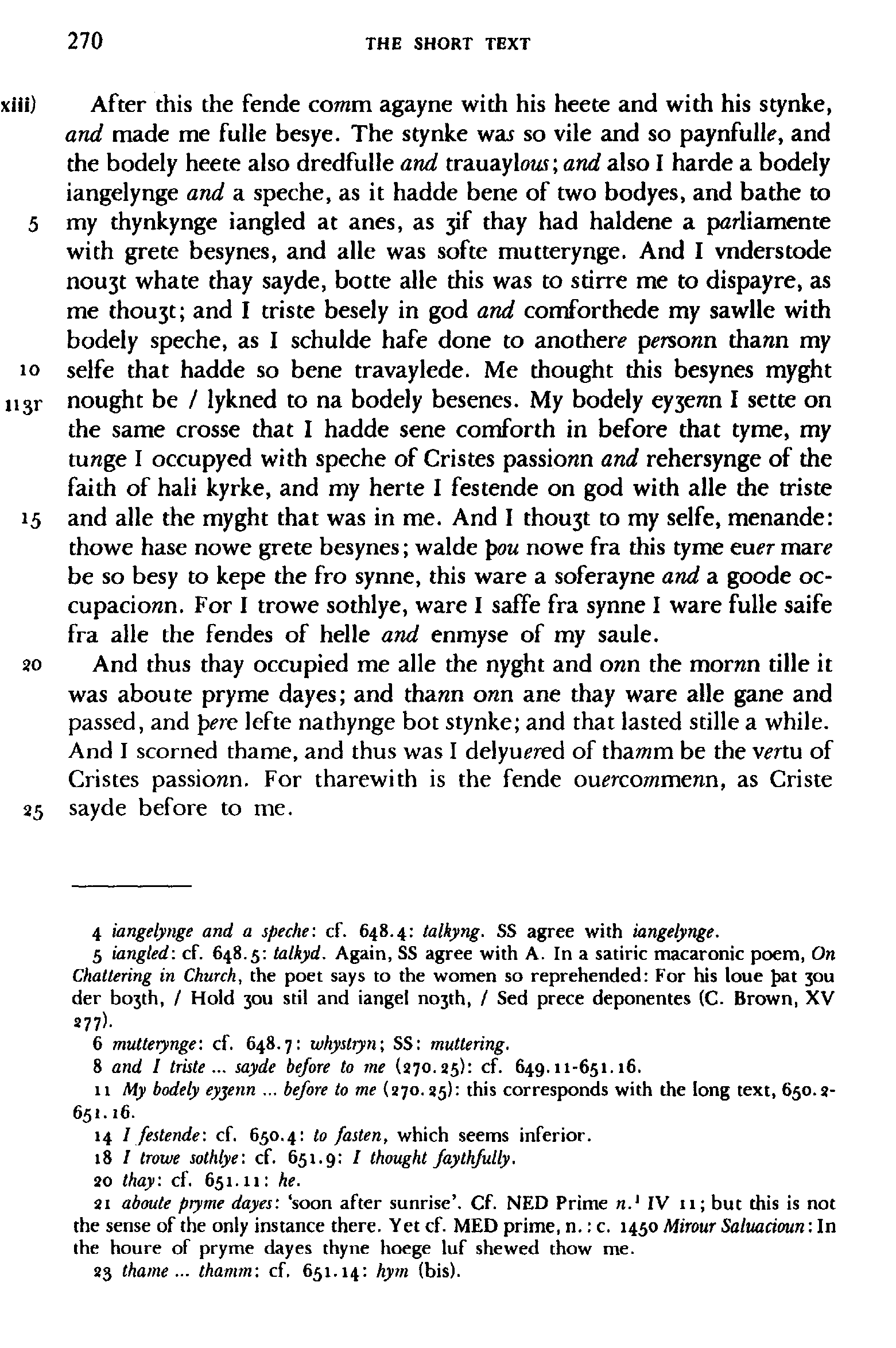
THE SHORT TEXT
xiii) After this the fende comm agayne with his heete and with his stynke, and made me fulle besye. The stynke wa$ so vile and so paynfulk, and the bodely heete also dredfulle and trauaylow; and also I harde a bodely iangelynge and a speche, as it hadde bene of two bodyes, and bathe to 5 my thynkynge iangled at anes, as jif thay had haldene a parliamente with grete besynes, and alle was softe mutterynge. And I vnderstode noujt whate thay sayde, botte alle this was to stirre me to dispayre, as me thou3t; and I triste besely in god and comforthede my sawlle with bodely speche, as I schulde hafe done to another^ pmonn thann my
10 selfe that hadde so bene travaylede. Me thought this besynes myght nsr nought be / lykned to na bodely besenes. My bodely eysenn I sette on the same crosse that I hadde sene comforth in before that tyme, my tunge I occupyed with speche of Cristes passionn and rehersynge of the faith of hali kyrke, and my herte I festende on god with alle die triste
15 and alle the myght that was in me. And I thou3t to my selfe, menande: thowe hase nowe grete besynes; walde Jxm nowe fra this tyme euer mare be so besy to kepe the fro synne, this ware a soferayne and a goode occupacionn. For I trowe sothlye, ware I saffe fra synne I ware fulle saife fra alle the fendes of helle and enmyse of my saule.
And thus thay occupied me alle the nyght and own the mornn tille it was aboute pry me dayes; and thawn own ane thay ware alle gane and passed, and tyre lefte nathynge bot stynke; and that lasted stille a while.
And I scorned thame, and thus was I delyuered of thamm be the wrtu of Cristes passionn. For tharewith is the fende ou^rcommenn, as Criste
25 sayde before to me.
4 iangelynge and a speche: cf. 648.4: talkyng. SS agree with iangelynge.
5 iangled: cf. 648.5: talkyd. Again, SS agree with A. In a satiric macaronic poem, On Chattering in Church, the poet says to the women so reprehended: For his loue pat 3011 der bo3th, / Hold 3011 stil and iangel no3th, / Sed prece deponentes (C. Brown, XV 277).
6 mutterynge: cf. 648.7: whystryn; SS: muttering.
8 and I triste... sayde before to me (270.25): cf. 649.11-651.16.
11 My bodely eyynn ... before to me (270.25): this corresponds with the long text, 650.2651.16.
14 / festende: cf. 650.4: to fasten, which seems inferior.
18 / trowe sothlye: cf. 651.9: / thought faythfully.
20 thay: cf. 651.11: he.
21 aboute pryme dayes: 'soon after sunrise'. Cf. NED Prime n.1 IV 11; but this is not the sense of the only instance there. Yet cf. MED prime, n.: c. 1450 Mirour Saluadoun: In the houre of pryme dayes thyne hoege luf shewed thow me.
23 thame... thamm: cf. 651.14: hym (bis).
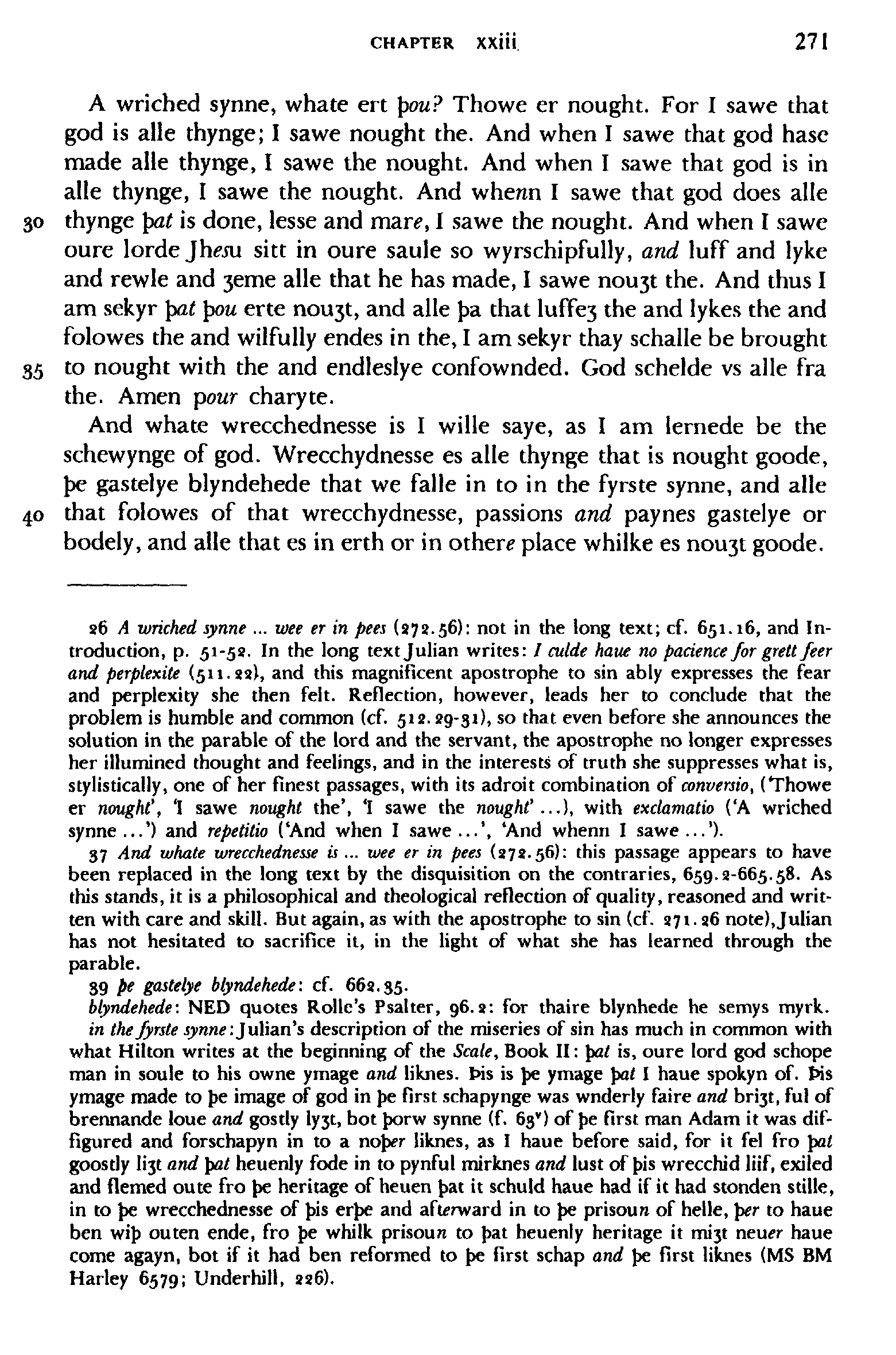
CHAPTER xxiii
A wriched synne, whate ert pou? Thowe er nought. For I sawe that god is alle thynge; I sawe nought the. And when I sawe that god hase made alle thynge, I sawe the nought. And when I sawe that god is in alle thynge, I sawe the nought. And whewn I sawe that god does alle
30 thynge pat is done, lesse and man?, I sawe the nought. And when I sawe oure lordejhmi sitt in oure saule so wyrschipfully, and luff and lyke and rewle and 3eme alle that he has made, I sawe nou3t the. And thus I am sekyr pat pou erte nou3t, and alle pa that luffej the and lykes the and folowes the and wilfully endes in the, I am sekyr thay schalle be brought
35 to nought with the and endleslye confownded. God schelde vs alle fra the. Amen pour charyte.
And whate wrecchednesse is I wille saye, as I am lernede be the schewynge of god. Wrecchydnesse es alle thynge that is nought goode, pG gastelye blyndehede that we falle in to in the fyrste synne, and alle
40 that folowes of that wrecchydnesse, passions and paynes gastelye or bodely, and alle that es in erth or in others place whilke es nou3t goode.
26 A wriched synne ... wee er in pees (272.56): not in the long text; cf. 651.16, and Introduction, p. 51-52. In the long text Julian writes: / culde haue no patience for grett feer and perplexite (511.22), and this magnificent apostrophe to sin ably expresses the fear and perplexity she then felt. Reflection, however, leads her to conclude that the problem is humble and common (cf. 512.29-31), so that even before she announces the solution in the parable of the lord and the servant, the apostrophe no longer expresses her illumined thought and feelings, and in the interests of truth she suppresses what is, stylistically, one of her finest passages, with its adroit combination of conversio, (Thowe er nought', 1 sawe nought the', 'I sawe the nought'...), with exdamatio ('A wriched synne...') and repetitio ('And when I sawe...', 'And whenn I sawe...').
37 And whate wrecchednesse is ... wee er in pees (272.56): this passage appears to have been replaced in the long text by the disquisition on the contraries, 659.2-665.58. As this stands, it is a philosophical and theological reflection of quality, reasoned and written with care and skill. But again, as with the apostrophe to sin (cf. 271.26 note), Julian has not hesitated to sacrifice it, in the light of what she has learned through the parable.
39 PC gastelye blyndehede: cf. 662.35. blyndehede: NED quotes Rolle's Psalter, 96.2: for thaire blynhede he semys myrk. in the fyrste synne .'Julian's description of the miseries of sin has much in common with what Hilton writes at the beginning of the Scale, Book II: \&t is, oure lord god schope man in soule to his owne ymage and liknes. t>is is pe ymage pat I haue spokyn of. Ks ymage made to pe image of god in pe first schapynge was wnderly faire and bri$t, ful of brennande loue and gostly h/3t, bot ]x>rw synne (f. 63") of pe first man Adam it was diffigured and forschapyn in to a noper liknes, as I haue before said, for it fel fro pat goostly Ii3t and pat heuenly fode in to pynful mirknes and lust of pis wrecchid liif, exiled and flemed oute fro pe heritage of heuen pat it schuld haue had if it had stonden stille, in to pe wrecchednesse of pis erpe and afterward in to pe prisoun of helle, per to haue ben wip outen ende, fro pe whilk prisoun to pat heuenly heritage it 01131 neu^r haue come agayn, bot if it had ben reformed to pe first schap and pe first liknes (MS BM
Harley 6579; Underbill, 226).
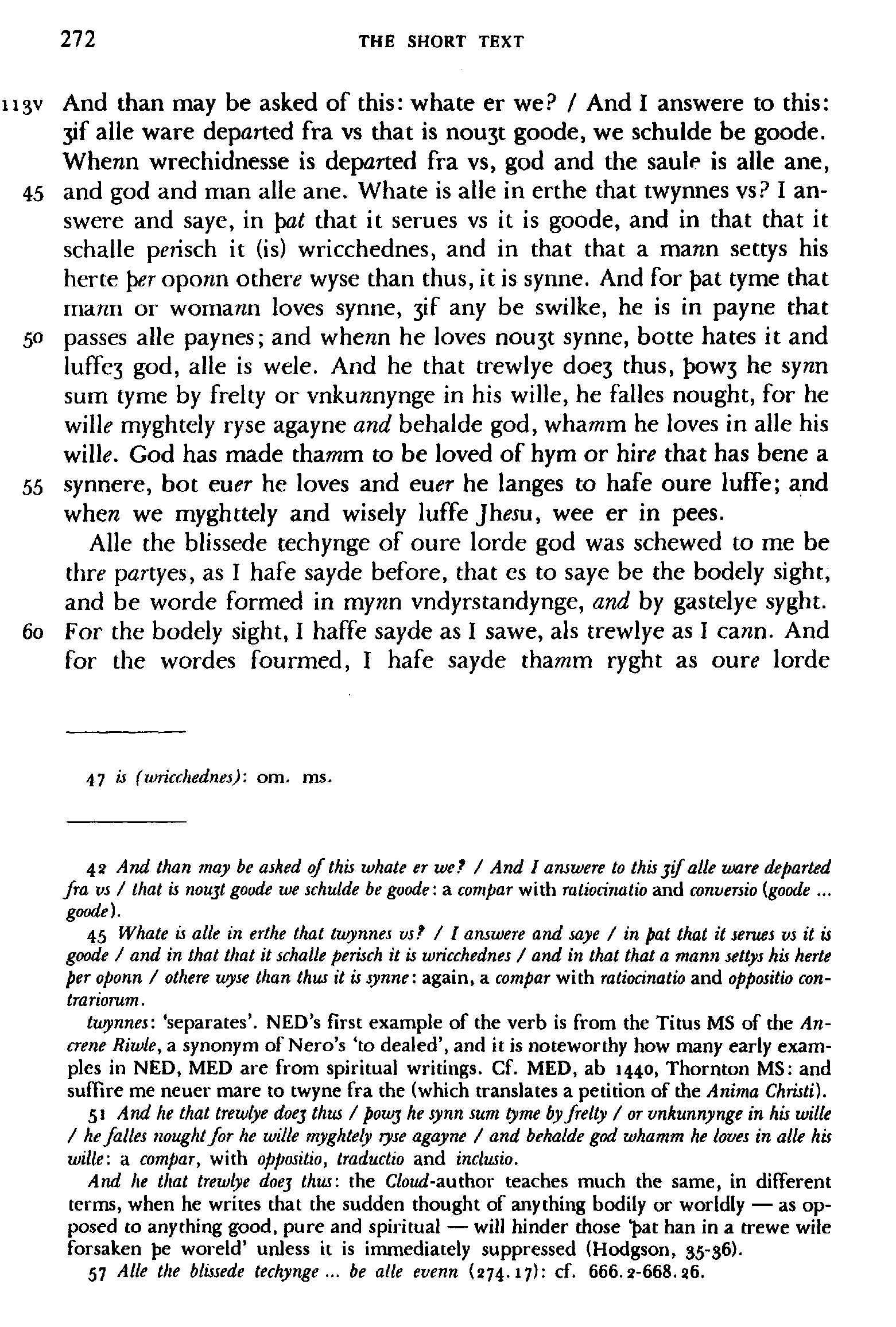
THE SHORT TEXT
iisv And than may be asked of this: whate er we? / And I answere to this:
3if alle ware departed fra vs that is nou3t goode, we schulde be goode.
Whenn wrechidnesse is departed fra vs, god and the saule is alle ane, 45 and god and man alle ane. Whate is alle in erthe that twynnes vs? I answere and saye, in \>at that it serues vs it is goode, and in that that it schalle perisch it (is) wricchednes, and in that that a mann settys his herte \>er oponn others wyse than thus, it is synne. And for £>at tyme that mann or womann loves synne, 3if any be swilke, he is in payne that 50 passes alle paynes; and whe/m he loves nou3t synne, botte hates it and Iuffe3 god, alle is wele. And he that trewlye does thus, {>ow3 he synn sum tyme by frelty or vnkunnynge in his wille, he falles nought, for he willtf myghtely ryse agayne and behalde god, whamm he loves in alle his wilk. God has made thamm to be loved of hym or hire that has bene a 55 synnere, bot euer he loves and eu^r he langes to hafe oure luffe; and when we myghttely and wisely luffejhmi, wee er in pees.
Alle the blissede techynge of oure lorde god was schewed to me be thre partyes, as I hafe sayde before, that es to saye be the bodely sight, and be worde formed in mynn vndyrstandynge, and by gastelye syght.
60 For the bodely sight, I haffe sayde as I sawe, als trewlye as I cann. And for the wordes fourmed, I hafe sayde thamm ryght as oure lorde
47 is (wricchednes): om. ms.
42 And than may be asked of this whate er we? / And I answere to this jif alle ware departed fra vs / that is noutf goode we schulde be goode: a compar with ratiocinatio and conversio (goode ... goode).
45 Whate is alle in erthe that twynnes vs? II answere and saye I in pat that it serues vs it is goode / and in that that it schalle perisch it is wricchednes / and in that that a mann settys his herte per oponn / othere wyse than thus it is synne: again, a compar with ratiocinatio and oppositio contrariorum. twynnes: 'separates'. NED's first example of the verb is from the Titus MS of the Ancrene Riwle, a synonym of Nero's 'to dealed', and it is noteworthy how many early examples in NED, MED are from spiritual writings. Cf. MED, ab 1440, Thornton MS: and suffire me neuer mare to twyne fra the (which translates a petition of die Anima Christi).
51 And he that trewlye doej thus / powj he synn sum tyme by frelty / or vnkunnynge in his wille
/ he falles nought for he wille myghtely ryse agayne / and behalde god whamm he loves in alle his wille: a compar, with oppositio, traductio and inclusio.
And he that trewlye doej thus: the C7oud-author teaches much the same, in different terms, when he writes that the sudden thought of anything bodily or worldly — as opposed to anything good, pure and spiritual — will hinder those 1>at han in a trewe wile forsaken £e woreld" unless it is immediately suppressed (Hodgson, 35-36).
57 Alle the blissede techynge... be alle evenn (274.17): cf. 666.2-668.26.
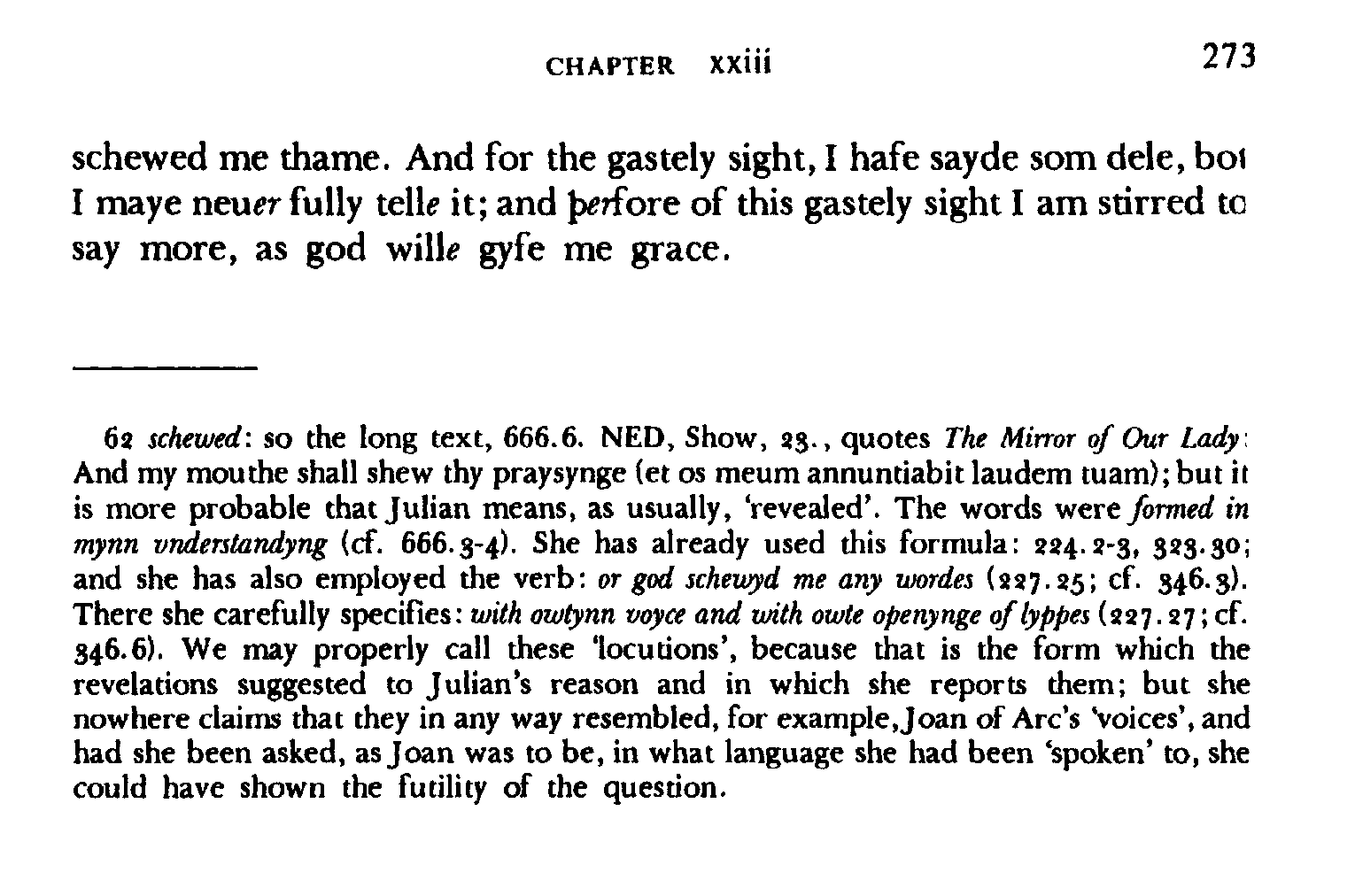
CHAPTER XX11I
schewed me thame. And for the gastely sight, I hafe sayde som dele, boi I maye neuer fully telle it; and J^rfore of this gastely sight I am stirred to say more, as god will* gyfe me grace.
62 schewed: so the long text, 666.6. NED, Show, 23., quotes The Mirror of Our Lady,
And my mouthe shall shew thy praysynge (et os meum annuntiabit laudem tuam); but it is more probable that Julian means, as usually, 'revealed'. The words were formed in mynn vnderstandyng (cf. 666.3-4). She has already used this formula: 224.2-3, 323.30; and she has also employed the verb: or god schewyd me any wordes (227.25; cf. 346.3).
There she carefully specifies: with owtynn voyce and with owte openynge oflyppes (227.27; cf.
346.6). We may properly call these 'locutions', because that is the form which the revelations suggested to Julian's reason and in which she reports them; but she nowhere claims that they in any way resembled, for example, Joan of Arc's Voices', and had she been asked, as Joan was to be, in what language she had been 'spoken' to, she could have shown the futility of the question.
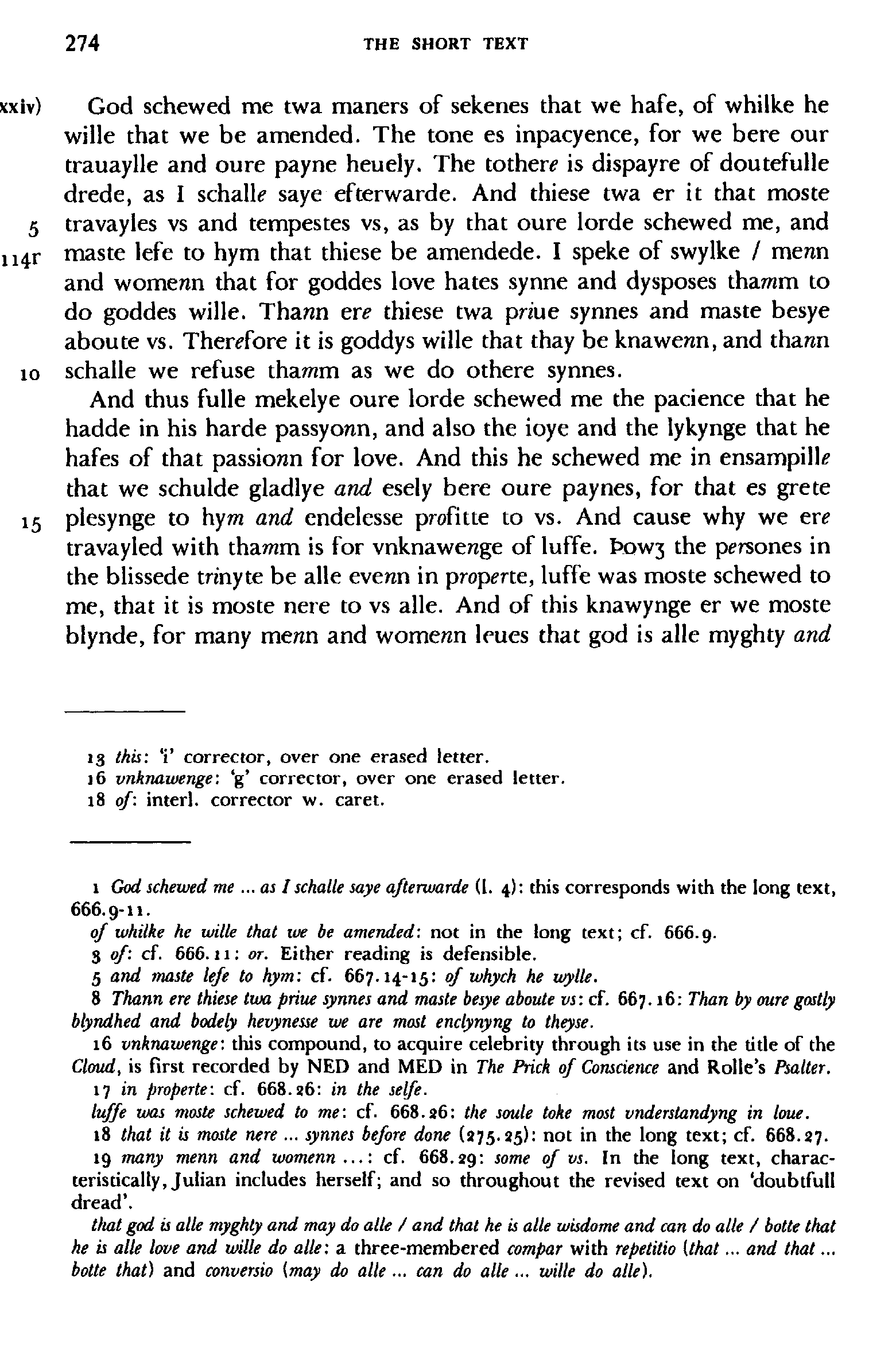
THE SHORT TEXT
xxiv) God schewed me twa maners of sekenes that we hafe, of whilke he wille that we be amended. The tone es inpacyence, for we here our trauaylle and oure payne heuely. The tothere is dispayre of doutefulle drede, as I schalle saye efterwarde. And thiese twa er it that moste
5 travayles vs and tempestes vs, as by that oure lorde schewed me, and U4r maste lefe to hym that thiese be amendede. I speke of swylke / menn and womenn that for goddes love hates synne and dysposes thamm to do goddes wille. Thann ere thiese twa priue synnes and maste besye aboute vs. Therefore it is goddys wille that thay be knawenn, and thann
10 schalle we refuse thamm as we do othere synnes.
And thus fulle mekelye oure lorde schewed me the pacience that he hadde in his harde passyonn, and also the ioye and the lykynge that he hafes of that passiorm for love. And this he schewed me in ensampille that we schulde gladlye and esely bere oure paynes, for that es grete
15 plesynge to hym and endelesse profitte to vs. And cause why we en? travayled with thawm is for vnknawenge of luffe. £>ow3 the pmones in the blissede m'nyte be alle evenn in propme, luffe was moste schewed to me, that it is moste nere to vs alle. And of this knawynge er we moste blynde, for many menn and womenn leues that god is alle myghty and 13 this: V corrector, over one erased letter.
16 vnknawenge: 'g' corrector, over one erased letter.
18 of: interl. corrector w. caret. i God schewed me ... as 1 schalle saye afterwarde (1. 4): this corresponds with the long text,
666.9-11. of whilke he wille that we be amended: not in the long text; cf. 666.9.
3 of: cf. 666.11: or. Either reading is defensible.
5 and maste lefe to hym: cf. 667.14-15: of whych he wylle.
8 Thann ere thiese twa priue synnes and maste besye aboute vs: cf. 667.16: Than by oure gostly blyndhed and bodely hevynesse we are most enclynyng to theyse.
16 vnknawenge: this compound, to acquire celebrity through its use in the title of the Cloud, is first recorded by NED and MED in The Prick of Conscience and Rolle's Psalter.
17 in properte: cf. 668.26: in the selfe. luffe was moste schewed to me: cf. 668.26: the soule toke most vnderstandyng in loue.
18 that it is moste nere ... synnes before done (275.25): not in the long text; cf. 668.27.
19 many menn and womenn ...: cf. 668.29: some of vs. In die long text, characteristically, Julian includes herself; and so throughout the revised text on 'doubtfull dread'. that god is alle myghty and may do alle / and that he is alle wisdome and can do alle I botte that he is alle love and wille do alle: a three-membered compar with repetitio (that... and that... botte that) and conversio (may do alle ... can do alle ... wille do alle).
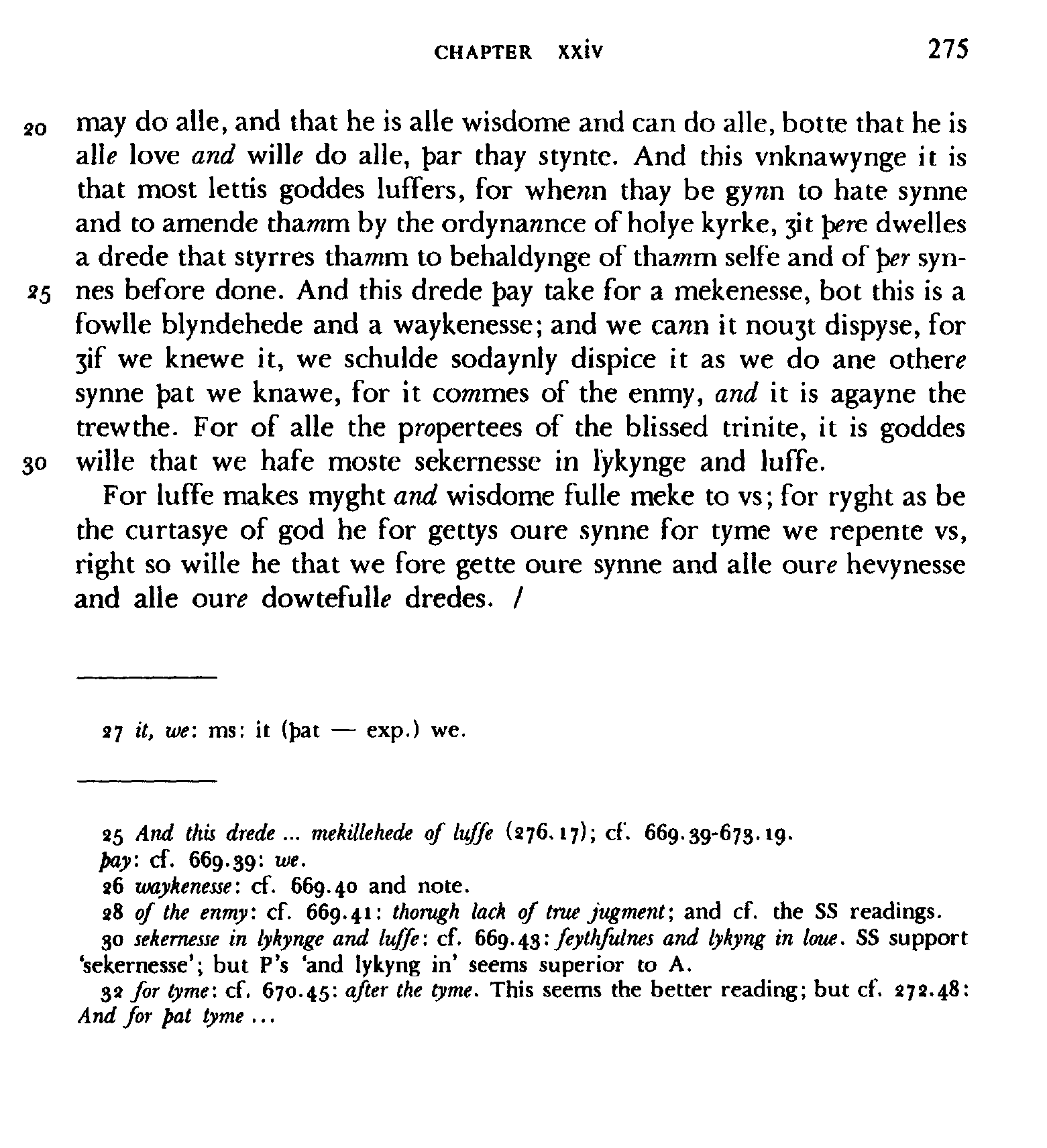
CHAPTER xxiv
20 may do alle, and that he is alle wisdome and can do alle, botte that he is all? love and will? do alle, par thay stynte. And this vnknawynge it is that most lettis goddes luffers, for whenn thay be gyran to hate synne and to amende tharam by the ordynawnce of holye kyrke, 3it tyre dwelles a drede that styrres thamm to behaldynge of thamm self e and of b?r syn25 nes before done. And this drede |>ay take for a mekenesse, bot this is a fowlle blyndehede and a waykenesse; and we carcn it noujt dispyse, for 3if we knewe it, we schulde sodaynly dispice it as we do ane other? synne pat we knawe, for it cowmes of the enmy, and it is agayne the trewthe. For of alle the propertees of the blissed trinite, it is goddes
30 wille that we hafe moste sekernesse in lykynge and luffe.
For luffe makes myght and wisdome fulle meke to vs; for ryght as be the curtasye of god he for gettys oure synne for tyme we repente vs, right so wille he that we fore gette oure synne and alle our? hevynesse and alle our? dowtefull? dredes. / 27 it, we: ms: it (J>at — exp.) we.
25 And this drede... mekillehede of luffe (276.17); cf. 669.39-673.19.
Pay: cf. 669.39: we.
26 waykenesse: cf. 669.40 and note.
28 of the enmy: cf. 669.41: thorugh lack of true jugment; and cf. the SS readings.
30 sekernesse in lykynge and luffe: cf. b6g.m:feythfulnes and lykyng in loue. SS support 'sekernesse'; but P's 'and lykyng in' seems superior to A.
32 for tyme: cf. 670.45: after the tyme. This seems the better reading; but cf. 272.48:
And for pat tyme ...
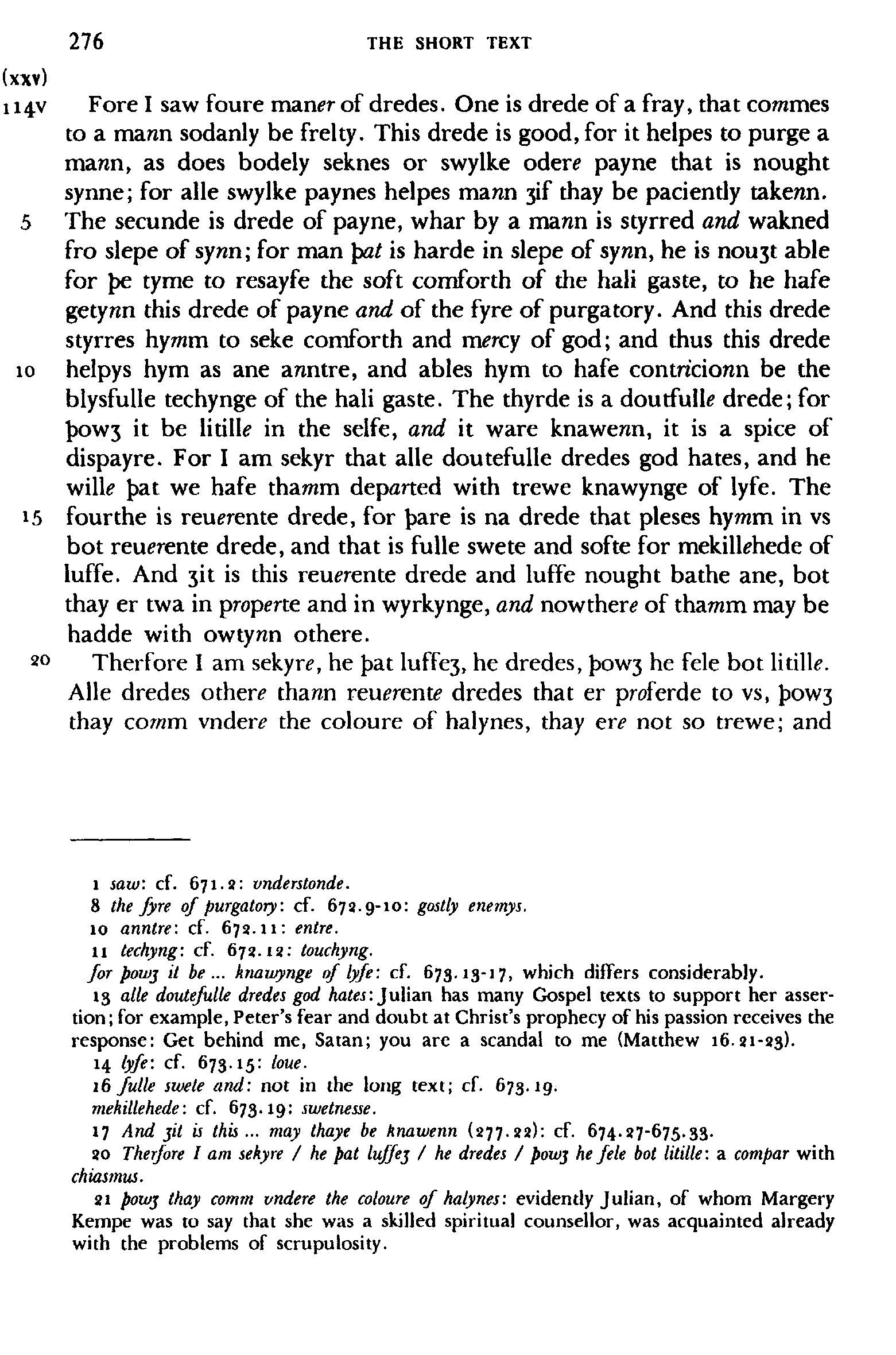
THE SHORT TEXT
(xxv) i i^v Fore I saw foure maner of dredes. One is drede of a fray, that commes to a mann sodanly be frelty. This drede is good, for it helpes to purge a mann, as does bodely seknes or swylke odere payne that is nought synne; for alle swylke paynes helpes mann ;jif thay be paciently takenn.
The secunde is drede of payne, whar by a mann is styrred and wakned fro slepe of synn; for man \>at is harde in slepe of synn, he is nou3t able for J>e tyme to resayfe the soft comforth of the hali gaste, to he hafe getynn this drede of payne and of the fyre of purgatory. And this drede styrres hymm to seke comforth and mercy of god; and thus this drede
helpys hym as ane anntre, and ables hym to hafe contncionn be the blysfulle techynge of the hali gaste. The thyrde is a doutfulltf drede; for ]xDW3 it be litill? in the selfe, and it ware knawenn, it is a spice of dispayre. For I am sekyr that alle doutefulle dredes god hates, and he will* hat we hafe thamm departed with trewe knawynge of lyfe. The 15 fourthe is reuerente drede, for hare is na drede that pleses hymm in vs bot reu^rente drede, and that is fulle swete and softe for mekill^hede of luffe. And sit is this reuerente drede and luffe nought bathe ane, bot thay er twa in property and in wyrkynge, and nowther? of tharam may be hadde with owtynn othere.
Therfore I am sekyr?, he pat Iuffe3, he dredes, J)OW3 he fele bot litilh?.
Alle dredes other? thann reuerente dredes that er proferde to vs, J)OW3 thay cowm vndeiT the coloure of halynes, thay er£ not so trewe; and i saw: cf. 671.2: vnderstonde.
8 the fyre of purgatory: cf. 672.9-10: gostly enemys.
10 anntre: cf. 672.11: entre.
11 techyng: cf. 672.12: touchyng. for powj it be... knawynge of lyfe: cf. 673.13-17, which differs considerably.
13 alle doutefulle dredes god hates: Julian has many Gospel texts to support her assertion; for example, Peter's fear and doubt at Christ's prophecy of his passion receives the response: Get behind me, Satan; you are a scandal to me (Matthew 16.21-23).
14 lyfe: cf. 673.15: loue.
16 fulle swete and: not in the long text; cf. 673.19. mekillehede: cf. 673.19: swetnesse.
17 And jit is this... may thaye be knawenn (277.22): cf. 674.27-675.33.
20 Therfore I am sekyre / he pat luffej / he dredes I powj he fele bot litille: a compar with chiasmus.
21 powj thay comm vndere the coloure of halynes: evidently Julian, of whom Margery
Kempe was to say that she was a skilled spiritual counsellor, was acquainted already with the problems of scrupulosity.
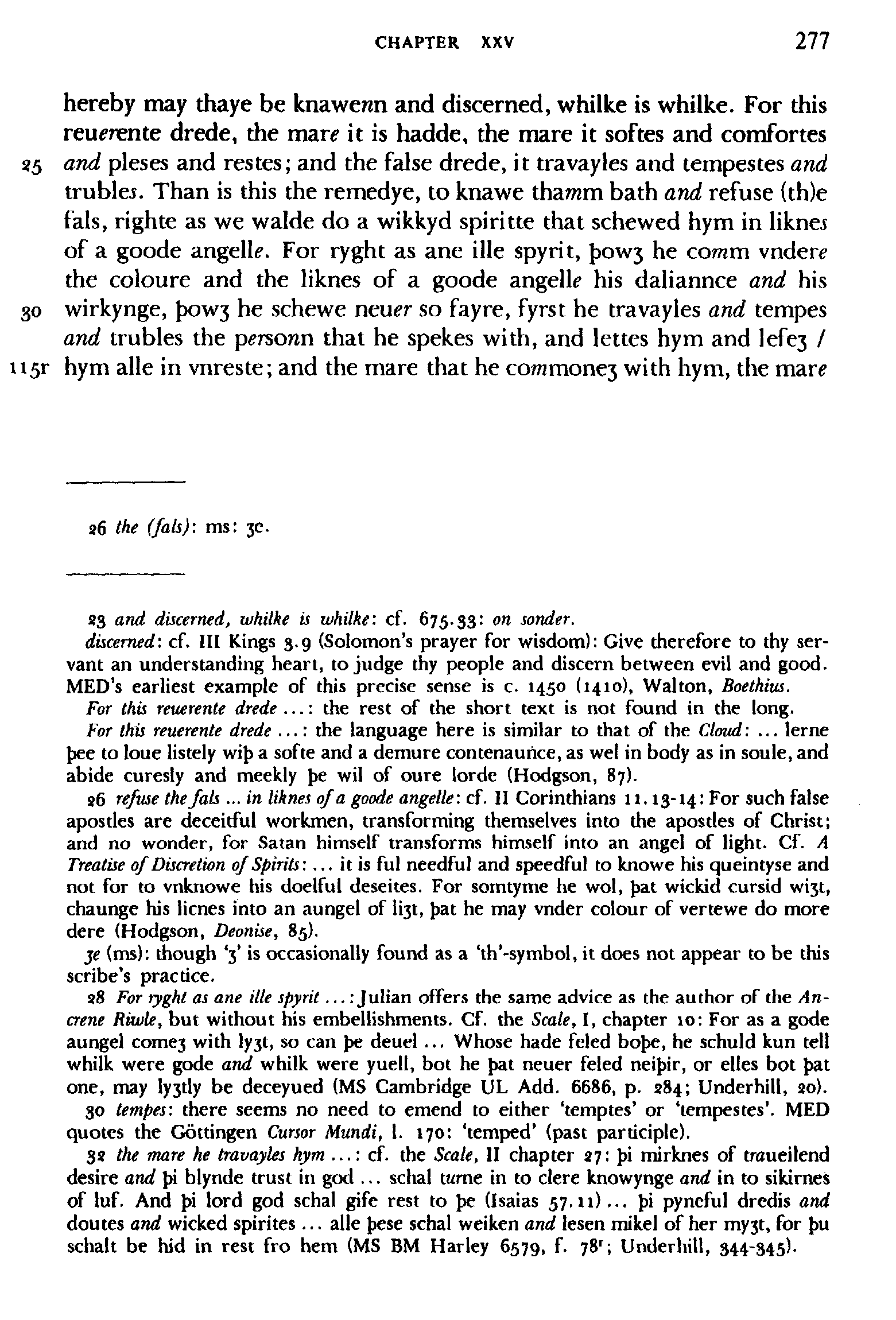
CHAPTER XXV
hereby may thaye be knawewn and discerned, whilke is whilke. For this reu^rente drede, the mare it is hadde, the mare it softes and comfortes
25 and pleses and restes; and the false drede, it travayles and tempestes and trublej. Than is this the remedye, to knawe thawm bath and refuse (th)e fals, righte as we walde do a wikkyd spiritte that schewed hym in liknej of a goode angelic. For ryght as ane ille spyrit, pow3 he coram vnden? the coloure and the liknes of a goode angellehis daliannce and his
30 wirkynge, JJQWJ he schewe neu^r so fayre, fyrst he travayles and tempes and trubles the pmown that he spekes with, and lettes hym and Iefe3 / ii5r hym alle in vnreste; and the mare that he commone3 w'th hym, the mare
26 the (fals): ms: 36.
23 and discerned, whilke is whilke: cf. 675.33: on sonder. discerned: cf. Ill Kings 3.9 (Solomon's prayer for wisdom): Give therefore to thy servant an understanding heart, to judge thy people and discern between evil and good.
MED's earliest example of this precise sense is c. 1450 (1410), Walton, Boethius.
For this reuerente drede ...: the rest of the short text is not found in the long.
For this reuerente drede ...: the language here is similar to that of the Cloud: ... lerne pee to loue listely wi]j a softe and a demure contenaurice, as wel in body as in soule, and abide curesly and meekly pe wil of oure lorde (Hodgson, 87).
26 refuse the fals ... in liknes of a goode angelle: cf. II Corinthians 11.13-14: For such false apostles are deceitful workmen, transforming themselves into the apostles of Christ; and no wonder, for Satan himself transforms himself into an angel of light. Cf. A Treatise of Discretion of Spirits: ... it is ful needful and speedful to knowe his queintyse and not for to vnknowe his doelful deseites. For somtyme he wol, pat wickid cursid wi3t, chaunge his licnes into an aungel of Ii3t, pat he may vnder colour of vertewe do more dere (Hodgson, Deonise, 85). y (ms): though '3' is occasionally found as a 'th'-symbol, it does not appear to be this scribe's practice.
28 For ryght as ane ille spyrit... .'Julian offers the same advice as the author of the Ancrene Riuile, but without his embellishments. Cf. the Scale, I, chapter 10: For as a gode aungel come3 with Iy3t, so can pe deuel ... Whose hade feled bope, he schuld kun tell whilk were gode and whilk were yuell, bot he pat neuer feled neipir, or elles bot pat one, may h/3tly be deceyued (MS Cambridge UL Add. 6686, p. 284; Underbill, 20).
30 tempes: there seems no need to emend to either 'temples' or 'tempestes'. MED quotes the Gottingen Cursor Mundi, 1. 170: 'temped* (past participle).
32 the mare he travayles hym ...: cf. the Scale, II chapter 27: pi mirknes of traueilend desire and pi blynde trust in god ... schal twme in to clere knowynge and in to sikirnes of luf. And pi lord god schal gife rest to pe (Isaias 57.11)... pi pyneful dredis and doutes and wicked spirites ... alle pese schal weiken and lesen mikel of her my3t, for pu schalt be hid in rest fro hem (MS BM Harley 6579, f. 78'; Underbill, 344-345).
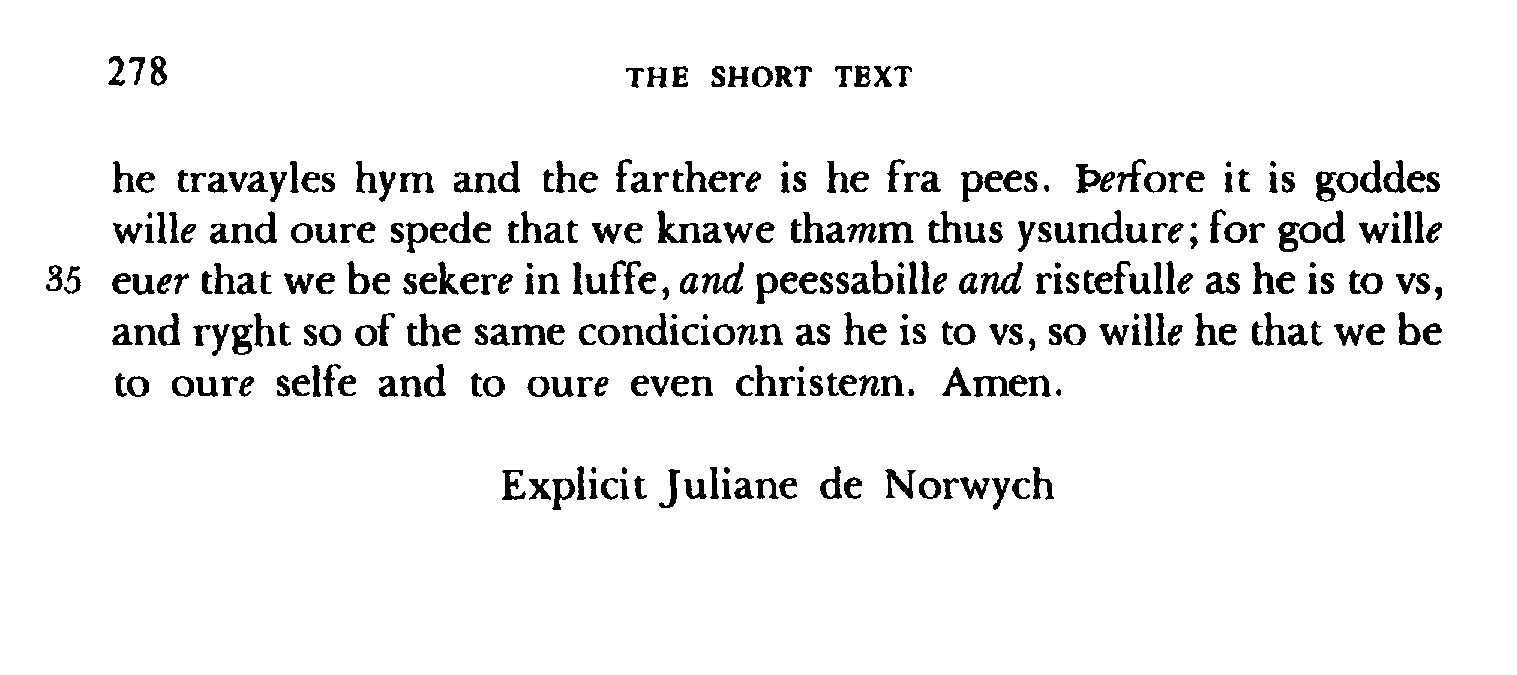
THE SHORT TEXT
he travayles hym and the farther* is he fra pees. Perfore it is goddes will? and oure spede that we knawe thamm thus ysundur*; for god will*
35 euer that we be seker* in luffe, and peessabill* and ristefull* as he is to vs, and ryght so of the same condicionn as he is to vs, so will* he that we be to our* selfe and to our* even christenn. Amen.
Explicit Juliane de Norwych
A BOOK OF SHOWINGS
TO THE ANCHORESS
JULIAN OF NORWICH
Part Two Introduction and The Short Text Edited by
EDMUND COLLEDGE O.S.A.
and
JAMES WALSH SJ.
PONTIFICAL INSTITUTE OF MEDIAEVAL STUDIES
TORONTO 1978
STUDIES AND TEXTS
PART Two
ACKNOWLEDGMENT
This book has been published with the help of a grant from the Humanities Research Council of Canada, using funds provided by the Canada Council.
Copyright 1978 by
PONTIFICAL INSTITUTE OF MEDIAEVAL STUDIES
59 QUEEN'S PARK CRESCENT EAST
TORONTO, ONTARIO, CANADA M£ &$
PRINTED BY UNI VERSA PRESS, WETTEREN, BELGIUM