
2 Introduction
INTRODUCTION
Her definition here of faith, which she had previously described as the dynamic gift given by the Trinity as natura creatrix (cf. 578.20 e.s.) in virtue of the incarnate Word's taking of our sensuality, is one which spiritual theologians tend to describe as 'the spirit of faith': '...a living synthesis of light and of movement ... the impregnation of the human soul by faith in the soul's most spiritual faculties ... progress in the faith, in the sense that man is more completely submissive to God's invitations ... a perfecting of faith'.353 Again, Julian's contemplation is strictly anagogical:
And at pe end of woe, sodeynly oure eye shalle be opynyd, and in clernes of syght oure lyght shalle be fulle, whych lyght is god, oure maker, fadyr, and holy gost in Crist Jhesu oure savyour (724.21).
Thys lyght is charite (chapter 84, 726.2): that is, the luminous faith which is contemplative response and awareness is the virtue and gift of love.
Julian's seeming lack of precision here might have been unacceptable to the dogmatic theologians of her own and later centuries, but it expresses the thought of the great Fathers, of the East as well as the West.
So Gregory of Nazianzus writes: 'He who is loved will be loved. He who is loved is God's guest. And where God is, there, of necessity, is the light. And the first effect of the light is knowledge of the light. So love introduces knowledge'.354 In the matter of the relationship between contemplation and charity, we expect Augustine and Gregory to be
Julian's masters. The soul is close to God when it is pure; and as it remains united to love, so it is flooded by him somehow with an intelligible light, and, so illumined, it perceives, not with its bodily vision, but through him who is its principle, those reasons the sight of which make it most blessed'.355 And it is Gregory's aphorism, 'Amor ipse notitia est',356 which is the inspiration of all that William of St. Thierry taught on contemplative wisdom and charity; for example, in his
Speculum Jidei: There is an inward sense of the soul, for perceiving what is reasonable or divine or spiritual, which is the soul's understanding; for it is love which is a greater and more worthy sense, a purer understanding'.357 Julian here, as she distinguishes between the light of contemplation in via and the vision of the blessed (cf. 726.4-5), emphasizes the contemplative effort; it is such a lyghte in whych we may lyue
353 Andre de Bovis, 'Esprit de foi', DSp 5 611-612.
354 De virtute, PC 37 731.
355 Augustine, Liber de diversis quaestionibus, PL 40 31.
356 Homily 27 in Evangelia, PL 76 1027.
357 Ed. Dechanet, 154.
IX. 18 REVELATION XVI
medfully, with traveyle deservyngpe wurschypfull thangke of god (726.4), which ensures that God's desire for us will become a thanksgiving.
Chapter 85 seems to indicate that what Julian has written about God's properties and the relationship between faith and charity is itself the fruit of immediate contemplation on all the revelations, which are now through grace stored in her memory. Augustine, dealing with that contemplation towards which all understanding of Scripture moves, had written: Fidei fructus intellectus, ut perveniamus ad vitam aeternam, sed ille qui nobis modo evangelium dispensavit ... appareat.358
This is, according to de Lubac, Veal' or practical anagogy; and he refers to Rupert of Deutz's prayer that we may be taken up to the heavenly
Jerusalem, where the Word himself will be our light.359 This is Julian's own sentiment:
And therfore whan the dome is gevyn, and we be alle brought vppe aboue, than shalle we clerely see in god the prevytees whych now be hyd to vs (729.11).
And she concludes with the vision of Paradise reflected in the Sanctus of the Roman Mass (cf. 729.14 note), which itself might be called an anagogical gloss on Isaias's vision of the heavenly temple and of the Lord on his throne (Isaias 6.1-3).
Augustine Baker, to whom, along with his followers among the exiled English Benedictines we owe the preservation of Julian's long text, quotes the Golden Epistle of William of St. Thierry (in Baker's day still attributed to Bernard of Clairvaux) in praise of the contemplative life:
Aliorum est deo servire; vestrum adhaerere. Aliorum est Deo credere, scire, amare, revereri; vestrum est sapere, intelligere, cognoscere, frui.360 Julian, in her humble realization that she is still aspiring to that fullness of the life of prayer which must be begonne by goddys gyfte and his grace (chapter 86, 731.2) in this present moment, but which reaches out into God's eternal present, uses all William's verbs to describe it:
For charyte, pray we alle to gedyr with goddes wurkyng, thankyng, trustyng, enjoyeng, for thus wylle oure good lord be prayde, by l>e vnderstandyng l>at I toke in alle his owne menyng (731.3).
It is only as we fulfil God's will in trusting him that he is the ground of the unitive prayer of petition — and here Julian is referring again to the 351 Enarrationes in lohannem, 22 2; cf. de Lubac, Exe'gese medievale a 634.
359 Ibid., 635 and note.
3*° Holy Wisdom, 15.
INTRODUCTION
beginning of the great revelation on prayer (cf. 460.3-5) — that he wylle geve vs grace to hue hym and deve to hym (732.9), and this whether we be ex professo contemplatives or not.
This lesson of love can be heard in its simplest form in the call to 'pray without ceasing'; and certainly all creatures, lettered or unlettered, are gifted by God for its performance, in one mode or another.
But as this lesson was learned by Julian, it contains and demands far more, as the editors have sought to demonstrate in the annotations to her text. Jean Leclercq has written with great perception about the conflict that can arise, in monastic theology and living, between learning and the beata conscientia, the devotion to heavenly things, and how this conflict can be resolved. Readers of Julian's book must decide how closely Leclercq's description fits her:
To combine a patiently acquired culture with a simplicity won through the power of fervent love, to keep simplicity of soul in the midst of the diverse attractions of the intellectual life and, in order to accomplish this, to place oneself and remain firmly on the plane of the conscience, to raise knowledge to its level and never let it fall below: this is what the cultivated monk succeeds in doing. He is a scholar, he is versed in letters, but he is not merely a man of science nor a man of letters nor an intellectual; he is a spiritual man.361
19 Conclusion In this first critical presentation of the texts of the Revelations, the editors have attempted to show all the evidence which has persuaded them that those critics who have regarded Julian as a spiritual teacher of the first order have been right. Both versions demonstrate that she was a woman of deep learning, by no means outmatched by that, say, of the Cloud or of the Scale; and the sobriety of her piety and her intensely cultivated literary gifts saved her from the extravagances of the school of Richard Rolle. She was never, until the twentieth century, a popular author; and much of the admiration she has been paid in our own times has been evoked by qualities attributed to her which in truth were not hers. So far from being the simple, untutored devotee miraculously endowed by the Spirit, she had laboured long and hard to equip herself to speak to the Church with the Church's authentic voice.
Some of her teachings as she enunciates them may at first startle; but no one of them in any way conflicts with her assurance that all which she
361 The Love of Learning, 317.
IX. 19 CONCLUSION
was shown, and all that prayer had taught her of its meaning, is in total accord with every other truth which God has revealed to men. 'God our mother' is infinitely more than a whimsical and exotic devotion.
Julian came to perceive it as she penetrated the mysteries of Trinity and of the incarnate Word; and she may have been helped to expound it by some of those who before her had been led along the same paths.
The internal evidence produced by objective study of the manuscripts shows that both texts are wholly free from invention or falsification.
The essential difference between the short text (together with the other, as she first drafted it) and the long text (as it finally came to be written in the 'second edition') is that first she suppressed the sights and locutions which were then to her incomprehensible, but, in the end, she was made to see that this should not be, and was given the insights which enabled her to record the totality of her showings, and to demonstrate with a theologian's authority their authenticity.
Perhaps the most striking proof of that authenticity is that, although we know that for many years after her book was finished and published she was consulted as a spiritual director, we do not know that she ever wrote another word. The case of the writer who has scored one first great success and then finds, when he attempts to repeat it, that he can only repeat himself, because inspiration has run dry, is not peculiar to the literary world; some of the Church's most prolific teachers would enjoy greater reputations, had they remained content with their earlier works and thereafter kept silence. Julian, evidently, was indifferent to her fame. It is true that in the short text she shows apprehension of the hostility which her writings may arouse, but her fears are not for her own standing in men's eyes, but that what she knows to be divine truths be impugned as a silly woman's vapourings. Once she had revealed those truths as the Spirit had best helped her to do, that was, it seems, for her the end of the matter. The rest she left to God and his other servants.
How much is owed in this respect to Augustine Baker and his school has been shown. He had tried to teach his disciples to pray as Julian had prayed; and it was they who saw her greatness as a woman of prayer, and who venerated her as a saint. So doing, they rescued what might have disappeared altogether, and preserved in their copies the long text, with its unique record not only of what she was shown in May, 1373, but of the graces and the wisdom given to her in the twenty years which followed.
It has been remarked that it is probably well that we know virtually nothing of her external life. We may guess that she was careful to en-
INTRODUCTION
sure that there remained no 'materials for her biography', just as in her book she asks us to forget that she wrote it and to remember that God inspired it. Any attempts whilst she was alive to pay her a saint's honours she would have found abhorrent — she knew too much about the 'discretion of spirits' — and evidently she was permitted to die and to rest in the obscurity she had sought.
The editors have considered themselves justified in presenting their own conjectures about matters which have importance for a proper evaluation of the Revelations, for they are convinced, and they hope that the evidence on which their convictions rest will convince others, that Julian was a great scholar. But about how she learned her Latin, with whom she studied Scripture and rhetoric, in which library she came upon William of St. Thierry, we can do no more than surmise. Nor would complete information tell us anything which we do not in effect already know. Whether it was Carrow or somewhere else which gave
Julian her training is inessential. She had been schooled in 'the Abbey of the Holy Ghost'.
A BOOK OF SHOWINGS
The short text edited from MS BM Additional 37790
!"#$%&'()%#*+)*+#,*'--.%-)/+%0-'*1%
CHAPTER
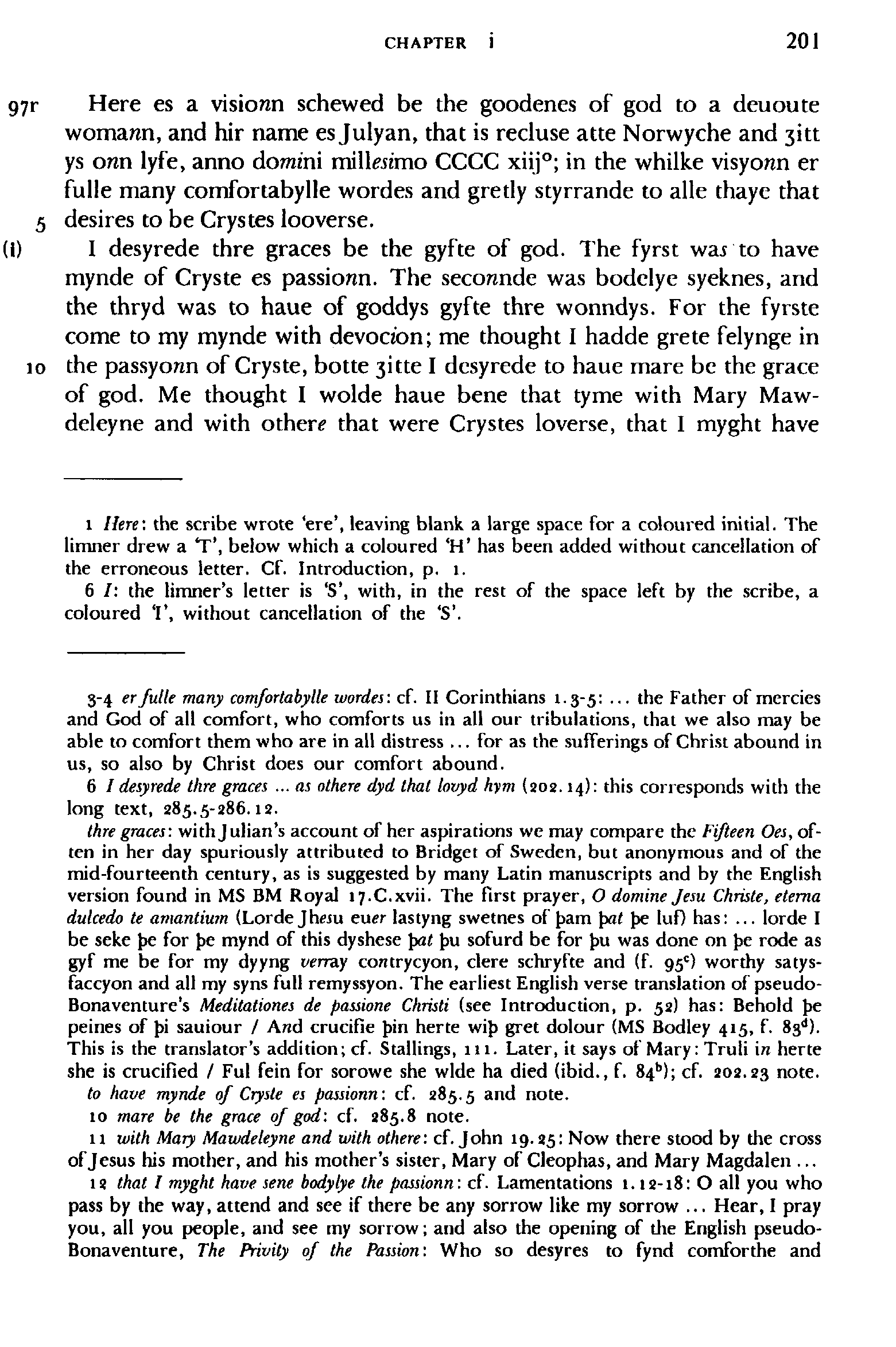
gyr Here es a visicwn schewed be the goodenes of god to a deuoute womawn, and hir name es Julyan, that is recluse atte Norwyche and 3itt ys own lyfe, anno dorami millmmo CCCC xiij°; in the whilke visyonn er fulle many comfortabylle wordes and gretly styrrande to alle thaye that 5 desires to be Crystes looverse.
(i) I desyrede thre graces be the gyfte of god. The fyrst warto have mynde of Cryste es passionn. The secownde was bodelye syeknes, and the thryd was to haue of goddys gyfte thre wonndys. For the fyrste come to my mynde with devodon; me thought I hadde grete felynge in 10 the passyonn of Cryste, botte 3itte I desyrede to haue mare be the grace of god. Me thought I wolde haue bene that tyme with Mary Mawdeleyne and with other? that were Crystes loverse, that I myght have i Here: the scribe wrote 'ere', leaving blank a large space for a coloured initial. The limner drew a T', below which a coloured 'H' has been added without cancellation of the erroneous letter. Cf. Introduction, p. i.
6 /: the limner's letter is 'S', with, in the rest of the space left by the scribe, a coloured 1', without cancellation of the 'S'.
3-4 er fulle many comfortabylle wordes: cf. II Corinthians 1.3-5: ... the Father of mercies and God of all comfort, who comforts us in all our tribulations, that we also may be able to comfort them who are in all distress ... for as the sufferings of Christ abound in us, so also by Christ does our comfort abound.
6 / desyrede thre graces ...as othere dyd that lovyd hym (202.14): this corresponds with the long text, 285.5-286.12. thre graces: with Julian's account of her aspirations we may compare the Fifteen Oes, often in her day spuriously attributed to Bridget of Sweden, but anonymous and of the mid-fourteenth century, as is suggested by many Latin manuscripts and by the English version found in MS BM Royal ly.C.xvii. The first prayer, O domine Jesu Christe, eterna dulcedo te amantium (Lordejhmi eu^r lastyng swetnes of pam frit pe luf) has: ... lorde I be seke pe for pe mynd of this dyshese frit pu sofurd be for pu was done on pe rode as gyf me be for my dyyng verray contrycyon, clere schryfte and (f. 95°) worthy satysfaccyon and all my syns full remyssyon. The earliest English verse translation of pseudoBonaventure's Meditationes de passione Christi (see Introduction, p. 52) has: Behold pe peines of pi sauiour / And crucifie pin herte wi{) gret dolour (MS Bodley 415, f. 83"*).
This is the translator's addition; cf. Stallings, in. Later, it says of Mary: Truli ire herte she is crucified / Ful fein for sorowe she wide ha died (ibid., f. 84b); cf. 202.23 note. to have mynde of Cryste es passionn: cf. 285.5 and note.
10 mare be the grace of god: cf. 285.8 note. n with Mary Mawdeleyne and with othere: cf. John 19.25: Now there stood by the cross of Jesus his mother, and his mother's sister, Mary of Cleophas, and Mary Magdalen ...
12 that I myght have sene bodylye the passionn: cf. Lamentations 1.12-18: O all you who pass by the way, attend and see if there be any sorrow like my sorrow ... Hear, I pray you, all you people, and see my sorrow; and also the opening of die English pseudoBonaventure, The Privity of the Passion: Who so desyres to fynd comforthe and