
282 The Long Text
THE LONG TEXT
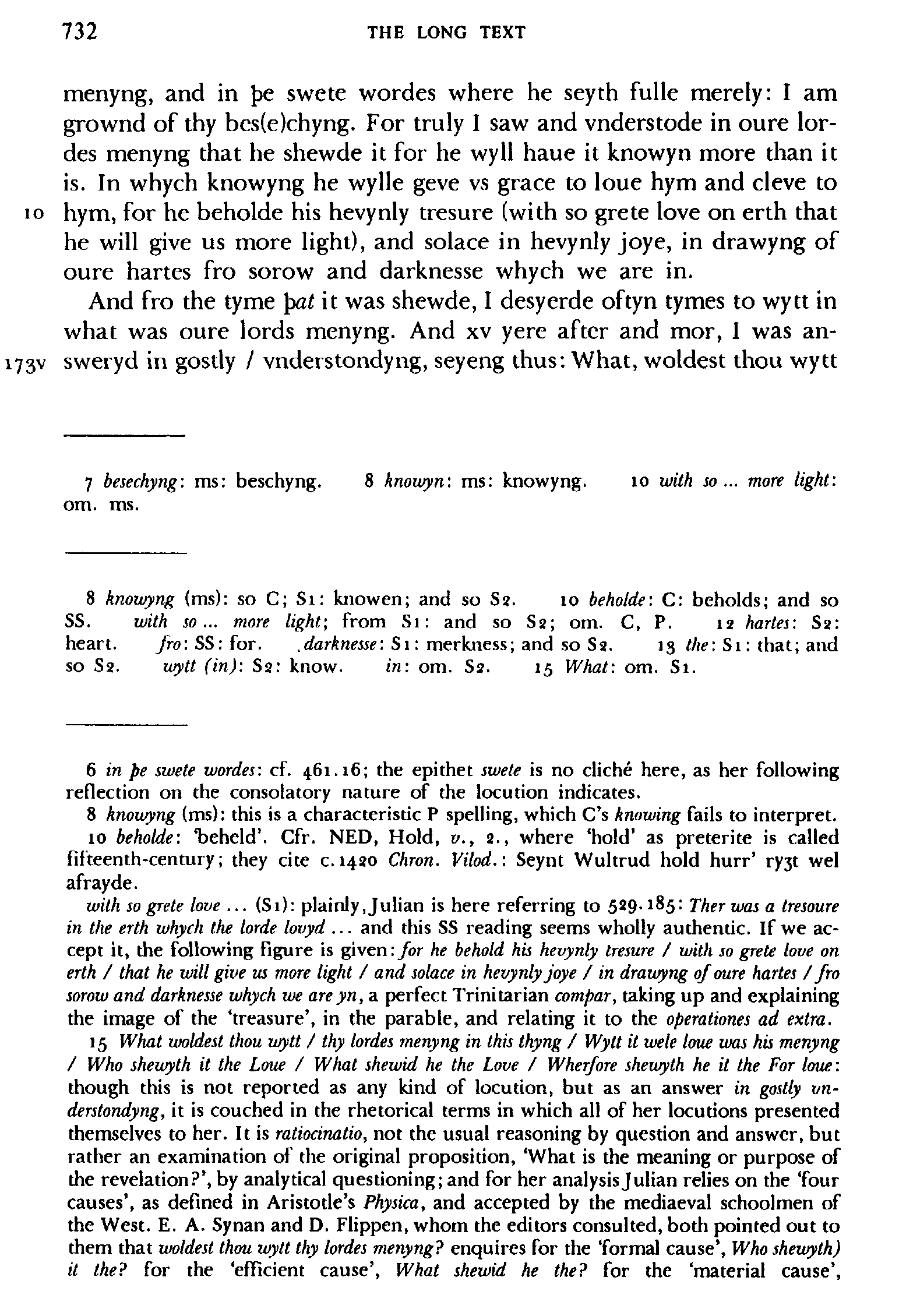
menyng, and in JDC swete wordes where he seyth fulle merely: I am grownd of thy bcs(e)chyng. For truly I saw and vnderstode in oure lordes menyng that he shewde it for he wyll haue it knowyn more than it is. In whych knowyng he wylle geve vs grace to loue hym and cleve to 10 hym, for he beholde his hevynly tresure (with so grete love on erth that he will give us more light), and solace in hevynly joye, in drawyng of oure hartes fro sorow and darknesse whych we are in.
And fro the tyme \>at it was shewde, I desyerde oftyn tymes to wytt in what was oure lords menyng. And xv yere after and mor, I was anlysv sweryd in gostly / vnderstondyng, seyeng thus: What, woldest thou wytt
7 besechyng: ms: beschyng.
8 knowyn: ms: knowyng.
10 with so... more light: om. ms.
8 knowyng (ms): so C; Si: knowen; and so 82.
10 beholde: C: beholds; and so SS. with so... more light; from Si: and so 82; om. C, P.
12 hartes: 82: heart. fro: SS: for.
.darknesse: Si: merkness; and so 82.
13 the: Si: that; and so 82. wytt (in): 82: know. in: om. 82.
15 What: om. Si.
6 in pe swete wordes: cf. 461.16; the epithet swete is no cliche here, as her following reflection on the consolatory nature of die locution indicates.
8 knowyng (ms): this is a characteristic P spelling, which C's knowing fails to interpret.
10 beholde: "beheld*. Cfr. NED, Hold, v., 2., where 'hold' as preterite is called fifteenth-century; they cite c. 1420 Chron. Vilod.: Seynt Wultrud hold hurr' ry3t wel afrayde. with so grete love ... (Si): plainly,Julian is here referring to 529.185: Ther was a tresoure in the erth whych the lorde lovyd ... and this SS reading seems wholly authentic. If we accept it, the following figure is given: for he behold his hevynly tresure / with so grete love on erth / that he will give us more light / and solace in hevynly joye / in drawyng of oure hartes /fro sorow and darknesse whych we areyn, a perfect Trinitarian compar, taking up and explaining the image of the 'treasure', in the parable, and relating it to the operationes ad extra.
15 What woldest thou wytt / thy lordes menyng in this thyng / Wytt it wele loue was his menyng
/ Who shewyth it the Loue / What shewid he the Love / Wherfore shewyth he it the For loue: though this is not reported as any kind of locution, but as an answer in gostly vnderstondyng, it is couched in the rhetorical terms in which all of her locutions presented themselves to her. It is ratiocinatio, not the usual reasoning by question and answer, but rather an examination of the original proposition, 'What is the meaning or purpose of the revelation?', by analytical questioning; and for her analysis Julian relies on the 'four causes', as defined in Aristotle's Physica, and accepted by the mediaeval schoolmen of the West. E. A. Synan and D. Flippen, whom the editors consulted, both pointed out to them that woldest thou wytt thy lordes menyng? enquires for the 'formal cause', Who shewyth) it the? for the 'efficient cause', What shewid he the? for the 'material cause',
CHAPTER 86, REVELATION 16
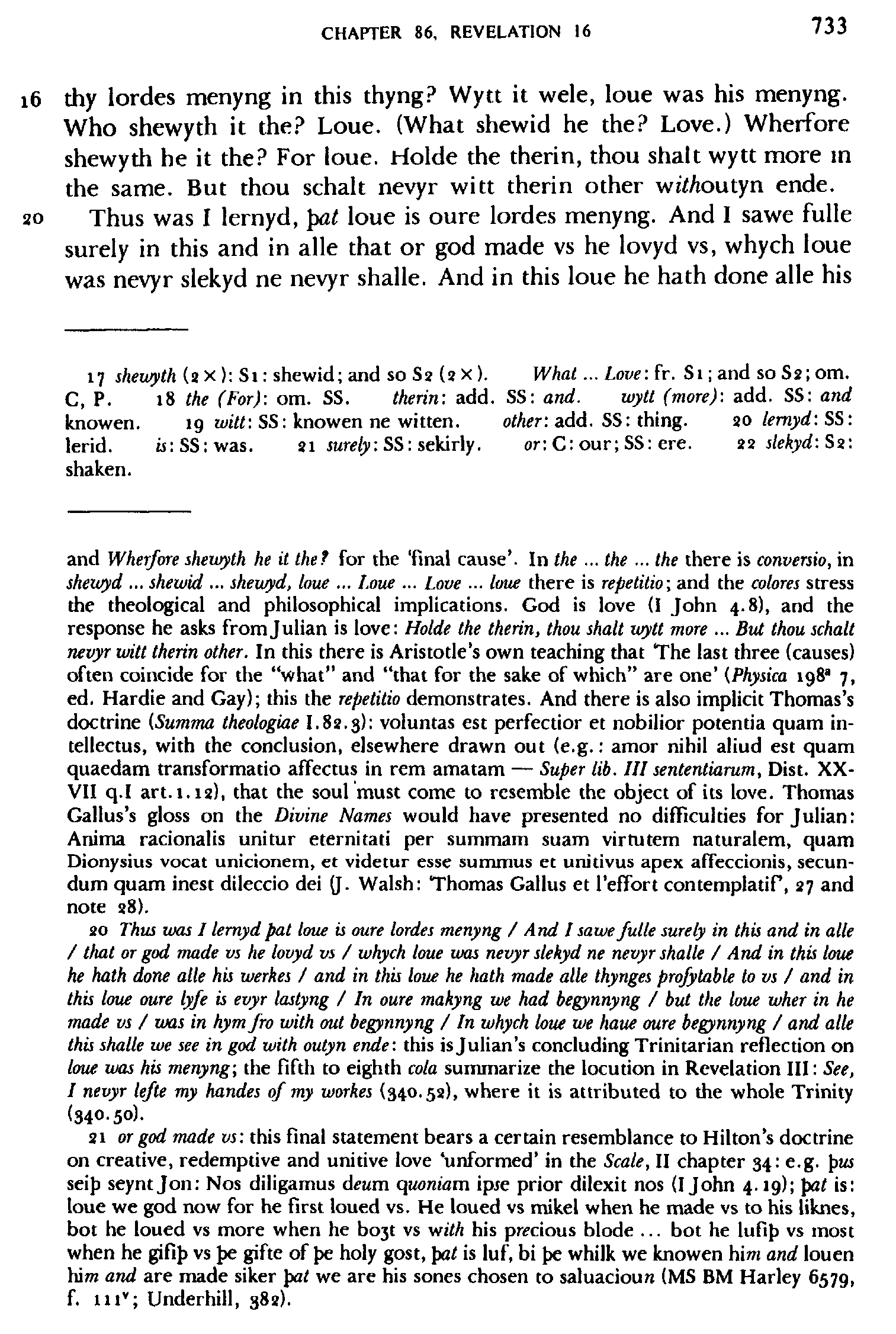
16 thy lordes menyng in this thyng? Wytt it wele, loue was his menyng.
Who shewyth it the? Loue. (What shewid he the? Love.) Wherfore shewyth he it the? For loue. riolde the therin, thou shalt wytt more in the same. But thou schalt nevyr witt therin other w^Aoutyn ende.
Thus was I lernyd, ^at loue is cure lordes menyng. And I sawe fulle surely in this and in alle that or god made vs he lovyd vs, whych loue was nevyr slekyd ne nevyr shalle. And in this loue he hath done alle his
17 shewyth (ax): S i: shewid; and so 82 (zx).
What... Love:fr. Si; and soSsjom.
C, P.
18 the (For): om. SS. therin: add. SS: and. wytt (more): add. SS: and knowen.
19 witt: SS: knowen ne witten. other: add. SS: thing.
20 lernyd:SS: lerid. is:SS:was.
21 surely: SS: sekirly. or: C: our; SS: ere.
22 slekyd: 82: shaken. and Wherfore shewyth he it the? for the 'final cause'. In the ... the ... the there is conversio, in shewyd ... shewid ... shewyd, loue ... Loue ... Love ... loue there is repetitio; and the colores stress die theological and philosophical implications. God is love (I John 4.8), and the response he asks from Julian is love: Holde the therin, thou shalt wytt more ... But thou schalt nevyr witt therin other. In this there is Aristotle's own teaching that The last three (causes) often coincide for the "what" and "that for the sake of which" are one' (Physica 198* 7, ed. Hardie and Gay); this the repetitio demonstrates. And there is also implicit Thomas's doctrine (Summa theologiae 1.82.3): voluntas est perfectior et nobilior potentia quam intellectus, with the conclusion, elsewhere drawn out (e.g.: amor nihil aliud est quam quaedam transformatio affectus in rem amatam — Super lib. HI sententiarum, Dist. XXVII q.I art. 1.12), that the soul must come to resemble the object of its love. Thomas
Callus's gloss on the Divine Names would have presented no difficulties for Julian:
Anima racionalis unitur eternitati per summam suam virtutem naturalem, quam Dionysius vocat unicionem, et videtur esse summus et unitivus apex affeccionis, secundum quam inest dileccio dei (J. Walsh: Thomas Callus et 1'effort contemplatiP, 27 and note 28).
20 Thus was I lernyd pat loue is oure lordes menyng /And I sawe fulle surely in this and in alle
/ that or god made vs he lovyd vs / whych loue was nevyr slekyd ne nevyr shalle / And in this loue he hath done alle his werkes / and in this loue he hath made alle thynges profytable to vs / and in this loue oure lyfe is evyr lastyng / In oure makyng we had begynnyng / but the loue wher in he made vs / was in hymfro with out begynnyng / In whych loue we haue oure begynnyng / and alle this shalle we see in god with outyn ende: this is Julian's concluding Trinitarian reflection on loue was his menyng; the fifth to eighth cola summarize the locution in Revelation III: See,
I nevyr lefte my handes of my workes (340.52), where it is attributed to the whole Trinity
(340.50).
21 or god made vs: this final statement bears a certain resemblance to Hilton's doctrine on creative, redemptive and unitive love 'unformed' in the Scale, II chapter 34: e.g. pu$ seif) seyntjon: Nos diligamus d^wm quoniam ipje prior dilexit nos (I John 4.19); \>at is: loue we god now for he first loued vs. He loued vs mikel when he made vs to his liknes, bot he loued vs more when he bo3t vs with his precious blode ... bot he lufij) vs most when he gifip vs pe gifte of pe holy gost, \>at is luf, bi pe whilk we knowen him and louen him and are made siker Ipat we are his sones chosen to saluacioun (MS BM Harley 6579, f. iii v; Underbill, 382).
THE LONG TEXT
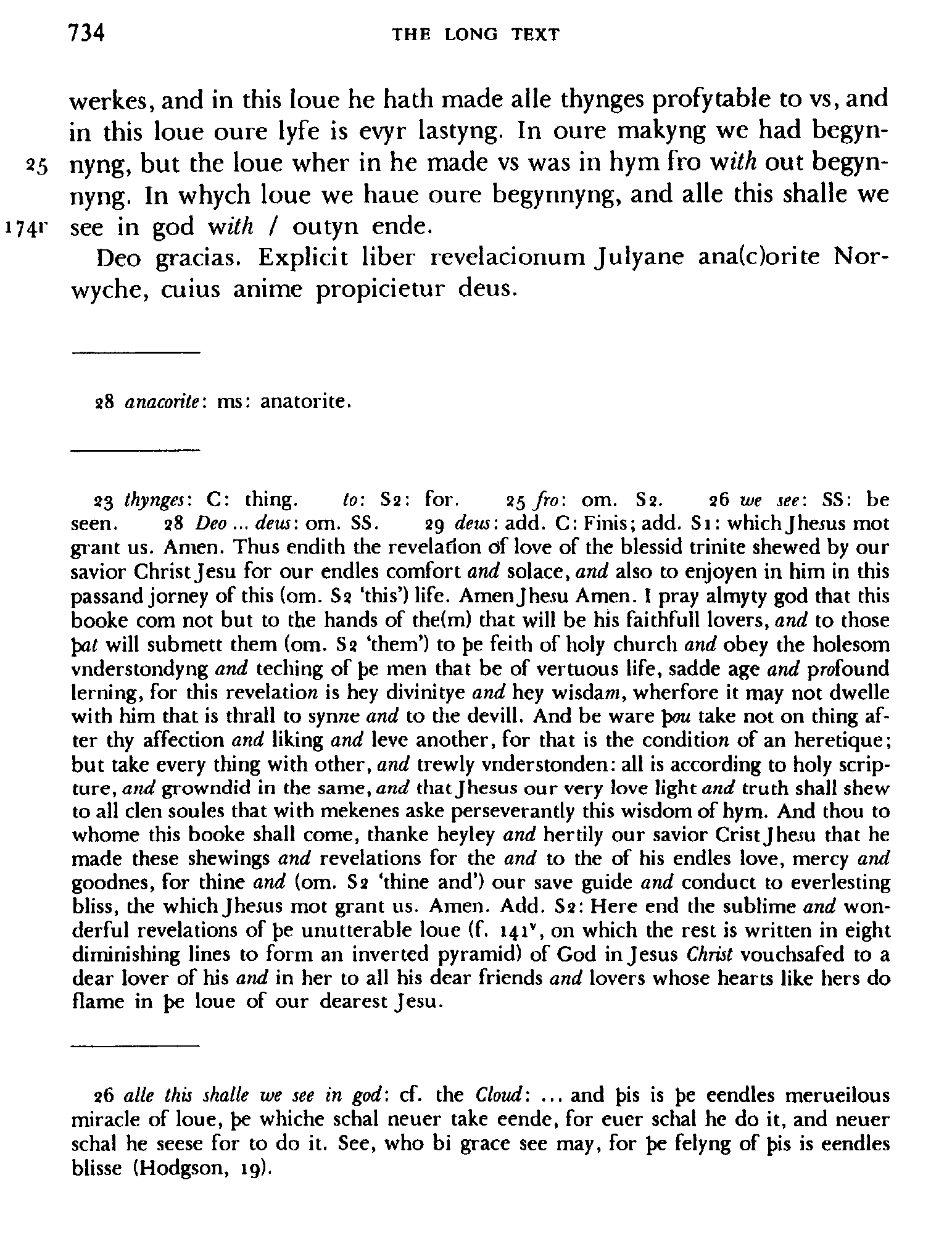
werkes, and in this loue he hath made alle thynges profytable to vs, and in this loue cure lyfe is evyr lastyng. In oure makyng we had begyn25 nyng, but the loue wher in he made vs was in hym fro with out begynnyng. In whych loue we haue oure begynnyng, and alle this shalle we
1741see in god with I outyn ende.
Deo gracias. Explicit liber revelacionum Julyane ana(c)orite Norwyche, cuius anime propicietur deus. anacorite: ms: anatonte.
23 thynges: C: thing. to: 82: for.
25 fro: om.
82.
26 we see: SS: be seen.
28 Deo ... deus: om. SS.
29 deus: add. C: Finis; add. Si: whichJhe^us mot grant us. Amen. Thus endith the revelation of love of the blessid trinite shewed by our savior Christ Jesu for our endles comfort and solace, and also to enjoyen in him in this passand jorney of this (om. 82 'this') life. Amenjhe^u Amen. I pray almyty god that this booke com not but to the hands of the(m) that will be his faithfull lovers, and to those
Jxzi will submett them (om. 82 'them') to J>e feith of holy church and obey the holesom vnderstondyng and teching of be men that be of vertuous life, sadde age and profound lerning, for this revelation is hey divinitye and hey wisdam, wherfore it may not dwelle with him that is thrall to synne and to the devill. And be ware Tpou take not on thing after thy affection and liking and leve another, for that is the condition of an heretique; but take every thing with other, and trewly vnderstonden: all is according to holy scripture, and growndid in the same, and that Jhesus our very love light and truth shall shew to all clen soules that with mekenes aske perseverantly this wisdom of hym. And thou to whome this booke shall come, thanke heyley and hertily our savior Cristjhe.su that he made these shewings and revelations for the and to the of his endles love, mercy and goodnes, for thine and (om. 82 'thine and') our save guide and conduct to everlesting bliss, the which Jhesus mot grant us. Amen. Add. 82: Here end the sublime and wonderful revelations of £e unutterable loue (f. 141", on which the rest is written in eight diminishing lines to form an inverted pyramid) of God in Jesus Christ vouchsafed to a dear lover of his and in her to all his dear friends and lovers whose hearts like hers do flame in J>e loue of our dearest Jesu.
26 alle this shalle we see in god: cf. the Cloud: ... and ]?is is J>e eendles merueilous miracle of loue, Jje whiche schal neuer take eende, for euer schal he do it, and neuer schal he seese for to do it. See, who bi grace see may, for be felyng of f>is is eendles blisse (Hodgson, 19).