
Appendix
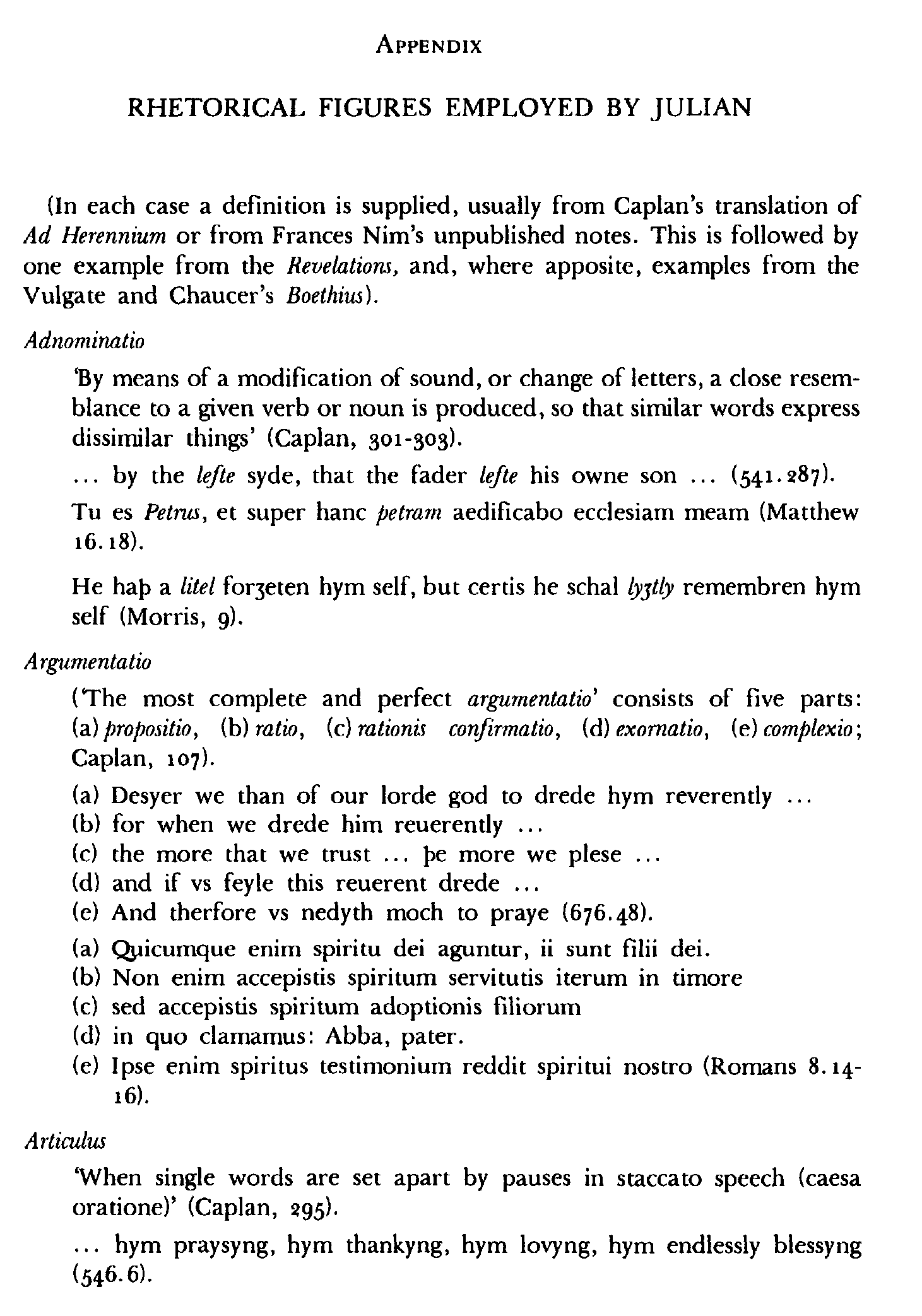
APPENDIX
RHETORICAL FIGURES EMPLOYED BY JULIAN
(In each case a definition is supplied, usually from Caplan's translation of Ad Herennium or from Frances Nim's unpublished notes. This is followed by one example from the Revelations, and, where apposite, examples from the Vulgate and Chaucer's Boethius).
Adnominatio 'By means of a modification of sound, or change of letters, a close resemblance to a given verb or noun is produced, so that similar words express dissimilar things' (Caplan, 301-303).
... by the lefte syde, that the fader lefte his owne son ... (541.287).
Tu es Petrus, et super hanc petram aedificabo ecclesiam meam (Matthew 16.18).
He haj) a litel fo^eten hym self, but certis he schal ly$ly remembren hym self (Morris, 9).
Argumentatio (The most complete and perfect argumentatio' consists of five parts:
(a) propositio, (b) ratio, (c) rationis confirmatio, (d)exomatio, (e) complexio; Caplan, 107).
(a) Desyer we than of our lorde god to drede hym reverently ...
(b) for when we drede him reuerently ...
(c) the more that we trust ... £e more we plese ...
(d) and if vs feyle this reuerent drede ...
(e) And therfore vs nedyth moch to praye (676.48).
(a) Quicumque enim spiritu dei aguntur, ii sunt filii dei.
(b) Non enim accepistis spiritum servitutis iterum in timore (c) sed accepistis spiritum adoptionis filiorum
(d) in quo clamamus: Abba, pater.
(e) Ipse enim spiritus testimonium reddit spiritui nostro (Romans 8.1416).
Articulus 'When single words are set apart by pauses in staccato speech (caesa oratione)' (Caplan, 295).
... hym praysyng, hym thankyng, hym lovyng, hym endlessly blessyng (546-6).
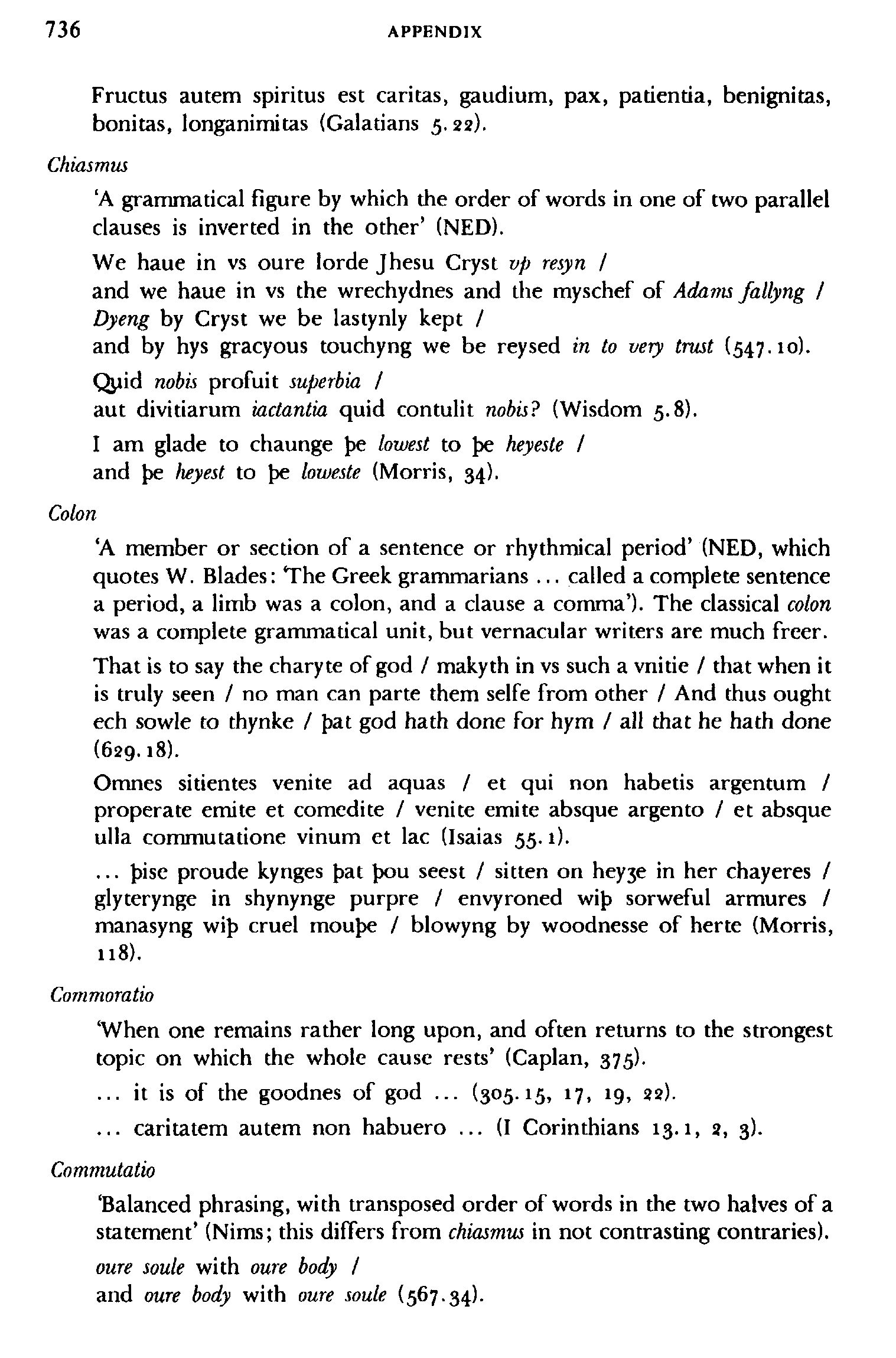
APPENDIX Fructus autem spiritus est caritas, gaudium, pax, patientia, benignitas, bonitas, longanimitas (Galatians 5. 22).
Chiasmus 'A grammatical figure by which the order of words in one of two parallel clauses is inverted in the other' (NED).
We haue in vs oure lorde Jhesu Cryst vp resyn I and we haue in vs the wrechydnes and the myschef of Adams fallyng I Dyeng by Cryst we be lastynly kept / and by hys gracyous touchyng we be reysed in to very trust (547.10).
Quid nobis profuit superbia I aut divitiarum iactantia quid contulit nobis? (Wisdom 5.8).
I am glade to chaunge pe lowest to \>e heyeste I and Jje hey est to pe loweste (Morris, 34).
Colon 'A member or section of a sentence or rhythmical period' (NED, which quotes W. Blades: The Greek grammarians ... called a complete sentence a period, a limb was a colon, and a clause a comma'). The classical colon was a complete grammatical unit, but vernacular writers are much freer.
That is to say the chary te of god / makyth in vs such a vnitie / that when it is truly seen / no man can parte them selfe from other / And thus ought ech sowle to thynke / pat god hath done for hym / all that he hath done
(629.18).
Omnes sitientes venite ad aquas / et qui non habetis argentum / properate emite et comedite / venite emite absque argento / et absque ulla commutatione vinum et lac (Isaias 55. i).
... pise proude kynges pat pou seest / sitten on hey3e in her chayeres / glyterynge in shynynge purpre / envyroned wip sorweful armures / manasyng wip cruel moupe / blowyng by woodnesse of herte (Morris,
118).
Commoratio 'When one remains rather long upon, and often returns to the strongest topic on which die whole cause rests' (Caplan, 375).
... it is of the goodnes of god ... (305.15, 17, 19, 22).
... caritatem autem non habuero ... (I Corinthians 13.1, 2, 3).
Commutatio 'Balanced phrasing, with transposed order of words in the two halves of a statement' (Nims; this differs from chiasmus in not contrasting contraries). oure soule with oure body I and oure body with oure soule (567.34).
APPENDIX
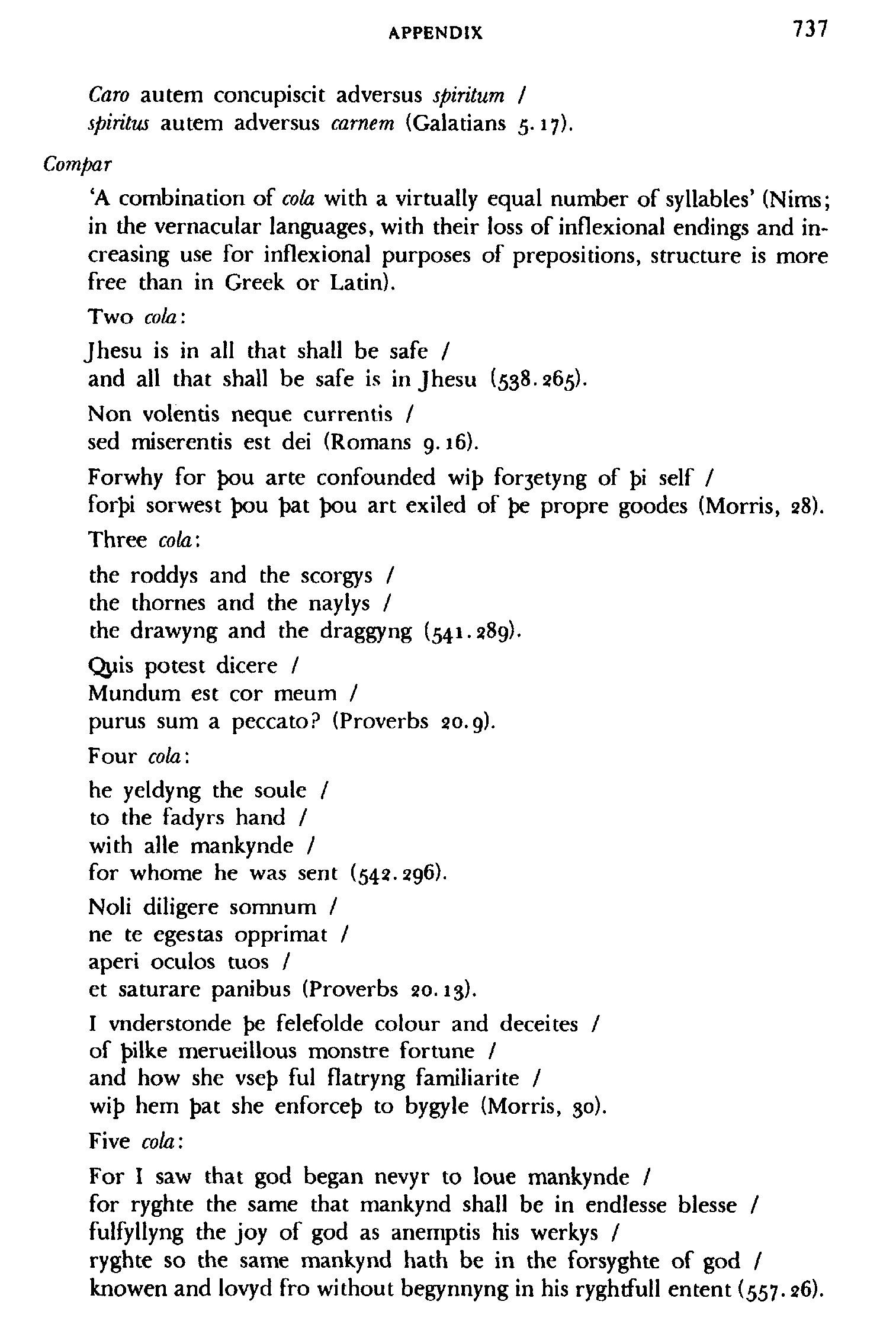
Caw autem concupiscit ad versus spiritum I spiritus autem adversus carnem (Galatians 5.17).
Compar 'A combination of cola with a virtually equal number of syllables' (Nims; in the vernacular languages, with their loss of inflexional endings and increasing use for inflexional purposes of prepositions, structure is more free than in Greek or Latin).
Two cola:
Jhesu is in all that shall be safe / and all that shall be safe is in Jhesu (538.865).
Non volentis neque currentis / sed miserentis est dei (Romans 9.16).
Forwhy for Jxm arte confounded wij> forjetyng of J>i self / for])i sorwest pou pat ]x>u art exiled of pe propre goodes (Morris, 28).
Three cola: the roddys and the scorgys / the thornes and the naylys / the drawyng and the draggyng (541.289).
Quis potest dicere / Mundum est cor meum / purus sum a peccato? (Proverbs 20.9).
Four cola: he yeldyng the soule / to the fadyrs hand / with alle mankynde / for whome he was sent (542.296).
Noli diligere somnum / ne te egestas opprimat / aperi oculos tuos / et saturare panibus (Proverbs 20.13).
I vnderstonde Jje felefolde colour and deceites / of pilke merueillous monstre fortune / and how she vse|) ful flatryng familiarite / wij) hem pat she enforce^ to bygyle (Morris, 30).
Five cola:
For I saw that god began nevyr to loue mankynde / for ryghte the same that mankynd shall be in endlesse blesse / fulfyllyng the joy of god as anemptis his werkys / ryghte so the same mankynd hath be in the forsyghte of god / knowen and lovyd fro without begynnyng in his ryghtfull entent (557.26).
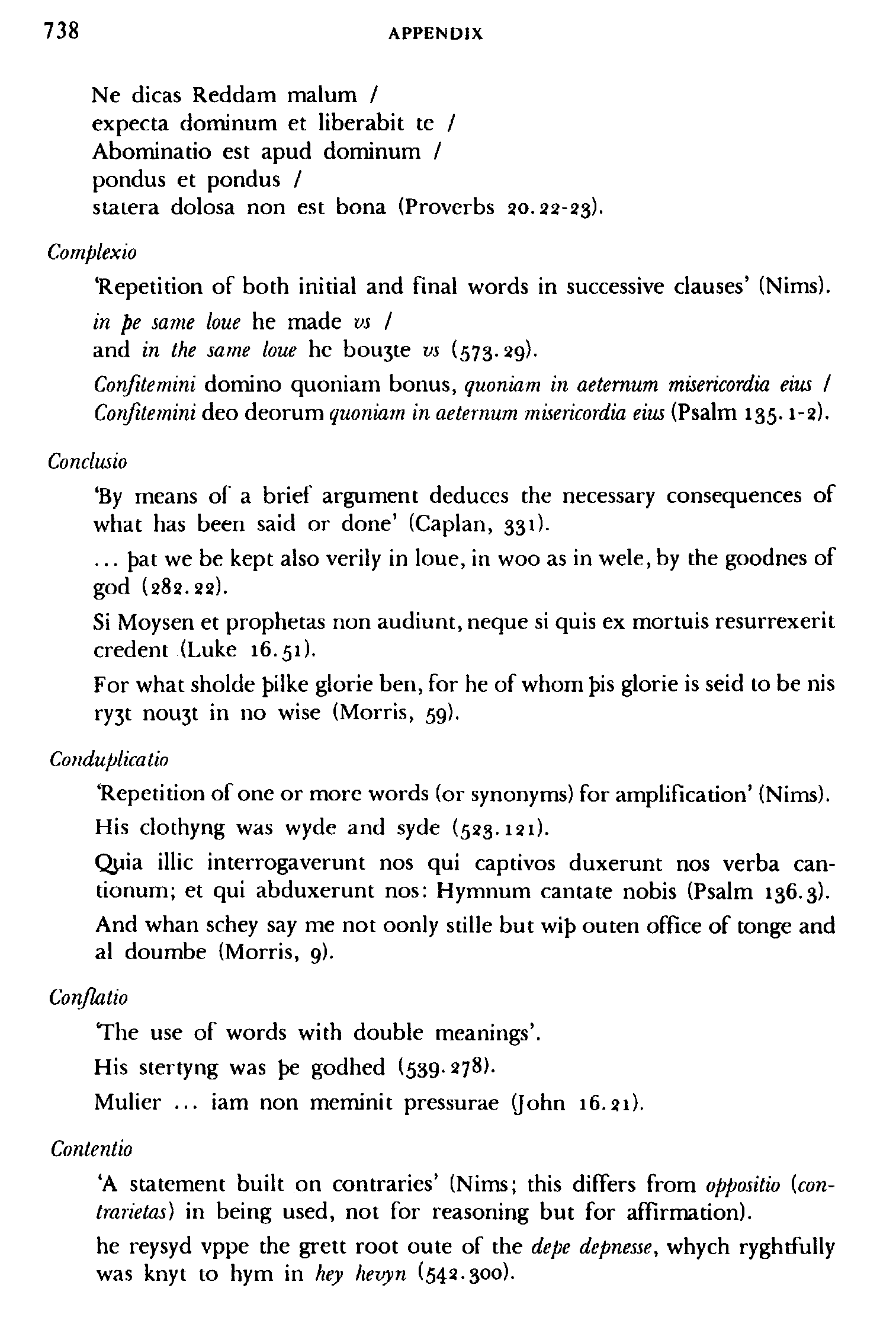
APPENDIX Ne dicas Reddam malum / expecta dominum et liberabit te / Abominatio est apud dominum / pondus et pondus / statera dolosa non est bona (Proverbs 20.22-23).
Complexio 'Repetition of both initial and final words in successive clauses' (Nims). in pe same hue he made vs I and in the same lone he bou3te vs (573.29).
Confitemini domino quoniam bonus, quoniam in aeternum misericordia eius I Confitemini deo deorum quoniam in aeternum misericordia eius (Psalm 135.1-2).
Condusio 'By means of a brief argument deduces the necessary consequences of what has been said or done' (Caplan, 331).
... £>at we be kept also verily in loue, in woo as in wele, by the goodnes of god (282.22).
Si Moysen et prophetas nori audiunt, neque si quis ex mortuis resurrexerit credent (Luke 16.51).
For what sholde £>ilke glorie ben, for he of whom J)is glorie is seid to be nis ryjt nou3t in no wise (Morris, 59).
Conduplicatio 'Repetition of one or more words (or synonyms) for amplification' (Nims).
His clothyng was wyde and syde (523.121).
Quia illic interrogaverunt nos qui captivos duxerunt nos verba cantionum; et qui abduxerunt nos: Hymnum cantate nobis (Psalm 136.3).
And whan schey say me not oonly stille but wijs outen office of tonge and al doumbe (Morris, 9).
Conflatio The use of words with double meanings'.
His stertyng was J>e godhed (539-278).
Mulier ... iam non meminit pressurae (John 16.21).
Contentio 'A statement built on contraries' (Nims; this differs from oppositio (contrarietas] in being used, not for reasoning but for affirmation). he reysyd vppe the grett root oute of the depe depnesse, whych ryghtfully was knyt to hym in hey hevyn (542.300).
APPENDIX
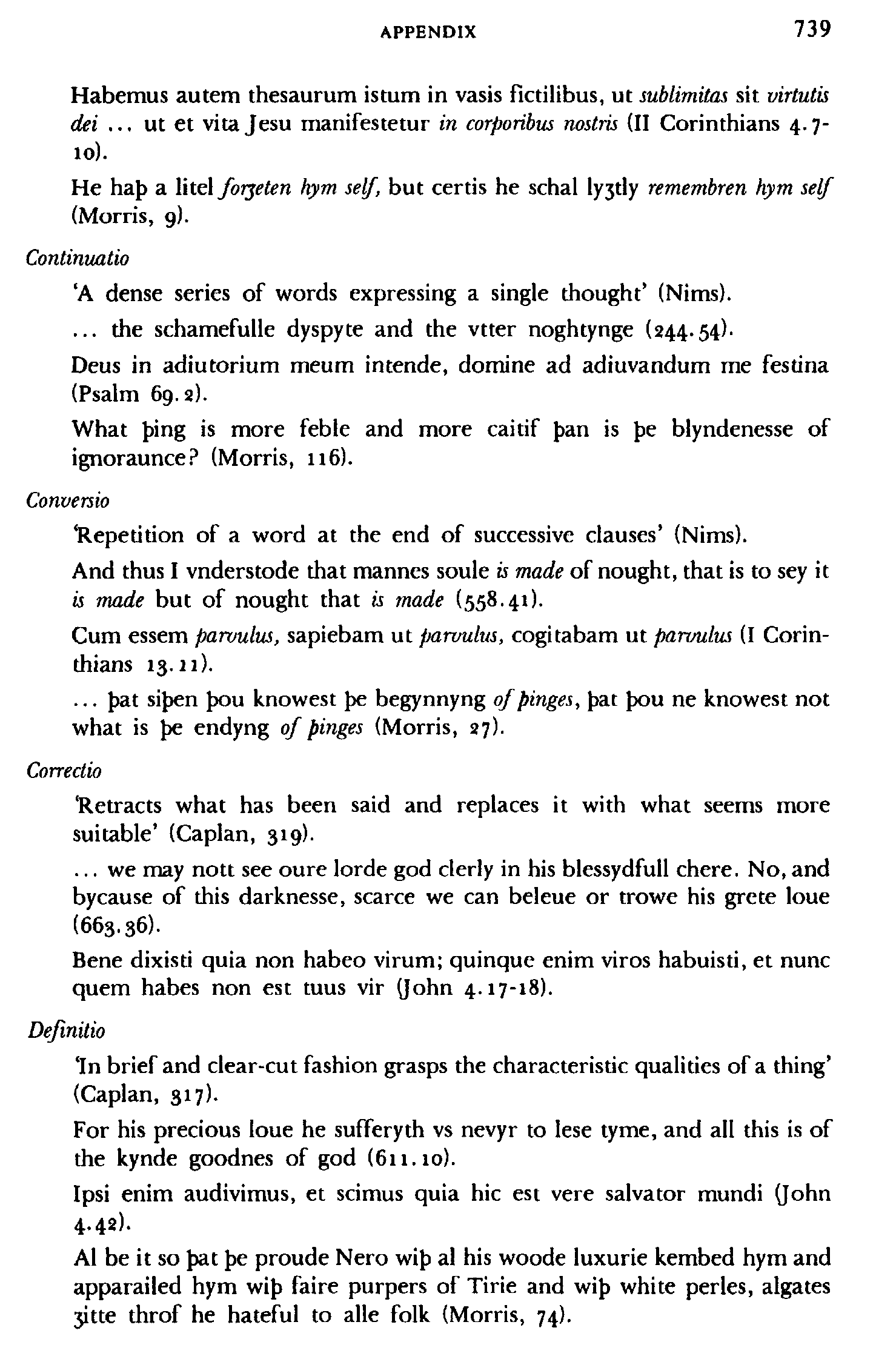
Habemus autem thesaurum istum in vasis fictilibus, ut sublimitas sit virtutis del ... ut et vitajesu manifestetur in corporibus nostris (II Corinthians 4.710).
He haf» a litel forjeten hym self, but certis he schal lystly remembren hym self
(Morris, g).
Continuatio 'A dense series of words expressing a single thought' (Nims).
... the schamefulle dyspyte and the vtter noghtynge (244.54).
Deus in adiutorium meum intende, domine ad adiuvandum me festina (Psalm 69.2).
What {ring is more feble and more caitif Jjan is Jje blyndenesse of ignoraunce? (Morris, 116).
Conversio 'Repetition of a word at the end of successive clauses' (Nims).
And thus I vnderstode that mannes soule is made of nought, that is to sey it is made but of nought that is made (558.41).
Cum essem parvulus, sapiebam ut parvulus, cogitabam ut parvultts (I Corinthians 13.11).
... £>at sijjen Jx>u knowest }>e begynnyng of fringes, J>at Jx)u ne knowest not what is }je endyng of pinges (Morris, 27).
Correctio 'Retracts what has been said and replaces it with what seems more suitable' (Caplan, 319).
... we may nott see oure lorde god clerly in his blessydfull chere. No, and bycause of this darknesse, scarce we can beleue or trowe his grete loue
(663.36).
Bene dixisti quia non habeo virum; quinque enim viros habuisti, et nunc quern habes non est tuus vir (John 4.17-18).
Definitio 'In brief and clear-cut fashion grasps the characteristic qualities of a thing'
(Caplan, 317).
For his precious loue he sufferyth vs nevyr to lese tyme, and all this is of the kynde goodnes of god (611.10).
Ipsi enim audivimus, et scimus quia hie est vere salvator mundi (John 4.42).
Al be it so l>at Jie proude Nero wif> al his woode luxurie kembed hym and apparailed hym wif) faire purpers of Tirie and wij) white perles, algates jitte throf he hateful to alle folk (Morris, 74).
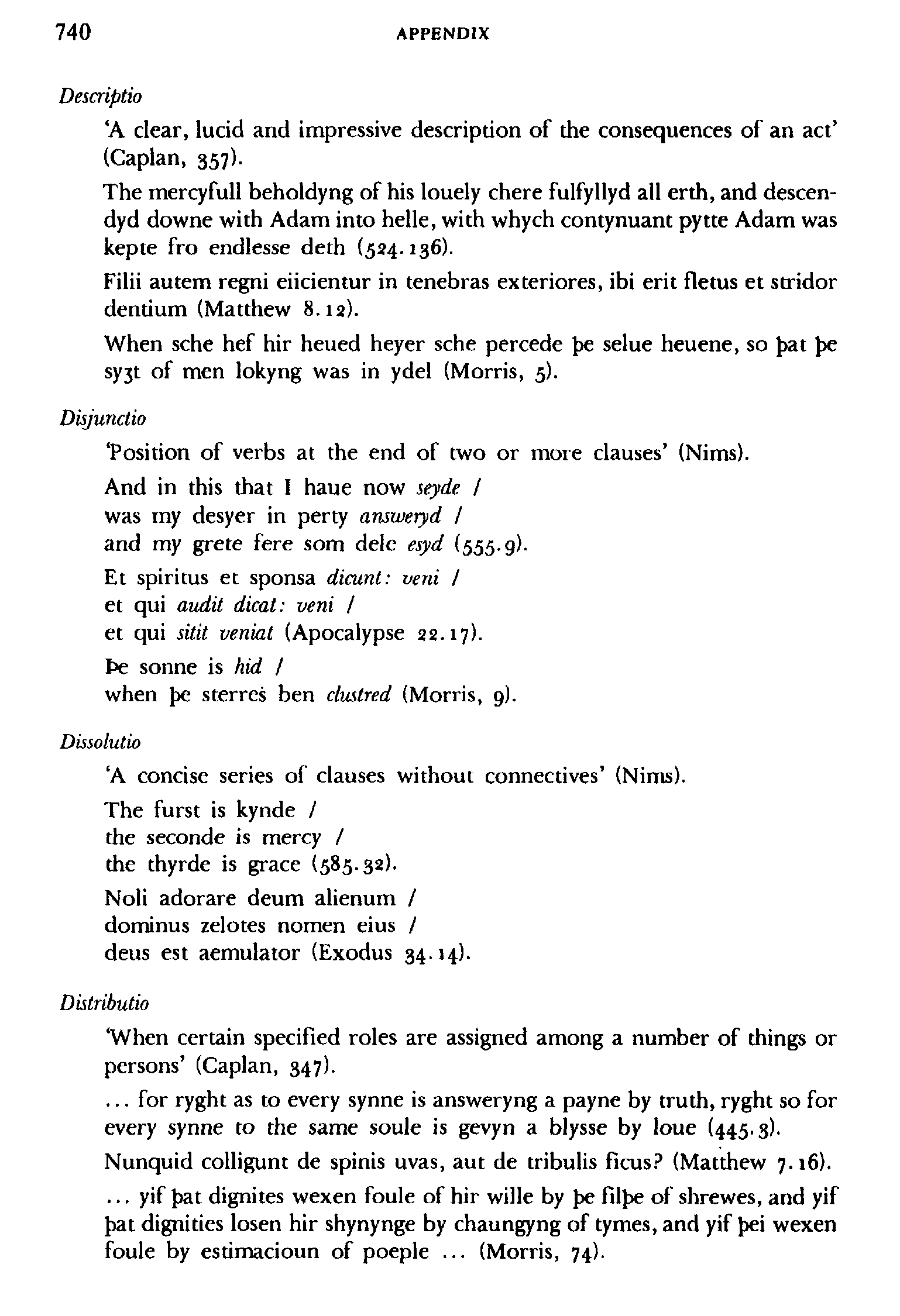
APPENDIX Descriptio 'A clear, lucid and impressive description of the consequences of an act'
(Caplan, 357).
The mercyfull beholdyng of his louely chere fulfyllyd all erth, and descendyd downe with Adam into helle, with whych contynuant pytte Adam was kepte fro endlesse deth (524.136).
Filii autem regni eiicientur in tenebras exteriores, ibi erit fletus et stridor dentium (Matthew 8.12).
When sche hef hir heued heyer sche percede IDC selue heuene, so J>at pe syjt of men lokyng was in ydel (Morris, 5).
Disjunctio 'Position of verbs at the end of two or more clauses' (Nims).
And in this that I haue now seyde I was my desyer in perty answeiyd I and my grete fere som dele esyd (555.9).
Et spiritus et sponsa dicunt: veni I et qui audit dicat: veni I et qui sitit venial (Apocalypse 22.17). t>e sonne is hid I when pe sterres ben dustred (Morris, 9).
Dissolutio 'A concise series of clauses without connectives' (Nims).
The furst is kynde / the seconde is mercy / the thyrde is grace (585.32).
Noli adorare deum alienum / dominus zelotes nomen eius / deus est aemulator (Exodus 34.14).
Distributio 'When certain specified roles are assigned among a number of things or persons' (Caplan, 347).
... for ryght as to every synne is answeryng a payne by truth, ryght so for every synne to the same soule is gevyn a blysse by loue (445.3).
Nunquid colligunt de spinis uvas, aut de tribulis ficus? (Matthew 7.16).
... yif pat dignites wexen foule of hir wille by pe filpe of shrewes, and yif pat dignities losen hir shynynge by chaungyng of tymes, and yif pei wexen foule by estimacioun of poeple ... (Morris, 74).
APPENDIX
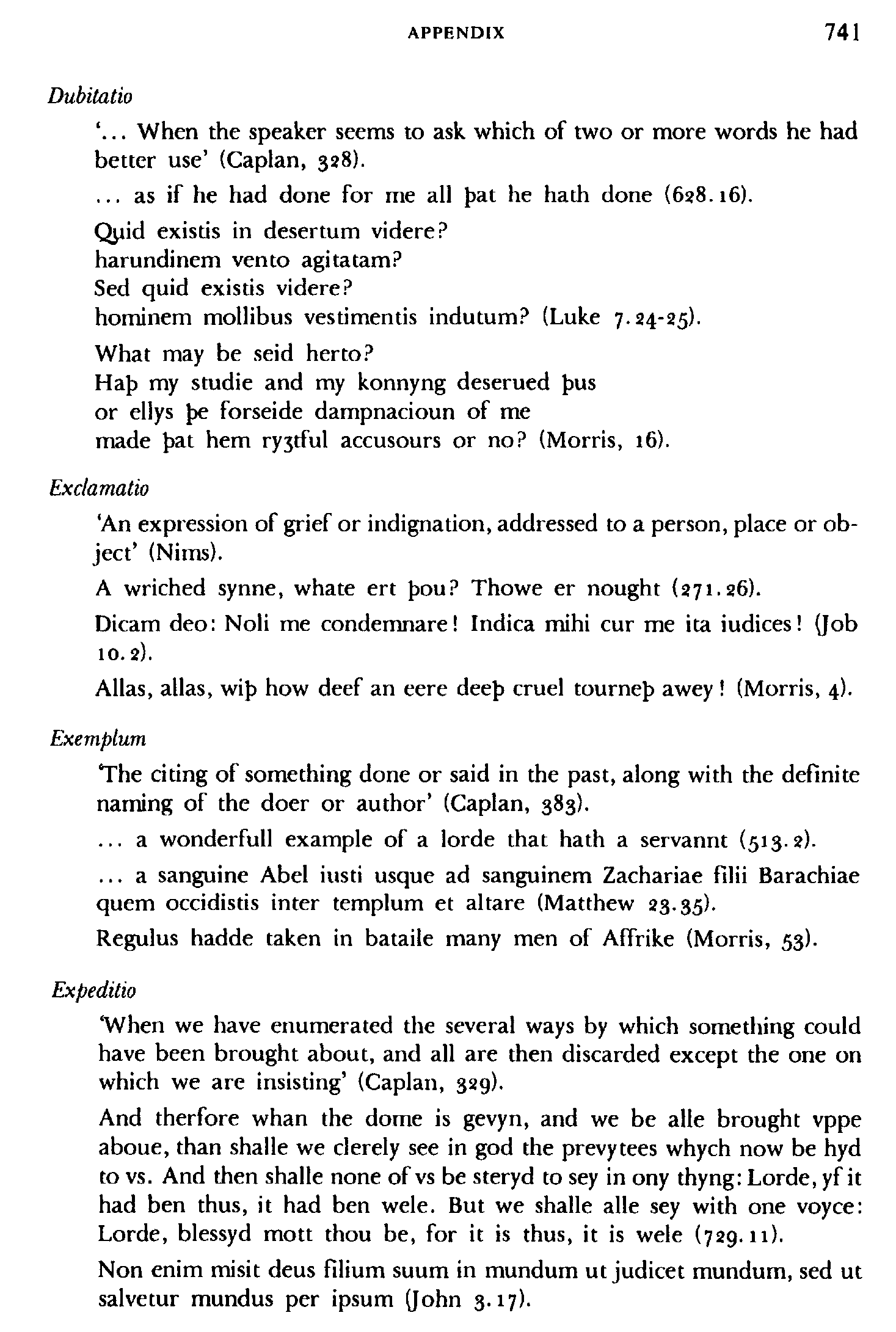
Dubitatio '... When the speaker seems to ask which of two or more words he had better use' (Caplan, 328).
... as if he had done for me all J>at he hath done (628.16).
Quid existis in desertum videre? harundinem vento agitatam?
Sed quid existis videre? hominem mollibus vestimentis indutum? (Luke 7.24-25).
What may be seid herto?
Hajj my studie and my konnyng deserued {ms or ellys J>e forseide dampnacioun of me made |>at hem ryjtful accusours or no? (Morris, 16).
Exclamatio 'An expression of grief or indignation, addressed to a person, place or object' (Nims).
A wriched synne, whate ert JXDU? Thowe er nought (271.26).
Dicam deo: Noli me condemnare! Indica mihi cur me ita iudices! (Job 10.2).
Alias, alias, wif> how deef an eere dee{> cruel tourne£> awey ! (Morris, 4).
Exemption The citing of something done or said in the past, along with the definite naming of the doer or author' (Caplan, 383).
... a wonderful! example of a lorde that hath a servannt (513.2).
... a sanguine Abel iusti usque ad sanguinem Zachariae filii Barachiae quem occidistis inter templum et altare (Matthew 23.35).
Regulus hadde taken in bataile many men of Affrike (Morris, 53).
Expeditio 'When we have enumerated the several ways by which something could have been brought about, and all are then discarded except the one on which we are insisting' (Caplan, 329).
And therfore whan the dome is gevyn, and we be alle brought vppe aboue, than shalle we clerely see in god the prevytees whych now be hyd to vs. And then shalle none of vs be steryd to sey in ony thyng: Lorde, yf it had ben thus, it had ben wele. But we shalle alle sey with one voyce:
Lorde, blessyd mott thou be, for it is thus, it is wele (729.11).
Non enim misit deus filium suum in mundum ut judicet mundum, sed ut salvetur mundus per ipsum (John 3.17).
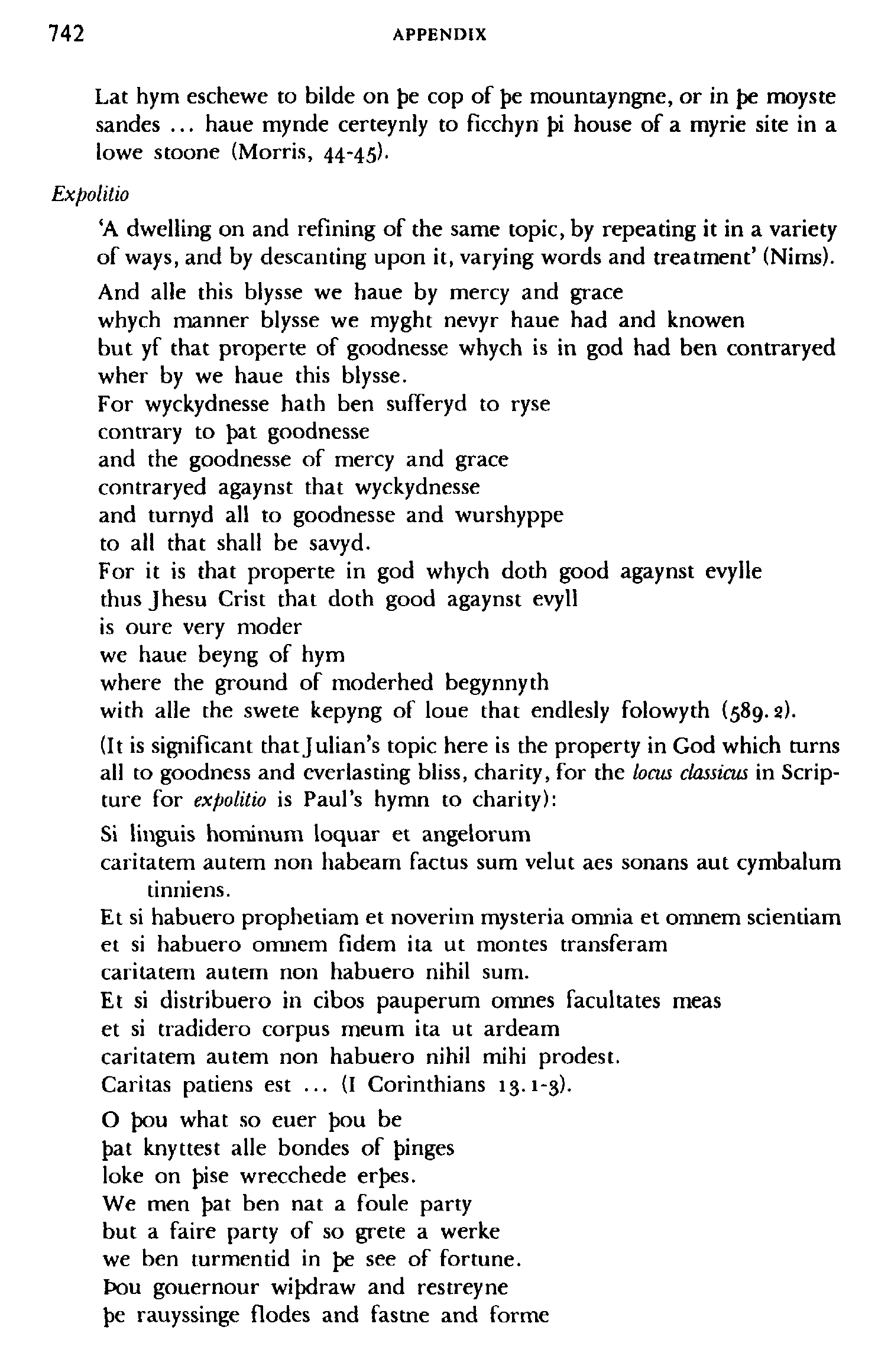
APPENDIX Lat hym eschewe to bilde on pe cop of pe mountayngne, or in pe moyste sandes ... haue mynde certeynly to ficchyn pi house of a myrie site in a lowe stoone (Morris, 44-45).
Expolitio 'A dwelling on and refining of the same topic, by repeating it in a variety of ways, and by descanting upon it, varying words and treatment' (Nims).
And alle this blysse we haue by mercy and grace whych manner blysse we myght nevyr haue had and knowen but yf that properte of goodnesse whych is in god had ben contraryed wher by we haue this blysse.
For wyckydnesse hath ben sufferyd to ryse contrary to pat goodnesse and the goodnesse of mercy and grace contraryed agaynst that wyckydnesse and turnyd all to goodnesse and wurshyppe to all that shall be savyd.
For it is that properte in god whych doth good agaynst evylle thus Jhesu Crist that doth good agaynst evyll is oure very moder we haue beyng of hym where the ground of moderhed begynnyth with alle the swete kepyng of loue that endlesly folowyth (589.2).
(It is significant that Julian's topic here is the property in God which turns all to goodness and everlasting bliss, charity, for the loots classicus in Scripture for exjyoiitio is Paul's hymn to charity):
Si linguis hominum loquar et angelorum caritatem autem non habeam factus sum velut aes sonans aut cymbalum tinniens.
Et si habuero prophetiam et noverim mysteria omnia et omnem scientiam et si habuero omnem fidem ita ut montes transferam caritatem autem non habuero nihil sum.
Et si distribuero in cibos pauperum omnes facultates meas et si tradidero corpus meum ita ut ardeam caritatem autem non habuero nihil mihi prodest.
Caritas patiens est ... (I Corinthians 13.1-3).
O pou what so euer pou be pat knyttest alle bondes of pinges loke on pise wrecchede erpes.
We men pat ben nat a foule party but a faire party of so grete a werke we ben turmentid in pe see of fortune. f>ou gouernour wipdraw and res trey ne pe rauyssinge flodes and fastne and forme
APPENDIX
pise erpes stable wij> pilke bonde wip whiche pou gouernest pe hcuenc pat is so large (Morris, 23).
Frequentatio 'When the points scattered throughout the whole cause are collected in one place so as to make the speech more impressive or sharp or accusatory' (Caplan, 361).
... in the takyng of oure kynd he quyckyd vs, and in his blessyd dyeng ... he bare vs ... he fedyth vs and fordreth vs ... (616.30).
Non est species ei neque decor, et vidimus eum et non erat adspectus ... despectum et novissimum virorum, virum dolorum et scientem infirmitatem, et quasi absconditus vultus eius et despectus, unde nee reputavimus eum (Isaias 53.2-3).
And I pat am put awey from goode men and despoiled from dignitees and defoulid of my name by gessyng haue suffred torment for my goode dedis
(Morris, 21).
Gradatio 'Repetition of die closing word of one clause as the opening word of the next' (Nims).
... dier way is by longyng and desyeryng / whych desyeryng and tongyng was shewed ... (538.261).
... sed et gloriamur in tribulationibus / scientes quod tribulatio patientiam operatur / patientia autem probationern I probatio vero spem I Spes autem non confundit ... (Romans 5.3-5).
Inditsio 'Repetition of the same word at the beginning of one clause and the end of the next'. oure kynde whych is the hyer party is knytte to god in pe makyng / and god is knytt to oure kynde (577.17). lustus perit et non est qui recogitet in corde suo ... a facie enim malitiae collectus est iustus (Isaias 57.1).
Interpretatio The figure which ... replaces the word that has been used by another with the same meaning' (Caplan, 325).
... wylle heyle it and hyde it fro vs (424.28).
... sed iudicabit in iustitia ... et arguet in aequitate (Isaias 11.4).
We han wel knowen how many greete harmes and destrucciouns weren don by pe emperoure Nero (Morris, 55).
APPENDIX Intenogatio Howe schulde it thann be pat pou schulde noght hafe thy besekynge?
(259.28, which Julian calls 'a sobere vndertakynge', 260.29 and note).
Aut non licet mihi quod volo facere? an oculus tuus nequam est quia ego bonus sum? (Matthew 20.15).
But what shal I seie of delices of body, of whiche delices l>e desiringes ben ful of anguisse, and pe fulfillinges of hem ben ful of penaunce? (Morris,
79)Membrum (the classical colon) 'A sentence member, brief and complete, which does not express the entire thought, but is in turn supplemented by another colon1 (Caplan, 295).
In oure fader almyghty we haue oure kepyng ... / and in the seconde person ... we haue oure kepyng ... / and in oure good lorde the holy gost we haue oure rewardyng (584.22).
Quoniam omne quod natum est ex deo vincit mundum / haec est victoria quae vincit mundum fides nostra / quis est qui vincit mundum nisi qui credit quoniam Jesus est films dei?
(I John 5.4-5).
Metonymy 'Substituting for the name of a thing the name of an attribute of it' (NED).
The wysdom of the seruannt sawe inwardly ... (528.175).
(Augustine's example of what he calls Verborum ambiguitas' is II Corinthians 3.6 — De doctrina Christiana II v. 9, Martin 82):
Littera enim occidit, spiritus autem vivificat.
Notatio 'Character delineation ... describing a person's character by the definite signs which ... are attributes of that character' (Caplan, 387).
... for he in alle this werkyng vsyth the very office of a kynde norysse (608.67).
Ipse autem loannes habebat vestimentum de pilis camelorum, et zonam pelliceam circa lumbos suos; esca autem eius erat locustae et mel sylvestre
(Matthew 3.4).
Who, quod sche, haj) suffred aprochen to pis seeke man pise commune strumpetis of siche a place pat men clepen £e theatre? (Morris, 6).
Oppositio contrariorum (Contrarietas: Arbusow, 87) "Combining a litotes with a corresponding positive affirmation' (Arbusow).
Repentyng and wylfulle choyse be two contrarytes /
APPENDIX
whych I felt both at that tyme / and tho be two partes / that oon outward that other inwarde (372.24).
Videmus nunc per speculum in aenigmate / tune autem facie ad faciem nunc cognosco ex parte / tune autem cognoscam sicut et cognitus sum (I Corinthians 13.12).
3if god is / whennes comen wikked Binges / and yif god ne is / whennes comen goode Binges? (Morris, 18).
Personification The representation of a thing or abstract as a person' (NED).
And this mercy and pytte dwellyth with mankynde (525-139)Misericordia et veritas obviaverunt sibi; iustitia et pax osculatae sunt
(Psalm 84.11).
Sorou hap comaunded his age to be in me (Morris, 4).
Propositio (cf. Argumentatio) Through the proposition we set forth summarily what we intend to prove' (Caplan, 107-109).
Than had I a profyr in my reason, as it had ben frendely seyde to me:
Loke vppe to hevyn to hys father (370.6).
Sed quid existis videre? hominem mollibus vestitum? Ecce qui mollibus vesduntur in domibus regum sunt (Matthew 11.8).
Yif £>ou abidest after helpe of pi leche, pi byhouep discouere pi wounde (Morris, 13).
Ratiodnatio 'Reasoning through question and answer' (Nims).
Whate schulde it than greve the to suffere a while senn it is my wille and my wyrschippe? (264.26).
Tanto tempore vobiscum sum et non cognovistis me? ...
Quomodo tu dicis:
Ostende nobis patrem?
Non creditis quia ego in patre et pater in me est? (John 14.9-10).
Knowest pou me not?
Why art pou stille?
Is it for schame or for astonynge? (Morris, 9).
APPENDIX Repetitio 'Reiteration of a word or words at the beginning of successive clauses'
(Nims).
He sayde nought / f>ou salle not be tempestyd / thowe schalle not be trauayled / pou schalle not be desesed / hot he sayde / Pou schalle noujt be ouercommen (369.37).
Omnia suffert / omnia credit / omnia sperat / omnia sustinet (I Corinthians 13.7).
What wronges haue I don pe / what goodes haue I byreft pe pat weren pine? / stryf or plete wip me byfore / what iuge pat pou wilt (Morris, 33).
Repetitio can be medial as well as initial: pe hygh myght of the trynyte is oure fader ... / the depe wysdom of the trynyte is oure moder ... / the grete loue of the trynyte is oure lorde (585.34).
Bead pauperes spiritu quoniam ipsorum est regnum caelorum / Beati mites quoniam ipsi possidebunt terram /
Beati qui lugent quoniam ipsi consolabuntur (Matthew 5.3-5).
I haue put it in scripture and remembraunce / for touching pe lettres falsly maked / by whiche lettres I am accused / to han hooped pe fredom of Rome (Morris, 17).
Sententia 'A saying drawn from life, which shows concisely what happens or ought to happen in life' (Caplan, 289).
The most wysdom is a creature to do after the wyll and pe councelles of his hyghest sovereynn frende (687.24).
Amicus fidelis medicamentum vitae et immor tali tads, et qui metuunt dominum invenient ilium (Ecclesiasticus 6.16).
Who so wolde ben my3ty, he mot daunten hys cruel corage, ne putte nat his nekke ouercomen vndir pe foule reines of lecherie (Morris, 77).
Sermocinatio 'Assigning to some person language which ... conforms with his character' (Caplan, 395).
APPENDIX
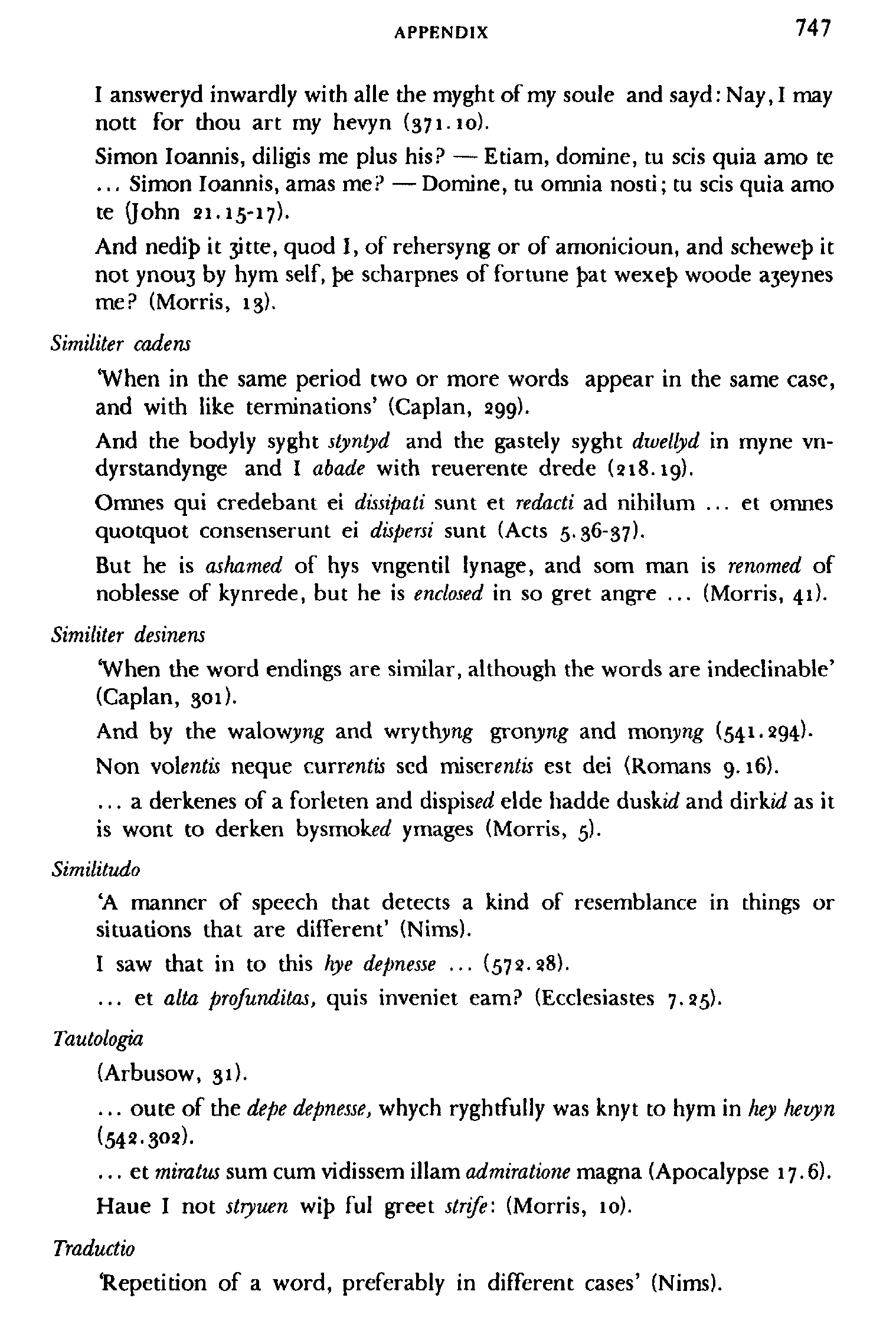
I answeryd inwardly with alle the myght of my soule and sayd: Nay, I may nott for thou art my hevyn (371.10).
Simon loannis, diligis me plus his? — Edam, domine, tu scis quia amo te ... Simon loannis, amas me? — Domine, tu omnia nosti; tu scis quia amo te (John 21.15-17).
And nedijj it ytte, quod I, of rehersyng or of amonicioun, and schewep it not ynouj by hym self, £e scharpnes of fortune f>at wexe|> woode a3eynes me? (Morris, 13).
Similiter cadens 'When in the same period two or more words appear in the same case, and with like terminations' (Caplan, 299).
And the bodyly syght styntyd and the gastely syght dwellyd in myne vndyrstandynge and I abade with reuerente drede (218.19).
Omnes qui credebant ei dissipati sunt et redacti ad nihilum ... et omnes quotquot consenserunt ei dispersi sunt (Acts 5.36-37).
But he is ashamed of hys vngentil lynage, and som man is renamed of noblesse of kynrede, but he is enclosed in so gret angre ... (Morris, 41).
Similiter desinens 'When the word endings are similar, although the words are indeclinable'
(Caplan, 301).
And by the walowyrcg and wrythjyng gromwg and monyng (541.294).
Non volentis neque current sed miserentis est dei (Romans 9.16).
... a derkenes of a forleten and disposed elde hadde duskw/ and dirku/ as it is wont to derken bysmoked ymages (Morris, 5).
Similitudo 'A manner of speech that detects a kind of resemblance in things or situations that are different' (Nims).
I saw that in to this hye depnesse ... (572.28).
... et alta profunditas, quis inveniet earn? (Ecclesiastes 7.25).
Tautologia (Arbusow, 31).
... oute of the depe depnesse, whych ryghtfully was knyt to hym in hey hevyn (542.302).
... et miratus sum cum vidissem illam admiratione magna (Apocalypse 17.6).
Haue I not stryuen wijj ful greet strife: (Morris, 10).
Traductio 'Repetition of a word, preferably in different cases' (Nims).
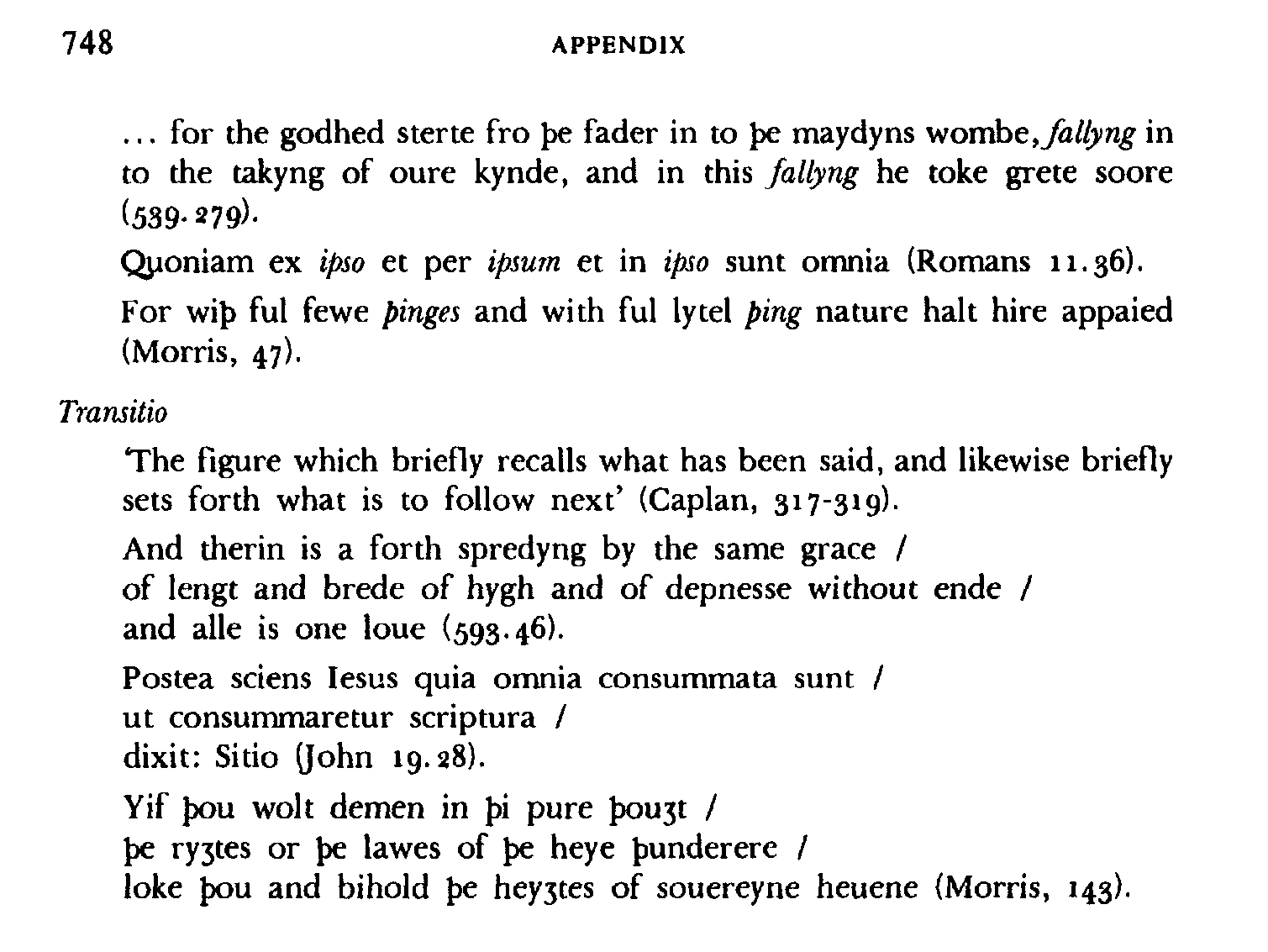
APPENDIX ... for the godhed sterte fro J>e fader in to Jje maydyns wombe,fallyng in to the takyng of oure kynde, and in this fallyng he toke grete soore
(539-279)Quoniam ex ipso et per ipsum et in ipso sunt omnia (Romans 11.36).
For wi|> ful fewe fringes and with ful lytel ping nature halt hire appaied (Morris, 47).
Transitio The figure which briefly recalls what has been said, and likewise briefly sets forth what is to follow next' (Caplan, 317-319).
And therin is a forth spredyng by the same grace / of lengt and brede of hygh and of depnesse without ende / and alle is one loue (593.46).
Postea sciens lesus quia omnia consummata sunt / ut consummaretur scriptura / dixit: Sitio (John 19.28).
Yif Jx)u wolt demen in Jji pure pou3t / Jje ryjtes or J>e lawes of f>e heye {mnderere / loke Jx)u and bihold JDC heystes of souereyne heuene (Morris, 143).