
2 Introduction
INTRODUCTION
2 C: the Cressy printed text26 Tide page: + / XVI / REVELATIONS / OF / Divine Love, /
Shewed to a Devout Servant / of our Lord, called / MOTHER JULIANA, / AN / Anchorete of NORWICH: / Who lived in the Dayes of KING I EDWARD the Third. / Published by R.F.S. Cressy.
I Accedite ad Deum et Illuminamini. Psal. 33 v. 5 / Printed in the Year, MDCLXX.
I Permissu Superiorum.
Pp. 1-215. Collation: title page, A2'3 + i.B1'4 + 4 -11'4 + 4,K1'4
+ 4, O1"4 + 4, P1'3, end page, 4 unsigned pages.
Throughout, archaic words are marked with an asterisk or other sign, repeated in the margin with a gloss. Running titles, e.g. (verso)
Revelations of Love, (recto) The First Revelation. Occasionally the recto titles are misnumbered; e.g. pp. 31, 46-47, 49-51.
David Rogers of the Bodleian Library sent this communication:
Though I cannot name you a printer, I am absolutely certain that Cressy's edition of Julian of Norwich was printed in England, where
Cressy seems to have lived between his being sent on the mission in the Southern Province in 1660 and his death at West Grinstead (not East
Grinstead, surely, as DNB has it) in 1674. The reason I am so certain is the presence, on the second and third leaves, of a band of small type ornaments known as "printers' flowers". These include a small twohandled vase and two sorts of fleur-de-lys which can all be matched in English books of the same date, but are quite unlike French or Flemish ornaments of the same period. For example, I find what may be the safine three small ornaments used in a pamphlet entitled Toleration disapprov'd and Condemn'd by William Assheton, printed at Oxford by William Hall in 1670, and again in John Gadbury's A brief relation of the Life and death of Mr. Vincent Wing, printed in London in the same year'.
3 P: Paris, MS Bibliotheque Nationale Fonds anglais 40.27
Ff. iii + 1-23, 23(bis)-i74 + i (ruled, blank) — iv, 80 x 117 mm, of f. 237 would be just sufficient to end chapter 16. There are in the English numerous phrases, whether of the translator or from a variant text, not found in Durante's Latin.
This is not one of the passages in the manuscript edited by W. P. Gumming. Unlike the other contents of A, this Bridget fragment is non-Northern in dialect, and gives the impression of coming from a quite separate source.
26 For the purpose of this description the perfect copy at Trinity College, Cambridge
(in its original binding with tooled and gilt spine) has been used.
27 Cf. Gaston Raynaud: Catalogue des manuscrits anglais de la Bibliotheque Nationale, 1516.
I MANUSCRIPTS AND PRINTED TEXT
paper. Ruled 22 lines to the page. Binding nineteenth-century.
The only contents are the long text of the Revelations. It is written in a single hand, a sedulous but unskilled and unconvincing imitation, each letter individually formed, of a hand of c. 1500. It is certainly of the seventeenth century, probably c. 1650. There are running titles in red; e.g.lf. 7r) The fourthe Chapter and the first revelacion'. Red paraphs, chapter initials in blue (with no guide letters). The scribe has written numerous words and phrases in red; these are usually, but not invariably, divine locutions.
Signatures of gatherings: (f. i6r): B; (f. 3ir-i.e. 32' with 23<bis)): C; (f.
47r):D;(f. 59'):E;(f. 75'):F;(f. 9ir):G;(f. io5'):H;(f. n9 r):J;(f. i35r):
K; (f. i5ir): L; (f. i67r): M. Catchwords to almost every page.
The only indication of ownership, in a later hand, f. ir, is: icy commence le premier chapitre. Leopold Delisle, reprinting the 1706 salecatalogue for the Bigot library's dispersal, suggested that its item 388,
Julianae Anatoritae Revelationes, Anglice', is identical with P.28 Since he informs us that with very few exceptions the Bigot manuscripts we;re acquired by the Bibliotheque du Roi, and are still preserved in tjie
Bibliotheque Nationale,29 since we know of no other Julian manuscript there, and since the sale-catalogue reproduces the misspelling of P, f. i74r, anatorite (cf. 734.28), this is probable if not certain. The collection was begun in the first half of the seventeenth century at Rouen by Jean Bigot, and increased by his son fimeric until he died in 1689, when it was inherited by a cousin, after whose death it was sold.30 If one of the Bigots did acquire P, it is interesting to speculate whether he recognized it for what it is, a product of his own age, or whether, like the catalogue of the Bibliotheque Nationale in the nineteenth century, he took it for some one hundred and fifty years older. There can be no question of P's being a 'forgery' — for that it is much too clumsy and inept — but its antique appearance may have recommended it to an undiscerning bibliophile.
Perforce the readings of P have wherever possible been retained, since, lacking any earlier exemplar of the long text, apart from the fragments in W (less possibly those in U), we have no certain criteria for emendation. But many of P's spellings and 'forms' seem to be no more
28 Bibliotheca Bigotiana, 92.
29 Ibid., iii.
30 Ibid., iv-xix.
INTRODUCTION
than an amateurish, Chatterton-like attempt to give the manuscript an appearance of antiquity by capricious departures from the norms of even the seventeenth century.
4 Si: London, MS British Museum Sloane 2499*'
Ff. 57, 229X369 mm, paper, of poor quality. Recent binding. A sprawling and unattractive but regular hand of c. 1650, which closely resembles that of Mother Clementina Gary, ob. 1671, foundress of the English Benedictine nunnery at Paris, and daughter of Elizabeth, Lady
Falkland, to whom, the year before Clementina's death, Cressy was to dedicate his edition. Her copies of the Constitutions and of Blosius are now preserved at Colwich Abbey." They both seem more practised and contrived than the Sloane manuscript, but, none the less, the resemblance is close enough to warrant the suggestion that, if the scribes are not identical, their hands were formed in the same school. C. 40 lines to the page. The first eight folios, particularly, can be read only with difficulty, since the ink of either surface obscures the reverse. On f. ir,
'6 5' at the head of the page and 'iB' in the right-hand margin may be press-marks earlier than those of the Sloane collection. Several hands have supplied marginal and interlinear corrections and glosses, and one which frequently appears has on f. igv underlined 'lak' and 'lakid' (cf.
409.13) and written in the margin: 'not liked of, from ye dutch word lacken to dispraise, to blame, being the opposit to ye D word pry sen to praise'.
The only contents are the long text of the Revelations, as also in 82.
5 82: London, MS British Museum Sloane 3705 Ff. i + i, 153X194 mm, paper. Nineteenth-century binding with Sloane arms. C. 23 lines to the page; the margins but not the lines ruled. A regular, flowing, legible hand of the eighteenth century. In an unnumbered folio of the same fine paper, between ff. 87 and 90, are mounted two smaller paper slips, 57 x 84 mm, numbered 88 and 89. On what are now the versos are drawn (both in black) the ten of diamonds and the ace of spades; on the rectos are what seem to be household recipes, many words in code, in a different, contemporary hand. On 31 The descriptions of Si and Sa in Samuel Ayscough's 1782 catalogue do not merit reporting.
32 Placid Spearritt drew our attention to this resemblance. For Clementina Gary, see
Gillow, i 417.
1 MANUSCRIPTS AND PRINTED TEXT
f. ir, '111 B' may be an early press-mark. Some contemporary marginal corrections and comments.
6 U: MS St. Joseph's College, Upholland (Lancashire, England)33 Ff. 127, 100X155 mm, paper, unruled. The cover is a portion of a vellum leaf with verses of the Psalms with musical notation from a late mediaeval choir office book. Another such leaf is used to bind MS
Colwich Abbey 18, which was copied by the English Benedictine nuns at Cambrai c. 1650; and it is beyond any doubt that this Upholland manuscript was written there about the same time. Hywel Owen wrote:
The manuscript is in four seventeenth-century hands. One of the hands is undoubtedly that of Dame Barbara Constable, the daughter of Sir
Philip Constable of Evringham, Yorkshire. Born in 1617, she was professed in 1640 at the abbey of Our Lady of Consolation at Cambrai ... and died there in 1684. Since her hand occurs in the first seven and the last three folios (as well as intermittently between) this gives us a dating of 1640-1684 for the manuscript, and indicates that it was copied at Cambrai'.34
It is unnecessary here to repeat Hywell Owen's careful identifications of the contents of this manuscript. It is an anthology of Augustine
Baker's Englishings, primarily for the benefit of the Cambrai nuns, of a wide selection from mediaeval and post-Reformation spiritual classics, and its chief importance is that it indicates the probability that we must thank Baker, as will be shown below, for the preservation of a complete long text of Julian and for its study in the seventeenth century, culminating in the 1670 printed text edited by his successor among the English Benedictines, Serenus Cressy. Whether Baker acquired his copy, now lost, of the Julian text, as he did that of The Cloud of Unknowing, from his fellow-countryman, also living in exile, Benet Canfield,35 we do not know.
7 W: London, Westminster Archdiocesan Archives MS36 Ff. 112, 106x156 mm, vellum. A highly legible, somewhat characterless hand of c. 1500. Nineteenth-century binding. Annotated
33 Cf. Hywel Wynn Owen: 'Another Augustine Baker Manuscript.'
34 Ibid., 270.
35 Placid Spearritt is at work on Augustine Baker, Kent Emery on Benet Canfield, and both scholars promise us studies of the contribution of Baker and Canfield to the revival among seventeenth-century English Catholics of study of the mediaeval mystics.
36 Cf. James Walsh and Edmund Colledge: Off the Knowledge of Ourselves and of God and Betty Foucard: 'A Cathedral Manuscript'; and see also N. R. Ker: Medieval
Manuscripts in British Libraries i, 418-419.
INTRODUCTION
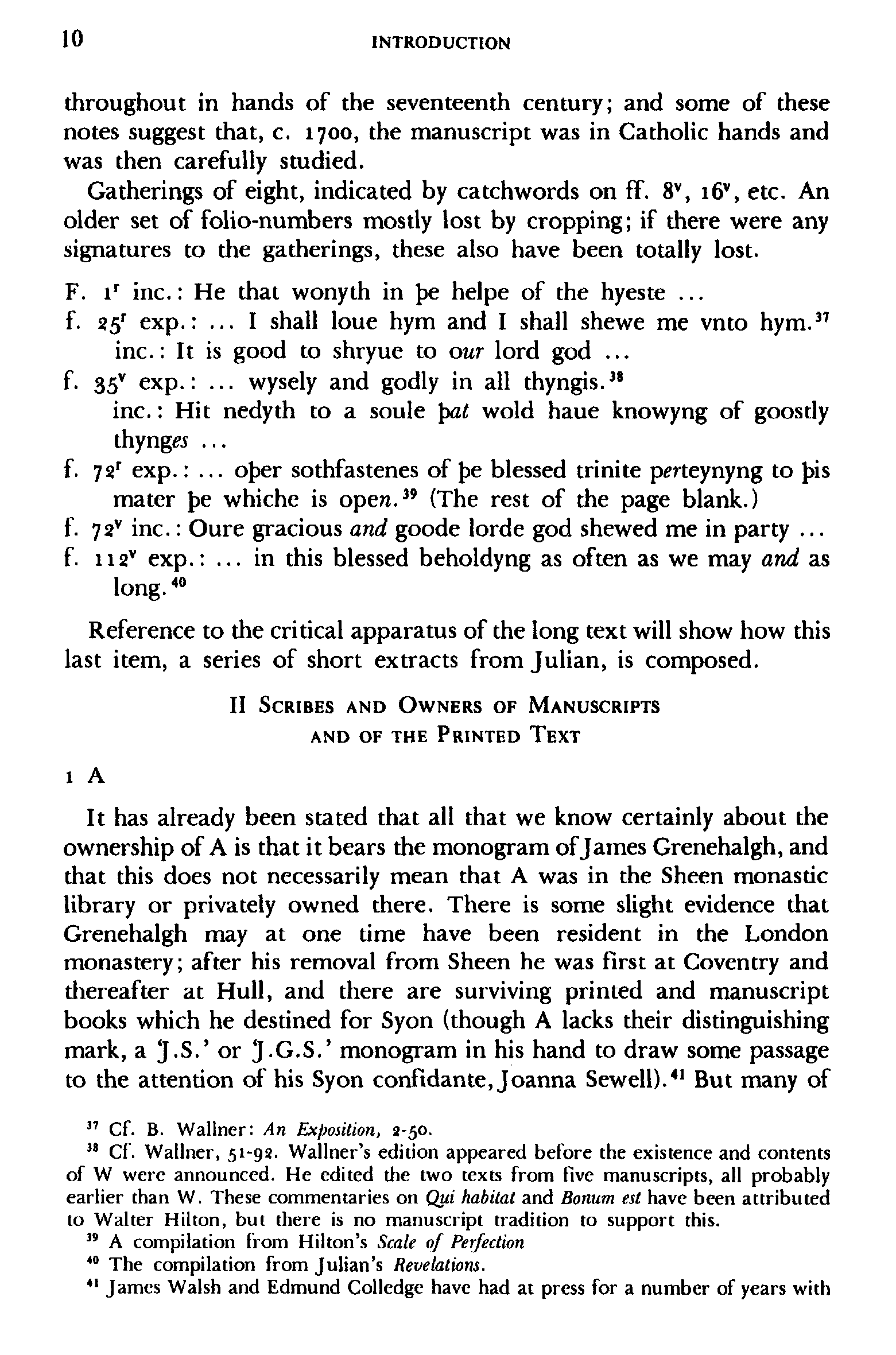
throughout in hands of the seventeenth century; and some of these notes suggest that, c. 1700, the manuscript was in Catholic hands and was then carefully studied.
Gatherings of eight, indicated by catchwords on ff. 8V, i6v, etc. An older set of folio-numbers mostly lost by cropping; if there were any signatures to the gatherings, these also have been totally lost.
F. ir inc.: He that wonyth in J)e helpe of the hyeste ... f. 25r exp.: ... I shall loue hym and I shall shewe me vnto hym.37 inc.: It is good to shryue to our lord god ... f. 35V exp.: ... wysely and godly in all thyngis.38 inc.: Hit nedyth to a soule \>at wold haue knowyng of goostly thyng« ... f. 72r exp.: ... oj>er sothfastenes of J?e blessed trinite pmeynyng to J>is mater J>e whiche is open.39 (The rest of the page blank.) f. 72
V inc.: Oure gracious and goode lorde god shewed me in party ... f. ii2v exp.: ... in this blessed beholdyng as often as we may and as long.40
Reference to the critical apparatus of the long text will show how this last item, a series of short extracts from Julian, is composed.
II SCRIBES AND OWNERS OF MANUSCRIPTS
AND OF THE PRINTED TEXT
1 A It has already been stated that all that we know certainly about the ownership of A is that it bears the monogram of James Grenehalgh, and that this does not necessarily mean that A was in the Sheen monastic library or privately owned there. There is some slight evidence that Grenehalgh may at one time have been resident in the London monastery; after his removal from Sheen he was first at Coventry and thereafter at Hull, and there are surviving printed and manuscript books which he destined for Syon (though A lacks their distinguishing mark, a J-S-' or J.G.S.' monogram in his hand to draw some passage to the attention of his Syon confidante, Joanna Sewell).41 But many of 37 Cf. B. Wallner: An Exposition, 2-50.
38 Cf. Wallner, 51-92. Wallner's edition appeared before the existence and contents of W were announced. He edited the two texts from five manuscripts, all probably earlier than W. These commentaries on Qui habitat and Bonum est have been attributed to Walter Hilton, but there is no manuscript tradition to support this.
39 A compilation from Hilton's Scale of Perfection 40 The compilation from Julian's Revelations.
41 James Walsh and Edmund Colledge have had at press for a number of years with
II SCRIBES AND OWNERS
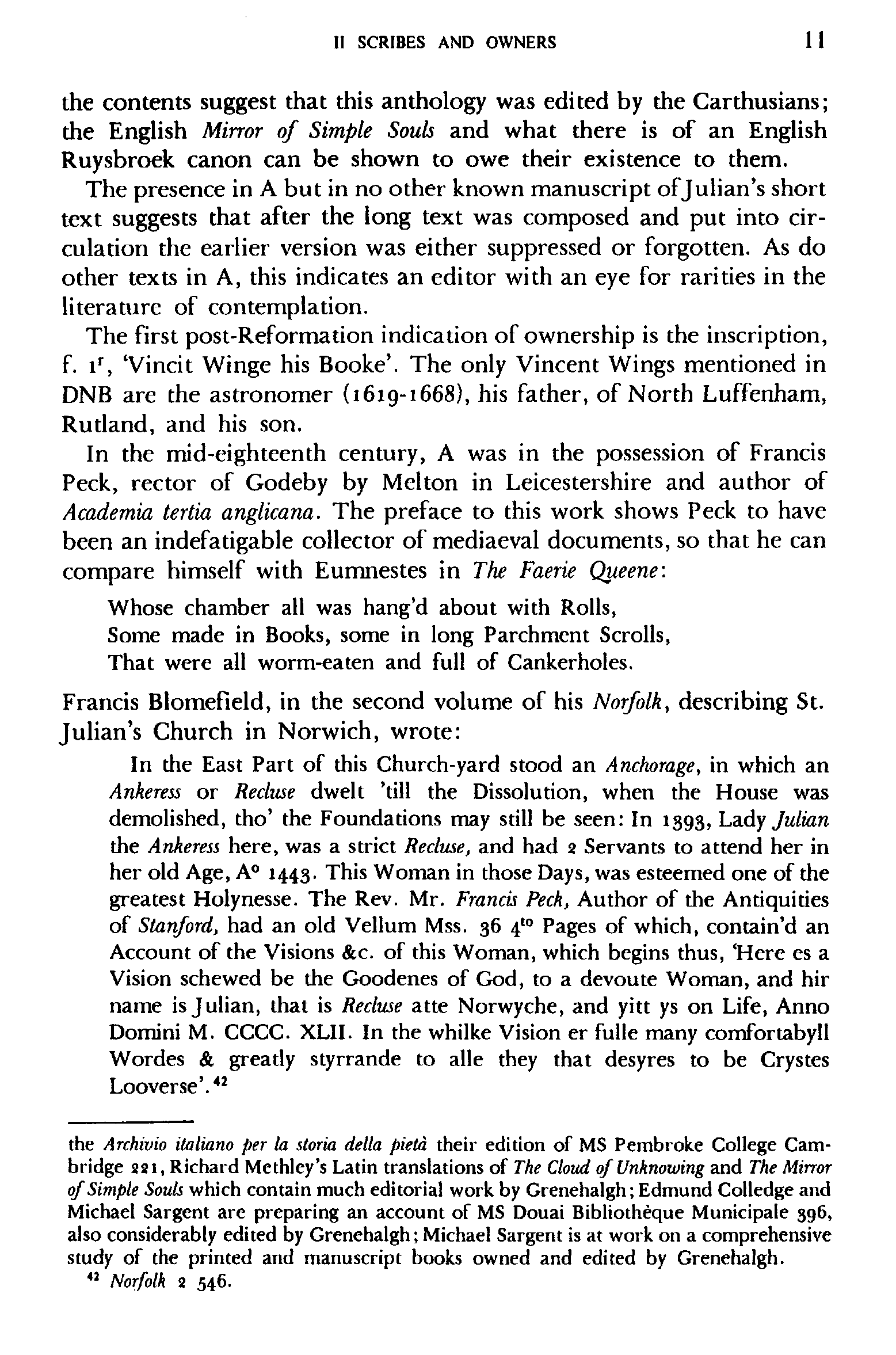
1 1 the contents suggest that this anthology was edited by the Carthusians; the English Mirror of Simple Souls and what there is of an English
Ruysbroek canon can be shown to owe their existence to them.
The presence in A but in no other known manuscript of Julian's short text suggests that after the long text was composed and put into circulation the earlier version was either suppressed or forgotten. As do other texts in A, this indicates an editor with an eye for rarities in the literature of contemplation.
The first post-Reformation indication of ownership is the inscription, f. ir, Vincit Winge his Booke'. The only Vincent Wings mentioned in DNB are the astronomer (1619-1668), his father, of North Luffenham,
Rutland, and his son.
In the mid-eighteenth century, A was in the possession of Francis Peck, rector of Godeby by Melton in Leicestershire and author of Academia tertia anglicana. The preface to this work shows Peck to have been an indefatigable collector of mediaeval documents, so that he can compare himself with Eumnestes in The Faerie Queene:
Whose chamber all was hang'd about with Rolls, Some made in Books, some in long Parchment Scrolls,
That were all worm-eaten and full of Cankerholes.
Francis Blomefield, in the second volume of his Norfolk, describing St.
Julian's Church in Norwich, wrote:
In the East Part of this Church-yard stood an Anchorage, in which an Ankeress or Recluse dwelt 'till the Dissolution, when the House was demolished, tho' the Foundations may still be seen: In 1393, Lady Julian the Ankeress here, was a strict Recluse, and had 2 Servants to attend her in her old Age, A° 1443. This Woman in those Days, was esteemed one of the greatest Holynesse. The Rev. Mr. Francis Peck, Author of the Antiquities of Stanford, had an old Vellum Mss. 36 4'° Pages of which, contain'd an Account of the Visions &c. of this Woman, which begins thus, 'Here es a Vision schewed be the Goodenes of God, to a devoute Woman, and hir name is Julian, that is Recluse atte Norwyche, and yitt ys on Life, Anno
Domini M. CCCC. XLH. In the whilke Vision er fulle many comfortabyll Wordes & greatly styrrande to alle they that desyres to be Crystes
Looverse'.42 the Archivio italiano per la storia della pietd their edition of MS Pembroke College Cambridge 221, Richard Methley's Latin translations of The Cloud of Unknowing and The Minor of Simple Souls which contain much editorial work by Grenehalgh; Edmund Colledge and Michael Sargent are preparing an account of MS Douai Bibliotheque Municipale 396, also considerably edited by Grenehalgh; Michael Sargent is at work on a comprehensive study of the printed and manuscript books owned and edited by Grenehalgh.
42 Norfolk 2 546.
INTRODUCTION
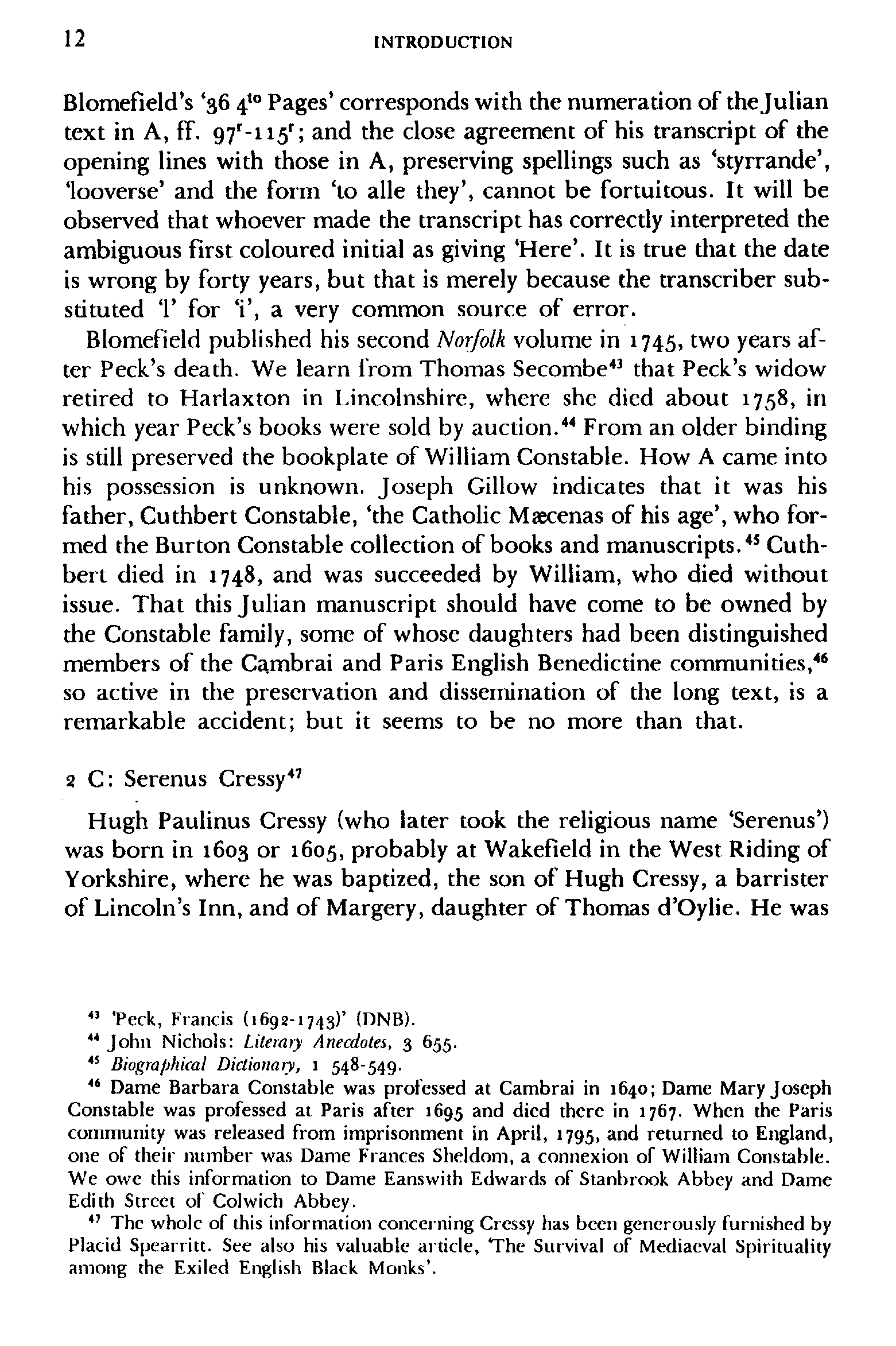
Blomefield's '36 4to Pages' corresponds with the numeration of thejulian text in A, ff. 97r-ii5r; and the close agreement of his transcript of the opening lines with those in A, preserving spellings such as 'styrrande',
'looverse' and the form 'to alle they', cannot be fortuitous. It will be observed that whoever made the transcript has correctly interpreted the ambiguous first coloured initial as giving 'Here'. It is true that the date is wrong by forty years, but that is merely because the transcriber substituted V for V, a very common source of error.
Blomefield published his second Norfolk volume in 1745, two years after Peck's death. We learn from Thomas Secombe43 that Peck's widow retired to Harlaxton in Lincolnshire, where she died about 1758, in which year Peck's books were sold by auction.44 From an older binding is still preserved the bookplate of William Constable. How A came into his possession is unknown. Joseph Gillow indicates that it was his father, Cuthbert Constable, 'the Catholic Maecenas of his age', who formed the Burton Constable collection of books and manuscripts.45 Cuthbert died in 1748, and was succeeded by William, who died without issue. That this Julian manuscript should have come to be owned by the Constable family, some of whose daughters had been distinguished members of the Cambrai and Paris English Benedictine communities,46 so active in the preservation and dissemination of the long text, is a remarkable accident; but it seems to be no more than that.
2 C: Serenus Cressy47 Hugh Paulinus Cressy (who later took the religious name 'Serenus') was born in 1603 or 1605, probably at Wakefield in the West Riding of Yorkshire, where he was baptized, the son of Hugh Cressy, a barrister of Lincoln's Inn, and of Margery, daughter of Thomas d'Oylie. He was
43 'Peck, Francis (1692-1743)' (DNB).
44 John Nichols: Literary Anecdotes, 3 655.
45 Biographical Dictionary, i 548-549.
46 Dame Barbara Constable was professed at Cambrai in 1640; Dame Mary Joseph Constable was professed at Paris after 1695 and died there in 1767. When the Paris community was released from imprisonment in April, 1795, and returned to England, one of their number was Dame Frances Sheldom, a connexion of William Constable.
We owe this information to Dame Eanswith Edwards of Stanbrook Abbey and Dame Edith Street of Colwich Abbey.
47 The whole of this information concerning Cressy has been generously furnished by Placid Spearritt. See also his valuable article, The Survival of Mediaeval Spirituality among the Exiled English Black Monks'.
II SCRIBES AND OWNERS
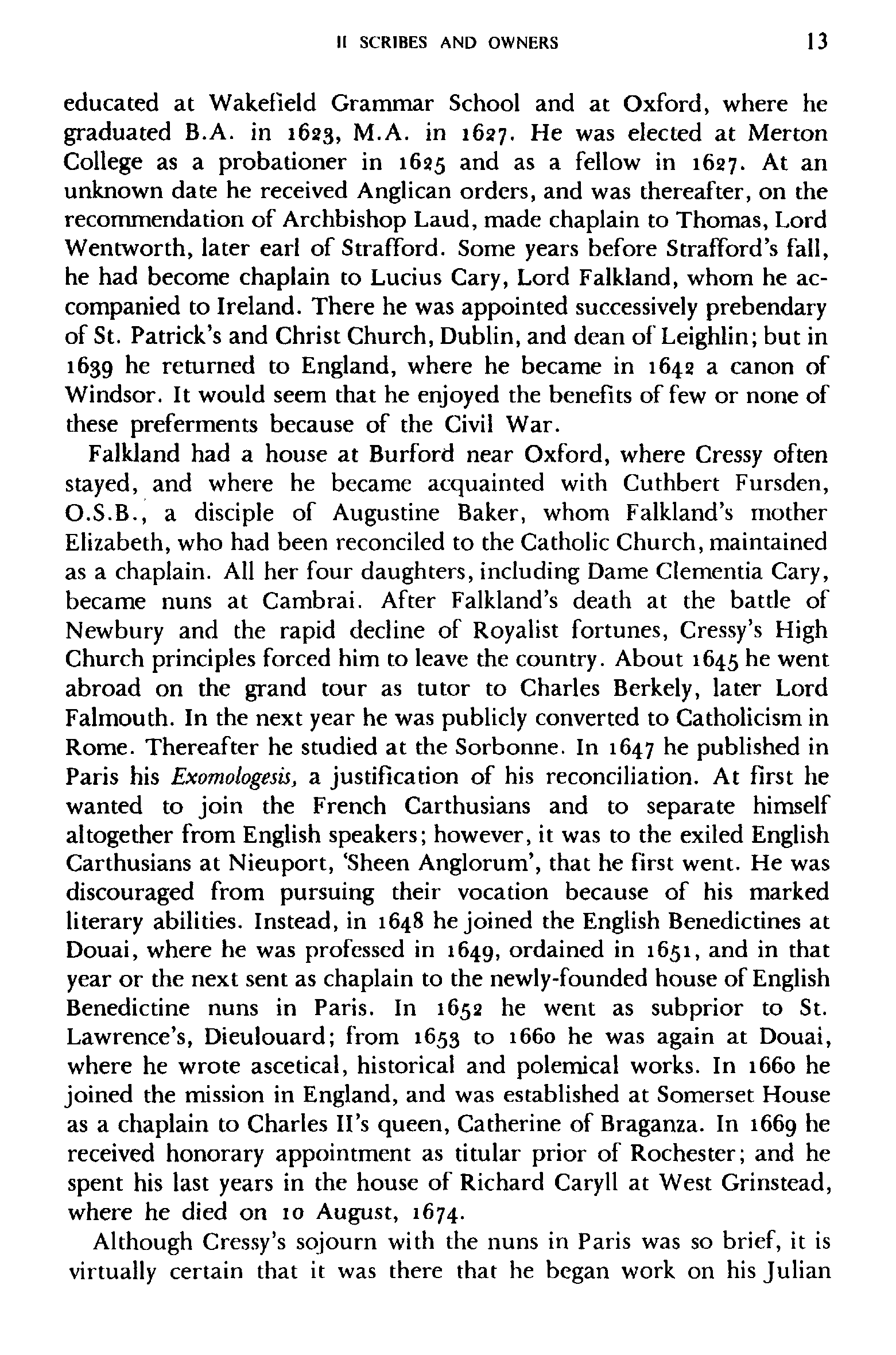
educated at Wakefield Grammar School and at Oxford, where he graduated B.A. in 1623, M.A. in 1627. He was elected at Merton
College as a probationer in 1625 and as a fellow in 1627. At an unknown date he received Anglican orders, and was thereafter, on the recommendation of Archbishop Laud, made chaplain to Thomas, Lord
Wentworth, later earl of Strafford. Some years before Strafford's fall, he had become chaplain to Lucius Gary, Lord Falkland, whom he accompanied to Ireland. There he was appointed successively prebendary of St. Patrick's and Christ Church, Dublin, and dean of Leighlin; but in 1639 he returned to England, where he became in 1642 a canon of Windsor. It would seem that he enjoyed the benefits of few or none of these preferments because of the Civil War.
Falkland had a house at Burford near Oxford, where Cressy often stayed, and where he became acquainted with Cuthbert Fursden,
O.S.B., a disciple of Augustine Baker, whom Falkland's mother Elizabeth, who had been reconciled to the Catholic Church, maintained as a chaplain. All her four daughters, including Dame Clementia Gary, became nuns at Cambrai. After Falkland's death at the battle of Newbury and the rapid decline of Royalist fortunes, Cressy's High
Church principles forced him to leave the country. About 1645 he went abroad on the grand tour as tutor to Charles Berkely, later Lord
Falmouth. In the next year he was publicly converted to Catholicism in Rome. Thereafter he studied at the Sorbonne. In 1647 he published in Paris his Exomologesis, a justification of his reconciliation. At first he wanted to join the French Carthusians and to separate himself altogether from English speakers; however, it was to the exiled English
Carthusians at Nieuport, 'Sheen Anglorum', that he first went. He was discouraged from pursuing their vocation because of his marked literary abilities. Instead, in 1648 he joined the English Benedictines at Douai, where he was professed in 1649, ordained in 1651, and in that year or the next sent as chaplain to the newly-founded house of English
Benedictine nuns in Paris. In 1652 he went as subprior to St.
Lawrence's, Dieulouard; from 1653 to 1660 he was again at Douai, where he wrote ascetical, historical and polemical works. In 1660 he joined the mission in England, and was established at Somerset House as a chaplain to Charles II's queen, Catherine of Braganza. In 1669 he received honorary appointment as titular prior of Rochester; and he spent his last years in the house of Richard Caryll at West Grinstead, where he died on 10 August, 1674.
Although Cressy's sojourn with the nuns in Paris was so brief, it is virtually certain that it was there that he began work on his Julian
INTRODUCTION
edition, as we shall see when what is known of the provenance and ownership of P, Si, 82 and U is summarized.
The prefatory epistle To the Reader' in the Cressy 1670 edition states that it has been produced at the expense of 'a more Venerable Abbot of our Nation'; and there is a marginal note to this, The V(ery)
R(everend) F(ather)Jo(hn) Guscoyn L(ord) Abbot of Lambspring'. This was John Placid Gascoigne (1599-1681), a younger son of John
Gascoigne, a Yorkshire Catholic created a Nova-Scotian baronet in 1635, and of Anne, daughter of John Ingleby. John Placid's third sister,
Catherine, became abbess of Cambrai, and his sixth sister, Justina, was prioress of Paris when she died in 1690. His eldest brother, Thomas, and his wife, Anne, daughter of John Symeon, had among their children
Catherine, who became prioress of Paris, and Frances, a nun at Cambrai .
MS Ampleforth 165, Peter Allanson's Biography of the English Benedictines, has some unenthusiastic things to say about Abbot Placid. He ruled over Lambspring for more than thirty years, and was best remembered for his implacable opposition to all the efforts of the English
Congregation to make his office, like all their others, tenable for four years only. Allanson writes that he 'was much given to Literature himself, but was no ways solicitous in promoting learning among his subjects, and is handed down as being regardless of learning in those whom he admitted to their Profession', and he castigates the abbot's 'inactivity and apathy'.
This being so, it is probably not unjust to suspect that it was his family ties at Cambrai and Paris which won the abbot's help for the Cressy printed edition.
For two centuries after its appearance, Cressy's printed text was the only source of information for scholars, Blomefield and his report of A excepted. Cressy's work was known to some European theologians. The Protestant Pierre Poiret, who had detailed knowledge of Augustine
Baker, Benet Canfield and Gertrude More, has, in his 'Catalogus Auctorum Mysticorum', an entry 'Julianae, Matris Anachoretae,
Revelationes de amore Dei.
Angiice. Theodidactae, profundae, estaticae'.48 Gerhard Tersteegen, whose spiritual reading as a young man had been guided by Poiret's works,49 assures us that Poiret knew of Julian through Cressy,50 who is the source also of Tersteegen's well48 Bibliotheca mysticorum, 336.
49 Tersteegen, Gerhard,' (Allgemeine Deutsche Biographic 37, 577).
50 Auserlesene Lebensbeschreibungen 3, 252 note a.
II SCRIBES AND OWNERS
informed and perceptive account of her.51 He shows how highly he esteemed her in his artless verses:
Von scharfer Reinigung und hohem Gott-Beschauen A Cruce weisslich redt; Mechdld und Julian vom kindlichen Vertrauen,
Theresa vom Gebet;52 and the success of his translated extracts may be judged by this one quotation:
Es sagte unser guter Herr zu mir, fragende: Bist du wohl damit zufrieden, dass ich fur dich gelitten habe? Ich sagte: Ja, guter Herr, ich sage dir Dank davor; ja, guter Herr, gesegnet mussest du seyn. Darnach sagte Jesus, unser guter Herr: Wann du zufrieden bist, dann bin ich auch zufrieden: es ist mir eine Freude, eine Gliickseligkeit, und ein unendliches
Wohlgefallen, dass ich mein Leiden fur dich ausgestanden habe. Und wenn ich mehr hatte leiden mogen, ich wiirde mehr gelitten haben.53
Cressy's text was reprinted in 1843 by G. H. Parker, and again in 1902 with a preface by George Tyrrell; but original work on Julian began only in 1877, when H. Collins published his modernization of Si. This was followed in 1901 by Grace Warrack's version of Si, published with an excellent introduction which has well stood the test of time, and has been used (not, invariably, with due acknowledgment) by many later writers. When she first wrote, A, of the existence of which she knew from Blomefield, was thought to be lost; but in 1911, two years after it had been acquired by the British Museum, Dundas Harford's modernized version of the short text appeared. Many other such versions have since been published; as the celebrations in Norwich in 1973 to commemorate the six hundredth anniversary of her revelations demonstrated, Julian's popularity does not diminish.
3 Seventeenth-Century Copies of the Long Text C, P, Si and U are, all four, roughly contemporary; even U could have been written after C's appearance in 1670, since Barbara Constable, one of its scribes, lived for another fourteen years. Hywel Owen has shown conclusively that it was written at Cambrai; how it journeyed from there to Upholland we do not know. We cannot assign Si
51 Ibid. 3, 251-274.
52 Ibid. 3, 6.
53 Ibid. 3, 257; cf. 382.3-5