
Kenda Creasy Dean and Christy Lang Hearlson
Kenda Creasy Dean and Christy Lang Hearlson
Some problems are so complex that you have to be highly educated and well-informed just to be undecided about them.
Laurence J. Peter
In 1909, The Blacksmith’s Journal, the “official organ of the International Brotherhood of Blacksmiths and Helpers,” urged every blacksmith to “usher in a new era” by securing at least one additional recruit for the blacksmith’s union.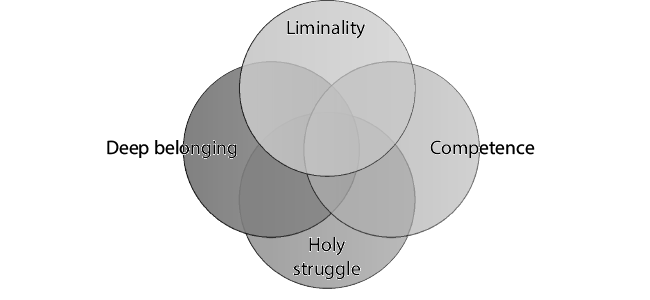
You know what happened. A year before the blacksmiths’ membership appeal, Henry Ford began mass-producing Model Ts. By 1910, he was manufacturing a tractor most farmers could afford. It is not that North America did not need leaders and workers in the transportation industry; it was just that the transportation industry was changing, and those changes altered the kind of skills and knowledge the industry required. In fact, many blacksmiths became the world’s first auto mechanics in order to stay in business.
It would do us good to step back for a moment and honestly ask, in our earnest attempts to inspire and prepare young Christian leaders: What might happen if we succeeded? After all, while we are talking about vocational pedagogy, churches are closing daily, seminary graduates struggle to find placements, and youth ministries — which for a century provided a pipeline for future church members as well as leaders — are among the first ministries cut during periods of economic duress. When the church invests in leadership development initiatives like High School Theology Programs that prepare young people for church leadership, are we preparing for the future, or recruiting more blacksmiths?
Wicked Questions
It is a “wicked question” — a question embedded in a situation so complex that every answer begets another layer of complications. Clearly Christians must form new generations of leaders if churches are to be vital and relevant in coming decades. At the same time, even if we succeed in recruiting more young people for church leadership through initiatives like High School Theology Programs, it is unclear whether the solution to the church’s shrinking leadership pool is to do more of what we already know, with more resources and tenacity, or to look toward alternative, untested paradigms of theological formation with equally iffy outcomes. Are enrollment and graduation statistics for formal theological education our best gauge for how well we prepare future church leaders? If not, then what is? That is a wicked question.
Wicked questions stem from wicked problems, a term used by social planners to describe inscrutable complexity. Addressing a wicked problem is like playing with liquid mercury: it is fascinating and maddening, because if you poke at it, the situation just shifts and takes on a new form. Wicked questions don’t have yes-or-no answers, only better-or-worse ones (see Figure 2.1). They tend to crop up when an organization or society faces constant change or unprecedented challenges.
How Do I Know It’s a Wicked Problem?
(John C. Camillus, 2008)
1. The problem involves many stakeholders with different values and priorities.
2. The roots of the issue are tangled and complex.
3. The problem is difficult to come to grips with, and it changes with every attempt to address it.
4. The challenge has no precedent.
5. There’s nothing to indicate the right answer to the problem.
Figure 2.1 Situations distinguishing wicked problems
from hard but ordinary problems.
It seems obvious that disproportionate numbers of alumni of High School Theology Programs would be interested in formal theological education, when compared to youth who do not attend HSTPs. But these programs are doing more than boosting seminary enrollment. They are unearthing a “mess” in the church, a tangle of overlapping conundrums that affect how we prepare theological leaders “for such a time as this” (Esther 4:14), and who gravitate to ecclesial forms that are, perhaps, especially suited to those raised in an era of cultural flux. If HSTPs do not offer solutions to wicked problems, they at least model practices that help churches discern what their faith community’s particular witness might look like in a world of ubiquitous change.
For this reason, High School Theology Programs may contribute as much to the conversation about twenty-first century ecclesiology as Christian leadership formation. The dilemma facing church leaders and theological educators is that we do not know what kind of churches we are shaping leaders for — and consequently, we are unsure about the kind of theological formation these leaders need. At a loss for alternatives, we are apt to train blacksmiths, passionately and well, throwing ourselves into this holy work with fervor and faith. It is no exaggeration to say that theological education today is more theologically nuanced, more contextually competent, and more pedagogically excellent than it has ever been; we are training the best blacksmiths the church has ever known.
Unfortunately, that century is over.
Vocational Pedagogy in an Age of Flux
The data are both sobering and tantalizing. David Roozen, who chronicled changes in American congregations between 2000 and 2010, revealed a decade of “slow, overall erosion of the strength of America’s congregations” marked by a steep loss of revenue, aging memberships, and high levels of conflict. The net result? Fewer people in the pews and a decline in spiritual vitality.
Of course, no “burst of innovation” happens in a vacuum. Like all institutions, churches scramble to adapt to the unprecedented pace of cultural change of the early twenty-first century. Ubiquitous connection, the eclipse of “place” by networks, the urgency of cities, the rise of “majority minorities,” the postponement of marriage, economic liquidity, the primacy of self, assumed complexity, participatory and collaborative culture, the “rise of the nones” — all represent shifts in Western society’s bedrock assumptions, and point to titanic changes underlying our “whole context of understanding, in which our moral, spiritual or religious experience and search takes place.”
The ecclesial question, then, is how is a particular community of Christians, rooted in a particular place at this particular moment in history, to convey Christ’s love? This is the question taken up by all High School Theology Programs, which rely on practices very much like those used to cultivate pastoral excellence across faith traditions:
High School Theology Programs demonstrate the importance of these learning experiences in influencing teenagers’ ecclesial imaginations. Teenagers participating in these peer-rich, embodied, border-crossing learning experiences come to think of themselves not only as individuals who reflect Christ’s love in the world, but as shapers of communities that do the same — once again relocating vocational discernment beyond the realm of individual decision-making.
Getting Beyond Buechner: Calling as a Creative Process
Spiritual writer and pastor Frederick Buechner famously described vocation by saying, “The place God calls you to is the place where your deep gladness and the world’s deep hunger meet.”
At the same time, Buechner offers a subjective and individualistic definition of vocation. He neglects to say that whole communities can have a calling, just as he overlooks the role communities play in helping individuals find and follow their Christian vocation. As we have noted above, High School Theology Programs are prime examples of the complexity of vocation and vocational discernment as a practice, which is more complex, more socially situated, more layered and more multivalent than is often assumed. In short, vocational discernment for North American young people is a wicked problem.
High School Theology Programs approach vocational discernment as a more creative process than a mere mapping exercise in which we attempt to pinpoint where “the world’s deep hunger” and our “deep gladness” intersect. Mihaly Csikszentmihalyi describes creativity as a “systemic rather than an individual phenomenon.”
A systems view of creativity — like a systems view of vocation — means that understanding creativity cannot be reduced to studying “the individuals who seem most responsible for a novel idea or a new thing. Their contribution, while necessary and important, is only a link in a chain, a phase in a process.”
Like creativity and fire, vocation can also be seen as a series of combustible variables that help the church as a whole hear Christ’s call to discipleship in real life and concrete situations, consider and engage in faithful ways of being and acting that answer that call in concrete situations, and reflect together on that action, as well as how the church might faithfully act in the future.
Context and Vocation: Wicked Problem or Creative Necessity?
Given the ways churches struggle to address the cultural upheavals of our time, context is often seen as a vocational problem. The nature of the church, and the kind of theological formation needed to shape those who serve it, is a perpetual conundrum for church leaders who recognize the complexity of what Csikszentmihalyi calls “the cultural domain,” and the importance of the church’s ability to speak into it.
When vocation is a creative process, on the other hand — a process of mutual ignition between multiple domains — context becomes a creative necessity, not a wicked problem to be solved. Csikszentmihalyi views the cultural domain as a necessary element for realizing creative (or in our case, vocational) potential. Without the specific needs, social attitudes, and exigencies dictated by context, an innovation can fall flat or be ignored, like Leonardo da Vinci’s flying machines that were conceived at a time when people had no imagination for (or need or desire for) flying humans. Likewise, for vocation to be vocation, the culture in which it unfolds must both need and recognize the gifts that a certain calling offers.
This is not just a pragmatic concession. It is a deeply incarnational conviction, since God’s love must always be enfleshed in the cultural settings where it is received. Each culture and each age has its own concerns, achievements, and moral failings; each culture and age hears the good news in distinct ways. This means that vocation is never something whose content is predetermined. The content that shapes our response to God’s call are the actual circumstances facing the world at that time.
Understanding vocational formation as a series of overlapping, mutually activating systems reframes the way churches view our cultural context. Instead of the culture in which we live being a sticky wicket to overcome, postmodern complexity becomes a constitutive feature of vocation itself. Instead of the secular age being an evil force dissuading future leaders from ministry, it serves as the social domain that makes these leaders’ innovations possible and meaningful. Unless we take seriously young people’s social, political, economic, and physical contexts as places that give vocation its meaning and purpose, vocation remains an individual decision rather than the result of the Holy Spirit’s presence in overlapping systems of human community. Christian vocation is not just the fact of being called; it is also the content of our response to Christ’s call — content that makes sense only insofar as it addresses real life and real lives.
Christian Community and Vocation: Fields of Validation
Csikszentmihalyi describes a field as all the individuals who act as gatekeepers to the domain: “It is their job to decide whether a new idea or product should be included in the domain.”
It took the entire population of the United States to decide whether the recipe for new Coke was an innovation worth keeping. On the other hand, it has been said that only four or five people in the world initially understood Einstein’s theory of relativity, but their opinion had enough weight to make his name a household word. But even in Einstein’s case, the broader society had a voice in deciding that his work deserved a central place in our culture.
Let’s assume the innovation is not new Coke, but Christian vocation: Who are the gatekeepers that allow a vocational vision to go forward; who validates it? How do we know whether young people’s decisions about the church’s mission align with God’s? Of course, the most important validator of a vocational vision comes from the Holy Spirit, but the Spirit awakens and validates these visions in different ways. Some people experience validation of their sense of calling through inward, subjective experiences like prayer or through Scripture reading; others through works of mercy and advocacy; others through inspired human communities that notice, name, and affirm their gifts for Christian leadership and service.
The “official” church’s validation of a young person’s call, therefore, is only part of the story. After all, one of the primary differences between episcopal (Roman Catholic, Anglican, and Episcopal), connectional (Methodist), congregational (Baptist and Congregational), and presbyterian (Reformed and Presbyterian) polities lies in who exactly has the official power to validate vocation, especially for those called to church leadership or service. High School Theology Programs recognize that vocational validation never ends with official denominational or church leaders. As any pastor will tell you, congregations can implicitly accept or reject a leader’s authority, enhancing or undermining that leader’s calling in the community.
Regardless of the polity of the sponsoring theological tradition, every High School Theology Program acts as a proactive validating field for every teenager’s vocation of discipleship, which has the effect of stimulating his or her ministry in more specific ways. As Csikszentmihalyi points out, fields are not neutral; they actively affect the rate of creativity by being “either reactive or proactive. A reactive field does not solicit or stimulate novelty, while a proactive field does.”
Individuals and Vocation: Cultivating Attention
By describing vocational discernment as a social practice, High School Theology Programs model ways to resist individualistic understandings of Christian vocation that reduce it to either following our bliss, or that abstract it from its social context. Still, the individual does play a part in a systemic understanding of vocation. As Csikszentmihalyi says of creativity: “While the individual is not as important as it is commonly supposed neither is it true that novelty could come about without the contribution of individuals.”
Csikszentmihalyi names a number of predispositions that make creativity more likely in some people than others (e.g., curiosity, wonder, early interest in the cultural domain, access to a validating field). Young people attending HSTPs often share similar characteristics: they have expressed early interest in theological thinking and Christian leadership, they are drawn to HSTPs partly out of a sense of curiosity and wonder, and they have access to both domains and fields associated with Christian leadership.
This last point is critically important. Vocational discernment requires teenagers to “internalize the entire system” that makes vocation possible, which takes time, intentionality, and attention on the part of the teenager.
Images of Vocation as Christian Leadership
in High School Theology Programs
The Lilly Endowment’s unabashed emphasis on interpreting vocation in terms of Christian leadership gives the domains and fields of High School Theology Programs a distinctive, and somewhat counterintuitive, thrust. After all, Jesus did not cultivate leaders; he cultivated followers. Every program director is quick to point out that HSTPs understand Christian leadership to mean serving Christ in myriad forms, and many downplay the language of “Christian leadership” in favor of the more theological (and more general) term “vocation” to describe the aims of their curriculum.
Still, there is no getting around the fact that congregations, campus ministries, colleges, and seminaries find it increasingly difficult to attract, develop, and retain a large pool of talented young people for congregational ministries. The so-called “leadership vacuum” facing North American congregations is dire, and the demonstrable likelihood that High School Theology alumni will at least consider formal theological training makes it impossible to avoid viewing these programs as feeder systems for congregational leadership. Given this cultural domain, every student who attends a HSTP must grapple with the tension between Christ’s call to follow him, and the church’s need for people who will lead.
The term “leadership” is therefore often used and seldom defined by High School Theology Programs. Like the field of leadership studies itself, HSTPs reflect a familiar pendulum swing in the way Christian leadership is understood. At one end of the spectrum are (dominant but declining) views in which leadership is a person-centered, mostly unidirectional, sometimes heroic quality possessed by individuals.
In reaction to this first body of literature are studies on followership, also important to Christian discussions of leadership-as-discipleship. This perspective was memorably illustrated in Derek Sivers’ three-minute 2010 TED talk, “How to Start a Movement” — aka, “Leadership Lessons from the Shirtless Dancing Guy.”
Theologians are divided in the ways they think about leadership and about whether they think Jesus was any good at it.
Given many large churches’ corporate structures and the growing necessity to find new avenues of funding for ministry even in small congregations, there is plenty the church can learn from business literature, but High School Theology Programs take a decidedly different approach. They view leadership, above all, as a calling inspired by God’s overabundant grace, especially the gift of Jesus Christ. Each program seeks to affirm young peoples’ primary vocation: following Christ and participating in God’s redemption of the world as Christ’s witnesses. Only in light of this primary vocation does a teenager’s secondary calling make sense, as she begins to recognize that God may use her particular gifts and desires to move beyond her own personal witness to further the witness of the church.
As a result, three images of Christian leadership explicitly or implicitly wend their way through High School Theology Programs: servant, witness, and steward. These images are not exclusively Christian (leadership gurus Robert Greenleaf, Steven Covey, and Peter Block have all built empires around variations on these themes), but they are nonetheless deeply embedded in the texts and traditions of Christian faith. In High School Theology Programs, these images take on various hues depending on the theological tradition of the host program. Yet together they form a layered understanding of Christian leadership that defies easy categories of “leaders” and “followers.” If leadership is the capacity to “get things done,” we might say that High School Theology Programs form young people who place themselves at the Holy Spirit’s disposal and thereby allow God to “get things done” through them, especially by mobilizing communities that bear witness to God’s inbreaking grace in human culture.
IMAGE OF LEADERSHIP
Theological backdrop often invoked
Formative practices often emphasized
Virtues of leadership often celebrated
Servant
Theologies of kenosis
(e.g., John Wesley, Henri Nouwen, Sarah Coakley)
Silence
Friendship
Discipleship
Humility
Empathy
Compassion
Witness
Theologies of reconciliation
(e.g., Karl Barth, Howard Thurman, Desmond Tutu)
Justice
Confession and Forgiveness
Community
Vision
Courage
Gratitude
Steward
Theologies of gifts
(e.g., Gregory of Nazianzus, Jean Luc Marion, Catherine Mowry LaCugna)
Worship
Relationship
Eucharist
Encouragement
Joy
Freedom
Figure 2.2 Images of Leadership in High School Theology Programs
The Leader as Servant
The image of Jesus washing the feet of his disciples is the most iconic portrait of leadership in Christian Scripture. The life of true spiritual leadership, Henri Nouwen reminds us, is one in which “power is constantly abandoned in favor of love.”
Let the same mind be in you that was in Christ Jesus,
who though he was in the form of God,
did not regard equality with God as something to be exploited,
but emptied himself, taking the form of a slave,
being born in human likeness, and being found in human form,
he humbled himself, and became obedient to the point of death —
even death on a cross. (Phil. 2:5-11)
This self-emptying — this divine act of friendship to human beings, this humility that makes room for the Holy Spirit to make us over in Christ’s image — is the condition for leadership marked by empathy and compassion. From sharing breakfast with homeless people to talking with people from other religious traditions, High School Theology Programs cultivate kenotic opportunities that decenter young people from their accustomed notions of self and others, opening them to a notion of leadership (and a notion of God) that inverts conventional understandings of power and control.
The Leader as Witness
William Willimon describes “a young country pastor” named Karl Barth as someone who preaches “as if he has just invented fire, and week after week never fails to be shocked that this God is with us, this God is with us.”
The image of the leader as witness pervades High School Theology Programs with a similar fervor, where teenagers are encouraged to bear witness to Christ in and beyond the walls of the church, in word and in deed. HSTPs especially stress the importance of naming the discrepancies between the Reign of God as revealed in Jesus Christ and dehumanizing practices in the dominant culture, what we might call prophetic truth telling. Truth telling is not only the task of those exercising Christian leadership, of course; Ronald Heifetz argues that “someone exercising leadership is probably generating disequilibrium”:
Either [the person exercising leadership] is raising issues or asking questions that disturb people and force people to come to terms with points of view or problems that they would rather not consider; or he’s protecting other people in the organization who are creating disequilibrium.
High School Theology Programs do not just help youth to identify places of injustice and suffering in the world; they also help students see their own culpability in dehumanization, heightening the importance of practices like confession and forgiveness in HSTP communities themselves. These practices strengthen the community’s fabric in ways that interpret individual, cultural, and theological differences as gifts rather than weaknesses. Like the church, HSTP communities themselves are viewed as witnesses “before the watching world,” whose corporate life is intended to reflect Jesus Christ, and thereby proclaim alternative ways of relating amidst competing cultural norms.
The Leader as Steward
Perhaps the most intriguing image of leadership in High School Theology Programs is the leader who stewards gifts for the good of all — God-given gifts like forests and sleep and violin-playing, as well as human offerings of money and time.
Since leaders name, develop, and deploy a community’s gifts for the benefit of all, exercising stewardship is deeply connected to “a theology of gifts” — a theological theme that runs deep in the veins of every HSTP we studied. These programs are shot through with generous assumptions about teenagers’ capacities for theological leadership. The importance of stewarding “gifts” reflects Paul’s insistence that each gift is a “grace given to us” so the community may flourish (Rom. 12:6b). At the same time, Paul ups the ante, promising “a still more excellent way” to employ and deploy God-given gifts — out of love (1 Cor. 12:31). In this way, writes Joel White, Paul offers a definitive statement of what it means to be a leader:
“Think of us in this way, as servants of Christ and stewards of God’s mysteries” (1 Cor. 4:1). . . . Paul uses two words in this verse to elaborate what he means. The first, hyperetes (“servants”), denotes . . . a servant who waits on or assists someone. In this sense, a leader attends personally to the needs of the people he or she leads. The leader is not exalted, but humbled, by accepting leadership. . . . The second is oikonomos (“stewards”), which describes a servant or a slave who manages the affairs of a household or estate. The chief distinction in this position is that the steward is trusted. The steward is trusted to manage the affairs of the household for the benefit of the owner. Likewise, the leader is trusted to manage the group for the benefit of all its members, rather than the leader’s personal benefit.
White notes that the image of a steward entrusted with managing a household’s resources is explicitly ascribed to Jesus, as well as to other leaders in the early church.
From Influence to Discernment: Experiencing Costly Leadership
What these images of leadership have in common — servant, witness, steward — is costliness: in each case, the leader consciously chooses to relinquish influence rather than seek it, to honor others’ gifts, and to point to God’s power instead of one’s own. The kenotic overtones of these images depart noticeably from dominant North American images of leadership. Servants, witnesses, and stewards suggest that the task of Christian leadership has more to do with discernment than over influence. Instead of prodding communities into predetermined shapes, servants, witnesses, and stewards help faith communities discern and undertake practices that enact their missional identities. Discipleship formation becomes less something that church leaders do to parishioners than a mutual process in which leaders and parishioners alike help each other conform to the image of God in Jesus Christ.
Costly images of leadership call into question one of American teenagers’ most cherished assumptions — namely, that the central goal of life is to be happy and feel good about ourselves.
does not carry significance; it is trivial, inconsequential, and largely meaningless. At the end of the day, it is not clear to the young people who attend the worship services, nor, it seems, to their parents, why worship matters.
Cady concluded that young people failed to find worship meaningful because it lacked “magnitude,” the significance that arises from anticipating an encounter with God.
If, as Cady believes, churches falter when it comes to offering youth experiences of magnitude, HSTPs do not.
Figure 2.3 Experiences of Magnitude in High School Theology Programs
Experiences of Liminality
In some ways, every High School Theology Program functions as a pilgrimage: students leave home and head toward a holy destination, hoping to be transformed. By definition, this process of separation and reintegration becomes a liminal rite of passage, as teenagers come to think of themselves as the executors of their own spiritual estates. Dangling in between the familiar world of home and the uncertain terrain of the future, students in High School Theology Programs (as in all rites of passage) are “betwixt and between,” suspended between expectations of old roles and anticipations of new commitments that await.
Liminality creates vulnerability, a risky posture for teenagers because it renders most of their accustomed defense mechanisms inoperable. Many programs intentionally intensify this defenselessness. Sixteen-year-old Jay reflected on the wilderness portion of Gordon-Conwell’s Compass program:
I definitely feel like [it was important] not being in my room at home with the different distractions. . . . Here I go outside and it’s just me and God. And so I think that helps me — it makes it a more of a special time.
Even in programs where students do not literally embark on pilgrimages, liminal experiences are prominent. The arts, structured encounters with unfamiliar “others,” and acts of play all place young people in existential spaces where they must, to some degree, lose themselves in the moment as they dangle “betwixt and between” their former assumptions and future selves. In music, dance, drama, film, and visual art, students find themselves in a mode of discourse that opens them to the numinous, apprehended and expressed through movement, color, sound, texture, or form. Structured encounters with “otherness” — divine or human — decenter young people from familiar assumptions as they are thrust, momentarily, into the sacred space of the “other”: a conversation with homeless people, a visit to a mosque, an experience with solitude. Adrian, also from Gordon-Conwell’s Compass program, reflected on the liminality of his solo day in the wilderness:
You know, practicing solitude [lets you see] what it looks like to actually have time to listen to your own thoughts and take them to the Lord, and of course to try to listen for Him. . . . I think prayer and solitude — and just learning to be still, and to perhaps read and kind of hear God’s word through reading — is kind of the practice of the wilderness.
Sometimes “holy others” had holy orders. Monks provided an endless source of fascination for students in the two programs associated with monasteries. The monks served as bridge figures, surprisingly in touch with “real life” while maintaining a sacred “set apartness” that seemed light years away from teenagers’ daily lives. Sixteen-year-old Holly compared the monks at St. Meinrad’s One Bread, One Body program with her “scary” youth minister at home:
They’re really interesting. When you first get here you think that they’re just fat bald guys, that all they do is pray and stuff, but really they have this sense of . . . this spark in them. . . . They all have this personality that just — they’re like a friend that you can always talk to. It’s not scary. My youth minister is scary. He’s always serious. He has God on his side as well, but he doesn’t pray five times a day or do the other stuff that the monks do. The monks have a sense of peace and holiness.
Suspended between two different possibilities — the way of life of home and school, and new vocational possibilities revealed by their experience in a High School Theology Program — teenagers in High School Theology Programs find themselves vulnerable and open to new possibilities, to others, and to God.
Experiences of Competence
Across the board, the students we interviewed were brought up short by their programs’ confidence in them as leaders and “scholars.”
The first day we walked into class and see this teeny tiny man, and he said: “You’re big boys and girls now, and we expect you to be ready, and we expect you to talk about what’s important to you. We’re not going to poo poo you because you’re seventeen. We’re going to talk about serious questions, so go for it.” It was the first time that I’d heard someone inside the church say, “Yeah, faithful people have questions and they’re hard questions and we’re going to talk about that for as long as you’d like.”
Sixteen-year-old Tom explained the joy of “doing hard things” in Gordon-Conwell’s Compass program:
Everyone had four books to read. . . . Reading Christian books . . . not always my favorite thing to do. But I have never been more inspired or more excited than I have been reading those books. To be able to read about God for four hours straight, I’ve never had that, and these books that they chose are definitely a reflection of what this program wants to teach us.
Brian, a seventeen-year-old from Calvin Theological Seminary’s Facing Your Future program, concurred:
I can honestly say, I’ve learned a lot more than I have ever learned. I love having conversations and discussions about Scripture. Someone else could think something completely different. You can really start to understand it better, I think. Never really done that a lot, because my youth group is more about everybody having fun. Maybe small lessons where you learn something about the Bible but you don’t really have discussions. I swear I don’t remember what I learned last week.
As Brian’s comments demonstrate (and as we noted in chapter 1), many congregational youth ministries do not include deep intellectual engagement of theological texts as part of their programs. Yet for spiritually curious youth, the presence of challenging theological conversation in HSTPs is a clear draw. Every adult working with a High School Theology Program is of one mind on this point: teenagers are far more capable, and far better theologians, than we expect them to be. As a result, each program turns to its own teenage participants for leadership, enlisting them as community leaders, worship leaders, theologians, ministers. In theologian Howard Thurman’s words, these programs “place a crown” over young people’s heads that, for the rest of their lives, they “will keep trying to grow tall enough to wear.”
Experiences of Deep Belonging
As we will see in chapter 3, intentional Christian community authenticates and accelerates every other faith practice in High School Theology Programs. HSTP leaders spend a great deal of pedagogical energy developing communities of practice that shape the identities of the teenagers who belong to them. Belonging to these communities is not the same as attending them; belonging is membership’s more costly cousin. Belonging implies mutual, willing vulnerability.
Of course, it seldom seems this way at first. Seventeen-year-old Deedee described her experience of the community at Candler’s Youth Theological Initiative:
Our community, it is the corniest thing ever, but once you experience it, honest to God, it’s [beyond words]. You know that, “Okay, we’re supposed to be one big family,” but on the first day it’s just all types of awkward. . . . We’re all very different people, and you don’t really know how it works, but [suddenly] it does. You just grow so close and you’re talking and you’re sharing, and now when you don’t have small group time we’re all like, “Wait, what? What in the world? We don’t have small group time?”
Being close to one another or talking seriously about theological questions does not necessarily make a community “Christian.” HSTP directors recognize the temptation to believe that, if theology is discussed, Christian community magically follows, or that if warm relationships emerge, theological discussion will ensue. Embedding theological formation in a Christian community, as opposed to a cozy one, is an ongoing challenge, and the teenagers we talked to struggled with what to call the “X factor” that set HSTP communities apart. Violet, Deedee’s seventeen-year-old friend at YTI, attributed it to many people working for the common good:
Volunteering at MedShare, that was just so impactful, because we come from different places, and we were helping ship supplies and medical needs to people who are from different countries. I see how small, how tiny we are, and how we’re contributing in a big way, and it was just — I mean, we packaged something like 5000-something pounds, 492 boxes! It was such a big movement, and I felt like a community.
Grace, a program participant from the Lutheran Theological Seminary at Gettysburg/Philadelphia, ascribed the profound sense of community to what was missing:
The best feeling I can think of is that this is a place that has [an absence of] shame. . . . Even if I were to say something and I didn’t finish it completely, just by the connections that we develop, we fill in the blank. I think that is really special and I can’t say that I have that connection with many other people. It is an awesome connection. It is the strongest of all of them.
But most teenagers saw an important role for faith practices that linked connecting with God to connecting with peers. At St. Meinrad’s, sixteen-year-old Helen called worship the source of her community’s Christian identity:
It’s amazing! So, you walk in as a community: you are one. You are one together. You share . . . like we come in we get the holy water . . . and we share it. We pick it up and we share it with the other person. So you come in as a community and you share together. The cool thing is, as you come in, you sing. You sit in the monk stalls. It’s like a unique opportunity. . . . And you sit and sing together, and you pray. When the time comes, you walk down (when you’re ready). You pray to the Lord to help you confess all of your sins, to confess everything you cannot share with anyone else. You can share with these monks. You’re basically putting your life in their hands. . . . You get to share everything, and it’s honestly one of the most amazing experiences I’ve ever had.
Of course, these explanations only partly account for intentionally cultivated Christian communities’ distinctive power. Countless secular organizations amass large groups to alleviate hunger without becoming churches; group therapy offers safe havens that are not sanctuaries; and many worship services go through their liturgical paces without cultivating “amazing experiences” of community. Given the emphasis on theology in these programs, it was somewhat striking that few young people explicitly named God’s presence in their HSTP community as a constitutive, formative variable.
Today we understand the nuances of social pedagogies, the critical importance of adult mentors in the learning process, and how to leverage what Lev Vygotsky called “zones of proximal development” that transform social modeling into internalized learning.
Experiences of Holy Struggle
Mike’s journey from disorientation to transformation is a common story among HSTP participants. The seventeen-year-old from Hellenic’s CrossRoad program recalled his reaction at learning he had to “unplug” to participate:
I was terrified . . . they were like, you can’t bring your cell phone; we’re going to take everything from you. You can’t have your iPod . . . you’ll barely call your parents, you won’t talk to your friends, and I was like, “That’s terrible.” My friends [said], “It sounds like prison camp” (laughs). It just sounds horrible but when you first experience it, you experience the community and the purity of appreciating the services. I came home and I just wanted to go right back. So yeah. [Sacrificing technology] makes you feel closer and, and to feel that again you go to church more often. It’s just a really cool experience.
Meaning making is forged in holy struggle. Sharon Daloz Parks maintains that the test of an adequate system of meaning — a “trustworthy truth” on which to set one’s heart — is to ask, “What does your chosen god do in the face of being totally overcome — what does it do in the face of shipwreck?”
Out of such struggle comes our best chance at making sense of the world. Jacob receives a new name and identity after he wrestles with the divine messenger: he is now one who has tangled with angels and prevailed (Gen. 32:22-31). Teenagers in High School Theology Programs also frequently connect their sense of identity and purpose to struggle. When teenagers navigate disruption — from bullying to divorce, from immigration to illness, from a parent’s incarceration to a family member’s death — they begin to ask: Do my struggles have a purpose? Is my pain meaningless? If God loves me, then why is my life so hard?
These are not only existential questions; they are vocational questions, as theologian James Loder points out. Loder argues that questions of meaning (“Why am I?”) go hand in hand with questions of identity (“Who am I?”); the latter cannot be addressed apart from the former. Our sense of being is tied closely to our sense of purpose; young people who lack a sense of existential purpose struggle with self-understanding as well. For Loder, the primary question that haunts human beings, starting with the onset of formal operational thought during adolescence, is “What is a life, and why do I live it?”
HSTPs all use meaningful struggles — “disorienting dilemmas,” as educator Jack Mezirow calls them
As teenagers encounter new theological perspectives, accept challenging responsibilities, and meet people whose views and life circumstances differ vastly from their own, a reckoning must take place, with themselves and with God. Such reckonings can be deeply uncomfortable, so programs also strive to create safe zones, supportive structures, and healing rituals. Some young people said they worked out their discomfort through prayer or worship (our research team heard a lot about incense and bells); others found meaning in deep conversations about Scripture with mentors and peers. Youth like sixteen-year-old Olivia found the hunger banquet at St. John’s Youth in Theology and Ministry program to be an important source of meaning:
Everyone knows there are starving people everywhere. But it didn’t really hit me until the images were just engraved in my mind. There’s a point where the people hosting the hunger banquet were giving us facts about how a child dies every three or four seconds. So then, [the program director] told us just to reflect and to be silent. And for a whole minute, every three seconds he would say “death,” every time a child life was lost. So that really impacted me a lot.
Without a safe community in which to experience disorientation, these experiences are simply struggles; holy struggle is made possible by “safe spaces” where teenagers can risk coming undone. Yet in a context marked by both support and challenge, young people find it possible to explore difficult subjects — and participate in difficult practices — that ask more of them than they thought they had to offer. Teenagers emerge from such experiences emboldened for ministry, more confident of their God-given agency in the church and broader culture.
In some ways, the pedagogical approach utilized by High School Theology Programs echoes experiences that we associate with apprenticeship learning. Blacksmiths are still formed through communities of practice; experiences of liminality, competence, belonging, and struggle are part and parcel of receiving a tradition from a community that hands down its practices in person more than in print. If the wicked questions facing theological education force us to look beyond how many young people we are forming for ministry to the ways in which young people are formed for ministry, High School Theology Programs are instructive. If Charles Taylor is correct that the very conditions that once made faith a natural response to the human experience have changed to the point that faith becomes a nearly unthinkable way to respond to human experience,
Theologically, of course, the future of the church depends on Jesus Christ, not on the leaders we recruit for the twenty-first century church. The opportunities to bear witness to Christ are so varied and the need to bring life into the world’s dead places is so profound that it seems obvious that we should invite as many young people into ministry as possible, no matter what happens to “church jobs” as we know them. At the same time, creating more young leaders, even young clergy, should not be viewed as a rescue operation for churches gasping for air. The truth is that many of the churches we are preparing young people to lead will not exist in a decade, making it a mistake to adopt High School Theology Programs — or any of their doppelgängers — as defensive strategies aimed at saving seminaries from economic ruin or churches from slow asphyxiation.
Vocational pedagogies do not simply form people to lead congregations; they form people who bear Christ’s image in the world and who shape communities that do the same. The question is whether those of us who are theological educators and church leaders have enough eschatology in our bones to trust that, even if seminary enrollments plummet, even if available ministry positions dwindle, even if churches change in ways we cannot yet imagine, Christ will still be made known, because even “the very stones will cry out” (Hab. 2:11).
High School Theology Programs routinely operate with this level of hope. Teenagers who attend HSTPs are not particularly worried about the shape the contemporary church is in. They’re not terribly concerned with preserving or reforming it. They do not share adults’ anxieties about the church’s future. Their questions are in the moment and personal: Does the church have room for someone like me? What would it look like for me to serve God with my life? Is there room for my gifts in the communities I know? Can I make a difference through the church, or should I work for Kiva or Tom’s Shoes or start a non-profit instead? Will being a priest make me dance? Would being a youth pastor yield a meaningful life? Can I help bend the world toward God by healing the sick as a nurse or a dad or an engineer? Is it possible that the gifts that I have and the hopes that I harbor coincide with the world that God has in mind?
HSTPs tend to foster broad, inclusive, and flexible ecclesiologies that do not solely rely on credentialed or even named leaders. Youth experiment with — and often are beneficiaries of — fluid roles demarcated more by gifts than by status, age, or ordination. In this context, leaders serve, bear witness, and steward as well as influence. As theological educators lament the murkiness of ministry in a changing church, High School Theology Programs view this ambiguity as an opportunity, allowing teenagers to reinterpret Christian witness for their moment in history. In so doing, they reinterpret the church. In the next few chapters, we will glimpse how.