
Judy Steers
Lorrie was seventeen years old when she came to Huron University College’s Ask & Imagine program. She was a bright, outgoing young woman who was enthusiastically involved in the life of her home congregation. Given her “bring it on” attitude toward any new challenge, the mentor team for our High School Theology Program was not surprised that Lorrie wanted to take part in Urban Plunge, an opportunity for students to encounter the realities of youth homelessness. First, students spend time learning about homeless people and street youth. Then, on the day of the Urban Plunge, pairs of Ask & Imagine students are dropped off in downtown Toronto in the early morning with one piece of identification and two dollars in their pocket. They spend the day living as if they were homeless youth arriving in the city: they are to find out where to get a meal, locate a safe place to stay, figure out how to get a job, acquire basic health care, and find longer-term accommodation. Lorrie’s Urban Plunge experience turned her world upside down.
Lorrie and her partner arrived at the central train station during the morning rush hour on a warm summer day. They felt confident and energized. Leaving the busy station, they met street youth and soon discovered that many services were readily available. Lorrie and her partner learned the locations of a number of downtown churches with lunch programs and headed to one. Arriving hot and tired after walking through the city streets, Lorrie noticed teens from a church youth group behind the counters, serving the meal. As she went through the food line, Lorrie tried to start a conversation.
“Hi,” she said across the counter to a girl about her own age. “Is your youth group volunteering at this church today?”
“Yes,” the girl quickly replied.
“Cool,” continued Lorrie, “What church are you guys from? Is it near Toronto? I’m from near Niagara Falls.”
The girl vaguely replied that her church was “somewhere outside the city.” Lorrie was suddenly aware that the girl was avoiding both eye contact and conversation. Later, Lorrie reflected:
I realized that this girl was looking at me the way I have always looked at people in need — with pity, or condescension, and she was keeping her distance from me. I suddenly realized that, in her eyes, I was one of “those people.” She was giving me food, but the girl didn’t want to know me, and she was suspicious of me. I was almost going to say, “Oh, I’m not really a homeless person. I’m doing a street awareness project,” and then fortunately, before I opened my mouth, I realized that I would be so hypocritical if I said that. It would be like I was saying, “You think I’m one of them? I’m not really one of them.” For that day, I was the person that I had always kept at arm’s length and looked down on. I can never look at people the same way again. That moment changed everything.
This moment was not scripted. The leadership team could not have anticipated this outcome for Lorrie; they could only construct a context for an experience and let it unfold. Yet for Lorrie, this was the most life-changing moment in the whole two-week program.
Leaders of youth programs of all kinds hope to offer opportunities, like the Urban Plunge experience, that will fan young people’s interest into life-changing insight. But for every Lorrie who has a life-changing “Aha!” moment, there are also youth who come away from experiential learning activities asking, “What was the point of that?” This raises the question: If we want youth to be changed by their experiences with us, to know what they believe, and to integrate these beliefs into their daily life, how then should we teach? What pedagogical elements must come together to fan a spark of interest into a fire of vocation?
This chapter will argue that effective experiential learning includes four key elements — encounter, reflection, agency, and community — and will show how these four elements work together in the context of the High School Theology Programs. Specifically, I will elaborate on how these elements contribute to learning in the context of three recurrent practices throughout many HSTPs: service, leadership, and artistic creation, with Ask & Imagine’s own use of these practices as a reference point. In serving, leading, and creating, youth at Ask & Imagine engage in an experiential learning process that sparks their interest in Christian discipleship and fans the flames of faith and vocation in ways that a church longing for young leadership would do well to notice.
The God of Encounter: Thinking Theologically
about Experiential Learning
At a parish consultation about children’s and youth ministry in which we dug through various motivations parents have for bringing their children to participate in these ministries, one mother commented, “I just want my daughter to know the stories.” I sensed there was more behind her remark; taking a guess, I think what this mother meant was: I want my daughter to have an encounter with a powerful and potentially life-changing narrative about God, and I want that to happen in the context of a faith community. I want her life to be connected to the lives of people around her. I want her to know she is named and called by God to participate in the work of God’s people in the world. She wanted her daughter to “know” the stories, but in a way that exceeded cognition. I think she wanted her daughter to encounter stories, make meaning, reflect with others, and respond to those stories.
This is a faithful desire; after all, the God whom we worship is a God who seeks to encounter us in community and in sacred and everyday stories. Pentecost is about encountering God in the community, being ignited by divine passion for the world. On Pentecost, those who have encountered God in Jesus’ ministry are given agency through the Spirit to act and transform the world. When we engage in experiential education, helping youth to encounter God and others and giving them agency to act within a supportive community, we live out the power of Pentecost. We also reflect Jesus’ own pattern of ministry. Jesus taught his own disciples experientially. The disciples had repeated encounters with the grand narrative of God’s grace and with the small narratives of Jesus’ parables and the lives of people he met. The disciples reflected together on Jesus’ questions, on their own mistakes, and on their life together. Jesus gave them agency, calling them to follow him and sending them out in his name, and he called them together into a community. These followers of the tradition of Jesus were experiential learners. When we engage in experiential education, we follow in their footsteps.
From the ancient catechumenate to the contemporary youth group, the Christian church has long experimented with this way of learning. Borrowing from the educational practices of the Greek paideia, Christians in the ancient world engaged in “mystagogical catechesis,” learning the practices of faith by participating in them. Sacramental theology enacted God’s gracious invitation to physically partake in Christ’s life, death, and resurrection. From monastic apprenticeships to the YMCA/YWCAs of the mid-nineteenth century, Christian formation of young people has long included active learning. Today, field education is a crucial component of seminary education. In short, while experiential learning is generally associated with modern progressive educators like Maria Montessori, John Dewey, and David Kolb, the early church — taking cues from the incarnation — beat them to it by nearly two thousand years.
Despite this history, experiential education is still often neglected or misunderstood in today’s churches. In a telling moment in a third-year seminary class I was teaching, one soon-to-be graduate commented, “I don’t know why I need all these learning theories and teaching methods — that’s what I have a Sunday school coordinator for.” Another student commented, “I don’t want to use experiential teaching methods; if I want people in my congregation to learn something, I just tell them. That’s what sermons are for.” (It was hard not to bang my head on the desk!) As these comments suggest, seminary education does not always equip future church leaders to practice robust action-reflection models of education with their congregations.
The High School Theology Programs, by contrast, have embraced experiential learning and honed compelling experiential curricula over the past twenty years. “Let me try!” is the cry of young people driven to engage with the world, yearning to convert ideas into actual experiences — and educators in the HSTPs have listened. Both the young people who participate in these programs and the adults who work with them want experiential learning to be more than simply praxis-based to-do lists or rote skill acquisition. They hope learners will be transformed. Like a spark catching fire, learners’ imaginations will then be ignited by the Holy Spirit, taking on new attitudes, values, and creative ways of being in the world. Experiential educators want learners to integrate their theology and faith practices into their daily lives and so become agents of positive change in the world. At its best, experiential learning is transformational learning — it creates a fundamental change in learners and their worldviews. The “doing” becomes part of the being, as it reorients learners’ sense of self and world.
Kindling the Fire of Vocation:
Four Elements of Experiential Learning
Setting off Sparks: Compelling Encounters
Educators in the High School Theology Programs have found that they can fan young people’s vocational fire through experiential education that includes the four elements of encounter, reflection, agency, and community. They begin by constructing a particular kind of learning experience that capitalizes on the interaction between a young person and his or her environment.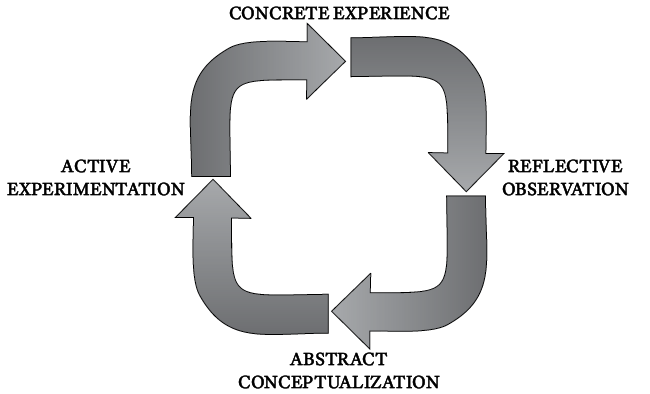
In the HSTPs, educators seek to provide opportunities for learners to have an experience, which often takes the form of an encounter with otherness.
Fueling the Fire: Reflection
Youth ministry practitioners have long noted that young people often prefer to “do stuff” rather than simply to listen or discuss, and a great many youth programs and curricula emphasize learning activities and projects. Yet while experiential education always involves activity, experiential educators do not simply ask young people to “do stuff.” Instead, they engage them in active, ongoing reflection on their activity. David Kolb, who popularized Dewey’s work in his model of experiential learning and his theory of learning styles, describes how learning happens cyclically through a continuous spiral of concrete experience, observation and reflection, formation of abstract concepts and generalizations, and finally testing through active experimentation, which leads to further experiences. He calls this process the “learning spiral.”
From the perspective of experiential education, it is not enough to do a one-off service project, to ask a young person to lead an element of worship or create an art project, and then claim the young person has learned something. Extracting what is meaningful, making connections to other ideas and experiences, and planning further work are all necessary in order to turn activities into learning moments. In the High School Theology Programs, such reflection is personal, communal, and theological, with the aim of transforming young people’s views of themselves, others, and God.
Fanning the Flame: Agency in Response
In experiential education, the learner has agency — freedom to respond honestly and creatively to encounters. While educators may have objectives in mind for a given lesson, they do not set a single agenda for what will happen in the learning process. This means that teachers relinquish some (though not all) control of learning outcomes, which can be threatening, especially in religious contexts. In one educational consultation at a church, in which we engaged in a process of open inquiry called “wondering,” one parent asked in an alarmed tone: “But what if the children think wrong thoughts? What if they think the wrong things about the story and don’t get the right answer?”
Figure 11.1 Kolb’s Experiential Learning Cycle
Theologically, we might respond that the willingness to reconsider accepted beliefs about God has led in the past to important revolutions of thought and action. In my own tradition, for example, I look at the radical young students in the early sixteenth century who, inspired by “crazy” ideas and stories of church reform that they were hearing from the continent, planted the seeds of the English Reformation; as adults, these students became key leaders in this reformation. They read Scripture in the context of a changing world around them and were inspired by the same stories that Christians had read for hundreds of years, but they reinterpreted them for the times in which they lived. Our students follow in their footsteps. They read Scripture and engage the world in their particular moment in time, while reconsidering accepted orthodoxies and finding ways to love God and neighbor that ring true today. A pedagogical approach that gives such freedom to the learner risks untraditional results, but it stands as part of a great tradition of faithful questioning.
Yet even as learners have tremendous freedom in experiential education, their learning is not unguided. Experiential education is not laissez-faire. The experiential educator does not set learners loose with no parameters, but seeks to construct and appropriately fence learning experiences, finessing the balance between structure, order, and boundaries, while allowing room for spontaneity, freedom, and invigorating (as opposed to overwhelming) chaos. Dewey regarded the main task of the teacher as providing learners with quality experiences that both build on prior knowledge and spur growth and creativity for subsequent experiences
Tending the Fire: Community
While individuals are certainly capable of learning from their own experience, experiential education emphasizes a learning community, in which learners work together, observe others’ actions, discuss plans, carry projects to completion, and — in an environment of safety and mutuality — offer encouragement, ideas, and criticism. For both educational and theological reasons, the HSTPs have invested themselves heavily in seeking how to best cultivate effective learning communities. Educationally, communities that offer both challenge and support give young people opportunities to explore what they believe, who they are, and how they want to live in the world. The encounter with new people, places, and stories is heightened when learners process their perspectives on it with others and listen to others’ perspectives. Theologically, supportive and challenging communities represent diakonia — fellowship — in the beloved community of God. In forming such communities, the HSTPs respond to Christ’s call to love one another. They also recognize that, beyond the theological imperatives, a community of safety, interdependence, inclusion, and mutuality is foundational to encouraging people to take risks with new ideas and ways of being.
Experiential Education in Practice:
Service, Leadership, and Creativity
Learning through Serving
One of the most basic expressions of Christian faith is the desire to give — to give generously of oneself for another, and to recognize the presence of Christ in the one being fed, clothed, visited, and sustained. Catholic theologian Jean-Luc Marion goes so far as to point out that love, understood through Jesus Christ, insists on giving, not on being — that the true calling of the human being is to be a divine gift, not a self-sufficient individual.
Although service is a component of discipleship, it can quickly go wrong. As we saw in Lorrie’s face-to-face encounter in the church meal program, the notion of service can polarize people into the privileged who serve and the disenfranchised who are served. This is not to say that advocacy or meeting human needs are unimportant, but our models of Christian service risk disconnecting good works from the realities of the people whom we serve. In some cases, our service (actions directed toward others) springs from ulterior motives or an alternative agenda such as conversion of the other (“our youth drop in centre is an opportunity for us to lead teenagers to Christ” or “we put Christian literature in the gift boxes that we send overseas”), attracting membership (“if kids come to the after school program then their parents might join the church”), gaining a privilege (“doing this will look good on a college application” or “if we volunteer at the soup kitchen every week, we get to go on the spring trip”), or perhaps even reassuring ourselves of our own salvation.
This last motive is a particular theological tangle, since we are not called to not serve others as a “symbol of Christ,” implying that serving them will get us to heaven or earn us favor with God. This may seem obvious, but it is an idea that insidiously creeps into our language and therefore our mindset. As Lorrie’s realization demonstrates, experiential learning helps young people reflect on others’ real situations as they come to terms with the fact that Christian service is a not an egocentric task. Instead, one’s relationship with Jesus must embody the love of Christ in the world (in our actions) and for the world (demonstrated in the radical ways Jesus lived his relationships with others in the Gospels). How can we engage in service in a way that truly honors others and responds to their real needs?
To engage in service well, we must deeply cherish the integrity of the other. Jean Vanier, philosopher, theologian, and founder of L’Arche (communities where people with developmental disabilities live together with caring friends), reflects in his writing on the importance of valuing the uniqueness and belovedness of the other:
The message of Jesus has often been mangled. Yet Jesus came to lead us all into a society that is a body, where each part, weak or strong, able or disabled, finds its place and is free. This vision of humanity, which is a vision of goodness and compassion for each person, comes from a God of Love.
We do not have to be the saviors of the world, Vanier argues, but simply human beings, “enfolded in weakness and in hope, called together to change our world one heart at a time.”
This kind of cherishing, if it is to avoid condescension and other pitfalls, requires significant reflection in which we help young people stop and ask, “Why are we doing what we are doing? Is the way we are doing it really of service? Is what we are doing really reflecting Christ?” We must examine the theological imperative to action, beyond simply saying, “It’s good to do good” or “Christ calls us to serve others.” Thoughtful experiential educators help young people ask questions like: “Who is actually being served by this action?” “How is the grace and presence of God revealed in this situation?” “What are the broader social and cultural realities that give rise to this need?” “How does this experience challenge our life and theology?”
Such questions can profoundly disrupt learners’ preconceived notions about themselves and the world — and educators should welcome such disruptions. Like the Pentecost moment when the Holy Spirit descended noisily on the disciples, moments of holy disruption open learners to God and ignite their theological and moral imaginations.
In the High School Theology Programs, youth learn about giving in myriad ways, from engaging in primary acts of service to one another (at Ask & Imagine, teenagers prepare and serve one another daily meals), to visiting and learning about social outreach organizations, to volunteering with service programs. At Ask & Imagine, youth go out into the community to visit service organizations, outreach programs for people with HIV/AIDS, meal programs, homeless shelters, chaplaincies at community housing projects, advocacy and support programs for people with addictions, and farms in the Canadian Foodgrains Bank. (Lorrie’s Urban Plunge experience was one of the options on this day.)
These “Faith-in-Action” days are intentionally structured, not as a day simply to “do good things,” but as an opportunity to engage with people who have made intentional, faith-driven life choices to come alongside others in service. This approach to service learning, in which our presence and listening is itself a form of self-giving love whether we “do good things” or not, has led to a number of lasting results. For example, seven years ago a young man named Brian chose to go to the local HIV/AIDS coalition for his Faith in Action day. He met people there whose lives had been touched by AIDS and were, as a result, now serving those affected by the disease. Since then, Brian has participated in an International HIV/AIDS conference, joined a theatrical group that does HIV/AIDS awareness and education in schools, and continues to be part of HIV/AIDS education and advocacy initiatives around the world. Brian credits that one visit with igniting this passion.
Second, these experiences help young people recognize that true service entails vulnerability of all involved. A case in point: on one day of visits, eighteen-year-old Jocelyn listened to Dean describe his choice to live at L’Arche. As Dean spoke about the death of one of the residents and the impact this disabled man had had on his life, he began to cry. Reflecting on the conversation later, Jocelyn said,
That was so huge for me. Dean is a person who really knows what he is about and what’s important. I want to live in a way that moves me so much that I am unashamed to cry in front of strangers when talking about my life and what I do. I want to be that vulnerable and strong at the same time.
Dean’s vulnerability in turn enabled Jocelyn to share honestly with her learning community, reflecting on the encounter and projecting a vision of herself into the future.
Finally, through encounter and reflection, youth often gain deeper understandings of — and confidence for working within — complex systems of poverty, hunger, prejudice, social injustice, and other problems. These layered understandings of social issues mean that, once youth leave the program, they are less likely to offer facile answers to complicated problems and more likely to seek out conversation and form nuanced responses. They are also more likely to take leadership in responding to issues they care about — the topic to which we now turn.
Learning through Leading
The leadership development aspect of Ask & Imagine did not elicit much excitement in Shannon, a shy introvert. Shannon never saw herself as a leader. She associated leadership with being an out-there, up-front, loud, and lively person. In her understanding, leaders were not shy or afraid to speak in groups. Shannon was in for a surprise. Over the two-week experience, she discovered that leaders could be people just like her who brought their quiet energy and commitment to ideas about which they were passionate. “Leadership,” she said after the program, “was about having the confidence to just be myself and initiate, and not try to just imitate other leaders that I saw in other contexts.”
As Shannon’s story suggests, a second major area of experiential learning occurs in participants’ opportunities for leadership — opportunities that often change their expectations about what leadership is. All HSTPs immerse young people in multi-layered opportunities for Christian leadership. Based on her experience directing Tomorrow’s Present, a program originally hosted by St. Francis’ Seminary (and now sponsored by Cardinal Stritch University), Lisa Calderone-Stewart discerned that giving teenagers agency as leaders and teachers provided them with transformative learning experiences that fueled their vocational discernment. She explains,
By teaching, we learn. When young people are challenged to become teachers, they are motivated to learn more so they can teach better. They begin to care about their audiences, and they want to offer their best. They see themselves as leaders. They develop ownership for passing on their messages. . . . That was the idea behind Tomorrow’s Present. Basically, we trained teenagers to teach workshops, and we watched how they learned. Here’s what we observed: Not only did the youth learn, but we adults learned as well. In fact, the young people improved the workshops tremendously. And many of the youth reported that these workshop practices and presentations were among the most significant experiences of their lives. They were transformational.
Because these leadership experiences were so powerful, Calderone-Stewart called her approach Transformational Ministry and grounded it in David Kolb’s learning cycle. Through leading and teaching, many youth in Tomorrow’s Present claimed a self-identity as Christian leaders and could foresee themselves seeking further leadership roles in faith communities in the future. Those youth who learned to teach through subject areas such as interfaith dialogue, hope building, or peace-making were often drawn to deeper study and engagement with those practices in their schools or congregations, in their post-secondary studies, or in volunteer commitments.
Using Calderone-Stewart’s models, at Ask & Imagine we teach youth strategies for planning and teaching, and intentionally seek to dismantle young people’s tendency to associate leadership with telling others what to do, being the boss, or leading the charge. Being a Christian leader is not about being bossy or domineering, but about being someone who, like Jesus, builds communities and enacts transformation by entering into relationship, giving oneself with passion and love, acting with courage, and giving others freedom to respond. Over time, our mentor team developed our own definition of leadership, drawing on the work of Margaret Wheatley and Harrison Owen: leadership is a relationship that unleashes potential.
Learning through Creating
A final practice of experiential education that recurs throughout High School Theology Programs involves creative production. Imagine this: Five young people are standing in a circle in a classroom with two young adult mentors. They are slapping their knees and clapping their hands in a steady four-four rhythm. Their eyes sparkle with excitement. As they hold the rhythm steady for one another, they take turns punching out a thirty-two-bar rap. The theme of the rap has nothing to do with traditional rap themes of relationships, rights, sexuality, angst, or anger. Instead, these young people are riffing on ecclesiology:
. . . I’ve got a tutorial
’bout the church as corporeal
living sleeping eating breathing
not just some memorial . . .
. . . We need room for skeptical honest interpretation
For formation of a movement towards nurturing creation . . .
intentional community
so we can be
hearts and hands
working for the good of all humanity . . .
This rap was part of an experimental project called Roots among the Rocks, in which the Faculty of Theology at Huron University College sought to engage arts, performance, music, theater, and theology. Roots among the Rocks emerged when, upon the tenth anniversary of Ask & Imagine, the Faculty of Theology wondered how they might find other ways to connect youth with theology, and specifically, what might happen if they invited young people into deep theological discourse and reflection on real life stories, and then commissioned them to create a theatrical piece out of that engagement.
The project brought a group of young people from Anglican, Lutheran, United Church, and Mennonite backgrounds together into intentional community for a month. They explored theology, Scripture, and church history with members of the Faculty of Theology. They also gathered source material in over seventy-five interviews with people ages eight to ninety-two, asking questions like:
The youth then set out to make a creative work that would express their own perspective on what they heard and learned. The point was not for them to perform a predetermined script or report back the project’s key message, but to engage in a creative process. They were given space to encounter stories, reflect on them together, and exercise agency in sharing what they had learned in community. The result was a project that participants deeply owned, and that changed and challenged them and their audiences.
The one-act play they created was performed in the style of theater known as Collective Creation or Devised Theater, which has been instrumental in creating performance pieces based on non-fiction stories that arise from local communities.
The rap cited above came out of a workshop with a musician after a lecture on church history and ecclesiology. The company of youth was asked to write their own answer to the question, “What is church?” in the form of a rap verse. Learning to rap was a stretch for a couple of youth who were classically trained vocalists. But their poetry was honest and hard-hitting on many issues that were causing church division. They wrote, for example,
The common cup is not a commodity —
You don’t need to hold property.
There ain’t no million-dollar-fee.
Jesus said:
“Ev’rybody come and get a piece o’ me.”
. . . I find it a pity that it is ruined by hypocrisy
Can’t you see this pettiness is making a mockery
Of the things we believe?
You know you’re causin’ a hindrance.
Don’t mean to upheave,
But you’re perpetuating ignorance.
I may be naïve,
But I don’t understand intolerance . . .
Clearly, these young people had reflected deeply on what they had learned, and, given agency, they spoke prophetically to their audience.
The audiences of Roots among the Rocks described it as inspiring and challenging, repeatedly saying that it offered them a fresh vision of church. At the premiere, one clergy person commented: “That was not what I expected — it was the most profound piece of theology that I have heard or read in years. I will be thinking about this for a long time!” Many audience members said they found encouragement and vision. One young theater student in a large urban center approached the director bluntly:
I do a lot of theater, and I’ve grown up in the church too. And this play was not what I expected it to be. To be honest, most church drama really blows, you know? It’s hokey, like it is trying to make a specific point and it hits you over the head repeatedly. With this play, that didn’t happen. I didn’t expect to be amazed and moved, but I totally was.
Numerous people who saw the play were surprised in another way. Some said, “We thought this was supposed to be youth ministry.” That is, they expected a play that taught the gospel to teenagers, rather than an event that gave youth a prophetic voice in expressing their understanding of the gospel. They were amazed that young people had listened to the stories of young and old and then retold those stories to the church in a provocative and inspiring way. They were surprised that youth had exercised agency, and they were moved by the results.
This example suggests that the arts provide a second language through which theological reflection can happen, as young artists gain access to new tools to express meaning. At Ask & Imagine, young people’s artistic offerings have included poetry about conformity, a video connecting cliff jumping with baptism, a painting about pain, and raps about ecclesiology. As they have workshopped their pieces, listened to feedback, and returned to the drawing board, they have discovered that creativity flourishes under the sun of sustained reflection in the context of a supportive and honest community.
This is experiential education at its best: it brings learners into encounters with new material, with others’ stories, and with real-world problems. It allows for and encourages reflection on those encounters in the context of a peer learning community, and it calls them to claim agency in responding to what they have learned — in our case, within a community of faith that asks for their active interpretation of centuries-old texts and traditions. This process helps learners open themselves to feedback that provides still more encounters, starting the “learning spiral” over again at a higher level. When they are given freedom and responsibility to create in community, youth are opened in new ways to the powerful and prophetic work of the Holy Spirit, who speaks through them to the church.
When a Fire Breaks Out
Compelling encounters send out sparks. It often only takes one story or a single compelling encounter with another’s narrative to catch a young person’s interest. Look carefully, and you will see sparks flash around Lorrie’s Urban Plunge encounter, Brian’s visit to the HIV/AIDS program, and Jocelyn’s experience of Dean’s tears. But a spark, an ember, goes out by itself. If you have ever had to light a reluctant campfire, you will recall the tipping point when the flame caught hold, just before the tiny roar of confident flames, after you gave it just enough space, the right fuel, sufficient air, enough shelter, and gentle encouragement. Without such coaxing, the spark dies. In a lecture to High School Theology Program directors in Indianapolis in 2003, theology professor Susan Thistlethwaite cautioned us, “It is incredibly easy to kill a vocation.” Put more positively, it takes deliberate care to fan the sparks of young people’s interest into the fire of lifelong discipleship and Christian vocation.
The task of educators is to provide young people with the flint and tinder of compelling encounters and the solid ground of an ancient story. We help a fire catch by encouraging reflection and active response in the context of a supportive and honest community. When educators and other caring adults fan the flames, we should not be surprised when the Holy Spirit lights a fire that, like a crucible, distills the very essence of the gospel from the lives of young people and the contexts in which they live. We do not provide encounters and opportunities for reflection and response just so that young people will adopt our ideologies or think only the “right thoughts.” In the process of experiential education, we honor what young people contribute — spurring them on to serve, to lead, and to express themselves prophetically to the church and the wider world.