
6. Atonement—Lev. 23:26–32 6. N
6. Atonement—Lev. 23:26–32 6. N/A 7. Booths— Lev. 23:33–44 7. Booths—Ezek. 45:25 ©1997 by Thomas Nelson, Inc.
EZEKIEL—NOTE ON 46:1–15 This section further discusses offerings and deals with: 1) Sabbath and new moon (vv. 1–8); 2) appointed feast days (vv. 9–11); 3) voluntary offerings (v. 12); and 4) daily sacrifices (vv. 13–15). Cf. Num. 28:1–15 for a summary of former Mosaic details.
EZEKIEL—NOTE ON 46:1 The gate . . . shall be shut. Shutting the gate six days seems to serve the purpose of giving special distinction to the Sabbath and new moon, when it is open and in use. Israel largely failed and was judged in ancient times in regard to these days (Jer. 17:22–27; cf. 2 Chron. 36:21). The Sabbath will be reinstated for a restored and regenerated Israel. Note here that modernday sabbatarians fail to realize that the Sabbath consisted of far more than just rest from labor, but included specific sacrifices. It is inconsistent to take one part of the Sabbath observance and discard the others.
EZEKIEL—NOTE ON 46:2 The prince. See note on 44:3. He appears five times (vv. 2, 4, 8, 10, 12) in regard to sacrifices. He is to be an example of spiritual integrity to the people (cf. v. 10).
EZEKIEL—NOTE ON 46:6–7 new moon. Israel's calendar was lunar, so the feasts were reckoned according to the phases of the moon.
EZEKIEL—NOTE ON 46:8 When the prince enters. He does not normally use the eastern gate itself, which is for the Lord (44:2). Rather, he enters and exits by the gate's vestibule. However, 46:12 permits his use of the gate for free-will offerings.
EZEKIEL—NOTE ON 46:9 the people. The people's entering and exiting for temple worship are to be done in an orderly flow to prevent congestion, since all will be present (cf. Deut. 16:16).
EZEKIEL—NOTE ON 46:10–12 the prince. He sets the example of worship for the people.
EZEKIEL—NOTE ON 46:13–15 daily. The testimony of the OT is that to remove the continual burnt offering meant an abolition of public worship (cf. Dan. 8:11–
EZEKIEL—NOTE ON 46:16–17 a gift. This explains inheritance laws governing the prince. A gift to one of his sons is permanent (v. 16), but a gift to a servant lasts only to the year of jubilee, the fiftieth year (cf. Lev. 25:10–13), and then returns to him (Ezek. 46:17).
EZEKIEL—NOTE ON 46:17 the year of liberty. The year of jubilee.
EZEKIEL—NOTE ON 46:18 The prince shall not take . . . inheritance. As in 45:8–9, the prince is not to confiscate others' property to enlarge his own holdings, as often occurred in Israel's history when rulers became rich by making others poor (cf. 1 Kings 21).
EZEKIEL—NOTE ON 46:19–24 chambers. The priests' kitchen chambers are convenient for managing their parts of the offerings and cooking sacrificial meals for worshipers, possibly close to the inner east gate. Those "who minister at the temple" (v. 24) are not the priests, but temple servants.
Ezekiel's Vision of Israel's New Boundaries c. 571 B.C.
Ezekiel's final vision describes the boundaries of a restored Israel, including the allotment to each tribe and the temple. Rather than following the boundaries traditionally occupied by the Israelites, which included Gilead east of the Jordan River and excluded land north of Tyre, Ezekiel's new boundaries generally follow those described by Moses in Num. 34. Ezekiel's vision also departs from the traditional allotment of the land among the 12 tribes and reassigns the land in horizontal bands from north to south.
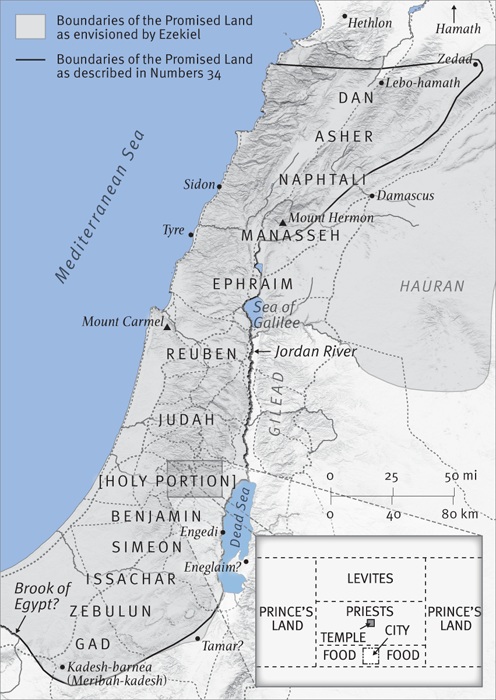
EZEKIEL—NOTE ON 47:1–12 This section reinforces the constant emphasis of the prophets that in the final kingdom amazing physical and geographical changes will occur on the earth, and especially the land of Israel. This chapter deals mainly with changes in the water.
EZEKIEL—NOTE ON 47:1–2 water was issuing . . . east. A stream of water flows up from underneath the temple (cf. Joel 3:18), going east to the Jordan, then curving south through the Dead Sea area (Ezek. 47:7–8). Zechariah 14:8 refers to this stream as flowing from Jerusalem to the west (Mediterranean Sea) as well as to the east (Dead Sea). Its origin coincides with Christ's second advent arrival on the Mount of Olives (cf. Zech. 14:4; Acts 1:11), which will trigger a massive earthquake, thus creating a vast east-west valley running through Jerusalem and allowing for the water flow. See note on Zech. 14:3–4.
EZEKIEL—NOTE ON 47:3–5 the man measured. The escorting angel, wanting to reveal the size of the river, took Ezekiel, in the vision, to four different distances from the temple, where the stream was found to be at increasing depths until it was over his head. Cf. Isa. 35:1–7, where the prophet says "the desert shall . . . blossom . . . like the crocus."
EZEKIEL—NOTE ON 47:7 very many trees. Lush growth from the river.
EZEKIEL—NOTE ON 47:8 water . . . become fresh. The flow east, then south, runs into the Dead Sea and renders good the salty water (more than six times as salty as the sea) that formerly would not support life because of its high mineral content. The Dead Sea is transformed into a "living sea" of fresh water.
EZEKIEL—NOTE ON 47:9 very many fish. These fish are said to be the same kinds in the Mediterranean (v. 10), probably referring to volume rather than species, since the river and the Dead Sea are fresh water.
EZEKIEL—NOTE ON 47:10 Engedi. The site is on the Dead Sea's west bank, about halfway along its length, near Masada. Eneglaim. Possibly it is Ein-Feska near Qumran at the northwestern extremity of the sea. Some argue for a site on the east bank, so that fishermen on both sides are in view.
EZEKIEL—NOTE ON 47:11 swamps and marshes. This could supply salt for the temple offerings (cf. 43:24), as well as for food.
EZEKIEL—NOTE ON 47:12 all kinds of trees. Cf. v. 7. The scene describes the blessing of returning to Eden-like abundance (Gen. 2:8–9, 16). leaves . . . fruit. Cf. Ezek. 47:7. The fruit is for food and the leaves serve a medicinal purpose, probably both in preventative and corrective senses. The fruit is perpetual, kept so by a continual and lavish supply of spring water from the temple.
EZEKIEL—NOTE ON 47:13–23 This is the boundary. The picture is that of an enlarged Canaan for all to inhabit. The boundaries are substantially larger than those given to Moses in Num. 34:1–15. Palestine, promised in God's covenant with Abraham (Ezek. 47:14; Gen. 12:7), has specific geographical limits within which Israel will finally occupy tribal areas that differ from the occupation in Joshua's day (cf. Josh. 13–22). This is the complete fulfillment of the promise of the land in the Abrahamic Covenant.
EZEKIEL—NOTE ON 47:13 Joseph . . . two portions. This is in keeping with the promise of Jacob to Joseph (Gen. 48:5–6, 22; 49:22–26).
EZEKIEL—NOTE ON 47:15–20 The borders of the millennial Promised Land are described 1) to the north (vv. 15–17); 2) to the east (v. 18); 3) to the south (v. 19); and 4) to the west (v. 20).
EZEKIEL—NOTE ON 47:22 have had children. This reminds us that children will be born all through the 1,000-year rule of Messiah. Not all will believe and be saved, as evidenced by the final rebellion (cf. Rev. 20:8–9).
EZEKIEL—NOTE ON 47:23 sojourner. This provision is in keeping with Lev. 19:34.
EZEKIEL—NOTE ON 48:1–7, 23–29 the tribes. The land pledged to each tribe within the total area described in 47:13–23 fulfills God's promises to actually restore Israel's people from around the world to the Promised Land just as they were actually scattered from it (28:25–26; 34–37; 39:21–29; Jer. 31:33). Dan is first mentioned. Though omitted from the 144,000 in Rev. 7, probably because of severe idolatry, Dan is restored in grace.
EZEKIEL—NOTE ON 48:8–22 the portion. Already described in 45:1–8, this unique area includes land allotment for the sentry and the Zadokian priests (48:8–12); the Levites (vv. 13–14); the city (vv. 15–20); and the prince (vv. 21– 22).
EZEKIEL—NOTE ON 48:30–35 These shall be the exits. Twelve city gates, three in each cardinal direction, bear the names of Israel's tribes, one on each gate.
EZEKIEL—NOTE ON 48:30 On the north side . . . 4,500 cubits. All four sides when added together equal 18,000 cubits (cf. v. 16), which is nearly 6 miles around. Josephus, a Jewish historian, reported in the first century A.D. that Jerusalem was approximately 4 miles in perimeter.
EZEKIEL—NOTE ON 48:35 the name. The city is called YHWH Shammah, "The Lord is there." The departed glory of God (chs. 8–11) has returned (44:1–2), and his dwelling, the temple, is in the very center of the district given over to the Lord. With this final note, all of the unconditional promises that God had made to Israel in the Abrahamic Covenant (Gen. 12); the Priestly Covenant (Num. 25); the Davidic Covenant (2 Sam. 7); and the New Covenant (Jer. 31) have been fulfilled. So this final verse provides the consummation of Israel's history—the returned presence of God!
Daniel
Daniel 1 • Daniel 2 • Daniel 3 • Daniel 4 • Daniel 5 • Daniel 6 • Daniel 7 •
Daniel 8 • Daniel 9 • Daniel 10 • Daniel 11 • Daniel 12 Introduction to Daniel
Title Author and Date Background and Setting Historical and Theological Themes Interpretive Challenges Outline Footnotes Study Notes
Introduction to Daniel
Title
According to Hebrew custom, the title is drawn from the prophet who throughout the book received revelations from God. Daniel bridges the entire 70 years of the Babylonian captivity (c. 605–536 B.C.; cf. 1:1 and 9:1–3). Nine of the 12 chapters relate revelation through dreams/visions. Daniel was God's mouthpiece to the Gentile and Jewish world, declaring God's current and future plans. What Revelation is to the NT prophetically and apocalyptically, Daniel is to the OT.
Author and Date
Several verses indicate that the writer is Daniel (8:15, 27; 9:2; 10:2, 7; 12:4–5), whose name means "God is my judge." He wrote in the autobiographical first person from 7:2 on, and is to be distinguished from the other three Daniels of the OT (cf. 1 Chron. 3:1; Ezra 8:2; Neh. 10:6). As a teenager, possibly about 15 years old, Daniel was kidnapped from his noble family in Judah and deported to Babylon to be brainwashed into Babylonian culture for the task of assisting in dealing with the imported Jews. There he spent the remainder of a long life (85 years or more). He made the most of the exile, successfully exalting God by his character and service. He quickly rose to the role of statesman by official royal appointment and served as a confidante of kings as well as a prophet in two world empires, i.e., the Babylonian (Dan. 2:48) and the Medo-Persian (6:1–2). Christ confirmed Daniel as the author of this book (cf. Matt. 24:15).
Daniel lived beyond the time described in Dan. 10:1 (c. 536 B.C.). It seems most probable that he wrote the book shortly after this date but before c. 530 B.C. Daniel 2:4b–7:28, which prophetically describes the course of Gentile world history, was originally and appropriately written in Aramaic, the contemporary language of international business. Ezekiel, Habakkuk, Jeremiah, and Zephaniah were Daniel's prophetic contemporaries.
Background and Setting
The book begins in 605 B.C. when Babylon conquered Jerusalem and exiled Daniel, his three friends, and others. It continues to the eventual demise of Babylonian supremacy in 539 B.C., when Medo-Persian besiegers conquered Babylon (5:30–31), and goes even beyond that to 536 B.C. (10:1). After Daniel was transported to Babylon, the Babylonian victors conquered Jerusalem in two further stages (597 B.C. and 586 B.C.). In both takeovers, they deported more Jewish captives. Daniel passionately remembered his home, particularly the temple at Jerusalem, almost 70 years after having been taken away from it (6:10).
Daniel's background is alluded to in part by Jeremiah, who names three of the last five kings in Judah before captivity (cf. Jer. 1:1–3): Josiah (c. 641–609 B.C.), Jehoiakim (c. 609–597 B.C.) and Zedekiah (597–586 B.C.). Jehoahaz (c. 609 B.C.) and Jehoiachin (c. 598–597 B.C.) are not mentioned (cf. Jeremiah Introduction: Background and Setting). Daniel is also mentioned by Ezekiel (cf. Ezek. 14:14, 20; 28:3) as being righteous and wise. He is alluded to by the writer of Hebrews as one of "the prophets—who through faith . . . stopped the mouths of lions" (Heb. 11:32–33).
The long-continued sin of the Judeans without national repentance eventually led to God's judgment for which Jeremiah, Habakkuk, and Zephaniah had given fair warning. Earlier, Isaiah and other faithful prophets of God had also trumpeted the danger. When Assyrian power had ebbed by 625 B.C., the Neo-Babylonians conquered: 1) Assyria with its capital Nineveh in 612 B.C.; 2) Egypt in the following years; and 3) Judah in 605 B.C. when they overthrew Jerusalem in the first of three steps (also 597 B.C., 586 B.C.). Daniel was one of the first groups of deportees, and Ezekiel followed in 597 B.C.
Israel of the northern kingdom had earlier fallen to Assyria in 722 B.C. With Judah's captivity, the judgment was complete. In Babylon, Daniel received God's word concerning successive stages of Gentile world domination through the centuries until the greatest Conqueror, Messiah, would put down all Gentile lordship. He then will defeat all foes and raise his covenant people to blessing in his glorious millennial kingdom.
Historical and Theological Themes
Daniel was written to encourage the exiled Jews by revealing God's program for them, both during and after the time of Gentile power in the world. Prominent above every other theme in the book is God's sovereign control over the affairs of all rulers and nations, and their final replacement with the true King. The key verses are 2:20–22, 44 (cf. 2:28, 37; 4:34–35; 6:25–27). God had not suffered defeat in allowing Israel's fall (Dan. 1), but was providentially working his sure purposes toward an eventual full display of his King, the exalted Christ. He sovereignly allowed Gentiles to dominate Israel, i.e., Babylon (605–539 B.C.), Medo-Persia (539–331 B.C.), Greece (331–146 B.C.), Rome (146 B.C.–A.D. 476), and all the way to the second advent of Christ. These stages in Gentile power are set forth in chs. 2 and 7. This same theme also embraces Israel's experience both in defeat and finally in her kingdom blessing in chs. 8–12 (cf. 2:35, 45; 7:27). A key aspect within the overarching theme of God's kingly control is Messiah's coming to rule the world in glory over all men (2:35, 45; 7:13–14, 27). He is like a stone in ch. 2, and like a son of man in ch. 7. In addition, he is the Anointed One (Messiah) in 9:26. Chapter 9 provides the chronological framework from Daniel's time to Christ's kingdom.
A second theme woven into the fabric of Daniel is the display of God's sovereign power through miracles. Daniel's era is one of six in the Bible with a major focus on miracles by which God accomplished his purposes. Other periods include: 1) the creation and flood (Gen. 1–11); 2) the patriarchs and Moses (Gen. 12–Deut.); 3) Elijah and Elisha (1 Kings 17–2 Kings 13); 4) Jesus and the apostles (Gospels, Acts); and 5) the time of the second advent (Revelation). God, who has everlasting dominion and ability to work according to his will (Dan. 4:34–35), is capable of miracles, all of which would be lesser displays of power than was exhibited when he acted as Creator in Gen. 1:1. Daniel chronicles the God-enabled recounting and interpreting of dreams that God used to reveal his will (Dan. 2; 4; 7). Other miracles included: 1) his writing on the wall and Daniel's interpreting it (ch. 5); 2) his protection of the three men in a blazing furnace (ch. 3); 3) his provision of safety for Daniel in a lions' den (ch. 6); and 4) supernatural prophecies (chs. 2; 7; 8; 9:24–12:13).
Interpretive Challenges
The main challenges center on interpreting passages about future tribulation and kingdom promises. Though the use of Imperial Aramaic and archeology have confirmed the early date of writing, some skeptical interpreters, unwilling to acknowledge supernatural prophecies that came to pass (there are over 100 in ch. 11 alone that were fulfilled), place these details in the intertestamental times.
They see these prophecies, not as miraculously foretelling the future, but as simply the observations of a later writer, who is recording events of his own day. Thus, they date Daniel in the days of Antiochus IV Epiphanes (175–164 B.C., ch. 8; 11:21–45). According to this scheme, the expectation of the stone and son of man (chs. 2; 7) turned out to be a mistaken notion that did not actually come to pass, or the writer was being intentionally deceptive. Actually, a future sevenyear judgment period (cf. 7:21–22; 11:36–45; 12:1) and a literal 1,000-year kingdom (cf. Rev. 20) after Christ's second coming when he will reign over Israelites and Gentiles (Dan. 7:27) are taught. This will be an era before and distinct from the final, absolutely perfect, ultimate state, i.e., the new heaven and the new earth with its capital, the new Jerusalem (Rev. 21–22). The literal interpretation of prophecy, including Daniel, leads to the premillennial perspective.
Many other aspects of interpretation challenge readers: e.g., interpreting numbers (1:12, 20; 3:19; 9:24–27); identifying the one like a son of man (7:13– 14); determining whether to see Antiochus of the past or Antichrist of the far future in 8:19–23; explaining the "seventy weeks" in 9:24–27; and deciding whether Antiochus of 11:21–35 is still meant in 11:36–45, or whether it is the future Antichrist.
Outline
I. The Personal Background of Daniel (1:1–21)
A. Conquest of Jerusalem (1:1–2)
B. Conscription of Jews for Training (1:3–7) C. Courage of Four Men in Trial (1:8–16) D. Choice of Four Men for Royal Positions (1:17–21) II. The Prophetic Course of Gentile Dominion (2:1–7:28)
A. Dilemmas of Nebuchadnezzar (2:1–4:37)
B. Debauchery and Demise of Belshazzar (5:1–31) C. Deliverance of Daniel (6:1–28) D. Dream of Daniel (7:1–28) III. The Prophetic Course of Israel's Destiny (8:1–12:13)
A. Prophecy of the Ram and Male Goat (8:1–27)
B. Prophecy of the Seventy Weeks (9:1–27) C. Prophecy of Israel's Humiliation and Restoration (10:1–12:13)
Daniel
Daniel Taken to Babylon
DANIEL 1 †In the third year of the reign of Jehoiakim king of Judah, Nebuchadnezzar king of Babylon came to Jerusalem and besieged it. 2†And the Lord gave Jehoiakim king of Judah into his hand, with some of the vessels of the house of God. And he brought them to the land of Shinar, to the house of his god, and placed the vessels in the treasury of his god. 3Then the king commanded Ashpenaz, his chief eunuch, to bring some of the people of Israel, both of the royal family [1] and of the nobility, 4†youths without blemish, of good appearance and skillful in all wisdom, endowed with knowledge, understanding learning, and competent to stand in the king's palace, and to teach them the literature and language of the Chaldeans. 5†The king assigned them a daily portion of the food that the king ate, and of the wine that he drank. They were to be educated for three years, and at the end of that time they were to stand before the king. 6Among these were Daniel, Hananiah, Mishael, and Azariah of the tribe of Judah. 7†And the chief of the eunuchs gave them names: Daniel he called Belteshazzar, Hananiah he called Shadrach, Mishael he called Meshach, and Azariah he called Abednego.
Daniel's Faithfulness
Daniel resolved that he would not defile himself with the king's food, or with the wine that he drank. Therefore he asked the chief of the eunuchs to allow him not to defile himself. 9†And God gave Daniel favor and compassion in the sight of the chief of the eunuchs, 10and the chief of the eunuchs said to Daniel, "I fear my lord the king, who assigned your food and your drink; for why should he see that you were in worse condition than the youths who are of your own age? So you would endanger my head with the king." 11Then Daniel said to the steward whom the chief of the eunuchs had assigned over Daniel, Hananiah, Mishael, and Azariah, 12†"Test your servants for ten days; let us be given vegetables to eat and water to drink. 13Then let our appearance and the appearance of the youths who eat the king's food be observed by you, and deal with your servants according to what you see." 14So he listened to them in this matter, and tested them for ten days. 15†At the end of ten days it was seen that they were better in appearance and fatter in flesh than all the youths who ate the king's food. 16So the steward took away their food and the wine they were to drink, and gave them vegetables.
17As for these four youths, God gave them learning and skill in all literature and wisdom, and Daniel had understanding in all visions and dreams. 18At the end of the time, when the king had commanded that they should be brought in, the chief of the eunuchs brought them in before Nebuchadnezzar. 19And the king spoke with them, and among all of them none was found like Daniel, Hananiah, Mishael, and Azariah. Therefore they stood before the king. 20†And in every matter of wisdom and understanding about which the king inquired of them, he found them ten times better than all the magicians and enchanters that were in all his kingdom. 21†And Daniel was there until the first year of King Cyrus.
Nebuchadnezzar's Dream
DANIEL 2 †In the second year of the reign of Nebuchadnezzar, Nebuchadnezzar had dreams; his spirit was troubled, and his sleep left him. 2†Then the king commanded that the magicians, the enchanters, the sorcerers, and the Chaldeans be summoned to tell the king his dreams. So they came in and stood before the king. 3And the king said to them, "I had a dream, and my spirit is troubled to know the dream." 4†Then the Chaldeans said to the king in Aramaic, [1] "O king, live forever! Tell your servants the dream, and we will show the interpretation." 5†The king answered and said to the Chaldeans, "The word from me is firm: if you do not make known to me the dream and its interpretation, you shall be torn limb from limb, and your houses shall be laid in ruins. 6But if you show the dream and its interpretation, you shall receive from me gifts and rewards and great honor. Therefore show me the dream and its interpretation." 7†They answered a second time and said, "Let the king tell his servants the dream, and we will show its interpretation." 8The king answered and said, "I know with certainty that you are trying to gain time, because you see that the word from me is firm— 9if you do not make the dream known to me, there is but one sentence for you. You have agreed to speak lying and corrupt words before me till the times change. Therefore tell me the dream, and I shall know that you can show me its interpretation." 10The Chaldeans answered the king and said, "There is not a man on earth who can meet the king's demand, for no great and powerful king has asked such a thing of any magician or enchanter or Chaldean. 11The thing that the king asks is difficult, and no one can show it to the king except the gods, whose dwelling is not with flesh."
12Because of this the king was angry and very furious, and commanded that all the wise men of Babylon be destroyed. 13So the decree went out, and the wise men were about to be killed; and they sought Daniel and his companions, to kill them. 14Then Daniel replied with prudence and discretion to Arioch, the captain of the king's guard, who had gone out to kill the wise men of Babylon. 15He declared [2] to Arioch, the king's captain, "Why is the decree of the king so urgent?" Then Arioch made the matter known to Daniel. 16And Daniel went in and requested the king to appoint him a time, that he might show the interpretation to the king.
God Reveals Nebuchadnezzar's Dream
17Then Daniel went to his house and made the matter known to Hananiah, Mishael, and Azariah, his companions, 18and told them to seek mercy from the God of heaven concerning this mystery, so that Daniel and his companions might not be destroyed with the rest of the wise men of Babylon. 19Then the mystery was revealed to Daniel in a vision of the night. Then Daniel blessed the God of heaven. 20‡Daniel answered and said: "Blessed be the name of God forever and ever, to whom belong wisdom and might.
21He changes times and seasons; he removes kings and sets up kings; he gives wisdom to the wise and knowledge to those who have understanding; 22he reveals deep and hidden things; he knows what is in the darkness, and the light dwells with him. 23To you, O God of my fathers, I give thanks and praise, for you have given me wisdom and might, and have now made known to me what we asked of you, for you have made known to us the king's matter."
24Therefore Daniel went in to Arioch, whom the king had appointed to destroy the wise men of Babylon. He went and said thus to him: "Do not destroy the wise men of Babylon; bring me in before the king, and I will show the king the interpretation."
25Then Arioch brought in Daniel before the king in haste and said thus to him: "I have found among the exiles from Judah a man who will make known to the king the interpretation." 26The king declared to Daniel, whose name was Belteshazzar, "Are you able to make known to me the dream that I have seen and its interpretation?" 27Daniel answered the king and said, "No wise men, enchanters, magicians, or astrologers can show to the king the mystery that the king has asked, 28†but there is a God in heaven who reveals mysteries, and he has made known to King Nebuchadnezzar what will be in the latter days. Your dream and the visions of your head as you lay in bed are these: 29To you, O king, as you lay in bed came thoughts of what would be after this, and he who reveals mysteries made known to you what is to be. 30But as for me, this mystery has been revealed to me, not because of any wisdom that I have more than all the living, but in order that the interpretation may be made known to the king, and that you may know the thoughts of your mind.
Daniel Interprets the Dream
31"You saw, O king, and behold, a great image. This image, mighty and of exceeding brightness, stood before you, and its appearance was frightening. 32The head of this image was of fine gold, its chest and arms of silver, its middle and thighs of bronze, 33its legs of iron, its feet partly of iron and partly of clay. 34As you looked, a stone was cut out by no human hand, and it struck the image on its feet of iron and clay, and broke them in pieces. 35Then the iron, the clay, the bronze, the silver, and the gold, all together were broken in pieces, and became like the chaff of the summer threshing floors; and the wind carried them away, so that not a trace of them could be found. But the stone that struck the image became a great mountain and filled the whole earth.
was the dream. Now we will tell the king its interpretation. 37You, O king, the king of kings, to whom the God of heaven has given the kingdom, the power, and the might, and the glory, 38and into whose hand he has given, wherever they dwell, the children of man, the beasts of the field, and the birds of the heavens, making you rule over them all—you are the head of gold. 39†Another kingdom inferior to you shall arise after you, and yet a third kingdom of bronze, which shall rule over all the earth. 40†And there shall be a fourth kingdom, strong as iron, because iron breaks to pieces and shatters all things. And like iron that crushes, it shall break and crush all these. 41‡†And as you saw the feet and toes, partly of potter's clay and partly of iron, it shall be a divided kingdom, but some of the firmness of iron shall be in it, just as you saw iron mixed with the soft clay. 42And as the toes of the feet were partly iron and partly clay, so the kingdom shall be partly strong and partly brittle. 43As you saw the iron mixed with soft clay, so they will mix with one another in marriage, [3] but they will not hold together, just as iron does not mix with clay. 44†And in the days of those kings the God of heaven will set up a kingdom that shall never be destroyed, nor shall the kingdom be left to another people. It shall break in pieces all these kingdoms and bring them to an end, and it shall stand forever, 45†just as you saw that a stone was cut from a mountain by no human hand, and that it broke in pieces the iron, the bronze, the clay, the silver, and the gold. A great God has made known to the king what shall be after this. The dream is certain, and its interpretation sure."
Daniel Is Promoted
46Then King Nebuchadnezzar fell upon his face and paid homage to Daniel, and commanded that an offering and incense be offered up to him. 47The king answered and said to Daniel, "Truly, your God is God of gods and Lord of kings, and a revealer of mysteries, for you have been able to reveal this mystery."
48Then the king gave Daniel high honors and many great gifts, and made him ruler over the whole province of Babylon and chief prefect over all the wise men of Babylon. 49Daniel made a request of the king, and he appointed Shadrach, Meshach, and Abednego over the affairs of the province of Babylon. But Daniel remained at the king's court.
Nebuchadnezzar's Golden Image
DANIEL 3 †King Nebuchadnezzar made an image of gold, whose height was sixty cubits [1] and its breadth six cubits. He set it up on the plain of Dura, in the province of Babylon. 2†Then King Nebuchadnezzar sent to gather the satraps, the prefects, and the governors, the counselors, the treasurers, the justices, the magistrates, and all the officials of the provinces to come to the dedication of the image that King Nebuchadnezzar had set up. 3Then the satraps, the prefects, and the governors, the counselors, the treasurers, the justices, the magistrates, and all the officials of the provinces gathered for the dedication of the image that King Nebuchadnezzar had set up. And they stood before the image that Nebuchadnezzar had set up. 4And the herald proclaimed aloud, "You are commanded, O peoples, nations, and languages, 5†that when you hear the sound of the horn, pipe, lyre, trigon, harp, bagpipe, and every kind of music, you are to fall down and worship the golden image that King Nebuchadnezzar has set up. 6†And whoever does not fall down and worship shall immediately be cast into a burning fiery furnace." 7Therefore, as soon as all the peoples heard the sound of the horn, pipe, lyre, trigon, harp, bagpipe, and every kind of music, all the peoples, nations, and languages fell down and worshiped the golden image that King Nebuchadnezzar had set up.
The Fiery Furnace
at that time certain Chaldeans came forward and maliciously accused the Jews. 9They declared [2] to King Nebuchadnezzar, "O king, live forever! 10You, O king, have made a decree, that every man who hears the sound of the horn, pipe, lyre, trigon, harp, bagpipe, and every kind of music, shall fall down and worship the golden image. 11And whoever does not fall down and worship shall be cast into a burning fiery furnace. 12†There are certain Jews whom you have appointed over the affairs of the province of Babylon: Shadrach, Meshach, and Abednego. These men, O king, pay no attention to you; they do not serve your gods or worship the golden image that you have set up."
Nebuchadnezzar in furious rage commanded that Shadrach, Meshach, and Abednego be brought. So they brought these men before the king. 14Nebuchadnezzar answered and said to them, "Is it true, O Shadrach, Meshach, and Abednego, that you do not serve my gods or worship the golden image that I have set up? 15†Now if you are ready when you hear the sound of the horn, pipe, lyre, trigon, harp, bagpipe, and every kind of music, to fall down and worship the image that I have made, well and good. [3] But if you do not worship, you shall immediately be cast into a burning fiery furnace. And who is the god who will deliver you out of my hands?"
Meshach, and Abednego answered and said to the king, "O Nebuchadnezzar, we have no need to answer you in this matter. 17If this be so, our God whom we serve is able to deliver us from the burning fiery furnace, and he will deliver us out of your hand, O king. [4] 18But if not, be it known to you, O king, that we will not serve your gods or worship the golden image that you have set up."
Nebuchadnezzar was filled with fury, and the expression of his face was changed against Shadrach, Meshach, and Abednego. He ordered the furnace heated seven times more than it was usually heated. 20And he ordered some of the mighty men of his army to bind Shadrach, Meshach, and Abednego, and to cast them into the burning fiery furnace. 21Then these men were bound in their cloaks, their tunics, [5] their hats, and their other garments, and they were thrown into the burning fiery furnace. 22†Because the king's order was urgent and the furnace overheated, the flame of the fire killed those men who took up Shadrach, Meshach, and Abednego. 23†And these three men, Shadrach, Meshach, and Abednego, fell bound into the burning fiery furnace.
24Then King Nebuchadnezzar was astonished and rose up in haste. He declared to his counselors, "Did we not cast three men bound into the fire?" They answered and said to the king, "True, O king." 25†He answered and said, "But I see four men unbound, walking in the midst of the fire, and they are not hurt; and the appearance of the fourth is like a son of the gods."
26Then Nebuchadnezzar came near to the door of the burning fiery furnace; he declared, "Shadrach, Meshach, and Abednego, servants of the Most High God, come out, and come here!" Then Shadrach, Meshach, and Abednego came out from the fire. 27†And the satraps, the prefects, the governors, and the king's counselors gathered together and saw that the fire had not had any power over the bodies of those men. The hair of their heads was not singed, their cloaks were not harmed, and no smell of fire had come upon them. 28‡Nebuchadnezzar answered and said, "Blessed be the God of Shadrach, Meshach, and Abednego, who has sent his angel and delivered his servants, who trusted in him, and set aside [6] the king's command, and yielded up their bodies rather than serve and worship any god except their own God. 29Therefore I make a decree: Any people, nation, or language that speaks anything against the God of Shadrach, Meshach, and Abednego shall be torn limb from limb, and their houses laid in ruins, for there is no other god who is able to rescue in this way." 30Then the king promoted Shadrach, Meshach, and Abednego in the province of Babylon.
Nebuchadnezzar Praises God
DANIEL 4 ‡ [1] King Nebuchadnezzar to all peoples, nations, and languages, that dwell in all the earth: Peace be multiplied to you! 2It has seemed good to me to show the signs and wonders that the Most High God has done for me.
3How great are his signs, how mighty his wonders! His kingdom is an everlasting kingdom, and his dominion endures from generation to generation.
Nebuchadnezzar's Second Dream
4 [2] I, Nebuchadnezzar, was at ease in my house and prospering in my palace. 5I saw a dream that made me afraid. As I lay in bed the fancies and the visions of my head alarmed me. 6†So I made a decree that all the wise men of Babylon should be brought before me, that they might make known to me the interpretation of the dream. 7Then the magicians, the enchanters, the Chaldeans, and the astrologers came in, and I told them the dream, but they could not make known to me its interpretation. 8†At last Daniel came in before me—he who was named Belteshazzar after the name of my god, and in whom is the spirit of the holy gods [3]—and I told him the dream, saying, 9†"O Belteshazzar, chief of the magicians, because I know that the spirit of the holy gods is in you and that no mystery is too difficult for you, tell me the visions of my dream that I saw and their interpretation. 10‡The visions of my head as I lay in bed were these: I saw, and behold, a tree in the midst of the earth, and its height was great. 11The tree grew and became strong, and its top reached to heaven, and it was visible to the end of the whole earth. 12Its leaves were beautiful and its fruit abundant, and in it was food for all. The beasts of the field found shade under it, and the birds of the heavens lived in its branches, and all flesh was fed from it.
saw in the visions of my head as I lay in bed, and behold, a watcher, a holy one, came down from heaven. 14He proclaimed aloud and said thus: 'Chop down the tree and lop off its branches, strip off its leaves and scatter its fruit. Let the beasts flee from under it and the birds from its branches. 15†But leave the stump of its roots in the earth, bound with a band of iron and bronze, amid the tender grass of the field. Let him be wet with the dew of heaven. Let his portion be with the beasts in the grass of the earth. 16†Let his mind be changed from a man's, and let a beast's mind be given to him; and let seven periods of time pass over him. 17The sentence is by the decree of the watchers, the decision by the word of the holy ones, to the end that the living may know that the Most High rules the kingdom of men and gives it to whom he will and sets over it the lowliest of men.' 18This dream I, King Nebuchadnezzar, saw. And you, O Belteshazzar, tell me the interpretation, because all the wise men of my kingdom are not able to make known to me the interpretation, but you are able, for the spirit of the holy gods is in you."
Daniel Interprets the Second Dream
Daniel, whose name was Belteshazzar, was dismayed for a while, and his thoughts alarmed him. The king answered and said, "Belteshazzar, let not the dream or the interpretation alarm you." Belteshazzar answered and said, "My lord, may the dream be for those who hate you and its interpretation for your enemies! 20The tree you saw, which grew and became strong, so that its top reached to heaven, and it was visible to the end of the whole earth, 21whose leaves were beautiful and its fruit abundant, and in which was food for all, under which beasts of the field found shade, and in whose branches the birds of the heavens lived— 22it is you, O king, who have grown and become strong. Your greatness has grown and reaches to heaven, and your dominion to the ends of the earth. 23And because the king saw a watcher, a holy one, coming down from heaven and saying, 'Chop down the tree and destroy it, but leave the stump of its roots in the earth, bound with a band of iron and bronze, in the tender grass of the field, and let him be wet with the dew of heaven, and let his portion be with the beasts of the field, till seven periods of time pass over him,' 24this is the interpretation, O king: It is a decree of the Most High, which has come upon my lord the king, 25that you shall be driven from among men, and your dwelling shall be with the beasts of the field. You shall be made to eat grass like an ox, and you shall be wet with the dew of heaven, and seven periods of time shall pass over you, till you know that the Most High rules the kingdom of men and gives it to whom he will. 26†And as it was commanded to leave the stump of the roots of the tree, your kingdom shall be confirmed for you from the time that you know that Heaven rules. 27†Therefore, O king, let my counsel be acceptable to you: break off your sins by practicing righteousness, and your iniquities by showing mercy to the oppressed, that there may perhaps be a lengthening of your prosperity."
Nebuchadnezzar's Humiliation
28All this came upon King Nebuchadnezzar. 29At the end of twelve months he was walking on the roof of the royal palace of Babylon, 30†and the king answered and said, "Is not this great Babylon, which I have built by my mighty power as a royal residence and for the glory of my majesty?" 31While the words were still in the king's mouth, there fell a voice from heaven, "O King Nebuchadnezzar, to you it is spoken: The kingdom has departed from you, 32and you shall be driven from among men, and your dwelling shall be with the beasts of the field. And you shall be made to eat grass like an ox, and seven periods of time shall pass over you, until you know that the Most High rules the kingdom of men and gives it to whom he will." 33Immediately the word was fulfilled against Nebuchadnezzar. He was driven from among men and ate grass like an ox, and his body was wet with the dew of heaven till his hair grew as long as eagles' feathers, and his nails were like birds' claws.
Nebuchadnezzar Restored
the end of the days I, Nebuchadnezzar, lifted my eyes to heaven, and my reason returned to me, and I blessed the Most High, and praised and honored him who lives forever, for his dominion is an everlasting dominion, and his kingdom endures from generation to generation; 35all the inhabitants of the earth are accounted as nothing, and he does according to his will among the host of heaven and among the inhabitants of the earth; and none can stay his hand or say to him, "What have you done?"
36At the same time my reason returned to me, and for the glory of my kingdom, my majesty and splendor returned to me. My counselors and my lords sought me, and I was established in my kingdom, and still more greatness was added to me. 37Now I, Nebuchadnezzar, praise and extol and honor the King of heaven, for all his works are right and his ways are just; and those who walk in pride he is able to humble.
The Handwriting on the Wall
DANIEL 5 †King Belshazzar made a great feast for a thousand of his lords and drank wine in front of the thousand.
when he tasted the wine, commanded that the vessels of gold and of silver that Nebuchadnezzar his father [1] had taken out of the temple in Jerusalem be brought, that the king and his lords, his wives, and his concubines might drink from them. 3Then they brought in the golden vessels that had been taken out of the temple, the house of God in Jerusalem, and the king and his lords, his wives, and his concubines drank from them. 4†They drank wine and praised the gods of gold and silver, bronze, iron, wood, and stone.
the fingers of a human hand appeared and wrote on the plaster of the wall of the king's palace, opposite the lampstand. And the king saw the hand as it wrote. 6Then the king's color changed, and his thoughts alarmed him; his limbs gave way, and his knees knocked together. 7‡The king called loudly to bring in the enchanters, the Chaldeans, and the astrologers. The king declared [2] to the wise men of Babylon, "Whoever reads this writing, and shows me its interpretation, shall be clothed with purple and have a chain of gold around his neck and shall be the third ruler in the kingdom." 8Then all the king's wise men came in, but they could not read the writing or make known to the king the interpretation. 9Then King Belshazzar was greatly alarmed, and his color changed, and his lords were perplexed.
queen, [3] because of the words of the king and his lords, came into the banqueting hall, and the queen declared, "O king, live forever! Let not your thoughts alarm you or your color change. 11There is a man in your kingdom in whom is the spirit of the holy gods. [4] In the days of your father, light and understanding and wisdom like the wisdom of the gods were found in him, and King Nebuchadnezzar, your father—your father the king—made him chief of the magicians, enchanters, Chaldeans, and astrologers, 12because an excellent spirit, knowledge, and understanding to interpret dreams, explain riddles, and solve problems were found in this Daniel, whom the king named Belteshazzar. Now let Daniel be called, and he will show the interpretation."
Daniel Interprets the Handwriting
Daniel was brought in before the king. The king answered and said to Daniel, "You are that Daniel, one of the exiles of Judah, whom the king my father brought from Judah. 14I have heard of you that the spirit of the gods [5] is in you, and that light and understanding and excellent wisdom are found in you. 15Now the wise men, the enchanters, have been brought in before me to read this writing and make known to me its interpretation, but they could not show the interpretation of the matter. 16†But I have heard that you can give interpretations and solve problems. Now if you can read the writing and make known to me its interpretation, you shall be clothed with purple and have a chain of gold around your neck and shall be the third ruler in the kingdom."
17Then Daniel answered and said before the king, "Let your gifts be for yourself, and give your rewards to another. Nevertheless, I will read the writing to the king and make known to him the interpretation. 18O king, the Most High God gave Nebuchadnezzar your father kingship and greatness and glory and majesty. 19And because of the greatness that he gave him, all peoples, nations, and languages trembled and feared before him. Whom he would, he killed, and whom he would, he kept alive; whom he would, he raised up, and whom he would, he humbled. 20But when his heart was lifted up and his spirit was hardened so that he dealt proudly, he was brought down from his kingly throne, and his glory was taken from him. 21He was driven from among the children of mankind, and his mind was made like that of a beast, and his dwelling was with the wild donkeys. He was fed grass like an ox, and his body was wet with the dew of heaven, until he knew that the Most High God rules the kingdom of mankind and sets over it whom he will. 22And you his son, [6] Belshazzar, have not humbled your heart, though you knew all this, 23but you have lifted up yourself against the Lord of heaven. And the vessels of his house have been brought in before you, and you and your lords, your wives, and your concubines have drunk wine from them. And you have praised the gods of silver and gold, of bronze, iron, wood, and stone, which do not see or hear or know, but the God in whose hand is your breath, and whose are all your ways, you have not honored.
24"Then from his presence the hand was sent, and this writing was inscribed. 25‡And this is the writing that was inscribed: MENE, MENE, TEKEL, and PARSIN. 26This is the interpretation of the matter: MENE, God has numbered [7] the days of your kingdom and brought it to an end; 27TEKEL, you have been weighed [8] in the balances and found wanting; 28PERES, your kingdom is divided and given to the Medes and Persians." [9]
29Then Belshazzar gave the command, and Daniel was clothed with purple, a chain of gold was put around his neck, and a proclamation was made about him, that he should be the third ruler in the kingdom.
very night Belshazzar the Chaldean king was killed. 31† [10] And Darius the Mede received the kingdom, being about sixty-two years old.
Daniel and the Lions' Den
DANIEL 6 †It pleased Darius to set over the kingdom 120 satraps, to be throughout the whole kingdom; 2†and over them three presidents, of whom Daniel was one, to whom these satraps should give account, so that the king might suffer no loss. 3†Then this Daniel became distinguished above all the other presidents and satraps, because an excellent spirit was in him. And the king planned to set him over the whole kingdom. 4†Then the presidents and the satraps sought to find a ground for complaint against Daniel with regard to the kingdom, but they could find no ground for complaint or any fault, because he was faithful, and no error or fault was found in him. 5Then these men said, "We shall not find any ground for complaint against this Daniel unless we find it in connection with the law of his God."
6Then these presidents and satraps came by agreement [1] to the king and said to him, "O King Darius, live forever! 7†All the presidents of the kingdom, the prefects and the satraps, the counselors and the governors are agreed that the king should establish an ordinance and enforce an injunction, that whoever makes petition to any god or man for thirty days, except to you, O king, shall be cast into the den of lions. 8†Now, O king, establish the injunction and sign the document, so that it cannot be changed, according to the law of the Medes and the Persians, which cannot be revoked." 9Therefore King Darius signed the document and injunction.
Daniel knew that the document had been signed, he went to his house where he had windows in his upper chamber open toward Jerusalem. He got down on his knees three times a day and prayed and gave thanks before his God, as he had done previously. 11Then these men came by agreement and found Daniel making petition and plea before his God. 12Then they came near and said before the king, concerning the injunction, "O king! Did you not sign an injunction, that anyone who makes petition to any god or man within thirty days except to you, O king, shall be cast into the den of lions?" The king answered and said, "The thing stands fast, according to the law of the Medes and Persians, which cannot be revoked." 13†Then they answered and said before the king, "Daniel, who is one of the exiles from Judah, pays no attention to you, O king, or the injunction you have signed, but makes his petition three times a day."
the king, when he heard these words, was much distressed and set his mind to deliver Daniel. And he labored till the sun went down to rescue him. 15Then these men came by agreement to the king and said to the king, "Know, O king, that it is a law of the Medes and Persians that no injunction or ordinance that the king establishes can be changed."
the king commanded, and Daniel was brought and cast into the den of lions. The king declared [2] to Daniel, "May your God, whom you serve continually, deliver you!" 17And a stone was brought and laid on the mouth of the den, and the king sealed it with his own signet and with the signet of his lords, that nothing might be changed concerning Daniel. 18Then the king went to his palace and spent the night fasting; no diversions were brought to him, and sleep fled from him.
19Then, at break of day, the king arose and went in haste to the den of lions. 20As he came near to the den where Daniel was, he cried out in a tone of anguish. The king declared to Daniel, "O Daniel, servant of the living God, has your God, whom you serve continually, been able to deliver you from the lions?" 21Then Daniel said to the king, "O king, live forever! 22†My God sent his angel and shut the lions' mouths, and they have not harmed me, because I was found blameless before him; and also before you, O king, I have done no harm." 23†Then the king was exceedingly glad, and commanded that Daniel be taken up out of the den. So Daniel was taken up out of the den, and no kind of harm was found on him, because he had trusted in his God. 24†And the king commanded, and those men who had maliciously accused Daniel were brought and cast into the den of lions —they, their children, and their wives. And before they reached the bottom of the den, the lions overpowered them and broke all their bones in pieces.
King Darius wrote to all the peoples, nations, and languages that dwell in all the earth: "Peace be multiplied to you. 26I make a decree, that in all my royal dominion people are to tremble and fear before the God of Daniel, for he is the living God, enduring forever; his kingdom shall never be destroyed, and his dominion shall be to the end.
27He delivers and rescues; he works signs and wonders in heaven and on earth, he who has saved Daniel from the power of the lions."
28So this Daniel prospered during the reign of Darius and the reign of Cyrus the Persian.
Daniel's Vision of the Four Beasts
DANIEL 7 †In the first year of Belshazzar king of Babylon, Daniel saw a dream and visions of his head as he lay in his bed. Then he wrote down the dream and told the sum of the matter. 2†Daniel declared, [1] "I saw in my vision by night, and behold, the four winds of heaven were stirring up the great sea. 3†And four great beasts came up out of the sea, different from one another. 4†The first was like a lion and had eagles' wings. Then as I looked its wings were plucked off, and it was lifted up from the ground and made to stand on two feet like a man, and the mind of a man was given to it. 5†And behold, another beast, a second one, like a bear. It was raised up on one side. It had three ribs in its mouth between its teeth; and it was told, 'Arise, devour much flesh.' 6†After this I looked, and behold, another, like a leopard, with four wings of a bird on its back. And the beast had four heads, and dominion was given to it. 7†After this I saw in the night visions, and behold, a fourth beast, terrifying and dreadful and exceedingly strong. It had great iron teeth; it devoured and broke in pieces and stamped what was left with its feet. It was different from all the beasts that were before it, and it had ten horns. 8†I considered the horns, and behold, there came up among them another horn, a little one, before which three of the first horns were plucked up by the roots. And behold, in this horn were eyes like the eyes of a man, and a mouth speaking great things.
The Ancient of Days Reigns
I looked, thrones were placed, and the Ancient of Days took his seat; his clothing was white as snow, and the hair of his head like pure wool; his throne was fiery flames; its wheels were burning fire. 10A stream of fire issued and came out from before him; a thousand thousands served him, and ten thousand times ten thousand stood before him; the court sat in judgment, and the books were opened.
looked then because of the sound of the great words that the horn was speaking. And as I looked, the beast was killed, and its body destroyed and given over to be burned with fire. 12†As for the rest of the beasts, their dominion was taken away, but their lives were prolonged for a season and a time.
The Son of Man Is Given Dominion
saw in the night visions, and behold, with the clouds of heaven there came one like a son of man, and he came to the Ancient of Days and was presented before him. 14†And to him was given dominion and glory and a kingdom, that all peoples, nations, and languages should serve him; his dominion is an everlasting dominion, which shall not pass away, and his kingdom one that shall not be destroyed.
Daniel's Vision Interpreted
for me, Daniel, my spirit within me [2] was anxious, and the visions of my head alarmed me. 16†I approached one of those who stood there and asked him the truth concerning all this. So he told me and made known to me the interpretation of the things. 17†'These four great beasts are four kings who shall arise out of the earth. 18‡†But the saints of the Most High shall receive the kingdom and possess the kingdom forever, forever and ever.'
I desired to know the truth about the fourth beast, which was different from all the rest, exceedingly terrifying, with its teeth of iron and claws of bronze, and which devoured and broke in pieces and stamped what was left with its feet, 20†and about the ten horns that were on its head, and the other horn that came up and before which three of them fell, the horn that had eyes and a mouth that spoke great things, and that seemed greater than its companions. 21†As I looked, this horn made war with the saints and prevailed over them, 22†until the Ancient of Days came, and judgment was given for the saints of the Most High, and the time came when the saints possessed the kingdom.
23"Thus he said: 'As for the fourth beast, there shall be a fourth kingdom on earth, which shall be different from all the kingdoms, and it shall devour the whole earth, and trample it down, and break it to pieces. 24†As for the ten horns, out of this kingdom ten kings shall arise, and another shall arise after them; he shall be different from the former ones, and shall put down three kings. 25†He shall speak words against the Most High, and shall wear out the saints of the Most High, and shall think to change the times and the law; and they shall be given into his hand for a time, times, and half a time. 26†But the court shall sit in judgment, and his dominion shall be taken away, to be consumed and destroyed to the end. 27†And the kingdom and the dominion and the greatness of the kingdoms under the whole heaven shall be given to the people of the saints of the Most High; their kingdom shall be an everlasting kingdom, and all dominions shall serve and obey them.' [3]
28"Here is the end of the matter. As for me, Daniel, my thoughts greatly alarmed me, and my color changed, but I kept the matter in my heart."
Daniel's Vision of the Ram and the Goat
DANIEL 8 †In the third year of the reign of King Belshazzar a vision appeared to me, Daniel, after that which appeared to me at the first. 2†And I saw in the vision; and when I saw, I was in Susa the capital, [1] which is in the province of Elam. And I saw in the vision, and I was at the Ulai canal. 3‡I raised my eyes and saw, and behold, a ram standing on the bank of the canal. It had two horns, and both horns were high, but one was higher than the other, and the higher one came up last. 4I saw the ram charging westward and northward and southward. No beast could stand before him, and there was no one who could rescue from his power. He did as he pleased and became great.
5As I was considering, behold, a male goat came from the west across the face of the whole earth, without touching the ground. And the goat had a conspicuous horn between his eyes. 6He came to the ram with the two horns, which I had seen standing on the bank of the canal, and he ran at him in his powerful wrath. 7I saw him come close to the ram, and he was enraged against him and struck the ram and broke his two horns. And the ram had no power to stand before him, but he cast him down to the ground and trampled on him. And there was no one who could rescue the ram from his power. 8Then the goat became exceedingly great, but when he was strong, the great horn was broken, and instead of it there came up four conspicuous horns toward the four winds of heaven.
of one of them came a little horn, which grew exceedingly great toward the south, toward the east, and toward the glorious land. 10†It grew great, even to the host of heaven. And some of the host and some [2] of the stars it threw down to the ground and trampled on them. 11†It became great, even as great as the Prince of the host. And the regular burnt offering was taken away from him, and the place of his sanctuary was overthrown. 12And a host will be given over to it together with the regular burnt offering because of transgression, [3] and it will throw truth to the ground, and it will act and prosper. 13†Then I heard a holy one speaking, and another holy one said to the one who spoke, "For how long is the vision concerning the regular burnt offering, the transgression that makes desolate, and the giving over of the sanctuary and host to be trampled underfoot?" 14†And he said to me, [4] "For 2,300 evenings and mornings. Then the sanctuary shall be restored to its rightful state."
The Interpretation of the Vision
I, Daniel, had seen the vision, I sought to understand it. And behold, there stood before me one having the appearance of a man. 16†And I heard a man's voice between the banks of the Ulai, and it called, "Gabriel, make this man understand the vision." 17†So he came near where I stood. And when he came, I was frightened and fell on my face. But he said to me, "Understand, O son of man, that the vision is for the time of the end."
18And when he had spoken to me, I fell into a deep sleep with my face to the ground. But he touched me and made me stand up. 19He said, "Behold, I will make known to you what shall be at the latter end of the indignation, for it refers to the appointed time of the end. 20As for the ram that you saw with the two horns, these are the kings of Media and Persia. 21†And the goat [5] is the king of Greece. And the great horn between his eyes is the first king. 22†As for the horn that was broken, in place of which four others arose, four kingdoms shall arise from his [6] nation, but not with his power. 23‡And at the latter end of their kingdom, when the transgressors have reached their limit, a king of bold face, one who understands riddles, shall arise. 24His power shall be great—but not by his own power; and he shall cause fearful destruction and shall succeed in what he does, and destroy mighty men and the people who are the saints. 25†By his cunning he shall make deceit prosper under his hand, and in his own mind he shall become great. Without warning he shall destroy many. And he shall even rise up against the Prince of princes, and he shall be broken—but by no human hand. 26†The vision of the evenings and the mornings that has been told is true, but seal up the vision, for it refers to many days from now."
27And I, Daniel, was overcome and lay sick for some days. Then I rose and went about the king's business, but I was appalled by the vision and did not understand it.
Daniel's Prayer for His People
DANIEL 9 †In the first year of Darius the son of Ahasuerus, by descent a Mede, who was made king over the realm of the Chaldeans— 2†in the first year of his reign, I, Daniel, perceived in the books the number of years that, according to the word of the LORD to Jeremiah the prophet, must pass before the end of the desolations of Jerusalem, namely, seventy years.
3Then I turned my face to the Lord God, seeking him by prayer and pleas for mercy with fasting and sackcloth and ashes. 4‡I prayed to the LORD my God and made confession, saying, "O Lord, the great and awesome God, who keeps covenant and steadfast love with those who love him and keep his commandments, 5we have sinned and done wrong and acted wickedly and rebelled, turning aside from your commandments and rules. 6We have not listened to your servants the prophets, who spoke in your name to our kings, our princes, and our fathers, and to all the people of the land. 7To you, O Lord, belongs righteousness, but to us open shame, as at this day, to the men of Judah, to the inhabitants of Jerusalem, and to all Israel, those who are near and those who are far away, in all the lands to which you have driven them, because of the treachery that they have committed against you. 8To us, O LORD, belongs open shame, to our kings, to our princes, and to our fathers, because we have sinned against you. 9To the Lord our God belong mercy and forgiveness, for we have rebelled against him 10and have not obeyed the voice of the LORD our God by walking in his laws, which he set before us by his servants the prophets. 11†All Israel has transgressed your law and turned aside, refusing to obey your voice. And the curse and oath that are written in the Law of Moses the servant of God have been poured out upon us, because we have sinned against him. 12He has confirmed his words, which he spoke against us and against our rulers who ruled us, [1] by bringing upon us a great calamity. For under the whole heaven there has not been done anything like what has been done against Jerusalem. 13As it is written in the Law of Moses, all this calamity has come upon us; yet we have not entreated the favor of the LORD our God, turning from our iniquities and gaining insight by your truth. 14Therefore the LORD has kept ready the calamity and has brought it upon us, for the LORD our God is righteous in all the works that he has done, and we have not obeyed his voice. 15And now, O Lord our God, who brought your people out of the land of Egypt with a mighty hand, and have made a name for yourself, as at this day, we have sinned, we have done wickedly.
Lord, according to all your righteous acts, let your anger and your wrath turn away from your city Jerusalem, your holy hill, because for our sins, and for the iniquities of our fathers, Jerusalem and your people have become a byword among all who are around us. 17Now therefore, O our God, listen to the prayer of your servant and to his pleas for mercy, and for your own sake, O Lord, [2] make your face to shine upon your sanctuary, which is desolate. 18O my God, incline your ear and hear. Open your eyes and see our desolations, and the city that is called by your name. For we do not present our pleas before you because of our righteousness, but because of your great mercy. 19O Lord, hear; O Lord, forgive. O Lord, pay attention and act. Delay not, for your own sake, O my God, because your city and your people are called by your name."
Gabriel Brings an Answer
20While I was speaking and praying, confessing my sin and the sin of my people Israel, and presenting my plea before the LORD my God for the holy hill of my God, 21†while I was speaking in prayer, the man Gabriel, whom I had seen in the vision at the first, came to me in swift flight at the time of the evening sacrifice. 22He made me understand, speaking with me and saying, "O Daniel, I have now come out to give you insight and understanding. 23At the beginning of your pleas for mercy a word went out, and I have come to tell it to you, for you are greatly loved. Therefore consider the word and understand the vision.
The Seventy Weeks
weeks [3] are decreed about your people and your holy city, to finish the transgression, to put an end to sin, and to atone for iniquity, to bring in everlasting righteousness, to seal both vision and prophet, and to anoint a most holy place. [4] 25Know therefore and understand that from the going out of the word to restore and build Jerusalem to the coming of an anointed one, a prince, there shall be seven weeks. Then for sixty-two weeks it shall be built again with squares and moat, but in a troubled time. 26And after the sixty-two weeks, an anointed one shall be cut off and shall have nothing. And the people of the prince who is to come shall destroy the city and the sanctuary. Its [5] end shall come with a flood, and to the end there shall be war. Desolations are decreed. 27†And he shall make a strong covenant with many for one week, [6] and for half of the week he shall put an end to sacrifice and offering. And on the wing of abominations shall come one who makes desolate, until the decreed end is poured out on the desolator."
Daniel's Terrifying Vision of a Man
DANIEL 10 †In the third year of Cyrus king of Persia a word was revealed to Daniel, who was named Belteshazzar. And the word was true, and it was a great conflict. [1] And he understood the word and had understanding of the vision.
2In those days I, Daniel, was mourning for three weeks. 3I ate no delicacies, no meat or wine entered my mouth, nor did I anoint myself at all, for the full three weeks. 4On the twenty-fourth day of the first month, as I was standing on the bank of the great river (that is, the Tigris) 5I lifted up my eyes and looked, and behold, a man clothed in linen, with a belt of fine gold from Uphaz around his waist. 6†His body was like beryl, his face like the appearance of lightning, his eyes like flaming torches, his arms and legs like the gleam of burnished bronze, and the sound of his words like the sound of a multitude. 7And I, Daniel, alone saw the vision, for the men who were with me did not see the vision, but a great trembling fell upon them, and they fled to hide themselves. 8So I was left alone and saw this great vision, and no strength was left in me. My radiant appearance was fearfully changed, [2] and I retained no strength. 9Then I heard the sound of his words, and as I heard the sound of his words, I fell on my face in deep sleep with my face to the ground.
behold, a hand touched me and set me trembling on my hands and knees. 11And he said to me, "O Daniel, man greatly loved, understand the words that I speak to you, and stand upright, for now I have been sent to you." And when he had spoken this word to me, I stood up trembling. 12†Then he said to me, "Fear not, Daniel, for from the first day that you set your heart to understand and humbled yourself before your God, your words have been heard, and I have come because of your words. 13†The prince of the kingdom of Persia withstood me twenty-one days, but Michael, one of the chief princes, came to help me, for I was left there with the kings of Persia, 14†and came to make you understand what is to happen to your people in the latter days. For the vision is for days yet to come."
15When he had spoken to me according to these words, I turned my face toward the ground and was mute. 16And behold, one in the likeness of the children of man touched my lips. Then I opened my mouth and spoke. I said to him who stood before me, "O my lord, by reason of the vision pains have come upon me, and I retain no strength. 17How can my lord's servant talk with my lord? For now no strength remains in me, and no breath is left in me."
18Again one having the appearance of a man touched me and strengthened me. 19†And he said, "O man greatly loved, fear not, peace be with you; be strong and of good courage." And as he spoke to me, I was strengthened and said, "Let my lord speak, for you have strengthened me." 20†Then he said, "Do you know why I have come to you? But now I will return to fight against the prince of Persia; and when I go out, behold, the prince of Greece will come. 21†But I will tell you what is inscribed in the book of truth: there is none who contends by my side against these except Michael, your prince.
The Kings of the South and the North
DANIEL 11 †"And as for me, in the first year of Darius the Mede, I stood up to confirm and strengthen him.
now I will show you the truth. Behold, three more kings shall arise in Persia, and a fourth shall be far richer than all of them. And when he has become strong through his riches, he shall stir up all against the kingdom of Greece. 3†Then a mighty king shall arise, who shall rule with great dominion and do as he wills. 4†And as soon as he has arisen, his kingdom shall be broken and divided toward the four winds of heaven, but not to his posterity, nor according to the authority with which he ruled, for his kingdom shall be plucked up and go to others besides these.
the king of the south shall be strong, but one of his princes shall be stronger than he and shall rule, and his authority shall be a great authority. 6†After some years they shall make an alliance, and the daughter of the king of the south shall come to the king of the north to make an agreement. But she shall not retain the strength of her arm, and he and his arm shall not endure, but she shall be given up, and her attendants, he who fathered her, and he who supported [1] her in those times.
from a branch from her roots one shall arise in his place. He shall come against the army and enter the fortress of the king of the north, and he shall deal with them and shall prevail. 8He shall also carry off to Egypt their gods with their metal images and their precious vessels of silver and gold, and for some years he shall refrain from attacking the king of the north. 9†Then the latter shall come into the realm of the king of the south but shall return to his own land.
sons shall wage war and assemble a multitude of great forces, which shall keep coming and overflow and pass through, and again shall carry the war as far as his fortress. 11†Then the king of the south, moved with rage, shall come out and fight against the king of the north. And he shall raise a great multitude, but it shall be given into his hand. 12And when the multitude is taken away, his heart shall be exalted, and he shall cast down tens of thousands, but he shall not prevail. 13‡For the king of the north shall again raise a multitude, greater than the first. And after some years [2] he shall come on with a great army and abundant supplies.
those times many shall rise against the king of the south, and the violent among your own people shall lift themselves up in order to fulfill the vision, but they shall fail. 15Then the king of the north shall come and throw up siegeworks and take a well-fortified city. And the forces of the south shall not stand, or even his best troops, for there shall be no strength to stand. 16†But he who comes against him shall do as he wills, and none shall stand before him. And he shall stand in the glorious land, with destruction in his hand. 17†He shall set his face to come with the strength of his whole kingdom, and he shall bring terms of an agreement and perform them. He shall give him the daughter of women to destroy the kingdom, [3] but it shall not stand or be to his advantage. 18†Afterward he shall turn his face to the coastlands and shall capture many of them, but a commander shall put an end to his insolence. Indeed, [4] he shall turn his insolence back upon him. 19†Then he shall turn his face back toward the fortresses of his own land, but he shall stumble and fall, and shall not be found.
shall arise in his place one who shall send an exactor of tribute for the glory of the kingdom. But within a few days he shall be broken, neither in anger nor in battle. 21†In his place shall arise a contemptible person to whom royal majesty has not been given. He shall come in without warning and obtain the kingdom by flatteries. 22†Armies shall be utterly swept away before him and broken, even the prince of the covenant. 23†And from the time that an alliance is made with him he shall act deceitfully, and he shall become strong with a small people. 24†Without warning he shall come into the richest parts [5] of the province, and he shall do what neither his fathers nor his fathers' fathers have done, scattering among them plunder, spoil, and goods. He shall devise plans against strongholds, but only for a time. 25†And he shall stir up his power and his heart against the king of the south with a great army. And the king of the south shall wage war with an exceedingly great and mighty army, but he shall not stand, for plots shall be devised against him. 26†Even those who eat his food shall break him. His army shall be swept away, and many shall fall down slain. 27†And as for the two kings, their hearts shall be bent on doing evil. They shall speak lies at the same table, but to no avail, for the end is yet to be at the time appointed. 28†And he shall return to his land with great wealth, but his heart shall be set against the holy covenant. And he shall work his will and return to his own land.
the time appointed he shall return and come into the south, but it shall not be this time as it was before. 30†For ships of Kittim shall come against him, and he shall be afraid and withdraw, and shall turn back and be enraged and take action against the holy covenant. He shall turn back and pay attention to those who forsake the holy covenant. 31†Forces from him shall appear and profane the temple and fortress, and shall take away the regular burnt offering. And they shall set up the abomination that makes desolate. 32‡†He shall seduce with flattery those who violate the covenant, but the people who know their God shall stand firm and take action. 33†And the wise among the people shall make many understand, though for some days they shall stumble by sword and flame, by captivity and plunder. 34†When they stumble, they shall receive a little help. And many shall join themselves to them with flattery, 35†and some of the wise shall stumble, so that they may be refined, purified, and made white, until the time of the end, for it still awaits the appointed time.
the king shall do as he wills. He shall exalt himself and magnify himself above every god, and shall speak astonishing things against the God of gods. He shall prosper till the indignation is accomplished; for what is decreed shall be done. 37†He shall pay no attention to the gods of his fathers, or to the one beloved by women. He shall not pay attention to any other god, for he shall magnify himself above all. 38†He shall honor the god of fortresses instead of these. A god whom his fathers did not know he shall honor with gold and silver, with precious stones and costly gifts. 39He shall deal with the strongest fortresses with the help of a foreign god. Those who acknowledge him he shall load with honor. He shall make them rulers over many and shall divide the land for a price. [6]
the time of the end, the king of the south shall attack [7] him, but the king of the north shall rush upon him like a whirlwind, with chariots and horsemen, and with many ships. And he shall come into countries and shall overflow and pass through. 41He shall come into the glorious land. And tens of thousands shall fall, but these shall be delivered out of his hand: Edom and Moab and the main part of the Ammonites. 42He shall stretch out his hand against the countries, and the land of Egypt shall not escape. 43He shall become ruler of the treasures of gold and of silver, and all the precious things of Egypt, and the Libyans and the Cushites shall follow in his train. 44†But news from the east and the north shall alarm him, and he shall go out with great fury to destroy and devote many to destruction. 45†And he shall pitch his palatial tents between the sea and the glorious holy mountain. Yet he shall come to his end, with none to help him.
The Time of the End
DANIEL 12 †"At that time shall arise Michael, the great prince who has charge of your people. And there shall be a time of trouble, such as never has been since there was a nation till that time. But at that time your people shall be delivered, everyone whose name shall be found written in the book. 2†And many of those who sleep in the dust of the earth shall awake, some to everlasting life, and some to shame and everlasting contempt. 3†And those who are wise shall shine like the brightness of the sky above; [1] and those who turn many to righteousness, like the stars forever and ever. 4†But you, Daniel, shut up the words and seal the book, until the time of the end. Many shall run to and fro, and knowledge shall increase."
I, Daniel, looked, and behold, two others stood, one on this bank of the stream and one on that bank of the stream. 6†And someone said to the man clothed in linen, who was above the waters of the stream, [2] "How long shall it be till the end of these wonders?" 7†And I heard the man clothed in linen, who was above the waters of the stream; he raised his right hand and his left hand toward heaven and swore by him who lives forever that it would be for a time, times, and half a time, and that when the shattering of the power of the holy people comes to an end all these things would be finished. 8I heard, but I did not understand. Then I said, "O my lord, what shall be the outcome of these things?" 9He said, "Go your way, Daniel, for the words are shut up and sealed until the time of the end. 10†Many shall purify themselves and make themselves white and be refined, but the wicked shall act wickedly. And none of the wicked shall understand, but those who are wise shall understand. 11†And from the time that the regular burnt offering is taken away and the abomination that makes desolate is set up, there shall be 1,290 days. 12†Blessed is he who waits and arrives at the 1,335 days. 13†But go your way till the end. And you shall rest and shall stand in your allotted place at the end of the days."
Footnotes
[1] 1:3 Hebrew of the seed of the kingdom
Footnotes for Daniel, Chapter 2
[1] 2:4 The text from this point to the end of chapter 7 is in Aramaic [2] 2:15
Aramaic answered and said; also verse 26
[3] 2:43 Aramaic by the seed of men
Footnotes for Daniel, Chapter 3
[1] 3:1 A cubit was about 18 inches or 45 centimeters [2] 3:9 Aramaic answered and said; also verses 24, 26
[3] 3:15 Aramaic lacks well and good
[4] 3:17 Or If our God whom we serve is able to deliver us, he will deliver us from the burning fiery furnace and out of your hand, O king.
[5] 3:21 The meaning of the Aramaic words rendered cloaks and tunics is uncertain; also verse 27
[6] 3:28 Aramaic and changed
[1] 4:1 Ch 3:31 in Aramaic
[2] 4:4 Ch 4:1 in Aramaic
[3] 4:8 Or Spirit of the holy God; also verses 9, 18
[1] 5:2 Or predecessor; also verses 11, 13, 18
[2] 5:7 Aramaic answered and said; also verse 10
[3] 5:10 Or queen mother; twice in this verse [4] 5:11 Or Spirit of the holy God
[5] 5:14 Or Spirit of God
[6] 5:22 Or successor
[7] 5:26 MENE sounds like the Aramaic for numbered
[8] 5:27 TEKEL sounds like the Aramaic for weighed
[9] 5:28 PERES (the singular of Parsin) sounds like the Aramaic for divided and for Persia
[10] 5:31 Ch 6:1 in Aramaic
[1] 6:6 Or came thronging; also verses 11, 15
[2] 6:16 Aramaic answered and said; also verse 20
[1] 7:2 Aramaic answered and said
[2] 7:15 Aramaic within its sheath
[3] 7:27 Or his kingdom shall be an everlasting kingdom, and all dominions shall serve and obey him
[1] 8:2 Or the fortified city
[2] 8:10 Or host, that is, some
[3] 8:12 Or in an act of rebellion
[4] 8:14 Hebrew; Septuagint, Theodotion, Vulgate to him
[5] 8:21 Or the shaggy goat
[6] 8:22 Theodotion, Septuagint, Vulgate; Hebrew the
[1] 9:12 Or our judges who judged us
[2] 9:17 Hebrew for the Lord's sake
[3] 9:24 Or sevens; also twice in verse 25 and once in verse 26
[4] 9:24 Or thing, or one
[5] 9:26 Or His
[6] 9:27 Or seven; twice in this verse
[1] 10:1 Or and it was about a great conflict
[2] 10:8 Hebrew My splendor was changed to ruin
[1] 11:6 Or obtained
[2] 11:13 Hebrew at the end of the times
[3] 11:17 Hebrew her, or it
[4] 11:18 The meaning of the Hebrew is uncertain [5] 11:24 Or among the richest men
[6] 11:39 Or land as payment
[7] 11:40 Hebrew thrust at
[1] 12:3 Hebrew the expanse; compare Genesis 1:6-8
[2] 12:6 Or who was upstream; also verse 7
Study Notes
DANIEL—NOTE ON 1:1 third year. 606–605 B.C. It was the third year by Babylonian dating, which did not count a king's initial (accession) year, but began with the following year. So the "third year" is in harmony with the same year labeled as "fourth" by the Judean system of dating (cf. Jer. 46:2). Jehoiakim. Son of Josiah who ruled (c. 609–597 B.C.) when Nebuchadnezzar first plundered Jerusalem. Nebuchadnezzar. Son of Nabopolassar who ruled Babylon (c. 605–562 B.C.).
DANIEL—NOTE ON 1:2 Shinar. A term for Babylon. his god. Bel or Marduk (same as Merodach). Babylonian religion recognized other gods too (cf. 1:7 and see note there). To conquer another nation's deities was thought to prove the superiority of the victor's god.
DANIEL—NOTE ON 1:4 Qualifications for Jews to be trained in affairs of state included being: 1) physically free from bodily defects or handicap and handsome, i.e., a pleasing appearance in the public eye; 2) mentally sharp; and 3) socially poised and polished for representing the leadership. The ages of the trainees was most likely 14–17.
DANIEL—NOTE ON 1:5 educated for three years. Cf. 2:1 and see note there.
DANIEL—NOTE ON 1:7 names. A key factor in the "brainwashing" process of the Babylonian training was a name switch. This was to link the inductees to local gods rather than to support their former religious loyalty. Daniel means "God is my judge," but became Belteshazzar, or "Bel protect the king." Hananiah, "the Lord is gracious," was changed to Shadrach, "command of Aku," another Babylonian god. Mishael, meaning "who is like the Lord?" was given the name Meshach, "who is what Aku is?" Finally, Azariah, "the Lord is my helper," became Abed-nego, "servant of Nego," also called Nebo, a god of vegetation (cf. Isa. 46:1).
DANIEL—NOTE ON 1:8 Daniel resolved. The pagan food and drink was devoted to idols. To indulge was to be understood as honoring these deities. Daniel "made up his mind" not to engage in compromise by being untrue to God's call of commitment (cf. Ex. 34:14–15). Also, foods that God's law prohibited (Lev.
11) were items that pagans consumed; to partake entailed direct compromise (cf. Dan. 1:12). Moses took this stand (Heb. 11:24–26), as did the psalmist (Ps. 119:115), and Jesus (Heb. 7:26). Cf. 2 Cor. 6:14–18 and 2 Tim. 2:20.
DANIEL—NOTE ON 1:9 God honored Daniel's trust and allegiance by sovereignly working favorably for him among the heathen leaders. In this instance, it prevented persecution and led to respect, whereas later on God permitted opposition against Daniel, which also elevated him (Dan. 3; 6). One way or another, God honors those who honor him (1 Sam. 2:30; 2 Chron. 16:9).
DANIEL—NOTE ON 1:12 vegetables. This Hebrew word appears in a plural form in the OT, only here and in v. 16. It might refer to wheat or barley, or it could be fresh vegetables.
DANIEL—NOTE ON 1:15 fatter. Indicates healthiness.
DANIEL—NOTE ON 1:20 ten times better. This probably uses the number qualitatively to signify fullness or completeness, i.e., they displayed incredible skill in answering, beyond the performance of other men who spoke without God's help. Compare this with "ten days" (vv. 12–15) which is quantitative, since it refers to an actual passage of time.
DANIEL—NOTE ON 1:21 first year. Cyrus of Persia conquered Babylon in 539 B.C. His third year, in 10:1, is the latest historical year that Daniel mentions (cf. Ezra 1:1–2:1).
An Overview of Daniel's Kingdoms
An Overview of Daniel's Kingdoms I. Daniel 2/Daniel 7
A. Babylon 2:32, 37–38; 7:4, 17 B. Medo-Persia 2:32, 39; 7:5, 17 C. Greece 2:32, 39; 7:6, 17 D. Rome 2:33, 40; 7:7, 17, 23 E. Revived Rome 2:33, 41–43; 7:7–8, 11, 24–25 F. Millennium 2:34–35, 44–45; 7:13–14, 26–27 II. Daniel 8/Daniel 11
A. Medo-Persia 8:3–8, 20–21; 10:20–21; 11:2–35 B. Greece 8:3–8, 20–21; 10:20–21; 11:2–35
C. Revived Rome 8:9–12, 23–26; 11:36–45. ©1997 by Thomas Nelson, Inc.
DANIEL—NOTE ON 2:1 second year. Promotion of the four Hebrews after three years (1:5, 18) agrees with the year of promotion after the dream in the "second year." See note on 1:1. dreams. In the time of revelation, God spoke through the interpretation of dreams that he induced (cf. 2:29).
DANIEL—NOTE ON 2:2 Chaldeans. This could refer to all people native to Chaldea (1:4; 3:8), or, as here, to a special class of soothsayers who taught Chaldean culture.
DANIEL—NOTE ON 2:4 Aramaic. This language, to which Daniel suddenly switches in v. 4b and retains through 7:28, was written with an alphabet like Hebrew, yet had distinctive differences. Aramaic was the popular language of the Babylonian, Assyrian, and Persian areas, and was useful in governmental and trade relations. Daniel 1:1–2:4a and 8:1–12:13 were written in Hebrew, possibly because the focus was more directly on Hebrew matters. Daniel 2:4b–7:28 switches to Aramaic because the subject matter is centered more on other nations and matters largely involving them.
DANIEL—NOTE ON 2:5 The word . . . is firm. The king shrewdly withheld the dream, though he remembered it, to test his experts. He was anxious for a straight interpretation, with no deception.
DANIEL—NOTE ON 2:7 Let the king tell. The worldly men of human skill failed (cf. the magicians in Pharaoh's court, Ex. 8:16–19, with Joseph, Gen. 41:1ff.). Daniel 2:8–13 show how impossible it is for humans to truly interpret dreams from God (cf. v. 27). But Daniel, who trusted God in prayer (v. 18), received his supernatural interpretation (vv. 19, 30). He gave credit to God in his prayer (vv. 20–23) and his testimony before Nebuchadnezzar (vv. 23, 45). Later the king, too, gave God the glory (v. 47).
DANIEL—NOTE ON 2:20–23 This praise to God sums up the theme of the whole book, namely that God is the One who controls all things and grants all wisdom and might.
DANIEL—NOTE ON 2:28 God . . . reveals mysteries. Just as he did during Joseph's time in Egypt (cf. Gen. 40:8; 41:16).
DANIEL—NOTE ON 2:36–45 we will tell the king its interpretation. Five empires in succession would rule over Israel, here pictured by parts of a statue (body). In Dan. 7, the same empires are represented by four great beasts. These empires are Babylon, Medo-Persia, Greece, Rome, and the later revived Rome (cf. Introduction: Background and Setting), each one differentiated from the previous as indicated by the declining quality of the metal. A stone picturing Christ (Luke 20:18) at his second coming (as the son of man also does in Dan. 7:13–14) will destroy the fourth empire in its final phase with catastrophic suddenness (2:34– 35, 44–45). Christ's total shattering of Gentile power will result in the establishment of his millennial kingdom, the ultimate empire, and then continuing on eternally (2:44; 7:27).
DANIEL—NOTE ON 2:39 inferior. This probably means "lower" (lit., "earthward") on the image of a man as Daniel guides Nebuchadnezzar's thoughts downward on the body from his own empire (the head) to the one that would succeed it. Medo-Persia, though lacking the glory of Babylon (silver as compared to gold), was not inferior in strength to Babylon when its day of power came; it actually conquered Babylon (7:5). Also in the case of Greece, bronze is less glorious (valuable) than silver, but stronger. rule over all the earth. Alexander the Great became the ruler of the world, including Israel, from Europe to Egypt to India.
DANIEL—NOTE ON 2:40 strong as iron. This metal fittingly represents the Roman Empire, which would be characterized by the description predicted. It did have armies in iron armor known as the Iron Legions of Rome, and it had strength and invincibility.
DANIEL—NOTE ON 2:41 toes. Ten toes represent the same kings as the 10 horns in 7:24. They will rule in the final time of the Gentile empire, which Christ destroys in violent abruptness at his second coming.
DANIEL—NOTE ON 2:41–43 clay and . . . iron. The iron in the 10 toes (kings) represents the Roman Empire in its revived form, prior to the second coming of Christ, as having iron-like strength for conquest (cf. Rev. 13:4–5). But the clay mixed in depicts that the union (federation) of kings and nations would have fatal flaws of human weakness, so that it is inherently vulnerable.
DANIEL—NOTE ON 2:44 stand forever. God's kingdom ruled by Messiah is the final rule, never to be replaced. It has a millennial phase and an eternal future, but it is the same king who rules both.
DANIEL—NOTE ON 2:45 stone . . . mountain. The stone is Messiah (cf. Ps. 118:22–23; Isa. 28:16; Rom. 9:33; 1 Pet. 2:6; esp. Luke 20:18). The mountain pictures God's all-transcending government that looms over weak earthly powers (Dan. 4:17, 25; Ps. 47:8; 103:19; 145:13; Rev. 17:9). Messiah is "cut from" this sovereign realm by God, which accords with the son of man coming (Dan. 7:13–14); "by no human hand" denotes that the Messiah comes from God and is not of human origin or power (cf. the same idea in 8:25). The virgin birth and the resurrection, as well as the second coming, could be encompassed in this reference to supernatural origin.
DANIEL—NOTE ON 3:1 image of gold. The statue, which the king arrogantly made, represented himself as an expression of his greatness and glory and reflected the dream where he was the head of gold (2:38). It was not necessarily made of solid gold, but more likely would have been overlaid with gold, like many objects found in the ruins of Babylon. The word for "image" usually means a human form. The height of the figure was about 90 feet and the width 9 feet; it would have been comparable in height to date palms found in that area. The self-deifying statue of the king need not have been grotesquely thin in proportion to the height since a massive base could have contributed to the height. This established the worship of Nebuchadnezzar and the nation under his power, in addition to the other gods.
DANIEL—NOTE ON 3:2 Leaders attending the "summit conference" for Nebuchadnezzar's display are: satraps, or leaders over regions; prefects, or military chiefs; governors, or civil administrators; counselors, or lawyers; treasurers; judges, or government arbiters; magistrates, or judges in our sense today; and officials, or other civil leaders.
DANIEL—NOTE ON 3:5 trigon. A smaller, portable version of the harp, most likely played with a plectrum (pick), yielding high tones. harp. Possibly an instrument plucked with the fingers rather than a plectrum (pick), yielding low tones.
DANIEL—NOTE ON 3:6 furnace. Some ancient kilns were found to have been shaped like a vertical tunnel open only at the top, with a dome supported by columns. Charcoal normally served as fuel.
DANIEL—NOTE ON 3:8 certain Chaldeans. These are most likely the priests of Bel-merodach who were envious of these young Jews, and sought their death.
DANIEL—NOTE ON 3:12 they do not serve your gods or worship the golden image. Enemies of God's servants witnessed such a clear-cut testimony that they were in no doubt about their rejection of idolatry and unshakeable allegiance to the God of Israel.
DANIEL—NOTE ON 3:13 these men. Daniel is not mentioned as being part of the refusal to worship witnessed by the Chaldeans. If present, he surely would have joined these others in faithfulness to God.
DANIEL—NOTE ON 3:15 who is the god . . . ? The king's challenge would return to embarrass him. The true God was able to deliver, just as he was able to reveal a dream and its meaning. Nebuchadnezzar had earlier called him "God of gods" (2:47), but having let that fade from his attention, he soon would be shocked and humiliated when God took up his challenge (3:28–29).
DANIEL—NOTE ON 3:16 we have no need to answer. The three men meant no disrespect. They did not have any defense, nor did they need to reconsider their commitment, since they stood fast for their God as the only true and living God. Their lives were in his hands as they indicated in vv. 17–18 (cf. Isa. 43:1–2).
DANIEL—NOTE ON 3:19 seven times more. The king's fury at being defied to his face led him to cry for an intensification of the heat. He was not literally requiring the fire to be seven times hotter as a gauge would indicate, or requiring seven times as long to heat, or seven times the amount of fuel (cf. v. 6, "immediately be cast"). The king in anger means "intensely hot," using "seven" figuratively to denote completeness (as Lev. 26:18–28; Prov. 6:31; 24:16), similar to "ten" in Dan. 1:20. Cf. "overheated" (3:22). A stone or brick furnace with an air draft could be made hotter by more fuel and air.
DANIEL—NOTE ON 3:22 took up. Refers to being taken upward on some kind of ramp to a spot near enough to the top to be thrown in (cf. v. 26). The fire was so hot it incinerated the king's men.
DANIEL—NOTE ON 3:23 fell bound into. A shaft directed them into the furnace bottom, on top of the fuel.
DANIEL—NOTE ON 3:25 four men unbound. The king seemed only to have known that the fourth person was a heavenly being. He called him a "son of the gods" (a pagan reference to one who appeared supernatural) and an "angel" (v. 28). The fourth person could possibly have been the second person of the
Godhead (Jesus Christ) in a preincarnate appearance (see notes on Josh. 5:13– 15; Judg. 6:11).
DANIEL—NOTE ON 3:27 the fire had not had any power. When God enacts a miracle, he supernaturally controls all details so that his power is unmistakable, and there is no other explanation.
DANIEL—NOTE ON 3:28–30 The king was convinced and eager to add the God of these men to his panoply of deities. Soon he learned that God was not one of many, but the only God (ch. 4).
DANIEL—NOTE ON 4:1–3 Nebuchadnezzar's praise of God in vv. 1–3 and 34b–37 is the theme that brackets the experience the king reiterates in the first person (vv. 4–34). He began and ended the narrative with praise, and in between told why he converted to such worship of the true God (cf. Rom. 11:33).
DANIEL—NOTE ON 4:6 wise men of Babylon. The king gave them another try (cf. 2:2–13) and they were again unable.
DANIEL—NOTE ON 4:8 At last Daniel came. Daniel alone interpreted the tree vision (v. 10), enabled by God. my god. As the story began, Nebuchadnezzar depicted himself still as a worshiper of Bel-merodach.
DANIEL—NOTE ON 4:9 chief of the magicians. Here was the title the pagans gave him (cf. 5:11). spirit. The meaning here and in v. 18 (as well as 5:11, 14) is rightly translated by some versions as "the Spirit of the Holy God." Wording for the true God in the Hebrew of Josh. 24:19 is equivalent to the Aramaic here (see note on Dan. 2:4). Some translators believe he meant "a spirit of the holy gods." This is unlikely, since no pagan worshipers claimed purity or holiness for their deities. In fact, just the opposite was believed. And since Nebuchadnezzar was rehearsing his conversion, he could genuinely identify the true Spirit of God.
DANIEL—NOTE ON 4:10–17 a tree. This pictures Nebuchadnezzar after 605 B.C. (cf. 4:20–22). The creatures in v. 12 represent people under his rule (v. 22). The fall of the tree represents the coming time of God's judgment on him (cf. vv. 23– 25).
DANIEL—NOTE ON 4:13 a watcher, a holy one. This was an angel (cf. v. 23), a servant of God, who controlled a nation's rise or fall (cf. 10:13). Angels often have roles administering God's judgment, as shown also in Gen. 18; Isa. 37; and
Rev. 16.
DANIEL—NOTE ON 4:15 stump. The basis (nucleus) of the kingdom, still in existence in v. 26 (cf. Isa. 6:13), will later sprout as in nature (Job 14:7–9). The band is a guarantee that God will protect what remains intact and preserve the king's rule (Dan. 4:26).
DANIEL—NOTE ON 4:16 a beast's mind. Some form of the disease called lycanthropy, in which a person thinks he is an animal and lives wildly, caused him to eat grass, have thick and unkept nails, shaggy hair, and behave inhumanly. seven periods of time. (cf. also vv. 23, 25, 32). Probably "years" are meant, not "months," which is used in v. 29. Daniel uses the same term clearly to mean "years" in 7:25.
DANIEL—NOTE ON 4:19 dismayed. Daniel's compassionate alarm at the coming calamity.
DANIEL—NOTE ON 4:26 Heaven rules. God is synonymous with his abode.
DANIEL—NOTE ON 4:27 break off your sins. Daniel called for a recognition of sin and repentance (cf. Isa. 55:7). He was not presenting a works salvation, but treating the issue of sin exactly as Jesus did with the rich young ruler in Matt. 19:16–23. The king failed to repent at this point (Dan. 4:30).
DANIEL—NOTE ON 4:30 I have built. Nebuchadnezzar was known for his building projects, such as a 400-foot high mountain terraced with flowing water and hanging gardens for his wife (one of the seven wonders of the ancient world) as a place for cool refreshment. For such pride, judgment fell (vv. 31–33).
DANIEL—NOTE ON 4:34 lifted my eyes. God's grace enables a person to do this (John 6:44–65). "For those who honor me I will honor" (1 Sam. 2:30); and "Toward the scorners he is scornful, but to the humble he gives favor" (Prov. 3:34). The praise of Dan. 4:34b–37 and chs. 1–3 came as a result (cf. Jer. 9:23– 24).
DANIEL—NOTE ON 5:1 Belshazzar. These events occurred in 539 B.C., over two decades after Nebuchadnezzar's death (c. 563/562 B.C.). This king, whose name (similar to Daniel's, cf. 4:8) means "Bel, protect the king," is about to be conquered by the Medo-Persian army.
DANIEL—NOTE ON 5:2 vessels. The celebration was designed to boost morale and break the feelings of doom, because at this very time, armies of Medo-Persia (cf. v. 30) had Babylon helplessly under siege.
DANIEL—NOTE ON 5:4 This exercise was a call for their deities to deliver them.
DANIEL—NOTE ON 5:5 human hand. Babylonian hands had taken God's vessels (mentioned twice) and held them in contempt to dishonor and challenge him. Now the hand that controls all men, and which none can restrain, challenged them (4:35). God's answer to their challenge was clear, as in 5:23–28.
DANIEL—NOTE ON 5:7–9 they could not. Without God's help, the experts again failed (cf. chs. 2; 4), but God's man Daniel would not.
DANIEL—NOTE ON 5:10 the queen declared. Possibly she was a surviving wife or a daughter of Nebuchadnezzar. If the latter, she was a wife of Nabonidus who co-ruled with Belshazzar (cf. "third ruler," v. 16). She, like Nebuchadnezzar in ch. 4, has confidence in Daniel (5:11–12).
DANIEL—NOTE ON 5:13 father. Used in the same sense of grandfather (cf. v. 18).
DANIEL—NOTE ON 5:16 the third ruler. This trio included Daniel, along with Belshazzar, Nebuchadnezzar's grandson (ruled 553–539 B.C.), and Nabonidus (ruled 556–539 B.C.). The prizes turned out to be non-existent in light of the city's conquest that very night (vv. 29–30).
DANIEL—NOTE ON 5:25–29 Mene, Mene. This means "counted," or "appointed," and is doubled for stronger emphasis. Tekel means "weighed" or "assessed," by the God who weighs actions (1 Sam. 2:3; Ps. 62:9). Peres denotes "divided," i.e., to the Medes and Persians. Parsin in Dan. 5:25 is the plural of Peres, possibly emphasizing the parts in the division.
DANIEL—NOTE ON 5:30 That very night. One ancient account alleged that Persia's General Ugbaru had troops dig a trench to divert and thus lower the waters of the Euphrates River. Since the river flowed through the city of Babylon, the lowered water enabled besiegers to unexpectedly invade via the waterway under the thick walls and reach the palace before the city was aware. The end then came quickly, as guards, Belshazzar, and others were slain on October 16, 539 B.C.
DANIEL—NOTE ON 5:31 Darius the Mede. Possibly Darius is not a name, but an honored title for Cyrus, who with his army entered Babylon October 29, 539 B.C. It is used in inscriptions for at least five Persian rulers. History mentions no specific man named Darius the Mede. In 6:28 it is possible to translate, "Darius even . . . Cyrus." A less likely possibility is that Darius is a second name for Gubaru, Cyrus' appointed king to head up the Babylonian sector of his empire. Gubaru (or Gobryas) is distinct from Ugbaru, the general, who died soon after conquering Babylon. As previously prophesied, Babylon met God's judgment (cf. Isa. 13; 47; Jer. 50–51; Hab. 2:5–19).
DANIEL—NOTE ON 6:1 satraps. Each is a provincial administrator under the king. Daniel's eminent appointment was to a post as "president" (v. 2), assisting the king as his vice-regent.
DANIEL—NOTE ON 6:2 suffer no loss. They were responsible to prevent loss from military revolts, tax evasion, or fraud.
DANIEL—NOTE ON 6:3 an excellent spirit. Daniel, over 80, had enjoyed God's blessing throughout his life (cf. 1:20–21; 2:49; 4:8; 5:12). over the whole kingdom. Daniel was the favorite of the king. He had experience, wisdom, a sense of history, leadership, a good reputation, ability, attitude, and revelation from the God of heaven. Apparently, God wanted him in the place of influence to encourage and assist in the Jews' return to Judah, since the return was made in Cyrus' first year (539–537 B.C.), right before the lions' den incident. From the record of Ezra 1 and 6, all the basic elements of the return appear: 1) the temple was to be rebuilt with the cost paid from Cyrus' treasury; 2) all Jews who visited could return, and those who stayed were urged to assist financially; and 3) the gold and silver vessels stolen from the temple by Nebuchadnezzar were to be taken back. To account for such favor toward the Jews, it is easy to think of Daniel not only influencing Cyrus to write such a decree, but even formulating it for him (cf. Prov. 21:1).
DANIEL—NOTE ON 6:4 complaint against Daniel. The jealous plot, not unlike the effort against Daniel's three friends in 3:8ff., was also similar to that by Joseph's brothers (cf. Gen. 37:18–24).
DANIEL—NOTE ON 6:7 except to you, O king. A deceptive stroke of the king's ego secured his injunction, which was designed to benefit Daniel's peers. Ancient kings were frequently worshiped as gods. Pagans had such inferior views of their gods that such homage was no problem.
DANIEL—NOTE ON 6:8 law . . . which cannot be revoked. Once enacted, MedoPersian law could not be changed, even by the king (cf. 6:12, 15; Est. 1:19; 8:8).
DANIEL—NOTE ON 6:10 toward Jerusalem. Daniel's uncompromising pattern of prayer toward God's temple conformed to Solomon's prayer that the Lord's people would do so (1 Kings 8:44–45). Three times a day was also the pattern established by David (Ps. 55:16–17).
DANIEL—NOTE ON 6:13 one of the exiles from Judah. Daniel had lived over 60 years in Babylon. His loyalty to the rulers was well known (5:13); in spite of that loyalty, his consistent faithfulness to God brought this threat.
DANIEL—NOTE ON 6:14 He went from a self-styled god to a fool in one day.
DANIEL—NOTE ON 6:16 den of lions. The word "den" is related to the Hebrew term meaning "to dig," so it refers to an underground pit which likely had 1) a hole at the top from which to drop food into the pit, and 2) a door at the foot of a ramp or on a hillside through which the lions could enter.
DANIEL—NOTE ON 6:22 his angel. In this miracle, the angel was possibly the same person as the fourth person in the fiery furnace (cf. 3:25 and see note there). blameless before him. That is the supreme commendation of Daniel as blameless before God and unworthy of such a death.
DANIEL—NOTE ON 6:23 no kind of harm . . . on him. God openly honored Daniel's faith for the purpose of showing his glory (cf. 3:26–27). That is not always the case, as God may choose to be glorified by permitting a trusted servant to be martyred (cf. Daniel in Heb. 11:33 with others in 11:35–38).
DANIEL—NOTE ON 6:24 the king commanded. Like the sin of Achan (Josh. 7:20–26), this sin against God, Darius, and Daniel cost the men and their families their lives. This judgment of God was also an important detail in the miracle, lest some critic suggest the lions were tame or toothless or not hungry.
DANIEL—NOTE ON 6:25–27 King Darius wrote. Impacted by Daniel and by the Lord, he expressed himself as if he had come to a point of personal trust in God for his salvation such as Nebuchadnezzar (cf. 4:1–3, 34–37). Daniel illustrated the evangelistic potency of a godly, uncompromising life. Cf. Matt. 5:48.
DANIEL—NOTE ON 7:1 first year. This represented a flashback to 553 B.C., 14 years before the feast of 5:1–3. Chapters 7–8 occur after ch. 4, but before ch. 5. The dream of Dan. 7 moves far beyond Daniel's day to the coming of Israel's king to end all Gentile kingdoms and to establish his eternal kingdom (7:13–14, 27; cf. 2:35, 45).
DANIEL—NOTE ON 7:2 great sea. This superlative refers to the Mediterranean, much greater in size than other bodies of water in that area of the world. Here this "sea" is used to represent nations and peoples (cf. vv. 3, 17; Rev. 13:1).
DANIEL—NOTE ON 7:3 four . . . beasts. These beasts represent the same empires as the individual parts of the image in ch. 2. Christ the King, the son of man from heaven (7:13–14), corresponds to the stone in 2:35, 45.
DANIEL—NOTE ON 7:4 lion . . . wings. The vicious, powerful, swift king of beasts represents Babylon. Winged lions guarded the gates of the royal palaces of Babylon. Daniel's contemporaries, Jeremiah, Ezekiel, and Habakkuk, used animals to describe Nebuchadnezzar.
DANIEL—NOTE ON 7:5 a bear. This is Medo-Persia, with the greater "side" being Persia and "ribs" referring to vanquished nations.
DANIEL—NOTE ON 7:6 a leopard. This represents Greece with its fleetness in conquest under Alexander the Great (born in 356 B.C.). He ruled from Europe to Africa to India. The "four heads" represent the four generals who divided the kingdom after Alexander's death at age 33 (323 B.C.). They ruled Macedonia, Asia Minor, Syria, and Egypt (cf. 8:8).
DANIEL—NOTE ON 7:7 fourth beast. No such animal exists; rather this is a unique beast pointing to the Roman Empire, already represented by iron in 2:40, devastating in conquest. Roman dominion fell apart in A.D. 476, yet it lived on in a divided status (Europe), but will be revived and return to great unified strength near Christ's second coming. Then it will be comprised of the 10 parts under kings (7:7, 24), as well as an eleventh king, the Antichrist (vv. 8, 24; 2 Thess. 2:3–10; Rev. 13:1–10).
DANIEL—NOTE ON 7:8 another horn. This describes the rise of Antichrist (cf. v. 20). This beast is human ("eyes like . . . a man" and a "mouth speaking great things") and is proud (cf. Rev. 13:5–6).
DANIEL—NOTE ON 7:9–10 As I looked. Daniel's vision flashes forward to the divine throne from which judgment will come on the fourth kingdom (cf. Rev. 20:11–15).
DANIEL—NOTE ON 7:11–12 the beast was killed. Reference is to the fourth beast (i.e., the Roman sphere), headed up by the "little horn" or Antichrist (vv. 7, 24). He will be destroyed at Christ's second coming (cf. Rev. 19:20; 20:10); cf. the smashing by the stone, Dan. 2:35, 45.
DANIEL—NOTE ON 7:12 rest of the beasts. These are the three earlier beasts (empires of chs. 2; 7). Each successively lost its chief dominance when it was conquered in history. Yet each was amalgamated into the empire that gained ascendancy, and survived in its descendants. As the second advent draws near, all three empires in their descendants will be a part of the Roman phase in its final form (Rev. 13:2). Survival will not be possible for the final and revived phase of the fourth empire after Christ's second coming, for catastrophic devastation (cf. Dan. 2:35) will utterly destroy it, and Christ's kingdom will replace it.
DANIEL—NOTE ON 7:13–14 son of man. The Messiah (cf. 9:26), Christ is meant; he often designated himself by this phrase (Matt. 16:27; 19:28; 26:64). "The clouds of heaven" are seen again in Rev. 1:7. Here he is distinct from the Ancient of Days, or Eternal One, the Father, who will coronate him for the kingdom (Dan. 2:44). The picture of old age is not that of being feeble, rather it highlights eternality and divine wisdom to judge (cf. 7:9–10).
DANIEL—NOTE ON 7:14 all peoples, nations, and languages. These distinctions are earthly and speak of the promise of an earthly kingdom, ruled by Christ, that merges into the eternal kingdom (cf. vv. 18, 27; Rev. 20:1–4; 21; 22).
DANIEL—NOTE ON 7:15 my spirit within me was anxious. Coming judgment made him sad, because it meant that history to its end would be a story of sin and judgment (cf. v. 28).
DANIEL—NOTE ON 7:16 those who stood there. Angels helped Daniel understand God's revelations (8:13–16; 9:22–27).
DANIEL—NOTE ON 7:17 beasts . . . four. These empires depicted by the lion, bear, leopard, and bizarre animal (vv. 3–7) are Babylon, Medo-Persia, Greece, and Rome. The "kings" are the most notable leaders over these empires, such as
Nebuchadnezzar (2:37–38), Cyrus, Alexander the Great, and finally the "little horn" (Antichrist).
DANIEL—NOTE ON 7:18, 22, 27 saints. These who trusted God possess the kingdom headed up by the son of man, the Messiah, of vv. 13–14. All serve him in vv. 14 and 27, the latter verse clarifying that the one served is actually God the Most High. Just as the four Gentile empires have individuals as kings (cf. 2:38; 7:8; 8:8), so the final kingdom has Christ as King.
DANIEL—NOTE ON 7:18 the Most High. God is referred to in this book as above all gods (2:47; 3:29; 4:35), as he was for Melchizedek and Abraham (Gen. 14:19–20, 22) as well as Naaman (2 Kings 5:17).
DANIEL—NOTE ON 7:19 fourth beast . . . different. This may refer to the empire's far greater diversity than previous empires, and its breadth of conquest (v. 24). It branches out into two great divisions (cf. "legs," 2:33), then near the end into 10 horns (a confederacy of 10 nations), and even an eleventh horn (Antichrist's kingdom) lasting until Christ's second coming.
DANIEL—NOTE ON 7:20 the other horn. The eleventh horn (ruler and his realm) is small and less powerful before its big rise (v. 8). Early in the future tribulation period, it (he) grows to be "larger" or more powerful than any of the horns (rulers) in the group.
DANIEL—NOTE ON 7:21 war with the saints. The final Antichrist will lead a great persecution of believers, especially in Israel (cf. Matt. 24:15–22; 2 Thess. 2:4; Rev. 12:13–17; 13:6–7).
DANIEL—NOTE ON 7:22 Ancient of Days. Refers to God the Eternal One, who confers the messianic kingdom on the Son to rule at his second coming and following (7:13–14). Judgment is against the Antichrist, Satan who empowers him (Rev. 13:4; 20:1–3), and the unsaved who are not allowed into the kingdom at its outset, but are destroyed and await the final, great white throne resurrection and judgment (Rev. 20:11–15). saints possessed the kingdom. Believers enter the kingdom in its earthly, millennial phase (Rev. 20:1–4) following Christ's second coming (Matt. 25:34), having eternal life that continues into the eternal state (Rev. 21–22) after the thousand years.
DANIEL—NOTE ON 7:24 another . . . after them. The "little horn" (Antichrist) blasts his way to the zenith of world rule.
DANIEL—NOTE ON 7:25 time, times, and half a time. This obviously refers to the three and a half years that are the last half of the seven-year period of Antichrist's power (cf. 9:27), continuing on to Christ's second coming as the judgment stone (2:35, 45) and glorious son of man (7:13–14). Cf. Rev. 11:2–3; 12:14; 13:5 for reference to this same period.
DANIEL—NOTE ON 7:26 the court. God will have his court session to judge sinners and sin (vv. 9–10). He will remove the Antichrist's rule, and destroy him and his empire in eternal, conscious hell (Rev. 19:20; 20:10).
DANIEL—NOTE ON 7:27 the kingdom . . . given to . . . the saints. God's kingdom in both earthly (Rev. 20:4) and heavenly phases (Rev. 21:27; 22:3–4, 14).
Alexander's Greek Empire
The ascension of Alexander the Great to the throne of the Macedonian kingdom (in northern Greece) spelled the end for the mighty Persian Empire. After gaining the loyalty of the other city-states of Greece, Alexander's astounding military prowess and success enabled him to systematically overtake virtually all of Persia's former territory within 12 years. Soon after he died in Babylon at age 33 (323 B.C.), Alexander's conquered territory was divided among his generals, who constantly vied for power among each other until their territories resembled those shown here (c. 303).
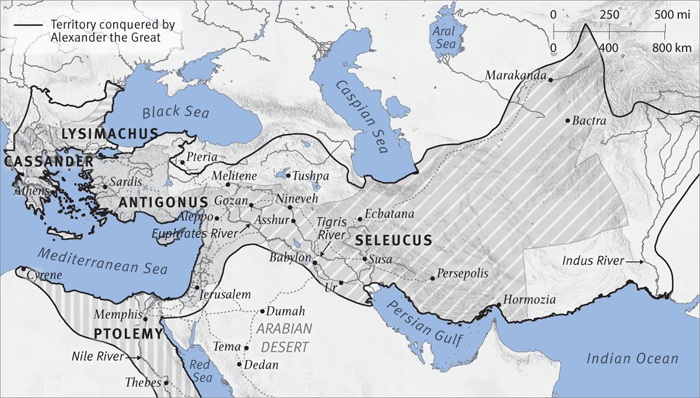
DANIEL—NOTE ON 8:1 third year. C. 551 B.C., two years after the dream of ch. 7 but before ch. 5. at the first. Looks back to ch. 7.
DANIEL—NOTE ON 8:2 Susa. This was a chief city of the Medo-Persian Empire, about 250 miles east of Babylon. Since Daniel saw himself in a vision, he may not have been bodily in that place (cf. Ezekiel's vision of being at the Jerusalem temple, though bodily still with the elders in Babylon, Ezek. 8–11).
DANIEL—NOTE ON 8:3–9 This imagery unfolded historically. The ram pictures the Medo-Persian Empire, as a whole, its two horns standing for the two entities (the Medes and the Persians) that merged into one. The history of this empire is briefly noted in v. 4, as it is seen conquering from the east to the west, south and north, under Cyrus, as predicted also by Isaiah 150 years earlier (Isa. 45:1–7). The longer horn, which appeared last, represents Persia. The goat (Dan. 8:5) represents Greece with its great horn Alexander, who with his army of 35,000, moved with such speed that he is pictured as not even touching the ground. The broken horn is Alexander in his death; the four horns are generals who became kings over four sectors of the Grecian empire after Alexander (cf. 7:6). The small horn is Antiochus Epiphanes, who rose from the third empire to rule the Syrian division in 175–164 B.C. and is the same king dominant in 11:21–35. Cf. 7:8, 24–26 where a similar "little horn" clearly represents the final Antichrist. The reason both are described as "little horns" is because one prefigures the other. A far more detailed summary will come later in 11:2–35.
DANIEL—NOTE ON 8:9 glorious land. Palestine. Cf. 11:16, 41.
DANIEL—NOTE ON 8:10 host of heaven. Picturesque language portrays Antiochus' persecution against Jewish people using the figure of stars (cf. Gen. 12:3; 15:5; 22:17; Ex. 12:41; Deut. 1:10). When defeated, the "stars" (Jewish people) will fall under the tyrant's domination.
DANIEL—NOTE ON 8:11 Prince. In addition to the desecration of the temple (cf. 1 Macc. 1:20–24, 41–50), Antiochus blasphemed Christ to whom ultimately the host of Jewish people sacrifice and to whom the sanctuary belongs. He is later the "Prince of princes" (Dan. 8:25).
DANIEL—NOTE ON 8:13 holy one. Angels are in view here.
DANIEL—NOTE ON 8:14 For 2,300 evenings and mornings. This refers to 2,300 total units or days. Cf. Genesis 1:5: "evening and . . . morning, the first day." The period runs to about 6 1⁄3 years of sacrificing a lamb twice a day, morning and evening (Ex. 29:38–39). The prophecy was precise in identifying the time as that of Antiochus's persecution, c. September 6, 171 B.C. to December 25, 165/164 B.C. After his death, Jews celebrated the cleansing of their holy place in the Feast of Lights, or Hanukkah, in celebration of the restoration led by Judas Maccabeus.
DANIEL—NOTE ON 8:15 appearance of a man. The word for man meaning "a mighty man" is the linguistic framework for "Gabriel," which means "mighty one of God." This is the first mention of an angel by name in the Bible.
DANIEL—NOTE ON 8:16 man's voice. God spoke with a human voice. Ulai. A river east of the Persian city of Susa.
DANIEL—NOTE ON 8:17 frightened and fell. Loss of consciousness is a common reaction to heavenly visitation (cf. Ezek. 1; Isa. 6; Rev. 1). time of the end. This term likely has a double sense of fulfillment. First, the "end" (as Dan. 8:19), "final" or "latter end" (vv. 19, 23), and "appointed time" (v. 19) refer to time late in the specific span that the historical prophecy has in view. That time is the period defined by the empires in these verses, Persia (Ram) and Greece (Goat), when the Grecian sector will be divided into four parts (v. 8). One of these, the Syrian under Seleucus (see note on v. 22), will eventually lead to Antiochus Epiphanes (175–164 B.C.) as the "little horn" meant in v. 9, who persecutes the people of Israel (v. 10) and defies God (v. 11). Cf. 11:21–35 and see notes there. Second, this "little horn" in 8:9, the Antichrist in the last days at the time of the eschatological fulfillment, sees Antiochus as a pattern of the Antichrist, who in many ways will be like him, though far greater in power, and will exercise his career in the end of the age just before Christ's return.
DANIEL—NOTE ON 8:21 goat . . . great horn. This is the third Gentile world power, the kingdom of Greece, and specifically Alexander the Great, the notable and "first king" after conquering Medo-Persia. Cf. 11:3.
DANIEL—NOTE ON 8:22 broken, in place of which four others. Alexander died at age 33 in 323 B.C., leaving no heir ready to reign. So four men, after 22 years of fighting, assumed rule over four Grecian sectors: 1) Cassander, Macedonia; 2) Lysimachus, Thrace and Asia Minor; 3) Seleucus, Syria, and Babylonia; 4) Ptolemy, Egypt, and Arabia. These are the four referred to in "toward the four winds" (v. 8). The phrase "not with his power" indicates they did not have Alexander's power or direct family lineage.
DANIEL—NOTE ON 8:23–25 a king . . . shall arise. The near fulfillment views Antiochus as the historical persecutor as in vv. 9–14. His career down to 164 B.C. was "at the latter end of their kingdom," that of the male goat in the Syrian territory. Rome conquered Greece by 146 B.C., only a few years later, and became the next dominant empire. Antiochus died, "broken—but by no human hand," due to insanity and disease of the bowels. The far fulfillment sees Antiochus in vv. 23–25 as prophetically illustrating the final tribulation period and the Antichrist. In such a view, the king here is also the "little horn," as in 7:7; 8:9 and the willful king in 11:36–45.
DANIEL—NOTE ON 8:25 Prince of princes. See note on 8:11.
DANIEL—NOTE ON 8:26 seal up the vision. Since he told it here, this did not mean to shut it up to secrecy but to preserve it as truth even if not to be fulfilled for a long time.
DANIEL—NOTE ON 9:1 the first year. C. 539 B.C. made king. This may mean that Darius (a title, not a proper name, see note on 5:31) refers to Cyrus who was made king by God's allowance (cf. Ps. 75:6–7). Since Cyrus was the first monarch of the Medo-Persian empire, this time note was also the first year after the death of Belshazzar, when Babylon fell.
DANIEL—NOTE ON 9:2 seventy years. Daniel's study of "the books" (OT scrolls) focused on the years prophesied for the captivity by Jeremiah in Jer. 25:11–12 and 29:10. Since the end of that span was near, he prayed for God's next move on behalf of Israel. Cf. 2 Chron. 36:21, where it is indicated that the 70 years of exile were intended to restore the Sabbath rests that Israel had ignored for so many years (cf. Lev. 25:4–5; 26:34–43).
DANIEL—NOTE ON 9:4–19 I prayed. Various aspects of the passage give rich instruction regarding prayer. True prayer is: in response to the word (v. 2), characterized by fervency and self-denial (v. 3), identified unselfishly with God's people (v. 5), strengthened by confession (vv. 5–15), dependent on God's character (vv. 4, 7, 9, 15), and has as its goal, God's glory (vv. 16–19).
DANIEL—NOTE ON 9:11 the curse. This refers to the judgment that God brought, as promised, for Israel's disobedience in the land (Lev. 26:21–42; Deut. 28:15–
68). This is in contrast to the blessings associated with faith and obedience (Lev. 26:3–20; Deut. 28:1–14). God had given the promise that even in a time of judgment, if Israel would confess their sin, he would bring blessing again (Lev. 26:40–42).
DANIEL—NOTE ON 9:16 Daniel prayed for restoration in three aspects. In effect he asked God to bring back "your city" (vv. 16, 18), "your sanctuary, which is desolate (v. 17), and "your people" (v. 19). God's answer embraced all three (v. 24).
DANIEL—NOTE ON 9:21 the man Gabriel. This angel, called a "man" because he appeared in the form of a man, appeared also in 8:16. Cf. the angel Michael in 10:13, 21; 12:1. the evening sacrifice. This was the second lamb of two offered daily (cf. 8:14 and see note there), this one at 3 p.m., a common time for prayer (Ezra 9:5).
DANIEL—NOTE ON 9:24–26 Seventy weeks. These are weeks of years, whereas weeks of days are described in a different way (10:2–3). The time spans from the Persian Artaxerxes' decree to rebuild Jerusalem, c. 445 B.C. (Neh. 2:1–8), to the Messiah's kingdom. This panorama includes: 1) seven weeks or 49 years, possibly closing Nehemiah's career in the rebuilding of Jerusalem as well as the end of the ministry of Malachi and the close of the OT; 2) 62 weeks or 434 more years for a total of 483 years to the first advent of Messiah. This was fulfilled at the triumphal entry on 10 Nisan, A.D. 30 (see notes on Matt. 21:1–9). The Messiah will be "cut off," (a common reference to death); and 3) the final seven years or seventieth week of the time of Antichrist (cf. Dan. 9:27). Roman people, from whom the Antichrist will come, will "destroy the city" of Jerusalem and its temple in A.D. 70.
DANIEL—NOTE ON 9:24 This highly complex and startlingly accurate prophecy answers Daniel's prayer, not with reference to near history, but by giving the future of Israel in the final end of the age. God promises two sets of three accomplishments each. First, those related to sin are: 1) finish the transgression, i.e., restrain sin and Israel's in particular in its long trend of apostasy, as in v. 11; 2) put an end to sin, i.e., to judge it with finality (cf. Heb. 9:26); and 3) atone for iniquity, signifies to furnish the actual basis of covering sin by full atonement, the blood of the crucified Messiah who is "cut off " (Dan. 9:26), which affects the first two realities (cf. the fountain, Zech. 13:1). Second, those accomplishments related to righteousness are: 1) bring in . . .
righteousness, the eternal righteousness of Daniel's people in their great change from centuries of apostasy; 2) seal both vision, i.e., no more revelation is needed and God will bring these anticipations to completion by their fulfillment in Israel's blessing as a nation; and 3) anoint a most holy place, consecrate the Holy Place in a temple of the future that will be the center of worship in the millennial kingdom (cf. Ezek. 40–48). Clearly this must be understood to sweep to the end of Gentile power and the time of Antichrist right before Christ's return. Summing up, the first three are fulfilled in principle at Christ's first coming, in full at his return. The last three complete the plan at his second advent.
DANIEL—NOTE ON 9:27 This is clearly the end of the age, the second advent judgment, because the bringing in of righteousness did not occur seven years after the death of the Messiah, nor did the destruction of Jerusalem fit the sevenyear period (occurring 37 years later). This is the future seven-year period that ends with sin's final judgment and Christ's reign of righteousness; i.e., the return of Christ and the establishment of his rule. These seven years constitute the seventieth week of Daniel. he shall make a strong covenant. "He" is the lastmentioned prince (v. 26), leader of the Roman sphere (cf. chs. 2 and 7), the Antichrist who comes in the latter days. The time is in the future tribulation period of "one week," i.e., the final seven years of 9:24. He confirms (lit., causes to prevail) a seven-year covenant, his own pact with Israel for what will turn out actually to be for a shorter time. The leader in this covenant is the "little horn" of 7:7–8, 20–21, 24–26, and the evil leader of NT prophecy (Mark 13:14; 2 Thess. 2:3–10; Rev. 13:1–10). That he is in the future, even after Christ's first advent, is shown by 1) Matt. 24:15; 2) by the time references that match (Dan. 7:25; Rev. 11:2–3; 12:14; 13:5); and 3) by the end here extending to the second advent, matching the duration elsewhere mentioned in Daniel (Dan. 2:35, 45; 7:15ff.; 12:1–3) and Rev. 11:2; 12:14; 13:5. half of the week. This is the halfway point of the seventieth week of years, i.e., seven years leading to Christ's second coming. The Antichrist will break his covenant with Israel (Dan. 9:27a), which has resumed its ancient sacrificial system. Three and a half years of tribulation remain, agreeing with the time in other Scriptures (7:25; Rev. 11:2–3; 12:14; 13:5; called "great tribulation," cf. Matt. 24:21) as God's wrath intensifies. abominations . . . one who makes desolate. The Antichrist will cause abomination against Jewish religion. This violation will desolate or ruin what Jews regard as sacred, namely their holy temple and the honoring of God's presence there (cf. 1 Kings 9:3; 2 Thess. 2:4). Jesus refers directly to this text in his Olivet discourse (Matt. 24:15). See note on Dan. 11:31. decreed end. God permits this tribulation under the Antichrist's persecutions and ultimately triumphs, achieving judgment of the sin and sinners in Israel (12:7) and in the world (cf. Jer. 25:31). This includes the Antichrist (Dan. 11:45; Rev. 19:20), and all who deserve judgment (Dan. 9:24; Matt. 13:41–43).
DANIEL—NOTE ON 10:1 third year. C. 536 B.C. Two years had passed since the first decree to let Israel return (cf. Ezra 1:1–2:1; 2:64–3:1).
DANIEL—NOTE ON 10:6 His body . . . like beryl. The messenger whom Daniel sees in a vision (vv. 1, 7) was distinct from the angel Michael, from whom he needed assistance (v. 13). The description of such glory has led some to see him as Christ in a preincarnate appearance (such as Josh. 5:13–15; 6:2; Judg. 6:11– 23). He is described almost identically to Christ (Rev. 1:13–14) and Daniel's reaction is similar to John's (Rev. 1:17).
DANIEL—NOTE ON 10:10 a hand touched me. Most likely this was Gabriel, who interpreted other revelations to Daniel (cf. 8:16) and spoke similarly of Daniel's being beloved in 9:20–23.
DANIEL—NOTE ON 10:12 your words have been heard. This was a great encouragement from God, who was attentive to prayer and acted to answer it (cf. 9:20–27).
DANIEL—NOTE ON 10:13 prince of . . . Persia. The three-week delay was due to an evil angel opposing Gabriel in heavenly warfare (cf. Rev. 16:12–14). This angel was specially anointed with Persian power in an effort to thwart the work of God. This tells us that Satan engages in heavenly warfare to influence generations and nations against God and his people (cf. Eph. 6:10ff.). Michael. This is the chief angel of heaven (cf. Dan. 10:21; 12:1; Jude 9; Rev. 12:7). Michael remained to assure that the Jews would be free to return to their land.
DANIEL—NOTE ON 10:14 days yet to come. This refers to the future plan of God for his people, extending from Daniel's time to that of the Antichrist.
DANIEL—NOTE ON 10:19 I was strengthened. This was the third time (vv. 10, 16), showing the overwhelming trauma of divine presence and revelation.
DANIEL—NOTE ON 10:20 prince of Greece. An evil angel contesting for the kingdom of Greece.
DANIEL—NOTE ON 10:21 book of truth. God's plan of certain and true designs for men and nations, which he can reveal according to his discretion (11:2; Isa. 46:9–11). except Michael. The angel with Michael intended to handle the demons of Persia and Greece. This actually forms the heavenly basis for the earthly unfolding of history in Dan. 11:2–35.
DANIEL—NOTE ON 11:1 first year. C. 539 B.C. (cf. 6:1ff.; 9:1). confirm and strengthen him. The messenger of 10:10ff. continues to speak of assisting Michael (even as Michael had strengthened him in the battle with demons in 10:21), confirming Darius in his purpose of kindness to Israel in decreeing their return.
DANIEL—NOTE ON 11:2–45 As in 8:3–26, this prophecy sweeps all the way from the history of spiritual conflict in Israel (11:2–35) to the tribulation (vv. 36–42) when Michael aids in fully delivering Israel (12:1). The detail of this history is so minute and accurate, so confirmed by history, that unbelieving critics have, without evidence, insisted that it was actually written 400 years later than Daniel, after it had happened, which would make the prophet a deceiver. The prophecy actually looks ahead from Daniel to the final Antichrist.
DANIEL—NOTE ON 11:2–35 This section unfolds the near fulfillment of the Persian kingdom and the reign of Greece through Antiochus Epiphanes.
DANIEL—NOTE ON 11:2 three more kings . . . a fourth. The three in the Persian sphere, after Cyrus (10:1), were Cambyses (c. 530–522 B.C.), Psuedo-Smerdis (c. 522 B.C.), and Darius I Hystaspes (c. 522–486 B.C.). The fourth is Xerxes I, called Ahasuerus in Esther (486–465 B.C.). Kings after Xerxes are not included, probably because Xerxes' failed military campaign against the Greeks (481–479
B.C.) sounded the beginning of the end for Persia, which finally fell c. 331 B.C. to Alexander the Great.
DANIEL—NOTE ON 11:3 a mighty king. Alexander the Great (cf. 8:5).
DANIEL—NOTE ON 11:4 After Alexander's death (c. 323 B.C.), four who were not of his posterity took sectors of his wide empire (see notes on 7:6; 8:3–9). The king of the south (Egypt) and king of the north (Aram, or Syria), receive emphasis in 11:5 and after. As time moved on, other leaders ruled, crossing and recrossing Palestine.
DANIEL—NOTE ON 11:5–6 king of the south . . . king of the north. King of the south represents the Ptolomies, the leaders of Egypt, contrasted often in vv. 5ff. with the king of the north, the Seleucids, leaders of Syria (v. 6). South and north are in relation to Palestine, for which the angel Gabriel, speaking in this passage, is so concerned. Verses 5–20 cover almost 200 years of wars between these bordering powers.
DANIEL—NOTE ON 11:6 make an alliance. Berenice, daughter of Egypt's Ptolemy II Philadelphus (285–246 B.C.), married Syria's King Antiochus II Theos (261–246 B.C.). The latter part of the verse refers to the political advantage they hoped the alliance would produce. Antiochus divorced his wife to marry Berenice. Later that divorced wife murdered Berenice, her baby son, and even Antiochus by poisoning him. Thus she brought her own son, Seleucus II Callinicus, to the throne.
DANIEL—NOTE ON 11:7 branch from her roots. The murdered Berenice's brother stood in his father's place. His name was Ptolemy III Euergetes of Egypt (246–222 B.C.), and in reverse he conquered Syria, sacking their great treasure (v. 8).
DANIEL—NOTE ON 11:9 the latter shall come. Syria's Callinicus attacked Egypt c. 240 B.C. but retreated, soundly beaten.
DANIEL—NOTE ON 11:10 His sons. Seleucus' sons (successors) kept up war against Egypt, as described in vv. 11–35.
DANIEL—NOTE ON 11:11 king of the south. Ptolemy IV Philopator (222–203
B.C.) devastated the Syrian army under Antiochus III the Great (223–187 B.C.). Egypt's advantage would be brief (v. 12).
DANIEL—NOTE ON 11:13–16 king of the north. Thirteen years later Antiochus returned with a great army, and in a series of strikes against Egypt brought Palestine ("the glorious land") into his control as far south as Gaza.
DANIEL—NOTE ON 11:14 violent among your own people. Violent Jews wanted Judean independence from Egypt, but failed in their revolt.
DANIEL—NOTE ON 11:16 he who comes against him. Antiochus III the Great took lasting dominion over Israel. glorious land. Palestine (cf. 8:9).
DANIEL—NOTE ON 11:17 give . . . the daughter. Antiochus, feeling pressure from Rome (fourth empire, 2:40; 7:7) to make peace with Egypt, offered his daughter Cleopatra to marry Ptolemy V Epiphanes (c. 192 B.C.). The Syrian thus hoped his daughter would spy to help him to "ruin" or weaken Egypt and bring it under his power. Cleopatra, instead of helping her father, favored her Egyptian mate.
DANIEL—NOTE ON 11:18 a commander. Antiochus had set his sights to conquer Greece, along the Mediterranean coastlands. But this brought him into conflict with Rome, so that a Roman, Lucius Scipio Asiaticus, repaid the Syrian aggression against Roman rights in the area with a resounding defeat (c. 191– 190 B.C.).
DANIEL—NOTE ON 11:19 fall. Antiochus returned from defeat to his own land compelled by Rome to relinquish all his territory west of the Taurus and to repay the costs of war. He was likely killed by defenders of a Persian temple he tried to plunder at night in Elymais (to get money to pay reparations required by Rome).
DANIEL—NOTE ON 11:20 an exactor. Rome required Seleucus IV Philopator to render tribute, for Rome was increasingly powerful. The Syrian set out to tax his subjects heavily to raise the tribute. Soon, he died after being poisoned. The "glory of the kingdom" possibly refers to Israel ("the glorious land") with its splendid temple.
DANIEL—NOTE ON 11:21 a contemptible person. In vv. 21–35, the most cruel king of the north was Seleucid, the Syrian persecutor of Israel named Antiochus IV Epiphanes (cf. 8:9–14, 23–25). He came to the throne when his brother Seleucus was murdered and a son of the dead king who might succeed him, Demetrius I Soter, was held hostage in Rome. In the vacuum, Antiochus seized power in Syria.
DANIEL—NOTE ON 11:22 utterly swept away. Egypt's armies were swept away by Antiochus' invading forces as by a flood (cf. "flood" for military onslaught, 9:26). Israel's "prince of the covenant," Onias III, was murdered by his own defecting brother Menelaus at the request of Antiochus (171 B.C.).
DANIEL—NOTE ON 11:23 an alliance. In an Egyptian struggle for the throne, Antiochus developed an alliance with Ptolemy VI Philometer over his rival Ptolemy VII Euergetes II (distinct from the leader in v. 7). By this alliance, Antiochus deceitfully plotted to gain greater power in Egypt. With a "small people," he conquered Memphis and the rest of Egypt all the way to Alexandria.
DANIEL—NOTE ON 11:24 Without warning he shall come into. Antiochus, under the guise of friendship, plundered the richest Egyptian places he could strike. To gain support, he gave lavish gifts, possibly battle spoils. devise plans against strongholds. He formed a scheme to take over Egypt.
DANIEL—NOTE ON 11:25 his power . . . against the . . . south. Antiochus attacked Philometer, who had become an enemy. The latter fell due to treachery by trusted supporters (v. 26a), and became Antiochus' captive.
DANIEL—NOTE ON 11:26 those who eat. Betraying counselors whom Philometer fed, led him to attack Syria to secure his defeat and death for him and his men.
DANIEL—NOTE ON 11:27 shall speak lies. Antiochus feigned help to reinstate Ptolemy Philometer to Egypt's throne, occupied then by Ptolemy Euergetes. Both kings lied at the conference, and Antiochus set Philometer up as king at Memphis, whereas Euergetes reigned at Alexandria. The two Egyptians soon agreed on a joint rule, frustrating the Syrian.
DANIEL—NOTE ON 11:28 against the holy covenant. En route north through Israel to Syria with riches, Antiochus met a revolt, as sources outside Scripture mention. He struck Jerusalem's temple, profaned the sacrificial system, massacred 80,000 men, took 40,000 prisoners, sold 40,000 as slaves, and squelched a Jewish bid to depose his own designated priest, Menelaus.
DANIEL—NOTE ON 11:29 come into the south. Antiochus, for the third time, invaded Egypt against the joint rulership (c. 168 B.C.); however, with much less success.
DANIEL—NOTE ON 11:30 ships . . . come against him. A Roman fleet from Cyprus sided with Egypt, thwarting Antiochus' attack. Backing down from engaging Rome in war, Antiochus left Egypt, taking out his rage on Israelites in his path. He opposed God's Mosaic Covenant that some Jews kept, despite Syrian policies and some Jewish compromise. Antiochus showed favors to Jewish apostates ("take action against the holy covenant") as nonbiblical writings attest.
DANIEL—NOTE ON 11:31 profane the temple. Antiochus' soldiers, no doubt working with apostate Jews, guarded the temple, halting all worship, while others attacked the city on the Sabbath slaughtering men, women, and children. Soldiers desecrated Israel's temple, banned circumcision and daily sacrifices (1 Macc. 1:44–54), and sacrificed a pig on the altar. The Syrians on Chislev (December 15, 167 B.C.), even imposed an idol statue in honor of the Olympian god Zeus into the temple. Jews called it "the abomination of desolation," i.e., emptying or ruining for Jewish worship. abomination that makes desolate.
Antiochus' soldiers profaned God's temple by spreading sow's broth on the altar and banning daily sacrifices (cf. Dan. 8:14 and see note there) as described in 1 Macc. 1:44–54. Both Daniel and Jesus said this atrocity was only a preview of the abomination that would happen later under the final Antichrist (Dan. 9:27; Matt. 24:15).
DANIEL—NOTE ON 11:32–34 those who violate the covenant. Compromisers (cf. v. 30) among the Jews were enticed by flattery to side with Antiochus and be corrupted (cf. 1 Macc. 1:11–15).
DANIEL—NOTE ON 11:32 the people who know their God. Jews loyal to God (called Hasideans) stood on firm convictions, suffering death rather than compromising (v. 33; as also 1 Macc. 1:62–63). Judas Maccabeus, helped by Rome, led them in a successful revolt.
DANIEL—NOTE ON 11:33 make many understand. Those who believe and know the truth will instruct others in the Scriptures, while also suffering continued persecution.
DANIEL—NOTE ON 11:34 a little help. Many would fall away, and Jews committed to the covenant would have little help, humanly speaking. Some, fearing the faithful remnant's dealing with apostates, pretended loyalty.
DANIEL—NOTE ON 11:35 refined. Faced by persecution, some who remained true to God's "wisdom" (any true believers, 12:3) were to fall as martyrs. The gracious design of such suffering was to sanctify them. The persecution pattern continues until the final "time of the end" that God appointed, at Christ's second coming. Reference to this "end time" prepares for a transition in 11:36 to final tribulation times when the Antichrist, whom Antiochus prefigures, will be in power. time of the end . . . appointed time. These two eschatological terms point to a forward leap across thousands of years of history from Antiochus to a future similar trial when the willful king (vv. 36–45) rules. The willful king is the "little horn," the Antichrist (7:7–8, 20–21, 24–26), the persecutor of 9:27 (see note there.
DANIEL—NOTE ON 11:36–45 This section is the far fulfillment of God's prophetic plan. It summarizes details of Daniel's seventieth week that are found nowhere else in Scripture. Antiochus Epiphanes, a type of Antichrist, is the perfect transition point to the actual Antichrist.
DANIEL—NOTE ON 11:36 till the indignation. This word points to the future "time of the end" mentioned in v. 35. Verses 36–45 discuss the career of the final Antichrist in the last seven years before Christ's millennial kingdom. This willful king is the final Antichrist (see notes on 7:8, 11–12, 25; 9:27; cf. Rev. 13:4–7).
DANIEL—NOTE ON 11:37 gods of his fathers. Pagan Gentiles have had traditional gods passed down from their fathers, but this king has no regard for any of them. His only god is power (v. 38, "god of fortresses"). one beloved by women. This could mean that Antichrist will be a homosexual; but it surely means he has no normal desire for, or interest in, women, e.g., as one who is celibate.
DANIEL—NOTE ON 11:38 god of fortresses. The term for fortress is used five other times in this chapter (vv. 7, 10, 19, 31, 39) and each time means "a strong place." Power is to be his god, and he spends all his treasures to become powerful and to finance wars. With this power, he will attack every stronghold (v. 39).
DANIEL—NOTE ON 11:40 king of . . . south . . . north. Here is the final north/south conflict. The south was Egypt in the earlier context. Here is the last great battle with the final army from the north retaliating against the attack of the final southern African power. Antichrist will not allow this without striking back and winning, defeating both as recorded in v. 41ff. The willful king, Antichrist, withstands onslaughts from both, and prevails, entering Israel ("the glorious land") and, perhaps, committing at that time the abomination of desolation (9:23; Matt. 24:15). With this victory, he will be established in power for a time.
DANIEL—NOTE ON 11:44 news from . . . east and . . . north. Military bulletins alert the willful king, in his victories, of other sectors of the world deploying troops to the Palestinian theater (cf. Rev. 9:16; 16:12).
DANIEL—NOTE ON 11:45 his end. To face the latest threats, the willful king sets up his command post between the Mediterranean Sea and the Dead Sea (and/or Sea of Galilee) and the holy mountain of Jerusalem, his troops filling the land (cf. Zech. 12:2–3; 14:2–3; Rev. 19:17–21). No one is able to help him against God, who, by the return of Christ, brings him to his end (cf. Rev. 19:20).
DANIEL—NOTE ON 12:1 that time. This points back to 11:36–45, the time of the ascendancy of Antichrist during the final tribulation period. During that period, Michael the archangel (cf. Jude 9) of Dan. 10:13, 21 ministers with special attention to protecting Israel during that Gentile time (cf. Isa. 26:20–21; Jer. 30:7; Matt. 24:21). "Your people" means Daniel's Israelite people, who can have hope, even in the distress of an unprecedented kind set for the great tribulation (Matt. 24:21; cf. Rev. 12:12–17; 13:7). "The book" is the book of the saved (Mal. 3:16–4:3; Luke 10:20; Rev. 13:8; 17:8; 20:12, 15; 21:27).
DANIEL—NOTE ON 12:2 many . . . those . . . some. Two groups will arise from death constituting the "many" meaning all, as in John 5:29. Those of faith will rise to eternal life, the rest of the unsaved to eternal torment. The souls of OT saints are already with the Lord; at that time, they will receive glorified bodies (cf. Rev. 20:4–6).
DANIEL—NOTE ON 12:3 wise. Those having true knowledge, by faith in God's word, not only leaders (as 11:33), but others (11:35; 12:10). To "shine" in glory is a privilege of all the saved (cf. the principle in 1 Thess. 2:12; 1 Pet. 5:10). Any who influence others for righteousness shine like stars in varying capacities of light as their reward (as in 1 Cor. 3:8). The faithfulness of the believer's witness will determine one's eternal capacity to reflect God's glory.
DANIEL—NOTE ON 12:4 the time of the end. Refers to the seventieth week of tribulation (cf. 11:35, 40). run to and fro. This Hebrew verb form always refers to the movement of a person searching for something. In the tribulation, people will search for answers to the devastation and discover increased knowledge through Daniel's preserved book.
DANIEL—NOTE ON 12:5 two others. Two angels.
DANIEL—NOTE ON 12:6 man . . . in linen. Cf. 10:5.
DANIEL—NOTE ON 12:7 a time, times, and half a time. This answers the question of v. 6. Adding these (one, two, and one-half) comes to the final three and a half years of Daniel's seventieth week (9:27), the time of trouble when the "little horn," or willful king, persecutes the saints (7:25; cf. 11:36–39 and Rev. 12:14; the same span is described by other phrases in Rev. 11:2–3; 13:5).
DANIEL—NOTE ON 12:10 Many . . . purify. Salvation will come to many Jews during the great tribulation (cf. Zech. 13:8–9, where the prophet speaks of onethird; Rom. 11:26; Rev. 11:13).The truly saved develop in godliness through trials. The unsaved pursue false values.
DANIEL—NOTE ON 12:11 the regular burnt offering. This reference is to the end of daily temple sacrifice, previously allowed under a covenant that the Antichrist formed with Israel, which he later causes to cease in the middle of the final seven years (9:27). Then, favorable relations give way to persecution. Even his abomination that desecrates the temple (as 9:27; Matt. 24:1; Mark 13:14; 2 Thess. 2:3–4) is accompanied with persecution. shall be 1,290 days. From the intrusion of the abomination, there follow 1,290 days, including 1,260 that make up the last three and a half years of the final seven years (see note on Dan. 12:7), then 30 days more, possibly to allow for the judgment of the living subsequent to Christ's return (cf. Matt. 24:29–31; 25:31–46), before millennial kingdom blessings begin.
DANIEL—NOTE ON 12:12 Blessed. This is in the kingdom (2:35, 45; 7:13, 14, 27) that gives blessedness after the subjugation to Gentile empires in chs. 2; 7; 8. at the 1,335 days. Forty-five more days, even beyond the 1,290 days, allows for transition between Israel's time of being shattered (12:7) and God's setting up of his kingdom (cf. 7:13–14, 27).
DANIEL—NOTE ON 12:13 go. Daniel's own career would soon involve death. stand. In resurrection (cf. 12:2; John 5:28–29). at the end of the days. The kingdom will ensue after the prophesied days of Dan. 9:24–27; 12:11–12.
Hosea
Hosea 1 • Hosea 2 • Hosea 3 • Hosea 4 • Hosea 5 • Hosea 6 • Hosea 7 •
Hosea 8 • Hosea 9 • Hosea 10 • Hosea 11 • Hosea 12 • Hosea 13 • Hosea 14 Introduction to Hosea
Title Author and Date Background and Setting Historical and Theological Themes Interpretive Challenges Outline Footnotes Study Notes
Introduction to Hosea
Title
The title is derived from the main character and author of the book. The meaning of his name, "salvation," is the same as that of Joshua (cf. Num. 13:8, 16) and Jesus (Matt. 1:21). Hosea is the first of the 12 Minor Prophets. "Minor" refers to the brevity of the prophecies, as compared to the length of the works of Isaiah, Jeremiah, and Ezekiel.
Author and Date
The book of Hosea is the sole source of information about the author. Little is known about him, and even less about his father, Beeri (1:1). Hosea was probably a native of the northern kingdom of Israel, since he shows familiarity with the history, circumstances, and topography of the north (cf. 4:15; 5:1, 13; 6:8–9; 10:5; 12:11–12; 14:6). This would make him and Jonah the only writing prophets from the northern kingdom. Although he addressed both Israel (the northern kingdom) and Judah (the southern kingdom), he identified the king of Israel as "our king" (7:5).
Hosea had a lengthy period of ministry, prophesying c. 755–710 B.C., during the reigns of Uzziah (790–739 B.C.), Jotham (750–731 B.C.), Ahaz (735–715 B.C.), and Hezekiah (715–686 B.C.) in Judah, and Jeroboam II (793–753 B.C.) in Israel (1:1). His long career spanned the last six kings of Israel from Zechariah (753– 752 B.C.) to Hoshea (732–722 B.C.). The overthrow of Zechariah (the last of the dynasty of Jehu) in 752 B.C. is depicted as yet future (1:4). Thus he followed Amos' preaching in the north, and was a contemporary of Isaiah and Micah as well, both of whom prophesied in Judah. Second Kings 14–20 and 2 Chron. 26– 32 record the historical period of Hosea's ministry.
Background and Setting
Hosea began his ministry to Israel (also called Ephraim, after its largest tribe) during the final days of Jeroboam II, under whose guidance Israel was enjoying both political peace and material prosperity as well as undergoing moral corruption and spiritual bankruptcy. Upon Jeroboam II's death (753 B.C.), however, anarchy prevailed and Israel declined rapidly. Until her overthrow by Assyria 30 years later, four of Israel's six kings were assassinated by their successors. Prophesying during the days surrounding the fall of Samaria, Hosea focuses on Israel's moral waywardness (cf. the book of Amos) and her breach of the covenantal relationship with the Lord, announcing that judgment was imminent.
Circumstances were not much better in the southern kingdom. Usurping the priestly function, Uzziah had been struck with leprosy (2 Chron. 26:16–21); Jotham condoned idolatrous practices, opening the way for Ahaz to encourage Baal worship (2 Chron. 27:1–28:4). Hezekiah's revival served only to slow Judah's acceleration toward a fate similar to that of her northern sister. Weak kings on both sides of the border repeatedly sought out alliances with their heathen neighbors (Hos. 7:11; cf. 2 Kings 15:19; 16:7) rather than seeking the Lord's help.
Historical and Theological Themes
The theme of Hosea is God's loyal love for his covenant people, Israel, in spite of their idolatry. Thus Hosea has been called the St. John (the apostle of love) of the OT. The Lord's true love for his people is unending and will tolerate no rival. Hosea's message contains much condemnation, both national and individual, but at the same time, he poignantly portrays the love of God toward his people with passionate emotion. Hosea was instructed by God to marry a certain woman, and experience with her a domestic life that was a dramatization of the sin and unfaithfulness of Israel. The marital life of Hosea and his wife, Gomer, provide the rich metaphor that clarifies the themes of the book: sin, judgment, and forgiving love.
Interpretive Challenges
That the faithless wife, Gomer, is symbolic of faithless Israel is without doubt; but questions remain. First, some suggest that the marital scenes in chs. 1–3 should be taken only as allegory. However, there is nothing in the narrative, presented in simple prose, which would even question its literal occurrence. Much of its impact would be lost if not literal. When nonliteral elements within the book are introduced, they are prefaced with "saw" (5:13; 9:10, 13), the normal Hebraic means of introducing nonliteral scenes. Furthermore, there is no account of a prophet ever making himself the subject of an allegory or parable.
Second, what are the moral implications of God's command for Hosea to marry a prostitute? It appears best to see Gomer as chaste at the time of marriage to Hosea, only later having become an immoral woman. The words "take to yourself a wife of whoredom" are to be understood proleptically, i.e., looking to the future. An immoral woman could not serve as a picture of Israel coming out of Egypt (2:15; 9:10), who then later wandered away from God (11:1). Chapter 3 describes Hosea taking back his wife, who had been rejected because of adultery, a rejection that was unjustifiable if Hosea had married a prostitute with full knowledge of her character.
A third question arises concerning the relationship between ch. 1 and ch. 3 and whether the woman of ch. 3 is Gomer or another woman. There are a number of factors that suggest that the woman of ch. 3 is Gomer. In 1:2, God's command is to "Go, take;" in 3:1, however, his command is to "Go again, love," suggesting that Hosea's love was to be renewed to the same woman. Furthermore, within the analogy of ch. 1, Gomer represents Israel. As God renews his love toward faithless Israel, so Hosea is to renew his love toward faithless Gomer. For Hos. 3 to denote a different woman would confuse the analogy.
Outline
I. Adulterous Wife and Faithful Husband (1:1–3:5)
A. Hosea and Gomer (1:1–9)
B. God and Israel (1:10–2:23) C. Both Parties Reconciled (3:1–5) II. Adulterous Israel and Faithful Lord (4:1–14:9)
A. Adulterous Israel Found Guilty (4:1–6:3)
B. Adulterous Israel Put Away (6:4–10:15) C. Adulterous Israel Restored to the Lord (11:1–14:9)
Hosea
HOSEA 1 †The word of the LORD that came to Hosea, the son of Beeri, in the days of Uzziah, Jotham, Ahaz, and Hezekiah, kings of Judah, and in the days of Jeroboam the son of Joash, king of Israel.
Hosea's Wife and Children
the LORD first spoke through Hosea, the LORD said to Hosea, "Go, take to yourself a wife of whoredom and have children of whoredom, for the land commits great whoredom by forsaking the LORD." 3So he went and took Gomer, the daughter of Diblaim, and she conceived and bore him a son.
the LORD said to him, "Call his name Jezreel, for in just a little while I will punish the house of Jehu for the blood of Jezreel, and I will put an end to the kingdom of the house of Israel. 5†And on that day I will break the bow of Israel in the Valley of Jezreel."
conceived again and bore a daughter. And the LORD said to him, "Call her name No Mercy, [1] for I will no more have mercy on the house of Israel, to forgive them at all. 7†But I will have mercy on the house of Judah, and I will save them by the LORD their God. I will not save them by bow or by sword or by war or by horses or by horsemen."
8When she had weaned No Mercy, she conceived and bore a son. 9†And the LORD said, "Call his name Not My People, [2] for you are not my people, and I am not your God." [3]
[4] Yet the number of the children of Israel shall be like the sand of the sea, which cannot be measured or numbered. And in the place where it was said to them, "You are not my people," it shall be said to them, "Children [5] of the living God." 11†And the children of Judah and the children of Israel shall be gathered together, and they shall appoint for themselves one head. And they shall go up from the land, for great shall be the day of Jezreel.
Israel's Unfaithfulness Punished
HOSEA 2 [1] Say to your brothers, "You are my people," [2] and to your sisters, "You have received mercy." [3]
with your mother, plead— for she is not my wife, and I am not her husband— that she put away her whoring from her face, and her adultery from between her breasts; 3lest I strip her naked and make her as in the day she was born, and make her like a wilderness, and make her like a parched land, and kill her with thirst. 4Upon her children also I will have no mercy, because they are children of whoredom. 5†For their mother has played the whore; she who conceived them has acted shamefully. For she said, 'I will go after my lovers, who give me my bread and my water, my wool and my flax, my oil and my drink.' 6Therefore I will hedge up her [4] way with thorns, and I will build a wall against her, so that she cannot find her paths. 7She shall pursue her lovers but not overtake them, and she shall seek them but shall not find them. Then she shall say,
'I will go and return to my first husband, for it was better for me then than now.' 8‡†And she did not know that it was I who gave her the grain, the wine, and the oil, and who lavished on her silver and gold, which they used for Baal. 9Therefore I will take back my grain in its time, and my wine in its season, and I will take away my wool and my flax, which were to cover her nakedness. 10†Now I will uncover her lewdness in the sight of her lovers, and no one shall rescue her out of my hand. 11†And I will put an end to all her mirth, her feasts, her new moons, her
Sabbaths, and all her appointed feasts. 12And I will lay waste her vines and her fig trees, of which she said, 'These are my wages, which my lovers have given me.' I will make them a forest, and the beasts of the field shall devour them. 13†And I will punish her for the feast days of the Baals when she burned offerings to them and adorned herself with her ring and jewelry, and went after her lovers and forgot me, declares the LORD.
The LORD's Mercy on Israel
behold, I will allure her, and bring her into the wilderness, and speak tenderly to her. 15†And there I will give her her vineyards and make the Valley of Achor [5] a door of hope. And there she shall answer as in the days of her youth, as at the time when she came out of the land of Egypt.
in that day, declares the LORD, you will call me 'My Husband,' and no longer will you call me 'My Baal.' 17†For I will remove the names of the Baals from her mouth, and they shall be remembered by name no more. 18†And I will make for them a covenant on that day with the beasts of the field, the birds of the heavens, and the creeping things of the ground. And I will abolish [6] the bow, the sword, and war from the land, and I will make you lie down in safety. 19‡And I will betroth you to me forever. I will betroth you to me in righteousness and in justice, in steadfast love and in mercy. 20I will betroth you to me in faithfulness. And you shall know the LORD.
21"And in that day I will answer, declares the LORD, I will answer the heavens, and they shall answer the earth, 22‡†and the earth shall answer the grain, the wine, and the oil, and they shall answer Jezreel, [7] 23†and I will sow her for myself in the land. And I will have mercy on No Mercy, [8] and I will say to Not My People, [9] 'You are my people'; and he shall say, 'You are my God.'"
Hosea Redeems His Wife
HOSEA 3 †And the LORD said to me, "Go again, love a woman who is loved by another man and is an adulteress, even as the LORD loves the children of Israel, though they turn to other gods and love cakes of raisins." 2†So I bought her for fifteen shekels of silver and a homer and a lethech [1] of barley. 3‡And I said to her, "You must dwell as mine for many days. You shall not play the whore, or belong to another man; so will I also be to you." 4†For the children of Israel shall dwell many days without king or prince, without sacrifice or pillar, without ephod or household gods. 5†Afterward the children of Israel shall return and seek the LORD their God, and David their king, and they shall come in fear to the LORD and to his goodness in the latter days.
The LORD Accuses Israel
HOSEA 4 †Hear the word of the LORD, O children of Israel, for the LORD has a controversy with the inhabitants of the land. There is no faithfulness or steadfast love, and no knowledge of God in the land; 2†there is swearing, lying, murder, stealing, and committing adultery; they break all bounds, and bloodshed follows bloodshed. 3†Therefore the land mourns, and all who dwell in it languish, and also the beasts of the field and the birds of the heavens, and even the fish of the sea are taken away. 4†Yet let no one contend, and let none accuse, for with you is my contention, O priest. [1] 5†You shall stumble by day; the prophet also shall stumble with you by night; and I will destroy your mother. 6†My people are destroyed for lack of knowledge; because you have rejected knowledge, I reject you from being a priest to me. And since you have forgotten the law of your God, I also will forget your children. 7‡The more they increased, the more they sinned against me; I will change their glory into shame. 8They feed on the sin [2] of my people; they are greedy for their iniquity. 9And it shall be like people, like priest; I will punish them for their ways and repay them for their deeds. 10They shall eat, but not be satisfied; they shall play the whore, but not multiply, because they have forsaken the LORD to cherish 11†whoredom, wine, and new wine, which take away the understanding. 12†My people inquire of a piece of wood, and their walking staff gives them oracles. For a spirit of whoredom has led them astray, and they have left their God to play the whore. 13†They sacrifice on the tops of the mountains and burn offerings on the hills, under oak, poplar, and terebinth, because their shade is good.
Therefore your daughters play the whore, and your brides commit adultery. 14†I will not punish your daughters when they play the whore, nor your brides when they commit adultery; for the men themselves go aside with prostitutes and sacrifice with cult prostitutes, and a people without understanding shall come to ruin. 15†Though you play the whore, O Israel, let not Judah become guilty. Enter not into Gilgal, nor go up to Beth-aven, and swear not, "As the LORD lives." 16†Like a stubborn heifer, Israel is stubborn; can the LORD now feed them like a lamb in a broad pasture? 17†Ephraim is joined to idols; leave him alone. 18When their drink is gone, they give themselves to whoring; their rulers [3] dearly love shame. 19A wind has wrapped them [4] in its wings, and they shall be ashamed because of their sacrifices.
Punishment Coming for Israel and Judah
HOSEA 5 †Hear this, O priests!
Pay attention, O house of Israel! Give ear, O house of the king!
For the judgment is for you; for you have been a snare at Mizpah and a net spread upon Tabor. 2And the revolters have gone deep into slaughter, but I will discipline all of them. 3I know Ephraim, and Israel is not hidden from me; for now, O Ephraim, you have played the whore; Israel is defiled. 4Their deeds do not permit them to return to their God. For the spirit of whoredom is within them, and they know not the LORD. 5†The pride of Israel testifies to his face; [1] Israel and Ephraim shall stumble in his guilt; Judah also shall stumble with them. 6‡With their flocks and herds they shall go to seek the LORD, but they will not find him; he has withdrawn from them. 7They have dealt faithlessly with the LORD; for they have borne alien children. Now the new moon shall devour them with their fields. 8†Blow the horn in Gibeah, the trumpet in Ramah. Sound the alarm at Beth-aven; we follow you, [2] O Benjamin! 9Ephraim shall become a desolation in the day of punishment; among the tribes of Israel
I make known what is sure. 10†The princes of Judah have become like those who move the landmark; upon them I will pour out my wrath like water. 11Ephraim is oppressed, crushed in judgment, because he was determined to go after filth. [3] 12†But I am like a moth to Ephraim, and like dry rot to the house of Judah. 13†When Ephraim saw his sickness, and Judah his wound, then Ephraim went to Assyria, and sent to the great king. [4] But he is not able to cure you or heal your wound. 14‡For I will be like a lion to Ephraim, and like a young lion to the house of Judah. I, even I, will tear and go away; I will carry off, and no one shall rescue. 15I will return again to my place, until they acknowledge their guilt and seek my face, and in their distress earnestly seek me.
Israel and Judah Are Unrepentant
HOSEA 6 ‡"Come, let us return to the LORD; for he has torn us, that he may heal us; he has struck us down, and he will bind us up. 2†After two days he will revive us; on the third day he will raise us up, that we may live before him. 3Let us know; let us press on to know the LORD; his going out is sure as the dawn; he will come to us as the showers, as the spring rains that water the earth." 4‡What shall I do with you, O Ephraim? What shall I do with you, O Judah? Your love is like a morning cloud, like the dew that goes early away. 5Therefore I have hewn them by the prophets; I have slain them by the words of my mouth, and my judgment goes forth as the light. 6†For I desire steadfast love [1] and not sacrifice, the knowledge of God rather than burnt offerings. 7†But like Adam they transgressed the covenant; there they dealt faithlessly with me. 8Gilead is a city of evildoers, tracked with blood. 9As robbers lie in wait for a man, so the priests band together; they murder on the way to Shechem; they commit villainy. 10In the house of Israel I have seen a horrible thing; Ephraim's whoredom is there; Israel is defiled. 11†For you also, O Judah, a harvest is appointed, when I restore the fortunes of my people.
HOSEA 7 †When I would heal Israel, the iniquity of Ephraim is revealed, and the evil deeds of Samaria; for they deal falsely; the thief breaks in, and the bandits raid outside. 2But they do not consider that I remember all their evil. Now their deeds surround them; they are before my face. 3By their evil they make the king glad, and the princes by their treachery. 4‡They are all adulterers; they are like a heated oven whose baker ceases to stir the fire, from the kneading of the dough until it is leavened. 5On the day of our king, the princes became sick with the heat of wine; he stretched out his hand with mockers. 6For with hearts like an oven they approach their intrigue; all night their anger smolders; in the morning it blazes like a flaming fire. 7†All of them are hot as an oven, and they devour their rulers. All their kings have fallen, and none of them calls upon me. 8‡Ephraim mixes himself with the peoples; Ephraim is a cake not turned. 9Strangers devour his strength, and he knows it not; gray hairs are sprinkled upon him, and he knows it not. 10The pride of Israel testifies to his face; [1] yet they do not return to the LORD their God, nor seek him, for all this. 11‡Ephraim is like a dove, silly and without sense, calling to Egypt, going to Assyria. 12As they go, I will spread over them my net; I will bring them down like birds of the heavens; I will discipline them according to the report made to their congregation. 13†Woe to them, for they have strayed from me! Destruction to them, for they have rebelled against me! I would redeem them, but they speak lies against me. 14†They do not cry to me from the heart, but they wail upon their beds; for grain and wine they gash themselves; they rebel against me. 15Although I trained and strengthened their arms, yet they devise evil against me. 16They return, but not upward; [2] they are like a treacherous bow; their princes shall fall by the sword because of the insolence of their tongue. This shall be their derision in the land of Egypt.
Israel Will Reap the Whirlwind
HOSEA 8 †Set the trumpet to your lips!
One like a vulture is over the house of the LORD, because they have transgressed my covenant and rebelled against my law. 2†To me they cry, "My God, we—Israel—know you." 3Israel has spurned the good; the enemy shall pursue him. 4They made kings, but not through me. They set up princes, but I knew it not. With their silver and gold they made idols for their own destruction. 5†I have [1] spurned your calf, O Samaria. My anger burns against them. How long will they be incapable of innocence? 6For it is from Israel; a craftsman made it; it is not God. The calf of Samaria shall be broken to pieces. [2] 7†For they sow the wind, and they shall reap the whirlwind. The standing grain has no heads; it shall yield no flour; if it were to yield, strangers would devour it. 8Israel is swallowed up; already they are among the nations as a useless vessel. 9†For they have gone up to Assyria, a wild donkey wandering alone; Ephraim has hired lovers. 10Though they hire allies among the nations, I will soon gather them up. And the king and princes shall soon writhe because of the tribute. 11Because Ephraim has multiplied altars for sinning, they have become to him altars for sinning. 12†Were I to write for him my laws by the ten thousands, they would be regarded as a strange thing. 13†As for my sacrificial offerings, they sacrifice meat and eat it, but the LORD does not accept them. Now he will remember their iniquity and punish their sins; they shall return to Egypt. 14†For Israel has forgotten his Maker and built palaces, and Judah has multiplied fortified cities; so I will send a fire upon his cities, and it shall devour her strongholds.
The LORD Will Punish Israel
HOSEA 9 ‡‡Rejoice not, O Israel!
Exult not like the peoples; for you have played the whore, forsaking your God.
You have loved a prostitute's wages on all threshing floors. 2Threshing floor and wine vat shall not feed them, and the new wine shall fail them. 3†They shall not remain in the land of the LORD, but Ephraim shall return to Egypt, and they shall eat unclean food in Assyria. 4†They shall not pour drink offerings of wine to the LORD, and their sacrifices shall not please him. It shall be like mourners' bread to them; all who eat of it shall be defiled; for their bread shall be for their hunger only; it shall not come to the house of the LORD. 5What will you do on the day of the appointed festival, and on the day of the feast of the LORD? 6†For behold, they are going away from destruction; but Egypt shall gather them; Memphis shall bury them. Nettles shall possess their precious things of silver; thorns shall be in their tents. 7‡The days of punishment have come; the days of recompense have come; Israel shall know it. The prophet is a fool; the man of the spirit is mad, because of your great iniquity and great hatred. 8The prophet is the watchman of Ephraim with my God; yet a fowler's snare is on all his ways, and hatred in the house of his God. 9†They have deeply corrupted themselves as in the days of Gibeah: he will remember their iniquity; he will punish their sins. 10†Like grapes in the wilderness, I found Israel. Like the first fruit on the fig tree in its first season,
I saw your fathers. But they came to Baal-peor and consecrated themselves to the thing of shame, and became detestable like the thing they loved.
glory shall fly away like a bird— no birth, no pregnancy, no conception! 12Even if they bring up children, I will bereave them till none is left. Woe to them when I depart from them! 13Ephraim, as I have seen, was like a young palm [1] planted in a meadow; but Ephraim must lead his children out to slaughter. [2] 14Give them, O LORD— what will you give? Give them a miscarrying womb and dry breasts. 15†Every evil of theirs is in Gilgal; there I began to hate them. Because of the wickedness of their deeds I will drive them out of my house. I will love them no more; all their princes are rebels. 16Ephraim is stricken; their root is dried up; they shall bear no fruit. Even though they give birth,
I will put their beloved children to death. 17†My God will reject them because they have not listened to him; they shall be wanderers among the nations.
HOSEA 10 †Israel is a luxuriant vine that yields its fruit. The more his fruit increased, the more altars he built; as his country improved, he improved his pillars. 2Their heart is false; now they must bear their guilt. The LORD [1] will break down their altars and destroy their pillars. 3‡For now they will say: "We have no king, for we do not fear the LORD; and a king—what could he do for us?" 4They utter mere words; with empty oaths they make covenants; so judgment springs up like poisonous weeds in the furrows of the field. 5†The inhabitants of Samaria tremble for the calf [2] of Beth-aven. Its people mourn for it, and so do its idolatrous priests— those who rejoiced over it and over its glory— for it has departed [3] from them. 6The thing itself shall be carried to Assyria as tribute to the great king. [4] Ephraim shall be put to shame, and Israel shall be ashamed of his idol. [5] 7Samaria's king shall perish like a twig on the face of the waters. 8†The high places of Aven, the sin of Israel, shall be destroyed. Thorn and thistle shall grow up on their altars, and they shall say to the mountains, "Cover us," and to the hills, "Fall on us." 9From the days of Gibeah, you have sinned, O Israel; there they have continued. Shall not the war against the unjust [6] overtake them in Gibeah? 10†When I please, I will discipline them, and nations shall be gathered against them when they are bound up for their double iniquity. 11†Ephraim was a trained calf that loved to thresh, and I spared her fair neck; but I will put Ephraim to the yoke;
Judah must plow; Jacob must harrow for himself. 12Sow for yourselves righteousness; reap steadfast love; break up your fallow ground, for it is the time to seek the LORD, that he may come and rain righteousness upon you.
13You have plowed iniquity; you have reaped injustice; you have eaten the fruit of lies. Because you have trusted in your own way and in the multitude of your warriors, 14†therefore the tumult of war shall arise among your people, and all your fortresses shall be destroyed, as Shalman destroyed Beth-arbel on the day of battle; mothers were dashed in pieces with their children. 15†Thus it shall be done to you, O Bethel, because of your great evil. At dawn the king of Israel shall be utterly cut off.
The LORD's Love for Israel
HOSEA 11 †When Israel was a child, I loved him, and out of Egypt I called my son. 2The more they were called, the more they went away; they kept sacrificing to the Baals and burning offerings to idols. 3‡Yet it was I who taught Ephraim to walk; I took them up by their arms, but they did not know that I healed them. 4I led them with cords of kindness, [1] with the bands of love, and I became to them as one who eases the yoke on their jaws, and I bent down to them and fed them. 5‡†They shall not [2] return to the land of Egypt, but Assyria shall be their king, because they have refused to return to me. 6The sword shall rage against their cities, consume the bars of their gates, and devour them because of their own counsels. 7†My people are bent on turning away from me, and though they call out to the Most High, he shall not raise them up at all. 8†How can I give you up, O Ephraim? How can I hand you over, O Israel? How can I make you like Admah?
How can I treat you like Zeboiim? My heart recoils within me; my compassion grows warm and tender. 9†I will not execute my burning anger; I will not again destroy Ephraim; for I am God and not a man, the Holy One in your midst, and I will not come in wrath. [3] 10†They shall go after the LORD; he will roar like a lion; when he roars, his children shall come trembling from the west; 11they shall come trembling like birds from Egypt, and like doves from the land of Assyria, and I will return them to their homes, declares the LORD. 12 [4] Ephraim has surrounded me with lies, and the house of Israel with deceit, but Judah still walks with God and is faithful to the Holy One.
HOSEA 12 †Ephraim feeds on the wind and pursues the east wind all day long; they multiply falsehood and violence; they make a covenant with Assyria, and oil is carried to Egypt.
The LORD's Indictment of Israel and Judah
LORD has an indictment against Judah and will punish Jacob according to his ways; he will repay him according to his deeds. 3‡In the womb he took his brother by the heel, and in his manhood he strove with God. 4He strove with the angel and prevailed; he wept and sought his favor. He met God [1] at Bethel, and there God spoke with us— 5the LORD, the
God of hosts, the LORD is his memorial name: 6"So you, by the help of your God, return, hold fast to love and justice, and wait continually for your God." 7†A merchant, in whose hands are false balances, he loves to oppress. 8Ephraim has said, "Ah, but I am rich; I have found wealth for myself; in all my labors they cannot find in me iniquity or sin." 9†I am the LORD your God from the land of Egypt; I will again make you dwell in tents, as in the days of the appointed feast. 10†I spoke to the prophets; it was I who multiplied visions, and through the prophets gave parables. 11†If there is iniquity in Gilead, they shall surely come to nothing: in Gilgal they sacrifice bulls; their altars also are like stone heaps on the furrows of the field. 12‡Jacob fled to the land of Aram; there Israel served for a wife, and for a wife he guarded sheep. 13By a prophet the LORD brought Israel up from Egypt, and by a prophet he was guarded. 14Ephraim has given bitter provocation; so his Lord will leave his bloodguilt on him and will repay him for his disgraceful deeds.
The LORD's Relentless Judgment on Israel
HOSEA 13 †When Ephraim spoke, there was trembling; he was exalted in
Israel, but he incurred guilt through Baal and died. 2†And now they sin more and more, and make for themselves metal images, idols skillfully made of their silver, all of them the work of craftsmen. It is said of them,
"Those who offer human sacrifice kiss calves!" 3Therefore they shall be like the morning mist or like the dew that goes early away, like the chaff that swirls from the threshing floor or like smoke from a window. 4‡But I am the LORD your God from the land of Egypt; you know no God but me, and besides me there is no savior. 5It was I who knew you in the wilderness, in the land of drought; 6but when they had grazed, [1] they became full, they were filled, and their heart was lifted up; therefore they forgot me. 7‡So I am to them like a lion; like a leopard I will lurk beside the way. 8I will fall upon them like a bear robbed of her cubs; I will tear open their breast, and there I will devour them like a lion, as a wild beast would rip them open. 9He destroys [2] you, O Israel, for you are against me, against your helper. 10Where now is your king, to save you in all your cities? Where are all your rulers— those of whom you said,
"Give me a king and princes"? 11I gave you a king in my anger, and I took him away in my wrath. 12†The iniquity of Ephraim is bound up; his sin is kept in store. 13†The pangs of childbirth come for him, but he is an unwise son, for at the right time he does not present himself at the opening of the womb. 14†Shall I ransom them from the power of Sheol? Shall I redeem them from Death? O Death, where are your plagues?
O Sheol, where is your sting? Compassion is hidden from my eyes.
he may flourish among his brothers, the east wind, the wind of the LORD, shall come, rising from the wilderness, and his fountain shall dry up; his spring shall be parched; it shall strip his treasury of every precious thing. 16† [3] Samaria shall bear her guilt, because she has rebelled against her God; they shall fall by the sword; their little ones shall be dashed in pieces, and their pregnant women ripped open.
A Plea to Return to the LORD
HOSEA 14 ‡Return, O Israel, to the LORD your God, for you have stumbled because of your iniquity. 2Take with you words and return to the LORD; say to him, "Take away all iniquity; accept what is good, and we will pay with bulls the vows [1] of our lips. 3†Assyria shall not save us; we will not ride on horses; and we will say no more, 'Our God,' to the work of our hands. In you the orphan finds mercy." 4‡†I will heal their apostasy; I will love them freely, for my anger has turned from them. 5I will be like the dew to Israel; he shall blossom like the lily; he shall take root like the trees of Lebanon; 6his shoots shall spread out; his beauty shall be like the olive, and his fragrance like Lebanon. 7†They shall return and dwell beneath my [2] shadow; they shall flourish like the grain; they shall blossom like the vine; their fame shall be like the wine of Lebanon. 8†O Ephraim, what have I to do with idols? It is I who answer and look after you. [3] I am like an evergreen cypress; from me comes your fruit. 9†Whoever is wise, let him understand these things; whoever is discerning, let him know them; for the ways of the LORD are right, and the upright walk in them, but transgressors stumble in them.
Footnotes
Footnotes for Hosea, Chapter
[1] 1:6 Hebrew Lo-ruhama, which means she has not received mercy
[2] 1:9 Hebrew Lo-ammi, which means not my people
[3] 1:9 Hebrew I am not yours
[4] 1:10 Ch 2:1 in Hebrew
[5] 1:10 Or Sons
[1] 2:1 Ch 2:3 in Hebrew
[2] 2:1 Hebrew ammi, which means my people
[3] 2:1 Hebrew ruhama, which means she has received mercy
[4] 2:6 Hebrew your
[5] 2:15 Achor means trouble; compare Joshua 7:26
[6] 2:18 Hebrew break
[7] 2:22 Jezreel means God will sow
[8] 2:23 Hebrew Lo-ruhama
[9] 2:23 Hebrew Lo-ammi
[1] 3:2 A shekel was about 2/5 ounce or 11 grams; a homer was about 6 bushels or 220 liters; a lethech was about 3 bushels or 110 liters
[1] 4:4 Or for your people are like those who contend with the priest
[2] 4:8 Or sin offering
[3] 4:18 Hebrew shields
[4] 4:19 Hebrew her
[1] 5:5 Or in his presence
[2] 5:8 Or after you
[3] 5:11 Or to follow human precepts
[4] 5:13 Or to King Jareb
[1] 6:6 Septuagint mercy
[1] 7:10 Or in his presence
[2] 7:16 Or to the Most High
[1] 8:5 Hebrew He has
[2] 8:6 Or shall go up in flames
[1] 9:13 Or like Tyre
[2] 9:13 Hebrew to him who slaughters
[1] 10:2 Hebrew He
[2] 10:5 Or calves
[3] 10:5 Or has gone into exile
[4] 10:6 Or to King Jareb
[5] 10:6 Or counsel
[6] 10:9 Hebrew the children of injustice
[1] 11:4 Or humaneness; Hebrew man
[2] 11:5 Or surely
[3] 11:9 Or into the city
[4] 11:12 Ch 12:1 in Hebrew
[1] 12:4 Hebrew him
[1] 13:6 Hebrew according to their pasture
[2] 13:9 Or I will destroy
[3] 13:16 Ch 14:1 in Hebrew
[1] 14:2 Septuagint, Syriac pay the fruit
[2] 14:7 Hebrew his
[3] 14:8 Hebrew him
Study Notes
HOSEA—NOTE ON 1:1 The word of the Lord. Cf. 6:5. This kind of introduction, expressing the prophet's divine authority and message source, appears also in Joel 1:1; Mic. 1:1; Zeph. 1:1; Zech. 1:1; Mal. 1:1. Similar statements appear in Amos 1:3; Obad. 1; Jonah 1:1; Hag. 1:2.
HOSEA—NOTE ON 1:2 wife of whoredom. See Introduction: Interpretive Challenges. children of whoredom. This points to the future unfaithfulness of their mother. The children were possibly not fathered by Hosea. That Hosea's marriage to Gomer was to depict God's marriage to Israel is clearly set forth and becomes the key to the theme of the book.
HOSEA—NOTE ON 1:4 Jezreel. Meaning "God will scatter" (cf. Zech. 10:9), the name is given to the child so named, as a prediction of judgment (cf. 2 Kings 9:7–10:28). I will punish the house of Jehu for the blood of Jezreel. It was at the city of Jezreel where Jehu slaughtered the house of Ahab (cf. 2 Kings 9:7– 10:28). put an end. Looks forward to the exile of Israel to Assyria in 722 B.C., from which she never returned.
HOSEA—NOTE ON 1:5 break the bow. The bow was a common euphemism denoting military strength, the principal instrument of warfare in Israel. Fulfillment came in 722 B.C. when Assyria invaded. the Valley of Jezreel. Jezreel, called Esdraelon, extends 10 miles in breadth from the Jordan to the Mediterranean Sea, near Carmel; it was the great battlefield (see Rev. 16:14–16) adjoining the Valley of Megiddo, which will become an avenue of blessing (cf. Hos. 1:11) when Christ returns in triumph.
HOSEA—NOTE ON 1:6 No Mercy. Lit., "not pitied," this daughter is named to symbolize God bringing judgment on Israel, no longer extending his favor toward them.
HOSEA—NOTE ON 1:7 I will have mercy on . . . Judah. God chose to intervene on behalf of Hezekiah when Jerusalem was besieged at the hands of the Assyrians in 701 B.C. (cf. 2 Kings 19; Isa. 37).
HOSEA—NOTE ON 1:9 Not My People. The name symbolizes God's rejection of Israel. I am not your God. Lit., "I am no longer 'I am' to you." The phrase gives the breaking of the covenant, a kind of divorce formula, in contrast to the covenant or marriage formula "i am who i am" given in Ex. 3:14.
HOSEA—NOTE ON 1:10–2:1 In spite of the waywardness of Israel, God preserved a remnant for himself from both Israel and Judah. Speaking of millennial blessings, God promised national increase (cf. Isa. 54:1), national conversion and reunion (cf. Ezek. 37:15–23), national leadership (Hos. 3:5), and national restoration (2:23).
HOSEA—NOTE ON 1:10 number. A reaffirmation of the Abrahamic Covenant, not to be fulfilled in this generation but in the future (cf. Gen. 22:17). not my people. Quoted by Paul in Rom. 9:26.
HOSEA—NOTE ON 1:11 one head. Refers to Messiah (cf. 3:5). day of Jezreel. Here used positively in the sense of divine blessing (cf. 2:22).
God's Lovingkindness to Israel
God's Lovingkindness to Israel HOSEA and GOMER GOD and ISRAEL BETROTHAL Hos. 1:2 Assumed; Jer. 2:2; Ezek. 16:8 ONE FLESH Hos. 1:3 Assumed; Jer. 3:1; Ezek. 16:9–14 ADULTERY Hos. 2:2; 3:1 Hos. 2:5; 4:12; Jer. 3:6; 5:7; Ezek. 16:15–34 DIVORCE Hos. 3:1 Hos. 2:2; Jer. 3:8–10, 20; Ezek. 16:35–59 REMARRIAGE Hos. 3:3–5 Hos. 1:10–11; 2:14–23; 14:4–9; Jer. 3:22–4:2; Ezek. 16:60–63 ©1997 by Thomas Nelson, Inc.
HOSEA—NOTE ON 2:2 Plead with your mother. Although the language is applicable to Gomer, it depicts a courtroom scene in which the Lord, as the plaintiff, brings charges against the defendant. Individual Israelites, depicted as the children, are commanded to bring charges against their mother, Israel as a nation. The physical immorality of Gomer pictures the spiritual idolatry of Israel.
HOSEA—NOTE ON 2:5 I will go. Lit., "let me go," it denotes strong desire and bent. Israel attributed her prosperity to the idols of her heathen neighbors, her "lovers" (cf. vv. 7, 10, 12). She would not be deterred from pursuing them.
HOSEA—NOTE ON 2:8–13 God withheld rain and productivity to show Israel that the Canaanite god Baal was not the god of rain and fertility.
HOSEA—NOTE ON 2:8 used for Baal. Baal (the Phoenician sun-god) worship, already present during the time of the judges (cf. Judg. 2:17; 3:3; 8:33), became established in Israel when King Ahab married Jezebel, who attempted to obliterate Israelite worship of the true God (cf. 1 Kings 19). Offerings to Baal actually came from God's dowry to Israel (cf. Ezek. 16:10–14).
HOSEA—NOTE ON 2:10 I will uncover her lewdness. God pledged to expose Israel's wickedness. The phrase is linked to being taken forcibly into captivity in Ezek. 16:37–40. her lovers. The idols were personified as if they could see, though they could offer no help.
HOSEA—NOTE ON 2:11 feasts. Ever since the exodus from Egypt, Israel had intermingled the worship of the Lord with the worship of false gods (cf. Amos 5:26; Acts 7:43).
HOSEA—NOTE ON 2:13 forgot me. Cf. 2 Kings 17:7–18 for a detailed description of what their abandonment of God involved.
HOSEA—NOTE ON 2:14 speak tenderly to her. The phrase was used of wooing (Gen. 34:3; Judg. 19:3; Ruth 2:13). God will restore Israel to himself.
HOSEA—NOTE ON 2:15 Valley of Achor. Lit., "valley of Trouble," near Jericho where Achan and his family were judged (Josh. 7:24). This reference alerts Israel that her discipline and judgment would not last forever because there is a "door of hope."
HOSEA—NOTE ON 2:16 My Husband . . . My Baal. The former ("husband") denotes affection and intimacy, while the latter (lit., "master") speaks of rulership.
HOSEA—NOTE ON 2:17 In v. 13, Israel forgot her true God; God said she would forget her false gods. What the outward conformity to the Mosaic Covenant could not do, God does through a new, regenerated heart in the New Covenant (Jer. 31:31–34; Zech. 13:1–2).
HOSEA—NOTE ON 2:18 a covenant. This depicts a millennial scene (cf. Isa. 2:4; 11:6–9; Mic. 4:3) when God's people become subject to God and creation becomes subject to them.
HOSEA—NOTE ON 2:19–20 I will betroth you. Repeated three times, the term emphasizes the intensity of God's restoring love for the nation. In that day, Israel will no longer be thought of as a prostitute. Israel brings nothing to the marriage; God makes all the promises and provides all the dowry. These verses are recited by every orthodox Jew as he places the phylacteries on his hand and forehead (cf. Deut. 11:18). The regeneration/conversion of the nation is much like that of an individual (cf. 2 Cor. 5:16–19).
HOSEA—NOTE ON 2:22–23 A reversal of circumstances (cf. 1:4, 6, 9).
HOSEA—NOTE ON 2:22 Jezreel. As in 1:11, used here in the positive sense of scattering seed to sow it.
HOSEA—NOTE ON 2:23 Quoted by Paul in Rom. 9:25.
HOSEA—NOTE ON 3:1 Go again, love. Having been previously separated, Hosea was commanded to pursue his estranged wife Gomer (cf. Introduction: Interpretive Challenges), thereby illustrating God's unquenchable love for faithless Israel. cakes of raisins. Eaten as a part of special occasions (cf. 2 Sam. 6:19), they may have been used in idolatrous ceremonies, possibly as an aphrodisiac (cf. Song 2:5).
HOSEA—NOTE ON 3:2 bought her. Probably from a slave auction, Hosea purchased Gomer for 15 shekels of silver and one and a half homers of barley. Together, the total may have equaled 30 pieces of silver, the price paid for a common slave (cf. Ex. 21:32). Barley was the offering of one accused of adultery (Num. 5:15).
HOSEA—NOTE ON 3:3–5 Gomer would not be allowed conjugal relations for "many days," with any man, including Hosea. As a further element of the picture of God's dealings with his covenant people during the present age, Israel would exist without her existing political and religious (both true and false) relations until Messiah returns at the second advent to set up his millennial reign (cf. Ezek. 40–48; Zech. 12–14).
HOSEA—NOTE ON 3:4 without ephod or household gods. Idolatrous items of priestly clothing and objects of worship.
HOSEA—NOTE ON 3:5 David. Cf. 1:11. This must refer to Messiah during the millennium, as "in the last days" specifies (cf. Isa. 55:3–4; Jer. 30:9; Ezek. 34:23–24; 37:24–25). The Jews did not seek after Christ at his first advent. This reference has the Davidic Covenant as its background (cf. 2 Sam. 7:12–17; Ps. 39; 132).
HOSEA—NOTE ON 4:1 the Lord has a controversy. Turning from the analogy of his own marriage, the prophet made the judicial charge in God's indictment against Israel.
HOSEA—NOTE ON 4:2 Notice the many infractions of the Ten Commandments (cf. Ex. 20:3–17).
HOSEA—NOTE ON 4:3 Sin plays havoc with lower creation and nature (cf. Joel 1:17–20; Rom. 8:19–22).
HOSEA—NOTE ON 4:4 let none accuse. Rationalizing and denying their wrongs, the people protested their innocence, like those who would not humbly accept the decision of the priests (cf. Deut. 17:8–13).
HOSEA—NOTE ON 4:5 your mother. The Israelite nation of which the people are the children (cf. 2:2).
HOSEA—NOTE ON 4:6 reject you from being a priest. Having rejected the Lord's instruction, Israel could no longer serve as his priest to the nations (cf. Ex. 19:6; James 3:1).
HOSEA—NOTE ON 4:7–10 Their position of power and glory, abused in succeeding generations by the eating of the sin offerings, would be turned to shame. Being no different from the people, the priests, who should have been faithful, would share their punishment (cf. Isa. 24:1–3).
HOSEA—NOTE ON 4:11 Here is a moral truth applicable to all people and times. Verses 12–13 are illustrations of the enslavement in Israel.
HOSEA—NOTE ON 4:12 spirit of whoredom. A prevailing mindset and inclination to worldly spiritual immorality, i.e., idolatry (cf. 5:4).
HOSEA—NOTE ON 4:13 Bereft of righteous teaching and understanding, they sacrificed to idols. Hilltops and groves of trees were favorite places for idolatrous worship (cf. Deut. 12:2; Jer. 2:20; Ezek. 6:13), including religious prostitution.
HOSEA—NOTE ON 4:14 Although all who sin will be judged, God forbade punishing the adulteresses alone and leaving the men who patronized them to go free. The heaviest punishment would not be on the women who sin, but the fathers and husbands who set such a bad example by their engagement with prostitutes. without understanding. Cf. 4:6.
HOSEA—NOTE ON 4:15 Gilgal. Between Jordan and Jericho in the area of Samaria, this was once a holy place to God (Josh. 5:10–15; 1 Sam. 10:8; 15:21), afterward desecrated by idol worship (cf. Hos. 9:15; 12:11; Amos 4:4; 5:5). Beth-aven. Judah was to stay away from Israel's centers of false worship, including Beth-aven ("house of wickedness/deceit"). This was a deliberate substitution for the name Bethel ("house of God"), once sacred to God (Gen. 28:17, 19), but made by Jeroboam a place to worship calves (cf.1 Kings 12:28– 33; 13:1; Jer. 48:13; Amos 3:14; 7:13).
HOSEA—NOTE ON 4:16 Because Israel was like a stubborn calf, God no longer attempted to corral her, abandoning her as a lamb in a vast wilderness.
HOSEA—NOTE ON 4:17 Ephraim . . . leave him alone. As the largest and most influential of the northern 10 tribes, Ephraim's name was often used as representative of the northern nation. This was an expression of God's wrath of abandonment. When sinners reject him and are bent on fulfilling their wicked purposes, God removes restraining grace and turns them over to the results of their own perverse choices. This kind of wrath is that in Rom. 1:18–32 (cf. Judg. 10:13; 2 Chron. 15:2; 24:20; Ps. 81:11–12).
HOSEA—NOTE ON 5:1 Hosea addressed the priests, the people, and the royal family; the three imperatives demand attention. The religious and civil leaders had entrapped the people (cf. 6:9; 7:7). Mizpah . . . Tabor. Mizpah of Gilead, lying east of the Jordan (Judg. 10:17; 11:29), and Tabor, southwest of the Sea of Galilee, were likely places for false worship.
HOSEA—NOTE ON 5:5 pride of Israel testifies to his face. Israel's pride in idolatry provided self-incrimination (cf. 7:10).
HOSEA—NOTE ON 5:6–7 Her religious sacrifices and monthly festivals no longer brought divine favor, only judgment. God "has withdrawn from them." See note on 4:17.
HOSEA—NOTE ON 5:8 The enemy was already upon them and thus her watchmen were to sound the alarm (cf. Num. 10:9). Gibeah . . . Ramah. Located on Judah's northern border with Israel. Beth-aven. (Bethel) situated in southern Israel (cf. Hos. 4:15). All three were strategic defense cities. Benjamin. Used to refer to the whole southern kingdom.
HOSEA—NOTE ON 5:10 move the landmark. Boundaries, marked by stones, could be easily moved at night. Moving them was tantamount to stealing land from a neighbor (cf. Deut. 19:14; 27:17; Prov. 22:28; 23:10). Worse, Israel's leaders were moving spiritual lines established by God (cf. Hos. 5:11).
HOSEA—NOTE ON 5:12 moth . . . dry rot. God will be destructive to Israel.
HOSEA—NOTE ON 5:13 great king. "Jareb" (see esv footnote) means "warrior" and refers to the king of Assyria, to whom Israel (cf. 2 Kings 15:19–20) and later Judah (cf. 2 Kings 16:5–9) turned for help.
HOSEA—NOTE ON 5:14–15 Foreign assistance would be of no value, since the Lord was orchestrating punishment at the hands of the Assyrians. he would remove himself until "they acknowledge their guilt" and "seek my face" (cf. 3:5).
HOSEA—NOTE ON 6:1–3 Coming with the beginning of Christ's millennial reign (cf. Zech. 12:10–13:1; Isa. 43:1–6), Hosea records Israel's future words of repentance (cf. Hos. 5:15).
HOSEA—NOTE ON 6:2 After two days . . . on the third day. Not a reference to the resurrection of Christ (illness, not death, is in the context), but to the quickness of healing and restoration (cf. the quickness with which the dry bones of Ezek. 37 respond). Numbers are used similarly elsewhere (e.g., Job 5:19; Prov. 6:16; 30:15, 18; Amos 1:3).
HOSEA—NOTE ON 6:4–7 Because Israel's commitment to the Lord was fleeting and superficial, he had to send prophets with stern words (vv. 4–5), calling for a covenantal loyalty befitting a marriage relationship (v. 6). But they violated the marriage vows (v. 7).
HOSEA—NOTE ON 6:6 I desire steadfast love and not sacrifice. Cf. Matt. 9:13 and 12:7.
HOSEA—NOTE ON 6:7 Adam . . . covenant. A reference to the Mosaic Covenant (cf. 8:1; Ex. 19:5–6).
HOSEA—NOTE ON 6:11 Lest Judah feel smug at her neighbor's demise, the prophet reminds them that they have a day of reckoning awaiting them (cf. Jer. 51:13; Joel 2:1–3).
HOSEA—NOTE ON 7:1 Samaria. As the capital, Samaria represents the northern kingdom.
HOSEA—NOTE ON 7:4–7 The civil leaders' evil lust burned so passionately all night, that the prophet repeatedly described it like a consuming oven (cf. vv. 4, 6–7), so hot that the baker could forego stirring the fire during the entire night and still have adequate heat for baking the next morning.
HOSEA—NOTE ON 7:7 All their kings have fallen. Four of Israel's final six kings were murdered by usurpers.
HOSEA—NOTE ON 7:8–9 At Israel's invitation, foreign nations made debilitating inroads into her national and religious life. This intrusion was making her like "a cake not turned," burned on one side and raw on the other. Payment for this foreign assistance would "devour" her strength (v. 9) and make her old and feeble without noticing it.
HOSEA—NOTE ON 7:11–12 Like a dove, reputed to lack good sense (cf. Matt. 10:16), so Israel had sought assistance from Egypt and Assyria, rather than from the Lord, who would ultimately trap her (cf. Hos. 8:9–10).
HOSEA—NOTE ON 7:13 would redeem them. From Egypt and their other enemies.
HOSEA—NOTE ON 7:14 wail upon their beds . . . gash themselves. The former phrase may speak of appeals to pagan fertility gods upon beds of sacred prostitution, while the latter harkens to Elijah's encounter with the prophets of Baal on Mount Carmel (cf. 1 Kings 18:28).
HOSEA—NOTE ON 8:1 like a vulture. Assyria was ready to descend quickly upon Israel to devour her (cf. Deut. 28:49). transgressed my covenant. See note on
Hos. 6:7.
HOSEA—NOTE ON 8:2 we . . . know you. Israel's syncretistic worship wherein she practiced idolatry while crying out to God.
HOSEA—NOTE ON 8:5 I have spurned your calf. Calf worship was the national religion of the northern kingdom (cf. 1 Kings 12:25–33; Ex. 32).
HOSEA—NOTE ON 8:7 sow the wind . . . reap the whirlwind. This indicates the escalating uselessness of all their false religion.
HOSEA—NOTE ON 8:9 they have gone up to Assyria. As the context notes, this is not a reference to the captivity, but to the alliance she made with Assyria. "A wild donkey," Israel has stubbornly pursued foreign assistance rather than depending on the Lord.
HOSEA—NOTE ON 8:12 Israel has been duly warned; she is without excuse (cf. 6:7; 8:1).
HOSEA—NOTE ON 8:13 shall return to Egypt. Recalling the place of Israel's former bondage, Hosea reminds them that Assyria will be their future "Egypt" (cf. 9:3; 11:5; Deut. 28:68). A few Judean refugees actually did go to Egypt (cf. 2 Kings 25:26). Isaiah used "Sodom" in a similar representative fashion (Isa. 1:9–10).
HOSEA—NOTE ON 8:14 Judah . . . fortified cities. Though less idolatrous than Israel, Judah showed lack of trust in God by trusting more in fortifications. Instead of drawing near to God, Judah multiplied human defenses (cf. Isa. 22:8; Jer. 5:17).
HOSEA—NOTE ON 9:1–17 Hosea enumerates the features of the Lord's banishment to Assyria: loss of joy (vv. 1–2); exile (vv. 3–6); loss of spiritual discernment (vv. 7–9); declining birth rate (vv. 10–16); and abandonment by God (v. 17).
HOSEA—NOTE ON 9:1–2 threshing floor . . . wine vat. These were the very places where sacred prostitution took place in an attempt to cause Baal to bring prosperity.
HOSEA—NOTE ON 9:3 the land of the Lord. Cf. Lev. 25:23. Egypt. See note on
HOSEA—NOTE ON 9:4 mourners' bread . . . defiled. Food eaten on the occasion of mourning was considered unclean, defiling anyone eating it (cf. Deut. 26:12– 15).
HOSEA—NOTE ON 9:6 Memphis. An ancient capital of Egypt known for its tombs and pyramids.
HOSEA—NOTE ON 9:7–8 The prophets were God's inspired messengers and watchmen (cf. Ezek. 3:17; 33:1–7), yet Israel considered them fools and madmen.
HOSEA—NOTE ON 9:9 Gibeah. Cf. 10:9. Israel's sin is likened to the gross evil of the men of Gibeah, a reference to their heinous rape of the concubine (Judg. 19:22–25), an infamous and unforgettable crime (cf. Judg. 19:30).
HOSEA—NOTE ON 9:10 grapes in the wilderness. A rare and refreshing find (cf. Deut. 32:10). Baal-peor. Prior to entering the Promised Land, Israel fell into worship of Baal at Baal-peor (Num. 25:3–18).
HOSEA—NOTE ON 9:11–14 Reminiscent of the imprecatory psalms, Hosea prayed that God's blessing would be withdrawn, in the figure of withholding children, the ultimate earthly blessing.
HOSEA—NOTE ON 9:15 Gilgal. As a center of idol worship (cf. 4:15), the place was representative of Israel's spiritual adultery; therefore he had rejected them from intimate fellowship.
HOSEA—NOTE ON 9:17 wanderers. God promised global dispersion for disobedience (cf. Lev. 26:33; Deut. 28:64–65).
HOSEA—NOTE ON 10:1 Agricultural prosperity had resulted in spiritual corruption (cf. Ezek. 16:10–19).
HOSEA—NOTE ON 10:3–4 The last five kings of Israel were usurpers. Impotent and unworthy of respect, they were incapable of enforcing the laws of the land.
HOSEA—NOTE ON 10:5 the calf of Beth-aven. See notes on 4:15 and 8:5.
HOSEA—NOTE ON 10:8 Cover us . . . Fall on us. The captivity would be so severe that the people would pray for the mountains and hills to fall on them, similar to the last days (cf. Luke 23:30; Rev. 6:16).
HOSEA—NOTE ON 10:10 double iniquity. Israel would receive a double portion of judgment for her multiplied iniquity (cf. Isa. 40:2; Jer. 16:18).
HOSEA—NOTE ON 10:11 a trained calf that loved to thresh. This was a far easier work than plowing, since cattle were not bound together under a yoke, but tread on the grain singly and were free to eat some of it, as the law required that they be unmuzzled (Deut. 25:4; 1 Cor. 9:9).
HOSEA—NOTE ON 10:14 Shalman destroyed Beth-arbel. Shalman was probably Shalmaneser V, king of Assyria (727–722 B.C.), who played a role in Israel's demise (cf. 2 Kings 17:3–6). Although the location of Beth-arbel is uncertain, the memory of the heinous crimes committed there was vividly etched into their minds.
HOSEA—NOTE ON 10:15 king. Hoshea, c. 732–722 B.C.
HOSEA—NOTE ON 11:1 In tender words reminiscent of the exodus from Egypt (cf. Ex. 4:22–23), the Lord reassured Israel of his intense love for her. His compassion for her was aroused (cf. Isa. 12:1; 40:1–2; 49:13; Jer. 31:10–14; Zech. 1:12–17). See Matt. 2:15 for Matthew's analogical use of this verse in relationship to Jesus Christ.
HOSEA—NOTE ON 11:3–4 The Lord's endearing word pictures are reflected in Ezekiel's touching descriptions of Israel's early years (cf. Ezek. 16).
HOSEA—NOTE ON 11:5 shall not return to . . . Egypt. See note on 8:13.
HOSEA—NOTE ON 11:5–7 In spite of his tender care, Israel was ungrateful, demanding punishment (cf. Rom. 1:21).
HOSEA—NOTE ON 11:7 turning. See note on Prov. 14:14.
HOSEA—NOTE ON 11:8 Admah . . . Zeboiim. Because of the Lord's great love for Ephraim, it was painful to punish her as he did these two cities, which were destroyed with Sodom and Gomorrah (cf. Gen. 10:19; 19:23–25; Deut. 29:23).
HOSEA—NOTE ON 11:9 I will not again destroy Ephraim. The destruction referred to that inflicted by Assyrian King Tiglath-pileser, who deprived Israel of Gilead, Galilee, and Naphtali (2 Kings 15:29). Ultimately, it referred to the promise that after the long dispersion God would, in mercy, restore his people in the kingdom, never to be destroyed again.
HOSEA—NOTE ON 11:10 will roar like a lion. Though the Lord would, as a lion, roar against Israel in judgment (cf. Amos 1:2), he would also roar for the purpose of calling, protecting, and blessing (cf. Joel 3:16). from the west. Returns from Assyrian and Babylonian captivities were from the east. This undoubtedly has reference to his return at the second advent to set up the millennial kingdom (cf. Isa. 11:11–12), when he calls Israel from their dispersion and reverses the judgment of Hos. 9:17.
HOSEA—NOTE ON 12:1 Israel's attempted alliances with heathen neighbors were of no worth. This prophecy was delivered at about the time of Israel's seeking the aid of the Egyptian king.
HOSEA—NOTE ON 12:2 Jacob. Frequently used interchangeably with "Israel" (cf. 10:11; Gen. 32:28).
HOSEA—NOTE ON 12:3–6 He exhorted them to follow their father Jacob's persevering prayerfulness, which brought God's favor on him. As God is unchanging, he would show the same favor to Jacob's posterity as he did to Jacob, if, like him, they sought God.
HOSEA—NOTE ON 12:7 merchant. Because the Canaanites were known as traders, the word "merchant" came to be used synonymously with "Canaanite" (cf. Ezek. 16:29; 17:4; Zeph. 1:11). Though she denied it (Hos. 12:8), Israel had become materialistic, filled with greed, and fond of dishonest gain.
HOSEA—NOTE ON 12:9 At the annual Feast of Booths, or Tabernacles (Deut. 16:13–15; cf. Num. 29:12–38), Israel dwelt in tents to commemorate her 40 years of wilderness wanderings. In captivity, she would be forced to live in them permanently.
HOSEA—NOTE ON 12:10 I spoke. Here is an aggravation of their guilt, that it was not through ignorance that they sinned, but in defiance of God's revealed word.
HOSEA—NOTE ON 12:11 heaps on the furrows. As gathered and piled stones would dot a farmer's field, so Israel multiplied her stone altars across the land. "Gilgal" means "a heap of stones," so this is a play on words.
HOSEA—NOTE ON 12:12–14 The reference to Jacob's wanderings to Syria and Israel's sojourn in Egypt should cause Ephraim to confess her pride, recognize her humble origins, and acknowledge that only by God's gracious power were they made a nation.
HOSEA—NOTE ON 13:1 trembling. When Ephraim, the most powerful tribe, spoke early in Israel's history, it was with authority and produced fear. died. Because of his sins and in spite of being feared, Ephraim died, spiritually and now nationally.
HOSEA—NOTE ON 13:2 kiss calves! An act of devotion to their idols (cf. 1 Kings 19:18).
HOSEA—NOTE ON 13:4–6 Having entered into a marriage covenant with the Lord, Israel was to remain faithful to him alone (cf. Ex. 20:2–3); yet she forgot him.
HOSEA—NOTE ON 13:7–8 The lion, leopard, and bear are all native to Israel. Her protector would now become to her as a wild beast, tearing and devouring (cf. Lev. 26:21–22; Deut. 32:24; Ezek. 14:21).
HOSEA—NOTE ON 13:12 bound up . . . kept in store. Israel's sins are all welldocumented and safely preserved for the day of reckoning (cf. 7:2; Deut. 32:34– 35; Job 14:17).
HOSEA—NOTE ON 13:13 at the opening of the womb. This refers to the birth canal. Employing this figure of giving birth, the Lord likens Ephraim to an unwise child, unwilling to move through to birth. By long deferring a "new birth" with repentance, the nation was like a child remaining in the canal dangerously long and risking death (cf. 2 Kings 19:3; Isa. 37:3; 66:9).
HOSEA—NOTE ON 13:14 Placing the strong affirmation of deliverance so abruptly after a denunciation intensified the wonder of his unrequited love (cf. 11:8–9; Lev. 26:44). This can apply to God's restoration of Israel from Assyria, and in future times from all the lands of the dispersion, preserving them and bringing them back to their land for the kingdom of Messiah (Ezek. 37). It also speaks of the time of personal resurrection as in Dan. 12:2–3. Repentant Israelites will be restored to the land and even raised from death to glory. Paul uses this text in 1 Cor. 15:55 (quoting the LXX) to celebrate the future resurrection of the church. The Messiah's great victory over death and the grave is the firstfruits of the full harvest to come, when all believers will likewise experience the power of his resurrection.
HOSEA—NOTE ON 13:15 east wind. Refers to Assyria.
HOSEA—NOTE ON 13:16 The shocking atrocities mentioned were in keeping with brutalities characteristic of the Assyrians (cf. 2 Kings 17:5; Isa. 13:6; Amos 1:13; Nah. 3:10).
HOSEA—NOTE ON 14:1–2 Israel was invited to return, bringing words of repentance accompanied with obedience, repaying God's gracious acceptance of them with "vows of our lips."
HOSEA—NOTE ON 14:3 orphan. God repeatedly demanded mercy for the orphan (cf. Ex. 22:22; Deut. 10:18); consequently, Israel could expect to receive his compassion (cf. Luke 15:17–20).
HOSEA—NOTE ON 14:4–8 The ultimate fulfillment of these blessings must be millennial, since Israel has not repented and will not do so in the manner of vv. 2–3 until the end of the great tribulation (cf. Zech. 12:10–13:1). The Lord's love is beautifully presented in metaphors taken from the lily, the cedars of Lebanon, and the olive tree.
HOSEA—NOTE ON 14:4 apostasy. See note on Prov. 14:14.
HOSEA—NOTE ON 14:7 fame . . . like the wine of Lebanon. Their "fame" (lit., "remembrance") denotes worldwide fame and admiration.
HOSEA—NOTE ON 14:8 The Lord, not idols, will care for Israel. He, not Israel, is the tree providing shelter and prosperity, the "evergreen cypress" from whom her fruitfulness would come.
HOSEA—NOTE ON 14:9 Representative of the theme of the book, Hosea's epilogue concludes the prophecy by presenting the reader with two ways of living (cf. Deut. 30:19–20; Ps. 1). He appeals to all readers to be wise, to choose the Lord's way, for his ways are right (cf. Ps. 107:43; Eccles. 12:13–14).
Joel
Joel 1 • Joel 2 • Joel 3 Introduction to Joel
Title Author and Date Background and Setting Historical and Theological Themes Interpretive Challenges Outline Footnotes Study Notes
Introduction to Joel
Title
The Greek Septuagint (lxx) and Latin Vulgate (Vulgate) versions follow the Hebrew Masoretic Text (MT), titling this book after Joel the prophet, the recipient of the message from God (1:1). The name means "the Lord is God" and refers to at least a dozen men in the OT. Joel is referred to only once in the NT (Acts 2:16–21).
Author and Date
The author identified himself only as "Joel, the son of Pethuel" (1:1). The prophecy provides little else about the man. Even the name of his father is not mentioned elsewhere in the OT. Although he displayed a profound zeal for the temple sacrifices (1:9; 2:13–16), his familiarity with pastoral and agricultural life and his separation from the priests (1:13–14; 2:17) suggest he was not a Levite. Extrabiblical tradition records that he was from the tribe of Reuben, from the town of Bethom or Beth-haram, located northeast of the Dead Sea on the border of Reuben and Gad. The context of the prophecy, however, hints that he was a Judean from the Jerusalem vicinity, since the tone of a stranger is absent.
Dating the book relies solely on canonical position, historical allusions, and linguistic elements. Because of: 1) the lack of any mention of later world powers (Assyria, Babylon, or Persia); 2) the fact that Joel's style is like that of Hosea and Amos rather than of the postexilic prophets; and 3) the verbal parallels with other early prophets (Joel 3:16/Amos 1:2; Joel 3:18/Amos 9:13), a late ninthcentury-B.C. date, during the reign of Joash (c. 835–796 B.C.), seems most convincing. Nevertheless, while the date of the book cannot be known with certainty, the impact on its interpretation is minimal. The message of Joel is timeless, forming doctrine that could be repeated and applied in any age.
Background and Setting
Tyre, Sidon, and Philistia had made frequent military incursions into Israel (3:2ff.). An extended drought and massive invasion of locusts had stripped every green thing from the land and brought severe economic devastation (1:7–20), leaving the southern kingdom weak. This physical disaster gives Joel the illustration for God's judgment. As the locusts were a judgment on sin, God's future judgments during the day of the Lord will far exceed them. In that day, God will judge his enemies and bless the faithful. No mention is made of specific sins, nor is Judah rebuked for idolatry. Yet, possibly due to a calloused indifference, the prophet calls them to a bona fide repentance, admonishing them to "rend your hearts and not your garments" (2:13).
Historical and Theological Themes
The theme of Joel is the day of the Lord. It permeates all parts of Joel's message, making it the most sustained treatment in the entire OT (1:15; 2:1, 11, 31; 3:14). The phrase is employed 19 times by eight different OT authors (Isa. 2:12; 13:6– 9; Ezek. 13:5; 30:3; Joel 1:15; 2:1, 11, 31; 3:14; Amos 5:18 [2x], 20; Obad. 15; Zeph. 1:7, 14 [2x]; Zech. 14:1; Mal. 4:5). The phrase does not have reference to a chronological time period, but to a general period of wrath and judgment uniquely belonging to the Lord. It is exclusively the day that unveils his character—mighty, powerful, and holy, thus terrifying his enemies. The day of the Lord does not always refer to an eschatological event; on occasion it has a near historical fulfillment, as seen in Ezek. 13:5, where it speaks of the Babylonian conquest and destruction of Jerusalem. As is common in prophecy, the near fulfillment is a historic event upon which to comprehend the more distant, eschatological fulfillment.
The day of the Lord is frequently associated with seismic disturbances (e.g., 2:1– 11, 31; 3:16), violent weather (Ezek. 13:5ff.), clouds and thick darkness (e.g., Joel 2:2; Zeph. 1:7ff.), cosmic upheaval (Joel 2:3, 30), and as a "great and very awesome" (2:11) day that would come as "destruction from the Almighty" (1:15). The latter half of Joel depicts time immediately prior to and subsequent to the day of the Lord in terms of promise and hope. There will be a pouring out of the Spirit on all flesh, accompanied by prophetic utterances, dreams, visions (2:28–29), as well as the coming of Elijah, an epiphany bringing restoration and hope (Mal. 4:5–6). As a result of the day of the Lord there will be physical blessings, fruitfulness, and prosperity (Joel 2:21ff.; 3:16–21). It is a day when judgment is poured out on sinners that subsequently leads to blessings on the penitent, and reaffirmation of God's covenant with his people. See note on 1 Thess. 5:2.
Interpretive Challenges
It is preferable to view ch. 1 as describing an actual invasion of locusts that devastated the land. In ch. 2, a new level of description meets the interpreter. Here the prophet is projecting something beyond the locust plague of ch. 1, elevating the level of description to new heights, with increased intensity that is focused on the plague and the immediate necessity for true repentance. The prophet's choice of similes, such as "like the appearance of horses" (2:4) and "like warriors" (2:7), suggests that he is still using the actual locusts to illustrate an invasion that can only be the massive overtaking of the final day of the Lord.
A second issue confronting the interpreter is Peter's quotation from Joel 2:28–32 in Acts 2:16–21. Some have viewed the phenomena of Acts 2 and the destruction of Jerusalem in A.D. 70 as the fulfillment of the Joel passage, while others have reserved its fulfillment to the final day of the Lord only—but clearly Joel is referring to the final terrible day of the Lord. The pouring out of the Holy Spirit at Pentecost was not a fulfillment, but a preview and sample of the Spirit's power and work to be released fully and finally in the Messiah's kingdom after the day of the Lord. See note on Acts 2:16–21.
Outline
Following 1:1, the contents of the book are arranged under three basic categories. In the first section (1:2–20) the prophet describes the contemporary day of the Lord. The land is suffering massive devastation caused by a locust plague and drought. The details of the calamity (1:2–12) are followed by a summons to communal penitence and reformation (1:13–20).
The second section (2:1–17) provides a transition from the historical plague of locusts described in ch. 1 to the eschatological day of the Lord in 2:18–3:21. Employing the contemporary infestation of locusts as a backdrop, the prophet, with an increased level of intensity, paints a vivid and forceful picture of the impending visitation of the Lord (2:1–11) and, with powerful and explicit terminology, tenaciously renews the appeal for repentance (2:12–17).
In the third section (2:18–3:21), the Lord speaks directly, assuring his people of his presence among them (2:27; 3:17, 21). This portion of the book assumes that the repentance solicited (2:12–17) had occurred and describes the Lord's zealous response (2:18–19a) to their prayer. Joel 2:18–20 forms the transition in the message from lamentation and woe to divine assurances of God's presence and the reversal of the calamities, with 2:19b–20 introducing the essence and nature of that reversal. The Lord then gives three promises to assure the penitents of his presence: material restoration through the divine healing of their land (2:21–27), spiritual restoration through the divine outpouring of his Spirit (2:28–32), and national restoration through the divine judgment on the unrighteous (3:1–21).
I. Day of the Lord Experienced: Historical (1:1–20)
A. Source of the Message (1:1)
B. Command to Contemplate the Devastation (1:2–4) C. Completeness of the Devastation (1:5–12) D. Call to Repent in Light of the Devastation (1:13–20) II. Day of the Lord Illustrated: Transitional (2:1–17)
A. Alarm Sounds (2:1)
B. Army Invades (2:2–11) C. Admonition to Repent (2:12–17) III. Day of the Lord Described: Eschatological (2:18–3:21)
A. Introduction (2:18–20)
B. Material Restoration (2:21–27) C. Spiritual Restoration (2:28–32) D. National Restoration (3:1–21)
Joel
JOEL 1 †The word of the LORD that came to Joel, the son of Pethuel:
An Invasion of Locusts
this, you elders; give ear, all inhabitants of the land! Has such a thing happened in your days, or in the days of your fathers? 3†Tell your children of it, and let your children tell their children, and their children to another generation. 4†What the cutting locust left, the swarming locust has eaten. What the swarming locust left, the hopping locust has eaten, and what the hopping locust left, the destroying locust has eaten. 5‡†Awake, you drunkards, and weep, and wail, all you drinkers of wine, because of the sweet wine, for it is cut off from your mouth. 6‡†For a nation has come up against my land, powerful and beyond number; its teeth are lions' teeth, and it has the fangs of a lioness. 7It has laid waste my vine and splintered my fig tree; it has stripped off their bark and thrown it down; their branches are made white. 8‡†Lament like a virgin [1] wearing sackcloth for the bridegroom of her youth. 9†The grain offering and the drink offering are cut off from the house of the LORD. The priests mourn, the ministers of the LORD. 10The fields are destroyed, the ground mourns, because the grain is destroyed, the wine dries up, the oil languishes. 11†Be ashamed, [2] O tillers of the soil; wail, O vinedressers, for the wheat and the barley, because the harvest of the field has perished.
vine dries up; the fig tree languishes. Pomegranate, palm, and apple, all the trees of the field are dried up, and gladness dries up from the children of man.
A Call to Repentance
13Put on sackcloth and lament, O priests; wail, O ministers of the altar. Go in, pass the night in sackcloth, O ministers of my God! Because grain offering and drink offering are withheld from the house of your God. 14†Consecrate a fast; call a solemn assembly. Gather the elders and all the inhabitants of the land to the house of the LORD your God, and cry out to the LORD. 15†Alas for the day! For the day of the LORD is near, and as destruction from the Almighty [3] it comes. 16Is not the food cut off before our eyes, joy and gladness from the house of our God? 17‡The seed shrivels under the clods; [4] the storehouses are desolate; the granaries are torn down because the grain has dried up. 18How the beasts groan! The herds of cattle are perplexed because there is no pasture for them; even the flocks of sheep suffer. [5] 19†To you, O LORD, I call. For fire has devoured the pastures of the wilderness, and flame has burned all the trees of the field. 20Even the beasts of the field pant for you because the water brooks are dried up, and fire has devoured the pastures of the wilderness.
The Day of the LORD
JOEL 2 ‡†Blow a trumpet in Zion; sound an alarm on my holy mountain! Let all the inhabitants of the land tremble, for the day of the LORD is coming; it is near, 2‡†a day of darkness and gloom, a day of clouds and thick darkness! Like blackness there is spread upon the mountains a great and powerful people; their like has never been before, nor will be again after them through the years of all generations. 3Fire devours before them, and behind them a flame burns. The land is like the garden of Eden before them, but behind them a desolate wilderness, and nothing escapes them. 4†Their appearance is like the appearance of horses, and like war horses they run. 5As with the rumbling of chariots, they leap on the tops of the mountains, like the crackling of a flame of fire devouring the stubble, like a powerful army drawn up for battle. 6Before them peoples are in anguish; all faces grow pale. 7Like warriors they charge; like soldiers they scale the wall. They march each on his way; they do not swerve from their paths. 8They do not jostle one another; each marches in his path; they burst through the weapons and are not halted. 9They leap upon the city, they run upon the walls, they climb up into the houses, they enter through the windows like a thief. 10†The earth quakes before them; the heavens tremble. The sun and the moon are darkened, and the stars withdraw their shining. 11The LORD utters his voice before his army, for his camp is exceedingly great; he who executes his word is powerful.
For the day of the LORD is great and very awesome; who can endure it?
Return to the LORD
even now," declares the LORD, "return to me with all your heart, with fasting, with weeping, and with mourning; 13and rend your hearts and not your garments." Return to the LORD your God, for he is gracious and merciful, slow to anger, and abounding in steadfast love; and he relents over disaster. 14Who knows whether he will not turn and relent, and leave a blessing behind him, a grain offering and a drink offering for the LORD your God? 15Blow the trumpet in Zion; consecrate a fast; call a solemn assembly;
the people. Consecrate the congregation; assemble the elders; gather the children, even nursing infants. Let the bridegroom leave his room, and the bride her chamber. 17Between the vestibule and the altar let the priests, the ministers of the LORD, weep and say, "Spare your people, O LORD, and make not your heritage a reproach, a byword among the nations. [1] Why should they say among the peoples,
'Where is their God?'"
The LORD Had Pity
the LORD became jealous for his land and had pity on his people. 19The LORD answered and said to his people, "Behold, I am sending to you grain, wine, and oil, and you will be satisfied; and I will no more make you a reproach among the nations. 20†"I will remove the northerner far from you, and drive him into a parched and desolate land, his vanguard [2] into the eastern sea, and his rear guard [3] into the western sea; the stench and foul smell of him will rise, for he has done great things. 21‡"Fear not, O land; be glad and rejoice, for the LORD has done great things! 22Fear not, you beasts of the field, for the pastures of the wilderness are green; the tree bears its fruit; the fig tree and vine give their full yield. 23‡"Be glad, O children of Zion, and rejoice in the LORD your God, for he has given the early rain for your vindication; he has poured down for you abundant rain, the early and the latter rain, as before. 24"The threshing floors shall be full of grain; the vats shall overflow with wine and oil. 25I will restore to you the years that the swarming locust has eaten, the hopper, the destroyer, and the cutter, my great army, which I sent among you. 26"You shall eat in plenty and be satisfied, and praise the name of the LORD your God, who has dealt wondrously with you. And my people shall never again be put to shame. 27†You shall know that I am in the midst of Israel, and that I am the LORD your God and there is none else. And my people shall never again be put to shame.
The LORD Will Pour Out His Spirit
[4] "And it shall come to pass afterward, that I will pour out my Spirit on all flesh; your sons and your daughters shall prophesy, your old men shall dream dreams, and your young men shall see visions. 29Even on the male and female servants in those days I will pour out my Spirit.
I will show wonders in the heavens and on the earth, blood and fire and columns of smoke. 31The sun shall be turned to darkness, and the moon to blood, before the great and awesome day of the LORD comes. 32†And it shall come to pass that everyone who calls on the name of the LORD shall be saved. For in Mount Zion and in Jerusalem there shall be those who escape, as the LORD has said, and among the survivors shall be those whom the LORD calls.
The LORD Judges the Nations
JOEL 3 ‡ [1] "For behold, in those days and at that time, when I restore the fortunes of Judah and Jerusalem, 2†I will gather all the nations and bring them down to the Valley of Jehoshaphat. And I will enter into judgment with them there, on behalf of my people and my heritage Israel, because they have scattered them among the nations and have divided up my land, 3and have cast lots for my people, and have traded a boy for a prostitute, and have sold a girl for wine and have drunk it.
4"What are you to me, O Tyre and Sidon, and all the regions of Philistia? Are you paying me back for something? If you are paying me back, I will return your payment on your own head swiftly and speedily. 5‡For you have taken my silver and my gold, and have carried my rich treasures into your temples. [2] 6†You have sold the people of Judah and Jerusalem to the Greeks in order to remove them far from their own border. 7‡Behold, I will stir them up from the place to which you have sold them, and I will return your payment on your own head. 8†I will sell your sons and your daughters into the hand of the people of Judah, and they will sell them to the Sabeans, to a nation far away, for the LORD has spoken."
this among the nations: Consecrate for war; [3] stir up the mighty men. Let all the men of war draw near; let them come up. 10Beat your plowshares into swords, and your pruning hooks into spears; let the weak say, "I am a warrior." 11Hasten and come, all you surrounding nations, and gather yourselves there. Bring down your warriors, O LORD. 12Let the nations stir themselves up and come up to the Valley of Jehoshaphat; for there I will sit to judge all the surrounding nations. 13Put in the sickle, for the harvest is ripe. Go in, tread, for the winepress is full. The vats overflow, for their evil is great.
multitudes, in the valley of decision! For the day of the LORD is near in the valley of decision. 15‡The sun and the moon are darkened, and the stars withdraw their shining. 16The LORD roars from Zion, and utters his voice from Jerusalem, and the heavens and the earth quake. But the LORD is a refuge to his people, a stronghold to the people of Israel.
The Glorious Future of Judah
you shall know that I am the LORD your God, who dwells in Zion, my holy mountain. And Jerusalem shall be holy, and strangers shall never again pass through it. 18†"And in that day the mountains shall drip sweet wine, and the hills shall flow with milk, and all the streambeds of Judah shall flow with water; and a fountain shall come forth from the house of the LORD and water the Valley of Shittim. 19"Egypt shall become a desolation and Edom a desolate wilderness, for the violence done to the people of Judah, because they have shed innocent blood in their land. 20†But Judah shall be inhabited forever, and Jerusalem to all generations. 21I will avenge their blood, blood I have not avenged, [4] for the LORD dwells in Zion."
Footnotes
[1] 1:8 Or young woman
[2] 1:11 The Hebrew words for dry up and be ashamed in verses 10-12, 17 sound alike [3] 1:15 Destruction sounds like the Hebrew for Almighty
[4] 1:17 The meaning of the Hebrew line is uncertain [5] 1:18 Or are made desolate
[1] 2:17 Or reproach, that the nations should rule over them
[2] 2:20 Hebrew face
[3] 2:20 Hebrew his end
[4] 2:28 Ch 3:1 in Hebrew
[1] 3:1 Ch 4:1 in Hebrew
[2] 3:5 Or palaces
[3] 3:9 Or Consecrate a war
[4] 3:21 Or I will acquit their bloodguilt that I have not acquitted
Study Notes
JOEL—NOTE ON 1:1 The word of the Lord. This introductory phrase is commonly employed by the prophets to indicate that the message was divinely commissioned. Cf. Hos. 1:1; Mic. 1:1; Zeph. 1:1. Slightly varied forms are found in 1 Sam. 15:10; 2 Sam. 24:11; Jer. 1:2; Ezek. 1:3; Jonah 1:1; Zech. 1:1; Mal. 1:1. Lord. A distinctively Israelitish designation for God; the name speaks of intimacy and a relationship bonded metaphorically through the covenant likened to marriage and thus carries special significance to Israel (Ex. 3:14). Joel. His name means "the Lord is God." Pethuel. His name means "openheartedness of/toward God" and is the only occurrence of this name in the Bible.
JOEL—NOTE ON 1:2–20 The prophet described the contemporary day of the Lord. The land was suffering massive devastation caused by a locust plague and drought. The details of the calamity (vv. 2–12) are followed by a summons to communal penitence and reformation (vv. 13–20).
JOEL—NOTE ON 1:2 Hear . . . give ear. The gravity of the situation demanded the undivided focus of their senses, emphasizing the need to make a conscious, purposeful decision in the matter. The terminology was commonly used in "lawsuit" passages (cf. Isa. 1:2; Hos. 4:1), intimating that Israel was found guilty and that the present judgment was her "sentence." elders . . . all inhabitants. The former term refers to the civil and religious leaders, who, in light of their position, were exhorted to lead by example the entire population toward repentance.
JOEL—NOTE ON 1:3 Tell . . . children . . . another generation. The pedagogical importance of reciting the Lord's mighty acts to subsequent generations is heavily underscored by the threefold injunction (cf. Ex. 10:1–6; Deut. 4:9; 6:6– 7; 11:19; 32:7; Ps. 78:5–7; 145:4–7; Prov. 4:1ff.).
JOEL—NOTE ON 1:4 locust. The four kinds of locusts refer to their species or their stages of development. Cf. 2:25, where the writer mentions them in different order. The total destruction caused by their voracious appetites demands repentance (cf. Deut. 28:38; Isa. 33:4; Amos 7:1).
JOEL—NOTE ON 1:5–12 Total destruction affected all social and economic levels.
Affected were the drunkards who delighted in the abundance of the vine (vv. 5– 7), the priests who utilized the produce in the offerings (vv. 8–10), and the farmers who planted, cultivated, and reaped the harvest (vv. 11–12). As if building toward a crescendo, the prophet noted in the first stanza that the luxuries of life were withdrawn. In the second, the elements needed to worship were interrupted. In the third, the essentials for living were snatched away. To lose the enjoyment of wine was one thing; to no longer be able to outwardly worship God was another; but to have nothing to eat was the sentence of death!
JOEL—NOTE ON 1:5 Awake . . . weep . . . wail. The drunkards were to awaken to the realization that their wine would be no more. They were to weep bitterly and to wail. The severity of the devastation called for public, communal mourning. sweet wine. The term can denote either freshly squeezed grape juice or newly fermented wine (cf. Isa. 49:26).
JOEL—NOTE ON 1:6–7 my land . . . vine . . . fig tree. The possessive pronoun refers to the Lord. He is the owner of the land (cf. Lev. 25:23; Num. 36:2; Ezek. 38:16), the vine, and the fig tree (cf. Hos. 2:9). Instead of symbols of prosperity and peace (1 Kings 4:25; Mic. 4:4; Zech. 3:10), the vine and fig tree had become visual reminders of divine judgment.
JOEL—NOTE ON 1:6 a nation. A literal invasion of locusts pictured the kind of destruction and judgment inflicted by human armies. lions' teeth. Joel described these hostile, countless locusts as possessing the "fangs of a lioness," so able were they to devour anything in their path. They are occasionally used as symbolic of violence (Gen. 49:9; Num. 23:24) and of the violent, awesome nature of God's judgment (Isa. 30:6; Hos. 13:8).
JOEL—NOTE ON 1:8–9 The metaphor is significant because the OT speaks of the Lord as the husband of Israel, his wife (Isa. 54:5–8; Jer. 31:32). The covenantal offerings and libations could not be carried out; Israel, the wife of the Lord, was to repent, lest her relationship with the Lord became like that of the young widowed maiden.
JOEL—NOTE ON 1:8 Lament like a virgin. As with the drunkards, the religious leaders were to wail as a young maiden would upon the death of her youthful husband, wherein she exchanged the silky fabric of a wedding dress and the joy of a wedding feast for the scratchy, coarse clothing of goat's hair and the cry of a funeral dirge. The term "virgin" lacks the notion of virginity in many cases (e.g.,
Est. 2:17; Ezek. 23:3), and when coupled together with the term "bridegroom," points to a young maiden widowed shortly after marriage. sackcloth. Fabric generally made of goat's hair, usually black or dark in color (cf. Rev. 6:12), and usually placed on the bare body around the hips (Gen. 37:34; 1 Kings 21:27), leaving the chest free for "beating" (Isa. 32:11–12), was used in the ancient world to depict sorrow and penitence (Neh. 9:1; Isa. 37:1; Matt. 11:21). Because the prophets' message usually dealt with a call to repentance, it became the principal garment worn by prophets (Matt. 3:4; Rev. 11:3).
JOEL—NOTE ON 1:9 grain offering . . . drink offering are cut off. To cut off these offerings, sacrificed each morning and evening (Ex. 29:38–42; Lev. 23:13), was to cut off the people from the covenant. The gravity of the situation was deepened by the fact that it threatened the livelihood of the priests, who were given a portion of most sacrifices.
JOEL—NOTE ON 1:11 Be ashamed, O tillers of the soil. The primary emphasis of the Hebrew term connotes a public disgrace, a physical state to which the guilty party has been forcibly brought.
JOEL—NOTE ON 1:12 all the trees . . . dried up. The picture was bleak, for even the deep roots of the trees could not withstand the torturous treatment administered by the locusts, especially when accompanied by an extended drought. gladness dries up. Human joy and delight had departed from all segments of society; none had escaped the grasp of the locusts. The joy that normally accompanied the time of harvest had been replaced with despair.
JOEL—NOTE ON 1:14 Consecrate a fast. The prophet called the priests to take action, first by example (v. 13) and then by proclamation (v. 14). As the official leaders, it was their duty to proclaim a public fast so that the entire nation could repent and petition the Lord to forgive and restore. Here they were admonished to "consecrate" a fast, denoting its urgent, sacred character. call a solemn assembly. Directives for calling an assembly, generally for festive purposes (cf. 2 Chron. 7:9; Neh. 8:18), are given in Num. 10:3. Parallel in thought to "consecrate a fast," no work was permitted on such days (Lev. 23:36; Num. 29:35; Deut. 16:8).
JOEL—NOTE ON 1:15 the day of the Lord is near. See Introduction: Historical and Theological Themes. This is the first occurrence of the theme. Later in the book (2:18ff.; 3:1, 18–21), the day of the Lord (the occasion when God pours out