
The MacArthur Study Bible (ESV) (continued)
for, inheritance rights for, or guaranteed fertility for the bearer. Or, perhaps possession by Rachel would call for Jacob to be recognized as head of the household at Laban's death. See notes on vv. 30, 44.
False Gods in the Old Testament
False Gods in the Old Testament 1. Rachel's household gods (Gen. 31:19) 2. The golden calf at Sinai (Ex. 32) 3. Nanna, the moon god of Ur, worshiped by Abraham before his salvation (Josh. 24:2) 4. Asherah, or Ashtaroth, the chief goddess of Tyre, referred to as the lady of the sea (Judg. 6:24–32) 5. Dagon, the chief Philistine agriculture and sea god and father of Baal (Judg. 16:23–30; 1 Sam. 5:1–7) 6. Ashtoreth, a Canaanite goddess, another consort of Baal (1 Sam. 7:3–4) 7. Molech, the god of the Ammonites and the most horrible idol in the Scriptures (1 Kings 11:7; 2 Chron. 28:14; 33:6) 8. The two golden images made by King Jeroboam, set up at the shrines of Dan and Bethel (1 Kings 12:28–31) 9. Baal, the chief deity of Canaan (1 Kings 18:17–40; 2 Kings 10:28; 11:18) 10. Rimmon, the Syrian god of Naaman the leper (2 Kings 5:15–19) 11. Nisroch, the Assyrian god of Sennacherib (2 Kings 19:37) 12. Nebo, the Babylonian god of wisdom and literature (Isa. 46:1) 13. Merodach, also called Marduk, the chief god of the Babylonian pantheon (Jer. 50:2) 14. Tammuz, the husband and brother of Ishtar (Asherah), goddess of fertility (Ezek. 8:14) 15. The golden image in the plain of Dura (Dan. 3) © 1997 by Thomas Nelson, Inc.
GENESIS—NOTE ON 31:20 Jacob tricked Laban. Because of fear at what Laban might do (v. 31), Jacob dispensed with the expected courtesy he had not forgotten before (30:25) and clandestinely slipped away at an appropriate time (31:19). With all his entourage, this was not a simple exit. Laban's gruffness (vv. 1–2) exuded enough hostility for Jacob to suspect forceful retaliation and to react by escaping what danger he could not know for sure.
GENESIS—NOTE ON 31:21 the Euphrates . . . hill country of Gilead. The area south of Galilee to the east of the Jordan River respectively.
GENESIS—NOTE ON 31:23 seven days. That it took so long for Laban's band to catch up with a much larger group burdened with possessions and animals indicates a forced march was undertaken by Jacob's people, probably motivated by Jacob's fear.
GENESIS—NOTE ON 31:24 Be careful . . . either good or bad. God again sovereignly protected, as he had done for Abraham and Isaac (12:17–20; 20:3–7; 26:8–11), to prevent harm coming to his man. In a proverbial expression (cf. Gen. 24:50; 2 Sam. 13:22) Laban is cautioned not to use anything in the full range of options open to him, "from the good to the bad," to alter the existing situation and bring Jacob back.
GENESIS—NOTE ON 31:26 my daughters like captives. Laban evidently did not believe that his daughters could have possibly agreed with the departure and must have left under duress.
GENESIS—NOTE ON 31:27–29 Laban's questions protested his right to have arranged a proper send-off for his family and functioned as a rebuke of Jacob's thoughtlessness toward him.
GENESIS—NOTE ON 31:30 why did you steal my gods? Longing to return to Canaan (cf. 30:25) might excuse his leaving without notice, but it could not excuse the theft of his teraphim (31:19). Laban's thorough search for these idols (vv. 33–35) also marked how important they were to him as a pagan worshiper. See notes on vv. 19, 44.
GENESIS—NOTE ON 31:31 afraid. A reasonable fear is experienced by Jacob, who had come to find a wife and stayed for at least 20 years (v. 38) under the selfish compulsions of Laban.
GENESIS—NOTE ON 31:34–35 One dishonest deed needed further dishonesty and trickery to cover it up.
GENESIS—NOTE ON 31:35 the way of women. Rachel claimed she was having her menstrual period.
GENESIS—NOTE ON 31:37 decide between us two. Rachel's theft and dishonest cover-up had precipitated a major conflict between her father and her husband that could only be resolved by judicial inquiry before witnesses.
GENESIS—NOTE ON 31:38–42 Jacob registered his complaint that he had unfairly borne the losses normally carried by the owner and had endured much discomfort in fulfilling his responsibility. Jacob also delivered his conclusion that except for the oversight of God, Laban may very well have fleeced him totally.
GENESIS—NOTE ON 31:42 Fear of Isaac. Also see "the Fear of his father Isaac" (v. 53). This was another divine name, signifying Jacob's identification of the God who caused Isaac to reverence him.
GENESIS—NOTE ON 31:43 Laban pled his case, amounting to nothing more than the manifestation of his grasping character, by claiming everything was his.
GENESIS—NOTE ON 31:44 let us make a covenant. Although Laban did regard all in Jacob's hands as his—after all Jacob had arrived 20 years before with nothing—nevertheless, the matter was clearly ruled in Jacob's favor, since Laban left with nothing. A treaty was struck in the customary fashion (vv. 45–51) in which they covenanted not to harm one another again (v. 52). With heaps of stones as testaments to the treaty named and in place (vv. 47–49), with the consecration meals having been eaten (vv. 46, 54), and with the appropriate oaths and statements made in the name of their God (vv. 50, 53), the agreement was properly sanctioned and concluded and thus they parted company. All contact between Abraham's kin in Canaan and Mesopotamia appears to have ended at this point.
GENESIS—NOTE ON 31:47–49 Jegar-sahadutha . . . Galeed . . . Mizpah. The first two words mean in Aramaic and also Hebrew, "heap of witnesses" (see esv footnote). The third word means "watchpost."
GENESIS—NOTE ON 31:53 God of Nahor. Laban's probable syncretistic paralleling of the God of Abraham with that of Nahor and Terah, his brother and father respectively, elicited Jacob again using "the Fear of his father Isaac," a reference to the true God (v. 42), for he certainly could not give credence to any of Laban's syncretistic allusions.
Jacob Returns to Canaan
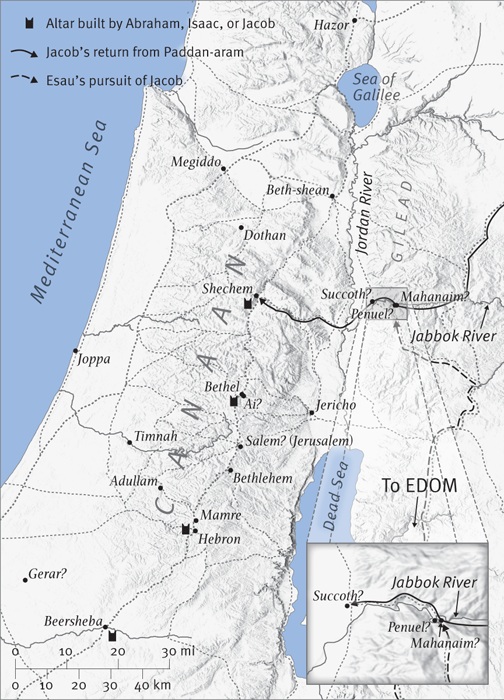
After acquiring wealth in Paddan-aram, Jacob returned to Canaan. He came to Mahanaim, where he sent his household ahead of him and crossed the Jabbok alone. There he wrestled with a mysterious man until morning and named the place Peniel (also called Penuel). Jacob then encountered his brother Esau, who had come from Edom to meet him. After the two were reconciled, Esau returned to Edom, while Jacob journeyed to Canaan.
GENESIS—NOTE ON 32:1 the angels of God. With one crisis behind him and before him the suspense of having to face Esau, Jacob was first met by an angelic host, who must have reminded him of Bethel, which served also as a timely reminder and encouragement of God's will being done on earth (28:11– 15).
GENESIS—NOTE ON 32:2 God's camp . . . Mahanaim. Meaning "two camps," i.e., one being God's and one being his own. It was located east of the Jordan River in Gilead near the Jabbok River.
GENESIS—NOTE ON 32:3 Seir . . . Edom. The territory of Esau south of the Dead Sea.
GENESIS—NOTE ON 32:7 greatly afraid and distressed. He had sought reconciliation with Esau (vv. 4–5), but the report of the returning envoys (v. 6) only confirmed his deepest suspicions that Esau's old threat against him (27:41– 42) had not abated over the years, and his coming with force betokened only disaster (32:8, 11). He prepared for the attack by dividing his company of people and animals.
GENESIS—NOTE ON 32:9–12 Commendably, notwithstanding the plans to appease his brother (vv. 13–21), Jacob prayed for deliverance, rehearsing God's own commands and covenant promise (v. 12; see 28:13–15), acknowledging his own anxiety, and confessing his own unworthiness before the Lord. This was Jacob's first recorded prayer since his encounter with God at Bethel en route to Laban (28:20–22).
GENESIS—NOTE ON 32:13–21 The logistics of Jacob's careful appeasement strategy (550 animals Esau would prize) may highlight his ability to plan, but it highlights even more, given the goal statement at the end (v. 20), his failure to pray and believe that God would change Esau's heart.
GENESIS—NOTE ON 32:22–32 This unique, nightlong wrestling match at Peniel ends with the 97-year-old Jacob having a change of name (v. 28) and the place having a new name assigned to it (v. 30) in order to memorialize it for Jacob and later generations. The limp with which he emerged from the match (vv. 25, 31) also served to memorialize this event.
GENESIS—NOTE ON 32:22 Jabbok. A stream, 60–65 miles long, east of the Jordan, which flows into that river midway between the Sea of Galilee and the Dead Sea (c. 45 miles south of the Sea of Galilee).
GENESIS—NOTE ON 32:24 a man wrestled. The site name, Peniel, or "face of God," given by Jacob (v. 30) and the commentary given by Hosea (Hos. 12:4) identifies this man with whom Jacob wrestled as the angel of the Lord who is also identified as God, a preincarnate appearance of the Lord Jesus Christ. See note on Ex. 3:2.
GENESIS—NOTE ON 32:28 no longer . . . Jacob, but Israel. Jacob's personal name changed from one meaning "heel-catcher" or "deceiver" to one meaning "God's fighter" or "he strives with God" (cf. 35:10). with God and with men. An amazing evaluation of what Jacob had accomplished, i.e., emerging victorious from the struggle. In the record of his life, "strive" did indeed dominate: 1) with his brother Esau (ch. 25–27); 2) with his father (ch. 27); 3) with his father-in-law (ch. 29–31); 4) with his wives (ch. 30); and 5) with God at Peniel (32:28).
GENESIS—NOTE ON 32:30 Peniel. See note on v. 24.
GENESIS—NOTE ON 32:32 not eat the sinew of the thigh. This might refer to the sciatic muscle/tendon. The observation that up to Moses' time ("to this day") the nation of Israel did not eat this part of a hindquarter intrigues because it bears no mention elsewhere in the OT, nor is it enshrined in the Mosaic law. It does find mention in the Jewish Talmud as a sacred law.
GENESIS—NOTE ON 33:1–2 Esau was coming. Jacob hastily divided his family into three groups (cf. 31:7) and went ahead of them to meet his brother. The division and relative location of his family in relationship to the perceived danger gives tremendous insight into whom Jacob favored.
GENESIS—NOTE ON 33:3–4 Fearfully and deferentially, Jacob approached his brother as an inferior would a highly honored patron, while gladly and eagerly, Esau ran to greet his brother without restraint of emotion. "They wept" because, after 21 years of troubling separation, old memories were wiped away and murderous threats belonged to the distant past; hearts had been changed, brothers reconciled! See v. 10.
GENESIS—NOTE ON 33:5–11 Family introductions (vv. 5–7) and an explanation of the 550 animals gift (vv. 8–10; cf. 32:13–21) properly acknowledged the gracious provision of the Lord upon his life (33:5, 11). The battle for generosity was won by Jacob when Esau, who initially refused to take anything from his brother, finally agreed to do so (v. 11).
GENESIS—NOTE ON 33:10 your face . . . the face of God. Jacob acknowledged how God had so obviously changed Esau, as indicated by his facial expression, which was not one of sullen hate but of brotherly love divinely wrought and restored.
GENESIS—NOTE ON 33:15 Let me find favor. Jacob did not want to have Esau's people loaned to him for fear something might happen to again fracture their relationship.
GENESIS—NOTE ON 33:16–17 to Seir . . . to Succoth. With Esau's planned escort courteously dismissed, they parted company. Jacob's expressed intention to meet again in Seir (see note on 32:3), for whatever reason, did not materialize. Instead, Jacob halted his journey first at Succoth, then at Shechem (v. 18). Succoth is east of the Jordan River, 20 miles east of Shechem, which is 65 miles north of Jerusalem, located between Mount Ebal and Mount Gerizim.
GENESIS—NOTE ON 33:18 came safely. C. 1908 B.C. A reference to the fulfillment of Jacob's vow made at Bethel when, upon departure from Canaan, he looked to God for a safe return. Upon arrival in Canaan, he would tithe of his possessions (28:20–22). Presumably Jacob fulfilled his pledge at Shechem or later at Bethel (35:1).
GENESIS—NOTE ON 33:19 bought . . . the piece of land. This purchase became only the second piece of real estate legally belonging to Abraham's line in the Promised Land (cf. 23:17–18; 25:9–10). However, the land was not Abraham's and his descendants' simply because they bought it, but rather because God owned it all (Lev. 25:23) and gave it to them for their exclusive domain (see notes on Gen. 12:1–3).
GENESIS—NOTE ON 33:20 erected an altar. In the place where Abraham had first built an altar (12:6–7), Jacob similarly marked the spot with a new name, incorporating his own new name (32:28), "God, the God of Israel," declaring that he worshiped the "Mighty One." "Israel" perhaps foreshadowed its use for the nation with which it rapidly became associated, even when it consisted of not much more than Jacob's extended household (34:7).
GENESIS—NOTE ON 34:1–31 The tawdry details of the abuse of Dinah and the revenge of Levi and Simeon are recounted in full, perhaps in order to highlight for the readers about to enter Canaan how easily Abraham's descendants might intermingle and marry with Canaanites, contrary to patriarchal desires (cf. 24:3; 27:46; 28:1) and God's will (Ex. 34:6; Deut. 7:3; Josh. 23:12–13; Neh. 13:26– 27).
GENESIS—NOTE ON 34:1 to see the women. Little did Dinah (see 30:20–21) realize that her jaunt to the nearby city to view how other women lived would bring forth such horrific results.
GENESIS—NOTE ON 34:2 saw . . . seized . . . lay with. Scripture classifies Shechem's action as forcible rape, no matter how sincerely he might have expressed his love for her afterwards (v. 3) and desire for marriage (vv. 11–12). Other expressions in the account underscore the clearly unacceptable nature of this crime, e.g. "defiled" (vv. 5, 13), "indignant and very angry" (v. 7), "an outrageous thing . . . must not be done" (v. 7), and "treat our sister like a prostitute" (v. 31).
GENESIS—NOTE ON 34:5 Jacob held his peace. In the absence of further data, Jacob's reticence to respond should not be criticized. Wisdom dictated that he wait and counsel with his sons, but their reaction, grief, anger, and vengeance hijacked the talks between Jacob and Hamor (v. 6) and led finally to Jacob's stern rebuke (v. 30).
GENESIS—NOTE ON 34:6–10 The prince of Shechem painted a picture of harmonious integration (v. 16, "become one people"). However, Shechemite self-interest and enrichment actually prevailed (v. 23).
GENESIS—NOTE ON 34:7 in Israel. Already Jacob's household is being called by the name God had given him as father of the coming nation (32:28).
GENESIS—NOTE ON 34:13–17 Feigning interest in the proposals put forward and misusing, if not abusing, the circumcision sign of the Abrahamic Covenant (see notes on 17:11–14), Jacob's sons conned both father and son into convincing all the men to submit to circumcision because the outcome would be to their favor with marriages (34:9) and social, economic integration (v. 10).
GENESIS—NOTE ON 34:19 he was the most honored. Meaning that the men agreed to such an excruciating surgery (vv. 24–25) because they had so much respect for him and because they anticipated mercenary benefit (v. 23).
GENESIS—NOTE ON 34:20 gate of their city. The normal place for public gatherings.
GENESIS—NOTE ON 34:25–29 A massacre of all males and the wholesale plunder of the city went way beyond the reasonable, wise, and justly deserved punishment of one man; this was a considerably more excessive vengeance than the Mosaic law would later legislate (cf. Deut. 22:28–29).
GENESIS—NOTE ON 34:27 sons of Jacob. Simeon and Levi set in motion the barbarity of that day and attention validly falls upon them in the narrative (vv. 25, 30; cf. 49:5–7), but their brothers joined in the looting, thereby approving murder and mayhem as justifiable retribution for the destroyed honor of their sister (34:31).
GENESIS—NOTE ON 34:30 You have brought trouble on me. Vengeance exacted meant retaliation expected. Total loss of respect ("making me stink") and of peaceful relations (v. 21) put both him and them in harm's way with survival being highly unlikely. This threat tested God's promise of safety, giving Jacob cause for great concern (28:15; 32:9, 12). Perizzites. See note on 13:7.
GENESIS—NOTE ON 35:1 Bethel. This was the place where God confirmed the Abrahamic Covenant to Jacob (28:13–15).
GENESIS—NOTE ON 35:2–4 Put away the foreign gods. Moving to Bethel necessitated spiritual preparation beyond the level of an exercise in logistics. Possession of idolatrous symbols such as figurines, amulets, or cultic charms (v. 4, "rings . . . in their ears") were no longer tolerable, including Rachel's troubling teraphim (31:19). Idols buried out of sight, plus bathing and changing to clean clothes, all served to portray both cleansing from defilement by idolatry and consecration of the heart to the Lord. It had been 8 or 10 years since his return to Canaan and, appropriately, time enough to clean up all traces of idolatry.
GENESIS—NOTE ON 35:4 terebinth tree . . . near Shechem. Possibly this was the same tree as in Abraham's day (12:6).
GENESIS—NOTE ON 35:5 a terror from God. A supernaturally induced fear of Israel rendered the surrounding city-states unwilling and powerless to intervene and made Jacob's fear of their retaliation rather inconsequential (34:30).
GENESIS—NOTE ON 35:7 built an altar. Through this act of worship, fulfillment of his vow (28:20–22), and renaming the site, Jacob reconfirmed his allegiance to God, who also affirmed his commitment to Jacob by reappearing to him, repeating the change of name (35:10; cf. 32:28), and rehearsing the Abrahamic promises (35:11–12). In response, Jacob also repeated the rite he had performed when he first met God at Bethel (v. 14) and reaffirmed its name (v. 15).
GENESIS—NOTE ON 35:11 kings shall come from your own body. God's words, here included for the first time since his promises at Abraham's circumcision (17:6, 16), served as a reminder of future royalty.
GENESIS—NOTE ON 35:13 went up. The presence of God was there in some visible form.
GENESIS—NOTE ON 35:14 A commonly done way to make a covenant (see note on 28:18–21).
GENESIS—NOTE ON 35:16 Ephrath. A more ancient name for Bethlehem (v. 19; 48:7; cf. 5:2).
GENESIS—NOTE ON 35:18 Ben-oni . . . Benjamin. The dying mother appropriately named her newly born son "Son of my sorrow," but the grieving father named him "Son of the right hand," thus assigning him a place of honor in the home. Her prayer at the birth of her firstborn was answered (30:24).
GENESIS—NOTE ON 35:20 The memorial to Rachel could still be seen in Moses' day, about 1 mile north of Bethlehem.
GENESIS—NOTE ON 35:21 tower of Eder. Likely a watchtower for shepherds, near Bethlehem.
GENESIS—NOTE ON 35:22 the sons of Jacob were twelve. The birth of Benjamin in Canaan (v. 18) furnished reason to simply review the sons born outside of Canaan, with only one sad note preceding it, i.e., the sin of Reuben, which tainted the qualifier "Jacob's firstborn" in the listing (see 49:3–4; Deut. 22:30; 1 Chron. 5:1–2).
GENESIS—NOTE ON 35:27 Mamre . . . Hebron. See note on 13:18.
GENESIS—NOTE ON 35:29 his sons Esau and Jacob. C. 1885 B.C. Isaac's funeral brought his two sons back together, as Abraham's funeral had done for Isaac and Ishmael (25:9). Jacob, back in the land before his father's death, fulfilled yet another part of his Bethel vow (28:21, "come again to my father's house in peace").
GENESIS—NOTE ON 36:1–37:1 The genealogy of Esau (36:1).
GENESIS—NOTE ON 36:1–19 The taking up of the history of Jacob (37:2), the next patriarch, is preceded by a fairly detailed genealogy of Esau, to which is appended both the genealogy of Seir the Horite, whose descendants were the contemporary inhabitants of Edom and a listing of Edomite kings and chiefs. Jacob's and Esau's posterities, as history would go on to show, would not be in isolation from each other as originally intended (36:6–8). They were to become bitter enemies engaged with each other in war.
GENESIS—NOTE ON 36:1 Edom. Cf. v. 8; see note on 25:30; see Introduction to Obadiah.
GENESIS—NOTE ON 36:7 too great for them to dwell together. Crowded grazing and living conditions finally clinched the decision by Esau to move permanently to Edom, where he had already established a home (cf. 32:3; 33:14, 16). Since it was Abraham's descendants through Isaac and Jacob who would possess the land, it was fitting for God to work out the circumstances providentially of keeping Jacob's lineage in the land and moving Esau's lineage out. It is not revealed if Esau had understood and come to accept the promises of God to Jacob, although his descendants surely sought to deny Israel any right to their land or their life.
GENESIS—NOTE ON 36:8 hill country of Seir. This was divinely assigned as Esau's place (Deut. 2:5; Josh. 24:4).
GENESIS—NOTE ON 36:10–14 Esau's sons. Cf. 1 Chron. 1:35–37.
GENESIS—NOTE ON 36:15 the chiefs. This term, "ruler of a thousand," apart from one exception (Zech. 12:5–6), is used exclusively for the tribal princes or clan leaders, the political/military leaders in Edom. It may suggest a loosely formed tribal confederacy.
GENESIS—NOTE ON 36:20–28 sons of Seir. Cf. 1 Chron. 1:38–42.
GENESIS—NOTE ON 36:31–39 kings . . . before any king . . . over the Israelites. Sandwiched in the genealogical details of Edom is a statement prophetically pointing to kingship in Israel (17:6, 16; 35:11; 49:10; Num. 24:7, 17–18; Deut. 17:14–20). The kings' list does not introduce a dynasty, each ruler not being the son of his predecessor. "Kings" more likely suggests rule over a more settled people than tribal groups.
GENESIS—NOTE ON 36:43 father of Edom. The closing title of the genealogy calls attention to the Lord's words to Rebekah at the birth of her sons, "two nations are in your womb" (25:23); here was the nation from the older.
GENESIS—NOTE ON 37:1 land of his father's sojournings. This introduction to the story of Jacob's son, Joseph, informs the reader that Jacob's father, Isaac, hence his sons as well, though in the land, had not yet entered into possession of their inheritance. They were still alien residents. land of Canaan. Actually Jacob and his family were in Hebron (v. 14). See note on 13:18.
GENESIS—NOTE ON 37:2–50:26 The genealogy of Jacob (v. 2).
GENESIS—NOTE ON 37:2 Joseph, being seventeen years old. Eleven years had passed since he had entered the land of Canaan with his family (cf. 30:22–24), since Joseph was born six years before departing from Haran. a bad report. Whether Joseph brought this at his own initiative or reported back at the father's demand on four of his brothers (e.g., v. 14) is not elaborated upon, nor specifically cited as the cause of the brothers' intense dislike of Joseph (cf. vv. 4–5, 8, 11, 18–19).
GENESIS—NOTE ON 37:3–4 Overt favoritism of Joseph and tacit appointment of him as the primary son by the father (see note on v. 3) conspired to estrange him from his brothers. They hated and envied him (vv. 4–5, 11) and could not interact with him without conflict and hostility. Joseph must have noticed the situation.
GENESIS—NOTE ON 37:3 a robe of many colors. The Septuagint (LXX) favored this translation of the Hebrew phrase used by Moses, although some prefer "a long-sleeved robe" or "an ornamented tunic." It marked the owner as the one whom the father intended to be the future leader of the household, an honor normally given to the firstborn son.
GENESIS—NOTE ON 37:5–10 The content of the dreams that Joseph recounted exacerbated fraternal hostility, with the second one also incurring paternal rebuke. The dream symbolism needed no special interpretation to catch its significant elevation of the favored son to ruling status over his brothers (vv. 8– 10).
GENESIS—NOTE ON 37:11 kept the saying in mind. Unlike the brothers, who immediately rejected any meaning to Joseph's words yet still allowed the dream to sorely irritate them into greater resentment of their brother (v. 19), the father, notwithstanding his public admonishment of Joseph, continued to ponder the meaning of the dreams.
GENESIS—NOTE ON 37:12–17 The assignment to Shechem brought Joseph providentially to Dothan, a site more convenient for contact with merchants using the main trade route on their way to Egypt.
Joseph and his Brothers
Jacob sent Joseph from Hebron to Shechem to find his brothers, who had been pasturing their father's flock. When Joseph arrived, he learned that his brothers had gone on to Dothan, so he went there and found them. His brothers threw him into a pit and later sold him to some Ishmaelite spice traders on their way from Gilead to Egypt. The traders took Joseph to Egypt and sold him to Potiphar, the captain of Pharaoh's guard.
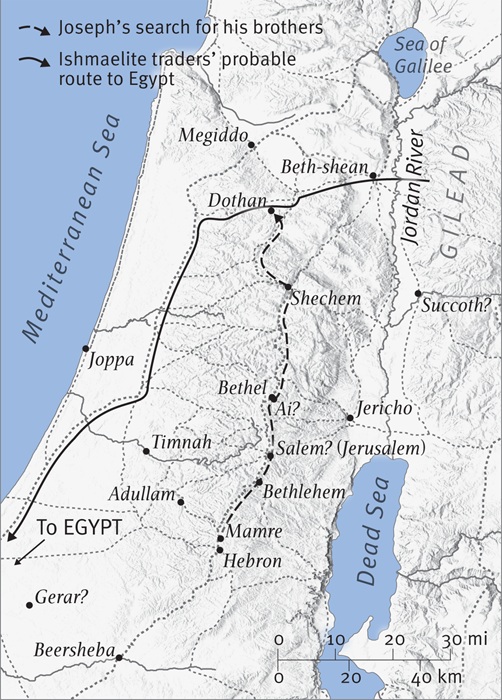
GENESIS—NOTE ON 37:12, 14 Shechem . . . Hebron. Shechem (see note on 12:6) was located c. 50 miles north of Hebron (see note on 13:18).
GENESIS—NOTE ON 37:17 Dothan. Almost 15 miles north of Shechem.
GENESIS—NOTE ON 37:18–27 The brothers' plans for murder and cover-up, the fruit of hate and envy, were forestalled by two brothers: first by Reuben, who intended to effect a complete rescue (vv. 21–22), and then by Judah who, prompted by a passing merchants' caravan, proposed a profitable alternative to fratricide (vv. 25–27).
GENESIS—NOTE ON 37:25 Ishmaelites. Also known as Midianites (cf. vv. 28, 36; 39:1). The descendants of Ishmael and of Abraham through Keturah and Midian (25:1–2) were sufficiently intermarried or were such inveterate travelers and traders, that they were viewed as synonymous groups. These were coming west from Gilead. Gilead. See note on 31:21.
GENESIS—NOTE ON 37:27 This criminal behavior would later be prohibited by the Mosaic legislation (Ex. 21:16; Deut. 24:7)
GENESIS—NOTE ON 37:28 twenty shekels of silver. This was the average price of a slave at that time in the second millennium B.C. Although most slaves were part of the booty of military conquest, private and commercial slave-trading was also common. Joseph was sold into slavery c. 1897 B.C.
GENESIS—NOTE ON 37:29 Reuben . . . tore his clothes. Although he was absent at the time of the sale, he would be held responsible for the treachery, and so joined in the cover-up (vv. 30–35). His grief manifested how much he had actually wanted to rescue Joseph (see 42:22).
GENESIS—NOTE ON 37:31–35 The deceiver of Isaac (27:18–29) was deceived by his own sons' lie. Sin's punishment is often long delayed.
GENESIS—NOTE ON 37:35 Sheol. This is the first OT use of this term for the abode of the dead (in 35:20 the word "tomb" is used to refer to an earthly burial plot). It is a general Hebrew term meaning the place of the dead (used 65 times in the OT), referring to either the body in its decaying form or the soul in its conscious afterlife.
GENESIS—NOTE ON 37:36 Potiphar. He was a prominent court official and highranking officer in Egypt, perhaps captain of the royal bodyguard (cf. 40:3–4). His name, a most unusual grammatical form for that period, either meant "the one whom the god Ra has given" or "the one who is placed on earth by Ra," making it a descriptive epithet more than a personal name. See note on 40:3–4.
GENESIS—NOTE ON 38:1–30 The Judah-Interlude, as it is sometimes known, is bracketed by references to the sale of Joseph to Potiphar (37:36; 39:1). Such a parenthesis in the Joseph story demands some reason why a chapter laced with wickedness, immorality, and subterfuge should of necessity be placed in this spot. The answer is that the events recorded are chronologically in the right place, being contemporary with Joseph's slavery in Egypt (38:1, "at that time"). The account is also genealogically in the right place, i.e., with Joseph gone (seemingly for good), with Reuben, Simeon, and Levi out of favor (for incest and for treachery), Judah would most likely accede to firstborn status. It provides a contrast because it also demonstrates the immoral character of Judah, as compared with the virtue of Joseph. Canaanite syncretistic religion and inclusivism threatened to absorb the fourth and later generations of Abraham's heirs, but Egyptian exile and racial exclusivism produced not loss of their ethnic identity, but preservation of it.
GENESIS—NOTE ON 38:1 Adullamite. Adullam was a town about 1 mile northwest of Hebron.
GENESIS—NOTE ON 38:2–5 Judah's separation from his brethren was marked by more than the geographical; it involved integration. His Canaanite wife had three sons for his family line.
GENESIS—NOTE ON 38:6–10 Two sons were executed by the Lord, one for unspecified wickedness and one for deliberate and rebellious rejection of the duty to marry a relative's widow, called a levirate marriage. This was a rather dubious distinction for the line of Judah to gain. For details on levirate marriage according to later Mosaic law, see note on Deut. 25:5–10; see Introduction to Ruth.
GENESIS—NOTE ON 38:11 Remain a widow . . . till Shelah my son. Taking her father-in-law at his word and residing at her father's household as a widow would do, Tamar vainly waited for Judah's third son to protect the inheritance rights of her deceased husband (v. 14) and finally resorted to subterfuge to obtain her rights (vv. 13–16). In so doing, she may have been influenced by Hittite inheritance practices which wickedly called the father-in-law into levirate marriage in the absence of sons to do so.
GENESIS—NOTE ON 38:12 Timnah. The specific location in the hill country of Judah is unknown. Cf. Samson, Judg. 14:1.
GENESIS—NOTE ON 38:13 shear his sheep. Such an event was frequently associated, in the ancient world, with festivity and licentious behavior characteristic of pagan fertility-cult practices.
GENESIS—NOTE ON 38:14–15 Feeling that no one was going to give her a child, Tamar resorted to disguising herself as a prostitute, obviously knowing she could trap Judah, which says little for his moral stature in her eyes. Judah's Canaanite friend, Hirah (vv. 1, 20), called her a temple prostitute (v. 21), which made Judah's actions no less excusable just because cultic prostitution was an accepted part of Canaanite culture. He solicited the iniquity by making the proposal to her (v. 16), and she played the role of a prostitute, negotiating the price (v. 17).
GENESIS—NOTE ON 38:18 Your signet and your cord and your staff. A prominent man in the ancient Near East endorsed contracts with the cylinder signet he wore on a cord around his neck. Her request for the walking stick suggests it also had sufficient identifying marks on it (cf. v. 25, "whose these are"). The custom of using three pieces of identification is attested to in Ugaritic (Canaanite) literature.
GENESIS—NOTE ON 38:20–23 It was not good for one's reputation to keep asking for the whereabouts of a prostitute.
GENESIS—NOTE ON 38:24 let her be burned. Double standards prevailed in that Judah, no less guilty than Tamar, commanded her execution for immorality. Later Mosaic legislation would prescribe this form of the death penalty for a priest's daughter who prostituted herself or for those guilty of certain forms of incest (Lev. 20:14; 21:9).
GENESIS—NOTE ON 38:26 more righteous than I. This was not an accolade for her moral character and faith, but a commendation by Judah for her attention to inheritance rights of her family line and his shameful neglect thereof. Her death sentence was rescinded.
GENESIS—NOTE ON 38:29 Perez. This first of the twins, born of prostitution and incest to Tamar, nevertheless came into the messianic line, which went through Boaz and Ruth to King David (Ruth 4:18–22; Matt. 1:3). His name means "breach" or "pushing through."
GENESIS—NOTE ON 39:1 Potiphar. See note on 37:36. Ishmaelites. See note on 37:25.
GENESIS—NOTE ON 39:2 The Lord was with Joseph. Any and all ideas that Joseph, twice a victim of injustice, had been abandoned by the Lord are summarily banished by the employment of phrases highlighting God's oversight of his circumstances, e.g. "with him" (vv. 3, 21), "caused all that he did to succeed" (vv. 3, 23), "found/gave him favor" (vv. 4, 21), "blessed/blessing" (v. 5), and "showed him steadfast love" (v. 21). Neither being unjustly sold into slavery and forcibly removed from the land (37:28), nor being unjustly accused of sexual harassment and imprisoned (39:13–18) were events signaling even a temporary loss of divine superintendence of Joseph's life and God's purpose for his people, Israel.
GENESIS—NOTE ON 39:2–4 successful . . . overseer over his house. This involved the authority and trust as the steward of the whole estate (v. 5, "house and field" and v. 9, "not greater"), one of the criteria for which was trust. No doubt Joseph was conversant in the Egyptian language (see note on 29:9).
GENESIS—NOTE ON 39:5 the blessing of the Lord. Joseph was experiencing fulfillment of the Abrahamic Covenant, even at that time before Israel was in the land (see 12:1–3).
GENESIS—NOTE ON 39:6 no concern about anything but the food he ate. Since Joseph proved trustworthy enough to need no oversight, his master concerned himself only with his own meals or his very own personal affairs. Joseph himself remarked that Potiphar had delegated to him so much, that he no longer knew the full extent of his own business affairs (v. 8); in fact, he knew only what was set before him (v. 6).
GENESIS—NOTE ON 39:9 this great wickedness. Joseph explained, when first tempted, that adultery would be a gross violation of his ethical convictions that demanded 1) the utmost respect for his master and 2) a life of holiness before his God. Far more was involved than compliance with the letter of an ancient Near Eastern law-code, many of which did forbid adultery. Rather, as one who walked with God, Joseph was seeking to obey moral standards which existed long before Mosaic law-code prescriptions applied (cf. Ps. 51:4).
GENESIS—NOTE ON 39:10–18 Her incessant efforts to seduce Joseph failed in the face of his strong convictions not to yield or be compromised. At flashpoint, Joseph fled! Based on false accusations, Joseph was deemed guilty and imprisoned. Cf. 2 Tim. 2:22 for a NT picture of Joseph's attitude.
GENESIS—NOTE ON 39:12 his garment. See 37:31–35 for the other time one of Joseph's cloaks was used in a conspiracy against him.
GENESIS—NOTE ON 39:17 Hebrew servant. This term was used by Potiphar's wife as a pejorative, intended to heap scorn upon someone considered definitely unworthy of any respect. Its use may also suggest some latent attitudes toward dwellers in Canaan, which could be aggravated to her advantage. Potiphar's wife also neatly shifted the blame onto her husband for having hired the Hebrew in the first place (vv. 16–18) and stated this also before the servants (v. 14).
GENESIS—NOTE ON 39:19–20 The death penalty for adultery may not have applied to a charge of attempted adultery, attempted seduction, or rape (cf. vv. 14, 18), so Potiphar consigned Joseph to the prison reserved for royal servants, from where, in the providence of God, he would be summoned into Pharaoh's presence and begin the next stage of his life (cf. chs. 40–41). See note on 40:3–4.
GENESIS—NOTE ON 39:21 showed him steadfast love. God did not permit this initial painful imprisonment to continue (cf. Ps. 105:18–19).
GENESIS—NOTE ON 39:22–23 Once again Joseph, though in circumstances considerably less comfortable than Potiphar's home, rose to a position of trust and authority and proved to be trustworthy enough not to need any oversight.
GENESIS—NOTE ON 40:1 the king of Egypt. To be identified as Senusert II, c. 1894–1878 B.C.
GENESIS—NOTE ON 40:2 the chief cupbearer and the chief baker. Both these occupations and ranks in Pharaoh's court are attested in existing ancient Egyptian documents. The cupbearer gave him his drinks. The baker cooked his bread. Both had to be trustworthy and beyond the influence of the monarch's enemies.
GENESIS—NOTE ON 40:3–4 captain of the guard. See note on 37:36. If this was Potiphar, the captain of the guard, then Joseph's former master directed him to attend to the two royal servants remanded into his custody until sentence was past. This prison was also called "the house of the captain of the guard" (40:3), "his master's house" (v. 7), and "pit" (v. 15; 41:14), unless Joseph had been moved to another penal facility.
GENESIS—NOTE ON 40:5 dream. Oneiromancy, the science or practice of interpreting dreams, flourished in ancient Egypt because dreams were thought to determine the future. Both Egypt and Babylon developed a professional class of dream interpreters. Deuteronomy 13:1–5 shows that such dream interpreters were part of ancient false religion and to be avoided by God's people. By some 500 years later, a detailed manual of dream interpretation had been compiled. Unlike Joseph, neither cupbearer nor baker understood the significance of their dreams (cf. Gen. 37:5–11).
GENESIS—NOTE ON 40:8 Do not interpretations belong to God? Joseph was careful to give credit to his Lord (cf. 41:16). Daniel, the only other Hebrew whom God allowed to accurately interpret revelatory dreams, was just as careful to do so (Dan. 2:28). Significantly, God chose both men to play an important role for Israel while serving pagan monarchs and stepping forward at the critical moment to interpret their dreams and reveal their futures.
GENESIS—NOTE ON 40:9–13 the chief cupbearer. Consistent with his duty as the cupbearer to the king, he dreamed of a drink prepared for Pharaoh. It was a sign that he would be released and returned to his position (v. 13).
GENESIS—NOTE ON 40:14–15 remember me. A poignant appeal to the cupbearer, whose future was secure, to speak a word for Joseph's freedom, because he knew cupbearers had the ear of kings. The cupbearer quickly forgot Joseph (v.
23) until his memory was prompted just at the right moment two years later (41:1, 9).
GENESIS—NOTE ON 40:15 the land of the Hebrews. Giving this designation to the land of Canaan indicates that Joseph understood the land promise of the Abrahamic Covenant.
GENESIS—NOTE ON 40:16 interpretation was favorable. The chief baker, noting some similarity in the dreams, was encouraged to request interpretation of his dream.
GENESIS—NOTE ON 40:20 Pharaoh's birthday. The Rosetta Stone (discovered in
A.D. 1799, this is a trilingual artifact from Egyptian antiquity, c. 196 B.C., whose Greek inscription enabled linguists to understand the language of hieroglyphics) records a custom of releasing Pharaoh's prisoners, but at this party held for his servants, Pharaoh rendered two very different kinds of judgment (vv. 21–22).
GENESIS—NOTE ON 41:1 the Nile. This river dominated Egyptian life.
GENESIS—NOTE ON 41:8 none who could interpret. The combined expertise of a full council of Pharaoh's advisers and dream experts, all of whom had been summoned into his presence, failed to provide an interpretation of the two disturbing dreams. Without knowing it, they had just set the stage for Joseph's entrance on the scene of Egyptian history.
GENESIS—NOTE ON 41:9 Then the chief cupbearer said. With memory suitably prompted, the butler apologized for his neglect ("my offenses"), and apprised Pharaoh of the Hebrew prisoner and his accurate interpretation of dreams two years earlier (vv. 10–13).
GENESIS—NOTE ON 41:14 Then Pharaoh sent and called Joseph. The urgent summons had Joseph in front of Pharaoh with minimum delay, in prized, cleanshaven Egyptian style for a proper appearance.
GENESIS—NOTE ON 41:16 It is not in me; God will give. Deprecating any innate ability, Joseph advised at the very outset that the answer Pharaoh desired could only come from God.
GENESIS—NOTE ON 41:25 God has revealed. Joseph's interpretation kept the focus fixed upon what God had determined for Egypt (vv. 28, 32).
GENESIS—NOTE ON 41:33–36 After interpreting the dream, Joseph told Pharaoh how to survive the next 14 years. Incongruously, Joseph, a slave and a prisoner, appended to the interpretation a long-term strategy for establishing reserves to meet the future need, and included advice on the quality of the man to head up the project. Famines had ravaged Egypt before, but this time divine warning permitted serious and sustained advance planning.
GENESIS—NOTE ON 41:37–41 To Pharaoh and his royal retinue, no other candidate but Joseph qualified for the task of working out this good plan, because they recognized that he spoke God-given revelation and insight (v. 39). Joseph's focus on his Lord had taken him from prison to the palace quickly (v. 41).
GENESIS—NOTE ON 41:38 the Spirit of God. The Egyptians did not understand about the third person of the triune Godhead. They merely meant that God had assisted Joseph.
GENESIS—NOTE ON 41:41 set you over all the land of Egypt. The country-wide jurisdiction accorded to Joseph receives frequent mention in the narrative (vv. 43–44, 46, 55; 42:6; 45:8).
GENESIS—NOTE ON 41:42 signet ring . . . garments . . . gold chain. Emblems of office and a reward of clothing and jewelry suitable to the new rank accompanied Pharaoh's appointment of Joseph as vizier, or prime minister, the second-in-command (v. 40; 45:8, 26). Joseph wore the royal seal on his finger, authorizing him to transact the affairs of state on behalf of Pharaoh himself.
GENESIS—NOTE ON 41:43–45 Other awards appropriate to promotion were also bestowed upon Joseph, namely, official and recognizable transportation (v. 43), an Egyptian name (v. 45), and an Egyptian wife (v. 45). Further, the populace was commanded to show deference for their vizier (v. 43, "Bow the knee"). All these dreams had been revealed by God, in a rare display of manifesting truth through pagans, so that Joseph would be established in Egypt as a leader and, thus elevated, could be used for the preservation of God's people when the famine came to Canaan. Thus, God cared for his people and fulfilled his promises (see note on 45:1–8).
GENESIS—NOTE ON 41:43 his second chariot. This signified to all that Joseph was second-in-command.
GENESIS—NOTE ON 41:45 Zaphenath-paneah. This name probably means "The Nourisher of the Two Lands, the Living One" but various other proposals have also been suggested; certainty of that meaning still eludes scholars. Foreigners are known to have been assigned an Egyptian name.
GENESIS—NOTE ON 41:46 thirty years old. C. 1884 B.C. Only 13 years had elapsed since his involuntary departure from "the land of the Hebrews" (cf. 40:15). Joseph had been 17 when the narrative commenced (37:2).
GENESIS—NOTE ON 41:50 On. One of the four great Egyptian cities, also called Heliopolis, which was known as the chief city of the sun god, Ra. It was located c. 19 miles north of ancient Memphis.
GENESIS—NOTE ON 41:51–52 Manasseh . . . Ephraim. The names, meaning "forgetful" and "fruitful," assigned to his sons together with their explanations depict the centrality of God in Joseph's worldview. Years of suffering, pagan presence, and separation from his own family had not harmed his faith.
GENESIS—NOTE ON 41:54–57 Use of hyperbole with "all" (vv. 54, 56–57) emphatically indicates the widespread ravaging impact of famine far beyond Egypt's borders. She had become indeed the "breadbasket" of the ancient world.
GENESIS—NOTE ON 41:55–56 Go to Joseph. After seven years, Joseph's authority remained intact, and Pharaoh still fully trusted his vizier. He dispensed the food supplies by sale to Egyptians and others (v. 47).
GENESIS—NOTE ON 42:1–3 Jacob's sons were paralyzed in the famine, and Jacob was reluctant to let his family return to Egypt, not knowing what would happen to them (v. 4). But, with no other choice left, he dispatched them to buy grain in Egypt (v. 2).
GENESIS—NOTE ON 42:4 Benjamin. See 35:16–19. He was the youngest of all, the second son of Rachel, Jacob's beloved, and the favorite of his father since he thought Joseph was dead.
GENESIS—NOTE ON 42:6 bowed. Without their appreciating it at the time, Joseph's dream became reality (37:5–8). Recognition of Joseph was unlikely because: 1) over 15 years had elapsed and the teenager sold into slavery had become a mature adult; 2) he had become Egyptian in appearance and dress; 3) he treated them without a hint of familiarity (42:7–8); and 4) they thought he was dead (v. 13).
GENESIS—NOTE ON 42:9–22 The brothers' final evaluation after being imprisoned for 3 days, after protesting the charge of espionage, and after hearing the royal criterion for establishing their innocence (vv. 15, 20), revealed their guilty conscience and their understanding that vengeance for their wrongdoing to Joseph had probably arrived (vv. 21–22). Calling themselves "honest men" (v. 11) was hardly an accurate assessment.
GENESIS—NOTE ON 42:9 remembered the dreams. Joseph remembered his boyhood dreams about his brothers bowing down to him (37:9) as they were coming true.
GENESIS—NOTE ON 42:15 by the life of Pharaoh. Speaking an oath in the name of the king would most likely have masked Joseph's identity from the brothers. Perhaps it also prevented them from grasping the significance of his declaration, "I fear God" (v. 18). unless your youngest brother comes here. Joseph wanted to find out if they had done the same or a similar thing to Benjamin as to himself.
GENESIS—NOTE ON 42:19–20 if you are honest men. Joseph took their assessment of themselves at face value when exhorting them to respond to his proposals, but still asked for a hostage.
GENESIS—NOTE ON 42:21 distress of his soul. The brothers had steeled their hearts when selling Joseph to the Midianites (37:28–29), but they could not forget the fervent pleading and terror-filled voice of the teenager dragged away as a slave from home. Reuben reminded them of his warning at that time and the consequence.
GENESIS—NOTE ON 42:22 reckoning for his blood. This declaration referred to the death penalty (9:5).
GENESIS—NOTE ON 42:24 took Simeon. He kept hostage not Reuben the firstborn, but Simeon, the oldest brother who willingly participated in the crime against Joseph (37:21–31).
GENESIS—NOTE ON 42:28 God has done. Their guilty conscience and fear of vengeance from God surfaced again in this response to the money with which they had purchased the grain being returned and found in the one sack that had been opened. Later, upon discovering all their money had been returned, their fear increased even further (v. 35).
GENESIS—NOTE ON 42:36 Jacob could not handle the prospect of losing another son, and didn't trust the brothers who had already divested him of two sons by what he may have thought were their intrigues. All . . . against me. The whole situation overwhelmed Jacob who complained against his sons (cf. 43:6) and would not release Benjamin (42:38).
GENESIS—NOTE ON 42:37 The always salutary Reuben generously made his father an offer easy to refuse—killing his grandsons!
GENESIS—NOTE ON 43:3 solemnly warned us. The seriousness of Joseph's words portended failure for another mission to buy food, unless the criterion he had set down was strictly met.
GENESIS—NOTE ON 43:9 I will be a pledge of his safety. Reuben's offer to guarantee the safety of Benjamin had been rejected (42:37–38), but Judah's was accepted (43:11) because of the stress of the famine and the potential death of all (v. 8) if they waited much longer (v. 10).
GENESIS—NOTE ON 43:11 a little. Likely, this was a significant present because they had little left. But there was no future at all past the little if they did not get grain in Egypt.
GENESIS—NOTE ON 43:14 Jacob's acquiescence to let Benjamin go (v. 13) ended with prayer for the brothers' and Benjamin's safety and with a cry of being a helpless victim of circumstances. Pessimism had apparently set into his heart and deepened after the loss of Joseph.
GENESIS—NOTE ON 43:23 Your God . . . has put. An indication of Joseph's steward either having come to faith in God or having become very familiar with how Joseph talked of his God and life. So concerned were the brothers to protest their ignorance of the means of the money being returned and to express their desire to settle this debt (vv. 20–22), that they missed the steward's clear reference to the God of Israel ("the God of your father") and his oversight of events in which he had played a part ("I received your money").
GENESIS—NOTE ON 43:26 bowed down to him to the ground. Again, Joseph's boyhood dream (37:5–8) had become reality (cf. 42:6).
GENESIS—NOTE ON 43:29 God be gracious. Joseph easily used the name of God in his conversation, but the brothers did not hear the name of their own covenant God being spoken by one who looked just like an Egyptian (cf. 42:18).
GENESIS—NOTE ON 43:30 to weep. Joseph was moved to tears on several occasions (42:24; 45:2, 14–15; 46:29).
GENESIS—NOTE ON 43:32 not eat with the Hebrews. Exclusivism kept the Egyptians sensitive to the social stigma attached to sharing a meal table with foreigners (cf. 46:34). Discrimination prevailed at another level too: Joseph ate alone, his rank putting him ahead of others and giving him his own meal table and setting.
GENESIS—NOTE ON 43:33 the firstborn . . . the youngest. To be seated at the table in birth order in the house of an Egyptian official was startling—how did he know this of them? Enough clues had been given in Joseph's previous questions about the family and his use of God's name for them to wonder about him and his personal knowledge of them. Obviously, they simply did not believe Joseph was alive (44:20) and certainly not as a personage of such immense influence and authority. They had probably laughed through the years at the memory of Joseph's dreams of superiority.
GENESIS—NOTE ON 43:34 Benjamin's portion. Favoritism shown to Rachel's son silently tested their attitudes; any longstanding envy, dislike, or animosity could not be easily masked. None surfaced.
GENESIS—NOTE ON 44:2 my cup, the silver cup. Joseph's own special cup, also described as one connected with divination (vv. 5, 15) or hydromancy (interpreting the water movements), was a sacred vessel symbolizing the authority of his office of Egyptian vizier. Mention of its superstitious nature and purpose need not demand Joseph be an actual practitioner of pagan religious rites. See note on v. 15.
GENESIS—NOTE ON 44:5 divination. See note on Deut. 18:9–12.
GENESIS—NOTE ON 44:7–9 The brothers, facing a charge of theft, protested their innocence by pointing first to their integrity in returning the money from the last trip, and then by declaring death on the perpetrator and slavery for themselves.
GENESIS—NOTE ON 44:12 beginning with the eldest. Again, there was a display of inside knowledge of the family, which ought to have signaled something to the brothers. See note on 43:33.
GENESIS—NOTE ON 44:13 tore their clothes. A well known ancient Near Eastern custom of visibly portraying the pain of heart being experienced. They were very upset that Benjamin might become a slave in Egypt (v. 10). Benjamin appears to have been speechless. They had passed a second test of devotion to Benjamin (the first in 43:34).
GENESIS—NOTE ON 44:14 fell before him. Again the dream had become reality (cf. 37:5–8; 42:6); but now prostrate before him, they had come to plead for mercy both for their youngest brother Benjamin and for their father Jacob (44:18–34).
GENESIS—NOTE ON 44:15 practice divination. See notes on vv. 2 and 5. Joseph, still disguising himself as an Egyptian official before his brothers, permitted them to think it so.
GENESIS—NOTE ON 44:16 And Judah said. Judah stepped forward as the family spokesman since it was he who came with his brothers to Joseph's house and he who pled with him (cf. vv. 14, 18); Reuben, the firstborn, had been eclipsed. God has found out the guilt. Judah, showing how his heart had changed, acknowledged the providence of God in uncovering their guilt (note the "we" in the questions), and did not indulge in any blame shifting, even onto Benjamin.
GENESIS—NOTE ON 44:18–34 An eloquent and contrite plea for mercy, replete with reference to the aged father's delight in and doting upon the youngest son (vv. 20, 30) and the fatal shock should he be lost (vv. 22, 29, 31, 34). Judah's evident compassion for Jacob and readiness to substitute himself for Benjamin in slavery finally overwhelmed Joseph—these were not the same brothers of yesteryear (45:1).
GENESIS—NOTE ON 45:1–8 Stunned by the revelation of who it really was with whom they dealt, the brothers then heard expressed a masterpiece of recognition of and submission to the sovereignty of God, i.e., his providential rule over the affairs of life, both good and bad. See note on 41:43–45.
GENESIS—NOTE ON 45:6 these two years. Joseph would have been 39 years old and away from his brothers for 22 years (37:2).
GENESIS—NOTE ON 45:7 to preserve . . . a remnant. Words reflecting, on Joseph's part, an understanding of the Abrahamic Covenant and its promise of a nation (cf. chs. 12; 15; 17).
GENESIS—NOTE ON 45:8 father to Pharaoh. A title that belonged to viziers and that designated one who, unrelated to Pharaoh, nevertheless performed a valuable function and held high position, which in Joseph's case was "lord of all Egypt" (v. 9). A new and younger Pharaoh now reigned, Senusert III, c. 1878– 1841 B.C.
GENESIS—NOTE ON 45:10 land of Goshen. This area, located in the northeast section of the Egyptian Delta region, was appropriate for grazing the herds of Jacob (cf. 47:27; 50:8). Over 400 years later, at the time of the exodus, the Jews still lived in Goshen (cf. Ex. 8:22; 9:26).
GENESIS—NOTE ON 45:14–15 Reconciliation was accomplished with much emotion, which clearly showed that Joseph held no grudges and had forgiven them, evidencing the marks of a spiritually mature man. See note on 50:15–18. It had been 22 years since the brothers sold Joseph into slavery.
GENESIS—NOTE ON 45:16 it pleased Pharaoh. The final seal of approval for Joseph's relatives to immigrate to Egypt came unsought from Pharaoh (vv. 17– 20).
GENESIS—NOTE ON 45:24 Do not quarrel on the way. A needed admonition because they would have so much sin to think about as they readied their confession to their father.
GENESIS—NOTE ON 45:26 his heart became numb. Like his sons (v. 3), Jacob was shocked by the totally unexpected good news. Even though the record is silent on the matter, this was the appropriate occasion for the sons to confess their crime to their father.
GENESIS—NOTE ON 46:1 offered sacrifices. The route to Egypt for Jacob went via Beersheba, a notable site about 25 miles southwest of Hebron and favorite place of worship for both Abraham and Isaac (21:33; 26:25).
GENESIS—NOTE ON 46:2–4 God spoke . . . in visions. Jacob's anxiety about his departure to Egypt was allayed by the Lord's approval and confirmation of his descendants returning as a nation. God had previously appeared/spoken to Jacob
GENESIS—NOTE ON 46:4 close your eyes. A promise of dying peacefully in the presence of his beloved son (cf. 49:33).
GENESIS—NOTE ON 46:6 came into Egypt. C. 1875 B.C. They remained 430 years (Ex. 12:40) until the exodus in 1445 B.C.
GENESIS—NOTE ON 46:8–27 The genealogical register, separately listing and totaling the sons per wife and handmaid, is enveloped by notification that it records the sons/persons of Jacob who went to Egypt (vv. 8, 27). Ancient Near Eastern genealogies could include historical notes as is true here, namely the death of Er and Onan (v. 12), and that Laban gave the handmaids to his daughters (vv. 18, 25).
GENESIS—NOTE ON 46:8 the descendants of Israel. This was the first time that author Moses referred to the family as a whole in this way, although "in Israel" had been used by the sons of Jacob before (cf. 34:7).
GENESIS—NOTE ON 46:26 sixty-six persons. The total of vv. 8–25 is 70, from which Er, Onan, Manasseh, and Ephraim need to be deleted.
GENESIS—NOTE ON 46:27 seventy. Jacob, Joseph, Manasseh, and Ephraim should be added to the 66. The 75 of Acts 7:14 included an additional five people, born in the land, which were added in the LXX reading of 46:8–27 (cf. Ex. 1:5; Deut. 10:22). These five included two sons of Manasseh, two sons of Ephraim, and one grandson of the latter. See note on Ex. 1:5.
GENESIS—NOTE ON 46:28 sent Judah ahead of him. Once again Judah was the leader going ahead as Jacob's representative, not Reuben. See note on 44:16. Goshen. See note on 45:10.
GENESIS—NOTE ON 46:31–34 Joseph's instructions about his preparatory interview with Pharaoh were designed to secure his relatives a place somewhat separate from the mainstream of Egyptian society. The social stigma regarding the Hebrews (43:32), who were shepherds also (46:34), played a crucial role in protecting Israel from intermingling and losing their identity in Egypt. See note on 43:32.
GENESIS—NOTE ON 47:1–6 in the land of Goshen. By informing Pharaoh of where he had located his family (cf. 45:10; 46:28) and then by having the family's five representatives courteously request permission to reside in Goshen (47:2, 4), Joseph, wise to court procedures, paved the way for Pharaoh's confirmation and approval (v. 6).
GENESIS—NOTE ON 47:7, 10Jacob blessed Pharaoh. The aged patriarch's salutations pronounced, undoubtedly in the name of God, a benediction on Pharaoh Senusert III (see note on 45:8) for his generosity and his provision of a safe place for Jacob's family. Though Senusert III had ascended to the throne before the famine ended, he honored his father's commitments.
GENESIS—NOTE ON 47:9 my sojourning . . . Few and evil. Since neither Jacob nor his fathers had actually possessed the land of Canaan, describing life as a sojourning was a fitting evaluation to give. In addition, his years seemed few in contrast to those of the two who had visited Egypt long before him, Abraham and Isaac (175 and 180 years respectively). And still overshadowed with pessimism, the days were "evil," in the sense of toil and trouble, of many sorrows, distresses, and crises. See note on 48:15.
GENESIS—NOTE ON 47:11 land of Rameses. An alternative designation for Goshen (cf. 46:34; 47:1, 6), with this name perhaps used later to more accurately describe the region for Moses' contemporary readers. See note on Ex. 1:11 regarding the name Rameses ("Raamses" being the alternate spelling in Exodus). This region is also called Zoan elsewhere (cf. Ps. 78:12, 43).
GENESIS—NOTE ON 47:12 according to the number of their dependents. A rationing system was evidently in operation.
GENESIS—NOTE ON 47:13–24 When the famine finally exhausted the Egyptians' supply of money, Joseph accepted animals in exchange for grain (v. 17). After the animals ran out, the people were desperate enough to exchange their land (vv. 19–20). Eventually, Pharaoh owned all the land, except what was the priests' (v. 22), though the people were allowed to work the land and pay one-fifth of its yield to Pharaoh (v. 24). Whatever may have been the land tenure system at that time, some private land ownership did at first exist, but finally, as in a feudal system, all worked their land for Pharaoh. Landed nobility did lose out and declined during major social reforms undertaken under Senusert III. This is the first record in Scripture of a national income tax, and the amount was 20 percent. Later, after the exodus, God would prescribe tithes for Israel as national income taxes to support the theocracy (see Mal. 3:10).
GENESIS—NOTE ON 47:15 when the money was all spent. The severity of the famine finally bankrupted all in Egypt and Canaan. With no monetary instruments available as a medium of exchange, a barter system was established (vv. 16–18).
GENESIS—NOTE ON 47:16–18 Land soon replaced animals as the medium of exchange.
GENESIS—NOTE ON 47:25–26 The extra measures imposed by Joseph to control the impact of the famine, i.e., moving parts of the population into cities (v. 21) and demanding a one-fifth tax on crop yields (v. 24), did not affect his approval ratings (v. 25). Whatever the gain to Pharaoh, the people obviously understood that Joseph had not enriched himself at their expense.
GENESIS—NOTE ON 47:27–28 fruitful and multiplied greatly. For 17 years, Jacob was witness to the increase; he had a glimpse of God's promise to Abraham, Isaac, and himself in the process of being fulfilled.
GENESIS—NOTE ON 47:29 your hand under my thigh. Cf. Abraham and Eliezer in 24:9. Do not bury me in Egypt. With the customary sign of an oath in that day, Joseph sincerely promised to bury Jacob, at his request, in the family burial cave in Canaan (cf. 49:29–32).
GENESIS—NOTE ON 47:31 Cf. Heb. 11:21.
GENESIS—NOTE ON 48:3–6 After summarizing God's affirmation of the Abrahamic Covenant to himself, Jacob/Israel, in gratitude for Joseph's great generosity and preservation of God's people, formally proclaimed adoption of Joseph's sons on a par with Joseph's brothers in their inheritance, thus granting to Rachel's two sons (Joseph and Benjamin) three tribal territories in the land (cf. v. 16). This may explain why the new name, Israel, was used throughout the rest of the chapter.
GENESIS—NOTE ON 48:4 will give this land. Cf. Acts 7:5.
GENESIS—NOTE ON 48:8 Who are these? Blind Jacob asked for identification of Joseph's sons before he would pronounce their blessings. Perhaps, at this point, he recollected the time of blessing before his own father and the trick played on blind Isaac (27:1–29).
GENESIS—NOTE ON 48:14 crossing his hands. Intentionally crossing his hands, Jacob altered what Joseph expected to happen and placed his right hand on the youngest, not on the firstborn. When Joseph attempted to correct Jacob's mistake (vv. 17–18), he learned that Jacob knew exactly what he was doing (vv. 19–20). The patriarchal blessing took on prophetic significance with such action and words, since Ephraim would be the most influential of the two to the extent that Ephraim would become a substitute name for Israel (see note on 48:19).
GENESIS—NOTE ON 48:15 blessed Joseph. With hands on the sons' heads, Jacob uttered the prayer-wish for Joseph, which indicated by his wording that these two would be taking his son's place under Abraham and Isaac. See note on vv. 3– 6.
GENESIS—NOTE ON 48:15–16 Pessimism no longer overshadowed Jacob's testimony; he recognized that every day had been under God's hand or that of his angel (see note on 16:13). This was a different evaluation of his life than previously given (47:9).
GENESIS—NOTE ON 48:16 redeemed me. This is the first mention of God as redeemer, deliverer, or Savior.
GENESIS—NOTE ON 48:19 younger brother shall be greater. Ephraim did indeed become the dominant tribe of the 10 northern tribes, eventually being used as the national designate for the 10 tribes in the prophets (Isa. 7:2, 5, 9, 17; Hos. 9:3– 16).
GENESIS—NOTE ON 48:21 bring you again. Dying Jacob gave voice to his undying trust in God's taking his descendants back to Canaan.
GENESIS—NOTE ON 48:22 one mountain slope . . . with my sword. Jacob's history does not record any conquest of Amorite land. He did purchase property from the children of Hamor (33:19) but that was not by conquest. At some time this military event had actually occurred, but for some unknown reason it finds no other mention in God's revelation.
GENESIS—NOTE ON 49:1–28 With Judah and Joseph receiving the most attention (vv. 8–12, 22–26), the father's blessing portrayed the future history of each son, seemingly based upon their characters up to that time. The cryptic nature of the poetry demands rigorous analysis for correlating tribal history with Jacob's last word and testament. See Moses' blessing on the tribes in Deut. 33, c. 1405 B.C.
GENESIS—NOTE ON 49:1 in days to come. The key expression leading into the poetic content of Jacob's prediction for each son often signifies the last days in prophetic literature (Isa. 2:2; Ezek. 38:16) or points more generally to "the latter days" (Deut. 4:30; 31:29), i.e., in the sense of "in subsequent days."
GENESIS—NOTE ON 49:2–27 The names of the sons are not given in birth order (cf. 29:32–30:24; 35:18), nor in the pattern of wife, then handmaid (cf. 46:8–25). The order is as per the mother: 1) the six sons of Leah; 2) one son of Bilhah; 3) two sons of Zilpah; 4) one son of Bilhah; and 5) the two sons of Rachel. Other than the reversal of Leah's fifth and sixth sons, the others remain in chronological order in relation to their mothers. No other pattern is discernible. It may have been nothing more than a mnemonic device, or just how Jacob personally had come to recall them to mind.
GENESIS—NOTE ON 49:3–4 The seriousness of Reuben's sin (35:22) was not forgotten. Its consequences erased his birthright (1 Chron. 5:1–3), and whatever dignity and majesty he might have had, his tribe received scant mention in Israelite history and produced not one judge, prophet, military leader, or other important person (cf. Judg. 5:15; 1 Chron. 5:1). Moses prayed for this tribe not to die out (Deut. 33:6). "Unstable as water" lit., means "boiling" and shows instability.
GENESIS—NOTE ON 49:5–7 The cruelty and anger of Simeon and Levi at Shechem were not forgotten (34:25). Their consequences affected Simeon who: 1) became the smallest tribe in the second census of Moses (Num. 26:14); 2) was omitted from the blessing of Moses (Deut. 33:8); and 3) later shared territory with Judah (Josh. 19:1–9). Levi was scattered (Gen. 49:7) throughout Israel; they became, by God's grace and through their loyalty to God (Ex. 32:26), the priestly tribe and residents of the cities of refuge. Neither possessed their own designated region in the land, although Levi's priestly position was certainly a privileged one (cf. Deut. 33:8–11; Josh. 21:1–3). "Hamstrung" means to cut the leg tendons as a means of destroying the animal's usefulness.
GENESIS—NOTE ON 49:8–12 As strong as a young lion and entrenched as an old lion, to Judah's line belonged national prominence and kingship, including David, Solomon, and their dynasty (640 years after this), as well as the one to whom "the scepter shall not depart," i.e., Shiloh, the cryptogram for the Messiah, the one also called the "Lion of the tribe of Judah" (Rev. 5:5). On the march through the wilderness, Judah went first (Num. 10:14) and had the largest population in Moses' census (cf. Num. 1:27; 26:22). This language (Gen. 49:11– 12) describes prosperity so great that people will tie a donkey to a choice vine, letting it eat because there is such abundance; wine will be as plentiful as water and everyone will be healthy. This is likely a millennial prophecy.
GENESIS—NOTE ON 49:13 Although Zebulun's territory did not border the Mediterranean nor the Sea of Galilee, the tribe was situated to benefit from the important trade route, the Via Maris, traversed by sea traders moving through their territory.
GENESIS—NOTE ON 49:14–15 Issachar, an industrious, robust, hardy, and stalwart tribe, lived up to the name of their founder whose name meant "man of wages" (cf. 1 Chron. 7:1–5; 12:32).
GENESIS—NOTE ON 49:16–18 Dan, whose name meant "Judge," fathered an aggressive tribe that would also judge in the nation but would not be known for moral stature or religious faithfulness (cf. Judg. 13:2; 18:1ff.; 1 Kings 12:28–30; 2 Kings 10:29). Dan would later abandon their land allotment (Josh. 19:40–48) and migrate to the extreme north of Israel (Judg. 18:1–31). Jacob's closing cry expressed hope for Dan in the day when salvation would indeed come to Israel. Dan, however, is omitted in the list of tribes in Rev. 7:4–8.
GENESIS—NOTE ON 49:19 Settling in Transjordan exposed Gad's people to invasions, making them valiant fighters worthy of victory and commendation (cf. 1 Chron. 5:18–22; 12:8–15).
GENESIS—NOTE ON 49:20 Asher benefited much from occupying the agriculturally rich coastal region north of Carmel, and provided gourmet delights for the palace. Cf. Josh. 19:24–31.
GENESIS—NOTE ON 49:21 Deer-like speed and agility marked Naphtali's military prowess (cf. Judg. 4:6; 5:18). The song of Deborah and Barak, who hailed from Naphtali (Judg. 4:6), is representative of his eloquent words (Judg. 5).
GENESIS—NOTE ON 49:22–26 Addressed to Joseph, but applicable to his two sons (cf. 48:15–20), these words thrust forth a contrasting experience of growth and prosperity alongside hostility and conflict. Verses 23–24 may be a biography of
Joseph. No other tribe had such direct reference to the Lord God (vv. 24–25) in their blessing as addressed to Joseph. The four names for God well reflect Joseph's emphasis on the sovereignty of his God, no matter the misfortune and grief that attended his way (cf. v. 23). Samuel was from Ephraim, Gideon from Manasseh.
GENESIS—NOTE ON 49:27 The warlike nature of the small tribe of Benjamin became well known, as exhibited in their archers and slingers (Judg. 20:16; 1 Chron. 8:40; 12:2; 2 Chron. 14:8; 17:17) and in their brazen defense of their wickedness in Gibeah (Judg. 19; 20). Both Sauls in the Bible were from this tribe: the first king in Israel (1 Sam. 9:1–2) and the apostle Paul (Phil. 3:5).
GENESIS—NOTE ON 49:29–32 Jacob's dying instructions were fully carried out (cf. 50:12–14). See 23:6–20.
GENESIS—NOTE ON 49:31 there I buried Leah. Honor was finally accorded to Leah in death and in Jacob's request to be buried alongside his wife, as were his fathers. Burial alongside Rachel, the beloved wife, was not requested.
GENESIS—NOTE ON 49:33 Jacob . . . breathed his last. C. 1858 B.C. gathered to his people. See note on 25:8.
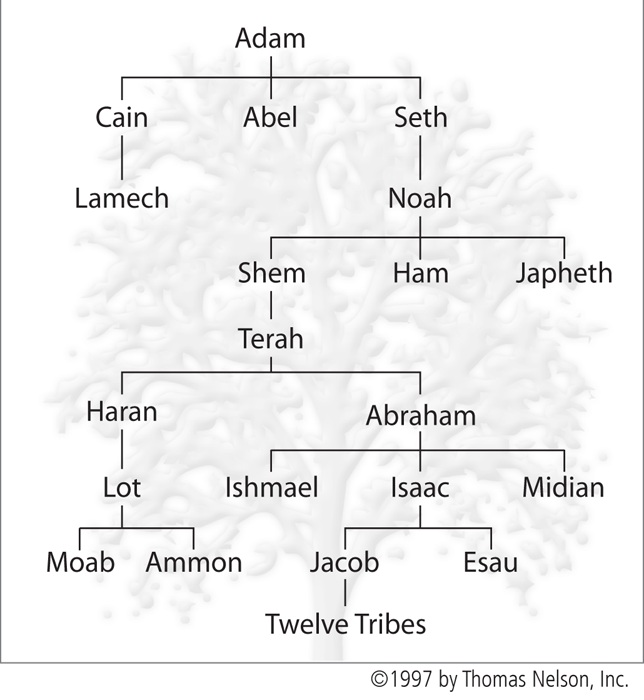
Adam to Israel's Twelve Tribes
GENESIS—NOTE ON 50:2–3 physicians to embalm. Joseph summoned medical men, who were fully capable of embalming, rather than the religious embalmers in order to avoid the magic and mysticism associated with their practices. Usually in Egypt, mummifying was a 40-day process, which included gutting the body, drying it, and wrapping it.
GENESIS—NOTE ON 50:3–6 Once normal embalming and mourning had been properly observed according to Egyptian custom, Joseph was free to seek permission to conduct a funeral in Canaan.
GENESIS—NOTE ON 50:7–11 Out of respect for Joseph, a substantial escort accompanied him and all his relatives into the land of Canaan. This extraordinary event gave assurance to later generations because the bodies of the three patriarchs were in Canaan and Joseph's bones awaited transport there when, as per Joseph's last words, God's promises to the three began to be fulfilled.
GENESIS—NOTE ON 50:15–18 The brothers' guilty consciences reasserted themselves and caused them to seriously underestimate the genuineness of Joseph's forgiveness and affection for them. Jacob's concern to plead on his sons' behalf equally underestimated Joseph's words and actions toward his brethren.
GENESIS—NOTE ON 50:19 am I in the place of God? This concise question tweaked their memory of his explanation of how God had put him where he was (cf. 45:3–8), in the place God intended him to be at that time.
GENESIS—NOTE ON 50:20 but God meant it for good. Joseph's wise, theological answer has gone down in history as the classic statement of God's sovereignty over the affairs of men. See note on 45:1–8.
Joseph—A Type of Christ
Joseph—A Type of Christ Joseph Parallels Jesus
37:2 A shepherd of his father's sheep John 10:11, 27– 29 37:3 His father loved him dearly Matt. 3:17
37:4 Hated by his brothers John 7:4–5
37:13–14 Sent by father to brothers Heb. 2:11 37:20 Others plotted to harm them John 11:53 37:23 Robes taken from them John 19:23–24 37:26 Taken to Egypt Matt. 2:14–15 37:28 Sold for the price of a slave Matt. 26:15 39:7 Tempted Matt. 4:1 39:16–18 Falsely accused Matt. 26:59–60 39:20 Bound in chains Matt. 27:2
40:2–3 Placed with two other prisoners, one who was saved and the other lost Luke 23:32
41:41 Exalted after suffering Phil. 2:9–11 41:46 Both 30 years old at the beginning of public recognition Luke 3:23 42:24; 45:2, 14, 15; 46:29 Both wept John 11:35
45:1–15 Forgave those who wronged them Luke 23:34 45:7 Saved their nation Matt. 1:21 50:20 What men did to hurt them, God turned to good 1 Cor.2:7–8 © 1997 by Thomas Nelson, Inc.
GENESIS—NOTE ON 50:24 God will visit you. Joseph died just as he had lived, firmly trusting in God to carry out his promises (cf. Heb. 11:22). Almost four centuries later, Moses took Joseph's remains out of Egypt (Ex. 13:19) and Joshua buried them at Shechem (Josh. 24:32). to Abraham, to Isaac, and to Jacob. The death of Jacob had finally allowed for the three patriarchs to be mentioned together.
GENESIS—NOTE ON 50:26 being 110 years old. C. 1804 B.C. Joseph's span of life was considered, at that time in Egypt, an ideal lifespan. Amenemhet III (c. 1841–1792 B.C.) was the reigning Pharaoh. Exodus picked up the historical narrative, after a 280-year silence, c. 1525 B.C. with the birth of Moses. See note on Ex. 1:6–8.
Exodus
Exodus 1 • Exodus 2 • Exodus 3 • Exodus 4 • Exodus 5 • Exodus 6 •
Exodus 7 • Exodus 8 • Exodus 9 • Exodus 10 • Exodus 11 • Exodus 12 • Exodus 13 • Exodus 14 • Exodus 15 • Exodus 16 • Exodus 17 • Exodus 18 • Exodus 19 • Exodus 20 • Exodus 21 • Exodus 22 • Exodus 23 • Exodus 24 • Exodus 25 • Exodus 26 • Exodus 27 • Exodus 28 • Exodus 29 • Exodus 30 • Exodus 31 • Exodus 32 • Exodus 33 • Exodus 34 • Exodus 35 • Exodus 36 • Exodus 37 • Exodus 38 • Exodus 39 • Exodus 40 Introduction to Exodus
Title Author and Date Background and Setting Historical and Theological Themes Interpretive Challenges Outline Footnotes Study Notes
Introduction to Exodus
Title
The Greek Septuagint (lxx) and the Latin Vulgate versions of the OT assigned the title "Exodus" to this second book of Moses, because the departure of Israel from Egypt is the dominant historical fact in the book (19:1). In the Hebrew Bible, the opening words, "And (or Now) these are the names," served as the title of the book. The opening "And" or "Now" in the Hebrew title suggests that this book was to be accepted as the obvious sequel to Genesis, the first book of Moses. Hebrews 11:22 commends the faith of Joseph who, while on his deathbed (c. 1804 B.C.), spoke of the "exodus" of the sons of Israel, looking ahead over 350 years to the exodus (c. 1445 B.C.).
Author and Date
Mosaic authorship of Exodus is unhesitatingly affirmed. Moses followed God's instructions and "wrote down all the words of the Lord" (24:4), which included at the least the record of the battle with Amalek (17:14), the Ten Commandments (34:4, 27–29), and the Book of the Covenant (20:22–23:33). Similar assertions of Mosaic writing occur elsewhere in the Pentateuch: Moses is identified as the one who recorded "their stages according to their starting places" (Num. 33:2) and who "wrote this law" (Deut. 31:9).
The OT corroborates Mosaic authorship of the portions mentioned above (see Josh. 1:7–8; 8:31–32; 1 Kings 2:3; 2 Kings 14:6; Neh. 13:1; Dan. 9:11–13; and Mal. 4:4). The NT concurs by citing Ex. 3:6 as part of "the book of Moses" (Mark 12:26), by assigning Ex. 13:2 to "the law of Moses," which is also referred to as "the Law of the Lord" (Luke 2:22–23), by ascribing Ex. 20:12 and 21:17 to Moses (Mark 7:10), by attributing the law to Moses (John 7:19; Rom. 10:5), and by Jesus' specifically declaring that Moses had written of him (John 5:46–47).
At some time during his 40-year tenure as Israel's leader, beginning at 80 years of age and ending at 120 (Ex. 7:7; Deut. 34:7), Moses wrote down this second of his five books. More specifically, it would have been after the exodus and obviously before his death on Mount Nebo in the plains of Moab. The date of the exodus (c. 1445 B.C.) dictates the date of the writing in the fifteenth century B.C.
Scripture dates Solomon's fourth year of reign, when he began to build the temple (c. 966/65 B.C.), as being 480 years after the exodus (1 Kings 6:1), establishing the early date of 1445 B.C. Jephthah noted that, by his day, Israel had possessed Heshbon for 300 years (Judg. 11:26). Calculating backward and forward from Jephthah, and taking into account different periods of foreign oppression, judgeships and kingships, the wilderness wanderings, and the initial entry and conquest of Canaan under Joshua, this early date is confirmed and amounts to 480 years.
Scripture also dates the entry of Jacob and his extended family into Egypt (c. 1875 B.C.) as being 430 years before the exodus (Ex. 12:40), thus placing Joseph in what archeologists have designated as the twelfth Dynasty, the Middle Kingdom period of Egyptian history, and placing Moses and Israel's final years of residence and slavery in what archeologists have designated as the eighteenth Dynasty, or New Kingdom period. Further, Joseph's stint as vizier over all of Egypt (Gen. 45:8) precludes his having served under the Hyksos (c. 1730–1570
B.C.), the foreign invaders who ruled during a period of confusion in Egypt and who never controlled all of the country. They were a mixed Semitic race who introduced the horse and chariot as well as the composite bow. These implements of war made possible their expulsion from Egypt.
Background and Setting
Eighteenth Dynasty Egypt, the setting for Israel's dramatic departure, was not a politically or economically weak and obscure period of Egyptian history. Thutmose III, for example, the Pharaoh of the Oppression has been called the "Napoleon of Ancient Egypt," the sovereign who expanded the boundaries of Egyptian influence far beyond natural borders. This was the dynasty that over a century before, under the leadership of Amose I, had expelled the Hyksos kings from the country and redirected the country's economic, military, and diplomatic growth. At the time of the exodus, Egypt was strong, not weak.
Moses, born in 1525 B.C. (80 years old in 1445 B.C.), became "instructed in all the wisdom of the Egyptians" (Acts 7:22) while growing up in the courts of Pharaohs Thutmose I and II and Queen Hatshepsut for his first 40 years (Acts 7:23). He was in self-imposed, Midianite exile during the reign of Thutmose III for another 40 years (Acts 7:30), and returned at God's direction to be Israel's leader early in the reign of Amenhotep II, the pharaoh of the exodus. God used both the educational system of Egypt and his exile in Midian to prepare Moses to represent his people before a powerful pharaoh and to guide his people through the wilderness of the Sinai peninsula during his final 40 years (Acts 7:36). Moses died on Mount Nebo when he was 120 years old (Deut. 34:1–6), as God's judgment was on him for his anger and disrespect (Num. 20:1–13). While he looked on from afar, Moses never entered the Promised Land. Centuries later he appeared to the disciples on the Mount of Transfiguration (Matt. 17:3).
Historical and Theological Themes
In God's timing, the exodus marked the end of a period of oppression for Abraham's descendants (Gen. 15:13), and constituted the beginning of the fulfillment of the covenant promise to Abraham that his descendants would not only reside in the Promised Land, but would also multiply and become a great nation (Gen. 12:1–3, 7). The purpose of the book may be expressed like this: To trace the rapid growth of Jacob's descendants from Egypt to the establishment of the theocratic nation in their Promised Land.
At appropriate times, on Mount Sinai and in the plains of Moab, God also gave the Israelites that body of legislation, the law, that they needed for living properly in Israel as the theocratic people of God. By this, they were distinct from all other nations (Deut. 4:7–8; Rom. 9:4–5).
By God's self-revelation, the Israelites were instructed in the sovereignty and majesty, the goodness and holiness, and the grace and mercy of their Lord, the one and only God of heaven and earth (see especially Ex. 3; 6; 33; 34). The account of the exodus and the events that followed are also the subject of other major biblical revelation (cf. Ps. 105:25–45; 106:6–27; Acts 7:17–44; 1 Cor. 10:1–13; Heb. 9:1–6; 11:23–29).
Interpretive Challenges
The absence of any Egyptian record of the devastation of Egypt by the 10 plagues and the major defeat of Pharaoh's elite army at the Red Sea should not give rise to speculation on whether the account is historically authentic. Egyptian historiography did not permit records of their pharaohs' embarrassments and ignominious defeats to be published. In recording the conquest under Joshua,
Scripture specifically notes the three cities that Israel destroyed and burned (Josh. 6:24; 8:28; 11:11–13). The conquest, after all, was one of takeover and inhabitation of property virtually intact, not a war designed to destroy. The date of Israel's march into Canaan will not be confirmed, therefore, by examining extensive burn levels at city-sites of a later period.
Despite the absence of any extrabiblical, ancient Near Eastern records of the Hebrew bondage, the plagues, the exodus, and the conquest, archeological evidence corroborates the early date. All the pharaohs, for example, of the fifteenth century left evidence of interest in building enterprises in Lower Egypt. These projects were obviously accessible to Moses in the Delta region near Goshen.
The typological significance of the tabernacle has occasioned much reflection. Ingenuity in linking every item of furniture and every piece of building material to Christ may appear most intriguing, but if NT statements and allusions do not support such linkage and typology then hermeneutical caution must rule. The tabernacle's structure and ornamentation for efficiency and beauty are one thing, but finding hidden meaning and symbolism is unfounded. How the sacrificial and worship system of the tabernacle and its parts meaningfully typify the redeeming work of the coming Messiah must be left to those NT passages that treat the subject.
Outline
I. Israel in Egypt (1:1–12:36)
A. The Population Explosion (1:1–7)
B. The Oppression Under the Pharaohs (1:8–22) C. The Maturation of a Deliverer (2:1–4:31) D. The Confrontation with Pharaoh (5:1–11:10)
E. The Preparation for Departure (12:1–36) II. Israel on the Road to Sinai (12:37–18:27)
A. Exiting Egypt and Panicking (12:37–14:14)
B. Crossing the Red Sea and Rejoicing (14:15–15:21) C. Traveling to Sinai and Grumbling (15:22–17:16) D. Meeting with Jethro and Learning (18:1–27) III. Israel Encamped at Sinai (19:1–40:38)
A. The Law of God Prescribed (19:1–24:18)
B. The Tabernacle of God Described (25:1–31:18) C. The Worship of God Defiled (32:1–35) D. The Presence of God Confirmed (33:1–34:35)
E. The Tabernacle of God Constructed (35:1–40:38)
Exodus
Israel Increases Greatly in Egypt
EXODUS 1 ‡‡These are the names of the sons of Israel who came to Egypt with Jacob, each with his household: 2Reuben, Simeon, Levi, and Judah, 3Issachar, Zebulun, and Benjamin, 4Dan and Naphtali, Gad and Asher. 5†All the descendants of Jacob were seventy persons; Joseph was already in Egypt. 6‡Then Joseph died, and all his brothers and all that generation. 7†But the people of Israel were fruitful and increased greatly; they multiplied and grew exceedingly strong, so that the land was filled with them.
Pharaoh Oppresses Israel
there arose a new king over Egypt, who did not know Joseph. 9‡†And he said to his people, "Behold, the people of Israel are too many and too mighty for us. 10‡Come, let us deal shrewdly with them, lest they multiply, and, if war breaks out, they join our enemies and fight against us and escape from the land." 11†Therefore they set taskmasters over them to afflict them with heavy burdens. They built for Pharaoh store cities, Pithom and Raamses. 12†But the more they were oppressed, the more they multiplied and the more they spread abroad. And the Egyptians were in dread of the people of Israel. 13So they ruthlessly made the people of Israel work as slaves 14†and made their lives bitter with hard service, in mortar and brick, and in all kinds of work in the field. In all their work they ruthlessly made them work as slaves.
the king of Egypt said to the Hebrew midwives, one of whom was named Shiphrah and the other Puah, 16†"When you serve as midwife to the Hebrew women and see them on the birthstool, if it is a son, you shall kill him, but if it is a daughter, she shall live." 17But the midwives feared God and did not do as the king of Egypt commanded them, but let the male children live. 18So the king of Egypt called the midwives and said to them, "Why have you done this, and let the male children live?" 19‡The midwives said to Pharaoh, "Because the Hebrew women are not like the Egyptian women, for they are vigorous and give birth before the midwife comes to them." 20So God dealt well with the midwives. And the people multiplied and grew very strong. 21And because the midwives feared God, he gave them families. 22†Then Pharaoh commanded all his people,
"Every son that is born to the Hebrews [1] you shall cast into the Nile, but you shall let every daughter live."
The Birth of Moses
EXODUS 2 ‡Now a man from the house of Levi went and took as his wife a Levite woman. 2The woman conceived and bore a son, and when she saw that he was a fine child, she hid him three months. 3‡When she could hide him no longer, she took for him a basket made of bulrushes [1] and daubed it with bitumen and pitch. She put the child in it and placed it among the reeds by the river bank. 4And his sister stood at a distance to know what would be done to him. 5†Now the daughter of Pharaoh came down to bathe at the river, while her young women walked beside the river. She saw the basket among the reeds and sent her servant woman, and she took it. 6When she opened it, she saw the child, and behold, the baby was crying. She took pity on him and said, "This is one of the Hebrews' children." 7Then his sister said to Pharaoh's daughter, "Shall I go and call you a nurse from the Hebrew women to nurse the child for you?" 8And Pharaoh's daughter said to her, "Go." So the girl went and called the child's mother. 9And Pharaoh's daughter said to her, "Take this child away and nurse him for me, and I will give you your wages." So the woman took the child and nursed him. 10†When the child grew up, she brought him to Pharaoh's daughter, and he became her son. She named him Moses, "Because," she said, "I drew him out of the water." [2]
Moses Flees to Midian
day, when Moses had grown up, he went out to his people and looked on their burdens, and he saw an Egyptian beating a Hebrew, one of his people. [3] 12He looked this way and that, and seeing no one, he struck down the Egyptian and hid him in the sand. 13When he went out the next day, behold, two Hebrews were struggling together. And he said to the man in the wrong, "Why do you strike your companion?" 14†He answered, "Who made you a prince and a judge over us? Do you mean to kill me as you killed the Egyptian?" Then Moses was afraid, and thought, "Surely the thing is known." 15†When Pharaoh heard of it, he sought to kill Moses. But Moses fled from Pharaoh and stayed in the land of Midian. And he sat down by a well.
16Now the priest of Midian had seven daughters, and they came and drew water and filled the troughs to water their father's flock. 17The shepherds came and drove them away, but Moses stood up and saved them, and watered their flock. 18†When they came home to their father Reuel, he said, "How is it that you have come home so soon today?" 19They said, "An Egyptian delivered us out of the hand of the shepherds and even drew water for us and watered the flock." 20He said to his daughters, "Then where is he? Why have you left the man? Call him, that he may eat bread." 21‡And Moses was content to dwell with the man, and he gave Moses his daughter Zipporah. 22She gave birth to a son, and he called his name Gershom, for he said, "I have been a sojourner [4] in a foreign land."
God Hears Israel's Groaning
those many days the king of Egypt died, and the people of Israel groaned because of their slavery and cried out for help. Their cry for rescue from slavery came up to God. 24†And God heard their groaning, and God remembered his covenant with Abraham, with Isaac, and with Jacob. 25God saw the people of Israel—and God knew.
The Burning Bush
EXODUS 3 †Now Moses was keeping the flock of his father-in-law, Jethro, the priest of Midian, and he led his flock to the west side of the wilderness and came to Horeb, the mountain of God. 2‡†And the angel of the LORD appeared to him in a flame of fire out of the midst of a bush. He looked, and behold, the bush was burning, yet it was not consumed. 3And Moses said, "I will turn aside to see this great sight, why the bush is not burned." 4When the LORD saw that he turned aside to see, God called to him out of the bush, "Moses, Moses!" And he said, "Here I am." 5‡†Then he said, "Do not come near; take your sandals off your feet, for the place on which you are standing is holy ground." 6†And he said, "I am the God of your father, the God of Abraham, the God of Isaac, and the God of Jacob." And Moses hid his face, for he was afraid to look at God.
the LORD said, "I have surely seen the affliction of my people who are in Egypt and have heard their cry because of their taskmasters. I know their sufferings, 8†and I have come down to deliver them out of the hand of the Egyptians and to bring them up out of that land to a good and broad land, a land flowing with milk and honey, to the place of the Canaanites, the Hittites, the Amorites, the Perizzites, the Hivites, and the Jebusites. 9And now, behold, the cry of the people of Israel has come to me, and I have also seen the oppression with which the Egyptians oppress them. 10†Come, I will send you to Pharaoh that you may bring my people, the children of Israel, out of Egypt." 11†But Moses said to God, "Who am I that I should go to Pharaoh and bring the children of Israel out of Egypt?" 12†He said, "But I will be with you, and this shall be the sign for you, that I have sent you: when you have brought the people out of Egypt, you shall serve God on this mountain."
Moses said to God, "If I come to the people of Israel and say to them, 'The God of your fathers has sent me to you,' and they ask me, 'What is his name?' what shall I say to them?" 14†God said to Moses, "I AM WHO I AM." [1] And he said, "Say this to the people of Israel, 'I AM has sent me to you.'" 15‡†God also said to Moses, "Say this to the people of Israel, 'The LORD, [2] the God of your fathers, the God of Abraham, the God of Isaac, and the God of Jacob, has sent me to you.' This is my name forever, and thus I am to be remembered throughout all generations. 16†Go and gather the elders of Israel together and say to them, 'The LORD, the God of your fathers, the God of Abraham, of Isaac, and of Jacob, has appeared to me, saying, "I have observed you and what has been done to you in Egypt, 17†and I promise that I will bring you up out of the affliction of Egypt to the land of the Canaanites, the Hittites, the Amorites, the Perizzites, the Hivites, and the Jebusites, a land flowing with milk and honey."' 18†And they will listen to your voice, and you and the elders of Israel shall go to the king of Egypt and say to him, 'The LORD, the God of the Hebrews, has met with us; and now, please let us go a three days' journey into the wilderness, that we may sacrifice to the LORD our God.' 19But I know that the king of Egypt will not let you go unless compelled by a mighty hand. [3] 20So I will stretch out my hand and strike Egypt with all the wonders that I will do in it; after that he will let you go. 21And I will give this people favor in the sight of the Egyptians; and when you go, you shall not go empty, 22†but each woman shall ask of her neighbor, and any woman who lives in her house, for silver and gold jewelry, and for clothing. You shall put them on your sons and on your daughters. So you shall plunder the Egyptians."
Moses Given Powerful Signs
EXODUS 4 †Then Moses answered, "But behold, they will not believe me or listen to my voice, for they will say, 'The LORD did not appear to you.'" 2‡The LORD said to him, "What is that in your hand?" He said, "A staff." 3And he said, "Throw it on the ground." So he threw it on the ground, and it became a serpent, and Moses ran from it. 4But the LORD said to Moses, "Put out your hand and catch it by the tail"—so he put out his hand and caught it, and it became a staff in his hand— 5"that they may believe that the LORD, the God of their fathers, the God of Abraham, the God of Isaac, and the God of Jacob, has appeared to you." 6Again, the LORD said to him, "Put your hand inside your cloak." [1] And he put his hand inside his cloak, and when he took it out, behold, his hand was leprous [2] like snow. 7Then God said, "Put your hand back inside your cloak." So he put his hand back inside his cloak, and when he took it out, behold, it was restored like the rest of his flesh. 8"If they will not believe you," God said, "or listen to the first sign, they may believe the latter sign. 9If they will not believe even these two signs or listen to your voice, you shall take some water from the Nile and pour it on the dry ground, and the water that you shall take from the Nile will become blood on the dry ground."
Moses said to the LORD, "Oh, my Lord, I am not eloquent, either in the past or since you have spoken to your servant, but I am slow of speech and of tongue." 11‡Then the LORD said to him, "Who has made man's mouth? Who makes him mute, or deaf, or seeing, or blind? Is it not I, the LORD? 12Now therefore go, and I will be with your mouth and teach you what you shall speak." 13‡But he said, "Oh, my Lord, please send someone else." 14Then the anger of the LORD was kindled against Moses and he said, "Is there not Aaron, your brother, the Levite? I know that he can speak well. Behold, he is coming out to meet you, and when he sees you, he will be glad in his heart. 15†You shall speak to him and put the words in his mouth, and I will be with your mouth and with his mouth and will teach you both what to do. 16†He shall speak for you to the people, and he shall be your mouth, and you shall be as God to him. 17†And take in your hand this staff, with which you shall do the signs."
Moses Returns to Egypt
went back to Jethro his father-in-law and said to him, "Please let me go back to my brothers in Egypt to see whether they are still alive." And Jethro said to Moses, "Go in peace." 19And the LORD said to Moses in Midian, "Go back to Egypt, for all the men who were seeking your life are dead." 20†So Moses took his wife and his sons and had them ride on a donkey, and went back to the land of Egypt. And Moses took the staff of God in his hand.
the LORD said to Moses, "When you go back to Egypt, see that you do before Pharaoh all the miracles that I have put in your power. But I will harden his heart, so that he will not let the people go. 22†Then you shall say to Pharaoh, 'Thus says the LORD, Israel is my firstborn son, 23and I say to you, "Let my son go that he may serve me." If you refuse to let him go, behold, I will kill your firstborn son.'"
a lodging place on the way the LORD met him and sought to put him to death. 25Then Zipporah took a flint and cut off her son's foreskin and touched Moses' [3] feet with it and said, "Surely you are a bridegroom of blood to me!" 26So he let him alone. It was then that she said, "A bridegroom of blood," because of the circumcision.
27The LORD said to Aaron, "Go into the wilderness to meet Moses." So he went and met him at the mountain of God and kissed him. 28And Moses told Aaron all the words of the LORD with which he had sent him to speak, and all the signs that he had commanded him to do. 29‡Then Moses and Aaron went and gathered together all the elders of the people of Israel. 30Aaron spoke all the words that the LORD had spoken to Moses and did the signs in the sight of the people. 31†And the people believed; and when they heard that the LORD had visited the people of Israel and that he had seen their affliction, they bowed their heads and worshiped.
Making Bricks Without Straw
EXODUS 5 †Afterward Moses and Aaron went and said to Pharaoh, "Thus says the LORD, the God of Israel, 'Let my people go, that they may hold a feast to me in the wilderness.'" 2†But Pharaoh said, "Who is the LORD, that I should obey his voice and let Israel go? I do not know the LORD, and moreover, I will not let Israel go." 3‡Then they said, "The God of the Hebrews has met with us. Please let us go a three days' journey into the wilderness that we may sacrifice to the LORD our God, lest he fall upon us with pestilence or with the sword." 4But the king of Egypt said to them, "Moses and Aaron, why do you take the people away from their work? Get back to your burdens." 5And Pharaoh said, "Behold, the people of the land are now many, [1] and you make them rest from their burdens!" 6‡The same day Pharaoh commanded the taskmasters of the people and their foremen, 7"You shall no longer give the people straw to make bricks, as in the past; let them go and gather straw for themselves. 8But the number of bricks that they made in the past you shall impose on them, you shall by no means reduce it, for they are idle. Therefore they cry, 'Let us go and offer sacrifice to our God.' 9Let heavier work be laid on the men that they may labor at it and pay no regard to lying words."
the taskmasters and the foremen of the people went out and said to the people, "Thus says Pharaoh, 'I will not give you straw. 11†Go and get your straw yourselves wherever you can find it, but your work will not be reduced in the least.'" 12So the people were scattered throughout all the land of Egypt to gather stubble for straw. 13The taskmasters were urgent, saying, "Complete your work, your daily task each day, as when there was straw." 14And the foremen of the people of Israel, whom Pharaoh's taskmasters had set over them, were beaten and were asked, "Why have you not done all your task of making bricks today and yesterday, as in the past?"
the foremen of the people of Israel came and cried to Pharaoh, "Why do you treat your servants like this? 16No straw is given to your servants, yet they say to us, 'Make bricks!' And behold, your servants are beaten; but the fault is in your own people." 17But he said, "You are idle, you are idle; that is why you say, 'Let us go and sacrifice to the LORD.' 18Go now and work. No straw will be given you, but you must still deliver the same number of bricks." 19The foremen of the people of Israel saw that they were in trouble when they said, "You shall by no means reduce your number of bricks, your daily task each day." 20‡They met
Moses and Aaron, who were waiting for them, as they came out from Pharaoh; 21and they said to them, "The LORD look on you and judge, because you have made us stink in the sight of Pharaoh and his servants, and have put a sword in their hand to kill us."
Moses turned to the LORD and said, "O Lord, why have you done evil to this people? Why did you ever send me? 23For since I came to Pharaoh to speak in your name, he has done evil to this people, and you have not delivered your people at all."
God Promises Deliverance
EXODUS 6 †But the LORD said to Moses, "Now you shall see what I will do to Pharaoh; for with a strong hand he will send them out, and with a strong hand he will drive them out of his land."
spoke to Moses and said to him, "I am the LORD. 3†I appeared to Abraham, to Isaac, and to Jacob, as God Almighty, [1] but by my name the LORD I did not make myself known to them. 4†I also established my covenant with them to give them the land of Canaan, the land in which they lived as sojourners. 5Moreover, I have heard the groaning of the people of Israel whom the Egyptians hold as slaves, and I have remembered my covenant. 6‡Say therefore to the people of Israel, 'I am the LORD, and I will bring you out from under the burdens of the Egyptians, and I will deliver you from slavery to them, and I will redeem you with an outstretched arm and with great acts of judgment. 7I will take you to be my people, and I will be your God, and you shall know that I am the LORD your God, who has brought you out from under the burdens of the Egyptians. 8I will bring you into the land that I swore to give to Abraham, to Isaac, and to Jacob. I will give it to you for a possession. I am the LORD.'" 9†Moses spoke thus to the people of Israel, but they did not listen to Moses, because of their broken spirit and harsh slavery.
10So the LORD said to Moses, 11"Go in, tell Pharaoh king of Egypt to let the people of Israel go out of his land." 12†But Moses said to the LORD, "Behold, the people of Israel have not listened to me. How then shall Pharaoh listen to me, for I am of uncircumcised lips?" 13But the LORD spoke to Moses and Aaron and gave them a charge about the people of Israel and about Pharaoh king of Egypt: to bring the people of Israel out of the land of Egypt.
The Genealogy of Moses and Aaron
are the heads of their fathers' houses: the sons of Reuben, the firstborn of Israel: Hanoch, Pallu, Hezron, and Carmi; these are the clans of Reuben. 15The sons of Simeon: Jemuel, Jamin, Ohad, Jachin, Zohar, and Shaul, the son of a Canaanite woman; these are the clans of Simeon. 16These are the names of the sons of Levi according to their generations: Gershon, Kohath, and Merari, the years of the life of Levi being 137 years. 17The sons of Gershon: Libni and Shimei, by their clans. 18The sons of Kohath: Amram, Izhar, Hebron, and Uzziel, the years of the life of Kohath being 133 years. 19The sons of Merari: Mahli and Mushi. These are the clans of the Levites according to their generations. 20Amram took as his wife Jochebed his father's sister, and she bore him Aaron and Moses, the years of the life of Amram being 137 years. 21The sons of Izhar: Korah, Nepheg, and Zichri. 22The sons of Uzziel: Mishael, Elzaphan, and Sithri. 23Aaron took as his wife Elisheba, the daughter of Amminadab and the sister of Nahshon, and she bore him Nadab, Abihu, Eleazar, and Ithamar. 24The sons of Korah: Assir, Elkanah, and Abiasaph; these are the clans of the Korahites. 25Eleazar, Aaron's son, took as his wife one of the daughters of Putiel, and she bore him Phinehas. These are the heads of the fathers' houses of the Levites by their clans.
26These are the Aaron and Moses to whom the LORD said: "Bring out the people of Israel from the land of Egypt by their hosts." 27It was they who spoke to Pharaoh king of Egypt about bringing out the people of Israel from Egypt, this Moses and this Aaron.
the day when the LORD spoke to Moses in the land of Egypt, 29the LORD said to Moses, "I am the LORD; tell Pharaoh king of Egypt all that I say to you." 30But Moses said to the LORD, "Behold, I am of uncircumcised lips. How will Pharaoh listen to me?"
Moses and Aaron Before Pharaoh
EXODUS 7 †And the LORD said to Moses, "See, I have made you like God to Pharaoh, and your brother Aaron shall be your prophet. 2You shall speak all that I command you, and your brother Aaron shall tell Pharaoh to let the people of Israel go out of his land. 3But I will harden Pharaoh's heart, and though I multiply my signs and wonders in the land of Egypt, 4†Pharaoh will not listen to you. Then I will lay my hand on Egypt and bring my hosts, my people the children of Israel, out of the land of Egypt by great acts of judgment. 5†The Egyptians shall know that I am the LORD, when I stretch out my hand against Egypt and bring out the people of Israel from among them." 6Moses and Aaron did so; they did just as the LORD commanded them. 7Now Moses was eighty years old, and Aaron eighty-three years old, when they spoke to Pharaoh.
8Then the LORD said to Moses and Aaron, 9†"When Pharaoh says to you, 'Prove yourselves by working a miracle,' then you shall say to Aaron, 'Take your staff and cast it down before Pharaoh, that it may become a serpent.'" 10So Moses and Aaron went to Pharaoh and did just as the LORD commanded. Aaron cast down his staff before Pharaoh and his servants, and it became a serpent. 11†Then Pharaoh summoned the wise men and the sorcerers, and they, the magicians of Egypt, also did the same by their secret arts. 12†For each man cast down his staff, and they became serpents. But Aaron's staff swallowed up their staffs. 13Still Pharaoh's heart was hardened, and he would not listen to them, as the LORD had said.
The First Plague: Water Turned to Blood
the LORD said to Moses, "Pharaoh's heart is hardened; he refuses to let the people go. 15†Go to Pharaoh in the morning, as he is going out to the water. Stand on the bank of the Nile to meet him, and take in your hand the staff that turned into a serpent. 16And you shall say to him, 'The LORD, the God of the Hebrews, sent me to you, saying, "Let my people go, that they may serve me in the wilderness. But so far, you have not obeyed." 17†Thus says the LORD, "By this you shall know that I am the LORD: behold, with the staff that is in my hand I will strike the water that is in the Nile, and it shall turn into blood. 18The fish in the Nile shall die, and the Nile will stink, and the Egyptians will grow weary of drinking water from the Nile."'" 19‡And the LORD said to Moses, "Say to Aaron, 'Take your staff and stretch out your hand over the waters of Egypt, over their rivers, their canals, and their ponds, and all their pools of water, so that they may become blood, and there shall be blood throughout all the land of Egypt, even in vessels of wood and in vessels of stone.'"
20Moses and Aaron did as the LORD commanded. In the sight of Pharaoh and in the sight of his servants he lifted up the staff and struck the water in the Nile, and all the water in the Nile turned into blood. 21And the fish in the Nile died, and the Nile stank, so that the Egyptians could not drink water from the Nile. There was blood throughout all the land of Egypt. 22†But the magicians of Egypt did the same by their secret arts. So Pharaoh's heart remained hardened, and he would not listen to them, as the LORD had said. 23Pharaoh turned and went into his house, and he did not take even this to heart. 24†And all the Egyptians dug along the Nile for water to drink, for they could not drink the water of the Nile.
full days passed after the LORD had struck the Nile.
The Second Plague: Frogs
EXODUS 8 † [1] Then the LORD said to Moses, "Go in to Pharaoh and say to him, 'Thus says the LORD, "Let my people go, that they may serve me. 2†But if you refuse to let them go, behold, I will plague all your country with frogs. 3The Nile shall swarm with frogs that shall come up into your house and into your bedroom and on your bed and into the houses of your servants and your people, [2] and into your ovens and your kneading bowls. 4The frogs shall come up on you and on your people and on all your servants."'" 5 [3] And the LORD said to Moses, "Say to Aaron, 'Stretch out your hand with your staff over the rivers, over the canals and over the pools, and make frogs come up on the land of Egypt!'" 6So Aaron stretched out his hand over the waters of Egypt, and the frogs came up and covered the land of Egypt. 7†But the magicians did the same by their secret arts and made frogs come up on the land of Egypt.
Pharaoh called Moses and Aaron and said, "Plead with the LORD to take away the frogs from me and from my people, and I will let the people go to sacrifice to the LORD." 9†Moses said to Pharaoh, "Be pleased to command me when I am to plead for you and for your servants and for your people, that the frogs be cut off from you and your houses and be left only in the Nile." 10†And he said, "Tomorrow." Moses said, "Be it as you say, so that you may know that there is no one like the LORD our God. 11The frogs shall go away from you and your houses and your servants and your people. They shall be left only in the Nile." 12So Moses and Aaron went out from Pharaoh, and Moses cried to the LORD about the frogs, as he had agreed with Pharaoh. [4] 13And the LORD did according to the word of Moses. The frogs died out in the houses, the courtyards, and the fields. 14And they gathered them together in heaps, and the land stank. 15But when Pharaoh saw that there was a respite, he hardened his heart and would not listen to them, as the LORD had said.
The Third Plague: Gnats
the LORD said to Moses, "Say to Aaron, 'Stretch out your staff and strike the dust of the earth, so that it may become gnats in all the land of Egypt.'" 17†And they did so. Aaron stretched out his hand with his staff and struck the dust of the earth, and there were gnats on man and beast. All the dust of the earth became gnats in all the land of Egypt. 18The magicians tried by their secret arts to produce gnats, but they could not. So there were gnats on man and beast.
the magicians said to Pharaoh, "This is the finger of God." But Pharaoh's heart was hardened, and he would not listen to them, as the LORD had said.
The Fourth Plague: Flies
20Then the LORD said to Moses, "Rise up early in the morning and present yourself to Pharaoh, as he goes out to the water, and say to him, 'Thus says the LORD, "Let my people go, that they may serve me. 21†Or else, if you will not let my people go, behold, I will send swarms of flies on you and your servants and your people, and into your houses. And the houses of the Egyptians shall be filled with swarms of flies, and also the ground on which they stand. 22†But on that day I will set apart the land of Goshen, where my people dwell, so that no swarms of flies shall be there, that you may know that I am the LORD in the midst of the earth. [5] 23†Thus I will put a division [6] between my people and your people. Tomorrow this sign shall happen."'" 24And the LORD did so. There came great swarms of flies into the house of Pharaoh and into his servants' houses. Throughout all the land of Egypt the land was ruined by the swarms of flies.
25Then Pharaoh called Moses and Aaron and said, "Go, sacrifice to your God within the land." 26†But Moses said, "It would not be right to do so, for the offerings we shall sacrifice to the LORD our God are an abomination to the Egyptians. If we sacrifice offerings abominable to the Egyptians before their eyes, will they not stone us? 27‡We must go three days' journey into the wilderness and sacrifice to the LORD our God as he tells us." 28†So Pharaoh said, "I will let you go to sacrifice to the LORD your God in the wilderness; only you must not go very far away. Plead for me." 29†Then Moses said, "Behold, I am going out from you and I will plead with the LORD that the swarms of flies may depart from Pharaoh, from his servants, and from his people, tomorrow. Only let not Pharaoh cheat again by not letting the people go to sacrifice to the LORD." 30So Moses went out from Pharaoh and prayed to the LORD. 31†And the LORD did as Moses asked, and removed the swarms of flies from Pharaoh, from his servants, and from his people; not one remained. 32But Pharaoh hardened his heart this time also, and did not let the people go.
The Fifth Plague: Egyptian Livestock Die
EXODUS 9 Then the LORD said to Moses, "Go in to Pharaoh and say to him, 'Thus says the LORD, the God of the Hebrews, "Let my people go, that they may serve me. 2For if you refuse to let them go and still hold them, 3†behold, the hand of the LORD will fall with a very severe plague upon your livestock that are in the field, the horses, the donkeys, the camels, the herds, and the flocks. 4†But the LORD will make a distinction between the livestock of Israel and the livestock of Egypt, so that nothing of all that belongs to the people of Israel shall die."'" 5†And the LORD set a time, saying, "Tomorrow the LORD will do this thing in the land." 6†And the next day the LORD did this thing. All the livestock of the Egyptians died, but not one of the livestock of the people of Israel died. 7†And Pharaoh sent, and behold, not one of the livestock of Israel was dead. But the heart of Pharaoh was hardened, and he did not let the people go.
The Sixth Plague: Boils
8And the LORD said to Moses and Aaron, "Take handfuls of soot from the kiln, and let Moses throw them in the air in the sight of Pharaoh. 9†It shall become fine dust over all the land of Egypt, and become boils breaking out in sores on man and beast throughout all the land of Egypt." 10†So they took soot from the kiln and stood before Pharaoh. And Moses threw it in the air, and it became boils breaking out in sores on man and beast. 11†And the magicians could not stand before Moses because of the boils, for the boils came upon the magicians and upon all the Egyptians. 12†But the LORD hardened the heart of Pharaoh, and he did not listen to them, as the LORD had spoken to Moses.
The Seventh Plague: Hail
13Then the LORD said to Moses, "Rise up early in the morning and present yourself before Pharaoh and say to him, 'Thus says the LORD, the God of the Hebrews, "Let my people go, that they may serve me. 14‡†For this time I will send all my plagues on you yourself, [1] and on your servants and your people, so that you may know that there is none like me in all the earth. 15For by now I could have put out my hand and struck you and your people with pestilence, and you would have been cut off from the earth. 16†But for this purpose I have raised you up, to show you my power, so that my name may be proclaimed in all the earth. 17You are still exalting yourself against my people and will not let them go.
18Behold, about this time tomorrow I will cause very heavy hail to fall, such as never has been in Egypt from the day it was founded until now. 19Now therefore send, get your livestock and all that you have in the field into safe shelter, for every man and beast that is in the field and is not brought home will die when the hail falls on them."'" 20‡Then whoever feared the word of the LORD among the servants of Pharaoh hurried his slaves and his livestock into the houses, 21but whoever did not pay attention to the word of the LORD left his slaves and his livestock in the field.
22Then the LORD said to Moses, "Stretch out your hand toward heaven, so that there may be hail in all the land of Egypt, on man and beast and every plant of the field, in the land of Egypt." 23‡Then Moses stretched out his staff toward heaven, and the LORD sent thunder and hail, and fire ran down to the earth. And the LORD rained hail upon the land of Egypt. 24There was hail and fire flashing continually in the midst of the hail, very heavy hail, such as had never been in all the land of Egypt since it became a nation. 25The hail struck down everything that was in the field in all the land of Egypt, both man and beast. And the hail struck down every plant of the field and broke every tree of the field. 26†Only in the land of Goshen, where the people of Israel were, was there no hail.
Pharaoh sent and called Moses and Aaron and said to them, "This time I have sinned; the LORD is in the right, and I and my people are in the wrong. 28†Plead with the LORD, for there has been enough of God's thunder and hail. I will let you go, and you shall stay no longer." 29Moses said to him, "As soon as I have gone out of the city, I will stretch out my hands to the LORD. The thunder will cease, and there will be no more hail, so that you may know that the earth is the LORD's. 30But as for you and your servants, I know that you do not yet fear the LORD God." 31‡(The flax and the barley were struck down, for the barley was in the ear and the flax was in bud. 32But the wheat and the emmer [2] were not struck down, for they are late in coming up.) 33So Moses went out of the city from Pharaoh and stretched out his hands to the LORD, and the thunder and the hail ceased, and the rain no longer poured upon the earth. 34†But when Pharaoh saw that the rain and the hail and the thunder had ceased, he sinned yet again and hardened his heart, he and his servants. 35So the heart of Pharaoh was hardened, and he did not let the people of Israel go, just as the LORD had spoken through Moses.
The Eighth Plague: Locusts
EXODUS 10 Then the LORD said to Moses, "Go in to Pharaoh, for I have hardened his heart and the heart of his servants, that I may show these signs of mine among them, 2†and that you may tell in the hearing of your son and of your grandson how I have dealt harshly with the Egyptians and what signs I have done among them, that you may know that I am the LORD."
Moses and Aaron went in to Pharaoh and said to him, "Thus says the LORD, the God of the Hebrews, 'How long will you refuse to humble yourself before me? Let my people go, that they may serve me. 4‡For if you refuse to let my people go, behold, tomorrow I will bring locusts into your country, 5and they shall cover the face of the land, so that no one can see the land. And they shall eat what is left to you after the hail, and they shall eat every tree of yours that grows in the field, 6and they shall fill your houses and the houses of all your servants and of all the Egyptians, as neither your fathers nor your grandfathers have seen, from the day they came on earth to this day.'" Then he turned and went out from Pharaoh.
Pharaoh's servants said to him, "How long shall this man be a snare to us? Let the men go, that they may serve the LORD their God. Do you not yet understand that Egypt is ruined?" 8†So Moses and Aaron were brought back to Pharaoh. And he said to them, "Go, serve the LORD your God. But which ones are to go?" 9Moses said, "We will go with our young and our old. We will go with our sons and daughters and with our flocks and herds, for we must hold a feast to the LORD." 10†But he said to them, "The LORD be with you, if ever I let you and your little ones go! Look, you have some evil purpose in mind. [1] 11†No! Go, the men among you, and serve the LORD, for that is what you are asking." And they were driven out from Pharaoh's presence.
the LORD said to Moses, "Stretch out your hand over the land of Egypt for the locusts, so that they may come upon the land of Egypt and eat every plant in the land, all that the hail has left." 13†So Moses stretched out his staff over the land of Egypt, and the LORD brought an east wind upon the land all that day and all that night. When it was morning, the east wind had brought the locusts. 14The locusts came up over all the land of Egypt and settled on the whole country of Egypt, such a dense swarm of locusts as had never been before, nor ever will be again. 15They covered the face of the whole land, so that the land was darkened, and they ate all the plants in the land and all the fruit of the trees that the hail had left. Not a green thing remained, neither tree nor plant of the field, through all the land of Egypt. 16†Then Pharaoh hastily called Moses and Aaron and said, "I have sinned against the LORD your God, and against you. 17†Now therefore, forgive my sin, please, only this once, and plead with the LORD your God only to remove this death from me." 18So he went out from Pharaoh and pleaded with the LORD. 19†And the LORD turned the wind into a very strong west wind, which lifted the locusts and drove them into the Red Sea. Not a single locust was left in all the country of Egypt. 20But the LORD hardened Pharaoh's heart, and he did not let the people of Israel go.
The Ninth Plague: Darkness
the LORD said to Moses, "Stretch out your hand toward heaven, that there may be darkness over the land of Egypt, a darkness to be felt." 22So Moses stretched out his hand toward heaven, and there was pitch darkness in all the land of Egypt three days. 23They did not see one another, nor did anyone rise from his place for three days, but all the people of Israel had light where they lived. 24†Then Pharaoh called Moses and said, "Go, serve the LORD; your little ones also may go with you; only let your flocks and your herds remain behind." 25†But Moses said, "You must also let us have sacrifices and burnt offerings, that we may sacrifice to the LORD our God. 26Our livestock also must go with us; not a hoof shall be left behind, for we must take of them to serve the LORD our God, and we do not know with what we must serve the LORD until we arrive there." 27But the LORD hardened Pharaoh's heart, and he would not let them go. 28†Then Pharaoh said to him, "Get away from me; take care never to see my face again, for on the day you see my face you shall die." 29†Moses said, "As you say! I will not see your face again."
A Final Plague Threatened
EXODUS 11 ‡The LORD said to Moses, "Yet one plague more I will bring upon Pharaoh and upon Egypt. Afterward he will let you go from here. When he lets you go, he will drive you away completely. 2Speak now in the hearing of the people, that they ask, every man of his neighbor and every woman of her neighbor, for silver and gold jewelry." 3And the LORD gave the people favor in the sight of the Egyptians. Moreover, the man Moses was very great in the land of Egypt, in the sight of Pharaoh's servants and in the sight of the people.
Moses said, "Thus says the LORD: About midnight I will go out in the midst of Egypt, 5†and every firstborn in the land of Egypt shall die, from the firstborn of Pharaoh who sits on his throne, even to the firstborn of the slave girl who is behind the handmill, and all the firstborn of the cattle. 6†There shall be a great cry throughout all the land of Egypt, such as there has never been, nor ever will be again. 7†But not a dog shall growl against any of the people of Israel, either man or beast, that you may know that the LORD makes a distinction between Egypt and Israel. 8And all these your servants shall come down to me and bow down to me, saying, 'Get out, you and all the people who follow you.' And after that I will go out." And he went out from Pharaoh in hot anger. 9Then the LORD said to Moses, "Pharaoh will not listen to you, that my wonders may be multiplied in the land of Egypt."
10Moses and Aaron did all these wonders before Pharaoh, and the LORD hardened Pharaoh's heart, and he did not let the people of Israel go out of his land.
The Passover
EXODUS 12 †The LORD said to Moses and Aaron in the land of Egypt, 2†"This month shall be for you the beginning of months. It shall be the first month of the year for you. 3‡Tell all the congregation of Israel that on the tenth day of this month every man shall take a lamb according to their fathers' houses, a lamb for a household. 4And if the household is too small for a lamb, then he and his nearest neighbor shall take according to the number of persons; according to what each can eat you shall make your count for the lamb. 5†Your lamb shall be without blemish, a male a year old. You may take it from the sheep or from the goats, 6†and you shall keep it until the fourteenth day of this month, when the whole assembly of the congregation of Israel shall kill their lambs at twilight. [1]
7"Then they shall take some of the blood and put it on the two doorposts and the lintel of the houses in which they eat it. 8They shall eat the flesh that night, roasted on the fire; with unleavened bread and bitter herbs they shall eat it. 9†Do not eat any of it raw or boiled in water, but roasted, its head with its legs and its inner parts. 10And you shall let none of it remain until the morning; anything that remains until the morning you shall burn. 11In this manner you shall eat it: with your belt fastened, your sandals on your feet, and your staff in your hand. And you shall eat it in haste. It is the LORD's Passover. 12†For I will pass through the land of Egypt that night, and I will strike all the firstborn in the land of Egypt, both man and beast; and on all the gods of Egypt I will execute judgments: I am the LORD. 13The blood shall be a sign for you, on the houses where you are. And when I see the blood, I will pass over you, and no plague will befall you to destroy you, when I strike the land of Egypt.
day shall be for you a memorial day, and you shall keep it as a feast to the LORD; throughout your generations, as a statute forever, you shall keep it as a feast. 15Seven days you shall eat unleavened bread. On the first day you shall remove leaven out of your houses, for if anyone eats what is leavened, from the first day until the seventh day, that person shall be cut off from Israel. 16†On the first day you shall hold a holy assembly, and on the seventh day a holy assembly. No work shall be done on those days. But what everyone needs to eat, that alone may be prepared by you. 17And you shall observe the Feast of Unleavened Bread, for on this very day I brought your hosts out of the land of Egypt. Therefore you shall observe this day, throughout your generations, as a statute forever. 18In the first month, from the fourteenth day of the month at evening, you shall eat unleavened bread until the twenty-first day of the month at evening. 19†For seven days no leaven is to be found in your houses. If anyone eats what is leavened, that person will be cut off from the congregation of Israel, whether he is a sojourner or a native of the land. 20You shall eat nothing leavened; in all your dwelling places you shall eat unleavened bread."
21Then Moses called all the elders of Israel and said to them, "Go and select lambs for yourselves according to your clans, and kill the Passover lamb. 22†Take a bunch of hyssop and dip it in the blood that is in the basin, and touch the lintel and the two doorposts with the blood that is in the basin. None of you shall go out of the door of his house until the morning. 23†For the LORD will pass through to strike the Egyptians, and when he sees the blood on the lintel and on the two doorposts, the LORD will pass over the door and will not allow the destroyer to enter your houses to strike you. 24You shall observe this rite as a statute for you and for your sons forever. 25†And when you come to the land that the LORD will give you, as he has promised, you shall keep this service. 26‡And when your children say to you, 'What do you mean by this service?' 27you shall say, 'It is the sacrifice of the LORD's Passover, for he passed over the houses of the people of Israel in Egypt, when he struck the Egyptians but spared our houses.'" And the people bowed their heads and worshiped.
28Then the people of Israel went and did so; as the LORD had commanded Moses and Aaron, so they did.
The Tenth Plague: Death of the Firstborn
29At midnight the LORD struck down all the firstborn in the land of Egypt, from the firstborn of Pharaoh who sat on his throne to the firstborn of the captive who was in the dungeon, and all the firstborn of the livestock. 30And Pharaoh rose up in the night, he and all his servants and all the Egyptians. And there was a great cry in Egypt, for there was not a house where someone was not dead. 31†Then he summoned Moses and Aaron by night and said, "Up, go out from among my people, both you and the people of Israel; and go, serve the LORD, as you have said. 32†Take your flocks and your herds, as you have said, and be gone, and bless me also!"
The Exodus
33The Egyptians were urgent with the people to send them out of the land in haste. For they said, "We shall all be dead." 34So the people took their dough before it was leavened, their kneading bowls being bound up in their cloaks on their shoulders. 35The people of Israel had also done as Moses told them, for they had asked the Egyptians for silver and gold jewelry and for clothing. 36†And the LORD had given the people favor in the sight of the Egyptians, so that they let them have what they asked. Thus they plundered the Egyptians.
the people of Israel journeyed from Rameses to Succoth, about six hundred thousand men on foot, besides women and children. 38†A mixed multitude also went up with them, and very much livestock, both flocks and herds. 39And they baked unleavened cakes of the dough that they had brought out of Egypt, for it was not leavened, because they were thrust out of Egypt and could not wait, nor had they prepared any provisions for themselves.
time that the people of Israel lived in Egypt was 430 years. 41At the end of 430 years, on that very day, all the hosts of the LORD went out from the land of Egypt. 42It was a night of watching by the LORD, to bring them out of the land of Egypt; so this same night is a night of watching kept to the LORD by all the people of Israel throughout their generations.
Institution of the Passover
the LORD said to Moses and Aaron, "This is the statute of the Passover: no foreigner shall eat of it, 44but every slave that is bought for money may eat of it after you have circumcised him. 45No foreigner or hired servant may eat of it. 46†It shall be eaten in one house; you shall not take any of the flesh outside the house, and you shall not break any of its bones. 47All the congregation of Israel shall keep it. 48If a stranger shall sojourn with you and would keep the Passover to the LORD, let all his males be circumcised. Then he may come near and keep it; he shall be as a native of the land. But no uncircumcised person shall eat of it. 49There shall be one law for the native and for the stranger who sojourns among you."
the people of Israel did just as the LORD commanded Moses and Aaron. 51†And on that very day the LORD brought the people of Israel out of the land of Egypt by their hosts.
Consecration of the Firstborn
EXODUS 13 The LORD said to Moses, 2‡†"Consecrate to me all the firstborn. Whatever is the first to open the womb among the people of Israel, both of man and of beast, is mine."
The Feast of Unleavened Bread
3Then Moses said to the people, "Remember this day in which you came out from Egypt, out of the house of slavery, for by a strong hand the LORD brought you out from this place. No leavened bread shall be eaten. 4Today, in the month of Abib, you are going out. 5And when the LORD brings you into the land of the Canaanites, the Hittites, the Amorites, the Hivites, and the Jebusites, which he swore to your fathers to give you, a land flowing with milk and honey, you shall keep this service in this month. 6Seven days you shall eat unleavened bread, and on the seventh day there shall be a feast to the LORD. 7Unleavened bread shall be eaten for seven days; no leavened bread shall be seen with you, and no leaven shall be seen with you in all your territory. 8†You shall tell your son on that day, 'It is because of what the LORD did for me when I came out of Egypt.' 9†And it shall be to you as a sign on your hand and as a memorial between your eyes, that the law of the LORD may be in your mouth. For with a strong hand the LORD has brought you out of Egypt. 10You shall therefore keep this statute at its appointed time from year to year.
11"When the LORD brings you into the land of the Canaanites, as he swore to you and your fathers, and shall give it to you, 12‡you shall set apart to the LORD all that first opens the womb. All the firstborn of your animals that are males shall be the LORD's. 13Every firstborn of a donkey you shall redeem with a lamb, or if you will not redeem it you shall break its neck. Every firstborn of man among your sons you shall redeem. 14And when in time to come your son asks you, 'What does this mean?' you shall say to him, 'By a strong hand the LORD brought us out of Egypt, from the house of slavery. 15For when Pharaoh stubbornly refused to let us go, the LORD killed all the firstborn in the land of Egypt, both the firstborn of man and the firstborn of animals. Therefore I sacrifice to the LORD all the males that first open the womb, but all the firstborn of my sons I redeem.' 16It shall be as a mark on your hand or frontlets between your eyes, for by a strong hand the LORD brought us out of Egypt."
Pillars of Cloud and Fire
Pharaoh let the people go, God did not lead them by way of the land of the Philistines, although that was near. For God said, "Lest the people change their minds when they see war and return to Egypt." 18†But God led the people around by the way of the wilderness toward the Red Sea. And the people of Israel went up out of the land of Egypt equipped for battle. 19†Moses took the bones of Joseph with him, for Joseph [1] had made the sons of Israel solemnly swear, saying, "God will surely visit you, and you shall carry up my bones with you from here." 20†And they moved on from Succoth and encamped at Etham, on the edge of the wilderness. 21†And the LORD went before them by day in a pillar of cloud to lead them along the way, and by night in a pillar of fire to give them light, that they might travel by day and by night. 22The pillar of cloud by day and the pillar of fire by night did not depart from before the people.
Crossing the Red Sea
EXODUS 14 Then the LORD said to Moses, 2"Tell the people of Israel to turn back and encamp in front of Pi-hahiroth, between Migdol and the sea, in front of Baal-zephon; you shall encamp facing it, by the sea. 3‡For Pharaoh will say of the people of Israel, 'They are wandering in the land; the wilderness has shut them in.' 4And I will harden Pharaoh's heart, and he will pursue them, and I will get glory over Pharaoh and all his host, and the Egyptians shall know that I am the LORD." And they did so.
the king of Egypt was told that the people had fled, the mind of Pharaoh and his servants was changed toward the people, and they said, "What is this we have done, that we have let Israel go from serving us?" 6So he made ready his chariot and took his army with him, 7†and took six hundred chosen chariots and all the other chariots of Egypt with officers over all of them. 8†And the LORD hardened the heart of Pharaoh king of Egypt, and he pursued the people of Israel while the people of Israel were going out defiantly. 9The Egyptians pursued them, all Pharaoh's horses and chariots and his horsemen and his army, and overtook them encamped at the sea, by Pi-hahiroth, in front of Baal-zephon.
Pharaoh drew near, the people of Israel lifted up their eyes, and behold, the Egyptians were marching after them, and they feared greatly. And the people of Israel cried out to the LORD. 11†They said to Moses, "Is it because there are no graves in Egypt that you have taken us away to die in the wilderness? What have you done to us in bringing us out of Egypt? 12†Is not this what we said to you in Egypt: 'Leave us alone that we may serve the Egyptians'? For it would have been better for us to serve the Egyptians than to die in the wilderness." 13†And Moses said to the people, "Fear not, stand firm, and see the salvation of the LORD, which he will work for you today. For the Egyptians whom you see today, you shall never see again. 14†The LORD will fight for you, and you have only to be silent."
LORD said to Moses, "Why do you cry to me? Tell the people of Israel to go forward. 16‡Lift up your staff, and stretch out your hand over the sea and divide it, that the people of Israel may go through the sea on dry ground. 17And I will harden the hearts of the Egyptians so that they shall go in after them, and I will get glory over Pharaoh and all his host, his chariots, and his horsemen. 18And the Egyptians shall know that I am the LORD, when I have gotten glory over Pharaoh, his chariots, and his horsemen."
the angel of God who was going before the host of Israel moved and went behind them, and the pillar of cloud moved from before them and stood behind them, 20coming between the host of Egypt and the host of Israel. And there was the cloud and the darkness. And it lit up the night [1] without one coming near the other all night.
Moses stretched out his hand over the sea, and the LORD drove the sea back by a strong east wind all night and made the sea dry land, and the waters were divided. 22And the people of Israel went into the midst of the sea on dry ground, the waters being a wall to them on their right hand and on their left. 23The Egyptians pursued and went in after them into the midst of the sea, all Pharaoh's horses, his chariots, and his horsemen. 24‡†And in the morning watch the LORD in the pillar of fire and of cloud looked down on the Egyptian forces and threw the Egyptian forces into a panic, 25clogging [2] their chariot wheels so that they drove heavily. And the Egyptians said, "Let us flee from before Israel, for the LORD fights for them against the Egyptians."
26Then the LORD said to Moses, "Stretch out your hand over the sea, that the water may come back upon the Egyptians, upon their chariots, and upon their horsemen." 27So Moses stretched out his hand over the sea, and the sea returned to its normal course when the morning appeared. And as the Egyptians fled into it, the LORD threw [3] the Egyptians into the midst of the sea. 28The waters returned and covered the chariots and the horsemen; of all the host of Pharaoh that had followed them into the sea, not one of them remained. 29‡But the people of Israel walked on dry ground through the sea, the waters being a wall to them on their right hand and on their left.
30Thus the LORD saved Israel that day from the hand of the Egyptians, and Israel saw the Egyptians dead on the seashore. 31Israel saw the great power that the LORD used against the Egyptians, so the people feared the LORD, and they believed in the LORD and in his servant Moses.
The Song of Moses
EXODUS 15 ‡†Then Moses and the people of Israel sang this song to the LORD, saying, "I will sing to the LORD, for he has triumphed gloriously; the horse and his rider [1] he has thrown into the sea.
2The LORD is my strength and my song, and he has become my salvation; this is my God, and I will praise him, my father's God, and I will exalt him. 3The LORD is a man of war; the LORD is his name. 4"Pharaoh's chariots and his host he cast into the sea, and his chosen officers were sunk in the Red Sea. 5The floods covered them; they went down into the depths like a stone. 6†Your right hand, O LORD, glorious in power, your right hand, O LORD, shatters the enemy. 7In the greatness of your majesty you overthrow your adversaries; you send out your fury; it consumes them like stubble. 8At the blast of your nostrils the waters piled up; the floods stood up in a heap; the deeps congealed in the heart of the sea. 9The enemy said, 'I will pursue, I will overtake, I will divide the spoil, my desire shall have its fill of them. I will draw my sword; my hand shall destroy them.' 10You blew with your wind; the sea covered them; they sank like lead in the mighty waters. 11"Who is like you, O LORD, among the gods? Who is like you, majestic in holiness, awesome in glorious deeds, doing wonders? 12You stretched out your right hand; the earth swallowed them. 13"You have led in your steadfast love the people whom you have redeemed; you have guided them by your strength to your holy abode. 14The peoples have heard; they tremble; pangs have seized the inhabitants of Philistia. 15†Now are the chiefs of Edom dismayed; trembling seizes the leaders of Moab; all the inhabitants of Canaan have melted away. 16‡Terror and dread fall upon them; because of the greatness of your arm, they are still as a stone, till your people, O LORD, pass by, till the people pass by whom you have purchased. 17You will bring them in and plant them on your own mountain, the place, O LORD, which you have made for your abode, the sanctuary, O Lord, which your hands have established. 18†The LORD will reign forever and ever."
19For when the horses of Pharaoh with his chariots and his horsemen went into the sea, the LORD brought back the waters of the sea upon them, but the people of Israel walked on dry ground in the midst of the sea. 20†Then Miriam the prophetess, the sister of Aaron, took a tambourine in her hand, and all the women went out after her with tambourines and dancing. 21And Miriam sang to them: "Sing to the LORD, for he has triumphed gloriously; the horse and his rider he has thrown into the sea."
Bitter Water Made Sweet
22Then Moses made Israel set out from the Red Sea, and they went into the wilderness of Shur. They went three days in the wilderness and found no water. 23When they came to Marah, they could not drink the water of Marah because it was bitter; therefore it was named Marah. [2] 24†And the people grumbled against Moses, saying, "What shall we drink?" 25†And he cried to the LORD, and the LORD showed him a log, [3] and he threw it into the water, and the water became sweet.
There the LORD [4] made for them a statute and a rule, and there he tested them, 26†saying, "If you will diligently listen to the voice of the LORD your God, and do that which is right in his eyes, and give ear to his commandments and keep all his statutes, I will put none of the diseases on you that I put on the Egyptians, for I am the LORD, your healer."
they came to Elim, where there were twelve springs of water and seventy palm trees, and they encamped there by the water.
Bread from Heaven
EXODUS 16 †They set out from Elim, and all the congregation of the people of Israel came to the wilderness of Sin, which is between Elim and Sinai, on the fifteenth day of the second month after they had departed from the land of Egypt. 2†And the whole congregation of the people of Israel grumbled against Moses and Aaron in the wilderness, 3†and the people of Israel said to them, "Would that we had died by the hand of the LORD in the land of Egypt, when we sat by the meat pots and ate bread to the full, for you have brought us out into this wilderness to kill this whole assembly with hunger."
the LORD said to Moses, "Behold, I am about to rain bread from heaven for you, and the people shall go out and gather a day's portion every day, that I may test them, whether they will walk in my law or not. 5†On the sixth day, when they prepare what they bring in, it will be twice as much as they gather daily." 6†So Moses and Aaron said to all the people of Israel, "At evening you shall know that it was the LORD who brought you out of the land of Egypt, 7†and in the morning you shall see the glory of the LORD, because he has heard your grumbling against the LORD. For what are we, that you grumble against us?" 8And Moses said, "When the LORD gives you in the evening meat to eat and in the morning bread to the full, because the LORD has heard your grumbling that you grumble against him—what are we? Your grumbling is not against us but against the LORD."
9Then Moses said to Aaron, "Say to the whole congregation of the people of Israel, 'Come near before the LORD, for he has heard your grumbling.'" 10And as soon as Aaron spoke to the whole congregation of the people of Israel, they looked toward the wilderness, and behold, the glory of the LORD appeared in the cloud. 11And the LORD said to Moses, 12"I have heard the grumbling of the people of Israel. Say to them, 'At twilight you shall eat meat, and in the morning you shall be filled with bread. Then you shall know that I am the LORD your God.'"
the evening quail came up and covered the camp, and in the morning dew lay around the camp. 14And when the dew had gone up, there was on the face of the wilderness a fine, flake-like thing, fine as frost on the ground. 15When the people of Israel saw it, they said to one another, "What is it?" [1] For they did not know what it was. And Moses said to them, "It is the bread that the LORD has given you to eat. 16‡This is what the LORD has commanded: 'Gather of it, each one of you, as much as he can eat. You shall each take an omer, [2] according to the number of the persons that each of you has in his tent.'" 17And the people of Israel did so. They gathered, some more, some less. 18†But when they measured it with an omer, whoever gathered much had nothing left over, and whoever gathered little had no lack. Each of them gathered as much as he could eat. 19And Moses said to them, "Let no one leave any of it over till the morning." 20But they did not listen to Moses. Some left part of it till the morning, and it bred worms and stank. And Moses was angry with them. 21Morning by morning they gathered it, each as much as he could eat; but when the sun grew hot, it melted.
the sixth day they gathered twice as much bread, two omers each. And when all the leaders of the congregation came and told Moses, 23he said to them, "This is what the LORD has commanded: 'Tomorrow is a day of solemn rest, a holy Sabbath to the LORD; bake what you will bake and boil what you will boil, and all that is left over lay aside to be kept till the morning.'" 24So they laid it aside till the morning, as Moses commanded them, and it did not stink, and there were no worms in it. 25Moses said, "Eat it today, for today is a Sabbath to the LORD; today you will not find it in the field. 26Six days you shall gather it, but on the seventh day, which is a Sabbath, there will be none."
27On the seventh day some of the people went out to gather, but they found none. 28And the LORD said to Moses, "How long will you refuse to keep my commandments and my laws? 29See! The LORD has given you the Sabbath; therefore on the sixth day he gives you bread for two days. Remain each of you in his place; let no one go out of his place on the seventh day." 30So the people rested on the seventh day.
the house of Israel called its name manna. It was like coriander seed, white, and the taste of it was like wafers made with honey. 32‡Moses said, "This is what the LORD has commanded: 'Let an omer of it be kept throughout your generations, so that they may see the bread with which I fed you in the wilderness, when I brought you out of the land of Egypt.'" 33And Moses said to Aaron, "Take a jar, and put an omer of manna in it, and place it before the LORD to be kept throughout your generations." 34As the LORD commanded Moses, so Aaron placed it before the testimony to be kept. 35The people of Israel ate the manna forty years, till they came to a habitable land. They ate the manna till they came to the border of the land of Canaan. 36(An omer is the tenth part of an ephah.) [3]
Water from the Rock
EXODUS 17 †All the congregation of the people of Israel moved on from the wilderness of Sin by stages, according to the commandment of the LORD, and camped at Rephidim, but there was no water for the people to drink. 2†Therefore the people quarreled with Moses and said, "Give us water to drink." And Moses said to them, "Why do you quarrel with me? Why do you test the LORD?" 3But the people thirsted there for water, and the people grumbled against Moses and said, "Why did you bring us up out of Egypt, to kill us and our children and our livestock with thirst?" 4†So Moses cried to the LORD, "What shall I do with this people? They are almost ready to stone me." 5‡And the LORD said to Moses, "Pass on before the people, taking with you some of the elders of Israel, and take in your hand the staff with which you struck the Nile, and go. 6Behold, I will stand before you there on the rock at Horeb, and you shall strike the rock, and water shall come out of it, and the people will drink." And Moses did so, in the sight of the elders of Israel. 7†And he called the name of the place Massah [1] and Meribah, [2] because of the quarreling of the people of Israel, and because they tested the LORD by saying, "Is the LORD among us or not?"
Israel Defeats Amalek
Amalek came and fought with Israel at Rephidim. 9‡†So Moses said to Joshua, "Choose for us men, and go out and fight with Amalek. Tomorrow I will stand on the top of the hill with the staff of God in my hand." 10†So Joshua did as Moses told him, and fought with Amalek, while Moses, Aaron, and Hur went up to the top of the hill. 11Whenever Moses held up his hand, Israel prevailed, and whenever he lowered his hand, Amalek prevailed. 12But Moses' hands grew weary, so they took a stone and put it under him, and he sat on it, while Aaron and Hur held up his hands, one on one side, and the other on the other side. So his hands were steady until the going down of the sun. 13And Joshua overwhelmed Amalek and his people with the sword.
the LORD said to Moses, "Write this as a memorial in a book and recite it in the ears of Joshua, that I will utterly blot out the memory of Amalek from under heaven." 15†And Moses built an altar and called the name of it, The LORD Is My Banner, 16†saying, "A hand upon the throne [3] of the LORD! The LORD will have war with Amalek from generation to generation."
Jethro's Advice
EXODUS 18 †Jethro, the priest of Midian, Moses' father-in-law, heard of all that God had done for Moses and for Israel his people, how the LORD had brought Israel out of Egypt. 2Now Jethro, Moses' father-in-law, had taken Zipporah, Moses' wife, after he had sent her home, 3along with her two sons. The name of the one was Gershom (for he said, "I have been a sojourner [1] in a foreign land"), 4and the name of the other, Eliezer [2] (for he said, "The God of my father was my help, and delivered me from the sword of Pharaoh"). 5Jethro, Moses' father-in-law, came with his sons and his wife to Moses in the wilderness where he was encamped at the mountain of God. 6And when he sent word to Moses, "I, [3] your father-in-law Jethro, am coming to you with your wife and her two sons with her," 7‡Moses went out to meet his father-in-law and bowed down and kissed him. And they asked each other of their welfare and went into the tent. 8Then Moses told his father-in-law all that the LORD had done to Pharaoh and to the Egyptians for Israel's sake, all the hardship that had come upon them in the way, and how the LORD had delivered them. 9And Jethro rejoiced for all the good that the LORD had done to Israel, in that he had delivered them out of the hand of the Egyptians.
10Jethro said, "Blessed be the LORD, who has delivered you out of the hand of the Egyptians and out of the hand of Pharaoh and has delivered the people from under the hand of the Egyptians. 11Now I know that the LORD is greater than all gods, because in this affair they dealt arrogantly with the people." [4] 12†And Jethro, Moses' father-in-law, brought a burnt offering and sacrifices to God; and Aaron came with all the elders of Israel to eat bread with Moses' father-in-law before God.
next day Moses sat to judge the people, and the people stood around Moses from morning till evening. 14When Moses' father-in-law saw all that he was doing for the people, he said, "What is this that you are doing for the people? Why do you sit alone, and all the people stand around you from morning till evening?" 15And Moses said to his father-in-law, "Because the people come to me to inquire of God; 16when they have a dispute, they come to me and I decide between one person and another, and I make them know the statutes of God and his laws." 17Moses' father-in-law said to him, "What you are doing is not good. 18You and the people with you will certainly wear yourselves out, for the thing is too heavy for you. You are not able to do it alone. 19Now obey my voice; I will give you advice, and God be with you! You shall represent the people before God and bring their cases to God, 20and you shall warn them about the statutes and the laws, and make them know the way in which they must walk and what they must do. 21†Moreover, look for able men from all the people, men who fear God, who are trustworthy and hate a bribe, and place such men over the people as chiefs of thousands, of hundreds, of fifties, and of tens. 22And let them judge the people at all times. Every great matter they shall bring to you, but any small matter they shall decide themselves. So it will be easier for you, and they will bear the burden with you. 23If you do this, God will direct you, you will be able to endure, and all this people also will go to their place in peace."
24So Moses listened to the voice of his father-in-law and did all that he had said. 25Moses chose able men out of all Israel and made them heads over the people, chiefs of thousands, of hundreds, of fifties, and of tens. 26And they judged the people at all times. Any hard case they brought to Moses, but any small matter they decided themselves. 27Then Moses let his father-in-law depart, and he went away to his own country.
Israel at Mount Sinai
EXODUS 19 ‡On the third new moon after the people of Israel had gone out of the land of Egypt, on that day they came into the wilderness of Sinai. 2They set out from Rephidim and came into the wilderness of Sinai, and they encamped in the wilderness. There Israel encamped before the mountain, 3‡†while Moses went up to God. The LORD called to him out of the mountain, saying, "Thus you shall say to the house of Jacob, and tell the people of Israel: 4†You yourselves have seen what I did to the Egyptians, and how I bore you on eagles' wings and brought you to myself. 5‡Now therefore, if you will indeed obey my voice and keep my covenant, you shall be my treasured possession among all peoples, for all the earth is mine; 6and you shall be to me a kingdom of priests and a holy nation. These are the words that you shall speak to the people of Israel."
7So Moses came and called the elders of the people and set before them all these words that the LORD had commanded him. 8†All the people answered together and said, "All that the LORD has spoken we will do." And Moses reported the words of the people to the LORD. 9†And the LORD said to Moses, "Behold, I am coming to you in a thick cloud, that the people may hear when I speak with you, and may also believe you forever."
When Moses told the words of the people to the LORD, 10†the LORD said to Moses, "Go to the people and consecrate them today and tomorrow, and let them wash their garments 11and be ready for the third day. For on the third day the LORD will come down on Mount Sinai in the sight of all the people. 12‡And you shall set limits for the people all around, saying, 'Take care not to go up into the mountain or touch the edge of it. Whoever touches the mountain shall be put to death. 13No hand shall touch him, but he shall be stoned or shot; [1] whether beast or man, he shall not live.' When the trumpet sounds a long blast, they shall come up to the mountain." 14So Moses went down from the mountain to the people and consecrated the people; and they washed their garments. 15†And he said to the people, "Be ready for the third day; do not go near a woman."
the morning of the third day there were thunders and lightnings and a thick cloud on the mountain and a very loud trumpet blast, so that all the people in the camp trembled. 17Then Moses brought the people out of the camp to meet God, and they took their stand at the foot of the mountain. 18Now Mount Sinai was wrapped in smoke because the LORD had descended on it in fire. The smoke of it went up like the smoke of a kiln, and the whole mountain trembled greatly. 19And as the sound of the trumpet grew louder and louder, Moses spoke, and God answered him in thunder. 20The LORD came down on Mount Sinai, to the top of the mountain. And the LORD called Moses to the top of the mountain, and Moses went up.
21And the LORD said to Moses, "Go down and warn the people, lest they break through to the LORD to look and many of them perish. 22Also let the priests who come near to the LORD consecrate themselves, lest the LORD break out against them." 23And Moses said to the LORD, "The people cannot come up to Mount Sinai, for you yourself warned us, saying, 'Set limits around the mountain and consecrate it.'" 24†And the LORD said to him, "Go down, and come up bringing Aaron with you. But do not let the priests and the people break through to come up to the LORD, lest he break out against them." 25So Moses went down to the people and told them.
The Ten Commandments
EXODUS 20 †And God spoke all these words, saying, 2"I am the LORD your God, who brought you out of the land of Egypt, out of the house of slavery.
shall have no other gods before [1] me.
shall not make for yourself a carved image, or any likeness of anything that is in heaven above, or that is in the earth beneath, or that is in the water under the earth. 5‡You shall not bow down to them or serve them, for I the LORD your God am a jealous God, visiting the iniquity of the fathers on the children to the third and the fourth generation of those who hate me, 6but showing steadfast love to thousands [2] of those who love me and keep my commandments.
shall not take the name of the LORD your God in vain, for the LORD will not hold him guiltless who takes his name in vain.
the Sabbath day, to keep it holy. 9Six days you shall labor, and do all your work, 10but the seventh day is a Sabbath to the LORD your God. On it you shall not do any work, you, or your son, or your daughter, your male servant, or your female servant, or your livestock, or the sojourner who is within your gates. 11For in six days the LORD made heaven and earth, the sea, and all that is in them, and rested on the seventh day. Therefore the LORD blessed the Sabbath day and made it holy.
your father and your mother, that your days may be long in the land that the LORD your God is giving you.
shall not murder. [3]
14†"You shall not commit adultery.
15†"You shall not steal.
shall not bear false witness against your neighbor.
shall not covet your neighbor's house; you shall not covet your neighbor's wife, or his male servant, or his female servant, or his ox, or his donkey, or anything that is your neighbor's."
when all the people saw the thunder and the flashes of lightning and the sound of the trumpet and the mountain smoking, the people were afraid [4] and trembled, and they stood far off 19†and said to Moses, "You speak to us, and we will listen; but do not let God speak to us, lest we die." 20†Moses said to the people, "Do not fear, for God has come to test you, that the fear of him may be before you, that you may not sin." 21The people stood far off, while Moses drew near to the thick darkness where God was.
Laws About Altars
the LORD said to Moses, "Thus you shall say to the people of Israel: 'You have seen for yourselves that I have talked with you from heaven. 23You shall not make gods of silver to be with me, nor shall you make for yourselves gods of gold. 24An altar of earth you shall make for me and sacrifice on it your burnt offerings and your peace offerings, your sheep and your oxen. In every place where I cause my name to be remembered I will come to you and bless you. 25If you make me an altar of stone, you shall not build it of hewn stones, for if you wield your tool on it you profane it. 26And you shall not go up by steps to my altar, that your nakedness be not exposed on it.'
Laws About Slaves
EXODUS 21 †"Now these are the rules that you shall set before them. 2‡When you buy a Hebrew slave, he shall serve six years, and in the seventh he shall go out free, for nothing. 3If he comes in single, he shall go out single; if he comes in married, then his wife shall go out with him. 4If his master gives him a wife and she bears him sons or daughters, the wife and her children shall be her master's, and he shall go out alone. 5But if the slave plainly says, 'I love my master, my wife, and my children; I will not go out free,' 6then his master shall bring him to God, and he shall bring him to the door or the doorpost. And his master shall bore his ear through with an awl, and he shall be his slave forever.
7"When a man sells his daughter as a slave, she shall not go out as the male slaves do. 8If she does not please her master, who has designated her [1] for himself, then he shall let her be redeemed. He shall have no right to sell her to a foreign people, since he has broken faith with her. 9If he designates her for his son, he shall deal with her as with a daughter. 10If he takes another wife to himself, he shall not diminish her food, her clothing, or her marital rights. 11And if he does not do these three things for her, she shall go out for nothing, without payment of money.
strikes a man so that he dies shall be put to death. 13But if he did not lie in wait for him, but God let him fall into his hand, then I will appoint for you a place to which he may flee. 14But if a man willfully attacks another to kill him by cunning, you shall take him from my altar, that he may die.
15‡"Whoever strikes his father or his mother shall be put to death.
16"Whoever steals a man and sells him, and anyone found in possession of him, shall be put to death.
17†"Whoever curses [2] his father or his mother shall be put to death.
18"When men quarrel and one strikes the other with a stone or with his fist and the man does not die but takes to his bed, 19then if the man rises again and walks outdoors with his staff, he who struck him shall be clear; only he shall pay for the loss of his time, and shall have him thoroughly healed.
a man strikes his slave, male or female, with a rod and the slave dies under his hand, he shall be avenged. 21But if the slave survives a day or two, he is not to be avenged, for the slave is his money.
men strive together and hit a pregnant woman, so that her children come out, but there is no harm, the one who hit her shall surely be fined, as the woman's husband shall impose on him, and he shall pay as the judges determine. 23‡But if there is harm, [3] then you shall pay life for life, 24†eye for eye, tooth for tooth, hand for hand, foot for foot, 25burn for burn, wound for wound, stripe for stripe.
26"When a man strikes the eye of his slave, male or female, and destroys it, he shall let the slave go free because of his eye. 27If he knocks out the tooth of his slave, male or female, he shall let the slave go free because of his tooth.
28"When an ox gores a man or a woman to death, the ox shall be stoned, and its flesh shall not be eaten, but the owner of the ox shall not be liable. 29But if the ox has been accustomed to gore in the past, and its owner has been warned but has not kept it in, and it kills a man or a woman, the ox shall be stoned, and its owner also shall be put to death. 30†If a ransom is imposed on him, then he shall give for the redemption of his life whatever is imposed on him. 31If it gores a man's son or daughter, he shall be dealt with according to this same rule. 32†If the ox gores a slave, male or female, the owner shall give to their master thirty shekels [4] of silver, and the ox shall be stoned.
Laws About Restitution
33"When a man opens a pit, or when a man digs a pit and does not cover it, and an ox or a donkey falls into it, 34the owner of the pit shall make restoration. He shall give money to its owner, and the dead beast shall be his.
35"When one man's ox butts another's, so that it dies, then they shall sell the live ox and share its price, and the dead beast also they shall share. 36Or if it is known that the ox has been accustomed to gore in the past, and its owner has not kept it in, he shall repay ox for ox, and the dead beast shall be his.
EXODUS 22 [1] "If a man steals an ox or a sheep, and kills it or sells it, he shall repay five oxen for an ox, and four sheep for a sheep. 2 [2] If a thief is found breaking in and is struck so that he dies, there shall be no bloodguilt for him, 3†but if the sun has risen on him, there shall be bloodguilt for him. He shall surely pay. If he has nothing, then he shall be sold for his theft. 4If the stolen beast is found alive in his possession, whether it is an ox or a donkey or a sheep, he shall pay double.
5"If a man causes a field or vineyard to be grazed over, or lets his beast loose and it feeds in another man's field, he shall make restitution from the best in his own field and in his own vineyard.
6"If fire breaks out and catches in thorns so that the stacked grain or the standing grain or the field is consumed, he who started the fire shall make full restitution.
7"If a man gives to his neighbor money or goods to keep safe, and it is stolen from the man's house, then, if the thief is found, he shall pay double. 8If the thief is not found, the owner of the house shall come near to God to show whether or not he has put his hand to his neighbor's property. 9For every breach of trust, whether it is for an ox, for a donkey, for a sheep, for a cloak, or for any kind of lost thing, of which one says, 'This is it,' the case of both parties shall come before God. The one whom God condemns shall pay double to his neighbor.
10"If a man gives to his neighbor a donkey or an ox or a sheep or any beast to keep safe, and it dies or is injured or is driven away, without anyone seeing it, 11†an oath by the LORD shall be between them both to see whether or not he has put his hand to his neighbor's property. The owner shall accept the oath, and he shall not make restitution. 12But if it is stolen from him, he shall make restitution to its owner. 13If it is torn by beasts, let him bring it as evidence. He shall not make restitution for what has been torn.
14"If a man borrows anything of his neighbor, and it is injured or dies, the owner not being with it, he shall make full restitution. 15If the owner was with it, he shall not make restitution; if it was hired, it came for its hiring fee. [3]
Laws About Social Justice
a man seduces a virgin [4] who is not betrothed and lies with her, he shall give the bride-price [5] for her and make her his wife. 17If her father utterly refuses to give her to him, he shall pay money equal to the bride-price for virgins.
18†"You shall not permit a sorceress to live.
19†"Whoever lies with an animal shall be put to death.
sacrifices to any god, other than the LORD alone, shall be devoted to destruction. [6]
21"You shall not wrong a sojourner or oppress him, for you were sojourners in the land of Egypt. 22†You shall not mistreat any widow or fatherless child. 23If you do mistreat them, and they cry out to me, I will surely hear their cry, 24and my wrath will burn, and I will kill you with the sword, and your wives shall become widows and your children fatherless.
you lend money to any of my people with you who is poor, you shall not be like a moneylender to him, and you shall not exact interest from him. 26If ever you take your neighbor's cloak in pledge, you shall return it to him before the sun goes down, 27for that is his only covering, and it is his cloak for his body; in what else shall he sleep? And if he cries to me, I will hear, for I am compassionate.
shall not revile God, nor curse a ruler of your people.
29"You shall not delay to offer from the fullness of your harvest and from the outflow of your presses. The firstborn of your sons you shall give to me. 30You shall do the same with your oxen and with your sheep: seven days it shall be with its mother; on the eighth day you shall give it to me.
shall be consecrated to me. Therefore you shall not eat any flesh that is torn by beasts in the field; you shall throw it to the dogs.
EXODUS 23 ‡"You shall not spread a false report. You shall not join hands with a wicked man to be a malicious witness. 2You shall not fall in with the many to do evil, nor shall you bear witness in a lawsuit, siding with the many, so as to pervert justice, 3nor shall you be partial to a poor man in his lawsuit.
4"If you meet your enemy's ox or his donkey going astray, you shall bring it back to him. 5If you see the donkey of one who hates you lying down under its burden, you shall refrain from leaving him with it; you shall rescue it with him.
6"You shall not pervert the justice due to your poor in his lawsuit. 7Keep far from a false charge, and do not kill the innocent and righteous, for I will not acquit the wicked. 8And you shall take no bribe, for a bribe blinds the clear-sighted and subverts the cause of those who are in the right.
9"You shall not oppress a sojourner. You know the heart of a sojourner, for you were sojourners in the land of Egypt.
Laws About the Sabbath and Festivals
six years you shall sow your land and gather in its yield, 11but the seventh year you shall let it rest and lie fallow, that the poor of your people may eat; and what they leave the beasts of the field may eat. You shall do likewise with your vineyard, and with your olive orchard.
12"Six days you shall do your work, but on the seventh day you shall rest; that your ox and your donkey may have rest, and the son of your servant woman, and the alien, may be refreshed.
attention to all that I have said to you, and make no mention of the names of other gods, nor let it be heard on your lips.
times in the year you shall keep a feast to me. 15You shall keep the Feast of Unleavened Bread. As I commanded you, you shall eat unleavened bread for seven days at the appointed time in the month of Abib, for in it you came out of Egypt. None shall appear before me empty-handed. 16You shall keep the Feast of Harvest, of the firstfruits of your labor, of what you sow in the field. You shall keep the Feast of Ingathering at the end of the year, when you gather in from the field the fruit of your labor. 17Three times in the year shall all your males appear before the Lord GOD.
18"You shall not offer the blood of my sacrifice with anything leavened, or let the fat of my feast remain until the morning.
best of the firstfruits of your ground you shall bring into the house of the LORD your God.
"You shall not boil a young goat in its mother's milk.
Conquest of Canaan Promised
20"Behold, I send an angel before you to guard you on the way and to bring you to the place that I have prepared. 21Pay careful attention to him and obey his voice; do not rebel against him, for he will not pardon your transgression, for my name is in him.
22"But if you carefully obey his voice and do all that I say, then I will be an enemy to your enemies and an adversary to your adversaries.
my angel goes before you and brings you to the Amorites and the Hittites and the Perizzites and the Canaanites, the Hivites and the Jebusites, and I blot them out, 24†you shall not bow down to their gods nor serve them, nor do as they do, but you shall utterly overthrow them and break their pillars in pieces. 25‡You shall serve the LORD your God, and he [1] will bless your bread and your water, and I will take sickness away from among you. 26None shall miscarry or be barren in your land; I will fulfill the number of your days. 27I will send my terror before you and will throw into confusion all the people against whom you shall come, and I will make all your enemies turn their backs to you. 28†And I will send hornets before you, which shall drive out the Hivites, the Canaanites, and the Hittites from before you. 29‡I will not drive them out from before you in one year, lest the land become desolate and the wild beasts multiply against you. 30Little by little I will drive them out from before you, until you have increased and possess the land. 31†And I will set your border from the Red Sea to the Sea of the Philistines, and from the wilderness to the Euphrates, for I will give the inhabitants of the land into your hand, and you shall drive them out before you. 32†You shall make no covenant with them and their gods. 33They shall not dwell in your land, lest they make you sin against me; for if you serve their gods, it will surely be a snare to you."
The Covenant Confirmed
EXODUS 24 Then he said to Moses, "Come up to the LORD, you and Aaron, Nadab, and Abihu, and seventy of the elders of Israel, and worship from afar. 2Moses alone shall come near to the LORD, but the others shall not come near, and the people shall not come up with him."
3Moses came and told the people all the words of the LORD and all the rules. [1] And all the people answered with one voice and said, "All the words that the LORD has spoken we will do." 4†And Moses wrote down all the words of the LORD. He rose early in the morning and built an altar at the foot of the mountain, and twelve pillars, according to the twelve tribes of Israel. 5†And he sent young men of the people of Israel, who offered burnt offerings and sacrificed peace offerings of oxen to the LORD. 6And Moses took half of the blood and put it in basins, and half of the blood he threw against the altar. 7†Then he took the Book of the Covenant and read it in the hearing of the people. And they said, "All that the LORD has spoken we will do, and we will be obedient." 8†And Moses took the blood and threw it on the people and said, "Behold the blood of the covenant that the LORD has made with you in accordance with all these words."
Moses and Aaron, Nadab, and Abihu, and seventy of the elders of Israel went up, 10†and they saw the God of Israel. There was under his feet as it were a pavement of sapphire stone, like the very heaven for clearness. 11And he did not lay his hand on the chief men of the people of Israel; they beheld God, and ate and drank.
LORD said to Moses, "Come up to me on the mountain and wait there, that I may give you the tablets of stone, with the law and the commandment, which I have written for their instruction." 13So Moses rose with his assistant Joshua, and Moses went up into the mountain of God. 14†And he said to the elders, "Wait here for us until we return to you. And behold, Aaron and Hur are with you. Whoever has a dispute, let him go to them."
15Then Moses went up on the mountain, and the cloud covered the mountain. 16‡The glory of the LORD dwelt on Mount Sinai, and the cloud covered it six days. And on the seventh day he called to Moses out of the midst of the cloud. 17Now the appearance of the glory of the LORD was like a devouring fire on the top of the mountain in the sight of the people of Israel. 18Moses entered the cloud and went up on the mountain. And Moses was on the mountain forty days and forty nights.
Contributions for the Sanctuary
EXODUS 25 ‡The LORD said to Moses, 2†"Speak to the people of Israel, that they take for me a contribution. From every man whose heart moves him you shall receive the contribution for me. 3And this is the contribution that you shall receive from them: gold, silver, and bronze, 4†blue and purple and scarlet yarns and fine twined linen, goats' hair, 5†tanned rams' skins, goatskins, [1] acacia wood, 6†oil for the lamps, spices for the anointing oil and for the fragrant incense, 7†onyx stones, and stones for setting, for the ephod and for the breastpiece. 8†And let them make me a sanctuary, that I may dwell in their midst. 9†Exactly as I show you concerning the pattern of the tabernacle, and of all its furniture, so you shall make it.
The Ark of the Covenant
10"They shall make an ark of acacia wood. Two cubits [2] and a half shall be its length, a cubit and a half its breadth, and a cubit and a half its height. 11†You shall overlay it with pure gold, inside and outside shall you overlay it, and you shall make on it a molding of gold around it. 12You shall cast four rings of gold for it and put them on its four feet, two rings on the one side of it, and two rings on the other side of it. 13You shall make poles of acacia wood and overlay them with gold. 14And you shall put the poles into the rings on the sides of the ark to carry the ark by them. 15The poles shall remain in the rings of the ark; they shall not be taken from it. 16†And you shall put into the ark the testimony that I shall give you.
shall make a mercy seat [3] of pure gold. Two cubits and a half shall be its length, and a cubit and a half its breadth. 18†And you shall make two cherubim of gold; of hammered work shall you make them, on the two ends of the mercy seat. 19Make one cherub on the one end, and one cherub on the other end. Of one piece with the mercy seat shall you make the cherubim on its two ends. 20The cherubim shall spread out their wings above, overshadowing the mercy seat with their wings, their faces one to another; toward the mercy seat shall the faces of the cherubim be. 21And you shall put the mercy seat on the top of the ark, and in the ark you shall put the testimony that I shall give you. 22There I will meet with you, and from above the mercy seat, from between the two cherubim that are on the ark of the testimony, I will speak with you about all that I will give you in commandment for the people of Israel.
The Table for Bread
23"You shall make a table of acacia wood. Two cubits shall be its length, a cubit its breadth, and a cubit and a half its height. 24You shall overlay it with pure gold and make a molding of gold around it. 25And you shall make a rim around it a handbreadth [4] wide, and a molding of gold around the rim. 26And you shall make for it four rings of gold, and fasten the rings to the four corners at its four legs. 27Close to the frame the rings shall lie, as holders for the poles to carry the table. 28You shall make the poles of acacia wood, and overlay them with gold, and the table shall be carried with these. 29And you shall make its plates and dishes for incense, and its flagons and bowls with which to pour drink offerings; you shall make them of pure gold. 30†And you shall set the bread of the Presence on the table before me regularly.
The Golden Lampstand
shall make a lampstand of pure gold. The lampstand shall be made of hammered work: its base, its stem, its cups, its calyxes, and its flowers shall be of one piece with it. 32And there shall be six branches going out of its sides, three branches of the lampstand out of one side of it and three branches of the lampstand out of the other side of it; 33three cups made like almond blossoms, each with calyx and flower, on one branch, and three cups made like almond blossoms, each with calyx and flower, on the other branch—so for the six branches going out of the lampstand. 34And on the lampstand itself there shall be four cups made like almond blossoms, with their calyxes and flowers, 35and a calyx of one piece with it under each pair of the six branches going out from the lampstand. 36Their calyxes and their branches shall be of one piece with it, the whole of it a single piece of hammered work of pure gold. 37You shall make seven lamps for it. And the lamps shall be set up so as to give light on the space in front of it. 38Its tongs and their trays shall be of pure gold. 39†It shall be made, with all these utensils, out of a talent [5] of pure gold. 40†And see that you make them after the pattern for them, which is being shown you on the mountain.
The Tabernacle
EXODUS 26 †"Moreover, you shall make the tabernacle with ten curtains of fine twined linen and blue and purple and scarlet yarns; you shall make them with cherubim skillfully worked into them. 2The length of each curtain shall be twenty-eight cubits, [1] and the breadth of each curtain four cubits; all the curtains shall be the same size. 3Five curtains shall be coupled to one another, and the other five curtains shall be coupled to one another. 4And you shall make loops of blue on the edge of the outermost curtain in the first set. Likewise you shall make loops on the edge of the outermost curtain in the second set. 5Fifty loops you shall make on the one curtain, and fifty loops you shall make on the edge of the curtain that is in the second set; the loops shall be opposite one another. 6And you shall make fifty clasps of gold, and couple the curtains one to the other with the clasps, so that the tabernacle may be a single whole.
shall also make curtains of goats' hair for a tent over the tabernacle; eleven curtains shall you make. 8The length of each curtain shall be thirty cubits, and the breadth of each curtain four cubits. The eleven curtains shall be the same size. 9You shall couple five curtains by themselves, and six curtains by themselves, and the sixth curtain you shall double over at the front of the tent. 10You shall make fifty loops on the edge of the curtain that is outermost in one set, and fifty loops on the edge of the curtain that is outermost in the second set.
11"You shall make fifty clasps of bronze, and put the clasps into the loops, and couple the tent together that it may be a single whole. 12And the part that remains of the curtains of the tent, the half curtain that remains, shall hang over the back of the tabernacle. 13And the extra that remains in the length of the curtains, the cubit on the one side, and the cubit on the other side, shall hang over the sides of the tabernacle, on this side and that side, to cover it. 14And you shall make for the tent a covering of tanned rams' skins and a covering of goatskins on top.
shall make upright frames for the tabernacle of acacia wood. 16Ten cubits shall be the length of a frame, and a cubit and a half the breadth of each frame. 17There shall be two tenons in each frame, for fitting together. So shall you do for all the frames of the tabernacle. 18You shall make the frames for the tabernacle: twenty frames for the south side; 19and forty bases of silver you shall make under the twenty frames, two bases under one frame for its two tenons, and two bases under the next frame for its two tenons; 20and for the second side of the tabernacle, on the north side twenty frames, 21and their forty bases of silver, two bases under one frame, and two bases under the next frame. 22And for the rear of the tabernacle westward you shall make six frames. 23And you shall make two frames for corners of the tabernacle in the rear; 24they shall be separate beneath, but joined at the top, at the first ring. Thus shall it be with both of them; they shall form the two corners. 25And there shall be eight frames, with their bases of silver, sixteen bases; two bases under one frame, and two bases under another frame.
26"You shall make bars of acacia wood, five for the frames of the one side of the tabernacle, 27and five bars for the frames of the other side of the tabernacle, and five bars for the frames of the side of the tabernacle at the rear westward. 28The middle bar, halfway up the frames, shall run from end to end. 29You shall overlay the frames with gold and shall make their rings of gold for holders for the bars, and you shall overlay the bars with gold. 30†Then you shall erect the tabernacle according to the plan for it that you were shown on the mountain.
you shall make a veil of blue and purple and scarlet yarns and fine twined linen. It shall be made with cherubim skillfully worked into it. 32And you shall hang it on four pillars of acacia overlaid with gold, with hooks of gold, on four bases of silver. 33And you shall hang the veil from the clasps, and bring the ark of the testimony in there within the veil. And the veil shall separate for you the Holy Place from the Most Holy. 34You shall put the mercy seat on the ark of the testimony in the Most Holy Place. 35And you shall set the table outside the veil, and the lampstand on the south side of the tabernacle opposite the table, and you shall put the table on the north side.
shall make a screen for the entrance of the tent, of blue and purple and scarlet yarns and fine twined linen, embroidered with needlework. 37And you shall make for the screen five pillars of acacia, and overlay them with gold. Their hooks shall be of gold, and you shall cast five bases of bronze for them.
The Bronze Altar
EXODUS 27 †"You shall make the altar of acacia wood, five cubits [1] long and five cubits broad. The altar shall be square, and its height shall be three cubits. 2And you shall make horns for it on its four corners; its horns shall be of one piece with it, and you shall overlay it with bronze. 3†You shall make pots for it to receive its ashes, and shovels and basins and forks and fire pans. You shall make all its utensils of bronze. 4You shall also make for it a grating, a network of bronze, and on the net you shall make four bronze rings at its four corners. 5And you shall set it under the ledge of the altar so that the net extends halfway down the altar. 6And you shall make poles for the altar, poles of acacia wood, and overlay them with bronze. 7And the poles shall be put through the rings, so that the poles are on the two sides of the altar when it is carried. 8You shall make it hollow, with boards. As it has been shown you on the mountain, so shall it be made.
The Court of the Tabernacle
shall make the court of the tabernacle. On the south side the court shall have hangings of fine twined linen a hundred cubits long for one side. 10Its twenty pillars and their twenty bases shall be of bronze, but the hooks of the pillars and their fillets shall be of silver. 11And likewise for its length on the north side there shall be hangings a hundred cubits long, its pillars twenty and their bases twenty, of bronze, but the hooks of the pillars and their fillets shall be of silver. 12And for the breadth of the court on the west side there shall be hangings for fifty cubits, with ten pillars and ten bases. 13The breadth of the court on the front to the east shall be fifty cubits. 14The hangings for the one side of the gate shall be fifteen cubits, with their three pillars and three bases. 15On the other side the hangings shall be fifteen cubits, with their three pillars and three bases. 16†For the gate of the court there shall be a screen twenty cubits long, of blue and purple and scarlet yarns and fine twined linen, embroidered with needlework. It shall have four pillars and with them four bases. 17All the pillars around the court shall be filleted with silver. Their hooks shall be of silver, and their bases of bronze. 18The length of the court shall be a hundred cubits, the breadth fifty, and the height five cubits, with hangings of fine twined linen and bases of bronze. 19All the utensils of the tabernacle for every use, and all its pegs and all the pegs of the court, shall be of bronze.
Oil for the Lamp
shall command the people of Israel that they bring to you pure beaten olive oil for the light, that a lamp may regularly be set up to burn. 21In the tent of meeting, outside the veil that is before the testimony, Aaron and his sons shall tend it from evening to morning before the LORD. It shall be a statute forever to be observed throughout their generations by the people of Israel.
The Priests' Garments
EXODUS 28 †"Then bring near to you Aaron your brother, and his sons with him, from among the people of Israel, to serve me as priests—Aaron and Aaron's sons, Nadab and Abihu, Eleazar and Ithamar. 2†And you shall make holy garments for Aaron your brother, for glory and for beauty. 3†You shall speak to all the skillful, whom I have filled with a spirit of skill, that they make Aaron's garments to consecrate him for my priesthood. 4These are the garments that they shall make: a breastpiece, an ephod, a robe, a coat of checker work, a turban, and a sash. They shall make holy garments for Aaron your brother and his sons to serve me as priests. 5‡They shall receive gold, blue and purple and scarlet yarns, and fine twined linen.
6"And they shall make the ephod of gold, of blue and purple and scarlet yarns, and of fine twined linen, skillfully worked. 7It shall have two shoulder pieces attached to its two edges, so that it may be joined together. 8And the skillfully woven band on it shall be made like it and be of one piece with it, of gold, blue and purple and scarlet yarns, and fine twined linen. 9You shall take two onyx stones, and engrave on them the names of the sons of Israel, 10six of their names on the one stone, and the names of the remaining six on the other stone, in the order of their birth. 11As a jeweler engraves signets, so shall you engrave the two stones with the names of the sons of Israel. You shall enclose them in settings of gold filigree. 12And you shall set the two stones on the shoulder pieces of the ephod, as stones of remembrance for the sons of Israel. And Aaron shall bear their names before the LORD on his two shoulders for remembrance. 13You shall make settings of gold filigree, 14and two chains of pure gold, twisted like cords; and you shall attach the corded chains to the settings.
shall make a breastpiece of judgment, in skilled work. In the style of the ephod you shall make it—of gold, blue and purple and scarlet yarns, and fine twined linen shall you make it. 16It shall be square and doubled, a span [1] its length and a span its breadth. 17You shall set in it four rows of stones. A row of sardius, [2] topaz, and carbuncle shall be the first row; 18and the second row an emerald, a sapphire, and a diamond; 19and the third row a jacinth, an agate, and an amethyst; 20and the fourth row a beryl, an onyx, and a jasper. They shall be set in gold filigree. 21There shall be twelve stones with their names according to the names of the sons of Israel. They shall be like signets, each engraved with its name, for the twelve tribes. 22You shall make for the breastpiece twisted chains like cords, of pure gold. 23And you shall make for the breastpiece two rings of gold, and put the two rings on the two edges of the breastpiece. 24And you shall put the two cords of gold in the two rings at the edges of the breastpiece. 25The two ends of the two cords you shall attach to the two settings of filigree, and so attach it in front to the shoulder pieces of the ephod. 26You shall make two rings of gold, and put them at the two ends of the breastpiece, on its inside edge next to the ephod. 27And you shall make two rings of gold, and attach them in front to the lower part of the two shoulder pieces of the ephod, at its seam above the skillfully woven band of the ephod. 28And they shall bind the breastpiece by its rings to the rings of the ephod with a lace of blue, so that it may lie on the skillfully woven band of the ephod, so that the breastpiece shall not come loose from the ephod. 29So Aaron shall bear the names of the sons of Israel in the breastpiece of judgment on his heart, when he goes into the Holy Place, to bring them to regular remembrance before the LORD. 30†And in the breastpiece of judgment you shall put the Urim and the Thummim, and they shall be on Aaron's heart, when he goes in before the LORD. Thus Aaron shall bear the judgment of the people of Israel on his heart before the LORD regularly.
shall make the robe of the ephod all of blue. 32†It shall have an opening for the head in the middle of it, with a woven binding around the opening, like the opening in a garment, [3] so that it may not tear. 33†On its hem you shall make pomegranates of blue and purple and scarlet yarns, around its hem, with bells of gold between them, 34a golden bell and a pomegranate, a golden bell and a pomegranate, around the hem of the robe. 35And it shall be on Aaron when he ministers, and its sound shall be heard when he goes into the Holy Place before the LORD, and when he comes out, so that he does not die.
shall make a plate of pure gold and engrave on it, like the engraving of a signet, 'Holy to the LORD.' 37And you shall fasten it on the turban by a cord of blue. It shall be on the front of the turban. 38It shall be on Aaron's forehead, and Aaron shall bear any guilt from the holy things that the people of Israel consecrate as their holy gifts. It shall regularly be on his forehead, that they may be accepted before the LORD.
shall weave the coat in checker work of fine linen, and you shall make a turban of fine linen, and you shall make a sash embroidered with needlework.
Aaron's sons you shall make coats and sashes and caps. You shall make them for glory and beauty. 41And you shall put them on Aaron your brother, and on his sons with him, and shall anoint them and ordain them and consecrate them, that they may serve me as priests. 42You shall make for them linen undergarments to cover their naked flesh. They shall reach from the hips to the thighs; 43and they shall be on Aaron and on his sons when they go into the tent of meeting or when they come near the altar to minister in the Holy Place, lest they bear guilt and die. This shall be a statute forever for him and for his offspring after him.
Consecration of the Priests
EXODUS 29 ‡"Now this is what you shall do to them to consecrate them, that they may serve me as priests. Take one bull of the herd and two rams without blemish, 2and unleavened bread, unleavened cakes mixed with oil, and unleavened wafers smeared with oil. You shall make them of fine wheat flour. 3You shall put them in one basket and bring them in the basket, and bring the bull and the two rams. 4You shall bring Aaron and his sons to the entrance of the tent of meeting and wash them with water. 5Then you shall take the garments, and put on Aaron the coat and the robe of the ephod, and the ephod, and the breastpiece, and gird him with the skillfully woven band of the ephod. 6And you shall set the turban on his head and put the holy crown on the turban. 7You shall take the anointing oil and pour it on his head and anoint him. 8Then you shall bring his sons and put coats on them, 9and you shall gird Aaron and his sons with sashes and bind caps on them. And the priesthood shall be theirs by a statute forever. Thus you shall ordain Aaron and his sons.
10"Then you shall bring the bull before the tent of meeting. Aaron and his sons shall lay their hands on the head of the bull. 11Then you shall kill the bull before the LORD at the entrance of the tent of meeting, 12and shall take part of the blood of the bull and put it on the horns of the altar with your finger, and the rest of [1] the blood you shall pour out at the base of the altar. 13And you shall take all the fat that covers the entrails, and the long lobe of the liver, and the two kidneys with the fat that is on them, and burn them on the altar. 14But the flesh of the bull and its skin and its dung you shall burn with fire outside the camp; it is a sin offering.
15"Then you shall take one of the rams, and Aaron and his sons shall lay their hands on the head of the ram, 16and you shall kill the ram and shall take its blood and throw it against the sides of the altar. 17Then you shall cut the ram into pieces, and wash its entrails and its legs, and put them with its pieces and its head, 18and burn the whole ram on the altar. It is a burnt offering to the LORD. It is a pleasing aroma, a food offering [2] to the LORD.
shall take the other ram, and Aaron and his sons shall lay their hands on the head of the ram, 20and you shall kill the ram and take part of its blood and put it on the tip of the right ear of Aaron and on the tips of the right ears of his sons, and on the thumbs of their right hands and on the great toes of their right feet, and throw the rest of the blood against the sides of the altar. 21Then you shall take part of the blood that is on the altar, and of the anointing oil, and sprinkle it on Aaron and his garments, and on his sons and his sons' garments with him. He and his garments shall be holy, and his sons and his sons' garments with him.
22"You shall also take the fat from the ram and the fat tail and the fat that covers the entrails, and the long lobe of the liver and the two kidneys with the fat that is on them, and the right thigh (for it is a ram of ordination), 23and one loaf of bread and one cake of bread made with oil, and one wafer out of the basket of unleavened bread that is before the LORD. 24You shall put all these on the palms of Aaron and on the palms of his sons, and wave them for a wave offering before the LORD. 25Then you shall take them from their hands and burn them on the altar on top of the burnt offering, as a pleasing aroma before the LORD. It is a food offering to the LORD.
26"You shall take the breast of the ram of Aaron's ordination and wave it for a wave offering before the LORD, and it shall be your portion. 27‡And you shall consecrate the breast of the wave offering that is waved and the thigh of the priests' portion that is contributed from the ram of ordination, from what was Aaron's and his sons'. 28It shall be for Aaron and his sons as a perpetual due from the people of Israel, for it is a contribution. It shall be a contribution from the people of Israel from their peace offerings, their contribution to the LORD.
29"The holy garments of Aaron shall be for his sons after him; they shall be anointed in them and ordained in them. 30The son who succeeds him as priest, who comes into the tent of meeting to minister in the Holy Place, shall wear them seven days.
31"You shall take the ram of ordination and boil its flesh in a holy place. 32And Aaron and his sons shall eat the flesh of the ram and the bread that is in the basket in the entrance of the tent of meeting. 33They shall eat those things with which atonement was made at their ordination and consecration, but an outsider shall not eat of them, because they are holy. 34And if any of the flesh for the ordination or of the bread remain until the morning, then you shall burn the remainder with fire. It shall not be eaten, because it is holy.
35"Thus you shall do to Aaron and to his sons, according to all that I have commanded you. Through seven days shall you ordain them, 36and every day you shall offer a bull as a sin offering for atonement. Also you shall purify the altar, when you make atonement for it, and shall anoint it to consecrate it. 37Seven days you shall make atonement for the altar and consecrate it, and the altar shall be most holy. Whatever touches the altar shall become holy.
38"Now this is what you shall offer on the altar: two lambs a year old day by day regularly. 39One lamb you shall offer in the morning, and the other lamb you shall offer at twilight. 40†And with the first lamb a tenth seah [3] of fine flour mingled with a fourth of a hin [4] of beaten oil, and a fourth of a hin of wine for a drink offering. 41The other lamb you shall offer at twilight, and shall offer with it a grain offering and its drink offering, as in the morning, for a pleasing aroma, a food offering to the LORD. 42†It shall be a regular burnt offering throughout your generations at the entrance of the tent of meeting before the LORD, where I will meet with you, to speak to you there. 43There I will meet with the people of Israel, and it shall be sanctified by my glory. 44I will consecrate the tent of meeting and the altar. Aaron also and his sons I will consecrate to serve me as priests. 45†I will dwell among the people of Israel and will be their God. 46And they shall know that I am the LORD their God, who brought them out of the land of Egypt that I might dwell among them. I am the LORD their God.
The Altar of Incense
EXODUS 30 ‡"You shall make an altar on which to burn incense; you shall make it of acacia wood. 2A cubit [1] shall be its length, and a cubit its breadth. It shall be square, and two cubits shall be its height. Its horns shall be of one piece with it. 3You shall overlay it with pure gold, its top and around its sides and its horns. And you shall make a molding of gold around it. 4And you shall make two golden rings for it. Under its molding on two opposite sides of it you shall make them, and they shall be holders for poles with which to carry it. 5You shall make the poles of acacia wood and overlay them with gold. 6†And you shall put it in front of the veil that is above the ark of the testimony, in front of the mercy seat that is above the testimony, where I will meet with you. 7And Aaron shall burn fragrant incense on it. Every morning when he dresses the lamps he shall burn it, 8and when Aaron sets up the lamps at twilight, he shall burn it, a regular incense offering before the LORD throughout your generations. 9†You shall not offer unauthorized incense on it, or a burnt offering, or a grain offering, and you shall not pour a drink offering on it. 10Aaron shall make atonement on its horns once a year. With the blood of the sin offering of atonement he shall make atonement for it once in the year throughout your generations. It is most holy to the LORD."
The Census Tax
11The LORD said to Moses, 12†"When you take the census of the people of Israel, then each shall give a ransom for his life to the LORD when you number them, that there be no plague among them when you number them. 13†Each one who is numbered in the census shall give this: half a shekel [2] according to the shekel of the sanctuary (the shekel is twenty gerahs), [3] half a shekel as an offering to the LORD. 14Everyone who is numbered in the census, from twenty years old and upward, shall give the LORD's offering. 15The rich shall not give more, and the poor shall not give less, than the half shekel, when you give the LORD's offering to make atonement for your lives. 16You shall take the atonement money from the people of Israel and shall give it for the service of the tent of meeting, that it may bring the people of Israel to remembrance before the LORD, so as to make atonement for your lives."
The Bronze Basin
17The LORD said to Moses, 18‡"You shall also make a basin of bronze, with its stand of bronze, for washing. You shall put it between the tent of meeting and the altar, and you shall put water in it, 19with which Aaron and his sons shall wash their hands and their feet. 20When they go into the tent of meeting, or when they come near the altar to minister, to burn a food offering [4] to the LORD, they shall wash with water, so that they may not die. 21They shall wash their hands and their feet, so that they may not die. It shall be a statute forever to them, even to him and to his offspring throughout their generations."
The Anointing Oil and Incense
LORD said to Moses, 23"Take the finest spices: of liquid myrrh 500 shekels, and of sweet-smelling cinnamon half as much, that is, 250, and 250 of aromatic cane, 24and 500 of cassia, according to the shekel of the sanctuary, and a hin [5] of olive oil. 25‡And you shall make of these a sacred anointing oil blended as by the perfumer; it shall be a holy anointing oil. 26With it you shall anoint the tent of meeting and the ark of the testimony, 27and the table and all its utensils, and the lampstand and its utensils, and the altar of incense, 28and the altar of burnt offering with all its utensils and the basin and its stand. 29You shall consecrate them, that they may be most holy. Whatever touches them will become holy. 30You shall anoint Aaron and his sons, and consecrate them, that they may serve me as priests. 31And you shall say to the people of Israel, 'This shall be my holy anointing oil throughout your generations. 32It shall not be poured on the body of an ordinary person, and you shall make no other like it in composition. It is holy, and it shall be holy to you. 33Whoever compounds any like it or whoever puts any of it on an outsider shall be cut off from his people.'"
LORD said to Moses, "Take sweet spices, stacte, and onycha, and galbanum, sweet spices with pure frankincense (of each shall there be an equal part), 35and make an incense blended as by the perfumer, seasoned with salt, pure and holy. 36You shall beat some of it very small, and put part of it before the testimony in the tent of meeting where I shall meet with you. It shall be most holy for you. 37And the incense that you shall make according to its composition, you shall not make for yourselves. It shall be for you holy to the LORD. 38Whoever makes any like it to use as perfume shall be cut off from his people."
Oholiab and Bezalel
EXODUS 31 ‡The LORD said to Moses, 2"See, I have called by name Bezalel the son of Uri, son of Hur, of the tribe of Judah, 3and I have filled him with the Spirit of God, with ability and intelligence, with knowledge and all craftsmanship, 4to devise artistic designs, to work in gold, silver, and bronze, 5in cutting stones for setting, and in carving wood, to work in every craft. 6And behold, I have appointed with him Oholiab, the son of Ahisamach, of the tribe of Dan. And I have given to all able men ability, that they may make all that I have commanded you: 7the tent of meeting, and the ark of the testimony, and the mercy seat that is on it, and all the furnishings of the tent, 8the table and its utensils, and the pure lampstand with all its utensils, and the altar of incense, 9and the altar of burnt offering with all its utensils, and the basin and its stand, 10and the finely worked garments, [1] the holy garments for Aaron the priest and the garments of his sons, for their service as priests, 11and the anointing oil and the fragrant incense for the Holy Place. According to all that I have commanded you, they shall do."
The Sabbath
the LORD said to Moses, 13"You are to speak to the people of Israel and say, 'Above all you shall keep my Sabbaths, for this is a sign between me and you throughout your generations, that you may know that I, the LORD, sanctify you. 14You shall keep the Sabbath, because it is holy for you. Everyone who profanes it shall be put to death. Whoever does any work on it, that soul shall be cut off from among his people. 15Six days shall work be done, but the seventh day is a Sabbath of solemn rest, holy to the LORD. Whoever does any work on the Sabbath day shall be put to death. 16Therefore the people of Israel shall keep the Sabbath, observing the Sabbath throughout their generations, as a covenant forever. 17It is a sign forever between me and the people of Israel that in six days the LORD made heaven and earth, and on the seventh day he rested and was refreshed.'"
he gave to Moses, when he had finished speaking with him on Mount Sinai, the two tablets of the testimony, tablets of stone, written with the finger of God.
The Golden Calf
EXODUS 32 †When the people saw that Moses delayed to come down from the mountain, the people gathered themselves together to Aaron and said to him, "Up, make us gods who shall go before us. As for this Moses, the man who brought us up out of the land of Egypt, we do not know what has become of him." 2So Aaron said to them, "Take off the rings of gold that are in the ears of your wives, your sons, and your daughters, and bring them to me." 3So all the people took off the rings of gold that were in their ears and brought them to Aaron. 4†And he received the gold from their hand and fashioned it with a graving tool and made a golden [1] calf. And they said, "These are your gods, O Israel, who brought you up out of the land of Egypt!" 5†When Aaron saw this, he built an altar before it. And Aaron made proclamation and said, "Tomorrow shall be a feast to the LORD." 6†And they rose up early the next day and offered burnt offerings and brought peace offerings. And the people sat down to eat and drink and rose up to play.
the LORD said to Moses, "Go down, for your people, whom you brought up out of the land of Egypt, have corrupted themselves. 8They have turned aside quickly out of the way that I commanded them. They have made for themselves a golden calf and have worshiped it and sacrificed to it and said, 'These are your gods, O Israel, who brought you up out of the land of Egypt!'" 9And the LORD said to Moses, "I have seen this people, and behold, it is a stiff-necked people. 10†Now therefore let me alone, that my wrath may burn hot against them and I may consume them, in order that I may make a great nation of you."
11But Moses implored the LORD his God and said, "O LORD, why does your wrath burn hot against your people, whom you have brought out of the land of Egypt with great power and with a mighty hand? 12Why should the Egyptians say, 'With evil intent did he bring them out, to kill them in the mountains and to consume them from the face of the earth'? Turn from your burning anger and relent from this disaster against your people. 13†Remember Abraham, Isaac, and Israel, your servants, to whom you swore by your own self, and said to them, 'I will multiply your offspring as the stars of heaven, and all this land that I have promised I will give to your offspring, and they shall inherit it forever.'" 14†And the LORD relented from the disaster that he had spoken of bringing on his people.
15Then Moses turned and went down from the mountain with the two tablets of the testimony in his hand, tablets that were written on both sides; on the front and on the back they were written. 16The tablets were the work of God, and the writing was the writing of God, engraved on the tablets. 17When Joshua heard the noise of the people as they shouted, he said to Moses, "There is a noise of war in the camp." 18But he said, "It is not the sound of shouting for victory, or the sound of the cry of defeat, but the sound of singing that I hear." 19†And as soon as he came near the camp and saw the calf and the dancing, Moses' anger burned hot, and he threw the tablets out of his hands and broke them at the foot of the mountain. 20He took the calf that they had made and burned it with fire and ground it to powder and scattered it on the water and made the people of Israel drink it.
21And Moses said to Aaron, "What did this people do to you that you have brought such a great sin upon them?" 22‡And Aaron said, "Let not the anger of my lord burn hot. You know the people, that they are set on evil. 23†For they said to me, 'Make us gods who shall go before us. As for this Moses, the man who brought us up out of the land of Egypt, we do not know what has become of him.' 24So I said to them, 'Let any who have gold take it off.' So they gave it to me, and I threw it into the fire, and out came this calf."
25And when Moses saw that the people had broken loose (for Aaron had let them break loose, to the derision of their enemies), 26†then Moses stood in the gate of the camp and said, "Who is on the LORD's side? Come to me." And all the sons of Levi gathered around him. 27And he said to them, "Thus says the LORD God of Israel, 'Put your sword on your side each of you, and go to and fro from gate to gate throughout the camp, and each of you kill his brother and his companion and his neighbor.'" 28†And the sons of Levi did according to the word of Moses. And that day about three thousand men of the people fell. 29And Moses said, "Today you have been ordained for the service of the LORD, each one at the cost of his son and of his brother, so that he might bestow a blessing upon you this day."
30The next day Moses said to the people, "You have sinned a great sin. And now I will go up to the LORD; perhaps I can make atonement for your sin." 31So Moses returned to the LORD and said, "Alas, this people has sinned a great sin. They have made for themselves gods of gold. 32†But now, if you will forgive their sin—but if not, please blot me out of your book that you have written." 33But the LORD said to Moses, "Whoever has sinned against me, I will blot out of my book. 34But now go, lead the people to the place about which I have spoken to you; behold, my angel shall go before you. Nevertheless, in the day when I visit, I will visit their sin upon them."
35Then the LORD sent a plague on the people, because they made the calf, the one that Aaron made.
The Command to Leave Sinai
EXODUS 33 The LORD said to Moses, "Depart; go up from here, you and the people whom you have brought up out of the land of Egypt, to the land of which I swore to Abraham, Isaac, and Jacob, saying, 'To your offspring I will give it.' 2‡†I will send an angel before you, and I will drive out the Canaanites, the Amorites, the Hittites, the Perizzites, the Hivites, and the Jebusites. 3Go up to a land flowing with milk and honey; but I will not go up among you, lest I consume you on the way, for you are a stiff-necked people."
4When the people heard this disastrous word, they mourned, and no one put on his ornaments. 5For the LORD had said to Moses, "Say to the people of Israel, 'You are a stiff-necked people; if for a single moment I should go up among you, I would consume you. So now take off your ornaments, that I may know what to do with you.'" 6Therefore the people of Israel stripped themselves of their ornaments, from Mount Horeb onward.
The Tent of Meeting
Moses used to take the tent and pitch it outside the camp, far off from the camp, and he called it the tent of meeting. And everyone who sought the LORD would go out to the tent of meeting, which was outside the camp. 8Whenever Moses went out to the tent, all the people would rise up, and each would stand at his tent door, and watch Moses until he had gone into the tent. 9When Moses entered the tent, the pillar of cloud would descend and stand at the entrance of the tent, and the LORD [1] would speak with Moses. 10And when all the people saw the pillar of cloud standing at the entrance of the tent, all the people would rise up and worship, each at his tent door. 11Thus the LORD used to speak to Moses face to face, as a man speaks to his friend. When Moses turned again into the camp, his assistant Joshua the son of Nun, a young man, would not depart from the tent.
Moses' Intercession
said to the LORD, "See, you say to me, 'Bring up this people,' but you have not let me know whom you will send with me. Yet you have said, 'I know you by name, and you have also found favor in my sight.' 13Now therefore, if I have found favor in your sight, please show me now your ways, that I may know you in order to find favor in your sight. Consider too that this nation is your people." 14And he said, "My presence will go with you, and I will give you rest." 15And he said to him, "If your presence will not go with me, do not bring us up from here. 16For how shall it be known that I have found favor in your sight, I and your people? Is it not in your going with us, so that we are distinct, I and your people, from every other people on the face of the earth?"
17And the LORD said to Moses, "This very thing that you have spoken I will do, for you have found favor in my sight, and I know you by name." 18‡Moses said, "Please show me your glory." 19†And he said, "I will make all my goodness pass before you and will proclaim before you my name 'The LORD.' And I will be gracious to whom I will be gracious, and will show mercy on whom I will show mercy. 20But," he said, "you cannot see my face, for man shall not see me and live." 21And the LORD said, "Behold, there is a place by me where you shall stand on the rock, 22and while my glory passes by I will put you in a cleft of the rock, and I will cover you with my hand until I have passed by. 23Then I will take away my hand, and you shall see my back, but my face shall not be seen."
Moses Makes New Tablets
EXODUS 34 †The LORD said to Moses, "Cut for yourself two tablets of stone like the first, and I will write on the tablets the words that were on the first tablets, which you broke. 2‡Be ready by the morning, and come up in the morning to Mount Sinai, and present yourself there to me on the top of the mountain. 3No one shall come up with you, and let no one be seen throughout all the mountain. Let no flocks or herds graze opposite that mountain." 4So Moses cut two tablets of stone like the first. And he rose early in the morning and went up on Mount Sinai, as the LORD had commanded him, and took in his hand two tablets of stone. 5The LORD descended in the cloud and stood with him there, and proclaimed the name of the LORD. 6‡The LORD passed before him and proclaimed, "The LORD, the LORD, a God merciful and gracious, slow to anger, and abounding in steadfast love and faithfulness, 7†keeping steadfast love for thousands, [1] forgiving iniquity and transgression and sin, but who will by no means clear the guilty, visiting the iniquity of the fathers on the children and the children's children, to the third and the fourth generation." 8And Moses quickly bowed his head toward the earth and worshiped. 9And he said, "If now I have found favor in your sight, O Lord, please let the Lord go in the midst of us, for it is a stiff-necked people, and pardon our iniquity and our sin, and take us for your inheritance."
The Covenant Renewed
10And he said, "Behold, I am making a covenant. Before all your people I will do marvels, such as have not been created in all the earth or in any nation. And all the people among whom you are shall see the work of the LORD, for it is an awesome thing that I will do with you.
what I command you this day. Behold, I will drive out before you the Amorites, the Canaanites, the Hittites, the Perizzites, the Hivites, and the Jebusites. 12‡Take care, lest you make a covenant with the inhabitants of the land to which you go, lest it become a snare in your midst. 13You shall tear down their altars and break their pillars and cut down their Asherim 14(for you shall worship no other god, for the LORD, whose name is Jealous, is a jealous God), 15lest you make a covenant with the inhabitants of the land, and when they whore after their gods and sacrifice to their gods and you are invited, you eat of his sacrifice, 16and you take of their daughters for your sons, and their daughters whore after their gods and make your sons whore after their gods.
17"You shall not make for yourself any gods of cast metal.
shall keep the Feast of Unleavened Bread. Seven days you shall eat unleavened bread, as I commanded you, at the time appointed in the month Abib, for in the month Abib you came out from Egypt. 19‡All that open the womb are mine, all your male [2] livestock, the firstborn of cow and sheep. 20The firstborn of a donkey you shall redeem with a lamb, or if you will not redeem it you shall break its neck. All the firstborn of your sons you shall redeem. And none shall appear before me empty-handed.
days you shall work, but on the seventh day you shall rest. In plowing time and in harvest you shall rest. 22‡You shall observe the Feast of Weeks, the firstfruits of wheat harvest, and the Feast of Ingathering at the year's end. 23Three times in the year shall all your males appear before the LORD God, the God of Israel. 24For I will cast out nations before you and enlarge your borders; no one shall covet your land, when you go up to appear before the LORD your God three times in the year.
25"You shall not offer the blood of my sacrifice with anything leavened, or let the sacrifice of the Feast of the Passover remain until the morning. 26The best of the firstfruits of your ground you shall bring to the house of the LORD your God. You shall not boil a young goat in its mother's milk."
27And the LORD said to Moses, "Write these words, for in accordance with these words I have made a covenant with you and with Israel." 28So he was there with the LORD forty days and forty nights. He neither ate bread nor drank water. And he wrote on the tablets the words of the covenant, the Ten Commandments. [3]
The Shining Face of Moses
Moses came down from Mount Sinai, with the two tablets of the testimony in his hand as he came down from the mountain, Moses did not know that the skin of his face shone because he had been talking with God. [4] 30Aaron and all the people of Israel saw Moses, and behold, the skin of his face shone, and they were afraid to come near him. 31But Moses called to them, and Aaron and all the leaders of the congregation returned to him, and Moses talked with them. 32Afterward all the people of Israel came near, and he commanded them all that the LORD had spoken with him in Mount Sinai. 33And when Moses had finished speaking with them, he put a veil over his face.
34Whenever Moses went in before the LORD to speak with him, he would remove the veil, until he came out. And when he came out and told the people of Israel what he was commanded, 35the people of Israel would see the face of Moses, that the skin of Moses' face was shining. And Moses would put the veil over his face again, until he went in to speak with him.
Sabbath Regulations
EXODUS 35 ‡‡Moses assembled all the congregation of the people of Israel and said to them, "These are the things that the LORD has commanded you to do. 2Six days work shall be done, but on the seventh day you shall have a Sabbath of solemn rest, holy to the LORD. Whoever does any work on it shall be put to death. 3You shall kindle no fire in all your dwelling places on the Sabbath day."
Contributions for the Tabernacle
said to all the congregation of the people of Israel, "This is the thing that the LORD has commanded. 5Take from among you a contribution to the LORD. Whoever is of a generous heart, let him bring the LORD's contribution: gold, silver, and bronze; 6blue and purple and scarlet yarns and fine twined linen; goats' hair, 7tanned rams' skins, and goatskins; [1] acacia wood, 8oil for the light, spices for the anointing oil and for the fragrant incense, 9and onyx stones and stones for setting, for the ephod and for the breastpiece.
every skillful craftsman among you come and make all that the LORD has commanded: 11the tabernacle, its tent and its covering, its hooks and its frames, its bars, its pillars, and its bases; 12the ark with its poles, the mercy seat, and the veil of the screen; 13the table with its poles and all its utensils, and the bread of the Presence; 14the lampstand also for the light, with its utensils and its lamps, and the oil for the light; 15and the altar of incense, with its poles, and the anointing oil and the fragrant incense, and the screen for the door, at the door of the tabernacle; 16the altar of burnt offering, with its grating of bronze, its poles, and all its utensils, the basin and its stand; 17the hangings of the court, its pillars and its bases, and the screen for the gate of the court; 18the pegs of the tabernacle and the pegs of the court, and their cords; 19the finely worked garments for ministering [2] in the Holy Place, the holy garments for Aaron the priest, and the garments of his sons, for their service as priests."
all the congregation of the people of Israel departed from the presence of Moses. 21And they came, everyone whose heart stirred him, and everyone whose spirit moved him, and brought the LORD's contribution to be used for the tent of meeting, and for all its service, and for the holy garments. 22So they came, both men and women. All who were of a willing heart brought brooches and earrings and signet rings and armlets, all sorts of gold objects, every man dedicating an offering of gold to the LORD. 23And every one who possessed blue or purple or scarlet yarns or fine linen or goats' hair or tanned rams' skins or goatskins brought them. 24Everyone who could make a contribution of silver or bronze brought it as the LORD's contribution. And every one who possessed acacia wood of any use in the work brought it. 25And every skillful woman spun with her hands, and they all brought what they had spun in blue and purple and scarlet yarns and fine twined linen. 26All the women whose hearts stirred them to use their skill spun the goats' hair. 27And the leaders brought onyx stones and stones to be set, for the ephod and for the breastpiece, 28and spices and oil for the light, and for the anointing oil, and for the fragrant incense. 29All the men and women, the people of Israel, whose heart moved them to bring anything for the work that the LORD had commanded by Moses to be done brought it as a freewill offering to the LORD.
Construction of the Tabernacle
Moses said to the people of Israel, "See, the LORD has called by name Bezalel the son of Uri, son of Hur, of the tribe of Judah; 31and he has filled him with the Spirit of God, with skill, with intelligence, with knowledge, and with all craftsmanship, 32to devise artistic designs, to work in gold and silver and bronze, 33in cutting stones for setting, and in carving wood, for work in every skilled craft. 34And he has inspired him to teach, both him and Oholiab the son of Ahisamach of the tribe of Dan. 35He has filled them with skill to do every sort of work done by an engraver or by a designer or by an embroiderer in blue and purple and scarlet yarns and fine twined linen, or by a weaver—by any sort of workman or skilled designer.
EXODUS 36 "Bezalel and Oholiab and every craftsman in whom the LORD has put skill and intelligence to know how to do any work in the construction of the sanctuary shall work in accordance with all that the LORD has commanded."
Moses called Bezalel and Oholiab and every craftsman in whose mind the LORD had put skill, everyone whose heart stirred him up to come to do the work. 3And they received from Moses all the contribution that the people of Israel had brought for doing the work on the sanctuary. They still kept bringing him freewill offerings every morning, 4so that all the craftsmen who were doing every sort of task on the sanctuary came, each from the task that he was doing, 5and said to Moses, "The people bring much more than enough for doing the work that the LORD has commanded us to do." 6So Moses gave command, and word was proclaimed throughout the camp, "Let no man or woman do anything more for the contribution for the sanctuary." So the people were restrained from bringing, 7for the material they had was sufficient to do all the work, and more.
all the craftsmen among the workmen made the tabernacle with ten curtains. They were made of fine twined linen and blue and purple and scarlet yarns, with cherubim skillfully worked. 9The length of each curtain was twentyeight cubits, [1] and the breadth of each curtain four cubits. All the curtains were the same size.
10He coupled five curtains to one another, and the other five curtains he coupled to one another. 11He made loops of blue on the edge of the outermost curtain of the first set. Likewise he made them on the edge of the outermost curtain of the second set. 12He made fifty loops on the one curtain, and he made fifty loops on the edge of the curtain that was in the second set. The loops were opposite one another. 13And he made fifty clasps of gold, and coupled the curtains one to the other with clasps. So the tabernacle was a single whole.
14He also made curtains of goats' hair for a tent over the tabernacle. He made eleven curtains. 15The length of each curtain was thirty cubits, and the breadth of each curtain four cubits. The eleven curtains were the same size. 16He coupled five curtains by themselves, and six curtains by themselves. 17And he made fifty loops on the edge of the outermost curtain of the one set, and fifty loops on the edge of the other connecting curtain. 18And he made fifty clasps of bronze to couple the tent together that it might be a single whole. 19And he made for the tent a covering of tanned rams' skins and goatskins.
20Then he made the upright frames for the tabernacle of acacia wood. 21Ten cubits was the length of a frame, and a cubit and a half the breadth of each frame. 22Each frame had two tenons for fitting together. He did this for all the frames of the tabernacle. 23The frames for the tabernacle he made thus: twenty frames for the south side. 24And he made forty bases of silver under the twenty frames, two bases under one frame for its two tenons, and two bases under the next frame for its two tenons. 25For the second side of the tabernacle, on the north side, he made twenty frames 26and their forty bases of silver, two bases under one frame and two bases under the next frame. 27For the rear of the tabernacle westward he made six frames. 28He made two frames for corners of the tabernacle in the rear. 29And they were separate beneath but joined at the top, at the first ring. He made two of them this way for the two corners. 30There were eight frames with their bases of silver: sixteen bases, under every frame two bases.
31He made bars of acacia wood, five for the frames of the one side of the tabernacle, 32and five bars for the frames of the other side of the tabernacle, and five bars for the frames of the tabernacle at the rear westward. 33And he made the middle bar to run from end to end halfway up the frames. 34And he overlaid the frames with gold, and made their rings of gold for holders for the bars, and overlaid the bars with gold.
35He made the veil of blue and purple and scarlet yarns and fine twined linen; with cherubim skillfully worked into it he made it. 36And for it he made four pillars of acacia and overlaid them with gold. Their hooks were of gold, and he cast for them four bases of silver. 37He also made a screen for the entrance of the tent, of blue and purple and scarlet yarns and fine twined linen, embroidered with needlework, 38and its five pillars with their hooks. He overlaid their capitals, and their fillets were of gold, but their five bases were of bronze.
Making the Ark
EXODUS 37 ‡Bezalel made the ark of acacia wood. Two cubits [1] and a half was its length, a cubit and a half its breadth, and a cubit and a half its height. 2And he overlaid it with pure gold inside and outside, and made a molding of gold around it. 3And he cast for it four rings of gold for its four feet, two rings on its one side and two rings on its other side. 4And he made poles of acacia wood and overlaid them with gold 5and put the poles into the rings on the sides of the ark to carry the ark. 6And he made a mercy seat of pure gold. Two cubits and a half was its length, and a cubit and a half its breadth. 7And he made two cherubim of gold. He made them of hammered work on the two ends of the mercy seat, 8one cherub on the one end, and one cherub on the other end. Of one piece with the mercy seat he made the cherubim on its two ends. 9The cherubim spread out their wings above, overshadowing the mercy seat with their wings, with their faces one to another; toward the mercy seat were the faces of the cherubim.
Making the Table
also made the table of acacia wood. Two cubits was its length, a cubit its breadth, and a cubit and a half its height. 11And he overlaid it with pure gold, and made a molding of gold around it. 12And he made a rim around it a handbreadth [2] wide, and made a molding of gold around the rim. 13He cast for it four rings of gold and fastened the rings to the four corners at its four legs. 14Close to the frame were the rings, as holders for the poles to carry the table. 15He made the poles of acacia wood to carry the table, and overlaid them with gold. 16And he made the vessels of pure gold that were to be on the table, its plates and dishes for incense, and its bowls and flagons with which to pour drink offerings.
Making the Lampstand
also made the lampstand of pure gold. He made the lampstand of hammered work. Its base, its stem, its cups, its calyxes, and its flowers were of one piece with it. 18And there were six branches going out of its sides, three branches of the lampstand out of one side of it and three branches of the lampstand out of the other side of it; 19three cups made like almond blossoms, each with calyx and flower, on one branch, and three cups made like almond blossoms, each with calyx and flower, on the other branch—so for the six branches going out of the lampstand. 20And on the lampstand itself were four cups made like almond blossoms, with their calyxes and flowers, 21and a calyx of one piece with it under each pair of the six branches going out of it. 22Their calyxes and their branches were of one piece with it. The whole of it was a single piece of hammered work of pure gold. 23And he made its seven lamps and its tongs and its trays of pure gold. 24He made it and all its utensils out of a talent [3] of pure gold.
Making the Altar of Incense
made the altar of incense of acacia wood. Its length was a cubit, and its breadth was a cubit. It was square, and two cubits was its height. Its horns were of one piece with it. 26He overlaid it with pure gold, its top and around its sides and its horns. And he made a molding of gold around it, 27and made two rings of gold on it under its molding, on two opposite sides of it, as holders for the poles with which to carry it. 28And he made the poles of acacia wood and overlaid them with gold.
made the holy anointing oil also, and the pure fragrant incense, blended as by the perfumer.
Making the Altar of Burnt Offering
EXODUS 38 ‡He made the altar of burnt offering of acacia wood. Five cubits [1] was its length, and five cubits its breadth. It was square, and three cubits was its height. 2He made horns for it on its four corners. Its horns were of one piece with it, and he overlaid it with bronze. 3And he made all the utensils of the altar, the pots, the shovels, the basins, the forks, and the fire pans. He made all its utensils of bronze. 4And he made for the altar a grating, a network of bronze, under its ledge, extending halfway down. 5He cast four rings on the four corners of the bronze grating as holders for the poles. 6He made the poles of acacia wood and overlaid them with bronze. 7And he put the poles through the rings on the sides of the altar to carry it with them. He made it hollow, with boards.
Making the Bronze Basin
made the basin of bronze and its stand of bronze, from the mirrors of the ministering women who ministered in the entrance of the tent of meeting.
Making the Court
he made the court. For the south side the hangings of the court were of fine twined linen, a hundred cubits; 10their twenty pillars and their twenty bases were of bronze, but the hooks of the pillars and their fillets were of silver. 11And for the north side there were hangings of a hundred cubits, their twenty pillars, their twenty bases were of bronze, but the hooks of the pillars and their fillets were of silver. 12And for the west side were hangings of fifty cubits, their ten pillars, and their ten bases; the hooks of the pillars and their fillets were of silver. 13And for the front to the east, fifty cubits. 14The hangings for one side of the gate were fifteen cubits, with their three pillars and three bases. 15And so for the other side. On both sides of the gate of the court were hangings of fifteen cubits, with their three pillars and their three bases. 16All the hangings around the court were of fine twined linen. 17And the bases for the pillars were of bronze, but the hooks of the pillars and their fillets were of silver. The overlaying of their capitals was also of silver, and all the pillars of the court were filleted with silver. 18And the screen for the gate of the court was embroidered with needlework in blue and purple and scarlet yarns and fine twined linen. It was twenty cubits long and five cubits high in its breadth, corresponding to the hangings of the court. 19And their pillars were four in number. Their four bases were of bronze, their hooks of silver, and the overlaying of their capitals and their fillets of silver. 20And all the pegs for the tabernacle and for the court all around were of bronze.
Materials for the Tabernacle
are the records of the tabernacle, the tabernacle of the testimony, as they were recorded at the commandment of Moses, the responsibility of the Levites under the direction of Ithamar the son of Aaron the priest. 22Bezalel the son of Uri, son of Hur, of the tribe of Judah, made all that the LORD commanded Moses; 23and with him was Oholiab the son of Ahisamach, of the tribe of Dan, an engraver and designer and embroiderer in blue and purple and scarlet yarns and fine twined linen.
24All the gold that was used for the work, in all the construction of the sanctuary, the gold from the offering, was twenty-nine talents and 730 shekels, [2] by the shekel of the sanctuary. 25The silver from those of the congregation who were recorded was a hundred talents and 1,775 shekels, by the shekel of the sanctuary: 26a beka [3] a head (that is, half a shekel, by the shekel of the sanctuary), for everyone who was listed in the records, from twenty years old and upward, for 603,550 men. 27The hundred talents of silver were for casting the bases of the sanctuary and the bases of the veil; a hundred bases for the hundred talents, a talent a base. 28And of the 1,775 shekels he made hooks for the pillars and overlaid their capitals and made fillets for them. 29The bronze that was offered was seventy talents and 2,400 shekels; 30with it he made the bases for the entrance of the tent of meeting, the bronze altar and the bronze grating for it and all the utensils of the altar, 31the bases around the court, and the bases of the gate of the court, all the pegs of the tabernacle, and all the pegs around the court.
Making the Priestly Garments
EXODUS 39 ‡†From the blue and purple and scarlet yarns they made finely woven garments, [1] for ministering in the Holy Place. They made the holy garments for Aaron, as the LORD had commanded Moses.
made the ephod of gold, blue and purple and scarlet yarns, and fine twined linen. 3†And they hammered out gold leaf, and he cut it into threads to work into the blue and purple and the scarlet yarns, and into the fine twined linen, in skilled design. 4They made for the ephod attaching shoulder pieces, joined to it at its two edges. 5And the skillfully woven band on it was of one piece with it and made like it, of gold, blue and purple and scarlet yarns, and fine twined linen, as the LORD had commanded Moses.
6They made the onyx stones, enclosed in settings of gold filigree, and engraved like the engravings of a signet, according to the names of the sons of Israel. 7And he set them on the shoulder pieces of the ephod to be stones of remembrance for the sons of Israel, as the LORD had commanded Moses.
made the breastpiece, in skilled work, in the style of the ephod, of gold, blue and purple and scarlet yarns, and fine twined linen. 9It was square. They made the breastpiece doubled, a span [2] its length and a span its breadth when doubled. 10And they set in it four rows of stones. A row of sardius, topaz, and carbuncle was the first row; 11and the second row, an emerald, a sapphire, and a diamond; 12and the third row, a jacinth, an agate, and an amethyst; 13and the fourth row, a beryl, an onyx, and a jasper. They were enclosed in settings of gold filigree. 14There were twelve stones with their names according to the names of the sons of Israel. They were like signets, each engraved with its name, for the twelve tribes. 15And they made on the breastpiece twisted chains like cords, of pure gold. 16And they made two settings of gold filigree and two gold rings, and put the two rings on the two edges of the breastpiece. 17And they put the two cords of gold in the two rings at the edges of the breastpiece. 18They attached the two ends of the two cords to the two settings of filigree. Thus they attached it in front to the shoulder pieces of the ephod. 19Then they made two rings of gold, and put them at the two ends of the breastpiece, on its inside edge next to the ephod. 20And they made two rings of gold, and attached them in front to the lower part of the two shoulder pieces of the ephod, at its seam above the skillfully woven band of the ephod. 21And they bound the breastpiece by its rings to the rings of the ephod with a lace of blue, so that it should lie on the skillfully woven band of the ephod, and that the breastpiece should not come loose from the ephod, as the LORD had commanded Moses.
also made the robe of the ephod woven all of blue, 23and the opening of the robe in it was like the opening in a garment, with a binding around the opening, so that it might not tear. 24On the hem of the robe they made pomegranates of blue and purple and scarlet yarns and fine twined linen. 25They also made bells of pure gold, and put the bells between the pomegranates all around the hem of the robe, between the pomegranates— 26a bell and a pomegranate, a bell and a pomegranate around the hem of the robe for ministering, as the LORD had commanded Moses.
also made the coats, woven of fine linen, for Aaron and his sons, 28and the turban of fine linen, and the caps of fine linen, and the linen undergarments of fine twined linen, 29and the sash of fine twined linen and of blue and purple and scarlet yarns, embroidered with needlework, as the LORD had commanded Moses.
made the plate of the holy crown of pure gold, and wrote on it an inscription, like the engraving of a signet, "Holy to the LORD." 31And they tied to it a cord of blue to fasten it on the turban above, as the LORD had commanded Moses.
all the work of the tabernacle of the tent of meeting was finished, and the people of Israel did according to all that the LORD had commanded Moses; so they did. 33†Then they brought the tabernacle to Moses, the tent and all its utensils, its hooks, its frames, its bars, its pillars, and its bases; 34the covering of tanned rams' skins and goatskins, and the veil of the screen; 35the ark of the testimony with its poles and the mercy seat; 36the table with all its utensils, and the bread of the Presence; 37the lampstand of pure gold and its lamps with the lamps set and all its utensils, and the oil for the light; 38the golden altar, the anointing oil and the fragrant incense, and the screen for the entrance of the tent; 39the bronze altar, and its grating of bronze, its poles, and all its utensils; the basin and its stand; 40the hangings of the court, its pillars, and its bases, and the screen for the gate of the court, its cords, and its pegs; and all the utensils for the service of the tabernacle, for the tent of meeting; 41the finely worked garments for ministering in the Holy Place, the holy garments for Aaron the priest, and the garments of his sons for their service as priests. 42‡According to all that the LORD had commanded Moses, so the people of Israel had done all the work. 43†And Moses saw all the work, and behold, they had done it; as the LORD had commanded, so had they done it. Then Moses blessed them.
The Tabernacle Erected
EXODUS 40 ‡The LORD spoke to Moses, saying, 2"On the first day of the first month you shall erect the tabernacle of the tent of meeting. 3And you shall put in it the ark of the testimony, and you shall screen the ark with the veil. 4And you shall bring in the table and arrange it, and you shall bring in the lampstand and set up its lamps. 5And you shall put the golden altar for incense before the ark of the testimony, and set up the screen for the door of the tabernacle. 6You shall set the altar of burnt offering before the door of the tabernacle of the tent of meeting, 7and place the basin between the tent of meeting and the altar, and put water in it. 8And you shall set up the court all around, and hang up the screen for the gate of the court.
9"Then you shall take the anointing oil and anoint the tabernacle and all that is in it, and consecrate it and all its furniture, so that it may become holy. 10You shall also anoint the altar of burnt offering and all its utensils, and consecrate the altar, so that the altar may become most holy. 11You shall also anoint the basin and its stand, and consecrate it. 12Then you shall bring Aaron and his sons to the entrance of the tent of meeting and shall wash them with water 13and put on Aaron the holy garments. And you shall anoint him and consecrate him, that he may serve me as priest. 14You shall bring his sons also and put coats on them, 15and anoint them, as you anointed their father, that they may serve me as priests. And their anointing shall admit them to a perpetual priesthood throughout their generations."
16This Moses did; according to all that the LORD commanded him, so he did. 17†In the first month in the second year, on the first day of the month, the tabernacle was erected. 18Moses erected the tabernacle. He laid its bases, and set up its frames, and put in its poles, and raised up its pillars. 19And he spread the tent over the tabernacle and put the covering of the tent over it, as the LORD had commanded Moses. 20He took the testimony and put it into the ark, and put the poles on the ark and set the mercy seat above on the ark. 21And he brought the ark into the tabernacle and set up the veil of the screen, and screened the ark of the testimony, as the LORD had commanded Moses. 22He put the table in the tent of meeting, on the north side of the tabernacle, outside the veil, 23and arranged the bread on it before the LORD, as the LORD had commanded Moses. 24He put the lampstand in the tent of meeting, opposite the table on the south side of the tabernacle, 25and set up the lamps before the LORD, as the LORD had commanded
Moses. 26He put the golden altar in the tent of meeting before the veil, 27and burned fragrant incense on it, as the LORD had commanded Moses. 28He put in place the screen for the door of the tabernacle. 29And he set the altar of burnt offering at the entrance of the tabernacle of the tent of meeting, and offered on it the burnt offering and the grain offering, as the LORD had commanded Moses. 30He set the basin between the tent of meeting and the altar, and put water in it for washing, 31with which Moses and Aaron and his sons washed their hands and their feet. 32When they went into the tent of meeting, and when they approached the altar, they washed, as the LORD commanded Moses. 33And he erected the court around the tabernacle and the altar, and set up the screen of the gate of the court. So Moses finished the work.
The Glory of the LORD
the cloud covered the tent of meeting, and the glory of the LORD filled the tabernacle. 35And Moses was not able to enter the tent of meeting because the cloud settled on it, and the glory of the LORD filled the tabernacle. 36†Throughout all their journeys, whenever the cloud was taken up from over the tabernacle, the people of Israel would set out. 37But if the cloud was not taken up, then they did not set out till the day that it was taken up. 38For the cloud of the LORD was on the tabernacle by day, and fire was in it by night, in the sight of all the house of Israel throughout all their journeys.
Footnotes
[1] 1:22 Samaritan, Septuagint, Targum; Hebrew lacks to the Hebrews
[1] 2:3 Hebrew papyrus reeds
[2] 2:10 Moses sounds like the Hebrew for draw out
[3] 2:11 Hebrew brothers
[4] 2:22 Gershom sounds like the Hebrew for sojourner
[1] 3:14 Or I AM WHAT I AM, or I WILL BE WHAT I WILL BE
[2] 3:15 The word LORD, when spelled with capital letters, stands for the divine name, YHWH, which is here connected with the verb hayah, "to be" in verse 14
[3] 3:19 Septuagint, Vulgate; Hebrew go, not by a mighty hand
Footnotes for Exodus, Chapter 4
[1] 4:6 Hebrew into your bosom; also verse 7
[2] 4:6 Leprosy was a term for several skin diseases; see Leviticus 13
[3] 4:25 Hebrew his
Footnotes for Exodus, Chapter 5
[1] 5:5 Samaritan they are now more numerous than the people of the land
[1] 6:3 Hebrew El Shaddai
[1] 8:1 Ch 7:26 in Hebrew
[2] 8:3 Or among your people
[3] 8:5 Ch 8:1 in Hebrew
[4] 8:12 Or which he had brought upon Pharaoh
[5] 8:22 Or that I the LORD am in the land
[6] 8:23 Septuagint, Vulgate; Hebrew set redemption
[1] 9:14 Hebrew on your heart
[2] 9:32 A type of wheat
[1] 10:10 Hebrew before your face
[1] 12:6 Hebrew between the two evenings
[1] 13:19 Samaritan, Septuagint; Hebrew he
[1] 14:20 Septuagint and the night passed
[2] 14:25 Or binding (compare Samaritan, Septuagint, Syriac); Hebrew removing
[3] 14:27 Hebrew shook off
[1] 15:1 Or its chariot; also verse 21
[2] 15:23 Marah means bitterness
[3] 15:25 Or tree
[4] 15:25 Hebrew he
[1] 16:15 Or "It is manna." Hebrew man hu
[2] 16:16 An omer was about 2 quarts or 2 liters [3] 16:36 An ephah was about
3/5 bushel or 22 liters
[1] 17:7 Massah means testing
[2] 17:7 Meribah means quarreling
[3] 17:16 A slight change would yield upon the banner
[1] 18:3 Gershom sounds like the Hebrew word for sojourner
[2] 18:4 Eliezer means My God is help
[3] 18:6 Hebrew; Samaritan, Septuagint, Syriac behold
[4] 18:11 Hebrew with them
[1] 19:13 That is, shot with an arrow
[1] 20:3 Or besides
[2] 20:6 Or to the thousandth generation
[3] 20:13 The Hebrew word also covers causing human death through carelessness or negligence [4] 20:18 Samaritan, Septuagint, Syriac, Vulgate; Masoretic Text the people saw
[1] 21:8 Or so that he has not designated her
[2] 21:17 Or dishonors; Septuagint reviles
[3] 21:23 Or so that her children come out and it is clear who was to blame, he shall be fined as the woman's husband shall impose on him, and he alone shall pay. If it is unclear who was to blame . . .
[4] 21:32 A shekel was about 2/5 ounce or 11 grams
[1] 22:1 Ch 21:37 in Hebrew
[2] 22:2 Ch 22:1 in Hebrew
[3] 22:15 Or it is reckoned in (Hebrew comes into) its hiring fee
[4] 22:16 Or a girl of marriageable age; also verse 17
[5] 22:16 Or engagement present; also verse 17
[6] 22:20 That is, set apart (devoted) as an offering to the Lord (for destruction)
[1] 23:25 Septuagint, Vulgate I
[1] 24:3 Or all the just decrees
[1] 25:5 Uncertain; possibly dolphin skins, or dugong skins; compare 26:14
[2] 25:10 A cubit was about 18 inches or 45 centimeters [3] 25:17 Or cover
[4] 25:25 A handbreadth was about 3 inches or 7.5 centimeters [5] 25:39 A talent was about 75 pounds or 34 kilograms
[1] 26:2 A cubit was about 18 inches or 45 centimeters
[1] 27:1 A cubit was about 18 inches or 45 centimeters
[1] 28:16 A span was about 9 inches or 22 centimeters [2] 28:17 The identity of some of these stones is uncertain [3] 28:32 The meaning of the Hebrew word is uncertain; possibly coat of mail
[1] 29:12 Hebrew all
[2] 29:18 Or an offering by fire; also verses 25, 41
[3] 29:40 A seah was about 7 quarts or 7.3 liters [4] 29:40 A hin was about 4 quarts or 3.5 liters
[1] 30:2 A cubit was about 18 inches or 45 centimeters [2] 30:13 A shekel was about 2/5 ounce or 11 grams [3] 30:13 A gerah was about 1/50 ounce or 0.6 gram [4] 30:20 Or an offering by fire
[5] 30:24 A hin was about 4 quarts or 3.5 liters
[1] 31:10 Or garments for worship
[1] 32:4 Hebrew cast metal; also verse 8
[1] 33:9 Hebrew he
[1] 34:7 Or to the thousandth generation
[2] 34:19 Septuagint, Theodotion, Vulgate, Targum; the meaning of the Hebrew is uncertain [3] 34:28 Hebrew the ten words
[4] 34:29 Hebrew him
[1] 35:7 The meaning of the Hebrew word is uncertain; also verse 23; compare
25:5
[2] 35:19 Or garments for worship; see 31:10
[1] 36:9 A cubit was about 18 inches or 45 centimeters
[1] 37:1 A cubit was about 18 inches or 45 centimeters [2] 37:12 A handbreadth was about 3 inches or 7.5 centimeters [3] 37:24 A talent was about 75 pounds or 34 kilograms
[1] 38:1 A cubit was about 18 inches or 45 centimeters [2] 38:24 A talent was about 75 pounds or 34 kilograms; a shekel was about 2/5 ounce or 11 grams [3] 38:26 A beka was about 1/5 ounce or 5.5 grams
[1] 39:1 Or garments for worship
[2] 39:9 A span was about 9 inches or 22 centimeters
Study Notes
EXODUS—NOTE ON 1:1–12:36 This section recounts Israel's final years in Egypt before the exodus.
EXODUS—NOTE ON 1:1–5 Genesis also reported the names and the number of Jacob's descendants who came to Egypt (Gen. 35:23–26; 46:8–27).
EXODUS—NOTE ON 1:5 seventy persons. Cf. Gen. 46:8–27. Acts 7:14 reports 75 with the addition of five relatives of Joseph included in the LXX, but not the Hebrew text.
EXODUS—NOTE ON 1:6–8 This summary of a lengthy period of time moves the record from the death of Joseph (c. 1804 B.C.), the last recorded event in Genesis, to the radical change in Israel's history, i.e., from favor before Egypt's pharaoh to disfavor and enslavement (c. 1525–1445 B.C.).
EXODUS—NOTE ON 1:7 The growth of the nation (cf. 12:37) was phenomenal! It grew from 70 men to 603,000 males, 20 years of age and older, thus allowing for a total population of about 2 million (Num. 1:46) departing from Egypt. The seed of Abraham was no longer an extended family, but a nation. The promise that his descendants would be fruitful and multiply (Gen. 35:11–12) had indeed been fulfilled in Egypt.
EXODUS—NOTE ON 1:8 arose a new king. This king is either to be identified as one of the Hyksos kings (see Introduction) during a period of political disintegration, or as Pharaoh Amose I, founder of what archeologists have designated as the eighteenth Dynasty of the New Kingdom period in Egyptian history. It is probably best to take this new king, who did not know Joseph, as a Hyksos ruler. Furthermore, the term "arose" signifies "rose against," which accords well with a foreign seizure of the Egyptian throne. The Hyksos (c. 1730–1570 B.C.) came from outside Egypt (cf. Acts 7:18).
EXODUS—NOTE ON 1:9–12 Another summary of a fairly lengthy period of time, as indicated by the population continuing to grow in spite of increasing hardship imposed on Israel.
EXODUS—NOTE ON 1:9 his people. An Egyptian pharaoh designated Israel as a nation, marking the first time the term "people" or "nation" is used of them.
EXODUS—NOTE ON 1:10–11 join our enemies . . . set taskmasters over them. Israel was assessed both as a threat to national security and as an economic asset —slavery would, therefore, control the danger and maximize their usefulness.
EXODUS—NOTE ON 1:11 store cities, Pithom and Raamses. Places where both provisions and military hardware were stored. Archeological identification has not been finally definitive, with some three to five options being put forward for them. Pithom is usually taken as a center of solar worship in northern Egypt, and Raamses as Qantir in the eastern delta region. In addition, the city might very well have been renamed under the reign of the later, powerful pharaoh, and that name was better known to Israel later on (cf. the case of Laish, or Leshem, renamed Dan in Gen. 14:14; Josh. 19:47; Judg. 18:29).
EXODUS—NOTE ON 1:12 the Egyptians. The native inhabitants continued to enslave Israel. Between vv. 12 and 13 a major change in Egyptian history took place—the Hyksos were driven out (c. 1570 B.C.).
EXODUS—NOTE ON 1:14 hard service, in mortar and brick. Archeologists have uncovered reliefs and paintings confirming the Egyptian practice of imposing forced labor on prisoners and slaves. These paintings also show foremen and guards watching construction work while scribes registered data on tablets.
EXODUS—NOTE ON 1:15–17 the midwives feared God. These brave, older women reverenced their God and therefore obeyed him and not man. They obviously understood that children were a gift from God and that murder was wrong. The two midwives mentioned by name were probably the leading representatives of their profession, for it is unlikely that such a burgeoning population had only two midwives to deal with all the births.
EXODUS—NOTE ON 1:15–16 The failure of rigorous bondage to suppress population growth necessitated that different measures be taken; hence, the royal order to the Hebrew midwives to murder male infants at birth.
EXODUS—NOTE ON 1:16 birthstool. Lit., "two stones" on which the women sat to deliver.
EXODUS—NOTE ON 1:19–20 Rather than trying to argue for a justifiable lie on the part of midwives seeking to protect God's people, take it as a statement of what was true: God was directly involved in this affair of birth and national growth. That's the key to understanding why no decree of Pharaoh would work out as he intended it, and why Hebrew women were so healthy and gave birth with ease.
EXODUS—NOTE ON 1:22 The failure of the extermination program demanded of the midwives finally caused Pharaoh to demand that all his subjects get involved in murdering newborn boys.
EXODUS—NOTE ON 2:1–2 Since Moses was born soon after the general decree of 1:22 was given (c. 1525 B.C.), the issuer of the decree was Thutmose I.
EXODUS—NOTE ON 2:3–4 The careful actions of Moses' mother to construct the ark of bulrushes, to set Moses afloat close to the royal bathing place, and to have his sister watch to see what would happen, indicate a hope that something would work out right for the child.
EXODUS—NOTE ON 2:5 the daughter of Pharaoh. Identified possibly as Hatshepsut or another princess; in either case a princess whom God providentially used to override Pharaoh's death decree and protect the life of his chosen leader for the Israelites.
EXODUS—NOTE ON 2:10 became her son. The position of "son" undoubtedly granted Moses special privileges belonging to nobility, but none of these persuaded Moses to relinquish his native origin. Rather, as the NT advises, his spiritual maturity was such that when he came of age, he "refused to be called the son of Pharaoh's daughter" (Heb. 11:24). The formal education in the court of that time meant that Moses would have learned reading, writing, arithmetic, and perhaps one or more of the languages of Canaan. He would also have participated in various outdoor sports, e.g., archery and horseback riding, two favorites of the eighteenth Dynasty court.
EXODUS—NOTE ON 2:11 when Moses had grown up. The narrative skips over all details of Moses' life as the adopted son of a princess prior to the event that led to his flight into Midian.
EXODUS—NOTE ON 2:11–12, 16–21 Two injustices aroused Moses' indignation with different consequences: one resulted in his leaving home, having killed an Egyptian who beat an Israelite; the other resulted in his finding a new home as an Egyptian who helped the Midianite daughters of Reuel, and in his finding a wife. Undoubtedly, Reuel and his family soon discovered Moses was not really an Egyptian.
EXODUS—NOTE ON 2:14 Who made you a prince . . . ? Cf. Acts 7:27–28, 35.
EXODUS—NOTE ON 2:15 Midian. The Midianites, who were descendants of Abraham and Keturah (Gen. 25:1–4), settled in the Arabian Peninsula along the eastern shore of the Gulf of Aqabah.
EXODUS—NOTE ON 2:18 Reuel. He was also known as Jethro (3:1), who may very well have been a worshiper of the true God (cf. 18:12–23), notwithstanding his being also the priest of Midian.
EXODUS—NOTE ON 2:21–23 The narrative skips over the unimportant details of this 40-year period and moves the record quickly to the finding of a new home and family and to the moment when Moses returned to his people.
EXODUS—NOTE ON 2:23–25 The hardship imposed upon Israel finally brought forth a collective cry for relief. The response of God is presented in four words: "heard," "remembered," "saw," and "knew." This signaled that a response was forthcoming.
EXODUS—NOTE ON 2:24 remembered his covenant. The unilateral covenant God made with Abraham (Gen. 12:1–3; 15:1–21; 17:1–22) and confirmed with Isaac (Gen. 26:2–5) and with Jacob (Gen. 28:10–15; 35:9–15) specifically promised a geographically recognizable territory to the descendants of Abraham through Isaac and Jacob. Through them, too, the world would be blessed.
EXODUS—NOTE ON 3:1 Moses was keeping the flock. Moses worked as a shepherd while living with his father-in-law, a life and occupation quite different from the privilege and prestige associated with his life in Pharaoh's court. Horeb. An alternative name for Mount Sinai (cf. 19:11; Deut. 4:10). Traditionally, this mountain has been identified with Jebel Musa, "the mountain of Moses." "Horeb" is the Hebrew for the non-Semitic place-name, Sinai, located in the southern part of the Sinai Peninsula. the mountain of God. This is known as such because of what took place there later in Israel's history. This name for the mountain suggests that the book of Exodus was written by Moses after the events at Sinai. Others suggest that it was already known as a sacred mountain prior to the call of Moses; but it seems best to relate the name to what God did for Israel there.
EXODUS—NOTE ON 3:2–4 Moses' attention was drawn to a most unusual sight, that of a burning bush that was not being consumed by the fire within. A supernatural event is the only viable explanation. Natural explanations of certain types of flowers with gaseous pods or oil glands fail, in that, after 40 years of work in the desert, Moses would surely have ignored something normal. This was so different that it aroused his curiosity and demanded further examination. God was in the bush speaking, clearly a miraculous event.
EXODUS—NOTE ON 3:2 The angel of the Lord. Lit., "messenger of Yahweh" who, in context, turns out to be the Lord himself talking to Moses (cf. Acts 7:30).
EXODUS—NOTE ON 3:5–10 Cf. Acts 7:33–34.
EXODUS—NOTE ON 3:5 Do not come near; take your sandals off. A sign of reverence in a holy place, one set apart from the norm because God was present there. These commands prevented Moses from rashly intruding, unprepared, into God's presence.
EXODUS—NOTE ON 3:6 I am the God of your father. God's opening words, although important for Moses to hear, point the reader back to 2:24—showing that the God of Israel has remembered his people and has begun to take action (cf. Matt. 22:32; Mark 12:26; Luke 20:37; Acts 3:13; 7:32). Moses hid his face. A fitting reaction of reverent fear in the presence of the Divine was modeled by Moses.
EXODUS—NOTE ON 3:7–8 I have surely seen . . . have heard. An emphasis on God's having been well aware of the desperate situation of Israel. The result: he promised to deliver them from Egyptian oppression. Here, and in the next two verses, the repetitive manner in describing what God saw and would do served to underscore all the more his personal involvement in the history of his people whom he had sent into Egypt.
EXODUS—NOTE ON 3:8 to a good and broad land, a land . . . to the place. Three descriptions of the land to which Israel was going to be taken emphatically underscored the land promise of the Abrahamic Covenant. flowing with milk and honey. A formal and graphic way of describing a fertile land of bounteous provision. the Canaanites, the Hittites. A specific identification of the territory to which Israel was going; her Promised Land was currently inhabited by other peoples.
EXODUS—NOTE ON 3:10 I will send you. The divine summons made Moses both leader/deliverer of Israel and ambassador of God before Pharaoh.
EXODUS—NOTE ON 3:11 Who am I . . . ? The first response is an objection from Moses to the divine summons, an expression of inadequacy for such a serious mission. It sounded reasonable, for after 40 years of absence from Egypt, what could he, a mere shepherd in Midian, do upon return?
EXODUS—NOTE ON 3:12 I will be with you. The divine promise, one given also to the patriarchs, Abraham, Isaac, and Jacob, should have been sufficient to quell all the chosen agent's fears and sense of inadequacy for the task. you shall serve God on this mountain. A second divine promise signified the future success of the mission, suggesting that Israel would not be delivered simply out of bondage and oppression, but rescued to worship (cf. Acts 7:7).
EXODUS—NOTE ON 3:13 Then Moses said. Was Moses at this point crossing the line from reasonable inquiry to unreasonable doubt? God's patient replies instructing Moses on what he would do and what the results would be, including Israel's being viewed with favor by the Egyptians (3:21), ought to caution the reader from hastily classifying Moses' attitude as altogether wrong from the very beginning of the interaction between him and the Lord. A response of divine anger comes only in 4:14 at the very end of Moses' questions and objections. See note on 4:1. What is his name? Moses raised a second objection. Israel might ask for God's name in validation of Moses' declaration that he had been sent by the God of their fathers. Significantly, the question was not "Who is this God?" The Hebrews understood the name Yahweh had been known to the patriarchs (which Genesis well indicates). Asking "what" meant they sought for the relevancy of the name to their circumstances. "Who?" sought after title, name, and identity, whereas "What?" inquired into the character, quality, or essence of a person.
EXODUS—NOTE ON 3:14 I am who I am. This name for God points to his selfexistence and eternality; it denotes "I am the One who is/will be," which is decidedly the best and most contextually suitable option from a number of theories about its meaning and etymological source. The significance in relation to "God of your fathers" is immediately discernible: he's the same God throughout the ages! The consonants from the Hebrew word Yhwh, combined