
1 CHRONICLES—NOTE ON 12:15 first month. March (continued)
weighs .4 ounces, this represents 15 pounds of silver for one chariot. horse for 150. Assuming the weight is in shekels, this would be about 3.75 pounds of silver. Deuteronomy 17:16 warned against the king's amassing horses. the Hittites. People, once expelled from Palestine, who lived north of Israel and northwest of Syria.
Solomon's International Ventures
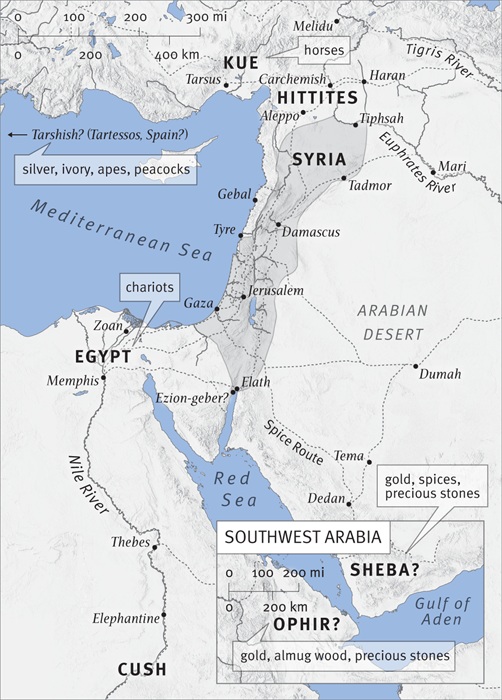
Solomon's firm control of important trade routes linking Egypt, Arabia, Mesopotamia, and Anatolia (Asia Minor) provided him with incalculable wealth. Partnering with King Hiram of Tyre, Solomon also launched his own trading expeditions to Ophir to acquire valuable and exotic goods. The queen of Sheba's visit to Solomon attests to his great fame throughout the ancient world. Solomon further augmented his wealth by buying horses from Kue and chariots from Egypt and selling them to the kings of Syria and the Hittites.
2 CHRONICLES—NOTE ON 2:1–18 This section reports how Solomon selected men to gather building materials for the temple. This was in addition to the massive supplies stockpiled by David (cf. 1 Chron. 22, 29). This section parallels 1 Kings 5:1–16.
2 CHRONICLES—NOTE ON 2:1 a temple for the name of the Lord. God's covenant name, Yahweh or Jehovah (cf. Ex. 3:14), is in mind. David wanted to do this, but was not allowed to do any more than plan and prepare (1 Chron. 23– 26; 28:11–13), purchase the land (2 Sam. 24:18–25; 1 Chron. 22), and gather the materials (1 Chron. 22:14–16). royal palace. See 1 Kings 7:1–12 for details (cf. 2 Chron. 7:11; 8:1).
2 CHRONICLES—NOTE ON 2:2 These numbers are repeated in 2:17–18. First Kings 5:16 records 3,300 overseers, compared to 3,600 in 2 Chron. 2:18. If, however, the additional supervisors (250 in 2 Chron. 8:10, but 550 in 1 Kings 9:23) are added, then both 1 Kings and 2 Chronicles agree that a total of 3,850 men worked. David had done similarly at an earlier date (1 Chron. 22:2).
2 CHRONICLES—NOTE ON 2:3–10 Compare with the contents of 1 Kings 5:3–6. The differences can be accounted for in much the same way as in the Gospels, by combining the narratives of 1 Kings 5:3–6 and 2 Chron. 2:3–10 to complete the entire correspondence.
2 CHRONICLES—NOTE ON 2:7 send me a man skilled. The Israelites were familiar with agriculture, but not metalworking. They needed experts for that.
2 CHRONICLES—NOTE ON 2:8 algum. A coniferous tree native to Lebanon. Some identify it as sandalwood, a smooth, expensive red wood that could be polished to a high gloss.
2 CHRONICLES—NOTE ON 2:10 This listing of goods is more complete than that of 1 Kings 5:11. Lebanon traded with Israel regularly for food. give . . . 20,000 cors. A cor is the same as a homer and could have measured as much as 7.5 bushels, making this amount about 150,000 bushels. and 20,000 baths. A bath measured about 6 gallons. This would be about 120,000 gallons. The 20,000 cors of "beaten oil" in 1 Kings 5:11 is most likely not a scribal error but rather a finer grade of oil.
2 CHRONICLES—NOTE ON 2:11–16 Compare with the context of 1 Kings 5:7–9.
2 CHRONICLES—NOTE ON 2:12 God . . . who made heaven and earth. This was the common identification of the true God when pagans spoke of or were told of him (cf. 2 Chron. 36:23; Ezra 1:2; 5:11–12; 6:10; 7:12, 21, 23; Jer. 10:11–12; Acts 4:24; 14:15; 17:24–26; Col. 1:16–17; Rev. 11:1, 6).
2 CHRONICLES—NOTE ON 2:13–14 Huram-abi. First Kings 7:14 states that his mother was of the tribe of Naphtali, not Dan, as reported here. This is resolved if she was of Naphtali by birth, but living in the territory of Dan. Or, if his parents were originally from the two tribes, then he could legitimately claim either. He was the parallel to Bezalel, who constructed the tabernacle. See note on 2 Chron. 1:5.
2 CHRONICLES—NOTE ON 2:16 Joppa. A major coastal port of Israel. Later, Jonah would sail from Joppa (Jonah 1:3), and much later Peter would be there to receive God's call in a vision (Acts 10:5ff.).
2 CHRONICLES—NOTE ON 2:17–18 See note on 2 Chron. 2:2.
2 CHRONICLES—NOTE ON 3:1–17 Cf. 1 Kings 6:1–38 and 7:15–22 for amplification and additional material on the building of the temple.
2 CHRONICLES—NOTE ON 3:1 threshing floor. See notes on Gen. 22:1–18; 2 Sam. 24:18–25; 1 Chron. 21:20–30.
2 CHRONICLES—NOTE ON 3:2 second month . . . fourth year. C. April/May, 966
B.C. (cf. 1 Kings 6:1). The project took seven years, six months to complete c. October/November 959 B.C. (cf. 1 Kings 6:37–38).
2 CHRONICLES—NOTE ON 3:3 cubits . . . old standard. About 18 inches or possibly the royal cubit of 21 inches (cf. Ezek. 40:5).
2 CHRONICLES—NOTE ON 3:6 Parvaim. An unknown location.
2 CHRONICLES—NOTE ON 3:8 600 talents . . . gold. Equal to almost 23 tons of gold.
2 CHRONICLES—NOTE ON 3:9 fifty shekels. Equal to 1.25 pounds. Most likely, this small amount gilded only the spike heads.
2 CHRONICLES—NOTE ON 3:10–13 two cherubim. See note on 1 Kings 6:23. This free-standing set of cherubim was in addition to the more diminutive set on the ark itself.
2 CHRONICLES—NOTE ON 3:14 veil. Cf. Ex. 26:31–35 on the veil of the tabernacle. The veil separated the Holy Place from the Most Holy Place, which was entered once annually by the high priest on the Day of Atonement (cf. Lev. 16). This highly limited access to the presence of God was eliminated by the death of Christ, when the veil in Herod's temple was torn in two from top to bottom (Matt. 27:51). It signified that believers had immediate, full access to God's presence through their Mediator and high priest Jesus Christ, who was the perfect, once-for-all sacrifice (cf. Heb. 3:14–16; 9:19–22).
2 CHRONICLES—NOTE ON 3:15 thirty-five cubits. First Kings 7:15, 2 Kings 25:17, and Jer. 52:21 uniformly describe these cast-bronze pillars as 18 cubits high (about 27 feet). Most likely this is accounted for because the chronicler gave the combined height of both as they were lying in their molds (cf. 2 Chron. 3:17).
2 CHRONICLES—NOTE ON 3:17 Jachin . . . Boaz. Most likely these were so named because of the names' meaning rather than in honor of particular people. Jachin means "he shall establish" and Boaz means "in it is strength" (cf. 1 Kings 7:21).
2 CHRONICLES—NOTE ON 4:1–5:1 See 1 Kings 7:23–51 for amplification and additional details.
2 CHRONICLES—NOTE ON 4:1 altar of bronze. This is the main altar on which sacrifices were offered (cf. the millennial temple altar, Ezek. 43:13–17). For comparison to the tabernacle's altar, see Ex. 27:1–8 and 38:1–7. If the cubit of 18 inches was used rather than the royal cubit of 21 inches, it would make the altar 30 feet by 30 feet by 15 feet high.
2 CHRONICLES—NOTE ON 4:2 made the sea. This large laver was used for ritual cleansing (cf. Ex. 30:17–21 as it relates to the tabernacle). In Ezekiel's millennial temple, the laver will apparently be replaced by the waters that flow through the temple (Ezek. 47:1–12).
2 CHRONICLES—NOTE ON 4:3 gourds. These were also around the laver, which was set on top of the 12 oxen.
2 CHRONICLES—NOTE ON 4:4 twelve oxen. Very likely the 12 oxen represent the 12 tribes who were similarly arrayed around the tabernacle as they set out on their journey in the wilderness (cf. Num. 2:1–34).
2 CHRONICLES—NOTE ON 4:5 held 3,000 baths. A bath equaled almost 6 gallons. First Kings 7:26 reads 2,000 baths. This discrepancy has been reconciled by accounting here not only for the water the basin held, but also the water source that was necessary to keep it flowing as a fountain.
2 CHRONICLES—NOTE ON 4:6 ten basins. There were no such corresponding basins in the tabernacle.
2 CHRONICLES—NOTE ON 4:7–8 ten golden lampstands . . . ten tables. The tabernacle had one of each. Everything was large because of the crowds of thousands that came on a daily basis and for special occasions.
2 CHRONICLES—NOTE ON 4:11–5:1 See notes on 1 Kings 7:40–51. All these details emphasize the great care and concern for worship, and served as a manual for the new temple being built by Zerubbabel after the Jews returned from Babylon.
2 CHRONICLES—NOTE ON 4:11 Hiram. See note on 2:13–14. He led the actual work that Solomon directed.
2 CHRONICLES—NOTE ON 5:1 The temple took seven years, six months to build and was completed in Solomon's eleventh year (959 B.C.) in the eighth month (cf. 1 Kings 6:38). Since it was dedicated in the seventh month (5:3), its dedication occurred 11 months later to coincide with the Feast of Booths, or Tabernacles. See note on 1 Kings 8:2. Why is there so much emphasis in the OT on the temple? 1) It was the center of worship that called people to correct belief through the generations. 2) It was the symbol of God's presence with his people. 3) It was the symbol of forgiveness and grace, reminding the people of the seriousness of sin and the availability of mercy. 4) It prepared the people for the true Lamb of God, Jesus Christ, who would take away sin. 5) It was a place of prayer. Cf. 2 Chron. 7:12–17.
2 CHRONICLES—NOTE ON 5:2–10 See notes on 1 Kings 8:1–9.
2 CHRONICLES—NOTE ON 5:2 The ark was in Jerusalem in a temporary tent (2 Sam. 6:17), not the original tabernacle, which was still at Gibeon (1 Chron. 16:39).
2 CHRONICLES—NOTE ON 5:11 the Holy Place. This was to be the last time anyone but the high priest went in, and then only once a year. It took several priests to place the ark in its new home.
2 CHRONICLES—NOTE ON 5:12 Asaph, Heman, and Jeduthun. See notes on 1 Chron. 25.
2 CHRONICLES—NOTE ON 5:13–14 the glory of the Lord. The Lord's presence indwelt the temple and the first service of worship was held. In the same manner he descended on the tabernacle (Ex. 40:34–38). He will do likewise on the millennial temple (Ezek. 43:1–5). His glory is representative of his person (cf. Ex. 33), and entering the temple signified his presence.
2 CHRONICLES—NOTE ON 6:1–11 See notes on 1 Kings 8:12–21.
2 CHRONICLES—NOTE ON 6:11 the covenant of the Lord. The Mosaic law written on tablets of stone (cf. 5:10).
2 CHRONICLES—NOTE ON 6:12–40 See note on 1 Kings 8:22–53. As Solomon led his people in prayer, he asked God to help them in many situations: 1) crime (vv. 22–23); 2) enemy attacks (vv. 24–25); 3) drought (vv. 26–27); 4) famine (vv. 28– 31); 5) foreigners (vv. 32–33); 6) war (vv. 34–35); and 7) sin (vv. 36–39).
2 CHRONICLES—NOTE ON 6:13 knelt. Solomon, in an unusually humbling act for a king, acknowledged God's sovereignty.
2 CHRONICLES—NOTE ON 6:18 Solomon marveled that God would condescend to live there. Cf. John 1:14 and Col. 2:9.
2 CHRONICLES—NOTE ON 6:41–42 See notes on Ps. 132:8–10 and 1 Kings 8:54– 61.
2 CHRONICLES—NOTE ON 7:1–3 fire came down. This also occurred when the tabernacle was dedicated (Lev. 9:23–24). This was the genuine dedication, because only God can truly sanctify.
2 CHRONICLES—NOTE ON 7:4–5 See note on 1 Kings 8:62.
2 CHRONICLES—NOTE ON 7:8–10 Solomon's celebration included the special assembly to dedicate the altar on the eighth–fourteenth of the seventh month (September/October) which included the Day of Atonement. It was immediately followed by the Feast of Booths, or Tabernacles (fifteenth–twenty-first) and a special assembly on the eighth day, i.e., twenty-second day of the month.
2 CHRONICLES—NOTE ON 7:8 Lebo-hamath . . . Brook of Egypt. Lit. from the northern boundary to the southern boundary.
2 CHRONICLES—NOTE ON 7:11–12 See note on 1 Kings 9:1–2. Perhaps years had passed since the dedication of the temple in 2 Chron. 6 during which he had also built "his own house" (cf. 8:1). After all that time, God confirmed that he had heard Solomon's prayer (7:12).
2 CHRONICLES—NOTE ON 7:13–16 This section is almost all unique to 2 Chronicles (cf. 1 Kings 9:3), and features the conditions for national forgiveness of Israel's sins: 1) humility; 2) prayer; 3) longing for God; and 4) repentance.
2 CHRONICLES—NOTE ON 7:17–22 See notes on 1 Kings 9:4–9.
2 CHRONICLES—NOTE ON 7:17–18 if . . . then. If there was obedience on the part of the nation, the kingdom would be established and they would have "a man to rule." Their disobedience was legendary and so was the destruction of their kingdom and their dispersion. When Israel is saved (cf. Zech. 12:14; Rom. 11:25–27), then their King Messiah will set up this glorious kingdom (Rev. 20:1ff.).
2 CHRONICLES—NOTE ON 8:1 twenty years. C. 946 B.C., 24 years after Solomon's reign began.
2 CHRONICLES—NOTE ON 8:2 Cf. 1 Kings 9:10–14. Though these cities were within the boundaries of the Promised Land, they had never been conquered, so Solomon gave Hiram the right to settle them. Hiram, however, returned the Galilean cities that Solomon had given him because they were unacceptably poor. Solomon apparently then improved them and settled Israelites there.
2 CHRONICLES—NOTE ON 8:3–6 Here are additional military campaigns and building projects not mentioned in 1 Kings 9. He was building storage places for his commercial enterprises and fortifying his borders to secure his kingdom from invasion.
2 CHRONICLES—NOTE ON 8:3 Hamath-zobah. A city located in Syria, north of Damascus and in close proximity to but south of Hamath.
2 CHRONICLES—NOTE ON 8:4 Tadmor. A city 150 miles northeast of Damascus. Hamath. A city north of Damascus.
2 CHRONICLES—NOTE ON 8:5 Beth-horon. Two cities northwest of Jerusalem. Upper Beth-horon is at 2,022 feet, 11 miles northwest of Jerusalem. Lower Bethhoron is at 1,210 feet, 13 miles northwest of Jerusalem. They were both on a strategic road that connected Jerusalem with Joppa on the coast.
2 CHRONICLES—NOTE ON 8:6 Baalath. A city originally in Danite territory (Josh. 19:44) c. 30 miles west of Jerusalem.
2 CHRONICLES—NOTE ON 8:10 250. See note on 2 Chron. 2:2.
2 CHRONICLES—NOTE ON 8:11 Pharaoh's daughter. Cf. 1 Kings 9:24. First Kings 3:1 mentions the marriage and the fact that Solomon brought her to Jerusalem until he could build a house for her. Until that palace was built, Solomon lived in David's palace, but did not allow her to do so, because she was a heathen and because the ark of God had once been in David's house. He surely knew his marriage to this pagan did not please God (cf. Deut. 7:3–4). Eventually his pagan wives caused tragic consequences (1 Kings 11:1–11).
2 CHRONICLES—NOTE ON 8:12–15 This section expands on 1 Kings 9:25, and indicates that Solomon was, in spite of his disobedience in marriage, still faithful to the religious practices required in the temple.
2 CHRONICLES—NOTE ON 8:13 three . . . feasts. These were prescribed in the Mosaic legislation: 1) Unleavened Bread, or Passover; 2) Weeks, or Pentecost; and 3) Booths, or Tabernacles (cf. Ex. 23:14–17; Deut. 16:1–17).
2 CHRONICLES—NOTE ON 8:17–18 See notes on 1 Kings 9:26–28. These two ports where Solomon had received ships were located on the eastern gulf of the Red Sea, called Aqabah. Solomon was cultivating peace and commerce plus using Hiram's sailors to teach his people how to sail.
2 CHRONICLES—NOTE ON 8:18 450 talents. First Kings 9:28 reports 420 talents, probably accounted for by a scribal error in transmission. This was about 17 tons of gold.
2 CHRONICLES—NOTE ON 9:1–28 See notes on 1 Kings 10:1–29.
2 CHRONICLES—NOTE ON 9:8 his throne. The thought that Solomon sat on God's throne is not included in the queen of Sheba's words in 1 Kings 10:9. The blessing of God on Israel and on Solomon was to last as long as he followed the Lord as David had (2 Chron. 7:17–21).
2 CHRONICLES—NOTE ON 9:16 shekels. "Bekah," not shekel, is the correct unit of weight. Since one mina equals 50 shekels and one shekel equals two bekahs, then the three minas in 1 Kings 10:17 equals the 300 bekahs here and both texts agree. This would represent a little less than 4 pounds.
2 CHRONICLES—NOTE ON 9:18 footstool of gold. The chronicler adds this detail, which is absent in 1 Kings 10:19.
2 CHRONICLES—NOTE ON 9:25 had 4,000 stalls. This reading is preferable to "40,000" in 1 Kings 4:26 (see note).
2 CHRONICLES—NOTE ON 9:29–31 See 1 Kings 11:41–43.
2 CHRONICLES—NOTE ON 9:29 First Kings 11:41 reports that Solomon's deeds were written in "the Book of the Acts of Solomon." For the rest of the record of Solomon's life, read 1 Kings 10:26–11:43. In later years, he turned away from God and, due to the influence of his wives, he led the nation into idolatry. This split the kingdom and sowed the seeds that led to its defeat and dispersion. The Chronicles do not record this sad end to Solomon's life because the focus is on encouraging the returning Jews from Babylon with God's pledge to them for a glorious future in the Davidic Covenant.
2 CHRONICLES—NOTE ON 10:1–36:21 This section records all 20 of the Judean rulers in the divided kingdom from Solomon's son Rehoboam (c. 931 B.C.) to Zedekiah (c. 586 B.C.) when the people were taken captive to Babylon. The righteous kings and the revivals under them are presented, as well as the wicked kings and their disastrous influence. The northern kingdom is absent since Chronicles focuses on the Davidic line.
2 CHRONICLES—NOTE ON 10:1–12:16 The reign of Rehoboam (c. 931–913 B.C.). Cf. 1 Kings 12–14.
2 CHRONICLES—NOTE ON 10:1–11:4 For details on this chapter, see notes on 1 Kings 12:1–24. Rehoboam followed foolish and bad advice from novices rather than the good counsel of wise, seasoned men. The result was the division of the nation. Amazingly, with all the strength of Solomon's reign, unity was fragile and one fool in the place of leadership ended it. Rehoboam tried to unite the people by force, but was not allowed to by God (2 Chron. 11:1–4).
2 CHRONICLES—NOTE ON 10:2 Jeroboam. He became the first king of the northern kingdom of Israel (c. 931–910 B.C.). His story leading to his return from Egypt is told in 1 Kings 11:26–40.
2 CHRONICLES—NOTE ON 10:16–19 Here is recorded the beginning of the divided kingdom. Ten tribes followed Jeroboam and were called Israel. The other two tribes, Benjamin and Judah, stayed loyal to David's line, accepted Rehoboam's rule, and were called Judah. However, Benjamin at times demonstrated split loyalties (see note on 1 Kings 12:21).
2 CHRONICLES—NOTE ON 11:6 built. To be understood as built further/strengthened/fortified (cf. 11:11–12).
2 CHRONICLES—NOTE ON 11:13–14 The priests and Levites from all the northern 10 tribes were rejected by Israel's king, Jeroboam (c. 931–910 B.C.), who saw them as a threat because of their loyalty to Jerusalem and the temple. He appointed his own idol priests, and all true priests moved south and found refuge in Judah with Rehoboam.
2 CHRONICLES—NOTE ON 11:15 he had made. This is in reference to Jeroboam (cf. 1 Kings 12:25–33), who established idolatry in the north.
2 CHRONICLES—NOTE ON 11:16–17 God's blessing rested on Rehoboam for three years because the people's commitment to the ways of God was patterned after David and Solomon.
2 CHRONICLES—NOTE ON 11:18–23 A summary of Rehoboam's life is given with special emphasis on succession to the throne. This is not a commendation of polygamy or concubinage, which violated God's law for marriage (cf. Gen. 2:24–25) and resulted in severe trouble and disaffection toward God. Never is polygamy commended in Scripture, and usually its tragic results are recorded.
2 CHRONICLES—NOTE ON 11:21 The chronicler did not include the similar summary of Solomon's wives (cf. 1 Kings 11:3), but clearly Rehoboam learned this disastrous marital style from his father Solomon. Even David was a polygamist. Polygamy was often practiced by the kings to secure alliances with nearby nations.
2 CHRONICLES—NOTE ON 12:1–2 fifth year. C. 926 B.C. Presumably, Rehoboam's three years of blessing preceded a fourth year of spiritual rebellion, which God judged in his fifth year with judgment at the hand of the Egyptians.
2 CHRONICLES—NOTE ON 12:2–5 Shishak. He ruled over Egypt c. 945–924 B.C. An Egyptian record of this invasion written on stone has been found, recording that Shishak's army penetrated all the way north to the Sea of Galilee. He wanted to restore Egypt's once-great power, but was unable to conquer both Israel and Judah. However, he was able to destroy cities in Judah and gain some control of trade routes. Judah came under Egyptian control.
2 CHRONICLES—NOTE ON 12:6–7 humbled themselves. In the face of the Egyptian conqueror, the leaders responded to the word of God through the prophet (v. 5) and repented, so that God would end his wrath worked through Shishak.
2 CHRONICLES—NOTE ON 12:8 Nevertheless. A fitting punishment arose to remind the Jews of their heritage in relationship to Egypt. This was the first major military encounter with Egypt since the exodus had ended hundreds of years of slavery there. A taste of being enslaved again to a people from whom God had given liberation was bitter. The message was crystal clear—if the Jews would forsake the true worship of God, they would also lose his protective hand of blessing. It was much better to serve God than to have to serve "kingdoms of the countries."
2 CHRONICLES—NOTE ON 12:9 against Jerusalem. After the parenthetical section (vv. 5–8) describing the state of the beleaguered court, the historian returns to discuss the attack on Jerusalem and the pillage of the temple and palace.
2 CHRONICLES—NOTE ON 12:9–16 See notes on 1 Kings 14:25–30.
2 CHRONICLES—NOTE ON 12:10–11 bronze. The pure gold was replaced by bronze, which was carefully guarded.
2 CHRONICLES—NOTE ON 12:12 Cf. 12:7. God preserved Judah because of her repentance.
2 CHRONICLES—NOTE ON 12:13 C. 931–913 B.C. By the general revival of true worship, Rehoboam's reign acquired new life and continued many years after the departure of Shishak. Sadly he faltered (v. 14), probably due largely to his heathen mother (v. 13).
2 CHRONICLES—NOTE ON 12:16 Abijah. Cf. 11:20–22. In 1 Kings 15:3, he is called a great sinner. But consistent with his pattern, the writer of the Chronicles highlights the little good he did to indicate that he was still in line with God's covenant promise to David.
2 CHRONICLES—NOTE ON 13:1–22 In the succession of Judah's kings, the reign of Abijah/Abijam is next (c. 913–911 B.C.; cf. 1 Kings 15:1–8). The disobedient nature of Abijah's reign is mentioned in 1 Kings 15:3, as is his faithless treaty with Syria (2 Chron. 16:3).
2 CHRONICLES—NOTE ON 13:3 See notes on 1 Kings 15:1–8. These numbers are large, but not surprising, given the immense number of capable men who could fight, as counted in David's census (cf. 1 Chron. 21:5). Both armies were set for civil war.
2 CHRONICLES—NOTE ON 13:4 Mount Zemaraim. The exact location is unknown, but it is likely near Bethel (Josh. 18:22) inside Israel's territory.
2 CHRONICLES—NOTE ON 13:5 covenant of salt. Salt is associated elsewhere with the Mosaic Covenant sacrifices (Lev. 2:13), the Priestly Covenant (Num. 18:19), and the New Covenant symbolic sacrifices in the millennial kingdom (Ezek.
43:24). The preservative quality of salt represents the fidelity or loyalty intended in keeping the covenant. Here it would refer to God's irrevocable pledge and intended loyalty in fulfilling the Davidic Covenant and God's desire for the loyalty of David's lineage to him if the people are to enjoy the blessings of the covenant.
2 CHRONICLES—NOTE ON 13:6 For the story of Jeroboam, read 1 Kings 11:26–40 and 2 Chron. 10. He was the first king of the northern kingdom called Israel.
2 CHRONICLES—NOTE ON 13:7 young. He was 41 (cf. 2 Chron. 12:13).
2 CHRONICLES—NOTE ON 13:8 kingdom of the Lord. Abijah reminds all that the Davidic Covenant is God's expressed will concerning who would rule on his behalf in the earthly kingdom. Thus Judah is God's nation, since the king is in the line of David. golden calves. Cf. 1 Kings 12:25–33 and 2 Chron. 11:15. Israel was full of idols and false priests, having driven out all the Levitical priests and, with them, the true worship of God.
2 CHRONICLES—NOTE ON 13:10–12 Abijah confessed a national commitment to pure worship and thus confidence in God's favor in battle.
2 CHRONICLES—NOTE ON 13:15 God defeated Jeroboam and all Israel. At the time of certain defeat, with 400,000 troops behind and the same number in front, Judah was saved by divine intervention. What God did is unknown, but the army of Israel began to flee (v. 16), and the soldiers of Judah massacred 500,000 of them in an unimaginable blood bath (v. 17).
2 CHRONICLES—NOTE ON 13:17 Before the battle, Jeroboam outnumbered Abijah two to one (13:3). After the fray, in which the Lord intervened on behalf of Judah, Abijah outnumbered Jeroboam four to three.
2 CHRONICLES—NOTE ON 13:19 Bethel. Located 12 miles north of Jerusalem. Although their exact locations are unknown, Jeshanah and Ephron are believed to be in the vicinity of Bethel.
2 CHRONICLES—NOTE ON 13:20 he died. Again God acted, in a manner not described, to end the life of this wicked ruler (c. 910 B.C.).
2 CHRONICLES—NOTE ON 14:1–16:14 The reign of Asa (c. 911–870 B.C.). Cf. 1 Kings 15:9–24.
2 CHRONICLES—NOTE ON 14:1–2 First Kings 15:11 says that Asa did as his forefather David had done—honoring God while building the kingdom (2 Chron. 14:6–8). Times of peace were used for strengthening.
2 CHRONICLES—NOTE ON 14:3–5 He removed elements of false worship that had accumulated over the years of Solomon, Rehoboam, and Abijah (cf. 1 Kings 15:12–13). Apparently, he did not remove all the high places or, once removed, they reappeared (cf. 2 Chron. 15:17; 1 Kings 15:14). His son Jehoshaphat later had to remove them (cf. 2 Chron. 17:6), although not completely (cf. 20:33). This was done in an effort to comply with Deut. 12:2–3.
2 CHRONICLES—NOTE ON 14:8 Asa had an army of 580,000 compared to Abijah's 400,000 (2 Chron. 13:3).
2 CHRONICLES—NOTE ON 14:9–15 A major threat developed from Zerah, the Ethiopian, probably on behalf of the Egyptian Pharaoh, who was attempting to regain control as Shishak had during the days of Rehoboam (cf. 2 Chron. 12:7– 8), c. 901–900 B.C.
2 CHRONICLES—NOTE ON 14:9 Mareshah. Located about 8 miles southeast of Gath and 25 miles southwest of Jerusalem. Rehoboam had earlier reinforced this city (2 Chron. 11:8).
2 CHRONICLES—NOTE ON 14:11 Asa's appeal to God centered on God's omnipotence and reputation.
2 CHRONICLES—NOTE ON 14:13–15 plunder. It appears that this great horde was a nomadic people who moved with all their possessions and had set up their camp near Gerar. The spoils of Judah's victory were immense.
2 CHRONICLES—NOTE ON 14:13 Gerar. Approximately 8 miles south of Gaza on the Mediterranean coast. Egypt does not appear on the scene again for over 150 years (cf. 2 Kings 17:4).
2 CHRONICLES—NOTE ON 15:1 Spirit of God. An act of the Holy Spirit, common in the OT enabling servants of God to speak or act uniquely for him. Azariah. This man was a prophet mentioned only here, who met Asa as he returned from the victory and spoke to him before all his army.
2 CHRONICLES—NOTE ON 15:2 The spiritual truth here is basic, namely that God is present and powerful in defense of his obedient people. Cf. Deut. 20:1; 1 Chron. 28:9; Isa. 55:6–7; Jer. 29:12–14; James 4:8. While good Asa ruled for 41 years, eight wicked kings ruled in Israel, including Jeroboam, who along with the others, was a negative illustration of this truth (cf. 2 Chron. 12:1ff.).
2 CHRONICLES—NOTE ON 15:8 vestibule. This refers to the area outside the Holy Place, where the altar of the burnt offering was located.
2 CHRONICLES—NOTE ON 15:9 Ephraim, Manasseh, and Simeon. This indicates that not all the people in the 10 tribes that constituted the apostate northern kingdom of Israel had abandoned God. Many migrated south into Judah, so that all tribes were represented in the mix of Jews in Judah.
2 CHRONICLES—NOTE ON 15:10 fifteenth year. C. 897 B.C. in May/June. The Feast of Weeks would have been the occasion.
2 CHRONICLES—NOTE ON 15:11–15 The assembled worshipers entered into a renewed promise to obey (cf. Ex. 24:1ff.) and to rigorously enforce the laws that made idolatry punishable by death (cf. Deut. 17:2–5). This was inaugurated with the sacrifices of animals taken in spoil from the Ethiopians (14:15).
2 CHRONICLES—NOTE ON 15:16–18 See note on 1 Kings 15:11–15.
2 CHRONICLES—NOTE ON 15:19 thirty-fifth year. C. 875 B.C.
2 CHRONICLES—NOTE ON 16:1 thirty-sixth year. Since Baasha (c. 909–886 B.C.) died in the twenty-sixth year of Asa's reign (cf. 1 Kings 15:33), this could not mean that they were at war 10 years later. However, if the time reference was to the thirty-fifth year since the kingdom was divided, then the year is c. 896 B.C. in the fourteenth year of Baasha's reign and the sixteenth of Asa's reign. This manner of reckoning was generally followed in the book of the record of the kings of Judah and Israel, the public annals of that time, from which the inspired writer drew his account (cf. 2 Chron. 16:11). This could be a cause for the defections of people from Israel to Judah as described in 15:9. Cf. 1 Kings 15:16–17. Ramah. This frontier town was on the high road about 6 miles north of Jerusalem. Because of the topography and fortification of that city, this would effectively block all traffic into Jerusalem from the north. Cf. 1 Kings 15:16–22.
2 CHRONICLES—NOTE ON 16:2–6 Asa sinfully resorted to trusting in a pagan king, Ben-hadad, for protection against the king of Israel in contrast to 1) Abijah
(13:2–20) and 2) even earlier to his own battle against Egypt (14:9–15), when they both trusted wholly in the Lord. See note on 1 Kings 15:18.
2 CHRONICLES—NOTE ON 16:3 my father . . . your father. A previously unmentioned treaty between Abijah (c. 913–911 B.C.) and Tabrimmon (c. 912– 890 B.C.).
2 CHRONICLES—NOTE ON 16:4 Ijon . . . cities. Along with the other cities mentioned, these were located north and east of the Sea of Galilee.
2 CHRONICLES—NOTE ON 16:6 Geba . . . Mizpah. Located two miles north northeast and two miles east of Ramah respectively.
2 CHRONICLES—NOTE ON 16:7 Hanani. God used this prophet to rebuke Asa 1) for his wicked appropriation of temple treasures devoted to God to purchase power, and 2) for his faithless dependence on a pagan king instead of the Lord, in contrast to before when opposed by Egypt (14:9–15). army of the king of Syria has escaped. Asa forfeited by this sin the opportunity of gaining victory not only over Israel, but also Aram, or Syria. This could have been a greater victory than over the Ethiopians, which would have deprived Syria of any future successful attacks on Judah. Though God had delivered them when they were outnumbered (13:3ff.; 14:9ff.), the king showed his own spiritual decline both in lack of trust and in his treatment of the prophet of God who spoke truth (16:10).
2 CHRONICLES—NOTE ON 16:9 strong support . . . heart is blameless toward him. See note on 15:2. you will have wars. Divine judgment on the king's faithlessness.
2 CHRONICLES—NOTE ON 16:10–12 During Asa's last six years, he uncharacteristically exhibited the ungodly behavior of: 1) anger at truth (v. 10); 2) oppression of God's prophet and people (v. 10); and 3) seeking man not God (v. 12).
2 CHRONICLES—NOTE ON 16:12 thirty-ninth year. C. 872 B.C. He died as a result of what may have been severe gangrene.
2 CHRONICLES—NOTE ON 16:13 forty-first year. C. 870 B.C.
2 CHRONICLES—NOTE ON 16:14 great fire. Due to the longevity of his reign and his notable accomplishments, Asa was honored by the people in their memorial of his death. Cremation was rarely used by the Hebrews (cf. 21:19; 1 Sam. 31:13; Amos 6:10). Later, Jehoram was not honored by fire (2 Chron. 21:19) because of his shameful reign.
2 CHRONICLES—NOTE ON 17:1–21:3 The reign of Jehoshaphat (c. 873–848 B.C.). Cf. 1 Kings 15:24 and 22:1–50.
2 CHRONICLES—NOTE ON 17:1–2 Jehoshaphat prepared the nation militarily for any aggression, particularly from the northern kingdom of Israel.
2 CHRONICLES—NOTE ON 17:3 the Baals. This is a general term used for idols. Cf. Judg. 2:11–13.
2 CHRONICLES—NOTE ON 17:3–9 Jehoshaphat made three strategic moves, spiritually speaking: 1) he obeyed the Lord (v v. 3–6); 2) he removed false worship from the land (v. 6); and 3) he sent out teachers who taught the people the law of the Lord (v v. 7–9).
2 CHRONICLES—NOTE ON 17:10–11 Jehoshaphat's spiritual strategy accomplished its intended purpose, i.e., invoking God's blessing and protection, much as it did with Abijah (13:2–20) and Asa (14:9–15). It should be noted that the Jews needed animals for extensive sacrificial uses, as much as for food and clothing.
2 CHRONICLES—NOTE ON 17:12–13 These verses indicate the massive wealth that developed under divine blessing (cf. 18:1), as well as formidable military power (17:14–19).
2 CHRONICLES—NOTE ON 18:1–34 See notes on 1 Kings 22:1–39. Ahab was king in Israel. Jehoshaphat arranged for his son (cf. 2 Chron. 21:6) to marry Athaliah, daughter of wicked Ahab, then made a military alliance with him. This folly had tragic results: 1) Jehoshaphat drew God's wrath (19:2); 2) after Jehoshaphat died and Athaliah became queen, she seized the throne and almost killed all of David's descendants (22:10ff.); and 3) she brought the wicked idols of Israel into Judah, which eventually led to the nation's destruction and captivity in Babylon. Jehoshaphat had a tendency to rely on other kings as evidenced by this unique report of a marriage alliance with Ahab (18:1). See also 20:35–37 concerning an alliance with Ahaziah (c. 853–852 B.C.).
2 CHRONICLES—NOTE ON 18:5 Evil kings had false prophets who told them what they wanted to hear (cf. Isa. 30:10–11; Jer. 14:13–16; 23:16, 21, 30–36). The true prophet spoke God's word and was arrested (v. 26).
2 CHRONICLES—NOTE ON 19:1–3 Having faced possible death that was diverted by God (18:31), Jehoshaphat was rebuked because of his alliances. The prophet condemned the king's alliance with God's enemy, Ahab (1 Kings 22:2), yet there was mercy mingled with wrath because of the king's concern personally and nationally for the true worship of God.
2 CHRONICLES—NOTE ON 19:2 Hanani. This same prophet had earlier given Jehoshaphat's father, Asa, a similar warning (16:7–9).
2 CHRONICLES—NOTE ON 19:4–11 Jehoshaphat put God's kingdom in greater spiritual order than at any time since Solomon. To ensure this order, he set "judges" (v. 5) in place and gave them principles to rule by: 1) accountability to God (v. 6); 2) integrity and honesty (v. 7); 3) loyalty to God (v. 9); 4) concern for righteousness (v. 10); and 5) courage (v. 11). All are essentials to spiritual leadership.
2 CHRONICLES—NOTE ON 20:1–2 The offspring of Lot, i.e., Moab and Ammon, located east of the Jordan, and those from Edom to the south (the offspring of Esau), had intentions of dethroning Jehoshaphat. They had come around the south end of the Dead Sea as far north as Engedi, at the middle of the western shore. This was a common route for enemies since they were invisible to the people on the other side of the mountains to the west.
2 CHRONICLES—NOTE ON 20:3–4 Jehoshaphat made the appropriate spiritual response, i.e., the king and the nation appealed to God in prayer and fasting. The fast was national, including even the children (v. 13). Cf. Joel 2:12–17 and Jonah 3:7.
2 CHRONICLES—NOTE ON 20:5–12 Jehoshaphat stood in the redecorated center court praying for the nation, appealing to the promises, the glory, and the reputation of God, which were at stake since he was identified with Judah. In his prayer he acknowledged God's sovereignty (v. 6), God's covenant (v. 7), God's presence (vv. 8–9), God's goodness (v. 10), God's possession (v. 11), and their utter dependence on him (v. 12).
2 CHRONICLES—NOTE ON 20:10 Mount Seir. A prominent landmark in Edom.
2 CHRONICLES—NOTE ON 20:14–17 The Lord responded immediately, sending a message of confidence through the prophet Jahaziel.
2 CHRONICLES—NOTE ON 20:16 ascent of Ziz . . . wilderness of Jeruel. These areas lie between Engedi on the Dead Sea and Tekoa, which is 10 miles south of Jerusalem and 17 miles northwest of Engedi. This is the pass that leads from the valley of the Dead Sea toward Jerusalem.
2 CHRONICLES—NOTE ON 20:18–21 Here was the praise of faith. They were confident enough in God's promise of victory to begin the praise before the battle was won. So great was their trust that the choir marched in front of the army, singing psalms.
2 CHRONICLES—NOTE ON 20:21 in holy attire. This refers to the manner in which the Levite singers were clothed in symbolic sacred clothing (cf. 1 Chron. 16:29) in honor of the Lord's holiness.
2 CHRONICLES—NOTE ON 20:22–24 Similar to God's intervention in Gideon's day
(Judg. 7:15–23), God caused confusion among the enemy, who mistakenly turned upon themselves and slaughtered each other. Some think this may have been done by angels who appeared and set off this uncontrolled and deadly panic. The destruction was complete before Jehoshaphat and his army ever met the enemy (2 Chron. 20:24).
2 CHRONICLES—NOTE ON 20:25–28 They went back just as they had gone out— with music (cf. vv. 21–22).
2 CHRONICLES—NOTE ON 20:29 This is the second time in Jehoshaphat's reign that fear came on the nations (cf. 17:10), which was similar to that when Israel came out of Egypt (Ex. 23:27; Num. 22:3; Josh. 2:9–11; 9:9–10).
2 CHRONICLES—NOTE ON 20:31–21:3 See notes on 1 Kings 22:41–49.
2 CHRONICLES—NOTE ON 21:2–5 When the co-regency with his father ended at his father's death, Jehoram killed all who might have threatened his throne.
2 CHRONICLES—NOTE ON 21:4–20 The reign of Jehoram (c. 853–841 B.C.). Cf. 2 Kings 8:16–24. Most likely, Obadiah prophesied during his reign.
2 CHRONICLES—NOTE ON 21:4–10 See notes on 2 Kings 8:16–22.
2 CHRONICLES—NOTE ON 21:11 made Judah go astray. Undoubtedly he was influenced by his marriage to Ahab's daughter (cf. v. 6) and was influenced in the alliance just like his father (18:1). They had not learned from Solomon's sinful example (cf. 1 Kings 11:3–4). His wicked wife, Athaliah, later became ruler over Judah and tried to wipe out David's royal line (2 Chron. 22:10).
2 CHRONICLES—NOTE ON 21:12–15 Elijah, best known for his confrontations with Israel's Ahab and Jezebel (1 Kings 17–2 Kings 2:11), confronted prophetically Jehoram's sins of idolatry and murder (2 Chron. 21:13). The consequences from God's judgment extended beyond himself to his family and the nation (21:14– 15). This event undoubtedly occurred in the early years of Jehoram's co-regency with his father Jehoshaphat and shortly before Elijah's departure to heaven, c. 848 B.C. (cf. 2 Kings 2:11–12).
2 CHRONICLES—NOTE ON 21:16–20 The consequences of his sin were farreaching. He suffered military losses, his country was ravaged, his capital taken, his palace plundered, his wives taken, all his children killed but the youngest, he died with a painful disease, and was buried without honor (21:16–22:1).
2 CHRONICLES—NOTE ON 21:20 eight years. These were the years of his exclusive reign, not including his co-regency with his father.
2 CHRONICLES—NOTE ON 22:1–9 The reign of Ahaziah (c. 841 B.C.). Cf. 2 Kings 8:25–29 and 9:21–29.
2 CHRONICLES—NOTE ON 22:1–6 See notes on 2 Kings 8:25–29.
2 CHRONICLES—NOTE ON 22:2 twenty-two. Some versions read "forty-two" here, a copyist's error easily made due to the small stroke that differentiates two Hebrew letters. The reading from 2 Kings 8:26 of "twenty-two" should be followed.
2 CHRONICLES—NOTE ON 22:3 his mother was his counselor . . . wickedly. Athaliah and the rest of Ahab's house who were in the young king's life taught him wickedness and led him to moral corruption, idolatry, and folly in being induced to war with the Arameans, or Syrians (vv. 5–6).
2 CHRONICLES—NOTE ON 22:7–9 See notes on 2 Kings 8:28–9:29.
2 CHRONICLES—NOTE ON 22:10–23:21 The reign of Athaliah (c. 841–835 B.C.). Cf. 2 Kings 11:1–20.
2 CHRONICLES—NOTE ON 23:3 as the Lord spoke. This is one of the most dramatic moments in messianic history. The human offspring of David have been reduced to one—Joash. If he had died, there would have been no human heir to the Davidic throne, and it would have meant the destruction of the line of the Messiah. However, God remedied the situation by providentially protecting Joash (22:10–12) and eliminating Athaliah (23:12–21).
2 CHRONICLES—NOTE ON 23:11 testimony. The usual meaning is a copy of the law (cf. Deut. 17:18; Job 31:35–36).
2 CHRONICLES—NOTE ON 24:1–27 The reign of Joash (c. 835–796 B.C.). Cf. 2 Kings 11:17–12:21. Most likely, Joel prophesied during his reign, and his prophecy provides much helpful background to the time.
2 CHRONICLES—NOTE ON 24:1–14 See notes on 2 Kings 11:17–12:16.
2 CHRONICLES—NOTE ON 24:15–16 Jehoiada. This man was the high priest of Athaliah's and Joash's reigns (cf. 2 Chron. 23:1–24:16), who championed God's cause of righteousness during days of evil by: 1) leading the fight against idols; 2) permitting the coup against Athaliah; and 3) granting the throne to Joash to bring about the subsequent revival.
2 CHRONICLES—NOTE ON 24:17–18a After Jehoiada's death, the leaders of Judah convinced King Joash that they needed to return to idolatry. With the death of the old priest came the turning point in the reign of Joash. He "listened" means Joash gave consent for the idol worship and thus it began.
2 CHRONICLES—NOTE ON 24:18b–19 God's righteousness judged the evil of Judah, while at the same time his mercy sent prophets to preach the truth of repentance.
2 CHRONICLES—NOTE ON 24:20–22 The specific example of Zechariah, son of Jehoiada (not to be confused with Zechariah, son of Berechiah [Zech. 1:1; Matt. 23:35]) is alluded to by NT writers in such texts as Acts 7:51–52; Heb. 11:37. This priest told the people that faithfulness to the Lord is the condition for blessing (cf. 2 Chron. 12:5; 15:2). The conspiracy against this man who spoke the truth was with the king's full authority, and he bore the greatest guilt for the murder (24:22). See note on Matt. 23:35.
2 CHRONICLES—NOTE ON 24:22 did not remember. Cf. 22:11, where Jehoiada's wife preserved Joash from certain death as an infant, or 23:1–24:1, where Jehoiada devised a plan to dethrone Athaliah and crown Joash king, or 24:2, where Jehoiada is acknowledged as the voice of righteousness for Joash. Yet, Joash willfully ignored all that. Zechariah died pronouncing the just doom that would eventually come.
2 CHRONICLES—NOTE ON 24:23–25 As Zechariah had prayed (v. 22), so God repaid Joash's apostasy with defeat by Syria and death at the hands of his own people.
2 CHRONICLES—NOTE ON 24:24 few men. As the Lord had previously given victory to Judah's smaller army because of their faithfulness (13:2–20; 14:9–15), he gave Judah defeat at the hands of a lesser force because of their wickedness.
2 CHRONICLES—NOTE ON 24:25 Unlike righteous Asa (16:13–14), but like unrighteous Jehoram (21:18–20), Joash died an ignominious death and received burial without honor.
2 CHRONICLES—NOTE ON 24:26–27 See notes on 2 Kings 12:19–21.
2 CHRONICLES—NOTE ON 25:1–28 The reign of Amaziah (c. 796–767 B.C.). Cf. 2 Kings 14:1–20.
2 CHRONICLES—NOTE ON 25:1–4 See notes on 2 Kings 14:1–6.
2 CHRONICLES—NOTE ON 25:4 Cf. Ezek. 18.
2 CHRONICLES—NOTE ON 25:5–16 This section is an elaboration of 2 Kings 14:7.
2 CHRONICLES—NOTE ON 25:5–13 Amaziah gathered his army, which was small compared to the army of Jehoshaphat, which was over 1,000,000 (cf. 17:14–19). This shows how the southern kingdom had declined in 80 years.
2 CHRONICLES—NOTE ON 25:6 100 talents. If a talent weighs 75 pounds, this represents almost four tons of silver. This wealth was paid to the king of Israel, Jehoahaz, who ordered the mercenaries of Israel to aid Amaziah against Edom.
2 CHRONICLES—NOTE ON 25:7 man of God. This is a technical term used about 70 times in the OT, always referring to one who spoke for God. He warned Amaziah not to make idolatrous Israel his ally because the Lord was not with Ephraim, i.e., Israel, the capital of idolatry. See note on Deut. 33:1.
2 CHRONICLES—NOTE ON 25:8 God has power. See note on 2 Chron. 24:24. The man of God reminded the king sarcastically that he would need to be strong, since God wouldn't help.
2 CHRONICLES—NOTE ON 25:9–10 The man of God told Amaziah to cut his losses and trust the Lord. The king obeyed and sent the Israelite mercenaries home in anger.
2 CHRONICLES—NOTE ON 25:11 Valley of Salt. Most likely this is located at the southern end of the Dead Sea, where David had several centuries before been victorious (cf. 1 Chron. 18:12–13). Seir. Another name for Edom.
2 CHRONICLES—NOTE ON 25:12 rock. This mode of execution was common among pagan nations (cf. Ps. 137:9).
2 CHRONICLES—NOTE ON 25:13 Samaria. This was the well-known town of Israel from which they launched their attacks. Beth-horon. See note on 2 Chron. 8:5.
2 CHRONICLES—NOTE ON 25:14–16 Amaziah did the unthinkable from both a biblical and political perspective—he embraced the false gods of the people whom he had just defeated. Perhaps he did this because he was seduced by the wicked pleasures of idolatry and because he thought it would help him in assuring no future threat from Edom. However, it only brought destruction to the king, who just wanted to silence the voice of God.
2 CHRONICLES—NOTE ON 25:17–28 See notes on 2 Kings 14:8–19.
2 CHRONICLES—NOTE ON 26:1–23 The reign of Uzziah, a.k.a. Azariah (c. 790– 739 B.C.). Cf. 2 Kings 14:21–22; 15:1–7. Hosea (Hosea 1:1), Amos (Amos 1:1), Jonah, and Isaiah (Isa. 6) ministered during his reign.
2 CHRONICLES—NOTE ON 26:1–4 See notes on 2 Kings 14:21–22 and 15:1–4.
2 CHRONICLES—NOTE ON 26:5 Zechariah. An otherwise unknown prophet during Uzziah's reign, not the priestly spokesman of 24:20, nor the prophet Zechariah who wrote the prophetic book to Judah c. 520 B.C. sought . . . prosper. This summarizes a major theme in 2 Chronicles.
2 CHRONICLES—NOTE ON 26:6–15 A summary of Uzziah's prosperity in the realm of: 1) conquering the Philistines (v v. 6–8); 2) domestic affairs (v v. 9–10); and 3) military might (v v. 11–15).
2 CHRONICLES—NOTE ON 26:6–8 A description of Judah's military success to the west, east, and south. Israel to the north is not mentioned.
2 CHRONICLES—NOTE ON 26:6 Gath . . . Jabneh . . . Ashdod. Key Philistine cities to the southwest of Jerusalem.
2 CHRONICLES—NOTE ON 26:7 Arabians . . . Gurbaal. Most likely a nomadic group who lived in an area whose location is unknown. Meunites. A nomadic people living in Edom (cf. 20:1).
2 CHRONICLES—NOTE ON 26:8 Ammonites. Offspring of Lot who lived east of the Jordan.
2 CHRONICLES—NOTE ON 26:9 Corner Gate. Located in the northwest section of Jerusalem. Valley Gate. Located in the southwest section of Jerusalem. Angle. Located in the east section of Jerusalem.
2 CHRONICLES—NOTE ON 26:11–15 With over 300,000 in the army and the development of new weapons, he posed a threat to would-be assailants and thus secured the nation in peace.
2 CHRONICLES—NOTE ON 26:16–18 Uzziah attempted to usurp the role of the priest, which is forbidden in the Levitical code (cf. Num. 3:10; 18:7). Proverbs 16:18 indicates that pride precipitates a fall, and it did in his case. Even the king could not live above God's law.
2 CHRONICLES—NOTE ON 26:19–20 God judged the king's refusal to heed the law but was merciful in that he did not kill Uzziah. With leprosy, Uzziah had to submit to the priests in a new way according to the laws of leprosy (cf. Lev. 13– 14), and endure isolation the rest of his life from the temple as well.
2 CHRONICLES—NOTE ON 26:21–23 See notes on 2 Kings 15:5.
2 CHRONICLES—NOTE ON 26:22 Not the canonical book of Isaiah, but rather a reference to some other volume that the prophet wrote.
2 CHRONICLES—NOTE ON 26:23 It was in that very year that Isaiah had his vision of God's glory (cf. Isa. 6:1ff.).
2 CHRONICLES—NOTE ON 27:1–9 The reign of Jotham (c. 750–731 B.C.). Cf. 2 Kings 15:32–38. Isaiah (Isa. 1:11) and Hosea (Hosea 1:1) continued to minister during his reign, plus Micah (Micah 1:1) prophesied during that time also.
2 CHRONICLES—NOTE ON 27:1–4, 7–9 See notes on 2 Kings 15:33–37.
2 CHRONICLES—NOTE ON 27:3 wall of Ophel. Located on the south side of Jerusalem.
2 CHRONICLES—NOTE ON 27:5 Ammonites. See note on 2 Chron. 26:8. Jotham repelled the invasion, pursuing the enemy into their own land and imposing a yearly tribute, which they paid for two years until Rezin, king of Syria, and Pekah, king of Israel, revolted and attacked. Jotham was too distracted to bother with the Ammonites (cf. 2 Kings 15:37). 100 talents. If a talent is about 75 pounds, this represents almost four tons of silver. 10,000 cors. If a cor is 7.5 bushels, this represents 75,000 bushels.
2 CHRONICLES—NOTE ON 27:6 His one failure was in not removing the idolatrous high places and stopping idol worship by the people (cf. v. 2; 2 Kings 15:35).
2 CHRONICLES—NOTE ON 28:1–27 The reign of Ahaz (c. 735–715 B.C.). Cf. 2 Kings 16:1–20. Isaiah (Isa. 1:1), Hosea (Hosea 1:1), and Micah (Micah 1:1) all continued to minister during his reign. Second Kings 17:1–9 reports that it was after the twelfth year of Ahaz, when Hosea was king in Israel, that the Assyrians took Israel into captivity (722 B.C.).
2 CHRONICLES—NOTE ON 28:1–5a See notes on 2 Kings 16:1–6.
2 CHRONICLES—NOTE ON 28:2 Baals. See note on 17:3.
2 CHRONICLES—NOTE ON 28:5b–8 Ahaz's gross disobedience earned him God's wrath, by which both Aram, or Syria, and Israel defeated his army, as they had in Jotham's day (cf. 2 Kings 15:37). This was likely a continuation of the same campaign against Judah begun earlier.
2 CHRONICLES—NOTE ON 28:5–6 Damascus. The capital city of Aram, or Syria, northeast of Judah. Pekah. King of Israel (c. 752–732 B.C.).
2 CHRONICLES—NOTE ON 28:8 Samaria. The capital city of the northern kingdom of Israel.
2 CHRONICLES—NOTE ON 28:9 Oded. An otherwise unknown prophet, with the same name as an earlier Oded (cf. 15:1, 8). The prophet said that Israel had won the victory because God was judging Judah. But he protested the viciousness of the killing and the effort to enslave them (28:10) and warned them of God's wrath for such action (v. 11). Amazingly the apostate and hostile Israelites complied with the prophet's warning (vv. 12–15).
2 CHRONICLES—NOTE ON 28:16 king of Assyria. Tiglath-pilneser, or Tiglathpileser (c. 745–727 B.C.).
2 CHRONICLES—NOTE ON 28:18 cities . . . Shephelah. To the southwest of Jerusalem.
2 CHRONICLES—NOTE ON 28:20–21 Tiglath-pileser. See note on 2 Chron. 28:16. In spite of temporary relief by the conquest of Damascus and slaughter of Rezin (2 Kings 16:9), little benefit came from this king to Ahaz because he allied with Assyria.
2 CHRONICLES—NOTE ON 28:22–27 Ahaz surrendered himself to idolatry with the ignorance of a wicked pagan and a ruthless defiance of God that ruined him and his nation. He was justly dishonored in his burial (v. 27).
2 CHRONICLES—NOTE ON 29:1–32:33 The reign of Hezekiah (c. 715–686 B.C.). Cf. 2 Kings 18:1–20:21 and Isa. 36–39. Second Kings 18:5 notes that Hezekiah's trust in the Lord had not been equaled by any king who preceded him nor by any who followed (cf. 2 Chron. 31:21). Isaiah (Isa. 1:1), Hosea (Hosea 1:1), and Micah (Micah 1:1) prophesied during his reign.
2 CHRONICLES—NOTE ON 29:1–2 See notes on 2 Kings 18:1–2.
2 CHRONICLES—NOTE ON 29:3 first year . . . first month. Hezekiah addressed the spiritual problems first, which reflected his life priorities. Hezekiah correctly diagnosed Judah's ills—she had abandoned the true worship of God. So the king stepped in to reverse the policy of his father (28:22–25) and to repair the temple and return proper temple worship as God had prescribed in his word (29:3–7). He knew such a revival of devotion to God would turn God's wrath away from Judah (v. 10).
2 CHRONICLES—NOTE ON 29:12–14 Fourteen leaders undertook to collect and prepare for the cleansing of the temple.
2 CHRONICLES—NOTE ON 29:12 Kohathites . . . Merari . . . Gershonites. The three familial lines of Levi (cf. 1 Chron. 6:1).
2 CHRONICLES—NOTE ON 29:13–14 Elizaphan. An important leader among the Kohathites (cf. Num. 3:30; 1 Chron. 15:8). Asaph . . . Heman . . . Jeduthun. The three lines of Levitical musicians (cf. 1 Chron. 25:1).
2 CHRONICLES—NOTE ON 29:15–19 to cleanse. Beginning with the outer courts and working for eight days, they then went inside. But as the Levites were not allowed within the walls of the holy places, the priests had to bring out all the debris to be carted off. This took eight more days.
2 CHRONICLES—NOTE ON 29:16 brook Kidron. To the east of Jerusalem, between the temple and the Mount of Olives.
2 CHRONICLES—NOTE ON 29:20–36 Hezekiah restored true temple worship as practiced in the time of David and Solomon, producing great joy (v. 36).
2 CHRONICLES—NOTE ON 29:26 instruments of David. The instruments David had made for the temple (cf. 1 Chron. 23:5).
2 CHRONICLES—NOTE ON 29:34 Levites were more upright in heart than the priests. Perhaps the priests had become used to participating in all the idol sacrifices they had instituted (cf. 28:25).
2 CHRONICLES—NOTE ON 30:1–27 Hezekiah reached back to restore the Passover (Ex. 12:1–20; Lev. 23:1–8) which apparently had not been properly and regularly observed in some time, perhaps since the division of the kingdom 215 years earlier (2 Chron. 30:5). The Passover would later be revived again by Josiah (35:1–9) and Zerubbabel (Ezra 6:19–22). It celebrated God's forgiveness and redemption of his believing people.
2 CHRONICLES—NOTE ON 30:1 Israel. These would be the remnant of the northern 10 tribes (vv. 6, 25) left in the land or escaped from the enemy after the northern kingdom was taken captive following the invasion by Assyria in 722
B.C. (2 Kings 17:1–9). Ephraim and Manasseh were the leading tribes.
2 CHRONICLES—NOTE ON 30:2 second month. This call to Passover was to unite the nation again in worship. Normally the Passover would be in the first month (March/April). The rule of exception for individuals who were unclean or absent (Num. 9:9–11) was applied to the whole nation.
2 CHRONICLES—NOTE ON 30:5 Beersheba to Dan. These two cities were at the extreme ends of the country, so this expression was a way of saying, "from south to north."
2 CHRONICLES—NOTE ON 30:6 return. The nation was required by law to annually celebrate three feasts in Jerusalem: 1) Passover; 2) Weeks, or Pentecost; and 3) Booths, or Tabernacles (cf. Ex. 23; Lev. 23; Num. 28–29; Deut. 16). God would have returned to bless the people of the northern apostate and idolatrous kingdom of Israel if they had returned to him. Cf. 2 Chron. 15:2; 20:20; 26:5; 31:21, where this recurring theme is affirmed.
2 CHRONICLES—NOTE ON 30:8 stiff-necked. This is the same kind of language used by Stephen in Acts 7:51–53, which in effect says, "Don't be obstinate."
2 CHRONICLES—NOTE ON 30:9 Not all the people of Israel had been taken captive in the invasion of the Assyrians during Hezekiah's reign (cf. 2 Kings 17:5–23; 18:9–12).
2 CHRONICLES—NOTE ON 30:10 Scorn was the response of these tribes, showing their wickedness even after judgment on them had begun. Notice v. 18 for the additional brazen sin of these tribes.
2 CHRONICLES—NOTE ON 30:13 second month. Normally, Passover, including the Feast of Unleavened Bread, was held in the first month; however, at this special time it was better to be one month late, than not at all.
2 CHRONICLES—NOTE ON 30:14 These altars had been erected to idols by Ahaz. See 28:25 and 29:16. Hezekiah was able to cleanse the city of idols and altars, something his predecessors failed to do.
2 CHRONICLES—NOTE ON 30:18–20 The attitude of the heart was to prevail over their outward activity (cf. 1 Sam. 15:22; Jer. 7:22–23; Hosea 6:6). Hezekiah reminded them that God forgives even the most heinous sins, and he did (2 Chron. 30:20).
2 CHRONICLES—NOTE ON 30:23 This speaks to the authenticity of revival in that the people knew how sinful they had been and how desperately in need of cleansing they actually were. They doubled the time for the feast that pointed to God's salvation and deliverance of the faithful.
2 CHRONICLES—NOTE ON 30:26 nothing like this. A telling statement about the spiritual degeneracy of the divided kingdom since the time of Solomon over 215 years earlier.
2 CHRONICLES—NOTE ON 31:1 Judah and Benjamin . . . Ephraim and Manasseh. The first two referred to the southern kingdom; the last two represented the northern kingdom. The Passover had been a real revival, and they carried the conviction of it back to their homes to destroy all the idolatry. So the reign of idolatry ended, and the worship of God was restored. The people went home in hope of divine blessing and a future of peace and prosperity.
2 CHRONICLES—NOTE ON 31:2–19 divisions of the priests and of the Levites. The priestly service had not been supported by the government during the reign of the wicked kings, so Hezekiah restored that support as God originally ordained it (cf. 1 Chron. 24:1ff.; 2 Chron. 8:12–14).
2 CHRONICLES—NOTE ON 31:6 tithe. Since the priests and Levites served the nation, they were to be supported by the people through the taxation of the tithe. According to Lev. 27:30–33 and Num. 18:21–24, the people were to give the tenth (tithe) to supply all the needs of the Levites. Malachi 3:8 says they were robbing God when they did not give the tithe. Deuteronomy 12:6–7 called for a second tithe that was to support the nation's devotion to the temple by being used for the national festivals at the temple in Jerusalem. This was called the festival tithe. Deuteronomy 14:28–29 called for a third tithe every three years for the poor. The sum of this tax plan totaled about 23 percent annually.
2 CHRONICLES—NOTE ON 31:7 third . . . seventh month. From the time of the Feast of Weeks, or Pentecost, in May/June until the Feast of Booths, or Tabernacles, in September/October.
2 CHRONICLES—NOTE ON 31:11 chambers. These were stone houses, granaries, and cellars to replace the old decayed ones. In these places the Levites stored the tithes (v. 12).
2 CHRONICLES—NOTE ON 31:17 twenty years old. See notes on 1 Chron. 23:3. Cf. Num. 4:3 and 28:24.
2 CHRONICLES—NOTE ON 31:19 fields of common land. This refers to the 48 Levitical cities (cf. Josh. 21:1–42). The tithes-taxes collected from everyone were used not only for festivals at the temple, but also for regular daily support of the priests living and leading throughout the land (see note on 2 Chron. 31:6).
2 CHRONICLES—NOTE ON 31:20–21 See notes on 2 Kings 18:5–7.
2 CHRONICLES—NOTE ON 32:1–23 Hezekiah's dealings with Sennacherib, king of Assyria (c. 705–681 B.C.). See notes on 2 Kings 18:13–19:37 and Isa. 36–37. The Assyrian king came because Hezekiah, determined to recover the independence of his nation, refused to pay the tribute his father had bound him to pay to Assyria. Sennacherib retaliated, and Hezekiah fortified the city (2 Chron. 32:5) and trusted God (vv. 8, 11), who delivered them (vv. 21–22) and was glorified (v. 23).
2 CHRONICLES—NOTE ON 32:24–26 See notes on 2 Kings 20:1–11 and Isa. 38.
2 CHRONICLES—NOTE ON 32:27–31 See notes on 2 Kings 20:12–20 and Isa. 39.
2 CHRONICLES—NOTE ON 32:30 A 1,700 feet long tunnel cut through solid rock (below Jerusalem) redirected water from the spring Gihon outside of Jerusalem (to the east) toward the south of Jerusalem into the pool of Siloam within the city to provide water in time of siege. The tunnel was a remarkable feat of engineering and boring skill, often 60 feet below the ground and large enough to walk through. It was discovered in 1838, but not until 1909 was it cleared of the debris left by the destruction of Jerusalem back in 586 B.C. This may not have been the first water shaft, since David may have entered Jerusalem 300 years earlier through a water shaft (cf. 2 Sam. 5:6–8).
2 CHRONICLES—NOTE ON 32:31 Babylon. This empire was gradually gaining power as Assyria declined due to internal strife and weak kings. Assyria was crushed in 612 B.C. and Babylon, under Nebuchadnezzar, became the world ruler (cf. 2 Kings 20:14).
2 CHRONICLES—NOTE ON 32:32 Isaiah. Cf. Isa. 1:1.
2 CHRONICLES—NOTE ON 33:1–20 The reign of Manasseh (c. 695–642 B.C.). Cf. 2 Kings 21:1–18.
2 CHRONICLES—NOTE ON 33:1–10 See notes on 2 Kings 21:1–10.
2 CHRONICLES—NOTE ON 33:6 Son of Hinnom. This valley to the south and east of the temple was where the worship of Molech involved burning children to death (Ps. 106:37). This was forbidden in Lev. 18:21; 20:2–5; Deut. 18:10. Such horrible practices appeared in Israel from the time of Ahaz (cf. 2 Chron. 28:3).
2 CHRONICLES—NOTE ON 33:11–17 God's retribution was swift. Manasseh apparently repented, but the spiritual damage was not easily reversed.
2 CHRONICLES—NOTE ON 33:11 king of Assyria. Most likely Ashurbanipal (c. 669–633 B.C.). Between 652 and 648 B.C., Babylon rebelled against Assyria. The city of Babylon was defeated temporarily, but Assyria may have felt Manasseh supported Babylon's rebellion, so he was taken to trial in Babylon.
2 CHRONICLES—NOTE ON 33:12–13 Manasseh. This king was very wicked and idolatrous, a murderer of his children, and a desecrater of the temple. God graciously forgave this "foremost" of sinners (cf. 1 Tim. 1:15) when he repented. He did what he could to reverse the effect of his life (2 Chron. 33:15–17). Although the people worshiped God and not idols, they were doing it in the wrong place and wrong way. God had commanded them to offer sacrifices only in certain places (Deut. 12:13–14) to keep them from corrupting the prescribed forms and to protect them from pagan religious influence. Disobedience to God's requirements in this matter surely contributed to the decline under the next king, Amon (2 Chron. 33:21–25), whose corruption his successor, Josiah, had to eliminate (34:3–7).
2 CHRONICLES—NOTE ON 33:14 A wall running from south of the temple and Ophel (west of the Kidron Valley) southeast/northwest reaching to the Fish Gate, northwest of the temple.
2 CHRONICLES—NOTE ON 33:18–20 See 2 Kings 21:17–18.
2 CHRONICLES—NOTE ON 33:21–25 The reign of Amon (c. 642–640 B.C.). Cf. 2 Kings 21:19–26. See notes on 2 Kings 21:19–24.
2 CHRONICLES—NOTE ON 34:1–35:27 The reign of Josiah (c. 640–609 B.C.). Cf. 2 Kings 22:1–23:30. Jeremiah prophesied during this reign (2 Chron. 35:24; Jer. 1:2) as did Habakkuk, Zephaniah (Zeph. 1:1), and Nahum.
2 CHRONICLES—NOTE ON 34:1–2 See notes on 2 Kings 22:1–2. At the age of 16, Josiah began to cultivate a love for God in his heart, and by age 20 his character was strong enough in devotion to him that he went into action to purge his nation.
2 CHRONICLES—NOTE ON 34:3–7 See notes on 2 Kings 23:4–20.
2 CHRONICLES—NOTE ON 34:8 repair the house of the Lord. During the 55-year reign of Manasseh (33:1) and the two-year reign of Amon (33:21), the work of Hezekiah on the temple restoration was undone, which called for another extensive enterprise to "restore and repair" it (34:9–13).
2 CHRONICLES—NOTE ON 34:8–13 See notes on 2 Kings 22:3–7.
2 CHRONICLES—NOTE ON 34:8–33 See notes on 2 Kings 22:8–23:20.
2 CHRONICLES—NOTE ON 34:33 All his days. This noble king had a life-long influence by the power of his godly life and firm devotion to God and his word. The strength of his character held the nation together serving the Lord. It started because as a young man he "began to seek . . . God" (cf. v. 3).
2 CHRONICLES—NOTE ON 35:1–19 The chronicler, probably Ezra, gave much more attention to this Passover celebration than does 2 Kings 23:21–23.
2 CHRONICLES—NOTE ON 35:1–2 Obviously, the temple's contents had been disturbed and the sacrifices/festivals interrupted by lack of attention, idolatrous practices, and foreign intervention. As Hezekiah had restored the Passover in his time (30:1ff.), so did Josiah. This was the central feast in devotion to the Lord (Ex. 12–13).
2 CHRONICLES—NOTE ON 35:3 the holy ark. The ark of the covenant, which was to remain in the Most Holy Place, had been removed, probably by Manasseh who set a carved image in its place (cf. 33:7). The law for the carrying of the ark during the tabernacle days, when it was portable, called for poles to be placed through rings on the sides, and Levites (Kohathites) to carry it by the poles without touching it (cf. Ex. 25:14–15). Uzzah died for touching the ark while he was improperly transporting the ark on a cart (1 Chron. 13:6–10). Now that the temple was built and the ark had a permanent place, it no longer needed to be transported in the old way.
2 CHRONICLES—NOTE ON 35:6 Moses. See notes on Ex. 12–13. The prescribed pattern for the Passover in the temple was followed (2 Chron. 35:7–17).
2 CHRONICLES—NOTE ON 35:18 such a Passover. Hezekiah's Passover (cf. ch. 30) differed. It was not celebrated strictly according to Mosaic law in that: 1) it was celebrated in the second month (30:2); 2) not all the people were purified (30:18); and 3) not all of the people came (30:10).
2 CHRONICLES—NOTE ON 35:18–19 since . . . Samuel. C. 1100–1015 B.C. It had been over 400 years, since before all the kings of Israel and Judah.
2 CHRONICLES—NOTE ON 35:20–27 The details of Josiah's tragic death are given. When compared with the account in 2 Kings 23:28–30, the events become clearer. Toward the end of Josiah's reign, the Egyptian Pharaoh Neco (c. 609– 594 B.C.) set out on a military expedition to aid the king of Assyria in a war at Carchemish, Assyria's latest capital, 250 miles northeast of Damascus on the bank of the Euphrates River. Fearing such an alliance would present future danger to Israel, Josiah decided to intercept Pharaoh Neco's army and fight to protect his nation. Coming from Egypt, likely by ship to Acco, a northern seaport in Israel, and by land up the coastal plain of Israel, the Egyptian army had landed and proceeded east to the plain of Megiddo (2 Chron. 35:22), i.e., Jezreel on the plain of Esdraelon. This was the most direct way to Carchemish. There Josiah met him for battle and was wounded by an arrow. He made it back to Jerusalem (60 miles south), where he died.
2 CHRONICLES—NOTE ON 35:21 God has commanded me. He is referring to the true God; whether he had a true revelation or not is unknown. Josiah had no way to know either, and it is apparent he did not believe that Neco spoke the word of God. There is no reason to assume his death was punishment for refusing to believe. He probably thought Neco was lying and, once victorious with Assyria over Babylon, they would together be back to assault Israel.
2 CHRONICLES—NOTE ON 35:25 There is no record of Jeremiah's elegy. The people continued to mourn the loss of Josiah up to the writing of the Chronicles in 450–430 B.C., nearly 200 years after the event. In fact, the location of the battle, the town of Hadad-rimmon in the plain of Megiddo, was part of a proverb lamenting Josiah's death even in Zechariah's day (Zech. 12:11), 90 years later.
2 CHRONICLES—NOTE ON 36:1–4 The reign of Joahaz (c. 609 B.C.). Cf. 2 Kings 23:31–33. Jeremiah continued to prophesy during this reign (Jer. 1:3).
2 CHRONICLES—NOTE ON 36:5–8 The reign of Jehoiakim, a.k.a. Eliakim (c. 609– 597 B.C.; cf. 2 Kings 23:34–24:7). See notes on 2 Kings 23:34–24:7. Daniel was taken captive to Babylon in 605 B.C. Jeremiah prophesied during this reign (Jer. 1:3), and Habakkuk likely appeared on the scene at this time of kingly abominations.
2 CHRONICLES—NOTE ON 36:9–10 The reign of Jehoiachin (c. 597 B.C.). Cf. 2 Kings 24:8–16. See notes on 2 Kings 24:8–16. Ezekiel was taken captive to Babylon in 597 B.C. Jeremiah prophesied during this reign.
2 CHRONICLES—NOTE ON 36:9 eighteen years old. Many Hebrew manuscripts say "eight years old," but the esv translation is preferable, as stated in 2 Kings 24:8, because of the full development of his wickedness (see Ezekiel's description of him in Ezek. 19:5–9).
2 CHRONICLES—NOTE ON 36:11–21 The reign of Zedekiah, a.k.a. Mattaniah (c. 597–586 B.C.). Cf. 2 Kings 24:17–25:21 and Jer. 52:4–27. Jeremiah prophesied during this reign (Jer. 1:3) and wrote Lamentations to mourn the destruction of Jerusalem and the temple in 586 B.C. Ezekiel received his commission during this reign (Ezek. 1:1) and prophesied from 592 B.C. to his death in 560 B.C.
2 CHRONICLES—NOTE ON 36:11–20 See notes on 2 Kings 24:17–25:21.
2 CHRONICLES—NOTE ON 36:20 See notes on 2 Kings 25:22–30 for the fate of those who remained behind in Jerusalem.
2 CHRONICLES—NOTE ON 36:21 Sabbaths. This suggests that the every seventh year Sabbath that God required for the land (Lev. 25:1–7) had not been kept for 490 years, dating back to the days of Eli, c. 1107–1067 B.C. (cf. 1 Sam. 1–4). Leviticus 26:27–46 warns of God's judgment in general if this law were to be violated. Jeremiah 25:1–11 applied this judgment to Judah from 605 B.C. at the time of the first Babylonian deportation until 536 B.C. when the first Jews returned to Jerusalem and started to rebuild the temple (cf. Ezra 3:8).
2 CHRONICLES—NOTE ON 36:22–23 See notes on Ezra 1:1–3. The chronicler ended with a ray of hope because the 70 years were completed (cf. Dan. 9:1–2) and Abraham's offspring were returning to the land to rebuild the temple.
Ezra
Ezra 1 • Ezra 2 • Ezra 3 • Ezra 4 • Ezra 5 • Ezra 6 • Ezra 7 • Ezra 8 • Ezra 9 •
Ezra 10 Introduction to Ezra
Title Author and Date Background and Setting Historical and Theological Themes Interpretive Challenges Outline Footnotes Study Notes
Introduction to Ezra
Title
Even though Ezra's name does not enter the account of Judah's postexilic return to Jerusalem until 7:1, the book bears his name ("Jehovah helps") as a title. This is because both Jewish and Christian tradition attribute authorship to this famous scribe-priest. New Testament writers do not quote the book of Ezra.
Author and Date
Ezra is most likely the author of both Ezra and Nehemiah, which might have originally been one book. Ezra 4:8–6:18 and 7:12–26 are written in Aramaic. Although Ezra never states his authorship, internal arguments favor him strongly. After his arrival in Jerusalem (c. 458 B.C.), he changed from writing in the third person to writing in the first person. In the earlier section it is likely that he had used the third person because he was quoting his memoirs. Ezra is believed to possibly be the author of the books of the Chronicles. It would have been natural for the same author to continue the OT narrative by showing how God fulfilled his promise by returning his people to the land after 70 years of captivity. There is also a strong priestly tone in Chronicles, and Ezra was a priestly descendant of Aaron (cf. 7:1–5). The concluding verses of 2 Chronicles (2 Chron. 36:22–23) are virtually identical to the beginning verses of Ezra (Ezra 1:1–3a), affirming his authorship of both.
Ezra was a scribe who had access to the myriad of administrative documents found in Ezra and Nehemiah, especially those in the book of Ezra. Very few people would have been allowed access to the royal archives of the Persian Empire, but Ezra proved to be the exception (cf. Ezra 1:2–4; 4:9–22; 5:7–17; 6:3–12). His role as a scribe of the law is spelled out in 7:10: "For Ezra had set his heart to study the Law of the Lord, and to do it and to teach his statutes and rules in Israel." He was a strong and godly man who lived at the time of Nehemiah (cf. Neh. 8:1–9; 12:36). Tradition says he was founder of the Great Synagogue, where the complete OT canon was first formally recognized.
Ezra led the second return from Persia (c. 458 B.C.), so the completed book was written sometime in the next several decades (c. 457–444 B.C.).
Background and Setting
God had originally brought Israel out of the slave markets of Egypt in the exodus (c. 1445 B.C.). Hundreds of years later, before the events of Ezra, God told his people that if they chose to break their covenant with him, he would again allow other nations to take them into slavery (Jer. 2:14–25). In spite of God's repeated warnings from the mouths of his prophets, Israel and Judah chose to reject their Lord and to participate in the worship of foreign gods, in addition to committing the abominable practices that accompanied idolatry (cf. 2 Kings 17:7–18; Jer. 2:7–13). True to his promise, God brought the Assyrians and Babylonians to issue his chastisement upon wayward Israel and Judah.
In 722 B.C. the Assyrians deported the 10 northern tribes and scattered them all over their empire (cf. 2 Kings 17:24–41; Isa. 7:8). Several centuries later, in 605–586 B.C., God used the Babylonians to sack and nearly depopulate Jerusalem. Because Judah persisted in her unfaithfulness to the covenant, God chastened his people with 70 years of captivity (Jer. 25:11), from which they returned to Jerusalem as reported by Ezra and Nehemiah. Cyrus, the Persian, overthrew Babylon in 539 B.C., and the book of Ezra begins with the decree of Cyrus one year later for the Jews to return to Jerusalem (c. 538 B.C.). It chronicles the reestablishment of Judah's national calendar of feasts and sacrifices, including the rebuilding of the second temple (begun in 536 B.C. and completed in 516 B.C.).
As there had been three waves of deportation from Israel into Babylon (605 B.C., 597 B.C., and 586 B.C.), so there were actually three returns to Jerusalem over a nine-decade span. Zerubbabel first returned in 538 B.C. he was followed by Ezra, who led the second return in 458 B.C. Nehemiah did likewise 13 years later, in 445 B.C. Complete uncontested political autonomy, however, never returned. The prophets Haggai and Zechariah preached during Zerubbabel's time, about 520
B.C. and following.
Historical and Theological Themes
The Jews' return from the Babylonian captivity seemed like a second exodus, sovereignly patterned in some ways after Israel's first redemption from Egyptian bondage. The return trip from Babylon involved activities similar to those of the original exodus: 1) the rebuilding of the temple and the city walls; 2) the reinstitution of the law, which made Zerubbabel, Ezra, and Nehemiah collectively seem like a second Moses; 3) the challenge of the local enemies; and 4) the temptation to intermarry with non-Jews, resulting in idolatry. Other parallels between the original exodus and the return from Babylon must have seemed to the returnees like they were given a fresh start by God.
In his account of the return, Ezra drew upon a collection of Persian administrative documents to which he had access as a scribe. The presence of actual royal administrative documents carries a powerful message when accompanied by the resounding line "the hand of the Lord his/my God was on him/me" (7:6, 28). The decrees, proclamations, letters, lists, genealogies, and memoranda, many of them written by the Persian administration, attest to the sovereign hand of God in Israel's restoration. The primary message of the book is that God orchestrated the past grim situation (captivity) and would continue to work through a pagan king and his successors to give Judah hope for the future (return). God's administration overrides that of any of the kings of this world, and thus the book of Ezra is a message of God's continuing covenant grace to Israel.
Another prominent theme that surfaces in Ezra is opposition from the local Samaritan residents whose ancestors had been imported from Assyria (4:2; cf. John 4:4–42). For reasons of spiritual sabotage, Israel's enemies requested to participate in rebuilding the temple (Ezra 4:1–2). After being shunned, the enemies hired counselors against the Jews (cf. 4:4–5). But the Lord, through the preaching of Haggai and Zechariah, rekindled the spirit of the people and their leaders to build, with the words "be strong . . . Work, for I am with you" (Hag. 2:4; cf. Ezra 4:24–5:2). The reconstruction resumed (c. 520 B.C.) and the temple was soon finished, dedicated, and back in service to God (c. 516 B.C.).
Interpretive Challenges
First, how do the postexilic historical books of 1 and 2 Chronicles, Ezra, Nehemiah, and Esther relate to the postexilic prophets Haggai, Zechariah, and Malachi? For the chronology of Ezra, Nehemiah, and Esther, see the notes on Ezra 6:22–7:1. The two books of Chronicles were written by Ezra as a reminder of the promised Davidic kingship, the Aaronic priesthood, and appropriate temple worship. Haggai and Zechariah prophesied in the period of Ezra 4–6 when temple construction was resumed. Malachi wrote during Nehemiah's revisit to Persia (cf. Neh. 13:6).
Second, what purpose does the book serve? Ezra historically reports the first two of three postexilic returns to Jerusalem from the Babylonian captivity. The first return (chs. 1–6) was under Zerubbabel (c. 538 B.C.) and the second (chs. 7–10) was led by Ezra himself (c. 458 B.C.). Spiritually, Ezra reestablished the importance of the Aaronic priesthood by tracing his ancestry to Eleazar, Phinehas, and Zadok (cf. Ezra 7:1–5). He reported on the rebuilding of the second temple (chs. 3–6). How he dealt with the gross sin of intermarriage with foreigners is presented in chs. 9–10. Most important, he reports how the sovereign hand of God moved kings and overcame varied opposition to reestablish Israel as Abraham's seed, nationally and individually, in the land promised to Abraham, David, and Jeremiah.
Third, the temple was built during the reign of Cyrus. Mention of Ahasuerus (4:6) and Artaxerxes (4:7–23) might lead one to conclude that the temple could also have been built during their reigns. Such a conclusion, however, violates history. Ezra was not writing about the construction accomplishments of Ahasuerus or Artaxerxes, but rather he continued to chronicle their oppositions after the temple was built, which continued even to Ezra's day. It is apparent, then, that Ezra 4:1–5 and 4:24–5:2 deal with rebuilding the temple under Zerubbabel, while 4:6–23 is a parenthesis recounting the history of opposition in the times of Ezra and Nehemiah.
Fourth, the interpreter must decide where Esther fits in to the time of Ezra. A careful examination indicates it took place between the events of chs. 6 and 7. See notes on Esther.
Fifth, how does divorce in Ezra 10 correlate with the fact that God hates divorce (Mal. 2:16)? Ezra does not establish the norm, but rather deals with a special case in history. It seems to have been decided (Ezra 10:3) on the principle that the lesser wrong (divorce) would be preferable to the greater wrong of the Jewish race being polluted by intermarriage, so that the nation and the messianic line of David would not be ended by being mingled with Gentiles. To solve the problem this way magnifies the mercy of God in that the only other solution would have been to kill all of those involved (husband, wives, and children) by stoning, as was done during the first exodus at Shittim (Num. 25:1–9).
Outline
I. The First Return under Zerubbabel (1:1–6:22)