The MacArthur Study Bible (ESV) (continued)
10. God of this world Influences thinking of world 2 Cor. 4:4 11. Liar Perverts the truth John 8:44 12. Murderer Leads people to eternal death John 8:44 13. Prince of demons Leader of fallen angels Mark 3:22 14. Prince of the power of the air Control of unbelievers Eph. 2:2 15. Roaring lion One who destroys 1 Pet. 5:8 16. Ruler of this world Rules in world system John 12:31 17. Satan Adversary 1 Tim. 5:15 18. Tempter Solicits people to sin 1 Thess. 3:5 ©1997 by Thomas Nelson, Inc.
A Comparison of Paul's Two Roman Imprisonments
A Comparison of Paul's Two Roman Imprisonments First Imprisonment Second Imprisonment Acts 28—Wrote the Prison Epistles Wrote 2 Timothy Accused by Jews of heresy and sedition against the empire
Persecuted by Rome and arrested as a criminal Local sporadic persecutions (A.D. 60–63) Neronian persecution (A.D. 64–68) Decent living conditions in a rented house (Acts 28:30– 31) Poor conditions in a cold, dark dungeon
Many friends visited him Virtually alone (only Luke with him) Many opportunities for Christian witness were available Opportunities for witness were restricted Was optimistic for release and freedom (Phil. 1:24–26) Anticipated his execution (2 Tim. 4:6) ©1997 by Thomas Nelson, Inc.
Profile of an Apostate
Profile of an Apostate 1. Ungodly (v. 4) 10. Grumblers (v. 16) 2. Morally perverted (v. 4) 11. Malcontents (v. 16) 3. Deny Christ (v. 4) 12. Self seeking (v. 16) 4. Defile the flesh (v. 8) 13. Arrogant speakers (v. 16) 5. Reject authority (v. 8) 14. Showing favoritism (v. 16) 6. Blaspheme holy angels (v. 8) 15. Scoffers (v. 18) 7. Dreamers (v. 8) 16. Cause division (v. 19) 8. Ignorant (v. 10) 17. Worldly minded (v. 19) 9. Self-destructive (v. 10) 18. Devoid of the Spirit (v. 19) ©1997 by Thomas Nelson, Inc.
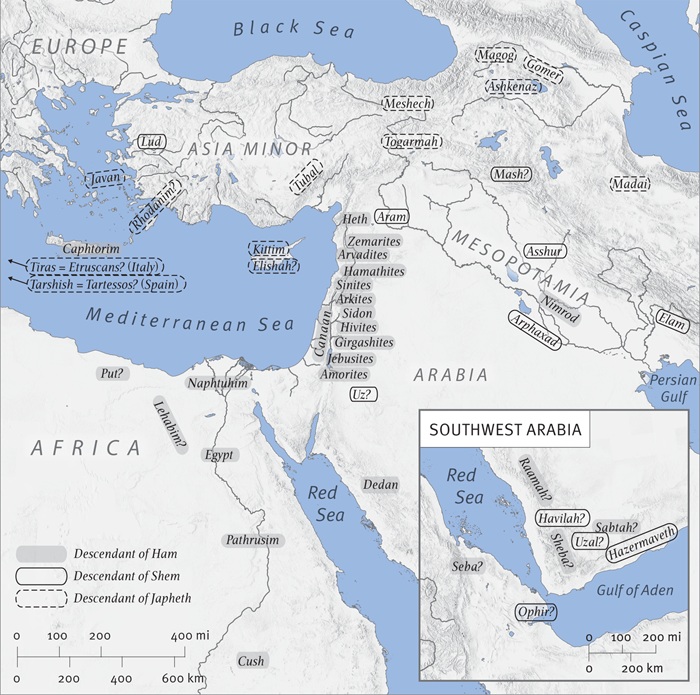
Table of Nations
Many of the people groups mentioned in Gen. 10 can be identified with relative certainty. In general, the descendants of Ham settled in North Africa and the eastern Mediterranean coast, the descendants of Shem in Mesopotamia and Arabia, and the descendants of Japheth in Europe and the greater area of Asia Minor.
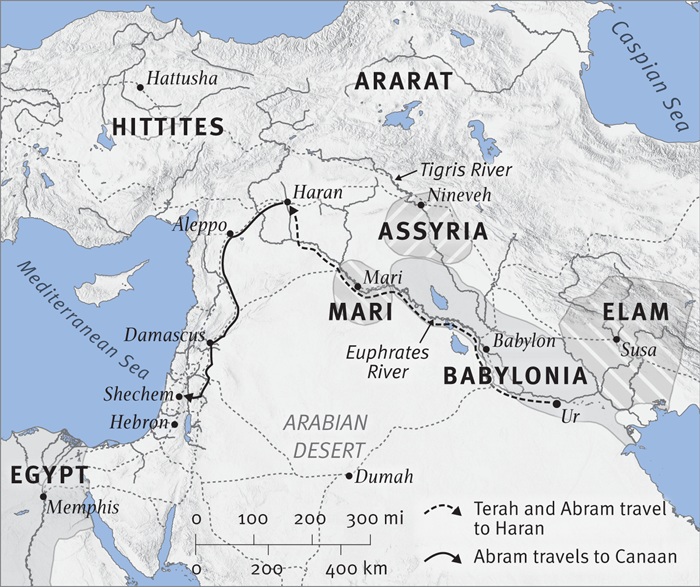
Abram Travels to Canaan
Abram was born in Ur, a powerful city in southern Babylonia. Abram's father, Terah, eventually led the family toward the land of Canaan but decided to settle in Haran (see Gen. 11:27–31). After Terah's death, the Lord called Abram to go "to the land that I will show you" (Canaan), which he promises to give to Abram's descendants.
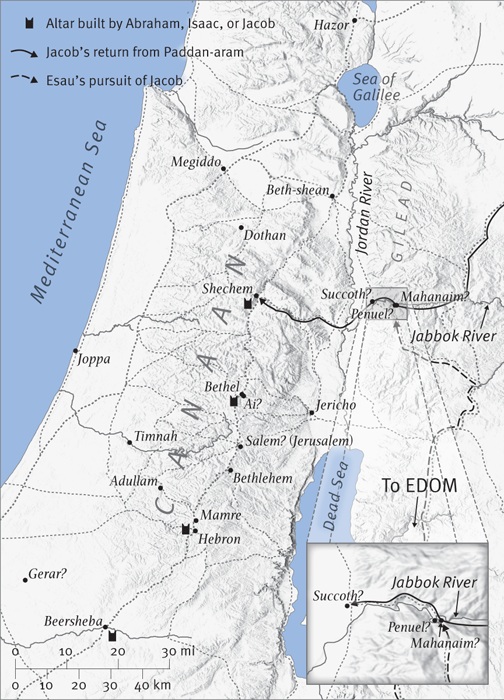
Jacob Returns to Canaan
After acquiring wealth in Paddan-aram, Jacob returned to Canaan. He came to Mahanaim, where he sent his household ahead of him and crossed the Jabbok alone. There he wrestled with a mysterious man until morning and named the place Peniel (also called Penuel). Jacob then encountered his brother Esau, who had come from Edom to meet him. After the two were reconciled, Esau returned to Edom, while Jacob journeyed to Canaan.
Joseph and his Brothers
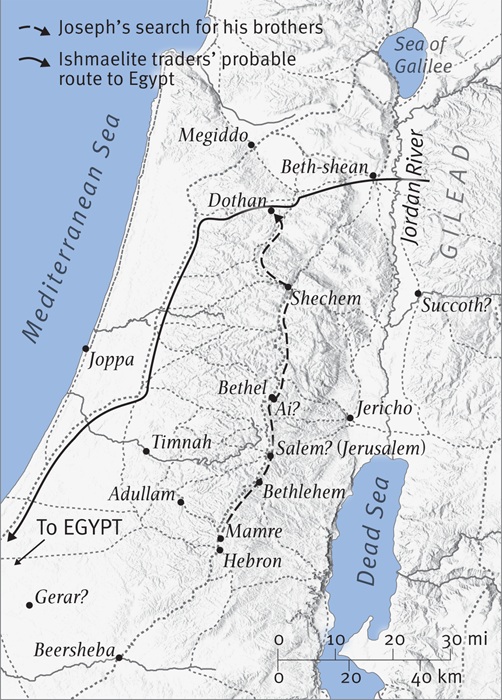
Jacob sent Joseph from Hebron to Shechem to find his brothers, who had been pasturing their father's flock. When Joseph arrived, he learned that his brothers had gone on to Dothan, so he went there and found them. His brothers threw him into a pit and later sold him to some Ishmaelite spice traders on their way from Gilead to Egypt. The traders took Joseph to Egypt and sold him to Potiphar, the captain of Pharaoh's guard.
The Journey to Mount Sinai
1446/1260 B.C.
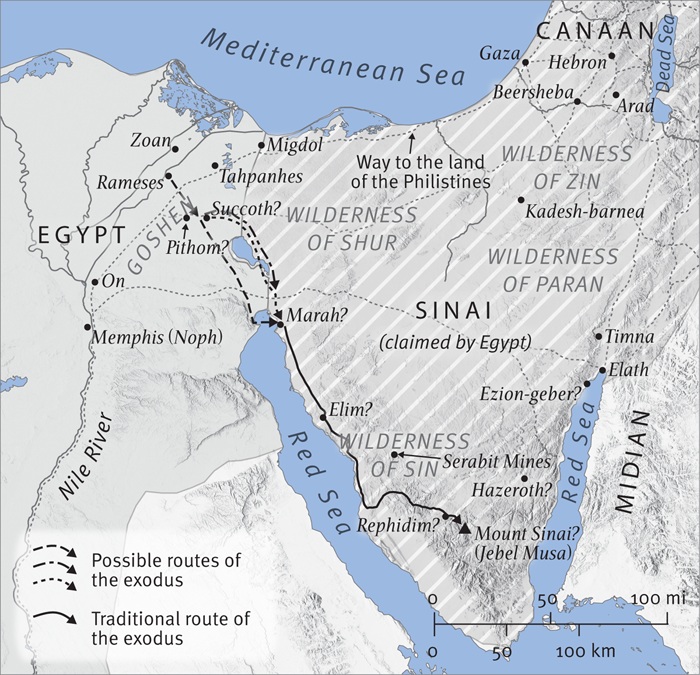
Among the many theories regarding the route of the exodus, the traditional route to Jebel Musa is considered by many scholars to be the most plausible. Beginning at Rameses, the Israelites journeyed to Succoth, but these two sites are the only ones on the route identified with certainty. From there they traveled to Etham and Pi-hahiroth, where they crossed the Red Sea. From there they traveled to Marah, Elim, Rephidim, and finally Mount Sinai.
The Journey to Canaan
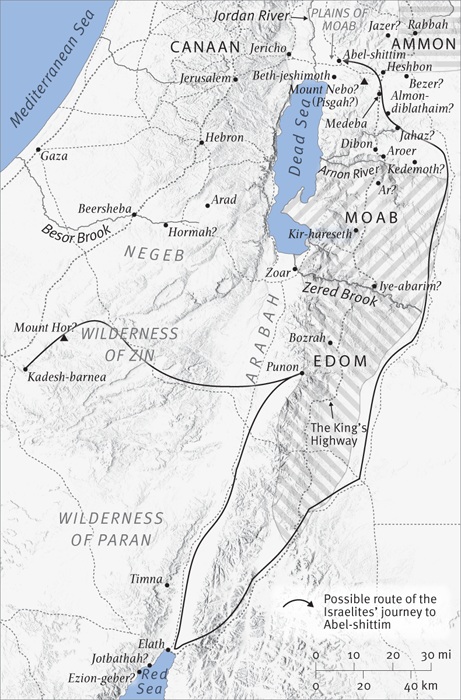
It is difficult to know for certain the exact route the Israelites took from Kadesh-barnea to the plains of Moab, but it is possible that they followed a course shown here, going around the lands of Edom and Moab along a desert route after they were refused passage through them.
The Conquest of Canaan: The Southern Campaign c. 1400 B.C.
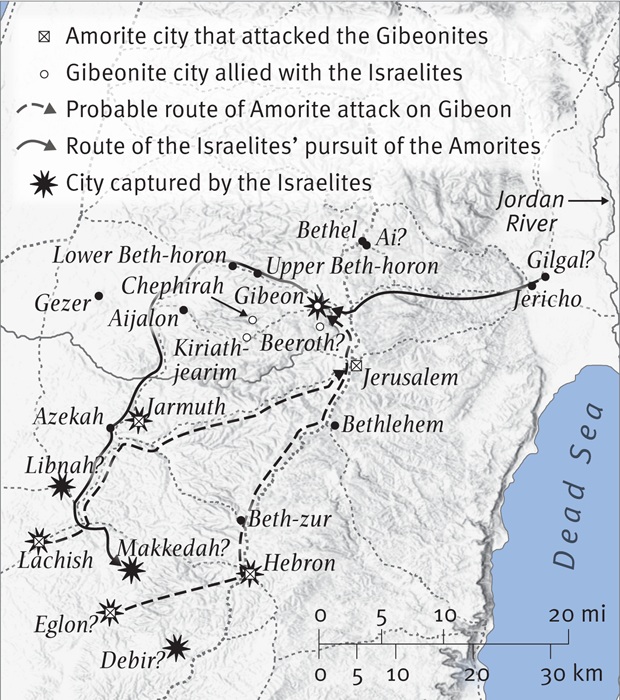
Upon hearing that the Gibeonites signed a peace treaty with the Israelites, five Amorite cities attacked Gibeon. Joshua's forces came up from Gilgal to defend the Gibeonites, and they chased the Amorites as far as Azekah and Makkedah. Joshua's forces continued their attack until they had captured Libnah, Lachish, Makkedah, Eglon, Debir, Hebron, and most likely Jarmuth.
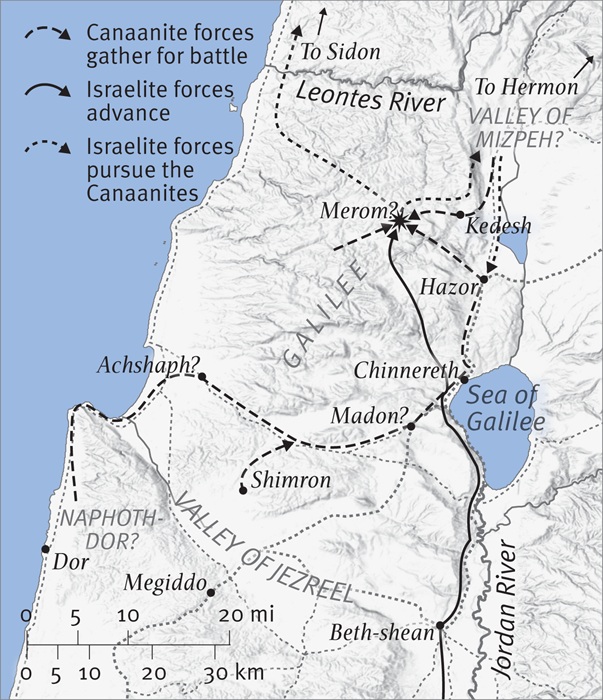
The Conquest of Canaan: The Northern Campaign c. 1400 B.C.
After Joshua's forces defeated several Amorite kings in the south, the king of Hazor assembled the northern Canaanite kings to battle the Israelites. Joshua and his men defeated the Canaanites at the waters of Merom and pursued them to Great Sidon and the Valley of Mizpeh. Then Joshua turned back and captured the city of Hazor.
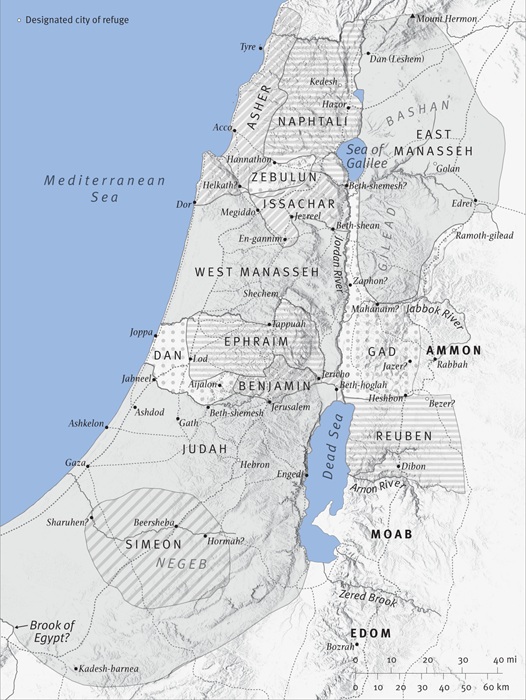
The Allotment of the Land
During the conquest of Canaan, Joshua allotted the land to the tribes of Israel. These boundaries, however, do not necessarily reflect the land each tribe actually inhabited by the end of the conquest. Several tribes, such as Dan, were unable to drive out the Canaanites that lived in much of their allotted territory (19:47), while other tribes controlled portions of land that were not originally allotted to them (e.g., 17:11).
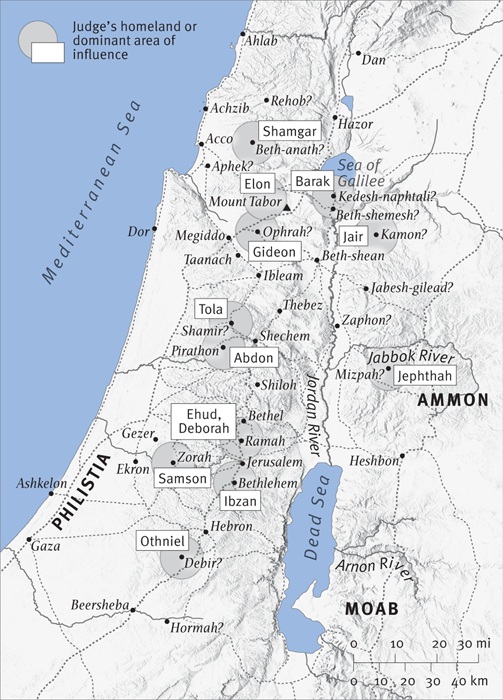
The Judges of Israel
The judges came from various tribes and regions of Israel, and they likely held varying degrees of influence over their neighboring regions and tribes.
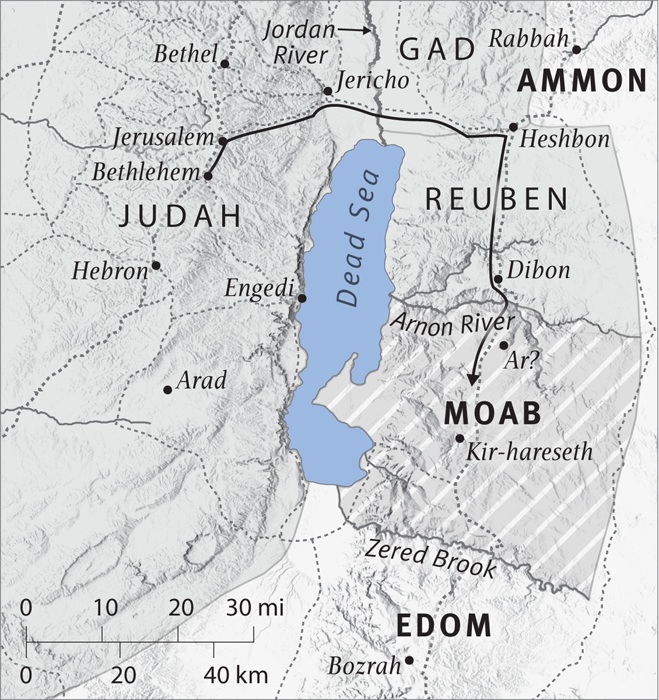
The Setting of Ruth
Set in the period of the judges, the book of Ruth records how a famine in Judah forces Naomi and her husband to leave Israel and move to Moab, where their sons marry Moabite women. When Naomi's husband and sons die, she decides to return to her home in Bethlehem in Judah, and her daughter-in-law Ruth chooses to go with her.
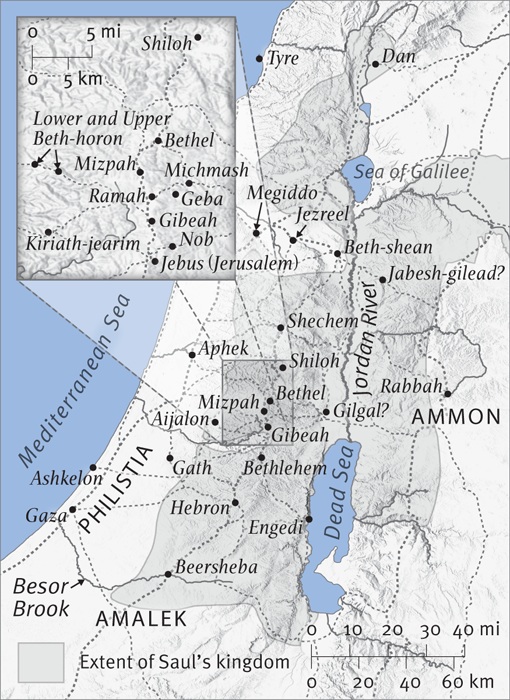
The Setting of 1 Samuel
The book of 1 Samuel is set in Israel during the time of transition between the period of the judges and the period of the monarchy. It opens with Samuel's birth and then describes his role as judge over Israel. When the people ask for a king, the Lord instructs Samuel to anoint Saul as Israel's first king.
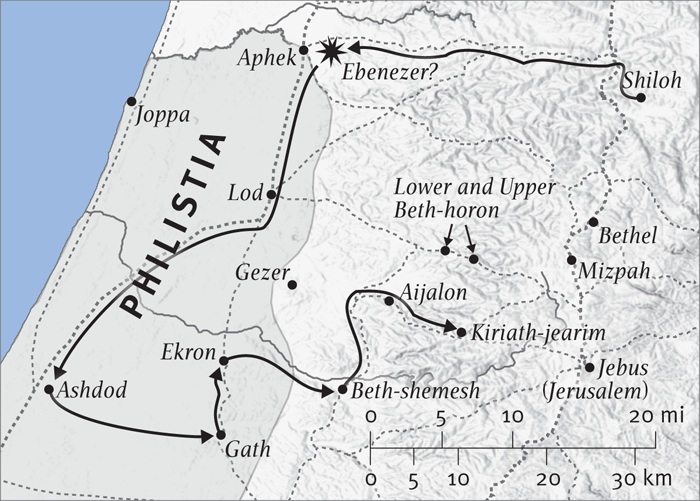
The Ark's Travels in 1 Samuel 3–7
After suffering losses in battle against the Philistines at Ebenezer, the Israelite forces called for the ark of the covenant to be brought to the battle from Shiloh. But the Israelites were defeated again, and the Philistines captured the ark. The ark's presence in each Philistine city caused the people to suffer terrible tumors, so it was sent away to another city. Eventually the ark was returned to Israel at Beth-shemesh, and then it was brought to Kiriath-jearim, where it remained for some 20 years.
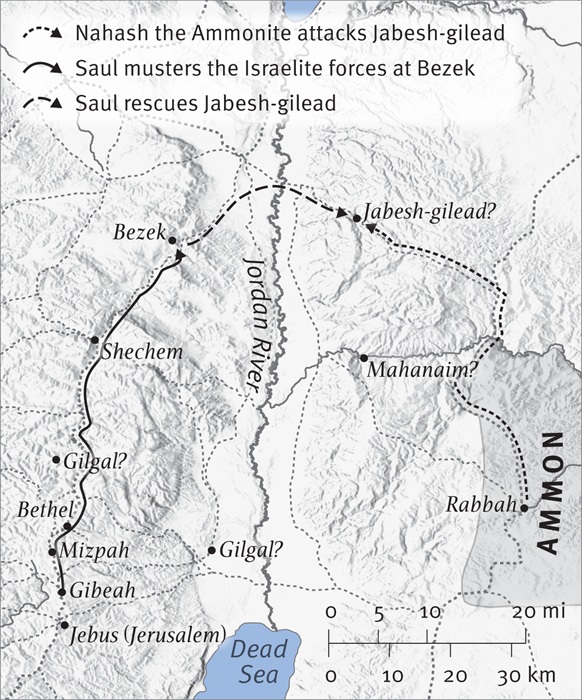
Saul Rescues Jabesh-gilead
Soon after Saul was anointed king of Israel, the people of Jabesh-gilead were attacked by the Ammonites. When Saul heard the news at Gibeah, he quickly mustered the Israelite forces at Bezek and defeated the Ammonites in battle. Samuel then called upon the people to confirm Saul's kingship at Gilgal.
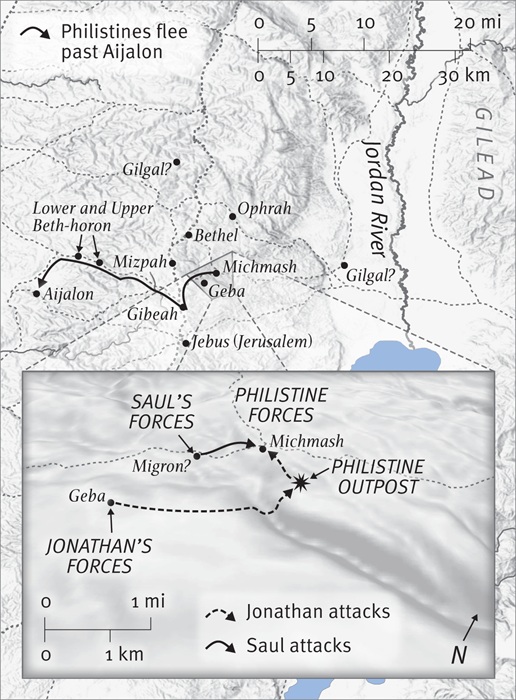
The Battle at Michmash
As the Philistines strengthened their grip on the central hill country of Israel, they placed troops at Michmash and sent raiding parties into the countryside. After Saul's son Jonathan captured the town of Geba, Saul mustered more Israelite forces at Gilgal and joined Jonathan. A daring raid by Jonathan across the ravine separating Michmash and Geba led to an Israelite victory over the Philistines, and the Israelites drove them from the hill country.
David Flees from Saul
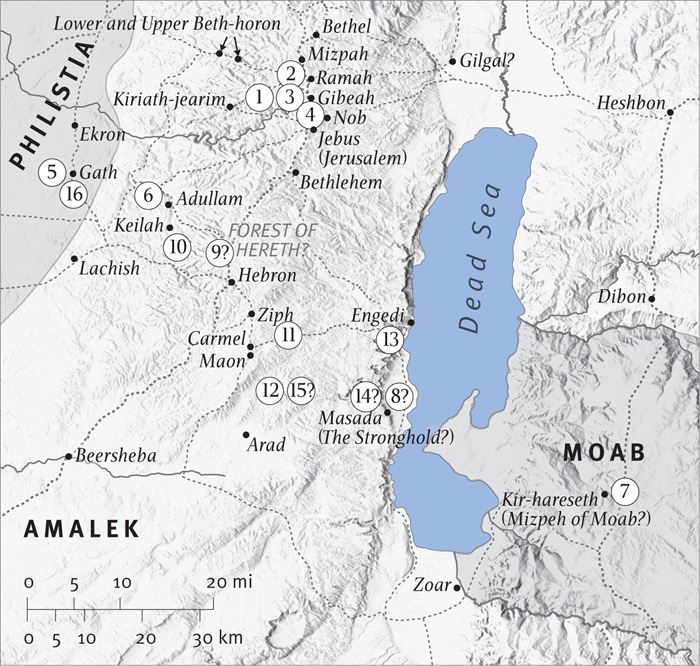
David's growing reputation among the people as a warrior and leader incited Saul's jealousy, and Saul began trying to kill David. David fled from Saul in Gibeah (1) and went to Samuel at Naioth in Ramah (2), but soon Saul sought him there, and David fled back to Jonathan in Gibeah (3). After Jonathan warned David of Saul's determination to kill him, David fled to Ahimelech the priest at Nob (4), where he collected food and Goliath's sword. David briefly sought refuge in the Philistine city of Gath (5) and then set up his headquarters at the cave of Adullam (6), where the ranks of his army swelled to 400 men. In order to protect his parents from harm, David left them in the care of the king of Moab at Mizpeh (7) and went to live in "the stronghold" (8). After some time, David went to the forest of Hereth (9) and then left to rescue nearby Keilah (10) from some Philistine raiding parties. When David heard that Saul was coming to Keilah, he and his growing army of 600 men relocated to the wilderness of Ziph (11). After the men of Ziph betrayed David to Saul, David and his men went to live in the wilderness of Maon (12) and narrowly escaped capture there by Saul. Fleeing the strongholds of Engedi (13), David again evaded capture by Saul and refused an opportunity to take Saul's life. David returned to "the stronghold" (14) and then to the wilderness of Paran (15). While he was there, David was again betrayed to Saul by the men of Ziph and refused another opportunity to take Saul's life. Finally, David and his men sought refuge with Achish, the king of Gath (16).
The Setting of 2 Samuel
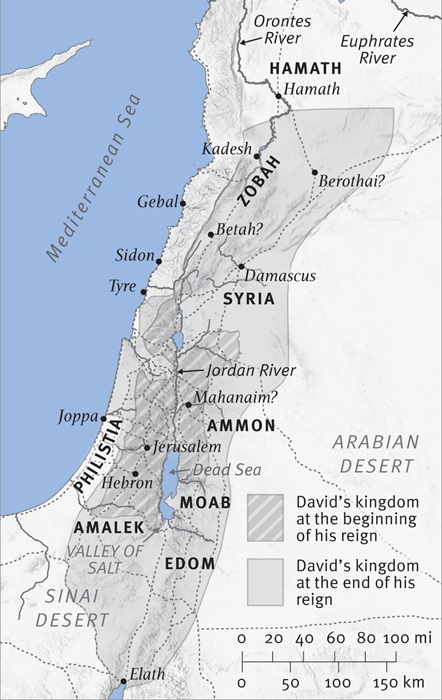
The book of 2 Samuel recounts David's reign over Israel and his battles to establish Israel as the dominant power in Syria and Palestine. David expanded Israel's borders from Saul's fledgling territory until, by the end of his reign, he controlled all of Israel, Edom, Moab, Ammon, Syria, and Zobah. Other kingdoms, such as Tyre and Hamath, established treaties with him.
David Captures the Stronghold of Zion
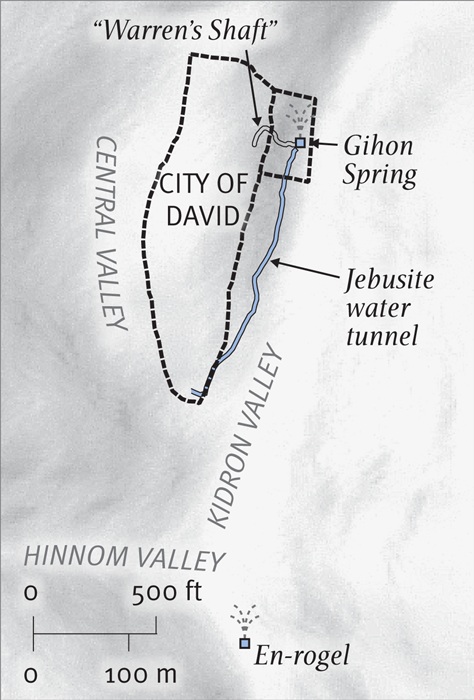
After securing his reign over all Israel, David moved his capital from Hebron, a southern city of Judah, to a more central and tribally neutral location at Jerusalem. At the time, Jerusalem (called "the stronghold of
Zion") was held by the Jebusites, and its terraced defensive walls and nearby steep hills and valleys made it seem impenetrable. But David sent men up a water shaft (believed by some to be Warren's Shaft) to capture the stronghold, and he renamed it the city of David.
Jerusalem at the Time of Solomon
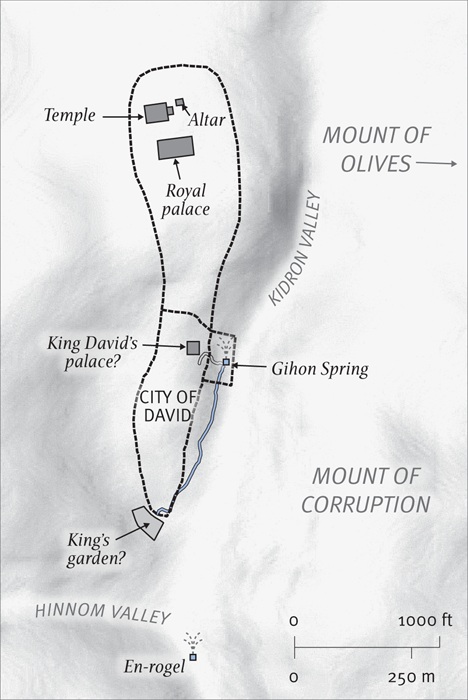
Through various building projects Solomon began to transform the small military stronghold of the city of David into a full-scale city that would be the geographical center of Israelite religion. He built the temple of the Lord and the royal palace complex on the hill to the north of the stronghold and encircled it with a wall. Ironically, Solomon also allowed his many foreign wives to establish pagan shrines on the hill to the east of the city, which would later be called the Mount of Corruption.
Solomon's International Ventures
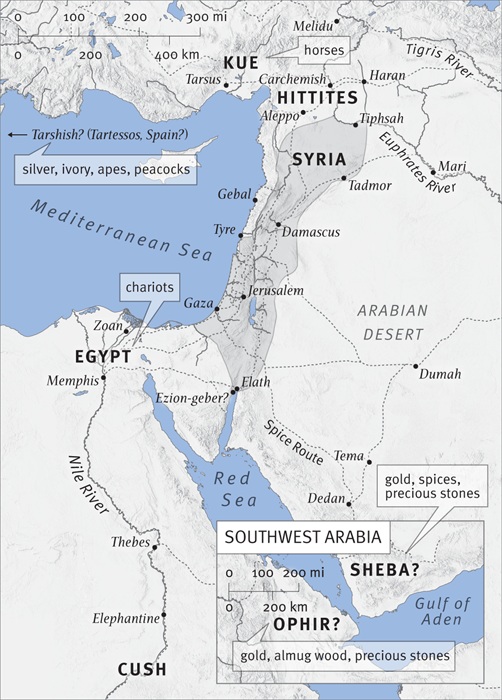
Solomon's firm control of important trade routes linking Egypt, Arabia, Mesopotamia, and Anatolia (Asia Minor) provided him with incalculable wealth. Partnering with King Hiram of Tyre, Solomon also launched his own trading expeditions to Ophir to acquire valuable and exotic goods. The queen of Sheba's visit to Solomon attests to his great fame throughout the ancient world. Solomon further augmented his wealth by buying horses from Kue and chariots from Egypt and selling them to the kings of Syria and the Hittites.
The Kingdom Divides
930 B.C.
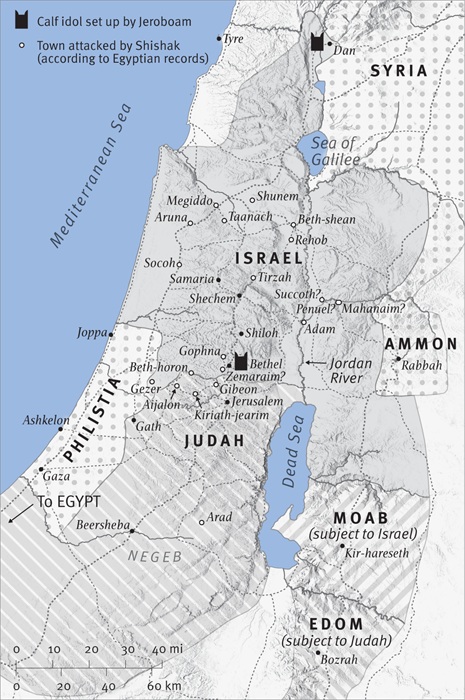
When Solomon's son Rehoboam arrived at Shechem for his coronation after his father's death, he refused to lighten his father's heavy tax burden on the people, and the 10 northern tribes revolted and set up Jeroboam as their king. The northern kingdom would now be known as Israel and the southern kingdom as Judah. Five years later, Shishak (also called Sheshonq) king of Egypt invaded Judah and Israel and captured a number of towns. Rehoboam avoided Jerusalem's destruction by paying off Shishak with many of the treasures Solomon had placed in the temple.
Elijah and Elisha
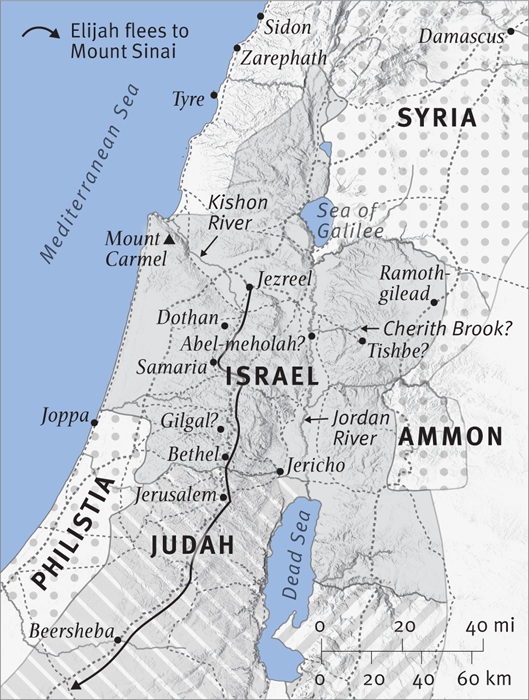
Elijah and his successor Elisha figure prominently in 1 and 2 Kings as they prophesied against the wickedness of Ahab and Joram (also called Jehoram) of Israel. Elijah's opposition to pagan worship also put him at odds with Jezebel, Ahab's Phoenician wife, who supported hundreds of prophets of Baal and Asherah. Eventually Elisha sent someone to anoint Jehu, one of Joram's commanders, to be the next king and to execute judgment on the entire family of Ahab.
The Fall of Samaria and Deportation of Israelites
722 B.C.
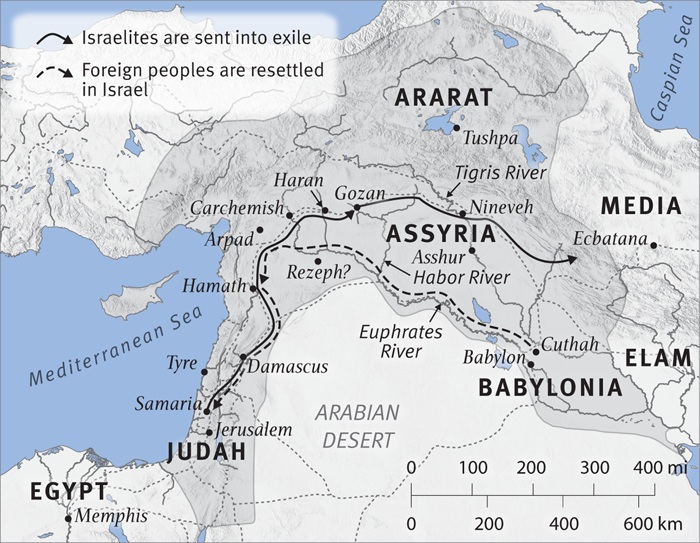
During the reign of Hoshea of Israel, Shalmaneser of Assyria attacked Israel and made it a vassal kingdom. Later, however, Hoshea conspired against Assyria, refusing to pay the tribute and appealing to Egypt for help, so the Assyrians came and besieged Samaria until it fell. Many Israelites were exiled far from Israel to the area near Gozan and the cities of the Medes, and foreign peoples from other parts of the empire were relocated to Israel in an effort to prevent revolt. This signaled the end of the northern kingdom of Israel.
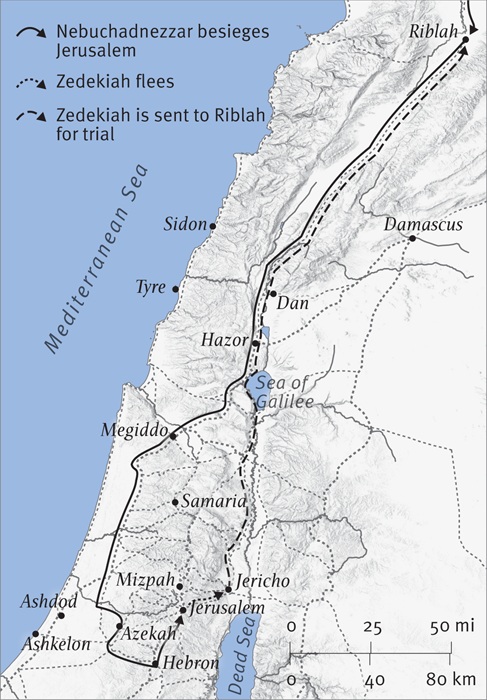
Exile to Babylon
The final years of the kingdom of Judah were marked by a power struggle between the Egyptians and the Babylonians, the rising power that had overtaken the Assyrian Empire. King Nebuchadnezzar of Babylon eventually won out and seized control of the Mediterranean coastal lands. When Zedekiah, who had been placed on the throne of Judah by the Babylonians, rebelled, Nebuchadnezzar besieged Jerusalem and captured the city. Zedekiah fled toward the east but was captured near Jericho and sent to Riblah to be judged.
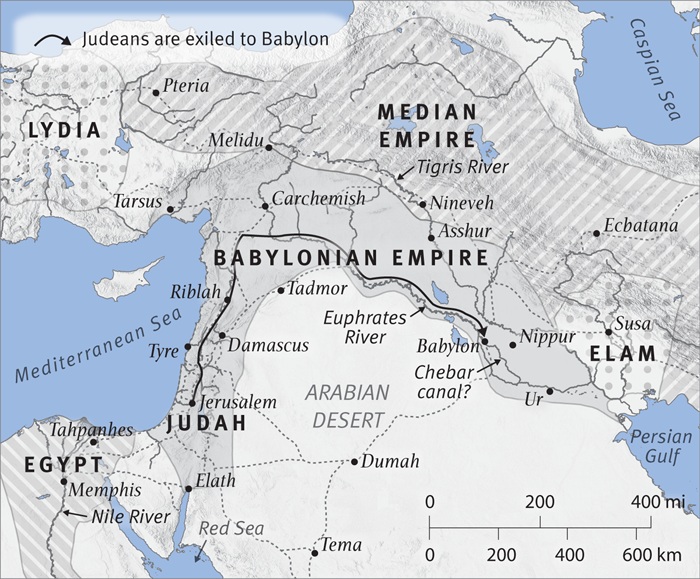
Babylon Attacks Judah
It appears that three separate deportations of Judeans to Babylon took place under the rule of Nebuchadnezzar (see also Jer. 52:28–30). The first came during the reign of Jehoiachin, when Nebuchadnezzar besieged Jerusalem and carried away many of the treasures of the temple and the royal palace. The second occurred after the fall of Jerusalem in 586 B.C., when the walls of the city were leveled and the temple was completely destroyed. The third appears to have occurred around 582 B.C. while King Nebuchadnezzar was reasserting his control over the general region of Palestine.
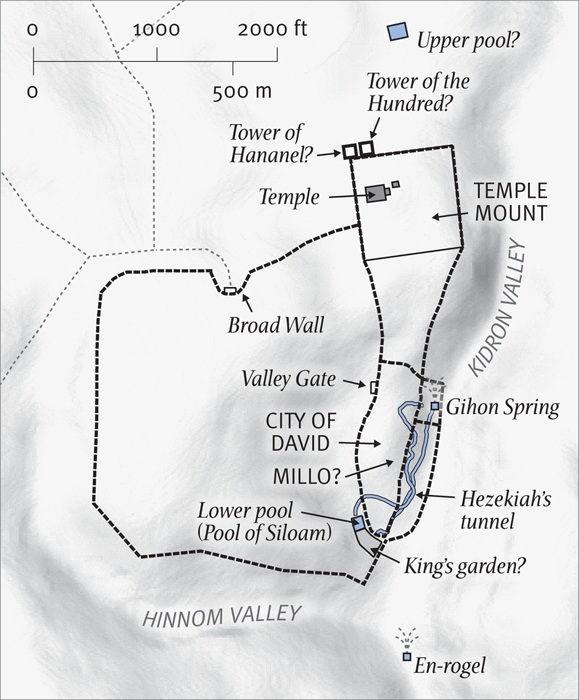
Hezekiah Fortifies Jerusalem
In anticipation of an Assyrian attack, King Hezekiah of Judah fortified Jerusalem, repairing broken sections of the wall and redirecting the flow of water from the Gihon Spring into the city. He also outfitted his army with weapons and shields and appointed battle commanders over the people. Archaeological evidence suggests he also enclosed the western hill of the city with a new wall and built the Temple Mount around Solomon's temple.
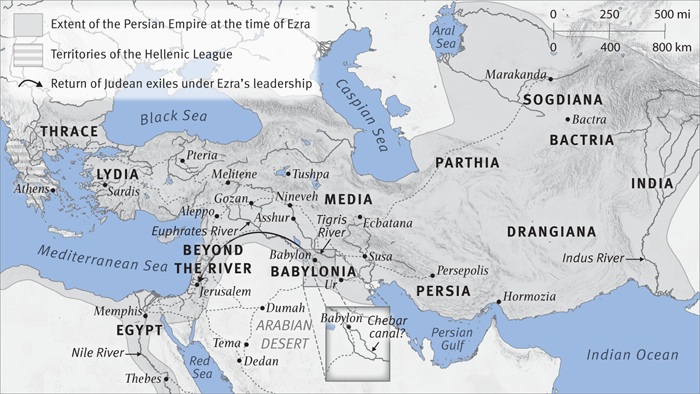
The Persian Empire at the Time of Ezra
During the time of Ezra the Persian Empire had reached its greatest extent, engulfing nearly the entire Near East. In 539 B.C. the Persians under Cyrus the Great defeated the Babylonians and absorbed their territory into the empire, including the lands of Israel and Judah (known as Beyond the River). The next year Cyrus allowed the people of Judah to return home under the leadership of Zerubbabel and rebuild the temple of the Lord. Later, around 458 B.C., another group of Judean exiles returned under Ezra's leadership.
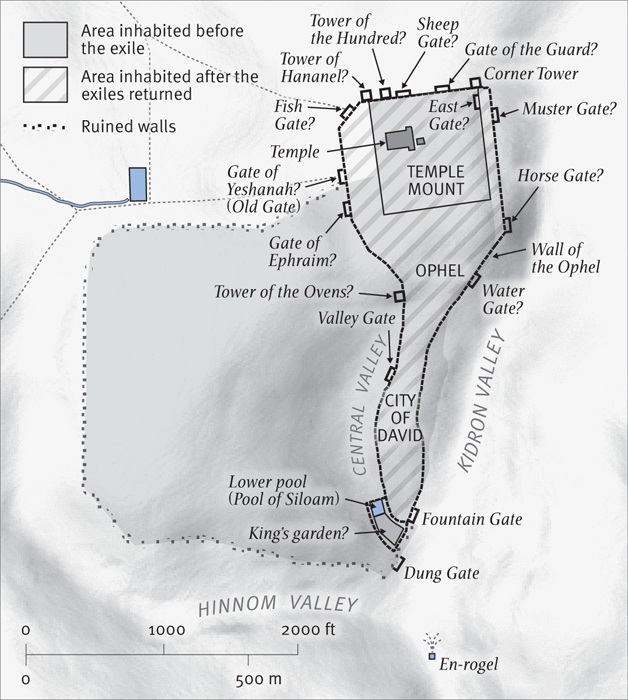
Jerusalem at the Time of Nehemiah
Though Nehemiah gives a careful listing of the sections of Jerusalem's walls that were rebuilt, it is difficult to be certain exactly which walls and gates he was referring to. The city had extended beyond the city of David and the Temple Mount by the time of Hezekiah, but it appears that only the Temple Mount and the city of David were enclosed within Nehemiah's walls. An ambitious project nonetheless, it was completed in only 52 days, providing Jerusalem with some measure of protection from its enemies.
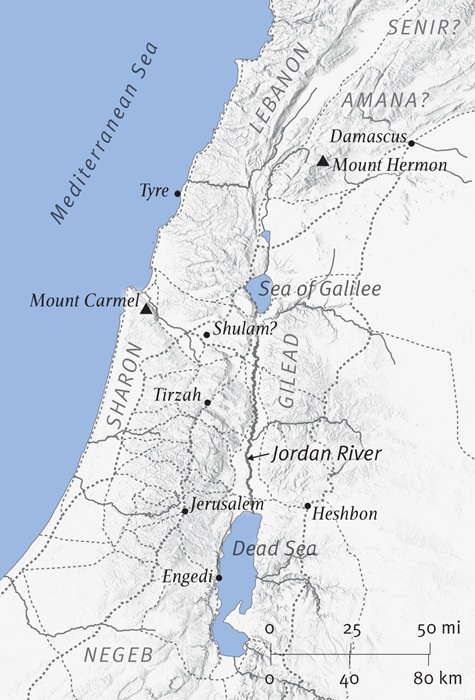
The Geography of Solomon's Song
The Song of Solomon draws richly upon the diverse and beautiful geographical setting of Israel and Lebanon, mentioning various cities, peaks, and regions within this general area.
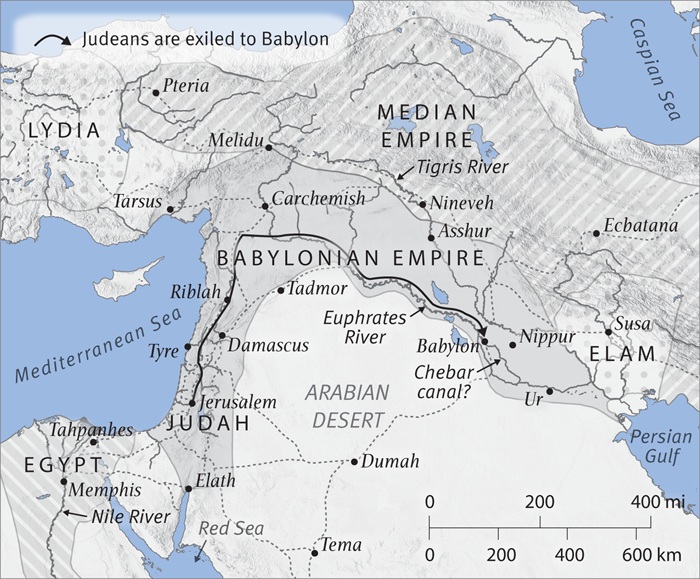
The Near East at the Time of Ezekiel
Ezekiel recorded his visions and prophecies while living in the vicinity of Babylon, where he had been exiled years earlier. By Ezekiel's time, the Babylonian Empire had engulfed virtually all of the area along the eastern coast of the Mediterranean Sea and would eventually subdue even the land of Egypt, where many other Judeans had fled.
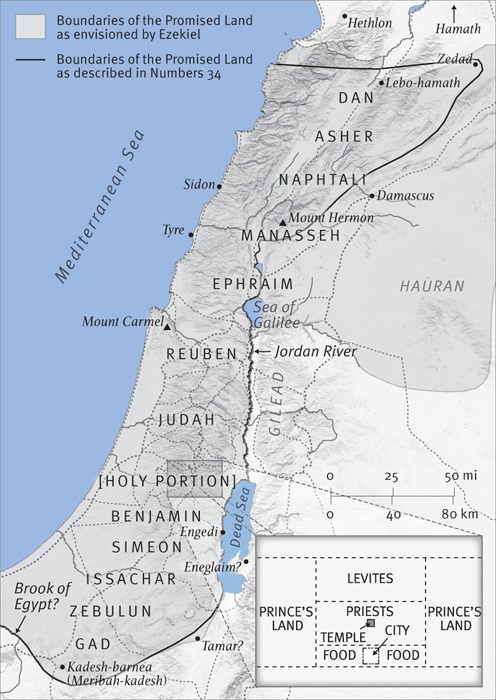
Ezekiel's Vision of Israel's New Boundaries c. 571 B.C.
Ezekiel's final vision describes the boundaries of a restored Israel, including the allotment to each tribe and the temple. Rather than following the boundaries traditionally occupied by the Israelites, which included Gilead east of the Jordan River and excluded land north of Tyre, Ezekiel's new boundaries generally follow those described by Moses in Num. 34. Ezekiel's vision also departs from the traditional allotment of the land among the 12 tribes and reassigns the land in horizontal bands from north to south.
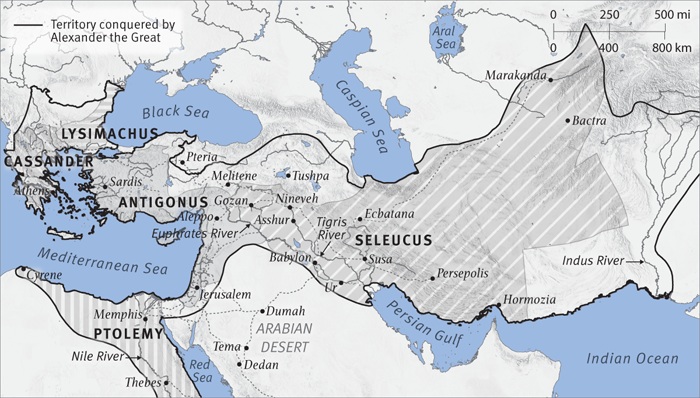
Alexander's Greek Empire
The ascension of Alexander the Great to the throne of the Macedonian kingdom (in northern Greece) spelled the end for the mighty Persian Empire. After gaining the loyalty of the other city-states of Greece,
Alexander's astounding military prowess and success enabled him to systematically overtake virtually all of Persia's former territory within 12 years. Soon after he died in Babylon at age 33 (323 B.C.), Alexander's conquered territory was divided among his generals, who constantly vied for power among each other until their territories resembled those shown here (c. 303).
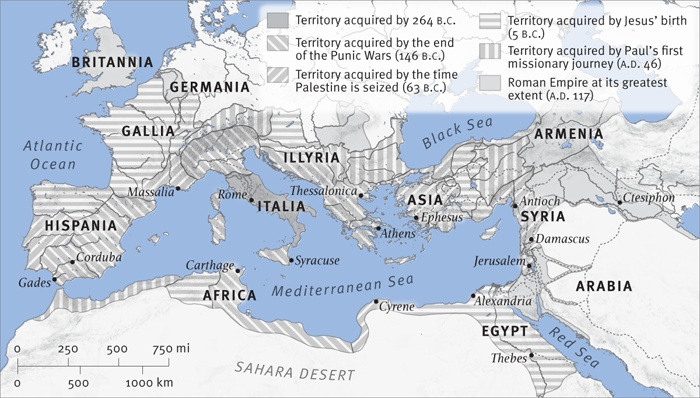
The Rise of the Roman Empire
From its earliest beginnings as a small kingdom centered in Rome, the Roman Empire eventually grew to become one of the most powerful empires the world has ever known. After solidifying control over the Italian peninsula, the Romans fought a series of wars (the Punic Wars) with the growing Carthaginian Empire and absorbed their territory in Africa and Hispania. Pushing eastward into Greece, Asia, and Syria, and westward into Gallia (Gaul) and western Hispania, the Romans continued to expand their territory until they ruled the entire Mediterranean region by A.D. 117.
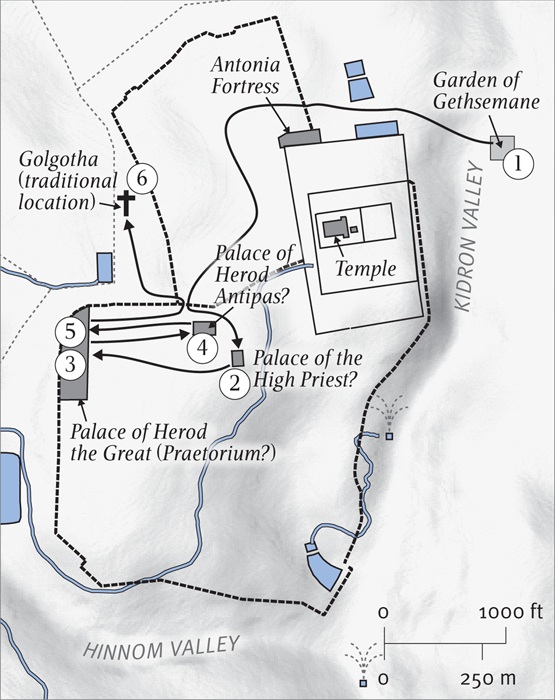
Jesus' Arrest, Trial, and Crucifixion
The path from Jesus' arrest to his crucifixion (part of which is often called the Via Dolorosa, "Way of Sorrows") is difficult to retrace with certainty. According to a possible harmony of the Gospel accounts, after the Passover meal Judas led a contingent of soldiers to Gethsemane to arrest Jesus (1). From there Jesus was led to Annas (location unknown), who sent him to his son-in-law Caiaphas, the high priest (2). The Jewish leaders then appealed to the Roman governor Pilate to have Jesus put to death (3). Luke records that Pilate sent Jesus to Herod Antipas (4), who questioned Jesus but returned him to Pilate without rendering any judgment (5). Pilate then sent Jesus to be crucified at Golgotha (6).
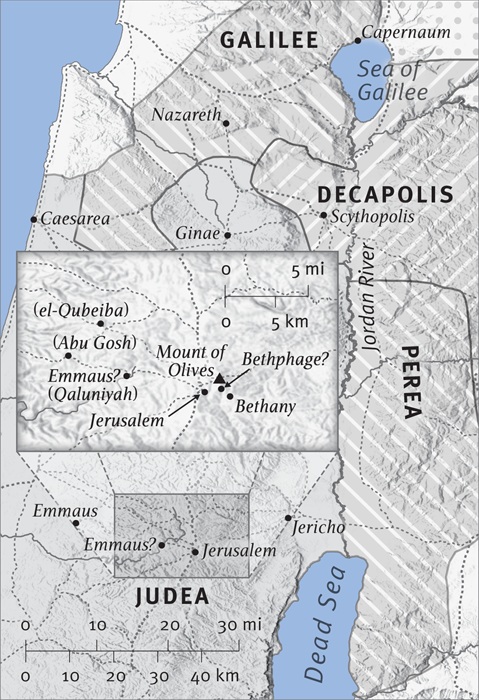
Jesus' Appearances after His Resurrection
Each of the Gospels and a few other NT books mention various appearances by Jesus after his resurrection, but only Luke notes that Jesus ascended to heaven from the Mount of Olives just outside Jerusalem. Luke also recounts Jesus' discussion with the two disciples on the road to Emmaus (likely modern Qaluniyah, not the Emmaus of the intertestamental period, which lay too far west). Matthew and John note that Jesus also appeared to his disciples in the region of Galilee.
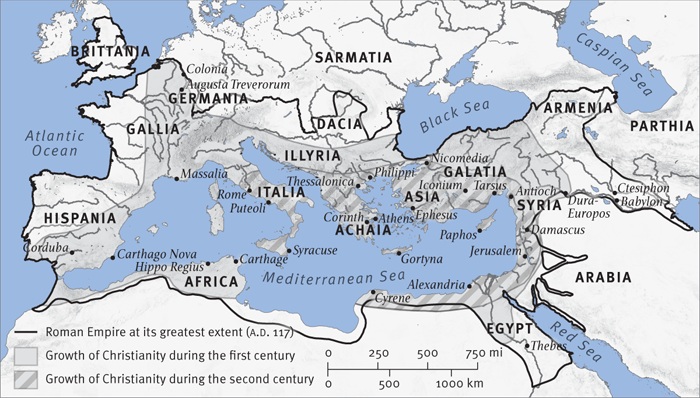
The Spread of Christianity in the First Two Centuries
The stability, relative safety in travel, and universal system of laws and government of the Roman Empire helped in the spread of the gospel throughout the first few centuries of the Christian church. Christianity first centered around Jerusalem and Syria, but soon spread to Asia, Achaia, and even Rome. Despite persecution, Christians during the second century a.d. continued to carry the gospel to places as far as Spain, Gallia, and North Africa. Eventually even Roman emperors came to recognize Christianity as a legal religion and sponsored many of its activities.
The Setting of Revelation
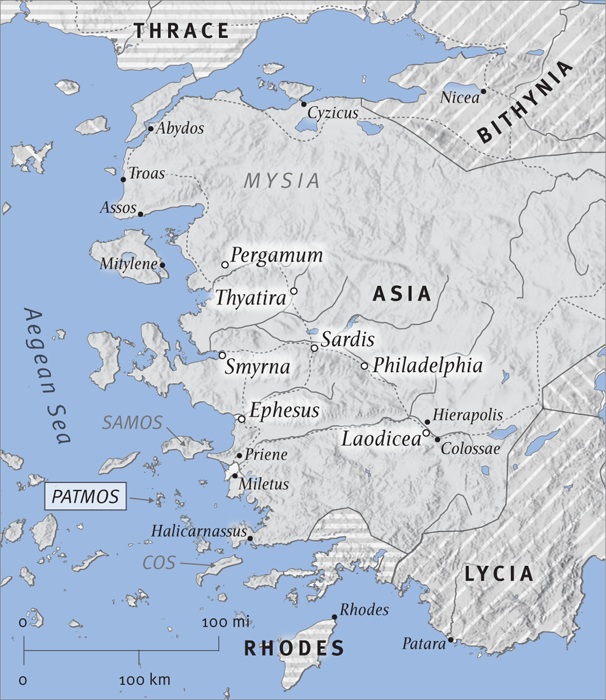
John addressed the book of Revelation "to the seven churches that are in Asia," namely Ephesus, Smyrna, Pergamum, Thyatira, Sardis, Philadelphia, and Laodicea, although there were undoubtedly other churches elsewhere in the province of Asia (e.g., Miletus and Colossae, see Acts 20:17; Col. 1:2). John had apparently been exiled from Ephesus to the island of Patmos, southwest of Ephesus, and it was there that he recorded his visions.
Adam to Israel's Twelve Tribes
The Plan of the Tabernacle
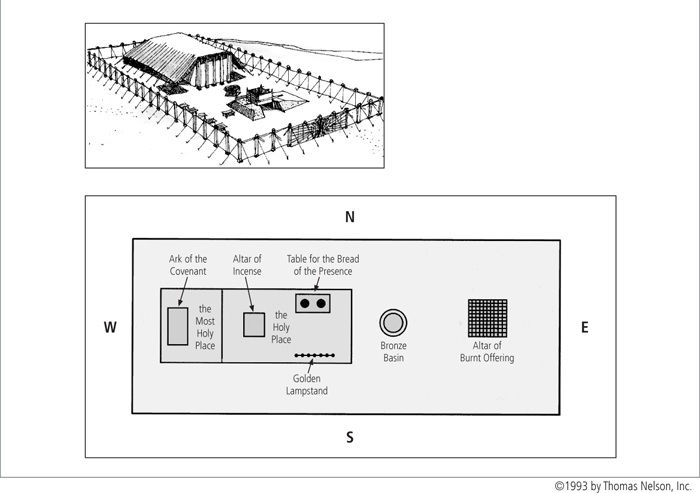
The tabernacle was to provide a place where God might dwell among his people. The term tabernacle sometimes refers to the tent, including the Holy Place and the Most Holy Place, which was covered with embroidered curtains. But in other places it refers to the entire complex, including the curtained court in which the tent stood.
This illustration shows relative positions of the tabernacle furniture used in Israelite worship. The tabernacle is enlarged for clarity.
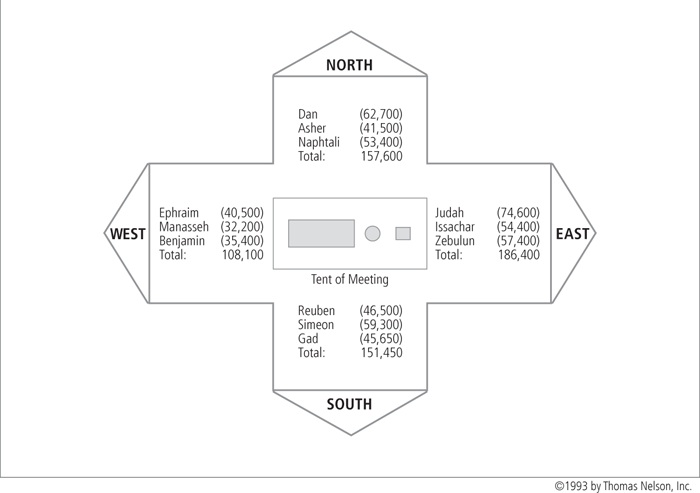
The Placement of Israel's Tribes
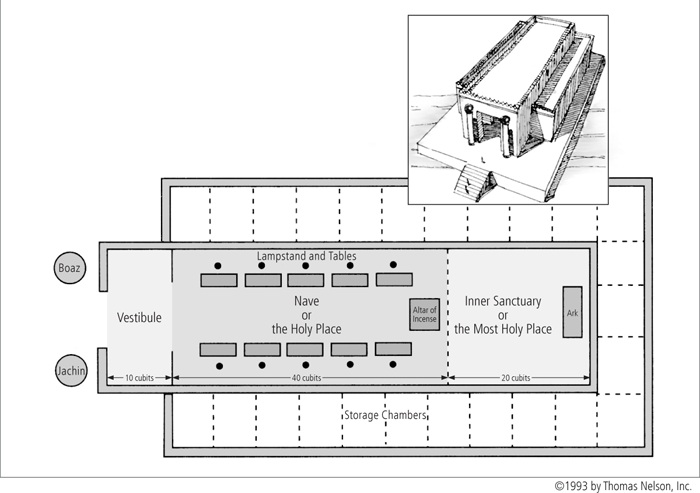
Solomon's Temple
Solomon constructed the temple on Mount Moriah, north of the ancient city of David. The temple was built according to plans that David received from the Lord and passed on to Solomon (1 Chron. 28:11–13, 19). The division into a nave and inner sanctuary corresponds to the division of the tabernacle into the Holy Place and Most Holy Place.
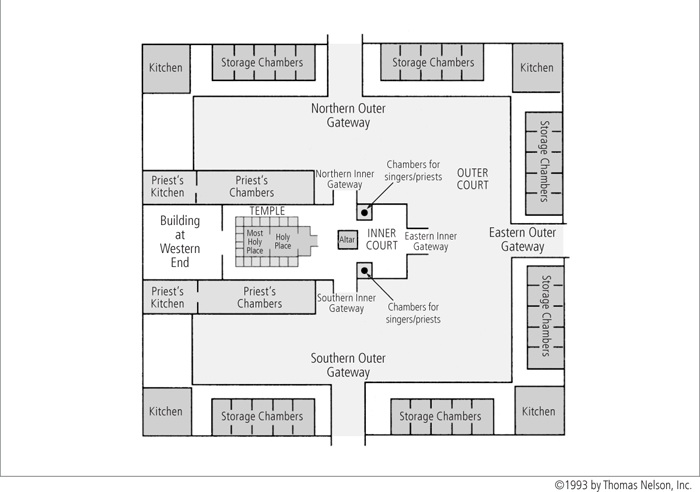
Ezekiel's Temple
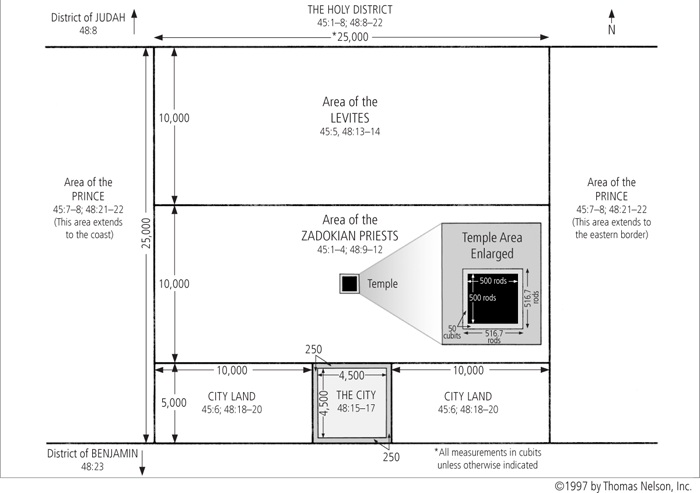
The Holy District
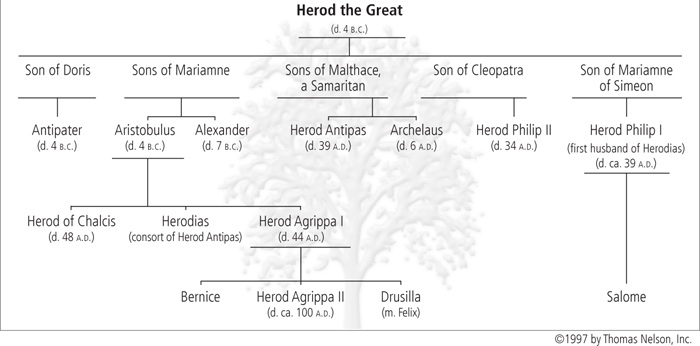
Family Tree of Herod
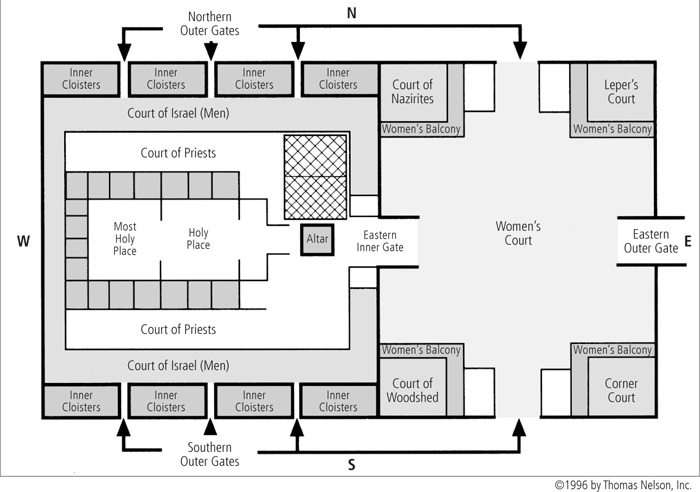
The Plan of Herod's Temple
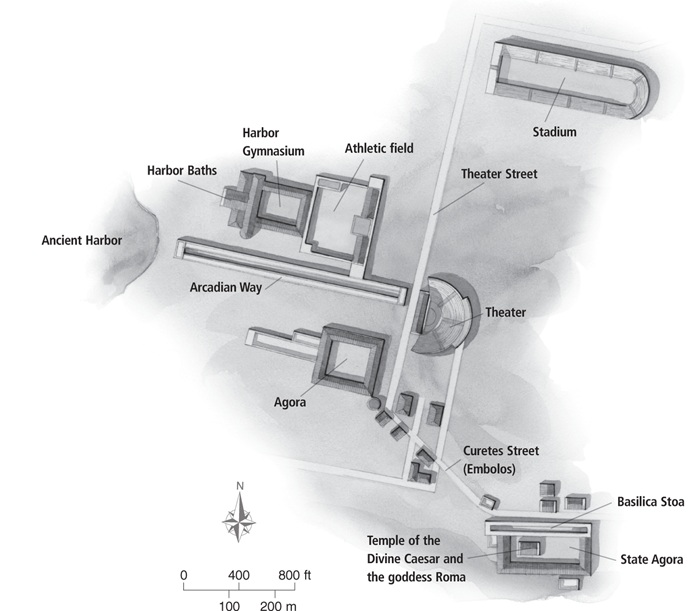
Ephesus in the Time of Paul (c. A.D. 60)
The city plan below shows those features of the city of Ephesus that archeologists have so far identified as dating from the time of Paul. Many of the notable buildings uncovered in the excavation at Ephesus date from later periods.
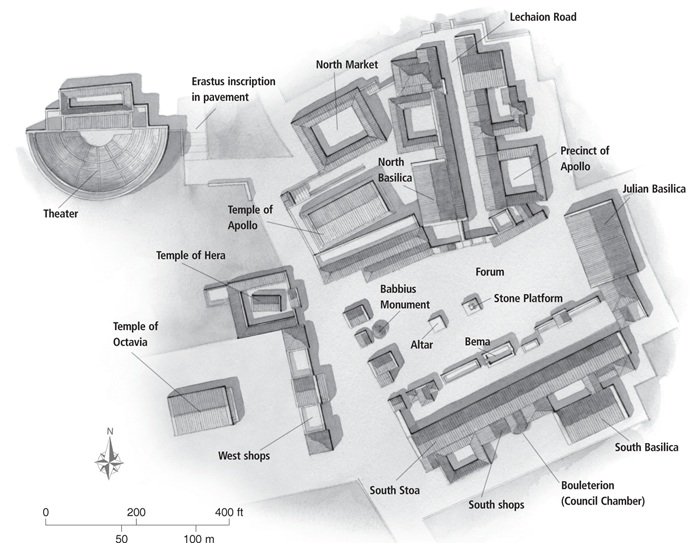
Corinth in the Time of Paul (c. A.D. 60)
The city plan below shows those features of the city of Corinth that archeologists have so far identified as dating from the time of Paul. Others remain to be discovered by future archeological excavations.
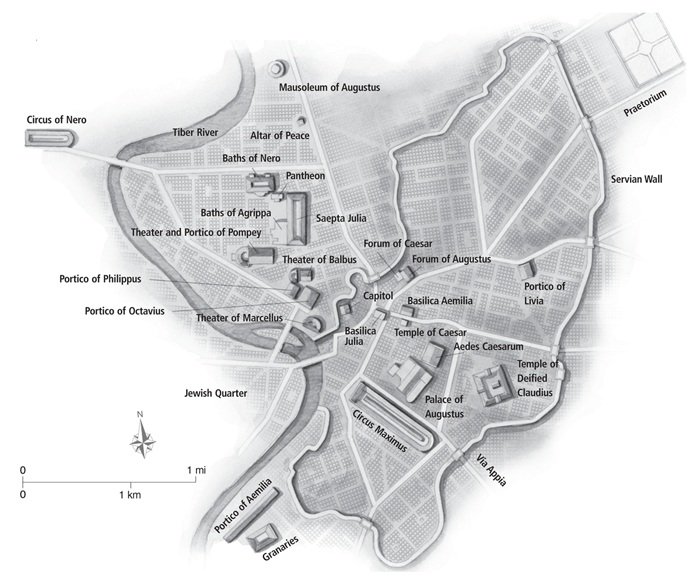
Rome in the Time of Paul (c. A.D. 60)
The city plan below shows most of the features of the city of Rome that archeologists have so far identified as dating from the time of Paul. Sections of the city would have been very impressive in his time, but most of the outstanding buildings visible in Rome today date to after his death.