
E. Jehoshaphat, King of Judah (1 Kings 22:41–50; 2 Chron. 17:1–21:3)
3. Solomon's Chastening for Breaking the Covenant (1 Kings 11:9–40) 4. Solomon's Death (1 Kings 11:41–43; 2 Chron. 9:29–31) V. THE KINGDOM DIVIDED (1 Kings 12:1–22:53; 2 Kings 1:1–17:41; 2
Chron. 10:1–28:27)
A. The Kingdom Divides (1 Kings 12:1–14:31)
1. The Division's Cause (1 Kings 12:1–24) 2. Jeroboam, King of Israel (1 Kings 12:25–14:20) 3. Rehoboam, King of Judah (1 Kings 14:21–31; 2 Chron. 10:1– 12:16) B. Judah's Two Kings (1 Kings 15:1–24; 2 Chron. 13:1–16:14)
1. Abijam, a.k.a. Joram, King of Judah (1 Kings 15:1–8; 2 Chron. 13:1–22) 2. Asa, King of Judah (1 Kings 15:9–24; 2 Chron. 14:1–16:14) C. Israel's Five Kings (1 Kings 15:25–16:28)
1. Nadab, King of Israel (1 Kings 15:25–31) 2. Baasha, King of Israel (1 Kings 15:32–16:7) 3. Elah, King of Israel (1 Kings 16:8–14) 4. Zimri, King of Israel (1 Kings 16:15–20) 5. Omri, King of Israel (1 Kings 16:21–28) D. Ahab, King of Israel (1 Kings 16:29–22:40)
1. Ahab's Sin (1 Kings 16:29–34) 2. Elijah the Prophet (1 Kings 17:1–19:21) 3. Wars with Syria (1 Kings 20:1–43) 4. Naboth Swindled and Killed (1 Kings 21:1–16) 5. Ahab's Death (1 Kings 21:17–22:40) E. Jehoshaphat, King of Judah (1 Kings 22:41–50; 2 Chron. 17:1–21:3)
F. Ahaziah, King of Israel (1 Kings 22:51–53; 2 Kings 1:1–18) G. Jehoram, a.k.a. Joram, King of Israel (2 Kings 3:1–8:15) H. Jehoram, King of Judah (2 Kings 8:16–24; 2 Chron. 21:4–20)
I. Ahaziah, King of Judah (2 Kings 8:25–9:29; 2 Chron. 22:1–9) J. Jehu, King of Israel (2 Kings 9:30–10:36)
K. Athaliah, Queen of Judah (2 Kings 11:1–16; 2 Chron. 22:10–23:21)
L. Joash, King of Judah (2 Kings 11:17–12:21; 2 Chron. 24:1–27) M. Jehoahaz, King of Israel (2 Kings 13:1–9)
N. Jehoash, a.k.a. Joash, King of Israel (2 Kings 13:10–25) O. Amaziah, King of Judah (2 Kings 14:1–22; 2 Chron. 25:1–28)
P. Jeroboam II, King of Israel (2 Kings 14:23–29) Q. Uzziah, a.k.a., Azariah, King of Judah (2 Kings 15:1–7; 2 Chron.
26:1–23) R. Zechariah, King of Israel (2 Kings 15:8–12)
S. Shallum, King of Israel (2 Kings 15:13–15) T. Menahem, King of Israel (2 Kings 15:16–22) U. Pekahiah, King of Israel (2 Kings 15:23–26) V. Pekah, King of Israel (2 Kings 15:27–31) W. Jotham, King of Judah (2 Kings 15:32–38; 2 Chron. 27:1–9)
X. Ahaz, King of Judah (2 Kings 16:1–20; 2 Chron. 28:1–27) Y. Hoshea, King of Israel (2 Kings 17:1–41) VI. THE SURVIVING KINGDOM OF JUDAH (2 Kings 18:1–25:30; 2
Chron. 29:1–36:23)
A. Hezekiah, King of Judah (2 Kings 18:1–20:21; 2 Chron. 29:1–
32:33) B. Manasseh, King of Judah (2 Kings 21:1–18; 2 Chron. 33:1–20) C. Amon, King of Judah (2 Kings 21:19–26; 2 Chron. 33:21–25) D. Josiah, King of Judah (2 Kings 22:1–23:30; 2 Chron. 34:1–35:27)
E. Jehoahaz, King of Judah (2 Kings 23:31–34; 2 Chron. 36:1–3)
F. Jehoiakim, King of Judah (2 Kings 23:35–24:7; 2 Chron. 36:4–8) G. Jehoiachin, King of Judah (2 Kings 24:8–16; 2 Chron. 36:9–10) H. Zedekiah, King of Judah (2 Kings 24:17–25:21; 2 Chron. 36:11–21)
I. Gedaliah, Governor of Judah (2 Kings 25:22–26) J. Jehoiachin Released in Babylon (2 Kings 25:27–30) K. Cyrus Decrees Rebuilding in Jerusalem (2 Chron. 36:22–23)
Introduction to the Prophets
The writing prophets of the OT fall into two groups: the four major prophets— Isaiah, Jeremiah, Ezekiel, and Daniel—and the 12 minor prophets—Hosea, Joel, Amos, Obadiah, Jonah, Micah, Nahum, Habakkuk, Zephaniah, Haggai, Zechariah, and Malachi. Lamentations falls into the major-prophet grouping because of its connection with Jeremiah.
Besides these, the OT regarded others as prophets. Such prophets as Gad, Nathan, Elijah, and Elisha were typical of the nonwriting prophets. In a sense, John the Baptist as a forerunner of Jesus was a prophet who belonged to the OT era.
The following table gives the sequence and approximate dates and direction of ministry for the writing prophets, with "Israel" designating the northern kingdom and "Judah" the southern:
Prophets organized by Date and Direction of Ministry
Prophets organized by Date and Direction of Ministry Prophet Ministered to in the Years Obadiah Edom 850–840 B.C. Joel Judah 835–796 B.C. Jonah Nineveh 784–760 B.C. Amos Israel 763–755 B.C. Hosea Israel 755–710 B.C. Isaiah Judah 739–680 B.C. Micah Judah 735–710 B.C. Nahum Nineveh 650–630 B.C. Zephaniah Judah 635–625 B.C. Jeremiah Judah 627–570 B.C. Habakkuk Judah 620–605 B.C. Daniel Babylon 605–536 B.C. Ezekiel Babylon 593–570 B.C. Haggai Judah 520–505 B.C. Zechariah Judah 520–470 B.C. Malachi Judah 437–417 B.C.
Another way of categorizing the writing prophets relates them chronologically to the captivities of Israel (c. 722 B.C.) and Judah (c. 586 B.C.):
Prophets organized by Writing Date and Captivity
Prophets organized by Writing Date and Captivity Preexilic Exilic Postexilic Obadiah Amos Micah Jeremiah Daniel Haggai Joel Hosea Nahum Habakkuk Ezekiel Zechariah Jonah Isaiah Zephaniah Malachi
Chronology of Old Testament Kings and Prophets
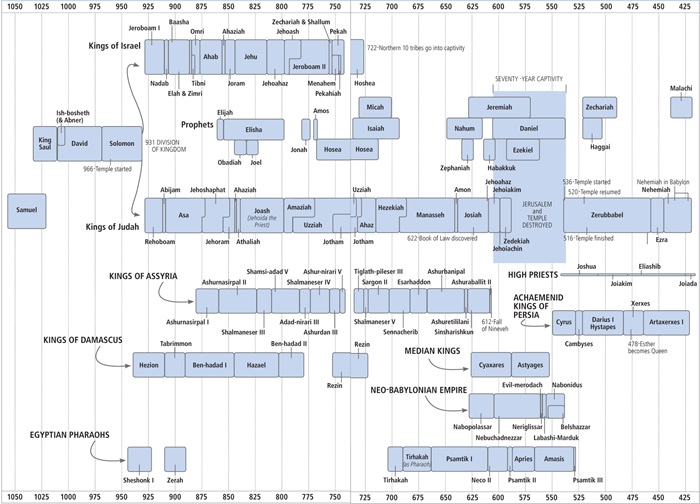
Messages of the writing prophets sometimes related to the prophets' immediate future (e.g., Isa. 7:1–11) and sometimes to the distant future (e.g., Isa. 7:12–14). In their frequent predictions about the coming Messiah, they saw him in two roles: that of a suffering Messiah (e.g., Isa. 53) and that of a reigning Messiah (e.g., Isa. 11). The prophets themselves were unable to comprehend completely how these two aspects of the Messiah's future ministry would fit together (1 Pet. 1:10–12).
God's dealings with Israel dominated the pages of the major and minor prophets, but several books—Daniel, Obadiah, Jonah, and Nahum—have as their subjects God's working in Gentile world history. The other prophetic books look beyond Israel from time to time to note how God's chosen nation will impact the rest of the nations (e.g., Isa. 52:10, 15) or how God will judge the nations.
As seen from the chronological listing on the previous page, the period of the writing prophets ended about 400 years before the coming of Christ. No official declaration marked the end of OT prophecy, but the people of Israel came gradually to the realization that no prophet had appeared in Israel for a considerable period of time (cf. 1 Macc. 9:27). From the perspective of later times, it became obvious to all that the great prophetic movement of the OT terminated and thus commenced the 400 "silent years," after which comparable written ministries of NT apostles and prophets began.
Genesis
Genesis 1 • Genesis 2 • Genesis 3 • Genesis 4 • Genesis 5 • Genesis 6 •
Genesis 7 • Genesis 8 • Genesis 9 • Genesis 10 • Genesis 11 • Genesis 12 • Genesis 13 • Genesis 14 • Genesis 15 • Genesis 16 • Genesis 17 • Genesis 18 • Genesis 19 • Genesis 20 • Genesis 21 • Genesis 22 • Genesis 23 • Genesis 24 • Genesis 25 • Genesis 26 • Genesis 27 • Genesis 28 • Genesis 29 • Genesis 30 • Genesis 31 • Genesis 32 • Genesis 33 • Genesis 34 • Genesis 35 • Genesis 36 • Genesis 37 • Genesis 38 • Genesis 39 • Genesis 40 • Genesis 41 • Genesis 42 • Genesis 43 • Genesis 44 • Genesis 45 • Genesis 46 • Genesis 47 • Genesis 48 • Genesis 49 • Genesis 50 Introduction to Genesis
Title Author and Date Background and Setting Historical and Theological Themes Interpretive Challenges Outline Footnotes Study Notes
Introduction to Genesis
Title
The English title, Genesis, comes from the Greek translation (Septuagint, LXX) meaning "origins"; whereas, the Hebrew title is derived from the Bible's very first word, translated "in the beginning." Genesis serves to introduce the Pentateuch (the first five books of the OT) and the entire Bible. The influence of Genesis in Scripture is demonstrated by its being quoted over 35 times in the NT and hundreds of allusions appearing in both Testaments. The story line of salvation that begins in Gen. 3 is not completed until Rev. 21–22, where the eternal kingdom of redeemed believers is gloriously pictured.
Author and Date
While 1) the author does not identify himself in Genesis and 2) Genesis ends almost three centuries before Moses was born, both the OT (Ex. 17:14; Num. 33:2; Josh. 8:31; 1 Kings 2:3; 2 Kings 14:6; Ezra 6:18; Neh. 13:1; Dan. 9:11, 13; Mal. 4:4) and the NT (Matt. 8:4; Mark 12:26; Luke 16:29; 24:27, 44; John 5:46; 7:22; Acts 15:1; Rom. 10:19; 1 Cor. 9:9; 2 Cor. 3:15) ascribe this composition to Moses, who is the fitting author in light of his educational background (cf. Acts 7:22). No compelling reasons have been forthcoming to challenge Mosaic authorship. Genesis was written after the exodus (c. 1445 B.C.), but before Moses' death (c. 1405 B.C.). For a brief biographical sketch of Moses read Ex. 1– 6.
Background and Setting
The initial setting for Genesis is eternity past. God then, by willful act and divine word, spoke all creation into existence, furnished it, and finally breathed life into a lump of dirt, which he fashioned in his image to become Adam. God made mankind the crowning point of his creation, i.e., his companions who would enjoy fellowship with him and bring glory to his name.
The historical background for the early events in Genesis is clearly Mesopotamian. While it is difficult to pinpoint precisely the historical moment for which this book was written, Israel first heard Genesis sometime prior to crossing the Jordan River and entering the Promised Land (c. 1405 B.C.).
Genesis has three distinct, sequential geographical settings: 1) Mesopotamia (chs. 1–11); 2) the Promised Land (chs. 12–36); and 3) Egypt (chs. 37–50). The time frames of these three segments are: 1) Creation to c. 2090 B.C.; 2) 2090– 1897 B.C.; and 3) 1897–1804 B.C. Genesis covers more time than the remaining books of the Bible combined.
Historical and Theological Themes
In this book of beginnings, God revealed himself and a worldview to Israel that contrasted, at times sharply, with the worldview of Israel's neighbors. The author made no attempt to defend the existence of God or to present a systematic discussion of his person and works. Rather, Israel's God distinguished himself clearly from the alleged gods of her neighbors. Theological foundations are revealed that include God the Father, God the Son, God the Holy Spirit, man, sin, redemption, covenant, promise, Satan and angels, kingdom, revelation, Israel, judgment, and blessing.
Genesis 1–11 (primeval history) reveals the origins of the universe, i.e., the beginnings of time and space and many of the firsts in human experience, such as marriage, family, the fall, sin, redemption, judgment, and nations. Genesis 12– 50 (patriarchal history) explained to Israel how they came into existence as a family whose ancestry could be traced to Eber (hence the "Hebrews"; Gen. 10:24–25) and even more remotely to Shem, the son of Noah (hence the "Semites"; Gen. 10:21). God's people came to understand not only their ancestry and family history, but also the origins of their institutions, customs, languages, and different cultures, especially basic human experiences such as sin and death.
Because they were preparing to enter Canaan and dispossess the Canaanite inhabitants of their homes and properties, God revealed their enemies' background. In addition, they needed to understand the actual basis of the war they were about to declare in light of the immorality of killing, consistent with the other four books that Moses was writing (Exodus, Leviticus, Numbers, and Deuteronomy). Ultimately, the Jewish nation would understand a selected portion of preceding world history and the inaugural background of Israel as a basis by which they would live in their new beginnings under Joshua's leadership in the land that had previously been promised to their original patriarchal forefather, Abraham.
Genesis 12:1–3 established a primary focus on God's promises to Abraham. This narrowed their view from the entire world of peoples in Gen. 1–11 to one small nation, Israel, through whom God would progressively accomplish his redemptive plan. This underscored Israel's mission to be "a light for the nations" (Isa. 42:6). God promised land, descendants (seed), and blessing. This threefold promise became, in turn, the basis of the covenant with Abraham (Gen. 15:1– 20). The rest of Scripture bears out the fulfillment of these promises.
On a larger scale, Gen. 1–11 set forth a singular message about the character and works of God. In the sequence of accounts that make up these chapters of Scripture, a pattern emerges that reveals God's abundant grace as he responded to the willful disobedience of mankind. Without exception, in each account God increased the manifestation of his grace. But also without exception, man responded in greater sinful rebellion. In biblical words, the more sin abounded the more did God's grace abound (cf. Rom. 5:20).
One final theme of both theological and historical significance sets Genesis apart from other books of Scripture, in that the first book of Scripture corresponds closely with the final book. In the book of Revelation, the paradise that was lost in Genesis will be regained. The apostle John clearly presented the events recorded in his book as future resolutions to the problems which began as a result of the curse in Gen. 3. His focus is upon the effects of the fall in the undoing of creation and the manner in which God rids his creation of the curse effect. In John's own words, "No longer will there by anything accursed" (Rev. 22:3). Not surprisingly, in the final chapter of God's word, believers will find themselves back in the Garden of Eden, the eternal paradise of God, eating from the tree of life (Rev. 22:1–14). At that time, they will partake, wearing robes washed in the blood of the Lamb (Rev. 22:14).
Interpretive Challenges
Grasping the individual messages of Genesis that make up the larger plan and purpose of the book presents no small challenge since both the individual accounts and the book's overall message offer important lessons to faith and works. Genesis presents creation by divine fiat, ex nihilo, i.e., "out of nothing." Three traumatic events of epic proportions, namely the fall, the universal flood, and the dispersion of nations are presented as historical backdrop in order to understand world history. From Abraham on, the pattern is to focus on God's redemption and blessing.
The customs of Genesis often differ considerably from those of our modern day. They must be explained against their ancient Near Eastern background. Each custom must be treated according to the immediate context of the passage before any attempt is made to explain it based on customs recorded in extrabiblical sources or even elsewhere in Scripture.
Outline
Genesis by content is comprised of two basic sections: 1) Primitive history (Gen. 1–11) and 2) Patriarchal history (Gen. 12–50). Primitive history records four major events: 1) Creation (Gen. 1–2); 2) the fall (Gen. 3–5); 3) the flood (Gen. 6–9); and 4) the dispersion (Gen. 10–11). Patriarchal history spotlights four great men: 1) Abraham (Gen. 12:1–25:8); 2) Isaac (Gen. 21:1–35:29); 3) Jacob (Gen. 25:21–50:14); and 4) Joseph (Gen. 30:22–50:26).
The literary structure of Genesis is built on the frequently recurring phrase "the book of the generations of" and is the basis for the following outline.
I. The Creation of Heaven and Earth (1:1–2:3) II. The Generations of the Heavens and the Earth (2:4–4:26)
A. Adam and Eve in Eden (2:4–25)
B. The Fall and Its Outcomes (ch. 3) C. Murder of a Brother (4:1–24) D. Hope in the Descendants of Seth (4:25–26) III. The Generations of Adam (5:1–6:8)
A. Genealogy—Seth to Noah (ch. 5)
B. Rampant Sin Prior to the Flood (6:1–8) IV. The Generations of Noah (6:9–9:29)
A. Preparation for the Flood (6:9–7:9)
B. The Flood and Deliverance (7:10–8:19) C. God's Noahic Covenant (8:20–9:17) D. The History of Noah's Descendants (9:18–29) V. The Generations of Shem, Ham, and Japheth (10:1–11:9)
A. The Nations (ch. 10)